Memorial Garden Opening 

Mixing my day job with my hobby is not usual but I felt this was more than worthy of a post.

For some time now I have been toying with the idea of a Memorial Garden at school tied in with the various topic work that we have been doing, which is linked to both the World War I and VE-day commemorations.

The idea really came to fruition in sort early last year when I approached the head of the school and put the idea to her. With enthusiasm the go ahead was given and the children were approached with the idea as an after school club. A small group volunteered to help and we began planning.

On June 18th 2015 the plan finally came together.

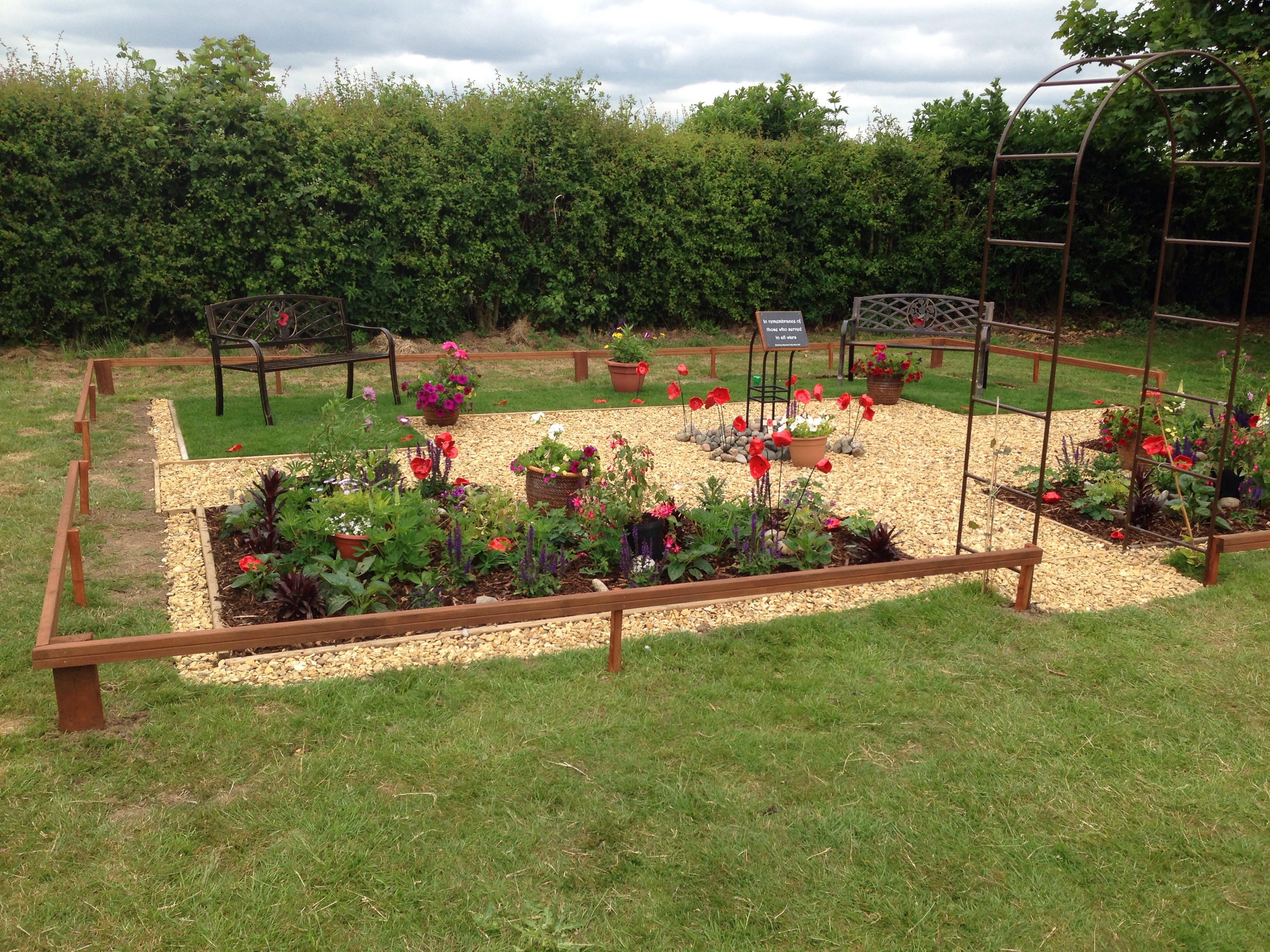
The Memorial at the Centre of the Garden.

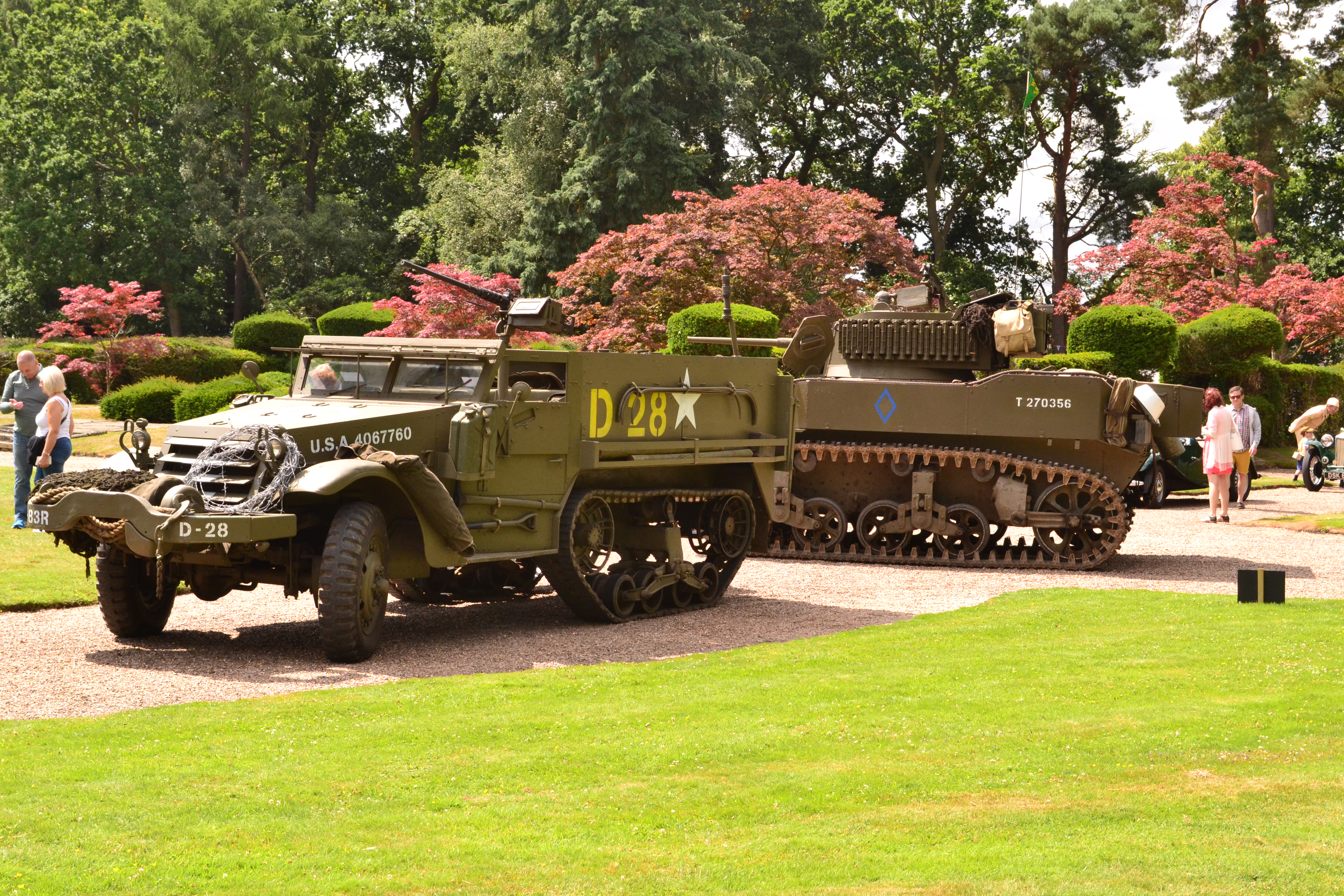
As people arrived they were greeted with refreshments and displays of work, photos of family members along with artefacts gathered or brought in by friends and parents. My good friend Kevin Fleckner brought four original uniform and bits from a crashed B-17 for us to show.

At 17:15 two RAF Tornado jets from RAF Marham flew overhead. The first low and slow, the second 15 seconds behind, higher and much faster with her wings swept. Over the school, she banked and the crowd waved. The event had opened.

The head then read a short introduction and it was my turn. I have to tell you that public speaking is not my forte and whilst I had been a little nervous I stood at the podium and the nerves vanished. My speech went thus:

June 18th 2015 is a special day. Not just because we’re opening this beautiful space, but for several iconic reasons. 200 years ago today the British and French forces were locked in arms at the Battle of Waterloo. 75 years ago today Winston Churchill made his famous “this was their finest hour” speech. Two dates that will go down in history as both important and momentous.

But these ae not the only significant dates in history.

100 years ago last year in 1914 young men in their thousands signed up with excitement for what they thought would be the war to end all wars. However, the war they thought would be over by Christmas went on for four long years. In the killing fields of Flanders, young men, many barely older than 16 or 17 were slaughtered in their thousands, living in mud and rat infested trenches very few were to survive. If not killed by the constant shelling, sniper fire or the slow march through no man’s land, many would suffer shell shock, a brutal psychological illness that would eat away at the very heart and soul of the young men. Eventually, in 1918 the First World War ended, the guns fell silent and Europe could finally begin rebuilding once more.

Sadly man’s inhumanity to man was to raise its ugly head again. In 1939, Europe was plunged once more into war with the German invasion of Poland. As The mighty Nazi war machine blitzkrieged its way across Europe, the British Armed Forces once more fought bravely in the name of freedom and democracy.

From the beaches of Dunkirk to the defence of Britain in the skies over Kent, the landing grounds of Normandy, to the battles in the Ardennes, Arnhem, over the Rhine and eventually the battle for Berlin itself, the brutality of war would once more be seen again.

The civilian population of Europe was to suffer greatly too. The blitz of our cities and the bombing of European targets that killed thousands upon thousands as bombs rained down from the sky. The concentration camps, death camps and prisoners of war camps saw a brutality on a scale that was and still is, incomprehensible.

From the hot deserts of Africa through the warm seas of the Mediterranean to the freezing conditions of the Arctic convoys, young men would bravely fight without question many paying the ultimate and final sacrifice.

Eventually, on 8th May 1945, the war in Europe finally ended and Peace reigned once more. However, the killing went on in the Far East. On the Pacific Islands of Okinawa, Saipan, Iwo Jima and Guadalcanal, The fighting continued in some of the most brutal conditions known to man. Eventually on August 15th 1945. UK time, following the Americans dropping the world’s most devastating and horrific bombs on Hiroshima and Nagasaki, war was declared finally over. The world has now entered the atomic age and six years of war had left it scars across Europe, the Middle East, The Far East, in the waters of the Atlantic and Pacific Oceans and across both the northern and Southern Hemispheres. Across the world millions lay dead, injured, homeless or orphaned. In the words of our distinguished guests here today “There are no winners in war.”

If there is one thing that history can teach us, it is that man is unable to live at peace with his fellow-man. Whether it be disputes over territory, natural resources or religious ideologies, War has continued to be fought and young men and women have continued to die.

In post-World War 2, the world lived on a knife-edge; the Cuban missile crisis being the ultimate stand-off between the east and west. From Korea and Vietnam to the Falkland Islands, the Middle Eastern countries of Iraq and Afghanistan, Britain and her allies have continued to fight for peace and democracy something we here take very much for granted.

It is in the name of these young men and women that we have built this memorial garden, so that their memories and their sacrifice may live on in the hearts and minds of future generations. It is so that we can pay homage and remember the dedication, bravery and self-sacrifice that they have shown so that we may live today without fear and in freedom.

It is to these people that I say thank you. Thank you for willing to lay down your life so we may freely speak out against injustice. To those who never came home, who paid the ultimate sacrifice, may you forever rest in peace. Thank you

Next one of the children read what the garden meant to him. Un-nerved by the occasion, he told how his father passed on his grandfathers tales of the war, how it means he can enjoy the peace and tranquility and he made a remarkably moving speech from the heart.

We then had a young lady from the group read in full the Robert Lawrence Binyon poem ‘For the fallen’. Short gasps from some of the audience told me they didn’t realise where the Remembrance Day words came from as it appears in the middle of the poem. She too read fluently and without falter, quite an achievement. Both these children were only just 10/11 years old.

A blessing by the vicar led us into the last post and a two minutes silence for those who had paid the ultimate sacrifice. A number of visiting Vets saluted, the Air Training Cadets lowered the colours and all went silent. Not a sound bar the cool wind in the adjacent trees.

My Good Friends Baz and Helen, whom helped enormously, John and Tony the Veterans and Kevin, who brought a number of uniforms and bits for us to display.

After the reveille the colours were raised and the two veterans invited to open the memorial officially. One Tony, a Normandy D-day+1 vet and the other John, who fought from Africa against Rommel’s Tigers, through Italy up into the continent, stood either side. As they lifted the flag, John declared the garden open to applause from the gathered audience. The children then sang unaccompanied Vera Lynn’s “We’ll meet again”; many from the audience joined in. The event closed and photos were taken around the memorial.

I estimated around 150 people, which for a small school of 68 children is remarkable. We had veterans from Cambridge a good hour and half away,  visitors from Northampton another similar distance and a large number of folk from the village turn up.

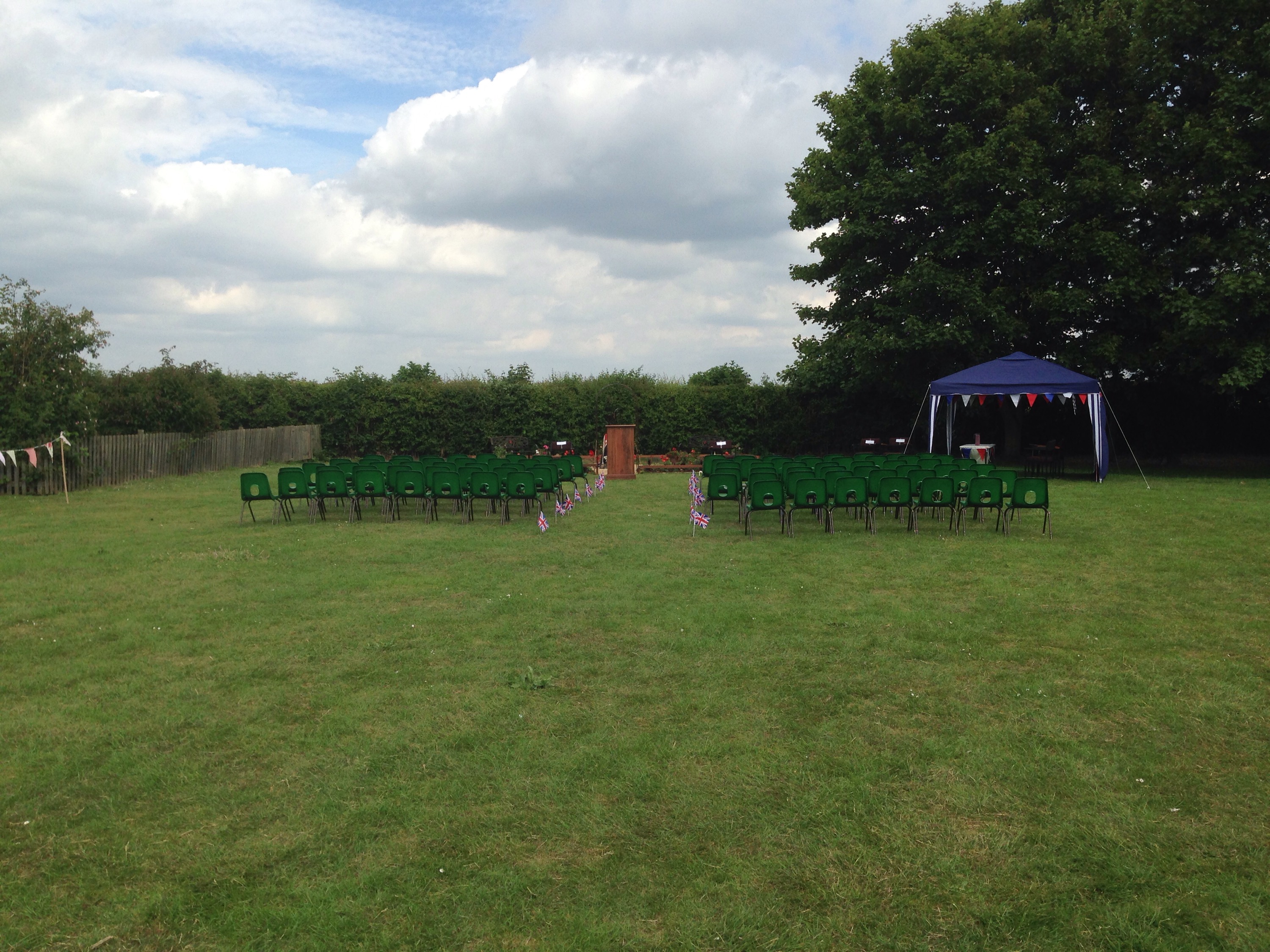
The seating before people started to arrive. There were many more standing, being a small school. we simply didn’t have enough chairs!

The feedback from visitors was superb and everyone was buzzing.

A real team effort, the long evenings, the hard work and recent battle against moles had all been worth while.

We had texts and emails from those who were there praising the efforts. It all worked out far better than even I had envisaged.

We shall miss it. We had great fun, even the odd beer or two, but it has been a real bonding exercise, we have become a little ‘family’ and are really proud of our achievements.

I passed on the good wishes to the children whom I think are quite overwhelmed themselves. They did a fantastic job and were superb role models for others to follow.

The Garden as it is today. We shall seed the outside, and continue the fight with the moles. An area for relaxation and thought.

We shall continue to nurture and maintain the Garden and watch it grow. The children use it already and do enjoy it. The rose in the crown were the poppies. Made out of clay, they are all handmade by the children mounted on metal rods and bunched in groups of 3 or 4. They do look superb.

There were small stumbling blocks along the way, and these caused delays but none so great we couldn’t deal with them. All in all it went beautifully, far, far better than I ever imagined and the finished product, I hope you’ll agree, is stunning.

An article appeared in the paper on the following day, Saturday here’s a link.

Structure of the Luftwaffe – The High Command.

Whilst primarily focussed on detailing the disappearing airfields of Britain, I find it important to appreciate what it was the Royal Air Force and her allies were up against, and that to be able to appreciate the enormity and structure of these forces helps to appreciate the lives of those studied.

A breakdown of the USAAF Command and Airforces have been done, and whilst none of these explanations go into enormous depth (I have neither the expert knowledge nor the resources to deal at that level) they do hopefully give an explanation of the general layout of the relative force in question. With this in mind, I have now tackled the Luftwaffe and have hopefully provided a layman’s view of its formation and size. My German is poor to say the least, and if I have misspelt any words through translation, I sincerely apologise.

The Luftwaffe

The Luftwaffe were a fearsome, well equipped and highly trained force, who when in support of the Panzers and other ground forces, must be considered one of the best armed forces in history.

Following the Treaty Of Versailles, the German armed forces were cut to the bone and useless for Hitler’s vision of a powerful and dominating Germany. He would therefore have to commence a massive rebuilding plan along with research and development of ships, tanks and aircraft in order to build up his Third Reich and fulfill this vision.

With growth and development of the Luftwaffe happening almost unabated, Hitler was able to create a substantial force, that was well equipped and well-trained. Many models being developed under the guise of ‘Passenger’ aircraft, they were easily adapted to become bombers or troop carriers thus hiding the real reason for development.

With the outbreak of the Spanish Civil War, Hitler offered his Luftwaffe as ‘support’, whereas some historians believe this to have been a front for a rehearsal for the forthcoming invasion of Germany’s neighbours later on.

Not surprisingly, records show that a huge build up of military aircraft occurred along the eastern frontiers of Germany in the months prior to the invasion of Poland. The writing was on the wall and once the blitzkrieg started, and the forces of the Third Reich took more and more territory, the network of support needed to sustain them also needed to grow. This expansion led to changes in the supply structure of the various forces enabling them to deal effectively with the new challenges that they now faced. As an attacking force, in September 1939, there were high numbers of bombers 1,458 in all, including ground attack and dive bombers compared to 1,077 single and twin-engined fighters. Clearly a force for invasion and not one of defence.

As the war progressed, these numbers changed. By April 1945, there were known to be 1,305 day fighters, a further 485 night fighters and only 37 multi engined bombers. A significant shift from attack to defence.

Throughout the conflict, up until the last few months of the war, the hierarchy of the Luftwaffe remained as it was. But in the dying days it began to crumble and this most powerful force soon became disorganised and demoralised.

The Luftwaffe High Command.

The Luftwaffe was divided into two parts, the overall responsibility lay with Herman Goring – Commander-in-Chief of the Air Force (Oberbefehlshaber der Luftwaffe) who controlled both The Luftwaffe High Command (Oberkommando der Luftwaffe) and The State Minister for Air (Reichsminister der Luftfahrt). His office was within the Air Ministry (Reichsluftfahrt Mininsterium) located in the heart of Nazi Germany in Berlin. The High command, were concerned with military actions, whilst the Ministry for Air, dealt with the administration side of the Luftwaffe.

Bundesarchiv Bild 102-13805, Hermann Göring

Hermann Goring*1

The Luftwaffe High Command was further sub-divided into a number of different directorates covering areas such as: operations, organisation, Training, Movements, Intelligence, Equipment, and personnel. These were then sub-divided further some coming under the command of the Chief of Operations and others the Chief of the General Staff.

Within this branch of the Luftwaffe were two main levels, a forward and a rear. The forward codenamed ‘Robinson’ fell under the Chief of General Staff and were located close to Hitler’s headquarters. This echelon composed of the intelligence and operations directorates and wherever Hitler went, they followed. The second echelon, codenamed ‘Kurfurst’ were more widely spread around Berlin, but all the directorates kept in very close and constant contact.

Regular meetings between Hitler and the leaders of these three services (Ministry for Air, ‘Robinson’ and ‘Kurfurst’) would determine the actions of the Luftwaffe as a whole with orders being passed directly to those in charge of the flying units.

Beneath these top sections lay the Luftwaffe itself, operationally split into 4 fleets (Luftflotten):

Luftflotte 1 – commanded by Albert Kesselring in Berlin who oversaw units to the north-east of Germany

Luftflotte 2 – commanded by Helmut Felmy in Brunswick who controlled the north-west of Germany

Luftflotte 3 – commanded by Hugo Sperrle in Munich who controlled the south-west of Germany

Luftflotte 4 – commanded by Alexander Lohr in Vienna who controlled the south-east, Austria and Czechoslovakia.

As the war progressed, further fleets were added:

Luftflotte 5 – covering Norway, Finland and northern Russia

Luftflotte 6 – covering central Russia

Luftflotte Reich – covering home defence and flak.

Actual flying units, were given as much autonomy as possible, being freed of all administrative duties where they could. This was to allow for a rapid response to ever-changing demands on or near the front and would involve breaking each Luftlotte into zones (Luftgaue) who monitored and organised the airfields within their own zone. This sectioning allowed for the rapid and efficient movement of flying units between zones without the unnecessary problems of obtaining  supplies and slow administration.

The Luftwaffe high command were a well organised and efficient group. Operational matters dealt with by those with experience of battle, and close to Hitler, whilst the more administrative side dealt with by those further afield.

The chain of command was tight, well organised and efficient, the Luftwaffe was a major force to be reckoned with.

In the second part we shall examine the flying units themselves.

Other pages relating to the Luftwaffe can be found here.

Sources and Credits

*1 Photo by (Bundesarchiv, Bild 102-13805 / CC-BY-SA [CC BY-SA 3.0 de (http://creativecommons.org/licenses/by-sa/3.0/de/deed.en)%5D, via Wikimedia Commons) 20th June 2015

The Luftwaffe Data Book‘, Dr Alfred Price, Greenhill Publications, 1977, Pages 13-18

Organization of the Luftwaffe (1933–45), https://en.wikipedia.org/wiki/Organization_of_the_Luftwaffe_%281933%E2%80%9345%29

A Total Success or a Human Tragedy – Operation Carthage

The Shell House attack.

Whilst researching a recent trip I came across this interesting film detailing the attack by 140 Wing (RAF) on the Gestapo Headquarters in Copenhagen, Denmark in 1945. Codenamed ‘Operation Carthage’. Technically it was 100% successful, the building was destroyed, the papers burned and resistance fighters escaped, but the attack resulted in the loss of 10 crew members 13 civilians and 86 children.

On March 21st 1945, 18 Mosquitos from 140 Wing (RAF) consisting of 3 waves of 6 from 487 Squadron, 464 Squadron and 21 Squadron  and two supporting photographic Mosquitos, took off from RAF Fersfield to attack and destroy the Gestapo Headquarters in Copenhagen, Denmark.

Leaving just before 9:00am, so they would arrive over the target when it was at its busiest, they headed out over the north sea on a direct line to Denmark.

Attacking at roof top height, they struck a blow at the heart of the Gestapo, killing 151 Gestapo officers and allowing for the escape of 30 Danish resistance fighters.

Sadly in the attack, a Mosquito s/n SZ977, flown by Wg. Cdr. Peter A Kleboe and Fg.Off. K Hall, struck a building causing it to crash and burst into flames. Following aircraft blinded by the smoke, believed this to be the target and bombed it, hitting a school killing 86 children inside.

Some argue the loss of those civilians was not sufficient to justify the attack whilst others claim the success of the mission outweighs the tragic loss of civilian life. The Debate goes on!

Aircraft involved in the attack

(Mosquito Mk.VI)

No 487 Squadron

RS570 ‘X’ Gp Capt R N Bateson / Sqn Ldr E B Sismore (Raid Leader)
PZ402 ‘A’ Wg Cdr F M Denton / Fg Off A J Coe (damaged, belly landed at base)
PZ462 ‘J’ Flt Lt R J Dempsey / Flt Sgt E J Paige (hit by flak, 1 engine u/s, returned safely)
PZ339 ‘T’ Sqn Ldr W P Kemp / Flt Lt R Peel
SZ985 ‘M’ Fg Off G L Peet / Fg Off L A Graham
NT123 ‘Z’ Flt Lt D V Pattison / Flt Sgt F Pygram (missing)

No 464 Squadron

PZ353 Flt Lt W K Shrimpton RAAF (Pilot) / Fg Off P R Lake RAAF
PZ463 Flt Lt C B Thompson / Sgt H D Carter
PZ309 Flt Lt A J Smith RAAF / Flt Sgt H L Green RAAF
SZ999 Fg Off H G Dawson RAAF / Fg Off P T Murray (missing)
RS609 Fg Off J H Palmer RAAF / 2nd Lt H H Becker RNorAF (missing)
SZ968 Wg Cdr Iredale RAAF / Fg Off Johnson
All aircraft took off at 0840; last back landed 1405.

No 21 Squadron

SZ977 Wg Cdr P A Kleboe / Fg Off K Hall (missing)
PZ306 Sqn Ldr A F Carlisle / Flt Lt N J Ingram
LR388 Sqn Ldr A C Henderson / Flt Lt W A Moore
HR162 Flt Lt M Hetherington / Fg Off J K Bell
No 21 Squadron records list only these four aircraft and crews above as taking part in this operation.
All aircraft took off at 0835; the three which returned did so at 1355.

Sources:National Archives, June 14th 2015.


Engines roar over Grafton Underwood once more. 

The ‘updated’ memorial at the former American Airbase,  RAF Grafton Underwood (Station 106), has been revealed with the help of Europe’s only flying B17 – ‘Sally B‘.

A large crowd gathered at the Memorial On Friday 29th May 2015, to hear speakers and see the beautiful ‘Sally B‘ perform a number of flypasts over the skies of Station 106 once more.

I sadly could not go due to work commitments, but have been informed that it was a resounding success and that it was very well attended by well wishers and members of the public alike.

This updating, has been in the pipeline for a while now and all the hard work has finally paid off. A new parking area and flag poles have been added and the site generally improved for visitors.

I have obtained and attached a short ‘You Tube’ video taken by one of the visitors to the event for you to see.

A lovely end to a remarkable tail.

My thanks go to Kevin for all his hard work and dedication keeping the memorial in such great condition and the memories of the 384th BG (H) well and truly alive.

The video of the event was kindly sent to me,  I don’t know who took it but all credit goes to them. I will try to find their name and attach it when I can.

Grafton Underwood appears in Trail 6.

RAF Langham – A revolution on the very tip of Norfolk.

This airfield concludes our four-part tour around Norfolk. It visits a large airfield that played a revolutionary part in the Second World War. So revolutionary, that it paved the way for air defence well beyond the Second World War. We go to the very edge of North Norfolk, to an area of sanctuary, mud flats and a bird watchers paradise. A place where the sound of the Lark has replaced the roar of the piston engine.

RAF Langham

RAF Langham is located at the tip of North Norfolk’s coast. Its location perfect for the role it was to operate.

Built as a satellite to Bircham Newton, it opened in 1940, with three grass runways, and would take aircraft from a number of nearby airfields. Not having any official resident units until 1941, when the Polish and Czech units of 300 and 311 squadrons used it as a forward operating base, it saw little operational action. Langham was initially used as a gunnery training airfield, towing targets for gunnery practice at nearby Stiffkey, a few miles to the north. This is perhaps Langham’s most famous role and the one that many people associate with Langham.

Langham airfield display board

Langham Airfield (photo of the display board at Langham Dome).

Then in November 1942 Langham was closed and redeveloped having concrete runways laid and around 35 looped style dispersals. The longest runway, (NE/SW) was of 1,988 yards, the second (N/S) 1,400 yards and the third (E/W) also of about 1,400 yards, all approximate. The accommodation sites were well away from the airfield many in and around the village of Langham itself to the east or south-east. Three T2 hangars were also erected, one to the north-west and two the south-east in the technical area. There were also various technical and administration blocks and a bomb storage area well away to the north of the site.

various 005

Langham’s Watch Office.

The first operational units arrived in April 1944, with Beaufighters of 455 (Australian) and 489 (New Zealand) squadrons of the Beaufighter Strike Wing, on the 8th and 13th respectively. This wing would famously form a combined attack against enemy shipping in the North Sea, being responsible for the sinking of 4 ‘U’ Boats and 36 surface vessels whilst here. A combination of nose mounted cannons and underwing rockets proved a deadly adversary for the flak ships and merchant vessels of the German Navy.

In August that year, the 521st Squadron moved from their base at RAF Docking to Langham to carry out its role of meteorological reconnaissance. Operating with Lockheed Hudsons, they would soon be ‘upgraded’ to Boeing’s massive B-17 adapted for these special duties. Other coastal command roles such as air-sea rescue were also carried out from Langham and a range of aircraft types would operate from here for the duration.

various 007

A collection of technical buildings still exist today.

Post war Langham was used by the Royal Netherlands Air Force as a Technical Training School, until June 1947 when it was vacated and then finally put into care and maintenance in the following September. For a short period between March 1953 and November 1958, it became a target towing site once more, pulling targets for No. 2 Civilian Anti-Aircraft Cooperation Unit and finally as if to defy the odds, it was used as an emergency landing ground for aircraft from nearby RAF Sculthorpe.

As with many of these Norfolk sites, Langham was eventually sold off, bought by Bernard Matthews becoming home to a number of turkey Sheds, the role it performs to this day.

various 001

Like so many in Norfolk, Langham’s main runway now houses poultry.

The majority of the concrete layout of Langham remains today, utilised by the company for transportation and storage. The technical sites and accommodation sites virtually indistinguishable from the farmland it once occupied. A small collection of buildings can be seen from the public road including: the watch tower, Fire tender shed, a Floodlight trailer, tractor shed,  a Night flying equipment store and a small brick hut used for weather balloons. To the north-east, on the brow of the hill sits the restored battle headquarters. But certainly the most famous and most distinguishable building of this site, is the former gunnery trainer dome.

various 011

The ‘famous’ Langham Dome – former Gunnery Trainer.

Refurbished through Lottery Money, the dome is now classed as an ancient monument and a museum run by the Trust and Friends of the Langham Dome. Much has been written about the dome and recently (May 17th 2015) the BBC ran a programme about its development and history which is available on BBC iplayer for a short period. Only a small number of these structures exist today, none of which are accessible, which is what makes the Langham dome so special and unique. Developed in conjunction with Kodak, it projected a film of an aircraft onto the dome wall, to simulate an attack, at which the gunner would ‘fire’ his gun. The trainer would measure the trainees accuracy using a dot to the front of the aircraft visible only to himself. A remarkable breakthrough in gunnery training, it led the way in anti-aircraft training for a good number of years even after the war.

various 021

A plaque from Veterans of the Royal Netherlands Airforce in the Church at Langham.

Langham is one of Norfolk’s most Northerly airfields, it provided a safe haven for returning aircraft, and its residents conducted air-sea rescue missions, sank a number of ships and played a role in meteorological reconnaissance and anti-aircraft training. A mixed bag, but certainly an important one, the memory of Langham should continue and thrive for without it, there would certainly have been many more casualties in the Second World War.

References

A website dedicated to the Dome and life at RAF Langham can be found here. It includes a range of photographs and first hand accounts of what it was like to live on or near the airfield.

The BBC iplayer programme may only available in the UK and for a short period of time. You can find it here.

Battle of Britain Memorial Capel-le-Ferne, Kent.

A recent revisit took me back to the Battle of Britain memorial at Capel-le-Ferne between Folkestone and Dover, in Kent. It sits high on the cliff-top, in a windy corner, a stones throw from the international docks at Dover, and the Battle of Britain airfield at Hawkinge. A ‘recent’ addition to the range of memorials, it is a poignant reminder of the young men who, from many nationalities, gave their lives in the name of freedom and the defence of this country.

Last time I was here, work was starting on the new visitor centre and the two replica aircraft, a Spitfire and Hurricane, had both been removed.

The replica Hurricane.

This week, on May 25th 2015, I went back to see what had been done.

The new centre is superb. First of all it has a good car park with ample space for a large number of cars.

The visitors centre itself has a bright open reception area and a small shop for souvenirs (I had to buy a book!) and upstairs a new cafe with a balcony overlooking the monument and across  the English Channel to France.

The Visitors center behind the ‘Wall of Honour’.

Entrance to the memorial is still free, but there is the option to try the ‘scramble’ experience, which I believe costs £6.00.

The Spitfire and Hurricane are both back, admittedly both are metal replicas but up here it gets very windy and the weather can change dramatically in seconds, so it’s probably for the best. They are certainly good replicas. 

The carved Pilot, sitting in the centre of a three-bladed propeller, gazes patiently out to sea, watching for his missing friends. Designed by Harry Gray of the Carving Workshop, Cambridge, the pilot is surrounded by the creats of those squadrons who took part in the famous battle in the Kent skies.

To either side, two large mounds, signify the locations of anti-aircraft batteries, now silent and filled in, perhaps two replica emplacements might add to the ‘feel’ of the site, although sometimes less is more.

As before, the monument is a quiet and moving place to sit; to read the names of those who gave their lives for us, and to absorb yourself in the battle through the numerous information panels around the site. From here you begin to imagine the vapour and smoke trails high above you and to think that Hitler and his invasion forces, stood not more than 30 miles away in the distant haze on the coast of France.

A big improvement to a very moving place.

RAF North Creake – A gem in Norfolk’s countryside.

The final part of this four part tour takes us to the very edge of North Norfolk’s Heritage coast and the nature reserves of Holkham and Blakeney.  Today it resounds with tourists and bird watchers, during the Second World War, it would have been very different.

Our first stop is North Creake, saddling the B1105 road to Wells-Next-the-Sea, it houses a few surprises.

RAF North Creake

plan

RAF North Creake taken in July 1945, shows a large number of dispersed aircraft around the perimeter.

North Creake, like many of the nearby airfields around this part, was originally a satellite for Docking, which in turn was originally a satellite for Bircham Newton.

Construction commenced on this decoy site in 1940/41, and North Creake, known locally as Egmere from the medieval site it stands on, operated in this role until 1942. With the need for more heavy bomber bases, it was soon decided to upgrade North Creake to a Class A airfield, with accommodation for up to 2,951 male and 411 female staff. Three concrete runways were added, two, 01/19 and 13/31 both 4,314 ft (1,315 m) and the third 04/22 of 5,643 ft (1,720 m). To accommodate the aircraft destined to reside here, 36 loop hardstandings, the majority of which are to the north-west of the site, two T2 hangars and one B1 hangar were also added in. The control tower would be built to the East side of the airfield adjacent to the technical site.

various 009

The AML Bombing Teacher nestles in the woods.

Construction was finally completed in 1943, however changes to the structure of Bomber Command, meant that no flying units would operate from here until well into May the following year.

Initially part of 2 Group, North Creake was passed like so many on this tour, to 100 Group, Bomber Command, and would also operate in the Electronic Warfare role. 199 Squadron was the first to arrive. 199 Squadron initially operated Short Stirling bombers, and latterly HP Halifaxes, on radio and radar jamming operations. Flying between 5th June 1944 and 3rd May 1945, they used both ‘Window’ and ‘Mandrel’ on sorties that were frequently combined with standard bombing operations. 199 squadrons ‘C’ flight was broken away from the unit and formed into 171 squadron on September 8th 1944, but carried on this role in support of 199, whose last mission took place on the night of 2nd/3rd May 1945 – in which they flew 17 successful bomber support sorties by Halifaxes in support of an attack against Kiel.

On July 27th, 1945, 171 squadron was disbanded, 199 sqn went 2 days later (being reformed in 1951 with Avro Lincolns, de Havilland Mosquitos, EE Canberras and finally the Vickers Valiant in 1957) and the site was closed to operational flying. It remained as a storage for surplus de Havilland Mosquitos prior to scrapping for a further two years until finally closing in 1947.

various 002

One of the remaining T2 Hangars.

Luckily, the causal observer can still see much of this history at North Creake. The road passes directly though the centre of the Technical Site. Nissan huts now used by small industrial units, still thrive, two of the hangers remain, both in use by an agricultural company and minor buildings such the Bomb Teacher and turret trainer can be found lurking between the trees. The main stores, gas clothing and respirator store are also in use, as are a workshop and away to the north-east, the Airman’s huts.

various 025

Main stores and Gas clothing huts.

North Creake’s runways and taxiways along with two looped hardstandings, are all but gone, covered in trees or used as pathways for the local farmer, but their location very much evident from satellite photos. Development has begun of yet another solar farm, and these great unsightly panels are gradually taking over yet another of Britain’s wartime airfields.

The one Jewell in the crown of North Creake, has to be the control Tower, purchased by private owners, it has undergone a painstaking transformation being refurbished and turned into a Bed and Breakfast. Modernised inside, it remains one of the better preserved buildings on the site.

various 028

North Creake’s Tower now a Bed & Breakfast.

To the south of the site, a memorial has recently been erected by the Airfield’s of Britain Conservation Trust, as a lasting tribute to not only the 17 crews who never returned, but to all those who served at RAF North Creake during the latter days of World War Two.

North Creake is certainly a gem for those wishing to see airfield architecture first hand, and if you desire, the chance to stay inside a tower that would have played a big part in Britain’s attack on Nazi Germany.

Leave North Creake heading north toward the coast, and then turn east. A few miles away lies our next and final stop, RAF Langham.

Links

Details of the North Creake Control Tower Bed & Breakfast can be found here.

RAF West Malling revisited. 

Around two years ago, I visited West Malling airfield in Kent to see what was left of this once historic place. Surprisingly, quite a bit did still survive albeit hidden amongst new buildings and office blocks.

Many of the ‘H’ blocks were left as was the Officer’s quarters and the control tower. The tower was shrouded in scaffolding and well hidden in the depths of a housing estate.

This May, I was in the area once more and decided to pop in and see what had become of the tower. Was it an office block, a museum dedicated to the men and women who were stationed here, or a modern cafe with retro decor? It was actually a bit of all of them.

Let me explain. The ground floor is partly a Costa Coffee shop with its ‘modern’ interior, but the original walls and windows are still used. A 1940s building, they have decorated the walls with photographs taken during West Malling’s operational time. I have to admit it is rather tasteful for a coffee bar, and they have maintained the feel quite well.

The outside provides a quiet seated area.

Next door, is a property development company,  who occupy both the ground and upper floors. The ground floor entrance is a small reception in which hangs a number of large photographs, again taken from West Malling’s operational time. There are no captions to the photographs but as a visitor, you can freely browse them, or at least I did and the lady behind the reception desk didn’t seem to mind.

There still remains a fair amount of scaffolding around the top of the tower, but the overall building refurbishment seems to be complete. Even the garden area to the front, adorned with children’s comments from airshows long gone, are tastefully cared for. Whilst they have made every endeavour to preserve this historic building, it is somewhat enclosed by houses and a large supermarket. There is no reference to what role the building played or even why it is here. The whole area has been rebuilt with upmarket restaurants and boutiques and all looks very pleasant. I do wonder how long it will retain this stylish appearance?
The cafe uses the original windows and walls, displaying photographs from an era long gone.

When I was there in 2013, I distinctly remember seeing a ‘blue plaque’. These are given to specific buildings to identify them as a site of special historical interest. On visiting this time, I could not find it and as a last resort stopped and asked a suited gentleman if he knew where it was. He introduced himself as the Estates Manager and said there is no blue plaque. Maybe I was mistaken. He then proceeded to tell me that the building I was sat outside of, was the original officer’s mess and that he would show me around if I so wished.

The Officer’s Mess. The board dedicating it to Guy Gibson, is to the left of the door.

I of course jumped at the chance, and he took me around to the front of the building and showed me a board naming the building as the ‘Gibson building’ in dedication to Guy Gibson.

He unlocked the doors and we went in. The walls here are adorned with photographs, squadron badges and other personal items from those who served at West Malling during its operational time. We then went through further doors into what was the billiard room. The gentleman explained that all the wooden doors, skirting and ceiling decorations are original. He also said that the fireplace was original too and that the lighting whilst not, was the same design and shape as the original lighting.

The local toilets reflect the tower’s design.

Then we walked through to what is now the council meeting room, he again explained that the doors and ceiling decorations were originals. He went on to explain that the fireplace here too was original and showed me a photograph of the room as it was before closure, it was indeed virtually identical – all apart from the modern furniture.

We then went to what is now the public reception at the back of the building, passing on the way, the dining room. This has been made much smaller with a false wall but again much of the 1940s architecture is still evident.

“These buildings are now grade 2 listed, and as such cannot be altered without permission” he explained, and he went on to describe how on some of the buildings you can still see traces of the original camouflage paint work.

A closer look reveals the original camouflage paint.

He went on to tell me the stories behind a number of the photographs on the wall. How they got them from local people and who they were of. I asked him about other remaining buildings on the site, and he explained how all other minor structures and hangers were long since gone; this building, the ‘H’ blocks, and the control tower being the only surviving buildings.

We talked about properties near to the site such as the local pub “The Startled Saint”, which was built to keep the RAF personnel ‘on base’. He also mentioned the initial officer’s quarters, now a private residence, which has on one of the ceilings, all the names of the crew members written with candle smoke. Apparently this property is open once a year for public viewing!

Before we said our goodbyes, he gave me a booklet written in 1989 to commemorate the life of West Malling airfield and the crews and personnel stationed here before its closure.

I did not get his name, but he is the Estates manager for the property, now owned by Tonbridge and Malling Borough Council, and I am truly grateful for the time he took to explain everything to me and for the booklet which I shall read and keep with pleasure.

I can certainly say that whilst the majority of the airfield has gone, what they have done with these last few buildings is both a surprise and real pleasure to see. They have tried to retain the original identity of the airfield through its architecture and road names. A number of small notice boards detail the events that occurred here from its inception until its final closure in the 1990s.

Whilst flying has long since ceased and all major features are gone, West Malling as an airfield has died. However, the centrepiece of this site, the fabulous memorial of the sculpted airman running for his plane, and the tastefully refurbished buildings, not only hold many secrets and tales, but give a hint of the atmosphere of this once historic and important Kent airfield.

West Malling was originally visited in 2013, in Trail 4. I shall be updating the trail shortly as a result of this latest visit.

RAF Little Snoring – not a sleepy village 70 years ago.

The second airfield on this part of the trail, takes us further north, to a little village and small airfield. It also features one of only a few round towered churches that hold some remarkable records of the region’s history.

RAF Little Snoring

Little Snoring is as its name suggests, a quiet hamlet deep in the heart of Norfolk. Surrounded by beautiful countryside, it boasts a superb round towered church (another called St. Andrew’s) that holds a remarkable little gem of historical significance.

various 002

The Village sign shows Little Snoring’s aviation history.

The airfield, to the North East, was originally opened in 1943, late in the war, as a satellite for nearby Foulsham. It had three runways: 2 constructed of concrete 4,199 ft (1,280 m) in length, (01/19 and 13/31) and one 07/25 of 6,004 ft (1,830 m) again in concrete. As with other airfields it was a typical ‘A’ shape, with 36 dispersal sites, a bomb site to the north, fuel dump to the south and the accommodation blocks dispersed away from the airfield to the east. It was built to accommodate 1,807 RAF and 361 WAAF personnel housed over eight domestic sites.

Initially under the command of 3 Group Bomber Command, it housed the rare Bristol Hercules engined Lancaster IIs of 1678 HCU (Heavy Conversion Unit) and 115 squadron, (between August and November 1943) formally RAF Witchford (Trail 11) and East Wretham, who were to carry out night bombing duties, a role it had performed well at Witchford. Then, as with many of the airfields in this location, it was taken over by Addison’s 100 Group and Mosquitos moved in.

various 007

One of two original T2 hangars still in use today.

169 squadron operating both Mosquito IIs and Beaufighter VIs, would undertake night fighter missions between December 1943 and June 1944. Like their counterparts at Great Massingham, Foulsham, North Creake, West Raynham and Sculthorpe amongst others, they would take part in electronic warfare and counter measures against enemy fighter operations. 100 Group, investigated a wide range of devises suitable for tracking, homing in on or jamming enemy radars. With a wide rage of names; “Airborne Cigar”, “Jostle”, “Mandrel”, “Airborne Grocer”, “Carpet” and “Piperack”, they used both “Serrate” and “ASH” to attack the enemy on their own airfield at night before they could intercept the bombers.

various 010

A road leads to one of the dispersed accommodation sites.

After a short spell with an American Intruder detachment between March and April 1944 flying P-51s and P-38s, Little Snoring was itself the subject of an attack from Luftwaffe aircraft that had followed the bomber stream home. The attack was so successful that Little Snoring was put out of action for some considerable time.

Night intruder missions continued, with 515 squadron, 23 squadron and 141 squadron operating a range of twin-engined aircraft such as the Beaufighter IIf, Blenheim V, Mosquito II, FB.VI and NF.30. Radar training also continued using smaller aircraft such as the Defiant, Anson and Airspeed Oxfords of 1692 Flt.

Eventually in September 1945, operational flying officially ceased  and the airfield was reduced to care and maintenance. Like other airfields in this area, it became the storage area for surplus Mosquitos on their way to a sad ending under the choppers blade. Then in the 1950s Little Snoring was opened temporarily and used by a civilian operated anti-aircraft co-operation unit, flying Spitfire XVI, Mosquito TT.35 and Vampire FB.Vs. Finally in April 1953, Little Snoring was shut, the gates locked and the site sold off.

However, that was not the of flying. Now in civilian hands, Little Snoring operates a small flying club and a microlight manufacturer. Aircraft can visit, and occasionally a ‘fly-in’ happens and the site springs into life once more.

various 017

The road uses the former eastern perimeter track, part of which is still visible to the side.

Following sale of the site, a large number of buildings were demolished or taken away for use elsewhere. The officers’ mess housed four ornately and beautifully written honours and awards boards. Luckily, these were saved by a good samaritan and now reside in the base’s ‘official’ church, St. Andrew’s, on the west wall. Written in paint, they detail the awards and ‘kills’ of the various crew members stationed at Little Snoring. Just a short walk from the church is the village sign which depicts a Mosquito, often seen over the skies of Little Snoring all those years ago.
The perimeter track to the east is now the road, the accommodation site on the eastern side still bears the track but is closed off, what secrets it must hold! A few remnants of concrete roadway exist outside of the airfield, the northern threshold of the main runway is also there used to store gravel and other road material. A small number of buildings, mainly huts, exist in private gardens used as storage sheds. The local caravan site has what is believed to be the base hospital and / or mortuary now a washing block.

The largest and best preserved buildings are two of the original T2 hangars, both used to store potatoes. A blister hangar is also on site but thought not an original of Little Snoring.

various 018

An air-raid bunker protected the personnel from attack.

The bomb site is a field, and all but a small part of the runways are gone or at best farm tracks. Little Snoring’s gem is its watch office, standing proud in the centre of the site, a lone wind sock fluttering from its walls. Run down and dilapidated, it is crying out for love and restoration, but I suspect this isn’t going to happen and perhaps its days are very sadly numbered.

During its operational life, twelve Lancasters and forty-three Mosquitos were lost during missions over enemy territory and to date no ‘official’ memorial exists in their honour. Maybe one day this too will change.

The base commander, ‘glass eyed’ Group Captain Rex O’Bryan Hoare (Sammy) was a known character and has been mentioned in a number of books discussing night intruder missions. He was a very successful Mosquito pilot  and looked up to by his fellow pilots. A superbly detailed account of him appears here and is certainly worth a read.

A once bustling airfield, Little Snoring is now a sleepy site with a few remaining remnants of its wartime activity. The church boards reminders of its successes and the toll paid by the young men of the Royal Air Force.

various 025

The watch office now derelict and forlorn.

The four award and honours boards in St. Andrew’s Church can be seen by clicking here.

Little Snoring ends Trail 22, but leads us to the last part of North Norfolk and a to Trail 23. As we continue north toward the coast, we visit two sites with some remarkable features.

RAF Foulsham, North Norfolk, Trail 22

The first airfield in this Trail reveals some excellent examples of wartime architecture. A short life, but an important one, it saw a wide range of aircraft undertaking some ground breaking activities.

We visit RAF Foulsham.

RAF Foulsham

ROYAL AIR FORCE BOMBER COMMAND, 1942-1945.

Halifax B Mark III, MZ817 ‘DT-O’, of No. 192 Squadron RAF after crash-landing while taking off from Foulsham, on a radar surveillance sortie. 9th December 1944*1

Foulsham, like many of its counterparts in this region played a major part in the electronic war, monitoring and jamming radar transmissions for larger formations of bombers. Despite this important and ground breaking role, Foulsham had only a short operational existence.

Built in the latter parts of 1941, Foulsham had three runways, 37 dispersals and 9 hangars. It was initially opened with light bombers of 2 Group Bomber Command. These were primarily Mitchell IIs of 98, 180 and 320 Squadrons; 320 being formed entirely of Dutch personnel. A detachment of Glider storage and maintenance personnel from 12 GMS were also at Foulsham between April 1943 and March 1944 preparing and maintaining Horsa Gliders for the forthcoming Normandy invasion. In this same year, on September 1st, 3 Group Bomber Command took over responsibility of Foulsham and the much heavier Lancasters of 1678 HCU (Heavy Conversion Unit) and 514 Squadron arrived for operational duties over Europe. One month later, the American 375th Servicing Squadron (SS) arrived and began modifying de Havilland’s ‘Wooden Wonder’ the Mosquito, for photographic reconnaissance duties, a role the Mosquito excelled at.

RAF Foulsham

One of four T2 hangars.

Once more, Foulsham changed hands and it became part of the now familiar 100 Group, who were dominating this area of the country. 192 Squadron arrived with a variety of aircraft, the HP Halifax, Mosquito, Anson and Wellington for electronic warfare operations.  Other squadrons soon joined them, and Foulsham became a large operational base shrouded in secrecy. Between 1943 and post conflict in 1946, more Wellingtons, Mosquitos, P38 ‘Lightnings’, Stirlings and Halifax IIIs arrived all becoming common place in the skies over Foulsham as they gathered information, trialed radio and electronic jamming operations and evaluated new methods of electronic warfare.

Foulsham was further graced in 1944 with the installation of FIDO, the fog clearing system, a method designed to burn away sufficient amounts of fog to enable a safe landing in difficult conditions; not always successfully. However, despite all this, Foulsham’s operational life was soon to be cut short and in June 1946 it was closed to flying duties, whereupon it became the final resting ground for a large number of Mosquitoes prior to scrapping. Foulsham remained ‘in-service’ until 1955 with the US Army, and then in the hands of the MOD until deemed surplus to requirements, it was finally sold off in the 1980s and its doors closed for the last and final time.

RAF Foulsham

A workshop nestled between two refurbished T2s.

Many of Foulsham’s buildings have surprisingly withstood the test of time. Whilst the runways have all but gone, now farm tracks and tree lines, some of the buildings do still remain and even from the roadside, you can see what must have been a remarkable place during its short, but hectic life. The road passes along the eastern side of the airfield, here, you can still see a number of the original T2 hangars, 3 in total, now utilised by a local potato business. (‘Addison Farm’ as it is aptly named, is in recognition of Air Vice Marshall Edward Barker Addison, the only person to Command 100 Group*2 during the war). Whilst two of these hangars have been re-clad, the third is still in its original metal. Hidden amongst these structures, are some of the original technical buildings, again some refurbished some original. The mass concrete bases signify the manoeuvring areas linking this area to the main section of the airfield to the west.

RAF Foulsham

A fourth T2.

At this point, there was until recently, gates separating the dispersal area to the east (now farm dwellings) to the hangar area on your left. During the War, this road was surprisingly open to the public and aircraft would be manoeuvred across the road, traffic being halted by an RAF Policeman.

Further to the north, beyond this area passing an air raid shelter, is the original entrance and further technical area.

A pill-box, marks where the main entrance was. Turn left here and follow the road west. To your right you pass the original Fire Tender shed, a B1 hangar and other minor buildings in varying states of disrepair. To your left, a further T2, partially refurbished partially original. Further along, the road crosses the original N/S runway, full width remnants to the right and a tree-lined track to the left mark clearly where the enormous concrete structure was laid. The road ahead, is the where the 08/26 runway ran as it disappears over the brow of the hill. The road then turns away north leaving the runway and airfield behind you.

RAF Foulsham

The original Fire Tender shed.

As with all airfields, the accommodation blocks and bomb stores were scattered well away from the main airfield. With some searching, evidence of these may be found amongst the hedges and trees, public roads utilising the concrete sections of RAF road laid down originally.

Whilst the main layout of Foulsham is difficult to see from the road, the last remaining buildings have fared quite well and remain some of the better examples of original wartime architecture. There is a distinct ‘feel’ to the site that transforms you back in time to the days when heavy bombers and lighter twin-engined aircraft would rumble along its runways. Recent and ongoing development work by the farmer seems to be sympathetic and ‘in tune’ with the site, many buildings being reclaimed from nature and now ‘on show’ to the passing public. Whilst all are on private land, they are easily seen and it seems that there may be a winning formula here that other land owners could quite easily follow and preserve what is left of our disappearing heritage.

RAF Foulsham

The remains of the 08/26 runway.

The wartime memories project, has a section focusing on RAF Foulsham and people trying to trace crew members who served there. It is worth a look through perhaps you may know someone from there.

In the nearby village of Foulsham, beneath the village sign, stands a memorial to the crews and personnel of RAF Foulsham.

From Foulsham, we head north-west, to a little airfield with the quaint name ‘Little Snoring’.


*1 photo from Royal Air Force Bomber Command, 1942-1945.© IWM (HU 60601)