One of many young men killed in the Second World War whose stories deserve to be told.
Flying Officer E. Gardner, RAF(VR)
Flying Officer Edwin Charles. Gardner (s/n 72558) was stationed at RAF Hemswell with 61 Squadron flying Hampden Mk.I bombers. He was part of the RAF(VR) and was killed 17th October 1940 age 24.
61 Sqn (RAF), a former World War I unit, was re-formed on March 8th 1937 at RAF Hemswell as a bomber squadron flying Audax aircraft. Over the next two years they would transition through a number of makes – Anson Mk I and Blenheim Mk I eventually equipping with the Handley Page Hampden in February 1939. They were formed as part of No. 5 Group, Bomber Command, and would take part in several prestige operations. During the early part of the war they would carry out the very first attack on a German land target, (Hornum, 19th/20th March 1940), the first major bombing raid on the German mainland (Monchengladbach, 11th/12th May 1940), and take part in the first RAF bombing raid on Berlin on the night of August 25th/26th 1940.
It was two months after this, that Flying Officer Gardner would lose his life at the age of 24.
Gardner’s aircraft, X-2979, QR-? took off around 18:00 to attack the German city of Merseburg. They would form part of a 73 strong formation made up of both Wellington and Hampden aircraft, attacking a number of targets at: Bremen, Kiel, Bordeaux and the Harz Forest, intending to set it alight with incendiaries. The force included aircraft from a number of squadrons that night.
With F/O Gardner were the Pilot – Pilot Officer William Herbert Clemenson (s/n 81027), Wireless Operator – Sgt William Hutchinson Hewitt (s/n 822581) and Sgt Dominick Flanagan (s/n 532927), the air gunner on board the aircraft.
The force attacked their designated targets successfully, returning home to the respective bases after having suffered very lightly (3 aircraft in total) over the target areas. On the return trip however, they encountered dense fog which, combined with technical problems with a number of aircraft, caused 10 Hampdens and 4 Wellingtons to crash, many with loss of life.
Reports show that Gardner’s aircraft contacted Hemswell twice in the early hours of the Thursday Morning to gain fixes on their positions. Possibly out of fuel, the aircraft finally came down at Sporle, a few miles west of Norwich, killing all four crew, members.
Flying Officer Gardner was laid to rest at All Saints Church Tacolneston, Norfolk a few miles west of Norwich. His companions were returned to their respective parishes. His grave stands alone in a quiet corner of this 13th Century church. May he rest in peace.
The skies of East Anglia were once busy and alive with the throbbing of radial and piston engines. The dangers of war were constant, and until aircraft were safely on the ground, danger and risk were always present. This is no more evident than in the large All Saints Church, Carleton Rode, Norfolk.
Although not strictly speaking in Carleton Rode, All Saints Church houses a plaque that is dedicated to the crews of four aircraft that collided in two separate collisions over the parish during the Second World War.
The Church itself is a historic building dating back to the 13th Century. It was modified in the 19th Century following a collapse of the tall tower. This restoration work gives the visitor the impression that this large church was a built with an unnatural small tower, but this was not so.
The memorial board at All Saints Church, Carleton Rode, gives the names of those who died in the two collisions. The top board contain the names of the 389th BG; the bottom, those of the 453rd BG.
The memorial itself hangs on the north wall inside All Saints, along with wreaths presented by local organisations including representations from the American base at RAF Alconbury.
The two collisions occurred on separate occasions and involved aircraft from both nearby RAF Hethel and RAF Old Buckenham.
Both incidents involved crews of the 2nd Air Division, Eighth Air Force. The first took place on November 21st 1944, followed a few months later, on February 9th 1945, by the second. The casualties of the first, were from the 566th BS, (389th BG) flying from RAF Hethel, and the second involved crews from the 734th BS, (453rd BG (H)) flying from RAF Old Buckenham. In all 28 airmen lost their lives in these two very tragic accidents.
The 566th BS were activated Christmas Eve 1942, and were assigned to the 389th BG, Second Air Division, Eighth Air Force. On arrival in England they were sent to RAF Hethel (Station 114) in Norfolk where they would participate in the air campaign over occupied Europe.
On November 21st 1944, the 389th were preparing for a mission to bomb the oil plants at Hamburg, Germany. Liberator B-24J, s/n 42-50452 ‘Earthquake McGoon’*1, piloted by Lt. Alfred Brooks took off to formate high above the Norfolk countryside. A second Liberator, B-24J, s/n 44-10513, piloted by 1st Lt. J. E. Rhine took off to join the same formation. The entire raid would involve a colossal 366 B-24 ‘Liberators’, along with 177 fighter-escorts involving both P-47 ‘Thunderbolts’ and P-51 ‘Mustangs’ – a formidable number of aircraft to have in the sky at any one time.
As the aircraft were joining the formation, the two B-24s collided, resulting in both aircraft crashing to the ground. Brooks was the only survivor from his aircraft, whilst there were only two survivors from ‘10513’. In total seventeen of the aircrew died that day in the resultant crash.
The crew who lost their lives that day were:
1st Lt James E. Rhine, s/n: 0-820824, *
1st Lt J.W. Safier.
2nd Lt D.R. Bromer.
2nd Lt J.E. Ryles.
2nd Lt. N.R. Snodgrass
Tech/Sgt. William M. Bucher, s/n: 36814876, *
Tech/Sgt. E.G. Forester
Tech/Sgt. Stanley H. Smith, s/n: 11082353, *
Tech/Sgt. Harold M. Thompson, s/n: 39092072, *
Staff/Sgt. Walter D. Brewer, s/n: 34872455, *
Staff/Sgt. Julius Heitler, s/n: 42041178, *
Staff/Sgt. Carl V. Hughes, s/n: 34021953,*
Staff/Sgt. R.W. Krouskup
Staff/Sgt. F.L. Landrum
Staff/Sgt. W.E. Leatherwood
Staff/Sgt. H.W. Looy
Staff/Sgt. W.C.Sawyer
*Seven of these men are buried in the Cambridge American Cemetery, five of whom were presented the Purple Heart.
A small window also remembers the 17 men killed in November 1944.
The second incident occurred on February 9th 1945, and involved two aircraft from RAF Old Buckenham.
The 734th BS flew as part of the 453 BG, 2nd Air Division, Eighth Air Force. They were activated on 1st June 1943, moving to England during the December of that year. Their trip took them from Wendover Field, Utah, to Idaho, California and onto Old Buckenham. Throughout the war they would operate as a strategic bomber group attacking many high prestige targets across Germany.
On February 9th 1945, two B-24s, 42-95102, ‘Spirit Of Notre Dame‘ and 42-50703 ‘Worry Bird‘ took off as part of a 313 strong force of B-24s to attack the Rothensee oil plant at Magdeburg, along with any targets of opportunity. Escorted by 151 P-51 ‘Mustangs’, they successfully bombed the target using H2X and returned home.
As the bombers were approaching Old Buckenham, the two aircraft collided and ‘Worry Bird‘ crashed in a fire-ball, within a mere hundred yards of the runway. ‘Spirit Of Notre Dame‘ on the other hand recovered from the collision making a safe landing at Old Buckenham. In the resultant crash, all 11 crews members of ‘Worry Bird‘ tragically lost their lives.
*Two of these men are buried in the Cambridge American Cemetery, one of whom was presented the Purple Heart.
This memorial reminds us of the dangers faced on a daily basis by young crews of the armed Air Forces during the Second World War. On these two days, 28 young men lost their lives in tragic accidents, that left a lasting scar on not only their bases, but their families and the local communities as well.
Notes:
All the crew members who lost their lives are remembered in the Saint Paul’s Cathedral Roll of Honour.
*1 in some references the aircraft name is given as ‘Earthquake Magoon‘.
The area around Attlebridge is steeped in historical value, archaeological finds have dated inhabitants of the area going back as far as prehistoric times; the Romans, Anglo Saxons and Normans have all left their remnants and marks. So too, has more modern man.
RAF Attlebridge (Station 120)
Initially built as a satellite for Swanton Morley, Attlebridge would eventually pass into the hands of the USAAF, receiving the designation Station 120 . As a satellite it was built with less ‘quality’ features than standard ‘A’ Class airfields, but this would not prevent its development or use by a range of single, twin and four engined aircraft of both the RAF and USAAF.
RAF Attlebridge Watch Office with Ops Room, the photo is believed to have been taken before the USAAF moved in. The office is a Type ‘A’ design (17821/40). and would have later additions to bring it up to improved standards. (IWM)
Opened in 1941, initial occupants were the dispersed Blenheim IVs of 105 Sqn from the parent airfield RAF Swanton Morley. Operating anti-shipping roles, they were originally state-of-the-art aircraft but were quickly left behind in the development stakes as the war progressed. Their failings were soon revealed in front line operations and so activities were reduced to low-level attacks on shipping and coastal targets.
No. 88 Sqn (RAF) were the first permanent residents of Attlebridge. Having replaced their Blenheim IVs for Bostons IIIs in the previous July, they brought these new and updated American built aircraft to Attlebridge to continue the low-level attacks on the European continent. 88 Sqn would operate various model s of the Boston right up until their departure the following year and then subsequent disbandment later in 1945.
These were infant years for Attlebridge, and it was soon realised that upgrading was going to be needed if it was to be a serious contender. So reconstruction work began and the site was upgraded with new concrete runways, improved perimeters tracks and dispersal points.
Across the Atlantic, the American’s began their immense build-up, and in the Autumn of 1942, Martin’s controversial B-26 ‘Marauders‘ were flown in via the northern Atlantic route. Both Attlebridge and nearby-by Horsham St. Faith received the new crews. A period of training was undertaken that consisted of low-level flights across the English countryside, but Attlebridge remained a back-seat airfield, acting as a staging post before the Marauders along with the Twelfth Air Force, moved on to the Mediterranean Theatre.
One of the many structures that remain swamped by undergrowth.
Little happened following their departure; the construction work was completed and the RAF returned with another American built model, the B-25 ‘Mitchell II’. 320 Sqn (one of three Dutch squadrons) brought these with them from RAF Methwold in the western regions of Norfolk; they stayed here until August 1943 undertaking a small number of operations in low-level raids.
A spate of Luftwaffe attacks on the East Anglian coast instigated a short stay by Typhoons of 247 Sqn (RAF) which saw them use Attlebridge as a stepping stone, moving through 12 airfields in as many months, a pattern that would continue well into 1947.
At this point, Attlebridge was assigned to the Eighth Air Force and further reconstruction of the airfield began. Improvements to the runways were made, new perimeter tracks, dispersals and technical areas were all added. The three original runways of 1,220, 1,120 and 1,080 yards, were by now increased to the standard 2,000 and two of 1,400 yards accordingly, each being 50 yards wide.
To accommodate the expected influx of 3000 crews and support staff, the accommodation sites would be increased to a total of 11: two communal; a WAAF site; sick quarters; a mix of officers, sergeants and enlisted airmen quarters and a sewage treatments works. Aircraft would be dispersed around a mix of both original and new ‘spectacle’ and ‘pan style’ hard stands, over 60 in total, with two T2 hangars and a blister hanger providing maintenance shelters. A larger bomb store – located to the east, would also accommodate the huge tonnage of bombs that was going to be required in the forthcoming onslaught over occupied Europe.
The scene was set and in February 1944, the Skies over Norfolk would reverberate with the sound of America’s most-produced, four-engined ‘heavy’ bomber.
One of the many air-raid shelters that can be seen around the area.
The only major Group to be stationed at Attlebridge was the 466th Bomb Group, 96th Combat Wing, 2nd Air Division, who arrived in early 1944.
The 466th BG were constituted on 19th May 1943, being activated in August that year. They flew Consolidated’s B-24 ‘Liberator‘ in the ‘H’, ‘J’, ‘L’ and ‘M’ models, and was made of four Bomb Squadrons: the 784th BS (code T9), the 785th BS (code 2U), the 786th BS (code U8) and the 787th BS (code 6L). The 466th would be nicknamed “The Flying Deck” and they would operate solely from Attlebridge.
In February-March 1944 the 466th moved in. The air echelon transferred via the southern ferry route to England, the ground echelon taking the Queen Mary to Greenock. They were new, inexperienced in combat, and as ‘rookies’ this would be a major factor in their disastrous start to the war.
Many parts of the runways and dispersals remain in full width.
Their maiden operation, a mission to Berlin, on March 22nd 1944 would very quickly bring home the dangers of aerial warfare and close formation flying. Even though fighter attacks were non-existent, two B-24s were to collide with the loss of 13 of the two crews. B-24H ’41-29434′ “Terry and the Pirates” collided with B-24H ’41-29416 “Rebel Yell” after “Rebel Yell” was hit by flak. The resultant collision caused both aircraft to fall from the sky and crash West of Oranienburg, in Germany.
On the second operation, the following day, two more B-24s collided over Osterburg, and again heavy casualties were incurred. Onboard one of the aircraft, – B-24H ’41-29466 ‘Dark Rhapsody‘ – were three replacement crew members: Robert A. Gum (C/P), Bogan Radich (R/O) and Aleck A. Amich (TG), it was Amich’s first and only mission – suffering from his injuries, he died three days later in hospital. The two B-24s crashed into or near the Zuiderzee, in the north-west of Holland, where fuselage parts of ‘Dark Rhapsody‘ were later recovered in 1981. Only three of either crew survived taken as prisoners of war.
A memorial stands to the south-west overlooking the former technical site.
Then a third collision on the 27th March meant that six aircraft had been lost in five days with little or no enemy intervention. It was not a good start for the freshman of the 466th!
In an attempt to reduce these collisions, which occurred throughout the war, war-weary B24s were stripped of their armaments, painted bright colours and patterns, and lit up so formating aircraft could identify their correct path and position in the formation. Known as ‘Forming Ships’, ‘Circus Leaders’, ‘Judas Goats’ or more commonly ‘Assembly Ships’; they were painted in bizarre patterns and carried a huge quantity of pyrotechnics, that itself being a danger to the operating crews. Many units operated their own assembly ships for this purpose, the 466th using a former 44th BG B-24 ’41-24109′ painted entirely in red zigzags.
The 466th BG would recover from this terrible start and go on to operate in a strategic bombing role, attacking targets such as: Liege; Brunswick; the Bohlen oil refineries; Kempten aircraft plants; Hamburg; Saarbrucken; Misburg and airfields at St. Trond. They supported the Normandy landings, the St. Lo breakout, hit communication and transport links during the Battle of the Bulge, and supported the Rhine Crossing. They would fly their last mission on April 25th 1945.
The 466th BG would not suffer as badly as many of the other groups did. Their initial entrance in the war marred by losses, would soon fade away. By the war’s end they would complete a total 232 missions, a remarkable achievement in just over one year. A total of 5,762 operational sorties would see 12,914 tons of bombs dropped on enemy positions. They would lose ‘only’ 47 aircraft in action with a further 24 others being lost as ‘other’ loses. The 785th BS had the enviable record of 55 consecutive missions without loss, but the 466th were to also suffer the last aircrew casualties of the entire Eighth Air Force.
The last crew to be shot down over Germany, taken 21st April 1945, 10 of the crew were killed. Standing Left to Right: John C. Murphy (RN), John A. Perella (N), John A. Regan (CP), Richard J. Farrington (P), George E. Noe (PN), Chris Manners (B) Kneeling Left to Right: Robert E. Peterson (TG), John C. Brennan (WG), Jerome Barrett (FE), Howard G. Goodner (R/O), Albert Seraydarian (G) Only Manners and Seraydarian were able to bail out. .(IWM.)
After the USAAF pulled out, Attlebridge was returned to RAF ownership, it was put under care and maintenance and retained until sold off in 1959. It is now owned by the Bernard Matthews company and as with many of the airfields that adorn Norfolk, they are now used to house Turkey sheds.
Views along one of the runways
The main runways and perimeter track of the airfield are very much evident and in a good state. As this is private ground, access is not permitted, but good views across the tracks can be gained from the local road. There were minimal visible signs of standing buildings, but the control tower was extended and is used by the management of the site. More careful probing will reveal signs of buildings and the bomb shelters laying waste amongst the trees. It is possible to drive round the entire site, being only feet from the perimeter track at any one time. Amongst these trees evidence can be seen of the airfields perimeter track. Odd derelict buildings lay swamped by vegetation and trees. At entrances to the site, good views along the runways give a perspective of the size of the place. Hard standings and concrete dispersal pens lay on either side of the road, now used to store sugar beet and other produce cultivated by the local farmers.
The accommodation sites, widely spread to the south-east, have little in the way of visible structures, although some huts are still used by small businesses and remain in reasonable condition.
The blister hanger still stands, although it is now showing signs of wear and its life may well be limited. Whilst large parts of the airfield have survived and survived well, many of the spectacle dispersals have been reduced, in some areas completely removed, presumably for hardcore, and only the tracks through the bomb store remain through the trees.
The western end of the main runway, perimeter track and connected dispersals have all been removed, the public road (Breck Road) now cutting through what was the main technical area. It is the only part that utilises any of the original perimeter track.
It is along this road, only feet from one of the dispersals, that there is a memorial dedicated to the crews of the airfield who served here. A well-kept memorial, it portrays a Liberator of the 466th, 2nd Division, 8th Air force, ‘The Flying Deck’ and the badges of each of the four bombardment squadrons. It tells of the combat missions over Normandy, France, the Rhineland and the Ardennes. Dedicated in 1992, 50 years after the end of hostilities, it serves as a little reminder of those brave souls, who gave their all from this small part of Norfolk.
Attlebridge had the dubious honour of having the last crew to be shot down over Germany fly from it. As with other sites, its easy to picture a bustling base, aircraft rumbling along preparing to take off on what may be their last flight. Where man once stood, turkeys now breed.
One of the Dispersal pans at Attlebridge.
Whilst visiting Attlebridge, it is worth taking a short journey westward to Hockering Wood, a site of Special Scientific Interest and one that is also steeped in history. More recently, it served as a massive bomb store, and evidence of its activities still remain.
(Attlebridge was visited in 2014 this page has been revised.)
Attlebridge forms a Trail taking in a number of airfields in this region all of which are covered in Trail 7.
With the increase in airfield construction and the demand for greater quantities of munitions, additional bomb storage became a problem during the Second World War. Bomb sites needed to be close enough to the airfields so that stores could be transferred quickly, but far enough away so as to not cause problems should an attack happen at either the airfield or at the store.
Apart from the major underground stores bought and secured in the 1930s, the War Office planned an additional nine above ground ‘Ammunition Parks’ at the outbreak of war*1. They were to add a further two more once the war had started and following the realisation that nine would not be sufficient to meet the demands of the air war over Europe.
Each of these parks were initially designed to hold a total of 1,000 tons of ordnance, but it was quickly realised that this too was not going to be anyway near sufficient and the capacity was soon raised to 10,000 tons.
Any store, needless to say, had to be safe, secure and well hidden from prying eyes, all of which presented the War Office with numerous problems. The initial pre-war sites relied upon the strength of the design to protect them but it was then thought better to use concealment as a way of protecting them and so the latter two sites did just this.
About one mile from RAF Attlebridge (Station 120) in Norfolk, stands one of these two sites. Located in Hockering Wood, now a site of Special Scientific Interest, it not only houses some of the rarest plants and animals in Norfolk but across the country as well.
Hockering Wood is one of the largest ancient, semi-natural woodlands in Norfolk, its ponds provide habitats for the protected Great Crested Newt, and a rare mix of soils support an ecological range that is remarkably unusual for Norfolk. It also contains a moated site believed to date as far back as the middle ages.
Yet with all this fauna and flora thriving, it is hard to believe that during the Second World War, this was an enormous bomb store capable of accommodating 8,400 tons of High Explosive (H.E.) bombs and 840 tons of incendiary bombs. A number of hardstandings, huts, component stores, staffing blocks and open sites, were spread out across the site, each linked by 9 foot (18 foot by adjoining H.E. groups) tar sprayed, metal roads that followed the natural contours of the wood. Whilst the general layout and design of each of these sites were similar, each construction team would have a certain amount of autonomy in the decision-making depending upon the conditions at each site. At Hockering, this would take into account the drainage, natural ditches, tree cover and natural barriers that existed there at the time. The requirement being that all natural features were to be retained as much as possible.
The H.E. bombs and ordinary small arms ammunition (S.A.A.) would be stored on hardstands, with the S.A.A. sited between the H.E. in the wooded area. The incendiaries, components stores and pyrotechnics would be stored in 36′ x 16′ Nissen huts, with some of the incendiaries on open land. The original plan was for the pyrotechnics to be grouped together in 6 huts per group, whilst the component stores would be in pairs. This provided a total of 17,000ft of storage for small arms, and over 20,000ft for pyrotechnics. Tail units, not fitted to the bombs until arming, were stored in an area covering 36,750ft. In addition to this at Hockering, there were two extra accommodation sites also planned in just beyond the perimeter fence should there be an overspill at nearby Attlebridge.
Access to the site was limited and controlled. Three public roads were closed off and entrance along these roads was by pass only – security was understandably high.
The site designed in the early 1940s, and designated as a ‘Forward Ammunition Depot’, was originally built to supply RAF units of 2 Group Bomber Command, and was under the control of No. 231 Maintenance Unit. It was built in the latter part of 1942, opening in early 1943 closing in 1945 at the end of the war. At its height it is thought to have served both USAAF and RAF units.
The tracks that led around the store are still there today, hidden beneath years of vegetation and soil build up. Foundations from many of the huts are still evident and even the odd building still stands as a reminder of the work that took place here all those years ago.
As with many of these historic sites though, mother nature has a way of claiming them back. Careful ecological management ensures the public get to enjoy the site whilst protecting the rare species that continue to thrive there.
A quiet and unassuming site today, it was once a hive of activity that supplied the bombs and bullets that brought death and destruction upon our enemy. It is somewhat reassuring to know that we can once again enjoy the peace and tranquillity that it now brings.
One of the more complete huts on the edge of Hockering Wood.
Sources and further reading
*1Wikipedia has a full list of all the designated ammunition parks.
The technical information was obtained from the plan drawing MC/97/42 Sheet B.
As part of the ‘American Ghosts’ trail around the borders of Northampton and Cambridgeshire, we move away from Kimbolton to an airfield that is synonymous with both the first and last bombing raids of the American Air War in Europe. We travel a few miles north, here we find a truly remarkable memorial and an area rich in history. We go to RAF Grafton Underwood.
RAF Grafton Underwood. (Station 106)
Construction of Grafton Underwood began in 1941, originally part of the RAF’s preparation of the soon to be defunct bomber group to be based in this region. But with the birth of the Eighth Air Force on January 28th 1942, it would become the USAAF’s first bomber base, when the 15th Bomber Squadron arrived after sailing on the SS Cathay from the United States.
A B-17 of the 384th BG features in the Memorial Window at Grafton Underwood.
The original idea for the ‘Mighty Eighth’ was to house a total of some 3,500 aircraft of mixed design in 60 combat groups. Four squadrons would reside at each airfield with each group occupying two airfields, this would require 75 airfields for the bomber units alone. This figure was certainly low and it would increase gradually as the war progressed and demand for bomber aircraft grew.
The terrible attack by the Japanese on Pearl Harbour diverted both attention and crews away from the European Theatre, but in April / May 1942 the build up began and American forces started to arrive in the UK.
With ground staff sailing across the Atlantic and aircrews ferrying their aircraft on the northern route via Iceland, the first plain olive drab B-17Es and Fs of the 97th BG set down on July 6th 1942, two squadrons at Polebrook and two at Grafton Underwood.
The sight of American airmen brought a huge change to life in this quiet part of the countryside. Locals would gather at the fence and stand watching the crews as if they were something strange. But as the war progressed, the Americans would become accepted and form part of everyday life at Grafton Underwood.
Eventually the airfield would be complete and although it would go through development stages, it would remain a massive site covering around 500 acres of land.
The remains of the main runway looking south.
A total of thirteen separate accommodation and support sites would be built; two communal; seven officers; a WAAF site; a sick quarters and two sewage treatment sites to cope with upward of 3,000 men and women who were to be based here.
The accommodation was based around an octagonal road design, the centre piece being the ‘Foxy’ cinema in Site 3 the main communal site. Roads from here took the crews away to various sites hidden amongst the trees of the wooded area. All theses site were located east of Site 1, the main airfield itself.
Grafton would have three runways; runway 1 (6,000 ft) running north-east / south-west, runway 2 (5,200 ft) running north-west / south-east and runway three (4,200 ft) running north to south, all concrete enabling the airfield to remain active all year round.
B-17 ’42-97948′ BK-U, “Hell on Wings” 384th BG, 546th BS. Prior to being lost on 11th October 1944. (IWM UPL 12946)
A large bomb store was located to the north-western side of the airfield, served by two access roads, it had both ‘ultra heavy’ and ‘light’ fuzing buildings; with a second store to the north just east of the threshold of runway 1. Thirty-seven ‘pan’ style hardstands and three blocks of four ‘spectacle’ hardstands accommodated dispersed aircraft around the perimeter track. Surprisingly only two hangars were built, both T2 (drg 3653/42) one in the technical area to the east and the second to the south-west.
On May 15th 1942, Grafton officially opened with the arrival of its first detachment. The 15th Bombardment Squadron (Light) arrived without aircraft and had to ‘borrow’ RAF Bostons for training and deployment. As yet there was no official directive, and so crews had little to do other than bed in. The 15th BS remained here until June 9th 1942 whereupon they moved to their new base at RAF Molesworth and began operations in their RAF aircraft supported by experienced RAF crews. This move coincided with the arrival of the main body of the Eighth Air Force on UK soil and the vacancy at Grafton was soon filled with B-17s of the 97th BG (Heavy).
Only activated in February that year, the 97th consisted of four Squadrons: at Polebrook were the 340th BS and the 341st BS, whilst at Grafton were the 342nd BS and the 414th BS. Whilst State side they flew submarine patrols along the US coast, but with clear skies and little in the way of realistic action, the ‘rookie’ crews would be ill prepared for what was about to come.
With the parent airfield at RAF Polebrook providing much of the administration for the crews, it was soon realised that gun crews, navigators, pilots and radio operators were poorly trained for combat situations. Quickly thrown together many could not use their equipment – whether a radio or gun – effectively and so a dramatic period of intense training was initiated. The skies around Grafton and Polebrook, quickly filled with the reverberating sound of the multi-engined bombers.
These early days were to be hazardous for the 97th. On August 1st, B-17 “King Condor” would crash on landing at Grafton Underwood. The aircraft’s brakes failed, it overshot the runway, went through a hedge and hit a lorry killing the driver.
B-17 41-9024 ‘King Condor’ Crash landed August 1st, 1942 pilot Lt Claude Lawrence ran off runway, through hedge and hit a truck, killing driver John Jimmison. (IWM UPL 19654)
On August 9th, the atmosphere at Grafton became electric, as orders for the first mission came through. Unfortunately for the keen and now ‘combat ready’ crews, the English weather changed at the last-minute and the mission was scrubbed. This disappointment was to be repeated again only 3 days later, when further orders came through only to find the weather changing again and the mission being scrubbed once more.
In the intervening days the weather was to play another cruel joke on the group claiming the first major victim of the 97th. A 340th BS B-17E ’41-9098′, crashed into the mountainside at Craig Berwyn, Cadair Berwyn, Wales, killing all 11 crew members. A sad start indeed for the youngsters.
Eventually though the weather calmed and on August 17th 1942, at 15:12, twelve aircraft took off from Polebrook and Grafton and headed south-east over the French coast. Not only was it notable for its historical relevance as Mission 1, but on board one of the B-17s was Major Paul Tibbets who later went on to drop the atom bomb on Hiroshima 3 years later. If this wasn’t enough, a further B-17, ’41-9023′, “Yankee Doodle”, also contained the Commanding General of the Eighth, Ira Eaker, – truly a remarkably important and historical flight indeed.
The 97th would go on to attack numerous targets including airfields, marshalling yards, industrial sites and naval installations before transferring to the Twelfth Air Force and moving away from Grafton to the Mediterranean in November 1942.
There then followed a quiet spell, for Grafton. A short spell between September and December 1942 saw the heavy bombers of the 305th BG reside at Grafton before moving off to Chelveston and another short spell for the heavies of the 96th BG in the latter half of April 1943 whilst on their way to Great Saling in Essex. It wouldn’t be until early June 1943 that Grafton would once again see continuous action over occupied Europe.
Activated at the end of 1942, the 384th BG (formed with the 544th, 545th, 546th and 547th BS) would train for combat with B-17Fs and Gs, move to Grafton via Gowen Field, Idaho, and Wendover Field, Utah, and perform as a major strategic bomber force. Focussing their attacks on airfields, industrial sites and heavy industry deep in the heart of Germany, they would receive a Distinguished Unit Citation (D.U.C) for their action on January 11th 1944. Targets included the high prestige works such as: Cologne, Gelsenkirchen, Halberstadt, Magdeburg and Schweinfurt. They would take part in the ‘Big Week’ attacks in February 1944, support the Normandy invasion, the break out at St. Lo, Eindhoven, the Battle of the Bulge and support the allied advance over the Rhine. A further DUC came on 24th April 1944 when the group led the 41st Wing in the attack against Oberpfaffenkofen airfield and factory. Against overwhelming odds, the group suffered heavy losses but took the fight all the way to the Nazis.
A dramatic photo of B-17 Flying Fortress BK-H, (s/n 42-37781) “Silver Dollar” of the 546th BS, 384th BG as it goes down after losing its tail. (IWM FRE1282)
Just as Grafton had played its part in the opening salvo of American bombings, it was to be a part of the last. On April 25th 1945, the last bombing raids took place over south-east Germany and Czechoslovakia. Mission 968 saw 589 bombers and 486 fighters drop the final salvos of bombs of the war on rail, industrial and airfield targets, shooting down a small number of enemy aircraft including an Arado 234 jet. Last ditch efforts by the remnants of the Luftwaffe claimed 6 bombers and 1 fighter, before the fight was over. After this all remaining missions were propaganda leaflets as bombs were replaced by paper.
Two years after their arrival the 384th departed for France, eventually returning to the US in 1949 and disbandment. Their departure left Grafton quiet, it was retained by the RAF under care and maintenance and then finally in 1959 declared surplus to requirements and sold off.
In the short two years of being at Grafton, the 384th had amassed 9,348 operational sorties, in 314 missions. They dropped 22,415 tons of explosives and lost 159 aircraft for the shooting down of 165 enemy aircraft. They received two Distinguished Unit Citations and over 1000 Distinguished Flying Crosses. A remarkable achievement for any bomb group.
Grafton today is very different to how it was in the mid 1940s. But before you go to the airfield, you must visit the local church. Passing through the village you’ll see a signpost for the church, park here and walk up the short path. Approaching the church, roughly from the East, you see a dark window which is difficult to make out. However, enter the church and look back, you will see the most amazing stained glass window ever, – the vibrant colours strike quite hard. This window commemorates the men and women of the 384th Bombardment Group of the Eighth Air Force who were stationed at here at Grafton Underwood.
Next to it, someone has placed a handwritten note with the picture of a very young man 2nd Lt. Thomas K Kohlhaas and details of the crew of B-17 ‘43-37713’ “Sons o’ Fun”. It states that he, along with 3 others of the crew, were murdered by German civilians after their aircraft was downed by flak on 30th November 1944. This is a very moving and personal place to be and a poignant reminder of what these young men were facing all those years ago.
When you leave the church, look on the wall of the porch and you will see two dedications. These list the location and names of trees, dedicated to the personnel of the Mighty Eighth, that have now replaced the runways on the airfield. Unfortunately these are on private land and for some very odd reason, not accessible.
Leave the church, turn left into the village, following the stream and then turn left up the hill. The memorial is on your right. Like most American memorials of the USAAF, it has the two flags aside the memorial which is well-kept. When I visited, ‘the keeper’ (who has since become a good friend of mine) was there and we chatted for ages. The memorial stands on what was the 6000 ft main runway and when you look behind you, you see what is left of it, a small track used for estate business. Other than this and a few inaccessible sections, the remains of the airfield have gone and it is open agriculture once more.
Small tracks remain in the accommodation areas.
Grafton, like Kimbolton, is split by the road. Leaving the memorial drive back to the village, turn left and follow the road. Along on the left is the former technical site, a few small huts still stand here used by the local farmer. Also, a few feet from the roadside would have been the perimeter track and dispersal pans. What is left of the main entrance, now nothing more than a large blue gate, can be seen as you pass. Odd patches of concrete can also be seen through the thick trees but little else. Then a little further along, passed the equine sign, is another blue gate. Park here. This is the entrance to Grafton Park, a public space, and what was the main thoroughfare to the mess, barracks and squadron quarters. Grafton housed some 3000 personnel of which some 1600 never returned. It is immense! Walking along the path, you can just see the Battle Headquarters, poking out of the trees, the site is very overgrown and nature is claiming back what was once hers. The roads remain and are clearly laid out, some having been recovered with tarmac, but careful observations will see the original concrete beneath. Keep on the ‘Broadway’ and you will pass a number of side roads until you come to the hub. This forms a central octagonal star, off from which were the aptly named: ‘Foxy’ cinema, mess clubs and hospitals. Each road taking you from here, site 3, to the various other sites a short distance away. Careful observations and exploring – there are many hidden ditches and pits – will show foundations and the odd brick wall from the various buildings that remain. A nice touch to the hub, is that it is now a grassed area with picnic tables.
The hub of the accommodation site is now a picnic area.
You do lose a sense of this being an airfield; the trees and vegetation have taken over quite virulently and hidden what little evidence remains. Exploring the area, you will find some evidence, but you have to look hard. Walk back along the Broadway, and take the first turn left. Keep an open to the right, and you will see other small buildings, the officers’ quarters and shelters – this was site 4. Again, very careful footing will allow some exploration, but there is little to gain from this.
Considering the size of Grafton Underwood, and then fact that 3000 men and women lived here, there is little to see for the casual eye. A beautiful place to walk, Grafton’s secrets are well hidden; perhaps too well hidden, but maybe the fact that it is so peaceful is as a result and great service to those that fought in that terrible battle above the skies of Europe directly from here.
There is a superb website dedicated to the crews of Grafton Underwood and it can be found at: http://384thbombgroup.com
Grafton Underwood was originally visited in 2014, this post has been updated since then. It forms part of Trail 6.
If visiting the airfields of North Norfolk, then a stop at the grand 17th Century Blickling Hall is a must. Here, not only do we have a house that dates back some 400 years, but an estate that goes back even further to the 15th Century, and once belonged to the Boleyn family. A mix of Jacobean architecture, grand paintings and tapestries complement a library that contains one of the most historically significant collections of manuscripts and books in England. Walks that take you through a 4,800 acre estate of gardens, wild meadows and woodland, are brimming with wildlife. Even on busy days, you cannot fail to enjoy the peace and tranquillity, the inviting waters of the lake and views over the Norfolk countryside.
But equally important, you have a house that once belonged to Philip Kerr, 11th Marquis of Lothian, Britain’s Ambassador to the United States. Lord Lothian, played a major part in Britain’s war, convincing Churchill to write to Roosevelt, explaining the consequences of a Nazi victory in Europe and the poor defensive position Britain lay in at that time. A letter that began a chain of events including Lord Lothian’s speech to the American people, that eventually led to the ‘Lend-Lease’ programme being initiated and arms allowed to flow into Britain.
Blickling Hall, the Museum can be found in the buildings to the right hand side.
A few miles from Blickling, is the airfield RAF Oulton, part of 100 Group commanded by Air Commodore Addison, whom the farm at RAF Foulsham is named after. Oulton utilised much of the house and grounds of Blickling, billeting officers in its ‘wings’ and other ranks in Nissen huts within its grounds. The lake was regularly used for dingy training, the upper floors allowed for bathing in baths – a real luxury for aircrews in the Second World War.
Housed within one of the ‘wings’, is a small museum, the RAF Oulton Museum.
The museum itself is situated in the upper floors on the eastern side, utilising one of the former barrack blocks used by the RAF. The original paintwork still colours the walls and a ‘mock’ billet has been recreated using original furniture sourced from local shops, auctions and through donations.
The museum holds a unique collection of photographs, personal letters and stories gathered over a number of years accumulating into a fascinating record of life at RAF Oulton only a few miles away. The winter of 1944-45 was one of the worst on record and many of the photographs show crew members relaxing in the snow on and around the base.
Letters tell of the local people, their connections with the base, the pub outside the main gate formerly the ‘Bird in Hand’, (now a private residence) and the Buckinghamshire Arms next to Blickling Hall, (still a pub) where crews would spend their evenings and ‘free’ time.
Log books and uniforms from those stationed at Oulton, along with a mix of original artefacts and replica newspapers, all help to recreate the atmosphere of an RAF billet. It is packed with historical and personal information – a real gem for those interested in history and life on the RAF base.
A great little museum, it is certainly worth a visit.
More information about Blickling Hall and the RAF Museum can be found on the National Trust Website.
This airfield forms another in a short trail through this part of north Norfolk. An area littered with the remnants of war and aviation history. As we continue south through the narrow lanes of the Norfolk countryside, we find the almost forgotten airfield at Swannington.
RAF Swannington
Swannington was one of the last airfields to be opened during the Second World War, hence very few units were permanently based here. This considered, an appreciable amount of it remains visible even today.
Also known as Haveringland, construction was started as early as 1942, but it didn’t actually open until 1944. It utilised much of the forests of nearby Haveringland Hall along with large parts of its estate. The hall itself, a rather large and grand building, was blown up at the end of the war following requisition damage and then being classed as ‘surplus to requirements’ by the MOD!
Once the forest area had been removed, work could begin, and a number of accommodation sites were erected. Haveringland Hall itself became the Officers mess, with various accommodation sites constructed all around it, all located to the east of the airfield. In 1944 there were 154 Officers (of both RAF and WAAF ranks) along with 1239 other ranks stationed here although accommodation was provided for around 2,500.
Former Sergeants Mess in use Today
Designated a class ‘A’ airfield, Swannington would have two T2 hangars and one B1, three runways (1 x 2000 yds and 2 x 1,400 yds) and 36 loop style hardstands.
100 Group became the immediate owners of Swannington and instantly placed two squadrons of de Havilland’s Mosquito at the base – No. 85 and 157 Squadrons. 100 Group were formed in November 1943 to investigate and oppose the electronic warfare operations being conducted by the Luftwaffe. To counter this threat, a number of airfields in this area were utilised, Swannington being one of them.
Using a range of new devises and tactics, 100 Group operated a range of different aircraft, predominately the heavier bombers: B-24s, Lancasters, B-17s, Halifaxes, Wellingtons along with the smaller and more agile, Mosquito.
On May 1st 1944, following a successful tour at West Malling*1 , the first Mosquito XVIIs of 85 Squadron arrived at Swannington.
Having a history that extended back to the First World War, 85 Sqn had been in France to support the B.E.F then, re-equipped, they participated in the opening skirmishes of the Battle of Britain. After taking on a new role as a night fighter squadron and moving to Yorkshire, they transferred to 100 group with their move to Swannington. Here they began supporting bombing missions, seeking out enemy night fighters before they attacked the bombers and then loitering over their airfields as they returned.
The Mosquitoes had proven so successful in all operations that 85 Sqn were moved back to West Malling for a short period to combat the increasing threat from the V-1 ‘Doodlebugs’. Their stay in Kent ended in the following August, at which point they returned to Swannington upgrading to the Mosquito XXX before moving off again, to RAF Castle Camps.
157 Squadron joined 85 at Swannington on May 7th 1944 with the Mosquito XIX, later upgrading to the NF.30 with its superchargers and a new radar. 157 had been the first squadron to receive the NF.IIs earlier in March 1942 with the delivery of both W4087 and W4098*2 .
157 Sqn’s arrival would not be the best. Three days after their arrival, Flight Lieutenants Tweedale and Cunningham would take off for an Airborne Interception (AI) training sortie in their Mosquito XVII. On their return, the aircraft would crash, losing its starboard undercarriage, and whilst neither officer was injured, it would be the first ‘casualty’ of 157 Squadron whilst based at Swannington. A very successful fighting unit, they would not be immune from further incidents, some to the embarrassment of their crews.
Whilst on patrol on November 21st 1944, Mosquito MM629 ‘RS-Y’ piloted by Flying Officers A Mackinnon and G Waddell, were shot down in error by another Mosquito of the same squadron, who believed them to be a Ju 88! Both crew members parachuted safely into enemy territory but managed to evade capture returning home within 12 hours.
Portions of concrete remain in the Technical Area.
157 Sqn would also transfer with 85 Sqn to West Malling, undertaking ‘anti-diver’ or ‘Doodlebug’ sorties; operations that saw 157 Sqn claim a total of 36.5 flying bombs, whilst 85 claimed some 18.
157 Sqn then returned to Swannington with 85 Sqn at the end of August 1944 and as with 85 Sqn, they upgraded to the MK XXX Mosquito. They, unlike 85 Sqn however, remained at Swannington until disbandment on 16th August 1945. By the end of operations at Swannington, both 85 Sqn and 157 Sqn had completed a touch under 2000 sorties between them, with 108 enemy aircraft destroyed and 19 damaged.
Toward the end of 1944 and early 1945, four other fighter squadrons would visit Swannington. 229 and 451 (Australian) Squadrons came first in the November of 1944; in a move initiated by poor weather, they would come from nearby waterlogged Matlask. 229 brought Spitfire IXs which within a month they would replace with LF XVIEs. This was followed by a swift departure to nearby Coltishall where they were disbanded and renumbered 603 (Auxiliary) Sqn in the following January.
It was a similar story for both 453 (Australian) Sqn with their Spitfire LF XVI, and 602 Sqn with their Spitfire XVI, both swinging like a pendulum between Matlask and Swannington and Swannington and Coltishall. 453 Sqn then transferred to Kent and eventually the continent whilst 602 Sqn followed 229 to Coltishall where they were disbanded on May 15th 1945. These late model Spitfires were now escorting daylight bombing raids such was the strength and superiority of the Allied Air Force over Europe.
Portions of the Perimeter track remain, some of it in full width.
These four squadrons, 602, 229, 453 and 451, were to join forces with 124 and 303 to tackle the new V-2 rocket, strafing and bombing the launch and control sites. It was on the 14th February 1945, that 602 Sqn pilot Sgt. T “Cupid” Love fired upon a rising V-2, the first (and only) record of any such incident occurring. An account of the event appears in Raymond Baxter’s log, and he explains how it was fortunate that the shots missed, for had he hit the rocket, it would no doubt have exploded ending the lives of himself and his fellow crews.
As the war came to a close and German forces were thought to be amassing troops at Kiel for a final assault on Norway, Mosquitoes from 157 Sqn were sent along with those from 8 Group to attack airfields in the area. These were to be some of the last attacks carried out by RAF aircraft in the European Theatre.
Their final departures signalled the end of operational duties for Swannington. The site was used for storage of surplus materials, mothballed Mosquitoes and numerous Merlin Engines until the RAF finally pulled out in 1947. Future plans for an upgrade to the airfield were abandoned, and the site was then sold off, it has since become a mix of agriculture and forestry.
Swannington’s Stand By Set House is used for storage.
The majority of Swannington airfield is best seen from the eastern side. Approaching from the north, you first come across the former technical site that marks the top right corner of the site. Turn right here and you will see the location of one of the T2s, a farm building now stands here and behind it the location of the tower and a small number of ancillary buildings. These are today shrouded in trees and large bushes, which prevents any real sighting of them. Sadly the current condition, which is believed to be quite poor, is difficult to verify from this point on the roadside. Large portions of concrete denote the perimeter track and access routes to the technical area. Across the road from here, other buildings do still remain and are easily seen from the roadside. A small portion of the north-east / south-west runway also remains here, virtually full in its width.
Turning back on yourself, turn right and drive past the technical area to your right. Poultry sheds and farm buildings now stand here, but the shape of the hardstands are easily recognisable. On your left are more concrete structures and piles of rubble from former buildings. After a sort distance you arrive at the perimeter track, this crosses the road and is full width at this junction. A gate to your left allows access to the distant church, and by driving along here you traverse the actual perimeter where many Mosquitoes would have moved on those night missions in 1944/45. The distant round-towered Church was so close to the perimeter that aircraft were often parked next to the church yard, a rather eerie and stark reminder to those crews boarding the aircraft at this point. Stopping at the church the enormous size of the track can again be seen, virtually full in its width, photos exist of a Mosquito also standing here in this very same position.
Outside this church, is a memorial dedicated by the ‘Airfields of Britain Conservation Trust’, the only ‘official’ memorial on the site. The church itself is locked, but two graves within the church yard and a bench dedicated to two members of the same family can be found here. The bench, dedicated to Lt. Cdr. M. Auckland and Flt. Lt. W. Auckland, both Harrier Pilots stands near the gate, whilst the older graves, F.O J. Edwards (Navigator) and Corporal C. Mace, can be found behind the church.
Flying Officer Edwards (s/n) 172240) was killed when his Mosquito TA392 ‘RS-K’ developed trouble whilst returning from an intruder mission. The aircraft crashed close to the airfield and both he and his pilot, Flt. Lt. W. Taylor, lost their lives. *3
Before returning, look across to the north to the small wooded area and you will see the Squash courts, standing in what was the Haveringland Hall estate. Now return back to the road, and turn left, follow the road south. You will cross, a short distance away, the remains of the east-west runway, followed shortly by the returning perimeter track. Carry on to Clay Lane, and turn right. To your left is a small farm and a track that leads away over private land. This is the entrance to the bomb store, it circles round and rejoins the road further along, both now narrow and restricted to farm traffic only.
The Grave of F.O. J Edwards, Killed 22nd December 1944, age 22.
From here it is best to retrace your tracks, go back along Clay Lane, turn left and head north. On your right is a turn into the Haveringland Hall Holiday Park. A number of buildings remain here, the squash court, former sergeants mess and standby set house and most in good condition. The woods around here also contain many derelict remains and foundations of former structures. Some visible others shrouded by growth, many are too dangerous to explore.
Swannington had a short life, and many of the crews that passed though here went on to achieve great things. Swannington though wasn’t without its drama. Because of the nature of the operations carried out from here, losses were incurred, many fatal. The later part of 1944 saw a particularly high number of accidents and crew losses, many of these young men never being found.
The remaining buildings at Swannington stand as a silent reminder of the activities of 100 Group. Along with the brave Mosquito and Spitfire crews are all those who fought a long and hard battle against Hitler and his terror weapons. Whilst the Griffons and Merlins have gone, their memories have not.
Sources and further reading.
*1 85 Squadron was previously commanded by Wing Commander ‘Cats Eyes’ Cunningham, who became famous for downing 20 enemy aircraft during hostilities. He later went on to be a test Pilot for de Havilland, testing the DH Comet – the worlds first jet airliner. He received a number of awards and achieved a number of aviation firsts, He died in 2002.
*2de Havilland Mosquito, An Illustrated History Vol 2, Ian Thirsk, Crecy Publications.
**3RAF Bomber Command Losses of the Second World War, W.R. Chorley, Midland.
Spitfire Dive-Bombers versus the V-2, Volume 2,Bill Simpson, Pen and Sword Books, has a good account of the V-2 war by the RAF Squadrons.
By the end of the Second World War, there were a substantial number of airfields covering the UK, mainly used by the Royal Air Force, the United States Army Air Force, the Royal Navy and all their associated branches; they were handed back to the RAF at the end of the war as the various forces were pulled out. Some were used as POW or repatriation camps, some were used to store surplus aircraft, vehicles or ordinance; many were put into care and maintenance whilst the RAF decided their ultimate fate.
Thankfully a few have lasted as airfields and are even fulfilling that role today, sadly though, many were dug up, their runways used for hardcore, the buildings demolished and the events that occurred there reserved for the history books.
The scale and pace of development was massive. The size of these sites bigger than many of the villages they took their names from, the populations larger than many towns of the time. Architecturally they changed the landscape dramatically.
Today as they dwindle away, many are mere names, locals have little knowledge of their existence, memorials are being forgotten, and life is moving on.
As a little reminder of those times and to put the scale of development into perspective, here are two maps held by the British Library that show the main Royal Air Force and Royal Navy airfields as of 31st December 1944.
The two maps, divide the UK and show not only the airfields but satellites as well. They also show Royal Air Force and Royal Navy Water Airfields, and Royal Air Force Moorings. There are a number of sites not included on the map such as relief landing grounds, and training schools, but they do give an indication of the number of airfields that covered the UK by the end of the war.
These are both low resolution pictures, and copyright is held by the British Library who have given permission for them to be reproduced here.
In this, the 34th trail, we go back to the northern area of Norfolk, not far from the North Sea coast, and then head south. We end up near to RAF Attlebridge found in Trail 7, west of the city of Norwich.
Our first stop was a quite unassuming airfield, but one that played an important role during the Second World War. British readers will remember the distinct voice of one Raymond Baxter OBE, the voice behind so many thrilling air show commentaries, the TV programme ‘Tomorrow’s World‘ and a wide range of outside commentaries that brought the wonders of science and technology into our homes. Baxter himself served in 602 Sqn RAF, and was stationed at the airfield in the latter stages of the war. We are of course at RAF Matlask.
RAF Matlask (Station 178)
Documented on airfield site plans and other RAF Documents as Matlask, as opposed to Matlaske the name of the village, it was a large grassed airfield hidden well into the Norfolk countryside.
The village of Matlaske separates the main airfield from the four airmen sites and sewage disposal site, which were widely spread away to the north; only site 2 (communal and WAAF area) and site 7 (Sick Quarters), were located in the village itself.
One of the few remaining buildings at Matlask. This being the former Site 3.
Accommodation was substantial, even taking over the large and rather grand Barningham Hall for the Officer’s Mess. The current building dates back to 1612 and stands in 150 Hectares of garden, park and lakes, a rather ‘up market’ dwelling, that is closed off to public access.
Other accommodation included a range of the usual huts, ‘Nissen’ and ‘Laing’ being the most prominent, with brick and timber featuring most.
The airfield itself stands to the south of the village, with the main entrance way off to the western side. A guard hut would have marked the main gate where a number of brick buildings would have been used for storage, technical activities, fuel storage and the like. A small road took you onto the concrete perimeter track that led all the way round the site. Dispersal was provided by 21 concrete hardstands, although a further 21 temporary hardstands were planned. One single T2 hangar was located next to the technical area, with a further 5 Blister hangers (design 12512/41) spread around the perimeter. Aircraft dispersal was also provided by the standard 6 Type B protected dispersal pens, (7151/41) with built-in air raid shelters; each shelter having a crew entrance and emergency exit. Matlask initially had one watch tower to the north of the site next to the technical area. This was later modified to a two storey design and then a further example was built slightly to the south, this being of the more common two storey ‘standard’. wartime design (343/43).
Matlask although tucked away in the Norfolk countryside would not be devoid of activity. Some 22 RAF squadrons, an Air Sea Rescue unit and an American Fighter Group would all use it at some point.
Designed initially as a satellite for Coltishall, it was dogged with drainage problems, and surprisingly never seem to warrant any form of hard runway. It was opened in 1940 as part of 12 group, destined for fighter defence of the Midlands.
In 1937, 72 Sqn (RAF) was reformed. they moved around a variety of bases eventually ending up at Matlask’s parent base, RAF Coltishall. When Coltishall was attacked in late October 1940, it was decided to move the Spitfire squadron to Matlask for protection. This merely brought the war to Matlask for on the 29th, five Dorniers attacked the airfield, inflicting damage on several dispersed aircraft and injuring a number of personnel.
The village sign in Matlaske village.
After this attack, the first of two, the Spitfires would leave and Matlask would revert back to a satellite having no permanent residents of its own. This situation continued until May/June 1941, when Spitfires IIbs would arrive also from RAF Coltishall (Trail 7) . 222 Sqn (RAF) only stayed until the following July, moving south to the large fighter base at RAF Manston, in Kent.
This would then set the tone for Matlask, a large number of short stays, most for no more than a month or so. But whilst their stays were short, the diversity of aircraft they used was not. Spitfire Is, IIbs, IX, XVI, Hurricane II, Airacobra I, Walrus, Lysanders, Westland Whirlwind, Typhoon Ia and Ib, P-47 ‘Thunderbolts’, Miles Master, Martinets, Hawker’s Henley, Tempest Vs and Mustang IIIs would all grace the skies over this region of Norfolk.
Perhaps one of the more notable examples to fly here, was the American Airacobra. 601 Sqn (RAF) moved from RAF Manston to Matlask at the end of June 1941, bringing Hurricanes with them. These were replaced by the distinctive tricycle undercarriaged P-39 ‘Airacobra‘ a short time after. The first auxiliary squadron, 601 was known as the “Millionaires’ Squadron” and said to have been created by Lord Grosvenor at the gentlemen’s club “White’s“. Membership was initially very restricted, and boasted a unique initiation into the ‘club’. Whilst a determined and very professional unit in the air, they acquired a reputation for flamboyance and bravado on the ground.
In looking for a new fighter, the RAF turned to the Americans. The Airacobra was trialled and whilst found to have a number of advantages over its adversaries, it was considered too poor at heights over 15,000ft. Used in only a small number of raids it was deemed inadequate and soon replaced, with many supplied models being sent on to Russia and the Far East. 601 would use these partly at Matlask and then back at the Fighter Development Unit at Duxford where they moved to on August 16th 1941.
On that same day, Spitfires arrived with 19 Sqn (RAF). They changed their Mk.IIs for Vbs before moving off to RAF Ludham in December. It was during this stay though that a change was to take place for Matlask.
On October 1st 1941, 278 Sqn would be formed out of 3 Air Sea Rescue (ASR) Flight, operating Lysander IIIs. These, whilst successful in SOE missions, were considered the weak link in the Air Sea Rescue Role. Operating initially as a spotter, it would fly to the last reported position of the downed aircraft, carry out a search, drop whatever aids it could, and then pass the information on to a Walrus which would collect the airman. In theory this worked well, but due to its poor capacity (supplies were limited to what could be fitted on the bomb racks), slow speed and vulnerability, it was limited to flying no further than 40 miles from the coast. As a result, and almost immediately, the Lysanders were replaced by the Walrus, an aircraft 278 Sqn operated for some time. Performing in this vital role, they were eventually moved in April 1942 to RAF Coltishall leaving Matlask firmly behind.
Around the time 19 Sqn departed Matlask, 137 Sqn moved in. They were to be perhaps the longest-serving squadron at Matlask and perhaps also one of the most notable.
Operating in the Coastal patrol and fighter role, they brought with them the Westland Whirlwind. Potentially thought be a world-beater, they would be liked by their crews, perform well at low altitude and have a punch that matched anything in the European Theatre at that time. However, having a poor combat range, and production problems with their engines, they were only built-in limited numbers and were restricted to ground attack, anti-shipping duties and low-level sorties. As such, they were only supplied to 2 operational squadrons, 137 Sqn and 263 Sqn; 137 Sqn being the second. Operations by the Whirlwind were mixed. Some great successes were reported, its concentrated fire power proving devastating not only to enemy aircraft but more heavily armoured targets including locomotives.
Despite this however, 137 Sqn was to suffer a major blow in February 1942. Whilst escorting British destroyers, they were unaware of the presence of the two German warships Scharnhorst and Gneisenau. On diving to investigate, they were attacked from above by escorting Bf-109s and of the six Whirlwinds sent out, four were shot down and lost. Despite its good performance, it was never to enter full production and soon the Whirlwind would be declared obsolete and be destined to fall into aviation obscurity.
137 Sqn would leave Matlask in August 1942 only to return 10 days later before departing again to RAF Snailwell at the end of the month. Almost as a direct replacement, Typhoons from Snailwell’s 56 Sqn and Coltishall’s 266 Sqn took their place. 56 Sqn stayed here for almost a year, moving to Manston in July 1943 whilst 266 Sqn moved to Duxford that same month. One of the last fatalities of 56 Sqn was Flight Sergeant R.G. Gravett (s/n 1268706), flying a ‘Rhubarb’ mission in his Typhoon JP392, who was killed when his aircraft was hit by Flak whilst attacking a locomotive at Leiden train station. The resultant crash, which hit 5 homes in Leiden, also killed one civilian and wounded five others.*1
After 56 Sqn’s departure the airfield was allocated to the Eighth Air Force and given the designation Station 178. Sadly though, it was only used for small detachments of the 56th FG flying P-47 ‘Thunderbolts’, and plans to expand the station to three runways were not carried out.
Apart from target towing activities, the early summer of 1943 was relatively quiet at Matlask; Lysanders returned along with the more unusual Masters, Henleys and Martinets of 1489 Flt.
Then came a flurry of fighter activity. The July of that year would see Matlask become a fighter base once again, with Spitfires, Tempest and Mustangs all being stationed here. Some 11 squadrons: 611, 195, 609, 3, 486, 65, 122, 229, 453, 602 and 451 all brought their own variety of fighter with them over the next year.
January 1944 would bring two more ‘unusual’ visitors to Matlask, although neither would be particularly graceful. On the 11th, B-17G (s/n 42-31090) ‘Nasty Habit‘ was instructed to land at Matlask, because of poor weather at its own station, RAF Deenethorpe (Trail 6). The B17 overshot and crashed through the boundary hedges and onto the road. Flying with the 613 BS, 401 BG, it was salvaged ten days later.
B-17G (s/n 42-31090) ‘Nasty Habit’ *2
Then at the end of that month, whilst returning from a mission to Berlin, Halifax III, HX239*3 ‘HD-G’ of 466 Sqn RAF Leconfield, attempted a landing at Matlask due to low fuel. On touchdown the pilot, P.O. D. Graham realised he was on a collision course for a group of workmen. In averting what could have been a major catastrophe, he ground looped and hit a partially built building, injuring three of the crew members. For the crew, a mix of Canadians and Australians, it was not the most comfortable of landings!
Almost as quickly as it all started, aircrews left and Matlask fell silent. The war came to an end and the RAF pulled out. 451 Squadron leapfrogged between here and nearby RAF Swannington, finally leaving on April 6th 1945 to RAF Lympne in Kent. The end had arrived for Matlask. A short spell as a POW camp and then it began its rapid return to agriculture and its present day form.
Matlask airfield today is very different from its heyday of the 1940s. The perimeter track is all but gone, only a small section remains as a simple farm track that leads across what was the northern section of the airfield. Half way across this part of the airfield lay the remains of the base of the T2 hanger. Today its holds farm machinery, waste and other products. On the north-western side would have been the main gate and the technical area. The two towers have left no remnants and even the last fighter pen is all but indistinguishable. Having grass runways, means the site is flat and unrecognisable as having any notable history. A memorial erected by the Airfields of Britain Conservation Trust stands on what was the north-eastern section of the airfield just south of the village. From the village, heading south past this memorial takes you parallel to the airfield, the former perimeter tracks only feet from where you are driving.
In the village of Matlaske itself, you can find the former sick quarters – site 7, its distinctive roadway still evident but housing small homes and Bungalows now rather than sick bays of the 1940s. To the west there are a small number of buildings remaining on private land, shrouded in vegetation and trees, they are barely visible from the roadside. This would have been the former site 3, the location of six airmen’s barracks, five latrines, an ablutions block, drying room, fuel compound and a picket post. A small community in its own right.
Many of the accommodation sites are located within the grounds of Barningham Hall and the roadways that once took weary crews to and from the airfield now gone. Driving down the western side past the technical site, presents no sign of wartime activity. The former huts have all been removed, and even the battle headquarters, often one of the last few buildings to survive, has been removed.
Matlask has all but gone. When I visited early in 2016 it was a foggy, cold morning. The Norfolk wind has replaced the piston engines, the Merlin’s no longer resonate across the open expanse. The village is quiet. A public defibrillator in an old phone box perhaps a metaphorical gesture. The village sign acknowledges the history, a lone aircraft flying low over the village. As the fog lifts on this winter morning it reveals a wide open expanse that was once the busy and historic RAF Matlask.
Raymond Baxter commentates on some British Classics at RAF St. Athan.
After leaving Matlask airfield, we head south, a short distance to the former base at Swannington.
sources
*1 Air War WW2 database V4.1, Jan Nieuwenhuis, Netherlands
This airfield forms the second stop on our Essex trail and is an airfield that is probably unique in that it was named after a General. After leaving Matching Green, we travel a short distance away and stop at the former base Andrews Field.
RAF Andrews Field
Andrews Field (officially Great Saling or Station 485) can be found nestled in the Essex countryside, not far from Stansted airport, about 3 miles west of Braintree. It has the unique honour, among many, to have been the first airfield designed and built for the USAAF in England.
Construction began in the summer of 1942 as a bomber station for the then fledging Eighth Air Force. Units from the 96th BG would start to arrive mid 1943 and their first operational duty would come in the middle of that same year. Heavy bombers of the 96th would go on to perform a strategic bombing role for the remainder of the Second World War, although not from Andrews Field.
Great Saling was renamed Andrews Field in honour of Lieut. Gen. Frank M. Andrews, who was killed when his B-24 crash-landed in Iceland on 3rd May 1943. Andrews was the eighth American general to lose his life (or to be reported missing in action) since the war began, and was known as a ‘doer’, once quoted in the New York Times as saying: “I don’t want to be one of those generals who die in bed.”*3
The airfield was built as a Class A airfield, with accommodation situated to the north-eastern side of the airfield. A communal site, two mess sites, six airmen accommodation sites, two WAAF sites, a sick quarters and a sewage works would accommodate upward of 3,000 officers, airmen, WAAFs and ground crews. The airfield, with the pinnacle of the ‘A’ pointing north, had three hard runways, the main (2,000yds) running east-west and two secondary (1,400 yd) running north-west to south-east and north-east to south-west respectively. A perimeter track with 50 hardstands joined the three runways together. Further storage and maintenance ‘sheds’ were provided by two T2 hangars, one to the south and one to the east. A bomb store, for small bombs, incendiaries and fusing, was also to the south next to Boxted Woods. The main administrative area was to the east, where the main entrance led out of the site to the accommodation areas. The technical aspects of Great Saling were widely spread and in comparison to many other airfields of this nature, quite thinly catered for. With the majority of the work being undertaken on this side of the airfield, the western side was left primarily for aircraft dispersal.
B-26 Marauder (s/n 43-34132) “Patricia Ann” of the 450th BS undergoing an engine test at Andrews Field. The aircraft collided with another B-26 (42-96279) over Beauville Airfield, it suffered damage but was able to return*1.
The first but not primary residents, were the heavy B-17s of the 96th BG, 4th BW, Eighth Air Force. Activated in July 1942 at Salt Lake City Utah, they trained on B-17s from the start of their inception. Moving to the United Kingdom in the following May, they would stay at Andrews Field for only one month before moving on to nearby Snetterton Heath on 12th June 1943. The 96th would operate four squadrons (337th, 338th, 339th and 413rd BS), attacking targets such as shipyards, harbours, aircraft factories, and major industrial targets across occupied Europe. Later in the war, they would receive a Distinguished Unit Citation before their return to the United States post war.
With their departure, Andrews Field would be passed over to a new unit, the 332nd BG, who were to be the largest and most major operational unit to serve at Andrews Field for the duration of the hostilities.
The USAAF was not generally associated with medium bombers, and the introduction of the Martin B-26 Marauder, would bring a whole host of issues. Rushed into service, it was to gain notoriety for poor handling, regular engine failures, weak undercarriage and high stall speeds that led to a string of accidents and crew deaths. The aircraft soon gained a collection of unsavoury names; ‘Widow Maker‘, ‘Baltimore Whore‘ and ‘Flying Prostitute‘, reasons for which were born out in its early days of flying.
B-26 Marauder (s/n 41-18276) “Pickled Dilly” of the 322nd BG. Later shot down 13km south of Abbeville, by Bf-109G-6 (JG301/1), July 8, 1944. 3 KIA 4 POW*2
The 322nd BG, activated at MacDill, Florida, trained with this particular aircraft and Marauder Squadrons soon found themselves transferring across the Atlantic to bases in both Suffolk and Norfolk as part of Eaker’s Eighth Air Force.
General Eaker however, soon decided that the low flying, medium bombers were adding little to his strategic bombing campaign, and so placed all the Marauder units under the control of the VIII Air Support Command, very much a back seat of the mighty Eighth’s activities. Coinciding with this move, was the decision to move all Marauder units of the 3rd Wing south so as to be within easy reach of the continent and more able to support the impending invasion. The first units to be affected were the 386th (to Boxted), the 322nd (from Rougham to Andrews Field) and the 323rd (to Earls Colne). The headquarters for these also moved south, taking up new residency at the less luxurious Marks Hall, an Elizabethan mansion!
After a series of disasters at Rougham, the 322nd, arrived at Andrews Field on June 12th 1943. The four squadrons (449th, 450th, 451st and 452nd BS) all returned to action in the July, following a series of intense low-level training duties. Better successes followed, and this led to a growing belief in the Marauder’s capability in proven hands; the future began to look brighter for the aircraft. The 322nd went on to use their new skills, attacking targets that included airfields across the lowlands, power stations, shipyards and the rail networks. Success flourished and the 322nd would eventually earn themselves both notoriety and a DUC for their high performance; if nothing else it was a reputation that stopped the Marauder crews being on the wrong end of B-17 crew jokes.
The 80,000 gl Braithwaite Water Tower at Andrews Field
On October 6th, 1943, the four units of the VIII Air Support Command flew their last mission as part of the Eighth. Now there was a new control, the Ninth Air Force had moved to England. A new focus and more low-level strikes against the enemy led the preparation for the invasion. Coastal defences were hit and airfields in the northern area of France were targeted as part of operation STARKEY, the allied plan to fool the Germans into thinking a full-scale attack would take place around the channel ports.
Following the June invasion, for which the 322nd played a major part, they went on to continue supporting Allied ground movements. Battles at Caen and St. Lo helped the Allied forces advance through France: bridges, railway junctions, defensive positions and ordnance depots all came under the focus of the 322nd.
As the Allies moved further in land toward Germany, so too did the Marauders. In September 1944, the 322nd left Andrews Field and moved to Beauvais in France. They continued to support the Allies into the German Heartland performing their last mission on April 24th 1945, before commencing inventory duties in Germany and then returning to the US for disbandment on 15th December 1945.
By the end of their tour, the 322nd had performed remarkably. The Marauder had gone from one of the most despised aircraft to the perhaps one of the most respected. Its ability to perform in good hands, and its sturdy airframe, reflected its remarkably low loss rate, 0.3 %, 13 losses in only 4000 sorties.
After their departure, Andrews Field was passed to RAF control and a considerable number of fighter units would pass through here. First came the Mustang IIIs of 316 Sqn, who arrived in August 1944, staying until September 1945. The October of 1944, saw yet more Mustangs arrive, with 19, 122, 129, 315 and 316 sqns again all with the Mark IIIs. By now Andrews Field was a very busy base, and even more units were to pass through. In December, 309 Sqn arrived staying until August 1945, and it was during this year (1945) that 65 Sqn brought the updated Mustang IV as did 303 Sqn later in the August. A monopoly of American hardware was only broken for two months (June to August 1945) by the Spitfires of 276 Sqn.
Then as the jet age dawned and Meteors began to arrive, two squadrons would operate the aircraft from Andrews Field; both 616 Sqn and 504 Sqn (albeit for a short period only) would fly the MK.III, transforming the sound from piston engines to jet engines. As December 1945 came so did the departure of the 303 Sqn and the last remaining Mustangs, a move that signalled the end of military action at Andrews Field. Following this, the airfield was mothballed and finally put into care and maintenance.
Andrews Field was to produce some remarkable records during its operational time. The first by B-26 ‘Mild and Bitter‘ s/n 41-31819, of the 450th BS, was the first Allied bomber to pass 100 operational missions (in Europe). A second, ‘Flak Bait‘, s/n 41-31773, became the first to surpass 200 missions – both remarkable feats when at that time few pilots relished the thought of flying just one mission let alone two hundred.
Post war, the airfield was used for a multitude of roles, eventually having much of its infrastructure removed and returning to a primarily agricultural role. However, aviation grew from the ashes and flying thrives once again through light aviation as Andrews Field Aviation. Offering a range of flying lessons, they keep the spirit of Andrews Field alive long after the last military aircraft departed on its final journey. Using a grass runway that follows the line of the original, it is one of the few reminders that an airfield existed here many years ago.
A memorial board in the airfield clubhouse
Visiting Andrews Field today, there is little of its former life left. The runways, buildings and perimeter tracks have all but been removed. Much of the evidence of its existence lies in the nearby village of Great Saling. The 80,000 gl high level water tower (Braithwaite built to design 16305/41) stands on the former Site 3, now a playing field, and a defensive pill-box hints at the area’s historical use. The main accommodation areas are now either all built upon with small housing estates or ploughed up for agricultural purposes. The original entrance from the main road is today the entrance to a small quarry.
Driving away from the village to the rear of the airfield takes you along the former north-western perimeter track. Down here almost buried under the hedgerow are the steep banks of the firing butt. The road continues round to the southern side of the site, again utilising part of the original perimeter track. Entering the site, takes you alongside the runway to the clubhouse and parking areas. From here one of the remaining two T2s can still be seen, lurking in amongst the tress, as if defiant to development.
A rather unusual addition to the site is a somewhat forlorn Dassault Mystere IVA jet, gradually decaying in the British weather. It certainly has seen better days, and maybe one day it too will rise from the ashes and become a thing of aviation beauty once more.
A memorial to those who built the airfield can be found where the entrance to the sick quarters were, and a further memorial can be seen along the road linking Great Saling and the A120 in memory of the crews of the 322nd BG. Inside the clubhouse is a mural and photos of the airfield whilst under construction.
The mural painted to commemorate the crews of the 322nd.
Andrews Field is an airfield that has clung onto its heritage, but whilst much of its former life has gone, the sound of small piston engined aircraft provides something of a reminder of the mighty engines that once relentlessly throbbed on this amazingly historical site.
After leaving Andrews Field, we travel a few miles west back again toward Stansted Airport. We stop at Great Dunmow and the neighbouring church at Little Easton.
Sources and further reading
1 Photo Roger Freeman Collection, IWM, FRE4482
*2 Photo Roger Freeman Collection, IWM, FRE1187
*3 New York Times published May 5th 1943 (accessed May 26th 2018)
“The Mighty Eighth“, (1970), Roger Freeman, Arms and Armour,
“RAF Squadrons“, (1998) CG Jefford, Airlife
A number of detailed and remarkable websites exist around the B-26, each is worthy of a visit.

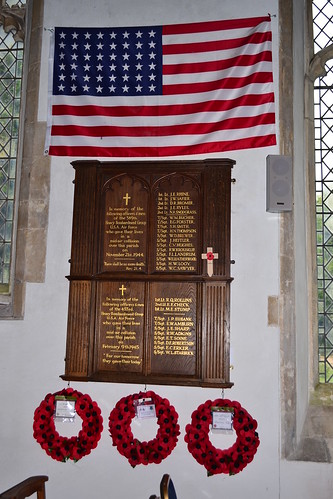


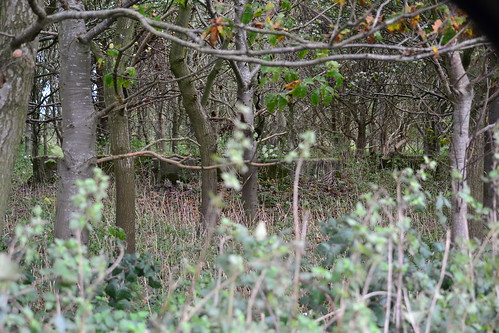
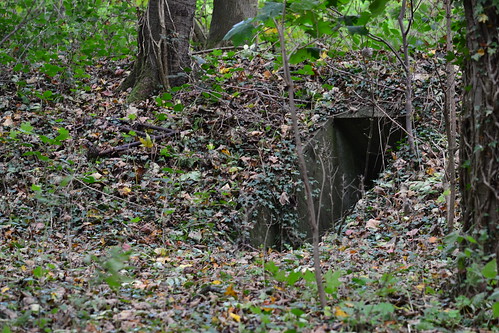
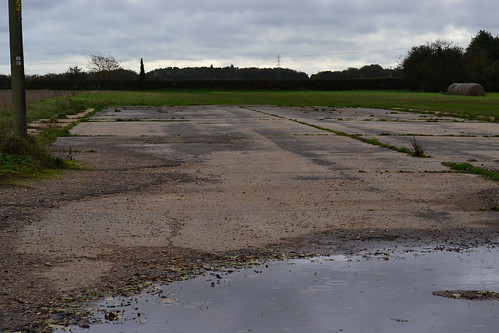
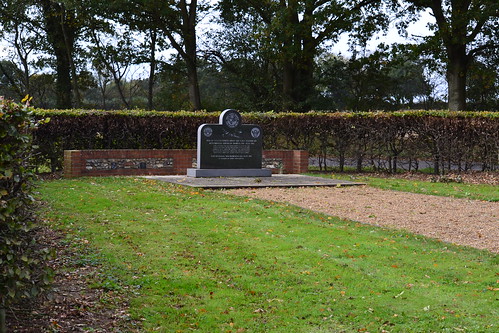


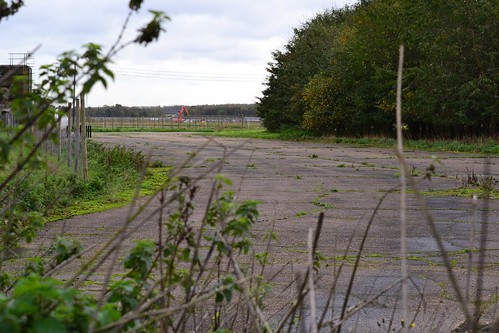
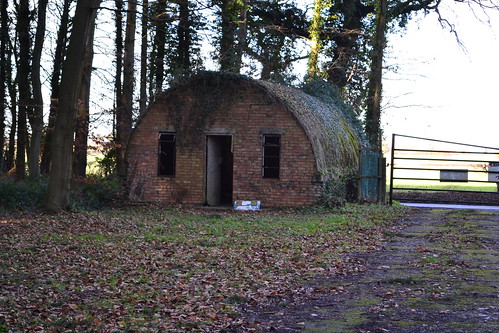
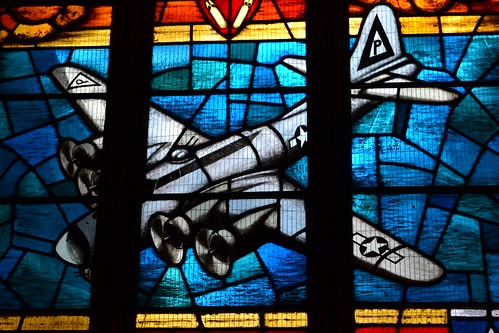
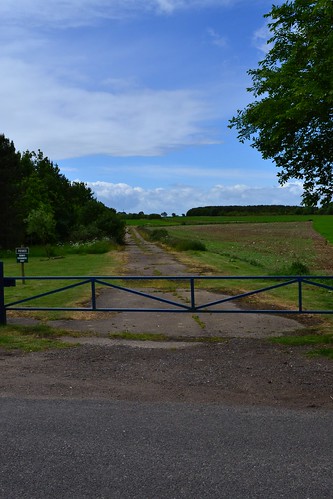


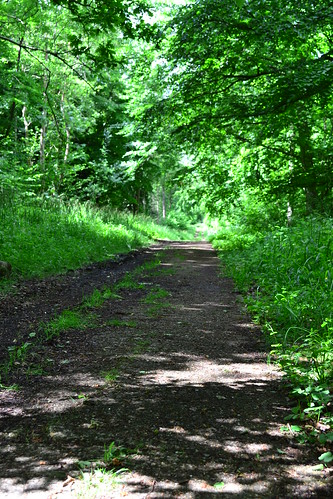
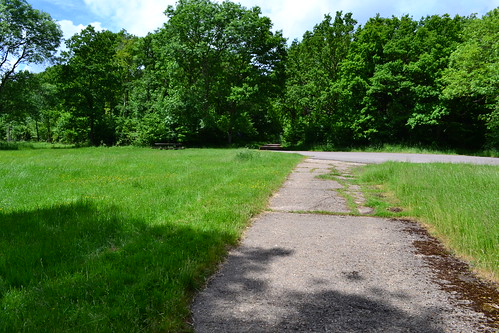
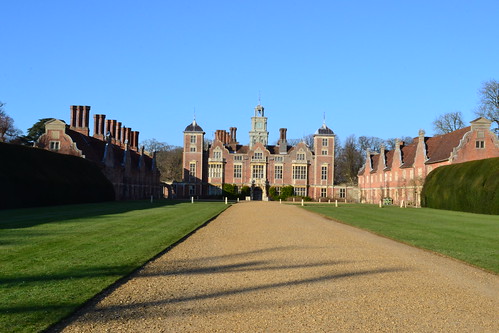
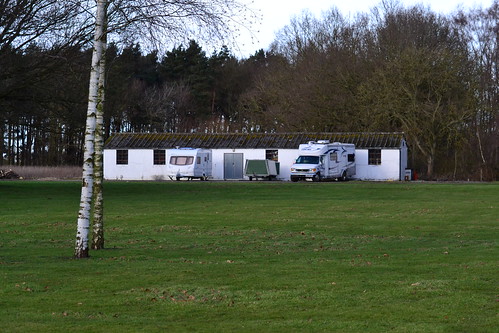
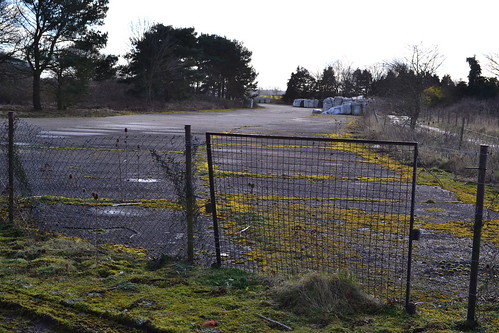
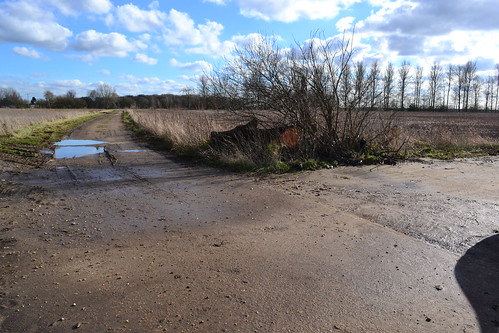

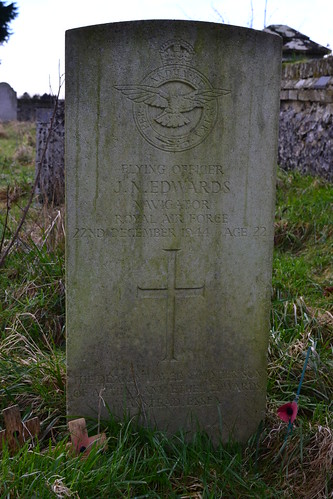


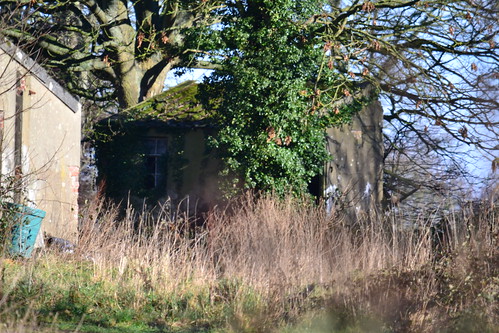


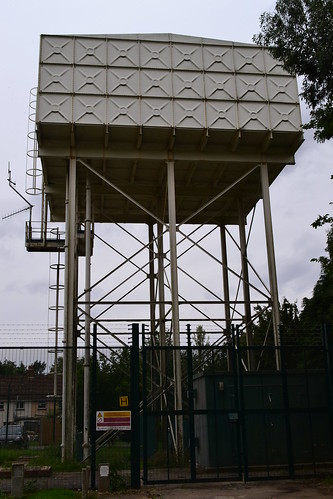
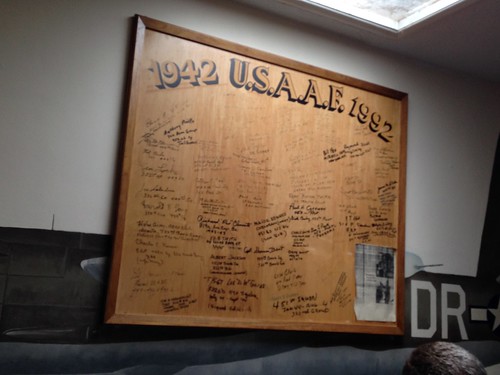
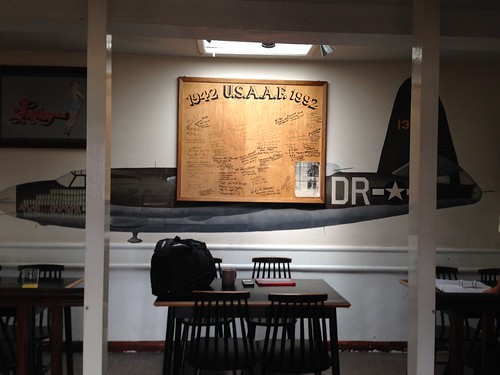
 Aviation Trails