On the morning of December 24th, 1944, Brigadier General Frederick W. Castle (s/n 0-319375), woke to the greet the day, and like most pilots facing perilous missions, he probably wondered if it would be his last. However, knowing what I know about Castle from my research, he was a calm, confident and highly competent pilot, so most likely he had every reason to believe in the success of his next mission. Sadly though, that was not to be the case. Castle never made it back that night. On Christmas Eve of 1944, this brave pilot lost his 30th and final battle.
Lieutenant Colonel Elliott Vandevanter of the 385th Bomb Group with Colonel Frederick W Castle (centre) of the 487th Bomb Group and Brigadier General Curtis A LeMay. *1
Frederick W. Castle was born on October 14th, 1908 at Fort McKinley in Manila, the Philippines. He came from an active military family and was the son of Col. Benjamin Frederick Castle. Following the end of World War 1, he was to settle in the United States in Mountain Lakes, New Jersey.
From a young age, Castle was destined to follow in his fathers footsteps, groomed for a life of military service. He attended Boonton High School and Storm King Military Academy before moving on to the US Military Academy from where he graduated in June 1930.
His first service was with the New Jersey National Guard, where he stayed for two years transferring to the Air Corps, March Field, California, then onto Kelly Field in Texas. Castle gaining his wings in October 1931.
Serving as a pilot with the 17th Pursuit Squadron for 3 years, he eventually left the forces returning to civilian life but holding a reserve status. With the entry of the United States into the Second World War, Castle would be called upon by his good Friend Ira Eaker, returning to the fold in January 1942, and being promoted within two months to Major. By the following September, Castle had been promoted yet again, he was now a Lieutenant Colonel.
With the forming of the Eighth Air Force in England, headed by General Ira Eaker, Castle was one of seven high-ranking officers selected to fly with him on the dangerous route over the Bay of Biscay, eventually arriving at Hendon wearing their civilian clothes. Joining Eaker on February 20th 1943 in the DC-3 from Lisbon were: Lt Colonel Frank Armstrong Jnr, Major Peter Beasley, Captain Beirne Lay Jnr, Lt. Harris Hull and Lt. William Cowart Jnr.
Castle desired a combat role, and this desire would lead to him taking over the command of the ailing 94th Bomb Group. His methods of command were initially considered weak, but in the face of low morale and apprehension, he personally took the 94th to some of the furthest targets yet, his first being Oschersleben in the heart of Germany; a mission that went on to inspire the film “12 o’clock High“. Castle went on to fly in many combat missions including numerous high prestige targets, a role that took him on to Brigadier General and command of 4th Combat Wing.
On Christmas Eve 1944, following a week of poor weather, orders came though for a maximum effort mission, involving every available B-17 and B-24 in support of the troops in the Ardennes. Airfields, supply lines and troop movements were to be attacked, and following weeks of poor weather, a break was at last predicted.
As a joint effort, this would be the largest single attack to date involving 500 RAF and Ninth Air force bombers, 800 fighters and just short of 2,050 Eighth Air Force bombers. Such was the demand for aircraft, that even ‘war weary’ examples, were hastily armed and prepared, many unfit for more than assembly or training duties. Truly an armada of incredible proportions.
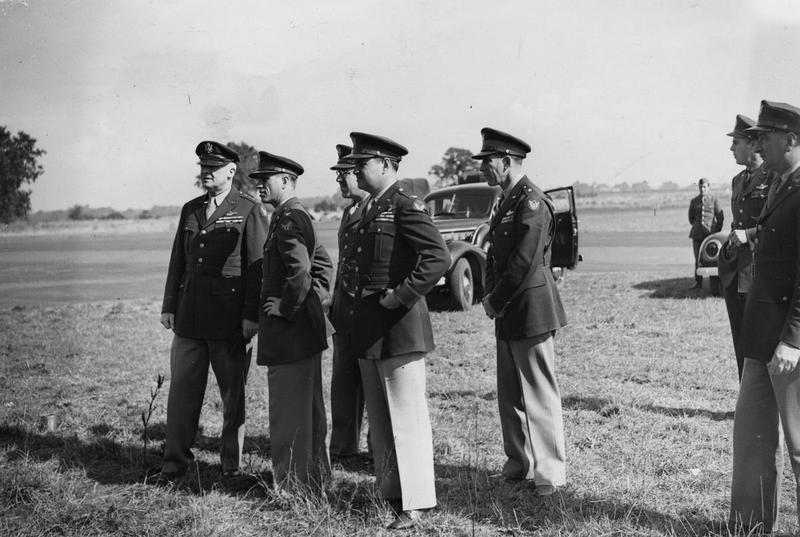
General Arnold with Colonel Frederick W Castle, Brigadier General Curtis LeMay, General Williams and General Anderson during a visit to RAF Rougham, home of the 379th BG. *2
Taking lead position, Frederick Castle, was in B-17G-VE, ’44-8444′ “Treble Four“, an aircraft that had itself seen battle experience. Assigned to the 836BS, 487BG, and at RAF Lavenham, it was previously damaged in a raid over Darmstadt. The aircraft was later salvaged in January 1945.
A veteran of 29 missions, Castle was a more than a competent leader. They set off, the weather was as predicted but with a haze that restricted ground level visibility. It was this haze prevented the fighters from leaving causing an all important delay in the escorts. This delay was not considered a major problem at the time however, as the escorts being faster, would soon catchup and overtake the heavily laden bombers. The Luftwaffe, in an unprecedented move, brought forward fighters into the Liege area to meet the oncoming bombers before any escorts could reach them. In the first few minutes of the battle, four of the 487th BG’s aircraft were downed and a further five forced to land in Belgium.
Castle’s lead plane, suffering problems with one of its engines (possibly due to previous battle damage) was attacked by the first wave of fighters, action was taken to leave the flight and join a formation further back. It was then attacked again, the aircraft catching fire, and the navigator being wounded.
Castle took control, and even though still being attacked, refused to jettison the bombs for fear of killing civilians or allied troops below. Further attacks led to both engines on the starboard wing catching fire, which ultimately led to the fuel tank exploding sending the aircraft into an uncontrollable spin.
Through Castle’s actions, seven of the crewmen were able to leave the aircraft, sadly though not all survived.
Frederick Castle died in the crash, his body is now buried in Henri-Chapelle American Cemetery, Liege, Belgium, Plot D, Row 13, Grave 53.
His citation reads:
“He was air commander and leader of more than 2,000 heavy bombers in a strike against German airfields on 24 December 1944. En route to the target, the failure of 1 engine forced him to relinquish his place at the head of the formation. In order not to endanger friendly troops on the ground below, he refused to jettison his bombs to gain speed maneuverability. His lagging, unescorted aircraft became the target of numerous enemy fighters which ripped the left wing with cannon shells. set the oxygen system afire, and wounded 2 members of the crew. Repeated attacks started fires in 2 engines, leaving the Flying Fortress in imminent danger of exploding. Realizing the hopelessness of the situation, the bail-out order was given. Without regard for his personal safety he gallantly remained alone at the controls to afford all other crewmembers an opportunity to escape. Still another attack exploded gasoline tanks in the right wing, and the bomber plunged earthward. carrying Gen. Castle to his death. His intrepidity and willing sacrifice of his life to save members of the crew were in keeping with the highest traditions of the military service*3.”
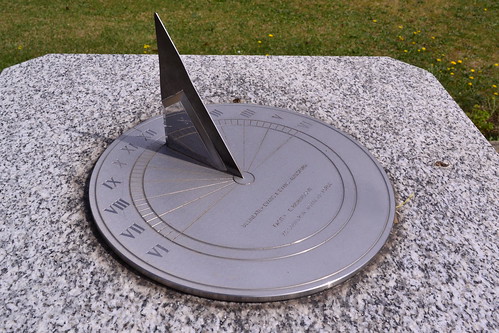
For his action, Frederick W. Castle was awarded the Medal of Honour posthumously. In 1946, the Castle Air Force Base, in the heart of California’s San Joaquin Valley, was dedicated in his name, and on June 20th, 1981, the Castle Air Museum was officially opened on the now closed base, for the purpose of preserving the Air Force and Castle heritage. Museum details can be found on their website. His name is also on a plaque in the Memorial Park, in Mountain Lakes, New Jersey.
The awarding of the Medal of Honour, reflected the determination and personality of one of Eakers “Original Seven”, who chose to leave a safe position for a combat role, taking on the demoralised 94th, and leading them into some of the Second World War’s most ferocious air battles.
Sources and further reading.
*1 Photo from Roger Freeman Collection, IWM, FRE9833
*2 Photo from Roger Freeman Collection, IWM, FRE9879
*3Congregational Medal of Honour Society, Website, accessed 22/12/15
As the year draws to a close, I would like to pass on my sincere thanks to all those of you who have followed, read, commented and shared a common interest with me here at Aviation Trails. It has truly been a challenging year but with determination we will no doubt get through these difficult times and on to better ones in the months ahead.
Since starting, I have now written over 60 trails, the number of airfields I have now visited has increased to over 120 stretching from Scotland’s north west coast to Kent in the south, from the eastern regions of England to the west; a huge area but one in which there are still many, many more airfields and sites yet to visit.
As 2021 approaches I would like to take the opportunity to wish you all, wherever you are in the world, a very happy and safe Christmas and both a peaceful and prosperous New Year.
In the heart of Norfolk, some 40 miles west of Norwich and 13 miles to the east of King’s Lynn, lies a small, quaint village typical of the English stereotype. Small ponds frequented by a range of ducks, are thought originally to be fish ponds for the 11th century Augustinian Abbey, and the history of the village is believed to go back as far as the 5th Century. Massingham boasts an excellent village pub, and a small shop along with beautiful walks that take you through some of Norfolk’s most beautiful countryside; it has to be one of Norfolk’s greatest visual assets.
Sited above this delight is the former airfield RAF Great Massingham, which during the war years was home to number of light bombers and even for a short while, the four engined heavy, the B-17. In Trail 21, we return to RAF Great Massingham.
RAF Great Massingham
Great Massingham airfield lies in the heart of Norfolk, some 40 miles west of Norwich and 13 miles to the east of King’s Lynn, lies a small, quaint village typical of the English stereotype. Small ponds frequented by a range of ducks, are thought originally to be fish ponds for the 11th century Augustinian Abbey, and the history of the village is believed to go back as far as the 5th Century. Massingham boasts an excellent village pub, and a small shop along with beautiful walks that take you through some of Norfolk’s most beautiful countryside; it has to be one of Norfolk’s greatest visual assets. Sited above this delight is the former airfield RAF Great Massingham, which during the war years was home to number of light bombers and even for a short while, the four engined heavy, the B-17.
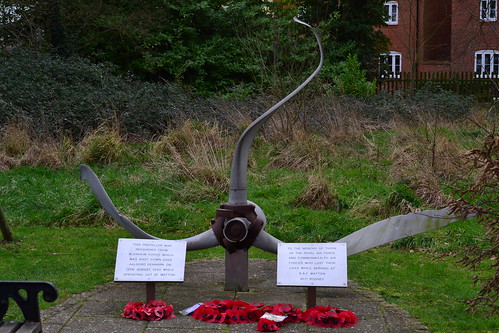
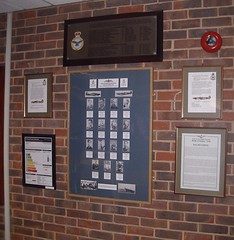
Before entering Great Massingham I suggest you stop at Little Massingham and the church of St. Andrew’s. For inside this delightful but small church, is a roll of honour*1 that lists enormous amounts of information about the crews who served at the nearby base. It gives aircraft details, mission dates and crew names amongst others. It is a hugely detailed collection of information covering 1940-45, in which time 600 Massingham crews lost their lives. Seven of these crew members, are buried in the adjacent church yard: Sqn. Ldr. Hugh Lindsaye (18 Sqn), Sgt. John Wilson (RNZAF – 107 Sqn), Sgt. Thomas Poole (107 Sqn), P/O. Arthur Lockwood (107 Sqn), Flt. Sgt. Gordon Relph (107 Sqn), F/O. Charles Ronayne (RAF) and F/O. Joseph Watkins (239 Sqn), all being killed in different circumstances. This is a valuable and enlightening stop off to say the least.
The Roll of Honour in St. Andrew’s Church, Little Massingham.
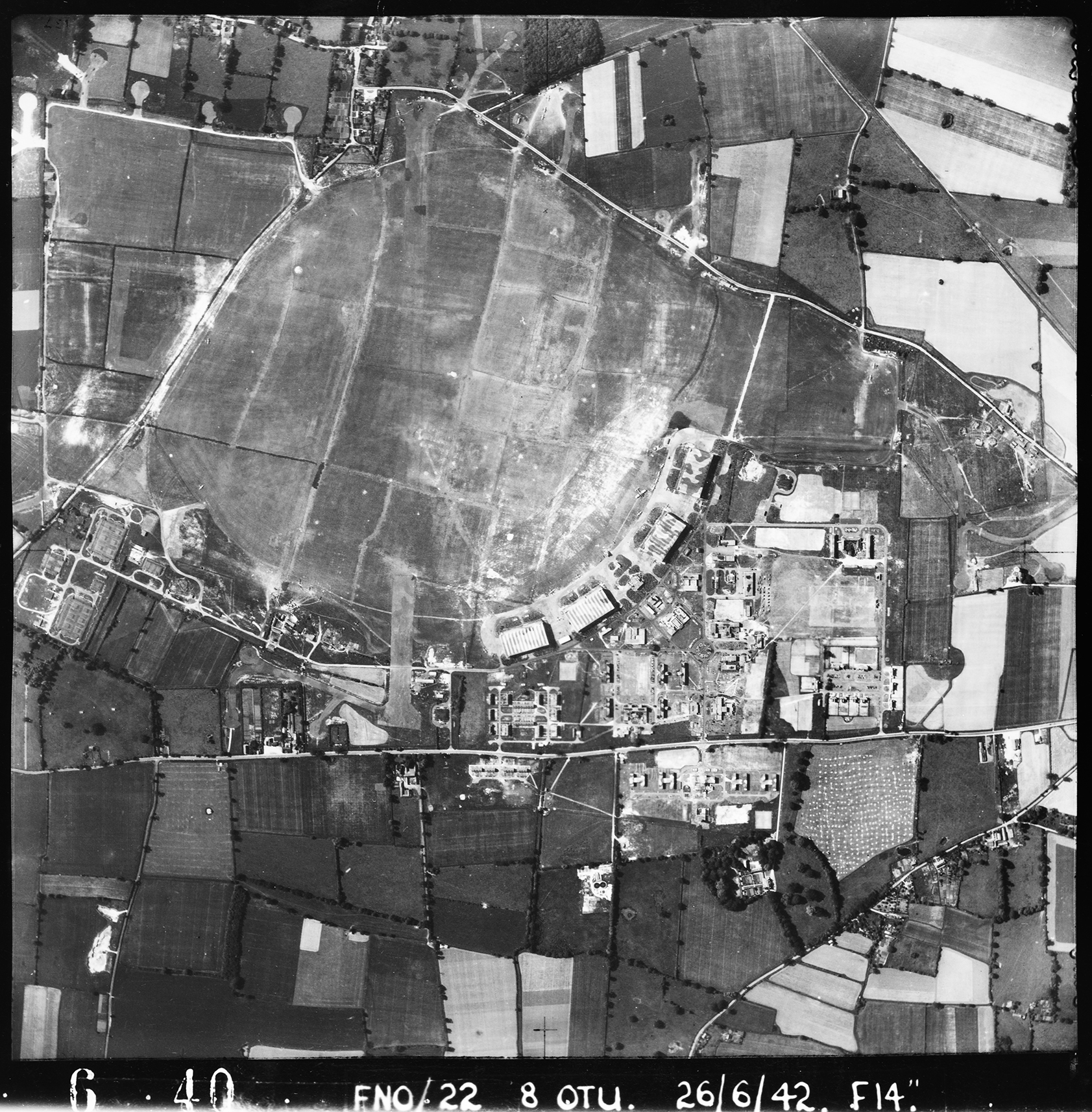
On leaving the church turn right and you will almost straight away enter the village of Great Massingham. The airfield is to the east behind the village holding the high ground, which makes for a very windy and open site, whilst the village nestled on the lower ground, remains calm and quiet. Built originally as a satellite for the nearby West Raynham, Massingham opened in 1940 with grass runways initially under the command of 2 Group, Bomber Command and then latterly 100 Group, whose headquarters were at Bylaugh Hall. The distance between both RAF West Raynham and RAF Massingham was so small, that crews would cycle from one to the other each morning before operations.
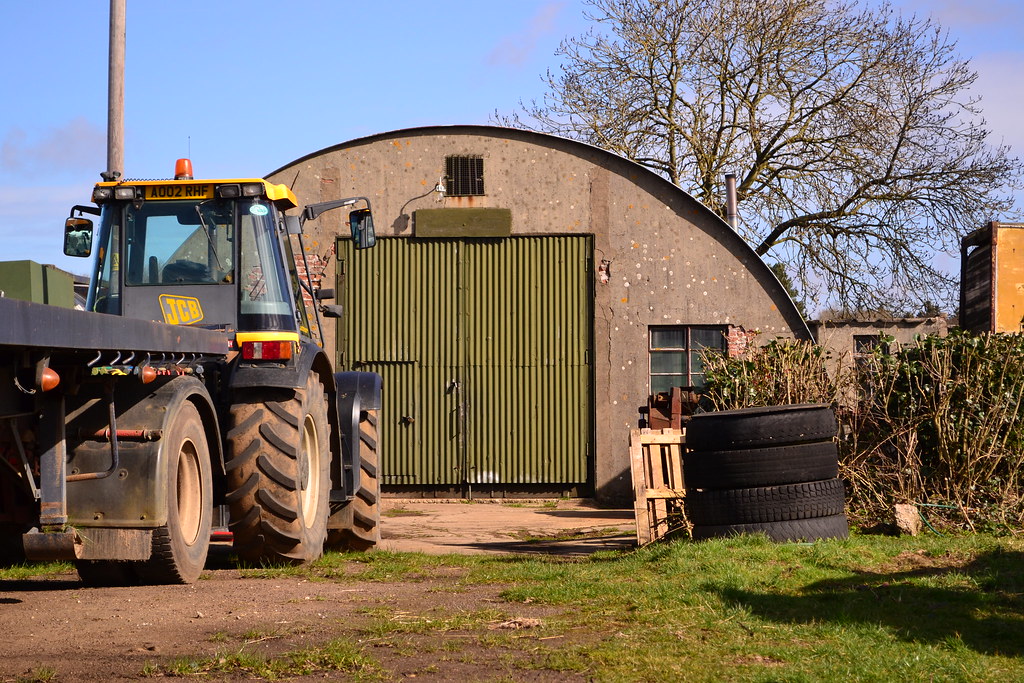
The Officers Mess now a farm building.
There were a total of four T2 hangars and one B1 hangar built on this site. The airfield also had sixteen pan-type hardstands and twenty-one loop-type hardstands, giving a total of thirty-seven dispersal points around its perimeter.
The main accommodation and communal sites which totalled five and two respectively, were near to Little Massingham church, to the west, along with further areas to the south of the airfield . These included a communal area to the south-west of the village and sufficient accommodation for 1,197 men, consisting of Officers, Senior NCOs and ordinary ranks. This was later upgraded to accommodate 1,778 men. In addition, accommodation was provided for the WAAFs of the airfield, 102 in total at the outset. This was also increased in the airfield’s upgrade, taking the total number of WAAFs to 431.
The bomb dump and ammunition stores were well to the north away from the personnel as was standard. A number of anti-aircraft sites were scattered around the perimeter offering good protection from any attacking aircraft.
The first occupants of Massingham were the Blenheim IVs of 18 Sqn RAF who arrived in the September of 1940.
18 Sqn were previously based at West Raynham, making the transition invariably very smooth. In fact, operations barely ceased during the change over, the last West Raynham sortie occurring on 7th September 1940 with a six ship formation attack on the docks and shipping at Dunkirk, and the first Great Massingham sortie on the evening of the 9th to Ostend.
Whilst at Great Massingham, 18 Sqn flew the Blenheim Mk.IV initially on short range bombing sorties to the French coast. All was fairly quiet for the first few weeks, the squadron’s first loss not occurring until November 28th 1940, when Blenheim P6934 crashed after hitting high tension wires west of the airfield. All three of the crew were injured and admitted to hospital, but Sgt. William E. Lusty (S/N: 751633) died from his injuries the following day.
18 Squadron remained at Great Massingham until April the following year (1941), performing in the low-level bombing role. Like most other RAF airfields around this area of Norfolk, it would be dominated by twin-engined aircraft like the Blenheim and its subsequent replacements. As a reminder to those who may have got complacent about the dangers of flying in wartime, the departure of 18 Sqn was marred by the loss of Squadron Leader Hugh Lindsaye (S/N: 40235), who was killed whilst towing a drogue near to Kings Lynn a few miles away. An investigation into the crash revealed that a drogue he was pulling had become separated and fouled the port elevator. The pilot lost control as a result and all three crewmen (SgT. Stone and F/O. Holmes) were killed. Sqn. Ldr. Lindsaye is one of those seven buried in Little Massingham.
Shortly after the departure of 18 Sqn, Massingham took on another Blenheim squadron in the form of 107 Sqn, a move that was coincided with a detachment of B-17 Flying Fortresses of 90 Squadron.
The B-17 (Fortress I) squadron was formed at Watton earlier that month, they moved to West Raynham whereupon they began trials at a number of smaller airfields including Bodney and Massingham, to see if they were suitable for the B-17. These initial tests, which were undertaken by Wing Commander McDougall and Major Walshe, were a series of ‘circuits and bumps’ designed to see if the ground and available runways were suitable. It was decided that Massingham was indeed suitable, and so a decision was made on the 13th, to base the aircraft at Massingham but retain the crews at West Raynham, transport vehicles ferrying them to and from the aircraft on a daily basis. For the next few days further tests were conducted, and engineers from Boeing came over to instruct ground crews on the B-17’s engineering and armaments. Concerns were soon raised by crews about Massingham’s grass runways, and how well they would perform with the heavier four engined B-17’s constantly pounding them.
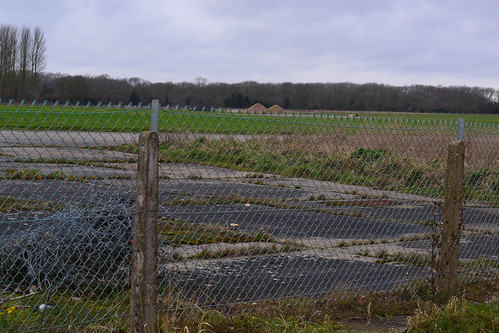
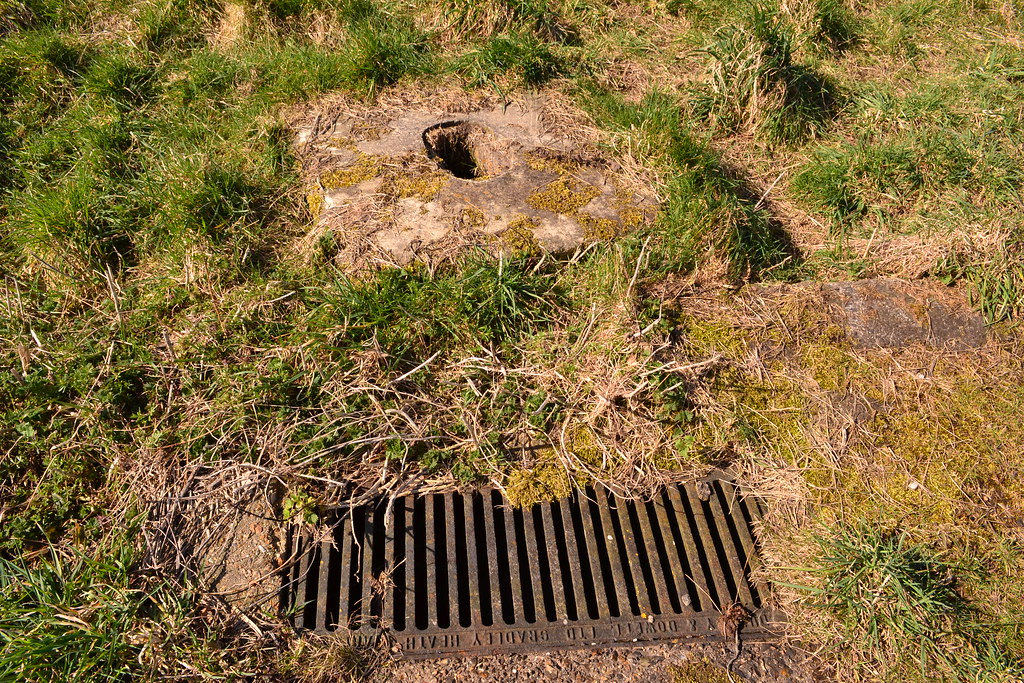
Remains around the perimeter track.
On the 23rd May, H.R.H The King conducted an inspection of Bomber Command aircraft at RAF Abingdon, in Oxfordshire. Amongst the types presented with the RAF bombers was a Fortress I from Massingham. The King, Queen and two Princess’s Elizabeth and Margaret, all attended and took a great interest in the Fortress. The Royal party taking considerable time to view and discuss the heavy bomber’s merits and features.
Back at Massingham, flight tests, training and examinations of the B-17 continued until in June 1941, when 90 Sqn were ordered out of both Massingham and West Raynham, moving to RAF Polebrook in Northamptonshire. But by the October, the Fortress’s had all gone from RAF bomber service, problems with freezing equipment convincing the RAF not to use the heavies in bombing operations.
By February 1942 the unit was disbanded and all its assets were absorbed into 1653 Heavy Conversion Unit (HCU). Within days of 90 Sqn’s arrival at Massingham, another more permanent squadron also arrived, again performing in the same low-level bombing role as their predecessors 18 Sqn. The spring of 1941 saw 2 group perform some of their largest operational sorties to date, with many Blenheims continuing their daylight raids on shipping and docks in north-west Germany.
It was during this hectic time, on May 11th, that 107 Sqn, would arrive at the Norfolk base at Massingham. Being taken off operations on the 10th, the air personnel made their way down from the Scottish base at Leuchars whilst the ground staff travelled by train the following day. A number of crews were posted on detachment to bases at Luqa, Ford and Manston.
After a short settling in period missions began again in earnest with their first twelve ship operation in Bomber Command taking them to Heliogoland on the 13th. Two of these Blenheims returned with engine problems, but the remainder managed to attack the target, in an operation that was considered a great success, with complete surprise being achieved. Flying at very low level was key to this operation, and whilst all aircraft returned home safely, one aircraft piloted by Sgt. Charney, flew so low he managed to strike the sea with his port engine; as a result, the airscrew was damaged and broke away leaving the aircraft flying on just one of its two powerplants!
The end of May was a difficult month for 107. On the 21st they returned to Heligoland, with nine aircraft taking off at 14:00, detailed for a daylight formation attack on the target. With visibility of 12 – 15 miles, they pressed home their attack from as low as fifty feet, in spite of what was an ‘intense and accurate’ flak barrage. Four aircraft were hit by this flak, and in one of them, Sgt. John Wilson (S/N: 40746) was killed when shrapnel struck him in the head. Sgt. Wilson is also one of the seven in the church yard at Little Massingham.*2
On the return flight, a second aircraft also damaged by the flak, had an engine catch fire. The pilot and crew were all lost after ditching in the sea. Fl. Sgt. Douglas J. R. Craig (S/N: 903947) never having being found, whilst two other crewmen (Sgt. Ratcliffe and Sgt. Smith) were seen climbing into their life raft, later being picked up by the Germans and interned as prisoners of war.
On the 23rd the squadron was then detailed to search for shipping off France’s west coast. Due to bad weather, they were unable to make Massingham and had to land at Portsmouth instead. Continued bad weather forced them to stay there until the 27th when they were able at last to return to Massingham. No further operations were then carried out that month.
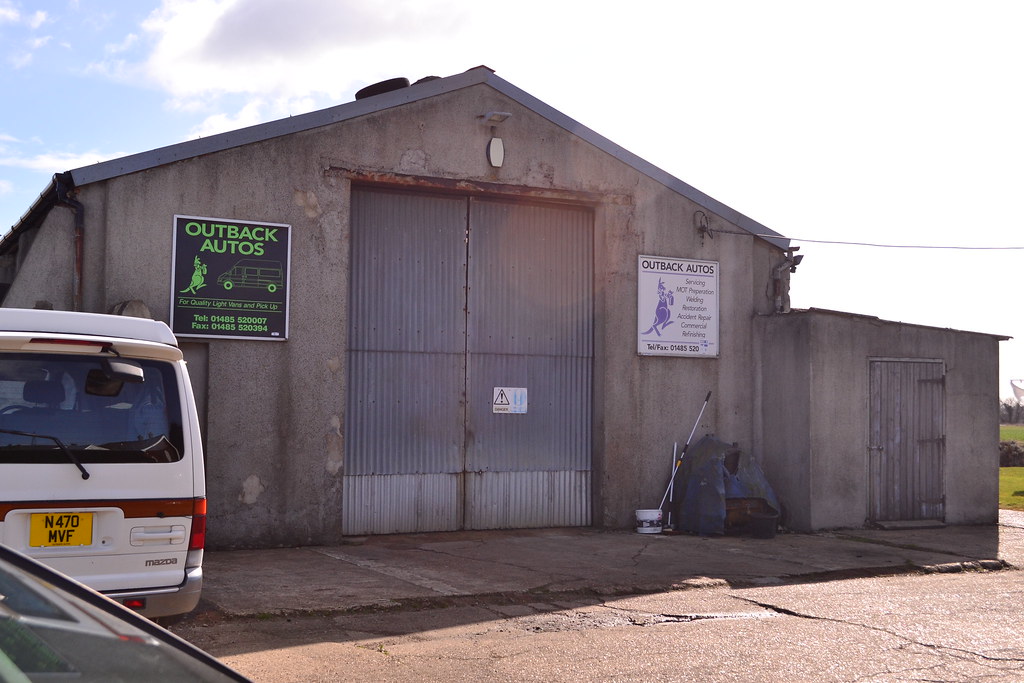
Gymnasium and attached Chancellery now a car repair shop.
The dawn of 1942 saw Bomber Command face its critics. High losses brought into question the viability of these small light aircraft as bombers over enemy territory, a situation that would see 2 Group, as it was, all but removed from operations by the year’s end.
But the end was not quite here, and January of 1942 saw 107 take on the Boston III ( an American built aircraft designated the ‘Havoc’) as a replacement for the now ageing Blenheim. With the new aircraft 107 remained at Massingham, at least until the early August, where they made a short move to Annan before returning to Massingham a mere week later. It would take only a month before the first 107 Sqn Boston would be lost.
Whilst on a training flight, Boston W8319, struggled to join the formation, after turning back, it was seen to fall to the ground, the resultant fireball killing all three crewmen on board.
Despite this, losses over the coming months remained light. With the introduction of US airmen and the 15th Bomb Squadron, June / July saw a number of Massingham aircraft transfer across to the American’s hosts 226 Sqn at Swanton Morley. One of these aircraft, crewed by two US airmen; Captain S. Strachan and Lt. C. Mente, crashed near RAF Molesworth killing both on board.
By the end of 1942, 107 Sqn had lost a total of 23 aircraft on operations, and with each Boston carrying four crewmen it meant losses were increasing for the unit.
In February 1943, the Boston IIIs were replaced by the IIIa model. During May, the whole of 2 Group would begin to transfer across to the 2nd Tactical Air Force (TAF) in preparations for the invasion the following year. Losses had been high for the group, the light bombers being easily cut down by both Luftwaffe fighters and flak.
At the end of August 1943, it was 107 Sqn’s turn and they departed Great Massingham for Hartford Bridge and a new life within the 2nd TAF. It was during these summer months that a Free French unit, 342 Lorraine Squadron would arrive at Massingham. A unit formed with Bostons at West Raynham, it would stay at Massingham between July and into early September before moving off to rejoin 107 Sqn at Hartford Bridge, also beginning a new life within the 2nd Tactical Air Force.
It was these postings that would lead to the end of Massingham as a day bomber station, and no further vulnerable light bombers of this nature would be stationed here again.
In April 1944 Great Massingham was redeveloped and upgraded, more accommodation blocks were provided and three concrete runways were laid; 03/21 and 13/31 both of 1,400 yards, and the third 09/27 at 2,000 yards, this would give the site the shape it retains today.
A year-long stay by 1694 Bomber (Defence) Training Flight with amongst them, Martinets, gave the airfield a much different feel. Target towing became the order the day and non ‘operational’ flying the new style. In the June of 1944, 169 Sqn would arrive at Massingham, operational flying was once again on the cards, with night intruder and bomber support missions being undertaken with the Wooden Wonder, the D.H. Mosquito. Between June and the cessation of conflict this would be a role the squadron would perform, and perform well, with numerous trains, ground targets and Luftwaffe night fighters falling victim to the Mosquito’s venomous attacks. Included in these are a damaged Ju 88 on the night of October 26th 1944 south of the Kiel Canal, and five trains on the night of October 29th.
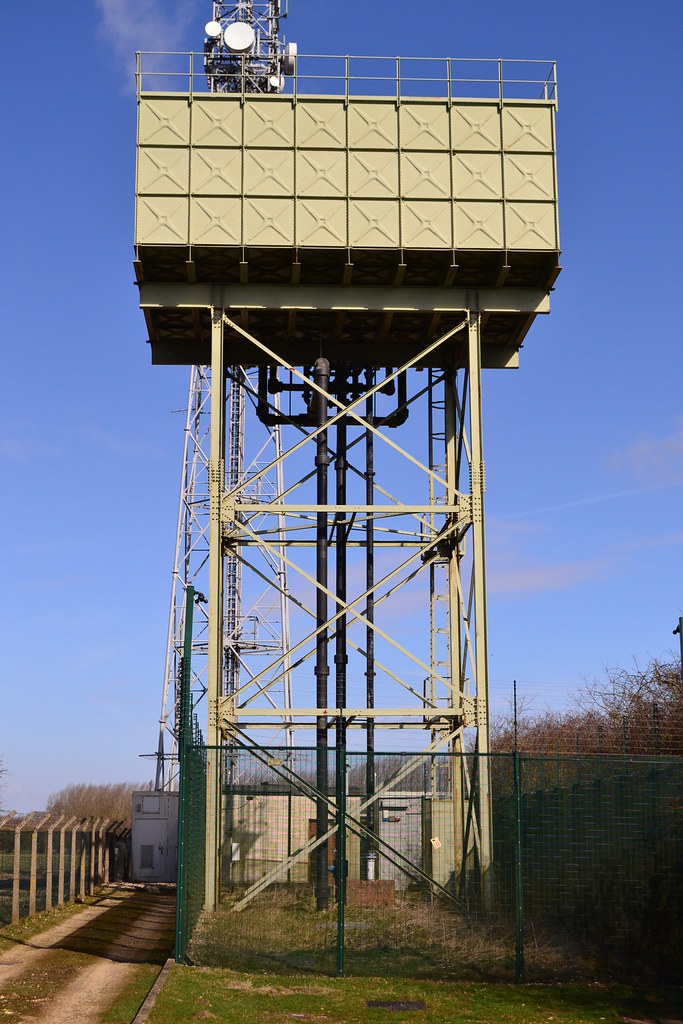
Original high-level Braithwaite water tank.
With them, came 1692 (Bomber Support Training) Flight, to train crews in the use of radar and night interception techniques.
Formed at RAF Drem in Scotland in 1942 as 1692 (Special Duties) Flight, they operated a range of aircraft including Defiants, Beaufighters and Mosquitoes. The two units stayed here at Massingham until both departed in August 1945, at which point 12 Group Fighter Command, took over responsibility of the site.
As radar and night interception roles developed, a new unit was created at Massingham under the control of the Central Fighter Establishment (CFE), who were to trial different techniques and strategies for air interception. They later moved to West Raynham where they continued to carry out this role.
Over the years a number of post war celebrities were stationed at Massingham, they included F.O. Keith Miller AM, MBE – the Australian Test cricketer; P.O. (later Squadron Leader) Bill Edrich DFC – the England cricketer and the BBC commentator – Flt. Sgt. Kenneth Wolstenholme DFC and Bar.
After the aircraft left, the airfield fell quiet and was very quickly closed. 1946 saw the last personnel leave, and it remained dormant until being sold in 1958. Bought by a farmer, it is now primarily agriculture, although a small private airfield has opened utilising the former runways, and flying visitors are welcomed with prior permission. The airfield at great Massingham has a public footpath running part way through it. This is accessible at either end of the southern side of the airfield, and permits access along part of the original perimeter track. Accessing the eastern end of the path is easiest, a gated road from the village takes you up to the airfield site. Once at the top, you can see the large expanse that was the main airfield site. Trees have since been cultivated and small coppices cover parts of it. To your right at this point the peri track continues on in an easterly direction, but this section is now private and access is not permitted. This track would have taken you toward the Watch office, the Fire Tender building and storage sheds – all these being demolished long ago. A further area to the south of here has now been cultivated, and there was, what is believed to have been a blister hangar, located at this point – this too has long since gone.
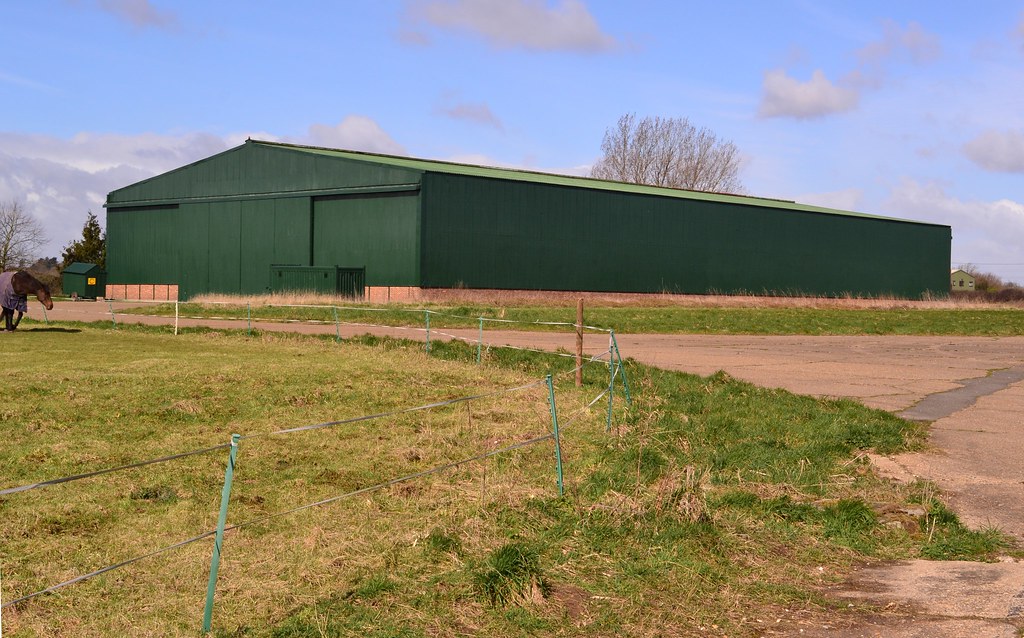
The public path turns left here and takes you round in a northerly direction. To your left is a T2 hangar, it is believed that this is not the original, but one that had been moved here from elsewhere. This however, cannot be confirmed, but there was certainly a T2 stood here originally.
The track continues round, a farm building, very much like a hangar, houses the aircraft that now fly. Sections of runway drainage are visible and piles of rubble show the location of smaller buildings. The track then takes you left again and back to the village past another dispersal site, now an industrial unit complete with blister hangar.
Other foundations can been seen beneath the bushes and leaves on your right. This may have been the original entrance to the site, although Massingham was unique in that in was never fenced off, nor guarded by a main gate. Other examples of airfield architecture may be found to the north side of the airfield, indeed satellite pictures show what looks like a B1 hangar on the northern perimeter.
The perimeter track and T2 hanger re-sited post war.
After walking round, drive back toward Little Massingham, but turn left before leaving the village and head up toward the distant radio tower, itself a remnant from Massingham’s heyday. We pass on our left, the former accommodation site. Now a field, there is no sign of its previous existence. However, further up to the right, a small enclave utilises part of the Officers’ Mess, the squash court, and gymnasium with attached chancery. Hidden amongst the trees and bushes are remnants of the ablutions block, and other ancillary buildings. Continue along this road, then take the left turn, toward the tower. Here is the original high-level Braithwaite water tank and pump house, still used for its original purpose and in very good condition.
Finally, a lone pill-box defensive position can also be found to the west of the village, some distance from the airfield in the centre of a farmer’s field. All small reminders of the areas once busy life.
Great Massingham is a delightful little village, set in the heart of Norfolk’s countryside. Its idyllic centre, pubs and shops surround ponds and greens. A short walk away, is the windy and open expanse that once was a bustling airfield, resounding to the noise of piston engines. All is now much quieter, their memories but a book, some dilapidated buildings and a handful of graves. Standing at the end of the runway, looking down the expanse of concrete, you can easily imagine what it must have been like all those years ago. From Great Massingham we head east, to RAF Foulsham, before turning north and the North Norfolk coast, an area of outstanding natural beauty and some fine examples of airfield architecture.
Sources and links RAF Great Massingham
*1 A comprehensive history of RAF Massingham, including RAF material, is now under the care of the Massingham Historical Society. Contact Anthony Robinson antmassingham@gmail.com for details about the Museum or Roll of Honour, a hard copy of which can be purchased for a small fee.
*2 The ORB shows this as Sgt G, Wilson and not J.W. Wilson.
National Archives AIR 27/842/10
RAF Great Massingham is remembered on the Massingham village website which includes details of the Roll of Honour.
Another trip along the North Kent coast in Trail 44, brings us from Herne Bay past Allhallows to the former RAF Gravesend. Another of Britain’s airfields that has since disappeared under housing, it has a history going back to the heydays of aviation and the 1920s. It was, during the war, a fighter airfield and was home to many famous names including James “Ginger” Lacey DFM and Squadron Leader Peter Townsend. A number of RAF squadrons used the site, as did American units in the build up to D-day. A wide range of aircraft from single engined biplanes to multi-engined fighters and even air-sea rescue aircraft could have been seen here during those war years. Gravesend was certainly a major player in Britain’s war time history and thanks to Mitch Peeke, we can visit the site once more.
RAF Gravesend
Gravesend aerodrome was born during the heyday of public interest in aviation in the late 1920’s and early 1930’s. The original site was nothing more than two fields off Thong Lane in Chalk, which was used by some aviators of the day as an unofficial landing ground. One such pilot was the Australian aviator Captain Edgar Percival, who often landed his own light aircraft there when visiting his brother, a well-known Doctor in Gravesend. It is widely thought that it was Percival, who was after all a frequent user of those fields, who first suggested the actual building of an airport there.
Whether he did or whether he didn’t, the two men who founded the airport’s holding company, Gravesend Aviation Ltd., in June of 1932, were Mr. T. A. B. Turnan and Mr. W. A. C. Kingham. A local builder, Mr. Herbert Gooding, was engaged to build the Control Tower/Clubhouse building. In September of that year, with the construction work well advanced, Herbert Gooding and a man named Jim Mollison (the husband of the British aviatrix Amy Johnson), joined the Board of Directors of Gravesend Aviation Ltd.
The Mayor of Gravesend, Councillor E. Aldridge JP, officially opened the newly constructed airport as “Gravesend-London East”, on Wednesday 12th October 1932. To mark this Gala occasion, the National Aviation Air Days Display Team, led by Sir Alan Cobham, visited the new airport and gave flying demonstrations to thrill those people present. Also on display for visitors was a curious flying machine called the Autogiro, a sort of cross between a helicopter and a small aircraft, that had been built for a Spanish aviator by the name of Senor Cierva.
At the time of its opening, Gravesend airport covered 148 acres. Its two 933 yard-long runways were grass and the airfield buildings comprised the combined Control Tower/Clubhouse, two smallish barn-style hangars and some other, small ancillary workshop and stores buildings. Located in open countryside on the high, relatively flat ground on the western side of Thong Lane, between the Gravesend-Rochester road and what is now the A2 (Watling Street), Gravesend airport boasted an Air-Taxi service and a flying school among its amenities.
In November of 1932, just one month after the airport’s opening, Herbert Gooding took over as Managing Director of Gravesend Aviation Ltd. It seems likely that Mr. Gooding had effectively been “saddled” with the airport that he’d largely built. The original Directors, Messrs. Turnan and Kingham, possibly had run out of cash with which to pay Mr. Gooding for his construction work. They disappeared at this time, probably having paid Mr. Gooding with their own company shares. Jim Mollison, though married to Amy Johnson, had never been anything more than a “sleeping” director anyway, so it fell solely to Gooding to try to recoup his investment by making the airport a commercial success.
The original idea behind the airport had been to encourage the rapidly expanding European airlines to use Gravesend as an alternative London terminal to the often-fogbound Croydon airport, and this, Gooding now set out to accomplish. Although a number of airlines such as KLM, Swissair, Imperial Airways and even Deutsche Lufthansa did indeed make use of Gravesend, they didn’t utilise it on anything like the scale that had been hoped for. Perhaps it was thought at the time that Gravesend just wasn’t quite close enough to London, geographically.
Then in 1933, a year after the airport had been officially opened; Captain Edgar Percival established his aeroplane works in the small hangar next to the flying school. It was from here that he started to turn out the Percival Gull and Mew Gull aircraft. These were possibly the finest light and sports aeroplanes respectively, of their day, and in fact pilots flying these aircraft set many inter-war aviation records. Such pilots, for example, as Alex Henshaw, (who later became a Spitfire test pilot), Sir Charles Kingsford-Smith, Amy Johnson, and another well-known aviatrix, Jean Batten, as well as Edgar Percival himself.
Gravesend airport 1935 – Gravesend Airport Research Group (Ron Neudegg). During this time, a much larger, third hangar had been constructed by A.J. & J. Law Ltd. of Merton, alongside the existing two. This new hangar, forever referred to as the “Law hangar”, was 130 feet wide and 100 feet long, with integral offices and workshops running down each of its two sides. The Law hangar was completed in the early part of 1934 and prominently bore the legend “GRAVESEND LONDON EAST” above the hangar doors.
In December of 1936, Captain Percival moved his business to Luton. This may have seemed like a disaster for Gooding and his airport at the time, but as luck would have it, a company called Essex Aero Ltd., moved into Percival’s vacated premises almost immediately and stayed at Gravesend, building a thriving business from aircraft overhaul and maintenance, though their real forte was the preparation of racing aircraft and the manufacture of specialist aircraft parts.
Business at Gravesend airport was positively booming when Gooding sold the place to Airports Ltd., the owners of the recently built Gatwick airport. It was felt that if anyone could make a proper commercial success out of using Gravesend for its originally intended purpose, these people could. They certainly tried, but in the end sadly, even they couldn’t; and they quickly offered the site to Gravesend Borough Council, for use as a municipal airport. There followed protracted negotiations over terms, price, etc., all of which were suspended when, because of the increasingly ominous rumblings from Adolf Hitler’s Germany, the Air Ministry stepped in.
It was the expansion of the Royal Air Force that ultimately saved Gravesend. In 1937, No 20 Elementary and Reserve Flying Training School was established at Gravesend to train pilots for the RAF and the Fleet Air Arm.
The training of service pilots began in October of 1937. The school operated the De Havilland Tiger Moth and the Hawker Hart at that time. Accommodation for the instructors and the student pilots wasn’t exactly salubrious. For the most part, they used the clubhouse, together with rooms in some of the local houses.
Meanwhile, as the trainee service pilots learned their craft daily, (and not without accident!) the civil aviation side of Gravesend continued, with record attempts to the fore. In 1938, the twin-engined De Havilland Comet, G-ACSS that was used to set a record for the flight to New Zealand and back, was fully prepared for its successful record attempt by Essex Aero, as was Alex Henshaw’s Percival Mew Gull, which he used the following year to make a record-breaking flight from England to Capetown and back. Both of these record flights departed from Gravesend and were well publicised at the time.
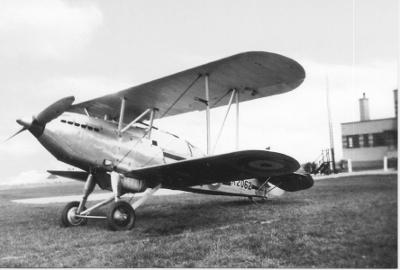
The origin of the Hawker Hurricane. This visiting Hawker Fury MkI, K2062 belonging to No.1 Squadron, was photographed at Gravesend airport in 1938. Photo: S Parsonson via Gravesend Airport Research Group (Ron Neudegg).
But in the same year that Alex Henshaw set his record, war with Germany looked to be a near certainty and the Air Ministry duly set in motion the formalities needed to requisition Gravesend airport, in the increasingly likely event of war.
When war indeed came that September, No 20 E&RFTS was relocated, Airports Ltd surrendered their lease to the Air Ministry and the RAF duly took over Gravesend airport as a satellite fighter station in the Hornchurch sector. Essex Aero however, stayed; taking on a vast amount of contract work for the Air Ministry. Among the items they soon found themselves making, were fuel tanks for Spitfires.
The first fighter squadron to be based at what was now RAF Gravesend was 32 Squadron, who moved in with their Hurricanes in January of 1940. They were followed by 610 (County of Chester) Squadron with their Spitfires, who helped cover the Dunkerque evacuation. Following the deaths in action of two successive commanding officers within a short space of time, 610 Squadron was moved to Biggin Hill in July and 604 Squadron moved into RAF Gravesend temporarily with their Bristol Blenheims, whilst training as a night fighter unit. Also on temporary detachment at this time from their usual base at Biggin Hill, were the Spitfires of 72 Squadron.
It was during this period that the two decoy airfields at Luddesdown and Cliffe were completed, to help protect Gravesend. It was thought to have been an obvious matter to the Germans that the RAF would take over the airport at the commencement of hostilities. After all, the Germans certainly knew that Croydon airport was now a fighter station.
Accommodation was always to remain something of a problem at Gravesend. The clubhouse of course had some rooms, but nowhere near enough to house an operational fighter squadron’s complement of pilots, let alone the ground crews, station maintenance crews, or even the administration staff. In the end, most pilots were billeted either in the Control Tower/Clubhouse accommodation, or at nearby Cobham Hall, the ancestral home of Lord Darnley. (In fact, Lord Darnley nearly lost his home during the Battle of Britain. Not to German bombs, but to the hi-jinks of some of 501 Squadron’s pilots, who nearly burned the place down letting off steam on one drunken evening!).
The station’s Ground crews were billeted at either the Laughing Waters Roadhouse (the original site of which is now occupied by The Inn on the Lake) about one mile up Thong Lane, or just the other side of Watling Street in somewhat spartan accommodation encampments, where “home” was a village of Nissen huts hidden in Ashenbank Woods. (Nothing remains of these encampments today save for three of the large underground Air Raid Shelters). Those who could not be accommodated in the huts were billeted in Bell tents pitched around the airfield perimeter. No doubt this was fine during the spring and summer, but not so good during the winter.
On 27th July 1940, 604 and 72 Squadrons moved out and 501 Squadron took up residence, being based there throughout the greater part of the Battle of Britain period, during which time the sector boundary was changed, so that Gravesend then came under the aegis of Biggin Hill. 66(F) Squadron arrived to relieve 501 in September, but as the Battle of Britain raged and German bombs mercilessly pounded Fighter Command’s other airfields, Gravesend got off lightly, especially compared to the sector command station at Biggin Hill.
Pilots of 66(F) Squadron in the clubhouse at RAF Gravesend in September 1940. From left to right, standing: Flight Lieutenant Bobby Oxspring, Squadron Leader Rupert Leigh and Flight Lieutenant Ken Gillies. From left to right, seated: Pilot Officer C Bodie, Pilot Officer A Watkinson, Pilot Officer H Heron, Pilot Officer H (Dizzy) Allen, Hewitt (Squadron Adjutant), Pilot Officer J Hutton (Squadron Intelligence Officer) and Pilot Officer Hugh Reilley. Photo: The Times, via Gravesend Airport Research Group (Ron Neudegg).
Although the Luftwaffe reconnaissance branch belatedly photographed Gravesend airfield again in November of 1940 and updated their target identification sheet, (Gravesend was given the target designation G.B. 10 89 Flugplatz) one can only conjecture that prior to that, the decoy site at Cliffe must have performed its role superbly. The fact that only two German bombs ever landed on RAF Gravesend during the entire Battle of Britain period, and then only in passing, would seem to support this, as the decoy airfield at Cliffe was bombed many times. Each time the Germans bombed the decoy airfield at Cliffe, with its equally fake Hurricanes dispersed around it, RAF work gangs would fill in the craters. This activity in turn seemed to convince the Germans that Cliffe ought to be bombed again. In the meantime, the real fighter station at Gravesend was left virtually unmolested. On the only occasion when Gravesend airfield was specifically targeted, the Germans bombed the wrong side of Thong Lane and missed the airfield completely.
Given the fact that during the pre-war period, Lufthansa flights had regularly made use of Gravesend airport to deposit passengers, it seems all the more astonishing that the Luftwaffe were seemingly unable to find the place again when distributing their stock of bombs. Ultimately, the night decoy airfield at Luddesdown also attracted little attention from the Luftwaffe either.
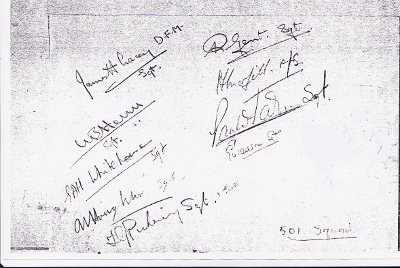
Piece of paper from the Sergeants Mess at RAF Gravesend in 1940, bearing the signatures of some of the Sergeant Pilots of 501 Squadron. Clearly legible is that of James “Ginger” Lacey DFM, who became the top-scoring RAF Battle of Britain pilot, and Geoffrey Pearson, (last one down, right hand column) who was killed in combat, aged just twenty-one. Via Kent County Library Services.
In October, at Churchill’s insistence, 421 Flight was formed at Gravesend from a nucleus of 66(F) Squadron’s pilots. In recognition of their origin, 421 Flight’s aircraft wore the same squadron identification letters as 66(F) Squadron’s aircraft, (LZ) but with a hyphen between them. Their job was to act as singleton flying observers to incoming enemy raids. A job with rather a high risk element!
With the manifest failure of the Luftwaffe’s daylight offensive, 66(F) Squadron and 421 Flight moved out of Gravesend at the end of October, and 141 Squadron with their Boulton-Paul Defiants moved in. They were joined soon afterwards by the Hurricanes of 85 Squadron, a former day-fighting unit led by Squadron Leader Peter Townsend, to take up the challenging role of night-fighting. These two squadrons stayed at Gravesend throughout the remainder of 1940. Townsend’s squadron moved out just after New Year, leaving 141 Squadron as the resident unit into the spring of 1941, though another Defiant-equipped squadron, 264 Squadron, joined them for a short time while the Luftwaffe continued with their efforts to destroy London by night. When the Luftwaffe finally abandoned that enterprise late in May of 1941, the night fighters moved out and Gravesend once again saw the Spitfires of several different day-fighting squadrons based there to carry out offensive sweeps over occupied France.
In 1941, the height of the control tower was raised by one level and during more major works that were carried out during 1942 and 1943, the two existing 933-yard grass runways were extended. The north-south runway was lengthened to 1, 700 yards and the east-west runway to 1, 800 yards. The station’s storage facilities were also enlarged and runway lighting was finally installed, as was Summerfield runway tracking, in an attempt to combat the autumn and winter mud. Also enlarged was the ground crew accommodation camp at nearby Ashenbank Wood.
In December of 1942, 277 Squadron, an RAF Air-Sea Rescue unit, duly took up residence. An unusual unit inasmuch as they flew a variety of aircraft at the same time. They had the amphibious Supermarine Walrus, which one would expect given the nature of their work, but they also had Westland Lysanders, Boulton-Paul Defiants and Spitfires. They were stationed at RAF Gravesend for a total of sixteen months, making them the record holders for the longest stay of any squadron at Gravesend.
The enlargement and improvement of the station had made possible the accommodation of three squadrons and in fact, three fighter squadrons of the USAAF were stationed at Gravesend for a while. Having longer and better runways also meant that battle-damaged heavy bombers returning from raids on Germany now stood a reasonably good chance of making a successful emergency landing at Gravesend, too.
In the early part of 1944, 140 Wing of the 2nd Tactical Air Force was based at Gravesend with their Mosquito fighter-bombers. The Wing comprised two Australian squadrons and one New Zealand squadron. The Wing’s task was that of “softening up” targets prior to the Normandy landings. With the success of the D-Day landings, 140 Wing continued their operations but shortly after D-Day, a new menace totally curtailed the station’s flying activities.
On 13th June, the very first V-1 “Doodlebug” landed at nearby Swanscombe, having flown almost directly over RAF Gravesend. In the coming weeks, the sheer numbers of these high speed pilot-less rocket-bombs passing very close to, if not actually over the RAF station, meant that flying from there was now a hazardous undertaking. 140 Wing moved out.
With the aircraft gone, RAF Gravesend became a command centre for the vast number of barrage balloon units that were brought into the surrounding area to help deal with the V-1 menace. The station also became a local air traffic control centre, to ensure that no friendly aircraft fell foul of the balloons. The V-1 campaign petered out toward the end of 1944 as the advancing Allied armies rapidly overran the launching sites and five months into 1945, the war ended.
With the end of the war, Gravesend was put into a care and maintenance state and surplus service equipment was stored in the Law hangar for a while. Only Essex Aero continued to work there, as they had throughout the war, eventually taking over the Law hangar, too.
Although Essex Aero tried hard to carry on from where they had left off just before the war, the nature of civilian aircraft and aviation had changed a great deal. Air racing and record-breaking was no longer in the public eye, as they had been in the thirties. The Air Training Corps now ran a gliding operation from Gravesend, and Essex Aero continued to make specialist aircraft parts and revolutionary Magnesium Alloy products, but the biggest problem facing them was the fact that Gravesend Borough Council steadfastly refused to grant the necessary planning permission that would allow the wartime runway extensions to be properly incorporated into the post-war aerodrome.
In April 1956, unable to work on the more numerous but ever-larger civilian aircraft types, because the pre-war dimensions of the airfield would not permit them to land there, Essex Aero went into liquidation.
In June of 1956, the Air Ministry relinquished their lease on the airfield and demolition and clearance work began in 1958. First to go were the two Barn-style hangars. The Law hangar was dismantled and re-erected on Northfleet Industrial Estate, minus its offices and workshops, where it served as a bonded warehouse until the late 1990’s. The rest of the buildings, except the Control Tower/Clubhouse, which became the site offices of the developers, were bulldozed to make way for a massive new housing estate, known today as Riverview Park. In 1961, the control tower was finally demolished and the last houses were built where it had stood. No visible trace of the once vital fighter station was left to remind anyone of what had been there.
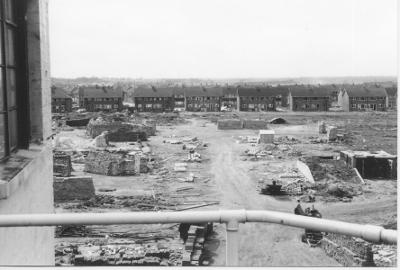
A final view to the south from the Control Tower of Gravesend aerodrome, prior to its demolition in 1961. The stacks of bricks piled up on the old hangar floors are for the construction of the houses that made up the final stage of the development. These houses were built where the airport buildings once stood, thus removing the last visible trace of this once vital fighter station. Photo: P Connolly, Gravesend Airport Research Group, via Ron Neudegg.
Yet RAF Gravesend had one last, hidden, reminder of its presence left to reveal. In April of 1990, many of the houses on the estate had suddenly to be evacuated when an unusual item was found buried in one of the gardens.
Fifty years previously, in June of 1940, the prospect of a German invasion looked very real. As we have seen, measures were taken to protect the airfield such as the setting up of the two decoy fields and the building of perimeter defence positions. Another, since totally forgotten measure, was the laying of “pipe mines” that would be exploded to deny the use of the airfield to the Germans should they succeed in invading England. It was one of these mines that had been found.
It transpired that Dolphin Developments Ltd, the building contractors who had constructed Riverview Park, were completely unaware of the presence of these mines and had happily built the entire estate on top of them. The original plans of the minefield were finally procured and the Royal Engineers were called in to locate and remove the rest of the mines. Once this operation had been successfully completed, the very last wartime vestige of RAF Gravesend had been removed.
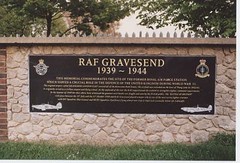
Yet the story of RAF Gravesend doesn’t quite end there. When “Cascades” Leisure Centre was built on the eastern side of Thong Lane, almost opposite where the main entrance to the RAF station once was, they put up a plaque of remembrance to the station and the pilots who had lost their lives flying from there during the Battle of Britain. The original plaque was initially located on an outside wall. Unfortunately, the name of the first of those pilots, Phillip Cox of 501 Squadron, was somehow shamefully omitted.
Cascades Leisure Centre, Thong Lane, Chalk, near Gravesend (Mitch Peeke)
The plaque stayed there, despite the inglorious error, for many years until 2003; when Sunday 2nd March saw the dedication of an all-new memorial to commemorate RAF Gravesend, the part it played in the Battle of Britain and a new plaque commemorating all fifteen of the pilots who died in combat whilst flying from the airfield during the battle.
The memorial itself is a large Black Marble plaque with Gold lettering, bearing both the RAF and the Fighter Command crests; one set either side of the gilded legend “RAF GRAVESEND”. The plaque is set into a purpose-built, stone-clad wall outside the gates of the Leisure Centre, and faces the houses that now stand close to where the airfield’s main entrance once was. The new plaque, finally listing all fifteen pilots, can now be found on the wall in the reception of the Leisure Centre, along with other displays which include a brief history of the airfield and the two squadrons that flew from there during the Battle of Britain. A few years later, photographs of all of the fifteen pilots were put into a collective frame and added to the display.
There was a full dedication ceremony flanked by standard-bearing parties of Air Cadets from the two local units, 402 Gravesend and 2511 Longfield Squadrons, led by Flight Lieutenant Tony Barker, the Commanding Officer of 2511 Squadron. Reverend Group Captain Richard Lee, lead the service of dedication and thanksgiving. Also included was a short history of the airfield read by Ron Neudegg, a founder of the Gravesend Airport Research Group. The Right Honourable Chris Pond, MP for Gravesham, then read the lesson, before Sergeant Steve Maher of the Central Band of the Royal Air Force sounded the ‘Last Post’ on the bugle. At last was paid a truly fitting tribute to a once vital fighter station and the fifteen pilots who lost their lives while flying from there.
One last, but still little-known fact however, is that if you know where to look, you will find the graves of two of those fifteen pilots quite nearby, in Gravesend Cemetery. The graves are those of Pilot Officer John Wellburn Bland of 501 Squadron, and Pilot Officer Hugh William Reilley of 66(F) Squadron.
The fortunes of the place where the pilots used to relax, The White Hart, have been as up and down as the aircraft those pilots flew. The pub the airmen knew was opened on October 19th 1937, just as the RAF moved into Gravesend Airport and started to train service pilots there. It was a new building, replacing one that had stood there for over a century, which was itself a replacement of the much older original building. The new White Hart was owned by Truman’s Brewery and Daniel Pryor was the first Landlord of this newly built inn. Daniel’s association with the airfield’s pilots probably started with those being trained at No 20 E&RFTS. By the time Daniel’s Den was playing host to the pilots of 501 and later, 66(F) Squadrons’ pilots, a direct line had been set up from the airfield to the pub, to warn pilots of imminent air raids (and probably visits from high-ranking officers!). Daniel Pryor’s tenure lasted till 1943. After a succession of further Landlords, the building was demolished in 1999 to make way for the Harvester Pub and Restaurant that occupies the site today.
In what is surely a strange quirk of fate, more actually remains of the fake airfield at Cliffe marshes, despite the bombing, than the real one at Gravesend, today. At the site of the decoy airfield, the southwest and the western parts of the access track remain, as does the fake control point. The control point is accessible from the track and is a two-roomed, brick-built bunker with a concrete roof. The bunker is entered via a small, door-less corridor. The two rooms are at the end of the short corridor, one on each side. The left-hand room has light, due to a square hatch in the ceiling, the cover of which has long since been removed. The right-hand room is smaller and completely dark, as the whole bunker is window-less. There is nothing inside the bunker today except for a small amount of rubbish and the seemingly inevitable graffiti that adorns the walls. The three-quarter-mile-long grass runways that never actually were, are today home to grazing cattle.
The new memorial situated in Thong Lane, Gravesend, to commemorate the part played in the Battle of Britain by RAF Gravesend. Photo: Mitch Peeke.
Apart from the bunker, there is no lasting or purpose-built memorial to the part played by the dummy airfield, even though it saved untold damage being done to the real fighter station at Gravesend, not to mention the corresponding casualties that would have been sustained among the personnel stationed there. Sadly, RAF Cliffe is now but a little-known and seldom remembered place. Above all, like the vital fighter station it once protected, it is yet another example of this country’s disappearing heritage.
By Mitch Peeke.
Editors note: in 2016 the Airfields of Britain Conservation Trust erected an airfield marker outside of Cascades Leisure Centre to commemorate and mark the location of RAF Gravesend.
I recently published a post about the life and death of 1st. Lt. William Rueckert, who was killed on his first and only operational mission from RAF Hardwick in Norfolk.
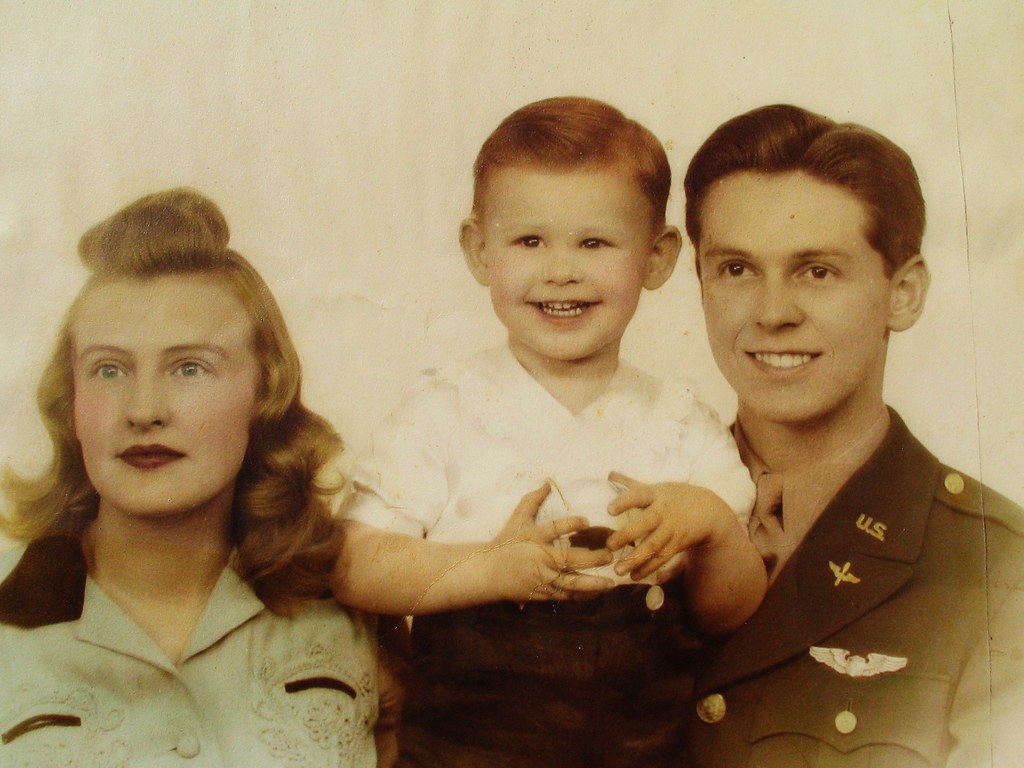
Dorothea ‘Dee’, Little Bill and William
Since then, I have been able to obtain, thanks to the Air Force Historical Research Agency Maxwell AFB, copies of another accident report that William was involved in.
The story was retold by Dee, William’s young wife as occurring at Biggs Field, El Paso in Texas and involved a B-24 colliding with another aircraft. It is now believed this was in fact a collision at Lemoore AAF as the details of the incident are very similar to those originally told by Dee.
At the time, the Army Air Corps used a range of aircraft to train pilots in basic flying, one of the more powerful and complex models was the single engined aircraft the Vultee BT-13 (replaced by the Vultee BT-15). On May 20th, 1943, William was flying solo in BT-15 #42-1957 at Lemoore AAF, and was approaching to land.
The official records (crash number 43-5-20-6) held at the Air Force Historical Research Agency, states that:
“At 17:02, May 20, 1943, while upon final approach at Lemoore Field at the termination of a routine training flight, Student Officer, 1st. Lt. W.G. Rueckert collided with A/C D.W. Christedsen [sic].
Both airplanes were approaching the field in the usual manner. The wind was slightly from the right at 10 mph. Position of the approaching ships gave the control ship stationed on the south-west corner of the mat no cause for alarm. A/C Christensen in ship 32 was in front below and to the right of Lt. Rueckert in ship 12. Several hundred yards from the south-west edge of the mat. Lt. Rueckert noticeably dropped the nose of his ship which struck the A/C Christensen’s airplane behind the canopy. Both airplanes remained in contact and fell to the edge of the mat from a height of about 50 feet. A/C Christensen plane landed on its back, exploded and burned killing A/C Christensen immediately. Lt. Rueckert’s landed nose first, broke clear of the other plane and the pilot jumped out and attempted to extinguish the blaze with his fire extinguisher. He sustained a cut on his forehead and shock. The fire truck and ambulance arrived immediately afterward, put out the blaze and conveyed Lt. Rueckert to the hospital.
Lt. Rueckert stated that he never saw A/C Christensen’s plane in the traffic pattern.
It is probable that one or both pilots were making improper correction for wind drift although witnesses were located at angles which made it impossible to verify this fact.”
The enquiry that followed concluded:
“Failure of pilot in airplane to look around. Poor correction for drift on the part of one or both pilots. Lack of control tower in the vicinity of mat. Present control tower is approximately four thousand feet from the scene of the accident.”
Dee would later retell the story to Bill, describing how she went to the hospital and how she had to remove little splinters of the shatter windshield from William’s forehead for weeks after the crash.
As a result it is now believed that the accident William suffered was indeed at Lemoore and not at El Paso. I shall continue to search for any evidence to the contrary, but it is almost certain that this is now the case.
Another small part of the jigsaw has fallen into place, and I once again thank Bill for allowing me to publish his father’s story.
In Trail 60 we visited the former RAF Oban (Karrera) on Scotland’s west coast, from which various squadrons operated flying a mix of flying boats notably the Short Sunderland and Consolidated Catalina.
One of these squadrons, 210 Sqn, was posted from Oban to Sullom Voe, a major deep water harbour on the Shetland Isles. These squadrons were used primarily for maritime patrols – U-boat searches and convoy escorts – flying for many hours out over the Atlantic and northern reaches toward Iceland.
It was from Sullom Voe that 210 Sqn Flying Officer John Cruickshank, earned himself the Victoria Cross for his action against a heavily armed German U-boat. During the attack, Cruickshank and three other crewmen were severely injured, his navigator was killed and the aircraft badly damaged. He continued to fly his aircraft (Catalina Mark IVA, JV928 ‘Y’) before relinquishing control to his second pilot. But knowing he couldn’t land the aircraft, Cruickshank refused morphine, circling over the base until daylight which allowed him to supervise the landing of the Catalina by the Second Pilot. His actions that night undoubtedly went a long way to saving his crew and his aircraft. Cruickshank is the last living recipient to have been awarded the Victoria Cross during the Second World War.
Born on 20th May, 1920 in Aberdeen, on Scotland’s north-east coast, Cruickshank spent some of his life in both Aberdeen and Edinburgh being educated at the Royal High School in Edinburgh, the Aberdeen Grammar School and Daniel Stewart’s College in Edinburgh. Before the war, he was employed by the Commercial Bank of Scotland, joining them in 1938. In 1939 he served in the Territorial Army before joining up in May, the 129 Field Regiment Royal Artillery being mobilised in the following August.
In June 1941, he transferred across to the Royal Air Force completing his flying training in both the US and Canada before returning to England and an operational squadron. By 1942 he had earned his wings and after further training he was assigned to an operational unit, 210 Squadron who were operating flying boats on maritime and anti-submarine patrols. By 1944 he was an accomplished and experienced pilot, flying many hours with 210 Sqn.
At 13:45 hrs on 17th July 1944, F.O. John Cruickshank, along with his crew: F.O. J.C. Dickson (Navigator); F.Sgt. J.S. Garnett (2nd Pilot); Sgt. F. Fidler (3rd Pilot); F.Sgt. S.B. Harrison (F.Engineer); W.O. W.C. Jenkins (1st W. Op.); F.Sgt. H. Gershenson (2nd W. Op); Sgt. R.S.C. Proctor (W.Op/Air G.); F.Sgt. F.J. Appleton (W.O/Air G.); and F.Sgt. A.I. Cregan (Rigger) took off in Catalina Mark IVA, JV928 ‘Y’ from Sullom Voe as part of Operation ‘Mascot’, an operation designed to attack and sink the German Battleship ‘Tirpitz’.
Tirpitz was anchored at her mooring in Kaafjord, Norway, and the RAF’s 18 Group role was to protect the attacking fleet from a defensive force of twelve German submarines designated Group Trutz. Cruickshank and 210 Sqn were part of that RAF 18 Group.
Following the unsuccessful attack, the British fleet returned, Group Trutz was re-positioned to lay in wait for them and it was here that Cruickshank made his attack.
At 21:45 at the position 6842N 0612E and a height of 1,500 ft, Cruickshank’s radar operator picked up a signal some 15 miles away, a position west of the Lofoten Islands, west of Narvik. The aircraft turned and vectored onto the vessel. At 5 miles distance they sighted an unknown surface vessel, and went to investigate.
The aircraft reduced altitude to 200 ft on a course of 2200 noting that the vessel was at that time stationary. After entering cloud, Cruickshank then sighted the vessel again at 2 miles, this time is was moving at a speed of about 20 knots and turning to starboard. The crew at this time considered it to be a ‘friendly’ and so fired a recognition flare whilst signalling the letter of the day. At this point, the vessel began to open fire and it was now certain that it was a U-boat and not a British vessel.
The Catalina, followed the U-boat (believed to be a German type VIIC submarine U-361) as it turned to port, and made a compete circuit remaining at 2 miles distance. Once ahead, the aircraft began its run in. Diving from 1,000 ft to 500 ft, it headed straight for the U-boat, inaccurate flak being met with fire from the Catalina’s front turret. As the aircraft passed the U-boat depth charges were dropped and the blister turrets also opened fire, hits were seen on the coning tower by both front and port blister turret.
Unfortunately the depth charges didn’t release and so Cruickshank turned the aircraft for a second attack. This time, the U-boat was stationary and firing more accurate flak. The Catalina was hit several times, killing the navigator, F.O. John C. Dickson, and seriously wounding Cruickshank along with three other crewmen. At 50 ft, 6 Depth Charges were released, this time successfully, the two blister turrets confirming wash from the drops but no defined ‘hits’. Immediately after the attack the Catalina entered thick sea fog obscuring any further views.
At 21:58 the attack was over, the Second Pilot took control of the Catalina, himself injured in the hand. The Wireless Operator F.Sgt. F.J. Appleton, treated the injured dressing their wounds, including those of Cruickshank. F/Sgt Fidler took over the navigation from the killed navigator. He calculated the aircraft’s fuel and consumption and initial results were not good, but with damaged instruments this proved to be difficult.
A message was sent back to Sullom Voe that an ambulance was required urgently. A conversation then began between the ground and the second Pilot in which it was said that the flying boat’s hull had been damaged and the pilot was unable to land the aircraft as he was badly wounded. The Catalina informed Sullom Voe that they had about 5 hours of fuel (450 Gallons) available. It was also clear by this point that the radio wasn’t working.
Whilst dressing Cruickshank’s wounds Appleton realised how seriously injured the pilot was, but knowing the Second Pilot, F.Sgt. J.S. Garnett, could not land the Catalina, he refused morphine, instead insisting on being carried back to the controls to oversee the landing.
Garnett set a course for home, and just after 03:00 hrs they arrived over Sullom Voe. With unsuitable weather and darkness still enshrouding the base, the aircraft circled the area burning off fuel and waiting for daylight, beaching being the only option due to the aircraft’s damage.
For a further hour, some five and half hours after the attack, the Catalina circled the base, Cruickshank giving instructions, keeping a watchful eye over the proceedings. Finally, daylight appeared and the aircraft was able to land, successfully beaching at 04:05 hrs.
On examination, Cruickshank was found to have seventy-two separate wounds, including his lungs and legs, and the aircraft had been badly damaged. Cruickshank was given an immediate blood transfusion and then transferred to Lerwick hospital, with one further stop over before finally being transferred south.
Cruickshank made a good recovery but despite this he didn’t return to flying operationally again. On 29th August 1944, his award appeared in The London Gazette, receiving the Victoria Cross from King George at Holyrood Palace in Edinburgh, on 21st September 1944; he was just 24 years of age. He eventually left the RAF in 1946 and returned to banking, the career he had held before the war.
For his efforts and determination F.Sgt. J.S. Garnett was awarded the DFM.
The submarine was later confirmed as sunk, which that night, enabled the British fleet to sail through a gap in the German Submarine line, a gap made possible by both Cruickshank and one other successful sinking.
On May 20th 2020 John Cruickshank VC turned 100, his story was widely celebrated and reported about on BBC Scotland.
On 1st September 1944, Number 36682, p. 4073, Cruickshank’s citation appeared in The London Gazette, its states:
The KING has been graciously pleased to confer the VICTORIA CROSS on the undermentioned officer in recognition of most conspicuous bravery: —
Flying Officer John Alexander CRUICKSHANK (126700), Royal Air Force Volunteer Reserve.No. 210 Squadron.
This officer was the captain and pilot of a Catalina flying boat which was recently engaged on an anti-submarine patrol over northern waters. When a U-boat was sighted on the surface, Flying Officer Cruickshank at once turned to the attack. In the face of fierce anti-aircraft fire he manoeuvred into position and ran in to release his depth charges. Unfortunately they failed to drop.
Flying Officer Cruickshank knew that the failure of this attack had deprived him of the advantage of surprise and that his aircraft offered a good target to the enemy’s determined and now heartened gunners.
Without hesitation, he climbed and turned to come in again. The Catalina was met by intense and accurate fire and was repeatedly hit. The navigator/bomb aimer was killed. The second pilot and two other members of the crew were injured. Flying Officer Cruickshank was struck in seventy-two places, receiving two serious wounds in the lungs and ten penetrating wounds in the lower limbs. His aircraft was badly damaged and filled with the fumes of exploding shells. But he did not falter. He pressed home his attack, and released the depth charges himself, straddling the submarine perfectly. The U-boat was sunk.
He then collapsed and the second pilot took over the controls. He recovered shortly afterwards and, though bleeding profusely, insisted on resuming command and retaining it until he was satisfied that the damaged aircraft was under control, that a course had been set for base and that all the necessary signals had been sent. Only then would he consent to receive medical aid and have his wounds attended to. He refused morphia in case it might prevent him from carrying on.
During the next five and half hours of the return flight he several times lapsed into unconsciousness owing to loss of blood. When he came to, his first thought on each occasion was for the safety of his aircraft and crew. The damaged aircraft eventually reached base but it was clear that an immediate landing would be a hazardous task for the wounded and less experienced second pilot. Although able to breathe only with the greatest difficulty, Flying Officer Cruickshank insisted on being carried forward and propped up in the second pilot’s seat. For a full hour, in spite of his agony and ever-increasing weakness, he gave orders as necessary, refusing to allow the aircraft to be brought down until the conditions of light and sea made this possible without undue risk.
With his assistance the aircraft was safely landed on the water. He then directed the taxying and beaching of the aircraft so that it could easily be salvaged. When the medical officer went on board, Flying Officer Cruickshank collapsed and he had to be given a blood transfusion before he could be removed to hospital.
By pressing home the second attack in his gravely wounded condition and continuing his exertions on the return journey with his strength failing all the time, he seriously prejudiced his chance of survival even if the aircraft safely reached its base. Throughout, he set an example of determination, fortitude and devotion to duty in keeping with the highest traditions of the Service.
After Part 1 of Trail 59, we return to the Lake District, and Lake Windermere, to see how the Second World War affected the tranquil waters of the Lake district. In particular, we go to White Cross Bay, where that majestic aircraft the Short Sunderland made its dramatic appearance.
Windermere White Cross Bay.
In the intermediate war years Windermere remained as it was, tranquil and aviation free, but once war broke out things would change.
With increased bombing of Britain and in particular the growing threat to aircraft production in southern England, the Ministry of Aircraft Production (MAP) began studies into creating new factories in safer areas away from Kent and the south. Short Brothers at Rochester was one such organisation identified for expansion. Primarily home of the Stirling bomber and located not far from London, it was a high risk location, and it was within easy reach of the Luftwaffe’s bombers. In response to the need for expansion and relocation, the ministry turned their attention to Windermere, ordering an immediate feasibility study*4 into the move.
With just three Sunderland Squadrons at the outbreak of war, the defence of shipping and anti-submarine patrols needed a major boost. Production of Sunderlands, Short’s long range Flying boat, had to be increased, and so it was decided, that a new factory independent from Rochester, would be constructed at Windermere. At 75,000 sq ft, it was to be the largest single span hangar in the country, and it would be at a huge cost too.
As had happened before at Windermere, local objections became a major issue. The thought of the beauty and tranquillity of the landscape succumbing to both an aircraft factory and housing for some 1,200 workers, would not be without its consequences. Other suitable sites were given due consideration too, but with Rochester coming under attack from German bombers, the Government were pushed into making a decision and quickly. On 16th December 1940, it was confirmed, and the go ahead to build at Windermere was given, albeit with some concessions. It was agreed between the Government of the time and the local population, that the factory and all its associated buildings, would be removed once the war was over and the site was no longer needed. A concession that sadly led to virtually nothing of this remarkable venture remaining visible today.
Over the next two years, building work progressed, jigs were brought in and new specialist tools were ordered. There were in essence, two main buildings for the production process, the factory where the various parts were made, and an assembly hangar where the aircraft were fabricated. A third area located at Troutbeck Bridge (subsequently referred to as Calgarth), consisted of a range of accommodation blocks and associated buildings, it was in fact, an entirely new ‘village’.
Known as the Calgarth Estate, it would have everything from two shops to a primary school, a laundry to a football team, it even had its own Policeman! The estate was set out in a semi-circular design, with rows of houses around the outside. The canteen, assembly hall and school were all located withing the centre of the site next to a large and open recreation ground.
Building a flying boat is probably more like building a boat than an aeroplane – rather than fixing stringers over bulkheads allowing the aircraft to be built in sections and pieced together, the Sunderland was built from the keel upwards.
The Sunderland (a pure flying boat) was a massive aircraft, 112 ft in span, 85 feet in length and standing 32 feet high (to the top of the fin), it could fly for some 13 hours with a range of 1,700 miles. With a crew of up to 15, it was an ideal sub-hunter and long range maritime escort. Its hull was a single step hull, with two decks; the upper for the flying crew, and the lower a storage area for bombs and depth charges. Being such a large hull, it also had a wardroom, galley, cooking and washing facilities.
ML824 at the RAF Museum Hendon. Depth charges/bombs were extended out onto the wings from inside the fuselage.
By April 1942 the first hulls had begun to be assembled. Even the enormous hull of the Sunderland was dwarfed by the size of the hangar. The first RAF allocated aircraft, DP176 began construction in April. The jigs were cemented into the ground and the construction process began with six keels being formed. A skeletal fuselage was built up, and then treated aluminium panels (Dural) were added using rivets.
Even though the site at Windermere was huge, the wings, like the engines, were pre-built and delivered to Windermere for adding to the hulls. Space inside the wing was tight, the only way to access internal wing parts (control rods for example) was to crawl inside the wing and work in the very confined space between the two surfaces. Many workers, proud of what they had achieved, left their names inside the wing using a pen.
Each Sunderland built at Windermere (all MK.IIIs) was ‘hand made’, panels bent and riveted, most by hand rather than machine, so that each one was unique. Operating on water, each aircraft had to be water tight, this being tested from the inside under pressure, and any that were not, were stripped down and rebuilt. It was extremely noisy work, mainly using a non-skilled workforce recruited primarily from the local area. As skilled labour was in very short supply, and Short Bros. at Rochester couldn’t afford to let their skilled work force go (many were working on the RAF’s heavy bomber the Stirling) women and youths were drafted in (as part of the Governments recruitment plans) to fill those spaces left by the men who had joined up.
This meant extensive training programmes had to be delivered, and it became a frustrating time for those employed at the site. But, over time, things settled down and production got into full swing, the workers united and a ‘family’ was formed.
Once complete, the aircraft was rolled out using a special tail-trolley with beaching wheels attached to the fuselage sides beneath the wings. As a pure flying boat, the Sunderland could not easily move under its own power whilst on land, but had to be towed by a small tractor. Once in the water, it cold move using its engines and rudder, but having no water rudder meant it was difficult to manoeuvre. To help, two drogues were used, located either side of the fuselage and passed through the galley windows. These 3 foot wide drogues could catch huge amounts of water, pulling a large cable and a man’s hand with it – if care wasn’t taken. Each man would throw one of the drogues out of the open window and drag it through the water to turn the aircraft, rather like how a canoeist does today. These methods, whilst primitive, were effective.
Once out of the hangar, the aircraft were lowered into the water, and the beaching gear was removed. The aeroplane was then towed, by boat, out onto the Mere where they were moored to buoys. To assist with this, the front turret could be withdrawn into the hull and a crew man would lean out and grab the mooring rope using a hook. Moving the aircraft into and out of the water was a tricky job indeed, and required great skill so as to not damage the hull of the aircraft through grounding.
Sunderland ML824 at the RAF Museum Hendon showing the front turret withdrawn to enable mooring. Notice also the maintenance panel in the wing, lowered to allow maintenance whilst moored. My father would fasten cork to his tools in case he dropped them into the water.
On September 10th 1942, the first aircraft, DP176, finally left the hangar ready for engine runs and its first flying test. Lashed down to the slipway, the four Bristol Pegasus XXII air-cooled radial engines were started up and ran. After a successful test, the test pilot John Lankaster-Parker, took the aircraft onto the water where it was moored ready for further tests, and its first flight the following day.
The next day, 11th September 1942, the workforce were given the day off to witness their first Sunderland’s flight. As Short Brother’s own test pilot John Lankester-Parker (who also flew the first Stirling) climbed aboard with a selection of technicians, a large crowd gathered outside the factory. The buzz of seeing the first Windermere Sunderland, was met with cheering and clapping as it gradually rose in to the air. After twenty minutes, Parker returned to the water and all was reported to be well. After further flying tests, DP176 was passed to RAF control, and taken away to have its electronics fitted before commencing operational flying duties with the RAF.
A post war picture of a Sunderland launching (photo my father) either Wig Bay or Stranraer. Does anyone know what U.I.D might mean?
The ‘Flying Porcupine’ as the Sunderland was known, became the backbone of Coastal Command operations, a sturdy reliable aircraft it was used as a model for the RAF’s Stirling bomber (less successfully) and went on to be the basis for the Short Shetland, a flying boat that dwarfed even the Sunderland.
In January 1944, Sir Richard Stafford Cripps*5, now the Minister of Aircraft Production (after Churchill had removed him from the War Cabinet for criticising his policies on war) visited Windermere to see the site and meet with the management team. The visit, unbeknown to those at Windermere, had an ulterior motive and in his meeting with the managers he announced that all production at the site was to stop with the last few fuselage frames in the factory being the last. It was a devastating blow for the workforce, but it was not however, the end of Windermere. As part of the change, the factory was to be retained and utilised as a Civilian Repair Organisation (CRO) repairing and updating older Sunderlands rather than building new ones.
The job of repairing the aircraft brought home to the workers just how bad things could be. Worn out, damaged and battered aircraft flew into Windermere to be repaired and returned to service. In some cases, women were not allowed entry into the aircraft until the blood and human remains had been removed, such was war. Some aircraft came only to be scrapped, taken apart by the axe, any usable parts were saved and reused on other less worn models.
A number of these damaged aircraft passed through Windermere, many due to action with the enemy, but some due to accidents. Those that were repairable were hauled into the factory on the beaching gear, stripped and repaired. Some were converted into MK.Vs, having new engines fitted with feathering propellers – over heating engines had been an issue on some long flights.
The CRO carried out repairs on Sunderlands, until the war’s end. In 1945 a new direction was taken and upgrading work took over as the main task for the workers. MK.IIIs were brought in, stripped and upgraded to MK.Vs. New Pratt and Whitney Twin Wasp engines were installed, the dorsal turret was removed, and two gun mounts were added to the insides of the fuselage behind the wings. In addition, to extend longevity all of the control cables were replaced.
Inside the Sunderland looking forward. The two brackets either side are the gun mounts of the MK.V, the turret having been removed and replaced.
The Sunderland gained the nickname ‘Flying Porcupine’ (Fliegendes Stachelschwein), generally thought so because of its extensive array of aerials. Alternatively, it gained its name from the Germans who fell foul of its powered gun turrets. It is also thought however, and more likely, that this naming was more to do with British propaganda than anything else, as the name appeared in print before any real skirmishes had occurred between RAF and Luftwaffe aircraft.
At the beginning of the Second World War, Coastal Command had only thirty-four Sunderlands on their books, but by the end almost 750 had been built, the majority being MK.IIIs, serving well into 1959. There were four military marks built: MK.I, MK.II, MKIII. and MK.V. The MK.IV being an upgrade of the MK.III with heavier guns: (.50 inch machine guns and 20mm Hispano Canons); a larger tail; longer fuselage and bigger, stronger wings. It also had in addition, more powerful Bristol Hercules engines. It was then considered an entirely new aircraft, and so received the designation S.45 ‘Seaford’. Only 8 examples were ever completed, all of which arrived too late to see combat duties. None of those constructed making it beyond trials with the Royal Air Force.
The last Windermere Sunderland worked on, ML877, arrived from 228 Sqn on April 4th 1945, along with NJ171 to collect and return the crew. The aircraft was upgraded to MK.V standard after which it was taken away and returned to operational duties.
The last Sunderland ML877 taken at Pembroke Dock (from my fathers photo album).
With that, Windermere’s aviation history closed. By the time production had ceased, Windermere had produced thirty-five aircraft equipping seventeen front line RAF Squadrons, along with Maintenance Units (MU) and Operational Training Units (OTU). Their service stretched as far as West Africa, Hong Kong and of course bases around the shores of the UK. One of the biggest ‘users’ was 57 MU / 1 FBSU (Flying Boat Service Unit) at Wig Bay, whilst others ended up at Pembroke Dock – both of which my own father was posted to, to work on Sunderland Flying Boats, I wonder if he came across any of these.
Workers from Windermere were transferred to either Rochester or Belfast, others stayed in the area to find alternative employment. After being nationalised by the Government during the war, Shorts in Rochester was closed and all production moved to Belfast. It was eventually taken over by the Canadian company Bombardier. It is believed that some aircraft parts along with general rubbish were dumped into Windermere to dispose of them, and rumours of complete aircraft being scuttled there have long since drawn divers to the area in search of these hidden wrecks. These are unfortunately unfounded, those who worked at the site have not given any credence to the myths, and so it remains a sad truth that the Windermere Sunderlands are indeed now just a part of history.
Back at the Windermere, the Government’s agreement to remove the buildings wasn’t implemented straight away.
In August 1945, the British government agreed to give refuge to 1000 child sufferers of Nazi concentration camps. 300 of them were brought to the Calgarth Estate, the former Short’s accommodation area, where a team of counsellors and volunteers had been assembled hoping to rehabilitate them.
The (4 month) pioneering project run by Oscar Friedman at Windermere, aimed to rehabilitate the children, allowing them to lead a normal life in society once more, after the horrific treatment they had received in the various concentration camps under the Nazi regime.
On arrival the children were separated into girls and boys, asked to remove clothing and given a medical examination. Some, fearful of what had happened before believed they were going to experience similar atrocities. Others were more forgiving and more hopeful. Their clothes were burnt, they were deloused and then the children were fed.
The former flying boat site provided accommodation for the workers, this accommodation would now house the refugees, each older child having their own bed, in their own room. A far cry from the squalid bunks of the concentration camps.
With the freedom of coming and going, even simple things frightened the children. A dogs bark or a uniform could mean the difference between life and death. Their nightmares would linger on for years to come.
During the day, they attended classes, English and sport along with therapy sessions using art as a medium through which they expressed their emotions. The pictures they created reflected the brutal suffering and emotional damage that the Nazi regime had inflicted upon them. Not the happy blue skies and sunny landscapes a ‘normal’ young child would have created.
Very soon the Red Cross brought the devastating news about their families:. Brothers, sisters, parents who had all perished in the various death camps across Eastern Europe. This was another blow to those who were either located here or worked here.
By the time the children were able to leave they had formed great friendships. In all, 732 children passed through British ‘camps’ all going on to make independent lives for themselves. Many set up businesses here in the UK, some in the US. Of those who stayed, many received accolades – an MBE and a knighthood being among them.
Windermere was a place of salvation, of peace and harmony. The journey was a difficult one, but after the horrors of the German concentration camps it brought life, love and lasting friendship to many heartbroken children.
Even though the local people had grown to liking the new factory, eventually the agreement made between them and the Government, to remove the buildings and all trace of the factory, was carried out. In 1949, the factory element was pulled down, leaving the accommodation area to continue on well into the 1960s.
In July 1990 the world’s last flyable Sunderland flew over Windermere visiting White Cross Bay. ML 814 (known as ‘Islander’), was a Belfast built Sunderland, and served with the RNZAF after the war. She also served as a civilian aircraft operated by Ansett Airlines. She was given permission to land on Windermere during the 1990 Windermere Festival, whilst the then owner Edward Hulton was looking for a permanent base for the aircraft. Sadly it was not to be, the authorities in 1990 were less keen than their predecessors to have large four engined aircraft on the water, and so the aircraft departed eventually being purchased and transported to Florida’s Fantasy of Flight Museum.
Traces of the site remained for many years, but now only the slipway, odd patches of concrete and paths hint at its history. The Holiday camp built on the site has a small display of items to do with the factory, and the Airfields of Britain Conservation Trust have erected a memorial stone to all those who served here. The stone stands outside of the ‘club house’.
Once a conglomeration of buildings, it is now a huge holiday park; how many of those who stay here I wonder, give more than a passing glance at the historic value of this once busy and noisy place.
Post Script.
For years rumours of scuttled Sunderlands proliferated around the aviation world drawing divers to explore the depths of Windermere in search of the wrecks. Whilst aircraft were indeed taken apart at Windermere, it would seem none were actually scuttled here and the rumours of such events were indeed just that – rumours. Perhaps they were created by locals wishing to extend the longevity of Windermere’s historic links, or perhaps they were created out of the minds of ex-workers misguided by fading memories. Whatever the origin, it would be nice to think that at least one does remain down there waiting for the day it is discovered and brought back to the surface to rekindle Windermere’s history once more.
Both the Imperial War Museum (IWM) at Duxford and Hendon have a Sunderland Flying boat on display. At Hendon ML824, a MK. V was transferred from the French Navy to Pembroke Dock (see photo above) where it sat outside exposed to the elements for many years. After deteriorating it was transported to Hendon where it was fully restored and now allows public entry into the fuselage.
At Duxford, ML796, the first production MK.V went to Calshot on the Solent and then onto Wig Bay in 1946. After remaining in storage for three years she was also passed to the French Navy, serving until 1950 when she was transferred to Shorts Brothers in Ireland for modifications. Returning to France in 1951 via Wig Bay, ML796 served again until 1962 at which point she was struck off charge. Purchased privately, she was then unceremoniously gutted being turned into a discotheque and drinks club. She then became the charge of the IWM in 1976 where she too was refurbished. Like her surviving sister, she remains on public display, located in the Airspace hangar.
Both the Windermere site and the Sunderlands that were built there are no more, an important and decisive part of Britain’s aviation history has gone forever. With two models in Britain and less than five globally, the Sunderland is an iconic aircraft that helped in Britain’s defence of Europe, and in the defence of her own borders. It’s such a shame that both this beautiful aircraft and the memory of Windermere, have been allowed to disappear from our skies forever.
*2 Whilst others had attempted, and to some extent achieved flight (both Gnosspelius and Commander Oliver Schwann at Barrow in Furness) Adams gained the title as he was the only one able to keep the aircraft under control, a pre-requisite for being the first.
For further information on the production of Sunderlands at Windermere, including personal stories and photographs, I would suggest Allan King’s excellent book “Wings on Windermere“, published in 2008 by MMP.
In Trail 59, we head to the northwest of the country, to an area of outstanding natural beauty. It is an area made famous by its many hills and lakes. It was the home of Beatrix Potter, Arthur Ransome’s series of books Swallows and Amazons; several water speed records, and it is a mecca for tourists flocking to “get away from it all”.
Surprisingly then, it is an unlikely place for aviation, yet it was up until the end of the Second World War, a major player in Britain’s aviation industry, utilising one of the vast lakes for that spectacular machine the flying boat.
In Trail 59 we head to the Lake District, and Lake Windermere in particular, where there are two sites linked to Britain’s aviation history. The first, at Cockshott Point, is where the aviation link began, whilst the second, White Cross Bay, is where the more substantial part of the trail takes place.
Windermere.
(RNAS Windermere/Cockshott Point / RNAS Hill of Oaks)
Lake Windermere (as it is incorrectly known) is the largest of the 16 bodies of water in the Lake District, and at almost seventy metres deep, eleven miles long and just under a mile wide, it is actually classed as a ‘Mere’, and not a lake. It is however, probably the most famous of all the Lakes, Meres or Tarns in the district and certainly it is the most visited. In 2018, Windermere helped draw more than 19,000,000*1 visitors to the area, many taking up recreational activities on its 14.8 square kilometres of water.
Windermere’s aviation connection began in 1911, when a civil engineer, Oscar Gnosspelius, and a barrister, Captain Edward William Wakefield, began trials of flying from water both men using Windermere as their base. Progress for the two was slow, each finding out for themselves the perils of trying to take off from water. Both men trove to be the first to achieve this challenging task, and both found the many difficulties of such an action.
After many failed attempts of breaking the water’s hold over these ‘hydro-aeroplanes’, both Gnosspelius and Wakefield reached a point where they believed take off was truly possible, all it needed was good weather.
The notoriously poor climate of the Lakes finally broke, and on 25th November 1911, Gnosspelius made his attempt first. After steering his aircraft along the water, lift was achieved, and it momentarily rose from the lake only to have the wing strike the water bringing the aircraft and Gnosspelius crashing down.
Wakefield meanwhile, had teamed up with a Rolls Royce engineer, 27 year old Herbert Stanley Adams, whilst he was based at Brooklands. Wakefield had offered him the job of test pilot, which Adams duly accepted. On the same day that Gnosspelius made his attempt, Adams took Wakefield’s aircraft, an Avro adapted Curtiss biplane, out onto Windermere water. The first run failed to gain any lift at all, but then, on his second run, he turned the craft and headed north. Now with a good headwind, the aircraft broke the surface tension and it gradually rose from the water flying some 50 feet or so above its surface. History was at last made, and Adams became the first man in the UK to fly an aircraft that had taken off from water*2
November 25th 1911, the date Adams took off from Windermere and flew the first UK flight from, and back, to water.
And so, Adams’ achievement set in motion a series of events that would lead Windermere on a long, and difficult path to aviation history. As confidence grew in waterborne aviation, more and more flights were made which soon led to the formation of the Lakes Flying Company. All this activity and the noise from albeit small aircraft engines, inevitably led to vehement objections from many locals including Beatrix Potter herself. These objections were so strong that organisations were set up to oppose the continuation of flying. Support for them rapidly grew, and soon they had amassed over 10,000 signatures in their support. But the argument in favour of flying was also strong. Many had the foresight to see where flying from water could lead, and in April 1912, the Government made the decision to allow further flights from Windermere, a decision that enabled Wakefield to continue with his business endeavour.
Fearing other nations were also trialling flight from water, especially France, the Government debated at length the need for such measures. During one such debate, the Rt. Honourable Mr. Joyson-Hicks directed his questions about France’s progress in hydro-planes, directly to the then 1st Lord of the Admiralty, Winston Churchill.
Mr. Joyson-Hicks asked Churchill how many such hydro-aeroplanes the British Navy owned. Mr. Churchill, in his answer, explained that there was indeed one under construction at East-Church, two others on order, and another thirty-two experiments with machines of this type occurring at:Sheerness,Lake Windermere, and at Barrow. He went on to explain that the results obtained so far from these trials “were promising“.*3
Gnosspelius meanwhile, repaired his damaged aircraft. Learning from his mistakes he modified it and retested it – it flew, giving him the lesser honour of becoming the first person to fly an aircraft built solely in Cumbria; albeit in the shadow of Adams’ and Wakefield’s triumphant achievement.
By the time World War I arrived, the benefits of taking off from water were well and truly clear, the Royal Naval Air Service took a great interest in the exploration seeing a future for water borne aircraft within their service. Wanting to perform their duties, both Adams and Gnosspelius joined up, leaving the company without anyone to lead it. Seizing on the opportunity, it was bought out by William R. Ding, an instructor who had been brought in by Wakefield, and had also realised the potential of taking off from water. In light of the RNAS’s interest, he could see profit in training pilots to perform the task. Eventually, so keen to investigate and carry on the idea themselves, the RNAS requisitioned the company and took over the site renaming it RNAS Hill of Oaks.
Many of the civilian staff who were already employed on the site remained for the time being, but when the last individuals left in 1916, it became a naval base, and as such was renamed again – this time the more appropriate RNAS Windermere. Training continued under the supervisory eye of the RNAS, but eventually, as the war approached its end, operations from Windermere began to wind down. Predictably, it reached a point where flying ceased altogether and the RNAS departed the site.
This could well have been the end of the line for Windermere, but a short reprieve in 1919 saw the once famous 1914 Schneider Trophy air race pilot, Charles Howard Pixton, return to the site. Utilising Avro 504K floatplanes, he set up and carried out tourist flights, which he combined with an newspaper delivery service to the Isle of Man. These operations breathed new life into waterborne flight, and in particular, into Windermere.
Eventually though even these ceased, and during these post war years, flying activity gradually declined at Windermere, and apart from a few recreational flights onto the water, it eventually ceased altogether. With this, the final flight had been made, and Cockshott Bay, a place unique in British aviation history, would no longer resound to the sound of aircraft engines. This part of Windermere’s aviation life had come to an end.
Now a major marina, only a tiny section of slipway remains, its access is difficult even for boat owners, primarily due to its location. It is rather sad, especially considering the importance of this site that nothing more tangible remains (a memorial stone from Airfields of Britain Conservation Trust is nearby) to commemorate the incredible deeds of Adams, Wakefield and Gnosspelius, who between them took Windermere into the annals of aviation history.
The second site visited today lies a few miles north from here, also along Windermere’s eastern bank. It is this site that is perhaps the more prominent, and perhaps the more defining, of the two. From here we take a short trip north stopping off at White Cross Bay.
In the afternoon of the September 30th, 1940; a lone Messerschmitt 109 flew low and slow over Strood, Kent, belching smoke. The pilot, Unteroffizier Ernst Poschenrieder, had been in combat with Spitfires from 222 Squadron whilst escorting bombers to London. Ernst’s squadron had suffered heavily when the Spitfires pounced. The aircraft he was flying wasn’t even his usual mount. He wasn’t superstitious, but so far this definitely wasn’t his day.
Knowing he would never get back to France and that he was too low to jump, crash-landing on Broom Hill, a hilltop field cultivating vegetables for the war effort, was now his only option. He could see it would be tricky. People were tending the field, but his wounded engine was giving up. To minimise the dangers of a wheels-up landing, he overflew the field and emptied his guns harmlessly into the surrounding treetops.
Unteroffizier Ernst Poschenrieder (courtesy Shoreham Aircraft Museum)
Approaching the tree-line, Ernst throttled back and put the flaps down, losing as much airspeed as possible. The treetops seemed to be trying to grab him as he cut the dying engine; a fire prevention measure. Skimming the trees, the Messerschmitt sank through the last thirty feet of the air and hit the ground violently at 60 MPH, ploughing down the slope. Bucking and bouncing, it tore up the dry soil then broke its back, slewing half-round and stopping just before the trees. He’d made it, just; but the force of the crash had nearly broken Ernst’s back, too.
The farm workers ran to the scene with hoes and forks. Thinking the pilot had tried to machine-gun them, they sought blood; but a young Land Army girl, a Scots lass named Sarah Kortwright, got there first. Standing beside the cockpit, she kept them back. Ernst sat there, ears ringing and in intense pain; and waited. Someone had gone to fetch a Policeman.
PC Jack Matthews (back row, 3rd from right) who later arrested Unteroffizier Ernst Poschenrieder (by kind permission of Mike Hearne)
Sixty-year-old PC 28 Jack Matthews, of the Rochester Police, quickly arrived on the scene. Taking immediate control, he arrested the pilot, for his own protection. Jack was over six feet tall and athletically built. Facing the mob, truncheon in hand, he sternly announced that anyone trying to interfere would be obstructing a Police Officer or having to assault one. The mob lost interest and Ernst was carefully extracted from his cockpit, grateful to be alive.
Ernst’s crashed 109, courtesy Friends of Broomhill
Ernst was taken to Chatham Police station, then immediately to Hospital, for emergency surgery. Thereafter, he was a POW.
He returned to England in 1955, to thank both Sarah Kortwright and the doctor who’d treated him. He traced the hospital doctor, but Sarah had returned to Scotland. Undeterred, he tracked her down and armed with a bouquet of flowers, went to Scotland and took her out to dinner! In 2005, Ernst visited artist Geoff Nutkins, at the Shoreham Aircraft Museum in Kent, to sign some prints and sketches. Ernst became a frequent visitor to the museum’s events. Sadly, he died in 2009, aged 98. he was killed not by old age; but rather unexpectedly, by a car.
This article was excerpted from a new e-book. 1940: THE BATTLES TO STOP HITLER gives the full story of this and many other events like it, that took place during the time when it seemed that only the French and the British stood in Hitler’s way. Published by Pen & Sword Books Ltd this e-book is available to download at http://www.pen-and-sword.co.uk/1940-The-Battles-to-Stop-Hitler-ePub/p/11119 priced at £8:00.
The Eagle Squadrons were three RAF Squadrons made up of American volunteers, their achievements and records are well-known and well documented, however, it was not all plain sailing for these determined and courageous flyers. For one Squadron in particular, 133 Squadron, September 26th 1942 would be a disaster, a disaster that would almost wipe out the entire flight of twelve airmen.
133 Squadron had been on the front line serving at RAF Biggin Hill and RAF Martlesham Heath before arriving at RAF Great Sampford, a satellite for RAF Debden. The ground crews were predominately British, assisting and training the US ground crews in aircraft maintenance and support. All the pilots however, were US volunteers, formed into three separate squadrons but under RAF control.
1st Lt Dominic ‘Don’ Gentile and Spitfire BL255 ‘Buckeye-Don’. The photo was taken after 133 Squadron RAF was disbanded and absorbed into the USAAF as the, 336th FS, 4th FG, 8th AF. (@IWM)
133 Squadron would arrive at RAF Great Sampford on September 23rd 1942, the same day as 616 Sqn RAF departed, they would be the last operational unit to fully use the airfield before its eventual closure.
Initially flying the Spitfire VBs, they soon replaced them with the MK.IX, a Spitfire that was essentially a MK.V with an updated engine. Having a higher ceiling than the FW-190 and being marginally faster, its improved performance took the Luftwaffe by complete surprise. It was so new and improved, that it remained on the secret list until after this particular operational flight.
On that fateful day, September 26th 1942, fourteen Spitfires of 133 Sqn took off from RAF Great Sampford in Essex, piloting those Spitfires were:
BS313 – F/Lt. Edward Gordon Brettell DFC (61053) The only British pilot and leader
BS275 – P/O. Leonard T. Ryerson (O-885137)
BS446 – P/O. William H. Baker Jr (O-885113)
BS137 – P/O. Dennis D. Smith (O-885128)
BR638 – P/O. G.B. Sperry (O-885112)
BS445 – P/O. Dominic “Buckeye-Don” S. Gentile (O-885109)
BS138 – P/O. Gilbert G. Wright (?)
BS279 – F/Lt. Marion E. Jackson (O-885117)
BS447 – P/O. R.E. Smith (O-885110)
BR640 – P/O. C.A. Cook (O-885112)
BS148 – P/O. Richard “Bob” N. Beaty (?)
BS301 – P/O. G.H. Middleton Jr (O-885127)
BS140 – P/O. Gene P. Neville (O-885129)
Unknown – P/O. Ervin “Dusty” Miller (O-885138) (not listed but known to have been on the flight).
They were to fly to RAF Bolt Head in Devon, where they would meet with 401 Squadron (RCAF) and 64 Squadron RAF, refuel and be briefed for the mission. A mission that was supposed to be straight forward and relatively uneventful.
The aim of the mission was to escort US bombers to Morlaix on the Brest peninsula. The usual commander of 133 Sqn, Red McColpin, was not placed in charge that day, instead he had been posted, and a British Pilot, F/Lt. Edward Gordon Brettell DFC, was issued with the task.
McColpin was a strict disciplinarian and his leadership was admired by those who followed him. Without this leadership, 133’s preparation was slack and they ultimately paid the price for this.
After landing at 12:30 hours, they realised there were no facilities at Bolt Head for refuelling, and they would have to go with what they had. This would kick-start a catalogue of errors that would ultimately seal the fate of the flight. Following a briefing in which Wing Commander Kingcombe DFC and all but two of 133 Sqn pilots had failed to show up for, the flight (which included the sixteen 401 (RCAF) Squadron Spitfire IXs from RAF Kenley) took off at 13:50 hours. Of the fourteen 133 Sqn Spitfires sent to Bolt Head, only twelve would be needed, and two pilots were instructed to remain at Bolt Head, they were P/O. Ervin Miller, and P/O. Don “Buckeye-Don” S. Gentile, they would be the luckiest two men of the squadron that day.
The briefing, a very vague and rushed one, instructed the flight to carry out a ‘Circus‘ mission escorting seventy-five B-17 Flying Fortresses from the 92nd BG, 97th BG and the 301st BG, who were bombing Cherbourg and the airfields at Maupertus and Morlaix in Brittany. When the squadron took off the weather was clear, and winds were predicted to be 35 mph at 24,000 feet, but 5 miles off the English coast, they encountered 10/10th cumulus cloud cover at 7,000 feet, and so had to climb above it so that they could locate the bombers more easily.
The take of was a mess, disorganised and lacking both radio information and in many cases maps, the aircraft were lucky not to collide with each other.
Of the three RAF squadrons involved in the mission, 401 would take the high position, 133 the middle and 64 Squadron, the lower. They were to form up over Bolt Head at 2,000 feet and then head at 200o at 180 mph to overtake the bombers before they arrived at the target. If they could not locate the bombers, the flight was to circle the target for three minutes and then depart.
As the flight approached the rendezvous area, one 133 Squadron Spitfire had to drop out of formation and return home, as he had encountered engine problems; this problem was thought to be due to his low fuel. The remainder of the flight scanned the skies for any sign of the bomber formation, and after searching for some 45 minutes, they spotted the bombers, some 50 miles south of Brest. The bombers had in fact already turned for home after having discarded their bombs near to the Pyrenees.
By now the 301st BG had been recalled, as their fighter escort failed to materialise, whilst the 97th BG had continued on. However, due to the heavy cloud cover over the target area, they had been ineffective as no bombing of the target had taken place. The American bombers, who were only three months into their European air war, had inadvertently miscalculated a tail wind putting them off track well away from the Bay of Biscay.
P/O. G.H. Middleton Jr of 133 Squadron RAF was shot down and taken Prisoner of War (@IWM).
The three squadrons formed up on the bombers at just after 16:45 hours, with 64 Squadron on the port side, 401 Squadron on the starboard and 133 Squadron behind. The whole formation then flew north for 30 minutes, at which point it became evident that the wind speed was in fact over 100 mph, and not the 35 mph as stated by the Meteorological Office, or at the briefing! It has since been revealed that this information was known to those in authority, but it had not been passed down the chain of command and the pilots were never informed.
The formation then spotted land, the bombers thought they were over Falmouth and turned right. 64 and 401 Squadron broke away maintaining height, but 133 Squadron dropped down below the cloud base and prepared to land.
133 Squadron then began to search for the airfield, and after searching in vain, they found a large town, this they hoped would give them the vital fix they desperately needed. Flying low over the houses they realised they were not over England at all but in fact still over France. The flight, uninformed of the 100 mph north-easterly wind at their altitude, had also been blown wildly off course, and after 1.5 hours flying time, the situation had suddenly become very severe indeed.
The Squadron flight Leader, Flight Lieutenant E.G. Brettell, wanting to ascertain his exact position, called up a ground direction finding station who provided a bearing and heading – 100 miles off the English coast with a homing vector of 020o. It was at this point they suddenly realised they were over the port of Brest, one of the most heavily defended ports under German occupation.
Immediately, the sky filled with flak and small arms anti-aircraft fire. The pilot in the number 2 position, Pilot Officer Gene Neville (O-885129) in Spitfire #BS140, took a direct and fatal hit, he was killed instantly. Three other aircraft were to be shot down in the melee that followed: Pilot Officer William H Baker Jr (O-885113) in Spitfire #BS446; Pilot Officer Leonard Ryerson (O-885137) in Spitfire #BS275 and Pilot Officer Dennis Smith (O-885128) in Spitfire #BS294 – all four were killed, and all four were awarded the Purple Heart.
2nd Lt. Gene P. Neville 133 (Eagle) Sqn RAF, stands before his MK. IX Spitfire at Great Sampford. He was Killed during the Morlaix disaster. (@IWM UPL 18912)
The remainder of 133 Squadron struggling to defend themselves, they scattered and were forced to land out of fuel, either on the island of Ouissant or on the French mainland.
Of the seven 133 squadron pilots who crash landed on French soil, five were known to have been captured immediately and taken prisoner: P/O. G.B. Sperry; F/Lt. Edward Brettell; F/Lt. M.E. Jackson; P/O. C.A. Cook and P/O. G.H. Middleton Jr., with a sixth, P/O. G.G. Wright, evading the Germans for several days before being captured later on.
Of these initial five, F/Lt. Jackson was injured in his crash and hospitalised for eight weeks. He was then taken to Stalag Luft III from where he was able to escape for about ten days by jumping from the roof of his cell house into a lorry load of evergreen branches that were being taken away from the camp.
Another Pilot, F/Lt. Edward Brettell DFC. was executed for his part in the Great Escape from the same prison camp, Stalag Luft III, whilst P/O. Robert E. Smith, the last remaining pilot, managed to abandon his aircraft evading capture, eventually returning to England on 18th January 1943.
The pilot who turned back early due to his own engine problems, P/O. Robert Beatty, crash landed his Spitfire at Kingsbridge in Devon after he too ran out of fuel over the Channel. During the crash he sustained severe injuries but luckily survived his ordeal and was able to give an account of the mission through what he heard over the radio.
Several of the 401 Squadron pilots, who had continued on, also reported being low on fuel and gave their intention to bail out before land was finally sighted. One of these, P/O. Junius L. Hokan (s/n: J/6833), did have to bail out over the sea, he was last seen in a gradual dive, his aircraft heading seaward. His body was never recovered. Others in the flight that day only just made land fall, one crashed and was taken to hospital where he recovered from his injuries, the others just managed to reach either RAF Bolt Head or RAF Harrowbeer. The Operational Record Books for 401 Squadron state that “many casualties were avoided by the clear thinking and cool behaviour of all members of our Squadron“.
A full report of the days tragic events was issued to Fighter Command Headquarters by Wing Commander Kingcombe DFC, Squadron Leader Gaze and Squadron leader K. Hodson DFC.
S/L Gordon Brettell, 133 Eagle Squadron, executed for his part in the Great Escape breakout at Stalag Luft III (@IWM UPL 25574)
The effect on those left behind in 133 Squadron was devastating. The result of poor preparation, inadequate briefings and sub-standard communication between the Met. Office and Fighter Command had cost many lives, and very nearly many, many more. A number of postings to the Far East soon followed, and many lessons weren’t that day that led to improvements preventing such a tragedy ever happening again.
133 Squadron would continue to operate after this, transferring over to the USAAF being renumbered as 336th FS, 4th FG, three days later as planned, leaving both RAF Great Sampford and the sad memories of that very tragic day far behind.