The last flight of Joe Kennedy and Wilford Willy – (RAF Fersfield).

There has been much written about the young Kennedy, his life, his family and his death, but a lot of information around his death has remained ‘unknown’ for many years. Even today, the actual cause of his death is not clear and will probably remain so.

Joseph Kennedy Jnr was based at RAF Fersfield (originally RAF Winfarthing) in Norfolk (Trail 27), and had only been there a few weeks before he tragically died on August 12th 1944, whilst operating on secret operations. A tragic loss, this is the last flight of Joseph Kennedy and Wilford Willy from RAF Fersfield, Norfolk, England.

The Crew – Lieutenant Joseph Kennedy Jnr.

Joseph Kennedy was born July 25th 1915, Nantasket, Massachusetts, he was the eldest brother of eight siblings including John F. Kennedy. He was son to Joseph Patrick Kennedy and Rose Fitzgerald. Throughout his life he had been pressured into the political life by his father who had high hopes that his son would become the future President. Joseph Jnr wanted to please. As war loomed, Joe Kennedy Jnr rose to the challenge seizing his opportunity to become the ‘shining light’ of the Kennedy family.

The Kennedy parents instilled a desire to be competitive, to win and succeed and to be the best. This came out in Joseph during his time at both home and at school. The pressure on Joseph was enormous, and it was clearly evident throughout his short life.

Joseph lived in the shadow of his younger brother John, who would captain a PT boat in the Far East, and in Joseph’s absence, go on to become President of the most powerful nation on Earth. John was the brighter, the more determined of the two, and this caused friction between them. Joe always wanting to ‘out-do’ his brother persevered, but never seemed to quite make it.

It was this determination and rivalry that perhaps led Joseph to do what he did, to impress, to be the best and the ideal way he thought was as a war hero.

With a remarkable academic background behind him, Joseph Kennedy joined the U.S. Naval Reserves on October 15th 1941, reporting to the Naval Air Station (N.A.S.) at Jacksonville, Florida the following day. After several months of training he received his commission and on January 10th 1943 he joined a flying patrol squadron. In May he became a Junior Grade Lieutenant transferring to a bomber squadron in the following July that year. In 1944, on July 1st, he was promoted to Lieutenant United States Naval Reserve. His military life would last just over one month.

Joseph was posted to RAF Dunkeswell serving under the RAF’s Coastal Command. Flying a PB4Y he would carry out U-Boat searches over the Atlantic around the Bay of Biscay and the Atlantic. As he accumulated flying hours, he rarely came into any real danger, even when posted to cover the Allied invasion fleet over Normandy he rarely came into contact with any opposing aircraft or vessels.

Joseph Kennedy’s opportunity came when volunteers were asked for to undertake a special secret and dangerous operation. He jumped at the chance to be a hero.

Joseph Kennedy arrived at RAF Fersfield, Norfolk on 30th July 1944, where he was trained for two weeks.  On August 10th 1944, he wrote a letter home, it would be his last communication with his family. Joseph Kennedy was to become a pilot in operation Anvil, the Navy’s version of Aphrodite.

Lieutenant Wilford John Willy

Sadly, Lieutenant Wilford J. Willy (s/n: O-137078), has remained in the shadows probably because the status of Joseph Kennedy Jnr. A tragic loss nonetheless and no less an important one. Willy was born 13th May 1909, New Jersey. He enlisted in the Navy in 1928, gaining his Naval Wings on April 30th 1937, just two years after he had married his sweetheart, Edna C. Schaffery, the women he left behind. On advancing through the rank of Chief Petty Officer,  he was awarded Lower Grade Lieutenant (April 28th 1942) and two months later, on June 26th, he achieved the rank of Lieutenant. Willy served at a number of operational stations, including Pearl Harbour, before being posted to RAF Fersfield, in Norfolk.

Willy, now an expert in Radio Operations and procedures, became the Executive Officer of the Special Air Unit One (S.A.U.1), the rank he achieved when he took off with Kennedy on August 12th 1944.

Operations Anvil and Aphrodite.

Whilst Drone technology and research had been around as early as World War I, it was still relatively unchartered territory. However, radio controlled drones (modern name Unmanned Aerial Vehicles or U.A.V.s) were already being used with relative success for target practice by the RAF and USAAF during World War II. The ‘Queen Bee’ being one of many used by the RAF. The Germans had also been investigating drone and guided bomb use through examples such as the Mistel aircraft (the most successful being a combination of either a FW-190 or Me-109 mounted above a Ju 88).

Both the  USAAF and USN were undertaking secret trials into drone aircraft operations with the view of attacking the heavily defended and ‘impenetrable’ submarine and ‘V’ weapons sites across northern France . The aim, to stop, or at least reduce, the Nazi’s use of the V1, V2 rockets and the development of the new V3 canon.

Codenamed ‘Aphrodite‘ by the USAAF,  and ‘Anvil‘  by the Navy, they were two secret operations running side by side. The idea behind these operations, was to remove all excess equipment from war-weary B-17s and B-24s, fill them with explosives, such as the British Torpex, put in radio receivers so that the drone (baby) could be controlled by a separate aircraft (mother) and fly them into designated targets. A volunteer crew of two would take off, set the aircraft in flight and then bail out over the U.K. or English Channel, leaving the ‘baby’ in the control of the ‘mother’ aircraft. These would then fly, by remote control, to the target when they would be put into a dive destroying whatever they hit.

The controls of the B-17 . The arm linkage moved the control column in response to the radio controls. (credit USAF)

The idea was remarkable but not new, and the equipment whilst innovative for its day, was basic to say the least. In all the operations undertaken only one drone ever reached its target, and that was through more luck than skill.

‘Azon’ (from AZimuth ONly*1) controls had been used successfully on individual 500lb or 1000lb bombs, where the control box was attached to the rear of the bomb and controlled by the bomb aimer through a joy stick. Using two directional controls (left or right) he could direct a bomb very accurately onto a given point. The downside of Azon, was that range and fall had to be determined in the usual way by the bomb aimer, and could not be altered once the bomb had left the aircraft.

Azon had been used and proven in attacking bridges, railways and other longitudinal targets and was very accurate with a good bomb aimer. However, because of its limitations, it could only be used in one dimension and therefore was not capable a making a ‘baby’ take off.

Two aircraft types were identified for the project. Boeing’s B-17 ‘Flying Fortress’ and Consolidated’s B-24 ‘Liberator’. These once converted would be given new identifications BQ-7 (usually B-17Fs) and BQ-8 (B-24D/J). In each case it was deemed that two crew members would be needed to raise the ‘baby’ off the ground, partly because of the strength needed to pull back the control columns in these heavy bombers. Once airborne, they would climb to around 20,000ft, arm the Torpex, set the aircraft on a trajectory to the target, switch on the receivers and bail out.

About twenty-five  BQ-7s were modified, but it is not known accurately how many USAAF BQ-8s were converted. However, it is known that at least two naval PB4Y-1s (the naval version of the B-24 of which 400 had been converted from B-24 status – these were given s/n 31936 – 32335) were converted to BQ-8 standard; one of which was flown by Lt. Kennedy and  Lt. Willy on the 12th August 1944.

A number of support aircraft were needed for each mission. Prior to the attack a Mosquito XVI of the 653rd BS would photograph the target. Then the ‘baby’ would be accompanied by at least one fighter (either P-38 or P-51) incase the ‘baby’ lost control and had to be shot down, and for fighter escort; a ‘mother’ either a Lockheed Ventura or another B-17 modified to CQ-4 standard, and a photographic  Mosquito from the 8th Combat Camera Unit (CCU) to record in-flight behaviour. A post mission photo reconnaissance operation was carried out by the 25th BG at Watton to analyse the effectiveness of the bombing. It therefore took a lot of fuel, crew and aircraft to fly one drone to its target.

Because of the design features of the bombers, the USAAF looked into removing the cockpit to allow easy departure. The only aircraft that received this treatment was B-17F, “Olin’s 69’ERS” 42-30595 formally of 560BS, 388BG at Knettishall. It was never used on an Aphrodite mission  and was scrapped post war after being used for training in the open cockpit mode.  The BQ-8  (B-24) also had modifications made in the form of a widened hatch in the nose allowing for an easier escape from the aircraft. Once modified, the aircraft would have had all previous markings removed, and a special white or yellow paintwork applied to identify them from other bombers in the air. To assist the controllers in sighting the ‘babies’ whilst in flight, the aircraft were fitted with a smoke canister that would be ignited allowing the bomb aimer to see the aircraft as it began its dive. In addition to this, two cameras were fitted to some ‘babies’ that transmitted pictures to the mother or support ship. These pointed at the controls through the plexiglass, a revolutionary step forward in drone technology.
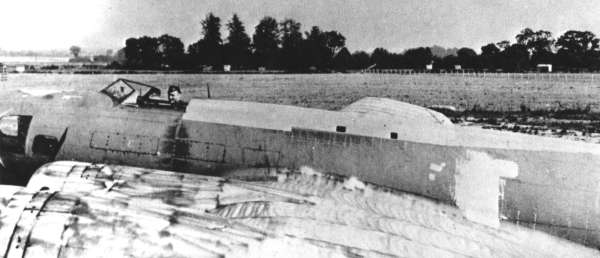
USAF designation system

A modified B-17 (BQ-7) with its canopy removed, this aircraft became a training drone. (Credit USAF)

In all, there were fifteen missions undertaken by the USAAF and USN, but none were to successfully hit their targets.  These included: Mimoyecques (Fortress); Siracourt (V1 Bunker); Watten (V2 Bunker); Heligoland (U-boat pens); Heide; Le Havre (docks); Hemmingstedt (oil refinery); Herford (marshalling yard) and Oldenburg (Power station). Both the operations and entire programme were cancelled only a few months after the Kennedy/Willy mission.

The last flight.

At RAF Fersfield, on August 12th 1944, Lieutenants Joseph Kennedy Jnr. and Wilford J. Willy, both of the S.A.U. 1 of the Fleet Air Arm Wing Seven, boarded their converted B-24 Liberator, s/n 32271 (ex USAAF B-24J 42-110007)*2 and began their preflight checks. The aircraft was filled with 21,270lbs of explosive. At 17:55 and 17:56 two Lockheed Ventura ‘mother’ aircraft took off, followed by a further navigation aircraft and then the ‘baby’ at 18:07. The ‘baby’ climbed to 2,000 ft, the two ‘mothers’ 200 feet higher and slightly behind. They were joined by two Mosquitoes, one for monitoring the weather, and the second, a USAAF F-8, to photograph the ‘baby’. This aircraft was flown by pilot Lieutenant Robert A. Tunnel and combat camera man Lieutenant David J. McCarthy. There was a further B-17 relay ship, a P-38 high altitude photo reconnaissance aircraft and five P-51 Mustangs to provide fighter cover.

The group set off toward the target at Mimoyecques , Northern France. They were to fly south-east toward the Suffolk coast, then turn south and head toward the target. Once level and stabilised, Kennedy and Willy handed over control to one of the ‘mother’ ships Then they reached the first control point (CP) at which time the group began to turn south; the ‘mother’ controlling the ‘baby’. Shortly after the turn was completed (about two minutes) Kennedy was heard to give the code “Spade Flush“, then at that 18:20 the ‘baby’ disintegrated in what was described as “two mid-air explosions” and a “large Fireball”.*4 The explosion, spread debris over a large area of the Suffolk countryside killing both crew members instantly. The following Mosquito also suffered damage and minor injuries to its crew. Following the explosion, all the aircraft were ordered back to base and the crews debriefed.

Many months (and indeed years) of investigations followed, but no firm conclusions could be drawn as to the precise cause of the explosion that ripped the aircraft apart. A number of speculative theories were drawn up, but the most plausible is that the electronic arming system was faulty, and when Kennedy or Willy, flicked the switch, an electronic short occurred that caused the bombs to detonate. Oddly the film that was in the following Mosquito has never been seen or made public – if indeed it was filming at that time.

The cause of death of both Joseph Kennedy and Wilford Willy still remain a mystery to this day, the secrecy behind one of the world’s worst explosions remaining locked away in archives.

Joseph Kennedy wanted to be a hero. He wanted to be talked about as the one who achieved and outshone his brother. Sadly, this dream cost him his life.

Page 1 of August 23, 1944 condolence letter to the parents of Lt. Joseph Kennedy, Jr.,

The letter sent to the Kennedy’s after Joseph’s death.*3

Page 2 of August 23, 1944 condolence letter to the parents of Lt. Joseph Kennedy, Jr.,

The letter sent to the Kennedy’s after Joseph’s death.*3

This fateful mission and its two crew members are remembered across the world. In France, the Mimoyecques museum contains a memorial honouring both pilots, and their names are carved in the Tablets of the Missing at the American Cemetery, Madingley, Cambridge. Kennedy has a ship the Destroyer ‘USS Joseph P. Kennedy Jr.’ DD850 named after him, and this is now a museum in Battleship Cove, Fall River, Massachusetts. Both aviators were awarded the Naval Cross posthumously,
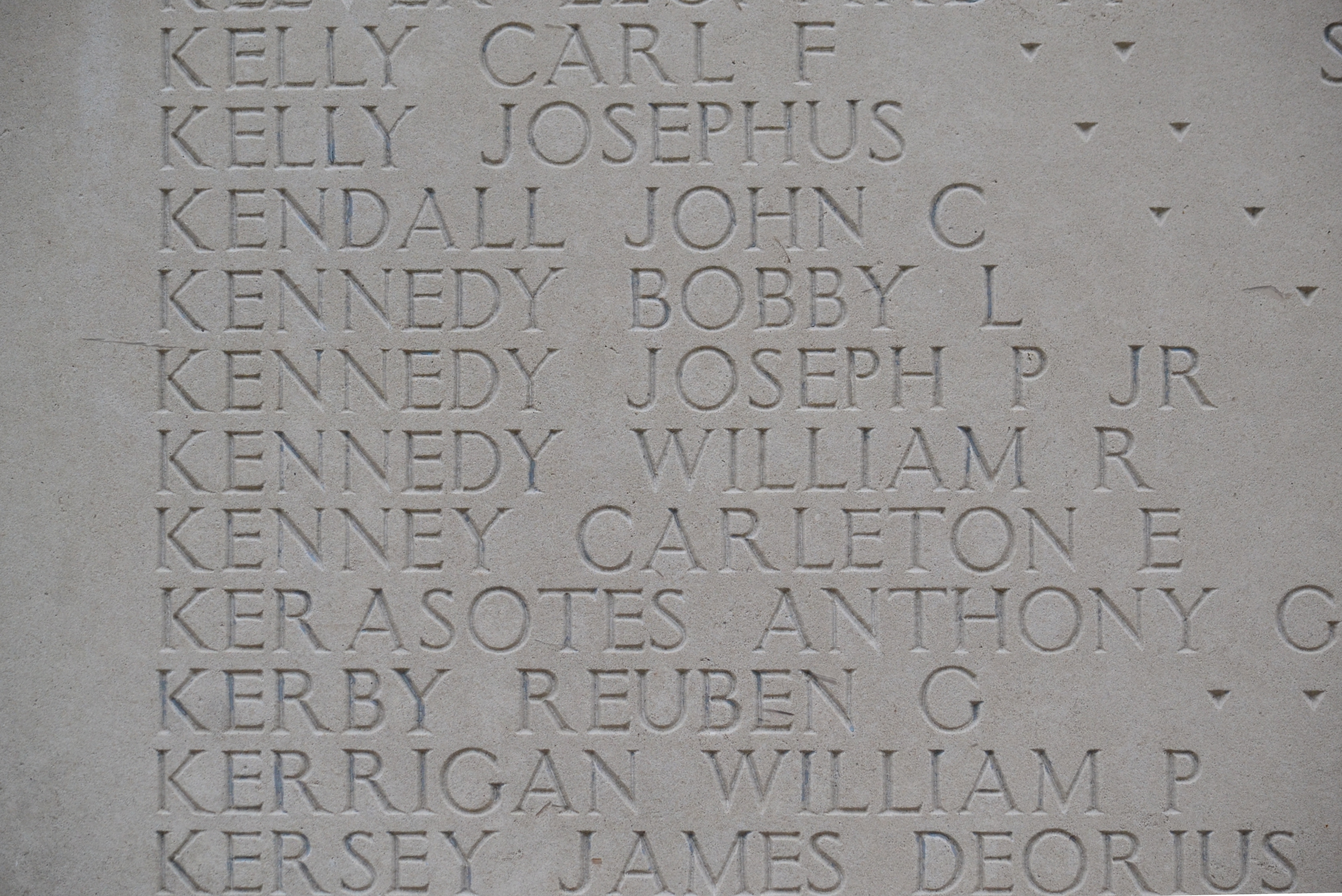
joe kennedy

Lieutenant Joseph P Kennedy Jr, USNR, appears on the Wall of the Missing at the American Cemetery, Madingley, Cambridgeshire.

Lieutenant Jospeh P. Kennedy Jnr had no dependents but Lieutenant Wilford J. Willy left a widow and three children.

Sources and further reading.

*1 Azimuth being the clockwise horizontal angle from a given point (usually North) to a second given point.

*2US Navy and US Marine Corps BuNos, Third Series (30147 to 39998)‘  Joe Baugher, accessed 20/8/15

*3 Photos taken from ‘A People at War‘  Archives.Gov, Accessed 20/8/15

*4 Elgood, P., ‘Crisis Hunter: The Last Flight of Joseph P. Kennedy Jr.’ Columbia Point, 2014, pg 45, 65,

For a list of USAAF drones and pilotless missiles, see the Directory of US Military Rockets and Missiles website.

For the details on Drones see Wikipedia.

For more information and types, see Mistel aircraft, on Wikipedia.

RAF Fersfield – where history was changed forever.

After leaving the open expanses of Deopham Green and the roar of Snetterton, we head to a very remote and quiet airfield. Quiet and remote for a very special reason. From here, crews would experience top-secret flights, we would see a link to one of America’s greatest and most powerful families, and from here, the RAF would strike another blow at the heart of the Gestapo. We head to RAF Fersfield.

RAF Fersfield (Station 140/554)

https://upload.wikimedia.org/wikipedia/commons/1/15/RAF_Fersfield_-_29_Aug_1946_Airfield.jpg

29th August 1946. Photograph taken by No. 541 Squadron, sortie number RAF/106G/UK/1707. English Heritage (RAF Photography).*1

Originally built as a satellite for RAF Knettishall, RAF Fersfield was built-in late 1943. The third Class A airfield on this Trail, its main runway ran along a NE-SW direction, was 2,000 yds in length and was constructed of concrete. There was a second and third runway each of 1,400 yds running N-S and E-W, again of concrete. Fersfield had two T-2 Hangars, one to the north side and one to the south, and 50 loop dispersals for aircraft storage. The bomb dump was located to the north, the technical area to the south and the accommodation blocks to the south and south-west. Fersfield would eventually be able to accommodate up to 2,000 personnel of mixed rank and gender.

Initially, the airfield was called Winfarthing and designated station 140, it was then handed over  to the USAAF who would rename it Station 554.

Fersfield was specifically chosen for its remote location as, unknown to those who came here, it was going to play a major role in the battle over Europe.

The first residents were a detachment of the 388th Bomb Group (BG) who were then based at Knettishall, and consisted of four bomb squadrons: the 560th, 561st, 562nd and 563rd. A detachment specifically from the 562nd, were brought here to perform special operations and research into radio controlled bombs using war-weary B-17s and B-24s. These special flights taking place between July 12th 1944 and 1st January 1945.

The 388th were unique in many ways. Aside from their work in radio controlled flights, they were also the only unit in the USAAF to not have formal squadron  identification codes. However, after VE day and the end of hostilities, wireless transmitter codes were applied to aircraft under the left wing preceded with the aircraft’s individual letter as a prefix. This then, gave a unique four letter identification on each aircraft. Similarly, the various aircraft used as remote controlled aircraft had the top surfaces of each wing and tailplane painted white for recognition purposes. *4

T2 Hangar now a store

An original T2 Hangar now stores grain.

Operating as Operation ‘Aphrodite‘, the idea of these operations was to remove all operational equipment from the aircraft, fill it with around 20,000 lb of ‘Torpex’ and fly it by remote control, into a specified target such as ‘V’ weapon sites, submarine pens (Operations Crossbow and Noball) or similar high prestige targets that were otherwise difficult to destroy .

Both the USAAF and USN were carrying out these trials. The Navy, also using Fersfield, called their operations ‘Anvil‘ and used the PB4Y (the Navy version of the B-24 ‘Liberator’) as their drone.

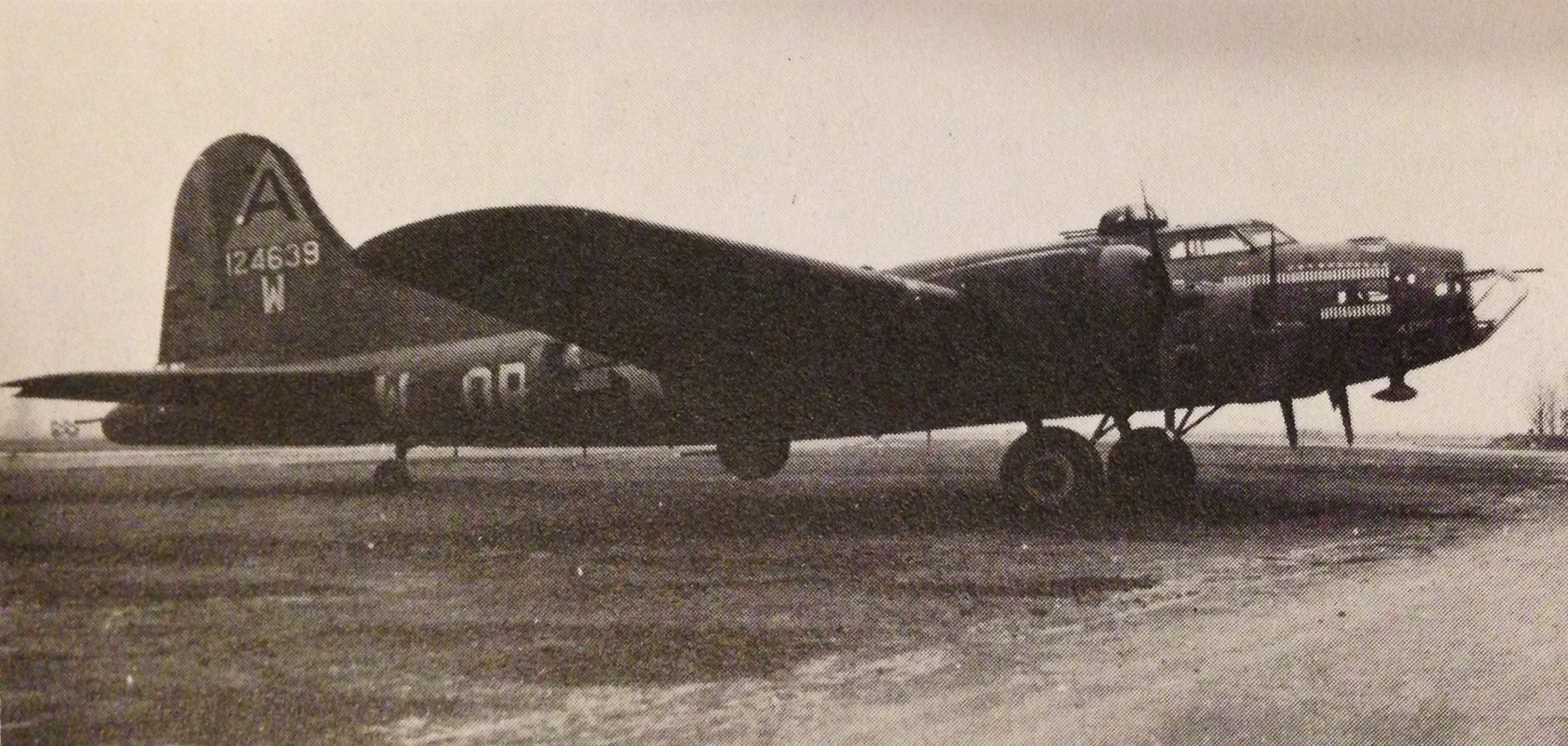
The first Aphrodite mission took place on August 4th 1944, and was to set the tone for all future operations. Mission 515, was flown using four B-17 ‘babies’ with four accompanying ‘mothers’ to target ‘V’  weapon sites at : Mimoyecques, Siracourt, Watten, and Wizernes. Escorting them were sixteen P-47s and sixteen P-51s. One of the babies, B-17 (#42-39835) ‘Wantta Spa(r)‘ (TU-N), had completed 16 missions between November 18th 1943 and July 6th 1944 with the 351st at Polebrook, and was declared to be “war-weary”. It took off but very quickly the crew – Lt J. Fisher and T/Sgt E. Most – realised there was a problem with the altimeter causing it to climb too quickly. Whilst T/Sgt Most bailed out, Lt. Fisher struggled on with the controls until it finally crashed in an almighty fireball in woodlands at Sudbourne, Suffolk, creating a crater 100ft wide. The three remaining ‘babies’ carried on but all failed to hit their designated targets. One Mother lost control and the baby hit a Gun Battery at Gravelines, the second overshot and the third B-17F formally (#41-24639) “The Careful Virgin”  (OR-W) of the 91st BG (323rd BS), hit short due to controller error.

The Careful Virgin 41-24639

B-17F “The Careful Virgin” before modification and whilst in the hands of the 91st BG. (USAF Photo)

Similar results were to follow in another mission only two days later, and then again in further operations throughout both the Aphrodite and Anvil projects.

The most famous tragedy of these missions was that of Lieutenant Joseph P. Kennedy Jnr, who was killed when his PB4Y unexpectedly blew up over Suffolk killing both him and his co-pilot on 12th August 1944.*2 In all, there were twenty-five drone missions completed, but none successfully hit their designated target with either control or accuracy. The missions were all considered failures and the operations were all cancelled soon after.

Operations Block

Former Operations Block south of the Technical site.

Another secret operation taking place from Fersfield, also involved radio controlled bombs. Designated Operation ‘Batty‘ it involved GB-4 television controlled bombs being  slung underneath B-17s and guided onto targets using TV. The 563rd BS provided much of the support whilst the other squadrons in the 388th BG, the crews. In the later part of 1944, a small number of these operations were flown again with little success and this too was abandoned before it could have any significant effect on the war.

All in all, the operations carried out here, were disastrous, killing as many crews and causing as much damage to the UK as it did the enemy. However, it did mean that the Allies had entered into the drone war and set the scene for future military operations. In all, there were 19 Aphrodite missions and 6 Batty operations carried out from RAF Fersfield.

The Americans left Fersfield toward the end of 1944, and it was then handed back to the RAF. A number of units used it for short periods, primarily for aircrew training, but none for major operational flights. However, it was not the end for the airfield, as Fersfield was to have one last remarkable mission and a further claim to fame.

Accomodation Site

Nissan Huts on the former accommodation site.

One of those squadrons who came here was 613 (City of Manchester) Squadron, who arrived at Fersfield on November 20th 1944. They were one of the twenty-one Royal Auxiliary Squadrons, and were considered the ‘baby’ of the Auxiliary Air Force by the other units. Formed on 1st February 1939 as part of No. 22 (Army Cooperation) Group, under Fighter Command, they were initially created with Hawker Hinds and a few Avro Tutors. It was then with another biplane, the Hawker Hector, and the monoplane the Lysander, that they moved with to France, early in the war to attack German gun positions and drop supplies to troops trapped in Calais by the advancing Wehrmacht.

613 performed a mix of roles, from Air Sea rescue operations from Martlesham Heath, to spraying lethal gas on troops in the event of an invasion, they moved from airfield to airfield gradually exchanging their older obsolete aircraft for more modern fighters as they went. They would take on both the North American Tomahawk followed by the incredible Mustang. It was with these aircraft that they were to escort the Venturas of 487 Sqn in their disastrous attack on the the Amsterdam power station in which Leonard Trent was awarded the VC. A mix up in rendezvous times meant the Venturas went on alone to the target, and thus paid the price for not having an escort with them.

In mid 1943, 613 Sqn operated from Snailwell near Newmarket, after which the ground personnel were sent to Sculthorpe and the aircrew to Lasham in Hampshire. This was to train all the personnel on the new Mosquito that the squadron was about to receive.

On joining the 2nd Tactical Air Force, they began attacks with their ‘Mossies’ on ‘Noball’ targets, and locomotives operating on the continent. It was at Lasham that 613 would become part of the newly formed 138 Wing, which would move soon after to Swanton Morley, but not before performing a very secret and daring mission.

Flying at very low level, they were to bomb the Kunstzaal Kleizkamp Art Gallery in the Hague, a former gallery turned Gestapo records office. Here documents relating to Dutch citizens for executions, deportation to concentration camps or labour camps were kept, and so it became a vital target for the wing. The operation was a total success, the building being all but demolished whilst nearby Dutch properties remained completely untouched.

The unit operated both on D-day, and supported the Americans in the Ardennes, flying through poor weather to strafe enemy ground troops who were trying to break through the American lines.

In November, the squadron moved to the continent in support of the allied forces whilst a small detachment of Mosquito VIs arrived here at Fersfield. They remained here until 7th August 1945, taking part in training flights, the last flight out taking place on August 5th 1945. At that point the squadron was disbanded the personnel transferring to 69 Squadron until their service ran out.

However, it was on March 21st 1945, that the crews of 613 Sqn would reunite with 487 Sqn, when the three Mosquito VI units of 21 Sqn (RAF), 464 Sqn (RAAF) and 487 Sqn (RNZAF) – now part of 140 Wing – were pulled back from the continent for a special mission to attack the Gestapo Headquarters at Copenhagen. Previously based at Hunsdon, the mission was Led by Gp. Capt. R. Bateson and Sqn. Ldr. E. Sismore, who took off in Mosquito RS570 ‘X’ at 08:35 and led a group of Mosquitoes in three waves of 6 aircraft in Operation Carthage.

The Shellhaus building raid gained notoriety for two reasons. Firstly, a large part of the building was bombed and destroyed and important documents were set alight, thus achieving the overall objective of the mission; another low-level, daring raid, it was operationally a great success.

However, Mosquitoes following the initial wave, attacked what they believed to be the target building, but it was in fact, a school masked by fire and smoke. This attack caused a significant number of unintentional civilian casualties including children at the school.

Six aircraft failed to return from the mission, four Mosquitoes (one of which crashed causing the smoke and fire that masked the school) and Two P-51s that were part of a twenty-eight strong fighter escort.

This operation was one of many daring low-level raids that the wing carried out, attacking various prestige targets including  the Amiens prison. Together with 138 Wing, the Mosquito under the charge of Basil Embry, more than proved itself as a successful low-level bomber aircraft capable of delivering high precision attacks on pin-point targets.

The aircraft eventually left Fersfield which signified the end of overseas operations for the site, and Fersfield would become a staging post for units prior to disbandment. Between November 1944 and September 1945 a number of units would be located here  which included: 98 and 107 (one week each); 140 (four days); 180 (one week), along with 226, and 605 Sqns. Operating a number of aircraft types including: Mosquitoes (T.III), Bostons (IIa), Hurricanes (IV), Martinets (TT.III), Mitchells (III) and Anson Is, Fersfield had now had its day, and in the last months of 1945, the site was closed and the land was sold off. Fersfield had closed its door for the last time and history had been written.

Post war, Fersfield had a brief spell of motor racing on its tracks and runways, but unlike Snetterton or Podington it would not last, and in 1951 Fersfield became agricultural once more, with many of the buildings being demolished and the remainder left to rot or, some thankfully, used for storage.

Nissen Huts

A few buildings remain on the technical Site.

Today a few buildings still do remain clinging onto life. The T-2 on the south side stores grain, and a number of Nissen huts  that housed the technical aspects of the airfield, are now storage for farm machinery and other associated equipment. All these can be located at the end of a small road from the village, and when visiting, I found the workers here only too willing to allow the visitor to wander freely among them. Footpaths cross the southern side of this site and to the north across the field dissecting the airfield. The path is very poorly marked and you are simply wandering across the crops. From here, you can find the last few remains of the accommodation site, further south a short distance away. Latrines and other communal buildings are shrouded in weeds, gradually disappearing beneath the undergrowth. Trees sprout from between the walls where so many walked before or after a mission. Nissen huts survive further out, now dilapidated and hastily patched, their memories mixed amongst the personal belongings of new owners.

Latrine Block

One of the many Latrines on the communal site.

It is hard to believe that an airfield with such an iconic history such as Fersfield never made it to the high status of so many others, as  surprisingly, it was here in this quiet and remote part of Norfolk that aviation history was made and American politics changed forever.

Squadrons that stayed at Fersfield in the last months of the war.

98 Sqn – Arrived here first, on April 18th 1945, remaining here until December 18th that same year with the Mitchell. They were disbanded at this point.

605 Sqn – Arrived 25th April 1945 staying until 31st August 1945 as a detachment of Mosquito VIs. They were then disbanded and renumbered as 4 Squadron.

226 Sqn – Joined 605 at Fersfield on 27th April 1945, also as a detachment but with Mitchell IIs. They too were disbanded on September 20th that same year.

180 Sqn – stayed here between 7th June and 14th June 1945, a weeks break from their airfield at Achmer to where they returned.

107 Sqn – Arrived at Fersfield a month later on 3rd July, also staying for one week with Mosquito VIs coming across from France to where they to returned.

140 Sqn – Stayed here between the 9th and 12th July 1945 with Mosquito XVIs, whilst en route from Eindhoven to Acklington.

Mosquito Mk.VIs involved in the Operation Carthage,*3.

No 487 Squadron

RS570 ‘X’ Gp Capt R N Bateson / Sqn Ldr E B Sismore (Raid Leader)
PZ402 ‘A’ Wg Cdr F M Denton / Fg Off A J Coe (damaged, belly landed at base)
PZ462 ‘J’ Flt Lt R J Dempsey / Flt Sgt E J Paige (hit by flak, 1 engine u/s, returned safely)
PZ339 ‘T’ Sqn Ldr W P Kemp / Flt Lt R Peel
SZ985 ‘M’ Fg Off G L Peet / Fg Off L A Graham
NT123 ‘Z’ Flt Lt D V Pattison / Flt Sgt F Pygram (missing)

No 464 Squadron

PZ353 Flt Lt W K Shrimpton RAAF (Pilot) / Fg Off P R Lake RAAF
PZ463 Flt Lt C B Thompson / Sgt H D Carter
PZ309 Flt Lt A J Smith RAAF / Flt Sgt H L Green RAAF (Flt. Lt. Green’s first given name was “Eric” known to all as “Les”, a common abbreviation in Australia. H.L. Green is used in the ORBs)*5
SZ999 Fg Off H G Dawson RAAF / Fg Off P T Murray (missing)
RS609 Fg Off J H Palmer RAAF / 2nd Lt H H Becker RNorAF (missing)
SZ968 Wg Cdr Iredale RAAF / Fg Off Johnson
All aircraft took off at 0840; last back landed 1405.

No 21 Squadron

SZ977 Wg Cdr P A Kleboe / Fg Off K Hall (missing)
PZ306 Sqn Ldr A F Carlisle / Flt Lt N J Ingram
LR388 Sqn Ldr A C Henderson / Flt Lt W A Moore
HR162 Flt Lt M Hetherington / Fg Off J K Bell
No 21 Squadron records list only these four aircraft and crews above as taking part in this operation.
All aircraft took off at 0835; the three which returned did so at 1355.

Sources and further reading.

*1 Photograph in Public Domain, taken from Wikipedia 20/8/15

*2 For a more detailed explanation of the operation that killed Joseph Kennedy Jnr. see  ‘The Last Flight of Joe Kennedy and Wilford Willy‘.

*3 Information from The National Archives, 21/8/15

*4 Freeman. R., “The Mighty Eighth” Arms and Armour, 1986

*5 My thanks go to Chris Berkley of the Canowindra Historical Society and Museum Inc. for the correction.

National Archives: AIR-27-1924-54, AIR-27-1924-53