Trail 59 – Windermere’s Early Flying Boats (Part 1)

In Trail 59, we head to the northwest of the country, to an area of outstanding natural beauty. It is an area made famous by its many hills and lakes. It was the home of Beatrix Potter, Arthur Ransome’s series of books Swallows and Amazons; several water speed records, and it is a mecca for tourists flocking to “get away from it all”.

Surprisingly then, it is an unlikely place for aviation, yet it was up until the end of the Second World War, a major player in Britain’s aviation industry, utilising one of the vast lakes for that spectacular machine the flying boat.

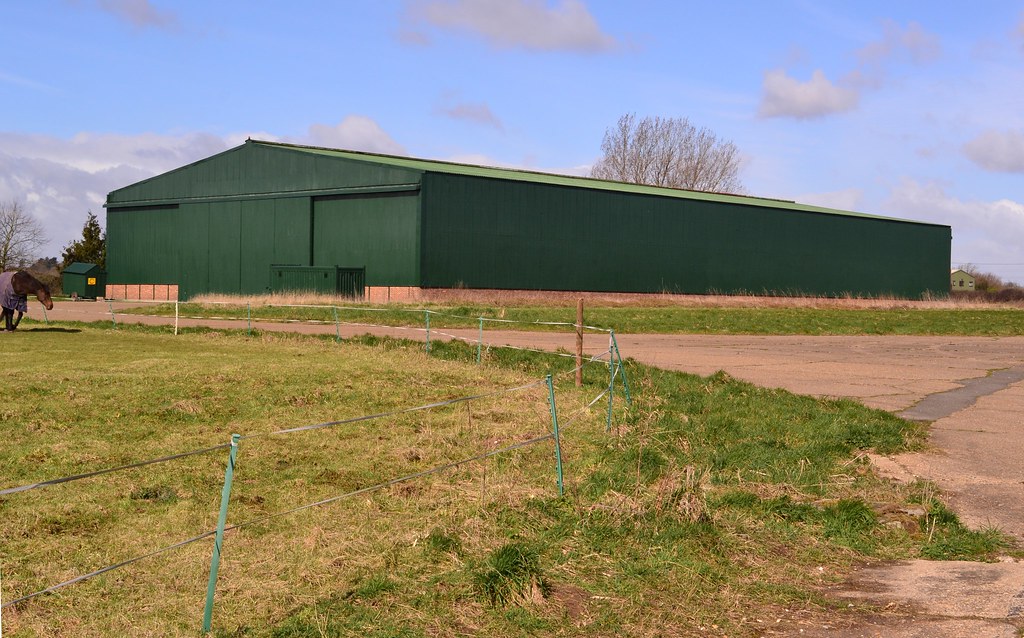
In Trail 59 we head to the Lake District, and Lake Windermere in particular, where there are two sites linked to Britain’s aviation history. The first, at Cockshott Point, is where the aviation link began, whilst the second, White Cross Bay, is where the more substantial part of the trail takes place.

Windermere.

(RNAS Windermere/Cockshott Point / RNAS Hill of Oaks)

Lake Windermere (as it is incorrectly known) is the largest of the 16 bodies of water in the Lake District, and at almost seventy metres deep, eleven miles long and just under a mile wide, it is actually classed as a ‘Mere’, and not a lake. It is however, probably the most famous of all the Lakes, Meres or Tarns in the district and certainly it is the most visited.  In 2018, Windermere helped draw more than 19,000,000*1 visitors to the area, many taking up recreational activities on its 14.8 square kilometres of water.

Windermere’s aviation connection began in 1911, when a civil engineer, Oscar Gnosspelius, and a barrister, Captain Edward William Wakefield, began trials of flying from water both men using Windermere as their base. Progress for the two was slow, each finding out for themselves the perils of trying to take off from water. Both men trove to be the first to achieve this challenging task, and both found the many difficulties of such an action.

After many failed attempts of breaking the water’s hold over these  ‘hydro-aeroplanes’, both Gnosspelius and Wakefield reached a point where they believed take off was truly possible, all it needed was good weather.

The notoriously poor climate of the Lakes finally broke, and on 25th November 1911, Gnosspelius made his attempt first. After steering his aircraft along the water, lift was achieved, and it momentarily rose from the lake only to have the wing strike the water bringing the aircraft and Gnosspelius crashing down.

Wakefield meanwhile, had teamed up with a Rolls Royce engineer, 27 year old Herbert Stanley Adams, whilst he was based at Brooklands. Wakefield had offered him the job of test pilot, which Adams duly accepted. On the same day that Gnosspelius made his attempt, Adams took Wakefield’s aircraft, an Avro adapted Curtiss biplane, out onto Windermere water. The first run failed to gain any lift at all, but then, on his second run, he turned the craft and headed north. Now with a good headwind, the aircraft broke the surface tension and it gradually rose from the water flying some 50 feet or so above its surface. History was at last made, and Adams became the first man in the UK to fly an aircraft that had taken off from water*2

Lake Windermere

November 25th 1911, the date Adams took off from Windermere and flew the first UK flight from, and back, to water.

And so, Adams’ achievement set in motion a series of events that would lead Windermere on a long, and difficult path to aviation history. As confidence grew in waterborne aviation, more and more flights were made which soon led to the formation of the Lakes Flying Company. All this activity and the noise from albeit small aircraft engines,  inevitably led to vehement objections from many locals including Beatrix Potter herself. These objections were so strong that organisations were set up to oppose the continuation of flying. Support for them rapidly grew, and soon they had amassed over 10,000 signatures in their support. But the argument in favour of flying was also strong. Many had the foresight to see where flying from water could lead, and in April 1912, the Government made the decision to allow further flights from Windermere, a decision that enabled Wakefield to continue with his business endeavour.

Fearing other nations were also trialling flight from water, especially France, the Government debated at length the need for such measures. During one such debate, the Rt. Honourable Mr. Joyson-Hicks directed his questions about France’s progress in hydro-planes, directly to the then 1st Lord of the Admiralty, Winston Churchill.

Mr. Joyson-Hicks asked Churchill  how many such hydro-aeroplanes the British Navy owned. Mr. Churchill, in his answer, explained that there was indeed one under construction at East-Church, two others on order, and another thirty-two experiments with machines of this type occurring at: Sheerness, Lake Windermere, and at Barrow. He went on to explain that the  results obtained so far from these trials “were promising“.*3

Gnosspelius meanwhile, repaired his damaged aircraft. Learning from his mistakes he modified it and retested it – it flew, giving him the lesser honour of becoming the first person to fly an aircraft built solely in Cumbria; albeit in the shadow of Adams’ and Wakefield’s triumphant achievement.

By the time World War I arrived, the benefits of taking off from water were well and truly clear, the Royal Naval Air Service took a great interest in the exploration seeing a future for water borne aircraft within their service. Wanting to perform their duties, both Adams and Gnosspelius joined up, leaving the company without anyone to lead it. Seizing on the opportunity, it was bought out by William R. Ding, an instructor who had been brought in by Wakefield, and had also realised the potential of taking off from water. In light of the RNAS’s interest, he could see profit in training pilots to perform the task. Eventually, so keen to investigate and carry on the idea themselves, the RNAS requisitioned the company and took over the site renaming it RNAS Hill of Oaks.

Many of the civilian staff who were already employed on the site remained for the time being, but when the last individuals left in 1916, it became a naval base, and as such was renamed again – this time the more appropriate RNAS Windermere. Training continued under the supervisory eye of the RNAS, but eventually, as the war approached its end, operations from Windermere began to wind down. Predictably, it reached a point where flying ceased altogether and the RNAS departed the site.

This could well have been the end of the line for Windermere, but a short reprieve in 1919 saw the once famous 1914 Schneider Trophy air race pilot, Charles Howard Pixton, return to the site. Utilising Avro 504K floatplanes, he set up and carried out tourist flights, which he combined with an newspaper delivery service to the Isle of Man. These operations breathed new life into waterborne flight, and in particular, into Windermere.

Eventually though even these ceased, and during these post war years, flying activity gradually declined at Windermere, and apart from a few recreational flights onto the water, it eventually ceased altogether. With this, the final flight had been made, and Cockshott Bay, a place unique in British aviation history, would no longer resound to the sound of aircraft engines. This part of Windermere’s aviation life had come to an end.

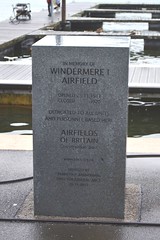
Now a major marina, only a tiny section of slipway remains, its access is difficult even for boat owners, primarily due to its location. It is rather sad, especially considering the importance of this site that nothing more tangible remains (a memorial stone from Airfields of Britain Conservation Trust is nearby) to commemorate the incredible deeds of Adams, Wakefield and Gnosspelius, who between them took Windermere into the annals of aviation history.

The second site visited today lies a few miles north from here, also along Windermere’s  eastern bank. It is this site that is perhaps the more prominent, and perhaps the more defining, of the two. From here we take a short trip north stopping off at White Cross Bay.

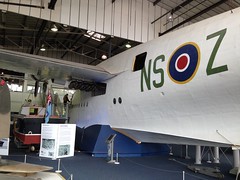
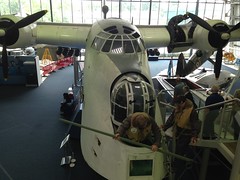
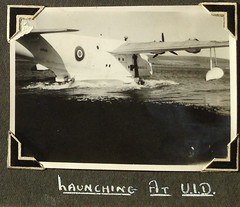
The full trail can be found at Trail 59 – Windermere’s Sunderlands.

RAF Warboys – Home to the Pathfinders (Part 2)

In the early years at Warboys, the Pathfinders had had a difficult start. High loses and poor results were compounded by poor weather. But in early 1943 the Lancaster began to arrive, and the old Wellingtons began to be phased out. The weather however,  takes no account of this and for the early part of January 1943, it continued to envelop the country preventing flights from Warboys going much further afield than Wyton, a stones throw away from their base. Even so, on the 13th, the Pathfinders took another major step forward, being formed into a new and unique Group of their own, No. 8 (PFF) Group, with Don Bennett (now an Air Commodore) remaining at the helm.

On the 26th, the squadron were able to use the new Lancasters for the first time on operations, a bombing raid to Lorient in which 4 Lancasters from Warboys took part; ‘ED474’, ‘ED485’, ‘W4851’ and ‘W4853’. On the 27th the same four aircraft, with different crews, went to Dussledorf, an operation that saw the use of Oboe Mosquitoes for the first time, and a mission that was followed on the 30th by Hamburg. All aircraft returned safely from each of these early operations – 1943 was beginning to look better already.

This run of ‘good luck’ ran well into April, with a relatively low loss rate per operation. This included on  April 16th, the death of Sgt. Patrick Brougham-Faddy (S/N: 577758) and the crew of both Lancasters ‘W4854’  and ‘W4930’. What perhaps makes this incident more notable, was the fact that Sgt. Brougham-Faddy was only 18 years of age, making him amongst the youngest to lose their life in Bomber Command operations. With him lost on that mission was also: his pilot P/O. Harald Andersen DFC; P/O. Kenneth Bordycott DFC, DFM and P/O. Frederick Smith DFM along with ten other experienced aircrew. These losses were a major blow to both the Warboy’s crews and the Pathfinders.

In June 1943, the Navigation Training Unit, a Lancaster based unit formed at RAF Gransden Lodge began its move, taking residency at both Upwood and here at Warboys. The split was not be in everyone’s favour, running a unit on two different sites initially caused some difficulty as the idea of the unit was to train crews in navigation techniques ready for postings to Pathfinder squadrons.

By the time 1943 drew to a close, fifty-seven aircraft had been lost from Warboys, a mix of both Lancaster MK.Is and MK.IIIs, the Wellington now having been replaced entirely within the squadron.

RAF Warboys

Buildings mark the edge of the bomb site.

The cold winter months of 1943 – 44 signified another major event in Bomber Command’s history – the air campaign against Berlin.

For almost 5 months, November to March, Bomber Command would attack Berlin relentlessly in pursuit of Harris’s doctrine of area bombing. The Short Stirling would be withdrawn as the losses mounting were unsustainable, a similar fate that began to land on the door of the Halifax. Some compared the Lancaster to the Halifax, similar to comparing a  “sports car and family saloon”*4. The handling of the Lancaster being far superior to that of the Halifax. As a result, the Lancaster squadrons would bear the brunt of the campaign, and Warboys crews would be in the thick of it. The Pathfinders using an updated version of H2S, would operate outside the range of Oboe, the land based navigation system introduced operationally a year before.

The cold of January 1944, did nothing to dampen the flights nor reduce the combat fatalities. Raids on Berlin, Brunswick, Munich and Frankfurt saw heavy losses (seventeen alone failed to return to Warboys in January, all experienced crews) and numerous aircraft returning early. For 156 Sqn this was disastrous, the squadron began to get a name for itself being referred to as the ‘chop’ squadron and consequently morale fell. With high losses the survival rate fell to an estimated 15%, *3 an unsustainable level of loss for any squadron. For the last fourteen days of January the squadron was effectively reduced to non-operational flights, and in a desperate attempt to bolster the men’s spirits and raise morale, a royal visit was arranged for the King and Queen. Both their majesty’s arrived on February 9th, where they talked to aircrew and took lunch in the Officer’s Mess. After a short stay they departed Warboys going on to visit other Pathfinder airfields in the area.

A widely used photo showing King George VI & Queen Elizabeth talking to ground crew of No 156 Squadron at Warboys(IWM CH 12153)

By the end of February 1944, 156 Sqn were prepared to leave Warboys, maybe a new start would give a new impetus. This move would be a direct swap with the remaining Lancasters of the Pathfinder’s Navigation Training Unit (NTU) based there. Perhaps ending the operating of the unit on two sites had been seen as an ideal opportunity to ‘kill two birds with one stone’, moving 156 and reuniting the NTU.  Whatever the reason the transfer began with a small advanced party taking the short drive to RAF Upwood.

By mid March the move was complete, and Warboys settled into its new role with a full complement of the NTU, hopefully now, the harrowing tales of loss were a thing of the past. With courses of generally three to five crews every few days, turnover was rapid.

With the Mosquito taking  a greater role in the Pathfinders, more crews were needing training in its operation. The 1655 (MTU) Mosquito Training Unit (formerly the 1655 Mosquito Conversion unit) originally formed at Horsham St. Faith in 1942, moved across from RAF Marham in Norfolk; Warboys was now awash with twin and four engined aircraft.

The Training unit would only stay at Warboys until December, at which point it moved to Upper Heyford where it would disband at the end of the year, being renumbered 16 Operational Training Unit (OTU). However, for that short time at Warboys, it grew extensively, gaining five flights including a mix of aircraft for training purposes. Whilst pilots were taught how to fly the Mosquito, the navigators were taught Pathfinder navigation & marking techniques, all prior to joining as a new crew for final training and ultimately postings to a Pathfinder squadron.

RAF Warboys

Further buildings survive near the bomb site.

Many of the aircraft delivered to Warboys were veteran aircraft themselves, having served with other numerous squadrons. Mosquito DZ606 which initially arrived in April 1944, had already flown at least nineteen operational sorties before arriving here. It was then passed on to another unit (139 Sqn) before returning with a further twenty-nine sorties under its belt. The dedication of ground crews, ease of repair and the reliability of the Mosquito enabled it to complete thirty-seven more operations with other units before the year was out.  It was eventually struck off charge in 1945 after being badly damaged.

One other notable example that appeared at Warboys with 1655 MTU, was W4053 which had been the Mosquito Turret Fighter Prototype in 1941. The (bizarre) idea of this was the fitting of a four gunned Bristol turret behind the cockpit, rather like a Boulton Paul Defiant. On tests though, the turret seized when turned to the front effectively trapping the occupant inside. After running further tests with the same results, the project was abandoned and no one was allowed to fly in it again – even though some did try! The aircraft had its turret removed and served with both 151 and 264 Squadrons before passing to 1655 MTU here at Warboys. In November 1944 it was damaged in a landing accident, repaired and then reused by the unit when it was renumbered as 16 OTU at Upper Heyford, where the Mosquito was destroyed in a crash.

With the Mosquito training unit moving away, the Navigation unit remained the sole user of Warboys, but years of use by heavy bombers had had a toll on the runway, their surfaces beginning to break up and cause problems. Warboys was going to need considerable repair work carried out. However, the Navigation unit remained here until the war’s end. On the 18th June 1945 a communique came through from Bomber Command and 8 (PFF) Group, announcing the disbandment  of the Navigation Training Unit., Staff began postings elsewhere, the last courses were completed and ‘Cooks’ tours (tours taking ground crews over Germany to see the devastation) were wound down.

Before the closure of Warboys though, two more squadrons would arrive, 128 Sqn and 571 Sqn, both Mosquito Pathfinder squadrons. 571 was disbanded here on September 20th, whilst 128 Sqn transferred out to B58/Melsbroek, then Wahn where it was disbanded in 1946.

After the training units were disbanded all flying ceased. The RAF did return briefly with Bloodhound missiles in 1960 staying for 4 years until the airfield was finally closed and sold off.

With that, Warboys was gone, and its remarkable history now a distant memory. But these memories were not to be forgotten forever. The local village commemorated the loss of one particular pilot who on the 10th April 1944, lost his life whilst flying a Lancaster over the Welsh countryside.

Flt. Lt. John L. Sloper DFC and Bar, was a veteran of 156 Sqn who had transferred out of operational duties to the Training Unit after completing his tour of duty on December 29th 1943. His last mission being a bombing raid to Berlin in Lancaster JB476. Flt. Lt. Sloper had achieved his quota in just seven months. He joined the Mosquito unit to pass on his skills to others, his personality, knowledge and determination making him very popular with the other crews.

RAF Warboys

A plaque dedicated to the memory of both Flt. Lt. Sloper and those who served with 156 Squadron.

Flt Lt. Sloper (S/N: 147214) was killed in Lancaster ‘JB 471’ during a cross country navigation flight near the village of LLanwrtyd Wells in Breconshire. The aircraft crashed after entering cloud, the ensuing fireball killing all those inside. Flt. Lt. Sloper’s remains were buried at Haycombe Cemetery and Crematorium, Bath.

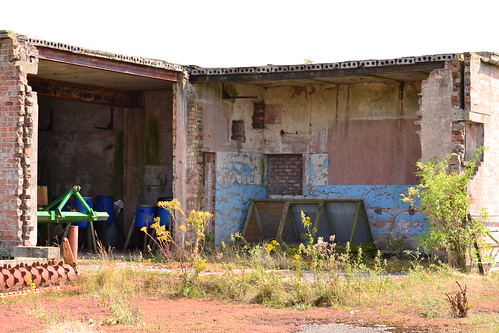
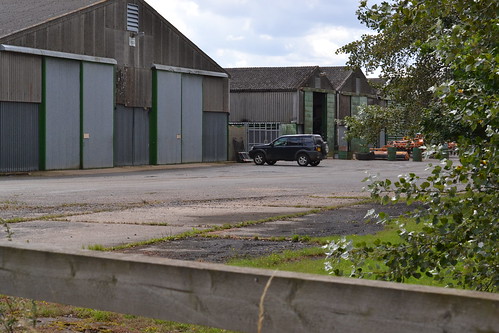
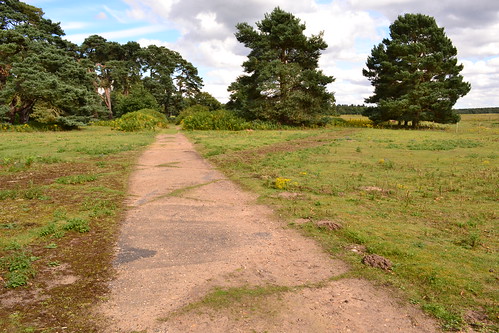
The site today houses small industrial units, but it is primarily farmland. Only a small section of the main runway exist, and this has farm buildings upon it. This section, has been cut by the original A141 now a ‘B’ road, and evidence of the runway can still be seen either side of the road.

RAF Warboys

Pathfinder long distance walk.

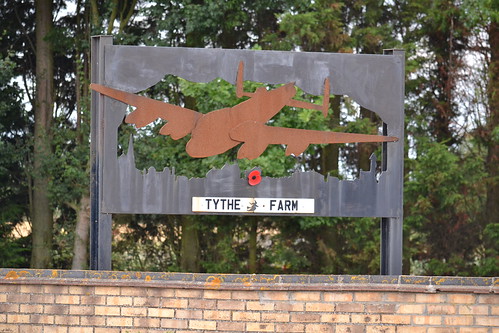
The farm entrance has a large sign with a Lancaster modelled out of metal. Two memorials on the gate posts mark the runway (since my original visit the sign and one of the memorial plaques appears to have been removed, though I have yet to verify this). Across the road from here, you can see the extension to the runway and the remains of a small building, but probably not war-time due to its location.

There is luckily a footpath that circumnavigates the field called ‘The Pathfinder Long distance Walk’, and uses that iconic aircraft, the Mosquito, as its icon. This path allows views across the airfield and access to some of the remaining buildings.

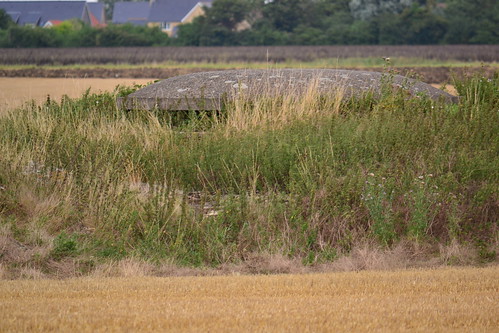
Entry to the path is toward the village, a gated path that is actually part of the perimeter track. As you work your way round, to your right can be found one of the few Air Ministry designed pill boxes. The manufacturer of these mushroom defences being F. C. Construction, they were designed in such a way as to allow machine gun fire through a 360 degree turn. Often referred to as ‘Oakington’ pill boxes, there are only a few remaining today.

Also, deeply shrouded in hedges and undergrowth, another structure possibly a second pill box or the battle headquarters. With permission from the farmer, you may be able to access these, but they look in a rather dangerous condition.

Further along to your right is where one of the T2 hangars would have stood before its demolition. Tracks lead away from here, and there is what appears to be further examples of airfield architecture buried amongst the trees.

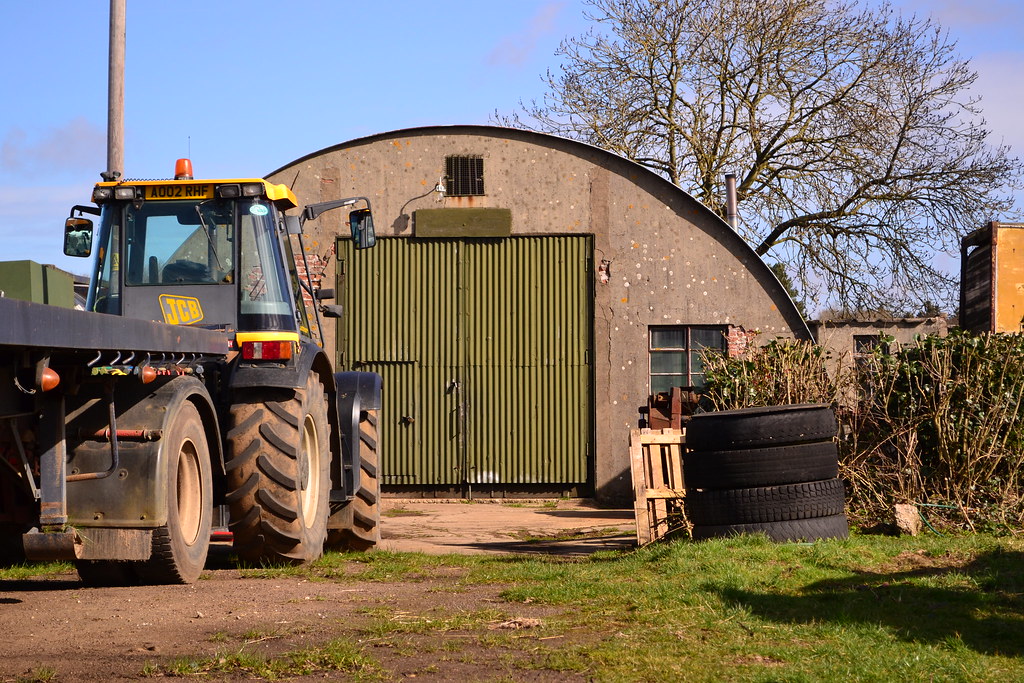
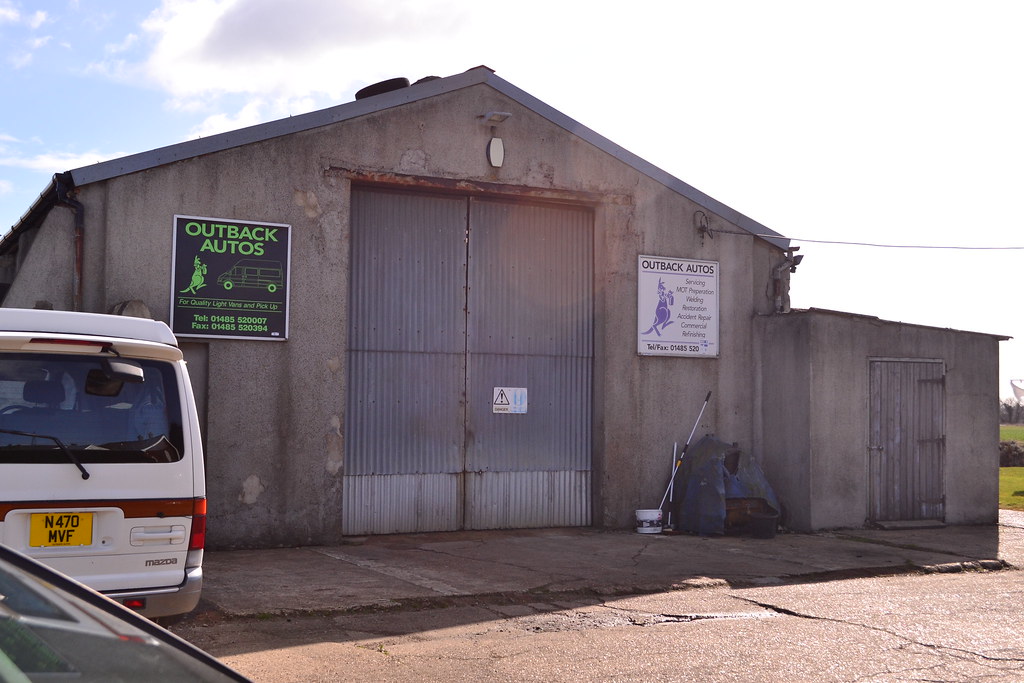
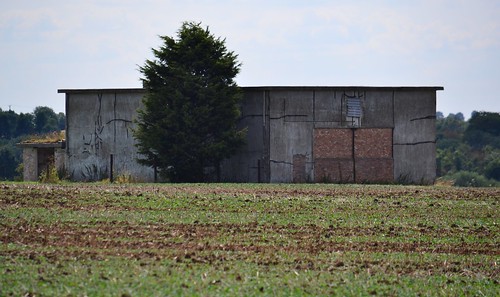
The perimeter track takes you around the rear of the airfield across the threshold of the main runway and round the perimeter track. A local model flying club now uses this part of the site between the runway and perimeter track. To your right would have been the bomb store, now open fields laden with crops rather than bombs. There are a few buildings here marking the boundary of the store, now used for chickens and extensively ‘modified’ by the farmer. They house farm machinery, a far cry from what would have been here many years ago.

The track then takes you away from the site and out across the Cambridgeshire countryside.

RAF Warboys

The remains of the Ground Control Interceptor (GCI) Radar Station.

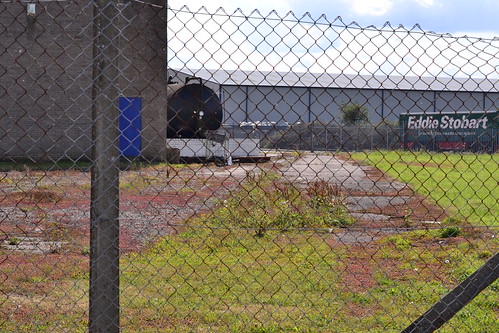
Returning back to the road, we go in the opposite direction from the village and come to the entrance of the industrial site. These buildings stand on the perimeter track marking the western corner of the airfield.

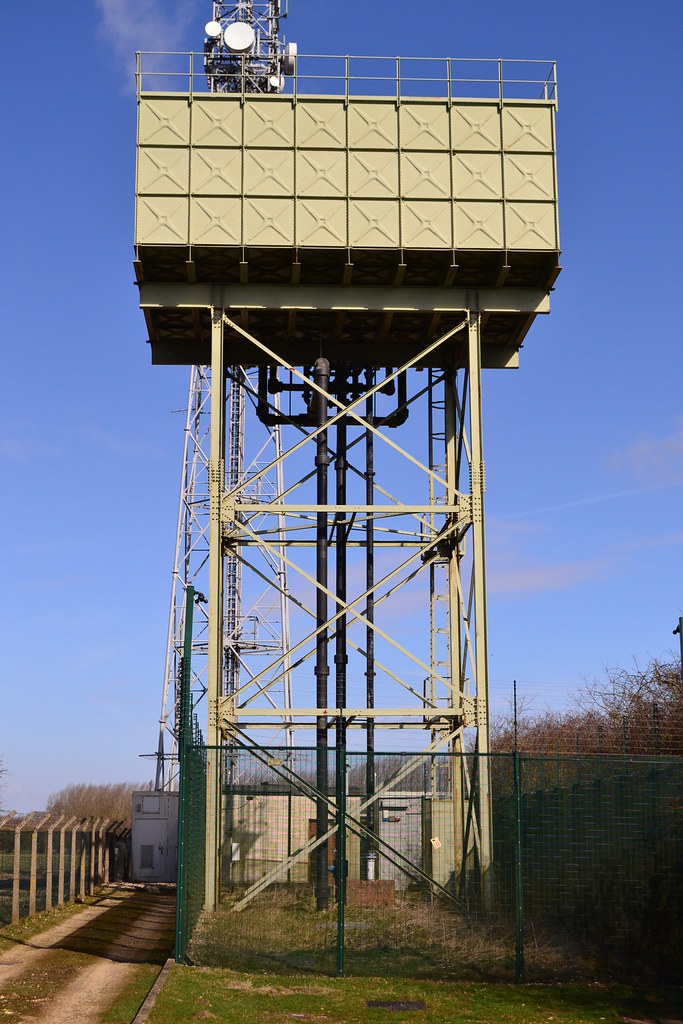
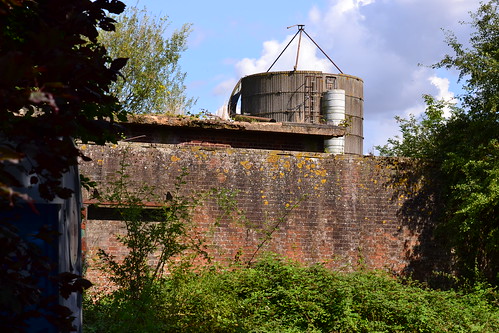
Next to this part of the site, is a large telecommunications transmitter, apparently the origins of the site being 1941. Whilst its use and history is somewhat difficult to locate or verify, it is known that this was a Ground Control Interceptor (GCI) Radar Station used to lock fighters onto incoming enemy aircraft. Later, there was a high-powered transmitter here used by RAF Mildenhall and RAF Wyton. It was also used to communicate with the V bombers on long-range flights. The mast believed to be original, has been updated and refurbished for telecommunications purposes, but the block house remains behind high fencing with very strong padlocks!

The majority of the admin sites are located along the A141 toward Wyton, some evidence exists here but the majority have long gone. Return toward the village and find the church; located just on the outskirts of the village.

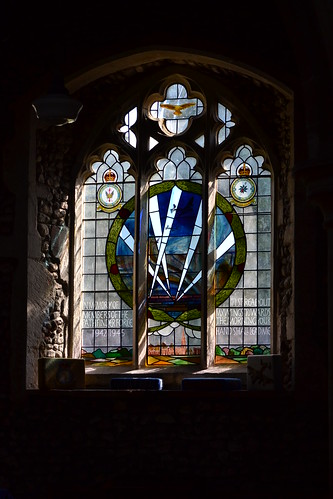
A superb memorial window and roll of honour can be found here, and it is well worth the effort. In Huntingdon town is the former Headquarters building of the Pathfinders, Castle Hill House, which now belongs to the local council. A blue plaque describes the historical significance of the building.

Pathfinders

Castle Hill House, Huntingdon. The Headquarters of the Pathfinders. (Photo courtesy Paul Cannon)

Designed initially as a satellite airfield, Warboys went on to be a pioneering airfield for a new and dedicated team of bombing experts. With 156 Squadron it took the war deep into the heart of Nazi Germany. As a result it suffered great losses, but without  doubt it performed one of the most vital roles in the latter parts of the war and it’s a role that should not be forgotten beneath waving crops and developing industry. The name of Warboys should be remembered as a Pathfinder icon.

After we leave Warboys, we head to her sister station to the west, and an airfield with a history going back to World War I. This airfield saw a spy caught and hanged; the making of a film using Lancasters, and more recently the site of a hospital for the treatment of victims of a nuclear war. We of course go to RAF Upwood.

Sources and further reading (RAF Warboys).

*1  A good blog  describes the life of Wing Co. T G ‘Jeff’ Jefferson, DSO AFC AE who served part of his life as a Pathfinder at RAF Upwood. It is well worth a read.

*3 Smith, G. “Cambridgeshire airfields in the Second World War“. Countryside Books (1997)

*4 Flying Officer J Catford DFC “View from a Birdcage“Tucaan Books (2005) Pg 51

National Archive: AIR 27/203/18
National Archive: AIR 27/1041/13
National Archive: AIR 27/1041/14
National Archive: AIR 27/1041/16
National Archive: AIR 27/1041/24

For more details of the Pathfinders see the excellent RAF Pathfinders Archive Website.

A website detailing crews, missions, aircraft and other information about 156 squadron is also well worth visiting for more specific and detailed information.

Warboys was originally visited in 2014 in Trail 17.

RAF Warboys – Home to the Pathfinders (Part 1)

In the south-western corner of Cambridgeshire, are a group of airfields that are synonymous with the Second World War’s target marking units, the Pathfinders. This is an area rich in aviation history, and an area that played a major part in not only the European Theatre of Operations of World War Two, but military operations long into the Cold war and beyond. Within a short distance of each other are the airfields at Wyton, Warboys, Upwood and Alconbury to name but a few, and it is two of these we visit in Trail 17.

Our first stop is the former RAF Warboys, once home to the Pathfinders.

RAF Warboys.

Warboys village is an ancient village with records of inhabitants going back to 7,000BC, it also has links to the Bronze age, the Romans, Vikings and the Doomsday book. Even further back, some 350 million years, there was an active volcano in the area, not far from where we start today.

RAF Warboys

The farm sign reminds us of the aviation link (it would appear that this sign may have recently been removed).

The airfield itself was initially constructed as a satellite for RAF Upwood, with a requirement for three 50 yards wide tarmac runways; one of 2,000 yards, another measuring 1,400 yards and the last 1,350 yards. There were initially twenty-four frying pan hardstands, two of which were then used as hangar bases, with a further eighteen loop style hardstands added after. This gave a total of forty dispersal points available for aircraft, and they would certainly be needed.

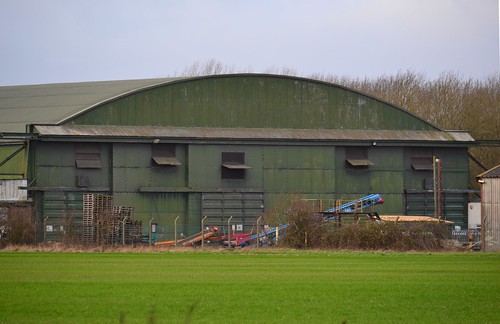
As with many airfields of this time there were two type ‘T2’ hangars, one each side of the airfield, supplemented with a ‘B1’ hangar. A well developed bomb store lay to the west of the airfield, and eleven domestic sites lay to the eastern side of the A141 to the south of the main airfield. These would accommodate up to 1,959 men and 291 women. Even before its completion, Warboys would undergo further development, an order coming through to extend two of the runways to 2,097 yards and 1,447 yards, its was a sign perhaps, of things to come. This extension work meant altering the perimeter track layout and diverting the main road around the airfield as it would be dissected by the new extension (the original road was reinstated post war, the end of the main runway being cut off as a result).

Construction began in 1940 with the airfield opening in September 1941, initially as a satellite bomber station. Whilst intended for Upwood, it was first of all used by Short Stirling’s from XV Squadron as an overflow from nearby RAF Wyton. As a satellite, Warboys was never far from the war when not long after the first Wyton aircraft landed, the Commanding officer of XV Squadron,  Wing Commander P. Ogilvie, crashed the Stirling he was piloting (W7439) here in bad weather. Luckily he and his crew escaped major injury but unfortunately the aircraft was written off completely. This crash would signify a run of accidents occurring at the airfield whilst XV squadron used Warboys.

However, XV Sqn’s stay was short-lived, and they soon departed the site their vacant place being taken by the Blenheims of ‘D’ Flight, 17 OTU (Operational Training Unit).*1

The Training unit was expanding, and their base at RAF Upwood was becoming crowded. Their move over to Warboys on 15th December 1941, was a part of this expansion, and led to four flights being created, each with a range of aircraft including: Lysanders, Ansons, Blenheims and even the odd Hurricane and Spitfire.

In August 1942, the OTU would receive orders moving the unit elsewhere, whilst over at RAF Alconbury, a few miles to the south-west, instructions came through to 156 Squadron to relocate here to RAF Warboys. The instruction specified that the move was to take place on the 5th and be completed by the 7th, it would involve the ferrying of large numbers of crews and their aircraft. On the 5th the first aircraft was brought across, and then on the 6th a further six aircraft were transferred. This was followed by another seven on the 7th.

Following the move the squadron was put straight onto operations, but many of these were cancelled because of the poor autumn weather. One of the first, occurring on August 11th, saw ten aircraft detailed for operations, and whilst all of them managed to take off,  three of them X37998 (Flt.Sgt. F. Harker); Z1595 (Sqn. Ldr. J. Beavis) and BJ603 (P/O. C. Taylor) would fail to return. All but three of the sixteen aircrew onboard would perish – the squadron’s first fatalities whilst at Warboys.

RAF Warboys

The remnants of the main runway are used for buildings.

On the night of 15th August 1942, eight more Wellingtons took off from Warboys for Dusseldorf, of these, three returned early with a forth being lost. The Operational Record Book simply stating “This aircraft failed to return” – a rather unembellished statement that became so common in operational records. Reports about the raid later highlighted the poor visibility and scattered bombing, with little or no industrial damage being done as a result.

Whilst August 1942 was not proving to be in anyway remarkable for 156 Sqn, it would prove to be a very historic month for Bomber Command. On the same day as the Dusseldorf raid, the Pathfinders – an elite force designed to locate and mark targets for the main bomber stream –  officially came into being. This idea had long been on the minds of the Air Ministry, causing a prolonged and difficult relationship between Sir Arthur Harris and Group Captain Sidney Bufton (Director of Bomber Operations at the Air Ministry). The fallout culminated in the intervention of the Chief of Air Staff, Sir Charles Portal, who came down on the side of Group Captain Bufton. He disagreed with Harris’s arguments, announcing that the Pathfinders were going to go ahead as planned.

This did not meet with Harris’s approval, he feared the Pathfinders would ‘skim off’ the cream of his bomber force, creating a corps d’elite, whilst Bufton was adamant it would vastly improve Bomber Commands accuracy, something that desperately needed to be done.

Harris gained the backing of his Group Commanders, explaining that removing individual crews from squadrons would be bad for morale within the groups and be divisive amongst the squadrons. He and his Commanders preferred a target marking unit within each Group, thus retaining these elite crews keeping the unity of the squadrons and the skills they possessed together. However, the long fight between Harris and Bufton came to a climax with the intervention of Sir Charles Portal, and an ultimatum was given to Harris, ‘accept the new Pathfinders or leave’.

The job of organising this new command fell to the then Group Captain Don Bennett D.S.O., an experienced pilot himself who advocated the use of target marking to improve bombing accuracy; something Bennett had indeed tried himself. However, it was not going to be an easy ride for the Group Captain, for the squadrons chosen all operated different aircraft types: Wellingtons, Stirlings, Halifaxes and Lancasters. The Wellingtons were becoming outdated and the Stirlings, whilst liked, had their own set of problems. Added to the mix the fact that German defences were improving and electronic counter measures (ECM) were on the increase, difficult times were definitely ahead.

RAF Warboys

Industry marks the south-western perimeter.

As a new force, only four squadrons were initially used, although more were considered and earmarked: 7 (No. 3 Group), 35 (No. 4 Group), 83 (No. 5 Group) and 156 (No. 1 Group), but it would take time for the new crews to settle and for improvements in bombing accuracy to shine through. All the while Pathfinder crews were operating, the remainder of the squadrons continued in their normal duties, this would allow the Pathfinder force to steadily grow.

For the large part, target marking in the latter part of 1942 would be by visual means only – a ‘Finder‘ and an ‘Illuminator‘ using flares and incendiaries respectively. This would prove to be an unsatisfactory method, the markers often being ‘lost’ amongst the fires that followed, or they were simply too difficult to see. However, photos taken after these early bombing raids showed that the number of bombs falling within 3 miles of the aiming point, post August, had in fact risen to 37% from 32%; those falling within 3 miles of the centre of concentration rising to 50% from 35%.*2 Whilst these figures were quite small, and bombing was still relatively inaccurate, it was at least a step in the right direction, and a boost to those who supported both Bufton and Bennett.

So, on the 15th August 1942, Bomber Command operations changed for good, the four squadrons moved to their respective airfields and the Pathfinders began preparations for a new battle. 156 Sqn at Warboys, would be a major part of this. Being one of the four pioneering airfields, Warboys would be joined by Graveley, Oakington and Wyton, as initial homes for the new force.

On the night of the 18th -19th August 1942, the Pathfinders would be put to the test for the first time, and two Wellingtons from 156 squadron were to be a part of it. The raid to Flensburg would not be successful though, one aircraft having great difficulty in locating the target through the haze, and the second having to ditch its flares five miles from the airfield after one ignited inside the aircraft. Of those that did get to mark, it proved to be inaccurate, and one Pathfinder aircraft, from 35 Sqn, was lost.

RAF Warboys

Airfield defence in the form of an ‘Oakington’ pill box.

The day after this, Group Captain Bennett visited Warboys to give a lecture on the Pathfinder Force and to promote its use; he must have made a good impression for after the lecture six Warboy’s crews volunteered for Pathfinder duties.

Further operations were carried out on the night of  27th – 28th August to Kassel. A good night for visual marking meant that bombing was accurate, and as a result all of the Henschel factories were damaged. However, the cost to the Pathfinders was very high. It was on this operation that the Pathfinders suffered one of their greatest losses. Thirty-one aircraft were missing of which fourteen were Wellingtons and three were from 156 Sqn. The next day, the mess hall was devoid of three crews, those from: ‘X3367’, ‘Z1613’ and ‘DF667’, and unbeknown to those sitting around the mess, there were no survivors. A fourth bomber (BJ883) returned to Warboys after the pilot, Sgt. E. Bowker, suffered severe head pains and was unable to carry on.

Not all operations were as bad. On the night of 19th – 20th September following action over Saarbrucken, a flare became lodged in the bomb bay of one of the 156 Sqn Wellingtons. Whilst sitting there it ignited causing a fire in the aircraft’s belly. The Pilot,  New Zealander Sqn. Ldr. A. Ashworth, instructed his crew to bail out, after which the fire extinguished itself allowing him to fly the aircraft back single-handedly, landing at the fighter station RAF West Malling in Kent. The operation itself, undertaken by 118 aircraft, was otherwise uneventful, although haze proved to be an obstacle for the markers.

The last 156 Sqn Wellington raid for 1942 occurred on December 21st and took the squadron to Munich as part of a force of 137 aircraft. The loss of ‘BK386’ crewed entirely by Canadians brought 1942 to a close, and a loss of 15 aircraft this year. To add insult to injury, whilst the majority of the bombers claimed to have hit the city starting large fires, photographs showed that in fact most bombs had fallen outside of the city in open countryside, possibly as a result of a successful decoy employed by the Germans. It had not been the most auspicious of starts for the Pathfinders, nor 156 Squadron at Warboys.

However, by early January, a new aircraft type was starting to arrive at Warboys – Avro’s mighty four engined heavy, the Lancaster MK.I. Created out of the under-performing Manchester, the Lancaster would go on to be one of the most iconic aircraft of the Second World War. Perhaps now the tide of misery would turn and Warboys crews would begin a new era in aviation history.

RAF Warboys

The beautiful Memorial window dedicated to the Pathfinders.

The full trail appears in Trail 17

RAF Snailwell – Where life was far from Slow (Pt 1).

In the latest Trail around Britain’s airfields, we visit four airfields so close that as the crow flys, they are a mere 12.5 km from the first to the last.  It is an area to the east of Cambridge, a large University City that now dwarfs the River Cam the narrow waterway that gave the city its name. The final airfield we visit lies on the outskirts of the city itself, and is probably more famous for its more recent operations under Marshalls of Cambridge, the Aerospace and Defence Group.

Our first stop though takes us through prime horse racing land, through the home of the Jockey Club and an area divided into studs and stabling, not for live stock, but for horses.

Our first stop in Trail 55 is the former RAF Snailwell, a small airfield where life was far from slow!

RAF Snailwell (USAAF Station 361).

Snailwell lies  just outside of the town of Newmarket in the county of Cambridgeshire now infinitely famous for its horse racing. The village of Snailwell from which the airfield takes its name, lies on the northern edge of the former airfield which is now  owned, as is much of this area, by the British Racing School who vehemently protect it from prying eyes.

Sitting to the north of the Bury St. Edmunds railway line, the airfield opened in the Spring of 1941, after the levelling of ten Bronze age Barrows (ancient burial grounds) as a satellite for RAF Duxford located to the south-west. The airfield would go through an ever changing number of roles including: Army Co-Operation, training, and as a fighter base performing low-level attacks on shipping and land based targets. It would also see a wide range of aircraft types from the small trainer to the powerful tank-buster the Typhoon. Opened as a technical training airfield, it passed to the control of 28 (Technical Training) Group whose headquarters were located in London. It fell under the command of Air Commodore John Charles ‘Paddy’  Quinnell, an avid lover of sailing who had a distinguished military history that extended back to 1914, first with the Royal Artillery and then with the Royal Flying Corps.

As a small grass airfield, Snailwell was by no means insignificant. It had three grass runways the largest being just short of 1,700 yards long, whilst the second and third were 1,400 yards in length. The main runway crossed the airfield on a south-west to north-east direction protruding out of the main airfield area. Aircraft were dispersed on concrete hardstands, a mix of twelve ‘Fighter’ style Type B hardstands (capable of holding two aircraft side by side but separated by a bank) along with two 50 ft diameter ‘frying pan’ style stands. They also had the use of a Bellman hangar, and ten blister hangars for servicing and maintenance of aircraft*1.

To the north, hidden amongst the trees was a bomb store, with separate fusing buildings, tail stores, incendiary and component stores, access to the site being via a 12 ft wide concrete road.

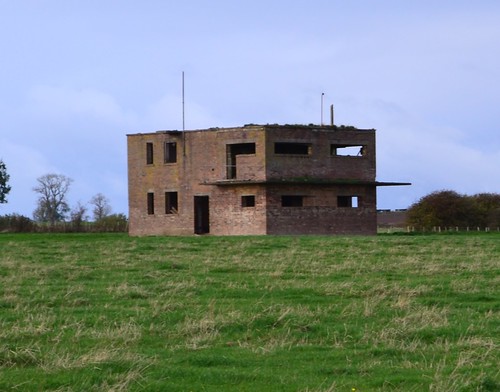
In all, there were only a few permanent personnel at the airfield, accommodation was only erected for around 1,100 officers and enlisted men in Nissen huts over just two sites; Dormitory site 1 and 2, which were supplemented with a mess site and sick quarters. It is known that later users were camped in tents around the airfield perimeter – not ideal accommodation by any means. Unusually, the technical area was widely spread with many buildings being away from the airfield hub. The watch office, at the centre of this hub, was designed to 12779/41 and had an adjoining meteorological office attached, an unusual addition for this type. There was also a wide range of buildings, AMT trainer, two Link trainers, flight offices, sleeping shelters, parachute stores, fire tender huts and numerous associated maintenance stores and sheds.

During construction of the airfield a local road was closed, and a lodge, built at the turn of the century, utilised as a guard room for the airfield. This building later passed to the Jockey Club for use by its employees.

The initial users of the airfield were the Army Co-operation Squadron  268 Sqn RAF, who arrived at Snailwell with Lysander IIIs on April 1st 1941. Being a slow aircraft it was ideal as a reconnaissance aircraft, flying patrols along the coast of East Anglia, looking for any sign of an invasion force. After arriving at Snailwell from Bury St. Edmunds, the three Echelons immediately began training, three photographic sorties taking place on the very day they arrived. In the days that followed, combined Army and Air Force exercises were the order of the day, after which the squadron took part in intensive gas training along with routine flying. However, 268 Sqn would not settle here, yo-yoing between Snailwell and numerous other stations no less than eleven times between their first arrival, and their last departure to RAF Odiham on May 31st 1943.

Duxford Battle of Britain Airshow

A Lysander at Duxford’s Battle of Britain Airshow 2019.

In the May of 1941, 268 Sqn would swap their ‘Lizzies’ (as they were affectionately known) for the Tomahawk IIA, an aircraft they kept until changing again to the better performing Mustang I a year later. These Tomahawks would perform a range of duties including – whilst based at RAF Barton Bendish in Norfolk – early morning ‘attacks’ on Snailwell as part of a Station Defence Exercise. These involved mock gas and parachute attacks along with low-level strafing runs. Being little more than a field, Barton Bendish provided no accommodation for visitors, and so the aircrews slept in tents overnight.

During the August of 1941 the first of Snailwell’s many short stay squadrons would arrive. 152 Squadron would use Snailwell for a period of just one week whilst transiting to nearby RAF Swanton Morley. Operating the sleek Spitfire IIA, the brain child of R.J. Mitchell, they would perform fighter sweeps, along with convoy and bomber escort duties. Arriving on the 25th, the only major event occurred on the 28th when the squadron escorted seventeen Blenheims to Rotterdam, Sgt. Savage being the only 152 Sqn pilot to be lost during the mission. The next day, ‘A’ flight searched for signs of him, but sadly found no wreckage nor any sign of Sgt. Savage.

Being a small airfield Snailwell was often home to detachments of squadrons, usually whilst on training. One such unit arriving on November 31st when 137 Sqn posted a detachment here whilst the main body of the squadron stayed at RAF Matlaske further north in Norfolk.  Operating the heavily armed escort fighter the Westland Whirlwind, they would perform escort duties for Lysanders, searches for downed aircraft and ‘X’ raid interception duties. Many of their patrols covered Great Yarmouth on the East Anglian coast in an area to the east of the airfield.

Designed in 1937, the Whirlwind had many teething problems with the engines proving to be a particular issue. After purchasing only 112 examples of the model, 137 would be one of only two squadrons who would use it in any operational role. After moving to Matlaske, 137 began a series of training operations, posting a detachment of aircraft to Snailwell whilst preparing to commence anti-shipping operations in the North Sea.  Once operationally ready, the unit moved north to RAF Drem (August 1942) before returning once more to Matlaske where further training would take place; ‘B’ Flight replaced ‘A’ Flight at Snailwell until both were reunited at Snailwell in late August. Anti shipping operations continued from Matlaske, with their final sortie occurring on August 20th in which an enemy Ju 88 was intercepted – the aircraft evading its pursuers in bad weather. Moving across to reunite the squadron on the 24th, 137 would perform their first operational sortie from Snailwell in early September, a feint attack against Lille. Designed to attract the Luftwaffe fighters into a trap, the twelve Whirlwinds and their fighter escorts failed to sight one enemy plane and all returned to their respective bases not having fired a shot. After this, the Whirlwinds were fitted with bombs and further training followed, but by mid September, they had left Snailwell and were heading for RAF Manston in Kent.

The summer of 1942 would be a busy period for Snailwell, with several squadrons utilising the airfield. At the end of March 56 (Punjab) Squadron would bring  the Hawker Typhoon MK.IA, a model they would begin replacing virtually immediately with the MK.IB. The April of that year was mainly taken up with practice formation flying and aircraft interception flights, before the squadron also moved to Manston in Kent. 56 Sqn would return briefly to Snailwell over the June / August period, but this would be short and they would then depart the airfield for good.

On June 15th 1942, a new squadron would be formed here at Snailwell. Under the command of Sqn. Ldr. F.G. Watson-Smyth, it would have two flights ‘A’ and ‘B’, each led by a Flight Lieutenant. 168 Sqn, initially flying the Curtiss Tomahawk II, was formed from the nucleus of 268 Sqn, and would remain here only until their aircraft and equipment had arrived. Being allocated RAF Bottisham as their main station, they would stay at Snailwell for a mere month. During this time aircraft would have their squadron numbers painted on, and Sqn, Ldr. Spear would give dual flying training to all pilots in a Fairy Battle.

Toward the end of June Sqn. Ldrs. Watson-Smyth and Bowen would visit Bottisham to discuss and prepare the accommodation arrangements for the squadron’s forthcoming arrival. Further deliveries of supplies took place and by the 26th there were seven Tomahawks on charge. On the 13th July, at 14:35 hrs, twelve Tomahawks took off from Snailwell and flew in formation to their new base at Bottisham, a mere stones throw from their current location. The move had begun and 168 Sqn would leave Snailwell for good.

In the August, whilst transiting to North Africa, 614 Sqn would place a detachment of their Blenheim Vs here, a further detachment being placed at Weston Zoyland with the main body of the squadron at Odiham. Coinciding with this was also a detachment of 239 Sqn with Mustang Is, making  Snailwell a very diverse station indeed.

With the arrival of autumn in the October of 1942, Snailwell took a very different turn, being handed over to the US Ninth Air Force Service Command who brought in the Airacobra, one of the few wartime fighters to use a tricycle undercarriage. Transferring across from Duxford, the parent airfield of Snailwell, the 347th Fighter Squadron (FS) were a brand new squadron, only being activated that very same month.

In part two we see the early American influence, and how this small grass airfield played its part in the build up to D-day.

The full page can be seen on Trail 55 – Around Newmarket.

RAF Polebrook – The First USAAF Bombing mission (Pt 1).

At the top of Northants, close to the Cambridge / Huntingdon borders, lie a number of wartime airfields. Relatively high up, they can be bleak and windy, but to those interested in aviation history they offer some amazing stories and fascinating walks. Some of these sites have been covered in earlier Trails e.g. Kingscliffe, Deenethorpe, Spanhoe Lodge and Grafton Underwood, but because of their close proximity, they could all be combined with this trip.

Our visit today in Trail 19 is the former RAF Polebrook, home to the famous Clark Gable, and the site that saw the very first official Eighth Air Force Bombing mission in August 1942.

RAF Polebrook (Station 110)

To the west of Peterborough, across the A1 and through some of the most gorgeous countryside this area has to offer, is Polebrook, a small village that once bustled with the sound of military voices. Originally designed for the RAF’s Bomber Command, Polebrook opened in May 1941, as a Class II airfield built by George Wimpey and Co. Ltd. It had three runways, the main one being (08-26) 1,280 yards in length, with two further runways (14-32) of 1,200 yards and (02-20), 1,116 yards, giving the site a substantial feeling of size. To accommodate the dispersed aircraft, it was designed with thirty hardstands laid mainly to the south-west and eastern sides of the airfield. The administration and technical sites were located to the north.

Aircraft maintenance was carried out in two type T2 hangars and one J type hanger, which sat next to each other, there were in addition, a range of technical buildings, a Watch Office (with Meteorological Section to design 518/40, to which a circular addition was made to the roof) and around 20 pill boxes built to provide defensive cover of the overall site.

To the north of the site across the main road, lies an area known as Ashton Wold Woods. Within the wood is the Ashton Estate, which was purchased and developed by the banker, Lionel Rothschild in 1860. It was after this that the estate was developed into a country home for his grandson, Charles Rothschild.

Charles, a banker by trade, set about creating a formal garden on the estate along with his wife Rozsika, and later his daughter Miriam. He had the grand honour of being the country’s leading expert on fleas, as well as a naturalist and conservationist who was responsible for forming the Society for the Promotion of Nature Reserves in 1912.

After his death and subsequently Rozsika’s in 1940, the house passed to their daughter, but when the construction of the airfield began, the house and gardens were requisitioned for use as both as a hospital and accommodation site. During the war, the site suffered badly through neglect, and post war, Miriam set about restoring parts of the estate. Sadly it was not fully restored and parts continued to fall into disrepair*1.

RAF Polebrook, Taken August 1948*2

A year after Miriam inherited the estate, the first RAF unit arrived, No 90 squadron (28th June 1941) with Fortress Is, otherwise known as Boeing’s B-17C, who stayed until their disbandment in February 1942. Although liked by their crews, the Fortresses were dogged by high altitude problems (freezing guns) and poor bombing results. This early version of the B-17 was not to be a record breaker and had a relatively short life before being replaced later by better models. Between 8th July and September 2nd, 1941 Polebrook Fortresses made 22 daylight attacks against targets including: Wilhelmshaven, Bremen, Brest, Emden, Kiel, Oslo, and Rotterdam. The RAF eventually decided to pull out of these daylight raids and the airfield momentarily fell silent to operational activities.

B-17C #40-2079 delivered to the RAFSerial: AN518 (Mistakenly marked as AM518 at the Boeing Factory) 90 Squadron

Delivered to the RAF [AN537] as part of Lend-Lease. This was the last B-17C produced; 90 Squadron [WP-L] Polebrook 13th May 1941. The aircraft later transferred to No. 220 Squadron at Alder-grove, Northern Ireland. (IWM UPL 31070)

Polebrook airfield was then handed over to the USAAF (June 28th 1942) and re-designated Station 110. It was felt however, that the current runways were inadequate for the American’s new model B-17s, and so a period of expansion then occurred. During this time the hardstands were increased to 50, the main runway (concrete and tarmac) was extended to 2,000 yards and the two secondary runways were both extended to 1,400 yards. Accommodation blocks were increased now allowing for 2,000 personnel, and the whole site was brought up to Class A standard; all-in-all it was a major redevelopment of the entire site.

The first American units were those of the 97th BG of the 1st Combat Wing. The 97th were constituted on 28th January 1942 and activated in the following February. Passing from MacDill Field in Florida through Saratosa they would make their way across the northern route to Prestwick. On route to their departure points, elements of the group were detached and sent to the Pacific coast, whilst the remainder continued on to Europe. The first manned B-17 #41-9085, ‘Jarrin Jenny‘ arrived in the UK on 1st July 1942 touching down at Prestwick in Scotland after a 3,000 mile long flight via Greenland, with the first ground echelons arriving via the Queen Elizabeth, shortly before on 10th June. Five days after ‘Jarrin Jenny’s‘ arrival, the aircraft would reach their new base, and the Northampton countryside would become a buzz of activity, as much from the curious locals as the Americans they were in awe of.

Bill Colantoni of the 306th Bomb Group with a B-17 Flying Fortress (serial number 41-9085) nicknamed

Bill Colantoni poses in front of B-17 #41-9085 ‘Jarrin’ Jenny’ at Polebrook, the first B-17 to arrive in the UK. (IWM UPL 6830)

Almost immediately after arriving int the UK the four squadrons of the 97th were split. Between June and the end of November the Headquarters unit, along with the 340th BS and 341st BS were based here at Polebrook, whilst the 342nd and 414th BS went to the satellite airfield at nearby Grafton Underwood (Trail 6).

Within a month of arriving on August 17th, the 97th BG would enter service flying the first operational mission of the USAAF from England, under the control of the Eighth Air Force. However, hastily formed, these early groups of bombers were made up of poorly trained crews, many of the gunners never having fired their guns at moving targets, nor had pilots flown at high altitude on Oxygen or in close formation. Such was the rush to get the aircraft overseas, that basic radio, flying and gunnery skills were all lacking, and if they were not to become easy targets for the more experienced and ruthless Luftwaffe, then they were going to have to endure a very steep learning curve indeed. Thus the early part of August was to be filled with intensive flying practice, with the RAF offering their services as mock enemy fighters, trainers and advisers, supporting the Americans through the tough training regime that would hopefully save their lives in the coming weeks and months.

By the 9th August it was decided that the 97th was combat ready and orders came through for their first mission. Sadly the 10th August brought poor weather, and the mission was scrubbed much to the disappointment of the those in the Group.

Two days after this, even before a bomb was dropped in anger, the dangers of flying in cloudy European skies would become all too apparent when a 340th BS, B-17E #41-9098 ‘Big Bitch‘ (not to be confused with #41-9021 ‘The Big Bitch’, which transferred to the 390th BG at Framlingham and was renamed “Hangar Queen“), collided with mountains in Wales whilst on a navigation exercise to Burtonwood, killing all eleven on board. The 97th were now racking up many ‘firsts’ adding the first B-17 fatalities to their extending roll.

August 12th saw the next call to arms, but again the weather played a cruel joke on the men of the 97th, the mission being scrubbed yet again; it was beginning to appear that someone was playing a rather frustrating joke at the expense of the eager young men.

Their next mission, detailed on the 16th was then again called. This time was ‘third time lucky’ and the following day the first official mission of the Eighth Air Force was given the green light. At 15:12 six B-17s in two waves of three left the runway at Polebrook and history was made. After rendezvousing with their ninety-seven RAF Spitfire escorts, they headed for the French coast only to turn away and head for home when just ten miles from the enemy’s coast. This time it was not the weather at fault, the mission was a planned feint to tease the Luftwaffe away from the main force following behind – a group of Twelve B-17s from each of the 342nd, 414th and 340th BS.

This mission was not only the USAAF’s first mission, but it also saw the testing of new electronic counter-measures equipment. Flying alongside this formation were nine Boulton Paul Defiants carrying the counter-measures equipment. Code named “Moonshine“, the equipment consisted of ‘repeaters’ designed to repeat back to the German’s their own radar signals thus giving the impression of a much larger and more formidable force.  These first two Polebrook flights split, the first making their feint toward Alderney, whilst the second force flew toward Dunkirk, it was this flight that was accompanied by the nine Defiants. Before reaching the coast though, they turned and headed for home their job done. It was reported by the British that an estimated 150 Luftwaffe fighters rose up to meet the ‘massive’ force, but no interception took place and all aircraft returned to base.

Amongst the main force following on, were three of the Eighth’s most prestigious personnel; the Group’s Commander Colonel Frank Armstrong Jnr who sat beside Major Paul Tibbbets (Tibbets was to go on and drop the first Atomic bomb on Hiroshima thus ending the war with Japan) in ‘Butcher Shop‘; whilst in the second wave flew General Ira Eaker, Commanding General of the entire Eighth Air Force, in ‘Yankee Doodle‘. Bombing results were ‘good’, the clear skies proving to be the bombardiers best friend that day. All aircraft returned, the only casualty being a pigeon that hit the windshield of one of the B-17s as it approached Polebrook. The first mission was over, the ice had been broken.

This first mission, a trip to Rouen, preceded several attacks across the low countries, until in the November when the Group (previously assigned to the Eighth on September 14th) transferred to the Twelfth Air Force. They were now heading for  North Africa. Over the period 18-20th November the air echelons departed Polebrook heading for Hurn before flying on to North Africa. The Ground echelons left shortly after, a point at which the 97th’s connection with Polebrook ceased leaving nothing but a legacy behind.

Original J type hangar built to specification 5835/39

The original Type ‘J’ Hangar still in use today.

In the short time the 97th stayed at Polebrook they would complete 14 missions over occupied Europe, dropping 395 tons of bombs. They would then go on to earn themselves two Distinguished Unit Citations and complete a number of ‘firsts’ whilst operating in the Middle East. But with the 97th now gone, Polebrook airfield would enter a period of relative calm and peace.

Then in April / May 1943, Station 110 once more resonated with American voices, with the arrival of the 351st BG. Another new Group, they were initially assigned to the 1 Bombardment Wing (1 BW) of the 101 Provisional Combat Bomb Wing (101 PCBW). After the USAAF went through periods of change and renumbering, this eventually became the 94th Combat Wing, (1st Bombardment Division). The 351st operated with B-17s of the: 508th (code YB), 509th, (code (RQ), 510th, (code TU) and 511th (code DS) Bomb Squadrons, distinguished by a triangular ‘J’ on the tail.

A film taken at Polebrook showing a number of aircrew and aircraft of the 351st BG. Several views of the technical and accommodation sites give a good contrast to the views of today, especially the ‘J’ type hangar that appears above.

The 351st were only activated in the previous October, and were, as ‘rookies’, to take part in some of the most severe aerial battles in Europe. Luckily for them though, training programmes back home had improved, and the gaps that were present in the first crew selections had now been filled.

As with all units new to the theatre of war, a short time was spent on familiarisation and formation flying techniques. Shortly before the 351st were deemed combat ready they were practising formation flying over Polebrook when tragedy struck.

Former Washington Redskins player Major Keith Birlem (508th BS) was piloting B-17 #42-29865 ‘YB-X’ when the plane dropped down severing the tail of another B-17 #42-29491 (509th BS) piloted by Capt Roy Snipes. Both aircraft fell from the sky landing as burning wrecks near to the perimeter of the airfield. The accident took the lives of all twenty airmen on-board the two aircraft. Major Birlem had flown his one and only combat mission just three days earlier, on his birthday, gaining experience as a co-pilot with the 303rd BG who were stationed at Molesworth.

In part 2 we see how the 351st entered the European conflict along with the further development and subsequent rundown of Polebrook immediately after the war. We also look at how the increase in tension of the Cold War brought Polebrook back to life once more, and how it eventually closed for good leading to the condition we find it in today.

RAF East Wretham – Home to the Czechs of Bomber Command (P1)

Hidden in the depths of Thetford Forest not far from the two major US Air bases at Mildenhall and Lakenheath, is a former airfield that has received a new lease of life as an Army training facility. Once home to Bomber Command’s only Czechoslovakian Squadron, it was also home to Canadians and other Commonwealth nationals. After their final departure, it became the home of an American Fighter unit meaning its history is both diverse and multinational.

In Trail 13, we stop off at the former Station 133, more widely known as RAF East Wretham.

RAF East Wretham (Station 133)

Originally built in the early part of the Second World War and opened in March 1940, East Wretham was primarily designed as a satellite airfield for nearby RAF Honington.  Being a satellite the airfield’s facilities would be basic, accommodation rudimentary and technical facilities limited. It would however, be developed as the war progressed and as its use increased. The main runway for example, (running north-east to south-west) was initially grass but with the arrival of the USAAF it would be covered with Pierced Steel Planking (PSP), designed to strengthen the surfaces and thus prevent aircraft digging into the soil.

East Wretham would also have a range of hangars. In addition to the standard two ‘T2’ hangars, it would have a canvas Bessoneau hangar, (more generally linked to the First World and inter-war years),  and an additional four Blister hangars (9392/42) all believed to be double ‘extra over’ blister hangars each 69 ft wide in the singular design.

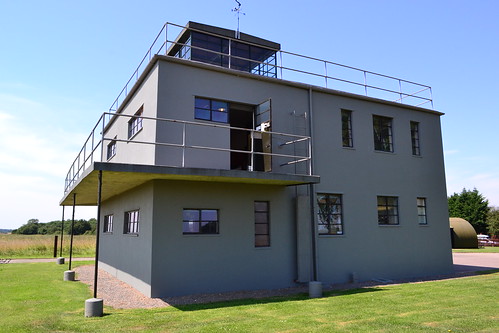
The watch office at East Wretham was another unusual design. Built to drawing 15498/40, it was originally a single storey room built on concrete pillars with a flat roof. It was then modified later on in the war to include an overhanging observation room, with the extension being mounted on metal pillars. This new extension had considerably more glazing than the original structure, and was more in keeping with the building style of other wartime airfields. These extra windows gave a much better view across the entire airfield, especially useful as the office was unusually located along the perimeter fence well behind the technical area of the airfield!

The Control Tower of the 359th Fighter Group at East Wretham. Caption on reverse: 'Caption on reverse: '359th FG Photos Source: T.P. Smith via Char Baldridge, Historian Description: #13 Control Tower at Station F-133, East Wretham, England.'

The unusual design of the Watch Office can clearly be seen in this photograph*1. (IWM)

Originally there were only 27 ‘frying pan’ style concrete hardstands, each one being located at various points around the perimeter track, all in groups of three or four. These were then added to later on, again using steel planking, to extend the number of dispersal points located on hard surfaces; a further indication to the problems with the boggy soil found in this part of East Anglia.

Accommodation for the initial 1,700 personnel, was dispersed over twelve sites around the north of the airfield, and across the road from the main airfield site. One of these sites (Site 2) was the nearby Wretham Hall, a grand building built in 1912, it was utilised by Officers of the USAAF for their own personal accommodation. Sadly, the grand three storey building was demolished in the early 1950s, possibly as a result of its wartime use.

A bomb storage site was also built on the airfield. Located on the south side of the site, it was well away from any accommodation or technical buildings. It was also well away from the three large fuel stores,  which boasted storage capacities of: 24,000, 40,000 and 90,000 gallons.

The initial use of East Wretham was as a dispersal for aircraft based at Honington, the first of which was a newly formed Czechoslovakian Squadron, No. 311 (Czech) Sqn, on 29th July 1940. So new were they that they didn’t receive their Wellington ICs until the August. This was to be a unique squadron in that it was the only Czech squadron to fly with Bomber Command, and whilst the main body of the squadron was located at Honington, the operational flight (A Flight) moved to East Wretham shortly after its  formation. In mid September a decision was made to move the entire squadron across to East Wretham posting a detachment to RAF Stradishall, where they stayed until April 1942.

On September 10th 1940, 311 Sqn, now with a small number of operational crews, took part in their first mission, a true baptism of fire flying directly into the German heartland and Berlin. For one of the crews and their Wellington, this would not go well, the aircraft believed forced down in the vicinity of a railway line near Leidschendam in Zuid-Holland, with all but one of the six airmen on-board being captured.

The only crew member not to be caught was Sgt. Karl Kunka, who managed to evade capture for a short period, only to shoot himself with the aircraft’s Very Pistol. It was thought that he carried out this action to not only avoid capture but any possible retaliation against his family back home in Czechoslovakia. Whilst Sgt. Kunka’s wounds were not initially fatal, they were so severe that he later died, failing to respond to treatment whilst in hospital.

The aircraft, Wellington MK.Ia, #L7788, ‘KX-E’, was also captured, repainted in Luftwaffe colours and flown for testing and evaluation to Rechlin, the Luftwaffe’s main aircraft test facility north of Berlin.

RAF East Wretham 3

East Wretham still uses the Nissen huts and smaller buildings today.

During December 1941, a further Czech unit, No.1429 Czech Operational Training Flight (COTF) was formed along side 311 Sqn, under the command of Sqn/Ldr. Josef Šejbl. This unit was designed specifically to train Czechoslovakian aircrews for Bomber Command, with instructors for the flight, being taken from 311 Sqn following completion of their tour of operations.

As aircrew completed their training, they were transferred to the operational flight, a steady but slow build up meant that numbers were quite low, the squadron being  considerably reduced by heavy casualties in the early stages of the war. As with other Bomber Command squadrons, 311 Sqn carried out night bombing missions, many penetrating Germany itself.

1941 would see more missions to Germany, starting with the first three nights January 1st – 3rd, when Bomber Command aircraft hit Bremen, with 311 Sqn taking part on the night of the 2nd. On this night, three aircraft from 311 Sqn would join the Hampdens and Whitleys of Bomber Command in attacking a major railway junction in the centre of the city, where fires and explosions were seen as far away as 20 miles. A relatively successful operation, it would not be long before the first casualties of 311 Sqn would occur.

On the night of January 16th – 17th Wellington IC #T2519 ‘EX-Y’ was lost on a mission to Wilhelmshaven, the aircraft going down after suffering ‘technical’ problems. Last heard from  at 22:21, the aircraft disappeared without trace along with the entire crew, none of whom were ever heard from again.

1941 would end as it started, with a return trip to Wilhelmshaven, in which good results were recorded. One aircraft was lost on this mission, Wellington #T2553 ‘EX-B’, the pilot, Sgt. Alois Siska ditching the aircraft after it had sustained serious flak damage over the target area. As the aircraft sunk, it took the life of the rear gunner Sgt. Rudolf Skalicky, the other’s climbing into the aircraft’s dingy, a small craft in which they remained for several days.

As the dingy drifted towered the Dutch coast, the icy conditions would take two more lives, that of Sgt. Josef Tomanek (Co/P) and F/O. Josef Mohr (Nav.), whilst the pilot, Sgt. Siska, suffered badly from frost bite and gangrene. The remaining crewmen, F/O. Josef Scerba (W/O), Sgt. Pavel Svoboda (air gunner) along with Sgt. Siska, were picked up by German forces and  interned as POWs, mainly staying in hospitals for treatment for cold related injuries. Sgt. Svoboda went on to escape captivity no less than three times, evading capture until after the war whereupon he returned to England.

By mid 1942, 311 Sqn were assigned a new posting and a new airfield, but before departing in their final month, April 1942, they  would be visited by two particularly significant dignitaries. On April 3rd, Air Vice Marshal J. Baldwin, Air Officer Commanding No. 3 Group, RAF Bomber Command, visited to award the DFC  to P/O. Karel Becvar for his services as a navigator with 311 Sqn. Then on the 18th April, the President of the Czechoslovak Republic, Dr. Edward Benes, arrived along with several other dignitaries to inspect the Squadron, and give a speech regarding the work carried out by the crews here at East Wretham.

Tarck to Bomb Store

A number of tracks remain on the site.

During their last month, 311 Sqn would fly twelve more operations before finally departing Norfolk for Northern Ireland and Aldergrove. Whilst here at East Wretham, they would fly 1,011 sorties which included both attacks on industrial targets and propaganda leaflet drops. On the 30th, the main air body along with the rear party departed the site, the bulk of the squadron moving two days earlier. After their departure, 311 Sqn would not return to East Wretham.

In November 1942, after a long quiet break, East Wretham would spring into life once more with the arrival of another bomber squadron, No. 115 Sqn (RAF) from Mildenhall now flying  Wellington MK.IIIs.

Over the winter of 1942-43, 115 Sqn would lose ten aircraft, most to missions over Germany but two whilst ‘Gardening’, the last occurring on the night of New Years Eve 1942.

During the early months of 1943 six more Wellingtons would be lost from 115 Sqn, KO-D, KO-X, KO-C, KO-N, KO-T and KO-Q, the new year had not brought new fortunes.

By now the limits of the Wellington had been realised and its days as a front line bomber were numbered. A poor performer in the bombing theatre, it would be gradually moved to other duties, being replaced by the superior four-engined heavies; 115 Sqn was no exception. The MK.II Lancaster, powered by four Bristol Hercules engines, was less common than the Merlin powered MK.I and MK.III, but none the less was far superior to the Wellington in both performance and bomb carrying capacity.

The first Lancaster arrived in the March of 1943, and as it did the Wellingtons began to depart. To help train crews on the new aircraft, a detachment from 1657 Heavy Conversion Unit (HCU) would be re-designated 1678 (Heavy Conversion) Flight (HCF) and was based here at East Wretham.

Flying the radial engined Lancaster MK.IIs under the code ‘SW’, they were one of only two HCFs to be established in Bomber Command, both in May of that year. Specifically set up to convert crews from the Wellington to the Lancaster, they were a short-lived unit, becoming a Heavy Conversion Unit once more on September 16th 1943, after moving to RAF Foulsham. During this time the flight would operate only eight aircraft in total, losing none whilst at East Wretham.

Even with the new aircraft though, flying over Germany was not without its problems for 115 Sqn. The first aircraft to be lost, and the first of its type in Bomber Command, Lancaster MK.II #DS625 ‘KO-W’ was lost without trace in a raid to Berlin on the night of March 29th/30th. The Pilot Sgt. H. Ross, (RCAF) and his crew all being commemorated on the Runnymede memorial. The aircraft being new, it had only flown 26 hours since its arrival at East Wretham earlier that year on March 9th.

rear-turret-of-Lanc-lost-595x478

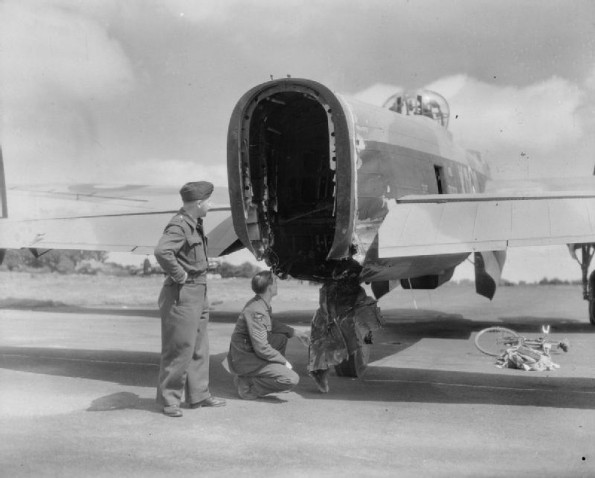
Avro Lancaster B Mk II, DS669 ‘KO-L’, of No. 115 Squadron, was hit by bombs from an aircraft flying above. during a raid on Cologne on the night of 28th/29th June 1943. The tail gun and gunner were both lost. (Author unknown)

With more missions into Germany, 115 Squadron’s Lancasters  would continue to serve well, perhaps one of the worst nights occurring just days before their eventual departure to RAF Little Snoring in early August 1943.

On the night of 2nd/3rd a mission was planned for Hamburg in which 740 aircraft were allocated. Of these, 329 were Lancasters, by far the largest contingency of the raid. Whilst over Germany, the formation entered a severe thunderstorm, and with many aircraft suffering from icing, they were forced to either turn back, or find other targets. The poor weather, including lightning, accounted for several of the losses that night including one of three lost from 115 Sqn.

Lancaster #DS673 was shot down by a night fighter, #DS685 was lost without trace and #DS715 was struck by lightning causing it to crash not far from the target. From the three that went down that night, there were no survivors from the twenty-one crewmen on board. 115’s time at East Wretham would close on a very sour note indeed.

With the departure of 115 Sqn in August, East Wretham would then pass from RAF ownership into the hands of the US Eighth Air Force, to become Station 133, the home of the three squadrons of the 359th Fighter Group – ‘The Unicorns’

RAF Scampton – What does the future hold?

Many in the aviation world were saddened and even shocked recently (24th July 2018) with the MOD’s announcement that RAF Scampton and RAF Linton-on-Ouse were to close, and the two sites sold off.

Whilst there seems to be little general objection to Linton-on-Ouse, there has been quite a backlash regarding the closure of RAF Scampton in Lincolnshire. Scampton is of course home to the RAF’s Red Arrows display team who moved in there around twenty years ago, but more famously, it was the home of 617 Squadron RAF otherwise known as ‘The Dambusters’ during the Second World War.

It is this that has primarily caused the huge backlash resulting in a petition and some quite heated social media ‘discussions’ over the closure. So what are the reasons behind such a move and what could the future hold for RAF Scampton?

Scampton has been under RAF ownership since the First World War, it is one of their oldest stations and has housed some 19 operational flying squadrons as well as a number of non-flying units during this time. The base was closed in 1996 and then again partially reopened for the storage and maintenance of aircraft, it was also at this point that it became home to the RAF’s Red Arrows. Currently the only other units stationed here are No.1 Air Control Centre and the Mobile Meteorological Unit.

No. 1 Air Control Centre was moved here from RAF Lossiemouth whilst upgrading work was undertaken on its site. They work in conjunction with, amongst others, RAF Boulmer to provide National and International air surveillance operations ready to deploy QRA Typhoons from either Lossiemouth or nearby Coningsby at a moments notice. They also provide support to international operations including those with the British Army and the Royal Navy.

The Mobile Meteorological Unit uses civilian operators (Reserves) to monitor weather conditions primarily for aviation related operations, but they can also assist in any operation where the weather may impact on the overall objective.

The Red Arrows (RAFAT) are perhaps the most famous of the world’s aircraft display teams, currently flying the BAE Hawk, in close formation flying displays that have spanned fifty-four years. The Red Arrows are famous the world over, with pilots undertaking a rigorous selection process and subsequent training programme, that sets them amongst the most elite pilots in the world.

These three units mean that there are around 600 people employed on the Scampton site, mainly armed forces personnel who will be moved with their various units to new postings when the move finally takes place. Some of these employees are civilian and live locally to the airfield.

The argument for closure.

The RAF has been under considerable pressure to reduce its costs whilst keeping a viable and effective force. The recent purchase of the F-35 Lightning to replace the now ageing Tornado, had a significant impact in the RAF’s overall budget. However, this was taken into consideration within the MOD’s strategy which aimed to reduce costs, streamline operations and reshape the RAF for the modern world. Notifications of these cuts were aired in the 2010 Strategic Defence & Security Review (SDSR) in which it was announced that the RAF would*1:

  • Reduce its manpower force by around 5,000 personnel to 33,000 by 2015;
  • Retain Tornado but remove Harrier from service in the
    transition to a future fast jet force of Typhoon and JSF;
  • Not bring into service the Nimrod MRA4;
  • Withdraw VC10 and the three variants of Tristar aircraft
    from 2013 as part of the transition towards the more capable
    A330 future strategic transport and tanker aircraft;
  • Withdraw the C-130 Hercules transport fleet 10 years earlier than planned to transition to the more capable and larger A400M;
  • Withdraw the Sentinel surveillance aircraft once it is no longer required to support operations in Afghanistan;
  • Rationalise the RAF estate (40% of which is over 50 years old)
VC 10 flypast 29/8/12

The VC-10 fly past over RAF Coningsby on August 29th 2012, prior to their withdrawal from service.

Whilst much of this criteria has already been met, the estates management review has yet to take full effect. A series of reviews and assessments have been carried out by relevant Government bodies in conjunction with personnel from the MOD. The Better Defence Estates strategy 2016 (which is part of the Defence Estate Optimisation Programme) focuses on streamlining the MOD’s estates: land, bases and housing by 30% by 2040. Only by doing this, will the MOD meet its SDSR commitment, saving £3bn by 2040, allowing £4bn to be invested over the next 10 years on over 40 separate sites.

A further Government commitment is to generate 55,000 new private homes, some of which will be for armed forces personnel (Service Families Accommodation, SFA), but most will be released to private housing ventures. Much of the land owned by the MOD (which covers 1.8% of the UK land mass), and in particular the RAF, has huge building potential and is therefore prime building land.

So far, the MOD has disposed of nine military sites, with a further ninety-one earmarked for closure. This doesn’t include Scampton or Linton-on-Ouse, but does include: Swansea Airport, Newtownards Airfield, RAF Colerne, RAF Henlow, RAF Halton and the three American bases at Molesworth, Mildenhall and Alconbury (currently occupied by USAF personnel).

The cost of maintaining one of these sites, is not cheap, and a considerable amount of money was spent on Scampton following the 2010 review, to resurface the runway to allow both the Red Arrows to operate from here and to keep the base in operational status should other units be posted here later on. However, the infrastructure remains a pre World War II design, the buildings and hangars dating back to the expansion period of the 1930s (as do Linton-on-Ouse’s) and therefore completely inadequate for today’s modern Air Force. In his deliverance of the ‘Better Defence Estate’ statement, the Parliamentary Under-Secretary of State for Defence, Mr Tobias Ellwood, said “The disposal of the site would offer better value for money and, crucially, better military capability by relocating the units based there“.

Considering other aspects of Scampton, the Museum of RAF Fire Fighting*2 was told to vacate their premises in 2017, they have since found alternative accommodation in Gainsborough and aim to be up and running very soon. There was also a renewed effort to bring airshows back to Lincolnshire after the Waddington shows were stopped following upgrade at RAF Waddington. The first, and so far only attempt, at Scampton in September 2017, made a loss even though 50,000 visitors passed through the gates over the two-day period. This was a huge drop in figures however, compared to the 170,000 previously attained at Waddington. A planned event for 2018 was postponed until 2019, but no firm decision has been made about the future viability of this event.

Sisters together

Under restoration, two Lancaster front sections housed in the Grade II listed building. They may have to find new homes.

A further point to be considered is that of the local economy. Many argue that the base provides economic benefits to the local economy. Being only 600 personnel, this is quite a weak argument, unlike say Mildenhall that has 4,000 personnel contributing £219m (2013-14 figures) to its local economy.*3

So on the face of it, Scampton is ‘ideal’ for disposal, it is underused, located in an area already busy with aircraft activity (RAF Cranwell, RAF Waddington and RAF Coningsby are all nearby) and has an infrastructure suited for a private venture. The accommodation areas are mostly empty and those units based there are easily moved elsewhere, only the Red Arrows could prove a problem due to interference with other operational flying units.

The argument against closure.

However, that said, Scampton (more so than Linton-on-Ouse) has a huge historic value. Being a pre-war airfield it was vital for Bomber Command in the fight against Nazi Germany. Initially built with grass runways, these were improved upon with hard runways in the early war years, being extended to 10,000 feet later on in 1956, to be able to take the mighty Vulcan. This expansion led to extensive renovations including the re-sighting of the main Roman road (Ermine Street) that passes alongside the airfield. It is this extension that led to Scampton’s famous station badge of the bow and arrow. In 2016 Scampton celebrated its centenary and this year (2018) marks the 100th anniversary of the RAF.

The biggest factor in favour of keeping Scampton open are its historical, political and architectural aspects, the most famous being the presence of 617 (Dambusters) Sqn during the 1940s. A specialist squadron, formed under the leadership of Guy Gibson VC, DSO & Bar, DFC & Bar,  who led the 133 airmen in nineteen Lancasters in the famous attack against the dams of the Rhur valley on May 16th, 1943. In memory of this historic event, a museum was opened up showcasing a number of artefacts from the Dambusters including Guy Gibson’s office. Gibson’s dog ‘Nigger‘ is also buried in the grounds of Scampton, outside of what was Gibson’s office and many of the offices used by the squadron are also open for pre-arranged visits.

Scampton September 2015 (17)

The names of those who took part in Operation ‘Chastise’

There are of course a number of other historical aspects to this site. Airmen from Scampton were awarded a greater number of honours that any other bomber airfield, including two Victoria Crosses and a George Cross in 1940 alone. The first 2,000 lb bomb was delivered by aircraft based at Scampton, and numerous raids were undertaken from here including its participation on the first 1,000 bomber raid.

Post war and Scampton played a major part in the Cold War, an airfield housing the Vulcan, an aircraft capable of carrying and delivering the Blue Steel stand-off nuclear missile, one of only two airfields that could complete such a task. In order to complete this role, further T2 hangars were added, the dispersals were modified and additional ancillary buildings erected for fuelling and avionics.

The four ‘C’ type hangars now Grade II listed (1st December 2005 – List entry Number: 1391594) are the only listed buildings on site, the Blue Steel maintenance shed being demolished in March 2004, before listing was made. In fact over recent years, many unused buildings have been gradually demolished: the pre-war parachute stores, the main station workshop outbuildings, the Vulcan simulator, parts of the medical centre and the Warrant Officers’ Quarters are all included.

The main reason for the listing of these hangars is their ‘Legacy’ record, and includes the attached stores, workshops and offices. These ‘C’ type hangars were built in the period 1936-1937 by J. H. Binge of the Air Ministry’s Directorate of Works and Buildings, to drawing number 5043/36, and signify the airfield as a bomber airfield. The sacrifice by Bomber Command was immense, some 55,000 aircrew were killed in operations and many came from airfields in and around Lincolnshire. Thus these hangars, as listed buildings, stand as unofficial memorials to those who never came back and in particular to those of 617 Sqn who gave the ultimate sacrifice. As listed buildings, they cannot easily be demolished and therefore must be retained in any future development whatever that may be. Even with these modifications having taken place, the general layout of the airfield, the road networks and most buildings are still the pre-war expansion period designs, little has changed here since those days of the late 1930s when Britain was expanding it national network of airfields.

A review of Britain’s airfields by English Heritage, classified Scampton (and Linton-on-Ouse) “as one of most complete surviving of our Airfields with Runways and Perimeter tracks” comparable with RAF West Raynham, RAF Finningley, and RAF Waddington. It is a prime example of an expansion period model, being built under Scheme B of the period and only one of four to be so. The architectural designs of the buildings significant in themselves, being a mix of neo-Georgian and concrete within its non-dispersed site. The shape and design of Scampton (and Linton-on-Ouse) are unique to this period in time, square with straight roads and grassed / tree areas to hide the accommodation and technical areas.

A further point is that there have been numerous archaeological investigations and finds on and around the airfield itself. These include: Prehistoric remains, Roman remains (the Roman road traverses part of the airfield), Anglo-Saxon burial sites, Medieval sites, post-medieval and modern warfare sites (WWI & II) that remain buried. Many of these have yet to be fully investigated and mapped, but it is thought that there are strong links to all of these periods in time.

"Nigger's" grave

The grave of Guy Gibson’s Labrador “Nigger“.

So what are the possible options?

These are certainly strong advocates for keeping the station alive, however, the question then arises does this warrant the huge expense of maintaining an operational airfield without service personnel being present? Does it warrant the use of an operational airfield just for the Red Arrows? Even if the RAF were to stay here, which unit(s) could be brought in and at what cost to other airfields? Many would argue not, and if the RAF / MOD are to meet their commitment to both a leaner more efficient Air Force and the SDSR, then on paper surely Scampton must close.

However, there are a number of options open when Scampton is closed. The worse scenario is that the entire site is sold to housing / industrial development. In such cases the historical aspect of Scampton could be lost, the hangars turned into industrial units and the airfield removed completely. This, if it were to happen, would no doubt cause a huge backlash from many in the aviation field including the RAF itself, and is unlikely (in my opinion) to happen.

Since the announcement of the 2010 SDSR the future of Scampton has been under considerable debate, with numerous studies being completed on behalf of the RAF and Lincolnshire County Council. On December 15th, 2011*4, Parliament were notified of the suggestion that Scampton could be closed by 2014 following the merger of No 1 Air Control Centre and the Control and Reporting Centre at RAF Kirton-in-Lindsey , which also closed as a result. Both these units would then move to RAF Coningsby, a move that was postponed following further investigations.

Scampton September 2015 (2)

Two of the four Grade II listed ‘C’ type hangars. Note the BAE Hawk ‘Red Arrow’.

In October 2013, Lincolnshire County Council*5,6,7 carried out its own feasibility study following a request to investigate possible options for Scampton’s use in the future. The study looked at a range of options including combining civil and military aviation, a combined heritage and RAF base, and an expansion of the site to form a leisure complex. The report concluded that:

  1. The potential for “increased airspace use on a joint military / civilian basis was not feasible given the requirements of RAFAT. This effectively ruled out the option of developing the base as a commercial or leisure aerodrome alongside RAF use“.
  2. Many buildings were not being used and were therefore able to be demolished without any serious issues. Only the hangars were listed and would be more difficult to remove. Whilst there is currently a museum on site, this could be exploited establishing an “aviation focused attraction of national and international importance“.  The cost of such a venture would be in the region of £80m, and it was thought that this would deliver an operating surplus based on “approximately 200,000 visitors per year“.  These figures would make Scampton comparable with the National Space Centre at Leicester, and with a greater visitor rate than that of Lincoln Castle.
  3. It was also suggested the unused space could be turned into leisure activities “themed hotels” for example, and that any such activity would compliment the RAF’s expansion at Scampton should it go ahead. The entire process of this consultation was met with interest by the base commander, and at that time it was thought that Scampton would expand in terms of operational staff.
  4. In conclusion of the study, it was suggested that “The aviation heritage attraction would tell key stories relevant to Lincolnshire and its involvement in defence and aviation. It is likely to attract significant new visitors to the county, generating sufficient revenue to support long-term operational sustainability of the attraction, plus spend in the local economy.” It also suggested that “a major new aviation heritage attraction at RAF Scampton could sit alongside the current scale of military use and would be sufficiently flexible to work with a greater or lesser RAF presence.”

Whilst much of these points include an RAF presence of some sort, it would be flexible in nature until such time as it became self-sustaining. A further option is to develop Scampton retaining its historical features and infrastructure. Much of the married quarters area has already been sold off and is currently in private ownership. These utilise the actual married quarters and has proven quite successful. Further sections of this area are also being sold and developed and so the atmosphere of the site has changed little since its wartime days.

Recently we have seen similar ventures at both RAF Coltishall and RAF West Raynham, where the airfield buildings have been retained (including the hangars, watch office and many associated buildings including the aircraft pens) and the site turned into a working heritage site with small industrial units utilising the workshops and hangars, and private housing using the refurbished personnel homes.

Scampton September 2015 (4)

The ‘Grand Slam’ and ‘Tallboy’ bombs at Scampton.

The main argument against closing Scampton is one of cost, defence budgets are being cut and savings have to be made in the estates area. Scampton as it is, is not a viable airfield. However, its historical value is much higher, and any future decision and development needs to take this into account. If we are to retain our aviation heritage then serious consideration needs to be given to Scampton as a future development opportunity, themed hotels, museums of national importance or even a living history museum are all possible. What needs to be considered very carefully, is how that change is brought about. Lack of suitable knowledge or understanding of even small aspects of the site could degrade the overall venture, with important features degrading beyond safe use and poor managerial provision wasting an ideal opportunity in raising public awareness of the site’s true historical value.

Developments at both RAF Coltishall and RAF West Raynham have shown what good planning can do, creating something useful from a former airfield, whilst allowing for the preservation of its unique historic infrastructure.

This is clearly going to be a long and heated discussion, whether Scampton closes or not is only part of the debate, the crux of the matter being the historical value that it holds and what happens to the legacy it carries for all future generations.

Sources and Further Reading.

*1 Fact Sheet 8: Future Force 2020 – Royal Air Force.  Published 19 October 2010, accessed 25/7/18.

*2 Museum of RAF Firefighting website, accessed 25/7/18.

*3 Figures from ‘Forces Network News’ website, accessed 25/7/18

*4 Memo to Parliament 15th November 2011

*5 Scampton – Appendix A – Scampton Aviation Heritage Consultancy Brief Final Version.pdf  (RAF Scampton – Feasibility Study for an Aviation Heritage Attraction and
related Site Development Options – Brief – March 2013 ) accessed 25/7/18

*6 RAF Scampton Feasibility Study, 29 October 2013 to the Economic Scrutiny Committee on behalf of Executive Director for Communities Lincolnshire County Council. accessed 25/7/18

*7 Lincolnshire County Council Agenda item – RAF Scampton Feasibility Study Meeting of Economic Scrutiny Committee, Tuesday, 29th October, 2013 9.30 am (Item 34.)

The Development of Britain’s Airfields – AviationTrails

‘A Better Defence Estate’, November 2016, accessed 25/7/18.

News story “Defence Minister outlines progress on building a Better Defence Estate”  Government news bulletin published 24th July 2018, by Ministry of Defence and The Rt Hon Tobias Ellwood MP

A Better Defence Estate, 24 July 2018, Volume 645, House of Commons, The Rt Hon Tobias Ellwood MP

Feasibility Study fr RAF Scampton, Purcell 2018 website.

Artech Designs Ltd. Design and Access Statement, April 2015

Historic England Website accessed 27/7/18

The Development of Britain’s Airfields (Part 8).

In this, the last of the series looking at the development of Britain’s airfields, we look at the Watch Office, perhaps the most atmospheric of buildings associated with Britain’ wartime airfields. The hub of an airfield control, it was where aircraft were counted out and back, where the battle was monitored and the cries of those who fought in the air war were heard.

Though only a recent addition to airfield architecture, it developed quickly and became one of the technologically advanced offices in the world.

Watch Offices.

The Watch office, Watch Tower or in American terms Control Tower, was the centre piece of any airfield, the place in which all operations were controlled. Even today, the control tower is the one feature that stands high above the rest of the airfield with commanding views across the entire site.

Many of these watch offices remain today, some as fabulous museums, some as private dwellings, but many are sadly derelict or even worse – gone altogether. This that do survive create a haunting and evocative feeling when seen from inside.

Thorpe Abbotts Museum

The beautifully restored Thorpe Abbots Watch Office (design 15683/41).

Unlike hangar development, the watch office appeared quite late in the development of the airfield, only really coming into being as war seemed inevitable. Before this, a rudimentary office was often all that was used, usually attached to the side of the main hangar, and was used to ‘book’ aircraft in and out. But by the mid war period the watch office had become a major structure on the airfield, a standard design (depending upon the airfield use) with two or more floors and often a ‘glass house’ for observation purposes.

For obvious reasons the watch office was built away from other buildings with clear sight over the entire airfield, an important aspect if controllers were to keep watch on the many aircraft that were moving about the airfield space. A vital asset to the airfield it was often targeted by marauding bombers, and in the case of attack, the controllers within would relocate to an emergency battle headquarters, hidden at ground level on a remote part of the airfield, but still with views across the site.

The basic watch office was often adapted rather than demolished and rebuilt, this can and does, cause great confusion as to its design origin. Further more, on some sites, the original was abandoned but not demolished, and a new office built elsewhere on a nearby site, thus giving rise to two offices on the one airfield eg. Matlask and Martlesham Heath

The Watch Office as we know it was first seen on military airfields in 1926 and resembled a small bungalow with bay windows. Those constructed on bomber bases would be slightly smaller than those on fighter bases, a fighter base office having a pilots office attached. The idea behind this was to keep pilots as close to the airfield  control centre so they could quickly be scrambled and report back to the airfield controller on their return. These early design were found on airfields such as Bircham Newton in Norfolk, Hendon and Tangmere and were all built to the same  basic 1926 drawing design only modified to take the extra pilots room.

The standard shape of the World War 2 Watch Office stems back to the mid 1930s, with the introduction of a two-storey building that was square in design. Like similar buildings of its time, it was brick, a building material that was replaced with concrete, in 1936.

RAF West Malling Control Tower under refurbishment

West Malling a 5845/39 design which is now a coffee shop.

By the end of the expansion period, and with the introduction of hard runways, it was realised that the non-dispersed sites gave poor visibility for early watch offices, views across the airfields were not clear and so a quick remedy was called for. The answer lay in two choices, (a) demolish the current buildings  and rebuild it in a better location, or (b) add an extension. In many cases the former was the better idea and this progressed quite quickly, however, where the latter was chosen, remedial work required alteration of the building whilst it remained in use.

A further complication to these designs was the introduction of meteorological sections, which all new buildings erected at the beginning of the war now had. This gave a mix of design styles, enough though there was only a small selection of design drawings from which to work.

These late expansion period and early war designs introduced the idea of ‘viewing platforms’ or parapets, surrounded by safety railings along the front of the building. These deign also had very large glass fronted walls, bright and airy they allowed a lot of light to enter the building but gave cause for concern later on, when it was realised that a bomb blast would cause severed injury to the occupants in an attack. It was also found that during night operations, large windows were more difficult to black out and so smaller windows offered both better protection and greater ease of black out.

As building materials became scare, particularly wood and brick, concrete became the norm. This change also led to drawing changes even though the basic design inside and out, was the same.

In order to appreciate the changes to watch office designs, one needs to consider the different roles that airfields played during the war. Bomber Command airfields would have a differ office to a fighter Command airfield, which in turn, had a different office to a satellite or night-fighter station.

Thorpe Abbotts Museum

Watch Offices give commanding views across the airfield. (Thorpe Abbots).

The regional control stations where these first offices were being built were certainly getting the better choice at this time, standard fighter and bomber airfields having to use inferior designs that very soon became outdated and inadequate for the needs of the airfield.

During the massive building programme of 1941/42, there was some effort made to standardise all airfield Watch Offices, this resulted in the 1941 design drawing no. 12779/41. This was to be the basic airfield watch office design, with its parapet, six large windows to the front and outside access steps. As older airfields were brought up to Class A Specification, many had these new Watch Offices built to replace the older original ones. Some simply had adaptation of the original. Here the use of the airfield had a bearing on the watch office modification / design, and whilst the basic 12779/41 model was employed, slight variations did exist where the airfield was not a bomber airfield.

Therefore various adaptations of this did follow, examples of which include the slightly smaller 13023/41 (RAF Cottam), those with modified smaller windows 15371/41 (Kimbolton) and 343/43 (Martlesham Heath),  and the smaller Night-Fighter design 15684/41 (Winfield). Being a Night-Fighter station Winfield, had the same basic design but construction methods were totally different. This new design 15684/41, would become standard at all night fighter bases.

All these alternative designs appear outwardly very similar to the original, but differ mainly in window design only, although the physical size of some is different.

RAF Winfield

The Night-Fighter station Watch Office at Winfield (15684/41) is a similar design but smaller, having only four windows in the front.

This design, 343/43, eventually became the most common design for watch offices and appeared on all operational stations and Operation Training Unit airfields after 1943, using a set of six half-size windows across the front.

Tower (2)

The smaller windows of Parham (Framlingham) were half the original design size (12779/41 modified to 343/43).

A further addition was the glass observation room located on the roof of the Watch Office. These were generally only applied to Group control offices, and gave an excellent all round unrestricted view of the entire airfield. Examples that exist today, such as Framlingham above, are replicas but have been built to very high standards.

Former RAF Martlesham Heath

Martlesham Heath is a similar design to Framlingham (modified to 343/43) – Note the runway heading board on the roof.

At the end of the war some airfields such as Sculthorpe and West Raynham had their Watch Offices modified as they changed roles to Very Heavy Bomber Stations. This new design 294/45, improved on former buildings as a complete new design based on a steel frame with precast concrete floors. It had an extra floor added and then the octagonal ‘glass house’ or Visual Control Room with slanted glass to reduce glare.

Control Tower

Sculthorpe’s modified tower gives 360 degree views over the airfield. A three-story block it utilises the former World War 2 Watch Office.

The Watch Office has been the hub of airfield command and control since the mid 1930s, it has developed from the humble shed to a multi-functional technologically advanced building dominating the skyline of the airfield today. Sadly though, many are now gone, and of those that are left only a few remain in good condition or open to the public.

Summary

The war-time airfield incorporated numerous building designs and shapes, certainly far too many to cover here, the wide variety of technical buildings, synthetic trainers, parachute stores, headquarters and general stores, all changing as the war progressed.  The design and materials used in these structures was as varied as the designs themselves. But as the RAF grew so too did the airfields they used. The runways, the hangars, the technical buildings and accommodation sites have all grown alongside. Sadly many of these buildings have now vanished, but the process and speed at which they developed has been unprecedented. From humble grass strips with wooden shacks to enormous conurbations with numerous buildings, they have become iconic symbols representing decades of both aviation history and human sacrifice.

The entire page can be viewed separately:

Part 1 – The Road to War.
Part 2 – The Expansion Period and airfield development.
Part 3 – Choosing a site.
Part 4 – Building the airfield.
Part 5 – Airfield Architecture.
Part 6 – Runways and Hardstands.
Part 7 – Hangars and aircraft sheds.

or as a whole document.


The Development of Britain’s Airfields (Part 7).

Whilst the runway’s remains one of the biggest features of an airfield, perhaps one of the most discussed and certainly visible is the hangar. Large sheds used to maintain aircraft, many still dominate the skyline today, used by farmers and industrial companies, they are massive buildings, but yet many remain classed as temporary or even transportable!

The development of these huge buildings is another that lasted many years, and whilst similar in layout and design, they are as complicated and as varied as any other building found on Britain’s airfields.

Hangars and Aircraft Sheds.

The topic of aircraft hangars is well versed in a large number of books and internet references. They, like the runways, can explain much about the history and use of an airfield, being the largest single building on any airfield site. Distinguishing features between hangar types is often difficult to see, many now re-clad or updated with modern features, doors or materials, even the differences between some designs is so small, without technical drawings or measurements, ascertaining the type can be all but impossible.

Hangars (or aircraft sheds as they were initially called) have been fairly constant in design, however, different services used different types, Admiralty seaplane sheds for example, were primarily side opening, whereas RAF hangars were generally front opening. Design and construction was undertaken by numerous companies (Herbertson & Co. Ltd., Nortons Ltd., Teeside Bridge and Engineering Co. Ltd., and Sir William Arrol & Co.) and even Handley Page Aircraft Co. and Boulton & Paul dabbled with the idea. With so many forms being used, it is a topic both detailed and extremely wide.

This is not therefore, intended to describe each and every hangar ever built (Second World War Air Ministry designs alone covered more than 56 types!), but more a general realisation of the huge development they undertook during this expansion and wartime period on RAF / USAAF airfields. Figures quoted here are generally rounded.

In order to understand the changes in aircraft hangars we need to briefly look at those of the First World War, where aircraft were stored in ‘sheds’, often made from canvas covering a wooden frame, or as a more permanent construction, completely wooden sheds with sliding doors. Later on these were built using metal (iron in particular) and were designed to be permanent, capable of housing several aircraft at a time.

The First World War hangars were varied and often crude, some little more than glorified tents, but through development famous names such as the Bessonneau and Hervieu were created toward the end of the war. Hangars became so large that specialist units had to be created solely to transport, erect and maintain them, and their use became more widespread.

The most common hangar of this period, the Bessonneau, was the first standard transportable hangar used on Royal Air Force airfields. Modern forms of it are still in use today, using different materials, they are quick to erect and offer reasonable protection from the weather outside.

The Bessonneau was a wooden frame structure covered in canvas. It was a simplistic design, able to be erected in as little as two days by a group of 20 skilled men. Heavy canvas doors open at one end allowing aircraft to be moved in and out with relative ease. The problem with these hangars was that the canvas was prone to freezing in winter and therefore becoming difficult to use.

There were two models of the Bessonneau built, differing only in their length – either 79 feet or 118 feet – but both were 65 feet wide.

The interwar and early war years were perhaps understandably,  the years in which the greatest hangar development occurred. The Air Ministry – the body overseeing the works – decided upon a system of ‘structure type’ using names and designations such as, Type ‘A’, ‘B’, ‘C’, Bellman, ‘T2’, etc., and just like the expansion period schemes, they progressed through this system as new developments came about.

The first type was the Type ‘A’, a permanent design, originating in 1924, it was used well into the 1930s when it was gradually replaced during the expansion period. Some examples did last well into the war and even beyond, for example, North Weald, one of the first airfields to be allocated a Type ‘A’, still uses one today.

Type A Hangar

Type A Hangar at North Weald. One of the first stations to have these types of Hangar, it has workshops attached to the Hangar side.

The Type ‘A’ is probably the first to represent the modern hangar, doors at both ends in leaves of four running on rails. Workshops are attached to the hangar side, something that was discontinued as Britain entered the war. Walls were reinforced with concrete to protect from bomb splinters, and they were built 249 feet long and 122 feet wide.

During the late 1920s, the Air Ministry published requirements for new heavy bombers, and these would require new hangars in which to maintain them. In response, the Ministry then updated the Type ‘A’ hangar to the Type ‘B’. In essence a larger version of the Type ‘A’, (160 ft span and 273 ft in length) the ‘B’ was named the ‘Goliath‘ with only three being built (each being a different length). One of these was at RAF Martlesham Heath and is still used today on what is now the industrial park. Like the Type ‘A’, the roof of the ‘B’ is possibly its most discernible feature, a series of trusses along its length crossing laterally over the roof.

With expansion period demands increasing, further developments were needed, and it was envisaged that an increasing bomber size would be needed if substantial bomb loads were to be delivered deep into the continent. The current size of hangar was now considered too restrictive and so a new buildings would be needed. The requirements of the Air Ministry was for a hangar with a span of 150 feet and length of 300 feet. With these in place, new aircraft specifications could be issued.

The Type ‘C’, (designed in 1934) as it was designated, would become the dominant building on any airfield and therefore visible from quite a distance. As airfield designs were subject to scrutiny by the Society for the Preservation of Rural England, local objections were taken into account during the design process. To appease any  objections, the steel frame was covered with local brick or stone, keeping it inline with other buildings not only on the airfield, but houses and buildings erected locally.

Most airfields during the expansion period were built with these hangars on site, and naturally went through a series of developments and improvements. This means, that there are many different forms of the Type ‘C’: gabled roof, hipped rafter and reinforced concrete. Another modified version of the ‘C’ appeared in 1938 and was designated the ‘C1’ (or ‘Protected’), this was an austerity measure development, reducing the amount of material used by lowering the roof height by 5 feet – internal metal work was also left partially exposed. Both the ‘C’ and ‘C1’, continued to be built with offices, workshops and aircrew accommodation attached to the hangar side, the idea being that it was more efficient to do so for the repair of the aircraft inside. As these were larger in width and length than their predecessors, they would have six leaf doors also sliding on top and bottom rails.

RAF Upwood

Type C at the former RAF Upwood.

1936 saw a dramatic change in hangar design, with two new requirements being issued by the Air Ministry. Firstly, storage space was now running out and so new facilities were required. These Aircraft Storage Unit Stations (ASU) would need their own hangar type, and so a requirement for these was put forward. Also at this time, the Ministry put out a demand for transportable hangars, these would replace the ageing Bessonneaus of the First World War. The response to these demands were three storage hangars and two temporary hangars.

Storage Hangars.

The Type ‘D’, ‘E’ and ‘L’ Hangars, were a development used specifically by the ASU stations, and they were not generally built on front line operational airfields. They were virtually identical in size to the Type ‘C’, but each type was marginally bigger in span 150 ft, 160 ft and 167 ft than the previous model, and all were the same length at 300 feet. The three types were different from previous hangars in that they had curved roofs, allowing the ‘E’ and ‘L’ to be covered with soil for protection and camouflage (the ‘D’ had straight side walls and therefore could not be covered). ASUs were built to assemble and disassemble aircraft for shipment to operational airfields in Britain or overseas. Aircraft were stored, in varying degrees of assembly within these units, and heavy hoists were often used to store aircraft ‘tail up’. However, with the outbreak of war, aircraft storage was thought better dispersed around the airfield and not concentrated in one space, so this method of storing aircraft was abandoned. Many of these hangars still remain today, used by small industrial units or for farm storage.

The next two types, the ‘J’ and ‘K’, were virtually identical in design, again with curved roofs, they were used for storage of aircraft. The ‘J’ can be found on many operational airfields, built in conjunction with other main hangars (Waterbeach is a very good example of this combination), whilst the ‘K’ was built on ASU stations. The design came in as a result of Expansion Scheme M, and was as a result of the call for 2,550 front line aircraft by March 1942.

The main difference between the two, (other than their location) was in the roof structure, the ‘K’ having lifting tackle rails along its width, while the ‘J’ were along its length. The ‘K’, being used for storage of aircraft, didn’t have any windows, where as the ‘J’ did as offices and workshops were in use constantly. Like previous hangars, the ‘J’ and ‘K’ both had a span of 150 ft and a length of 300 ft.

RAF Waterbeach 'J' Hangar

A ‘J’ hangar located at RAF Waterbeach.

Transportable hangars.

The 1936 transportable hangar requirement, asked for a hangar that could be easily erected and didn’t require a permanent base. It also asked for doors at both ends and needed to be simplistic in design, with parts being interchangeable. These hangers also saw the separating of the office/workshop facilities previously built onto the side of the hangars, these now being located in buildings in the technical and administrative areas. After considering numerous designs, two were chosen and ultimately built.

The first of these, and the primary choice, was the Bellman. Designed by an engineer within the Works Directorate, N.S. Bellman, they were smaller than previous hangars (88ft span and 175 ft on RAF bases) and could be built in under 500 hours by a dozen men. So successful, were they, that over 400 were built between 1938 and 1940 across a wide range of airfield types. Some of these examples even appeared in Russia.

Bellman Aircraft shed

Bellman Aircraft sheds at the former RAF Bircham Newton

The second design, was the Callender (later Callender-Hamilton with modifications) Hangar, designed by the bridge design company Callender Cable and Construction. These had a span of 90 clear feet, with a length of 185 ft, and were used on both RAF and RNAS airfields. There were only eight of these built before the outbreak of war, examples of which appear at East Fortune, further examples with lower roof clearances (17 ft) being purchased after 1940. The Callender-Hamilton are best recognised by their lattice-work on the top door rails.

Callender-Hamilton Hangar East Fortune National Museum of Flight

Callender-Hamilton Hangar East Fortune National Museum of Flight

As the war approached, 1939 – 1940 saw a transition period between ‘permanent’ and ‘temporary’ buildings, although many of these temporary buildings still stand today! Because of this change, many airfields had various hangars built, something that often gives a mix of hangar designs on one airfield which can cause confusion as to its age and origin. However, from this point on, all wartime hangars were designed as temporary hangars, designed with short lives and easily assembled / disassembled.

By 1940, the Bellman was considered too small for the RAF’s requirements and a new design was going to be needed. An agreement between the Air Ministry and Teeside Bridge & Engineering resulted in the ‘T’ series of hangars, perhaps the most well-known of the hangar designs.

The ‘T’ series covers a wide range of (temporary or transportable) hangars, each slightly different to the previous, but designed as three main types; T1 (90 ft span), T2 (113 ft) and T3 (66 ft). The length of each hangar varied depending upon local requirements and the number of additional bays added as needed. The design number e.g T2 (26) indicated the number of bays (26) and hence the length.

The ‘T’ range were a diverse and complicated range, the ‘T2’ being sub split into 5 variants (T2, T2 Heavy Duty, TFB (flying Boat), TFBHD (flying boat heavy-duty) and T2MCS (marine craft shed), so the identification of each being difficult without measuring equipment.

RAF Wratting Common

A T2 hangar at RAF Wratting Common.

On first inspection the ‘T2’ and Bellman look virtually identical, both lightweight, steel lattice frames with metal side panels. The main distinctions are that the Bellman doors are flush with the top of the side panelling whereas the ‘T2’ has an extra level of panelling and so are not flush. The other difference is the lattice frame inside the roof, the ‘T2’ has only diagonal braces whereas the Bellman has vertical braces in addition to the diagonals. Both hangars have six leaf doors on sliding rails supported both top and bottom, allowing full width access.

A final addition to the ‘T2’ were the Ministry of Aircraft Production Hangars the Type ‘A’ (A1 & A2) and Type ‘B’ (B1 & B2) built in the mid war years 1942-43 and funded by the Ministry of Aircraft Production. These hangars, not to be confused with the type ‘A’ and ‘B’ of the 1920s, were designed specifically for the repair of damaged aircraft especially operational aircraft on their own airfield. They were also erected at ASUs, and Satellite Landing Grounds (SLG).

RAF Wratting Common

A B1 at RAF Wratting Common an RAF bomber station.

The ‘B1’ and ‘B2’ were built specifically at Bomber Command airfields for the repair of damaged bombers thus eliminating the need to transport them long distances to specialist repair depots. Designed by T. Bedford Consulting Engineers they were eventually found on virtually all Bomber Command airfields by the end of the war and were manned by civilian repair organisations. Examples of both the ‘T2’ and ‘B1’ can be found in use at Wratting Common.

‘A1’ and ‘A2’ hangars on the other hand, whilst similar in design – metal cladding on metal frames – were slightly smaller and found only on aircraft factory airfields. Thus again there are virtually two identical hangars designated primarily by their location!

The last hangar to be commonly found on RAF / USAAF airfields were the blister hangar. A hangar of a temporary nature that usually used a curved metal frame covered in metal sheeting. The Blister hangar was the brainchild of architects and consulting engineers Norman & Dawbarn and William C. Inman of Miskins & Sons, and was designed to accommodate small span aircraft ideally fighters dispersed around the perimeter of airfields. Maintenance or storage could easily be carried in these hangars, and they could easily and quickly be erected, no base or foundations being required before hand.

These types of hangar came in three designs, the standard blister, (timber construction), over type (light welded steel) and Extra Over (also light welded steel), and ranged in span from 45 – 70 feet, A further type built was that of Double extra Over and Dorman Long, a separate design similar in shape but securely bolted to foundations. Many of these hangars have now gone, the majority being dismantled and sold off, only to be erected elsewhere on farmland well away from their original location. The father of a friend of mine, was employed in this very role, one day finding a Spitfire inside a blister hangar which nobody claimed to own!

By the end of the war, in excess of 900 ‘T2’ hangars were erected on British airfields including those built abroad. In 2004 it was thought there were about 100*7 left surviving on MOD property in Britain. A number have also survived on farmland used to store foodstuffs or machinery, or industrial sites. The ‘T2’ remained the main hangar in use by both the RAF and USAAF during the war, appearing on all Class ‘A’ airfields, occasionally with other models also being present. A number of other older models also continue to serve even to this day. Considering many of these were built as temporary buildings, they have survived remarkably well and are testament to the engineering design of the pre and early war years.

This is by no means an exhaustive list of those hangars that were built during the period 1918 – 1945 (other examples include the: Aeroplane Twin Shed; RFC Sheds; Seaplane Sheds; General Service Sheds; Plane Stores; Running Sheds; Lamella (a German idea built in Britain); Hinaldi; Main Hangars; Lamson Hangars; Fromson Hangars; Robins Hangars; Butler (a US design); Merton; ‘S’ type Hangars (RNAS); Pentad Hangar and Boulton & Paul Hangars and of course post war examples such as the Gaydon), but hopefully it has shone a glimmer of light on these remarkable structures that often dominated the skyline and that remain the centrepiece of many a disused airfield today.

In the next section we shall look at that other main iconic building in airfield design, the watch office.

Sources and further reading. 

*7Technical Bulletin 02/02 “World War II Hangars – Guide to Hangar Identification” Ministry of Defence (February 2002).

The Development of Britain’s Airfields (Part 6).

After considering the architecture of Britain’s airfields in Part 5, we turn to the hard surfaces, primarily the runways. Developed out of necessity, they created a steep learning curve for those involved in their construction. Many problems were found, many materials were tried, but ultimately they were built and even after their removal for hardcore, many have left scars in the tissue of the earth that remind us of their once massive presence.

Runways, Perimeter Tracks and Hardstands

In the pre-war years, the development of hard runways and large airfields was a new phenomena, hard surfaces being a new aspect still very much a topic of considerable controversy. In the First World War, water logging and mud was an issue even for the small biplanes that filled the skies over Britain and  France. To overcome this, ash was spread over landing surfaces and to some degree successfully, but even though many local remedies were tried, it wouldn’t be taken seriously until the Second World War loomed.

Glatton (Conington) second runway markings

Runways like this one at Glatton (Conington) remain in good condition and used by the local flying club.

At this point the typical airfield layout included up to four grass runways, one of 1,300 x 400 yards and three of 1,000 x 200 yards, many were even smaller. Bomber and Fighter Command, realising that not only would the new era of aircraft call for longer, hard runways on its airfields, but the need to maintain year round activity was essential if Britain was to defeat the Luftwaffe.

Both Fighter and Bomber Command pushed the Government to allow these to be developed, on the one hand Sir Hugh Dowding, fighting the corner for Fighter Command, pressed home the need for hard surfaces on his fighter airfields, whilst Sir Arthur Harris on the other, pushed for hard surfaces on his bomber airfields.

The entire process was lengthy and complex, and lacked in-depth, professional knowledge. The first hard ‘pavements’ later runways and taxi ways, being constructed based on road building techniques and knowledge. So before any firm decisions could be made, trials would need to be carried out to determine not only whether or not they were indeed needed, but if so, how they should be best constructed.

Initial steps in runway construction was started as early as 1937, where ‘flexible’ runways were constructed comprising layers of brick or stone covered with two further layers of tarmac and a coat of asphalt to seal the structure in. Concrete pavements, which proved to be much stronger were either 150 mm or 200 mm thick slabs laid directly onto the ground after the topsoil had been removed by heavy machinery. As would be expected, these early designs failed quite quickly under the heavy loads of the fighters and bombers that were coming into service. Rapid repairs were carried by adding a further layer of tarmac (6.5cm) and another layer (2cm) of sealant.

These early flexible constructions continued to fail whereas the concrete designs stood up to much more wear and tear and proved longer lasting. However, time was short and the learning curve would be steep.

The test to determine these needs was to take a Whitley bomber, laden to equal its full operational weight, and taxi it across a grassed surface.  A rather primitive assessment, it was intended to ascertain the effects of the aircraft on the ground beneath. Trials were first carried out at Farnborough and then Odiham, and these were generally successful, the Whitley only bogging down on recently disturbed soils. Further trials were then carried out at RAF Stradishall in March 1938, and the results were a little more mixed. Whilst no take offs or landings took place during these trials, the general agreement was that more powerful bombers would have no problems using grassed surfaces, as long as the ground was properly prepared and well maintained. All well and good when the soils were dry and well-drained.

By April 1939, the Air Ministry conceded, and agreed to lay runways at a small number of fighter and bomber airfields, of which Kenley, Biggin Hill, Debden and Stradishall were identified.  Whilst construction was slow, only two fighters airfields being completed by the outbreak of war, progress was finally being made.

These initial runways were only 800 yards long and 50 yards wide, but were extended later that year to 1,000 yards long, as aircraft were repeatedly running off the ends on to the grassed areas. Over the years Stradishall in particular, would be further developed, its longest runway eventually extending to 2,000 yards.

RAF Charterhall

The runway at Charterhall in the borders, breaking up after many years of use both by training units and as a motor racing circuit post war.

During the early war years, the demand for airfields grew. By early 1940 the requirement was for three runways as close as possible at 60o to each other, and of a minimum length of 1,000 yards with room for extension up to 1,400 yards. This then became the norm by late 1940 especially at bomber airfields, with the main runway being 1,400 yards and subsidiaries at 1,100 yards. A month later, this increased by another 200 yards with a requirement to be able to extend to 2,000 and 1,400 yards respectively.

However, these short piecemeal responses were not sufficient and it was both a continual problem and a thorn in the side for the Air Ministry. Sir Arthur Harris, in raising his concerns for airfields belonging to Bomber Command, also pushed the need to develop good, long and reliable surfaces. He voiced his frustration in a vehement letter*6 to Lord Beaverbrook in 1941, In which he states:

“For twenty years everybody on the stations and the squadrons has been screaming for runways without avail.”

and he continues stressing the need for hard surfaces particularly in winter as:

“Through not having runways our effort will be seriously detracted from in normal winter conditions and reduced very probably to zero in abnormal winter conditions.”

He then goes on to state that Britain’s views were ‘blinkered’ saying that:

“Every other nation throughout the world has long been convinced of the necessity for runways…”

By the summer of 1941, the length of runways had again increased, all stations would now have a main runway of 2,000 yards and two subsidiaries of 1,400 yards and where this was not possible, then a minimum of 1,600 and 1,100 yards (fighter and night fighter stations being shorter at 1,300 and 1,400 yards respectively).

The harsh winters were less than ideal for laying concrete (by far the best material for the job) but any delay could mean the difference between success and failure. Elaborate testing was therefore passed over, materials were laid and experience led the way. This method of trail and error, led to many instances of runways having to be dug up and relaid, this in itself led to problems as aircraft, men and machinery had to then be moved and housed elsewhere. The American Eighth Air Force suffered greatly with these problem, fully laden bombers repeatedly breaking through the surface or falling off the edges as it gave way.

Another consideration was that of training and satellite airfields. As the need for new pilots increased, the training of new recruits intensified. The harsh winters were causing major headaches for these airfields as mud, stones and other winter debris was causing continuous problems for flying. With both man power and materials being in short supply, suitable alternatives were sought.  A number of solutions were offered all very similar in their design and material.

The answer it seemed lay in steel matting – of which twelve different types were used – the more common being : Sommerfeld Track, Pierced Steel Planking (PSP – also called Marston Mat), or Square Mesh Track (SMT).

Sommerfeld track was a steel mat designed by Austrian Kurt Sommerfeld. The tracking was adapted from a First World War idea, and was a steel mat that when arrived, was rolled up in rolls 3.25 m (10 ft 8 in) wide by 23 m (75 ft 6 in) long. It was so well designed that a full track could be laid, by an unskilled force, in a matter of hours. Each section could be replaced easily if damaged, and the entire track could be lifted and transported by lorry, aeroplane or boat to another location and then reused.

Sommerfeld track (along with these other track types) were not only used commonly on training and satellite airfields, but also on Advanced and Forward Landing Grounds in Kent and later France after the Allied invasion of Normandy. In the build up to D-Day, 24 Advanced Landing Grounds in southern England were created using this form of Steel Matting,

Tracking had to be robust, it had to be able to withstand heavy landings and be non-conspicuous from the air. Sommerfeld track met both of these, and other stringent criteria very well, although it wasn’t without its problems. Crews often complained of a build up of mud after heavy rain, and concerns over both tyre and undercarriage damage were also extensively voiced; several records reporting tail wheels being ripped off after catching in the track lattice.

Because of the poor state and short length of runways, bombers were still regularly running off the ends, especially at night, or being unable to fly because the surfaces were poor or even unusable. A number of ideas were tested out to alleviate the problem, one such idea led to twenty sites testing arrester hook facilities. Several heavy bombers: Halifax, Manchester, Stirlings  and later the Lancaster,  were all modified to undertake these trials, with Woodhall Spa becoming the first airfield to have the full complement of six arrester sets.

Runway arrester gear

Runway arrester gear at Woodhall Spa.

The idea was met with scepticism, but trials went ahead and in January 1942, a list of priority airfields was sent out to the Headquarters of No. 1,3,4, and 5 Groups RAF detailing those twenty sites selected for the equipment. At the top of the list was RAF Woodhall Spa in Lincolnshire, followed by Bottesford, Swinderby, Ossington, Syerston, Middleton St. George, Linton, and ending with Waterbeach and Stradishall. By late 1942 Woodhall Spa was ready and in October, five landings were made by an Avro Manchester.  A month later the decision was made to install units at all major operational airfields, but this never came to fruition and the idea was soon mothballed. By 1943, it had been forgotten about and the 120 or so units built were scrapped (many being left buried where they were laid).

It was finally during early 1942 that a standard design airfield would be put in place. Known as the Class ‘A’, it would be the standard to which all new airfields and updated older sites would be made.

A Class A airfield would be designed around three hard concrete runways, shaped like an ‘A’ with each runway at 60o  to each other where possible. The main runway would be aligned with the prevailing wind again were possible to allow aircraft to take off/land into the wind as often as possible (north-east, south-west). In several cases, due to land features and local restrictions, this was not always possible, and so many permutations of design were seen as a result.

Rapidly becoming the largest part of the airfield layout, the runways and other paved areas – perimeters tracks, aprons and hardstands – were now given high priority. The standard now called for a main runway of 2,000 yards with two subsidiaries of 1,400 yards. Each of these would be 50 yards wide whilst the connecting perimeter tracks would be 50 feet wide. Along side these runways would be an emergency landing strip, a grassed area given a landing surface of 400 and  200 yards respectively.

Dues to the high numbers of bombers returning badly damaged and unable to make safe and proper landings, a small number of emergency strips were created by extending the main runways to 4,000 yards long and 400 yards wide. One such airfield was RAF Manston in Kent. Being on of the closest airfields to the continent, it was often the first place a stricken aircraft, especially a bomber, would seek out.

Whilst the general layout of airfields did not change for the remainder of the war, some further runways were extended to 3,000 yards, one such example being RAF Sculthorpe in Norfolk which was prepared to take the heavy B29 ‘Superfortress’ and post war, the B-36 ‘Peacemaker’.

A further point worth mentioning here is that of dispersals, not required pre-war, they were also an aspect of airfield architecture that were born out of the Second World War. In the inter-war years, aircraft were housed either on a central pan (apron or ramp) or within hangars. These collections of aircraft were easy targets and even a small amount of munitions could cause huge damage. In 1939 the need for dispersals was therefore recognised and so to address the issue, hedges were removed and tracks created that took aircraft away from the main runway but kept them within easy reach of the airfield site. The initial design was that of the ‘frying pan’ a 150 ft circle connected to the perimeter track by a small concrete track.

However, by 1942, it was found that aircraft were clogging up these tracks, some even ‘falling off’ the concrete onto soft soil and so blocking following aircraft in their tracks. The answer was the ‘spectacle’ or ‘loop’ hardstand, so-called by their oval shape, generally in pairs, that allow aircraft in and out without the need to turn or block access tracks. From 1942 onward, this model became the standard hardstand for all Class A airfields, and the aim was to have 50 such hardstands placed strategically around the perimeter, with 25 at satellite airfields. As the threat of attack diminished toward the end of the war, ‘finger’ or ‘star’ dispersals began to appear, much less effective than the predecessors, they were however cheaper and easier to construct.

RAF Milfield

Unusual as many training airfields didn’t have aircraft pans, RAF Millfield, in the borders, had several

In addition to hardstands, pens were built on fighter stations. The first, an experimental pit, was dug at Feltwell, whilst overly expensive and obtrusive, it did lead the way to aircraft pens later on, pens that were developed as either type ‘B’ or ‘E’  on these fighter airfields. The main difference here is that the early type ‘B’ had cranked side walls whereas the ‘E’ had walls that were straight. The former requiring more space, was later phased out in favour of the ‘E’, named so by its shape, using side and back walls to protect the fighter or small bomber located within.

Remains of Type 'B' fighter Pen

The remains of a Type ‘B’ Fighter Pen at Matlaske.

RAF Macmerry

A Type ‘B’ Pen at RAF Macmerry. The cranked wall can be seen to the right, with the central wall on the left. The entrance is to the bottom right.

Examples of these pens were located at Matlaske (type ‘B’ – built to design 7151/41) and Macmerry in Scotland, whilst the type ‘E’ were found on airfields especially those around London that included Biggin HiIl, Kenley and North Weald.

Kingscliffe airfield

One of the ‘E’ type pens found at Kings Cliffe. Adapted with rifle slits for additional defence.

These pens were designed to specific dimensions and were designed as either a ‘Hurricane’ or ‘Blenheim’ to accommodate either a single engined or twin-engined aircraft. Within the back wall of these pens was a shelter for up to 25 personnel, and in some cases, they had Stanton Shelters built-in to the structures. Some, for example, at Kings Cliffe in Northampton, remain with rifle slits for additional protection from ground forces.

King's Cliffe airfield

Inside the aircraft pen shelter at King’s Cliffe.

Whilst the majority of these shelters were manufactured using banks of soil, sandbags, brick or concrete, there was a least one example at RAF Drem, in Scotland which used logs cut to size and shape and built in the style of a Scandinavian house. It is these various designs of aircraft pen that paved the way to modern hardened aircraft shelters (HAS) seen on military airfields today.

From the early days of grass runways to the massive lengths of concrete that were created up to and after the mid 1940s, runways and hardstands have become a defining factor in airfield design. The sole purpose of an airfield – to get aircraft off the ground as quickly as possible, get them to their target and them get them home again – led to the development of both runway lengths and construction materials, much of which has paved the way for modern airfields today. These early leaps into runway designs have enabled larger and heavier aircraft to make those important journeys that we very much take for granted in this the modern world of air travel and general aviation.

In the next section we look at one of the buildings most associated with the airfield. An early form of aircraft storage, its role changed as it was soon realised that aircraft needed to be dispersed and not grouped together on large aprons as they were in the prewar era. Aesthetics and neatly lined up aircraft were no longer an important factor in front line flying, but safety and the ability to repair aircraft quickly and efficiently were. Here we introduce the hangar, a huge building often of a temporary or transportable nature, that became one of the more longer lasting structures of airfield architecture.

Sources and further reading. 

*6 Letter from Arthur Harris to Lord Beaverbrook, February 1941 – AIR 19/492 – National Archives