RAF Foulsham – A Leader in Electronic Warfare. (Part 2)

In part 1 we saw how Foulsham began its life and how early squadrons suffered with bad weather and malfunctioning guns. In Part 2, we continue our journey and find out how an American pilot, who crash landed at Foulsham was awarded the Medal of honour.

On that particular day, the aircraft, “Ruthie II“, was in a mass formation heading for Hanover, when a canon shell ripped through the windscreen splitting the pilots head. In addition to this, the oxygen system to the tail, waist, and radio positions was  also inoperable, the top turret gunner had lost both arms and had major injuries to his side; the intercom system was out of action and several crew members had lost consciousness due to the lack of Oxygen.

Morgan grappled with the severely wounded pilot, who had wrapped his arms round the controls, to try and maintain level flight. Morgan decided the protection of the formation was better than heading for home alone, and so for the next two hours he flew in formation holding the pilot back with one hand whilst steering with the other. Eventually the navigator came forward and gave assistance allowing the aircraft to reach the safety of England and Foulsham.

For his actions, Morgan, of Vernon, Wilbarger County, Texas, received the Medal of Honour the following December in a ceremony presided over by Lt. General Ira C. Eaker. The story of Morgan’s bravery would form a part of the story line in the book and movie “Twelve O’Clock High”.*3

The posting of 98 and 180 Squadrons in August 1943 was no coincidence, as the airfield saw further development and new hangars added. These hangars were erected at various locations around the airfield site, ready to accommodate the forty or so Horsa gliders that would soon arrive here escorted by 12 Heavy Glider Maintenance Section. Their arrival marking the beginning of the  preparations for the invasion of Normandy the following year.

A few days later, on September 1st, 1943, the handover of Foulsham took place and 3 Group became the new owners in a move that also signified the forming of 514 Squadron with Lancaster IIs, the less common radial engined version of this famous Avro aircraft.

514 Sqn was initially headed by Acting Wing Commander A.J. Samson D.F.C., although the first to arrive at the airfield was the squadron adjutant. On first inspection, he and his small party found that the office blocks had been completely stripped of all their furniture, even shelving had annoyingly been removed from walls. As a result the offices were virtually unusable, and so a huge clean up operation began in readiness for the ground and air crews who were to shortly follow.

RAF Foulsham

One of the original T2 hangars.

Accommodation sites 2 and 5 were quickly allocated to the squadron for personnel use, and as soon as equipment began arriving, on a rainy and very wet September day, everyone was drafted in to unload and store the various much needed supplies.

To provide flying personnel for the new squadron, a support unit would also be formed at the airfield, that of 1678 Heavy Conversion Unit. The formation of this unit was achieved through the renumbering of the Flight of the same designation, a changeover that took place a month later, on October 16th 1943. The role of this unit was to convert experienced bomber crews over to the new Lancaster.

In the interim period, the new aircraft began to arrive. The first Lancaster ‘DS735’ touching down on 11th September, 1943, followed by three more (DS785, 783 and 784) over the next three days. Their arrival was met not with pomp and ceremony though, but by heavy showers and thunderstorms, the weather that had dogged earlier squadrons continued to play its terrible part in life at Foulsham. Over the next few weeks, aircraft were quickly modified and air-tested ready for flying, by the end of the month, eighteen Lancasters had been flown in and virtually all the crews had arrived ready for converting to the new type.

Over the next month, and although the weather yet again played havoc with flights, cross-countries and air tests were carried out with a high level of success. However, no one could control the weather, and the first planned operational sortie had to be cancelled due to extensive fog that blanketed the Norfolk countryside. Not until November 6th did a break allow any operational flying to take place, and that break allowed two small flights to get airborne.

A mining operation undertaken by four aircraft along with a bombing mission in which only two aircraft got off the ground, were the squadrons break into operational flying; not a major mission, but one that nevertheless broke the ice.

With the poor weather continuing, several more ‘ops’ were again cancelled allowing only the occasional ‘Bulls-eye’ or morning flight to get away. Whilst it must have been frustrating for crews, this did allow them to finally put into practice all the training they had undertaken so far.

Then on the 14th November 1943, news came through from above that 3 Group was being reorganised and that 514 Sqn would be moving from Foulsham to RAF Waterbeach in Cambridgeshire as a result. The move, expected to be completed by the 23rd, would coincide with the first operation to Berlin, a move that also signified the first phase of the ‘Battle of Berlin’. This would also be the first time a 514 Sqn aircraft (DS784 ‘JI-C’) would not return from operations; the loss being a blow to the squadron. Of the seven-man crew, one would be taken prisoner (F/S. B. Haines (RAAF)) whilst a further (Sgt. H. Lucas) would evade capture,  successfully hiding out in Brussels until its liberation in 1944. The remaining five crewmen however, all perished in the aircraft’s crash.

In Part 3, Foulsham passes to new ownership and its life in electronic warfare begins. The new Group will bring new challenges, new aircraft and the installation of FIDO, the Fog dispersal system.

The entire story of Foulsham can be seen in Trail 22.

RAF Foulsham – A Leader in Electronic Warfare. (Part 1)

In Norfolk sits an airfield that only had a short wartime life, but it is one that is more than significant. Used in the electronic warfare role, it went on to house a small number of heavy bomber squadrons all crammed with electronics to detect, monitor and interfere with enemy transmissions.

In conjunction with this, it also saw a detachment of two-seat P-38/F-5 Lightnings, a rare aircraft in this country, and possibly the only one to do so. Dogged by bad weather it was identified as a suitable site for ‘FIDO’ the fog dispersal system, and post war it was used in both the scrapping of DH Mosquitoes and as a storage unit.

In Trail 22 we revisit the former RAF Foulsham.

RAF Foulsham

RAF Foulsham, sits approximately 8 miles north-east of the Norfolk town of Dereham. It had a short active life of just three years, lasting between May 1942 and 1945, at which point it was closed to flying and used as a storage site for military hardware. It remained in this lesser state until the 1980s when it was deemed surplus to requirements and finally closed. The land it stood on, was then sold off to local farmers.

Built over the period 1940-41 by the construction company Kirk and Kirk Ltd, RAF Foulsham occupied land some 173 feet above sea level, and opened under the control of 2 Group Bomber Command. Much of the material that was brought in to construct Foulsham came via nearby railways stations, then along local roads through the village, leaving locals facing endless mud and traffic.

As a war-time airfield, Foulsham would have three tar and wood chip runways, one of which would later be equipped with the fog dispersal system ‘FIDO’, a valuable if not bizarre system designed to dissipate fog along airfield runways.

Foulsham’s three runways were 1,900 and 1,350 yards long, with the main runway heading in a north-south direction. By the end of the war it would have thirty-seven heavy bomber hardstands, nine T2 hangars and one B1, and as such, was a formidable size. Personnel numbers were reflected in this, with accommodation spread over several sites to both the south and east, able to accommodate upward of 2,500 personnel of mixed rank and gender. The ever important technical site sat to the east, with the bomb store situated to the south-west of the airfield, just off the end of the main north-south runway.

RAF Foulsham

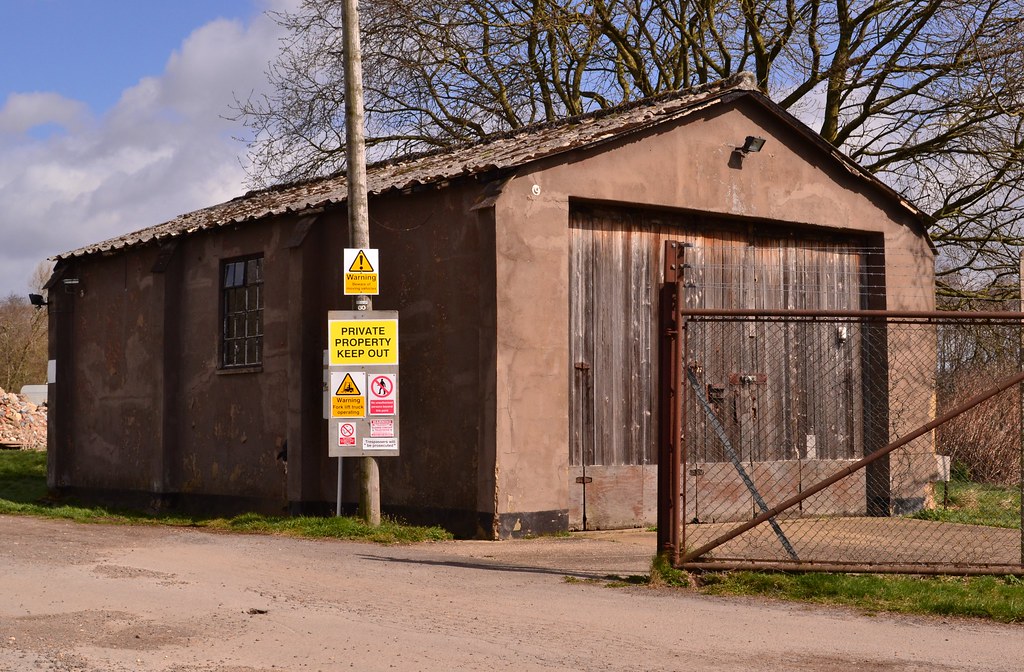
The original Fire Tender shed.

The watch office, now long gone, was built to design 518/40 which included and Meteorological section attached to the building. These designs were a development of earlier models using a new 9 inch rendered brick wall as opposed to timber, although timber was initially required for the floors and ceilings. Due to a shortage in wood at the time though, concrete replaced a large portion of these leaving only the balcony and control room using such material.

Whilst Foulsham opened under 2 Group, it would almost immediately – within a month of opening – be handed over to the US forces of the 8th Air Force and be renamed station B.13. However, this change never evolved into anything  more as no American personnel were stationed here, and by the October it was back in RAF hands, and 2 Group once more. The next few years would see the airfield change hands several more times, and with each change would come new aircraft, new personnel and new roles.

The first units to arrive here were those of the host unit 2 Group. Both 98 and 180 Squadron arrived in mid October 1942 after their reformation/formation at RAF West Raynham. During this time, they both began to receive their aircraft, the American built B-25 ‘Mitchell II’. Their transfer across to Foulsham gave the airfield the honour of being the first station to use the type operationally. Both squadrons would remain active in the light bomber role until 18th August 1943 at which point they would depart and the airfield would change ownership once more.

98 Squadron, a First World War unit, had been operating out of Kaldadarnes in Iceland following a terrible loss of personnel when the Lancastria was sunk in June 1940. Their reformation at West Raynham, and subsequent move to Foulsham, had been quickly met with yet more losses, when one of the Mitchells ‘FL206’, spun killing all four members of the crew on board.

After this, the squadron would be dogged by misfortune, the squadron adjutant noting in the Operational Records that excessive rain had turned the site into a “disgraceful condition”; the weather was one aspect the staff would have to put up with for some time to come. *5

For the first sixteen days of November, all but a handful of days were washed out, the despair of staff being felt through the Operational Records, each day met with ‘Lectures continue, adverse weather for flying‘. However, on the 16th, training flights did manage to take place, but it too was met with more sadness as a second set of fatalities occurred.

During the training flight, Mitchell FL179 suffered a bird strike in the carburettor of the starboard engine, this caused the engine to fail. With only one serviceable engine the pilot, Flt. Sgt. K. Williams (s/n: 1062588), tried to land at nearby RAF Attlebridge, unfortunately the aircraft stalled and went into a spin. The resultant crash killed all three aircrew on board and wrote off the Mitchell.

Things were to not get any better for the squadron either. On the 30th, a third crash took yet four more lives when FL708 collided with high tension cables near to RAF Wendling. The explosion from the collision also killed a local farmer who was ploughing his field at the time of the accident. It had been a terrible start for the fledgling unit.

The poor weather continued relentlessly, hampering the squadron’s progress, both on the ground and in the air, with training flights being cancelled on a regular basis. During the small numbers that were taking place, further problems came to light adding to the frustrations already felt by the crews.  Since taking on the initial batch of nine Mitchells on September 18th, the squadron had been having problems with the aircraft especially the guns and their turrets.

Gunners had found that extended bursts of gunfire were impossible, usually no more than a dozen rounds could be fired at any one time, a situation borne out by Wing Commander Foster, the Group Armament Officer, on the 16th December. In an attempt to remedy the situation, an American gun turret specialist visited the squadron, but by the 18th it was considered that the guns were ‘obsolete’.

RAF Foulsham

A defence ‘pill box’.

January was much the same, snow added to further problems and again the aerodrome was noted as being in a “very bad condition“, all flying being cancelled until the middle of the month when a small number of flights did get airborne.

The first battle order came through on January 21st, but due to a late delivery of bombs, it was also cancelled, meaning the squadrons first operation flight wouldn’t take place until the next day.

Six aircraft were ordered to operations, and whilst all made it to the target, one aircraft, FL693, was hit by flak and disintegrated. All on board were presumed killed.  The first months of 98 squadron had been challenging and difficult for those posted here.

180 Squadron had fared a little better, although after walking into a spinning propeller, L.A.C. J. Aspinall was killed, the only fatality of the squadron during the same period.

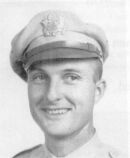
On July 26th 1943, an emergency landing was made at Foulsham by a B-17F #42-29802 of the 326th BS, 92nd BG, 8th AF, after a traumatic series of events that earned the co-pilot, John C. Morgan Flight Officer (later 2nd Lt.), the Medal of Honour for his valour and courage in action.

In part 2 we see how Morgan earned this prestigious award and how Foulsham continues to develop.

The entire story of Foulsham can be seen in Trail 22.

August 23, 1944 The worst aircraft accident in the UK during WW2.

During the Second World War, Britain’s landscape changed forever. The friendly invasion brought  new life, new music, rationed items became sought after bounties and they were plentiful – if you knew an American.  But this dramatic change in the British way of life could also be explosive and deadly.

Anyone living near to a wartime airfield knew only too well the risks of such a life. Aircraft could ground loop, collide in the air or suffer a major mechanical failure on take off, all of which could result in a massive explosion in a fully laden bomber. There are numerous recordings of such accidents occurring, and the brave attempts of crewmen trying to avoid local housing. One such crash was that of B-17 #42-39825, “Zenobia” which crashed on take off coming to rest in the nearby village of Deenethorpe. Luckily, the crew were able to escape and warn the locals of the impending danger, thus averting a catastrophe when the aircraft, fully laden with bombs and fuel, exploded twenty minutes later. The explosion was so fierce that it was heard nine miles away!

However, not everyone was as lucky, and on August 23rd 1944, Wartime Britain experienced what is considered its worst wartime air disaster. A disaster in which sixty-one people lost their lives when a USAAF aircraft from BAD2 at RAF Warton crashed into the adjacent village of Freckleton in Lancashire.

Warton, or BAD2 (Base Air Depot No. 2), was responsible for the modification and overhaul of US aircraft and engines when they arrived fresh from the United States. They were assembled, modified and transferred from here to front line operational airfields across the UK. A massive operation that began even before the United States had even entered the War.

Initially, Warton was built as a satellite for the RAF Coastal Command station at Blackpool, known at the time as Squires Gate Airfield, an airfield with a history going as far back as 1909. With many pleasure flights, air pageants and civil flights, it was eventually taken over and used for fighters and bombers of Coastal Command.

With many aircraft being shipped into the UK via the Atlantic during the early years of the war, the need for a site to build and then maintain them became evermore apparent and urgent. It was not long after the outbreak of war, that four such sites were earmarked for use by the USAAF as Air Depots, each one dealing solely with aircraft maintenance and refurbishment. The proposal, initiated by Lord Beaverbrook as early as October 1939, which then progressed through discussions between the American and the British Governments in 1941 , specified that these bases would need to be able to deal with large quantities of aircraft and be able to handle aircraft modifications at any stage of the assembly process. In October, these bases were identified by a consortium of American and British representatives, who selected: Warton, Little Staughton (Bedford), Burtonwood (Warrington) and Langford Lodge in Neagh, Northern Ireland, as the most suitable sites.

Warton would be massive, housing almost 16,000 people in over ten accommodation sites, which when compared to a normal Class A airfield of some 3,000 people, was an enormous conurbation. To be adaptable, the runway was strengthened and extended to match that of any wartime airfield, at almost 2,000 yards long, it could take any aircraft brought over from the United States. Along side this were a wide range of ancillary buildings: stores,  maintenance sheds, office blocks, hangars, engine test sheds and fifty dispersal points. As the war progressed, Warton was extended further with the largest European storage shed and further hangars being added in 1944.

The entire site was completed in just nine months, using a combination of construction groups led by Frank Thomas; this included both Alfred McAlpine, and Wimpey, two of the largest airfield contractors at that time.

Station 582 of the US Eighth Air Force was opened August 1942, housing a small contingent of USAAF personnel. Officially handed over to the USAAF a year later, it now had some 5,000 personnel on its books already, all specially trained to handle the unique American aircraft being brought over from the United States.

Each base would specialise, Burtonwood in radial engines and the B-17, whilst Warton concentrated on in-line engines and B-24s. However, that did not mean that this was a ‘closed door’ operation, Warton would, over the period of the war, see every example of US built aircraft pass though its doors, and at its peek, held over 800 aircraft within its grounds.

Living near such a large and active base would bring many benefits, 700, children were given a Christmas party that lasted for a week, the locals were well provided for and money poured into the local economy. However being so close also brought it dangers. There were numerous accidents with parked aircraft being hit as other aircraft taxied past. There were also several crashes, including a North American P-51D-5-NA Mustang #44-13403 that crashed on June 12th, 1944, killing its pilot. The accident being caused by a catastrophic structural failure of the wing assembly. Another P-51D #44-14608 (310th Ferry Squadron, 27th Aircraft Transport Group) was involved in a landing accident at Warton, on October 5th, 1944. The pilot survived, but the aircraft was destroyed in the crash.

Then there was the P-51B-5 #43-6623 that crashed after taking off from Liverpool’s Speke airport, it was was subsequently taken to Warton where it was combined with other parts of P-51Bs that had been dropped on delivery. The new aircraft, aptly named ‘Spare parts‘, would then be used as an unarmed two-seater ferrying VIPs around, delivering small spare parts to the other airfields and collecting supplies of of whiskey from a distillery in Glasgow. The aircraft itself was lost in late 1944 when it experienced engine failure. The two crew bailed out and survived but the aircraft crashed coming to a rest at the bottom of the Irish Sea.

One of the more terrible accidents at Warton involved the collision of two Douglas A-26B-10-DT Invaders, on November 29th 1944, when #43-22298 collided in midair with #43-22336 over Warton Marsh. The crews’ bodies were removed from the site, but the aircraft remained buried in the silt until excavation in 2004. Both aircraft were then transferred to the RAF Millom Museum at Haverigg, Cumbria where they remained until its closure on 1st September 2010. With many of it exhibits being ‘on loan’, they were returned to their original owners whilst the rest were publicly auctioned off in January 2011. The fate of the two Invaders is unknown at the time of writing.

However, it was on Wednesday, August 23rd 1944, that Warton would be shocked by Britain’s worst wartime air disaster and the terrible events that would unfold that day.

Everything appeared normal that day as the workers at BAD 2 and the surrounding area awoke. The news was generally good, the war was heading in the right direction and victory for the allies appeared to be on the cards. There were high pressure zones to the east and west and low pressure to the north. The first 2 weeks of August were generally dry and  warm with spells of sunshine. There had been  a spell of warm weather that continued into the third week, with temperatures reaching as high as 28°C in the south. On the 23rd, early sunshine was expected to change to light rain later on, nothing that should have caused any significant problems to the experienced crews at Warton.

Early on that day, two routine test flights were booked by experienced pilots on newly refurbished Consolidated B-24 Liberators  before they were sent out out to the 2nd Bomb Division. The first, piloted by First Lieutenant John Bloemendal, ‘Classy Chassis II‘, and the second piloted by First Lieutenant Peter Manassero.

After a delayed start, First Lt. Bloemendal and his two crewmen boarded the B-24, ran their ground checks and started the engines. They then departed on was was a routine test flight. Meanwhile, the second B-24 piloted by First Lt. Manassero also departed and both aircraft headed out from Warton. During this time a weather warning was passed to Warton tower informing them of an impending storm, the likes of which even the British had rarely seen. The notorious British weather had played a cruel joke.  In seconds, the summer sky had turned jet black. Daylight had been all but wiped out, Heavy rain lashed the landscape, localised flash floods and unprecedented strong winds battered the Warton skyline. Locals reported seeing trees being uprooted and buildings being damaged such was the strength of the wind and lashing rain.

The tower issued an immediate warning to land the two aircraft. B-24 #42-50291 “Classy Chassis II“,  was given clearance first, the second flown by First Lieutenant  Manassero was to come in next. With visibility down to some 500 yards, the two aircraft approached the airfield in close formation, simply to keep in visual contact. Bloemendal  lowered his undercarriage followed by Manassero. Bloemendal  then began his approach, suddenly retracting his undercarriage informing Manassero he was going round again for another try. But by now, the weather had deteriorated so much that the tower was extremely concerned, and issued an order, to both aircraft, to withdraw from the circuit and abort landings, telling them to fly to the north to avoid the storm. Bloemendal never received the message.

By now contact had been lost between the two pilots, Manassero headed out of the circuit and flew out of harms way, Bloemendal on the other hand had already hit the ground, a massive fireball ensued. Eye witness accounts differed as to what the cause of the crash was, one witness said she saw  lightning strike the aircraft at the wing root, “splitting the aircraft in two“, others say they saw the wings in a near vertical position as if the pilot was banking steeply to turn away.

The aircraft came down across Lytham Road, after hitting the ‘Sad Sack Snack Bar’, purposefully built for the American servicemen of BAD 2. It demolished three houses and the infant section of Freckleton’s Holy Trinity School, which at the time, was full of children between the ages of 4 and 6 who, along with their teachers, were going about their daily routine. The resultant crash led to a fireball, one that eventually took the lives of sixty-one people. Eighteen in the cafe, forty in the school and the three crewmen aboard “Classy Chassis II“.  Many of these dying in the days that followed from severe burns as burning petrol engulfed the school before flowing into the street .

The crash was so devastating that at the inquest, only the School’s register could be used to identify some of the missing children whilst others were identified merely by parts of their clothing painfully presented to grieving parents. First Lieutenant John Bloemendal was only identified by the remains of his dog tags and wedding ring, the only married man aboard the aircraft.

The US servicemen from BAD2 were highly praised in the days that followed for their quick and brave response to the crash. Pulling away debris while the aircraft still burned, attempting to put out the fire and fighting to save whomever they could from the burning wreck that was once Freckleton village school.

The papers understandably ran the story for months and even years afterwards, as more and more information came to light. Some of the injured were so severely burned, they were read their last rights, whilst many had to have long term skin grafts, including some as part of McIndoe’s Guinea Pig Club.

From Lytham St. Annes, to London and New York, the story of Britain’s worst air disaster spread, putting good news from the front line into painful perspective. Whilst convalescing, young survivors were visited by Bing Crosby, who diverted from his tour of American airfields across the UK, to pay his respects. A small gesture to avert the grieving now felt across both sides of the ocean.

A mass funeral service took place in Freckleton on August 26th, the streets were lined with mourners as service personnel carried the many tiny coffins along in one mass parade. Afterwards, a fund was set up by the USAAF, and an area of land was developed into a playground as a lasting memorial to those lost in the accident. A tablet laid at the playground reads:  “This playground presented to the children of Freckleton by their neighbours of Base Air Depot No. 2 USAAF in recognition and remembrance of their common loss in the disaster of August 23rd 1944”.

The inquest into the crash could not prove conclusively as to the cause of the crash. It states:

“The cause of this accident is unknown. It is the opinion of the Accident Investigating Committee that the crash resulted from pilot’s error in the judgement of the violence of the storm. The extent of the thunder-head was not great and he could have flown in perfect safety to the North and East of the field”.

It also states that a possible “rough air structural failure occurred“, although verification of this was impossible due to the total destruction of the aircraft’s structure.

freckleton 28 Aug 1944 funeral procession Photo Ralph Scott

Crowds line the street as US Servicemen carry the many coffins at Freckleton (Photo Ralph Scott, BAD2)

What did arise from the crash was that US service personnel who were trained in the bright blue skies of America, were unaccustomed to the changeable and fierce British weather. Many, like First Lieutenant Bloemenda, often under-estimating the dangers of these thunderstorms and as a result, training was amended to include warnings about such events.

With the eventual withdrawal of US forces from Warton, the memories of that day linger on, regular services are held at Frekleton in remembrance of those sixty-one lives who were all innocent victims of Britain’s worst air disaster of World War Two.

Sources and Further reading

There are many sites that cover this story, in particular I refer you to:

British Newspaper Archive website.

The Lancashire Aircraft Investigation Team Website which has many photographs pertaining to the crash and is well worth a visit.

BAD2 Blog 

The Book “The Freckleton, England, Air Disaster” by James R. Hedtke, details the accident in depth giving eyewitness accounts, background details and transcripts of the conversations between pilots and the tower. It served as a valuable source of information for this post and is worth buying if interested in reading about this further.

Also, the book ‘Blood and Fears‘ by Kevin Wilson, (Weidenfeld & Nicolson) also briefly mentions accounts of the event. Again a good book should you wish to read further.

M/Sgt. Hewitt Dunn – Flew 104 missions.

RAF Framlingham (Parham) otherwise known as Station 153, achieved a remarkable record, or rather one man in particular did. His name was Hewitt Dunn, a Master Sergeant in the U.S.A.A.F and later the U.S.A.F.

Known as “Buck” he would achieve the remarkable record of completing 104 missions with the 390th Bombardment Group (Heavy) – a record that astounded many as life expectancy in a heavy bomber was short, and few survived beyond one tour of 30 missions.

Hewitt Tomlinson Dunn (s/n 13065206) was born on July 14th 1920. He progressed through school to join the Air Corps where he was assigned to the 390th Bombardment Group (Heavy), 13th Combat Wing, 3rd Air Division, Eighth Air Force, as a gunner in December 1943.

His first mission was with the 569th Bombardment Squadron in the following January. He completed his first gruelling tour of 30 missions by April that year, upon which he immediately applied for a further tour that he would complete by the summer of 1944. His attitude of ‘its not over until its won’, would see him accept a further remarkable third tour, virtually unheard of for a heavy bomber crew member.

On Friday, April 6th 1945, mission 930, an armada of aircraft of the U.S.A.A.F would strike at the marshalling yards in Leipzig, Germany. Inside B-17 #43-38663, ‘The Great McGinty‘, was Hewitt Dunn.

After the mission Dunn described how earlier at the morning briefing, he, like so many of his colleagues, had been a little ‘nervous’. Then, when the curtain was pulled back, their nervousness was justified, Leipzig – the 390th had been there before.

Many crews in that briefing would look to Dunn for signs of anguish, if he remained steady and relaxed, they knew it would be ‘easy’, if he sat forward, then it was going to be a difficult one. The atmosphere must have been tense.

Luckily, unlike other missions into the German heartland, this one turned out to be ‘just another mission’ a ‘milk run’. Much to the huge relief of those in command of the 390th, all aircraft returned safely.

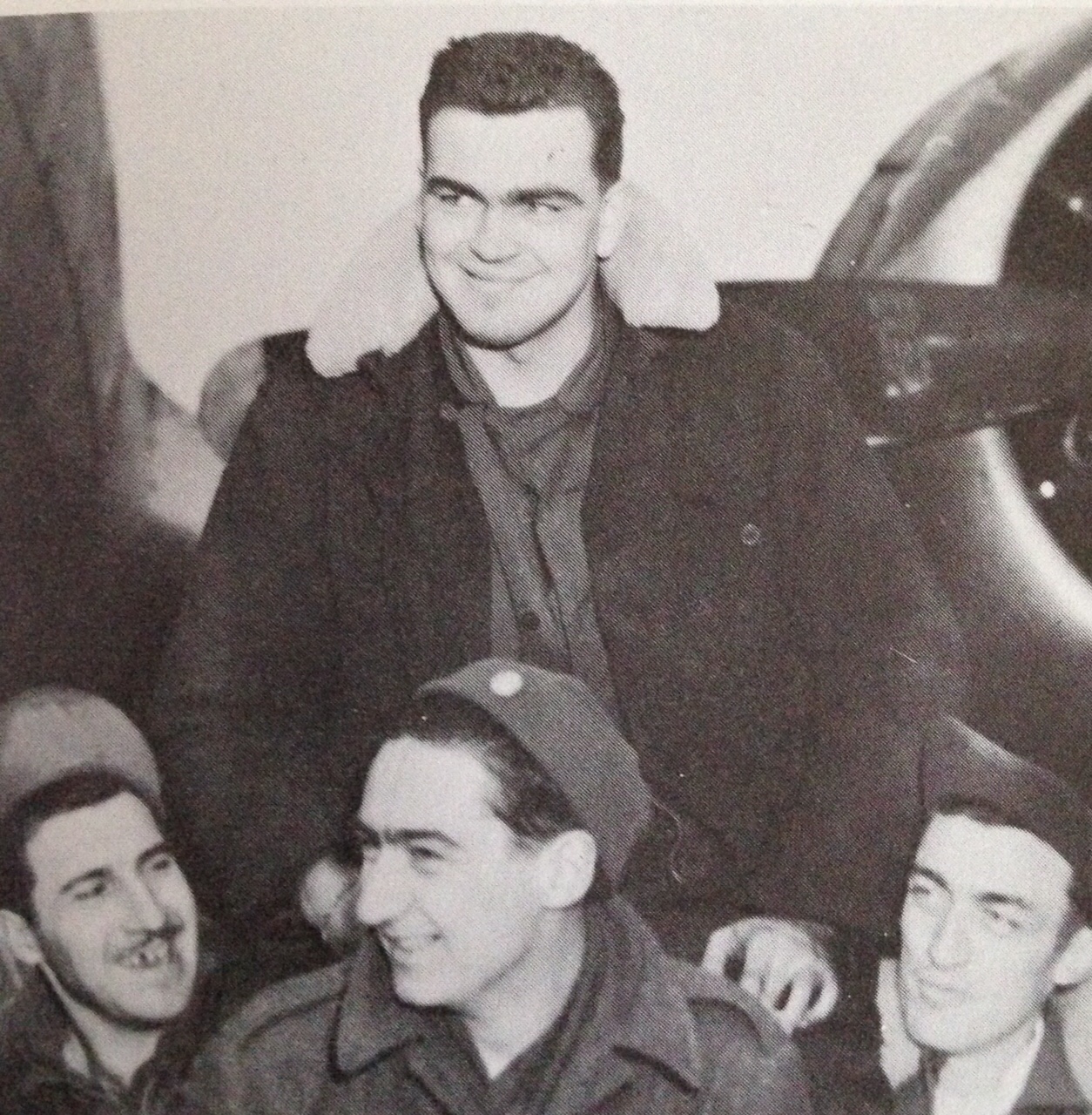
On his arrival back at Framlingham, Dunn was greeted by cheering crowds, ground crews lifted him high in their air carrying him triumphantly away from his aircraft, it was a heroes welcome.

By the time the war had finished, Dunn had flown in 104 missions, he had been a tail gunner on twenty-six missions, twice a top-turret gunner, a waist gunner and the remainder as togglier (Bombardier). He had flown over Berlin nine times, he claimed a FW-190 shot down and had amassed an impressive array of medals for his bravery and actions, and all at just 24 years old.

Post war, he continued to fly as an Instructor Gunner for B-52s in the 328th Bomb Squadron, 93rd Strategic Bomb Wing, at Castle Air Force Base in California. Here he was described as “quiet and reserved” and never talked about his war experiences. He was “handsome man with black hair”, and only when he wore his dress uniform, did others realise how well decorated he was.

Dunn was considered a rock by those who knew him and perhaps immortal, but he was not, and on June 15th , 1961 after flying for a further 64 flights, he was killed. Details of his death are sketchy, but the man who had flown in more missions than any other person in the Eighth Air Force and had gone to train others in that very role, was highly decorated. He was looked up to and liked by those who knew him.

Following his death a service was held in Merced, California, his body was then taken to Arlington National Cemetery in Washington D.C. where he was finally laid to rest in grave number 3675, section 28.

For a man who achieved so much in his fighting career, little exists about him or his achievements. Maybe, by the end of the war, records were no longer needed, tales of dedication and bravery were no longer useful propaganda. Whatever the reason, Hewitt Dunn’s name should be heavily embossed in the history books of the Second World War.

hewiit-dunn

Hewitt Dunn on return from his 100th mission, April 1945 (IWM)

Hewitt Dunn’s medal tally:

– Air Force Longevity Service Award with 3 oak leaf clusters
– Air Medal with 13 oak leaf clusters (2 silver, 3 bronze)
– Air Medal with 7 oak leaf clusters (1 silver, 2 bronze)
– American Campaign Medal
– Distinguished Flying Cross with 1 oak leaf cluster
– Good Conduct Medal
– National Defence Service Medal
– Silver Star
– World War II Victory Medal
– European-African-Middle Eastern Campaign Medal with 1 bronze star
– European-African-Middle Eastern Campaign Medal with 1 silver star

Hewitt Dunn’s story is one of many featured in Heroic Tales.

Lt. Col. Leon Vance 489th BG – Medal of Honour.

Leon vance.jpgThe story of Leon Vance is one of  the saddest stories to emerge from the Second World War. He was a young American, who through his bravery and dedication, saved the lives of his colleagues and prevented their heavily stricken aircraft from crashing into populated areas of southern England. Following a mission over France, his was very severely injured, but miraculously fought on.

Leon Robert Vance, Jr. known as ‘Bob’ to his family and friends, was born in Enid, Oklahoma, on August 11th, 1916. He graduated from high school in 1933 after receiving many honours and being singled out as a high performing athlete. He went on, after University, to the prestigious Training College at West Point in 1935, staying until his graduation four years later in 1939. It was here, at West Point, he would meet and marry his wife Georgette Brown. He and Georgette would later have a daughter, after whom Vance would name his own aircraft ‘The Sharon D’.

Vance would become an aircrew instructor, and would have various postings around the United States. He became great friends with a Texan, Lieutenant Horace S. Carswell, with whom he would leave the Air Corps training program to fly combat missions in B-24 Liberators. They became great friends but would go on to fight in different theatres.

Prior to receiving his posting, Vance undertook training on Consolidated B-24s. Then, in October 1943, as a Lieutenant Colonel, he was posted to Europe with the newly formed 489th Bombardment Group (Heavy), as the Deputy Group Commander. One of the last groups to be assigned to the European theatre, they formed part of the 95th Combat Bombardment Wing (2nd Bomb Division),  Eighth Air Force, and were sent to RAF Halesworth (RAF Holton) designated Station 365 by the USAAF.

The group left their initial base at Wendover Field, Utah in April / May 1944 and their first mission would be that same month on May 30th, 1944, as part of a combined attack on communication sites, rail yards and airfields. A total of 364 B-24s were to attack the Luftwaffe bases at Oldenburg, Rotenburg and Zwischenahn, along with other targets of opportunity far to the north in the German homeland. With only 1 aircraft lost and 38 damaged, it was considered a success and a good start to the 489th’s campaign.

As the build up to Normandy developed, Vance and the 489th would be assigned to bombing targets in northern France in support of the Normandy invasion about to take place further to the south. An area the unit would concentrate on, prior to the Allied beach invasion on June 6th that year.

The day before D-day, the 489th would fly to Wimereaux, in the Pas-de-Calais region of northern France. This would be Leon Vance’s final mission.

File:846bs-b24-42-94860--halesworth.jpg

B-24H Liberator of the 489thBG, RAF Halesworth*2

The group, (Mission 392),  consisted of 423 B-17s and 203 B-24s and were to hit German coastal defences including: Le Havre, Caen, Boulogne and Cherbourg areas as  a precursor to the Normandy invasion. Some 127 P-47s and 245 P-51s would support the attacks. The 489th would assemble at 22,500 feet on the morning of June 5th, proceed to the south of Wimereaux, fly over dropping their payload, and then return to England. On the run in to the target, Vance was stationed behind the pilot and copilot.  The lead plane encountered a problem and bombs failed to jettison. Vance ordered a second run, and it was on this run that his plane, Missouri Sue, took several devastating hits.

Four of the crew members, including the pilot were killed and Vance himself was severely injured. His foot became lodged in the metal work behind the co-pilots seat. There were frantic calls over the intercom and the situation looked bad for those remaining on board. To further exacerbate the problems, one of the 500lb bombs had remained inside the bomb bay armed and in a deadly state, three of the four engines were disabled, and fuel spewed from ruptured lines inside the fuselage.

Losing height rapidly, the co-pilot put the aircraft into a dive to increase airspeed. The radio operator, placed a makeshift tourniquet around Vance’s leg, and the fourth engine was feathered.  They would then glide toward the English coast.

The aircraft was too damaged to control safely, so once over English soil, Vance ordered those who could, to bail out. He then turned the aircraft himself out to the English Channel to attempt a belly landing on the water. A dangerous operation in any aircraft, let alone a heavy bomber with an armed bomb and no power.

Still trapped by the remains of his foot, laying on the floor and using only aileron and elevators, he ensured the remaining crew left before the aircraft struck the sea. The impact caused the upper turret to collapse, effectively trapping Vance inside the cockpit. By sheer luck, an explosion occurred that threw Vance out of the sinking wreckage,  his foot now severed.  He remained in the sea searching for whom he believed to be the radio operator, until picked up by the RAF’s Air Sea Rescue units.

Vance was alive, but severely injured. He would spend a number of weeks, recuperating in hospital, writing home and gradually regaining his strength. Disappointed that his flying career was over, he looked forward to seeing his wife and young child once more. However, on a recuperation trip to London, Vance met a young boy, who innocently, and without thought, told him he wouldn’t miss his foot. The emotional, impact of this comment was devastating to Vance and he fell into depression. Then, news of his father’s death pushed him down even further.

Eventually, on July 26th, 1944 Vance was given the all clear to return home and he joined other wounded troops on-board a C-54, bound for the US. It was never to arrive there.

The aircraft disappeared somewhere between Iceland and Newfoundland. It has never been found nor has the body of Leon Vance or any of the others on board that day. Vance’s recommendations for the Medal of Honour came through in the following  January (4th), but at the request of his wife, was delayed until October 11th 1946, so his daughter could be presented the medal in her father’s name.

The citation for Leon Vance reads:

For conspicuous gallantry and intrepidity above and beyond the call of duty on 5 June 1944, when he led a Heavy Bombardment Group, in an attack against defended enemy coastal positions in the vicinity of Wimereaux, France. Approaching the target, his aircraft was hit repeatedly by antiaircraft fire which seriously crippled the ship, killed the pilot, and wounded several members of the crew, including Lt. Col. Vance, whose right foot was practically severed. In spite of his injury, and with 3 engines lost to the flak, he led his formation over the target, bombing it successfully. After applying a tourniquet to his leg with the aid of the radar operator, Lt. Col. Vance, realizing that the ship was approaching a stall altitude with the 1 remaining engine failing, struggled to a semi-upright position beside the copilot and took over control of the ship. Cutting the power and feathering the last engine he put the aircraft in glide sufficiently steep to maintain his airspeed. Gradually losing altitude, he at last reached the English coast, whereupon he ordered all members of the crew to bail out as he knew they would all safely make land. But he received a message over the interphone system which led him to believe 1 of the crew members was unable to jump due to injuries; so he made the decision to ditch the ship in the channel, thereby giving this man a chance for life. To add further to the danger of ditching the ship in his crippled condition, there was a 500-pound bomb hung up in the bomb bay. Unable to climb into the seat vacated by the copilot, since his foot, hanging on to his leg by a few tendons, had become lodged behind the copilot’s seat, he nevertheless made a successful ditching while lying on the floor using only aileron and elevators for control and the side window of the cockpit for visual reference. On coming to rest in the water the aircraft commenced to sink rapidly with Lt. Col. Vance pinned in the cockpit by the upper turret which had crashed in during the landing. As it was settling beneath the waves an explosion occurred which threw Lt. Col. Vance clear of the wreckage. After clinging to a piece of floating wreckage until he could muster enough strength to inflate his life vest he began searching for the crew member whom he believed to be aboard. Failing to find anyone he began swimming and was found approximately 50 minutes later by an Air-Sea Rescue craft. By his extraordinary flying skill and gallant leadership, despite his grave injury, Lt. Col. Vance led his formation to a successful bombing of the assigned target and returned the crew to a point where they could bail out with safety. His gallant and valorous decision to ditch the aircraft in order to give the crew member he believed to be aboard a chance for life exemplifies the highest traditions of the U.S. Armed Forces”*2

Leon Vance’s actions would be remembered. His local base in Oklahoma was renamed ‘Vance Air Force Base’ on July 9th, 1949. The gate at Tinker Air Force Base, Oklahoma was also later named after him on May 9th, 1997, and his name appears on the ‘Wall of the Missing’ at Madingley American War Cemetery in Cambridge, England.

DSC_0582

The American War Cemetery, Madingley. Leon Vance’s Name Appears on the wall of the missing (to the left of the picture).

Leon Robert Vance, Jr. (August 11th, 1916 – July 26th, 1944)

For other personal tales, see the Heroic Tales Page.

Sources.

* Photo public domain via Wikipedia

*1 “Medal of Honor recipients – website World War II”.

*2 Photo Public Domain via Wikipedia.

RAF North Witham – Leading the way into Normandy.

If you follow the A151 towards the main A1, close to the Lincolnshire / Leicestershire border, and you come across Twyford Woods, and an airfield that is little known about, yet its part in history is perhaps one of the most important played by any airfield in Britain. Famous battles such as the Normandy invasion, the Ardennes and the crossing of the Rhine all took place because of the events that occurred here, and were it not for this airfield, many may not have been as successful as they were. In Trail 3, we head further west to perhaps one of Britain’s best kept secrets – RAF North Witham.

RAF North Witham (Station 479)

RAF North Witham sits quietly amongst the trees of Twyford Woods, a site originally known as Witham Wood, which is now a public space owned and maintained by the U.K.’s Forestry Commission.

Originally, North Witham was one of twelve airfields in the Leicestershire cluster intended to be an RAF bomber station for No. 7 Group, however, it was never used operationally by the Royal Air Force, instead like ten others in the area, it was handed over to the US Ninth Air Force and in particular the IX Troop Carrier Command.
North Whitham control tower

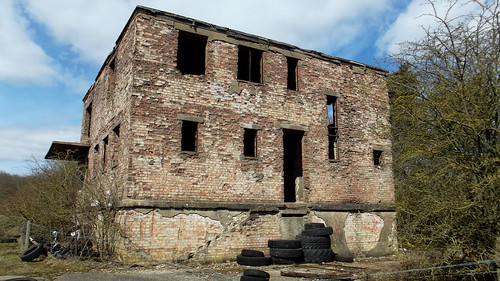
North Witham’s Tower – now a mere shell.

As it was originally designed as a bomber station it was built to the Air Ministry’s class ‘A’ specification, formed around the usual three triangular runways, perimeter track and aircraft hardstands. With construction beginning in the mid-war years 1942/43, its main runway would be 2000 yds long, with the second and third runways 1,400 yds in length and all 50 yds wide. To accommodate the aircraft, 50  ‘spectacle’ style dispersals were built, scattered around the adjoining perimeter track. As a bomber base it had a bomb store, located to the north-eastern side of the airfield, with the admin and technical site to the south-east. The usual range of stores and ancillary buildings adorned these areas. One architectural feature of North Witham was its operations block, built to drawing 4891/42, it was larger than most, with ceilings of 14 feet high. Amongst the myriad of rooms were a battery room, cipher office, meteorology room, PBX, traffic office and teleprinter room, all accessed through specially designed air locks. A further feature of this design was the attachment of a Nissen hut to house plant and boiler equipment, a feature not commonly seen at this time.

Aircraft maintenance could be carried out in one of two ‘T2’ hangars with additional work space provided by one of six ‘Butler’ hangars. Designed and built by the Butler Manufacturing Company of Kansas, USA, these were supplied in kit form and had to be erected on site by an Engineer Aviation Battalion. These hangars consisted of rigid box section girders over a canvas cladding, and once fully erected, gave a wide 40 ft span. Quite a rare feature, these types of structures were only built in limited numbers during the Second World War and only appeared on American occupied airfields. Post-war however, they were far more commonly used appearing on many American cold-war sites across the UK.

north whitam

A ‘Butler’ hangar under construction by members of the 833rd Engineer Aviation Battalion (EAB) at a very snowy North Witham (@IWM479)

The Ninth Air Force was born in 1942 out of the ashes of the V Air Support Command, and then combined with units already located in the England operating under the American Eighth Air Force. Its initial activities focused on the allied push across North Africa followed by the move up into southern Europe through Italy.

Moving to England in October 1943, it then became the tactical Air Force that would support the Normandy invasion, supplying medium bombers, operating as troop support and finally providing supply flights. Facilitation of this massive invasion required both a huge backup, and an intricate supply and support network. North Witham would form part of this support network through both repair and maintenance of the troop carrier aircraft that were operated by the Ninth Air Force – primarily the C-47s. The main group undertaking this role at North Witham was the 1st Tactical Air Depot comprising the 29th and 33rd Air Depot Groups between January and September 1944*1. One of a number of depots, they were once described as the “backbone of Supply for the Army Air Force”, and had a complicated arrangement that encompassed numerous groups across the entire world theatre.

For such a large base, North Witham would be operationally ‘underused’, the only unit to fly from here being those of the IX Troop Carrier Command (TCC), who would primarily use C-47 ‘Skytrains’ – an established and true workhorse, and one that would go on to supply many air forces around the world.

During the Sicily campaign, it was found that many incoming aircraft were not finding the drop zones as accurately as they should, and as a result, paratroops were being widely and thinly scattered. More accurate flying aided by precise target marking was therefore required, and so the first Pathfinder School was set up.

North Whitham pen

Part of one of North Witham’s 50 dispersal pans.

The IX TCC Pathfinder School (incorporating the 1st, 2nd, 3rd and 4th Pathfinder Squadrons) was formed whilst the TCC was at RAF Cottesmore in Rutland. Initially having only seven C-47 aircraft, it arrived at North Witham on March 22nd 1944. These aircraft were fitted with, at the time, modern Gee radar and navigation equipment, along with SCR-717 navigational radar housed in a dome beneath the fuselage of the aircraft. This combination of equipment would allow the aircraft to be used as ‘Pathfinders’, and would be used to train both crews and paratroops of the 101st and 82nd Airborne to mark targets prior to the main invasion force arriving.

These crack troops would train at North Witham before returning to their own designated bases to pass on their newly acquired skills. The idea being that these troops would set up ‘homing’ stations using ‘Eureka’ beacons that would connect to ‘Rebecca’ receivers in the aircraft (distinguished from the outside by antenna protruding from the nose). This would allow flying to near pinpoint accuracy even in poor weather or at night; something that would be employed with relative success in the forthcoming Normandy landings.

On arrival at North Witham, the Pathfinders were accommodated in the huts originally provided for the depot’s crews – some 1,250 enlisted men and 75 officers. Many of these displaced men were rehoused in tents along the northern end of the site which only added a further strain to the already rudimentary accommodation that was already in place at the airfield. At its height, North Witham would house upward of 3,700 men in total, a figure that included an RAF detachment of 86 men and large quantities of GIs.

After arrival, the crews began training for the invasion. Flying cross country flights enabled them to practise using their new radar sets, flying in all weathers, at night and during the day. By D-Day, all navigators had been using the equipment in excess of 25 hours and were considered more than competent in its operation.

With postponements of the invasion came frustration, crews and paratroops mentally prepared for war were let down, there was little for them to do to release the tension that many must have felt.

On June 5th, after the plan was finally given the go ahead, some 821 Dakotas at various sites across England were primed ready for the initial wave of the invasion. Timing was of the utmost importance. As rehearsals had shown, seconds could mean the difference between life and death – for the crews of the C-47s, the pressure was on.

Around 200 Pathfinders of North Witham were the first to leave the UK and enter the Normandy arena. Departing late in the evening of June 5th, men of the 82nd and 101st Airborne climbed aboard their twenty C-47s and rose into the night sky. North Witham based C-47A*2 ‘#42-93098’ piloted by Lieutenant Colonel Joel Crouch*3, led the way. Nineteen other North Witham aircraft joined Crouch that night, and remarkably only one aircraft was lost in the entire flight. Flying under mission ‘Albany‘, the Douglas built C-47A-15-DK Skytrain, #42-92845 (aircraft #4) was lost en route either due to mechanical failure, or as some sources say, following a direct hit by Anti-Aircraft fire. Either way, the aircraft lost an engine and was forced to ditch in the sea. Once down, the crew and paratroops on-board were rescued by the British destroyer HMS Tartar.

Image result for Lieutenant Colonel Joel Crouch and his crew

The Crew of C-47A #42-93098, a few hours before they left for Normandy. Including Pilot, Lieutenant Colonel Joel Crouch (centre), Captain Vito Pedone (copilot), Captain William Culp (Navigator), Harold Coonrod (Radio Operator), along with Dr. Ed Cannon (physician), and E. Larendeal (crew chief)*1

The aircraft flew in groups of three in an in-line ‘V’ formation; aircraft 1, 2, 3 followed by 4, 5, 6; 19 and 20 (added as a late decision); 7, 8, 9; 10, 11, 12; then 16, 17 and 18. The formation was finally completed with aircraft 13, 14 and 15 bringing up the rear. Each C-47 would deposit its collection of Paratroops over six drop zones (DZ) A, C, D, O, N and T between 00:20 and 02:02.

Flying alongside aircraft #19, the only pair on the flight, was C-47 #20 piloted by 1st Lt. Paul F. G. Egan, of Massachusetts. Joining him in the aircraft were: Sgt. Jack Buchannon, Crew Chief (Mass); 2nd Lt. Richard A. Young, Co-Pilot (Ohio); 2nd Lt. Fern D. Murphy, Navigator (PA);  Staff Sgt. Marvin Rosenblatt, Radio Operator (NY) along with ten Combat Engineers of the 101st Airborne who  were dropped at Sainte-Mère-Église on the Cherbourg Peninsula early in the morning 6 June 1944.

Lt. Paul Egan had a remarkable service history, serving in each of the US Army, US Army Air Force and US Air Force after the war, a service that stretched from 1939 to 1967. His remarkable record includes: Pearl Harbour in 1939 and the Japanese attack in December 1941, the Battle of Midway in 1942, followed by advanced training in 1943. This training kept Lt. Egan in military intelligence as a Pathfinder pilot flying mostly C-47s out of both North Witham and later Chalgrove. As well as dropping the paratroopers on D-Day in Operation Market Garden, he also dropped troops in Operation Varsity along with every other major airborne operation flown from England. He also flew bombing missions in B-17s and flew ‘secret’ missions in early 1945. At the signing of the Japanese surrender onboard the USS Missouri on September 2nd 1945, he was the only USAAF representative there, General McArthur wanting someone who was present at Pearl Harbour to also be present at the surrender. His record is certainly remarkable and one to admire.*5
1st Lt Paul F. G. Egan and crew (photo courtesy Jean Egan)

Photo taken at North Witham Air Base, England on June 5, 1944, the night before D-Day. C-47 #20 (note the number chalked in front of the door to ensure paratroops boarded the right aircraft, and the crudely painted invasion stripes) one of the first 20 aircraft to fly with the elite group, the Pathfinders.  Front row: Sgt. Jack Buchannon, Crew Chief; 2nd Lt. Richard A Young, Co-Pilot; 2nd Lt. Fern D. Murphy, Navigator; 1st Lt. Paul F. G. Egan, Pilot (Captain); Staff Sgt. Marvin Rosenblatt, Radio Operator along with ten 101st Airborne Combat Engineers dropped on the Cherbourg Peninsula early morning 6 June 1944, “D-Day” (Photo courtesy Jean Egan).

Pathfinder training continued at North Witham beyond D-Day, well into 1944. The scope of those trained expanding to include Polish paratroops of the 1st Independent Polish Airborne Brigade, who would perform a similar role to their American counterparts. These various Pathfinder groups would go on to have long and distinguished careers, supporting the battles at Arnhem, the Ardennes and also Operation Varsity – the Allied crossing of the Rhine.

As the Allies pushed further into enemy territory, the flying distance from England became too great and so new airfields were either hastily constructed on the continent or captured airfields refurbished. As a result, the Pathfinder School soon moved away to Hampshire and the maintenance units, needed nearer the front lines, gradually departed to these newly acquired bases on the continent.

September 1944 would see big changes in the Ninth and the knock-on was felt at North Witham. Firstly, the IX TCC transferred from the Ninth AF to the First Allied Airborne Army, and as a result, the Air Depot title was changed to IX Troop Carrier Service Wing (Provisional), which was re-assigned to aid and supply the new Troop Carrier Groups (TCG) now based in France. To accomplish this new role, groups often used borrowed or war-weary C-47s, C-46 (Commandos) or C-109s (converted B-24 Liberators) to fulfil their role. Secondly, the Pathfinder School was re-designated IX Troop Carrier Pathfinder Group (Provisional) and they moved away from North Witham to their new base at Chalgrove near Oxford. Now much quieter, life otherwise continued on at North Witham, but it wouldn’t long before the demand for UK-based maintenance and repair work would slow, and within months North Witham’s fate would be finally sealed.

As the end of the war approached, the airfield quickly became obsolete, and the long wind-down to closure, that many of these unique places suffered, began to take effect.

By the time the war was over, the last American personnel had pulled out and the site was handed back to the RAF’s 40 Group who, after using it for a brief spell as a maintenance depot themselves, placed it under care and maintenance. It was used as a munitions and hardware store until 1948, and then finally, in 1956, it was closed by the Ministry and within two years the site was sold off.
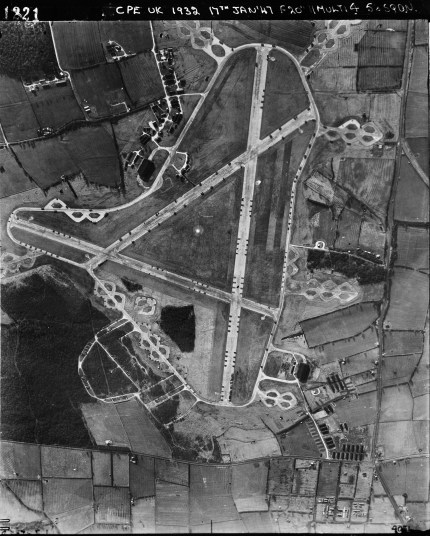
Photograph of North Witham taken on 17th January 1947. The technical site and barrack sites are at the top left, the bomb dump is bottom left. (IWM RAF_CPE_UK_1932_FP_1221)

The site, intact as it was, was returned to the Forestry Commission who planted a range of new tress around the site, covering the vast areas of grass. The technical area was developed into a small industrial unit and perhaps most sadly the watch office left to decay and fall apart.

Today the three runways and perimeter track still exist almost in their entirety, and remarkably, in generally good condition. Largely overgrown with weeds and small trees, the remainder is well hidden obscuring what little there is in the way of buildings – most being demolished and the remains left piled up where they stood. However, a T2 hangar is now used on the industrial estate and the watch office still stands tucked away amongst the trees and undergrowth. This area is a favourite place for dog walkers, and because of its runways, it is accessible for prams and pushchairs. Whilst here, I spoke to quite a few people, remarkably none of them knew of the site’s historical significance let alone the office’s existence!

Today the watch office remains open to the elements. Surrounded by used tyres and in constant threat of the impending industrial complex over the fence, its future is uncertain. Access stairs have been removed, but an entrance has been made by piling tyres up to the door – presumably by those wishing to enter and ‘explore’ further. Little evidence of its history can be seen from the outside, even the rendering has been removed, and so, any possible personal links with the past are more than likely now gone.
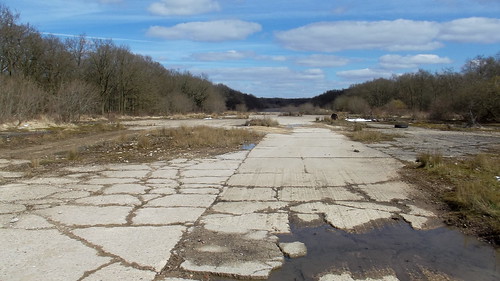
North Whitham runway

The view of the main runway from outside the tower.

Returning back to the main public entrance along the perimeter track, a number of dispersal pens can be found; overgrown but relatively intact, they are a further sign that even here, war was never very far away.

North Witham was one of those ‘backroom boys’ whose contribution, whilst extremely important, is little known about. The work carried out here not only helped to maintain a strong and reliable fighting force, but one that spearheaded the frontal invasion of Normandy. It served as a cold and perhaps uncomfortable home to many brave troops, many of whom took the fight direct to Nazi Germany.

Standing here today, it is quiet and strangely surreal – you can almost hear the roar of engines. Looking along its enormous runways you get an eerie feeling – how many troops also stood here, spending their last few hours in this quiet place. Looking around now, it is difficult to imagine the immense work that went on here, the gathering of equipment as preparations were made for the big push into Normandy on that famous June night.

North Witham is truly a remarkable place, hidden away amongst the trees as a giant time capsule, a monument to those who lived, worked and died during that turbulent time in 1944-45.
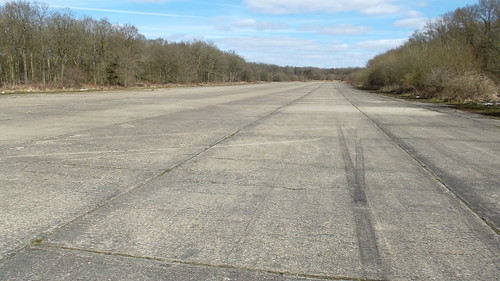
North Whitham runway

Another view along the main runway.

Sadly in May 2015, Twyford Woods was the scene of a large illegal rave, over 1000 people attended the event where a number of arrests were made in the violent altercations that took place*4. A sad day that would turn the souls of those who sacrificed themselves for the freedom we take for granted so very easily today.

(North Witham was originally visited in early 2013)

Links and sources (RAF North Witham)

*1 American Air Museum in Britain

*2 C-47A #42-93098 itself was later lost whilst flying with the 439th Troop Carrier Group (TCG) on September 18th 1944, whilst flying in support of Operation ‘Market Garden‘ in Holland.

*3 Superb footage of Crouch and his crew as they depart from North Witham is available on-line, it also shows the Watch Tower in its former glory.

*4 A report of the event is available on the BBC News website.

*5 My sincere thanks go to Jean Egan, daughter of Lt. Paul Egan, for the information and photograph.

An excellent website contain photos of paratroops and air crew as they prepare for embarkation and advance through France.
Remembrance Day 2021 – At the going down of the sun…

At the eleventh hour on the eleventh day of the eleventh month 1918, the guns on the western front fell silent. Four years of war in which millions were either killed or wounded, towns and villages wiped from the map and the environment changed forever, had finally come to an end. All along the front line, men were soon to put down their arms and leave their trenches for home.

The war to end all wars had finally come to an end. During the last four years some 40 million people had been killed or wounded, many simply disappeared in the mud that bore no preference to consuming man or machine.

Back home, virtually no city, town, village or hamlet was left unscathed by the loss of those four years. Many who returned home were changed, psychologically many were wounded beyond repair.

Sadly, twenty years later, the world slipped into the abyss of war once more. A war that saw some of the most incredible horrors, one that saw the extreme capabilities of what man can do to his fellow-man. Across the world millions of innocent people were slaughtered under the guise of an ideology. An ideology that was determined to rid the world of anyone who was willing to speak out against that very same ideology.

Young men were transported thousands of miles to fight in environments completely alien to them. Many had never been beyond their own home town and yet here they were in foreign lands fighting a foe they had never even met.

The bravery and self-sacrifice of those young men  on the seas, on the land and in the air, go beyond anything we can offer as repayment today.

For nearly 80 years, the world has been at an uneasy rest, Korea, Vietnam, the Falklands, the Middle East, and the Far East, in almost every corner of the globe there has been a war in which our service men and women have been involved. The war to end all wars failed in its aim to bring peace to the world.

In this year, we remember those who laid down their lives in the fight for freedom. We remember those who fought for the right to free speech, for the right to be who you are and the right to live our lives in peace.

We will remember them…

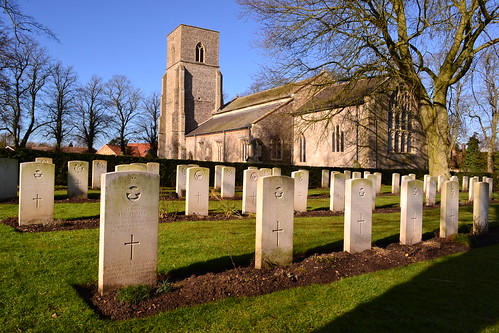
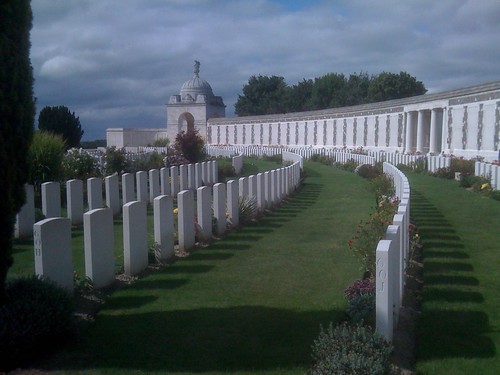
War Graves Cemetery - St Mary's Great Bircham

St Mary’s Great Bircham

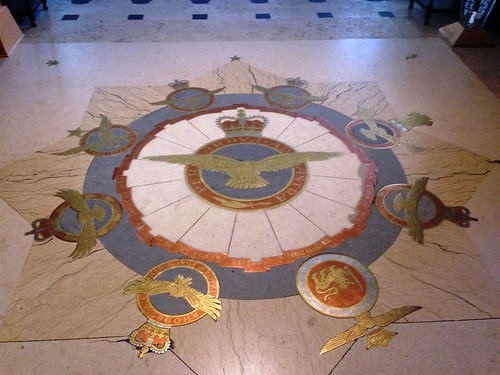
St. Clement Danes - Church of the RAF

The rosette of the Commonwealth Air Forces – St. Clement Danes

Ypres 007

Tyne Cot, Ypres

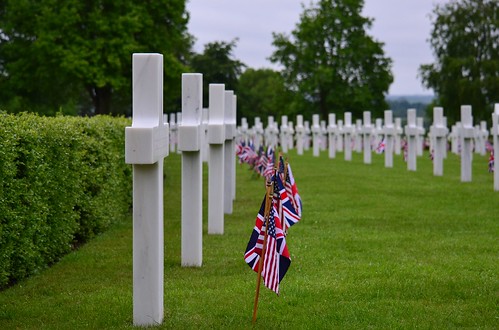
DSC_0587

The American Cemetery Madingley

Anthem for Doomed Youth

What passing-bells for these who die as cattle?
Only the monstrous anger of the guns.
Only the stuttering rifles’ rapid rattle
Can patter out their hasty orisons.
No mockeries now for them; no prayers nor bells,
Nor any voice of mourning save the choirs,
The shrill, demented choirs of wailing shells;
And bugles calling for them from sad shires.

What candles may be held to speed them all?
Not in the hands of boys, but in their eyes
Shall shine the holy glimmers of goodbyes.
The pallor of girls’ brows shall be their pall;
Their flowers the tenderness of patient minds,
And each slow dusk a drawing down of blinds.

Wilfred Owen (18/3/1893 – 4/11/1914)

B-17 Pilot 1st Lt.D. J. Gott and 2nd. Lt W. E. Metzger

War makes men do terrible things to their fellow mankind. But through all the horror and sometimes insurmountable odds, courage and bravery shine through. Two gallant young men both in the same B-17 were awarded the Medal of Honour for acts of extreme bravery in the face of certain death.

Born on 3 June  1923, Arnett. Oklahoma, Donald Joseph Gott, began his air force career at the local base in 1943. By the end of the first year he had achieved the rank of First Lieutenant in the US Army Air Corps. Posted with the 729th. Bomber Squadron, 452nd Bombardment Group to Deopham Green, Norfolk, England, he was to fly a B-17 (42-97904) ‘Lady Jeannette’ along with his crew and co-pilot  William E. Metzger.

Metzger was born February  9, 1922 – Lima, Ohio and by the time he was 22 he was a 2nd Lieutenant. He was to meet Gott at Deopham Green, Norfolk and together they would fly a number of missions over occupied Europe bombing strategic targets.

On the 9th November 1944, they took off with their crew on a mission that would take them into the German heartland to bomb the marshalling yards at Saarbrucken.

On this run, the aircraft, was badly hit by flak, three of the engines caught fire and were inoperable, the fires were so fierce that they were reaching the tail of the stricken aircraft.

Further fires within the fuselage started when flares were ignited, and this rapidly caught a hold. Hydraulic lines were severed and the liquid from within was jettisoned onto the burning fuselage.  With communication lines cut and unable to contact the crew, both Gott and Metzger had some difficult decisions to make. They had not yet reached the target, the aircraft still held its bomb load and they were deep into occupied territory.

The crew too had suffered badly at the hands of the anti-aircraft fire. The engineer was wounded in the leg and the radio operators  arm was severed below the elbow causing great pain and loss of blood. He would die very quickly if medical help was not found. Despite the quick thinking and application of  tourniquet by fellow crew members, he soon passed out and fell unconscious.

Gott and Metzger decided that jettisoning the injured radio operator  would not result in his receiving medical help and so they would drop the bombs and head for the nearest friendly territory where they could crash-land. Doing this, would risk not only the life of the operator, but that of the crew and themselves should the stricken aircraft explode.

Over the target, they released their bombs and flew alone toward allied territory. Flying low over the village of Hattonville, the aircraft was seen to swerve avoiding a church and homes. At this point, Metzger personally crawled through the aircraft and instructed the crew to bail out. Three chutes were seen by local people, two fell to earth and the third became entangled on the stabiliser and was trapped. A further three were seen moments later, all these escaped. Metzger decided to remain with Gott and try to land the aircraft with the radio operator on board. With only one working engine, Gott and Metzger brought the aircraft down through a series of tight turns and at only 100 feet from safety the aircraft banked and exploded. Crashing to earth it again suffered a second explosion and disintegrated killing all three crew members on board and the crew member still attached to the tail.

1st Lieutenant Gott and his co-pilot 2nd Lieutenant Metzger had shown great courage and determination to complete their mission, and to save their crew from certain death. They had shown the greatest of  valour in what was to be the final act of their short lives.

Both men were killed on that day, November 4th 1944 aged 21 and 22 respectively. They were both posthumously awarded the Medal of Honour on the 16th May 1945.

Gott’s remains were returned to the United States and he was buried at the Harmon Cemetery, in Harmon, Ellis County, Oklahoma, USA. Metzger, was returned to his home town and was buried at Woodlawn Cemetery, Lima, Ohio.

Along with Gott and Metzger, crew members who did not survive were:  T/Sgt Robert A, Dunlap and S/Sgt T.G. Herman B, Krimminger. The survivors were picked up by a a local field hospital and treated for their injuries: 2nd lt John A, Harland ; 2nd lt Joseph F, Harms ; S/Sgt B.T. James O, Fross ; S/Sgt R.W. William R, Robbins and T/Sg T.T. Russell W Gustafson.

A memorial now stands close to the site of the crash site.

metzger

2nd Lieutenant William Metzger (@IWM UPL 16264)

gott

1st Lieutenant Donald Gott (@IWM UPL 16265)


RAF Bircham Newton (Part 5 – The war comes to an end)

After Bircham entered the war in Part 4, and new innovative designs helped to save lives at sea, Bircham continues on and heads towards the war’s end. Numerous squadrons have now passed through this Norfolk airfield, and many more will come. Once the war is over, Bircham enters the wind down, its future uncertain, but on the horizon a saviour is coming and Bircham may well be saved by an unusual guardian.

By 1942, designs in ASR equipment had moved on, and a jettisonable lifeboat had by now been designed. The Hudsons at Bircham were the first unit to have the necessary modifications made to them to enable them to carry such boats, and as a result several crews were saved by the aircraft of 279 Sqn. Many searches however, were not fruitful and lives continued to be lost as a result of the lack of suitable equipment and poor weather.

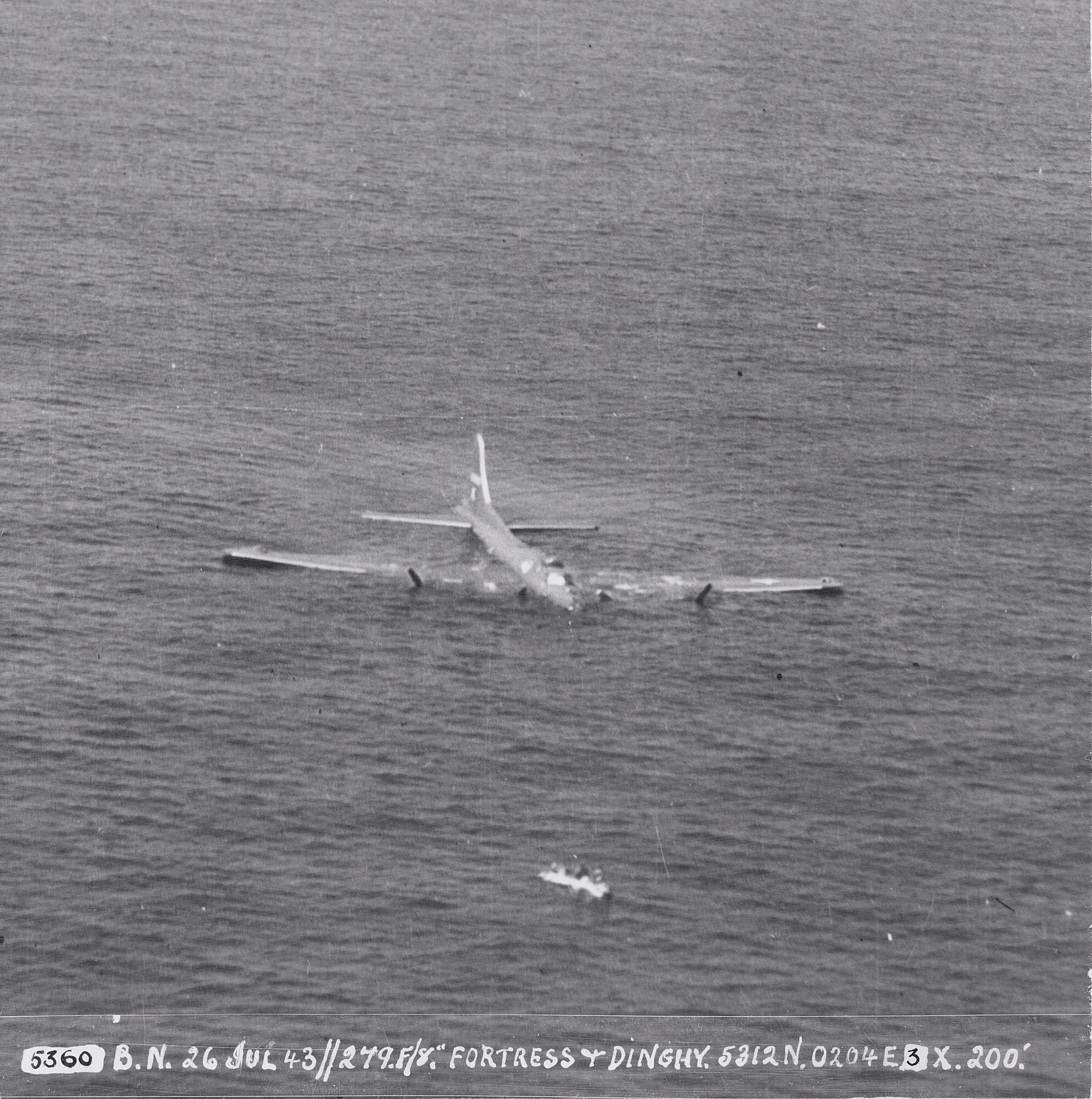
After ditching B-17 #42-29981 (92nd BG) on 26 July 1943 in the relative safety of a calm sea, the crew managed to escape a and (with difficulty) climb aboard their life raft. An ASR aircraft from RAF Bircham Newton located them and a rescue ensued (AAM UPL 39104).

ROYAL AIR FORCE COASTAL COMMAND, 1939-1945.

Moments later, an airborne lifeboat is parachuted down by a Hudson of No. 279 Squadron to the crew. (© IWM C 3691)

During the year yet more front line squadrons would arrive here at Bircham. The first, 502 Sqn brought with it a change of aircraft type, with the Whitley V. The Whitley was a 1930’s design, constructed to Specification B.3/34, and was only one of three front line bombers in service at the outbreak of the war.

Within a matter of weeks, one of these Whitleys, returned from a maritime night patrol, overshot the flare path and crash landed. This particular mark of Whitley was soon replaced by the VII, and as 502 received their new models, so they began their departure to St.Eval; they had only been here at Bircham for a mere month.

March and April 1942 would then see two more units, both operating Hudsons. The first, 407 Sqn, was the first Canadian unit to be based here at Bircham, and would only stay here until October. As part of 16 Group, it would perform attacks on enemy shipping between Heligoland and the Bay of Biscay. The second squadron, 320 Sqn, would arrive at Bircham a month later on April 21st and would remain here for the next year. An entirely Dutch manned unit they had transferred from Leuchars in Scotland where they had been carrying out maritime patrols. The main part of April for 320 Sqn would consist of ferry flights, tests and cross country flying.

The final squadron, 521 (Meteorological) Sqn, was formed here on 22nd July 1942 through the joining of 1401 and 1403 (Met) Flights. These were operating a number of aircraft including the Blenheim IV, Gladiator II, Spitfire V, Mosquito IV and Hudson IIIA, and all passed over to 521 Sqn in the July on its formation. In the following year, March 1943, the squadron would be split again, returning back to two flights once more, Nos 1401 and 1409, thus ending this period of its history. The role of 521 sqn was meteorological, the Gladiators flying locally usually above base, whilst the remainder flew long range sorties over northern Germany or to altitudes the Gladiator could not reach.

There was little ‘front line’ movement in or out of Bircham during 1943, only two new squadrons would be seen here, 695 Sqn with various types of aircraft, and 415 (Torpedo Bomber) Sqn another Canadian unit.

415 were initially a torpedo squadron operating in the North Sea and English Channel areas attacking shipping along the Dutch coast. They arrived here at Bircham Newton in November with both Albacores and Wellingtons, and remained here in this role until July 1944 when they left for East Moor and Bomber Command. During D-day the squadron lay down a smoke screen for the allied advance, taking on the Halifax to join in Bomber Command operations. Throughout their stay they retained detachments at a number of airfields including: Docking and North Coates (Wellingtons) and Manston, Thorney Island and Winkleigh (Albacores). They were well and truly spread out!

695 Sqn were formed here out of 1611, 1612 and 1626 Flights, and performed anti-aircraft co-operation duties using numerous aircraft including: Lysanders, Henleys, Martinets, Hurricanes and Spitfires. They remained here until August 1945 whereupon they departed to Horsham St. Faith now Norwich airport.

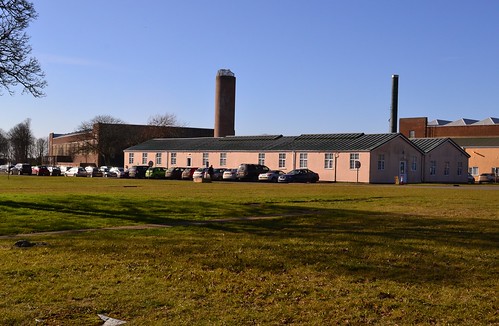
Main Stores

The main stores with two of the C-type hangars in the background.

The only RAF squadron to appear here at Bircham Newton in 1944, was 524 Sqn. It was originally formed at Oban on the Scottish West coast with the failed Martinet, in October 1943, the squadron lasted a mere two months before being disbanded in the early days of December.

Like a phoenix though, it would be reborn later in April 1944 at Davidstow Moor. By the time it reached Bircham in the July, it was operating the Wellington XIII. After moving to nearby RAF Langham in October,  it would eventually disband for the final time in  1945.

It was also during this year that further FAA units would make their presence here at Bircham. 855 Sqn FAA brought along the Avenger, whilst 819 Sqn FAA brought more Albacores and Swordfish. Both these units served as torpedo spotter reconnaissance and torpedo-bomber reconnaissance squadrons.

As the war drew to a close, 1945 would see the winding down of operations and squadrons. Two units would see their days end at Bircham, 598 Sqn with various types of aircraft and 119 Sqn with the Fairey Swordfish, would both be disbanded – in April and May respectfully.

Bircham’s activity then began to dwindle, and its role as a major airfield lessened. From anti-shipping activities to Fighter Command,  Flying Training, Transport Command and finally to a Technical Training unit, Bircham was now training the Officers of the future. Flying activity naturally reduced, and small trainers such as the Chipmunk became the order of the day. Whilst a number of recruits passed through here, the most notable was perhaps HRH The Duke of Edinburgh, who made several landings here as part of his flying training in the early 1950s.

Like all RAF Stations, Bircham was the proud owner of several ‘gate guardians’, notably at this time was Spitfire LF Mk.Vb Spitfire ‘EP120’ from around 1955 to late 1962, along with Vampire F MK.3 ‘VF272’.

Spitfire EP120, was a Castle Bromwich model, which entered RAF service in May 1942, with 45 Maintenance Unit (MU) at Kinloss in Scotland. Whilst serving with several squadrons she achieved seven confirmed ‘kills’ before being relegated to a ground instructional air frame. There then followed a period of ‘Gate Guardianship’ standing at the front of several stations including Bircham Newton. In 1967 she was used as a static example in the famous Battle of Britain movie, before being transferred back to gate guard duties. In 1989 she was then transferred to a storage facility at St. Athan along with several other Spitfires awaiting their fate. Finally she was bought by the ‘Fighter Collection‘ in 1993. After a two year restoration, EP120 finally returned to the skies once more, in September 1995 where she has performed displays around the country ever since.

Spitfire EP120

Spitfire EP120 at Duxford 2014.

Unfortunately, Vampire VF272 wasn’t so lucky. Whilst her fate is unknown at this time, it is believed she was scrapped on site when Bircham finally closed in 1962.

But it was not to be the end of the story though. In 1965, with the development of the Kestrel, Hawker Siddeley’s VTOL baby, Bircham came to life once more, albeit briefly, with the sound of the jet engine. With tests of the new aircraft being carried out, Bircham Newton once again hung on by its finger nails – if only temporarily.

A year later, Bircham was sold to the National Construction College and the pathways were adorned with young building apprentices, diggers and cranes of varying sizes. Being a busy building college, many of the original buildings have been restored but the runways, flying areas and sadly the watch office, removed. Whilst private, the airfield retains that particular feel associated with a wartime airfield.

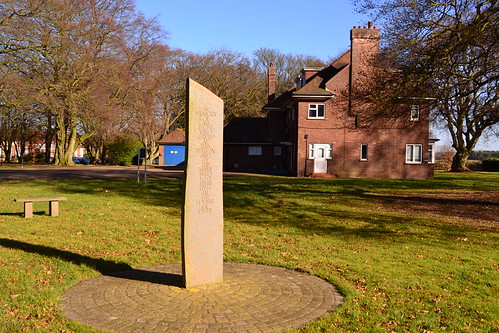
Luckily, the main road passes through the centre of Bircham. A project to turn the Station Commanders Office into a heritage centre*9 has come to fruition, using the ground floor space to exhibit photographs, letters, documents and memorabilia from Bircham Newton.  A memorial has also been erected and stands outside the centre, just off the main road and is well sign posted. The original accommodation blocks, technical buildings and supporting blocks are still visible even from the road. The 1923 guard-house, is now a shop and the operations block, the reception centre.

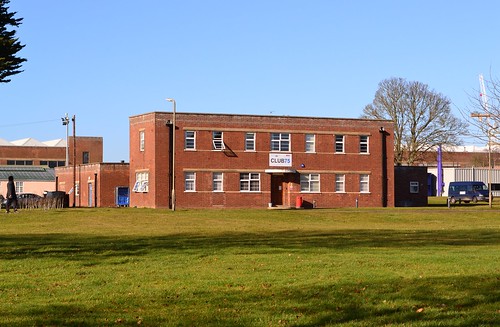
Reputedly haunted, the squash courts (built-in 1918) continue to serve their original purpose, and most significantly, the three large C-type hangers and two Bellman sheds are still there – again all visible from the public highway.

RAF Bircham Newton, stands as a well-preserved model one of Britain’s wartime airfields. Although private now, the buildings reflect the once bustling activities of this busy centre of aviation.

In February 2020, the CITB announced that they had sold the site to the Bury St Edmunds based West Suffolk College. The move, it says, was planned as a cost cutting exercise with the loss of some 800 jobs. The intention of the West Suffolk College is to continue with the construction training at Bircham, hopefully preserving the site for generations to come. Only time will tell.

RAF Memorial and Station Commanders house

The RAF Memorial, and behind, the former Station Commander’s house.

Sources and links for further reading (RAF Bircham Newton):

The full text can be seen in Trail 20 – North Norfolk Part 1.

*1 A detailed history of the production of the HP.15 /1500 can be found on Tony Wilkin’s blog ‘Defence of the Realm‘.

*2 Letter from C.C. Darley (the brother of C.H. Darley) to Sqn Ldr. J. Wake 1st March 1937 (AIR 27/1089/1 Appendix B)

*3 Gunn, P.B. “Flying Lives with a Norfolk theme“, 2010 Published by Peter Gunn.

*4 Pitchfork, G, “Shot down and in the Drink” 2007, Published by The National Archives. – A very interesting and useful book about the development of the ASR service along with true stories of airmen who had crashed in the sea.

*5 BAE Systems website accessed 6/7/21

*6 Traces of World War 2 Website, accessed 11/7/21

*7 Aviation Safety Network website, accessed 21/7/21

*8 Braithwaite, D., “Target for Tonight“, Pen and Sword, 2005

*9 The Heritage Centre is a free to visit site located in the former Station Commanders House. It is only open on set days each year and is fully staffed by volunteers. The project has over the years been updated and reorganised, and is an excellent exhibit of letters, photographs, memorabilia and documents pertaining to the history of Bircham Newton along with material relating to both Docking and Sedgeford. The staff are extremely knowledgeable and more than willing to she this knowledge with you. Opening times and further details can be found on their Facebook page. I visited on October 15th 2023 and would like to thank Jamie and the staff for sharing their knowledge and showing me round the exhibits. I can’t recommend it enough.

National Archives: AIR 27/263/1; AIR 27/788/1; AIR 27/1233/1; AIR 27/1221/1; AIR 27/1222/11, AIR 27/1222/12

Details of 206 Sqn fatalities are available on the 206 Sqn Coastal Command website.

Details of Great Bircham war cemetery graves are available at the role of honour of St Mary’s Church.

RAF Bircham Newton (Part 4 – Bircham Enters the War)

So far we have seen how Bircham Newton developed from a First World War training airfield through the cutbacks of the early 1920s, and on into the Expansion period of the 1930s. Bircham is now in the hands of Coastal Command, a force lacking in materials but not will power. The units at Bircham work hard, and new developments come along that will help save lives at sea and put Bircham on the map. After Part 3, Bircham now enters the war.

The declaration of war and the early 1940’s would see some remarkable events take place at Bircham Newton; new aircraft and new roles, along with some advances that were to help downed airmen who ended up in Britain’s coastal waters.

One of these advances, was the creation of the ‘Bircham Barrel’, a container manufactured from the tail end of a 250lb bomb that was carried under the wing of searching Air Sea Rescue (ASR) aircraft and dropped to downed aircrews. The barrel was based on the ‘Thornaby bag’ a container designed at RAF Thornaby, in which supplies of: water, food rations, first-aid equipment, clothing and cigarettes were all placed. The Bircham Barrel, developed this idea a little further, making it more water tight and easier to retrieve by crews once in the water.*4

The Barrel was placed under the wing of an aircraft on a bomb rack, and once a crew was sighted, the pilot could drop the barrel providing the crew with sufficient rations for several days. After tests, the idea was given the green light and by 1941 it was in use by a range of aircraft operating in the ASR role.

With an increase in coastal operations from Bircham, particularly in the Air Sea Rescue role, many of the aircraft that would now use the airfield would be the twin-engined types. Kicking off the decade were the Bristol Blenheims, of 254 Sqn in January 1940. Joining a small detachment of 233 Sqn  Blenheims that had arrived here late in 1939, 254 Sqn only stayed for three months, operating as ‘Trade defence’ or fisheries protection unit – perhaps one of the lesser well known operations of Coastal Command.

Twin-engined models were not to be the only aircraft seen at Bircham though. The spring and early summer of 1940 would see further detachments with Hurricanes from 229 Sqn, a short stay by 235 Sqn and the first of a number of Royal Navy’s Fleet Air Arm (FAA) units 815 Sqn with the delightful Swordfish. One further unit to be based here at this time, would bring with it one of the more intriguing models of aircraft used during the Second World War, the Wellington DWI of No 2 General Reconnaissance Unit (GRU).

One of the roles of the GRU was to detect and destroy German mines, particularly new magnetic mines that were proving to be a menace to allied shipping. Using a Wellington 1A bomber modified to carry a large 51 foot ring of wood containing an aluminium coil, it would generate, using a Ford motor, an electronic signature that would resemble a ship. By flying low and slow over the water, it was hoped that the signal from the coil would detonate the new mines. Whilst the idea worked well in principal on land, over water it caused a number of issues primarily because the aircraft had to fly between 60 feet and 35 feet to detonate the mine. A number of successful detonations were recorded, but some aircraft were struck by the blast wash, causing them to be knocked ‘off balance’ as the mines exploded. Fortunately though, there are no recordings of any serious damage being sustained by these aircraft, but it was nonetheless, a dangerous job to do and because of advances elsewhere, it became a short lived attempt to gain an advantage over the Germans in the mine laying war.

ROYAL AIR FORCE OPERATIONS IN THE MIDDLE EAST AND NORTH AFRICA, 1940-1943.

Wellington DWI Mark II of No. 1 GRU based at Ismaliya. The ring weighed over two and a quarter tons.© IWM (CM 5312)

Like the Swordfish, both the Wellingtons of 2 GRU and the Blenheims of 235 Sqn were only based at Bircham for a month, all departing in May 1940, although 235 Sqn did return in the summer staying this time for a year. The immediate period after their departure saw yet more FAA units arrive, 826 and 812 Sqns, with Albacores and Swordfish respectively. Both of these units would operate as shipping patrols and also in mine laying operations, but would again only stay for a short period of time. During operations on 21st June 1940, at De Kooy Naval air base, one 826 Sqn aircraft was lost, two of the Albacore’s crewmen: Sub Lieutenant (A) Peter William S. Butterworth, (famed for his acting in the ‘Carry On’ films) and Telegraphist /Air Gunner Robert (TAG) J. Jackson, were both captured. Sub. Lt Butterworth survived ending up in Stalag Luft III after several failed escape attempts, whilst TAG Jackson died in captivity on 18th January 1945. The third crewman, Sub-Lieutenant Victor J. Dyke, died the day after the attack.*6

Peter Butterworth - Wikipedia

Peter Butterworth from the 1968 film “Carry on… Up the Khyber” (wikipedia)

Bircham’s long standing 206 Sqn were by now replacing their Blenheims with Hudsons, the American built twin engined aircraft designed around the civil Lockheed Super Electra. By militarising it, they produced an aircraft that would serve well in Coastal Command operations.

Initially carrying out convoy duties, the Hudsons would then patrol as far away as the ‘North German Islands’, but primarily flew reconnaissance patrols along the  coastline between Norway and Brest. Shipping was engaged on a number of occasions as were flak and Luftwaffe aircraft. During May, as the new Hudsons were being delivered, a number were lost to enemy action, particularly fighters.

For one Hudson, (P5120), life at Bircham would be short lived, the aircraft arriving here in April, only to be written off after a crash landing in June. The aircraft, one of three, departed Bircham on June 19th at 23:50 for a night patrol. On return it struck a ridge on the airfield’s approach causing it to bounce heavily. The aircraft then stalled and hit the ground so hard it caused the undercarriage to collapse. Thankfully all four crewmen emerged from the aircraft unhurt.

WITH A HUDSON OF COASTAL COMMAND

Hudson C-VX (P5120) of 206 Sqn on patrol before being written off in a crash landing. (© IWM CH 287)

Both during and after the build up to Hitler’s planned invasion of Britain, airfields across southern England were targeted by the Luftwaffe, and Bircham Newton was no exception. Whilst not a fighter airfield high on the list of Luftwaffe priorities, bombs nonetheless did fall on the airfield, and it was the Hurricane detachment of 229 Sqn based here, who were tasked with providing cover against such attacks.

In addition, many support units were also based at Bircham, these would provide training for pilots, gunners, navigators, other members of aircrew along with cooperation with ground operations as well. One such unit here at Bircham was No. 1 Anti Aircraft Co-operation Unit (AACU) which consisted of several Flights, designated ‘B’, ‘C’, ‘D’, ‘K’ and ‘M’, they all operated the Hawker Henley, the Hurricane’s little known relative.

With Flights designated A – Z (‘I’ was omitted), the unit operated at various airfields across Britain, flying a mix of Henley IIIs, Wallace, Lysander and Battle aircraft, with both Flights ‘B’ and ‘M’ being formed here at Bircham Newton. Several of these Flights also used RAF Langham, another Coastal Command / training airfield a few miles away on the Norfolk coast, particularly useful for the training of heavy anti-aircraft guns.

The Henley – built along side the Hurricane – essentially used the same jigs, their similarity thus being quite stark. The Henley was initially designed as a light bomber with modifications to the guns and an additional seat added behind the pilot. However, changes in Government policy toward daylight bombers meant that the Henley was soon transferred to other duties notably target towing. To assist this, a small propeller driven motor was added to the port side of the aircraft, just below the rear cockpit, this would power the winch that held the target drogue as it was towed some 7,000ft behind the aircraft for gunners to aim at*5.

ROYAL AIR FORCE COASTAL COMMAND, 1939-1945.

Hawker Henley, L3353, of ‘K’ or ‘M’ Flight, No. 1 AACU, next to a bomb crater at Bircham Newton. A lone Do 17 dropped seven high explosive bombs on the station causing light damage but also slightly damaging this aircraft. The similarities to the Hurricane are very evident. (IWM CE 43)

In November of 1940, two more squadrons were formed here, one, another First World War unit, was 252 Sqn. It would not fly operationally from here though, instead collecting its aircraft from Chivenor to where it would move a matter of weeks later.

The second unit, 221 Sqn was formed on the 21st November, and was also a former World War One unit. Disbanded in 1919, it would serve for the remainder of the war with the Wellingtons in the Coastal Command role. The initial order was to train crews at Bircham prior to their move to operations at Limvardy, a role it would perform using twenty-four Wellington IC aircraft. By the end of the month two such models, N2909 and N2910 were delivered and ready to be used for the job. A third aircraft, a dual control Wellington (R2700), arrived on the 6th and then on the 12th December, the personnel were all moved off site to a new location the rather grand Heacham Hall. The hall, which burned down during the war, was a 17th Century building, and had historic ties to Matoaka (better known as “Pocahontas”), who married local man John Rolfe. It must have been a  rather nice change for the airmen to be ‘off base’ and in more luxurious, and historical, surroundings.

During the remainder of December more aircraft arrived and by the last day of the year, eleven more Wellingtons were ‘on role’ along with a growing number of personnel – both air and ground crew.

1941 started on a high for Bircham Newton, with a Royal Visit. On 26th January, the Royal party consisting of King George VI, Queen Elizabeth, and Princesses Margaret and Elizabeth, visited the area inspecting the airfield and its aircraft. Whilst here, the King gave airmen a number of awards before the whole party moved of to other airfields across Norfolk.

For the whole of January, training flights were the order of the day for the Wellingtons of 221 Sqn, but poor weather meant that only 12 out of the 31 days were actually suitable. However, by March 27th 1941, all pilots had flown solo by day and a new flight was crewed up and ready for operations. The squadron then began its move over to Limvardy in Northern Ireland.

The summer of 1941 was another busy time for Bircham Newton. In May, two squadrons appeared, the first 200 Sqn was formed from 206 Sqn, which had already been used to create 220 Sqn earlier on. 200 Sqn were formed to perform the ‘operational duties of a Coastal Command general reconnaissance land-plane squadron’ in other words maritime and anti-submarine patrols. It would be made up initially of 210 personnel, who would depart Bircham on the 25th to Greenock, whilst seven Hudsons would fly to Gibraltar on route to Gambia. It would remain abroad until its disbandment at the war’s end in 1945.

The second, 500 Sqn moved in from Detling in Kent, bringing Blenheims with it. With detachments at both Limvardi and Carew Cheriton, these were replaced by the Hudson V in November before the unit departed for Stornaway in Scotland’s Western Isles in May 1942. Once at Bircham they immediately began patrols, looking for downed aircrew, mines or enemy shipping. Poor weather restricted many of these patrols, but both mines and shipping were spotted, sadly no dinghies or aircraft were found in these early days.

The next unit to arrive was another Blenheim squadron, 248 Sqn who performed convoy patrols and strikes against enemy shipping. During July, a month after they moved in, they began to replace the Blenheim with Beaufighter ICs, a powerful and heavily armed aircraft built to design Specification F.37/35. After initial handling issues, it became a sturdy weapons platform that performed well, especially in the anti-shipping role, carrying a torpedo or rockets. For the next month the weather prevented much in the way of flying, with fog, rain and poor visibility preventing all but minimal flying, the squadron remained firmly on the ground for a good deal of August.

Armoury and Photographic building

Former armoury and photographic building.

The last of the summer squadrons to arrive were 53 Sqn and 59 Sqn. Initially based at Detling / Thorney Island, they had also maintained a detachment of aircraft here at Bircham. Once the two squadrons had reformed at Bircham, they both took on the Hudson replacing their Blenheims before departing back to St Eval in the October of that year (53 Sqn) and North Coates (59 Sqn).

By September 1941, the need for more Air Sea Rescue aircraft, particularly deep search aircraft, had become ever more apparent, and it called for the creation of two more squadrons able to perform such tasks. However, suitable aircraft were in short supply, especially Lockheed’s Hudson with ASV (Air to Surface Vessel) radar equipment and Lindholme rescue gear. Thanks though to Sir John Salmond GCB, CMG, CVO, DSO & Bar , Coastal Command’s corner was fought, and even though by the end of 1941, aircraft were still few and far between, by the December one of these Squadrons, 279 Sqn, was up and running here at Bircham. However, it would be a long haul, and it would not be until March the following year before they would be fully operational and their Hudsons operating regularly in the Air Sea Rescue role from this airfield.

The second squadron, 280 Sqn however, was not given the Hudson, instead they had to contend with the Anson. Another unit set up in 1941, its primary base was also at Detling in Kent. Whilst performing this duty, they maintained a detachment of aircraft here at Bircham Newton, a position it held whilst the bulk of the squadron moved to Langham in Norfolk in the summer of 1942. It would then be after this, that the entire squadron would move into Bircham Newton.

Like its sister unit it would take time to become fully operational and it would not be until June before the squadron was operating as it should. The benefit of both units was quickly seen though, thirty-five men from six crews were rescued over May – June by 279 Sqn, whilst one crew was rescued by 280 Sqn within days of them becoming fully operational.

The early years of the war were busy for Bircham Newton, and as war progresses, further units arrive and depart, the hectic scenes will not be stopping yet!

The full text can be seen in Trail 20 – North Norfolk Part 1.