Lt. Jack Watson 303rd BG. – From Villain to Hero.

The end of training flights in the Second World War in the quiet and blue skies of the United States, were occasionally ‘celebrated’ with flyovers and ‘buzzing’ of the home town of family or girl friend

The end of training flights in the Second World War in the quiet and blue skies of the United States, were occasionally ‘celebrated’ with flyovers and ‘buzzing’ of the home town of family or girl friends. Whilst this unofficial activity was frowned upon, in general, a blind eye was turned by Commanding Officers of the various Groups. However, one such activity was not taken quite so lightly, and almost led to the end of a promising career before it had even started.

At RAF Molesworth (Station 107) not far from Huntingdon, Cambridgeshire, the 303rd Bomb Group (BG) had been serving the Allied offensive since mid September 1942. They had taken heavy casualties after participating in many prestige missions including the disastrous August and October raids on the ball-bearing plant at Schweinfurt. The invincibility of the heavily armed B-17 was very quickly shown to be a myth.

After a period of calm, primarily due to persistent bad weather rather than any  significant strategic military decision, the USAAF was allowed unofficial time to recuperate, rebuild and rearm. During this period, new recruits and aircraft poured into the United Kingdom via either the Northern or the Southern transit routes over the Atlantic Ocean.

On one of these aircraft was Lt. Jack Watson, a ‘green’ pilot’ who had recently completed his training, and was now on his way to fight in a war a long way from his Indianapolis home.

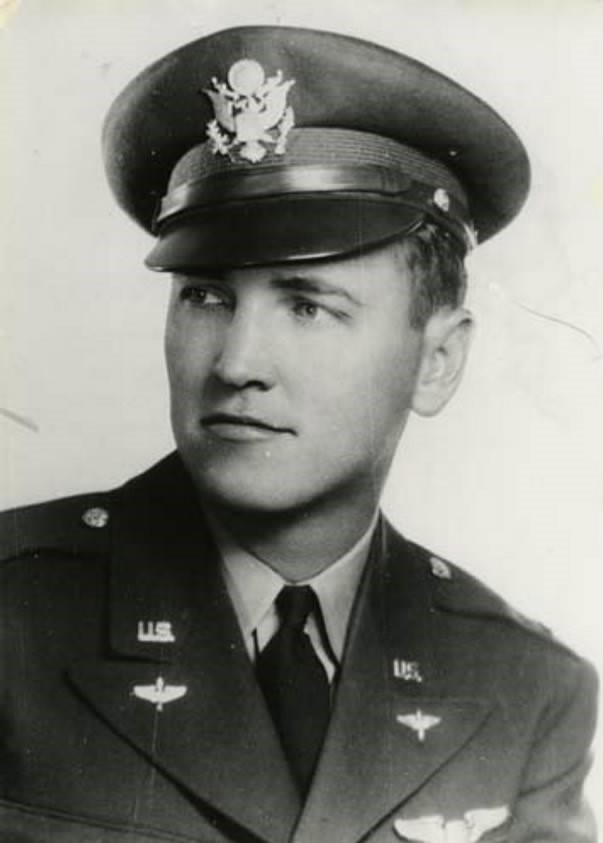
jack watson page A fresh faced 2nd Lt. Jack Watosn who bravely brought home his burning and crippled B-17 bomber after ordering his crew to bail out. (IWM UPL 32160)

On eventual arrival at Molesworth, Lt. Watson was soon to experience for himself the horrors and reality of war. On January 11th 1944, he was part of a 291 bomber force attacking both the FW190 production factory as Oschersleben and the Junkers factory at Halberstadt, Germany. On what became one of the blackest days for the Group, eleven out of the forty aircraft dispatched were lost, an attrition rate of just over 25%, which was also the highest loss of the entire force.

On the inward flight, the weather, which had dogged much of the winter, closed in over the continent.  A recall message was sent out, the 2nd and 3rd Divisions turning for home, but it was ignored by Brigadier General Robert F. Travis, 1st Bombardment Division Commander in the lead plane – ‘The Eight Ball‘. Original orders were to bomb by visual methods but if cloud cover prevailed then pathfinder Liberators  were to mark the target.

As the weather had deteriorated, cloud being present as high as 24,000 feet, fighter cover was all but withdrawn. The bombers were now virtually on their own and much smaller in number.

Alerted early on, the Luftwaffe had managed to form an enormous welcoming party for the now weakened force. It would be the strongest collection of Luftwaffe aircraft since the October raids, and it was waiting, eager for blood.

The first contact between the two forces was made over the shallow waters of the  Zuiderzee on the inward flight. A collection of rocket-firing fighters launched a gruesome attack on the lead section of the 303rd, an attack that lasted for several hours and took out numerous aircraft.

From the Initial point (IP) to the target, flak was light but accurate, more aircraft took hits and further damage was sustained by the formation. Those bombers that did get through managed to bomb the target, the accuracy of which was considered ‘excellent’.

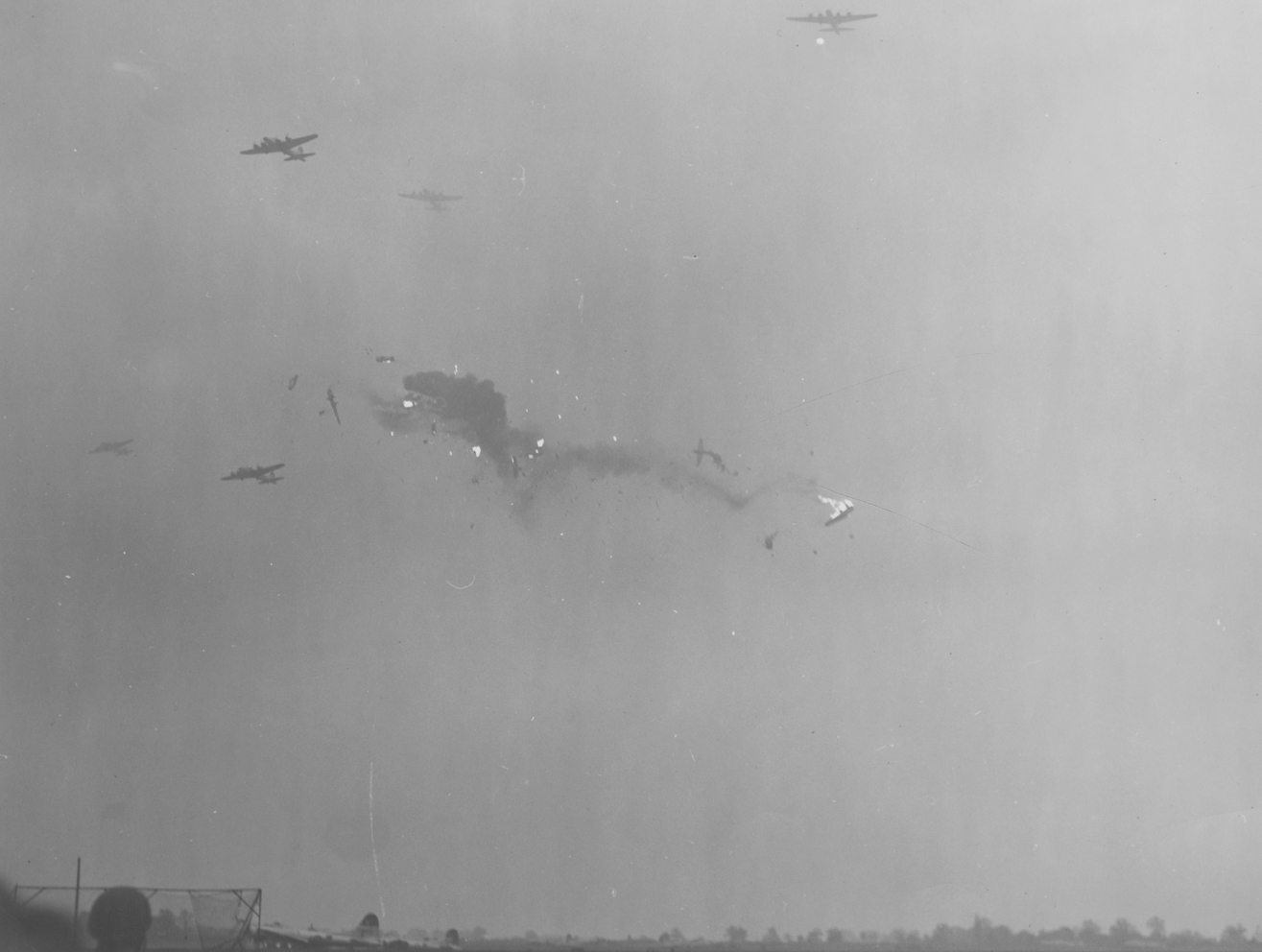
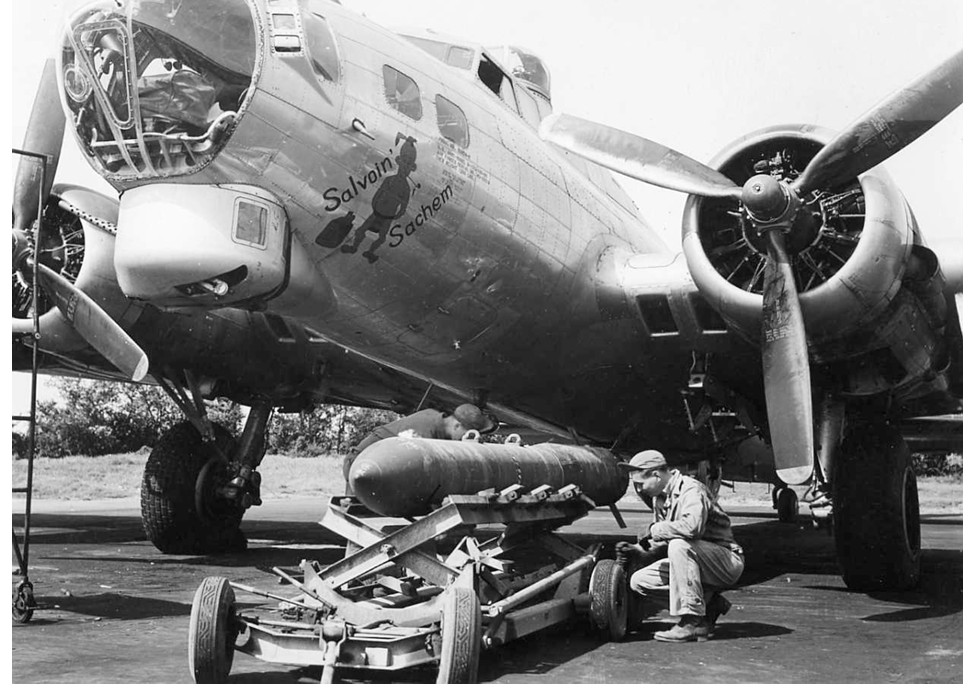
On the return flight  B-17F #42-29524 ‘Meat Hound‘, piloted by Lt. Jack Watson was attacked again by waves of enemy fighters who zoned in on the bomber and its supporting formation. With many aircraft now crippled, the B-17s were easy targets for the fierce and determined Luftwaffe defenders.

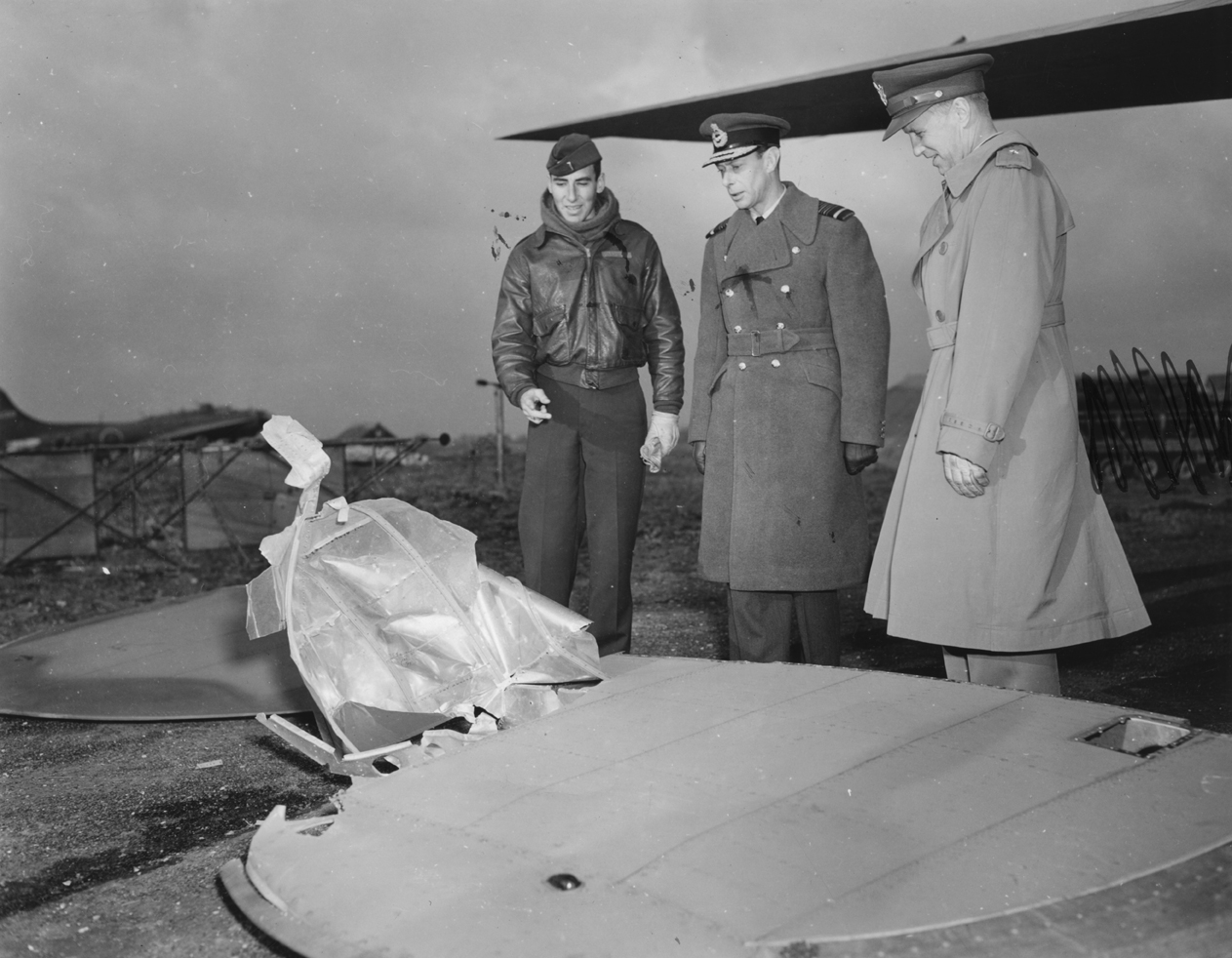
Lt. Watson’s aircraft, (a B-17F-55-BO, which had previously been assigned to the 306th BG transferring to the 303rd in July 1943), was hit hard over Durgerdam. The damage looked terminal, two engines were on fire, there was substantial damage around the wing root and the left elevator had been shot completely off. With such damage, not only was the aircraft difficult to control but it was losing vital airspeed and altitude as well.

Lt. Watson, gave the bail out order, holding the aircraft steady until all the crew had departed. Lt. Watson, who had by then put the aircraft on automatic pilot, was himself preparing to jump, but the thought of the cold waters below forced his retreat to the cockpit and the challenge of getting home alone.

Of those who did jump, four fell into the Ijsselmeer and sadly drowned, and another four were caught by occupying forces and sent to POW camps. The ninth, Lt. Col. Clayton David, the Co-Pilot, managed to evade capture eventually making his way back to England. Clayton’s journey took him through Holland and Belgium and on into France, where he headed south, eventually crossing the Pyrenees into Spain. From there, he reached Gibraltar eventually returning to England in May 1944, four months after he was reported as ‘Missing in Action.’ For his efforts he received the Purple Heart*1.

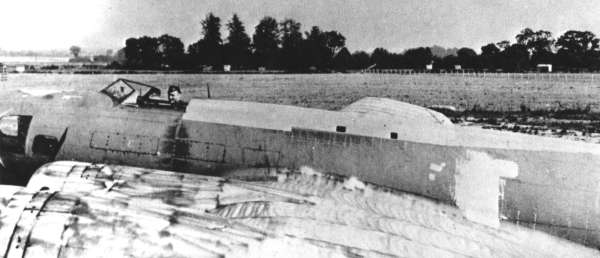
Lt. Watson, now alone in the crippled B-17 fought on, keeping the aircraft flying toward England. Once over home territory he brought the aircraft down through the thick cloud that had dogged so many of Britain’s airfields that winter, landing at RAF Metfield, an American Fighter airfield home at that time to the 353rd Fighter Group.

So severe was the fire on the aircraft that it took fire crews a considerable time to extinguish it. These crews were not only amazed to see just one crewman exit the aircraft, but also to find an unexploded shell sitting directly behind the pilots seat.

WM UPL 32171 B-17 ‘Meat Hound‘ on the ground at Metfield, Suffolk after landing with two burning engines. The aircraft was subsequently written off and salvaged for usable parts.  (IWM UPL 32171).

On his arrival back at Molesworth, Lt Watson received a telegram sent by New York Mayor Fiorello LaGuardia, forgiving Watson for his villainous activity previously in late 1943.

It was at this time that Watson along with three other pilots; 2nd Lts. Robert Sheets, Elmer Young, and Joseph Wheeler, buzzed the World Series game between St. Louis Cardinals and the New York Yankees at the Yankee Stadium, New York. Mayor LaGuardia was so incensed by the action at the time, that he insisted Watson and the others be disciplined, court martial proceedings being instigated as soon as the four landed in Maine*2.

However, it was not to be, the top brass needing every aircraft and crewman they could muster, sent the four on their way with a $75 fine and a stiff telling off!

Although tinged by the sad loss of his crew, the villain of the World Series’ Buzzing, had gone on to prove himself more than a worthy pilot, making history in more ways than one.

Yankee Stadium, Bronx, NY, October 5, 1943 – B-17 Flying Fortress bombers makes a surprise visit during the first game of the 1943 World Series

A Boeing B-17 ‘buzzes’ the Yankee stadium October 5th 1943. (Author unknown).*3

The crew of ‘Meat Hound‘ were:

Pilot – 2nd Lt. Jack Watson (Returned to Duty)
Co-Pilot – Lt Col. Clayton David (Evaded)
Navigator – 2nd Lt. John Leverton (POW)
Radio Operator –  Stf. Sgt. Harry Romaniec (KIA)
Bombardier – 2nd Lt. Vance Colvin (KIA)
Flight Engineer/Top Turret Gunner – Stf. Sgt. Sam Rowland (POW)
Right Waist Gunner – Sgt. William Fussner (KIA)
Left Waist Gunner – Gene Stewart (POW)
Tail Gunner – Sgt. Roman Kosinski (POW)
Ball Turret Gunner – Sgt. Fred Booth (KIA)

The B-17F, #42-29524, was delivered to Denver 31st December 1942; then assigned to the 423rd BS (306th BG) as ‘RD-D’ at Thurleigh 2nd March 1943. It was later transferred to the  358th BS (303rd BG) as ‘VK-K’ based at Molesworth on 30th July 1943.

For their efforts in this mission, the 303rd Bomb Group were awarded a Distinguished Unit Citation, the only time the entire unit achieved such an accolade.

This and other similar stories appears in Heroic tales of World War 2.

Sources and Further Reading.

Missing Air Crew Report 4269

*1 Herald-Whig Obituaries Website accessed 27/5/19

*2 303rd BG website ‘Outfield Fly’ by Hap Rocketto accessed 27/5/19

*3 Photo appeared in ‘Old-Time Baseball Photos and Essays’, blogsite. accessed 27/5/19

Major George Preddy – 352nd FG – A tragic loss.

In Trail 8, we heard about a number of heroic tales and tragic losses. One of those, was that of one of the highest scoring P-51 pilots, Major George Preddy of the 487th Fighter Squadron (FS), 352nd Fighter Group (FG), based at RAF Bodney (Station 141)

George E. Preddy Jnr (0-430846), from Greensboro, North Carolina, was born on 5th February 1919, and graduated from Greensboro High School at the age of sixteen. Preddy became interested in flying whilst in college and made his first solo flight in 1938 at 19 years of age.

Preddy page

Major George E “Rasty” Preddy Jr in the cockpit of his P-51 Mustang (HO-P), #44-13321 nicknamed “Cripes A’ Mighty 3rd.” (@IWM FRE 006368)

His road to war would take time and effort. His introduction to flying was as a barnstormer which led him to attempting entry into the US Navy no less than three times, each time being rejected on account of his small stature and curved spine. With each rejection came more determination, his love of flying taking him back to Barnstorming, whilst he undertook bodybuilding and stretching exercises to straighten his back. Eventually, in the summer of 1940, he applied to the USAAF and to his delight he passed all the relevant examinations. However, as the US was not yet at war, Preddy’s entrance would take yet more time and so to gain experience and better prepare himself, he joined the Army National Guard, being posted to the 252nd Coast Artillery, which went on to protect the important oil refineries on the islands of Aruba and Curaçao, in the southern Caribbean Sea.

The following year in In April 1941,  Preddy received his orders to report for flying training, from which he graduated on December 12th that same year. December 1941 saw the Japanese attack on Pearl Harbour, an attack that led to the US joining the Second World War, and an attack that led to Preddy, commissioned as a Second Lieutenant, being posted to Australia to the 9th Pursuit Squadron (PS), 49th Pursuit Group (PG) in the defence of northern Australia.

Whilst here, Preddy would fly Curtiss P-40s, he named his first plane, ‘Tarheel‘,
as a tribute to his home state. During his time here, he damaged both a Japanese fighter and a bomber in combat operations. Sadly though, in the summer of 1942, he was involved with a collision with another P-40, an accident that would kill Preddy’s friend and colleague, and leave Preddy seriously ill in hospital for another six months or so.

In the October of 1942, Preddy returned to the US, it was here that he would cross paths once again with Lt. Jack Donalson, a pilot who was also a veteran of the early Pacific theatre, and who was with him on that tragic day in July 1942. The two met at Trumbull Field, Connecticut, on January 15th 1943, where the newly formed 352nd FG were training and forming up. The 352nd would be made up of three squadrons (328th, 486th and 487th), Preddy would initially be assigned to the 487th FS.

The 352nd would continue training, their new P-47 Thunderbolts arriving three days later. With the P-47 being new, there were many accidents and losses, primarily due to a carburettor hose clamp becoming loose. Luckily Preddy avoided all such incidents and by May 1943, he and the 352nd were ready for action.

On the 7th July the 352nd arrived at RAF Bodney (newly named Station 141) a small grassed airfield not far from RAF Watton in Norfolk. With small incursions into enemy territory the first few months were generally event free. Preddy would get his first kill later that year on December 1st 1943, while flying P-47D-5-RE Thunderbolt (HO-P) #42-8500 “Cripes A’Mighty“, a name he gave to all his aircraft, so-called because it was his favourite expression. Whilst escorting bombers back from a mission over occupied Europe, Preddy noticed a formation of German fighters who were focusing their attention on stragglers, easy pickings for the experienced and deadly Bf-109s. Preddy and his squadron dived down, bouncing the Germans, causing his first victim to explode in a flurry of cannon fire.

Preddy’s first year would end with two confirmed kills, a tally that would only grow as time went on. In his second kill, he would sadly lose his wing man, Lt. Richard Grow, but for his action he would receive the Silver Star, one of many achievements Preddy would gain.

On January 29th 1944, Preddy would come close to death for a second time, when after dispatching an FW-190, he was hit by Flak and had to ditch in the sea. After spending a short time in the water he was picked up by an RAF Air Sea Rescue Walrus and returned to Bodney.

Over March and April, the new P-51 Mustangs began to arrive at Bodney, an aircraft that would lead to Preddy achieving ‘Ace’ status. On May 13th, the 487th dived down on around thirty Bf-109s, Preddy accounted for two taking his tally over the magical ‘Five’ Kills and ‘Ace’ status.

During the summer of 1944 Preddy would achieve many more ‘kills’, by now he was well on his way to becoming the leading ace in the European skies. In March he was made Operations Manager of the 487th, and promoted to Captain.

By mid July Preddy has reached 14.5 kills, all a mix of single and twin-engined aircraft, and by the end of the month, this has risen to 21.83 kills, taking him to the top spot and leading ‘Ace’ of the 352nd.

Following an escort mission on the 5th, a further mission, in which Preddy was ordered to lead on the 6th, was scrubbed due to bad weather. With the day free to themselves, the officers mess became the focus of attention and the drinks ran freely

By the time Preddy had got to bed, he was well and truly drunk, and as with many operations of the war, the weather cleared and the operation was on once more, Preddy was woken after only an hours sleep and struggled to get to the briefing. Still reeling under the influence, he took off and lead the group into battle. Worse for wear, he emptied his stomach in the cockpit and headed toward the enemy.

As the bomber and their escorts approached Hamburg, Preddy led the attack on the Luftwaffe fighters.  In the airspace between 30,000 ft and 5,000 ft, Preddy managed to shoot down six Bf-109s, with numerous hits around canopies, wing roots and fuselages. On return he was greeted like a hero, the ground crews and squadron pilots crowding his aircraft. Preddy gave a simple reply to the eager crowd, vowing “Never again” would he fly with a hangover.  Following this mission Preddy was awarded the DSC and sent home to the US for a well-earned rest on a 30 day leave.

Preddy page

Major George Preddy, during his return to the United States between August & October 1944. Taken at a Press Conference in the Pentagon Building.’ (@IWM FRE 00346)

On his return in October, Preddy was again promoted, this time to Major, whereupon he commenced his second operational tour. His involvement with the 487th would not last long though, as with his promotion came new responsibilities and the command of the 328th FS, taking over from Lt. Col. John Edwards.

The hard winter of 1944-45 tore into the souls of the ground and air forces across Europe. Severe frosts, snow and cold made Bodney a difficult place to be. But the war continued and in the forests of the Ardennes, German forces were gathering. With few flights being carried out due to thick fog and freezing conditions, the German armoured brigades under the control of Field Marshal Gerd von Rundstedt, made a daring breakthrough (Operation Bodenplatte) in what became know as the ‘Battle of the Bulge’. Ground forces made continued calls for air support, but with increasingly bad weather, few flights were able to make it.

The order then came through and on the 22nd December 1944, the 352nd were to move to Belgium and Asch (Y-29) a small grassed airfield near to Genk in the province of Limburg. The 352nd crammed all the cold weather clothing they could into their aircraft and set off. By the end of the day the Group had settled in the cold of Belgium, it was a far cry from the relative warmth of Bodney.

Preddy’s time in Belgium would be short-lived however. As the weather cleared more missions were undertaken. On Christmas Day, the 328th would have one of its finest battles, shooting down eleven enemy aircraft, but it was a victory that would be eclipsed by the loss of perhaps its greatest leader and airman.

On that day there were two missions ordered, Preddy would lead the second of the two, an escort mission into Germany and Koblenz. On the return trip, Preddy was vectored to Liege, and warned of ‘heavy flak’.  Arriving south of the city, Preddy, along with his wingman Lt. Gordon Cartee, and another pilot Lt. James Bouchier of the 479 th FG, spotted an FW-190 and gave chase at tree-top level.

On entering the area, ground forces opened fire, the Anti-Aircraft battery were American, and all three allied aircraft were hit. Lt. Bouchier managed to climb high enough to bail out, landing safely in the British sector, Lt. Cartee, also having been hit, also managed to escape and get home, but not until after he saw Preddy’s P-51, turn and dive into the ground. Major George Preddy died in the crash.

Preddy’s death was devastating for both the group at both Asch and those back home at Bodney. Festivities were subdued to say the least. Preddy’s dashing good looks and character were well-known, his relationship with his own ground crews were one of the best, he always took time out for them and praised their efforts in keeping him flying. At 25 years of age, Major George Preddy was not a born killer, just a young man who loved to fly, and to fly well.

George Preddy had flown 143 combat missions, he had has been credited with shooting down 26.83 enemy aircraft, the highest in the 352nd FG, and destroying 5 enemy aircraft on the ground. His combined total of 31.83 aircraft was just 6 short of the Group’s highest, a total that most certainly isn’t conclusive.

His commanding officer Lt. Col. John C. Meyer, who held the Group’s record and  was the fourth ranking American Air Ace, described Preddy as “the complete fighter pilot”.  A man so brave and dedicated that he would be awarded, amongst others: the Distinguished Service Cross; Silver Star (1 Oak Leaf Cluster); Distinguished Flying Cross (6 Oak Leaf Clusters); Air Medal (6 Oak Leaf Clusters); Croix de Guerre, and the Purple Heart.

In 1968 the city of Greensboro dedicated Preddy Boulevard in honour for both George and his brother. The Preddy Memorial Foundation also created a petition to have Fayetteville’s Pope Air Force Base renamed Pope-Preddy Air Force Base.
George Preddy’s career may have been short, but his influence went far and wide especially amongst those who knew of him.

Major George Preddy is buried in the Lorraine American Cemetery, just outside Saint-Avold,  Moselle, France, alongside his brother, another fighter pilot, in Plot A, Row 21, Grave 43.

Sources and further reading.

RAF Bodney appears in Trail 8.

North Carolina Museum of History website Accessed 23/8/18

Freeman, R.A., “The Mighty Eighth“, Arms and Armour, 1986

The Preddy Memorial Foundation website Accesses 20/8/18

P.O William Davis (Eagle Sqn) – March 18th 1941

RAF Sutton Bridge, was a small airfield on the Norfolk / Lincolnshire border a few miles from the Wash off the north Norfolk coast. Before, during and after the war it served as  training camp for new pilots, training them in the art of gunnery, utilising a firing range that had been in situ since 1926.

Many airmen of the RAF passed through Sutton Bridge, many of these were Commonwealth aircrew, some from Czechoslovakia and a few from the United States.

In the church yard behind the church of St. Matthew in the village, lie almost 60 graves of those who died in the fight for freedom, they are also joined by a German airman, foe united in death.

One such airmen is that of American Airman Pilot Officer William Lee Davis s/n: 61459 (RAFVR) who joined as part of the famed ‘Eagle’ Squadron, a group of volunteer American flyers.

P.O. Davis was from St. Louis and graduated at Central High School, before going on to attend Washington University. He was the son of William J. Davis of 4500 Arsenal Street, and a salesman in a cork and insulation firm in the area, when he joined up at the age of 25.

He left his job, signing with the Clayton-Knight Committee, a recruitment company for the Canadian and British Air Forces operating in the United States.  He was initially stationed at Love Field in Dallas, where he received four weeks of intensive training in aerobatics, gunnery and combat flying. After qualifying here, he transferred to Ottawa, where he was commissioned and then sent onto England to further his training. He was the first person from St. Louis to obtain a Commission in the Royal Air Force obtaining a deferment of his draft in doing so. When asked about joining the RAF, he told reporters that it was “a matter of sentiment and heritage” citing his English grandfather’s role as an officer in the Boar war.

P.O. Davis was no stranger to flying, having been a flyer before signing up for the RAFVR, achieving a total of 223 hours flying time, a commercial pilots licence and an advanced CAA Licence.

On arrival on March 5th 1941, these pilots were generally sent to No.3 Personnel Reception Centre at Bournemouth, before posting to No.56 Operational Training Unit (OTU) at Sutton Bridge. Here they completed their training and were then sent onto their respective operational squadrons.

There were something in the region of 156 American Airmen who found their way into 56 OTU, many passed through with little or only minor mishaps. For P.O. Davis though it was to be the end of his dream, in an accident that would take his life.

On March 18th, a week after his arrival at Sutton Bridge, he took off in Hurricane P5195 on a general map reading flight across the Lincolnshire Fens. Whilst on the flight P.O. Davis became lost and decided to put down on farm land at New Leake Fen near Boston. Unfortunately, the ground in the Fens was soft causing the undercarriage to dig in and flip the Hurricane on its back. In the resultant crash, P.O. Davis broke his neck killing him instantly. He was not only the first from St. Louis to die, but the first American from Sutton Bridge to die also.

A citizen of the United States, Pilot Officer William Lee Davis is buried in the Church yard of St. Matthew’s Church, Sutton Bridge, Lincolnshire, Section P, Grave 56.

Pilot Officer William Lee Davis

Pilot Officer (Pilot) William Lee Davis

2nd Lt. Robert E. Femoyer MOH, 711th BS Rattlesden

Robert Femoyer.jpg Robert Femoyer 711th BS, 447BG

Flying from RAF Rattlesden, Suffolk, England, navigator 2nd Lt. Robert E. Femoyer earned the Medal of Honour for action whilst on a mission to Merseburg. During this operation, he showed the highest level of dedication to his crew, performing a selfless act of bravery whilst being severely and fatally wounded.

Born October 31st 1921, Huntington, West  Virginia, USA, he was the eldest child of Edward and Mary Femoyer. and attended Virginia Polytechnic Institute in Blacksburg, Virginia.

On 11th November 1942 Robert Femoyer enlisted and joined the Reserve Corps. He didn’t take up active duty until the following February when he began his basic training at Miami Beach, Florida. He joined the Army Air Corps in that same month and became a cadet at the University of Pittsburgh. He received his commission at the AAF Navigation School at Selman Field, Louisiana in 1943 and graduated, without gaining his wings, in 1944.

With his second lieutenant bars firmly under his belt, Femoyer received his first posting; and in September 1944 he left with the 711th Bomb Squadron as part of the 447th Bomb Group, Eighth Airforce. As a navigator he would determine routes and ensure the safe flight of his aircraft and other crew members to the bomb target and home.

On his fifth and final mission , and only a few days after his 23rd birthday, on November 2, 1944, the 711th attacked an oil refinery at Merseburg, near Leipzig, Germany. The B-17 he was in, was battered, hit several times by flak, and had two of the four engines damaged. The aircraft was difficult to fly and the navigational instruments were left almost useless. Femoyer himself had received shrapnel wounds to his side and back, was bleeding heavily and in a great deal of pain.

The B-17 quickly lost both height and speed and was forced to leave the formation, making it more vulnerable to attack from fighters, but Femoyer was not going let his compatriots down.

Deciding to turn for home the pilot asked for a route.  In response, Femoyer, determined to keep a clear head, refused all medical assistance before planning their escape route home. He insisted he was propped up so he could read his maps, the injury to his body making sitting extremely difficult. Guiding the pilot safely around heavy flak zones, they eventually reached the safety of the English coast, where then, and only then, did Femoyer allow morphine and other medical aid to be administered. The pilot managed to guide the stricken aircraft home where upon landing at RAF Rattlesden, Femoyer was removed from his post, weak and having lost of lot of blood, and taken to hospital where he sadly died about an hour later.

For his valour and courage he was posthumously awarded the Medal of Honour, and his citation read:

“For conspicuous gallantry and intrepidity at the risk of his life above and beyond the call of duty near Merseburg, Germany, on Nov. 2, 1944. While on a mission, the bomber, of which 2d Lt. Femoyer was the navigator, was struck by three enemy antiaircraft shells. The plane suffered serious damage and 2d Lt. Femoyer was severely wounded in the side and back by shell fragments which penetrated his body. In spite of extreme pain and great loss of blood he refused an offered injection of morphine. He was determined to keep his mental faculties clear in order that he might direct his plane out of danger and so save his comrades. Not being able to arise from the floor, he asked to be propped up in order to enable him to see his charts and instruments. He successfully directed the navigation of his lone bomber for 2 1/2 hours so well it avoided enemy flak and returned to the field without further damage. Only when the plane had arrived in the safe area over the English Channel did he feel that he had accomplished his objective; then, and only then, he permitted an injection of a sedative. He died shortly after being removed from the plane. The heroism and self-sacrifice of 2d Lt. Femoyer are in keeping with the highest traditions of the 447th Bomb Group and the U.S. Army Air Corps.”

The body of 2nd Lt. Robert Edward Femoyer was returned to the United States to his adopted Florida home, and was buried in Greenlawn Cemetery in Jacksonville, Florida, Section 8, Lot 2.  Florida historical resources list him as one of their own war heroes. His college, Virginia Tech, named a building the ‘Femoyer Hall’ in his honour in 1949 and in 2001, a stretch of West Virginia Route 152 from the Fifth Street crossing with Interstate 64 to the Huntington city limits, was officially designated Robert Femoyer Boulevard. Numerous air force bases have also named streets in his honour.

Robert Femoyer was the only American navigator to have received the Medal of Honour during service in World War Two and remains a Florida hero to this day.

For other heroic tales click here.

RAF Rattlesdon Today RAF Rattlesden is a light airfield utilising the former runway of the base.

Notes and Further Reading .

Source compiled from U.S. Air Force Office of History.

Few, if any, photos survive of Femoyer, but others of his squadron are at: http://www.447bg.com/Contacts.htm

B-17 Pilot 1st Lt.D. J. Gott and 2nd. Lt W. E. Metzger

War makes men do terrible things to their fellow mankind. But through all the horror and sometimes insurmountable odds, courage and bravery shine through. Two gallant young men both in the same B-17 were awarded the Medal of Honour for acts of extreme bravery in the face of certain death.

Born on 3 June  1923, Arnett. Oklahoma, Donald Joseph Gott, began his air force career at the local base in 1943. By the end of the first year he had achieved the rank of First Lieutenant in the US Army Air Corps. Posted with the 729th. Bomber Squadron, 452nd Bombardment Group to Deopham Green, Norfolk, England, he was to fly a B-17 (42-97904) ‘Lady Jeannette’ along with his crew and co-pilot  William E. Metzger.

Metzger was born February  9, 1922 – Lima, Ohio and by the time he was 22 he was a 2nd Lieutenant. He was to meet Gott at Deopham Green, Norfolk and together they would fly a number of missions over occupied Europe bombing strategic targets.

On the 9th November 1944, they took off with their crew on a mission that would take them into the German heartland to bomb the marshalling yards at Saarbrucken.

On this run, the aircraft, was badly hit by flak, three of the engines caught fire and were inoperable, the fires were so fierce that they were reaching the tail of the stricken aircraft.

Further fires within the fuselage started when flares were ignited, and this rapidly caught a hold. Hydraulic lines were severed and the liquid from within was jettisoned onto the burning fuselage.  With communication lines cut and unable to contact the crew, both Gott and Metzger had some difficult decisions to make. They had not yet reached the target, the aircraft still held its bomb load and they were deep into occupied territory.

The crew too had suffered badly at the hands of the anti-aircraft fire. The engineer was wounded in the leg and the radio operators  arm was severed below the elbow causing great pain and loss of blood. He would die very quickly if medical help was not found. Despite the quick thinking and application of  tourniquet by fellow crew members, he soon passed out and fell unconscious.

Gott and Metzger decided that jettisoning the injured radio operator  would not result in his receiving medical help and so they would drop the bombs and head for the nearest friendly territory where they could crash-land. Doing this, would risk not only the life of the operator, but that of the crew and themselves should the stricken aircraft explode.

Over the target, they released their bombs and flew alone toward allied territory. Flying low over the village of Hattonville, the aircraft was seen to swerve avoiding a church and homes. At this point, Metzger personally crawled through the aircraft and instructed the crew to bail out. Three chutes were seen by local people, two fell to earth and the third became entangled on the stabiliser and was trapped. A further three were seen moments later, all these escaped. Metzger decided to remain with Gott and try to land the aircraft with the radio operator on board. With only one working engine, Gott and Metzger brought the aircraft down through a series of tight turns and at only 100 feet from safety the aircraft banked and exploded. Crashing to earth it again suffered a second explosion and disintegrated killing all three crew members on board and the crew member still attached to the tail.

1st Lieutenant Gott and his co-pilot 2nd Lieutenant Metzger had shown great courage and determination to complete their mission, and to save their crew from certain death. They had shown the greatest of  valour in what was to be the final act of their short lives.

Both men were killed on that day, November 4th 1944 aged 21 and 22 respectively. They were both posthumously awarded the Medal of Honour on the 16th May 1945.

Gott’s remains were returned to the United States and he was buried at the Harmon Cemetery, in Harmon, Ellis County, Oklahoma, USA. Metzger, was returned to his home town and was buried at Woodlawn Cemetery, Lima, Ohio.

Along with Gott and Metzger, crew members who did not survive were:  T/Sgt Robert A, Dunlap and S/Sgt T.G. Herman B, Krimminger. The survivors were picked up by a a local field hospital and treated for their injuries: 2nd lt John A, Harland ; 2nd lt Joseph F, Harms ; S/Sgt B.T. James O, Fross ; S/Sgt R.W. William R, Robbins and T/Sg T.T. Russell W Gustafson.

A memorial now stands close to the site of the crash site.

metzger

2nd Lieutenant William Metzger (@IWM UPL 16264)

gott

1st Lieutenant Donald Gott (@IWM UPL 16265)


RAF Little Walden (Station 165)

Sometimes, we come across quite unexpectedly, something of great interest. Whilst on my travels recently, passing through the southern regions of Cambridge into Essex, I came upon the former station RAF Little Walden. Being an unplanned visit, I was rather short in prior knowledge and preparation, no maps, aerial photographs, or other documents that I normally seek out before venturing off into the wilderness. So I was quite unprepared when I stumbled across the Watch Office from former station RAF Little Walden, otherwise known as Station 165 of the USAAF.

RAF Little Walden (Hadstock) – (Station 165)

Little Walden lies slightly closer to the village of Hadstock than it does Little Walden, and was originally called Hadstock. When construction began in 1942, it was allocated to the Eighth Air Force as a Class A bomber airfield. However, due to the bad winter of 1942/43 work ceased temporarily, being held up until well into the summer of 1943. At this point, Hadstock became known as Little Walden, a name change that coincided with the formation of the Ninth Air Force in Europe, an organisation whose primary role was the support of ground troops in the European theatre. With its headquarters at Sunninghill Park1 in Ascot, it would operate both transport and bomber units, taking many of these units (and their airfields) from the already established Eighth Air Force. Little Walden was one such airfield passing from the Eighth to the Ninth to fulfil this new role.

Although a Class A airfield, Little Walden’s main runway was slightly shorter than those of its counterparts, 1,900 yards as opposed to 2,000 yards, but the two auxiliary runways were both the standard 1,400 yards in length. A concrete and wood chip construction gave these runways good strength, it also had hardened perimeter tracks and fifty hardstands of the spectacle type. Grouped mainly in blocks of five, they were located around the perimeter track with a further block of eighteen to the north-west of the site. In the development process a public road the B1052, was closed as it passed directly though the centre of the proposed site.

Little Walden Watch Office

Little Walden’s Watch Office is now a private residential property.

A large bomb store lay to the west of the airfield, surprisingly close to the majority of the hardstands, any major accidental discharge being likely to cause substantial damage to parked aircraft. There were four areas within the bomb store, each holding 200 tons of bombs and tail units, further stores held pyrotechnics, incendiaries, ‘small’ bombs, grenades and small arms ammunition. Most of these were secured by earth banks with fusing points (both ultra-heavy and heavy-light) being held in temporary brick buildings.

To the eastern side of the airfield lay the technical area, with one of the type T2 hangars (the second being located to the north), a fire tender shelter, and a watch office designed to drawing 12779/41 – the standard airfield design of 1942/43. Behind this, lay the main technical area, with its usual range of dingy stores, MT (Motor Transport) sheds, parachute stores and a wide range of ancillary buildings.

Accommodation for staff was, as usual by now, dispersed over eleven sites, a sick quarters, communal site and WAAF site accounting for three of them. A further sewage works made the twelfth site. All-in-all accommodation was provided for just short of 3,000 men and women of mixed rank.

On March 6th, 1944 the airfield officially opened, the day before its first residents arrived. The 409th BG were a new Group, only constituted on June 1st, the previous year (1943). They trained using Douglas A-20 Havocs (known in British service as the Boston) a twin engines light bomber capable of carrying up to 4,000lb of bombs.

The 409th BG formed at Will Rogers Field (Oklahoma) and transitioned through Woodward and DeRidder bases before arriving in the UK. Between March and September they operated out of Little Walden, bombing V-weapons sites and airfields in France in a strategic role. Initially they performed in the low-level role, but soon moved to higher altitudes, performing their first mission on April 13th 1944.

In the short period of residency at Little Walden, the 409th would lose a number of aircraft, one of the first being that of #43-9899 of the 642nd BS, which was written off in a landing accident on April 22nd 1944. Three days later a second aircraft, #43-9691, would also crash-land at Little Walden being damaged in the process.

May would also prove to be a difficult month for the 409th, with one aircraft ‘lost’ on the 9th, a further crash landing on the 11th, another lost on the 22nd and two further aircraft lost (classified as MIA) on the 27th. It was on this mission that a further Havoc would collide with a low flying Mustang resulting in several tragic deaths.

Havoc #43-10130 of the 643rd BS, piloted by Captain Roger D. Dunbar took off from Little Walden heading south-east, when it collided with P-51B #42-106907 of the 503rd FS, 339th FG, piloted by 2nd Lt. Robert L. Dickens. The Mustang, on a training flight, disintegrated killing the pilot, whilst the Havoc crashed into the farmland below. In the ensuing fire, a local farmer’s widow and trained nurse, Betty Everitt ran to the scene and managed to pull one of the airmen out of the aircraft. When returning to retrieve another crewman, one of the bombs on board the aircraft exploded killing her, her small dog, a helping Staff Sgt. and those left inside the aircraft. As a thank you to Betty, the US airmen, from the base, raised almost £3,000 to provide an education for her four-year old orphaned son, Tony2. This was not a one-off either, a fund set up by Stars and Stripes and the British Red Cross, aimed to raise funds for children who had suffered the loss of one or both parents. The amounts raised went a long way to getting these children an education that they would not otherwise have had.

Early June would see another such tragedy, when three more Havocs would collide. Havocs A-20G #43-9703 and #43-9946, both of the 641st BS, would crash whilst the third aircraft managed to land at the airfield. #43-9703 was piloted by Joseph R. Armistead, whilst #43-9946 was piloted by Thomas A. Beckett. A young girl, Marjorie Pask, ran to help, pulling two airmen out of the wreckage then waiting with them until help arrived. Five airmen including the pilots and an air gunner, Staff Sergeant Albert H Holiday, were all killed. It was not until later that Marjorie realised that there were many bombs scattered around the site and how much danger she had been in 3.

Staff Sgt. Albert H Holiday, killed June 11th 1944 in a collision between two Havocs of the 409th BG. (IWM-UPL 21530)

With two further loses and a forced landing in June, it was be a difficult month for the 409th. The late summer months of July and August would be lighter but by no means a clean sheet. In September 1944, on the 18th, the 409th were moved out of Little Walden and posted to a forward Landing Ground A-48 at Bretigny, where they would continue to suffer from landing accidents, Flak and fighters.

Next at Little Walden came the Mustangs of the 361st FG, in a move that saw possession of Little Walden pass back into the hands of the Eighth Air Force. Station 165 was now back with its original owners.

The 361st FG were the last of the P-47 Groups to arrive in the UK. Initially based at Bottisham, they converted to the P-51 in the weeks leading up to D-day. Using the Thunderbolts they earned a reputation as a strong and determined ground attack unit, hitting rail yards and transportation links across France.

A short break whilst transferring from Bottisham to Little Walden gave a somewhat minor break for the 361st. But, following changes to the Eighth’s overall structure, it was soon back to normal and more attacks over occupied France. In October, Lt. Urban Drew shot down two Me 262s who were in the process of taking off from their airfield at Achmer. What was more remarkable about the attack was that Lt. Drew had only arrived in the U.K. a few days earlier, had been grounded for a Victory Roll and then went on to become an Ace shooting down six enemy aircraft and the first pair of 262s! He was awarded the Air Force Cross, being denied the Distinguished Flying Cross until after the war when records from both the Luftwaffe and US Air Force were able to confirm his dramatic claims.

The Christmas and winter of 1944-45 was notoriously bad, very cold temperatures, fog, frost and ice played havoc with operations. The Battle of the Bulge was raging and the allies were finding it all but impossible to provide assistance from the air. Many Bomb Groups suffered terrible tragedies as collisions and accident numbers increased in the poorer weather. The Ninth, who themselves had primary roles in ground support were finding it particularly difficult. To help, a selection of men and machines from the 361st (and 352nd from Bodney) were transported to France and the airfields at St. Dizier (Y-64) and Asch (Y-29) where they were seconded into the Ninth Air Force.  The main force back at Little Walden continued to support bomber missions whenever they could, a difficult job in often appalling conditions.

Duxford American Airshow May 2016

‘Ferocious Frankie’ #44-13704 (374th FS, 361st FG). The original crashed during a wheels up belly landing at RAF Little Walden, on November 9th, 1944. (This aircraft was flying at the Duxford American Airshow May 2016).

Aug 2015 317a

‘Ferocious Frankie’ (named after the wife of Lieutenant-Colonel Wallace E. Hopkins) seen at the Eastbourne Air Display August 2015.

By the end of January the seconding to the Ninth came to an end and the entire Group moved across to Belgium and Chievres, a former Belgian airfield captured and used by Luftwaffe bombers during the earlier years of the war. The 361st would remain there until April 1945 whereupon they returned back to Little Walden. During their absence Little Walden was made good use of. Being a ‘bomber airfield’ by design, its runways and hardstands were put to good use by Debach’s 493rd BG and their B-17 ‘Flying Fortresses’ whilst their own airfield was repaired and strengthened.

Spending only a month at Little Walden, the Air Echelons of the 493rd BG would depart in the April as the 361st FG returned. On the 20th, the 361st would fly their last operational mission, a flight that would close the record books culminating in a total of 441 missions. As the war ended and personnel were sent home, crews and aircraft of the 361st were dispersed to depots around the U.K., those that were left were sent home via the Queen Mary from Southampton arriving in New York in early November 1945. Within hours the group was disbanded and the men scattered to the four winds.

Between early September and early October 1945, the 56th FG ‘The Wolfpack’ were brought to Little Walden. The aircraft were also dispatched to depots around the country whilst personnel were brought to Little Walden for onward transportation to the United States. By mid October they too had gone.

Little Walden then began the wind down, transferring back to RAF ownership in early 1946. For the next twelve years or so, it was used to store surplus military equipment before they were sold off. After that, the site was returned to agriculture, the majority of the buildings pulled down and the runways dug up for road building hardcore.

The control tower stood for many years derelict and forlorn, until being purchased by an architect in 1982, eventually being turned into a private residence, the state it exists in today. The closed road has since been restored, utilising part of the NE-SW runway. Other parts that remain being a public footpath, but all a fraction of their former selves and no more than a tractor’s width wide.

What’s left of the technical area is a small industrial unit, remaining buildings being used for storage or small industrial companies. An access road from the B1052 passes the site an on to private residencies.

Little else survives of Little Walden. Memorial plaques are believed to be mounted on the side of the watch office, although I could not see these when I visited, and the village memorial mentions those who were stationed at the airfield.

The serenity of Little Walden does nothing to reflect the goings on here over 70 years ago. The aircraft are gone, the bird song replacing the sound of engines, and the busy runways now a small road. For those who were lost here, the watch office stands as  a memorial to their memory and the dedication shown by the many young men and women of the USAAF.

Sources and further reading.

1 Sunninghill Park was originally part of Windsor Forest and dates back to the 1600s and King Charles 1. Its ownership changed hands several times, and in the early 1800s during the Georgian period,  a large house was built upon it. The Ninth Air Force made it their headquarters between  November 1943 and September 1944, after which, in 1945, it was sold to the Crown Estate as a future home for Queen Elizabeth and Prince Philip, Duke of Edinburgh. However, before their marriage, the house burned down and the site remained unoccupied until the 1980s when a new property was designed and constructed for the Duke and Duchess of York. However, it was never occupied, the house fell into a very poor state of disrepair and was bought for £15m by an overseas investor. The site continued to decay and by 2014 was ordered for demolition.

2The Troy Record Newspaper Archives, Page 20, June 5th 1944 accessed 10/3/19.

3The full story can be read in ‘Balsham, A Village Story 1617-2017‘.

Little Walden is a new addition to Trail 46

1st Lt. Raymond Harney and 2nd Lt. Warren French – 349th BS, 100th BG

Lt Raymond Harney (Photo courtesy of Tsymond Harney JR.)*1

A few years ago a story came to light that not only brought home the brutality of war but also the compassion found in war. It was of two American airmen whose World War II story finally come to a close 70 years after their death.

The two airmen, U.S. Army Air Corps 1st Lt. Raymond Harney (s/n O-523208) and U.S. Army Air Corps 2nd Lt. Warren French, (s/n O-2056584) of the 349th BS, 100th BG, were in a B17G (44-6306) over Germany on September 28th 1944, when they were hit by flak whilst on a mission to Merseberg. This would be their eighth and final mission.

Mission 652 involved a total of 342 B-17s which were sent to bomb the Merseburg/Leuna oil refinery and any additional targets of opportunity. During the operation, 10 B-17s were lost, 4 were damaged beyond repair and 251 damaged but repairable. Escort for the mission was provided by 212 P-51s of the USAAF.

B-17 ‘#44-6306’, was delivered to Kearney airbase on 28th June 1944,  then moved to Grenier airbase, New Hampshire on 9th July 1944, for onward transport to the United Kingdom.  It was assigned to the 349th Bomb Squadron, of the 100th Bomb Group, given the code ‘XR-G’, and based at RAF Thorpe Abbotts from the 12th July 1944.

The crew of #44-6306, assigned on the 28th August 1944, was: (Pilot) 1st Lt. Raymond E. Harney (Co-pilot); 2nd Lt. William R. Kimball (Navigator); 2nd Lt. Charles M. Hamrick (Bombardier); 2nd Lt. Warren. M. French (Top Turret/Engineer); Cpl. Thadeus L. Gotz (Radio Operator/Gunner); Cpl. Hubert J. Burleigh,Jr. (Ball Turret); Cpl. Melvin F. Cordray (Waist Gunner); Cpl. Robert C. Minear (Waist Gunner); Cpl James J. Sorenson, and (tail Gunner) Cpl. John H.  Bundner. However, for reasons unknown at this time, for this particular mission, Gotz was not aboard, and instead S/Sgt. Jack D. Francisco flew as tail gunner and Cpl. Robert C. Minear flew as the Flight Engineer.

At 12:10, whilst over the target, the B-17 was hit in the number 2 engine by anti-aircraft flak. As a result, the engine caught fire, the aircraft withdrew from the protection of the formation, joining another formation further back, but began to fall back again when the number 4 engine was also feathered. Harney continued to fly the crippled B-17 for two hours after being hit, before finally deciding enough was enough and he ordered the crew to bail out. Being determined to save his friend and the aircraft, he also decided that he and the injured French, would remain and try to land the aircraft.

Outside of the village of Schwickershausen, to the north of another major target, Schweinfurt, Germany, they attempted a belly landing bringing the aircraft down in a turnip field. The B-17 slid across the ground, ripping off the port wing, causing a tremendous fire. Neither Harney nor French sadly survived the subsequent fireball.

Although he managed to get the crew to leave the aircraft, their safety was not guaranteed and sadly, three were killed by local police in the following days. An event not uncommon in Nazi Germany. Only two of the gunners, Cpl. Melvin F. Cordray, and Cpl. Robert C. Minear, survived as POWs.

What makes this story more significant than usual, is what followed after the crash.

The local people made a wooden cross in remembrance of the crew and they kept it hidden away in the local church for over 70 years.

The cross kept secret for so many years.*2

The large wooden cross, had the words “Hier ruhen in Gott! 2 amer. Flieger,” or “Here rests in God 2 American flyers,” engraved on it, along with details of the aircraft crash. On the 70th anniversary of the crash, 28th September 2014, a memorial service was held in the village of Schwickershausen. Following this, on 5th October, the cross was flown over to England in an American KC-135 Stratotanker from RAF Mildenhall, with two Luftwaffe Tornadoes escorting them over Germany. The cross was donated to the ‘Bloody 100th’ museum at Thorpe Abbots for safe keeping. A certificate was also handed over along with the cross signifying not only the now peaceful and co-operative alliance between the two nations, but the final closing of a chapter of the history of two crew members of the “Bloody Hundredth.”

The cross being transported in the Boom pod of a KC-135 Stratotanker. October 2014.*4

This is a remarkable story, and one that certainly stands out amongst the horrors and heroism of the Second World War.

2Lt Warren M French

Warren French’s memorial stone in Belgium*3

Lt. Raymond E. Harney’s Gravestone is at Ft. Snelling Cemetery in Minnesota, his remains are in the graveyard at Gemeindefriedhof Schwickershausen. Warren French’s headstone is in the Ardennes, Neuville-en-Cond, in Belgium.

Thorpe Abbotts airfield and museum is featured in Trail 12

Sources:

*1 photo the Bloody 100th Foundation.

*2 Photo from RAF Mildenhall news

*3 Photo from ‘Find a Grave

*4 Photo from RAF Mildenhall News

This story first appeared in the RAF Mildenhall News report October 20th 2014.

Trail 32 RAF Nuthampstead – The end of an Era – Part 4

After Part 3 of our journey, we see the US bomber airfield at Nuthampstead finally come to a close. But as the war approaches its conclusion, operations continue to be flown and losses continue to mount.

The US forces would go to Dresden the morning after the RAF had been. 431  B-17s of the entire 1st Bombardment Division, would prepare for take off at 07:00 hrs to be over Dresden at mid-day. With two other Divisions also in the air that day, escort would be from 784 Mustangs, with the 20th FG protecting the leaders the 1st Bombardment Wing, the 398th BG, followed by the 91st and 381st Bomb Groups respectively. In all, in excess of 2,000 American aircraft would fly into the heart of Germany that day.

It was to go disastrously wrong for the Group though, for even as they flew over Holland, they were already off course and now the weather was moving in. With their Gee system being constantly interfered with and throwing up faults, the lead plane of the 389th decided to take the more southerly route to fly around the cloud, taking the formation near to Munster, a city heavily guarded by flak. Although objecting to the move, both the 381st and the 91st followed – a move they would come to regret. The 91st were hit hard; many aircraft were damaged and their crewmen badly injured. Then, another defensive turn took the Wing, some 137 aircraft, a total of fifty miles of course. They were now heading to Schweinfurt, the scene of such devastation in August 1943 where high loses resulted the US temporarily ceasing air operations as a result. Not wanting to relive the experience, the formation then turned south again, taking them, and their escorts, even further off course.

By now, the leader’s Gee system had completely failed, and as the formation approached the target, the deputy’s system also ceased working. Lost and confused, they were gifted with a break in the cloud through which they could see an ancient city with a river running through it. The order was given and bombs were dropped. With little to no flak and no enemy fighters to resist them, the formation unleashed its devastating load onto those below. Unfortunately, it was not Dresden at all, but the Czech capital Prague, they were some eighty miles off course.*5

The 398th flew their final operation on April 25th 1945, a flight that took them to the Skoda Armament Works at Pilsen. The 398th were joined that day by the 91st, 92nd, 303rd, 305th, 379th, 384th, and the 381st Bomb Groups. With simultaneous operations happening elsewhere at Munich and the Me 262 airfield in Prague, 198 aircraft were flew to Pilsen to bomb the Skoda works.

In contrast to their first mission, take off was controlled and in good order. The first aircraft was airborne at 05:20 and the last 35 minutes later. Forming up took place over Debden Buncher (RAF Debden) at 5,000 feet and the Buncher was left at 06:40, when the entire formation headed for the coast. at 07:37, they crossed the French shoreline.*10

The 398th BG were tasked with leading the 1st Combat Bombardment Wing, totalling three Bomb Groups made up of 120 B-17s. In charge was Captain Michael Robinson, Commanding Offcier of the 601st BS. The weather was predicted to be good, so a visual bomb run was planned, however, over the target, this proved not to be the case and 10/10 cloud completely obscured the target. Forced to go round again, the formation made a 360o turn bringing them back in at the rear of the formation. By now flak had become both intense and accurate.

Two aircraft from the 602nd in the high squadron were hit. The first B-17G #42-97266 (K8-G, “Godfathers Inc.“) piloted by 2nd Lt. Allan Ferguson, quickly left the formation spiralling out of control. Three of those on board managed to escape the aircraft as it fell earthward. Of the crew, six were killed whilst two were captured becoming prisoners of war for the last remaining days of action*6*7

The second aircraft that day was that of Lt. Paul Coville, B-17G #43-38652 (K8-V, “Stinker Jr“). After the second bomb run, the aircraft was hit behind the #3 engine, leaving a large hole and a damaged engine. After falling out of formation and feathering the engine, Lt. Coville brought the aircraft back, at which point the engine caught fire. A small explosion then ripped the right wing off outboard of the engine, sending the aircraft spiralling towards the ground. The crew inside, frantically tried to get out, assisting each other with parachutes. All crewmen except the ball turret gunner S. Sgt. Charles Walker, manged to escape the aircraft, managing to find allied troops on the ground and safety.

During their search for safety both Coville and the waist gunner S. Sgt. Harry Overbough, took two prisoners each, Overbough’s ending up being revealed as escaped Jewish prisoners who had donned German army uniforms to help them escape. *7*8

After bombs away, the formation made a right turn and headed as briefed toward home, crossing the English coast at 14:26. The first aircraft touched down at Nuthampstead at 15:02.*10

With the last mission flown, Nuthampstead’s days were now numbered. A handful of ‘Revival’ flights were made transferring POWs from Barth in Germany to airfield A-10 in France. In addition, flights carrying ground crews over Germany also took place. By May 1945 though, the war was over and the exodus of American forces back to the united States began. Over the period May / June,  1945, the 398th would depart Nuthampstead, the ground force returning to the US  from Greenock onboard the Queen Elizabeth, whilst the air personnel flew back between 21st and 27th May. After thirty days of rest and recuperation, the Group assembled at Drew Field, Florida where many officers and enlisted men were discharged from the service. The remaining handful were given duties elsewhere and transferred almost immediately.

A VE day service held at Nuthampstead airbase. (@IWM UPL 35448)

On September 1st 1945, Major Gene Nelson and Major Dean Ashworth, quietly and without ceremony, inactivated the Group – the 398th would be no more.

By the time the war had come to a close, the 398th had completed 6,419 operational sorties (175 missions) dropping some 15,700 tons of bombs. They lost some seventy*10 aircraft in operations. For their determination and outstanding flying over Derben on April 8th, the Group received a Presidential Unit Citation, this came in addition to 2,124 Air Medals, 531 DFCs, 2 Silver Stars, 18 Bronze Stars and 4 Purple Hearts (with others being awarded elsewhere). Whilst their losses were perhaps hugely significant compared to other Groups, they nonetheless performed gallantly and with dedication deserving of any military group.

Returned to RAF ownership a month later the airfield became a store and maintenance station storing ordnance for disposal, and by 1954 the military had no further interest in it, and it closed some 5 years later.

During the 1960s Nuthampstead was in the limelight once more when it was considered as a site for London’s third airport after Heathrow and Gatwick. Being so close to the capital made it an ideal proposition, but the proposal faced huge opposition from those living and working in the area. The decision would eventually favour Stansted, a site not even shortlisted in the initial phase.

The Roskill Commission Inquiry (1968-70), identified seventy-eight initial sites, reducing it to four possibles: Nuthampstead, Thurleigh (Bedford), Cublington (Bucks) and Foulness on the Essex coast, ignoring Stansted on grounds of air traffic, noise and poor road access.

After great debate, Cublington was finally chosen, however, following in-house arguments and disagreements, this was later overturned in favour of Foulness (Maplin Sands),*9 Nuthampstead being rejected on various points including most noise, most agricultural loss and the requirement of a rail link.

With work intending to start in the early 1970s, the plans were eventually shelved due to the 1973 oil crisis and instead a smaller proposal was put forward to build a site at Stansted, itself a former war-time airfield. The build eventually went ahead and today Stansted sees in excess of 15 million passengers, all of which could have been located at Nuthampstead.

With that, Nuthampstead was destined to be become farmland once more. The Forestry Commission planted tress in the former bomb store, itself leading to large quantities of munitions being discovered after the site was abandoned. A small strip was retained for karting and a small crop spraying business utilised part of the airfield. Much of this has now also ceased and whilst parts of the original runway and peri track concrete surfaces still exits, farmland prevails once more over the site.

Built mid war, Nuthampstead had a rather unfortunate start, with many serious problems for the 55th FG and their P-38 Lightnings. The 398th, the Group synonymous with the airfield, were a rookie Group but one that went on to perform 195 operations many over Germany, losing a number of aircraft and crews in the process. They took part in some the the war’s most ferocious battles including Schweinfurt on October 9th, Berlin on several occasions and the US Air Force’s last operation of the war, Pilsen on April 25th 1945.
Transferred back to RAF ownership post war it was  a serious contender for London’s third airport, however, this was not to be and the airfield was largely removed, buildings were demolished and the runways were dug up for hardcore. Little remains of it today, a small private airstrip utilises some of the site, and a thriving museum continues to tell the story of those who served here. A stunning memorial stands outside the local pub frequented once by so many personnel who served here, at Nuthampstead, in those days of the 1940s.
The full history of RAF Nuthampstead can be read in Trail 32.

Sources and further information (Nuthampstead)

*1 Investigation of the US National Defense Program, Part 35. US Government Printing Office Available on Google books

*2 Fooy. F., “One of Thousands – A Navigator in the European Air War.” Lulu Publishing, 2015 Via Google Books

*3 Wilson. K. “Blood and Fears – How America’s Bomber Boys and Girls in England Won their War“. Weidenfeld & Nicholson, 2016 page 390

*4 American Air Museum Website accessed 11/2/24

*5 Taylor, F., “Dresden – Tuesday 13th February 1945“, Bloomsbury, 2004

*6 MACR 14224.

*7  “Hell from Heaven – Ch 35 – Mission 31 – Pilsen, Czechoslovakia,  Our Last Combat Mission – April 25, 1945” published by Leonard Streitfeld, Bombardier, 600th Squadron on the 398th BG Memorial Association Website.

*8 MACR 14220

*9 Banister, D., “Transport Planning In the UK, USA and Europe”  Taylor & Francis, 2003

*10 United States Army Air Forces, “The History of the 398th Bombardment Group (H)” (1945) World War Regimental Histories Book 124.

Missing Air Crew Reports 12214 and 12215

Ethell. J., & Price. A., “Target Berlin – Mission 250: March 6th 1944“. Janes, 1981

A good many photos, official records and personal stories are available on the 398th BG Memorial website. A great resource for those wanting to read more about the history of the 398th BG,

Trail 32 RAF Nuthampstead – The arrival of the 398th – Part 3

In Part 2 of this Trail, we saw how the 55th FG finally departed Nuthampstead having been dogged by mechanical problems. In this part, they are replaced by the 398th BG, a heavy bomber group who brought the B-17 ‘Flying Fortress’ with them. As ‘rookie’ crews though, their start may not have been the start they had wished for.

The new Group was a Heavy Bomber Group, equipped with B-17Gs, and would be the last Fortress Group to join the USAAF. Made up of four squadrons: 600th, 601st, 602nd and 603rd Bomb Squadrons (BS), the first personnel would arrive in Liverpool, on April 21st 1944, sailing on the USS Wakefield from Boston. Once at Nuthampstead, they would begin combat flights in a matter of days, their first mission taking place an May 6th that year.

Their journey to Nuthampstead had been a long one. Being activated on 1st March 1943 with a cadre from the 34th BG at Blythe, California. They trained hard, transferring to Orlando in Florida and then onto Spokane, Washington. In June 143, they transferred once more, this time to Rapid City, South Dakota, each time picking up new staff and crews as they went.

During training in the Autumn of 1943, the monotony of routine was broken when 2nd Lt. Thompson Highfill displayed courage and to assure the safety of his crew. After his B-17 suffered engine failure and complete wing disintegration, he ordered the crew to bale out, holding the aircraft as steady as he could whilst they made their escape. Too low to use his own chute, he made a wheels up landing, for which he was awarded the Distinguished Flying Cross, the first to the unit.

After further moves the unit was eventually war ready, and on March 24th 1944, the advance party began their journey to England. On April 22nd, the ground echelon arrived at Nuthampstead, the same day as the first section of the air echelon.

Having only been activated the year before, the 398th were a novice Group, but that would not prevent them operating against important strategic targets in Germany. These operations would include factories in Berlin, warehouses in Munich, marshalling yards in Saarbrucken, shipping facilities and docks in Kiel, along with oil refineries and aircraft production facilities in Munster. Thus even as a new unit, it would take part in some of the heaviest attacks on German industrial centres.

On May 6th, the 398th went into action for the first time, and like other newbies, it was a disaster. Although these missions were not seen as full missions (flying the full complement of aircraft and crews) they were nevertheless important in the development of the crews, honing their skills and allowing them to begin gelling as a close knit crew.

The morning started badly when breakfast was delayed. The take off as a result was also late with departures being badly timed. Forming up was ‘less than tidy’, with ten of the eighteen aircraft forming up on the wrong formation or in the wrong place. Once over the target, the ‘V’-weapons site at Sottevast, cloud prevented the bombers from seeing the target and so they returned without dropping a single bomb. Their inauguration had been far from successful but looking at it positively, there were no loses and all aircraft returned unharmed.

The rest of May saw the Group fly to Berlin no less than four times, in addition to targets at Kiel, Saarbrucken, Ludwigshafen, Ruhland and Dessau in Germany. They also flew to several targets in both France and Poland meaning there had been no let up for the novice flyers.

During the lead up to D-day, the 398th would attack coastal defences along the Cherbourg peninsula, softening up defences for the invasion forces who were about to land along the Normandy coast. These and other targets in France would dominate the early weeks of June, whilst July saw a return to the homeland and targets deep into Germany once more.

October 15th brought the true realities of war to the Group when a flak shell hit B-17G #43-38172 in the nose exploding inside the aircraft. The Toggler/bombardier,  Sgt George Abbott, was killed outright, and the instruments were all but obliterated. With no oxygen and the nose barely recognisable, the pilot 1st Lt. Lawrence DeLancey, managed to bring the B-17 home thus saving the lives of the other crewmen on board.

B-17G #43-38172 “2 Sad Lovely Julie” hit in the nose by flak, killing the bombardier outright. (@IWM UPL13907)

For his actions, Lawrence De Lancey was awarded the Silver Star, Lt. General Doolittle’s letter citing the “sheer determination and tenacity”  of De Lancey in bringing the aircraft and remaining crew home safely.

Christmas 1944 saw no easing up for the crews. On Christmas Eve, orders came through for every available bomber to be airborne. The winter of 1944-45 being one of the worst saw ground forces take a pounding in the Ardennes by a desperate last attempt at a breakthrough by the German land forces. Taking advantage of the fog and mist that had prevailed, air cover was limited for the allies but as soon as a break occurred, they would return in large numbers. That break occurred momentarily on the 24th.

Over 2,000 bombers of the Eighth Air Force, (which included 500 RAF and number of bombers from the Ninth AF) took to the skies that day, the largest Eighth Air Force operation to assemble over enemy territory in history.

The flyers did not experience mass opposition, in fact it was insufficient to make a difference, and so the operation fulfilled its objective of destroying supply links and disrupting airfield operations. On the way home, the bombers were faced with encroaching haze, many UK airfields becoming closed in and closed to landings. The 1st Air Division (formally 1st Bomb Division) were faced with a thick fog that forced them to land elsewhere, the 398th coming in at Ridgewell along with the 351st and Ridgwell’s normal residents the 381st. Christmas for the crews would be spent away from their England home that year.

On 3rd February 1945, the 1st AD were part of a force attacking Berlin again,  lead by the 91st BG with Lt. Col. Marvin Lord, the group Operations manager who was chalking one up, never having flown to Berlin before, he took over from the normal lead pilot who was on a short pass.

As the formation neared the initial point (IP) over Lehmke, near Gardelegen, the formation began to close up causing extensive turbulence from prop wash. Before the bombardiers took over, aircraft jostled for positions ensuring their safe place in the group. At this point, it took two pilots to control the buffeting aircraft, as they were thrown about the sky within the ever tightening formation. Ninth in line were the 398th BG led by 1st Lt. Perry Powell in B-17G #43-38697, of the 603rd BS.

Affected by this powerful prop-wash, Powell decided to drop back and in doing so he got too close to the low squadron. His automatic reaction was to lift the nose of his heavily laden B-17, a reaction that caused the air-frame to suffer extreme stress, stresses that caused the fuselage to split open around the ball turret, sending the powerful front end into the front of Lt. John McCormick’s B-17 #42-97387 of the 602nd BS. The collision cut away the nose of the second aircraft. With no parachutes or safety straps, the navigator 2nd Lt. Second Lieutenant Bruce Phelps fell to his death.

Now no longer flyable aircraft, both B-17s began to fall, spiralling toward the ground and their inevitable fate – of the two crews, only three were seen to escape that day.

Out of Perry Powell’s aircraft, #43-38697, eight were killed, only the tail gunner S.Sgt. Joe Bancroft survived becoming a prisoner of war. From John McCormick’s B-17, #42-97387, only he and the Bombardier, Bill Logan, survived, seven losing their lives in the tragic accident that marred the operation that day*3, *4.

Later that month, on the 13th, the 398th would take part in the hugely disputed attack on Dresden, a combined force of Allied aircraft that would drop in excess of 4,500 tons of bombs on a city whose conditions led to a firestorm that killed more than 25,000 inhabitants.

In the last part we see how Nuthampstead’s war comes to a close. The airfield no longer required eventually closes, but not before it enters a great debate about its future and possible expansion.

The full history of RAF Nuthampstead can be read in Trail 32.

Trail 32 RAF Nuthampstead – The end of the 55th – Part 2

In Part 1, we looked at the construction of Nuthampstead and were introduced to the 55th FG,  the first residents of the airfield. There had been a good start to their war, but things were about to take a turn for the worst.

Two days later, the 55th were again joined again by elements of the 20th FG, swelling their number into the fifties. A shortage of Lightnings had meant that the bulk of the deliveries had gone to Nuthampstead, leaving the Kings Cliff Group to fly along side the 55th until their own numbers had reached full capacity. However, very soon after take off that day, mechanical problems struck several of the Lightnings and they were forced to return. Forty-seven aircraft then continued on to their rendezvous point, but the Liberators of the 2nd BD were nowhere to be seen. Extremely low temperatures then caused further issues with the Allison engines and several more P-38s were forced to abort the mission and return home empty handed. By the time the bombers were located, the 38th FS were the only ones about, and the sixteen aircraft of the squadron began to protect their bigger friends from a swarm of attacking 109s and 190s.

Once back at Nuthampstead, claims were once again put in with a loss of none of their own. Apart from ongoing mechanical issues, the war was going well for the 55th.

On the 13th however, the gremlins struck again and this time they struck hard. The 55th were ordered to protect the 1st, 2nd and 3rd BD bombers to Bremen. Before they had even reached the bombers, three had to return due to mechanical problems with the engines and yet again, the extremely cold temperatures and humidity made flying difficult and the possibility of further problems more likely. Both engine issues and a determined fighter attack took its toll on the 55th, with seven aircraft failing to return that day, five being shot down and two lost from suspected engine problems that were by now dogging the Group.

These gremlins then reared their ugly heads again on the 29th, and once more it was over Bremen. Flying out over the Dutch coast the flight was attacked by a swarm of FW 190s, with full drop tanks and heavily laden, the Lightnings suffered badly once more with another seven P-38s failing to return to Nuthampstead.

Ongoing losses had meant that by the end of the month a third of the Group’s aircraft had been lost, either on operations or as a result of crashing on their return – the failings of the Lightning were now showing themselves in dramatic style. Poor performance at higher altitudes, where the bombers operated, seriously curtailed the ability of the engines to perform even satisfactorily. Oil turned to sludge and pipelines froze often leading to a catastrophic failure of the engines. Over the winter of 1943-44, over half the P-38 losses experienced were put down to the engine’s inability to cope with the moisture and freezing temperatures of the European skies. Compounding this, poor heating for the pilots led to immense discomfort, and even frost bite for some. Lengthy flights were taking their toll not only on the aircraft’s performance, but also the pilots ability to fight the better equipped enemy.

The new year of 1944 brought new challenges to the 55th. The mechanical problems of the Lightning continued, even with the introduction of the newer ‘J’ model, major engine problems prevented it from becoming the fighter it was designed to be, and as a result, losses continued to grow.

In February, the infamous ‘Big Week’ operation took place, the intended mass destruction of the German industrial region along the Rhine. The 55th offered a supporting role to the bombers but by no means was it a front row seat.

In March, after much speculation, the 8th Air Force turned its attentions to Berlin once more, a target that had been previously planned but scrubbed before take off, raised its head again. An initial flight in the first hours of March led to nothing more than failure after many bombers took too long to form up and subsequently returned low of fuel, those that did get away were forced to return due to cloud. On the 4th, another attempt was equally affected with many aircraft forced to attack targets elsewhere. But even after the recall was given, a small number of bombers did get through dropping the first, but totally ineffective, US bomb on the German capital.  With them, acting as escort, were the P-38s of the 55th FG, Led by Lieutenant-Colonel Jack S. Jenkins, commanding officer, who would become the first US fighter pilot to reach Berlin. Although the operation was a failure, it would nevertheless be a milestone in America’s part in the war.

Lt. Col. Jack S. Jenkins, of Levelland, Texas, in his P-38 “The Texas Ranger.” (#42-67074) Jenkins was the first US fighter pilot to fly over Berlin. (@IWM FRE 2425)

On the way in, Jenkins and his companions in the 38th FS, had received hits from flak, and as usual, were suffering from engine trouble, so much so that only half the 38th made it to the target area. Flying in his later P-38 “Texas Ranger IV” (#42-67825), Jenkins failed to locate the bombers and upon turning for home, had to outrun a number of enemy aircraft at low level. When the story of his achievement hit the headlines it was both big news and a welcome morale booster for not only the 55th, but for the US forces in general.

Sadly, Lt. Col. Jenkins, the ‘hero’ of Berlin, would only fly for a further month following his flight over the capital, being shot down on April 10th, in the same P-38 “Texas Ranger IV” he had flown so well. He survived the incident but was captured and taken prisoner by the Germans, whether they knew of his achievement or not is not known.

On the day following the Berlin operation, March 6th, the USAAF returned to ‘The Big ‘B”. The 55th were again to be a part of the operation, directed to protect the bombers on their return leg of the mission. Once at the rally point north of Berlin, the bombers began their flight home seeking the protection of the forty-seven P-38s that the 55th put up. Once over enemy territory though, the gremlins that had now played almost as big a part in the war as the Group, reared their heads once more and sixteen of the aircraft developed faults forcing them, and an escort for them, to return home. It had been a black time for the 55th.

In the following month, a new model of the P-38 would emerge, the ‘Droopsnoot’ P-38, a fighter bomber version of the Lightning. Both the 20th FG and the 55th FG flew the version on this day, thirty-four of them being from the 55th. But the ‘Droopsnoot’s’ arrival would  also mark the departure of the 55th from Nuthampstead, along with the simultaneous arrival of a new and very different Group.

Their time at Nuthampstead had been mixed. Scores of enemy aircraft had been claimed but many good airmen had been lost, and the aircraft they flew had proven to be less than perfect in the cold, damp European skies. But as the 55th left, the bombers of the 398th Bomb Group (BG) took over operations with the heavy bomber the B-17 Flying Fortress, this would be the aircraft and Group that Nuthampstead would become synonymous with.

Nuthampstead and the 55th FG in particular had suffered badly. Mechanical issues and caused untold damage and many losses in aircrew. Now it was time for them to move on and for a new group tp arrive at this Hertfordshire airfield. With departure of the 55th, came the Heavy Bomber Group the 398th.

In the next part, we travel along with the 398 BG as they take the war to Germany. But as new crews, things do not initially go their way, their first operations being ‘untidy’, a  trait that inevitably leads to losses.

The full history of RAF Nuthampstead can be read in Trail 32.