The Development of Britain’s Airfields (Part 5).

Once the airfield had been built (Part 4), it was occupied by ground and later air forces, and became operational. However, the process by which it was developed, was not haphazard, nor was the architecture of its buildings. Designed to meet specific needs, the airfields of Britain were built using local knowledge, materials and in many cases architectural design.

Airfield Architecture

Any of these airfield developments had to be in line with guidelines laid down by both the Royal Fine Arts Commission and the Society for the Preservation of Rural England, hardly what you’d want in such difficult times! These restrictions however, would initiate a building design that would initially be both functional and aesthetically pleasing, with standard designs varying only through local conditions (suppliers of local brick for example). In the early schemes a ‘Georgian’ style of architecture was chosen for all permanent brick buildings, distinguished by their pillars and ornate archways, often seen on the entrances to Officers Quarters.

RAF Stradishall

The Officers Quarters at RAF Stradishall were reflective of the types built during war-time under Scheme A

Officer's Quarters now called 'The Gibson Building'.

Standard designs allowed for replication across numerous airfields, the idea being an officer could lift his room from one site and drop it directly on another. RAF West Malling, (built under Scheme M), reflecting this with Stradishall, (Scheme A), above.

All buildings were constructed from brick with roofing tiles chosen accordingly for the local conditions. As the schemes progressed and brick became scarce, concrete was used as a cheap and strong substitute, certainly for technical buildings but less so for administration and domestic structures.

As each scheme was replaced, any previous buildings would have remained (some modified to the new standard), thus some sites will have had a range of building types, often leading to confusion and a mix of architectural styles. The accommodation areas themselves changed too. In the early war years and as the awareness of air attack increased, accommodation was built away from the main airfield site and outside of the airfield perimeter. Classed as either ‘dispersed’ or ‘non-dispersed’, they were identified by the location of these domestic sites, where ‘non-dispersed’ were within the perimeter, and dispersed were beyond the main perimeter area of the airfield.

Barrack block Type Q (RAF Upwood)

The changing face of Barrack Blocks. A Type Q Barrack block at RAF Upwood, built to design 444/36, to accommodate 3 NCOs and 68 aircraftsmen. Compare this flat-roofed, expansion period building to the later Nissen hut.

In these early stages little consideration was given to air attack, and so ‘non-dispersed’ sites were still being constructed at the beginning of the war. The benefit of these sites being that all personnel were in close proximity, general accommodation buildings often being built around the parade ground, and with all the amenities under one roof. These sites also saw the segregation between officers, sergeants and other ranks along with separate married (many with servants quarters) and single quarters. However, with the outbreak of war and as a result of austerity measures, the building of separate married quarters ceased. Examples of these early non-dispersed designs include: StradishallMarham, Tern Hill, Waddington and Feltwell.

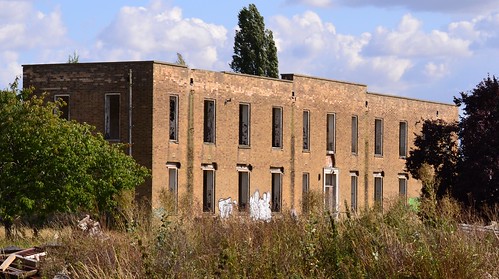
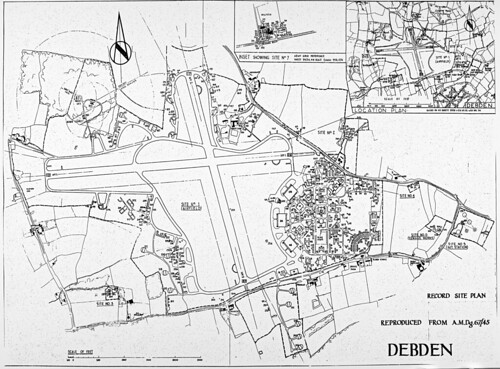
RAF Debden

RAF Debden, a non-dispersed site where accommodation and administrative areas were collectively close to the main airfield site within the outer perimeter (IWM17560).

The layout of these barrack blocks, took on the familiar ‘H’ shape, a design that replaced the initial ‘T’ shape of the post First World War and inter-war years. The ‘H’ Block became the standard design and gave a distinct shape to accommodation blocks on these prewar non dispersed airfields.

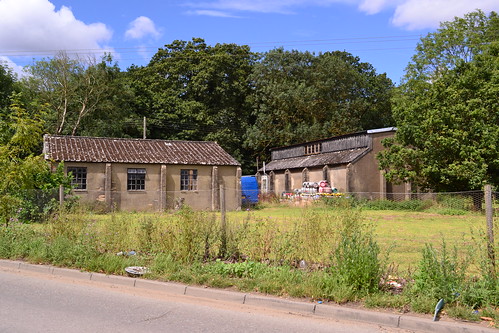
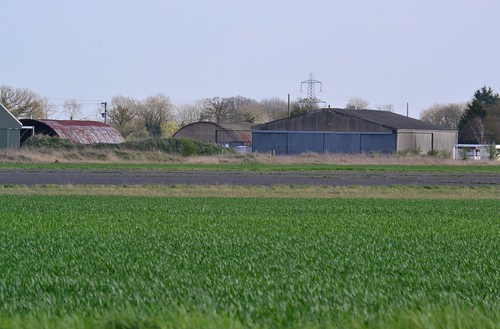
As the awareness of the dangers of non-dispersed designs became all too apparent, dispersed sites became the norm, where domestic areas were located a good distance from the main airfield site. Dispersed accommodation could have many sites, depending largely upon the nature of the airfield (Bomber, Fighter etc), when it  was built and whether it was operated by the RAF or USAAF. In these later dispersed schemes, domestic sites became more temporary in nature, whilst some remained as brick, many were built as prefabricated units often as Nissen or Quonset style huts, often due in part to the shortage of brick for building and the speed at which they could be erected.

With the changes in dispersing accommodation blocks away from the main airfield, safety increased but both administrative and operational effectiveness noticeably dropped. It was going to be a fine balance between keeping a safe distance and achieving maximum effectiveness.

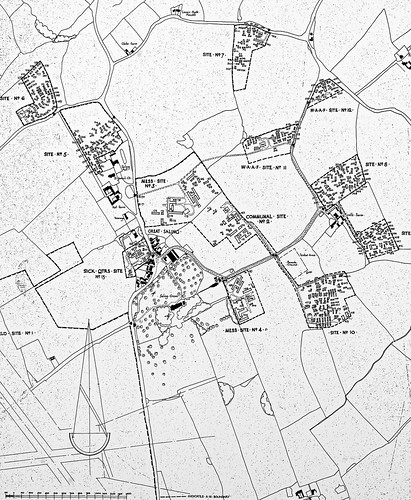
Andrewsfield Accommodation site

A typical dispersed site showing the accommodation areas dispersed well away from the main airfield (bottom left). RAF Andrews Field (IWM UPL17532)

Depending upon local topography, these domestic areas could be situated as much as two miles from the airfield site, wooded areas being utilised where possible to hide the location of huts; blocks were randomised in their position to break up the appearance of housing, and pathways weaved their way round the sites to reduce their visual impact. In most later airfields, a public road would separate the technical and accommodation sites, with as many as thirteen or fourteen sites becoming common place.

The separation of WAAFs from RAF communal quarters also ceased, men and women now allowed to mix rather than having the separate sites for each. As a result many post 1942 sites had fewer dispersed sites then those of pre 1942.

The design of the technical areas also took on a new look. The prewar practice of squadrons offices being attached to the hangar was dropped, these also being placed away from the main technical site, dispersals for ground crew or waiting pilots were spread about the perimeter so airmen could be closer to the aircraft but far away enough to be safe in the case of attack. This led to a number of buildings appearing on the outer reaches of the airfield, along perimeter tracks and near to hardstands, often these were brick, small and square, others more temporary.

Further changes occurred with the reduction in available materials. These changes have given rise to a wide variation in building design, again many airfields having a variety of buildings using different materials.

Initially, buildings built of brick were strong and commonplace, but as this became both scarce and time-consuming to build, alternative forms were found. Timber followed on, but it too proved to be time-consuming to manufacture, and by 1940 acutely rare also.

A range of materials were looked into, using a mix of timber and concrete, plasterboard and concrete, but they were all below the Air Ministry standard. Even so, many were accepted as design alternatives and used in temporary building construction.

1940 saw the return of the 1916 designed Nissen hut, a curved hut that bolted together in widths of 16, 24 or 30 feet. A cold but effective hut it was commonplace on many airfields as both accommodation huts and technical huts, many being sold post war, and ending up in farmer’s fields many miles from the nearest airfield. With the arrival of the USAAF in 1942-3, they brought with them the Quonset hut, bigger in design than the Nissen, they are mainly distinguishable by their curvatures, the Quonset being semi-circular to the ground whilst the Nissen gave a 210o curvature. This extra curvature gave greater use of ground space, but lacked in overall space compared to it US counterpart.

RAF Matching Green

A Quonset hut at Matching Green. Note the curvature at ground level.

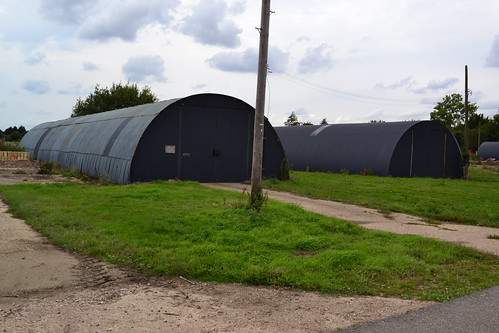
Nissen Hut on Acc. Site

The Nissen hut had a larger curvature giving greater ground space – RAF Fersfield.

Even this material became in short supply, metal being scare and urgently required for the building of military hardware. In 1942 the Ministry of Works took over control of hut design, manufacture and supply, and various new designs were brought into play. Asbestos became popular again, with the US being able to supply large quantities of the material. Uni-Seco Ltd, Turners Asbestos and Universal Handcraft being examples introduced at this time.

The final design to be used, was that of the Orlit, a reinforced concrete panel and post design that slots together to form the walls and roof. Also know as the British Concrete Federation (BCF) design they were quick to erect and lasted from many years. This type of design was used for emergency housing in the post war period and has since proven to be degrading to the point that some of these properties have been condemned.

Thus the architecture of airfield buildings took on many guises, from permanent brick designs, through timber, timber and plasterboard mixes, various metal design, asbestos and finally concrete, all of which gave a change in shape and design examples of which could appear on many airfields. The most common surviving examples today being the Nissen hut.

In the next section we shall look at the runway, the very heart of the airfield and often the defining factor in its designation.

Warning over Airfield Closures.

A recent report on the BBC has highlighted a number of military airfields that are set to close over the next six years, with the potential loss of thousands of jobs. However, the threat is much wider than that, and an all-party group have now highlighted the issue, putting pressure on the Government to take action before the situation becomes extremely serious.

In the report, the BBC say that the all-party group on general aviation, labels airfields as “national assets“, and that once closed they “will never be replaced” – a statement primarily based on the complex planning system currently operating in the UK.

Many of the sites identified by the BBC have already been reduced to a holding status, or with minimal military activity anyway. In most cases military flying has already ceased and in some cases, has been so for a number of years. So why are the all party group so concerned?

As highlighted previously, this is all part of a massive cost cutting exercise and streamlining of Britain’s armed forces, a move that will not only save money for the Ministry of Defence, but provide valuable space for much-needed new housing projects across the UK.

Military airfields not only employ armed forces personnel but they also employ a large number of civilians.  Many of these people live locally, and provide a great deal of income to the local economy. As such, many small towns, for example Mildenhall, could be seriously affected by any such closure of its military base. In the event that a new airfield be required, the cost of it would, even if possible, run into millions of pounds, and would take a considerable time to complete. At a time when Britain and her allies were facing increased threats from foreign nationals, is this not perhaps a dangerous policy to be considering at this particular moment in time?

Furthermore, the issue here is not just military airfields, but Britain’s airfields in general. The all-party group, led by the Right Honourable Grant Shapps MP, aims to promote jobs and growth throughout General Aviation in the UK. The group currently (April 2018) contains 150 parliamentary members, which is a record number of members, and one that highlights the depth of feeling amongst its associates.  The group’s primary aim, which covers four areas of aviation: Airfield, Airspace, Tax and Regulations and Heritage, is to safeguard Britain’s network of airfields regardless of their size or status.

The BBC report states that many of those airfields highlighted are also used by both private pilots and particularly flight training firms, who are having to move their operations abroad due to lack of suitable airfields in the UK. Along with other ‘non-commercial’ flying activities (general aviation), these account for “£3bn a year to the UK economy“, the BBC says citing Government figures.

Whilst both military and general aviation airfields are the focus of this report, there are also wider issues at stake here. Figures quoted by the group show that the closure of Britain’s (civilian) General Aviation airfields not only affects the £3bn Gross Value Added (GVA), but directly affects over 38,000 people employed largely in the Science, Technology, Engineering and Mathematics (STEM) roles. These activities they say, “provide the foundation for the much broader £60.6bn UK aviation sector“.

The general aviation situation at the moment, according to the all-party group, shows that in Surrey for example, every licensed airfield is under threat, whilst in Hertfordshire there is only one remaining licensed airfield, and in twenty-two counties across the whole of the UK, there are no licensed airfields whatsoever.

In terms of heritage, many of these airfields, and those that have closed already, are former World War Two sites, and as such have an immense  historical value to them. As we have seen many times already, many of these airfields are no longer in existence and many have been reduced to mere shells of buildings with no memorial, or little recognition of the human sacrifice made from them.

With the closure of airfields comes the knock on effect of air displays, which since the tragic events at Shoreham, have become prohibitively expensive. Owners of historic jet aircraft for example, are having to sell them abroad as they can no longer afford to fly them in this country. The drain on flying examples could, they say, lead to there being no examples of post war models left flying in this country at all. Even military supported fleets e.g the Battle of Britain Memorial Flight, the Royal Navy Historic Flight and the Army’s Historic Aircraft Flight, are having their ability to perform at airshows reduced by Government cutbacks. This is particularly worrying they say, as evidence shows that a considerably large number of armed forces recruits are gained through airshow attendance.

Promoting general aviation, and particularly Britain’s rich and diverse aviation heritage across the UK, also falls to the numerous museums located around the country.  The majority of people they say, are within an hours drive of at least one aviation museum, and whilst the majority are on former wartime sites in the east and south of the country, this figure broadly applies to the whole of the UK; one I think you’ll agree is both astonishing and reflective of the general interest in aviation in this country.

The national interest in aviation has also been heightened by the current anniversary of the founding of the Royal Air Force on April 1st 1918, but notwithstanding this, visits to these museums accounts for an estimated 2.5 million visits a year, generating over £40 million of heritage tourism revenue – a very significant figure indeed.

The purchase and storage of static aircraft for these museums is also a costly one, rents, hangar space and ground running costs are ever-increasing. Aircraft themselves are not cheap, and few museums can ill-afford to update ‘stock’ with models that are becoming more rare with each passing day. New or more recent examples are also at the base of the argument; with the forthcoming withdrawal of the Tornado for example, how many will be ‘offered’ to local small-scale museums at a reasonable price rather than dealers who will pass them on to foreign or large-scale buyers.

Furthermore, many of these museums, house archives and personal records of those who served during many of the conflicts this country and her allies have been involved in over the last 100 years. Allowing these organisations to prosper, enables future generations to access records, photographs and information, not only about world history, but in many cases family histories too.

The closure of Britain’s airfields has not just a localised impact, it has a national impact that long-term, could have serious affects not only on the aviation and tourist economy as a whole, but science and technology, the armed forces and historical sources too. Whilst the need for housing must be met, a balance must also be sought where these valuable assets are not simply stripped away and forgotten, but consideration is given to their historical and economic contributions too. We can ill-afford to let our aviation heritage be simply removed without due consideration of the financial, economic and historical consequences.

Some of the airfields currently listed as ‘under threat’ include:

Andrewsfield
Blackpool
Bourn
Deenethorpe
Dunsfold
Elvington
Halfpenny Green
Kemble
Long Marston
Manston
Alconbury
Molesworth
Mildenhall
Chalgrove
Colerne
RAF Henlow
RAF Hullavington
RAF Wyton
RAF Wethersfield
RMB Chivenor
Linton-on-Ouse
RAF Topcliffe
Nottingham City
Old Sarum
Panshanger
Peterborough
Plymouth
Redhill
Rochester
Wellesbourne
Wycombe Air Park
Fairoaks
North Danes
Tollerton
+ 30 other MOD sites

The BBC highlighted the story on April 21st 2018 via their website. (this may not be accessible outside of the UK).

The General Aviation All-Party Parliamentary Group has a website detailing its aims and policies. It also encourages lobbying of MPs for improvements to the planning process and in particular the protection of Britain’s aviation heritage.


The Development of Britain’s Airfields (Part 4).

In Part 4 of the Development of Britain’s Airfields, we take a short look at the construction process and the numerous companies that were involved in building the airfield. Once a site was found in Part 3, compulsory purchase was made and the developers moved in.

Building the airfield.

The creation of airfields was set, each plan was studied, trees, shrubs and hedges were removed, ditches filled and the land leveled to a maximum gradient of 1:60.

First of all to reduce the risk of machinery being bogged down, perimeter tracks were built. This allowed the delivery of heavy loads to any part of the site, and so were originally designed to carry support vehicles rather than aircraft. One reason why so many grassed airfields had hard perimeter tracks.

With such a big workforce being drafted in, accommodation for the workers would be needed, these would generally be the huts that would be used for the aircrews and other personnel on the base once active. Drainage and dry storage was needed as a matter of urgency, and were usually a priority even before the accommodation areas.

RAF Bury St Edmunds (Rougham)

Buildings would be built using a range of materials.

Hiding these enormous excavations was going to a headache for the authorities. How do you hide a building site covering many acres? (Average grassed stations covered 200 – 400 acres whilst those with runways were around 500 acres extending to over 1,000 by the war’s end).  Numerous strategies were tried from painting the ground to covering it with coal dust, even adding wood chip to the concrete surfaces was used all with little real impact. Any spy or reconnaissance pilot worth his salt would have spotted the works and reported back immediately.

Gradually the airfield developed. Workers worked in shifts covering a 24 hour working day, seven days a week, this meant that the construction period was relatively short and the completion rapid. By the end of the war some £200 million worth of work had been carried out involving somewhere in the region of 130,000 individuals including engineering workers, and building sub-contractors.

As the site neared completion, RAF staff would begin moving in. The stores officer or ‘Equipment manager’ would often be first, ordering the necessary supplies to accommodate the forthcoming personnel. He would usually be followed by a NAFFI and a medical officer who would officially declare the site ready for occupation. Once this had been given the ground crews would be brought in, followed by aircrews and the aircraft. Even with a newly opened site, it was rare that it was ever fully finished, often accommodation was rudimentary or cooking facilities limited. In some cases tents were the order of the day until construction was completed. Great emphasis was placed on getting the site open and operational rather than ready. In some cases ground crews, who were otherwise waiting for aircraft to arrive, would take to shovels and picks to complete or improve upon work that had been started on site.

Also the airfield needed naming. Names were usually taken from the nearest village or town, and where confusion might arise from a similar name, it could then be taken from an alternative nearby village. This is why some airfields appear to be quite distant from their respective named locations. Alternatives to this would be geographical features or alternatively local farms e.g RAF Twinwood Farm. The Americans used the system of numbering partly because (a) the American airmen were unable to pronounce accurately some of the English names and were often found getting confused by them, and (b) the American administration system made it easier to use numbers rather than names.

By now the airfield was built, or at least open, the first unit would arrive and airfield defences would be set up. Military personnel would become established and operations would soon begin. All this could occur within months, it was a massive undertaking achieved in very little time.

In the next section we look at the architecture of British airfields, how the idea of replication in design led to architectural developments, and how the demand for materials led to changes in airfield buildings.

The Development of Britain’s Airfields (Part 3).

In Part 3 of this series, we turn from the political scene of Part 2 and look at how airfields were identified, The process and methodology of airfield selection.

Choosing a site.

Choosing an airfield site during these prewar periods was especially difficult as there were many ‘unknown’ factors to predict, a factor in itself that helped determine the needs of each of the various schemes mentioned previously. However, there were a number of airfields already in situ, some used by the military and some used by civilian aviation. As remnants of the First World War, many military sites were inadequate or inappropriate for the growing future needs of the RAF, but with some work, they could be developed into workable sites as the basic infrastructure was already there in place.

As well as these RAF sites, there were also civilian airfields, which the Government considered as potential military airfields. Because civil aviation had grown amongst the wealthier members of society, although not exclusively, this meant that in the pre-war period, there were some 90 airfields*4 owned either by local councils or under private ownership. Many of these were requisitioned by the authorities, but because many were small or located very close to built-up areas, (in 1928 the Air Ministry ‘encouraged’ towns of 20,000+ inhabitants to have a municipal airport), they were not suitable for modern fighter or bomber aircraft. As a result, many of these became training or maintenance sites, some linked to aircraft production facilities, but none were ‘operational’ for fighting units.

A further group of airfields in use at this time, were those of the AA (Automobile Association – better known as a motoring organisation). The AA Landing Grounds were often ex First World War sites located near to hotels and other places of interest to the motorist. Fuel was usually supplied at, or near to, each site, and each one was ‘tested’ by an aircraft on behalf of the AA before it was granted AA status. As these sites were registered, their locations were readily available to the Germans and so they were closed and rendered unsuitable for aircraft. However, land in close proximity was occasionally used, and so a new site would be created in a similar location.

With all these sites available, one would imagine choosing a site and developing it, would be relatively straight forward, but this is far from the truth. Many of these sites were inadequate, and the process of repairing/upgrading or rectifying it was simply not going to be sufficient. Therefore, many new sites were going to be required and the process by which a site was identified, acquired and then subsequently developed was not at all straightforward. In each case the Air Ministry Directorate (AMDGW) and Air Ministries Aerodromes Board would work in very close conjunction with numerous other Government departments and interested public bodies. These would include local Electricity Boards, Drainage Boards, the Geological Survey Department and the local War Agricultural Committee, who were concerned about flooding caused by run-off from the sudden building of large expanses of concrete.

In the first instance, using an ordnance survey map, areas that were below 50 feet above sea level or above 650 feet were generally ignored, the former being prone to flooding whilst the latter suffering high levels of low cloud or hill fog. Next a circle with a radius of 1,100 yards was marked off, this had to be flat with minimal rise in the ground layer. It also had to be free from obstructions and ideally at least three miles away from any other flying location. Next officers from the Air Ministries Aerodromes Board would walk the site, field by field, recording maximum landing distances, and noting any unidentified obstacles, trees, hedges, ditches or more permanent structures that would need removal.

By September 1939, board officials had identified, examined and recorded around 4,000 possible sites in the U.K. Many would be simply filed away never to see aviation of any kind, whilst others would become famous for years to come.

Once a suitable site had been identified and examined, the local geology had to be established where possible. In the pre-war years, no consideration was given to hard runways, they didn’t exist in any real form and were not seen as needed as any aircraft of that time could happily take off from a grass strip. However, in order to prevent aircraft wheels from bogging down, or flooding closing an airfield, well-drained soils were absolutely paramount.

Once the site had been accepted, the land was requisitioned, forcibly purchased using new powers created under the Emergency Powers (Defence) Act 1939. This gave virtually immediate access and ownership of the land – with little notice to the land owner – to the Government. These powers also saw their way to reducing the ‘NIMBY*5 effect, protests against developments being side-lined through political clout.

The next stage in the process was to put the job out to tender. The difficulty here was that secrecy was of the utmost importance, and so little of the detail was released other than an approximate location. As the war progressed, the number of construction companies involved became fewer, and those that were involved more established, prime contractors being Wimpey, Laing, Taylor-Woodrow and McAlpine – all of whom went on to be major construction companies post war. That said, no major airfield would generally be completed by one single contractor, as the whole process required a wide range of skills based operations. As one completed their task, another would come in, sometimes dual operations would be carried out simultaneously. For example taxiways and access roads may have been built by Tarmac, whereas the runway may have been built by McAlpine. Accommodation areas often used ‘Nissen’, or in many USAAF cases, ‘Quonset’ huts, many of these and other ‘standard’ buildings were erected by buildings contractors whereas other more substantial buildings may have been built by John Laing and Co.

By the outbreak of war, 100 sites had been purchased, as the number was relatively small, the board were able to be ‘particular’ in their choice, something that was quickly disregarded as the war progressed.

Airfields are highly labour intensive projects requiring an enormous workforce and extensive heavy machinery, little of which were available in the early 1940s. Irish labour provided the backbone of the initial workforce, whilst heavy plant came in from the United States. At its peak there were some 60,000 men employed on airfield construction, all of whom were unable to spend their time rebuilding the devastated towns and cities of the UK.

As the war progressed, the Royal Air Force Airfield Construction Service began taking a greater role in airfield construction, diversifying away from their original role as repairers of damaged airfields sites. There would be an initial 20 squadrons created to carry out these tasks, with a further 6 being formed later in the war. With squadron numbers ranging from 5001 to 5026, they would be initially involved in the updating of older sites and the creation of ALGs, eventually taking on a much greater responsibility of airfield construction. These squadrons, were of course given great assistance by the well established Royal Engineers.

In 1942, the United States joined the European theatre sending their own Engineer Aviation Battalions to the U.K. Their task was to support these British squadrons by building their own airfields ready for the huge influx of men and machines that was about to arrive. The first site completed by the Americans and opened in 1943, was Great Saling (later renamed Andrews Field) by the 819th engineer Aviation Battalion. Not being experienced in U.K. soils, it was a steep learning curve fraught with a number of initial problems.

Former RAF Andrewsfield

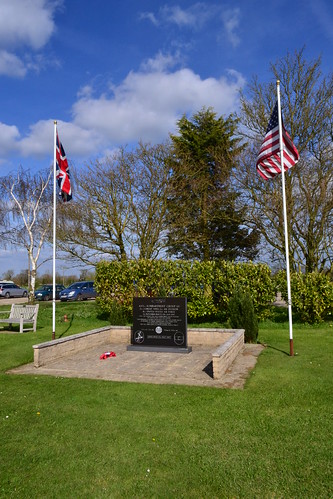
RAF Andrews Field memorial to the 819th Engineer Aviation Battalion.

In 1939 there were only 60 military airfields in the UK, by 1940 this had increased to 280, almost tripling to over 720 by 1945. Between 1939 and 1945 444 airfields*2,4 new airfields were built by these organisations – an amazing feat by any standard. Using almost a third of Britain’s total construction labour force, they were often open and manned within a matter of months rather than years. Building Britain’s wartime airfields was not cheap. Many, like Debach the last USAAF airfield to be constructed, cost almost £1,000,000 to construct.  A small amount compared to the £645, 000,000 it cost to build all 250 US airfields in the UK*5a

This whole process however was not fool-proof. In a number of situations sites were identified and requisitioned, but not developed. In several cases they were partly built, and in others like RAF Cottam, they were completely built but then never occupied. Some airfields were identified for USAAF use, only to be declined and then handed over to their RAF counterparts. Some US bases were never actually started but remained named and therefore official sites even though they remained as farmers fields!

The lead up to war led to a massive change in the British landscape. Keeping airfields secret led to many being built in remote areas and away from major towns. Little did the inhabitants of these quiet little villages know, but their population was about to increase, in some cases by thousands.

In the next section we look at how the airfield was built, the process of construction and the difficulties faced during this phase.

Sources and further reading. 

*2 Smith, D.J., “Britain’s Military Airfields 1939-1945“, Patrick Stephens Limited, 1989

*4 Francis, P., et al, “Nine Thousand Miles of Concrete, Historic England in Conjunction with the Airfield Research Group (ARG). pdf document Published 15/1/16 via website accessed 2/1/18

*5 NIMBY – Acronym used to describe the objections of local planning projects. (Not In My Back Yard).

*5a Wilson. K., “Blood and Fears – How America’s Bomber Boys and Girls in England Won Their War.”, Weiden & Nicolson. (2016)

The Development of Britain’s Airfields (Part 2).

In this series of posts we look at the development of Britain’s airfields and how they developed over the years. We move on from Part 1, and the “Road to War”, to look at the Political response to Germany’s build up and the development of the airfield. We focus on the expansion period 1934-1939, and the political moves that helped shape the airfields that are found in Britain today.

The expansion period and airfield development.

In this, the expansion period 1934-39, airfield development would become a prime factor in the RAF’s own development.  The driving force behind this was the need to increase the numbers of front line aircraft, both fighters and bombers, if Britain was to be able to match Germany’s growing armed forces and her desires over Europe. To this end, a number of schemes were created, each one building upon the previous through  adaptation of technological development, design improvement and political pressure. A continuation of updating meant that the face of the British airfield would change considerably from 1934 to the end of the war in 1945. This development would then go on post war as the world entered the jet age and nuclear deterrent.

Whilst many of Britain’s original airfields dated back to the First World War, the vast majority had vanished, (of the original 301 only 45 remained and of these 17 were civil*2) the rest being sold cheaply in the reorganisation of the post war RAF. Of those that did remain, many were poorly kept, the permanent huts that had been built were in poor condition and flying surfaces totally inadequate for the heavier aircraft that were envisaged.  Many of these airfields were located around London (including Biggin Hill and North Weald) and were built on a clay subsoil, a soil that holds water and led to numerous accidents as aircraft landed badly. The RAF began to apply pressure on the Government, but with no real direction, there was little hope of achieving anything more than lip service.

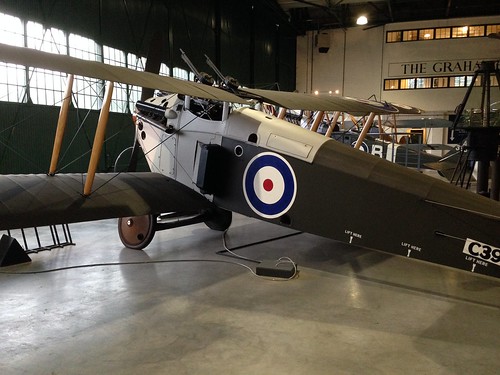
RAF Museum Hendon

Early biplanes formed the backbone of the interwar years.

The Government finally realising that change was needed, formed a new department, whose role of executing these new plans it fell to. The Air Ministry Directorate General of Works (AMDGW) under the control of Ernest Holloway, oversaw the process with the new Air Ministries Aerodromes (later Airfield) Board, being responsible for identifying the new airfield. The Lands Branch of the Air Ministry would purchase the land, and then the construction, development and maintenance would be carried out under contract, by civilian organisations, to the Air Ministry.

This process took airfield design through a series of successive alphabetically listed schemes commencing with ‘A’ (not to be confused with Class ‘A’ airfields that emerged much later in 1942) progressing through to ‘M’. Due to the rapid changes in these designs though, not all were implemented, many being absorbed into subsequent models before they could be administered. The future development and expansion of the RAF would be built-in to these schemes, restricted initially by the monetary cost of such a plan. But the overall  aim would be to build the RAF up to full strength within eight years (1942).

The key to these designs was continuity and replication. By creating a series of standard design drawings for everything from latrines to heating systems, hangars and runways, airfields could be ‘mass produced’ with ease, saving both time and money, which was paramount if the RAF was to be ready for the forthcoming war.

In essence, these schemes increased targets for aircraft numbers, including training facilities and airfield design:*2,3,4

Scheme A – (adopted in July 1934) is the scheme that set the bench mark by which all future schemes would develop, and called for a front line total of 1,544 aircraft within the next five years. Of these, 1,252 would be allocated specifically for home defence. This scheme was responsible for bringing military aviation back to the north of England, Norfolk and Suffolk, of which Marham (the first), Feltwell and Stradishall were among the first completed. These airfields were designed as “non-dispersed” (or compact) airfields, where all domestic sites were located close to the main airfield site, and not spread about the surrounding area as was common practice in war-time airfield designs. At this stage, the dangers of an air attack were not being wholeheartedly considered, and such an attack could have proven devastating if bombs had been accurately dropped. It was thought that by having personnel close by, airfields would run both economically and efficiently, and of course they could more easily be protected from ground forces.

Scheme ‘A’ would also introduce the idea of standard building designs, in which all new airfields (and older original airfields) would now be built to.

Scheme B – was never submitted to Government

Scheme C – adopted May 1935 following Hitler’s boast to Anthony Eden that the German Air Force had surpassed the RAF’s in number, a claim that has since been discounted. This would develop bomber bases within flying distance of Germany (notably Lincolnshire and Yorkshire), and proposed creating a further 70 bomber and 35 fighter squadrons accommodating 1,500 front line aircraft within two years.

Scheme D – was never submitted to Government

Scheme E – was never submitted to Government

Scheme F – replaced Scheme ‘C’ and was approved in March 1936. Scheme ‘F’ expanded the defence force, further increasing front line numbers to 1,736 with a foreseeable number of 2,500 by 1939. This scheme saw the creation of additional factories in close proximity to the already adopted car manufacturing plants in the industrial midlands. A move that was intended to assist with the supply of new aircraft and aircraft components. Such was the industrial output at this time that Aircraft Storage Units (ASU) had to be specially set up utilising land on already established Flying Training Schools. These ASU stations would be specifically created to assemble or disassemble aircraft for transport to fighter bases, either within or outside of Britain. Scheme ‘F’ would also create further new front line airfields, examples including: Debden, Upwood, Scampton and Dishforth, with further updating being implemented at previously built airfields.

Scheme G – was never submitted to Government

Scheme Hreached proposal at the end of 1936 and would have increased front line strength at the expense of the reserves, and so was rejected. It was at this point that the ADGB and associated bodies were split into the four aforementioned commands each headed by a Commander-in-Chief (CIC)

Scheme I – was not used

Scheme Jonly reached proposal, but would have provided the RAF with 2,400 front line aircraft. It was considered too expensive and rejected in lieu of Scheme ‘K’.

Scheme Kreached proposal in March 1938, but was considered too small following the German’s annexation of Austria. A further review was requested which accelerated the expansion, and was proposed a month later as Scheme ‘L’.

Scheme L – passed by the Government on 27th April 1938, it called upon industry to produce the maximum output possible over the next two years. Superseded by ‘M’ after the Munich crisis, new airfields included: Binbrook, Leeming, Middle Wallop, and Horsham St. Faith. This scheme required 2,373 front line aircraft in 152 squadrons, and focused on fighter Command; in particular, increasing the number of fighter pilot training units. Scheme ‘L’ also called for increased accommodation facilities to allow for this increase in trainee pilots, and it called for new RAF Hospitals, the first of which was at Ely in Cambridgeshire.

Scheme M – approved on 7th November 1938 and called for 2,550 front line aircraft by March 1942. Airfield examples included: Swanton Morley in Norfolk, Coningsby in Lincolnshire and West Malling in Kent. This scheme introduced the ‘J’ and ‘K’ hangars, implemented as part of austerity measures, one of the few permanent buildings now on site.

By the outbreak of war the RAF had a force that equalled less than half that of the Luftwaffe, Fighter Command possessing only 1,500 aircraft (less than was required under Scheme ‘F’), of which many were already outdated or inadequate. Bomber Command had 920 aircraft, but nothing was bigger than a twin-engined aircraft with limited capabilities.

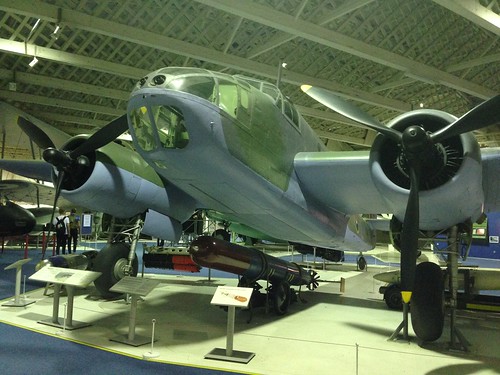
RAF Museum Hendon

The RAF’s front line bombers were twin-engined with limited capability.

The four Commands created out of the ADGB were also undergoing dramatic change, with aircraft being distributed more appropriately and groups being formed to streamline operations. Whilst still far below the levels at which the Luftwaffe were operating, the RAF had over the last few years seen a major reconstruction process, both in terms of aircraft and airfield development, along with major changes in the Air Force’s structure.

As aircraft were designed to perform different duties, airfields within their commands would also differ in their operation and construction. Hangars or watch offices for example, would be designed but modified depending upon the nature of the airfield they were servicing. Standard buildings would be altered to suit the different needs of the different duties, and airfield design would take a change in direction, the non-dispersed site being discarded for the safer, but less efficient, dispersed site.

As the years progressed, further changes to airfield development would occur as new, larger and heavier aircraft were developed. The four engined heavies: Stirling, Halifax and Lancaster, determining new designs and new requirements. The entrance of the USAAF in the European theatre also played a part in airfield design and development, and by 1942, a new standard would be devised by which all future airfields would be built.

The Class ‘A’ airfield became the standard airfield design for bomber airfields, with many fighter airfields, training and temporary airfields remaining either as grass or using a form of steel matting. Twelve different types of matting were developed during the war, the most common being – Sommerfeld Track, Pierced Steel Planking (PSP – also called Marston Mat), or Square Mesh Track (SMT). The Class A was determined primarily by its runway layout and measures, formed around three intersecting runways at 60o to each other, the main was 2,000 yards long with two subsidiaries of 1,400 yards, each 50 yards wide. An extension of 75 yards was provided alongside the runaway to allow for emergency landings. In addition, another grass strip clear of all obstacles was also provided, these measured 400 and 200 yards respectively.

The Class A would set the standard from now on, the British airfield was now a major geographical conurbation. They were now like small towns, with cinemas, gymnasiums and other recreational facilities, they had dispersed accommodation areas, technical sites, large aircraft maintenance sheds and hard runways that only a few years earlier were unheard of.

Each of these schemes brought new requirements for airfield designs; their layouts and buildings were changing almost as fast as aircraft development. The airfield had finally evolved.

In the next part we look at the way in which a site was chosen, the number of agencies involved and the criteria for airfield location.

Sources and further reading. 

*2 Smith, D.J., “Britain’s Military Airfields 1939-1945“, Patrick Stephens Limited, 1989

*3 “Norfolk Heritage Explorer pdf document published by Norfolk County Council – via  website accessed 2/1/18,

*4 Francis, P., et al, “Nine Thousand Miles of Concrete, Historic England in Conjunction with the Airfield Research Group (ARG). pdf document Published 15/1/16 via website accessed 2/1/18

The Development of Britain’s Airfields (Part 1).

The development of Britain’s airfields has been both rapid and complex. The design, layout and specific requirements of airfields changing as the need for areas suitable for larger and more powerful aircraft arose. From the early days of flight through the expansion period of 1934 – 1939, and on into the cold war, Britain’s airfields have become iconic symbols not only of Britain’s defence, but also the rapid development of air travel.

The range of airfields is as wide as their developmental history: fighter; Bomber; Coastal Command; Emergency Landing Grounds (ELG); Relief Landing Ground (RLG); Satellite Landing Grounds (SLG); Advanced Landing Grounds (ALG) and Cub Strips, not to mention the fake ‘Q’ sites along with the various training, glider and ATC sites.

It is a very detailed and complex subject, and one in which there have been many valuable and in-depth texts written. It is a subject that is far too detailed to cover in its entirety here, but by focusing on the main features of airfield development, we can at least shed some light on the huge undertaking that reshaped the British landscape, and whose effect has been long-lasting, becoming the widespread topic of interest it is today.

In the following series of eight posts, we look at the development of these airfields, the main structures that are associated with them and how Britain’s airfields grew from basic fields to major conurbations as a result of the direct threat of war.

We start with the build up to war and the growth of the Royal Air Force from 1918.

Britain’s Road to War.

The Royal Air Force was formed on April 1st 1918 through an act of Parliament that saw its predecessor, the Royal Flying Corp, mutate into what has become not only one of the premier fighting forces of the world, but also the oldest Air Force in the World. However, in the post-war era following the First World War, political opinion was very much against the continuation of the RAF, feeling that it was exhausting an already depleted national economy and contravening a stern non-rearmament policy. In addition, an apathetic and vehemently pacifist post war public was also hard to convince that a third force, which was seen as ‘weaker’ than its two older sisters, was really necessary.

Two men, Winston Churchill (then Minister for War) and Air Marshal Trenchard (as Chief of the Air Staff), crusaded on behalf of the RAF, seeing it as the valuable asset it had become. In the Trenchard memorandum of December 1919, Trenchard outlined the biggest re-organisation of the Royal Air Force in history, a change that included everything from insignia and uniforms, to buildings and training. It was a change that would establish the RAF as an air force capable of mobilisation and expansion at a moments notice.

To achieve these goals, Trenchard would set up a rigorous training plan, with stations specifically designed to deal with the various aspects that would be needed; an Air Force Cadet College at Cranwell, a flying training school for Air Force Staff in Andover, a further scheme for short-service commissions and a technical college at Halton (set to close in 2022) in Buckinghamshire.

RAF Cranwell

RAF Cranwell in Lincolnshire remains the Officer Training College today.

This re-organisation would be a re-organisation for survival, and would involve the disbandment and demobilising of vast numbers of men and women; the subsequent rundown of the RAF being both rapid and immediate. By March 1920, in excess of 23,000 officers, 21,000 cadets and 227,000 other ranks and been demobilised and returned to ‘civvy street’. The new RAF was small, formed with just 3,280 officers and 25,000 other ranks. Assets too were stripped, airfields were sold off and hardware disposed of, but the Air Force was going to survive as an independent fighting force that would become a major peacekeeping force within the next few decades.

In the 1920s, and even though limited by the 10 Year Rule on defence expenditure, Trenchard envisaged a build up of the Air Force, incorporating both fighters and bombers, to a level that would be both powerful and dominant. He set a target of some 52 Home Defence Squadrons, but his continued battles with the Army, Royal Navy and politicians alike, meant that this figure would take many years to achieve and Britain would be poorly protected in the case of attack.

In a statement by the Secretary of State for Air, Sir Samual Hoare, at a meeting of the Imperial Conference on October 19th, 1923, Sir Samual highlighted the inadequate numbers that were present for Home Defence, he said:

“When the Navy and Army requirements were met and the squadrons provided for the Air Command in Iraq, and provision made for training in Great Britain, the machines left for home defence in Great Britain were altogether insignificant. I may give as an instance of this insignificance the fact that a few months ago at the height of the Turkish crisis, when we had sent two Royal Air Force squadrons to Constantinople, we were left with only twenty-four first-line machines actually available for home defence against air attack.”

Whilst slow, the 1920s and early 1930s did see the RAF expand, achieving 65 squadrons by January 1st 1935, mostly manned by fully trained reserves. This did however, do little to bolster the front line numbers of available fighters, and as demands for spending cuts in the world’s depression started to bite, this build up began to slow even further.

It was during these early 1930s that movements in Germany, in particular with Hitler and the rise of the Nazi Party, gave rise to an uneasy feeling across Europe; a feeling that would lead to new policies being implemented, policies that would refuel the impetus of Britain re-arming its major forces in the latter half of the 1930s.

With events like the Schneider Trophy and displays at Hendon capturing the imagination of the public, the Government saw these as a way to develop new faster and more agile aircraft, and as a pedestal on which to put both Britain and the RAF. These air displays continued until 1937, when a war with Germany became evermore likely, and the previously formed rearming policies began to take shape.

German boasting of its redevelopment was barely enough to hide the fact that it was rearming as early as 1932, and the speed at which this was happening would far outstrip the RAF’s meagre numbers in the years following the Nazi’s rise to power in 1933. In these early years, Britain’s bomber strength was as low as five night, and six-day bomber squadrons, each one operating limited, slow and cumbersome biplanes. Aircraft that were no match for even the reduced force that Germany was to front during the controversial Spanish Civil War.

Germany’s rearming was occurring at an alarming rate, and after Goring’s inauguration as head of the Reich Commission for Aviation, a formal request for the purchase of British aircraft, by Goring, was refused, but ironically not the supply of two military supercharged aero-engines that were to be built under license in Germany! Britain was not alone in this action though, the USA also sold Germany contravening merchandise during the 1930s, 19 aircraft and 569 aero-engines crossed the Atlantic, with most of these being supplied during 1934.*1 Perhaps even more astonishingly, the World War 1 German Ace Ernst Udet visited the US in the 1930s, where he developed not only ground attack and dive bombing techniques, but purchased two Curtiss Hawk II biplanes, which were taken back to Germany for evaluation for future dive bomber designs. This action eventually led to the Germans developing the Junkers Ju-87, famously known as the ‘Stuka‘, an aircraft that wreaked fear and havoc across the European continent.

Although the depression of the 1930s held German production back, the number of air-frame plants rose from 2,813 in January 1933 to almost 38,000 in 1935. This rearming was becoming so rapid, that in 1933, six new aircraft manufacturers joined the seven already established – all diversifying from other engineering areas to begin aircraft manufacture. By 1935, the total number of air-frame and aero-engine plants had risen to an astonishing 53,865, an increase of nearly 50,000 in just two years.

This massive increase was highlighted in a letter from Winston Churchill to Stanley Baldwin (three times British Prime Minister) on March 17th 1935*8, in which Churchill pointed out that:

“I believe that the Germans are already as strong as we are and possibly stronger, and that if we carry out our new programme as prescribed Germany will be 50 per cent stronger than we by the end of 1935 or the beginning of 1936.”

This increase eventually led to a number of changes in Britain. One such change was the demand for a twin-engined aircraft capable of delivering a 1,000lb bomb up to 720 miles away. Whilst not record-breaking, specification B.9/32 led to both the Wellington and the Hudson being developed, each a major step forward from the biplanes in RAF service at that time.

A further major change that the German action brought about, occurred during the mid – late years of the 1930s (1934-1939) where Britain saw, what is now commonly referred to as, “the Expansion Period”, a period in which the RAF began to increase its numbers also. It was during this period (between May and July 1936) that the idea of Trenchard’s small elite force would become four; the Air Defence of Great Britain (ADGB) along with No.1 Air Defence Group and other administration and command groups, would be disbanded and reformed as four new commands: Fighter Command (HQ at Stanmore), Bomber Command (HQ at Uxbridge), Coastal Command (HQ at Lee-on-Solent) and Training Command (HQ at Ternhill). In addition, new aircraft were going to be required, particularly fighters and heavy bombers, and to support these new aircraft, a massive support network:  new training facilities; aircraft and aero-engine factories; storage facilities; armaments factories; flying schools, and of course a range of new airfields would be needed. Running in conjunction with this would be research and development. The RAF’s budget, which included research and procurement, rose from £17.5m in 1934-5 to £74.5m by 1938-39, a massive injection of cash to help develop these new ideas.

This demand would begin the process by which Britain would develop its airfields and air force, kick starting the huge economic and technological change that would see Britain move from the simple bi-plane to jet technology, and airfields that covered not just a few, but several thousands of acres of land across the British landscape.

Britain had entered the arms race with Germany, and it would be a race to the death.

In the second part we examine the political response focusing on the expansion period 1934-1939, and how Britain’s airfields changed as a direct result.

Notes, sources and further reading.

CAB\24\164 Note from the Meeting  of the Imperial Conference on October 19th, 1923. (National Archives)

*1 Dancey, P.G., and Vajda, A-V, “German Aircraft Industry and Production, 1933-45“. 1998, Airlife Publishing Ltd

*8 Churchill, W.S., “The Second World War Volume I – The Gathering Storm“, Cassell, 1948

Disaster at RAF Tibenham.

In this post, we revisit Tibenham in Norfolk, the home of the 445th Bomb Group, Eighth Air Force. Whilst here, the 445th would suffer the worst casualty rate of any Bomb Group in a single mission, a mission that virtually wiped out the entire Group. Yet they would no give up, determined they would go onto have one of the most successful bombs on target statistics of all the Eighth’s Bomb Groups, a record they can be proud of.

RAF Tibenham (Station 124)

Station 124 was one of those purpose-built airfields designed specifically for the USAAF in the mid-part of the war. Known to the locals as Tivetshall, it occupies a site previously used by the Royal Flying Corps in World War 1 (although there appears to be no record of units based here).

In preparation for the Air Force’s arrival, a Class A airfield was built, with three standard concrete and tarmac runways, the primary of 2,000 yds and two secondary each 1,400 yds long and all the standard 50 yds wide. In addition, there were thirty-five ‘frying pans’ hardstands and a further seventeen ‘spectacle’ hardstands, all dotted around the perimeter track. Aircraft maintenance was completed in two T2 hangars, one in the technical area and one other to the south side of the airfield. The bomb store was located to the north-west of the airfield, with the technical and administrative areas to the east. Beyond this, dispersed further to the north-east were the accommodation areas: two communal sites, a WAAF site, sick quarters and seven male accommodation sites. Accommodation was initially designed for 3,000 personnel, using mainly Nissen huts with some Orlit hutting on site. Most other buildings were ‘temporary’ and built of brick.

RAF Tibenham Perimeter track

Part of the perimeter track – RAF Tibenham

Built over 1941-1942 by W. and C. French Ltd, it was opened in 1942, and was the temporary residence for the ground echelons of two squadrons of the 320th BG in November that year. The plan was to send the air echelons via the northern route, but due to heavy losses of the 47th and 319th BGs, they were diverted to North Africa via the southern route. The Ground echelons would then join them departing both Tibenham and nearby Hethel on November 21st 1942.

Tibenham then remained unoccupied by operational forces until November 4th 1943, when the 700th, 701st, 702nd and 703rd Bomb Squadrons of the 445th Bomb Group, Eighth Air Force arrived.

The 445th’s journey brought them from Gowen Field in Idaho, through Wendover Air Force Base in Utah, to Sioux City where they completed their training. In October the ground echelons sailed on the Queen Mary arriving in Scotland in early November. The air echelons flew the southern route, covering Florida, Puerto Rico, Brazil and West Africa before arriving shortly afterwards.

Flying B-24 Liberators, they would perform their first mission on December 13th 1943 – a month after their arrival. Their first target was the U-boat pens at Kiel. Along with other units of the 2nd Bomb Division fifteen aircraft would take off and undertake what was to be a relatively uneventful sortie, all the 445th aircraft returning with only two aircraft damaged and no casualties.

Their third mission, also in December, was less successful. A massive force of 546 bombers left England to attack Breman, arriving over the target between 11:42 and 12:14, the force was badly hit by ME-410s of the Luftwaffe. The 445th had fifteen of their aircraft damaged, with two crewmen wounded and eleven classed as ‘missing’. The realities of war were beginning to bite home.

1944 would be a more decisive year for Tibenham and the 445th. During the February ‘Big Week’ campaign against the German aircraft industry, Tibenham would suffer from accidental bombing by a returning Liberator. After being recalled, a  B-24 accidentally released a bomb whilst flying over Tibenham airfield, the resultant explosion killing two servicemen and a civilian in a nearby house.

The 445th would also suffer this year, but for their determination and action over Gotha they would be awarded a Distinguished Unit Citation (DUC), an award that reflected their bravery.

RAF Tibenham

Today’s huts and hangars

The eight groups of the 2nd Bomb Division (BD) were targeting the Me-110 factories on February 24th 1944, dropping 372 tons of high explosive bombs. During the  mission 239 aircraft would leave England in three large wing formations, the 445th in the 2nd Combat Wing (CW) were to fly in the lead, along with the 389th BG and the 453rd BG. Behind them were the 14th Combat Wing with the 20th Combat Wing bringing up the rear.

The lead group were hit hard as much as 80 minutes before the target. Flying ahead of schedule, they had failed to rendezvous with their escort and so were at a huge disadvantage. Flying at altitude, the lead aircraft of the 389th suffered oxygen problems, which caused the bomb aimer to suffer from anoxia, the condition led to him release the bombs early, over Eisenach and not the primary target. As the bombs fell toward the ground, others in the wing began to follow suit, all releasing their bombs far too early, and well away from the target area. The 445th realising there was a problem, ignored the false signal and continued on to the target alone. Being out of formation and without escort, the B-24s were ‘sitting ducks’, and unsurprisingly were given special attention by the Luftwaffe.

From then on, and for an hour after the bomb run, Luftwaffe fighters attacked the B-24s, and one by one, the heavy bombers fell from the sky as fighters picked them off. After two and a half hours of relentless attacks, thirteen of the original twenty-five aircraft had been lost and nine others were badly damaged. The mission had cost 50% of the groups aircraft, but it was a tragedy that was not to be their last, nor their worst.

The main formation who had released early, had also suffered badly, being subjected to aerial bombing, cable bombing and rockets, an attack which led to a mission tally of thirty-three aircraft being lost and 314 airmen being classed as ‘missing in action’.

March 1944 would also be a noteworthy month. It was the end of a career as Commanding Officer for Capt. James Stewart, Commander of the 703rd BS. Posted here before he was declared unfit for flying duty, he arrived as ‘Operations Officer’, before being given the Command of the 703rd. He would go onto fly ten missions with the 703rd before departing Tibenham for Old Buckenham and the 453rd BG as Group Operations Manager.

Because the 445th had flown many missions over the winter months, March would become noteworthy for another reason. Four months after their first operation, Lt. Sam Miller and the crew of B-24 #42-110037 of the 700th BS had completed twenty-five missions whilst here at Tibenham, they were the first crew of the group to do so. At last some good news had brought relief to the horrors of the previous months and in particular the disaster of ‘Big Week’.

Ground personnel of the 445th Bomb Group gather around a B-24 Liberator (I5-B+, serial number 42-110037) after its return to base on D-Day. Printed caption on reverse: '51451- Ground crew swarming around a bomber returning from a D-Day mission for information on the invasion.' Handwritten caption on reverse: 'Lt Sam Miller's B-24 returning to Tibenham, Norfolk after he and crew completed a 25 mission tour of operations. First crew in the 445th bomb Group to do so.'

The return of B-24 #42-110037 after its crew had completed 25 Missions (USAF).

In the lead up to the Normandy invasion in June, the 445th attacked airfields in the Paris area along with V-weapons sites in Northern France, and on D-Day itself, they returned and attacked the shore installations, pounding them before the land forces arrived. The 445th then went on to help with the breakout at St. Lo striking enemy defensive positions. The Tibenham group were now so successful that they led the ratings for the most accurate bombing of all the Liberator groups in Europe, these successes though, were to be short-lived, for on September 27th 1944, the 445th would suffer its own ‘day of infamy’.

On that day the group was allocated the Henschel facility in Kassel, and they were to lead 315 B-24s to the target. Navigating by GEE the 445th took a wrong turn and left the protection of the formation. The turn went unnoticed by the remainder of the group and so, all of a sudden, the 445th were now out on a limb and lacking the protection of the formation once again.

The group then all dropped their bombs, but unbeknown to them they were not over Kassel but were in fact over Gottingen some 20 miles away. After implementing the withdrawal plan, the 445th put themselves even further away from the main force, they were now alone. All of a sudden the 445th met II/JG.4, and what followed would all but wipe out the group.

Fw-190s approached the group from behind, three abreast diving down as they fired. Then followed two Me-109 Gruppen of JG.4 who picked off the damaged aircraft. With individuals falling away, the formation was spread and broken up, some 150 enemy aircraft had attacked and devastated the group.

In around five minutes, the Luftwaffe fighters had picked off and dispatched twenty-five B-24s and damaged most of those that remained flying. Only the intervention of US fighters stopped the total and complete annihilation of the group. The scene was devastating, the sky was full of smoke and debris, parachutes from both sides floated through the carnage. Three more B-24s crashed on the way, luckily in allied territory, two others managed to reach Manston’s emergency runway and one more crashed at Old Buckenham. The four remaining aircraft managed to limp back to Tibenham, but only one was able to fly again the next day.

In a written account*1, Pilot Capt. William R Dewey Jr describes the scene in his B-24 (one of those that made Manston)

“The tail turret had caught fire, from direct hits by 20 mm cannon in the first wave of FW-190s, both waist gunners were wounded and bloody along with the tail gunner. There was a huge hole in the right waist ahead of the window, the left waist window was shattered. Control cables to the tail were partially damaged, and the twin vertical rudders appeared frayed and disintegrating. Looking out the copilot’s window we could see a 3′ diameter hole in the upper surface of the wing behind the #3 engine, where 100 octane gasoline was splashing out.”

Dewey goes on to explain how the co-pilot William L. Boykin Jr, carried oxygen bottles back to the wounded crew, gave them first aid and comforted them. Dewey then decided to drop below oxygen requirement level and risk ditching. Switching channels to the emergency channel, he manged to contact air-sea rescue using the code word “Colgate“. After obtaining a radar fix, they gave him a heading for Manston.

After an hour Dewey spotted Manston and began the task of landing not knowing what condition the flaps, undercarriage or tyres were in. Thankfully all were in good order and he described it as:

“the best I ever made in a B-24 – like we were on feathers. A day we will never forget!”*1

Statistics for the day were horrendous, the efficiency of the German controllers had been spectacular, no previous efforts had yielded such incredible results; 236 men were missing, 1 was dead and 13 were injured in the resultant crashes. This loss, left only ten aircraft in the entire group, and would go down as the worst operational day of the war for any single group of ‘The Mighty Eighth’.

The 445th would regroup and return though. In December and January they supported the troops in the Battle of the Bulge by bombing German communication lines, helping the Paratroops holding up in the forests of the Ardennes.

On February 24th 1945, Ford built Liberator B-24H-1-FO #42-7619 “Bunnie” a veteran of 103 missions, took off from Tibenham’s main east-west runway. Within seconds something went wrong and the bomber crashed a few hundred yards west of the airfield. In the crash four of the crew were killed, the remaining five managed to survive.

Photo of

“Chuck” Walker & his crew being congratulated by Lt. Col. Fleming, (deputy commander) on completion of their 35th mission and “Bunnie’s” 100th.(IWM)

and then on 24th March 1945, they dropped food, ammunition and medical supplies to the troops who had made the Rhine crossing at Wesel. They returned later that day to bomb the landing grounds at Stormede.

The 445th went on to carry out a total of 282 operations building a reputation for high accuracy bombing in the face of danger. Further awards were received from the French for their support of the Resistance, in dropping food supplies, gaining them the Croix de Guerre, a highly regarded award.

The 445th flew their last mission on 25th April 1945, the last mission by the Eighth Air Force in Europe, attacking airfields and rail targets in south-east Germany and Czechoslovakia without loss. The 445th finally returned to the US at the end of hostilities leaving behind huge numbers of crews for whom home would never be back on their own soil.

After their departure in May / June, Tibenham remained ‘operational’ although no operational flying took place. The RAF then began to sell off parts of the airfield to the local farmers. A short-lived expansion of the airfield’s runway in 1955 led nowhere, as no aircraft were assigned to the airbase, and in 1959, Tibenham was finally closed as a military base. During this time, the Norfolk Gliding Club took over part of the site, paying a rent to the Ministry of Defence, remaining here even after 1964/65 when the airfield site was finally sold.

Since then the Club has fought long and hard to keep flying at Tibenham. Battles over land and attempts to curb flying have so far failed. Gradually bit-by-bit the infrastructure has been removed, sold off for hardcore and agriculture use.

Flying at Tibenham

Small piston engined aircraft keep the spirit alive

A small collection of memorabilia and photographs of the four squadrons based at Tibenham are maintained by the club, and a memorial stands as a lasting legacy to those who never returned.

Currently, large parts of two of the runways remain; the perimeter track can also be seen, being split by the main road round the airfield. Also a small number of huts are still being used and the site is in remarkable condition as a result.

Other evidence is hard to find, the majority of the accommodation, stores and works all being located to the east amongst the trees and on private land. I am reliably informed that primitive airfield defences can be found amongst the trees at the end of the runway. These amount to a ladder that would enable any defence troops to climb up and remain hidden should any German paratroopers fall.

The heavily laden bombers have long since been replaced by the grace and beauty of gliders, the control tower and other major buildings are now history, but as the summer sun and cool breeze wafts across the open skies above Norfolk, it is easy to picture these lumbering bombers, fuelled and crewed waiting for their turn to depart. With the roar of labouring engines now long gone, peace has returned once more to this quiet corner of Norfolk.

RAF Tibenham memorial

Memorial dedicated to the 445th BG.

Tibenham was initially visited in April 2014 when these photos were taken. It appears as part of Trail 13 along with Old Buckenham and East Wretham. This page is an update with additional information on the 445th’s history.

Sources and further reading.

The Norfolk Gliding Club website gives details of their activities, opening times and flying operations.

*1 A typescript memoir written by Capt. William R. Dewey ‘Disaster at Kassel’: 27th Sep 1944. Second Air Division Digital Archive . Ref: MC 371/250, USF 5/1 accessed 25/3/18.

All Saints Church in Tibenham also has a small memorial and kneelers dedicated to those who flew from Tibenham.

50 Aviation Trails Reached!

I am pleased to announce that since starting Aviation Trails four years ago, I have now reached that magic number of 50 Trails around Britain’s wartime airfields, a feat I never thought would happen.

Each Trail covers two or more sites, in some cases six, many three, covering in total, over 100 former RAF and USAAF airfields and museums around Britain.

I can honestly say its been a terrific four years, in which I have learnt a lot about Britain’s wartime past, the men and machines that flew from these places and the tragedies that occurred at so many. The development of these airfields was staggering, the process of construction, and the subsequent decay just as eye-opening. These sites and the people who used them, have changed both the British and world landscape, leaving in many cases scars that may never heal. The buildings and stretches of concrete that remain are monuments to human endurance and sacrifice, a sacrifice that we hope may never have to be repeated.

RAF Tibenham Perimeter track

The perimeter track at the former RAF Tibbenham.

During these four years there have been several changes at many of these sites, hangars and other buildings have gone, runways are continuing to be dug up as they become prime land for development. As we speak there are numerous sites under planning proposals, whilst others are waiting in the wings to hear what their fate will be.

To compile these trails I have personally visited each and every one of these sites, even a field has a certain something when you know who stood there before you.

To all those who have visited, commented and followed me on this journey, I thank you, I hope you have enjoyed the journey back in time as much as I have writing it. I hope that through these trails, the memories of those who gave their all may live on so that future generations may know who they were and what they did, so that we may enjoy the peace we do today.

Here’s to the next 50!

Andy.

RAF Andrews Field – (Great Saling/Station 485) – Trail 33: Essex Part 1.

RAF Attlebridge  (Station 120) – Trail 7: Northwest Norfolk.

RAF Barton BendishTrail 7: Northwest Norfolk.

RAF Biggin Hill (Westersham) (Station 343) – Trail 4: Kent Part 1.

RAF Bircham NewtonTrail 20: North Norfolk (Part 1).

RAF Bodney (Station 141) – Trail 8: Swaffham and Her Neighbours (Part 1 of 3).

RAF BournTrail 31: Southern Cambridgeshire (Part 2).

RAF Brenzett (ALG) – Trail 18: Kent Part 2.

RAF BruntonTrail 47: Northumberland.

RAF Bungay (Flixton) (Station 125) – Trail 14:  Central Suffolk (Part 1).

RAF Bury St. Edmunds (Rougham) (Station 468) – Trail 16: West Suffolk (part 1).

RAF Castle CampsTrail 45: Essex (Part 2).

RAF Caxton GibbetTrail 29: Southern Cambridge (Part 1).

RAF Charterhall Trail 41: The Borders of Scotland and England.

RAF ChedburghTrail 49: Bomber Command – Bury St. Edmunds to Haverhill

RAF Collyweston Trail 37: The Northern Reaches of Cambridgeshire.

RAF Coltishall – Trail 7: Northwest Norfolk.

RAF ConingsbyTrail 1: Lower Lincolnshire.

RAF CottamTrail 40: Yorkshire (East Riding).

RAF CranwellTrail 2: Lincoln Borders and Newark.

RAF Debach (Station 152) – Trail 39: Suffolk around Ipswich (Part 1).

RAF Debden (Station 356) – Trail 46: Essex Part 3,

RAF Deenethorpe (Station 128) – Trail 6: American Ghosts.

RAF Deopham Green (Station 142) – Trail 27: Southern Norfolk (Part 3).

RAF Digby (Scopwick) – Trail 1: Lower Lincolnshire.

RAF Docking – Trail 20: North Norfolk (Part 1).

RAF Downham Market (Bexwell) – Trail 7: Northwest Norfolk.

RAF Drem – Trail 42: Edinburgh’s Neighbours.

RAF East Fortune – Trail 42: Edinburgh’s Neighbours.

RAF East Kirkby Trail 1: Lower Lincolnshire.

RAF East Wretham (Station 133) – Trail 13: Southern Norfolk around Diss (Part 2).

RAF Eye (Brome) (Station 134) – Trail 14: Central Suffolk (Part 1).

RAF Fersfield – (Station 130) – Trail 28: Southern Norfolk (Part 4).

RAF FoulshamTrail 22North Norfolk (Part 3).

RAF FowlmereTrail 32Southern Cambridgeshire (Part 3).

RAF Framlingham (Parham) (Station 153)Trail 39: Suffolk around Ipswich (Part 1).

RAF Glatton (Station 130) – Trail 6: American Ghosts.

RAF Gransden Lodge – Trail 31: Southern Cambridgeshire (Part 2).

RAF Graveley – Trail 29: Southern Cambridge (Part 1).

RAF Grafton Underwood (Station 106) – Trail 6: American Ghosts.

RAF Great Dunmow (Station 164)- Trail 33: Essex (Part 1).

RAF Great MassinghamTrail 21: North Norfolk (Part 2).

RAF Great Sampford (Station 359) – Trail 50: Haverhill’s neighbours – Wratting Common and Great Sampford.

RAF Hardwick (Station 104) – Trail 12: Southern Norfolk around Diss (Part 1).

RAF Hawkinge – Trail 18: Kent Part 2.

RAF Hethel – Trail 38: To the West of Norwich.

RFC HinghamTrail 38: To the West of Norwich.

RAF Hunsdon – Trail 25: Hertfordshire.

RAF Kimbolton (Station 117) – Trail 6: American Ghosts.

RAF King’s Cliffe (Station 367) – Trail 6: American Ghosts.

RAF LanghamTrail 23: North Norfolk (Part 4).

RAF Lashenden (Headcorn) – Trail 18: Kent Part 2.

RAF Lavenham (Station 137) – Trail coming soon.

RAF Little Snoring – – Trail 22North Norfolk (Part 3).

RAF MarhamTrail 7: Northwest Norfolk.

RAF Martlesham HeathTrail 48: Suffolk around Ipswich (Part 2).

RAF Matching (Station 166) – Trail 33: Essex Part 1.

RAF Matlask (Station 178) – Trail 34: North Norfolk (Part 5).

RAF MattishallTrail 36: North Norfolk (Part 6).

RAF Mendlesham (Station 156) – Trail 15: Central Suffolk (Part 2).

RAF MepalTrail 11: Around Ely.

RAF Methwold – Trail 8: Swaffham and Her Neighbours (Part 1).

RAF Millfield –  Trail 47: Northumberland.

RAF Narborough (Narborough Aerodrome)- Trail 7: Northwest Norfolk.

RAF North CreakeTrail 23: North Norfolk (Part 4).

RAF North Pickenham (Station 143) – Trail 9: Swaffham and Her Neighbours (Part 2).

RAF North WealdTrail 25: Hertfordshire.

RAF North Witham (Station 479) – Trail 3: Gone But Not Forgotten.

RAF Old Buckenham (Station 144) – Trail 13: Southern Norfolk around Diss (Part 2).

RAF Oulton – Trail 34: North Norfolk (Part 5).

RAF Polebrook (Station 110) – Trail 19: Northamptonshire American Ghosts II.

RAF Rattlesden (Station 126) – Trail 15: (Central Suffolk (Part 2).

RAF SawbridgeworthTrail 25: Hertfordshire.

RAF ScamptonTrail 30: Scampton and the Heritage Centre.

RAF SculthorpeTrail 21: North Norfolk Part 2.

RAF Shipdham (Station 115) – Trail 10: Swaffham and Her Neighbours (Part 3).

RAF Snetterton Heath – (Station 138) – Trail 27: Southern Norfolk (Part 3).

RAF Spanhoe Lodge (Station 493) – Trail 6: American Ghosts.

RAF Steeple Morden – Trail 32: Southern Cambridgeshire (Part 3).

RAF Stoke OrchardTrail 24: Gloucestershire.

RAF Stradishall- Trail 49: Bomber Command – Bury St. Edmunds to Haverhill

RAF Sutton BridgeTrail 3: Gone But Not Forgotten.

RAF Swannington – Trail 36: North Norfolk (Part 6) 

RAF Swanton Morley – Trail 38: To the West of Norwich.

RAF Thorpe Abbotts (Station 139) – Trail 12: Southern Norfolk around Diss (Part 1).

RAF Tibenham (Station 124) – Trail 13: Southern Norfolk around Diss (Part 2).

RAF Tuddenham – Trail 16: West Suffolk (Part 1).

RAF Tydd St. Mary – Trail 37: The Northern Reaches of Cambridgeshire.

RAF Upwood – Trail 17: The Pathfinders.

RAF Warboys – Trail 17: The Pathfinders.

RAF Watton (Station 376/Station 505) – Trail 9: Swaffham & Her Neighbours (Part 2).

RAF Wendling (Station 118) – Trail 10: Swaffham and Her Neighbours (Part 3).

RAF West Malling Trail 4: Kent Part 1.

RAF West RaynhamTrail 21: North Norfolk Part 2.

RAF WethersfieldTrail 45: Essex (Part 2).

RAF Westley – Trail 16: West Suffolk (part 1).

RAF WinfieldTrail 41: The Borders of Scotland and England.

RAF Winthorpe Trail 2: Lincoln Borders and Newark.

RAF WitchfordTrail 11: Around Ely.

RAF Wittering  – Trail 37: The Northern Reaches of Cambridgeshire.

RAF Woodall SpaTrail 1: Lower Lincolnshire.

RAF Wratting CommonTrail 50 – Haverhill’s neighbours – Wratting Common and Great Sampford.


Great Sampford – A disaster for the U.S. “Eagles”.

After leaving RAF Wratting Common, we turn south and head back past Haverhill towards Finchingfield. Reputedly one of the most photographed villages in England, it has a ‘chocolate box’ appeal, its quaint houses, old tea shops and village pond, reminiscent of Britain’s long and distant past. Finchingfield and this trail, are also close to the airfield at Wethersfield, and a short detour to the east, is an added bonus and a worthy addition to the trail.

This next airfield, a small satellite airfield, lies one and a half miles to the west of Great Sampford village, and five miles south-east of Saffron Walden. It is actually quite remote, with no public roads close to the site. Footpaths do cross parts of the former airfield, which is all now  completely agricultural.

As we head south we stop  off at the former airfield RAF Great Sampford.

RAF Great Sampford (Station 359)

RAF Great Sampford was a short-lived airfield, built initially as a satellite for RAF Debden, it would be used primarily by RAF Fighter Command, and later by the US Eighth Air Force. It was also used by 38 Group for paratroop training, and by the Balloon Command.

Being a satellite it was a rudimentary airfield, and accommodation was basic; utilising wooden huts as opposed to the more pleasant brick dwellings found at its parent station RAF Debden. It was very much the poorer of the airfields in the area, although by the war’s end a wooden hut would no doubt have been preferential to a cold, metal Nissen hut!

As a satellite it would be used by a small number of squadrons, No. 65 RAF, No. 133 (Eagle Squadron) RAF and No. 616 Squadron RAF. The famous Eagle Squadrons being manned by American volunteers, 133 Sqn was later renamed 336th Fighter Squadron (FS), 4th Fighter Group (FG), after their absorption into the US Army Air Force.

There were two runways at Great Sampford, one of grass and one of steel matting (Sommerfeld track), a steel mat designed by Austrian Expatriate, Kurt Sommerfeld. The tracking was adapted from a First World War idea, and was a steel mat that when arrived, was rolled up in rolls 3.25 m (10 ft 8 in) wide by 23 m (75 ft 6 in) long. It was so well designed that a full track could be laid, by an unskilled force, in a matter of hours. Each section could be replaced easily if damaged, and the entire track could be lifted and transported by lorry, aeroplane or boat to another location and then reused.

Sommerfeld track (along with a handful of other track types) were common on fighter, training and satellite airfields, especially in the early part of the war. It was also used extensively on forward landing grounds in Kent and later France after the Allied invasion of Normandy.

Tracking had to be robust, it had to be able to withstand heavy landings and be non-conspicuous from the air. Sommerfeld track met both of these, and other stringent criteria very well, although it wasn’t without its problems. Crews often complained of a build up of mud after heavy rain, and concerns over both tyre and undercarriage damage were also extensively voiced. Some records report tail wheels being ripped off after catching in the track lattice.

At Great Sampford the steel matting was 1600 yards long, extended later to 2,000 yards, the grass strip being much shorter at just over 1,000 yards. A concrete perimeter track circumnavigated the airfield, and due to the nature of the area the airfield took on a very odd shape indeed. With many corners and little in the way of straight sections, it may have suited the longer noses of the RAF’s Spitfires well, avoiding the need to weave continuously to see passed the long engine. However, because it was small and uneven, it caused numerous problems for pilots taking off, the hedges and trees proving difficult obstacles to clear without stalling the aircraft in an attempt to get above them.

Hangars and maintenance huts were also sparse, but four blister hangars were provided as the main structures for aircraft repair and maintenance.

Opened on 14th April 1942, the first unit to use the site was No. 65 (East India) Squadron RAF who arrived the same day that it was opened. No. 65 Sqn, being veterans of both Dunkirk and the Battle of Britain, had been moved about to regroup and refit, upgrading its aircraft numerous times before settling with the Spitfire.

The Spitfire VB of 65 Sqn (who were previously based at Debden) was a modified MK.V,  the first production version of the Spitfire to have clipped wingtips, a modification that reduced the wingspan down to 32 ft but increased the roll rate and airspeed at much lower altitudes. No. 65 Squadron, would use their Spitfire VBs for low-level fighter sweeps and bomber escort duties, something that suited the clipped wing version well.

Between April and July 1942, 65 Squadron would move between Debden, Martlesham Heath and Hawkinge with short spells in between at Great Sampford. They would then have a longer spell in Kent before leaving for RAF Drem in Southern Scotland. These repeated moves were largely in response to the threat of renewed Luftwaffe attacks on the airfields of southern England, and were part of a much larger plan put into place to protect the front line squadrons.
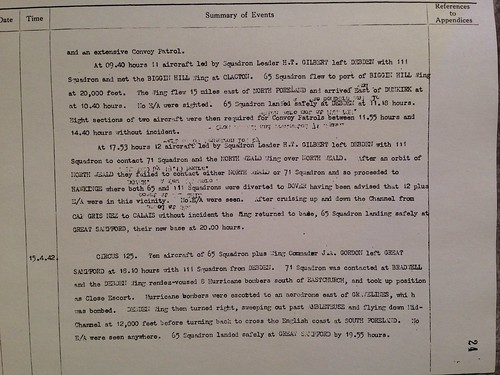
65 Squadron ORB Great Sampford

The entry in the Operational Record Book for April 14th shows the first landing of Spitfires at Great Sampford. (AIR 27/594/4)

On April 14th, the move took place, a move that was achieved under some difficulty as the squadron was called upon to participate in two Rodeo (fighter sweeps) operations. After extensive searching between Cap Gris Nez and Calais, no enemy aircraft were sighted, and so the wing returned to their various bases. At 20:00 hrs, the first 65 Sqn aircraft touched down at Great Sampford – the base was now open and operational.

The next mission would be the very next day – there was no let up for the busy flyers! “Circus 125” led by Wing Commander J. Gordon, consisted of ten aircraft from Great Sampford, who after taking off at 18:10, met with the bomber formation and escorted them to an airfield target near Gravelines. The entire mission was uneventful and the aircraft arrived safely back at Great Sampford at 19:55 hrs.

This mission pretty much set the standard for the remainder of the month. Numerous Rodeo and Circus operations saw 65 Sqn repeatedly penetrate French airspace with various sighting of, but little contact with, enemy aircraft. The first real skirmish took place on the 25th, when the Boston formation they were escorting was attacked by fourteen FW-190s. One of the Bostons was hit and subsequently crashed into the sea. Flt. Sgt. Stillwell (Red 3) of 65 Sqn threw his own dingy out to the downed crewman who seemed to make no effort to reach it – he was then assumed to be already dead.

On the April 27th, “Circus 142” took place, the escort of eight Hurricane bombers who were attacking St. Omer aerodrome. Three sections ‘Red’, ‘White’ and ‘Blue’ made up 65 Squadron’s section of the Wing, and consisted of both Rhodesian, Czech and British airmen. The Wing flew across the Channel at 15,000 ft, and when on approach to the target, they were attacked by 50-60 FW-190s. In the ensuing dogfight F/O. D. Davies, in Spitfire #W3461; P/O. Tom Grantham (s/n: 80281) flying Spitfire #BL442, and P/O. Frederick Haslett (s/n: 80143) in Spitfire #AB401, were all reported missing presumed dead. It was thought that both F/O. Davies and P/O. Grantham may have collided as they were together when they went down, P/O. Grantham was just 19 years of age.

There were no further losses that month although operations continued up until the last day. In all, 21 operations had been flown in which 2 enemy aircraft were destroyed, 1 was a probable and 1 was damaged. April proved to be a record month in terms of operational flying hours for every pilot below the rank of Squadron Leader, the successes of which though, were marred by the sad events of the 27th and the loss of three colleagues.

On the 28th, their last day of this, the first of several stays at Great Sampford, a congratulatory message came though from the Air Officer Commanding No. 11 Group, “Well done the Debden Wing”, which went some way to lighten the atmosphere before the new month set in.*1
65 Squadron ORB Great Sampford

The Operational Record Book for 65 Squadron. A message of congratulations from the Air Officer Commanding No. 11 Group. (AIR 27/594/4)

It was three months later on July 29th 1942, that 65 Squadron would depart Great Sampford for the last time, and the next squadron would arrive, the Spitfire VIs of No. 616 Squadron RAF.

No. 616 Sqn were formed prior to the declaration of war in November 1938. An Auxiliary Air Force Unit, it too took part in supporting both the Dunkirk evacuation and the early days of the Battle of Britain. Now, at Great Sampford, it had been given the high altitude Spitfire, the MK. Vl, an attempt by Supermarine to tackle the Luftwaffe’s high altitude bombers, and quite the opposite to the VBs of 65 Sqn – these Spitfires had extended wingtips!

616 Squadron would, like 65 Sqn before them, spend July to September yo-yoing between Great Sampford and the airfields further south, Ipswich and Hawkinge, before departing Great Sampford for the final time on September 23rd 1942 for RAF Tangmere. Whilst here at Great Sampford, they would perform fighter sweeps, bomber escort and air patrols over northern France, engaging with the enemy on numerous occasions.

On the same day as 616 Sqn departed, the last operational unit would arrive at Great Sampford, the U.S. volunteer squadron, 133 Squadron known as one of the ‘Eagle Squadrons’. Being one of three squadrons manned totally by American crews, it had been on the front line serving at RAF Biggin Hill and RAF Martlesham Heath before arriving here at Great Sampford. Whilst some British RAF ground crews helped servicing and maintenance, the aircrew were entirely US, and crews were regularly changed as losses were incurred or crews were transferred out.

Many of these new recruits came in from other units. Ground crews coming into Great Sampford would have to get the train to Saffron Walden where they were met by a small truck who would take them to RAF Debden for a meal and freshen up. Afterwards they were transferred, again by truck, the few miles here to Great Sampford, the transformation was astonishing! In the words of many of those who were stationed here, “there was nothing ‘great’ about Great Sampford!”*2 Also flying Spitfire VBs, they were to quickly replace them with the MK.IX, a Spitfire that was essentially a MK.V with an updated engine. Having a higher ceiling than the FW-190 and being marginally faster, its improved performance took the Luftwaffe by complete surprise.

It would be a short-lived stay at Great Sampford though, as 133 Sqn RAF were disbanded on the 29th September, being renumbered as 336th FS, 4th FG, USAAF, and officially becoming US Air Force personnel. They were no longer volunteers of the Royal Air Force.

Just three days before this final transfer, on September 26th 1942, 133 Sqn would suffer a major disaster, and one that almost wiped out the entire squadron.

A small force of seventy-five B-17s from the 92nd BG, 97th BG and the 301st BG, were to mount raids on Cherbourg and the airfields at Maupertus and Morlaix, when the weather closed in. The 301st BG were recalled as their fighter escort failed to materialise, and the 97th BG were ineffective as cloud had prevented bombing to take place. The RAF’s 133 (Eagle) Sqn were to provide twelve aircraft (plus two spares) to escort the bombers on these raids. After refuelling and a rather vague briefing at RAF Bolt Head in Devon, they set off. Unbeknown to them at the time, the two pilots instructed to stay behind, P/O. Don Gentile and P/O. Erwin Miller, had a guardian angel watching over them that day.

During talks with P/O. Beaty, it was ascertained that the Spitfires had flown out above 10/10th cloud cover and so were unable to see any ground features, thus not being able to gain a true understanding of where they were. Added to that, a 100 mph north-easterly wind blew the aircraft far off course into the bay of Biscay. Finding the bombers after 45 minutes of searching, the flight set for home and reduced their altitude to below the cloud for bearings. Being over land they searched for the airfield, all the time getting low on fuel. Instead of being over Cornwall however, where they thought they were, they were in fact over Brest, a heavily defended port, and in the words of 2nd Lt. Erwin Miller – “all Hell broke loose.” *3

In the subsequent battle, all but one of 133 Sqn aircraft were lost, with four pilots being killed.  P/O. William H. Baker Jr (O-885113) in Spitfire #BS446; P/O. Gene Neville (O-885129) in Spitfire #BS140 – Millers replacement; P/O. Leonard Ryerson (O-885137) in Spitfire #BS275 and P/O. Dennis Smith (O-885128) in Spitfire #BS294.

Only one pilot managed to return, P/O. Robert ‘Bob’ Beatty,  who crash landing his Spitfire at Kingsbridge in Devon after he too ran out of fuel. During the crash he sustained severe injuries but luckily survived his ordeal. From his debriefing it was thought that several others managed to land either on the island of Ouissant or on the French mainland. Of these, six were known to have been captured and taken prisoners of war, one of whom, F/Lt. Edward Brettell  DFC was executed for his part in the Great Escape from Stalag Luft III. A full report of the events of that day are available in an additional page.

There would be no further operational flying take place for the rest of the month for 133 Sqn – all in all it was a disastrous end for them, and to their spell as RAF aircrew.*4

Pilot Officer Gene P. Neville 133 (Eagle) Sqn RAF, stands before his MK. IX Spitfire at Great Sampford. He was Killed during the Morlaix disaster. (@IWM UPL 18912)

Because these marks of Spitfire were in short supply, the remainder of the Squadron were re-equipped with the former MK.VBs, a model they retained into 1943 before replacing them with the bigger and heavier Republic P-47 ‘Thunderbolts’.

As a result of the losses, the dynamics of the group would change. The cohesive nature of the men who had been together for so long, was now broken and the base took on a very different atmosphere.

The effect on those left behind was devastating, morale slumped, and in an attempt to raise it, Donald ‘Don’ Blakeslee ordered the remaining pilots to line up along the eastern perimeter track and take off in formation; something that had been considered virtually impossible due to its short length, uneven surface and rather awkwardly placed trees along its boundary. Blakeslee, who became a legendary fighter pilot with both 133 Sqn and later the 4th Fighter Group (FG), led the group in true American Style, getting all the aircraft off the ground without any mishaps. Heading for Debden, they formed up, and flew directly over the station at below 500 feet, shaking windows and impressing those on the ground with precision flying that took as much out of the pilots as did air to air combat.

That night, the mess hall at Debden, was awash with celebrations as 133 Squadron pilots enjoyed the limelight they had for so long deserved.

On the next day, September 29th, the crews packed their personal belongings and departed Great Sampford for the comforts of Debden, where an official handover took place. General Carl Spaatz and Air Chief Marshal Sir Sholto Douglas, witnessing the official transfer of the three Eagle Squadrons to the United States Air Eighth Air Force, a move that on the whole, pleased the American airmen.

From then on, Great Sampford would remain under control of the USAAF, being used as a satellite for the 4th FG at Debden, but without any permanent residents. The occasional flight of Spitfires or P-47s would land here whilst on detachment or away pending a Luftwaffe attack. In the early stages of 1943, the Americans decided that Great Sampford (renamed Station 359 as per US designations) was no longer suitable for their needs as it wouldn’t accommodate either the  P-38s or the P-47s due to its awkward size and shape. By February 1943 they had pulled out, and Great Sampford was returned to RAF ownership. By March 1943 the airfield now surplus to flying requirements, was closed, used only by a large selection of RAF Regiments training in airfield defence, Guard of Honour duties and VIP Security. The station eventually closed in August 1944.

Airmen of the 336th Fighter Squadron, 4th Fighter Group with a clipped wing Spitfire Mk. Vb (MD-A), 1943. Handwritten caption on reverse: '19A. KP. Fall, 1942. Great Sampford Satellite Field. 336th crew by 336th Spit Mk. Vb. Wings clipped by sawing off wing & pounding in board then carving and painting it. MD-A, red/blue wheel. Source -Bill Chick, Megura.'

Airmen of the 336th Fighter Squadron, 4th Fighter Group with a clipped wing Spitfire Mk. Vb (MD-A), 1943. at Great Sampford. (@IWM – FRE3230)

However, this closure was not the end for Great Sampford. With paratroop operations progressing in Europe, the airfield was put back into use on 6th December 1944 by 620 Sqn in Operation ‘Vigour‘.

No. 38 Group, in need of practice areas, had acquired the airfield, and were dropping SAS paratroops into the site. This flight preceded another similar activity the following day where Horsa gliders pulled by 620 Sqn Stirlings, took part in Operation ‘Recurrent‘; a cross-country flight from RAF Dunmow in Essex. This flight culminated with the Horsas being released and landing here at Great Sampford. These activities continued throughout the appalling winter of 1944 / 45, and into the following months. In March, in the lead up to Operation ‘Varsity‘ the allied crossing of the Rhine, there was further activity in the skies of this small grass strip. Operation ‘Riff Raff‘  saw yet more paratroops and gliders at Great Sampford, whilst in November 1945, after the war’s end, Operation ‘Share-Out‘ saw the final use of Great Sampford by the paratroops. No. 620 Squadron, who had been based at RAF Dunmow, were now winding down themselves and their use of Great Sampford ceased virtually overnight.

Since then, Great Sampford has become completely agricultural, the perimeter track virtually all that remains of this small but rather interesting site. It lies in a remote area, fed only by farm tracks and small footpaths. The tracks, now a fraction of their original size, still weave their way around the airfield as they did for that short, but busy time, in the mid 1940s.

Regretfully the airfield and its unique history has all but passed into the history books, and rather sadly, no memorial marks the airfield, even though many airmen were lost during  the many sorties in those dark days of the war-torn years of the 1940s.

We depart Great Sampford heading off once more, the airfields of Essex and East Anglia beckoning. As we move off, we spare a thought for those for whom this was the last view they had of ‘home’, and of those who never came back to this quiet and remote part of the world.

Sources and further reading

*1 National Archives: AIR 27/594/4 .

*2 Goodson. J,. “Tumult in the clouds” Penguin UK, (2009) 

*3 Price. A., “Spitfire – A Complete Fighting History“, Promotional Reprint Company,  (1974).

*4 National Archives: AIR 27/945/26

National Archives: AIR 27/945/25

The “Slightly-out-of-Focuswebsite has details of a photo essay documenting the planning and execution of an airborne exercise prior to Operation Varsity. It’s a detailed document which includes gliders of 38 Group RAF landing at Great Sampford.
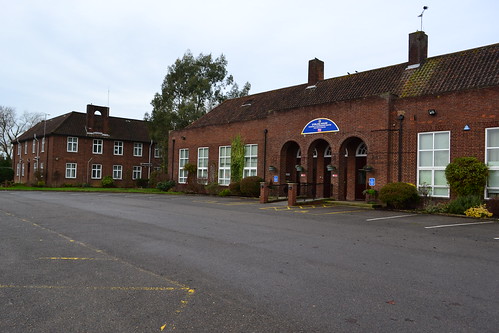
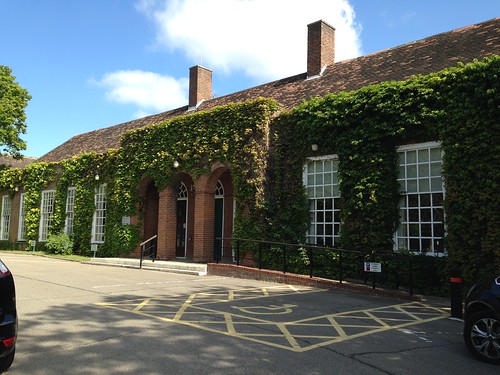
2017 – A Look Back Over The Last Three Years.

As 2017 draws to a close and another year passes, I’d like to look back at some of the highlights of the blog so far.

Since starting the site, way back in 2014, I have learned a lot about Britain’s airfields, their design and construction, and the men and machines that flew from them. What started as a record of memories has turned into a passion of history and hopefully, a dedication to all those who served, fought and died at these places. I have also seen how gradually, over time, many of these historic sites have sadly disappeared, beaten by the onslaught of time, the developers pen, and the ploughs of the industrial farmer evermore determined to draw out more crops from his expanding domain.

What were once massive military sites covering a vast acreage of land, homes to several thousand people who were all doing ‘their bit’ for the war effort; who came from all four corners of the world to fight, are now mere ruins or a collection of derelict and decaying buildings. In many cases they are merely small patches of concrete often covered with the waste of farm practices, or as in some cases, completely gone.

Since starting I have managed to visit over 100 different airfields, stretching from the southern most county of Kent to Edinburgh in Scotland; from Gloucestershire in the west to the East Anglian counties in the East. This has resulted in just short of 50 Trails around the country, but even this has barely scratched the surface of what is still out there waiting to be found. There are many, many more to go, so I thought at this point of the year, I’d share some of the posts that I’ve enjoyed, and also those examples that highlight the extent of this massive war-time development. With this, I hope to show a selection of the examples of features that have (so far) survived and the evidence of them that can be seen today. I hope you enjoy them and may I take this time to wish all followers, family and friends a very merry Christmas and a happy and safe New Year.

With the forming of the Royal Flying Corps, Britain needed and built a number of small airfields all with grass runways, wooden sheds for workshops and accommodation sites using tents. Examples of these places include the likes of Collyweston, (absorbed into modern-day RAF Wittering), Tydd St Mary (Attacked by Zeppelins) and Narborough (Norfolk’s very first airfield) to name but a few. Such little evidence of these sites now exists – many were absorbed into later airfields or they were returned to agriculture – that some, such as Hingham and Westley, we don’t even know the precise location of.

We saw  with the expansion of Britain’s airfields in the 1930s, how buildings changed dramatically from wooden construction – such as RAF Castle Camps – to more permanent (although classed as temporary) brick buildings, many examples of which survive in a preserved state at RAF Bircham Newton.

Technical buildings in use today. At the former RAF Snetterton Heath, technical buildings have survived as small industrial units.

We saw the development of the hangar, one of the most recognisable and distinguishing features of an airfield, from early wooden sheds through canvas doored Bessoneaux hangars, to metal hangars of over 150 feet in length. Many of these buildings still exist today, absorbed into farms or used for storage. Examples are thankfully still relatively common with some found at RAF East Fortune (now a museum), RAF Methwold (farmland), RAF Little Snoring (a light airfield) and RAF North Creake.

RAF Waterbeach 'J' Hangar RAF Waterbeach’s ‘J’ type hangar with a ‘T2’ behind. Waterbeach like so many, is an airfield embroiled in the planning process.

Runways to allow bigger and heavier aircraft to use them, grew from short grass strips to those of wood chip, tarmac and concrete of 2,000 yards in length and 50 yards wide. Some of these even exceeded a massive 3,000 yards in length. Many of these pathways continue to exist today in some form or other, RAF Eye (industrial), RAF Cottam (built and never used), RAF Debden (currently an army barracks), RAF Deopham Green (farmland) and RAF North Witham (an open and public space) are some of the better examples we can find today.

RAF Great Dunmow RAF Great Dunmow typifies the state of many of the better examples of these massive runways today.

The Watch Office, another distinguishing feature, lay central to the operations of a wartime airfield. Again its development was rapid and complex. Some thankfully have been restored as museums such as those at RAF Framlingham (Parham), RAF Debach, RAF East Kirkby, and RAF Martlesham Heath. Some are now derelict, decaying memorials to those who served. Examples found at RAF Winfield, and RAF North Pickenham, are particularly severe, whilst many are used for other purposes such as RAF Matching Green (radio); RAF Attlebridge (offices) and RAF Rattlesden (a glider club).

RAF Bury St Edmunds (Rougham) At Bury St. Edmunds (Rougham) the watch office is now restored and forms the main part of the museum.

There are numerous examples of other buildings on some of these sites, many are now part of small industrial complexes, workshops that were once used to repair aircraft parts now repair cars or other small items. Their original features often hidden by new cladding, overgrown weeds or a change in frontage. Slowly, but surely, they are gradually disappearing from our skyline.

The purpose of theses places was to wage war. In doing so many lives were lost, both military and civilian – on both sides. As a result, many heroic acts of bravery and self-sacrifice took place. The VC, the highest award given to members of the British armed forces for gallantry “in the face of the enemy”, was awarded to two pilots: Flt. Sgt. Arthur Louis Aaron, V.C., D.F.M. and Sqn. Ldr. Ian Willoughby Bazalgette (RAFVR) VC., both flying from RAF Downham Market. The American S.Sgt. Archibald Mathies, USAAF, 510th BS, 351st BG, was one of many Americans awarded the Medal Of Honour for his valour in combat whilst flying from RAF Polebrook, another was 2nd Lt. Robert E. Femoyer MOH, 711th BS of RAF Rattlesden, for his actions over Meresberg.

Losses were high both in combat and also during training. This year, I managed to visit several training stations of which two RAF Chaterhall and RAF Milfield had high losses of trainee pilots. Many are those are buried locally, and one delightful small church I visited at Fogo, had almost as many war dead as it did living inhabitants!

Fogo Church The church yard at Fogo has 16 war dead, most from the nearby training airfield RAF Chaterhall.

All in all its been a fascinating journey, I have entered the lives of many people who fought for what they believed in. I have read their stories, visited the very places they served at, and in many cases, the graves in which they now lie.  These decaying sites are the true monuments to their sacrifice. The buildings that once housed these young men stand as a lasting tribute to them, I hope that their memories never fade away in the way that many of these sites now have.

I’d like to thank you for taking the time to join me on this journey, I hope you have enjoyed reading about them as much as I have enjoyed visiting, researching and writing about them. I look forward to you joining me next year as we travel on many more trails around Britain’s disused airfields.

A Merry Christmas and a Happy New Year to all!

Andy.