RAF Hunsdon – The end of the Turbinlite (Part 2)

In part 1, we saw how Hunsdon was developed and how the new Turbinlite system was developed. However, things don’t quite go to pan the system falls doesn’t meet expectations.

After taking on Hurricanes IIB/C at Martlesham Heath in April, 3 Squadron arrived at Hunsdon from Stapleford Tawney, and like 85 Sqn, would remain here until mid May 1943, when it took its Mosquitoes to West Malling.

Pilots and aircraft of 3 Sqn would make their first appearance at Hunsdon on the 2nd August 1941 when twelve pilots arrived to practice formation flying with crews of the special Havoc Flight created earlier in May. These initial twelve would be followed by another twelve on the third, and then ten more crews on the sixth. The two squadrons would perform practice night flights together, formation flying and ‘dog fighting’ tactics with drogues. By the 10th, the bulk of the squadron had moved over leaving only a detachment both at Manston and Shoreham, where crews undertook both dawn and dusk patrols over southern England and over enemy airfields looking for bombers either landing or taking off.
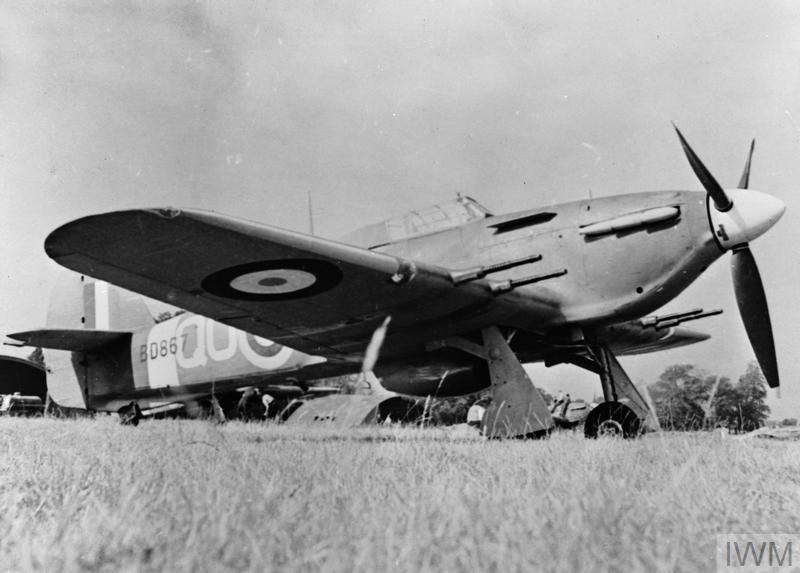
Hurricane IIC, BD867 ‘QO-Y’, 3 Sqn, at Hunsdon. The exhausts have shields over them to help prevent them being seen whilst on night fighter operations. (@IWM CH 3509)

The combined practice flights would take Hunsdon’s 3 Sqn and the Turbinlite Flights aircrew well into the summer and autumn of the following year, progress being marred by continuing poor weather. GCI (Ground Control Intercept) training and formation flying between the two units took up the majority of the time whilst they were here, however, both dusk and dawn patrols in their Hurricanes gave the pilots of 3 Sqn a little respite from the routine of formation flying with the two Special Flights.

September 1941 then brought the second of the two Special Flights to Hunsdon. On the 20th, 1459 (Fighter) Flight, the penultimate of the ten, was formed here also operating both Havoc Is and Boston IIs, Fs and IIIs. The last of the Flights to make up the ten units would follow just after, being based in northern England at RAF Acklington.

It was quickly found that the Turbinlites not only had a lack of firepower, but poor speed as well, so they were soon demoted to being used solely as a searchlight platform with 3 Squadron’s Hurricanes taking over the main role of interceptor.

With the formation of a new squadron at Croydon, 287 Sqn would have detachments spread far and wide including one here at Hunsdon. Staying here for virtually the entire war, they would fly a range of aircraft including: Blenheims, Hudsons; Lysanders; Hurricanes; Masters; Defiants; Martinets and Spitfires. Even as a detachment flying support flights, they were the longest resident at Hunsdon but never achieved the same status as many of those that were to be based here.

After the turbulence of 1941, 1942 would initially bring a much calmer time at Hunsdon, with less movements in or out of the airfield, although staff changes did cause problems for some units. Changes were initially relatively small, the first of which wouldn’t come until the July of 1942, when a small detachment of 605 Sqn Bostons arrived. After being reformed the month before, at RAF Ford, the small group remained here until mid March 1943, when after taking on the Mosquito, they transferred to Castle Camps in Essex.

605 had previously been posted to Batavia where the majority of ground personnel had been captured by enemy forces. Those that were left were posted to various units and the squadron disbanded. Its reformation at Ford would be a slow process, but gradually it would receive both men and aircraft, accepting machines from 23 Squadron as it also eventually took on the Mosquito.

Whilst based here at Hunsdon, they would primarily carry out training, performing cross country flights,  searchlight co-operation flights and gunnery practice. Navigation also came under scrutiny with logs being examined by the squadron’s navigation officer. By the end of August though, all was well and the personnel returned to Ford thus reuniting the entire squadron once more.

As was the case with many other airfields, training and support flights also used the same airfields, training pilots in new and more modern ways to fly. Hunsdon was no different, and in August a new Flight fulfilling this role was created here at Hunsdon. 1530 Beam Approach Training (BAT) Flight, who were formed specifically to train pilots to land in the dark, or poor weather, using a ‘beam’ (formally blind approach) or radio system. They remained here for some time eventually moving to Wittering where they were disbanded later in 1944.

It would also be in August 1942, that Hunsdon’s resident 85 Sqn would take on the Mosquito, the MK.IIs being a major change from the Havocs previously used. It would only be a trickle of aircraft at first, with just a small number of the ‘Wooden Wonders’ being received by the month’s end.

The trickle continued into September as did the nightly Havoc patrols. On the 7th, Sgt. McCormick sighted what he believed to be a Ju. 88, and closed in for the attack. After following the aircraft he managed to close to 150 feet at which point he opened fire on the starboard engine which quickly caught fire. The aircraft fell from the sky and was later seen burning on the sea below. It was confirmed not as a Ju. 88 but as an He.111 distinguished by its fixed rear-firing machine gun in the extreme end of the fuselage.

September 1942 then brought yet more change. At this point it was decided to raise all ten Turbinlite squadrons to squadron status. The date decided upon was September 2nd 1942. However, due to administration problems, only five could be raised on that date, the remaining five being raised six days later on the 8th of the month. By then, all ten Turbinlite training Flights had been disbanded and reformed as operational squadrons.

With that, 1451 became 530 Sqn on September 8th and continued to operate from Hunsdon, whilst 1459 became 538 Sqn and was relocated to Hibaldstow.

The reformation meant that flights were initially curtailed for 530 Sqn. The poor September weather then added to the issue meaning that flying was at best sporadic. Two further support Hurricanes soon arrived for the squadron taking the total available to four. But their arrival did not ease the situation, the poor weather and other factors continuing to dominate operations to the point that little operational flying took place at all.

October fared little better. More poor weather combined with the fact that three of their four Hurricane pilots (all American), were transferred to the US Army Air Corps, meant that 530 Sqn was unable to progress the way it had hoped. It had been a very poor start for the operational Turbinlites.

By November there were a total of eight Hurricane pilots, some of which had transferred in from O.T.Us, but all were lacking night flying experience. As a result, they were rushed through a night flying course at Hunsdon and were passed as ‘operational’ by the month’s end. However, the problems did not end there. Formation flying in good weather was considered difficult and in visibility of 2,000 ft or less, impossible. This meant that the required number of night flights were not being made which held back all operational flights. Compounding this, continuing bad weather had by now turned the ground very soft and a number of aircraft were getting bogged down in the mud. In addition, whilst aircraft serviceability was generally good, a few had experienced wrinkling of the skin over the air frame and were now awaiting an inspection before being allowed to fly. By now, the crews must have been wanting 1942 to draw to a very quick close.

And to a close it came. December brought rumours of the demise of the Turbinlite squadrons causing uncertainty amongst the personnel. Continuing bad weather had curtailed all but the most urgent of flights. Lectures prevailed bringing escape tactics and Luftwaffe organisation information up to date. A new Havoc was brought in for testing with a new windscreen deicing system, unfortunately this was found unsatisfactory, so a new hot air method was suggested by the squadron and tested under the same conditions. This proved much more successful.

Christmas celebrations then kept the personnel occupied and were ‘livelier than expected’ primarily due to the inclement weather. Crews in the meantime being kept on standby in case the weather turned and operations became necessary again.
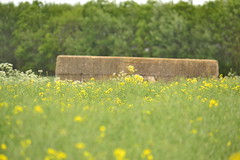
RAF Hunsdon Battle Headquarters

The battle headquarters.

With New Year 1943, came the news that the Turbinlites were indeed being disbanded. Of the ten squadrons formed, only five made successful enemy intercepts – Turbinlite was not a great success and as a result, on the 25th January, 530 Squadron along with all other units, ceased to exist and all personnel were scattered amongst other squadrons.

The end of the Turbinlites meant that Hunsdon only had two operational units at this point, both 85 and 3 Sqn continuing to fly from the airfield when they could. The early part of the year, brought considerable fog and cold weather, the fog preventing flying on many occasions, which hampered test flights for 3 Sqn on their new Typhoons when they arrived in February.

By mid May though, both these units were to depart also, 3 Squadron transferring to West Malling, with the Mosquitoes of 85 Sqn joining them soon after, but not until after a very important ceremony.

The full story of RAF Hunsdon can be read in Trail 25.
RAF Hunsdon – The beginnings of Turbinlite (Part 1)

In Trail 25 we head to the south once more, to the west of Harlow, and to two wartime airfields; one of which played a major part in striking a blow at the very heart of the Nazi regime.

The county of Hertfordshire is an area popular with commuters to both London and the technological towns of Harlow and Bishops Stortford. Being north of London, it is also close to Stansted airport, itself an ex World War II airfield. Hertfordshire has some beautiful countryside, delightful little villages and quaint country pubs. It is also an area with a wealth of history.

Our first stop is a small airfield nestled in the heart of this beautiful countryside. It is situated north-east of the village that gives it its name, RAF Hunsdon.

RAF Hunsdon

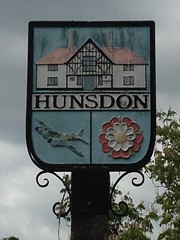
RAF Hunsdon Village sign

The Hunsdon Village sign reflects its history and links to the RAF.

Even before Hunsdon was built, it is referenced in some areas that the site was being used for a detachment of 107 Squadron Blenheims, then based at RAF Wattisham and later Leuchars. This may have been part of the ‘Scatter’ directive given to squadrons in the immediate period before war was officially declared, and was thought to occur between May 1939 and March 1941.  However, there are no references to this in the official squadron files and so this action is doubted. However, if this were the case, then it would certainly suggest an early use of the site before it was developed into a fully operational airfield, and it may have been an indication that an airfield was on its way in the near future.

The site was earmarked for development in 1940, with construction occurring over the period October 1940 to March 1941, after which the first squadron moved in. It was built by various construction companies and incorporated two asphalt runways; the main running east-west reaching 1,750 yards in length after its later extension, with a second running north-east to south-west  extended to 1,450 yards; both were built to the standard 50 yard width. Aircraft dispersals, maintenance and storage buildings consisted of eighteen ‘twin-engined’ hardstands; sixteen blister hangars (a mix of ‘Over’ (4) and  ‘Extra Over’ (12)) and a Bellman hangar. There was also a fuel dump and accommodation buildings for up to 2,240 airmen and some 276 WAAFs, all located across eight dispersed sites.

A large number of operational units, (in excess of twenty-five) would pass through its doors throughout its relatively short life, providing Hunsdon with a multinational mixture of crews and a number of aircraft types.

The airfield itself lies within a stone’s throw of London and so its initial role was that of night fighter operations covering London and the south / east area.

The first recognised squadron to make its mark at Hunsdon was 85 Squadron on May 3rd 1941, transferring across from RAF Debden flying Defiants and Havoc MK.Is. The move across on the 3rd went smoothly with personnel and equipment being transferred across in lorries and 32 seat busses, the majority of personnel arriving later that day.

RAF Hunsdon Parachute store

The Parachute store now holds farm machinery.

On arrival at Hunsdon, personnel of ‘A’ Flight were immediately billeted on the aerodrome close to their dispersals, whilst those of ‘B’ Flight were housed on Number 2 Site, located about a mile or so from the main airfield area. Personnel of both the Headquarters Flight and the servicing Echelon were billeted even further away, about four miles in fact, at Gilstone Park. The officers meanwhile, had the better accommodation, being billeted in a house called ‘Boningtons’ believed to be the former home of “Mr. Brooke Bond” the family of the P.G. Tea empire. It is thought that the family purchased the house in 1940, moving out of their London residency to avoid the blitz. Unfortunately, it was rather a short lived purchase as the property was requisitioned by the RAF not long after!

By the end of the 4th, all 85 Sqn personnel were in and unpacked at Hunsdon, and so night flying duties could commence straight away with patrols taking place over the Felixstowe area. Immediately, a Heinkel He.111 was vectored onto, and a skirmish took place in which both aircraft both gave and received machine gun fire. The Luftwaffe bomber came off worst though, and was last seen diving into cloud firing a white verey pistol, either as a resignation of the fight or possibly as a distress signal to any would be rescuers.

Over the next few nights further contacts were made and several Ju. 88s were either confirmed or claimed as shot down. The squadron was performing well, morale was high and all was looking good.

The night of the 13th could have been different for some though. On his return from a patrol, Fly. Off. Hemingway’s instruments failed and with little choice, he gave the order to bale out. After his operator, Sgt. Bailey, had departed the Havoc, Hemingway followed, both men landing in close proximity to each other in the grounds of Much Hadam Hall (a grade 1 listed building built in the early 1700s). Whilst both airmen were safe, Hemingway’s was not the model jump, as he came to rest in a tree in the grounds of the hall. Bailey fared little better, landing rather ungainly on a bucket not too far away. This was Hemingway’s third successful bale out of a stricken aircraft, his previous two both occurring during the Battle of Britain.

On May 17th, Wg. Cdr. Peter Townsend, now with a DSO, flew to Great Massingham, Flt. Lt. Marshall flew to Odiham to test the runway and Flt. Lt. Rabone flew to Heston from where he collected a special and secret Havoc which was to be tested by the squadron. The first flight of this new variant occurred on May 23rd, and was quickly followed by a second aircraft on the 28th, After this, they would then begin testing both aircraft as a new night flying platform.

This particular type of aircraft was the forerunner of what became known as the Turbinlite Havoc, a new design that was the brainchild of one Sidney Cotton.*3

RAF Hunsdon Runway remains

The main runway has been reduced to a track.

With the help of William Helmore, Cotton took out two patents; GB 574970 and GB 574118, each one relating to this new idea. It would be Helmore (an Air Commodore) who would then develop the idea further turning it into what would become commonly known as the Turbinlite system.

Originally designated Air Target Illumination, Cotton’s idea was passed to the Alan Muntz Company, who in conjunction with G.E.C., developed it into what was at the time, the most powerful searchlight in the world, and one that would fit neatly into the nose of a Douglas Havoc, or Boston as it was known in the RAF.

The light was so powerful that it would require a staggering forty-eight batteries each stored in the bomb bay of the aircraft, adding an additional weight to the aircraft just short of 2,000lbs. The light was so strong (1,400 amps) that it would discharge in less than 12 seconds meaning its use was limited to short searches only.

Havoc Mark I (Turbinlite), AW400, on the ground at Burtonwood, Lancashire. This aircraft served with Nos. 1422 and 1454 (Turbinlite) Flights, and with 1459 (Turbinlite) Flight/538 Squadron RAF, before transfer to the USAAF in April 1943. (© IWM ATP 10654C)

The first full prototype Turbinlite aircraft fitted with the unit was Boston W8254 and was flown by Acting Squadron Leader A. Clouston of 1422 (Night Fighter) Flight formed at Heston on May 12th 1941. The Flight would then operate a number of these aircraft, along with several other types which included the only Turbinlite Mosquito; along with a Defiant, Wellington and Hurricane.

Heston was the home of Airwork, an aviation company set up by two ex-Cambridge students and soldiers of the great war, Sir Henry Nigel Norman and Alan Muntz.  Their vision, was to create the best aerodrome near London, a dream that would cost Norman his life and Muntz to lose his son. Airwork would go through many changes during its life, taking on several Government contracts including a range of flying schools to train RAF pilots throughout the Second World War. These included RAF Digby, RAF Grangemouth, RAF Scone (Perth) and RAF Linton-on-Ouse.

Airwork would themselves modify a further four Bostons, with a further sixteen being modified by the Heston Aircraft Company. A third batch was then developed at RAF Burtonwood, giving a total of nine flights for training and ten operational squadrons comprising just short of 100 aircraft in all.

It was soon realised however, that the Bostons lacked firepower and so the company began to look at the Mosquito as a possible replacement aircraft. Only one Mosquito was modified (W4087, a Hatfield built F.II) at Heston, but this idea, unlike the Boston, failed to progress any further than the prototype stage, and no other aircraft were converted.

The Only Mosquito converted to carry the Turbinlite.*5

The Turbinlite project quickly gained pace, but the units wouldn’t be raised to squadron status until September of the following year. In preparation, ten special Havoc flights were created to train crews to operate the aircraft. The first of two, formed at Hunsdon (and the first of the ten) was 1451 (Fighter) Flight on May 22nd 1941. The Flight used several examples that included both Boston IIIs (AL469 and Z2280) and Havoc Is (AE470 and AW405). It also utilised a Cygnet and Tiger Moth for pilot training. By the end of the month, 85 Sqn had flown a total of 505 hours, 482 of them undertaken in Havocs, with 213 of these being on night flights.

On August 9th 1941, 85 Sqn were joined here at Hunsdon by 3 Sqn, one of the original three squadrons to have been formed by the Royal Flying Corp. Created on May 13th 1912, when the Air Battalion of the Royal Engineers was absorbed in to the month old Royal Flying Corps, 3 Sqn joined both 1 and 2 Squadrons as the oldest units to have operated in the RFC. As such, its history is long and very distinguished.

In Part 2 we see how the Turbinlite develops, and how, as the war goes on, the first of Mosquitoes arrive.

The full story of RAF Hunsdon can be read in Trail 25.