Sgt. Archibald Mathies, USAAF, 510th BS, 351st BG (Medal Of Honour)

Staff Sgt. Archibald Mathies (U.S. Air Force file photo)*1

Born in the Scottish town of Stonehouse, South Lanarkshire, on the 3rd June 1918, Archibald (Archie) Mathies was to become a Second World War hero. He was awarded the Medal of Honour (MOH) for his actions whilst at RAF Polebrook (USAAF Station 110) in Northamptonshire, England.

It would be on the 20th February 1944, shortly after arriving at Polebrook, that he would earn this honour but his life would be dramatically cut short.

Not long after his birth in Scotland, Mathies moved with his family to the United States, to a small town in Western Pennsylvania called Finleyville, in Washington County.

After leaving school, he began work in a local coal mine. The work was hard, and the pay was low; Mathies was not inspired. Then, following the Japanese attack on Pearl Harbour, as many other brave young American men did, he joined the Army, enlisting in Pittsburgh on the 30th December 1940. Mathies would transition through a number of stations and training centres before finally completing a course in aerial gunnery on the 22nd March 1943. His last U.S. posting was to the 796th Bombardment Squadron at Alexandria, Louisiana for operational training duties flying B-17s. He would leave here on the 8th December 1943 bound for England and the European Theatre of Operations.

Mathies arrived in the U.K. eight days later. His initial assignment was with the Eighth Air Force Replacement Depot, before being attached to the 1st Replacement and Training Squadron. On the 19th January 1944, he received his first and only operational squadron posting; the 510th Bomb Squadron, 351st Bomb Group, based at RAF Polebrook, as an engineer/gunner. Promotion was swift, and on 17th February 1944, probably following his first mission, Mathies was awarded the rank of Staff Sergeant.

A few days later, on 20th February 1944, the allies began the enormous aerial campaign known as ‘Big Week’. During this short period a massive number of aircraft would attack targets deep in the heart of Nazi Germany. One of the first, (Mission 226) would see a total of 417 aircraft fly from airfields across England. From RAF Polebrook, 39 B-17s took off to attack Leipzig. In the lead planes were Maj. Leonard B. Roper (s/n O-734101 ) of the 510th BS forming the high group, and Maj. James T. Stewart (s/n O-659405) of the 508th BS, leading the low group.

Flying in the number three ship of the lower Squadron, in B-17 (42-31763) ‘Ten Horsepower‘ was: Pilot: Clarry Nelson, Co-Pilot: Roland Bartley, Navigator: Walter Truemper, Engineer / Top Turret Gunner: Archie Mathies, Bombardier: Joe Martin, Radio Operator: Joe Rex, Ball Turret Gunner: Carl Moore, Waist Gunner: Tom Sowell, Waist Gunner: Russ Robinson, and Tail Gunner: Magnus Hagbo.

mathies page

B-17 “Ten Horsepower” – cropped from the photo below- (TU-A, serial number 42-31763) taken prior to its crash”2.

On approaching the target, the formation was hit hard by fighters and flak, who would attack the formation for over an hour, hitting many aircraft in the subsequent melee. Ten Horsepower, was targeted repeatedly receiving many hits from 20mm cannon shells. In these attacks the co-pilot was killed and the pilot knocked unconscious from his wounds. Fearing the bomber was doomed, the bombardier jettisoned the bombs and then bailed out, later being captured by the Germans and becoming a prisoner of war. The remaining crew remained with the B-17 which soon began a deathly spiral toward the ground.

Mathies and the navigator (Walter Truemper) would eventually take over control of the aircraft and nurse it back to England. Once over their base at RAF Polebrook, the crew were instructed to bail out but both Mathies and Truemper refused to leave the injured pilot. After deliberation, they were given permission to try to land, the remaining two crew members prepared themselves for a heavy landing.

Guided in by a fellow aviator it was going to be very difficult. The first two attempts had to be aborted, but on the third attempt, as they approached the airfield, the aircraft struck the ground, killing all three crew members onboard.
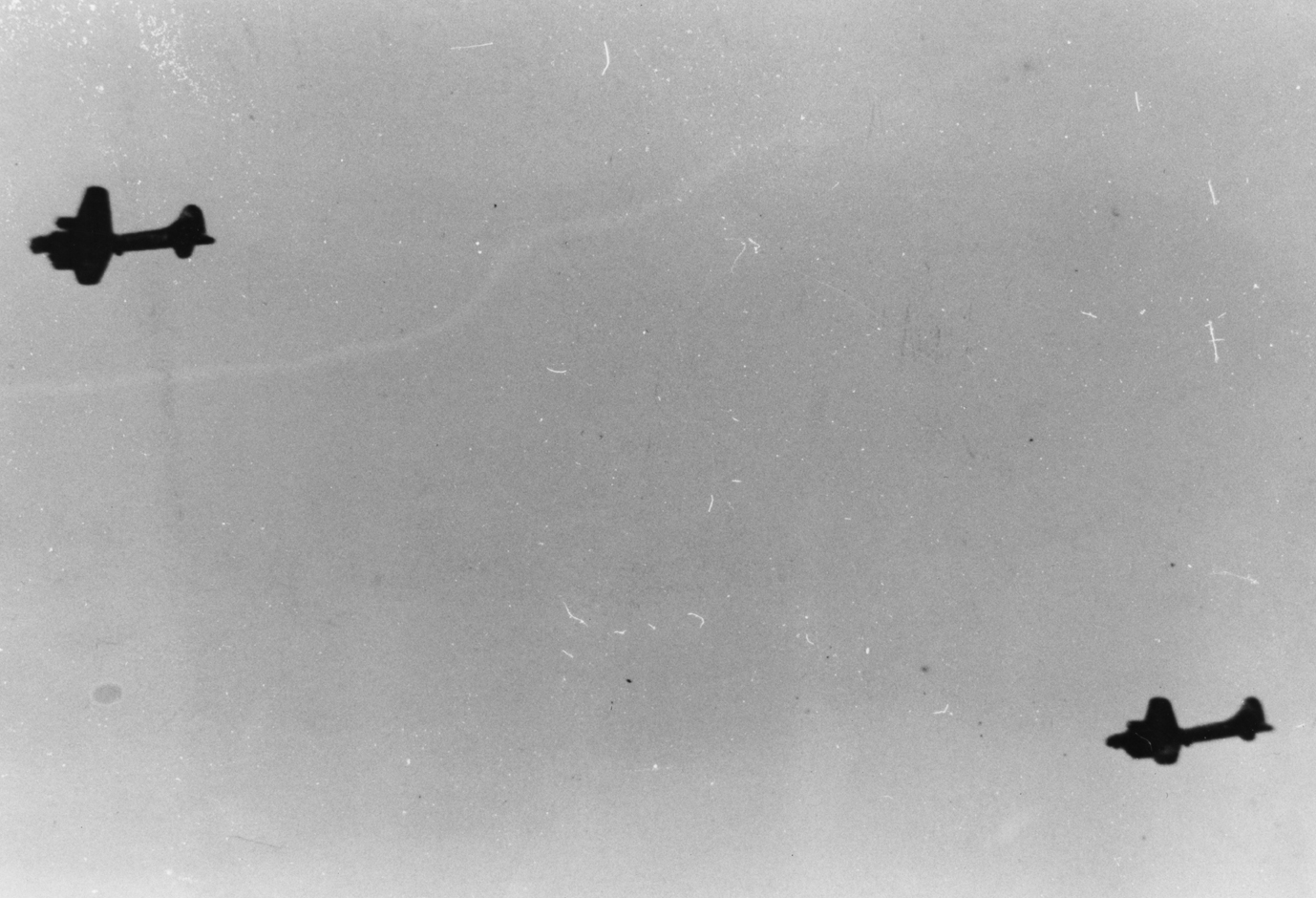
The last moments of B-17G “Ten Horsepower” (TU-A, #42-21763) piloted by Second Lieutenant Walter E Truemper  and Sergeant Archibald Mathies, as it is guided by a fellow aircraft after the pilot was severely injured. Truemper and Mathies unsuccessfully attempted to land the aircraft at Polebrook and were posthumously awarded the Medal of Honour for their bravery, 20th February 1944. (IWM FRE 4724)

The crash was a severe blow for the base, both air and ground crews were devastated. On returning from the mission, five other aircraft (42-38028, 42-38005, 42-39760, 42-39853 and 42-6151). were forced to land at nearby Glatton (Conington) only a short distance away.

This was only Mathies’ second mission and sadly, his last.

For his bravery, Mathies was awarded the Medal of Honour; his name now appears on page 280 of the St. Paul’s Cathedral Roll of Honour. Also, as a dedication to him, one of the temporary lodging units at the Joint Base Anacostia-Bolling is named after him, as is the Airman Leadership School at RAF Feltwell,  and the Non commissioned Officer Academy at Keesler AFB, Mississippi. In addition, the bridge on Truemper Drive crossing Military Highway at Lackland Air Force Base, Texas; the USCIS Dallas District Office and the Mathies Coal Company in Pittsburgh, Pennsylvania, are all named in his honour.

Archibald Mathies  citation reads:

For conspicuous gallantry and intrepidity at risk of life above and beyond the call of duty in action against the enemy in connection with a bombing mission over enemy-occupied Europe on 20 February 1944. The aircraft on which Sgt. Mathies was serving as engineer and ball turret gunner was attacked by a squadron of enemy fighters with the result that the copilot was killed outright, the pilot wounded and rendered unconscious, the radio operator wounded and the plane severely damaged. Nevertheless, Sgt. Mathies and other members of the crew managed to right the plane and fly it back to their home station, where they contacted the control tower and reported the situation. Sgt. Mathies and the navigator volunteered to attempt to land the plane. Other members of the crew were ordered to jump, leaving Sgt. Mathies and the navigator aboard. After observing the distressed aircraft from another plane, Sgt. Mathies’ commanding officer decided the damaged plane could not be landed by the inexperienced crew and ordered them to abandon it and parachute to safety. Demonstrating unsurpassed courage and heroism, Sgt. Mathies and the navigator replied that the pilot was still alive but could not be moved and they would not desert him. They were then told to attempt a landing. After two unsuccessful efforts, the plane crashed into an open field in a third attempt to land. Sgt. Mathies, the navigator, and the wounded pilot were killed“.*3

Mathies was truly a brave and dedicated man, who in the face of adversity, refused to leave his wounded pilot and friend. Daring to land a badly damaged aircraft, he sadly lost his life showing both great courage and determination.

The crew of ‘Ten Horsepower‘ were:

Pilot: Clarry Nelson,
Co-Pilot: Roland Bartley,
Navigator: Walter Truemper
Engineer / Top Turret Gunner: Archie Mathies
Bombardier: Joe Martin (POW)
Radio Operator: Joe Rex,
Ball Turret Gunner: Carl Moore,
Waist Gunner: Tom Sowell,
Waist Gunner: Russ Robinson,
Tail Gunner: Magnus Hagbo

Notes:

*1 Photo from Malmstrom Air Force Base website.

*2 Photo IWM Freeman Collection FRE 4725

*3 Citation taken from: US Army Centre for Military History website.
RAF Polebrook – the First USAAF Bombing mission (Pt 2).

In Part One of RAF Polebrook, we saw how the airfield had been developed, how it had been used by the first B-17s in RAF service. We saw how the first USAAF B-17 had landed setting the wheels of history in motion. We also saw the first USAAF bombing mission, and the American’s first major losses of the war. By mid 1943 a new unit, the 351st Bomb Group, was now arriving at Polebrook and they too were preparing for combat and their first mission of the War.

On May 12th 1943, the 351st would be initiated into the conflict, but it was not the most auspicious of starts to their campaign. The Eighth Air Force put up a force of seventy-two B-17s from the 4 BW and a further ninety-seven from the 1 BW. The call required all fourteen 351st BG aircraft to head for St. Omer / Ft. Rouge in France. After the lead aircraft discovered a fault in the oxygen system, it turned for home, the remaining aircraft then became disorganised and returned to base without dropping a single bomb.

The 351st would improve and go on to attack many prestige targets including: Schweinfurt, Mayen, Koblenz, Hannover, Berlin, Cologne, Mannheim and Hamburg. They would later go on to target submarine pens, harbours and ‘V’ weapons sites. Ground support was provided for both the Normandy invasion, the Battle of the Bulge and other major ground battles up to and including the crossing of the Rhine.

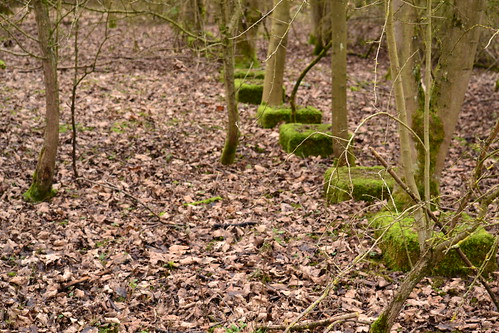
foundations

Stone foundations poke through the undergrowth.

In October 1943, the unit received the first of its Distinguished Unit Citations (DUC), with highly accurate bombing in very challenging conditions raising the standing of this new group. A second DUC was to follow in January 1944 for action deep in the heart of Germany. During an attack on Leipzig in the ‘Big Week’ campaign of 20th – 25th February 1944, two crewmen of the 510th, 2nd Lt Walter Truemper (Navigator) and Sgt. Archibald Mathies*2 (Flt. Engineer), both received Medals of Honour for taking over their stricken aircraft when both Pilot and Co-Pilot were injured / killed. B-17, TU-A ‘Ten Horsepower‘ (#42-31763), was directly hit by flak, both Truemper and Mathies nursed the aircraft back to Polebrook where they allowed the other crew members to bail out safely. On attempting to land the aircraft for the third time, it crashed (Great North Road) between Glatton (Trail 6) and Polebrook exploding, killing all three remaining crew members.

A B-17G Flying Fortress nicknamed

The last moments of B-17G “Ten Horsepower” (TU-A, #42-21763) piloted by Second Lieutenant Walter E Truemper  and Sergeant Archibald Mathies, as it is guided by a fellow aircraft after the pilot was severely injured. Truemper and Mathies unsuccessfully attempted to land the aircraft at Polebrook and were posthumously awarded the Medal of Honour for their bravery, 20th February 1944. (IWM FRE 4724)

It was also during this time that (Cp.) Clark Gable was stationed at Polebrook, initially to make recruitment films for air gunners, flying five combat missions in total and taking a film crew on each one. The first was on 4th May 1943 and his last on 23rd September that same year. He was initially awarded the Air Medal, and later the Distinguished Flying Cross, finally leaving Polebrook with over 50,000 feet of film on 5th November 1943. In 1944, the film ‘Combat America’, narrated by Gable himself, was shown in theatres around the United States. The film covers the 351st from their departure from the United states through their campaign. Included is footage of the collision between the two B-17s on May 7th 1943.

Another remarkable record was set at Polebrook, between 13th June 1943 and January 11th 1944, when Maj. Eliza LeDoux would lead the 509th BS (351st BG) for fifty-two  consecutive missions without losing either a single man nor a single aeroplane. An astonishing example set when at the same time other US Groups were losing aircraft at a rate of around 5%.

Major LeDoux, commanding officer of the 351st Bomb Group the cockpit of a B-17 Flying Fortress, 20 June 1943. Official caption on image:

Major LeDoux, CO, 509th BS, 351st BG, 20th June 1943. He led his squadron without loss for 52 consecutive missions.

The 351st remained at Polebrook until shortly after VE day, returning to the US and becoming deactivated on August 28th 1945. Polebrook then became quiet once more being put under care and maintenance until its closure in 1948.

During the three years the 351st were at Polebrook, they flew a total of 279 B-17s on 9,075 sorties with 7,945 of them dropping 20,778 tons of bombs. Air gunners on these aircraft were credited with 303 enemy aircraft destroyed. In all they flew 311 credited missions losing 175 B-17s in all.

One interesting point about Polebrook was that as a station under care and maintenance, it is thought that within its hangars was the last Short Stirling to be owned by the Royal Air Force.  A MK.V aircraft, it was struck off charge in 1946, a point that ended a long and interesting career for an aircraft that has long been considered a failure. As a bomber, this was certainly partly true, the many teething problems it had suffered – a lack of altitude, poor climb rate, continued engine problems and a tendency to swing on take off – all giving it a bad name. However, it could out manoeuvre a Lancaster and it could give any fighter of its time a run for its money. By the end of its flying career, the Stirling was loved by its crews, it had been a successful transport aircraft, mining platform and had brought many POWs back home after the war. Sadly though, none survived other than as wrecks at the bottom of Fjords or as bits salvaged from various crash sites across Europe. The days of the Stirling were now over and the only person to gain any benefit from them was to be the scrap man.

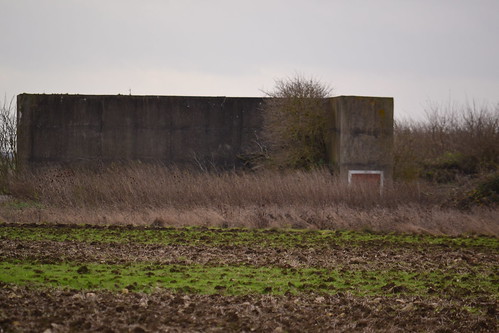
Thor site walls

3 Thor missile sites remain used for farm machinery.

But it wasn’t quite the same for Polebrook. Post war, and with the heightened threat from the Soviet Union, Polebrook was once more brought back to life, with three Thor missile sites being constructed in the centre of the main runway. These remained operational until August 1963 when they were finally removed and the site closed off. It was sold back to the former owners, at which point the airfield’s runways were dug up for valuable hardcore and many of the buildings were pulled down.

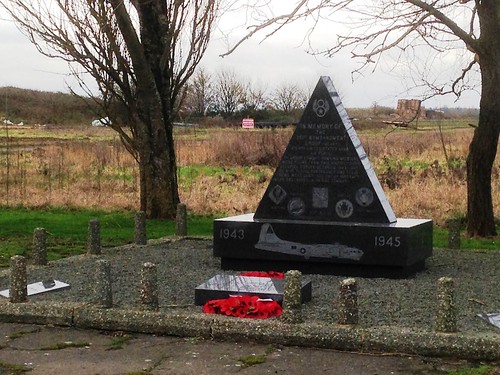
Standing on the site now, the wind howling across the open fields, it is easy to imagine how the site must have been all those years ago. A memorial stands on what remains of the main runway, a small section of concrete, overlooking the airfield.

Memorial

A memorial looks over the remnants of the main runway.

Two benches carved in marble with a main triangular stone are beautifully carved and cared for. Trees planted in lines mark the threshold where many bombers would have left on their way to targets in occupied Europe. A guest book is supplied in a wooden box and signatures reveal visitors from all over the world.

Across the road from here, tucked away in the corner of a field, is the main battle headquarters. Originally a sunken chamber with communications centre and raised platform, it allows observers a full 360 degree view over the site and surrounding area. Built to specification 1008/41 it is sadly now flooded and standing proud of the ground. Both access points are open to the more adventurous, or fool hardy, explorer.

Battle Headquarters designed to drawing 1008/41.

The battle headquarters offers 360 degree views.

The single largest and most well-preserved building is the original ‘J’ type hangar. Used for farming purposes, it is well looked after and visible from most parts of the site. The T2 hangars that would have been opposite are gone. as has the control tower and other main structures.

The three Thor sites are still standing, used by the farmer for storage. They were (at the time of visiting) buried beneath hay bales and farm machinery. One is clearly visible however, the blast walls standing proud. Whilst careful exploring around the others reveals tracks and remains of the housing for the Liquid oxygen supply tank and hydropneumatic controllers, all ancillary buildings are gone.

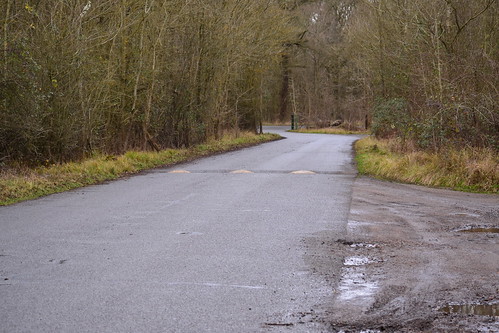
The best evidence of life at Polebrook can be seen from the entrance to the ‘industrial’ site on the Lutton to Polebrook Road. This area, now woodland, is actually designated a nature reserve and access is freely available. This small road is the original entrance to the airfield and to both your left and right are the technical areas. Beneath the leaves and muddy floor, road ways still lined with kerbstones, are visible, and whilst the road way is not clear, it is possible to make out the general view of the site.

main entrance

The original entrance to the airfield. The main road in the distance separates the technical areas, left and right, from the accommodation areas in the woods ahead.

Hidden amongst the trees and brambles, are a few good examples of the buildings once used. Most, are now piles of concrete, but quite a few shelters are still about and accessible. Storage tanks are open, the covers gone and so as a caution, tread very carefully amongst the bushes watching your footing.

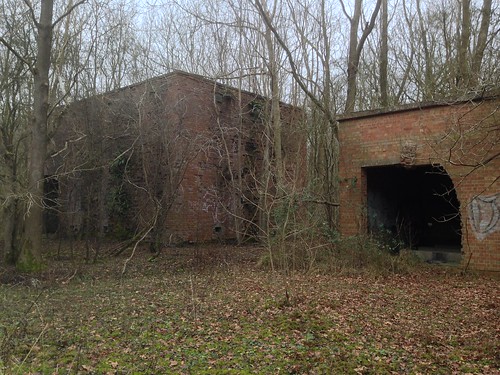
From the entrance, to your left and a little further in, are two buildings, still shells but intact. The larger, I believe is the operations block, a smaller building next to it may have been a power or perhaps communications building.

operations block and adjacent building

One of the various substantial remains, possibly the operations block.

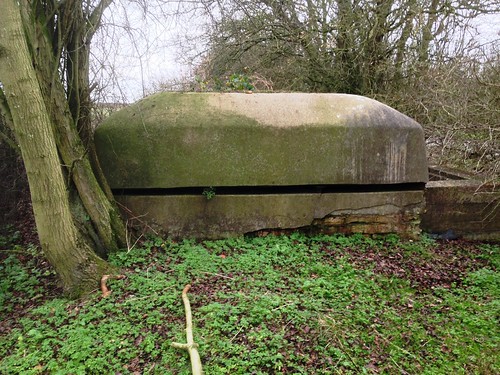
Polebrook is unique in that it has/had examples of twin looped pill boxes. Here one firing window is situated above the other. A few other more standard examples are also on site some easily seen from the road or track.

I believe that the office on the site contains a full-scale model of the airfield as it was, and that the owner is more than helpful to visitors. Unfortunately on the day I was there, I was unable to take advantage of this so a return visit is certainly on the cards for later.

I was amazingly surprised by Polebrook. It is a truly an atmospheric place with plenty to see for the visitor; remnants of a time gone by lay hidden amongst the trees and brambles of the now wooded area, and little reminders of lives lost, lay beneath the leaves. A howling winter wind replaced by summer sun, carry the voices of those young men across its open expanse and through its decaying walls of history.

Polebrook appears in Trail 19.

Sources and further Reading

*1 Ashton Wold – Historic England information sheet List Entry Number: 1001715 accessed 6/2/19

*2 Photo taken from Wikipedia open source. http://commons.wikimedia.org/wiki/File:Polebrook-Aug1948.png

*3 The story of Archie Mathies appears in the ‘Heroic Tales‘. The crew list of B-17 ‘Ten Horsepower‘ was:

Pilot: Clarry Nelson,
Co-Pilot: Roland Bartley,
Navigator: Walter Truemper
Engineer / Top Turret Gunner: Archie Mathies
Bombardier: Joe Martin (POW)
Radio Operator: Joe Rex,
Ball Turret Gunner: Carl Moore,
Waist Gunner: Tom Sowell,
Waist Gunner: Russ Robinson,
Tail Gunner: Magnus Hagbo

Anton. T., & Nowlin. B., “When Football went to War” 2013, Triumph Books

Freeman, R., “The Mighty Eighth War Diary“, (1981) Jane’s Publishing.

Freeman, R., “The Mighty Eighth“, (1986), Arms and Armour Press.

For further information, see the superbly detailed website dedicated to the 351st BG with photos of crews and aircraft.

If time allows, the nearby Polebrook church also has a memorial dedicated to the personnel of the base.

Polebrook was originally visited in the latter part of 2014, the full Trail can be seen in Trail 19.