RAF Polebrook – the First USAAF Bombing mission (Pt 2).

In Part One of RAF Polebrook, we saw how the airfield had been developed, how it had been used by the first B-17s in RAF service. We saw how the first USAAF B-17 had landed setting the wheels of history in motion. We also saw the first USAAF bombing mission, and the American’s first major losses of the war. By mid 1943 a new unit, the 351st Bomb Group, was now arriving at Polebrook and they too were preparing for combat and their first mission of the War.

On May 12th 1943, the 351st would be initiated into the conflict, but it was not the most auspicious of starts to their campaign. The Eighth Air Force put up a force of seventy-two B-17s from the 4 BW and a further ninety-seven from the 1 BW. The call required all fourteen 351st BG aircraft to head for St. Omer / Ft. Rouge in France. After the lead aircraft discovered a fault in the oxygen system, it turned for home, the remaining aircraft then became disorganised and returned to base without dropping a single bomb.

The 351st would improve and go on to attack many prestige targets including: Schweinfurt, Mayen, Koblenz, Hannover, Berlin, Cologne, Mannheim and Hamburg. They would later go on to target submarine pens, harbours and ‘V’ weapons sites. Ground support was provided for both the Normandy invasion, the Battle of the Bulge and other major ground battles up to and including the crossing of the Rhine.
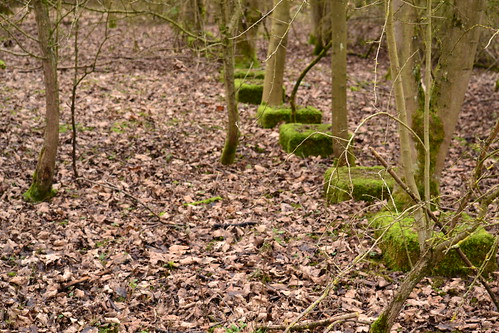
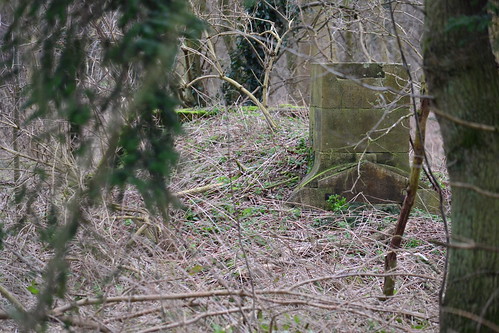
foundations

Stone foundations poke through the undergrowth.

In October 1943, the unit received the first of its Distinguished Unit Citations (DUC), with highly accurate bombing in very challenging conditions raising the standing of this new group. A second DUC was to follow in January 1944 for action deep in the heart of Germany. During an attack on Leipzig in the ‘Big Week’ campaign of 20th – 25th February 1944, two crewmen of the 510th, 2nd Lt Walter Truemper (Navigator) and Sgt. Archibald Mathies*2 (Flt. Engineer), both received Medals of Honour for taking over their stricken aircraft when both Pilot and Co-Pilot were injured / killed. B-17, TU-A ‘Ten Horsepower‘ (#42-31763), was directly hit by flak, both Truemper and Mathies nursed the aircraft back to Polebrook where they allowed the other crew members to bail out safely. On attempting to land the aircraft for the third time, it crashed (Great North Road) between Glatton (Trail 6) and Polebrook exploding, killing all three remaining crew members.

A B-17G Flying Fortress nicknamed

The last moments of B-17G “Ten Horsepower” (TU-A, #42-21763) piloted by Second Lieutenant Walter E Truemper  and Sergeant Archibald Mathies, as it is guided by a fellow aircraft after the pilot was severely injured. Truemper and Mathies unsuccessfully attempted to land the aircraft at Polebrook and were posthumously awarded the Medal of Honour for their bravery, 20th February 1944. (IWM FRE 4724)

It was also during this time that (Cp.) Clark Gable was stationed at Polebrook, initially to make recruitment films for air gunners, flying five combat missions in total and taking a film crew on each one. The first was on 4th May 1943 and his last on 23rd September that same year. He was initially awarded the Air Medal, and later the Distinguished Flying Cross, finally leaving Polebrook with over 50,000 feet of film on 5th November 1943. In 1944, the film ‘Combat America’, narrated by Gable himself, was shown in theatres around the United States. The film covers the 351st from their departure from the United states through their campaign. Included is footage of the collision between the two B-17s on May 7th 1943.

Another remarkable record was set at Polebrook, between 13th June 1943 and January 11th 1944, when Maj. Eliza LeDoux would lead the 509th BS (351st BG) for fifty-two  consecutive missions without losing either a single man nor a single aeroplane. An astonishing example set when at the same time other US Groups were losing aircraft at a rate of around 5%.

Major LeDoux, commanding officer of the 351st Bomb Group the cockpit of a B-17 Flying Fortress, 20 June 1943. Official caption on image:

Major LeDoux, CO, 509th BS, 351st BG, 20th June 1943. He led his squadron without loss for 52 consecutive missions.

The 351st remained at Polebrook until shortly after VE day, returning to the US and becoming deactivated on August 28th 1945. Polebrook then became quiet once more being put under care and maintenance until its closure in 1948.

During the three years the 351st were at Polebrook, they flew a total of 279 B-17s on 9,075 sorties with 7,945 of them dropping 20,778 tons of bombs. Air gunners on these aircraft were credited with 303 enemy aircraft destroyed. In all they flew 311 credited missions losing 175 B-17s in all.

One interesting point about Polebrook was that as a station under care and maintenance, it is thought that within its hangars was the last Short Stirling to be owned by the Royal Air Force.  A MK.V aircraft, it was struck off charge in 1946, a point that ended a long and interesting career for an aircraft that has long been considered a failure. As a bomber, this was certainly partly true, the many teething problems it had suffered – a lack of altitude, poor climb rate, continued engine problems and a tendency to swing on take off – all giving it a bad name. However, it could out manoeuvre a Lancaster and it could give any fighter of its time a run for its money. By the end of its flying career, the Stirling was loved by its crews, it had been a successful transport aircraft, mining platform and had brought many POWs back home after the war. Sadly though, none survived other than as wrecks at the bottom of Fjords or as bits salvaged from various crash sites across Europe. The days of the Stirling were now over and the only person to gain any benefit from them was to be the scrap man.
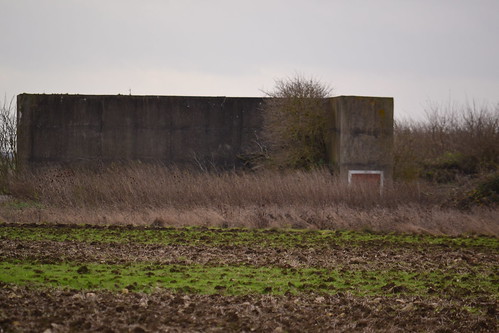
Thor site walls

3 Thor missile sites remain used for farm machinery.

But it wasn’t quite the same for Polebrook. Post war, and with the heightened threat from the Soviet Union, Polebrook was once more brought back to life, with three Thor missile sites being constructed in the centre of the main runway. These remained operational until August 1963 when they were finally removed and the site closed off. It was sold back to the former owners, at which point the airfield’s runways were dug up for valuable hardcore and many of the buildings were pulled down.

Standing on the site now, the wind howling across the open fields, it is easy to imagine how the site must have been all those years ago. A memorial stands on what remains of the main runway, a small section of concrete, overlooking the airfield.
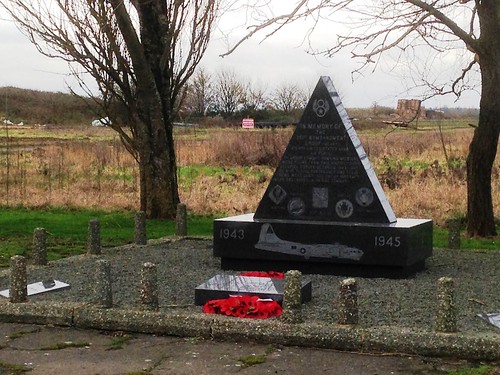
Memorial

A memorial looks over the remnants of the main runway.

Two benches carved in marble with a main triangular stone are beautifully carved and cared for. Trees planted in lines mark the threshold where many bombers would have left on their way to targets in occupied Europe. A guest book is supplied in a wooden box and signatures reveal visitors from all over the world.

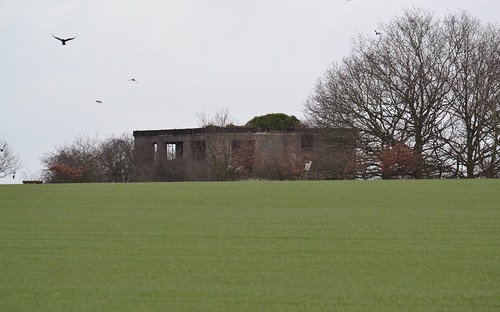
Across the road from here, tucked away in the corner of a field, is the main battle headquarters. Originally a sunken chamber with communications centre and raised platform, it allows observers a full 360 degree view over the site and surrounding area. Built to specification 1008/41 it is sadly now flooded and standing proud of the ground. Both access points are open to the more adventurous, or fool hardy, explorer.
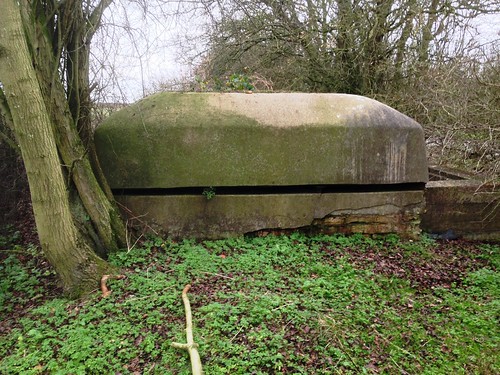
Battle Headquarters designed to drawing 1008/41.

The battle headquarters offers 360 degree views.

The single largest and most well-preserved building is the original ‘J’ type hangar. Used for farming purposes, it is well looked after and visible from most parts of the site. The T2 hangars that would have been opposite are gone. as has the control tower and other main structures.

The three Thor sites are still standing, used by the farmer for storage. They were (at the time of visiting) buried beneath hay bales and farm machinery. One is clearly visible however, the blast walls standing proud. Whilst careful exploring around the others reveals tracks and remains of the housing for the Liquid oxygen supply tank and hydropneumatic controllers, all ancillary buildings are gone.

The best evidence of life at Polebrook can be seen from the entrance to the ‘industrial’ site on the Lutton to Polebrook Road. This area, now woodland, is actually designated a nature reserve and access is freely available. This small road is the original entrance to the airfield and to both your left and right are the technical areas. Beneath the leaves and muddy floor, road ways still lined with kerbstones, are visible, and whilst the road way is not clear, it is possible to make out the general view of the site.
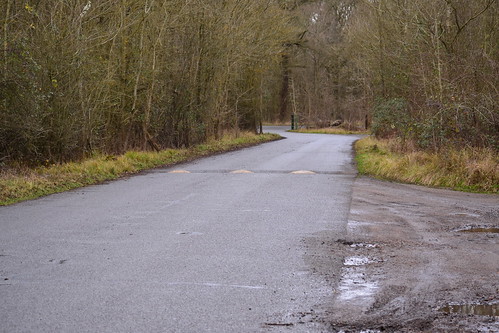
main entrance

The original entrance to the airfield. The main road in the distance separates the technical areas, left and right, from the accommodation areas in the woods ahead.

Hidden amongst the trees and brambles, are a few good examples of the buildings once used. Most, are now piles of concrete, but quite a few shelters are still about and accessible. Storage tanks are open, the covers gone and so as a caution, tread very carefully amongst the bushes watching your footing.

From the entrance, to your left and a little further in, are two buildings, still shells but intact. The larger, I believe is the operations block, a smaller building next to it may have been a power or perhaps communications building.
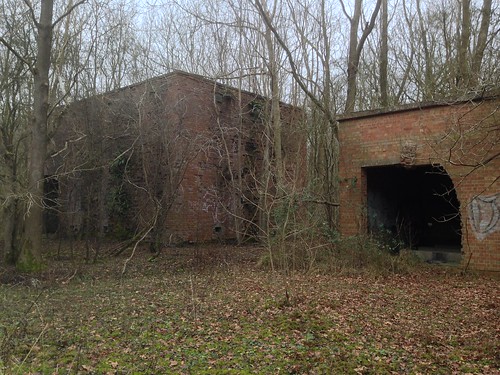
operations block and adjacent building

One of the various substantial remains, possibly the operations block.

Polebrook is unique in that it has/had examples of twin looped pill boxes. Here one firing window is situated above the other. A few other more standard examples are also on site some easily seen from the road or track.

I believe that the office on the site contains a full-scale model of the airfield as it was, and that the owner is more than helpful to visitors. Unfortunately on the day I was there, I was unable to take advantage of this so a return visit is certainly on the cards for later.

I was amazingly surprised by Polebrook. It is a truly an atmospheric place with plenty to see for the visitor; remnants of a time gone by lay hidden amongst the trees and brambles of the now wooded area, and little reminders of lives lost, lay beneath the leaves. A howling winter wind replaced by summer sun, carry the voices of those young men across its open expanse and through its decaying walls of history.

Polebrook appears in Trail 19.

Sources and further Reading

*1 Ashton Wold – Historic England information sheet List Entry Number: 1001715 accessed 6/2/19

*2 Photo taken from Wikipedia open source. http://commons.wikimedia.org/wiki/File:Polebrook-Aug1948.png

*3 The story of Archie Mathies appears in the ‘Heroic Tales‘. The crew list of B-17 ‘Ten Horsepower‘ was:

Pilot: Clarry Nelson,
Co-Pilot: Roland Bartley,
Navigator: Walter Truemper
Engineer / Top Turret Gunner: Archie Mathies
Bombardier: Joe Martin (POW)
Radio Operator: Joe Rex,
Ball Turret Gunner: Carl Moore,
Waist Gunner: Tom Sowell,
Waist Gunner: Russ Robinson,
Tail Gunner: Magnus Hagbo

Anton. T., & Nowlin. B., “When Football went to War” 2013, Triumph Books

Freeman, R., “The Mighty Eighth War Diary“, (1981) Jane’s Publishing.

Freeman, R., “The Mighty Eighth“, (1986), Arms and Armour Press.

For further information, see the superbly detailed website dedicated to the 351st BG with photos of crews and aircraft.

If time allows, the nearby Polebrook church also has a memorial dedicated to the personnel of the base.

Polebrook was originally visited in the latter part of 2014, the full Trail can be seen in Trail 19.
RAF North Pickenham – The Worst Record of the Eighth

There were many airfields in the eastern region of England during the Second World War, and countless crews were lost flying in combat operations. Undeterred and undaunted by these losses, many continued the brave fight to release Europe from the evil grip that was slowly strangling it. Loses were high, but at one particular airfield, the loses of one Group were the highest, and of those that came here, few were to return home alive.

In Trail 9 we visit RAF North Pickenham, an airfield with a short life, but one with a terrible tale of loss and sacrifice.

RAF North Pickenham (Station 143)

RAF North Pickenham was built in the later part of the Second World War (1943/44) and was officially handed over to the USAAF, 492nd Bomb Group (BG), on May 22nd 1944, by an RAF Officer during a ceremonial hand-over parade. This handover would see the culmination of USAAF takeovers of British Airfields – some sixty-six in all. America’s ‘friendly invasion’, would result in eighty-two major operational units moving to the UK, all of which would occupy some seventy-seven military sites in total.

RAF North Pickenham (Station 143) was built with three concrete runways, 50 ‘spectacle’ style hardstands and a substantial bomb store to the north-west. Accommodation for the crews, was divided into a: communal site (site 3), mess site (site 4), six officers’ quarters (sites 6 to 11) and a sick quarters (site 5). Three further sites, 12-14, consisted of a small sentry post, sewage disposal site and H.F.D.F station. All the accommodation areas were to the eastern side of the airfield well away from the extended bomb store to the west.

The 492nd were a new unit, only being activated in the previous October. On arrival in the UK in April, they were assigned to the 2nd Bomb Division, 14th Combat Wing and sent to RAF North Pickenham where they entered combat on May 11th 1944. The main body of the ground echelon was formed with personnel taken from units already in the U.K. whilst the air echelons were trained states-side and then ferried across the southern Atlantic route.

This first mission, which took the 492nd to marshalling yards in north-eastern France, saw 364 B-24s of the 2nd and 3rd Bomb Divisions combine with 536 fighters over occupied Europe. Whilst relatively uneventful for the 492nd, two B-24s did run out of fuel on their return journey; the first, B-24J #44-4087 “Sweet Chariot” crashing at Bury St. Edmunds, whilst the second, came to grief at West Wittering in Sussex. Thankfully, only one crewman was lost (3 were injured), but he was to be the first of the many casualties of the 492nd’s operational war.

RAF North Pickenham

Operations Block, North Pickenham

Throughout the month of May, the 492nd operated against industrial targets in Germany, and being a new unit, their loses would be high. On May 19th 1944, a week into operations, they suffered their first major casualties, eight aircraft in total, all shot down in operations over Brunswick. Loses were not only happening in air either, only two days later, on May 21st, two B-24s collided on the ground whilst taxing -‘What’s Next Doc‘ struck ‘Irishman’s Shanty‘ – causing the former to be written off. It was not a good omen for the 492nd.

In the following month, on June 20th, a massed 2nd Bomb Division formation attacked Politz, an attack that saw the 492nd lose a further fourteen aircraft, six of which managed to limp to Sweden before finally coming down.

Things then went from bad to worse for the 492nd, but undaunted and undeterred, they would continue their quest, attacking V-weapons sites, coastal batteries, and other defences along the Normandy coast. Apart from supporting the St. Lo breakout on July 25th, they continued to attack targets in the German homeland for the remainder of what would be their brief existence.

RAF North Pickenham

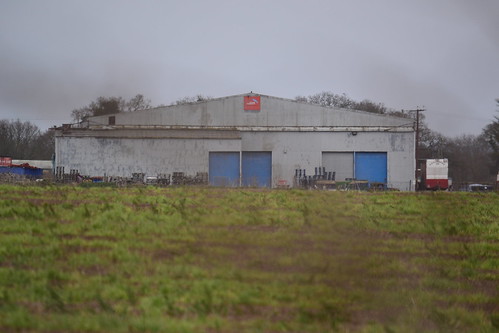
North Pickenham’s last remaining hangar before it was burnt down in 2014.*1

Consisting of the 856th, 857th, 858th and 859th Bomb Squadrons, they were not to fare well at all. In total, the 492nd would carry out sixty-six missions accumulating just over 1,600 sorties. During these operations, they would lose fifty-seven aircraft (including six non-operationally) which was the highest loss of any B-24 unit of the entire Eighth Air Force. Talk of ‘blame’ for these losses was rife; some blamed the aircraft’s all metal finish, saying it attracted fighter attention, others pinned loses on the Luftwaffe’s determination to bring down one single group, whilst another placed it solely at the inability of the crews to fly in neat well-structured formations. Whatever the reasons, it was certain that the 492nd were often ‘Tail-end Charlies‘ finding themselves in the weakest and most vulnerable positions of the formations – easy pickings for the now determined and desperate Luftwaffe pilots.

With loses continuing to climb and talk of a jinxed group spreading, an order came though on August 5th 1944 for the 492nd to withdraw from combat missions and take over ‘Carpetbagger‘ operations previously being performed by the 801st at RAF Harrington.  This order would not end the 492nd’s increasing casualties though. On the following day, another two B-24s would both collide on approach to the airfield. #44-4016 ‘Sugar-n-Spice‘ and #42-50719 ‘Sans Souci‘ struck each other causing them both to crash. The accident resulted in the loss of eleven crewmen with another nine injured.

Finally, on 7th August the order was put in place and after the last mission that day, the move began. This reshuffle of numbers and crews was in reality the disbandment of the 492nd, the crews and ground staff being spread far and wide and the 492nd name being transferred to an already well established unit – the 801st.

The loss of these personnel gave North Pickenham a short respite from the rigours of war. But it would only be short. Within a few days, conflict would return as yet another B-24 unit, the 491st Bomb Group, would move in.

Originally designated to reside at North Pickenham, they were instead directed to RAF Metfield, primarily due to the immense progress that the 492nd had made in their training programme. Whilst there must have been concerns around the jinxed airfield, in terms of operational records, the 491st were to be quite the reverse of the 492nd. The 491st arrived at North Pickenham on the 15th August, and continued with their operations over occupied Europe. Like their previous counterparts, they focused on industrial targets in Germany, flying deep in to the heart of the Reich: Berlin, Hamburg, Cologne. Gelsenkirchen, Hannover and Magdeburg.

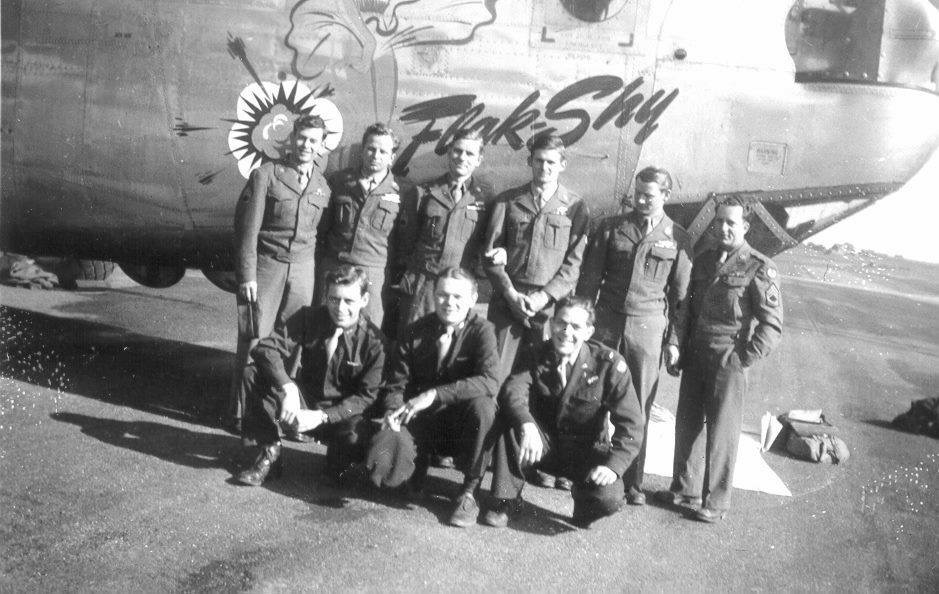
Ben Glidden front left pilot of ‘Flak Shy’ 491BG (Photo John Glidden)

It was on one of these missions, on November 26th 1944, that they were awarded a Distinguished Unit Citation (D.U.C.) for successfully bombing their target in Misburg despite very heavy loses from a prolonged and determined German counter attack. Out of the original 27 aircraft that set out from North Pickenham that day, 15 were lost to enemy action.

As 1944 turned into 1945 the appalling European weather set in. The cold snows of the 1944/45 winter were one of the worst on record, as troops in the Ardennes and ground crews of the Allied Air Forces were to find out to their discomfort.

Many bombing missions were scrubbed, often at the last-minute, but desperate attempts were regularly made to not only get supplies through, but to bomb strategic positions held by the Germans. On January 5th 1945, heavy snows fell across England and in an attempt to attack German positions, two B-24s of the 491st took off from North Pickenham with disastrous results.

The two aircraft, B-24 #44-40165 ‘Rage in Heaven‘ the unit’s assembly ship, and B-24J #42-50793, both crashed just after take off, with considerable loss of life. As a result, the decision was then made for the 491st to abandon any further attempts to get aircraft airborne, and their part in this operation was cancelled. Even though some 1,000 aircraft of the 1st, 2nd and 3rd Air Divisions would get aloft that day, January 5th would become a black day and notoriously famous for a number of such incidents across the English countryside.

The remains of B-24 #42-50793 lay in the heavy snows of North Pickenham following a crash on January 5th 1945.  One of two 491st aircraft that crashed that day in snow storms. (IWM FRE 8588)

Eventually by April 1945, “The Ringmasters” as they had become known, had amassed over 5000 sorties, dropping over 12,000 tons of bombs, for the loss of only 47 aircraft on operational missions over occupied Europe. In June and July, after cessation of conflict, they began their withdrawal and a gradual return to the United States. A few days of ‘R and R’ then led to their inactivation on September 8th 1945.

After the group left North Pickenham, no other flying squadrons were based here, neither American or RAF, but a brief residency of Thor missiles operated by 220 Sqn between 22nd July 1959 and 10th July 1963, saw the site brought back to life momentarily. Finally, a last reprieve in 1965 saw testing of the Kestrel VTOL aircraft which of course became famous as the Harrier, one of the many British Jet Aircraft to see combat operations in the post war eras.

After the Kestrel trials were over, the site was closed and sold off, returning to a mix of poultry farming, and light industry. Many of the hardstands were removed, buildings left to deteriorate and the perimeter track reduced to a fraction of its former self. As time has gone on wind turbines have sprouted up across the open landscape making good use of the winds that blow across the Norfolk countryside.

RAF North Pickenham

“Stanton” shelter located at South Pickenham.

Despite this decline, there are still signs of this once busy station to see. If approaching from the south, you will pass through South Pickenham first. Follow the leafy road toward the village, but keep a sharp eye open for amongst the trees are a series of “Stanton” air raid shelters of which there are five in total. Many of these are only visible by the escape hatches serving the top of the shelter. These were part of the domestic site that once served the airfield.

Some of these shelters are easily accessible being a few feet from the roadside, but as always, caution is the key word when visiting, and remember the laws of trespass! Moving further on, take a left and you pass a small collection of buildings on the right hand side.

These are the operations block and the store for the American  Norden M7 bomb sight. In a very poor state of repair, they once played a major role in the American offensive over Nazi Germany, – there must be many stories held within their crumbling and decaying walls. Continue past the buildings and you arrive at a ‘T’ junction. Turning right will take you to the airfield, now an industrial site and turkey farm. Access from here is both limited and private. Instead turn left, follow the road along, and then join the B1077. Turn right and drive for a mile or two, the airfield is on your right. A suitable parking space allows views across the field where its enormity can be truly understood. Now containing many turkey sheds along its runways, the outline is distinct and relatively clear considering its age. Up until November 2014 one of the original hangars still remained*1 fire destroying the structure, and what was left then subsequently removed. A number of ordnance huts mark the former location of the bomb dump, these can still be seen in the foreground from this high vantage point. The Watch Office, built to design 12779/41was demolished many years ago but stood opposite you and to the right.

It is also possible to view the main runway. By driving around the site via Swaffham, or retracing your steps though the village, the best view is from the northern end of the airfield on the road from Swaffham to Bradenham, close to the village where the base gets its name. Substantial is size, these runways have fared remarkably well and the sheer size of them easily discernible from the views at this end.

North Pickenham may truly fit the description of ‘ghost’ airfield, its chequered history includes not only one of the worst fatality records of the whole eighth Air Force, but it also attracted a lot of Luftwaffe attention. In excess of 200 German bombs were dropped on it during its short and rather dramatic wartime life. Handed over to the Americans in May 1944, it was the 66th and final one to be so, thus ending a remarkable chapter in world history.

A memorial to the servicemen who flew from North Pickenham, lays silently in the village on the edge of a new housing development. Wreaths from nearby RAF Lakenheath enforce the link between the current American Air Force and Norfolk’s legendary flying history.

On leaving the remnants and stories of North Pickenham, we continue south-east, toward the former RAF Watton, another now extinguished British airfield.

DSC_0056

Memorial dedicated to those who flew from, and never returned to, North Pickenham.

North Pickenham was originally visited in early 2014, this post has since been updated.

*1 This hangar was burnt down in November 2014. My thanks to the anonymous reader for the updates and corrections.