RAF Debach – Home of Helton’s Hellcats.

As we depart Framlingham we head a short distance away to the south-west, to another U.S Bomber base also with a remarkable museum. As we head towards Ipswich we arrive at Debach, the former base of the 493rd BG(H) and a group named after its commander Col. Elbert Helton, “Helton’s Hellcats.”

RAF Debach (Station 152).

Debach was one of the last bases to be built during the war, hence its life span was relatively short. Construction began in 1943 opening in 1944 and was constructed by the 820th Engineer Battalion (Aviation) whose headquarters were at Great Barrington in the Cotswolds.

The 820th arrived, by boat, at Glasgow, unprepared but warned about the ‘English reserve‘ that they were likely to encounter. After travelling by train to Debach they were kept ‘on base’ sleeping in tents that were arranged around the airfield they were intending to build. Against orders, the men then decided it was time to see what England was all about and set off along its leafy lanes with thatched cottages and chocolate box views. Their first real taste of England came at the local pub ‘The Dog‘ in Grundisburgh, which sat across a wooden bridge from the local village green.

A traditional pub, it had served the locals for centuries, and to the Americans, it was stuck there. Old men with pipes sat in the corners while oak beams held the low ceilings just above the GI’s heads.
Debach Airfield and Museum

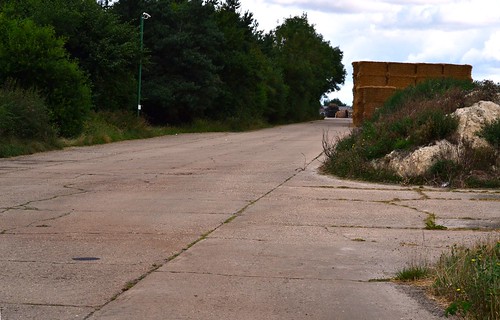
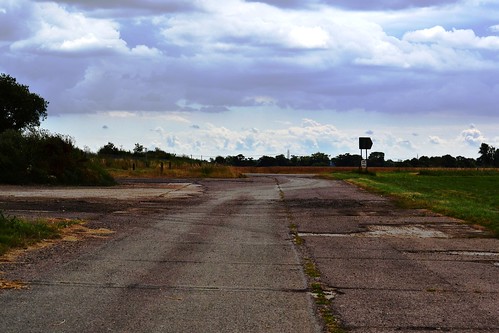
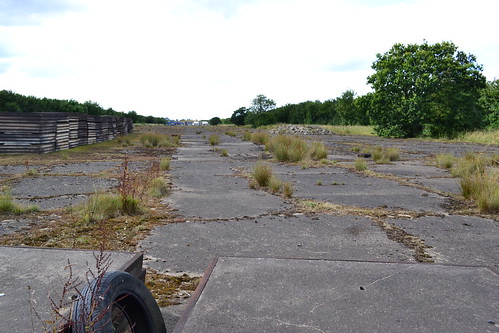
Part of the runway at Debach, cracking and breaking up, built by the 820th Engineer Battalion, it once resounded to the roar of heavy bombers.

After thinking they had entered a weird new world, the GIs tried the beers, all of them, to find one that suited the American taste buds the best. Before long, word spread, and the pub empty on their arrival, quickly filled with inquisitive English people, interested in seeing what these Americans were really like.

After an evening of much talk and drinking, the GI’s left for their tented homes, their first introduction to the British being a polite and pleasant affair. By the end of the evening the pub had run out of beer, the first time such a thing had happened in its 450 year old history.

Debach as a Class ‘A’ site, had three concrete runways, the main running slightly off north/east-south/west, the second east-west, and the third slightly off north-south.  The runway patterns at Debach were slightly different to the norm in that the cross of the ‘A’ was at the base rather than part way up, but the various lengths were as per other Class ‘A’ models.

A perimeter track with 50 spectacle hardstands joined the thresholds of each runway, with the bomb store to the south-east and the accommodation, admin and technical areas all spread along the western side. The airfield site encompassed the medieval site of Thistledon Hall, a three-moated house that has historical features dating back to the late 16th and early 17th Century. A building that was demolished by the 820th Engineer Battalion to make way for the airfield.

Accommodation was split over 6 officer and enlisted crewmen sites, two WAAF sites, a sick quarters and admin block that granted access to the main airfield. The majority of the buildings were Nissen huts, with some Romneys, a blister hanger for the gunnery trainer and two T2 hangars.

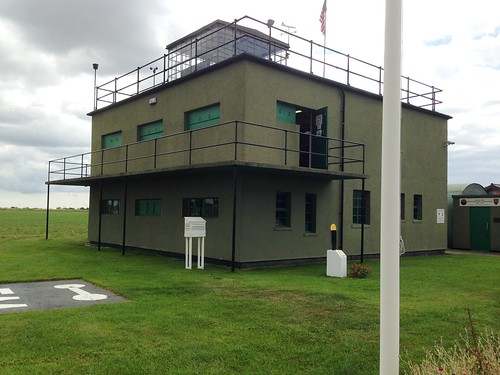
The watch office was of the standard wartime design, built to drawing 12779/41 later adapted to take the much smaller windows as per the updated drawing 343/43. This gave it a slightly different appearance to non-modified towers of the time.

In the technical area, Debach had the usual range of buildings, stores and supply huts, however, the parachute store was almost unique in that it had its own drying room attached – perhaps as a result of the late building of the site. Like many of the forty-one airfields built to house the USAAF heavy bombers, Debach cost nearly £1,000,000 to construct, a small amount compared to the £645, 000,000 it cost to build all 250 US airfields in the UK*.

The mid war years saw a dramatic and rapid build up of the Eighth Air Force on British soil. This build up had seen huge numbers of both men and machinery arrive via Atlantic routes, many coming through the large ports at Greenock or Liverpool. The 40th, and last group to be assigned to the ‘Mighty Eighth’, would be the 493rd Bombardment Group (Heavy) and they would be assigned to RAF Debach.
Debach Airfield and Museum

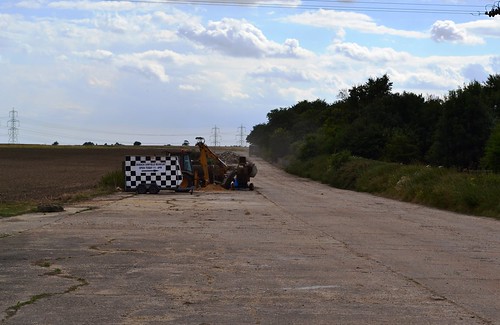
The perimeter track forms access for farm vehicles.

The 493rd would be a relatively short-lived unit, moving from their training ground at McCook Army Airfield in Nebraska, to their headquarters at Elveldon Hall, and Debach airfield. They remained here until their return to Sioux Falls post war. Their entire service would last just short of 2 years. Following their activation in November 1943, they had their ground echelons assigned in early 1944 with the air echelons joining in the following May. Ground crews were pulled in from other units to form these ground echelons, with additional support coming over from the U.S arriving at Liverpool on the USS Brazil. The 493rd were initially assigned the mighty ‘Olive-Drab’ B-24H ‘Liberator’  a lumbering giant of the skies it was loved by many and loathed by some.

Their inauguration would be a baptism of fire, celebrations overshadowed by events taking place overseas. On the morning of Tuesday 6th June 1944, high spirits took the crews of the 860th, 861st, 862nd and 863rd Bombardment squadrons high above the beaches of Normandy. Joining some 11,000 other aircraft, this 3rd Air Division unit would aim to soften up German gun defences dug in along the Normandy beach head. As the allies moved inland, the 493rd would go on to target key bridges and airfields, German strongholds around St. Lo and Caen. Other strategic targets further inland would include marshalling yards, manufacturing plants and the heavily defended oil plants at Merseberg.

Cpl. Kenneth Blair died in a tragic accident on July 8th 1944. He is buried in the Cambridge American Cemetery, Madingley.*1

Losses in battle are often more ‘acceptable’ than losses though accidents, and Debach would have its share of both. On July 8th 1944 only a month after their first mission, Cpl. Kenneth Blair (s/n: 39692721) of the 18th Weather Squadron, 493rd BG would be killed in a tragic accident that involved him walking into the spinning propeller of a running B-24. Only minutes before, he had received good news that took him  to his ultimate and tragic death.

The last mission to see the 493rd using B-24s was on August 24th, when fifty-two B-24s and 383 B-17s attacked Kiel in Germany. Within two weeks crews were using the formidable B-17G ‘Flying Fortress’, an aircraft that took them back to the German Heartland. Using these aircraft they went on to support the allied push through Holland to Arnhem, and in the fight back against Von Rundstedt’s last-ditch attempt to push back the Allies in the Ardennes.
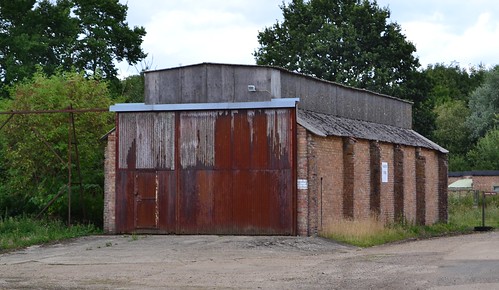
Debach Airfield and Museum

The parachute room was rare with its addition of a separate drying area.

Late 1944 was a difficult time for the crews of the Air Forces. many of the airfields in the UK were shrouded in fog, causing many operations to be cancelled at late notice. Those that did go ahead were largely ineffective until finally, the clouds lifted and the fog dispersed. The frustration for the crews must have been immense.

It was during this time that one crew had a very lucky escape in an event that was reflected on many airfields across England. On December 12th, whilst on the 493rd’s third trip to Darmstadt, B-17 #43-38219 ‘Devil’s Own‘ suffered an engine problem that resulted in an intense fire on the port wing. In an attempt to extinguish the fire, the pilot, Lt. John E. DeWitt, put the aircraft into a dive. This proved fruitless and with little choice left he decided to bring the stricken aircraft back to Debach. The fire had now become so intense that there was an almost certain chance that the wing would separate from the fuselage. The resulting crash would have most certainly led to the deaths of the crew and those on the ground below.

DeWitt flew straight in to Debach narrowly missing parked aircraft and vehicles. The crew abandoned the B-17 and within moments the entire bomb load exploded in an explosion that was so severe that the nearby hangar doors were blown completely off their rails. The aircraft was blown apart and pieces spread across a wide area.

With fires still burning, ‘Devil’s Own‘ is scattered across a wide area of Debach. (IWM)

The weather at this time was to play its own part in Debach’s history. Even though it was a relatively new airfield, the frost and cold worked its way into the runway surfaces, and with continued heavy use, it began to break up. New runways were the only answer and so as soon as the aircraft left to attack Uim on March 1st, the ground echelons and servicing units began the arduous task of moving every possible piece of machinery and all supplies over to a temporary base at Little Walden. The 493rd would fly twenty missions from this site as the runways of Debach were removed and then relaid. Remarkably the entire event went with out a single hitch.

In 1945, the 493rd went on to  support the Rhine crossing softening up defences along the German borders, but by the end of April, their bombing war was over, their last mission was carried out on the 20th April 1945 in which they attacked the marshalling yards at Nauen just 38 km west of Berlin. An event that would take their bomb load tally to 11,733 tons in 4,871 sorties. For the remainder of the war the 493rd took part in operation Mania, dropping food in six missions over Holland. Further revival flights took the 493rd to Austria on four occasions in the last days of May 1945.

In the following month the ground echelons returned via the Queen Elizabeth to New York whilst the air echelons flew back in the following July and August. Following thirty days rest and recuperation the unit was disbanded. Debach was now devoid of aircraft and the empty accommodation blocks became a site for both German and Italian Prisoners of War, and displaced persons.

Post war, Debach fell into disrepair. It was eventually sold to the current landowner after the T2s were removed and the runways largely dug up for the lucrative road hardcore. Many of the technical buildings were left and, as with the watch tower, they were in a very poor state of repair.
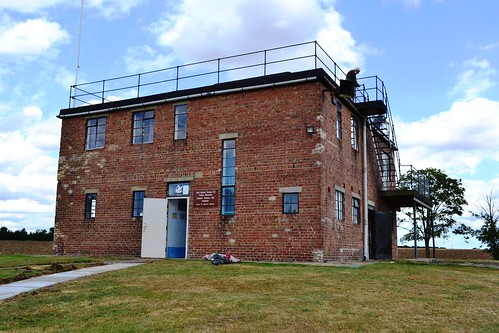
Debach Airfield and Museum

The Watch Office is now a superbly restored museum dedicated to those who served at Debach.

Debach is now a busy farm, the watch tower has been superbly refurbished as have many of the remaining buildings. It now forms the 493d BG museum which houses an incredible amount of memorabilia and wartime stories. It also has a remarkable collection of toys and other items made by prisoners of war and is thought to be the largest collection in the East Anglia region.

Debach is a working farm and the museum is only open at limited times. However, the curators and farm owners are happy to oblige visitors, my self having a personal guided tour of the museum during the summer of 2016. Much of the perimeter track is still there, sections of the runways are also there in part  and allow for the landing of light aircraft during special occasions; but these are amongst the farm grounds and generally off-limits to the public. Then technical area has several buildings used for storage of farm material and a wide collection of military vehicles and memorabilia. The parachute and dingy store are still present as are former motor transport shed and other stores; as a visitor you are able to wander these at will.

If you leave through via main entrance (itself the original airfield entrance) cross the road, walk along the track, on your right you will find the former headquarters building which is now a small industrial unit, this is where you will find the memorial. I was invited in to the building to browse, again freely, at the various photos and mission charts that adorned the walls. These give a fascinating insight into the lives of those at Debach.

When you leave here, head north, (left) turn right at the main road and pass the Clopton Commercial Park (the northern most end of the main and secondary runway, which is still visible beneath the many huts built upon them now). Turn right into Debach village, the village sign is on your left. Depicting a B-17 flying over the village, it has at its base a dedication to those who served and died at the base. Behind the houses to your right are where many of the hardstands upon which the B-17s would have stood. These are now gone beneath the homes of the local residents. Continue on and then turn first right, this road is the old perimeter track and takes you to the end of the secondary runway. From here you can see along its length and width which is still full width today. The decay is obvious though and large cracks filled with small bushes are a sign of its impending demise. This road, still using the perimeter track, then takes you round toward the end of the main runway and away from the site.
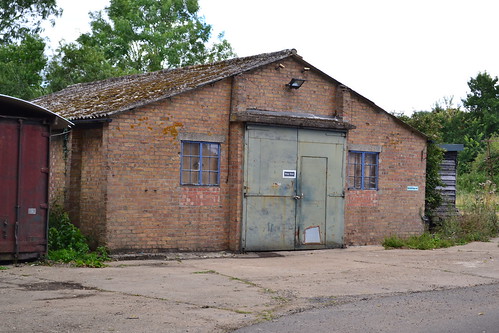
Debach Airfield and Museum

The Dingy Store is one of the many buildings in use today storing farm machinery.

Whilst only being around for a short period of time, Debach has, like so many of these wartime airfields, its own unique stories to tell. It has a history that is part of a time so dramatic that it has become a monument to human ingenuity, planning and suffering.

Almost forgotten and abandoned for good, Debach has been painstakingly and lovingly restored to represent a superb monument to those who fought and died from his airfield. The dedication of the owners is second to none, their passion for the site reflected in the warm welcome you receive when visiting. The small group of volunteers that work so tirelessly to keep it open, enables it to stand today as a reminder of so many events that occurred in the dreadful years leading up to end of the conflict in 1945.

Links and further reading.

Whilst in the village, the now closed church of All Saints also has a memorial in its graveyard.

The 493rd Museum website has all the details of the site and the museum opening hours.

*Wilson, K., “Blood and Fears – How America’s Bomber Boys and Girls in England Won Their War.”,  Weiden & Nicolson. 2016

*1 Photo from IWM image UPL 20040

Arbib, Robert S, “Here we are together: The Notebook of an American Soldier in Britain.”, Longmans, Green And Co. (1946)
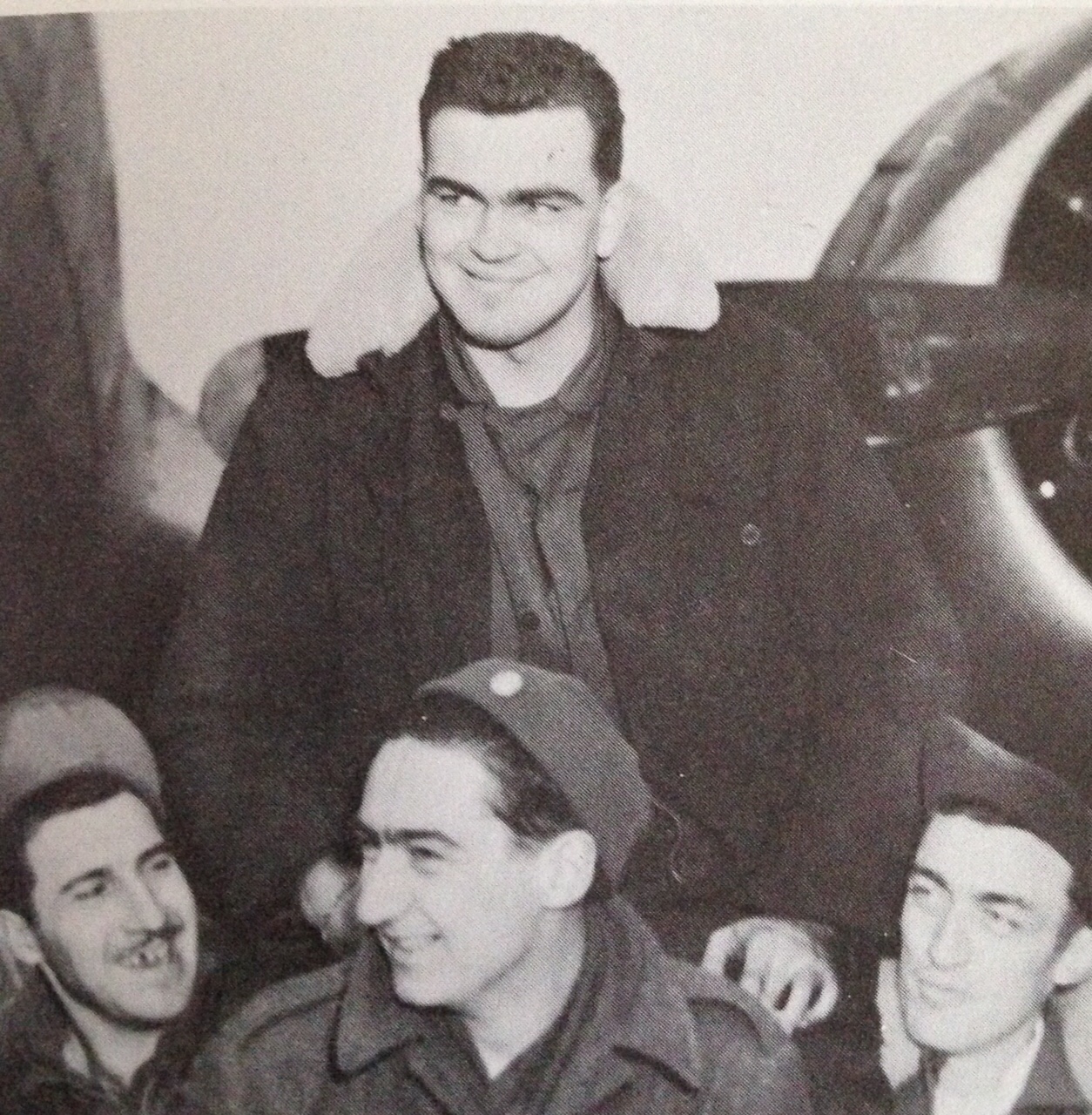
M/Sgt. Hewitt Dunn – Flew 104 missions.

RAF Framlingham (Parham) otherwise known as Station 153, achieved a remarkable record, or rather one man in particular did. His name was Hewitt Dunn, a Master Sergeant in the U.S.A.A.F and later the U.S.A.F.

Known as “Buck” he would achieve the remarkable record of completing 104 missions with the 390th Bombardment Group (Heavy) – a record that astounded many as life expectancy in a heavy bomber was short, and few survived beyond one tour of 30 missions.

Hewitt Tomlinson Dunn (s/n 13065206) was born on July 14th 1920. He progressed through school to join the Air Corps where he was assigned to the 390th Bombardment Group (Heavy), 13th Combat Wing, 3rd Air Division, Eighth Air Force, as a gunner in December 1943.

His first mission was with the 569th Bombardment Squadron in the following January. He completed his first gruelling tour of 30 missions by April that year, upon which he immediately applied for a further tour that he would complete by the summer of 1944. His attitude of ‘its not over until its won’, would see him accept a further remarkable third tour, virtually unheard of for a heavy bomber crew member.

On Friday, April 6th 1945, mission 930, an armada of aircraft of the U.S.A.A.F would strike at the marshalling yards in Leipzig, Germany. Inside B-17 #43-38663, ‘The Great McGinty‘, was Hewitt Dunn.

After the mission Dunn described how earlier at the morning briefing, he, like so many of his colleagues, had been a little ‘nervous’. Then, when the curtain was pulled back, their nervousness was justified, Leipzig – the 390th had been there before.

Many crews in that briefing would look to Dunn for signs of anguish, if he remained steady and relaxed, they knew it would be ‘easy’, if he sat forward, then it was going to be a difficult one. The atmosphere must have been tense.

Luckily, unlike other missions into the German heartland, this one turned out to be ‘just another mission’ a ‘milk run’. Much to the huge relief of those in command of the 390th, all aircraft returned safely.

On his arrival back at Framlingham, Dunn was greeted by cheering crowds, ground crews lifted him high in their air carrying him triumphantly away from his aircraft, it was a heroes welcome.

By the time the war had finished, Dunn had flown in 104 missions, he had been a tail gunner on twenty-six missions, twice a top-turret gunner, a waist gunner and the remainder as togglier (Bombardier). He had flown over Berlin nine times, he claimed a FW-190 shot down and had amassed an impressive array of medals for his bravery and actions, and all at just 24 years old.

Post war, he continued to fly as an Instructor Gunner for B-52s in the 328th Bomb Squadron, 93rd Strategic Bomb Wing, at Castle Air Force Base in California. Here he was described as “quiet and reserved” and never talked about his war experiences. He was “handsome man with black hair”, and only when he wore his dress uniform, did others realise how well decorated he was.

Dunn was considered a rock by those who knew him and perhaps immortal, but he was not, and on June 15th , 1961 after flying for a further 64 flights, he was killed. Details of his death are sketchy, but the man who had flown in more missions than any other person in the Eighth Air Force and had gone to train others in that very role, was highly decorated. He was looked up to and liked by those who knew him.

Following his death a service was held in Merced, California, his body was then taken to Arlington National Cemetery in Washington D.C. where he was finally laid to rest in grave number 3675, section 28.

For a man who achieved so much in his fighting career, little exists about him or his achievements. Maybe, by the end of the war, records were no longer needed, tales of dedication and bravery were no longer useful propaganda. Whatever the reason, Hewitt Dunn’s name should be heavily embossed in the history books of the Second World War.

hewiit-dunn

Hewitt Dunn on return from his 100th mission, April 1945 (IWM)

Hewitt Dunn’s medal tally:

– Air Force Longevity Service Award with 3 oak leaf clusters
– Air Medal with 13 oak leaf clusters (2 silver, 3 bronze)
– Air Medal with 7 oak leaf clusters (1 silver, 2 bronze)
– American Campaign Medal
– Distinguished Flying Cross with 1 oak leaf cluster
– Good Conduct Medal
– National Defence Service Medal
– Silver Star
– World War II Victory Medal
– European-African-Middle Eastern Campaign Medal with 1 bronze star
– European-African-Middle Eastern Campaign Medal with 1 silver star

Hewitt Dunn’s story is one of many featured here.

RAF Framlingham & the 390th BG – Masters of the Air

In Trail 39 we turn south once more and return to Suffolk, to the southern most regions of East Anglia, to an area known for its outstanding beauty and its stunning coastline. It is also an area rich in both Second World War and Cold War history. Perhaps better known for its fighter and light bomber stations, it was also the location for several heavy bomber bases, each one with its own fascinating story to tell.

We start off this trail at the former site of American base at RAF Framlingham.

RAF Framlingham (Station 153)

RAF Framlingham is actually closer to the village of Parham than it is the town of Framlingham, hence it was also known as RAF Parham – a name that it became synonymous with. Built as a class ‘A’ bomber station its official American designation was Station 153.

Building work commenced in 1942, and as with most large bomber stations it was designed to the Class A specification to include: three concrete runways (one of  6,400 ft and two of 4,400 feet in length), an adjoining perimeter track that linked fifty ‘pan style’ dispersals; two T-2 hangars (one to the west with the technical site and one to the south-east) and accommodation for some 3,000 personnel dispersed in 10 sites to the south-west of the airfield.  A  further sewage treatment plant dealt with the site’s waste.

The main runway ran east-west and to the eastern end sat the bomb store, a large area that included: a pyrotechnic store, fusing point, incendiary store and small arms store – all encircled by a concrete roadway.

Peri track looking north toward tech area (A)

Part of the Perimeter track at the southern end of the airfield. To the right was the crew rest rooms, locker and drying rooms.

The administration site sat between the main technical site and accommodation areas all located to the south-west side of the airfield.

Opened in 1943, the first residents were the B-17s of 95th Bomb Group which consisted of four bomb squadrons: the 334th, 335th, 336th and the 412th. Flying a tail code of a square ‘B’ they initially formed part of the 4th Bomb Wing, changing to the 13th Combat Wing, 3rd Air Division of the Eighth Air Force in September 1943 following the reorganisation of the U.S. Air Force in Europe.

Following their inception and constitution on 28th January 1942 and subsequent activation in June, they moved from their training ground at Barksdale Field, Louisiana, through Oregon, Washington and eventually to Rapid City Air force Base in South Dakota. They began their move across the Atlantic in the spring of 1943, taking the southern route via Florida arriving at Alconbury and then moving on directly to Framlingham in early May/June that year. It was whilst stationed at Alconbury though that they would have their first few encounters of the war, and they would not all be plain sailing.

On May 27th, 1943 just 14 days after their first mission, ground crews were loading 500 lb bombs onto a 334th BS B-17 ’42-29685′ when the bombs inexplicably detonated, the Alconbury landscape was instantly turned to utter carnage and devastation. The blast was so severe that it killed eighteen men (another later died of his injuries), injured twenty-one seriously and fourteen others slightly.  The B-17 involved was completely destroyed and very little of its remains could be found in or around the huge crater that was left deep in the Alconbury soil. Three other aircraft, 42-29808, 42-29706 and 42-29833, all sat within 500 feet of the explosion, were severely damaged and subsequently scrapped. In total, fifteen B-17s were damaged by the blast, it was a major blow to the 95th and a terrible start to their war.

There then followed a transition period in which the group moved to Framlingham. During this time operations would continue from both airfields leaving the squadrons split between the two bases. The first few missions were relatively light in terms of numbers of aircraft lost, however, on June 13th 1943, they were part of a ‘small’ force of seventy-six B-17s targeting Kiel’s U-boat yards. This was to be no easy run for the 95th, a total of twenty-two aircraft were lost on this raid and of the eighteen aircraft who set off from Framlingham in the lead section, two aborted and only six made it back. In one of the lead planes, was the newly appointed Brigadier General Nathan Bedford Forrest as observer. Riddled with bullet holes, his aircraft plummeted from of the sky with the majority of its tail plane missing and one of its engines ablaze. His body was never found and he became the first U.S. General causality of the war. In total, the raid resulted in 236 crewmen being listed as either missing, killed or wounded – this would be the 95th’s heaviest and most costly mission of the entire war.

A view from the tower looking East to West.

Two days after this mission the group would depart Framlingham and move to RAF Horham a few miles north-west, where they remained for the remainder of the war. The majority of the crews would probably be pleased to move away leaving behind many terrible memories and lost friends. However, the tide would turn and they would go on to gain a remarkable reputation and make a number of USAAF records. They would be the only Eighth Air Force group to achieve three Distinguished Unit Citations (DUC), and be the first group to bomb Berlin. They also claimed the highest number of enemy aircraft shot down by any bomb group and they would be the group to suffer the last aircraft loss (on a mission) of the war – all quite remarkable considering their devastating introduction to the European Theatre.

As the 95th departed Framlingham so moved in the 390th BG.

The 390th BG like the 95th and 100th were part of the 13th Combat Wing, 3rd Air Division. They too were a new Group, only being formed themselves early in 1943. The 390th BG was made up of four B-17 bomb squadrons: the 568th, 569th, 570th and 571st, and at initial full strength consisted of just short of 400 personnel. They formed part of the larger second wave of USAAF influxes who were all new recruits and whose arrival in the U.K. would double the size of the USAAF’s presence overnight.

Old hands of the Mighty Eighth, took great pride in teasing these new recruits whose bravado and cockiness would soon be knocked out of them by the more experienced Luftwaffe fighter pilots.

The 390th would create quite a stir in the Suffolk countryside and not just because of their ‘smooth taking’, ‘endless supply of chocolate’ and ‘upbeat music’. Up until now, the ‘smuggling’ of pets into American airbases had been by-and-large ignored, but with the 390th came a Honey Bear, a beast that quite frequently escaped only to be confronted by rather bemused locals! There would be however, despite all this frivolity, no rest period for the crews, and operations would start the 12th August 1943, less than a month after they arrived.

B-17 Flying Fortresses of the 390th Bomb Group in flight over Framlingham. Handwritten caption on reverse: '390BG.'

B-17s of the 390th BG over RAF Framlingham (IWM)

The latter parts of 1943 saw a lot of poor weather over both the U.K. and the continent, and this combined with the heavy use of smoke screens by the Germans, prevented large numbers of bombers finding their targets. As a result, many crews sought targets of opportunity thus breaking up strong defensive formations. The eager Luftwaffe pilots made good use of this, taking advantage of broken formations and poor defences. As a result, the bombers of this new influx would receive many heavy casualties and August 12th was to become the second heaviest loss of life in the American air war so far.

1943 would be a busy time for the 390th, within a few days and on the anniversary of the U.S. VIII Air Force’s first European operation, they would attack the Messerschmitt factory at Regensburg, a mission for which they would receive their first Distinguished Unit Citation (DUC).

The operation would be a blood bath. On that day 147 B-17s took off with the 390th forming the high squadron in the first formation. For over an hour and a half, multiple fighters of the Luftwaffe attacked the formations which were split by delayed arrivals, and large gaps in the formation. Compounded with this was the fact that the escorting P-47s had to return home leaving the formations largely undefended. With no fighter escort the bombers became easy prey and the numbers of blood-thirsty attacks increased. The rear and low formations of the force were decimated and departing P-47 fighter crews could only look on in horror.

Over the target, skies cleared and bombing accuracy was excellent, but it was the 390th that would excel. Of the seven groups to attack, the 390th manged to get 58% of its bombs within 1000 ft of the target and 94% within 2000 ft, a remarkable achievement for a fledgling group. Flying on, they passed over the Alps and across Italy onto North Africa where they landed – their first shuttle mission was complete. The run in to the target and subsequent journey to North Africa would create multiple records; two B-17s, one of which belonged to the 390th, sought sanctuary in neutral Switzerland, the first of any group to do so. But the journey across Europe had been difficult and it would cost the lives of six B-17 crews – it had truly been a hard-won DUC.

Two months and some 20 missions later, they would repeat this epic achievement. On October 14th 1943, they took part in the second major attack on Schweinfurt, a target whose name alone put the fear of God into many crews. The route that day would take them across some of the most notorious Flak black spots, Aachen, Frankfurt, Bad Kissingen and Schweinfurt itself. On top of that, Luftwaffe fighters would be hungry for blood, many crew members knew this would be a one way trip.

Take off was at 10:00am, and the Third Air Division would provide 154 aircraft, but again due to mechanical problems and poor weather, the formation were scattered across the sky and defences were weak. As they crossed the channel enemy aircraft were few and far between, giving false hopes to rookie crews who were cruising 20,000 feet above the ground. Eventually at around 1:00pm the escorts left and the waiting Luftwaffe crews stepped in. All hell broke loose. Rockets, timed bombs and heavy machine gun fire riddled the B-17 formations – Schweinfurt was going to live up to its reputation. After fending off relentless attacks by the Luftwaffe, the formation reached their target and all 390th aircraft managed to bomb with an accuracy of 51% of the MPI (Mean Point of Impact). For this they received their second DUC – the newbies were rapidly becoming masters of the air.

July 2016 019

The widest section of runway, now a mere fraction of its former self.

1943 would draw to a close, and the optimism of many ‘successful’ raids over the Reich would bring the dawn of 1944.  Big week in February saw the massed attacks on the German aircraft production factories, and in March, the 390th attacked Berlin. During this raid B-17 ’42-30713′ “Phyllis Marie” made an emergency landing only to be captured intact by the Luftwaffe and flown under KG200. It was later found in Bavaria.

Other major targets for the 390th this year included Frankfurt marshalling yards, Cologne, Mannheim, the navel yards at Bremen and the oil refineries at Mersburg. In 1944 the 390th softened the German defences along the Atlantic coast just fifteen minutes before the invasion force landed in June. They followed up the advance by supporting the allied break out at St. Lo.

During August 1944, the 390th flew a round mission that took them for the second time to a Russian airfield. After refuelling and rearming, they attacked the oil refineries at Trzebinia (later famed with the POW’s ‘death march’ across western Europe) and then back to Russia. Three days later they flew to North Africa, depositing high explosives in Romania, and then four days after that, the return trip to Framlingham bombing Toulouse on the way.

The cold winter of 1944 would become well-known for its snow and ice, a period in which almost as many aircraft were lost to ice as to enemy action. On December 27th, the cold would claim B-17 ’42-107010′ “Gloria-Ann II” of the 569th BS. A build up of ice would bring her down within a minute of taking off and the ensuing explosion of fuel and bombs would cause a fire from which nine crew members would perish. Houses in the vicinity of Parham were also damaged but there were no local casualties and the aircraft would be salvaged and reborn as “Close Crop“.

B-17G-35-VE #42-97849

Battle damage was often severe, here B-17G #42-97849 “Liberty Bell” of the 570th BS, shows extensive damage to her tail section. (IWM)

In the early months of 1945 the Ardennes was also gripped in this terrible fog and cold. The 390th took off in support of the paratroopers locked in the Belgium forests, bombing strategic targets beyond the Ardennes, they cut German lines preventing further supplies reaching the front.

By 1945 it was no longer a rare occurrence for bombers to have exceeded the 100 mission milestone, for the crews however, it was a target to avoid. For the 390th, April 1945 would see the first US airman to surpass the 100 mission mark achieved solely whilst operating in the European theatre. Hewitt Dunn, acting as bombardier (Togglier) was the first US Eighth AF airman to surpass 100 missions in an operational span that started in January 1944 and that had seen him in virtually every position of an operational B-17, and over virtually every high risk target in occupied Europe – he was just 24 years old.

Gradually the summer sun came and with it clear skies. Allied air operations increased and soon the end was in sight for Nazi Germany, but air accidents and US losses would still continue. On landing his B-17 “Chapel in the Sky“, Murrell Corder ground looped his aircraft to prevent crashing into other parked B-17s. In doing so, he clipped the wings of “Satan’s Second Sister” severely damaging both aircraft, thankfully though, there were no casualties.

At the end of the war the 390th left Framlingham and returned to the United States. They had received two Distinguished Unit Citations, had the highest enemy aircraft claim of any unit on one single mission and reached the first 100th mission of any aircrew member. Their tally had amounted to 300 missions in which they had dropped over 19,000 tons of bombs. They had definitely earned their place in the Framlingham history books.

On departure, Framlingham was given back to the RAF who used it as a transit camp to help with the relocation of displaced Polish people. It was then closed in the late 1940s and sold back to the local farmer, with whom it remains today.

A small consortium of volunteers have manged to rebuild the control tower into a fabulous museum, displaying a wide variety of aircraft and airfield parts, and personal stories from those at Framlingham. They have also refurbished a couple of Nissen huts, recreating life in a barrack room as it would have been during the Second World War, and displaying articles and stories from the resistance organisation.

As for the airfield, much of the perimeter track remains as do long sections of the runways as farm tracks. The public road today passes through the centre of the airfield dissecting the technical area from the bomb store. From the northern most end a footpath allows you to walk along the north-western section of the perimeter track, currently used by a road repair company for storing stone chippings and lorries. The hardstands have been removed and piles of rubble contain evidence of drainage and electrical supply pipes. From the road at this point you can also see a small section of the main runway – now holding piggery sheds – which has virtually all been removed. From the western side of the perimeter track you can look along the north-west to south-east runway, a mere fraction of its former self, it is barely wide enough for a tractor let alone a heavily laden B-17 and her crew.

Returning to the museum front takes you along the widest part of this runway. A small section at almost full width, it gives you an indication of the 150 feet of concrete that makes up these great structures, and an insight into what they would have been like during the mid 1940s.

Tower 4

The Watch office is now a refurbished museum and highly recommended.

Behind the museum stands one of the hangars, this along with the tower are the two most discernible buildings left on site. Many of the accommodation buildings are now gone, and what is left is difficult to see. A footpath does allow access across the bomb store – now a wooded area, but if walking from the north, it is virtually impossible to park a car due to the very narrow and tight roads in the area.

Like many of Britain’s airfields Framlingham holds a wealth of stories in its midsts. The near constant roar of B-17s flying daily missions over occupied Europe are now whispers in the trees. The museum, a lone statue, gazes silently over the remains of the airfield offering views of ghostly silhouettes as they lumber passed on their way to a world gradually being forgotten. Framlingham and the 390th, have definitely earned their place in the world’s history books.

Whilst in the area, take a short trip to Framlingham town, below the castle, is St Michael’s church and above the door a 390th Group Hatchment in honour of those who served at Framlingham.

From here, we travel south-west toward Ipswich and stop at another USAAF base also with a fabulous museum. We go to RAF Debach – home of the 493rd BG(H).

Notes, sources and further reading.

*Photos exist of what appears to be a Type ‘J’ or ‘K’ hangar on the site. This does not appear on the airfield drawings however and its origin is as yet unknown.

A number of sources were used to research the history of RAF Framlingham and the 390th, they are highly recommended for further information. They include:

The 390th Memorial Museum website.

Veronico. N., “Bloody Skies“, Stackpole Books, 2014

Freeman, R., “The Mighty Eighth“, Arms and Armour Press, 1986

Freeman, R,. “The B-17 Flying Fortress Story“, Arms and Armour Press, 1998

Britain’s Airfields – What does the future hold?

There has been a recent ‘spate’ of developments with planning applications that affect Britain’s wartime heritage, and in particular the airfields that were used during the Second World War.

With land at a premium, a housing crisis that is growing, these sites are becoming more and more handsome as development opportunities. Many have a ready-made infrastructure, many are open fields and as such, prime agricultural or development land. So what does the future hold for Britain’s heritage?

We have seen applications submitted or at least interest shown, for the former: RAF Kings Cliffe, RAF Downham Market, RAF West Raynham, RAF Denethorpe and RAF Coltishall, further applications have now been seen affecting former RAF Dunsfold, RAF Bourn and RAF Wellesbourne Mountford.

We also know that the USAF have given notice of withdrawal from their major UK base at RAF Mildenhall, the smaller site at RAF Molesworth and the remaining site at RAF Alconbury. The Government has already announced it will be selling these sites for housing after the military withdrawal in 2020-23. These three sites form part of an estimated £500m sell-off that would also include: RAF Barnham (Suffolk), Kneller Hall (Twickenham), Claro and Deverell Barracks (Ripon), Lodge Hill (Kent), Craigiehall (Edinburgh), HMS Nelson Wardroom (Portsmouth), Hullavington Airfield (Wiltshire) and MOD Felton (London). Changes at RAF Lakenheath will also see job losses through streamlining of operations.

It is estimated that the 12 sites could accommodate an estimated 15,000 homes with Alconbury having 5,000 alone.

The former airfield and barracks at RAF Waterbeach is also subject to planning proposals, and the Bassingbourn barracks near Cambridge is also under the development spotlight. The recent closure of Manston (a vital Second World War airfield) has led to speculation of its future both as an airfield (possibly London’s third) and as a development opportunity. These are perhaps just a few of the prime areas of land that are now becoming the focus of planners and developers alike.

There are many variables in this heated and long-lasting debate, in fact far too many to raise and discuss here. Strong feelings exist both toward and against the idea of development and it is certainly not a new one. Employment, jobs, environment, heritage, housing etc, they all create discussion and a strong case for both arguments, but the debate here is not “should we build or not” this is quite frankly, inevitable and in many cases much-needed, no, it’s more how can we meet the needs of an ever-growing population with the needs to preserve historically important sites that form the very thread of today’s society.

We have a dynamic population, and as health care improves, social mobility increases and a growing desire to own our own home increases, the need for more housing, affordable homes and homes for rent also increases. We are an ageing population, care homes, schools for our children and hospitals for the sick are all in much greater need. Where do we build them?

Whilst housing demands have always been with us and the need for more housing an all important one, the recent developments suggest that these old airfields could become prime land to meet these future housing needs.

Many of the current Second World War airfields are now either industrial conurbations or agricultural areas. Most have little or no remnants of their former lives visible, and certainly not widely accessible. Many argue that these sites are scrub, derelict and in need of development, and some indeed are. A proportion of the more recently used sites, are ‘mothballed’ or in part operating aviation related activities. They cover huge areas and have a ready-made infrastructure such were the designs of war and post war airfields. These sites also contain extensive dereliction, primarily due to being left and allowed to decay by their owners. Vandalism and pilfering has left them rotting like carcasses of forgotten wild animals. Where industry has been operating, contaminates have seeped into the soils, damaging flora and fauna growth; some so severe that they are rendered too difficult to reclaim as ‘Green Space’. Certainly on paper, they offer good sources for today’s desperate housing stock.

However, balance this against the historical and cultural importance of these places and the argument becomes a little blurred at the seams. Had it not been for the people who came to this country from all over the world to fight the Nazi tyranny in the war years 1939-45, then Britain and Europe would probably not be the Europe we know today. Many thousands of people gave their lives during those dark days, and for many of them, these airfields were their last homes, cold, often draughty huts on the outskirts of some bleak airfield. Their dedication helped form the very society we live in today, the democracy and freedom of speech we so enjoy and relish, the open spaces where we can walk our dog without fear and in freedom. The fact that we can have this very debate, is in itself, testament to those who came here never to return. The very nature and fabric of our local communities has been built around the ‘friendly invasion’ the acceptance of others into our quaint life and idyllic life-styles. Influences from other nations and cultures grew and developed as a result of those who came here from far and wide to give up their lives.

These sites have become monuments to them, their lives and deaths, many still have no known grave; many simply ‘disappeared’ such was the ferocity of the explosion that killed them. The design of Britain’s airfields are architecturally significant to our heritage, buildings were designed to fulfil a purpose and just like our castles and stately homes, they are monuments to a significant period of not only British, but world history. Our education system, includes this very period as a subject for discussion, debate and analysis. To build over such sites without due regard to them would be a travesty, and one that we would regret in the future. To paraphrase that well-known quote; If we are to learn from our mistakes then we need to remember the past. The Second World War is still, for the moment, in living memory, the veterans and civilians who survived it are dwindling in numbers and very soon their memories will be lost for ever. Each day brings news of a lost veteran or a newly discovered story. If we don’t acknowledge the value of these places, if we don’t plan for their ‘preservation’ then both we and our future generations, will be the ones to regret it.

So where do we go from here? The plans published for RAF West Raynham and RAF Coltishall take into account the nature of these sites, they are sympathetic to their historical value and acknowledge the sacrifices made. West Raynham utilises the very buildings that were created, thus keeping the atmosphere for those who wish to visit. Small museums create a record, first hand experiences and artefacts, all valuable records for the education of future generations. But both of these are unique. Both closed in more recent history, they have retained their structures whereas many older sites have had theirs long since demolished.

It is a delicate balance, and as sad as it would be to see them go, there has to be legislation to create compromise. Sympathetic developments have to be the way forward, acknowledgement of the sacrifice has to be high on the agenda. Many of the airfields I have been too have no museum, no memorial barely even a signpost. Surely this is wrong.

If we are to preserve our fragile heritage, we need to consider the implications of the planning process, to look at the value of these sites as both suitable housing and significant historical areas, the sacrifice of the many needs to be acknowledged and it needs to be done soon.

Sources and Further Reading.

Laying the Foundations: A Housing Strategy for England ” HM Gov, November 2011

Stimulating housing supply – Government initiatives (England)” House of Commons Library, 9 December 2014

The “Get Surrey” news report issued on January 5th 2016 relating to Dunsfold can be found here.

Then latest news from “Cambridge News” December 16th 2015 can be found here.

The “Stratford-Upon-Avon Herald” January 6th 2016 front page story about Wellesbourne can be found here. (This may be a limited time link).

The latest news on RAF Mildenhall and Lakenheath published by the BBC, 18th January 2016 can be found here.

A Happy New Year!

As 2015 fades away I would like to take this opportunity to thank each and every one of you who has visited, followed, liked, reblogged, commented and generally supported “Aviation Trails” during the last year. Without you, it would not be the site it is today.

It has certainly grown over the last year and taken on a new dimension. Investment in research material has enabled much longer posts and more personal information to be included, something that I know many people like to see. Not only do ‘we’ as enthusiasts, historical ‘writers’, modellers, relations of veterans etc. preserve our common history, but openly promote and educate others through the writing we do.

I believe it is important to remember what went on, the sacrifice and dedication to freedom, and if I can go a small way to helping that then it has all been worthwhile.

I have been inspired to take up old hobbies, learnt about aspects of military and natural history that I had never heard of, found new places in the world and been a part of a group of people who share the desire to learn, educate and inform others. It has been a wonderful year.

The tally of airfields I have visited is now around 75, double what it was this time last year. I have walked in the footsteps of famous people like Guy Gibson, Glenn Miller and Joe Kennedy, stood where important and famous missions have been planned and executed, trodden the very ground where so many young men and women served their country, many thousands giving the ultimate sacrifice.

It has been a most humbling experience.

So to each and every one of you, a heartfelt thank you, and here’s to a happy, peaceful and rewarding 2016.

Heartbreak on Christmas Eve 1944

On the morning of December 24th, 1944, Brigadier General  Frederick W. Castle (s/n 0-319375), woke to the greet the day, and like most pilots facing perilous missions, he probably wondered if it would be his last. However, knowing what I know about Castle from my research, he was a calm, confident and highly competent pilot, so most likely, he had every reason to believe in the success of his next mission. Sadly though, that was not to be the case. Castle never made it back that night. On Christmas Eve of 1944, this brave pilot lost his 30th and final battle.

Lieutenant Colonel Elliott Vandevanter of the 385th Bomb Group with Colonel Frederick W Castle (centre) of the 487th Bomb Group and Brigadier General Curtis A LeMay. *1

Frederick W. Castle was born on October 14th, 1908 at Fort McKinley in Manila, the Philippines. He came from an active military family and was the son of Col. Benjamin Frederick Castle. Following the end of World War 1, he was to settle in the United States in Mountain Lakes, New Jersey.

From a young age, Castle was groomed for a life of military service. He attended Boonton High School and Storm King Military Academy before moving on to the US Military Academy from where he graduated in June 1930.

His first service was with the New Jersey National Guard, where he stayed for two years  transferring to the Air Corps, March Field, California, then onto Kelly Field in Texas. Castle gained his wings in October 1931.

Serving as a pilot with the 17th Pursuit Squadron for 3 years, he eventually left the forces returning to civilian life but holding a reserve status. With the entry of the United States into the Second World War, Castle would be called upon by his good Friend Ira Eaker, and he returned in January 1942, being promoted within two months to Major and then onto Lieutenant Colonel in the following September.

With the forming of the Eighth Air Force in England, headed by General Ira Eaker, Castle was one of seven high-ranking officers selected to fly with him on the dangerous route over the Bay of Biscay, eventually arriving at Hendon wearing their civilian clothes. Joining Eaker on February 20th 1943 in the DC-3 from Lisbon were: Lt Colonel Frank Armstrong Jnr, Major Peter Beasley, Captain Beirne Lay Jnr, Lt. Harris Hull and Lt. William Cowart Jnr.

Castle desired a combat role, and this desire would lead to him taking over the command of the ailing 94th Bomb Group. His methods of command were initially considered weak, but in the face of low morale and apprehension, he personally took the 94th to some of the furthest targets yet, his first being Oschersleben in the heart of Germany; a mission that went on to inspire the film “12 o’clock High“.  Castle went on to fly in many combat missions including numerous high prestige targets, a role that took him on to Brigadier General and command of 4th Combat Wing.

On Christmas Eve 1944, following a week of poor weather, orders came though for a maximum effort mission, involving every available B-17 and B-24 in support of the troops in the Ardennes. Airfields, supply lines and troop movements were to be attacked, and good weather was at last predicted.

General Arnold with Colonel Frederick W Castle, Brigadier General Curtis LeMay, General Williams and General Anderson during a visit to Bury St Edmunds (Rougham), home of the 379th Bomb Group. Image stamped on reverse: 'Passed for publication 3 Sep 1943.' [stamp] nand '282085.' [censor no.] A printed caption was previously attached to the reverse however this has been removed. Associated news story: 'American Air Forces G.O.C. Meets The

General Arnold with Colonel Frederick W Castle, Brigadier General Curtis LeMay, General Williams and General Anderson during a visit to Bury St Edmunds (Rougham)*2

A joint effort, this would be the largest single attack to date involving 500 RAF and Ninth Air force bombers, 800 fighters and just short of 2,050 Eighth Air Force bombers. Such was the demand for aircraft, that even ‘war weary’ examples, were hastily armed and prepared, many unfit for more than assembly or training duties. Truly an armada of incredible proportions.

Taking lead position, Frederick Castle, was in B-17G-VE, ’44-8444′ “Treble Four“, an aircraft that had itself seen battle experience. Assigned to the 836BS, 487BG, and at RAF Lavenham, it was previously damaged in a raid over Darmstadt. The aircraft was salvaged in January 1945.

A veteran of 29 missions, Castle was a more than a competent leader. They set off, the weather as predicted, but with a haze that restricted ground level visibility. This haze prevented the fighters from leaving causing an all important delay. This delay was not considered a major problem at the time however, as the escorts would soon catchup and overtake the laden bombers. The Luftwaffe, making an unprecedented move, brought forward fighters into the Liege area to meet the oncoming bombers before any escorts could reach them. In the first few minutes of the battle, four of the 487th BG’s aircraft were downed and a further five forced to land in Belgium.

Castle’s lead plane, suffering problems with one of its engines (possibly due to previous battle damage) was attacked by the first wave of fighters, action was taken to leave the flight and join a formation further back. It was then attacked again, the aircraft catching fire, and the navigator wounded.

Castle took control, and even though still being attacked, refused to jettison the bombs for fear of killing civilians or allied troops below. Further attacks led to both engines on the starboard wing catching fire, which ultimately led to the fuel tank exploding sending the aircraft into an uncontrollable spin.

Through Castle’s actions, seven of the crewmen were able to leave the aircraft, sadly not all survived.

Frederick Castle died in the crash, his body is now buried in Henri-Chapelle American Cemetery, Liege, Belgium, Plot D, Row 13, Grave 53.

His citation reads:

“He was air commander and leader of more than 2,000 heavy bombers in a strike against German airfields on 24 December 1944. En route to the target, the failure of 1 engine forced him to relinquish his place at the head of the formation. In order not to endanger friendly troops on the ground below, he refused to jettison his bombs to gain speed maneuverability. His lagging, unescorted aircraft became the target of numerous enemy fighters which ripped the left wing with cannon shells. set the oxygen system afire, and wounded 2 members of the crew. Repeated attacks started fires in 2 engines, leaving the Flying Fortress in imminent danger of exploding. Realizing the hopelessness of the situation, the bail-out order was given. Without regard for his personal safety he gallantly remained alone at the controls to afford all other crewmembers an opportunity to escape. Still another attack exploded gasoline tanks in the right wing, and the bomber plunged earthward. carrying Gen. Castle to his death. His intrepidity and willing sacrifice of his life to save members of the crew were in keeping with the highest traditions of the military service*3.”

For his action, Frederick W. Castle was awarded the Medal of Honour posthumously. In 1946, the Castle Air Force Base, in the heart of California’s San Joaquin Valley, was dedicated in his name, and on June 20th, 1981, the Castle Air Museum was officially opened on the now closed base, for the purpose of preserving the Air Force and Castle heritage. Museum details can be found here. His  name is also on a plaque in the Memorial Park, in Mountain Lakes, New Jersey.

The awarding of the Medal of Honour, reflected the determination and personality of one of Eakers “Original Seven”, who chose to leave a safe position for a combat role, taking on the demoralised 94th, and leading them into some of the Second World War’s most ferocious air battles.

Sources and further reading.

*1 Photo from Roger Freeman Collection, IWM, FRE9833

*2 Photo from Roger Freeman Collection, IWM, FRE9879

*3 Congregational Medal of Honour SocietyWebsite, accessed 22/12/15

Mountain Lakes Library, Website, accessed 22/12/15

“The B-17 Flying Fortress Story”, Roger A Freeman, Arms and Armour, 1997.

Air Forces Historical Support, Division,  Website, accessed 22/12/15

“The Mighty Eighth”, Roger Freeman, Arms and Armour, 1986.

Luftwaffe diaries – Big Week

Following on from the earlier diaries of Luftwaffe pilots during the Battle of Britain, I have found other examples, worth sharing.

These examples, were written as the Allies launched the ‘Big Week’ campaign against heavily defended German targets. In defence, the Luftwaffe were operating a wide range of aircraft, heavily armed, they were designed to destroy the big heavy bombers, both quickly and easily. The US Eighth and Fifteenth Airforces were bombing during daylight whilst the RAF were bombing at night. As a result, brutal dogfights were common place between escorting P-51s, P-47s and P-38s and the German aircraft.

Based at Wunstorf near Hanover, was III Gruppe Zerstorergeschwader 26, (part of Luftflotte 2) whose primary role was defence of the North Western Sector of Europe, Belgium and the Netherlands. Formed along with I. and II. Gruppe; III. Gruppe were to suffer badly at the hands of their superior American counterparts. During 1940, they had a total fo 33 aircraft, by the time ‘Big Week’ had come in 1944, this number was significantly lower.

The entry starts in the middle of February, with visits from Generalmajor Ibel1, re-equiping of machines and flight training. Prior to Big week, the Gruppe were also operating in support of land forces. However, as the allied forces began their operations, this role changed.

20.2.44 – At 12:03 hours the Gruppe received orders from 2. Jagddivision to take off and engage reported enemy bomber formation. At 12:13 hours, Bf 110s were airborne and assembled at radio beacon Marie, after new orders re-assembled overhead base. The Kommandeur, Major Kogler, took off late with three more BF 110s at 12.19 hours but failed to meet up with the aircraft which had taken off at 12.13. At 4,000m the first formation was surprised by enemy fighters attacking out of the sun and as a result 11 Bf 110s were shot down2. During the incursion two enemy fighters carried out a low-level attack on the airfield. As a result nine aircraft were hit and suffered up to 30% damage.3

21.2.44 – At 12:41 hours the group received orders to engage incoming enemy formations. At 12:45 ten BF 110s were airborne; assembly over radio beacon Marie.
At 13:15 hours these aircraft joined up with the escort a friendly fighters in the Rottenburg area. Our formation made contact with the enemy force, but due to poor direction failed to reach a favourable position from which to attack.4

22.2.44 – The Gruppe was ordered to take off at 12:22 hours to engage incoming enemy formations. The Gruppe scrambled eight BF 110s at 12:28 hours. Weather at take-off: Fair weather, 50km visibility, cloud base 1,000m, 2–3/10 cover. At 12:55 to 13:00 hours joined own fighter escort at 7,000m above Lake Steinhude. The Gruppe joined up behind I./ZG 26 which was operating under the control of the 2. Jagddivision. At 13:35 hours three formations of Fortress IIs were sighted. The leader of our formation (I./ZG 26) closed on the enemy formation to attack from head-on. III./ZG 26, following, was too close behind for a head-on attack, and had to turn an attack from the rear. While closing in to attack, fire was opened from about 400m. The enemy machine flying on the left outside of the formation burst into flames along its right side. It began to curve away to the left and the second attack was carried out from above and to the left, from behind. This Fortress dropped away from the formation well ablaze. There was strong defensive fire from the enemy rear gun positions. Each enemy formation numbered about 60 aircraft, flying in arrow. Weather in operational area: about 3/10 cloud cover, cloud base 500m tops 2,000m. Visability above cloud more than 50km.

During the head-on attack, the formation leader turned in too soon, so that the aircraft coming behind were unable to get into an attacking position.

Landing: Two BF 110s landed at Wunstorf, at 13:58 and at 14:10 hours. Four BF 110s made belly-landings. No landing reports received so far from two BF 110s. 5

Successes: One Fortress II shot down by Oblt. Bley.

23.2.44 – No operations. The Gruppe carried out instrument flying training missions as planned. The 7th Staffel is in the process of receiving replacement aircraft.

24.2.44 – Operational report.
Take off: Four BF 110s from Wunstorf at 12:01 hours. Order: Scramble take-off to engage incoming enemy formations. The Gruppe assembled at 7,000m over Brunswick with ten BF 110s of I./ZG 26. II./JG 11 joined up to provide the escort at 12:15 hours. Instructions received from JaFue6 during the assembly. At 13:15 hours eight formations each of about 15 liberators were seen in the area of Nordhausen, stepped up from 4,000m to 7,000m and flying on the south-easterly heading. It was noticeable that the enemy aircraft were wavering about. On the approach of our Gruppe the enemy force turned south and later south-west. Attack was carried out at 13:00 hours in the area of Holzminden, from the left and above. III./ZG 26 scored one victory7 and one Herausschuss (bomber leaving formation after attack by Major Kogler). Several liberators were observed to be on fire; others were seen to crash8. The claims of I./ZG 26 are not to hand. Landing: Two BF 110s landed at Wunstorf at 14:08 and 14:14 hours. One BF 110 suffered damage to the cabin and turned back. One BF 110: no landing report received (Gern’s aircraft).

Supplement: the enemy bombers were escorted by Thunderbolts, which flew above the formation. It was ascertained that the leading formation, which I tried to attack, always went into a turn to the right when I was in front shortly before I turned in to make my attack. It is possible that this forced the bombers away from their target.

Diary written by Major (Gruppe Kommandeur) Kogler, 1944

On February 24th 1944, there were several missions flown by the USAAF: Mission 233, (to attack targets at: Gotha, Rostock, Poznan and Schweinfurt) and 234 which occurred at night.  Mission 233 was the second largest operation to take place during ‘Big Week’ and involved 809 bombers with 767 fighters as escort.

Mission 233 took place in 3 Waves, Wave 1 – 239 B-24s were sent to Gotha; Wave 2 – 266 B-17s were sent to Schweinfurt and Wave 3, 304 B-17s were dispatched to the primary target of Poznan.

A fatal mistake by the lead aircraft in the first Wave (due to a faulty oxygen mask) led to Eisenach being bombed by mistake. The following formation also bombed by mistake, following his mark.  These are the only B-24s that flew on that day and as a result, it is probable (but not certain) that these are the Liberators mentioned in Kogler’s diary for that day. Casualties reported by the USAAF for that mission were: 3 KIA, 6 WIA and 324 MIA9.

Liberators of the 392nd BG from RAF Wendling were involed in this mission, an account is available here along with MACRs and statements from those involved.

It has been interesting to compare explantions from both sides, with limited resources, any connection is only presumed, but it does give an interesting perspective to the bomber war over Europe.

Sources:

1 – Generalmajor Ibel was the Commander of 2. Jagddivision

2 – Six pilots and five radio operators were killed in the attack. Two pilots and four radio operators were wounded.

3 – One armourer was killed along with one Radio operator and one mechanic wounded.

4 – Combat report D1

5 – Later found to have been shot down, their crews were killed.

6 – JaFue – Fighter Controller.

7 – Oblt Meltz.

8 – Lt. Gern, who was shot down during the action but bailed out of his aircraft, logged a claim for one Fortress shot down when he returned to his unit.

9 – 8th Airforce Operations, http://8thafhs.com/missions.php

The full diary entry appeared in The Luftwaffe Data Book, by Dr. Alfred Price, Published by Greenhill Books, 1936, 1977, 1997. pg197-200

Australian Flt. Sgt. Rawdon H. Middleton VC (RAAF) 149 Sqn RAF

100641

Pilot Officer Rawdon Middleton (RAAF)*1

Middleton (s/n: 402745) was born on 22nd July 1916 in Waverley, New South Wales, Australia. Son of Francis and Faith Middleton, he was educated at Dubbo Hugh School. Nicknamed ‘Ron’ by his friends, he was a keen sportsman excelling at many sports particularly cricket and football. After leaving school, he worked as a ‘Jackaroo’ (cattle handler) until joining the Royal Australian Air Force on the 14th October 1940 under the Empire Air Training Scheme. He learnt to fly at Narromine, New South Wales and then was sent to Canada for further training in preparation for his posting to the UK. He finally arrived in Britain in September 1941, as a second pilot, and his first operational squadron was No. 149 Squadron RAF, who were flying Short Stirling bombers out of both Lakenheath and nearby Mildenhall in Suffolk.

P01019.003

Five student pilots from No. 7 Empire Air Training Scheme (EATS) course at No. 5 Elementary Flying Training School (5 EFTS) Narromine. They are left to right: Aircraftman (AC) Gordon Orchard; AC Douglas Scott; Leonard Reid; Pilot Officer (PO) Douglas Wilberforce Spooner (DFM); PO Rawdon Hume Middleton*2

Middleton’s first experience of operations, was in a Short Stirling over the Rhur, the industrial heartland of Nazi Germany. After spending a short time with 149 squadron he moved temporarily to No. 7 Squadron (RAF).

In July 1942, as first pilot, he was given his own aircraft and crew, it was also around this time that he returned to 149 squadron.

Their first mission together would be on July 31st, to bomb the strategic and heavily defended target, Düsseldorf. Middleton and his crew would continue to fly together and took part in other prestigious missions; namely Genoa on the 7th of November and his 28th mission, Turin on the 20th November. His 29th and final mission, would take place on the night of 28/29th November 1942.

In the early evening of the 28th he took off in Stirling BF372 coded ‘OJ-H’ as part of the raid on the Fiat works in Torino, Italy, along with 227 other aircraft which included – 117 Avro Lancasters, 46 Short Stirlings, 45 Handley Page Halifaxes, and 19 Vickers Wellingtons.

Middleton’s crew consisted of: Ft.Sgt. Leslie Anderson Hyder, Ft. Eng: Sgt. James Ernest Jeffrey, Bomb Aimer F.O. G. R. Royde, Wireless Operator: Sgt. John William Mackie; Gunners: P.O. N. E. Skinner, Sgt. D. Cameron and Sgt. H. W. Gough. Three of these had already completed their tour of 30 operations and could have left. However, their dedication to Middleton kept them together.

The mission would take the aircraft over the Alps and the Stirling, laden with bombs and fuel combined with having a notoriously poor ceiling, had to negotiate through the mountains rather than fly over them. A factor that often resulted in a high number of casualties.

Once over the target area, OJ-H was subjected to an extreme flak barrage. With poor visibility, Middleton had to make three passes over the target area to enable his crew to positively identify it. It was on the third pass that a shell burst hit the cockpit. The resulting damage was severe, and fragments had hit Middleton’s head badly injuring him. His right eye was lost and his skull exposed. There were further hits on the aircraft’s fuselage causing considerable damage to the control systems and airframe. Knocked unconscious by the blast, Middleton lost control and the aircraft plummeted through the skies to an altitude of around 800ft. The second pilot, Fl.Sgt. Hyder eventually managed to take the controls, release the bombs over the target and then pull the aircraft into a climb, safely reaching 1,500ft.

With his aircraft severely damaged, Middleton had a choice, get his crew to bail out over occupied France and certain capture, fly to Africa or head back to England; a journey that would last over 4 hours and put the aircraft at risk of attack and the crew in danger. Wanting to give them a fighting chance of getting home, he opted for the latter, and set a course for England.

SUK10501

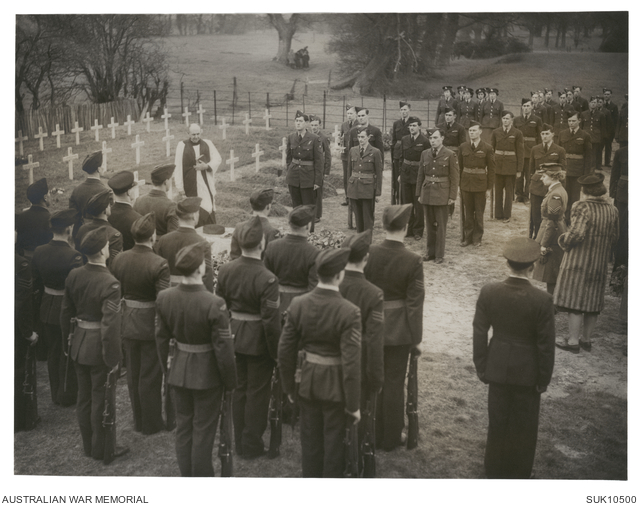
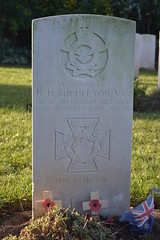
Middleton was buried with full military honours at St. Johns Church, Beck Row. Suffolk.*3

The aircraft experienced a number of attacks as they crossed occupied France, but Middleton, fighting for survival, kept reassuring the crew that he would get them home. Eventually, and against all the odds, they made the English coast, and once over land Middleton ordered the crew to bail out. Five crewmen left the stricken aircraft whilst the other two remained to help him control it. Turning for the Channel, Middleton ordered the two remaining crew members to bail out, whilst he stayed at the controls, steadying the aircraft.

By now the Stirling was very low on fuel and it finally gave up the fight and crashed at 03:00 on the morning of November 29th 1942. Middleton, too injured and too weak to escape the wreckage, drowned within the aircraft fuselage. His two crew members, Sgt. James Ernest Jeffrey (576050) age 19 and Wireless Operator Sgt. John William Mackie (994362) age 30, despite escaping, also drowned. Both the bodies of Sgt Mackie and Sgt. Jeffrey were washed ashore later that day on the 29th.

Middleton’s body remained in the aircraft, but was eventually freed from the wreckage by the action of the sea, and was washed ashore on Shakespeare Beach, Dover, in February 1943. His remains were taken to RAF Lakenheath and he was buried in St John’s churchyard, Beck Row, within sight of his airfield in Suffolk, with full military honours. Middleton was only 26 and only one mission away from ending his tour and returning home.

For his action, dedication and bravery, Flt. Sgt. Middleton was posthumously awarded the Victoria Cross, the first to any serving member of the R.A.A.F in World War II. He was also posthumously awarded a commission as Pilot Officer, backdated to mid November before his sortie to Turin. Thirty years later, in 1978, Middleton’s V.C. was presented to the Australian War Memorial, in Canberra for safe keeping and preservation.

For their actions, the other crew members received three DFMs and two DFCs. Fl.Sgt. Leslie Hyder (DFM) was injured, P.Officer. N. Skinner (DFC) was also injured, along with Sgt. H. W. Gough (DFM). F.O. G. R. Royde (DFC) and Sgt. D. Cameron (DFM) escaped unhurt.

The London Gazette published a report on 12th January 1943. It said:

“Fl. Sgt. Middleton was captain and first pilot of a Stirling aircraft detailed to attack the Fiat Works in Turin one night in November, 1942. Very difficult flying conditions, necessitating three low altitude flights to identify the target, led to excessive petrol consumption, leaving barely sufficient fuel for the return journey. Before the bombs could be released the aircraft was damaged by anti-aircraft fire and a splinter from a shell which burst in the cockpit wounded both the pilots and the wireless officer. Fl. Sgt. Middleton’s right eye was destroyed and the bone above it exposed. He became unconscious and the aircraft dived to 800 ft. before control was regained by the second pilot, who took the aircraft up to 1,500 ft. releasing the bombs, the aircraft meanwhile being hit many times by light flack. On recovering consciousness Fl. Sgt. Middleton again took the controls and expressed his intention of trying to make the English coast, so that his crew could leave the aircraft by parachute. After four hours the badly damaged aircraft reached the French coast and there was once more engaged and hit by anti-aircraft fire. After crossing the Channel Fl. Sgt. Middleton ordered the crew to abandon the aircraft. Five left safely, but the front gunner and the flight engineer remained to assist the pilot, and perished with him when the aircraft crashed into the sea”.

Funeral service for 402745 Flight Sergeant Rawdon Hume Middleton, the RAAF’s first VC winner. He was buried with full military honours in a country churchyard near his station. Air Vice Marshal H. N. Wrigley represented the High Commissioner for Australia (Mr S. M. Bruce) and the RAAF. The graveside service was conducted by Squadron Leader H. C. Thrush of Prospect, SA, RAAF Chaplain. (Australian War Memorial Public Domain)

Middleton’s citation read:

“Flight Sergeant Middleton was determined to attack the target regardless of the consequences and not to allow his crew to fall into enemy hands. While all the crew displayed heroism of a high order, the urge to do so came from Flight Sergeant Middleton, whose fortitude and strength of will made possible the completion of the mission. His devotion to duty in the face of overwhelming odds is unsurpassed in the annals of the Royal Air Force”.

In honour of Middleton’s bravery, Number 1 RAAF Recruit Training Unit at RAAF Base Wagga has renamed the club in his name, the “Middleton VC Club”, and he also appeared on one of the 1995 Australian 45c stamps. The dining hall located at the nearby (now American) base at RAF Mildenhall in Suffolk, has also been named in his honour.

St. John's Church Beck Row, Mildenhall Fl. Sgt. Rawdon Hume Middleton, VC (RAAF) 149 Sqn RAF, St. John’s Church, Beck Row, Suffolk.

Middleton was a brave and dedicated young man who gave his life to save those of his crew. Each and every one of them acted with the highest dedication, sadly for some, it cost them dearly.

Sources

*1 photo courtesy of Australian War Memorial, image 100641, Public domain.

*2 photo courtesy of Australian War Memorial, image P01019.003, Public domain.

*3 Photo courtesy of Australian War Memorial, Image SUK10501, Public domain

*4 Photo courtesy of Australian War Memorial, Image SUK10500, Public domain

They shall grow not old, as we that are left grow old: …

Originally posted on the anniversary of the publication of his poem, For the Fallen, 21st September 2014, Laurence Binyon’s poem has become synonymous with remembrance services across the country. This week is remembrance Weekend (and Veteran’s day in the United States) on which we remember the fallen: those who gave the greatest sacrifice, so we could live in peace.

I thought it appropriate to repost this during Thai special week so we know a little more about the poem and the history behind it.

‘Lest we forget’

“To all those who went before, (Robert) Laurence Binyon’s 1914 poem is widely used in remembrance services across the world. Laurence Binyon wrote his For the Fallen, with its Ode of Remembrance, while Binyon was visiting the cliffs of North Cornwall between Pentire Point and The Rumps.

Today, if you visit, there is a stone plaque at the spot to commemorate his poem, which reads: For the Fallen Composed on these cliffs 1914″. There is also a second plaque located on the beehive monument on the East Cliff above Portreath in central North Cornwall. There, you will find a plaque on a statue inscribed with the same words. Laurence Binyon’s poem, For the Fallen, was published in The Times newspaper, following heightened public sentiment due to the recent Battle of Marne (5-12 September 1914) on 21st September 1914, 100 years ago today. http://wp.me/P4xjD9-8u

For the Fallen

With proud thanksgiving, a mother for her children,
England mourns for her dead across the sea.
Flesh of her flesh they were, spirit of her spirit,
Fallen in the cause of the free.

Solemn the drums thrill: Death august and royal
Sings sorrow up into immortal spheres.
There is music in the midst of desolation
And a glory that shines upon our tears.

They went with songs to the battle, they were young,
Straight of limb, true of eye, steady and aglow.
They were staunch to the end against odds uncounted;
They fell with their faces to the foe.

They shall grow not old, as we that are left grow old:
Age shall not weary them, nor the years condemn.
At the going down of the sun and in the morning
We will remember them.

They mingle not with their laughing comrades again;
They sit no more at familiar tables of home;
They have no lot in our labour of the day-time;
They sleep beyond England’s foam.

But where our desires are and our hopes profound,
Felt as a well-spring that is hidden from sight,
To the innermost heart of their own land they are known
As the stars are known to the Night;

As the stars that shall be bright when we are dust,
Moving in marches upon the heavenly plain,
As the stars that are starry in the time of our darkness,
To the end, to the end, they remain.

(Published in The Times newspaper, 21st September 1914).

Thanks to Marcella who contributed to the writing of the original post.”

DSC_0097

 For the Fallen – Laurence Binyon (1869-1943)

Ode to the Fallen.

As we approach Remembrance day (and Veteran’s day in America), Aviation Trails will be publishing a mix of poetry and aviation material in remembrance of those brave and courageous young men and women, who, from all nationalities, gave the ultimate sacrifice in war.

The numbers are staggering; during World War 1, there were some 37 million* deaths, (of which around 7 million were civilian). Thankfully, because the war was quite stationary, it did not create as many of the civilian casualties that were found in the Second World War. The higher number here being primarily military and serving personal. Defined as the ‘War to end all Wars’, it brought a devastating blow to societies across the European countries and their allies, as men flocked to the front and the mass slaughter that prevailed.

World War 2 on the other hand, due to the much faster, greater technological advancement that war brings, saw a much higher casuality rate. Over 60 million people died which amounted to approximately 2.5% of the world’s population*1. This is currently about the size of Nigeria, the world’s seventh largest country*2. The war was so widespread and devastating, that the actual number of casualties will never be known. A new type of war, it spread death and destruction to a much wider audience.

Subsequent wars, have also taken their toll, both in military and civilian terms. Continuing conflicts are, and will account for further deaths, and it is a sad reflection of the world we live in today.

So on this special weekend, during the 100th anniversary of the First World War, we remember those who have given so much so that the rest of us can live peacefully.

Memorials visited during the making of ‘Aviation Trails‘ can be seen here.

Ypres 007

Tyne Cot Cemetery, Belgium


Sources:

Whilst not official, Wikipedia gives some detailed accounts of countries and their casualties.

* Wikipedia, World War 1 Casualties;  http://en.wikipedia.org/wiki/World_War_I_casualties

*1 Wikipedia, World War 2 casualties; http://en.wikipedia.org/wiki/World_War_II_casualties

*2 Wikipedia, list of countries by population; http://en.wikipedia.org/wiki/List_of_countries_by_population