Flt. Lt. William ‘Bill’ Reid VC 61 Squadron, RAF Syerston

In 1942 Air Ministry Directive S.46368/D.C.A.S. turned Bomber Command’s focus to the morale of the German population and in particular its industrial workforce. Bomber Command now turned to strategic bombing, a controversial campaign that was debated for many years after, it was seen as a way to destroy the enemy’s industrial output, by attacking the very workforce that produced it.
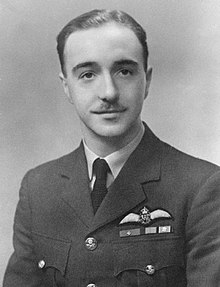
William Reid VC.jpg

Flt. Lt. Bill Reid VC (IWM CHP 794)

But as loses had mounted, Bomber Command had been forced to fly at night, a task that was almost impossible to satisfactorily achieve for most bomber crews who had been trained to bomb in daylight. Indeed, only some 3 in every 100 bombers were hitting within 5 miles of the aiming point at the start of the campaign.

Harris himself knew that hitting a single target consistently, at night was impossible, and so there was little choice seen other than the controversial bombing campaign.

On one of these raids, on the night of 3rd/4th November 1943, Bomber Command sent a large raid of almost 600 aircraft to Germany. In that raid was Acting Flight Lieutenant William (Bill) Reid, a Scot born in Baillieston, Glasgow, and the son of a Blacksmith .

Reid performed his duties that night in a manner that would see him earn the Victoria Cross, the highest honour possible, for taking his damaged Lancaster to the heart of Dussledorf and bombing the target even though he himself and his Flight Engineer were wounded; the navigator killed and the aircraft severely damaged and so difficult to fly.

That evening, eleven Lancasters from 61 Squadron, RAF Syerston, took off on a mission to bomb Dusseldorf. Reid’s aircraft, Lancaster LM360 was second to depart taking off at 16:59. On board with Flt. Lt. William (Bill) Reid were: Sgt. J. Norris (Flt Eng); Flt. Sgt. J. Jeffries (Nav); Sgt T. Rolton (Bomb Aimer); Flt. Sgt. J. Mann (WT/ Air Gunner); Flt. Sgt. S. Baldwin (Air Gunner) and Flt. Sgt. A. Emerson (Air Gunner).

As the aircraft crossed the Dutch coast there was a terrific bang outside the aircraft  which resulted in the windscreen being shattered and partially blown out. Reid was wounded in the head, shoulders and hands, and the plane temporarily went out of control. Flak continued to burst all around the Lancaster with one further burst injuring the Flight Engineer, who was next to read, and causing further injuries to Reid himself. The port elevator had been shot away and to compensate, Reid had to pull the stick fully back just to keep the plane straight and level. Between Reid and the Flight Engineer, they maintained level flight as part of the formation of almost 600 aircraft across an 8 to 10 mile span of up to 6000 feet deep – the option of turning back was not a viable one.

Keeping the plane straight and level, Reid watched the target indicators. The bombs were dropped and the photographic evidence taken. Turning the aircraft away, the Lancaster headed for home. Reid knew that he was the only one who could fly the aircraft and even with with no elevator, virtually no instruments and at night, he was determined to make it back safely. With further attacks from night fighters on the return trip, it was not an easy journey, but they eventually made it to England. Once over the English coast they looked for a suitable airfield to land, they came across the beacons at the American base at RAF Shipdham in Norfolk, and Reid put the aircraft down. Almost immediately, the legs of the undercarriage collapsed and the aircraft hit the runway on its belly, sliding along for some 50 yards or so, before coming to a complete stop. At this point Reid realised the Navigator had died slumped in his seat behind him.

Reid, severely injured, had managed to fly the badly damaged aircraft, without oxygen and with wounded on board, for many hours from deep inside Germany, the actions of which earned the 22-year-old acting Flight Lieutenant the Victoria Cross.

His citation in the Third Supplement to the London Gazette on Tuesday 14th December 1943 covered an entire page and read:

Air Ministry, 14th December, 1943.

The KING has been graciously pleased to confer the VICTORIA CROSS on the undermentioned officer in recognition of most conspicuous bravery: —

Acting Flight Lieutenant William REID (124438), Royal Air Force Volunteer Reserve, No. 61 Squadron.

On the night of November 3rd, 1943, Flight Lieutenant Reid was pilot and captain of a Lancaster aircraft detailed to attack Dusseldorf.

Shortly after crossing the Dutch coast, the pilot’s windscreen was shattered by fire from a Messerschmitt 110. Owing to a failure in the heating circuit, the rear gunner’s hands were too cold for him to open fire immediately or to operate his microphone and so give warning of danger; but after a brief delay he managed to return the Messerschmitt’s fire and it was driven off.

During the fight with the Messerschmitt, Flight Lieutenant Reid was wounded in the head, shoulders and hands. The elevator trimming tabs of the aircraft were damaged and it became difficult to control. The rear turret, too, was badly damaged and the communications system and compasses were put out of action. Flight Lieutenant Reid ascertained that his crew were unscathed and, saying nothing about his own injuries,
he continued his mission.

Soon afterwards, the Lancaster was attacked by a Focke Wulf 190. This time, the enemy’s fire raked the bomber from stem to stern. The rear gunner replied with his only serviceable gun but the state of his turret made accurate aiming impossible. The navigator was killed and the wireless operator fatally injured. The mid-upper turret was hit and the oxygen system put out of action. Flight Lieutenant Reid was again wounded and the flight engineer, though hit in the forearm, supplied him with oxygen from a portable supply.

Flight Lieutenant Reid refused to be turned from his objective and Dusseldorf was reached some 50 minutes later. He had memorised his course to the target and had continued in such a normal manner that the bomb-aimer, who was cut off by the failure of the communications system, knew nothing of his captain’s injuries or of the casualties to his comrades. Photographs show that, when the bombs were released, the aircraft was right over the centre of the target.

Steering by the pole star and the moon, Flight Lieutenant Reid then set course for home. He was growing weak from loss of blood. The emergency oxygen supply had given out. With the windscreen shattered, the cold was intense. He lapsed into semi-consciousness. The flight engineer, with some help from the bomb-aimer, kept the
Lancaster in the air despite heavy anti-aircraft fire over the Dutch coast.

The North Sea crossing was accomplished. An airfield was sighted. The captain revived, resumed control and made ready to land. Ground mist partially obscured the runway lights. The captain was also much bothered by blood from his head wound getting into his eyes. But he made a safe landing although one leg of the damaged undercarriage collapsed when the load came on.

Wounded in two attacks, without oxygen, suffering severely from cold, his navigator dead, his wireless operator fatally wounded, his aircraft crippled and defenceless,  Flight Lieutenant Reid showed superb courage and leadership in penetrating a further 200  miles into enemy territory to attack one of the most strongly defended targets in Germany, every additional mile increasing the hazards of the long and perilous journey home. His tenacity and devotion to duty were beyond praise.

Reid would go on to fly in Bomber Command being transferred to the famous 617 Sqn at Woodhall Spa after his recovery. Here he would fly with Leonard Cheshire, another VC holder, on Tallboy missions, dropping the enormous weapon onto heavily fortified or deeply buried structures.

On 31st July 1944, sixteen Lancasters and two Mosquitoes of 617 Sqn were ordered to attack the V-1 site at Rily-la-Montage, a railway tunnel used by the Germans to store the pilot-less flying bombs ‘The Doodlebug’.  Here Flt. Lt. William ‘Bill’ Reid’s luck would finally run out.

He had managed so far to evade either death or capture, only to be struck down by bombs from one of his own. The Lancaster Mk.I (ME557) ‘KC-S’ he was flying with 617 Sqn, shuddered as allied bombs crashed through the Lancaster severing the control cables, fracturing the structure of the Lancaster’s body and removing one of the port engines. Uncontrollable, the aircraft then entered a spin. Reid gave the order to bail out, himself escaping through the hatch above his head. He landed heavily, breaking an arm in the process – an injury that would hinder his escape from his pursuers. Within an hour he was captured, interrogated and sent on to a POW camp. Reid and one other crewman, Flying Officer D. Luker, were the only two airmen to escape the stricken  Lancaster, the remaining five all being killed in the crash.

As the allied forces moved ever closer, the much admired Reid was moved from camp to camp, ending his war at Stalag III – a POW camp made famous by ‘The Great Escape’ and ‘The Wooden Horse’.

Back at the RAF Woodhall Spa in Lincolnshire, he colleagues ‘mourned’ his capture by joking that he had escaped with all their money, money he had won in an early morning card game in the officers mess at the Petwood Hotel. *1.

Liberated in May 1945, Reid returned home and became well known in the agricultural business. He became great friends with the that other Scottish VC holder John Cruickshank a friendship that lasted a good many years.

Some time after moving to his new home in Crieff, Bill Reid sadly passed away; his death being announced  on November 28th 2001. He was buried in the local cemetery at Crieff.

Sources and Further Reading.

National Archives AIR 27/578/22
National Archives  AIR 27/2128/24
National Archives  AIR 27/2128/23

The Third Supplement of The London Gazette Publication date: 10th December 1943; Supplement: 36285 Page: 5435

World At War Series BBC narrated by Lawrence Olivier Episode 12

*1 Sweetman, J. “Bomber Crew – Taking on the Reich“, Abacus, 2004 pg 207

The Scotsman Newspaper website, 29th November 2001.

RAF Scone – A little airfield with a big History (4)

In Part 3, we saw how Scone grew in the post war era, taking on more civilian operations, training pilots from around the world. This continued on in the years that followed and so the airfield grew even more.

Airwork’s ideas were big though, and one of the major changes they would make would be the extension of the runways adding not one but two tarmac runways of 2,800 ft and 2,000 ft in 1968. Scone then became the only UK Air Training School to have such facilities. As an international training college it was going to need to be able to accommodate large numbers of personnel, students and aircraft.

By the 1970s Scone had reached a peak with in excess of 400 students being trained at any one time. Catering for all these nationalities was hard work and a separate school had to be set up to standardise the language.  A School of English taught both basic English and technical English, meaning that by this time not only were pilots and engineers being trained in aeronautical procedures, but English as well. The AST became so busy, that it boasted of being “the largest civil aviation training organisation in the world”.*3

The demand for Scone’s operations continued to grow, as did the airfield itself.  Development took another step forward in the late 1970s and early 1980s when Air Service Training Ltd. expanded yet again. With huge increases in overseas student numbers (over 100 nationalities) a new hall had to be built to provide accommodation for them all. This was Stormont Hall, a large building with all the facilities needed to accommodate and cater for all student needs.

However, like many aviation related histories, things took a turn in the 1990s. Political moves by the Civil Aviation Authority and the Government, combined with changing global economies, caused AST to cease training overseas pilots at the international college at Scone. By April 1996, following the closure of the college, the site owners, Caledonian Investments, broke the news to its users, that it was selling up and in August, Scone was put on the market with a £3m price tag; the end of an era had apparently come to an abrupt end.*4

However, the move did not initially prove to be too much of a set back for AST and Scone as a whole, as it was able to bolster its maintenance programme with the purchase of a Jetstream from Cranfield University. The facilities for the programme, primarily the hangar,  proved to be too small, so a larger one was obtained, on lease, from the Airport authorities, and was officially opened for business in November 2008 after an opening ceremony led by the then-Cabinet Secretary for Education and Lifelong Learning, Fiona Hyslop MSP.*3

A buyer for Scone was soon found however, and in 1997, the airport was purchased as a going concern by the Morris Leslie Group, who allowed the various companies to continue to operate as normal from the airfield. Scone, or now Perth airport, had a new lease of life and would quickly grow to some fifty companies employing around 400 people once more. It has also updated many of the former buildings, providing both residential properties and workshops. It has over recent years, welcomed high prestige figures including Queen Elizabeth, former President George Bush and Prince Andrew.

AST continue to operate from Scone under the new owner, and they are not alone. Other organisations include the Scottish Aero Club (formerly The Scottish Flying Club) and whose history, goes back to 1927, and who relocated to Scone in 1956, joining ranks with the Strathtay Aero Club to form the new  club.  The Aero Club remains Scotland’s largest flying club and continues to offer rotary and fixed wing training as well as both auto-gyro and micro-light flying. It also provides maintenance for those aircraft located on the site.

Other users of Perth include Scotland’s Charity Air Ambulance (SCAA) flying the EC135-T2 helicopter, a charitable organisation that relies solely on donations to keep it flying. It was formed in 2012 and launched a helicopter air ambulance in May 2013 to assist the Scottish Air Ambulance Service (SAAS) to deliver front-line care to time-critical emergencies across Scotland. SCAA provides a fully equipped medical helicopter that can be deployed to incidents across the length and breadth of Scotland.

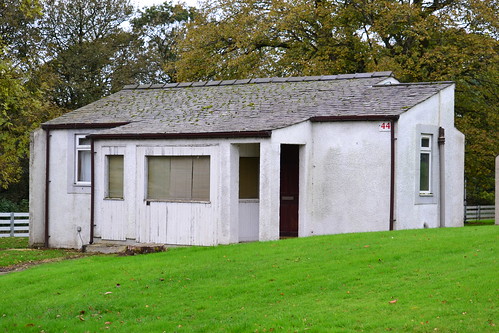
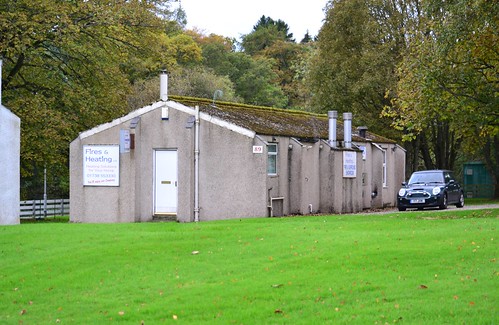
Today many of the wartime buildings remain, in use, by small industrial units. The Battle Headquarters, can be seen from the road very much exposed, as all but the top slotted observation ‘turret’ would normally be underground. The accommodation and technical areas are located together and many now form part of a small hotel for those visiting the area.

There are three runways in use, two of concrete / tarmac and one of grass, these being 2,799 ft and 1,998 feet, the third grass runway is 2,040 feet, all joined at the ends to form a perimeter. Two large hangars hold around 85 aircraft with further space for 15 more parked on the apron.

The airfield lies a few miles north of Perth, the main A94 offers access to the airfield and views across some of the site. It sits on a hill and so much of it is hidden from view at ground level. Being an active airfield, access is limited and understandably restricted. However, views of the current residents are available and many of the wartime buildings are accessible operating as retail and industrial units.

RAF Scone (Perth Airport)

The Battle Headquarters is very much exposed, this would normally be below ground level with only the slits visible.

Scone for such a small airfield, has had a long and fruitful history. Its links to pilot training, especially throughout the war years, no doubt sent many airmen to front line squadrons, many of whom  would go onto serve in some of Britain’s fiercest air battles. A small and often rudimentary airfield, it played a huge part in Britain’s wartime and post-war aviation history, and long may it continue.

The full history of Scone can be read in Trail 56.

Sources and further reading (RAF Scone).

*1 University of Glasgow website. Accessed 10.2.25

*2 McCloskey. K., “Airwork – A History“. The History Press, 2012.

*3 The Herald Newspaper, 16th August 2020, via website

*4 The Herald Newspaper, 9th August 1996 via website

Perth Airport website

National Archives AIR 27/1679/1; AIR 27/1679/1

McCloskey, K. “Airwork – A history” The History Press, 2012

Lake, A., “Flying Units of the Royal Air Force“, Airlife, 1999.

McKay, S., “Secret Britain” Headline Publishing Group. 2021

Lake. A., “Flying Units of the RAF“. Air Life Publishing, 1999.

RAF Scone – A little airfield with a big History (3)

In Part 2, Scone supported the RAF throughout the war, training pilots and navigators in a range of aircraft. Post war, this demand reduced, but it was not the RAF’s end with Scone, nor the end of pilot training.

With Airwork now owning the site outright, they began to look to the future. In 1950, BEA began trials with flights to Renfrew and Glasgow, a scheme that was hoping to open doors to destinations wider afield, but it was not successful and so the idea never came to fruition. Keen to expand, Airwork then took on conversion flying for the Admiralty, converting naval pilots to from single to twin-engined aircraft. They also carried out engineering and navigational training and began work overhauling radio systems, the future was looking bright for the expanding airfield.

The December of 1950 saw the Glasgow University Air Squadron (UAS) move to Scone as a temporary measure whilst their runway at Abbotsinch was resurfaced. As a result, Airwork became responsible for the maintenance of the training aircraft they were using, primarily Tiger Moths and Miles Magisters. Airwork soon came up with the idea of a trophy to be contested for by the various Scottish University Air Squadrons, called the Scone Cup,  the first competition was held in October 1951 and won by Glasgow. After a further name change of the UAS to Universities of Glasgow and Strathclyde Air Squadron (UGSAS) in 1965, the squadron re-equipped with DH Chipmunks, bringing yet another type to the small Scottish airfield.

RAF Scone (Perth Airport)

Old buildings are utilised for modern purposes.

Meanwhile the Scone Cup continued, as did the relationship between Scone and the various Air Squadrons, until in 1969, when the RAF centralised all its maintenance work at RAF Turnhouse, and the link with Scone was broken. The GSAS were then reassigned back to Glasgow airport, the location of its origin way back in April 1941.

Like so many other contracts with the military post war, the Admiralty’s pilot training programme wouldn’t last long either, and a gradual reduction in the need for pilot training for the service, forced Airwork to look elsewhere for their trade. The dynamic years that followed saw a huge growth in civil aviation, with jets now spanning the globe in hours and not days, and private flying was becoming evermore affordable to the masses. It was this opportunity that Airwork seized, becoming the first civil school to gain an Instrument rating course certificate for pilot training.

This enabled the now renamed ‘Airwork School of Aviation’ to officially offer its services to civilian operators for the first time, an offer that was taken up by numerous airlines including the first, Sudan Airways, with the first trainees arriving in November 1955.

Although the Navy had ended its contract with Airwork and Scone, it was not the end of military training for good. Whilst 1957 brought the disbandment of some landmark units, on March 8th, another training unit, 1 Civilian Fighter Control Co-Operation unit, formed here at Scone operating the Avro Anson T22. Little seems to be published about the activities of this unit, but I would assume it was, like other training units at Scone, operated by civilians working as part of the Royal Air Force’s training programme. The unit remained active here at Scone, until 31st January 1961 where upon it was disbanded. A year after its cessation on May 10th, an Anson of the unit ‘VV977’ was sold as scrap at No.27 Maintenance Unit (MU) at Shawbury.

With that any RAF connections with Perth ceased. The airfield was passed to ACS Aviation, who claim to be the “leading Commercial Flight Training Organisation in Scotland”. Operating a range of services including commercial pilot training and maintenance provisions.

By the turn of the 1950s / 60s, Scone was heralded as a thriving pilot training facility, seen by many organisations as one of the best available. In acknowledgement of this, the recently formed British United Airways sent their pilots here and were quickly followed by other UK based airlines. The prestige that attracted these airlines  led to an award by the Ministry of Aviation confirming Scone’s high ranking status, something that had not been done before to any other UK based school.

Airwork’s organisation stretched the length and breadth of the UK, and as military reorganisations took place, so some of Airwork’s units were either closed or relocated to alternative locations. In the early 1960s, Scones Airwork School of Aviation began to expand further by taking over the School of Aeronautical Engineering from Hamble, which led to yet another name change to Airwork Services Training (AST) to match the new role now being served at Scone. As the school developed and established itself at Scone, so it too began to expand, delving into the roles of electrical, turbine and rotary fields, all of which required further development of the pre-war site.

RAF Scone (Perth Airport)

Modern day Scone is home to a large number of small aircraft.

As Airwork has expanded into the rotary field, the next natural step was to train helicopter pilots at the airfield. The first such operation took place on 30th September 1963, with students from the Ghana Air Force. The instructor on that course, one Cryil Sweetman, would go onto gain his own fifteen minutes of fame flying a Hiller UH-12C in James Bond’s ‘From Russia with Love.’

The growth of Scone continued on throughout the (1960s) decade. During these years no less than thirty Cessnas (130 and 150 models) were brought into the airfield to train pilots, a number that would make it the largest fleet in Europe, giving Scone the advantage over other European training centres. Combine that with the additional training facilities and private maintenance work, Scone was rapidly becoming one of the biggest players in the civil aviation industry.

In the final part, we see how Scone had grown from strength tot  strength, through different ownership it has continued to supply training for new and established pilots, establishing itself as one of the largest training centres around.

The full history of Scone can be read in Trail 56.

RAF Scone – A little airfield with a big History (2)

Part 1 of this trail, saw how Scone began its life, and how through private enterprise, it developed into a pilot training centre for RAF pilots. As the need for pilots and navigators increases so does the work at Scone.

On September 3rd 1939, with Britain’s declaration of war, the training units operating on behalf of the RAF were immediately reorganised and re-designated, 11 E&RFTS becoming known more simply as 11 Elementary Flying Training School (EFTS).

This reorganisation of training schools also led to new aircraft, the Tiger Moths currently under civilian registration, were given military designations (BB672 – BB692) and the Hart trainers were replaced by Miles Magisters. Whilst ground crews remained as civilians, the instructors were drafted into the RAF and the school became RAF controlled.

Also at this time, Airwork formed and operated a further training unit here at Scone, 7 Civil Air Navigation School (CANS) flying Avro Ansons. Like 11 E&RFTS, they were, in October, disbanded and re-designated 7 Air Observers Navigation School (AONS), this new designation beginning on 1st November 1939. To fulfil their role, they would then take on eight Dragon Rapides, specifically to train new crews in cross country navigation techniques. After further expansion of both aircraft numbers and type, on June 1st 1940, the AONS was disbanded, further streamlining of training units meaning these needs were met elsewhere.

It was in these early war years that Scone almost became the hub for vital research into radar, when in late 1939, the Telecommunications Research Establishment (TRE) relocated here from Bawdsey Manor in Suffolk; mainly to be away from prying eyes but also away from the possibility of attack by German bombers. The pioneer of radar Robert Watson-Watt, grew up in this region and later went to University here, so it was a natural place to move the research to. However, once at RAF Scone, it was realised that the facilities were far to rudimentary and completely insufficient to accommodate the amount of work  needed to carry out this vital research. So, in early 1940, the establishment moved again this time near to Swanage on the Dorset coast. Scone’s fifteen minutes of fame had sadly and quickly passed them by.

Then in early November 1940, 309 Squadron sent a detachment of Lysander IIIs to Scone. Only recently formed, they remained here for about six months, being primarily based at Renfrew where the Polish pilots found the number of woods and railway lines confusing. The sole purpose of 309 Sqn was as a Polish Co-operation unit to work in conjunction with the C-in-C of the Polish Army. It was unique in that it was ‘double’ ranked, having both British and Polish officers in charge, the idea being that once the Polish personnel were in place the British would be pulled out and the squadron would operate as an independent Polish unit. A series of training flights were carried out by the Polish pilots, but with lectures being carried out through a translator, it was often a difficult task to do.

In September 1941, ‘E’ Flight of 11 EFTS  was used to form a new training unit, 5 Flying Instructors School (Supplementary) then again simply to the Flying Instructors School, finally becoming the Flying Instructors School (Elementary) from April 1942. The small number of resident pilot instructors flew Miles Masters and Tiger Moths training hundreds of pilots between them before the unit was eventually disbanded in November 1942.

Scone airport looking south in 1947. (@Britain from above)

The remainder of 11 EFTS continued on to the war’s end however, gradually being reduced in size as demand for new pilots decreased. Post war, in 1947, it was renamed as 11 Reserve Flying School (RFS) still operated by Airwork and still flying the biplane the Tiger Moth along with Airspeed Oxfords, Ansons and Hawk trainers. By 1954, the unit had wound down finally being disbanded that same year on the 20th June.

The immediate post war years also saw a huge closure of now ‘unwanted’ airfields, all surplus to requirements. Many were put into care and maintenance or reserved for future use should east-west relations diminish. RAF Errol, located to the east of Scone between Perth and Dundee, was closed and proposals put forward to turn it into a municipal airport for Perth and Dundee. This proposal allowed Airwork to put forward their own offer to Perth Town Council for the site at Scone, the offer (£54,000) was quickly accepted and the deal was finalised and ownership handed over on 31st July 1946, just four months after the initial offer was made.

The war’s end allowed many of the former civilian clubs to reinstate their operations, some though, were unable to due to high costs or lack of suitable facilities. The Strathtay Aero Club, who were one of the lucky ones, were once again able to continue their operations with Airwork at Scone.

Throughout the 1940s, a resurgence of public events saw many air pageants and displays take place across the country. At Perth, the Strathtay Aero Club in conjunction with Airwork, organised its first post war air display attracting around 10,000 spectators, highlighting the renewed interest in aviation at that time.

Amongst those present at the display on 16th August 1947, were the Lord Provost Ure Primrose and Air Marshal Sir Richard Peirse. Aircraft taking part ranged from Bleriot’s 1909 monoplane to a squadron of clipped wing Spitfires. A short film of the event is available to view through the British Pathe News website.

Thus renewed interest in civilian flying, allowed Scone (Airwork) to become the saviour of yet another civilian aeroclub, and another that had been forcible suspended by the war. The Scottish Flying Club (SFC), who were initially based at Renfrew and whose buildings 309 Sqn moved into, were closed following the declaration of war and evicted from their premises. After being ejected from their airfield, they found themselves in the awkward position of having nowhere to operate from and unable to afford the high fees being charged by many civilian operators in the immediate post war years.

Airwork allowed the SFC to use Scone’s facilities in such a way that Airwork made no profit out of the agreement. This was clearly a saving grace for the club who eventually joined forces with the Strathtay Aero Club later in 1956, to form a new organisation, The Scottish Aero Club, who would continue to operate from here at Scone.

But the RAF had not finished with Scone yet. In 1949, 666 Squadron was reformed at Scone as an Royal Auxiliary Air Force unit (RAuxAF) comprising of the 1966 Air Observation Post Flight (AOP), the 1967 (AOP) Flight at Renfrew and the 1968 (AOP) Flight at Abbotsinch. The squadron flew Austers Vs and VIs, in a cooperation role with Army units, but by 1957 all three flights, and thus the squadron, had ceased to exist when a letter, signed by the Queen, was handed to more than eighty senior officers of the RAuxAF, officially ending its existence as a military unit. With that, thirty-two years of history had come to an end, a history that had seen the RAuxAF take part in virtually all of Britain’s major air battles since 1925.

With the war over, the RAF’s need for pilots reduces dramatically and so does the need for supporting civilian operations. However, at Scone, operations go from strength to strength.

The full history of Scone can be read in Trail 56.

RAF Scone – A little airfield with a big History (1)

In Trail 56, we head north once again, this time across the River Tay into Perthshire,  the gateway to the Highlands.

The grand city of Perth boasts a majestic history, once the capital of Scotland, it is a city with galleries, museums and stunning architecture; described by VisitScotland.com as “a picturesque playground for Kings and Queens“, and rightly so.

The village that gave this airfield its name, has its own history, going back as far as the Iron age. Once the seat of Royals, it is mentioned in Shakespeare’s Macbeth, and once housed the famous ‘Stone of Scone‘ or ‘Coronation stone‘ that has for centuries been used for coronations of the Kings and Queens of Scotland and England. It was stolen by King Edward I of England who took it to London, where it remained until 1950 when it was stolen once more by four Scottish students and taken back to Scotland. It was a year later, returned to London where it remained, being used for the coronation of Queen Elizabeth II. In 1996, the Queen and Prime Minister agreed the stone should be returned to Edinburgh on the proviso that it be brought to London for any future coronations, the last one being King Charles III – it must be the most famous 125kg of rock anywhere in the world. *1

So, on Trail 56 after passing through the beautiful city of Perth and onto this small but famous village, we find one former RAF airfield that has since become Perth Airport. Located in the same region as Scone Castle, we now visit the former RAF Scone.

RAF Scone.

RAF Scone was built in the 1930s, and has been known by a series of names: Perth Airport, Perth Aerodrome, Perth Municipal Airport, RAF Perth, RAF Scone and Scone Aerodrome. The airfield is located about 3.5 miles north-east of the aforementioned city of Perth.

In the days before Scone was built, the Lord Provost of Perth, Thomas Hunter, had an idea to build an aerodrome near to his home town, designated Newlands aerodrome. The idea never came to fruition however, and no real progress was ever made on the site. However, in 1935, with the rumblings of war in Europe, the Government announced the expansion of the Royal Air Force, and so the idea was taken up again, this time by Sir John Ure Primrose.

Sir John, with support from many Perth Councillors, put forward a plan costing some £20,000 for an aerodrome, and with a small committee of members, began to seek advice from a number of sources including the aircraft company A.M. Airwork Ltd., and the architects Norman, Muntz and Dawbarn. After looking at the designs and reviewing Sir John’s plans, a revised model was put forward doubling the cost to some £40,000.

The new scheme was passed however, and 250 acres of woodland and pasture were purchased from two local landowners, Scone Estates and J. Patrick Cuthbert of Barclayhills. In September 1935, work began on clearing the site which employed around 440 labourers and tradesmen all employed by two companies, Maxwell M. Hart & Co. and William Taylor & Son.*2

It was agreed that the running of the airfield would be undertaken by the Airwork company, who were founded in 1928 and based at the then Heston Aerodrome in Middlesex. For much of this time, Airwork’s chief pilot was Captain Valentine Baker MC, DFC, who later joined forces with Sir James Martin to form the now famous  Martin-Baker company, famous for it ejector seats found on numerous fast jests world wide.

RAF Scone (Perth Airport)

Numerous buildings survive from Scones wartime past.

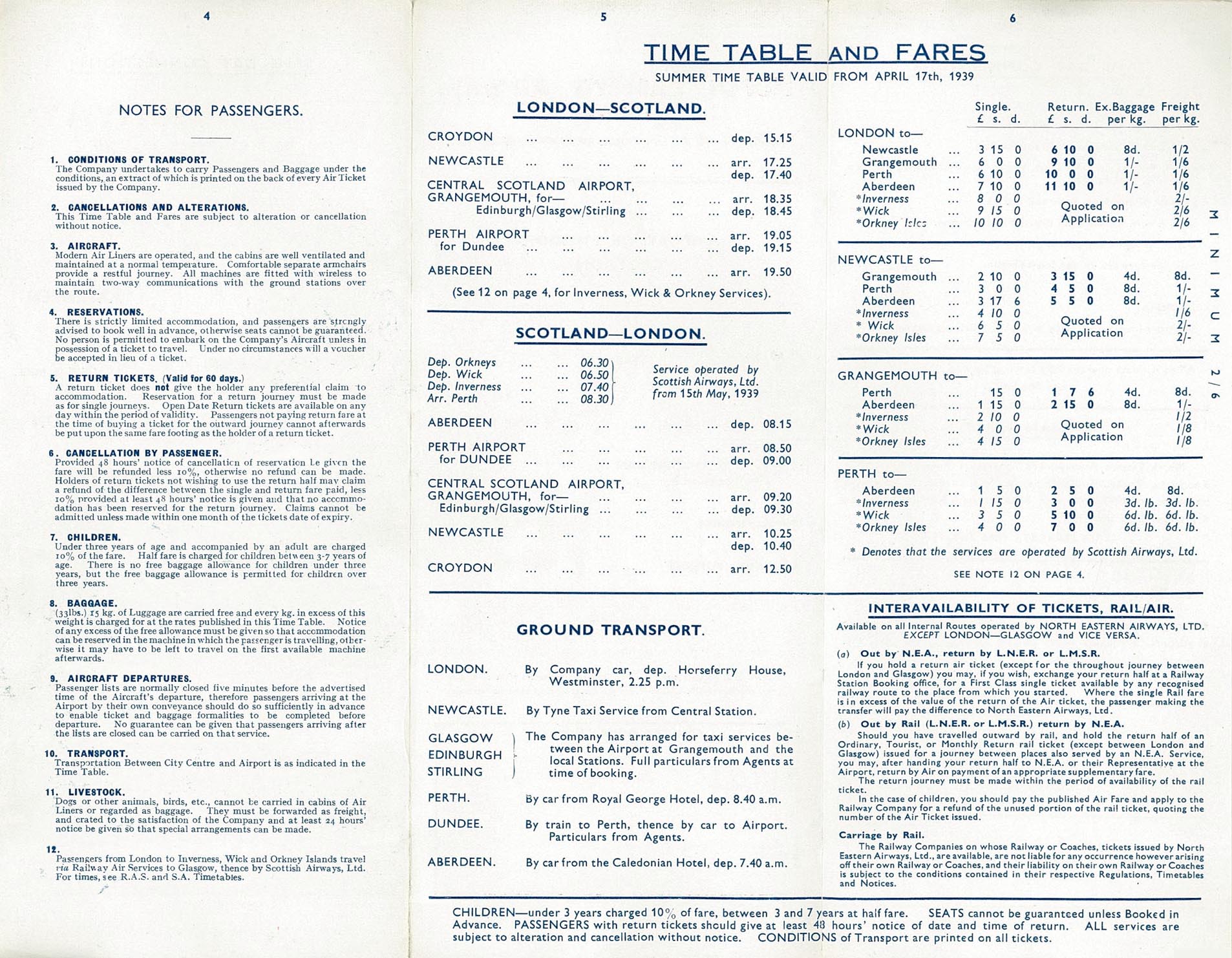
Initially Scone (pronounced Scoone) aerodrome, would be a municipal aerodrome used by various civilian operators including North Eastern Airways and Railway Air Services, who made both local and national flights as far as London and Aberdeen. Some of these flights began in the dawning of 1936, before the airfield had officially opened and so the future looked fairly bright.

This burning light was also fuelled by the formation of the Strathtay Aero Club here at Scone, on May 29th 1936. Set up by three ex-RAF personnel, its initial operations were short lived however, being suspended due to the impending war in Europe. Despite this, with the war’s end in 1945, the club was allowed to continue these operations, including holding major events in 1947 leading to further growth over the next few years.

However, with increasing tension on the continent in the 30s, the RAF’s expansion was paramount and it would take preference over civilian operations. Not only would huge numbers of military personnel be required – an additional 2,000 pilots and over 16,000 ground personnel – but new airfields to operate and fly the aeroplanes from to wage such a war.

With some fifty new aerodromes required by the end of 1937, and so many new pilots to train, elementary flying training would have to form a major constituent of the programme, the majority of which would pass to civilian hands allowing the RAF to focus their efforts on advanced flying techniques. To meet this demand, civilian centres were to be increased from four to an initial thirteen *1, of which Scone would be one.

The entire training programme was overhauled with separate sites providing different instructions – ground or air – and a new RAF Volunteer Reserve class was set up to provide temporary training to cadets designated the rank of Sergeant. It was planned that those part-time trainees located at Scone, would learn to fly in one of twelve aircraft, each aircraft accumulating as many as 3,500 flying hours each year as a result.

The demand was therefore great, and Scone’s civilian operators, who were by now well established, would be joined on 27th January 1936, by No. 11 Elementary & Reserve Flying Training School (E&RFTS) operating under the control of 51 Group RAF, who were then based in Leeds. Even though 11E&RFTS were a military unit, their pilots would be trained by civilian instructors whilst they were stationed at the airfield.

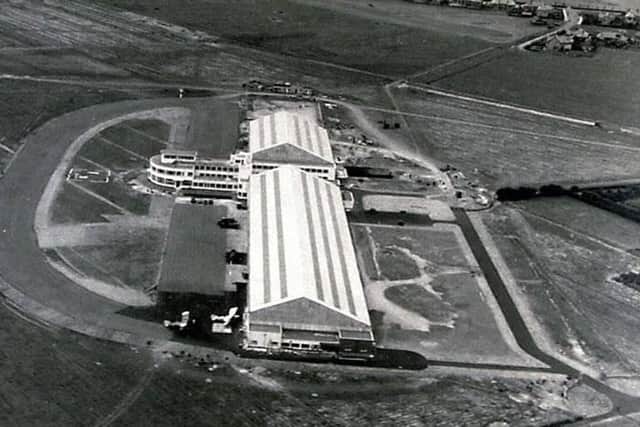
It was clear at this point though, that Scone’s infrastructure was going to be insufficient for both the military and Airwork’s needs, and further land and development was going to be required. To this end, another 120 acres were either purchased, or leased from local landowners, allowing the development, now costing £60,000, to have two runways, 1,000ft and 4,200ft both initially of grass. These new extensions and the extra teaching facilities provided would add both space and accommodation to the original large hangar, administration and support buildings,  terminal and its six cottages.

Airwork’s influence stretched far beyond the boundaries of Scone though, their experiences elsewhere allowing them to develop the airfield and provide much of the infrastructure themselves. As an established aviation company they already provided maintenance facilities and operations across Britain, supporting what would become a thriving civil aviation network. In fact, this additional work would provide as much for the aviation industry as the flying training did.

RAF Scone (Perth Airport)

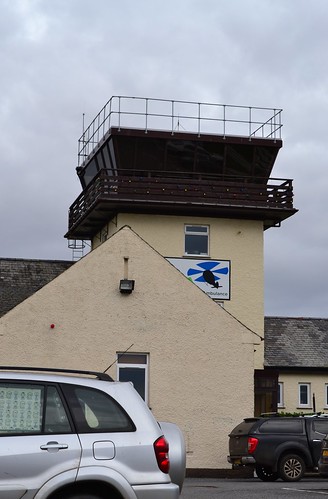
The current Watch Office at Scone (Perth Airport).

The original twelve training aircraft supplied by the RAF were also going to be insufficient, so a further eight were obtained giving of total of twenty, a mix of  Tiger Moths (DH.82) along with a handful of Hawker Harts and Hawker Hinds. Over the next few months, various other models would be obtained and used by the unit at Scone, these included:  Audax, Fairy Battles and Avro Ansons at some point.

With the number of operators using the site growing, it was going to be busy, and the ground would take considerable punishment. But the cold winter weather prevented the growth of newly laid grass and so, for a period of some two months, 11 E&RFTS moved out until the grass had established itself and the colder weather had passed.

Not long after this, the airfield was officially opened. On June 5th, 1936, a grand ceremony, led by Viscount Swindon, and a number of dignitaries, saw the airfield officially handed over to the Airwork Company under the management of P. Perkins, the general manager of Airworks – Scone had been born.

Even with all the development and extension work that had been going on, Scone would remain a relatively rudimentary station. On site, there would be a watch office, a single Civil 160 x 90 ft hangar; one 120 x 110 ft hangar, six blister hangars but no hardstands and the runways remained grass. A hard perimeter track did circumnavigate the airfield and although it only had two runways,  a third strip was also used. A set up that would see Scone enter the war.

In Part 2, Scone develops as the war progresses. Pilot training and maintenance work increases.

The full history of Scone can be read in Trail 56.

de Havilland Mosquitoes in BOAC Service.

Very few countries around the world managed to avoid the influence of the Second World War as it ravaged and rampaged its way across the globe. One such nation that did manage to keep its borders secure though was Sweden, a place that became known as a safe haven for downed airmen or those trying to escape the clutches of the Nazi tyranny that would engulf vast swathes of the European continent. Surrounded by conflict and declared neutral, Sweden was to all intents and purposes cut off from the rest of the world.

However, Sweden was a country reliant on imports and exports, a reliance that led to extensive negotiations between herself and both the axis and allied powers who effectively blockaded her supply routes. Through these negotiations she achieved an  agreement to the rights of passage for ‘safe-conduct traffic’, an agreement that allowed the passage through hostile waters of shipping, allowing the exports of paper and wood from Sweden, in exchange for imports of food and oil.

Sweden’s role in the Second World war was largely political. If she was to survive she was going to have to forge safe links beyond her closest Scandinavian neighbours. Fearing she would be sucked into war and absorbed into a Europe ruled by Germany, she turned to Britain with a view to forging a safe airway between Stockholm and Scotland.

Discussions around the opening of the Swedish air routes began prior to war breaking out, negotiations between the Chairman of Britain’s Civil Aviation Authority (CAA), Sweden’s airline company AB Aerotransport (ABA) and Germany’s Hermann Goring, eventually led to an agreed flight once per week from Stockholm – Oslo-Stavanger-Perth. However, ongoing Swedish concerns led to long delays in activation of the service, even though a successful test flight involving a Junkers 52 had taking place on November 27th 1939.

The Swedish ABA were to run the operation, initially using three DC-3s (named Gripen ‘Griffin’, Gladen ‘kite’ and Falken ‘falcon’) painted bright orange and clearly marked Sweden/Schweden in large black lettering to prevent attacks from either side on a neutral aircraft. Throughout the war though this link was tenuous at best, heightened German aggression and fearsome weather often being the determining factors for the safe passage of the aircraft between the two countries. German restrictions on both freight and passengers angered the Swedes, who defiantly disobeyed their rulings. This decision led to a number of Swedish operated aircraft being attacked and shot down.

By 1945 the Swedes decided it was now too dangerous to fly, particularly with trigger happy defences and over keen allied pilots. The airspace around Sweden’s near neighbour Norway, had become a cauldron of  fire, and so the service was eventually closed down.

However, this official Swedish run route was not the only airway that operated between the two countries. The Norwegians also ran a service albeit reduced, as did the Americans later on in the war with five stripped out B-24 Liberators. Another service however, a ‘British’ service, also operated, but this was much more of a clandestine role than that of their Swedish counterparts.

At the time Sweden was a producer of iron but more importantly ball-bearings, a  commodity essential for any moving parts in machinery; whether it be a simple tool or a more complex engine, without them machinery simply wouldn’t work.

Ball-bearings in Sweden were all manufactured by one company, Svenska Kullagerfabriken AB (SKF), who before the war, exported around 9% of her total output to Germany with another 9% going to the United Kingdom. During the war however, this balance dramatically fell heavily on the side of Germany with as much as 65% of her total output ending up in German hands by 1943.*1 This imbalance was primarily due to the exports that were received in the occupied territories, falling into German hands, and being diverted into Germany’s own industrial operations.

Britain however, also needed these ball-bearings, and was perhaps more keen on maintaining this link than many would have initially thought. Having her supply line to Swedish goods cut was going to hit Britain hard. Britain needed all the ball-bearings she could find, and so Sweden was vital to this supply. So desperate were the British  authorities to obtain these components that they mounted two naval operations,  ‘Rubble‘ and ‘Performance‘, both of which turned out to be disastrous in terms of both the loss of life and the loss of shipping.

There were many other reasons why Britain wanted to maintain this link though, one was the expansion of its resistance operations across Scandinavia, Sweden providing a safe passage for agents entering and leaving the region safely, a move that was just as important as it was for returning escaped or interned airmen of the RAF and later USAAF.

Furthermore, Britain needed to ensure that Sweden was receiving as much British propaganda as it was German. If this line were to be severed, there would be a chance that the imbalance in material may have detrimental effects on Sweden’s future as the war developed.

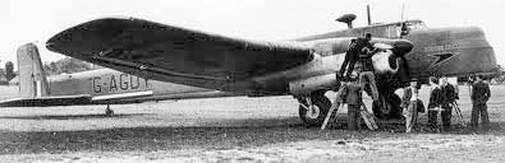
In late 1939 flights began in secrecy, operated by British Airways Ltd, who used three Junkers 52 transport aircraft and one Lockheed Model 14 Super Electra (the forerunner of the Hudson) named ‘Bashful Gertie‘ (G-AGBG). Like the Swedish operation, these flights took place between Perth and Stockholm via Norway and were flown by civilian crews in civilian marked aircraft. However, this route was subsequently closed when one of the aircraft was attacked by a Luftwaffe fighter, and another was captured in Oslo when the Germans invaded Norway.

Then in 1939/40 the two British aviation companies, British Airways Ltd and Imperial Airways, merged to form the British Overseas Airways Corporation (BOAC), a civilian operation that would go on to serve as Britain’s leading national airline for many years after the war’s end. The amalgamation of these companies was an important step forward leading to the reinstatement of the Swedish route, this time using the military base at RAF Leuchars in Fife.

Also piloted by Swedish or Norwegian aircrew, the idea behind the route was to pass POW mail and propaganda (magazines, newspapers etc) into Sweden where it could be forwarded to prison camps in occupied Europe. However, constantly aware of the need for ball-bearings and the fact that Sweden was a major supplier of them, plans were put in place for returning aircraft to be refuelled and filled with ball-bearings before returning to Leuchars. This run hence became known as the ‘ball-bearing run‘.

In these early years of the war, BOAC operated other similar aircraft types, these included C-47 Dakotas, converted Whitley IV bombers and Curtis Wright C46 aircraft, but their lack of speed and manoeuvrability left them vulnerable to Luftwaffe attacks. It soon became clear that a new and much faster type was needed and so BOAC began to put pressure on de Havilland for their new Mosquito.

Picture

A Whitley bomber in BOAC markings *7

A trial flight was undertaken using an unmarked Mosquito of 105 Sqn (DK292) on August 6th 1942 (there is some confusion over this exact date), flown by  Fl. Lt. Parry and P. Off. Robinson, the results of which showed the aircraft to be highly suitable for the purpose of the flights. The journey from Leuchars to Stockholm covered some 800 miles was, on average, completed in around 3 hours.

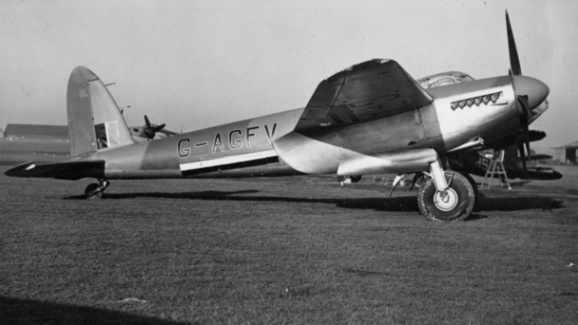
On 15th December 1942 the first civilian operated model of the aircraft arrived at Leuchars. A Mosquito PR.IV ‘DZ411’,  it was assigned the civilian registration G-AGFV, and began flights to Stockholm on 4th February 1943. After this, it was joined by six other Mosquito MK.VI aircraft between April and May (all being given the sequential registrations G-AGGC to AGGH) with a further three in April 1944.

The incredible carrying capacity of the Mosquito, which would be proven later in the war, would allow for up to 650Kg (10 -12 crates) of ball-bearings to be carried in the aircraft’s bomb bay.

The opening of such a link was kept very secret, the British not wanting the Germans to know about the new revolutionary Mosquito, nor their important cargo. However, keeping such an operation from German intelligence was difficult, if not impossible, and soon they discovered that the flights were again taking place between the two countries. Now embroiled in a political stand off, the Germans put pressure on neutral Sweden to put a stop to these flights, insisting that they were giving the British an advantage, and that as a neutral country, they should not be allowing British aircraft to land on Swedish soil. The Swedes maintained that the service was purely civilian and controlled solely by the Swedish authorities, to which the Germans threatened to inform Hitler thus rendering the aircraft legitimate military targets. Fearing that the British would in turn close the passage for the safe-conduct traffic, the Swedes ignored the German threats and so the service continued.

However, so as to not infringe or violate Sweden’s wartime neutrality, it was vital that the Mosquitoes remained unarmed for these operations. But that made any aircraft on this run a potential ‘sitting duck’, even though, like their Lockheed predecessors, they carried BOAC insignia and were flown by civilian aircrew.

So all of these aircraft had to be changed from military status to civilian, this required the removal of all traces of armament. Modified at Hatfield – the home of the Mosquito – the resultant weight loss altered the aircraft’s centre of gravity and so additional ballast had to be added to prevent changes in the aircraft’s flying characteristics.

The first example DZ411, was a Mosquito B.IV Series II, powered by two Merlin 21/23 engines built under the contract 555/C.23(a) and converted to a PR.IV at Hatfield prior to its delivery to BOAC at RAF Leuchars. It would go on to serve until early 1945 with BOAC before presumably returning to RAF ownership.

The first of the next batch, all FB.VIs, was ‘HJ680’ another example built at Hatfield under the same contract 555/C.23(a) but with Merlin 23/25 engines. This aircraft was initially passed to BOAC at Bramcote on April 16th 1943, receiving the registration G-AGGC before flying on to Leuchars immediately after. On the 18th, on the return leg of its maiden flight for BOAC, it was chased by enemy fighters, but its speed and agility allowed the Mosquito to escape unharmed. It was eventually removed from service on November 30th 1944, but remained at Leuchars in case a ‘spare’ aircraft was urgently needed. This particular model was the longest serving Mosquito in BOAC’s service, being taken off the civil register on January 4th 1946, whereupon it was passed to 22 Maintenance Unit. On June 15th 1950, the example was eventually sold as scrap to the John Dale Scrap merchants.

The next aircraft ‘HJ681’ arrived at the same time, and remained in service until January 1944, under the civil registration G-AGGD. This particular aircraft crash landed in Sweden and was reduced to spare parts.

‘HJ718’ arrived on April 24th and was given the registration G-AGGE, it served until June 1945, whilst ‘HJ720’ (G-AGGF) crashed into high ground at Invernairk, Glen Esk on 17th August 1943, killing both crewmen Captain L.A. Wilkins and Radio Operator N.H. Beaumont. A further FB.VI, ‘HJ721’ (G-AGGG) also crashed, this time on the return leg only a mile or so from Leuchars on October 25th 1943, when the port engine failed. Both crewmen, Captain Hamre and Radio Operator Haug, lost their lives along with their passenger Mr Carl Rogers.

The last FB.VI ‘HJ723’ also built under the same contract as the other models, arrived on the 2nd May 1943, and would operate until the end of June 1945 as G-AGGH . It was subsequently handed over to the RAF and eventually presumably disposed of.

By the end of May 1943, a total of nine Mosquitoes would have been modified and delivered to BOAC at Leuchars*5.

DH98 Mosquito G-AGFV (DZ411) MkIV BOAC on 8th January 1943 (© 2021 BAE Systems)

In June 1943, with the need for ball-bearings increasing, two Mosquitoes departed Leuchars with two very important dignitaries onboard. Firstly the British president of the Swedish SKF airline and secondly a ball-bearings expert from the British authorities, who were going to negotiate the delivery of further supplies to Britain.

In order to accommodate these additional passengers the bomb bay of the aircraft had to be converted, thus allowing them to lay on their backs on padded felt*6. An additional reading lamp was fitted, along with an oxygen supply, intercom and even coffee. The passenger would have a piece of string the other end of which was tied to the pilots leg, and should the conditions  in the bomb bay become too uncomfortable, they would pull the string.

These operations were very soon regularly carrying human cargo. On the outward leg mail, newspapers and other written material held within its bomb bay, would be deposited in Sweden, the aircraft would be refuelled and stocked up with either human cargo (allied aircrew, special agents or scientists), ball-bearings or a mix of the two. The faster and far more agile Mosquito would, in most cases, be able to out run any opposing Luftwaffe fighter that should, and indeed did, try to intercept the aircraft whilst on one of these flights.

One such notable passenger who was carried back from Sweden was the nuclear physicist Niels Bohr whose work on atomic structures and quantum theory had won him the Nobel Prize in Physics in 1922.*4 His journey almost cost him his life though after he failed to operate his oxygen mask correctly. Only when the failed to respond to the pilot’s attempts to contact him, was action taken and the aircraft reduced altitude allowing Bohr to breathe normally and regain consciousness. Bohr went on to work on the Manhattan project, an American project that led to the development of the atomic bomb that would end the war, and plunge the world into the nuclear age.

A large number of other significant people were also carried by these Mosquitoes, Sgt. Jack Byrne who went on to be a  founder member of the SAS, after being shot in the face, bayoneted in the groin and detained in several prisoner of war camps, was one such person repatriated to Leuchars. Three of those who escaped in the famous ‘Wooden Horse‘ escape were also returned via Mosquitoes from Sweden; as where Norwegians Peter Bergsland and Jens Muller two of the three to escape in ‘The Great Escape’.

In ‘Operation Gunnerside’, the SOE operation to blow up the German heavy Water plant in Norway (featured in the film ‘The Heroes of Telemark‘), six of the team were repatriated using this route. A key player in this operation was Leif Tronstad, a Norwegian Physicist who was also flown to Scotland to provide vital information about the German efforts to produce heavy water at the plant.

A considerable number of British personalities were also flown into Sweden using this method; T.S. Elliot, Sir Kenneth Clarke and even the Bishop of Chichester were flown into Sweden this way.

Sgt. Jack Byrne, was shot, bayoneted and imprisoned. He fought at Dunkirk, on D-Day, in North Africa and at the Battle of the Bulge and then went on to be a founder member of the SAS.*2

By the end of 1943, 157 such flights had been made, 129 of which were by these Mosquitoes. A total of some 110 tonnes of freight (a mix of human and mainly ball bearings) had been carried.

Even though these flights were highly successful, a few aircraft were lost. In Mid August 1944, G-AGKP ‘LR296’ a former 27 MU aircraft was lost when it crashed into the sea nine miles from Leuchars. All three on board, Captain G. Rae, Radio Operator D.T. Roberts and Captain B.W.B. Orton (himself a BOAC Mosquito pilot), were killed as it approached Leuchars on its return flight from Stockholm.  The crash was believed to have been caused by the aircraft’s structural failure, the aircraft having been repaired previously after an accident in January. The total number of aircraft being used by BOAC reached fourteen, with five of these crashing including one G-AGKR ‘HJ792’ being lost at sea in August 1944 with no trace of either the aircraft or crew ever being found.

On 17th May 1945 the service officially ceased. Between 1941 and the war’s end, 1,200 of these trips had been made, many by the Mosquitoes. The service between Sweden and Scotland had been a vital link between the two countries not only for the supply of ball-bearings but a life line for escapees and special agents. For these Mosquitoes it was a remarkable achievement for an aircraft that would prove itself to be one of the war’s most incredible designs.

de Havilland Mosquitoes used by BOAC*3:

DK292 – The first Mosquito to fly the Leuchars – Stockholm route
DZ411 – G-AGFV flew to 1945
HJ667 – G-AGKO flew to 1945
HJ680 – G-AGGC flew to 1946
HJ681 – G-AGGD crash landed Sweden 1941
HJ718 – G-AGGE flew to 1945
HJ720 – G-AGGF crashed Invernairk 1943
HJ721 – G-AGGG crashed near to Leuchars 1943
HJ723 – G-AGGH flew to 1945
LR296 – G-AGKP crashed near Leuchars 1944
HJ792 – G-AGKR lost at sea 1944
HJ898 – Crew trainer retained RAF serial flew to 1945
HJ985 – Crew trainer retained RAF serial returned to RAF 1944
LR524 – Crew trainer retained RAF serial returned to RAF 1944

RAF Leuchars appears in Trail 53.

Sources and further reading.

*1 Martin Fritz (1975) Swedish ball-bearings and The German war economy,
Scandinavian Economic History Review, 23:1, 15-35, DOI: 10.1080/03585522.1975.10407803

*2 Photo from “Think Scotland website”  accessed 12/3/21

*3*6 The Mosquito Page Website accessed 12/3/21

*4 For additional information and pilot stories about the ‘ball-bearing’ run see the Royal Institute of Navigation Blog.

*5 Thirsk, I. “de Havilland Mosquito – An illustrated History Vol.2“, Crecy 2006

*7 Photo from Aircraft Enthusiast Group Website.

BAE Systems Website

Trail 64 – Central Scotland (Part 3)

Part 2 of this trail saw a range of units arrive at Grangemouth, each one bringing new aircraft and new personnel to this small Scottish site. Some, playing a rather sinister role, eventually move on to leave Grangemouth’s longest standing unit here to see the war out.

58 OTU was initially set up to train night fighters, but was quickly turned into a Spitfire training unit, the purpose to train pilots to fly the Spitfire, many of these trainees would be Polish. In fact, so many were training here that by February 1941, the unit had grown from a small half sized unit to a full unit with in excess of 50 Spitfires and 20 Masters available to the trainees. To help accommodate the aircraft, Grangemouth was paired with a satellite airfield located at Balado Bridge*8 between Edinburgh and Perth.

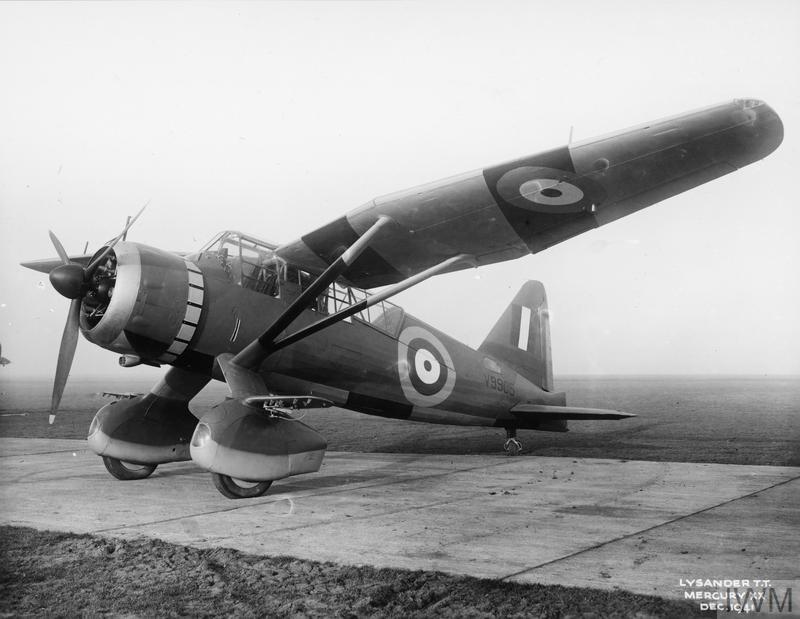
Lysander TT Mark IIIA target tug, V9905, on the ground at Westland’s Ltd, Yeovil, Somerset, before delivery to No. 58 Operational Training Unit at Grangemouth. (© IWM ATP 10716B)

The training unit would become the longest standing resident unit at Grangemouth and this would set the scene for its future.

The turn of the year though, really saw little change, except the weather got even colder. More rain and fog was joined by frost, and on several days the airfield was closed, its ground simply unsuitable for any flying activity.

Even though the weather was playing havoc, the work that both 58 OTU and the resident 614 Sqn would do in conjunction with the Polish airmen, led an affiliation between 614 and the Polish forces on January 10th 1941; an acknowledgement of the good work that was being done jointly between the two.

March 1941 then brought the news that 614 Squadron would be moving on, to Tranent (Macmerry), perhaps a welcome move as the last few months had seen flying hours drop to around 200 in the day and less than 20 at night. Several accidents had left aircraft badly damaged, crewmen injured and the squadron short of aircraft, it had not been a good year. But by early in the month, the move had taken place and 614 had departed to its new home where it could continue to carry out its sinister role.

With that, the OTU remained the main sole user of Grangemouth until on 10th March 1941,  when the Aircraft Delivery Flight Grangemouth was set up. (A month later it would be re-designated 4 Aircraft Delivery Flight). During its lifetime it would operate a number of aircraft: Oxfords, Dominies, Lysanders, Beaufighters, Mustangs and Typhoons. The role of the flight was to ferry aircraft from one location to another, taking new aircraft to new squadrons in support of 13 and 14 Groups.

Fighter pilot instructors give a demonstration of tight formation flying with Spitfires at Grangemouth 25th April 1941 (© IWM H 9180)

Delivering aircraft was not without its problems either. On October 2nd, a Hurricane IIA was being transferred by Sgt. Arthur Carl Young of the Flight from Martlesham Heath to Grangemouth. The pilot became disorientated in cloud, and so bailed out leaving the Hurricane to its fate crashing in an area near Goole.

The numbers of trainees at Grangemouth had grown significantly by 1942, so much so, that within 58 OTU a dedicated squadron was formed. Designated as ‘A’ squadron, it was manned by both British and Polish instructors, many of these were hardened veterans including Sqn. Ldr. Henryk Drobinski who had multiple kills and awards to his name.

But Grangemouth would be a multinational training centre, taking pilots from all around the world. The diversity of languages must have been a headache for some, the non- English speaking airmen having to learn very quickly indeed.

Collisions played a large part in the accident roll at Grangemouth, such was the nature of the training programme and those learning to fly the Spitfire, close formation flying being a large part of the syllabus here at the airfield.

In his biography “Challenge in the Air” (William Kimber, 1988), Miroslav Liskutin describes how on a six week course, six of the thirty pilots on his course were killed, a fact they simply lived with.

On April 17th, two pilots were killed when Spitfires R7073 and X4905 collided over Falkirk. One was killed outright, whilst the other died during an attempted crash landing following the incident. Sgt. Siemienczuk (26) along with P/O. Malkiewicz (24), both from Poland, were subsequently buried in Grangemouth Grandsable Cemetery located to the south of the airfield site.

In fact, 1942 saw no less than six collisions or near collisions, all of which resulted in either one or both pilots being killed. All these young men were in their 20s and from countries far beyond Britain’s own borders.

As the demand for training increased and subsequently the numbers of trainees increased, it was decided to increase the length of the main east–west runway by some 300 yards. This would allow for a greater amount of time to land and come to a stop and would allow for faster or larger aircraft to utilise the airfield should the requirement demand. Whilst the necessary work was carried out, operations and training flights continuing unhindered.

Ten months old Marian Edward, held by his mother Audrey Bełc (née Stephenson), receiving his late father’s DFC from Air Commodore W. H. Dunn during an award ceremony at RAF Grangemouth, 21 September 1942. The pilot standing far right in the group in the background is Flight Lieutenant Stanisław Brzeski, also of No. 58 OTU. Note also the former terminal building behind.(© IWM CH 7431)

The extension of the runway however, didn’t prevent further accidents from happening whether in the air or on the ground. Collisions with parked aircraft appear on several occasions, although and perhaps the worst incident, would occur some distance away from the airfield site.

On January 16th 1943, three Spitfires from the OTU were out on a formation flying exercise when they collided with a hillside killing two of the three airmen. It is what happened subsequent to the crash that is perhaps more incredible.

The accident occurred on Saturday 16th January 1943, when bad weather intervened in their flight plans. Initially they were ordered to land at the satellite airfield at Balado Bridge, but an accident there prevented this and so they were diverted to Perth.

In dense mist the three Spitfires X4614 (Ia), AR254 (Ia) and P8276 (IIa) remained in formation resulting in all three colliding with a 648ft high hill known as King’s Seat in the Ochils, 3km north of Dollar, Clackmannanshire. In the collision, two of the three pilots F.O. Hugh Gordon ’Bud’ Reynolds and Sgt. Gordon Murray Duda were both killed instantly.  The third pilot, an RAAF airman, Sgt. Vincent P Daly, managed to see the hillside in time and pulled his Spitfire’s nose up at the last minute to reduce the impact on the hillside. As a result, he survived sustaining only a broken leg and other minor injuries.

F.O. Reynolds, his Spitfire behind him. *6

The crash site being high up in the hills and covered in snow, would not be reached for some time though, and so Daly, even though suffering from a range of injuries (a compound fracture, bruising and cuts to head and body), managed to drag himself down the hillside where he was found two days later by a local farmer.

Daly had managed to use his scarf at the time of the crash, to tie his legs together making a make shift splint to support his broken tibia. He then set off, in freezing conditions, down the hill side toward safety and help. During the decent, he began to contract double pneumonia and suffered severe frostbite to both his toes and his nose – the tip of which he lost.

Once he had been located, Daly was transferred to Larbert Military Hospital, where he made a partial recovery, having to use special shoes and a walking stick to walk. Once out of hospital, he was sent back to RAF Grangemouth, but he never recovered sufficiently to fly again in the RAF. He died in 1969 in his home country, Australia, at the age of just 48 from a heart condition.

Reynolds and Duda were both flying with the RCAF (Duda being an American) and their bodies were eventually found and brought back to be buried at Grangemouth Grandsable Cemetery.

In memory of the airmen and as a lasting tribute a Cairn has been erected at the site (as is common in Scottish mountain crashes) in 2009, and was marked with a flypast by the BBMF Spitfire, Hurricane and Lancaster.

Cairn memorial dedicated in 2009 (© Gordon Brown)*7

Later that year, on October 5th 1943, 58 OTU would finally be disbanded in name, the aircraft and training programme being reused under the new name  2 Combat Training Wing still here at Grangemouth. For just the next two weeks or so, the unit would operate under this guise, before on the 15th yet another renaming would take place and it would become 2 Tactical Exercise Unit.  Continuing to use the Hurricane, Masters and Spitfires, it operated until 25th June 1944, at which point it was seen as surplus to requirements and disbanded for good. This move began the slow and inevitable run down of the airfield.

Between 1944 and 1945 Grangemouth was used by several maintenance units, including both No. 14 MU and No. 243 MU, who used the site after the departure of the OTU to store materials and ammunition. This took the airfield into the late 1940s, at which point there followed a period of limited flying, primarily through a number of RAF gliding schools.

The first of these was No. 6 Gliding school , who were formed here in January 1945 using Cadets, Grunau Baby IIBs and Sedburgh TX.1s.  In 1947 a second school, No. 2 Gliding School was also reformed here after being disbanded at Dumfries earlier in the war.

Then on April 1st, 1948,  No. 13 Reserve Flying School was formed here at Grangemouth, under the control of Airwork Ltd,. This organisation ran a number of flying training units around the country including two at Scone outside of Perth. 13 RFS used six Tiger Moths and were led by Wing Commander F. Nugent. The School was disbanded a year later in 1949, with almost 200 trainees on their books at various stages.

In 1949, the two Gliding Schools were also amalgamated, the Scone operations continuing at the demise of Grangemouth and absorbing all their equipment.

A third school No. 4 Gliding School then joined Grangemouth in 1951, and eventually all three were absorbed into one under the control of No. 2 Gliding School. A year later the grand terminal building, which had now stood throughout the war, would be destroyed by a major fire, which further helped the demise of the airfield categorically killing any future it may have had.

By 1955, neither Glasgow nor Edinburgh councils had shown any interest in the site as an aviation project, despite the money that had been spent on it previously. Scottish Aviation had also pulled out its resources and so, with all glider schools gone, the terminal building destroyed and no prospect of further flying, the land was put up for sale with an £11m price tag.*9

With that, the airfield was closed. The great dream of civilian aviation at Grangemouth would never materialise again after that. The runways became a proving ground for the young, and new car drivers honed their skills on the concrete paths. By the 1960s, the site was being ripped up and built upon, houses very quickly filled the gaps and the oil refinery took over most of the site. The runway extension, built to allow for longer landings, now holds the Charlotte Dundas Shopping centre along with further housing.

Grangemouth’s humble existence started off as an amazing dream, one that was shattered by the calling of war. A future that was so promising for Scotland’s Aviation industry sadly failed to materialise. Instead, Grangemouth became a training ground for many young men who were far away from their homes in Europe and across the commonwealth. In all,  80 air and ground crew lost their lives while serving at Grangemouth, 60 of those being aircrew. The majority of these lay buried in the local cemetery close to the airfield where they served all those years ago. There are many famous names synonymous with Grangemouth too, many of these were ‘Aces’, highly decorated pilots who achieved many ‘kills’ in their attempt to turn the tide of war.  Becoming trainers they also set many trainees off on their long journeys to the war’s end. One such pilot was Neville Duke the test pilot, who went on to achieve great things in the aviation industry.

Whilst elements of the site are still visible,  (the two original hangars and traces of one of the runways as part of a Inchyra play park) the airfield leaves few distinguishing features and you would be forgiven for not knowing such a site ever existed close to this growing Scottish town.

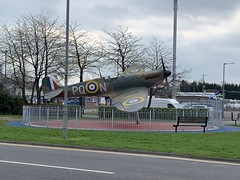
In 2013, the cadets of 1333 (Spitfire) Squadron led by Squadron Leader Tom McMorrow, finally saw their plans come to fruition when they were present at the unveiling of their Spitfire memorial outside the original hangar that remains standing today.

Their work and dedication ensures that the memories of those who not only who died here, but served at Grangemouth will go to survive so that we can enjoy the peace we have today.

The full story appears in Trail 64.

Sources and Further Reading (Grangemouth)

National Archives: AIR-27-969-1; AIR-27-1547-1;  AIR-27-1550; AIR-27-2073; AIR-27-2079-1; AIR-27-2120-1

*1 Falkirk Herald newspaper website accessed 24/6/23

*2 Delve. K., “The Military Airfields of Britain – Scotland and Northern Ireland“, Crowood Press Ltd. 2010.

*3 During this early part of the Grangemouth’s operation, the unit names became interchangeable, the use of ‘civil’ in 10 CANS being dropped in many situations, and 10 AONS being referred to in the ORBs as early as September.

*4 Secret Scotland website (unsubstantiated)

*5 Aviation Safety Network Website.

*6 Photo from Daily Record newspaper website. Accessed 1/7/23

*7 Photo © Copyright Gordon Brown via Geograph Website Accessed 1/7/23

*8 The Airfields of Britain Conservation Trust placed a marker on the site of Balado Bridge on 8/7/23.

*9 McCloskey, K., “Airwork A History“, The History Press, 2012 (via Google books)

Trail 64 – Central Scotland (Part 2)

In Part 1, we saw how Grangemouth was created through incredible vision, but how the impending war shattered that dream. Also how it then went on to become a training airfield, training young pilots to fly Spitfires. This was not an easy task, the weather playing havoc with training schedules and an ill prepared airfield adding to the cauldron of problems that would culminate in the inevitable accidents and resultant deaths.

On October 1st 1939, F.O. James A. B. Somerville (known as Young Hamish, to his family) was taxiing his Spitfire I. (L1047), when P.O. J.S. Morton flying Spitfire I (L1059) landed on top of him. In the resulting accident Somerville was killed outright and his aircraft totally written off. P.O. Morton was uninjured and his aircraft received only minor damage, however, the accident would no doubt have a lasting impact the injuries to F.O. Somerville being so severe. *5

On October 6th, the order to move the entire 602 Squadron finally came though and the next day the main portion of the unit transported its belongings to Grangemouth. More poor weather prevented another early departure by the aircraft, but by lunchtime, all ground and air crew along with their Spitfires, were over at Grangemouth. Lacking in accommodation, airmen had to be billeted off site in the town itself, whilst Officers took up residency in one of the vacant houses just north of the airfield. The war had finally started for this small airfield in Central Scotland.

602’s stay at Grangemouth was to be short lived though. With threats of German attacks coming from the east, it was decided to move 602 elsewhere, and within a week new orders had come through to move lock, stock and barrel to RAF Drem, in North Berwickshire. By the 13th October, the Spitfires and all their personnel, were gone and Grangemouth was vacant once more.

602 Sqn would go on to make further ‘firsts’ whilst at Drem, when on the 16th of October, pilot George Pinkerton would intercept and shoot down, a Heinkel 111. In doing so, he would be the first pilot to to fire in anger in the skies over Great Britain. It would also be 602 who would down the first ‘intact’ enemy aircraft onto British soil. Known as the Humbie Heinkel, it would become famous for this reason.

It would then be all change again, and on the 19th October 1939, Grangemouth would see the arrival of a new squadron and a new aircraft.  141 Squadron Led by Pilot Officer H. Anderson,  another former Turnhouse unit, brought with them Gloster’s Galdiator, an outdated but much loved biplane that began being supplemented during November by the more updated Blenheims.

Like their predecessors, airmen were billeted in three halls in the town whilst officers occupied two vacant houses -110 Boness Road and its neighbour. Whilst accommodation was far from ideal, it would do for now and all those assigned here were soon in and settled.

On the next day, a funeral guard of honour was provided back at Turnhouse for the burial of several German airmen. Those who were to stay behind had the unenviable task of filling sandbags, which were to be used around the dispersal points to protect aircraft from attacking bombers; a task that was eventually postponed due to yet more heavy Scottish rain.

In the following weeks little happened at Grangemouth. Six Gladiators were eventually brought in and used for local flying practise. The squadron tried to use the Air Observer School Ansons and although permission was eventually granted by Fighter Command, no instructors were available due to the School’s own backlog of hours. Further sand was delivered and yet more bags were filled, the monotony of such duties being broken only by the trickle of a small number of Blenheims from Hullavington.

Training flights were fraught with danger, and there were several accidents including on November 12th 1939, a crash on a night approach by  Sgt. P. Green in his Gladiator. Sgt. Green was unfortunately injured in the accident, but after being taken to nearby Falkirk hospital for treatment, he made a good recovery. Also in November five Gladiators were sent to Acklington for firing practice. Due to bad weather though, all five had to make emergency landings en route, P.O. Louden hit a wall and P.O. Smith landed badly. In both incidences the aircraft received substantial damage but thankfully neither pilot was injured. The other three aircraft reported no damage after their various forced landings.

P.O. Louden would have a second lucky escape in the following January when the Blenheim he was flying, overshot the runway and crashed beyond the airfield boundary. Again the aircraft was badly damaged but P.O. Louden was once more unhurt.

The weather in southern Scotland can be terrible, and persistent heavy rain not only caused cancelled flights, but also made the ground boggy and difficult to traverse. Even the floodlight tractor became bogged down and stuck in the mud causing further problems for night flying activities.

The routine of local flying, link training and lectures then became the norm for the days leading into the new year. January 1940  saw snow, rain and fog play a large part in the daily lives of those stationed here, causing as many issues on the ground as it did in the air. In the following month, the squadron was given new orders to transfer to Prestwick, a move it made on the 13th. But before they had time to unpack and settle in, further orders came in to return back to Grangemouth, their stay at Prestwick lasting no more than a week!

The early part of the year saw yet more night flying practice and yet more landing accidents. The Blenheims taking a bit of beating as heavy landings caused considerable damage to landing gear and aircraft structures.

By April 1940 another new aircraft was being delivered to the Grangemouth squadron, the Boulton Paul Defiant I. A ‘fighter’ that had failed miserably in its initial role – falling foul of the enemy’s superior aircraft – but would later become more effective as a night fighter. The first of these aircraft was delivered on April 4th 1940, by from 24 Maintenance Unit (MU) based at Ternhill.

141 Squadron continued to re-equip with the Defiants, and by the end of June 1940 they were carrying out target practice at various sites around the UK. Excitement then came to the airfield when on 26th June 1940, crews were called to standby – the first air raid warning of the year sounded over Grangemouth. No bombs were dropped but an enemy aircraft was seen to be shot down. Those pilots from 141 Sqn who were put on stand by at the airfield were not needed and probably disappointed for not having the opportunity to put into practice their new found flying skills.

RAF Grangemouth

Replica Supermarine Spitfire Mark I X4859 PQ-N -which crashed 15th September 1941 over Avondale estate killing Sergeant Eugeniusz Lukomski. It stands at the front of the former airfield as a memorial to all those who trained here, especially the Polish airmen. Unveiled by 1333 Grangemouth Air Cadet Squadron in 2013.

A second warning sounded again on the 28th June, but once more those 141 Sqn pilots put on standby were not required, another disappointment for those waiting for the signal to scramble and a chance to get their revenge.

On that very same morning  (June 28th 1940), new orders came through to 141, their posting to Grangemouth had come to an end.  It was all move once more. Busses began to ferry the staff and their equipment from Grangemouth back to Turnhouse, a move that lasted for most of the day. By the late afternoon all aircraft and personnel had made the transfer across and the settling in process would begin once more. This wouldn’t be the end of the link however, for a small detachment would return in July before the ties between Grangemouth and 141 Sqn were finally severed for good.

The month of June would see many changes at Grangemouth, not only did 141 Squadron depart, but there would be three other units all arrive within days of each other before the month was out.

On the 8th, 614 Squadron arrived, followed the next day on the 9th by No 52 (Army Co-operation) Wing and then on the 28th, 263 Squadron. It would be a hectic time for this small and ill prepared airfield.

Two of these units, 52 ACW and 263 squadron would both be short lived stays, neither remaining beyond the end of September 1940.

The role of No. 52 (Army Co-operation) Wing, was a tactical move to help defend the northern regions from enemy attack. These Lysanders and Defiants were brought in to free up valuable Spitfires and Hurricanes who could subsequently be moved south to protect London and the South East. Here in Scotland, they could protect not only the industrial regions of the north from attack, but assist in army training operations ready for their return to the continent – whenever that would be. Being located at Grangemouth, they were in easy reach of both the west and east coast, an area they began patrolling almost immediately. This stay would be yet another short lived one though and they soon would move on elsewhere just a month after their arrival.

The second of these short stay units were the Hurricanes from 263 Squadron.  263 had been re-established at RAF Drem earlier in the month, after flying on board naval carriers,  including HMS Glorious until she was sunk on June 8th 1940. They were now firmly a land based unit, and gradually getting back to full strength.

The other change came with the introduction of Westland’s Whirlwind for 263 Squadron. The underrated and rather obscure fighter being brought in to replace the Hurricanes they had been using since their reformation the month before.

In early September 1940, the time for change came once more, this time it was 263 who were to transfer from Grangemouth back to Drem, taking their newly acquired Whirlwinds with them. This would be the squadron’s only spell at Grangemouth before their final disbandment in 1963.

Aircraft of No. 58 Operational Training Unit at Grangemouth: a Miles Master Mark I undergoes an engine service in the hangar, while another Master is parked on the hard standing outside. In the background a Spitfire can be seen taxiing on the airfield.(© IWM H 9190)

The first of these June moments however, was to be the longer lasting one, remaining at Grangemouth until March 1941. 614 (County of Glamorgan) Squadron arrived on June 8th 1940, transferring north from Odiham

Over the next two days, twenty-two Lysanders  would arrive, the crews being billeted in tents around the airfield site; hardly an ideal situation considering the location of the airfield and the weather they were experiencing at the time.

614 Sqn was another of the twenty-one Auxiliary Air Force units, and the only one formed in Wales. It had been operating in France assisting the Army as artillery spotters, providing coordinates for the French and British gunners desperately trying to stem the tide that was the blitzkrieg.

Once settled, 614 Squadron began practise flights dropping messages and performing tactical reconnaissance sorties.  By the 17th June 1940, day long patrols were being carried out along the east coast of Scotland, covering an area from Inverness to Berwick, flying over the coastline and up to 5 miles inland. None of these patrols provided any signs of enemy action though.

Over the next few weeks further patrols and practise flights took place, one aircraft was damaged when struck by a second trying to land, and others had to land in fields due to bad weather or engine failures. There were no causalities but some of the aircraft were badly damaged in these incidents.

614 were also used to test gas spraying techniques in a chemical warfare role. Parts of Grangemouth were off limits and heavily guarded, and permits had to be issued to those personnel needing access to such areas. The idea behind this was that of the enemy launched an invasion force along the Scottish coast, then mustard gas (stockpiled at Grangemouth) would be used against them. This secret and somewhat underhand method of warfare was carried on by 614 once it moved to Macmerry in the following year.*4

In July 1940, internal changes saw the headquarters, motor transport unit and armaments sections move from one part of the airfield to a farm located at the northern side of the site. Simultaneously 180 airmen moved into  the recently requisitioned annex at the local Grange School, whilst a further 100 moved into the school itself. A temporary measure that would only last until the next school term started. Other duty personnel were moved to tents around the airfield, perhaps somewhat reluctantly, especially as within days, heavy rain would flood them out resulting in them being billeted off site as well.

Over the next few weeks little flying took place as bad weather continued to cause problems. Airfield defences continued to be erected and a visit by the Inspector General Sir E. Ludlow-Hewitt, broke the monotony of the pouring rain.

On August 10th 1940 an accident occurred when Lysander P9186 piloted by F.O. N. Merrett and F.O. J. Harper collided with Lysander N1251 flown by P.O. Cheminant. During the evasive tactics exercise the aircraft struck Merrets Lysander losing virtually all its main-plane. The aircraft then crashed to the ground killing both occupants. The second aircraft, whilst damaged, managed to land safely.

Bad landings caused extensive damage to several aircraft in the month that followed, whilst three others were grounded awaiting spares. Luckily none of the occupants in the poor landings were injured, but it did mean the squadron was now six aircraft down causing issues with both cover and patrols.

The last few days of September 1940 brought other incidents and fatalities. Outside the airfield, a dispatch rider was killed in a head on collision with a car, and an enemy bomber dropped a bomb in the vicinity of the airfield. No damage was done to the site but it brought home the fact that war was never very far away. At this time work also began on building the asphalt runways, which up until now had remained as grass. With luck, the heavy rain that had continued throughout the summer would soon not hinder flying activities.

At the close of September 1940, 754 hours had been flown by crews in daylight but only 17 had been flown at night; it had not been a great summer all round.

On the 4th November (1940) news came though that Grangemouth was transferring from 22 Group back to Fighter Command, the news brought little more than hope, those units already here remaining where they were and with what they had.

The miserable weather of 1940/41 brought little to cheer about at Grangemouth. Perhaps the greatest interest, apart from a hopeful christmas break, was the formation of a training unit in December. On the 2nd, 58 Operational Training Unit (OTU) was set up and provided with Spitfires along with a selection of Fairy Battles, Hurricanes and a Whitley amongst others. The OTU was supposed to have been formed earlier in November, but when Sqn. Ldr, (later Air Vice Marshal) Henry Hogan arrived, it was not ready for the OTU and so he left disappointed having to return the following month.

The last part of the trail shows how Grangemouth met it demise. Once the dream of a visionary it slowly begins to decay as the war comes to an end and units are gradually pulled out, surplus to requirements. The end comes slowly, but not before its last and longest standing unit arrives.

The full story appears in Trail 64.

Trail 64 – Central Scotland (Part 1)

In this latest trail around Britain’s wartime airfields, we travel to central Scotland, and the foothills of the Highlands. Travelling west from Scotland’s capital Edinburgh, we head toward an area of outstanding beauty where the flat lands begin to meet the lower highlands. Here during the Second World War, lay an airfield that never reached its full potential, but it did play a major part in the training of the RAF’s fighter pilots.

In Trail 64, we visit the former RAF Grangemouth.

RAF Grangemouth.

Grangemouth lies 1 mile from the town that gave it its name and 3 miles from Falkirk. The Firth of Fourth, Edinburgh’s major sea outlet, crosses west to east north of the airfield providing not only major docks and shipping services, but dry docks for submarines and other naval vessels as well. It is the natural sea outlet that led to Grangemouth’s very existence when founded in 1768 by Sir Lawrence Dundas, following the creation of the Forth and Clyde Canal that linked Glasgow to Edinburgh.

The Shipping that this development brought led to a huge expansion of the docks at Grangemouth. Exports increased along with the number and size of the docks available. Then during the First World War, these were taken over and renamed  HMS Rameses, by the military, who set up a mine manufacturing and training school here. Once usefulness of mines was realised, old merchant vessels were quickly adapted to drop mines and these were both stored and loaded here at Grangemouth.

The airfield itself was located to the south of these docks, and would play a large part in their defence, especially as a major oil refinery has been located here for many years. The expansion of this refinery, albeit a turbulent one, has since taken over the airfield site leaving little trace of its history behind.

Accommodation  for those personnel stationed here was often rudimentary to say the least, tents providing cover for many whilst the local town hotels were used for the luckier ones. A substantial number of houses along Boness road, just beyond the airfield perimeter, were also known to have been requisitioned over a period of time, some used for sick quarters whilst others became aircrew billets.

Life for Grangemouth airfield began long before the current industrial modernisation of the area though, initially being earmarked as a civilian site for commercial operations before war broke out. It was opened on May 1st, 1939 and was intended to have as many as four grass runways, the longest being 1,360 yards long. It would be operated and run by Scottish Aviation Ltd., who were based at Prestwick. Built by a number of companies including the construction company Wimpey, it would have at least twenty dispersals, two of which had blister hangars on them by the war’s end.

The main Edinburgh road originally passed between the airfield and the Firth, thus restricting any wartime expansion northwards. Now replaced by the M9 to the south, this road is now a minor road through housing serving a thriving residential community.

When it was handed over to the military, the site was then developed further, some of the rudimentary accommodation was replaced by more substantial blocks, and the grass runways were replaced with tarmac. The airfield was by then, able to cater for upwards of 600 personnel of mixed rank and gender.

With a total of eight Blister hangars added, its maintenance facilities were then extended far beyond those of its civil requirements.

It ambitious origins began in early 1939, with the purchase of 500 acres of farmland to develop into what was intended to be Scotland’s largest airport, initially serving routes to London, Glasgow, Edinburgh and the Shetland Isles.  During its construction, two large civil airport hangars were built along with a large and luxurious terminal at a cost of some £160,000 (£14,000,000 today).

The luxurious Terminal building (Falkirk Herald)

Even before the site was completed, the grass runways were active with the first commercial ticket being sold to Provost Robert Peddie for the princely sum of £9.00 10 shillings. The ticket gave him passage south in a de Havilland Dragon Rapide, but more importantly, this inaugural flight meant that Grangemouth was now commercially ‘operational’, even though it had not yet been officially opened.

On July 1st, 1939, Air Marshall Viscount Trenchard, the ‘Father of the RAF’.*1 arrived at the airfield declaring it officially open for business. Known as Central Scotland Airport, it was part of the expansion of the much troubled North-Eastern Airways, a company that had only been formed five years earlier, on March 4th 1935 by a group headed by the wealthy racehorse owner and banker, Ralph Beckett, 3rd Baron of Grimthorpe.

A KLM operated DC-3 at Grangemouth.  It is thought this was taken at the opening of the airfield,. The terminal is in the background. (Feel Falkirk website P12358)

Flying in direct competition with the rail service LNER, North-Eastern Airways operated flights from London to Newcastle and then onto Grangemouth before heading northward again to Perth and beyond. The majority of their fleet were Airspeed AS.6A Envoys, with the Rapides following on later.

Eastern Airways Timetable April 1939 @Bjorn Larsson

North Eastern Airways Timetable April 1939 @Bjorn Larsson

North It was intended that more routes would soon open up encouraging new operators and prosperity to the area, unfortunately this was only a pipe dream and with increasing costs and cheaper rail tickets challenging the operator, these routes were soon closed proving uneconomical to run in light of strong competition. The onslaught of war then hammered the final nail in to the coffin of commercial operations, By September 1939,  all flights had ceased, and the future of Grangemouth was no longer in the hands of civilian operators.

Whilst these commercial operations were the prime reason for the purchase and development of Grangemouth, Scottish Aviation’s interest, and that of  Air Marshall Trenchard was more than a passing coincidence. The company had early on in the proceedings, secured a government contract to train pilots for what seemed to be an inevitable war with Germany.

Scottish Aviation set up their own civilian run training group 35 Elementary and Reserve Flying Training School (ERFTS) to fulfil this contract. They operated some fifty-one aircraft including: the Audax, Hawker Hinds, Tiger Moths and soon after Avro Ansons, with an intended capacity of 200 trainee pilots at any one time*2

Soon after the declaration of war, a reformation of military training operations took place, and a new unit was established here with 35 ERFTS being disbanded and reformed as 10 Civil Air Navigation School (CANS). The use of the Ansons continued. This name however, would only last until November, when a further re-naming took place, forcing the disbanding and renumbering of the unit to 10 Air Observers Navigation School (AONS)*3

10 AONS, continued to soldier on with the Ansons. Then on 2nd December 1939  it was all change again when the unit was absorbed into the Prestwick school, 1 Air Observers Navigation School. Grangemouth, now closed to all civilian operations, was passed to full control of the RAF’s Fighter Command and 13 Group. It would seem there were to be big changes ahead.

Meanwhile, back on August 25th 1939, the RAF began mobilisation, orders were sent round military airfields to begin preparing for war. One such order came through to the Abbotsinch based 602 (City of Glasgow) Squadron, instructing them to inspect the buildings at Grangemouth with a view to moving there shortly afterwards. Sqn Ldr. Farquhar and two other members of his staff then travelled by car to Grangemouth, inspected the site and made their findings known later that evening.

On September 1st 1939, at 23:45 hrs, a notice came through to 602 Squadron to mobilise all units and prepare for war. With a considerable amount of preparation already having been done, the squadron were able to pronounce themselves ‘mobilised’ by 10:30 hrs the following morning. Commanding Officer Sqn Ldr A.D. Farquhar with Flight Lieutenants W. Robinson “A” Flight, and G.D. Pinkerton “B” Flight, led the way, taking the Scottish unit to war.

602 Sqn had the grand distinction of being the first of the Auxiliary Air Force squadrons to be formed, an honour that occurred in 1925. Although the first staff member, adjutant Flt. Lt. Martyn arrived at Renfrew to begin proceedings on September 12th 1925, the squadron’s official birthday wasn’t  recorded until September 15th.

The two hangars and terminal building. These hangars are the sole remaining structures left on the site. See photo below. (Falkirk Herald Website)

Between its formation and its impending move to Grangemouth, 602 Sqn had operated a wide range of aircraft: Hawker Harts, Hinds, Hectors Gauntlet IIs and from May 1939, Spitfire MK.Is. The Spitfire being a major leap forward in terms of flying technology, speed and power. This change gave 602 yet another ‘first’, being the first Auxiliary unit to receive the new aircraft type.

Two days later on September 3rd, official notice Movement Order 3 of 1939, gave notice of the imminent  move, and preparations immediately began at Abbotsinch. The aim of the squadron’s move to Grangemouth was to protect the valuable iron foundries, dockyards and numerous chemical factories that were now abundant along the banks of the Fourth.

Apart form organising the move, the first few days of war were unsurprisingly uneventful, with orders to “Stand by” being given to both A and B Flights coming to nothing more. The routine quickly changed to night flying practise, and as a result, the first ‘casualty’. In the dark, with little lighting to guide them in, a Spitfire crashed on the airfield whilst trying to land but luckily no one was injured and the aircraft only suffered ‘minor’ damage.

The quietness of the Phoney War, enabled the C.O. to test a new device that would stop the obscuring of the windshield from oil thrown out by the propeller. The unit was made, fitted and tested in the air, and photographs along with a detailed report was submitted to Fighter Command on September 6th. On the 8th, Sqn Ldr. Tidd of 13 Group came to see the item in action for himself, and finding it most suitable, had it used on all aircraft. As a result, the idea played a major part in future Spitfire development.

Grangemouth Hangar (left)

Left: One of the two original hangars still used at Grangemouth.

On the 30th September, a further visit to Grangemouth led to the decision that only a small detachment, and not the entire squadron, of 602’s Spitfires could be moved to Grangemouth, not at least until the accommodation, currently held by the Navigation School, had become vacant. These few aircraft and their ground crews would operate from Grangemouth between 09:00 and 18:00 hrs each day with ground staff and pilots being billeted on site during their tour there.

The next day, October 1st, a small detachment comprising of six aircraft, along with  ammunition and all the necessary flight equipment, departed Abbotsinch for Grangemouth. The desired early departure was unfortunately delayed by poor weather, something that was going to dominate the next few years at Grangemouth, and so the group, led by Flt. Lt M. Robinson, didn’t arrive until later than planned that day.

It was also at this time that 602’s sister squadron and rival, 603 (City of Edinburgh) Squadron, another Turnhouse unit, would begin to receive their Spitfires. As these were new aircraft to the squadron, each Flight, ‘A’ and ‘B’, would travel to Grangemouth to train. ‘B’ arrived first, flying between 17th and 24th, followed by ‘A’ Flight between the 25th and the 30th. These daily flights meant a considerable amount of movement in and out of the airfield, and with so many trainees in unfamiliar aircraft, accidents were almost inevitable.

In Part 2, we see how Grangemouth goes on to develop further, how the weather played a role in its operation and how with so many young men eager to learn, mistakes were made with dire consequences.

The full story appears in Trail 64.

RAF Leuchars – one of Britain’s oldest airfields (Part 5)

After Part 4, in this, the final part of Trail 62, we round off our look at RAF Leuchars. We have seen how to grew from a balloon training ground in the pre-war years to a training station for early flyers. Then on to maritime patrol, the Cold War and QRA status. Now as the years pass, defence cuts rear their heads once gain, Leuchars is once more under threat from politics.

The 1970s would see a return to training here at Leuchars with both the RAF and the Royal Navy embarking on new ventures with the Phantom – McDonnell Douglas’s all round, all-weather, multi-role aircraft. With new models, come new training units, and with the arrival of 111 Sqn the famous ‘Treble One’, in November 1975, also came a training support unit – the Post Operational Conversion Unit (later known as the Phantom Training Flight). The primary role of this unit was to train Fleet Air Arm aircrews for carrier borne models of the Phantom.

A No. 111 Squadron McDonnell Douglas F-4K Phantom FG.1, an aircraft closely associated with RAF Leuchars. (License: GNU Free Documentation License 1.2)

By the early 1970s, the shortcomings of the Lightning were now more than apparent, a lack of range and loitering ability becoming more obvious as the Phantom’s capabilities outshone it. A slower, but far more advanced Phantom, was proving to be more than just a suitable replacement for the now ageing ‘rocket of the skies’.

Whilst the Phantom was phased in and the Lightning phased out, pilots of the Lightnings continued to be wary of its tendency for engine fires, a problem that had  been present for some time. One such incident saw Lightning XS918 catch fire before the pilot (Flying Officer Doidge) manged to eject over the North Sea, West of The Bell Rock, 9 miles East of RAF Leuchars. Unfortunately controversy surrounded several aspects of the pilots kit, after he ejected he became detached from his survival kit, an inquiry highlighting ‘modifications’ to his clothing that may or may not have led to his tragic loss of life. In what appears to have been common practice amongst many airmen, changes were officially made to the kits supplied to aircrew in light of the accident.

The transition between Phantom and Lightning was a smooth if not rapid one. At Leuchars, the final farewell was made at the annual open day in September 1975, when six of 23 Squadron’s Lightnings and and four Phantoms of 43 Sqn formed a flypast. The Lightnings passing over the airfield in dramatic style saying a last farewell to the station where it has performed its duties so well for many years. With their disbandment in October, the baton and well and truly been passed over to a new breed of aircraft.

Between 1972 and 1978, Leuchars saw further sporadic returns of the Royal Navy, with 892 Squadron from HMS Ark Royal utilising the ground space for its operations. By 1978 though, 892 Sqn was disbanded, and their ship – the Ark Royal – decommissioned, bringing an end to this relationship between the navy and Leuchars. However, the FG.1 Phantoms used by 892 were absorbed into 111 Sqn, replacing the FGR.2s they had been operating before.

The end of 892 Sqn was marred by a tragic accident When rehearsing for the final solo display, the aircraft, a McDonnell Douglas Phantom FG 1 ‘XT868’ flown by Cdr. C. C. N. Davies and his navigator/observer Lt J. Gavin, suffered multiple engine failures whilst flying low, downwind along the runway axis. The aircraft entered a tight right hand turn through 180º to fly dead stick back along the runway. The Phantom’s right wing then struck the ground, and with the aircraft now perpendicular to the runway, the pilot ejected followed almost immediately by the observer. In their exits, the pilot was severely injured whilst the observer was sadly killed.

The decision to scrap the angled-decked carriers of the Navy would in turn have an eventual knock on effect at Leuchars. With both naval Buccaneers and Phantoms transferring to the RAF, no new training would take place – the Navy now looking toward the introduction the Harrier. The Phantom Training Flight would for now, remain at Leuchars though its role ‘downgraded’ to performing refresher training, ensuring that a round the clock, carrier based status was maintained in the UK.

It was also at this time that another film crew arrived – this time from the BBC – who used Ark Royal and her on-board flying units, including 892 Sqn, for their documentary ‘Sailor‘. The iconic insight into carrier operations was perhaps made even more famous by its theme tune of a similar name sung by Rod Stewart.

The 1970s saw continuous and increased intrusions into the the northern airspace around the UK, and as a result QRA scrambles became more common place at Leuchars than any other UK station. A massed show of force on Lenin’s centenary provided a massive ‘target’ for the QRA aircraft, with no less than 60 ‘Bears’ and ‘Badgers’ filling the skies on one day alone over the North Sea. A major headache for the QRA crews, it did however provide an excellent photo opportunity even allowing for a Marham Victor to shadow a Soviet Tu-95 ‘Bear’ much to the annoyance of the AOC No.1 Group when he got to hear about it.

With continued use, the runway needed a further resurfacing, and after the Phantoms of 43 Sqn had departed to Kinloss for a ‘Bolthole’ (where Station based aircraft deploy to temporary locations) deployment to carry out QRA operations from there, and those of 111 had left for Coningsby, Leuchars was left to the developers, and for an estimated eight months the airfield was effectively out of front line action.

Now with restricted runway use, the Whirlwind and Wessex helicopters and later Sea Kings, of 22 Sqn, would be the main users of Leuchars; their Air Sea Rescue operations combining with the Scottish Mountain Rescue teams, saving not only downed aircrew but stranded climbers as well . They would also be joined by the University Air Squadrons from nearby St. Andrew’s, Aberdeen and Dundee (later amalgamated to form the  East of Scotland Universities Air Squadron) who would use Leuchars for training with their Scottish Aviation Beagle Bulldogs.

Once completed, a second phase of work was then undertaken, new hardened aircraft shelters (HAS) were to be built. Common place on bases in Germany, these were designed to withstand conventional attacks, providing protection for individual aircraft whilst dispersed around the airfield. In an announcement made by Sir Michael Beetham the Chief of the Air Staff, Leuchars and five other airfields were to receive these ‘new’ shelters. It would take several years though before those at Leuchars were ready with its QRA aircraft safely tucked inside.

As the 1980s turned into the 1990s, the Phantom had now reached the end of its life and the new Multi Role Combat Aircraft (MRCA) the ‘Tornado’ would soon be appearing. The two Leuchars based squadrons, 43 and 111 were both stood down, the Phantoms removed and the Tornadoes brought in. 43 Sqn, who had been based at Leuchars since 1969 being the first to receive the new aircraft, a transition that saw all the Phantoms gone from the Scottish base within a year.

The introduction of the Tornado was not without its own political and military wrangling. Doubts cast upon the ability of the multi-role aircraft to perform as well as those aircraft it was designed to replace were raised by the military. History had shown some dramatic failures on this score whilst others, such as the Mosquito, had shown it more than possible with great success. Politicians however, seemed more drawn between upsetting the Americans who were trying to sell the F-15, and the multi national consortium Panavia Aircraft GmbH,  who collectively built the Tornado.  The decision would be a fine balance.

With the fall of the Berlin Wall, Soviet incursions  around the UK’s airspace would drop, the need for interceptors had now seemingly reduced, and so a review of the RAF’s front line operations was once again on the cards. The withdrawal of both the Phantom and shortly after the Buccaneer, left the Tornado as Britain’s only front line defence aircraft.

With the Gulf War in the 1991, the Tornadoes of Leuchars would play a major part and all eyes would be on them, scrutinising their every move. The gradual phasing out of Buccaneers and Jaguars leaving a lot on the shoulders of Tornado crews.

In 1995 two 43 Sqn Tornadoes from Leuchars were involved in a mid air collision over the North Sea. One of the aircraft ZE210 collided with the second, ZE733, during a joining up manoeuvre at 12,000ft whilst using night vision goggles. The pilot of ZE733 lost control and the two crew (Flt. Lt. McCarry and Flt. Lt. Booth) safely ejected, being rescued by an Air Sea Rescue helicopter from RAF Boulmer.  The second aircraft, ZE210, suffered damage to the hood and electrics, which knocked out the navigational aids. On landing, it took a considerable time to extract the crew due to the damage sustained to the hood. The aircraft was not repaired instead being used for spares before finally being dumped at St. Athan. *8

RAF Leuchars

Tornado ZE967 Gate Guard at Leuchars 2018.

The 2000s saw further upgrades to aircraft and new squadrons arrive. An Operation Conversion Unit for Tornadoes No. 56 (Reserve) Squadron, arrived in 2003. It was designed to upgrade pilots to the new variant Tornado. Absorbed into the long standing 43 Sqn, it remained on site and active until 2009 when it too was disbanded.

Further cut backs to finances meant the final departure of the Jaguars from bases in England. For Leuchars it would see the reforming of the University Air Squadrons into the ESUAS. A single training unit operating in conjunction with the three Scottish Universities .

After 2010 the Tornadoes were replaced by the Typhoons of 1 and 6 Sqns. 1 Sqn was reformed here on 15th September 2012, and joined 6 Sqn who had been reformed here on 6th September 2010, this offered an almost seamless transition from Tornadoes to Typhoons. These modern fighters now formed Britain’s front line of defence against potential aggressors taking over the QRA status for the north.  But in 2014, orders came through to move the RAF out of Leuchars transferring the aircraft, personnel and role to Lossiemouth in Moray. On 31st March 2015 at 12:00 hrs, ownership of Leuchars officially passed over to the Army, Leuchars’ named was changed to Leuchars Station, and its history as an operational airfield had finally come to an end.

Designated an emergency landing ground, (Master Diversion Airfield or MDA) between 2015 and 2016 no fewer than fifteen aircraft used Leuchars for ’emergency’ landings. These included: Tucanoes (Linton-on-Ouse), Tornadoes GR4 (Lossiemouth); Hawks (Leeming); Typhoons (Coningsby) and F15s from Lakenheath in Suffolk.

A minor respite in 2020 saw the QRA Typhoons return briefly as work was carried out on Lossiemouth’s runway. Within a short period of time though, this was completed and the aircraft departed once more leaving Leuchars quiet again.

This move signified the last full use of Leuchars by the Royal Air Force, responsibility of this long standing Scottish airfield being handed over to the the British Army who now based the Royal Scots Dragoon Guards and the Royal Engineers here. Various other non-flying units do serve here including The Military police units and 612 (R) Squadron, a medical unit of the RAF.

Whilst the defence cuts of 2010 indicated the closure of Leuchars, in October 2020, it was confirmed by the Ministry of Defence that they were looking into increasing both civilian and military usage of the airfield at Leuchars. Whilst there remains no intention to retain, or base aircraft here, the installation of fuel facilities does give hope that aviation will return in some form in the future. The indications are that by opening Leuchars to civilian traffic, it could bring revenue in to the hard pressed MOD*7.

Leuchars played a major part in two World conflicts being used primarily by the RAF throughout its life. The Royal Navy (Fleet Air Arm) have also been based here, as have the Army who are now the current main residents of the base. Other users include: the Dutch,  the Norwegians, the Canadians, Australians and New Zealand Air Forces as well as civil aviation organisations and University Air Squadrons.

More recently, with it being located closer to international airspace which is regularly penetrated by Soviet aircraft, the RAF’s Northern QRA aircraft were based here for many years before moving away to Lossiemouth in Moray, someway further north. Leuchars’ history is therefore long and very varied, covering a wide range of users in a multitude of roles.

RAF Leuchars has a history going back over 100 years. It was never upgraded to ‘A’ class status, and has only ever had two runways. Originally built from concrete and wood chip, the surface was upgraded to accommodate the jets of modern warfare, and the infrastructure has been added to as the airfield grew.

It has been home to a considerable number of front line squadrons along with an extensive collection of support flights, training flights and non-flying units. The number of people that have passed through its doors probably uncountable. It performed during the first World War, trained air crew in the inter-war years, and carried out vital work during the Second. Post war, it formed the front line of defence against potential Soviet aggression before returning to training through the University Air Squadrons across Scotland. Now home to the British Army, it is at least for the time being open for business, but as a flying military site, it is all but closed.

Its location has been in many ways its saviour. Operating maritime patrols and clandestine operations into occupied and neutral Europe. The Fleet Air Arm were formed from its units, and the Air Forces of several nations have been based here. It has a history that is so diverse and dynamic that very few other airfields in Britain can match it. As with other airfields across the country, its future hangs in the balance, I hope that this long living and prestigious site remains alive and well to honour all those who over the last 100 years have served from its runways.

Leuchars as an operational military site is not accessible to the general public and views across it are limited. It is thought that two rare First World War Double Royal Flying Corps General Service Aircraft Sheds are among the few original buildings that survive on the site. The accommodation areas have now been sold off to private buyers, but the airfield is intact as it is used as an emergency landing ground and by the ESUAS. With care, opportunities are there to see this historic and fascinating piece of Britain’s aviation history.

The full story of Leuchars can be seen on Trail 62.

Sources and further reading

*1 Fatal Air Accidents website 12th November 1918 – November 1919

*2 Royal Flying Corp Website

*3 An interesting film of 489 Beaufighters with invasion markings appears on the IWM website, it shows the take off and formation flying of the squadron along with some interesting ground shots too.

*4 For additional information and pilot stories about the ‘ball-bearing’ run see the Royal Institute of Navigation Blog.

*5 Thirsk, I. “de Havilland Mosquito – An illustrated History Vol.2“, Crecy 2006

*6 Further details about the BOAC Mosquitoes appear n ‘Mosquitoes on BOAC Service.

*7 The Courier.co.uk newspaper website.

*8, 11 Aviation Safety Network Website.

*9 National Archives AIR 27/2612/1

*10 Defence Transformation Volume 531: debated on Monday 18 July 2011 Dr. Liam Fox’s announcement to Parliament. UK Parliament House of Commons.

Gracie’s Guide to British Industrial History website.

Flying Magazine, (August 1972) website.

National Archives: AIR 27/1383

AIR 27/624/29

AIR 27/624/33

BAE Systems Website accessed 6/3/21.

For first hand stories of MRT work see Heavy Whalley’s blog

For a detailed account of life at Leuchars, read “Northern Q – The History of RAF Leuchars” by Ian Smith Watson.