RAF Scone – A little airfield with a big History (4)

In Part 3, we saw how Scone grew in the post war era, taking on more civilian operations, training pilots from around the world. This continued on in the years that followed and so the airfield grew even more.

Airwork’s ideas were big though, and one of the major changes they would make would be the extension of the runways adding not one but two tarmac runways of 2,800 ft and 2,000 ft in 1968. Scone then became the only UK Air Training School to have such facilities. As an international training college it was going to need to be able to accommodate large numbers of personnel, students and aircraft.

By the 1970s Scone had reached a peak with in excess of 400 students being trained at any one time. Catering for all these nationalities was hard work and a separate school had to be set up to standardise the language.  A School of English taught both basic English and technical English, meaning that by this time not only were pilots and engineers being trained in aeronautical procedures, but English as well. The AST became so busy, that it boasted of being “the largest civil aviation training organisation in the world”.*3

The demand for Scone’s operations continued to grow, as did the airfield itself.  Development took another step forward in the late 1970s and early 1980s when Air Service Training Ltd. expanded yet again. With huge increases in overseas student numbers (over 100 nationalities) a new hall had to be built to provide accommodation for them all. This was Stormont Hall, a large building with all the facilities needed to accommodate and cater for all student needs.

However, like many aviation related histories, things took a turn in the 1990s. Political moves by the Civil Aviation Authority and the Government, combined with changing global economies, caused AST to cease training overseas pilots at the international college at Scone. By April 1996, following the closure of the college, the site owners, Caledonian Investments, broke the news to its users, that it was selling up and in August, Scone was put on the market with a £3m price tag; the end of an era had apparently come to an abrupt end.*4

However, the move did not initially prove to be too much of a set back for AST and Scone as a whole, as it was able to bolster its maintenance programme with the purchase of a Jetstream from Cranfield University. The facilities for the programme, primarily the hangar,  proved to be too small, so a larger one was obtained, on lease, from the Airport authorities, and was officially opened for business in November 2008 after an opening ceremony led by the then-Cabinet Secretary for Education and Lifelong Learning, Fiona Hyslop MSP.*3

A buyer for Scone was soon found however, and in 1997, the airport was purchased as a going concern by the Morris Leslie Group, who allowed the various companies to continue to operate as normal from the airfield. Scone, or now Perth airport, had a new lease of life and would quickly grow to some fifty companies employing around 400 people once more. It has also updated many of the former buildings, providing both residential properties and workshops. It has over recent years, welcomed high prestige figures including Queen Elizabeth, former President George Bush and Prince Andrew.

AST continue to operate from Scone under the new owner, and they are not alone. Other organisations include the Scottish Aero Club (formerly The Scottish Flying Club) and whose history, goes back to 1927, and who relocated to Scone in 1956, joining ranks with the Strathtay Aero Club to form the new  club.  The Aero Club remains Scotland’s largest flying club and continues to offer rotary and fixed wing training as well as both auto-gyro and micro-light flying. It also provides maintenance for those aircraft located on the site.

Other users of Perth include Scotland’s Charity Air Ambulance (SCAA) flying the EC135-T2 helicopter, a charitable organisation that relies solely on donations to keep it flying. It was formed in 2012 and launched a helicopter air ambulance in May 2013 to assist the Scottish Air Ambulance Service (SAAS) to deliver front-line care to time-critical emergencies across Scotland. SCAA provides a fully equipped medical helicopter that can be deployed to incidents across the length and breadth of Scotland.

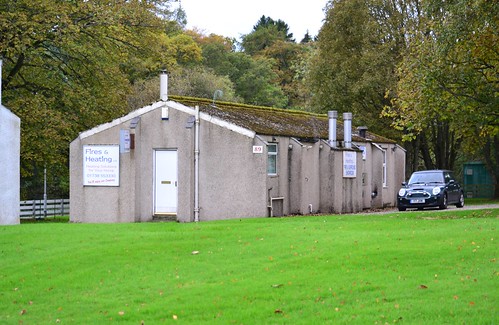
Today many of the wartime buildings remain, in use, by small industrial units. The Battle Headquarters, can be seen from the road very much exposed, as all but the top slotted observation ‘turret’ would normally be underground. The accommodation and technical areas are located together and many now form part of a small hotel for those visiting the area.

There are three runways in use, two of concrete / tarmac and one of grass, these being 2,799 ft and 1,998 feet, the third grass runway is 2,040 feet, all joined at the ends to form a perimeter. Two large hangars hold around 85 aircraft with further space for 15 more parked on the apron.

The airfield lies a few miles north of Perth, the main A94 offers access to the airfield and views across some of the site. It sits on a hill and so much of it is hidden from view at ground level. Being an active airfield, access is limited and understandably restricted. However, views of the current residents are available and many of the wartime buildings are accessible operating as retail and industrial units.

RAF Scone (Perth Airport)

The Battle Headquarters is very much exposed, this would normally be below ground level with only the slits visible.

Scone for such a small airfield, has had a long and fruitful history. Its links to pilot training, especially throughout the war years, no doubt sent many airmen to front line squadrons, many of whom  would go onto serve in some of Britain’s fiercest air battles. A small and often rudimentary airfield, it played a huge part in Britain’s wartime and post-war aviation history, and long may it continue.

The full history of Scone can be read in Trail 56.

Sources and further reading (RAF Scone).

*1 University of Glasgow website. Accessed 10.2.25

*2 McCloskey. K., “Airwork – A History“. The History Press, 2012.

*3 The Herald Newspaper, 16th August 2020, via website

*4 The Herald Newspaper, 9th August 1996 via website

Perth Airport website

National Archives AIR 27/1679/1; AIR 27/1679/1

McCloskey, K. “Airwork – A history” The History Press, 2012

Lake, A., “Flying Units of the Royal Air Force“, Airlife, 1999.

McKay, S., “Secret Britain” Headline Publishing Group. 2021

Lake. A., “Flying Units of the RAF“. Air Life Publishing, 1999.
RAF Scone – A little airfield with a big History (3)

In Part 2, Scone supported the RAF throughout the war, training pilots and navigators in a range of aircraft. Post war, this demand reduced, but it was not the RAF’s end with Scone, nor the end of pilot training.

With Airwork now owning the site outright, they began to look to the future. In 1950, BEA began trials with flights to Renfrew and Glasgow, a scheme that was hoping to open doors to destinations wider afield, but it was not successful and so the idea never came to fruition. Keen to expand, Airwork then took on conversion flying for the Admiralty, converting naval pilots to from single to twin-engined aircraft. They also carried out engineering and navigational training and began work overhauling radio systems, the future was looking bright for the expanding airfield.

The December of 1950 saw the Glasgow University Air Squadron (UAS) move to Scone as a temporary measure whilst their runway at Abbotsinch was resurfaced. As a result, Airwork became responsible for the maintenance of the training aircraft they were using, primarily Tiger Moths and Miles Magisters. Airwork soon came up with the idea of a trophy to be contested for by the various Scottish University Air Squadrons, called the Scone Cup,  the first competition was held in October 1951 and won by Glasgow. After a further name change of the UAS to Universities of Glasgow and Strathclyde Air Squadron (UGSAS) in 1965, the squadron re-equipped with DH Chipmunks, bringing yet another type to the small Scottish airfield.

RAF Scone (Perth Airport)

Old buildings are utilised for modern purposes.

Meanwhile the Scone Cup continued, as did the relationship between Scone and the various Air Squadrons, until in 1969, when the RAF centralised all its maintenance work at RAF Turnhouse, and the link with Scone was broken. The GSAS were then reassigned back to Glasgow airport, the location of its origin way back in April 1941.

Like so many other contracts with the military post war, the Admiralty’s pilot training programme wouldn’t last long either, and a gradual reduction in the need for pilot training for the service, forced Airwork to look elsewhere for their trade. The dynamic years that followed saw a huge growth in civil aviation, with jets now spanning the globe in hours and not days, and private flying was becoming evermore affordable to the masses. It was this opportunity that Airwork seized, becoming the first civil school to gain an Instrument rating course certificate for pilot training.

This enabled the now renamed ‘Airwork School of Aviation’ to officially offer its services to civilian operators for the first time, an offer that was taken up by numerous airlines including the first, Sudan Airways, with the first trainees arriving in November 1955.

Although the Navy had ended its contract with Airwork and Scone, it was not the end of military training for good. Whilst 1957 brought the disbandment of some landmark units, on March 8th, another training unit, 1 Civilian Fighter Control Co-Operation unit, formed here at Scone operating the Avro Anson T22. Little seems to be published about the activities of this unit, but I would assume it was, like other training units at Scone, operated by civilians working as part of the Royal Air Force’s training programme. The unit remained active here at Scone, until 31st January 1961 where upon it was disbanded. A year after its cessation on May 10th, an Anson of the unit ‘VV977’ was sold as scrap at No.27 Maintenance Unit (MU) at Shawbury.

With that any RAF connections with Perth ceased. The airfield was passed to ACS Aviation, who claim to be the “leading Commercial Flight Training Organisation in Scotland”. Operating a range of services including commercial pilot training and maintenance provisions.

By the turn of the 1950s / 60s, Scone was heralded as a thriving pilot training facility, seen by many organisations as one of the best available. In acknowledgement of this, the recently formed British United Airways sent their pilots here and were quickly followed by other UK based airlines. The prestige that attracted these airlines  led to an award by the Ministry of Aviation confirming Scone’s high ranking status, something that had not been done before to any other UK based school.

Airwork’s organisation stretched the length and breadth of the UK, and as military reorganisations took place, so some of Airwork’s units were either closed or relocated to alternative locations. In the early 1960s, Scones Airwork School of Aviation began to expand further by taking over the School of Aeronautical Engineering from Hamble, which led to yet another name change to Airwork Services Training (AST) to match the new role now being served at Scone. As the school developed and established itself at Scone, so it too began to expand, delving into the roles of electrical, turbine and rotary fields, all of which required further development of the pre-war site.

RAF Scone (Perth Airport)

Modern day Scone is home to a large number of small aircraft.

As Airwork has expanded into the rotary field, the next natural step was to train helicopter pilots at the airfield. The first such operation took place on 30th September 1963, with students from the Ghana Air Force. The instructor on that course, one Cryil Sweetman, would go onto gain his own fifteen minutes of fame flying a Hiller UH-12C in James Bond’s ‘From Russia with Love.’

The growth of Scone continued on throughout the (1960s) decade. During these years no less than thirty Cessnas (130 and 150 models) were brought into the airfield to train pilots, a number that would make it the largest fleet in Europe, giving Scone the advantage over other European training centres. Combine that with the additional training facilities and private maintenance work, Scone was rapidly becoming one of the biggest players in the civil aviation industry.

In the final part, we see how Scone had grown from strength tot  strength, through different ownership it has continued to supply training for new and established pilots, establishing itself as one of the largest training centres around.

The full history of Scone can be read in Trail 56.

RAF Scone – A little airfield with a big History (2)

Part 1 of this trail, saw how Scone began its life, and how through private enterprise, it developed into a pilot training centre for RAF pilots. As the need for pilots and navigators increases so does the work at Scone.

On September 3rd 1939, with Britain’s declaration of war, the training units operating on behalf of the RAF were immediately reorganised and re-designated, 11 E&RFTS becoming known more simply as 11 Elementary Flying Training School (EFTS).

This reorganisation of training schools also led to new aircraft, the Tiger Moths currently under civilian registration, were given military designations (BB672 – BB692) and the Hart trainers were replaced by Miles Magisters. Whilst ground crews remained as civilians, the instructors were drafted into the RAF and the school became RAF controlled.

Also at this time, Airwork formed and operated a further training unit here at Scone, 7 Civil Air Navigation School (CANS) flying Avro Ansons. Like 11 E&RFTS, they were, in October, disbanded and re-designated 7 Air Observers Navigation School (AONS), this new designation beginning on 1st November 1939. To fulfil their role, they would then take on eight Dragon Rapides, specifically to train new crews in cross country navigation techniques. After further expansion of both aircraft numbers and type, on June 1st 1940, the AONS was disbanded, further streamlining of training units meaning these needs were met elsewhere.

It was in these early war years that Scone almost became the hub for vital research into radar, when in late 1939, the Telecommunications Research Establishment (TRE) relocated here from Bawdsey Manor in Suffolk; mainly to be away from prying eyes but also away from the possibility of attack by German bombers. The pioneer of radar Robert Watson-Watt, grew up in this region and later went to University here, so it was a natural place to move the research to. However, once at RAF Scone, it was realised that the facilities were far to rudimentary and completely insufficient to accommodate the amount of work  needed to carry out this vital research. So, in early 1940, the establishment moved again this time near to Swanage on the Dorset coast. Scone’s fifteen minutes of fame had sadly and quickly passed them by.

Then in early November 1940, 309 Squadron sent a detachment of Lysander IIIs to Scone. Only recently formed, they remained here for about six months, being primarily based at Renfrew where the Polish pilots found the number of woods and railway lines confusing. The sole purpose of 309 Sqn was as a Polish Co-operation unit to work in conjunction with the C-in-C of the Polish Army. It was unique in that it was ‘double’ ranked, having both British and Polish officers in charge, the idea being that once the Polish personnel were in place the British would be pulled out and the squadron would operate as an independent Polish unit. A series of training flights were carried out by the Polish pilots, but with lectures being carried out through a translator, it was often a difficult task to do.

In September 1941, ‘E’ Flight of 11 EFTS  was used to form a new training unit, 5 Flying Instructors School (Supplementary) then again simply to the Flying Instructors School, finally becoming the Flying Instructors School (Elementary) from April 1942. The small number of resident pilot instructors flew Miles Masters and Tiger Moths training hundreds of pilots between them before the unit was eventually disbanded in November 1942.

Scone airport looking south in 1947. (@Britain from above)

The remainder of 11 EFTS continued on to the war’s end however, gradually being reduced in size as demand for new pilots decreased. Post war, in 1947, it was renamed as 11 Reserve Flying School (RFS) still operated by Airwork and still flying the biplane the Tiger Moth along with Airspeed Oxfords, Ansons and Hawk trainers. By 1954, the unit had wound down finally being disbanded that same year on the 20th June.

The immediate post war years also saw a huge closure of now ‘unwanted’ airfields, all surplus to requirements. Many were put into care and maintenance or reserved for future use should east-west relations diminish. RAF Errol, located to the east of Scone between Perth and Dundee, was closed and proposals put forward to turn it into a municipal airport for Perth and Dundee. This proposal allowed Airwork to put forward their own offer to Perth Town Council for the site at Scone, the offer (£54,000) was quickly accepted and the deal was finalised and ownership handed over on 31st July 1946, just four months after the initial offer was made.

The war’s end allowed many of the former civilian clubs to reinstate their operations, some though, were unable to due to high costs or lack of suitable facilities. The Strathtay Aero Club, who were one of the lucky ones, were once again able to continue their operations with Airwork at Scone.

Throughout the 1940s, a resurgence of public events saw many air pageants and displays take place across the country. At Perth, the Strathtay Aero Club in conjunction with Airwork, organised its first post war air display attracting around 10,000 spectators, highlighting the renewed interest in aviation at that time.

Amongst those present at the display on 16th August 1947, were the Lord Provost Ure Primrose and Air Marshal Sir Richard Peirse. Aircraft taking part ranged from Bleriot’s 1909 monoplane to a squadron of clipped wing Spitfires. A short film of the event is available to view through the British Pathe News website.

Thus renewed interest in civilian flying, allowed Scone (Airwork) to become the saviour of yet another civilian aeroclub, and another that had been forcible suspended by the war. The Scottish Flying Club (SFC), who were initially based at Renfrew and whose buildings 309 Sqn moved into, were closed following the declaration of war and evicted from their premises. After being ejected from their airfield, they found themselves in the awkward position of having nowhere to operate from and unable to afford the high fees being charged by many civilian operators in the immediate post war years.

Airwork allowed the SFC to use Scone’s facilities in such a way that Airwork made no profit out of the agreement. This was clearly a saving grace for the club who eventually joined forces with the Strathtay Aero Club later in 1956, to form a new organisation, The Scottish Aero Club, who would continue to operate from here at Scone.

But the RAF had not finished with Scone yet. In 1949, 666 Squadron was reformed at Scone as an Royal Auxiliary Air Force unit (RAuxAF) comprising of the 1966 Air Observation Post Flight (AOP), the 1967 (AOP) Flight at Renfrew and the 1968 (AOP) Flight at Abbotsinch. The squadron flew Austers Vs and VIs, in a cooperation role with Army units, but by 1957 all three flights, and thus the squadron, had ceased to exist when a letter, signed by the Queen, was handed to more than eighty senior officers of the RAuxAF, officially ending its existence as a military unit. With that, thirty-two years of history had come to an end, a history that had seen the RAuxAF take part in virtually all of Britain’s major air battles since 1925.

With the war over, the RAF’s need for pilots reduces dramatically and so does the need for supporting civilian operations. However, at Scone, operations go from strength to strength.

The full history of Scone can be read in Trail 56.

RAF Scone – A little airfield with a big History (1)

In Trail 56, we head north once again, this time across the River Tay into Perthshire,  the gateway to the Highlands.

The grand city of Perth boasts a majestic history, once the capital of Scotland, it is a city with galleries, museums and stunning architecture; described by VisitScotland.com as “a picturesque playground for Kings and Queens“, and rightly so.

The village that gave this airfield its name, has its own history, going back as far as the Iron age. Once the seat of Royals, it is mentioned in Shakespeare’s Macbeth, and once housed the famous ‘Stone of Scone‘ or ‘Coronation stone‘ that has for centuries been used for coronations of the Kings and Queens of Scotland and England. It was stolen by King Edward I of England who took it to London, where it remained until 1950 when it was stolen once more by four Scottish students and taken back to Scotland. It was a year later, returned to London where it remained, being used for the coronation of Queen Elizabeth II. In 1996, the Queen and Prime Minister agreed the stone should be returned to Edinburgh on the proviso that it be brought to London for any future coronations, the last one being King Charles III – it must be the most famous 125kg of rock anywhere in the world. *1

So, on Trail 56 after passing through the beautiful city of Perth and onto this small but famous village, we find one former RAF airfield that has since become Perth Airport. Located in the same region as Scone Castle, we now visit the former RAF Scone.

RAF Scone.

RAF Scone was built in the 1930s, and has been known by a series of names: Perth Airport, Perth Aerodrome, Perth Municipal Airport, RAF Perth, RAF Scone and Scone Aerodrome. The airfield is located about 3.5 miles north-east of the aforementioned city of Perth.

In the days before Scone was built, the Lord Provost of Perth, Thomas Hunter, had an idea to build an aerodrome near to his home town, designated Newlands aerodrome. The idea never came to fruition however, and no real progress was ever made on the site. However, in 1935, with the rumblings of war in Europe, the Government announced the expansion of the Royal Air Force, and so the idea was taken up again, this time by Sir John Ure Primrose.

Sir John, with support from many Perth Councillors, put forward a plan costing some £20,000 for an aerodrome, and with a small committee of members, began to seek advice from a number of sources including the aircraft company A.M. Airwork Ltd., and the architects Norman, Muntz and Dawbarn. After looking at the designs and reviewing Sir John’s plans, a revised model was put forward doubling the cost to some £40,000.

The new scheme was passed however, and 250 acres of woodland and pasture were purchased from two local landowners, Scone Estates and J. Patrick Cuthbert of Barclayhills. In September 1935, work began on clearing the site which employed around 440 labourers and tradesmen all employed by two companies, Maxwell M. Hart & Co. and William Taylor & Son.*2

It was agreed that the running of the airfield would be undertaken by the Airwork company, who were founded in 1928 and based at the then Heston Aerodrome in Middlesex. For much of this time, Airwork’s chief pilot was Captain Valentine Baker MC, DFC, who later joined forces with Sir James Martin to form the now famous  Martin-Baker company, famous for it ejector seats found on numerous fast jests world wide.

RAF Scone (Perth Airport)

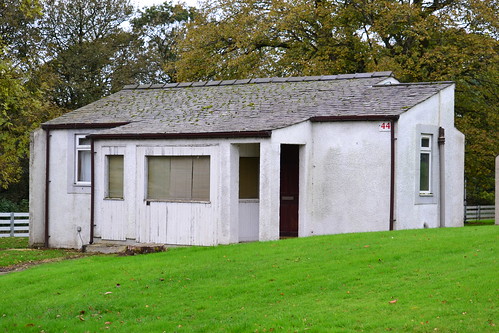
Numerous buildings survive from Scones wartime past.

Initially Scone (pronounced Scoone) aerodrome, would be a municipal aerodrome used by various civilian operators including North Eastern Airways and Railway Air Services, who made both local and national flights as far as London and Aberdeen. Some of these flights began in the dawning of 1936, before the airfield had officially opened and so the future looked fairly bright.

This burning light was also fuelled by the formation of the Strathtay Aero Club here at Scone, on May 29th 1936. Set up by three ex-RAF personnel, its initial operations were short lived however, being suspended due to the impending war in Europe. Despite this, with the war’s end in 1945, the club was allowed to continue these operations, including holding major events in 1947 leading to further growth over the next few years.

However, with increasing tension on the continent in the 30s, the RAF’s expansion was paramount and it would take preference over civilian operations. Not only would huge numbers of military personnel be required – an additional 2,000 pilots and over 16,000 ground personnel – but new airfields to operate and fly the aeroplanes from to wage such a war.

With some fifty new aerodromes required by the end of 1937, and so many new pilots to train, elementary flying training would have to form a major constituent of the programme, the majority of which would pass to civilian hands allowing the RAF to focus their efforts on advanced flying techniques. To meet this demand, civilian centres were to be increased from four to an initial thirteen *1, of which Scone would be one.

The entire training programme was overhauled with separate sites providing different instructions – ground or air – and a new RAF Volunteer Reserve class was set up to provide temporary training to cadets designated the rank of Sergeant. It was planned that those part-time trainees located at Scone, would learn to fly in one of twelve aircraft, each aircraft accumulating as many as 3,500 flying hours each year as a result.

The demand was therefore great, and Scone’s civilian operators, who were by now well established, would be joined on 27th January 1936, by No. 11 Elementary & Reserve Flying Training School (E&RFTS) operating under the control of 51 Group RAF, who were then based in Leeds. Even though 11E&RFTS were a military unit, their pilots would be trained by civilian instructors whilst they were stationed at the airfield.

It was clear at this point though, that Scone’s infrastructure was going to be insufficient for both the military and Airwork’s needs, and further land and development was going to be required. To this end, another 120 acres were either purchased, or leased from local landowners, allowing the development, now costing £60,000, to have two runways, 1,000ft and 4,200ft both initially of grass. These new extensions and the extra teaching facilities provided would add both space and accommodation to the original large hangar, administration and support buildings,  terminal and its six cottages.

Airwork’s influence stretched far beyond the boundaries of Scone though, their experiences elsewhere allowing them to develop the airfield and provide much of the infrastructure themselves. As an established aviation company they already provided maintenance facilities and operations across Britain, supporting what would become a thriving civil aviation network. In fact, this additional work would provide as much for the aviation industry as the flying training did.

RAF Scone (Perth Airport)

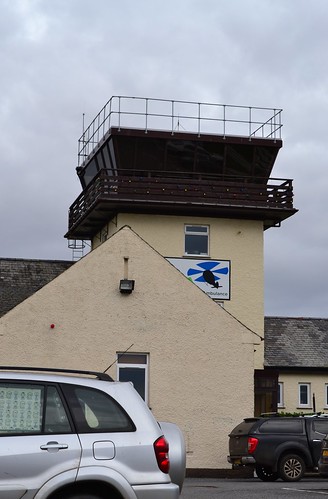
The current Watch Office at Scone (Perth Airport).

The original twelve training aircraft supplied by the RAF were also going to be insufficient, so a further eight were obtained giving of total of twenty, a mix of  Tiger Moths (DH.82) along with a handful of Hawker Harts and Hawker Hinds. Over the next few months, various other models would be obtained and used by the unit at Scone, these included:  Audax, Fairy Battles and Avro Ansons at some point.

With the number of operators using the site growing, it was going to be busy, and the ground would take considerable punishment. But the cold winter weather prevented the growth of newly laid grass and so, for a period of some two months, 11 E&RFTS moved out until the grass had established itself and the colder weather had passed.

Not long after this, the airfield was officially opened. On June 5th, 1936, a grand ceremony, led by Viscount Swindon, and a number of dignitaries, saw the airfield officially handed over to the Airwork Company under the management of P. Perkins, the general manager of Airworks – Scone had been born.

Even with all the development and extension work that had been going on, Scone would remain a relatively rudimentary station. On site, there would be a watch office, a single Civil 160 x 90 ft hangar; one 120 x 110 ft hangar, six blister hangars but no hardstands and the runways remained grass. A hard perimeter track did circumnavigate the airfield and although it only had two runways,  a third strip was also used. A set up that would see Scone enter the war.

In Part 2, Scone develops as the war progresses. Pilot training and maintenance work increases.

The full history of Scone can be read in Trail 56.