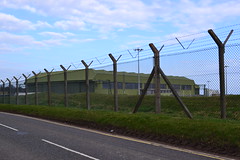
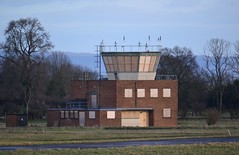
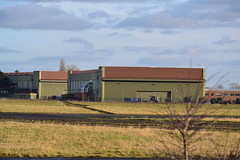
RAF Narborough – The Great Government Aerodrome.

Resting not more than a mile or so from the boundary of Britain’s front line fighter base RAF Marham, is an airfield that never made it beyond the First World War. However, its importance cannot be denied nor should it be over looked. Key to aviation in Norfolk and to the Royal Air Force as a whole, it played a major part in both, and therefore is pivotal to today’s modern air force. Opened originally as a satellite by the Royal Naval Air Service, it became not only Norfolk’s first, but the biggest First World War, fixed wing aircraft airfield, only four airship stations were bigger.  Leading the way for the aviators of today’s Royal Air Force, we look back at the former RAF Narborough.

RAF Narborough

Built as the largest, aircraft based, World War One aerodrome, Narborough has been known under a range of different names. The most common, ‘The Great Government Aerodrome’ reflected not only its size (over 900 acres) but also its multinational stature; the range of aircraft and personnel based here, and its achievements in aviation history. Used by the Royal Naval Air Service (RNAS), the Royal Flying Corps (RFC) and the Royal Air Force (RAF), it would have names that reflected each of these fledgling services.

Records show that Narborough had military links as far back as 1912, in the year that the RFC was established when both the Naval Air Organisation and the Air Battalion of the Royal Engineers were combined. Unfortunately, little exists to explain what it was used for at this time, but in later years, it was used to counteract the threat from both the German Zeppelin and Schütte-Lanz airships, and also to train future pilots of the RFC and RAF.

Narborough’s history in these early days is sketchy, few specific records existing as to the many changes that were taking place at this time or to the development of the RFC and RNAS. Its activities – and history though – was no doubt influenced on July 1st 1914, when the name RNAS was officially adopted, and all Naval flying units of the RFC were transferred to the control of the Navy. A major development in the formation of both forces, there were at this point, a total of: 111 officers, 544 other ranks, seven airships,  fifty-five seaplanes (including shipborne aircraft) and forty aeroplanes in RNAS service.*1 Some of these may well have been used at Narborough at this point.

By 1915, Narborough’s future had been sealed, designated as a satellite station to RNAS Great Yarmouth, (itself commissioned in 1913) it was initially to be used as a night landing ground for those aircraft involved in attacks on enemy airships. No crews were permanently stationed here at this time however, but as time went on ‘on-duty’ crews would fly in, and await the call to arms should an airship raid take place over East Anglia.

The first recorded arrival was in August 1915, an event that would keep the site in use by the RNAS for the next ten months, before being designated as surplus to requirements and handed over to the RFC in June 1916.

It was in June 1916 that the first RFC squadron would make use of Narborough as an airfield, 35 Sqn transferring over here from Thetford with Vickers FB.5 and FE.2bs. disposing of their DH2s and Henry Farman F.20s in the process. Within two months of their arrival, the nucleus of the squadron would then be used to form a new unit, 59 Sqn, also here at Narborough, under the command of Lieutenant A.C. Horsburgh with the RE8s. Narborough was already beginning to grow.

It was in that same month, that the perils of war would be brought home to those based at Narborough, when one of 59 Sqn’s pilots, Lt. Gordon William Hall, was killed when the DH.1 (4631) he was flying,  side slipped on approach to the airfield crashing as a result. A court of enquiry confirmed that the aircraft had been “banked too steeply” and that the pilot had put the aircraft into a dive that made it uncontrollable. A verdict of ‘accidental death’ was recorded against Lt. Hall.*2

In August, it was the turn of 35 Sqn to suffer its first fatality in a non too dissimilar accident. On the 29th, an Armstrong Whitworth F.K.3 (6201), was written off after it too side slipped and dived following a slow turn. The Pilot – Air Mechanic 1st Class –  Moses Boyd was tragically killed in the accident flying an aircraft that was based at Thetford but undertaking a training exercise here at Narborough. Already, the dangers of flying were becoming all too apparent and the glamour of flying was becoming tarnished.

Within two months, another 35 Sqn aircraft would also crash, this time one of the two crewmen, pilot 2nd Lt. Robert Leslie Edward would escape with just injuries. The observer, 2nd Lt Ernest Hildreth, however, was not so lucky and was killed in the resultant crash.

As the First World War raged on the European continent, the demand for aircraft was growing. It was quickly developing into a lethal weapon and a very potent reconnaissance vehicle. To fill vacant spaces and meet high demand, training programmes were rushed into place, meaning Narborough would become a preparation ground for new recruits. With training considered very basic by any standards, recruits only had to pass a number of tests before being sent to the front. Written examinations followed up by twenty hours solo flying, cross-country flights and two successful landings, were followed by flying for fifteen minutes at 8,000 feet and landing with a cut engine. Barely enough experience to see anyone through a violent war.

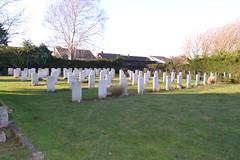
During these flights, these daring young men, many who were considered dashing heroes by the awe-inspired locals, would display their skills for all who lined the local roads to watch. As they were quickly learning though, life was not always ‘fun’, and the dangers of the craft were ever present. Accident rates were high and survival from a crash was rare, even ‘minor’ accidents could prove fatal. The local church yard at Narborough, paying testament to their dangerous career with fourteen of the eighteen graves present being RFC/RAF related.

The RFC was now building in strength, not only in its front line units but in its reserves too. On November 2nd, 1916 a new reserve squadron was constituted and formed here at Narborough, 48 (Reserve) Squadron (RS). Models flown by the unit at this time included the Grahame White XV, the Maurice Farman Shorthorn and Sopwith’s Pup. Over the next period of time, there followed a number of other reserve units: No 50, 53 and 64 (Reserve) Squadron (later designated Training Squadrons*3) all passing through Narborough at some point. However, and even with this large influx of personnel in these early days, Narborough was not to be the most exotic of locations.

As a training ground, accommodation was basic to say the least, being described by one ‘resident’ as a “desolate God-forsaken place“*4. It was soon realised by the authorities that new buildings needed to be erected for not only accommodation, but for training and maintenance roles as well. In response, a total of seven Boulton and Paul hangars, and up to 150 buildings would be built on the site over the next two years. A development that would by the end of the war, see some 1,000 personnel based here at Narborough – a number comparable with any modest Second World War airfield.

Meanwhile the threat from Zeppelins had not yet receded, and as a result 1916 would close with a small detachment of 51 Sqn BE.12s tasked with attacking these marauding menaces. Whilst primarily based at Hingham, 51 Sqn would have detachments spread across a number of East Anglia airfields, all preparing to meet the continued threat from Germany’s enormous airships.

With increasing numbers of squadrons and men being required for front line units in France, both 35 and 59 Squadrons departed Narborough in early 1917, and by the end of February both were gone.

All Saints Church Narborough, Norfolk

2nd Lt. Allen Ingham Murphy, killed March 30th 1917 ‘in an aeroplane accident’.

This left the reserves at Narborough, and it wouldn’t be long before they too suffered causalities. The first of these to lose a valuable pilot was 50 RS on March 30th 1917. A young Canadian, not yet out of his teens, 2nd Lt. Allen Ingham Murphy, was killed when his Armstrong Whitworth F.K.8 ‘A2720’ stalled whilst turning after take off. 2nd Lt. Murphy was the first of four casualties from the units that year – training young pilots was not getting any easier.

This danger was made no more obvious than on October 29th, when two aircraft, both from 50 RS were lost in separate accidents. The first an Armstrong Whitworth FK.8 (A2730) side slipped during a turn and nose dived into the ground killing both crewmen, 2Lt. Norman Victor Spear (aged 29) and Air. Mech. 1 Sidney Walter Burrell (age 22).  The second aircraft, also an Armstrong Whitworth F.K.8 (B219) spun off a low climbing turn also killing its pilot 2Lt. Laurence Edward Stuart Vaile (aged 23). It was indeed a black day for 50 RS and a stark reminder to the trainees.
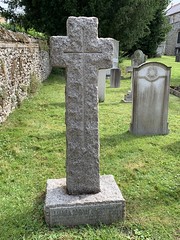
All Saints Church Narborough, Norfolk

2Lt. Laurence Edward Stuart Vaile, killed in an aeroplane accident August 29th 1917.

In October and December two more units bolstered the numbers of trainees at Narborough. Firstly, 1 Training Squadron were formed here on October 1st, whilst 83 Sqn, born out of 18 (Reserve) Squadron (RS), arrived at Narborough during December that year bringing a range of aircraft that they quickly swapped for FE.2bs.

83 Squadron soon departed Narborough though, heading to France in March 1918 where they performed attacks on troop concentrations, attempting to stem the early spring offensive.

On June 8th, 1917 Lt. Hubert J. Game was killed when the B.E.2e (A2794) he was flying suffered a catastrophic wing failure when pulling out of a dive whilst looping the loop. Lt. Game was originally a Lieutenant in the Royal
Field Artillery (RFA) and was attached to 53 (Training) Sqn RFC at Narborough, when he was tragically killed. Hubert was the younger brother of Air Vice-Marshal Sir Philip Woolcott Game, and was just 26 years old at the time of his death. He is another one of those whose grave lays a short distance away from the site of Narborough airfield.
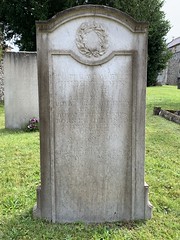
All Saints Church Narborough, Norfolk

Lt. Hubert J. Game, All Saints Church Narborough.

The occurrences of these tragic accidents were becoming so frequent, that one instructor, Capt. W.E. Johns, creator of ‘Biggles’ later cited spies as the cause of many ‘accidents’ – tampering with machines causing the deaths of the crews on board. Johns, himself having written of many machines, believed Americans with German sounding names were to blame for aircraft breaking up in mid-air or crashing at the bottom of loops. More likely, the fault lay with over exuberant or poorly trained recruits.

As the war drew to a close, one further squadron would be formed here at Narborough. On New Year’s day 1918, 121 Squadron were formed here, initially created to use DH.9s, they instead flew a variety of aircraft until they moved out to Filton in mid August. Shortly after their arrival here they were disbanded.

The last months of the war had no let up in training. Keen to join the RFC young men continued to train to fly. In mid February 1918 two 18 year old boys would perhaps be fulfilling a dream when it all went tragically wrong. Flying a DH.4, 2Lt. John Fyffe Shaw and 2Lt. Charles Arkley Law were both killed after the aircraft’s engine failed causing it to stall and then nose dive into the ground.
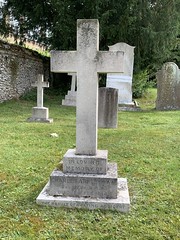
All Saints Church Narborough, Norfolk

2Lt. Charles Arkley Law killed after his engine failed and the aircraft stalled.

By August, war was over, and the the big wind down of squadrons would soon begin. At Narborough, two squadrons 69 (Training) Squadron and 26 (Reserve) Squadron would both merge to form a new 22 Training Depot Station. Many other similar units would soon follow suit and either disband or merge. This dramatic wind down continued on into, and beyond, 1919. In February, both 56 Sqn and 64 Sqn arrived as cadres; 64 Sqn was disbanded here later that year whilst 56 transferred to Bircham Newton where they too were disbanded later that same year. A third squadron, 60 Sqn also suffered the same fate, arriving as a cadre mid February before themselves being sent to Bircham Newton and disbandment.

With one last roll of the dice in mid March 1919, 55 Training Deport Station also disbanded here at Narborough, but out of the ashes was born a new unit 55 Training Squadron. With that though, Narborough was heading for closure, its days now over, it was soon to be surplus to requirements.

The post war years then saw the closure of many of Britain’s war time airfields including Narborough. But unlike its sister station RAF Marham a mile or so away, it would remain closed. The buildings were all sold off in what was considered to be one of the biggest auctions in Norfolk, with some of them going to local farmers, other for small industrial units, some to schools and the like, Narborough was now scattered to the four corners of the county. The remainder of the site was sold to the farmer and it quickly returned to agriculture, a state it remains in today. Some of these original buildings are reputed to still exist at various locations around the area today, whether that is true or not, is difficult to ascertain, but most have long since succumbed to age, the inevitable deterioration and eventual demolition.

Narborough itself having no hard runways or perimeter tracks has long since gone. A small memorial has been erected by a local group aiming to promote and preserve the memory of Narborough, a memorial plaque also marks the graves of those who never made it to France; and the small Narborough Museum & Heritage Centre holds exhibits of 59 Squadron in the local church.
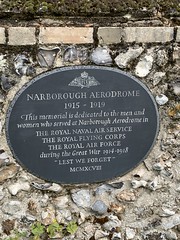
All Saints Church Narborough, Norfolk

The Plaque at All Saint’s Church Narborough, honouring those who served at Narborough.

Significant not only in size, but in its history, Narborough has now been relegated to the history books. But with the dedication and determination of a few people the importance and historical significance of this site will hopefully continue to influence not only the aviators of tomorrow, but also the public of today.
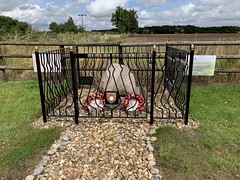
Updated memorial August 2021

The Narborough memorial which sits at the entrance to Narborough airfield. It was refurbished after the original was struck by a vehicle.

Sources and further Reading (Narborough)

*1 Fleet Air Arm Officers Association Website accessed 14/6/21

*2 RAF Museum Story Vault Website accessed 14/6/21

*3 On May 31st 1917, all RFC ‘Reserve Squadrons’ were renamed ‘Training Squadrons’.

*4 Letter from 2/AM C. V. Williams from 59squadronraf.org.uk

Narborough appears in Trail 7.
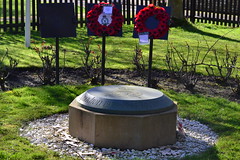
September 8th 1943 – Tragedy at RAF Mepal.

On the night of September 8/9th 1943,  a force of 257 aircraft comprising 119 Wellingtons, 112 Stirlings, 16 Mosquitoes and 10 Halifaxes took off from various bases around the U.K. to bomb the Nazi gun positions at Boulogne. Included in this force were aircraft from the RAF’s Operational Training Units, and for the first time of the war, five B-17s flown by US aircrews of the USAAF’s 422nd BS, 305th BG at Grafton Underwood. This was the first of eight such missions to test the feasibility of the USAAF carrying out night operations over Europe.  After the remaining seven missions, in which the squadron had dropped 68 tons of bombs, the idea was scrapped, the concept considered ‘uneconomical’ although the aircraft themselves proved to be more than capable of the operations.

RAF Mepal - memorial

RAF Memorial – Mepal

The Gun battery targeted, was the emplacement that housed the Germans’ long-range guns, and the target wold be marked by Oboe Mosquitoes. With good weather and clear visibility, navigation was excellent, allowing the main force to successfully drop their bombs in the target area causing several huge explosions. However, not many fires were seen burning and the mission was not recorded as a success. Reports subsequently showed that the emplacement was undamaged due to both inaccurate marking by Pathfinders, and bombing by the main force. However, as both anti-aircraft fire and night fighter activity were light, no aircraft were lost during the flight making it a rather an uneventful night.

However, the mission was not all plain sailing, and whilst all crews returned, the night was marred by some very tragic events.

Three Stirlings were to take off from their various bases that night: at 21:00 hrs from Chedburgh, Stirling MK. III, EF136, piloted by F/S. R. Bunce of 620 Sqn; at 21:30, another Stirling MK.III, from 75 Sqn at RAF Mepal, BK809 ‘JN-T*1‘ piloted by F/O I.R.Menzies of the RNZAF; and lastly at 21:58 also from Chedburgh, Stirling MK. I, R9288 ‘BU-Q’ piloted by N.J. Tutt  of 214 Sqn.  Unfortunately all three aircraft were to suffer the same and uncanny fate, swinging violently on take off. The first EF136 crashed almost immediately, the second BK809 struck a fuel bowser, and the third R9288 ended up in the bomb dump. Miraculously in both the Chedburgh incidents there were no casualties at all, all fourteen crew men surviving what must have been one of their luckiest escapes of the war! The same cannot be said for the second though.

Stirling BK809 was part of a seventeen strong force of 75 Sqn aircraft. Each aircraft was carrying its full load made up of 1,000lb and 500lb bombs. As the Stirling was running along the runway, it swung violently, striking a fuel bowser which sent it careering into houses bordering the edge of the airfield.

One of the occupants of one of the houses, Mr. P. Smith, saw the aircraft approaching and ran into the street to warn others to get clear. As the aircraft struck the rear of the houses, it burst into flames causing some of the bombs to detonate. This brought considerable rubble down on the occupants of the second house, Mr and Mrs John Randall.

Mrs Randall managed to get out, her legs injured, whereupon she was met by a local fireman, Mr. A.E. Kirby of the National Fire Service. Mr. Kirby went on to help search in the wreckage of the house until his attempts were thwarted by another explosion. His body, along with that of Mr. Randall, was found the next day.

Two other people were also killed that night trying to provide assistance, those being F/Sgt Peter Gerald Dobson, RNZAF and Section Officer Joan Marjorie Easton WAAF. F/Sgt. Dobson was later mentioned in despatches. Three members of the crew lost their lives as a result of the accident, F/O. Menzies and F/O. N. Gale both died in the actual crash whilst Sgt. A. Mellor died later from injuries sustained in the accident.

A number of others were injured in the crash and one further member of the squadron, Cpl Terence Henry King B.E.M, was awarded the British Empire Medal “for his bravery that night in giving assistance“.

The mission on the night of September 8/9th 1943 will not go down as one of the most remarkable, even though  it was unique in many respects, but it will be remembered for the sad loss of crews, serving officers and civilians alike in what was a very tragic and sad event.

The crew of Stirling BK809 were:

F/O. Ian Robert Menzies RNZAF NZ415002. (Pilot).
P/O. Derek Albert Arthur Cordery RAFVR 136360. (Nav).
P/O. Norman Hathway Gale RAFVR 849986. (B/A).
Sgt. Ralph Herbert Barker RNZAF NZ417189. (W/O).
Sgt. Albert Leslie Mellor RAFVR 943914. (Flt. Eng).
Sgt. Bullivant G RAFVR 1395379. (Upp. G)
Sgt. Stewart Donald Muir RNZAF NZ416967. (R/G).

RAF Mepal was visited in Trail 11.

Sources and Further Reading.

*1 Chorley, 1996 “Bomber Command Losses 1943” notes this aircraft as AA-T.

National Archives: AIR 27/646/42: 75 Sqn ORB September 1943

Chorley, W.R., “Bomber Command Losses – 1943“, Midland Counties, (1996)

Middlebrook M., & Everitt C., “The Bomber Command War Diaries”  Midland Publishing, (1996)

Further details of this accident, the crews and those involved can be found on the 75 (NZ) Sqn blog. This includes the gravestones of those killed and a newspaper report of the event.

My thanks also go to Neil Bright for the initial  information.

RAF Graveley and the Pathfinders (Part 2).

In Part 1, we saw how Graveley had been formed, its early years and the how it was drawn into Don Bennett’s Pathfinder Group. We saw the Introduction of FIDO and the benefits of this incredible fog busting system.

In this, the second and final part we see more uses of FIDO, new aircraft and new squadrons arrive, but we start on the night of 18th/19th November 1942 which saw a remarkable turn of fortune for a squadron who had suffered some devastating losses.

Halifax DT488 (TL-S) piloted by Wing Commander B.V. Robinson, caught fire when flares in the bomb bay ignited. He ordered the crew to bail out, but as the last man left, the fire extinguished itself. Robinson then decided to try and nurse the damaged bomber home. Flying single-handed, he reached the safety of RAF Colerne in Wiltshire, where he survived a crash landing. The six crew members who had bailed out also survived but were unfortunately captured and taken as prisoners of war by the Germans.  As a result of his actions, Robinson was awarded a Bar to add to his DSO. Robinson would go on to have a second lucky escape later on, after which, in May 1943, he would become the Station Commander of his home base here at Graveley.

35 Sqn would continue to carry out missions both marking and attacking strategic targets deep in the heart of Germany, but accuracy, whilst improving, was not yet 100%.

By the end of 1942 the new H2S ground scanning radar system was being introduced, and a small number of 35 Sqn aircraft were fitted with the units. The continuing missions were on the whole successful, even after the Germans developed a device able to track aircraft using it, and eventually, the whole of the PFF were fitted with it.

In April 1943, a detachment of 97 Sqn Lancasters arrived at Graveley. Based at the parent station RAF Bourn, they also had detachments at Gransden Lodge and Oakington, and they remained here for a year. After that, they moved on to RAF Coningsby in Lincolnshire.

A number of major operations were undertaken by 35 Sqn over the coming months, but with it came the end of good fortune for Group Captain Robinson. Fate was finally to catch up with him, and he was lost on the night of 23rd/24th August 1943. Flying in a Halifax II (HR928) ‘TL-R’, his loss that night brought a further blow to the men of Graveley and 35 Sqn. Following this, Air Chief Marshal Sir Arthur Harris restricted flying operations by base Commanders as the number of these experienced men being lost was quickly becoming unsustainable.

On November 18th/19th 1943, Bomber Command began the first phase of its ‘Battle for Berlin’, and Graveley’s Pathfinders would find FIDO more than beneficial. A raid of some 266 aircraft would see light losses on the second night of operations, but on returning to England, crews would find many of their bases shrouded in heavy fog. With visibility down to as little as 100 yards on the ground, the order was given to light up FIDO. This would be FIDO’s first official wartime use, and whilst some of Graveley’s bombers were diverted elsewhere, four managed to land safely using the system. This new invention may well have saved precious lives, as others failed to survive landing at their own fog-bound bases. At debriefing, one airmen, was noted as saying he could see Graveley’s fire as he crossed the English coast, a considerable distance from where he was now safely stood.

The night of 16th/17th December of 1943 would go down as one of the worst for Bomber Command and in  particular for the Pathfinders who were all based in the area around Graveley.

In what was to become known as ‘Black Thursday’ a massed formation of almost 500 aircraft attacked targets in Berlin, and although covered in cloud, marking was reasonably accurate and bombs struck their intended targets. On return however, England was fog bound, thick fog with a layer of heavy cloud prevented the ground from being seen. Whilst not operational that night, Graveley lit up its FIDO in an attempt to guide fuel starved bombers in. With little hope for even getting in safely here, crew after crew requested landing permission in a desperate attempt to get down. Many, out of fuel, bailed out leaving their aircraft to simply fall from the night sky. Others, desperate for a landing spot, simply crashed into the ground with the expected disastrous results. At Graveley, several attempts were made by desperate crews, but even FIDO was unable to help everyone. One aircraft came in cross wind losing vital power as he realised his error and tried to pull away. Another crashed a few miles away to  the north-east and a third aircraft trying to land came down to the south-east of the airfield. Of all those lost around Graveley that night, survivors could be counted on only one hand. 97 Squadron at Bourn, Gravely’s sister Pathfinder station, had taken the brunt with seven aircraft being lost. The role call the next morning was decimated.

The new year brought new changes to Graveley. Mosquito B.IVs arrived with a newly formed 692 Squadron (RAF). Their first mission here would be on the night of February 1st/2nd 1944 in which a single aircraft would defiantly attack Berlin.

graveley

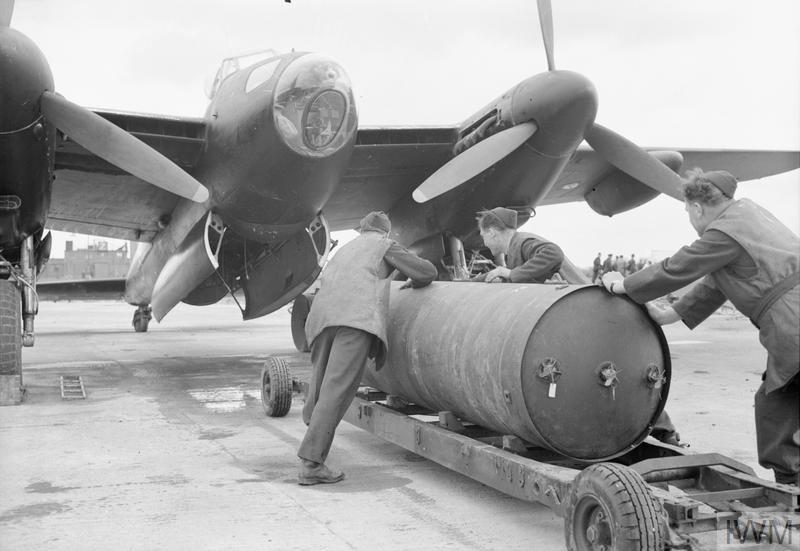
Armourers wheel a 4,000-lb HC bomb into a Mosquito. The Mosquitoes were fitted with bulged bomb-bays in order to accommodate ‘Cookies’. The tower can be seen behind. (© IWM CH 12621)

Some of these 692 Sqn Mosquitoes were later modified to carry the enormous 4,000 lb ‘Cookie’ bomb, This was first used by S/Ldr. Watts in Mosquito DZ647 who took off at 20.45 hours to attack Düsseldorf. The attack took place on  the night of 23rd/24th February 1944 from a height of 25,000 feet. The initial bomb was followed by two further bombs from Mosquitoes of the same squadron, DZ534 and DZ637.

The first casualties for 692 Sqn were reported only three days earlier, on the night of 19th/20th February, which also proved to be the worst night for Bomber Command casualties since the war started – even worse than ‘Black Thursday’. With 79 aircraft failing to return home, the RAF had taken another pounding and squadrons were finding themselves short of crews. These casualties including those in Mosquito DZ612 ‘P3-N’. Flown by F/L. W. Thomas (DFC) and F/L. J. Munby (DFC) the aircraft took off at 01:05 to attack Berlin. The Mosquito was subsequently shot down and both crew members killed.

graveley

Mosquito B Mark XVIs of No. 692 Squadron RAF (PF392 ‘P3-R’ nearest), lined up at Graveley. (© IWM CH 17859)

35 Sqn, who were still flying their Halifaxes, suffered even worse. TL-J, TL-B, TL-N, and TL-O, all fell to the accurate guns of night fighters over the continent. In yet another devastating night of losses, neighbouring Warboys, Wyton and distant Leeming and Waterbeach all lost crews. The casualty list was so high, that barely a squadron operating that night didn’t suffer a loss.

In early April 1944, a small detachment of 571 Sqn Mosquitoes (RAF Downham Market) joined 692 passing through on their way to RAF Oakington. From there that then transferred to  RAF Warboys, where the squadron was eventually disbanded. A series of events not untypical for Graveley.

692 would go on to have another claim to fame a year later, when on January 1st 1945, in an attempt to assist in the Ardennes offensive, they attacked supply lines through a tunnel. A daring attempt it required the bomb to be dropped into the mouth of the tunnel where it would explode. These attacks were carried out between 100 and 250 feet using the ‘Cookies’ and were so successful that smoke was seen bellowing from the other end of the tunnel after the attack.

The final 692 Sqn mission would then be on the night of May 2nd/3rd 1945. As the war was coming to a close, it was feared that remaining resolute Germans would make their escape from Keil, and so 23 aircraft in 2 waves of 12 and 11 went sent to bomb the coastal town. A successful mission, all crews returned safely.

692 Squadron, would operate a variety of Mosquito types during its life including the B.IV, XIV and XVI who would prove to be highly successful and instrumental in 8 Group’s ‘Light Night Striking Force’.

692 Sqn would move to Gransden Lodge in June 1945 where they were finally disbanded; a sad end to a remarkable career. The squadron had performed well since arriving here at Graveley, and had seen many highly regarded crew members lost in operations, including both Sqn. Ldr. R. Fitzgerald and Wing Commander A. Cranswick; its record of prestige losses reflecting the nature and danger of flying as part of the elite Pathfinder Force. 35 Sqn meanwhile would go on to have a long and established career, operating as late as 1982.

The remaining buildings utilised by the farm, which no longer resembles the Control Tower it was.

Other units to grace the skies over Graveley would include detachments of 97, 115 and 227  Sqns all with Lancasters MK. I and MK.IIIs, mainly prior to thier disbandment toward the war’s end.

692 Squadron carried out 310 operations from Graveley losing 17 Mosquitoes in all. A  total of 150 aircraft were registered either missing or crashed following operations from this station: 83 Halifaxes, 32 Lancasters and 35 Mosquitoes.

As one of the many Pathfinder stations in this part of the country, Graveley is linked by the long ‘Pathfinder Walk’ a path that leads all the way to RAF Warboys in the north. Using this walk allows you to visit a number of these bases linking each one by open cross-country footpaths.

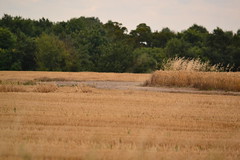
Today, Graveley is all but gone. The control tower is now very well disguised as a farm-house, its shape considerably different to the original design, the concrete huts have been pulled down and the runways mainly dug-up. A couple of buildings do still remain next to the farm-house, storing a range of modern farm equipment. The perimeter track considerably smaller in width, remains used by the local farm for lorries to transport their goods to the main road.

Perimeter Track

The perimeter track where bombers once lumbered.

A small memorial has been erected and sad to say, was poorly maintained when I was there. It stands at the entrance to the former airfield on the northern side, now the entrance to the farm site.

Graveley is typical of the sad end to many of Britain’s lost airfields. The wide open expanses that once resounded with the roar of piston engines taking brave young men to war, are now quiet and the sounds mere whispers in the wind. Lorries roll where the wheels of laden bombers once lumbered. The brave acts of those young men now laid to rest in a small stone overlooking where they once walked. As a pivotal station in 8 Group, Graveley and its crews deserve a much greater recognition for their dedication, bravery and sacrifice.

This aside, a beautiful stained glass window can be found in the local Graveley church and is worthy of a visit if time allows.

After the quiet of Graveley we head south-east, toward our next planned destination, RAF Bourn. On the way, we make a brief stop at the now extinct RAF Caxton Gibbet, a little airfield with a colourful history.

*1 Williams, G. “Flying Through Fire FIDO – The Fog Buster of World War Two“, 1995, Alan Sutton Publishing, Page 109.

(Graveley was initially visited in 2015, in Trail 29, this is an updated post).

RAF Graveley and the Pathfinders (Part 1).

In Trail 29 we turn south and head to the southern end of Cambridgeshire. This area is rich in fighter stations, both RAF and USAAF. Home to Duxford and Bader’s ‘Big Wing’, Mustangs, Spitfires and Hurricanes once, and on many occasions still do, grace the blue skies of this historical part of the country.

We start off though not at a fighter station but one belonging to those other true professionals, the Pathfinders of No 8 Group RAF, and former RAF Graveley,

RAF Graveley

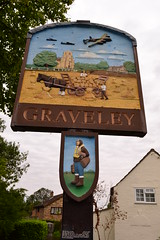
Village sign Graveley village sign depicts its aviation heritage.

Graveley airfield sits on the south side of Huntingdon, a few miles to the east of St. Neots in Cambridgeshire. It takes its unusual name from the nearby village. The airfield itself would see a number of changes to its infrastructure, including both upgrades and improvements and it would be home to several different squadrons during  its wartime life.

Initially built as a satellite for RAF Tempsford, Graveley opened in March 1942 when it accepted its first residents, 161 (Special Duty) Squadron.  Formed from a combination of elements from both 138 Sqn and the King’s Flight, it had been formed less than a month earlier at RAF Newmarket  and would bring with it the Lysander IIIA, the Hudson MkI and the Whitley V.

The role of the Special Duty Sqn  was to drop agents of the Special Operations Executive (SOE) into occupied France, a role it would perform throughout its operational wartime life.  Their stay at Graveley would however be short lived, remaining here for a mere month before departing to  Graveley’s parent airfield in Bedfordshire, before moving elsewhere once more.

By the war’s end, Graveley would have become a complete operational airfield in its own right, forming part of Air Vice Marshall Donald Bennett’s 8 Group, with the Pathfinders. After upgrading, its initial concrete runways of 1,600 yards, 1,320 yards and 1,307 yards would be transformed into the standard lengths of one 2,000 yards and two 1,400 yard runways; the measures associated with all Class ‘A’ specification airfields.

Accommodation for all personnel was spread around the north side of the airfield, across the main Offord to Graveley road. These were separated into nine separate accommodation areas, incorporating both a separate communal area and sick quarters. Graveley would, once complete, accommodate upward of 2,600 personnel, a figure that included almost 300 WAAFs.

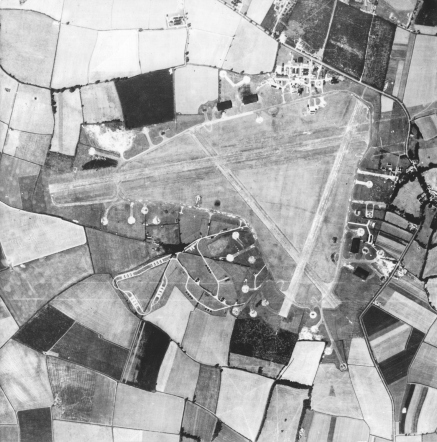
As with all sites, the bomb store was well away from the accommodation area, to the south-west, partially enclosed by the ‘A’ frame of the three runways. The 50 foot perimeter track linked these runaways with 36 pan style hardstands, all suitable for heavy bombers (after the extension three of these were replaced by loops). The main technical area, with its range of stores, workshops and ancillary buildings lay to the north-west, where two of the three T-2 hangars were also located, the third being erected to the south-east next to the only B-1 hangar on the site.

scan10_020

RAF Graveley (author unknown)

Following the immediate departure of 161 Sqn, Graveley lay operationally dormant. However, in May’s ‘1000’ bomber raid, aircraft from 26 OTU based at RAF Wing, flew from Graveley as part of the massive bombing operation. Sadly four of the Wellingtons (all Mk ICs) failed to return; WS704, DV740, DV707 and DV709. One of these, DV709 crashed some thirteen miles north-east of Cambridge whilst trying to make an emergency landing at Graveley. Unfortunately, when the aircraft came down, it overturned killing two of the crew on board: Sgt. J. Dixon the pilot, and Sgt. B. Camlin the tail gunner. Both these airmen were laid to rest in Beck Row Cemetery, at nearby Mildenhall.

St. John's Church Beck Row, Mildenhall

Beck Row Cemetery, Mildenhall.

The difficulty faced by Bomber Command crews in accurately hitting targets at night had, by now, become a problem for the ‘top brass’ at High Wycombe, and by April 1942, it had been decided, much against the views of Arthur Harris, that a new special Pathfinder Force was to be set up as soon as possible. As if adding salt to the wound, Harris was then instructed to organise it, and with a mixed charge of emotions, he appointed the then Group Captain Don Bennett, a man who had proven himself to have excellent flying and navigation skills.

Bennett then took charge, and on August 15th 1942, he formally took control of the new 8 (Pathfinder) Group, consisting of a specialised group of airmen who were considered to be the cream of the crop.

With its headquarters initially at RAF Wyton, Bennett received the first five founder squadrons of which 35 Sqn was one, the very day they moved into Graveley airfield.

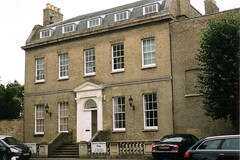
Castle Hill House, Huntingdon

Castle Hill House, Huntingdon, headquarters of the Pathfinders 1943 – 45. (Photo Paul Cannon)

Initially arriving with Halifax IIs, 35 Sqn would upgrade to the MK III in the following October, and then to the Lancaster I and III a year later. There would be little respite for the crews arriving here however, for they would be flying their first mission from Graveley, just three days after their initial arrival.

On the night of 18th/19th August 1942, a total of 31 PFF aircraft left to mark the target at Flensburg, close to the German-Danish border. However, poor weather and strong winds, prevented accurate marking, and two Danish towns were accidentally bombed as a result. It was a rather disastrous start for 35 Sqn and the Pathfinders.

Another blow was to fall 35 Sqn a month later, when on the night of 19th September 1942, the experienced 24 year old Wing Commander James.H. Marks DSO, DFC was lost when his Halifax II (W7657) ‘TL-L’  crashed at Blesme in France. Also being lost that night with W.C. Marks, was 19 year old F.L. Alan J. Child DFC and 25 year old F.O. Richard L. Leith-Hay-Clark; the remaining three crewmen being taken prisoner by the Germans. The squadron designation for this aircraft would then be reallocated, as was the case in in all squadrons, and as if bad luck were playing its hand yet again, that aircraft, Halifax HR928, would also crash with the loss of all its crew, including the highly experienced Sqn Ldr. Alec Panton Cranswick.

graveley

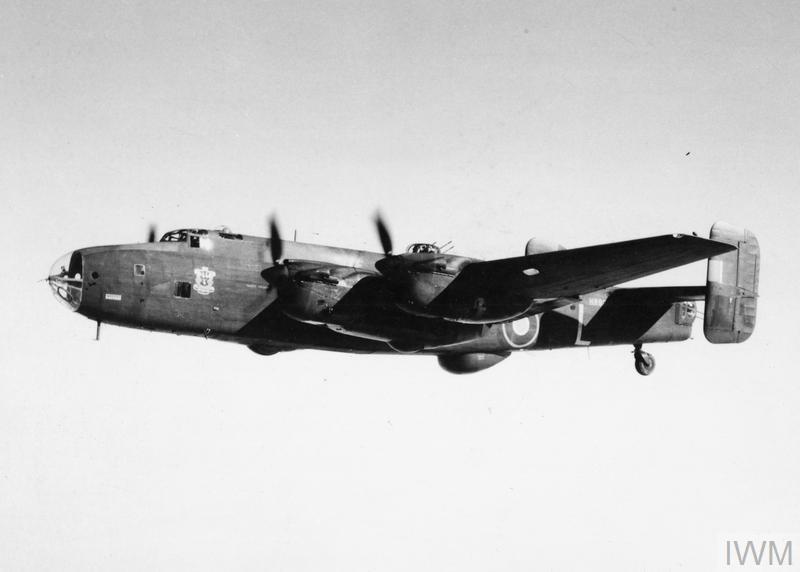
Halifax Mark II Series 1A, HR928 ‘TL-L’, 35 Sqn RAF being flown by Sqn Ldr A P Cranswick, an outstanding Pathfinder pilot who was killed on the night of 4/5 July 1944 on his 107th mission. The Cranswick coat-of-arms decorates the nose just below the cockpit.(I© IWM HU 92966)

In October, Gravely made history when it was earmarked to become the first operational airfield to test the new and revolutionary fog clearing system, FIDO. Classified as Station II, it would be the second of only fifteen British airfields to have the system installed and whilst it had its opponents, it was generally accepted and greeted by all who used it.

Installed by contractors William Press, the system’s pipes were laid along the length of the runway, a not easy feat as operations continued in earnest. One of the initial problems found with the FIDO system, was the crossing of the intersecting runways, pipes had to be hidden to avoid aircraft catching them and an obvious disaster ensuing. Two types of pipe were laid at Graveley, initially the Four Oaks type burner, but this was later replaced by the Haigas (Mk.I) burner. A more complex system, the Haigas took considerable time to install but by January 1943 it was ready, and an aerial inspection was then carried out by Mr. A Hartley – the Technical Director of the Petroleum Warfare Dept (PWD) and Chief engineer of the Anglo-Iranian oil Co. It was Hartley who later played a major role in PLUTO, the cross channel pipeline installed for D-day. Hartley, himself a non flyer, was flown over the burning pipes in a Gypsy Major by no less than Don Bennett himself.

It was later, on February 18th, that Bennett made the first four-engined heavy bomber FIDO landing at Graveley, using a Lancaster of 156 Sqn from Oakington. Setting off from Oakington, Bennett headed towards Graveley airfield, and with the burners lit, he remarked how he was able to see them from some 60 miles distant, the fire providing a far better light than searchlights alone, the means by which aircraft had been guided home on foggy nights previously. A great success, Bennett requested that certain minor modifications be made as he thought pilots could be distracted by the cross pipes at the threshold of the runway. Hartley keen to please Bennett, duly arranged for the necessary alterations and the modification were carried out without further delay.  However, further problems were to come to light on the the first operational lighting of the system, when bushes, hedges and telegraph poles adjacent to the pipelines were ignited due to an extension of the system passing through a nearby orchard!

The installation of FIDO meant that huge oil containers had to be installed too. At Graveley, sixteen cylindrical tanks were mounted in two banks, each tank holding up to 12,000 gallons of fuel. These tanks were kept topped up by road tankers, there being no railway line nearby as was the case at other stations.

Over the next few months, FIDO was tested further, but for various reasons its benefits weren’t truly exploited. On one occasion it was prevented from being lit by a crashed Halifax on the runway, the resultant lack of FIDO after the accident, was then blamed for the loss of two more aircraft, neither being able to safely put down in the poor conditions.  On another night, poorly maintained pipes caused burning fuel to spill onto the ground rather than heating the vaporising pipes above. Bennett somewhat angry at this, once more requested modifications to be made, needless to say they were not long in coming!

With further trials, one pilot was remarked as describing flying through FIDO as “entering the jaws of hell”*1 but once crews were used to it, the benefits were by far outweighing the drawbacks.

The safety of FIDO could not assist all crews though, and a number of other experienced crews were to be lost from Graveley over the next few months. But all news was not bad. The night of 18th/19th November 1942 saw a remarkable turn of fortune.

In Part 2 we see how Graveley sees out the war, the changes that occur, the new aircraft and new squadrons that arrive.

The whole trail can be read in Trail 29 – Southern Cambridgeshire.

RAF Bradwell Bay Event July 17th 2021

A recent request from Eric Simonelli at the RAF Bradwell Bay Preservation Group. Eric is a key member of the group who are trying to preserve and promote the former RAF Bradwell Bay. He has kindly supplied a short write up and a flyer promoting a study day to be held in July for anyone interested. If you are, please contact the group direct and not myself at Aviation Trails.

RAF Bradwell Preservation Group.

Bradwell started off as a small grass aerodrome serving the firing range on the Dengie Peninsula, in the late 1930’s. In 1942 the aerodrome was expanded and became a large bases for 2,500 personnel who were to fly intruder missions to the continent and provide refuge for bombers returning with damage, casualties and short of fuel. To enable this level of activity there were many career opportunities for both men and women. This included aircraft maintenance, radio control, catering, motor transport and may more. Women were to fill all roles, apart from combat.  Today the RAF is fully inclusive.

RAF Bradwell Bay was host to many different squadrons up to the end of the war, with a variety aircraft types including Boston Havocs’, Mosquito’s, Spitfire’s, Tempest’s, Blenheim’s and Beaufighter’s. Other aircraft were based there for training and administrative purposes such as Miles Magisters, De-Haviland Dominies, Tiger Moths. At sometimes Bradwell Bay would have been an aeroplane spotter’s paradise. At least 25 squadrons are known to have been based there at different times.

Some parts of the airfield survive including the runways and control tower. However, the site is under threat of being demolished to make way for a second nuclear power station. As a group we are working to preserve as much as is possible, including building an archive to preserve memories and stories.

We have an unusual memorial and now are building an exhibition in the, nearby, Othona Centre. We are hoping to staff the exhibition at weekends or by appointment.

Bradwell Bay Memorial

Bradwell bay Memorial (Photo Eric Simonelli 2021)

more information can be found at: www.rafbradwellbay.co.uk

or email at: info@rafbradwellbay.co.uk

Eric has asked me to add the following ‘flyer’ to let you know about the study day being held locally for anyone interested in supporting the group and their aim to preserve Bradwell Bay. 

Inaugural Study Day

@ The Othona Community Centre

Saturday 17th July 2021

09:30 Reception and Coffee

3 Talks

WARTIME MALDON (World War 2) – by Stephen P. Nunn

A talk on George folliottPowell-Shedden by His Daughter

The Last CO – by Eric Simonelli

£25 inc Lunch, tea, and coffee (please advise of any dietary requirements on booking)

To book your place please complete the contact form on our website http://www.rafbradwellbay.co.uk

Members discount available

My thanks to Eric and good luck to them in their venture. 

RAF Leuchars – one of Britain’s oldest airfields (Part 3)

In Part 2, a number of twin engined models frequented Leuchars performing anti shipping roles and U Boat hunts out in the North Sea. BOAC had begun its clandestine role and shipping ball-bearings back from neutral Sweden. We now see a change to these flights and as the war ends, a new much larger breed begin to appear here are Leuchars.

Throughout all these changes at Leuchars, the BOAC company had been continually running its clandestine operations to Sweden. But by now it was clear that a new, faster more agile aircraft was needed. Even though they were marked with civilian markings and flown by Swedish crews, the Electras were slow and cumbersome and made easy targets for both fighters and flak. Now, with the development of the Mosquito, the opportunity had finally arrived.

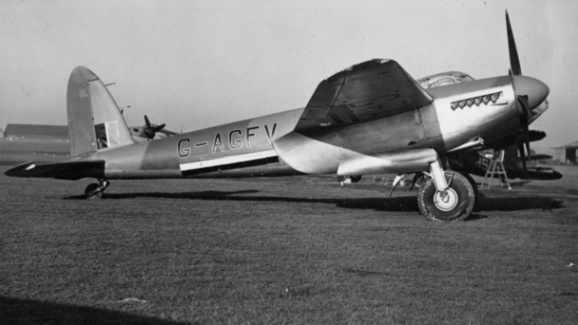
It was during December 1942 that the first civilian operated model of the aircraft arrived here at Leuchars. A Mosquito PR.IV ‘DZ411’,  it was assigned the civilian registration G-AGFV, and would begin flights to Stockholm on 4th February 1943, after which it was joined by six other aircraft. These MK.VIs were given the sequential registrations G-AGGC to GH, and would arrive during the April and May of that year.

By the end of April the following year, a total of nine Mosquitoes would have been modified and delivered to BOAC at Leuchars*5.

BOAC Mosqquito BAE Systems (@BAE Systems)

All these aircraft had to be changed from military status to civilian, this required the removal of all traces of armament. Modified at Hatfield – the home of the Mosquito – the resultant weight loss altered the aircraft’s centre of gravity and so additional ballast had to be added to prevent changes in the aircraft’s flying characteristics.

It was vital that the Mosquitoes remained unarmed for these operations, so as to not infringe or violate Sweden’s wartime neutrality, however, this made any aircraft on this run a potential ‘sitting duck’, even though, like their Lockheed predecessors, they carried BOAC insignia and were flown by civilian aircrew.

These operations were by now carrying more than just mail and ball-bearings though. These covert operations, took the civilian marked and unarmed Mosquito across the North Sea to Sweden, where it would drop off the mail, papers and other written material held within its bomb bay, and return with prominent scientists, special agents or allied aircrew who had been interned in Sweden as well as vital ball-bearings produced by the Swedes. The faster and far more agile Mosquito would, in most cases, be able to out run any opposing Luftwaffe fighter that should, and indeed did, try to intercept the aircraft whilst on one of these flights.

The returning ‘passenger’ on these flights had the unfortunate prospect of having to sit in a modified ventral bay for the whole duration of the flight. The prospect of further internment probably outweighing that of cramp and three hours of discomfort.

One such notable passenger who was carried back from Sweden, was the nuclear physicist Niels Bohr, whose work on atomic structures and quantum theory, had won him the Nobel Prize for Physics in 1922.*4 He would go on to work on the Atom Bomb in the Manhattan Project, the results of which were seen at both Hiroshima and Nagasaki in 1945.

Even though these flights were highly successful, a few aircraft were lost. In Mid August 1944, G-AGKP ‘LR296’, a former 27 MU aircraft, was lost when it crashed into the sea nine miles from Leuchars. All three on board were killed as it approached on return from Stockholm; the passenger being a BOAC Mosquito pilot himself. The crash was believed to have been caused by a structural failure, the aircraft having been repaired previously after an accident in January. By the war’s end fourteen Mosquitoes had been used in some way by BOAC, five of which crashed.*6

As the war moved on, squadron numbers at Leuchars begin to diminish. 1943 brought only two, that of 235 Sqn and 333 (Royal Norwegian Air Force) Sqn who were formed here on April 5th as ‘B’ Flight after the dividing and renumbering of 1477 (Norwegian) Flight. This was a split unit, one part flying the Catalina from Woodhaven, whilst ‘B’ Flight flew the Mosquito MK.II. An upgrade to the MK.VI then saw the unit move to join the famous Banff Strike Wing in September 1944. Whilst at Leuchars they operated as sub-hunters and convoy escorts, whilst ‘A’ flight flew more clandestine operations smuggling secret agents and supplies into occupied Norway. The Mosquito as a multi-function aircraft performed well in these duties, and by the end of the war numerous U-boats had been attacked by aircraft based at the Scottish airfield.

RAF Leuchars

One of the Hangars at Leuchars 2018

With 1944 dawning and major events happening on the continent, more changes would take place at Leuchars.

In the early months, proposals to extend and widen one of the runways was put forward, a part of which was agreed in April. This move also required the relocation of the Watch Office and widening of the perimeter tracks. A further three squadrons would pass through this year beginning with a detachment of 281 Sqn, who stayed for a year from February. A second unit 206 Sqn, stayed here for less than three weeks. But then September/October would bring a new and interesting model in the shape of the B-24 Liberator and 547 Sqn. A change to the smaller twin-engined models that had frequented Leuchars for the last four years or so, the move here was unfortunately a signal of their ending though, the squadron being disbanded in June 1945 never to appear again.

Whilst here, the Liberators would patrol the Norwegian coast in the A/U (anti-U boat) role, many of these patrols being uneventful, the U-boat threat by now greatly reduced compared to its previous Atlantic successes. However, on October 12th, Liberator MK.VI “G” did spot a U boat on the surface which it attacked with both front and rear turrets. Strikes from both guns were seen on and around the conning tower, and it was initially thought that the sub was sunk. After patrolling for a further 45 minutes, the U boat was again sighted some two miles away, but managed to escape in the poor weather. It was believed by the crew to have been a 740 ton vessel which had subsequently suffered damage from the attack.

The B-24s of the these RAF squadrons would be complemented by B-24s now flying separate runs to Sweden by the Americans. In addition to these, Leuchars also saw the reintroduction of the popular and highly successful American built Douglas DC3. The route to Stockholm now being a little less dangerous than it had been in previous years.

The arrival of the Liberator had signified a big change in direction for Leuchars,  they were to be the first of many four engined heavies to serve from the Fife base.

In 1945, 519 Sqn brought along the Halifax III, but sadly they were to go the way of 547 Sqn and disband here at Leuchars in the following May; it too would not reappear in the RAF’s inventory of operational Squadrons. 519 were a meteorological unit, collecting data for flying operations. Using both the Spitfire VII and Halifax IIIs, they would climb to altitudes of around 40,000 ft, and collect valuable meteorological data. Using Prata I, Prata II and Recipe I (Pressure And Temperature Ascent) many of these flights would take the aircraft high out over the North Sea.

With the close of the war, Leuchars had seen no less than twenty-eight operational squadrons pass through its doors, some of these merely staying for a day, whilst others were more prolonged. A range of aircraft had come and gone, mainly twin-engined models operating in the photographic reconnaissance or anti-shipping role. With its position on the north eastern coast, Leuchars had proven vital to maritime operations protecting the seas between Britain and Scandinavia, an area it had operated in, in a number of clandestine roles. But with the war now at an end, these were no longer required, and Leuchars’ role would again revert back to its original one – that of training.

The post war world was very different to the pre-war one, Britain like many other countries was rapidly trying to revert to pre-war budgets. A reduction in the armed forces was seen as essential to cutting costs, whilst rebuilding the nations cities that had been so heavily bombed in the Blitz, was paramount. As a result, the RAF as with the other forces, were having to do with what they had. A reduction in man power and machinery though would not only mean a reduction in squadrons, but the airfields that used them.

Leuchars, like so many, was now under the potential threat of closure. However, the increasing post war tensions between the east and west created the Cold War, with a strained and anxious stand off between Soviet and Western forces right across the European frontier. As had happened before, Leuchars’ position would once again be its saviour. Over the coming years it would see a wealth of operational aircraft and a broad range of front line fighters be based in this small corner of Scotland,

The coming months after the war’s end would see further four-engined models reappear, a previous resident 203 Sqn who had been here in the 1920s, returned from overseas operations in May 1946, bringing back with them the B-24 (Liberator VIII). Within two months though, this would be replaced by the Lancaster GR.3, a version of the mighty four-engined heavy that had wreaked so much devastation across Germany’s industrial cities. But by 1947, 203’s link with the Scottish airfield would finally draw to a close, and the squadron would depart for good.

160 Sqn who arrived a month later in June, also brought the Liberator, and similarly began taking on the Lancaster GR.3. By October though their demise had also arrived, they were renumbered and reformed as 120 Sqn, and by 1947 they had lost the last of their Liberators retaining only the Lancaster.

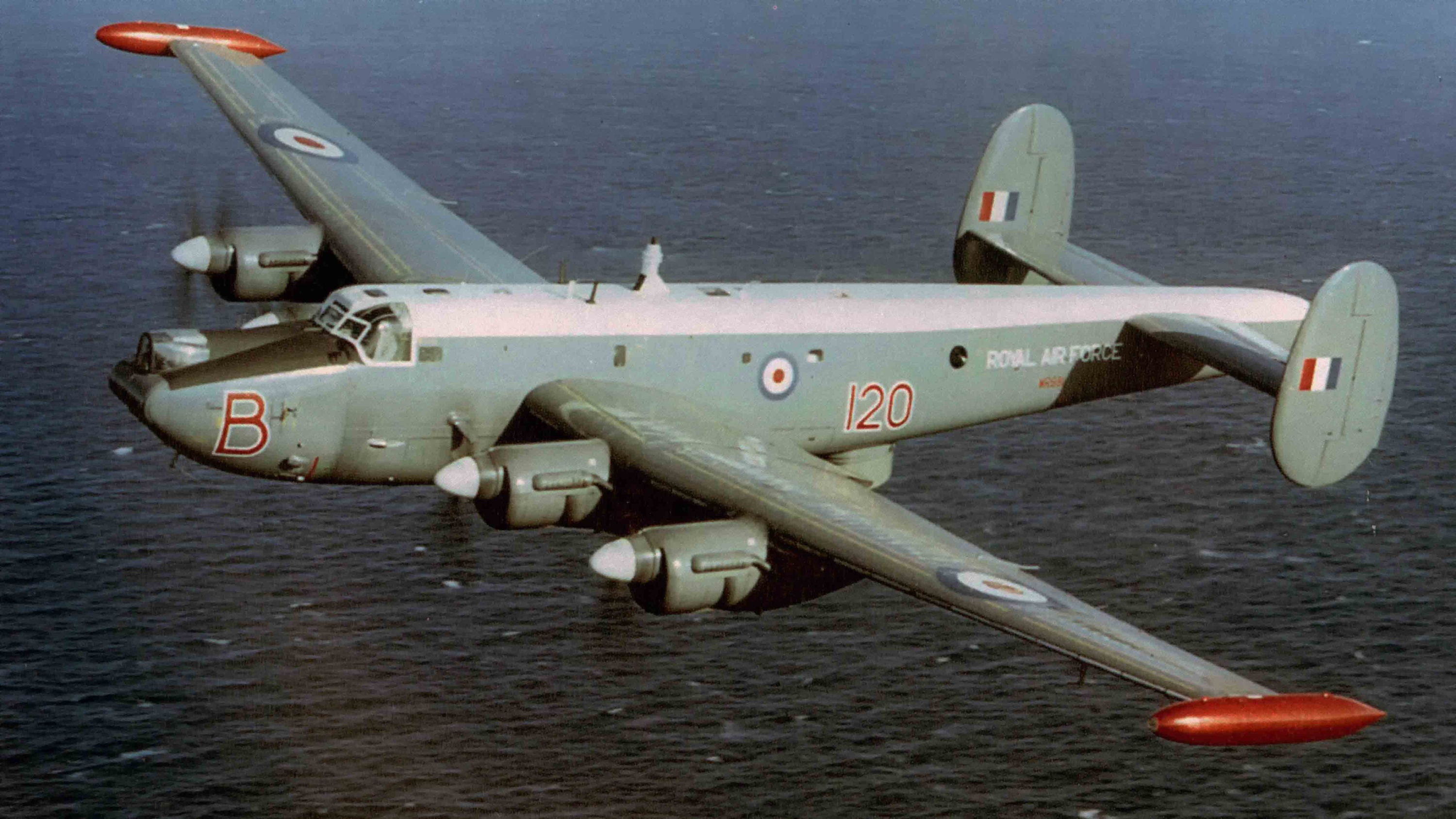
In December 1950, 120 Sqn were posted to Kinloss, where its wartime bombers were replaced with the newer Avro model, the long range maritime patrol aircraft, the Shackleton with its rare contra-rotating props.

Avro Shackleton MR.3 (WR989) of 120 Sqn RAF (@BAE Sytems)

The aircraft, built in response to the growing Soviet threat, was designed around the Lancaster,  Roy Chadwick’s dream bomber. Chadwick, like R.J. Mitchell, having sadly died before their dream had finally been put into service. Built to Air Ministry Specification R 5/46, the Shackleton was initially designed with gun turrets and two Rolls-Royce Griffon 57A engines inboard, and two Roll-Royce Griffon 57 engines outboard.

One other unit arrived here at Leuchars that year, that of 82 Sqn, initially as a Lancaster detachment and then in June 1947 as a base with its own detachments at Eastleigh, Dar-es-Salaam and Lusaka. The last of the prop driven aircraft were now making their ultimate RAF appearances, and soon Leuchars would enter in the jet age.

In Part 4 Leuchars enters the jet age. The Cold War begins and Leuchars takes on a new challenge as it moves to a new Command, that of Fighter Command.

The full story of Leuchars can be seen on Trail 62.

Trail 61 – RAF Dishforth – Along the A1 trail (Part 4).

In Part 3 we saw how Dishforth turned from a bomber base to one of training, its role had gone full circle. Now the war was drawing to a close, its future left hanging in the balance. With the dawn of the jet age, opportunities are there but Dishforth gets left out. As Bombers are withdrawn, a new type appears though, and many appear here at Dishforth.

As 1945 dawned, it was becoming clear that the war’s end was in sight. Conversion courses to heavy bombers were being scaled back as losses fell and the need for more crews diminished. On April 6th, the HCU was officially disbanded and the staff posted elsewhere.

1945 would also see the end of 6 (RCAF) Group, the group that had flown almost 40,000 sorties with a loss of 10,000 aircrew from its several Yorkshires bases, Dishforth of course, being one of the first.

Not long after the disposal of the HCU, the 1695 (Bomber) Defence Training Flight, a unit set up to work in conjunction with the HCUs, was also disbanded.  In July 1945, the unit flew its last flight and its Spitfires, Hurricanes, Martinets and Air Speed Oxfords all departed Dishforth. The fighter element had also now gone from this historic base.

For the next couple of years little would happen at Dishforth, the Canadian link was broken, bombers were removed and the airfield remained relatively quiet. However, it was to see the four engined Halifax return once more, albeit very briefly.

1948 was a year of change, with no need for bombers, transport aircraft were to be the new type appearing at Dishforth. Conversion Units continuing on where the HCUs left off. 240 Operational Conversion Unit (OCU) made an appearance with a second, 241 OCU forming on January 5th 1948. Formed out of the renumbering of 1332 Heavy Transport Conversion Unit, they operated  a mix of Halifaxes, Hastings, Yorks and Vallettas all of which had now become the flavour of the day.  With these new units coming in, other units such as No 1381 (Transport) Conversion Unit, were disbanded.

Handley Page Hastings C Mk 1, location unknown. (©IWM ATP 16063D)

Another squadron, 47 Sqn also appeared at Dishforth that year. In September, they transferred in from RAF Fairford, and immediately began replacing their ageing Halifaxes with the Hastings C.1 transport aircraft. They remained at Dishforth for just a year, moving on to nearby Topcliffe in the autumn of 1949. This was mirrored  by 297 Sqn, who also came, swapped their Halifaxes and then also departed to Topcliffe.

240 OCU led Dishforth into the new decade. In April 1951, further changes saw them disband and amalgamate with 240 to form 242 OCU, but still the Vallettas and Hastings were top dog. As time progressed they would convert to Argosys, Beverleys and eventually the Hercules, moving on to eventually disband at RAF Lyneham in 1992.

The mid 50’s saw other changes, with 30 Sqn arriving in April also operating the  Beverley C1 until its departure in 1959, and 215 Sqn in April 1956 with the Pioneer CC1. Originally a First World War Sqn they had operated a range of aircraft including the Virginia, Harrow, Wellington, Liberator (B-24) and Dakota, before disbandment and reformation here. They solely operated from this airfield before again being disbanded and reformed as 230 Sqn here at Dishforth in 1958. By November though they would also go the way of their predecessors and move out, this time to Nicosia, before returning (briefly via Dishforth in April 1959) to Upavon.

Another Dakota unit,  1325 (Transport) Flight operated from here in the August of 1956, before it too departed, eventually disbanding in Singapore in 1960.

By the end of the 50s, all these units had departed and Dishforth’s future was now in the balance. With no RAF Flying there seemed little point in keeping it open.

Small training aircraft from other Yorkshire bases including Leeming, Topcliffe and Linton-On-Ouse, then used the base as a satellite and emergency landing ground. The Jet Provosts of 1 FTS and 3 FTS being frequent users.

With the withdrawal of all RAF personnel, Dishforth was handed over to the Army Air Corp who based a number of helicopter units here during the 1990s and early 2000s. These units primarily: 657 ; 659; 664; 669; 670; 671 and 672 Sqns all operated the Lynx or Gazelle helicopters in a range of roles.

As of 2021, Dishforth remains in the possession of the Army, home to 6 Regiment Royal Logistics Corp, who consist of three squadrons: 62 Squadron and 64 Squadron (both hybrid squadrons made up of Drivers and Logistic Supply Specialists) and 600 HQ Squadron including the Regimental Head Quarters who provide support to the other two task squadrons. Their role is to provide logistic support to 1 UK Division, preparing forces for both fixed and responsive tasks.

With other non military units using the site as well, Dishforth’s future is once again in doubt. A large airfield, with extensive hangar space and ground area, it is ideally located near to the A1 road. The tower has recently been boarded up and parts of the perimeter track are beginning to decay, Dishforth too will soon close (earmarked for closure in 2031) under Government cutbacks, but hopefully its history will live on and the memories of those who passed though its doors will remain alive and well.

Dishforth currently remains an active Military site and as such access is limited. The A168 runs parallel to the main runway between it and the A1. The hangars remain, the tower is also present although in the last two years or so it has been boarded up. Remnants of the Second World War can be found round the perimeter by using the smaller roads around the base, but again these are restricted.

With the recent announcement of the closure of Linton-On-Ouse, both Dishforth and Topcliffe will also close, three more of Britain’s war time bomber airfields will then be gone from Britain’s landscape.

The full page can be seen in Trail 61 – RAF Dishforth – Along the A1 Trail.

Sources and further reading.

*1Bygone Times‘  – Halifax LK930 remembered and a tale of two Palterton village heroes. by Jack Richards. A web page detailing the crash of LK930 on the night of 21st/22nd March.

National Archives AIR-27-141-1

National Archives AIR-27-660-1

National Archives AIR-27-1837-1

Harris, A., “Bomber Offensive‘ 1998, Greenhill Books.

Millar, G., “The Bruneval Raid – Stealing Hitler’s Radar” 1974, Cassell & Co.

RCAF 425 Alouettes Sqn – a blog honouring 425 Sqn by Pierre Lagacé

Ward. C., “4 Group Bomber Command” 2012, Pen & Sword.

Trail 61 – RAF Dishforth – Along the A1 trail (Part 3).

In Part 2 we saw the first of the Canadian units form at Dishforth, still a new unit, they very quickly become part of the new 6 Group (RCAF).  As they began operations over occupied Europe, they quickly learnt that war brings casualties. We also see that Dishforth soon becomes ‘upgraded’ to a Standard ‘A’ specification airfield, and then the Canadians move out and a new training unit move in. The aircraft now get bigger.

The new year brought new changes both at Dishforth and within the RAF. Expansion of the force saw a new Group born, that of 6 (RCAF) Group, and after some four years of wrangling between the Canadians and the British, all but two of the Canadian squadrons, and their airfields, were transferred over to RAF control. The formation of the Group was with mixed emotions though, the Canadians having no control nor say over its operation, but still paying the bill for the squadrons for the duration of the war – a rather one sided agreement in the eyes of the Canadians. However, the expansion increased Squadron numbers, now some 37% of the RAF’s pilots were from the Dominion and of these, almost two-thirds were Canadian.

On January 1st 1943, 6 (RCAF) Group was therefore officially up and running, and it would be now that 426 Sqn would become operational.

Their start to the war began with an attack on the French port at Lorient on the night of 14th/15th January. 6 Group’s first attack as an operational group, was part of a 122 strong aircraft formation, sending nine Wellingtons and six Halifaxes. Only two aircraft were lost that night, both Wellingtons, one a Polish crew from 300 Sqn and the other a Canadian crew from 426 Sqn.

The aircraft, piloted by 21 year old P.O. George Milne (s/n:J/9355), was lost without trace, presumably crashing into the sea on its way to the target, it was not heard from since leaving Dishforth at 22:37.

Within a month of 6 Group’s inauguration, 426 Sqn would suffer a heavy blow when its Commanding Officer Wing Commander Blanchard would be shot down whilst returning from Germany. The aircraft, a Wellington III ‘X3420’ was shot down by Hauptmann Manfred Meurer near Limburg with the loss of all six crewmen. It was a bitter blow to the fledgling squadron.

The role of commander then passed to Wing Commander Leslie Crooks DFC a non-Canadian, he would lead the squadron into battle on numerous occasions. A brave and determined leader, he would soon add a DSO to his collection, dutifully awarded after surviving an attack from a night fighter, when he nursed the stricken bomber home. Unable to land the aircraft due to its extensive damage, he ordered the crew to bail out leaving the Wellington to its ultimate and final fate.  Crooks, would go on to lead further operational missions with the squadron, but sadly his luck would run out over Peenemunde on the night of August 17th/18th 1943 when he was lost for good.

The time then came to upgrade Dishforth, its now unsuitable surfaces needed replacing and the airfield needed bringing up to ‘modern’ standards. The two Canadian units moved out – 425 Sqn to North Africa in May, and 426 Sqn to Linton-On-Ouse in June. That left the airfield operationally silent. The bulldozers and earth-movers then moved in;  its three concrete and tarmac runways were constructed, and the whole site was upgraded to the Class ‘A’ specification. By November the works were all but complete and it was handed over to No.61 Training Base, 6 (RCAF) Group, led by the transfer in of 1664 Heavy Conversion Unit (HCU) operating the four engined heavy the Halifax Mk.III.

Formed in May 1943 at Croft, they were renamed 1664 (RCAF) ‘Caribou’ HCU on moving to Dishforth and were primarily a training unit converting pilots onto Halifaxes from other aircraft – usually twin engined bombers like the Wellington. One of their first customers was the former Dishforth unit 425 Sqn, who returned from Tunisia with their Wellingtons to convert over to the Halifax over the next month. By mid December they were all done, and they departed for RAF Tholthorpe where they picked up their new aircraft.

RAF Dishforth

A rather sad end to the Watch office.

Converting crews to the four engined types was no easy task, and whilst crews were experienced, accidents did still happen.

The first Dishforth blow came to 1664 (RCAF) HCU two days before Christmas 1943. Halifax V ‘ZU-C’ crashed after getting into difficulties whilst on a night training flight. The aircraft was partially abandoned, but three of the crew were killed and a further two were injured. This tragic accident would not be the last for the Dishforth unit though, and would draw 1943 to a sad close.

Some of these accidents were understandably down to the inexperience of crews on the new type, as the night of January 30th 1944 showed. Halifax V DG308 flown by F.L. J. Bissett DFM along with a student, came into land at Dishforth. The student inadvertently lowered the bomb doors rather than the flaps causing the aircraft to come in too fast. Bissett, in an effort to avert a catastrophe, swung the Halifax off the runway subjecting it to great stresses. As a result of this action, the undercarriage collapsed and the aircraft fell on its belly severely damaging it. But Bisset had done his job, and the student had learnt a valuable lesson.

With two further accidents on the following night, one due to a strong cross wind and the second when the aircraft hit high ground due to excessive drift, the training programmes were proving hard going for the Dishforth unit.

For some crewmen there was even the misfortune of multiple crashes, and for one man in particular, these unfortunate events occurred in the space of just one week.

For Sgt. H. (Ray) Collver, mid March would be his worst week. During a training flight on the 16th, his Halifax swung on landing, badly damaging the undercarriage. Thankfully however, there were no major injuries and all walked away relatively unhurt. But then on the night of 21st/22nd, he was on a night training flight (thought to be a nickle flight), when the port inner engine failed, and refused to feather. The cause of the problem was not clear, but the aircraft began to shake violently as a result. Before coming down in Derbyshire, Sgt. Cullver gave the order to abandon the Halifax, two of the crew escaping through the nose hatch. By then though, the bomber was too low for others to escape, the remainder of the crew were effectively trapped inside. When the aircraft hit the ground, two of the four left on board were killed, the remaining two Sgt. Russ Pym and Sgt. Cullver were injured, Cullver being thrown clear as the Halifax struck a bank aside a road*1.

On many occasions though, pilot error was not a cause, engine faults seeming to have been the primary cause of the aircraft’s demise; problems that either required an engine to be shut down or engines failing, seeming to be high on the list of causes for the squadron’s losses.

During August a Lancaster Finishing Flight was set up within the HCU at Dishforth, its job to polish pilots and crews in their Lancasters before returning them to operational units. Loses here would be far lower.

By the years end, the HCU would have lost some fifty aircraft on training flights, which for a training unit, was a substantial number of heavy aircraft and for the Command.

With the close of the war ahead, changes are in the pipeline for both the Royal Air Force and Dishforth. With the need for bombers diminishing, a new form of aircraft arrives and in good number. In the final part we see Dishforth head in to the jet era but opportunities are missed and sadly it gets left behind, its future then looks bleak.

The full page can be seen in Trail 61 – RAF Dishforth – Along the A1 Trail.

Trail 61 – RAF Dishforth – Along the A1 trail (Part 2).

After seeing Dishforth’s pre-war construction and arrival of its first squadrons in Part 1, we head in to 1941, more trips to Germany and a special mission to Italy.

The beginnings of 1941 were much the same for the two Dishforth units. Trips to Germany were very much the order of the day. But on February 3rd, six Whitleys from 51 Squadron were sent as part of a force to blow up the aqueduct crossing the Tragino river in the Campania province of southern Italy. Code named Operation ‘Colossus‘, it was a daring operation where troops would be parachuted into enemy territory, destroy their target and escape by submarine.

After departing to Mildenhall, the Dishforth aircraft then flew on to Malta, arriving at Luqa airfield after a long, eleven hour flight. On the night of the 11th, the plan was put in place. Two aircraft were to perform a diversionary attack on the marshalling yards at Foggia, whilst the remainder dropped members of ‘X’ Troop in the valleys near to the target. Whilst the aqueduct was successfully blown apart, none of the ground forces, nor the crew of one of the 78 Squadron Whitleys on the diversionary raid, managed to get home. All were unfortunately picked up by Italian forces and placed in POW camps. The raid being a success, had suffered high losses.

That same night, the remaining crews at Dishforth fared little better. On returning to the airfield following a raid on Bremen, they were ordered to divert to RAF Drem in Scotland. Four of the aircraft either misunderstood the instruction, got lost or ran out of fuel, resulting in each of them being abandoned over the British countryside. Unfortunately even abandoning an undamaged aircraft was not entirely safe, as nine of the twenty crewmen suffered injuries whilst doing so. All four of the aircraft were left to their inevitable and catastrophic rendezvous with mother Earth.

A new Bomber Command Directive drove the Group’s Whitleys to Germany night after night. Then a turn of focus to aircraft factories saw a change in operations, and although losses for Bomber Command were high, both the Dishforth units managed to scrape through relatively unscathed.

April saw the departure of 78 Squadron from Dishforth, this time though there would be no return, and their time here had finally come to an end.  Dishforth however, continued on, retaining its one operational squadron, that of 51 Sqn, who continued to soldier bravely on with their Whitley Vs.

Industrial targets were then once again at the forefront of Bomber Command’s agenda. 51 Sqn joining many other units on raids to the German heartland. In early May, they visited Ludwigshafen, followed by Dortmund, Duisburg and Dussledorf losing one aircraft on each operation (P5106, Z6663, Z6657, and Z6563 respectively) with the loss of all but five of the airmen on board.

Whilst 51 Sqn’s losses per operation continued to be relatively light, overall they suffered some of the highest losses for the year, some 43 aircraft being lost on operations throughout 1941. A tally that put them amongst the top five biggest losses of Bomber Command squadrons for the year.

As with many bomber stations, support and training flights also operated from these larger airfields, Dishforth was no different with 1512 Beam Approach Training Flight (formally 12 Blind Approach Training Flight) forming here in October 1941. The unit trained pilots to land in poor visibility using a system designed ironically by the Germans. Previously known as ‘Blind Approach’, it was felt the the use of the word ‘Blind’ was not very reassuring for pilots and so all units were changed to Beam. Also ironic as no beam was actually used, but more a single distorted radio transmission.

The dawn of 1942 saw more of the same for the Bombers of 51 Sqn and 4 Group. With a renewed focus on the German fleet anchored at Brest, Bomber Command would soon pay the price, and it would be Operation ‘Fuller’, that would be the cause.

On the night of February 12th, a determined and combined force of naval vessels and aircraft along with RAF aircraft, would attack the a force of mighty ships including the ScharnhorstGneisenau and Prinz Eugen as it made its way through the English Channel to home waters from Brest harbour. For over a year, the ships had been a thorn in the sides of the RAF, being damaged and repaired they could not be put out of action permanently. Patched up but not fit for heavy warfare, the attacks came in poor weather, ideal for a sea escape. The resultant allied losses were a tragedy for both services, and would leave them blooded and badly scarred.

Thankfully though, the fortunes of the Command would soon turn, albeit briefly on the night of the 27th-28th February, bringing a smile to both the faces of the British forces and the population as a whole. February would thankfully close on a good note.

The events began at Thruxton airfield, where twelve Whitley bombers were having holes cut in their floors and special doors added to allow paratroopers to jump through. This small force would be led by 51 Sqn W.C. Charles ‘Percy’ Pickard who, described as a tall, fair haired pipe-smoker, was known as a real character within 51 Sqn. Pickard’s character had been projected well beyond the mess halls of Dishforth though, noticeably after he took a leading part as Squadron Leader Dickson in ‘Target for Tonight‘; the RAF’s 1941 film about a crew on a bombing mission over Germany. Pickard would eventually leave 51 Sqn, transferring to the 2nd Tactical Air Force in Operation ‘Jerrico’, and the attack on the prison at Amiens where he met his death with almost seventy operations to his name.

The February raid was to be carried out by a small force of British Paratroops, which involved them being dropped into enemy territory to capture a secret German radar site. Once established, they were to remove vital components from the radar and bring them back to England for analysis. The raid, whilst not without its hiccups, was a huge success in the war of the electronics, and not only allowed the British to examine the workings of the radar, but also provided them with a prisoner who was one of the operational technicians at the site. The night had been a real coup, and a much needed morale booster for the RAF and the UK’s population. Known as the ‘Bruneval Raid‘, Britain now had a significant insight into the German Wurzburg radar system, and 51 Sqn played a major part in delivering those gallant men to their drop zone. For his part in the operation Pickard was awarded a bar to his DSO.

Charles ‘Percy’ Pickard (believed to be at Lissett, Yorkshire) with his dog ‘Ming’.(© IWM CH 10251)

In May 1942, 51 Sqn received orders to depart Dishforth for the base at Chivenor in Devon. This too would be their final farewell to the Yorkshire base as they would not be returning. By the end of the year they would be replacing their Whitleys with the Halifax, their last Whitley being lost whilst at Dishforth a few days prior to their departure on the night of 23rd/24th April 1942.

A short period of calm then led to further changes. It was during this ‘quiet period’, that the 1472 (Army Co-Operation) Flight formed here at Dishforth. Using only light aircraft: Battles, Tomahawks Hurricanes and Masters, they didn’t require the lengthy runways that heavy bombers needed, and operated in conjunction with land based forces primarily on training operations.

It was after this that a new Canadian unit 425 (Alouette) Sqn RCAF was formed here at Dishforth. The first ever French-Canadian unit formed in the U.K., it was led by W.C. J. St. Pierre, and was part of a Canadian force manned totally by Canadian personnel. It would not be ready and operational though until the October of 1942.  It was also during October that another Canadian squadron would be formed, also here at Dishforth, that of 426 (Thunderbird) Sqn led by W.C. Sedley Blanchard. A third unit, that of 6 Group’s Communication Flight also joined the Canadians here at Dishforth.

Both these squadrons flew the twin-engined Wellington, with its remarkable geodetic design, a sturdy aircraft it would be the main type used by the two squadrons for the next year.

425 Sqn spent the next weeks building up to operational status, training flights both cross country and in the local area being carried out when the weather permitted. It was on one of these flights that the first Wellington was lost from the squadron. During a fighter affiliation exercise, in which cloud ranged from 3/10 to 6/10 at 3,000 ft to 10/10 at higher altitudes, the 403 Sqn Spitfire ‘attacking’ the Wellington collided with the nose turret bringing down both the Spitfire and the Wellington. There were no survivors from the bomber.

Once declared operational, 425 Sqn’s inauguration into the war soon occurred. On the night of October 5th/6th 1942, they took part in a raid on Aachen. 101 Wellingtons, almost half the force, were sent to the town but weather was poor and target markers were way off track, some 17 miles away over the Dutch town of Lutterade. As a result, little significant damage was done to the target, and it was the Dutch who bore the brunt of the force. To make matters worse, 425 Sqn lost one of its aircraft, Wellington III ‘X3943’ KW-G piloted by Sgt. O’Driscoll. The first operational loss for the squadron with the entire crew being killed when the aircraft crashed in Essex on its return home.

In Part 3, we head in to 1943 where we see the official formation of 6 Group (RCAF) – the Canadians officially arrive in Yorkshire and the Group begins operations over occupied Europe. Dishforth plays a big part in those operations.

The full page can be seen in Trail 61 – RAF Dishforth – Along the A1 Trail.

Trail 61 – RAF Dishforth Along the A1 trail (Part 1).

As we continue our journey north along the A1, the ‘Great North Road’, (Trail 54, Trail 57) we come across an airfield that began life in the prewar expansion period of the 1930s. Destined to become a bomber station for a large part of the war, it soon returned to its initial role as a training base, a role it carried on after the war’s eventual end. Today the base is still active but in the hands of the British Army, and although no major flying takes place, it does occasionally see the odd aircraft pass by.

This airfield sits alongside the A1 road, this offers opportunities to see what’s left and observe the goings on at the base. On the next part of our trail along the A1, we stop off at the former RAF Dishforth,

RAF Dishforth.

As a prewar airfield built during the expansion period, Dishforth was a ‘non-dispersed’ airfield, distinguished by having both its accommodation and technical areas located closely together. Initially it fell under the control of 3 Group Bomber Command, but would soon transfer to 4 Group for use as a training airfield for their bombers; a Command which in itself was also born out of the expansion era of the 1930s.

By the war’s end, Dishforth would have grown considerably, eventually being capable of catering for over 2,500 personnel, and upgraded to the standard Class ‘A’ specification with three concrete and tarmac runways (1 at 2,000 and 2 at 1,400 yards in length). The main runway runs parallel to the main A1 road, in a north-west to south-east direction, with the two subsidiary runways running east / west and north-east to south-west, thus forming the recognisable ‘A’ shape of this airfield design.

Around the perimeter were twenty-seven pan and eleven spectacle hardstands, and to the south-east, located between the legs of the ‘A’, were five ‘C’ type hangars and a range of ancillary, technical and storage buildings. The Watch office, initially located between the hangers overlooking the pan, was later rebuilt to the north of the airfield over looking the entire flying site now to the south.

Alongside Dishforth came airfields at Linton-on-Ouse, Driffield, Leconfield and Finningley, all of which would see a range of light and medium bombers grace their runways. Other major airfields built at this time included the bomber bases at Wyton and Upwood in Cambridgeshire, Scampton in Lincolnshire and the fighter airfield at Debden in Essex, the RAF was indeed expanding at great speed.

On January 12th 1937, the first of the squadrons arrived, 10 Squadron RAF, with a mix of Heyfords and Virginias. The move was led by the advanced party, followed by the main party on the 25th and the rear party on the 2nd February. Whilst settling in and preparing the airfield for operations, they were joined by another squadron, 78 Sqn, also with Heyford IIIs.

K3489 the first production Handley Page Heyford the last biplane heavy bomber. These aircraft were well liked at the time and were, unbelievably, able to be looped as was seen at the 1935 Hendon Air show.  Note the retractable gun turret. (©IWM ATP 7352C)

Within a month of their arrival at Dishforth though, 10 sqn would begin to replace these now obsolete biplanes with Whitleys, flying both the MK.I and later the much improved Merlin powered MK.IV, until their eventual departure from Dishforth in July 1940. The first of these Tiger IX powered MK.Is arrived on the 9th March, followed by sporadic arrivals culminating at the end of June, with a full complement of aircraft; the last of these being Whitley K7195 on the June 25th.

One of the highlights for 10 squadron’s posting to Dishforth, was to perform a ‘set piece’ at the 1937 Hendon Air Show, five Dishforth aircraft performing well to the gathered crowds below. This was nothing new to the Squadron, having previously performed at Mildenhall for the King’s review and at Old Sarum for an Indian Army Officers School, both in July 1935.

Over the remainder of the year and into 1938, a number of observer calibration flights took place. These were later supplemented with squadron operations, under what was described as ‘war conditions’, and although repeatedly hampered by bad weather, the squadron managed 3,733 daylight hours and 752 night flying hours, over the two year period.

78 Sqn, which was officially reformed on 1st November 1936 under the command of Wing Commander M.B. Frew DSO, MC, AFC, was also assigned the obsolete aircraft. With a second flight forming in April 1937, they too soon began updating these models with both the MK.I and later in 1939, the MKIVa Whitleys.

Following the disbandment of the rather mashed together Air Defence Great Britain (ADGB) and the introduction of the four commands (Fighter, Bomber, Training and Coastal), Dishforth and its two squadrons would now fall under the control of the newly formed 4 Group. With Air Commodore A. T. Harris as its (short lived) lead, 4 Group’s headquarters made its move from Mildenhall to Linton-on-Ouse, only a few miles to the south-east of Dishforth. Yorkshire would now become the county synonymous with the Group and its aircraft.

4 Group had struggled obtaining a suitable bombing range to use with its Whitleys, Harris, in his book ‘Bomber Offensive‘, talks about being frustrated because he repeatedly came up against local objections. Abbotsford was one such site that dragged on largely due to objections about the local swan population. As it turned out, having a range actually kept people away and as a result the swans thrived!

The dawn of 1939 would herald a new era. January introduced Dishforth to the forthcoming events with the loss Whitley K7211 off the coast of Kent. The last message from the aircraft being received  at 18:20 on January 23rd. There then followed an extensive search, but despite the efforts of the Royal Navy, neither the aircraft, nor its crew, were ever found, and the Whitley along with its crew remains missing to his day.

The declaration of war by Neville Chamberlain in September 1939, shook the nation. It brought with it immediate mobilisation orders to the Group. Within days 10 Squadron were ordered to send eight aircraft on a reconnaissance and ‘Nickle‘ flight over northern Germany. Following Air Plan No. 14, they were loaded with propaganda leaflets, the aircraft then flew over the ‘target’ dropping these ‘paper bombs’ on the citizens below. Returning anti-aircraft fire was light and sporadic, and as a result, all aircraft returned without incident.

RAF Dishforth

Two of Dishforth’s five hangars.

On the night of the 21st, two more 10 Sqn aircraft were ordered out on another Nickle operation, this time over Bremen and Hamburg; an additional order was given to “create a disturbance in Berlin”. Again no enemy aircraft were encountered, and anti-aircraft fire was very light. But with that, and a flight of three more Whitleys on the night of 1st/2nd October, 10 Sqn had gained the honour of being the first allied squadron to fly over the German capital during wartime.

Meanwhile, Dishforth’s other squadron, 78 Sqn, were allocated as 4 Group’s Reserve Squadron, acting as a pool for training crews and a reservoir for the Group’s other front line squadrons. I wonder if, at the time, there were any reservations about such a move from those within the squadron.

However, by early October 1939 a move was on the cards for 78 Sqn. Linton-on-Ouse was now calling, and early in the morning of 15th the move had begun with the Whitleys landing at Linton. This move, a few miles south, would temporarily leave Dishforth with only one operational squadron.

This lull lasted until early December, when 51 Sqn joined those at Dishforth. Like other squadrons, they had ditched their ageing Virginias for the more modern Whitley and were now in the process of upgrading these to the MK.V.

The winter of 1939/40 was a harsh one, and as a result little flying took place from the snowed in Dishforth. With only a short lull in February, aircraft were well and truly ‘frozen in’ for the large part of the winter months. It was most certainly a cold start to the war, and even when the thaw came, the ground remained dangerous to fly from due to water logging from the melting snow.

Following the German invasion of Denmark and Norway, 4 Group’s aircraft began attacks on airfields and supply routes being used by the Germans. Both 51 Sqn and 10 Sqn visited several of these airfields including Aalbourg on the night of 22nd-23rd April. On this operation, one of 51 Sqn’s aircraft, Whitely IV ‘MH-G’ piloted by F.O. J Birch, was lost without trace not long after departing Dishforth at 21:50.

By July 1940, the Battle of Britain was in full swing and 10 Sqn were moving out; the period between January and July being filled with numerous and relatively uneventful trips to Germany. Barely cold, their vacant beds were quickly filled by 78 Squadron, who had previously departed to Linton-on-Ouse; now they were given orders to return back to Dishforth.

The month of July had been one of some confusion for the squadron, initial orders requiring they transfer to the unfinished RAF Leeming, the place where kit and materials had, by now, been sent. What’s more, they were also informed that they would continue performing the role of reserve squadron whilst at Leeming, but now however, on moving to Dishforth, they were made fully operational for the first time since war had broken out with Germany.

The move went relatively smoothly, aircraft were deposited at Topcliffe (Dishforth’s satellite) with personnel transferring directly to Dishforth. The move involved organising transport from not only Linton, but also York and Leeming too, such was the wide spread of both men and equipment. As a result, “very little useful work” was done, the primary objective being to reorganise the squadron following the confusion of the orders and counter orders over the previous weeks.

A Whitley at an unknown location revving up its engines. © IWM CH 681

As we leave 1940 behind and head to 1941, we see, part 2, what changes come to Dishforth. There are more ventures into Germany and a special mission to Italy that results in success but at a great cost.

The full page can be seen in Trail 61 – RAF Dishforth – Along the A1 Trail.