Trail 34 a visit to former RAF Oulton

Laying quietly between the airfields at Matlaske and Swannington is another one of Addison’s 100 group’s small collection. An airfield that not only saw a variety of makes and models, but a range of nationalities as well, each having a remarkable story to tell. In the second part of Trail 34, we travel a few miles south and visit RAF Oulton.

RAF Oulton.

RAF Oulton in 1946, taken  from the north. (IWM)

Although an RAF base, Oulton was also home to the heavy American bombers the B-17 and B-24. However, they were not used in their natural heavy bomber role, but a more secret and sinister one.

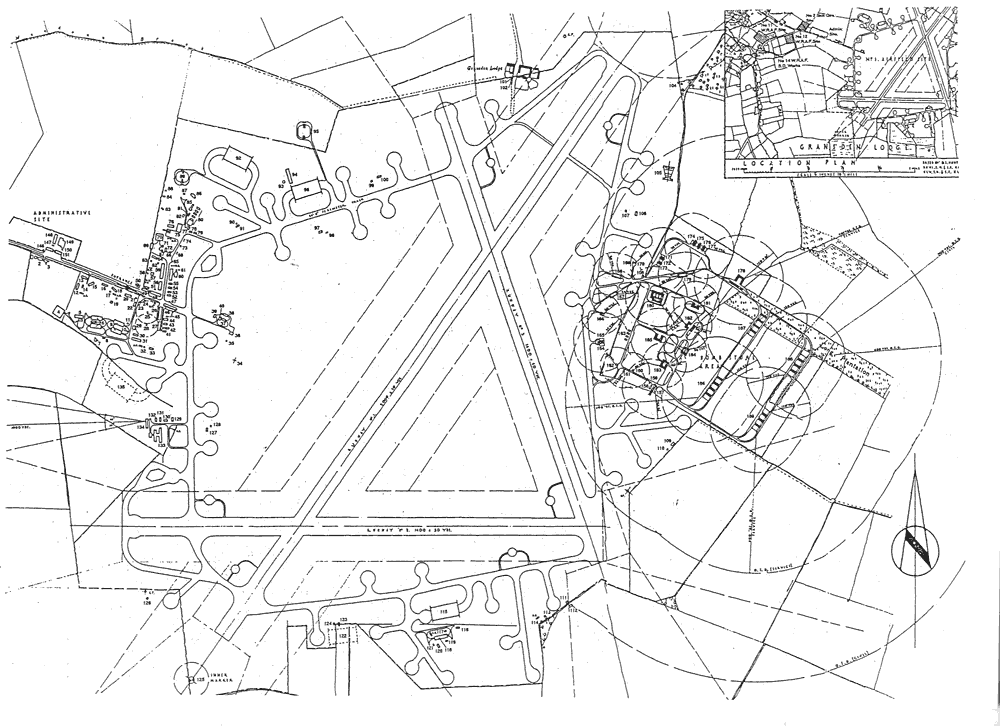
Initially built as a satellite for the larger bomber base at Horsham St. Faith, Oulton originally only had grass runways. It would later, in 1942, be upgraded to class ‘A’ standard, which would require the construction of three concrete runways, a new tower and bomb store and upgrading to the technical site. Runway 1 (2000 yds) ran east-west, runway 2 (1,400 yds), north-east to south-west, and runway 3 ran approximately north-south and was also 1,400 yds. All were the standard 50 yards wide and would be connected by thirty-two loop style hardstands and eleven pan style hardstands. Uncommonly, Oulton would also have four T2 hangars (three to the eastern side and one to west, two of which would later hold Horsa gliders) and a further blister hangar.

The majority of the technical area was to the eastern side of the airfield next to the main entrance and along side Oulton Street. The two bomb stores were located to the north and western sides of the airfield well away from personnel and aircraft as was common. The first of the two towers, was built to drawing 15898/40, which combined the tower and crew rooms; the second built later to drawing 12779/41 (adapted to the now common 343/43) brought the airfield in line with other Class ‘A’ airfields.

RAF Oulton

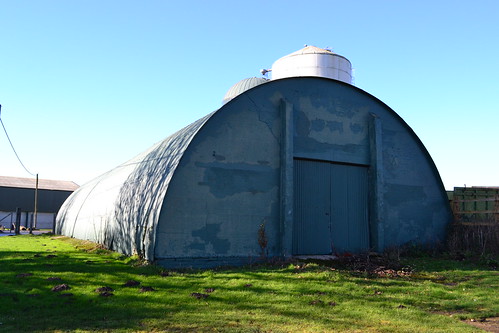
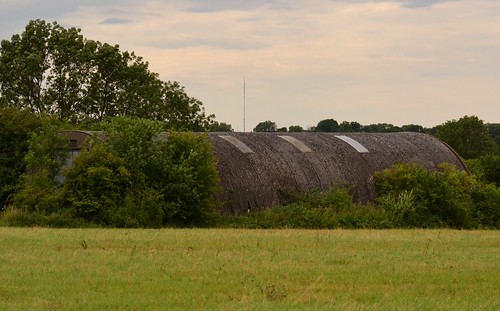
One of the huts used for agricultural purposes today.

Throughout the war personnel accommodation utilised the grand and audacious Blickling Hall. A seventeenth century building that stands in a 4,777 acre estate that once belonged to the family of Anne Boleyn. Owned more recently by Lord Lothian, he famously persuaded Churchill to write to Roosevelt declaring Britain’s position and poor military strength. Lord Lothian was a great entertainer dining with many notable people including Joachim von Ribbentrop, Hitler’s foreign Policy advisor and close friend. A number of other notable events took place at Blickling, including, in early 1945, Margaret Lockwood raising eyebrows when she and James Mason arrived to film ‘The Wicked Lady’ .

In the early 1940s, the hall was requisitioned by the RAF, officers were billeted inside the ‘wings’ whilst other ranks were put up in Nissen huts within the grounds. The lake was used for Dingy training and the upper floors allowed for baths albeit with cold water!  In total some 1,780 personnel could be housed in and around the estate.

For the first two years between 1940 and 1942, Oulton airfield was the home to Blenheims, Hudsons and Beaufighters, each undertaking a light bombing or anti-shipping role as part of 2 Group.

First came 114 sqn on August 10th 1940 with Blenheim IVs. Apart from a small detachment at Hornchurch, they stayed here until the following March whereupon they moved to Thornaby. Their most notable mission was the mid-December attack on Mannheim, an attack that would signify the start of the RAF’s ‘area’ bombing campaign.  A short spell of three months beginning April 1941 by 18 Sqn, preceded their return later in November and then subsequent move to Horsham St Faith.

Like many airfields during this time, units moved around and it was no different for 139 Sqn. With their Blenheims and later Hudsons, they would leapfrog between Horsham St. Faith and Oulton throughout 1941 only to disband and reform returning in 1942 with Mosquito IVs.

RAF Oulton

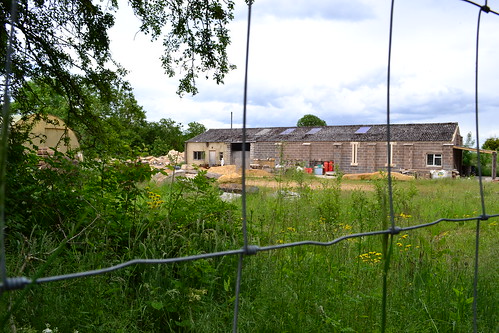
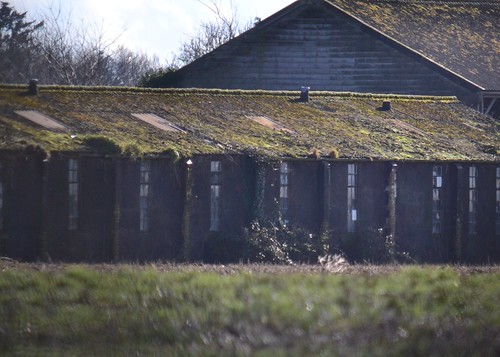
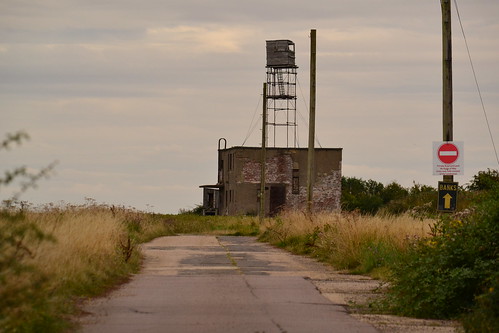
A few buildings remain on the site, many are fighting a losing battle with nature. The main entrance to the airfield is just to the right of this building.

It was during this time in late 1941 that Hudson conversion flight 1428 would be formed at Oulton with the sole job of training crews on the Hudson III. They would remain here until the following May, at which point they were disbanded.

The re-establishment of 236 Sqn in July 1942 with Beaufighter ICs meant Oulton performed as part of Coastal Command for a short time. The success of 236 in torpedo strikes, led to a new wing being formed at North Coates with 236 leading the way, they departed taking their Beaufighters with them. This left a vacancy, that would soon be filled with a new twin-engined model, the Boston III and 88 Squadron.

88 Sqn were split over 6 different airfields before being pulled together here at Oulton. They retained two of these detachments, one at RAF Ford and the other at RAF Hurn, and their arrival and start of operations at Oulton, would be tarnished with sadness.

On October 31st 1942, a month after they arrived, ground crews were unloading a 250lb bomb from 88 Sqn Boston ‘W8297’ when it suddenly went off. The resultant explosion destroyed the Boston and killed six members*1 of the ground crew. The youngest of these, AC2 K. F. Fowler, was only 19.

After having suffered serious losses in France whilst claiming the first RAF ‘kill’ of the war, they were the first unit to fly the new Boston, and would continue to undertake dangerous daylight intruder operations. Flying daring, low-level missions, they would attack shipping and coastal targets before supporting the allied advance on D-day. Their most famous attack was the renowned bombing of the Philips works in Eindhoven, which resulted in the loss of production for six months following the raid. Ninety-three aircraft took part in the raid, all flying beyond the reach of any fighter escort, a factor that no doubt resulted in the heavy casualties sustained by 2 Group on that mission*2 .

DSC_0178

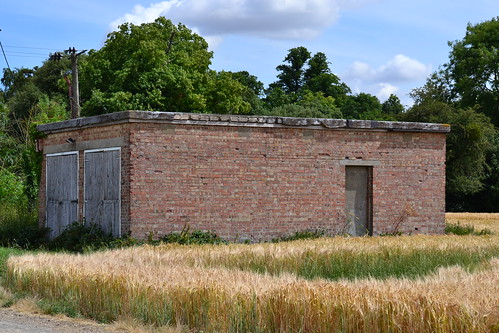
Two Nissen huts would have been next to this building, and according to the site map, it was part of the rubber store.

In March 1943, the Boston IIIs left and Oulton passed to Addison’s 100 group. As with many other airfields in this part of Norfolk, 100 group were using them to fly missions investigating electronic warfare and radio counter measures. This move to 100 Group would bring a major change for Oulton.

The now satellite of Foulsham would soon be seeing larger and heavier aircraft in the form of the American Fortress I (B-17E), II (F), III (G) and Liberator VI (B-24H). This change required extensive upgrading; the construction of hard runways, updating of the accommodation, new technical buildings and a second, updated tower, along with further storage facilities. The airfield was closed throughout the operation, and with the completion in May 1944 operations could begin almost immediately.

Both USAAF and RAF crews moved in. 1699 Flight were providing conversion for crews to fly the heavy bombers for their parent Squadron 214 Sqn, whilst the American 803rd BS, 36th BG flew radio-countermeasures in their B-17s and later B24s. This move here allowed their own parent station RAF Sculthorpe, to also be extensively redeveloped.

The Americans stayed for three months whilst their work was undertaken, but the RAF units remained until the end of the war. After 1699 Flt. had completed conversions, 214 changed Fortress IIs for IIIs and flew these until disbandment on July 27th 1945.

On August 23rd 1944, 223 Sqn reformed at Oulton. Having previously been flying the twin-engined Baltimore, the new unit would have to get used to much larger aircraft very quickly, a task they commanded with relative ease. They flew the heavier Liberator IVs, and Fortress IIs and IIIs until their final disbandment a year later.

Both 214 and 223 flew the heavy bombers now bristling with electronics. Using a range of electronic gadgetry such as ‘window’ ,’H2S’ and ‘Mandrel’, they had their front turrets painted over or removed and electronic equipment added. ‘Window‘ chutes were installed in the fuselage of the aircraft and a heavy secrecy enveloped the airfield.

The winter of 1944 proved to be one of the worst for many years, crews worked hard in the snowy environment, relaxing where they could at the nearby pubs, one nicely placed next to Blickling Hall and the other directly opposite the entrance to the airfield.

Both units would participate in a number of major, high prestige operations, providing radio jamming and window curtains for the bomber formations. ‘Spoof’ operations were common, diverting enemy fighters away from the real force and playing a daring game of cat and mouse with the German radio operators. As the war drew to a close, so too did the operations from 214 and 223. Eventually in July 1945 both Squadrons were disbanded, 214 being the renumbered 614 squadron, with 223 having to wait until 1959 before being reborn as a THOR missile squadron.

With the withdrawal of the heavies, the end was near for Oulton. After being used for storage of surplus  Mosquitoes for a year it was closed and sold off. The end had finally arrived and Oulton closed its gates for the last time.

Oulton airfield stands as a  reminder of the bravery of the light bomber and ECM crews; today many of the original buildings still remain, used for agricultural purposes and even by the National Trust.

RAF Oulton

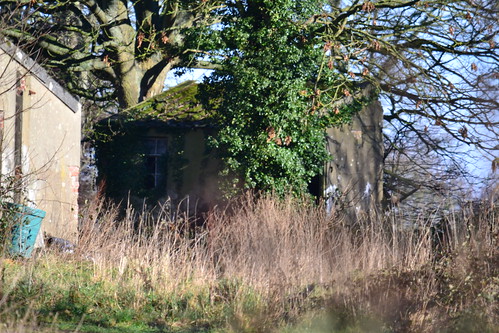
One of the few buildings that remain, the former squadron offices.

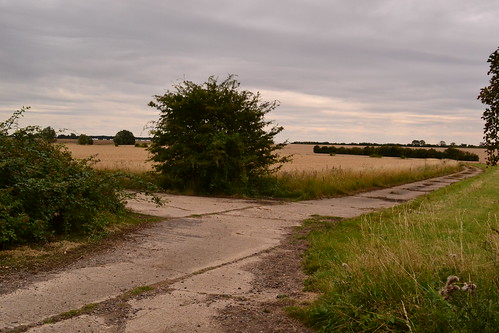
Whilst the general layout of the airfield has changed with the addition of farm and ‘industrial’ units, its layout can still be recognised. The majority of the runways still exist, now housing poultry sheds, and large sections can easily be seen from the roadside. Luckily, even some of the original huts from the technical area are also in existence and ‘accessible’.

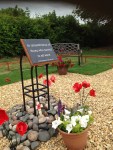
Approaching from the north, the first reference point is the memorial. Standing at the crossroads on the north-eastern corner, it serves as a pointer directly in line with the centreline of the Runway 2. Behind you to your right is the former sick quarters, here would have been an ambulance station, Static water tank and sick quarters, now all gone. Turning right here, keeping the airfield to your left, you pass along the northern boundary, within a short distance of what would have been the perimeter track.

The first sign is a pillbox. This was placed next to the special signals workshop which consisted of three small buildings. Now overgrown, this maybe a Vickers Machine gun Pillbox, different to ‘standard’ pill boxes as it has a concrete ‘table’ beneath the gun port designed to support the heavier gun and tripod.

Further along this road, to your right, is the first and main bomb store. A small track being the only visible reminder, the walls having been removed long ago. The large concrete ‘pan’ being the entrance, on which farm products are now stored.

The second store and USAAF quarters were further along this road, again all trace has gone and it is purely agricultural now. Retracing your steps, go back to the memorial. At the crossroads, ahead of you, was Number 1 accommodation site, now all farm buildings, but formerly the officers, sergeants quarters and airman’s barracks.

Turn right here and as you drive down Oulton Street, there are a number of original buildings back from the road in a small enclave. The National Trust own part of these and use them to restore historic textiles, one of these buildings being the squadron offices. The main entrance to the airfield is further along this road and now an insignificant farm gate, allowed to grow and fill in, the path buried beneath the grass. Beyond this, you can see some remaining buildings across the field, truly overgrown and very dilapidated, these are possibly the crew locker and drying rooms. Continue on along this narrow road and you arrive at the pond. Behind the pond, stands a well-preserved hut and smaller buildings. These were the main workshops, rubber store and general stores, now holding agricultural products and waste material. Certainly they are some of the better preserved buildings on the site. Further along, the road crosses the main runway, here it is full width on both sides of the road. Poultry sheds stand on the main section, whilst farm waste resides on the left.

RAF Oulton

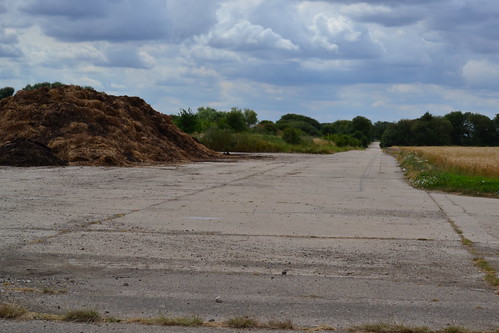
The eastern end of the main runway.

Continuing on and the road crosses the third runway, where we turn left. We can now see the site of one of the four T2s, the road at this point using the original perimeter track before it departs away to the north.

From here, we return north, head back past the airfield and return to the main road. Here we turn right and follow the road for a few miles east through the woodland where we arrive at Blickling Hall. The accommodation sites here, include the No.1 and 2 WAAF sites, NAAFI, No. 4 and 5 accommodation site and various service sites.

The east wing of the Blickling Hall is now a museum, formerly the barracks and still shows the original paintwork. A range of uniforms, photos and personal stories can be seen and read.

There are virtually no remnants of the other sites which were primarily Nissen huts. Footpaths do allow you to walk through these, now natural spaces, walking in the footsteps of former airmen and women.

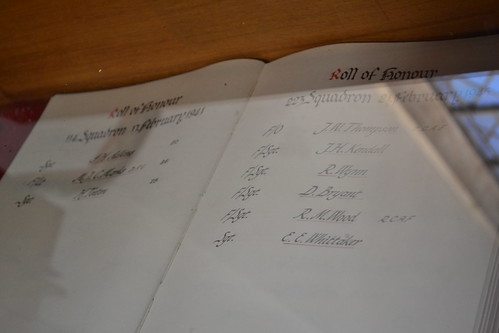
Next to the Hall, is the church of St. Andrew, in here is a small collection of artefacts and a roll of honour for those who died at Oulton. Also here is the sole grave of Sergeant L. Billington, who died on March 4th 1945 at the young age of 20. He was part of a crew in a Fortress III (B-17) on window duties. As the aircraft was returning from its mission, it was attacked by a JU 88, causing it to crash on the airfield boundary. All but two of the crew were killed*3, their bodies being buried in different locations. A sad end to another young life at Oulton.

St. Andrew's Church

The Roll of Honour at St. Andrew’s Church, next to Blickling Hall.

RAF Oulton housed a range of aircraft types and nationalities. Their role encompassed many important duties and missions that certainly helped defeat the Nazi tyranny. Many of these young men, led the way in today’s electronic counter measures and electronic warfare. The daring missions they led, firmly embedded in our history, and now the remnants of Oulton stand as a reminder to both their sacrifice and dedication.

Notes and Further Reading.

*1 The ground crew were:

E.J. Bone, Aircraftsman Ist Class
H. Bramham, Aircraftsman 2nd Class
A.C. Emery, Aircraftsman 2nd Class
K.F. Fowler, Aircraftsman, 2nd Class
F. Packard, Leading Aircraftsman
A. Torrence, Leading Aircraftsman

Source Aircrew remembered website.

*2 National Archives, RAF Bomber command diary 1940.

* The crew were:

P/O H Bennett
Sgt. L Billington
F/S H. Barnfield
W/O LJ Odgers (RAAF)
F/S W Bridden
F/S LA Hadder
F/S F Hares
Sgt. A McDirmid (injured)
W/O RW Church (injured)
Sgt. PJ Healy

Source: Chorley, W.R., RAF Bomber Command Losses 1945, 1998, Midland Counties.

RAF Matlask, a Windy Corner of Norfolk with Hurricanes, Whirlwinds and Typhoons

In this, the 34th trail, we go back to the northern area of Norfolk, not far from the North Sea coast, and then head south. We end up near to RAF Attlebridge found in Trail 7, west of the city of Norwich.

Our first stop was a quite unassuming airfield, but one that played an important role during the Second World War. British readers will remember the distinct voice of one Raymond Baxter OBE,  the voice behind so many thrilling air show commentaries, the TV programme ‘Tomorrow’s World‘ and a wide range of outside commentaries that brought the wonders of science and technology into our homes. Baxter himself served in 602 Sqn RAF, and was stationed at the airfield in the latter stages of the war.  We are of course at RAF Matlask.

RAF Matlask (Station 178)

Documented on airfield site plans and other RAF Documents as  Matlask, as opposed to Matlaske the name of the village, it was a large grassed airfield hidden well into the Norfolk countryside.

The village of Matlaske separates the main airfield from the  four airmen sites and sewage disposal site, which were widely spread away to the north; only site 2 (communal and WAAF area) and site 7 (Sick Quarters), were located in the village itself.

RAF Matlaske

One of the few remaining buildings at Matlask. This being the former Site 3.

Accommodation was substantial, even taking over the large and rather grand Barningham Hall for the Officer’s Mess. The current building dates back to 1612 and stands in 150 Hectares of garden, park and lakes, a rather ‘up market’ dwelling, that is closed off to public access.

Other accommodation included a range of the usual huts, ‘Nissen’ and ‘Laing’ being the most prominent, with brick and timber featuring most.

The airfield itself stands to the south of the village, with the main entrance way off to the western side. A guard hut would have marked the main gate where a number of brick buildings would have been used for storage, technical activities, fuel storage and the like. A small road took you onto the concrete perimeter track that led all the way round the site. Dispersal was provided by 21 concrete hardstands, although a further 21 temporary hardstands were planned. One single T2 hangar was located  next to the technical area, with a further 5 Blister hangers (design 12512/41) spread around the perimeter. Aircraft dispersal was also provided by the standard 6 Type B protected dispersal pens, (7151/41) with built-in air raid shelters; each shelter having a crew entrance and emergency exit. Matlask initially had one watch tower to the north of the site next to the technical area. This was later modified to a two storey design and then a further example was built slightly to the south, this being of the more common two storey ‘standard’. wartime design (343/43).

Matlask although tucked away in the Norfolk countryside would not be devoid of activity. Some 22 RAF squadrons, an Air Sea Rescue unit and an American Fighter Group would all use it at some point.

Designed initially as a satellite for Coltishall, it was dogged with drainage problems, and surprisingly never seem to warrant any form of hard runway. It was opened in 1940 as part of 12 group, destined for fighter defence of the Midlands.

In 1937, 72 Sqn (RAF) was reformed. they moved around a variety of bases eventually ending up at Matlask’s parent base, RAF Coltishall. When Coltishall was attacked in late October 1940, it was decided to move the Spitfire squadron to Matlask for protection. This merely brought the war to Matlask for on the 29th, five Dorniers attacked the airfield, inflicting damage on several dispersed aircraft and injuring a number of personnel.

DSC_0149

The village sign in Matlaske village.

After this attack, the first of two, the Spitfires would leave and Matlask would revert back to a satellite having no permanent residents of its own. This situation continued until May/June 1941, when Spitfires IIbs would arrive also from RAF Coltishall (Trail 7) . 222 Sqn (RAF) only stayed until the following July, moving south to the large fighter base at RAF Manston, in Kent.

This would then set the tone for Matlask, a large number of short stays, most for no more than a month or so. But whilst their stays were short, the diversity of aircraft they used was not. Spitfire Is, IIbs, IX, XVI, Hurricane II, Airacobra I, Walrus, Lysanders, Westland Whirlwind, Typhoon Ia and Ib, P-47 ‘Thunderbolts’, Miles Master, Martinets, Hawker’s Henley, Tempest Vs and Mustang IIIs would all grace the skies over this region of Norfolk.

Perhaps one of the more notable examples to fly here, was the American Airacobra. 601 Sqn (RAF) moved from RAF Manston to Matlask at the end of June 1941, bringing Hurricanes with them. These were replaced by the distinctive tricycle undercarriaged P-39 ‘Airacobra‘ a short time after. The first auxiliary squadron, 601 was known as the “Millionaires’ Squadron” and said to have been created by Lord Grosvenor at the gentlemen’s club “White’s“. Membership was initially very restricted, and boasted a unique initiation into the ‘club’. Whilst a determined and very professional unit in the air, they acquired a reputation for flamboyance and bravado on the ground.

In looking for a new fighter, the RAF turned to the Americans. The Airacobra was trialled and whilst found to have a number of advantages over its adversaries, it was considered too poor at heights over 15,000ft. Used in only a small number of raids it was deemed inadequate and soon replaced, with many supplied models being sent on to Russia and the Far East. 601 would use these partly at Matlask and then back at the Fighter Development Unit at Duxford where they moved to on August 16th 1941.

On that same day, Spitfires arrived with 19 Sqn (RAF). They changed their Mk.IIs for Vbs before moving off to RAF Ludham in December. It was during this stay though that a change was to take place for Matlask.

On October 1st 1941, 278 Sqn would be formed out of 3 Air Sea Rescue (ASR) Flight, operating Lysander IIIs. These, whilst successful in SOE missions, were considered the weak link in the Air Sea Rescue Role.  Operating initially as a spotter, it would fly to the last reported position of the downed aircraft, carry out a search, drop whatever aids it could, and then pass the information on to a Walrus which would collect the airman. In theory this worked well, but due to its poor capacity (supplies were limited to what could be fitted on the bomb racks), slow speed and vulnerability, it was limited to flying no further than 40 miles from the coast. As a result, and almost immediately, the Lysanders were replaced by the Walrus, an aircraft 278 Sqn operated for some time. Performing in this vital role, they were eventually moved in April 1942 to RAF Coltishall leaving Matlask firmly behind.

Around the time 19 Sqn departed Matlask, 137 Sqn moved in. They were to be perhaps the longest-serving squadron at Matlask and perhaps also one of the most notable.

Operating in the Coastal patrol and fighter role, they brought with them the Westland Whirlwind. Potentially thought be a world-beater, they would be liked by their crews, perform well at low altitude and have a punch that matched anything in the European Theatre at that time. However, having a poor combat range, and production problems with their engines, they were only built-in limited numbers and were restricted to ground attack, anti-shipping duties and low-level sorties. As such, they were only supplied to 2 operational squadrons, 137 Sqn and 263 Sqn; 137 Sqn being the second. Operations by the Whirlwind were mixed. Some great successes were reported, its concentrated fire power proving devastating not only to enemy aircraft but more heavily armoured targets including locomotives.

Despite this however, 137 Sqn was to suffer a major blow in February 1942. Whilst escorting British destroyers, they were unaware of the presence of the two German warships Scharnhorst and Gneisenau. On diving to investigate, they were attacked from above by escorting Bf-109s and of the six Whirlwinds sent out, four were shot down and lost.  Despite its good performance, it was never to enter full production and soon the Whirlwind would be declared obsolete and be destined to fall into aviation obscurity.

ROYAL AIR FORCE FIGHTER COMMAND, 1939-1945.

Typhoon IB of 56 Squadron runs up its engine in a revetment at Matlask, before taking off on a ‘Rhubarb’ mission over Holland. © IWM (CH 9250)

137 Sqn would leave Matlask in August 1942 only to return 10 days later before departing again to RAF Snailwell at the end of the month. Almost as a direct replacement, Typhoons from Snailwell’s 56 Sqn and Coltishall’s 266 Sqn took their place. 56 Sqn stayed here for almost a year, moving to Manston in July 1943 whilst 266 Sqn moved to Duxford that same month. One of the last fatalities of 56 Sqn was Flight Sergeant R.G. Gravett (s/n 1268706), flying a ‘Rhubarb’ mission in his Typhoon JP392, who was killed when his aircraft was hit by Flak whilst attacking a locomotive at Leiden train station. The resultant crash, which hit 5 homes in Leiden, also killed one civilian and wounded five others.*1

After 56 Sqn’s departure the airfield was allocated to the Eighth Air Force and given the designation Station 178. Sadly though, it was only used for small detachments of the 56th FG flying P-47 ‘Thunderbolts’, and plans to expand the station to three runways were not carried out.

Apart from target towing activities, the early summer of 1943 was relatively quiet at Matlask; Lysanders returned along with the more unusual Masters, Henleys and Martinets of 1489 Flt.

Then came a flurry of fighter activity. The July of that year would see Matlask become a fighter base once again, with Spitfires, Tempest and Mustangs all being stationed here. Some 11 squadrons: 611, 195, 609, 3, 486, 65, 122, 229, 453, 602 and 451 all brought their own variety of fighter with them over the next year.

January 1944 would bring two more ‘unusual’ visitors to Matlask, although neither would be particularly graceful. On the 11th, B-17G (s/n 42-31090) ‘Nasty Habit‘ was instructed to land at Matlask, because of poor weather at its own station, RAF Deenethorpe (Trail 6). The B17 overshot and crashed through the boundary hedges and onto the road. Flying with the 613 BS, 401 BG, it was salvaged ten days later.

A B-17 Flying Fortress (IN-L, serial number 42-31090) nicknamed

B-17G (s/n 42-31090) ‘Nasty Habit’ *2

Then at the end of that month, whilst returning from a mission to Berlin, Halifax III, HX239*3 ‘HD-G’ of 466 Sqn RAF Leconfield, attempted a landing at Matlask due to low fuel. On touchdown the pilot, P.O. D. Graham realised he was on a  collision course for a group of workmen. In averting what could have been a major catastrophe, he ground looped and hit a partially built building, injuring three of the crew members. For the crew, a mix of Canadians and Australians, it was not the most comfortable of landings!

Almost as quickly as it all started, aircrews left and Matlask fell silent. The war came to an end and the RAF pulled out. 451 Squadron leapfrogged between here and nearby RAF Swannington, finally leaving on April 6th 1945 to RAF Lympne in Kent. The end had arrived for Matlask. A short spell as a POW camp and then it began its rapid return to agriculture and its present day form.

Matlask airfield today is very different from its heyday of the 1940s. The perimeter track is all but gone, only a small section remains as a simple farm track that leads across what was the northern section of the airfield. Half way across this part of the airfield lay the remains of the base of the T2 hanger. Today its holds farm machinery, waste and other products. On the north-western side would have been the main gate and the technical area. The two towers have left no remnants and even the last fighter pen is all but indistinguishable. Having grass runways, means the site is flat and unrecognisable as having any notable history. A memorial erected by the Airfields of Britain Conservation Trust stands on what was the north-eastern section of the airfield just south of the village. From the village, heading south past this memorial takes you parallel to the airfield, the former perimeter tracks only feet from where you are driving.

In the village of Matlaske itself, you can find the former sick quarters – site 7, its distinctive roadway still evident but housing small homes and Bungalows now rather than sick bays of the 1940s. To the west there are a small number of buildings remaining on private land, shrouded in vegetation and trees, they are barely visible from the roadside. This would have been the former site 3, the location of six airmen’s barracks, five latrines, an ablutions block, drying room, fuel compound and a picket post. A small community in its own right.

Many of the accommodation sites are located within the grounds of Barningham Hall and the roadways that once took weary crews to and from the airfield now gone. Driving down the western side past the technical site, presents no sign of wartime activity. The former huts have all been removed, and even the battle headquarters, often one of the last few buildings to survive, has been removed.

Matlask has all but gone. When I visited early in 2016 it was a foggy, cold morning. The Norfolk wind has replaced the piston engines, the Merlin’s no longer resonate across the open expanse. The village is quiet. A public defibrillator in an old phone box perhaps a metaphorical gesture. The village sign acknowledges the history, a lone aircraft flying low over the village. As the fog lifts on this winter morning it reveals a wide open expanse that was once the busy and historic RAF Matlask.

Raymond Baxter commentates on some British Classics at RAF St. Athan.

After leaving Matlask airfield, we head south, a short distance to the former base at Swannington.

sources

*1 Air War WW2 database V4.1, Jan Nieuwenhuis, Netherlands

*Photo IWM, Roger Freeman Collection. FRE 8078

*3 Aircrew Remembered website, accessed 4/3/16

*Bomber Command Losses of the Second World War, W.R.Chorley, 1944, Midland Publishing


A Happy New Year!

As 2015 fades away I would like to take this opportunity to thank each and every one of you who has visited, followed, liked, reblogged, commented and generally supported “Aviation Trails” during the last year. Without you, it would not be the site it is today.

It has certainly grown over the last year and taken on a new dimension. Investment in research material has enabled much longer posts and more personal information to be included, something that I know many people like to see. Not only do ‘we’ as enthusiasts, historical ‘writers’, modellers, relations of veterans etc. preserve our common history, but openly promote and educate others through the writing we do.

I believe it is important to remember what went on, the sacrifice and dedication to freedom, and if I can go a small way to helping that then it has all been worthwhile.

I have been inspired to take up old hobbies, learnt about aspects of military and natural history that I had never heard of, found new places in the world and been a part of a group of people who share the desire to learn, educate and inform others. It has been a wonderful year.

The tally of airfields I have visited is now around 75, double what it was this time last year. I have walked in the footsteps of famous people like Guy Gibson, Glenn Miller and Joe Kennedy, stood where important and famous missions have been planned and executed, trodden the very ground where so many young men and women served their country, many thousands giving the ultimate sacrifice.

It has been a most humbling experience.

So to each and every one of you, a heartfelt thank you, and here’s to a happy, peaceful and rewarding 2016.

American Ghosts – RAF Kimbolton an Airfield with a Remarkable History.

Kimbolton was home to the American USAAF, it also housed one of the RAF’s rarest Wellington Bombers of the Second World War. The 379th BG were the main residents achieving a number of records whilst bombing heavily defended targets in occupied Europe. We go back to see what is left today.

RAF Kimbolton. (Station 117)

DSC_0108

Looking across Kimbolton today.

We arrive not far from the busy A14 to the south-west of Graffham Water. Perched on top of the hill, as many of these sites are, is Station 117 – Kimbolton. Having a short life, it was home to the 379th Bombardment Group of the Eighth Air Force, flying some 330 missions in B-17s. The site is split in two by the main road which uses part of the original perimeter track for it’s base. To one side is where the runways and dispersal pens would have been, to the other side the main hangers, admin blocks, fuel storage and squadron quarters. The former is now open fields used for agriculture and the later a well-kept and busy industrial site. What was the main runway is crossed by this road where there is now a kart track.

Kimbolton Airfield in 1945, taken by 541 Sqn RAF. (English Heritage RAF Photography – RAF_106G_UK_635_RP_3217)

Kimbolton was designed with three concrete runways, the main running north-west / south-east, (2154 yds); the second and third running slightly off north-south (1545 yds) and east-west (1407 yds), it also had two T2 hangars with a proposed third, along with 20 ‘loop’ style hardstands and 31 ‘frying pan’ hardstands around its perimeter.

The local railway line formed the northern boundary,  the bomb store was to the south-west, the technical and administrative site to the south-east and beyond that the accommodation sites. To house the huge numbers staff to be located at Kimbolton, there were two communal sites; a WAAF site; sick quarters; two sewage sites; two officers quarters, an airmen’s quarters; a sergeants site and two further sites with ablutions and latrines. These were all spread to the south-eastern corner of the airfield,

Originally built in 1941 as a  satellite for RAF Molesworth, it was initially used by the RAF’s Wellington IVs, a rare breed where only 220 airframes were built. 460 Sqn were formed out of ‘C’ flight 458 Sqn at Molesworth and used the Wellingtons until August 1942 when they replaced them with the Halifax II. Staying only until January 1942, their departure saw the handing over of both Molesworth and Kimbolton to the USAAF Eighth Air Force and the heavier B-17s. During this time, the airfield was still under construction, and although the majority of the infrastructure was already in place, the perimeter was yet to be completed.

First to arrive was the 91stBG, who only stayed for a month, before moving on to Bassingbourn.  A short stay by ground forces preceded extensions to the runways, accommodation and improved facilities. Now Kimbolton was truly ready for a Heavy Bomb Group.

Soon to arrive, was the 379th BG, 41st CW, flying B-17Fs. Activated in November 1942 they arrived at Kimbolton via Scotland, ground forces sailing from New York whilst the crews flew their aircraft from Maine to Prestwick via the northern supply route.

Arriving in April / May, their first mission would be that same month. The 379th would attack prestige targets such as industrial sites, oil refineries, submarine pens and other targets stretching from France and the lowlands to Norway and onto Poland. Targets famed for heavy defences and bitter fighting, they would often see themselves over, Ludwigshafen, Brunswick, Schweinfurt, Leipzig, Meresberg and Gelsenkirchen. They would receive two DUCs for action over Europe including, raids without fighter escort over central Germany on January 11th 1944. They assisted with the allied invasion, the breakout at St. Lo and attacked communication lines at the Battle of the Bulge. They  would operate from Kimbolton until after the war’s end, when on 12th June 1945, they began their departure to Casablanca.

Life at Kimbolton was not to be easy and initiation into the war would be harsh. On the first operation, four aircraft were lost, three over the target and one further crashing on return. Three of the crews were to die; a stark warning as to what would come. Their second mission would fair little better. An attack on Wilhelmshaven, saw a further six aircraft lost and heavy casualties amongst the survivors. Things were not going well for the 379th and with further losses, this was to be one of the bloodiest entries into the war for any Eight Air Force Group.

A B-17 Flying Fortress (FR-C, serial number 42-38183) nicknamed

B-17 Flying Fortress (‘FR-C’, 42-38183) “The Lost Angel” of the 379th BG sliding on grass after crash landing, flown by Lieutenant Edmund H Lutz at Kimbolton. (Roger Freeman Collection)

As the air battle progressed, further losses would be the pay off for accurate and determined bombing by the 379th. Flying in close formation as they did, accidents often occurred. On January 30th 1944, 42-3325 “Paddy Gremlin” was hit by bombs from above. Then again, on September 16th 1943, two further aircraft were downed by falling bombs, close formation flying certainly had its dangers.

Some 1 in 6 losses of the USAAF were due to accidents of one form or another. Collisions were another inevitable part of the close formation flying. A number of memorials around the country remember crews who lost their lives whilst flying in close formation. Kimbolton and the 379th were to be no different. On June 19th 1944, two B-17Gs 44-6133 (unnamed) and 42-97942 “Heavenly Body II” crashed over Canvey Island killing all but one of 44-6133 and three of Heavenly Body II. The official verdict stated that the second pilot failed to maintain the correct position whilst in poor visibility, a remarkable feat in any condition let alone poor visibility whilst possibly on instruments alone. (See full details of the terrible accident).

However, not all was bad for the 379th though. Luck was on the side of B-17F, 42-3167, “Ye Olde Pub“, when on December 20th 1943, anti-aircraft fire badly damaged the aircraft whilst over Bremen. The aircraft limping for home, was discovered by Lt. Franz Stigler of JG 27/6. On seeing the aircraft, Stigler escorted the B-17 over the North Sea, whereupon he saluted and departed allowing the B-17 safe passage home where it landed and was scrapped.

A number of prestige visitors were seen at Kimbolton. These included King George VI, Queen Elizabeth, Princess Elizabeth and General Doolittle. One particular and rather rare visitor arrived at Kimbolton on January 8th 1944. A rebuilt Messerschmitt BF-109 stayed here whilst on a familiarisation tour for crews. Shot down over Kent it was rebuilt to flying condition and flown around the country.

8th 1944.

Seen in front of a B-17, Messerschmitt BF-109 runs up her engine at Kimbolton, January 8th 1944. (Roger Freeman Collection FRE 4775)

All in all the 379th had a turbulent time. By the time they had left Kimbolton, they had lost a great many crews, but their record was second to none. They flew more sorties than any other Bomb Group of the Eighth Air Force – in excess of 10,000 in 330 missions; dropped around 24,000 tons of ordnance, equating to 2.3 tons per aircraft; pioneered the 12 ship formation that became standard practice in 1944 and had the lowest abortive rate of any group from 1943. Kimbolton was visited by Lieutenant General James Doolittle, and two B-17s held the record of that time “Ol Gappy” and “Birmingham Jewel“, for the most missions at the end of their service. They also had overall, one of the lowest loss rates of all Eighth AF Groups largely due to the high mission rates.

With their departure to Casablanca, the 379th would be the last operational unit to reside at Kimbolton. Post war it was retained by the RAF until sold off in the 1960s, it was returned to agriculture, the many buildings torn down, the runways dug up and crops planted where B-17s once flew.

DSC_0113

The old perimeter track exists for farm machinery and forms part of the main road.

Kimbolton today is little more than a small industrial estate and farmland. At the main entrance to the industrial site, is a well-kept memorial. Two flags representing our two nations, stand aside a plaque showing the layout of the field as was, with airfield detail added.  Behind this, and almost un-noticeable, is a neat wooden box with a visitors book and a file documenting all those who left from here never to return. There are a considerable number of pages full of names and personal detail – a moving document. One of the B-17 pilots, Lt. Kermit D. Wooldridge, of the 525th Bomb Squadron, 379th Bomb Group, 8th Air Force kept a diary of his 25 raids, and many of the crew members mentioned in the memorial book appear in his diaries. These are currently being published by his daughter, and can be seen at https://sites.google.com/site/ww2pilotsdiary/  They tell of the raids, the crews and detailed events that took place over the skies of occupied Europe from June 29th 1943. I highly recommend reading it.

DSC_0109

Memorial book listing those that never came home.

This is a lovely place to sit (benches are there) and contemplate what must have been a magnificent sight all those years ago. It made me think of the part in the film ‘Memphis Belle’, where the crew were sitting listening to the poetry just prior to departure, how many young men also stood here ‘listening to poetry’. The control tower would have stood almost opposite where you are now, with views across an enormous expanse. Here they would have stood ‘counting them back’. Like everything else, it has gone and the site is now ‘peaceful’.

Kimbolton saw great deal of action in its short life. But if determination and grit were words to associate with any flying unit of the war, the 379th would be high on that list.

From Kimbolton we head off to another American Ghost, one that holds its own record and a beautiful stained glass window. We go to the American base at RAF Grafton Underwood.

Kimbolton was originally visited a couple of years ago, this is an update of that trail and it appears in Trail 6 – ‘American Ghosts’.

A short but eventful life, RAF Matching, Essex

RAF Matching (Station 166) or Matching Green, was built very late in the war, and was only operational for just over a year. It was initially built for the heavy bombers of the Eighth Air Force as a Class ‘A’ heavy bomber station, but was very soon transferred to the Ninth Air Force and used by medium bombers of the 391st Bomb Group, who supported the allied advance into Germany.

It was built with 3 runways all of concrete, 50 loop style hardstands, two T2 hangars; one to the south-east and one to the south-west, a number of blister hangars and a wide range of ancillary and support buildings. Both technical and accommodation areas were all to the east and south-east well away from the main area. The bomb site, had approximately three miles of roadway, giving an indication of its generous size.

matching green

The Watch Office at Matching now homes radar equipment.

Opened in January 1944 the first month would be busy for Matching Green. The first and primary residents were the Olive Drab B-26 Marauders of the 391st Bomb Group of the Ninth Air Force. The 391st were made up of 4 Bomb Squadrons: 572nd, 573rd, 574th, and 575th, and undertook their first mission within a month after arriving in England. They were a new group, ‘rookies’ in comparison to many, only being formed a year earlier.

Their primary targets were: airfields, bridges, marshalling yards and V- weapons sites across France. During the Allied invasion, they attacked German defences along the coast and as the allies moved further inland, they attacked fuel dumps and troop concentrations. They supported the break out at St. Lo in July 1944, and prevented the enemies retreat by attacking transport and communication links behind German lines.

Being to the south of the country, Matching Green was occasionally used by returning aircraft as a safe haven. On February 4th, just a month after it opened,  the first fatality would be recorded. Whilst returning from a mission to Frankfurt and with both engines on one side feathered, B-17G  ’42-31494′ (PY) of the 407BS, 92nd BG, based at Podington, failed to make the airfield and crashed on the approach to Matching Green. The resultant accident killed 5 of its crew members, a worse fate then the aircraft which was later salvaged.

matching green

One of the former accommodation sites.

In September 1944, the 391st moved from Matching Green to Roye/Amy in France, where they received a DUC for action against heavily defended sites without fighter escort. Their departure from Matching Green sounded the end and its short life would soon cease operationally. Between their arrival in January and their departure to France in  September, the 391st would fly some 6,000 sorties losing just under 200 crew members in action over Europe.

As the war drew to a close, the airfield was handed back to the RAF for paratroop activities. Elements of both RAF and the USAAF IX Troop Carrier Command, were reputed to have been based here, operating either Short Stirlings or C-47s. These were the last military units to operate from here and the site was closed in 1945, being returned to agriculture within a very short period of time. The majority of concrete was removed for nearby development, although many of the buildings were luckily left standing.  In the late 1980s, one of the T2 hangars was dismantled and transferred to  nearby North Weald Airfield. It remains there today re clad but still in aviation use. The Control Tower remains today and in remarkably good condition, adorned with electronic equipment, it us used use as a radar equipment test facility.

The site whilst agriculture, is now home to a large selection of fauna and flora. Deer roam freely across the site and a survey in the summer of 1999 recorded over 160 species of trees, grasses and wild flowers that included three different types of Orchid.

Matching Green, like other airfields in this area, lives in the shadow of the modern Stansted International Airport, and this has proven, in part, to be its savour.

matching green

The water tower at Matching Green in a former accommodation site.

Although close to Stansted, the network of country roads that lead to the airfield are small and signposts are few and far between. It is not an easy place to find – one of the many features of Second World War airfields. One of the first things you see is the old original water tower. It pokes its head above the many trees that now cover matching green airfield.

Access to this site is along what would have been the original entrance to the airfield. To mark the spot, a memorial has been built here. Sadly it’s not well looked after and was looking rather worn when I visited in the summer of 2015.

The tower, a rusty guardian, watches over a few of the remaining huts that once formed one of the many accommodation areas in this south-eastern corner of this airfield. A number of huts, in generally good condition, they are now utilised by a quantity of small businesses. The atmosphere of the place has not been lost and it is easy to imagine the hustle and bustle of crews moving between huts along its concrete paths. Some of the huts are in disrepair, a few have been ‘refurbished’ but the layout is clear.
From here drive back to the memorial and with the technical site behind you, turn left, drive along the road past the small forests and you can see evidence of more paths. These would have led to the technical area. This part, whilst predominantly agricultural, is also home to a number of deer and if you are lucky, as I was, you will see them walk across the road from one side to the other. A rather fitting sight bringing peace to a place that once brought death and destruction in the fight against an evil regime. Carry on along this road and you arrive at the more open areas of the airfield. To your right appears from almost nowhere, the original watch tower. In good condition also, it is fenced off and now used as a radar test facility.
August 2015 038

The perimeter track heads off to the north to join the east-west runway at the bend.

With the tower in front of you, the majority of the site is beyond this. A track, that was the perimeter track, leads off onto private land and a farm dwelling still using a blister hangar and other  small buildings. Carry on along the main road, at the bend you are now on the former NW-SE runway as it heads off north-east. At the next bend is further evidence  of the runways. Here the you are at the top of the ‘A’ where two of the three runways cross, now a mere track. Continue along, this is the second runway. It then turns and you drive along the perimeter track. To the south would have been one of the ‘T2s’ and loop dispersals, now all gone. On the other side of the road, the track heads off to the third runway and is used for storing farm ‘waste’.

Much of Matching Green has now gone, returned to agriculture and nature. A peaceful wind blows across the once busy airfield, a few huts linger as reminders of days long gone, but amongst the wild flowers a few well hidden surprises tell the short story of RAF Matching Green.

RAF Fowlmere “a remarkable number of aviation firsts and combat records”.

This airfield concludes our three-part tour of Southern Cambridge for now; we shall be revisiting this area again shortly to see the remaining historic sites that once protected these green and pleasant lands from our invaders. This last stop however, is a former base just a stones throw from the Imperial War Museum and former Fighter Command base at Duxford – we go to RAF Fowlmere.

RAF Fowlmere (Station 378)

Fowlmere’s life can really be divided into two mains parts. That under the RAF as a Battle of Britain era airfield and that of the USAAF for which Fowlmere would achieve a remarkable number of aviation firsts and combat records.

But whatever its achievements, its wartime life was dogged by bad weather, and in particular rain! Poor drainage and heavy water logging left if unusable for large periods, inhospitable and rather bleak with poor accommodation, it was not a noteworthy ‘curriculum vitae’ for a prestigious fighter airfield. It is one of those airfields that took a long time to reach an honorary status, being home to a large number of RAF units, most for short assignments only, it was rarely in the spotlight. In total, it would be home to some 17 operational RAF squadrons,  a small number of training squadrons and one USAAF squadron. A rather high number for any second world war station.

Initially built as a First World War airfield, it opened on October 1st 1916, a small number of buildings were erected including six hangars and the runways were grass. It remained operational until the early 1920s at which point the buildings were demolished and the land reused.

With the next threat of an invasion looming, the defence of Britain was paramount. Fowlmere was then identified as a suitable site for a satellite to nearby Duxford, and Spitfires began to arrive from 19 Squadron. 19 Squadron would ‘yo-yo’ between Duxford and Fowlmere between June 1940 and August 1941, operating the Spitfire I,  IB and IIA in the process. These crews would operate as part of the Duxford Wing in the Battle of Britain where 19 Squadron would gain notoriety.

Duxford September 2015 436a

A sight once common over Fowlmere.

Following significant loses over France and southern England, the Boulton Paul Defiant was withdrawn from front line operations and pulled back to perform in ‘secondary’ duties. Part of this meant a short stay at Fowlmere in July 1940 for 264 Squadron who, whilst carrying out night-fighter duties, were in transit to Kirton-in-Lindsey.

Subsequent to their departure, there was a silence at Fowlmere which was only broken by a short five-day stay by the Hurriacne IIBs of 133 Squadron, whilst moving between Collyweston and Eglington. Noted for their twelve .303 machine guns and Merlin XX engines, first used in the Hurricane IIA, it used a mix of 30% glycol and 70% water. By using this mix, the fuel mixture was not only safer but it meant the engine would run much cooler thus giving it a longer life. Further examples of this aircraft would return later in the summer of 1942 with another squadron, 174 Sqn, also whilst transiting, but this time from and back to their main station at RAF Manston.

The winter of 1941 / 42 would remain quiet at Fowlmere, and it wouldn’t be until the following spring on March 12th, that there would be any significant action at the base. The first visitors being a detachment of Spitfire VBs from 154 Sqn whose main force was based away at Coltishall. Eventually, a month later, the entire squadron would transit over, but yet again, they would be another short-stay resident who would depart  for RAF Church Stanton in early May that year. Other than the short visits by the Hurricanes, all would be quiet again until the autumn and in September Fowlmere would be blessed with yet another short stay of transiting Spitfires. The VBs of 111 Squadron, would stay for one month whilst on their way the Mediterranean and North Africa. 111 would go on to become famous for their Lightnings and the ‘Black Arrows’ aerobatics team with their Hunters in the post war jet era.

Once again the winter would have a quietening effect on Fowlmere, and there would be little happen for the next few months. The following March though, would see a considerable amount of movement at the airfield. Preceded by a short stay of Austers from 655 Squadron, Spitfire VBs of 411 Squadron and Spitfire VCs of 167 Squadron would arrive in the early days of March. Their departures on the 12th and 13th respectively would be interceded by the arrival of more Spitfire VBs of 421 Squadron, who also left on the 13th of that month. Similar movements would take place only a few days later. On the 19th 2 Sqn RAF arrived and stayed for just over a month. But the arrival and departure of 2 Sqn signalled a big change for Fowlmere and their Mustang Is were to be not only the end of RAF interests in the airfield, but a sign of things yet to come.

Littlefriends.co.uk

Aircraft of the 503rd FS from the waist gunner’s position of a B-17. Aircraft seen are, from rear to foreground: P-51B ‘D7-O’ “Miss Max”; P-51D ‘D7-M’ “Sally II”; P-51D ‘D7-Z’ “Shy Ann”; and P-51D ‘D7-F’ “Dee”. *1

After April, Fowlmere would remain very quiet. With the increasing need for bomber bases for the USAAF, Fowlmere was identified as a possible site. This potential new lease of life was to be short-lived though and the decision was reversed only a matter of weeks later. It was not to be, but thankfully, it was not the end of Fowlmere.

Handed over to the Americans as a fighter airfield, it would be upgraded. Two new runways were built (1,400 and 1,600 yds) using Sommerfield Track and pierced planking, eight new blister hangars were erected, to compliment the ‘T2’ hangar to the north of the site and firm plans were drawn up that would shape Fowlmere for the rest of the war.

To deal with the staff, eight sites would be developed. All to the north-eastern side of the airfield, there would be a communal site, five accommodation blocks in total for officers and enlisted men separately, a sick quarters and a sewage treatment site. The main road to Fowlmere village already severed, would have a runway built across it, aircraft pens, technical buildings and a wide range of supporting structures including: fire sheds, harmonisation walls and around forty hardstands around a perimeter track that encircled the two runways. The main technical area would be to the north, whilst the bomb and fuel stores were to the south along side the remains of the southern section of the main road. Fowlmere would be taking on a new role and it would be permanent.

The control tower at Fowlmere, home of the 339th Fighter Group, 1945. Image via James G Robinson. Written on slide casing: 'Fowlmere Tower, 1945.'

Fowlmere Tower, 1945*2

Fowlmere would open again on the 4th April 1944 as Station 378, with the arrival of the 339th FG, the penultimate fighter group to be based in the UK. Flying P-51s, the 339th FG at this time consisted of three squadrons, the 503rd (D7), 504th (5Q) and 505th FS (6N). They would use Fowlmere as their only European base and whilst here would be used in both the fighter escort and ground attack role.

Their first mission was on April 30th with a fighter sweep over France, followed by around 5 weeks of escort duties of medium and heavy bombers. They soon made their mark on the air war though. In the first thirty days, they claimed forty aircraft shot down and fifteen destroyed on the ground.

Initially flying P-51Bs they would also use the ‘C’, ‘D’ and ‘K’ models. Missions would include: strafing runs over airfields; attacking communication lines; supporting the allied push out of Normandy; dive bombing locomotives; marshalling yards; anti-aircraft batteries and troops. They also supported allied advances such as the breakout at St Lo and in the Ardennes. The group received a Distinguished Unit Citation for operations on September 10th and 11th whilst attacking heavily defended airfields and defending bombers of the ‘Bloody Hundredth’ whilst attacking cities in Germany. All in all they were to prove themselves a formidable force in the air.

One of the peculiarities of the 339th was the stripped jacket and baseball cap wearing  Runway Control officer. It was worn so the pilots could see him and his signal that it was clear to take off. A signal they depended upon greatly. Here he signals to a P-51 at Fowlmere embarking on a bombing mission in August 1944.*3

Each time the 339th went into battle it would seem a new record would be set. On the 29th November 1944, in a ferocious air battle, Lt. Jack Daniell shot down five FW-190s, giving him ‘Ace in a day’ status, the last pilot of the US Eighth Air force to do so. In early 1945, during strafing attacks 105 aircraft were destroyed in one mission, another first for any group. A remarkable feat that was repeated only twelve days later with a high score of 118 and an individual record for its leader Captain Robert Ammon.

The 339th would not only becomes a formidable force, but they would be the first units to test new ‘G’ suits, designed to prevent blacking out in tight turns, an essential piece of clothing in today’s modern air force. They would also take the British designed gyroscopic gun sight and develop it for use in the P-51, an innovative device that calculated deflection increasing hit rates both at greater distances and with more accurately.

By the war’s end the 339th would rack up a total of  264 missions, with 680 aircraft destroyed, two-thirds being on the ground and on heavily defended airfields, whilst losing less than 100 aircraft and crews. They achieved the greatest number of air and ground ‘kills’ in any twelve month period of the war,  a DUC and a remarkable reputation.

Fowlmere had finally achieved the status of its more famous neighbours, but it was a little too late for this airfield, the war was finally over. After the Americans pulled out in October 1945, Fowlmere fell silent for the last permanent time. The land was eventually sold off in the 1950s long after all military operations had ceased.

Fowlmere is one of those airfields that is quite difficult to find. Tucked away at the back of the village access is through an industrial site and along a rather grand driveway that is actually a farmers track. The road leads to nowhere other than the farm, a small light airfield and a memorial.

Before driving or walking to the memorial start off at the village centre. Facing south, site 3 would be behind you, and sites 4, 9, 7 and 5 to your front. Take the road south and then turn in toward Manor farm; as you enter, there is an industrial site on your right. This road, was the original main entrance, and there would have been a picket post, Co’s house and Officer’s Mess to your right. On you left was a further Officer’s mess, recreation room for enlisted men, and a block with showers and ablutions for the Sergeants. The road bears right, here you can see, in the field to your right, a Nissen hut once part of the Communal area (Site 2). Now derelict and truly overgrown its days are definitely numbered. The original plan layout differs quite a bit from the current layout, and it is difficult to ascertain the precise nature of its origin. However, it could have been either an ‘A.M.W.D*4‘. or latrines for 310 – 400 enlisted men. Using satellite photos, you can clearly see the foundations for a number of other buildings including the: Officer’s Mess, Dental Centre, Stand-by set house and CO’s quarters. This road, which was originally much shorter than it is today takes you into an industrial estate that has reused some of the period buildings, these may well have come from the original site and have been moved or the site was built differently to the original design. It is at this stage difficult to determine.

Aug 2015 005

One of the few remaining structures at Fowlmere, now overgrown and disappearing, this Nissen hut stands on Site 2.

Leave here and turn right at the end of the road. This grand road takes you up the hill toward the airfield. On your left would have been the sick block Site 8 with a barrack hut, sick quarters with 18 beds, a garage and mortuary. Follow this road along, at the farm follow the road right, and the memorial is about 100 yards further along on your left. A small space has been made available for parking by the adjacent property who kindly ask you to look after the memorial during your visit. It is sad that we have to ask people to do this, it should be an absolute.

The memorial overlooks the remains of the airfield. The original T2 hangar stands reclad in its original position now storing small private aircraft. Other remains, the crew rest rooms and two main workshops, have been reclaimed by the farm and incorporated into the farm infrastructure. A considerable amount of concrete also exists from this technical area, again utilised by the farm.  The watch office, originally built to 17/65840 for the RAF, was later replaced by a the more common 343/43 two storey type; this too is long gone and would have been to your front beyond the hangar.

A quiet an unassuming place, Fowlmere remained a satellite for most if its life, seeing a number of temporary stays by some prestige aircraft and squadrons. It wasn’t until the latter parts of the war that it really came into its own, sadly though, this was short-lived; but the P-51s of the 339th would carry Fowlmere’s history into the annuls of time and the small private aircraft that now stand where Spitfires, Hurricanes and Mustangs were once dispersed, grace the skies where their forefathers cut their teeth – in the skies over war-torn Europe.

Aug 2015 018

The Memorial overlooks the airfield, the reclad T2 and its new inhabitants beyond.

A stones throw from Fowlmere, is the Imperial War Museum at Duxford, essential to anyone with an interest in the Second World War. Home of many displays, exhibitions, and restoration projects it has to be on everyone’s list of to-dos. The Duxford website can be accessed here.

Sources and further reading.

*1 Photo from Russell Abbey (www.55th.org) from the ‘Little Friends’ website.

*2 Photo from Roger Freeman collection FRE 5982  American Air Museum in Britain.

*3 Photo from Roger Freeman collection FRE 5961 American Air Museum in Britain.

*4 This is the reference on the site plans, if anyone knows what it means please let me know.

Home to eight squadrons and the Pathfinders.

The second part of Trail 31 continues on through the beautiful Cambridgeshire countryside. Low soft hills give for superb views and fine examples of aviation heritage. We move on to the former RAF station at Gransden Lodge.

RAF Gransden Lodge

Sitting high on the hill-top, Gransden lodge rests peacefully nestled next to the villages of Little and Great Gransden to the west and Longstowe to the east; the county borders of Cambridgeshire and Bedfordshire pass right across it. Surrounded by undulating countryside it no longer reverberates to the mass sound of piston engines, but more with the gentle whistle of gliders.

Gransden Lodge was another Cambridgeshire airfield modified to class ‘A’ specifications. It was opened in 1942, initially as a satellite for RAF Tempsford. Going through many modifications, the original design differed greatly from the eventual layout; initially the runways not reaching the perimeter track and there being no allocation of hangar, staff accommodation or hardstand space. As a satellite station, presumably these would not have been required. However, with the expansion of Bomber Command and the need for more airfields, Gransden Lodge would eventually become much larger and much more significant. Following changes to plans and redesigns of the infrastructure, three concrete runways (NE-SW, N-S and E-W) were eventually constructed and with one at 1,600 yards and two at 1,200 yards each, they were not huge. However, these were then extended to the more usual 2,000 yards and 1,400 yards later on, when in April 1941, the government decided that every Bomber Command airfield would have to accommodate the larger four-engined aircraft. Again further development of the site was undertaken and the runways were extended.

Perimeter Track

Part of the Track in the Technical area.

A total of 36 hardstands were constructed using the pan style design, two of which were replaced when a hangar was built during the later development stage. This would give Gransden Lodge three hangars in total, two (a B1 and T2) to the north and one T2 to the south of the airfield.

The bomb store was located to the eastern side whilst the accommodation sites were spread to the west and north-west. These 10 sites were made up of two communal, two WAAF, and six domestic sites which included sick quarters and associated premises. The technical area would be to the west. In total, Gransden Lodge could accommodate 1,867 men and 252 women ranks.

Building plan of RAF Gransden Lodge*4

Once open, Gransden Lodge would be home to eight operational RAF squadrons: 53, 97, 142, 169, 192, 405, 421 and 692 before it would finally close at the end of the Second World War.

First to arrive were the combined units of 1474 and 1418 flights, who were here between April 1942 and April 1943, conducting radio navigation tests using the new GEE system. Operating the Wellington IC, III, X, IV and Halifax IIs, they were heavily involved in radio navigation and electronic counter-measure operations. These flights would probe German radar defences, gathering information so that counter-measures could be devised allowing bomber formations safe passage to their targets. The Wellingtons used for this would fly over Germany, France, and the Low Countries and even over the Bay of Biscay, gathering information and reporting back.

The British were were getting quite desperate to find out what frequencies the German airborne radar was using, until they knew, jamming and other counter measures would be difficult. On December 2nd 1942, a Wellington filled with specialist equipment and a daring crew set off from Gransden Lodge to find out as much about the enemy system as possible. In order to track and establish the frequencies they were using, they would have to allow themselves to be tracked by an enemy fighter for a lengthy period, a potentially fatal move for any RAF bomber!

Once tracked, the crew would record and transmit every detail they could about the system and then, if they hadn’t been shot down, head for home.

At around 4:30 am contact was made, and the enemy aircraft tracking them was monitored. The chance of attack increased with every long second they waited until eventually the aircraft, A Ju 88, fired upon the Wellington ripping canon shells along the length and breadth of its fuselage. In the melee that followed, the front and rear turrets were both put out of action, the gunners in each were wounded, the wireless operator was wounded, a specialist radio operator monitoring the Ju 88 was also wounded and the aircraft, controlled by one of only two uninjured crewman on board Pilot Sergeant Paulton, had fallen from 14,000ft to around 500ft as Sgt. Paulton had desperately tried to escape the Ju 88’s clutches.

Eventually the Ju 88 ceased its relentless attacks and left the Wellington to its seeming  terrible fate. But determined to get back, Sgt. Paulton headed for England, both engines now misfiring and much of the hydraulics system disabled.

Over England he told the most able to bale out, then he would attempt a sea landing. The aircraft came down just of the Walmer coast, whereupon the crew clambered out to discover their dingy had been badly damaged and was useless. Thankfully though, it wasn’t long before a rescue boat found them and all the remaining crewmen were taken aboard and brought safely to dry land.

Eventually, these flights would combine forming a new squadron 192 Squadron (RAF) which officially formed on 4th January 1943 here at Gransden Lodge. 192 would pass over to 100 Group and move away to RAF Feltwell on the April 5th that same year and they  would go on to gain the honour of flying more operational sorties, and as a result, suffer more casualties than any other Radio Counter Measures (RCM) squadron in the RAF.

With their departure, Gransden Lodge would then be transferred to No. 8 (PFF) Group like its sister station, RAF Graveley, whereupon its operational role would be changed for good.

The next units to arrive would only stay for 5 days. Passing through with their Mustang Is, 169 Squadron would transit on to RAF Bottisham, whilst 421 Squadron would take their Spitfire VBs to nearby RAF Fowlmere.

Nissen Hut

An overgrown Nissen Hut.

On April 18th 1943, 97 Squadron (RAF) arrived at neighbouring RAF Bourn – but would be split over several sites. A detachment was based here are Gransden, whilst two other detachments were located at Graveley and Oakington. 97 would go onto to gain notoriety for the disastrous ‘Black Thursday’ (See RAF Bourn) operation that took the lives of many of its crews. 97 Sqn would undertake many bombing operations staying here for a year, departing Gransden Lodge on 18th April 1944, a year to the day of their arrival.

April 1943 would be a busy time for Gransden. On the 19th, a day after 97 Sqn’s arrival, 405 Squadron (RCAF) would arrive, bringing with them Halifax IIs. Formed on April 23rd 1941, 405 would fly with 6 Group, at RAF Leeming, until their arrival here at Gransden. Adopted by the people of Vancouver, it would be the first Canadian unit to serve with Bomber Command.

405 Sqn’s entry into the Pathfinder Group brought more experience and skill. Participating in the both the ‘1000 bomber raid’ on Cologne and conducting temporary operations with Coastal Command, 405 had seen a number of different operational conditions. Initially bringing Halifax IIs, they would take on the Lancaster I and III only four months later. 405 Squadron would be the first unit to fly the Canadian built Lancaster – named ‘The Ruhr Express’, KB700 would be the first production model Mk. X.

ROYAL AIR FORCE BOMBER COMMAND, 1942-1945.

The first Canadian-built Lancaster B Mk X, KB700 “The Ruhr Express”, taxiing after landing at Northolt, Middlesex, KB700 was the first of 300 aircraft built by Victory Aircraft of Malton, Ontario. IWM (CH 11041)

405 Sqn would go on to attack many high-profile targets including: Essen, Dortmund, Cologne, Düsseldorf and toward the end of hostilities, Hitler’s retreat at Berchtesgaden. They would be the last unit to attack targets in Italy and they would see action over Peenemunde.

Operating in conjunction with 97 Sqn, 405 would also fall victim to ‘Black Thursday’, when Lancaster JB477 ‘LQ-O’, would strike the ground within a stones throw of Graveley airfield killing six of the seven crew members. Two other Lancasters would also crash with fatalities that night, JB481 ‘LQ-R’ and JB369 ‘LQ-D’, – would both fail to make it home in the thick fog of ‘Black Thursday’ – truly a dark night for the Canadian Squadron.

At the end of 1944, No. 142 Squadron (RAF) would be reformed at Gransden Lodge. With an extensive Middle-Eastern history behind them, they would fly from here between 25th  October 1944 and September 28th 1945, the date of their departure a year later. Serving as apart of 8 Group (PFF) they flew Mosquito XXVs and would go on to complete 1,095 operational sorties, achieving 64 DFC’s and 52 DFM’s. They remained at Gransden Lodge carrying out their last raid on the night of May 2nd / 3rd 1945, finally disbanding on September 28th that year.

Watch Office

The Watch Tower today.

It was during this time that Gransden’s second Mosquito squadron would arrive. 692 Squadron (RAF) would fly the MK. XIV until September that year. Moving from neighbouring Graveley, it had a short life of only 20 months. Its last casualties being March just before their arrival at Gransden.

It would be three months before any further units would be based at Gransden Lodge. On December 1st 1945, Liberator VIs of 53 Squadron (RAF) would arrive and stay for two months whilst they carried out trials of a new radar-assisted airborne mapping system. They were eventually disbanded on February 28th 1946. Their demise would mark the end of military flying at Gransden and whilst it remained in MOD hands it would not be home to any further military units.

Post war, Gransden Lodge was home to the first motor racing event using the old runways and northern section of the perimeter track. This was not to be permanent arrangement sadly and Gransden would remain disused. Military life almost returned with the escalation of the Cold War when ‘The Lodge’ was earmarked as a possible site for Cold War forces, however this never came to fruition and all continued to be quiet. Finally, in the 1960s Gransden Lodge closed it doors for good and the site left to decay.

That was not the end of Gransden Lodge though. In the 1990s the Cambridge University Gliding Club, (now the Cambridge Gliding Club) took over the site and flying has returned once again. Small airshows have taken place and whilst gliding is the more prominent, the sound of the piston engine can once more be heard over this historic site.

Whilst little of the original infrastructure survives today, there are some good reminders of this airfield’s history to be found. After driving through Little Gransden go up the hill towards what is now the rear of the airfield, you will arrive at an old Windmill. Sitting below this Windmill is a small and rather sadly insignificant memorial dedicated to the crews and personnel who worked, died and served at RAF Gransden Lodge.  Carry on past the memorial along a small track and you finally arrive at the rear of the airfield. In front of you the barrier and beyond the barrier the former watch tower. This road would have been the main entrance to the airfield’s technical site, you can still see a number of small buildings and a picket post to the side. To the right of this a track leads off to one of the few remaining huts now heavily shrouded in weeds and undergrowth. The tower, a mere shell, has had a modern but temporary ‘watchtower’ added to its roof. Whilst in poor condition, the watch office stands overlooking what is left of the airfield towards the small flying club that keeps its aviation history alive. A small number of other buildings can be seen around here all buried beneath the undergrowth and all skeletons of their former selves.

Leave the site return back to the village bear left, and continue to follow the road round. You will eventually come to a gravel entrance on your left with a small sign pointing to the flying club.

Take this road, and traverse the potholes as you climb the hill. On your left you will pass a small selection of foundations and piles of bricks that were once part of the southern side of the airfield. Continue on from here and the road bears right, this is now the original perimeter track, follow it as it winds its way around the outside of the airfield. It’s width is greatly reduced throughout its length and only small patches of concrete tell you of its former life. As you pass the former bomb store on your right and the end of the modern grass runways, bear left where you will finally arrive at the flying club. Here  a collection of small aircraft and gliders will greet you. A small modern watchtower and clubhouse watch over the aircraft and the airfield as gliders take to the sky.

On warm summer days, or when  the thermals are good, this is a lovely place to sit and watch in awe as the majestic birds of the sky float silently above this once busy wartime airfield. A small club house provides refreshments and a welcome break from the dusty road that leads here.

As you depart the club, and drive back round the perimeter track, you can see in the distance, the control tower standing proud on the horizon, what memories it must hold and stories it could tell.

Aug 2015 002

The Stained Glass window in St. Bartholomew’s Church.

Before departing this site for good, it is worth going to Great-Gransden and the church of Saint Bartholomew. Within its walls is a beautiful stained-glass window that commemorates those who served at Gransden Lodge. Also placed nearby is the roll of honour detailing those individuals who gave their lives whilst serving here. A fitting and well deserved memorial, it forms an excellent record of those long gone.

The villages of Little and Great-Gransden bear virtually  no reminders of their local aviation history. Delightful in their settings, nestled in the Cambridgeshire countryside, their secrets are bound tightly within their boundaries, but the airfield and the flying, still live on.

We finally leave here and head west to another ‘hilltop’ site. One that boasts one of the most prestigious memorials in the country. An open site with superb views over the Cambridgeshire countryside, we head to the former American base – RAF Steeple Morden.

Notes:

*4 Photo courtesy of RAF museum

The Cambridge Gliding Club website has details of their activities.

Home to Lancasters and Vulcans, Scampton is an iconic and historical airfield.

In this trip we head back northwards into Lincolnshire otherwise known as ‘Bomber Country’ to an airfield that is steeped in history; active since the first world war, it stands high above Lincoln but only a few miles from the Cathedral, a landmark welcomed by many a returning bomber crew. It was here that three Victoria Crosses were earned, Lancasters filled the skies and from here the famous ‘Dambusters’ of 617 Squadron carried out their daring raid on the dams of the Ruhr. It is of course RAF Scampton.

RAF Scampton.

RAF Scampton is to Bomber Command what Biggin Hill is to Fighter Command. It embodies all that is the air war of those dark days of the 1940s; the bravery and dedication of crews, the sacrifice, the loss and the heartache. It has had a long and successful life; even today it is a military airfield but one that sadly operates as a shadow of its former self.

Opened during the First World War under the name of Brattleby Cliff, Scampton was a Home Defence Flight Station, operated by the Royal Flying Corps with 11, 60 and 81 squadrons. A variety of aircraft were based here and it performed in this role until closing shortly after the cessation of the conflict in 1918. For a while Scampton lay dormant, many buildings being removed, but, as a new war loomed over the horizon, it once more sprang into life as RAF Scampton.

Opening in 1936, it was designed as a grass airfield. Its firsts residents were the Heyford IIIs of No 9 squadron (RAF) in 1938, who stayed for just short of two years. They were joined by the Virginia Xs of 214 Squadron (RAF) who arrived in October that same year. A brief spell by 148 Squadron (RAF) in 1937, further added to the variety of aircraft at this base.

The next units to arrive would see Scampton into the Second World War. Both 49 and 83 Squadrons arrived with Hawker Hinds, models they retained until replaced by the more modern twin-engined Hampdens in 1938. Using these aircraft, Scampton would have an auspicious start to the war. With inexperienced crews, flying was very ‘hit and miss’ – delays, missed targets and inaccurate flying all became common place during this period of the ‘phony’ war.

ROYAL AIR FORCE BOMBER COMMAND, 1939-1941.

The crew of a Handley Page Hampden Mark I of No. 83 Squadron RAF leave their aircraft at Scampton.© IWM (CH 256)

However, as the mighty German war machine charged across Europe, Scampton’s crews were to find themselves in the thick of the fighting. With bombing and mine laying being the main focus for them, they would learn quickly through flying into high risk areas – many heavily defended by flak and determined fighter cover – that they had to be better. It was in this early stage of the war that the first Victoria Cross would be earned by a Scampton pilot.

Flight Lieutenant Roderick Learoyd who by now was a veteran of 23 missions, fought to hold his badly damaged aircraft on track during a raid on the Dortmund-Ems Canal. Then, nursing the crippled aircraft home, he would remain circling the airfield for three hours, so he could land his aircraft safely in the daylight rather than endangering his crew by landing at night.

Scampton’s sorties would become almost continuous. Barely a month would pass before a second V.C. would be won by wireless operator Sergeant John Hannah flying with 83 Squadron, in a raid on ports in the lowland countries. It was believed that the Germans were massing their invasion barges here and vital that they were bombed to prevent the invasion taking place. During the raid, Hannah would extinguish an onboard fire using a small fire extinguisher, then his log book and finally his hands. Badly burned and in great pain, he helped nurse the stricken aircraft home after two of the crew bailed out.

Scampton continued to develop as bomber station. Crew quarters were in short supply and often cramped. In March 1940, Fairy Battles of 98 Squadron would have a very brief spell here whilst on their way to RAF Finningley. In December 1941, 83 Squadron received the new Avro Manchester as a replacement for the now poorly performing Hampden, followed in April 1942 by 49 Squadron. These aircraft were not loved or admired, suffering from gross under power, and major hydraulic issues, they would soon go in favour of the RAF’s new bomber and Scampton’s icon, the Lancaster I and III.

Scampton September 2015 (10)

Scampton from Gibson’s window. Nigger’s grave can be seen to the left.

Both 49 and 83 squadrons would leave Scampton soon after this upgrade. Scampton itself would then go through a period of quiet until when in September that year, on the 4th, Lancaster I and IIIs arrived with 57 Squadron. They would stay here operating over Europe for one year before moving off to nearby RAF East Kirkby. 467 Squadron joined 57 for a short period, being formed at Scampton on November 7th 1942 again with the formidable Lancaster I and IIIs. Their stay was much shorter however, within a month of arrival they would have gone to RAF Bottesford.

It was the following year that Scampton really became famous with the formation of 617 Squadron (RAF) in March 1943. Commanded by Wing Commander Guy Gibson, a Scampton ‘veteran’ himself, 617 Sqn was put together for a very special operation using specially modified Lancaster IIIs. ‘Operation Chastise’ is probably the best known military operation of Bomber Command and the story of the Dams raid on the Mohne, Eder and Sorpe dams is well documented in virtually every form of media possible. This raid was to become synonymous with Scampton even though 617 Sqn were only here for a very brief period of time. They would only undertake two raids from Scampton, the Dams raid and a second to Northern Italy, before they moved to Coningsby, and later Woodhall Spa (Trail 1), both a short distance to the south. It was of course that as a result of this raid, Scampton would earn a third VC through the actions of Wing Commander Guy Gibson.

The departure of both 57 and 617 Squadrons from Scampton allowed for development of the runways. Concrete was laid for the first time, in sufficient amounts to accommodate more heavy bombers, and the first to arrive were the Lancaster I and IIIs of 153 Squadron (RAF).

153 Sqn were to see out the war at Scampton, but their stay was not a good one. As the war drew to a close, 153 began the mining operations that Scampton had been so used to at the outbreak of war. Casualties were high with many crews being lost including that of the Gibson’s contemporary, Canadian born Wing Commander Francis Powley. On the night of April 4th/5th, two Lancaster Mk. Is – NX563 ‘P4-R’ and RA544 ‘P4-U’ with Powley on board, were both shot down by Major Werner Husemann of I./NJG3, over Kattegat, whilst on a ‘gardening’ mission. The crews were all lost without trace and are commemorated on the Runnymede memorial.

Scampton September 2015 (38)

Two Sisters under refurbishment in one of the four hangars.

On this same night, more Lancasters I and IIIs arrived from RAF Kelstern with 625 Squadron (RAF) and together they formed part of the last major Bomber Command operation of the war. On 25th April 1945, they flew against Hitler’s mountain retreat at Obersalzberg, Berchtesgaden. 153 Sqn was eventually disbanded on September 28th 1945 followed by 625 Sqn on October 7th that same year.

A brief 3 month stay by 100 Squadron saw flying from Scampton cease and it remained without operational flying units for the next two years.

Scampton would next play a part in the Berlin Airlift.  American B.29 Superfortresses were stationed here for a year as part of the US Strategic Air Command between 1948 and 1949  flying operations into the besieged Berlin. There then followed another quiet period, something that was common place for Scampton and it wasn’t until 1953 that it would see flying activity once again.

On 15th January 1953, 10 Squadron would reform here,  followed not long after by 27 Squadron (15th June), 18 Squadron  (1st August), and finally 21 Squadron on 21st September1953; all operating the new Canberra. Many of these units would stay for only a short period of time, moving on to new bases relatively quickly. However, as the ‘cold war’ threat increased, Scampton would come back into the limelight once more.

In 1956 the main runway was extended to 10,000ft causing the main A15 road to be re-routed giving it its notable ‘bend’. After two years, on 1st may 1958, 617 squadron would return to its historical home, being reformed at Scampton with the mighty Vulcan B.1. 617 Sqn would fly a variety of versions: B.1A, B.2 and B.2A, until disbandment on New Years Eve 1981*1. It was during this time that the Blue Steel would form Britain’s Nuclear deterrent, the very reason the Vulcan was designed. History was to repeat itself again on 10th october 1960, as 83 Squadron, who had flown Hampdens at the outbreak of war from here, were also reformed at Scampton, also with the B.2 and B.2A Vulcan. 27 Sqn were also to return, going through a number of reforms and disbandment forming up again at Scampton on 1st April 1961 to join what became known as the ‘Scampton Wing’. 83 Sqn sadly though, were not to last as long as their historical counterparts, being disbanded on 31st August 1969.

THE ROYAL AIR FORCE, 1950-1969

An Avro Vulcan B.2 of the Scampton Wing © Crown copyright. IWM (RAF-T 4883)

Then on 16th January 1975, more Vulcans would arrive, those of  35 Squadron (RAF) who would go on to serve until disbandment on March 1st 1982 again here at Scampton. This being the last ever operational flying unit to grace the skies over this iconic airfield.

A small reprieve for Scampton came in the form of two separate stays by the adored aerobatics team the Red Arrows, who have continued to use Scampton as their base stunning crowds at airshows around the world. Currently stationed here until the end of the decade, Scampton at least has retained some flying for the foreseeable future.

Today RAF Scampton is home to only two small non-flying but operational units; the Air Control Centre (ACC) who merged with the Control and Reporting Centre (CRC) and the and Mobile Met Unit (MMU). These are responsible for monitoring British Airspace 24 hours a day, 365 days a year ready to alert the RAF’s QRA units when intruders are detected. These units provide Scampton with around 200 working personnel, somewhat dwarfed in a base built for 2000.

Scampton is of course synonymous with the Dambusters, and it is predominately this history that keeps Scampton alive today.

The four enormous ‘C’ type hangers stand virtually idle, no longer holding the huge aircraft they were designed to hold. No Vulcans fill their beams, no Lancasters roar into life on moon lit nights. Instead private companies use one for storage, the Red Arrows another and the Heritage Centre a third. The last one is utilised by the Museum of RAF Firefighting to store some 40+ historically important RAF and civilian fire engines all once used to fight the fierce fires of crashed aircraft. Reputedly the largest collections of fire fighting equipment, models, photographs and memorabilia in the world, it is an extensive collection and well worth the visit.

Scampton September 2015 (2)

Two of the four ‘C’ types Hangars, each one could take 4 Vulcans.  Note the Red Arrow Hawk.

Whilst only a fraction of Scampton is used these days, its crew quarters quiet and locked, it remains under very strict security with patrolling armed guards. Photography is strictly forbidden around the former quarters, but once on the actual airfield security is relaxed – albeit in a small amount. Access is only by prior permission as a visitor to either the National Museum of Fire Fighters or to the Heritage Centre. It is these volunteers that care for and share the very office used by Guy Gibson when 617 sqn prepared for their mission to the Ruhr.

On arrival at Scampton an armed guard watches vigilantly, as guides check your ID, a passport or drivers licence, who then take you through the gate to walk along where Gibson and his crews were briefed on that very night. The buildings that line either side of the road are no different from that day and it is here in this very spot where Guy Gibson (Richard Todd) walked away from Barnes Wallis (Michael Redgrave) at the end of the 1955 film “The Dambusters”. The main gate you walk through to enter the site is the very gate at which the squadron mascot ‘Nigger’ was run over and killed by a car. Not by a hit and run driver as portrayed  in the film, but a passer-by who stopped, collected the dog and reported it to the very guard-house that stands there today. Like many films portraying the brave and heroic acts of the Second World War, the factual accuracy of the film is somewhat skewed. However, the film makers could be forgiven for this as much of the operational records were still on the secret list when the film was made.

Once passed the accommodation blocks cameras are permitted and the views over the airfield are stunning. The control tower – moved after the redevelopment of the airfield – watches over its quiet expanses, little moves here expect the Hawks of the Red Arrows.

Scampton September 2015 (17)

The names of those who took part in Operation Chastise.

Gibson’s office stands overlooking this part of the field, and perhaps the only reminder of that night, is Nigger’s grave. A ‘headstone’ enclosed in a fence marks the dog’s grave, placed in front of Gibson’s offices slightly offset so Gibson himself could be laid to rest here with him. Sadly his death on September 19th 1944 near Steenburgen in Holland prevented the reuniting of Gibson’s body with his beloved pet and the two remain separated for eternity.

His office,  so well reconstructed, stands with period furniture as it would have been during his stay here with 617 sqn. Uniforms, photos and numerous other artefacts from that time are displayed for the visitor.

Below this floor, a large model of a Lancaster and more artefacts reflect the historical importance of 617 squadron from its earliest days of the Second World War to the point when they were to return with the RAF’s modern fighter the Tornado.

Guy Gibson trail then takes you through a mock-up of the crew quarters and on into the hangar. Here several aircraft are stored, a Hunter, Sukhoi SU 22, Gnat and Hawk both in Red Arrows colours. Also a second Hawk used to train RAF Technicians ready for the Red Arrows. Two Lancaster front sections are being carefully restored and a number of artefacts are stored here waiting their fate whatever that may be.

Scampton as an ‘active’ base may well have a reprieve over the next year or so. With the recent announcements from the RAF that Waddington will no longer host an airshow due to ‘increased security risks’, Scampton has been identified  as a possible replacement venue after 2017. Whether this will come to fruition or not is yet to be seen, but if it does, it may well breath new life into this historic and truly iconic airfield.

Further reading, links and notes.

There are many additional stories linked with Scampton that would simply fill a book. The live bomb unknowingly used as a gate guard for a number of years, the Lancaster that served here and now stands in the Imperial War Museum, London, and the little known story of Iris Price, possibly the only WAAF to see a bombing mission from an allied aircraft. Passing out due to oxygen loss, she was nearly thrown out of the aircraft so as to dispose of the body, thus avoiding a court-martial for her and the crew.

Guy Gibson’s own book ‘Enemy Coast Ahead’ gives a fabulous insight into his life especially whilst at Scampton and is highly recommended.

The ‘Dambusters’ Pub located near to the airfield was frequented by the crews of Scampton and is now a popular haunt for the Red Arrows. It is filled with memorabilia, photographs and is purely fascinating, a museum with beer, even producing its own tipple  – ‘Final Approach’!

*1 617 would go on to be reformed later, with the ‘Tornado’ at RAF Marham forming a front line fighter squadron.

For current operational information on Scampton and how to visit the Heritage Centre click here.

RAF Fersfield – Where history was made – and lost.

After leaving the open expanses of Deopham Green and the roar of Snetterton, we head to a very remote and quiet airfield. Quiet and remote for a very special reason. From here crews would experience top-secret flights, we would see a link to one of America’s greatest and most powerful families and the RAF would strike another blow at the heart of the Gestapo. We head to RAF Fersfield.

RAF Fersfield (Station 140/554)

https://upload.wikimedia.org/wikipedia/commons/1/15/RAF_Fersfield_-_29_Aug_1946_Airfield.jpg

29 August 1946. Photograph taken by No. 541 Squadron, sortie number RAF/106G/UK/1707. English Heritage (RAF Photography).*1

Originally built as a satellite for RAF Knettishall, RAF Fersfield, was built-in late 1943. The third Class A airfield on this Trail, its main runway ran along a NE-SW direction, was 2000 yds in length and was constructed of concrete. There was a second and third runway of 1,400 yds running N-S and E-W again of concrete. Fersfield had two T-2 Hangars, one to the north side and one to the south, and 50 loop dispersals for aircraft storage. The bomb dump was located to the north, the technical area to the south and the accommodation blocks to the south and south-west. Fersfield would eventually be able to accommodate up to 2000 mixed personnel.

Initially, the airfield was called Winfarthing and designated station 140, it was then handed over  to the USAAF who would rename it Fersfield Station 554.

Fersfield was specifically chosen for its remote location as, unknown to those who came here, it was going to play a major role in the battle over Europe.

The first residents were a detachment of the 388th Bomb Group (BG) based at Knettishall which consisted of four bomb squadrons: the 560th 561st, 562nd and 563rd. A detachment specifically from the 562nd, were brought here to perform special operations and research into radio controlled bombs using war-weary B-17s and B-24s.

T2

T2 Hangar now a store

Operating as Operation ‘Aphrodite’, the idea was to remove all operational equipment from the aircraft, fill it with around 20,000 lb of ‘Torpex’ and fly it by remote control into a specified target such as ‘V’ weapon sites, submarine pen (Operations Crossbow and Noball) or similar high prestige targets that were otherwise difficult to destroy .

Both the USAAF and USN were carrying out these trials. The Navy, also using Fersfield, called their operations ‘Anvil’ and used the PB4Y (the Navy version of the B-24 ‘Liberator’) as their drone.

The first Aphrodite mission took place on August 4th 1944, and was to set the tone for all future operations. Mission 515, was flown using four B-17 ‘babies’ with four accompanying ‘mothers’ to target ‘V’  weapon sites at : Mimoyecques, Siracourt, Watten, and Wizernes. Escorting them were sixteen P-47s and sixteen P-51s. One of the babies, B-17 (42-39835) ‘Wantta Spa(r)‘ (TU-N), had completed 16 missions between November 18th 1943 and July 6th 1944 with the 351st at Polebrook and was declared to be “war-weary”. It took off and very soon  the crew, Lt J. Fisher and T/Sgt E. Most, realised there was a problem with the altimeter causing it to climb too quickly. Whilst T/Sgt Most bailed out, Lt. Fisher struggled on with the controls until it finally crashed in an almighty fireball in woodlands at Sudbourne, Suffolk creating a crater 100ft wide. The three remaining ‘babies’ carried on but all failed to hit their designated targets. One Mother lost control and the baby hit a Gun Battery at Gravelines, the second overshot and the third B-17F formally (41-24639) “The Careful Virgin”  ‘OR-W’ of the 91st BG (323rd BS), hit short due to controller error.

The Careful Virgin 41-24639

B-17F “The Careful Virgin” before modification and whilst in the hands of the 91st BG. (USAF Photo)

Similar results were to follow in another mission only two days later, and then in further operations throughout both the Aphrodite and Anvil projects.

The most famous tragedy of these missions was that of Lieutenant Joseph P Kennedy Jnr, who was killed when his PB4Y unexpectedly blew up over Suffolk killing both him and his co-pilot on 12th August 1944.*2 In all there were 25 drone missions completed but none successfully hit their designated target with either control or accuracy. The missions were all considered failures and the operations were all cancelled soon after.

Operations Block

Former Operations Block south of the Technical site.

Another secret operation taking place from Fersfield, also involved radio controlled bombs. Designated Operation ‘Batty’ it involved GB-4 television controlled bombs being  slung underneath B-17s and guided onto targets using TV. The 563rd BS provided much of the support whilst the others in the 388th BG the crews. In the later part of 1944 a small number of these operations were flown again with little success and this too was abandoned before it could have any significant effect on the war.

All in all, the operations carried out here, were disastrous, killing as many crews and causing as much damage to the UK as it did the enemy. However, it did mean that the Allies had entered into the drone war and set the scene for future military operations.

The Americans left Fersfield late in 1944, and it was handed back to the RAF. A number of units used it for short periods primarily for aircrew training. However, Fersfield was to have one last remarkable mission and a further claim to fame.

Accomodation Site

Nissan Huts on the former accommodation site.

On March 21st 1945, Mosquito VI units of 21 Sqn (RAF), 464 Sqn (RAAF) and 487 Sqn (RNZAF) all part of 140 Wing, were pulled back from the continent for a special mission to attack the Gestapo Headquarters at Copenhagen. Primarily based at Hunsdon (Trail 25), the mission was Led by Gp. Capt R Bateson and Sqn Ldr E Sismore, who took off in Mosquito RS570 ‘X’ at 08:35 and led a group of Mosquitoes in three waves of 6 aircraft in Operation Carthage.

The Shellhaus building raid gained notoriety for two reasons. Firstly, a large part of the building was bombed and destroyed and important documents set alight thus achieving the overall objective of the mission. A low-level daring raid it was operationally a great success. However, Mosquitoes following the initial wave attacked what they believed to be the building but what was in fact a school masked by fire and smoke. This caused a significant number of casualties including children.

Six aircraft failed to return from the mission, four Mosquitoes (one of which crashed causing the smoke and fire that masked the school) and Two P-51s that were part of a 28 strong fighter escort.

This operation was one of many daring low-level raids that the wing carried out, attacking various buildings including  the Amiens prison.

The wing left Fersfield which signified the end of overseas operations and Fersfield would become a staging post for units prior to disbandment. Between November 1944 and September 1945 a number of units would be located here  which included 98, 107 (one week), 140 (four days), 180 (one week), 226, 605 and 613 Sqns. Operating a number of aircraft types including: Mosquitoes (T.III), Bostons (IIa), Hurricanes (IV), Martinets (TT.III), Mitchells (III) and Anson Is, Fersfield had now had its day. In the following month, December 1945, the site was closed and the land sold off. Fersfield had closed its door for the last time and history had been written.

Post war, Fersfield had a brief spell of motor racing on its tracks and runways, but unlike Snetterton or Podington it wouldn’t last and in 1951 Fersfield became agricultural once more, with many of the buildings being demolished and the remainder left to rot or, some thankfully, used for storage.

Nissen Huts

A few buildings remain on the technical Site.

Today a few buildings still do remain clinging onto life. The T-2 on the south side stores grain, and a number of Nissen huts  that housed the technical aspects of the airfield, are now storage for farm machinery and other associated equipment. All these can be located at the end of a small road from the village and when visiting, I found the workers here only to willing to allow the visitor to wander freely among them. Footpaths cross the southern side of this site and to the north across the field dissecting the airfield. The path is very poorly marked and you are simply wandering across the crops. From here, you can find the last few remains of the accommodation site, further south a short distance away. Latrines and other communal buildings are shrouded in weeds, gradually disappearing beneath the undergrowth. Trees sprout from between the walls where so many walked, before or after a mission. Nissen huts survive further out, now dilapidated and hastily patched, their memories mixed amongst the personal belongings of new owners.

Latrine Block

One of the many Latrines on the communal site.

It is hard to believe that an airfield with such an iconic history as Fersfield never made it to the status of so many others. Surprisingly, it was here at this quiet and remote part of Norfolk that aviation history was made and American politics changed forever.

Mosquito Mk.VIs involved in the Operation Carthage,*3.

No 487 Squadron

RS570 ‘X’ Gp Capt R N Bateson / Sqn Ldr E B Sismore (Raid Leader)
PZ402 ‘A’ Wg Cdr F M Denton / Fg Off A J Coe (damaged, belly landed at base)
PZ462 ‘J’ Flt Lt R J Dempsey / Flt Sgt E J Paige (hit by flak, 1 engine u/s, returned safely)
PZ339 ‘T’ Sqn Ldr W P Kemp / Flt Lt R Peel
SZ985 ‘M’ Fg Off G L Peet / Fg Off L A Graham
NT123 ‘Z’ Flt Lt D V Pattison / Flt Sgt F Pygram (missing)

No 464 Squadron

PZ353 Flt Lt W K Shrimpton RAAF (Pilot) / Fg Off P R Lake RAAF
PZ463 Flt Lt C B Thompson / Sgt H D Carter
PZ309 Flt Lt A J Smith RAAF / Flt Sgt H L Green RAAF
SZ999 Fg Off H G Dawson RAAF / Fg Off P T Murray (missing)
RS609 Fg Off J H Palmer RAAF / 2nd Lt H H Becker RNorAF (missing)
SZ968 Wg Cdr Iredale RAAF / Fg Off Johnson
All aircraft took off at 0840; last back landed 1405.

No 21 Squadron

SZ977 Wg Cdr P A Kleboe / Fg Off K Hall (missing)
PZ306 Sqn Ldr A F Carlisle / Flt Lt N J Ingram
LR388 Sqn Ldr A C Henderson / Flt Lt W A Moore
HR162 Flt Lt M Hetherington / Fg Off J K Bell
No 21 Squadron records list only these four aircraft and crews above as taking part in this operation.
All aircraft took off at 0835; the three which returned did so at 1355.

Sources and further reading.

*1 Photograph in Public Domain, taken from Wikipedia 20/8/15

*2 For a more detailed explanation of the Anvil operation that killed Joseph Kennedy Jnr see  ‘Heroic Tales‘.

*3 Information from The National Archives, 21/8/15

An airfield that holds a tremendous history, yet little exists.

In this revised trip, we go back to Woodhall Spa, and visit the former Bomber Command airfield, famed for its crews, missions and aircraft. Woodhall Spa is a remarkable airfield, yet it is hardly known, or recognisable today.

RAF Woodhall Spa was originally built as a satellite to RAF Coningsby a short distance away, and opened on 1st February 1942. It was built with three concrete runways; two of 1,400 yds (1,353 m) and a third and main runway of 2,000yds all 50yds (46 m) wide. The site like other Standard ‘A’ class airfields had two T2 hangars and one B1, thirty-six pan-style hardstands and numerous support buildings scattered around its perimeter. Accommodation was spread over 7 sites, along with a WAAF, sick quarters and 2 communal sites all located to the south-east. The technical and administrative sites were also to the south-east side of the airfield between the accommodation areas and the main airfield.

A bomb store was well to the north and the main entrance to the north-west. A range of accommodation and technical style huts were used, Laing / Nissen / Seco and a Watch Tower to drawing 15956/40.

aerial photo of RAF Woodhall Spa

An aerial photograph of Woodhall Spa taken post war. The B1 and T2 hangers can be seen to the north-west, a further T2 to the south. The accommodation block are below the frame. (Taken from a photo at the Thorpe Camp museum).

One remarkable features of Woodhall Spa was the installation of six arrester gear units on the runways. These were designed to prevent aircraft overshooting the runway and were installed during the building programme. Some 120 units were manufactured in all but only a handful of sites had them. On October 22nd 1942, the Woodhall Spa units were tested using an Avro Manchester from the Royal Aircraft Establishment and all went well. However, as the war progressed, reservations were registered about such a technique and the units were never used ‘operationally’ in any of the allocated sites.

At the same time that Woodhall Spa opened, the newly equipped Lancaster (Mk I & III) squadron, 97 Sqn, moved from RAF Coningsby into RAF Woodhall Spa and within a month were flying operations from their new home. However, their first operation, mine laying, was to be fatal for three aircraft, cashing on the journey home. This was not to be the general theme for 97 Sqn though. For the next year they would prove themselves more than capable, hitting many targets accurately with bravery and courage.

Lancaster Mk I ‘R5495’ OF-N of 97 Sqn Woodhall Spa, bombs up. This aircraft was shot down over Essen 8th/9th June 1942, the crew were all killed.*4

The following March (1943) the main bulk of 97 Sqn moved to Bourn to form part of the new Pathfinder force, with detachments at Graveley, Gransden Lodge, Oakington and a further section remaining at Woodhall.  On April 18th 1943, 619 Sqn was formed from the Woodhall Spa detachment retaining their Lancaster Is and IIIs. However, their stay was very short; they moved out to Coningsby in January 1944 and were replaced overnight by the famous 617 (Dambusters) Sqn*5.

During their year here, 619 Sqn would prove themselves further in raids over the Ruhr, Düsseldorf, Oberhausen and Krefeld. Casualties were light during these early missions, but in the following August (1943) the RAF a mounted a massive raid consisting of 596 aircraft on the V2 rocket site at Peenemunde. Three of the twelve aircraft sent by 619 Sqn would fail to return.

Bomb Shelter now flooded.

The bomb shelter now flooded and inaccessible.

When 619 Sqn moved out, 617 Sqn moved in. Lead by Group Captain Leonard Cheshire, 617 Sqn were the elite of 5 Group, Bomber Command and accordingly were to be assigned some of the most difficult and outright dangerous precision bombing missions.

Throughout 1944, 617 Sqn would have many near misses, and losses, ranging from low-level bird strikes to fighter attacks and flak. Targets varied considerably including those at: Limoge (aircraft engine factory), the Antheor Viaduct, Albert, St. Etienne and Metz (aircraft parts factories); many using the new ‘Tall Boy’ 12,000lb bomb.

On 15th April 1944, 617 Squadron were joined by 627 Sqn and obtained some D.H. Mosquito VIs, using these to good effect in the Pathfinder role while their Lancasters continued with the bombing. In June, they had a small respite from bombing missions and on the day of the Allied Invasion, they were tasked with dropping ‘Window’ over the Pas-de-Calais to fool the Germans into believing the invasion force would strike there.

Nissen Huts

A handful of huts and buildings remain.

Throughout the remainder of 1944, 617 Sqn continued to use ‘conventional’ and Tall Boy  bombs on prestige targets like U-boat pens and the Samur Tunnel. Cheshire found himself handed a P-51, and after having it unpacked and engine tested, he used it to mark a V1 target to which 617 struck a devastating blow.

Further major targets were to befall the wrath of 617 Sqn. Flying 2,100 miles to a forward operating base at Yagodonik with Lancasters from 9 Sqn, they attacked the German main Battleship the ‘Tirpitz’. During the mission, for which they had long-range fuel tanks, of the 38 aircraft that set off, six were to crash on the outward journey, one turn back and one to crash on the return. The Tirpitz however was to remain ‘unsinkable’ for some time. It would take two more return trips by 617 Sqn from Lossiemouth to finally sink the ship, the last being on 12th November 1944, with the loss of 1000 German sailors.

Bombing and pathfinder operations for Woodhall spa crews continued right up to the end of the war. Early that year they would start to use the new ‘Grand Slam’ 22,000lb bomb, with their last operational fatality being on 16th April 1945. That was not the end for Woodhall Spa though. The famous Guy Gibson drove here and ‘borrowed’ a Mosquito of 627 Sqn against a backdrop of changed minds, mishaps and misjudgements, the resulting crash leaving him dead.

DSC_0181

Brick walls outline former structures.

Woodhall closed soon after the war ended, but it was identified as a suitable location for Britain’s air defence missile the ‘Bloodhound’ and on May 1st 1960, Woodhall Spa became the base of 222 Sqn with Bloodhound MkI missiles. These were disbanded in June 1964 and replaced by Bloodhound Mk IIs of 112 Sqn on November 2nd 1964. These stayed until 1st October 1967 when they moved to Episkopi in Cyprus.

After the removal of the Bloodhound squadron, the RAF continued to use a small site near to the main entrance, utilising the 617 Sqn T2 hangar and other ancillary buildings as an engine maintenance and testing facility. This too has since closed and the main use is now as a quarry.

Thorpe Camp (RAF Woodhall Spa)

Map showing the location of the Bloodhound Missile Site (Photo of the display at the museum)

A long and distinguished life, Woodhall Spa’s operational losses totalled 91 aircraft, of which 74 were Lancasters and 17 Mosquitoes. Daring and brave crews, they gave their all for freedom and the love of flying.

Today little exists of this former airfield. Being a quarry and partly MOD, much of the  land it is not accessible to the general public. Most of the buildings have long since gone and the runways mostly dug up. A few minor concrete ‘side roads’ are in situ and with searching some evidence can be found. The tower was demolished just after the war as were many of the other buildings and huts. Steps have now been taken to turn whats left into a nature reserve (see post dated 4th July 2015) and a memorial has been placed at the intersection of the runway remains. The best remnants can be seen a little way to the south-east at the former No 1 communal site at Thorpe Camp (see below).

Former NAAFI

The former NAAFI for 469 airmen and 71 officers.

A small number of buildings remain here utilised now as a museum. These include a war-time NAAFI able to accommodate 469 airmen and 71 officers, the ablutions block, ration store and various Nissen huts. A bomb shelter is also here, now flooded and blocked off along with other part brick structures.

In the adjacent woods, the airmen’s quarters and other buildings can be found, now derelict and in a dangerous condition. Odd buildings are scattered about the various sites but these too are few and far between.

Considering the history of Woodhall Spa, the men who flew from here, the operations they undertook, the testing of revolutionary equipment, the new and deadly bombs, it has suffered possibly greater than most and much of this history, if it were not for the Thorpe Camp museum, would now be lost forever. Now it has become a nature reserve in part, then maybe, just maybe, the footsteps of those who were stationed here may once again be walked by others and their memories brought back to life.

Sources and further Reading.

*1 Author unknown, photo from http://www.aircrewremembered.com/hughes-mervyn.html, August 2015

*2 617 Squadron are most famous for the raid on the Ruhr dams in Operation Chastise ‘Operation Chastise’ carried out on 17 May 1943 under the command of Wing Commander Guy Gibson.

This is an updated trail part of Trail 1 Lower Lincolnshire.