2017 – A Look Back Over The Last Three Years.

As 2017 draws to a close and another year passes, I’d like to look back at some of the highlights of the blog so far.

Since starting the site, way back in 2014, I have learned a lot about Britain’s airfields, their design and construction, and the men and machines that flew from them. What started as a record of memories has turned into a passion of history and hopefully, a dedication to all those who served, fought and died at these places. I have also seen how gradually, over time, many of these historic sites have sadly disappeared, beaten by the onslaught of time, the developers pen, and the ploughs of the industrial farmer evermore determined to draw out more crops from his expanding domain.

What were once massive military sites covering a vast acreage of land, homes to several thousand people who were all doing ‘their bit’ for the war effort; who came from all four corners of the world to fight, are now mere ruins or a collection of derelict and decaying buildings. In many cases they are merely small patches of concrete often covered with the waste of farm practices, or as in some cases, completely gone.

Since starting I have managed to visit over 100 different airfields, stretching from the southern most county of Kent to Edinburgh in Scotland; from Gloucestershire in the west to the East Anglian counties in the East. This has resulted in just short of 50 Trails around the country, but even this has barely scratched the surface of what is still out there waiting to be found. There are many, many more to go, so I thought at this point of the year, I’d share some of the posts that I’ve enjoyed, and also those examples that highlight the extent of this massive war-time development. With this, I hope to show a selection of the examples of features that have (so far) survived and the evidence of them that can be seen today. I hope you enjoy them and may I take this time to wish all followers, family and friends a very merry Christmas and a happy and safe New Year.

With the forming of the Royal Flying Corps, Britain needed and built a number of small airfields all with grass runways, wooden sheds for workshops and accommodation sites using tents. Examples of these places include the likes of Collyweston, (absorbed into modern-day RAF Wittering), Tydd St Mary (Attacked by Zeppelins) and Narborough (Norfolk’s very first airfield) to name but a few. Such little evidence of these sites now exists – many were absorbed into later airfields or they were returned to agriculture – that some, such as Hingham and Westley, we don’t even know the precise location of.

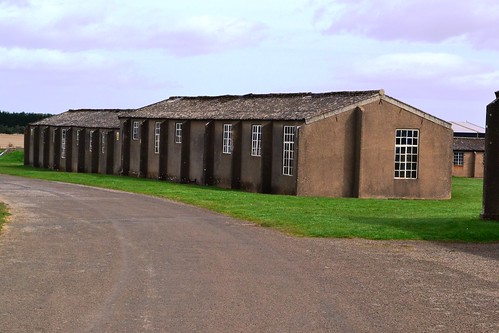
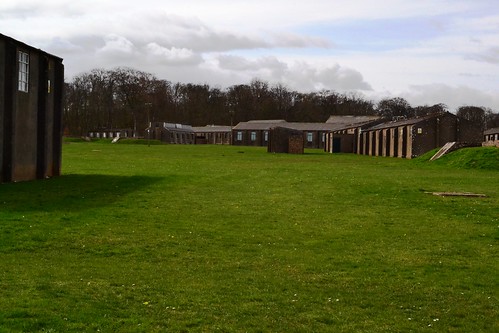
We saw  with the expansion of Britain’s airfields in the 1930s, how buildings changed dramatically from wooden construction – such as RAF Castle Camps – to more permanent (although classed as temporary) brick buildings, many examples of which survive in a preserved state at RAF Bircham Newton.

Technical buildings in use today. At the former RAF Snetterton Heath, technical buildings have survived as small industrial units.

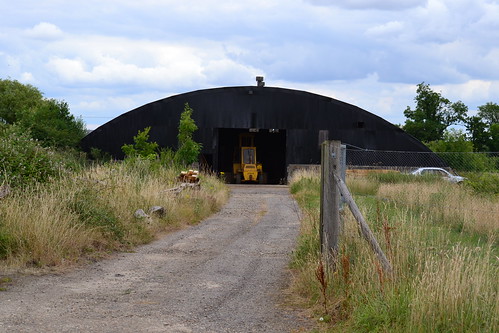
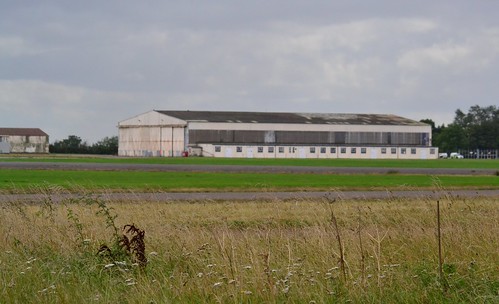
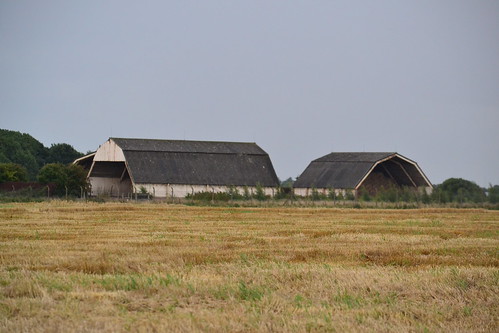
We saw the development of the hangar, one of the most recognisable and distinguishing features of an airfield, from early wooden sheds through canvas doored Bessoneaux hangars, to metal hangars of over 150 feet in length. Many of these buildings still exist today, absorbed into farms or used for storage. Examples are thankfully still relatively common with some found at RAF East Fortune (now a museum), RAF Methwold (farmland), RAF Little Snoring (a light airfield) and RAF North Creake.

RAF Waterbeach 'J' Hangar RAF Waterbeach’s ‘J’ type hangar with a ‘T2’ behind. Waterbeach like so many, is an airfield embroiled in the planning process.

Runways to allow bigger and heavier aircraft to use them, grew from short grass strips to those of wood chip, tarmac and concrete of 2,000 yards in length and 50 yards wide. Some of these even exceeded a massive 3,000 yards in length. Many of these pathways continue to exist today in some form or other, RAF Eye (industrial), RAF Cottam (built and never used), RAF Debden (currently an army barracks), RAF Deopham Green (farmland) and RAF North Witham (an open and public space) are some of the better examples we can find today.

RAF Great Dunmow RAF Great Dunmow typifies the state of many of the better examples of these massive runways today.

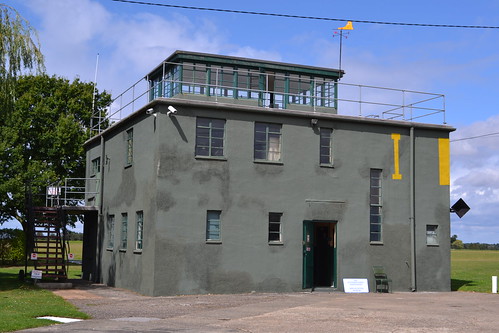
The Watch Office, another distinguishing feature, lay central to the operations of a wartime airfield. Again its development was rapid and complex. Some thankfully have been restored as museums such as those at RAF Framlingham (Parham), RAF Debach, RAF East Kirkby, and RAF Martlesham Heath. Some are now derelict, decaying memorials to those who served. Examples found at RAF Winfield, and RAF North Pickenham, are particularly severe, whilst many are used for other purposes such as RAF Matching Green (radio); RAF Attlebridge (offices) and RAF Rattlesden (a glider club).

RAF Bury St Edmunds (Rougham) At Bury St. Edmunds (Rougham) the watch office is now restored and forms the main part of the museum.

There are numerous examples of other buildings on some of these sites, many are now part of small industrial complexes, workshops that were once used to repair aircraft parts now repair cars or other small items. Their original features often hidden by new cladding, overgrown weeds or a change in frontage. Slowly, but surely, they are gradually disappearing from our skyline.

The purpose of theses places was to wage war. In doing so many lives were lost, both military and civilian – on both sides. As a result, many heroic acts of bravery and self-sacrifice took place. The VC, the highest award given to members of the British armed forces for gallantry “in the face of the enemy”, was awarded to two pilots: Flt. Sgt. Arthur Louis Aaron, V.C., D.F.M. and Sqn. Ldr. Ian Willoughby Bazalgette (RAFVR) VC., both flying from RAF Downham Market. The American S.Sgt. Archibald Mathies, USAAF, 510th BS, 351st BG, was one of many Americans awarded the Medal Of Honour for his valour in combat whilst flying from RAF Polebrook, another was 2nd Lt. Robert E. Femoyer MOH, 711th BS of RAF Rattlesden, for his actions over Meresberg.

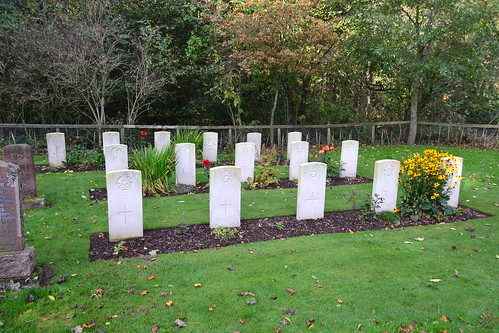
Losses were high both in combat and also during training. This year, I managed to visit several training stations of which two RAF Chaterhall and RAF Milfield had high losses of trainee pilots. Many are those are buried locally, and one delightful small church I visited at Fogo, had almost as many war dead as it did living inhabitants!

Fogo Church The church yard at Fogo has 16 war dead, most from the nearby training airfield RAF Chaterhall.

All in all its been a fascinating journey, I have entered the lives of many people who fought for what they believed in. I have read their stories, visited the very places they served at, and in many cases, the graves in which they now lie.  These decaying sites are the true monuments to their sacrifice. The buildings that once housed these young men stand as a lasting tribute to them, I hope that their memories never fade away in the way that many of these sites now have.

I’d like to thank you for taking the time to join me on this journey, I hope you have enjoyed reading about them as much as I have enjoyed visiting, researching and writing about them. I look forward to you joining me next year as we travel on many more trails around Britain’s disused airfields.

A Merry Christmas and a Happy New Year to all!

Andy.

RAF Brunton – A little known about airfield.

In this the second stop on our trip to Northumberland, we travel close to the North Sea coast not far from the eastern borders of England and Scotland. A small airfield, this was the satellite to RAF Milfield, and performed an important role in the Second World War. You cannot mention Milfield without reference to this airfield, and vice versa. Here we stop off at that little known about site RAF Brunton.

RAF Brunton.

Brunton is located some 3.5 miles to the south-east of Seahouses, a short distance from the Northumbrian coast. The village it takes its name from sits alongside the airfield, and is made up of a handful of buildings – primarily farmhouses. It is an open and flat area ideal for an airfield, and only a short flying distance away from its parent airfield RAF Milfield.

Brunton was designed as a satellite, and even though it was not a major airfield, it more than fulfilled the role of one. A constantly busy site, it somehow managed to ward off the high numbers of tragedies, losses and accidents that dogged Milfield and many other aircrew training facilities.

Brunton was conceived during the development of Milfield, when the need for another site was soon realised. The land on which Brunton stands was requisitioned in 1941, opening for business in early 1942. With its three runways forming an almost perfect equilateral triangle at its centre, it had a 50 yard perimeter track and twenty-five hardstands of the frying pan style. The longest of the three runways ran slightly off north-south, and was originally built to a length of 1,600 yards – it was later extended to 2,000 yards. The second and third runways, intersecting almost at their centre, were both 1,100 yards and were also extended but to 1,400 and 2,000 yards respectively.

RAF Brunton

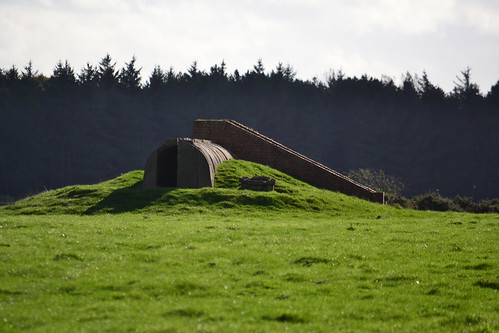
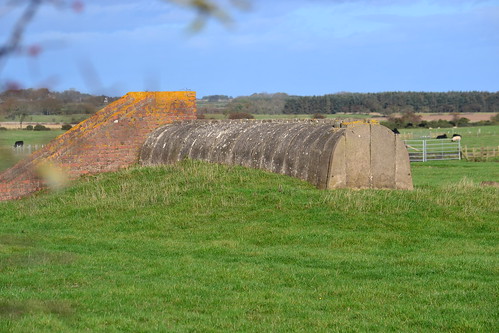
One of several exposed shelters at RAF Brunton.

Unusually, the accommodation areas were all closely tied together, a rare feature that placed them to the south of the airfield straddling the local railway (now the East Coast main line from which views can be seen as you pass by). Being a satellite, Brunton was only designed to accommodate small numbers of personnel, upward of some 750 men and women of mixed ranks.

As a satellite, there were no permanent hangars built, but four blister hangars were erected around the site, and used to maintain the aircraft. These Blister hangars (a name given to cover a wide range of arched aircraft shelters initially designed by architects and engineers, Norman & Dawbarn and William C. Inman of Miskins and Sons) were known as Dorman Long hangars, and were built to design 4630/42. At slightly under 72 feet in length they were 45 feet wide with a height of over 20 feet. Dorman Long hangars differed in design to other hangars by being constructed of four sections each held together by three RSJ type ribs, and ‘I’ shaped Purlins along the roof. These hangars were also bolted to foundations rather than staked to the ground like the more conventional blister hangars in use at that time. A similar hangar was used at RAF Sawbridgeworth in Hertfordshire – none of which survive today.

As a satellite, Brunton would work closely with its parent. It would be used in the second part of the 9-10 week pilot’s course to train pilots in formation flying, ground attack and strafing techniques. In the ground attack role, pilots would use a mix of rockets, bombs and cannon to destroy dummy convoys and strongholds. There were a number of ranges in the region providing targets for this particular role; Brunton aircraft predominately using the gunnery range at Goswick Dunes on which numerous ex-army vehicles, including Churchill Tanks, were placed.

Even before Brunton officially opened, it would witness a tragic accident in which it became the final resting place of one Whitley bomber, and three of its four crew. On November 6/7th 1941, whilst on a training flight, the MK. V Whitley (Z6932) of 10 Sqn, RAF Leeming, became lost in poor weather due to a failure of its navigation equipment. After landing on the partially built site, the Whitley took off again, heading south in an effort to locate its home base. As it lifted off, it struck a steam roller causing the aircraft to jolt and strike live high tension cables. The aircraft burst into flames and subsequently crashed. The Wireless Operator/Rear Gunner Sgt. Robert Whitlock, RAFVR (s/n: 163028) was pulled free by a crew from the local search light battery, but the remainder of the crew: Pilot F/Sgt. William Stuart RCAF, (s/n: R/60298) P/O. Richard. S. Austin, RNZAF, (s/n: 403785) and Observer Sgt. P. Bryant, RAFVR, (s/n: 976876), all perished. Bryant was a mere 23 years of age whilst Stuart and Austin were both just 21 years old.

Brunton’s opening in the summer of 1942, coincided with the start of operations at RAF Milfield, Brunton’s first residents would be 59 Operational Training Unit, a unit set up to train pilots for Fighter Command.

59 OTU operated the Hurricane, many of which were themselves veterans of the Battle of Britain. War-weary and battle-scarred, they were joined by a number of other aircraft types including Magisters and Fairy Battles. These flights would take the now adept pilots and train them to fly in formation and at low-level. A speciality would be to fly across the sea, at low-level, turn toward land and then strike at land based targets with bombs and canon or later rockets.

During the Spring of 1942 it was decided to allocate reserve squadron numbers to Operational Training Units, these numbers being in the range 551 – 566. The idea behind this plan – code name ‘Saracen‘ – was to create a series of squadrons that could be mobilised at a moments notice to counteract an imminent German invasion threat. The plans were later revised under the codename ‘Banquet‘ but would remain, in essence, in its original form well into 1944 before being seen as unnecessary, and so  withdrawn. At Brunton, 559 Sqn was allocated, (500 was generally added to the OTU number to create the reserve number) but the pilots of 31 Course, like many others, were never officially mobilised. However, Brunton was run as if it were a fully fledged operational squadron, the same rules and regulations, with two flights ‘E’ and ‘F’ both operating the Hurricane MK.I.

Flying with old and war-weary aircraft was difficult. Many would suffer engine fires, oil leaks or complete engine failures – some whilst in flight – and they rarely flew without the need for excessive trimming or constant adjustments to flying controls. These continuing problems would hound the pilots and ground crews for months, but undeterred they carried on, and morale remained particularly high.

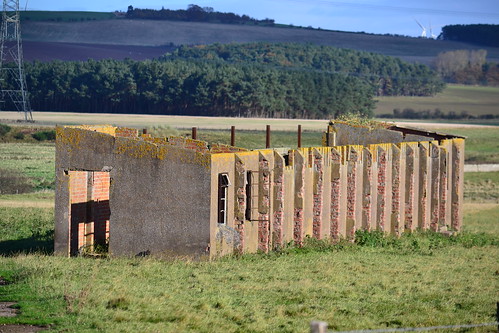
RAF Brunton

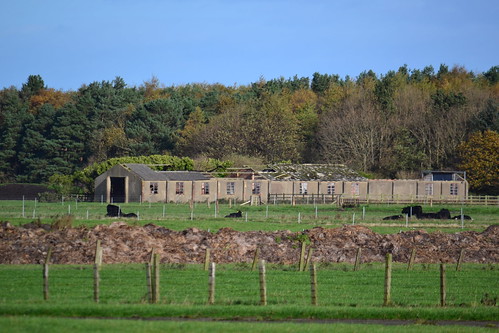
A very small number of buildings exist dotted about the former airfield. Thought to be the former flight offices, these examples are the largest.

On October 13th 1942, one of these Hurricanes would suffer from such a problem and its engine would fail causing the pilot to crash-land. A MK.I  Hurricane (P3524) it would be forced to land in a field not far from Alnwick, the county town a few miles to the south-west of the airfield. The aircraft was slightly damaged in the incident but fortunately the pilot, Sgt. C. Tidy (s/n 1042890), would walk away unhurt. In carrying out the controlled crash, Sgt. Tidy would steer his aircraft down missing a nearby school, but as he exited the aircraft, the documents he was carrying were scattered to the four winds. Wanting to do their bit, a local school master organised a search party with the boys in his care, and the documents were all gathered up and retrieved successfully. *1

Brunton, like Milfield, would have a high turnover of visiting aircraft. Many would come from Milfield, but some from much further afield to practice landings at night or as pilots transferred from one aerodrome to another. Some aircraft were also using Brunton as a safe haven, getting down after getting in trouble in the air. In March 1943 a Hurricane MK. I (W9121) of 59 OTU based at Milfield  crashed whilst on final approach at night to Brunton airfield. The pilot, Sgt. Cullener was very sadly killed in an event that was repeated in early 1944, when another Milfield 59 OTU Hurricane MK.I (P3104) also crashed on its approach to Brunton.

The dawn of 1944 saw 59 OTU along with the Specialised Low Attack Instructors School  (SLAIS) (also formed in 1942 at Milfield) disband, being replaced by a specialised unit the Fighter Leader School. The FLS was a unit designed solely to train pilots in the ground attack role and was set up primarily in preparation for the forthcoming Allied Invasion of Normandy. With this change so came a change of aircraft type, the Spitfire VB and MK IX now becoming the main aircraft operated in place of the Hurricane. The FLS would make great use of Brunton, training many pilots until it moved to Wittering at the end of 1944.

But not all staff would vacate Brunton in this move. A small detachment remained behind to give support to the build up of the newly reformed 56 Operational Training Unit who were brought together, both here and at Milfield, in place of the vacating FLS. This meant that the two sites would continue to operate very closely, but now using the heavier radial engined Tempests and Typhoons still in the ground attack role rather than the previous Spitfires and the now vulnerable Hurricanes of before.

The Typhoons came in with a number of teething troubles, one such attribute was the propensity to lose its tail plane during mid-flight, or the engine suffering a blow-back resulting in a fire in the engine or worse still in the cockpit. These issues were soon dealt with  though, and the Typhoon went on to become renowned as a ground attack aircraft, with its bombs or rockets proving devastating weapons in the role.

Av Typhoon IB JP853/SA-K of No 486 Squadron (Tangmere) (IWM CH 11578)

Brunton continued its close relationship with Milfield, supporting its 140 aircraft. Course No. 1 would begin in that January of 1945 and through it a large number of pilots would pass on their way to new roles in the European campaign.

Even as the war drew to a close accidents were still to happen and Brunton was no exception. In early January 1945, whilst being ferried from Milfield to Brunton Typhoon IB. (RB343) developed engine failure on take of at Milfield causing it to lose height and ultimately crash into the ground. The pilot, Canadian born P/O Nelson I. Gordon (J88818) was killed. Then just a month before the end of the war on April 9th, Tempest MK. V (EJ845) swung on take off at Brunton colliding with a wind sock. The accident took the life of another Canadian pilot, 32-years-old F/Lt. Ivan W. Smith (J22244) RCAF; he remains buried at Harrogate (Stonefall) Cemetery in Yorkshire along with over 1,000 other war dead.

Gradually though, the need for ground attack pilots diminished and Brunton, no longer required, was earmarked for closure. The war finally came to a close, and on February 14th 1946, 56 OTU were disbanded and the RAF pulled out of Brunton almost immediately. The airfield was now all but deserted.

After the war, for around 20 years, the Borders Parachute Centre occupied Brunton, until the land was sold, and the owner gave them notice to quit. Their lease ran out in 2004 and the club closed on the site. During this time a small contingent of RAF personnel were brought in when a radar facility was set up on the eastern side of the site. This too eventually closed though, and the personnel were pulled out. A small number of private pilots used the airfield to store and fly their aircraft from, it is believed they too have had to vacate the site, although this is not certain.

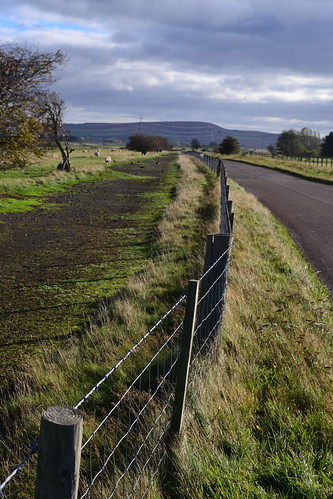
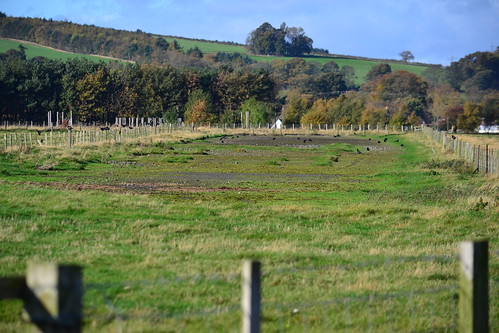
A large portion of the airfield still exists and in very good condition today. If travelling toward Brunton village you pass beneath the main East Coast main line railway, and on into the village. This road was the original entrance to the airfield, with the main technical area to your left. Now only farm buildings stand here, but the concrete pathway is still visible as it leads away to the main airfield site. Views across the airfield from this point offer little advantage, so turning back and driving along side the railway  down a single track, will lead you along the western side of the airfield and toward the back of the site. This is another original road and provides much better, but still limited, views of the site. The runways and perimeter track are present and many air raid shelters are also present along this western side. The remainder of the buildings from these various sites are now gone.

The small radar / monitoring dome is also still present but on the eastern side of the airfield, and although information about this is scarce, it was linked to nearby RAF Boulmer, and manned by RAF personnel. Boulmer which is currently the home of the Air Surveillance and Control System (ASACS) plays a key role in the home defence of the United Kingdom. Boulmer is linked to a number of monitoring stations around the British Isles and monitors, around the clock, an area of over one million square miles of airspace. This airspace stretches from the northern tip of Norway to as far out as Iceland and beyond, and encompasses the whole of the United Kingdom. With links direct to the QRA sites at RAF Coningsby, it monitors and tracks all aircraft activity around British Airspace, and in particular Soviet intrusions into this Airspace.

RAF Brunton

Another of the exposed shelters to along the western boundary. The taxiway of a short distance from here.

Brunton, whilst only a satellite, proved its worth during the Second World War. It trained numerous pilots in the art of ground attack techniques, and was pivotal in both the Normandy invasion and the drive on through occupied Europe. Visited by many commonwealth pilots, it was more ‘relaxed’ than other wartime airfields, but always maintained the highest of standards, operating as strictly and smoothly as any operational airfield of the Second World War.

Sources and further Reading.

*1 Article appeared in “The Northumbrian Times – No. 28” and was quoted in Walton, D. (1999), Northumberland Aviation Diary, Norav Publications.

RAF Milfield – Arguably One of Britain’s Most Significant Airfields.

High up in the northern most reaches of England is an airfield that has repeatedly appeared in the memoirs of many RAF and USAAF pilots. Not because it was a busy front-line station dealing with the constant battle against marauding enemy bombers, but more simply because it was a training station. However, this airfield was no ordinary training facility. It operated a large number of aircraft whose pilots played a major part in both the Normandy landings and the drive on through France and the low countries. In this, the next trail, we visit Northumberland, and a place where ground attack pilots honed their skills, perfecting the use of rockets, canon and bombs, in the destruction of enemy troop convoys, trains and tanks. The first stop on this trail is an airfield that is arguably one of Britain’s most significant airfields – RAF Milfield.

RAF Milfield.

RAF Milfield lies a short distance from the village it takes its name from, at the foot of the Cheviot hills on an area known as the Millfield Plain. It is an area steeped in history. On this site, evidence has been found of Neolithic hearths, storage pits and post holes.  There is also evidence of two Bronze Age circular houses and a further three rectangular houses dating back to the ‘Dark Age’; an age that probably pre-dates the Anglo-Saxon conquest of the area from around AD 547.

This area was also the scene of many fierce and brutal battles between the English and the Scots, The Battle of Homildon Hill and the Battle of Flodden were both fought within a few miles of this very site. In both these conflicts, heavy casualties were suffered by both sides, and it is therefore, an area that is both used to war, and one that is rich in historical interest.

RAF Milfield

The Perimeter track is now the public road, parts lay visible alongside with associated dispersal pans.

As a military aviation site, Milfield came into being during the First World War. One of several such sites in the region that was used as little more than an emergency landing ground by 77 Squadron who were based further north at Edinburgh. Known at the time as Woodbridge, it would be a quiet little site that would soon disappear, quickly returning to its agricultural roots once war was over.

As a second war with Germany seemed inevitable, the need for new airfields became evermore apparent, and so the Air Ministry implemented the airfield expansion scheme. This programme developed so quickly that by 1942 there was a front line airfield opening at the rate of one every three days! As the German forces moved ever more quickly, and the Fall of France led to the Battle of Britain, the need for fresh, well-trained pilots became paramount. With home reserves drying up, the Commonwealth became an untapped source that would fill the ever-increasing void that was becoming a thorn in the side of the RAF.

Trained only in basic flying techniques, these crews had to be battle hardened and fit for action in a matter of weeks or even less. Initial training operations were mere ‘lip-service’ and recruits often had as much chance of killing themselves as they did the enemy they were intended to down. To meet this demand, numerous training stations were created, manned mainly by Operational Training Units (OTU), they were governed by the various arms of the Air Command: Fighter, Bomber, Naval, Transport etc.

At these training sites, crews would in essence, perform a ‘post-graduate’ training exercise, where they would be assembled for the first time and trained in their respective roles on the aircraft they would be expected to fly operationally. Milfield would be designated as one such station, and was initially identified as a suitable location for a bomber command site. Following requisition of the land in early 1941, the green-light for development was given, the process was put into place, and RAF Milfield was born.

Before any bomber crew would use Milfield though, it would pass from Bomber Command control over to Fighter Command whose focus would now be fighter pilots, and in particular, those specialising in both ground attack and dive bombing techniques.

As pilots came from all across the world, their training standards were some what disjointed, and so a refresher course bringing all crews up to the same standard would be required. This was a role that Milfield would fulfil. Working in conjunction with its satellite station a  few miles to the east, RAF Brunton, Milfield crews would spend some 9 to 10 weeks in total on flying techniques, both solo and formation flying, with the more advanced training taking place at RAF Brunton.

Nestled between the main road and the River Till, Milfield would be built to bomber station specifications, the three runways being wood chip and concrete one of 1,400 yards and two of 1,100 Yards. During development and subsequent handover to Fighter Command though, the new Class ‘A’ airfield standard would come in to being, requiring all airfields to be built with a longer runway specification. However, being a fighter training site, these were not imposed and whilst two of the runways were extended (1,800 and 1,300 yards) they were not to the full Class A specification.

RAF Milfield

The runway threshold is still surviving, note the close proximity of the hills in the background.

As a training airfield it would be exceptionally busy. An expected turnover would be a new course starting around every 3 weeks, which would mean a considerable number of aircrew and aircraft; in excess of 100 air frames would be located here at Milfield at any one time. The primary fighter aircraft at this point would be the Hurricane with other examples including the Miles Master and Magister. To repair and maintain the aircraft, two T2 hangars were constructed with a further eight blister hangars located around the dispersal areas. Squadron dispersal huts were spread around the perimeter, with the technical area and main hangars being located to the south-eastern side. Accommodation, designed to be temporary, was dispersed over 13 sites, and would be designed to accommodate in the region of 1,650 staff, both male and female. Like many airfields though, this figure was surpassed with the actual ‘on roll’ totals varying considerably reflecting the constant movement of staff. Including the numerous support staff, it is believed that some 3,300 people were employed at Milfield at its height.

Adjacent to the airfield was the former Galewood Farm House, an old farm building used as an Officer’s mess during the airfield’s operational life. Destroyed in the 1960s, it was once part of an estate that adjoined the airfield, and was previously home to Josephine Butler. Josephine was the leader of a national women’s political campaign in Victorian England, who campaigned on behalf of prostitutes, abused and trafficked women until her death in 1906*1. Now commandeered by the military, a snooker table with lights powered by a generator was placed inside, and nearby stood the NAAFI theatre, the recreational building showing the usual films to keep the personnel entertained.

It was during this construction period that the first enemy action would occur over Milfield. On September 1st 1941, at 23:00 hrs, six bombs were dropped in the vicinity of Milfield. A crater 72 feet wide and 10 feet deep was recorded, the road was blocked and telephone lines were brought down. Also during this time, and whilst not officially open, aircraft would land at Millfield, presumably as test landings or after getting into difficulty. One of the first casualties here was that of Sgt. James B Spangler (R71573) RCAF flying Hurricane V7044 on 25th June 1941, who was “killed in the course of a training flight” whilst flying with 59 OTU. This tragic accident would be a sign of things to come.

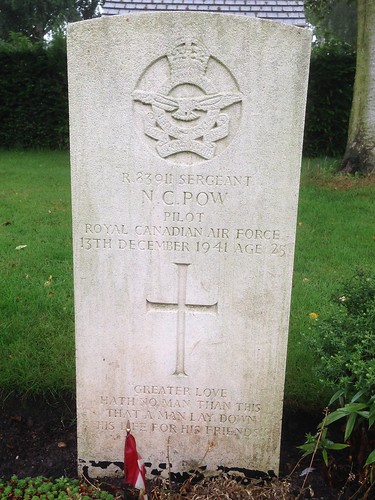
Because of the nature of training flights, accidental deaths on or around Milfield would become fairly common. These included on October 6th, 1941, Hurricane MK. I W9177 which was forced to Bellyland in a field near to Stocksfield just west of Newcastle-upon-Tyne. On 13th December 1941, Sgt. Norman Clunie Pow, (R83911) RCAF, again of 59 OTU, crashed in Hurricane P3809. Sgt. Pow was just 25 years of age and was buried some several hundred miles away next to RAF Sutton Bridge in Lincolnshire, another training station.

Sutton Bridge Churchyard

Sgt. Pow’s grave at Sutton Bridge.

As a training airfield, no operational front line squadrons would use Milfield, other than a detachment of 184 Sqn Hurricane IIDs between 1st December, 1942 and 1st March, 1943. The only other use of Milfield by ‘front line’ units would be as a transit base in the early post-war months.

The first full unit to arrive was that of 59 Operational Training Unit (OTU), arriving in the August of 1942.

59 OTU were originally formed at Turnhouse in December 1940, and operated amongst other things, the Hurricane, the Magister, the Fairy Battle and finally Hawker’s Tempest, all in a training capacity. After spending some five months at Crosby-on-Eden, the unit transferred to Milfield where they trained pilots in the ground attack role. As with many training stations, casualties were high, with many accidents happening through either pilot error or mechanical defects. Many of the Hurricanes used here were veterans themselves, beaten and patched up following intensive fighting in the Battle of Britain, many were long past their sell by date.

One of the first accidents to occur was that of Sgt. K. Dole, RCAF, who stalled whilst performing aerobatics – either authorised or not. His aircraft, a Hurricane MK.I ‘V7316’, MF 89 of ‘Z’ flight 59 OTU, crashed on farmland near Cornhill in August 1942. Luckily Sgt. Dole was unhurt, and the aircraft was salvaged; being repaired and sent to operations in the Middle East. The same fate however, did not fall to P/O J. Methum, who was killed in early September 1942, when his Hurricane MK.I ‘V6840’ crashed in a forced landing a few miles away to the east. The aircraft was written off in this most tragic of accidents.

The dangers of training became evermore apparent over the next few months, Saturday 27th March 1943 being particularly poor for 59 OTU with two crashes on the same day.  Hurricanes Mk.I ‘W9184’ and ‘W9121’ crashing in forced landings and night landings respectively. Both pilots were killed that day; Sgt. Robert MacFadzean (s/n: 1349862) born of US resident parents, and Welshman, Sgt. Gordon Cullener (s/n: 1383311).

Four months after 59 OTU’s arrival, No 1 Specialised Low Attack Instructors School  (SLAIS) would also be formed here (7th December, 1942) another unit that used the Hurricane and the Magister. One of the Chief Instructors of the School would be Squadron Leader J.H. “Ginger” Lacey DFM and Bar, a Battle of Britain Veteran who ended his career with 28 confirmed kills.

Hurricane MK.IID of No. 1 Specialised Low Attack Instructors School being refuelled and rearmed by Ground crew, including a WAAF, on a wet dispersal at Milfield. The fairings covering the two Vickers 40mm anti-tank guns beneath the wings have been removed and a warning notice hung from the barrel. (IWM CH 18134)

Low flying, in even in the relative safety of Northern England, was not immune from accidents, mishaps or misjudgements by the pilots. On 21st February 1943, Hurricane MK.II ‘HW731’ of the SLAIS hit an obstacle one mile north of Beal, the pilot escaped unharmed and after nursing the aircraft back to Milfield, it was repaired and converted for ground training purposes as ‘4616M’.

As flying training continued, so too did the number of accidents, burst tyres, engine malfunctions and fires, pilot error and collisions accounting for a wide range of them. On April 27th 1943, two Hurricanes collided in mid-air whilst performing formation flying. Both airmen, F/Sgt Davies and F/O Thompson were killed; an event that was mirrored in the following July when Hurricanes ‘P3475’ and ‘V7173’ also collided again with fatal results. New Zealander Charles Humphrey (s/n: 421056) is buried locally.

On May 1st 1943, 59 OTU transferred from 81 Group to No. 9 Group, at which point 81 Group was disbanded. No 9. took over 81’s responsibility, and it remained primarily a training arm of the Royal Air Force. For 59 OTU though, little would change.

On September 16th 1943, a B-17F-BO  (42-30030) named ‘Old Ironsides‘ ran out of fuel whilst returning from La Rochelle. The pilot Lieutenant Henry J Nagorka, decided to ditch in the sea near Farne Islands, off the Northumbrian coast. The aircraft quickly filled with water and in under four minutes she had disappeared beneath the waves.

During the ditching two crewmen were lost, waist gunners: S/Sgt. Ed Christensen and S/Sgt. Claude Whitehead, whilst the tail gunner S/Sgt. Harris lost a leg. Those that survived managed to climb into a dingy and sailed to St Cuthbert’s Island where they awaited rescue. Upon being saved, they were transferred to Milfield, where they were collected by another B-17 from the USAAF. However, as Milfield was a fighter airfield and its runways hadn’t been extended to Class A specifications, there were doubts about the aircraft’s ability to get off the ground on the short space available. To overcome the problem, the hedges at the end of the runway were removed and steal planking temporarily laid, the problem never arose though as the B-17 along with its additional human cargo left Milfield safely.

B-17F ‘Old Ironsides’ 42-30030, was loss at sea on the 16th September 1943 with the loss of two men. (IWM UPL 28296)

On January 26th 1944, both 59 OTU and the SLAIS were disbanded and a new unit formed, the Fighter Leaders School (FLS). The School had its origins in 52 OTU formed at Chedworth, and was in January, created as a unit in its own right. Formed through the need for more ground attack pilots in preparation for the forthcoming invasion, it was a unit that would take on the responsibility for the majority of the RAF’s ground attack crews. One notable figure of the FLS at Milfield was Bob Doe DSO, DFC & Bar, another veteran of the Battle of Britain. He would later return to operational duties after his short stay here in Northumberland.

Using the codes HK, OQ and MF, the FLS operated a number of aircraft predominately Spitfire VBs, and Spitfire MK IXs along with a handful of other marks. It later went on to adopt the Sabre engined Typhoon IB. In total over 130 aircraft would be used by the  Milfield unit, an incredible amount of aircraft on one site at any one time. Milfield continued to be in the spotlight.

It was also during this time, early 1944, that the USAAF would begin to send their pilots to Milfield to train on their ranges. With them, came a variety of US built aircraft, P-38 ‘Lightnings’, P-47 ‘Thunderbolts’ and the P-51 ‘Mustangs’. The brainchild of General Quesada, the plan was to train Ninth Air Force pilots in the art of dive bombing, skip bombing and low-level attacks, techniques that would become paramount if the push through France and on into Germany was to succeed. The arrival and increased use of Milfield by the US crews gave an indication that the impending invasion was drawing ever closer.

One of the earliest accidents for the FLS was in March of 1944, when Mohawk MK.III AR633 of 510 Squadron was hit by a Typhoon (JR509) of the Fighter Leader School on take off. Also on this day, a Spitfire MK.IIa (P8549) of the FLS tragically blew up in mid-air during a dive bombing attack on the Goswick ranges. The pilot of the Spitfire, F/Lt. Bouquen, a Belgian, was killed in the incident.

About a month later, a flight of four P47D Thunderbolts from the 366th FS (358th FG) from RAF Raydon attached to Milfield, were carrying out practice strafing attacks on a military convoy. During the climb out of the attack, one of the Thunderbolts (#42-25530), piloted by 1st Lt A. Serapiglia collided head on with Spitfire Mk 1 ‘R6762’ which was preparing to land at nearby RAF Eshott. In the collision, both pilots Sgt. Kai Knajenhjelm a 19-year-old Norwegian and Lt. Serapiglia were killed. After the investigation it was deemed that all future exercises should be performed “outside of local flying areas” of nearby airfields, something that perhaps seems obvious today, but reflects the hectic and often frantic skies over northern England in the 1940s.

A further accident to befall the Americans occurred on May 27th 1944, when a P-38 ‘Lightning’ #42-67425, of the 392nd FS, 367th FG piloted by Dueron H. Robertson, of the Ninth Air force, suffered a landing accident. The aircraft suffered major damage in the crash.

One of the benefits of attending the FLS was the diverse range not only of nationalities: Dutch, Czech, Canadian, Australian, New Zealand and South Africans to name but a few, but also the range of aircraft used. At the end of courses, trainees – now fully fledged fight pilots – were sometimes given the opportunity to try out other types of aircraft. An action that no doubt put the fear of God into the Station Commander who was heard to have shut his door and say “to hell with it”*2 . A number of other incidents occurred during this hectic time, which saw, by the end of December 1944, the FLS being absorbed into the Central Fighter Establishment based at RAF Wittering. Following this, the staff at Milfield all moved out, and momentarily peace prevailed once more.

Between mid December 1944 and into early January 1945, 56 OTU was reformed. Previously at RAF Sutton Bridge in Lincolnshire, it brought new aircraft, to the area, and Northumbria now reverberated to the radial engines of the Typhoon IB and the Tempest V; as four squadrons operated the aircraft using the codes FE, GF, HQ and OD. A collection of other aircraft types also graced the skies of this now highly significant airfield, Spitfires, Tiger Moths, Leopard Moths and Magisters to name but a few.

Even though the war in Europe was winding its way toward its conclusive ending, priority for aircraft was given to this purposefully created unit, and practice flights continued in earnest. The skies remained busy and accident numbers remained high.  In the space of one month between mid January and mid February 1945, there were no less than 8 incidents involving aircraft from Milfield and 56 OTU. As with many incidents here, poor weather, engine failures and pilot error were the causes of many  aircraft abandonment, pilot injuries and tragically deaths. In these eight incidents six involved Typhoons and two involved Tempests.

RAF Milfield

MG & Cannon Range building, one of the few remaining structures at Milfield.

March and April were similar stories, accidents, mishaps and deaths continued to plague Milfield, with pilot error accounting for a larger number of the accidents. Perhaps one of the most bizarre incidents took place on March 8th 1945 when the leader of a Spitfire squadron ‘deliberately’ attacked a Typhoon Mk.Ib ‘MP187’ of 56 OTU, killing the pilot F/O. R Smith of the Royal Canadian Air Force. The Typhoon was commonly mistaken for the Luftwaffe’s Focke Wolf 190, a formidable beast that became the scourge of the USAAF bomber formations.

The closing stages of the war didn’t bring a respite either. Saturday 12th May saw a collision between Tempests ‘EJ685’ and ‘NV759’ an event that killed an instructor pilot. Even after the war’s end, accidents continued to occur, with June, July, August and September all witnessing  further deaths and incidents. August 23rd saw Typhoon ‘SW638’ collide on the ground with two other aircraft, both those struck were written off whilst the ‘offending’ aircraft was badly damaged.

At the end of the war, and over just a two-day period, the only two operational units to use Milfield would arrive, using it as a transit stop. Both 164 Squadron and 183 Squadron would arrive and depart on the same day 16 – 17th June 1945 bringing with them yet more Typhoons.

Eventually, nearly nine months after the war’s end, on February 14th 1946, 56 OTU were disbanded, but not before one final roll of the dice when the life of an RAF pilot was taken. On January 29th 1946, whilst on a “Camera Exercise” and after performing a slow roll ten miles west of Holy Island, Tempest Mk. V EJ859 piloted by F/Lt. Vincent Parker (s/n 42356) RAFVR, an Australian aged 27, dived into the ground killing him. In a cruel twist of irony, F/Lt Parker was killed after having survived as a prisoner of war since 16th August 1940. He had remained in a German POW camp until its liberation at the end of hostilities, returning to England in June 1945, his post-war, peacetime life had been shorter than his life in captivity.

The departure of 56 OTU signified the end of the RAF’s interests in Milfield, and although not a front line operational airfield, it had become a very active and played a highly significant role in fighter training and development. Used to train both new and experienced pilots, it had become one of the RAF’s top fighter pilot training stations, developing pilot’s proficiency in low-level weapons delivery techniques. No matter how dangerous the training got, crews had continued to pass through, morale had  remained high and the standards were never dropped. Of the 1,200 pilots who had passed through here, many went on to make their names as the top ground attack pilots of the Second World War.

Immediately after the war, many of the accommodation huts were used to house Latvian soldiers, many staying here up until 1950. Local people were then housed in refurbished WAAF blocks before moving on to more permanent housing in the local village.

Soon after, Milfield began its decline with many of the buildings being demolished over the coming years. During the cold war era, the two T2 hangars were designated storage units for dried foods and emergency rations, thankfully a role that never had to be called into operation.  Eventually the runways were dug up and removed for hardcore, quarrying took over the southern end of the airfield and much of the surface layers were removed in the process.

During the 1970s investigations were carried by Air Anglia into the possibility of commencing commuter flights to European cities, but the project failed to ‘get off the ground’ and the service was scrapped before it ever developed into anything more than investigative flights.

Now partly returning to agriculture, a small section of the airfield has been retained by the Borders Glider Club*3 . The battle to keep gliders and flying here alive, being a long and difficult one. Through this small organisation, that operates only at the weekends, the spirit of flying lives on, and Milfield continues to fight for survival, a fight that has been both emotive and historically significant in the battle for the skies over Britain. The T2s have now gone as has virtually all the remaining buildings. A stone statue built by an Italian POW who was employed on the local farm, stands on private land, marking what was the official entrance to the airfield during the war years, it is clearly visible from the road side.

RAF Milfield

One of two sculptures, one made by an Italian POW, the second copied by an RAF serviceman.

Located four miles north-west of Wooler and Visiting today, there is some evidence of the former airfield left. Small sections of the perimeter track are now the public road, but alongside the road,  the remainder of the track can just still be seen. The north-western end of the runway is also visible as are a small collection of dispersal pans.  The MG & Cannon Range building still stands, minus its roof it is rapidly decaying, it has a very short life left.

Interestingly, as a training airfield, Milfield used both a Fisher Front Turret Trainer and Hawarden Trainer, a simulation trainer that used the fuselage of a Spitfire to train pilots in interception techniques. A model suspended from the ceiling up to 60 feet away from the pilot could be moved forwards or backwards by operating the opposite movement of the Spitfire’s throttle. As the Spitfire ‘accelerated’ the model moved backwards along a rail, rather similar in design to a 1970’s child’s toy. During these sessions a range of flying skills could be tested, interception and aircraft recognition, throttle control and cockpit procedures included. A primitive method that was state of the art in 1941. Sadly neither of these exist today.

Two memorials are located at this site, the first in a public car park to the western end of the airfield, next to the Maelmin heritage trail. The second is located outside the club house of the Borders Gliding Club, approximately on the site of the former watch office, itself no longer there. This memorial was commissioned by the club entirely through donations and is their way of acknowledging the sacrifice of those who flew from Milfield.

Interestingly a comment made by visitor Reginald Hall states that his wife’s uncle, David Harrison, (born in Gateshead in 1911) was stationed here to “strip out as much non-essential equipment as possible from the planes (he said principally Spitfires) to lighten their weight and so permit a greater quantity of fuel to be carried, sufficient to enable the return flights from Milfield to Scandinavia that were required for photographic reconnaissance“. Unfortunately the exact date of this Reg is unsure of, but I thank him for his comment which can be read in full in the comments below.

Milfield is arguably one of the most significant airfields of the Second World War, many Spitfire, Hurricane and Typhoon pilots quote it in their memoirs, their time here short but memorable. Here ground attack pilots cut their teeth, low-level strafing and dive bombing techniques being honed to absolute perfection. The battle for Europe would certainly have been more difficult were it not for those daring young men who passed through this remote but historically important airfield.

After we leave Milfield, we head east, toward the coast and the satellite of Milfield. A small airfield, it too played a major part in the development of ground attack crews and it too saw many accidents and losses through its training programme. From here we go to RAF Brunton.

Sources and Further Reading.

*1 A website tells the story of Josephine Butler’s life, and another has photos of Galewood farm-house.

*2 Dunn, W.R., “Fighter Pilot: The First American Ace of World War II“,  1996, The University Press of Kentucky, Page 118.

*3 Border flying club website

The Friends of Berwick and District Museum and Archives website provide information about the archaeological history of Milfield.

A book has been published about RAF Milfield, a complementary website gives fabulous personal detail of life at the airfield and is well worth a visit.

Photos of those stationed at Milfield can be seen through the BGC Flckr account.

RAF Debden (Part 1) – The Build up to the Battle of Britain.

Not far from Wethersfield, lies the parent airfield of Castle Camps. Now closed to aviation, it currently resides in the hands of the Army as the Carver Barracks. On this next part of this Trail we wind our way through the Essex countryside to the former fighter station that gained notoriety during the early 1940s, and in particular the Battle of Britain. In this, the first part of the visit, we look into the development of the airfield, and the build up that took it into the heart of the Battle. We visit the former RAF Debden.

RAF Debden (Station 356) – Essex

The internet and history books are awash with pictures and information about RAF Debden, and rightly so. It is an airfield with an incredible history, famous for its part in the Battle of Britain and the defence of London, it was home to no less than thirty RAF squadrons at some point; it was used by the U.S. volunteer squadrons the ‘Eagle Squadrons’, and then taken over by USAAF as a fighter airfield following their official entry into the war. It was then used again by the RAF post war up until 1975 when the British Army took over,  those whose hands it remains in today as the Carver Barracks.  Not only is it history long but the site is historically highly significant. According to Historic England, Debden airfield represents “one of the most complete fighter landscapes of the Battle of Britain period“, considered historically important due to its “largely intact defensive perimeter and flying-field with associated blast pens“.*1

Debden is therefore a remarkable site, but as an active military base, access and views are understandably very restricted. However, some buildings can still be seen from public areas, particularly the front as you pass by the main entrance.

RAF Debden

One of 11 Blister Hangars built at Debden.

Debden’s life began in the mid 1930s, it eventually opened in 1937, as part of the expansion programme of the pre-war era, and was classified as a fighter airfield under Scheme ‘C’ of the airfield construction programme. During this period, great consideration was given to the architectural features of airfield buildings, standard designs being finished and positioned aesthetically in line with both the local landscape, stone and environment. Design and construction of these airfields, in this the second part of the expansion phase, was carried out in conjunction with the Royal Fine Arts Commission, whose influence led to an overall improvement in airfield design. During this phase of expansion, over 100 permanent sites were built using these new designs, in fact, according to Historic England, it is these sites that have tended to survive in the best condition to date largely thanks due to their post war and Cold War usage. Even in this pre-war period, aesthetics were as important as operability!

Built by W. L. Fench Limited, Debden wasn’t completed until after it had been opened, thus the first units there were using the site in its unfinished state. The two initial landing surfaces were grass, but as a fighter airfield little more was needed. Even so, and not long after it opened, these were replaced by concrete and tarmac surfaces, giving the airfield much stronger and more adaptable landing surfaces. Being the standard 50 yards wide, these runways were also extended from the initial 1,600 and 1,300 yards to 2,600 and 2,100 yards respectively, allowing for larger and more powerful aircraft to utilise the site.

Debden had a large number of hangars built: three ‘C’ type, one Bellman and eleven blister hangars which were all spread around the perimeter and technical areas of the airfield. Some 80 hardstands were also provided, thus large quantities of aircraft were expected to use the site at one point or another.

Of these thirty operational flying squadrons to pass through Debden, the primary aircraft to see service would be the Spitfires and Hurricanes of Fighter Command. Biplanes such as the Demon and the Gloster Gladiator were also to feature here, as were the twin-engined aircraft the Beaufighter, Havoc/Bostons and the jet engined Meteor in the latter stages of the war. The period 1939 – 1942 though, was by far the busiest period for Debden, the majority of squadrons operating from here during this time.

Upon opening in 1937, Debden would operate the outdated and obsolete biplanes of the Royal Air Force, Hawker’s Fury II of 87 squadron being the first to arrive on 7th June 1937, being replaced shortly after by Gloster’s Gladiator, that famous Biplane that protected Malta as ‘Faith’, ‘Hope’ and ‘Charity’. In the summer of 1938, prior to the outbreak of war, Hurricanes were brought in and the entire squadron moved to airfields in France where they would stay until May 1940, when France was invaded by the German forces. Brought back to England, a short two-day stop over at Debden, would lead to a move north and Yorkshire before returning to the battle, and a night fighter role over Southern England.

Joining 87 Sqn in June 1937 were further Gladiators, those of 80  Squadron who, themselves formed a month earlier, would stay at Debden until departing for the Middle East and Ismailia a year later. A third squadron would arrive during this time, 73 Squadron, who shortly after reforming at nearby Mildenhall, would also replace their Hawker Furys with Gladiators coinciding with their move to Debden. Also moving to France, 73 Sqn would eventually move to the Middle East, where they would remain for the duration of the war, flying from numerous airfields including that of Habbaniyah, one of several places where my father was stationed post-war.

One other squadron would grace the skies over Debden that year, that of 29 Squadron, whose Hawker Demons were adapted to accept a Frazer-Nash turret for defence. A small aircraft, they would be no match for enemy fighters and so were replaced in December 1938 by the far superior aircraft the Blenheim IIF. Coinciding with this, was the movement of a detachment of 29 sqn aircraft to Martlesham Heath, which was followed by a months stay at RAF Drem in the border region before returning to Debden once more. By the end of June though, the entire squadron have been pulled out of Debden and moved to Digby in Lincolnshire and a new role as night fighters.

1938 also saw the reforming of 85 Squadron on the 1st June. 85 sqn, as a unit, had their roots in the First World War, being stationed in France before disbandment in the summer of 1919. But on this occasion, they were reformed out of ‘A’ Flight of 87 squadron prior to them taking on their Hurricanes and imminent move abroad. During the period 1939 – 1940, 85 Sqn would move around almost weekly, with one of their longest permanent stays being between November 1938 and September 1939 whilst here at Debden. Being the parent airfield of Castle Camps, Debden units would often be dispersed there, or in some cases stationed there, whilst also operating out of Debden – 85 Sqn being no exception.

Two other squadrons would fly from Debden during the winter/spring of 1939 – 40, both 17 and 504 operating the Hurricane MK. I. On an almost weekly basis, both units would yo-yo between Debden and Martlesham Heath, an almost continuous spiral of postings saw them using the ‘Heath’ as a forward operating airfield until around May 1940, when both units were moved to France in support of the B.E.F.

Hawker Hurricane Mark Is of No 17 Squadron taxiing at Debden, July 1940. In the foreground is YB-C, that of the CO, Squadron Leader Harold ‘Birdy’ Bird-Wilson, who was shot down on 24th September flying YB-W (P3878) (IWM – HU 54517)

As the fall of France turned into the Battle of Britain, fighter units to defend Britain became top priority. The dawn of 1940 would see the beginning of six more squadrons operate out of Debden, the majority of which would arrive during the height of the Battle. Debden, as the Sector Station responsible for the Thames Estuary and eastern approaches to London, would become a prestige Luftwaffe target during those early days of the Battle. As a result, it along with other Sector stations at Northolt, North Weald, Biggin Hill, Tangmere and Hornchurch, would endure some of the most sustained and prolonged attacks by German bomber formations.

To meet the demand for fighter units, 257 Squadron were reformed and posted to Debden initially flying the Spitfire MK. I. They quickly replaced these with the Hurricane I prior to them becoming operational on July 1st. Four days later they were joined at Debden by both 601 (the ‘Millionaires Squadron’ named so after the men who initially joined it) and 111 Squadron making this one of the largest collections of Hurricanes at that time.

85 Squadron were soon in the thick of the battle. As July 1940 turned to August, patrols would be sent up as regularly as the sun would rise, many of these patrols would result in enemy engagement; the Operational Record Books being testament to the continuing battle for the skies over Britain at that time. At the beginning of August on the 7th, Air Vice-Marshal K.R. Park M.C., D.F.C. visited  Debden, a visit that preceded the transfer of Debden from 12 Group into 11 Group. It was also at this time that the funeral of P/O. Britton of 17 Sqn took place, a young man who lost his life in a flying accident on the 6th whilst carrying out an air test in Hurricane N2456. In poor weather, visibility of only four miles, P/O Britton crashed into Debden Park destroying the aircraft in which he lost his life.

In mid August 1940, both ‘A’ and ‘B’ flights of 85 Sqn were brought back from Martlesham Heath and Castle Camps to Debden, a move that preceded the not only the first but one of the largest attacks by a Debden squadron on enemy aircraft.

In part 2, we see how Debden was affected by the German campaign, the relentless attacks that drew Debden crews into battle. We look at the changes at Debden and how the American made a name for themselves as determined and fearless fighter pilots.

*1 Historic England, Historic Military Aviation Sites – Conservation Guidance, 2016.

R.A.F. Wethersfield (U.S.A.A.F. Station 170).

After a short journey from Castle Camps we soon arrive at our next port of call. This airfield, although a Second World War airfield, saw little action but was used by both the U.S.A.A.F. and the R.A.F. both during and after the war. Whilst it does not generally have active flying units today, it does house the M.O.D. dog training unit and as such is classed as an active military site.

This part of the trail brings us to the former airfield RAF Wethersfield.

R.A.F. Wethersfield (Station 170).

RAF Wethersfield was originally designed and built as a Class ‘A’ bomber airfield with construction occurring during 1942. During this expansion period materials and labour were both in short supply, which delayed the completion of the airfield until late 1943. During this period, ownership of the airfield passed hands several times, initially belonging to the Eighth Air Force, it was to be loaned to the R.A.F. between December 1942 and May 1943, before returning back to American hands. However, the delay to construction meant that by the time it was completed and opened, it would not be used by the R.A.F. but passed instead directly into the hands of the ‘new’ U.S. Ninth Air Force.

Constituted in 1941, the Ninth had already been fighting in Egypt and Libya, before they were moved to England in late 1943 in preparation for the forthcoming invasion of the continent. Throughout the remainder of the war they would pave the way for the advancing forces from Normandy deep into Germany itself. As an Air force, it would be disbanded in 1945 only to be reborn post war as part of the Tactical Air Command, and latterly the Continental Air Command, at which point it was assigned to Reserve and National Guard duties.

The first units to arrive at Wethersfield did so in the February of 1944, four months before the invasion took place. The first aircraft to arrive were the A-20 ‘Havocs’ of the 416th Bombardment Group (Light). The Group, who was only a year old itself, was made up of the: 668th, 669th, 670th and 671st Bomb Squadrons, and would fall under the control of the IX Bomber Command, Ninth Air Force who had their headquarters at the rather grand stately home Marks Hall in Essex.

A-20 Havocs, including (serial number 43-9701) of the 416th BG. 9701 was salvaged August 18th 1945. IWM (FRE 6403)

A journey that started at Will Rogers Airfield in Oklahoma, would take the men of the 416th from Lake Charles in Louisiana, through Laurel Airfield, Mississippi and onto Wethersfield some 28 miles to the south-east of Cambridge, in Essex.

As a Class A airfield, its three concrete runways would be standard lengths: 1 x 2,000 yards and 2 x 1,400 yards, all the normal 50 yards wide. Scattered around the perimeter were fifty hardstands for aircraft dispersal – all but one being of the spectacle style.

The 2,500 ground and air crews would be allocated standard accommodation, primarily Nissen huts, situated over several sites to the south-west of the main airfield site. Two T2 hangars were provided for aircraft maintenance, one in the technical area also to the south-west, and the second to the east. One notable building at Wethersfield was a Ctesiphon hut. An unusual, and indeed controversial design, it originated in the Middle East when a sergeant, unable to camouflage his tent, had poured concrete over it. As the pole was removed, the structure remained both intact and strong. The commanding officer, Major J.H. De W. Waller took the idea, named it after a 1,600 year old palace at Bagdad, and developed it in the UK, through the Waller Housing Corporation.

The idea behind the building is that a metal frame is constructed, similar in design to Nissen hut ribs, then covered with hessian after which concrete is poured over it. As the concrete hardens, the hessian sags giving added strength through its ‘corrugated’ shape. The ‘scaffolds’ are then removed leaving the hut’s shell standing independently. At Wethersfield there were originally fourteen of these huts built, all within the technical site, it is not currently known whether any of these still exist today, but it is extremely unlikely as most were pulled down post war.

The 416th BG were part of the 97th Combat Wing, and were among the first to receive the new ‘Havocs’, along with the 409th and 410th BG who were also under the control of the 97th. For the short period between the 416th’s arrival (February 1944) and the invasion in June, they carried out sustained training missions transferring their skills from the B-25s they had earlier used, to the new A-20s, which included operational sorties targeting V-weapons sites in northern France starting in March 1944.

During these flights, accidents would happen. A number of aircraft were damaged or written off whilst attempting  landings at Wethersfield: ’43-9203′, (671st BS) piloted by George W. Cowgill crashed on 21st April 1944; ’43-9209′ piloted by Pilot Elizabeth O. Turner, crashed on 13th August 1944, and ’43-9368′ crashed two days earlier on 11th August 1944. Some of these accidents resulted in fatalities, including that of ’43-9223′ (668th BS) which crashed on a routine test flight 1.5 miles north-west of Wethersfield, on 9th May 1944. The pilot Capt. William P. Battersby (the Squadron Operations Officer) and a passenger Private First Class Charles W. Coleman (s/n 32372194) a Parachute Rigger, were both killed in the accident.

In the April, two months after the Americans had moved in, the R.A.F. officially handed over the airfield to the U.S. forces in a ceremony that unusually, saw a large number of civilians take part.

As the invasion neared, the 416th began to attack coastal defences and airfields  that were supporting Luftwaffe forces. During and after the invasion they targeted rail bottlenecks, marshalling yards, road networks, bridges and other strategic targets to prevent the build up of reinforcements and troop movements into Normandy.

As the German forces retreated, the 416th attacked escape routes in the Falaise Gap to the south of Caen, destroying the many bridges that allowed the German armies to leave the encircled area. During the battle, nine aircraft were lost, and all those lucky enough to return suffered flak damage, some of it heavy. For their actions here between the 6th and 9th of August 1944, the 416th earned themselves a Distinguished Unit Citation (D.U.C.) the only one they would receive during the conflict.

By the following September, the Allies had pushed into France and the Ninth began to move across to captured airfields on the continent, the 416th being one of those to go. Leaving the leafy surroundings of Wethersfield for the Advanced Landing Ground (A.L.G.) at Melun, to the south of Paris, it would be a move that would coincide with the change to the new A-26 ‘Invader’; the 416th being the first unit to do so, another first and another distinction. During their seven month stay at Wethersfield the 416th BG would fly 141 operational sorties losing twenty-one aircraft in the process.

A-20 Havocs and A-26 Invaders of the 416th Bomb Group at Wethersfield. This picture was probably taken around the time the 416th were departing Wethersfield for the Landing Ground at Melun, France. FRE 7445 (IWM)

With their departure, Wethersfield was handed back to the R.A.F. and the First Allied Airborne Army. This would see a dramatic change from the light twin-engined A-20s to the mighty four-engined Stirlings MK.IV, the former heavy bombers turned transport and glider tugs, whose nose stood at over 20 feet from the ground.

The two squadrons operating these aircraft at Wethersfield, 196 Sqn and 299 Sqn, would both arrive on the same day, October 9th 1944 and depart within 24 hours of each other on 26th and 25th of January 1945 respectively.

The Stirling, initially a heavy bomber of Bomber Command, was pulled from front line bombing missions due to its high losses, many squadrons replacing them with the newer Lancaster. 196 Sqn however, retained the Stirling and instead transferred from Bomber Command into the Allied Expeditionary Air Force.

The Stirlings proved to be much more suited to their new role supporting resistance and S.O.E. operations in occupied Europe. But the heavy weight of the Stirling took its toll on the runways at Wethersfield, and eventually they began to break up. Now in need of repairs, the two squadrons were pulled out and sent to Shepherds Grove where they would eventually be disbanded at the war’s end.

RAF Wethersfield

One of the original T2 Hangars on the south-eastern side.

A short stay in March of 1945 by the 316th Troop Carrier Group (T.C.G.) allowed them to participate in Operation ‘Varsity‘, transporting paratroops of the British 6th Airborne across the Rhine into Wessel, and on into northern Germany itself. An operation that saw 242 C-47 and C-53 transport aircraft leave bases in England filled with paratroops and their associated hardware. For many of these troops, it was their first drop into enemy territory – a true baptism of fire. During the take offs, paratroopers witnessed a V-1 flying bomb race across the Wethersfield sky, the Germans last-ditch effort to turn the tide that was very much against them. Immediately after the operation the 316th returned to their home station at R.A.F. Cottesmore, a move that signified the operational end of Wethersfield for the Second World War. Now unoccupied the site was put into care and maintenance, a state it remained in for a good number of years.

With the heightening threat of a soviet attack and the suggestion of the Cold War turning ‘hot’, Wethersfield was then given a new lease of life. On the 1st June 1952, the U.S. returned once more with the 20th Fighter Bomber Wing (F.B.W.), the 55th and 77th Fighter Bomber Squadrons (F.B.S.) operating the F-84G ‘Thunderjet’.

To accommodate the new jets, the main runway was extended, the original wartime buildings were removed and replaced with more modern structures. The original control tower was developed and upgraded to meet the new higher standards required of a military airfield. Accommodation and family support was also considered. Like many U.S. bases in the U.K. they had their own shops, bowling complex, basketball centre, Youth club, cinema and school. Wethersfield was to become, for a short period of time, a front line base and a major part of the U.S.’s twenty-two European bases.

Children are shown around RAF Wethersfield as part of cementing American and British relations. 

The F-84G was a Tactical-fighter bomber designed to carry a 2,000 lb nuclear bomb for use on enemy airfields in the event of all out war. Operating as part of the 49th Air Division, 3rd Air Force, they would operate in conjunction with the B-45’s located at nearby R.A.F. Sculthorpe.

In June 1955, the wing, now reformed but utilising the same units, began flying the Republic F-84F ‘Thunderstreak’. The ‘F’ model was essentially a swept-wing version of the ‘G’; designed to be more powerful whilst utilising many of the tooling used by the ‘G’. Gradually the ‘G’ was phased out by the 20th with the ‘F’ becoming the standard flying air frame.

Up grading of the F-84F to the F-100 ‘Super Sabres’ occurred in 1957, during which time the unit was also re-designated the 20th Tactical Fighter Wing after a major reorganisation of the U.S. forces in Europe. The Super Sabres remaining in service here until 1970 when the nearby development of Stansted Airport led to the Wing moving to Upper Heyford in Oxfordshire. Prior to this move Wethersfield would bear witness to the first demonstration of the F-111 in U.K. skies, an aircraft that would become the back-bone of the 20th after its departure to Upper Heyford in June that year.

In 1963, Wethersfield suffered a blow when  an F-100F Super Sabre ’56-3991′ piloted by First Lieutenant Paul Briggs (s/n 69418A) and co-pilot Colonel Wendell Kelley (s/n 7784A) crashed at Gosfield in Essex. The aircraft experienced repeated “severe compressor stalls” and ongoing problems with oil pressure. After disposing of their fuel tanks over the sea, the aircraft was guided back towards Wethersfield. Eventually the crew decided to eject, the co-pilot asked for the canopy to be blown, and believing he had gone, the pilot ejected. It was not until afterwards that the pilot realised the co-pilot was still in the aircraft, and he was killed in the resultant crash in a farmer’s field. To commemorate the tragic accident that took the life of Colonel Kelley, a memorial stands on the village playing field*1.

RAF Wethersfield

Cold War Shelters located on the original hardstands.

With this move in 1970, Wethersfield went back into care and maintenance, used by the airport repair organisation the Rapid Engineer Deployable Heavy Operational Repair Squadron Engineers or RED HORSE for short, who were responsible for the rapid repair of runways and other large airfield structures in times of war. This would also mean the end of operational flying at Wethersfield, and after the departure of the 20th, no further active flying units would return.

As the Americans began their European wind down, the ‘RED HORSE’ unit was also pulled out and the site returned to Ministry of Defence ownership. The R.A.F.’s M.O.D. Police units moved in during 1991, the hands of which it remains in today.

The airfield is still complete, the runways a little worn, its surfaces ‘damaged’ by experimentation with new techniques and repair practices, but it is used by visiting aircraft associated with Police and M.O.D. operations – Police Helicopters and the like. A glider training unit 614  V.G.S. also reside here utilising one of the remaining T2 hangars, keeping the aviation spirit alive if only for a short while longer.

Today it remains an active Military base, and as such access is strictly forbidden. The roads around the airfield do offer some views but these are limited. A public road and footpath is located at the north-eastern end of the site, from here the runway, parts of the perimeter track and hangar can be seen through the fencing. Passing the main entrance, there are a small number of buildings remaining derelict on adjacent farmland, these were part of the original accommodation site and are few and far between. Continuing along this road leads to a dead-end and private dwelling, but it does allow views of the current  accommodation and training buildings on the former technical area, all now very modern.

RAF Wethersfield

There have been many of these post-war additions to the airfield,

Whilst Wethersfield remains an active site, plans were announced in March 2016 to dispose of it as part of the M.O.D.’s plan to sell off many of its sites to raise money and streamline its activities. If planning permission is granted, Wethersfield could see 4,850 homes being built on it and the resident units of the military being moved elsewhere. It is planned to pass Wethersfield over to the Homes and Communities Agency by 2020, for its disposal*2.

Having a short war service and limited cold war history, Wethersfield is one of those airfields that never achieved huge recognition. Despite this, it was nonetheless, one that played its part in major world history. Achieving many ‘firsts’ and seeing many new developments in aviation, it is slowly starting that decline into obscurity. If the Government have their way, Wethersfield will shortly become a housing estate, and its history will sadly become yet another of those condemned to the local library.

After leaving here, we carry on into Essex and yet another airfield that has remained active but not as a flying base. We go to the Carver Barracks and the former R.A.F. Debden.

Sources and further Reading.

*1A website dedicated to the 20th T.F.W. at Wethersfield has a number of pictures of both aircraft and people associated with Wethersfield and the 20th T.F.W.  It also includes a transcript of the discussion between the pilot and the tower prior to the Sabre’s crash. There are also other documents relating to the crash located on the site.

*2 The announcement was highlighted ion the Essex Live website, March 24th 2016.

R.A.F. East Fortune – Scotland’s Baby that Grew up.

After leaving R.A.F Drem, we travel a few miles to the east, away from Edinburgh to an airfield that was originally built in the First World War. In the mid war years it was closed and returned to agriculture; then, as the Second World War loomed, it was reopened, used by both the Navy and the Air Force. As such, its history goes back to the turn of the last century. Today it is Scotland’s home of the National Museum of Flight, it is also has one of the best preserved collections of original buildings left in the country. In the second part of Trail 42, we visit the former airfield of R.A.F East Fortune.

R.A.F East Fortune.

R.A.F East Fortune is another airfield that has its roots in the First World War. Located 4 miles north-east of the small town of Haddington, and a similar distance east of R.A.F Drem, it has since become Scotland’s premier aviation museum, housing one of the best collections of aircraft in the north.

East Fortune National Museum of Flight

One of the many buildings left at East Fortune.

With the outbreak of war in 1914, German intrusions over British towns and cities became both a tangible and frightening threat. Scotland and the north-east along with North Sea shipping lanes, all became targets. To counteract these threats, a string of defensive airfields (Stations) were built along the eastern coast of Britain operating as a combined force in the British Home Defence Network.

East Fortune become one such station, from which, during 1915, a small number of aircraft would operate. Designed to protect the waters around the city of Edinburgh and the North Sea coast, it fulfilled this role using a selection of aircraft including types such as the: Sopwith Scout, Maurice Fairman, Avro 504 and B.E.2c.

It wasn’t until 1916 though that the airfield really came into its own. Officially opened in August as a Royal Naval Air Station, it operated initially Coastal Class airships, followed shortly after by North Sea Class airships, both of the non-rigid design. Later on, as airships developed, the more famous ‘R’ series rigid airships appeared and took their place at East Fortune.

As a major airship station, there would often be five or six of the type at East Fortune at any one time, each carrying out submarine patrols over the North Sea. To ensure their safety whilst on land, a number of airship sheds were built; the design and development of these sheds proceeded almost as fast and dramatic as the airships themselves.

When war broke out, the threat posed to British ships  by German submarines, became all too apparent. The Admiralty recognising the potential of airships as spotters, were soon to put in an order for a ship that would be able to travel at speeds of between 40 – 50 mph, carry two crew, 160lb of bombs, wireless equipment and sufficient fuel for up to 8 hours flying time. These airships would ideally reach altitudes of around 5,000ft, and their design be so basic, that the crew could be trained and in the air within weeks rather than months. The first of these ships was the Submarine Scout (S.S.) class, a design that was so simple, the first were airborne within three weeks of the initial prototype being built. In essence, these used the wingless fuselage of a B.E.2c aeroplane suspended beneath a simple envelope. These ‘S.S.’ ships were so successful in their role, that the Admiralty ordered more, bigger and faster airships, and so the Coastal Class was then born.

The Coastal Class was larger at 195.6 feet long. They had two 150hp engines, a top speed of 52 mph, and could be airborne for up to 22 hours at a time. Designed around a French design, they were made of three sections, an unusual “Tri-lobe” design. The gondola itself, utilised two shortened Avro seaplane aircraft fuselages, the tails were removed and the two sections joined back-to-back. This produced a car that could seat four or five crew members with two engines at opposing ends. Canvas and planking was added for further strength and improved crew comfort. Operating successfully for two years, many soon became weary and in need of updating. Deciding to opt for an improved alternative, the Admiralty scrapped the Coastal Class and brought in the last of the non-rigid designs, the North Sea (N.S.) Class.

Initial trials and operations of the N.S. Class proved it to be very unpopular. Problems with the drive system left many crews unhappy about its performance, its top speed of 57mph rarely, if ever, being achieved. The original engines, 250 horse-power Rolls Royce engines, had very elaborate transmission systems, in fact so elaborate that they were prone to breaking. The only answer was to replace the entire system and attach the propellers directly to the engine itself. Once this problem was overcome, the airship was hailed as a success to the point that many of them broke flight endurance records on an almost regular basis. Whilst flights of 30 hours or more were not unusual, some extended as far as 61 hours, and even post war, one of these ships flew for an incredible 101 hours non stop.

The period 1916 – 17 saw a rapid advancement in airship design and development. The larger rigid airships (so-called because the envelope was now wrapped around a rigid frame) were now coming into being, and the remainder of the war would see these new airships coming on-line and into service, many appearing at East Fortune.

To counter the German’s Zeppelin threat, three new manufactures were contracted to build these rigid ships: Beardmore, Armstrong and Whitworth, and lastly Shorts Brothers.

At East Fortune, (H.M.A) R.24 was delivered on October 28th 1917, and not without its problems. Initial testing revealed that it was two-thirds of a ton heavier than its sister ship R.23, and after investigations as to why, it was discovered that it was the rivets used that were the problem. In order to move the craft from its Beardmore shed, a number of weight modifications had to urgently be made. These modifications included removing an engine and all the associated components from the rear car.

RAF EAST FORTUNE DURING THE INTERWAR YEARS

The camouflaged Airship shed built to house H.M.A. R.34 at East Fortune. Note the smaller shed to the right. (IWM – Q103040)

Although now much lighter, R.24 paid the price with speed, with no replacement of the propulsion unit, she remained slow, achieving a top speed of little more than 35 mph. But she did cover some 4,200 miles and flew for 164 hours in total; most of which were as training flights. As an operational airship however, she was little more than useless, and was eventually scrapped in 1919.

The next rigid airship to arrive and operate from East Fortune was R.29 in the following June. R.29 went on to be considered the most successful wartime rigid airship. Being the only one to be involved in direct enemy action, she was responsible for the sinking of the German submarine UB.115. Commissioned on 20th June 1918, she was based at East Fortune and would cover around 8,200 operational miles, in some 335 hours flying time. This would be a short-lived active life though, lasting only five months before the war finally came to an end.

Carrying on flying post war, she would eventually be scrapped in October 1919 having covered in total, 11,334 miles in service, more than any other British rigid airship up to that time.

Post war, rigids continued to operate from East Fortune; R.34 perhaps being the most famous. Another craft from the works of William Beardmore and Co. Ltd. of Inchinnan near Glasgow, R.34 would be constructed in the later stages of the war under War Specifications. At 634 feet in length with a top speed of 62 mph generated by five 270 hp Sunbeam ‘Maori’ engines, she would cost £350,000 to build. R.34 would be designed to carry twenty 100 lb and four 550 lb bombs, a range of Pom-Pom, Lewis and two-pounder quick-firing guns, but as she wasn’t finished until after the war, none of these were ever fitted, nor was she flown in anger.

R.34 probably at East Fortune. (author unknown)

Completed in early 1919, she just missed out the first Atlantic crossing, being laid up by damage caused by poor handling, and thus beaten to the record now held by Alcock and Brown. In May, she arrived at East Fortune, here she carried out a number of test flights including an endurance flight across the Scandinavian countries. Then in July 1919, she became the first aircraft to make the Atlantic crossing, both east to west, and back again.

On the evening of 1st July 1919 the ship was fueled to capacity, in the early hours of the morning she was moved out of her shed and prepared for the flight. Her captain, Major Scott, decided gave the order to release and at 1.42 am (GMT) R.34 lifted slowly in to the Scottish sky.

A record was made, R.34 had put East Fortune firmly on the map. After 108 hours and 12 minutes flying time, R.34, her crew and two stowaways: William Ballantyne and a small tabby kitten called “Whoopsie”, landed at Mineola, Long Island, New York.

After a major refit at East Fortune, R.34 left for Pulham airship base in Norfolk. Here she carried out a number of flights, but was eventually badly damaged in strong winds, and after being stripped, she was sold for scrap – a rather ungainly ending to an incredible machine.

Airships were not to be the only user of East Fortune though. With the formation of the Royal Air Force in 1918, it would initially house No. 208 Training Depot Station (T.D.S.), designed to train torpedo bomber pilots using a variety of aircraft types, such as the Sopwith Camel and Beardmore W.B.III. In August 1918, it became 201 Training Depot Station, merging both 1 Torpedo Training Squadron, and the Torpedo Aeroplane School already at East Fortune.

A Sopwith Cuckoo (N6954) of the Torpedo Aeroplane School dropping a torpedo during trials at East Fortune, 24 – 26 July 1918. (IWM Q 67496)

On 21st October 1918, No. 185 Squadron was formed here, made by merging elements of 31, 33, 39 and 49 Torpedo Depot Stations, they would fly the Sopwith Cuckoo until April 1919, when it was reduced to a cadre, and then disbanded five days later on April 14th, 1919.

It was also in this month on the 31st, October 1918, just days before the armistice that year, that Bristol F.2b B8942 of 201 T.D.S, left R.A.F. East Fortune for a bombing mission against the German Fleet. During the take off, the aircraft stalled and crashed into the ground. In what must have been the last casualties of 201’s operations, the two crew: Lieutenant Lynn N. Bissell (age 19), and  Lieutenant Eric W. Bragg (22), were both killed when a bomb they were carrying exploded on impact. They have remained together ever since in Athelstaneford Parish Churchyard in East Lothian*1.

201 Training Depot Station were soon re-designated as the Torpedo Training School, finally being disbanded on February 1st, 1920, here at East Fortune.

This move signalled the end of East Fortune as an airfield for now. The site was closed, many of the buildings were removed either scrapped or sold off, and no further flying activity would take place.

East Fortune National Museum of Flight

A small part of the collection of wartime buildings that still exist at East Fortune.

After laying dormant for around twenty years, the outbreak of war saw East Fortune brought back to life once more. Designated a satellite for R.A.F. Drem, it was virtually unchanged in its layout. After a period of expansion and development, new runways were laid, a technical site established, and accommodation and administration areas developed. A bomb dump was created to the south-west, well away from the other areas to the north. The runways, tarmac laid on hardcore, were all non-standard lengths, 1,710 yards, 1,560 yards and 1,100 yards but they were the standard 50 yards wide.

The first to arrive were 60 Operational Training Unit (O.T.U.)  in June 1941. A night fighter development unit they flew a range of aircraft including: Boulton Paul’s Defiant, Miles’ Master and Magister, and Westland’s Lysander. In June 1942, the  twin-engined Beaufighter also arrived here, a year which also saw a return of the Blenheim and Beaufort. Some of these Beaufighters were dual control and several had Aircraft Interception (A.I.) equipment installed.

It was in one of these Defiants, that pilot Sergeant Anthony. D.C. La Gruta, (s/n 400719) (R.A.A.F.) was killed when the aircraft he was in plunged into the ground with such force that it buried itself some 16 feet down. The Ministry of Defence, unable to recover the wreckage, declared it a war grave and his body remains there to this day. A monument and parts of the wreckage currently mark the spot where the aircraft lies. Whilst it can’t be confirmed, it would appear that whilst out conducting a series of ‘homing tests’, the pilot lost control of the aircraft resulting in the tragic accident.

East Fortune National Museum of Flight

One of several Air Raid shelters at East Fortune.

During October 1942, No. 2 Glider School were formed here, they were quickly moved on however, and disbanded later at Dumfries – playing virtually no part in the development of East Fortune. On 24th November 1942, 60 O.T.U. was officially disbanded, and then immediately reformed as 132 (Coastal) Operational Training Unit, remaining at East Fortune airfield. Operating under the leadership of No. 17 (Training) Group (R.A.F. Coastal Command) it was designed to train crews in the long-range fighter and strike role. To achieve this, there were some sixty aircraft split primarily between Beaufighters and Blenheims; with other models such as Beauforts, Lysanders, Magisters and Spitfire VBs also adding to the busy airspace in this region of Southern Scotland.

In May 1944, Belgian Flying Officer, Gilbert A. E. Malchair, (s/n 132969), and Flight Sergeant, Roger H. L. Closon, (s/n 1424811), both of the Royal Air Force Volunteer Reserve, took off in Beaufighter ‘EL457’ on what is believed to be a training sortie. Little is still known about the accident but it is believed that the pilot reduced height to prevent icing, in doing so, the aircraft collided with the ground at Hedgehope Hill (Threestoneburn Wood) in the Cheviots. As a result, both crewmen were killed.

In 1944 a few D.H. Mosquitoes arrived at the airfield, but by now East Fortune had begun the long wind down. By May 1946, 132 O.T.U. was disbanded, and the aircraft were either dispersed or scrapped.

The airfield remained in R.A.F. hands, but during the cold war years, the U.S. Air Force lengthened two of the runways in anticipation of the Cold War becoming ‘hot’. Thankfully however,  hostilities never broke out and occupation of the site never materialised. East Fortune was then used as storage facility in case of any subsequent Soviet attack, primarily for the ‘Green Goddess’ fire engines, and later to store food stuffs by the Ministry for Agriculture and Fisheries. The site remained ‘open’, and for a short period – April to August 1961 – it acted as a replacement for Edinburgh’s Turnhouse international airport recording just short of 100,000 passenger movements. After this, in 1961, East Fortune was finally closed and the site vacated.

Callender-Hamilton Hangar East Fortune National Museum of Flight

Two of the three Callender-Hamilton hangars.

Over the years East Fortune had gone from an Airship site to a night fighter training school. Operational Training Units had lost crews and the entire site developed and expanded. Two of the three runways were expanded up to 2,000 yards, 46 hardstands were laid, it had 3 Callender-Hamilton hangars, 8 blister hangars, and accommodated 1,501 R.A.F personnel and 794 W.A.A.Fs. Designed as a satellite it had achieved a remarkable status, incredibly much more than it was ever designed to do.

Since its closure however, it has taken on a new role, developing both its past and preserving its history, turning it into what is possibly Scotland’s finest aviation museum. Many of the Second World War buildings still remain: The night flying store (drawing number 17831/40); three Callender-Hamilton hangars; Nissen stores, latrines and a refurbished parachute store. The Watch Office sadly not refurbished, is also present on the airfield site, as are a number of air raid shelters. The main runway is also still in situ, now used for Sunday markets, with the original section and extended post war sections being dissected by the road through the site. The perimeter track and secondary runways are also intact, having been used in part for racing activities.

East Fortune

The Watch Office remains on the ‘active’ side of the airfield site.

One of the benefits of East Fortune is the location of all these buildings, primarily on one relatively small site. Access is easy although many of them are sadly locked and out-of-bounds to the public.

Considering its early history and the sacrifice many of its crews gave, East Fortune is an important site, it stands as a memorial to all those who came and died here, and to all those who not only wrote history, but have contributed to it over the last 100 years.

Sources and further reading:

Further details of R,34’s trip can be found here.

Additional pictures of East Fortune can be found on flckr.

More detailed information about R.34 and the development of Airships can be found on The Airship Heritage Trust website .

The Eastern Daily Press ran several articles on the commemoration of R34’s journey 100 years on. The articles are available on the EDP Website.

*1 The Commonwealth War Graves Commission website.

RAF Winfield and the Polish Connection (Part 2)

After Part 1, we return to RAF Winfield, where an ‘odd’ visitor arrives. We also see the post war demise of Winfield into the site it is today.

At the end of the war many Polish units and displaced persons were pulled back to the U.K. in preparation for their repatriation into civilian life and for some return to their native country. Winfield became the site of one such group; the 22 Artillery Support Company (Army Service Corps, 2nd Polish Corps) who whilst fighting in the Middle East and Italy adopted a rather odd mascot. He became known as Wojtek, a Syrian bear who was officially given the rank of Private in the Polish Army, and who ‘fought’ alongside them as one of their own.

THE POLISH ARMY IN BRITAIN, 1940-1947

Wojtek the Syrian bear adopted by the Polish relaxing at Winfield Airfield, the unit’s temporary home after the war.*1

After finding the bear as a young cub wrapped around the neck of a small Iranian boy, Lance Corporal Peter Prendys took him and adopted him. After the war, on October 28th 1946, the Polish Army along with the bear arrived at Winfield Displaced Persons Camp – little did they know what a stir Wojtek would cause.

As displaced persons the Polish men would venture into nearby Berwick, where the locals grew fond of them and drinks flowed in abundance. Wojtek would go with them, becoming a familiar, if not unorthodox, site amongst the streets and bars or Berwick. This cigarette smoking, beer loving character, often causing a stir wherever he went. He became renowned in the area, the local villagers would flock to see him. He joined in with the frolics and loved the life that he was being allowed to live.

As a bear he loved the rivers and the River Tweed flows only a short distance from Winfield, rich and fast flowing it is abundant in that other commodity – Salmon. However, Wojtek was under strict orders not to swim alone nor stray onto the airfield which although closed, could still provide a danger for him if seen.

Wojtek became part of local history, eventually, a year after their arrival, the Polish unit were demobbed and they moved away. Wojtek was given to Edinburgh Zoo to look after, who did so until his death at the age of 21 in 1963. A statue stands in Princess Street Gardens beneath Edinburgh Castle as a reminder of both him and the Polish troops who were stationed at Winfield camp. A second statue of Wojtek stands in the centre of Duns, the village not far from Charterhall. The Wojtek Memorial Trust, set up in his honour, aims to promote both educational and friendship links between the young people of Scotland and Poland, an aim it tirelessly works towards today.

RAF Winfield

Statue of Wojtek in the centre of nearby Duns.

After the Polish troops left, Winfield was allocated to the USAF, and earmarked for development, but this never materialised and the site was left dormant. Winfield then reverted back to RAF control some five years later in October 1955, whereupon it was disposed of and sold off.

A small group of private flyers reopened the site, renovating the watch office and utilising a small hangar on the north of the airfield. This operation has now ceased and the watch office has sadly fallen into disrepair, it windows missing and open to the elements. The demise of Winfield and its subsequent decay has begun.

Winfield airfield lies between two roads, a further public road passes through the site although this was seen to be gated at the southern end. The most prominent feature is by far the Watch Office, a two-story design built to design 15684/41, having walls some 13.5 inches thick as was standard for all night-fighter stations (but different to the one at Charterhall).

Other buildings also remain to the west on the main airfield site but these are only small and very few in number. The accommodation sites have all been removed, however, there are some buildings remaining in the former WAAF site to the north of the airfield. Located down a track just off the B4640, these buildings appear to be latrines and a possible WAAF decontamination block, with other partial remains nearby. Drawing numbers for these are unclear, (but appear to be 14420/41 and 14353/41) indicating WAAF (Officer and sergeant) quarters. Other buildings on this site look to have been a drying room, water storage tank and a picket post. Heading further south along this track leads to a small pond, here is a local design Fire Trailer shelter: a small brick-built building no more than about seven feet square. Presumably this pond was used to fill the fire trailer in cases of fire or attack and was located midway between the WAAF site and the main airfield. Also on this site, which is part of the Displaced Persons Camp, is a makeshift memorial to the Polish Armed Forces, dotted around the ground are a number of metal parts partially buried in the soil.

RAF Winfield

A plaque dedicated to the Polish Armed Forces placed next to the fire trailer hut.

The airfield runways and perimeter tracks are still in place, and years of both decay and locals using them to practice their driving skills on, have taken their toll. Like Charterhall, Winfield was also used as a motor racing circuit, although not to the same extent that Charterhall was. On one occasion though, as many as 50,000 spectators were known to have visited the site on one day alone!

Winfield like its parent site has now become history, the remnants of its past linger on as final reminders of the activities that went on here in the 1940s. The night fighter pilots who pushed the boundaries of aircraft location and interception are gradually fading away; the dilapidated buildings too are gradually crumbling and breaking apart. Inch by inch these sites are disappearing until one day soon, perhaps even they will have gone along with the brave young men who came here to train, to fight and in many cases to die.

As we leave the remnants of Winfield and Charterhall behind, we continue North to our next trail; nearing Edinburgh we take in more of Scotland’s natural beauty and even more tales of its wonderful but tragic aviation history.

My sincere thanks go to both Mr. and Mrs. Campbell for their hospitality and the help in touring these two sites. The history of both Charterhall and Winfield can be read in Trail 41.

Sources and Further Reading – RAF Winfield

*1 Photo IWM collections No.HU 16548.

The Polish Scottish Heritage website provides information about the scheme.

RAF Bardney to become a Shooting Range

After the closure of many of Britain’s wartime airfields, many were returned to agriculture or converted for use by light industry. Some were completely removed and some developed into housing. RAF Bardney, located a few miles to the east of Lincoln, has since been one of those used for a multitude of light industrial and agricultural uses and has been the recent subject of a planning application.

Bardney was home to three RAF squadrons during World War Two: Nos 9, (April 1943 – July 1945);  No. 227, who were reformed here at Bardney from ‘A’ flight of No. 9 Sqn and ‘B’ flight of 619 Sqn, staying for two weeks in October 1944; and finally No. 189 Sqn (April – October 1945) – all three squadrons operated the Lancaster MKI and MKIII.

During their stay here, No. 9 Sqn operated as part of 5 Group Bomber Command, using the Squadron code ‘WS’, and after moving in from nearby Waddington, they carried out a number of operations into the German heartland losing fifty-nine aircraft during 1943, half of which were whilst based here at Bardney.

The first fatality occurred on April 30th, when Lancaster III WS-R, ‘KD838’ was lost without trace in an operation to Essen. None of the seven crew members were ever found nor was there ever any trace of the aircraft.

9 Squadron was a mix of nationalities: British, Australian, Canadian, Rhodesian and Trinidadian. As with KD838, a large number of these crews were lost without trace, and as such, have no known grave – their memories being carved into the walls of the Runnymede Memorial.

ROYAL AIR FORCE BOMBER COMMAND, 1942-1945.

Lancaster Mk III, ED831 ‘WS-H’, of No 9 Squadron RAF, flown by Squadron Leader A M Hobbs RNZAF and his crew, at Bardney. © IWM (CH 10405)

In the dying stages of the war, Bardney was used by the RAF’s Bomber Command Film Unit, flying Lancasters and Mosquitoes, the unit was itself eventually disbanded at Upwood later in the same year.

Post war Bardney was used  as a Thor missiles base by No. 106 Squadron (July 1959 – May 1963), before its eventual closure and final disposal.

A planning application was originally submitted in September 2016 for a:

“Change of use and conversion of existing agricultural land and associated outbuildings to provide an outdoor activities centre providing archery, air rifle shooting, axe throwing, combat archery and zombie training, and the construction of earth bunds to a maximum height of 3.0metres (bunds already constructed), in accordance with the amended plans received by the Local Planning Authority on 15th November 2016”.

Objections were put forward by local people and comments made by other interested bodies such as Environmental Health, Health and Safety and the Economic Development Team. Permission was initially granted in December that year. There are certain conditions in the terms of the decision, but it seems more than likely that the development will progress as planned.

The proposal and supporting documents can be found on the East Lindsey District Council Planning site.

The story first appeared in ‘Lincolnshire Live‘ news report on May 27th 2017.

RAF Winfield and the Polish Connection (Part 1)

The second airfield on Trail 41 takes us a little further east to Charterhall’s satellite and a site that had strong links with the armed forces of Poland. Remembered here is an usual mascot, a bear known as ‘Wojtek’. We stop off a few miles away at the satellite that was RAF Winfield.

RAF Winfield.

RAF Winfield, located a few miles east of Charterhall, was pivotal to the success of the night-fighter training programme and in particular to Charterhall and 54 Operational Training Unit (O.T.U.).

Charterhall and Winfield cannot be talked about with great reference to each other, they were built together, manned together and operated as part of the same training programme. Winfield and Charterhall probably operated together more closely than any parent / satellite airfields of the Second World War.

RAF Winfield

Winfield Watch Office one of the few remaining buildings now derelict and forlorn.

Winfield (like Charterhall) was initially used as a First World War landing ground for 77 Sqn based at Edinburgh flying a range of Royal Aircraft Factory B.E. types in the Home Defence role. Whilst many of these airfields were designated ‘landing grounds’, many were not officially recorded to the point that their precise locations remain vague even today. Winfield (or Horndean as it was known), was designed as a site where crews could land in an emergency, perhaps if their aircraft developed problems or if weather prevented landing at their home station.

77 Sqn were part of a force who were to patrol the eastern regions of Britain, an area stretching from Dover in the south to Edinburgh in the north. This area, was the furthest point north and the defence of the Scottish border region fell to 77 Sqn. The conditions at Horndean were not luxury, and the ‘runways’ were far from smooth, but in an emergency any semi-decent ground was most likely welcome. Crews often practised emergency landings at both Horndean and Eccles Toft (Charterhall), where aircraft guards would restart the aircraft before flight could take place again. These ‘guards’ (or Ack Emas as they were known) were often mechanics recruited into the Royal Flying Corps because of their mechanical background and knowledge of engines. After a brief training period of some eight weeks, they were sent to various establishments to maintain and prepare aircraft before and after flight.

Horndean as an airfield was not to last though, and before the war’s end it would close returning to its former agricultural use.

With the outbreak of the Second World War, the training of pilots and other crewmen became a priority. Night fighters were also needed and Winfield would fulfil this role.

Winfield was built over the period 1941 – 42 opening later than expected, due to bad weather, in April 1942. A rather hastily affair, it was built between two roads and would only have two runways. Oddly, the initial construction of the runway was by hand, red shale from local quarries being brought in by endless lorries and laid down by local workers. It didn’t take long though before it was realised that this method was too slow, and so heavy machinery was brought in, and the stocks of shale bulldozed into the foundations. At the threshold, rubble stone was laid to a depth of some 12 feet, much deeper than the remainder,  to take the impact of landing aircraft. A covering of tarmac was laid over this layer in depths of between four and six inches thick. The runways at Winfield, like Charterhall, were 1,600 and 1,100 yards and both 50 yards wide. Aircraft dispersal was provided by thirty-seven hardstands whilst maintenance was carried out in four blister hangars.

The first personnel to arrive were an advanced party of thirty-four airmen led by Flying Officer Beal, who arrived on April 30th 1942. Unlike Charterhall, the airfield was complete and ready for the new recruits to move straight in. Being a satellite station, accommodation numbers catered for were less than those at Charterhall, 686 airmen and 56 WAAFs, all spread over five sites: three airmen, a WAAF, and a communal site. A small sewage plant was located not far from these, all to the north-eastern side of the airfield.

Trainees were to follow an initial three-tier programme. Starting in ‘A’ squadron – the conversion unit – they would then pass to ‘B’ and then finally onto ‘C’ here at Winfield. C Squadron, would finely tune skills and train aircrew in uses of Aircraft Interception (AI), ground attack and air-to-air gunnery techniques. Later on, a fourth tier would be added, focusing purely in flying the D.H. Mosquito in the night fighter role.

RAF Winfield

Remains of the former WAAF site.

These initial stages primarily used Beaufighters and Blenheims, aircraft that had been passed down from front line units to the training squadrons of the O.T.U.s. Many were therefore ‘war weary’ and as a result, mechanical problems were common place.

The first fatality at Winfield occurred in a rather bizarre accident on May 23rd 1942. A dispatch rider, Aircraftman 1st Class, John R. Livesey (s/n1478277), was struck by a Blenheim flown by Sgt. J. Grundy as the aircraft was taking off. The aircraft was damaged in the collision and the pilot unhurt, but Livesey was very sadly killed; he now rests at Marton (St. Paul) church in Blackpool.

In August 1942 a combined operation was planned involving Spitfire VBs from 222 Sqn (based at North Weald) and Boston IIIs from Attlebridge’s 88 Sqn. These manoeuvres saw eighteen Spitfires and twelve Bostons arrive, supported by three H.P. Harrows of 271 Sqn bringing ground crews, spares and supplies for the various aircraft. In all, around 360 new crews were accommodated at Winfield over the short two-week period.

Adept at low-level attacks, the two squadrons would arrive here between 1st and 4th August 1942, spend several days attacking ‘enemy’ transport and troop routes across southern Scotland, before departing. Considered a relative success, their stay was only for a short period vacating to RAF airfields at Drem, near Edinburgh, and Attlebridge, in Norfolk, respectively by mid August.

A further deployment of Mustang Is of 241 Sqn based at Ayr was cut short when bad weather prevented both flying and training operations from occurring. Later that month the small party left rather disappointed having hardly flown since arriving here at Winfield.

Being the more advanced tier of the training programme, serious accidents at Winfield occurred less frequently than at Charterhall. Burst tyres and mechanical problems being the main cause of many of the problems that were incurred.

RAF Winfield

Few buildings remain at Winfield, the WAAF site having the majority of the examples.

During July 1943, a Beaufighter from ‘C’ Squadron at Winfield misjudged the distance from himself to the target drogue being pulled by a Lysander, after firing and passing, his airscrew caught the drogue’s wire; luckily both aircraft were able to land safely and neither crew were injured. At the end of July a less fortunate incident occurred when, on a night flight, the port engine of Beaufighter T3370 (a former 456 Sqn RAAF aircraft coded RX-Z) caught fire. The crew bailed out, the pilot surviving but the Radio operator/navigator P/O. Frank Walmsley (s/n J/17124) of the RCAF was posted missing, presumed drowned, after the aircraft crashed into the sea. No trace was ever found of him.

October saw further deaths of crews from Winfield. On the 11th, Beaufighter VI, (ND184) crashed killing its Pilot Sgt. Angus Taylor, after it suffered engine failure; followed the next day by the crash of Beaufighter T3218 in a gunnery exercise over the North Sea. The aircraft crashed into the water after incurring a stall, both crewmen; F/O. John W. Roussel and F/O. Francis L. Kirkwood both of the RCAF, were missing presumed drowned. Both are commemorated on the Runnymede memorial.

During 1944 the tide began to turn and night fighter crews were on the offensive. The invasion of Normandy brought new hope and a new aircraft – the Mosquito. But as 1944 ended it would be the worst for fatalities in 54 OTU.

January brought many heavy bombers to the grounds of Winfield, returning from missions over Europe, they were either damaged or unable to land at their own respective bases due to poor weather. On February 17th 1945, fourteen Halifax IIIs from 420 Squadron RCAF landed at Winfield along with a further 408 Squadron aircraft. Whilst not able to comfortably accommodate such numbers and aircraft, it would have no doubt been a happy, and very much appreciated landing.

As the war drew to a close so did the number of flying hours. By May 31st the war was over and Winfield was no longer required, all the various ranks were pulled back to Charterhall leaving only a small maintenance party behind. For the next few years Winfield would have no operational units stay here, either temporary or permanently.

In the second part of this visit, we see how Winfield changed after the war, an odd visitor arrives, and Winfield’s decline begins. 


The Borders – RAF Charterhall (Part 3)

We carry on from Part 2 of Trail 41 for the final Part of RAF Charterhall. An airfield that had become known as ‘Slaughterhall’ it was about to see a new breed of aircraft, perhaps even a turn in luck.

RAF Charterhall

The main runway at Charterhall looking south.

The night of May 27th – 28th 1944 was a heavy night for Bomber Command, with large numbers of four engined heavies attacking targets in Germany.  On their return, ten Lancaster bombers were diverted to Charterhall, the first time the four engined bombers would use the airfield, but not the last. On the 8th June, another seven were to arrive, also diverted on their return from the continent. Then in July, a Halifax was diverted here after sustaining heavy flak damage over Helioland. The pilot, P/O W. Stewart of the RCAF and navigator P/O K. Evans (RAF) were both awarded DFCs for their action whilst badly injured, such was the determination to get all the crew and aircraft back safely.

July to October saw an increase in flying and an increase in accidents. July ‘led the way’ with heavy landings, burst tyres, ground collisions and engine failures being common place. The majority of these incidents were Beaufighter MKIIfs, some were visiting or passing aircraft who suffered problems and had to divert. Charterhall saw a mix of Lysanders, Barracuders, Beauforts, Wellingtons and Hurricanes all use Charterhall as a safe haven.

As the threat of attack was now diminishing, a reorganisation of the O.T.Us would see 9 Group disband in September that year. The responsibility of 54 O.T.U (now flying mainly Mosquitoes) and Charterhall would now pass to 12 Group.

Eventually 1944 turned to 1945 and the year that saw for 17 fatal crashes also saw 54 O.T.U. take on more aircraft and more crews.

January 1945 was incredibly harsh in terms of weather and the cold. Training new crews on new radar meant that Wellingtons were brought into Charterhall. Small teams of pupils would take turns to operate the radar to detect Hurricane ‘targets’. These new models increased the air frame numbers at Charterhall to 123 by the end of January.

RAF Charterhall

‘No. 1’ Building on the Technical site.

By now the allies were winding their way into Germany, pressure was increased by Bomber Command and so more heavies were to find Charterhall a refuge when the weather closed in. On the 15th February a large ‘Gardening’ operation led to 12 heavies landing at Charterhall along with four Mosquitoes who had been flying with them over Norway. All these aircraft were able to return to their various bases at Skipton-On-Swale, Leeming and Little Snoring the next day.

Two days later, more aircraft were to find Charterhall (and Winfield) needed. Some 266 aircrews – an incredible influx for one night – were going to need bedding – billiard tables, sofas and chairs suddenly became in very short supply.

The poor weather continued well into the year and snow caused some ‘minor’ accidents at Charterhall. The first confirmed death was not until early March and others were to follow. By May the war had come to an end and operations began to wind down. Winfield was closed and crews returned to Charterhall. Beaufighters were gradually sold, scrapped or moved elsewhere, and by August the last aircraft had left.

March would see the last fatalities at Charterhall, both in Mosquitoes on the 25th and 29th. In the former, the aircraft was in a high-speed vertical crash and the latter the pilot, Flight Lieutenant Cole (s/n125484), overshot the runway and crashed his Mosquito FBVI (HR297) a mile south of the airfield. He was 22.

Apart from a small detachment of crews from 770 Squadron Naval Air Branch carrying out trials, operations began slowing down. After VJ day, the Mosquito numbers were also wound down, only fifty-one aircraft remained by the end of August.

In September the order came through to vacate Charterhall and the packing began. By the end of the month 54 O.T.U. had all but vacated leaving Charterhall quiet once more. The last eighty aircraft consisting of: Mosquito VI,  XVII and NF30s, Martinets, an Oxford, Miles Master II, Ansons, Hurricane IICs and Wellington XVIIIs were flown out for the final time, 54 O.T.U. had played its part and their end lay ahead.

In the three years that Charterhall had been in operation, they had passed over 800 crews for night fighter operations, they had suffered over 330 accidents, 56 of which had resulted in deaths. During this time crews had flown just short of 92, 000 hours flying time day and night, with almost a third being carried out at night. Had it not been for this unit, the heavy bombers of Bomber Command may well have suffered even greater losses, the determined and deadly night fighters of the Luftwaffe may have had a much wider and easier reign over our skies and the losses we quote today would be even higher.

But the withdrawal of 54 O.T.U. was not the demise of Charterhall. For a short period it was set up as No 3 Armament Practice Station, designed to support and train fighter pilots in the art of gunnery. During its period here November 1945 – March 1947 it would see a range of aircraft types grace the runways of Charterhall.

The first units were the Spitfire IXB of 130 squadron from December 1st 1945 – January 24th 1946, followed by 165 Squadron’s Spitfire IXE between 30th December and January 24th 1946. On the day these two squadrons moved out, Charterhall entered a new era as the jet engines of Meteor F3s arrived under the command of 263 Squadron. After staying for one month they left, allowing the Mustang IVs of 303 (Polish) Squadron to utilise the airfield. Each of these squadrons followed a course which included air-to-air target practice, ground attack, bombing and dive bombing techniques.

Following the completion of the course 303 pulled out and the order was given to close No. 3 Armament Practice Station and wind Charterhall down for good. The RAF sent no further flying units here and apart from a detachment of Mosquitoes from 772 Squadron of the Fleet Air Arm, by the following summer, it had closed. The final spin of the airscrew had taken place.

Post war, the airfield was left, the runways and buildings remained intact and the airfield was used by small light aircraft. Gradually though it fell into disrepair, used mainly for agriculture, it had a new lease of life when on Saturday May 31st, 1952, the airfield saw its first motor race using sections of the perimeter track and runways. A two-mile track became the proving ground for a number of the worlds most famous racing drivers including: Sir Stirling Moss, Jackie Stewart O.B.E., Roy Salvadori, Sir John Arthur ‘Jack’ Brabham, AO, OBE, Giuseppe “Nino” Farina and local boy Jim Clark O.B.E. Clark cut his racing teeth at Charterhall, eventually winning 25 Grand Prix races and the Indianapolis 500 in 1965. His grave lies in nearby Chirnside cemetery alongside his mother and father. Charterhall also saw the appearance of Scotland’s first organised sports car team, ‘Ecurie Ecosse’, using Jaguar cars*4. Racing occurred here until 1969, when the current owners took over the site.

The RAF then returned briefly in late 1976 undertaking trials of the Rapier ground-to-air missile system, in which a range of fast jets including Jaguars and Phantoms would participate. These lasted a month which would see the last and final RAF involvement end.

The owners reinvigorated the site providing a venue for rally sport events which started again in 1986. Eventually on March 30th, 2013, the last ever race was run and motor sport stopped for good and so another era finally came to a close.*5

RAF Charterhall

Jim Clark’s grave stone at Chirnside.

Today a section at the western end of the main runway is still available for use by light aircraft (with prior permission) and the main technical area is home to the Co-op Grain store, a facility which has a number of large stores for drying and storage of grain.

Accessing the site is from the B6460 where a memorial stands to the crews who passed through Charterhall and in particular Flight Lieutenant Hillary and Flight Sgt. Fison, who died in such tragic circumstances. A track leads all the way to the airfield site, which was the main entrance to the airfield. A good quantity of buildings still stand here on the technical site along with two of the original hangars. All of these are used for storage or stabling of animals including horses and are rather rundown. The perimeter track and runways are complete but their surfaces are breaking up and in a poor state of repair.

These buildings are a remarkable and poignant reminder of the tragic but significant years that Charterhall prepared and developed crews for the night fighter squadrons of the RAF. Hundreds passed through here, for many it was a difficult twelve weeks, for some it ended abruptly and decisively. Not known for its comforts, it was a pivotal station in the Second World War and indeed also for many years after for the those who went on to become some of the world’s most famous motor racing drivers.

Many airmen came and stayed, sixteen of them who were killed on active service whilst at Charterhall are buried in the nearby cemetery at Fogo, a short distance to the north of the airfield. Many are from around the commonwealth who came here to help and were never to return.

After leaving Charterhall, we head a little further east to Charterhall’s satellite and a site that had strong links with the forces of Poland. Remembered here is an usual mascot, a bear known as ‘Wojtek’. We stop off a few miles away at the satellite that was RAF Winfield.

Sources and further reading

*4 Obituary of Bill Dobson: ‘Ecurie Ecosse’ racing driver in ‘The Scotsman‘ newspaper 21st October 2008.

*5 A news report of the event can be read on ‘The Berwickshire News‘ Newspaper, 28th March 2013.