RAF Narborough – ‘The Largest Aircraft Base of the First World War.’ Part 2

In Part 1, we saw how Narborough was established as a Night Landing Ground, and how the RNAS passed it onto the RFC to train pilots in aerial combat at great rick. In Part 2, that rick continues and so does the development of the aerodrome to the point it becomes the largest aircraft based airfield in Norfolk.

All Saints Church Narborough, Norfolk

2nd Lt. Allen Ingham Murphy, killed March 30th 1917 ‘in an aeroplane accident’.

These departures left only the reserve squadrons at Narborough, and it wouldn’t be long before they too suffered causalities. The first of these to lose a valuable pilot was 50 Reserve Squadron on March 30th 1917. A young Canadian, not yet out of his teens, 2nd Lt. Allen Ingham Murphy, was killed when his Armstrong Whitworth F.K.8 ‘A2720’ stalled whilst turning after take off. 2nd Lt. Murphy was the first of many casualties from the units that year – training young pilots was not getting any easier.

April saw the arrival of yet another of the Reserve Squadrons, with 64 Reserve Squadron (RS) being posted in from Dover (Swingate Down) in mid April. Another of the training units they would also bring RE8s, Avro 504s Nieuport 17s, BE2s and Shorthorns.
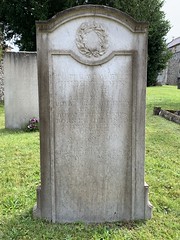
All Saints Church Narborough, Norfolk

Lt. Hubert J. Game, All Saints Church Narborough.

A second tragic accident on June 8th 1917, showed how fragile these aircraft could be. Lieutenant Hubert John Game  was attempting a loop when he got into difficulty and ended up in a steep dive. Trying to pull the aircraft – a BE2 (A2794) – out of the dive was too much for its fragile structure and it suffered a catastrophic wing failure, both wing extensions breaking away leaving the aircraft uncontrollable. Lt. Game was originally a Lieutenant in the Royal Field Artillery (RFA) and was attached to 53 (Training) Sqn RFC at Narborough, when he was tragically killed. He was also the younger brother of Air Vice-Marshal Sir Philip Woolcott Game, and was just 26 years old at the time of his death. He is another one of those whose grave lays a short distance away from the site of Narborough airfield.

Many of those who joined up to fight had jobs or were celebrities in their own field. Many famous actors went on in the second World War to have successful military careers, and many sports personalities also performed admirably. At Narborough, 2nd Lt. William Smeeth was a  22 year old who transferred into the RFC from the 9th Battalion Royal Irish Rifles. Before the war he attended the Loretto School (a prestigious boarding school whose building dates back to the 14th Century, and was founded in 1827 thus claiming to be Scotland’s oldest) from 1909 to 1913, and was a player in the Loretto XI. Considered a “fine, slow, left-handed bowler”, he was wounded in France and posted to Narborough as a flying instructor. On 17th July 1917 he was flying an Avro 504B (A9975) which was struck, whilst landing, by an A.W. FK8 which was taking off at the same time. In the accident Smeeth was killed, and he remains the only military grave in his home town of Bolton Abbey in the Yorkshire Dales.*6, 7

The inherent danger faced by trainees was made no more obvious once again on October 29th, when two more aircraft, both from 50 RS, were lost in separate accidents. The first an Armstrong Whitworth FK.8 (A2730) side slipped during a turn and nose dived into the ground killing both crewmen, 2Lt. Norman Victor Spear (aged 29) and Air. Mech. 1 Sidney Walter Burrell (age 22).  The second aircraft, also an Armstrong Whitworth F.K.8 (B219) spun off a low climbing turn also killing its pilot 2Lt. Laurence Edward Stuart Vaile (aged 23). It was indeed a black day for 50 RS and a stark reminder to the trainees.
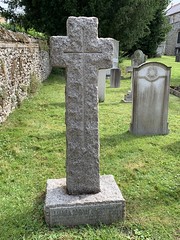
All Saints Church Narborough, Norfolk

2Lt. Laurence Edward Stuart Vaile, killed ‘in an aeroplane accident’ August 29th 1917.

In October and December 1917 two more units bolstered the numbers of personnel at Narborough. Firstly, 1 Training Squadron was reformed here on October 1st, whilst 83 Sqn, born out of 18 (Reserve) Squadron (RS), arrived at Narborough two months later, both these bringing a range of aircraft that they quickly swapped for FE.2bs. 83 RS had previously been based at Wyton commanded by Major V. E. Albrecht and were one of the first units designated a Training Squadron Station rather than Training Depot Station.

83 Squadron had only been formed in January that year and within three months of their arrival here, would be on the front line at St. Omer  attacking enemy troop concentrations, attempting to stem the early German spring offensive.

The occurrences of all these tragic accidents was becoming so frequent, that one instructor, Capt. W.E. Johns, creator of ‘Biggles‘, later cited spies as the cause of many ‘accidents’ – claiming that they had tampered with the machines causing the deaths of the crews on board. Johns, himself having written off many machines, believed Americans with German sounding names were to blame for aircraft breaking up in mid-air or crashing at the bottom of loops. More likely however, the fault lay with over exuberant or simply poorly trained recruits.

Like most airfields, there were those locals who disliked the presence of the military and their new flying machines on their doorstep, and there were those who welcomed them into their villages and homes with open arms. Narborough was no different and there are many tales of interactions between military personnel and the local civilians.

The nearby Narborough Hall opened its doors to wounded brought in the from the fields of Flanders, whilst local people, in conjunction with airfield staff, held money raising events to help with food shortages. The local hostelries were frequented by personnel from the airfield, and friendly sports events were held between civilian and military teams. On some days, flying events were put on to display the aircraft and the skills of the pilots training with the RFC. Many came to watch in awe whilst others complained about low-level flying disturbing livestock, and pilots making a nuisance of themselves in the villages; others complained about the speeding lorries that brought in both supplies and men.

In early 1918 a year after the United States declared war, airmen of the 20th, 24th and 163rd U.S. Aero Squadrons were brought into Narborough and attached to 121 Sqn which had just formed in the opening days of the year. Whilst using a variety of aircraft, the backbone of the squadron was the DH 9, an aircraft they used until their departure to Filton in August and eventual disbandment.

As a unit set up to train the Americans, times were hard and often relationships were strained, the cold British winter weather being a substantial change from the hot climate of Texas from where many originated. These units, once here, were spread far and wide, amongst other squadrons across the UK; their Campaign Hat, a broad-brimmed, high-crowned hat, becoming synonymous with their presence.

There would be no let up in the movements in and out of Narborough. 1918 would see yet more arrivals in February with 26 Training Squadron (TS) and 69 Training Squadron (TS)  both units being posted in during that month. Flying a mix of Henry Farman models, the two units would leave Narborough in August to form 22 Training Depot Station in Gormanston, Ireland. Whilst here in Norfolk though, they would carry out training duties, honing their skills alongside the already present training units and the newly arrived Americans.

As time passed, the angst between the US and RFC staff began to mellow. The initial feeling of US personnel having a much more ‘laid back’ approach to rank and uniform being extremely distasteful to the more rigid RFC officials. By the time they were to leave though, relationships had matured and their sad departure ended what had become a generally happy association between them all.

The last months of the war saw no let up in training either; keen to join the RFC young men continued to join up and train to fly. In mid February 1918, two 18 year old boys were perhaps fulfilling a dream when it all went tragically wrong. Flying a DH.4 (B2121), 2Lt. John Fyffe Shaw and 2Lt. Charles Arkley Law of 26 Training Squadron, were both killed after their aircraft’s engine failed causing it to stall and then nose dive with dire consequences into the ground.

When crews arrived at the scene the throttle was found only half open, suggesting the aircraft had stalled during the low level right-hand turn they were performing. Insufficient fuel would have starved the engine leading to it cutting out and causing the resultant crash. Both airmen were from Scotland, Shaw from Dundee where he remains, and Law was from Edinburgh – he remains buried in Narborough.
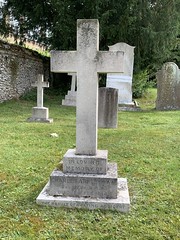
All Saints Church Narborough, Norfolk

2Lt. Charles Arkley Law killed after his engine failed and the aircraft stalled.

In a major reforming of the military structure on April 1st 1918, the RFC and RNAS were finally amalgamated officially forming the Royal Air Force, a major turning point in the history of the force as it is today. To reflect this, RFC Narborough also took on the new name RAF Narborough, but a mere name change wouldn’t stop the intense work from going on as usual.

As the summer approached and the weather improved, so too did the relationship between the various nationalities. The American’s arrival at Narborough was now matched by the arrival of some thirty or more women of the Women’s Army Auxiliary Corps (WAAC)*2 – which along with the Women’s Naval branch (WRNS) and Women’s Legion, formed the Women’s Royal Air Force (WRAF) on April 1st. Many of these women performed roles in admin sections of the Air Force, telephonists, catering and personal duties whilst some entered the more technical roles, parachute packing, riggers, mechanics and carpenters. By the war’s end, Narborough would have in excess of 100 female personnel working at its site.

On September 12th 1918, 55 Training Depot Station – who originally formed at Manston when 203 Training Depot Station (TDS) was renumbered – arrived here also to carry out training duties. A large number of these training Depots existed at that time and continued on to the war’s end. Like other training units 55 TDS also flew a large range of aircraft types; B.E.2e, D.H.4, 6, and 9, Avro 504j and k and S.E.5a.
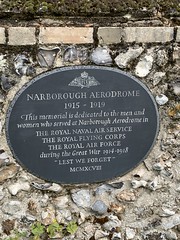
All Saints Church Narborough, Norfolk

The Plaque at All Saint’s Church Narborough, honouring those who served at Narborough.

This latest squadron to join the many arrived during a time of major redevelopment not only of the site, but the training units as well. Narborough with such a huge influx of staff was now developing new accommodation buildings, hangars and work space. Electricity supplies were at last being installed, new roads created to get men and supplies around the site much quicker and a new hangar, The ‘Red hangar’ – due to its red brick construction – was added near to Battles  Farm. The site had become so big now that it was one of just a few considered for homing the new enormous Handley Page Bomber the V/1500 which was capable of bombing Berlin. But like both Sedgeford and Pulham that decision went elsewhere, to Bircham Newton, with its more suitable and stable soils and long term development potential.

Whilst no V/1500 was ever stationed at Narborough, Capt. J. Sinclair of 166 Sqn Bircham Newton, did land one on the site proving that it could be done and that Narborough airfield was more than able to cater for its needs. However, the aircraft never made the flight to Berlin,  the Armistice being called just before the operation was planned to go ahead.

In November 1918, the war finally ended. After 4 and half years of brutal warfare, millions had died, a small fraction of those killed had been either based at, or passed through, RAF Narborough in their training.

Then, after the news of the cessation of conflict, the big reduction in manpower and machines would begin. As units began to arrive home from France they were quickly disbanded. At Narborough, several of these arrived as cadres, No. 64 (14th February), No. 56 (15th February)and No. 60 (20th February) where upon they joined 55 Training Depot Station to see out their last few months of existence.

Despite this, training continued on, but with less urgency than before. The arrival of one (Sir) Alan Cobham went rather unnoticed, just another instructor to train those stationed here. His focus was on those who struggled to achieve the status of ‘pilot’ for whatever reason – whether it be lack of ability or just through lack of ambition. He remained at Narborough until February 1919 at which point, like so many others, he was demobbed and returned to civvy street.

With flying restrictions now lifted, Cobham teamed up with brothers Fred and Jack Holmes forming their own Aviation Tours company buying an ex RAF Avro 504K, a car and some petrol. He soon added to this a second 504K (G-EAKX and G-EASF) with which they created the famous ‘Cobham’s Flying Circus‘, performing daring barnstorming shows across the country.

In 1921, with the great depression, he began to work for an aerial photographic company and air taxi firm, this led him on to long distance travel, becoming known as “the King of the Taxi Pilots“.*8

Cobham went on to have an incredible aviation life, pioneering both long distance flight and aircraft technology. He made civil aviation more accessible and popular to the masses his influence on aviation going far beyond the training of RAF pilots.

With the war over it was now time for harsh decisions. The monetary and human cost of the war had been astronomical and the military were now no longer the favour of the Government. A new restructure and decommissioning of vast quantities of military equipment was on the horizon. In one small gesture in March 1919, 55 Training Depot Station were disbanded only to be renamed 55 Training Squadron, this simple move brought it inline with other training units of the same designation.

The four units who arrived at the end of 1918, would now one-by-one disband or move on elsewhere to disband; 56 departing to Bircham Newton on December 30th where it disbanded a month later; 60 followed in January only to disband before the month was out, and 64 ended its days on New Years Eve 1919 at Narborough. With that, its days now over, Narborough was deemed surplus to requirements and with the disbandment of the recently renamed 55 Training Squadron, on New Years Eve, the airfield was unceremoniously closed for good.

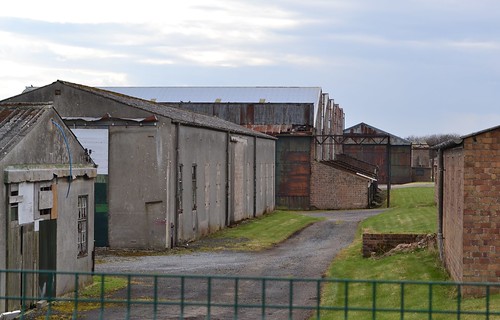
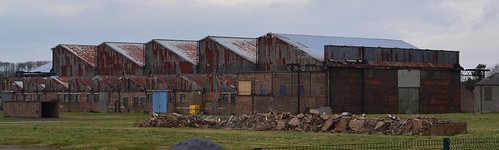
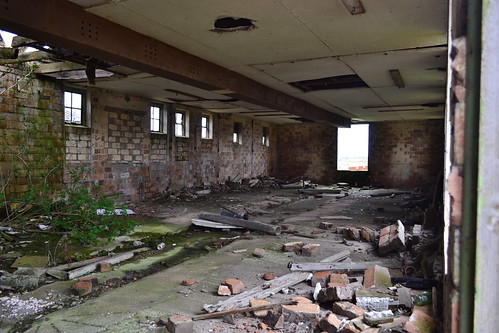
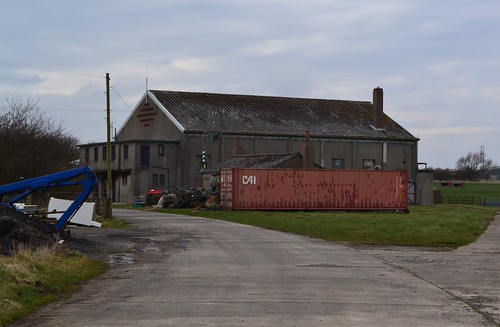
The post war years saw the closure of many other war time airfields like Narborough. But unlike its sister station RAF Marham a mile or so away, it would remain closed.  For over a year the site remained unoccupied and unused, and the usual vandalism began to take its toll. Machinery, tools and even scraped aircraft remained on site for enthusiastic youths to make their playground. Then in 1921, the buildings and contents were all sold off in a two day event over 2nd and 3rd February, in what was considered to be one of the biggest auctions in Norfolk: some of the items going to local farmers, other for small industrial units, some to schools and the like; Narborough was now scattered to the four corners of the county. The remainder of the site was sold to the farmer and it quickly returned to agriculture, a state it remains in today.

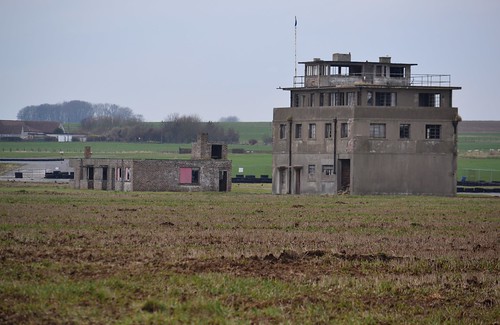
Some of the original buildings are reputed to have existed for many years, even to the present today, (a car show room in Cromer, a furniture warehouse in Terrington-St-Clement and a nearby hut at Setch) whether they still do, is difficult to ascertain, but most have long since succumbed to age, their inevitable deterioration and eventual demolition. In 1977 the last hangar on the airfield, a hangar known as the ‘Black Hangar’ was demolished after severe gales took the last sections of roof. With little option but to pull it down, it was removed leaving little trace.*2 The last full building on site, known as the ‘Racket House’ after personnel used it to play squash, burnt down in 1995, and with that the last trace of the airfield was wiped away.

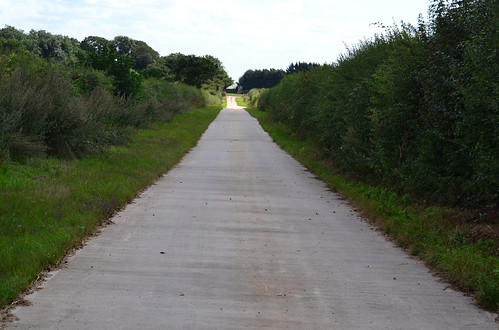
Narborough itself having no hard runways or perimeter tracks has long since gone. A small memorial has been erected by the Airfield Research Group who are part of the Narborough Local history Society, aiming to promote and preserve the memory of RFC/RAF Narborough; a memorial plaque also marks the graves of those who never made it to France, and the small Narborough Museum & Heritage Centre holds exhibits of 59 Squadron in the local church.

During the First World War some nineteen Victoria Crosses were awarded to members of the RFC/RAF, of those three had passed through Narborough. Several famous individuals also cut their teeth at Narborough, and some went on to achieve great things in the aviation world. Many trainees lost their lives here, but many became successful pilots seeing the war out alive.

Significant not only in size, but in its history, Narborough has now been relegated to the history books. But with the dedication and determination of a few people the importance and historical significance of this site will hopefully continue to influence not only the aviators of tomorrow, but also the public of today.
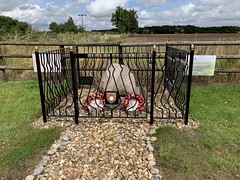
Updated memorial August 2021

The Narborough memorial which sits at the entrance to Narborough airfield. It was refurbished after the original was struck by a vehicle.

After Narborough, we head east once more toward Swaffham. After turning off the main A47 we come across another American airfield. In the next part of this trip we visit the former RAF Attlebridge.

The full story of Narborough can be read in Trail 7 – North West Norfolk.

Sources and further reading (RAF Narborough)

National Archives: AIR 27/554/1; AIR 27/558;

*1 Fleet Air Arm Officers Association Website accessed 14/6/21

*2 Narborough Airfield Research Group “The Great Government Aerodrome” NARG, 2000

*3 RAF Museum Story Vault Website accessed 14/6/21

*4 Letter from 2/AM C. V. Williams from 59squadronraf.org.uk

*5 On May 31st 1917, all RFC ‘Reserve Squadrons’ were renamed ‘Training Squadrons’.

*6Loretto Roll of Honour 1914-1920” National Library of Scotland digitised copy. accessed 17/5/25 via Google books.

*7 Renshaw, A., “Wisden on the Great War – The Lives of Cricket’s Fallen 1914 – 1918“. Bloomsbury. 2014

*8 Gunn. P., “Flying Lives with a Norfolk Theme“. Gunn. 2010

The book “The Great Government Aerodrome” is an excellent publication about the history of Narborough and contains a great many photos and personal stories of those who knew Narborough. It is well worth a read.
RAF Narborough – ‘The Largest Aircraft Base of the First World War.’ Part 1

At the turn of the last century, flying was in its infancy, and airships formed the main threat from an enemy. Aeroplanes were fragile, slow and cumbersome and those that flew them, risk death at every turn with no means of escape.

As aircraft developed and those in high ranking positions finally saw their potential, production went into overdrive, but there was a greater need, the need for those to fly them.

In Norfolk, the threat from airships was very real, and so many new airfields sprung up to defend the British Isles from these roaming menaces. One such airfield, became the largest of them all, a huge site of 900 acres it dwarfed all other aircraft based airfields, and yet, it failed to last beyond the war.

In this part of Trail 7, we head to modern day RAF Marham, for on its fringes lie a field of forgotten heroes who gave their all during the First World War. We look at RAF Narborough.

RAF Narborough

Originally constructed as the largest aircraft base of the First World War, Narborough Airfield in Norfolk has been known by a variety of names over the years: Narborough Aerodrome, RNAS Narborough, RFC Narborough, and later RAF Narborough. However, the most unofficial — and arguably the most evocative — title, ‘The Great Government Aerodrome’, offers a sense not only of its vast scale (spanning over 900 acres), but also of the diversity of aircraft and personnel stationed there. Initially operated by the Royal Naval Air Service (RNAS), the site later came under the control of the Royal Flying Corps (RFC), and eventually the newly-formed Royal Air Force (RAF), with each change of name reflecting the evolving structure and ownership of Britain’s early air services.

Records show that the site at Narborough had military links as far back as 1912, in the year that the RFC was established when both the Naval Air Organisation and the Air Battalion of the Royal Engineers were combined. Unfortunately, little exists to explain what the site was used for at this time, but it is thought that it was used by the army for training with horses and gun carriages. In later years, it was used as a base from which to counteract the threat from both the German Zeppelin and Schütte-Lanz airships, and also to train future pilots of the RFC and RAF.

Narborough’s history in these early days is therefore sketchy, few specific records exist as to the many changes that were taking place at this time particularly in relation to the development of both the RNAS and the RFC.

However, Narborough’s activities, and its history too, were no doubt influenced on July 1st 1914, when the name RNAS Narborough was officially adopted, and all Naval flying units of the RFC were transferred over to the control of the Navy. A major development in the formation of both forces, there were at this point, a total of: 111 officers, 544 other ranks, seven airships,  fifty-five seaplanes (including ship-borne aircraft) and forty aeroplanes in RNAS service.*1 Some of these may well have seen service at Narborough at this point.

Narborough’s first interaction with flying occurred when a solo flyer – thought to have been Lt. F. Hodges in an Avro 504 *2 – touched down on farmland near to Battles’ Farm in the Autumn of 1915. Neither the pilot, the aircraft type nor the purpose of the landing can be substantiated, but it may well have been the precursor to the development of an airfield at this site.

The airfield itself was then developed, opening early that year (1915), on land that lay some 50 feet above sea level. It sat nestled between the towns of Kings Lynn (10 miles), Swaffham (5 miles); and Downham Market (9 miles), and a mile or so away from the small village of Narborough. A smaller aerodrome would, in 1916, open literally across the road from here, and at 80 acres, it would be tiny in comparison. However, over time, it would grow immensely to become what is today’s RAF Marham, an active airfield that has matured into one of the RAF’s top fighter airfields in the UK.

So by mid 1915, Narborough’s future had been decided, designated as a satellite station to RNAS Great Yarmouth, (itself commissioned in 1913) it was initially to be used as a night landing ground for those aircraft involved in attacks on enemy airships, the most likely reason for its location. No crews were permanently stationed here at the time however, ‘on-duty’ crews later being flown in to await the call to arms should an airship raid take place over East Anglia.

This first arrival of an aircraft in August 1915, led to the site being kept in use by the RNAS for the next ten months. During that time, aircraft of the Air Service would patrol the coastline around Norfolk, using aircraft mainly from Great Yarmouth along with a series of emergency landing grounds including Narborough. The threat from German airships at this time being very real. These landing grounds were strategically placed at intervals along the coastline with others more inland, these included: Aldeborough, Burgh Castle; Covehithe; Holt and Sedgeford all of which combined to make North Norfolk one of the densest regions for airfields at that time. But, and even with all these patrols, the roaming airships that made their way across the region had little to worry about as many of the fighter aircraft used could neither reach them at the higher altitudes nor locate them in poorer weather.

However, as a night landing ground, little activity would directly take place at Narborough (there are no recordings of airship sightings from Aircraft using the airfield) and so after a dormant ten months, the RNAS decided it was surplus to requirements and they pulled out leaving Pulham the only ‘in-land’ station larger than Narborough open in Norfolk at that time.

The future of Narborough could have so easily ended there, but even as closure plans were made, its future was still relatively secure, and it would not be long before a new user of the site would be found. Discussions were already in hand for the RFC to take over, provided the land owners’ permitted it! Luckily they did, and soon fifty acres of rough terrain and a small number of canvas flight sheds were theirs. As for staff accommodation, there was none, so when 35 Sqn arrived at the end of May 1916, Bell tents and make shift accommodation had to be erected by the personnel, in order to protect themselves from the harsh Norfolk elements.

With the First World War raging across the fields of Flanders, the demand for aircraft and trained crews grew rapidly. These new flying machines were evolving swiftly into lethal weapons and highly effective reconnaissance platforms, capable of identifying enemy positions and directing artillery fire with increasing accuracy. To meet the urgent need for trained airmen, hurried training programmes were established, and Narborough soon became a vital preparation ground for budding pilots.

Training, by any standard, was rudimentary. Recruits were required to pass a series of written examinations, followed by up to twenty hours of solo flying, a number of cross-country flights, and two successful landings. Added to this was a fifteen-minute flight at 8,000 feet, culminating in a dead-stick landing — that is, returning safely to earth with the engine cut. It was, in truth, barely enough experience for what lay ahead in the violence of aerial combat.

Like many newly established stations, Narborough was designated as an RFC training site — officially known as a Training Depot Station — joining a growing network of such facilities across Norfolk, Suffolk, and Lincolnshire. Their primary role was to prepare pilots for the rigours of air combat, with instruction in dog-fighting, aerobatics, cross-country navigation, and formation flying.

With the arrival of the RFC came immediate expansion. Additional acreage was acquired that same year, extending the airfield westward beyond the area already occupied by the RNAS, bringing it close to the present-day boundary of RAF Marham. As was often the case with wartime construction, adjustments to the local infrastructure were necessary. A road that once bisected the site was eventually closed to accommodate the growing airfield footprint.

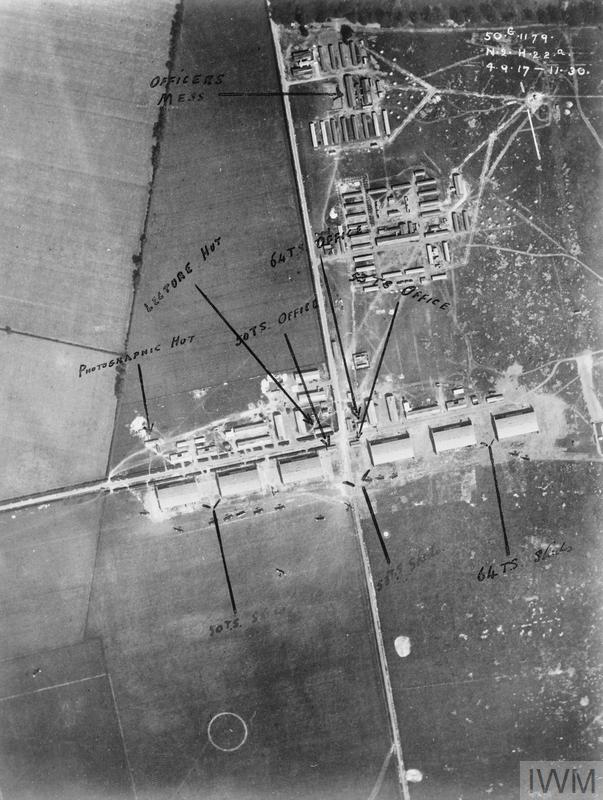
RFC Narborough from the air 1917. @IWM (Q 111416)

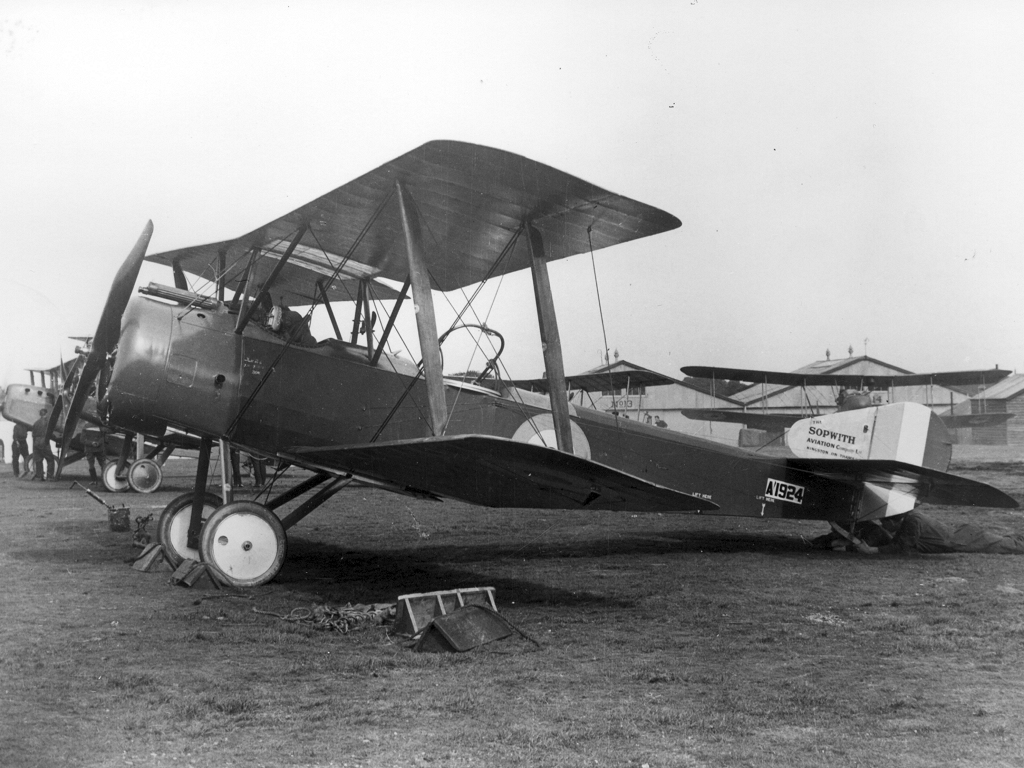
So, it was during June 1916 that the first RFC squadron would make use of Narborough as an airfield, 35 Sqn transferring over here from Thetford with Vickers FB.5 and FE.2bs. disposing of their D.H.2s and Henry Farman F.20s in the process. Within two months of their arrival, the nucleus of the squadron would then be used to form a new unit, 59 Sqn, who were also to be stationed here at Narborough (under the initial temporary command of Lieutenant A.C. Horsburgh) with RE8s. On the 16th August, Horsburgh would take on a new role when the new permanent commander Major R. Egerton, was transferred in. It would be he who would take the unit to France the following year and command until his death in December 1917.

During their time here, these daring young trainees, many whom were considered dashing heroes by the awe-inspired locals, would display their skills for all who lined the local roads to see. As these eager young men quickly learned though, flying was not always ‘fun’, and the dangers of the craft were always present, many with dire consequences. Accident rates were high and survival from a crash was rare, even ‘minor’ accidents could prove fatal. All Saints church yard at Narborough, pays testament to their dangerous career with fourteen of the eighteen military graves present being RFC/RAF related.

The initial drive for both these squadrons was to train pilots in the art of cavalry support, using advanced pilot training  techniques. This included being able to send Morse code messages at a rate of six words per minute*2 whilst flying the aircraft over enemy territory – certainly no mean feat.

Deaths on and off the airfield were commonplace and not all aviation related either. During late June 1916, one of the Air Mechanics of 59 Sqn, Charles Gardner, suffered a heart attack and died, just one day prior to the official formation of his squadron. Whilst not considered to have been directly related to his role, his loss saw the beginning of a string of deaths in August that would set the scene for the coming months.

The first of these was another thought to be, unrelated aviation death, although whether or not Corporal Patrick Quinn was on duty at the time is unclear. He died on August 18th, whilst riding his motorcycle in the vicinity of the airfield, the narrow Norfolk roads catching him unaware. Then, just two days later on August 20th, the first of many fatal air accidents would occur.

In this instance, one of 59 Sqn’s pilots, Lt. Gordon William Hall, was killed when the DH.1 (4631) he was flying, side-slipped on approach to the airfield crashing into the ground as a result. A Court of Inquiry (87/8413) concluded that the aircraft had been “banked too steeply” and that the pilot had put the aircraft into a dive that made it uncontrollable. A verdict therefore of ‘accidental death‘ was subsequently recorded against Lt. Hall.*3

A mere eight days later, it was the turn of 35 Sqn to suffer its first fatality and in a not too dissimilar accident. On the 29th, an Armstrong Whitworth F.K.3 (6201), was written off after it too side-slipped and dived following a slow turn. The Pilot, Air Mechanic 1st Class  Moses Boyd, was tragically killed in the accident flying an aircraft that was based at Thetford but undertaking a training exercise here at Narborough. His Court of Inquiry (Ref. 87/4971) on 9th September 1916)*3 , summated that it was a “Flying accident. Turning having lost flying speed”. By now, the dangers of flying were becoming all too apparent and with another two deaths before Christmas, the glamour of flying was quickly becoming tarnished.

However, despite these accidents, young men continued to arrive at the airfield for training, but the large influx of personnel did not mean it was at all a glamorous place to be.

As a training ground, accommodation was basic to say the least, Narborough being described by one trainee as a “desolate, God-forsaken place“*4. Quickly realising the problem, the authorities, began to erect new buildings not only for personnel accommodation, but for training and maintenance roles as well. In response, a total of six permanent hangars, probably RFC General Service Flight Sheds, were erected by the design company and builders Boulton & Paul, three each side of the main road. The Boulton & Paul company based at Norwich, would go on to design and build many aviation related products including the famous ‘Defiant’, a turreted fighter of World War II.

With continued expansion over the next two years, up to 150 buildings would eventually be built on the site, a mix of technical, administrative and accommodation. This on going process of construction and development would, by the end of the war, see some 1,000 personnel based here at Narborough – a number comparable with many modest Second World War airfields.

Narborough wasn’t the only airfield being developed in the immediate area though. Next door, across the road, the new RFC Marham was opening, a much smaller site, that sat in the centre of what is now modern day RAF Marham. Why the two were put so close together is anyone’s guess, but Marham quickly became the home and headquarters to ‘C’ Flight 51 Squadron. The remaining two flights of the squadron being based at both RFC Mattishall and RFC Tydd St Mary.

Marham opened for business in September 1916 and one of those who would be stationed here was Major A.T. Harris, later ‘Bomber Harris’ of Bomber Command fame. He was in command of 191 Night Training Squadron, and took part in many flights from the airfield. Marham, like Narborough, would eventually close at the end of the war in the huge disarmament programme of the immediate post war years. But, unlike Narborough, it would be reborn in the expansion period of the 1930s and grow to what it is today.

There was a good relationship between the two stations, with plenty of rivalry and good humour. Flour bombs from Marham crews on Armistice day were met with a retaliation from Narborough crews with soot bombs, the culmination of several years of war finally coming to an emotional close.

RFC Narborough 1916. The six RFC hangars can be seen in line along the former Narborough – Beachamwell Road. (Marham Aviation Heritage Centre)

The RFC was now building in strength, not only in its front line units but in its reserves too. On November 2nd, 1916 a new reserve squadron was constituted and formed here at Narborough, 48 (Reserve) Squadron (RS). Models flown by the unit at this time included the Grahame White XV, the Maurice Farman Shorthorn and Sopwith’s Pup. As a newly formed unit they would have to get established, gain crews, admin staff and equipment. Once this was in place they could then move on, and after just a month, they departed Narborough heading for the Lincolnshire airfield at Waddington.

The vacancy at Narborough was quickly filled though, in mid December No. 50 Reserve Squadron (RS) arrived from the Kent village of Wye, just as the Sedgeford based 53 Reserve Squadron (RS) also arrived with 504s, BE2s, DH6s and RE8s.*5

Between their arrival and November the following year (1917), the date they departed for Spitalgate, 50 Reserve Squadron would lose twelve flyers in accidents, three Air Mechanics with the remainders being Lieutenants, both 1st and 2nd Class. Five of these remain in the local churchyard.

In early 1917, Nottingham born Captain Albert Ball, VC, DSO & Two Bars, MC arrived at Narborough; a veteran of the front line, he served here for only a short time as an instructor before the draw of the front line took him back once again. This time there was no coming home as he was killed after an intense aerial battle on May 7th that year with 44 victories under his belt. He was just 20 years of age.

Albert Ball via ‘Visit Nottingham’ website.

With increasing numbers of squadrons and men being required for front line units in France, both the original 35 and 59 Squadrons departed Narborough in early 1917. 35 Squadron were first to go, and those left behind saw them off from local train stations with all the pomp and ceremony they could muster.  A few days later a convoy of 3 ton Leyland lorries, trailers and an assortment of other vehicles loaded with men and equipment, set off for France where they met the air party who had already flown to St. Omer. 59 Squadron would follow to the same airfield on February 23rd, both squadrons remaining in France until 1919 and the war’s end.

In Part 2, the reserves are left to carry on training, but its not an easy job. The development and growth of Narborough continues and eventually the RAF is formed. There are major changes all round.

The full story of Narborough can be read in Trail 7 – North West Norfolk.

RAF Narborough – The Great Government Aerodrome.

Resting not more than a mile or so from the boundary of Britain’s front line fighter base RAF Marham, is an airfield that never made it beyond the First World War. However, its importance cannot be denied nor should it be over looked. Key to aviation in Norfolk and to the Royal Air Force as a whole, it played a major part in both, and therefore is pivotal to today’s modern air force. Opened originally as a satellite by the Royal Naval Air Service, it became not only Norfolk’s first, but the biggest First World War, fixed wing aircraft airfield, only four airship stations were bigger.  Leading the way for the aviators of today’s Royal Air Force, we look back at the former RAF Narborough.

RAF Narborough

Built as the largest, aircraft based, World War One aerodrome, Narborough has been known under a range of different names. The most common, ‘The Great Government Aerodrome’ reflected not only its size (over 900 acres) but also its multinational stature; the range of aircraft and personnel based here, and its achievements in aviation history. Used by the Royal Naval Air Service (RNAS), the Royal Flying Corps (RFC) and the Royal Air Force (RAF), it would have names that reflected each of these fledgling services.

Records show that Narborough had military links as far back as 1912, in the year that the RFC was established when both the Naval Air Organisation and the Air Battalion of the Royal Engineers were combined. Unfortunately, little exists to explain what it was used for at this time, but in later years, it was used to counteract the threat from both the German Zeppelin and Schütte-Lanz airships, and also to train future pilots of the RFC and RAF.

Narborough’s history in these early days is sketchy, few specific records existing as to the many changes that were taking place at this time or to the development of the RFC and RNAS. Its activities – and history though – was no doubt influenced on July 1st 1914, when the name RNAS was officially adopted, and all Naval flying units of the RFC were transferred to the control of the Navy. A major development in the formation of both forces, there were at this point, a total of: 111 officers, 544 other ranks, seven airships,  fifty-five seaplanes (including shipborne aircraft) and forty aeroplanes in RNAS service.*1 Some of these may well have been used at Narborough at this point.

By 1915, Narborough’s future had been sealed, designated as a satellite station to RNAS Great Yarmouth, (itself commissioned in 1913) it was initially to be used as a night landing ground for those aircraft involved in attacks on enemy airships. No crews were permanently stationed here at this time however, but as time went on ‘on-duty’ crews would fly in, and await the call to arms should an airship raid take place over East Anglia.

The first recorded arrival was in August 1915, an event that would keep the site in use by the RNAS for the next ten months, before being designated as surplus to requirements and handed over to the RFC in June 1916.

It was in June 1916 that the first RFC squadron would make use of Narborough as an airfield, 35 Sqn transferring over here from Thetford with Vickers FB.5 and FE.2bs. disposing of their DH2s and Henry Farman F.20s in the process. Within two months of their arrival, the nucleus of the squadron would then be used to form a new unit, 59 Sqn, also here at Narborough, under the command of Lieutenant A.C. Horsburgh with the RE8s. Narborough was already beginning to grow.

It was in that same month, that the perils of war would be brought home to those based at Narborough, when one of 59 Sqn’s pilots, Lt. Gordon William Hall, was killed when the DH.1 (4631) he was flying,  side slipped on approach to the airfield crashing as a result. A court of enquiry confirmed that the aircraft had been “banked too steeply” and that the pilot had put the aircraft into a dive that made it uncontrollable. A verdict of ‘accidental death’ was recorded against Lt. Hall.*2

In August, it was the turn of 35 Sqn to suffer its first fatality in a non too dissimilar accident. On the 29th, an Armstrong Whitworth F.K.3 (6201), was written off after it too side slipped and dived following a slow turn. The Pilot – Air Mechanic 1st Class –  Moses Boyd was tragically killed in the accident flying an aircraft that was based at Thetford but undertaking a training exercise here at Narborough. Already, the dangers of flying were becoming all too apparent and the glamour of flying was becoming tarnished.

Within two months, another 35 Sqn aircraft would also crash, this time one of the two crewmen, pilot 2nd Lt. Robert Leslie Edward would escape with just injuries. The observer, 2nd Lt Ernest Hildreth, however, was not so lucky and was killed in the resultant crash.

As the First World War raged on the European continent, the demand for aircraft was growing. It was quickly developing into a lethal weapon and a very potent reconnaissance vehicle. To fill vacant spaces and meet high demand, training programmes were rushed into place, meaning Narborough would become a preparation ground for new recruits. With training considered very basic by any standards, recruits only had to pass a number of tests before being sent to the front. Written examinations followed up by twenty hours solo flying, cross-country flights and two successful landings, were followed by flying for fifteen minutes at 8,000 feet and landing with a cut engine. Barely enough experience to see anyone through a violent war.

During these flights, these daring young men, many who were considered dashing heroes by the awe-inspired locals, would display their skills for all who lined the local roads to watch. As they were quickly learning though, life was not always ‘fun’, and the dangers of the craft were ever present. Accident rates were high and survival from a crash was rare, even ‘minor’ accidents could prove fatal. The local church yard at Narborough, paying testament to their dangerous career with fourteen of the eighteen graves present being RFC/RAF related.

The RFC was now building in strength, not only in its front line units but in its reserves too. On November 2nd, 1916 a new reserve squadron was constituted and formed here at Narborough, 48 (Reserve) Squadron (RS). Models flown by the unit at this time included the Grahame White XV, the Maurice Farman Shorthorn and Sopwith’s Pup. Over the next period of time, there followed a number of other reserve units: No 50, 53 and 64 (Reserve) Squadron (later designated Training Squadrons*3) all passing through Narborough at some point. However, and even with this large influx of personnel in these early days, Narborough was not to be the most exotic of locations.

As a training ground, accommodation was basic to say the least, being described by one ‘resident’ as a “desolate God-forsaken place“*4. It was soon realised by the authorities that new buildings needed to be erected for not only accommodation, but for training and maintenance roles as well. In response, a total of seven Boulton and Paul hangars, and up to 150 buildings would be built on the site over the next two years. A development that would by the end of the war, see some 1,000 personnel based here at Narborough – a number comparable with any modest Second World War airfield.

Meanwhile the threat from Zeppelins had not yet receded, and as a result 1916 would close with a small detachment of 51 Sqn BE.12s tasked with attacking these marauding menaces. Whilst primarily based at Hingham, 51 Sqn would have detachments spread across a number of East Anglia airfields, all preparing to meet the continued threat from Germany’s enormous airships.

With increasing numbers of squadrons and men being required for front line units in France, both 35 and 59 Squadrons departed Narborough in early 1917, and by the end of February both were gone.

All Saints Church Narborough, Norfolk

2nd Lt. Allen Ingham Murphy, killed March 30th 1917 ‘in an aeroplane accident’.

This left the reserves at Narborough, and it wouldn’t be long before they too suffered causalities. The first of these to lose a valuable pilot was 50 RS on March 30th 1917. A young Canadian, not yet out of his teens, 2nd Lt. Allen Ingham Murphy, was killed when his Armstrong Whitworth F.K.8 ‘A2720’ stalled whilst turning after take off. 2nd Lt. Murphy was the first of four casualties from the units that year – training young pilots was not getting any easier.

This danger was made no more obvious than on October 29th, when two aircraft, both from 50 RS were lost in separate accidents. The first an Armstrong Whitworth FK.8 (A2730) side slipped during a turn and nose dived into the ground killing both crewmen, 2Lt. Norman Victor Spear (aged 29) and Air. Mech. 1 Sidney Walter Burrell (age 22).  The second aircraft, also an Armstrong Whitworth F.K.8 (B219) spun off a low climbing turn also killing its pilot 2Lt. Laurence Edward Stuart Vaile (aged 23). It was indeed a black day for 50 RS and a stark reminder to the trainees.

All Saints Church Narborough, Norfolk

2Lt. Laurence Edward Stuart Vaile, killed in an aeroplane accident August 29th 1917.

In October and December two more units bolstered the numbers of trainees at Narborough. Firstly, 1 Training Squadron were formed here on October 1st, whilst 83 Sqn, born out of 18 (Reserve) Squadron (RS), arrived at Narborough during December that year bringing a range of aircraft that they quickly swapped for FE.2bs.

83 Squadron soon departed Narborough though, heading to France in March 1918 where they performed attacks on troop concentrations, attempting to stem the early spring offensive.

On June 8th, 1917 Lt. Hubert J. Game was killed when the B.E.2e (A2794) he was flying suffered a catastrophic wing failure when pulling out of a dive whilst looping the loop. Lt. Game was originally a Lieutenant in the Royal
Field Artillery (RFA) and was attached to 53 (Training) Sqn RFC at Narborough, when he was tragically killed. Hubert was the younger brother of Air Vice-Marshal Sir Philip Woolcott Game, and was just 26 years old at the time of his death. He is another one of those whose grave lays a short distance away from the site of Narborough airfield.

All Saints Church Narborough, Norfolk

Lt. Hubert J. Game, All Saints Church Narborough.

The occurrences of these tragic accidents were becoming so frequent, that one instructor, Capt. W.E. Johns, creator of ‘Biggles’ later cited spies as the cause of many ‘accidents’ – tampering with machines causing the deaths of the crews on board. Johns, himself having written of many machines, believed Americans with German sounding names were to blame for aircraft breaking up in mid-air or crashing at the bottom of loops. More likely, the fault lay with over exuberant or poorly trained recruits.

As the war drew to a close, one further squadron would be formed here at Narborough. On New Year’s day 1918, 121 Squadron were formed here, initially created to use DH.9s, they instead flew a variety of aircraft until they moved out to Filton in mid August. Shortly after their arrival here they were disbanded.

The last months of the war had no let up in training. Keen to join the RFC young men continued to train to fly. In mid February 1918 two 18 year old boys would perhaps be fulfilling a dream when it all went tragically wrong. Flying a DH.4, 2Lt. John Fyffe Shaw and 2Lt. Charles Arkley Law were both killed after the aircraft’s engine failed causing it to stall and then nose dive into the ground.

All Saints Church Narborough, Norfolk

2Lt. Charles Arkley Law killed after his engine failed and the aircraft stalled.

By August, war was over, and the the big wind down of squadrons would soon begin. At Narborough, two squadrons 69 (Training) Squadron and 26 (Reserve) Squadron would both merge to form a new 22 Training Depot Station. Many other similar units would soon follow suit and either disband or merge. This dramatic wind down continued on into, and beyond, 1919. In February, both 56 Sqn and 64 Sqn arrived as cadres; 64 Sqn was disbanded here later that year whilst 56 transferred to Bircham Newton where they too were disbanded later that same year. A third squadron, 60 Sqn also suffered the same fate, arriving as a cadre mid February before themselves being sent to Bircham Newton and disbandment.

With one last roll of the dice in mid March 1919, 55 Training Deport Station also disbanded here at Narborough, but out of the ashes was born a new unit 55 Training Squadron. With that though, Narborough was heading for closure, its days now over, it was soon to be surplus to requirements.

The post war years then saw the closure of many of Britain’s war time airfields including Narborough. But unlike its sister station RAF Marham a mile or so away, it would remain closed. The buildings were all sold off in what was considered to be one of the biggest auctions in Norfolk, with some of them going to local farmers, other for small industrial units, some to schools and the like, Narborough was now scattered to the four corners of the county. The remainder of the site was sold to the farmer and it quickly returned to agriculture, a state it remains in today. Some of these original buildings are reputed to still exist at various locations around the area today, whether that is true or not, is difficult to ascertain, but most have long since succumbed to age, the inevitable deterioration and eventual demolition.

Narborough itself having no hard runways or perimeter tracks has long since gone. A small memorial has been erected by a local group aiming to promote and preserve the memory of Narborough, a memorial plaque also marks the graves of those who never made it to France; and the small Narborough Museum & Heritage Centre holds exhibits of 59 Squadron in the local church.

All Saints Church Narborough, Norfolk

The Plaque at All Saint’s Church Narborough, honouring those who served at Narborough.

Significant not only in size, but in its history, Narborough has now been relegated to the history books. But with the dedication and determination of a few people the importance and historical significance of this site will hopefully continue to influence not only the aviators of tomorrow, but also the public of today.

Updated memorial August 2021

The Narborough memorial which sits at the entrance to Narborough airfield. It was refurbished after the original was struck by a vehicle.

Sources and further Reading (Narborough)

*1 Fleet Air Arm Officers Association Website accessed 14/6/21

*2 RAF Museum Story Vault Website accessed 14/6/21

*3 On May 31st 1917, all RFC ‘Reserve Squadrons’ were renamed ‘Training Squadrons’.

*4 Letter from 2/AM C. V. Williams from 59squadronraf.org.uk

Narborough appears in Trail 7.

RAF Leuchars – one of Britain’s oldest airfields (Part 1)

Following on from Trail 53 we leave the former RNAS Crail and Dunino behind and head north-west to the mecca of the golfing world, and the historic town of St. Andrew’s, where just outside of the University town is an airfield whose history goes back as far as 1911; this makes it one of Britain’s oldest and most established airfields. Its development then takes it through the First World World War, to the relative peace of the 1920s, the expansion period of the 1930s and on into the Second World War. Faced with potential closure it then went on to be one of the most significant and important airfields in Britain’s Cold War defence network.

Sadly politics played its part as it often does, and in 2011, its fate was sealed when at 4:48pm on July 18th, Dr. Liam Fox the then Secretary of State for Defence announced when talking about bringing the Army back from Germany: “Two major units and a formation headquarters will be based at Leuchars, increasing the number of posts there from 1,200 to more than 1,300. Consequently, the Typhoon force due to be built up there will instead be built up at RAF Lossiemouth.”*10 With that the airfield was to close, being transferred over to the Army, a transfer that occurred four years later in March 2015. Since then the RAF has, on occasion, returned for flying duties,  but its front line RAF role had gone. A state which exists today.

On this next stop, we take an extensive look at the long and incredible life of RAF Leuchars.

RAF Leuchars.

Leuchars sits on the north-eastern coast of Fife, on the banks of the River Eden as it enters the sea at St. Andrew’s Bay. To the north across the River Tay, lies Dundee, and to the west, the city of Perth. South of Leuchars is the University town of St. Andrews – the home of world golfing. Being literally on the shore line, Leuchars provided an ideal location for a whole host of maritime operations, aerial reconnaissance and even later on, search and rescue.

Its life began just after the turn of the last century in 1911, when powered flight was but a mere few years old.  Even before the first aero-engine had been started here, the site was being put to use by the Royal Engineers with a Balloon Squadron, who used it for reconnaissance training in the Tentsmuir Forest on the edge of what is now the airfield.

With the formation of the RFC in 1912, the Balloon Squadron would become part of the first military flying arm to exist in the UK. It would continue in its role as spotting for artillery, even as powered flight gradually became established. On the nearby beaches, small aircraft were tried and tested, but balloon training would ultimately remain the focus of the squadron.

In 1916, the RNAS then acquired the land and began to develop the site as a place for powered flight. Taking over farmland, and eventually swallowing up the resident farm, the airfield slowly expanded, and by 1918 its future was established. By this time, the RAF had been formed, the flying responsibilities of the Navy were transferred to the RAF and the first unit was ready to move in. The Grand Fleet School of Aerial Fighting and Gunnery, run by the RAF to train Naval airmen, resided at the airfield from the end of 1918 on into 1920. This unit, a new unit in its own right, was formed out of the disbanded 208 (Temporary) Training Depot Station which, whilst formed at East Fortune in the Scottish borders, had only been in existence for as little as one month.

RAF Leuchars

The control tower at Leuchars. The airfield’s proximity to the shore line being evident.

In these early days of flying, risks were high, the thrill of manned flight was a draw for many young men eager to experience the joy of soaring above the clouds. As a result, there were numerous accidents and Leuchars was no different.

On May 19th, 1919, Lt. David Gardiner Cooper (22) lost his life when he misjudged a slow roll whilst flying in his Sopwith Camel (F8497), and on August 1st, Canadian, Lt. Philip Hall-Smith (30) was killed, after his Camel was seen to inexplicably nose dive into the ground.*1*2 Two unfortunate losses after a war that had already taken hundreds of thousands of lives.

During the 1920s, with the war now over, military might was seen as an almost unnecessary waste, units were cutback, airfields that had been established for war were closed, and fighting men were returned to civvy street. Political fighting amongst the three arms of the military, saw the RAF cut back to a fraction of its former self, its cause for survival spearheaded by Lord Trenchard. However, Leuchars managed to cling on, remaining not only active, but receiving further development as well. More land was purchased and in 1925 the base was officially renamed RAF Training Base Leuchars.

It would be a time of dramatic change and turbulence for the fledgling Air Force though, and this was wholly reflected by the number of units appearing at Leuchars during this period. Operating as one of the UK’s major Naval training bases (the RAF being responsible for Naval flying at this point), the first of these units to appear was 203 Sqn in March 1920 which had reformed here after having been disbanded just two months earlier at Scopwick.

On April 1st 1923, the RAF Carrier units were re-designated under the new 400 series of squadron codes – a major stepping stone in RAF / Naval structure. Then a year later in 1924, these units were combined to form the new Fleet Air Arm (FAA), the flying branch of the Royal Navy. These changes had a major impact on operational numbers here at Leuchars.

Formally a Royal Naval Air Service unit, 203 Sqn initially flew the Sopwith Camel, replacing these  in April 1922, with the Nieuport and the General (Gloster) Nightjar. In mid September, the squadron was posted to Turkey, departing Leuchars onboard HMS Argus; a posting that would last for three months. After that, the squadron returned to Leuchars once more, again onboard HMS Argus, remaining active at Leuchars until 1st April 1923. At this point the squadron was disbanded, being divided into two Naval Flights: 401 and 402. The squadron as was, would be reformed later, but it would be another twenty-three years before they would see the shores of Leuchars once more.

203 Sqn would be joined a month after their arrival by another former RNAS unit – 205 Sqn. Like 203, it too was disbanded at Scopwick only to reform here at Leuchars in April 1920. Bringing another new model of aircraft to the Scottish airfield, 205 Sqn flew the Parnall Panther, and would serve in its entirety as 205 until October 1921, when the Mobile Flight element  was reformed as 3 Squadron. The remainder of 205 Sqn continued serving alongside here at Leuchars.

3 Squadron would operate out of the Scottish base until 1st April 1923, at which point it was similarly divided into three flights: 420, 421 and 422 now serving at Gosport. The remainder of 205 were also divided up into separate Flights – 440, 441 and 442, but unlike its sister unit, 205 would not return in any form to these Fife shores.

As part of this formation of the FAA, Leuchars would see all these Flights joined by another seven: 403, 404, 405, 406, 443, 445, and 446, and all around this time. This would bring a whole range of aircraft to these shores: Nightjars, Panthers, Nimrods, Flycatchers and the like.  Some of these units would depart for foreign shores whilst some would remain in the UK at other bases. The skies above Leuchars was now buzzing with activity.

For the majority of the 1930s, Leuchars would remain as an FAA training base, being renamed No. 1 Flying Training School, on April 1st 1935. Aircraft seen here would have included a range of training types including the: Fairey IIIF, Fairey Gordon, Avro Tutor and Avro 504N. For three continuous years pilots trained at Leuchars for the Fleet Air Arm, a branch that continued to be the responsibility of the RAF.

The mid to late 1930s would see tensions slowly rise in Germany, but Britain’s general post war doctrine was to defend her shores rather than attack any potential enemy. The Royal Navy was still seen at these times as the main military force, a belief that would very soon change. Britain in these early years, had not seen Germany (partly due to the devastating conditions of the Treaty of Versailles) but France, as her biggest potential aggressor, and as such long range aircraft or heavy bombers were not seen as an important requirement.

Government ideas that Britain should only arm itself with a view to defence against its nearest potential threat, meant that early on, defences were developed at the cost of attacking units. But by the time it was clear that Germany was the threat, Britain was lacking far behind, as little national development had been undertaken. This doctrine saw a far reaching impact right across Britain’s peace time airfields, which at this time included Leuchars. With only one squadron, 36 Sqn (the former Coastal Defence Torpedo Flt.) transiting through on its way to the Far East, preparation for war and flying in particular, remained limited to training flights here at the Scottish base.

As Britain then entered the Expansion Period, new aircraft specifications were being pushed through and airfield development became increasingly important. A number of new airfields were built and a restructuring of the RAF was once again on the cards. Here at Leuchars, the number of hangars was extended, with 7 Belfast Truss hangars being added to the site.

With further changes in the late 1930s, Leuchars became a Temporary Armament Training Camp (later station) with a small collection of Wapitis who used the nearby range at Tentsmuir.

Then in 1938, this restructuring took place, Leuchars, driven by its coastal location, was passed over to Coastal Command in an exchange that saw the two squadrons based at Thornaby (224 Sqn and 233 Sqn) transfer across here, whilst 1 FTS would leave for Netheravon. The Temporary Armament Training Camp previously established here would also disband.

Both these units brought the Avro Anson with them, 224 replacing them the following year with the Lockheed Hudson, a military aircraft born out of a civil transport model. Over the next two years, 224 Sqn would upgrade each of these with both the MK.II and MK.III models before departing to Limvadi in April 1941.

233 Sqn however, would have a more turbulent time, moving initially to Montrose, and then back to Leuchars, where they also took on the Hudson, only to replace it a month or so later with the Blenheim IV. Then, within less than a year, they would depart Leuchars for good, heading for Aldergrove in Northern Ireland where they would continue their operations with Coastal Command.

As 1938 passed the situation in Europe looked even more grave, and home based units were put on alert. 224 Sqn began carrying out searches of the North Sea, looking for vessels making their way to the open waters of the Atlantic. A further flight began sweeps of the Firth of Forth looking for submarines operating in the waters off the Scottish coast. However, in September, Neville Chamberlain returned from Munich, and following his ‘Peace in our time’ speech, war had seemingly been averted for the time being, and these precautionary measures were then relaxed.

In mid December, with tensions eased, 224 Sqn was granted 3 weeks leave allowing personnel time to go home over the Christmas period. The relaxation of measures was however, short lived, and a year later the squadron was put on a war footing with mobilisation orders coming through on September 1st 1939.

In part 2 Leuchars enters the war, being a coastal airfield the sea would dominate its actions and the squadrons that would be based here. It would also be the first line of defence against Luftwaffe bombers, ships and U-boats.

The full story of Leuchars can be seen on Trail 62.

RAF Sedgeford – Operational during two World Wars.

In this new addition to Trail 20, we visit a former airfield whose history not only stems back to the First World War, but is deeply rooted in it. Between the wars it lay dormant, and then sprang into life once more, as military activity in Norfolk increased during the 1940s.  Known under four different names, and controlled by three different branches of the armed forces, we visit an airfield that has been the subject of one of Britain’s largest archaeological digs in recent years. Situated east of the coastal resort of Heacham in Norfolk, it now forms the first airfield on our tour in Trail 20. We start the Trail at the former RAF Sedgeford.

RAF Sedgeford (RFC Sedgeford, RNAS Sedgeford)

Also known as RFC Sedgeford,  RNAS Sedgeford or Sedgeford Aerodrome, the airfield lies just outside of the village from which it takes its name, and on the south side of the B1454 Docking Road.

Sedgeford originally opened as a First World War airfield during the latter half of 1915 as Royal Naval Air Station (RNAS) Sedgeford. It was initially a Class 1 night landing ground (NLG) for the main base at Great Yarmouth (South Denes) much further to the east on East Anglia’s North Sea Coast.

The Royal Naval Air Service were themselves a fledgling service, being formed only a year earlier in July 1914, after the naval wing of the Royal Flying Corps (RFC) was removed from RFC control, being placed under the jurisdiction of the Admiralty. At their time of formation the RNAS had on its books some fifty-five seaplanes (inc. ship-borne aircraft); forty aeroplanes; seven airships; 111 officers and 544 men*1.

With aviation very much in its infancy, the RNAS had been using mainly airships, and were only just beginning to venture into aeroplanes as a means of fighting a war. With a range of airfields in the area including both RFC Holt and RFC Bacton (NLG), it also used Ludham (HMS Flycatcher), Pulham (an airship station), Hickling Road (a seaplane airfield), Lowestoft (a balloon site) and Great Yarmouth (South Denes which was a mixed use airfield for home defence and marine operations). From these humble beginnings, the RNAS were to become a strong force during the First World War.

With the might of the Zeppelin ruling the skies, it wasn’t long before the first attacks were made along the North Norfolk coast, ranging from Great Yarmouth to Kings Lynn. These attacks, and continuing intruder flights by Zeppelins, called for a much greater aerial protection of East Anglia. It was this call that led to the creation of not only Sedgeford but also Aldeburgh, Bacton, Holt, Narborough (which later became Norfolk’s first military airfield) and Burgh Castle as active airfields operating armed flying units*2.

During the early part of 1916, RNAS Sedgeford was transferred across to the RFC (themselves only formed on 13th April 1912) and used as a training station. The site was developed with further buildings added, eventually gaining eleven canvassed Bessonneaux hangars, two more permanent General Service Sheds, a range of buildings suitable for aircraft repair and maintenance, barrack huts, MT (motor transport) sheds and even a locomotive shed fed by a branch line to the main Hunstanton and West Norfolk Railway a mile or so to the north. Sedgeford would develop into a substantial sized airfield with some 100 buildings accommodating over 1,200 personnel including WRENs and WRAFs. Whilst the overall dimensions of the site cannot be confirmed, it is thought that the airfield covered around 170 acres.

The WRAFs, (known affectionately as ‘Penguins,’ because they didn’t fly) were often found working in aircraft doping sheds repairing aircraft fabrics using a potentially harmful ‘dope’ containing an acetate solvent. The fumes from this solvent were known to be lethal in large doses, with many of those using it on a regular basis, feeling ill or in extreme cases, dying from the effects of its toxic fumes. To combat the problem, some First World War doping sheds had extractor fans built into them to remove these hazardous fumes, and at Sedgeford, evidence has been found (by the Sedgeford Historical and Archaeological Research Project), that confirms their use here.

Over the next few years Sedgeford would house a number of flying units, both training and ‘operational’ whilst preparing to move to France. The first of these (No. 45 Squadron) arrived on 21st May 1916 operating the Bristol BE.2b, an aircraft that they had been using since April at Thetford. Over the next five months, 45 Sqn would take on three other aircraft types: the Henry Farman F.20, (June to August), Royal Aircraft Factory FE.2b (July to Sept) and lastly the Sopwith 1 1/2 Strutter (July to Sept 1917); the first British aeroplane to have synchronised guns firing through a two bladed propeller. The rather odd name was given to the aircraft because of the unusual ‘half-struts’ that attached the wings to the fuselage.

Sopwith 1 1/Strutter (unknown photographer via Wikipedia.)

In August 1916, 45 Sqn was broken up, with the nucleus being used to form a new squadron here at Sedgeford – No. 64 Sqn. The remainder of No. 45 Sqn then prepared for France, a move it made two months later.

No. 64 Sqn continued using the Henry Farman F.20s that had previously been allocated to them, but over time, they too would use a variety of aircraft types including: the Royal Aircraft Factory BE.2c and FE.2b, Sopwith’s famous Pup, the Avro 504 and the de Havilland DH5.

Then on February 1st 1917, 64 Sqn was itself then split, the demand for new pilots and new squadrons increasing as the conflict entered its third gruesome year. From this split, another new squadron was born, No. 53 Reserve Squadron, who were  themselves re-designated as No. 53 Training Squadron on 31st May 1917, and operated models such as the RE.8, BE.2c, Avro 504J and the DH.6. They would eventually leave Sedgeford and end their days at Harlaxton where they were disbanded and merged into another unit.

Although many of these pilots were ‘experienced’, being in training meant there were of course accidents, many taking the lives of the young men who had been drawn to the thrill of flying. One such pilot, twenty year old Sec. Lt. Arthur Le Roy Dean, was killed when his Sopwith ‘Pup’ (official name Scout) B1788 spun into the ground whilst flying with 64 Sqn on August 8th 1917. He initially survived the crash only to die from his injuries the following day.

RAF Sedgeford

The grave of Second Lieutenant Arthur Dean RFC.

The 9th would prove to be a black day for 64 Sqn, after they lost a second pilot, Canadian Lt. Edward Gordon Hanlan, who was killed when his DH.5 (#A9393) crashed following a wing failure whilst performing a loop over the airfield at nearby Bircham Newton.

September 1917 would prove to be a busy month for both Sedgeford airfield and the many airmen stationed there. On the 15th, another new unit arrived to join 64 Sqn. They too were a new squadron, only being formed a few days earlier at Upavon. No. 87 Sqn, remained at Sedgeford for just three months prior to moving to Hounslow before themselves moving across to St. Omer in France, which was rapidly becoming the hub of the Royal Flying Corp in continental Europe.

This month was the penultimate month of 64’s stay at Sedgeford, and prior to them leaving for France another Sopwith Pup (#B1787) would take the life of its pilot, 2Lt. Francis Brian Hallam Anderson (aged 19) who, like Sec. Lt. Dean, survived the actual crash only to succumb to his injuries and die several days later on the 8th. Flying these lightweight aircraft was not proving to be easy.

By mid October (14th), orders to move had come through, and 64 Squadron packed its bags – they were on their way to France taking their DH5s to St. Omer.  St. Omer being the very place the parent squadron (No. 45 Sqn) had moved to almost a year to the day previously. The many faces of 45 Sqn surely being different to those that departed a year before.

It was in France that 64 Sqn’s Acting Captain Flt, Lt. James A. Slater MC., DFC. would go on to be the Sqn’s top ace achieving 22 kills, which when added to the two he achieved with No. 1 Sqn, gave him a total of 24 kills. His determination and expertise in the air earning him both the DFC and Military Cross (with Bar) which was Gazetted in the London Gazette Supplement published on February 1st 1918*3*4.

The beginning of November 1917 would see another short lived unit arrive at this Norfolk site, and it would be the brief reuniting of two sister units.

Both No. 72 Sqn and No. 87 Sqn, had their roots firmly fixed in the same place – the Central Flying School at Upavon; 87 being formed from the resident ‘D’ Flight whilst 72 were formed from ‘A’ Flight. Whilst they perhaps enjoyed a momentary annexation, it would not last long before they would all depart and go their separate ways for good. Whilst 87 Sqn moved to the cold winter of France, No. 72 Sqn would take their Pups to the much warmer Persian Gulf and onto Basra and Baghdad, where they stayed until the war’s end.

Sedgeford was rapidly becoming a major player in the RFC’s continued development, with yet another new unit arriving here the same month they were formed – No. 110 Sqn. They too would be another relatively short stay unit, and again, operating a number of different aircraft types. Formed on November 1st, they were created out of the nucleus of 38 Training Squadron at Rendcomb, and stopped off at Dover on their way to Sedgeford. By June 1918, they were on their way again, moving to Kenley in Surrey, a station that would become famous in the Second World War as a fighter airfield.

Within days of 110 Sqn’s arrival, pilot James Alan Pearson was killed following a flying accident at Sedgeford. Pearson, who was from Chesterfield, had only joined the RFC in August that same year, transferring from South Farnborough, to Winchester, Oxford and then Hendon, where he joined No. 19 Training Squadron on September 19th, 1917. On November 19th, he completed his probationary period and was confirmed as a Temporary Second Lieutenant upon which, he was posted to No. 110 Sqn, at Sedgeford, just after the main squadron arrived at the busy Norfolk airfield.

His death came within a matter of days of his arrival, some references stating he ‘blacked out’, whilst other say his aircraft, a Martinsyde Elephant (#B866), broke apart. No doubt, both actions resulted from a steep dive from which Pearson never recovered. During the dive, and probable breakup of the aeroplane, Pearson was thrown out of the cockpit, unaided or not conscious, he failed to survive the fall. His official service record (AIR 76/396/34) simply states ‘Killed as result of aero accident‘, the short few entries showing how limited, at 18 years old, his experience was.

RAF Sedgeford

The grave of 18 yr old, Sec. Lt. James A. Pearson at St. Mary’s Church, Docking, who was killed within four months of joining the RFC.

As the war turned to another year and the winter of 1917/18 dragged on, New Year’s day 1918, would see No. 110 Sqn joined by another newly formed unit, No. 122 Sqn, who whilst  initially operating a range of aircraft, were earmarked to receive the de Havilland DH.9.  However, the transition would not go smoothly and it would ultimately result in the squadron’s demise.

Both 110 and 122 Sqns were assigned to go to France, 110 Sqn leaving on 15th June 1918 initially to Kenley before Bettoncourt to the south of Nancy in France, whilst No. 122 Sqn were to be sent to Hamble (which became the more prominent Upper Hayford post World War Two) where they were to take on the DH.9s before also moving to the continent.

However, the unit was disbanded whilst still as a training unit at Sedgeford on the day prior to its move on 17th August 1918. No. 122 was then reformed at Hamble, but further plans stalled as the DH.9 was replaced by the DH.10 and a delay in allocation prevented the reformed squadron from its final activation. With the war’s end and no further requirement seen for the squadron, the process then halted, and in November 1918, the squadron was disbanded for good .

With the war in Europe now over, the withdrawal of squadrons from France began and units started the long journey home. Sedgeford would continue to host some of these units, continuing to perform their role as a training airfield. Even at this point, expansion of the airfield was still occurring but the future for Sedgeford was not bright.

At the end of 1918, No 3 Fighting School (FS) (who had been formed at nearby Bircham Newton) arrived at Sedgeford. Being a former Aerial Fighting and Gunnery School, it operated a number of different aircraft types including: Pups, a range of de Havilland models, Dolphins, Camels and Handley Page 0/400s.

Perhaps now, as the war was over, a lapse in concentration or exuberant antics may have caused the death of young twenty-one year old 2Lt. Jack Garside of the Fighting School. He was killed on the 18th November just a week after the armistice when his Camel (E7253) was involved in a ‘flying accident’ over Hunstanton.  Although born in Yorkshire, Jack was buried at his parents home town of Coventry, in the London Road Cemetery.

The accidents didn’t stop there either. In the new year, on January 24th 1919, two more Sopwith Camels collided over Sedgeford airfield. Camel C8318 flown by Capt. Cecil Frederick King MC., DFC., was in collision with H2724 flown by Lt Hector Daniel MC.

Capt. King, who had been wounded in France, had been awarded not only the Military Cross in April 1918, but also the Distinguished Flying Cross in August 1918 along with the Croix de Guerre. Incredibly he was just short of his 19th birthday. Lt Daniel (a South African), survived the accident, and also achieved the Military Cross along with the Air Force Cross in July 1918 and June 1919 respectively.*5

RAF Sedgeford

The grave of Capt. Cecil Frederick King MC., DFC, Croix de Guerre

The wind down was slow at Sedgeford, but March 1919 would see two major changes at the airfield. Firstly, on the 14th, No. 3 FS was disbanded, reforming as No. 7 Training Squadron (TS), who continued in the training role at Sedgeford. By October though, with cutbacks in the pipeline, it would no longer be required and so operations were curtailed, and it was finally disbanded.

Secondly, the end of March saw the arrival of a cadre of No. 13 Sqn with RE.8s. Their journey to Sedgeford had taken them around the many battlefields of France over the last three years, the skies of Norfolk must have been a more than welcome break for the young pilots.

As more and more units were disbanded, Sedgeford too would feel the bite. On New Year’s Eve 1919/20, orders were received and subsequently carried out, to disband the last remaining squadron at the airfield, and with this, the end of Sedgeford as a flying base was now signalled.

The interwar years saw many of the buildings removed, many being sold off or demolished, but fortunately some remained, falling into disrepair or put to agricultural use. What remained of the airfield was left in a dormant state, fading bit by bit. But, the 1930s increase in international tensions would be the saviour of Sedgeford, as war once again reared its ugly head. This time however, it would not be as an operational airfield with the usual buzz and activity it was once so used to, this time it would be a much quieter decoy site.

With so many strategic airfields located in East Anglia, and with the extended development of Bircham Newton as few miles away, the protection of these sites was paramount.  The war of deception created the dummy airfield, with the sole purpose of diverting the Luftwaffe bombers away from the real airfield located nearby. Sedgeford was seen as a suitable location for such a site, the few remaining buildings being partly representative of a wartime airfield. With a little development and appropriate lighting added, Sedgeford  became one such site, the remaining buildings being utilised to create an image of activity one would expect to see on an active airfield.

RAF Sedgeford

The airfield today is far different from the one used in World War One.

These decoy sites were the brainchild of Colonel John Fisher Turner, a retired Officer from the Air Ministry who had turned his hand to film work and special effects. Working with a team of tradesmen and engineers, they produced life-like aircraft, vehicles, boats and buildings using canvas, wood and other lightweight materials that when viewed from the air, look like the real thing. With lights added to give the impression of runway lighting, fires and vehicles, it proved to be a major coup in the war against the Luftwaffe. Designated as both a ‘Q’ (night time) and ‘K’ (day time) decoy station, Sedgeford was operational between June 1940 and August 1942, after which time the larger threat of bombing had sub-sided.

Sedgeford had a small number of operators on site to perform the deception, and because they were to attract enemy attention, they were provided with a shelter, the bulk of which still exists on the site today. After this, Sedgeford was finally closed down and  returned to agricultural use once more. A state it has remained in ever since.

The airfield’s site is located just outside of the village, a gate and long path indicate the original entrance to the site. This path was once lined with First World War buildings, none of which remain today. The actual airfield itself is now an agricultural field, the railway spur that led from the main line has also gone, as has the main line itself. From the public road there are sadly no indications of the significance of this once historic site.

RAF Sedgeford

The main entrance and long road into former RAF Sedgeford. The field to the left would have had several buildings along it. The buildings remaining today are located beyond the forest on the horizon.

Along from the airfield toward the village of Docking, is another private dwelling that was also known to have been used as a billet for Sedgeford’s airmen. Formally the Union Workhouse it dates back to 1835 and was one of the largest workhouses in Norfolk at that time. Intended to hold up to 450 people, it rarely had more than 100 at any one time. The RFC took over the building in 1916 handing it back at the war’s end.

Since 2009 the Sedgeford Historical and Archaeological Research Project (SHARP) has carried out a huge excavation of the site at Sedgeford, uncovering a number of foundations and links to Sedgeford’s aviation history. Some of these buildings include the mortuary and Officers quarters, with its very ornate fireplace, and the World War 2 shelter mentioned previously. These are all firmly on private land hidden in a small wood around which the majority of the technical buildings were originally erected. Access to these sites is understandably only with permission, something I didn’t have on the day. The project, which has been carried out yearly, also uncovered numerous building foundations and a track for a hangar door. Substantial information being gleaned from the various digs being carried out over the years.

The types of buildings remaining at Sedgeford, especially the First World War examples, make this quite a unique site. So few buildings exist from this era, Stow Maries being the only other site with examples of any quality. This, along with the many deaths and sacrifices witnessed by Sedgeford, make it both historically and architecturally significant, and as such, perhaps the site should be protected.

The history of Sedgeford is extraordinary. Many of those who passed through its doors were teenagers, some lasted only weeks, whilst others went on to fly for years performing acts of great bravery and daring. But one thing that draws them all together was the thrill of flying in an era were flight was new and boundaries were unknown. Their bravery and courage should be remembered.

Sedgeford airfield had sadly all but passed into the history books, but recent excavations have given new life to this once significant site, and maybe one day, these will be given public status, and the memories of those who served and died here will live again.

This recognition took a step forward when on 21st July 1918 the Airfields of Britain Conservation Trust erected a memorial at Sedgeford. The report can be seen on both Your Local Paper website, and the ABCT website along with videos of the day and interviews with SHARP members.

From Sedgeford we continue with Trail 20, and travel east toward Docking, stopping off at St. Mary’s Church, before travelling a few miles further to the former airfield RAF Docking.

Sources and further reading.

*1 Fleet Air Arm Officers Association Website accessed 10/8/2019

*2 Gunn. P. “Aviation Landmarks – Norfolk and Suffolk“. The History Press (2017)

*3 London Gazette Publication date: Supplement: 30827, Page:9204.

*4 London Gazette, Publication date: Supplement: 30507. Page:1606 Supplement page 1606.

*5 National Archives AIR 76/276/120, AIR 76/121/132

SHARP interim report 2011 (pdf via website)
Sedgeford Historical and Archaeological Research Project website.

Norfolk in the First World War: Somme to Armistice project Website accessed 11/8/19

The Workhouse, The Story of an Institution website. Accessed 12/8/19

Photos of Sedgeford’s buildings can be seen on the ‘Derelict places’ website.

RNAS Crail – The Mary Celeste of Aviation (Part 2)

After Part 1 of RNAS Crail, we continue looking at the buildings that remain, along with the units that served from here. We also look at the wide range of aircraft and the airfield’s current status.

Another exclusive building at Crail is the watch Office, again a building design unique to RNAS sites. The idea behind these offices was to create a standard floor design in a room of 38 ft x 30 ft, which could, depending upon the needs of the individual station in use, easily have a second, third or even fourth floor added should the airfield be expanded later on. Crail’s watch office has all four floors, the top being a largely glazed structure with commanding views not only across the airfield, but the Firth of Fourth and beyond to the Isle of May. Built into the ground level of the watch office is a fire tender shed, and rooms for the crews. Built to the basic drawing 3860/42, it remains one of only a few such examples today.

RNAS Crail (HMS Jackdaw)

The Watch office remains rare and whilst in poor condition, a good example of Naval Air Station Watch Offices. The door on the bottom right is the fire tender door. The building to the left is the photographic block. Both these are listed buildings.

Crail was an extremely busy airfield, it would, at some point, house 29 different squadrons, only 8 of these were training (or non front line units as denoted by the preceding ‘7’), the remainder being temporary stays by front line units either on training or whilst their vessels were in dock.  As a training station it would pass a huge number of trainees, all having undertaken basic training through the Empire Air Training Scheme abroad. The task of training these crews fell to a small number of resident squadrons at Crail, the first being 785 Naval Air Squadron (NAS) who arrived on November 4th 1940, under the command of Station Commander Lieutenant-Commander P.G.O. Sydney-Turner RN.

No. 785 NAS were a training squadron, formed from the Naval element of the Torpedo Training Unit at Abbotsinch. They were a Torpedo Bomber Reconnaissance (TBR) Training Squadron, equipped from the beginning by two aircraft types, the Fairy Swordfish and the Blackburn Shark. The Sharks were the last in a line of Blackburn bi-planes and were an all metal framed aircraft covered with fabric.  They were powered by a radial engine and were manufactured both in the UK and under licence in Canada. Introduced in 1934, the Shark was considered out-of-date  by the time war broke out and was quickly replaced by both the Swordfish and later at Crail, by the Fairy Albacore in 1941.

785 Naval Air Squadron Swordfish Mk I during a training flight from RNAS Crail (© IWM A 3536)

No. 785 NAS was joined that same month by No. 786 NAS, another training squadron, also flying Albacores. As the more successful Swordfish became more widely available these too were also replaced.

In the summer of 1941 No.770 NAS arrived at Crail. 770 were a Fleet Requirements Unit tasked with supporting surface vessels in their training needs. Ideally they would tow targets for ship borne gunners to shoot at; provide simulated surface attacks and spot for shore bombardments. They would use a variety of aircraft to fulfil this role before moving off to Crail’s satellite station Dunino a few miles west of Crail. 770 NAS were also to be based at RAF Drem and there was talk of placing them at RAF Macmerry, a move that never materialised.

1943 brought yet another flying unit to Crail, No. 778 NAS – a Service Trials Unit. Their purpose was to test new aircraft suitable for deck landings, and to achieve this they used a range of aircraft including both the Barracuda and Supermarine’s Seafire, the naval version of the Spitfire. A Griffon powered aircraft, the early Seafires had good low altitude speed but take-off and landings proved difficult due to their poor handling characteristics. One flaw with the Seafire was the tendency to drift to the right due to the high torque developed by the Griffon. Eventually, Supermarine would fit a contra-rotating propeller, and the problem was solved.

The dawn of 1944 brought another collection of aircraft into Crail with a detachment of 758 NAS, a stay that was short-lived, lasting only three months almost to the day.

The last flying unit to arrive at Crail was the training Squadron No. 711 NAS in September that same year, also with Fairy Barracudas. At the war’s end, these were replaced with Grumman Avengers, the Torpedo bomber that proved such a success in the Pacific theatre. The Avenger was renamed the ‘Tarpon’ in British use, but this name never really caught on and Avenger stayed. This arrival brought the number of aircraft at Crail to around 240, however, the end of hostilities meant that training programmes were facing being cut down, and 711 NAS was disbanded being absorbed into No. 785 NAS in December 1945.

It was during these last two months of 1945 that another short stay unit would arrive at Crail, No. 747 NAS only staying between November and December that year.

A Grumman Avenger of No 785 Naval Air Squadron at Crail Fleet Air Arm Station The torpedoes carried in the belly of the aircraft. The Avenger (Tarpon) was a huge success in the Pacific war, particularly in the hands of the US Navy. © IWM (A 18237)

Throughout the war a number of front line squadrons used Crail either whilst their vessel was in for repair, or for training purposes on the various ranges in the area. These disembarked units included: 800, 810, 811, 812, 816, 817, 819, 820, 822, 823, 826, 827, 828, 829, 831, 832, 833, 834, 836, 837 and 846 NAS all front line squadrons.

The last Fleet Air Arm squadron to use Crail was a detachment from 780 NAS which arrived here from Hinstock in the closing days of 1946. Staying here for only a very short period, they were to see the last of flying activities, and in 1947 flying at Crail finally ceased. The Royal Navy did retain the site though, renaming it HMS Bruce, they used the accommodation blocks to train new naval recruits and the airfield was maintained ‘operational’ allowing aircraft from other bases to use its runways for landing practice.

In 1949, the training part of Crail was closed, whether or not this was due to the harsh discipline found at Crail or not is unclear, but it was to signify the impending end of the Royal Navy’s relationship with Crail.

Other short reprieves came with the stationing of the Black Watch here during the Korean War, and a joint languages school (Joint Services School of Linguistics – JSSL) was set up here to train students in speaking Russian and Czechoslovakian.

The 1950s brought another short flying reprieve, as Leuchars’ runways were lengthened, the St. Andrews University Air Squadron who were based there, used Crail on a temporary basis.

The late 50s also saw the consideration of reopening Crail for jet aircraft, but due to the lack of runways space and with them being so close to the shoreline, lengthening them was out of the question. The idea was shelved and the Navy decided to close Crail for good. The land was eventually sold off, and returned to the state it is in today.

The airfield lies on the coast, 1/2 mile north-east of the coastal village it takes its name from, Crail. From the village take the road to Fife Ness and you arrive at the airfield within a few minutes. The main airfield is to your right and the accommodation areas to your left. The site is so large that it cannot be missed. The main entrance to the airfield is part way down this road, but a small road passes along the perimeter just after the site and leads all the way to the coast beyond. This road allows for excellent views across the entire airfield.

In the village itself, in the tourist information centre (limited opening hours), is a small display of photographs, letters and other personal effects from those who were stationed at Crail during the war. It is certainly worth a visit.

RNAS Crail (HMS Jackdaw)

Many buildings remain at Crail, a unique site, it is one of the biggest ‘preserved’ Naval Air Station example in the country.

Crail exists today as a prime example of Royal Naval stations, its uniqueness qualifying many of the buildings for protected status. Classed as either category ‘A’, ‘B’ or ‘C’, Historic Scotland has recognised the importance of this site and laid the way to protect it as much as possible. The majority of the airfield was scheduled as an ancient monument in 1997, and following a review in 2006, this was reduced to an area covering the runways along with a selection of 32 buildings which are all now listed.

This said, many of the buildings are in poor condition, internal features being removed and damaged  extensively by constant exposure to the Scottish weather. Of those that are in a better condition, many are used for light industrial purposes or for the storage of farm machinery / produce. The Scottish Kart club operates on part of the site and it is used as a Drag strip and raceway offering Sprint packages to those wishing to race their car around its 1.25 mile track. Putting all this aside though, it is the ‘wholeness’ of Crail that is remarkable, and one that makes it such an important site to Britain’s aviation and wartime heritage.

Sources and Further Reading

The Aggleton Family website has log books, images and recollections of life at Crail and is certainly worth a visit.

Tony Drury’s website ‘Fleet Air Arm Bases’ has a wealth of information on Royal Navy stations across the country. Another site worthy of a visit.

Hobb, D Commander MBE, RN (Ret), HMS Jackdaw, Royal Naval Air Station Crail, Crail Museum Trust, (2104)

A full list of those buildings listed can be found on the Historic Scotland website,

RNAS Crail – The Mary Celeste of Aviation (Part 1).

On the eastern coast of Fife in Scotland, lies a remarkable airfield that has to be one of the most extraordinary Second World War airfields in the country. It is a change from the usual sites we look at, being neither RAF nor USAAF, but instead it is a Royal Naval Air Station.

Not only is this site remote, sitting just outside the small village of Crail, and accessible by one road, but it is an airfield that has been locked in a time capsule, an airfield that looks like the Mary Celeste of wartime sites.

As we head north again, this time close to the famous golf course at St. Andrews on the east coast of Scotland, Trail 53 visits the former Royal Naval Air Station (RNAS) at Crail, an airfield that looks like it was left the very day the last man walked out the door.

RNAS Crail (HMS Jackdaw)

Crail has to be virtually unique, complete almost in its entirety, from accommodation, to the technical buildings, its runways and even the Naval watch office, they are all standing (albeit in a poor state) as they were when the site was closed in 1958.

RNAS Crail (HMS Jackdaw)

Crail’s Aircraft Repair Shop with its category ‘A’ listing dominates the skyline.

Now very much rundown, it has to be one of the most compete examples of wartime airfields in the UK today. This is primarily due to Historic Scotland who have scheduled the entire site listing many of the buildings for preservation.

Originally Crail was the site of a World War I airfield, opened and closed within a year 1918 -1919, and was designed specifically to train new pilots before posting to front line squadrons in France. The airfield was home to both No. 50 and 64 Training Squadrons, who were both immediately disbanded, and then reformed under the control of the newly formed Royal Air Force as No. 27 Training Depot Squadron RAF, on July 15th 1918.

Flying RE8, FE2b, Avro 504A & 504K aircraft and Sopwith Camels, they were to give airmen who had passed their basic flying training programme, instruction in techniques in both fighter-reconnaissance and air combat. Pilots would progress from one aircraft type to another learning to fly amongst other things, simulated dogfights which hopefully prepared them for combat over northern France.

At the end of 1918 US airmen were being sent across the Atlantic and some of these too were trained here at Crail. But as the war finally closed, there was little need to train new pilots and so flying duties were slowly withdrawn. The number of flights at Crail began to dwindle and its end looked near.

In March of 1919, a cadre of 104 Sqn DH.10s landed here, but with little or no flying taking place, they were soon surplus to requirements, the RAF being cut back to save money. As a result of these cuts, they were no longer needed and so were disbanded at the end of June.

During its short eight month life Crail would be a busy station seeing many aircraft types. It would also be developed quite extensively, having a range of buildings erected on site which included three coupled General Service sheds, recognisable by their curved roof using the ‘Belfast Truss’ construction method; and a single Aircraft Repair Shed, all typical of Training stations in the latter stages of the war.

Like many World War II airfields later on, Crail was unfinished when these first bi-plane units moved in, and once the war was over, like the aircraft, the buildings were all removed and the land returned to agriculture once more.

When war broke out for the second time, Crail was identified as a possible site for a new airfield for use by the Royal Navy (RN), a satellite being used at nearby Dunino. Having a record of good weather and drainage, it was a perfect location, quiet, secluded and on the coast of Scotland. It was an ideal location both for training and for operations over the North Sea.

RNAS Crail (HMS Jackdaw)

The Guard House, whilst listed (Cat B) is reflective of the condition of most buildings at Crail.

Being a Royal Naval airfield it would differ from RAF airfields in that it had four runways and not three, each being of tarmac. However, because they would not be used for heavy aircraft especially the larger bombers, these runways would be considerably smaller, 3 x 1000 yds and 1 x 1,200 yds each only 33 yds wide. The other reason for these narrow and short runways were that they were used to train pilots to land as they would on aircraft carriers, using much shorter and narrower landings spaces than their RAF counterparts.

World War II Crail would be considerably larger than its First World War predecessor, and would have numerous state-of-the-art buildings and features. With construction starting in 1939, it would open in the Autumn of 1940 but would continue to be adapted and updated right the way through to the war’s end in 1945. As Crail was a Royal Navy station, it would have to follow Royal Navy law and have its crew named after an actual floating vessel. Hence, on October 1st 1940, it was commissioned as HMS Jackdaw, following the tradition of using bird names for land based stations.

As with many wartime RAF airfields, Crail was split by the main road, the accommodation areas to the north-west and the active airfield to the south-east. Accommodation would cater for around 2,000 personnel of mixed rank and gender, WRNs (Wrens) being used, like WAAFs, not only in the administration and communication roles, but for aircraft maintenance, parachute packing and other maintenance duties.

Wren parachute packers at Royal Naval Air Station Crail. © IWM (A 6289)

Many of these accommodation blocks were single story, laid out in blocks of four (some grouped as eight) in a grid-style layout. Whilst separate from the active side of the airfield, it was not truly dispersed as RAF airfields were later on. Also on this site, close to the entrance, are the communal buildings such as the gymnasium/cinema and chapel, providing  comfort and entertainment for those off duty times.

RNAS Crail (HMS Jackdaw)

The Gymnasium / Cinema at Crail is Category ‘B’ listed.

On the technical side of the airfield Crail had a number of hangars, an Aircraft Repair Shop, torpedo attack training building (TAT), bombing training building and a watch office along with many other support and technical buildings. A bomb store was located in the southern area of the airfield.

The TAT building revolutionised torpedo attacks, removing the ‘educated’ guesswork that pilots had to make using bow waves, ships’ angles and speed estimations. These deflected attacks reminiscent of deflected shooting by fighter pilots and gunners of the RAF, they were much harder to calculate and so more difficult to score hits. This new ‘F’ director system fed information from the aircraft directly into the torpedo which once released, could accelerate away at accurately calculated deflection angles from the aircraft. These buildings used a large hemispherical screen linked to a TAT trainer which looked not unlike a Link trainer. Designed to drawing number 1697/42 they were large buildings, with a large lighting gantry suspended from the ceiling constructed by technicians from closed theatres in London. The example at Crail was the first such building and led the way to other similar structures being built at other Naval Air Stations. Today this is the only known example left and whilst the innards of the building have gone, it has been listed as a Historic building Category ‘A’ by Historic Scotland.

In conjunction with the synthetic training provided at Crail, cameras were used that would be strapped beneath the wings of the aircraft and would take a photo as the torpedo release button was depressed. Classed as ‘Aerial Light Torpedo’ it was a simulated attack that would take an image of the vessel under attack, allowing an examiner to calculate the success of it without the need to use a dummy torpedo. Pilots at Crail would carry out several mock attacks every day and so the use of a camera and synthetic training, reduced the use of dummy torpedoes that could not be collected once dropped.

A camera attached to the wing of Swordfish at Crail allowed examiners to calculate the success of hits against surface targets.(© IWM A 9413)

An additional aspect of synthetic training at Crail was the bombing teacher building, another rare and rather unique example. An example based on the earliest 1926/1927 designs, it remained unchanged and is said to be the only existing example of its kind left in Britain. The fore-runner of the AML bombing teacher, it was a two-story building that projected an image on to the floor beneath the bomb aimer. Designed to simulate a variety of conditions, the bomb aimer would lay on a platform feeding signals to a projector above, and the image would move simulating an aircraft flying at 90 mph at an altitude of 8,000ft.

But by far the most prominent building at Crail is the Aircraft Repair Shed (ARS) at 250 feet in length with its ‘zig-zag’ roof, these were unique to Naval Air Stations and were able to take numerous aircraft for full strip down and rebuilding work. In conjunction with this were a number of well equipped workshops and seven squadron hangars all 185 feet long and 105 feet wide. Five of these hangars were grouped together in the technical area with two more to the eastern side of the airfield. Specifically designed for naval use, these Pentad transportable hangars were able to accommodate aircraft with folding wings, as would be used on aircraft carriers during the war. Again especially built for Naval Air Stations, the sides were canted to allow close parking of aircraft. Sadly these hangars have now gone but their concrete foundations and door rails do still remain.

In the next post we shall continue looking at RNAS Crail, and the huge number of squadrons that used it during its operational life. We shall look at the variety of aircraft that would operate from here, along with its post war history and its current status. It truly is the Mary Celeste of aviation.