A short but eventful life, RAF Matching, Essex

RAF Matching (Station 166) or Matching Green, was built very late in the war, and was only operational for just over a year. It was initially built for the heavy bombers of the Eighth Air Force as a Class ‘A’ heavy bomber station, but was very soon transferred to the Ninth Air Force and used by medium bombers of the 391st Bomb Group, who supported the allied advance into Germany.

It was built with 3 runways all of concrete, 50 loop style hardstands, two T2 hangars; one to the south-east and one to the south-west, a number of blister hangars and a wide range of ancillary and support buildings. Both technical and accommodation areas were all to the east and south-east well away from the main area. The bomb site, had approximately three miles of roadway, giving an indication of its generous size.

matching green

The Watch Office at Matching now homes radar equipment.

Opened in January 1944 the first month would be busy for Matching Green. The first and primary residents were the Olive Drab B-26 Marauders of the 391st Bomb Group of the Ninth Air Force. The 391st were made up of 4 Bomb Squadrons: 572nd, 573rd, 574th, and 575th, and undertook their first mission within a month after arriving in England. They were a new group, ‘rookies’ in comparison to many, only being formed a year earlier.

Their primary targets were: airfields, bridges, marshalling yards and V- weapons sites across France. During the Allied invasion, they attacked German defences along the coast and as the allies moved further inland, they attacked fuel dumps and troop concentrations. They supported the break out at St. Lo in July 1944, and prevented the enemies retreat by attacking transport and communication links behind German lines.

Being to the south of the country, Matching Green was occasionally used by returning aircraft as a safe haven. On February 4th, just a month after it opened,  the first fatality would be recorded. Whilst returning from a mission to Frankfurt and with both engines on one side feathered, B-17G  ’42-31494′ (PY) of the 407BS, 92nd BG, based at Podington, failed to make the airfield and crashed on the approach to Matching Green. The resultant accident killed 5 of its crew members, a worse fate then the aircraft which was later salvaged.

matching green

One of the former accommodation sites.

In September 1944, the 391st moved from Matching Green to Roye/Amy in France, where they received a DUC for action against heavily defended sites without fighter escort. Their departure from Matching Green sounded the end and its short life would soon cease operationally. Between their arrival in January and their departure to France in  September, the 391st would fly some 6,000 sorties losing just under 200 crew members in action over Europe.

As the war drew to a close, the airfield was handed back to the RAF for paratroop activities. Elements of both RAF and the USAAF IX Troop Carrier Command, were reputed to have been based here, operating either Short Stirlings or C-47s. These were the last military units to operate from here and the site was closed in 1945, being returned to agriculture within a very short period of time. The majority of concrete was removed for nearby development, although many of the buildings were luckily left standing.  In the late 1980s, one of the T2 hangars was dismantled and transferred to  nearby North Weald Airfield. It remains there today re clad but still in aviation use. The Control Tower remains today and in remarkably good condition, adorned with electronic equipment, it us used use as a radar equipment test facility.

The site whilst agriculture, is now home to a large selection of fauna and flora. Deer roam freely across the site and a survey in the summer of 1999 recorded over 160 species of trees, grasses and wild flowers that included three different types of Orchid.

Matching Green, like other airfields in this area, lives in the shadow of the modern Stansted International Airport, and this has proven, in part, to be its savour.

matching green

The water tower at Matching Green in a former accommodation site.

Although close to Stansted, the network of country roads that lead to the airfield are small and signposts are few and far between. It is not an easy place to find – one of the many features of Second World War airfields. One of the first things you see is the old original water tower. It pokes its head above the many trees that now cover matching green airfield.

Access to this site is along what would have been the original entrance to the airfield. To mark the spot, a memorial has been built here. Sadly it’s not well looked after and was looking rather worn when I visited in the summer of 2015.

The tower, a rusty guardian, watches over a few of the remaining huts that once formed one of the many accommodation areas in this south-eastern corner of this airfield. A number of huts, in generally good condition, they are now utilised by a quantity of small businesses. The atmosphere of the place has not been lost and it is easy to imagine the hustle and bustle of crews moving between huts along its concrete paths. Some of the huts are in disrepair, a few have been ‘refurbished’ but the layout is clear.

From here drive back to the memorial and with the technical site behind you, turn left, drive along the road past the small forests and you can see evidence of more paths. These would have led to the technical area. This part, whilst predominantly agricultural, is also home to a number of deer and if you are lucky, as I was, you will see them walk across the road from one side to the other. A rather fitting sight bringing peace to a place that once brought death and destruction in the fight against an evil regime. Carry on along this road and you arrive at the more open areas of the airfield. To your right appears from almost nowhere, the original watch tower. In good condition also, it is fenced off and now used as a radar test facility.

August 2015 038

The perimeter track heads off to the north to join the east-west runway at the bend.

With the tower in front of you, the majority of the site is beyond this. A track, that was the perimeter track, leads off onto private land and a farm dwelling still using a blister hangar and other  small buildings. Carry on along the main road, at the bend you are now on the former NW-SE runway as it heads off north-east. At the next bend is further evidence  of the runways. Here the you are at the top of the ‘A’ where two of the three runways cross, now a mere track. Continue along, this is the second runway. It then turns and you drive along the perimeter track. To the south would have been one of the ‘T2s’ and loop dispersals, now all gone. On the other side of the road, the track heads off to the third runway and is used for storing farm ‘waste’.

Much of Matching Green has now gone, returned to agriculture and nature. A peaceful wind blows across the once busy airfield, a few huts linger as reminders of days long gone, but amongst the wild flowers a few well hidden surprises tell the short story of RAF Matching Green.

RAF King’s Cliffe – buildings not recommended for listing.

A recent assessment of the remaining buildings on the former RAF King’s Cliffe airfield, Northamptonshire, has not proven to be as positive as one had hoped for. The result could open the door to future development of the site and ultimately the permanent loss of these buildings as a result.

Oakington Pillbox Kings Cliffe Dec 2014

One of the rarer Oakington Pillboxes deemed not to be of Historical interest.

King’s Cliffe (originally visited in Trail 6) was the station for a number of RAF and USAAF units flying P-38s and P-51s amongst them . They operated as fighter escort for the heavy bombers of the Eighth, seeking out targets of opportunity, particularly enemy locomotives, as enemy fighters reduced in numbers. It was also the site of Glenn Miller’s final hangar concert, for which a memorial has been erected on the base of the hanger structure.

Closed post war, it was returned to agriculture, and the runways removed for hardcore. A few buildings still remain including: aircraft pens, pillboxes, the Battle headquarters and a rather dilapidated watch office. Away from the airfield site, the chapel and other small accommodation buildings survive in modern use. King’s Cliffe has certainly taken its share of post war degradation.

This survey was initiated following the successful planing application made for Jacks Green; the area to the southern side of the airfield around the Glenn Miller Memorial. This application has been granted (see here and the media reports here), and development is due to proceed. This combined with the findings of the survey by Historic England, won’t help the long-term future of King’s Cliffe’s buildings, and it may have further implications for the preservation of the site as a whole.

Historic England,  submitted their report to the Secretary of State who has deemed that the remaining buildings, including those mentioned, are not suitable for classification as “historically significant” and therefore will not be added to the list of  Buildings of Historical interest and so ‘listed’.

 Under the Planning (Listed Buildings and Conservation Areas) Act 1990 Buildings of Special Architectural or Historic interest; buildings that are deemed to be significant in terms of their architecture, historical importance or rarity, can be classified.

The full report can be accessed via the Historical England Website, but the key points they highlight are thus:

1. The Watch Office:

The report highlights the fact that of the 18 different models constructed, there are 220 examples still surviving today,  with many of them surviving in a better condition.

At King’s Cliffe the watch office (type Watch Office for Night Fighter Stations FCW4514) is a windowless shell, with some of its internal walls demolished and its balcony rails missing. There are no internal features. It is a poignant and dramatic ruin, but its condition precludes designation.

2. The Battle Headquarters:

At the time of the survey, the building was flooded and so access was inhibited, but it is thought that it is unlikely to contain anything of historical or architectural significance. Again Historic England state that there are better preserved examples on other sites around the UK.

The report states:

At King’s Cliffe, much of the essential wartime context has been lost with the removal of its runways and hangers. Moreover, the interior of the structure, which is flooded currently and effectively inaccessible, is unlikely to retain fixtures and fittings of interest. Together, these considerations mean that King’s Cliffe’s Battle HQ cannot be recommended as an addition to the List.

3. Fighter Pens:

Built to protect fighters and crews from attack, with soil mounds, brick walls and protectives rifle slits, there are a variety of these structures surviving today around the UK. More significant examples can be found at Battle of Britain airfields for example, and whilst those at King’s Cliffe were important, they are in mixed condition and according to the report, not of significant value.

The report states:

Elsewhere, however, the pens are very degraded or part demolished. The fact that only a proportion of the fighter pens survival relatively well as an ensemble, and that much of the essential wartime context has been lost with the removal of the runways and hangers, means that King’s Cliffe’s fighter pens cannot be recommended as additions to the List.

4. Pillboxes:

There are a small quantity of pillboxes around the airfield site and these represent a minute number of the 28,000 constructed in defence of the UK. Rarer examples are more likely to be selected for listing than the more common examples. Those found at King’s Cliffe are the Oakington style, a rarer model of which only 61 have been recorded by the English Heritage Monuments Protection Programme. Some of these have since been demolished and so an even smaller number exist today. However, “a high degree of selectivity” was used as a basis for the decision.

While the three examples at King’s Cliffe are also of undoubted interest, and generally survive in relatively good condition, a high degree of selectivity must be deployed when assessing structures of this late date. The loss of so many key components of the wartime airfield compromises their historic context and argues against recommending them for designation.

The conclusion of this report, states that the decision not to recommend listing these buildings is down to three primary points:

1. The fact there the buildings are in poor condition,
2. The fact that they are not ‘rare’ and,
3. The fact that because the other major features, (runways and hangars) have been removed, they are not significant in ‘Group Value’.

This decision is not surprising, but the wording suggests that any airfield with no runway or hangars, is not likely to have its buildings listed for preservation unless they are either very rare or in very good condition. After 75 years, that is extremely unlikely.

This outcome means that any decision to demolish the buildings lays with the landowner, and whilst they have been in situ for the last 70 years or so, there is now no need to retain them in any form should they so wish.

Ultimately, these buildings could be removed for land development, or agriculture use, meaning they would then be lost forever. That would leave the two small memorials as the only significant reminders of the King’s Cliffe site.

The full report can be accessed via the link below, which gives a detailed explanation for the decision. The annex of the report will be published on the Heritage Gateway website.

www.historicengland.org.uk case number 1426070

Anyone who wishes to challenge this decision can do so within 28 days with a request that the decision be reviewed in light of further evidence or because of irregularities in the process, full details are available through the link below. A form is available through this link, with appropriate guidance for completion. Both downloadable from the ‘Reviews of Listing Decisions’ page.

https://www.gov.uk/how-to-challenge-our-decision-to-list-or-not-list-a-building

If you are unable to access the website please contact:

The Listing Review Officer
Heritage Protection Branch
Culture Team
Department for Culture Media and Sport
4th Floor
100 Parliament Street
London
SW1A 2BQ

My thanks to Sandra Beale for forwarding this information.

Home to Lancasters and Vulcans, Scampton is an iconic and historical airfield.

In this trip we head back northwards into Lincolnshire otherwise known as ‘Bomber Country’ to an airfield that is steeped in history; active since the first world war, it stands high above Lincoln but only a few miles from the Cathedral, a landmark welcomed by many a returning bomber crew. It was here that three Victoria Crosses were earned, Lancasters filled the skies and from here the famous ‘Dambusters’ of 617 Squadron carried out their daring raid on the dams of the Ruhr. It is of course RAF Scampton.

RAF Scampton.

RAF Scampton is to Bomber Command what Biggin Hill is to Fighter Command. It embodies all that is the air war of those dark days of the 1940s; the bravery and dedication of crews, the sacrifice, the loss and the heartache. It has had a long and successful life; even today it is a military airfield but one that sadly operates as a shadow of its former self.

Opened during the First World War under the name of Brattleby Cliff, Scampton was a Home Defence Flight Station, operated by the Royal Flying Corps with 11, 60 and 81 squadrons. A variety of aircraft were based here and it performed in this role until closing shortly after the cessation of the conflict in 1918. For a while Scampton lay dormant, many buildings being removed, but, as a new war loomed over the horizon, it once more sprang into life as RAF Scampton.

Opening in 1936, it was designed as a grass airfield. Its firsts residents were the Heyford IIIs of No 9 squadron (RAF) in 1938, who stayed for just short of two years. They were joined by the Virginia Xs of 214 Squadron (RAF) who arrived in October that same year. A brief spell by 148 Squadron (RAF) in 1937, further added to the variety of aircraft at this base.

The next units to arrive would see Scampton into the Second World War. Both 49 and 83 Squadrons arrived with Hawker Hinds, models they retained until replaced by the more modern twin-engined Hampdens in 1938. Using these aircraft, Scampton would have an auspicious start to the war. With inexperienced crews, flying was very ‘hit and miss’ – delays, missed targets and inaccurate flying all became common place during this period of the ‘phony’ war.

ROYAL AIR FORCE BOMBER COMMAND, 1939-1941.

The crew of a Handley Page Hampden Mark I of No. 83 Squadron RAF leave their aircraft at Scampton.© IWM (CH 256)

However, as the mighty German war machine charged across Europe, Scampton’s crews were to find themselves in the thick of the fighting. With bombing and mine laying being the main focus for them, they would learn quickly through flying into high risk areas – many heavily defended by flak and determined fighter cover – that they had to be better. It was in this early stage of the war that the first Victoria Cross would be earned by a Scampton pilot.

Flight Lieutenant Roderick Learoyd who by now was a veteran of 23 missions, fought to hold his badly damaged aircraft on track during a raid on the Dortmund-Ems Canal. Then, nursing the crippled aircraft home, he would remain circling the airfield for three hours, so he could land his aircraft safely in the daylight rather than endangering his crew by landing at night.

Scampton’s sorties would become almost continuous. Barely a month would pass before a second V.C. would be won by wireless operator Sergeant John Hannah flying with 83 Squadron, in a raid on ports in the lowland countries. It was believed that the Germans were massing their invasion barges here and vital that they were bombed to prevent the invasion taking place. During the raid, Hannah would extinguish an onboard fire using a small fire extinguisher, then his log book and finally his hands. Badly burned and in great pain, he helped nurse the stricken aircraft home after two of the crew bailed out.

Scampton continued to develop as bomber station. Crew quarters were in short supply and often cramped. In March 1940, Fairy Battles of 98 Squadron would have a very brief spell here whilst on their way to RAF Finningley. In December 1941, 83 Squadron received the new Avro Manchester as a replacement for the now poorly performing Hampden, followed in April 1942 by 49 Squadron. These aircraft were not loved or admired, suffering from gross under power, and major hydraulic issues, they would soon go in favour of the RAF’s new bomber and Scampton’s icon, the Lancaster I and III.

Scampton September 2015 (10)

Scampton from Gibson’s window. Nigger’s grave can be seen to the left.

Both 49 and 83 squadrons would leave Scampton soon after this upgrade. Scampton itself would then go through a period of quiet until when in September that year, on the 4th, Lancaster I and IIIs arrived with 57 Squadron. They would stay here operating over Europe for one year before moving off to nearby RAF East Kirkby. 467 Squadron joined 57 for a short period, being formed at Scampton on November 7th 1942 again with the formidable Lancaster I and IIIs. Their stay was much shorter however, within a month of arrival they would have gone to RAF Bottesford.

It was the following year that Scampton really became famous with the formation of 617 Squadron (RAF) in March 1943. Commanded by Wing Commander Guy Gibson, a Scampton ‘veteran’ himself, 617 Sqn was put together for a very special operation using specially modified Lancaster IIIs. ‘Operation Chastise’ is probably the best known military operation of Bomber Command and the story of the Dams raid on the Mohne, Eder and Sorpe dams is well documented in virtually every form of media possible. This raid was to become synonymous with Scampton even though 617 Sqn were only here for a very brief period of time. They would only undertake two raids from Scampton, the Dams raid and a second to Northern Italy, before they moved to Coningsby, and later Woodhall Spa (Trail 1), both a short distance to the south. It was of course that as a result of this raid, Scampton would earn a third VC through the actions of Wing Commander Guy Gibson.

The departure of both 57 and 617 Squadrons from Scampton allowed for development of the runways. Concrete was laid for the first time, in sufficient amounts to accommodate more heavy bombers, and the first to arrive were the Lancaster I and IIIs of 153 Squadron (RAF).

153 Sqn were to see out the war at Scampton, but their stay was not a good one. As the war drew to a close, 153 began the mining operations that Scampton had been so used to at the outbreak of war. Casualties were high with many crews being lost including that of the Gibson’s contemporary, Canadian born Wing Commander Francis Powley. On the night of April 4th/5th, two Lancaster Mk. Is – NX563 ‘P4-R’ and RA544 ‘P4-U’ with Powley on board, were both shot down by Major Werner Husemann of I./NJG3, over Kattegat, whilst on a ‘gardening’ mission. The crews were all lost without trace and are commemorated on the Runnymede memorial.

Scampton September 2015 (38)

Two Sisters under refurbishment in one of the four hangars.

On this same night, more Lancasters I and IIIs arrived from RAF Kelstern with 625 Squadron (RAF) and together they formed part of the last major Bomber Command operation of the war. On 25th April 1945, they flew against Hitler’s mountain retreat at Obersalzberg, Berchtesgaden. 153 Sqn was eventually disbanded on September 28th 1945 followed by 625 Sqn on October 7th that same year.

A brief 3 month stay by 100 Squadron saw flying from Scampton cease and it remained without operational flying units for the next two years.

Scampton would next play a part in the Berlin Airlift.  American B.29 Superfortresses were stationed here for a year as part of the US Strategic Air Command between 1948 and 1949  flying operations into the besieged Berlin. There then followed another quiet period, something that was common place for Scampton and it wasn’t until 1953 that it would see flying activity once again.

On 15th January 1953, 10 Squadron would reform here,  followed not long after by 27 Squadron (15th June), 18 Squadron  (1st August), and finally 21 Squadron on 21st September1953; all operating the new Canberra. Many of these units would stay for only a short period of time, moving on to new bases relatively quickly. However, as the ‘cold war’ threat increased, Scampton would come back into the limelight once more.

In 1956 the main runway was extended to 10,000ft causing the main A15 road to be re-routed giving it its notable ‘bend’. After two years, on 1st may 1958, 617 squadron would return to its historical home, being reformed at Scampton with the mighty Vulcan B.1. 617 Sqn would fly a variety of versions: B.1A, B.2 and B.2A, until disbandment on New Years Eve 1981*1. It was during this time that the Blue Steel would form Britain’s Nuclear deterrent, the very reason the Vulcan was designed. History was to repeat itself again on 10th october 1960, as 83 Squadron, who had flown Hampdens at the outbreak of war from here, were also reformed at Scampton, also with the B.2 and B.2A Vulcan. 27 Sqn were also to return, going through a number of reforms and disbandment forming up again at Scampton on 1st April 1961 to join what became known as the ‘Scampton Wing’. 83 Sqn sadly though, were not to last as long as their historical counterparts, being disbanded on 31st August 1969.

THE ROYAL AIR FORCE, 1950-1969

An Avro Vulcan B.2 of the Scampton Wing © Crown copyright. IWM (RAF-T 4883)

Then on 16th January 1975, more Vulcans would arrive, those of  35 Squadron (RAF) who would go on to serve until disbandment on March 1st 1982 again here at Scampton. This being the last ever operational flying unit to grace the skies over this iconic airfield.

A small reprieve for Scampton came in the form of two separate stays by the adored aerobatics team the Red Arrows, who have continued to use Scampton as their base stunning crowds at airshows around the world. Currently stationed here until the end of the decade, Scampton at least has retained some flying for the foreseeable future.

Today RAF Scampton is home to only two small non-flying but operational units; the Air Control Centre (ACC) who merged with the Control and Reporting Centre (CRC) and the and Mobile Met Unit (MMU). These are responsible for monitoring British Airspace 24 hours a day, 365 days a year ready to alert the RAF’s QRA units when intruders are detected. These units provide Scampton with around 200 working personnel, somewhat dwarfed in a base built for 2000.

Scampton is of course synonymous with the Dambusters, and it is predominately this history that keeps Scampton alive today.

The four enormous ‘C’ type hangers stand virtually idle, no longer holding the huge aircraft they were designed to hold. No Vulcans fill their beams, no Lancasters roar into life on moon lit nights. Instead private companies use one for storage, the Red Arrows another and the Heritage Centre a third. The last one is utilised by the Museum of RAF Firefighting to store some 40+ historically important RAF and civilian fire engines all once used to fight the fierce fires of crashed aircraft. Reputedly the largest collections of fire fighting equipment, models, photographs and memorabilia in the world, it is an extensive collection and well worth the visit.

Scampton September 2015 (2)

Two of the four ‘C’ types Hangars, each one could take 4 Vulcans.  Note the Red Arrow Hawk.

Whilst only a fraction of Scampton is used these days, its crew quarters quiet and locked, it remains under very strict security with patrolling armed guards. Photography is strictly forbidden around the former quarters, but once on the actual airfield security is relaxed – albeit in a small amount. Access is only by prior permission as a visitor to either the National Museum of Fire Fighters or to the Heritage Centre. It is these volunteers that care for and share the very office used by Guy Gibson when 617 sqn prepared for their mission to the Ruhr.

On arrival at Scampton an armed guard watches vigilantly, as guides check your ID, a passport or drivers licence, who then take you through the gate to walk along where Gibson and his crews were briefed on that very night. The buildings that line either side of the road are no different from that day and it is here in this very spot where Guy Gibson (Richard Todd) walked away from Barnes Wallis (Michael Redgrave) at the end of the 1955 film “The Dambusters”. The main gate you walk through to enter the site is the very gate at which the squadron mascot ‘Nigger’ was run over and killed by a car. Not by a hit and run driver as portrayed  in the film, but a passer-by who stopped, collected the dog and reported it to the very guard-house that stands there today. Like many films portraying the brave and heroic acts of the Second World War, the factual accuracy of the film is somewhat skewed. However, the film makers could be forgiven for this as much of the operational records were still on the secret list when the film was made.

Once passed the accommodation blocks cameras are permitted and the views over the airfield are stunning. The control tower – moved after the redevelopment of the airfield – watches over its quiet expanses, little moves here expect the Hawks of the Red Arrows.

Scampton September 2015 (17)

The names of those who took part in Operation Chastise.

Gibson’s office stands overlooking this part of the field, and perhaps the only reminder of that night, is Nigger’s grave. A ‘headstone’ enclosed in a fence marks the dog’s grave, placed in front of Gibson’s offices slightly offset so Gibson himself could be laid to rest here with him. Sadly his death on September 19th 1944 near Steenburgen in Holland prevented the reuniting of Gibson’s body with his beloved pet and the two remain separated for eternity.

His office,  so well reconstructed, stands with period furniture as it would have been during his stay here with 617 sqn. Uniforms, photos and numerous other artefacts from that time are displayed for the visitor.

Below this floor, a large model of a Lancaster and more artefacts reflect the historical importance of 617 squadron from its earliest days of the Second World War to the point when they were to return with the RAF’s modern fighter the Tornado.

Guy Gibson trail then takes you through a mock-up of the crew quarters and on into the hangar. Here several aircraft are stored, a Hunter, Sukhoi SU 22, Gnat and Hawk both in Red Arrows colours. Also a second Hawk used to train RAF Technicians ready for the Red Arrows. Two Lancaster front sections are being carefully restored and a number of artefacts are stored here waiting their fate whatever that may be.

Scampton as an ‘active’ base may well have a reprieve over the next year or so. With the recent announcements from the RAF that Waddington will no longer host an airshow due to ‘increased security risks’, Scampton has been identified  as a possible replacement venue after 2017. Whether this will come to fruition or not is yet to be seen, but if it does, it may well breath new life into this historic and truly iconic airfield.

Further reading, links and notes.

There are many additional stories linked with Scampton that would simply fill a book. The live bomb unknowingly used as a gate guard for a number of years, the Lancaster that served here and now stands in the Imperial War Museum, London, and the little known story of Iris Price, possibly the only WAAF to see a bombing mission from an allied aircraft. Passing out due to oxygen loss, she was nearly thrown out of the aircraft so as to dispose of the body, thus avoiding a court-martial for her and the crew.

Guy Gibson’s own book ‘Enemy Coast Ahead’ gives a fabulous insight into his life especially whilst at Scampton and is highly recommended.

The ‘Dambusters’ Pub located near to the airfield was frequented by the crews of Scampton and is now a popular haunt for the Red Arrows. It is filled with memorabilia, photographs and is purely fascinating, a museum with beer, even producing its own tipple  – ‘Final Approach’!

*1 617 would go on to be reformed later, with the ‘Tornado’ at RAF Marham forming a front line fighter squadron.

For current operational information on Scampton and how to visit the Heritage Centre click here.

The Korean War Memorial, London

On July 27th 1953, the Korean War, a very much ‘forgotten’ war, came to an end. For over 50 years, the 81,084 British Troops who were sent there feel they have had little official recognition from the authorities or public.

The Memorial stands overlooking the Thames.

However, on the 3rd December 2014,  320 veterans and 180 other guests, watched as HRH the Duke of Gloucester unveiled a new memorial on the Embankment next to the Royal Air Force, Fleet Air Arm and Battle of Britain memorials.

The memorial, which was a gift from the Republic of Korea in honour of the British Troops sent there, stands six metres high and was carved by Philip Jackson – famed for carvings of Sports personalities, artists and the Gurkha Memorial. It shows a Bronze statue of a soldier, head bowed, standing on a base of Welsh Slate in front of an obelisk of Portland Stone. Dressed in winter wear, the statue reflects the tiredness of constant rain, and the never-ending battle against both a determined enemy and the elements.

Behind the weary soldier are several carvings, including a mountainous landscape representing Korea’s environment, along with a number of inscriptions. On the base, to the front, reads (in both English and Korean)

“With gratitude for the sacrifice made by the British Armed Forces in defence of freedom and democracy in the Republic of Korea.”

To the North side of the memorial is a further inscription:

“The Korean War was the first UN action against aggression. The UN forces that fought the North Korean invasion were drawn from 21 countries. Although exhausted and impoverished after the Second World War, Britain responded immediately by providing strong naval, army and air forces and became the second largest contributor after the United States. A distant obligation honourably discharged.”

On the south side of the obelisk, below the Union Flag, it reads:

“In this fierce and brutal conflict those who fought included many Second World War veterans reinforced by reservists and young national servicemen. The land battle was fought against numerically superior communist forces, the terrain was mountainous and the weather extreme. 81,084 British servicemen served in the theatre of operations. 1,106 were killed in action, thousands were wounded and 1,060 suffered as prisoners of war.”

The Korean War was the first UN action and took troops from 21 different countries, many of whom had only just started to recover from the Second World War. For their action, two British Soldiers were awarded the highest military honour – the Victoria Cross – but yet despite this, it still remains very much a ‘forgotten war’.

HMS Triumph

HMS Triumph as she appeared in my father’s photo album on return from Korea.

Much of the fighting took place around the 38th Parallel, a point that once stabilised, became not only the border between North and South Korea, but the Russians and the West in what would be a long and at times trying Cold War.

The memorial stands facing the Thames, amongst a number of other memorials outside the Ministry of Defence building on the north embankment and forms a group of Korean memorials. These include a plaque in the crypt of St Paul’s, and two other memorials in the National Arboretum in Staffordshire and in Bathgate, Scotland.

This memorial stands as a reminder of a short war, but for those who took part, it is a timely reminder of the sacrifice that they and their colleagues made.

The unveiling of the memorial.


A website dedicated to the Korean War Veterans can be found here.

Other major memorials can be found here and RAF / USAAF memorials here.

Battle of Britain Memorial, London

In this the 75th anniversary year of the Battle of Britain, it is rather apt to include a mention of a further part of a Trail of major memorials. Another found in London outside the Ministry of Defence Building on the Northern Embankment, is that of the Battle of Britain.


Even on a cold and wet winters day it is an inspiring memorial placed near the busy junction at Westminster Bridge.

Sculpted by Paul Day, work on the site began in February 2005 with erection of a 82ft long granite base, in two parts, on which to stand the bronze sculpture. Created initially in wax, the sculptures were cast in bronze by Morrris Singer in sections, each section depicting a scene relating to the Battle. The memorial was finally opened by HRH the Prince of Wales on 18th September 2005.


The main and most significant section shows pilots as they ‘scramble’ to their waiting aircraft. Around this, are scenes referring to the women who helped not only in the factories and munitions works, but those who ferried the vital aircraft to their airfields. Other scenes depict: workers in a slit trench watching the battle rage overhead, the gunners defending the airfield, a dogfight, observers, mechanics and fitters all of whom worked tireless to keep the damaged aircraft flying. Further depictions show pilots at rest, drinking tea and relaxing telling tales of heroism and narrow escapes. A prominent picture that came out of the battle and the following blitz, was that of Saint Paul’s Cathedral standing proud of the smoke as all London burns around it. This too has been immortalised in bronze on another of the 14 scenes.

The detail of each panel is incredible. The emotion behind the eyes of those depicted grabs the passer-by and holds them, captured momentarily in time.


The entire battle is described through these characters, the romantic idea of the battle as seen by the farm workers, the joy of a victory from returning  crews, the tiredness after yet another sortie, and the fear as they run not knowing if this were to be a one way journey.

Around the scenes are the 2,937 names of the airmen who took part in Battle. As many records from the day were inaccurate, mislaid or destroyed it had to be decided upon what criteria  would be set in order to ‘qualify’ for a listing. This was that the pilot had to have flown between 10th July and 31st October 1940 and to have been awarded the Battle of Britain Clasp after flying at least one operational sortie in one of the recognised squadrons. A daunting task that took many hours of reading and research but was eventually completed and finalised as the 2,937 that appear today.  

There are 15 countries listed, covering 544 pilots who died during the battle and 795 who were to die by the end of the war. Interestingly, there is no Israeli mention, yet in the 1969 film made famous by its incredible cast, an Israeli pilot is mentioned. Perhaps this is due to the criteria used or inaccuracies in records used by the film.

Winston Churchill’s immortalised words ‘Never in the field of human conflict was so much owed by so many to so few’ are etched into the  base of the memorial bringing the entire structure to life.

The detail on this memorial is incredible, just glance and you’ll miss it. The way each scene is depicted in great detail even down to the ruffles in the clothing, the emotion behind the eyes and the position of the various people, it is an awe-inspiring memorial that proudly and aptly reflects those who gave so much for so many.

The memorial is found on the Victoria Embankment opposite the London Eye to the East of Westminster Bridge.

Other major memorials can be found here.

Memorial Garden Opening 

Mixing my day job with my hobby is not usual but I felt this was more than worthy of a post.

For some time now I have been toying with the idea of a Memorial Garden at school tied in with the various topic work that we have been doing, which is linked to both the World War I and VE-day commemorations.

The idea really came to fruition in sort early last year when I approached the head of the school and put the idea to her. With enthusiasm the go ahead was given and the children were approached with the idea as an after school club. A small group volunteered to help and we began planning.

On June 18th 2015 the plan finally came together.

The Memorial at the Centre of the Garden.

As people arrived they were greeted with refreshments and displays of work, photos of family members along with artefacts gathered or brought in by friends and parents. My good friend Kevin Fleckner brought four original uniform and bits from a crashed B-17 for us to show.

At 17:15 two RAF Tornado jets from RAF Marham flew overhead. The first low and slow, the second 15 seconds behind, higher and much faster with her wings swept. Over the school, she banked and the crowd waved. The event had opened.

The head then read a short introduction and it was my turn. I have to tell you that public speaking is not my forte and whilst I had been a little nervous I stood at the podium and the nerves vanished. My speech went thus:

June 18th 2015 is a special day. Not just because we’re opening this beautiful space, but for several iconic reasons. 200 years ago today the British and French forces were locked in arms at the Battle of Waterloo. 75 years ago today Winston Churchill made his famous “this was their finest hour” speech. Two dates that will go down in history as both important and momentous.

But these ae not the only significant dates in history.

100 years ago last year in 1914 young men in their thousands signed up with excitement for what they thought would be the war to end all wars. However, the war they thought would be over by Christmas went on for four long years. In the killing fields of Flanders, young men, many barely older than 16 or 17 were slaughtered in their thousands, living in mud and rat infested trenches very few were to survive. If not killed by the constant shelling, sniper fire or the slow march through no man’s land, many would suffer shell shock, a brutal psychological illness that would eat away at the very heart and soul of the young men. Eventually, in 1918 the First World War ended, the guns fell silent and Europe could finally begin rebuilding once more.

Sadly man’s inhumanity to man was to raise its ugly head again. In 1939, Europe was plunged once more into war with the German invasion of Poland. As The mighty Nazi war machine blitzkrieged its way across Europe, the British Armed Forces once more fought bravely in the name of freedom and democracy.

From the beaches of Dunkirk to the defence of Britain in the skies over Kent, the landing grounds of Normandy, to the battles in the Ardennes, Arnhem, over the Rhine and eventually the battle for Berlin itself, the brutality of war would once more be seen again.

The civilian population of Europe was to suffer greatly too. The blitz of our cities and the bombing of European targets that killed thousands upon thousands as bombs rained down from the sky. The concentration camps, death camps and prisoners of war camps saw a brutality on a scale that was and still is, incomprehensible.

From the hot deserts of Africa through the warm seas of the Mediterranean to the freezing conditions of the Arctic convoys, young men would bravely fight without question many paying the ultimate and final sacrifice.

Eventually, on 8th May 1945, the war in Europe finally ended and Peace reigned once more. However, the killing went on in the Far East. On the Pacific Islands of Okinawa, Saipan, Iwo Jima and Guadalcanal, The fighting continued in some of the most brutal conditions known to man. Eventually on August 15th 1945. UK time, following the Americans dropping the world’s most devastating and horrific bombs on Hiroshima and Nagasaki, war was declared finally over. The world has now entered the atomic age and six years of war had left it scars across Europe, the Middle East, The Far East, in the waters of the Atlantic and Pacific Oceans and across both the northern and Southern Hemispheres. Across the world millions lay dead, injured, homeless or orphaned. In the words of our distinguished guests here today “There are no winners in war.”

If there is one thing that history can teach us, it is that man is unable to live at peace with his fellow-man. Whether it be disputes over territory, natural resources or religious ideologies, War has continued to be fought and young men and women have continued to die.

In post-World War 2, the world lived on a knife-edge; the Cuban missile crisis being the ultimate stand-off between the east and west. From Korea and Vietnam to the Falkland Islands, the Middle Eastern countries of Iraq and Afghanistan, Britain and her allies have continued to fight for peace and democracy something we here take very much for granted.

It is in the name of these young men and women that we have built this memorial garden, so that their memories and their sacrifice may live on in the hearts and minds of future generations. It is so that we can pay homage and remember the dedication, bravery and self-sacrifice that they have shown so that we may live today without fear and in freedom.

It is to these people that I say thank you. Thank you for willing to lay down your life so we may freely speak out against injustice. To those who never came home, who paid the ultimate sacrifice, may you forever rest in peace. Thank you

Next one of the children read what the garden meant to him. Un-nerved by the occasion, he told how his father passed on his grandfathers tales of the war, how it means he can enjoy the peace and tranquility and he made a remarkably moving speech from the heart.

We then had a young lady from the group read in full the Robert Lawrence Binyon poem ‘For the fallen’. Short gasps from some of the audience told me they didn’t realise where the Remembrance Day words came from as it appears in the middle of the poem. She too read fluently and without falter, quite an achievement. Both these children were only just 10/11 years old.

A blessing by the vicar led us into the last post and a two minutes silence for those who had paid the ultimate sacrifice. A number of visiting Vets saluted, the Air Training Cadets lowered the colours and all went silent. Not a sound bar the cool wind in the adjacent trees.

My Good Friends Baz and Helen, whom helped enormously, John and Tony the Veterans and Kevin, who brought a number of uniforms and bits for us to display.

After the reveille the colours were raised and the two veterans invited to open the memorial officially. One Tony, a Normandy D-day+1 vet and the other John, who fought from Africa against Rommel’s Tigers, through Italy up into the continent, stood either side. As they lifted the flag, John declared the garden open to applause from the gathered audience. The children then sang unaccompanied Vera Lynn’s “We’ll meet again”; many from the audience joined in. The event closed and photos were taken around the memorial.

I estimated around 150 people, which for a small school of 68 children is remarkable. We had veterans from Cambridge a good hour and half away,  visitors from Northampton another similar distance and a large number of folk from the village turn up.

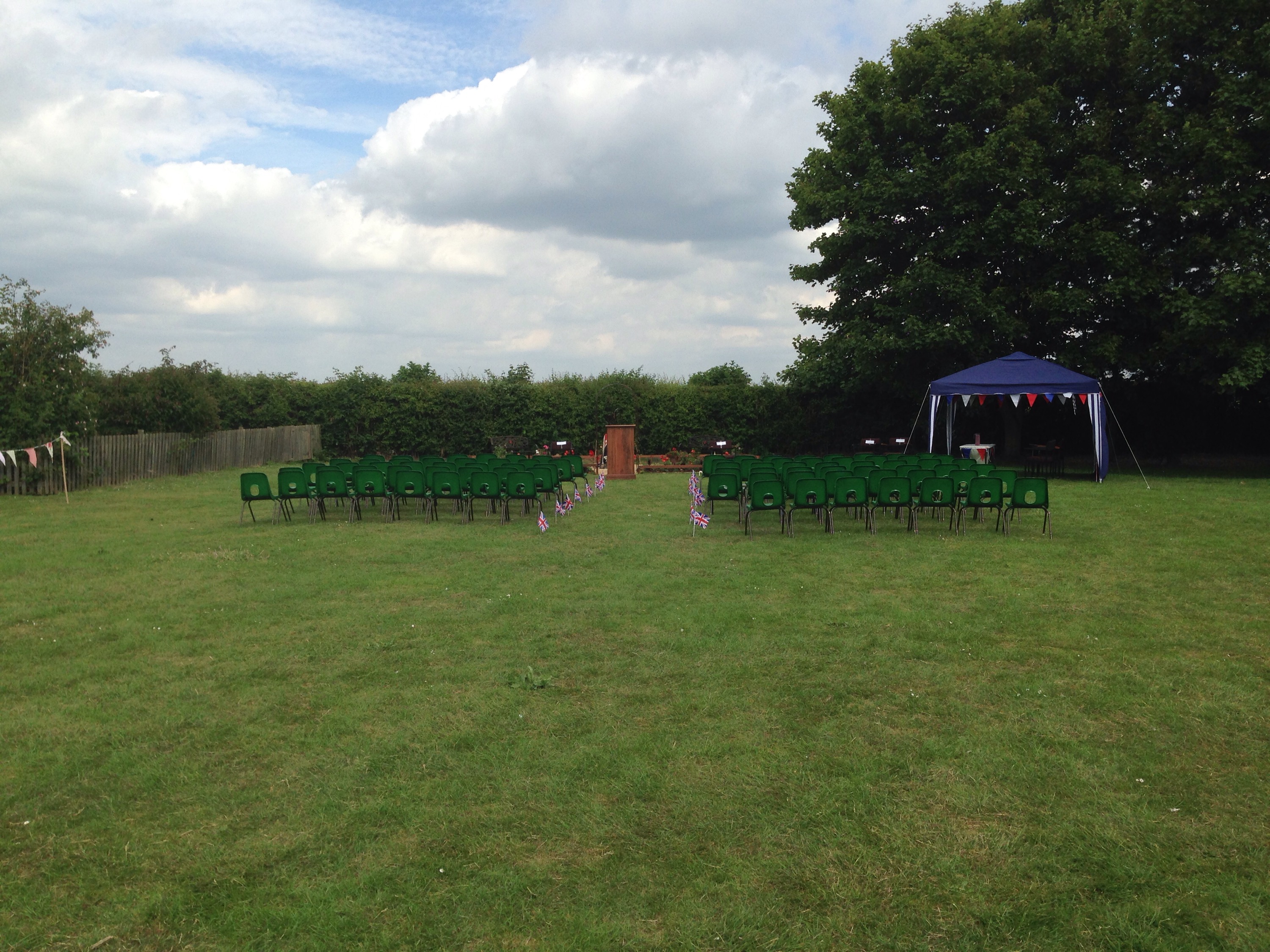
The seating before people started to arrive. There were many more standing, being a small school. we simply didn’t have enough chairs!

The feedback from visitors was superb and everyone was buzzing.

A real team effort, the long evenings, the hard work and recent battle against moles had all been worth while.

We had texts and emails from those who were there praising the efforts. It all worked out far better than even I had envisaged.

We shall miss it. We had great fun, even the odd beer or two, but it has been a real bonding exercise, we have become a little ‘family’ and are really proud of our achievements.

I passed on the good wishes to the children whom I think are quite overwhelmed themselves. They did a fantastic job and were superb role models for others to follow.

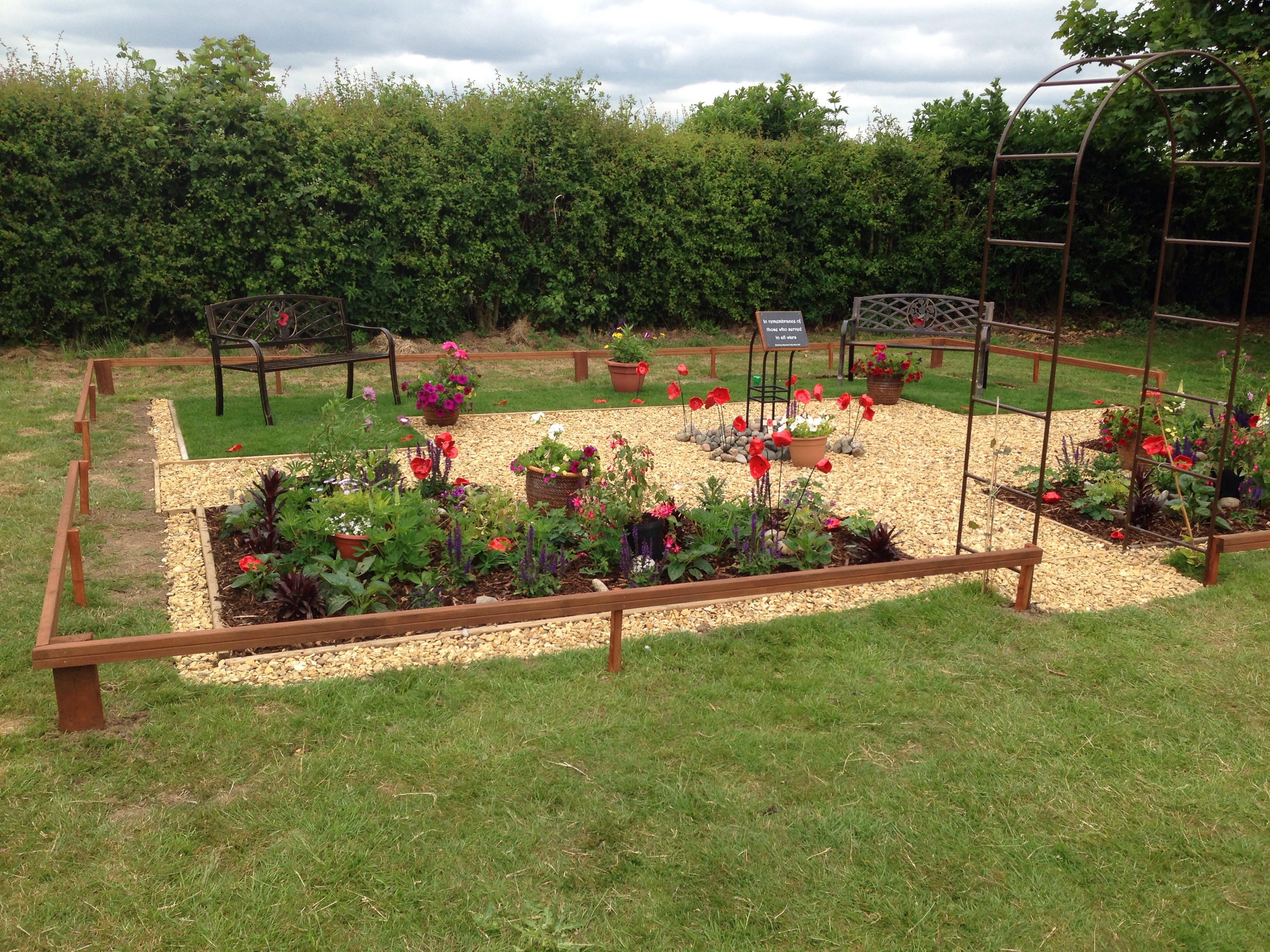
The Garden as it is today. We shall seed the outside, and continue the fight with the moles. An area for relaxation and thought.

We shall continue to nurture and maintain the Garden and watch it grow. The children use it already and do enjoy it. The rose in the crown were the poppies. Made out of clay, they are all handmade by the children mounted on metal rods and bunched in groups of 3 or 4. They do look superb.

There were small stumbling blocks along the way, and these caused delays but none so great we couldn’t deal with them. All in all it went beautifully, far, far better than I ever imagined and the finished product, I hope you’ll agree, is stunning.

An article appeared in the paper on the following day, Saturday here’s a link.

Battle of Britain Memorial Capel-le-Ferne, Kent.

A recent revisit took me back to the Battle of Britain memorial at Capel-le-Ferne between Folkestone and Dover, in Kent. It sits high on the cliff-top, in a windy corner, a stones throw from the international docks at Dover, and the Battle of Britain airfield at Hawkinge. A ‘recent’ addition to the range of memorials, it is a poignant reminder of the young men who, from many nationalities, gave their lives in the name of freedom and the defence of this country.

Last time I was here, work was starting on the new visitor centre and the two replica aircraft, a Spitfire and Hurricane, had both been removed.

The replica Hurricane.

This week, on May 25th 2015, I went back to see what had been done.

The new centre is superb. First of all it has a good car park with ample space for a large number of cars.

The visitors centre itself has a bright open reception area and a small shop for souvenirs (I had to buy a book!) and upstairs a new cafe with a balcony overlooking the monument and across  the English Channel to France.

The Visitors center behind the ‘Wall of Honour’.

Entrance to the memorial is still free, but there is the option to try the ‘scramble’ experience, which I believe costs £6.00.

The Spitfire and Hurricane are both back, admittedly both are metal replicas but up here it gets very windy and the weather can change dramatically in seconds, so it’s probably for the best. They are certainly good replicas. 

The carved Pilot, sitting in the centre of a three-bladed propeller, gazes patiently out to sea, watching for his missing friends. Designed by Harry Gray of the Carving Workshop, Cambridge, the pilot is surrounded by the creats of those squadrons who took part in the famous battle in the Kent skies.

To either side, two large mounds, signify the locations of anti-aircraft batteries, now silent and filled in, perhaps two replica emplacements might add to the ‘feel’ of the site, although sometimes less is more.

As before, the monument is a quiet and moving place to sit; to read the names of those who gave their lives for us, and to absorb yourself in the battle through the numerous information panels around the site. From here you begin to imagine the vapour and smoke trails high above you and to think that Hitler and his invasion forces, stood not more than 30 miles away in the distant haze on the coast of France.

A big improvement to a very moving place.

RAF North Creake – A gem in Norfolk’s countryside.

The final part of this four part tour takes us to the very edge of North Norfolk’s Heritage coast and the nature reserves of Holkham and Blakeney.  Today it resounds with tourists and bird watchers, during the Second World War, it would have been very different.

Our first stop is North Creake, saddling the B1105 road to Wells-Next-the-Sea, it houses a few surprises.

RAF North Creake

plan

RAF North Creake taken in July 1945, shows a large number of dispersed aircraft around the perimeter.

North Creake, like many of the nearby airfields around this part, was originally a satellite for Docking, which in turn was originally a satellite for Bircham Newton.

Construction commenced on this decoy site in 1940/41, and North Creake, known locally as Egmere from the medieval site it stands on, operated in this role until 1942. With the need for more heavy bomber bases, it was soon decided to upgrade North Creake to a Class A airfield, with accommodation for up to 2,951 male and 411 female staff. Three concrete runways were added, two, 01/19 and 13/31 both 4,314 ft (1,315 m) and the third 04/22 of 5,643 ft (1,720 m). To accommodate the aircraft destined to reside here, 36 loop hardstandings, the majority of which are to the north-west of the site, two T2 hangars and one B1 hangar were also added in. The control tower would be built to the East side of the airfield adjacent to the technical site.

various 009

The AML Bombing Teacher nestles in the woods.

Construction was finally completed in 1943, however changes to the structure of Bomber Command, meant that no flying units would operate from here until well into May the following year.

Initially part of 2 Group, North Creake was passed like so many on this tour, to 100 Group, Bomber Command, and would also operate in the Electronic Warfare role. 199 Squadron was the first to arrive. 199 Squadron initially operated Short Stirling bombers, and latterly HP Halifaxes, on radio and radar jamming operations. Flying between 5th June 1944 and 3rd May 1945, they used both ‘Window’ and ‘Mandrel’ on sorties that were frequently combined with standard bombing operations. 199 squadrons ‘C’ flight was broken away from the unit and formed into 171 squadron on September 8th 1944, but carried on this role in support of 199, whose last mission took place on the night of 2nd/3rd May 1945 – in which they flew 17 successful bomber support sorties by Halifaxes in support of an attack against Kiel.

On July 27th, 1945, 171 squadron was disbanded, 199 sqn went 2 days later (being reformed in 1951 with Avro Lincolns, de Havilland Mosquitos, EE Canberras and finally the Vickers Valiant in 1957) and the site was closed to operational flying. It remained as a storage for surplus de Havilland Mosquitos prior to scrapping for a further two years until finally closing in 1947.

various 002

One of the remaining T2 Hangars.

Luckily, the causal observer can still see much of this history at North Creake. The road passes directly though the centre of the Technical Site. Nissan huts now used by small industrial units, still thrive, two of the hangers remain, both in use by an agricultural company and minor buildings such the Bomb Teacher and turret trainer can be found lurking between the trees. The main stores, gas clothing and respirator store are also in use, as are a workshop and away to the north-east, the Airman’s huts.

various 025

Main stores and Gas clothing huts.

North Creake’s runways and taxiways along with two looped hardstandings, are all but gone, covered in trees or used as pathways for the local farmer, but their location very much evident from satellite photos. Development has begun of yet another solar farm, and these great unsightly panels are gradually taking over yet another of Britain’s wartime airfields.

The one Jewell in the crown of North Creake, has to be the control Tower, purchased by private owners, it has undergone a painstaking transformation being refurbished and turned into a Bed and Breakfast. Modernised inside, it remains one of the better preserved buildings on the site.

various 028

North Creake’s Tower now a Bed & Breakfast.

To the south of the site, a memorial has recently been erected by the Airfield’s of Britain Conservation Trust, as a lasting tribute to not only the 17 crews who never returned, but to all those who served at RAF North Creake during the latter days of World War Two.

North Creake is certainly a gem for those wishing to see airfield architecture first hand, and if you desire, the chance to stay inside a tower that would have played a big part in Britain’s attack on Nazi Germany.

Leave North Creake heading north toward the coast, and then turn east. A few miles away lies our next and final stop, RAF Langham.

Links

Details of the North Creake Control Tower Bed & Breakfast can be found here.

RAF Little Snoring – not a sleepy village 70 years ago.

The second airfield on this part of the trail, takes us further north, to a little village and small airfield. It also features one of only a few round towered churches that hold some remarkable records of the region’s history.

RAF Little Snoring

Little Snoring is as its name suggests, a quiet hamlet deep in the heart of Norfolk. Surrounded by beautiful countryside, it boasts a superb round towered church (another called St. Andrew’s) that holds a remarkable little gem of historical significance.

various 002

The Village sign shows Little Snoring’s aviation history.

The airfield, to the North East, was originally opened in 1943, late in the war, as a satellite for nearby Foulsham. It had three runways: 2 constructed of concrete 4,199 ft (1,280 m) in length, (01/19 and 13/31) and one 07/25 of 6,004 ft (1,830 m) again in concrete. As with other airfields it was a typical ‘A’ shape, with 36 dispersal sites, a bomb site to the north, fuel dump to the south and the accommodation blocks dispersed away from the airfield to the east. It was built to accommodate 1,807 RAF and 361 WAAF personnel housed over eight domestic sites.

Initially under the command of 3 Group Bomber Command, it housed the rare Bristol Hercules engined Lancaster IIs of 1678 HCU (Heavy Conversion Unit) and 115 squadron, (between August and November 1943) formally RAF Witchford (Trail 11) and East Wretham, who were to carry out night bombing duties, a role it had performed well at Witchford. Then, as with many of the airfields in this location, it was taken over by Addison’s 100 Group and Mosquitos moved in.

various 007

One of two original T2 hangars still in use today.

169 squadron operating both Mosquito IIs and Beaufighter VIs, would undertake night fighter missions between December 1943 and June 1944. Like their counterparts at Great Massingham, Foulsham, North Creake, West Raynham and Sculthorpe amongst others, they would take part in electronic warfare and counter measures against enemy fighter operations. 100 Group, investigated a wide range of devises suitable for tracking, homing in on or jamming enemy radars. With a wide rage of names; “Airborne Cigar”, “Jostle”, “Mandrel”, “Airborne Grocer”, “Carpet” and “Piperack”, they used both “Serrate” and “ASH” to attack the enemy on their own airfield at night before they could intercept the bombers.

various 010

A road leads to one of the dispersed accommodation sites.

After a short spell with an American Intruder detachment between March and April 1944 flying P-51s and P-38s, Little Snoring was itself the subject of an attack from Luftwaffe aircraft that had followed the bomber stream home. The attack was so successful that Little Snoring was put out of action for some considerable time.

Night intruder missions continued, with 515 squadron, 23 squadron and 141 squadron operating a range of twin-engined aircraft such as the Beaufighter IIf, Blenheim V, Mosquito II, FB.VI and NF.30. Radar training also continued using smaller aircraft such as the Defiant, Anson and Airspeed Oxfords of 1692 Flt.

Eventually in September 1945, operational flying officially ceased  and the airfield was reduced to care and maintenance. Like other airfields in this area, it became the storage area for surplus Mosquitos on their way to a sad ending under the choppers blade. Then in the 1950s Little Snoring was opened temporarily and used by a civilian operated anti-aircraft co-operation unit, flying Spitfire XVI, Mosquito TT.35 and Vampire FB.Vs. Finally in April 1953, Little Snoring was shut, the gates locked and the site sold off.

However, that was not the of flying. Now in civilian hands, Little Snoring operates a small flying club and a microlight manufacturer. Aircraft can visit, and occasionally a ‘fly-in’ happens and the site springs into life once more.

various 017

The road uses the former eastern perimeter track, part of which is still visible to the side.

Following sale of the site, a large number of buildings were demolished or taken away for use elsewhere. The officers’ mess housed four ornately and beautifully written honours and awards boards. Luckily, these were saved by a good samaritan and now reside in the base’s ‘official’ church, St. Andrew’s, on the west wall. Written in paint, they detail the awards and ‘kills’ of the various crew members stationed at Little Snoring. Just a short walk from the church is the village sign which depicts a Mosquito, often seen over the skies of Little Snoring all those years ago.

The perimeter track to the east is now the road, the accommodation site on the eastern side still bears the track but is closed off, what secrets it must hold! A few remnants of concrete roadway exist outside of the airfield, the northern threshold of the main runway is also there used to store gravel and other road material. A small number of buildings, mainly huts, exist in private gardens used as storage sheds. The local caravan site has what is believed to be the base hospital and / or mortuary now a washing block.

The largest and best preserved buildings are two of the original T2 hangars, both used to store potatoes. A blister hangar is also on site but thought not an original of Little Snoring.

various 018

An air-raid bunker protected the personnel from attack.

The bomb site is a field, and all but a small part of the runways are gone or at best farm tracks. Little Snoring’s gem is its watch office, standing proud in the centre of the site, a lone wind sock fluttering from its walls. Run down and dilapidated, it is crying out for love and restoration, but I suspect this isn’t going to happen and perhaps its days are very sadly numbered.

During its operational life, twelve Lancasters and forty-three Mosquitos were lost during missions over enemy territory and to date no ‘official’ memorial exists in their honour. Maybe one day this too will change.

The base commander, ‘glass eyed’ Group Captain Rex O’Bryan Hoare (Sammy) was a known character and has been mentioned in a number of books discussing night intruder missions. He was a very successful Mosquito pilot  and looked up to by his fellow pilots. A superbly detailed account of him appears here and is certainly worth a read.

A once bustling airfield, Little Snoring is now a sleepy site with a few remaining remnants of its wartime activity. The church boards reminders of its successes and the toll paid by the young men of the Royal Air Force.

various 025

The watch office now derelict and forlorn.

The four award and honours boards in St. Andrew’s Church can be seen by clicking here.

Little Snoring ends Trail 22, but leads us to the last part of North Norfolk and a to Trail 23. As we continue north toward the coast, we visit two sites with some remarkable features.

A memorial for three aircraft that crashed close by.

Trail 22 takes us to an area of Norfolk that is filled with narrow lanes, and ‘chocolate box’ villages with duck filled streams and babbling brooks running through the middle. An ideal and welcome break from the horrors of what was witnessed in the skies of occupied Europe all those years ago.

Travelling away from Great Massingham and West Raynham, we carry on east, toward Norwich and then take a left turn and head north. Cutting through the delights of Norfolk, we take in the last few sites that offer good examples of airfield architecture. Before reaching our first site however, turn off the main road at Weasenham St. Peter, for here is a small reminder of the terrible tragedies of war.

Nestled in the village is a small but poignant reminder of the dangers faced by the young men who flew in our skies. Once over friendly territory, crews would often feel safe knowing that ‘home’ was but a few miles away. However, for many the danger was not over yet.

A pyramid memorial in this quiet and almost insignificant village, identifies the crews of not one but three aircraft that crashed close by killing all onboard. From this point you can see the hangars of West Raynham dominating the skyline, an indication of how close to home these young men were.

Blenheim L8800, of 114 sqn RAF, crashed on 5th June 1942. On board were: Sg. F. Cooke, Sgt. J Wallbridge (VR) and Sgt. E. Kitcher (VR) all of whom lost their lives. On 17th October that year, a B25 Mitchell,  FL206 of 98 sqn RAF, crashed killing the crew: Flt. Sgt. D. Tanner, Sgt. E. Boreham, Sgt. L. Horton and LAC F Barnett all of RAF(VR). Finally on May 22nd 1943, close to his spot a Douglas Boston III, AL285 of 342 ‘Lorraine’ Sqn.  crashed killing all her crew, who were part of the Free French Airforce: Lt. M. Le Bivic, Lt. R. Jacquinot, Sgt. L. Cohen and Cpl. J. Desertlaux. All three aircraft were based at nearby West Raynham when the tragedies struck.

various 003

The memorial at Weasenham St. Peter. Behind you, are the not so distant hangars of RAF West Raynham.

A sad and terrible loss of life. When leaving here, return to the main road and head east to our first stop at RAF Foulsham.