M/Sgt. Hewitt Dunn – Flew 104 missions.

RAF Framlingham (Parham) otherwise known as Station 153, achieved a remarkable record, or rather one man in particular did. His name was Hewitt Dunn, a Master Sergeant in the U.S.A.A.F and later the U.S.A.F.

Known as “Buck” he would achieve the remarkable record of completing 104 missions with the 390th Bombardment Group (Heavy) – a record that astounded many as life expectancy in a heavy bomber was short, and few survived beyond one tour of 30 missions.

Hewitt Tomlinson Dunn (s/n 13065206) was born on July 14th 1920. He progressed through school to join the Air Corps where he was assigned to the 390th Bombardment Group (Heavy), 13th Combat Wing, 3rd Air Division, Eighth Air Force, as a gunner in December 1943.

His first mission was with the 569th Bombardment Squadron in the following January. He completed his first gruelling tour of 30 missions by April that year, upon which he immediately applied for a further tour that he would complete by the summer of 1944. His attitude of ‘its not over until its won’, would see him accept a further remarkable third tour, virtually unheard of for a heavy bomber crew member.

On Friday, April 6th 1945, mission 930, an armada of aircraft of the U.S.A.A.F would strike at the marshalling yards in Leipzig, Germany. Inside B-17 #43-38663, ‘The Great McGinty‘, was Hewitt Dunn.

After the mission Dunn described how earlier at the morning briefing, he, like so many of his colleagues, had been a little ‘nervous’. Then, when the curtain was pulled back, their nervousness was justified, Leipzig – the 390th had been there before.

Many crews in that briefing would look to Dunn for signs of anguish, if he remained steady and relaxed, they knew it would be ‘easy’, if he sat forward, then it was going to be a difficult one. The atmosphere must have been tense.

Luckily, unlike other missions into the German heartland, this one turned out to be ‘just another mission’ a ‘milk run’. Much to the huge relief of those in command of the 390th, all aircraft returned safely.

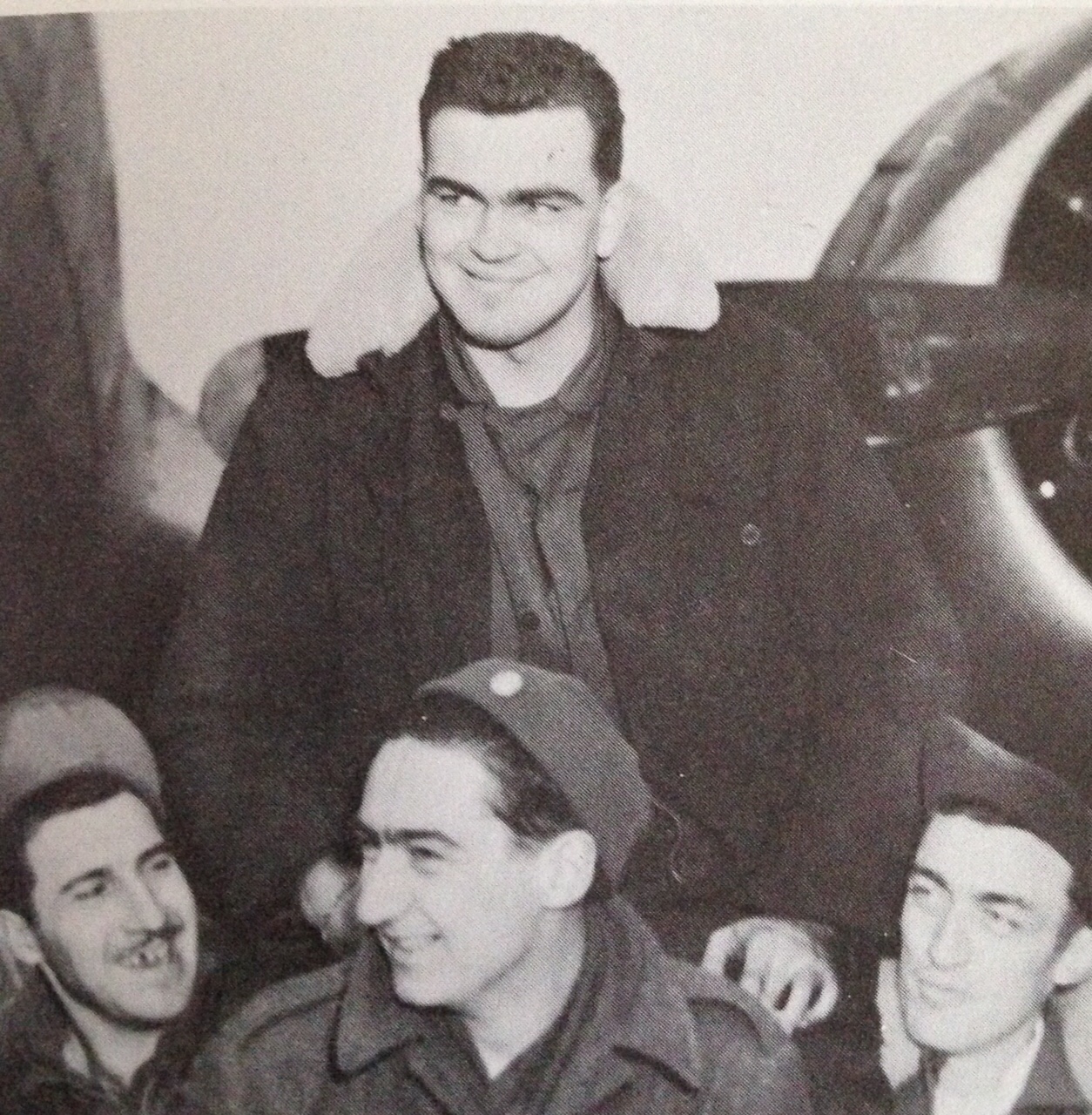
On his arrival back at Framlingham, Dunn was greeted by cheering crowds, ground crews lifted him high in their air carrying him triumphantly away from his aircraft, it was a heroes welcome.

By the time the war had finished, Dunn had flown in 104 missions, he had been a tail gunner on twenty-six missions, twice a top-turret gunner, a waist gunner and the remainder as togglier (Bombardier). He had flown over Berlin nine times, he claimed a FW-190 shot down and had amassed an impressive array of medals for his bravery and actions, and all at just 24 years old.

Post war, he continued to fly as an Instructor Gunner for B-52s in the 328th Bomb Squadron, 93rd Strategic Bomb Wing, at Castle Air Force Base in California. Here he was described as “quiet and reserved” and never talked about his war experiences. He was “handsome man with black hair”, and only when he wore his dress uniform, did others realise how well decorated he was.

Dunn was considered a rock by those who knew him and perhaps immortal, but he was not, and on June 15th , 1961 after flying for a further 64 flights, he was killed. Details of his death are sketchy, but the man who had flown in more missions than any other person in the Eighth Air Force and had gone to train others in that very role, was highly decorated. He was looked up to and liked by those who knew him.

Following his death a service was held in Merced, California, his body was then taken to Arlington National Cemetery in Washington D.C. where he was finally laid to rest in grave number 3675, section 28.

For a man who achieved so much in his fighting career, little exists about him or his achievements. Maybe, by the end of the war, records were no longer needed, tales of dedication and bravery were no longer useful propaganda. Whatever the reason, Hewitt Dunn’s name should be heavily embossed in the history books of the Second World War.

hewiit-dunn

Hewitt Dunn on return from his 100th mission, April 1945 (IWM)

Hewitt Dunn’s medal tally:

– Air Force Longevity Service Award with 3 oak leaf clusters
– Air Medal with 13 oak leaf clusters (2 silver, 3 bronze)
– Air Medal with 7 oak leaf clusters (1 silver, 2 bronze)
– American Campaign Medal
– Distinguished Flying Cross with 1 oak leaf cluster
– Good Conduct Medal
– National Defence Service Medal
– Silver Star
– World War II Victory Medal
– European-African-Middle Eastern Campaign Medal with 1 bronze star
– European-African-Middle Eastern Campaign Medal with 1 silver star

Hewitt Dunn’s story is one of many featured here.

Hingham – an airfield fallen into obscurity.

Continuing  on Trail 38, we depart Swanton Morley and travel south-east toward the former RAF / USAAF base at Hethel. Here we find fast cars, a museum, and more remnants of yesteryear. On the way, we pass-by another former RFC airfield from the First World War – the Home Defence Station at Hingham.

Hingham Home Defence Station.

There is considerable speculation about the true location of Hingham airfield. It is sadly one of those sites that has long since gone, and its history is now so blurred that its true location is not accurately known. It is known however, that it housed only three squadrons in its very short life: 51 (HD), 100 and 102, but only 51 Sqn remained for any period of time, thus making it the sole unit to have flown actively from this airfield.

A grass site, it was believed to be located near to the village of Hingham in Norfolk, some 12 miles south-west of Norwich, however, some sources cite it as Scoulton (latterly Watton airfield) located a few miles to the west of here. Wherever the true whereabouts of Hingham are, it is known that it did play a small but important part in the defence of Great Britain, and therefore worthy of a thought as we pass by.

Following the reorganisation of the RFC and RNAS in 1916, it was known that 51 (HD)  transferred from Thetford to Hingham, arriving at the fledgling airfield on 23rd September 1916, with the Royal Aircraft Factory BE12s. With detachments at Harling Road, Mattishall and Narborough, they were widely spread and would operate solely in the Home Defence role. These airfields were designated Home Defence Stations of which there were two, the ‘Flight‘ station (the smaller of the two) and the ‘Squadron‘ Station, the larger and main station. It is very likely that Hingham was designated as a Flight Station.

In October 1916, 51 (HD) replaced with the BE12s with  two-seat FE2bs and then with further RAE aircraft, the BE2e, in December 1916. The Hingham flight moved to Marham in early august 1917, whilst the Mattishall flight remained where they were.  ‘B’ flight moved west to Tydd St. Mary, a small airfield located on the Lincolnshire / Cambridgeshire border.

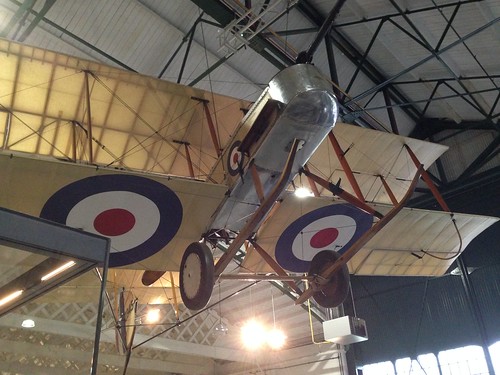
RAF Museum Hendon

The Royal Aircraft Factory F.E.2b at Hendon, London

Throughout the war 51 (HD) squadron fought against the Zeppelins that foraged over the eastern counties. By flying across the North Sea and then turning into The Wash, they were aiming to reach targets as far afield as Liverpool, Coventry and London.

One of several Home Defence airfields in this region, the role of Hingham aircraft (and the other Home Defence units around here), was to protect these industrial areas by intercepting the Zeppelins before they were able to fly further inland.

However, in the early days of the war, Zeppelins were able to fly at greater speeds and altitudes than many of the RFC aircraft that were available, and so the number of RFC ‘kills’ were relatively light. Many of these German Naval airships were able to wander almost at will around the Fens of Cambridge and Lincolnshire dropping their bombs wherever they pleased. It was this lack of a strong defence strategy that perpetuated the creation of the Home Defence squadrons. This new organisation along with improvements and developments in both ammunition and aircraft performance, began to improve the ‘kill’ success rates, and gradually the number of raids decreased. 51 (HD) Sqn played a pivotal part in this role, attacking Zeppelins on a number of occasions in these mid-war years.

It was during this time that two new RFC squadrons would be formed at Hingham. On February 11th 1917, the nucleus of 51 Sqn were relocated here to form the new 100 Sqn, whilst on August 9th that same year, the new 102 Sqn was formed. Both these units would train in the night bombing role and then go on to attack airfields and troops in Northern France in support of the stagnating Allied ground troops.

A stay of about 6 weeks for 102 Sqn and 12 days for 100 Sqn saw them both depart to pastures new, St. Andre-aux-Bois in France and Farnborough in the south of England respectively. It was at these locations that they would collect their operational aircraft before reuniting in Northern France in March that year.

After 51 (HD) squadron left Hingham, the site was never used again by the military and it was subsequently closed down. Whatever structures that were there were presumably sold off in the post war RAF cutbacks, and the field returned to agriculture with all traces, if any, removed – Hingham’s short history had finally come to a close.

Hingham was a small airfield that played its own small part in the defence of the Eastern counties. Whilst its true location is sadly not known, it is certainly worthy of a thought as we travel between two much larger, and perhaps much more significant sites, in this historical part of Norfolk.

Air Crew Memorials – Sgt R. C. Land (RAFVR)

Young men who died in service for their country, may their memories last forever.

On February 4th 1943, Lancaster III, ED496, ‘WS-P’ of No. 9 Squadron (RAF) took off from its base at RAF Waddington, Lincolnshire. On board were the crew members: Sgts Land, Packer, Gullery, Levesque (RCAF) and McGonigal all of the RAF (VR). This was to be a routine test flight for the crew, but it would end tragically for all those on board.

February 1943 was one of the mildest on record, experiencing low snowfalls and warmer temperatures across the country. However, on the fourth, particularly low temperatures were recorded, and during the night many aircraft on operations turned back due to associated icing problems. During that month there was a very low seasonal rainfall, particularly around Lincoln and the east coast area; with prevailing south-westerly winds, the weather was considered to be ‘fair’.

Lancaster WS-P took off on a routine air test, it was to undertake a number of circuits carrying out practice landings testing on-board equipment aiding such manoeuvres. At 16:00, the aircraft dived in to the ground crashing at Scopwick, north of Sleaford, Lincolnshire. With all its four engines still running when the aircraft struck the ground, the resultant crash led to an inevitable explosion and fire killing all on board. Whilst Sgt Land’s body was thrown clear, the remaining crew members were not and they remained trapped inside. The force of the crash buried the aircraft  deep in to the peaty Lincolnshire soil, rendering any recovery virtually impossible.

The crash was investigated by the Air Investigation Branch and their findings summarised in report W1458; but whilst no firm conclusions were drawn, it is believed that ‘structural failure’ of the air frame was to blame for the accident.

The aircraft and bodies remain in the ground to this day and a small monument has been erected in their honour. Sgt Land’s body was taken to Weston Longville, Norfolk, where he was buried in the grounds of All Saints Church. His companions are all honoured at the Runnymede Cemetery, Surrey.

The crew of Lancaster WS-P were:

Sgt Charles Richard Land, (s/n 1332099)
Ronald Jack Packer (s/n 901009) (Panel 160)
Sgt  Hugh Francis Gullery, (s/n 1378136) (Panel 151)
Sgt Joseph Thomas Levesque (RCAF) (s/n R/55503) (Panel 183)
Sgt Francis Victor McGonigal, (s/n 1554452) (Panel 157)

Sgt. CR Land,

Sgt Land is buried in the grounds of All Saints Church, Weston Longville, Norfolk.

F/O. Edwin C. Gardner, RAF Hemswell, 61 Squadron

One of many young men killed in the Second World War whose stories deserve to be told.

F/O E Gardner

Flying Officer E. Gardner, RAF(VR)

Flying Officer Edwin Charles. Gardner (s/n 72558) was stationed at RAF Hemswell with 61 Squadron flying Hampden Mk.I bombers. He was part of the RAF(VR) and was killed 17th October 1940 age 24.

61 Sqn (RAF), a former World War I unit,  was re-formed on March 8th 1937 at RAF Hemswell as a bomber squadron flying Audax aircraft. Over the next two years they would transition through a number of makes – Anson Mk I and Blenheim Mk I eventually equipping with the Handley Page Hampden in February 1939. They were formed as part of No. 5 Group, Bomber Command, and would take part in several prestige operations. During the early part of the war they would carry out the very first attack on a German land target, (Hornum, 19th/20th March 1940), the first major bombing raid on the German mainland (Monchengladbach, 11th/12th May 1940), and take part in the first RAF bombing raid on Berlin on the night of August 25th/26th 1940.

It was two months after this, that Flying Officer Gardner would lose his life at the age of 24.

Gardner’s aircraft, X-2979, QR-? took off around 18:00 to attack the German city of Merseburg. They would form part of a 73  strong formation made up of both Wellington and Hampden aircraft, attacking a number of targets at: Bremen, Kiel, Bordeaux and the Harz Forest, intending to set it alight with incendiaries. The force included aircraft from a number of squadrons that night.

With F/O Gardner were the Pilot – Pilot Officer William Herbert Clemenson (s/n 81027), Wireless Operator – Sgt William Hutchinson Hewitt (s/n 822581) and Sgt Dominick Flanagan (s/n 532927), the air gunner on board the aircraft.

The force attacked their designated targets successfully, returning home to the respective bases after having suffered very lightly (3 aircraft in total) over the target areas. On the return trip however, they encountered dense fog which, combined with technical problems with a number of aircraft, caused 10 Hampdens and 4 Wellingtons to crash, many with loss of life.

Reports show that Gardner’s aircraft contacted Hemswell twice in the early hours of the Thursday Morning to gain fixes on their positions. Possibly out of fuel, the aircraft finally came down at Sporle, a few miles west of Norwich, killing all four crew, members.

Flying Officer Gardner was laid to rest at All Saints Church Tacolneston, Norfolk a few miles west of Norwich. His companions were returned to their respective parishes. His grave stands alone in a quiet corner of this 13th Century church. May he rest in peace.

‘Death is Swallowed up in Victory’

Sources

Chorley. W.R., Bomber Command Losses Vol I, 1939-40, Classic Publication, 1992.

Is this the missing Stirling LJ850?

A recent report has identified what is believed to be the wreckage of Stirling LJ850 ‘QS-Y’ of 620 Squadron (RAF), that crashed whilst on a mission to drop paratroopers behind German lines.

Crew of Missing Stirling LJ850

The crew of LJ850 *1

The aircraft was part of a three ship formation and disappeared on the night of 17th / 18th June 1944, with a number of RAF personnel and the 1st SAS Regiment servicemen on board, – there were no survivors*2.

There has been considerable speculation about the fate of this aircraft and a number of theories as to what happened to it.

It was last heard from whilst over the English Channel, and initial thoughts were that it crashed into the sea. Other reports state it crashed into high ground on the run-in to the drop zone in the Morvan Mountains area near Les Valottes. A further report states it crashed 100 miles off course in the Savoy Hills, but there were never any reports by the German authorities at the time and no substantial wreckage has as yet been found.

Fragments form this particular wreckage may have been located a few miles inland of what was Omaha Beach, a possible location if LJ850 did come down shortly after its last transmission.

It is known that there were very few heavy bomber activities that night, and no bomber casualties were reported. Early indications are that the wreckage is of a Stirling bomber, so could this be the wreck of LJ850?

Before any investigations can proceed, a permit is required, but French officials are refusing to grant permission for any detailed search of the site, as the site is a “war grave”. They also quite rightly raise concerns over the conservation of the site, safety issues, and also jurisdictional considerations. So, for now, the story and final closure of LJ850 looks set to continue for some time yet.

620 Squadron was formed on 17th June 1943 at Chedburgh, and were initially involved in night bombing duties. In November 1943, they converted to airborne operations, dropping supplies, Paratroops and performing glider tug operations. Between March 18th 1944 and 18th October 1944, they operated from RAF Fairford, Gloucestershire, before moving to Great Dunmow and subsequently to the Middle East at the end of the war.

The crew of the Stirling were:

Wing Commander R.W. Crane  RAAF (s/n 413535) (Pilot)
Fgt. Sgt. F.N. Johnson  RAFVR (s/n 1395038) (Nav.)
W.O. II J.P. Clasper RCAF (s/n R159971) (B/A)
Sgt. D.W. Evans RAFVR (s/n 1407968) (Flt. Eng)
Flt. Sgt. G.W. Stopford RAFVR (s/n 657479) (W/O – A/G)
Flt. Sgt. B.J. Profit RCAF (s/n R189226)  (A/G)
Sgt. P. Wilding RAFVR (s/n 1345156) (Parachutist Dispatcher)*2.

The crew are represented on the Runnymede memorial.

Included on that flight when it crashed was Sgt. Reginald Wortley, (s/n 4863732) of the 1st Special Air Service Regiment. Wortley was one of the founder members of the SAS.

The names of the paratroops appear on the Bayeux Memorial.

The reported story can be found here.

*1 photo from CBC News website.

*In Dennis Williams’ book “Stirlings in Action with the Airborne Forces“, the crew list omits Wilding, the dispatcher, and lists 15 SAS troops killed on the night. Many thanks go to reader Darren Sladden for the further information and book recommendation, which I too recommend to anyone with an interest in this area of aviation. The Book was published by Pen and Sword Books, 2008, ISBN 184415648-6,

February 13th, Birthday of a Young Hero.

Today, 13th February, marks the birthday of an American airman who like so many, died at the young age of just 21, in the early morning of D-Day, 1944.

He was a gallant and brave young man, whose tragedy perhaps led to the success of his fellow airmen, and whose sacrifice is still remembered today.

As the world’s largest amphibious assault force assembled along the South Coast of England, thousands of aircrew prepared for what was to be the most incredible night of their lives.

Across the Midland Counties, American ground crews prepared their fighters and paratrooper aircraft. Along southern England, the same scene was being played out. RAF crews too prepared their aircraft; fighter groups were briefed and paratroopers readied their gear. The invasion was on!

Flying an operation of this magnitude was going to require guts, daring and precision flying. There was little room for error.

In the lead up to June 6th, the RAF and USAAF had been bombing prime targets across Northern France to soften up the defending Germans. Supply lines were severed and gun emplacements destroyed. Beachhead bunkers had been heavily targeted, and supporting artillery further inland, hit hard.

In the air, fighters had been downing the Luftwaffe in an effort to gain vital air superiority over the drop zones. At home, huge attempts were made to keep the plans and preparations as secret as possible. An intricate operation of deception was being played out; dummy airfields were built, camps and troop movements were hidden under cover and concealed in forests.

At an airfield in Norfolk, the day was to begin very badly for one particular young pilot. He was 1st Lt. Robert C. Frascotti of Milford, Massachusetts.

In the days leading up to D-Day at RAF Bodney (USAAF Station 141), the 352nd FG had been flying intruder missions over France, attacking ground targets and completing air superiority missions. P-51s were rapidly being prepared, and the growth of black and white stripes adorning aircraft, hinted of an imminent invasion.

In the late hours of June 5th, the P-51s were being fueled up and armed, ready for an early morning takeoff.  The weather was not at its best and a low mist shrouded the airfield reducing visibility. The mission ahead was to support the troops landing on the Normandy beaches.

At 02:30, the pilots climbed in, fastened their belts and awaited the signal to launch D-Day. First to leave were the 486th FS. To help with the takeoff, temporary lights were placed along the runway, guiding the aircraft safely out of harm’s way into the night sky. One of these aircraft, unfortunately struck the lights knocking them out and plunging the airfield into darkness once more. Lining up behind them were the second flight of the 486th, including Frascotti’s P-51.

When lining up, the flight were unaware that they were off centre. Frascotti and his wingman, Lt. Carlton “Bud” Fuhrman, accelerated away and raced down the runway. Fuhrman watched Frascotti to his left when suddenly there was a massive fireball. Thinking someone had dropped their external fuel tanks, Fuhrman pulled up sharply and pushed on through the flames hoping his engine would not falter resulting in him crashing into the raging fire below. Momentarily blinded by the now total darkness, Fuhrman, pushed the stick forward and fought against the impending stall. Eventually his sight returned and he was able to read his instruments once more. Looking back, he could see Frascotti’s fully fueled plane engulfed in fire with no hope of an escape. Frascotti died instantly.

The accident report filed after Frascotti’s death stated that an inadequately lit tower along with poor weather and high levels of traffic had caused him to inadvertently strike the unfinished control tower at Bodney resulting in the ignition of his fuel. Tragically, Frascotti died instantly, and the aircraft was a total loss.

Frascotti’s plane, a blue nosed P-51B-5 Mustang, 43-6685 was named ‘Umbriago‘. In Italian, ‘umbriago’ means ‘drunk’. Frascotti could have named his plane for that reason, but it could also be he was referring to the World War II-era song of 1944, “Umbriago”by Jimmy Durante about a fabled friend of the same name. The song lyrics end with, “So when you feel low, better send for my friend, Umbriago.”

At a mere 21 years of age, 1st Lt. Robert C. Frascotti had many tributes written about him. There was one benefit of his tragic accident: the following aircraft now had a ‘guiding light’ by which they could safely takeoff and leave for Normandy.

Frascotti was born on February 13th, 1923 into a very close-knit and patriotic family in Milford, Massachusetts. (His father fought in World War I where he was gassed). Frascotti was awarded his pilot wings in Marianna, Florida on March 25, 1943, then completed advanced fighter training before deploying to England in March 1944. He joined the 486th FS of the 352nd FG, otherwise known as ‘The Blue Nosed Bastards of Bodney”. 1st Lt. Donald “Red” Whinnem of Hartford, Connecticut, was best friends with Frascotti since the early days of flight school. On D-Day at Bodney, “Red” took off without incident and flew for sixteen hours, returning to discover the tragedy that had occurred. “Red” says of his friend;

“Bob was the nicest guy you would ever want to know, and a great athlete as well. He could stir up laughter anywhere he went, and he was great fun to be with. Bob would sing a song or tell a story and cheer everyone up. You couldn’t ask for a better friend, and he was closer than a brother to me.”

During his service, Frascotti was credited with the destruction of two enemy aircraft on the ground whilst strafing enemy airfields. On D-Day, he departed for his 89th mission. This was to be his last mission of the war as he was due to return to the States leaving conflict behind him. Sadly, he never made that journey home to Massachusetts until many years later.

Initially, Frascotti was buried in England. His remains were eventually taken back to Massachusetts in 1948 after his next of kin had his body exhumed, and he now lies in the Sacred Heart Cemetery, in Milford. Lt. Robert C. Frascotti VFW Post 1544 in his hometown, now bears his name, and on December 6th, 2013, as part of the annual “Wreaths Across the Worcester and Norfolk District”, a group of local veterans, families and friends, laid a holiday wreath at Calzone Park in Milford to remember the fallen veterans of the area, including Frascotti. Since the war, every year until his death in 1998, 1st Lt. Donald “Red” Whinnem traveled to Frascotti’s grave in Milford to pay his respects and remember his wartime friend.

Fly pasts and tributes continue to be paid for Frascotti, in both the United States and here at RAF Bodney, Norfolk. 1st Lt. Robert C. Frascotti will long be remembered for his brave sacrifice, and we that are here, are honored to continue to tell his story.

As for RAF Bodney, the airfield is now an Army training camp and part of the Stanford Training Area (STANTA) in Thetford Forest. Little remains of the airfield today but the history held within its decaying walls will long live on.

RAF Bodney can be visited in Trail 8 – Swaffham and her Neighbours (Part 1).

IMG_2210

Robert Frascotti next to his P-51B, 43-6685, named ‘Umbriago’ . At 21 years of age he was killed on his final mission before returning home. (Photo – Marc Hamel)

I came across this video on You Tube, published on May 27th 2013, it shows the control tower at Bodney airfield.

(The Frascotti page was originally posted on June 6th 2014)

Britain’s Airfields – What does the future hold?

There has been a recent ‘spate’ of developments with planning applications that affect Britain’s wartime heritage, and in particular the airfields that were used during the Second World War.

With land at a premium, a housing crisis that is growing, these sites are becoming more and more handsome as development opportunities. Many have a ready-made infrastructure, many are open fields and as such, prime agricultural or development land. So what does the future hold for Britain’s heritage?

We have seen applications submitted or at least interest shown, for the former: RAF Kings Cliffe, RAF Downham Market, RAF West Raynham, RAF Denethorpe and RAF Coltishall, further applications have now been seen affecting former RAF Dunsfold, RAF Bourn and RAF Wellesbourne Mountford.

We also know that the USAF have given notice of withdrawal from their major UK base at RAF Mildenhall, the smaller site at RAF Molesworth and the remaining site at RAF Alconbury. The Government has already announced it will be selling these sites for housing after the military withdrawal in 2020-23. These three sites form part of an estimated £500m sell-off that would also include: RAF Barnham (Suffolk), Kneller Hall (Twickenham), Claro and Deverell Barracks (Ripon), Lodge Hill (Kent), Craigiehall (Edinburgh), HMS Nelson Wardroom (Portsmouth), Hullavington Airfield (Wiltshire) and MOD Felton (London). Changes at RAF Lakenheath will also see job losses through streamlining of operations.

It is estimated that the 12 sites could accommodate an estimated 15,000 homes with Alconbury having 5,000 alone.

The former airfield and barracks at RAF Waterbeach is also subject to planning proposals, and the Bassingbourn barracks near Cambridge is also under the development spotlight. The recent closure of Manston (a vital Second World War airfield) has led to speculation of its future both as an airfield (possibly London’s third) and as a development opportunity. These are perhaps just a few of the prime areas of land that are now becoming the focus of planners and developers alike.

There are many variables in this heated and long-lasting debate, in fact far too many to raise and discuss here. Strong feelings exist both toward and against the idea of development and it is certainly not a new one. Employment, jobs, environment, heritage, housing etc, they all create discussion and a strong case for both arguments, but the debate here is not “should we build or not” this is quite frankly, inevitable and in many cases much-needed, no, it’s more how can we meet the needs of an ever-growing population with the needs to preserve historically important sites that form the very thread of today’s society.

We have a dynamic population, and as health care improves, social mobility increases and a growing desire to own our own home increases, the need for more housing, affordable homes and homes for rent also increases. We are an ageing population, care homes, schools for our children and hospitals for the sick are all in much greater need. Where do we build them?

Whilst housing demands have always been with us and the need for more housing an all important one, the recent developments suggest that these old airfields could become prime land to meet these future housing needs.

Many of the current Second World War airfields are now either industrial conurbations or agricultural areas. Most have little or no remnants of their former lives visible, and certainly not widely accessible. Many argue that these sites are scrub, derelict and in need of development, and some indeed are. A proportion of the more recently used sites, are ‘mothballed’ or in part operating aviation related activities. They cover huge areas and have a ready-made infrastructure such were the designs of war and post war airfields. These sites also contain extensive dereliction, primarily due to being left and allowed to decay by their owners. Vandalism and pilfering has left them rotting like carcasses of forgotten wild animals. Where industry has been operating, contaminates have seeped into the soils, damaging flora and fauna growth; some so severe that they are rendered too difficult to reclaim as ‘Green Space’. Certainly on paper, they offer good sources for today’s desperate housing stock.

However, balance this against the historical and cultural importance of these places and the argument becomes a little blurred at the seams. Had it not been for the people who came to this country from all over the world to fight the Nazi tyranny in the war years 1939-45, then Britain and Europe would probably not be the Europe we know today. Many thousands of people gave their lives during those dark days, and for many of them, these airfields were their last homes, cold, often draughty huts on the outskirts of some bleak airfield. Their dedication helped form the very society we live in today, the democracy and freedom of speech we so enjoy and relish, the open spaces where we can walk our dog without fear and in freedom. The fact that we can have this very debate, is in itself, testament to those who came here never to return. The very nature and fabric of our local communities has been built around the ‘friendly invasion’ the acceptance of others into our quaint life and idyllic life-styles. Influences from other nations and cultures grew and developed as a result of those who came here from far and wide to give up their lives.

These sites have become monuments to them, their lives and deaths, many still have no known grave; many simply ‘disappeared’ such was the ferocity of the explosion that killed them. The design of Britain’s airfields are architecturally significant to our heritage, buildings were designed to fulfil a purpose and just like our castles and stately homes, they are monuments to a significant period of not only British, but world history. Our education system, includes this very period as a subject for discussion, debate and analysis. To build over such sites without due regard to them would be a travesty, and one that we would regret in the future. To paraphrase that well-known quote; If we are to learn from our mistakes then we need to remember the past. The Second World War is still, for the moment, in living memory, the veterans and civilians who survived it are dwindling in numbers and very soon their memories will be lost for ever. Each day brings news of a lost veteran or a newly discovered story. If we don’t acknowledge the value of these places, if we don’t plan for their ‘preservation’ then both we and our future generations, will be the ones to regret it.

So where do we go from here? The plans published for RAF West Raynham and RAF Coltishall take into account the nature of these sites, they are sympathetic to their historical value and acknowledge the sacrifices made. West Raynham utilises the very buildings that were created, thus keeping the atmosphere for those who wish to visit. Small museums create a record, first hand experiences and artefacts, all valuable records for the education of future generations. But both of these are unique. Both closed in more recent history, they have retained their structures whereas many older sites have had theirs long since demolished.

It is a delicate balance, and as sad as it would be to see them go, there has to be legislation to create compromise. Sympathetic developments have to be the way forward, acknowledgement of the sacrifice has to be high on the agenda. Many of the airfields I have been too have no museum, no memorial barely even a signpost. Surely this is wrong.

If we are to preserve our fragile heritage, we need to consider the implications of the planning process, to look at the value of these sites as both suitable housing and significant historical areas, the sacrifice of the many needs to be acknowledged and it needs to be done soon.

Sources and Further Reading.

Laying the Foundations: A Housing Strategy for England ” HM Gov, November 2011

Stimulating housing supply – Government initiatives (England)” House of Commons Library, 9 December 2014

The “Get Surrey” news report issued on January 5th 2016 relating to Dunsfold can be found here.

Then latest news from “Cambridge News” December 16th 2015 can be found here.

The “Stratford-Upon-Avon Herald” January 6th 2016 front page story about Wellesbourne can be found here. (This may be a limited time link).

The latest news on RAF Mildenhall and Lakenheath published by the BBC, 18th January 2016 can be found here.

B-17 Reveals its Secrets after 73 years.

There are many tragic and sad events associated with the Second World War, a recent discovery is no different. The story of a B-17 and her crew as they left on one of the first missions of the American air war has recently come to light with the discovery of the aircraft off the North Norfolk coast.

The story of this particular aircraft, believed to be B-17F-VE ’42-29752′ is especially sad, not only because it was the first operational mission of the unit and the first casualty, but because of the nature of the loss;  just moments after take off, a month after it and its crews had first arrived in the UK.

The B-17, was built and delivered at  Cheyenne on February 12th 1943. Its journey to the UK would take it through a number of stations, via Walker airbase, Salina, and on to Presque Isle, in the north-eastern sector of Maine, where it arrived on April 8th 1943. It was here that it was allocated to the 338th BS, 96th BG and ferried across the northern route with the air echelon of the 338th, arriving at RAF Grafton Underwood in April 1943, before onward shipment and operational duties.

The 338th BS had only been activated themselves one year earlier in July 1942 and as such were relatively new to the war. Their journey took them through a number of training bases from Salt Lake City, through Utah, Idaho and onto their final station at Pyote AAB Texas. From here, the air and ground echelons went their separate ways, the air echelon travelling north and the ground crews to Camp Kilmer, New Jersey and onward via the Queen Elizabeth to Greenock, Scotland and the European Theatre of Operation. The ground echelons arrived at Great Saling (Andrews Field) in early May 1943 moving to Snetterton Heath a month later where they would join up with the air echelons.

It would be whilst temporarily based here at Grafton Underwood, on May 13th 1943 that the B-17 would end its short life and become an almost forgotten part of history.

The 338th would take part in a 72 aircraft mission to bomb the Longuenesse and Ft. Rouge Airfields at St Omer, France. On the day in question, the aircraft were to form up over the North Norfolk coast, before heading off south. Crews had been briefed about the possibility of being attacked by marauding Luftwaffe aircraft and so many crews had their guns charged as they climbed away from the airfield. It was this very precaution that led to the tragic death of one of the crew members and demise of the B-17.

As the aircraft, piloted by Capt. Derrol Rogers, formed up, a waist gun was accidentally discharged sending high calibre bullets into the stabilizer completely severing it and forcing the aircraft into an uncontrollable climb and potential stall. Fighting with the controls, Capt. Rogers fought to keep it from crashing. Both he and his Co-Pilot: Lt. Norville Gorse, managed to get the aircraft back under control long enough to allow the crew to bail out over land. Once out, they took the aircraft back out over The Wash and jettisoned the bombs. Then as they approached land once more, they tied a rope to the yolk and bailed out themselves.

42-29752 after stabilizer accidently shot off

Aircraft, believed to be 42-29752, after the waist gun was accidentally discharged, severing the stabilizer. (American Air Museum)*1

Lt. Gorse was picked up by an RAF rescue launch and returned to his unit, but unfortunately, Capt. Rogers, being in the sea for some time, didn’t survive. He was the only fatality of the incident, the remaining crew all returning to their base and operational duties.

The B-17 now unmanned and destabilized, plunged into the North Sea where it has laid for the last 70 years. A truly tragic start to a very bitter war.

An engine was initially caught up in a fishing boat net in the 1970s, but no real investigation was made of the wreck. More recently, towards the end of 2015, a small team of divers went back down to photograph the aircraft, and it was then that it was identified and its remarkable story revealed.

The Crew of B-17 ’42-29752′

Capt: Derrol W. Rogers,
Co-pilot: Norville Gorse,
Navigator: Joe Hudson,
Bombardier: George Rawlings,
Flight engineer/top turret gunner: Basil Maxwell,
Radio Operator: Bob Bennett,
Ball turret gunner: Alf Miles,
Waist gunner: Bob Dominick,
Waist gunner: Edwin Wolfkuhle,
Tail gunner: Ed Youngers (injured by discharged bullets)

Capt. D.W. Rogers (s/n O-403737) is listed in the St Paul’s Roll of Honour, (Page 360), he is buried in the Cambridge American Cemetery, Madingley, Plot D, Row 7, Grave 69, he was awarded the DFC and Purple Heart.

*1 Photo from the American Air Museum (IWM) UPL 19232

The story first appeared in the Eastern Daily Press on November 30th 2015.


A Happy New Year!

As 2015 fades away I would like to take this opportunity to thank each and every one of you who has visited, followed, liked, reblogged, commented and generally supported “Aviation Trails” during the last year. Without you, it would not be the site it is today.

It has certainly grown over the last year and taken on a new dimension. Investment in research material has enabled much longer posts and more personal information to be included, something that I know many people like to see. Not only do ‘we’ as enthusiasts, historical ‘writers’, modellers, relations of veterans etc. preserve our common history, but openly promote and educate others through the writing we do.

I believe it is important to remember what went on, the sacrifice and dedication to freedom, and if I can go a small way to helping that then it has all been worthwhile.

I have been inspired to take up old hobbies, learnt about aspects of military and natural history that I had never heard of, found new places in the world and been a part of a group of people who share the desire to learn, educate and inform others. It has been a wonderful year.

The tally of airfields I have visited is now around 75, double what it was this time last year. I have walked in the footsteps of famous people like Guy Gibson, Glenn Miller and Joe Kennedy, stood where important and famous missions have been planned and executed, trodden the very ground where so many young men and women served their country, many thousands giving the ultimate sacrifice.

It has been a most humbling experience.

So to each and every one of you, a heartfelt thank you, and here’s to a happy, peaceful and rewarding 2016.

American Ghosts – RAF Kimbolton an Airfield with a Remarkable History.

Kimbolton was home to the American USAAF, it also housed one of the RAF’s rarest Wellington Bombers of the Second World War. The 379th BG were the main residents achieving a number of records whilst bombing heavily defended targets in occupied Europe. We go back to see what is left today.

RAF Kimbolton. (Station 117)

DSC_0108

Looking across Kimbolton today.

We arrive not far from the busy A14 to the south-west of Graffham Water. Perched on top of the hill, as many of these sites are, is Station 117 – Kimbolton. Having a short life, it was home to the 379th Bombardment Group of the Eighth Air Force, flying some 330 missions in B-17s. The site is split in two by the main road which uses part of the original perimeter track for it’s base. To one side is where the runways and dispersal pens would have been, to the other side the main hangers, admin blocks, fuel storage and squadron quarters. The former is now open fields used for agriculture and the later a well-kept and busy industrial site. What was the main runway is crossed by this road where there is now a kart track.

Kimbolton Airfield in 1945, taken by 541 Sqn RAF. (English Heritage RAF Photography – RAF_106G_UK_635_RP_3217)

Kimbolton was designed with three concrete runways, the main running north-west / south-east, (2154 yds); the second and third running slightly off north-south (1545 yds) and east-west (1407 yds), it also had two T2 hangars with a proposed third, along with 20 ‘loop’ style hardstands and 31 ‘frying pan’ hardstands around its perimeter.

The local railway line formed the northern boundary,  the bomb store was to the south-west, the technical and administrative site to the south-east and beyond that the accommodation sites. To house the huge numbers staff to be located at Kimbolton, there were two communal sites; a WAAF site; sick quarters; two sewage sites; two officers quarters, an airmen’s quarters; a sergeants site and two further sites with ablutions and latrines. These were all spread to the south-eastern corner of the airfield,

Originally built in 1941 as a  satellite for RAF Molesworth, it was initially used by the RAF’s Wellington IVs, a rare breed where only 220 airframes were built. 460 Sqn were formed out of ‘C’ flight 458 Sqn at Molesworth and used the Wellingtons until August 1942 when they replaced them with the Halifax II. Staying only until January 1942, their departure saw the handing over of both Molesworth and Kimbolton to the USAAF Eighth Air Force and the heavier B-17s. During this time, the airfield was still under construction, and although the majority of the infrastructure was already in place, the perimeter was yet to be completed.

First to arrive was the 91stBG, who only stayed for a month, before moving on to Bassingbourn.  A short stay by ground forces preceded extensions to the runways, accommodation and improved facilities. Now Kimbolton was truly ready for a Heavy Bomb Group.

Soon to arrive, was the 379th BG, 41st CW, flying B-17Fs. Activated in November 1942 they arrived at Kimbolton via Scotland, ground forces sailing from New York whilst the crews flew their aircraft from Maine to Prestwick via the northern supply route.

Arriving in April / May, their first mission would be that same month. The 379th would attack prestige targets such as industrial sites, oil refineries, submarine pens and other targets stretching from France and the lowlands to Norway and onto Poland. Targets famed for heavy defences and bitter fighting, they would often see themselves over, Ludwigshafen, Brunswick, Schweinfurt, Leipzig, Meresberg and Gelsenkirchen. They would receive two DUCs for action over Europe including, raids without fighter escort over central Germany on January 11th 1944. They assisted with the allied invasion, the breakout at St. Lo and attacked communication lines at the Battle of the Bulge. They  would operate from Kimbolton until after the war’s end, when on 12th June 1945, they began their departure to Casablanca.

Life at Kimbolton was not to be easy and initiation into the war would be harsh. On the first operation, four aircraft were lost, three over the target and one further crashing on return. Three of the crews were to die; a stark warning as to what would come. Their second mission would fair little better. An attack on Wilhelmshaven, saw a further six aircraft lost and heavy casualties amongst the survivors. Things were not going well for the 379th and with further losses, this was to be one of the bloodiest entries into the war for any Eight Air Force Group.

A B-17 Flying Fortress (FR-C, serial number 42-38183) nicknamed

B-17 Flying Fortress (‘FR-C’, 42-38183) “The Lost Angel” of the 379th BG sliding on grass after crash landing, flown by Lieutenant Edmund H Lutz at Kimbolton. (Roger Freeman Collection)

As the air battle progressed, further losses would be the pay off for accurate and determined bombing by the 379th. Flying in close formation as they did, accidents often occurred. On January 30th 1944, 42-3325 “Paddy Gremlin” was hit by bombs from above. Then again, on September 16th 1943, two further aircraft were downed by falling bombs, close formation flying certainly had its dangers.

Some 1 in 6 losses of the USAAF were due to accidents of one form or another. Collisions were another inevitable part of the close formation flying. A number of memorials around the country remember crews who lost their lives whilst flying in close formation. Kimbolton and the 379th were to be no different. On June 19th 1944, two B-17Gs 44-6133 (unnamed) and 42-97942 “Heavenly Body II” crashed over Canvey Island killing all but one of 44-6133 and three of Heavenly Body II. The official verdict stated that the second pilot failed to maintain the correct position whilst in poor visibility, a remarkable feat in any condition let alone poor visibility whilst possibly on instruments alone. (See full details of the terrible accident).

However, not all was bad for the 379th though. Luck was on the side of B-17F, 42-3167, “Ye Olde Pub“, when on December 20th 1943, anti-aircraft fire badly damaged the aircraft whilst over Bremen. The aircraft limping for home, was discovered by Lt. Franz Stigler of JG 27/6. On seeing the aircraft, Stigler escorted the B-17 over the North Sea, whereupon he saluted and departed allowing the B-17 safe passage home where it landed and was scrapped.

A number of prestige visitors were seen at Kimbolton. These included King George VI, Queen Elizabeth, Princess Elizabeth and General Doolittle. One particular and rather rare visitor arrived at Kimbolton on January 8th 1944. A rebuilt Messerschmitt BF-109 stayed here whilst on a familiarisation tour for crews. Shot down over Kent it was rebuilt to flying condition and flown around the country.

8th 1944.

Seen in front of a B-17, Messerschmitt BF-109 runs up her engine at Kimbolton, January 8th 1944. (Roger Freeman Collection FRE 4775)

All in all the 379th had a turbulent time. By the time they had left Kimbolton, they had lost a great many crews, but their record was second to none. They flew more sorties than any other Bomb Group of the Eighth Air Force – in excess of 10,000 in 330 missions; dropped around 24,000 tons of ordnance, equating to 2.3 tons per aircraft; pioneered the 12 ship formation that became standard practice in 1944 and had the lowest abortive rate of any group from 1943. Kimbolton was visited by Lieutenant General James Doolittle, and two B-17s held the record of that time “Ol Gappy” and “Birmingham Jewel“, for the most missions at the end of their service. They also had overall, one of the lowest loss rates of all Eighth AF Groups largely due to the high mission rates.

With their departure to Casablanca, the 379th would be the last operational unit to reside at Kimbolton. Post war it was retained by the RAF until sold off in the 1960s, it was returned to agriculture, the many buildings torn down, the runways dug up and crops planted where B-17s once flew.

DSC_0113

The old perimeter track exists for farm machinery and forms part of the main road.

Kimbolton today is little more than a small industrial estate and farmland. At the main entrance to the industrial site, is a well-kept memorial. Two flags representing our two nations, stand aside a plaque showing the layout of the field as was, with airfield detail added.  Behind this, and almost un-noticeable, is a neat wooden box with a visitors book and a file documenting all those who left from here never to return. There are a considerable number of pages full of names and personal detail – a moving document. One of the B-17 pilots, Lt. Kermit D. Wooldridge, of the 525th Bomb Squadron, 379th Bomb Group, 8th Air Force kept a diary of his 25 raids, and many of the crew members mentioned in the memorial book appear in his diaries. These are currently being published by his daughter, and can be seen at https://sites.google.com/site/ww2pilotsdiary/  They tell of the raids, the crews and detailed events that took place over the skies of occupied Europe from June 29th 1943. I highly recommend reading it.

DSC_0109

Memorial book listing those that never came home.

This is a lovely place to sit (benches are there) and contemplate what must have been a magnificent sight all those years ago. It made me think of the part in the film ‘Memphis Belle’, where the crew were sitting listening to the poetry just prior to departure, how many young men also stood here ‘listening to poetry’. The control tower would have stood almost opposite where you are now, with views across an enormous expanse. Here they would have stood ‘counting them back’. Like everything else, it has gone and the site is now ‘peaceful’.

Kimbolton saw great deal of action in its short life. But if determination and grit were words to associate with any flying unit of the war, the 379th would be high on that list.

From Kimbolton we head off to another American Ghost, one that holds its own record and a beautiful stained glass window. We go to the American base at RAF Grafton Underwood.

Kimbolton was originally visited a couple of years ago, this is an update of that trail and it appears in Trail 6 – ‘American Ghosts’.