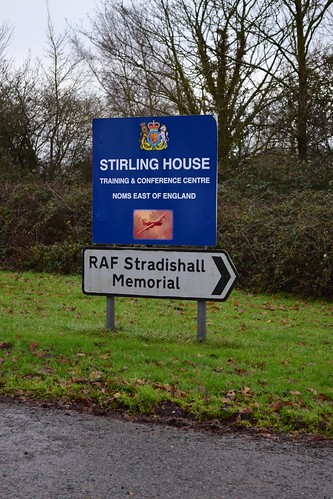
November 1938 -Tragedy at Stradishall

Whilst researching a forthcoming trail, I discovered the story of two airmen who were both killed in an accident, and are both buried in the local village cemetery.

Their gravestones are sadly much less ‘grand’ than many of the other airmen in the cemetery, but their departure was none the less, nothing short of a tragedy, and in no way less of a sacrifice than any other loss.

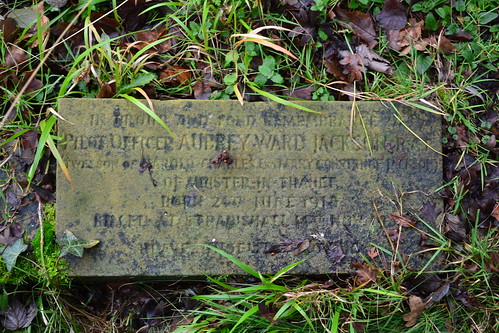
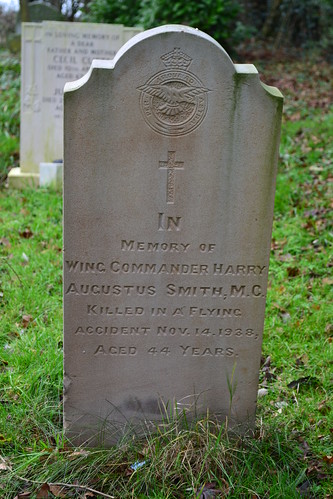
It was during a night training flight, on November 14th 1938, that Wing Commander Harry A. Smith MC, along with his navigator Pilot Officer Aubrey W. Jackson, both of No. 9  Squadron (RAF),  would be killed in a Handley Page Heyford III reg: K5194, when the aircraft undershot the airfield striking trees outside the airfield boundary. The crash was so forceful that the aircraft burst into flames killing both airmen.

Wing Commander Smith MC qualified as a pilot whilst in the Royal Flying Corps in 1916, and was the first of his rank to be killed since the inception of Bomber Command in July 1936. He had been awarded the Military Cross ‘for gallantry and distinguished service in the field‘ in 1918.

Pilot Officer Jackson was appointed for a Short Service Commission in January 1937, and later a Permanent Commission. He was only 20 years old at the time of his death.

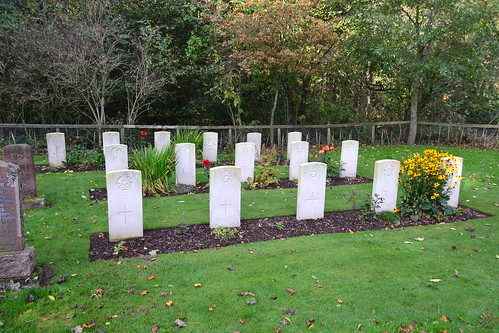
Both crewmen are buried in Stradishall’s local cemetery.

St. Margaret of Antioch, Stradishall

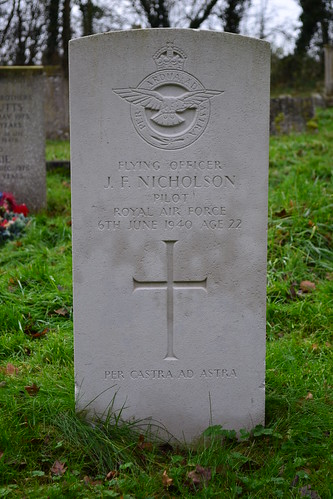
A very ordinary grave stone marks the plot of P.O. Aubrey W. Jackson, killed on November 14th 1938 on a night training flight.

St. Margaret of Antioch, Stradishall

Wing Commander Smith, killed alongside P.O. Jackson on a night training flight. He was the first of his rank to die since the formation of Bomber Command.

4th June 1944 – Death of a Lancaster Crew

On June 3rd 1944, Lancaster ND841 ‘F2-D’ piloted by F/O. George. A. Young (s/n: 134149) RAFVR 635 Squadron, was detailed to attack Calais as part of the preparations for D-Day. There would be eight other aircraft from RAF Downham Market also detailed for the mission and take off would be late that evening.

The mission as a whole would involve 127 Lancasters and 8 Mosquitoes of No.1, 3 and 8 Groups and the targets would be the gun batteries at both Calais and Wimerereux. It was a  diversionary raid as part of Operation “Fortitude South“, to fool the Germans into believing the invasion would occur in the Pas-de-Calais region.

At 28 minutes past midnight, F/O. Young lined the Lancaster up on the runway, opened the throttles and began the long run down the runway. As the Lancaster approached take off, it began to swing striking the roof of a B1 Hangar. In an uncontrollable state the aircraft crashed just outside the airfield killing all on board.

All other eight aircraft took off and returned safely after having dropped their bombs.

On board Lancaster F2-D that night was:

Pilot: F.O. George Ambrose Young, aged 24 (s/n: 134149) RAFVR.
Flight Engineer: Sgt. Thomas Snowball, aged 32 (s/n: 1100769) RAFVR
Navigator: F.Sgt. Howard Pritchard, aged 22 (s/n: 1578502) RAFVR
Bomb Aimer: F.O. Walter Thomas Olyott, aged 21 (s/n: 151238). RAFVR
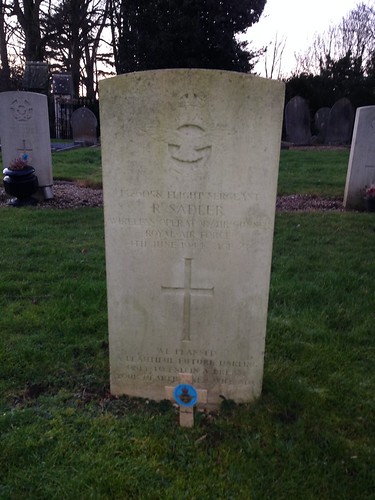
Wireless Operator / Gunner: F.Sgt. Robert Sadler, aged 23 (s/n: 1526058). RAFVR
Air Gunner: F.Sgt. Stanley Wharton, aged 30 (s/n: 1578013) RAFVR
Air Gunner: F.Sgt. Charles Patrick Nallen, aged 20 (s/n: 427537) RAAF

The Operations record book (AIR 27/2155/7) for that day simply  states:

3.6.44  ‘D’ F/O Young G.A. hit hangar after taking off and crashed on airfield when large bomb exploded and the crew all killed.  8 aircraft returned to base .

Three of the crew are buried in Kings Walk Cemetery, Downham Market, a short distance from the airfield.

Downham Market Cemetery

F.Sgt. Stanley Wharton (RAFVR)

Downham Market Cemetery

F.Sgt. Robert Sadler (RAFVR)

Downham Market Cemetery

F.O. Walter Thomas Olyott (RAFVR)

RAF Chedburgh – An appalling loss of life.

In this next trail, we start just a few miles to the south-west of Bury St. Edmunds in Suffolk, where we visit a number of airfields that were associated with the heavy bombers of the RAF’s Bomber Command.

Our first stop, although a satellite, more than earned its rightful place in the history books of aviation. It is an airfield where large numbers of the ill-fated Stirling flew many missions over occupied Europe, where the staggering statistics of lost men and machines speak for themselves.

Now little more than fields and a small industrial estate, the remnants of this wartime airfield stand as reminders of those dark days in the 1940s when night after night, young men flew enormous machines over enemy territory to drop their deadly payload on heavily defended industrial targets.

We begin our next trip at the former airfield RAF Chedburgh, home to the mighty four-engined bombers of No. 3 Group Bomber Command of the Royal Air Force.

RAF Chedburgh.

Built in 1942 (by John Laing and Son Ltd) as a satellite for RAF Stradishall, Chedburgh would be built to the Class A specification, a later addition to the RAF’s war effort. Being a bomber station Chedburgh would have three runways made of concrete, the initial construction being one of 2,000 yards and two of 1,400 yards, all the standard 50 yards wide, as was the standard specification brought in during 1941. Later on, these would be extended giving Chedburgh much longer runways than many of its counterparts, i.e. one at 3,000 yards and two at 2,000 yards. Having runways this long, meant that heavy bombers could use the site when in trouble, something that Chedburgh would get used to very quickly.

With the village of Chedburgh to the north of the site, directly opposite the main gate; the technical area along the north-eastern side of the main runway, and the bomb store to the east, Chedburgh would have two T2 hangars, a B1 and later on 3 glider hangars. Dotted around the perimeter track were a number of dispersals comprising 34 pan styles and 2 looped.
RAF Chedburgh

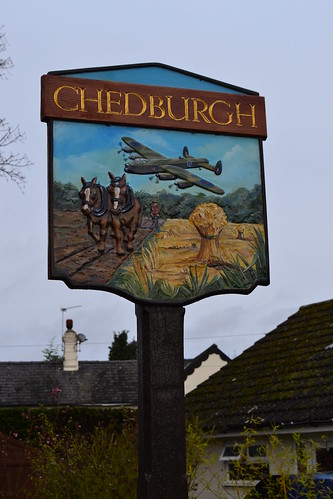
Chedburgh village sign reflects it aviation history.

Whilst housing only two major squadrons 214 Squadron and 620 Squadron, it would also be home to a small number of other operational units, 218, 301, 304 Sqns and 1653 Heavy Conversion Unit (HCU).

Opening under the control of No. 3 Group, on September 7th 1942, the first resident unit was 214 Squadron (RAF) flying the Stirling MK. I, a model they operated until as late as February 1944. The bulk of the unit arrived in the October, with operations beginning very soon after. Within four months they would begin replacing some of these models with the upgraded MK.III, also operating these until the beginning of 1944 and after transferring to RAF Downham Market in Norfolk.

As with many airfields at this time, the arrival of personnel preceded the completion of the works, development continuing well into the operational time of its residents, something that would cause a problem in the coming months.

It was in March of 1943 that the first casualties would occur, the night of March 1st/2nd being a baptism of fire for 214 Sqn. Stirling MK. I (R9143) BU-E piloted by F/S. J. Lyall (RCAF) would be hit by flak, she was badly damaged, and then abandoned by her crew. As he descended from the stricken aircraft, F/O. Hotson (RNZAF) would be hit by a splintering shell – the wounding he received as a result would be fatal. The remainder of the crew all escaped the aircraft safely but were later captured by the Germans and incarcerated. A multi-national crew, this loss was to be followed just two nights later with the loss of another Stirling, ‘BU-C’, but this time none of the seven crewmen were to survive.

Then on the next night, 5th/6th March, whilst on operations to Essen (the 100,000th sortie by RAF aircraft), Stirling BK662 ‘BU-K’ crashed into the North Sea about 30 km north-northwest of Ijmuiden. Only one of the crew, Air Gunner Sgt. William H. Trotter (s/n: 1128255) was ever found, the rest of the crew remaining ‘missing in action’. This was the first Stirling to be listed as such since the squadron’s operations began. This raid would prove devastating, taking the lives of 75 RAF airmen, but the War Office considered it a major success in terms of  industrial damage to the German war machine. The targeted Krupps factory, which sat in the centre of over 100 acres of industrialised area, was devastated by both accurate marking and then the subsequent bombing.

Throughout this month there were further loses to the squadron: Stirlings ‘BU-Q’ and  ‘BU-A’ (in which F/S. D Moore (RCAF) and Sgt. T. Wilson were both awarded the George medal for saving the life of their companion Sgt. J. Flack), along with ‘BU-M’ were all lost; ‘BU-M’ losing all but one crewman. Another aircraft, ‘BU-L’, lost all seven aircrew  on the night of March 27th/28th, and closing March off, was a collision between Stirlings BK663 and EF362, which left several more crewmen either injured or dead. Although many losses were as a direct result of flak or night fighters, the cracks were beginning to show, and the poor performance of the Stirling was becoming evermore apparent.

It was during this year on 17th June 1943, that Chedburgh’s second main operational unit would be formed, 620 Sqn (RAF), also carrying out bomber operations, again with the Stirling MK. I and later in the August, the MK. III. Also part of 3 Group Bomber Command, 620 Sqn were created through the streamlining of 214 Sqn and 149 Sqn at nearby Lakenheath. The move reduced each of the two former squadrons from three flights to two,  releasing ‘C’ Flight of 214 Sqn who were already stationed here at Chedburgh.
RAF Chedburgh

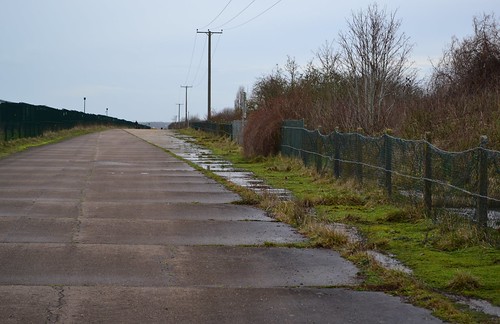
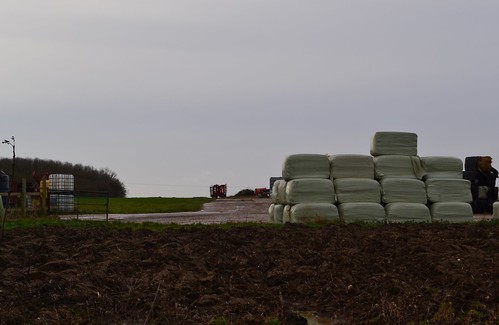
Parts of the perimeter track and runways remain as tracks used for storage.

As many of these crews were already well established and experienced, there would be no delay in commencing operations, the first sortie occurring on the night of the 19th June 1943 – two days after their formation. The first casualties occurred three days later on the night of 22nd/23rd June 1943, just a few days into their operational campaign. There then followed five months of heavy operational activity, a period in which the Stirling and its crews would be pushed to the very limit and beyond. The shortcomings of the aircraft being realised further more.

Being on a partially built airfield would be the cause of the demise of Stirling EF336 (QS-D) which swung on take off and ran into the partially constructed perimeter track. The uneven surface caused the undercarriage to collapse, and whilst there were no injuries to the crew, the aircraft was written off.

The poor service ceiling of the Stirling led to several aircraft being damaged through falling bombs from aircraft flying above. A number of Stirlings were recorded returning to bases, including Chedburgh, with damage to the air frames, damage caused by these falling ‘friendly’ bombs!  However, the extent of this damage did give great credit to the aircraft, showing both its robustness and strength in design; something that often gets forgotten when talking about the Stirling in operations.

The next few months for 620 Sqn would be filled with a mix of operational sorties, mining operations (Gardening) and training flights, including both ‘Bullseye‘ and ‘Eric‘; testing the home defence searchlight and AA batteries both at night and during the day. During a fighter affiliation exercise on July 2nd, two 620 Squadron aircraft collided, ‘EF394’ (QS-V) and BK724 (QS-Y)  killing fifteen and injuring two. One of those killed, Flight Mechanic AIC Arthur Haigh (s/n: 1768277) was only 18 years old, and one of five ground crew who were aboard the two aircraft that day.

Both 214 Sqn and 620 Sqn would go on for the next few months taking part in some of the war’s largest bomber missions including Hamburg, Essen and Remscheid. A number of aircraft would be lost and many aircrew along with them. The worst recorded night for 620 Sqn was the night operation on August 27th/28th, 1943 to Nuremberg, when three aircraft were shot down, all Stirling MK.IIIs: BF576 (QS-F) piloted by Sgt. Frank Eeles (s/n: 1531789); EE942 (QS-R) piloted by Flt. Sgt. John F. Nichols (s/n: 1318759) and EF451 (QS-D) piloted by Sgt. William H. Duroe (s/n: 658365). These three losses accounted for sixteen deaths and five taken as POWs, there were no other survivors.

The last 214 Sqn Stirling to be written off during bombing missions occurred on the night of November 22nd/23rd, 1943. Whilst on a mission to Berlin, Stirling EF445 (BU-J) was hit by flak, attacked by a FW-190 and then suffered icing. The resultant damage along with a lack of fuel, caused the pilot to ditch in the North Sea with the loss of two crewmen: pilot F/S. George A. Atkinson (s/n: 1485104) and Sgt. W. Sweeney (RCAF) (s/n: R/79844).

620’s stay at Chedburgh would be fairly short-lived, taking part in their final operation on the night of November 19th/20th, 1943 to Leverkusen. They then departed Chedburgh at the end of that month after suffering a heavy toll on their numbers and a devastating start to their war. By now the limitations of the Stirling were very well-known, and it was already being replaced by the much favoured Lancaster. In the short five months it had existed, the squadron had lost eighteen of its aircraft in operations, and a further six in accidents, statistics that are however, overshadowed by the loss of ninety-three lives. 620 Sqn left both Chedburgh and Bomber Command to join other units at RAF Leicester East and the Allied Expeditionary Air Force in November, where the unit was to perform Airborne operations along side 196 Sqn and 1665 Heavy Conversion Unit (HCU). A role that 620 performed for the remainder of the war.

With their departure came the arrival of another Stirling squadron, 1653 HCU, a Stirling training unit rather than a front line operational squadron. A month later 214 Sqn would also leave Chedburgh taking their Stirlings to Downham Market and then onto Sculthorpe where they replaced them with the B-17 Flying Fortress.

A P-51 Mustang (5Q-Q, serial number 42-106672) of the 504th Fighter Squadron, 339th Fighter Group, that has crash landed at Chedburgh, 18 May 1944. (IWM FRE 2784)

1653 HCU, as a training unit, would also have it share of accidents and losses, many due to technical problems, but some due to pilot error. A number of accidents were caused by tyres blowing, and some were caused by engine failures, the bravery of these pilots in dealing with these matters being no less than exemplary. One such incident being that of F/O. Hannah and his crew, who took off at 20:50 on the evening of November 3rd 1944, on a radar training flight. Immediately after take off both port engines cut out, something that was almost fatal in a Stirling. The aircraft, virtually uncontrollable, was heading towards a row of cottages but the crew managed to turn it  away missing the houses but colliding with a row of trees instead. All of the crew were injured to varying degrees – one fatally. Sgt. Eddie (RCAF) dying in the resultant crash.

After a year of being at Chedburgh, 1653 HCU would also depart (December 1944) by which time the Lancaster was well and truly the main bomber of the RAF. This late stage of the war would not be the end of Chedburgh though, Bomber Command retaining its use, sending the Lancasters I and III of 218 (Gold Coast)*1 Squadron here from RAF Methwold.

On December 2nd 1944 the first ground units began to arrive, with flying personnel arriving on the 5th, after much-needed runway repairs were completed. The airfield reopened with the arrival of eighteen Lancasters, formed into three new flights, of which thirteen would undertake operations on the 8th, to the railway yards at Duisburg – their first from Chedburgh. Both this mission and that of the 11th to the marshalling yards at Osterfeld, were heavily restricted by thick cloud, and so G-H navigation aids were used in conjunction with ‘Oboe‘.

For the majority of the remainder of the war Bomber Command continued its strategic missions against German cities, with marshalling yards and oil refineries being other major targets. It was of course this continued use of bomber aircraft against what was now a demoralised and weakened German population, that led to the outcry over Harris’s continued attacks on German cities. A controversial action that led to his move away from the lime light at the war’s end, and the lack of recognition for bomber commands efforts throughout the conflict.

218 Sqn would continue on though. The winter of 1944 / 45 proving to be one of the worst weather wise, many missions were either scrubbed or carried out in poor weather. On the night of January 1st/2nd 1945, one hundred and forty-six aircraft of No. 3 Group were tasked with the attack on Vohwinkel railway yards. During the attack in which 218 Sqn were a part, two aircraft were hit by heavy anti-aircraft fire from American guns below. One of these was 218 Sqn Lancaster MK. I PB768 (XH-B) piloted by 20 yr old Australian F/O. Robert G. Grivell. The accuracy of these guns was ironically excellent, hitting the aircraft not once but twice, causing it to spin uncontrollably toward the ground. All but one of the crew were killed in the ensuing crash.

It was during this period that the RAF began daylight bombing missions too, such was the poor state of the defending Luftwaffe. Numerous missions over the next weeks led to attacks on the coking plants at both Datteln and Hattingen, repeated again on March 17th in attacks at Huls (and Dortmund). Hattingen was again attacked by 218 Sqn aircraft on the 18th without loss.

ROYAL AIR FORCE BOMBER COMMAND, 1942-1945.

Mechanics at work on an engine of Lancaster B Mk. III, (LM577) ‘HA-Q’ “Edith”, of No. 218 Squadron. On March 19th 1945, this aircraft was hit by flak over Gelsenkirchen damaging the rear turret and injuring the gunner’s eye. LM577 went on to complete more flying hours than any other Lancaster on the station.(© IWM (CH 15460))

The remainder of the war would see 218 Sqn fly from Chedburgh, completing many missions until the war’s end. During Operation ‘Manna‘ in which the German Army lifted an embargo on food transport into Holland, ten Lancasters of 218 Squadron dropped food supplies to the starving Dutch below. Understandably April had seen fewer operations than in previous months, but with May seeing many more food trips to the Hague, 218 Squadron leapt to the top of the leader board for operational tours, overtaking both 77 Sqn and 115 Sqn their closest friendly ‘competitors’. With further flights under ‘Manna‘, and then repatriation flights under both ‘Dodge‘ and ‘Exodus‘ 218 Sqn continued to operate the long haul flights into European territory.

During August the big wind down began, and the Lancasters were gradually flown out of Chedburgh for disposal. Then on the 10th, 218 (Gold Coast) Squadron was finally disbanded, and the various crews sent home to their respective territories across the globe.

On August 27th 1945, the last two Lancasters departed Chedburgh, and all was very quiet for those left behind. Then in September, two Polish bomber squadrons arrived, both 301 and 304 Sqns remaining here until they were also disbanded a year later on December 18th, 1946; their Warwicks, Wellingtons and Halifaxes being no doubt scrapped. Whilst here, the Polish squadrons flew long-range transport flights, retaining at least some link to the heavy aircraft and long-range flights that had been common only a year or so before.

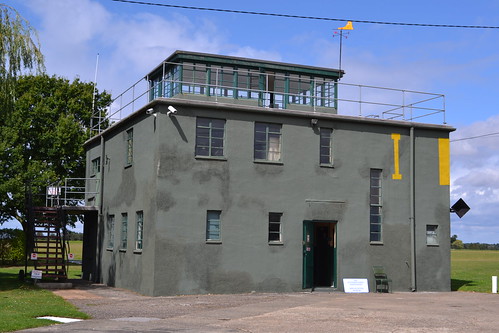
Over the remaining years the airfield, like many, has reduced to both agriculture and industrial use. The watch Office has been heavily modified and lies hidden within an industrial complex that has completely taken over the former technical site. A number of these original buildings still survive and visible from the main A143 Bury St. Edmunds to Haverhill road, the road that separates the airfield from the village opposite. The runways and perimeter tracks, visible only in small parts, are mere concrete platforms, now used to store farm produce and machinery, rather than the lumbering bombers of RAF Bomber Command.

The huts used to house the 1,600 RAF personnel and 240 WAAFs, have all been removed, as have the thirty-six hardstands – the airfield site now being completely agricultural.

RAF Chedburgh

Some technical buildings remain in use today.

Whilst Chedburgh was only built as a satellite airfield, by the end of the war it had been witness to many great sacrifices. Eighty-three aircraft had been lost on operations, all but 12 being Stirlings; eighteen from 620 Sqn and fifty from 214 Sqn. For a period of only fourteen months for 214 Sqn and five for 620 Sqn, this was an appalling loss of life, and one that was sadly mirrored by many bomber squadrons across the British Isles in the 1940s.

Sources and further reading

Much of the specific detail for these loses came from the Chorley, W.R., “Bomber Command Losses series”, published by Midland Counties Publications.

*1 A number of books are available on this squadron. One written by Ron Warburton, ‘Ron’s War‘ chronicles the life of a Flight Engineer of a Lancaster in 218 (Gold Coast) Sqn whilst at Chedburgh in 1945. It is published by RW Press, and available online. ISBN-13: 978-0983178804

A second book is also available, “From St Vith to Victory: 218 (Gold Coast) Squadron and the Campaign Against Nazi Germany“, written by Stephen Smith, and published by Pen and Sword Aviation in 2010 (ISBN10 1473855403). It details the life of 218 (Gold Coast Sqn) from its inception through to its disbandment in 1945.

A blog has also been set up dedicated to those who served in 218 (Gold Coast) Sqn and it gives a detailed history from 1936-1945. It has also been created by Stephen Smith who has also published other books relating to 218 Sqn including “A Short War” and “A Stirling Effort” which relates specifically to their time at RAF Downham Market.  https://218squadron.wordpress.com/

September 8th 1943 – Tragedy at RAF Mepal.

On the night of September 8/9th 1943,  a force of 257 aircraft comprising 119 Wellingtons, 112 Stirlings, 16 Mosquitoes and 10 Halifaxes took off from various bases around the U.K. to bomb the Nazi gun positions at Boulogne. Included in this force were aircraft from the RAF’s Operational Training Units, and for the first time of the war, five B-17s flown by US aircrews of the USAAF’s 422nd BS, 305th BG at Grafton Underwood. This was the first of eight such missions to test the feasibility of the USAAF carrying out night operations over Europe.  After the remaining seven missions, in which the squadron had dropped 68 tons of bombs, the idea was scrapped, the concept considered ‘uneconomical’ although the aircraft themselves proved to be more than capable of the operations.

The Gun battery targeted, was the emplacement that housed the Germans’ long-range guns, and the target wold be marked by Oboe Mosquitoes. With good weather and clear visibility, navigation was excellent, allowing the main force to successfully drop their bombs in the target area causing several huge explosions. However, not many fires were seen burning and the mission was not recorded as a success. Reports subsequently showed that the emplacement was undamaged due to both inaccurate marking by Pathfinders, and bombing by the main force. However, as both anti-aircraft fire and night fighter activity were light, no aircraft were lost during the flight making it a rather an uneventful night.

However, the mission was not all plain sailing, and whilst all crews returned, the night was marred by some very tragic events.

Three Stirlings were to take off from their various bases that night: at 21:00 hrs from Chedburgh, Stirling MK. III, EF136, piloted by F/S. R. Bunce of 620 Sqn; at 21:30, another Stirling MK.III, from 75 Sqn at RAF Mepal, BK809 ‘JN-T*1‘ piloted by F/O I.R.Menzies of the RNZAF; and lastly at 21:58 also from Chedburgh, Stirling MK. I, R9288 ‘BU-Q’ piloted by N.J. Tutt  of 214 Sqn.  Unfortunately all three aircraft were to suffer the same and uncanny fate, swinging violently on take off. The first EF136 crashed almost immediately, the second BK809 struck a fuel bowser, and the third R9288 ended up in the bomb dump. Miraculously in both the Chedburgh incidents there were no casualties at all, all fourteen crew men surviving what must have been one of their luckiest escapes of the war! The same cannot be said for the second though.

Stirling BK809 was part of a seventeen strong force of 75 Sqn aircraft. Each aircraft was carrying its full load made up of 1,000lb and 500lb bombs. As the Stirling was running along the runway, it swung violently, striking a fuel bowser which sent it careering into houses bordering the edge of the airfield.

One of the occupants of one of the houses, Mr. P. Smith, saw the aircraft approaching and ran into the street to warn others to get clear. As the aircraft struck the rear of the houses, it burst into flames causing some of the bombs to detonate. This brought considerable rubble down on the occupants of the second house, Mr and Mrs John Randall.

Mrs Randall managed to get out, her legs injured, whereupon she was met by a local fireman, Mr. A.E. Kirby of the National Fire Service. Mr. Kirby went on to help search in the wreckage of the house until his attempts were thwarted by another explosion. His body, along with that of Mr. Randall, was found the next day.

Two other people were also killed that night trying to provide assistance, those being F/Sgt Peter Gerald Dobson, RNZAF and Section Officer Joan Marjorie Easton WAAF. F/Sgt. Dobson was later mentioned in despatches. Three members of the crew lost their lives as a result of the accident, F/O. Menzies and F/O. N. Gale both died in the actual crash whilst Sgt. A. Mellor died later from injuries sustained in the accident.

A number of others were injured in the crash and one further member of the squadron, Cpl Terence Henry King B.E.M, was awarded the British Empire Medal “for his bravery that night in giving assistance“.

The mission on the night of September 8/9th 1943 will not go down as one of the most remarkable, even though  it was unique in many respects, but it will be remembered for the sad loss of crews, serving officers and civilians alike in what was a very tragic and sad event.

The crew of Stirling BK809 were:

F/O. Ian Robert Menzies RNZAF NZ415002. (Pilot).
P/O. Derek Albert Arthur Cordery RAFVR 136360. (Nav).
P/O. Norman Hathway Gale RAFVR 849986. (B/A).
Sgt. Ralph Herbert Barker RNZAF NZ417189. (W/O).
Sgt. Albert Leslie Mellor RAFVR 943914. (Flt. Eng).
Sgt. Bullivant G RAFVR 1395379. (Upp. G)
Sgt. Stewart Donald Muir RNZAF NZ416967. (R/G).

RAF Mepal was visited in Trail 11.

Sources and Further Reading.

*1 Chorley, 1996 “Bomber Command Losses 1943” notes this aircraft as AA-T.

Chorley, W.R., “Bomber Command Losses – 1943“, Midland Counties, (1996)

Middlebrook M., & Everitt C., “The Bomber Command War Diaries”  Midland Publishing, (1996)

Further details of this accident, the crews and those involved can be found on the 75 (NZ) Sqn blog. This includes the gravestones of those killed and a newspaper report of the event.

My thanks also go to Neil Bright (Twitter handle @Blitz_Detective) for the initial  information.

2017 – A Look Back Over The Last Three Years.

As 2017 draws to a close and another year passes, I’d like to look back at some of the highlights of the blog so far.

Since starting the site, way back in 2014, I have learned a lot about Britain’s airfields, their design and construction, and the men and machines that flew from them. What started as a record of memories has turned into a passion of history and hopefully, a dedication to all those who served, fought and died at these places. I have also seen how gradually, over time, many of these historic sites have sadly disappeared, beaten by the onslaught of time, the developers pen, and the ploughs of the industrial farmer evermore determined to draw out more crops from his expanding domain.

What were once massive military sites covering a vast acreage of land, homes to several thousand people who were all doing ‘their bit’ for the war effort; who came from all four corners of the world to fight, are now mere ruins or a collection of derelict and decaying buildings. In many cases they are merely small patches of concrete often covered with the waste of farm practices, or as in some cases, completely gone.

Since starting I have managed to visit over 100 different airfields, stretching from the southern most county of Kent to Edinburgh in Scotland; from Gloucestershire in the west to the East Anglian counties in the East. This has resulted in just short of 50 Trails around the country, but even this has barely scratched the surface of what is still out there waiting to be found. There are many, many more to go, so I thought at this point of the year, I’d share some of the posts that I’ve enjoyed, and also those examples that highlight the extent of this massive war-time development. With this, I hope to show a selection of the examples of features that have (so far) survived and the evidence of them that can be seen today. I hope you enjoy them and may I take this time to wish all followers, family and friends a very merry Christmas and a happy and safe New Year.

With the forming of the Royal Flying Corps, Britain needed and built a number of small airfields all with grass runways, wooden sheds for workshops and accommodation sites using tents. Examples of these places include the likes of Collyweston, (absorbed into modern-day RAF Wittering), Tydd St Mary (Attacked by Zeppelins) and Narborough (Norfolk’s very first airfield) to name but a few. Such little evidence of these sites now exists – many were absorbed into later airfields or they were returned to agriculture – that some, such as Hingham and Westley, we don’t even know the precise location of.

We saw  with the expansion of Britain’s airfields in the 1930s, how buildings changed dramatically from wooden construction – such as RAF Castle Camps – to more permanent (although classed as temporary) brick buildings, many examples of which survive in a preserved state at RAF Bircham Newton.

Technical buildings in use today. At the former RAF Snetterton Heath, technical buildings have survived as small industrial units.

We saw the development of the hangar, one of the most recognisable and distinguishing features of an airfield, from early wooden sheds through canvas doored Bessoneaux hangars, to metal hangars of over 150 feet in length. Many of these buildings still exist today, absorbed into farms or used for storage. Examples are thankfully still relatively common with some found at RAF East Fortune (now a museum), RAF Methwold (farmland), RAF Little Snoring (a light airfield) and RAF North Creake.

RAF Waterbeach 'J' Hangar RAF Waterbeach’s ‘J’ type hangar with a ‘T2’ behind. Waterbeach like so many, is an airfield embroiled in the planning process.

Runways to allow bigger and heavier aircraft to use them, grew from short grass strips to those of wood chip, tarmac and concrete of 2,000 yards in length and 50 yards wide. Some of these even exceeded a massive 3,000 yards in length. Many of these pathways continue to exist today in some form or other, RAF Eye (industrial), RAF Cottam (built and never used), RAF Debden (currently an army barracks), RAF Deopham Green (farmland) and RAF North Witham (an open and public space) are some of the better examples we can find today.

RAF Great Dunmow RAF Great Dunmow typifies the state of many of the better examples of these massive runways today.

The Watch Office, another distinguishing feature, lay central to the operations of a wartime airfield. Again its development was rapid and complex. Some thankfully have been restored as museums such as those at RAF Framlingham (Parham), RAF Debach, RAF East Kirkby, and RAF Martlesham Heath. Some are now derelict, decaying memorials to those who served. Examples found at RAF Winfield, and RAF North Pickenham, are particularly severe, whilst many are used for other purposes such as RAF Matching Green (radio); RAF Attlebridge (offices) and RAF Rattlesden (a glider club).

RAF Bury St Edmunds (Rougham) At Bury St. Edmunds (Rougham) the watch office is now restored and forms the main part of the museum.

There are numerous examples of other buildings on some of these sites, many are now part of small industrial complexes, workshops that were once used to repair aircraft parts now repair cars or other small items. Their original features often hidden by new cladding, overgrown weeds or a change in frontage. Slowly, but surely, they are gradually disappearing from our skyline.

The purpose of theses places was to wage war. In doing so many lives were lost, both military and civilian – on both sides. As a result, many heroic acts of bravery and self-sacrifice took place. The VC, the highest award given to members of the British armed forces for gallantry “in the face of the enemy”, was awarded to two pilots: Flt. Sgt. Arthur Louis Aaron, V.C., D.F.M. and Sqn. Ldr. Ian Willoughby Bazalgette (RAFVR) VC., both flying from RAF Downham Market. The American S.Sgt. Archibald Mathies, USAAF, 510th BS, 351st BG, was one of many Americans awarded the Medal Of Honour for his valour in combat whilst flying from RAF Polebrook, another was 2nd Lt. Robert E. Femoyer MOH, 711th BS of RAF Rattlesden, for his actions over Meresberg.

Losses were high both in combat and also during training. This year, I managed to visit several training stations of which two RAF Chaterhall and RAF Milfield had high losses of trainee pilots. Many are those are buried locally, and one delightful small church I visited at Fogo, had almost as many war dead as it did living inhabitants!

Fogo Church The church yard at Fogo has 16 war dead, most from the nearby training airfield RAF Chaterhall.

All in all its been a fascinating journey, I have entered the lives of many people who fought for what they believed in. I have read their stories, visited the very places they served at, and in many cases, the graves in which they now lie.  These decaying sites are the true monuments to their sacrifice. The buildings that once housed these young men stand as a lasting tribute to them, I hope that their memories never fade away in the way that many of these sites now have.

I’d like to thank you for taking the time to join me on this journey, I hope you have enjoyed reading about them as much as I have enjoyed visiting, researching and writing about them. I look forward to you joining me next year as we travel on many more trails around Britain’s disused airfields.

A Merry Christmas and a Happy New Year to all!

Andy.

The death of the Robson Children, 1st December 1943.

It was on Wednesday 1st December 1943, that a 75 Squadron Stirling MK.III (EH880)  piloted by F/S J. S. Kerr (s/n 1558163) would be diverted from RAF Mepal and instructed to land at RAF Acklington in Northumbria. On the final approach it undershot striking a family home in Togston near Amble. Inside the house, Cliff House Farmhouse, was the Robson family. The five children, ranging in ages from 19 months to 9 years of age, were all killed, whilst the parents who were playing cards downstairs, escaped with varying injuries. All but one of the Stirling’s crew were killed, the mid upper gunner Sgt K Hook, was pulled from the burning wreckage his burning clothes being extinguished by the local butcher, Jim Rowell.

This crash was the greatest civilian loss of life in the district,

The crew of Stirling EH880 ‘AA-J’ were:

F/S George John Stewart Kerr, RAFVR (s/n 1558163) – Pilot.
Sgt. Donald Frank Wort, RAFVR (s/n 1585034) – Navigator.
Sgt. Ronald Smith, RAFVR (s/n 1239376) – Air Bomber.
Sgt. Derek Arthur Holt, RAFVR (s/n 1217087) – Wireless Operator.
Sgt. Leonard George Copsey, RAFVR (s/n 1691471) – Flight Engineer.
Sgt. Kenneth Gordon Hook, RAFVR (s/n 1335989) – Mid Upper Gunner.
Sgt. George William Thomas Lucas, RAFVR (s/n 1250557) – Rear Gunner.

The Robson children were:

Sheila (19 months)
William (3 Years)
Margery (5 Years)
Ethel (7 Years)
Sylvia (9 Years)

The ‘Times’ Newspaper, published the story of 3rd December 1943:

Aircraft Crash on Farmhouse. Family of five young children killed.

Five children – all their family – of Mr and Mrs W. Robson were killed when an Aircraft crashed into Cliff House, a small dairy farm near Amble, Northumberland, on Wednesday night. The children’s ages ranged from one to nine years. They were sleeping in an upstairs room.

The mother and father, who with two friends Mr. and Mrs Rowell of Dilston [Terrace] Amble, were sitting in a downstairs room, were injured but not seriously. One of the crew of the aircraft, a gunner, was saved by Mr. Rowell.

Mr Rowell said last night: “We did not realise what had happened until the house collapsed above our heads. We managed to stand up, bruised and badly dazed, and, looking upward we saw the sky. Mrs Robson tried to make her way towards the stairs, which had been blown away. My wife called my attention to a burning object outside which was moving about.  We rushed over and found it was a gunner with his clothes alight. Mr Rowell rolled the airman on the ground to extinguish the burning clothes. Although badly burned, the gunner was alive.

The children’s partly charred bodies were recovered later.

Five streets on a housing estate near to the crash site in Amble have since been named after each of the Robson children. The crew are remembered on a plaque in St. John the Divine, the official church of RAF Acklington St. John.

RAF Waterbeach Museum.

Earlier this year I was able to visit the Waterbeach Military Heritage Museum located on the former RAF Waterbeach airfield; creating the museum has been quite an achievement and a very worthy cause. The museum contains many interesting photographs and artefacts relating to life at “the ‘Beach”, from its inception in 1940 right through to its final closure in 2013.

The current Museum was opened after the Army’s departure and the subsequent closure of the barracks. It is currently housed in Building 3 just inside the main entrance next to the former guard-house, and access is strictly controlled, and by prior arrangement only. It was created by the then curator, Oliver Merrington, along with a handful of local people who wanted to secure the future of the museum and keep the memories of Waterbeach alive for future generations. Mr. Merrington has since sadly passed away, but the volunteers continue the good work he put in place.

Whilst the museum is currently small, it holds a tremendous amount of information, all  of which is neatly displayed in cabinets and on the walls. Many original photographs are supplemented with official documents, personal stories, newspaper cuttings and artefacts, some of which relate to specific aircraft from Waterbeach’s history.

RAF Waterbeach Museum

Part of one of the many displays in the museum.

Whilst most of the displays reflect life at Waterbeach during the Second World War, various aspects reflect its post war life, both with the RAF and with the Army’s Engineer Regiment – the founders of the original Waterbeach Museum in 1984.

The two rooms of the museum are dedicated to all these people, taking you on a journey through the life of Waterbeach, starting with the sad First World War story of three brothers: Sgt. Jack Day, (1st July 1916), Private Walter Day (1st July 1916) and Private Clifford Day (13th August 1918). Like so many families of the war, their lives were all taken prematurely, two of which occurred on the first day of the first Battle of the Somme. The three brothers, whose ages ranged from 19 to 22 years old, were all local boys to Waterbeach, and like so many, left a family devastated by their loss. Two of the boys remain buried abroad but Walter, like so many other young men, has no known grave and remains missing.

From here the display takes us to Waterbeach in the 1940s, the story of its construction and design are told using photographs taken at that time. Representations of the various bomber squadrons who used the airfield are supported with operational details, personal stories and artefacts relating to individual aircraft that flew from Waterbeach during these early war years.

In the post-war period Waterbeach was transferred to the Transport Command and again photographs and documents show the range of aircraft that flew from here: Liberators, Dakotas, Lancastrians and Avro Yorks.

Into the jet age and we see a flying suit, and a canopy from Gloster Javelin XH871, which ended its days at Bovingdon as a fire fighting air frame. It is particularity significant as it previously served here at RAF Waterbeach in the late 1950s.

RAF Waterbeach Museum

One of the many exhibits on display at the Museum.

After the Royal Air Force departed the base was handed over to the Army, and a small number of exhibits represent their presence here at Waterbeach. The Royal Engineers finally departed the barracks themselves in March 2013.

Other exhibits on display here include: the weather vane from the station church (now demolished), the operations boards, astro-compasses, radios and telephone equipment, all neatly arranged inside glass cabinets. A detailed history of one of the former gate guards, Spitfire LF MK.XIVe ‘TE392’ which now flies with the Lone Star Flight Museum, Galveston, Texas, is also on view.

This is a delightful little museum that has been put together to pay homage to those who served at Waterbeach, either under RAF command or with the Royal Engineers. It is run by volunteers and relies on charitable donations to keep it running. Like many museums, it has limited opening hours, but the range of material is fabulous and it deserves a great deal of public support.

On a final note, my personal thanks go out to Adrian Wright who gave up his own time to open up and show me around the museum.

For details of opening times and other information the curator can be contacted via email at:  waterbeachmilitarymuseum@waterbeach.org

or via Facebook at: https://en-gb.facebook.com/waterbeachmilitaryheritagemuseum/


Remembrance Sunday – Fogo Churchyard – Lest we forget.

On this, Remembrance Sunday, we pay tribute and homage to those who gave the ultimate sacrifice, to those who put their lives on the line so that we may live peacefully and free.

Not far from the former RAF Charterhall airfield in Berwickshire, is a small church that dates back to the late 1600s. The hamlet in which it stands, Fogo, is small. In 2004 it had a population of just 21 people, yet it is the resting place of 16 service personnel from the Second World War. These are Commonwealth graves with men from: the Royal New Zealand Air Force; Royal Australian Air Force; Royal Navy Volunteer Reserves;  Royal Air Force Volunteer Reserves; Royal New Zealand Navy and the Royal Canadian Air Force, all of whom died in service on and around RAF Charterhall.

Fogo Church

The sixteen men lay together in a Commonwealth War Graves Commission site.

These are those sixteen – We shall remember them:

Fogo Church

F.O. John Morris, (s/n: J/10253) RCAF, killed October 24th, 1942.

F.O. John Morris was one of many pilots who suffered as a result of the autumn storms. It is believed he lost control of his Beaufighter MKIIF (R2313) whilst in the clouds and crashed into the ground in the local area.

Fogo Church

F.O. Thomas James Donohue (s/n: 411880) RAAF, Killed November 10th, 1942.

F.O. Donohue was one of many Australian crewmen to pass through Winfield and Charterhall. Sadly it was to be the final resting place for F.O. Donohue, his Blenheim MK V (BA111) crashing into the ground following the port engine cutting out. This was the third Blenheim crash of the month.

Fogo Church

Sgt. Clarence Leonard Hutchesson (s/n: 401729) RAAF, Killed November 13th, 1942.

On the 13th November Beaufighter MKIIF R2378 took off from RAF Winfield with Pilot Sgt. Hutchesson and Navigator Sgt. R. Bell on board. The aircraft collided with another Beaufighter (T3359) near to Kettleshall Farm, Poleworth. Both crewmen in R2378 were killed, whilst the other crew managed to fly back to Winfield where they landed safely.

Fogo Church

Flt. Sgt. Terence Cosson (s/n: 417024) RNZAF, Killed June 9th, 1943.

Flt. Sgt. Cosson was killed when the Beaufighter he was flying (V8163) spun into the ground and burned.

Fogo Church

Petty Officer Airman Arthur Herbert Percy Archibald (s.n: 3171) RNZN, Killed July 19th, 1943.

Petty Officer Airman Archibald was flying a Fairy Barracuda MKII (DP868) from the RNAS Worthy Down to Scotland when he got into difficulties. The engine failed, after which the aircraft crashed at Charterhall killing him.

Fogo Church

Flt. Sgt. Will Andrew (S/n: 415280) RNZAF, Killed July 27th 1943.

July 1943 saw a high number of accidents at Charterhall, Flt. Sgt. Andrew being one of the first fatalities of the month. He was killed when his Beaufighter (T3419) swung on take-off. This action caused the aircraft to collide with a blister hangar and then crash into a taxiing Beaufort. The pilot of the Beaufort was uninjured although the aircraft sustained considerable damage.

Fogo Church

Flt. Sgt. Edward John Stacy Williams (s/n: 409952) RAAF, Killed September 19th, 1943.

Flt. Sgt. Williams was killed following a night flight engine fire. The pilot of the Beaufighter (T3361) Flt. Sgt. McGrath reported to RAF Winfield that he and his navigator were bailing out, but the when the aircraft was later found in the area, the bodies of both crewmen were still inside – both dead.

Fogo Church

F.O. Gordon William Bigmore (s/n: 418047) RAAF, Killed October 18th, 1943.

It is believed that on the 18th, F.O. Bigmore lost control of his aircraft, Beaufighter MKIIF (T2438) whilst in cloud and on approach to the airfield. The aircraft collided with high ground killing the pilot and causing severe injuries to the navigator F.O. Hirst.

Fogo Church

Sgt. Gilbert Douglas James Hanlon (s/n: 1333983) RAFVR, Killed February 17th, 1944.

Sgt. Hanlon was killed when he lost control on final approach to the airfield at Winfield. The Beaufighter MKIIF (R2375) collided with the ground some 2 miles south of the airfield on farmland.

Fogo Church

Sub-Lieutenant (A) James Allen Luke, RNVR, Killed March 1st, 1944.

March 1944 started off badly, when Sub-Lieutenant (A) Luke (above) and Sub-Lieutenant (A) Newburgh-Hutchins (below) tried to land their Fairy Fulmar in a snow storm at nearby RAF Winfield. The aircraft, a Fulmer MKI (X8696), was on a flight from the trials aircraft carrier HMS Pretoria Castle when it flew into the snow storm.

Fogo Church

Sub-Lieutenant (A) Christopher Newburgh-Hutchins RNVR, killed March 1st, 1944.

Fogo Church

W/O. Hamilton Alexander Douglas (s/n: 405843) RAAF, Killed March 18th, 1944.

On March 18th, W/O. Douglas of the RAAF was killed when the Miles Martinet T.T. (EM481) he was flying crashed on take-off at RAF Charterhall.

Fogo Church

Flt. Lt. Michael John Dunn O’Leary DFC  (s/n: 77614), RAFVR, Killed May 11th, 1944

Flt. Lt. O’Leary DFC was involved in what was possibly Charterhall’s most serious accident, when Beaufighter V8614 suffered an engine failure on the starboard wing; the aircraft unable to gain height, crashed into the ground. Flt. Lt. O’Leary was one of four crewmen killed, a crew that included two instructors and two pupils. O’Leary had just been awarded his DFC for gallantry prior to arriving at 54 OTU.

Fogo Church

F.O. John Owen Scott (s/n: 151287) RAFVR, Killed August 5th, 1944.

F.O. Scott was killed in early August when his Beaufighter MKIF (V8739) suffered engine failure at 800 feet and spun into the ground at Charterhall.

Fogo Church

F.O. Frank Ernest Larkman ( s/n: J/42709) RCAF, Killed March 3rd, 1945.

F.O. Frank Ernest Larkman was another crewman involved in a serious accident, when the Beaufighter NF VI (KV976) he was a pupil in, lost both its artificial horizon and its gyros. At 5,000 feet and in cloud, the pilot Flt. Sgt. Wedgewood as instructor, perhaps became disoriented and the aircraft crashed into the sea 3 miles north of Berwick. A further unknown crewman who was also aboard, also died in the incident.

Fogo Church

F.O. Ernest Arthur Clough (s/n: 147069) RAFVR, Killed July 13th, 1945.

Sadly many crews lost their lives at, or after, the war’s end. Flt. Lt. Clough was one such man. Flying a Hawker Typhoon IB (RB210) of 56 OTU from Winfield, he flew into high ground near North Charlton, Northumberland, in the resultant crash on July 13th, 1945, he was killed.

RAF Charterhall and RAF Winfield were both training grounds where many airmen were trained using unfamiliar or war-weary aircraft. As a result of inexperience, bad weather or in many cases, technical issues, there were a number of accidents many of which ended tragically. These sixteen are just a few of those who lost their lives in these accidents and are now buried in this quiet and secluded part of Scotland.

Lest we forget.

Fogo Church

Fogo Kirk in the autumn sun.

389th BG Exhibition at Hethel.

Whilst visiting RAF Hethel (Trail 38), we drop into the exhibition of the of the 389th BG who were stationed here during World War II.

The exhibition is small but it has a lot to offer. Located in the former Chapel/Gymnasium, it has been carefully restored and filled with information and artefacts pertaining to the former airfield and U.S Air Force during the Second World War.  There are also articles from the 466th Bomb Group who were based at nearby RAF Attlebridge, the RAF and stories from local people who befriended the Americans whilst they were here.

The exhibition is located on a working poultry farm and so access is limited, open every second Sunday of each month between April and October, from 10:00 am to 4:00 pm.

The buildings have been painstakingly restored by volunteers, some of whom have had connections with the airfield or Lotus cars, the current owner of the airfield itself. In 2001 the museum opened its doors to the public, after moving a collection of memorabilia from the Lotus site over to their new home here at the 389th exhibition.

It was during the restoration that two murals were discovered, these are perhaps one of the more stunning aspects of the exhibition. Painted in 1943 by Sgt. Bud Doyle, the then Chaplin’s driver, they are located on one of the walls of the Chapel. One is of Christ on a cross, whilst the other is a portrait of a pilot, both have been restored and remain on display where they were originally painted all those years ago..

389th BG Exhibition Hethel

The restored murals in the Chapel.

Located here, are a number of items many with stories attached. In the Chaplin’s quarters next door, are maps and other documents relating to the groups activities.

Two new Nissen huts have also been built, opened and dedicated in 2014 and 2017, they extend the exhibition further to include uniforms, service records, numerous photographs and more memorabilia.

RAF Hethel, 389th BG Museum

The dedication plaque.

There is also a refreshments bar offering the usual tea and snacks, along with a toilet facilities.

From the museum there are public footpaths into what was one of the accommodation areas of RAF Hethel, here are some of the remains of buildings, shelters primarily, hidden amongst the undergrowth. The footpaths are mainly concrete once you get onto the site.

RAF Hethel, 389th BG Museum

Part of the exhibition inside the former Chapel at RAF Hethel.

A nice little museum it has free entry and welcomes donations to help with the upkeep and maintenance of the site, if in the area, it is well worth a visit and your support .

The 389th website has further details and opening times and information of forthcoming events.

1945 World Air Speed Record – Herne Bay.

Before leaving Herne Bay in Trail 44, take a look out to sea and imagine yourself watching a Gloster Meteor flash by. On November 7th 1945, this very event occurred during which a new World Air Speed record was set.

On that day, two Meteor aircraft were prepared in which two pilots, both flying for different groups, would attempt to set a new World Air Speed record over a set course along Herne Bay’s seafront. The first aircraft was piloted by Group Captain Hugh Joseph Wilson, CBE, AFC (the Commandant of the Empire Test Pilots’ School, Cranfield); and the second by Mr. Eric Stanley Greenwood O.B.E., Gloster’s own chief test pilot. In a few hours time both men would have the chance to have their names entered in the history books of aviation by breaking through the 600mph air speed barrier.

The event was run in line with the Fédération Aéronautique Internationale‘s rules, covering in total, an 8 mile course flown at, or below, 250 feet. For the attempt, there would be four runs in total by each pilot, two east-to-west and two west-to-east.

With good but not ideal weather, Wilson’s aircraft took off from the former RAF Manston, circling over Thanet before lining his aircraft up for the run in. Following red balloon markers along the shoreline, Wilson flew along the 8 mile course at 250 feet between Reculver Point and  Herne Bay Pier toward the Isle of Sheppey. Above Sheppey, (and below 1,300 ft) Wilson would turn his aircraft and line up for the next run, again at 250ft.

Initial results showed Greenwood achieving the higher speeds, and these were eagerly flashed around the world. However, after confirmation from more sophisticated timing equipment, it was later confirmed that the higher speed was in fact achieved by Wilson, whose recorded speeds were: 604mph, 608mph, 602mph and 611mph, giving an average speed of just over 606mph. Eric Greenwood’s flights were also confirmed, but slightly slower at:  599mph, 608mph, 598mph and 607mph, giving an overall average speed of 603mph. The actual confirmed and awarded speed over the four runs was 606.38mph by Wilson*1.

The event was big news around the world, a reporter for ‘The Argus*2‘ – a Melbourne newspaper – described how both pilots used only two-thirds of their permitted power, and how they both wanted permission to push the air speed even higher, but both were denied at the time.

In the following day’s report*3, Greenwood described what it was like flying at over 600 mph for the very first time.

As I shot across the course of three kilometres (one mile seven furlongs), my principal  worry was to keep my eye on the light on the pier, for it was the best guiding beacon there was. On my first run I hit a bump, got a wing down, and my nose slewed off a bit, but I got back on the course. Below the sea appeared to be rushing past like an out-of-focus picture.

I could not see the Isle of Sheppey, toward which I was heading, because visibility was not all that I wanted.

At 600mph it is a matter of seconds before you are there. It came up just where I  expected it. In the cockpit I was wearing a tropical helmet, grey flannel bags, a white silk shirt, and ordinary shoes. The ride was quite comfortable, and not as bumpy as some practice runs. I did not have time to pay much attention to the gauges and meters, but I could see that my air speed indicator was bobbing round the 600mph mark.

On the first run I only glanced at the altimeter on the turns, so that I should not go too high. My right hand was kept pretty busy on the stick (control column), and my left hand was. throbbing on the two throttle levers.

Greenwood went on to describe how it took four attempts to start the upgraded engines, delaying his attempt by an hour…

I had to get in and out of the cockpit four times before the engines finally started. A technical hitch delayed me for about an hour, and all the time I was getting colder and colder. At last I got away round about 11.30am. 

He described in some detail the first and second runs…

On the first run I had a fleeting glance at the blurred coast, and saw quite a crowd of onlookers on the cliffs. I remembered that my wife was watching me, and I found that there was time to wonder what she was thinking. I knew that she would be more worried than I was, and it struck me that the sooner I could get the thing over the sooner her fears would be put at rest.

On my first turn toward the Isle of Sheppey I was well lined up for passing over the Eastchurch airfield, where visibility was poor for this high-speed type of flying. The horizon had completely disappeared, and I turned by looking down at the ground and hoping that, on coming out of the bank, I would be pointing at two balloons on the pier 12 miles ahead. They were not visible at first.

All this time my air speed indicator had not dropped below 560 mph, in spite of my back-throttling slightly. Then the guiding light flashed from the pier, and in a moment I saw the balloons, so I knew that I was all right for that.

On the return run of my first circuit the cockpit began to get hot. It was for all the world like a tropical-summer day. Perspiration began to collect on my forehead. I did not want it to cloud my eyes, so for the fraction of a second I took my hands off the controls and wiped the sweat off with the back of my gloved hand. I had decided not to wear goggles, as the cockpit was completely sealed. I had taken the precaution, however, of leaving my oxygen turned on, because I thought that it was just that little extra care that might prevent my getting the feeling of “Don’t fence me in.”

Normally I don’t suffer from a feeling of being cooked up in an aircraft, but the Meteor’s cockpit was so completely sealed up that I was not certain how I should feel. As all had gone well, and I had got half-way through the course I checked up my fuel content gauges to be sure that I had plenty of paraffin to complete the job.

I passed over Manston airfield on the second run rather farther east than I had hoped, so my turn took me farther out to sea than I had budgeted for. But I managed to line up again quite satisfactorily, and I opened up just as I was approaching Margate pier at a height of 800 feet. My speed was then 560 mph.

Whilst the first run was smooth, the second he said, “Shook the base of his spine”.

This second run was not so smooth, for I hit a few bumps, which shook the base of my spine. Hitting air bumps at 600 mph is like falling down stone steps—a series of nasty jars. But the biffs were not bad enough to make me back-throttle, and I passed over the line without incident, except that I felt extremely hot and clammy.

After he had completed his four attempts, Greenwood described how he had difficulty in lowering his airspeed to enable him to land safely…

At the end of my effort I came to one of the most difficult jobs of the lot. It was to lose speed after having travelled at 600 mph. I started back-throttling immediately after I had finished my final run, but I had to circuit Manston airfield three times before I got my speed down to 200mph.

The two Meteor aircraft were especially modified for the event. Both originally built as MK.III aircraft – ‘EE454’ (Britannia ) and ‘EE455’ (Yellow Peril) – they had the original engines replaced with Derwent Mk.V turbojets (a scaled-down version of the RB.41 Nene) increasing the thrust to a maximum of 4,000 lbs at sea level – for the runs though, this would be limited to 3,600 lbs each. Other modifications included: reducing and strengthening the canopy; lightening the air frames by removal of all weaponry; smoothing of all flying surfaces; sealing of trim tabs, along with shortening and reshaping of the wings – all of which would go toward making the aircraft as streamlined as possible.

Related image

EE455 ‘Yellow Peril’ was painted in an all yellow scheme (with silver outer wings) to make itself more visible for recording cameras.*4

An official application for the record was submitted to the International Aeronautical Federation for world recognition. As it was announced, Air-Marshal Sir William Coryton (former commander of 5 Group) said that: “Britain had hoped to go farther, but minor defects had developed in ‘Britannia’. There was no sign of damage to the other machine“, he went on to say.

Wilson, born at Westminster, London, England, 28th May 1908, initially received a short service commission, after which he rose through the ranks of the Royal Air Force eventually being placed on the Reserves Officers list. With the outbreak of war, Flt. Lt. Wilson was recalled and assigned as Commanding Officer to the Aerodynamic Flight, R.A.E. Farnborough. A year after promotion to the rank of Squadron Leader in 1940, he was appointed chief test pilot at the Royal Aircraft Establishment (R.A.E.) who were then testing captured enemy aircraft. He was promoted to Wing Commander, 20th August 1945, retiring on 20th June 1948 as a Group Captain.

Eric Greenwood, Gloster’s Chief Test Pilot, was credited with the first pilot to exceed 600 miles per hour in level flight, and was awarded the O.B.E. on 13th June 1946.

His career started straight from school, learning to fly at No. 5 F.T.S. at Sealand in 1928. He was then posted to 3 Sqn. at Upavon flying Hawker Woodcocks and Bristol Bulldogs before taking an instructors course, a role he continued in until the end of his commission. After leaving the R.A.F., Greenwood joined up with Lord Malcolm Douglas Hamilton (later Group Captain), performing barnstorming flying and private charter flights in Scotland.

Greenwood then flew to the far East to help set up the Malayan Air Force under the guise of the Penang Flying Club. His time here was adventurous, flying some 2,000 hours in adapted Tiger Moths. His eventual return to England saw him flying for the Armstrong Whitworth, Hawker and Gloster companies, before being sent as chief test pilot to the Air Service Training (A.S.T.) at Hamble in 1941. Here he would test modified U.S. built aircraft such as the Airocobra, until the summer of 1944 when he moved back to Gloster’s – again as test pilot.

It was whilst here at Gloster’s that Greenwood would break two world air speed records, both within two weeks of each other. Pushing a Meteor passed both the 500mph and 600mph barriers meant that the R.A.F. had a fighter that could not only match many of its counterparts but one that had taken aviation to new record speeds.

During the trials for the Meteor, Greenwood and Wilson were joined by Captain Eric ‘Winkle’ Brown, who between them tested the slimmed-down and ‘lacquered until it shone’ machine, comparing  drag coefficients with standard machines. Every inch of power had to be squeezed from the engine as reheats were still in their infancy and much too dangerous to use in such trials.

To mark this historic event, two plaques were made, but never, it would seem, displayed. Reputed to have been saved from a council skip, they were initially thought to have been placed in a local cafe, after the cliffs – where they were meant to be displayed – collapsed. The plaques were however left in the council’s possession, until saved by an eagle-eyed employee. Today, they are located in the RAF Manston History Museum where they remain on public display.

RAF Manston History Museum

One of the two plaques now on display at the RAF Manston History Museum.

To mark the place in Herne Bay where this historic event took place, an information board has been added, going some small way to paying tribute to the men and machines who set the world alight with a new World Air Speed record only a few hundred feet from where it stands.

Part of the Herne Bay Tribute to the World Air Speed Record set by Group Captain H.J. Wilson (note the incorrect speed given).

From Herne Bay, we continue on to another trail of aviation history, eastward toward the coastal towns of Margate and Ramsgate, to the now closed Manston airport. Formerly RAF Manston, it is another airfield that is rich in aviation history, and one that closed with huge controversy causing a great deal of ill feeling amongst many people in both the local area and the aviation fraternity.

Sources and Further Reading.

*1 Guinness World Records website accessed 22/8/17.

*2 The Argus News report, Thursday November 8th 1945 (website) (Recorded readings quoted in this issue were incorrect, the correct records were given in the following day’s issue).

*3 The Argus News report, Thursday November 9th 1945 (website)

*4 Photo from Special Hobby website.

The RAF Manston History Museum website has details of opening times and location.

The Manston Spitfire and Hurricane Memorial museum website has details of opening times and location.