RFC/RAF Allhallows – Kent.

Many of you will be aware of Mitch Peeke, a friend of mine and author, who has contributed several articles to Aviation Trails. He also organised the building of a memorial to the crew of B-17 #44-6133 which crashed after colliding with another B-17 over the Thames Estuary.  Mitch has now written about the former RAF/RFC site at Allhallows, located not far from the memorial, which is a long abandoned airfield, now totally agriculture, located on the northern coast of Kent on the Hoo Peninsula.

It has been included in Trail 44, as an addition to the Barnes Wallis memorial statue, the Herne Bay / Reculver Air Speed Record and the Amy Johnson statue. 

My thanks to Mitch.

RFC/RAF Allhallows. (1916-1935).

The operational life of this little known Kent airfield began in the October of 1916, a little over two years into World War 1. Situated just outside the Western boundary of Allhallows Village, the airfield was bounded to the North by the Ratcliffe Highway and to the East by Stoke Road. Normally used for agriculture, the land was earmarked for military use in response to a direct threat from Germany.

​Toward the end of 1915 and into 1916, German Zeppelin airships had begun raiding London and targets in the South-east by night. At a height of 11,000 feet, with a favourable wind from the East, these cigar-shaped monsters could switch off their engines and drift silently up the Thames corridor, to drop their bombs on the unsuspecting people of the city below, with what appeared to be impunity. 

Not surprisingly, these raids caused a considerable public outcry. To counter the threat, street lights were dimmed and heavier guns and powerful searchlights were brought in and Zeppelin spotters were mobilised. Soon, some RFC and Royal Naval Air Service squadrons were recalled from France and other, specifically Home Defence squadrons, were quickly formed as the defence strategy switched from the sole reliance on searchlights and anti-aircraft guns, to now include the use of aeroplanes. Incendiary bullets for use in aircraft were quickly developed, in the hope of any hits igniting the Zeppelins’ highly flammable lifting gas and thus bringing down these terrifying Hydrogen-filled German airships.

No. 50 Squadron RFC, was founded at Dover on 15 May 1916. Quickly formed in response to the Zeppelin threat, they were hastily equipped with a mixture of aircraft, including Royal Aircraft Factory BE2’s and BE12’s in their newly created home defence role. The squadron was literally spread about trying to cover the Northern side of the county, having flights based at various airfields around Kent. The squadron flew its first combat mission in August 1916, when one of its aircraft found and attacked a Zeppelin. Though the intruder was not brought down, it was deterred by the attack; the Zeppelin commander evidently preferred to flee back across the Channel, rather than press on to his target.

At the beginning of October 1916, elements of 50 Squadron moved into Throwley, a grass airfield at Cadman’s Farm, just outside of Faversham. This was to become the parent airfield for a Flight that was now to move into another, newly acquired grass airfield closer to London; namely, Allhallows. On 7 July 1917 a 50 Squadron Armstrong-Whitworth FK8 successfully shot down one of the  big German Gotha bombers off the North Foreland, Kent. 

Former RAF Allhallows Main Entrance

The main entrance of the former airfield (photo Mitch Peeke)

In February 1918, 50 Squadron finally discarded its strange assortment of mostly unsuitable aircraft, to be totally re-equipped with the far more suitable Sopwith Camel. 50 Squadron continued to defend Kent, with Camels still based at Throwley and Allhallows.  It was during this time that the squadron started using their running dogs motif on their aircraft, a tradition which continued until 1984. The design arose from the squadron’s Home Defence code name; Dingo.  

Also formed at Throwley in February of 1918, was a whole new squadron; No. 143, equipped with Camels. After a working-up period at Throwley, the complete new squadron took up residence at Allhallows that summer, the remnants of 50 Squadron now moving out. 

RFC Allhallows had undergone some changes since 1916. When first opened, it was literally just a mown grass field used for take-off and landing. Tents provided accommodation for mechanics and such staff, till buildings began to appear in 1917. The first buildings were workshops and stores huts, mostly on the Eastern side of the field, on the other side of Stoke Road from the gates. The airfield itself was never really developed, though. No Tarmac runway, no vast Hangars or other such military airfield infrastructure was ever built. 

On 1st April, 1918, the RFC and the RNAS were merged to become the RAF. 143 Squadron and their redoubtable Camels continued their residence at what was now RAF Allhallows even after the Armistice. In 1919, they re-equipped with the Sopwith Snipe, but with the war well and truly over, the writing was on the wall. They left Allhallows at the end of that summer and on October 31st, 1919; 143 Squadron was disbanded.

Their predecessors at Allhallows, 50 Squadron, were disbanded on 13th June 1919. An interesting aside is that the last CO of the squadron before their disbandment, was a certain Major Arthur Harris; later to become AOC-in-C of RAF Bomber Command during World War 2.

ABCT memorial Allhallows

The Allhallows was presented by the Airfields of Britain Conservation Trust. The former airfield lies beyond the trees. (Photo by Mitch Peeke).

Now minus its fighters, RAF Allhallows was put into care and maintenance. It was still an RAF station, but it no longer had a purpose. The great depression did nothing to enhance the airfield’s future, either. But it was still there. 

In 1935, a new airport at Southend, across the Thames Estuary in Essex, opened. A company based there called Southend-On-Sea Air Services Ltd began operating an hourly air service between this new airport and Rochester, here in Kent. They sought and were granted, permission to use the former RAF Allhallows as an intermediate stop on this shuttle service. Operating the new twin engined Short Scion monoplane passenger aircraft, each flight cost five shillings per passenger. Boasting a new railway terminus, a zoo and now a passenger air service, Allhallows was back on the map! 

Alas, the new air service was rather short-lived. The service was in fact run by Short Bros. and was used purely as a one-season only, testing ground for their new passenger plane, the Scion. At the end of that summer, the service was withdrawn. As the newly re-organised RAF no longer had a use for the station either, it was formally closed. Well, sort of. 

The land reverted to its original, agricultural use. But then, four years later, came World War 2. The former RAF station was now a declared emergency landing ground. In 1940, the RAF’s Hurricanes and Spitfires fought daily battles with the German Luftwaffe in the skies over Allhallows, as the might of Germany was turned on England once again, in an attempt at a German invasion. That planned hostile invasion never came to fruition thankfully, but in 1942/43 came another, this time, friendly invasion. America had entered the war and it wasn’t long before the skies over Allhallows reverberated to the sound of American heavy bombers from “The Mighty Eighth.” It wasn’t long before the sight of those same bombers returning in a battle-damaged state became all too familiar in the skies above Allhallows, either.

On 1st December 1943, an American B 17 heavy bomber, serial number 42-39808, code letters GD-F, from the 534th Bomb Squadron of the 381st Bombardment Group; was returning from a raid over Germany. She was heading for her base at Ridgewell in Essex, but the bomber had suffered a lot of battle damage over the target. Three of her crew were wounded, including the Pilot; Harold Hytinen, the Co-Pilot; Bill Cronin and the Navigator; Rich Maustead.

B-17 42-39808 of the 534BS/381BG [GD-F] based at RAF Ridgewell, crashed landed at Allhallows following a mission to Leverkusen on 1st December 1943 . The aircraft was salvaged at Watton, all crew returned to duty. (@IWM UPL 16678)

Tired from the long flight, fighting the pain from his wounds and struggling to keep the stricken bomber in the air, Hytinen chose to crash-land his aircraft at the former RAF station, Allhallows. Coming in roughly from the South-east, he brought her in low over the Rose and Crown pub, turned slightly to Port and set her down in a wheels-up landing along the longest part of the old airfield. All ten crew members survived and later returned to duty. The USAAF later salvaged their wrecked aircraft.

That incident was the last aviation related happening at the former airfield. In 2019, the Airfields of Britain Conservation Trust erected a memorial to the former RAF station, in the car park of the Village Hall. No visible trace of the airfield remains today, as the land has long since reverted to agriculture, but the uniform badge of the nearby Primary School, features a Sopwith Camel as part of the design of the school emblem. 

RAF Allhallows is yet another part of the UK’s disappearing heritage, but although it has long gone, it will be long remembered; at least in the village whose name it once bore.

By Mitch Peeke.

Editors Note: Allhallows, or to be more precise ‘Egypt Bay’ also on the Hoo Peninsula and a few miles west of Allhallows, was the location of the death of Geoffrey de Havilland Jnr., when on 27th September 1946 he flew a D.H. 108, in a rehearsal for his attempt the next day, on the World Air Speed record. He took the aircraft up for a test, aiming to push it to Mach: 0.87 to test it ‘controllability’. In a dive, the aircraft broke up, some say after breaking the sound barrier, whereupon the pilot was killed. The body of Geoffrey de Havilland Jnr. was days later, washed up some 25 miles away at Whitstable, not far from another air speed record site at Herne Bay – his neck was broken.

Sources and further Reading:

Airfields of Britain Conservation Trust website

​ Southend Timeline website

American Air Museum website

 Imperial War Museum website

Village Voices Magazine

Allhallows Life Magazine

RAF Upwood (Trail 17) – The Graveyard of RAF Squadrons (Part 4)

In Part 3 Upwood became part of the Pathfinders operating Mosquitoes on major operations as Bennett’s Pathfinder Force. Eventually the war drew to a close and bombing operations wound down. Then we entered the jet age.

With the war in Europe now over, Upwood would become a ‘graveyard’ for RAF squadrons. The first of these 105 Squadron, arrived in the same month as 156 departed, with Mosquito XVIs. By the end of January 1946 they were gone, but like the Phoenix of Greek folklore, they would arise from the ashes at Benson in the early 1960s.

102 Squadron were another typical example of this, arriving in February 1946, only to be disbanded two weeks later, being renumbered as 53 Squadron. 53 Sqn made a conscious effort to buck the trend by  flying with the four engined heavies the Liberator VIs and VIIIs, but sadly they too did not last long, closing in the summer of that same year.

1946 was a busy year at Upwood, with what seemed a constant ebb and flow of ‘heavies’, this motion setting a scene that would prevail for the next eight years or so.

February 1946 finally saw the departure of 139 Sqn to Hemswell, after two years at Upwood, their time here had come – their historic role had come to an end. But for Upwood, it was still not the final curtain, for on July 29th, another unit would arrive, 7 Squadron. The unit was reduced to just ten aircraft prior to the move, and would not take on any new models until 1949 when the Lincoln B.2 arrived. An aircraft developed from the highly successful Lancaster, it would be used in operations over Malaya until the squadron was disbanded and then reformed elsewhere with Valiants in 1956.

Back in November 1946, two other squadrons would reform here at Upwood, both 148 and 214 Sqns, and both with Lancaster B.1 (F.E.). These ‘tropicalised’ versions of the B.1 had been destined to go to the Far East to fly operations against Japan as the ‘Tiger Force‘. These modifications included changes made to the radio, radar, navigational aids and included having a 400 gallon fuel tank installed in the bomb bay. Faced with the high temperatures of the Far East, they were painted white on top to reduce heat absorption, and black underneath. Fortunately though, the war with Japan had ended before they could be used, and in 1949, both these units would lose them in favour of the Lincoln also. This meant that Upwood now boasted three Lincoln squadrons, the war may have been over, but the power of the Merlin continued on well into the mid 1950s, these three squadrons disbanding between 1954 and 1956.

In the summer months of 1952, Dirk Bogarde starred in a film made at Upwood using Lancasters in an ‘Appointment in London‘.

A wartime story it was made by Mayflower Film Productions, and used four Lancasters crewed by Upwood airmen. Starring Dirk Bogarde, it is a story of intense rivalry between a Wing Commander aiming for his 90th mission, and an American officer, there is the usual love story attached as the two try to put aside their rivalry to achieve their own personal aims.

On February 23rd 1954, a forth Lincoln squadron arrived at Upwood, 49 Squadron took the number of four engined heavy bombers even further, staying here until August 1st the following year, at which point they were disbanded only to be reborn at Wittering in 1956.

By now, the RAF’s long range jet bomber, the Canberra, had been in service for a few years, and had proved itself as a more than capable aircraft. A first generation medium bomber, it was designed by W. E. W. ‘Teddy’ Petter, and would go on to set the world altitude record of 70,310 ft two years after entering service here at Upwood.

The success of the Canberra would be one to rival the Lancaster and Spitfire. Being built in twenty-seven different versions, it was exported to over fifteen countries world wide. In the RAF it served with no less than thirty-five squadrons, several of them ending up here at Upwood. Over 900 examples were built by British companies, with a further 403 being built under licence by the American Martin Company and designated the B-57. In RAF service, it reigned for fifty-seven years, the last examples being stood down in 2006.

Between 22nd May 1955 and 11th September 1961, eight RAF squadrons: 18, 61, 50, 40, 76, 542 and finally 21,  were all disbanded at Upwood, and all operating the aforementioned Canberra; primarily the B.2 or B.6 models, few of them operating the model for more than three years. There was also a return of 35 Sqn, the former Bomber Command unit who operated from Upwood in early 1940; they came over from Marham having operated as the Washington Conversion Unit before renumbering as 35 Sqn. They remained here until September 1961 whereupon they were disbanded for the penultimate time.
After the last Canberra Sqn had departed, Upwood remained under RAF control as part of the RAF’s Strike Command, until 1964 when they too pulled out leaving a small care and maintenance unit behind. Over the next few years Upwood would be used in the training of non-flying duties, until these units also left, the last in 1981. Upwood’s future now looked very insecure.

RAF Upwood

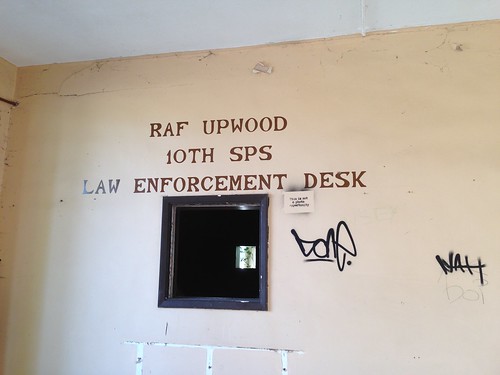
Inside the Gate house, the USAF presence. (Security Police Squadron).

Fortunately though, control of Upwood was then passed to the USAF for training and support services for nearby RAF Alconbury and RAF Lakenheath. It was earmarked for medical services, and should an attack occur during the Cold War, it would quickly be turned into a control area ready to deal with heavy nuclear attack casualties. Thankfully this was never put to the test though, and gradually the USAF phased out its use of Upwood, and as other airfields closed, personnel numbers became less and the homes they used emptied. Eventually, even the 423rd Medical Squadron pulled out, taking their community support, equipment and staff with them.

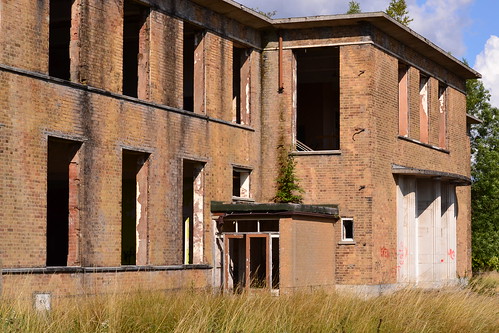
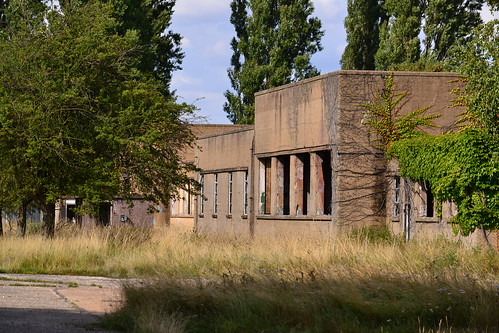
Upwood finally closed on 26th October 2012, and the remaining buildings including the NAFFI and NCO homes, were all sold off to developers and the site wound down. Since then, there have been numerous attempts to purchase the site and develop it with housing. These have all faltered along the way for one reason or another. On the positive side, the hangars remain actively used by an aero-engine company who refurbish jet engines. A glider club has been agreed a 10 year lease on the remaining parts of the runways (although these have been removed) and two Nissen huts have been fully refurbished to allow modern use. This part of the airfield looks and feels like a real and active military base, whilst the admin and medical side are ghostly reminders of its past. Standing on the site looking around, the imagination can only begin to think how this lonely and desolate place once bustled with crews and aircraft, crews going about their business and vehicles ferrying aircrew to their machines.

RAF Upwood

RAF Upwood’s hangars are still in use today. Aero engines outside await work.

Today it is an enormous site covered with derelict buildings as if left following an atomic blast. The windows are all shattered, the buildings vandalised and graffiti daubed on all the walls. Two tanks have been brought in and a small urban assault company use it for mock battles. The guardroom, officers quarters and associated mess halls all remain, some in a worse state than others.

In 2017 the redundant site was acquired without conditions, and planning permission obtained for a comprehensive development of a small six acres of the site. This plan, put forward by Lochailort *5 included 60 houses. Huntingdon District Council have now incorporated Upwood into their long term Local Plan, and a proposal is under consideration for further development which would include the removal of large quantities of the buildings. It would also see hardstands being replaced by a mix of housing (450 homes) and business premises. The intention is to keep the architecturally significant buildings and layout, along with the hangars, thus retaining the military atmosphere, developing it “in a way which respects its setting and former use“.*4 I only hope that the sympathetic approach is indeed used, and that this incredible and historic site does not become another of Britain’s matchbox towns.

Post Script:

A website dedicated to RAF Upwood shows a range of older photographs, squadron details and information about Upwood’s history. Created by Sean Edwards, it is well worth a visit for more specific details.

A local gentleman has purchased a scrapped Canberra nose section that once flew  from Upwood, and has rebuilt it. It remains in his garage and is displayed at shows around the country.

Sources and further reading.

National Archives – AIR 27/379/4
National Archives – AIR-27-961-4

BAE Systems Website

*1 Photo from the UK Archives, (https://www.flickr.com/photos/nationalarchives) no known copyright restrictions.

*2 Josepf Jakobs story can be read on the: Josef Jakobs blog with further information on the Upwood Website.

*3 Middlebrook, M & Everitt, C. “The Bomber Command War Diaries 1939-1945“, Midland Publishing (1996)

*4 Huntingdonshire District Council Local Plan Proposal

*5 Lochailort Investments Ltd, Webiste.

Thirsk, I., “de Havilland Mosquito an illustrated History – Vol 2” Crecy publishing (2006)

For more information and details of the Pathfinders, see the excellent RAF Pathfinders Archive at: https://raf-pathfinders.com/

The full text can be read in Trail 17 – The Pathfinders

RAF Upwood (Trail 17) – The Graveyard of RAF Squadrons (Part 3)

In Part 2 Upwood progressed through the early war years as a training airfield operating a range of aircraft types. As the larger, heavier aircraft came n line, its wet and boggy ground became churned up necessitating the construction of hard runways.

By the end of the year these runways were completed, and in the early months of 1944, two more new squadrons would arrive at the airfield, 139 and 156 in February and March respectively.

By  now Bomber Command aircraft had been pounding German cities and industrial targets, the period January to March 1944 was to see Berlin hit particularly hard, and with Stirlings being withdrawn due to their high losses, the Lancaster crews would now be taking the brunt.

Now under the control of Bennett’s new Pathfinder Force (PFF), 139 (Jamaica) Sqn would bring with them the beautiful and much loved Mosquito MK.XX. Coming from nearby RAF Wyton, they had already begun replacing these with the MK.XVI, flying both models whilst performing operations from the Cambridgeshire airfield. The following month a Lancaster squadron, 156, who were based at another PFF airfield, RAF Warboys, joined 139. Within a month Upwood had become a major front line airfield, the roar of multiple Merlins now filling the Cambridgeshire skies.

RAF Upwood

139 (Jamaica) Squadron had a long history, which had begun on July 3rd 1918. This first period of their existence lasted only a year, the unit being disbanded in March 1919. With the onset of war they were called back into operation being reformed in 1936, when they went on to fly Blenheims, and later Hudsons, until being disbanded and renumbered as 62 Sqn in April 1942. Reformed again in the June of that year 139 Sqn would go on to serve well into the late 1950s.

Named ‘Jamaica’ Squadron, 139 acquired their name as a result of the huge effort of the colony to provide enough money for twelve Blenheims, a remarkable effort considering the nature and size of the country. It was from Trinidad that Sqn. Ldr. Ulric Cross came, the most decorated West Indian of World War II, who earned himself the DSO and DFC whilst flying with the Pathfinders.

139’s drafting in to the Pathfinders occurred at the end of May 1943, leaving 2 Group for Don Bennett’s 8 Group, they formed the nucleus of the Light Night Striking Force (LNSF).  At this time they were still at RAF Marham, but moved across to Wyton and then onto Upwood arriving here on 1st February 1944, with a mix of Mosquito IV, IX, XX and XVIs.

There would be no settling in period for 139 Sqn, their first sortie, marking for a raid on Berlin, was due that very night. Take off for F.O. D Taylor and F.Lt. C. Bedell in Mosquito DZ 476, was at 17:50; they dropped their Target Indicator which was subsequently bombed on by Mosquitoes from another squadron. Whilst flak was recorded as ‘slight’, the aircraft was heavily engaged over Neinburg. The Mosquito landed back at Upwood, ending the squadrons first successful operation from here, at 22:40.

Photograph taken during an attack by De Havilland Mosquito B Mark IVs of No. 139 Squadron, on the locomotive sheds at Tours, France (date unknown) © IWM C 3409

156 Squadron were one of the four initial Pathfinder units having been taken on by the new Group in August 1942 whilst at RAF Warboys a few miles up the road. After two years of relatively high losses for the Squadron, the time for change had come, and they moved across here to RAF Upwood. Hopefully a new start for the depleted unit would see better results and higher morale. As 156 moved in, the few remaining aircraft of the NTU moved out, rejoining the main collection at Warboys, the unit having been split over the two sites for some time.

However, the first three months of 1944 were to prove to be the worst for 156 Sqn, over half its total yearly losses occurring during this period. This culminated, at the end of March, with the loss of four Upwood aircraft. Lancaster MK.IIIs: ND406 (S),  ND466 (Z), ND476 (V) and ND492 (L) all left as part of a seventeen strong force from Upwood joining with a further ninety-three other PFF aircraft to attack Nuremberg. Even though the weather was against the bombers, the operation went ahead, the 795 heavy bombers of Bomber Command making their way east. Strong winds caused havoc, with large parts of the force drifting off course, much farther north than they should have done. This resulted in them unknowingly bombing Schweinfurt and not Nuremberg. Outward bound, the German defences waited, many picking off the bombers before they even reached Germany. In total 95 bombers were lost, 82 of them on the outward journey. For 156 Squadron it was another devastating blow, and for Bomber Command a disaster, their biggest loss of the entire war*3.

RAF Upwood

A huge number of derelict buildings remain on the now abandoned site.

Of the thirty 156 Sqn airmen lost that night (two Lancasters were carrying eight crewmen), only six survived, each of these being incarcerated as POWs, the rest all being killed and buried in this region of Germany.

The months preceding June were taken up with missions to support the impending D-Day landings. With Bomber Command forces being pulled away from targets in Germany, many missions now focused on V weapons sites, rail and transport links, coastal batteries and airfields across western France. The number of Pathfinder Mosquitoes increased, as did the need for precision bombing, the wider ‘blanket’ bombing not being implemented on these small scale targets.

The transportation plan as it was known, required intense operations from 8 Group, and although the number of missions rocketed the number of casualties fell. Morale was on the increase and things were looking up for the crews of Upwood based aircraft.

With the Pathfinders being mainly experienced and skilled crews, any loss was considered damaging. In the period up to D-Day, losses for both squadrons were  in single figures, but of those who were lost, many were DFC or DFM holders, including on the 27th – 28th April, 156 Sqn Lancaster III ND409, which had five DFC bearing crewmen on board.

During this raid, which was only some four weeks after Nuremburg, 323 aircraft attacked Friedrichshafen’s engineering plants, where components were made for German tanks. Highlighted as an ‘outstanding’ raid, marking was near perfect which resulted in the entire destruction of the plant and almost three-quarters of the town.

Meanwhile, the Canadians were busily building Mosquitoes for the RAF, and on May 10th – 11th, the first Bomber Command MK. XX built in Canada, was written off when a flare ignited inside the aircraft. Returning from Ludwigshafen, the marker had failed to release only to cause disaster near Cambridge on the return flight. Inside the aircraft were Flying Officers G. Lewis and A. Woollard DFM, Woollard going on to survive a second serious crash on 12th June when his aircraft crashed in Sweden after it was hit by flak. Flying Officer Lewis in the first crash failed to survive.

In June 1944, a very special aircraft was unveiled at the de Havilland Canada Downsview factory during the ‘Million Dollar Day’ ceremonies. Mosquito KB273 was unveiled by  the cousin of Geoffrey de Havilland Junior, Joan Fontaine, the Hollywood film star, who gave her name to the aircraft. KB273 ‘Joan‘ would be passed to 139 Sqn here at Upwood before being handed over to 608 Sqn in August. In fact, KB273 was one of many Mosquitoes from this same stable that passed through 139 Sqn to the Downham Market unit. It was sadly lost on 29th February 1945, its pilot evading capture whilst the navigator was taken as a POW.

Losses remained relatively low on a month by month basis for the two squadrons, an excellent improvement compared to previous months and against other units. By the end of the year, 139 Sqn had sustained twenty operational losses whilst 156 Sqn suffered fifty-two. All in all 1944 had been a little more positive.

The dawn of 1945 saw the world entering the final stages of the war. The long and cold winter of 1944-45 prevented many operations from being carried out, and even though the Luftwaffe were finding it difficult to put up sufficient numbers of aircraft and skilled pilots, losses in Bomber Command were still high overall. Last ditch efforts saw attacks from fighter jets, mainly Me 262s, and 1945 would signify the end of operations from Upwood for one of the two Pathfinder squadrons based here.

For 156 Sqn the early months of 1945 would be their last, and although there was an all out effort, casualties were relatively light. With one Lancaster being lost in January (PB186) with all on board; three in February – two over the Prosper Benzol plant at Rottrop, (ME366, PB505) and another (PB701) over Dussledorf – January and February would close with few losses. March similarly would see another two in the closing hours of the month over Berlin, both crews of PB468 and PB517 being completely wiped out.

Germany continued to be pounded by large formations during April, a month that saw many of the last major operations for several squadrons. For 156, their final bombing mission came on the 25th, sixteen aircraft taking part in a raid to Wangerooge in which Bomber Command lost seven aircraft – six of which were collisions in near perfect weather. For 156 though, the raid was casualty free, and with that their bombing raids ceased. The final capitulation of Germany was taking place and mercy raids could now be flown to supply those who had lived in terror and hunger under the Nazi regime.

3010671412_0a0a4fd717

Aerial photo taken on 25th April 1945 over Wangerooge*1.

In that month alone, Squadron crews were awarded no less than: one DSO; nineteen DFCs; a CGM and three DFMs. Aircrews had flown over 850 operational hours in 141 sorties, a small fraction of the 4,839 they had flown in their three year existence. By June, operations for 156 Sqn had wound down at Upwood and they moved back to Wyton, finally being disbanded and removed from the  RAF register in September.

139 Sqn meanwhile, had continued their marking for night raids on German cities. During the period late February to the end of March, 139 Sqn carried out thirty-six consecutive night raids on Berlin, one of these being the largest ever attack by Mosquitoes on the German capital. On this operation, 142 twin-engined ‘Wooden Wonders’ from a number of different squadrons unleashed their loads in two waves over the German city. 139 Sqn leading the Light Night Striking force using up to date models of H2S.

After the Battle of Berlin had ended, along with a winter of heavy bombing, the analysis would now begin. Bomber Command’s effectiveness, and in particular its bombing strategy, would suddenly be under the spotlight, with its leader Sir Arthur Harris, the focal point. It would be a legacy that would last for generations to come, even to this day the debate continues, and there are many that fight the cause in support of Harris’s operational strategy.

The end of the bombing war for 139 Sqn came in May 1945, ironically their busiest month of the year, flying 256 sorties which culminated with an attack on Kiel.

Throughout their operational tour, 139 Sqn had lost a total 23 aircraft in 438 raids , the highest of all the Mosquito PFF squadrons.

Part 4 takes us into the Cold War, the development of the jet engine in which Upwood becomes a graveyard for disbanding RAF Squadrons.

The full text can be read in Trail 17 – The Pathfinders

RAF Upwood (Trail 17) – The Graveyard of RAF Squadrons (Part 2)

In Part 1 we saw how Upwood was formed and how the first squadrons arrived ready to show off their new Fairey Battles. As September 1939 dawned, war was declared and Upwood stepped up to the mark and prepared itself for the conflict.

The immediate issuing of order S.D.107 and S.D.107a, resulted in the whole of 63 Sqn, including their dispersed aircraft, being moved to Abingdon, whose crews and aircraft were in turn moved to France. The transfer of men and machinery being completed by 08:00 on the 8th September, at which point 63 Sqn joined No.6 Group, leaving Upwood far behind.

52 Sqn also brought back their aircraft from Alconbury filling the spaces left by 63 Sqn, before moving themselves to Kidlington, and then onto Abingdon where they would join once again with 63 Sqn.

The outbreak of war saw huge changes for the RAF. The immediate mobilisation began with the implementation of the ‘Scatter Scheme’, where aircraft were dispersed away from parent airfields to avoid the ‘imminent’ threat of attack. Over at West Raynham, 90 Sqn were doing just that. In mid September, aircraft that were dispersed to Weston-on-the-Green were now brought over to the all but vacant Upwood, in a move that preceded a more long lasting move by the squadron to the airfield.

RAF Upwood

Guard house to the former airfield.

Over the next few weeks a mix of Mk.I and MK.IV Blenheims were collected and brought into Upwood supporting the training role carried out by 90 Sqn. Training was a risky business, as many trainee crews would find out. On the 18th October, two Upwood Blenheims crashed, one in a field with its undercarriage retracted following an engine failure, and the second on the airfield itself. The worst of these was Blenheim L4876 which crashed on take off, and resulted in the loss of the life of the pilot P.O T. Peeler. His observer, Sgt. Dobbin was injured, whilst the wireless operator, AC2 Brown,  managed to escape without injury.

Over the winter months Upwood would rise in the league tables of airfields notorious for flooding and water logged  ground. The heavy rains making the airfield unserviceable on numerous occasions. This caused great concern for the air staff who made the difficult decision to cut short training programmes, thus enabling the supply of aircrew to be maintained. It did however, mean that there would be a supply to front line squadrons of crews with partial or less than perfect training.  This problem would persist at Upwood for some time to come, eventually being partly solved by the building of hard runways.

1940 brought with it another training squadron, 35 Sqn, who also found the ground at Upwood difficult, their move being hampered for several weeks before they could finally settle in and begin operations properly. The summary for February shows thirteen days were lost to bad weather and nine to waterlogged surfaces!

March 12th 1940, saw another fatal accident at Upwood, with the death of trainee pilot Sgt. Alphonse Hermels (s/n: 517823) whose aircraft collided with a Blenheim on detachment from  90 Sqn, the two aircraft taking off simultaneously but neither apparently being aware of the other’s presence.

In early April, both 35 and 90 Sqns were disbanded and amalgamated to form No. 17 Operational Training Unit (OTU). The name of 35 Sqn would be reborn as part of Bomber Command at Boscombe Down at the year’s end, but that would be their ties with this rather wet airfield cut, until in 1956, when it would return extending its stay to a more permanent five years. For the next three years the OTU would be the main user of Upwood, flying with a wide range of aircraft types, including: the Lysander, Anson, Hurricane, Spitfire, Wellington and Fairey Battle. The unit  eventually departed to Silverstone – famous for British Motor Racing – in December 1943.

As the BEF were being withdrawn from the beaches of Dunkirk, Britain began to brace itself for the impending invasion. Although the Battle of Britain would not officially start for some time yet, the period immediately after Dunkirk saw minor attacks on British airfields, particularly those in East Anglia. On several days during June, enemy bombers would penetrate British airspace and unload their small bomb loads on these sites. Some of the first enemy intruder missions were recorded at this time, and Upwood would receive its fair share of bombings although little damage was done.

This operational ‘dry spell’ was momentarily broken when 26 Squadron appeared on the scene at Upwood. For what must be one of the most mobile squadrons of the RAF, 26 Squadron were constantly transferring from airfield to airfield, staying here on an overnight stop in early October. In the space of less than a week the squadron had operated from no less than 6 different airfields including: Twinwood Farm (Glenn Miller’s last stop), Barton Bendish, and Snailwell.

RAF Upwood

Upwood’s collection of buildings are numerous.

Upwood was to experience some rather difficult times and localised action. Numerous accidents were interspersed with attacks by marauding Luftwaffe aircraft, they even had their own parachuting spy. The event caused a great deal of excitement around the base, and saw the spy,  42 yr old Josef Jakobs, being found guilty of treason and subsequently executed at the Tower of London.

Jakobs, who parachuted into England on January 31st 1941, broke his ankle when he landed at Dovehouse Farm, Ramsey Hollow, a few miles from the airfield. He was found by passing farm workers (Charles Baldock and Harry Coulson) after firing shots into the air. With him were maps with both RAF Upwood and RAF Warboys identified, transmitting equipment, codes, £497 in £1.00 notes and false papers. He was arrested, taken to Cannon Row Police Station in London where he was handed over to Lt. Col. Tommy ‘Tar’ Robertson of MI5.

Robertson took Jakobs to ‘Camp 020’ a special interrogation camp run by MI5, on Ham Common, where he was treated for his injuries and interrogated with a view to turning him into a ‘double agent’. However, his position had already been compromised because of local gossip about his capture, and so MI5 could not guarantee his position with the spy network.

Jakobs was finally tried under the Treachery Act under military law – a court martial consisting of four military figures. The court hearing began on 4th August and lasted two days. He was subsequently found guilty of treason and on the morning of the 15th he was shot by a firing squad formed from the Holding Battalion of the Scots Guards at the Tower of London, his body being buried in an unmarked grave in St. Mary’s Roman Catholic Cemetery in Kensal Green, North-West London.*2

Often, training airfield squadrons would operate in conjunction with various specialised units, in this case 11 Blind Approach Training Flight who were formed here at Upwood, in October 1941, with Air Speed Oxfords. This unit was quickly renamed 1511 (Beam Approach Training) Flight, and trained pilots in the use of navigation beams for poor weather or night landings. These twin engined Oxfords were found in numerous training flights and at numerous airfields across Britain and in Canada, and were generally popular with trainees.

As the war progressed new advances meant that the older aircraft were becoming tired and in need of replacement. With larger bombers coming on line, Wellingtons pulled from front line service were now being used in training operations. Added to this, the introduction of the Lancasters of the Navigation Training Unit (NTU) in June 1943, meant that Upwood’s runways could no longer withstand the churning up by heavy aircraft, and it was now that Upwood’s notoriously bad surface began to really show its true colours.

RAF Upwood

A scene typical of the buildings at Upwood

Being a heavier breed than the Blenheims and Oxfords, the ground began to break up, and it was for this reason that the OTU moved to Silverstone, and the Beam Training Flight moved out to Greenham Common. This left the airfield devoid of all operational aircraft apart from the NTU. It was now time to make amends at Upwood.

Whilst the site was all but vacant, one of the RAF’s Airfield Construction Flights moved in and construction began on the three concrete runways needed for Upwood to continue operations. The brain child of Wing Co. Alexander John ‘Daddy’ Dow, they were a huge organisation that supported the RAF’s front line squadrons by building, repairing and maintaining their runways.

In Part 3 Upwood see the arrival and use of the four engined heavies. The Pathfinders are born and Upwood becomes a front line bomber airfield.

The full text can be read in Trail 17 – The Pathfinders

RAF Upwood (Trail 17) – The Graveyard of RAF Squadrons (Part 1)

In the second part of Trail 17 we visit a station  with a history going back to World War One. This airfield saw a spy caught and hanged; the making of a film using Lancaster bombers, and more recently the site of a hospital for the treatment of victims of a nuclear war. Ever since its closure it has been the subject of numerous failed planning applications, and seems to have hung on by the skin of its teeth – perhaps until now.

This site must rank as one of Britain’s largest collection of ex military buildings (albeit subjected to the usual vandalism) for its collection is huge, and its a collection that includes wartime hangars. We of course go to RAF Upwood near Huntingdon.

RAF Upwood

RAF Upwood is a remarkable site to visit. Its buildings remain very empty stripped of their dignity and daubed with a wide range of graffiti, yet within its boundaries lay many years of history.

Located in the south-western corner of Cambridgeshire, not far from both RAF Alconbury and RAF Warboys, Upwood is possibly one of the countries most photographed aviation sites.

RAF Upwood has seen no less than twenty-two different RAF flying units grace its runways, the majority of these being post war operational units, many coming here prior to their disbandment – it is perhaps the graveyard of RAF squadrons.

However, whilst the latter part of the 20th Century saw it gain its recognition, its origins lay way back in the First World War.

Originally opened in September 1917, as Bury (Ramsey) after the adjacent village, it had no permanent buildings and was merely a grassed airfield with no fixed squadrons of its own. Towards the end of the war though, in 1918, five hangars and a small number of huts had been built, and it was at this time that it became officially known as ‘Upwood’.

RAF Upwood

Post war, Upwood served as a hospital and most of the buildings survive.

Then, when the war ended, the personnel departed and the site was cleared of all military related artefacts, the site being returned to the local community once more.

However, the impending conflict in the late 1930s, required a massive rethinking into Britain’s defences and the need for greater air power. A number of locations were earmarked for opening, and as a former airfield, Upwood was one of them. Designed as a medium bomber station, plans were put in place for as many as five large hangars, although only four were ever completed.

Opened in early 1937, during the expansion period of pre-war Britain, it was home to both 52 and 63 Squadrons Royal Air Force. In March the two newly formed squadrons arrived, 52 Sqn from Abingdon, No. 1. Bomber Group, and 63 Sqn from Andover, No. 2 Bomber Group. At the time of opening conditions were far from ideal, only half of the total number of hangars had been built, and more importantly, there was no provision for permanent accommodation; instead, crews were faced with a rushed collection of inadequate, temporary blocks. 52 Sqn were first, followed two days later by 63 Sqn, by which time conditions had changed marginally for the better, the officers mess being one such building to open as a permanent structure – clearly rank was to have its privileges.

For 52 Sqn it was a complete change, the move being managed over just two days, which also saw them transfer to No. 2 Bomber Group bringing them in line with 63 Sqn. Initially, 52 Sqn brought with them seven Hawker Hinds, then four more on the 8th and a further two on the 10th, bringing the total number of aircraft on role to thirteen. Six of these Hinds were immediately put into reserve saved for the formation of a ‘B’ Flight.

Meanwhile, 63 Sqn began to upgrade their aircraft taking on four replacement Audaxes, each being delivered straight from the A.V. Roe factory (Woodford Aerodrome)  in Manchester. With a further three and then two more being delivered from A.V. Roe’s on the 17th and 18th respectively, the number of aircraft at Upwood now amounted to twenty-two.

This was a busy time for Upwood, with personnel coming and going, new postings arriving and staff being posted out, there was considerable movement before things finally began to settle down and operations bed in.

On the 22nd and 24th, both squadrons took turns to carry out search operations over the local countryside looking for the remains of a DH Moth belonging to Mary Russell, the Duchess of Bedford, which disappeared on the evening of the 22nd during a snowstorm. Both searches proved unsuccessful, with no sightings been made. It later transpired that the Duchess had crashed into the North Sea, her body never being found.

With 52 Sqn’s ‘B’ Flight being formed on April 6th and 63’s on the 12th, the scene was almost set, and with visits by both Air Chief Marshall Sir John Steel KCB, KBE, CMG (Air Officer Commanding in Chief of Bomber Command), and then the Under Secretary State for Air a few days later; Upwood was finally on the map and making progress toward being both operational and fighting fit.

63 Squadron would then take a step forward, having the honour of being the first operational unit to receive the new Fairey Battle, K7559 landing at Upwood on May 20th 1937, some 6 months before 52 Sqn received theirs.

Throughout the summer of 1937, the number of delivered Battles gradually increased, each one coming directly from Ringway Aerodrome, one of Fairey’s main sites. For 63 Sqn, the following months would be a busy time ‘showing off’ their new aircraft to various dignitaries from around the globe. A massive PR stunt, it started with the Gaumont British Film Company, who filmed nine of the aircraft taking off, landing and flying in formation, scenes being recorded for the film “Under the Shadow of the Wing“.

During this period, Upwood would be inundated with visitors; his Highness the Duke of Aosta along with Italian representatives started the ball rolling, followed by: Major Woutieres of Belgium; Lt. Lim Weir K’nei of the Chinese Air Force; Air Chief Marshal Sir E. Ludlow-Hewitt KCB, CMG, DSO, MC; Air Commodore S. Goble CBE, DSO, DSC. and even a consortium from Germany – General der Flieger Milch, General Lieutenant Stumpff, General Major Udet along with their entourage. These three high ranking officials were, from the 1930s onward, key to the development, build up and use of Germany’s illegal Luftwaffe. Accompanying them, were a number of high ranking British Air Force personnel, who openly guided the party through a range of inspections of the Battles, a programme of events that included a flying display at RAF Mildenhall.

Generalfeldmarschall
Erhard Milch March 1942 (Source: Wikipedia)

By the end of 1937, 63 Sqn had flown 2,256 hours, many of these to show off their aircraft. With little else to do at this time, a range of pageants and shows kept the crews busy in between the obligatory gunnery and navigation training sessions.

1938 would be filled with similar such undertakings, but as the year drew on training  would take on a more serious and predominant role, mock bombing attacks being regularly practised by the squadron on various sites including Upwood itself.

After a short period away training at West Freugh, the squadron was placed in a ‘precautionary’ state, in readiness for immediate mobilisation – the threat of war in Europe now growing ever stronger. This period was short lived however, and the squadron temporarily returned to normal duties, with yet more visits from both high ranking officials and royal dignitaries from overseas.

November 25th 1938, would be a sad day for Upwood crews, training flights proving to be hazardous, and even fatal.

New Zealander P.O. K Vare, managed to land and walk away from Battle K7603 as it burned on a nearby railway line, whilst 63 Sqn Battle K7567 crashed in poor weather whilst undertaking a navigation exercise over Hampshire. The aircraft, piloted by P.O. J Ellis (killed), collided with trees severely injuring Cpl. A Thoroughgood and ejecting AC2 V. Rawlings. Being thrown from the aircraft was possibly Rawlings’s saviour, the likely hood of being killed himself higher had he not been.

Fairey Battle Mk.I (K7602) of 52 Squadron, at RAF Upwood.© IWM H(am) 179

On the 16th December, in a ceremony attended by the station staff, P.O. Ellis’s ashes were scattered over the airfield, the procedure being carried out from another Fairy Battle from the squadron.

After a short Christmas break, 63 Sqn returned to their duties once more, training flights, many of which were in conjunction with squadrons from other airfields, increasing in frequency as events across the Channel took on an even more sinister turn.

In mid March, a new policy was issued that would affect the operation of both the Upwood squadrons. This policy turned both 52 and 63 into ‘non mobilising’ units, meaning that the more senior officers would remain on site as instructors, whilst the ‘regular’ crews would be posted to operational units. The spaces left by these vacating staff being filled by Volunteer Reserves from the various Flying Schools. After a period of some months, these trained staff would revert to civilian status, but as reserves, they could be called upon if, or more likely when, war was declared – the war machine was again stepping up a gear. A further element of this change was the allocation of 10 new Avro Anson aircraft, each of these twin-engined training aircraft arriving over the next few weeks direct from Woodford.

This period would see world tensions rise even further, and as war looked even more likely, changes were again made to Upwood’s staff. Rehearsals in dispersing aircraft were carried out, passes were restricted to ensure sufficient numbers were always on hand in case of war being declared, and mock attacks on the airfield were carried out. During these mock attacks ‘Gas’ was sprayed by both ‘attacking’ aircraft and from a ground based “High Pressure Jenny”, a devise developed in America to spray water and steam over the outside of aircraft.

Upwood then experienced a second fatal accident, which occurred on the night of 25th July 1939, the crash involving Fairy Battle K9412 of 63 Sqn with the loss of all on board: Sgt. Albert Shepherd, Sgt. Aubrey Sherriff and AC2 William Murphy. The aircraft struck the ground and caught fire whilst taking part in one of these preparatory exercises.

The end of August saw a further ramping up of the gears with the implementation of the Bomber Command War Order (Readiness ‘D’). Aircraft of both squadrons were now restricted to essential tests and practises only, being dispersed across the airfield, bombed up but without fuses, ready for flight. Personnel were also put on high alert, anyone on leave was recalled and had to return back to the station.

As September dawned, the full readiness ‘D’ plan was brought into full force. 52 Sqn were ordered to disperse aircraft at nearby Alconbury, with twenty-four Battles and five Ansons being flown across, along with a small guard and a selection of maintenance personnel. The Royal Air Force as a body was mobilised by Royal Proclamation, and preparations were made for war, the entry in the Operations Record Book for 63 Sqn simply stating:

3rd Sept. 11:00 “A state of war is declared between Great Britain and the German Reich

In Part 2, Upwood goes to war, major changes come in terms of both aircraft and infrastructure. New squadrons arrive and an unwelcome visitor is caught.

The entire text can be read in Trail 17 – The Pathfinders.

RAF Warboys – Home to the Pathfinders (Part 1)

In the south-western corner of Cambridgeshire, are a group of airfields that are synonymous with the Second World War’s target marking units, the Pathfinders. This is an area rich in aviation history, and an area that played a major part in not only the European Theatre of Operations of World War Two, but military operations long into the Cold war and beyond. Within a short distance of each other are the airfields at Wyton, Warboys, Upwood and Alconbury to name but a few, and it is two of these we visit in Trail 17.

Our first stop is the former RAF Warboys, once home to the Pathfinders.

RAF Warboys.

Warboys village is an ancient village with records of inhabitants going back to 7,000BC, it also has links to the Bronze age, the Romans, Vikings and the Doomsday book. Even further back, some 350 million years, there was an active volcano in the area, not far from where we start today.

RAF Warboys

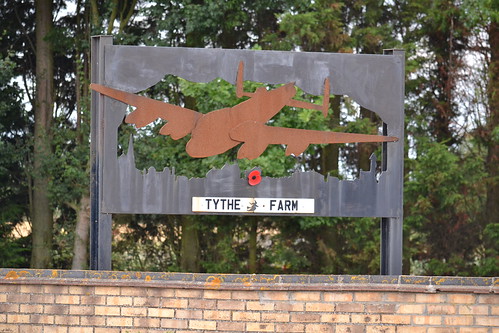
The farm sign reminds us of the aviation link (it would appear that this sign may have recently been removed).

The airfield itself was initially constructed as a satellite for RAF Upwood, with a requirement for three 50 yards wide tarmac runways; one of 2,000 yards, another measuring 1,400 yards and the last 1,350 yards. There were initially twenty-four frying pan hardstands, two of which were then used as hangar bases, with a further eighteen loop style hardstands added after. This gave a total of forty dispersal points available for aircraft, and they would certainly be needed.

As with many airfields of this time there were two type ‘T2’ hangars, one each side of the airfield, supplemented with a ‘B1’ hangar. A well developed bomb store lay to the west of the airfield, and eleven domestic sites lay to the eastern side of the A141 to the south of the main airfield. These would accommodate up to 1,959 men and 291 women. Even before its completion, Warboys would undergo further development, an order coming through to extend two of the runways to 2,097 yards and 1,447 yards, its was a sign perhaps, of things to come. This extension work meant altering the perimeter track layout and diverting the main road around the airfield as it would be dissected by the new extension (the original road was reinstated post war, the end of the main runway being cut off as a result).

Construction began in 1940 with the airfield opening in September 1941, initially as a satellite bomber station. Whilst intended for Upwood, it was first of all used by Short Stirling’s from XV Squadron as an overflow from nearby RAF Wyton. As a satellite, Warboys was never far from the war when not long after the first Wyton aircraft landed, the Commanding officer of XV Squadron,  Wing Commander P. Ogilvie, crashed the Stirling he was piloting (W7439) here in bad weather. Luckily he and his crew escaped major injury but unfortunately the aircraft was written off completely. This crash would signify a run of accidents occurring at the airfield whilst XV squadron used Warboys.

However, XV Sqn’s stay was short-lived, and they soon departed the site their vacant place being taken by the Blenheims of ‘D’ Flight, 17 OTU (Operational Training Unit).*1

The Training unit was expanding, and their base at RAF Upwood was becoming crowded. Their move over to Warboys on 15th December 1941, was a part of this expansion, and led to four flights being created, each with a range of aircraft including: Lysanders, Ansons, Blenheims and even the odd Hurricane and Spitfire.

In August 1942, the OTU would receive orders moving the unit elsewhere, whilst over at RAF Alconbury, a few miles to the south-west, instructions came through to 156 Squadron to relocate here to RAF Warboys. The instruction specified that the move was to take place on the 5th and be completed by the 7th, it would involve the ferrying of large numbers of crews and their aircraft. On the 5th the first aircraft was brought across, and then on the 6th a further six aircraft were transferred. This was followed by another seven on the 7th.

Following the move the squadron was put straight onto operations, but many of these were cancelled because of the poor autumn weather. One of the first, occurring on August 11th, saw ten aircraft detailed for operations, and whilst all of them managed to take off,  three of them X37998 (Flt.Sgt. F. Harker); Z1595 (Sqn. Ldr. J. Beavis) and BJ603 (P/O. C. Taylor) would fail to return. All but three of the sixteen aircrew onboard would perish – the squadron’s first fatalities whilst at Warboys.

RAF Warboys

The remnants of the main runway are used for buildings.

On the night of 15th August 1942, eight more Wellingtons took off from Warboys for Dusseldorf, of these, three returned early with a forth being lost. The Operational Record Book simply stating “This aircraft failed to return” – a rather unembellished statement that became so common in operational records. Reports about the raid later highlighted the poor visibility and scattered bombing, with little or no industrial damage being done as a result.

Whilst August 1942 was not proving to be in anyway remarkable for 156 Sqn, it would prove to be a very historic month for Bomber Command. On the same day as the Dusseldorf raid, the Pathfinders – an elite force designed to locate and mark targets for the main bomber stream –  officially came into being. This idea had long been on the minds of the Air Ministry, causing a prolonged and difficult relationship between Sir Arthur Harris and Group Captain Sidney Bufton (Director of Bomber Operations at the Air Ministry). The fallout culminated in the intervention of the Chief of Air Staff, Sir Charles Portal, who came down on the side of Group Captain Bufton. He disagreed with Harris’s arguments, announcing that the Pathfinders were going to go ahead as planned.

This did not meet with Harris’s approval, he feared the Pathfinders would ‘skim off’ the cream of his bomber force, creating a corps d’elite, whilst Bufton was adamant it would vastly improve Bomber Commands accuracy, something that desperately needed to be done.

Harris gained the backing of his Group Commanders, explaining that removing individual crews from squadrons would be bad for morale within the groups and be divisive amongst the squadrons. He and his Commanders preferred a target marking unit within each Group, thus retaining these elite crews keeping the unity of the squadrons and the skills they possessed together. However, the long fight between Harris and Bufton came to a climax with the intervention of Sir Charles Portal, and an ultimatum was given to Harris, ‘accept the new Pathfinders or leave’.

The job of organising this new command fell to the then Group Captain Don Bennett D.S.O., an experienced pilot himself who advocated the use of target marking to improve bombing accuracy; something Bennett had indeed tried himself. However, it was not going to be an easy ride for the Group Captain, for the squadrons chosen all operated different aircraft types: Wellingtons, Stirlings, Halifaxes and Lancasters. The Wellingtons were becoming outdated and the Stirlings, whilst liked, had their own set of problems. Added to the mix the fact that German defences were improving and electronic counter measures (ECM) were on the increase, difficult times were definitely ahead.

RAF Warboys

Industry marks the south-western perimeter.

As a new force, only four squadrons were initially used, although more were considered and earmarked: 7 (No. 3 Group), 35 (No. 4 Group), 83 (No. 5 Group) and 156 (No. 1 Group), but it would take time for the new crews to settle and for improvements in bombing accuracy to shine through. All the while Pathfinder crews were operating, the remainder of the squadrons continued in their normal duties, this would allow the Pathfinder force to steadily grow.

For the large part, target marking in the latter part of 1942 would be by visual means only – a ‘Finder‘ and an ‘Illuminator‘ using flares and incendiaries respectively. This would prove to be an unsatisfactory method, the markers often being ‘lost’ amongst the fires that followed, or they were simply too difficult to see. However, photos taken after these early bombing raids showed that the number of bombs falling within 3 miles of the aiming point, post August, had in fact risen to 37% from 32%; those falling within 3 miles of the centre of concentration rising to 50% from 35%.*2 Whilst these figures were quite small, and bombing was still relatively inaccurate, it was at least a step in the right direction, and a boost to those who supported both Bufton and Bennett.

So, on the 15th August 1942, Bomber Command operations changed for good, the four squadrons moved to their respective airfields and the Pathfinders began preparations for a new battle. 156 Sqn at Warboys, would be a major part of this. Being one of the four pioneering airfields, Warboys would be joined by Graveley, Oakington and Wyton, as initial homes for the new force.

On the night of the 18th -19th August 1942, the Pathfinders would be put to the test for the first time, and two Wellingtons from 156 squadron were to be a part of it. The raid to Flensburg would not be successful though, one aircraft having great difficulty in locating the target through the haze, and the second having to ditch its flares five miles from the airfield after one ignited inside the aircraft. Of those that did get to mark, it proved to be inaccurate, and one Pathfinder aircraft, from 35 Sqn, was lost.

RAF Warboys

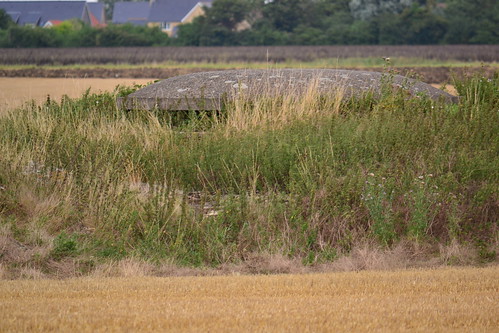
Airfield defence in the form of an ‘Oakington’ pill box.

The day after this, Group Captain Bennett visited Warboys to give a lecture on the Pathfinder Force and to promote its use; he must have made a good impression for after the lecture six Warboy’s crews volunteered for Pathfinder duties.

Further operations were carried out on the night of  27th – 28th August to Kassel. A good night for visual marking meant that bombing was accurate, and as a result all of the Henschel factories were damaged. However, the cost to the Pathfinders was very high. It was on this operation that the Pathfinders suffered one of their greatest losses. Thirty-one aircraft were missing of which fourteen were Wellingtons and three were from 156 Sqn. The next day, the mess hall was devoid of three crews, those from: ‘X3367’, ‘Z1613’ and ‘DF667’, and unbeknown to those sitting around the mess, there were no survivors. A fourth bomber (BJ883) returned to Warboys after the pilot, Sgt. E. Bowker, suffered severe head pains and was unable to carry on.

Not all operations were as bad. On the night of 19th – 20th September following action over Saarbrucken, a flare became lodged in the bomb bay of one of the 156 Sqn Wellingtons. Whilst sitting there it ignited causing a fire in the aircraft’s belly. The Pilot,  New Zealander Sqn. Ldr. A. Ashworth, instructed his crew to bail out, after which the fire extinguished itself allowing him to fly the aircraft back single-handedly, landing at the fighter station RAF West Malling in Kent. The operation itself, undertaken by 118 aircraft, was otherwise uneventful, although haze proved to be an obstacle for the markers.

The last 156 Sqn Wellington raid for 1942 occurred on December 21st and took the squadron to Munich as part of a force of 137 aircraft. The loss of ‘BK386’ crewed entirely by Canadians brought 1942 to a close, and a loss of 15 aircraft this year. To add insult to injury, whilst the majority of the bombers claimed to have hit the city starting large fires, photographs showed that in fact most bombs had fallen outside of the city in open countryside, possibly as a result of a successful decoy employed by the Germans. It had not been the most auspicious of starts for the Pathfinders, nor 156 Squadron at Warboys.

However, by early January, a new aircraft type was starting to arrive at Warboys – Avro’s mighty four engined heavy, the Lancaster MK.I. Created out of the under-performing Manchester, the Lancaster would go on to be one of the most iconic aircraft of the Second World War. Perhaps now the tide of misery would turn and Warboys crews would begin a new era in aviation history.

RAF Warboys

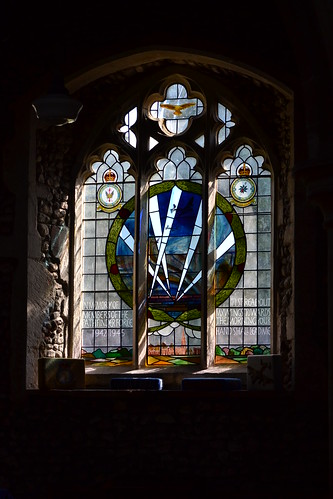
The beautiful Memorial window dedicated to the Pathfinders.

The full trail appears in Trail 17

RAF Scone – Rudimentary but Very Important.

In Trail 56, we head north once again, this time across the River Tay into Perthshire,  the gateway to the Highlands.

The grand city of Perth boasts a majestic history, once the capital of Scotland, it is a city with galleries, museums and stunning architecture; described by VisitScotland.com as “a picturesque playground for Kings and Queens“, and rightly so.

The village that gave this airfield its name, has a history going back as far as the Iron age, once the seat of Royals it is mentioned in Shakespeare’s Macbeth, and once housed the famous ‘Stone of Scone’ or ‘Coronation stone’ that has for centuries been used for coronations of the Kings and Queens of Scotland and England. It was stolen by King Edward I of England who took it to London, and was last used in the Coronation of Elizabeth II in 1953. It now resides in Edinburgh Castle on the proviso that it returned to London for Royal Coronations – it must be the most famous 125kg of rock anywhere in the world.

On Trail 56 we pass though the beautiful city of Perth and onto this small but famous village that leads into the countryside beyond. It is here that we find a former RAF airfield that has since become Perth Airport. In the same region as Scone Castle, we visit the former RAF Scone.

RAF Scone.

RAF Scone is known under a range of names: Perth Airport, Perth Aerodrome, Perth Municipal Airport, RAF Perth, RAF Scone and Scone Aerodrome, and can be found 3 1/2 miles north-east of Perth.

Scone (pronounced Scoone) opened in 1936 under the control of 51 Group based in Leeds and was, throughout it military life, an Elementary Flying Training School operating a number of training flights as well as some operational squadron detachments.

A very rudimentary station, it had no more than a watch office, a single Civil 160 x 90 ft hangar; one 120 x 110 ft hangar, and six blister hangars spread about the site. There were no hardstands and runways were initially grass. A hard perimeter track circumnavigated the airfield and although it only had one officially designated ‘runway’,  a grass strip of 1,300 yds in length, other strips were used.

RAF Scone (Perth Airport)

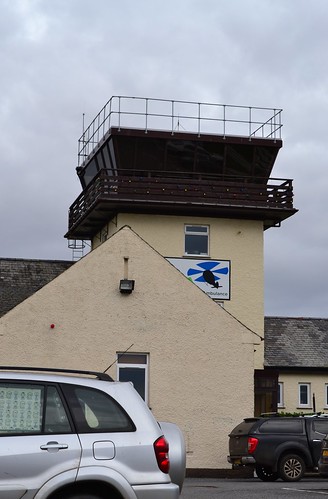
The Watch Office at Scone (Perth Airport).

Being a training airfield accommodation was also rudimentary and limited, designed for only 400 permanent personnel, it would cater for both males and females of mixed rank. Even though Scone was small, it was by no means insignificant, boasting the passage of hundreds of pupils passing though its gates on their way to front line flying units.

The initial user of Scone was 11 Elementary and Reserve Flying Training School (E&RFTS) operating Hawker Harts, Audax, Hinds, Battles, Tiger Moths and Ansons at some point. Formed here on the 27th January 1936 it was operated by A.M. Airwork Ltd.

The Airwork company was founded in 1928 and based at the then Heston Aerodrome in Middlesex. For much of this time, Airwork’s chief pilot was Captain Valentine Baker MC, DFC, who later joined forces with Sir James Martin to form the now famous  Martin-Baker company famous for it ejector seats found on numerous fast jests world wide.

RAF Scone (Perth Airport)

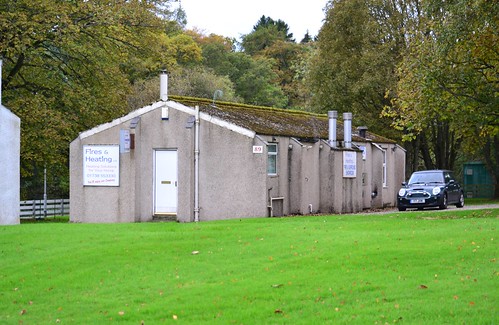
Numerous buildings survive from Scones wartime past.

Airwork moved north under contract from the Air Ministry to support training needs for the Royal Air Force, they moved into Scone (and several other airfields such as Renfrew and Abbotsinch) and developed the airfield providing much of the infrastructure themselves. A large company they would also provide maintenance facilities and operations across Britain supporting what would become a thriving civil aviation network.

On September 3rd 1939, with Britain’s declaration of war, the training units operating on behalf of the RAF were reorganised and re-designated, 11 E&RFTS becoming known more simply as 11 Elementary Flying Training School (EFTS). Also at this time  Airwork formed and operated a further training unit here at Scone, 7 Civil Air Navigation School (CANS) flying Dragon Rapides. They too were re-designated though, becoming  7 Air Observers Navigation School (AONS) on 1st November 1939. They would then take on the Avro Anson, training crews in navigation techniques. On June 1st 1940, the AONS was also disbanded, training needs being met elsewhere. 

Also during early November 1940, 309 Squadron sent a detachment of Lysander IIIs to Scone. only recently formed, they remained here for about six months. The sole purpose of 309 Sqn was as a Polish Cooperation unit to work in conjunction with the C-in-C of the Polish Army. It was unique in that it was ‘double’ ranked, having both British and Polish officers in charge, the idea being that once the Polish personnel were in place the British would be pulled out and the squadron would operate as an independent Polish unit. A series of training flights were carried out by the Polish pilots, but with lectures being carried out through a translator, it was often difficult task to do.

RAF Scone (Perth Airport)

Old buildings are utilised for modern purposes.

In September 1941, ‘E’ Flight of 11 EFTS  was used to form a new training unit, 5 Flying Instructors School (Supplementary) then simply Flying Instructors School, finally becoming Flying Instructors School (Elementary) from April 1942. The small number of pilot instructors flew Miles Masters and Tiger Moths training hundreds of pilots between them before the unit was disbanded in November 1942.

The remainder of 11 EFTS continued on to the war’s end gradually being reduced in size. Post war, in 1947, it was renamed as 11 Reserve Flying School (RFS) still operated by Airwork and still flying the biplane the Tiger Moth along with Airspeed Oxfords, Ansons and Hawk trainers. By 1954, the unit had wound down finally being disbanded that same year.

RAF Scone (Perth Airport)

The Battle Headquarters is very much exposed, this would normally be below ground level with only the slits visible.

In 1949, 666 Squadron was reformed at Scone as a Royal Auxiliary Air Force unit comprising: 1966 Air Observation Post Flight (AOP), with 1967 (AOP) Flight at Renfrew and 1968 (AOP) Flight at Abbotsinch. The squadron flew Austers Vs and VIs, in a cooperation role with Army units, and by 1957 all three flights, and thus the squadron, had ceased to exist when a letter, written by the Queen, was handed to more than eighty senior officers of the RAuxAF, officially ending its existence as it was. With that, thirty-two years of history had come to an end, a history that had seen the RAuxAF take part in virtually all of Britain’s major air battles since 1925.

In that same year on March 8th, 1957, another training unit, 1 Civilian Fighter Control Co-operation unit, formed here operating the Avro Anson T21. Little seems to be published about the activities of this unit, but I would assume it was operated by civilians working as part of the Royal Air Force’s training programme. It remained active here at Scone until 31st January 1961 where upon it was disbanded. A year after its disbandment on May 10th, an Anson of the unit ‘VV977’ was sold as scrap at No.27 MU Shawbury.

Later on D.H. Chipmunks of the Glasgow University Air Squadron graced the skies over Scone, the airfield now being known as Perth. A reign that lasted until 1993 when the squadron moved back to Glasgow, and its place of formation in the early days of the Second World War.

Due to high usage, two hard concrete runways were built on the site, whilst the third remained as grass.

With that the RAF’s connections with Perth ceased. The airfield was passed to ACS Aviation, who claim to be the “leading Commercial Flight Training Organisation in Scotland”. Operating a range of services including commercial pilot training and maintenance provisions. Other users of Perth include Scotland’s Charity Air Ambulance (SCAA) flying the EC135-T2 helicopter, a charitable organisation that relies solely on donations to keep it flying.

Today many of the wartime buildings remain, in use, by small industrial units. The Battle Headquarters, can be seen from the road very much exposed, as all but the top slotted observation ‘turret’ would normally be underground. The accommodation and technical areas are located together and many now form part of a small hotel for those visiting the area.

The airfield lies a few miles north of Perth, the main A94 offers access to the airfield and views across some of the site. It sits on a hill and so much of it is hidden from view at ground level. Being an active airfield, access is limited and understandably restricted. However, views of the current residents are available and many of the wartime buildings are accessible operating as retail and industrial units.

Scone for such a small airfield, had a long and fruitful history. Its links to pilot training, especially throughout the war years, no doubt sent many airmen to front line squadrons, many of whom  would go onto serve in some of Britain’s fiercest air battles. A small and rudimentary airfield, it played a huge part in Britain’s wartime and post-war aviation history.

RAF Scone (Perth Airport)

Modern day Scone is home to a large number of small aircraft.

Sources and further reading.

National Archives AIR 27/1679/1

Lake, A., “Flying Units of the Royal Air Force“, Airlife, 1999.

“1940: The Battles to Stop Hitler” – Mitch Peeke

A book review.

This is a superbly written book that looks at the Battle of Britain through the life of the airmen who were primarily based at a now disused RAF station (RAF Gravesend) in Kent. Whilst being historically accurate throughout, it is not one of those books that is full of data, figures and graphs, more a book based on personal and general historical events. It deals well with the political climate in Europe post World War I, setting the scene for Hitler’s rise to power, and the lethargic way in which the Allies allowed him to achieve his ultimate goal. It looks at the political unrest at home, and how that shaped both a public and government totally unprepared for war.

Each of the first four chapters look at specific events that led to the declaration of war on September 3rd, 1939. It looks at how the Allied response to Poland’s invasion was belittled by the massive and hugely technologically advanced German forces, who cut through Belgium circumnavigating the Maginot line, forcing the BEF and French forces to a small pocket at Dunkirk. It then looks at the evacuation through the eyes of two small boats (one of which Mitch supports through his book sales) and those who sailed on her. By examining the infrastructure surrounding the evacuation, it adds a very personal touch to what was a massive undertaking, and one that the many other books, films and documentaries have failed to highlight.

After Dunkirk, Mitch examines the Battle of Britain as it occurred in the skies over Kent and London. Individual skirmishes, with details of those involved, add a very personal touch to the blow-by-blow account of the battle as it weaves its way to its ultimate ending.

It is clear from the references to the skirmishes that Mitch has carried out extensive and prolonged investigations into each one, even pinpointing in many cases the actual crash site of the aircraft. Added to this are the personal and eye-witness accounts which continue to keep the personal aspect very much at the front. As the battle draws to its conclusion, life in London’s city streets are revealed through events that are again backed up with eyewitness accounts and personal details. Some of these stories will make you laugh, the absurdity of ill-fitting fire hoses and the tenacity of the firemen to solve the problem whilst all around were in chaos, is just one incredible example. It also shows that how through it all, the people of Britain managed to keep smiling, still seeing the good in what was a terrible time.

Whilst the Battle of Britain officially ended on 31st of October, Mitch continues to tell the story as autumn turns to winter and as the Battle of Britain turned to the Blitz. The nightly bombing of British cities gave rise to some dark secrets and activities, but balanced with these are other more informal and light-hearted highlights, all of which add to pulling the reader into the atmosphere of 1940s Britain.

In summing up, Mitch analyses the flaws in the German strategic plan for attacking Britain. He looks at how poor decisions enabled Britain to refocus and rearm thus building her forces up to a strength that was far better than those that remained in the period immediately following Dunkirk.

He then reintroduces the characters that had appeared throughout the book informing the reader of their postwar lives, some of whom were his own family members and who witnessed first hand, the true horrors of war.

Throughout Mitch’s final chapters there is a glowing slant toward the people,  showing the true grit and resolve of the British people who ‘pulled together’, that has become synonymous with those dark days of 1940/41. But this is not a patriotic, ‘let’s wave the flag and tell the world how good we were’ book, it’s more a heartfelt look at a very decisive time in world history, one that could have been so very different if it were not for ‘the few’, their leaders and the British people who supported them.

As appendices, Mitch looks at one RAF Station in particular, RAF Gravesend, its history and what has happened to the site since its closure post war. Now long gone, it is one of the many airfields that were so important to Britain’s survival, yet nothing remains of it today. He also looks at the 15 brave airmen who lost their lives in 501 and 66(F) Sqns, their names now on a plaque on the wall of a leisure centre on what was the former entrance to the airfield. Reading their short biographies really brings home the tender age of those who paid the ultimate sacrifice for our freedom.

I read this book in about two days, it’s easy, and compelling reading, very detailed and very personal. “1940: The Battles to Stop Hitler” is not about the Battle of Britain per se, but more a personal examination of the people who were involved in the two battles; Dunkirk and the Battle of Britain, and how their lives were interwoven in the summer of 1940. Light hearted in places, extremely moving in others, it adds another dimension to those famous battles, and I for one would most certainly recommend it.

1940: The Battles to Stop Hitler” by Mitch Peeke is available from Pen and Sword Books Limited. It is sadly only available in digital format and all the author’s royalties go to The Medway Queen Preservation Society, The Medway Queen being a survivor of the Dunkirk evacuation and featured in Mitch’s book.

1940: The Battles to Stop Hitler”  is available from Pen and Sword Books,  ISBN: 9781473858091, Published: 24th June 2015. https://www.pen-and-sword.co.uk/1940-The-Battles-to-Stop-Hitler-Kindle/p/11118

I would like to pass on my immense gratitude to Mitch for providing me with a copy of the book via publishers Pen and Sword Books.

November 11th 2018 – At the going down of the sun…

At the eleventh hour on the eleventh day of the eleventh month 1918, the guns on the western front fell silent. Four years of war in which millions were either killed or wounded, towns and villages wiped from the map and the environment changed forever, had finally come to an end. All along the front line, men were soon to put down their arms and leave their trenches for home.

The war to end all wars had finally come to an end. During the last four years some 40 million people had been killed or wounded, many simply disappeared in the mud that bore no preference to consuming man or machine.

Back home, virtually no city, town, village or hamlet was left unscathed by the loss of those four years. Many who returned home were changed, psychologically many were wounded beyond repair.

Sadly, twenty years later, the world slipped into the abyss of war once more. A war that saw some of the most incredible horrors, one that saw the extreme capabilities of what man can do to his fellow-man. Across the world millions of innocent people were slaughtered under the guise of an ideology. An ideology that was determined to rid the world of anyone who was willing to speak out against that very same ideology.

Young men were transported thousands of miles to fight in environments completely alien to them. Many had never been beyond their own home town and yet here they were in foreign lands fighting a foe they had never even met.

The bravery and self-sacrifice of those young men  on the seas, on the land and in the air, go beyond anything we can offer as repayment today.

For nearly 80 years, the world has been at an uneasy rest, Korea, Vietnam, the Falklands, the Middle East, and the Far East, in almost every corner of the globe there has been a war in which our service men and women have been involved. The war to end all wars failed in its aim to bring peace to the world.

In this year, 104 years after the end of the First World War, we remember those who laid down their lives in the fight for freedom. We remember those who fought for the right to free speech, for the right to be who you are and the right to live our lives in peace.

We will remember them…

War Graves Cemetery - St Mary's Great Bircham St Mary’s Great Bircham
St. Clement Danes - Church of the RAF The rosette of the Commonwealth Air Forces – St. Clement Danes
Ypres 007 Tyne Cot, Ypres
DSC_0587 The American Cemetery Madingley

Anthem for Doomed Youth

What passing-bells for these who die as cattle?
Only the monstrous anger of the guns.
Only the stuttering rifles’ rapid rattle
Can patter out their hasty orisons.
No mockeries now for them; no prayers nor bells,
Nor any voice of mourning save the choirs,
The shrill, demented choirs of wailing shells;
And bugles calling for them from sad shires.

What candles may be held to speed them all?
Not in the hands of boys, but in their eyes
Shall shine the holy glimmers of goodbyes.
The pallor of girls’ brows shall be their pall;
Their flowers the tenderness of patient minds,
And each slow dusk a drawing down of blinds.

Wilfred Owen (18/3/1893 – 4/11/1914)

RAF East Wretham – Home to the Czechs of Bomber Command (P1)

Hidden in the depths of Thetford Forest not far from the two major US Air bases at Mildenhall and Lakenheath, is a former airfield that has received a new lease of life as an Army training facility. Once home to Bomber Command’s only Czechoslovakian Squadron, it was also home to Canadians and other Commonwealth nationals. After their final departure, it became the home of an American Fighter unit meaning its history is both diverse and multinational.

In Trail 13, we stop off at the former Station 133, more widely known as RAF East Wretham.

RAF East Wretham (Station 133)

Originally built in the early part of the Second World War and opened in March 1940, East Wretham was primarily designed as a satellite airfield for nearby RAF Honington.  Being a satellite the airfield’s facilities would be basic, accommodation rudimentary and technical facilities limited. It would however, be developed as the war progressed and as its use increased. The main runway for example, (running north-east to south-west) was initially grass but with the arrival of the USAAF it would be covered with Pierced Steel Planking (PSP), designed to strengthen the surfaces and thus prevent aircraft digging into the soil.

East Wretham would also have a range of hangars. In addition to the standard two ‘T2’ hangars, it would have a canvas Bessoneau hangar, (more generally linked to the First World and inter-war years),  and an additional four Blister hangars (9392/42) all believed to be double ‘extra over’ blister hangars each 69 ft wide in the singular design.

The watch office at East Wretham was another unusual design. Built to drawing 15498/40, it was originally a single storey room built on concrete pillars with a flat roof. It was then modified later on in the war to include an overhanging observation room, with the extension being mounted on metal pillars. This new extension had considerably more glazing than the original structure, and was more in keeping with the building style of other wartime airfields. These extra windows gave a much better view across the entire airfield, especially useful as the office was unusually located along the perimeter fence well behind the technical area of the airfield!

The Control Tower of the 359th Fighter Group at East Wretham. Caption on reverse: 'Caption on reverse: '359th FG Photos Source: T.P. Smith via Char Baldridge, Historian Description: #13 Control Tower at Station F-133, East Wretham, England.'

The unusual design of the Watch Office can clearly be seen in this photograph*1. (IWM)

Originally there were only 27 ‘frying pan’ style concrete hardstands, each one being located at various points around the perimeter track, all in groups of three or four. These were then added to later on, again using steel planking, to extend the number of dispersal points located on hard surfaces; a further indication to the problems with the boggy soil found in this part of East Anglia.

Accommodation for the initial 1,700 personnel, was dispersed over twelve sites around the north of the airfield, and across the road from the main airfield site. One of these sites (Site 2) was the nearby Wretham Hall, a grand building built in 1912, it was utilised by Officers of the USAAF for their own personal accommodation. Sadly, the grand three storey building was demolished in the early 1950s, possibly as a result of its wartime use.

A bomb storage site was also built on the airfield. Located on the south side of the site, it was well away from any accommodation or technical buildings. It was also well away from the three large fuel stores,  which boasted storage capacities of: 24,000, 40,000 and 90,000 gallons.

The initial use of East Wretham was as a dispersal for aircraft based at Honington, the first of which was a newly formed Czechoslovakian Squadron, No. 311 (Czech) Sqn, on 29th July 1940. So new were they that they didn’t receive their Wellington ICs until the August. This was to be a unique squadron in that it was the only Czech squadron to fly with Bomber Command, and whilst the main body of the squadron was located at Honington, the operational flight (A Flight) moved to East Wretham shortly after its  formation. In mid September a decision was made to move the entire squadron across to East Wretham posting a detachment to RAF Stradishall, where they stayed until April 1942.

On September 10th 1940, 311 Sqn, now with a small number of operational crews, took part in their first mission, a true baptism of fire flying directly into the German heartland and Berlin. For one of the crews and their Wellington, this would not go well, the aircraft believed forced down in the vicinity of a railway line near Leidschendam in Zuid-Holland, with all but one of the six airmen on-board being captured.

The only crew member not to be caught was Sgt. Karl Kunka, who managed to evade capture for a short period, only to shoot himself with the aircraft’s Very Pistol. It was thought that he carried out this action to not only avoid capture but any possible retaliation against his family back home in Czechoslovakia. Whilst Sgt. Kunka’s wounds were not initially fatal, they were so severe that he later died, failing to respond to treatment whilst in hospital.

The aircraft, Wellington MK.Ia, #L7788, ‘KX-E’, was also captured, repainted in Luftwaffe colours and flown for testing and evaluation to Rechlin, the Luftwaffe’s main aircraft test facility north of Berlin.

RAF East Wretham 3

East Wretham still uses the Nissen huts and smaller buildings today.

During December 1941, a further Czech unit, No.1429 Czech Operational Training Flight (COTF) was formed along side 311 Sqn, under the command of Sqn/Ldr. Josef Šejbl. This unit was designed specifically to train Czechoslovakian aircrews for Bomber Command, with instructors for the flight, being taken from 311 Sqn following completion of their tour of operations.

As aircrew completed their training, they were transferred to the operational flight, a steady but slow build up meant that numbers were quite low, the squadron being  considerably reduced by heavy casualties in the early stages of the war. As with other Bomber Command squadrons, 311 Sqn carried out night bombing missions, many penetrating Germany itself.

1941 would see more missions to Germany, starting with the first three nights January 1st – 3rd, when Bomber Command aircraft hit Bremen, with 311 Sqn taking part on the night of the 2nd. On this night, three aircraft from 311 Sqn would join the Hampdens and Whitleys of Bomber Command in attacking a major railway junction in the centre of the city, where fires and explosions were seen as far away as 20 miles. A relatively successful operation, it would not be long before the first casualties of 311 Sqn would occur.

On the night of January 16th – 17th Wellington IC #T2519 ‘EX-Y’ was lost on a mission to Wilhelmshaven, the aircraft going down after suffering ‘technical’ problems. Last heard from  at 22:21, the aircraft disappeared without trace along with the entire crew, none of whom were ever heard from again.

1941 would end as it started, with a return trip to Wilhelmshaven, in which good results were recorded. One aircraft was lost on this mission, Wellington #T2553 ‘EX-B’, the pilot, Sgt. Alois Siska ditching the aircraft after it had sustained serious flak damage over the target area. As the aircraft sunk, it took the life of the rear gunner Sgt. Rudolf Skalicky, the other’s climbing into the aircraft’s dingy, a small craft in which they remained for several days.

As the dingy drifted towered the Dutch coast, the icy conditions would take two more lives, that of Sgt. Josef Tomanek (Co/P) and F/O. Josef Mohr (Nav.), whilst the pilot, Sgt. Siska, suffered badly from frost bite and gangrene. The remaining crewmen, F/O. Josef Scerba (W/O), Sgt. Pavel Svoboda (air gunner) along with Sgt. Siska, were picked up by German forces and  interned as POWs, mainly staying in hospitals for treatment for cold related injuries. Sgt. Svoboda went on to escape captivity no less than three times, evading capture until after the war whereupon he returned to England.

By mid 1942, 311 Sqn were assigned a new posting and a new airfield, but before departing in their final month, April 1942, they  would be visited by two particularly significant dignitaries. On April 3rd, Air Vice Marshal J. Baldwin, Air Officer Commanding No. 3 Group, RAF Bomber Command, visited to award the DFC  to P/O. Karel Becvar for his services as a navigator with 311 Sqn. Then on the 18th April, the President of the Czechoslovak Republic, Dr. Edward Benes, arrived along with several other dignitaries to inspect the Squadron, and give a speech regarding the work carried out by the crews here at East Wretham.

Tarck to Bomb Store

A number of tracks remain on the site.

During their last month, 311 Sqn would fly twelve more operations before finally departing Norfolk for Northern Ireland and Aldergrove. Whilst here at East Wretham, they would fly 1,011 sorties which included both attacks on industrial targets and propaganda leaflet drops. On the 30th, the main air body along with the rear party departed the site, the bulk of the squadron moving two days earlier. After their departure, 311 Sqn would not return to East Wretham.

In November 1942, after a long quiet break, East Wretham would spring into life once more with the arrival of another bomber squadron, No. 115 Sqn (RAF) from Mildenhall now flying  Wellington MK.IIIs.

Over the winter of 1942-43, 115 Sqn would lose ten aircraft, most to missions over Germany but two whilst ‘Gardening’, the last occurring on the night of New Years Eve 1942.

During the early months of 1943 six more Wellingtons would be lost from 115 Sqn, KO-D, KO-X, KO-C, KO-N, KO-T and KO-Q, the new year had not brought new fortunes.

By now the limits of the Wellington had been realised and its days as a front line bomber were numbered. A poor performer in the bombing theatre, it would be gradually moved to other duties, being replaced by the superior four-engined heavies; 115 Sqn was no exception. The MK.II Lancaster, powered by four Bristol Hercules engines, was less common than the Merlin powered MK.I and MK.III, but none the less was far superior to the Wellington in both performance and bomb carrying capacity.

The first Lancaster arrived in the March of 1943, and as it did the Wellingtons began to depart. To help train crews on the new aircraft, a detachment from 1657 Heavy Conversion Unit (HCU) would be re-designated 1678 (Heavy Conversion) Flight (HCF) and was based here at East Wretham.

Flying the radial engined Lancaster MK.IIs under the code ‘SW’, they were one of only two HCFs to be established in Bomber Command, both in May of that year. Specifically set up to convert crews from the Wellington to the Lancaster, they were a short-lived unit, becoming a Heavy Conversion Unit once more on September 16th 1943, after moving to RAF Foulsham. During this time the flight would operate only eight aircraft in total, losing none whilst at East Wretham.

Even with the new aircraft though, flying over Germany was not without its problems for 115 Sqn. The first aircraft to be lost, and the first of its type in Bomber Command, Lancaster MK.II #DS625 ‘KO-W’ was lost without trace in a raid to Berlin on the night of March 29th/30th. The Pilot Sgt. H. Ross, (RCAF) and his crew all being commemorated on the Runnymede memorial. The aircraft being new, it had only flown 26 hours since its arrival at East Wretham earlier that year on March 9th.

rear-turret-of-Lanc-lost-595x478

Avro Lancaster B Mk II, DS669 ‘KO-L’, of No. 115 Squadron, was hit by bombs from an aircraft flying above. during a raid on Cologne on the night of 28th/29th June 1943. The tail gun and gunner were both lost. (Author unknown)

With more missions into Germany, 115 Squadron’s Lancasters  would continue to serve well, perhaps one of the worst nights occurring just days before their eventual departure to RAF Little Snoring in early August 1943.

On the night of 2nd/3rd a mission was planned for Hamburg in which 740 aircraft were allocated. Of these, 329 were Lancasters, by far the largest contingency of the raid. Whilst over Germany, the formation entered a severe thunderstorm, and with many aircraft suffering from icing, they were forced to either turn back, or find other targets. The poor weather, including lightning, accounted for several of the losses that night including one of three lost from 115 Sqn.

Lancaster #DS673 was shot down by a night fighter, #DS685 was lost without trace and #DS715 was struck by lightning causing it to crash not far from the target. From the three that went down that night, there were no survivors from the twenty-one crewmen on board. 115’s time at East Wretham would close on a very sour note indeed.

With the departure of 115 Sqn in August, East Wretham would then pass from RAF ownership into the hands of the US Eighth Air Force, to become Station 133, the home of the three squadrons of the 359th Fighter Group – ‘The Unicorns’