RAF Narborough – ‘The Largest Aircraft Base of the First World War.’ Part 1

At the turn of the last century, flying was in its infancy, and airships formed the main threat from an enemy. Aeroplanes were fragile, slow and cumbersome and those that flew them, risk death at every turn with no means of escape.

As aircraft developed and those in high ranking positions finally saw their potential, production went into overdrive, but there was a greater need, the need for those to fly them.

In Norfolk, the threat from airships was very real, and so many new airfields sprung up to defend the British Isles from these roaming menaces. One such airfield, became the largest of them all, a huge site of 900 acres it dwarfed all other aircraft based airfields, and yet, it failed to last beyond the war.

In this part of Trail 7, we head to modern day RAF Marham, for on its fringes lie a field of forgotten heroes who gave their all during the First World War. We look at RAF Narborough.

RAF Narborough

Originally constructed as the largest aircraft base of the First World War, Narborough Airfield in Norfolk has been known by a variety of names over the years: Narborough Aerodrome, RNAS Narborough, RFC Narborough, and later RAF Narborough. However, the most unofficial — and arguably the most evocative — title, ‘The Great Government Aerodrome’, offers a sense not only of its vast scale (spanning over 900 acres), but also of the diversity of aircraft and personnel stationed there. Initially operated by the Royal Naval Air Service (RNAS), the site later came under the control of the Royal Flying Corps (RFC), and eventually the newly-formed Royal Air Force (RAF), with each change of name reflecting the evolving structure and ownership of Britain’s early air services.

Records show that the site at Narborough had military links as far back as 1912, in the year that the RFC was established when both the Naval Air Organisation and the Air Battalion of the Royal Engineers were combined. Unfortunately, little exists to explain what the site was used for at this time, but it is thought that it was used by the army for training with horses and gun carriages. In later years, it was used as a base from which to counteract the threat from both the German Zeppelin and Schütte-Lanz airships, and also to train future pilots of the RFC and RAF.

Narborough’s history in these early days is therefore sketchy, few specific records exist as to the many changes that were taking place at this time particularly in relation to the development of both the RNAS and the RFC.

However, Narborough’s activities, and its history too, were no doubt influenced on July 1st 1914, when the name RNAS Narborough was officially adopted, and all Naval flying units of the RFC were transferred over to the control of the Navy. A major development in the formation of both forces, there were at this point, a total of: 111 officers, 544 other ranks, seven airships,  fifty-five seaplanes (including ship-borne aircraft) and forty aeroplanes in RNAS service.*1 Some of these may well have seen service at Narborough at this point.

Narborough’s first interaction with flying occurred when a solo flyer – thought to have been Lt. F. Hodges in an Avro 504 *2 – touched down on farmland near to Battles’ Farm in the Autumn of 1915. Neither the pilot, the aircraft type nor the purpose of the landing can be substantiated, but it may well have been the precursor to the development of an airfield at this site.

The airfield itself was then developed, opening early that year (1915), on land that lay some 50 feet above sea level. It sat nestled between the towns of Kings Lynn (10 miles), Swaffham (5 miles); and Downham Market (9 miles), and a mile or so away from the small village of Narborough. A smaller aerodrome would, in 1916, open literally across the road from here, and at 80 acres, it would be tiny in comparison. However, over time, it would grow immensely to become what is today’s RAF Marham, an active airfield that has matured into one of the RAF’s top fighter airfields in the UK.

So by mid 1915, Narborough’s future had been decided, designated as a satellite station to RNAS Great Yarmouth, (itself commissioned in 1913) it was initially to be used as a night landing ground for those aircraft involved in attacks on enemy airships, the most likely reason for its location. No crews were permanently stationed here at the time however, ‘on-duty’ crews later being flown in to await the call to arms should an airship raid take place over East Anglia.

This first arrival of an aircraft in August 1915, led to the site being kept in use by the RNAS for the next ten months. During that time, aircraft of the Air Service would patrol the coastline around Norfolk, using aircraft mainly from Great Yarmouth along with a series of emergency landing grounds including Narborough. The threat from German airships at this time being very real. These landing grounds were strategically placed at intervals along the coastline with others more inland, these included: Aldeborough, Burgh Castle; Covehithe; Holt and Sedgeford all of which combined to make North Norfolk one of the densest regions for airfields at that time. But, and even with all these patrols, the roaming airships that made their way across the region had little to worry about as many of the fighter aircraft used could neither reach them at the higher altitudes nor locate them in poorer weather.

However, as a night landing ground, little activity would directly take place at Narborough (there are no recordings of airship sightings from Aircraft using the airfield) and so after a dormant ten months, the RNAS decided it was surplus to requirements and they pulled out leaving Pulham the only ‘in-land’ station larger than Narborough open in Norfolk at that time.

The future of Narborough could have so easily ended there, but even as closure plans were made, its future was still relatively secure, and it would not be long before a new user of the site would be found. Discussions were already in hand for the RFC to take over, provided the land owners’ permitted it! Luckily they did, and soon fifty acres of rough terrain and a small number of canvas flight sheds were theirs. As for staff accommodation, there was none, so when 35 Sqn arrived at the end of May 1916, Bell tents and make shift accommodation had to be erected by the personnel, in order to protect themselves from the harsh Norfolk elements.

With the First World War raging across the fields of Flanders, the demand for aircraft and trained crews grew rapidly. These new flying machines were evolving swiftly into lethal weapons and highly effective reconnaissance platforms, capable of identifying enemy positions and directing artillery fire with increasing accuracy. To meet the urgent need for trained airmen, hurried training programmes were established, and Narborough soon became a vital preparation ground for budding pilots.

Training, by any standard, was rudimentary. Recruits were required to pass a series of written examinations, followed by up to twenty hours of solo flying, a number of cross-country flights, and two successful landings. Added to this was a fifteen-minute flight at 8,000 feet, culminating in a dead-stick landing — that is, returning safely to earth with the engine cut. It was, in truth, barely enough experience for what lay ahead in the violence of aerial combat.

Like many newly established stations, Narborough was designated as an RFC training site — officially known as a Training Depot Station — joining a growing network of such facilities across Norfolk, Suffolk, and Lincolnshire. Their primary role was to prepare pilots for the rigours of air combat, with instruction in dog-fighting, aerobatics, cross-country navigation, and formation flying.

With the arrival of the RFC came immediate expansion. Additional acreage was acquired that same year, extending the airfield westward beyond the area already occupied by the RNAS, bringing it close to the present-day boundary of RAF Marham. As was often the case with wartime construction, adjustments to the local infrastructure were necessary. A road that once bisected the site was eventually closed to accommodate the growing airfield footprint.

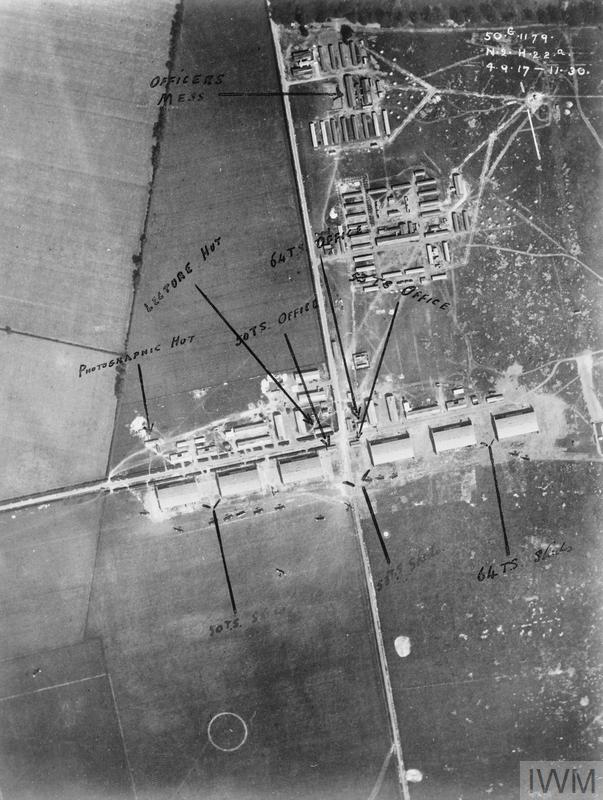
RFC Narborough from the air 1917. @IWM (Q 111416)

So, it was during June 1916 that the first RFC squadron would make use of Narborough as an airfield, 35 Sqn transferring over here from Thetford with Vickers FB.5 and FE.2bs. disposing of their D.H.2s and Henry Farman F.20s in the process. Within two months of their arrival, the nucleus of the squadron would then be used to form a new unit, 59 Sqn, who were also to be stationed here at Narborough (under the initial temporary command of Lieutenant A.C. Horsburgh) with RE8s. On the 16th August, Horsburgh would take on a new role when the new permanent commander Major R. Egerton, was transferred in. It would be he who would take the unit to France the following year and command until his death in December 1917.

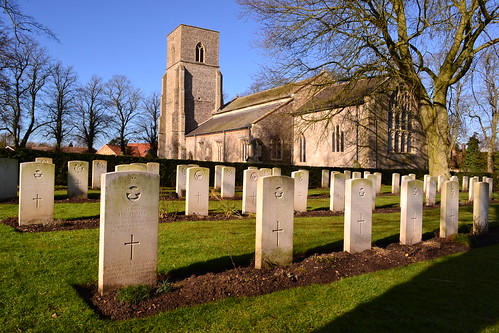
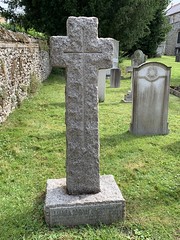
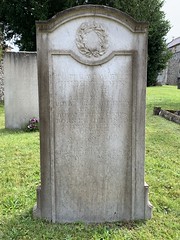
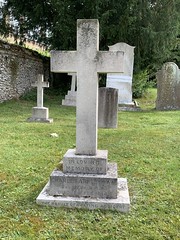
During their time here, these daring young trainees, many whom were considered dashing heroes by the awe-inspired locals, would display their skills for all who lined the local roads to see. As these eager young men quickly learned though, flying was not always ‘fun’, and the dangers of the craft were always present, many with dire consequences. Accident rates were high and survival from a crash was rare, even ‘minor’ accidents could prove fatal. All Saints church yard at Narborough, pays testament to their dangerous career with fourteen of the eighteen military graves present being RFC/RAF related.

The initial drive for both these squadrons was to train pilots in the art of cavalry support, using advanced pilot training  techniques. This included being able to send Morse code messages at a rate of six words per minute*2 whilst flying the aircraft over enemy territory – certainly no mean feat.

Deaths on and off the airfield were commonplace and not all aviation related either. During late June 1916, one of the Air Mechanics of 59 Sqn, Charles Gardner, suffered a heart attack and died, just one day prior to the official formation of his squadron. Whilst not considered to have been directly related to his role, his loss saw the beginning of a string of deaths in August that would set the scene for the coming months.

The first of these was another thought to be, unrelated aviation death, although whether or not Corporal Patrick Quinn was on duty at the time is unclear. He died on August 18th, whilst riding his motorcycle in the vicinity of the airfield, the narrow Norfolk roads catching him unaware. Then, just two days later on August 20th, the first of many fatal air accidents would occur.

In this instance, one of 59 Sqn’s pilots, Lt. Gordon William Hall, was killed when the DH.1 (4631) he was flying, side-slipped on approach to the airfield crashing into the ground as a result. A Court of Inquiry (87/8413) concluded that the aircraft had been “banked too steeply” and that the pilot had put the aircraft into a dive that made it uncontrollable. A verdict therefore of ‘accidental death‘ was subsequently recorded against Lt. Hall.*3

A mere eight days later, it was the turn of 35 Sqn to suffer its first fatality and in a not too dissimilar accident. On the 29th, an Armstrong Whitworth F.K.3 (6201), was written off after it too side-slipped and dived following a slow turn. The Pilot, Air Mechanic 1st Class  Moses Boyd, was tragically killed in the accident flying an aircraft that was based at Thetford but undertaking a training exercise here at Narborough. His Court of Inquiry (Ref. 87/4971) on 9th September 1916)*3 , summated that it was a “Flying accident. Turning having lost flying speed”. By now, the dangers of flying were becoming all too apparent and with another two deaths before Christmas, the glamour of flying was quickly becoming tarnished.

However, despite these accidents, young men continued to arrive at the airfield for training, but the large influx of personnel did not mean it was at all a glamorous place to be.

As a training ground, accommodation was basic to say the least, Narborough being described by one trainee as a “desolate, God-forsaken place“*4. Quickly realising the problem, the authorities, began to erect new buildings not only for personnel accommodation, but for training and maintenance roles as well. In response, a total of six permanent hangars, probably RFC General Service Flight Sheds, were erected by the design company and builders Boulton & Paul, three each side of the main road. The Boulton & Paul company based at Norwich, would go on to design and build many aviation related products including the famous ‘Defiant’, a turreted fighter of World War II.

With continued expansion over the next two years, up to 150 buildings would eventually be built on the site, a mix of technical, administrative and accommodation. This on going process of construction and development would, by the end of the war, see some 1,000 personnel based here at Narborough – a number comparable with many modest Second World War airfields.

Narborough wasn’t the only airfield being developed in the immediate area though. Next door, across the road, the new RFC Marham was opening, a much smaller site, that sat in the centre of what is now modern day RAF Marham. Why the two were put so close together is anyone’s guess, but Marham quickly became the home and headquarters to ‘C’ Flight 51 Squadron. The remaining two flights of the squadron being based at both RFC Mattishall and RFC Tydd St Mary.

Marham opened for business in September 1916 and one of those who would be stationed here was Major A.T. Harris, later ‘Bomber Harris’ of Bomber Command fame. He was in command of 191 Night Training Squadron, and took part in many flights from the airfield. Marham, like Narborough, would eventually close at the end of the war in the huge disarmament programme of the immediate post war years. But, unlike Narborough, it would be reborn in the expansion period of the 1930s and grow to what it is today.

There was a good relationship between the two stations, with plenty of rivalry and good humour. Flour bombs from Marham crews on Armistice day were met with a retaliation from Narborough crews with soot bombs, the culmination of several years of war finally coming to an emotional close.

RFC Narborough 1916. The six RFC hangars can be seen in line along the former Narborough – Beachamwell Road. (Marham Aviation Heritage Centre)

The RFC was now building in strength, not only in its front line units but in its reserves too. On November 2nd, 1916 a new reserve squadron was constituted and formed here at Narborough, 48 (Reserve) Squadron (RS). Models flown by the unit at this time included the Grahame White XV, the Maurice Farman Shorthorn and Sopwith’s Pup. As a newly formed unit they would have to get established, gain crews, admin staff and equipment. Once this was in place they could then move on, and after just a month, they departed Narborough heading for the Lincolnshire airfield at Waddington.

The vacancy at Narborough was quickly filled though, in mid December No. 50 Reserve Squadron (RS) arrived from the Kent village of Wye, just as the Sedgeford based 53 Reserve Squadron (RS) also arrived with 504s, BE2s, DH6s and RE8s.*5

Between their arrival and November the following year (1917), the date they departed for Spitalgate, 50 Reserve Squadron would lose twelve flyers in accidents, three Air Mechanics with the remainders being Lieutenants, both 1st and 2nd Class. Five of these remain in the local churchyard.

In early 1917, Nottingham born Captain Albert Ball, VC, DSO & Two Bars, MC arrived at Narborough; a veteran of the front line, he served here for only a short time as an instructor before the draw of the front line took him back once again. This time there was no coming home as he was killed after an intense aerial battle on May 7th that year with 44 victories under his belt. He was just 20 years of age.

Albert Ball via ‘Visit Nottingham’ website.

With increasing numbers of squadrons and men being required for front line units in France, both the original 35 and 59 Squadrons departed Narborough in early 1917. 35 Squadron were first to go, and those left behind saw them off from local train stations with all the pomp and ceremony they could muster.  A few days later a convoy of 3 ton Leyland lorries, trailers and an assortment of other vehicles loaded with men and equipment, set off for France where they met the air party who had already flown to St. Omer. 59 Squadron would follow to the same airfield on February 23rd, both squadrons remaining in France until 1919 and the war’s end.

In Part 2, the reserves are left to carry on training, but its not an easy job. The development and growth of Narborough continues and eventually the RAF is formed. There are major changes all round.

The full story of Narborough can be read in Trail 7 – North West Norfolk.

Remembrance Sunday November 2022

At the eleventh hour on the eleventh day of the eleventh month 1918, the guns on the western front fell silent. Four years of war in which millions were either killed or wounded, towns and villages wiped from the map and the environment changed forever, had finally come to an end. All along the front line, men were soon to put down their arms and leave their trenches for home.

The war to end all wars had finally come to an end. During the last four years some 40 million people had been killed or wounded, many simply disappeared in the mud that bore no preference to consuming man or machine.

Back home, virtually no city, town, village or hamlet was left unscathed by the loss of those four years. Many who returned home were changed, psychologically many were wounded beyond repair.

Sadly, twenty years later, the world slipped into the abyss of war once more. A war that saw some of the most incredible horrors, one that saw the extreme capabilities of what man can do to his fellow-man. Across the world millions of innocent people were slaughtered under the guise of an ideology. An ideology that was determined to rid the world of anyone who was willing to speak out against that very same ideology.

Young men were transported thousands of miles to fight in environments completely alien to them. Many had never been beyond their own home town and yet here they were in foreign lands fighting a foe they had never even met.

The bravery and self-sacrifice of those young men  on the seas, on the land and in the air, go beyond anything we can offer as repayment today.

For nearly 80 years, the world has been at an uneasy rest, Korea, Vietnam, the Falklands, the Middle East, and the Far East, in almost every corner of the globe there has been a war in which our service men and women have been involved. The war to end all wars failed in its aim to bring peace to the world.

In this year, 104 years after the end of the First World War, we remember those who laid down their lives in the fight for freedom. We remember those who fought for the right to free speech, for the right to be who you are and the right to live our lives in peace.

We will remember them…

War Graves Cemetery - St Mary's Great Bircham

St Mary’s Great Bircham

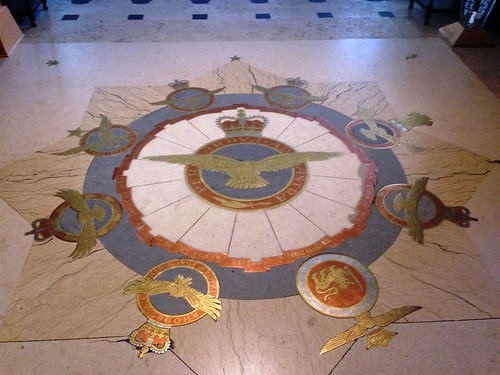
St. Clement Danes - Church of the RAF

The rosette of the Commonwealth Air Forces – St. Clement Danes

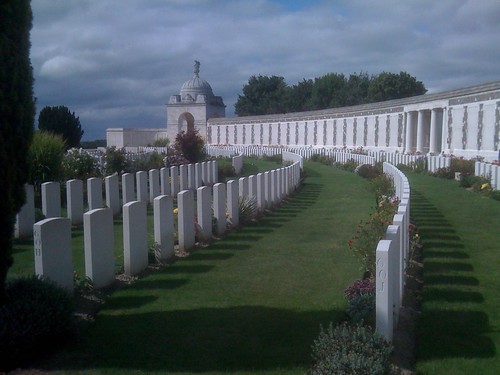
Ypres 007

Tyne Cot, Ypres

DSC_0587

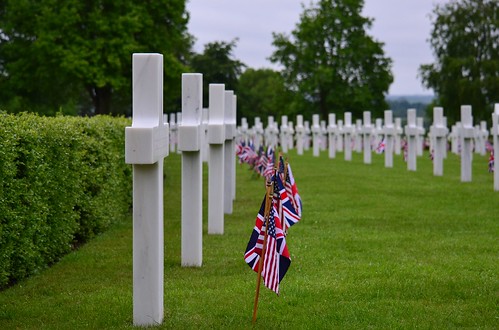
The American Cemetery Madingley

Anthem for Doomed Youth

What passing-bells for these who die as cattle?
Only the monstrous anger of the guns.
Only the stuttering rifles’ rapid rattle
Can patter out their hasty orisons.
No mockeries now for them; no prayers nor bells,
Nor any voice of mourning save the choirs,
The shrill, demented choirs of wailing shells;
And bugles calling for them from sad shires.

What candles may be held to speed them all?
Not in the hands of boys, but in their eyes
Shall shine the holy glimmers of goodbyes.
The pallor of girls’ brows shall be their pall;
Their flowers the tenderness of patient minds,
And each slow dusk a drawing down of blinds.

Wilfred Owen (18/3/1893 – 4/11/1914)

Remembrance Day 2021 – At the going down of the sun…

At the eleventh hour on the eleventh day of the eleventh month 1918, the guns on the western front fell silent. Four years of war in which millions were either killed or wounded, towns and villages wiped from the map and the environment changed forever, had finally come to an end. All along the front line, men were soon to put down their arms and leave their trenches for home.

The war to end all wars had finally come to an end. During the last four years some 40 million people had been killed or wounded, many simply disappeared in the mud that bore no preference to consuming man or machine.

Back home, virtually no city, town, village or hamlet was left unscathed by the loss of those four years. Many who returned home were changed, psychologically many were wounded beyond repair.

Sadly, twenty years later, the world slipped into the abyss of war once more. A war that saw some of the most incredible horrors, one that saw the extreme capabilities of what man can do to his fellow-man. Across the world millions of innocent people were slaughtered under the guise of an ideology. An ideology that was determined to rid the world of anyone who was willing to speak out against that very same ideology.

Young men were transported thousands of miles to fight in environments completely alien to them. Many had never been beyond their own home town and yet here they were in foreign lands fighting a foe they had never even met.

The bravery and self-sacrifice of those young men  on the seas, on the land and in the air, go beyond anything we can offer as repayment today.

For nearly 80 years, the world has been at an uneasy rest, Korea, Vietnam, the Falklands, the Middle East, and the Far East, in almost every corner of the globe there has been a war in which our service men and women have been involved. The war to end all wars failed in its aim to bring peace to the world.

In this year, we remember those who laid down their lives in the fight for freedom. We remember those who fought for the right to free speech, for the right to be who you are and the right to live our lives in peace.

We will remember them…

War Graves Cemetery - St Mary's Great Bircham

St Mary’s Great Bircham

St. Clement Danes - Church of the RAF

The rosette of the Commonwealth Air Forces – St. Clement Danes

Ypres 007

Tyne Cot, Ypres

DSC_0587

The American Cemetery Madingley

Anthem for Doomed Youth

What passing-bells for these who die as cattle?
Only the monstrous anger of the guns.
Only the stuttering rifles’ rapid rattle
Can patter out their hasty orisons.
No mockeries now for them; no prayers nor bells,
Nor any voice of mourning save the choirs,
The shrill, demented choirs of wailing shells;
And bugles calling for them from sad shires.

What candles may be held to speed them all?
Not in the hands of boys, but in their eyes
Shall shine the holy glimmers of goodbyes.
The pallor of girls’ brows shall be their pall;
Their flowers the tenderness of patient minds,
And each slow dusk a drawing down of blinds.

Wilfred Owen (18/3/1893 – 4/11/1914)

RAF Narborough – The Great Government Aerodrome.

Resting not more than a mile or so from the boundary of Britain’s front line fighter base RAF Marham, is an airfield that never made it beyond the First World War. However, its importance cannot be denied nor should it be over looked. Key to aviation in Norfolk and to the Royal Air Force as a whole, it played a major part in both, and therefore is pivotal to today’s modern air force. Opened originally as a satellite by the Royal Naval Air Service, it became not only Norfolk’s first, but the biggest First World War, fixed wing aircraft airfield, only four airship stations were bigger.  Leading the way for the aviators of today’s Royal Air Force, we look back at the former RAF Narborough.

RAF Narborough

Built as the largest, aircraft based, World War One aerodrome, Narborough has been known under a range of different names. The most common, ‘The Great Government Aerodrome’ reflected not only its size (over 900 acres) but also its multinational stature; the range of aircraft and personnel based here, and its achievements in aviation history. Used by the Royal Naval Air Service (RNAS), the Royal Flying Corps (RFC) and the Royal Air Force (RAF), it would have names that reflected each of these fledgling services.

Records show that Narborough had military links as far back as 1912, in the year that the RFC was established when both the Naval Air Organisation and the Air Battalion of the Royal Engineers were combined. Unfortunately, little exists to explain what it was used for at this time, but in later years, it was used to counteract the threat from both the German Zeppelin and Schütte-Lanz airships, and also to train future pilots of the RFC and RAF.

Narborough’s history in these early days is sketchy, few specific records existing as to the many changes that were taking place at this time or to the development of the RFC and RNAS. Its activities – and history though – was no doubt influenced on July 1st 1914, when the name RNAS was officially adopted, and all Naval flying units of the RFC were transferred to the control of the Navy. A major development in the formation of both forces, there were at this point, a total of: 111 officers, 544 other ranks, seven airships,  fifty-five seaplanes (including shipborne aircraft) and forty aeroplanes in RNAS service.*1 Some of these may well have been used at Narborough at this point.

By 1915, Narborough’s future had been sealed, designated as a satellite station to RNAS Great Yarmouth, (itself commissioned in 1913) it was initially to be used as a night landing ground for those aircraft involved in attacks on enemy airships. No crews were permanently stationed here at this time however, but as time went on ‘on-duty’ crews would fly in, and await the call to arms should an airship raid take place over East Anglia.

The first recorded arrival was in August 1915, an event that would keep the site in use by the RNAS for the next ten months, before being designated as surplus to requirements and handed over to the RFC in June 1916.

It was in June 1916 that the first RFC squadron would make use of Narborough as an airfield, 35 Sqn transferring over here from Thetford with Vickers FB.5 and FE.2bs. disposing of their DH2s and Henry Farman F.20s in the process. Within two months of their arrival, the nucleus of the squadron would then be used to form a new unit, 59 Sqn, also here at Narborough, under the command of Lieutenant A.C. Horsburgh with the RE8s. Narborough was already beginning to grow.

It was in that same month, that the perils of war would be brought home to those based at Narborough, when one of 59 Sqn’s pilots, Lt. Gordon William Hall, was killed when the DH.1 (4631) he was flying,  side slipped on approach to the airfield crashing as a result. A court of enquiry confirmed that the aircraft had been “banked too steeply” and that the pilot had put the aircraft into a dive that made it uncontrollable. A verdict of ‘accidental death’ was recorded against Lt. Hall.*2

In August, it was the turn of 35 Sqn to suffer its first fatality in a non too dissimilar accident. On the 29th, an Armstrong Whitworth F.K.3 (6201), was written off after it too side slipped and dived following a slow turn. The Pilot – Air Mechanic 1st Class –  Moses Boyd was tragically killed in the accident flying an aircraft that was based at Thetford but undertaking a training exercise here at Narborough. Already, the dangers of flying were becoming all too apparent and the glamour of flying was becoming tarnished.

Within two months, another 35 Sqn aircraft would also crash, this time one of the two crewmen, pilot 2nd Lt. Robert Leslie Edward would escape with just injuries. The observer, 2nd Lt Ernest Hildreth, however, was not so lucky and was killed in the resultant crash.

As the First World War raged on the European continent, the demand for aircraft was growing. It was quickly developing into a lethal weapon and a very potent reconnaissance vehicle. To fill vacant spaces and meet high demand, training programmes were rushed into place, meaning Narborough would become a preparation ground for new recruits. With training considered very basic by any standards, recruits only had to pass a number of tests before being sent to the front. Written examinations followed up by twenty hours solo flying, cross-country flights and two successful landings, were followed by flying for fifteen minutes at 8,000 feet and landing with a cut engine. Barely enough experience to see anyone through a violent war.

During these flights, these daring young men, many who were considered dashing heroes by the awe-inspired locals, would display their skills for all who lined the local roads to watch. As they were quickly learning though, life was not always ‘fun’, and the dangers of the craft were ever present. Accident rates were high and survival from a crash was rare, even ‘minor’ accidents could prove fatal. The local church yard at Narborough, paying testament to their dangerous career with fourteen of the eighteen graves present being RFC/RAF related.

The RFC was now building in strength, not only in its front line units but in its reserves too. On November 2nd, 1916 a new reserve squadron was constituted and formed here at Narborough, 48 (Reserve) Squadron (RS). Models flown by the unit at this time included the Grahame White XV, the Maurice Farman Shorthorn and Sopwith’s Pup. Over the next period of time, there followed a number of other reserve units: No 50, 53 and 64 (Reserve) Squadron (later designated Training Squadrons*3) all passing through Narborough at some point. However, and even with this large influx of personnel in these early days, Narborough was not to be the most exotic of locations.

As a training ground, accommodation was basic to say the least, being described by one ‘resident’ as a “desolate God-forsaken place“*4. It was soon realised by the authorities that new buildings needed to be erected for not only accommodation, but for training and maintenance roles as well. In response, a total of seven Boulton and Paul hangars, and up to 150 buildings would be built on the site over the next two years. A development that would by the end of the war, see some 1,000 personnel based here at Narborough – a number comparable with any modest Second World War airfield.

Meanwhile the threat from Zeppelins had not yet receded, and as a result 1916 would close with a small detachment of 51 Sqn BE.12s tasked with attacking these marauding menaces. Whilst primarily based at Hingham, 51 Sqn would have detachments spread across a number of East Anglia airfields, all preparing to meet the continued threat from Germany’s enormous airships.

With increasing numbers of squadrons and men being required for front line units in France, both 35 and 59 Squadrons departed Narborough in early 1917, and by the end of February both were gone.

All Saints Church Narborough, Norfolk

2nd Lt. Allen Ingham Murphy, killed March 30th 1917 ‘in an aeroplane accident’.

This left the reserves at Narborough, and it wouldn’t be long before they too suffered causalities. The first of these to lose a valuable pilot was 50 RS on March 30th 1917. A young Canadian, not yet out of his teens, 2nd Lt. Allen Ingham Murphy, was killed when his Armstrong Whitworth F.K.8 ‘A2720’ stalled whilst turning after take off. 2nd Lt. Murphy was the first of four casualties from the units that year – training young pilots was not getting any easier.

This danger was made no more obvious than on October 29th, when two aircraft, both from 50 RS were lost in separate accidents. The first an Armstrong Whitworth FK.8 (A2730) side slipped during a turn and nose dived into the ground killing both crewmen, 2Lt. Norman Victor Spear (aged 29) and Air. Mech. 1 Sidney Walter Burrell (age 22).  The second aircraft, also an Armstrong Whitworth F.K.8 (B219) spun off a low climbing turn also killing its pilot 2Lt. Laurence Edward Stuart Vaile (aged 23). It was indeed a black day for 50 RS and a stark reminder to the trainees.

All Saints Church Narborough, Norfolk

2Lt. Laurence Edward Stuart Vaile, killed in an aeroplane accident August 29th 1917.

In October and December two more units bolstered the numbers of trainees at Narborough. Firstly, 1 Training Squadron were formed here on October 1st, whilst 83 Sqn, born out of 18 (Reserve) Squadron (RS), arrived at Narborough during December that year bringing a range of aircraft that they quickly swapped for FE.2bs.

83 Squadron soon departed Narborough though, heading to France in March 1918 where they performed attacks on troop concentrations, attempting to stem the early spring offensive.

On June 8th, 1917 Lt. Hubert J. Game was killed when the B.E.2e (A2794) he was flying suffered a catastrophic wing failure when pulling out of a dive whilst looping the loop. Lt. Game was originally a Lieutenant in the Royal
Field Artillery (RFA) and was attached to 53 (Training) Sqn RFC at Narborough, when he was tragically killed. Hubert was the younger brother of Air Vice-Marshal Sir Philip Woolcott Game, and was just 26 years old at the time of his death. He is another one of those whose grave lays a short distance away from the site of Narborough airfield.

All Saints Church Narborough, Norfolk

Lt. Hubert J. Game, All Saints Church Narborough.

The occurrences of these tragic accidents were becoming so frequent, that one instructor, Capt. W.E. Johns, creator of ‘Biggles’ later cited spies as the cause of many ‘accidents’ – tampering with machines causing the deaths of the crews on board. Johns, himself having written of many machines, believed Americans with German sounding names were to blame for aircraft breaking up in mid-air or crashing at the bottom of loops. More likely, the fault lay with over exuberant or poorly trained recruits.

As the war drew to a close, one further squadron would be formed here at Narborough. On New Year’s day 1918, 121 Squadron were formed here, initially created to use DH.9s, they instead flew a variety of aircraft until they moved out to Filton in mid August. Shortly after their arrival here they were disbanded.

The last months of the war had no let up in training. Keen to join the RFC young men continued to train to fly. In mid February 1918 two 18 year old boys would perhaps be fulfilling a dream when it all went tragically wrong. Flying a DH.4, 2Lt. John Fyffe Shaw and 2Lt. Charles Arkley Law were both killed after the aircraft’s engine failed causing it to stall and then nose dive into the ground.

All Saints Church Narborough, Norfolk

2Lt. Charles Arkley Law killed after his engine failed and the aircraft stalled.

By August, war was over, and the the big wind down of squadrons would soon begin. At Narborough, two squadrons 69 (Training) Squadron and 26 (Reserve) Squadron would both merge to form a new 22 Training Depot Station. Many other similar units would soon follow suit and either disband or merge. This dramatic wind down continued on into, and beyond, 1919. In February, both 56 Sqn and 64 Sqn arrived as cadres; 64 Sqn was disbanded here later that year whilst 56 transferred to Bircham Newton where they too were disbanded later that same year. A third squadron, 60 Sqn also suffered the same fate, arriving as a cadre mid February before themselves being sent to Bircham Newton and disbandment.

With one last roll of the dice in mid March 1919, 55 Training Deport Station also disbanded here at Narborough, but out of the ashes was born a new unit 55 Training Squadron. With that though, Narborough was heading for closure, its days now over, it was soon to be surplus to requirements.

The post war years then saw the closure of many of Britain’s war time airfields including Narborough. But unlike its sister station RAF Marham a mile or so away, it would remain closed. The buildings were all sold off in what was considered to be one of the biggest auctions in Norfolk, with some of them going to local farmers, other for small industrial units, some to schools and the like, Narborough was now scattered to the four corners of the county. The remainder of the site was sold to the farmer and it quickly returned to agriculture, a state it remains in today. Some of these original buildings are reputed to still exist at various locations around the area today, whether that is true or not, is difficult to ascertain, but most have long since succumbed to age, the inevitable deterioration and eventual demolition.

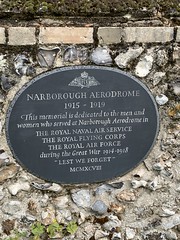
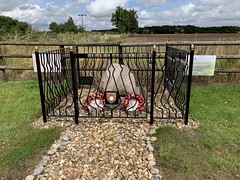
Narborough itself having no hard runways or perimeter tracks has long since gone. A small memorial has been erected by a local group aiming to promote and preserve the memory of Narborough, a memorial plaque also marks the graves of those who never made it to France; and the small Narborough Museum & Heritage Centre holds exhibits of 59 Squadron in the local church.

All Saints Church Narborough, Norfolk

The Plaque at All Saint’s Church Narborough, honouring those who served at Narborough.

Significant not only in size, but in its history, Narborough has now been relegated to the history books. But with the dedication and determination of a few people the importance and historical significance of this site will hopefully continue to influence not only the aviators of tomorrow, but also the public of today.

Updated memorial August 2021

The Narborough memorial which sits at the entrance to Narborough airfield. It was refurbished after the original was struck by a vehicle.

Sources and further Reading (Narborough)

*1 Fleet Air Arm Officers Association Website accessed 14/6/21

*2 RAF Museum Story Vault Website accessed 14/6/21

*3 On May 31st 1917, all RFC ‘Reserve Squadrons’ were renamed ‘Training Squadrons’.

*4 Letter from 2/AM C. V. Williams from 59squadronraf.org.uk

Narborough appears in Trail 7.

Memories of a Vulcan XH558 Restoration Volunteer.

I was recently contacted by Trevor Danks, a volunteer during the restoration of Vulcan XH558, until 2015, the world’s last flying Vulcan bomber. Trevor very kindly sent me his memories along with a selection of his photos, taken whilst working as a volunteer during the aircraft’s restoration.

The Vulcan’s final farewell flight took place on October 28th 2015.

My sincere thanks go to Trevor for sharing his memories and photos with me.

Memories of a Vulcan XH558 Restoration Volunteer.

I joined the 558 Club at the RIAT 2000 at RAF Cottesmore. At that time I was unable to play any active part due to work commitments. However by 2005 I was semi retired and when the request came out for volunteers to help out with the restoration of XH558, I replied immediately.

I had been an Airframe Mechanic during my National Service in the RAF between 1955 and 1957. I had been fortunate to be posted to 232 OCU Valiant Squadron at RAF Gaydon and became a member of a ground crew on a Valiant. So the prospect of being in close proximity to the Vulcan was an exciting prospect.

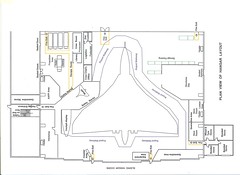
Following the first call for volunteers an e-mail was sent out asking if anyone knew someone who could do a drawing of the hangar at Bruntingthorpe, at minimum cost. I replied by e-mail to say that I would do it on my CAD system at no cost as part of my volunteer work. So on a cold April morning in 2005, I met Colin Marshall at Bruntingthorpe to discuss what was required. The first task was to take measurements of the hangar.  I was also supplied with a drawing of the Vulcan which had to be shown in position in the hangar. Another volunteer, Derek Bates, helped with the measuring of the hangar. The original drawing was to be part of a document for the Heritage Lottery Fund. However as time passed the drawing was amended a few times and the later version is shown below, which shows the visitors walkway.

Hangar Layout (Bruntingthorpe).

Hangar layout

The Hangar layout at Bruntingthorpe (Trevor Danks)

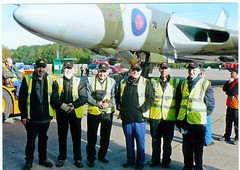
I became a member of the Wednesday Crew (See photo) together with a number of other volunteers. On that day there were a basic six of us who, from the start, did a variety of jobs. In the beginning we helped to set up the hangar to meet the requirements of Marshall Aerospace, the hangar becoming part of their engineering facilities located at Cambridge. Apart from the tidying up, dismantling or erecting shelving and racking, we participated in the setting up of the technical library, under the supervision of Frank Edmondson, this held all the Air Publications (AP’s).

Our main task lay with the 600 tons of spares held in the Deep Store, better known as “The Shed”. Over the days of the restoration we sorted, counted, placed in boxes and put the spares in the racking. This information was input to the computer. After which we then had to find and retrieve spares as and when required by the engineers. All this was carried out under the supervision of Simon Chipman. We were a happy bunch beavering away in The Shed, sometimes very hot and sometimes very cold depending on the time of the year. During tea and lunchtime breaks in the Airfield Diner we would reminisce about our days in the RAF or times past when the Vulcan was flying at displays.

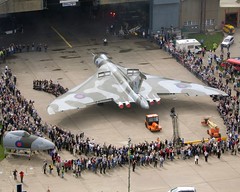
In August 2006 it had reached a critical point where more finance was need to be able to complete the restoration. A fund raising operation had been carried out but the trust was still £500,000 short so the paid employees had been put on notice to end their employment. Everyone was convinced that it looked as this was to be the end of the project. After the aircraft had been rolled out to loud cheers a louder cheer went up as Sir Michael Knight, Chairman of VTTS Trust, announced a donation of £500,000 had been received from a mystery donor. The donor turned out to be Jack Hayward, owner at the time of Wolves football club.

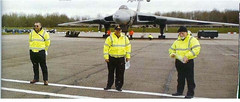
When the Vulcan finally got to the stage of emerging from the hangar for such as engine runs we joined together with all the other volunteers who came on other days of the week. This usually required us to do a ‘FOD Plod’ which entailed us doing a walk of where the Vulcan was to pass, picking up any debris lying about. The first time the Vulcan was taken out for an engine test run, it was taken to a dispersal pad on the edge of the airfield. Having run the engines individually the time came to run them together up to 75% full power. I and a colleague were stationed on the perimeter track to prevent anyone coming along it. As the power increased we noticed a shed on the side of the perimeter track beginning to move. We quickly flagged the ground crew to shut down before the shed disappeared into the trees. The aircraft was then repositioned to continue the engine run.

First Flight.

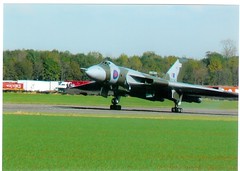
The most enjoyable FOD Plod was on 18th October 2007 when we were all out on the runway at 7.30am as dawn broke. The expectancy on that day was electric; our little crew had been appointed as the emergency team in the team bus with the task of dashing to an emergency entrance on the edge of the airfield. This was to let in emergency vehicles in the event of a mishap. Fortunately the day blossomed into a beautiful day both weather-wise and the rebirth of a much loved aircraft. When the crew of XH558 let off the brakes and that famous engine “Howl” was heard, one minute it was rushing down the runway and the next 100 feet up as it went past us in the viewing area.  We cheered like mad and hugged each other with not a dry eye in the house.

Sqd Ldr Dave Thomas - VOC Display Pilot ; AEO Barry Masefield - VOC AEO & Radio Op; Sqd Ldr Al McDicken - Marshalls Test Pilot

Sqd. Ldr Dave Thomas – VOC Display Pilot:  AEO Barry Masefield – VOC AEO & Radio Op.: Sqd Ldr Al McDicken – Marshalls’ Test Pilot

This was not the end but the beginning, as much had to done to get it to the stage of giving a display at the Waddington Air Show in 2008. There were other engine runs and flights, with XH558 getting her certificate to display just two days before the first day of the Air Show. All the time the Vulcan remained at Bruntingthorpe I continued to visit there on a Wednesday. When it moved to RAF Lyneham and the office to Hinckley, I changed my visits to Hinckley and became part of the education team. From this I developed my Power Point presentation to give talks about the restoration time.  However I retain the happy memories of our days at Bruntingthorpe and count myself very lucky to have been part of what can only be described as a great adventure. I was at Waddington for that first display and also managed to attend the day she flew with the two Lancaster bombers.

Since those days I have managed to visit Robin Hood Airport on a couple of occasions. The last time I managed to get the signatures of Taff Stone and Andrew Edmondson added to all the other signatures in my copy of Vulcan 607.

Photo Collection.

Weds crew John, Trevor, Peter, Dave, Bob and Vic.

‘The Wednesday Crew’ – John, Trevor, Peter, Dave, Bob and Vic.

Volunteers with Brunty Bear (XH558 Mascot)

Volunteers with ‘Brunty Bear’ (XH558 Mascot) On head centre front row.

Roll Out Day - XH558 Outside for first time August 2006

Roll Out Day – XH558 Outside for first time August 2006.

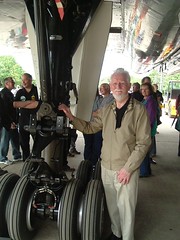
With Starboard Undercarriage Leg on Roll Out Day

With Starboard Undercarriage Leg on Roll Out Day.

First Flight.

Nose Wheel Off for First flight

Nose Wheel Off for First flight.

Volunteers after the First flight.

Volunteers after the First flight.

Start of Display Season.

Starting Fod Plod along runway April 2008 ready for display Season (John, Bob, Trevor)

Starting ‘Fod Plod’ along runway April 2008 ready for display Season. (John, Bob, Trevor).

At RAF Lyneham

At RAF Lyneham.

Trevor Danks – VOC Volunteer.
Founding Guardian No. 338.

My personal thanks again to Trevor and all the volunteers who took part in the restoration and displaying of XH558 and also to those who continue to work for her preservation.

Trail 61 – RAF Dishforth – Along the A1 trail (Part 4).

In Part 3 we saw how Dishforth turned from a bomber base to one of training, its role had gone full circle. Now the war was drawing to a close, its future left hanging in the balance. With the dawn of the jet age, opportunities are there but Dishforth gets left out. As Bombers are withdrawn, a new type appears though, and many appear here at Dishforth.

As 1945 dawned, it was becoming clear that the war’s end was in sight. Conversion courses to heavy bombers were being scaled back as losses fell and the need for more crews diminished. On April 6th, the HCU was officially disbanded and the staff posted elsewhere.

1945 would also see the end of 6 (RCAF) Group, the group that had flown almost 40,000 sorties with a loss of 10,000 aircrew from its several Yorkshires bases, Dishforth of course, being one of the first.

Not long after the disposal of the HCU, the 1695 (Bomber) Defence Training Flight, a unit set up to work in conjunction with the HCUs, was also disbanded.  In July 1945, the unit flew its last flight and its Spitfires, Hurricanes, Martinets and Air Speed Oxfords all departed Dishforth. The fighter element had also now gone from this historic base.

For the next couple of years little would happen at Dishforth, the Canadian link was broken, bombers were removed and the airfield remained relatively quiet. However, it was to see the four engined Halifax return once more, albeit very briefly.

1948 was a year of change, with no need for bombers, transport aircraft were to be the new type appearing at Dishforth. Conversion Units continuing on where the HCUs left off. 240 Operational Conversion Unit (OCU) made an appearance with a second, 241 OCU forming on January 5th 1948. Formed out of the renumbering of 1332 Heavy Transport Conversion Unit, they operated  a mix of Halifaxes, Hastings, Yorks and Vallettas all of which had now become the flavour of the day.  With these new units coming in, other units such as No 1381 (Transport) Conversion Unit, were disbanded.

Handley Page Hastings C Mk 1, location unknown. (©IWM ATP 16063D)

Another squadron, 47 Sqn also appeared at Dishforth that year. In September, they transferred in from RAF Fairford, and immediately began replacing their ageing Halifaxes with the Hastings C.1 transport aircraft. They remained at Dishforth for just a year, moving on to nearby Topcliffe in the autumn of 1949. This was mirrored  by 297 Sqn, who also came, swapped their Halifaxes and then also departed to Topcliffe.

240 OCU led Dishforth into the new decade. In April 1951, further changes saw them disband and amalgamate with 240 to form 242 OCU, but still the Vallettas and Hastings were top dog. As time progressed they would convert to Argosys, Beverleys and eventually the Hercules, moving on to eventually disband at RAF Lyneham in 1992.

The mid 50’s saw other changes, with 30 Sqn arriving in April also operating the  Beverley C1 until its departure in 1959, and 215 Sqn in April 1956 with the Pioneer CC1. Originally a First World War Sqn they had operated a range of aircraft including the Virginia, Harrow, Wellington, Liberator (B-24) and Dakota, before disbandment and reformation here. They solely operated from this airfield before again being disbanded and reformed as 230 Sqn here at Dishforth in 1958. By November though they would also go the way of their predecessors and move out, this time to Nicosia, before returning (briefly via Dishforth in April 1959) to Upavon.

Another Dakota unit,  1325 (Transport) Flight operated from here in the August of 1956, before it too departed, eventually disbanding in Singapore in 1960.

By the end of the 50s, all these units had departed and Dishforth’s future was now in the balance. With no RAF Flying there seemed little point in keeping it open.

Small training aircraft from other Yorkshire bases including Leeming, Topcliffe and Linton-On-Ouse, then used the base as a satellite and emergency landing ground. The Jet Provosts of 1 FTS and 3 FTS being frequent users.

With the withdrawal of all RAF personnel, Dishforth was handed over to the Army Air Corp who based a number of helicopter units here during the 1990s and early 2000s. These units primarily: 657 ; 659; 664; 669; 670; 671 and 672 Sqns all operated the Lynx or Gazelle helicopters in a range of roles.

As of 2021, Dishforth remains in the possession of the Army, home to 6 Regiment Royal Logistics Corp, who consist of three squadrons: 62 Squadron and 64 Squadron (both hybrid squadrons made up of Drivers and Logistic Supply Specialists) and 600 HQ Squadron including the Regimental Head Quarters who provide support to the other two task squadrons. Their role is to provide logistic support to 1 UK Division, preparing forces for both fixed and responsive tasks.

With other non military units using the site as well, Dishforth’s future is once again in doubt. A large airfield, with extensive hangar space and ground area, it is ideally located near to the A1 road. The tower has recently been boarded up and parts of the perimeter track are beginning to decay, Dishforth too will soon close (earmarked for closure in 2031) under Government cutbacks, but hopefully its history will live on and the memories of those who passed though its doors will remain alive and well.

Dishforth currently remains an active Military site and as such access is limited. The A168 runs parallel to the main runway between it and the A1. The hangars remain, the tower is also present although in the last two years or so it has been boarded up. Remnants of the Second World War can be found round the perimeter by using the smaller roads around the base, but again these are restricted.

With the recent announcement of the closure of Linton-On-Ouse, both Dishforth and Topcliffe will also close, three more of Britain’s war time bomber airfields will then be gone from Britain’s landscape.

The full page can be seen in Trail 61 – RAF Dishforth – Along the A1 Trail.

Sources and further reading.

*1Bygone Times‘  – Halifax LK930 remembered and a tale of two Palterton village heroes. by Jack Richards. A web page detailing the crash of LK930 on the night of 21st/22nd March.

National Archives AIR-27-141-1

National Archives AIR-27-660-1

National Archives AIR-27-1837-1

Harris, A., “Bomber Offensive‘ 1998, Greenhill Books.

Millar, G., “The Bruneval Raid – Stealing Hitler’s Radar” 1974, Cassell & Co.

RCAF 425 Alouettes Sqn – a blog honouring 425 Sqn by Pierre Lagacé

Ward. C., “4 Group Bomber Command” 2012, Pen & Sword.

Trail 61 – RAF Dishforth – Along the A1 trail (Part 3).

In Part 2 we saw the first of the Canadian units form at Dishforth, still a new unit, they very quickly become part of the new 6 Group (RCAF).  As they began operations over occupied Europe, they quickly learnt that war brings casualties. We also see that Dishforth soon becomes ‘upgraded’ to a Standard ‘A’ specification airfield, and then the Canadians move out and a new training unit move in. The aircraft now get bigger.

The new year brought new changes both at Dishforth and within the RAF. Expansion of the force saw a new Group born, that of 6 (RCAF) Group, and after some four years of wrangling between the Canadians and the British, all but two of the Canadian squadrons, and their airfields, were transferred over to RAF control. The formation of the Group was with mixed emotions though, the Canadians having no control nor say over its operation, but still paying the bill for the squadrons for the duration of the war – a rather one sided agreement in the eyes of the Canadians. However, the expansion increased Squadron numbers, now some 37% of the RAF’s pilots were from the Dominion and of these, almost two-thirds were Canadian.

On January 1st 1943, 6 (RCAF) Group was therefore officially up and running, and it would be now that 426 Sqn would become operational.

Their start to the war began with an attack on the French port at Lorient on the night of 14th/15th January. 6 Group’s first attack as an operational group, was part of a 122 strong aircraft formation, sending nine Wellingtons and six Halifaxes. Only two aircraft were lost that night, both Wellingtons, one a Polish crew from 300 Sqn and the other a Canadian crew from 426 Sqn.

The aircraft, piloted by 21 year old P.O. George Milne (s/n:J/9355), was lost without trace, presumably crashing into the sea on its way to the target, it was not heard from since leaving Dishforth at 22:37.

Within a month of 6 Group’s inauguration, 426 Sqn would suffer a heavy blow when its Commanding Officer Wing Commander Blanchard would be shot down whilst returning from Germany. The aircraft, a Wellington III ‘X3420’ was shot down by Hauptmann Manfred Meurer near Limburg with the loss of all six crewmen. It was a bitter blow to the fledgling squadron.

The role of commander then passed to Wing Commander Leslie Crooks DFC a non-Canadian, he would lead the squadron into battle on numerous occasions. A brave and determined leader, he would soon add a DSO to his collection, dutifully awarded after surviving an attack from a night fighter, when he nursed the stricken bomber home. Unable to land the aircraft due to its extensive damage, he ordered the crew to bail out leaving the Wellington to its ultimate and final fate.  Crooks, would go on to lead further operational missions with the squadron, but sadly his luck would run out over Peenemunde on the night of August 17th/18th 1943 when he was lost for good.

The time then came to upgrade Dishforth, its now unsuitable surfaces needed replacing and the airfield needed bringing up to ‘modern’ standards. The two Canadian units moved out – 425 Sqn to North Africa in May, and 426 Sqn to Linton-On-Ouse in June. That left the airfield operationally silent. The bulldozers and earth-movers then moved in;  its three concrete and tarmac runways were constructed, and the whole site was upgraded to the Class ‘A’ specification. By November the works were all but complete and it was handed over to No.61 Training Base, 6 (RCAF) Group, led by the transfer in of 1664 Heavy Conversion Unit (HCU) operating the four engined heavy the Halifax Mk.III.

Formed in May 1943 at Croft, they were renamed 1664 (RCAF) ‘Caribou’ HCU on moving to Dishforth and were primarily a training unit converting pilots onto Halifaxes from other aircraft – usually twin engined bombers like the Wellington. One of their first customers was the former Dishforth unit 425 Sqn, who returned from Tunisia with their Wellingtons to convert over to the Halifax over the next month. By mid December they were all done, and they departed for RAF Tholthorpe where they picked up their new aircraft.

RAF Dishforth

A rather sad end to the Watch office.

Converting crews to the four engined types was no easy task, and whilst crews were experienced, accidents did still happen.

The first Dishforth blow came to 1664 (RCAF) HCU two days before Christmas 1943. Halifax V ‘ZU-C’ crashed after getting into difficulties whilst on a night training flight. The aircraft was partially abandoned, but three of the crew were killed and a further two were injured. This tragic accident would not be the last for the Dishforth unit though, and would draw 1943 to a sad close.

Some of these accidents were understandably down to the inexperience of crews on the new type, as the night of January 30th 1944 showed. Halifax V DG308 flown by F.L. J. Bissett DFM along with a student, came into land at Dishforth. The student inadvertently lowered the bomb doors rather than the flaps causing the aircraft to come in too fast. Bissett, in an effort to avert a catastrophe, swung the Halifax off the runway subjecting it to great stresses. As a result of this action, the undercarriage collapsed and the aircraft fell on its belly severely damaging it. But Bisset had done his job, and the student had learnt a valuable lesson.

With two further accidents on the following night, one due to a strong cross wind and the second when the aircraft hit high ground due to excessive drift, the training programmes were proving hard going for the Dishforth unit.

For some crewmen there was even the misfortune of multiple crashes, and for one man in particular, these unfortunate events occurred in the space of just one week.

For Sgt. H. (Ray) Collver, mid March would be his worst week. During a training flight on the 16th, his Halifax swung on landing, badly damaging the undercarriage. Thankfully however, there were no major injuries and all walked away relatively unhurt. But then on the night of 21st/22nd, he was on a night training flight (thought to be a nickle flight), when the port inner engine failed, and refused to feather. The cause of the problem was not clear, but the aircraft began to shake violently as a result. Before coming down in Derbyshire, Sgt. Cullver gave the order to abandon the Halifax, two of the crew escaping through the nose hatch. By then though, the bomber was too low for others to escape, the remainder of the crew were effectively trapped inside. When the aircraft hit the ground, two of the four left on board were killed, the remaining two Sgt. Russ Pym and Sgt. Cullver were injured, Cullver being thrown clear as the Halifax struck a bank aside a road*1.

On many occasions though, pilot error was not a cause, engine faults seeming to have been the primary cause of the aircraft’s demise; problems that either required an engine to be shut down or engines failing, seeming to be high on the list of causes for the squadron’s losses.

During August a Lancaster Finishing Flight was set up within the HCU at Dishforth, its job to polish pilots and crews in their Lancasters before returning them to operational units. Loses here would be far lower.

By the years end, the HCU would have lost some fifty aircraft on training flights, which for a training unit, was a substantial number of heavy aircraft and for the Command.

With the close of the war ahead, changes are in the pipeline for both the Royal Air Force and Dishforth. With the need for bombers diminishing, a new form of aircraft arrives and in good number. In the final part we see Dishforth head in to the jet era but opportunities are missed and sadly it gets left behind, its future then looks bleak.

The full page can be seen in Trail 61 – RAF Dishforth – Along the A1 Trail.

Trail 61 – RAF Dishforth – Along the A1 trail (Part 2).

After seeing Dishforth’s pre-war construction and arrival of its first squadrons in Part 1, we head in to 1941, more trips to Germany and a special mission to Italy.

The beginnings of 1941 were much the same for the two Dishforth units. Trips to Germany were very much the order of the day. But on February 3rd, six Whitleys from 51 Squadron were sent as part of a force to blow up the aqueduct crossing the Tragino river in the Campania province of southern Italy. Code named Operation ‘Colossus‘, it was a daring operation where troops would be parachuted into enemy territory, destroy their target and escape by submarine.

After departing to Mildenhall, the Dishforth aircraft then flew on to Malta, arriving at Luqa airfield after a long, eleven hour flight. On the night of the 11th, the plan was put in place. Two aircraft were to perform a diversionary attack on the marshalling yards at Foggia, whilst the remainder dropped members of ‘X’ Troop in the valleys near to the target. Whilst the aqueduct was successfully blown apart, none of the ground forces, nor the crew of one of the 78 Squadron Whitleys on the diversionary raid, managed to get home. All were unfortunately picked up by Italian forces and placed in POW camps. The raid being a success, had suffered high losses.

That same night, the remaining crews at Dishforth fared little better. On returning to the airfield following a raid on Bremen, they were ordered to divert to RAF Drem in Scotland. Four of the aircraft either misunderstood the instruction, got lost or ran out of fuel, resulting in each of them being abandoned over the British countryside. Unfortunately even abandoning an undamaged aircraft was not entirely safe, as nine of the twenty crewmen suffered injuries whilst doing so. All four of the aircraft were left to their inevitable and catastrophic rendezvous with mother Earth.

A new Bomber Command Directive drove the Group’s Whitleys to Germany night after night. Then a turn of focus to aircraft factories saw a change in operations, and although losses for Bomber Command were high, both the Dishforth units managed to scrape through relatively unscathed.

April saw the departure of 78 Squadron from Dishforth, this time though there would be no return, and their time here had finally come to an end.  Dishforth however, continued on, retaining its one operational squadron, that of 51 Sqn, who continued to soldier bravely on with their Whitley Vs.

Industrial targets were then once again at the forefront of Bomber Command’s agenda. 51 Sqn joining many other units on raids to the German heartland. In early May, they visited Ludwigshafen, followed by Dortmund, Duisburg and Dussledorf losing one aircraft on each operation (P5106, Z6663, Z6657, and Z6563 respectively) with the loss of all but five of the airmen on board.

Whilst 51 Sqn’s losses per operation continued to be relatively light, overall they suffered some of the highest losses for the year, some 43 aircraft being lost on operations throughout 1941. A tally that put them amongst the top five biggest losses of Bomber Command squadrons for the year.

As with many bomber stations, support and training flights also operated from these larger airfields, Dishforth was no different with 1512 Beam Approach Training Flight (formally 12 Blind Approach Training Flight) forming here in October 1941. The unit trained pilots to land in poor visibility using a system designed ironically by the Germans. Previously known as ‘Blind Approach’, it was felt the the use of the word ‘Blind’ was not very reassuring for pilots and so all units were changed to Beam. Also ironic as no beam was actually used, but more a single distorted radio transmission.

The dawn of 1942 saw more of the same for the Bombers of 51 Sqn and 4 Group. With a renewed focus on the German fleet anchored at Brest, Bomber Command would soon pay the price, and it would be Operation ‘Fuller’, that would be the cause.

On the night of February 12th, a determined and combined force of naval vessels and aircraft along with RAF aircraft, would attack the a force of mighty ships including the ScharnhorstGneisenau and Prinz Eugen as it made its way through the English Channel to home waters from Brest harbour. For over a year, the ships had been a thorn in the sides of the RAF, being damaged and repaired they could not be put out of action permanently. Patched up but not fit for heavy warfare, the attacks came in poor weather, ideal for a sea escape. The resultant allied losses were a tragedy for both services, and would leave them blooded and badly scarred.

Thankfully though, the fortunes of the Command would soon turn, albeit briefly on the night of the 27th-28th February, bringing a smile to both the faces of the British forces and the population as a whole. February would thankfully close on a good note.

The events began at Thruxton airfield, where twelve Whitley bombers were having holes cut in their floors and special doors added to allow paratroopers to jump through. This small force would be led by 51 Sqn W.C. Charles ‘Percy’ Pickard who, described as a tall, fair haired pipe-smoker, was known as a real character within 51 Sqn. Pickard’s character had been projected well beyond the mess halls of Dishforth though, noticeably after he took a leading part as Squadron Leader Dickson in ‘Target for Tonight‘; the RAF’s 1941 film about a crew on a bombing mission over Germany. Pickard would eventually leave 51 Sqn, transferring to the 2nd Tactical Air Force in Operation ‘Jerrico’, and the attack on the prison at Amiens where he met his death with almost seventy operations to his name.

https://youtu.be/PDTLeFl8cXU

The February raid was to be carried out by a small force of British Paratroops, which involved them being dropped into enemy territory to capture a secret German radar site. Once established, they were to remove vital components from the radar and bring them back to England for analysis. The raid, whilst not without its hiccups, was a huge success in the war of the electronics, and not only allowed the British to examine the workings of the radar, but also provided them with a prisoner who was one of the operational technicians at the site. The night had been a real coup, and a much needed morale booster for the RAF and the UK’s population. Known as the ‘Bruneval Raid‘, Britain now had a significant insight into the German Wurzburg radar system, and 51 Sqn played a major part in delivering those gallant men to their drop zone. For his part in the operation Pickard was awarded a bar to his DSO.

Charles ‘Percy’ Pickard (believed to be at Lissett, Yorkshire) with his dog ‘Ming’.(© IWM CH 10251)

In May 1942, 51 Sqn received orders to depart Dishforth for the base at Chivenor in Devon. This too would be their final farewell to the Yorkshire base as they would not be returning. By the end of the year they would be replacing their Whitleys with the Halifax, their last Whitley being lost whilst at Dishforth a few days prior to their departure on the night of 23rd/24th April 1942.

A short period of calm then led to further changes. It was during this ‘quiet period’, that the 1472 (Army Co-Operation) Flight formed here at Dishforth. Using only light aircraft: Battles, Tomahawks Hurricanes and Masters, they didn’t require the lengthy runways that heavy bombers needed, and operated in conjunction with land based forces primarily on training operations.

It was after this that a new Canadian unit 425 (Alouette) Sqn RCAF was formed here at Dishforth. The first ever French-Canadian unit formed in the U.K., it was led by W.C. J. St. Pierre, and was part of a Canadian force manned totally by Canadian personnel. It would not be ready and operational though until the October of 1942.  It was also during October that another Canadian squadron would be formed, also here at Dishforth, that of 426 (Thunderbird) Sqn led by W.C. Sedley Blanchard. A third unit, that of 6 Group’s Communication Flight also joined the Canadians here at Dishforth.

Both these squadrons flew the twin-engined Wellington, with its remarkable geodetic design, a sturdy aircraft it would be the main type used by the two squadrons for the next year.

425 Sqn spent the next weeks building up to operational status, training flights both cross country and in the local area being carried out when the weather permitted. It was on one of these flights that the first Wellington was lost from the squadron. During a fighter affiliation exercise, in which cloud ranged from 3/10 to 6/10 at 3,000 ft to 10/10 at higher altitudes, the 403 Sqn Spitfire ‘attacking’ the Wellington collided with the nose turret bringing down both the Spitfire and the Wellington. There were no survivors from the bomber.

Once declared operational, 425 Sqn’s inauguration into the war soon occurred. On the night of October 5th/6th 1942, they took part in a raid on Aachen. 101 Wellingtons, almost half the force, were sent to the town but weather was poor and target markers were way off track, some 17 miles away over the Dutch town of Lutterade. As a result, little significant damage was done to the target, and it was the Dutch who bore the brunt of the force. To make matters worse, 425 Sqn lost one of its aircraft, Wellington III ‘X3943’ KW-G piloted by Sgt. O’Driscoll. The first operational loss for the squadron with the entire crew being killed when the aircraft crashed in Essex on its return home.

In Part 3, we head in to 1943 where we see the official formation of 6 Group (RCAF) – the Canadians officially arrive in Yorkshire and the Group begins operations over occupied Europe. Dishforth plays a big part in those operations.

The full page can be seen in Trail 61 – RAF Dishforth – Along the A1 Trail.

Trail 61 – RAF Dishforth Along the A1 trail (Part 1).

As we continue our journey north along the A1, the ‘Great North Road’, (Trail 54, Trail 57) we come across an airfield that began life in the prewar expansion period of the 1930s. Destined to become a bomber station for a large part of the war, it soon returned to its initial role as a training base, a role it carried on after the war’s eventual end. Today the base is still active but in the hands of the British Army, and although no major flying takes place, it does occasionally see the odd aircraft pass by.

This airfield sits alongside the A1 road, this offers opportunities to see what’s left and observe the goings on at the base. On the next part of our trail along the A1, we stop off at the former RAF Dishforth,

RAF Dishforth.

As a prewar airfield built during the expansion period, Dishforth was a ‘non-dispersed’ airfield, distinguished by having both its accommodation and technical areas located closely together. Initially it fell under the control of 3 Group Bomber Command, but would soon transfer to 4 Group for use as a training airfield for their bombers; a Command which in itself was also born out of the expansion era of the 1930s.

By the war’s end, Dishforth would have grown considerably, eventually being capable of catering for over 2,500 personnel, and upgraded to the standard Class ‘A’ specification with three concrete and tarmac runways (1 at 2,000 and 2 at 1,400 yards in length). The main runway runs parallel to the main A1 road, in a north-west to south-east direction, with the two subsidiary runways running east / west and north-east to south-west, thus forming the recognisable ‘A’ shape of this airfield design.

Around the perimeter were twenty-seven pan and eleven spectacle hardstands, and to the south-east, located between the legs of the ‘A’, were five ‘C’ type hangars and a range of ancillary, technical and storage buildings. The Watch office, initially located between the hangers overlooking the pan, was later rebuilt to the north of the airfield over looking the entire flying site now to the south.

Alongside Dishforth came airfields at Linton-on-Ouse, Driffield, Leconfield and Finningley, all of which would see a range of light and medium bombers grace their runways. Other major airfields built at this time included the bomber bases at Wyton and Upwood in Cambridgeshire, Scampton in Lincolnshire and the fighter airfield at Debden in Essex, the RAF was indeed expanding at great speed.

On January 12th 1937, the first of the squadrons arrived, 10 Squadron RAF, with a mix of Heyfords and Virginias. The move was led by the advanced party, followed by the main party on the 25th and the rear party on the 2nd February. Whilst settling in and preparing the airfield for operations, they were joined by another squadron, 78 Sqn, also with Heyford IIIs.

K3489 the first production Handley Page Heyford the last biplane heavy bomber. These aircraft were well liked at the time and were, unbelievably, able to be looped as was seen at the 1935 Hendon Air show.  Note the retractable gun turret. (©IWM ATP 7352C)

Within a month of their arrival at Dishforth though, 10 sqn would begin to replace these now obsolete biplanes with Whitleys, flying both the MK.I and later the much improved Merlin powered MK.IV, until their eventual departure from Dishforth in July 1940. The first of these Tiger IX powered MK.Is arrived on the 9th March, followed by sporadic arrivals culminating at the end of June, with a full complement of aircraft; the last of these being Whitley K7195 on the June 25th.

One of the highlights for 10 squadron’s posting to Dishforth, was to perform a ‘set piece’ at the 1937 Hendon Air Show, five Dishforth aircraft performing well to the gathered crowds below. This was nothing new to the Squadron, having previously performed at Mildenhall for the King’s review and at Old Sarum for an Indian Army Officers School, both in July 1935.

Over the remainder of the year and into 1938, a number of observer calibration flights took place. These were later supplemented with squadron operations, under what was described as ‘war conditions’, and although repeatedly hampered by bad weather, the squadron managed 3,733 daylight hours and 752 night flying hours, over the two year period.

78 Sqn, which was officially reformed on 1st November 1936 under the command of Wing Commander M.B. Frew DSO, MC, AFC, was also assigned the obsolete aircraft. With a second flight forming in April 1937, they too soon began updating these models with both the MK.I and later in 1939, the MKIVa Whitleys.

Following the disbandment of the rather mashed together Air Defence Great Britain (ADGB) and the introduction of the four commands (Fighter, Bomber, Training and Coastal), Dishforth and its two squadrons would now fall under the control of the newly formed 4 Group. With Air Commodore A. T. Harris as its (short lived) lead, 4 Group’s headquarters made its move from Mildenhall to Linton-on-Ouse, only a few miles to the south-east of Dishforth. Yorkshire would now become the county synonymous with the Group and its aircraft.

4 Group had struggled obtaining a suitable bombing range to use with its Whitleys, Harris, in his book ‘Bomber Offensive‘, talks about being frustrated because he repeatedly came up against local objections. Abbotsford was one such site that dragged on largely due to objections about the local swan population. As it turned out, having a range actually kept people away and as a result the swans thrived!

The dawn of 1939 would herald a new era. January introduced Dishforth to the forthcoming events with the loss Whitley K7211 off the coast of Kent. The last message from the aircraft being received  at 18:20 on January 23rd. There then followed an extensive search, but despite the efforts of the Royal Navy, neither the aircraft, nor its crew, were ever found, and the Whitley along with its crew remains missing to his day.

The declaration of war by Neville Chamberlain in September 1939, shook the nation. It brought with it immediate mobilisation orders to the Group. Within days 10 Squadron were ordered to send eight aircraft on a reconnaissance and ‘Nickle‘ flight over northern Germany. Following Air Plan No. 14, they were loaded with propaganda leaflets, the aircraft then flew over the ‘target’ dropping these ‘paper bombs’ on the citizens below. Returning anti-aircraft fire was light and sporadic, and as a result, all aircraft returned without incident.

RAF Dishforth

Two of Dishforth’s five hangars.

On the night of the 21st, two more 10 Sqn aircraft were ordered out on another Nickle operation, this time over Bremen and Hamburg; an additional order was given to “create a disturbance in Berlin”. Again no enemy aircraft were encountered, and anti-aircraft fire was very light. But with that, and a flight of three more Whitleys on the night of 1st/2nd October, 10 Sqn had gained the honour of being the first allied squadron to fly over the German capital during wartime.

Meanwhile, Dishforth’s other squadron, 78 Sqn, were allocated as 4 Group’s Reserve Squadron, acting as a pool for training crews and a reservoir for the Group’s other front line squadrons. I wonder if, at the time, there were any reservations about such a move from those within the squadron.

However, by early October 1939 a move was on the cards for 78 Sqn. Linton-on-Ouse was now calling, and early in the morning of 15th the move had begun with the Whitleys landing at Linton. This move, a few miles south, would temporarily leave Dishforth with only one operational squadron.

This lull lasted until early December, when 51 Sqn joined those at Dishforth. Like other squadrons, they had ditched their ageing Virginias for the more modern Whitley and were now in the process of upgrading these to the MK.V.

The winter of 1939/40 was a harsh one, and as a result little flying took place from the snowed in Dishforth. With only a short lull in February, aircraft were well and truly ‘frozen in’ for the large part of the winter months. It was most certainly a cold start to the war, and even when the thaw came, the ground remained dangerous to fly from due to water logging from the melting snow.

Following the German invasion of Denmark and Norway, 4 Group’s aircraft began attacks on airfields and supply routes being used by the Germans. Both 51 Sqn and 10 Sqn visited several of these airfields including Aalbourg on the night of 22nd-23rd April. On this operation, one of 51 Sqn’s aircraft, Whitely IV ‘MH-G’ piloted by F.O. J Birch, was lost without trace not long after departing Dishforth at 21:50.

By July 1940, the Battle of Britain was in full swing and 10 Sqn were moving out; the period between January and July being filled with numerous and relatively uneventful trips to Germany. Barely cold, their vacant beds were quickly filled by 78 Squadron, who had previously departed to Linton-on-Ouse; now they were given orders to return back to Dishforth.

The month of July had been one of some confusion for the squadron, initial orders requiring they transfer to the unfinished RAF Leeming, the place where kit and materials had, by now, been sent. What’s more, they were also informed that they would continue performing the role of reserve squadron whilst at Leeming, but now however, on moving to Dishforth, they were made fully operational for the first time since war had broken out with Germany.

The move went relatively smoothly, aircraft were deposited at Topcliffe (Dishforth’s satellite) with personnel transferring directly to Dishforth. The move involved organising transport from not only Linton, but also York and Leeming too, such was the wide spread of both men and equipment. As a result, “very little useful work” was done, the primary objective being to reorganise the squadron following the confusion of the orders and counter orders over the previous weeks.

A Whitley at an unknown location revving up its engines. © IWM CH 681

As we leave 1940 behind and head to 1941, we see, part 2, what changes come to Dishforth. There are more ventures into Germany and a special mission to Italy that results in success but at a great cost.

The full page can be seen in Trail 61 – RAF Dishforth – Along the A1 Trail.

September 26th 1942, a near tragedy for three RAF Squadrons.

The Eagle Squadrons were three RAF Squadrons made up of American volunteers, their achievements and records are well-known and well documented, however, it was not all plain sailing for these determined and courageous flyers. For one Squadron in particular, 133 Squadron, September 26th 1942 would be a disaster, a disaster that would almost wipe out the entire flight of twelve airmen.

133 Squadron had been on the front line serving at RAF Biggin Hill and RAF Martlesham Heath before arriving at RAF Great Sampford, a satellite for RAF Debden. The ground crews were predominately British, assisting and training the US ground crews in aircraft maintenance and support. All the pilots however, were US volunteers, formed into three separate squadrons but under RAF control.

1st Lt Dominic 'Don' Gentile and Spitfire BL255 'Buckeye-Don', 336th FS, 4th FG, 8th AF.

1st Lt Dominic ‘Don’ Gentile and Spitfire BL255 ‘Buckeye-Don’. The photo was taken after 133 Squadron RAF was disbanded and absorbed into the USAAF as the, 336th FS, 4th FG, 8th AF. (@IWM)

133 Squadron would arrive at RAF Great Sampford on September 23rd 1942, the same day as 616 Sqn RAF departed, they would be the last operational unit to fully use the airfield before its eventual closure.

Initially flying the Spitfire VBs, they soon replaced them with the MK.IX, a Spitfire that was essentially a MK.V with an updated engine. Having a higher ceiling than the FW-190 and being marginally faster, its improved performance took the Luftwaffe by complete surprise. It was so new and improved, that it remained on the secret list until after this particular operational flight.

On that fateful day, September 26th 1942, fourteen Spitfires of 133 Sqn took off from RAF Great Sampford in Essex, piloting those Spitfires were:

BS313 – F/Lt. Edward Gordon Brettell DFC (61053) The only British pilot and leader
BS275 – P/O. Leonard T. Ryerson (O-885137)
BS446 – P/O. William H. Baker Jr (O-885113)
BS137 – P/O. Dennis D. Smith (O-885128)
BR638 – P/O. G.B. Sperry (O-885112)
BS445 – P/O. Dominic “Buckeye-Don” S. Gentile (O-885109)
BS138 – P/O. Gilbert G. Wright (?)
BS279 – F/Lt. Marion E. Jackson (O-885117)
BS447 – P/O. R.E. Smith (O-885110)
BR640 – P/O. C.A. Cook (O-885112)
BS148 – P/O. Richard “Bob” N. Beaty (?)
BS301 – P/O. G.H. Middleton Jr (O-885127)
BS140 – P/O. Gene P. Neville (O-885129)
Unknown  – P/O. Ervin “Dusty” Miller (O-885138) (not listed but known to have been on the flight).

They were to fly to RAF Bolt Head in Devon, where they would meet with 401 Squadron (RCAF) and 64 Squadron RAF, refuel and be briefed for the mission. A mission that was supposed to be straight forward and relatively uneventful.

The aim of the mission was to escort US bombers to Morlaix on the Brest peninsula. The usual commander of 133 Sqn, Red McColpin, was not placed in charge that day, instead he had been posted, and a British Pilot, F/Lt. Edward Gordon Brettell DFC, was issued with the task.

McColpin was a strict disciplinarian and his leadership was admired by those who followed him. Without this leadership, 133’s preparation was slack and they ultimately paid the price for this.

After landing at 12:30 hours, they realised there were no facilities at Bolt Head for refuelling, and they would have to go with what they had. This would kick-start a catalogue of errors that would ultimately seal the fate of the flight. Following a briefing in which Wing Commander Kingcombe DFC and all but two of 133 Sqn pilots had failed to show up for, the flight (which included the sixteen 401 (RCAF) Squadron Spitfire IXs from RAF Kenley) took off at 13:50 hours. Of the fourteen 133 Sqn Spitfires sent to Bolt Head, only twelve would be needed, and two pilots were instructed to remain at Bolt Head, they were P/O. Ervin Miller, and P/O. Don “Buckeye-Don” S. Gentile, they would be the luckiest two men of the squadron that day.

The briefing, a very vague and rushed one, instructed the flight to carry out a ‘Circus‘ mission escorting seventy-five B-17 Flying Fortresses from the 92nd BG, 97th BG and the 301st BG, who were bombing Cherbourg and the airfields at Maupertus and Morlaix in Brittany. When the squadron took off the weather was clear, and winds were predicted to be 35 mph at 24,000 feet, but 5 miles off the English coast, they encountered 10/10th cumulus cloud cover at 7,000 feet, and so had to climb above it so that they could locate the bombers more easily.

The take of was a mess, disorganised and lacking both radio information and in many cases maps, the aircraft were lucky not to collide with each other.

Of the three RAF squadrons involved in the mission, 401 would take the high position, 133 the middle and 64 Squadron, the lower. They were to form up over Bolt Head at 2,000 feet and then head at 200o at 180 mph to overtake the bombers before they arrived at the target. If they could not locate the bombers, the flight was to circle the target for three minutes and then depart.

As the flight approached the rendezvous area, one 133 Squadron Spitfire had to drop out of formation and return home, as he had encountered engine problems; this problem was thought to be due to his low fuel. The remainder of the flight  scanned the skies for any sign of the bomber formation, and after searching for some 45 minutes, they spotted the bombers, some 50 miles south of Brest. The bombers had in fact already turned for home after having discarded their bombs near to the Pyrenees.

By now the 301st BG had been recalled, as their fighter escort failed to materialise, whilst the 97th BG had continued on. However, due to the heavy cloud cover over the target area, they had been ineffective as no bombing of the target had taken place. The American bombers, who were only three months into their European air war, had inadvertently miscalculated a tail wind putting them off track well away from the Bay of Biscay.

1st Lt George H Middleton Jr 336FS, 4FG, 8AF USAAF. Former Eagle Sqn Spitfire pilot.

P/O. G.H. Middleton Jr of 133 Squadron RAF was shot down and taken Prisoner of War (@IWM).

The three squadrons formed up on the bombers at just after 16:45 hours, with 64 Squadron on the port side, 401 Squadron on the starboard and 133 Squadron behind. The whole formation then flew north for 30 minutes, at which point it became evident that the wind speed was in fact over 100 mph, and not the 35 mph as stated by the Meteorological Office, or at the briefing! It has since been revealed that this information was known to those in authority, but it had not been passed down the chain of command and the pilots were never informed.

The formation then spotted land, the bombers thought they were over Falmouth and turned right. 64 and 401 Squadron broke away maintaining height, but 133 Squadron dropped down below the cloud base and prepared to land.

133 Squadron then began to search for the airfield, and after searching in vain, they found a large town, this they hoped would give them the vital fix they desperately needed. Flying low over the houses they realised they were not over England at all but in fact still over France. The flight, uninformed of the 100 mph north-easterly wind at their altitude, had also been blown wildly off course, and after 1.5 hours flying time, the situation had suddenly become very severe indeed.

The Squadron flight Leader, Flight Lieutenant E.G. Brettell, wanting to ascertain his exact position, called up a ground direction finding station who provided a  bearing and heading – 100 miles off the English coast with a homing vector of 020o. It was at this point they suddenly realised they were over the port of Brest, one of the most heavily defended ports under German occupation.

Immediately, the sky filled with flak and small arms anti-aircraft fire. The pilot in the number 2 position, Pilot Officer Gene Neville (O-885129) in Spitfire #BS140, took a direct and fatal hit, he was killed instantly. Three other aircraft were to be shot down in the melee that followed: Pilot Officer William H Baker Jr (O-885113) in Spitfire #BS446; Pilot Officer Leonard Ryerson (O-885137) in Spitfire #BS275 and Pilot Officer Dennis Smith (O-885128) in Spitfire #BS294 – all four were killed, and all four were awarded the Purple Heart.

2nd Lt. Gene P. Neville 133 (Eagle) Sqn RAF, stands before his MK. IX Spitfire at Great Sampford. He was Killed during the Morlaix disaster. (@IWM UPL 18912)

The remainder of 133 Squadron struggling to defend themselves, they scattered and were forced to land out of fuel, either on the island of Ouissant or on the French mainland.

Of the seven 133 squadron pilots who crash landed on French soil, five were known to have been captured immediately and taken prisoner: P/O. G.B. Sperry; F/Lt.  Edward Brettell; F/Lt. M.E. Jackson; P/O. C.A. Cook and P/O. G.H. Middleton Jr., with a sixth, P/O. G.G. Wright, evading the Germans for several days before being captured later on.

Of these initial five, F/Lt. Jackson was injured in his crash and hospitalised for eight weeks. He was then taken to Stalag Luft III from where he was able to escape for about ten days by jumping from the roof of his cell house into a lorry load of evergreen branches that were being taken away from the camp.

Another Pilot, F/Lt.  Edward Brettell  DFC. was executed for his part in the Great Escape from the same prison camp, Stalag Luft III, whilst P/O. Robert E. Smith, the last remaining pilot, managed to abandon his aircraft evading capture, eventually returning to England on 18th January 1943.

The pilot who turned back early due to his own engine problems,  P/O. Robert Beatty,  crash landed his Spitfire at Kingsbridge in Devon after he too ran out of fuel over the Channel. During the crash he sustained severe injuries but luckily survived his ordeal and was able to give an account of the mission through what he heard over the radio.

Several of the 401 Squadron pilots,  who had continued on, also reported being low on fuel and gave their intention to bail out before land was finally sighted. One of these, P/O. Junius L. Hokan (s/n: J/6833), did have to bail out over the sea, he was last seen in a gradual dive, his aircraft heading seaward. His body was never recovered. Others in the flight that day only just made land fall, one crashed and was taken to hospital where he recovered from his injuries, the others just managed to reach either RAF Bolt Head or RAF Harrowbeer. The Operational Record Books for 401 Squadron state that “many casualties were avoided by the clear thinking and cool behaviour of all members of our Squadron“.

A full report of the days tragic events was issued to Fighter Command Headquarters by Wing Commander Kingcombe DFC, Squadron Leader Gaze and Squadron leader K. Hodson DFC.

S/L Gordon Brettell 133 Eagle Squadron

S/L Gordon Brettell, 133 Eagle Squadron, executed for his part in the Great Escape breakout at Stalag Luft III  (@IWM UPL 25574)

The effect on those left behind in 133 Squadron was devastating. The result of poor preparation, inadequate briefings and sub-standard communication between the Met. Office and Fighter Command had cost many lives, and very nearly many, many more. A number of postings to the Far East soon followed, and many lessons weren’t that day that led to improvements preventing such a tragedy ever happening again.

133 Squadron would continue to operate after this, transferring over to the USAAF being renumbered as 336th FS, 4th FG, three days later as planned, leaving both RAF Great Sampford and the sad memories of that very tragic day far behind.

New York Times September 16 1942.

Sources and further reading.

Great Sampford appears in Trail 50.

National Archives: Operational Record Book 133 Sqn – AIR 27/945/2

National Archives: Operational Record Book 401 Sqn – AIR 27/1772/17

National Archives: Operational record Book 64 Sqn – AIR 27/590/41

*3 Price. A., “Spitfire – A Complete Fighting History“, Promotional Reprint Company,  (1974).