In April / May 1943, Station 110 once more resounded with American voices, the arrival of the 351st Bomb Group. Assigned to the 94th Combat Wing, (1st bombardment Division) they flew B-17s of the: 508th, 509th, 510th and 511th Bomb squadrons. These aircraft would be distinguished by a Triangular ‘J’ on the tail.
The 351st were only activated in the previous October, and were, as ‘rookies’, to take part in some of the most severe aerial battles of the Second World War.
Primary targets they would attack included: Schweinfurt, Mayen, Koblenz, Hannover, Berlin, Cologne, Mannheim and Hamburg. The 351st would later go on to attack submarine pens, harbours and ‘V’ weapons sites. Ground support was also provided for the Normandy invasion, the Battle of the Bulge and other major European ground battles.
Stone Foundations Poke Through the Undergrowth
In October 1943, the 351st received the first of its two Distinguished Unit Citations, with highly accurate bombing in very challenging conditions raising the standing of this new group. A second DUC was to follow in January 1944 for action deep in the heart of Germany. During an attack on Leipzig in the ‘big week’ campaign of 20th-25th February 1944, two crewmen of the 510th, 2nd Lt Walter Truemper (Navigator) and Sgt. Archibald Mathies (Flt. Engineer), both received Medals of Honour for taking over their stricken aircraft when both Pilot and Co-Pilot were injured / killed. On attempting to land the aircraft, the B-17 crashed between Glatton (Trail 6) and Polebrook, exploding it killed all three remaining crew members.
It was during this time that (Cp.) Clark Gable was stationed at RAF Polebrook, initially to make recruitment films for air gunners. He only flew five combat missions in all, taking a film crew on each one. The first of these missions was on 4th May 1943 and his last on 23rd September that same year. He was initially awarded the Air Medal, and later the Distinguished Flying Cross, finally leaving Polebrook with over 50,000 feet of film on 5th November 1943. In 1944, the film ‘Combat America’, narrated by Gable himself, was shown in theaters around the United States.
A memorial looks over the remnants of the main runway.
The 351st remained at Polebrook until shortly after VE day, returning to the US and becoming deactivated on August 28th 1945. Polebrook became quiet once more being put under care and maintenance until its final closure in 1948.
During the three years the 351st were at Polebrook, they flew a total of 279 B-17s on 9,075 sorties with 7,945 of them dropping 20,778 tons of bombs. Air gunners on these aircraft were credited with 303 enemy aircraft destroyed. In all they flew 311 credited missions losing 124 B-17s in all.
The story of RAF Polebrook, how it looks today and the story behind the men can be found here.
Middleton (s/n: 402745) was born on 22nd July 1916 in Waverley, New South Wales, Australia. Son of Francis and Faith Middleton, he was educated at Dubbo Hugh School. Nicknamed ‘Ron’ by his friends, he was a keen sportsman excelling at many sports particularly cricket and football. After leaving school, he worked as a ‘Jackaroo’ (cattle handler) until joining the Royal Australian Air Force on the 14th October 1940 under the Empire Air Training Scheme. He learnt to fly at Narromine, New South Wales and then was sent to Canada for further training in preparation for his posting to the UK. He finally arrived in Britain in September 1941, as a second pilot, and his first operational squadron was No. 149 Squadron RAF, who were flying Short Stirling bombers out of both Lakenheath and nearby Mildenhall in Suffolk.
Five student pilots from No. 7 Empire Air Training Scheme (EATS) course at No. 5 Elementary Flying Training School (5 EFTS) Narromine. They are left to right: Aircraftman (AC) Gordon Orchard; AC Douglas Scott; Leonard Reid; Pilot Officer (PO) Douglas Wilberforce Spooner (DFM); PO Rawdon Hume Middleton*2
Middleton’s first experience of operations, was in a Short Stirling over the Rhur, the industrial heartland of Nazi Germany. After spending a short time with 149 squadron he moved temporarily to No. 7 Squadron (RAF).
In July 1942, as first pilot, he was given his own aircraft and crew, it was also around this time that he returned to 149 squadron.
Their first mission together would be on July 31st, to bomb the strategic and heavily defended target, Düsseldorf. Middleton and his crew would continue to fly together and took part in other prestigious missions; namely Genoa on the 7th of November and his 28th mission, Turin on the 20th November. His 29th and final mission, would take place on the night of 28/29th November 1942.
In the early evening of the 28th he took off in Stirling BF372 coded ‘OJ-H’ as part of the raid on the Fiat works in Torino, Italy, along with 227 other aircraft which included – 117 Avro Lancasters, 46 Short Stirlings, 45 Handley Page Halifaxes, and 19 Vickers Wellingtons.
Middleton’s crew consisted of: Ft.Sgt. Leslie Anderson Hyder, Ft. Eng: Sgt. James Ernest Jeffrey, Bomb Aimer F.O. G. R. Royde, Wireless Operator: Sgt. John William Mackie; Gunners: P.O. N. E. Skinner, Sgt. D. Cameron and Sgt. H. W. Gough. Three of these had already completed their tour of 30 operations and could have left. However, their dedication to Middleton kept them together.
The mission would take the aircraft over the Alps and the Stirling, laden with bombs and fuel combined with having a notoriously poor ceiling, had to negotiate through the mountains rather than fly over them. A factor that often resulted in a high number of casualties.
Once over the target area, OJ-H was subjected to an extreme flak barrage. With poor visibility, Middleton had to make three passes over the target area to enable his crew to positively identify it. It was on the third pass that a shell burst hit the cockpit. The resulting damage was severe, and fragments had hit Middleton’s head badly injuring him. His right eye was lost and his skull exposed. There were further hits on the aircraft’s fuselage causing considerable damage to the control systems and airframe. Knocked unconscious by the blast, Middleton lost control and the aircraft plummeted through the skies to an altitude of around 800ft. The second pilot, Fl.Sgt. Hyder eventually managed to take the controls, release the bombs over the target and then pull the aircraft into a climb, safely reaching 1,500ft.
With his aircraft severely damaged, Middleton had a choice, get his crew to bail out over occupied France and certain capture, fly to Africa or head back to England; a journey that would last over 4 hours and put the aircraft at risk of attack and the crew in danger. Wanting to give them a fighting chance of getting home, he opted for the latter, and set a course for England.
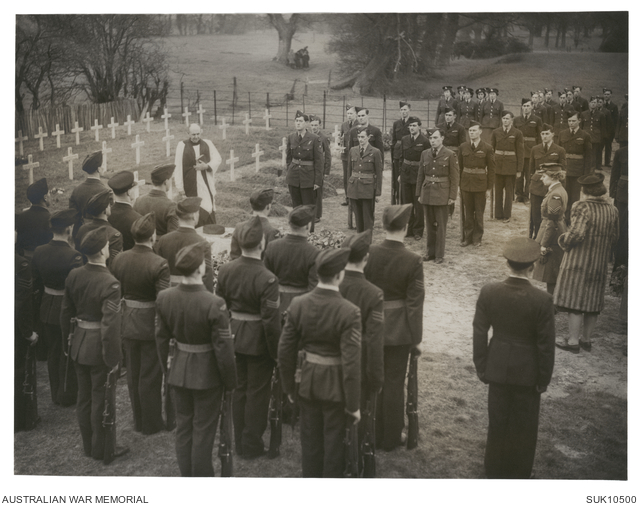
Middleton was buried with full military honours at St. Johns Church, Beck Row. Suffolk.*3
The aircraft experienced a number of attacks as they crossed occupied France, but Middleton, fighting for survival, kept reassuring the crew that he would get them home. Eventually, and against all the odds, they made the English coast, and once over land Middleton ordered the crew to bail out. Five crewmen left the stricken aircraft whilst the other two remained to help him control it. Turning for the Channel, Middleton ordered the two remaining crew members to bail out, whilst he stayed at the controls, steadying the aircraft.
By now the Stirling was very low on fuel and it finally gave up the fight and crashed at 03:00 on the morning of November 29th 1942. Middleton, too injured and too weak to escape the wreckage, drowned within the aircraft fuselage. His two crew members, Sgt. James Ernest Jeffrey (576050) age 19 and Wireless Operator Sgt. John William Mackie (994362) age 30, despite escaping, also drowned. Both the bodies of Sgt Mackie and Sgt. Jeffrey were washed ashore later that day on the 29th.
Middleton’s body remained in the aircraft, but was eventually freed from the wreckage by the action of the sea, and was washed ashore on Shakespeare Beach, Dover, in February 1943. His remains were taken to RAF Lakenheath and he was buried in St John’s churchyard, Beck Row, within sight of his airfield in Suffolk, with full military honours. Middleton was only 26 and only one mission away from ending his tour and returning home.
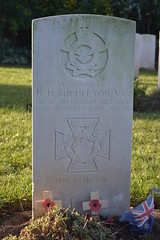
For his action, dedication and bravery, Flt. Sgt. Middleton was posthumously awarded the Victoria Cross, the first to any serving member of the R.A.A.F in World War II. He was also posthumously awarded a commission as Pilot Officer, backdated to mid November before his sortie to Turin. Thirty years later, in 1978, Middleton’s V.C. was presented to the Australian War Memorial, in Canberra for safe keeping and preservation.
For their actions, the other crew members received three DFMs and two DFCs. Fl.Sgt. Leslie Hyder (DFM) was injured, P.Officer. N. Skinner (DFC) was also injured, along with Sgt. H. W. Gough (DFM). F.O. G. R. Royde (DFC) and Sgt. D. Cameron (DFM) escaped unhurt.
The London Gazette published a report on 12th January 1943. It said:
“Fl. Sgt. Middleton was captain and first pilot of a Stirling aircraft detailed to attack the Fiat Works in Turin one night in November, 1942. Very difficult flying conditions, necessitating three low altitude flights to identify the target, led to excessive petrol consumption, leaving barely sufficient fuel for the return journey. Before the bombs could be released the aircraft was damaged by anti-aircraft fire and a splinter from a shell which burst in the cockpit wounded both the pilots and the wireless officer. Fl. Sgt. Middleton’s right eye was destroyed and the bone above it exposed. He became unconscious and the aircraft dived to 800 ft. before control was regained by the second pilot, who took the aircraft up to 1,500 ft. releasing the bombs, the aircraft meanwhile being hit many times by light flack. On recovering consciousness Fl. Sgt. Middleton again took the controls and expressed his intention of trying to make the English coast, so that his crew could leave the aircraft by parachute. After four hours the badly damaged aircraft reached the French coast and there was once more engaged and hit by anti-aircraft fire. After crossing the Channel Fl. Sgt. Middleton ordered the crew to abandon the aircraft. Five left safely, but the front gunner and the flight engineer remained to assist the pilot, and perished with him when the aircraft crashed into the sea”.
Funeral service for 402745 Flight Sergeant Rawdon Hume Middleton, the RAAF’s first VC winner. He was buried with full military honours in a country churchyard near his station. Air Vice Marshal H. N. Wrigley represented the High Commissioner for Australia (Mr S. M. Bruce) and the RAAF. The graveside service was conducted by Squadron Leader H. C. Thrush of Prospect, SA, RAAF Chaplain. (Australian War Memorial Public Domain)
Middleton’s citation read:
“Flight Sergeant Middleton was determined to attack the target regardless of the consequences and not to allow his crew to fall into enemy hands. While all the crew displayed heroism of a high order, the urge to do so came from Flight Sergeant Middleton, whose fortitude and strength of will made possible the completion of the mission. His devotion to duty in the face of overwhelming odds is unsurpassed in the annals of the Royal Air Force”.
In honour of Middleton’s bravery, Number 1 RAAF Recruit Training Unit at RAAF Base Wagga has renamed the club in his name, the “Middleton VC Club”, and he also appeared on one of the 1995 Australian 45c stamps. The dining hall located at the nearby (now American) base at RAF Mildenhall in Suffolk, has also been named in his honour.
Middleton was a brave and dedicated young man who gave his life to save those of his crew. Each and every one of them acted with the highest dedication, sadly for some, it cost them dearly.
Sources
*1 photo courtesy of Australian War Memorial, image 100641, Public domain.
*2 photo courtesy of Australian War Memorial, image P01019.003, Public domain.
*3 Photo courtesy of Australian War Memorial, Image SUK10501, Public domain
*4 Photo courtesy of Australian War Memorial, Image SUK10500, Public domain
Many of Britain’s airfields have hung on desperately to a small corner of history. Hawkinge is sadly one of those that has been buried deep beneath housing, schools and shops. Sadly, one of England’s most historic airfields, has finally been defeated not by Goring’s Luftwaffe, but by local planners.
Hawkinge was at the forefront of the Battle of Britain, it was repeatedly attacked by the bombers of the Luftwaffe. Because of its location, just minutes from France, crews would often have little warning and would have to take to the sky unprepared. Many returning aircraft would use its runways as a safe haven returning battle damaged and weary; Hawkinge fire crews were some of the busiest Britain was to have. It was used as a transport depot in the First World War, became a mecca for international pilots, saw some of the first ‘drones’ and was used in the filming of the 1969 film ‘The Battle of Britain’.
Today a small museum, utilises what’s left of the original buildings whilst housing creeps like poison ivy, ever further across the airfield.
The nearby cemetery is home to not only RAF pilots but also fallen Luftwaffe crews, ironically remaining in the land they tried to take all those years ago.
As part of a second aviation trail around historic Kent, Hawkinge is a must for any follower of history, aviation or the Battle Of Britain.
It was during this time, on July 4th 1944, that General Eisenhower stopped off at Lashenden following one of his many flights over the German lines in Normandy. His pilot, Brig. Gen. Elwood R. Quesada, veteran of 90 sorties, was berated by his superiors for such a ‘foolish’ act. In response he said, “When a five-star general says ‘Go,’ you go!”
Lashenden, also known as Headcorn, was an advanced landing ground, built initially for the RAF, it was taken over by the US Ninth Airforce who used to to fly P-51s and P-47s out over France.
Today it is a thriving airfield, whose annual reenactments bring back the nostalgia of 1940s Britain. Find out more about Lashenden’s history and other airfields in Kent. Click on this link.
1940s Britain is reenacted on the Former Lashenden Advanced Landing Ground used by the Ninth Air Force.
The first V1 for 315 sqn was shot down by Flt Sgt Jankowski at 13:10 on July 11th. There were three more the following day and several others would meet similar fates. Shooting down a V1 was dangerous, many aircraft being caught in the subsequent blast. Other, less conventional methods would include tipping the wing of the V1 destabilising the gyroscopic guidance system within, sending it tumbling to the ground. On one occasion, WO Tadeusz Szymanski managed to completely turn a V1 onto its back using such a method.
Brenzett, was an advanced landing ground, built to be temporary, but even so, it produced some remarkable stories.
As part of a second trail around Kent, we visit three more of Britain’s airfields, Hawkinge, Brenzett and Lashenden. Each with its own story to tell. Want to know more? click here to go back to 1940s England and then see what has happened to these historic places.
Brenzett Village Sign Depicts its Aviation History
The story of Leon Vance is one of the saddest stories to emerge from the Second World War. He was a young American, who through his bravery and dedication, saved the lives of his colleagues and prevented their heavily striken aircraft from crashing into populated areas of southern England. Following a mission over France, his was very severely injured, but miraculously fought on.
Leon Robert Vance, Jr. known as ‘Bob’ to his family and friends, was born in Enid, Oklahoma, on August 11th, 1916. He graduated from high school in 1933 after receiving many honours and being singled out as a high performing athlete. He went on, after University, to the prestigious Training College at West Point in 1935, staying until his graduation four years later in 1939. It was here, at West Point, he would meet and marry his wife Georgette Brown. He and Georgette would later have a daughter, after whom Vance would name his own aircraft ‘The Sharon D’.
Vance would become an aircrew instructor, and would have various postings around the United States. He became great friends with a Texan, Lieutenant Horace S. Carswell, with whom he would leave the Air Corps training program to fly combat missions in B-24 Liberators. They became great friends but would go on to fight in different theatres.
Prior to receiving his posting, Vance undertook training on Consolidated B-24s. Then, in October 1943, as a Lieutenant Colonel, he was posted to Europe with the newly formed 489th Bombardment Group (Heavy), as the Deputy Group Commander. One of the last groups to be assigned to the european theatre, they formed part of the 95th Combat Bombardment Wing (2nd Bomb Division), Eighth Airforce, and were sent to RAF Halesworth (RAF Holton) designated Station 365 by the USAAF.
The group left their initial base at Wendover Field, Utah in April / May 1944 and their first mission would be that same month on May 30th, 1944, as part of a combined attack on communication sites, rail yards and airfields. A total of 364 B-24s were to attack the Luftwaffe bases at Oldenburg, Rotenburg and Zwischenahn, along with other targets of opportunity far to the north in the German homeland. With only 1 aircraft lost and 38 damaged, it was considered a success and a good start to the 489th’s campaign.
As the build up to Normandy developed, Vance and the 489th would be assigned to bombing targets in northern France in support of the Normandy invasion about to take place further to the south. An area the unit would concentrate on, prior to the Allied beach invasion on June 6th that year.
The day before D-day, the 489th would fly to Wimereaux, in the Pas-de-Calais region of northern France. This would be Leon Vance’s final mission.
B-24H Liberator of the 489thBG, RAF Halesworth*2
The group, (Mission 392), consisted of 423 B-17s and 203 B-24s and were to hit German coastal defenses including: Le Havre, Caen, Boulogne and Cherbourg areas as precursors to the Normandy invasion. Some 127 P-47s and 245 P-51s would support the attacks. The 489th would assemble at 22,500 feet on the morning of June 5th, proceed to the south of Wimereaux and fly over dropping their payload then return to England. On the run in to the target, Vance was stationed behind the pilot and copilot. The lead plane encountered a problem and bombs failed to jettison. Vance ordered a second run, and it was on this run that his plane, Missouri Sue, took several devastating hits.
Four of the crew members, including the pilot were killed and Vance himself was severely injured. His foot became lodged in the metal work behind the co-pilots seat. There were frantic calls over the intercom and the situation looked bad for those remaining on board. To further exacerbate the problems, one of the 500lb bombs had remained inside the bomb bay armed and in a deadly state, three of the four engines were disabled, and fuel spewed from ruptured lines inside the fuselage.
Losing height rapidly, the co-pilot put the aircraft into a dive to increase airspeed. The radio operator, placed a makeshift tourniquet around Vance’s leg, and the fourth engine was feathered. They would then glide toward the English coast.
The aircraft was too damaged to control safely, so once over english soil, Vance ordered those who could, to bail out. He then turned the aircraft himself out to the English Channel to attempt a belly landing on the water. A dangerous operation in any aircraft, let alone one with an armed bomb and no power.
Still trapped by the remains of his foot, laying on the floor and using only aileron and elevators, he ensured the remaining crew left before the aircraft struck the sea. The impact caused the upper turret to collapse, effectively trapping Vance inside the cockpit. By sheer luck, an explosion occurred that threw Vance out of the sinking wreckage, his foot now severed. He remained in the sea searching for whom he believed to be the radio operator, until picked up by the RAF’s Air Sea Rescue units.
Vance was alive, but severely injured. He would spend a number of weeks, recuperating in hospital, writing home and gradually regaining his strength. Disappointed that his flying career was over, he looked forward to seeing his wife and young child once more. However, on a recuperation trip to London, Vance met a young boy, who innocently, and without thought, told him he wouldn’t miss his foot. The emotional, impact of this comment was devastating to Vance and he fell into depression. Then, news of his father’s death pushed him down even further.
Eventually, on July 26th, 1944 Vance was given the all clear to return home and he joined other wounded troops on-board a C-54, bound for the US. It was never to arrive there.
The aircraft disappeared somewhere between Iceland and Newfoundland. It has never been found nor has the body of Leon Vance or any of the others on board that day. Vance’s recommendations for the Medal of Honour came through in the following January (4th), but at the request of his wife, was delayed until October 11th 1946, so his daughter could be presented the medal in her father’s name.
The citation for Leon Vance reads:
“For conspicuous gallantry and intrepidity above and beyond the call of duty on 5 June 1944, when he led a Heavy Bombardment Group, in an attack against defended enemy coastal positions in the vicinity of Wimereaux, France. Approaching the target, his aircraft was hit repeatedly by antiaircraft fire which seriously crippled the ship, killed the pilot, and wounded several members of the crew, including Lt. Col. Vance, whose right foot was practically severed. In spite of his injury, and with 3 engines lost to the flak, he led his formation over the target, bombing it successfully. After applying a tourniquet to his leg with the aid of the radar operator, Lt. Col. Vance, realizing that the ship was approaching a stall altitude with the 1 remaining engine failing, struggled to a semi-upright position beside the copilot and took over control of the ship. Cutting the power and feathering the last engine he put the aircraft in glide sufficiently steep to maintain his airspeed. Gradually losing altitude, he at last reached the English coast, whereupon he ordered all members of the crew to bail out as he knew they would all safely make land. But he received a message over the interphone system which led him to believe 1 of the crew members was unable to jump due to injuries; so he made the decision to ditch the ship in the channel, thereby giving this man a chance for life. To add further to the danger of ditching the ship in his crippled condition, there was a 500-pound bomb hung up in the bomb bay. Unable to climb into the seat vacated by the copilot, since his foot, hanging on to his leg by a few tendons, had become lodged behind the copilot’s seat, he nevertheless made a successful ditching while lying on the floor using only aileron and elevators for control and the side window of the cockpit for visual reference. On coming to rest in the water the aircraft commenced to sink rapidly with Lt. Col. Vance pinned in the cockpit by the upper turret which had crashed in during the landing. As it was settling beneath the waves an explosion occurred which threw Lt. Col. Vance clear of the wreckage. After clinging to a piece of floating wreckage until he could muster enough strength to inflate his life vest he began searching for the crew member whom he believed to be aboard. Failing to find anyone he began swimming and was found approximately 50 minutes later by an Air-Sea Rescue craft. By his extraordinary flying skill and gallant leadership, despite his grave injury, Lt. Col. Vance led his formation to a successful bombing of the assigned target and returned the crew to a point where they could bail out with safety. His gallant and valorous decision to ditch the aircraft in order to give the crew member he believed to be aboard a chance for life exemplifies the highest traditions of the U.S. Armed Forces”*1
Leon Vance’s actions would be remembered. His local base in Oklahoma was renamed ‘Vance Air Force Base’ on July 9th, 1949. The gate at Tinker Air Force Base, Oklahoma was also later named after him on May 9th, 1997, and his name appears on the ‘Wall of the Missing’ at Madingley American War Cemetery in Cambridge, England.
The Wall of the Missing, on Which Leon Vance’s Name Appears.
Leon Robert Vance, Jr. (August 11th, 1916 – July 26th, 1944)
Originally posted on the anniversary of the publication of his poem, For the Fallen, 21st September 2014, Laurence Binyon’s poem has become synonymous with remembrance services across the country. This week is remembrance Weekend (and Veteran’s day in the United States) on which we remember the fallen: those who gave the greatest sacrifice, so we could live in peace.
I thought it appropriate to repost this during Thai special week so we know a little more about the poem and the history behind it.
‘Lest we forget’
“To all those who went before, (Robert) Laurence Binyon’s 1914 poem is widely used in remembrance services across the world. Laurence Binyon wrote his For the Fallen, with its Ode of Remembrance, while Binyon was visiting the cliffs of North Cornwall between Pentire Point and The Rumps.
Today, if you visit, there is a stone plaque at the spot to commemorate his poem, which reads: “For the Fallen Composed on these cliffs 1914″. There is also a second plaque located on the beehive monument on the East Cliff above Portreath in central North Cornwall. There, you will find a plaque on a statue inscribed with the same words. Laurence Binyon’s poem, For the Fallen, was published in The Times newspaper, following heightened public sentiment due to the recent Battle of Marne (5-12 September 1914) on 21st September 1914, 100 years ago today. http://wp.me/P4xjD9-8u
For the Fallen
With proud thanksgiving, a mother for her children,
England mourns for her dead across the sea.
Flesh of her flesh they were, spirit of her spirit,
Fallen in the cause of the free.
Solemn the drums thrill: Death august and royal
Sings sorrow up into immortal spheres.
There is music in the midst of desolation
And a glory that shines upon our tears.
They went with songs to the battle, they were young,
Straight of limb, true of eye, steady and aglow.
They were staunch to the end against odds uncounted;
They fell with their faces to the foe.
They shall grow not old, as we that are left grow old:
Age shall not weary them, nor the years condemn.
At the going down of the sun and in the morning
We will remember them.
They mingle not with their laughing comrades again;
They sit no more at familiar tables of home;
They have no lot in our labour of the day-time;
They sleep beyond England’s foam.
But where our desires are and our hopes profound,
Felt as a well-spring that is hidden from sight,
To the innermost heart of their own land they are known
As the stars are known to the Night;
As the stars that shall be bright when we are dust,
Moving in marches upon the heavenly plain,
As the stars that are starry in the time of our darkness,
To the end, to the end, they remain.
(Published in The Times newspaper, 21st September 1914).
Thanks to Marcella who contributed to the writing of the original post.”
The Bomber Command memorial was erected in honour of the 55,573 crew members of the RAF Bomber Command who died during the Second World War. It stands as a reminder of the young men, whose average age was only 22, and who never returned to their beloved homes. It was unveiled by the Queen, on June 28th 2012, when a Lancaster bomber of the BBMF flew over dropping thousands of poppies.
RAF Bomber Command Memorial
The monument can be found in London adjacent to Green Park. It stands proudly watching over the grassed picnic area where picnickers, shoppers and tourists sit. The main part of the monument is a bronze sculpture consisting of seven members of a typical bomber command aircrew.
Perhaps not obviously noticed, some of the crew are looking to the sky, some with hands to shield from the morning sun, as if looking for missing friends. Others are looking downward, perhaps in despair or fear for those not yet home. The stance of the statues suggests a crew recently returned from a mission who have just disembarked from their damaged aircraft. Tired, bewildered and overwhelmed by what they have witnessed, they have been created in precise and superb detail.
The Pilot stands central and to the rear of the group; the navigator to the left, followed by the flight engineer, mid-upper gunner, bomb aimer, rear gunner and then the wireless operator to the right. Their faces reflecting the feelings and emotions that these young men felt. The base of the statues were ‘littered’ with photos of loved ones and messages from around the world. A moving tribute.
Outside and on the walls of the memorial, are two crests; on the left, the RAF crest “Per Ardua ad Astra” meaning “Through adversity to the Stars“. The crest has its origins going back to August 1st 1918 and has been the symbol of the RAF ever since. On the right, is the crest of Bomber Command whose motto is “Strike Hard, Strike Sure“. Both beautifully carved into the undoubtedly beautiful Portland Stone.
A number of quotes, including one from Winston Churchill, “The Fighters are our salvation, but the bombers alone provide the means of victory” surround the memorial giving it strength. A further quote, to the rear of the memorial reflects the losses of all nations, who on the ground, lost lives as a result of bombing campaigns on both sides – a reflection of reconciliation and peaceful times ahead.
The roof above the memorial is open. This allows you to see the figures against a backdrop of sky, whether at day or night, rather than the bustling city behind. A view more representative of the times they lived and flew in.
The remainder of the roof is similar to the kriss cross design of the Vickers Wellington, one of the RAF’s bombers during World War II. The design is both eye-catching and unique, not only to the memorial but the Wellington from which it came.
The building of the memorial, which is truly a mix of emotion, international representation, and a build that reflects the lives of those affected by the war, is considered as closure for many; a symbol of what the young crews had to endure on long missions over occupied Europe. It also serves to act as a lesson to the those who were too young to know what the war meant to those who fought and died in it. It is A beautiful place to sit and give thanks to those 55,573 brave young men who never lived to experience peacetime again.
RAF Bomber Command Memorial – Note the Roof Design.
The official Bomber Command Memorial website is here. An app is also available for a small fee that goes part way to supporting the maintenance of the memorial, it gives greater detail to the construction and design of the memorial, along with an audio script and stories from survivors of Bomber Command.
A history of the RAF Crest and its derivations can be found by clicking here.
By clicking here, you can see and hear some stories of those to whom the monument is honouring.
“The Fighters are our salvation, but the bombers alone provide the means of victory“
Winston Churchill, 1940
To see more memorials from airfields around the country please click here
As we approach Remembrance day (and Veteran’s day in America), Aviation Trails will be publishing a mix of poetry and aviation material in remembrance of those brave and courageous young men and women, who, from all nationalities, gave the ultimate sacrifice in war.
The numbers are staggering; during World War 1, there were some 37 million* deaths, (of which around 7 million were civilian). Thankfully, because the war was quite stationary, it did not create as many of the civilian casualties that were found in the Second World War. The higher number here being primarily military and serving personal. Defined as the ‘War to end all Wars’, it brought a devastating blow to societies across the European countries and their allies, as men flocked to the front and the mass slaughter that prevailed.
World War 2 on the other hand, due to the much faster, greater technological advancement that war brings, saw a much higher casuality rate. Over 60 million people died which amounted to approximately 2.5% of the world’s population*1. This is currently about the size of Nigeria, the world’s seventh largest country*2. The war was so widespread and devastating, that the actual number of casualties will never be known. A new type of war, it spread death and destruction to a much wider audience.
Subsequent wars, have also taken their toll, both in military and civilian terms. Continuing conflicts are, and will account for further deaths, and it is a sad reflection of the world we live in today.
So on this special weekend, during the 100th anniversary of the First World War, we remember those who have given so much so that the rest of us can live peacefully.
Memorials visited during the making of ‘Aviation Trails‘ can be seen here.
Tyne Cot Cemetery, Belgium
Sources:
Whilst not official, Wikipedia gives some detailed accounts of countries and their casualties.
On this night 70 years ago (November 6th 1944), twelve RAF Mosquitoes from 608 Squadron, RAF Downham Market (Bexwell), took off on a raid to attack Gelsenkirchen, Germany.
Whilst the raid itself was a success, that night was to be the last for the two crew members of Mosquito KB 364. Pilot Officer James McLean (26) and Sergeant Mervyn Lambert Tansley (21) of the RAF(VR) were to die tragically on approach to Downham Market.
On the return journey, cold air and icy conditions are thought to have caused icing on the controls and wings of KB 364 making it difficult to control and lose height. What happened next was to be tragic, both for the crew members and the village of Bawdeswell.
To see the full story of that night and what happened at 20:45, November 6th 1944, click here




 Aviation Trails