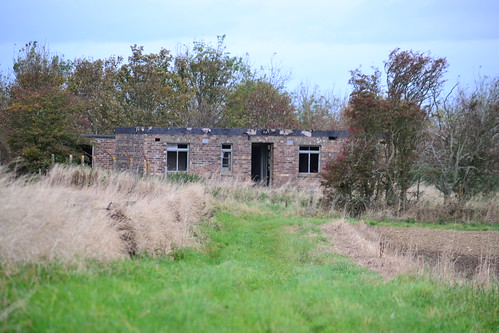
Loss of Mosquito FBVI ‘NS828’ RAF Swanton Morley.

Memorial to Fl. Lt. J Paterson and Fl. Lt J. Mellar

On April 25/26th 1944, 487 Sqn (RNZAF) moved from RAF Gravesend to RAF Swanton Morley in Norfolk, taking with them D.H. Mosquitoes. They had only been at Gravesend a few days when news of the new move came through.

487 Sqn had previously been involved in ground attacks on German airfields across the occupied countries, and in several high profile missions. In particular, during the previous February, they had been involved in Operation ‘Jericho‘, the attack on the Amiens Jail, in France. It was also a Methwold based Ventura piloted by Squadron Leader Leonard H. Trent, who, on 3rd May 1943, had led the Squadron in a disastrous daylight attack on the power station at Amsterdam. As a result of his actions that day, Sqn. Ldr. Trent received the V.C., the highest honour bestowed on personnel of the armed forces.

On their arrival at Swanton Morley, 487 Sqn would immediately begin training for new air operations, their part in the forthcoming D-day invasion at Normandy, with the first flights taking off the following day.

On April 27th three ‘targets’ were chosen, the Grimston Range not far away from Swanton Morley, the Bradenham Range in the Chilterns, and lastly the Army Gunnery School site at Stiffkey, on the North Norfolk coast. Each of these were to be ‘attacked’ in cross country sorties by the Mosquitoes.

In one of those Mosquitoes ‘EG-A’ was Pilot Flight Lieutenant John Charles Paterson (NZ/2150), and his Navigator Flight Lieutenant John James Spencer Mellar (s/n: 49175) both of the R.N.Z.A.F.

The day’s sortie went well, until the return flight home was made. It was on this leg of the flight that the port engine of the Mosquito, a Hatfield built FBVI ‘NS828’ under contract 555/C.23(a), began to overheat.

Immediately Flt. Lt. Paterson feathered the engine – now flying on just one. The Mosquito was lined up on approach to Swanton Morley for a single-engined landing, but all did not go well. Unfortunately,  instead of putting the aircraft down on the runway, the aircraft overshot the airfield crashing into a field beyond, the resultant accident killing both pilot and navigator instantly.

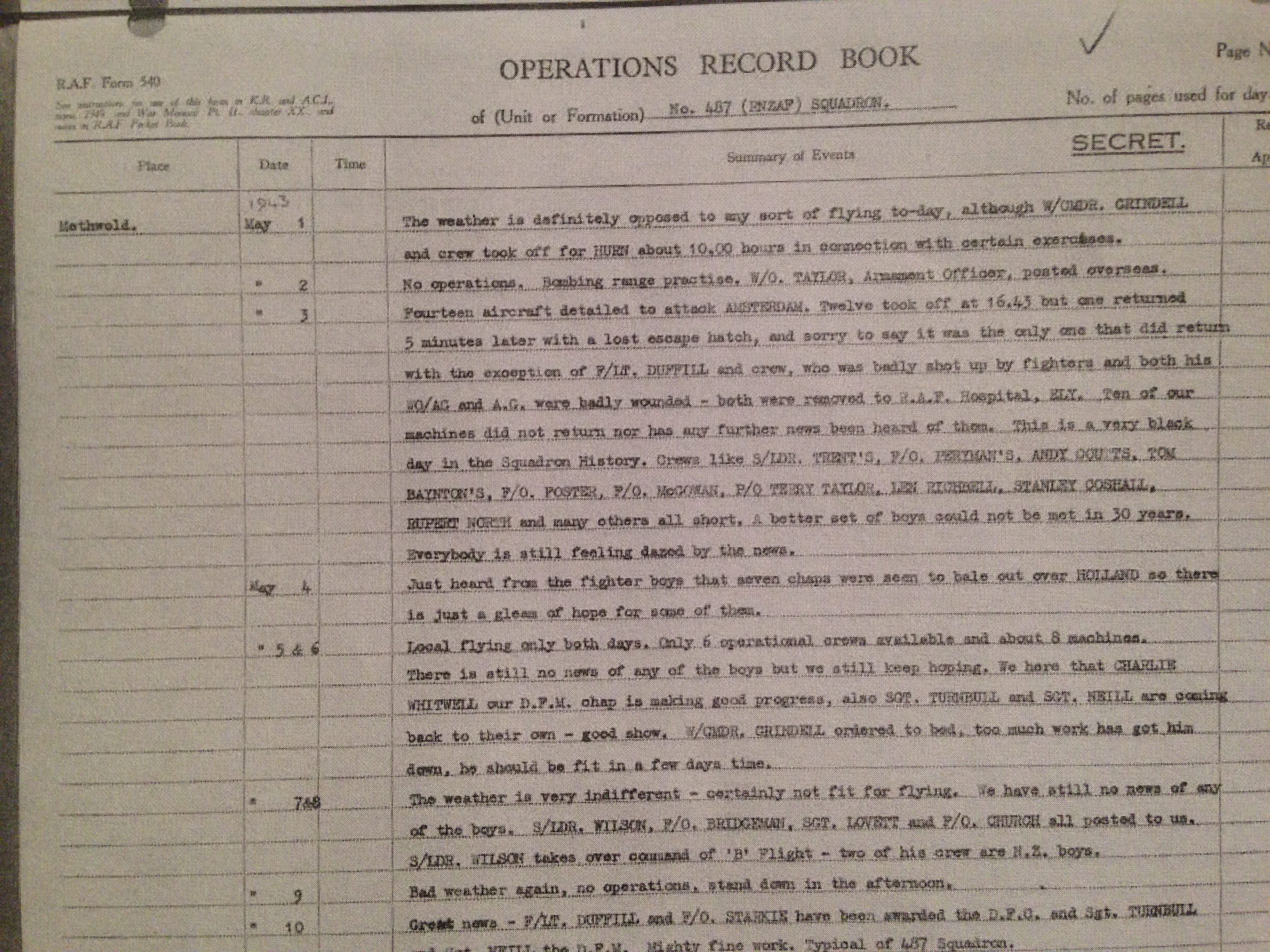
The Operational Record Book (AIR 27/1935/31) for April 27th states:

Formation dive bombing on Grimstone [sic] range. Low level bombing on Bradenham Range. Formation cross country with air to sea firing practice off the coast at Wells. In the evening six aircraft carried out formation attacks on gun positions at an army Gunnery School at Stiffkey. Returning from this ‘A’, F/Lt. Paterson developed engine trouble and feathered the airscrew.  In attempting to land, he overshot and crashed. F.Lt. Paterson and his navigator F. Lt. Mellar, were both killed.”

Since then, a memorial has been erected in memory of the two men, located on the side of the B1110 Dereham Road just outside the village of North Elmham in Norfolk, it stands not far from the site of the crash site, west of Swanton Morley airfield. After the crash, Flt. Lt. Paterson’s body was buried at Shepperton Church Cemetery, whilst Flt. Lt. Mellar was buried at Brookwood Military Cemetery plot 24. D. 20.

Flight Lieutenant Mellar was 29 on the date of his passing, he was the son of William Edward and Eleanor Mellar; and husband of Dorothy Freda Mellar. Flight Lieutenant Paterson was 24 years of age, he was the son of John Alexander and Alice Louise Paterson, of Papakura, Auckland, New Zealand, and husband of Doris Josephine Paterson, of Shepperton.

Swanton Morley appears in Trail 38.

RAF Leeming Part 2 – The Canadians arrive.

In part 1, we saw how 4 Group had been operating mainly Whitleys from Leeming, and how the squadrons here had taken a beating in the European skies. Now, following the departure of the last elements of 10 Sqn. in August 1942, Leeming was all but empty, and ready to be handed over to the Canadians. With the introduction of the four engined heavies, hopefully things would begin to change and the losses of before would be lessened. Harris was now in charge of Bomber Command, new directives and a renewed focus would see the first of the 1,000 bomber raids, perhaps now, the air war would turn.

Formed in October 1942, 6 Group was born out of Article XV of the Riverdale Agreement, which allowed the formation of distinct squadrons manned by personnel from across the British Commonwealth – primarily Australia, Canada and New Zealand. This would, in theory, allow the aircrews of these countries to keep their national identity whilst serving in the Royal Air Force, and allowing the governments of these nations to have a say in the service of these crews. However, Britain did not want this – fearing interference from abroad in strategic matters – and so an agreement was drawn up whereby they would keep their nationality but serve under the full control of the Royal Air Force.

After negotiations on 17th April 1941, it was agreed that there could be 25 Canadian squadrons created (along with 18 Australian and 6 New Zealand Squadrons). But with shortages of trained personnel, and slow progress  through the British Commonwealth Air Training Plan (BCATP), many of these squadrons took a long time to come, and many units were simply filled with a range of nationalities, thus defeating the original objectives of the agreement.

Ultimately though, 44 Canadian, 16 Australian and 6 New Zealand squadrons were formed operating across a range of fields. Of these, 15 Canadian squadrons operated within Bomber Command – one transferring to the Pathfinders of 8 Group.  As the war progressed, and air superiority fell to the allies, Bomber Command took fewer casualties, and so the number of  individual nationals serving within each squadron began to rise. By the time the war began to close, these squadrons had had their  national identities and character restored, and they were by now, either Canadian, Australian or New Zealand Squadrons in their own right.

Transferring so many units from other countries would initially cause confusion, with similar numbered units appearing in both the RAF, Canadian, Australian or New Zealand Air Forces. To overcome the problem, Canadian squadrons were allocated the first fifty numbers of the ‘400’ block (400 – 449), and so Canadian born squadrons were renumbered accordingly once they had transferred to the UK*4. With this, 6 Group was born, and over the next few years it would become synonymous with Yorkshire, utilising the many airfields found within its boundaries.

At Leeming, six of these fourteen units would operate, Nos: 405, 408, 419, 424, 427 and 429, all between August 1942 and May 1946 when the last two resident groups would disband.

The first of these squadrons to arrive would be 419 (Moose) Squadron.

419 Sqn. were only at Leeming a short time, a transition stop between 13th and 18th August 1942, just prior to the forming of 6 Group. Preparations for the move began a few days earlier with an advance party of twenty-five personnel making the journey to Leeming from Mildenhall by train. On the 11th, the squadron was stood down from operations and all hands helped load equipment onto another train consisting of 25 goods wagons. Loading took place at night at Shippea Hill, a small desolate, and rarely used station not far from Mildenhall airfield.

On the 12th, a second train was laid on in which 200 personnel were loaded onto 30 cars, led by Flt. Lt. D. S. McCann, they made their way north arriving at Leeming Bar station at 21.40 hrs. After unloading, a warm and no doubt welcome meal was provided, and then the personnel all retired for the night. Also on the 12th, a further 150 personnel transferred by air, flying in seventeen of the squadron’s aircraft. They made their way from Mildenhall, not to Leeming airfield but to RAF Skipton, where they stayed the night. The next day, they made the last leg of the journey, transferring across to Leeming landing on the one serviceable runway. Here they unloaded and prepared the airfield for operations. However, the stay was short lived, a visit by the Canadian Minister of National Defence for Air, the Honorable Charles Gavan “Chubby” Power, MC. PC., and Air Marshall L.S. Breadner the following day, preceded the squadron’s move out from Leeming to RAF Topcliffe, where operations would finally finally began once more.

Named 419 (Moose) Squadron they were named after their first Commanding Officer, Wing Commander John “Moose” Fulton, and displayed a Canadian Moose in the centre of their unit crest. Not joining 6 (R.C.A.F.) Group until the following year, they flew Wellingtons into Leeming going on to be resident at several of the Group’s airfields. It was 419 Sqn. pilot Andrew Charles “Andy” Mynarski, who would so bravely try to save the life of his trapped tail gunner; Mynarski himself dying from the severe burns he received in the action. The Gunner, Cpl. Pat Brophy, remarkably survived the aircraft’s crash, and it was his testimony that led to Mynarski receiving the Victoria Cross.  The Canadian Warplane Heritage Museum in Hamilton, Ontario have restored and fly, one of only two air worthy Lancasters as a memorial and tribute to Mynarski’s brave efforts.
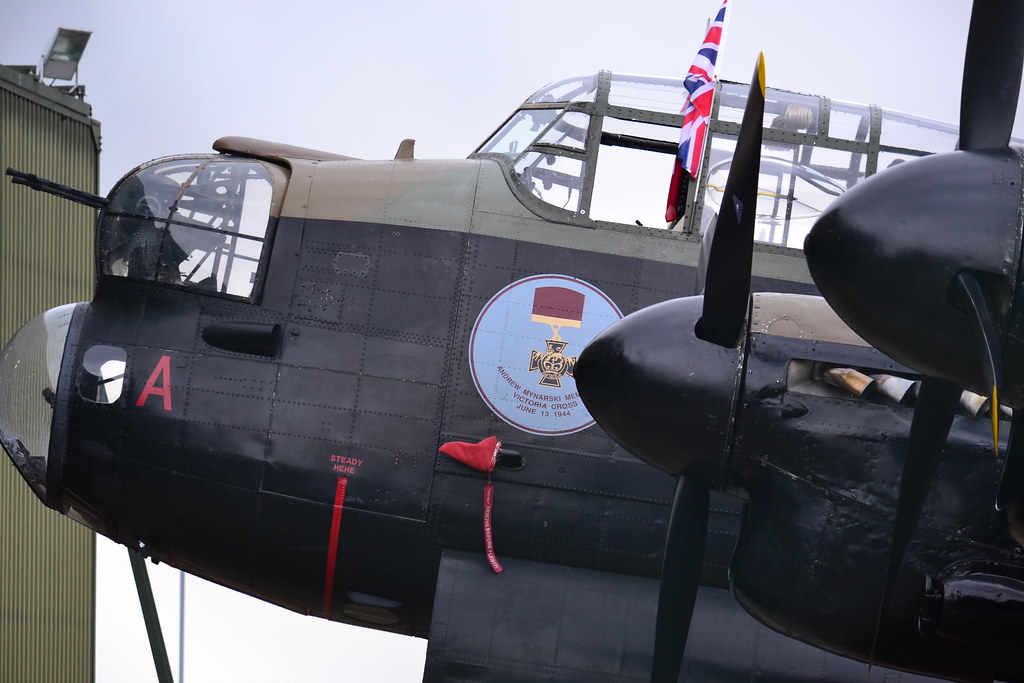
Canadian Lancaster C-GVRA

Canadian Lancaster KB726 ‘VR-A’ dedicated to Andrew Mynarski on her arrival at RAF Coningsby August 2014. The dedication to Mynarski being displayed beneath the Lancaster’s cockpit.

A rather impromptu visit interrupted changes at Leeming, when P.O. Colin Frank Sorensen (RCAF) was practising aerobatics in the Leeming vicinity in Spitfire P8784. During a manoeuvre his engine cut out, luckily he was able to make a wheels up landing after gliding into Leeming. The aircraft was badly damaged in the landing but the Danish born Sorensen walked away unhurt.

The second of the six Canadian Squadrons to arrive at Leeming, 408 (Goose) Sqn., made their appearance on 14th September 1942, the squadron arriving whilst  in the process of changing over from the Hampden to the Halifax. After a busy, but ‘run of the mill’ period, October would prove to be rather significant, although the Operational Record Books wouldn’t quite recognise it as such. The entry for October 1st 1942*3  states:

1.10.42.

Today started a month which proved to be a rather dull one from the historian’s point of view, but a very busy one for the squadron. The printed word can hardly paint the picture of industry of receiving aircraft and modifying them for operations, of air and ground training and of personnel going to and coming from various courses of instruction on Halifax aircraft and equipment.

This entry would kick off a short period of major events that were in no way ‘run of the mill‘! Firstly, on the 2nd October, confirmation was received at Leeming that two of 408 Squadron’s aircrew had successfully evaded, making their way to Gibraltar after being shot down over Belgium in the former Commanding Officer’s aircraft. Their remarkable journey had taken them across the European continent to safety – quite an amazing achievement in itself. Unfortunately, there had been no word as yet as to the whereabouts of the Commanding Officer.

After that on the 11th, the first of the new four-engined heavy bombers arrived, two Halifax MK.Vs, which were subjected to great scrutiny and discussion by the crews. Their presence giving the squadron a renewed keenness to get back to operations. As they milled around the aircraft, morale was instantly lifted, and a new impetus had been injected. By the end of the month there would be thirteen MK.V’s all being modified ready for operations.

Additional changes on the 12th, saw 408 (RCAF) Squadron Conversion Flight along with 405 (RCAF) Conversion Flight merging to become 1659 Canadian Conversion unit (Heavy Conversion Unit) here at Leeming, the record books playing down the historical  importance of early October 1942.

This impetus would see 408 Sqn. through to early November without loss, until on the afternoon of 9th November 1942, Halifax V, DG238 piloted by Flt. Sgt. R. Bell DFM, stalled and crashed 5 miles east of Croft airfield. The entire crew were tragically lost in the accident in which they were participating in a fighter affiliation exercise. The event marked not only the first loss for 408 Sqn. since arriving here at Leeming, but the first loss of any Halifax V in the whole of Bomber Command.

However, within a month of the first Mk.V’s arriving at Leeming, 408 Sqn. would begin receiving another mark of the Halifax, this time the MK.II with its Merlin XX inline engines. They would keep this model for a further year until replacing them, for a short while, with the Lancaster.

The November tragedy would round off 408’s year, taking them into 1943 and a new year that would see Bomber Command finally ready – fully trained and fully operational with four engined heavies. Harris would waste no time in using this to his advantage, striking at the many cities deep in the heart of Germany time and time again.

By January 1st, 1943, 4 Group had transferred no less than ten airfields over to the Canadians, their numbers rising as more and more aircrews were passing through the training programme. Along with Leeming, the Canadians now operated from: Croft, East Moor, Middleton-St-George, Topcliffe, Dalton, Skipton-On-Swale, Dishforth, Linton-On-Ouse and Tholthorpe. The Canadians were quickly becoming a force to be reckoned with.

For 408 Sqn. 1943 finally saw them confirmed as operational with seventeen MK.IIs and one MK.V on their books, it would also see their first operational casualty. On January 23rd, Halifax MK. II ‘EQ-C’ lost power in both starboard engines, this loss of power caused the aircraft to crash near to Ossington in Nottingham. Thankfully though, all the crew escaped unharmed, but it was a rather unfortunate start to 408’s mission record.

Engine fires and engine failures would see several other aircraft crash over the next few months. On return from Koln on the night of 14th – 15th February, Halifax ‘EQ-U’ crashed when the port outer engine burst into flames on the approach to the airfield. After gaining some height the pilot Flt. Lt. R. Boosey ordered the crew to evacuate the aircraft. All but one, an American, survived, his parachute failing to open in time.

Following the attack by a night-fighter on 1st – 2nd March, Halifax EQ-H,  also suffered engine failure on the port side. As a result of the attack, the pilot F.O. A. Stewart (RNZAF), dropped his bombs and turned the aircraft for home. Picked up by another night fighter, the lonesome aircraft was again attacked this time the result was more decisive, the Halifax being shot down. After the crash, three of the crew were taken prisoner, the remainder managing to avoid capture going on to evade their enemy.

Enemy action may have also caused a further Halifax’s loss on the night of 12th – 13th March. Whilst on finals returning from Essen,  Halifax ‘EQ-S’ lost both port engines as they also cut out. Unable to control the violent yaw, the aircraft came down not far from Leeming airfield, again thankfully all the crew escaped unharmed, the aircraft coming off much worse.

The ground crew doing maintenance work on a Halifax II of No 408 Squadron at Leeming, August 10th, 1943.

The ground crew completing maintenance work on a Halifax II of No 408 Squadron at Leeming, August 10th, 1943. days before they departed Leeming. (National Defence Image Library, PL 19510 – Via Juno Beach Centre)

During March 1943, a further Canadian unit arrived at Leeming airfield – 405 (Vancouver) Squadron. They were the first Canadian unit to have been formed overseas, and the first to carry out an operational mission. It then went on to be the only Canadian unit to be part of Bennett’s elite Pathfinder Group. 405 Sqn. also had the honour of being the first to operate the Canadian built Lancaster, the MK.X, although its entry not occurring until the dying days of the war. Remaining at Leeming from early March to mid April, 405 Sqn. departed for Gransden Lodge on the 19th. Their journey to Leeming had taken them through Driffield, Pocklington, Topcliffe and Beaulieu, a two year journey that had started on April 23rd 1941.

405 (Vancouver) Sqn had earlier taken part in the controversial 1,000 bomber raid on Cologne, and had taken part in maritime operations before joining 6 Group. Their stay here being a brief one, being transferred by special train (X771) to Gamlingay station, and onward travel to Gransden Lodge and 8 Group.

It was also during April, that another Canadian unit would pass through Leeming, 424 (Tiger) Squadron, staying here for just one month before moving on.  424 Sqn. took their name from the Hamilton Wildcats, a Canadian Rugby team that played in the city of Hamilton, Ontario, after the people there adopted the Squadron as their own. Formed in December 1942 at Topcliffe, they operated Wellington IIIs which they changed for MK. Xs prior to moving over to Leeming, and eventual departure to North Africa.

The fifth Canadian unit to reside at Leeming arrived on 5th May 1943, in the form of 427 (Lion) Sqn. Four days earlier, orders had been received by 427 Sqn. that their aircraft (Wellington MK.X) were to be flown to RAF Skipton-On-Swale to form a new Canadian Squadron 432 (Leaside) Sqn., after which, their personnel were to be transferred here to Leeming, where they would receive new Halifax MK.Vs.

On the next day, twenty-one aircraft and five crews led by Sqn. Ldr. W. McKay of Vancouver, flew to Skipton, taking with them equipment and personnel. The departure was honoured by a party in the Officers’ and Sergeants’ messes both of which had been opened to all ranks, resulting in a party of true ‘Lion Squadron’ style.

The 4th and 5th then saw the transfer of the crews and equipment to Leeming, the stark contrast between a main station and satellite station coming as a pleasant surprise for the personnel of 427 Sqn. The transition from one to the other meant that there would be no flying for the squadron over the next few days, aircraft not having been fully modified or prepared for operational duties.

With two full squadrons now operating at Leeming, Halifaxes were littered across the airfield, the hardstands almost bursting with the different examples.

It was at this time (8th) that the BBC visited Leeming, making a documentary film illustrating the flight of the commanding Officer and his crew and how they had gallantly won their collection of medals. It was impeccable timing as another medal was also awarded that day, the squadron’s first DFM to Flt. Sgt. Higgins for his part in recent operations.

Over the next few days, aircrew took great pride in adorning their new aircraft with painted motifs, a tradition that had become steadfast in American circles and now more frequent within Bomber Command.

On the 24th May, the M.G.M. film company officially adopted the Squadron, in a grand ceremony outside the hangars, in which speeches were made and medals were awarded. During the ceremony a draw was held in which seventeen names were put into a hat and one drawn out. The lucky winner got to chalk the name of Lana Turner on his aircraft, Turner being one of M.G.M’s biggest stars and an icon of Hollywood glamour. The lucky pilot was Sgt. Johnson who had the privilege of chalking her name on his aircraft in front of a cheering crowd.

Image result for Lana Turner

Lana Tuner – the pin up of Canadian crews. Wikipedia (public domain)

On the 28th the squadron finally became operational with the first mission the next day to Wuppertal. With thirteen aircraft booked to fly, one suffered technical difficulties and so only twelve made it into the air. All returned to Leeming with only one having to land away at Thurleigh due to severe damage. 427 Squadron’s war had now officially begun at Leeming.

As the summer progressed so too did operational sorties. An increase in sorties also meant an increase in risk. After all the parties and the celebrations, 427’s morale was high, but it would be short-lived, the dangers of the air war were about to be made very clear to the crews of Leeming.

On the night of 12th – 13th June, Halifax V DK183 (427 Sqn) was brought down by a night-fighter over Germany. In the attack three crewmen were killed, another was injured and three others were taken prisoner, but there was yet more to come.

A near tragic accident was only just avoided on the 16th when Flt. Sgt. E. Johnson landed after a training flight. On landing, the aircraft swung badly, and in avoiding a group of airmen, Johnson crashed the Halifax – thankfully without injury.

June continued its onslaught when on a mission to Krefeld, three of Leeming’s longer standing 408 squadron aircraft were shot down. Of the twenty-one crew aboard only seven made it out alive, all the survivors being taken prisoners of war. On the following day (22nd – 23rd) it would be 427 Sqn’s turn and another four aircraft would be lost. This time, only two of the twenty-eight survived, both being picked up by German forces and incarcerated in POW camps. In two nights, forty-nine airmen had been lost, nine of them ending up in German internment camps. But the bad spell was not yet over, another three 427 Sqn aircraft;  DK135, DK144 and DK 190 along with a 408 Sqn MKII, JB858, were lost two nights later – another fourteen airmen were gone and seven more taken prisoners of war. The end of June simply couldn’t come soon enough.

But July would carry on in the same vein, 408 Sqn. losing two aircraft on the night of 3rd – 4th July, JB796 ‘EQ-C’ was lost with all but one of the crew, whilst JB913 ‘EQ-F’ was lost shot down by a night-fighter just after midnight. Two of this crew evaded whilst the others were taken prisoner by the German authorities. Both aircraft were on operations to Koln.

With a further three lost at Gelsenkirchen on the night of 9th – 10th July, two more on July 13th – 14th and one further aircraft on 27th – 28th July; the summer would come to a close with 408 having lost forty-two Halifaxes since being made operational earlier that year. 427 Sqn were not far behind in the loss stakes, the Canadians were taking a heavy battering and the mess halls must have seemed remarkably light.

It was during this time that the pilot of 408 Sqn Halifax ‘JD174’, F.O. Donald Thomas Bain RCAF (s/n: J/9412) would earn the DFC for his actions in saving his crew. The aircraft had departed from Leeming 9 minutes after midnight on the night of the 14th to bomb Aachen as part of a 374 strong force of allied bombers. After having the hydraulic system badly damaged by night fighters, Bain lost his attackers only to be subjected to further attacks on the homeward leg of the flight. Again, F.O. Bain managed to loose his pursuers, and once over the English coast realised that the damage to the hydraulics was more extensive than perhaps they first thought. The undercarriage could not be lowered, and so a belly landing was the only way the aircraft was going to be put down. However, with his bomb bay still full of bombs, this was not an option and so F.O. Bain gave the bail out order, turned the aircraft toward open ground and departed himself. After landing badly and breaking both ankles, F.O. Bain was discovered by a local farming family who, suspicious of his accent, dragged the wounded airman back to the farm house where he managed to convince them he was in fact Canadian, and not an enemy spy in disguise. He was then treated for his injuries and allowed to return to operational duties later on.

Bain’s received a DFC for his actions in saving his crew, the citation appearing in the Third Supplement of the London Gazette on August 6th 1943 which stated:

Flying Officer Donald Thomas Bain (Can/J.9412), Royal Canadian Air Force, No. 408 (R.C.A.F.) Squadron. One night in July, 1943, this officer piloted an aircraft to attack Aachen. Whilst over the target area, the bomber was seriously damaged when engaged by an enemy fighter. Despite this, Flying Officer Bain made several  determined runs over the objective. On the return flight 2 more enemy fighters were encountered but Flying Officer Bain out-manoeuvred them. By superb airmanship and great tenacity he succeeded in flying the crippled bomber to this country. He displayed commendable courage and a fine fighting spirit in circumstances of great difficulty.”

At the end of August, 408 Squadron were then transferred out of Leeming moving to RAF Linton-On-Ouse, another of 6 Group’s airfields a short distance away. With 427 Sqn. now being the only squadron on site, there was once again room for one final Canadian unit to join them.

The last Canadian squadron to use Leeming arrived on August 13th 1943, 429 (Bison) Sqn who like 427 Sqn. had swapped their Wellingtons for Halifaxes. The transition for the majority of these squadrons taking the same steps, from Wellington to Halifaxes and onto Lancasters and eventual disbandment.

429 Sqn. were only based at two airfields in their entire operational history, East Moor where they were formed, and Leeming where they were disbanded.

In January 1944 the Halifax Vs of 427 Sqn. were replaced by the MK.III. All this changing between aircraft models was proving to be a headache for the ground crews. Whilst some components were common and easily maintained, others were not, new tooling being required particularly when changing from radial to in-line Merlin engines.

By now the air war was swinging in the favour of the allies and tactics employed by the Luftwaffe were becoming more calculated and desperate. Attacking a bomber from  its blind spot – underneath – had long been a method used by Luftwaffe night fighter pilots, and as a result mid upper gunners were rapidly becoming redundant. To counteract this, it was considered achievable by removing the Halifax’s turret in 429 Sqn aircraft and covering over the resultant hole. Now a window could be inserted into the belly of the aircraft and the redundant gunner, laying on a mattress, could be used to look out for attacking aircraft from beneath*7. The lighter load also meant that the aircraft could gain a little more speed and altitude, always a bonus when in a heavy bomber over occupied territory.

In the early part of 1944, Leeming suffered a series of puzzling fires, all minor, but none the less strange. The civilian workforce were suspected and as a result four were relieved of their duties in June with another 24 being reprimanded for their behaviour*7.

Halifax B Mark III, LW127 ‘HL-F’, of No. 429 Squadron RCAF, in flight over Mondeville, France, after losing its entire starboard tailplane due to bombs dropped by another Halifax above it. © IWM (CE 154)

On July 18th 1944, Operation ‘Goodwood’ was put in place. The operation required the bombing of five German held positions to the east of Caen, prior to the British Second Army’s attack.  429 Sqn. were part of this massive raid of 942 aircraft of which 260 were Halifaxes. Whilst flying on this mission Halifax LW127 was struck by falling bombs from aircraft above, its tailplane being severed completely off on the one side. Now difficult to fly, the pilot Flt. Lt. G Gardiner (RCAF) gave the bail out order, of the seven in the aircraft that day, three lost their lives, one evaded and three others were taken prisoner. A second Leeming aircraft (427 Sqn.) LV985, was also lost that day, this time with the loss of all those on board. This apart, the mission was considered a complete success with Bomber Command dropping 5,000 tons of bombs and US Forces an additional 1,800 tons.

The striking of bombers from above was not an uncommon one, for a similar event occurred on August 3rd, when another 427 Sqn Halifax LW163 ‘U’ was hit no less than three times by falling bombs from above. The pilot, F.O. L. Murphy, managed to keep the aircraft flying, delivering his own bomb load on target before returning to Leeming this time making a safe landing. Once on the ground the damage could be properly assessed, a hole had been made through the fuselage behind the turret, with a further hole through the starboard mainplane.

The supply of materials was always difficult during war time, and a shortage of bombs at Leeming caused another headache for ground crews. A shortage of 1000lb bombs meant that bombs had to be ‘borrowed’ from Dishforth until new supplies could arrive. The lead up to D-Day was particularly busy, with some 37,000 bomb tails having to be collected from Skipton in readiness for an all out maximum effort.

In May 1944 the Halifax IIIs of 427 Sqn. were replaced by Avro’s magnificent showpiece the Lancaster Mk.I and MK.III; a four engined heavy that had been born out of the disastrous, under powered twin-engined Manchester. For a year 427 Sqn. flew operations in the RAF’s ultimate bomber. By the end of the war, 427 Sqn. had dropped over 8,500 tons of bombs, in just over 3,200 sorties, the majority of these occurring in 1944. In total 101 crews had been lost  in operational sorties between 1943 and 1945 from Leeming, a stark ending to a bright and happy start.  427 Sqn was eventually joined in the flying of the Lancaster by 429 (Bison) Sqn. who eventually swapped their Halifaxes for the Lancaster in May 1945.

With the end of the war in Europe and eventually the war in Japan, celebrations began in earnest at Leeming. Its doors were thrown open to the locals and many parties were held in celebration. Trips were offered to the WAAFs and ‘thank yous’ paid to the ground crews through flights over bombed German cities.

In August 1945, the last two squadrons of 6 Group passed over to 1 Group, operating under a new command following the disbandment of the ‘Base’ concept. Leeming being No. 63 base disbanding on August 31st, 1945. The base concept, implemented during the war, improved both administrative and technical services across a group of stations, streamlining the two processes by giving overall control of several airfields to one ‘base’ station.

By now Britain’s airfields were littered with unspent ordnance and it had to be disposed of. The skies continued to be full of the sound of heavy bombers taking these bombs out over the sea where they were dropped into the waters below. With disbandment on the horizon and a return to civvy street, there would be one last roll of the dice and one last casualty to remind the Canadians that flying can be a dangerous game.

On November 5th 1945, whilst on a training flight, Lancaster RA571 ‘AL-D’ of 429 Sqn crashed into a hillside, four of those on board, one an aero-mechanic, would not be returning home to a civilian life.

In the remaining months crews from both 427 and 429 took part in the repatriation flights under Operation ‘Dodge‘. Flying out to Italy, many crews ‘extended’ their stay before returning home to Leeming.  By May 1946, most crews had by now departed and on the 31st, both 427 and 429 Squadrons officially disbanded, the Operational Record Books*5 stating:

The return to Canada of Nos. 427 and 429 Squadrons, the last of the Canadian Heavy Bomber Squadrons which so ably operated in Bomber Command throughout the war and subsequent emergency, cause a regrettable break in an unforgettable relationship of the air, founded during (unreadable) heroic days and nights when the command bore the brunt of the offensive against the enemy.”

It goes onto say:

During the war, the R.C.A.F. Squadrons in Bomber Command (unreadable) for themselves the most commendable operation which will forever remain prominent in the history of air warfare, and in the annuls of Bomber Command. Not the least of these are the proud operational records, too long to mention here, of Nos. 427 and 429 RCAF Squadrons.”

it ends:

I sincerely hope that our mutual ties of comradeship which have been closely knit in war will endure, and that they will be fostered throughout the peace by the more peaceful activities of our two great nations.”

Both the importance and the contribution of Canadian crews (or any other nation for that matter) can never be understated. Trained through the British Commonwealth Air Training Plan in Canada,  they would go on to form a third of the total number of Bomber Command air crews operating during the Second World War. They would become some of the elite bomber crews, one of the fourteen squadrons forming part of Bennett’s Pathfinder force in 8 Group.

With that, Leeming was put into wind down, the rear party departed and Leeming was then at peace once more. But the skies over Yorkshire would not stay quiet for long.

In the final part of this trail, Leeming enters the jet age, its future still in the balance as many of Britain’s airfields are closed and sold off. But with new aircraft coming on line and a new threat looming from the east, Leeming survives and takes on a new role.

RAF Leeming – The Great North Road (Part 1).

In another of our Trails along the ‘Great North Road’ we arrive in Yorkshire, to stop off at a station with a history that stretches back to 1937, and one that continues its flying tradition today.

As a modern jet training facility, this airfield has a long and distinguished history; it is also one that has seen a number of aircraft types and squadrons using it. Born as a bomber airfield, transforming to a fighter establishment, it has now turned its attention to pilot training. From the early twin engined bombers of the late 30’s to the modern jets of today, it is an active aviation establishment.

Heading north, we pull off the A1 and stop at RAF Leeming.

RAF Leeming.

RAF Leeming has been an operational RAF airfield ever since its official opening in the summer of 1940. Following two years of construction in which a non-dispersed accommodation site, hangars and technical area were all built – the three concrete and tarmac runways were added. Each of these were built to the standard 50 yard width, and measured 1,950 yds, 1,650 yds, and 1,400 yds in length. Aircraft dispersals were included, these amounted to thirty-six of the ‘frying pan’ style, with the all important technical area nestled between the legs of the ‘A’ of the multiple runway design.

At its wartime peak, Leeming could cater for almost 2,500 personnel of mixed rank and gender, all accommodated within the boundary of the airfield perimeter, a normal practise for non-dispersed airfields of the pre-war expansion period.

RAF Leeming

One of Leeming’s Hangars today.

It was this expansion period that would also see the creation of 4 Group – the initial ‘owners’ of RAF Leeming. Hatched from 3 Group, it would hold control of twenty-two operational airfields in the Yorkshire area. Headed by one Arthur Harris, 4 Group would become synonymous with this region of England and Bomber Command, a command of which Harris would himself eventually take full control of.

During the war itself, Leeming would operate as a bomber base, operating beyond the focus of most Luftwaffe intruders. It would, throughout its life, be home to a large number of  front line squadrons, supported by: training units, Flying Training Schools and RAF support flights that would extend right the way through to the present day. With the impending closure of Scampton in Lincolnshire in 2022, Leeming has been identified as one possible location for the RAF’s Red Arrows to relocate to. Such a move, whilst not welcomed by many, would ensure the continued operational activities of the base in an otherwise uncertain military situation.

Leeming’s life began shortly after 12:05 on July 6th 1940, when an advanced party from 10 Sqn – ‘Shiny Ten’ as they were known – left RAF Dishforth to prepare Leeming’s accommodation site for the forthcoming arrival of the Whitley  squadron. Not long after they arrived, ‘spare’ aircraft from Dishforth began to arrive, the squadron remaining on full alert, and at readiness for operations that were continuing in earnest.

Two days later, on the morning of the 8th, the main party began its transfer over, all the time crews were being prepared and briefed for the days operational duties. Indeed there would be no settling in period and no honeymoon to find their feet. The first Leeming based aircraft took off and attacked targets at Kiel on the very same day they arrived. Following the briefing, aircraft were prepared and checks were made, then at around 21:00, five Leeming Whitleys took off at one minute intervals to join sixty-four aircraft departing Britain’s airfields to attack the ports of northern Germany. The primary target for the Leeming group was the Howaldts Railway Yard in Kiel. Prepared with a mix of 250lb and 500lb bombs, 20% of which had time delay fuses, they headed towards Kiel along a flight path designated as target corridor ‘A’.

In this early mission of the war only one Whitley was lost, that of 10 Squadron, N1496 ‘ZA-V’ flown by Flt. Lt Douglas A. Ffrench-Mullen, who was shot down  by Oberfeldwebel Hermann Förster (8./NJG 1),  in a Luftwaffe night-fighter off Heliogoland. Flt. Lt. Ffrench-Mullen and his four other crewmen were then picked up by German ground forces and detained as Prisoners of War. Sadly their time together would end there, they would not be sharing the same camps.

On the 10th, the then flamboyant Wing Commander William E. Staton, CB, DSO and  Bar,  MC, DFC and Bar arrived at Leeming to take over formal control of the airfield. A highly decorated man with a service going back to the First World War, he was soon to become known as ‘King Kong‘, his large stature being a prominent feature around Leeming’s site.

Staton, who record covered both World Wars, includes the downing of 25 enemy aircraft on the Western Front on no less than three separate occasions in 1918. On another occasion, during the Second World War, he spent an hour over the target area, after which he brought home his badly damaged Whitley. His accuracy in flying helped lead to the formation of Bennett’s Path Finder Force, and whilst serving in the Far East, Staton suffered at the brutal hands of the Japanese who removed his back teeth. Post war, his character would lead the British Shooting Team in both the 1948 and the 1952 Olympics. He was certainly a good choice to take Leeming forward as a bomber base.

Staton's Whitley.

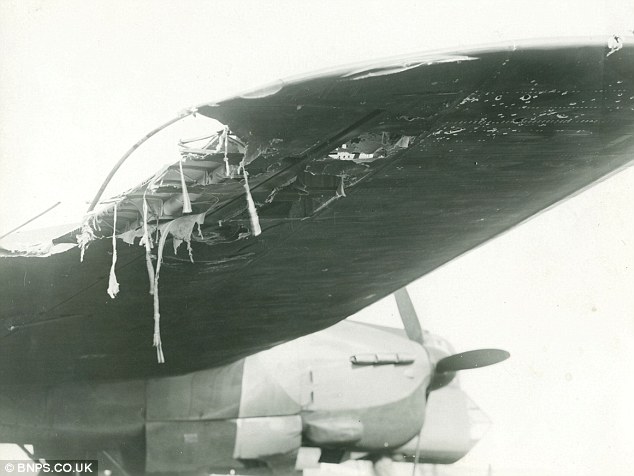
The damaged wing of Staton’s Whitley Bomber. Despite the damage Staton carried out the raid on Bremen, nursing the aircraft back to England. His medal collection sold for £52,000 in 2013 (BNPS.CO.UK)

Due to delays installing the telephone system combined with an illness suffered by Wing Commander Staton, the transition to Leeming was slow, with operations continuing from both Leeming and Dishforth well into July. By the end of the month though, 10 Sqn had finally moved across allowing missions to continue in an almost seamless fashion.

The autumn of 1940 would become a hectic time at Leeming. Transition stops saw the arrival and departure of several 4 Group bomber units. On August 15th, an incursion on RAF Driffield left five 102 Sqn Whitleys destroyed and a number of 77 Sqn aircraft damaged. The airfield’s operational capability then being dramatically until repairs could be carried out. As a result, 102 Sqn transferred across here to Leeming at the end of August, staying here for one week before being temporarily detached to 15 Group and Coastal Command. 77 Sqn would also depart Driffield transferring for a short period to Linton-On-Ouse another of 4 Group’s Yorkshire airfields.

Whilst Driffield was being visited by the Luftwaffe, another RAF unit, 7 Squadron, was being resurrected for the third time of the war. 7 Squadron’s creation here at Leeming would herald a new era in Bomber Command, and a rather historical moment in aviation.

With this reformation would come the first ‘operational’ and soon to be ill-fated Short Stirling MK.I.

As Stirling N3640 flew into Leeming, it was greeted warmly and openly by the ground crews who had gathered to welcome it in. They all waited expectantly outside the hangars that they had repeatedly cleaned in order to keep themselves busy. August 2nd would not only mark a new period in the war, but it would also be the beginning of what would become a difficult time for those crews in Bomber Command.

The grace, beauty and sheer size of the Stirling brought a cheer, and instantly raised morale within the ranks of the RAF. It was their first long range, four-engined heavy bomber, and so at last, the war could now seriously be taken directly to the enemy’s front door.

The logistics of the change though would give rise to many problems, the Whitley, the Stirling’s predecessor, was a Merlin in-line powered aircraft, whilst the Stirling had a Bristol Hercules – a radial engine. Spares and tools were lacking and in addition, no one in 7 Sqn. had any experience of four-engined aircraft. To combat the problem, new crews were draughted in, mostly from Coastal Command, who had already been operating Short’s successful flying boat, the Sunderland. Closely linked, the transference of skills from one to the other came relatively quickly, and it needed to.

Despite the now known history of the Stirling’s on-going problems: its mechanics, the undercarriage, tail wheel, engine difficulties and its performance in general, the Stirling was liked by many, a good handling aircraft its manoeuvrability was better than others in its class. In battle it was also able to take a lot of punishment before finally giving up, a factor that no doubt saved a good number of crews. The Stirling, after many struggles within Bomber Command,  would eventually find its niche either laying mines or as a transport / glider tug in the numerous airborne operations over Europe.

But at Leeming however, it wasn’t to be. The aircraft’s arrival was slow, the initial eight promised with the arrival of the new Sqn. Commander, Wg. Cdr. Paul.I Harris D.FC., being held up after Luftwaffe attacks on the Short’s factories in both Belfast and at Rochester. By the end of the month only two more aircraft had arrived, N3641 and N3642.

Stirling, N3641 ‘MG-D’, the second Stirling to be delivered to 7 Squadron at Leeming. It took part in their first raid over Rotterdam on the night of 10-11 February 1941© IWM (CH 3139)

On September 5th another communication came through confirming the allotting of yet another eight aircraft so that 7 Sqn. could form a second flight – the note must have raised a few eyebrows across the station, as there wasn’t enough yet for one.

Being a new aircraft, 7 Sqn. crews had to perform a range of tasks on it, many of which they relished, completing over and over so they could get to know the aircraft and her delicate intricacies. One of these was loading the enormous bomb bay, and depending upon the load, it could be in one of twelve different configurations. Here the crews got to find the first of its many faults, the cables to haul the bombs up into the bays were too short, so it couldn’t, at this point, accept a full complement of bombs. What use was a bomber with only half a load?

Fuel consumption tests were next. On September 29th, F.O. T. P.  Bradley D.F.C., took off on a cross-country flight in N3640, the first Stirling to arrive at Leeming. During the flight the aircraft developed engine problems forcing it to crash at Hodge Branding in Lancashire (this location may be an error in the ORB). In the crash the aircraft struck a wall ‘writing it off’, luckily though the crew managed to avoid any serious injury.

Throughout October, 7 Squadron’s Operational Record Book*1 read badly, “Teething troubles seriously interfered with the programme of intensive flying“, hardly a glowing testament to a new aircraft. With that though, on 29th October, 7 Sqn. moved out from Leeming transferring across to Oakington in Cambridgeshire, where they continued to be dogged by serious issues. Comments such as “continual modifications interfering with squadron activities” and the training flights taking place in “the two or three aircraft more serviceable than the others” clearly showing the frustration of the squadron as they struggled to get to grips with the new aircraft.

Meanwhile Leeming’s resident Whitleys would be playing a large part in Bomber Command’s operations, flying many missions over Europe. On the night of October 15th 1940, three Whitleys of 10 Squadron were lost. The first, P4952, ran out of fuel trying to find and airfield in thick cloud. The pilot Sqn. Ldr. K. Ferguson gave the bail out order, and all crew members landed safely. The second Whitley T4143, on the same mission to the Stettin oil facility,  also ran out of fuel, and without radio contact the pilot also ordered the bail out. Unfortunately two of the crew were killed, one of whom, had only lost his brother a matter of weeks earlier in the same squadron. Sgt. Leslie Neville (age 26) and his brother Sgt. Brian Neville (age 19) had joined on the same day, and their service numbers were  only 4 digits apart. The third aircraft lost that night, Whitley P4993, struck a balloon cable whilst on its way to Le Harve. Sadly all five crewmen were lost that evening, their bodies being returned to their respective homes.

In the following month, November 1940, another short stay squadron appeared at Leeming in the form of 35 Squadron, the first unit to be equipped with that other new four-engined heavy, the Halifax MK.I. Designed initially to meet Specification P.13/36, it took its maiden flight on 25th October 1939 and would go on to form 40% of the RAF’s heavy bomber force.

After being disbanded at RAF Upwood early that year, 35 Squadron then reformed at Boscombe Down (7th November 1940) taking on their first Halifax, L9486, flown by F.O. M.T.G. Henry and his crew. On the 20th, the squadron moved across here to Leeming, to come under the control of 4 Group taking on the prototype Halifax L7244 from the Ministry of Aircraft Production (M.A.P)  for ‘dual’ purposes. The aircraft was ferried in by Wg. Cdr. R.W.P. Collings AFC, the squadron’s first Commanding Officer along with his crew. On December 5th, 35 Squadron would then transfer to Linton-On-Ouse where it would, within a matter of days, lose its first Halifax (L9487) in a tragic accident with the loss of all on board. The aircraft, which is thought to have crashed because a fuel cap had been left off, had only had 4 hours of flying time before crashing at Howefield House, near Baldersby St. James in Yorkshire*2. Whilst at Linton-On-Ouse, 35 Sqn. would receive many new pilots, one of whom, P.O. Geoffrey L. Cheshire DSO.,  would go on to achieve amongst others, the DFC and the Victoria Cross, the highest award for gallantry in the face of the enemy. He would also go onto lead 617 Sqn. and not only be the youngest group captain in the RAF, but one of the most highly decorated pilots of the entire war.

After all these arrivals and subsequent departures, Leeming was then left with just its original 10 Squadron, which meant that the winter – summer period 1940/41 was relatively quiet in terms of operational movements in or out of Leeming. 10 Sqn. performing their role as best they could with their Whitleys.

December 22nd 1940, brought the last Leeming fatalities for the year. On take-off for a training flight,  10 Sqn. Whitley P4994 ‘ZA-U’ struck the roof of a farm house located beyond the end of the runway. In the resultant crash, one crewman was killed – Canadian P.O. Ross Flewelling. Two further crewmen were injured whilst the forth escaped unharmed.

Two Armstrong Whitworth Whitley Mark Vs of No. 10 Squadron based at Leeming, Yorkshire in flight © IWM (CH 4451)

The introduction of the new heavy bombers was not smooth. A third, the Manchester from Avro, merely compounded the issues already being faced by bomber and ground crews. Faced with unreliable mechanics and poor handling characteristics, regular flying was now being further reduced by continual poor weather, making maintenance, flying practise and life generally miserable on the ground as well as in the air. 10 Sqn. would be subjected to gales, severe icing and heavy rain, airfields across Britain were fast becoming churned up and boggy.

It would not be long into 1941 before casualties would be incurred. 10 Sqn, who were now beginning their own transition to Halifaxes, were still operating  Whitleys, and on the night of 16th – 17th January, they sent them to the port at Wilhelmshaven on Germany’s North Sea coast. With eight aircraft taking off around 18:30, they would briefed at Linton-On-Ouse where the night’s operations were being commanded from. At 21:15 hrs Whitley T4220 piloted by F.O. H Skryme would report in that the mission had been successful and that they were on their way home. It would be the last time the crew were heard from, and the aircraft along with its occupants were recorded as missing at 04:30 hrs. The crew of T4220 were never heard from again, their aircraft, nor they, were ever found.

The implementation of a new directive saw Bomber Command’s focus change to oil production facilities. Some seventeen sites were earmarked for attacks, over 80% of Germany’s production was going to soon be on the receiving end of Bomber Command. Implementation of a second, and parallel directive that focused on maritime operations, would then follow leading to attacks on docks, ports and shipping facilities particularly those located along the French coast.

By September 1941, things would change again at Leeming.  77 Squadron – another Whitley Squadron – would arrive, staying here until the early summer of 1942. With a history dating back to the First World War it was later resurrected by the renumbering of ‘B’ Flight of 102 Sqn in 1937. One of 77 Sqn’s Commanding Officers whilst at Leeming would be Wing Commander Don Bennett, the later Commander of 8 Group and the Pathfinders.

Like many units, 77 Squadron’s transition between its former base, RAF Topcliffe and its new base RAF Leeming, occurred whilst operational sorties remained in progress. On the very day the transfer began (September 2nd), aircraft were ordered to a raid on Frankfurt. On return from this operation, many of the squadron’s aircraft landed directly at Leeming rather than returning to their former base RAF Topcliffe.

On their next sortie, their first official Leeming mission, 77 Sqn. would lose three aircraft, Whitleys: Z6654 flown by P. Off. Havelock, (classed as missing); Z6668 flown by Sgt. D. Mercer (loss of all onboard) and Z6824 flown by Sqn.Ldr. A. Hanningan, with the loss of all but one. It had proven to be a bad start for the squadron at Leeming.

The next ten days were consistently poor weather with rain and mist preventing operational flying for the squadron. Indeed the remainder of October followed a similar pattern, rain or mist interspersed with operations. During these flights, which took the squadron to Wilhelmshaven, Le Harve, Kiel, Hamburg and Cherbourg, casualties were light allowing the squadron to settle into their new home.

Leemings’s long standing squadron 10 Sqn, began replacing their Whitleys with Halifaxes in December 1941. It was at his point that the squadron would be split; a detachment moving to RAF Lossiemouth in Scotland, in a move that would mark the beginning of change for this long standing resident of Leeming.

The beginning of 1942 saw air operations focus on the German Cruisers located at the French port at Brest. With successive operations attempting to sink, or at least cripple the ships, it became a thorn in the side of not only Bomber Command, but the Government as well, who as a result of these failed operations were to suffer a great humiliation. The culmination of these attacks saw many Bomber Command squadron losses along with six Swordfish crews of 825 Naval Air Squadron take part in ‘Operation Fuller’, a disaster that saw the loss of so many lives.

With the appointment of Harris as Command in Chief of Bomber Command, little immediately changed. Operations carried on as usual and at Leeming 77 Sqn visited St. Nazaire from which two aircraft were lost on their return trip. With a further 10 Sqn Halifax also being lost that night, it was a bit of a blow for the station.

The further loss of three more 77 Sqn aircraft at the end of February,  and four more in March – Z9293 ‘KN-D’; Z9312 ‘KN-S’; Z6975 ‘KN-V’ and Z9221 ‘KN-G’ – meant that the squadron was taking a bit of a battering and that the Whitley was perhaps beginning to show its outdated status. Indeed, April followed with several ‘softer’ targets being attacked without loss. Then on May 6th – 7th, the squadron began its departure from Leeming to Chivenor and a spell of Maritime Duties with Coastal Command. 77 Sqn would later return to Bomber Command but their spell at Leeming was now over, and this chapter of their life was closed.

The summer of 1942 would see big further changes at Leeming. In May, the departure of 77 Sqn. on the 6th along with the move of another section of 10 Sqn. to Aqir south of Tel Aviv, meant that numbers were once again low. The final departure of all remaining 10 Squadron personnel in the August 1942, meant that Leeming was now all but empty, and it would be passed over to the control of the Canadians and 6 Group Bomber Command. The new Command would then retain control of the airfield operating a small number of Canadian Squadrons right the way through to the war’s end.

With that, new times lay ahead. The four engined heavies were beginning to make their mark, the lighter of the bombers were starting to be withdrawn from front line service, and the focus on shipyards was now about to shift. The Canadians were about to arrive at Leeming.

Australian Flt. Sgt. Rawdon H. Middleton VC (RAAF) 149 Sqn RAF

100641

Pilot Officer Rawdon Middleton (RAAF)*1

Middleton (s/n: 402745) was born on 22nd July 1916 in Waverley, New South Wales, Australia. Son of Francis and Faith Middleton, he was educated at Dubbo Hugh School. Nicknamed ‘Ron’ by his friends, he was a keen sportsman excelling at many sports particularly cricket and football. After leaving school, he worked as a ‘Jackaroo’ (cattle handler) until joining the Royal Australian Air Force on the 14th October 1940 under the Empire Air Training Scheme. He learnt to fly at Narromine, New South Wales and then was sent to Canada for further training in preparation for his posting to the UK. He finally arrived in Britain in September 1941, as a second pilot, and his first operational squadron was No. 149 Squadron RAF, who were flying Short Stirling bombers out of both Lakenheath and nearby Mildenhall in Suffolk.

P01019.003

Five student pilots from No. 7 Empire Air Training Scheme (EATS) course at No. 5 Elementary Flying Training School (5 EFTS) Narromine. They are left to right: Aircraftman (AC) Gordon Orchard; AC Douglas Scott; Leonard Reid; Pilot Officer (PO) Douglas Wilberforce Spooner (DFM); PO Rawdon Hume Middleton*2

Middleton’s first experience of operations, was in a Short Stirling over the Rhur, the industrial heartland of Nazi Germany. After spending a short time with 149 squadron he moved temporarily to No. 7 Squadron (RAF).

In July 1942, as first pilot, he was given his own aircraft and crew, it was also around this time that he returned to 149 squadron.

Their first mission together would be on July 31st, to bomb the strategic and heavily defended target, Düsseldorf. Middleton and his crew would continue to fly together and took part in other prestigious missions; namely Genoa on the 7th of November and his 28th mission, Turin on the 20th November. His 29th and final mission, would take place on the night of 28/29th November 1942.

In the early evening of the 28th he took off in Stirling BF372 coded ‘OJ-H’ as part of the raid on the Fiat works in Torino, Italy, along with 227 other aircraft which included – 117 Avro Lancasters, 46 Short Stirlings, 45 Handley Page Halifaxes, and 19 Vickers Wellingtons.

Middleton’s crew consisted of: Ft.Sgt. Leslie Anderson Hyder, Ft. Eng: Sgt. James Ernest Jeffrey, Bomb Aimer F.O. G. R. Royde, Wireless Operator: Sgt. John William Mackie; Gunners: P.O. N. E. Skinner, Sgt. D. Cameron and Sgt. H. W. Gough. Three of these had already completed their tour of 30 operations and could have left. However, their dedication to Middleton kept them together.

The mission would take the aircraft over the Alps and the Stirling, laden with bombs and fuel combined with having a notoriously poor ceiling, had to negotiate through the mountains rather than fly over them. A factor that often resulted in a high number of casualties.

Once over the target area, OJ-H was subjected to an extreme flak barrage. With poor visibility, Middleton had to make three passes over the target area to enable his crew to positively identify it. It was on the third pass that a shell burst hit the cockpit. The resulting damage was severe, and fragments had hit Middleton’s head badly injuring him. His right eye was lost and his skull exposed. There were further hits on the aircraft’s fuselage causing considerable damage to the control systems and airframe. Knocked unconscious by the blast, Middleton lost control and the aircraft plummeted through the skies to an altitude of around 800ft. The second pilot, Fl.Sgt. Hyder eventually managed to take the controls, release the bombs over the target and then pull the aircraft into a climb, safely reaching 1,500ft.

With his aircraft severely damaged, Middleton had a choice, get his crew to bail out over occupied France and certain capture, fly to Africa or head back to England; a journey that would last over 4 hours and put the aircraft at risk of attack and the crew in danger. Wanting to give them a fighting chance of getting home, he opted for the latter, and set a course for England.

SUK10501

Middleton was buried with full military honours at St. Johns Church, Beck Row. Suffolk.*3

The aircraft experienced a number of attacks as they crossed occupied France, but Middleton, fighting for survival, kept reassuring the crew that he would get them home. Eventually, and against all the odds, they made the English coast, and once over land Middleton ordered the crew to bail out. Five crewmen left the stricken aircraft whilst the other two remained to help him control it. Turning for the Channel, Middleton ordered the two remaining crew members to bail out, whilst he stayed at the controls, steadying the aircraft.

By now the Stirling was very low on fuel and it finally gave up the fight and crashed at 03:00 on the morning of November 29th 1942. Middleton, too injured and too weak to escape the wreckage, drowned within the aircraft fuselage. His two crew members, Sgt. James Ernest Jeffrey (576050) age 19 and Wireless Operator Sgt. John William Mackie (994362) age 30, despite escaping, also drowned. Both the bodies of Sgt Mackie and Sgt. Jeffrey were washed ashore later that day on the 29th.

Middleton’s body remained in the aircraft, but was eventually freed from the wreckage by the action of the sea, and was washed ashore on Shakespeare Beach, Dover, in February 1943. His remains were taken to RAF Lakenheath and he was buried in St John’s churchyard, Beck Row, within sight of his airfield in Suffolk, with full military honours. Middleton was only 26 and only one mission away from ending his tour and returning home.

For his action, dedication and bravery, Flt. Sgt. Middleton was posthumously awarded the Victoria Cross, the first to any serving member of the R.A.A.F in World War II. He was also posthumously awarded a commission as Pilot Officer, backdated to mid November before his sortie to Turin. Thirty years later, in 1978, Middleton’s V.C. was presented to the Australian War Memorial, in Canberra for safe keeping and preservation.

For their actions, the other crew members received three DFMs and two DFCs. Fl.Sgt. Leslie Hyder (DFM) was injured, P.Officer. N. Skinner (DFC) was also injured, along with Sgt. H. W. Gough (DFM). F.O. G. R. Royde (DFC) and Sgt. D. Cameron (DFM) escaped unhurt.

The London Gazette published a report on 12th January 1943. It said:

“Fl. Sgt. Middleton was captain and first pilot of a Stirling aircraft detailed to attack the Fiat Works in Turin one night in November, 1942. Very difficult flying conditions, necessitating three low altitude flights to identify the target, led to excessive petrol consumption, leaving barely sufficient fuel for the return journey. Before the bombs could be released the aircraft was damaged by anti-aircraft fire and a splinter from a shell which burst in the cockpit wounded both the pilots and the wireless officer. Fl. Sgt. Middleton’s right eye was destroyed and the bone above it exposed. He became unconscious and the aircraft dived to 800 ft. before control was regained by the second pilot, who took the aircraft up to 1,500 ft. releasing the bombs, the aircraft meanwhile being hit many times by light flack. On recovering consciousness Fl. Sgt. Middleton again took the controls and expressed his intention of trying to make the English coast, so that his crew could leave the aircraft by parachute. After four hours the badly damaged aircraft reached the French coast and there was once more engaged and hit by anti-aircraft fire. After crossing the Channel Fl. Sgt. Middleton ordered the crew to abandon the aircraft. Five left safely, but the front gunner and the flight engineer remained to assist the pilot, and perished with him when the aircraft crashed into the sea”.

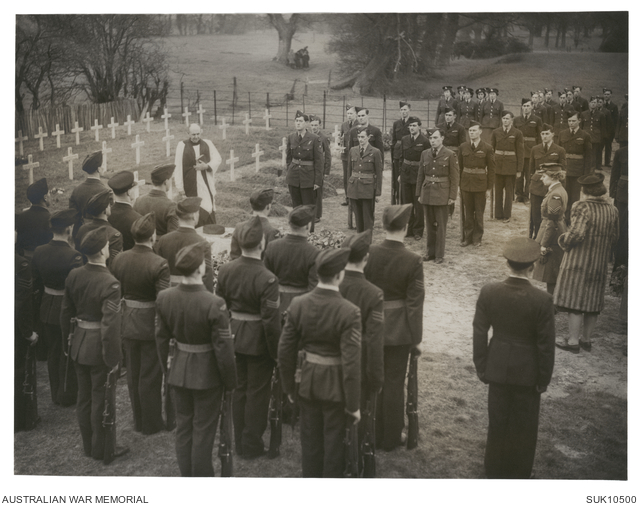
Funeral service for 402745 Flight Sergeant Rawdon Hume Middleton, the RAAF’s first VC winner. He was buried with full military honours in a country churchyard near his station. Air Vice Marshal H. N. Wrigley represented the High Commissioner for Australia (Mr S. M. Bruce) and the RAAF. The graveside service was conducted by Squadron Leader H. C. Thrush of Prospect, SA, RAAF Chaplain. (Australian War Memorial Public Domain)

Middleton’s citation read:

“Flight Sergeant Middleton was determined to attack the target regardless of the consequences and not to allow his crew to fall into enemy hands. While all the crew displayed heroism of a high order, the urge to do so came from Flight Sergeant Middleton, whose fortitude and strength of will made possible the completion of the mission. His devotion to duty in the face of overwhelming odds is unsurpassed in the annals of the Royal Air Force”.

In honour of Middleton’s bravery, Number 1 RAAF Recruit Training Unit at RAAF Base Wagga has renamed the club in his name, the “Middleton VC Club”, and he also appeared on one of the 1995 Australian 45c stamps. The dining hall located at the nearby (now American) base at RAF Mildenhall in Suffolk, has also been named in his honour.

St. John's Church Beck Row, Mildenhall

Fl. Sgt. Rawdon Hume Middleton, VC (RAAF) 149 Sqn RAF, St. John’s Church, Beck Row, Suffolk.

Middleton was a brave and dedicated young man who gave his life to save those of his crew. Each and every one of them acted with the highest dedication, sadly for some, it cost them dearly.

Sources

*1 photo courtesy of Australian War Memorial, image 100641, Public domain.

*2 photo courtesy of Australian War Memorial, image P01019.003, Public domain.

*3 Photo courtesy of Australian War Memorial, Image SUK10501, Public domain

*4 Photo courtesy of Australian War Memorial, Image SUK10500, Public domain

Heroic tales – Aviation Trails.

Sgt. James Ward VC.- 75 (NZ) Sqn RAF Feltwell.

We have seen through the many ‘Heroic tales‘, acts of daring and valour that have astounded the average man in the street. Acts of heroism that were completed without forethought or consideration for personal safety, where the lives of fellow crewmen and their aircraft were put far beyond that of their own.

Some of these included flying an aircraft with astonishing injuries, staying with an aircraft until such times as all the crew have either left – or because they have been unable to leave – remaining at the controls to attempt a landing without help or hydraulics. There have even been cases of airmen exiting the aircraft to extinguish external fires whilst both at altitude and at speed. Indeed this is not a solitary occurrence; a number of airmen have been known to have performed such acts, some successfully others less so. But the fact that an airmen is willing to perform such an act of bravery, is in itself, incredible.

One such action occurred in July 1941 and was performed by 2nd Pilot Sgt. James Allen Ward (RNZAF) of 75 (NZ) Sqn, RAF Feltwell.

Sgt. James Allan Ward, 75 (NZ) Squadron RAF, standing in the cockpit of his Vickers Wellington Mark IC, L7818 ‘AA-V’, at Feltwell, Norfolk. (© IWM (CH 2963)

Sgt. Ward, the Son of Mr. Percy Harold Ward and Mrs. Ada May Ward, of Wanganui, Wellington, New Zealand was born on 14th June 1919, and was, following his training, posted to 75 (NZ) Sqn then at RAF Feltwell in Norfolk. The squadron were operating the new Vickers Wellington MK.Ic, or ‘Wimpey‘ as it was affectionately known, on a bombing mission to Munster in Germany.

Take off was at 23.10 on the night of July 7th 1941. On board (aircraft CNF.994/L7818) that night were: Canadian S/L. R. Widdowson (Pilot); Sgts. J. Ward (2nd Pilot); L.A. Lawton (Navigator); Mason (Wireless Op); Evans (Front Gunner) and A. Box (Rear Gunner), as part of a force of ten Wimpeys from Feltwell along with thirty-nine others from nearby bases.

The flight out was uneventful, with no interactions with either flak nor Luftwaffe night fighters. Over the target, bombs were released and several fires were seen to light, although German reports stated that little damage was done and no casualties were incurred.

The return leg took the formation over the Zuider Zee at which point the Wellington was strafed by canon fire from an Me 110 flying beneath it. As shells ripped though the fuselage, the rear gunner was injured in the foot but managed to return fire sending the attacker plummeting to Earth with heavy smoke pouring from the port engine.

Shortly after this, the Wellington’s wing, housing a fuel line damaged in the attack, itself caught fire and with the aircraft having a fabric covering, it was only a matter of time before it would also fall to Earth in a massive fireball.

With S/L Widdowson struggling to control the aircraft, which had had half its rudder shot away, its elevators severely damaged, hydraulics ruptured, flaps inoperable and bomb doors opened and damaged; a decision had to be made as to what to do next.

A bale out appeared to be the only safe and viable option. S/L. Widdowson gave the order and the crew began preparations to depart the stricken aircraft. Almost as a last minute attempt to save it, Widdowson instructed the crew to try and extinguish the fire, and they began ripping away the fabric covering the geodesic framework. Ward, grabbing a fire extinguisher, shot jets of agent through the hole toward the fire. At altitude and speed, the air stream was far too strong and the attempt had little effect on the burning engine.

At this point, and without attention to his own safety, Sgt. Ward decided to climb out and try to smother the fire with a canvas engine cover that had been used to raise S/L. Widdowson’s seat. Much to the dismay and protests of the other crewmen, Ward grabbed a parachute and attached a rope to himself and the Navigator, and began to climb out through the astrodome located between the wings in the fuselage’s ceiling. By punching holes in the aircraft’s fabric, he was able retain a foot and hand hold on to the aircraft, manoeuvring himself tight against the air frame toward the burning wing.

Once out onto the starboard wing, he approached the fire and pushed the canvas into the hole left by the flames. The fire burning furiously by now, was intense, and caused Sgt. Ward great pain forcing him to withdraw his hand several times before the slipstream finally caught the canvas tearing it from the hole and out into the dark night sky.

Being partially successful, there was little left for Sgt. Ward to do, so he began the arduous journey back toward the aircraft’s fuselage and its relative safety. By smothering the fire as he did, Ward’s attempts had made a difference, and shortly afterwards the fire extinguished itself enabling both the aircraft and crew to return to England safely making an emergency landing at RAF Newmarket Heath.

The Wellington with ‘hand-tholes’ after Sgt Ward tried to extinguish the fire.  (A) The hole caused by shell and, afterwards, by fire; (B) The Astro-Hatch through which Sergeant Ward, VC climbed; (1, 2 and 3) Holes kicked in the fabric by Sergeant Ward.(IWM CH3223)

Landing at 04:30, the Wellington came to a stop only after striking a fence on the airfield boundary, its brakes being totally unusable.

For his action, Sgt. James (Jimmy) Ward was awarded the Victoria Cross, the highest honour for bravery and extraordinary courage; he was the first New Zealander to win such an award during the Second World War. S/L. Widdowson for his actions, was awarded an immediate D.F.C. whilst Sgt. Box, the D.F.M.

At the time of the incident Sgt. Ward was only 22 years of age, he would be given his own crew and would go on to complete ten missions in total before, on the eleventh, being shot down and killed in another Wellington of 75 (NZ) Sqn over Hamburg on September 15th 1941.

Sgt Ward’s death brought a severe blow to the crews of 75 (NZ) Sqn, who perhaps thinking him invincible, went on to perform with great pride and determination in the face of great adversity. With over 8,000 sorties flown, the highest of any squadron in 3 Group, came a high cost, 193 aircraft being lost, the second highest of any Bomber Command Squadron of the Second World War.

Sgt Ward’s body was recovered from the crash that killed him, and along with his three comrades was laid to rest in the Ohlsdorf Cemetery in Hamburg, CWCG Plot 5A. A1. 9.

The report of Sgt. Ward’s VC. (Auckland Library Heritage Collection : 13 August 1941 : Item ref # AWNS 19410813-23-1)

Sgt. Ward’s citation appeared in the London Gazette “No. 35238” on 5 August 1941 p. 4515 and reads:

“On the night of 7th July, 1941, Sergeant Ward was second pilot of a Wellington returning from an attack on Munster.

When flying over the Zuider Zee at 13,000 feet, the aircraft was attacked from beneath by a Messerschmitt which secured hits with cannon shell and incendiary bullets. The rear gunner was wounded in the foot but delivered a burst of fire which sent the enemy fighter down, apparently out of control.

Fire then broke out near the starboard engine and, fed by petrol from a split pipe, quickly gained an alarming hold and threatened to spread to the entire wing. The crew forced a hole in the fuselage and made strenuous efforts to reduce the fire with extinguishers, and even the coffee in their vacuum flasks, but without success. They were then warned to be ready to abandon the aircraft.

As a last resort, Sergeant Ward volunteered to make an attempt to smother the fire with an engine cover which happened to be in use as a cushion. At first he proposed to discard his parachute, to reduce wind resistance, but was finally persuaded to take it. A rope from the dingy was tied to him, though this was of little help and might have become a danger had he been blown off the aircraft. With the help of the navigator, he then climbed through the narrow astro-hatch and put on his parachute. The bomber was flying at a reduced speed but the wind pressure must have been sufficient to render the operation one of extreme difficulty.

Breaking the fabric to make hand and foot holds where necessary, and also taking advantage of existing holes in the fabric, Sergeant Ward succeeded in descending three feet to the wing and proceeding another three feet to a position behind the engine, despite the slipstream from the airscrew which nearly blew him off the wing. Lying in this precarious position, he smothered the fire in the wing fabric and tried to push the cover into the hole in the wing and on to the leaking pipe from which the fire came. As soon as he removed his hand, however, the terrific wind blew the cover out and when he tried again it was lost. Tired as he was, he was able with the navigator’s assistance, to make successfully the perilous journey back into the aircraft.

There was now no danger of fire spreading from the petrol pipe, as there was no fabric left nearby, and in due course it burnt itself out. When the aircraft was nearly home some petrol which had collected in the wing blazed up furiously but died down quite suddenly. A safe landing was then made despite the damage sustained by the aircraft.

The flight home had been made possible by the gallant action of Sergeant Ward in extinguishing the fire on the wing in circumstances of the greatest difficulty and at the risk of his life.”

Sources.

National Archives – AIR 27/645/34, AIR 27/645/33

Auckland War Memorial Museum Website.

January 1st 1945 – Loss of Mosquito PZ340

On the afternoon of January 1st 1945, Mosquito FB.VI #PZ340, ‘HB-Z’ took off from RAF West Raynham, according to the Operational Record Book it was assigned to a “high level bomber support” sortie over Heligoland, unusual as these Mosquitoes were not pressurised models. The pilot, F/O Ian George Walker (s/n: 156104) and navigator/wireless operator F/O. Joseph Ridley Watkins (s/n: 152875), had only just been brought together, F/O Watkins, from Wanstead in Essex, normally being based with 141 Squadron, but on attachment to 239 Squadron, when the flight took place.

On return, from the mission, the aircraft crashed near to Narford Hall, an Eighteenth Century stately home located a short distance to the north-east of RAF Marham in Norfolk. Whilst not confirmed, it is thought the crash was caused by an instrument failure, a crash that resulted in both airmen being killed.

Following the accident, F/O. Walker was returned to his home town and was buried in St. Michael’s Cemetery in Dumfries. F/O Watkins however, was buried locally, in nearby St. Andrew’s Church, Little Massingham not far from RAF Great Massingham. Both airmen were only 21 years of age.

The Mosquito, a Hatfield manufactured aircraft, was produced under contract 555/C.23(a), and was an aircraft designed for ‘intruder’ strike missions, it was the most commonly used variant of all Mosquitoes.  239 Squadron was in the process of replacing these examples with the MK. XXX before its disbandment on July 1st 1945.

Little Massingham St. Andrew's Church

F/O Watkins died on January 1st 1945 after the Mosquito he was in crashed near to RAF Marham, Norfolk. He rests in St. Andrew’s Church yard, Little Massingham.


A Happy Christmas!

I would just like to take this opportunity to wish all those of you who have followed, read or commented on the blog, a very merry Christmas and a very happy and safe New Year.

A extra big thanks goes out to those of you who have stuck around for so long, we’re now approaching our seventh year of the blog and have managed to visit over 125 airfields, 105 memorials and 40 museums. These have stretched from Perth in Scotland to the South coast of England, Suffolk in the east to Gloucestershire in the west. The range of these airfields is enormous, and they continue to vanish, with many in a worse state now than they were when I visited at the beginning of the journey.

Very soon many of these will be gone, lets hope the memories of those who served are not also gone with them.

A very happy Christmas one and all!

RAF Andrews Field – (Great Saling/Station 485) – Trail 33: Essex Part 1.

RAF Attlebridge  (Station 120) – Trail 7: Northwest Norfolk.

RAF Barkston Heath (Station 483) – Trail 2: Lincoln Borders and Newark

RAF Barton BendishTrail 7: Northwest Norfolk.

RAF Biggin Hill (Westersham) (Station 343) – Trail 4: Kent Part 1.

RAF Bircham NewtonTrail 20: North Norfolk (Part 1).

RAF Bodney (Station 141) – Trail 8: Swaffham and Her Neighbours (Part 1 of 3).

RAF Bottesford (Station 481) – Trail 52: Leicestershire’ Borders.

RAF Bottisham (Station 374) – Trail 55: Around Newmarket

RAF Boulmer – Trail 47: Northumberland.

RAF BournTrail 31: Southern Cambridgeshire (Part 2).

RAF Brenzett (ALG) – Trail 18: Kent Part 2.

RAF BruntonTrail 47: Northumberland.

RAF Bungay (Flixton) (Station 125) – Trail 14:  Central Suffolk (Part 1).

RAF Bury St. Edmunds (Rougham) (Station 468) – Trail 16: West Suffolk (part 1).

RAF Castle CampsTrail 45: Essex (Part 2).

RAF Caxton GibbetTrail 29: Southern Cambridge (Part 1).

RAF Charterhall Trail 41: The Borders of Scotland and England.

RAF ChedburghTrail 49: Bomber Command – Bury St. Edmunds to Haverhill

RAF Collyweston Trail 37: The Northern Reaches of Cambridgeshire.

RAF Coltishall – Trail 7: Northwest Norfolk.

RAF ConingsbyTrail 1: Lower Lincolnshire.

RAF CottamTrail 40: Yorkshire (East Riding).

RNAS CrailTrail 53: Scotland’s East Coast – Fife

RAF CranwellTrail 2: Lincoln Borders and Newark.

RAF Debach (Station 152) – Trail 39: Suffolk around Ipswich (Part 1).

RAF Debden (Station 356) – Trail 46: Essex Part 3.

RAF Deenethorpe (Station 128) – Trail 6: American Ghosts.

RAF Deopham Green (Station 142) – Trail 27: Southern Norfolk (Part 3).

RAF Digby (Scopwick) – Trail 1: Lower Lincolnshire.

RAF Docking – Trail 20: North Norfolk (Part 1).

RAF Downham Market (Bexwell) – Trail 7: Northwest Norfolk.

RAF Drem – Trail 42: Edinburgh’s Neighbours.

RAF Dunino –  Trail 53: Scotland’s East Coast – Fife.

RAF East Fortune – Trail 42: Edinburgh’s Neighbours.

RAF East Kirkby Trail 1: Lower Lincolnshire.

RAF East Wretham (Station 133) – Trail 13: Southern Norfolk around Diss (Part 2).

RAF Eye (Brome) (Station 134) – Trail 14: Central Suffolk (Part 1).

RAF Fersfield – (Station 130) – Trail 28: Southern Norfolk (Part 4).

RAF FoulshamTrail 22North Norfolk (Part 3).

RAF FowlmereTrail 32Southern Cambridgeshire (Part 3).

RAF Framlingham (Parham) (Station 153)Trail 39: Suffolk around Ipswich (Part 1).

RAF GamstonTrail 54: The Great North Road.

RAF Glatton (Station 130) – Trail 6: American Ghosts.

RAF Gransden Lodge – Trail 31: Southern Cambridgeshire (Part 2).

RAF Graveley – Trail 29: Southern Cambridge (Part 1).

RAF Grafton Underwood (Station 106) – Trail 6: American Ghosts.

RAF Great Dunmow (Station 164)- Trail 33: Essex (Part 1).

RAF Great MassinghamTrail 21: North Norfolk (Part 2).

RAF Great Sampford (Station 359) – Trail 50: Haverhill’s neighbours – Wratting Common and Great Sampford.

RAF Hardwick (Station 104) – Trail 12: Southern Norfolk around Diss (Part 1).

RAF Hawkinge – Trail 18: Kent Part 2.

RAF Hethel – Trail 38: To the West of Norwich.

RFC HinghamTrail 38: To the West of Norwich.

RAF Holme on Spalding Moor Trail 40: Yorkshire (East Riding).

RAF Hunsdon – Trail 25: Hertfordshire.

RAF Kimbolton (Station 117) – Trail 6: American Ghosts.

RAF King’s Cliffe (Station 367) – Trail 6: American Ghosts.

RAF LanghamTrail 23: North Norfolk (Part 4).

RAF Lashenden (Headcorn) – Trail 18: Kent Part 2.

RAF Lavenham (Station 137) – Trail coming soon.

RAF Leuchars – Trail 53: Scotland’s East Coast – Fife.

RAF Little SnoringTrail 22North Norfolk (Part 3).

RAF Little Walden – – Trail 46: Essex Part 3.

RAF Macmerry Trail 51: Southern Scotland

RAF MarhamTrail 7: Northwest Norfolk.

RAF Martlesham HeathTrail 48: Suffolk around Ipswich (Part 2).

RAF Matching (Station 166) – Trail 33: Essex Part 1.

RAF Matlaske (Station 178) – Trail 34: North Norfolk (Part 5).

RAF MattishallTrail 36: North Norfolk (Part 6).

RAF Mendlesham (Station 156) – Trail 15: Central Suffolk (Part 2).

RAF MepalTrail 11: Around Ely.

RAF MetheringhamTrail 1: Lower Lincolnshire.

RAF Methwold – Trail 8: Swaffham and Her Neighbours (Part 1).

RAF Milfield –  Trail 47: Northumberland.

RAF Narborough (Narborough Aerodrome)- Trail 7: Northwest Norfolk.

RAF Newmarket Heath – Trail 55: Around Newmarket

RAF North CreakeTrail 23: North Norfolk (Part 4).

RAF North Pickenham (Station 143) – Trail 9: Swaffham and Her Neighbours (Part 2).

RAF North WealdTrail 25: Hertfordshire.

RAF North Witham (Station 479) – Trail 3: Gone But Not Forgotten.

RAF Old Buckenham (Station 144) – Trail 13: Southern Norfolk around Diss (Part 2).

RAF Oulton – Trail 34: North Norfolk (Part 5).

RAF Polebrook (Station 110) – Trail 19: Northamptonshire American Ghosts II.

RAF Rattlesden (Station 126) – Trail 15: (Central Suffolk (Part 2).

RAF SawbridgeworthTrail 25: Hertfordshire.

RAF ScamptonTrail 30: Scampton and the Heritage Centre.

RAF SconeTrail 56: Perthshire.

RAF SculthorpeTrail 21: North Norfolk Part 2.

RAF Sedgeford – Trail 20: North Norfolk (Part 1).

RAF Shipdham (Station 115) – Trail 10: Swaffham and Her Neighbours (Part 3).

RAF Snailwell (Station 361) – Trail 55: Around Newmarket

RAF Snetterton Heath – (Station 138) – Trail 27: Southern Norfolk (Part 3).

RAF Spanhoe Lodge (Station 493) – Trail 6: American Ghosts.

RAF Steeple Morden – Trail 32: Southern Cambridgeshire (Part 3).

RAF Stoke OrchardTrail 24: Gloucestershire.

RAF Stradishall- Trail 49: Bomber Command – Bury St. Edmunds to Haverhill

RAF Sutton BridgeTrail 3: Gone But Not Forgotten.

RAF Swannington – Trail 36: North Norfolk (Part 6) 

RAF Swanton Morley – Trail 38: To the West of Norwich.

RAF Thorpe Abbotts (Station 139) – Trail 12: Southern Norfolk around Diss (Part 1).

RAF Tibenham (Station 124) – Trail 13: Southern Norfolk around Diss (Part 2).

RAF Tuddenham – Trail 16: West Suffolk (Part 1).

RAF Tydd St. Mary – Trail 37: The Northern Reaches of Cambridgeshire.

RAF Upwood – Trail 17: The Pathfinders.

RAF Warboys – Trail 17: The Pathfinders.

RAF WaterbeachTrail 11: Around Ely.

RAF Watton (Station 376/Station 505) – Trail 9: Swaffham & Her Neighbours (Part 2).

RAF Wendling (Station 118) – Trail 10: Swaffham and Her Neighbours (Part 3).

RAF West Malling Trail 4: Kent Part 1.

RAF West RaynhamTrail 21: North Norfolk Part 2.

RAF WethersfieldTrail 45: Essex (Part 2).

RAF Westley – Trail 16: West Suffolk (part 1).

RAF WinfieldTrail 41: The Borders of Scotland and England.

RAF Winthorpe Trail 2: Lincoln Borders and Newark.

RAF WitchfordTrail 11: Around Ely.

RAF Wittering  – Trail 37: The Northern Reaches of Cambridgeshire.

RAF Woodall SpaTrail 1: Lower Lincolnshire.

RAF Wratting CommonTrail 50 – Haverhill’s neighbours – Wratting Common and Great Sampford.

RNAS Dunino – in the shadow of St. Andrews.

Continuing on in Trail 53, Scotland’s east coast, we visit another Royal Naval Air Station, this one, a satellite of RNAS Crail, is not quite so well preserved.  However, with that said, a number of buildings do still exist, and whilst most are on private land, some are visible from the public road.

Sitting not far from Scotland’s east coast and a short distance from the parent airfield at Crail, we visit an airfield that had a short military life, but one that saw many squadrons use it. With these squadrons came a multitude of aircraft types, but one in particular stood out as the predominant type- the Fairy Swordfish, a biplane that became famous with the Royal Naval Air Service.

On this trip, we visit another of Scotland’s relics, this time the former Royal Naval Air Station at Dunino.

RNAS Dunino (HMS Jackdaw II, HMS Merlin III).

Dunino is a small hamlet in the north eastern region of Fife in Scotland. The area around here is littered with golf courses, the most famous being St. Andrews the home of international golf and perhaps the most famous golf course in the world. Played on by the world’s top golfers, it is known to be at least 600 years old, and probably even older with its origins going as far back as the 12th Century.

The Firth of Forth forms the main shoreline of St. Andrews and encompasses this whole region of Fife. A beautiful region, it has views out across the North Sea in a landscape broken by undulating hills, castles and quaint fishing villages.

The airfield of Dunino, sits about two miles east of the hamlet from which it takes its name, and about 3.5 miles west of its parent airfield at Crail. Dunino being so small, is often overlooked by visitors to the region, but its claim to fame is a sacred grove and a Holy Well which remain there to this day.

The airfield initially opened as a satellite for nearby RAF Leuchars, a neighbour of St. Andrew’s, after requisition of the land on which its sits in 1939. As a satellite of RAF Leuchars some 5 miles away, Dunino lacked all the comforts of home, wide open and exposed to the elements, it was not the best place to be posted to. In many ways Dunino was primitive, lacking proper accommodation and hard runways, it was perhaps one of the less comforting of the north’s operational bases. With little to occupy themselves, many ‘residents’ visited the ancient cities of Perth or Dundee, or strolled the streets of St. Andrews not far away.

The airfields itself was an irregular oval shape with a main runway running south-west to north-east, initially made of grass and later Sommerfeld tracking, a steel matting laid down on many of Britain’s temporary airfields and advanced landing grounds.

The other landing strips at Dunino remained grass, joined together by a concrete perimeter track intersected with hardstands and blister hangars. For a satellite, it had a large quantity of hangars, eight Super -blisters, four blister and another four hangars used for storage. A further aircraft repair shed (ARS) was used to maintain and repair aircraft on site.

Accommodation was located on three sites to the east of the airfield and could cater for 88 officers, 647 ratings, and 140 WRNS of mixed rank. Accommodation was not sufficient for all visitors to have a roof over their heads, some visiting units having to sleep in tents scattered around the airfield. Most naval airfields were built to similar designs as Royal Air Force designs, although they were not so tightly controlled, and variation within designs was more common.

Dunino’s watch office was initially the standard RAF watch office for Fighter Satellite Stations, a small single storey building it was later abandoned when the Royal Navy took over and built their own standard two story naval type to design 3860/42.

Not long after opening in 1940, the airfield passed from RAF control to Royal Navy control, who used it as  a satellite airfield for nearby RNAS Crail.

RNAS Dunino

The current Watch Office at Dunino is a two storey building designed by the RNAS.

On May 24th 1939, the Board of Admiralty took over control of the Fleet Air Arm from the Royal Air Force, a force that included all carrier based aircraft, some 230 examples across 20 squadrons. Squadron numbers were issued between 700 – 899, those in the range of 700 – 749 initially being catapult units, and 750-799 as training units – which were then changed to ‘Second Line’ or permanent training units. Those in the range of 800 – 809 and 870 – 899, were allocated to single seat fighter squadrons, including all carrier based and land based operational units. Those in between were allocated to torpedo units, spotter squadrons and other front line squadrons*1.

Operating primarily from ships, the Fleet Air Arm needed land bases to place their aircraft when ships were in for repairs or refurbishments, this allowed maintenance and training to continue, and even allowed for off-shore protection with torpedo aircraft carrying out patrols and attacks on enemy shipping where possible. As with all Royal Naval Air Stations, Dunino took a bird’s name and the designation of a floating vessel as its own name, being a satellite, Dunino took HMS Jackdaw II after Crail’s HMS Jackdaw. Such was the demand for airfields that the Fleet Air Arm took over five airfields initially, but then implemented their own building programme, a programme that saw the total number of air stations reach twenty-four (plus seven non-commissioned sites) by 1944 along with fifteen satellites more commonly known in Naval circles as “Tenders”.*1 It was this need to place aircraft and their crews that led to Dunino having such a high number of users, many being just short stays whilst their carriers were refurbished.

The first users of Dunino were two training squadrons, the first, 785 NAS was formed out of the Naval element of the Torpedo Training Unit at Abbotsinch. Primarily a Torpedo Bomber Reconnaissance (TBR) Training Squadron, they were based at Crail and flew the Swordfish and Blackburn Shark, a bi-plane very much out of date by the time war broke out. The Swordfish, the Shark’s replacement, was also a bi-plane, but one that went on to be successful under naval control in numerous operations including the Channel Dash in 1942. The Swordfish was such a good little aeroplane, it even outshone its designed replacement, the Albacore, an ‘upgraded’ version of the Swordfish, which never managed to fulfil the role as well as its predecessor.

Like 785, their sister unit 786 NAS, was also a  training squadron and also operated from Crail using Dunino as a secondary field from which to operate.

During this time of Naval residency, the RAF also used Dunino posting 309 (Polish) Sqn here with Westland Lysanders. An Army Co-operation unit they were the only Polish squadron to have been formed in Scotland (at Abbotsinch during the Autumn of 1940). After moving from Renfrew into RAF Scone in Perth, they were posted here to Dunino,  arriving in early may 1941. On arrival, the crews were told the bad news, that their accommodation was to be tents in the local woods surrounding the airfield – not a pleasant surprise in the least.

This region of Scotland became a mecca for the Poles, many being posted here to protect Scotland’s east coast from German attack. They developed deep and sincere relationships with the locals, frequenting the bars and towns of Fife, including Cupar and St. Andrews, and built strong friendships that have lasted to this day.

The Lysander, famous for its SOE operations, was a small aircraft with high wing and STOL (short take of and landing) capabilities. Ideal for spotting and landing in small areas, it went on to excel in airborne operations over occupied France.

Not long after arriving at Dunino an accident in Lysander V9608 piloted by Sgt. Kowalczyk with observer Flt. Lt. Lukinski, saw a very-light pistol fall from its secure holding onto the floor of the cockpit whereupon it fired, igniting the cockpit. Taking immediate and remedial action, Sgt. Kowalczyk attempted an emergency landing, but crashed in the process. Both pilot and observer survived, but both suffered burnt hands and feet and were treated in the Polish Military Hospital No.1, (understood to be the requisitioned Taymouth Castle in Perth).

Whilst here, the Polish crews undertook a number of training operations including on the 20th – 21st June 1941, operations with 614 Sqn who were based at RAF Macmerry in the Borders. Orders were, that on the 19th, three aircraft from both ‘A’ and ‘B’ Flights were to depart with their crews by air at 16:00 hrs, to arrive shortly after at RAF Macmerry. The ground party would depart earlier at 14:00 hrs, taking the drive south arriving later that afternoon. The air party was led by F/Lt. Pictrowski and the ground party by Sgt. Kouarba. Whilst operating out of Macmerry, the two Flights would fall under the control of the O.C.of 614 Squadron who were also operating Lysanders at that time.

The MK. III Lysanders used by 309 Sqn, where soon replaced with the MK.IIIA which was based on the MK.I but with an updated engine, a model they would use until August 1942, by which point the first of the new Mustang Is had already began arriving. By the July, ‘B’ Flight had completely converted over to the new American built aircraft. Going from the slow Lysander to the powerful Mustang must have proven to be both a major challenge and huge step up in the eyes of the Polish crews.

Westland Lysander Mk IIIAs No. 309 (Polish) Squadron based at Dunino, taking part in a low-level bombing exercise in Scotland (12/3/42). © IWM (H 17776)

In November 1942, the Polish crews departed, in a move that ended the RAF’s dealings with Dunino, although 309 would return to Scotland and RAF Drem later on in the war.

After a quiet winter over 1942-43, Dunino would then, in the February / March, spring into life once more, and it would be this period that would see a great deal of movement here at Dunino.

There would initially be two front line squadrons arrive here, 825 Naval Air Squadron (NAS) and 837 NAS both flying the Fairy Swordfish. It was 825 NAS who so bravely attacked the German fleet that sailed from Brest to their home in the Baltics, a force of mighty ships that included the ScharnhorstGneisenau and Prinz Eugen . After a cat and mouse game between the RAF and the German navy, a dash was made by the fleet under heavy escort and a powerful air umbrella through the English Channel. It was at this time that 825 NAS were launched from RAF Manston in Kent to attack the fleet, the six aircraft led by  Lt. Cdr. Eugene Esmonde, being decimated in the attack with the loss of thirteen airmen. The full story of the suicidal mission became known as ‘Operation Fuller – The Channel Dash‘.

837 NAS was originally formed in Jamaica, and sailed to the United Kingdom in the summer of 1942. After arriving here, they formed two flights, one going to Gibraltar and the other posting to Iceland, both operating the Swordfish. In March of 1943, the two flights recombined here at Dunino, remaining here until the summer at which point the squadron disbanded temporarily.

A third squadron was also here at this time, 737 NAS, formed here on 22nd Feb 1943, as an amphibious Bomber Reconnaissance Training Squadron. 737 NAS would eventually leave Dunino on September 28th 1943, seven months after they were formed.

There then followed a period of activity during 1943 at the airfield which saw a series of short stays for 824 NAS, 827 NAS, 860 NAS and 833 NAS whose departure coincided with the arrival of 813 NAS. All these squadrons, apart from from 827, operated the Swordfish, 827 operating the Fairey Barracuda, the first Fleet Air Arm squadron to do so. The Barracuda, like the Albacore, was designed to replace the Swordfish. Crewed by three, it was the result of design specification S.24/37, but was never truly successful being hampered by supply problems.  However, the Barracuda did go on to serve well into the 1950s, with over 2,500 examples being built.

The end of January 1944 saw the penultimate unit arrive, 838 NAS who arrived mid January and stayed to see in the new Month of February before they too left the cold and openness of Dunino behind. That left just one further squadron to fly out of Dunino, 770 Sqn, who had been here since January 29th leaving on July 16th 1944.

By this time, Dunino had been extensively developed, and although not equal to front line stations in terms of quality, it boasted a good range of hangarage and storage that many other airfields could not even come close to.

RNAS Dunino

One of the many buildings that stand at the former RNAS Dunino. Now derelict, many house farm machinery and general rubbish.

With the departure of 770 Sqn, came the gradual demise of the airfield. With the war’s end, flying all but ceased and Dunino became a site for storing military hardware. With many aircraft being kept here well  into 1945, it was then closed off and emptied of its aircraft, the site remaining under military ownership until the late 1950’s.

Since then, many of the buildings have been removed, a few examples lay dormant in the wooded areas that surround the airfield, and the tower, visible from the public road, sits forlorn and empty in the middle of a field detached from the reminder of the airfield’s remnants.

Scattered around the perimeter and on farms are the tell-tale signs of a time gone by, dilapidated buildings used for storage of farm machinery and agricultural products, they are reminders of a day when Royal Naval flying was in its infancy and biplanes still remained in service against the more powerful aircraft of a determined and ruthless enemy.

Dunino is a difficult airfield to find, even though a fair number of buildings still exist. Taking the B9131 from St. Andrew’s head south. Pass through the hamlet of Stravithie, onto Dunino, itself little more than an old closed school and a few houses, the road takes south towards Beleybridge where we turn left. The first signs of it being a wartime location are seen here, with further buildings along side the road. A wooded area on your left, houses further buildings away from public view and access over farmland to where the airfield lies. Further along this road, the tower can be seen in the distance, as can some of the former blister hangars some way off.

Without walking through this wood, or across open farmland, access is limited, but the more intrepid adventurer would discover some interesting remnants in this area.

Dunino may have been a satellite, but the number of aircraft types and crews who passed through here were large. Primarily a Royal Naval Air Station it saw a good deal of action and along with its parent station at Crail, led the way with Naval Flying in this, a remote area of eastern Scotland.

Sources and further reading (RNAS Dunino)

*1 Lavery, B. “Churchill’s Navy: The Ships, People and Organisation, 1939-1945“, (2006) Bloomsbury

National Archives – AIR 27/1677/3

Sqn. Ldr. Leonard Trent VC – RAF Methwold

RAF Methwold was a small airfield that was never intended to be a major player in the Second World War, yet it would see some remarkable achievements performed by the people who were stationed there.

Once such notable person was Squadron Leader Leonard Trent V.C., who, on 3rd May 1943, took a squadron of Lockheed Venturas on a ‘Ramrod’ Mission to attack an electricity power station on the northern side of Amsterdam.

As part of a larger attack, it would not be a mission central to Bomber Command’s overall bombing strategy, but more a mission of support and encouragement to the resistance fighters bravely fighting in occupied Holland.

Trent (N.Z.248i), born in Nelson, New Zealand on 14th April 1915, achieved his wings with the RNZAF in Christchurch in May 1938, a month before sailing to England and a role with the Royal Air Force.

At the outbreak of war he was sent with No. 15 Squadron flying Fairy Battles, to France to carry out photo-reconnaissance sorties over occupied territory. The squadron then moved back to England (RAF Wyton) and changed their Fairy Battles for Bristol Blenheim IVs.

After carrying out a number of low-level attacks, he was awarded a DFC for his part in the air war over Belgium, after which he became a flying instructor for RAF crews.

Wing Commander G J “Chopper” Grindell (centre), Commanding Officer of No. 487 Squadron RNZAF, with his two flight commanders in front of a Lockheed Ventura at Methwold, Norfolk. On his left is the ‘A’ Flight commander, Squadron Leader T Turnbull, and on his right is the commander of ‘B’ Flight, Squadron Leader L H Trent. (IWM)*1

In 1942 he returned to operational duties as a newly promoted Squadron Leader taking command of B Flight, 487 (NZ) Squadron at Feltwell. At the time 487 were part of No. 2 Group and were in the process of replacing their Blenheims with Venturas. The squadron moved from Feltwell to Methwold in early April 1943. Little did they know that only a month later, the Squadron’s Operations Record Book would read: “This is a very black day in the Squadron history…a better set of boys could not be met in 30 years. Everybody is still feeling dazed by the news.”

As an experienced pilot Trent would fly several low-level missions over the low countries, using an aircraft that was originally designed around a small passenger aircraft back in the United States. Whilst having powerful engines, Venturas suffered from poor manoeuvrability and a heavy air frame, these two failings combined with its rather ‘fat’ appearance, earned it the name “flying pig”.

Loses in Ventura operations would be high, and this was reflected nowhere else than on the very mission that Trent would fly on May 3rd 1943.

On that day fourteen Venturas of 487 Sqn were detailed to attack a target in Amsterdam, however only twelve aircraft actually took off, all at 16:43 from RAF Methwold. These aircraft were all part of a much wider operation, one that would involve an escort of nine RAF fighter squadrons. Timing was therefore crucial, as was low-level flying and maintaining the element of surprise. Within five minutes of their departure though, ‘EG-Q’ piloted by Sgt. A. Baker, would return after losing the crew escape hatch. This left eleven aircraft to carry on to the target.

A diversionary attack carried out by aircraft of 12 Group flying ahead of the main formation flew in too high, too soon, thus losing the surprise and alerting the defenders of the impending attack. Caught out by low fuel, many of the escorting fighters had to then leave thus reducing the overall effectiveness of the defensive escorting force. The Luftwaffe, now ready and waiting, had scrambled numerous fighters, a deadly cocktail of FW-190s and Bf-109s. The squadron record book reports an estimated “80+ ” enemy aircraft in the locality of the attacking Venturas.

From this point on things went very badly for 487 Sqn.

As they crossed the Dutch coast Ventura ‘AJ478’ (EG-A) was attacked and shot down by Luftwaffe fighters. Ditching in the sea the crew took to a life raft where Sgt. T Warner, injured in the attack, died of his injuries. Committing his body to the sea the remaining three would be captured and become prisoners of war. Warner’s body would wash up two days later on a Dutch beach and be buried in the small town of Bergen op Zoom – all four were from New Zealand.

A second aircraft, ‘AE916’ (EG-C) was also very badly shot up by the pouncing fighters. However, it managed to return to England landing at their former base RAF Feltwell. The pilot and navigator were both unhurt, but the wireless operator and air gunner were both badly wounded, and were immediately taken directly the RAF hospital at Ely, Cambridgeshire. The aircraft was so badly damaged in the attack that it was written off. For their actions the pilot (F/Lt. Duffill) and navigator (F.O. Starkie) were both awarded the DFC, whilst the wireless operator (Sgt. Turnbull) and gunner (Sgt. Neill) the DFM.  Dufill later went on to become the managing director of Humbrol paints, a company renowned for its paint and modelling supplies.

Pressing on to the target, the casualties got worse and the loss rate increased.

Firstly, Ventura ‘AE684’ (EG-B) was shot down at 17:45 near Bennebroek with the loss of two; at the same time ‘AE731’ (EG-O) was shot down  just north of Vijfhuizen, three crewmen were captured but the fourth, Sgt. Tatam, died. Five minutes later at 17:50, ‘AE780’ (EG-S) was lost, with only one crew member surviving – the aircraft crashing into the suburbs of Amsterdam. Within three more minutes, a fourth aircraft of this group would go down; ‘AE713’ (EG-T) was hit, also causing it to crash in the northern suburbs of Amsterdam, this time killing all on board. By 18:00 there were only two of the eleven aircraft left, ‘AJ209’ (EG-V) flown by Squadron Leader Leonard Trent, and ‘AE716’ (EG-U) flown by F.O. T. Baynton.

Baynton’s aircraft, ‘EG-U’, would then be shot down by fighters causing it to crash in the outskirts of Amsterdam, also killing all four on board. Squadron Leader Trent, seeing all around him fall from the sky, pressed on. Flying toward the target he dropped his bombs and then turned away. Trent bravely and coolly defended his aircraft, shooting down a Bf-109 with his forward facing guns. Shortly after, he too was hit, the aircraft badly damaged, spiralled earthward uncontrollably, breaking up as it did so, throwing both Trent and his navigator F.L. V. Philips, out of the falling wreckage.

Both Trent and Philips were later captured and taken prisoner, the other two crew members; F.O. R. Thomas and Sgt. G. Trenery, both lost their lives in the crash.

One further aircraft, ‘AJ200’ (EG-G) piloted by New Zealander Sgt. J Sharp was thought to crash 3 km west of Schiphol, with only Sharp surviving; whilst the remaining two unaccounted aircraft, ‘AE956’ (EG-H) and ‘AE 798’ (EG-D), were lost over the sea on the way to the target. All eight crewmen were presumed killed, two of them being washed up several days later on the Dutch coast. The remainder were never heard from again.

In the space of only a few minutes, eleven aircraft had been attacked and ten shot down with the loss of 28 young RAF lives.

operations-record-page

The Operations Record Book for May 3rd 1943, shows the depth of feeling felt by the crews at Methwold following the disastrous mission. (Crown Copyright*2)

Trent spent the remainder of the war in Stalag Luft III where he participated in the ‘Great Escape‘, being the 79th man out of the famous tunnel, just as the sentry discovered the escape route. Trent was almost stood on by the guard. Being captured at this point possibly saved his life after Hitler gave orders to shoot half of the escapees. Only on his eventual return to England did the full and disastrous story of what had happened come out. He was awarded the Victoria Cross for his leadership in ensuring the bomb run was completed despite heavy enemy resistance and very high losses. The London Gazette published his citation on Friday 1st March 1946, in the Third Supplement which said:

“Before taking off, Squadron Leader Trent told the deputy leader that he was going over the target, whatever ‘happened…”

It later went on to say…

“On this, his 24th sortie, Squadron Leader Trent showed outstanding leadership. Such was the trust placed in this gallant officer that the other pilots followed him unwaveringly. His cool, unflinching courage and devotion to duty in the face of overwhelming odds, rank with the finest examples of these virtues.” *3

A determined attack, it was flawed from the moment the preceding force were spotted. The Venturas, woefully inadequate and unprotected, were literary cut down from the sky. Fighters escorting the Venturas confirmed seeing seven parachutes from the aircraft, but the scale of the loss was a blow so devastating, it left only six operational crews in the entire squadron.

For many days after, the Operational Record Books indicated “no news of the boys“, and as new crews and aircraft arrived, prayers for their return faded, but hopes for a return to operational status rose. Following a number of training flights, the next operational mission would finally take place on May 23rd, a mission that was a total success, and one that must have boosted the morale of the squadron immensely.

This mission was a disaster for the Royal Air Force and for Methwold in particular. The loss of life dealt a huge blow to the community both on, and around the base. In memory of these gallant young men, many of whom were never found, their names are inscribed on the Runnymede memorial, whilst those whose bodies were recovered, remain scattered in various graves across the Dutch countryside.

May their memories live for evermore.

RAF Methwold appears in Trail 8.

Sources and further reading.

*1 Photo source The Imperial War Museum Collections

*2 AIR\27\1935\13

*3  The London Gazette: (Supplement) no. 37486. p. 1179. 26 February 1946. Retrieved 29th January 2017

AIR\27\1935\13 – Operational Records Book (summary), The National Archives

AIR\27\1935\14 – Operational Records Book (work carried out), The National Archives

Chorley, W.R., Bomber Command Losses, 1943, Midland Counties, 1996

RAF Newmarket Heath (Rowley Mile) Part 2.

Part 1 of Newmarket Heath saw the rebirth of this First World War airfield. The outbreak of war and the confusion that grew from the Phoney War.

Part 2 continues the growth and development of Newmarket and its eventual demise.

The Autumn of 1941 saw the reforming of a World War 1 squadron, 138 Sqn whose re-creation on the 25th, was the result of renumbering 1419 Flight. who would operate Lysanders, Whitleys and finally Halifax IIs before they departed mid December. 138 Sqn would then go on to play a major part in the forming of yet another squadron, also here at Newmarket, in a few months time.

December 1941 heralded another First World War squadron reformation, this time the ground echelons of 215 Sqn, who would make their way to India before the air echelons – formed at Waterbeach – could join them.

The winter of 1941 – 1942 would be a time of great discord for Bomber Command even to the point where its whole future was at stake. With high losses and poor bombing accuracy, there were those in power who were seeking to reduce the Command to a fraction of its size, and with such unsustainable losses, their arguments were holding a lot of water. But Sir Charles Portal, who vehemently supported the Bomber Command dogma of carpet bombing, managed to secure the backing of Churchill, and having Churchill on your side meant you had power.

Across Bomber Command, 1942 would bring many changes. To implement this mass bombing policy, now targeting the populous rather than individual industrial targets, Portal employed Sir Arthur Harris in February 1942. Whilst not Harris’s conception, it would be his name that would become synonymous with the policy that has become so controversial ever since.

AIR CHIEF MARSHAL SIR ARTHUR HARRIS, KCB.,OBE.,AFC.

Air Chief Marshal Sir Arthur Harris, KCB.,OBE.,AFC. © IWM (CH 13021)

Along with Harris came a restructuring of Bomber Command, including its support structure. With the heavier four-engined types all coming on line and into full squadron service, it would see the reduction on the reliance of the smaller, now outdated, twin-engined types: Whitley, Hampden and the Manchester; and whilst the numbers of Bomber Command aircraft would not significantly increase, its payload would.

These changes would include the training units designed to train crews for the new bomber aircraft, With larger aircraft, came larger and more specific roles.  Within the reshuffle came renumbering, amalgamation and reformation, making their evolution a complicated mix of numbers and bases. Newmarket was a part of this mix.

One such unit to go through these changes was No. 1483 (Target Towing and Gunnery) Flight which joined with other flights to be finally renamed No. 3 Group Air Bomber Training Flight in mid 1942. The Flight would continue on in this form until mid March 1944, whereupon it was disbanded, and its aircraft disposed of. 

The confusing reforming of training units would reflect the reshaping that Bomber Command would also go through, much of which was settled and firmly embedded by the year’s end. Much of this would be under Harris’s direction, but some by the natural evolutionary process of development and improvement.

The development of aircraft was rapid during the war years. With both the Allied and Axis powers investigating faster and more powerful aircraft, it wouldn’t be long before the jet engine would make an appearance. For the RAF, the Meteor (F.9/40 ‘GlosterWhittle’ twin-jet interceptors) would be the breakthrough. A twin engined jet aircraft, of which twelve prototypes were initially ordered by the Ministry of Aircraft Production (designated DG202 – DG213), and was unofficially known as the ‘Rampage’, would have different engines to undergo flight testing.

On July 2nd, 1942, one of these prototypes DG202, was transferred from the Gloster factory at Bentham in Gloucestershire, here to Newmarket by road. Loaded onto a low loader, its wings were removed and then reassembled for ground run and taxiing trials.

On the 10th, the aircraft was powered up and taxied by Flt. Lt. P.E.G. ‘Gerry’ Sayer, who attempted two short flights. On the second attempt, Sayers managed to get the aircraft off the ground for a few seconds before bringing it back down again. The engines fitted at the time, were not designed to be flight condition engines and so no greater duration attempts were made.

After suffering problems with the undercarriage, trials were resumed with Hawker Typhoon wheels, until mid August when the engines were removed, and the aircraft stored in one of the hangars on the airfield.

After further tests, the aircraft was transported, again by road, to RAF Barford St. John, in Banbury, Oxon where it would eventually fly for six minutes under the control of Gloster’s chief test pilot, Michael Daunt. DG202 then underwent numerous modifications and further flight tests, eventually being mothballed and refurbished, until it found its way to the RAF Museum at Hendon, London. The Meteor would of course go on the break the Air Speed Record at Herne Bay, Kent on November 7th 1945.

Meanwhile back at Newmarket, the end of October 1942 saw air and ground crews of 75 (NZ) Sqn at nearby RAF Mildenhall, begin transferring across to Oakington, an airfield that had caused so many problems with mud earlier in the war. The purpose of the move was to convert the men, initially of ‘B’ Flight and then ‘A’ Flight, over to the Stirlings they were about to receive. Once trained, they would return to Mildenhall and then transfer to Newmarket’s Rowley Mile, where they would be based for the foreseeable future.

At the end of October the transformation from Wellington to Stirling began. Thirteen Welllingtons were dispatched to other squadrons, at which point the New Zealanders began their move to Newmarket. The move, overseen by Sqn. Ldr. R. Crawford, commenced on November 1st 1942, and involved two parties, one travelling by road whilst the other travelled by air. Once at Newmarket the crews would begin settling in, and as soon as their replacement aircraft arrived, they would carry out air training flights acclimatising themselves to the intricacies of the new four-engined heavy.

With new aircraft to get used to, it would not be long before the first accident would occur, one that thankfully did not involve casualties. A wheels-up landing by Sgt. P. Buck at Holme whilst on an air-to-air firing flight to RAF Marham, marked the start of a new era.

The first operational flight from Newmarket took place on November 20th, a long distance flight to Turin. A small force comprising of only four aircraft carrying 4 lb incendiary bombs, made up 75 Sqn’s component of 232 aircraft – the largest Italian  raid of the period. Whilst the raid was successful and no losses were encountered by any squadron, two of the four No. 75 Squadron Stirlings returned early with problems; the incendiaries they were carrying being dropped over southern France or in The Wash.

Operations to Stuttgart two nights later showed similar results, this time only two aircraft were detailed of which one returned early with an unserviceable rear turret.

A pattern was beginning to emerge. On the 28th, another raid with four aircraft saw one forced to jettison its load of 1,000 lb and 500 lb bombs due to one engine cutting out, the other three aircraft bombing Turin successfully. On the return, Stirling BK608 ‘T’ ran out of fuel over Stradishall, the crew bailing out as low as 600 ft, but against the odds, they all survived unhurt. The aircraft crashed, but was eventually recovered and converted to an instructional air frame. Sadly the same could not be said for the crew of BF399, who whilst on a training flight back at Oakington, flew into the ground killing all but the mid-upper gunner instantly. Sgt. C. T. Roberts, the only crash survivor,  unfortunately succumbed to his injuries a few days later, adding another tally to the list of dead.  It later transpired that the pilot, Sgt. H. Broady, had tried to avoid a head-on collision with another Stirling possibly putting the aircraft into a stall from which he could not recover.

On the 29th, further problems dogged the Stirlings, a faulty bomb release mechanism meant an early return for BK609 ‘R’, who landed in poor weather at Bradwell Bay; the pilot overshooting the runway damaging the aircraft and injuring the Air Bomber Sgt. Broadle.

Over the October / November period, 75 Sqn received a quantity of new Stirlings, the factories at Rochester, Swindon and Birmingham each supplying examples as the last of the Wellingtons were dispatched elsewhere.

By December, the crews were all together back here at Newmarket and taking part in squadron operations over occupied Europe. The last days of 1942 would not be happy yule tides for all though, as fate would claim one last victim of 75 Sqn, that of BF400 ‘G’ which was shot down over Holland. The crew were all captured and placed in POW camps, F/O. Eric Williams being one of those whose famous escape via the Wooden Horse was immortalised on film.

As 1943 dawned and Bomber Command settled into its new form, Newmarket would see a short stay of 2 Sqn Mustang Is. Based primarily a stones throw away at RAF Bottisham, they were only a detachment and would soon depart the site. Similarly, between the 6th and 14th March of 1943, 453 Sqn flying Spitfire VBs utilised the bomber site. Another short stay unit, the Merlin engined fighter group had only been formed at Drem in Scotland, some nine months earlier.

In the preceding years, the Stirling and Wellington had remained, for a large part, the main backbone of 3 Group, with the Stirling gradually replacing the twin-engined ‘Wimpy’, until it too would be withdrawn from front line service in favour of the Lancaster.

75 Sqn suffered only a handful of losses, many aircrew being captured and taken prisoners of war. In the March, the MK.I began to be replaced by the MK.III, and with it came new hope for improved performance. Many of the teething troubles that had dogged the earlier version of the Stirling had now been resolved, but it still remained a poorly performing aircraft, even in its current form.

Initial tests of the MK.III at Boscombe Down were positive. Altitudes of 17,000 ft were achievable, and whilst still far below that of the Lancaster or Halifax, it was better than the MK.I. However, these tests failed to take account of new equipment such as new dorsal turrets and flame dampers, additional weight and drag meant that in operational form, the new model was barely better than its predecessor, and far better engines were needed if any significant improvement was going to be made. With further engine developments the first of the MK.III Stirlings came out. Fitted with Hercules MK.VI engines they could achieve a marginal 2,300 ft better altitude and a slightly faster climb rate; it was hardly anything to call home about, but with improved German flak defences it was welcomed with open arms.

In March, 75 Sqn received two of the new models, with others following not long after. One of these was lost on April 8th on a mission to Duisburg. The crew were all lost when the aircraft came down on its way home only three miles west of Diss in Norfolk.

On the RAF’s anniversary, 75 Sqn formed a new section, ‘C’Flight, an increase in crew meant an an increase in operations too. Whilst 1943 saw low casualties generally, there were three nights on which four aircraft were lost each time. On the night of 28-29th April R9290, W7513, BF4667 and BK807 were all lost whilst on ‘Gardening’ missions in the Baltics, there were no survivors. Another four aircraft were then lost over Wuppertal, with only seven of the airmen surviving – it was another huge loss. A further four aircraft were lost on the night 22-23rd June whilst on a mission to Mulheim. During this attack the four aircraft were shot down by a combination of night fighters and flak, with only five crewmen from BK810 surviving as prisoners of war.

June 1943 saw the last remaining Newmarket operations. On the 19th, fourteen aircraft were dispatched to Krefeld on the western banks of the Rhine a few miles north-west of Dusseldorf. Over the target, Stirling MK.I EH880 piloted by Flt. Lt. J. Joll, was hit by flak, breaking a fuel-cock and control cables. As a result, fuel and oil poured into the aircraft’s body, causing a fire in the fuselage, mainplane and mid-upper turret. Without thinking for his safety, the Flight Engineer Sgt. G. Falloon, cut a hole into the wing with an escape axe, and crawled through. Once inside, he located and isolated the leak enabling the aircraft to land safely back at Newmarket.

Undaunted the crew returned to Krefeld two nights later, this time safely returning without damage. As the month closed, the last Newmarket loss came on the night of 25-26th June 1943, a loss that coincided with the Sqn’s departure from Newmarket, and a move to pastures new at RAF Mepal. The Loss of Stirling BK768 ‘L’ piloted by F/O. Perrott, came as a last minute blow to the squadron, with the loss of all on board.

As the war progressed, new technologies and better methods for bombing were being investigated by both sides. Within the RAF, the Bomber Development Unit (BDU) (formally 1418 Flight) was making huge steps in this direction. A specialist unit that was set up to run trials of new technologies for the RAF’s heavy bombers included: H2S, ‘Monica’, ‘Boozer’ and ‘Fishpond‘, each one designed to improve bombing accuracy or aircraft protection.

On 13th September 1943, the BDU  moved from RAF Feltwell to Newmarket, where they continued these tests, including trials into higher altitude mine laying. The research carried out by the BDU was paramount in the introduction of ventral guns fitted in many of the RAF’s wartime heavy bombers. Under the leadership of Sqn. Ldr. (later Wing Commander) Richard ‘Dickie’ Speare DSO, DFC and bar, and Sir Lewis Hodges, they also investigated the  idea of a radar guided rear turret (AGLT) that locked onto enemy aircraft. A design feature that never really took off, and the idea was later scrapped.

A number of other units, Maintenance units, Glider Maintenance sections, Training Schools and Flights, also graced the skies over Newmarket. But by now the end was drawing closer, and operations from Newmarket began winding down until they finally ceased shortly after the end of the war. A military presence remained for a further two years, but there was little activity. Post war, the Rowley Mile racecourse was reinstated, the buildings returned to their former use and the majority of the airfield’s buildings were pulled down. Within three years the military had pulled out and Newmarket’s wartime history came to a close.

RAF Newmarket Heath (Rowley Mile)

Newmarket racecourse today. The Grandstand to the right with the Rowley Mile along the front (white fencing). The main runway was directly in front of you at this point, cutting across the airfield. (Taken from the lowered section of the Dyke)

Today the racecourse is predominant, little evidence can be seen of the former airfield, the Dyke still has the lowered section, and one original hangar remains to the north of the site next to the A14 road. The July landing strip still operates, and aircraft are permitted to land and take off up to an hour before or after racing commences/finishes, used mainly by visiting jockeys and horse owners, it is perhaps the last remaining sign of an aviation history at this once busy airfield.

The dangers of the Dyke continue to show themselves today, on June 1st 2000, a Piper Seneca carrying the Jockeys Frankie Dettori and Ray Cochrane crashed on this site both suffering serious injuries. The pilot, Patrick Mackey, was killed in the crash which took place between the July strip and Rowley mile, impacting on the Devils Dyke – yet another victim claimed by this ancient structure.

The Grandstand, the former accommodation block for aircrews, still stands but much refurbished and updated, a grand viewing platform where race-goers can watch in comfort as the horses gallop across the finish line.

Newmarket airfield started off as a rather insignificant satellite airfield growing considerably in size over its life. Although the runways were grass, (there were three officially designated) the longest stretched to around 9,000 ft (2,500 yds) – some 500 more than a standard Class A bomber airfield of the war years. The remaining two runways (1,800 yds and 1,600 yds), were also large for its size. A bomb store, much needed early on in the war, was located to the north and a small, non circular perimeter track linked the many hangers that were found on the original wartime site. Several T2s, two B1s, and various blister hangars were all located around the airfield.

The majority of the technical area was found to the north of the site, the opposite end of the Grandstand which was close to the watch office. In this technical area were located twenty-four hardstands of the spectacle style, all of which have now gone. The main A14 road now cuts across this former technical area, only one of the B1s still exists today, the second having been burnt down and replaced in recent years.

RAF Newmarket Heath saw a huge range of flying activities during its life. Primarily a bomber station, it witnessed many accidents and suffered many losses. From its inception in the First World War to its development as a substantial airfield in the second, it grew to be a remarkable site, and one which continues to be prominent today. Sadly though, this important period of history seems to have all but vanished, the slate wiped clean and replaced with something much more appealing to the general public today.

After we leave Newmarket, we head a short distance west towards Cambridge where we find another airfield that has long since gone. Through huge efforts by a small group of volunteers though, we see a museum sprouting out of the ashes, as we head to the former airfield RAF Botisham.

The full text appears in Trail 55.

Sources and further reading (Newmarket Heath)

*1The British History Online website has detailed studies of the Devil’s Dyke.

National Archives – AIR 27/788/3, AIR 27/788/8,  AIR 27/98/3, AIR 27/646/19,
AIR 27/646/21, AIR 27/646/36

Star Jockeys survive plane Crash inferno‘ story appeared in the Guardian Online Website.  June 2nd 2000.

Bowyer, M.J.F., “The Stirling Bomber“, Faber and Faber, 1980

For information about Newmarket the Newmarket Shops History website has a wealth of information about the town.