RAF Rackheath – The 467th BG, the highest bombing accuracy (pt2).

In Part 1 we saw how Rackheath had been developed, and how the 467th BG, the resident group had been subjected to a fierce introduction to the war.

Now, in part 2, we continue our visit to Rackheath and the bizarre event of December 1944.

On December 24th,  B-24 #42-50675 “Bold Venture III” piloted by 1st. Lt. P. Ehrlich, was one of sixty-two B-24s from the 467th taking part in a maximum effort attack on a range of targets in Germany. Hit by flak over the target, five of the  crew, including the pilot, bailed out fearing the aircraft was lost. All five were subsequently captured and incarcerated as prisoners of war. The fires in the engines then extinguished themselves allowing the remaining crew to engage the auto-pilot, taking the aircraft homeward and over allied territory. Once over France, they too bailed out as they were unable to land the heavy bomber, each of these men being safely picked up by allied forces. The plane then continued on, unmanned across the Channel, until it ran out of fuel.
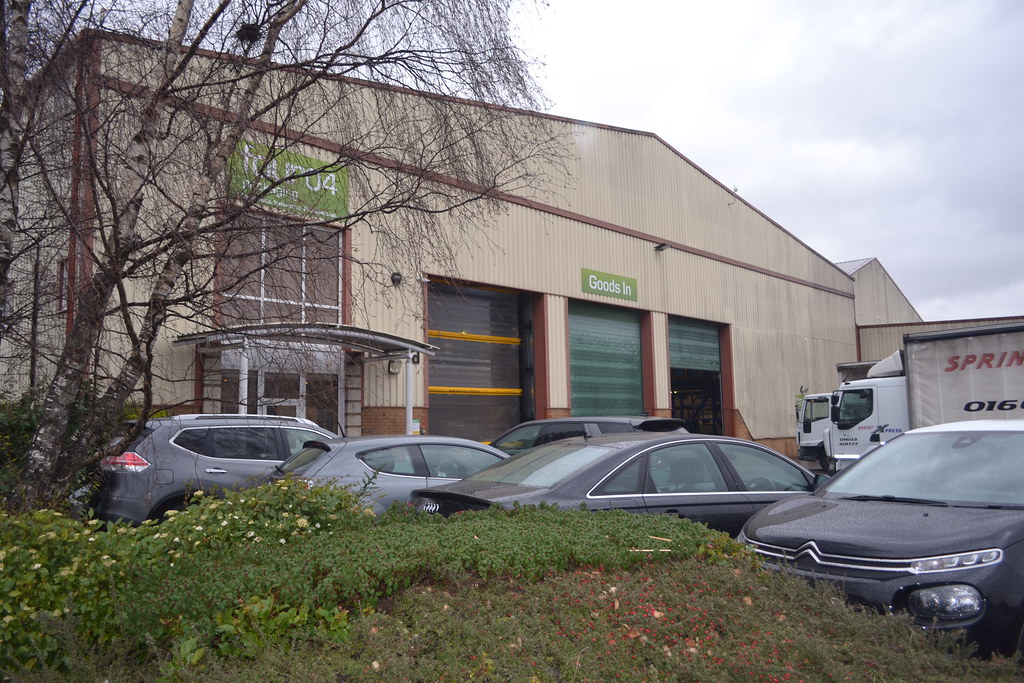
RAF Rackheath

The former hangar has been completely refurbished.

At this point, the story becomes confused. Some say it landed / crashed  in a field near to  Lower House Farm, Vowchurch Common in Herefordshire. The wreck being salvaged the following day. However, there is little evidence of this event, and other sources (Freeman “The Mighty Eighth“) have it landing in a Welsh marsh a little further west. Whatever the truth is, its a remarkable, but not unique, story of  a crewless bomber flying ‘home’ coming to rest safely on British soil.

Also on that Christmas Eve, another Rackheath B-24, #42-95220, piloted by First Lieutenant William W. Truxes Jr , was hit over Pruen. The aircraft then exploded over Rettigny in Belgium, killing Sgt. Walter Walinski (TG); Sgt. Stanley P. Koly (LWG); Fl. Off. David J. Countey (Nav); Sgt. Roland L. Morehouse (BA); St. Sgt. Peter Hardick Jr (TTG); St. Sgt. John N. Ellefson (Radio Op) and Sgt. Alek Onischuk (RWG). Only the Nose Gunner St. Sgt. Robert J. Ball Jr. returned to duty the remainder being taken prisoners of war.

On the 29th the continuing appalling weather caused the loss of two more B-24s, both crashing attempting to take off from a foggy Rackheath (#42- 95115 and #42-51572). A third (#42-94881) was then abandoned over the sea, and a forth (#44- 10607) crashed at Attlebridge also after sustaining damage on its take off. The  visibility was so poor that day that the crews couldn’t even make out the edge of the runway. As a result of these crashes, the mission to Prum, was finally scrubbed, but by then fifteen airmen had already been lost.

The dawn of 1945 saw the Ardennes offensive continuing, and at Rackheath B-24 ‘Witchcraft‘ was approaching its 100th Mission an achievement it made on January 14th 1945. In just 140 days since arriving, it had reached its 70th mission an average of one mission every two days, but what made this particular achievement so remarkable was not this incredible average, but the fact that the aircraft had been mechanically sound throughout, not having to turn back from any sortie it had undertaken. A remarkable achievement, and a solid testament to the dedication of the ground crews who kept her in the air.

The Witch“, as she affectionately became known, would go on to complete a total of 130 missions without a single abort nor injury to any crewman. She became one of the most celebrated aircraft in the 8th Air force’s history. This total would surpass all other B-24s in the whole of the European theatre of operations. Like many though, ‘The Witch‘ eventually returned to the US where she was unceremoniously taken apart at Altus, Oklahoma. In memory of the aircraft, her achievements and the crews who were lost flying B-24s, she is now represented by the world’s last flying Liberator, currently owned and operated by the Collings Foundation, Massachusetts.

Ground crew of the 467th BG B-24 “Witchcraft“. Standing Crew Chief Joe Ramirez, Chamberlin. Front Row Walter Elliot, Geo Dong, Joe Vetter, Ray Betcher.’ (IWM FRE 1979)

As 1945 progressed the end of the war was near. Attempts by the Luftwaffe to curtail bomber intrusions into German airspace were becoming desperate. The introduction of the Me 262 was too little, too late, to make a major difference. But so determined to stop the bombers were the Luftwaffe pilots that many still got through and they were finding the bombers.

Other fighters more determined to bring down the enemy began ramming them. A specialist squadron the ‘Sonderkommando Elbe‘  was set up using volunteer pilots. They were instructed to strike the fuselage of the bomber between the wing and tail thus cutting the aircraft in two, a tactic that would  allow the German pilot to bail out of his aircraft whilst taking down the bomber.

On April 7th, the unit was put into action in its one and only recorded attack, as over 1,000 heavies flew towards German airfields, oil storage facilities and factories in north-west Germany. From the 2nd AD, 340 B-24s headed for Krummel, Duneburg and Neumunster. As the force approached they were targeted by a mix of over 100 Luftwaffe fighters including 109s, 190s and 262s. In this mix was the Sonderkommando Elbe. Whilst the tactic would prove to be more devastating to the rammer than the target, one of Rackheath’s B-24s #42-94931 ‘Sack Time‘ was hit in the tail severing the starboard stabiliser. The B-24’s pilot, Lt. Robert Winger, managed to keep the aircraft flying but with little control, he ordered the crew to abandon the aircraft once over allied territory. The B-24 then crewless, fell from the sky.

It is not known whether the attack was a deliberate act by the Sonderkommando Elbe, or as a result of the tail gunner Robert (Bob) Perkins’s action. Perkins in his attempt to defend the B-24, fired desperately at the attacker, Heinrich Henkel, striking the aircraft several times.

Then for three days in mid April, the heavies of the USAAF turned their attention to the gun batteries around Royan. These German strong holds were hindering the allied plans to use the port at Bordeaux, they had to be ousted.

During one of the missions, on April 15th, the 467th would make history again when three of the four squadrons released all their 2,000lb bombs within 1,000 ft of the mean point of impact, half of these being within 500 ft – a record that would not be beaten by any other USAAF unit. This was the ‘icing on the cake’ for the 467th who were building a strong reputation for consistent and accurate bombing.  So determined were the Americans to remove the defenders on the ground, that they used Napalm in 500 lb tanks, a rather horrific weapon used to great effect during the Vietnam war.

By the end of April the war was all but over, and at bases all around the UK, air and ground crews eagerly awaited the notice to cease operations. Some units were already being stood down, and very soon operations would begin to drop food rather than bombs. As the end of hostilities was announced, the figures began to be totted up. The 379th BG at Kimbolton were recorded as dropping the greatest number of bombs on a target, with the 467th BG at Rackheath achieving the greatest accuracy. This Rackheath record was due, in part, to the dedication, support and drive of its Commander, Colonel Albert Shower.

On April 25th 1945, the 467th completed its last mission, a total that amounted to 212 (5,538 sorties credited), dropping 13,333 tons of bombs. With 29 aircraft classed as ‘missing’, and a further 19 lost on operations, the war had not been cheap.
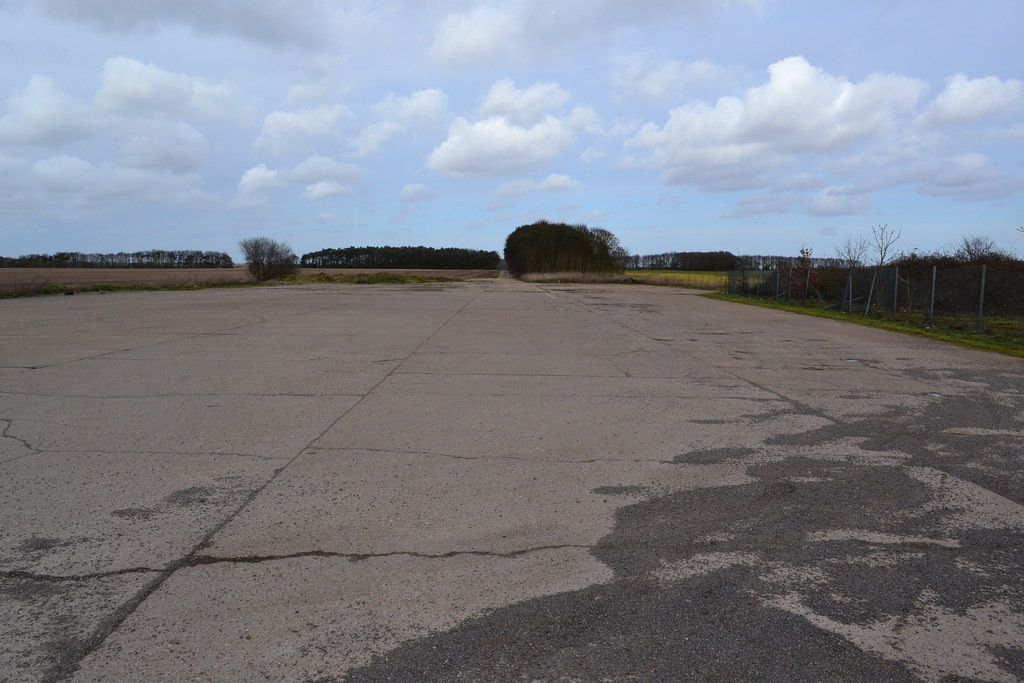
RAF Rackheath

The former runway looking north-east.

On May 13th, the 467th were to lead the Victory Flypast over High Wycombe, the headquarters of the Eighth Air Force operations, the choice of a B-24 as lead fuelling the ‘ill-feeling’ between B-24 and B-17 crews even further.

Over the next month, the aircraft and men of the 467th would return to the US, the majority of aircraft departing Rackheath on June 12th, whilst the ground echelons left via the Queen Mary from Greenock, the same port they had arrived at just over a year earlier. Eventually the 467th would be disbanded, renamed the 301st, but for Rackheath it was the end, and within a year much of the airfield was already being ripped up, the runways were disappearing and many of the accommodation buildings had been torn down. The entire site measuring just short of 4 km2  was already beginning to disappear.

Gradually agriculture has taken over, much of the main airfield site are now fields. The technical area has since been developed into an industrial estate with many of the original buildings being re clad, redeveloped, modernised or pulled down. The watch office has thankfully been refurbished and from the outside resembles a watch office typical of the time. Inside it is now offices. The one surviving T2 hangar, has had brickwork added to it, other buildings are almost indistinguishable from their modern counterparts. A memorial, dedicated to the men and Women of the 467th was unveiled on 29th July 1990, by the then 80 year old Colonel Albert J. Shower, returning for one last time to the place he had built up a reputation for hard graft whilst appreciating the need for recreation.

If approaching from the south, take the A1270 from Norwich heading north, leave at the roundabout with Salhouse Road turning right. The Holy Trinity Church is a few hundred yards along this road. Here you will find the village sign, memorial benches and numerous plaques in memory of the 467th. The two wrought iron gates at the entrance of the church were donated by the Coffey crew. Inside here (the church was closed on my visit) a collection of photographs and letters bring the Rackheath to life once more.
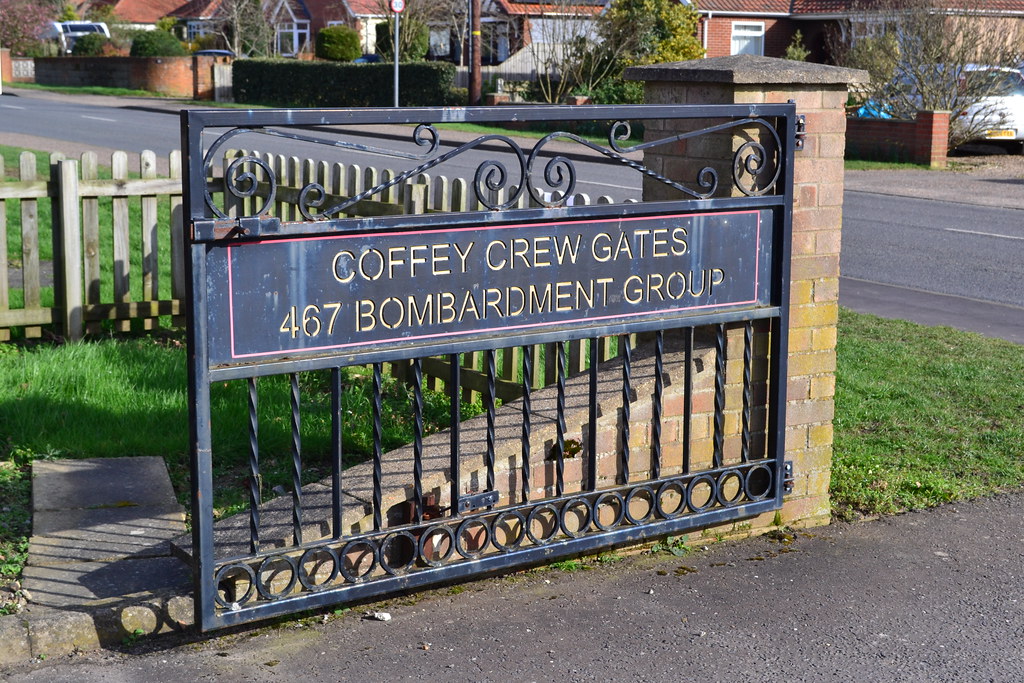
RAF Rackheath

The memorial gates donated by the Coffey crew.

When leaving the church, go back but turn right along Green Lane West. This takes you past the remaining hardstands and along to the industrial estate. Enter by Wendover Road, named after Wendover Field in Utah. Turning into Bidwell Road, (following the signs) you will find the main memorial on the the corner of Bidwell Road and Liberator Close.

Coming back again, turn left, follow Wendover Road to the corner with Witchcraft Way, a small road to your left. Here you will see the Watch Office. Also along here are Ramirez Road, Albert Shower Road, the T2 and other buildings of interest. A real rabbit warren, it is best explored to really discover the many buildings and plaques that remain.

The main accommodation areas were located back across the from the entrance of Wendover Road. Today a new road has been cut through this wooded area but within these woods, remains of huts still exist, some with etchings on the walls. All on private land, they are also gradually disappearing from view.

Rackheath was a short lived base, operating for just a short part of the war. But its contribution and the contribution of its crews, was nonetheless immense. With high accuracy and the determination to win, they took the war into the heart of Germany itself. The names of these young men now live on, in the road names and plaques that adorn many of the building and streets around this beautiful and now peaceful area of Norfolk.

After departing Rackheath we head a few miles east, toward the coast. Not far away, is another airfield, this time a former RAF site. Long gone it continues to use part of the original runway, two watch offices remain, and a smattering of wartime buildings lay dormant in the corner of now agricultural fields. In part 2 of Trail 58 we visit RAF Ludham.

Sources and further reading RAF Rackheath

For more detail on Mission 311 see: McLachlan, I., “Night of the Intruders” Pen and Sword (1994).

RAF Rackheath – The 467th BG, the highest bombing accuracy (Pt1).

In Trail 58 we head to the east of Norwich into an area known as the Norfolk Broads; an area created through turf extraction in medieval times. The large, shear sided pits were later flooded giving more navigable inland waterways than both Venice and Amsterdam.

Today, it attracts a wide range of wildlife, and offers a range of boating, bird watching and fishing holidays. The shear size and scope of the Broads attracting some 7 million visitors per year to enjoy the rich nature and peace of the Broads.

But in this area during the Second World War, life was very different. Overhead, the drone of aircraft engines was a constant reminder of a war being fought both across the sea and here in East Anglia.

Between Norwich and the East Anglian coast we visit two airfields, one USAAF and one RAF, both now long closed, they each played a vital part in the destruction of the Nazi tyranny across the sea in Europe.

Our first stop is a former bomber base. Now a huge industrial estate where many of the original wartime buildings have been demolished. But some still remain, refurbished, re-clad and in many cases almost indistinguishable from their original design. A memorial, located in the heart of the estate, denotes the technical area of the former base, and a local church displays a collection of wartime photographs.

Our first stop on this trail is the former US bomber base RAF Rackheath (Station 145).

Rackheath (Station 145)

Rackheath airfield lies approximately 5 miles north-east of Norwich, bordered to the east by the  East Norfolk Railway Line, and to the west by the (modern) A1270.

RAF Rackheath

Rackheath village sign denotes its history and links to the base.

Built over the period 1942-43, it was built as a Class A airfield incorporating three runways: one of  2,000 yds and two of 1,400 yds in length, each 50 yds wide and each covered with concrete.

A large number of hardstands lined the perimeter track, some 50 altogether, all being of the spectacle type; with  a bomb store to the north of the main airfield site, sitting surprisingly close to the majority of the hardstands and nearby Rackheath village.

A wide range of technical buildings, supported by two T2 hangars for aircraft maintenance, allowed for repairs and crew preparation: crew rooms, parachute stores, dingy stores, armouries, photographic blocks and so on. The watch office (design 12779/41) stood proud of the technical area located to the south-west of the site. All personnel areas – eleven accommodation and three ancillary sites – lay to the west of the airfield, dispersed around Rackheath Hall, an early 19 Century listed building with its notable architectural features and its own turbulent history. These sites, hidden amongst the woodland, were both extensive and well serviced by concrete roads that led to the main airfield site.

Rackheath was initially designed as a bomber airfield, but during the construction phase, it was re-designated as a fighter airfield. However, delays in the construction process, led to it never being operated as a fighter station, instead it was manned by the Eighth Air Force’s 467th Bombardment Group (BG) and B-24 Liberators.

The 467th BG consisted of the 788th, 789th, 790th and 791st Bomb Squadrons (BS), each flying Consolidated’s heavy bomber the B-24 Liberator. The group’s long journey to Rackheath started on 19th May 1943 at Wendover Field in Utah. After being activated on August 1st, they moved to Mountain Home Army Airfield in Idaho, then back to Utah and Kearns, from there onto Wendover Field again where they remained for fifteen weeks undertaking intensive training. On 12th February the ground echelons made their way, by train, to Camp Shanks, New York where they boarded the US ship Frederick Lykes. Their Atlantic journey brought them, like so many before them, to Greenock, a major port on the Clyde on Scotland’s west coast. From here, they boarded trains and made their way to Rackheath.

The air echelon in the meantime flew the southern route, tragically en route, they lost one of their B-24s (#42-52554 “Rangoon Rambler“) with all its crew, over the Atlas mountains in North Africa. The remainder of the group finally arrived here at Rackheath combining with the ground echelons in late March 1944, where they began to prepare for their first operation on April 10th.

Operating initially within the 2nd Bombardment Division (later the 2nd Air Division) 96th Combat Wing (CBW), they flew Liberator ‘H’, ‘J’, ‘L’ and ‘M’ models under the command of Colonel Albert J. Shower, the only US group commander to have brought and remained with the same group until the end of hostilities.

The 467th’s first mission was to bomb Bourges airfield, a relatively light target in which 730 bombers pounded aviation targets across the low countries. On the next day, they formed part of a even larger force of over 900 heavies attacking aircraft production factories in Germany, their honeymoon was well and truly over in one fell swoop.

But the first major event of the war for the 467th was to occur shortly after this on April 22nd 1944, on a day that has since become infamous in American aviation history. Mission 311, was an attack by 803 heavy bombers of the 1st, 2nd and 3rd Bombardment Divisions on targets at Hamm, Soest and Koblenz along with targets of opportunity. The Massed formation, escorted by 859 fighters, were led by the 445th BG, 2nd Air Division from Tibbenham. The 96th CBW portion was led  by the 458th BG from Horsham St Faith, with the 466th BG from Attlebridge on the low left, and the 467th ‘The Rackheath Aggies‘  on the high right.

As teleprinters rattled across the East Anglian area, B-24s were bombed up, fuelled and checked over by mechanics who meticulously prepared their machines for war. Maps were drawn up, meteorological reports were read out and orders were strict – ‘avoid the Ruhr!’

Once in the air, brightly coloured assembly ships gathered their flocks together in tight formations, and then it was time to set off for Germany. On route, technical problems dogged the lead plane, which led to inaccurate navigation, and ultimately brought the entire force into Ruhr Valley – exactly where they did not want to be.

Dividing up, the massed formations hit a range of targets, Hamm being the focus of the 467th. Surprisingly though, results were good, especially considering the many problems the formation had suffered flying over to Germany. Pleased with their results, the 467th set course for home, blissfully unaware of the dangers that were lurking not far away as they made the return leg of their journey.

The whole operation had been meticulously planned, but it meant that many of the bombers would be arriving home in the dark, an environment alien to many American crews. Experience had told them that Luftwaffe fighters lurked in the dark, unseen and dangerously accurate in their attacks.

When approaching from the east, Rackheath and Nearby Horsham St. Faith were the first two large airfields available, a distance of just some 4 miles separating them. With navigation lights and landing lights illuminating the aircraft, airfields were lit up like christmas trees, each one inviting their bombers home to safety. These lights were also a beacon for the as yet unknown, marauding Luftwaffe night fighters. As the first Rackheath Liberator approached, the air filled with requests for landing  permission, fuel now getting critically low and crews tired from the long flight. Gun places were vacated and crews began preparing to land, everyone was starting to relax – they were home.

It was this point that all hell was unleashed over Rackheath. Canon shells ripped in to the wings and fuselage of 1st Lt. Stalie Reid’s B-24 #42-52445, setting both starboard engines on fire.  The lead Luftwaffe pilot Staffelkapitaen Hauptmann Dieter Puttfarken of II/KG51, taking his companions, in their mix of night fighters, right into the heart of the flight path of the returning bombers. Here they waited, unseen, until the moment the bombers were at their most vulnerable.

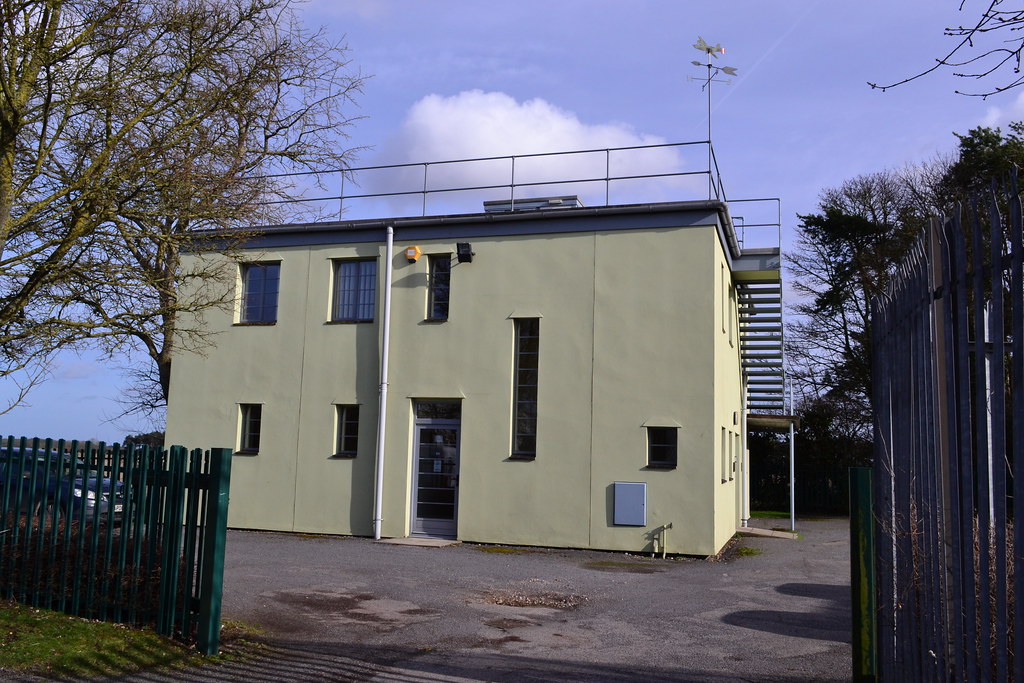
RAF Rackheath

The former Watch Office has been refurbished and used as offices.

As the Liberator began to fall uncontrollably out of the sky, four of the crewmen manged to don their parachutes and escape, the remaining six failing to vacate the aircraft in time. All six were lost in the ensuing crash when the aircraft hit the Earth near to Barsham in Suffolk. For Sgt. Edward Hoke, one of those lucky enough to escape, his troubles were not yet over, for somehow, he was pulled from his parachute, and without a means to slow his descent, he too  fell to his death. It was only the third mission of the war for the crew.

Meanwhile, other aircraft began to line up desperate to land. Near misses were now becoming a risk, aircraft suddenly appearing out of the darkness within feet of each other. Then a second B-24 went down –  struck by the terror of the night. B-24 #42-52536 piloted by 2nd Lt. James A. Roden was hit by canon fire. So severe and so accurate were the strikes, that it severed the tail of the Liberator from the fuselage. Now split in two, the aircraft went into a spin and eventual fireball. The entire crew were lost that night.

Not content with picking aircraft off in the air, the Luftwaffe night fighters then began to attack, with bombs and guns, the main airfield site, strafing ground targets almost at will. By now crews were starting to panic, some withdrew from the landing pattern and headed off away from the airfield only to run the gauntlet of friendly Anti-Aircraft guns who were not expecting to see heavy American bombers at night.  By now it was becoming clear what had happened, and to protect the airfield all lights were extinguished. Aircraft were unable to see the runways, parts of which were now only illuminated by fires of wrecks and bombs. Waiting patiently, or diverting to other bases, B-24s light on fuel, circled frantically the field trying to find some sign that it lay below. The confusion that night, repeated across numerous US airbases, tore a hole in the hearts of the American flyers as numbers of those lost across East Anglia began to filter through.

April 22nd would go down in history as the worst loss in one night to intruders alone, made even worse by the fact that once over home territory, you consider yourself to be ‘safe’. Some American gunners were able to retaliate and there are records of intruders being shot down, but the statistics clearly fell heavily in favour of the intruders.

With that, the 467th had finally cut their teeth, their war was real, and it was having an effect.

On D-Day, the 467th were assigned to bombing shore installations and bridges near to Cherbourg, then as the allies progressed through France they supported them by attacking supply lines at Montreuil. A few days after the D-Day landings, a 467th BG Liberator became the first four engined bomber to land on a beach-head airstrip. The B-24 #42-95237, ‘Normandy Queen‘ piloted by 1st Lt. Charles Grace was hit by flak and badly damaged. Unable to make the crossing back home, he ordered the crew to bail out whilst he and his co-pilot brought the aircraft down onto an allied fighter airstrip, luckily without further mishap. All the crew that day survived to tell the tale.

B-24 Liberator (4Z-U, #42-95237) 791st BS, 467th BG parked on the grass in a field in Normandy – the first four engined heavy to do so. (IWM FRE 8431)

By now the allied onslaught of occupied Europe was well under way. Continual flying began to make its mark on both air and ground crews. The summer months seeing over 28,000 sorties being flown, meaning that many crews were reaching their quotas of missions in a very short space of time.

In early August a reshuffle of command within the Eighth saw several changes at the highest levels. Lower down, in the front line units, further reshuffles saw crews and squadrons move from one unit to another. The 788th BS, who had been taken to form the 801st Group to perform ‘Carpetbagger‘ operations in the lead up to D-Day, now rejoined their original Group back at Rackheath.

The long, cold winter of 1944-45 was known for its persistent fog, snow and ice that hampered air operations, and all just as the German army was about to make its one last push through the Ardennes forest. Christmas 1944 would be sombre time for the US forces, with the loss of both Brigadier General Frederick W. Castle and the fighter ace Major George Preddy who was inadvertently shot down by friendly fire and killed.

For the 467th BG it would also be a period of misery, a period that started with one of the most bizarre events in their history. We shall revisit Rackheath again in Part 2.