Memorial Garden Opening 

Mixing my day job with my hobby is not usual but I felt this was more than worthy of a post.

For some time now I have been toying with the idea of a Memorial Garden at school tied in with the various topic work that we have been doing, which is linked to both the World War I and VE-day commemorations.

The idea really came to fruition in sort early last year when I approached the head of the school and put the idea to her. With enthusiasm the go ahead was given and the children were approached with the idea as an after school club. A small group volunteered to help and we began planning.

On June 18th 2015 the plan finally came together.

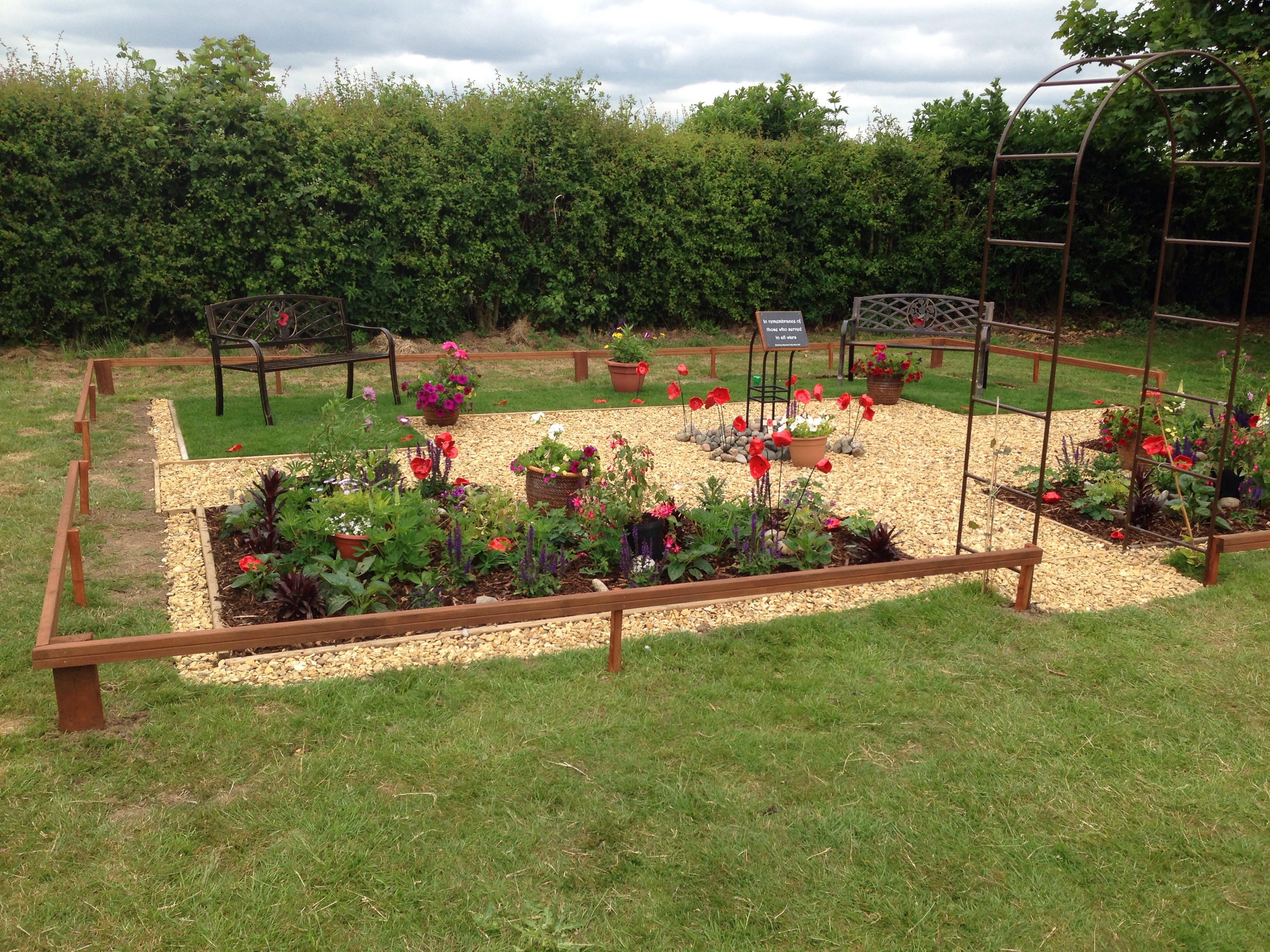
The Memorial at the Centre of the Garden.

As people arrived they were greeted with refreshments and displays of work, photos of family members along with artefacts gathered or brought in by friends and parents. My good friend Kevin Fleckner brought four original uniform and bits from a crashed B-17 for us to show.

At 17:15 two RAF Tornado jets from RAF Marham flew overhead. The first low and slow, the second 15 seconds behind, higher and much faster with her wings swept. Over the school, she banked and the crowd waved. The event had opened.

The head then read a short introduction and it was my turn. I have to tell you that public speaking is not my forte and whilst I had been a little nervous I stood at the podium and the nerves vanished. My speech went thus:

June 18th 2015 is a special day. Not just because we’re opening this beautiful space, but for several iconic reasons. 200 years ago today the British and French forces were locked in arms at the Battle of Waterloo. 75 years ago today Winston Churchill made his famous “this was their finest hour” speech. Two dates that will go down in history as both important and momentous.

But these ae not the only significant dates in history.

100 years ago last year in 1914 young men in their thousands signed up with excitement for what they thought would be the war to end all wars. However, the war they thought would be over by Christmas went on for four long years. In the killing fields of Flanders, young men, many barely older than 16 or 17 were slaughtered in their thousands, living in mud and rat infested trenches very few were to survive. If not killed by the constant shelling, sniper fire or the slow march through no man’s land, many would suffer shell shock, a brutal psychological illness that would eat away at the very heart and soul of the young men. Eventually, in 1918 the First World War ended, the guns fell silent and Europe could finally begin rebuilding once more.

Sadly man’s inhumanity to man was to raise its ugly head again. In 1939, Europe was plunged once more into war with the German invasion of Poland. As The mighty Nazi war machine blitzkrieged its way across Europe, the British Armed Forces once more fought bravely in the name of freedom and democracy.

From the beaches of Dunkirk to the defence of Britain in the skies over Kent, the landing grounds of Normandy, to the battles in the Ardennes, Arnhem, over the Rhine and eventually the battle for Berlin itself, the brutality of war would once more be seen again.

The civilian population of Europe was to suffer greatly too. The blitz of our cities and the bombing of European targets that killed thousands upon thousands as bombs rained down from the sky. The concentration camps, death camps and prisoners of war camps saw a brutality on a scale that was and still is, incomprehensible.

From the hot deserts of Africa through the warm seas of the Mediterranean to the freezing conditions of the Arctic convoys, young men would bravely fight without question many paying the ultimate and final sacrifice.

Eventually, on 8th May 1945, the war in Europe finally ended and Peace reigned once more. However, the killing went on in the Far East. On the Pacific Islands of Okinawa, Saipan, Iwo Jima and Guadalcanal, The fighting continued in some of the most brutal conditions known to man. Eventually on August 15th 1945. UK time, following the Americans dropping the world’s most devastating and horrific bombs on Hiroshima and Nagasaki, war was declared finally over. The world has now entered the atomic age and six years of war had left it scars across Europe, the Middle East, The Far East, in the waters of the Atlantic and Pacific Oceans and across both the northern and Southern Hemispheres. Across the world millions lay dead, injured, homeless or orphaned. In the words of our distinguished guests here today “There are no winners in war.”

If there is one thing that history can teach us, it is that man is unable to live at peace with his fellow-man. Whether it be disputes over territory, natural resources or religious ideologies, War has continued to be fought and young men and women have continued to die.

In post-World War 2, the world lived on a knife-edge; the Cuban missile crisis being the ultimate stand-off between the east and west. From Korea and Vietnam to the Falkland Islands, the Middle Eastern countries of Iraq and Afghanistan, Britain and her allies have continued to fight for peace and democracy something we here take very much for granted.

It is in the name of these young men and women that we have built this memorial garden, so that their memories and their sacrifice may live on in the hearts and minds of future generations. It is so that we can pay homage and remember the dedication, bravery and self-sacrifice that they have shown so that we may live today without fear and in freedom.

It is to these people that I say thank you. Thank you for willing to lay down your life so we may freely speak out against injustice. To those who never came home, who paid the ultimate sacrifice, may you forever rest in peace. Thank you

Next one of the children read what the garden meant to him. Un-nerved by the occasion, he told how his father passed on his grandfathers tales of the war, how it means he can enjoy the peace and tranquility and he made a remarkably moving speech from the heart.

We then had a young lady from the group read in full the Robert Lawrence Binyon poem ‘For the fallen’. Short gasps from some of the audience told me they didn’t realise where the Remembrance Day words came from as it appears in the middle of the poem. She too read fluently and without falter, quite an achievement. Both these children were only just 10/11 years old.

A blessing by the vicar led us into the last post and a two minutes silence for those who had paid the ultimate sacrifice. A number of visiting Vets saluted, the Air Training Cadets lowered the colours and all went silent. Not a sound bar the cool wind in the adjacent trees.

My Good Friends Baz and Helen, whom helped enormously, John and Tony the Veterans and Kevin, who brought a number of uniforms and bits for us to display.

After the reveille the colours were raised and the two veterans invited to open the memorial officially. One Tony, a Normandy D-day+1 vet and the other John, who fought from Africa against Rommel’s Tigers, through Italy up into the continent, stood either side. As they lifted the flag, John declared the garden open to applause from the gathered audience. The children then sang unaccompanied Vera Lynn’s “We’ll meet again”; many from the audience joined in. The event closed and photos were taken around the memorial.

I estimated around 150 people, which for a small school of 68 children is remarkable. We had veterans from Cambridge a good hour and half away,  visitors from Northampton another similar distance and a large number of folk from the village turn up.

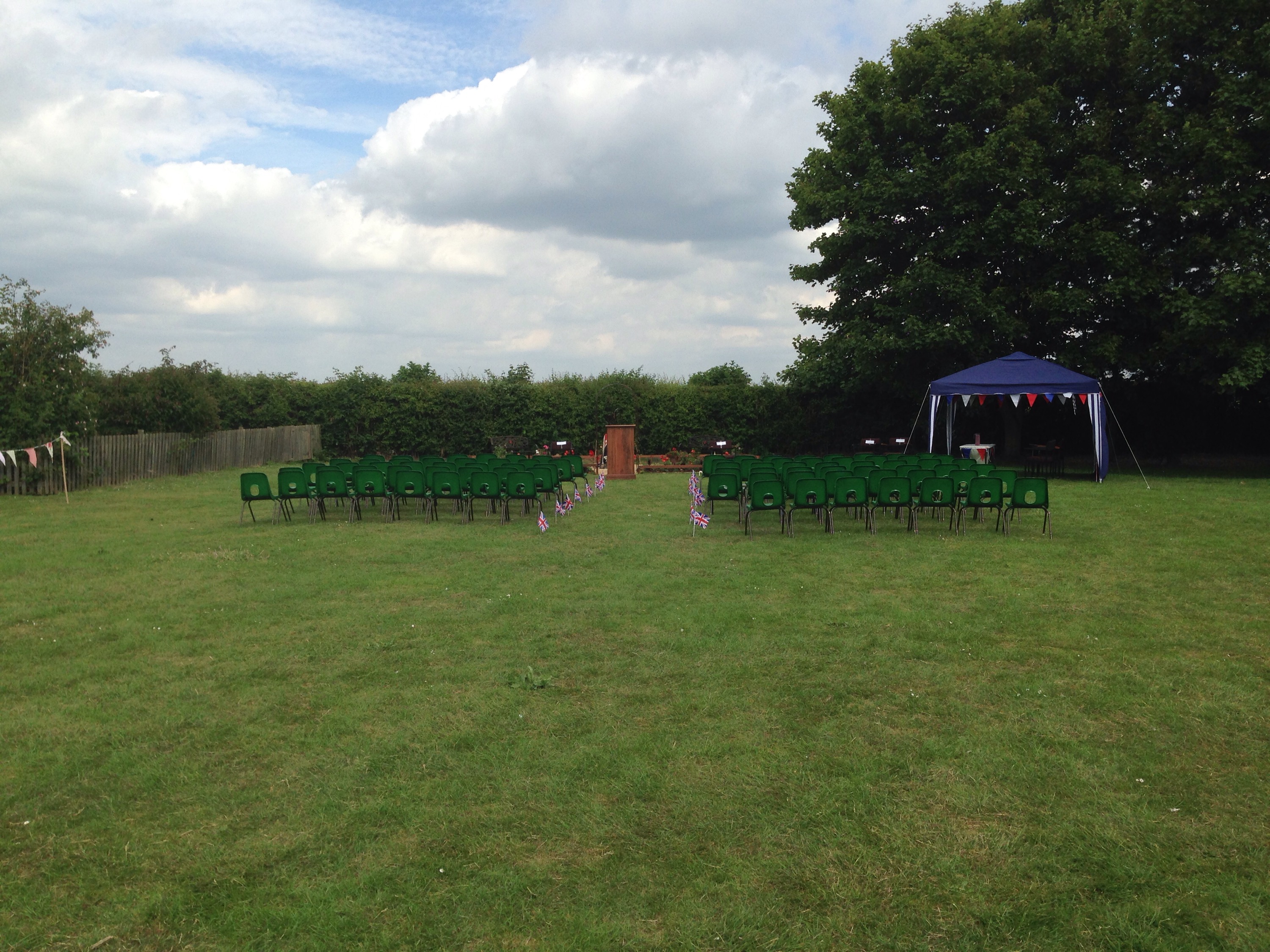
The seating before people started to arrive. There were many more standing, being a small school. we simply didn’t have enough chairs!

The feedback from visitors was superb and everyone was buzzing.

A real team effort, the long evenings, the hard work and recent battle against moles had all been worth while.

We had texts and emails from those who were there praising the efforts. It all worked out far better than even I had envisaged.

We shall miss it. We had great fun, even the odd beer or two, but it has been a real bonding exercise, we have become a little ‘family’ and are really proud of our achievements.

I passed on the good wishes to the children whom I think are quite overwhelmed themselves. They did a fantastic job and were superb role models for others to follow.

The Garden as it is today. We shall seed the outside, and continue the fight with the moles. An area for relaxation and thought.

We shall continue to nurture and maintain the Garden and watch it grow. The children use it already and do enjoy it. The rose in the crown were the poppies. Made out of clay, they are all handmade by the children mounted on metal rods and bunched in groups of 3 or 4. They do look superb.

There were small stumbling blocks along the way, and these caused delays but none so great we couldn’t deal with them. All in all it went beautifully, far, far better than I ever imagined and the finished product, I hope you’ll agree, is stunning.

An article appeared in the paper on the following day, Saturday here’s a link.

RAF West Malling revisited. 

Around two years ago, I visited West Malling airfield in Kent to see what was left of this once historic place. Surprisingly, quite a bit did still survive albeit hidden amongst new buildings and office blocks.

Many of the ‘H’ blocks were left as was the Officer’s quarters and the control tower. The tower was shrouded in scaffolding and well hidden in the depths of a housing estate.

This May, I was in the area once more and decided to pop in and see what had become of the tower. Was it an office block, a museum dedicated to the men and women who were stationed here, or a modern cafe with retro decor? It was actually a bit of all of them.

Let me explain. The ground floor is partly a Costa Coffee shop with its ‘modern’ interior, but the original walls and windows are still used. A 1940s building, they have decorated the walls with photographs taken during West Malling’s operational time. I have to admit it is rather tasteful for a coffee bar, and they have maintained the feel quite well.

The outside provides a quiet seated area.

Next door, is a property development company,  who occupy both the ground and upper floors. The ground floor entrance is a small reception in which hangs a number of large photographs, again taken from West Malling’s operational time. There are no captions to the photographs but as a visitor, you can freely browse them, or at least I did and the lady behind the reception desk didn’t seem to mind.

There still remains a fair amount of scaffolding around the top of the tower, but the overall building refurbishment seems to be complete. Even the garden area to the front, adorned with children’s comments from airshows long gone, are tastefully cared for. Whilst they have made every endeavour to preserve this historic building, it is somewhat enclosed by houses and a large supermarket. There is no reference to what role the building played or even why it is here. The whole area has been rebuilt with upmarket restaurants and boutiques and all looks very pleasant. I do wonder how long it will retain this stylish appearance?

The cafe uses the original windows and walls, displaying photographs from an era long gone.

When I was there in 2013, I distinctly remember seeing a ‘blue plaque’. These are given to specific buildings to identify them as a site of special historical interest. On visiting this time, I could not find it and as a last resort stopped and asked a suited gentleman if he knew where it was. He introduced himself as the Estates Manager and said there is no blue plaque. Maybe I was mistaken. He then proceeded to tell me that the building I was sat outside of, was the original officer’s mess and that he would show me around if I so wished.

The Officer’s Mess. The board dedicating it to Guy Gibson, is to the left of the door.

I of course jumped at the chance, and he took me around to the front of the building and showed me a board naming the building as the ‘Gibson building’ in dedication to Guy Gibson.

He unlocked the doors and we went in. The walls here are adorned with photographs, squadron badges and other personal items from those who served at West Malling during its operational time. We then went through further doors into what was the billiard room. The gentleman explained that all the wooden doors, skirting and ceiling decorations are original. He also said that the fireplace was original too and that the lighting whilst not, was the same design and shape as the original lighting.

The local toilets reflect the tower’s design.

Then we walked through to what is now the council meeting room, he again explained that the doors and ceiling decorations were originals. He went on to explain that the fireplace here too was original and showed me a photograph of the room as it was before closure, it was indeed virtually identical – all apart from the modern furniture.

We then went to what is now the public reception at the back of the building, passing on the way, the dining room. This has been made much smaller with a false wall but again much of the 1940s architecture is still evident.

“These buildings are now grade 2 listed, and as such cannot be altered without permission” he explained, and he went on to describe how on some of the buildings you can still see traces of the original camouflage paint work.

A closer look reveals the original camouflage paint.

He went on to tell me the stories behind a number of the photographs on the wall. How they got them from local people and who they were of. I asked him about other remaining buildings on the site, and he explained how all other minor structures and hangers were long since gone; this building, the ‘H’ blocks, and the control tower being the only surviving buildings.

We talked about properties near to the site such as the local pub “The Startled Saint”, which was built to keep the RAF personnel ‘on base’. He also mentioned the initial officer’s quarters, now a private residence, which has on one of the ceilings, all the names of the crew members written with candle smoke. Apparently this property is open once a year for public viewing!

Before we said our goodbyes, he gave me a booklet written in 1989 to commemorate the life of West Malling airfield and the crews and personnel stationed here before its closure.

I did not get his name, but he is the Estates manager for the property, now owned by Tonbridge and Malling Borough Council, and I am truly grateful for the time he took to explain everything to me and for the booklet which I shall read and keep with pleasure.

I can certainly say that whilst the majority of the airfield has gone, what they have done with these last few buildings is both a surprise and real pleasure to see. They have tried to retain the original identity of the airfield through its architecture and road names. A number of small notice boards detail the events that occurred here from its inception until its final closure in the 1990s.

Whilst flying has long since ceased and all major features are gone, West Malling as an airfield has died. However, the centrepiece of this site, the fabulous memorial of the sculpted airman running for his plane, and the tastefully refurbished buildings, not only hold many secrets and tales, but give a hint of the atmosphere of this once historic and important Kent airfield.

West Malling was originally visited in 2013, in Trail 4. I shall be updating the trail shortly as a result of this latest visit.

RAF Foulsham, North Norfolk, Trail 22

The first airfield in this Trail reveals some excellent examples of wartime architecture. A short life, but an important one, it saw a wide range of aircraft undertaking some ground breaking activities.

We visit RAF Foulsham.

RAF Foulsham

ROYAL AIR FORCE BOMBER COMMAND, 1942-1945.

Halifax B Mark III, MZ817 ‘DT-O’, of No. 192 Squadron RAF after crash-landing while taking off from Foulsham, on a radar surveillance sortie. 9th December 1944*1

Foulsham, like many of its counterparts in this region played a major part in the electronic war, monitoring and jamming radar transmissions for larger formations of bombers. Despite this important and ground breaking role, Foulsham had only a short operational existence.

Built in the latter parts of 1941, Foulsham had three runways, 37 dispersals and 9 hangars. It was initially opened with light bombers of 2 Group Bomber Command. These were primarily Mitchell IIs of 98, 180 and 320 Squadrons; 320 being formed entirely of Dutch personnel. A detachment of Glider storage and maintenance personnel from 12 GMS were also at Foulsham between April 1943 and March 1944 preparing and maintaining Horsa Gliders for the forthcoming Normandy invasion. In this same year, on September 1st, 3 Group Bomber Command took over responsibility of Foulsham and the much heavier Lancasters of 1678 HCU (Heavy Conversion Unit) and 514 Squadron arrived for operational duties over Europe. One month later, the American 375th Servicing Squadron (SS) arrived and began modifying de Havilland’s ‘Wooden Wonder’ the Mosquito, for photographic reconnaissance duties, a role the Mosquito excelled at.

RAF Foulsham

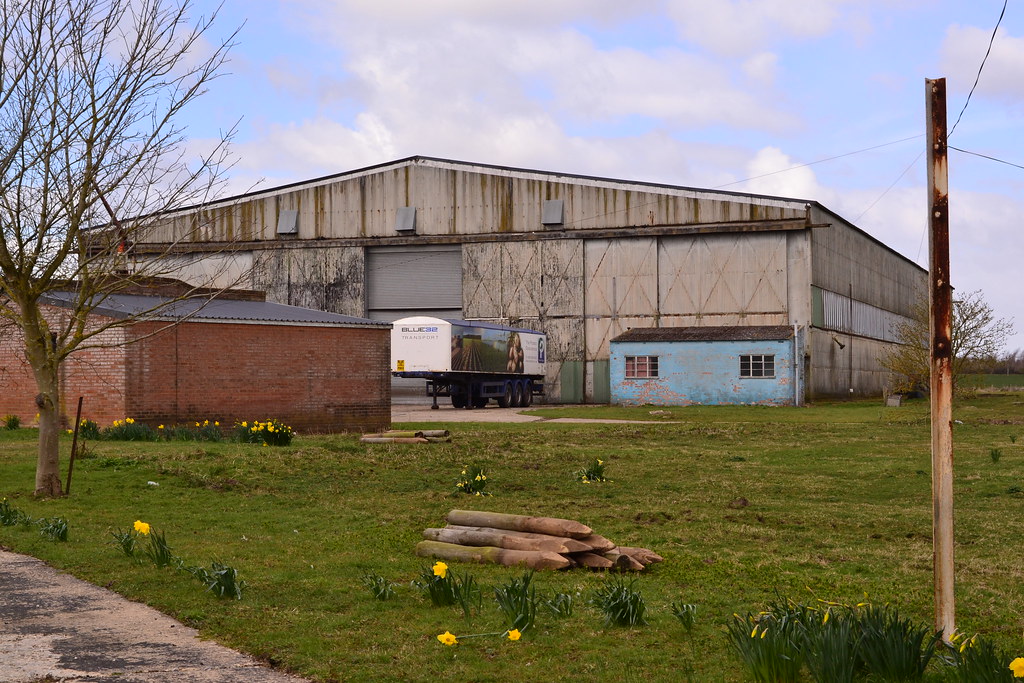
One of four T2 hangars.

Once more, Foulsham changed hands and it became part of the now familiar 100 Group, who were dominating this area of the country. 192 Squadron arrived with a variety of aircraft, the HP Halifax, Mosquito, Anson and Wellington for electronic warfare operations.  Other squadrons soon joined them, and Foulsham became a large operational base shrouded in secrecy. Between 1943 and post conflict in 1946, more Wellingtons, Mosquitos, P38 ‘Lightnings’, Stirlings and Halifax IIIs arrived all becoming common place in the skies over Foulsham as they gathered information, trialed radio and electronic jamming operations and evaluated new methods of electronic warfare.

Foulsham was further graced in 1944 with the installation of FIDO, the fog clearing system, a method designed to burn away sufficient amounts of fog to enable a safe landing in difficult conditions; not always successfully. However, despite all this, Foulsham’s operational life was soon to be cut short and in June 1946 it was closed to flying duties, whereupon it became the final resting ground for a large number of Mosquitoes prior to scrapping. Foulsham remained ‘in-service’ until 1955 with the US Army, and then in the hands of the MOD until deemed surplus to requirements, it was finally sold off in the 1980s and its doors closed for the last and final time.

RAF Foulsham

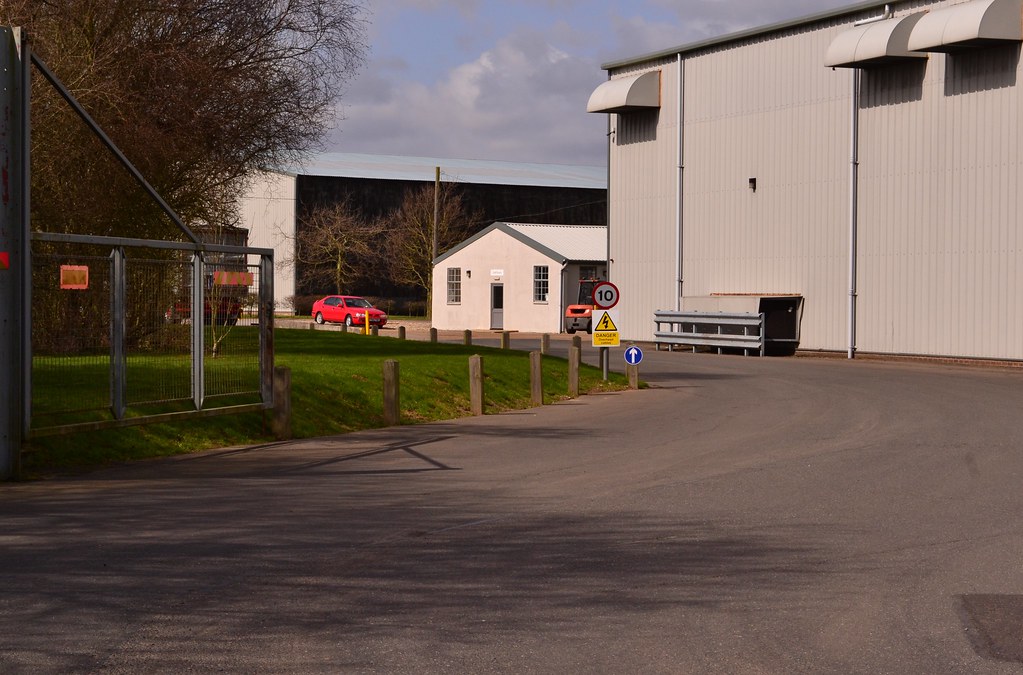
A workshop nestled between two refurbished T2s.

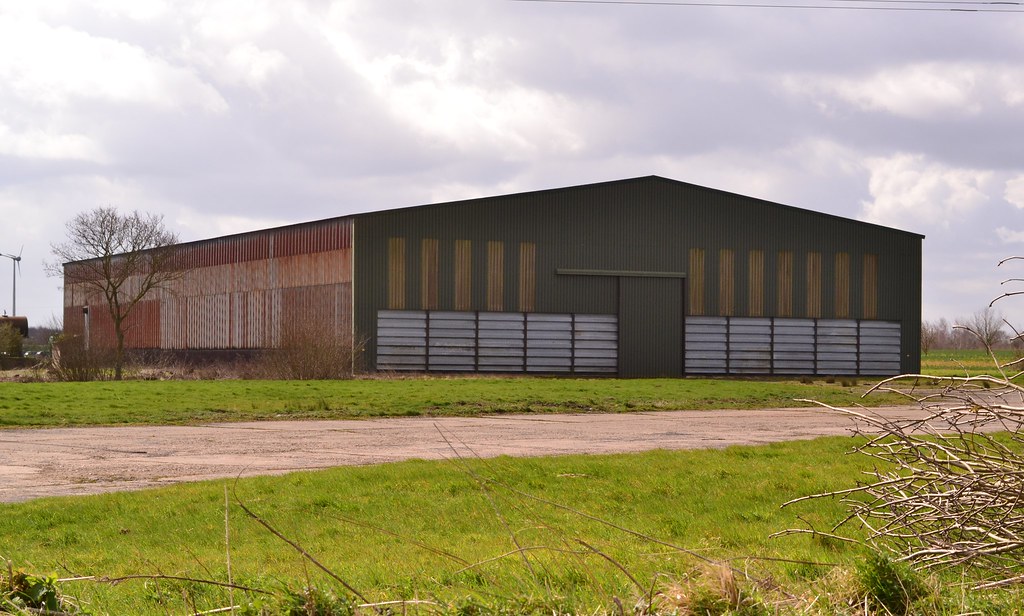
Many of Foulsham’s buildings have surprisingly withstood the test of time. Whilst the runways have all but gone, now farm tracks and tree lines, some of the buildings do still remain and even from the roadside, you can see what must have been a remarkable place during its short, but hectic life. The road passes along the eastern side of the airfield, here, you can still see a number of the original T2 hangars, 3 in total, now utilised by a local potato business. (‘Addison Farm’ as it is aptly named, is in recognition of Air Vice Marshall Edward Barker Addison, the only person to Command 100 Group*2 during the war). Whilst two of these hangars have been re-clad, the third is still in its original metal. Hidden amongst these structures, are some of the original technical buildings, again some refurbished some original. The mass concrete bases signify the manoeuvring areas linking this area to the main section of the airfield to the west.

RAF Foulsham

A fourth T2.

At this point, there was until recently, gates separating the dispersal area to the east (now farm dwellings) to the hangar area on your left. During the War, this road was surprisingly open to the public and aircraft would be manoeuvred across the road, traffic being halted by an RAF Policeman.

Further to the north, beyond this area passing an air raid shelter, is the original entrance and further technical area.

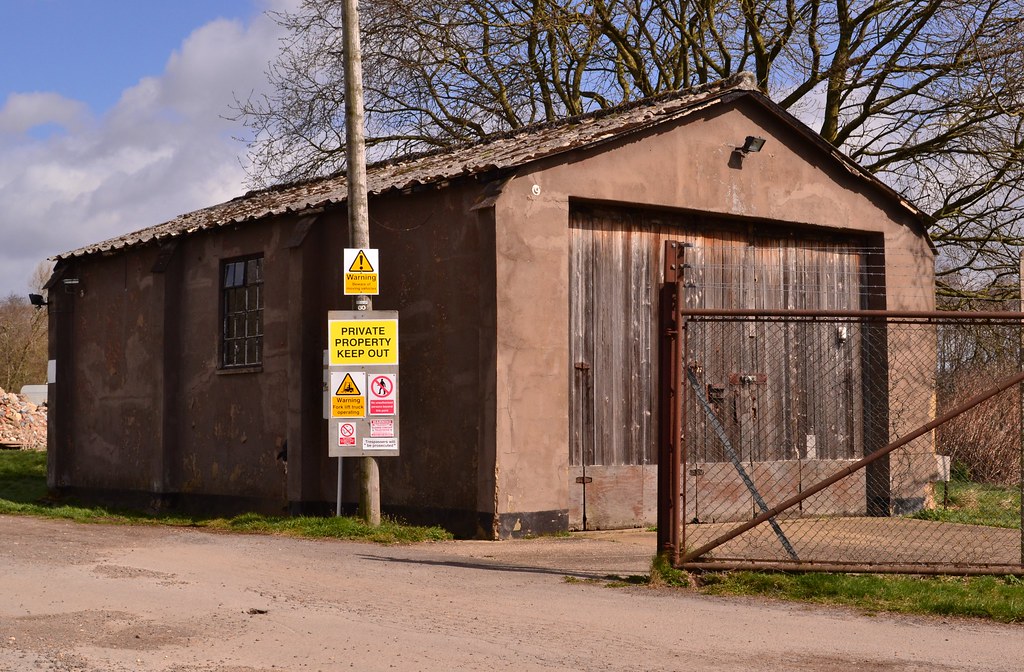
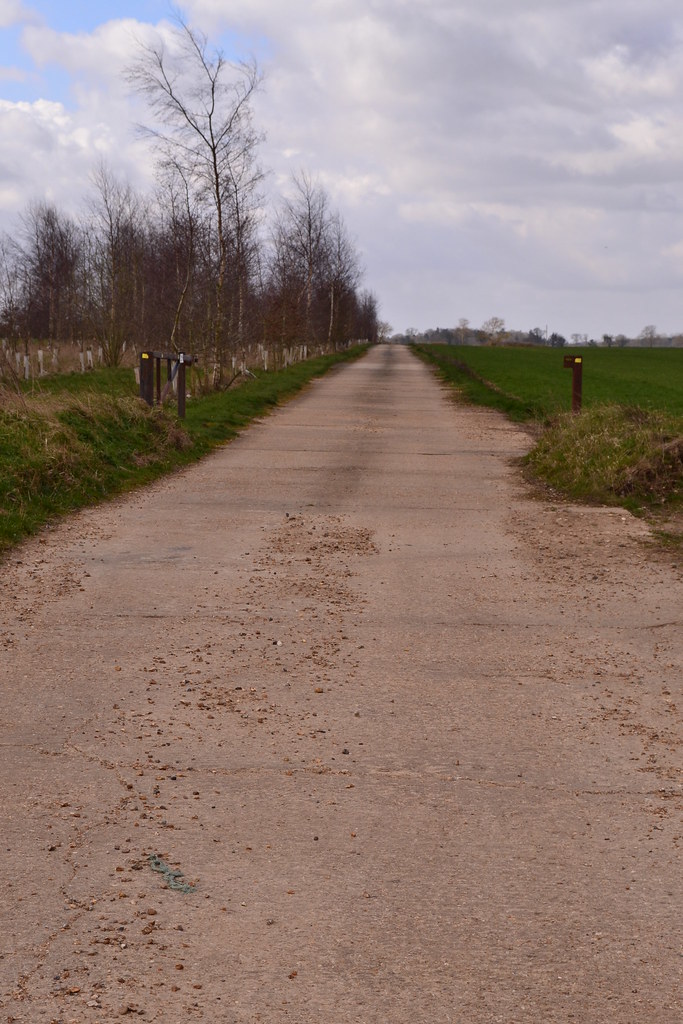
A pill-box, marks where the main entrance was. Turn left here and follow the road west. To your right you pass the original Fire Tender shed, a B1 hangar and other minor buildings in varying states of disrepair. To your left, a further T2, partially refurbished partially original. Further along, the road crosses the original N/S runway, full width remnants to the right and a tree-lined track to the left mark clearly where the enormous concrete structure was laid. The road ahead, is the where the 08/26 runway ran as it disappears over the brow of the hill. The road then turns away north leaving the runway and airfield behind you.

RAF Foulsham

The original Fire Tender shed.

As with all airfields, the accommodation blocks and bomb stores were scattered well away from the main airfield. With some searching, evidence of these may be found amongst the hedges and trees, public roads utilising the concrete sections of RAF road laid down originally.

Whilst the main layout of Foulsham is difficult to see from the road, the last remaining buildings have fared quite well and remain some of the better examples of original wartime architecture. There is a distinct ‘feel’ to the site that transforms you back in time to the days when heavy bombers and lighter twin-engined aircraft would rumble along its runways. Recent and ongoing development work by the farmer seems to be sympathetic and ‘in tune’ with the site, many buildings being reclaimed from nature and now ‘on show’ to the passing public. Whilst all are on private land, they are easily seen and it seems that there may be a winning formula here that other land owners could quite easily follow and preserve what is left of our disappearing heritage.

RAF Foulsham

The remains of the 08/26 runway.

The wartime memories project, has a section focusing on RAF Foulsham and people trying to trace crew members who served there. It is worth a look through perhaps you may know someone from there.

In the nearby village of Foulsham, beneath the village sign, stands a memorial to the crews and personnel of RAF Foulsham.

From Foulsham, we head north-west, to a little airfield with the quaint name ‘Little Snoring’.


*1 photo from Royal Air Force Bomber Command, 1942-1945.© IWM (HU 60601)

A memorial for three aircraft that crashed close by.

Trail 22 takes us to an area of Norfolk that is filled with narrow lanes, and ‘chocolate box’ villages with duck filled streams and babbling brooks running through the middle. An ideal and welcome break from the horrors of what was witnessed in the skies of occupied Europe all those years ago.

Travelling away from Great Massingham and West Raynham, we carry on east, toward Norwich and then take a left turn and head north. Cutting through the delights of Norfolk, we take in the last few sites that offer good examples of airfield architecture. Before reaching our first site however, turn off the main road at Weasenham St. Peter, for here is a small reminder of the terrible tragedies of war.

Nestled in the village is a small but poignant reminder of the dangers faced by the young men who flew in our skies. Once over friendly territory, crews would often feel safe knowing that ‘home’ was but a few miles away. However, for many the danger was not over yet.

A pyramid memorial in this quiet and almost insignificant village, identifies the crews of not one but three aircraft that crashed close by killing all onboard. From this point you can see the hangars of West Raynham dominating the skyline, an indication of how close to home these young men were.

Blenheim L8800, of 114 sqn RAF, crashed on 5th June 1942. On board were: Sg. F. Cooke, Sgt. J Wallbridge (VR) and Sgt. E. Kitcher (VR) all of whom lost their lives. On 17th October that year, a B25 Mitchell,  FL206 of 98 sqn RAF, crashed killing the crew: Flt. Sgt. D. Tanner, Sgt. E. Boreham, Sgt. L. Horton and LAC F Barnett all of RAF(VR). Finally on May 22nd 1943, close to his spot a Douglas Boston III, AL285 of 342 ‘Lorraine’ Sqn.  crashed killing all her crew, who were part of the Free French Airforce: Lt. M. Le Bivic, Lt. R. Jacquinot, Sgt. L. Cohen and Cpl. J. Desertlaux. All three aircraft were based at nearby West Raynham when the tragedies struck.

various 003

The memorial at Weasenham St. Peter. Behind you, are the not so distant hangars of RAF West Raynham.

A sad and terrible loss of life. When leaving here, return to the main road and head east to our first stop at RAF Foulsham.

RAF Great Massingham – A Real Gem in Norfolk’s Heartland.

In the heart of Norfolk, some 40 miles west of Norwich and 13 miles to the east of King’s Lynn, lies a small, quaint village typical of the English stereotype. Small ponds frequented by a range of ducks, are thought originally to be fish ponds for the 11th century Augustinian Abbey, and the history of the village is believed to go back as far as the 5th Century.  Massingham boasts an excellent village pub, and a small shop along with beautiful walks that take you through some of Norfolk’s most beautiful countryside; it has to be one of Norfolk’s greatest visual assets.

Sited above this delight is the former airfield RAF Great Massingham, which during the war years was home to number of light bombers and even for a short while, the four engined heavy, the B-17. In Trail 21, we return to RAF Great Massingham.

RAF Great Massingham

Great Massingham airfield lies in the heart of Norfolk, some 40 miles west of Norwich and 13 miles to the east of King’s Lynn, lies a small, quaint village typical of the English stereotype. Small ponds frequented by a range of ducks, are thought originally to be fish ponds for the 11th century Augustinian Abbey, and the history of the village is believed to go back as far as the 5th Century.  Massingham boasts an excellent village pub, and a small shop along with beautiful walks that take you through some of Norfolk’s most beautiful countryside; it has to be one of Norfolk’s greatest visual assets. Sited above this delight is the former airfield RAF Great Massingham, which during the war years was home to number of light bombers and even for a short while, the four engined heavy, the B-17.

Before entering Great Massingham I suggest you stop at Little Massingham and the church of St. Andrew’s. For inside this delightful but small church, is a roll of honour*1 that lists enormous amounts of information about the crews who served at the nearby base. It gives aircraft details, mission dates and crew names amongst others. It is a hugely detailed collection of information covering 1940-45, in which time 600 Massingham crews lost their lives. Seven of these crew members, are buried in the adjacent church yard: Sqn. Ldr. Hugh Lindsaye (18 Sqn), Sgt. John Wilson (RNZAF – 107 Sqn), Sgt. Thomas Poole (107 Sqn), P/O. Arthur Lockwood (107 Sqn), Flt. Sgt. Gordon Relph (107 Sqn), F/O. Charles Ronayne (RAF) and F/O. Joseph Watkins (239 Sqn), all being killed in different circumstances. This is a valuable and enlightening stop off to say the least.

RAF Great Massingham

The Roll of Honour in St. Andrew’s Church, Little Massingham.

On leaving the church turn right and you will almost straight away enter the village of Great Massingham. The airfield is to the east behind the village holding the high ground, which makes for a very windy and open site, whilst the village nestled on the lower ground, remains calm and quiet. Built originally as a satellite for the nearby West Raynham, Massingham opened in 1940 with grass runways initially under the command of 2 Group, Bomber Command and then latterly 100 Group, whose headquarters were at Bylaugh Hall. The distance between both RAF West Raynham and RAF Massingham was so small, that crews would cycle from one to the other each morning before operations.
RAF Great Massingham

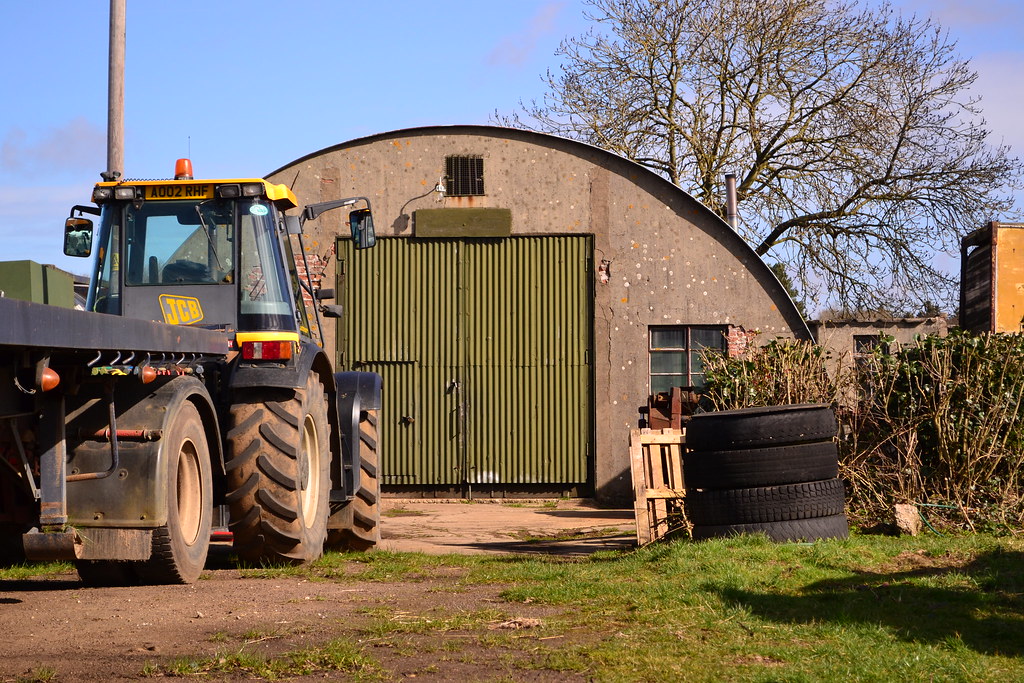
The Officers Mess now a farm building.

There were a total of four T2 hangars and one B1 hangar built on this site. The airfield also had sixteen pan-type hardstands and twenty-one loop-type hardstands, giving a total of thirty-seven dispersal points around its perimeter.

The main accommodation and communal sites which totalled five and two respectively, were near to Little Massingham church, to the west, along with further areas to the south of the airfield . These included a communal area to the south-west of the village and sufficient accommodation for 1,197 men, consisting of Officers, Senior NCOs and ordinary ranks.  This was later upgraded to accommodate 1,778 men. In addition, accommodation was provided for the WAAFs of the airfield, 102 in total at the outset. This was also increased in the airfield’s upgrade, taking the total number of  WAAFs to 431.

The bomb dump and ammunition stores were well to the north away from the personnel as was standard. A number of anti-aircraft sites were scattered around the perimeter offering good protection from any attacking aircraft.

The first occupants of Massingham were the Blenheim IVs of 18 Sqn RAF who arrived in the September of 1940.

18 Sqn were previously based at West Raynham, making the transition invariably very smooth. In fact, operations barely ceased during the change over, the last West Raynham sortie occurring on 7th September 1940 with a six ship formation attack on the docks and shipping at Dunkirk, and the first Great Massingham sortie on the evening of the 9th to Ostend.

Whilst at Great Massingham, 18 Sqn flew the Blenheim Mk.IV initially on short range bombing sorties to the French coast. All was fairly quiet for the first few weeks, the squadron’s first loss not occurring until November 28th 1940, when Blenheim P6934 crashed after hitting high tension wires west of the airfield. All three of the crew were injured and admitted to hospital, but Sgt. William E. Lusty (S/N: 751633) died from his injuries the following day.

18 Squadron remained at Great Massingham until April the following year (1941), performing in the low-level bombing role. Like most other RAF airfields around this area of Norfolk, it would be dominated by twin-engined aircraft like the Blenheim and its subsequent replacements. As a reminder to those who may have got complacent about the dangers of flying in wartime, the departure of 18 Sqn was marred by the loss of Squadron Leader Hugh Lindsaye (S/N: 40235), who was killed whilst towing a drogue near to Kings Lynn a few miles away. An investigation into the crash revealed that a drogue he was pulling had become separated and fouled the port elevator. The pilot lost control as a result and all three crewmen (SgT. Stone and F/O. Holmes) were killed. Sqn. Ldr. Lindsaye is one of those seven buried in Little Massingham.

Shortly after the departure of 18 Sqn, Massingham took on another Blenheim squadron in the form of 107 Sqn, a move that was coincided with a detachment of B-17 Flying Fortresses of 90 Squadron.

The B-17 (Fortress I) squadron was formed at Watton earlier that month, they moved to West Raynham whereupon they began trials at a number of smaller airfields including Bodney and Massingham, to see if they were suitable for the B-17. These initial tests, which were undertaken by Wing Commander McDougall and Major Walshe, were a series of ‘circuits and bumps’ designed to see if the ground and available runways were suitable. It was decided that Massingham was indeed suitable, and so a decision was made on the 13th, to base the aircraft at Massingham but retain the crews at West Raynham, transport vehicles ferrying them to and from the aircraft on a daily basis. For the next few days further tests were conducted, and engineers from Boeing came over to instruct ground crews on the B-17’s engineering and armaments. Concerns were soon raised by crews about Massingham’s grass runways, and how well they would perform with the heavier four engined B-17’s constantly pounding them.
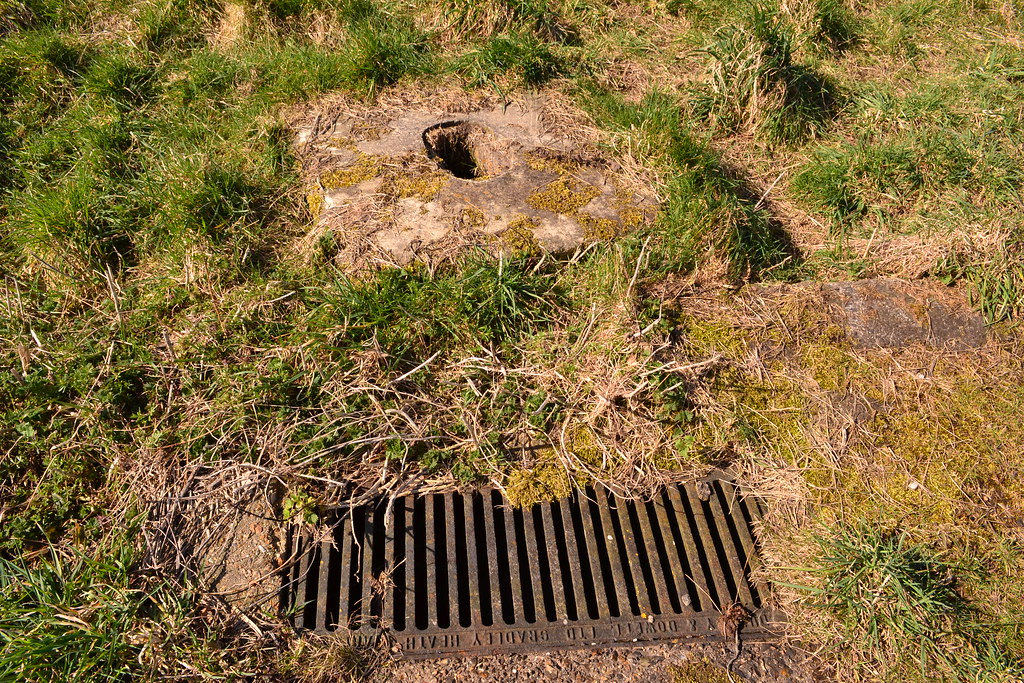
RAF Great Massingham

Remains around the perimeter track.

On the 23rd May, H.R.H The King conducted an inspection of Bomber Command aircraft at RAF Abingdon, in Oxfordshire. Amongst the types presented with the RAF bombers was a Fortress I from Massingham. The King, Queen and two Princess’s Elizabeth and Margaret, all attended and took a great interest in the Fortress. The Royal party taking considerable time to view and discuss the heavy bomber’s merits and features.

Back at Massingham, flight tests, training and examinations of the B-17 continued until in June 1941, when 90 Sqn were ordered out of both Massingham and West Raynham, moving to RAF Polebrook in Northamptonshire. But by the October, the Fortress’s had all gone from RAF bomber service, problems with freezing equipment convincing the RAF not to use the heavies in bombing operations.

By February 1942 the unit was disbanded and all its assets were absorbed into 1653 Heavy Conversion Unit (HCU). Within days of 90 Sqn’s arrival at Massingham, another more permanent squadron also arrived, again performing in the same low-level bombing role as their predecessors 18 Sqn. The spring of 1941 saw 2 group perform some of their largest operational sorties to date, with many Blenheims continuing their daylight raids on shipping and docks in north-west Germany.

It was during this hectic time, on May 11th, that 107 Sqn, would arrive at the Norfolk base at Massingham. Being taken off operations on the 10th, the air personnel made their way down from the Scottish base at Leuchars whilst the ground staff travelled by train the following day. A number of crews were posted on detachment to bases at Luqa, Ford and Manston.

After a short settling in period missions began again in earnest with their first twelve ship operation in Bomber Command taking them to Heliogoland on the 13th. Two of these Blenheims returned with engine problems, but the remainder managed to attack the target, in an operation that was considered a great success, with complete surprise being achieved. Flying at very low level was key to this operation, and whilst all aircraft returned home safely, one aircraft piloted by Sgt. Charney, flew so low he managed to strike the sea with his port engine; as a result, the airscrew was damaged and broke away leaving the aircraft flying on just one of its two powerplants!

The end of May was a difficult month for 107. On the 21st they returned to Heligoland, with nine aircraft taking off at 14:00, detailed for a daylight formation attack on the target. With  visibility of 12 – 15 miles, they pressed home their attack from as low as fifty feet, in spite of what was an ‘intense and accurate’ flak barrage. Four aircraft were hit by this flak, and in one of them, Sgt. John Wilson (S/N: 40746) was killed when shrapnel struck him in the head. Sgt. Wilson is also one of the seven in the church yard at Little Massingham.*2

On the return flight, a second aircraft also damaged by the flak, had an engine catch fire. The pilot and crew were all lost after ditching in the sea. Fl. Sgt. Douglas J. R. Craig (S/N: 903947) never having being found, whilst two other crewmen (Sgt. Ratcliffe and Sgt. Smith) were seen climbing into their life raft, later being picked up by the Germans and interned as prisoners of war.

On the 23rd the squadron was then detailed to search for shipping off France’s west coast. Due to bad weather, they were unable to make Massingham and had to land at Portsmouth instead. Continued bad weather forced them to stay there until the 27th when they were able at last to return to Massingham. No further operations were then carried out that month.
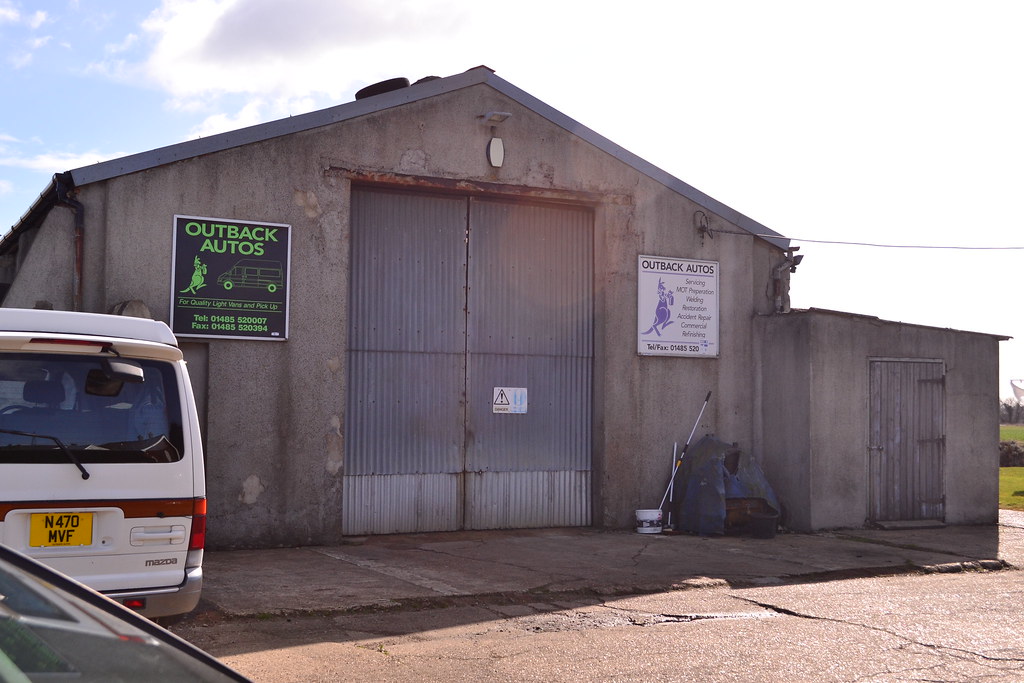
RAF Great Massingham

Gymnasium and attached Chancellery now a car repair shop.

The dawn of 1942 saw Bomber Command face its critics. High losses brought into question the viability of these small light aircraft as bombers over enemy territory, a situation that would see 2  Group, as it was, all but removed from operations by the year’s end.

But the end was not quite here, and January  of 1942 saw 107 take on the Boston III ( an American built aircraft designated the ‘Havoc’) as a replacement for the now ageing Blenheim. With the new aircraft 107 remained at Massingham, at least until the early August, where they made a short move to Annan before returning to Massingham a mere week later. It would take only a month before the first 107 Sqn Boston would be lost.

Whilst on a training flight, Boston W8319, struggled to join the formation, after turning back, it was seen to fall to the ground, the resultant fireball killing all three crewmen on board.

Despite this, losses over the coming months remained light. With the introduction of US airmen and the 15th Bomb Squadron, June / July saw a number of Massingham aircraft transfer across to the American’s hosts 226 Sqn at Swanton Morley. One of these aircraft, crewed by two US airmen; Captain S. Strachan and Lt. C. Mente, crashed near RAF Molesworth killing both on board.

By the end of 1942, 107 Sqn had lost a total of 23 aircraft on operations, and with each Boston carrying four crewmen it meant losses were increasing for the unit.

In February 1943, the Boston IIIs were replaced by the IIIa model. During May, the whole of 2 Group would begin to transfer across to the 2nd Tactical Air Force (TAF) in preparations for the invasion the following year. Losses had been high for the group, the light bombers being easily cut down by both Luftwaffe fighters and flak.

At the end of August 1943, it was 107 Sqn’s turn and they departed Great Massingham for Hartford Bridge and a new life within the 2nd TAF. It was during these summer months that a Free French unit, 342 Lorraine Squadron would arrive at Massingham. A unit formed with Bostons at West Raynham, it would stay at Massingham between July and into early September before moving off to rejoin 107 Sqn at Hartford Bridge, also beginning a new life within the 2nd Tactical Air Force.

It was these postings that would lead to the end of Massingham as a day bomber station, and no further vulnerable light bombers of this nature would be stationed here again.

In April 1944 Great Massingham  was redeveloped and upgraded, more accommodation blocks were provided and three concrete runways were laid; 03/21 and 13/31 both of 1,400 yards, and the third 09/27 at  2,000 yards, this would give the site the shape it retains today.

A year-long stay by 1694 Bomber (Defence) Training Flight with amongst them, Martinets, gave the airfield a much different feel. Target towing became the order the day and non ‘operational’ flying the new style. In the June of 1944, 169 Sqn would arrive at Massingham, operational flying was once again on the cards, with night intruder and bomber support missions being undertaken with the Wooden Wonder, the D.H. Mosquito. Between June and the cessation of conflict this would be a role the squadron would perform, and perform well, with numerous trains, ground targets and Luftwaffe night fighters falling victim to the Mosquito’s venomous attacks. Included in these are a damaged Ju 88 on the night of October 26th 1944 south of the Kiel Canal, and five trains on the night of October 29th.
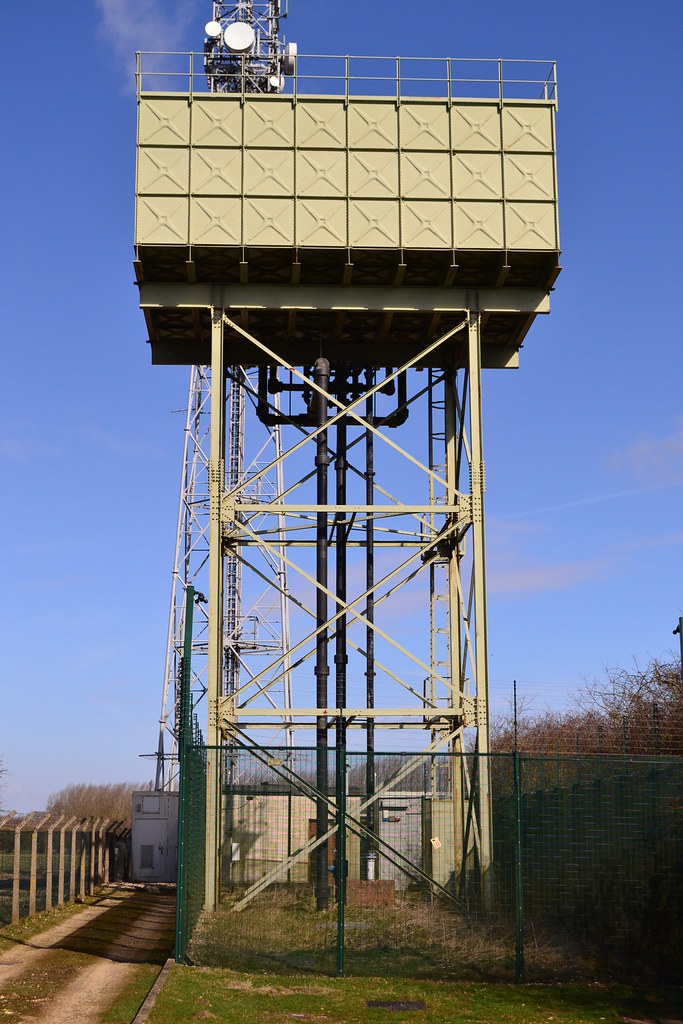
RAF Great Massingham

Original high-level Braithwaite water tank.

With them, came 1692 (Bomber Support Training) Flight, to train crews in the use of radar and night interception techniques.

Formed at RAF Drem in Scotland in 1942 as 1692 (Special Duties) Flight, they operated a range of aircraft including Defiants, Beaufighters and Mosquitoes. The two units stayed here at Massingham until both departed in August 1945, at which point 12 Group Fighter Command, took over responsibility of the site.

As radar and night interception roles developed, a new unit was created at Massingham under the control of the Central Fighter Establishment (CFE), who were to trial different techniques and strategies for air interception. They later moved to West Raynham where they continued to carry out this role.

Over the years a number of  post war celebrities were stationed at Massingham, they included F.O. Keith Miller AM, MBE – the Australian Test cricketer; P.O. (later Squadron Leader) Bill Edrich DFC – the England cricketer and the BBC commentator – Flt. Sgt. Kenneth Wolstenholme DFC and Bar.

After the aircraft left, the airfield fell quiet and was very quickly closed. 1946 saw the last personnel leave, and it remained dormant until being sold in 1958. Bought by a farmer, it is now primarily agriculture, although a small private airfield has opened utilising the former runways, and flying visitors are welcomed with prior permission. The airfield at great Massingham has a public footpath running part way through it. This is accessible at either end of the southern side of the airfield, and permits access along part of the original perimeter track. Accessing the eastern end of the path is easiest, a gated road from the village takes you up to the airfield site. Once at the top, you can see the large expanse that was the main airfield site. Trees have since been cultivated and small coppices cover parts of it. To your right at this point the peri track continues on in an easterly direction, but this section is now private and access is not permitted. This track would have taken you toward the Watch office, the Fire Tender building and storage sheds – all these being demolished long ago. A further area to the south of here has now been cultivated, and there was, what is believed to have been a blister hangar, located at this point – this too has long since gone.

The public path turns left here and takes you round in a northerly direction. To your left is a T2 hangar, it is believed that this is not the original, but one that had been moved here from elsewhere. This however, cannot be confirmed, but there was certainly a T2 stood here originally.

The track continues round, a farm building, very much like a hangar, houses the aircraft that now fly. Sections of runway drainage are visible and piles of rubble show the location of smaller buildings. The track then takes you left again and back to the village past another dispersal site, now an industrial unit complete with blister hangar.

Other foundations can been seen beneath the bushes and leaves on your right. This may have been the original entrance to the site, although Massingham was unique in that in was never fenced off, nor guarded by a main gate. Other examples of airfield architecture may be found to the north side of the airfield, indeed satellite pictures show what looks like a B1 hangar on the northern perimeter.
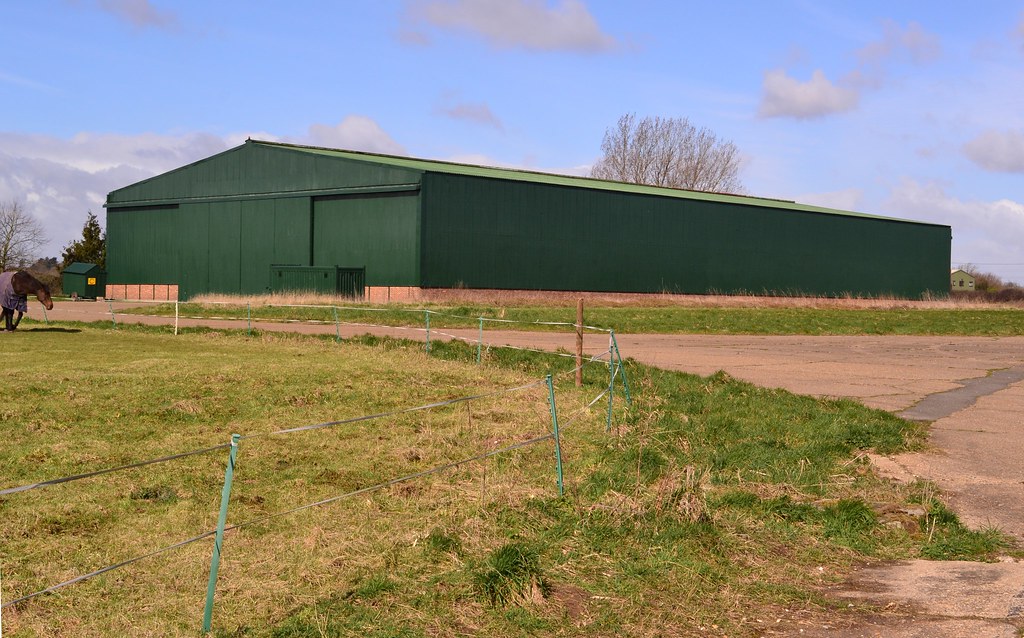
RAF Great Massingham

The perimeter track and T2 hanger re-sited post war.

After walking round, drive back toward Little Massingham, but turn left before leaving the village and head up toward the distant radio tower, itself a remnant from Massingham’s heyday. We pass on our left, the former accommodation site. Now a field, there is no sign of its previous existence. However, further up to the right, a small enclave utilises part of the Officers’ Mess, the squash court, and gymnasium with attached chancery. Hidden amongst the trees and bushes are remnants of the ablutions block, and other ancillary buildings. Continue along this road, then take the left turn, toward the tower. Here is the original high-level Braithwaite water tank and pump house, still used for its original purpose and in very good condition.

Finally, a lone pill-box defensive position can also be found to the west of the village, some distance from the airfield in the centre of a farmer’s field. All small reminders of the areas once busy life.

Great Massingham is a delightful little village, set in the heart of Norfolk’s countryside. Its idyllic centre, pubs and shops surround ponds and greens. A short walk away, is the windy and open expanse that once was a bustling airfield, resounding to the noise of piston engines. All is now much quieter, their memories but a book, some dilapidated buildings and a handful of graves. Standing at the end of the runway, looking down the expanse of concrete, you can easily imagine what it must have been like all those years ago. From Great Massingham we head east, to RAF Foulsham, before turning north and the North Norfolk coast, an area of outstanding natural beauty and some fine examples of airfield architecture.

Sources and links RAF Great Massingham

*1 A comprehensive history of RAF Massingham, including RAF material, is now under the care of the Massingham Historical Society. Contact Anthony Robinson antmassingham@gmail.com for details about the Museum or Roll of Honour, a hard copy of which can be purchased for a small fee.

*2 The ORB shows this as Sgt G, Wilson and not J.W. Wilson.

National Archives AIR 27/842/10

RAF Great Massingham is remembered on the Massingham village website which includes details of the Roll of Honour.

Massingham was first visited in 2015.

RAF West Raynham – a well Preserved Segment of Britian’s Aviation History.

From the first site of this trail, RAF Sculthorpe, we travel a few miles south, a stones throw, to its sister station and another post war relic – RAF West Raynham.

RAF West Raynham

Nestled away in the heart of Norfolk is a real hidden gem. West Raynham remains an incredibly intact airfield, complete virtually in its entirety. But don’t get over excited, the diggers, cranes and bulldozers are there and already casting their blows.

Built in 1939 it had four runways, all of grass with 36 pan type dispersals, an accommodation block, ‘C’ type hangars and all the associated support buildings of a wartime airfield. Used by bomber command, it would see a range of twin-engined aircraft operate from within.

C Type Hangar

West Raynham’s hangars will be holiday flats.

Opened in May 1939, it was typical of its time. The first squadron to be based here was 101 squadron RAF, equipped with Bristol Blenheim IVs and later Vickers Wellington 1cs. 101 sqn began the war with daylight attacks on oil supplies in the port areas, communication lines and enemy airfields. A duty that later changed to the more successful night fighter role. 101 eventually left West Raynham, being replaced by further Blenheims of 114 squadron. Other squadrons to arrive included: 2 Grp TT flight, 76, 139, 18, 90 (with B17c ‘Fortresses’), 614, 18 and 1482 squadrons. A variety of aircraft came with them, including: Lysanders, Defiants, Bostons, Hampdens and Fairy Battles giving West Raynham a real diverse range of types.

In September 1942, two more squadrons arrived at West Raynham, 98 and 180 operating the North American B25 ‘Mitchells’. In the following year, Between May and November 1943, the grass runways were removed and replaced with concrete runways, one 2,000 yards (1,800 m) long and the other 1,400 yards (1,300 m) long. To coincide with this, the accommodation area was also expanded to allow for the influx of new personnel. West Raynham was now able to accommodate up to 2,456 men and 658 WAAFs.

West Raynham 042

The Officers mess is destined for other uses.

Night intruder attacks from West Raynham increased. De Havilland’s ‘Wooden Wonder’, the Mosquito II, FB, VI and NF 30s of 141 and 239 squadrons taking over this role. A number of switching between nearby Sculthorpe and Great Massingham, led to regular changes in residency, indeed as the war closed and the jet age beckoned, West Raynham would be the home to many types of modern fighter and their squadrons. Fighter trials became the order of the day, Tempests, Spitfires, Firebrands, Sea Mosquitos (see here), Sea Venoms, Sea Hawks Meteors, Javelins and Canberras to name but a few. The Royal Navy based many of their types here for various trials and research projects. The last piston examples to fly from West Raynham were the Fireflys and Hellcats of 746 sqn RN as part of Naval Fighter development Unit.

Further fighter trials and development units continued into the jet age, and the last aircraft to grace the skies over West Raynham were the Hunters and Canberras of 45, 85 and 100 squadrons. Then the roar of the jet engine was replaced by the Bloodhound missile and West Raynham began its decline into closure. In the 1994 West Raynham finally closed its hangar doors and its personnel moved out, the airfield itself remaining in MOD hands. Sadly the housing lay empty and it quickly became derelict, targeted by the vandals, the accommodation blocks were damaged and windows smashed.

Long debates and scornful banter over the housing shortage boiled over in parliament and sites such as West Raynham were seen as Prime land, with a huge infrastructure already in place, they were half way to meeting the needs of a growing community. The MOD eventually gave in, agreed to the sale and the site was handed over.

Control Tower

The Tower stands in the late sun shrouded in scaffolding. A sign of new life?

Initial attempts at obtaining a Grade II listing to a large number of the airfield’s buildings was made by the English Heritage but sadly, this was later withdrawn and no follow-up made. A number of planning applications have been passed over a period of years and as a result, the number of developments designated for this site have increased. Luckily, many of the original homes will and have been refurbished and sold off, thankfully retaining their original style and layout.  The Hangars remain and will be turned in to Holiday apartments. How much of the other airfield architecture will remain in its original design is yet to be seen, but much of the north end of the runway and Bloodhound sites have already gone, being replaced by the beginnings of what is reputed to be, Britain’s largest Solar Park.

The control tower remains along with a wide range of smaller ancillary buildings, shrouded in scaffolding maybe it will become a cafe or other ‘social centre’. The Rapier Training dome still stands as does the elaborate Officers Mess. The adjacent tennis courts have now been reclaimed by trees and like the mess, will no doubt will find a new lease of life in some other guise.

various 005

The Rapier training dome resembles the gunnery trainers found at other older airfields.

If you drive round the airfield, to the east side, you can still obtain good views across to the hangars. The original Battle headquarters remains buried and pill boxes for the airfields defence can also be found.

A memorial to the crews of West Raynham has been erected in what is now the centre of a new housing area that utilises the old accommodation blocks. Around it remain fences and grazing sheep, the buildings behind them yet to see their fate.

West Raynham’s lasting legacy may be down to Flight Lieutenant Alan Pollock, flight commander of No 1 Squadron, who around midday on 5th April 1968 flew a Hawker Hunter FGA.9 (XF442) between the two spans of Tower Bridge in London. This stunt, a protest by Pollock at Government defence cutbacks, resulted in Pollock being invalided out of the RAF on ‘medical’ grounds, the alternative being a rather more embarrassing court-martial.

West Raynham remains today an incredibly well ‘preserved’ airfield, complete in its entirety. Its history is well documented in its walls and architecture. The layout, even as private housing is clearly that of an airfield, with the feel of an airfield, but what of its future? What will eventually become of this grand and large segment of British History? Only time will tell.

various 002

West Raynham’s memorial stands in the centre of the refurbished housing development.

Just a few minutes drive from West Raynham to the west is another wartime airfield and our last for today. Whilst the majority of the infrastructure has gone, all is not lost as it is a private airfield open to landings and with access in part via a footpath, a real delight to end the trail. We visit the picturesque village of Great Massingham.

RAF Sculthorpe – a relic of the Cold War.

In this second part of the Norfolk Trails, we visit three more of Norfolk’s treasures. Deep in the heart of Norfolk, two of them are very much complete, but the third is all but gone. However, all is not lost as it still an active private airfield, and some of its features have luckily survived.

The first of these three jewels on this trail is RAF Sculthorpe.

RAF Sculthorpe 

Located to the west of Norwich, Sculthorpe has its origins in the Second World War, but it has a larger claim to fame that it still retains to this day.

A once busy shop

A once busy shop now derelict and forgotten.

Designed initially as a heavy bomber site, and satellite to RAF West Raynham, Sculthorpe now has three runways one of 12,000ft and two of 6,000ft, all concrete. With its enormous technical and administration sites that housed up to 10,000 personnel, Sculthorpe was one of the biggest bases in Europe, an honour it retains to this day.

Sculthorpe had a limited Second World War life, being opened quite late in the war in January 1943. Following a years development and growth, it initially housed Mosquitos of 464 (RAAF) and 487 (RNZAF) squadrons.  Originally based at Methwold, the Mosquito FB.VIs replaced the earlier and slower twin-engined Venturas. At Sculthorpe, these two units were joined by 21 Sqn who stayed until the following December, before moving on. Then the much heavier B-17s of 214 sqn moved in thus changing the role of RAF Sculthorpe. The B-17s were redesigned and adapted to assist in radio jamming trials, the early form of Electronic Counter Measures (ECM), the B-17 crews would also be joined by other personnel from the United States, who stayed carrying out this role, until just prior to the end of hostilities.

Accomodation Block

Barrack Block

It was really at this time that Sculthorpe came into its own. With the influx of crews from the States, more accommodation would be needed and quickly. A sustained period of redevelopment, improving of runways and hardstandings, saw Sculthorpe gain the designation of Very Heavy Bomber base. It was anticipated that the enormous Boeing B-29s would be stationed here, but when the war in Europe came to an end, further deployment at Sculthorpe ceased and the B29s never arrived. However, the rise in ‘Soviet Aggression’ and post conflict tensions during the Cold War and Berlin airlift, secured the immediate future of Sculthorpe. Atomic weapons were stored here ready, when the North American B-45 Tornado found itself becoming the front-line four engined bomber designed to attack Soviet targets from the UK. During 1952, the 47th Bomb Wing of the Strategic Air Command were redeployed here from the United States. This wing consisted of the 84th, 85th, and 86th BS, along with the 420th Refueling Sqn and the 19th Tactical Reconnaissance sqn. These units operated a number of types including the: B-45, B-66, KB-29, KB-50, and RB-45C aircraft.

Control Tower

The Control Tower in a setting sun.

Ninety day duty rotations saw aircraft like the mighty B-36 ‘Peacemaker’ fill the skies over Sculthorpe, until finally, political agreements and imposed de-escalation strategies between the Cold War factions, prevented further deployment of large-scale US bombers on European soil.

Gradually, as nuclear deterrents turned to missiles and naval based platforms, Sculthorpe’s activity began to slow. Being returned to RAF ownership in 1964, it was placed in care and maintenance, and held by only a small detachment of support staff. Then in the late 60s, the USAF returned once more, needing a base from which to operate its aircraft whilst other airfields were redeveloped and runways resurfaced. This brought new life to Sculthorpe, American F-4 Phantoms and C-130s were based here, along with other aircraft types from the RAF operating under similar circumstances. This process went on well into the late 1980s and Sculthorpe became a mecca for plane spotters for at least another few years.

Airmens huts

‘Hut 380’, a Second World War remnant.

This was not to last however, and Sculthorpe finally closed its doors in 1992, the enormous accommodation blocks and technical sites were sold off. Both these and many of the remaining buildings were left to decay, whilst planners gae thought to what they should be used for. However, like a phoenix, Sculthorpe returned from the dead yet again. The RAF, Army Air Corps and USAF using it for manoeuvres, with tilt wing aircraft, paratroops and rehearsals of supply drops over its enormous runways; much of this activity taking place at night. Even up until recently, C-130s have also been seen landing here, again rehearsing quick ‘stop-‘n’-go’ drops.

Looking at Sculthorpe, it is hard to believe its origins were in the Second World War. Being a real monster of the Cold War, Sculthorpe is clinging on by the skin of its teeth. The accommodation blocks that once housed 10,000 personnel are decaying and vandalised, refurbished areas are now sold off and accommodating local families. A small industrial area has been developed from the technical area, and the local farmer grazes his cows on the far reaches of the site. Many of the older orignal buildings have been left to rot and fall down. The American authorities still retain some ownership of the site, whilst a large part of it is in private hands.

Technical site buildings

A large part of Sculthorpe has been left to rot, piece by piece.

The original guard-house is no longer manned, and a number of other buildings close by are also empty. A small public track that once took eager plane spotters to the rear of the airfield, still allows views across the north of the now quiet site where a blister hangar continues to stand alone. The control tower is still intact visible in the distance from this point, as are a number of original Nissan huts and Second World War buildings hidden amongst new buildings and old developments.

Reunion 'memorial'

In remembrance of the 47th BW, 50th anniversary reunion, 2002.

Sculthorpe was once a bustling airfield, home to some of the world’s heaviest bombers, a mecca for aviation enthusiasts and plane spotters alike. Today, it is a decaying industrial site, a mix of old buildings and new developments, a remnant of the Cold War, it clings on to life by the skin of its teeth, maybe, just maybe, the Phoenix will rise up once more and spring into life again.

Blister Hangar

Sculthorpe’s remaining Blister hangar in a low setting sun.

From Sculthorpe, we travel a few miles south, a stones throw, to its sister station and another post war relic – RAF West Raynham.

Gloucester – RAF Stoke Orchard

DSC_0014

An original Bellman Hangar, rusty but in use.

It’s always good to receive comments and have interaction with readers on trails. Contact from such a reader promoted a good discussion around the state of many of these airfield and the changes seen in relatively short periods of time. It surprised both of us how much had changed and not for the better!

A fellow enthusiast and reader, Steve Darnell, kindly offered to share his photos with me and take me to a local but little known about airfield within a few minutes of his home near Gloucester – RAF Stoke Orchard.

RAF Stoke Orchard

There is little information available about Stoke Orchard, but it is known that a small number of units were based here between September 1941 and January 1945: No 3 GTS, (Glider Training School), No 5 MU, (Maintenance Unit) , No 10 EFTS, (Elementary Flying Training School)  along with a WAAF Officers’ School all utilised the site during this time.

Having a relief landing ground at Northleach, Stoke Orchard airfield was built with four grass runways: N/S – 1,090 yds, NE/SW – 1,160 yds, E/W – 1,160 yds, and NW/SE – 1,125 yds. It had a number of hangars: 4 Bellman, 8 double Blisters, 1 treble Blister and four single blisters. Accommodation was provided for 645 RAF personnel and 201 WAAFs. Other buildings on the site included the accommodation blocks, technical buildings, hospital, AA defences and a wooden Control Tower.

As a training station, there were around 50 Tiger Moths based here, which were later replaced by gliders.

DSC_0015

Bellman Hangar door runners.

After the war, the site quickly closed, and Stoke Orchard fell into disrepair. However, the Gloster run factory across the road at the northern side of the site, continued to use the airfield to ferry aircraft away from the site. The aircraft were maneuvered over the road and through a gate onto the airfield; the gate now a gap in the hedge and the factory used for research into coal.

Several parts of the perimeter track still remain today, now used by farmers, they mark the extent of the site which for its origin and purpose, is quite large. The four Bellman hangars are also still in situ, three of them having been substantially reinforced and refurbished, the fourth being in its original shell. Even with the refurbished covers, the internal structures are evident as are racking points, evidence of additional work being carried out on them during their original use.

The Hangar door rails can also be seen embedded in the concrete floor, and a large concrete area, to the front of the sites is where the control tower stood along with other technical buildings.

DSC_0017

Part of the Perimeter Track.

Part of the site is now a waste disposal site and along this road can be found examples of both a Cold War relic, the Royal Observer Post, and a bunker, a rare type called a ‘Seagull Trench’ due to its shape. These trenches were used for airfield defence in the case of attack or invasion. Both are intact, but the bunker has had several fires lit inside it severely damaging the internal structures.

A number of brick mounds are also embedded in the hedgerows, bits of pottery and other remnants can also be found for those wishing to get in amongst the thorns and delve deeply.

Little else survives of the airfield, and little is known or recorded about its activities. There are mentions of ex-POWs using it as a ‘squat’ post war and families living in its accommodation blocks, but it appears that Stoke Orchard is another site that has quietly disappeared leaving only small relics behind to remind us of this once active airfield.

My sincerest gratitude goes to Steve and Michelle for their generous hospitality, and for opening their home up to me. I would also like to thank Steve for the loan of the books, CDs and for giving me the many photos for safe keeping.  A real gent.

Stoke Orchard is also very close to the Jet Age Museum based in the corner of Gloucester Airport, formally Staverton, and is open on certain days in the summer.

DSC_0005

A Seagull trench used for Airfield defence.