A recent request from Eric Simonelli at the RAF Bradwell Bay Preservation Group. Eric is a key member of the group who are trying to preserve and promote the former RAF Bradwell Bay. He has kindly supplied a short write up and a flyer promoting a study day to be held in July for anyone interested. If you are, please contact the group direct and not myself at Aviation Trails.
RAF Bradwell Preservation Group.
Bradwell started off as a small grass aerodrome serving the firing range on the Dengie Peninsula, in the late 1930’s. In 1942 the aerodrome was expanded and became a large bases for 2,500 personnel who were to fly intruder missions to the continent and provide refuge for bombers returning with damage, casualties and short of fuel. To enable this level of activity there were many career opportunities for both men and women. This included aircraft maintenance, radio control, catering, motor transport and may more. Women were to fill all roles, apart from combat. Today the RAF is fully inclusive.
RAF Bradwell Bay was host to many different squadrons up to the end of the war, with a variety aircraft types including Boston Havocs’, Mosquito’s, Spitfire’s, Tempest’s, Blenheim’s and Beaufighter’s. Other aircraft were based there for training and administrative purposes such as Miles Magisters, De-Haviland Dominies, Tiger Moths. At sometimes Bradwell Bay would have been an aeroplane spotter’s paradise. At least 25 squadrons are known to have been based there at different times.
Some parts of the airfield survive including the runways and control tower. However, the site is under threat of being demolished to make way for a second nuclear power station. As a group we are working to preserve as much as is possible, including building an archive to preserve memories and stories.
We have an unusual memorial and now are building an exhibition in the, nearby, Othona Centre. We are hoping to staff the exhibition at weekends or by appointment.
Eric has asked me to add the following ‘flyer’ to let you know about the study day being held locally for anyone interested in supporting the group and their aim to preserve Bradwell Bay.
Inaugural Study Day
@ The Othona Community Centre
Saturday 17th July 2021
09:30 Reception and Coffee
3 Talks
WARTIME MALDON (World War 2) – by Stephen P. Nunn
A talk on George folliottPowell-Shedden by His Daughter
The Last CO – by Eric Simonelli
£25 inc Lunch, tea, and coffee (please advise of any dietary requirements on booking)
After Part 4, in this, the final part of Trail 62, we round off our look at RAF Leuchars. We have seen how to grew from a balloon training ground in the pre-war years to a training station for early flyers. Then on to maritime patrol, the Cold War and QRA status. Now as the years pass, defence cuts rear their heads once gain, Leuchars is once more under threat from politics.
The 1970s would see a return to training here at Leuchars with both the RAF and the Royal Navy embarking on new ventures with the Phantom – McDonnell Douglas’s all round, all-weather, multi-role aircraft. With new models, come new training units, and with the arrival of 111 Sqn the famous ‘Treble One’, in November 1975, also came a training support unit – the Post Operational Conversion Unit (later known as the Phantom Training Flight). The primary role of this unit was to train Fleet Air Arm aircrews for carrier borne models of the Phantom.
A No. 111 Squadron McDonnell Douglas F-4K Phantom FG.1, an aircraft closely associated with RAF Leuchars. (License: GNU Free Documentation License 1.2)
By the early 1970s, the shortcomings of the Lightning were now more than apparent, a lack of range and loitering ability becoming more obvious as the Phantom’s capabilities outshone it. A slower, but far more advanced Phantom, was proving to be more than just a suitable replacement for the now ageing ‘rocket of the skies’.
Whilst the Phantom was phased in and the Lightning phased out, pilots of the Lightnings continued to be wary of its tendency for engine fires, a problem that had been present for some time. One such incident saw Lightning XS918 catch fire before the pilot (Flying Officer Doidge) manged to eject over the North Sea, West of The Bell Rock, 9 miles East of RAF Leuchars. Unfortunately controversy surrounded several aspects of the pilots kit, after he ejected he became detached from his survival kit, an inquiry highlighting ‘modifications’ to his clothing that may or may not have led to his tragic loss of life. In what appears to have been common practice amongst many airmen, changes were officially made to the kits supplied to aircrew in light of the accident.
The transition between Phantom and Lightning was a smooth if not rapid one. At Leuchars, the final farewell was made at the annual open day in September 1975, when six of 23 Squadron’s Lightnings and and four Phantoms of 43 Sqn formed a flypast. The Lightnings passing over the airfield in dramatic style saying a last farewell to the station where it has performed its duties so well for many years. With their disbandment in October, the baton and well and truly been passed over to a new breed of aircraft.
Between 1972 and 1978, Leuchars saw further sporadic returns of the Royal Navy, with 892 Squadron from HMS Ark Royal utilising the ground space for its operations. By 1978 though, 892 Sqn was disbanded, and their ship – the Ark Royal – decommissioned, bringing an end to this relationship between the navy and Leuchars. However, the FG.1 Phantoms used by 892 were absorbed into 111 Sqn, replacing the FGR.2s they had been operating before.
The end of 892 Sqn was marred by a tragic accident When rehearsing for the final solo display, the aircraft, a McDonnell Douglas Phantom FG 1 ‘XT868’ flown by Cdr. C. C. N. Davies and his navigator/observer Lt J. Gavin, suffered multiple engine failures whilst flying low, downwind along the runway axis. The aircraft entered a tight right hand turn through 180º to fly dead stick back along the runway. The Phantom’s right wing then struck the ground, and with the aircraft now perpendicular to the runway, the pilot ejected followed almost immediately by the observer. In their exits, the pilot was severely injured whilst the observer was sadly killed.
The decision to scrap the angled-decked carriers of the Navy would in turn have an eventual knock on effect at Leuchars. With both naval Buccaneers and Phantoms transferring to the RAF, no new training would take place – the Navy now looking toward the introduction the Harrier. The Phantom Training Flight would for now, remain at Leuchars though its role ‘downgraded’ to performing refresher training, ensuring that a round the clock, carrier based status was maintained in the UK.
It was also at this time that another film crew arrived – this time from the BBC – who used Ark Royal and her on-board flying units, including 892 Sqn, for their documentary ‘Sailor‘. The iconic insight into carrier operations was perhaps made even more famous by its theme tune of a similar name sung by Rod Stewart.
The 1970s saw continuous and increased intrusions into the the northern airspace around the UK, and as a result QRA scrambles became more common place at Leuchars than any other UK station. A massed show of force on Lenin’s centenary provided a massive ‘target’ for the QRA aircraft, with no less than 60 ‘Bears’ and ‘Badgers’ filling the skies on one day alone over the North Sea. A major headache for the QRA crews, it did however provide an excellent photo opportunity even allowing for a Marham Victor to shadow a Soviet Tu-95 ‘Bear’ much to the annoyance of the AOC No.1 Group when he got to hear about it.
With continued use, the runway needed a further resurfacing, and after the Phantoms of 43 Sqn had departed to Kinloss for a ‘Bolthole’ (where Station based aircraft deploy to temporary locations) deployment to carry out QRA operations from there, and those of 111 had left for Coningsby, Leuchars was left to the developers, and for an estimated eight months the airfield was effectively out of front line action.
Now with restricted runway use, the Whirlwind and Wessex helicopters and later Sea Kings, of 22 Sqn, would be the main users of Leuchars; their Air Sea Rescue operations combining with the Scottish Mountain Rescue teams, saving not only downed aircrew but stranded climbers as well . They would also be joined by the University Air Squadrons from nearby St. Andrew’s, Aberdeen and Dundee (later amalgamated to form the East of Scotland Universities Air Squadron) who would use Leuchars for training with their Scottish Aviation Beagle Bulldogs.
Once completed, a second phase of work was then undertaken, new hardened aircraft shelters (HAS) were to be built. Common place on bases in Germany, these were designed to withstand conventional attacks, providing protection for individual aircraft whilst dispersed around the airfield. In an announcement made by Sir Michael Beetham the Chief of the Air Staff, Leuchars and five other airfields were to receive these ‘new’ shelters. It would take several years though before those at Leuchars were ready with its QRA aircraft safely tucked inside.
As the 1980s turned into the 1990s, the Phantom had now reached the end of its life and the new Multi Role Combat Aircraft (MRCA) the ‘Tornado’ would soon be appearing. The two Leuchars based squadrons, 43 and 111 were both stood down, the Phantoms removed and the Tornadoes brought in. 43 Sqn, who had been based at Leuchars since 1969 being the first to receive the new aircraft, a transition that saw all the Phantoms gone from the Scottish base within a year.
The introduction of the Tornado was not without its own political and military wrangling. Doubts cast upon the ability of the multi-role aircraft to perform as well as those aircraft it was designed to replace were raised by the military. History had shown some dramatic failures on this score whilst others, such as the Mosquito, had shown it more than possible with great success. Politicians however, seemed more drawn between upsetting the Americans who were trying to sell the F-15, and the multi national consortium Panavia Aircraft GmbH, who collectively built the Tornado. The decision would be a fine balance.
With the fall of the Berlin Wall, Soviet incursions around the UK’s airspace would drop, the need for interceptors had now seemingly reduced, and so a review of the RAF’s front line operations was once again on the cards. The withdrawal of both the Phantom and shortly after the Buccaneer, left the Tornado as Britain’s only front line defence aircraft.
With the Gulf War in the 1991, the Tornadoes of Leuchars would play a major part and all eyes would be on them, scrutinising their every move. The gradual phasing out of Buccaneers and Jaguars leaving a lot on the shoulders of Tornado crews.
In 1995 two 43 Sqn Tornadoes from Leuchars were involved in a mid air collision over the North Sea. One of the aircraft ZE210 collided with the second, ZE733, during a joining up manoeuvre at 12,000ft whilst using night vision goggles. The pilot of ZE733 lost control and the two crew (Flt. Lt. McCarry and Flt. Lt. Booth) safely ejected, being rescued by an Air Sea Rescue helicopter from RAF Boulmer. The second aircraft, ZE210, suffered damage to the hood and electrics, which knocked out the navigational aids. On landing, it took a considerable time to extract the crew due to the damage sustained to the hood. The aircraft was not repaired instead being used for spares before finally being dumped at St. Athan. *8
Tornado ZE967 Gate Guard at Leuchars 2018.
The 2000s saw further upgrades to aircraft and new squadrons arrive. An Operation Conversion Unit for Tornadoes No. 56 (Reserve) Squadron, arrived in 2003. It was designed to upgrade pilots to the new variant Tornado. Absorbed into the long standing 43 Sqn, it remained on site and active until 2009 when it too was disbanded.
Further cut backs to finances meant the final departure of the Jaguars from bases in England. For Leuchars it would see the reforming of the University Air Squadrons into the ESUAS. A single training unit operating in conjunction with the three Scottish Universities .
After 2010 the Tornadoes were replaced by the Typhoons of 1 and 6 Sqns. 1 Sqn was reformed here on 15th September 2012, and joined 6 Sqn who had been reformed here on 6th September 2010, this offered an almost seamless transition from Tornadoes to Typhoons. These modern fighters now formed Britain’s front line of defence against potential aggressors taking over the QRA status for the north. But in 2014, orders came through to move the RAF out of Leuchars transferring the aircraft, personnel and role to Lossiemouth in Moray. On 31st March 2015 at 12:00 hrs, ownership of Leuchars officially passed over to the Army, Leuchars’ named was changed to Leuchars Station, and its history as an operational airfield had finally come to an end.
Designated an emergency landing ground, (Master Diversion Airfield or MDA) between 2015 and 2016 no fewer than fifteen aircraft used Leuchars for ’emergency’ landings. These included: Tucanoes (Linton-on-Ouse), Tornadoes GR4 (Lossiemouth); Hawks (Leeming); Typhoons (Coningsby) and F15s from Lakenheath in Suffolk.
A minor respite in 2020 saw the QRA Typhoons return briefly as work was carried out on Lossiemouth’s runway. Within a short period of time though, this was completed and the aircraft departed once more leaving Leuchars quiet again.
This move signified the last full use of Leuchars by the Royal Air Force, responsibility of this long standing Scottish airfield being handed over to the the British Army who now based the Royal Scots Dragoon Guards and the Royal Engineers here. Various other non-flying units do serve here including The Military police units and 612 (R) Squadron, a medical unit of the RAF.
Whilst the defence cuts of 2010 indicated the closure of Leuchars, in October 2020, it was confirmed by the Ministry of Defence that they were looking into increasing both civilian and military usage of the airfield at Leuchars. Whilst there remains no intention to retain, or base aircraft here, the installation of fuel facilities does give hope that aviation will return in some form in the future. The indications are that by opening Leuchars to civilian traffic, it could bring revenue in to the hard pressed MOD*7.
Leuchars played a major part in two World conflicts being used primarily by the RAF throughout its life. The Royal Navy (Fleet Air Arm) have also been based here, as have the Army who are now the current main residents of the base. Other users include: the Dutch, the Norwegians, the Canadians, Australians and New Zealand Air Forces as well as civil aviation organisations and University Air Squadrons.
More recently, with it being located closer to international airspace which is regularly penetrated by Soviet aircraft, the RAF’s Northern QRA aircraft were based here for many years before moving away to Lossiemouth in Moray, someway further north. Leuchars’ history is therefore long and very varied, covering a wide range of users in a multitude of roles.
RAF Leuchars has a history going back over 100 years. It was never upgraded to ‘A’ class status, and has only ever had two runways. Originally built from concrete and wood chip, the surface was upgraded to accommodate the jets of modern warfare, and the infrastructure has been added to as the airfield grew.
It has been home to a considerable number of front line squadrons along with an extensive collection of support flights, training flights and non-flying units. The number of people that have passed through its doors probably uncountable. It performed during the first World War, trained air crew in the inter-war years, and carried out vital work during the Second. Post war, it formed the front line of defence against potential Soviet aggression before returning to training through the University Air Squadrons across Scotland. Now home to the British Army, it is at least for the time being open for business, but as a flying military site, it is all but closed.
Its location has been in many ways its saviour. Operating maritime patrols and clandestine operations into occupied and neutral Europe. The Fleet Air Arm were formed from its units, and the Air Forces of several nations have been based here. It has a history that is so diverse and dynamic that very few other airfields in Britain can match it. As with other airfields across the country, its future hangs in the balance, I hope that this long living and prestigious site remains alive and well to honour all those who over the last 100 years have served from its runways.
Leuchars as an operational military site is not accessible to the general public and views across it are limited. It is thought that two rare First World War Double Royal Flying Corps General Service Aircraft Sheds are among the few original buildings that survive on the site. The accommodation areas have now been sold off to private buyers, but the airfield is intact as it is used as an emergency landing ground and by the ESUAS. With care, opportunities are there to see this historic and fascinating piece of Britain’s aviation history.
The full story of Leuchars can be seen on Trail 62.
Sources and further reading
*1 Fatal Air Accidents website 12th November 1918 – November 1919
*3 An interesting film of 489 Beaufighters with invasion markings appears on the IWM website, it shows the take off and formation flying of the squadron along with some interesting ground shots too.
*4 For additional information and pilot stories about the ‘ball-bearing’ run see the Royal Institute of Navigation Blog.
*5 Thirsk, I. “de Havilland Mosquito – An illustrated History Vol.2“, Crecy 2006
As Leuchars emerged from the Second World War in Part 3, it entered a new phase in its long and distinguished life. No longer operating maritime patrols, it was now entering the Cold War, and under a new Command, that of Fighter Command, it would take on a new role with a new breed of aircraft.
Throughout the war Leuchars had been a maritime operations base, with submarine hunts, convoy patrols and anti-shipping flights taking the role of its front line squadrons. But with the last of the long range patrol aircraft being posted out, Leuchars’ role would now change, and a new breed of aircraft would be seen along its runways.
The Cold War brought a new dimension to warfare, nuclear weapons and the arms race were the flavour of the day. With both sides fearing preemptive attacks, fighters and bombers capable of carrying these potent weapons were in great need. Whilst bomber airfields across the length and breadth of Britain were modified to accommodate newer and bigger aircraft, Leuchars physically changed very little. However, being transferred to the control of RAF Fighter Command, Leuchars would be propelled to the forefront of RAF operations, with both day and night fighters soon shattering the quiet of this post war airfield.
This new focus would mean that the 1950s would see Leuchars aircraft participating in a number of high profile exercises ‘Coronet‘, ‘Premraf‘, ‘Kingpin‘, ‘Formulate‘ and ‘Fabulous‘ which often required the deployment of detachments to airfields around the United Kingdom. These exercises, varied in their structure, would often include Leuchars aircraft acting as the enemy trying to attack shipping or other targets at altitudes from very low level up to 50,000 feet. Air-to-air gunnery was also involved as war air-to-ground rocketry.
With this transfer came further changes. The first jet to arrive was the Meteor in the form of the F4. with 222 Sqn in May 1950. After staying for seven years upgrading to the F.8 and then returning back to the F.4, the unit was finally disbanded in 1957 only to re-emerge as a Bloodhound operator at RAF Woodhall Spa in Lincolnshire.
The next squadron to arrive, 43 Sqn, arrived in November 1950, and also brought the Meteor F.8. On 22nd October 1952, one of these aircraft Meteor F8 VZ461 ‘W’ was lost on route from RAF Acklington to Leuchars as part of three-ship formation. The aircraft (number two in the formation) suffered problems when its artificial horizon failed. The pilot, Pilot Officer Maurice William Prior, notified the lead pilot who instructed him to make a starboard turn and rejoin the group above the clouds. Unfortunately the Meteor descended instead, and struck the sea near to Coquet Island off Amble, Northumberland. In the accident, which was put down to ‘instrument failure’, the pilot lost his life.*9
43 Sqn retained their Meteors until 1954, they then replaced them with the Hawker Hunter; flying marks including the: F.1, F.4, F.6 and F.G.A.9 in a front line role. After transferring to Nicosia in 1961 and eventual disbandment, the squadron was reformed here at Leuchars in in 1969 with the McDonnell Douglas Phantom FG.1. An upgrade to the FGR.2 in May 1988 eventually led to the Phantom being replaced by the Panavia Tornado F.3 in 1989. This made 43 Sqn one of the longest standing front line squadrons to reside at Leuchars in its entire history.
1951 would see another long standing resident unit at Leuchars. But the early months were noted for more short stay units. The ‘sister’ of the Meteor, the DH. Vampire, made a presence through 602, 612 and 603 Sqns between April and July that year, each reflecting Leuchars’ war time record and staying for short periods before moving on. For a while over the summer months, Leuchars would be home to no less than six front line squadrons, five of them with Meteors or Vampires with a sixth flying that old favourite the Spitfire.
Then in September 1951, 151 Sqn was reformed, an ex-wartime unit it had its roots firmly in 1918. Initially flying the Vampire NF.10, Meteor NF.11, and then in September 1955, the Venom NF.3, it left for a spell at Turnhouse before returning to Leuchars in 1957 with the Delta Winged Gloster Javelin FAW.5. In September 1961, the squadron disbanded again being reformed a year later at Watton. During the war it had operated as a night fighter unit, a role it continued here at Leuchars. Donned with the Saltire of St. Andrew, the flag of the patron Saint of Scotland, it would make a good companion for 43 Sqn with whom it had flown with during the Battle of Britain with Hurricanes.
In 1952, a 222 Sqn Meteor from Leuchars took off on a low level training sortie over the Scottish mountains. The aircraft, an F.8 ‘WA882’ piloted by Pilot Officer Brian Lightfoot, departed Leuchars at 9:58am in poor conditions. Snow covered the mountains and frequent snow showers were experienced over the area. At 10:20, a witness reported hearing a crash and seeing black smoke rising from the Scottish mountain Oxen Craig, in the Bennnachie hills, Aberdeenshire. The Meteor had struck the mountain killing the pilot. It took some two weeks to locate the wreckage, most of which was buried at the scene by RAF rescue teams, after which a small memorial was built to commemorate not only the life of P.O. Lightfoot, but also the crew of a Westland Wallace ‘K6028’ which had crashed at the same location in September 1939. The official cause of the pilot’s death was attributed to “poor definition of snow covered mountains in the prevailing conditions”. It was one more loss in the Scottish hills*11.
The 50s saw a more permanent move by some RAF squadrons. 264 Sqn who only stayed for six months in 1952 with Meteors led the way. In 1954 ‘C’ Flight of 275 Sqn arrived, this signified another change in role for Leuchars as it brought the first of the helicopters to the airfield – the Sycamore HR.14. This squadron, formed in 1941 continued to perform its role of Air Sea Rescue (a much needed but over looked service during the war), and the Flight stayed here until the entire squadron was disbanded in 1959. As an Air Sea Rescue unit it understandably had Flights based at a number of sites around the UK, and took on the Whirlwind HAR 2 and 4 prior to disbandment. Working in conjunction with the Mountain Rescue Teams, many civilians as well as aircrew owe them a great deal of gratitude.
1957 then saw Leuchars enter the film industry when a crew arrived to make a film using 43 Sqn as its main squadron. Headlined by Ray Milland (Wing Commander Rudge), Bernard Lee (Flight Sergeant Harris), Leslie Philips (Squadron Leader Blake) and John Le Mesurier as the Commandant, it was about a Commanding Officer of an RAF Training School (Cranwell) who must deal with a difficult cadet. The problem was not the cadet’s behaviour so much as the fact that he reminded the Commandant of himself when he was young. The film included shots of 43 Sqn in low level, gunnery and aerobatic manoeuvres which were filmed until the end of the year when the days were too short to carry on.
The squadron initially identified with the ‘starring role’ was 111 Sqn, who had only that year been recognised as the RAF’s official Fighter Command Aerobatics team, pipping their Leuchars stable mates, 43 Sqn, at the post. ‘Treble One’ took the name of ‘Black Arrows‘ and with their nine ship formation went on to be as famous as the Red Arrows are today. 43 Sqn’s ‘Fighting Cocks‘ were a four ship group and the disappointment of not achieving the status of their Leuchars partners, ended a decade of pageants, displays and European tours where they had been centre stage across many countries.
As the decade drew to a close, so July 1958 would see the arrival of yet more Meteors with 29 Sqn. These NF.12s were operated until replaced by the Javelin, Gloster’s delta wing fighter, before they departed to Nicosia in 1963. This time would also see the arrival of another Air Sea Rescue detachment, that of ‘C’ Flight from 228 Squadron also with the Sycamore helicopter. Throughout the war they had flown in Sunderland flying boats, including from the Scottish West coast base at Oban in 1941. The detachment had remained here until 1964 when it was renumbered as 202 Sqn.
The next forty years would see more front line jet squadrons, 25 Sqn with Javelins FAW.7s who retained these until their disbandment in 1962. They were followed by 23 Sqn who had disposed of their Javelins in preparation for the mighty Lightning, which they received a year after their arrival here in 1963. For eleven years they flew both the F.3 and the F.6, before they too were disbanded in preparation for yet more modern upgrades.
The arrival of the Lightning also heralded the arrival of the Quick Reaction Alert (QRA) status, the Lightning proving to be a huge step forward in terms of aircraft speed and climb rate compared to its predecessors, was an ideal interceptor; only the appalling fuel consumption and limited armaments of early models prevented it from being the ultimate attack aircraft.
Although QRA’s origins are associated with the Lightning, the Hunters of 43 and 222 Squadrons had previously retained a two minute readiness with aircrew remaining in the cockpit at all times, a rota that kept aircraft at the ready 24 hours a day, 365 days a year. Sitting in the cockpit for many hours, waiting for the chance to intercept a Soviet aircraft, must have been somewhat tedious on occasions – a draining but very necessary part of the job.
Two more units arrived in 1964, 74 (Tiger) Sqn and 202 Sqn. 74 Sqn had had the honour of being the first Lightning squadron in 1960, and for bringing the first Lightning to Leuchars, roaring into the Fife skies in August that year. They remained here for three years whilst another detachment from 202 brought the Whirlwind HAR.10 strengthening Leuchars’ role in Air Sea Rescue. For the next twelve years the helicopters of ‘C’ Flight would operate from here, with other detachments at similar sites including Boulmer and Coltishall.
74 Sqn soon took on the upgraded Avon powered Lightning F.3, this proved to be a godsend as the MK.Is were soon becoming worn out, regular faults being difficult to repair meant that flying hours were starting to fall. This upgrade was followed in September 1966 by the F.6. With this new aircraft they, and Leuchars, would participate in the sixth ‘Tiger Meet’, which saw a gathering of NATO ‘Tiger’ units from across the European and American nations. As Leuchars was hosting the gathering, it would mean a range of unusual aircraft types would appear here, if only for a short period of time. For four days in July 1966: F-100D Super Sabres, Super Mystére B2s, F-104G and CF-104 Starfighters along with F-4D Phantom IIs and a range of support aircraft, would all be present in these operations. This brought a multinational collection of pilots and crews from France, the US, Belgium and Germany to this Scottish airfield.
Unfortunately, the event was marred by the death of French pilot Capt. Joel Dancel, whose Armée de l’Air Super Mystère B.2 struck the ground shortly after take off killing him. As a mark of respect the final days solo displays, which he was practising for, went ahead with the flags of all nations at half mast.
Then followed the infamous Labour Government’s decision in 1965 to axe large parts of the defence budget, thus cancelling numerous projects such as TSR.2. This meant that Britain’s future strike capability was seriously weakened. The various separate commands were rapidly becoming no longer viable, and so now the nearly non-existent Bomber Command and Fighter Command were both amalgamated to form the new Strike Command. It was this Command that would take Leuchars on into the 1970s and beyond.
With more Lightnings arriving in April 1967 with the reforming of the fighter squadron 11 Sqn, a stay of some five years would see the Lightnings continue the role of policing Britain’s North Sea airspace. The RAF’s ongoing interest in Leuchars would also be kept alive and well by the the newly formed 43 Sqn, who joined 11 Sqn in 1967 with the Phantom FG.1. 43 Sqn would remain at Leuchars for over forty years, taking over where the Lightning left off, and eventually taking on the Tornado in 1989/90.
The end of the 1960s saw what was a first for not only 23 Squadron but perhaps even the RAF, when two Lightnings of the squadron left Leuchars to perform at an airshow in Toronto. The flight, made non-stop with the help of over-wing tanks and no less than six Victors for in-flight refuelling, was made by Sdn. Ldr. Ed Durham and Flg. Off. Geoff Brindle, supported by a VC10 carrying ground crew, supplies and spare pilots. The flight, which had lasted for some seven and a half hours, ended at Toronto in front of a massed crowd of well wishers and press, a real coup for the crews of Leuchars.
Leuchars personnel would also celebrate the 50th anniversary of the RAF in 1968, when it was granted the freedom of St. Andrews. A parade through the town was supported by all makes of aircraft stationed at Leuchars including no less than sixteen Lightnings. Whirlwinds and Chipmunks from both the Air Sea Rescue service and the University Air Squadron also took part, further cementing the strong bond that had existed between Leuchars and its neighbouring town.
The 1960s finally drew to a close, world war had so far been averted but Leuchars remained on the front line, monitoring and intercepting Soviet aircraft over the North Sea, at least for the time being.
In the fifth and final part of this trail, we see how Leuchars is affected by defence cuts. The QRA status is at risk as is the very future of this historic airfield.
The full story of Leuchars can be seen on Trail 62.
In Part 2, a number of twin engined models frequented Leuchars performing anti shipping roles and U Boat hunts out in the North Sea. BOAC had begun its clandestine role and shipping ball-bearings back from neutral Sweden. We now see a change to these flights and as the war ends, a new much larger breed begin to appear here are Leuchars.
Throughout all these changes at Leuchars, the BOAC company had been continually running its clandestine operations to Sweden. But by now it was clear that a new, faster more agile aircraft was needed. Even though they were marked with civilian markings and flown by Swedish crews, the Electras were slow and cumbersome and made easy targets for both fighters and flak. Now, with the development of the Mosquito, the opportunity had finally arrived.
It was during December 1942 that the first civilian operated model of the aircraft arrived here at Leuchars. A Mosquito PR.IV ‘DZ411’, it was assigned the civilian registration G-AGFV, and would begin flights to Stockholm on 4th February 1943, after which it was joined by six other aircraft. These MK.VIs were given the sequential registrations G-AGGC to GH, and would arrive during the April and May of that year.
By the end of April the following year, a total of nine Mosquitoes would have been modified and delivered to BOAC at Leuchars*5.
All these aircraft had to be changed from military status to civilian, this required the removal of all traces of armament. Modified at Hatfield – the home of the Mosquito – the resultant weight loss altered the aircraft’s centre of gravity and so additional ballast had to be added to prevent changes in the aircraft’s flying characteristics.
It was vital that the Mosquitoes remained unarmed for these operations, so as to not infringe or violate Sweden’s wartime neutrality, however, this made any aircraft on this run a potential ‘sitting duck’, even though, like their Lockheed predecessors, they carried BOAC insignia and were flown by civilian aircrew.
These operations were by now carrying more than just mail and ball-bearings though. These covert operations, took the civilian marked and unarmed Mosquito across the North Sea to Sweden, where it would drop off the mail, papers and other written material held within its bomb bay, and return with prominent scientists, special agents or allied aircrew who had been interned in Sweden as well as vital ball-bearings produced by the Swedes. The faster and far more agile Mosquito would, in most cases, be able to out run any opposing Luftwaffe fighter that should, and indeed did, try to intercept the aircraft whilst on one of these flights.
The returning ‘passenger’ on these flights had the unfortunate prospect of having to sit in a modified ventral bay for the whole duration of the flight. The prospect of further internment probably outweighing that of cramp and three hours of discomfort.
One such notable passenger who was carried back from Sweden, was the nuclear physicist Niels Bohr, whose work on atomic structures and quantum theory, had won him the Nobel Prize for Physics in 1922.*4 He would go on to work on the Atom Bomb in the Manhattan Project, the results of which were seen at both Hiroshima and Nagasaki in 1945.
Even though these flights were highly successful, a few aircraft were lost. In Mid August 1944, G-AGKP ‘LR296’, a former 27 MU aircraft, was lost when it crashed into the sea nine miles from Leuchars. All three on board were killed as it approached on return from Stockholm; the passenger being a BOAC Mosquito pilot himself. The crash was believed to have been caused by a structural failure, the aircraft having been repaired previously after an accident in January. By the war’s end fourteen Mosquitoes had been used in some way by BOAC, five of which crashed.*6
As the war moved on, squadron numbers at Leuchars begin to diminish. 1943 brought only two, that of 235 Sqn and 333 (Royal Norwegian Air Force) Sqn who were formed here on April 5th as ‘B’ Flight after the dividing and renumbering of 1477 (Norwegian) Flight. This was a split unit, one part flying the Catalina from Woodhaven, whilst ‘B’ Flight flew the Mosquito MK.II. An upgrade to the MK.VI then saw the unit move to join the famous Banff Strike Wing in September 1944. Whilst at Leuchars they operated as sub-hunters and convoy escorts, whilst ‘A’ flight flew more clandestine operations smuggling secret agents and supplies into occupied Norway. The Mosquito as a multi-function aircraft performed well in these duties, and by the end of the war numerous U-boats had been attacked by aircraft based at the Scottish airfield.
One of the Hangars at Leuchars 2018
With 1944 dawning and major events happening on the continent, more changes would take place at Leuchars.
In the early months, proposals to extend and widen one of the runways was put forward, a part of which was agreed in April. This move also required the relocation of the Watch Office and widening of the perimeter tracks. A further three squadrons would pass through this year beginning with a detachment of 281 Sqn, who stayed for a year from February. A second unit 206 Sqn, stayed here for less than three weeks. But then September/October would bring a new and interesting model in the shape of the B-24 Liberator and 547 Sqn. A change to the smaller twin-engined models that had frequented Leuchars for the last four years or so, the move here was unfortunately a signal of their ending though, the squadron being disbanded in June 1945 never to appear again.
Whilst here, the Liberators would patrol the Norwegian coast in the A/U (anti-U boat) role, many of these patrols being uneventful, the U-boat threat by now greatly reduced compared to its previous Atlantic successes. However, on October 12th, Liberator MK.VI “G” did spot a U boat on the surface which it attacked with both front and rear turrets. Strikes from both guns were seen on and around the conning tower, and it was initially thought that the sub was sunk. After patrolling for a further 45 minutes, the U boat was again sighted some two miles away, but managed to escape in the poor weather. It was believed by the crew to have been a 740 ton vessel which had subsequently suffered damage from the attack.
The B-24s of the these RAF squadrons would be complemented by B-24s now flying separate runs to Sweden by the Americans. In addition to these, Leuchars also saw the reintroduction of the popular and highly successful American built Douglas DC3. The route to Stockholm now being a little less dangerous than it had been in previous years.
The arrival of the Liberator had signified a big change in direction for Leuchars, they were to be the first of many four engined heavies to serve from the Fife base.
In 1945, 519 Sqn brought along the Halifax III, but sadly they were to go the way of 547 Sqn and disband here at Leuchars in the following May; it too would not reappear in the RAF’s inventory of operational Squadrons. 519 were a meteorological unit, collecting data for flying operations. Using both the Spitfire VII and Halifax IIIs, they would climb to altitudes of around 40,000 ft, and collect valuable meteorological data. Using Prata I, Prata II and Recipe I (Pressure And Temperature Ascent) many of these flights would take the aircraft high out over the North Sea.
With the close of the war, Leuchars had seen no less than twenty-eight operational squadrons pass through its doors, some of these merely staying for a day, whilst others were more prolonged. A range of aircraft had come and gone, mainly twin-engined models operating in the photographic reconnaissance or anti-shipping role. With its position on the north eastern coast, Leuchars had proven vital to maritime operations protecting the seas between Britain and Scandinavia, an area it had operated in, in a number of clandestine roles. But with the war now at an end, these were no longer required, and Leuchars’ role would again revert back to its original one – that of training.
The post war world was very different to the pre-war one, Britain like many other countries was rapidly trying to revert to pre-war budgets. A reduction in the armed forces was seen as essential to cutting costs, whilst rebuilding the nations cities that had been so heavily bombed in the Blitz, was paramount. As a result, the RAF as with the other forces, were having to do with what they had. A reduction in man power and machinery though would not only mean a reduction in squadrons, but the airfields that used them.
Leuchars, like so many, was now under the potential threat of closure. However, the increasing post war tensions between the east and west created the Cold War, with a strained and anxious stand off between Soviet and Western forces right across the European frontier. As had happened before, Leuchars’ position would once again be its saviour. Over the coming years it would see a wealth of operational aircraft and a broad range of front line fighters be based in this small corner of Scotland,
The coming months after the war’s end would see further four-engined models reappear, a previous resident 203 Sqn who had been here in the 1920s, returned from overseas operations in May 1946, bringing back with them the B-24 (Liberator VIII). Within two months though, this would be replaced by the Lancaster GR.3, a version of the mighty four-engined heavy that had wreaked so much devastation across Germany’s industrial cities. But by 1947, 203’s link with the Scottish airfield would finally draw to a close, and the squadron would depart for good.
160 Sqn who arrived a month later in June, also brought the Liberator, and similarly began taking on the Lancaster GR.3. By October though their demise had also arrived, they were renumbered and reformed as 120 Sqn, and by 1947 they had lost the last of their Liberators retaining only the Lancaster.
In December 1950, 120 Sqn were posted to Kinloss, where its wartime bombers were replaced with the newer Avro model, the long range maritime patrol aircraft, the Shackleton with its rare contra-rotating props.
Avro Shackleton MR.3 (WR989) of 120 Sqn RAF (@BAE Sytems)
The aircraft, built in response to the growing Soviet threat, was designed around the Lancaster, Roy Chadwick’s dream bomber. Chadwick, like R.J. Mitchell, having sadly died before their dream had finally been put into service. Built to Air Ministry Specification R 5/46, the Shackleton was initially designed with gun turrets and two Rolls-Royce Griffon 57A engines inboard, and two Roll-Royce Griffon 57 engines outboard.
One other unit arrived here at Leuchars that year, that of 82 Sqn, initially as a Lancaster detachment and then in June 1947 as a base with its own detachments at Eastleigh, Dar-es-Salaam and Lusaka. The last of the prop driven aircraft were now making their ultimate RAF appearances, and soon Leuchars would enter in the jet age.
In Part 4 Leuchars enters the jet age. The Cold War begins and Leuchars takes on a new challenge as it moves to a new Command, that of Fighter Command.
The full story of Leuchars can be seen on Trail 62.
After Part 1 in which we saw how Leuchars came about and develop as we moved towards the Second World War, we enter the early 1940s. Here we now see anti shipping sorties, U boat hunts and a strange relationship spawn between the recently formed civilian organisation BOAC and RAF Leuchars.
Immediately after the declaration of war, searches began with flights penetrating out over the North Sea. On the September 4th, a Hudson of 224 Sqn spotted a Dornier 18. The Dornier attacked the Hudson which sustained damage in both the fuselage and fuel tank. Thankfully, the pilot evaded further damage and manged to nurse the aircraft back home to Leuchars without further problems. Leuchars’ position on the eastern coast provided an ideal opportunity for such flights, hunting for bombers, U-boats and ships over the North Sea; it was this operation perhaps that marked the beginning of these maritime searches- a role it would carry out for the next 5 years.
Armourers secure 250lb bombs in the bomb-bay of a Lockheed Hudson of No. 224 Squadron at RAF Leuchars. (public domain)
The two units at Leuchars continued with repeated patrols, with 233 sighting both enemy flying boats and a submarine on September 7th. Attacks were made on both but no signs of damage were reported to either. Sadly, on this day, a 224 Sqn Hudson was seen diving into the sea, no explanation was available as to the cause, and a launch was dispatched to search for survivors – sadly with no results. This rolling programme of patrols over the North Sea pretty much set the scene for the remainder of 1940, culminating in the departure of 233 Sqn in September, followed not long after by 224 Sqn on April 15th the following year.
At the base itself, more hangars were built, four (austerity) ‘C’ type hangars were added which expanded the servicing and maintenance area hugely. Leuchars was clearly expanding.
Leuchars like many of Britain’s airfields would not only operate ‘operational’ squadrons from them, but numerous support flights that would run along side. Some of these included: training flights, communications flights, Army support and co-operation flights, and Leuchars was no different. One such unit was that of 18 Group Communications Flight, who resided at Leuchars from the spring of 1940 right the way through to 1960. With only a brief spell at Turnhouse, it would operate a wide range of aircraft throughout its long service and be one of, if not the longest serving unit at the airfield.
The early part of 1940 saw yet another front line squadron arrive here at Leuchars, that of 605 Sqn with Hurricanes. The fighter squadron, whose battle honours would include The Battle of Britain and the Malta campaign, would only stay for a very short period of time, transferring again at the end of the month to the rather unsuitable Wick, where only one Bessineau hangar existed and there were little or no dispersal facilities. As two other squadrons were also moving onto the airfield at the same time, it was decided to billet the non operational crews off the airfield site, an idea that became the norm in the following war years.
Over the next few years, there would be a plethora of squadrons use Leuchars. In October, 320 Sqn arrived in a move that saw the return of the Avro Anson. Within days of their arrival though the squadron would begin receiving the Hudson I. What makes this particular unit special was the fact that both it, and 321 Sqn with whom it would soon merge, were both formerly of the Royal Dutch Naval Air Service, and had arrived at Pembroke Dock in June that year after the Germans invaded Holland. They brought with them Fokker T VIII seaplanes which were quickly replaced with the Anson.
On January 18th 1941, the two units were merged to form 320 (Dutch) Sqn, whose headquarters were at Carew Cheriton under the command of Lieutenant Commander W. van Lier, at which point all but one of the Ansons were disposed of. For short time the unit would perform from both there and Silloth training crews on aerial photography in the Hudson, before returning here to Leuchars in the March, where upon they gradually updated the Hudsons with the MK.II, the MK.III and eventually the MK.IV before ending their link with Leuchars and departing to Bircham Newton in the April of 1942.
Another unusual squadron to arrive at Leuchars was that of 72 Sqn in November 1940. A Spitfire unit, they had then taken on the Gloster Gladiator, a 1934 designed bi-plane that became famous in the defence of Malta as ‘Faith‘, ‘Hope’, and ‘Charity‘. The switch to the bi-plane appears to have been made as a result of an unsuitable airfield at Acklington. However, and even though the Gladiator was in no way equal to the Spitfire, 72 Sqn retained the Gladiator well into the Spring of 1941, at which point they upgraded to the newer Spitfire, the IIa.
Arriving at Leuchars on November 29th, 1940, 72 Sqn immediately began flying patrols over the sea, their first being in the area around Dunbar. However, the Scottish winter weather dogged operational flying resulting in many cancelled flights and patrols. On December 8th, Green section led by P.O. Norfolk struck lucky, and the flight encountered a lone Luftwaffe Heinkel He.111 over Holy Island. The Spitfire engaged the Heinkel firing numerous shots at the enemy aircraft, but the bomber made his escape flying into the heavy cloud that blanketed the coastal skies. As a result, P.O. Norfolk was unable to make a claim against it. It was this very same bad weather that prevented the squadron’s proposed move back to Acklington, meaning that the planned trip for the 15th, was delayed, the aircraft unable to make the transfer until the end of the month.
Beaufort Mark I, N1172 AW-S, of 42 Sqn RAF, in flight with L9834, also of 42 Sqn (@ IWM CH 2775)
The majority of 1941 saw similar moves; short stays by 86 Sqn (2nd February – 3rd March) with Blenheims; 42 Sqn (1st March – 18th June) with Beauforts on their way to the Far East; 107 Sqn (3rd March – 11th May) with Blenheims and 114 Sqn (13th May – 19th July) also with Blenheims, all of which brought a number of twin-engined models to the Scottish airfield. The primary role for these units was maritime patrols, monitoring and photographing vessels out over the cold waters of the North Sea.
In 1941 a strange relationship spawned between the recently formed British Overseas Airways Corporation (BOAC) and RAF Leuchars. BOAC – being formed by the amalgamation of British Airways Ltd and Imperial Airways – formed a partnership with Leuchars that would remain at the airfield up until the war’s end, operating in an ‘open’ but rather contradictory clandestine role.
The civilian company would initially operate a single Lockheed Model 14 Super Electra (the forerunner of the Hudson) named ‘Bashful Gertie‘, between Leuchars and Stockholm in neutral Sweden. Piloted by Swedish aircrew, the idea behind the route was to pass POW mail into Sweden where it could be forwarded to prison camps in occupied Europe. At the time though, Sweden was one of Europe’s largest producers of ball-bearings, a commodity that both the allied and axis powers needed in order to keep their war machine turning. It is now known that much of Germany’s war supply of ball-bearings was in fact coming from Sweden, but they were not the only country buying the Swedish goods. After dropping off the post, the Electra would be refuelled and filled with ball-bearings before returning to Leuchars. This run hence became known as the ‘ball-bearing run’. These operations would continue for several years from Leuchars, but upgrades at a later date, would see a new form take over from these rather slow and vulnerable aircraft.
On August 12th, another new squadron was formed here at Leuchars, that of 489 Sqn with Beauforts, who kept them until the January of 1942. At this point they began replacing them with the Blenheim IV. After departing to Thorney Island in March 1942, they returned here as a full squadron in October 1943. At this point they began receiving the Beaufighter X an aircraft they kept until the war’s end. Prior to D-day the squadron moved to RAF Langham in Norfolk where they donned invasion stripes ready for their part in the forthcoming invasion of Normandy*3.
A detachment of the Horsham-St-Faith based 105 Sqn, arrived at Leuchars in December 1941 bringing yet another twin-engined, but new design, to these Scottish shores. A revolution in aircraft design, it was the envy of the Luftwaffe and a joy for British pilots – the de Havilland Mosquito IV.
Aircrew of 105 Sqn next to a Mosquito (location unknown) (@IWM CH 018011 1)
The detachment would stay here until after September 1942 whereupon it would reform as a complete unit at RAF Marham in Norfolk. In the last days of September however, four aircraft would leave Leuchars to attack a ‘special’ target in Oslo.
In Oslo on this day was a gathering of high level Nazi officials at the Gestapo headquarters, and this was to be the primary target for the four aircraft. After bombing successfully, they four sped away at low level toward the sea and home, only to be attacked, by four FW-190s. All four Mosquitoes received damage to varying degrees, and one was sadly lost, that flown by twenty-six year old Flt. Sgt. F. Carter and his navigator twenty-year old Sgt. Young. The Mosquito was seen heading toward the Oslo Fjord (Lake Engervann) with its starboard engine on fire. Unable to maintain height, the aircraft clipped trees and struck the water killing the two crew. The two bodies were successfully pulled from the Fjord by local fishermen and buried in Oslo. The four crews had only been posted to Leuchars the day before.
Little changed throughout 1942. More short detachments and movements through Leuchars saw 217 Sqn, 415 Sqn, 455 (RAAF), 144 Sqn and 544 Sqn bringing mainly twin engined models to Leuchars. Only the detachment of 544 Sqn with Spitfires saw any major changes. The longest standing unit at this time was 144 Sqn with Hampdens, but they were spread far and wide, detachments being located at Skitten, Sumburgh, Wick, Afrikanda and Vaenga.
In October, a month after the departure of 105 Sqn, the Mosquito returned once more. This time a new unit, 540 Sqn, who were created from both ‘H’ and ‘L’ flights of 1 Photographic Reconnaissance Unit (PRU). The multiple flights of this former RAF Benson unit was divided up into five separate consecutive squadrons 540 – 544. Flying models that included: Mosquito II ‘DD615’, VIII ‘DZ424 and IX ‘LR422 they would also use the Spitfire IV up to the end of the year. Their role here was primarily to photograph targets in Norway and northern Europe, a role they performed until early February 1944. They would eventually return to their former home at RAF Benson leaving a sixteen month stay at Leuchars behind.
In Part 3, the running of BOAC aircraft from Leuchars see a change, the war comes to a close and new larger aircraft begin to appear here at the Scottish base.
The full story of Leuchars can be seen on Trail 62.
In 2014, I published Trail 6 – ‘American Ghosts’ a trail around six American bases from the Second World War, one of these, RAF King’s Cliffe, was, at the time, under threat of development.
In 2015, objections from over 300 people were received which included supporters of Glenn Miller, aviation enthusiasts, wildlife groups and local people alike, who all highlighted concerns over the proposed development of the site and the impact it may have.
At an initial meeting in September that year, the council failed to come to any overall decision as they needed to consider further reports from different interested parties. At a second meeting held on Wednesday 14th October, after considering all the issues raised, East Northamptonshire Council approved the plans and so planning for 55 holiday homes were passed on an area known as Jack’s Green.
This area includes a memorial to the late Glenn Miller, who performed his last ever hangar concert here at King’s Cliffe before being lost over the sea. Assurances from the land owner at that time, were that the development would be in keeping with the area and that the memorial would remain “exactly as it was”.
I have not been able to return to Jack’s Green, nor King’s Cliffe airfield to see how this development has affected the area, and was wanting to know if anyone had photos of the development taken since the development started or more so, in the years following. As it would directly affect the memorial and adjoining public footpath, I was interested in the Jack’s Green area especially. I know that many geocachers use this path as do horse riders, walkers and enthusiasts alike, and am hoping someone may have a small collection of photos I could see.
Any photos you are willing to share would be very much appreciated.
In Part one, we saw Tuddenham’s opening to the war. A rather cold and uninspiring airfield, it housed the Stirlings of 90 Squadron. Now, the Lancasters were arriving and front line bombing missions were once again on the horizon.
The first of these major operations was on the night of 10th/11th June, when seven Lancasters, a mix of MK.Is and MK.IIIs, left Tuddenham to bomb rail facilities at Dreux – 90 Sqn had at last returned to the ‘front line.’
Sadly it was not to be the best night for the squadron, of the seven Lancasters that departed, two never returned home. The first NE149 ‘WP-A’ and the second NE177 ‘WP-B’ (both MK.IIIs), crashing in France. Of the fourteen airmen on board, three evaded capture, one was caught, and the remaining ten were all killed – it was not the most auspicious start for the unit.
With two more Lancasters lost that month – one on the infamous Gelsenkirchen raid in which seventeen Lancasters were lost – June had proven to be difficult, and even though Stirlings were still operating, the Lancaster had become the main type and it wasn’t going to be an easy ride to Christmas. Forty-three, 90 Sqn airmen had been posted as either ‘killed’ or ‘missing’ in June alone.
Bomber Command’s tactical support of the land based forces continued on until mid September, by which time, Harris was back in charge and Bomber Command could once again turn its attention to targets in the German heartland. As the allied forces moved ever closer, night raids turned to daylight as allied air power began to get its grip on the skies over Europe.
In October, a new squadron would reform here at Tuddenham, 186 Squadron also flying Lancaster MK.I and IIIs. Originally having its roots on board HMS Argus in 1918, it was another unit that had had short spells of activity before being disbanded once again. In a very different guise to its original formation, this time it was born out of 90 Sqn’s ‘C’ Flight, there the differences cease and by the December, the squadron had left Tuddenham moving to Stradishall where it remained until the war’s end, and its final disbandment once more.
The remainder of the year was relatively quiet for the Tuddenham group, regular missions with little or no opposition meant losses were low, and results were generally considered successful. But with bad weather setting in across both the UK and the wider continent, many squadrons had days of being stood down. Tuddenham on the other hand, with their FIDO system, was able to put up more flights than many others. Indeed during the Battle of the Bulge in the Ardennes, 90 Sqn were one of the few units able to launch attacks when most others were fog bound.
The dawn of 1945 brought hope for an end to the war as the allied war machine moved ever closer to Berlin. The German’s last ditch attempt in the Ardennes was eventually overrun, and bombing picked up as fair weather returned once more.
On February 2nd, Wing Commander W. G. Bannister joined the squadron on attachment. On the same day as he arrived, he took off at 20:52 in Lancaster HK610 ‘WP-Z’ along with thirteen other Lancasters from the squadron. Around an hour later, the aircraft collided with Lancaster PD336 ‘WP-P’, striking the tail trapping the rear gunner, Sgt. K. Hudspeth, inside the turret by his legs. Injured, he lay slumped over his guns. The pilot turned the aircraft over the Wash and ordered the bombs dumped in the sea. The rear tyre of the aircraft was burst and the port side of the tail was badly damaged, maybe even missing, and the turret by now was hanging off the aircraft. The pilot ordered chutes to be put on, after which the mid gunner Sgt. G. Wraith, went to help Sgt. Hudspeth, pulling him back into the aircraft’s fuselage where he administered morphine. The Lancaster made its way back to Tuddenham, and with the radio knocked out, red flares were fired to inform ground staff of its difficulties. Badly damaged with injured on board, the Lancaster made a safe landing, thanks to the skill of the pilot and crew.
Bannister’s Lancaster however, did not recover from the collision. After striking ‘P’ for Peter, the aircraft fell from the sky, crashing at 21:25, 3 miles from Bury St. Edmunds; sadly there were no survivors.
March 1945 saw a return of the Stirling to Tuddenham with 138 Sqn*3 transferring from Tempsford with the MK.V. As soon as they arrived they began to replace these with Lancasters MK.I and IIIs. 138 Sqn had been heavily involved in clandestine operations with the SOE, dropping agents into occupied Europe. With the need for such missions now largely gone, operations were wound down and the Stirling squadron were to be upgraded to front line bomber status. The first operational mission under this new guise was planned for the 28th but postponed until the following day. Three aircraft were ordered and all returned safely after having bombed the target.
As the war drew to its conclusion, 90 Squadron turned their attention to Kiel with both mining and bombing to prevent a German withdrawal. By the of the month it was all but over and operation Manna was put into place. On April 30th, 90 Sqn began their part in dropping supplies to the Dutch – targeting Rotterdam. Drop zones were identified by red T.Is and / or white crosses placed on the ground. By the end of the month 23 tons of food supplies had been dropped by the one squadron alone. During May, they began flights to Juvincourt to collect and bring back prisoners of war, dropping them at various sites including Dunsfold, Tangmere, Wing and Oakley; the aircraft then returned to base before carrying out further flights.
On the 25th, ‘Cooks tours’ began, aircrew flying ground crew to Germany to see for themselves the damage inflicted by the war on the German heartland, it was a harrowing site for many.
An electrical sub station shows its original RAF paint work
With no operational flying to do, training flights took over. It was a major change for both the air and ground crews. As bases around the country began to close, so squadrons were moved around in preparation for disbandment. In April, two more Lancaster squadrons arrived here at Tuddenham, both 149 and 207 Sqns transferring across from RAF Methwold. The number of bomber squadrons now residing at Tuddenham totalling four.
Finally, in November 1946 the death knell finally rang for Tuddenham and it too was closed, flying ceased and the aircraft were all withdrawn. All four squadrons were pulled out of Tuddenham, 90 and 186 Sqns taking their Lancasters to RAF Wyton, whilst 149 and 207 went to RAF Stradishall. In what must have been a mass exodus, Tuddenham fell suddenly silent.
The airfield stood dormant for many years whilst remaining in RAF hands, but then in 1953 life returned once more as the USAF arrived and used it as an ammunition storage area and renovation depot for surplus WWII ammunition and equipment. The American forces remained here for four years until 1957 when they too finally withdrew.
Tuddenham itself continued to stay in RAF ownership for a short while longer. As tension rose in the early part of the Cold War, ideal because of its low population and rural location, it was earmarked as a site for the new Thor missiles. New launch pads were built and a small section of the site was redeveloped accordingly. Then in July 1959, 107 Squadron RAF reformed here, operating three of the Thor missiles as part of the UK-USA nuclear deterrent agreement. Retaining these until July 1963, the site finally closed once and for all. At this point all military personnel moved out and the gates were finally locked.
After this, Tuddenham was earmarked for quarrying to meet the rising demand for housing. Large sections were returned to agriculture, but a quarry opened to extract the much-needed materials for house construction. This operation has continued to the present day and has been responsible for the removal of large quantities of the main airfield site.
Visiting Tuddenham, reveals little of the history of the airfield and the people who stayed here. A few buildings, primarily the gymnasium and squash court remain standing, but in a very poor state and are likely to be pulled down soon. The roof has collapsed and part of the walls are missing. Located to the south of the airfield, they stand as reminders of those days long gone.
Other technical areas and the main part of the airfield, are now the workings of the quarry. The entrance to this site, rather insignificant, is part of the original perimeter track and is marked by an electrical sub-station. The shell is intact and complete with two blast walls, even the original RAF paint work can be seen! Overgrown and hidden beneath large thorns, this lone building will no doubt soon go the way of others some distance away.
Tuddenham airfield now stands lonely, large parts excavated and gone along with the memories of those who were stationed here. A pig farm covers a large part of the southern section and very little remains other than a few dilapidated buildings whose days are also very numbered. Tuddenham’s place in history is most certainly confined to the books and the memories of those whose numbers are also rapidly diminishing.
Before leaving Tuddenham, return to the village and stop at the village green. The village sign depicts a Lancaster flying low over the Suffolk landscape. A sundial, beautifully crafted marks the history of 90 Sqn, both the aircraft flown (1917 – 1965) as well as the airfields they were stationed at throughout their life. A superb tribute to a once active airfield and the gallant heroes of 90 Squadron Royal Air Force who served here*4.
Beneath the sundial, all the aircraft used by 90 squadron.
In July 2021 I was contacted by Herb Zydney who was stationed at the former RAF Tuddenham in the mid 1950s, he kindly sent some photos and has since sent the original road sign ‘home’ to remind us of RAF Tuddenham. Hopefully this will be suitable displayed.
The original road sign to Tuddenham airfield. It has since been returned to Tuddenham for display. (Photo courtesy Herb Zydney)
On leaving Tuddenham, carry on in a south-easterly direction toward Bury St. Edmunds and follow the A14 east. Passing Bury, we arrive at an industrial area on your left. Here we discover an aviation dream world see Trail 16.
Sources and Further Reading.
*1 National Archives AIR 27/731/25
*2 Grehan. J. & Mace. M. “Bomber Harris – Sir Arthur Harris’ Despatch on War Operations“, Pen & Sword, 2014
*3 No. 138 Squadron RAF went on to be the first ‘V-bomber’ squadron of the RAF, flying the Vickers Valiant between 1955 until being disbanded in 1962.
*4 Personal stories of personnel from 90 Squadron at Tuddenham can be found here on the Wartime Memories Project website.
*5 Williams, G. “Flying Through Fire – FIDO The Fogbuster of World War Two“, Alan Sutton Publishing. 1995 (An excellent book detailing the work on FIDO and its installations at each airfield).
National Archives: AIR 27/733/3; AIR 27/733/4
My thanks to Herb Zydney for the You Tube video and photos, they are very much appreciated.
In this trail we return to an RAF bomber airfield which opened later in the war. With a relatively quiet start, it soon became a front line base operating the four engined heavies the Lancasters of Bomber Command. Within a short time of it opening, it would become one of only a small number of airfields that would use the cleverly designed fog clearing system FIDO, a system that allowed aircraft to take-off and land in difficult weather conditions. As a result, it became a safe haven on more than one occasion.
Tuddenham (as opposed to the decoy site North Tuddenham) is one of those places that is today surrounded by large towns. To the north-east lies Thetford, to the south-east, Bury-St.-Edmunds and to the south-west that mecca of horse racing – Newmarket. As a result, the landscape of the area today is somewhat different to what it was in the 1930s and 40s.
Using land requisitioned in 1943 it was opened that same year. A standard Class ‘A’ airfield, its main runway ran south-east to north-west and was the standard 2,000 yards in length. With two secondary runways both of 1,400 yards, it would open under the control of 3 Group Bomber Command. For its protection it had its own decoy site built a short distance away at Cavenham, but even this didn’t stop attacks on the airfield, none of which thankfully caused any major damage.
Built by Taylor Woodrow, it would have two T2 and later one B1 hangar, with thirty-eight loop style hardstands and a perimeter track of the standard 50 yards width. A standard watch office for all commands (design 12779/41) was later redesigned to match the new war-time standard 343/43 design which had the smaller windows especially designed for bomber airfields.
Tuddenham village sign showing its links to a once active airfield.
Accommodation for air and ground crews was located on land to the south of the airfield spread across twelve sites. A mix of huts, they would accommodate around 2,000 personnel of which some 250 were WAAFs. Built as temporary buildings, these huts were unheated and unhomely, they were cramped and cold and as such, Tuddenham was not one of the most popular stations with crews posted there.
A fairly nondescript airfield, it was first frequented by the RAF’s 90 Squadron with the huge Stirling MK.III. 90 Squadron in name, had been in existence since 1917 although it had been disbanded and reformed on no less than four previous occasions, and had been at a variety of locations before arriving here at Tuddenham. This time however, it would be a much more permanent formation, and for the duration of the war it would reside at only one station, that of RAF Tuddenham.
90 Squadron had previously been recreated to test the suitability of B-17s for RAF service. Initially based at Watton, it would be less than a year before they were disbanded once more. Their more recent reincarnation led them to Wratting Common, from where they departed on their journey to Tuddenham on October 13th 1943.
According to the official records*1, this move was ‘worked out in every detail‘ and it went ‘expeditiously without incident‘ even though the airfield was still in a state of non completion. 90 Squadron’s first operational mission from Tuddenham occurred on the 17th, a return to mine laying off the Frisian Islands. Classed as ‘minor’ operations three aircraft were ordered to fly that day, one of which had to return early due to being struck by lightning and suffering damage to a number of areas including the rear turret. With only three other mining operations and an air-sea rescue search that month, the move to Tuddenham would have been uneventful had it not been for an accident involving Stirling EF497, piloted by Sgt. Wallace Jones who was aged just 21. The crew of the Stirling were on an air test when the aircraft struck trees just close to RAF Benson in Oxfordshire. As a result, all of the crew, of which three were in the RCAF, died in the ensuing crash.
With only two other operational losses before the year was out, the Stirlings of 90 Sqn were not fairing as badly as many other units, but the days of the type were indeed now numbered as losses overall in 3 Group were high. The Stirling would soon be relegated to secondary duties completely.
December 1943 would see a major installation take place at Tuddenham. By now, the fog dispersal system FIDO, was in place across several other British airfields and was proving to be a major breakthrough in poor weather flying.
Designed after pre-war investigations into ways of dispersing fog, it led to oil burners being laid along a mile length of the main runway at Tuddenham. Where these crossed secondary runways, the burners were entrenched and metal plates placed over the top to prevent aircraft using these runways, from having an accident.
At Tuddenham (classed as FIDO Station XIX), the Mark IV Haigill burners were used, each burner was 40 yards in length and made of three pipes looped at the ends. Oil was fed into the burner via a feed pipe from the main pump on the southern side of the airfield.
Supplying these burners took huge quantities of oil, this was brought in on the nearby railway which passed through the village of Higham. A special siding was constructed which could take a large number of wagons from which fuel was pumped into a small pumping station. From here, it would then cross several fields via underground pipes into one of three large storage tanks capable of holding around half a million gallons of fuel in total.
Work began at Tuddenham early in the new year 1944, and again Taylor Woodrow were charged with the task of carrying out the construction. By August, they were ready and stocks had begun arriving ready for a test burn.
FIDO amazed all those who saw it for the first time. Its ability to clear not only fog but low cloud as well, was a god send to those who were unfortunate enough to have found themselves lost in the thick of it. The first use of FIDO at Tuddenham was on August 8th 1944, when by pure accident, an American B-26 ‘Marauder’ was caught by fog. On that day, a test burn was planned, the burners were lit and the amazed onlookers watched as both fog and low cloud began to clear. Suddenly, out of the darkness and murk came the B-26, who had attempted to land elsewhere no less than eight times unsuccessfully. Seeing the bright blaze of Tuddenham’s burners, the pilot made for the airfield, flew over it to ascertain what it was, and once satisfied, made a successful wheels up landing.
FIDO would be used regularly over the next few months, in November it provided a safe haven for both RAF and USAAF aircraft. In Geoffrey Williams’ book ‘Flying Through Fire‘, he quotes one pilot as stating he could see Tuddenham’s FIDO “from Ostend at 7,000 ft“, a point that illustrates the effectiveness of FIDO in poor conditions.
The idea behind FIDO was to install it at a number of airfields that were located in a ‘hub’ of other airfields, thus keeping returning aircraft as close to their parent airfield as much as possible. It allowed returning aircraft to land (and take off) safely in poor or deteriorating weather conditions, but it was used ‘sparingly’, as in one day’s total of 6 hours burn, some 200,000 gallons*5 of fuel had been used. Not many sites actually had FIDO installed, just fifteen in the UK, eleven of which were Bomber Command airfields. However, FIDO was undoubtedly successful, these fifteen alone enabled somewhere in the region of 2,500 safe landings that would have no doubt led to a number of casualties or even deaths had it not been available. The airfields were very much appreciated by those who were caught out when returning from raids over Europe, the only major complaints being glare from the bright fires as aircraft came into land*2.
South of the airfield lay the Squash court and Gymnasium.
Back in early 1944, Tuddenham’s operations continued, the Stirlings of 90 Sqn were soldiering on. More mining operations and bombing raids on the French coast dominated the months of January and February, whilst ‘special duties’ (SOE supply operations) took over as the main focus from March to May. By this time the Stirlings were starting to be replaced by the Lancaster, as it was now being relegated universally to secondary operations: supply sorties, paratroop transport and mining operations off the European coast.
This transition began on May 11th, with pilots gaining initial experience by flying as 2nd pilot in other squadrons. New crewmen were soon being posted in, many of these from Conversion Units, whilst 90 Sqn’s Stirling crews were posted out. The continual cycle of trained crews coming in and ‘untrained’ crews going out filling the record books.
During all this operations continued on, and Stirlings continued to be lost. Four aircraft were shot down in May, three of them, on the two consecutive nights between the 8th and 10th, with many of the crewmen either being killed or captured.
The last Stirling to be lost on operations for 90 Sqn was on the night of June 2nd / 3rd when EF294 ‘WP-B’ crashed in France in the early hours of the 3rd. Of those on board, two managed to evade capture whilst the remaining five were caught and imprisoned in POW camps.
With the invasion of Normandy on June 5th/6th, four Lancasters and fifteen Stirlings were prepared for operations in connection with the landings, but the Lancasters were withdrawn – perhaps to the annoyance of those on board. The Stirlings all took off and carried out their mission successfully, each one returning to Tuddenham safely.
The last Stirling only operation took place on June 7th, the last two aircraft to return landing at Newmarket after completing their special operations. The Lancaster would now take over as the main aircraft and so 90 Squadron would soon return to bombing operations once more.
A sundial on the village green remembers the crews of 90 Squadron RAF.
In Part two the Lancaster arrive, but it is not the most auspicious of starts for the squadron.
In part 1 we saw how Watton had been built as a pre-war expansion period airfield and how the Blenheims that were stationed here were decimated in the face of a superior enemy. Eventually begin withdrawn, they were simply outclassed.
Eventually, the airfield like so many in this area, was handed over to the Americans. It was re-designated and would take on a different role. Watton would now grow and develop.
The USAAF renamed the airfield Station 376, they redeveloped the accommodation blocks, added more hardstands and laid a steel mat runway. The original hangars were added to so that there were now not only the original ‘C’ types, but also the more modern ‘B1’ and ‘T2’ types, along with three smaller blisters hangars. In 1944, the steel matting was removed and a concrete runway built in its place. The airfield’s history would now become a little more complex as it officially became two sites utilising the same single runway.
The main airfield itself would house aircraft of the 802nd Reconnaissance Group (Provisional), who were later renamed the 25th Bomb Group (Reconnaissance). Whilst on the southern edge of the site, a new complex was built for the repair and refurbishment depot the 3rd Strategic Air Depot (SAD). This complex grew so large that it became a site in its own right, gaining the designation Neaton (Station 505). The name has been somewhat confusing however, as the site was actually closer to the village of Griston that it was to Neaton.
A collection of B-24 engines removed from their mounts. (IWM UPL 5385)
The role of the 3rd SAD was to maintain and repair the battle damaged B-24s of the 2nd Air Division, that had by now, flooded into the UK from the United States. This unenviable task required the recovery of the heavy bombers, washing them out and perhaps removing the remains of airmen before returning them to flyable condition once more. Whilst not designed to be so, the acronym SAD certainly reflected the role perfectly.
Neaton consisted of a number of sites, 4 accommodation sites, a communal site, a sick quarters, two motor sites, a ‘miscellaneous’ site housing a Steam Jenny and then a 9AD site with tool sheds and other maintenance related buildings. The majority of these accommodation sites incorporated either the more common Laing or Nissen huts.
Watton itself would now become synonymous with reconnaissance, surveillance and electronic countermeasures (ECM). A new unit, 25th Bomb Group (Reconnaissance), it was constituted on 17th July 1944, and activated in England on 9th August that year. They would only serve from one UK airfield, that of Watton, where they would stay until VE day serving under the umbrella of the 8th Air Force. A visit by the famous ‘Carpetbaggers‘ (the special operations group designed to support French resistance operations) also saw the black Liberator’s fly regular missions from here during this time.
The end of Mosquito PR Mk XVI “M” NS774 of the 25th BG after crashing at RAF Watton (Station 376) 25th March 1943. (IWM UPL 6964)
The role of the Watton Group was to carryout reconnaissance missions over the seas around Britain and the Azores, gathering meteorological data. Combined with flights over the continent, the information they would gather, would help in the preparation of bombing missions. They would also carryout aerial mapping and photo reconnaissance missions, identifying German troop movements both at night and during the day. Many of these operations involved major battles, including northern France, the Rhineland and the Ardennes. Additional tasks included electronic countermeasures using ‘chaff’, and flying ahead of large formations to ascertain last minute weather reports. A varied and dangerous collections of roles, they used a number of aircraft types including: B-17s, B-24s, B-25s, B-26s and P-38 Lightnings.
When VE day did finally arrive, the American unit departed returning to Drew Field in Florida. The August of that year must have been quite surreal, as the Americans left, flying was reduced and Watton was returned back to RAF ownership.
With the war now over, flying units began to return to the UK, many being disbanded not long after. One such unit was 527 Sqn who arrived here in the November, only to be disbanded in the April of 1946.
The next four years saw no other front line ‘operational’ flying units here at Watton, but the 1950s would bring a number of units back through its gates. With the introduction of the jet engine at the end of the war, piston engines fighters were soon being replaced by newer designs.
One of Watton’s many accommodation blocks in modern use.
The ECM activity initiated at Watton by the 25th Bomb Group, would continue on in these early post-war years. For some twenty years or so in fact, through a variety of aircraft including: the Mosquito, Wellington, Domine, Lincoln, Anson, Proctor, Canberra, Meteor, Sea Fury, Firefly, Venom and many others. Each of these would not only play a vital part in the development and use of ECM, but radio research and training as well. Warfare had taken on a very new twist.
This move would see Watton becoming a hub for ECM activity. A number of RAF and Naval squadrons would operate from here undertaking such tasks. At the end of the war, Watton had become home to the Radio Warfare Establishment (RWE), renamed in 1946 to the Central Signals Establishment (CSE). It was only one of five such units operating jointly between the military and National Air Traffic Services Organisation (NATS). The Navy and RAF would jointly use Watton at this time, albeit for only a short period of time between March and September 1947, when the Naval Air Warfare Radio Unit moved in under the disguise of 751 NAS.
The role of the CSE was very complex, for too complex to discuss here, but with a number of squadrons operating under different roles whilst at Watton, it would culminate in 1948 in the forming of three un-numbered units: a Signals Research Squadron, a Monitoring Squadron and a Radio Countermeasures (RCM) Squadron. In essence, their role was to monitor and jam Soviet electronic communications and defence systems – it was an total airborne electronic warfare operation.*1
But the use of un-numbered squadrons was short lived, by the end of the decade the CSE had reverted to using numbered squadrons once more, their role to probe the air defences along the Soviet borders. British aircraft combined with ground stations, would monitor the reaction and activity of Soviet communications, seeing how they responded to intrusions into their airspace. By knowing this detail, countermeasures could be put in place to jam or scramble these communications, ideally rendering them useless or at least temporarily incapacitated. The first of these numbered squadrons were 192 and 199, who were originally the calibration and training units of the CSE.
Reformed here in July 1951 flying Mosquitoes, Lincoln B.2s and then the enormous Washington (B-29), 192 Sqn would not receive their first jet until January 1953 when the Canberra B.2 arrived. 192 Sqn would also fly the Varsity and the Comet C.2 before being disbanded and renumbered as 51 Sqn in August 1958.
199 Squadron (reformed on the same day) flew both the Lincoln B.2 and the Mosquito NF.36, in the same role as 192; their stay lasting until April 1952, at which point they moved to Hemswell in Lincolnshire where they picked up their first jet engined aircraft.
The August of 1952 saw a number of other units reform, disband or pass through Watton. 116 Sqn were reformed on the 1st, another ex Calibration flight of the CSE, it stayed until August 1958 when it was disbanded and reformed as 115 Sqn. A battle hardened squadron from Bomber Command, they had since themselves been disbanded. No longer flying operational bombers, the Varsitys 115 Sqn would operate would be the new form of transport, as they were reformed and moved on within days of their inception in that August.
On that same day in late August 1958, 245 Sqn would reform, also from the renumbering of another squadron – 527 Sqn. Flying Canberras they too were gone within days of their reformation.
As 1959 began to close and 1960 dawned, Watton would become the home of a new unit, 263 Sqn, who were operating Bloodhound missiles, the RAF’s ground to air missile used to defend Britain’s airfield against attacking aircraft. The operational use of these giant weapons lasted here until June 1963.
The 1960s saw the last of the flyers, lasting only between January 1962 and May 1963, 151 Sqn operated from here as the Signals Development Squadron, bringing back the props of the Hastings, Lincoln and Varsity before being renumbered again and subsequently disbanded.
Other units at Watton included 97 Sqn from 1963 – 1967; 98 Sqn (1/10/63 – 17/4/69), 360 Sqn (1/10/63 – 17/4/69) and 361 Sqn (2/1/67 – 14/7/67) two of which were both reformed and disbanded at Watton.
As can be expected, there were a large number of subsidiary and support units based at Watton, many of these attached to the Radio Warfare Establishment, along with SAM Training units, a range of flight units and other various regiments.
Part of the disused Eastern Radar complex.
By the 1970s all flying had ceased leaving Eastern, and latterly Border Radar, the only ‘operational’ activity on the site. Eventually of course, even these were moved in the early 1990s, signalling the demise of the airfield as an active base. Watton was then handed over to the British Army.
A few years later the Army also reduced it use of Watton and the accommodation areas were sold off for private housing; a move that helped retain that airfield ‘feel’ that it still maintains today. More of the site was then sold later and new housing estates were built on the land where this previously stood; the entire feel of this has now since gone, replaced instead by a rabbit warren of roads with boxes for houses. The last remaining parts of the main airfield were sold off in 2012, the runway and peri-track being retained by the farmer and used for agricultural purposes.
Neaton too was sold off and has now been replaced by HMP Wayland, a prison holding category ‘C’ prisoners at her majesty’s pleasure. One gruesome part of history being replaced by another.
Today, the perimeter tracks, runways and hard standings support nothing more than housing. A proportion of the perimeter track remains with a small wire fence being the only defence to the continued onslaught of development. The original 4 “C” type hangars were all demolished as were the two control towers, one of which was built to support the new jet-era. Some minor buildings continue to remain surrounded by the original RAF housing, but these are few and far between, and even their future is uncertain.
Almost as lip service, many roads are named after an aircraft, Liberator, Marauder, etc., those aircraft synonymous with the operations of Watton and Neaton. Various concrete remains poke through the undergrowth and make this part of the site rather untidy. How long is it before they too disappear?
The site is split by the main road with some of the former administration buildings remaining on one side with the airfield and accommodation on the other. Some of these buildings are still in use with civilian operators and as such, have been well-preserved; others such as the technical site, have not been so fortunate and have become very rundown and in high states of disrepair.
Memorial to the 455th AAA ‘The Rabbs’ located on the airfield site.
As for the airfield itself, two small memorials ‘guard’ the entrance to the new development. On the one side is the bent propeller recovered from a crashed Blenheim (R3800) shot down in the loss of eleven aircraft over Aalborg on 13th August 1940; on the other side a memorial that commemorates the 25th Bomb group USAAF. On the original housing site itself, a further memorial commemorates the 455th AAA ‘The Rabbs‘ who were given the task of defending Britain’s airfields against the Luftwaffe. Owned by Stanford Training Area (STANTA) for a period of time and used for air mobile training, the odd Hercules or Army helicopter might have been seen here. However, this has now ceased and housing is creeping ever closer. I’m sure it won’t be long before many of these remaining remnants are lost to the developer’s digger.
Sources and Further Reading.
*1 Flintham, V., “High Stakes: Britain’s Air Arms in Action 1945-1990” Pen and Sword, Oct 2008.
National Archives AIR 27/263/1: AIR 27/263/2
A website dedicated to RAF Watton has an extensive range of personal stories and information about life at Watton. It also has a video of the retrieval of Blenheim R3821 being recovered from Aalborg airport.
Further Pictures of the remains at these sites can be seen on Flckr.
NB: There is a museum commemorating the lives of the Watton personnel, open on limited days only, details can be found on their website.
Norfolk once boasted many major airfields, virtually all of which are now closed to military flying. Marham is the only major survivor spearheading the RAF’s front line fighter force, in conjunction with Lincolnshire’s RAF Coningsby and RAF Lossiemouth in Moray, Scotland.
However, during the Second World War the Norfolk landscape was very different; it was littered with front line airfields, composed mainly of light bomber and fighter squadrons, all of which could be found with relative ease.
One such airfield was that of Watton. Used by a range of light and heavy aircraft, its history was chequered, bearing witness to some of the more gruesome aspects of the air-war.
Today it is a housing estate, the single runway remains and is used for storage, the hangers and technical buildings have gone and the accommodation areas have all been sold off. That said, the perimeter track remains in part, the ‘feel’ of the airfield hangs over the area and a number of memorials pay silent tribute to those who served here.
Found on the edge of the town of Watton in Norfolk, we go back to this once busy RAF base and see what has changed, and relive the life of RAF Watton.
RAF Watton (Station 376)
RAF Watton, located some 11.5 miles north-east of Thetford, opened in 1939 as a medium bomber station with the RAF. Unusually it only had one runway, a grass example, which was later extended to 2,000 yards and crossed the airfield in an east-west direction.
The late 1930s saw a massive expansion of Britain’s military might, and in particular, its airfields. With little foresight into what lay ahead, these pre-war and early war airfields were not designed, nor built, as dispersed sites. Once the realisation of what the war would bring hit home however, later examples would be dispersed, giving a new dimension to airfield design. As a result, Watton (built by the John Laing company) was constructed with much of the accommodation block, technical area, hangars and so on, all being placed closely together on one single site.
Housing for the personnel was located in the north-western corner, with the technical area just east of this. The bomb dump, an ideal target, was further to the east of this area. Four ‘C’ type hangers were constructed each having a span of 150 feet, a length of 300 feet and a height of 35 feet. Whilst Watton was a medium bomber airfield, and thus aircraft were relatively small, it was envisaged at this time that larger, heavier bombers would soon come on line, and so foresight deemed larger than necessary hangar space be provided. A 1934/35 design, these hangars would be common place across expansion period airfields.
Another architectural design found at Watton was the redesigned Watch Office, an all concrete affair built to drawing 207/36, it was one that would very quickly become inadequate, requiring either heavily modifying or, as was in many other cases, replacing altogether.
Part of Watton’s decaying perimeter track.
Partially opened in 1937, the airfield wasn’t fully completed and handed over to the RAF until 1939. Being a pre-war design, building materials were in good supply, and so the accommodation blocks were constructed using brick, and they catered well for those who would find themselves posted here.
Another aspect considered at this time was that of camouflage; airfields were enormous open expanses and could be easily seen from great distances and heights. Numerous proposals for hiding them were put forward, a move that resulted in the formation of a special unit within the Directorate of Works led by Colonel Sir John Turner. Watton came under the eyes of Sir John and his department, and this led to an ingenious camouflage pattern of fields and hedges being painted across the entire airfield, thus disguising it from prying eyes above. Whilst not completely effective, it certainly went some way to protecting it from attack.
Watton airfield taken in 1942 by No. 8 Operational Training Unit. The four hangars can be seen in the centre of the photo with the patchwork of ‘fields’ disguising the main airfield. English Heritage (RAF Photography).
The first postings to arrive were the men and machines of 21 and 34 Squadrons RAF. Their arrivals on March 2nd 1939 saw a reuniting of both squadrons under the Command of Group Captain P. J. Vincent DFC and 6 (B) Group . On the 7th, the airfield was inspected by the Group’s AOC after which 34 Sqn performed a flypast; one such event that would be the start of many visits from numerous dignitaries including the Marshall of the Royal Air Force himself, Sir Edward Ellington GCB, CMG, CBE.
Little flying took place by either squadron at this time however, as the aerodrome was soon unserviceable due to the very poor British weather. Grass runways soon became bogs, and as was found across many grassed airfields at this time, unsafe for aircraft to either take off or land without mishap. From April things picked up slightly, and intensive training began in the form of station tactics and defence exercises. The weather would however, continue to be the worst enemy, repeatedly preventing or restricting flying from taking place.
In August, 34 Sqn received orders to depart Watton and proceed to Singapore, and so on the 12th, the air and ground parties began their long transit leaving Watton and England far behind. The quiet of their departure would not last ling however, as within a few days of them leaving, their empty beds would be filled once more, when the Blenheims and crews of 82 Sqn arrived.
At 11:05 on September 3rd 1939, notification came though to Watton of Britain’s declaration of war. Within days of the announcement aircraft were being moved out under the ‘Scatter’ scheme to another airfield, Sealand, for there was a fear of imminent air attacks following the war’s declaration. The Blenheims remained at Sealand until mid September, at which point they were recalled and prepared for attacks on vessels belonging to the German Navy. These vessels were not located however, and so the order to stand by was cancelled and the crews stood down. This would sadly become a regular and frustrating occurrence for the men of 21 Sqn.
Shortly after on the 9th, the first of the new MK.IV Blenheims were collected from Rootes Ltd at Speke, with further examples arriving over the next few days. Further movements saw aircraft detached to Netheravon and then onto Bassingbourne where Blenheim L8473 was damaged as it ‘nosed over’ whilst taxiing. A minor, but unfortunate accident, it would be the first of many more serious losses for the squadron.
A fence separates the housing estate from the airfield remains.
On 26th September, another order came through for aircraft of 21 Sqn to stand by to attack the German fleet, whilst a further two Blenheims (L8734 and L8743) would fly to the Rhur to carry out a photographic reconnaissance mission. However, bad weather, industrial smoke and a faulty camera prevented both aircraft from carrying out their duties: each one returning to Watton empty handed but unscathed – crews reporting heavy flak over the target area. The whole of October and November were pretty much a wash-out. Bad weather with prolonged heavy rain prevented any substantial flying beyond the local area. Air gunnery and co-operation flights were carried out whenever possible, but the late months of 1939 had certainly been a ‘phoney war’ for 21 Sqn.
As 1940 dawned, things on the continent began to heat up and ground attacks increased for both Watton squadrons. Low-level sorties saw them attacking troop formations and enemy hardware as its galloped its was across the low-countries. Whilst bravely flying on and escorted by fighters, overall loses for the slower Blenheims of 2 Group were beginning to rise, a pattern that would only increase in the face of a far superior enemy in the coming months.
These losses were borne out by 82 Sqn in dramatic style on the 17th May, when twelve aircraft took off at 04:50 to attack Gembloux. They were met with heavy anti-aircraft fire and overwhelming fighter opposition – fifteen BF.109s, decimated the squadron. All but one aircraft was lost, the only survivor being P8858 crewed by Sgt. Morrison, Sgt. Carbutt and AC Cleary. Whilst not injured in the melee, the aircraft was badly damaged and as a result, was deemed irreparable and written off. An entire squadron had all but been wiped out in one fell swoop.
This disaster would be reflected right across 2 Group, who had now suffered its greatest overall loss to date, but for 82 Sqn it would not yet be the end of this traumatic and devastating period. The burning cauldron that was now facing the light bomber was taking its toll on crews, who were all at a distinct disadvantage to their Luftwaffe counterparts. On the 21st, three more aircraft were lost from Watton, with one being forced down in France, another lost without trace and a third limping home so badly damaged it also had to be written off.
A short visit by 18 Sqn between 21st and 26th May barely interrupted proceedings at Watton. After returning from France, they had spent no less than nine days in May at five different airfields including the nearby Great Massingham.
By early June 1940 Operation Dynamo had been completed and France was lost. The British Bulldog, whilst not a spent force, had shown her teeth, been bitten hard and was now licking her heavy wounds. Preparations would now begin to protect her own shores from the impending invasion.
Fuelled by revenge, combined attacks by both 21 and 82 Sqn continued on into the summer months. But revenge alone does not protect a crew from superior fighters and heavy flak. On June 11th, three more 21 Sqn aircraft were lost whilst attacking positions around La Mare, it is thought all three fell to Luftwaffe fighters. Two days later on the 13th, another five aircraft were lost, two from 21 Sqn and three from 82 Sqn; losses were mounting for the light bombers and Watton was amongst those bearing the brunt of these. On the 24th, 21 Sqn saw a reprieve, whether to rest crews, take on a new role or simply regroup, they began a move north to RAF Lossiemouth in Scotland. 82 Sqn however, would remain at Watton, where they would carry on with the punishing raids over the continent.
After the arrival and departure of another short stay unit, 105 Sqn between 10th July and 31st October, Watton was now left in the lone hands of 82 Sqn, a situation that would remain until the spring of 1942.
The dramatic loss of eleven crews back in May would come back to haunt 82 Sqn in August that year. On the 12th, another twelve aircraft took off on a high altitude bombing mission to Aalborg in Denmark. The airfield they were to target was well defended, and as if history were to repeat itself, once again eleven of the twelve aircraft were lost. The only one to return, that of R3915 crewed by Sgt. Baron, Sgt. Mason and Sgt, Marriott, turned back early due to low fuel.
In the space of three months, an entire squadron has been all but wiped out not once, but twice, unsustainable losses that would surely bring the squadron to its knees.
Memorial to the crews lost at Aalborg, 13th August 1940. The propeller of Blenheim R3800, that crashed that day.
It was loses like this that helped convince the authorities to eventually withdraw Blenheims from front line service during 1942 – the Blenheim being long outdated and outclassed. At this time, Watton’s 82 Sqn, would begin their transfer to the Far East, a place they would remain at until the war’s end.
A lull in operations meant that Watton was then reduced to mainly training flights, through the Advanced Flying Unit. Small single and twin-engined aircraft providing the activity over the Norfolk countryside. Many of the crews being trained here would be shipped out to the satellite airfield at Bodney, before returning here for their evening meals.
A brief interlude in the May of 1942 saw the rebirth of the former 90 Squadron, a First World War unit that had gone through this very process on a number of occasions since its inception in 1917.
Flying the American B-17 ‘Flying Fortress’ or Fortress I as it was in RAF designations, 90 Sqn was set up to trial the use of the four-engined heavy for its suitability as an RAF bomber. During the first 15 days at Watton, the squadron gained personnel and received their first aircraft, after which they moved to nearby RAF West Raynham. Here they would begin these trials which also required the use of a number of smaller airfields in the local area. These included both RAF Great Massingham and RAF Bodney, neither of which were particularly suited to the heavy bombers.
Watton then saw no further operational units, and in the mid 1943, it was handed over to the Americans who began to develop the airfield into something more suitable for their needs. It was now that Watton would take on a more sinister role.
In Part 2 we see how the Americans developed Watton, and how it became two sites rather than just one, and also, how its role in Electronic countermeasure took it into the post war years.

 more information can be found at: www.rafbradwellbay.co.uk
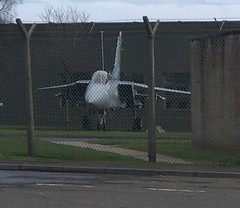


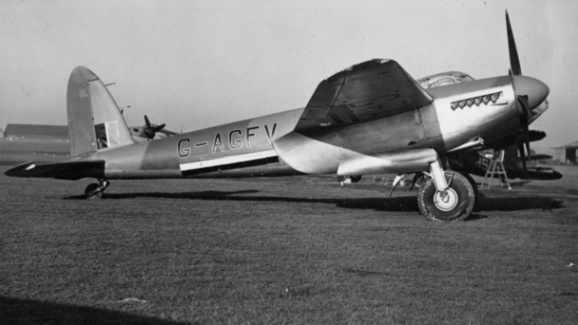
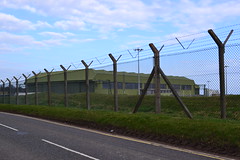
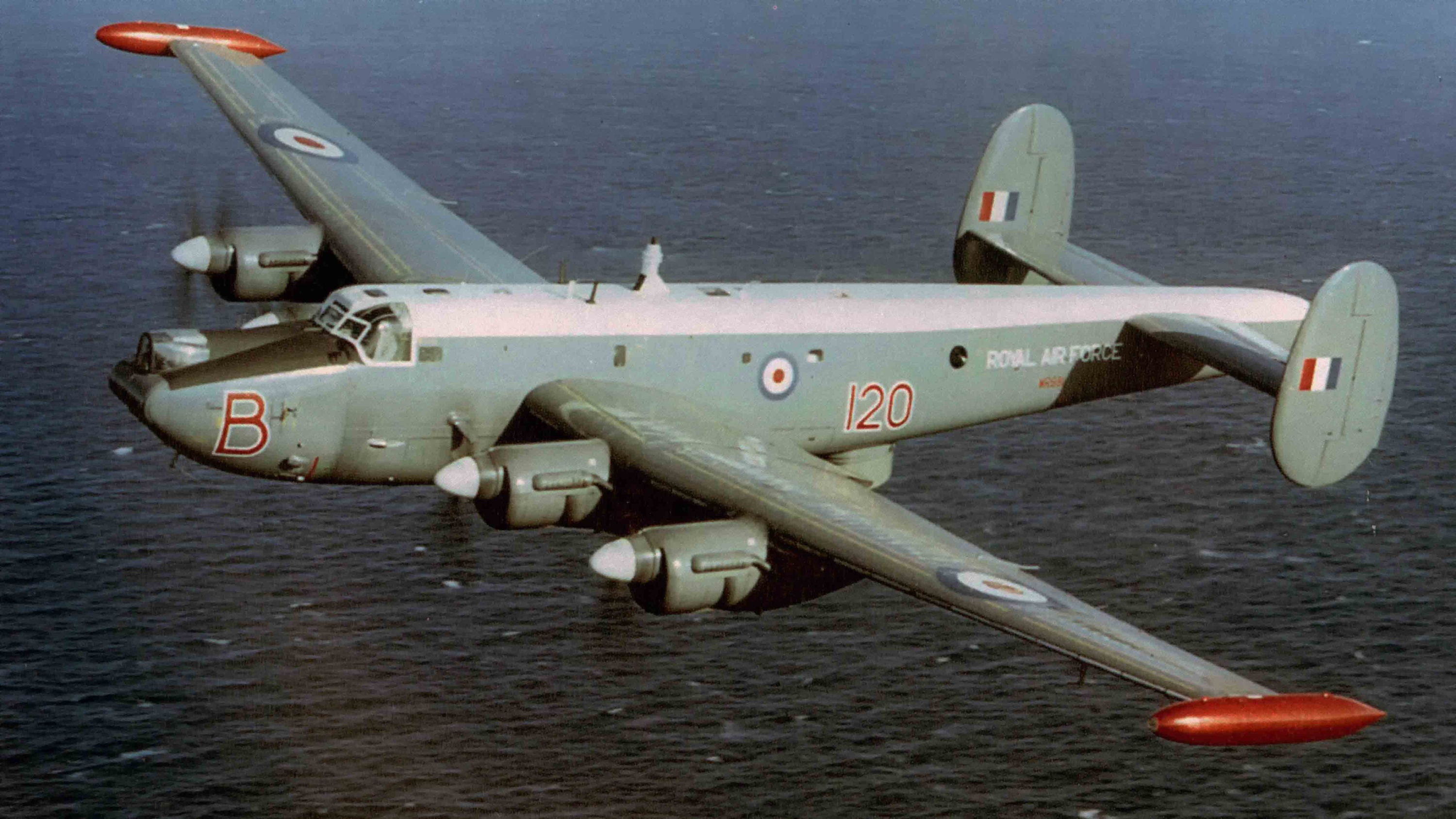


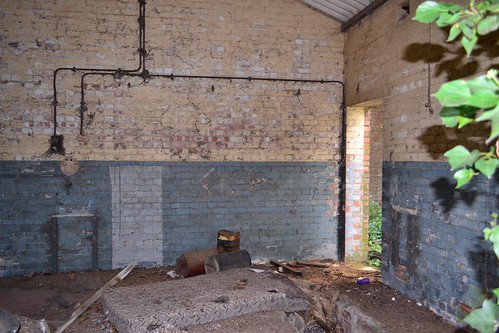
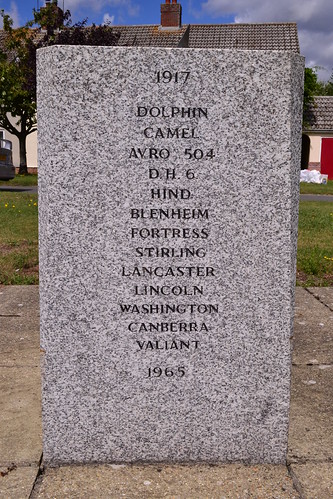
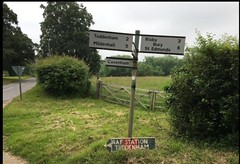


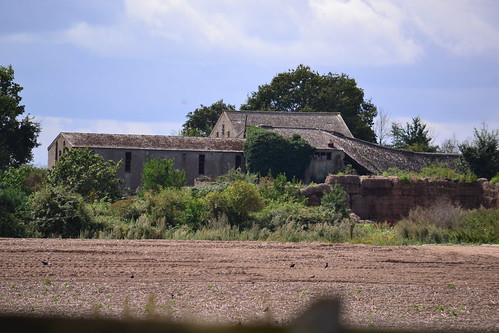
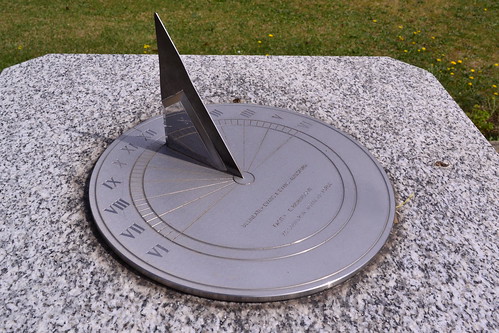
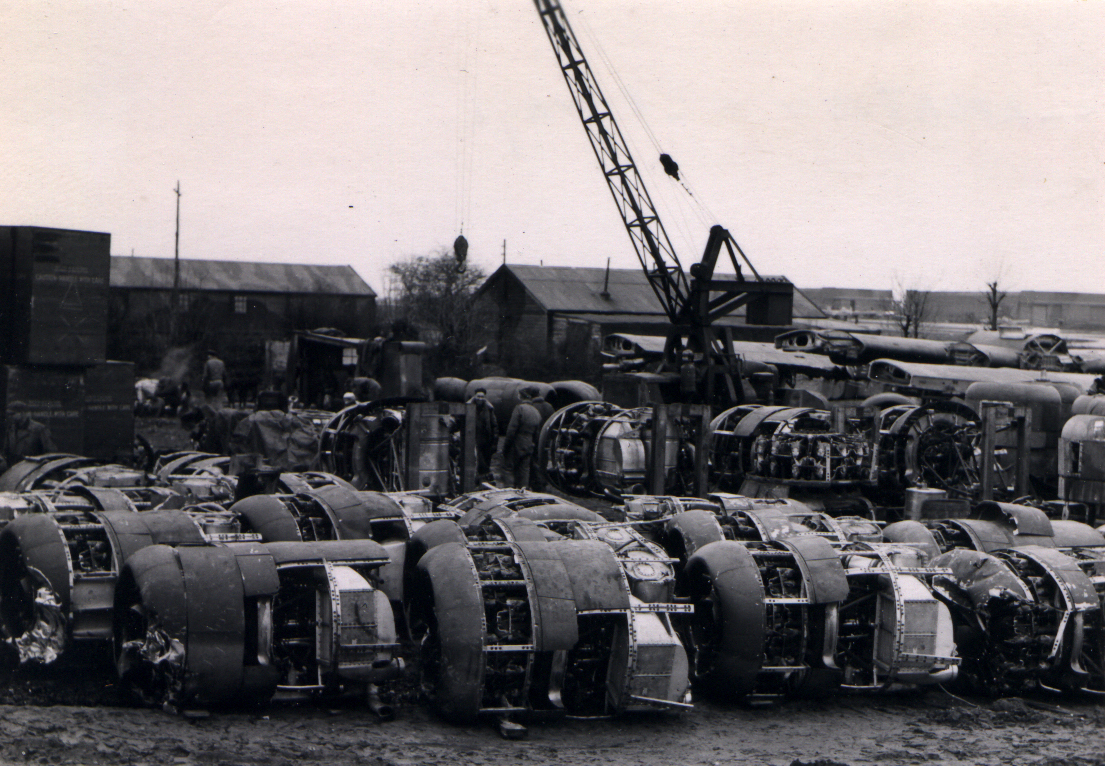
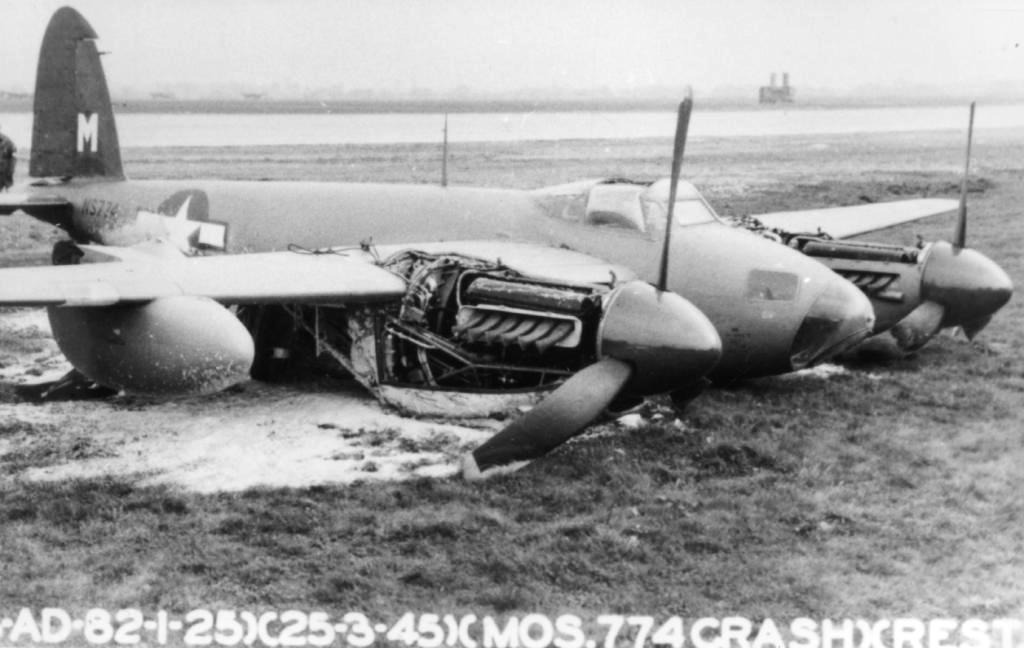

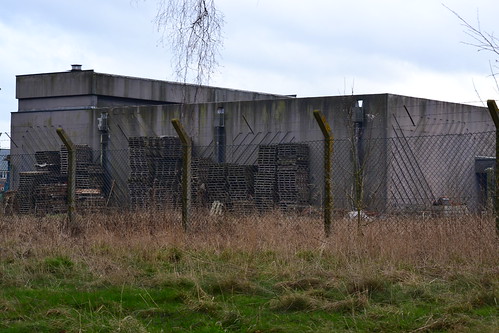
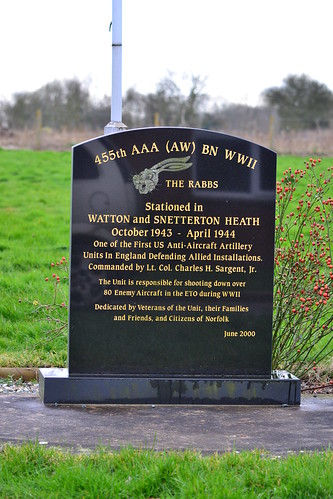
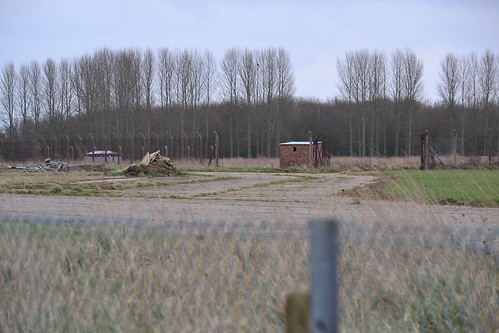
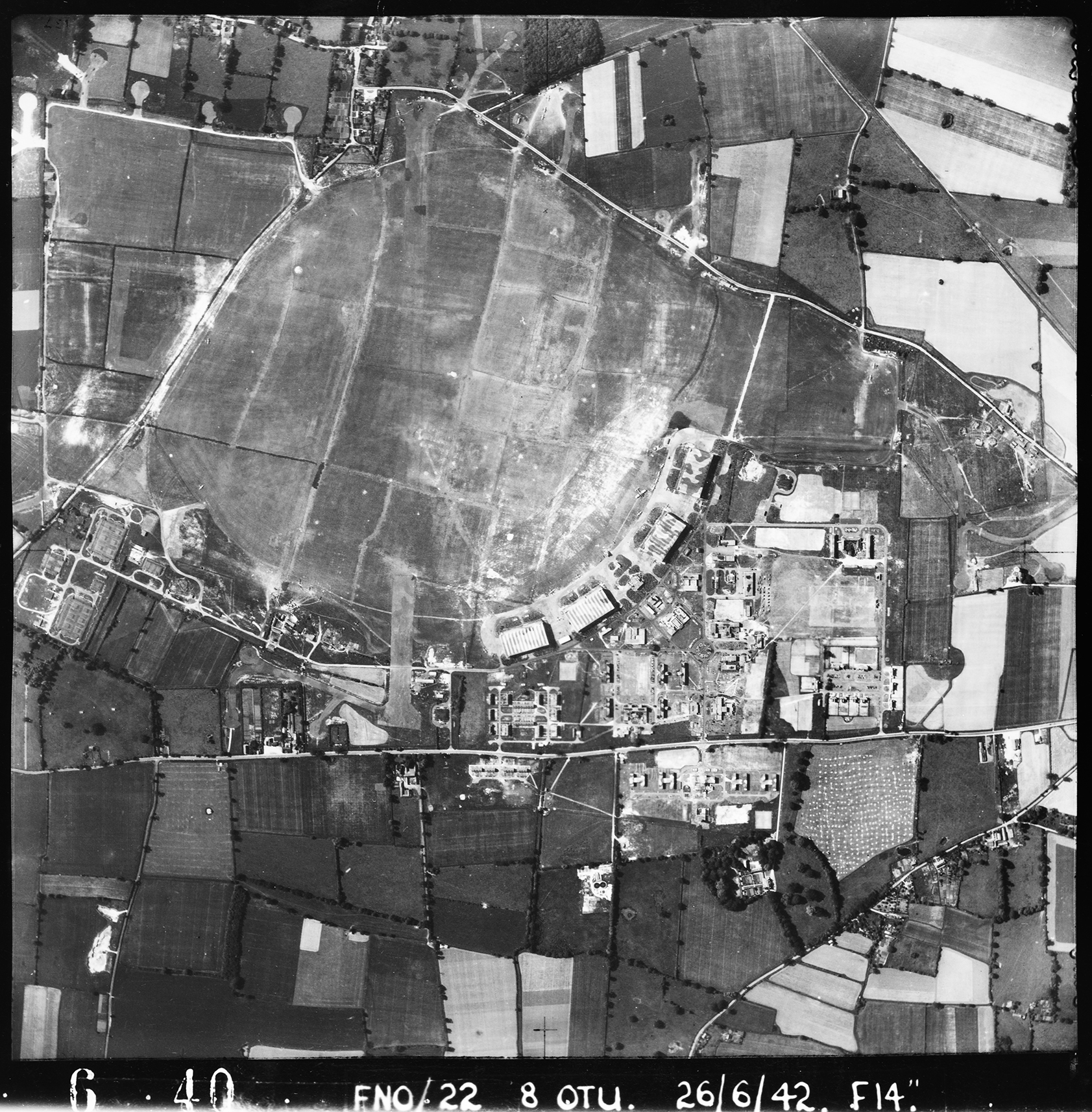
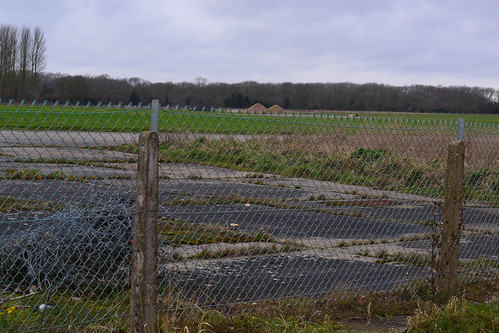
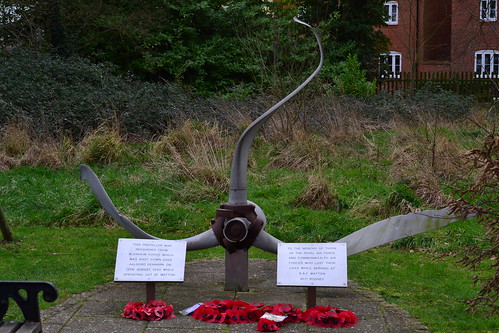
 Aviation Trails