RAF Bircham Newton (Part 4 – Bircham Enters the War)

So far we have seen how Bircham Newton developed from a First World War training airfield through the cutbacks of the early 1920s, and on into the Expansion period of the 1930s. Bircham is now in the hands of Coastal Command, a force lacking in materials but not will power. The units at Bircham work hard, and new developments come along that will help save lives at sea and put Bircham on the map. After Part 3, Bircham now enters the war.

The declaration of war and the early 1940’s would see some remarkable events take place at Bircham Newton; new aircraft and new roles, along with some advances that were to help downed airmen who ended up in Britain’s coastal waters.

One of these advances, was the creation of the ‘Bircham Barrel’, a container manufactured from the tail end of a 250lb bomb that was carried under the wing of searching Air Sea Rescue (ASR) aircraft and dropped to downed aircrews. The barrel was based on the ‘Thornaby bag’ a container designed at RAF Thornaby, in which supplies of: water, food rations, first-aid equipment, clothing and cigarettes were all placed. The Bircham Barrel, developed this idea a little further, making it more water tight and easier to retrieve by crews once in the water.*4

The Barrel was placed under the wing of an aircraft on a bomb rack, and once a crew was sighted, the pilot could drop the barrel providing the crew with sufficient rations for several days. After tests, the idea was given the green light and by 1941 it was in use by a range of aircraft operating in the ASR role.

With an increase in coastal operations from Bircham, particularly in the Air Sea Rescue role, many of the aircraft that would now use the airfield would be the twin-engined types. Kicking off the decade were the Bristol Blenheims, of 254 Sqn in January 1940. Joining a small detachment of 233 Sqn  Blenheims that had arrived here late in 1939, 254 Sqn only stayed for three months, operating as ‘Trade defence’ or fisheries protection unit – perhaps one of the lesser well known operations of Coastal Command.

Twin-engined models were not to be the only aircraft seen at Bircham though. The spring and early summer of 1940 would see further detachments with Hurricanes from 229 Sqn, a short stay by 235 Sqn and the first of a number of Royal Navy’s Fleet Air Arm (FAA) units 815 Sqn with the delightful Swordfish. One further unit to be based here at this time, would bring with it one of the more intriguing models of aircraft used during the Second World War, the Wellington DWI of No 2 General Reconnaissance Unit (GRU).

One of the roles of the GRU was to detect and destroy German mines, particularly new magnetic mines that were proving to be a menace to allied shipping. Using a Wellington 1A bomber modified to carry a large 51 foot ring of wood containing an aluminium coil, it would generate, using a Ford motor, an electronic signature that would resemble a ship. By flying low and slow over the water, it was hoped that the signal from the coil would detonate the new mines. Whilst the idea worked well in principal on land, over water it caused a number of issues primarily because the aircraft had to fly between 60 feet and 35 feet to detonate the mine. A number of successful detonations were recorded, but some aircraft were struck by the blast wash, causing them to be knocked ‘off balance’ as the mines exploded. Fortunately though, there are no recordings of any serious damage being sustained by these aircraft, but it was nonetheless, a dangerous job to do and because of advances elsewhere, it became a short lived attempt to gain an advantage over the Germans in the mine laying war.

ROYAL AIR FORCE OPERATIONS IN THE MIDDLE EAST AND NORTH AFRICA, 1940-1943.

Wellington DWI Mark II of No. 1 GRU based at Ismaliya. The ring weighed over two and a quarter tons.© IWM (CM 5312)

Like the Swordfish, both the Wellingtons of 2 GRU and the Blenheims of 235 Sqn were only based at Bircham for a month, all departing in May 1940, although 235 Sqn did return in the summer staying this time for a year. The immediate period after their departure saw yet more FAA units arrive, 826 and 812 Sqns, with Albacores and Swordfish respectively. Both of these units would operate as shipping patrols and also in mine laying operations, but would again only stay for a short period of time. During operations on 21st June 1940, at De Kooy Naval air base, one 826 Sqn aircraft was lost, two of the Albacore’s crewmen: Sub Lieutenant (A) Peter William S. Butterworth, (famed for his acting in the ‘Carry On’ films) and Telegraphist /Air Gunner Robert (TAG) J. Jackson, were both captured. Sub. Lt Butterworth survived ending up in Stalag Luft III after several failed escape attempts, whilst TAG Jackson died in captivity on 18th January 1945. The third crewman, Sub-Lieutenant Victor J. Dyke, died the day after the attack.*6

Peter Butterworth - Wikipedia

Peter Butterworth from the 1968 film “Carry on… Up the Khyber” (wikipedia)

Bircham’s long standing 206 Sqn were by now replacing their Blenheims with Hudsons, the American built twin engined aircraft designed around the civil Lockheed Super Electra. By militarising it, they produced an aircraft that would serve well in Coastal Command operations.

Initially carrying out convoy duties, the Hudsons would then patrol as far away as the ‘North German Islands’, but primarily flew reconnaissance patrols along the  coastline between Norway and Brest. Shipping was engaged on a number of occasions as were flak and Luftwaffe aircraft. During May, as the new Hudsons were being delivered, a number were lost to enemy action, particularly fighters.

For one Hudson, (P5120), life at Bircham would be short lived, the aircraft arriving here in April, only to be written off after a crash landing in June. The aircraft, one of three, departed Bircham on June 19th at 23:50 for a night patrol. On return it struck a ridge on the airfield’s approach causing it to bounce heavily. The aircraft then stalled and hit the ground so hard it caused the undercarriage to collapse. Thankfully all four crewmen emerged from the aircraft unhurt.

WITH A HUDSON OF COASTAL COMMAND

Hudson C-VX (P5120) of 206 Sqn on patrol before being written off in a crash landing. (© IWM CH 287)

Both during and after the build up to Hitler’s planned invasion of Britain, airfields across southern England were targeted by the Luftwaffe, and Bircham Newton was no exception. Whilst not a fighter airfield high on the list of Luftwaffe priorities, bombs nonetheless did fall on the airfield, and it was the Hurricane detachment of 229 Sqn based here, who were tasked with providing cover against such attacks.

In addition, many support units were also based at Bircham, these would provide training for pilots, gunners, navigators, other members of aircrew along with cooperation with ground operations as well. One such unit here at Bircham was No. 1 Anti Aircraft Co-operation Unit (AACU) which consisted of several Flights, designated ‘B’, ‘C’, ‘D’, ‘K’ and ‘M’, they all operated the Hawker Henley, the Hurricane’s little known relative.

With Flights designated A – Z (‘I’ was omitted), the unit operated at various airfields across Britain, flying a mix of Henley IIIs, Wallace, Lysander and Battle aircraft, with both Flights ‘B’ and ‘M’ being formed here at Bircham Newton. Several of these Flights also used RAF Langham, another Coastal Command / training airfield a few miles away on the Norfolk coast, particularly useful for the training of heavy anti-aircraft guns.

The Henley – built along side the Hurricane – essentially used the same jigs, their similarity thus being quite stark. The Henley was initially designed as a light bomber with modifications to the guns and an additional seat added behind the pilot. However, changes in Government policy toward daylight bombers meant that the Henley was soon transferred to other duties notably target towing. To assist this, a small propeller driven motor was added to the port side of the aircraft, just below the rear cockpit, this would power the winch that held the target drogue as it was towed some 7,000ft behind the aircraft for gunners to aim at*5.

ROYAL AIR FORCE COASTAL COMMAND, 1939-1945.

Hawker Henley, L3353, of ‘K’ or ‘M’ Flight, No. 1 AACU, next to a bomb crater at Bircham Newton. A lone Do 17 dropped seven high explosive bombs on the station causing light damage but also slightly damaging this aircraft. The similarities to the Hurricane are very evident. (IWM CE 43)

In November of 1940, two more squadrons were formed here, one, another First World War unit, was 252 Sqn. It would not fly operationally from here though, instead collecting its aircraft from Chivenor to where it would move a matter of weeks later.

The second unit, 221 Sqn was formed on the 21st November, and was also a former World War One unit. Disbanded in 1919, it would serve for the remainder of the war with the Wellingtons in the Coastal Command role. The initial order was to train crews at Bircham prior to their move to operations at Limvardy, a role it would perform using twenty-four Wellington IC aircraft. By the end of the month two such models, N2909 and N2910 were delivered and ready to be used for the job. A third aircraft, a dual control Wellington (R2700), arrived on the 6th and then on the 12th December, the personnel were all moved off site to a new location the rather grand Heacham Hall. The hall, which burned down during the war, was a 17th Century building, and had historic ties to Matoaka (better known as “Pocahontas”), who married local man John Rolfe. It must have been a  rather nice change for the airmen to be ‘off base’ and in more luxurious, and historical, surroundings.

During the remainder of December more aircraft arrived and by the last day of the year, eleven more Wellingtons were ‘on role’ along with a growing number of personnel – both air and ground crew.

1941 started on a high for Bircham Newton, with a Royal Visit. On 26th January, the Royal party consisting of King George VI, Queen Elizabeth, and Princesses Margaret and Elizabeth, visited the area inspecting the airfield and its aircraft. Whilst here, the King gave airmen a number of awards before the whole party moved of to other airfields across Norfolk.

For the whole of January, training flights were the order of the day for the Wellingtons of 221 Sqn, but poor weather meant that only 12 out of the 31 days were actually suitable. However, by March 27th 1941, all pilots had flown solo by day and a new flight was crewed up and ready for operations. The squadron then began its move over to Limvardy in Northern Ireland.

The summer of 1941 was another busy time for Bircham Newton. In May, two squadrons appeared, the first 200 Sqn was formed from 206 Sqn, which had already been used to create 220 Sqn earlier on. 200 Sqn were formed to perform the ‘operational duties of a Coastal Command general reconnaissance land-plane squadron’ in other words maritime and anti-submarine patrols. It would be made up initially of 210 personnel, who would depart Bircham on the 25th to Greenock, whilst seven Hudsons would fly to Gibraltar on route to Gambia. It would remain abroad until its disbandment at the war’s end in 1945.

The second, 500 Sqn moved in from Detling in Kent, bringing Blenheims with it. With detachments at both Limvardi and Carew Cheriton, these were replaced by the Hudson V in November before the unit departed for Stornaway in Scotland’s Western Isles in May 1942. Once at Bircham they immediately began patrols, looking for downed aircrew, mines or enemy shipping. Poor weather restricted many of these patrols, but both mines and shipping were spotted, sadly no dinghies or aircraft were found in these early days.

The next unit to arrive was another Blenheim squadron, 248 Sqn who performed convoy patrols and strikes against enemy shipping. During July, a month after they moved in, they began to replace the Blenheim with Beaufighter ICs, a powerful and heavily armed aircraft built to design Specification F.37/35. After initial handling issues, it became a sturdy weapons platform that performed well, especially in the anti-shipping role, carrying a torpedo or rockets. For the next month the weather prevented much in the way of flying, with fog, rain and poor visibility preventing all but minimal flying, the squadron remained firmly on the ground for a good deal of August.

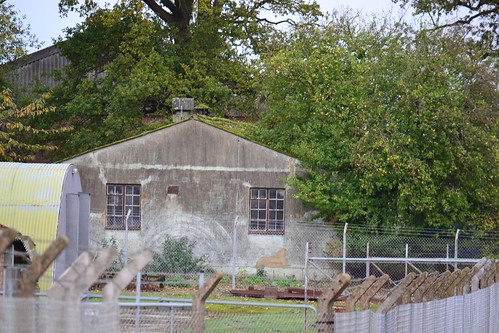
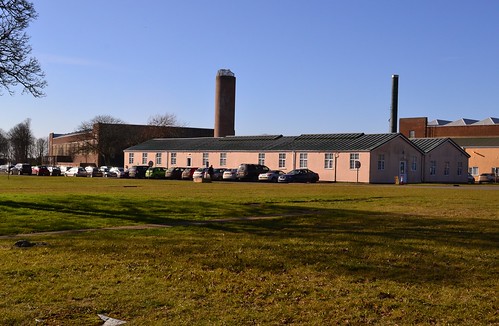
Armoury and Photographic building

Former armoury and photographic building.

The last of the summer squadrons to arrive were 53 Sqn and 59 Sqn. Initially based at Detling / Thorney Island, they had also maintained a detachment of aircraft here at Bircham. Once the two squadrons had reformed at Bircham, they both took on the Hudson replacing their Blenheims before departing back to St Eval in the October of that year (53 Sqn) and North Coates (59 Sqn).

By September 1941, the need for more Air Sea Rescue aircraft, particularly deep search aircraft, had become ever more apparent, and it called for the creation of two more squadrons able to perform such tasks. However, suitable aircraft were in short supply, especially Lockheed’s Hudson with ASV (Air to Surface Vessel) radar equipment and Lindholme rescue gear. Thanks though to Sir John Salmond GCB, CMG, CVO, DSO & Bar , Coastal Command’s corner was fought, and even though by the end of 1941, aircraft were still few and far between, by the December one of these Squadrons, 279 Sqn, was up and running here at Bircham. However, it would be a long haul, and it would not be until March the following year before they would be fully operational and their Hudsons operating regularly in the Air Sea Rescue role from this airfield.

The second squadron, 280 Sqn however, was not given the Hudson, instead they had to contend with the Anson. Another unit set up in 1941, its primary base was also at Detling in Kent. Whilst performing this duty, they maintained a detachment of aircraft here at Bircham Newton, a position it held whilst the bulk of the squadron moved to Langham in Norfolk in the summer of 1942. It would then be after this, that the entire squadron would move into Bircham Newton.

Like its sister unit it would take time to become fully operational and it would not be until June before the squadron was operating as it should. The benefit of both units was quickly seen though, thirty-five men from six crews were rescued over May – June by 279 Sqn, whilst one crew was rescued by 280 Sqn within days of them becoming fully operational.

The early years of the war were busy for Bircham Newton, and as war progresses, further units arrive and depart, the hectic scenes will not be stopping yet!

The full text can be seen in Trail 20 – North Norfolk Part 1.

RAF Bircham Newton (Part 3 – The build up begins).

In Part 2 we saw how Bircham had grown following the immediate post war cutbacks, and how France was seen as a threat. Now as developments occur in Germany, the dynamics of Europe begin to change and we enter the Expansion Period of the late 1930s.

Bircham sees more new squadrons, new aircraft and further developments to its infrastructure.

In the 1930s, the Government’s plans for expansion took a new direction when Germany too began to build up its armed forces – albeit surreptitiously at first. New expansion schemes were put in place, which not only signified the expansion of the RAF’s forces, but the number of available airfields, their design, and the number of their associated buildings as well.

One of these modifications was the construction of a standard watch office with attached tower. Designed as drawing 1959/34, it became the standard design used for all Watch Offices of this time, and was in essence a square building with a small observation tower built onto a flat roof. In addition to this, Bircham also had new barrack blocks (2357/36) built, now in the familiar ‘H’ shape, supplementing the previous models which were in the form of a ‘T’. These new buildings had reinforced roofs giving better protection to those inside should it be struck by small incendiaries.

The decade started off on a bad foot however, with the loss of a 207 Sqn aircraft, a Fairey IIIF on January 21st 1930. A previous resident of Bircham, the rear party had brought the last of the personnel to Bircham in November 1929. The next weeks were spent getting as many airmen flying solo on the Fairey IIIFs as possible. However, poor visibility due to fog that day, caused the aircraft ‘J9637’ to crash into an orchard near Sudbury in Suffolk killing both crewmen: F.O. Donald Mackenzie (aged 25) and Cpl. Leonard Edward Barnard who was a year younger.

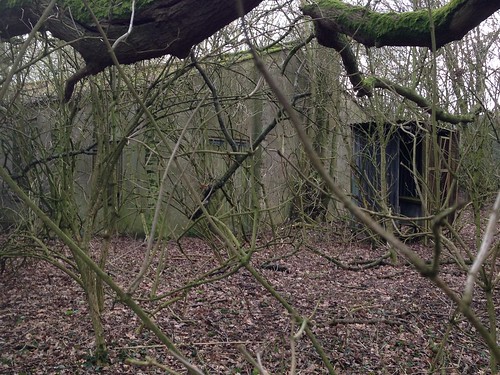
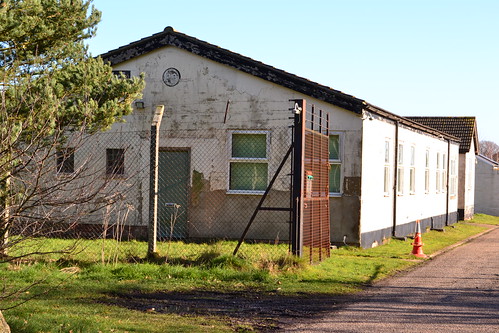
Former Technical Building

One of the former technical buildings no longer used.

In November 1935 information was received at Bircham that two new squadrons were to be formed here, 21 Sqn and 34 Sqn, both bomber units flying Hawker Hinds. Personnel began arriving on December 3rd and began to work on 207 Sqn’s  updated Fairey Gordons, preparing them for dispatch to Cardington prior to their move abroad once more. 21 Sqn were allocated Hangar No. 17, and would receive their first Hind (K.4638) on New Years Eve 1935.

34 Sqn on the other hand, wouldn’t receive their first batch of Hinds until January 1936, when four examples were delivered from the Hawker Aircraft Company Ltd. at Brooklands, by pilots from other units. With two more Hinds being delivered on June 11th, also by pilots of other units, the cadre would soon be preparing to move. On July 30th, both 21 and 34 cadres were ordered north, making the move from Bircham Newton to Abbotsinch in Scotland.

The latter part of the decade reflected previous events at Bircham. Many new changes meant that events at the airfield were as dynamic as ever. Several new squadrons were formed resulting in new crews and some new aircraft. Sharing the space at Bircham were 18 Sqn (Harts and Hinds), 49 Sqn (formed from ‘C’ Flight of 18 Sqn) and ending the decade 206 Sqn with Ansons and later Hudsons. 206 would themselves later be used to form 220 Sqn, which in turn would see ‘C’ Flight be renamed as 269 Sqn. Many of these new squadrons would in turn depart Bircham as changes occurred on the continent.

With 206 came new changes of command at Bircham. Their arrival in 1936, saw a move to Coastal Command (16 Group). Formed at Manston in June under the initial command of Sqn. Ldr. A. H. Love, 23 (Training) Group, 206 Sqn had three flights of six aircraft each and a further six Ansons in reserve. The squadron transferred across to Bircham at the end of July by which time the command had been taken over by Wing Commander F.J. Vincent D.F.C.

206’s main role at this point was training pilots selected for Flying Boats and the  Blenheim squadrons of Coastal Command. Shortly after arrival, the unit’s command would pass over to Wing Commander H. Long D.S.O., and by June 1937, 270 pilots would have been successfully converted in 2,700 hours of flying time.

Naturally accidents did occur during this time, on November 9th 1936, 220 Sqn Anson ‘K6199’ stalled after take-off killing P.O. Peter White (age 23) and injuring three others: Sqn. Ldr. William M. M. Hurley (the pilot), AC.2 Eric D. Butler and AC.1 Reginald K. Birtwistle. The aircraft was written off, after which a court of enquiry recommended modifications to locking bars, as it appeared that the pre-flight checks had been made with the control systems locked. The aircraft was left as an instructional air frame and a stark reminder for proper pre-flight checks!*7

A second accident occurred a year later in September 1937, when another 220 Sqn Anson, ‘K6227’ also stalled, this time falling into the sea near Conway. This time, the crew were not so lucky, with all three, a Sergeant, an AC.1 and an AC.2 all being killed. Their average age was just 22 years old.

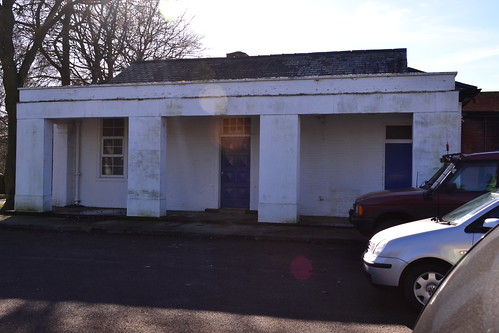
Guard House

The former Guard House now stands as a shop.

During the later years of the 1930s, a royal visitor was often seen parked in the hangars at Bircham Newton. The Airspeed Envoy G-AEXX of the King’s Flight was a regular here, being so close to Sandringham House, the Royal residency, it was an ideal location for the aircraft. The Envoy was a creation of the Airspeed company, headed by the author Nevil Shute, a former de Havilland and Vickers employee who later set up his own business, Airspeed Limited. The Envoy was later developed into the Airspeed Oxford which became one of the main trainers used by the RAF.

As the era closed and just weeks before the outbreak of war, another squadron arrived here at Bircham in the form of 42 Sqn with Vickers Vildebeests. The Vildebeest was a late 1920s design biplane, designed to meet Specification 25/25 which required an aircraft operating in the Coastal Defence role and capable of both day bombing and ant-shipping torpedo operations. Several marks were manufactured, up to and including the MK.IV of which only 18 were built. It was some of these that were later delivered to 42 Sqn at Bircham Newton. These aircraft remained in service at Bircham until April 1940, when they were replaced by Beauforts at which point, 42 Sqn departed Bircham transferring to Thorney Island in West Sussex.

On the day war was declared, another very mobile squadron appeared at the door of Bircham, this time it was the Blenheims of 90 Sqn who made a very brief appearance here from West Raynham. Over a period of just two weeks they would locate at five different RAF stations!

With the introduction of the last of the Expansion Schemes ‘L’ and ‘M’ over the years 1938 -39, Bircham would see yet more changes to its infrastructure, notably the demolition of the repair sheds and their replacement with three Type ‘C’ hangars. At this point a fourth was also proposed such was the size and nature of activity at Bircham Newton. In addition, the two original Belfast type hangars were retained providing a mass of hangar space on the airfield. Another bonus for Bircham was the addition of further accommodation blocks, providing better accommodation for the many new air and ground crews who were increasingly appearing at this Norfolk site.

Teetering on the bring of war, Bircham was now operational, more modern aircraft are filtering through and Coastal Command operations begin in earnest. In Part 4, Bircham Newton enters the war.

The full text can be seen in Trail 20 – North Norfolk Part 1.

RAF Bircham Newton (Part 2 – The 1920s)

In Part 1 – The Early Years – we saw how Bircham Newton was created and how it was chosen to be the forefront of long rang bombers targeting Berlin. We saw the untimely death of One Captain Cecil Darley and how, as we enter the 1920s, a new build up of the RAF was required following massive cutbacks after the First World War. In Part 2, we progress through the 20s, Bircham develops into a larger station and how one of its pilots won his VC before arriving here.

This decision to rebuild the RAF in response to France’s build up, then led to an initial burst of refurbishment and development of Britain’s current airfield stock, those not closed by the post-war political hatchet. This included Norfolk’s Bircham Newton.

The link forged in late 1918 with bombers would carry Bircham right through the 1920s and on into the mid 1930s, during which time a number of squadrons would either be formed here or pass through in transit elsewhere. The first of these was through the reforming of 207 Squadron on February 1st, 1920 with DH.9As. This unit came from the nucleus of 274 Sqn, itself a previous resident of Bircham. As a cadre, it would remain here for two years before departing for warmer climates and Turkey, in the Autumn of 1922. That was not the end of the link though, after a spell abroad the squadron would return to the UK, coming back to RAF Bircham Newton at the end of the decade. This return would bring a new variety of aircraft, the Fairey IIIF. By 1932 though, these models were themselves being replaced by another Fairey aircraft, the Gordon, and within three more years the squadron would be back on the road to the Middle East once more.

Another small cadre appeared here on New Year’s Day 1920. Moving in from the former Narborough airfield (Norfolk’s first), the cadre from 60 Squadron would disband later that month, having the good fortune to reappear at Risalpur, India, later in the year.

Over the period 1923 – 24 three more squadrons arrived at Bircham, 7 Sqn (who were formed here from 100 Sqn and stayed for four years); 11 Squadron (6 months) and 99 Squadron (four years) bringing a wide range of aircraft with them to this part of Norfolk. Delights such as the Vickers Vimy; Virginia II, III, IV, V, VI and VII; DH.9A, Fairey Fawn and the Handley Page Hyderabad were all present during this short period of time.

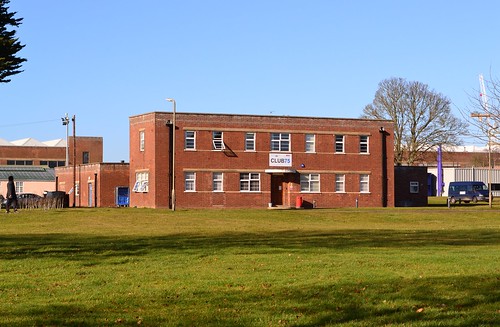
Squash courts

The original squash courts are still used as they were intended.

With such a mass of movement, accidents were inevitable. 7 Sqn suffered a loss when Vickers Vimy (F9187) overturned whilst landing at night on 16th October 1923. Damage to the aircraft itself was not too severe and it was repaired, however, one of the four man crew, AC.1 Ronald Sinclair Watson (aged 20), was not so lucky and was killed  in the crash. The remaining three crew all escaped unhurt.

Another accident befell a 99 Sqn aircraft on 27th February 1925, in which one of its crew was also killed with a second injured. The Avro 504K ‘H3083’,  spun after attempting a stall turn, the manoeuvre resulted in the death of P.O. Cecil S. Marshall Woode also aged just 20. This was the first fatal accident for 99 Sqn.

This build up of squadrons saw continuous movements both in and out of Bircham throughout the 1920s, resulting in many more personnel and aircraft residing at the airfield.

In mid January 1928, 39 Sqn appeared at Bircham (DH.9A) staying for just one year, followed soon after on March 21st, by 101 Sqn. This was another former RFC unit, and were reformed, under the initial command of Sqn. Ldr. J. C. P. Wood. Sqn. Ldr. Wood was posted in from RAF Uxbridge to oversee the formation of the unit and the training of the crews. At its inception the squadron had just 23 airmen in its ranks and was tasked with operating the Sidestrand, an aircraft built by Boulton and Paul aircraft manufacturers.

File:Im1927v145-p46f.jpg

The first example Boulton Paul Sidestrand (Grace’s Guide)

The first model built, J.7938 was collected and brought to Bircham Newton, it was then taken to Ringstead for testing there. It was however, unfortunately damaged in a landing accident after it developed an oil pressure problem whilst being flown by F.O. Duggan, the now Squadron Commander.

Meanwhile, at Bircham, Ground crew were occupied with further ground and air tests, along with lectures by staff from the Bristol Aeroplane Co. on maintenance of the  Sidestrand’s engine, the Jupiter VIIIF.

Rounding off the 1920s was 35 (Bomber) Sqn, reformed with DH.9As and then the Fairey IIIFs, followed not long after by the Fairey  Gordon. 35 Sqn was commanded by  Gilbert Stuart Martin Insall, who had in 1915 been awarded the VC for his actions in France. After having attacked  a German aircraft, he was forced down suffering numerous hits to his own aircraft. Once down, he was able to complete sufficient repairs enabling him to take off again, but in a hail of gunfire that kept others seeking cover.

Later, Insall was shot down again, this time he and his crewman were both injured and captured. Moved from hospital to a POW camp, he made two escape attempts, being recaptured in the first but successfully escaping in the second.

Once repatriated, Insall was by now, a keen archaeologist, and flying with 35 Sqn enabled him to take photographs of the Norfolk landscape. These photographs led to discoveries that have since proven to be very important in the archaeological world. His endeavours in this area went on to help in the development of aerial photography as a reconnaissance tool and to aerial photography as a whole.

However, by the mid 1930s, both Insall and 35 Sqn had also departed Bircham Newton, heading for warmer climates and the Sudan, this move ending their link with this Norfolk airfield.

By now, Bircham had grown considerably, partly in response to the number of its users but also in response to the growing concern over what was happening on the continent. The airfield would by now, have a single aircraft repair section shed along with three double bay general service sheds. All of these were located in the south-eastern corner of the main airfield site, sat in a row with doors facing north-west.

In Part 3, we enter the uncertain times of the 1930s. Germany begins a build up of her forces, and Bircham changes commands being transferred over to Coastal Command.

The full text can be seen in Trail 20 – North Norfolk Part 1.

RAF Bircham Newton (Part 1 – The Early Years)

The north Norfolk coast area boasts numerous wartime airfields and several Cold War examples too, all of which are now closed. Many of these retain buildings or parts of runways in various states of disrepair. In Trail 20, we visit three of these and in one case a substantial amount remains solely thanks to its owners. As we revisit Trail 20, we look at the long history of RAF Bircham Newton.

RAF Bircham Newton.

RAF Bircham Newton has one of the country’s best preserved technical and accommodation areas anywhere in the UK. This remarkable achievement is largely down to the owners, the Construction Industry Training Board (CITB), who opened their first training centre here at Bircham Newton in 1966. Attracted particularly by the large hangars, they are an organisation who specialise in training people for the construction industry through a number of training centres spread across the UK. Their work at Bircham Newton has ensured maintenance/preservation of many (but not all) of the buildings on site.

Located 8 miles from the Norfolk town of Fakenham, RAF Bircham Newton has associations with several airfields including: RAF West Raynham (its parent), RAF Docking (its satellite from where all night flying took place) and four minor decoy sites including the former RFC/RAF Sedgeford.

With its origins in the First World War, prior to the birth of the Royal Air Force, Bircham Newton has had a long and distinguished career mainly serving under 16 Group Coastal Command, who operated a range of single and twin engined aircraft from the site.

By the end of the Second World War, it would have seen considerable development, including three runways, all BRC steel matting (British Reinforcing Concrete), three ‘C’ Type Hangars, three Bellmans, ten Blister hangars and two Belfast hangars mainly located in the south eastern corner. It would also have an extensive range of accommodation and technical buildings catering for around 3,000 personnel of mixed rank and gender.

Opened in 1916, little initially happened with the airfield, and it wasn’t until near the war’s then that Bircham really came into being. Its first operational use was as a Fighter Gunnery School in 1918, with No. 3 School of Aerial Fighting & Gunnery (later known as No. 3 Fighting School) as its initial resident.

The School was born out of the need to train both pilots and gunners in the early biplanes to use their guns effectively in aerial combat. With their roots in the Auxiliary School of Aerial Gunnery, they were formed in May 1918 when Numbers 2 and 4 merged with another two Schools, Numbers 1 and 2 School of Aerial Gunnery. This amalgamation of ‘Schools’ was designed to streamline the complex array of establishments that had grown out of the need for new gunners and pilots. Once formed, they would be one of four new schools which were joined by a fifth in September later that year. Operating a range of aircraft including: B.E.2e, Bristol M.IC, D.H.4, Dolphins, Camels and H.P. 0/400 aircraft, their stay at Bircham would however, be short lived, moving to nearby RAF Sedgeford in November of that year.

Early losses with trainee pilots were high, novices learning to fly the hard way. At Bircham, one such loss occurred to 2Lt. Horace G. R. Boyt, who was killed when his Sopwith Camel (D8226) of No. 3 Fighting School stalled whilst attempting a forced landing near to Thornham bombing range, on July 31st 1918. 2Lt. Boyt was only 19 years of age at the time of his death – a young man taken in the prime of his life.

Possibly Bircham’s most significant early aircraft was the Handley Page V/1500 (Super-Handley) bombers*1. An enormous four-engined aircraft, it first flew in May 1918, and was designed to hit Germany hard, striking targets as far away as Berlin. The V/1500 was more than capable for the role too. It could carry up to thirty 250lb bombs over a range of 1,300 miles with a crew of six. Even more unusual, especially for an aircraft so large, it boasted folding wings; presumably this allowed it to be placed inside a hangar/repair shed for maintenance or storage.

BRITISH AIRCRAFT OF THE FIRST WORLD WAR

Handley-Page V/1500 heavy bomber biplane possibly at Bircham Newton. (© IWM Q 67329)

These aircraft arrived with three squadrons, the first 166 Squadron, was formed on 13th June 1918. Whilst initially receiving FE.2Bs, the squadron was created with the sole purpose of bombing Berlin, and the d’elite crews (mainly Canadian) were hand picked accordingly; a situation not unlike 617 (Dambusters) Sqn of the Second World War. Bircham Newton was chosen for these aircraft, as it was both the most suitable and the most easterly aerodrome available to the RAF at that time.

Formed under the command of Major Cecil H. Darley DSC and Bar, DFC,  a seasoned veteran of the war, the squadron fell under the control of 3 Group, a relationship it maintained until 13th September 1918 when it was transferred to 86 Wing, 27 Group. As the squadron rapidly developed, it naturally grew in size taking on new staff on a regular basis. By the end of September, after its Group transfer, it would have 17 officers and 308 ‘other ranks’ on its books.

After building the squadron up and preparing for war, an audacious and no doubt suicidal attack, was planned for November 9th 1918 – a raid on Berlin. However, maintenance problems meant that only two of the three aircraft at Bircham Newton were serviceable, this despite ground crews working hard to get all three in the air. There then followed a spell of bad weather which caused even further delay to the operation. By the time the situation had improved and the weather was more favourable, the armistice had been agreed, and so the raid was no longer required. As a result, the squadron was ordered to ‘stand down’ and the raid never took place.

For 166 Squadron it was a bitter disappointment, had the war gone on and the flight taken place, they certainly would have made history regardless of whether or not they were successful in their task. Perhaps they too would would have been as famous as their Second World War partners 617 Sqn.

As for the V/1500s, it is believed they were left in Bircham’s sheds, allowed to decay until they had deteriorated beyond use, ultimately they were scrapped. A rather appalling end to an incredible aircraft.*2

The second squadron to be formed with these remarkable aircraft here at Bircham, was 167 Sqn, who also failed to see any active military service. Being formed on the 18th November 1918, just days after the Armistice was agreed, they too were no longer required.

The last of these special squadrons to be created was 274 Sqn,  which was also  formed here, at Bircham Newton, a year later on 15th June 1919. Personnel for the unit came from the nucleus of No.  5 (Communication) Squadron after it was renamed. As the war had now come to a conclusive end though, there seemed little need for these huge, long-range bombers and so all three units were disbanded each within six or seven months of their initial creation.

The immediate post-war era saw little interest in the building of a military force, especially an air force, and strong opposition from both the Navy and Army was fuelled by an anti-war feeling amongst the British public. As a result, many airfields were sold off, aircraft and equipment were scrapped and thousands of personnel demobbed. Airfields like Bircham Newton, now had in their store, numerous surplus aircraft awaiting disposal.

On of these surplus aircraft was the V/1500, and it would be Major Darley of 166 Sqn, who would go on to fly one, not in an operational  capacity, but as a non-stop flight to Madrid to promote these long range aircraft as potential civilian transports. It was not all plain sailing though, for the trip nearly cost Major Darley his life when, on the return leg, the aircraft got into difficulties and crashed into he sea off Biarritz. Managing to survive the accident, Major Darley eventually returned home to Bircham where he continued his military service. In honour of his achievements, the Spanish Government awarded Major Darley the Cross of Military Merit.*3

In a twist of fate, Major (now Captain) Cecil H. Darley, was joined in 1919 by his brother Flt. Lt. Charles Curtis Darley, also a veteran of the First World War, here at Bircham Newton, and they would be tasked with flying more of these surplus aircraft, this time Vickers Vimys, to Cairo. On their first trip together, on 24th September 1919, they departed Bircham heading for France, then onto Rome and eventually Cairo. On the 27th, following a forced stop at Lake Bracciano, 20 miles from Rome, the aircraft struck a telegraph pole causing it to crash. The resultant fire killed Captain Cecil Darley whilst his brother tried in vane to pull him free from the burning wreckage.*3

BRITISH AIRCRAFT OF THE INTERWAR PERIOD

Vickers Vimy (© IWM Q 73389)

Whilst Britain had entered a period of ‘demilitarisation’, the early 1920s saw increasing Government concern over France’s build up of military aircraft, particularly its bombers. The Government now saw France not as  potential Allie, but a potential aggressor, and there was now a growing concern over Britain’s lack of defensive strength.

By 1922, Britain had only 12 squadrons available in the UK, a weak and lacking force it would have been unable to counteract any aggressive moves made by the French. Consequently the Government put in a place a plan to rebuild its forces and increase this number, to a more substantial 52 squadrons by the mid 1920s.

In Part 2. we see how Bircham developed in response to the Governments plans and how new squadrons arrived at this rapidly developing airfield.

The full text can be seen in Trail 20 – North Norfolk Part 1.

Secrets Of The (Not So) Deep.

By Mitch Peeke.

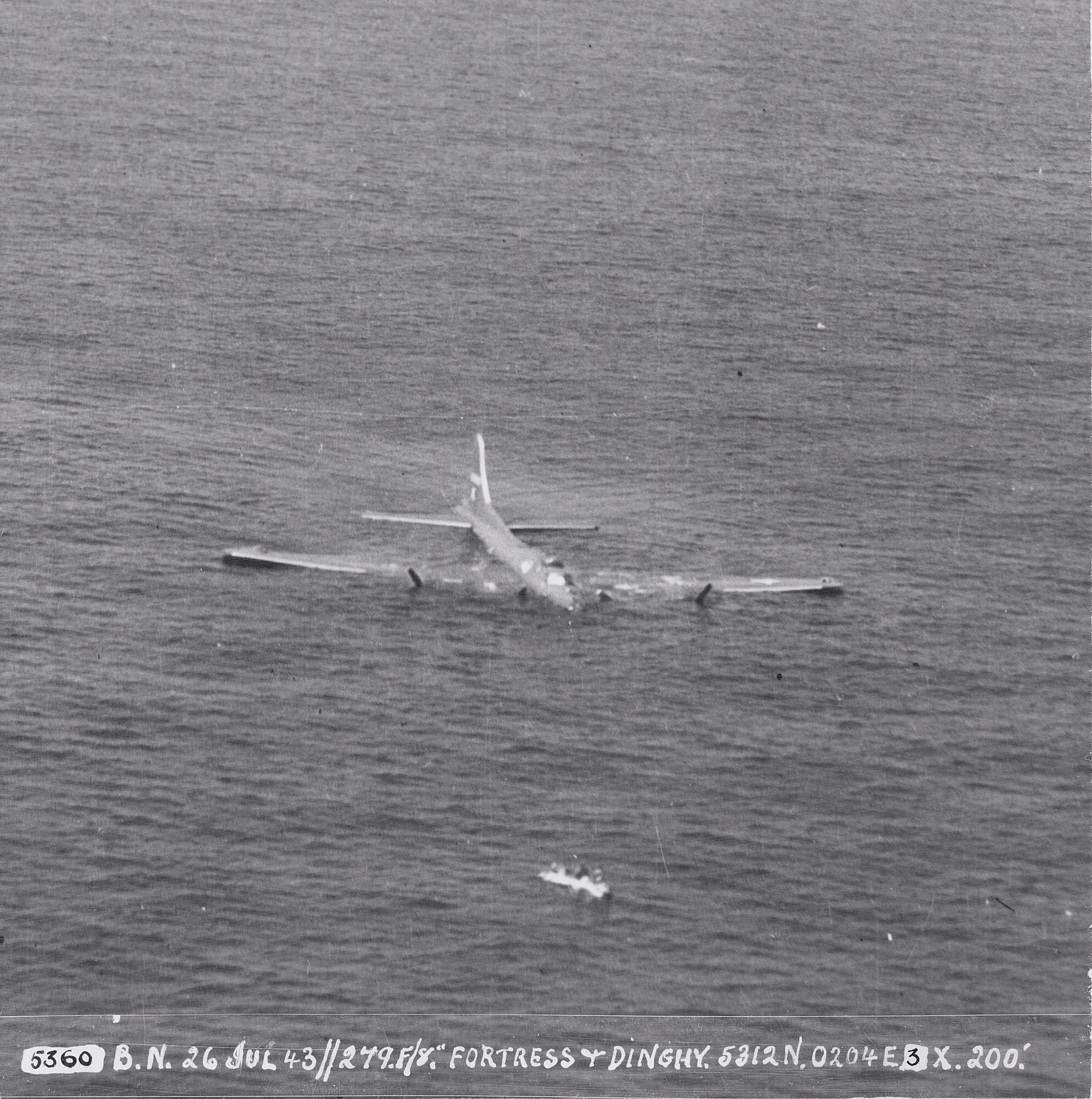
This latest chapter in the story of B17 44-6133, which crashed in shallow water at Allhallows, Kent, in June of 1944, came about during a visit I made to The Kent Battle Of Britain Museum at Hawkinge; which ordinarily, is not perhaps the sort of of venue one might expect to find anything related to The Mighty Eighth.

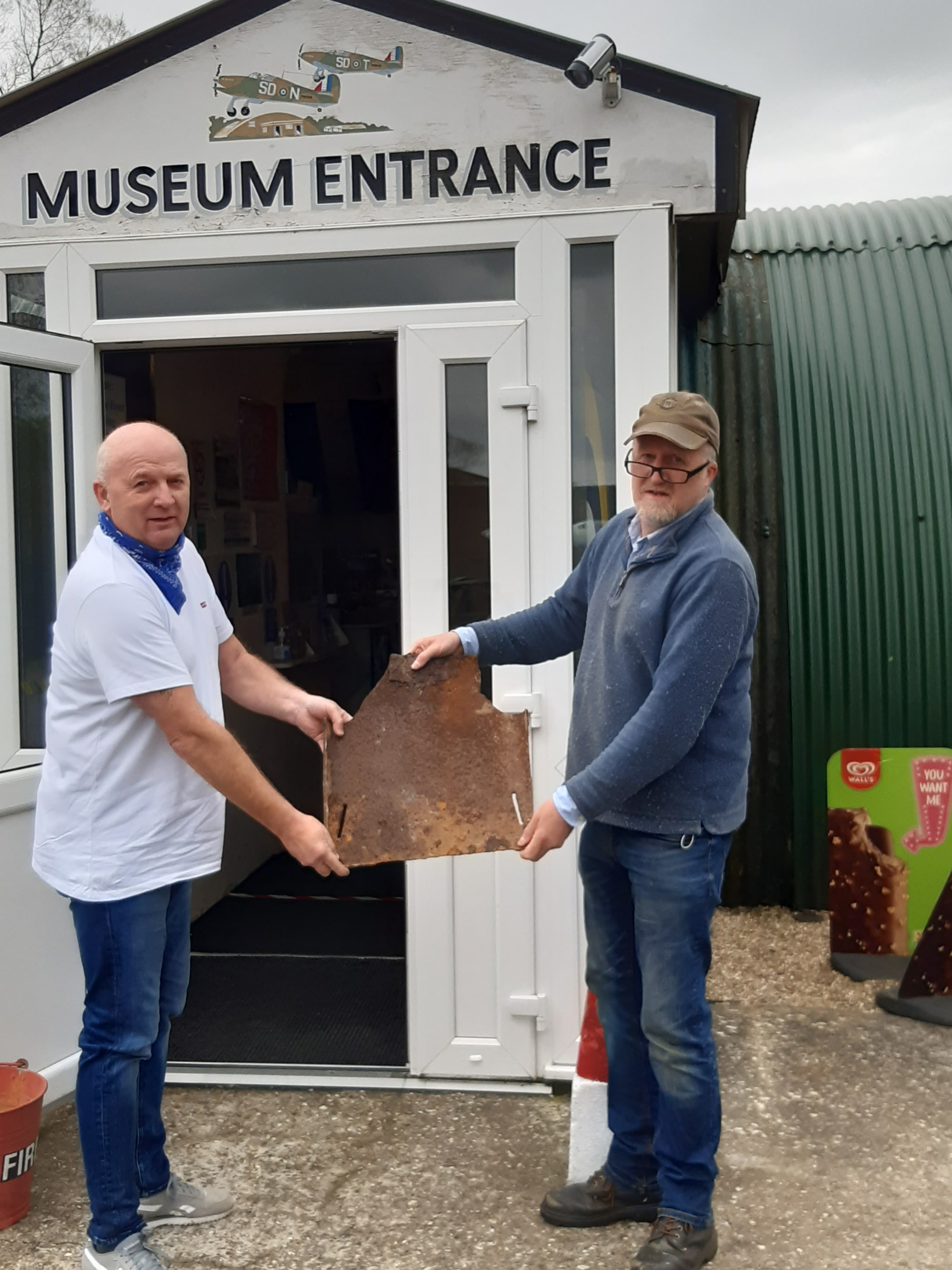
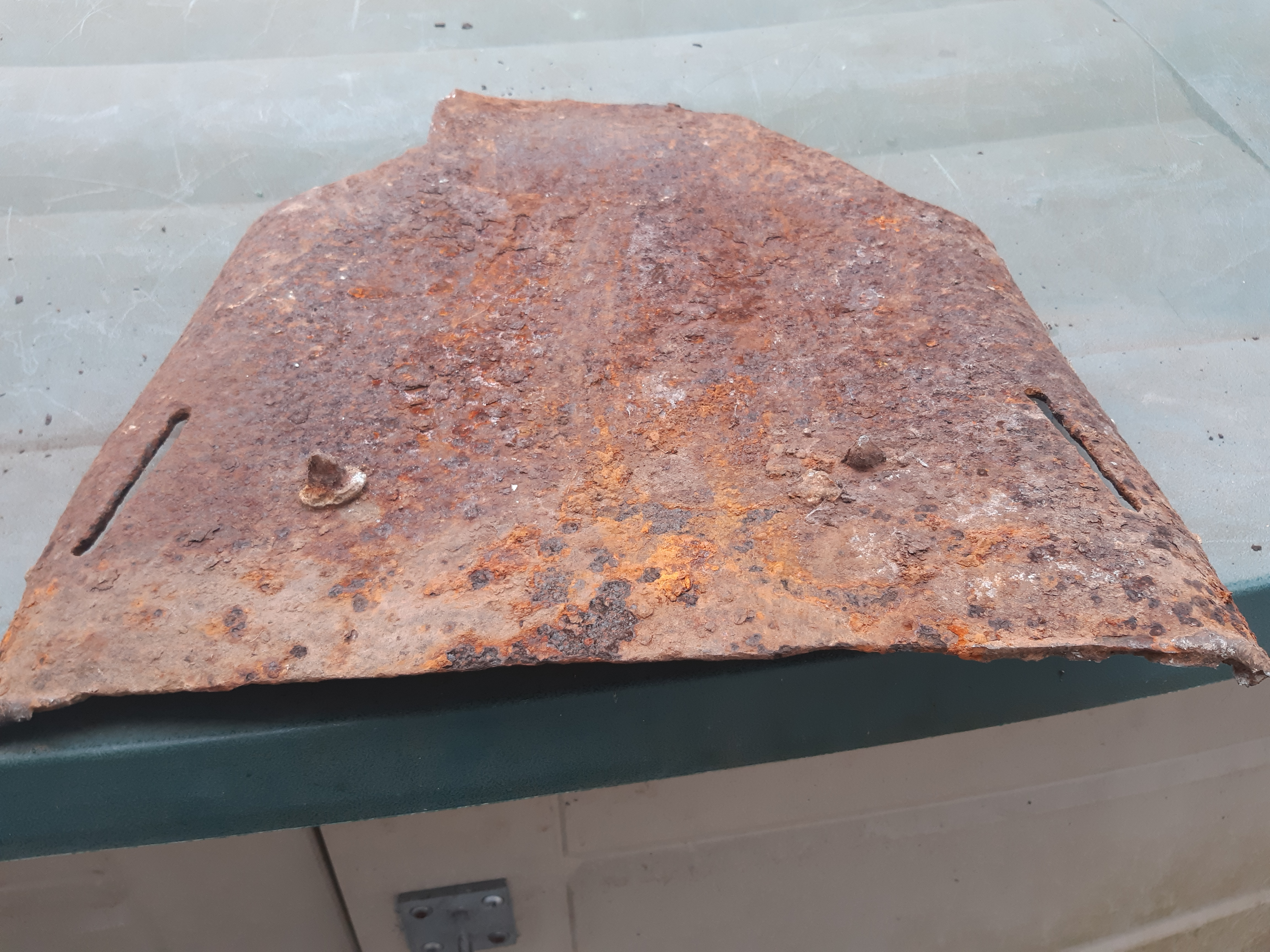
I have been to this excellent museum a few times. They very graciously stocked the promotional leaflets for my own Battle Of Britain E-Book; 1940: The Battles To Stop Hitler when it came out in 2015. Four years later, in the Summer of 2019, I had organized the creation of a memorial at Allhallows, commemorating the lost crew of B17 44-6133 and later that same Summer, there I was, talking to Dave Brocklehurst MBE, Curator of the museum at Hawkinge, about my project, the memorial day we’d just held there and how there was going to be a new museum at nearby Slough Fort, which would include a display relating to the crash. The Fort has a small piece of wreckage from the B17 that had washed up on the beach front at Allhallows. It was then that Dave told me that he also had a genuine piece of that B17 in storage and he offered it to me, for inclusion in the Fort’s display. It is a fair-sized but broken piece of armour plate, thought to be a section of armour from either of the Pilots’ chairs, though Dave was by no means certain of that. We arranged for him to retrieve it from his storage section and for me to return to the museum to collect it. Then came the Covid pandemic of course!

Successive lockdowns meant I couldn’t collect it. Dave was kept extremely busy, not only with the general upkeep but also the museum’s newest acquisition; a Spanish-built Heinkel 111 that had been used in the 1969 film The Battle Of Britain, which of course had seen Hawkinge used as a filming location. Each time we made our arrangements, another lockdown put paid to our plans, then finally, we were able to make a definite date, in May of 2021, nearly two years after first discussing the idea, for me to collect the B17 artefact.

Dave Brocklehurst MBE, (right) Curator of The Kent Battle Of Britain Museum at Hawkinge, Presents Mitch Peeke with the salvaged armour plate. (Photo: Mitch Peeke.)

The first thing that struck me when Dave handed the plate to me, was the sheer weight of it. The plate measures a mere 17 by 19 inches. It is a quarter of an inch thick, but it weighs an incredible 22.6 pounds: 10 kg. No wonder Dave told me not to come to collect it on my Harley! I used my wife’s SUV instead.

Once I got it safely home, I photographed it from several angles and set about the task of trying to positively identify it. To that end, I emailed the Museum of aviation at Robins Air Force Base in America, as they are currently in the process of restoring a B17 to its former glory. Their Curator, a former US Air Force officer by the name of Arthur Sullivan, replied to my enquiry with 24 hours, expressing a great interest in the the plate and the story behind it. Despite casting their expert eyes over the photos I sent them, we are still not 100% certain; but it would seem likely, given its curved edges and obvious mounting bolts underneath, that it is seat base armour from either of the Pilot’s seats; the two angled slots most likely to have been for the lap straps to pass through.

Underside of the plate, showing the mounting bolts and possible Lap Strap slots. (Photo: Mitch Peeke.)

The plate was salvaged from the wreck site, a muddy, watery crater some 500 yards off the beach at Allhallows, in the late 1970’s. By then, some nefarious low tide salvage attempts had already been made, most notably by slightly drunk members of the Allhallows Yacht Club. One such foray had resulted in the Police being called to the club when the returning “Trophy Hunters” had brought a quantity of .50 caliber machine gun bullets back with them and decided to try “firing” them from a vice on a workbench, using a hammer and the pointed end of a six inch nail. Luckily for those concerned, the bullets had deteriorated to such an extent after laying on the muddy bottom of the Thames Estuary for 32 years, that they merely fizzled and smoked. The Police confiscated them. The Trophy Hunters had also retrieved one of the bombers Browning machine guns, probably one of the waist guns, but that had been hidden from the Police. That gun was apparently later taken apart and smuggled into Canada. To discourage any further foolhardy amateur salvage operations, the Royal Engineers were called in to demolish the wreck with explosives. Nobody seemed to consider the possibility of that wreck being a War Grave. The body of Staff Sergeant Cecil Tognazzini, the bomber’s Flight Engineer/Top Turret Gunner, has never been found. He is the only member of 44-6133’s crew who is still unaccounted for.

Today, the crater is still visible at low tide, as are the fragmented remains of the B17. The tidal mud holds a lot of the wreckage in suspension, so every now and again, more of it becomes visible, sticking up out of the muddy floor of the crater, when the tide goes out. Tempting though it still is for some to venture out there, the oozing mud makes such an expedition a dangerously foolish pursuit. Letting that sleeping B17 rest in peace is a far more noble and worthy aim.

In the meantime, we do now have two tangible pieces of 44-6133; one is the small piece of wreckage that washed ashore in 2017 and the other is the newly re-discovered armour plate. Both are now on display in the Slough Fort Museum. Thanks to Jeanne Cronis-Campbell, we also now have photographs of some of 44-6133’s young crew, taken by her late Father, Teddy; who was the plane’s Bombardier and the sole survivor of 6133’s crew, which I added to the memorial last year. And of course, we finally have that permanent memorial to those men, overlooking the place where they fell. We will, remember them.

My thanks to Mitch for the update.

The full story of 44-6133 can be found in ‘A Long way from Home‘,

RAF Graveley and the Pathfinders (Part 2).

In Part 1, we saw how Graveley had been formed, its early years and the how it was drawn into Don Bennett’s Pathfinder Group. We saw the Introduction of FIDO and the benefits of this incredible fog busting system.

In this, the second and final part we see more uses of FIDO, new aircraft and new squadrons arrive, but we start on the night of 18th/19th November 1942 which saw a remarkable turn of fortune for a squadron who had suffered some devastating losses.

Halifax DT488 (TL-S) piloted by Wing Commander B.V. Robinson, caught fire when flares in the bomb bay ignited. He ordered the crew to bail out, but as the last man left, the fire extinguished itself. Robinson then decided to try and nurse the damaged bomber home. Flying single-handed, he reached the safety of RAF Colerne in Wiltshire, where he survived a crash landing. The six crew members who had bailed out also survived but were unfortunately captured and taken as prisoners of war by the Germans.  As a result of his actions, Robinson was awarded a Bar to add to his DSO. Robinson would go on to have a second lucky escape later on, after which, in May 1943, he would become the Station Commander of his home base here at Graveley.

35 Sqn would continue to carry out missions both marking and attacking strategic targets deep in the heart of Germany, but accuracy, whilst improving, was not yet 100%.

By the end of 1942 the new H2S ground scanning radar system was being introduced, and a small number of 35 Sqn aircraft were fitted with the units. The continuing missions were on the whole successful, even after the Germans developed a device able to track aircraft using it, and eventually, the whole of the PFF were fitted with it.

In April 1943, a detachment of 97 Sqn Lancasters arrived at Graveley. Based at the parent station RAF Bourn, they also had detachments at Gransden Lodge and Oakington, and they remained here for a year. After that, they moved on to RAF Coningsby in Lincolnshire.

A number of major operations were undertaken by 35 Sqn over the coming months, but with it came the end of good fortune for Group Captain Robinson. Fate was finally to catch up with him, and he was lost on the night of 23rd/24th August 1943. Flying in a Halifax II (HR928) ‘TL-R’, his loss that night brought a further blow to the men of Graveley and 35 Sqn. Following this, Air Chief Marshal Sir Arthur Harris restricted flying operations by base Commanders as the number of these experienced men being lost was quickly becoming unsustainable.

On November 18th/19th 1943, Bomber Command began the first phase of its ‘Battle for Berlin’, and Graveley’s Pathfinders would find FIDO more than beneficial. A raid of some 266 aircraft would see light losses on the second night of operations, but on returning to England, crews would find many of their bases shrouded in heavy fog. With visibility down to as little as 100 yards on the ground, the order was given to light up FIDO. This would be FIDO’s first official wartime use, and whilst some of Graveley’s bombers were diverted elsewhere, four managed to land safely using the system. This new invention may well have saved precious lives, as others failed to survive landing at their own fog-bound bases. At debriefing, one airmen, was noted as saying he could see Graveley’s fire as he crossed the English coast, a considerable distance from where he was now safely stood.

The night of 16th/17th December of 1943 would go down as one of the worst for Bomber Command and in  particular for the Pathfinders who were all based in the area around Graveley.

In what was to become known as ‘Black Thursday’ a massed formation of almost 500 aircraft attacked targets in Berlin, and although covered in cloud, marking was reasonably accurate and bombs struck their intended targets. On return however, England was fog bound, thick fog with a layer of heavy cloud prevented the ground from being seen. Whilst not operational that night, Graveley lit up its FIDO in an attempt to guide fuel starved bombers in. With little hope for even getting in safely here, crew after crew requested landing permission in a desperate attempt to get down. Many, out of fuel, bailed out leaving their aircraft to simply fall from the night sky. Others, desperate for a landing spot, simply crashed into the ground with the expected disastrous results. At Graveley, several attempts were made by desperate crews, but even FIDO was unable to help everyone. One aircraft came in cross wind losing vital power as he realised his error and tried to pull away. Another crashed a few miles away to  the north-east and a third aircraft trying to land came down to the south-east of the airfield. Of all those lost around Graveley that night, survivors could be counted on only one hand. 97 Squadron at Bourn, Gravely’s sister Pathfinder station, had taken the brunt with seven aircraft being lost. The role call the next morning was decimated.

The new year brought new changes to Graveley. Mosquito B.IVs arrived with a newly formed 692 Squadron (RAF). Their first mission here would be on the night of February 1st/2nd 1944 in which a single aircraft would defiantly attack Berlin.

graveley

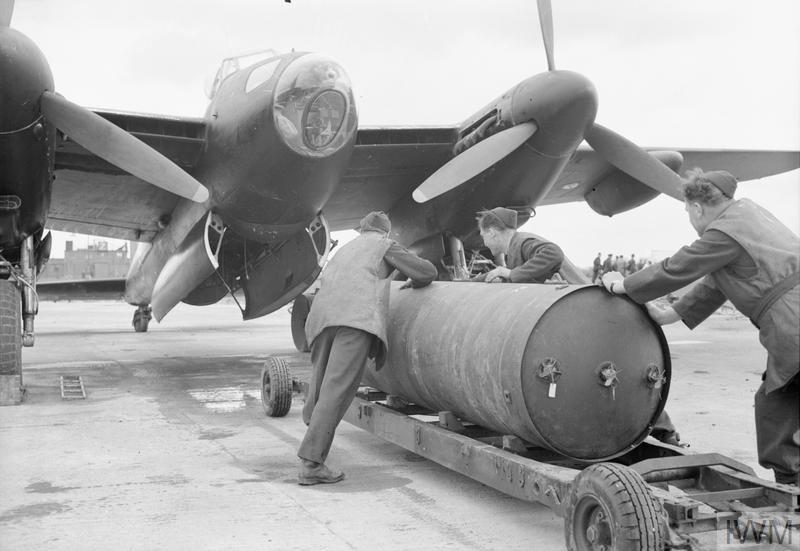
Armourers wheel a 4,000-lb HC bomb into a Mosquito. The Mosquitoes were fitted with bulged bomb-bays in order to accommodate ‘Cookies’. The tower can be seen behind. (© IWM CH 12621)

Some of these 692 Sqn Mosquitoes were later modified to carry the enormous 4,000 lb ‘Cookie’ bomb, This was first used by S/Ldr. Watts in Mosquito DZ647 who took off at 20.45 hours to attack Düsseldorf. The attack took place on  the night of 23rd/24th February 1944 from a height of 25,000 feet. The initial bomb was followed by two further bombs from Mosquitoes of the same squadron, DZ534 and DZ637.

The first casualties for 692 Sqn were reported only three days earlier, on the night of 19th/20th February, which also proved to be the worst night for Bomber Command casualties since the war started – even worse than ‘Black Thursday’. With 79 aircraft failing to return home, the RAF had taken another pounding and squadrons were finding themselves short of crews. These casualties including those in Mosquito DZ612 ‘P3-N’. Flown by F/L. W. Thomas (DFC) and F/L. J. Munby (DFC) the aircraft took off at 01:05 to attack Berlin. The Mosquito was subsequently shot down and both crew members killed.

graveley

Mosquito B Mark XVIs of No. 692 Squadron RAF (PF392 ‘P3-R’ nearest), lined up at Graveley. (© IWM CH 17859)

35 Sqn, who were still flying their Halifaxes, suffered even worse. TL-J, TL-B, TL-N, and TL-O, all fell to the accurate guns of night fighters over the continent. In yet another devastating night of losses, neighbouring Warboys, Wyton and distant Leeming and Waterbeach all lost crews. The casualty list was so high, that barely a squadron operating that night didn’t suffer a loss.

In early April 1944, a small detachment of 571 Sqn Mosquitoes (RAF Downham Market) joined 692 passing through on their way to RAF Oakington. From there that then transferred to  RAF Warboys, where the squadron was eventually disbanded. A series of events not untypical for Graveley.

692 would go on to have another claim to fame a year later, when on January 1st 1945, in an attempt to assist in the Ardennes offensive, they attacked supply lines through a tunnel. A daring attempt it required the bomb to be dropped into the mouth of the tunnel where it would explode. These attacks were carried out between 100 and 250 feet using the ‘Cookies’ and were so successful that smoke was seen bellowing from the other end of the tunnel after the attack.

The final 692 Sqn mission would then be on the night of May 2nd/3rd 1945. As the war was coming to a close, it was feared that remaining resolute Germans would make their escape from Keil, and so 23 aircraft in 2 waves of 12 and 11 went sent to bomb the coastal town. A successful mission, all crews returned safely.

692 Squadron, would operate a variety of Mosquito types during its life including the B.IV, XIV and XVI who would prove to be highly successful and instrumental in 8 Group’s ‘Light Night Striking Force’.

692 Sqn would move to Gransden Lodge in June 1945 where they were finally disbanded; a sad end to a remarkable career. The squadron had performed well since arriving here at Graveley, and had seen many highly regarded crew members lost in operations, including both Sqn. Ldr. R. Fitzgerald and Wing Commander A. Cranswick; its record of prestige losses reflecting the nature and danger of flying as part of the elite Pathfinder Force. 35 Sqn meanwhile would go on to have a long and established career, operating as late as 1982.

The remaining buildings utilised by the farm, which no longer resembles the Control Tower it was.

Other units to grace the skies over Graveley would include detachments of 97, 115 and 227  Sqns all with Lancasters MK. I and MK.IIIs, mainly prior to thier disbandment toward the war’s end.

692 Squadron carried out 310 operations from Graveley losing 17 Mosquitoes in all. A  total of 150 aircraft were registered either missing or crashed following operations from this station: 83 Halifaxes, 32 Lancasters and 35 Mosquitoes.

As one of the many Pathfinder stations in this part of the country, Graveley is linked by the long ‘Pathfinder Walk’ a path that leads all the way to RAF Warboys in the north. Using this walk allows you to visit a number of these bases linking each one by open cross-country footpaths.

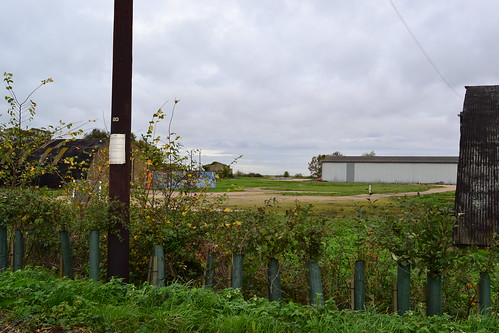
Today, Graveley is all but gone. The control tower is now very well disguised as a farm-house, its shape considerably different to the original design, the concrete huts have been pulled down and the runways mainly dug-up. A couple of buildings do still remain next to the farm-house, storing a range of modern farm equipment. The perimeter track considerably smaller in width, remains used by the local farm for lorries to transport their goods to the main road.

Perimeter Track

The perimeter track where bombers once lumbered.

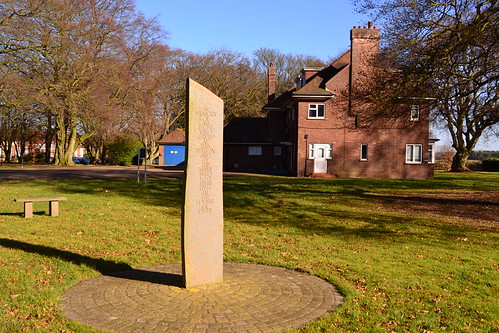
A small memorial has been erected and sad to say, was poorly maintained when I was there. It stands at the entrance to the former airfield on the northern side, now the entrance to the farm site.

Graveley is typical of the sad end to many of Britain’s lost airfields. The wide open expanses that once resounded with the roar of piston engines taking brave young men to war, are now quiet and the sounds mere whispers in the wind. Lorries roll where the wheels of laden bombers once lumbered. The brave acts of those young men now laid to rest in a small stone overlooking where they once walked. As a pivotal station in 8 Group, Graveley and its crews deserve a much greater recognition for their dedication, bravery and sacrifice.

This aside, a beautiful stained glass window can be found in the local Graveley church and is worthy of a visit if time allows.

After the quiet of Graveley we head south-east, toward our next planned destination, RAF Bourn. On the way, we make a brief stop at the now extinct RAF Caxton Gibbet, a little airfield with a colourful history.

*1 Williams, G. “Flying Through Fire FIDO – The Fog Buster of World War Two“, 1995, Alan Sutton Publishing, Page 109.

(Graveley was initially visited in 2015, in Trail 29, this is an updated post).

RAF Bradwell Bay Event July 17th 2021

A recent request from Eric Simonelli at the RAF Bradwell Bay Preservation Group. Eric is a key member of the group who are trying to preserve and promote the former RAF Bradwell Bay. He has kindly supplied a short write up and a flyer promoting a study day to be held in July for anyone interested. If you are, please contact the group direct and not myself at Aviation Trails.

RAF Bradwell Preservation Group.

Bradwell started off as a small grass aerodrome serving the firing range on the Dengie Peninsula, in the late 1930’s. In 1942 the aerodrome was expanded and became a large bases for 2,500 personnel who were to fly intruder missions to the continent and provide refuge for bombers returning with damage, casualties and short of fuel. To enable this level of activity there were many career opportunities for both men and women. This included aircraft maintenance, radio control, catering, motor transport and may more. Women were to fill all roles, apart from combat.  Today the RAF is fully inclusive.

RAF Bradwell Bay was host to many different squadrons up to the end of the war, with a variety aircraft types including Boston Havocs’, Mosquito’s, Spitfire’s, Tempest’s, Blenheim’s and Beaufighter’s. Other aircraft were based there for training and administrative purposes such as Miles Magisters, De-Haviland Dominies, Tiger Moths. At sometimes Bradwell Bay would have been an aeroplane spotter’s paradise. At least 25 squadrons are known to have been based there at different times.

Some parts of the airfield survive including the runways and control tower. However, the site is under threat of being demolished to make way for a second nuclear power station. As a group we are working to preserve as much as is possible, including building an archive to preserve memories and stories.

We have an unusual memorial and now are building an exhibition in the, nearby, Othona Centre. We are hoping to staff the exhibition at weekends or by appointment.

Bradwell Bay Memorial

Bradwell bay Memorial (Photo Eric Simonelli 2021)

more information can be found at: www.rafbradwellbay.co.uk

or email at: info@rafbradwellbay.co.uk

Eric has asked me to add the following ‘flyer’ to let you know about the study day being held locally for anyone interested in supporting the group and their aim to preserve Bradwell Bay. 

Inaugural Study Day

@ The Othona Community Centre

Saturday 17th July 2021

09:30 Reception and Coffee

3 Talks

WARTIME MALDON (World War 2) – by Stephen P. Nunn

A talk on George folliottPowell-Shedden by His Daughter

The Last CO – by Eric Simonelli

£25 inc Lunch, tea, and coffee (please advise of any dietary requirements on booking)

To book your place please complete the contact form on our website http://www.rafbradwellbay.co.uk

Members discount available

My thanks to Eric and good luck to them in their venture. 

RAF Leuchars – one of Britain’s oldest airfields (Part 5)

After Part 4, in this, the final part of Trail 62, we round off our look at RAF Leuchars. We have seen how to grew from a balloon training ground in the pre-war years to a training station for early flyers. Then on to maritime patrol, the Cold War and QRA status. Now as the years pass, defence cuts rear their heads once gain, Leuchars is once more under threat from politics.

The 1970s would see a return to training here at Leuchars with both the RAF and the Royal Navy embarking on new ventures with the Phantom – McDonnell Douglas’s all round, all-weather, multi-role aircraft. With new models, come new training units, and with the arrival of 111 Sqn the famous ‘Treble One’, in November 1975, also came a training support unit – the Post Operational Conversion Unit (later known as the Phantom Training Flight). The primary role of this unit was to train Fleet Air Arm aircrews for carrier borne models of the Phantom.

A No. 111 Squadron McDonnell Douglas F-4K Phantom FG.1, an aircraft closely associated with RAF Leuchars. (License: GNU Free Documentation License 1.2)

By the early 1970s, the shortcomings of the Lightning were now more than apparent, a lack of range and loitering ability becoming more obvious as the Phantom’s capabilities outshone it. A slower, but far more advanced Phantom, was proving to be more than just a suitable replacement for the now ageing ‘rocket of the skies’.

Whilst the Phantom was phased in and the Lightning phased out, pilots of the Lightnings continued to be wary of its tendency for engine fires, a problem that had  been present for some time. One such incident saw Lightning XS918 catch fire before the pilot (Flying Officer Doidge) manged to eject over the North Sea, West of The Bell Rock, 9 miles East of RAF Leuchars. Unfortunately controversy surrounded several aspects of the pilots kit, after he ejected he became detached from his survival kit, an inquiry highlighting ‘modifications’ to his clothing that may or may not have led to his tragic loss of life. In what appears to have been common practice amongst many airmen, changes were officially made to the kits supplied to aircrew in light of the accident.

The transition between Phantom and Lightning was a smooth if not rapid one. At Leuchars, the final farewell was made at the annual open day in September 1975, when six of 23 Squadron’s Lightnings and and four Phantoms of 43 Sqn formed a flypast. The Lightnings passing over the airfield in dramatic style saying a last farewell to the station where it has performed its duties so well for many years. With their disbandment in October, the baton and well and truly been passed over to a new breed of aircraft.

Between 1972 and 1978, Leuchars saw further sporadic returns of the Royal Navy, with 892 Squadron from HMS Ark Royal utilising the ground space for its operations. By 1978 though, 892 Sqn was disbanded, and their ship – the Ark Royal – decommissioned, bringing an end to this relationship between the navy and Leuchars. However, the FG.1 Phantoms used by 892 were absorbed into 111 Sqn, replacing the FGR.2s they had been operating before.

The end of 892 Sqn was marred by a tragic accident When rehearsing for the final solo display, the aircraft, a McDonnell Douglas Phantom FG 1 ‘XT868’ flown by Cdr. C. C. N. Davies and his navigator/observer Lt J. Gavin, suffered multiple engine failures whilst flying low, downwind along the runway axis. The aircraft entered a tight right hand turn through 180º to fly dead stick back along the runway. The Phantom’s right wing then struck the ground, and with the aircraft now perpendicular to the runway, the pilot ejected followed almost immediately by the observer. In their exits, the pilot was severely injured whilst the observer was sadly killed.

The decision to scrap the angled-decked carriers of the Navy would in turn have an eventual knock on effect at Leuchars. With both naval Buccaneers and Phantoms transferring to the RAF, no new training would take place – the Navy now looking toward the introduction the Harrier. The Phantom Training Flight would for now, remain at Leuchars though its role ‘downgraded’ to performing refresher training, ensuring that a round the clock, carrier based status was maintained in the UK.

It was also at this time that another film crew arrived – this time from the BBC – who used Ark Royal and her on-board flying units, including 892 Sqn, for their documentary ‘Sailor‘. The iconic insight into carrier operations was perhaps made even more famous by its theme tune of a similar name sung by Rod Stewart.

The 1970s saw continuous and increased intrusions into the the northern airspace around the UK, and as a result QRA scrambles became more common place at Leuchars than any other UK station. A massed show of force on Lenin’s centenary provided a massive ‘target’ for the QRA aircraft, with no less than 60 ‘Bears’ and ‘Badgers’ filling the skies on one day alone over the North Sea. A major headache for the QRA crews, it did however provide an excellent photo opportunity even allowing for a Marham Victor to shadow a Soviet Tu-95 ‘Bear’ much to the annoyance of the AOC No.1 Group when he got to hear about it.

With continued use, the runway needed a further resurfacing, and after the Phantoms of 43 Sqn had departed to Kinloss for a ‘Bolthole’ (where Station based aircraft deploy to temporary locations) deployment to carry out QRA operations from there, and those of 111 had left for Coningsby, Leuchars was left to the developers, and for an estimated eight months the airfield was effectively out of front line action.

Now with restricted runway use, the Whirlwind and Wessex helicopters and later Sea Kings, of 22 Sqn, would be the main users of Leuchars; their Air Sea Rescue operations combining with the Scottish Mountain Rescue teams, saving not only downed aircrew but stranded climbers as well . They would also be joined by the University Air Squadrons from nearby St. Andrew’s, Aberdeen and Dundee (later amalgamated to form the  East of Scotland Universities Air Squadron) who would use Leuchars for training with their Scottish Aviation Beagle Bulldogs.

Once completed, a second phase of work was then undertaken, new hardened aircraft shelters (HAS) were to be built. Common place on bases in Germany, these were designed to withstand conventional attacks, providing protection for individual aircraft whilst dispersed around the airfield. In an announcement made by Sir Michael Beetham the Chief of the Air Staff, Leuchars and five other airfields were to receive these ‘new’ shelters. It would take several years though before those at Leuchars were ready with its QRA aircraft safely tucked inside.

As the 1980s turned into the 1990s, the Phantom had now reached the end of its life and the new Multi Role Combat Aircraft (MRCA) the ‘Tornado’ would soon be appearing. The two Leuchars based squadrons, 43 and 111 were both stood down, the Phantoms removed and the Tornadoes brought in. 43 Sqn, who had been based at Leuchars since 1969 being the first to receive the new aircraft, a transition that saw all the Phantoms gone from the Scottish base within a year.

The introduction of the Tornado was not without its own political and military wrangling. Doubts cast upon the ability of the multi-role aircraft to perform as well as those aircraft it was designed to replace were raised by the military. History had shown some dramatic failures on this score whilst others, such as the Mosquito, had shown it more than possible with great success. Politicians however, seemed more drawn between upsetting the Americans who were trying to sell the F-15, and the multi national consortium Panavia Aircraft GmbH,  who collectively built the Tornado.  The decision would be a fine balance.

With the fall of the Berlin Wall, Soviet incursions  around the UK’s airspace would drop, the need for interceptors had now seemingly reduced, and so a review of the RAF’s front line operations was once again on the cards. The withdrawal of both the Phantom and shortly after the Buccaneer, left the Tornado as Britain’s only front line defence aircraft.

With the Gulf War in the 1991, the Tornadoes of Leuchars would play a major part and all eyes would be on them, scrutinising their every move. The gradual phasing out of Buccaneers and Jaguars leaving a lot on the shoulders of Tornado crews.

In 1995 two 43 Sqn Tornadoes from Leuchars were involved in a mid air collision over the North Sea. One of the aircraft ZE210 collided with the second, ZE733, during a joining up manoeuvre at 12,000ft whilst using night vision goggles. The pilot of ZE733 lost control and the two crew (Flt. Lt. McCarry and Flt. Lt. Booth) safely ejected, being rescued by an Air Sea Rescue helicopter from RAF Boulmer.  The second aircraft, ZE210, suffered damage to the hood and electrics, which knocked out the navigational aids. On landing, it took a considerable time to extract the crew due to the damage sustained to the hood. The aircraft was not repaired instead being used for spares before finally being dumped at St. Athan. *8

RAF Leuchars

Tornado ZE967 Gate Guard at Leuchars 2018.

The 2000s saw further upgrades to aircraft and new squadrons arrive. An Operation Conversion Unit for Tornadoes No. 56 (Reserve) Squadron, arrived in 2003. It was designed to upgrade pilots to the new variant Tornado. Absorbed into the long standing 43 Sqn, it remained on site and active until 2009 when it too was disbanded.

Further cut backs to finances meant the final departure of the Jaguars from bases in England. For Leuchars it would see the reforming of the University Air Squadrons into the ESUAS. A single training unit operating in conjunction with the three Scottish Universities .

After 2010 the Tornadoes were replaced by the Typhoons of 1 and 6 Sqns. 1 Sqn was reformed here on 15th September 2012, and joined 6 Sqn who had been reformed here on 6th September 2010, this offered an almost seamless transition from Tornadoes to Typhoons. These modern fighters now formed Britain’s front line of defence against potential aggressors taking over the QRA status for the north.  But in 2014, orders came through to move the RAF out of Leuchars transferring the aircraft, personnel and role to Lossiemouth in Moray. On 31st March 2015 at 12:00 hrs, ownership of Leuchars officially passed over to the Army, Leuchars’ named was changed to Leuchars Station, and its history as an operational airfield had finally come to an end.

Designated an emergency landing ground, (Master Diversion Airfield or MDA) between 2015 and 2016 no fewer than fifteen aircraft used Leuchars for ’emergency’ landings. These included: Tucanoes (Linton-on-Ouse), Tornadoes GR4 (Lossiemouth); Hawks (Leeming); Typhoons (Coningsby) and F15s from Lakenheath in Suffolk.

A minor respite in 2020 saw the QRA Typhoons return briefly as work was carried out on Lossiemouth’s runway. Within a short period of time though, this was completed and the aircraft departed once more leaving Leuchars quiet again.

This move signified the last full use of Leuchars by the Royal Air Force, responsibility of this long standing Scottish airfield being handed over to the the British Army who now based the Royal Scots Dragoon Guards and the Royal Engineers here. Various other non-flying units do serve here including The Military police units and 612 (R) Squadron, a medical unit of the RAF.

Whilst the defence cuts of 2010 indicated the closure of Leuchars, in October 2020, it was confirmed by the Ministry of Defence that they were looking into increasing both civilian and military usage of the airfield at Leuchars. Whilst there remains no intention to retain, or base aircraft here, the installation of fuel facilities does give hope that aviation will return in some form in the future. The indications are that by opening Leuchars to civilian traffic, it could bring revenue in to the hard pressed MOD*7.

Leuchars played a major part in two World conflicts being used primarily by the RAF throughout its life. The Royal Navy (Fleet Air Arm) have also been based here, as have the Army who are now the current main residents of the base. Other users include: the Dutch,  the Norwegians, the Canadians, Australians and New Zealand Air Forces as well as civil aviation organisations and University Air Squadrons.

More recently, with it being located closer to international airspace which is regularly penetrated by Soviet aircraft, the RAF’s Northern QRA aircraft were based here for many years before moving away to Lossiemouth in Moray, someway further north. Leuchars’ history is therefore long and very varied, covering a wide range of users in a multitude of roles.

RAF Leuchars has a history going back over 100 years. It was never upgraded to ‘A’ class status, and has only ever had two runways. Originally built from concrete and wood chip, the surface was upgraded to accommodate the jets of modern warfare, and the infrastructure has been added to as the airfield grew.

It has been home to a considerable number of front line squadrons along with an extensive collection of support flights, training flights and non-flying units. The number of people that have passed through its doors probably uncountable. It performed during the first World War, trained air crew in the inter-war years, and carried out vital work during the Second. Post war, it formed the front line of defence against potential Soviet aggression before returning to training through the University Air Squadrons across Scotland. Now home to the British Army, it is at least for the time being open for business, but as a flying military site, it is all but closed.

Its location has been in many ways its saviour. Operating maritime patrols and clandestine operations into occupied and neutral Europe. The Fleet Air Arm were formed from its units, and the Air Forces of several nations have been based here. It has a history that is so diverse and dynamic that very few other airfields in Britain can match it. As with other airfields across the country, its future hangs in the balance, I hope that this long living and prestigious site remains alive and well to honour all those who over the last 100 years have served from its runways.

Leuchars as an operational military site is not accessible to the general public and views across it are limited. It is thought that two rare First World War Double Royal Flying Corps General Service Aircraft Sheds are among the few original buildings that survive on the site. The accommodation areas have now been sold off to private buyers, but the airfield is intact as it is used as an emergency landing ground and by the ESUAS. With care, opportunities are there to see this historic and fascinating piece of Britain’s aviation history.

The full story of Leuchars can be seen on Trail 62.

Sources and further reading

*1 Fatal Air Accidents website 12th November 1918 – November 1919

*2 Royal Flying Corp Website

*3 An interesting film of 489 Beaufighters with invasion markings appears on the IWM website, it shows the take off and formation flying of the squadron along with some interesting ground shots too.

*4 For additional information and pilot stories about the ‘ball-bearing’ run see the Royal Institute of Navigation Blog.

*5 Thirsk, I. “de Havilland Mosquito – An illustrated History Vol.2“, Crecy 2006

*6 Further details about the BOAC Mosquitoes appear n ‘Mosquitoes on BOAC Service.

*7 The Courier.co.uk newspaper website.

*8, 11 Aviation Safety Network Website.

*9 National Archives AIR 27/2612/1

*10 Defence Transformation Volume 531: debated on Monday 18 July 2011 Dr. Liam Fox’s announcement to Parliament. UK Parliament House of Commons.

Gracie’s Guide to British Industrial History website.

Flying Magazine, (August 1972) website.

National Archives: AIR 27/1383

AIR 27/624/29

AIR 27/624/33

BAE Systems Website accessed 6/3/21.

For first hand stories of MRT work see Heavy Whalley’s blog

For a detailed account of life at Leuchars, read “Northern Q – The History of RAF Leuchars” by Ian Smith Watson.

RAF Leuchars – one of Britain’s oldest airfields (Part 4)

As Leuchars emerged from the Second World War in Part 3, it entered a new phase in its long and distinguished life. No longer operating maritime patrols, it was now entering the Cold War, and under a new Command, that of Fighter Command, it would take on a new role with a new breed of aircraft.

Throughout the war Leuchars had been a maritime operations base, with submarine hunts, convoy patrols and anti-shipping flights taking the role of its front line squadrons. But with the last of the long range patrol aircraft being posted out, Leuchars’ role would now change, and a new breed of aircraft would be seen along its runways.

The Cold War brought a new dimension to warfare, nuclear weapons and the arms race were the flavour of the day. With both sides fearing preemptive attacks, fighters and bombers capable of carrying these potent weapons were in great need. Whilst bomber airfields across the length and breadth of Britain were modified to accommodate newer and bigger aircraft, Leuchars physically changed very little. However, being transferred to the control of RAF Fighter Command, Leuchars would be propelled to the forefront of RAF operations, with both day and night fighters soon shattering the quiet of this post war airfield.

This new focus would mean that the 1950s would see Leuchars aircraft participating in a number of high profile exercises ‘Coronet‘, ‘Premraf‘, ‘Kingpin‘, ‘Formulate‘ and ‘Fabulous‘ which often required the deployment of detachments to airfields around the United Kingdom. These exercises, varied in their structure, would often include Leuchars aircraft acting as the enemy trying to attack shipping or other targets at altitudes from very low level up to 50,000 feet. Air-to-air gunnery was also involved as war air-to-ground rocketry.

With this transfer came further changes. The first jet to arrive was the Meteor in the form of the F4. with 222 Sqn in May 1950. After staying for seven years upgrading to the F.8 and then returning back to the F.4, the unit was finally disbanded in 1957 only to re-emerge as a Bloodhound operator at RAF Woodhall Spa in Lincolnshire.

The next squadron to arrive, 43 Sqn, arrived in November 1950, and also brought the Meteor F.8. On 22nd October 1952, one of these aircraft Meteor F8 VZ461 ‘W’ was lost on route from  RAF Acklington to Leuchars as part of  three-ship formation. The aircraft (number two in the formation) suffered problems when its artificial horizon failed. The pilot, Pilot Officer Maurice William Prior, notified the lead pilot who instructed him to make a starboard turn and rejoin the group above the clouds. Unfortunately the Meteor descended instead, and struck the sea near to Coquet Island off Amble, Northumberland. In the accident, which was put down to ‘instrument failure’, the pilot lost his life.*9

THE ROYAL AIR FORCE, 1950-1969

Hunter F.1s of 43 sqn RAF Leuchars, in a vertical climb. © IWM RAF-T 42a

43 Sqn retained their Meteors until 1954, they then replaced them with the Hawker Hunter; flying marks including the: F.1, F.4, F.6 and F.G.A.9 in a front line role. After transferring to Nicosia in 1961 and eventual disbandment, the squadron was reformed here at Leuchars in in 1969 with the McDonnell Douglas Phantom FG.1. An upgrade to the FGR.2 in May 1988 eventually led to the Phantom being replaced by the Panavia Tornado F.3 in 1989. This made 43 Sqn one of the longest standing front line squadrons to reside at Leuchars in its entire history.

1951 would see another long standing resident unit at Leuchars. But the early months were noted for more short stay units. The ‘sister’ of the Meteor, the DH. Vampire, made a presence through 602, 612 and 603 Sqns between April and July that year, each reflecting Leuchars’ war time record and staying for short periods before moving on. For a while over the summer months, Leuchars would be home to no less than six front line squadrons, five of them with Meteors or Vampires with a sixth flying that old favourite the Spitfire.

Then in September 1951, 151 Sqn was reformed, an ex-wartime unit it had its roots firmly in 1918. Initially flying the Vampire NF.10, Meteor NF.11, and then in September 1955, the Venom NF.3, it left for a spell at Turnhouse before returning to Leuchars in 1957 with the Delta Winged Gloster Javelin FAW.5. In September 1961, the squadron disbanded again being reformed a year later at Watton.  During the war it had operated as a night fighter unit, a role it continued here at Leuchars. Donned with the Saltire of St. Andrew, the flag of the patron Saint of Scotland, it would make a good companion for 43 Sqn with whom it had flown with during the Battle of Britain with Hurricanes.

In 1952, a 222 Sqn Meteor from Leuchars took off on a low level training sortie over the Scottish mountains. The aircraft, an F.8 ‘WA882’ piloted by Pilot Officer Brian Lightfoot, departed Leuchars at 9:58am in poor conditions. Snow covered the mountains and frequent snow showers were experienced over the area. At 10:20, a witness reported hearing a crash and seeing black smoke rising from the Scottish mountain Oxen Craig, in the Bennnachie hills, Aberdeenshire. The Meteor had struck the mountain killing the pilot. It took some two weeks to locate the wreckage, most of which was buried at the scene by RAF rescue teams, after which a small memorial was built to commemorate not only the life of P.O. Lightfoot, but also the crew of a Westland Wallace ‘K6028’ which had crashed at the same location in September 1939. The official cause of the pilot’s death was attributed to “poor definition of snow covered mountains in the prevailing conditions”. It was one more loss in the Scottish hills*11.

The 50s saw a more permanent move by some RAF squadrons. 264 Sqn who only stayed for six months in 1952 with Meteors led the way. In 1954 ‘C’ Flight of 275 Sqn arrived, this signified another change in role for Leuchars as it brought the first of the helicopters to the airfield – the Sycamore HR.14. This squadron, formed in 1941 continued to perform its role of Air Sea Rescue (a much needed but over looked service during the war), and the Flight stayed here until the entire squadron was disbanded in 1959. As an Air Sea Rescue unit it understandably had Flights based at a number of sites around the UK, and took on the Whirlwind HAR 2 and 4 prior to disbandment. Working in conjunction with the Mountain Rescue Teams, many civilians as well as aircrew owe them a great deal of gratitude.

1957 then saw Leuchars enter the film industry when a crew arrived to make a film using 43 Sqn as its main squadron. Headlined by Ray Milland (Wing Commander Rudge), Bernard Lee (Flight Sergeant Harris), Leslie Philips (Squadron Leader Blake) and John Le Mesurier as the Commandant, it was about a Commanding Officer of an RAF Training School (Cranwell) who must deal with a difficult cadet. The problem was not the cadet’s behaviour so much as the fact that he reminded the Commandant of himself when he was young. The film included shots of 43 Sqn in low level, gunnery and aerobatic manoeuvres which were filmed until the end of the year when the days were too short to carry on.

The squadron initially identified with the ‘starring role’ was 111 Sqn, who had only that year been recognised as the RAF’s official Fighter Command Aerobatics team, pipping their Leuchars stable mates, 43 Sqn, at the post. ‘Treble One’ took the name of ‘Black Arrows‘ and with their nine ship formation went on to be as famous as the Red Arrows are today. 43 Sqn’s ‘Fighting Cocks‘ were a four ship group and the disappointment of not achieving the status of their Leuchars partners, ended a decade of pageants, displays and European tours where they had been centre stage across many countries.

As the decade drew to a close, so July 1958 would see the arrival of yet more Meteors with 29 Sqn. These NF.12s were operated until replaced by the Javelin, Gloster’s delta wing fighter, before they departed to Nicosia in 1963. This time  would also see the arrival of another Air Sea Rescue detachment, that of ‘C’ Flight from 228 Squadron also with the Sycamore helicopter. Throughout the war they had flown in Sunderland flying boats, including from the Scottish West coast base at Oban in 1941. The detachment had remained here until 1964 when it was renumbered as 202 Sqn.

The next forty years would see more front line jet squadrons, 25 Sqn with Javelins FAW.7s who retained these until their disbandment in 1962. They were followed by 23 Sqn who had disposed of their Javelins in preparation for the mighty Lightning, which they received a year after their arrival here in 1963. For eleven years they flew both the F.3 and the F.6, before they too were disbanded in preparation for yet more modern upgrades.

The arrival of the Lightning also heralded the arrival of the Quick Reaction Alert (QRA) status, the Lightning proving to be a huge step forward in terms of aircraft speed and climb rate compared to its predecessors, was an ideal interceptor; only the appalling fuel consumption and limited armaments of early models prevented it from being the ultimate attack aircraft.

Although QRA’s origins are associated with the Lightning, the Hunters of 43 and 222 Squadrons had previously retained a two minute readiness with aircrew remaining in the cockpit at all times, a rota that kept aircraft at the ready 24 hours a day, 365 days a year. Sitting in the cockpit for many hours, waiting for the chance to intercept a Soviet aircraft, must have been somewhat tedious on occasions – a draining but very necessary part of the job.

Two more units arrived in 1964, 74 (Tiger) Sqn and 202 Sqn. 74 Sqn had had the honour of being the first Lightning squadron in 1960, and for bringing the first Lightning to Leuchars, roaring into the Fife skies in August that year. They remained here for three years whilst another detachment from 202 brought the Whirlwind HAR.10 strengthening Leuchars’ role in Air Sea Rescue. For the next twelve years the helicopters of ‘C’ Flight would operate from here, with other detachments at similar sites including Boulmer and Coltishall.

THE ROYAL AIR FORCE, 1950-1969

Lightning F.6 of No 74 Squadron, RAF Leuchars. Armed with Red Top air-to-air missiles, and carrying over-wing long range fuel tanks.(© IWM RAF-T 6973)

74 Sqn soon took on the upgraded Avon powered Lightning F.3, this proved to be a godsend as the MK.Is were soon becoming worn out, regular faults being difficult to repair meant that flying hours were starting to fall. This upgrade was followed in September 1966 by the F.6. With this new aircraft they, and Leuchars, would participate in the sixth ‘Tiger Meet’, which saw a gathering of NATO ‘Tiger’ units from across the European and American nations. As Leuchars was hosting the gathering, it would mean a range of unusual aircraft types would appear here, if only for a short period of time. For four days in July 1966: F-100D Super Sabres, Super Mystére B2s, F-104G and CF-104 Starfighters along with F-4D Phantom IIs and a range of support aircraft, would all be present in these operations. This brought a multinational collection of pilots and crews from France, the US, Belgium and Germany to this Scottish airfield.

Unfortunately, the event was marred by the death of French pilot Capt. Joel Dancel, whose Armée de l’Air Super Mystère B.2 struck the ground shortly after take off killing him. As a mark of respect the final days solo displays, which he was practising for, went ahead with the flags of all nations at half mast.

Then followed the infamous Labour Government’s decision in 1965 to axe large parts of the defence budget, thus cancelling numerous projects such as TSR.2. This meant that Britain’s future strike capability was seriously weakened. The various separate commands were rapidly becoming no longer viable, and so now the nearly non-existent Bomber Command and Fighter Command were both amalgamated to form the new Strike Command. It was this Command that would take Leuchars on into the 1970s and beyond.

With more Lightnings arriving in April 1967 with the reforming of the fighter squadron 11 Sqn,  a stay of some five years would see the Lightnings continue the role of policing Britain’s North Sea airspace. The RAF’s ongoing interest in Leuchars would also be kept alive and well by the the newly formed 43 Sqn, who joined 11 Sqn in 1967 with the Phantom FG.1. 43 Sqn would remain at Leuchars for over forty years, taking over where the Lightning left off, and  eventually taking on the Tornado in 1989/90.

The end of the 1960s saw what was a first for not only 23 Squadron but perhaps even the RAF, when two Lightnings of the squadron left Leuchars to perform at an airshow in Toronto. The flight, made non-stop with the help of over-wing tanks and no less than six Victors for in-flight refuelling, was made by Sdn. Ldr. Ed Durham and Flg. Off. Geoff Brindle, supported by a VC10 carrying ground crew, supplies and spare pilots. The flight, which had lasted for some seven and a half hours, ended at Toronto in front of a massed crowd of well wishers and press, a real coup for the crews of Leuchars.

Leuchars personnel would also celebrate the 50th anniversary of the RAF in 1968, when it was granted the freedom of St. Andrews. A parade through the town was supported by all makes of aircraft stationed at Leuchars including no less than sixteen Lightnings. Whirlwinds and Chipmunks from both the Air Sea Rescue service and the University Air Squadron also took part, further cementing the strong bond that had existed between Leuchars and its neighbouring town.

The 1960s finally drew to a close, world war had so far been averted but Leuchars remained on the front line, monitoring and intercepting Soviet aircraft over the North Sea, at least for the time being.

In the fifth and final part of this trail, we see how Leuchars is affected by defence cuts. The QRA status is at risk as is the very future of this historic airfield.

The full story of Leuchars can be seen on Trail 62.

RAF Leuchars – one of Britain’s oldest airfields (Part 3)

In Part 2, a number of twin engined models frequented Leuchars performing anti shipping roles and U Boat hunts out in the North Sea. BOAC had begun its clandestine role and shipping ball-bearings back from neutral Sweden. We now see a change to these flights and as the war ends, a new much larger breed begin to appear here are Leuchars.

Throughout all these changes at Leuchars, the BOAC company had been continually running its clandestine operations to Sweden. But by now it was clear that a new, faster more agile aircraft was needed. Even though they were marked with civilian markings and flown by Swedish crews, the Electras were slow and cumbersome and made easy targets for both fighters and flak. Now, with the development of the Mosquito, the opportunity had finally arrived.

It was during December 1942 that the first civilian operated model of the aircraft arrived here at Leuchars. A Mosquito PR.IV ‘DZ411’,  it was assigned the civilian registration G-AGFV, and would begin flights to Stockholm on 4th February 1943, after which it was joined by six other aircraft. These MK.VIs were given the sequential registrations G-AGGC to GH, and would arrive during the April and May of that year.

By the end of April the following year, a total of nine Mosquitoes would have been modified and delivered to BOAC at Leuchars*5.

BOAC Mosqquito BAE Systems (@BAE Systems)

All these aircraft had to be changed from military status to civilian, this required the removal of all traces of armament. Modified at Hatfield – the home of the Mosquito – the resultant weight loss altered the aircraft’s centre of gravity and so additional ballast had to be added to prevent changes in the aircraft’s flying characteristics.

It was vital that the Mosquitoes remained unarmed for these operations, so as to not infringe or violate Sweden’s wartime neutrality, however, this made any aircraft on this run a potential ‘sitting duck’, even though, like their Lockheed predecessors, they carried BOAC insignia and were flown by civilian aircrew.

These operations were by now carrying more than just mail and ball-bearings though. These covert operations, took the civilian marked and unarmed Mosquito across the North Sea to Sweden, where it would drop off the mail, papers and other written material held within its bomb bay, and return with prominent scientists, special agents or allied aircrew who had been interned in Sweden as well as vital ball-bearings produced by the Swedes. The faster and far more agile Mosquito would, in most cases, be able to out run any opposing Luftwaffe fighter that should, and indeed did, try to intercept the aircraft whilst on one of these flights.

The returning ‘passenger’ on these flights had the unfortunate prospect of having to sit in a modified ventral bay for the whole duration of the flight. The prospect of further internment probably outweighing that of cramp and three hours of discomfort.

One such notable passenger who was carried back from Sweden, was the nuclear physicist Niels Bohr, whose work on atomic structures and quantum theory, had won him the Nobel Prize for Physics in 1922.*4 He would go on to work on the Atom Bomb in the Manhattan Project, the results of which were seen at both Hiroshima and Nagasaki in 1945.

Even though these flights were highly successful, a few aircraft were lost. In Mid August 1944, G-AGKP ‘LR296’, a former 27 MU aircraft, was lost when it crashed into the sea nine miles from Leuchars. All three on board were killed as it approached on return from Stockholm; the passenger being a BOAC Mosquito pilot himself. The crash was believed to have been caused by a structural failure, the aircraft having been repaired previously after an accident in January. By the war’s end fourteen Mosquitoes had been used in some way by BOAC, five of which crashed.*6

As the war moved on, squadron numbers at Leuchars begin to diminish. 1943 brought only two, that of 235 Sqn and 333 (Royal Norwegian Air Force) Sqn who were formed here on April 5th as ‘B’ Flight after the dividing and renumbering of 1477 (Norwegian) Flight. This was a split unit, one part flying the Catalina from Woodhaven, whilst ‘B’ Flight flew the Mosquito MK.II. An upgrade to the MK.VI then saw the unit move to join the famous Banff Strike Wing in September 1944. Whilst at Leuchars they operated as sub-hunters and convoy escorts, whilst ‘A’ flight flew more clandestine operations smuggling secret agents and supplies into occupied Norway. The Mosquito as a multi-function aircraft performed well in these duties, and by the end of the war numerous U-boats had been attacked by aircraft based at the Scottish airfield.

RAF Leuchars

One of the Hangars at Leuchars 2018

With 1944 dawning and major events happening on the continent, more changes would take place at Leuchars.

In the early months, proposals to extend and widen one of the runways was put forward, a part of which was agreed in April. This move also required the relocation of the Watch Office and widening of the perimeter tracks. A further three squadrons would pass through this year beginning with a detachment of 281 Sqn, who stayed for a year from February. A second unit 206 Sqn, stayed here for less than three weeks. But then September/October would bring a new and interesting model in the shape of the B-24 Liberator and 547 Sqn. A change to the smaller twin-engined models that had frequented Leuchars for the last four years or so, the move here was unfortunately a signal of their ending though, the squadron being disbanded in June 1945 never to appear again.

Whilst here, the Liberators would patrol the Norwegian coast in the A/U (anti-U boat) role, many of these patrols being uneventful, the U-boat threat by now greatly reduced compared to its previous Atlantic successes. However, on October 12th, Liberator MK.VI “G” did spot a U boat on the surface which it attacked with both front and rear turrets. Strikes from both guns were seen on and around the conning tower, and it was initially thought that the sub was sunk. After patrolling for a further 45 minutes, the U boat was again sighted some two miles away, but managed to escape in the poor weather. It was believed by the crew to have been a 740 ton vessel which had subsequently suffered damage from the attack.

The B-24s of the these RAF squadrons would be complemented by B-24s now flying separate runs to Sweden by the Americans. In addition to these, Leuchars also saw the reintroduction of the popular and highly successful American built Douglas DC3. The route to Stockholm now being a little less dangerous than it had been in previous years.

The arrival of the Liberator had signified a big change in direction for Leuchars,  they were to be the first of many four engined heavies to serve from the Fife base.

In 1945, 519 Sqn brought along the Halifax III, but sadly they were to go the way of 547 Sqn and disband here at Leuchars in the following May; it too would not reappear in the RAF’s inventory of operational Squadrons. 519 were a meteorological unit, collecting data for flying operations. Using both the Spitfire VII and Halifax IIIs, they would climb to altitudes of around 40,000 ft, and collect valuable meteorological data. Using Prata I, Prata II and Recipe I (Pressure And Temperature Ascent) many of these flights would take the aircraft high out over the North Sea.

With the close of the war, Leuchars had seen no less than twenty-eight operational squadrons pass through its doors, some of these merely staying for a day, whilst others were more prolonged. A range of aircraft had come and gone, mainly twin-engined models operating in the photographic reconnaissance or anti-shipping role. With its position on the north eastern coast, Leuchars had proven vital to maritime operations protecting the seas between Britain and Scandinavia, an area it had operated in, in a number of clandestine roles. But with the war now at an end, these were no longer required, and Leuchars’ role would again revert back to its original one – that of training.

The post war world was very different to the pre-war one, Britain like many other countries was rapidly trying to revert to pre-war budgets. A reduction in the armed forces was seen as essential to cutting costs, whilst rebuilding the nations cities that had been so heavily bombed in the Blitz, was paramount. As a result, the RAF as with the other forces, were having to do with what they had. A reduction in man power and machinery though would not only mean a reduction in squadrons, but the airfields that used them.

Leuchars, like so many, was now under the potential threat of closure. However, the increasing post war tensions between the east and west created the Cold War, with a strained and anxious stand off between Soviet and Western forces right across the European frontier. As had happened before, Leuchars’ position would once again be its saviour. Over the coming years it would see a wealth of operational aircraft and a broad range of front line fighters be based in this small corner of Scotland,

The coming months after the war’s end would see further four-engined models reappear, a previous resident 203 Sqn who had been here in the 1920s, returned from overseas operations in May 1946, bringing back with them the B-24 (Liberator VIII). Within two months though, this would be replaced by the Lancaster GR.3, a version of the mighty four-engined heavy that had wreaked so much devastation across Germany’s industrial cities. But by 1947, 203’s link with the Scottish airfield would finally draw to a close, and the squadron would depart for good.

160 Sqn who arrived a month later in June, also brought the Liberator, and similarly began taking on the Lancaster GR.3. By October though their demise had also arrived, they were renumbered and reformed as 120 Sqn, and by 1947 they had lost the last of their Liberators retaining only the Lancaster.

In December 1950, 120 Sqn were posted to Kinloss, where its wartime bombers were replaced with the newer Avro model, the long range maritime patrol aircraft, the Shackleton with its rare contra-rotating props.

Avro Shackleton MR.3 (WR989) of 120 Sqn RAF (@BAE Sytems)

The aircraft, built in response to the growing Soviet threat, was designed around the Lancaster,  Roy Chadwick’s dream bomber. Chadwick, like R.J. Mitchell, having sadly died before their dream had finally been put into service. Built to Air Ministry Specification R 5/46, the Shackleton was initially designed with gun turrets and two Rolls-Royce Griffon 57A engines inboard, and two Roll-Royce Griffon 57 engines outboard.

One other unit arrived here at Leuchars that year, that of 82 Sqn, initially as a Lancaster detachment and then in June 1947 as a base with its own detachments at Eastleigh, Dar-es-Salaam and Lusaka. The last of the prop driven aircraft were now making their ultimate RAF appearances, and soon Leuchars would enter in the jet age.

In Part 4 Leuchars enters the jet age. The Cold War begins and Leuchars takes on a new challenge as it moves to a new Command, that of Fighter Command.

The full story of Leuchars can be seen on Trail 62.