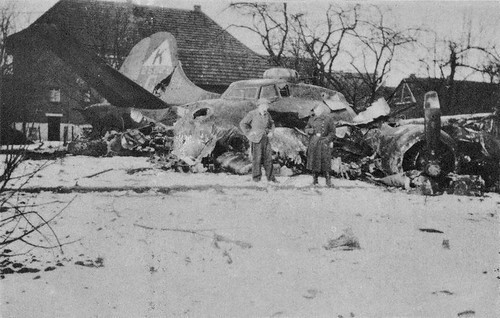
It was on Wednesday 1st December 1943, that a 75 Squadron Stirling MK.III (EH880) piloted by F/S J. S. Kerr (s/n 1558163) would be diverted from RAF Mepal and instructed to land at RAF Acklington in Northumbria.
The aircraft had been on operations to plant mines in the Danish coastal waters. On the final approach it undershot striking a family farmhouse in Togston near Amble. Inside the house, Cliff House Farmhouse, was the Robson family. The five children, ranging in ages from 19 months to 9 years of age, were all killed, whilst the parents who were playing cards downstairs, escaped with varying injuries after being pulled from the rubble by helpers. All but one of the Stirling’s crew were killed, the mid upper gunner Sgt K Hook, was pulled from the burning wreckage, his burning clothes being extinguished, by the local butcher, Jim Rowell.
This crash was the greatest civilian loss of life in the district,
The crew of Stirling EH880 ‘AA-J’ were:
F/S George John Stewart Kerr, RAFVR (s/n 1558163) – Pilot.
Sgt. Donald Frank Wort, RAFVR (s/n 1585034) – Navigator.
Sgt. Ronald Smith, RAFVR (s/n 1239376) – Air Bomber.
Sgt. Derek Arthur Holt, RAFVR (s/n 1217087) – Wireless Operator.
Sgt. Leonard George Copsey, RAFVR (s/n 1691471) – Flight Engineer.
Sgt. Kenneth Gordon Hook, RAFVR (s/n 1335989) – Mid Upper Gunner.
Sgt. George William Thomas Lucas, RAFVR (s/n 1250557) – Rear Gunner.
The ‘Times’ Newspaper, published the story of 3rd December 1943:
Aircraft Crash on Farmhouse. Family of five young children killed.
Five children – all their family – of Mr and Mrs W. Robson were killed when an Aircraft crashed into Cliff House, a small dairy farm near Amble, Northumberland, on Wednesday night. The children’s ages ranged from one to nine years. They were sleeping in an upstairs room.
The mother and father, who with two friends Mr. and Mrs Rowell of Dilston [Terrace] Amble, were sitting in a downstairs room, were injured but not seriously. One of the crew of the aircraft, a gunner, was saved by Mr. Rowell.
Mr Rowell said last night: “We did not realise what had happened until the house collapsed above our heads. We managed to stand up, bruised and badly dazed, and, looking upward we saw the sky. Mrs Robson tried to make her way towards the stairs, which had been blown away. My wife called my attention to a burning object outside which was moving about. We rushed over and found it was a gunner with his clothes alight. Mr Rowell rolled the airman on the ground to extinguish the burning clothes. Although badly burned, the gunner was alive.
The children’s partly charred bodies were recovered later.
Five streets on a housing estate near to the crash site in Amble have since been named after each of the Robson children. The crew are remembered on a plaque in St. John the Divine, the official church of RAF Acklington St. John.
In 1942 Air Ministry Directive S.46368/D.C.A.S. turned Bomber Command’s focus to the morale of the German population and in particular its industrial workforce. Bomber Command now turned to strategic bombing, a controversial campaign that was debated for many years after, it was seen as a way to destroy the enemy’s industrial output, by attacking the very workforce that produced it.
Flt. Lt. Bill Reid VC (IWM CHP 794)
But as loses had mounted, Bomber Command had been forced to fly at night, a task that was almost impossible to satisfactorily achieve for most bomber crews who had been trained to bomb in daylight. Indeed, only some 3 in every 100 bombers were hitting within 5 miles of the aiming point at the start of the campaign.
Harris himself knew that hitting a single target consistently, at night was impossible, and so there was little choice seen other than the controversial bombing campaign.
On one of these raids, on the night of 3rd/4th November 1943, Bomber Command sent a large raid of almost 600 aircraft to Germany. In that raid was Acting Flight Lieutenant William (Bill) Reid, a Scot born in Baillieston, Glasgow, and the son of a Blacksmith .
Reid performed his duties that night in a manner that would see him earn the Victoria Cross, the highest honour possible, for taking his damaged Lancaster to the heart of Dussledorf and bombing the target even though he himself and his Flight Engineer were wounded; the navigator killed and the aircraft severely damaged and so difficult to fly.
That evening, eleven Lancasters from 61 Squadron, RAF Syerston, took off on a mission to bomb Dusseldorf. Reid’s aircraft, Lancaster LM360 was second to depart taking off at 16:59. On board with Flt. Lt. William (Bill) Reid were: Sgt. J. Norris (Flt Eng); Flt. Sgt. J. Jeffries (Nav); Sgt T. Rolton (Bomb Aimer); Flt. Sgt. J. Mann (WT/ Air Gunner); Flt. Sgt. S. Baldwin (Air Gunner) and Flt. Sgt. A. Emerson (Air Gunner).
As the aircraft crossed the Dutch coast there was a terrific bang outside the aircraft which resulted in the windscreen being shattered and partially blown out. Reid was wounded in the head, shoulders and hands, and the plane temporarily went out of control. Flak continued to burst all around the Lancaster with one further burst injuring the Flight Engineer, who was next to read, and causing further injuries to Reid himself. The port elevator had been shot away and to compensate, Reid had to pull the stick fully back just to keep the plane straight and level. Between Reid and the Flight Engineer, they maintained level flight as part of the formation of almost 600 aircraft across an 8 to 10 mile span of up to 6000 feet deep – the option of turning back was not a viable one.
Keeping the plane straight and level, Reid watched the target indicators. The bombs were dropped and the photographic evidence taken. Turning the aircraft away, the Lancaster headed for home. Reid knew that he was the only one who could fly the aircraft and even with with no elevator, virtually no instruments and at night, he was determined to make it back safely. With further attacks from night fighters on the return trip, it was not an easy journey, but they eventually made it to England. Once over the English coast they looked for a suitable airfield to land, they came across the beacons at the American base at RAF Shipdham in Norfolk, and Reid put the aircraft down. Almost immediately, the legs of the undercarriage collapsed and the aircraft hit the runway on its belly, sliding along for some 50 yards or so, before coming to a complete stop. At this point Reid realised the Navigator had died slumped in his seat behind him.
Reid, severely injured, had managed to fly the badly damaged aircraft, without oxygen and with wounded on board, for many hours from deep inside Germany, the actions of which earned the 22-year-old acting Flight Lieutenant the Victoria Cross.
His citation in the Third Supplement to the London Gazette on Tuesday 14th December 1943 covered an entire page and read:
Air Ministry, 14th December, 1943.
The KING has been graciously pleased to confer the VICTORIA CROSS on the undermentioned officer in recognition of most conspicuous bravery: —
Acting Flight Lieutenant William REID (124438), Royal Air Force Volunteer Reserve, No. 61 Squadron.
On the night of November 3rd, 1943, Flight Lieutenant Reid was pilot and captain of a Lancaster aircraft detailed to attack Dusseldorf.
Shortly after crossing the Dutch coast, the pilot’s windscreen was shattered by fire from a Messerschmitt 110. Owing to a failure in the heating circuit, the rear gunner’s hands were too cold for him to open fire immediately or to operate his microphone and so give warning of danger; but after a brief delay he managed to return the Messerschmitt’s fire and it was driven off.
During the fight with the Messerschmitt, Flight Lieutenant Reid was wounded in the head, shoulders and hands. The elevator trimming tabs of the aircraft were damaged and it became difficult to control. The rear turret, too, was badly damaged and the communications system and compasses were put out of action. Flight Lieutenant Reid ascertained that his crew were unscathed and, saying nothing about his own injuries,
he continued his mission.
Soon afterwards, the Lancaster was attacked by a Focke Wulf 190. This time, the enemy’s fire raked the bomber from stem to stern. The rear gunner replied with his only serviceable gun but the state of his turret made accurate aiming impossible. The navigator was killed and the wireless operator fatally injured. The mid-upper turret was hit and the oxygen system put out of action. Flight Lieutenant Reid was again wounded and the flight engineer, though hit in the forearm, supplied him with oxygen from a portable supply.
Flight Lieutenant Reid refused to be turned from his objective and Dusseldorf was reached some 50 minutes later. He had memorised his course to the target and had continued in such a normal manner that the bomb-aimer, who was cut off by the failure of the communications system, knew nothing of his captain’s injuries or of the casualties to his comrades. Photographs show that, when the bombs were released, the aircraft was right over the centre of the target.
Steering by the pole star and the moon, Flight Lieutenant Reid then set course for home. He was growing weak from loss of blood. The emergency oxygen supply had given out. With the windscreen shattered, the cold was intense. He lapsed into semi-consciousness. The flight engineer, with some help from the bomb-aimer, kept the
Lancaster in the air despite heavy anti-aircraft fire over the Dutch coast.
The North Sea crossing was accomplished. An airfield was sighted. The captain revived, resumed control and made ready to land. Ground mist partially obscured the runway lights. The captain was also much bothered by blood from his head wound getting into his eyes. But he made a safe landing although one leg of the damaged undercarriage collapsed when the load came on.
Wounded in two attacks, without oxygen, suffering severely from cold, his navigator dead, his wireless operator fatally wounded, his aircraft crippled and defenceless, Flight Lieutenant Reid showed superb courage and leadership in penetrating a further 200 miles into enemy territory to attack one of the most strongly defended targets in Germany, every additional mile increasing the hazards of the long and perilous journey home. His tenacity and devotion to duty were beyond praise.
Reid would go on to fly in Bomber Command being transferred to the famous 617 Sqn at Woodhall Spa after his recovery. Here he would fly with Leonard Cheshire, another VC holder, on Tallboy missions, dropping the enormous weapon onto heavily fortified or deeply buried structures.
On 31st July 1944, sixteen Lancasters and two Mosquitoes of 617 Sqn were ordered to attack the V-1 site at Rily-la-Montage, a railway tunnel used by the Germans to store the pilot-less flying bombs ‘The Doodlebug’. Here Flt. Lt. William ‘Bill’ Reid’s luck would finally run out.
He had managed so far to evade either death or capture, only to be struck down by bombs from one of his own. The Lancaster Mk.I (ME557) ‘KC-S’ he was flying with 617 Sqn, shuddered as allied bombs crashed through the Lancaster severing the control cables, fracturing the structure of the Lancaster’s body and removing one of the port engines. Uncontrollable, the aircraft then entered a spin. Reid gave the order to bail out, himself escaping through the hatch above his head. He landed heavily, breaking an arm in the process – an injury that would hinder his escape from his pursuers. Within an hour he was captured, interrogated and sent on to a POW camp. Reid and one other crewman, Flying Officer D. Luker, were the only two airmen to escape the stricken Lancaster, the remaining five all being killed in the crash.
As the allied forces moved ever closer, the much admired Reid was moved from camp to camp, ending his war at Stalag III – a POW camp made famous by ‘The Great Escape’ and ‘The Wooden Horse’.
Back at the RAF Woodhall Spa in Lincolnshire, he colleagues ‘mourned’ his capture by joking that he had escaped with all their money, money he had won in an early morning card game in the officers mess at the Petwood Hotel. *1.
Liberated in May 1945, Reid returned home and became well known in the agricultural business. He became great friends with the that other Scottish VC holder John Cruickshank a friendship that lasted a good many years.
Some time after moving to his new home in Crieff, Bill Reid sadly passed away; his death being announced on November 28th 2001. He was buried in the local cemetery at Crieff.
Sources and Further Reading.
National Archives AIR 27/578/22
National Archives AIR 27/2128/24
National Archives AIR 27/2128/23
The Third Supplement of The London Gazette Publication date: 10th December 1943; Supplement: 36285 Page: 5435
World At War Series BBC narrated by Lawrence Olivier Episode 12
*1 Sweetman, J. “Bomber Crew – Taking on the Reich“, Abacus, 2004 pg 207
The Scotsman Newspaper website, 29th November 2001.
The Royal Air Force was made up of many nationals including both those from the Commonwealth and those from across the globe.
In Bomber Command, and the Pathfinders in particular, one man stood out not just for his nationality, but for his bravery and dedication in the face of death.
That man was one Acting Major*1 Edwin Essery Swales VC, DFC based at RAF Little Staughton on the Bedfordshire / Cambridgeshire border.
Swales (fourth from right) and his crew with their Lancaster ‘M’ Mother *9
Swales was born on 3rd July 1915, the son of Harry Evelyn Swales and Olive Essery, in Inanda, Natal South Africa. He was one of four children whose father was a farmer. Whilst Edwin was young, his father, Harry, died from the influenza epidemic that claimed some 50 million lives after the First World War. Without a father, the family were unable to maintain the farm, and so they moved away to Berea in Durban.
Once of high school age, the young Edwin Swales attended Durban High School, he also joined the Scouts learning valuable skills with like minded youngsters, that would help in him in later life. After leaving school Swales landed himself his first job, working at the international branch of Barclays Bank in Durban. But with with war looming, Swales like many young men at the time, was drawn to military service, and so he joined up, posted to the Natal Mounted Rifles where he achieved the rank of Sergeant Major.
Whilst with the Mounted Rifles, Swales served in several locations including: Kenya, Abyssinia and North Africa where he fought bravely alongside his compatriots and the Eighth Army under Montgomery. He would remain with the rifles until January 1942 at which point he transferred to the South African Air Force, obtaining his wings on 26th June a year later. Two months after this milestone, he, like many others from across the commonwealth, was seconded to the Royal Air Force ensuring his position overseas.
Swales (s/n: 6101V) like many new recruits to the Royal Air Force, would undergo a tense period of retraining, eventually being posted to fly heavy bombers within Donald Bennett’s 8 Group – ‘The Pathfinders’. His first and only posting, would be at Little Staughton with 582 Sqn.
During his short time at Little Staughton, Swales would fly a number of missions piloting Avro’s delight, the four engined heavy bomber the Lancaster.
Swales took part in many operations over occupied Europe, including the ill-fated attack on Cologne on December 23rd 1944, which saw the loss of five aircraft from 582 Sqn. In total, eight aircraft from seventeen flying from both Little Staughton and Graveley were lost that day including the lead bomber flown by Sqn. Ldr. Robert Palmer who himself was awarded the Victoria Cross for his actions.
On that day, an Oboe mission that went terribly wrong, Swales heard the instruction to bomb visually releasing his bombs at 12:51hrs. Flak and fighter attacks were so ferocious, that Swales, like many others in the formation, had to take “violent evasive action” to shake off persistent and accurate attacks from fighter and ground based gunners. He was able to return his aircraft and crew safely to Little Staughton landing at 14:35*2
The action taken by Swales that day was indicative of his determination to succeed and protect both his aircraft and crew, and one that would be repeated time after time by the airman. As a result, it was seen fit to award Captain Swales the DFC for his action that night, his citation stating:
This Officer was pilot and Captain of an aircraft detailed to attack Cologne in December, 1944. When approaching the target, intense anti-aircraft fire was encountered. Despite this, a good bombing attack was executed. Soon afterwards the aircraft was attacked by five enemy aircraft. In the ensuing fights, Capt. Swales manoeuvred with great skill. As a result his gunners were able to bring effective fire to bear upon the attackers, one of which is believed to have been shot down. Throughout this spirited action Captain Swales displayed exceptional coolness and captaincy, setting a very fine example. This Officer has completed very many sorties during which he has attacked a variety of enemy targets*3
Within two months of the operation and at the time his award was being awarded, Swales would be in a similar position again. This time as Master Bomber leading the formation and directing the bombers to the target.
On that night, only ten days after the historical attack on Dresden, 367 Lancasters and 13 Mosquitoes from 1, 6 and 8 Groups were detailed to attack the city of Pforzheim to the north-west of Stuttgart. This would be the only attack on the city during the war and it would prove almost as devastating as both Dresden and Hamburg.
Flying along side Swales that night in his Lancaster III PB538 ‘N’, were seven other crewmen, including two navigators as was commonplace for Oboe fitted aircraft.
On the run in to the target, the Lancaster was badly mauled by night fighters who successfully put one engine and the rear turret guns out of action. But undeterred, Swales remained on station guiding the following bombers onto the target with the greatest of precision.
When he was finally satisfied that the attack had been carried out successfully, he left his station and turned the aircraft for home. It had been difficult to keep the Lancaster flying, but Swales had persevered in order to complete the job. But he was now easy prey for enemy fighters and inevitably more attacks came.
Soon a second engine was put out of action and flying controls were damaged further with some now completely inoperable. With a reduced speed and difficult flying conditions he headed for the allied lines, where he hoped to get his crew out safely.
All those on board made the jump to safety, leaving just Swales at the controls of the failing Lancaster. As if someone had been watching over them, just as the last man left, the Lancaster finally gave up the struggle and dived into the earth – Edwin Swales was still sat at the controls when it was found later on.
The attack on Pforzheim was considered to be very accurate, with over 1,800 bombs having been dropped in as little as twenty minutes or so. Over 17,000 people were known to have died that night in the raging fire that followed the bombing, and a post-war photo, revealed that 83% of the built up area had been destroyed by the raid *4
Following the death of Captain Swales, Air Chief Marshall Sir Arthur Harris KCB, OBE, AFC, Chief of Bomber Command, personally write to Swales’ mother saying: “On every occasion your son proved to be a fighter and a resolute captain of his crew. His devotion to duty and complete disregard for his own safety will remain an example and inspiration for all of us.”*10
For his action, bravery and dedication to duty, 29 year old Edwin Swales, a prominent rugby player and South African “who only had to smile at his crew and they were with him all the way“*5 was awarded the Victoria Cross posthumously, the second such award to go to an airman of RAF Little Staughton, just one of three to the Pathfinders and one of only four South Africans to be awarded the Victoria Cross during the war. His citation appeared in the Fifth Supplement to The London Gazette, of Friday, the 20th of April, 1945:
Air Ministry, 24th April, 1945.
The KING has ‘been graciously pleased to confer the VICTORIA CROSS on the undermentioned officer in recognition of most conspicuous bravery:.—
Captain Swales was ” master bomber ” of a force of aircraft which attacked Pforzheim on the night of February 23rd, 1945. As ” master bomber,” he had the task of locating the target area with precision and of giving aiming instructions to the main force of bombers following in his wake.
Soon after he had reached the target area he was engaged by an enemy fighter and one of his engines was put out of action. His rear guns failed. His crippled aircraft was an easy prey to further attacks. Unperturbed, he carried on with his allotted task; clearly and precisely he issued aiming instructions to the main force. Meanwhile the enemy fighter closed the range and fired again. A second engine of Captain Swales’ aircraft was put out of action. Almost defenceless, he stayed over the target area issuing his aiming instructions until he was satisfied that the attack had achieved its purpose.
It is now known that the attack was one of the most concentrated and successful of the war.
Captain Swales did not, however, regard his mission as completed. His aircraft was damaged. Its speed had been so much reduced that it could only with difficulty be kept in the air. The blind-flying instruments were no longer working. Determined at all costs to prevent his aircraft and crew from falling into enemy hands, he set course for home. After an hour he flew into thin-layered cloud. He kept his course by skilful flying between the layers, but later heavy cloud and turbulent air conditions were met. The aircraft, ‘by now over friendly territory, ‘became more and more difficult to control; it was losing height steadily. Realising that the situation was desperate Captain Swales ordered his crew to bale out. Time was very short and it required all his exertions to keep the aircraft steady while each of his crew moved in turn to the escape hatch and parachuted to safety. Hardly had the last crew-member jumped when the aircraft plunged to earth. Captain Swales was found dead at the controls.
Intrepid in the attack, courageous in the face of danger, he did his duty to the last, giving his life that his comrades might live.*6
His body was removed from the aircraft in which he gave his life and was interned at the War Cemetery at Leopoldsburg, in Belgium, Section VIII Grave C.5.
In honour of Captain Swales, two memorial stones were laid and revealed outside his Durban High School on Armistice day 2009. One in the Memorial Courtyard of the School and the second on the Memorial Wall of the Natal Mounted Rifles also in Durban. In attendance were both his niece, Professor Edwina Ward, and Lt. Gen. Carlo Gagiano, Chief of the South African Air Force.
In 2013, Swales was also awarded the “Bomber Command” clasp to be worn on the 1939 – 1945 Star already awarded.
Edwin Swales was indeed a very brave man, who through sheer determination managed to save his crew in spite of the dangers facing him. His award was in no doubt deservingly awarded.
The story of pals Edwin Swales and Robert Palmer both of whom won VCs posthumously whilst at RAF Little Staughton.*7
The story of Captain Swales appeared in a newspaper cartoon “Heroes of the Air War”.*8
Sqn Ldr. Robert Palmer’s story appears in Heroic Tales.
Sources and further reading.
*1 the documents showing Captain Swales’ promotion to the rank of Major only reached the UK authorities after his death and as a result he was cited as being a Captain. (South African Aviation Foundation)
*2 National Archives 582 Operational Record Book AIR-27-2052-18
*3 Supplement 36954, to The London Gazette, 23rd February 1945, published 20th February 1945, page 1070
*4 Middlebrook, M., Everitt. C., “The Bomber Command War Diaries“, Midland Publishing Ltd, 1996
*5 International Bomber Command Centre National Archive website.
*6 Fifth Supplement to The London Gazette, of Friday 20th April 1945. Published on Tuesday 24th April 1945, Supplement 37049, Page 2173.
*7 “Newspaper cuttings concerning awards of Victoria Crosses,” IBCC Digital Archive, accessed November 11, 2023,
*8 “Heroes of the Air War (No. 39) Captain Swales,” IBCC Digital Archive, accessed November 11, 2023,
*9 Photo The South African Legion of Military Veterans website
On October 9th 1944 Mosquito KB261 608 (PFF) Sqn, took off with 21 other Downham Market aircraft to attack the naval port at Wilhelmshaven in Lower Saxony, Germany. Situated on the western side of the Jade Bight, a bay of the North Sea in Northern Germany, it was a major target frequently attack by allied bombers during the war.
The Mosquito, ‘D’ – Dog, a MK. XX, piloted by Flt. Lt. Reginald George Gardner (s/n 68776) with Fl. Off. Oswald Cuthbert Sweetman DFM*1 (s/n 145171) as navigator, departed Downham Market at 18:03 carrying a mix of bombs. It arrived over the target only to see 10/10ths cloud, and the target obscured. However, bombs were released successfully on red target indicators, after which crews reported seeing several flashes beneath the cloud along with large explosions lasting several seconds.
In debriefing, all crews reported a successful operation although visual confirmation was difficult due to the cloud cover which had extended to between 6 and 8,000 ft in height.
However, Mosquito KB261 never made it down. It arrived home and circled the airfield waiting for its turn to land, it showed no signs of distress or problem – all appeared well. As it entered the ‘funnel’ it suddenly – and without explanation, – dived into the ground from around 1,000 ft, crashing at 21:30.
The aircraft hit a cowshed in the nearby hamlet of Barroway Drove, to the south-west of the airfield, killing both pilot and navigator. A farm building was slightly damaged and some animals in or near the shed were also killed.
The aircraft had been fully flight tested and reported ‘serviceable’ that afternoon by the pilot Flt. Lt. Gardner, and both engines were known to be running at the time of the crash.
A report into the accident concluded it as “obscure” with no known cause, although the Station Commander witnessed the crash saying “…it would appear that while turning into the funnel the aircraft did a slipping turn resulting in rapid loss of height and final crash.”
In the Accident Report Form 765C, the pilot was noted to have called the tower on the downwind leg, but there was no report at that time, from him, as to any problems with the aircraft and all appeared to be in order.
The two crewmen were both married. Flt. Lt. Gardener was born in 1913 and married Nancy Buttle of Bearstead, Kent, where his remains are buried*2; and Fl. Off. Sweetman, born 1916, was married to Jessie James from Newcastle in 1940, he also remains buried in his home town*3.
On the following two nights, October 10th and 11th, two more 608 Squadron Mosquitoes were lost; KB404 ‘6T-T’ and KB348 ‘6T-M’.
In KB404, a Mosquito B MK. 25, both crewmen (pilot – Fl. Off. James Arthur Smith DFC RAAF, and navigator Sgt. John Burchell) emerged safely from the aircraft which crash landed in a field near to the airfield. The port engine was reported to have cut out at approximately 100 feet after take off, whereupon the pilot managed to perform a wheels up landing bringing the aircraft down safely.
In the third Mosquito, KB348, (MK.XX), the aircraft was hit by Flak over the city of Berlin and crashed at the Bornstettin Army Exercise Grounds near Potsdam at 04:02 hrs. The pilot, Fl. Off. Stanley Warren Reeder (RAFVR), and navigator Flt. Sgt. Robert John Bolton (RAAF) were both killed. Initially buried locally in Potsdam, they were, in 1946, interred in the Berlin 1939-1945 War Cemetery, Plot 4, Row K, Graves 26 and 27, where they remain today.
608 Squadron were only reformed at Downham Market on August 1st 1944, after being disbanded earlier at the end of July. They remained at Downham Market for the remainder of the war being disbanded again on 24th August 1945. In May 1946 they reformed once more only to disband for the last time on March 10th, 1957 at Thornaby whilst flying Vampires. It was at Thornaby that they were initially formed in 1930.
The last remnants of the main runway being approached by the Mosquito before they were removed.
Lancaster, a MK.III, took off from RAF Warboys, at 18:24 on September 29th 1943 on operations to Germany. It was joined by nine other Lancasters from the same squadron to bomb Bochum in Western Germany. Over the target, flak was moderate and visibility was good. Marking was in the form of skymarkers, along with red and green target indicators (TI) and bombing was reported as scattered with smoke rising to 5,000 ft.
On Lancaster EE118 that night was Flt. Sgt. Frederick H. Ray (Pilot); Sgt. David R. Booker (Bomb aimer); Fl. Off. Sydney K. Smith RCAF (Navigator); Sgt. Norman P. Winterburn (Wireless Op); Sgt. William A. Lineham (Flt. Engineer); Sgt. Frederick D. Dickens (Air Gunner) and Sgt. Arthur S. W. Orchard (rear Gunner).
The aircraft had suffered heavy flak damage, several of the instruments were not working including the compass and altimeter, and a 1,000lb bomb remained ‘hung-up’ in the bomb bay, Their return to Warboys would take them over the North Sea, across the Wash and south-east toward Warboys, but they requested landing permission at RAF Downham Market as it was closer. Permission was granted, and the ‘hung-up’ bomb was safely disposed of over the Wash.
The Memorial Plaque to Lancaster EE118.
Downham Market was at the time shrouded in thick fog and the FIDO installation recently added was not yet fully serviceable. Flt. Sgt. Ray made his approach, and with 10/10ths cloud as low as 1,000 feet, it was very difficult to make out where he was.
On his first approach, Flt. Sgt. Ray missed the runway and so headed north, and then turned in a south-west direction to make a new approach from the east. On his run in toward the final turn, the rear wheel caught the tree tops of a Slubberdike Wood, located north-west of the airfield. This slowed the aircraft down sufficiently to prevent it from climbing, and as they passed over Allotments at nearby Wimbotsham village, the port wing clipped a raised air-raid shelter near to the allotment entrance. This caused the wing tip to break off and resulted in the aircraft colliding with a telegraph pole at the end of Hop Pikel field near to Milller’s Lane which flipped the aircraft over bring it down in an orchard.
In the accident, all but the rear gunner Sgt. Orchard were killed outright, Sgt. Orchard being thrown clear from his rear turret.
The noise of the crash alerted local people who went out to see what had caused all the noise, and suspecting an air crash, they searched for wreckage. Gardens at the end of Miller’s Lane were strewn with bits of aircraft and a two young boys by the name of Gutteridge, came across Sgt. Orchard with a large branch across his legs. Fearing he had broken it, Sgt. Orchard begged them not to move it and await medical assistance in case it made the injury worse.
In the confusion that followed, Sgt. Orchard couldn’t remember if the 1,000 lb bomb had been dropped or not, so the police on the scene cleared the nearby houses sending everyone into their various bomb shelters for protection. It was not necessary however, and soon the all clear had been given and they returned to their homes.
Another young boy, 12 years old at the time, recalled how the rest of the crew were found in his garden, 39 Miller’s Lane, and how they were removed by RAF personnel during the night. Wreckage was found across the orchard and in local gardens, until RAF salvage teams took the aircraft away some 3 – 4 weeks later.
An aerial photo of Wimbotsham showing the direction the Lancaster flew on that fateful night. The scar in the orchard is clearly visible. The airfield is in the bottom right hand corner.
On the 30th September 2023, a plaque was attached to the Wimbotsham village sign to commemorate the loss of the crew nearby. The ceremony was opened by Mr. Ian Cable, Chairman of Wimbotsham Parish Council with a greeting and introduction from Reverend Canon Dr. David Karoon. After the hymn ‘O God our help in ages past’, Group Captain Frederick Wigglesworth, Station Commander RAF Marham, gave the Bible reading Isaiah 40:25:31 which was followed by a prayer of dedication led by The Rev. (Wing Commander) Eddie Wynn.
Dr. Karoon then gave a blessing of the memorial after which followed ‘The Airman’s Hymn’ sung by those gathered at the service.
Mr. Dutton gives background information on the Pathfinders with Rev. Canon Dr. Davis Karoon, The Rev (Wing Cdr) Eddie Wynn and Group Captain Frederick Wigglesworth looking on.
Following the Lords Prayer, a further dedication was given by Bill Bower, the R.A.F.A. Chairman, which preceded the Last Post and a minutes silence. The ceremony was closed with some back ground information on the Pathfinders by Tim Dutton, and the Benediction from Dr. Karoon. Lastly, the National Anthem was sung and a thanks to those involved given by Mr. Cable.
In the gathering were relatives of both Sgt. Arthur Orchard and Sgt. David Booker, the bomb aimer, along with villagers who remember the crash in 1943.
Tea, cake and a display of material from the crash and personal letters from Arthur Orchard to relatives of the crew were made available in the village hall, itself a former RAF Downham Market admin building.
The crew in Lancaster EE118 (GT-?)
Flt. Sgt. Frederick H. Ray (Pilot), s/n: 1391599, age 26
Sgt. David R. Booker (Bomb aimer), s/n: 1413457, age 20
Fl. Off. Sydney K. Smith RCAF. (Navigator), s/n: J/14174, age 21
Sgt. Norman P. Winterburn (Wireless Op), s/n: 1439760, age 21
Sgt. William A. Lineham (Flt. Engineer), s/n: 1815307, age 19
Sgt. Frederick D. Dickens (Air Gunner), s/n: 1613337, age 20
Sgt. Arthur S. W. Orchard (rear Gunner) – survived
The Lancaster, a MK.III, was built as part of the fourth production batch of 620 aircraft (the final contract of No. 6427) by A.V. Roe & Co Ltd. at Chadderton. It was delivered to 32 Maintenance Unit (MU) on 27th May 1943 transferring to 156 Sqn. on 22nd June 1943. It was struck off charge after the Wimbotsham crash on 19th October 1943.
A range of resources were used in the compiling of this post, including:
National Archives: AIR 27/1041/40
Chorley, W.H. “Bomber Command Losses of the Second World War – 1943“, Midland Counties, 1996.
Holmes, H. “Avro Lancaster – The Definitive Story“, Airlife Publishing, 1997
Personal letters and photos on display from Arthur Orchard and Derek Neal.
There has been much written about the young Kennedy, his life, his family and his death, but a lot of information around his death has remained ‘unknown’ for many years. Even today, the actual cause of his death is not clear and will probably remain so.
Joseph Kennedy Jnr was based at RAF Fersfield (originally RAF Winfarthing) in Norfolk (Trail 27), and had only been there a few weeks before he tragically died on August 12th 1944, whilst operating on secret operations. A tragic loss, this is the last flight of Joseph Kennedy and Wilford Willy from RAF Fersfield, Norfolk, England.
The Crew – Lieutenant Joseph Kennedy Jnr.
Joseph Kennedy was born July 25th 1915, Nantasket, Massachusetts, he was the eldest brother of eight siblings including John F. Kennedy. He was son to Joseph Patrick Kennedy and Rose Fitzgerald. Throughout his life he had been pressured into the political life by his father who had high hopes that his son would become the future President. Joseph Jnr wanted to please. As war loomed, Joe Kennedy Jnr rose to the challenge seizing his opportunity to become the ‘shining light’ of the Kennedy family.
The Kennedy parents instilled a desire to be competitive, to win and succeed and to be the best. This came out in Joseph during his time at both home and at school. The pressure on Joseph was enormous, and it was clearly evident throughout his short life.
Joseph lived in the shadow of his younger brother John, who would captain a PT boat in the Far East, and in Joseph’s absence, go on to become President of the most powerful nation on Earth. John was the brighter, the more determined of the two, and this caused friction between them. Joe always wanting to ‘out-do’ his brother persevered, but never seemed to quite make it.
It was this determination and rivalry that perhaps led Joseph to do what he did, to impress, to be the best and the ideal way he thought was as a war hero.
With a remarkable academic background behind him, Joseph Kennedy joined the U.S. Naval Reserves on October 15th 1941, reporting to the Naval Air Station (N.A.S.) at Jacksonville, Florida the following day. After several months of training he received his commission and on January 10th 1943 he joined a flying patrol squadron. In May he became a Junior Grade Lieutenant transferring to a bomber squadron in the following July that year. In 1944, on July 1st, he was promoted to Lieutenant United States Naval Reserve. His military life would last just over one month.
Joseph was posted to RAF Dunkeswell serving under the RAF’s Coastal Command. Flying a PB4Y he would carry out U-Boat searches over the Atlantic around the Bay of Biscay and the Atlantic. As he accumulated flying hours, he rarely came into any real danger, even when posted to cover the Allied invasion fleet over Normandy he rarely came into contact with any opposing aircraft or vessels.
Joseph Kennedy’s opportunity came when volunteers were asked for to undertake a special secret and dangerous operation. He jumped at the chance to be a hero.
Joseph Kennedy arrived at RAF Fersfield, Norfolk on 30th July 1944, where he was trained for two weeks. On August 10th 1944, he wrote a letter home, it would be his last communication with his family. Joseph Kennedy was to become a pilot in operation Anvil, the Navy’s version of Aphrodite.
Lieutenant Wilford John Willy
Sadly, Lieutenant Wilford J. Willy (s/n: O-137078), has remained in the shadows probably because the status of Joseph Kennedy Jnr. A tragic loss nonetheless and no less an important one. Willy was born 13th May 1909, New Jersey. He enlisted in the Navy in 1928, gaining his Naval Wings on April 30th 1937, just two years after he had married his sweetheart, Edna C. Schaffery, the women he left behind. On advancing through the rank of Chief Petty Officer, he was awarded Lower Grade Lieutenant (April 28th 1942) and two months later, on June 26th, he achieved the rank of Lieutenant. Willy served at a number of operational stations, including Pearl Harbour, before being posted to RAF Fersfield, in Norfolk.
Willy, now an expert in Radio Operations and procedures, became the Executive Officer of the Special Air Unit One (S.A.U.1), the rank he achieved when he took off with Kennedy on August 12th 1944.
Operations Anvil and Aphrodite.
Whilst Drone technology and research had been around as early as World War I, it was still relatively unchartered territory. However, radio controlled drones (modern name Unmanned Aerial Vehicles or U.A.V.s) were already being used with relative success for target practice by the RAF and USAAF during World War II. The ‘Queen Bee’ being one of many used by the RAF. The Germans had also been investigating drone and guided bomb use through examples such as the Mistel aircraft (the most successful being a combination of either a FW-190 or Me-109 mounted above a Ju 88).
Both the USAAF and USN were undertaking secret trials into drone aircraft operations with the view of attacking the heavily defended and ‘impenetrable’ submarine and ‘V’ weapons sites across northern France . The aim, to stop, or at least reduce, the Nazi’s use of the V1, V2 rockets and the development of the new V3 canon.
Codenamed ‘Aphrodite‘ by the USAAF, and ‘Anvil‘ by the Navy, they were two secret operations running side by side. The idea behind these operations, was to remove all excess equipment from war-weary B-17s and B-24s, fill them with explosives, such as the British Torpex, put in radio receivers so that the drone (baby) could be controlled by a separate aircraft (mother) and fly them into designated targets. A volunteer crew of two would take off, set the aircraft in flight and then bail out over the U.K. or English Channel, leaving the ‘baby’ in the control of the ‘mother’ aircraft. These would then fly, by remote control, to the target when they would be put into a dive destroying whatever they hit.
The controls of the B-17 . The arm linkage moved the control column in response to the radio controls. (credit USAF)
The idea was remarkable but not new, and the equipment whilst innovative for its day, was basic to say the least. In all the operations undertaken only one drone ever reached its target, and that was through more luck than skill.
‘Azon’ (from AZimuth ONly*1) controls had been used successfully on individual 500lb or 1000lb bombs, where the control box was attached to the rear of the bomb and controlled by the bomb aimer through a joy stick. Using two directional controls (left or right) he could direct a bomb very accurately onto a given point. The downside of Azon, was that range and fall had to be determined in the usual way by the bomb aimer, and could not be altered once the bomb had left the aircraft.
Azon had been used and proven in attacking bridges, railways and other longitudinal targets and was very accurate with a good bomb aimer. However, because of its limitations, it could only be used in one dimension and therefore was not capable a making a ‘baby’ take off.
Two aircraft types were identified for the project. Boeing’s B-17 ‘Flying Fortress’ and Consolidated’s B-24 ‘Liberator’. These once converted would be given new identifications BQ-7 (usually B-17Fs) and BQ-8 (B-24D/J). In each case it was deemed that two crew members would be needed to raise the ‘baby’ off the ground, partly because of the strength needed to pull back the control columns in these heavy bombers. Once airborne, they would climb to around 20,000ft, arm the Torpex, set the aircraft on a trajectory to the target, switch on the receivers and bail out.
About twenty-five BQ-7s were modified, but it is not known accurately how many USAAF BQ-8s were converted. However, it is known that at least two naval PB4Y-1s (the naval version of the B-24 of which 400 had been converted from B-24 status – these were given s/n 31936 – 32335) were converted to BQ-8 standard; one of which was flown by Lt. Kennedy and Lt. Willy on the 12th August 1944.
A number of support aircraft were needed for each mission. Prior to the attack a Mosquito XVI of the 653rd BS would photograph the target. Then the ‘baby’ would be accompanied by at least one fighter (either P-38 or P-51) incase the ‘baby’ lost control and had to be shot down, and for fighter escort; a ‘mother’ either a Lockheed Ventura or another B-17 modified to CQ-4 standard, and a photographic Mosquito from the 8th Combat Camera Unit (CCU) to record in-flight behaviour. A post mission photo reconnaissance operation was carried out by the 25th BG at Watton to analyse the effectiveness of the bombing. It therefore took a lot of fuel, crew and aircraft to fly one drone to its target.
Because of the design features of the bombers, the USAAF looked into removing the cockpit to allow easy departure. The only aircraft that received this treatment was B-17F, “Olin’s 69’ERS” 42-30595 formally of 560BS, 388BG at Knettishall. It was never used on an Aphrodite mission and was scrapped post war after being used for training in the open cockpit mode. The BQ-8 (B-24) also had modifications made in the form of a widened hatch in the nose allowing for an easier escape from the aircraft. Once modified, the aircraft would have had all previous markings removed, and a special white or yellow paintwork applied to identify them from other bombers in the air. To assist the controllers in sighting the ‘babies’ whilst in flight, the aircraft were fitted with a smoke canister that would be ignited allowing the bomb aimer to see the aircraft as it began its dive. In addition to this, two cameras were fitted to some ‘babies’ that transmitted pictures to the mother or support ship. These pointed at the controls through the plexiglass, a revolutionary step forward in drone technology.
A modified B-17 (BQ-7) with its canopy removed, this aircraft became a training drone. (Credit USAF)
In all, there were fifteen missions undertaken by the USAAF and USN, but none were to successfully hit their targets. These included: Mimoyecques (Fortress); Siracourt (V1 Bunker); Watten (V2 Bunker); Heligoland (U-boat pens); Heide; Le Havre (docks); Hemmingstedt (oil refinery); Herford (marshalling yard) and Oldenburg (Power station). Both the operations and entire programme were cancelled only a few months after the Kennedy/Willy mission.
The last flight.
At RAF Fersfield, on August 12th 1944, Lieutenants Joseph Kennedy Jnr. and Wilford J. Willy, both of the S.A.U. 1 of the Fleet Air Arm Wing Seven, boarded their converted B-24 Liberator, s/n 32271 (ex USAAF B-24J 42-110007)*2 and began their preflight checks. The aircraft was filled with 21,270lbs of explosive. At 17:55 and 17:56 two Lockheed Ventura ‘mother’ aircraft took off, followed by a further navigation aircraft and then the ‘baby’ at 18:07. The ‘baby’ climbed to 2,000 ft, the two ‘mothers’ 200 feet higher and slightly behind. They were joined by two Mosquitoes, one for monitoring the weather, and the second, a USAAF F-8, to photograph the ‘baby’. This aircraft was flown by pilot Lieutenant Robert A. Tunnel and combat camera man Lieutenant David J. McCarthy. There was a further B-17 relay ship, a P-38 high altitude photo reconnaissance aircraft and five P-51 Mustangs to provide fighter cover.
The group set off toward the target at Mimoyecques , Northern France. They were to fly south-east toward the Suffolk coast, then turn south and head toward the target. Once level and stabilised, Kennedy and Willy handed over control to one of the ‘mother’ ships Then they reached the first control point (CP) at which time the group began to turn south; the ‘mother’ controlling the ‘baby’. Shortly after the turn was completed (about two minutes) Kennedy was heard to give the code “Spade Flush“, then at that 18:20 the ‘baby’ disintegrated in what was described as “two mid-air explosions” and a “large Fireball”.*4 The explosion, spread debris over a large area of the Suffolk countryside killing both crew members instantly. The following Mosquito also suffered damage and minor injuries to its crew. Following the explosion, all the aircraft were ordered back to base and the crews debriefed.
Many months (and indeed years) of investigations followed, but no firm conclusions could be drawn as to the precise cause of the explosion that ripped the aircraft apart. A number of speculative theories were drawn up, but the most plausible is that the electronic arming system was faulty, and when Kennedy or Willy, flicked the switch, an electronic short occurred that caused the bombs to detonate. Oddly the film that was in the following Mosquito has never been seen or made public – if indeed it was filming at that time.
The cause of death of both Joseph Kennedy and Wilford Willy still remain a mystery to this day, the secrecy behind one of the world’s worst explosions remaining locked away in archives.
Joseph Kennedy wanted to be a hero. He wanted to be talked about as the one who achieved and outshone his brother. Sadly, this dream cost him his life.
The letter sent to the Kennedy’s after Joseph’s death.*3
This fateful mission and its two crew members are remembered across the world. In France, the Mimoyecques museum contains a memorial honouring both pilots, and their names are carved in the Tablets of the Missing at the American Cemetery, Madingley, Cambridge. Kennedy has a ship the Destroyer ‘USS Joseph P. Kennedy Jr.’ DD850 named after him, and this is now a museum in Battleship Cove, Fall River, Massachusetts. Both aviators were awarded the Naval Cross posthumously,
Lieutenant Joseph P Kennedy Jr, USNR, appears on the Wall of the Missing at the American Cemetery, Madingley, Cambridgeshire.
Lieutenant Jospeh P. Kennedy Jnr had no dependents but Lieutenant Wilford J. Willy left a widow and three children.
Sources and further reading.
*1 Azimuth being the clockwise horizontal angle from a given point (usually North) to a second given point.
During March 1944, an event took place in the UK that considering its historical importance, is little known about. It was actually quite a momentous event, especially in terms of aviation history, and in particular the Second World War.
As a follow on to RAF Glatton and Trail 6, we look into the short-lived presence of Boeing’s mighty aircraft the B-29 ‘Superfortress’, in what would appear to be its first and only wartime presence on British soil.
At the time of the bombing of Pearl Harbour in 1941, the United States was less than ready for a global war. The retaliation and defeat of not only Japan, but Nazi Germany as well, was going to be both costly and massive, requiring a huge increase in manufacturing of both arms and machinery.
This increase meant not only aircraft for the Air Force, but the infrastructure to support and train the aircrews too. A network of airfields and supporting organisations totalling some $100 million in 1940, would, by the war’s end be valued in the region of $3,000 million. In terms of size, this infrastructure would cover an area of land equal to the combined areas of: New Hampshire, Vermont, Massachusetts, and Connecticut.*1
To complete the task, along with aiding her allies, the U.S. was going to need to design and manufacture many new models of aircraft, aircraft that would outshine anything previously made available to the U.S. forces. Long range bombers in particular, capable of travelling great distances were going to be required – and a lot of them. At the outbreak of the European war, the U.S. Army Air Corps was in comparison to the European forces, very small, commanding just 26,000 officers and enlisted men, and operating only 800 front-line aircraft. The Luftwaffe on the other hand, had expanded considerably over the previous years, now commanding some 3,600 aircraft. The British, who were still some way behind the Germans but growing rapidly, had available to them some 2,000 aircraft, whilst the French could muster slightly over 1,700. *1a
To meet this demand, U.S. aircraft manufacturers were going to have to start by modifying, and with some exceptions, redesigning the various aircraft types that were already available to the U.S. forces. However, and likewise the British and German manufacturers, new models were going to have to be designed and put into production very quickly if victory was to be achieved in any of the world’s theatres.
Preempting war, the US Government put out tenders for long range bombers, in answer to which during the 1930s, the Boeing Model 299, first flew. Eventually being purchased by the US Government to fulfil the role, it was put into production as the iconic B-17 ‘Flying Fortress’, and was followed not long after by the B-24 ‘Liberator’; a more modern aircraft which took its maiden flight in 1939. But sitting on the drawing board at this time, was another aircraft that performed even better, the formidable B-29, a bomber designed to fly at altitudes up to 40,000ft, beyond the range of anti-aircraft guns and faster than many fighters of the time. The aircraft was so advanced in design that depending upon its payload it was capable of flying distances of up to 5,000 miles, far beyond that of any other heavy bomber.
Whilst the U.S. aircraft manufacturers had already begun designing and testing these new models, it would be some time before the number and types of available aircraft would come anywhere close to being comparable to those of the Luftwaffe, R.A.F. or even later, the Imperial Japanese Air Force.
By August 1942 both the development and production of these two heavy bombers, the B-17 and B-24, were well underway, and so it was decided that they would go initially to the European theatre rather than the Far East. The competition for the attack on Japan now lay between the B-29 and Consolidated’s competitor the B-32 ‘Dominator’ – an enlarged and also pressurised version of their B-24. However, two years after the first design drawings were revealed, neither of these aircraft types had yet flown, and so the shorter ranged B-17 and B-24s were going to have to fill the gap until such times as their replacements could arrive.
The war in the Far East would provide its own set of problems. The distance that supplies would have to be taken would take time and before any invasion could take place, lost ground not only had to be recovered, but held. To achieve this, ground forces would need to be protected by an air umbrella, a defensive shield formed so tightly that air supremacy was guaranteed.
Getting supplies into China was difficult, by air it required long and dangerous flights over the ‘Hump’, the Himalayan mountain range, usually fulfilled by C-47s and DC-3s, their commercial equivalent. With the C-46 ‘Commando’ and C-87 coming on line later on, the frequency and quantity of these supplies could increase but it was still not enough for the Chinese, nor for the difficult task ahead.
By March 1943 the stage was set. The Fourteenth Air Force was created out of Maj. Gen. Claire Chennault’s China Air Task Force, which by the summer time, had begun attacks on coastal positions, ports and troop concentrations under Japanese control. This air umbrella was in part achieved over Burma, and the desired attacks on Japan now looked more possible, but the B-17s and B-24s that had worked tirelessly lacked the range to hit the Japanese homeland; the long range high performance B-29 was by now desperately needed.
During the Quebec Conference in August that year, U.S. officials put forward their proposal to stage American long range bombers on airfields in China, the area required for such bases being under Chinese control already and therefore not at the mercy of the Japanese forces. This offensive, designated the Matterhorn Project, would involve the still as yet untested in battle, B-29s, their longer range and larger bomb capacity enabling them to ‘bomb Japan into submission’ in a similar way that Sir Arthur Harris had hoped for in Europe with the RAF’s bombing campaign against Germany’s industrial targets and cities.
To meet these aims a new force would be created, the Twentieth Air Force, which would be made up of two commands: the XX Bomber Command from China and the XXI Bomber Command who would be based in the Mariana Islands after they were retaken from Japanese control.
The aircraft destined to carry out this role, the B-29, was still very much an unknown quantity. Rushed into production with scant attention to testing, it was a monster of an aircraft, with a crew of eleven in pressurised compartments, electronic gun turrets and a massive 141 ft wingspan. The project was to be the biggest in U.S. aviation history, spares alone in the initial contract costing $19.5m, and one which General Arnold
referred to as the “$3 billion gamble”.*1b
The following film “Birth of the B-29 Superfortress” shows a B-29 production line and a test YB-29 in flight. It also contains some short graphic images at the start.
A batch of four XB-29 prototypes were built, and after initial test flights, a further fourteen ‘test’ aircraft, designated the YB-29, were also constructed. But problems with design drawings, missing parts and rushed testing meant that production was slowed to a minimum, part finished aircraft being stored whilst awaiting vital components. After test flights it became apparent that the B-29’s engines were prone to overheating and in several cases catching fire. This delayed further testing reducing flying time considerably until the problems could be solved. During flight tests, this problem with the engines was graphically seen, first on February 18th 1943, and then again a year later.
In February, XB-29 #41-003 (the second prototype XB) crashed into a meat packing factory killing all eight crew on board along with twenty civilians on the ground. The pilot, Eddie Allen, had already received the Air Medal for successfully landing the same XB-29 following another engine fire in the preceding December. A year later, January 29th 1944, engine problems caused yet another accident when #41-36967, the last of the fourteen*2 Wichita YB-29s manufactured, crashed after losing all four engines whilst in the air. This problem with overheating engines becoming the proverbial ‘thorn in the side’ of the Boeing production team.
By the summer of 1943, B-29 training squadrons were being set up, the first, the 58th Bombardment Operational Training Wing (Heavy) later the 58th BW (Very Heavy), was formed with the 40th, 444th, 462nd, 468th and 472nd Bombardment Groups, each with four or five squadrons of their own.
After a period of training four of these groups (the 472nd was disbanded April 1944) would transfer to India flying via Africa to join the Twelfth Air Force initially flying supplies over ‘the Hump’, before taking part in operations against Japan from the Chinese airfields.
Departure for these groups occurred over the March – April 1944 period, during which time one of these aircraft would divert to the U.K. causing a huge stir whilst ‘touring’ several U.K. airbases.
Whilst precise sources seem scarce, it is thought that flying B-29s across the southern route raised fears of a Luftwaffe attack whilst en-route, and so a plan of ‘disinformation’ was set in motion to fool the Germans into thinking that the B-29s were to be based in England, ready to be used against German targets. The first part of this ruse was in early March 1944, when YB-29 #41-36963 ‘Hobo Queen‘ took off from Salina Airbase in Kansas and flew to England. It initially took the southern route toward Africa, but then deviated north heading to Newfoundland. The YB-29, piloted by Colonel Frank Cook, then flew across to the UK initially landing at RAF St. Mawgan, in Cornwall.
During its short stay in the U.K. it was known to have visited RAF Horsham St. Faith near Norwich, RAF Bassingbourn on the 8th March, RAF Knettishall and RAF Glatton on 11th March before its final departure from RAF St. Mawgan to India in April that year. The route took the YB-29 to Marrakech, Cairo (2nd April), Karachi (5th Apr) finally arriving at Kharagpur, India, on 6th Apr 1944 . Once here, it was assigned to the 769th Bomb Squadron, 462nd Bomb Group who were then based at Piardoba in India, where it was modified as a tanker to ferry fuel over ‘the Hump’. The YB-29, the only test model to fly overseas, gave a successful service, eventually being declared war weary and returned to the United States, its eventual fate being unknown, presumably, like many war weary models, the aircraft was scrapped.*3
Whilst in the U.K. the YB-29 was certainly a major draw, over 1,000 key personnel viewing the aircraft at RAF Glatton alone, its enormous size dwarfing anything that had been seen in U.K. skies before.
The ruse was considered a success. The many B-29s that followed across the southern route did so without any interference from German aircraft, although how much of that was actually down to the ruse itself, is hard to distinguish. It is even thought in some circles that photos of the ‘Hobo Queen‘ appeared in the newspaper of the National Socialist German Workers’ Party, The Völkischer Beobachter, although an initial search of the paper through the Austrian National Library proved fruitless.
Crews and ground staff swarm around B-29 #41-36963 at Glatton airfield 11th March 1944*4.
Although B-29s were initially considered for the European theatre none operated from British soil until after the wars end, when a joint British and American operation, Project ‘Ruby‘*5, investigated deep penetration bombs against reinforced concrete structures. Three B-29s were prepared in the United States along with four B-17s and a select detachment of admin, maintenance, technical staff and air crew, who arrived at RAF Marham, Norfolk, on March 15th 1946. Initial plans were to test a series of bombs on the submarine assembly plant at Farge, but due to the close proximity of housing and an electricity plant, the U-boat shelter at Heligoland was used instead. The bombing trials began on March 25th by which time an original three B-17s from RAF Mildenhall had also joined the group.
A number of both American and British bombs were tested in the trials:
The US 22,000lb. ‘Amazon’ bomb
The US rocket assisted 4,500lb. ‘Disney’ bomb (used by B-17s in the latter stages of the war)
The 4,500lb. ‘Disney’ bomb without rocket assistance
The American 22,000lb. fabricated ‘Grand Slam’ (designated T14)
The American 12,000lb. fabricated ‘Tall Boy’ (designated T10)
The British 12,000lb, ‘Tall Boy’
The British 2,000lb. Armour Piercing bomb
The inert loaded 2,000lb. SAP (M103) bomb
The Picratol filled 2,000lb. SAP (M103) bomb
The 1,650lb. Model bomb
The results of the trials were quite conclusive, none of these bombs in their current form, were capable of penetrating the 23 ft thick concrete of the Farge roof, and therefore, all would need adapting, redeveloping or redesigning if such operations were to be carried out again.
Post war, B-29s were brought into the UK and operated as Boeing Washington B1s, operating with nine RAF Squadrons: No. 15, 35, 44, 57, 90, 115, 149, 192 and 207 at various airfields including RAF Marham, RAF Coningsby, RAF Watton and RAF Waddington, eventually being replaced by the high flying English Electric Canberra. The B-29 then disappeared from operational service in the UK.
Without doubt, the development of the B-29 had a major impact on the world as we know it today, and even though its first arrival in the UK in March 1944 caused a major stir in the aviation world, it incredibly remains a little known about clear fact. With little documentation available, there is clearly much more research to be done.
Since the original posting of this article, I have been contacted by Daniel Partridge whose grandfather (Leon Suthers) was at Randolph Field in the United States, after the war’s end. He has sent me some photos of ‘Hobo Queen’ after she returned to the US. According to information Daniel has supplied, she was used as a training airframe from January 1945 until 1954, after which she was scrapped. From the photos, you can see that much of the aircraft has been stripped away, presumably as part of this programme, yet the 45 camel ‘mission scores’ have been left. Further information from Daniel confirms that these Camels represent flights ‘over the hump’. My sincere thanks to Daniel for the information.
Hobo Queen Post War (Photo courtesy Daniel Partridge)
Sources and further reading.
*1 Nalty, B., et al. “With Courage The U.S. Army Air Forces in World War II” 1994. Air Force Historical Studies Office (p61)
*1a ibid (p38)
*1b ibid (p147)
*2 Only 14 YB-29BWs were built (#41-36954 – #41-36967) and all at Wichita. They were painted olive drab upper surfaces and light gull grey lower surfaces.
*3 MSN 3334.
*4 Image courtesy of 457th BG Association.
*5 Comparative Test of the Effectiveness of Large Bombs Against Large Reinforced Concrete Structures (PDF), Report of the Air Proving Ground Command, Elgin Field, Florida – Anglo-American Bomb Test Project “Ruby”. October 31st, 1946.
On June 3rd 1944, Lancaster ND841 ‘F2-D’ piloted by Flying Officer George. A. Young (s/n: 134149) RAFVR 635 Squadron, was detailed to mark and attack Calais as part of the preparations for D-Day. There would be eight other aircraft from RAF Downham Market also detailed for the mission and take off would be late that evening.
Initially, the aircraft and crew, were designated for training, but that night, nine aircraft and crews, were then detailed for operations to Calais, including F.O. Young’s crew in ‘D-Dog’. They were given orders to mark a coastal defence battery, as part of the preparations for the forthcoming D-Day invasion.
The mission as a whole would involve 127 Lancasters and 8 Mosquitoes of No.1, 3 and 8 Groups and the targets would be the gun batteries at both Calais and Wimerereux. It was a diversionary raid as part of Operation “Fortitude South“, to fool the Germans into believing the invasion would occur in the Pas-de-Calais region.
At 28 minutes past midnight, F.O. Young lined the Lancaster up, opened the throttles and began the long run down the runway. As the aircraft approached take off, it began to swing striking the roof of a B1 Hangar nearby. In an uncontrollable state the aircraft crashed just outside the airfield killing all those on board.
All other eight aircraft took off and returned safely after having dropped their bombs as instructed.
On board Lancaster ‘F2-D’ that night were:
Lancaster ND841 ‘D’ and its crew before the fatal crash on June 4th 1944.
Pilot: F.O. George Ambrose Young, aged 24 (s/n: 134149) RAFVR.
Flight Engineer: Sgt. Thomas Snowball, aged 32 (s/n: 1100769) RAFVR
Navigator: Flt. Sgt. Howard Pritchard, aged 22 (s/n: 1578502) RAFVR
Bomb Aimer: F.O. Walter Thomas Olyott, aged 21 (s/n: 151238). RAFVR
Wireless Operator / Gunner: F.Sgt. Robert Sadler, aged 23 (s/n: 1526058). RAFVR
Air Gunner: Flt Sgt. Stanley Wharton, aged 30 (s/n: 1578013) RAFVR
Air Gunner: Flt Sgt. Charles Patrick Nallen, aged 20 (s/n: 427537) RAAF
The Squadron’s Operation’s Record Book (AIR 27/2155/7) for that day simply states:
3.6.44 ‘D’ F/O Young G.A. hit hangar after taking off and crashed on airfield when large bomb exploded and the crew all killed. 8 aircraft returned to base .
Three of the crew are buried in Kings Walk Cemetery, Downham Market, a short distance from the airfield.
In Part 3, we saw how Scone grew in the post war era, taking on more civilian operations, training pilots from around the world. This continued on in the years that followed and so the airfield grew even more.
Airwork’s ideas were big though, and one of the major changes they would make would be the extension of the runways adding not one but two tarmac runways of 2,800 ft and 2,000 ft in 1968. Scone then became the only UK Air Training School to have such facilities. As an international training college it was going to need to be able to accommodate large numbers of personnel, students and aircraft.
By the 1970s Scone had reached a peak with in excess of 400 students being trained at any one time. Catering for all these nationalities was hard work and a separate school had to be set up to standardise the language. A School of English taught both basic English and technical English, meaning that by this time not only were pilots and engineers being trained in aeronautical procedures, but English as well. The AST became so busy, that it boasted of being “the largest civil aviation training organisation in the world”.*3
The demand for Scone’s operations continued to grow, as did the airfield itself. Development took another step forward in the late 1970s and early 1980s when Air Service Training Ltd. expanded yet again. With huge increases in overseas student numbers (over 100 nationalities) a new hall had to be built to provide accommodation for them all. This was Stormont Hall, a large building with all the facilities needed to accommodate and cater for all student needs.
However, like many aviation related histories, things took a turn in the 1990s. Political moves by the Civil Aviation Authority and the Government, combined with changing global economies, caused AST to cease training overseas pilots at the international college at Scone. By April 1996, following the closure of the college, the site owners, Caledonian Investments, broke the news to its users, that it was selling up and in August, Scone was put on the market with a £3m price tag; the end of an era had apparently come to an abrupt end.*4
However, the move did not initially prove to be too much of a set back for AST and Scone as a whole, as it was able to bolster its maintenance programme with the purchase of a Jetstream from Cranfield University. The facilities for the programme, primarily the hangar, proved to be too small, so a larger one was obtained, on lease, from the Airport authorities, and was officially opened for business in November 2008 after an opening ceremony led by the then-Cabinet Secretary for Education and Lifelong Learning, Fiona Hyslop MSP.*3
A buyer for Scone was soon found however, and in 1997, the airport was purchased as a going concern by the Morris Leslie Group, who allowed the various companies to continue to operate as normal from the airfield. Scone, or now Perth airport, had a new lease of life and would quickly grow to some fifty companies employing around 400 people once more. It has also updated many of the former buildings, providing both residential properties and workshops. It has over recent years, welcomed high prestige figures including Queen Elizabeth, former President George Bush and Prince Andrew.
AST continue to operate from Scone under the new owner, and they are not alone. Other organisations include the Scottish Aero Club (formerly The Scottish Flying Club) and whose history, goes back to 1927, and who relocated to Scone in 1956, joining ranks with the Strathtay Aero Club to form the new club. The Aero Club remains Scotland’s largest flying club and continues to offer rotary and fixed wing training as well as both auto-gyro and micro-light flying. It also provides maintenance for those aircraft located on the site.
Other users of Perth include Scotland’s Charity Air Ambulance (SCAA) flying the EC135-T2 helicopter, a charitable organisation that relies solely on donations to keep it flying. It was formed in 2012 and launched a helicopter air ambulance in May 2013 to assist the Scottish Air Ambulance Service (SAAS) to deliver front-line care to time-critical emergencies across Scotland. SCAA provides a fully equipped medical helicopter that can be deployed to incidents across the length and breadth of Scotland.
Today many of the wartime buildings remain, in use, by small industrial units. The Battle Headquarters, can be seen from the road very much exposed, as all but the top slotted observation ‘turret’ would normally be underground. The accommodation and technical areas are located together and many now form part of a small hotel for those visiting the area.
There are three runways in use, two of concrete / tarmac and one of grass, these being 2,799 ft and 1,998 feet, the third grass runway is 2,040 feet, all joined at the ends to form a perimeter. Two large hangars hold around 85 aircraft with further space for 15 more parked on the apron.
The airfield lies a few miles north of Perth, the main A94 offers access to the airfield and views across some of the site. It sits on a hill and so much of it is hidden from view at ground level. Being an active airfield, access is limited and understandably restricted. However, views of the current residents are available and many of the wartime buildings are accessible operating as retail and industrial units.
The Battle Headquarters is very much exposed, this would normally be below ground level with only the slits visible.
Scone for such a small airfield, has had a long and fruitful history. Its links to pilot training, especially throughout the war years, no doubt sent many airmen to front line squadrons, many of whom would go onto serve in some of Britain’s fiercest air battles. A small and often rudimentary airfield, it played a huge part in Britain’s wartime and post-war aviation history, and long may it continue.
The full history of Scone can be read in Trail 56.
Sources and further reading (RAF Scone).
*1 University of Glasgow website. Accessed 10.2.25
*2 McCloskey. K., “Airwork – A History“. The History Press, 2012.
*3 The Herald Newspaper, 16th August 2020, via website
*4 The Herald Newspaper, 9th August 1996 via website
In Part 2, Scone supported the RAF throughout the war, training pilots and navigators in a range of aircraft. Post war, this demand reduced, but it was not the RAF’s end with Scone, nor the end of pilot training.
With Airwork now owning the site outright, they began to look to the future. In 1950, BEA began trials with flights to Renfrew and Glasgow, a scheme that was hoping to open doors to destinations wider afield, but it was not successful and so the idea never came to fruition. Keen to expand, Airwork then took on conversion flying for the Admiralty, converting naval pilots to from single to twin-engined aircraft. They also carried out engineering and navigational training and began work overhauling radio systems, the future was looking bright for the expanding airfield.
The December of 1950 saw the Glasgow University Air Squadron (UAS) move to Scone as a temporary measure whilst their runway at Abbotsinch was resurfaced. As a result, Airwork became responsible for the maintenance of the training aircraft they were using, primarily Tiger Moths and Miles Magisters. Airwork soon came up with the idea of a trophy to be contested for by the various Scottish University Air Squadrons, called the Scone Cup, the first competition was held in October 1951 and won by Glasgow. After a further name change of the UAS to Universities of Glasgow and Strathclyde Air Squadron (UGSAS) in 1965, the squadron re-equipped with DH Chipmunks, bringing yet another type to the small Scottish airfield.
Old buildings are utilised for modern purposes.
Meanwhile the Scone Cup continued, as did the relationship between Scone and the various Air Squadrons, until in 1969, when the RAF centralised all its maintenance work at RAF Turnhouse, and the link with Scone was broken. The GSAS were then reassigned back to Glasgow airport, the location of its origin way back in April 1941.
Like so many other contracts with the military post war, the Admiralty’s pilot training programme wouldn’t last long either, and a gradual reduction in the need for pilot training for the service, forced Airwork to look elsewhere for their trade. The dynamic years that followed saw a huge growth in civil aviation, with jets now spanning the globe in hours and not days, and private flying was becoming evermore affordable to the masses. It was this opportunity that Airwork seized, becoming the first civil school to gain an Instrument rating course certificate for pilot training.
This enabled the now renamed ‘Airwork School of Aviation’ to officially offer its services to civilian operators for the first time, an offer that was taken up by numerous airlines including the first, Sudan Airways, with the first trainees arriving in November 1955.
Although the Navy had ended its contract with Airwork and Scone, it was not the end of military training for good. Whilst 1957 brought the disbandment of some landmark units, on March 8th, another training unit, 1 Civilian Fighter Control Co-Operation unit, formed here at Scone operating the Avro Anson T22. Little seems to be published about the activities of this unit, but I would assume it was, like other training units at Scone, operated by civilians working as part of the Royal Air Force’s training programme. The unit remained active here at Scone, until 31st January 1961 where upon it was disbanded. A year after its cessation on May 10th, an Anson of the unit ‘VV977’ was sold as scrap at No.27 Maintenance Unit (MU) at Shawbury.
With that any RAF connections with Perth ceased. The airfield was passed to ACS Aviation, who claim to be the “leading Commercial Flight Training Organisation in Scotland”. Operating a range of services including commercial pilot training and maintenance provisions.
By the turn of the 1950s / 60s, Scone was heralded as a thriving pilot training facility, seen by many organisations as one of the best available. In acknowledgement of this, the recently formed British United Airways sent their pilots here and were quickly followed by other UK based airlines. The prestige that attracted these airlines led to an award by the Ministry of Aviation confirming Scone’s high ranking status, something that had not been done before to any other UK based school.
Airwork’s organisation stretched the length and breadth of the UK, and as military reorganisations took place, so some of Airwork’s units were either closed or relocated to alternative locations. In the early 1960s, Scones Airwork School of Aviation began to expand further by taking over the School of Aeronautical Engineering from Hamble, which led to yet another name change to Airwork Services Training (AST) to match the new role now being served at Scone. As the school developed and established itself at Scone, so it too began to expand, delving into the roles of electrical, turbine and rotary fields, all of which required further development of the pre-war site.
Modern day Scone is home to a large number of small aircraft.
As Airwork has expanded into the rotary field, the next natural step was to train helicopter pilots at the airfield. The first such operation took place on 30th September 1963, with students from the Ghana Air Force. The instructor on that course, one Cryil Sweetman, would go onto gain his own fifteen minutes of fame flying a Hiller UH-12C in James Bond’s ‘From Russia with Love.’
The growth of Scone continued on throughout the (1960s) decade. During these years no less than thirty Cessnas (130 and 150 models) were brought into the airfield to train pilots, a number that would make it the largest fleet in Europe, giving Scone the advantage over other European training centres. Combine that with the additional training facilities and private maintenance work, Scone was rapidly becoming one of the biggest players in the civil aviation industry.
In the final part, we see how Scone had grown from strength tot strength, through different ownership it has continued to supply training for new and established pilots, establishing itself as one of the largest training centres around.
The full history of Scone can be read in Trail 56.