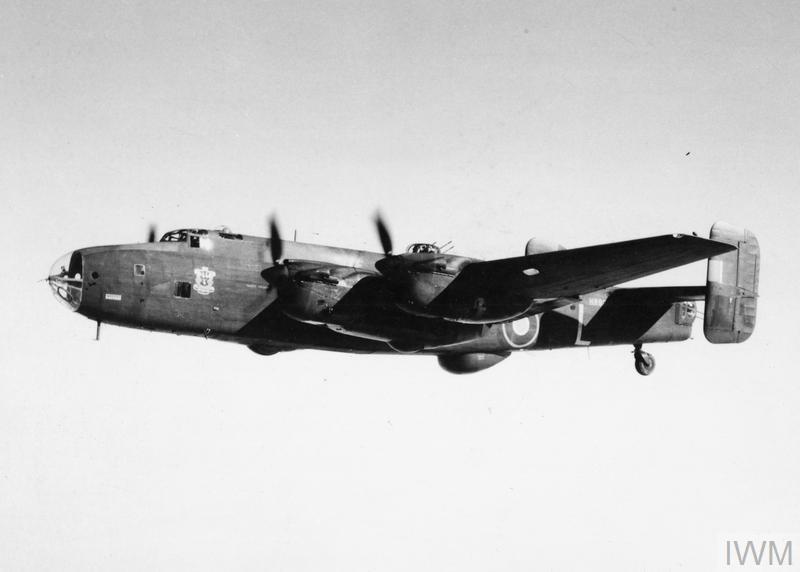
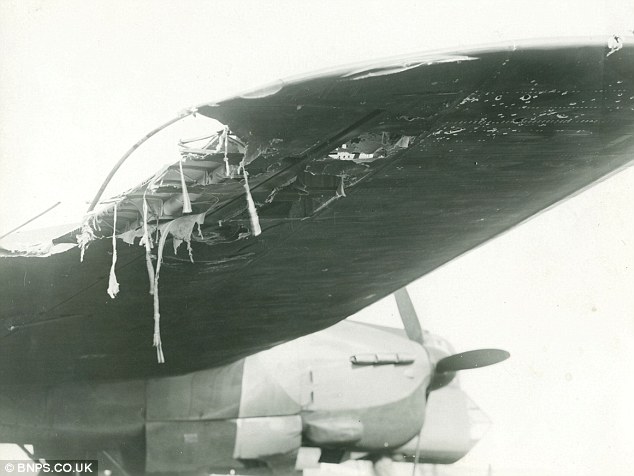
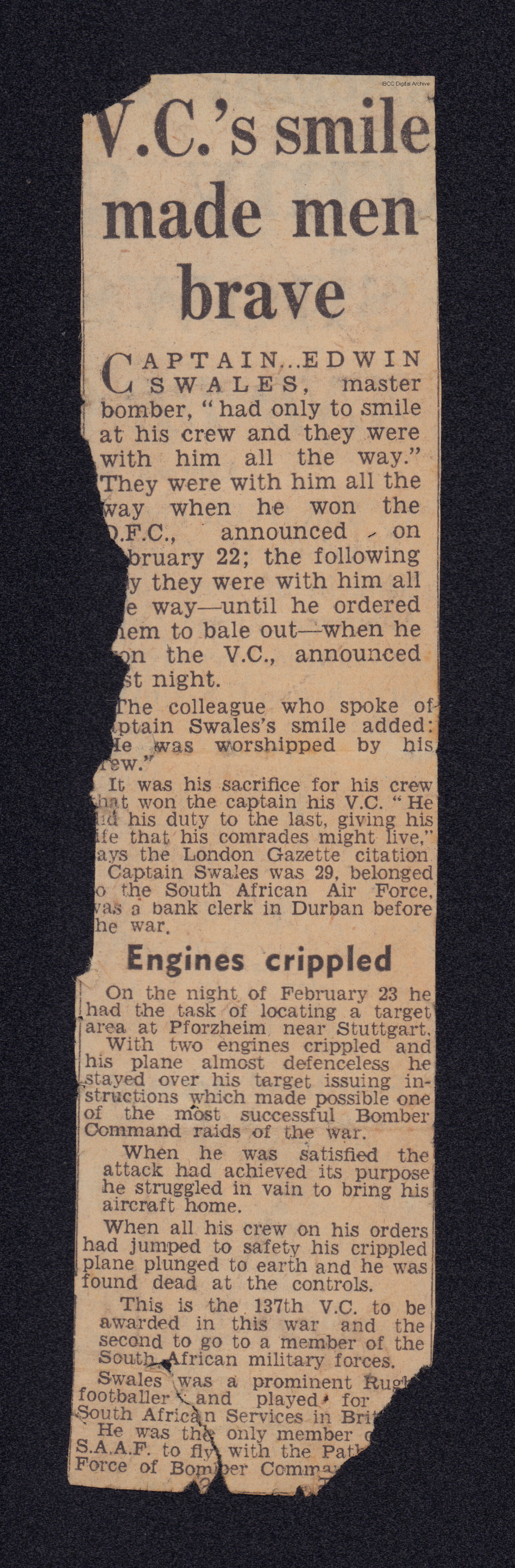
Captain Edwin Swales VC, DFC RAF Little Staughton.

The Royal Air Force was made up of many nationals including both those from the Commonwealth and those from across the globe.

In Bomber Command, and the Pathfinders in particular, one man stood out not just for his nationality, but for his bravery and dedication in the face of death.

That man was one Acting Major*1 Edwin Essery Swales VC, DFC based at RAF Little Staughton on the Bedfordshire / Cambridgeshire border.

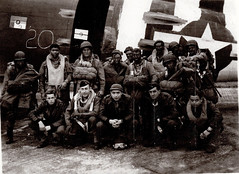
Swales (fourth from right) and his crew with their Lancaster ‘M’ Mother *9

Swales was born on 3rd July 1915, the son of Harry Evelyn Swales and Olive Essery, in Inanda, Natal South Africa. He was one of four children whose father was a farmer. Whilst Edwin was young, his father, Harry, died from  the influenza epidemic that claimed some 50 million lives after the First World War. Without a father, the family were unable to maintain the farm, and so they moved away to Berea in Durban.

Once of high school age, the young Edwin Swales attended Durban High School, he also joined the Scouts learning valuable skills with like minded youngsters, that would help in him in later life. After leaving school Swales landed himself his first job, working at the international branch of Barclays Bank in Durban. But with with war looming, Swales like many young men at the time, was drawn to military service, and so he joined up, posted to the Natal Mounted Rifles where he achieved the rank of Sergeant Major.

Whilst with the Mounted Rifles, Swales served in several locations including: Kenya, Abyssinia and North Africa where he fought bravely alongside his compatriots and the Eighth Army under Montgomery. He would remain with the rifles until January 1942 at which point he transferred to the South African Air Force, obtaining his wings on 26th June a year later. Two months after this milestone, he, like many others from across the commonwealth, was seconded to the Royal Air Force ensuring his position overseas.

Swales (s/n: 6101V) like many new recruits to the Royal Air Force, would undergo a tense period of retraining, eventually being posted to fly heavy bombers within Donald Bennett’s 8 Group – ‘The Pathfinders’. His first and only posting, would be at Little Staughton with 582 Sqn.

During his short time at Little Staughton, Swales would fly a number of missions piloting Avro’s delight, the four engined heavy bomber the Lancaster.

Swales took part in many operations over occupied Europe, including the ill-fated attack on Cologne on December 23rd 1944, which saw the loss of five  aircraft from 582 Sqn. In total, eight aircraft from seventeen flying from both Little Staughton and Graveley were lost that day including the lead bomber flown by Sqn. Ldr. Robert Palmer who himself was awarded the Victoria Cross for his actions.

On that day, an Oboe mission that went terribly wrong, Swales heard the instruction to bomb visually releasing his bombs at 12:51hrs. Flak and fighter attacks were so ferocious, that Swales, like many others in the formation, had to take “violent evasive action” to shake off persistent and accurate attacks from fighter and ground based gunners. He was able to return his aircraft and crew safely to Little Staughton landing at 14:35*2

The action taken by Swales that day was indicative of his determination to succeed and protect both his aircraft and crew, and one that would be repeated time after time by the airman. As a result, it was seen fit to award Captain Swales the DFC for his action that night, his citation stating:

This Officer was pilot and Captain of an aircraft detailed to attack Cologne in December, 1944. When approaching the target, intense anti-aircraft fire was encountered. Despite this, a good bombing attack was executed. Soon afterwards the aircraft was attacked by five enemy aircraft. In the ensuing fights, Capt. Swales manoeuvred with great skill. As a result his gunners were able to bring effective fire to bear upon the attackers, one of which is believed to have been shot down. Throughout this spirited action Captain Swales displayed exceptional coolness and captaincy, setting a very fine example. This Officer has completed very many sorties during which he has attacked a variety of enemy targets*3

Within two months of the operation and at the time his award was being awarded, Swales would be in a similar position again.  This time as Master Bomber leading the formation and directing the bombers to the target.

On that night, only ten days after the historical attack on Dresden, 367 Lancasters and 13 Mosquitoes from 1, 6 and 8 Groups were detailed to attack the city of Pforzheim to the north-west of Stuttgart. This would be the only attack on the city during the war and it would prove almost as devastating as both Dresden and Hamburg.

Flying along side Swales that night in his Lancaster III PB538 ‘N’, were seven other crewmen, including two navigators as was commonplace for Oboe fitted aircraft.

On the run in to the target, the Lancaster was badly mauled by night fighters who successfully put one engine and the rear turret guns out of action. But undeterred, Swales remained on station guiding the following bombers onto the target with the greatest of precision.

When he was finally satisfied that the attack had been carried out successfully, he left his station and turned the aircraft for home. It had been difficult to keep the Lancaster flying, but Swales had persevered in order to complete the job. But he was now easy prey for enemy fighters and inevitably more attacks came.

Soon a second engine was put out of action and flying controls were damaged further with some now completely inoperable. With a reduced speed and difficult flying conditions he headed for the allied lines, where he hoped to get his crew out safely.

All those on board made the jump to safety, leaving just Swales at the controls of the failing Lancaster. As if someone had been watching over them, just as the last man left, the Lancaster finally gave up the struggle and dived into the earth –  Edwin Swales was still sat at the controls when it was found later on.

The attack on Pforzheim  was considered to be very accurate, with over 1,800 bombs having been dropped in as little as twenty minutes or so. Over 17,000 people were known to have died that night in the raging fire that followed the bombing, and a post-war photo, revealed that 83% of the built up area had been destroyed by the raid *4

Following the death of Captain Swales, Air Chief Marshall Sir Arthur Harris KCB, OBE, AFC, Chief of Bomber Command, personally write to Swales’ mother saying: “On every occasion your son proved to be a fighter and a resolute captain of his crew. His devotion to duty and complete disregard for his own safety will remain an example and inspiration for all of us.”*10

For his action, bravery and dedication to duty, 29 year old Edwin Swales, a prominent rugby player and South African “who only had to smile at his crew and they were with him all the way“*5  was awarded the Victoria Cross posthumously, the second such award to go to an airman of RAF Little Staughton, just one of three to the Pathfinders and one of only four South Africans to be awarded the Victoria Cross during the war. His citation appeared in the Fifth Supplement to The London Gazette, of Friday, the 20th of April, 1945:

Air Ministry, 24th April, 1945.

The KING has ‘been graciously pleased to confer the VICTORIA CROSS on the undermentioned officer in recognition of most conspicuous bravery:.—

Captain Edwin SWALES, D.F.C. (6101V), S.A.A.F., 582 Sqn. (deceased).

Captain Swales was ” master bomber ” of a force of aircraft which attacked Pforzheim on the night of February 23rd, 1945. As ” master bomber,” he had the task of locating the target area with precision and of giving aiming instructions to the main force of bombers following in his wake.

Soon after he had reached the target area he was engaged by an enemy fighter and one of his engines was put out of action. His rear guns failed. His crippled aircraft was an easy prey to further attacks. Unperturbed, he carried on with his allotted task; clearly and precisely he issued aiming instructions to the main force. Meanwhile the enemy fighter closed the range and fired again. A second engine of Captain Swales’ aircraft was put out of action. Almost defenceless, he stayed over the target area issuing his aiming instructions until he was satisfied that the attack had achieved its purpose.

It is now known that the attack was one of the most concentrated and successful of the war.

Captain Swales did not, however, regard his mission as completed. His aircraft was damaged. Its speed had been so much reduced that it could only with difficulty be kept in the air. The blind-flying instruments were no longer working. Determined at all costs to prevent his aircraft and crew from falling into enemy hands, he set course for home. After an hour he flew into thin-layered cloud. He kept his course by skilful flying between the layers, but later heavy cloud and turbulent air conditions were met. The aircraft, ‘by now over friendly territory, ‘became more and more difficult to control; it was losing height steadily. Realising that the situation was desperate Captain Swales ordered his crew to bale out. Time was very short and it required all his exertions to keep the aircraft steady while each of his crew moved in turn to the escape hatch and parachuted to safety. Hardly had the last crew-member jumped when the aircraft plunged to earth. Captain Swales was found dead at the controls.

Intrepid in the attack, courageous in the face of danger, he did his duty to the last, giving his life that his comrades might live.*6

His body was removed from the aircraft in which he gave his life and was interned at the War Cemetery at Leopoldsburg, in Belgium, Section VIII Grave C.5.

In honour of Captain Swales, two memorial stones were laid and revealed outside his Durban High School on Armistice day 2009. One in the Memorial Courtyard of the School and the second on the Memorial Wall of the Natal Mounted Rifles also in Durban. In attendance were both his niece, Professor Edwina Ward, and Lt. Gen. Carlo Gagiano, Chief of the South African Air Force.

In 2013, Swales was also awarded the “Bomber Command” clasp to be worn on the 1939 – 1945 Star already awarded.

Edwin Swales was indeed a very brave man, who through sheer determination managed to save his crew in spite of the dangers facing him. His award was in no doubt deservingly awarded.
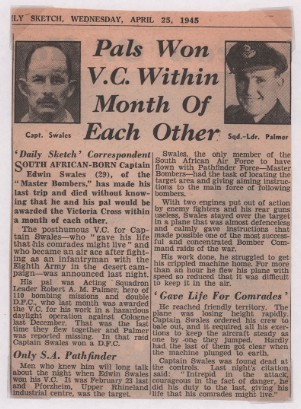
The story of pals Edwin Swales and Robert Palmer both of whom won VCs posthumously whilst at RAF Little Staughton.*7
NColeFIG170709-020001.jpg

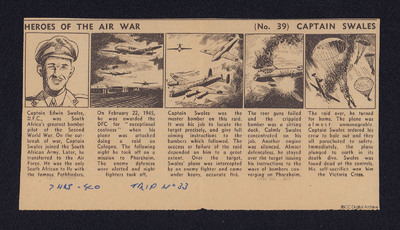
The story of Captain Swales appeared in a newspaper cartoon “Heroes of the Air War”.*8

RAF Little Staughton appears in Trail 29.

Sqn Ldr. Robert Palmer’s story appears in Heroic Tales.

Sources and further reading.

*1 the documents showing Captain Swales’ promotion to the rank of Major only reached the UK authorities after his death and as a result he was cited as being a Captain. (South African Aviation Foundation)

*2 National Archives 582 Operational Record Book AIR-27-2052-18

*3 Supplement 36954, to The London Gazette, 23rd February 1945, published 20th February 1945, page 1070

*4 Middlebrook, M., Everitt. C., “The Bomber Command War Diaries“, Midland Publishing Ltd, 1996

*5 International Bomber Command Centre National Archive website.

*6 Fifth Supplement to The London Gazette, of Friday 20th April 1945. Published on Tuesday 24th April 1945, Supplement 37049, Page 2173.

*7 “Newspaper cuttings concerning awards of Victoria Crosses,” IBCC Digital Archive, accessed November 11, 2023,

*8 “Heroes of the Air War (No. 39) Captain Swales,” IBCC Digital Archive, accessed November 11, 2023,

*9 Photo The South African Legion of Military Veterans website

*10 South African Aviation Foundation website

9th October 1944, loss of Mosquito KB261 RAF Downham Market

On October 9th 1944 Mosquito KB261 608 (PFF) Sqn, took off with 21 other Downham Market aircraft to attack the naval port at Wilhelmshaven in Lower Saxony, Germany. Situated on the western side of the Jade Bight, a bay of the North Sea in Northern Germany, it was a major target frequently attack by allied bombers during the war.

The Mosquito, ‘D’ – Dog, a MK. XX, piloted by Flt. Lt. Reginald George Gardner (s/n 68776) with Fl. Off. Oswald Cuthbert Sweetman DFM*1 (s/n 145171) as navigator, departed Downham Market at 18:03 carrying a mix of bombs. It arrived over the target only to see 10/10ths cloud, and the target obscured. However, bombs were released successfully on red target indicators, after which crews reported seeing several flashes beneath the cloud along with large explosions lasting several seconds.

In debriefing, all crews reported a successful operation although visual confirmation was difficult due to the cloud cover which had extended to between 6 and 8,000 ft in height.

However, Mosquito KB261 never made it down. It arrived home and circled the airfield waiting for its turn to land, it showed no signs of distress or problem – all appeared well. As it entered the ‘funnel’ it suddenly – and without explanation, –  dived into the ground from around 1,000 ft, crashing at 21:30.

The aircraft hit a cowshed in the nearby hamlet of Barroway Drove, to the south-west of the airfield, killing both pilot and navigator. A farm building was slightly damaged and some animals in or near the shed were also killed.

The aircraft had been fully flight tested and reported  ‘serviceable’ that afternoon by the pilot Flt. Lt. Gardner, and both engines were known to be running at the time of the crash.

A report into the accident concluded it as “obscure” with no known cause, although the Station Commander witnessed the crash saying “…it would appear that while turning into the funnel the aircraft did a slipping turn resulting in rapid loss of height and final crash.”

In the Accident Report Form 765C, the pilot was noted to have called the tower on the downwind leg, but there was no report at that time, from him, as to any problems with the aircraft and all appeared to be in order.

The two crewmen were both married. Flt. Lt. Gardener was born in 1913 and married Nancy Buttle of Bearstead, Kent, where his remains are buried*2; and Fl. Off. Sweetman, born 1916, was married to Jessie James from Newcastle in 1940, he also remains buried in his home town*3.

On the following two nights, October 10th and 11th, two more 608 Squadron Mosquitoes were lost; KB404 ‘6T-T’ and KB348 ‘6T-M’.

In KB404, a Mosquito B MK. 25, both crewmen (pilot – Fl. Off. James Arthur Smith DFC RAAF, and navigator Sgt. John Burchell) emerged safely from the aircraft which crash landed in a field near to the airfield. The port engine was reported to have cut out at approximately 100 feet after take off, whereupon the pilot managed to perform a wheels up landing bringing the aircraft down safely.

In the third Mosquito, KB348, (MK.XX), the aircraft was hit by Flak over the city of Berlin and crashed at the Bornstettin Army Exercise Grounds near Potsdam at 04:02 hrs. The pilot,  Fl. Off.  Stanley Warren Reeder (RAFVR), and navigator Flt. Sgt. Robert John Bolton (RAAF) were both killed. Initially buried locally in Potsdam, they were, in 1946, interred in the Berlin 1939-1945 War Cemetery, Plot 4, Row K, Graves 26 and 27, where they remain today.

608 Squadron were only reformed at Downham Market on August 1st 1944, after being disbanded earlier at the end of July. They remained at Downham Market for the remainder of the war being disbanded again on 24th August 1945. In May 1946 they reformed once more only to disband for the last time on March 10th, 1957 at Thornaby whilst flying Vampires. It was at Thornaby that they were initially formed in 1930.

Downham Market Runway remains

The last remnants of the main runway being approached by the Mosquito before they were removed.

The history of Downham Market appears in Trail 7 – North West Norfolk.

Notes and sources.

*1  Fl. Off. Sweetman’s DFM was gazetted on 5th February 1943, for service he carried out with 104 Sqn flying Wellingtons in the Middle East.

*2 Flt. Gardener was buried in the Holy Cross Churchyard, Section N, Grave 184

*3 Fl. Off. Sweetman was buried in All Saints Cemetery, Section E, Unconsecrated Grave 191.

National Archives: AIR-27-2101-19, AIR-27-2101-20

Chorley, W.H. “Bomber Command Losses – Vol 5 1944” Midland Publishing,. 1997

Aviation Safety Network website, accessed 11/1/25

Downham Market Heritage Centre

Squadron Leader Robert Palmer V.C., D.F.C and Bar.

There are many stories of great bravery as a result of action over occupied Europe during the Second World War; all are a test of human endurance pushing the human body to its limits and beyond. In some such cases, the recipient received the highest honour that could be bestowed on any member of the armed forces – the Victoria Cross.

One such award went to a Pathfinder, one of only three to go to the entire Group. Donald Bennett, the commander of 8 Group, himself even said he would not award such an accolade to any living person, it was not therefore given lightly, nor easily obtained.

In this instance the recipient was a pilot based at RAF Little Staughton on the Cambridgeshire – Bedfordshire border. It was a short lived airfield and only had two operational squadrons use it, both squadrons were part of the RAF’s Pathfinders.

This is his story.

Robert Anthony Maurice Palmer, the older brother of Douglas, was born on July 7th, 1920 in Gillingham, Kent, son of Arthur Palmer and Lilian Skuse. His father, Arthur Palmer, had served in the Essex and West Kent Regiments during the First World War before joining the fledgling Royal Air Force in May 1918. He would remain in the Air Force as an instructor at RAF Duxford until being demobbed the following year.

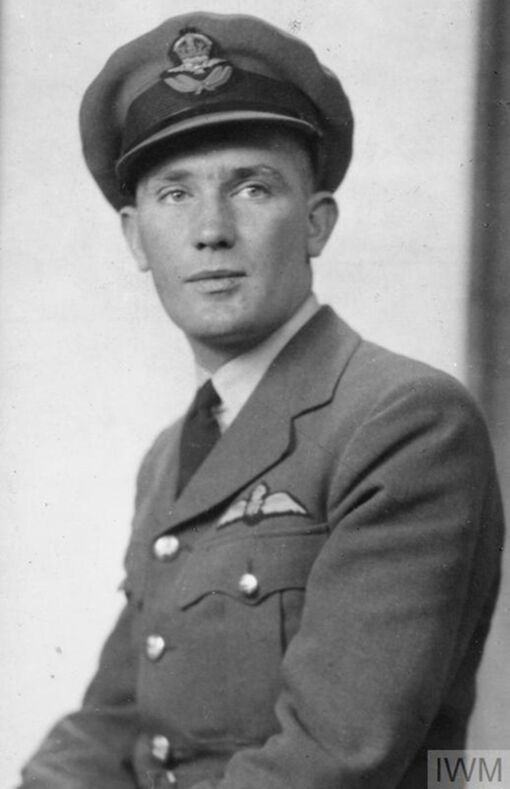
Sqn Ldr. Robert Palmer (IWM HU 1996)

Arthur and his stories of flying, reinforced by the exploits of the 1920’s aviation pioneers, would inspire Robert, and fuel his desire to enter the world of flight himself. It was a desire that would enable him to fulfil his dreams but ultimately lead to his death.

After attending his first school, Cecil Road in Gravesend, Robert would join The County School for Boys, in Darnley Road, Gravesend, run then by the Reverend Samuel Lister.

Once his school life was over, Robert obtained his first job, joining the Borough’s Surveyor’s Office where he showed good potential before volunteering as a pilot for the Royal Air Force Volunteer Reserves on 22nd August 1939. Given the initial service number of 758016 (later 115772), Robert was awarded the initial rank of Aircraftsman II/ under training pilot.  The following day he was promoted to the rank of sergeant, before being transferred from Hastings to Rochester, his first training post. Between then and June 1941, Robert worked through a number of training units starting with No.12 Flying Training School followed by No. 15 Officer Training School. During his short time here, he would gain good grades and show his true potential as a future pilot within the Royal Air Force.

Once qualified, Robert Palmer would be posted to his first operational squadron, 75 (New Zealand) Squadron flying Wellington ICs at RAF Feltwell in Norfolk, the date November 16th 1940.

The move was designed to give Robert the experience of life in an operational unit. Being shepherded by the experienced P. Off. Morton, he would gain a good understanding  of the huge responsibilities a pilot in an operational unit would have. Whilst at Feltwell, Robert would continue to grow and show further good potential as a pilot now in Bomber Command.

Robert’s stay at Feltwell would last for just ten days, transferring to his own aircraft with 149 Squadron at RAF Mildenhall on the 26th of November. Here Robert would have to gather and mould a new crew, creating a camaraderie that would hopefully keep them both alive and together, through some of the worst battles that the RAF were likely to experience. The operational schedule was so intense that it would take just three months for them to complete their first tour of thirty operations.

Now as a seasoned pilot, he and his crew who had jelled together so well, were to be split, each one being posted to a different training unit where they could share their experiences and knowledge to other crewmen. Robert was sent to No. 200 Training Unit arriving in February 1941 where he remained for a year. Five months into the posting, he would be promoted to Temporary Flight Sergeant*1, a grade he remained at until January 28th 1942, at which point he was discharged on appointment to a Temporary Commission as Pilot Officer within the RAFVR, a promotion that came with another transfer to No. 20 Operational Training Unit (OTU) at Lossiemouth in Scotland, again as an instructor. This appointment was confirmed and he officially became a Flying Officer in October 1942.

Some ten days after his appointment, he was sent to No. 1501 Beam Approach Training Flight learning to land on instruments, a course that lasted a mere week, Robert then returned to 20 OTU where he remained as instructor for a further year. He, like many instructors, was keen to get back into operational flying, and pressed his superiors for a transfer back to a front line squadron.

It would be whilst at the OTU that Palmer would come into contact with Squadron Leader Ian Bazalgette DFC. another pilot who would go onto the be awarded the VC posthumously. Bazalgette recognised the potential of Palmer and put in a recommendation for his transfer to a front line unit.

Robert’s wish then came true. After a short spell training on Mosquitoes at the RAF Warboys based 1685 Mosquito Training Unit and the Pathfinders in early November 1943, he transferred out, being posted to 109 Squadron at RAF Marham, Norfolk, a front line squadron within the Pathfinders’ Group. Thirteen days after his arrival, he would be promoted again, this time to Flight Lieutenant.

The Pathfinders were commanded by Donald Bennett and were an ‘elite’ group of pilots and aircrew, who had proven themselves to be excellent flyers. Arthur Harris, the Commander in Chief of Bomber Command had been completely opposed to the idea of an elite unit,  citing a drop in morale as the cream of his bomber squadrons would be taken away to form a new unit. But 8 Group came into being and Flt. Lt. Robert Palmer was soon one of them.

109 Squadron were about to receive the Mosquito XVI to supplement the Mk, IX they already had, and with both variants, the unit transferred from Marham to RAF Little Staughton on the Cambridgeshire / Bedfordshire border some 60 miles south-west. The move in April 1944 would be Robert’s final transfer.

As a Mosquito pilot, Robert would undertake many operations whilst here at Little Staughton, and in recognition of both his gallantry and his devotion to duty, he was awarded the Distinguished Flying Cross (DFC) on June 30th, 1944. *2

It was then, a combination of this devotion to duty and the fact that he quickly reached the milestone of 100 operations, that led him to receive a second DFC in the form of a bar on his first; an accolade that acknowledged his determination to succeed and his skill as a pilot. *3

With two DFCs under his belt, Robert Palmer would soon receive his final promotion, being granted the rank of acting Squadron Leader on 10th December 1944.

December would prove to be the end of the line for Sqn. Ldr. Palmer though. After flying his last Mosquito operation on December 6th in ‘MM171’ to Osnabruck, he would soon change to Avro’s baby the Lancaster. On the 23rd, two days before Christmas, he was assigned to fly in a daylight raid to Gremberg, a daring raid that would use Oboe to pinpoint the target. As a Pathfinder, his role was to identify the target and drop markers/bombs for the following bombers to bomb on. It was a dangerous and daring mission and one which Sqn. Ldr. Palmer and his navigator Flight Lieutenant George Russell, would lead as Master Bomber in a 582 Sqn aircraft with Flight Lieutenant Owen Milne and his crew.

The morning was cold, wet and foggy, simply described as “miserable” by Bill Lanning*6. After dragging themselves out of bed and performing their morning ablutions, they headed off to the mess hall for a hearty breakfast of egg, bacon and beans, the standard morning feast for those flying on ops that day.

At briefing, the two crews met, Russell remaining quietly reserved whilst Palmer was introduced to Milne’s crew. The target was revealed and the various experts gave their reports: escort, weather, flak, bomb run etc.

By 09:30 briefing was over and the various crews made their way to the locker room and parachute stores to collect their belongings for the flight. The temperature was expected to be at -20oC, it would be very cold.

Palmer’s take off time was recorded as 10:27, but the mission was already doomed. Over England two Lancasters at the rear of the last flight, misjudged the distance between them and collided with the loss of both crews. Meanwhile, Palmer leading the operation, had become separated from the main formation, his two flights were alone and undefended as their escort raced to catch-up. Flying on Oboe meant they would have to fly both straight and level for fifteen minutes before they could drop their bombs, in daylight and clear skies this would be suicidal. The 6/10 cloud they had been promised didn’t materialise, and it was indeed clear and cloudless.

Flak came first. Very quickly the German gunners found their mark and aircraft were peppered with shrapnel. A reserve Pathfinder Mosquito flying alongside, went first and soon Palmer’s Lancaster was also hit. Two engines were quickly put out of action,  flying controls were damaged and even though the aircraft was difficult to fly, Palmer maintained a straight and level approach. Four minutes from the target the Luftwaffe pounced. Determined not to let Palmer and his two flights through, they hounded the formation some of whom had by now, begin to scatter. Communications had all but broken down but still Palmer continued on. Although “burning fiercely” he successfully bombed from 17,500 ft, laying his eleven 1,000 lb general purpose bombs spot on the target.

Within seconds of dropping their explosive bomb load, Palmer’s aircraft took further devastating hits and it began to fall from the sky. All but one of the crew would die that day. A very short statement details their loss: “aircraft are missing”.*5

Palmer stayed at his station commanding the aircraft until the end, an act of selfless heroism and bravery trying to save his fellow crewmen before himself. For his actions he was awarded the Victoria Cross posthumously.

The 24 year-old’s citation appeared in the Fourth Supplement to The London gazette of March 20th 1945*4

“This officer has completed 110 bombing missions. Most of them involved deep penetration of heavily defended territory; many were low-level “marking” operations against vital targets; all were executed with tenacity, high courage and great accuracy. He first went on operations in January, 1941. He took part in the first 1,000 bomber raid against Cologne in 1942. He was one of the first pilots to drop a 4,000 lb. bomb on the Reich. It was known that he could be relied on to press home his attack whatever the opposition and he bombed with great accuracy. He was always selected, therefore, to take part in special operations against vital targets.

The finest example of his courage and determination was on the 23rd December, 1944, when he led a formation of Lancasters to attack the marshalling yards at Cologne in daylight. He had the task of marking the target and his formation had been ordered to bomb as soon as the bombs had gone from his, the leading aircraft.

The leader’s duties during the final bombing run were exacting and demanded coolness and resolution. To achieve accuracy, he would have to fly at an exact height and air speed on a set course regardless of opposition.

Some minutes before the target was reached, his aircraft came under heavy anti-aircraft fire, shells burst all around, two engines were set on fire and there were flames and smoke in the nose and in the bomb bay.

Enemy fighters now attacked in force. Squadron Leader Palmer disdained the possibility of taking avoiding action. He knew that if he diverged the least bit from his course, he would be unable to utilise the special equipment to the best advantage. He was determined to complete the run and provide an accurate and easily seen aiming-point for the other bombers. He ignored the double risk of fire and explosion in his aircraft and kept on. With its engines developing unequal power, an immense effort was needed to keep the damaged aircraft on a straight course. Nevertheless, he made a perfect approach and his bombs hit the target.

His aircraft was last seen spiralling to earth in flames. Such was the strength of the opposition that more than half of his formation failed to return.

At 24 years old, Squadron Leader Palmer was an outstanding pilot. He displayed conspicuous bravery. His record of prolonged and heroic endeavour is beyond praise”.

Sqn. Ldr. Robert Anthony Maurice Palmer (s/n: 115772) was buried in the Commonwealth War Cemetery at Rheinberg, Plot: 14. Row: C. Grave: 13-14 along with the other’s in the crew.

In honour of Sqn. Ldr. Palmer, the Grammar School he attended continues to pay homage to his brave and selfless act by hanging both his portrait and his V.C. citation in the school hall. A nearby church, St Peter and St Paul Church located at East Milton Road, Milton, Gravesham has his name inscribed above the Lych Gate at the church entrance. He is also remembered at the Rheinberg War Cemetery, Germany. At his former home in Denton, a plaque was unveiled  in 2006 by then mayor, Raymond Parker.

RAF Little Staughton appears in Trail 29.

Those on board that day were:

Pilot – Sqn Ldr. Robert Palmer VC, DFC and Bar; (RAFVR), age 24, s/n:115772
Pilot – Flt. Lt. Owen Strachan Milne, (RAFVR), s/n: 132625
Navigator – Sqn Ldr. Albert Leslie Carter, DFC, (RAF), age 29, s/n:44553
Navigator – Flt. Lt. George Russell DFC,  (RAFVR), age 21, s/n:129583
Wireless Op. – Flt. Sgt. Bert Nundy, (RAFVR) age 21, s/n: 1671822
Gunner – Fl. Off. William Dalgarno,  (RAFVR), s/n:161283
Gunner – Flt. Sgt. R K Yeulett (RCAF), (survived taken as POW)

Sources and further reading.

*1 The London Gazette, Issue 35531, page 1754, dated April 21st 1942.

*2 The London Gazette, Fourth Supplement of Tuesday June 27th 1944, dated Friday 30th June 1944. Issue 36589, Page 3089

*3 The London Gazette, Issue 36831, Page 5634, dated 8th December 1944

*4 The London Gazette, Fourth Supplement of Tuesday 20th March 1945, dated Friday 23rd March 1945, Supplement:36997, Page:1593

*5 National Archives Operational Record Books 109 Squadron December 1944 AIR 27/855/9

*6 Lanning, Bill. A personal account recorded for The International Bomber Command Centre, which also includes other eyewitness and personal accounts of that day.

National Archives: AIR 27/855/10

Feast, S., “Heroic Endeavour“, Grub Street Publications, 2006

RAF Pathfinders Archive Website.

Commonwealth War Graves Commission website.

Kent online newspaper website 17th December 2019

Gravesend Grammar School Commemorative Archive website

IBCC website 

RAF Little Staughton – Winner of Two VCs. Part 1.

Trail 29 saw a trip to two airfields both of which have now gone. A new addition to this trail, takes us back to the west of Cambridgeshire to the Bedford border and a small airfield that continues to operate as a flying entity. But, and perhaps more importantly, it is one where two VCs were won, and where RAF Pathfinders reigned supreme. Having only a short life itself, and only two front line squadrons, its rather unassuming presence hides a remarkable tale of heroism, bravery and dedication that transports it high into the ranks of wartime history.

In the latest addition to this trail we visit the small village with two airfields, starting with RAF Little Staughton.

RAF Little Staughton

The village of Little Staughton sits on Oxford Clay, a Jurassic marine sediment, and is located about 4.5 miles from Kimbolton and 8 miles from Bedford. The village itself resides in the upper most regions of Bedfordshire, but this is not the original village, that being abandoned following the bubonic plague, and so the village we see today being created as a result.

Little Staughton is unusual in that it has been home to two wartime airfields, RFC Little Staughton which was open between October 1916 and June 1917, and its World War II counterpart, RAF Little Staughton. Both add further complexities to the name by each being located over the county border in Cambridgeshire.

RAF Little Staughton, like many of its contemporaries, was cold and draughty. The staff huts dispersed around the various sites provided little comfort to those inside seeking warmth and shelter from the elements outside.

Built by a mix of construction companies including the AMWD  (Air Ministry Works Directorate), it had three concrete and tarmac runways measuring 1,920 x 50 yards; 1,340 x 50 yards and 1,000 x 50 yards with the main runway running in an approximate east-west direction.

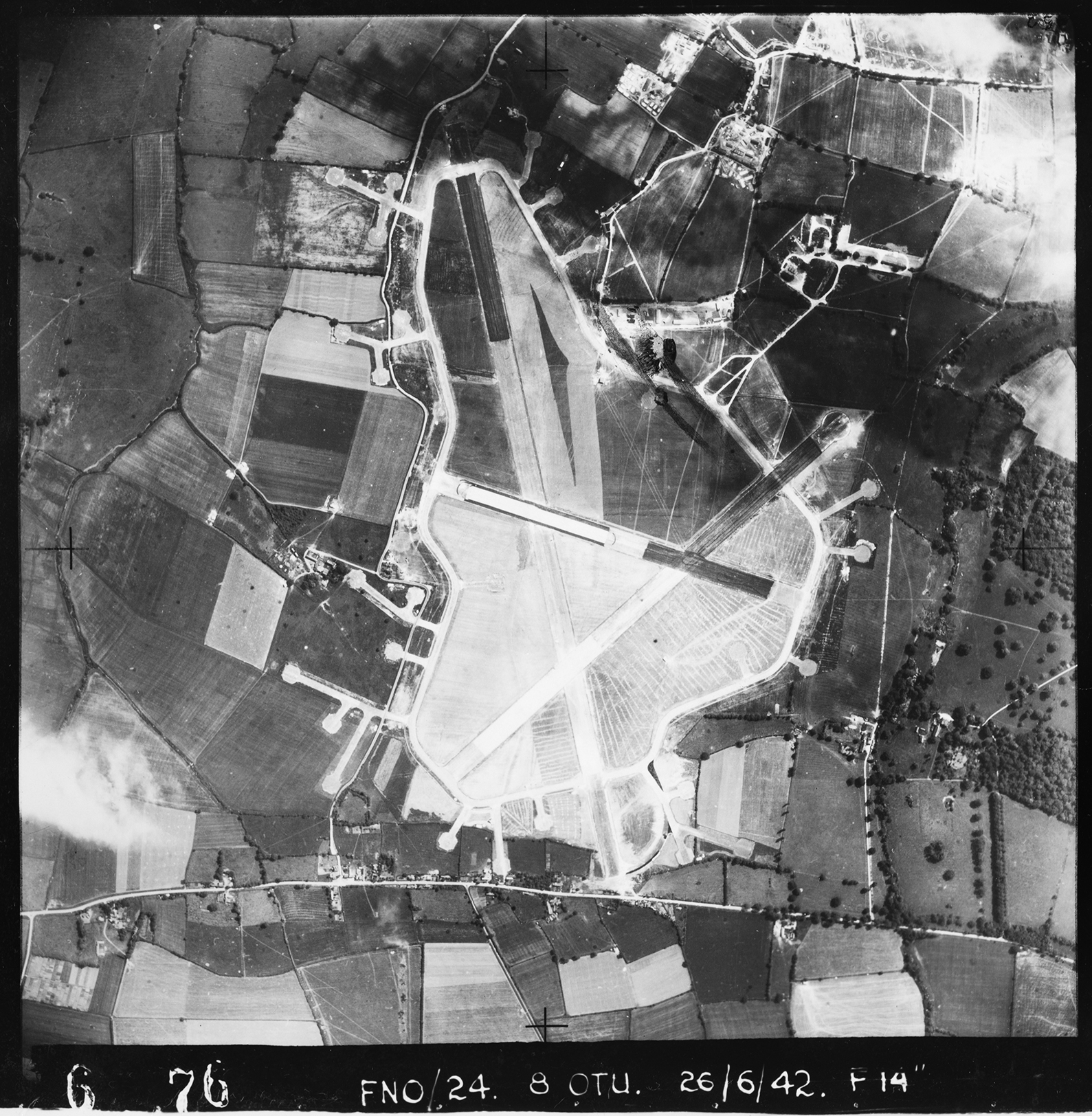
Little Staughton (east upward) whilst under construction, 26th June 1942. Note the accommodation and technical areas have not yet been started and the spectacle hardstands are missing. Photo taken by No. 8 OTU. English Heritage (RAF Photography RAF/FNO/24).

Aircraft maintenance and storage consisted of eight Robin and three ‘T2’ hangars with an additional Butler hangar. Butler hangars were built in limited quantity for use on American airfields, and were supplied in kit form from the Butler Manufacturing Company, Kansas. They were made of box-section girders and then clad with canvas to keep out the elements and provide some protection for those inside. Butler stores buildings of which there were two at Little Staughton, were similar, but with rigid frames and beams forming a forty foot span. The presence of these buildings give a little insight into the origins of the airfield, as neither were found elsewhere on RAF airfields.

Around the perimeter track, there were thirty-seven pan style hardstands along with an additional sixteen spectacle hardstands. Personnel accommodation blocks for approximately 2,500 staff of mixed rank and gender, were spread to the east, behind the technical area, and incorporated eleven sites including a waste water treatment plant, three communal sites and a sick quarters. A further site housed the airfield’s transmitter.

Staff accommodation was made by a mix of suppliers and materials. These included Laing, Nissen and Ministry of Works, using both asbestos and corrugated iron. It is also known that ‘Jane Huts’ existed at Little Staughton, timber frames with plasterboard, or later, corrugated iron covering reinforced with chicken wire – hardly a home from home!

The technical area itself housed the usual collection of maintenance and training buildings including: three link trainers, a free gunnery trainer, a parachute store, workshops, an A.M. bombing teacher and various stores built from numerous materials. Located not far from the technical area is the watch office, built in 1942 using the Air Ministry’s Directorate of Works and Building’s design, Drawing No. 13726/41, it was rendered brick with an asphalt roof, with the watch office to the front on the ground floor and a meteorological office, switch room and lavatories to the rear. The first floor has the control room to the front of the building with 2 large windows, and to the rear was the controller’s rest room and signals office. Access to the second floor is via external steel stairs and a balcony  provides extensive outside views of the airfield as was common with wartime watch offices.

Opened in December 1942, Little Staughton was handed over to the USAAF to be used as No.2 Advanced Air Depot (AAD) and renamed in accordance with the US naming system as Station AAF127. This provides an explanation as to why Butler structures appear at the site.

The main role for the 2nd AAD (previously known as SAD – Strategic Air Depot) was to expedite repairs, modifications and in-depth maintenance to the B-17s of the 1st Bomb Wing. A role that could prove grizzly as many would have been badly shot up with the inevitable casualties languishing inside. A number of similar bases were established and then further developed by the Americans, these included: Warton, Burtonwood and Langford Lodge. Being the only one at the time in East Anglia though, Little Staughton was given priority and quickly established itself as a high level maintenance base.

A year after it opened however, the US authorities decided to move the depot from Little Staughton to a new base at Abbots Ripton adjacent to the huge American base at Alconbury. Little Staughton, then surplus to their needs, was subsequently handed back to the Royal Air Force and Bomber Command, who, on March 1st, took over control and began moving new personnel and aircraft on to the site.

Little Staughton

One of Little Staughton’s technical huts now used for light industry.

8 (PFF) Group, under the command of Donald Bennett, and to whom the airfield was allocated, was undergoing a reduction in squadron flights from three to two at this point, and so a month later to the day, the first aircraft, Lancasters of ‘C’ Flight, 7 Squadron at Oakington along with Lancasters of ‘C’ Flight 156 Squadron from Upwood, arrived to form a new squadron, 582 Sqn, as part of the Pathfinder force and based here at Little Staughton. The squadron would use both the Mark I and Mark III Lancaster, and would be the last of the heavy bomber units to be formed under the Pathfinders.

On April 1st 1944, fifty officers arrived at Little Staughton, and were immediately assigned to the command of Squadron Leader (Acting Wing Commander) C.M. Dunnicliffe DFC from 97 Sqn at Bourn. Sqn. Ldr. Welbourn and Sqn. Ldr. McMillan were placed in temporary charge of ‘A’ and ‘B’ Fights respectively. The squadron headquarters, flight offices, crew rooms and specialist offices were all quickly put to good use and various alterations made to the buildings to suit the new squadron. The crew rooms were perhaps deemed better than some, being described as “commodious” by the new admin staff.

582 Sqn were not alone for long though, being joined within twenty-four hours by the twin-engined Mosquitoes of 109 Sqn from RAF Marham, the various aircraft being ferried in over a two day period.

There would be no respite for the two squadrons though. 582’s Lancaster crews began training immediately, flying cross country flights, “Y” training flights, fighter affiliation flights and so on. 109 Sqn on the other hand began operations to the continent almost immediately. On the 4th, four Mosquitoes were detailed to Essen, two to Rhinehausen, two more to Aachen, Kreffield, Cologne and two more to an unnamed target. Only one aircraft had problems that night, Mosquito IV ‘DZ256’ suffered engine problems and so the pilot instructed the navigator to bale out over the coast. The Mosquito then managed to land at Bradwell Bay, a difficult task in a Mosquito especially as the propeller on the faulty engine could not be feathered.

Bradwell Bay was soon to see more of the 109 Sqn Mosquitoes. On the 8th, a second one crash landed there after being hit by flak over Essen. Thankfully, both pilot and navigator were unhurt in the landing.

The rest of the month was operationally similar. With numerous flights to the continent marking and bombing targets, some requiring markers whilst some didn’t, and in these cases the target indicators (TIs) were brought home. Several aircraft over the month had failed to bomb due to ‘technical problems’, mainly failing oxygen systems, faulty aircraft undercarriage or engine trouble.

Hendon RAF Museum

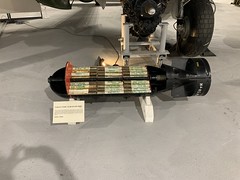
A thousand lb Target indicator Bomb at Hendon.

582 Sqn on the other hand, continued throughout the month with training flights inter-dispersed with a small number of operations over the continent. On April 23rd they received a blow, when Lancaster III JA933 ‘S’ flown by New Zealander Flt. Sgt. Wallis B. Forfar failed to return from a seven ship formation to Laon. Sadly all seven crew on board were killed that day, and their bodies remained buried together in Roye New British Cemetery in the Somme. Their known ages ranged from just 19 years of age to 22.

Operations and training flights were interrupted on April 29th, when Air Vice Marshall Don Bennett visited the airfield, and in particular 109 Sqn’s Messes. He presented watches ‘on behalf of a foreign admirer of the Royal Air Force‘ to Pilot Officer Sexton and Flight Sergeant Marchant who had both completed  seventeen sorties to Berlin.

By the end of the month both squadrons had been on operations almost daily, the routine of training now taking a back seat. These continual operations meant that the two squadrons amassed in excess of 300 sorties between them. Little Staughton and it’s crews had certainly made their mark.

Over the next few months, operations took both squadrons to strategic targets, V-1 sites were especially targeted, accurately marked by the Mosquitoes of 109 Sqn. Railway yards and road junctions were also hit in an attempt to slowdown advancing German reinforcements into Normandy. The Pathfinder squadrons were making good use of their skills.

July 11th 1944, would prove to be a first for both Bomber Command and for 8 Group in particular. The modification of a 582 Sqn. Lancaster, ND817 ‘S’ meant it was the first to carry the new ‘Oboe’ equipment. It was then piloted by Wing Commander G.F. Grant of 109 squadron, who directed the first ‘heavy Oboe’ operation of the war. Grant, himself a seasoned Mosquito pilot, was able to direct the bombers accurately onto the target, initiating bombing when he bombed, and so aiming to obtain a higher level of success than had previously been achieved.

The attack by seven Lancasters on the flying bomb’s site at Gapennes, proved uneventful in terms of losses or incidents, but was no doubt a notable point in the bombing war. Now they could hit small, precision targets with heavy bombers using Oboe.

A second such operation on July 20th to the flying-bomb site at Foret-du-Croc was not so fortunate though, 582 squadron suffering the loss of the leading aircraft, Lancaster ED908 ‘Z’ flown by Sqn. Ldr. J. Foulsham DFC, AFC.

Using the new Oboe equipment required considerable training, and so four of the crew, including Sqn. Ldr. Foulsham, had been reassigned to the aircraft from 109 Sqn. With two navigators on board the aircraft, the eight man crew were all lost when the aircraft was shot down, crashing with great force on the run-in to the target. Sqn. Ldr. Foulsham may have been a late change on that operation as the ORB doesn’t list him as flying that day. All eight crewmen are buried in the Canadian War Cemetery in Dieppe.

With two more Lancasters lost on July 23rd-24th and another on the night of 28th-29th, 582’s losses were slowly mounting. In one of the Lancasters lost on 23rd, was the South African airman Lt. Swales, who went on to later be awarded the VC in 1945. Whilst the aircraft was lost in an emergency landing, the crew were all safe and they continued flying almost immediately. Additionally, in the last Lancaster to go down that July, was one of Bomber Command’s oldest airmen Flt. Sgt. C. Lewis at age 39. Seven of the eight airmen were lost including Flt. Sgt. Lewis.

August would prove to be one of the heaviest months for operations, especially for 109 Sqn, who would mount in excess of 500 sorties flying against Flying Bomb sites, oil plants, rail junctions, fuel depots and other strategic targets.

In late 1944, Arthur Harris was partially released of the tight constraints applied to him by the Supreme Allied Commanders, and so he was now able to turn his forces to his favoured targets – the cities of Germany. Although directed to focus on oil, many of these cities had close connections to oil, and so Harris was able to circumnavigate the directive with few complaints from those above him.

As aircrew casualties began to fall and the number of available heavy bombers began to rise, the RAF were now able to increase their operations, dropping almost half of all their wartime tonnage in the remaining few months of the war*4

August 1944 would prove to be another pivotal month in Bomber Command, as the first major daylight raid since 1941 was launched against German targets. 582 Sqn sent ten Lancasters to Minoyecques, whilst 109 Sqn sent eight Mosquitoes to Homburg in Saarland and six Mosquitoes to Minoyecques in support of the Lancasters. All aircraft returned safely to Little Staughton, some bringing indicators back with them as they were not needed due to accurate and extensive marking. The end of the month ended on a more sour note for the two squadrons however, with the loss of one Lancaster along with all of its crew, and two Mosquitoes. It is believed that all four crewmen from the Mosquitoes managed to evade capture, although their fate is not yet known.

Perhaps the most successful operations for 582 Sqn came on October 3rd, when 252 Lancasters and 7 Mosquitoes attacked the sea walls at Walcheren, targets that dominated the approach to Antwerp. By breaching the sea wall it was hoped that the sea would flood the defences behind, and drastically hinder any defence against an allied assault on the town. Once Antwerp was taken, an estimated 40,000 tons of supplies could then be poured through to the front line of the allied advance, who were now getting very low on supplies and losing momentum as a result.

The operation led by Master Bomber Grp. Cptn. P. Cribb in Lancaster ND750 ‘E’, of 582 Sqn was a great success, with the walls being breached across a 100 foot span,  through which millions of gallons of water could pass. The attack was carried out by eight waves of Lancasters with Pathfinder Mosquitoes and Lancasters leading the way. At the back of the formation were 617 Sqn Lancasters carrying Tallboy bombs, but because the bombing was so successful and accurate, these were not needed and 617 Sqn took them back home with them.

By the winter of 1944/45, and although a long way from beaten, the Luftwaffe were now on the back foot and the allies were becoming masters of the skies. By the end of the year RAF daylight operations were commonplace, but they were not without their problems.

In Part 2 we see how Little Staughton crews took the brunt of the Luftwaffe’s determination to take back control of the skies. In one mission alone, they would sacrifice eight aircraft and most of their crews. It would however, bring the first of two VCs to the little airfield.

The entire story can be read in Trail 29.

Former RAF Upwood mural

The former airfield at Upwood in Cambridgeshire had a long and distinguished history. Having its origins go back as far as the First World War, it really gained its fame during the Second World War and post war history; closing as late as 2012 when the military finally pulled out.

During the Second World War it was home to Pathfinder squadrons, who attacked prestige targets. The airfield was home to a range of aircraft;  it was also the location for the 1952 film with Dirk Bogarde  ‘Appointment in London‘. Post war, it was designed to be a post apocalyptic hospital, able to treat those injured in the event of a nuclear war.

Today the site is gradually being demolished as housing gradually takes over. Many of the original buildings are boarded up and behind screens and threfore inaccessible. The hangars however, are still in use by local industry and so access to part of the site is still available.

In 2020, a mural was painted on one of the buildings to commemorate those who flew from Upwood and the wider RAF in general. It features a Lancaster and three aircrew who each achieved incredible flying feats.

I don’t know what the future holds for the mural, but it’s a fabulous piece of street art and a very worthy one, perhaps it should be preserved.

RAF Upwood

The mural was painted by Street Arts Hire, and depicts Lancaster GT-Q (ND875) of 156 Squadron, which carried out 108 operations, one of only 35 to ever make it over 100 missions. The three airmen also depicted are:

Left: Flt.Sgt A. Wilson 76 operations
Middle: Flt.Sgt. J. Watson 77 operations and
Right: Flt. Sgt. W. Appleby 80 Operations

A video made by the group is available on Facebook at: https://www.facebook.com/watch/?v=760437928152790

Another blow for RAF Downham Market.

In April 2023 a group of archaeological surveyors arrived at the former RAF Downham Market and began digging trenches on the western perimeter along where the track led to the threshold of the main east-west runway. They were looking for historical artefacts of any significance, either wartime or Anglo-Saxon. Apart from odd items, nothing of any real significance was found and the trenches were filled in.

RAF Downham Market (Bexwell)

The remains of the perimeter track after diggers removed it.

In mid May, the diggers moved in again, but these were the developer’s diggers, and they began to remove a strip of the western perimeter track along half its length, taking away what would have been the site of two hangars, and several hardstands along with it.

Evident from the thick concrete slabs that have been lifted, are substantial sections of piping for drainage,  along with wiring most likely for the perimeter track lighting. Each section of concrete has thick reinforcement cable thread through it to give added strength.

RAF Downham Market (Bexwell)

Pipework going through the track bed.

The planning for this site has been ongoing for about 15 years, stalling over various aspects since the current landowners took over. Now, finally, an agreement has been reached and some 240 houses have been earmarked for this site on the former airfield. Other plans have been considered for the remains of the technical area but these didn’t seem to come to fruition. All the runways have been removed and only small sections of peri track now remain, one as a private road and the other along this section to the north of this site.

RAF Downham Market, otherwise known as RAF Bexwell, was opened in July 1942 and closed in 1946. It was home to the Pathfinders of Don Bennett and to Stirlings, Lancaster’s and Mosquitos. It features in Trail 7.

RAF Downham Market (Bexwell)

There is extensive pipework along the length of the removed track.

RAF North Witham – Leading the way into Normandy.

If you follow the A151 towards the main A1, close to the Lincolnshire / Leicestershire border, and you come across Twyford Woods, and an airfield that is little known about, yet its part in history is perhaps one of the most important played by any airfield in Britain. Famous battles such as the Normandy invasion, the Ardennes and the crossing of the Rhine all took place because of the events that occurred here, and were it not for this airfield, many may not have been as successful as they were. In Trail 3, we head further west to perhaps one of Britain’s best kept secrets – RAF North Witham.

RAF North Witham (Station 479)

RAF North Witham sits quietly amongst the trees of Twyford Woods, a site originally known as Witham Wood, which is now a public space owned and maintained by the U.K.’s Forestry Commission.

Originally, North Witham was one of twelve airfields in the Leicestershire cluster intended to be an RAF bomber station for No. 7 Group, however, it was never used operationally by the Royal Air Force, instead like ten others in the area, it was handed over to the US Ninth Air Force and in particular the IX Troop Carrier Command.

North Whitham control tower

North Witham’s Tower – now a mere shell.

As it was originally designed as a bomber station it was built to the Air Ministry’s class ‘A’ specification, formed around the usual three triangular runways, perimeter track and aircraft hardstands. With construction beginning in the mid-war years 1942/43, its main runway would be 2000 yds long, with the second and third runways 1,400 yds in length and all 50 yds wide. To accommodate the aircraft, 50  ‘spectacle’ style dispersals were built, scattered around the adjoining perimeter track. As a bomber base it had a bomb store, located to the north-eastern side of the airfield, with the admin and technical site to the south-east. The usual range of stores and ancillary buildings adorned these areas. One architectural feature of North Witham was its operations block, built to drawing 4891/42, it was larger than most, with ceilings of 14 feet high. Amongst the myriad of rooms were a battery room, cipher office, meteorology room, PBX, traffic office and teleprinter room, all accessed through specially designed air locks. A further feature of this design was the attachment of a Nissen hut to house plant and boiler equipment, a feature not commonly seen at this time.

Aircraft maintenance could be carried out in one of two ‘T2’ hangars with additional work space provided by one of six ‘Butler’ hangars. Designed and built by the Butler Manufacturing Company of Kansas, USA, these were supplied in kit form and had to be erected on site by an Engineer Aviation Battalion. These hangars consisted of rigid box section girders over a canvas cladding, and once fully erected, gave a wide 40 ft span. Quite a rare feature, these types of structures were only built in limited numbers during the Second World War and only appeared on American occupied airfields. Post-war however, they were far more commonly used appearing on many American cold-war sites across the UK.

north whitam

A ‘Butler’ hangar under construction by members of the 833rd Engineer Aviation Battalion (EAB) at a very snowy North Witham (@IWM479)

The Ninth Air Force was born in 1942 out of the ashes of the V Air Support Command, and then combined with units already located in the England operating under the American Eighth Air Force. Its initial activities focused on the allied push across North Africa followed by the move up into southern Europe through Italy.

Moving to England in October 1943, it then became the tactical Air Force that would support the Normandy invasion, supplying medium bombers, operating as troop support and finally providing supply flights. Facilitation of this massive invasion required both a huge backup, and an intricate supply and support network. North Witham would form part of this support network through both repair and maintenance of the troop carrier aircraft that were operated by the Ninth Air Force – primarily the C-47s. The main group undertaking this role at North Witham was the 1st Tactical Air Depot comprising the 29th and 33rd Air Depot Groups between January and September 1944*1. One of a number of depots, they were once described as the “backbone of Supply for the Army Air Force”, and had a complicated arrangement that encompassed numerous groups across the entire world theatre.

For such a large base, North Witham would be operationally ‘underused’, the only unit to fly from here being those of the IX Troop Carrier Command (TCC), who would primarily use C-47 ‘Skytrains’ – an established and true workhorse, and one that would go on to supply many air forces around the world.

During the Sicily campaign, it was found that many incoming aircraft were not finding the drop zones as accurately as they should, and as a result, paratroops were being widely and thinly scattered. More accurate flying aided by precise target marking was therefore required, and so the first Pathfinder School was set up.

North Whitham pen

Part of one of North Witham’s 50 dispersal pans.

The IX TCC Pathfinder School (incorporating the 1st, 2nd, 3rd and 4th Pathfinder Squadrons) was formed whilst the TCC was at RAF Cottesmore in Rutland. Initially having only seven C-47 aircraft, it arrived at North Witham on March 22nd 1944. These aircraft were fitted with, at the time, modern Gee radar and navigation equipment, along with SCR-717 navigational radar housed in a dome beneath the fuselage of the aircraft. This combination of equipment would allow the aircraft to be used as ‘Pathfinders’, and would be used to train both crews and paratroops of the 101st and 82nd Airborne to mark targets prior to the main invasion force arriving.

These crack troops would train at North Witham before returning to their own designated bases to pass on their newly acquired skills. The idea being that these troops would set up ‘homing’ stations using ‘Eureka’ beacons that would connect to ‘Rebecca’ receivers in the aircraft (distinguished from the outside by antenna protruding from the nose). This would allow flying to near pinpoint accuracy even in poor weather or at night; something that would be employed with relative success in the forthcoming Normandy landings.

On arrival at North Witham, the Pathfinders were accommodated in the huts originally provided for the depot’s crews – some 1,250 enlisted men and 75 officers. Many of these displaced men were rehoused in tents along the northern end of the site which only added a further strain to the already rudimentary accommodation that was already in place at the airfield. At its height, North Witham would house upward of 3,700 men in total, a figure that included an RAF detachment of 86 men and large quantities of GIs.

After arrival, the crews began training for the invasion. Flying cross country flights enabled them to practise using their new radar sets, flying in all weathers, at night and during the day. By D-Day, all navigators had been using the equipment in excess of 25 hours and were considered more than competent in its operation.

With postponements of the invasion came frustration, crews and paratroops mentally prepared for war were let down, there was little for them to do to release the tension that many must have felt.

On June 5th, after the plan was finally given the go ahead, some 821 Dakotas at various sites across England were primed ready for the initial wave of the invasion. Timing was of the utmost importance. As rehearsals had shown, seconds could mean the difference between life and death – for the crews of the C-47s, the pressure was on.

Around 200 Pathfinders of North Witham were the first to leave the UK and enter the Normandy arena. Departing late in the evening of June 5th, men of the 82nd and 101st Airborne climbed aboard their twenty C-47s and rose into the night sky. North Witham based C-47A*2 ‘#42-93098’ piloted by Lieutenant Colonel Joel Crouch*3, led the way. Nineteen other North Witham aircraft joined Crouch that night, and remarkably only one aircraft was lost in the entire flight. Flying under mission ‘Albany‘, the Douglas built C-47A-15-DK Skytrain, #42-92845 (aircraft #4) was lost en route either due to mechanical failure, or as some sources say, following a direct hit by Anti-Aircraft fire. Either way, the aircraft lost an engine and was forced to ditch in the sea. Once down, the crew and paratroops on-board were rescued by the British destroyer HMS Tartar.

Image result for Lieutenant Colonel Joel Crouch and his crew

The Crew of C-47A #42-93098, a few hours before they left for Normandy. Including Pilot, Lieutenant Colonel Joel Crouch (centre), Captain Vito Pedone (copilot), Captain William Culp (Navigator), Harold Coonrod (Radio Operator), along with Dr. Ed Cannon (physician), and E. Larendeal (crew chief)*1

The aircraft flew in groups of three in an in-line ‘V’ formation; aircraft 1, 2, 3 followed by 4, 5, 6; 19 and 20 (added as a late decision); 7, 8, 9; 10, 11, 12; then 16, 17 and 18. The formation was finally completed with aircraft 13, 14 and 15 bringing up the rear. Each C-47 would deposit its collection of Paratroops over six drop zones (DZ) A, C, D, O, N and T between 00:20 and 02:02.

Flying alongside aircraft #19, the only pair on the flight, was C-47 #20 piloted by 1st Lt. Paul F. G. Egan, of Massachusetts. Joining him in the aircraft were: Sgt. Jack Buchannon, Crew Chief (Mass); 2nd Lt. Richard A. Young, Co-Pilot (Ohio); 2nd Lt. Fern D. Murphy, Navigator (PA);  Staff Sgt. Marvin Rosenblatt, Radio Operator (NY) along with ten Combat Engineers of the 101st Airborne who  were dropped at Sainte-Mère-Église on the Cherbourg Peninsula early in the morning 6 June 1944.

Lt. Paul Egan had a remarkable service history, serving in each of the US Army, US Army Air Force and US Air Force after the war, a service that stretched from 1939 to 1967. His remarkable record includes: Pearl Harbour in 1939 and the Japanese attack in December 1941, the Battle of Midway in 1942, followed by advanced training in 1943. This training kept Lt. Egan in military intelligence as a Pathfinder pilot flying mostly C-47s out of both North Witham and later Chalgrove. As well as dropping the paratroopers on D-Day in Operation Market Garden, he also dropped troops in Operation Varsity along with every other major airborne operation flown from England. He also flew bombing missions in B-17s and flew ‘secret’ missions in early 1945. At the signing of the Japanese surrender onboard the USS Missouri on September 2nd 1945, he was the only USAAF representative there, General McArthur wanting someone who was present at Pearl Harbour to also be present at the surrender. His record is certainly remarkable and one to admire.*5

1st Lt Paul F. G. Egan and crew (photo courtesy Jean Egan)

Photo taken at North Witham Air Base, England on June 5, 1944, the night before D-Day. C-47 #20 (note the number chalked in front of the door to ensure paratroops boarded the right aircraft, and the crudely painted invasion stripes) one of the first 20 aircraft to fly with the elite group, the Pathfinders.  Front row: Sgt. Jack Buchannon, Crew Chief; 2nd Lt. Richard A Young, Co-Pilot; 2nd Lt. Fern D. Murphy, Navigator; 1st Lt. Paul F. G. Egan, Pilot (Captain); Staff Sgt. Marvin Rosenblatt, Radio Operator along with ten 101st Airborne Combat Engineers dropped on the Cherbourg Peninsula early morning 6 June 1944, “D-Day” (Photo courtesy Jean Egan).

Pathfinder training continued at North Witham beyond D-Day, well into 1944. The scope of those trained expanding to include Polish paratroops of the 1st Independent Polish Airborne Brigade, who would perform a similar role to their American counterparts. These various Pathfinder groups would go on to have long and distinguished careers, supporting the battles at Arnhem, the Ardennes and also Operation Varsity – the Allied crossing of the Rhine.

As the Allies pushed further into enemy territory, the flying distance from England became too great and so new airfields were either hastily constructed on the continent or captured airfields refurbished. As a result, the Pathfinder School soon moved away to Hampshire and the maintenance units, needed nearer the front lines, gradually departed to these newly acquired bases on the continent.

September 1944 would see big changes in the Ninth and the knock-on was felt at North Witham. Firstly, the IX TCC transferred from the Ninth AF to the First Allied Airborne Army, and as a result, the Air Depot title was changed to IX Troop Carrier Service Wing (Provisional), which was re-assigned to aid and supply the new Troop Carrier Groups (TCG) now based in France. To accomplish this new role, groups often used borrowed or war-weary C-47s, C-46 (Commandos) or C-109s (converted B-24 Liberators) to fulfil their role. Secondly, the Pathfinder School was re-designated IX Troop Carrier Pathfinder Group (Provisional) and they moved away from North Witham to their new base at Chalgrove near Oxford. Now much quieter, life otherwise continued on at North Witham, but it wouldn’t long before the demand for UK-based maintenance and repair work would slow, and within months North Witham’s fate would be finally sealed.

As the end of the war approached, the airfield quickly became obsolete, and the long wind-down to closure, that many of these unique places suffered, began to take effect.

By the time the war was over, the last American personnel had pulled out and the site was handed back to the RAF’s 40 Group who, after using it for a brief spell as a maintenance depot themselves, placed it under care and maintenance. It was used as a munitions and hardware store until 1948, and then finally, in 1956, it was closed by the Ministry and within two years the site was sold off.

Photograph of North Witham taken on 17th January 1947. The technical site and barrack sites are at the top left, the bomb dump is bottom left. (IWM RAF_CPE_UK_1932_FP_1221)

The site, intact as it was, was returned to the Forestry Commission who planted a range of new tress around the site, covering the vast areas of grass. The technical area was developed into a small industrial unit and perhaps most sadly the watch office left to decay and fall apart.

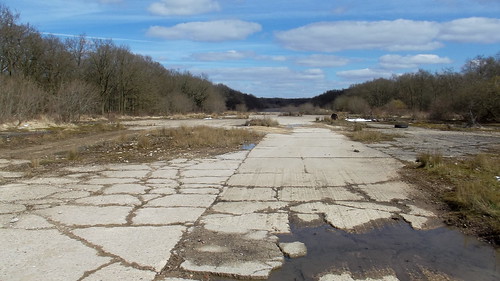
Today the three runways and perimeter track still exist almost in their entirety, and remarkably, in generally good condition. Largely overgrown with weeds and small trees, the remainder is well hidden obscuring what little there is in the way of buildings – most being demolished and the remains left piled up where they stood. However, a T2 hangar is now used on the industrial estate and the watch office still stands tucked away amongst the trees and undergrowth. This area is a favourite place for dog walkers, and because of its runways, it is accessible for prams and pushchairs. Whilst here, I spoke to quite a few people, remarkably none of them knew of the site’s historical significance let alone the office’s existence!

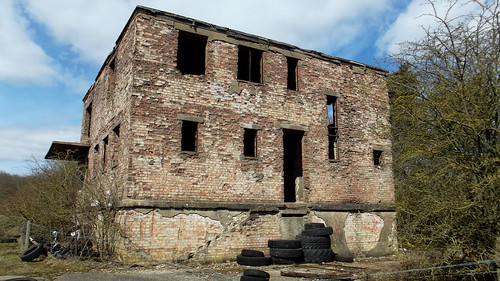
Today the watch office remains open to the elements. Surrounded by used tyres and in constant threat of the impending industrial complex over the fence, its future is uncertain. Access stairs have been removed, but an entrance has been made by piling tyres up to the door – presumably by those wishing to enter and ‘explore’ further. Little evidence of its history can be seen from the outside, even the rendering has been removed, and so, any possible personal links with the past are more than likely now gone.

North Whitham runway

The view of the main runway from outside the tower.

Returning back to the main public entrance along the perimeter track, a number of dispersal pens can be found; overgrown but relatively intact, they are a further sign that even here, war was never very far away.

North Witham was one of those ‘backroom boys’ whose contribution, whilst extremely important, is little known about. The work carried out here not only helped to maintain a strong and reliable fighting force, but one that spearheaded the frontal invasion of Normandy. It served as a cold and perhaps uncomfortable home to many brave troops, many of whom took the fight direct to Nazi Germany.

Standing here today, it is quiet and strangely surreal – you can almost hear the roar of engines. Looking along its enormous runways you get an eerie feeling – how many troops also stood here, spending their last few hours in this quiet place. Looking around now, it is difficult to imagine the immense work that went on here, the gathering of equipment as preparations were made for the big push into Normandy on that famous June night.

North Witham is truly a remarkable place, hidden away amongst the trees as a giant time capsule, a monument to those who lived, worked and died during that turbulent time in 1944-45.

North Whitham runway

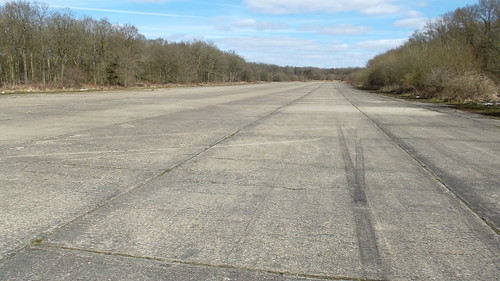
Another view along the main runway.

Sadly in May 2015, Twyford Woods was the scene of a large illegal rave, over 1000 people attended the event where a number of arrests were made in the violent altercations that took place*4. A sad day that would turn the souls of those who sacrificed themselves for the freedom we take for granted so very easily today.

(North Witham was originally visited in early 2013)

Links and sources (RAF North Witham)

*1 American Air Museum in Britain

*2 C-47A #42-93098 itself was later lost whilst flying with the 439th Troop Carrier Group (TCG) on September 18th 1944, whilst flying in support of Operation ‘Market Garden‘ in Holland.

*3 Superb footage of Crouch and his crew as they depart from North Witham is available on-line, it also shows the Watch Tower in its former glory.

*4 A report of the event is available on the BBC News website.

*5 My sincere thanks go to Jean Egan, daughter of Lt. Paul Egan, for the information and photograph.

An excellent website contain photos of paratroops and air crew as they prepare for embarkation and advance through France.

RAF Graveley and the Pathfinders (Part 1).

In Trail 29 we turn south and head to the southern end of Cambridgeshire. This area is rich in fighter stations, both RAF and USAAF. Home to Duxford and Bader’s ‘Big Wing’, Mustangs, Spitfires and Hurricanes once, and on many occasions still do, grace the blue skies of this historical part of the country.

We start off though not at a fighter station but one belonging to those other true professionals, the Pathfinders of No 8 Group RAF, and former RAF Graveley,

RAF Graveley

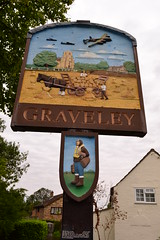
Village sign Graveley village sign depicts its aviation heritage.

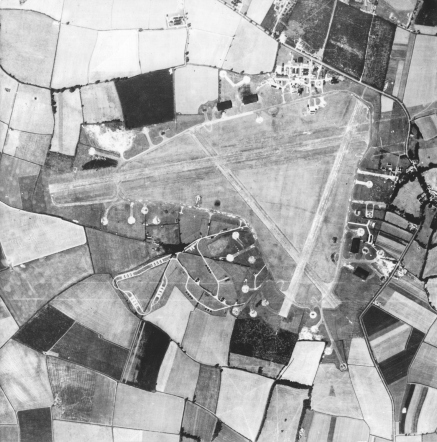
Graveley airfield sits on the south side of Huntingdon, a few miles to the east of St. Neots in Cambridgeshire. It takes its unusual name from the nearby village. The airfield itself would see a number of changes to its infrastructure, including both upgrades and improvements and it would be home to several different squadrons during  its wartime life.

Initially built as a satellite for RAF Tempsford, Graveley opened in March 1942 when it accepted its first residents, 161 (Special Duty) Squadron.  Formed from a combination of elements from both 138 Sqn and the King’s Flight, it had been formed less than a month earlier at RAF Newmarket  and would bring with it the Lysander IIIA, the Hudson MkI and the Whitley V.

The role of the Special Duty Sqn  was to drop agents of the Special Operations Executive (SOE) into occupied France, a role it would perform throughout its operational wartime life.  Their stay at Graveley would however be short lived, remaining here for a mere month before departing to  Graveley’s parent airfield in Bedfordshire, before moving elsewhere once more.

By the war’s end, Graveley would have become a complete operational airfield in its own right, forming part of Air Vice Marshall Donald Bennett’s 8 Group, with the Pathfinders. After upgrading, its initial concrete runways of 1,600 yards, 1,320 yards and 1,307 yards would be transformed into the standard lengths of one 2,000 yards and two 1,400 yard runways; the measures associated with all Class ‘A’ specification airfields.

Accommodation for all personnel was spread around the north side of the airfield, across the main Offord to Graveley road. These were separated into nine separate accommodation areas, incorporating both a separate communal area and sick quarters. Graveley would, once complete, accommodate upward of 2,600 personnel, a figure that included almost 300 WAAFs.

As with all sites, the bomb store was well away from the accommodation area, to the south-west, partially enclosed by the ‘A’ frame of the three runways. The 50 foot perimeter track linked these runaways with 36 pan style hardstands, all suitable for heavy bombers (after the extension three of these were replaced by loops). The main technical area, with its range of stores, workshops and ancillary buildings lay to the north-west, where two of the three T-2 hangars were also located, the third being erected to the south-east next to the only B-1 hangar on the site.

scan10_020

RAF Graveley (author unknown)

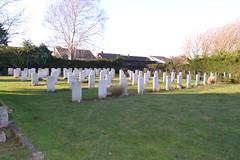
Following the immediate departure of 161 Sqn, Graveley lay operationally dormant. However, in May’s ‘1000’ bomber raid, aircraft from 26 OTU based at RAF Wing, flew from Graveley as part of the massive bombing operation. Sadly four of the Wellingtons (all Mk ICs) failed to return; WS704, DV740, DV707 and DV709. One of these, DV709 crashed some thirteen miles north-east of Cambridge whilst trying to make an emergency landing at Graveley. Unfortunately, when the aircraft came down, it overturned killing two of the crew on board: Sgt. J. Dixon the pilot, and Sgt. B. Camlin the tail gunner. Both these airmen were laid to rest in Beck Row Cemetery, at nearby Mildenhall.

St. John's Church Beck Row, Mildenhall

Beck Row Cemetery, Mildenhall.

The difficulty faced by Bomber Command crews in accurately hitting targets at night had, by now, become a problem for the ‘top brass’ at High Wycombe, and by April 1942, it had been decided, much against the views of Arthur Harris, that a new special Pathfinder Force was to be set up as soon as possible. As if adding salt to the wound, Harris was then instructed to organise it, and with a mixed charge of emotions, he appointed the then Group Captain Don Bennett, a man who had proven himself to have excellent flying and navigation skills.

Bennett then took charge, and on August 15th 1942, he formally took control of the new 8 (Pathfinder) Group, consisting of a specialised group of airmen who were considered to be the cream of the crop.

With its headquarters initially at RAF Wyton, Bennett received the first five founder squadrons of which 35 Sqn was one, the very day they moved into Graveley airfield.

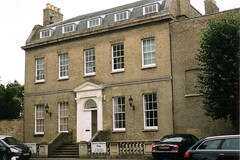
Castle Hill House, Huntingdon

Castle Hill House, Huntingdon, headquarters of the Pathfinders 1943 – 45. (Photo Paul Cannon)

Initially arriving with Halifax IIs, 35 Sqn would upgrade to the MK III in the following October, and then to the Lancaster I and III a year later. There would be little respite for the crews arriving here however, for they would be flying their first mission from Graveley, just three days after their initial arrival.

On the night of 18th/19th August 1942, a total of 31 PFF aircraft left to mark the target at Flensburg, close to the German-Danish border. However, poor weather and strong winds, prevented accurate marking, and two Danish towns were accidentally bombed as a result. It was a rather disastrous start for 35 Sqn and the Pathfinders.

Another blow was to fall 35 Sqn a month later, when on the night of 19th September 1942, the experienced 24 year old Wing Commander James.H. Marks DSO, DFC was lost when his Halifax II (W7657) ‘TL-L’  crashed at Blesme in France. Also being lost that night with W.C. Marks, was 19 year old F.L. Alan J. Child DFC and 25 year old F.O. Richard L. Leith-Hay-Clark; the remaining three crewmen being taken prisoner by the Germans. The squadron designation for this aircraft would then be reallocated, as was the case in in all squadrons, and as if bad luck were playing its hand yet again, that aircraft, Halifax HR928, would also crash with the loss of all its crew, including the highly experienced Sqn Ldr. Alec Panton Cranswick.

graveley

Halifax Mark II Series 1A, HR928 ‘TL-L’, 35 Sqn RAF being flown by Sqn Ldr A P Cranswick, an outstanding Pathfinder pilot who was killed on the night of 4/5 July 1944 on his 107th mission. The Cranswick coat-of-arms decorates the nose just below the cockpit.(I© IWM HU 92966)

In October, Gravely made history when it was earmarked to become the first operational airfield to test the new and revolutionary fog clearing system, FIDO. Classified as Station II, it would be the second of only fifteen British airfields to have the system installed and whilst it had its opponents, it was generally accepted and greeted by all who used it.

Installed by contractors William Press, the system’s pipes were laid along the length of the runway, a not easy feat as operations continued in earnest. One of the initial problems found with the FIDO system, was the crossing of the intersecting runways, pipes had to be hidden to avoid aircraft catching them and an obvious disaster ensuing. Two types of pipe were laid at Graveley, initially the Four Oaks type burner, but this was later replaced by the Haigas (Mk.I) burner. A more complex system, the Haigas took considerable time to install but by January 1943 it was ready, and an aerial inspection was then carried out by Mr. A Hartley – the Technical Director of the Petroleum Warfare Dept (PWD) and Chief engineer of the Anglo-Iranian oil Co. It was Hartley who later played a major role in PLUTO, the cross channel pipeline installed for D-day. Hartley, himself a non flyer, was flown over the burning pipes in a Gypsy Major by no less than Don Bennett himself.

It was later, on February 18th, that Bennett made the first four-engined heavy bomber FIDO landing at Graveley, using a Lancaster of 156 Sqn from Oakington. Setting off from Oakington, Bennett headed towards Graveley airfield, and with the burners lit, he remarked how he was able to see them from some 60 miles distant, the fire providing a far better light than searchlights alone, the means by which aircraft had been guided home on foggy nights previously. A great success, Bennett requested that certain minor modifications be made as he thought pilots could be distracted by the cross pipes at the threshold of the runway. Hartley keen to please Bennett, duly arranged for the necessary alterations and the modification were carried out without further delay.  However, further problems were to come to light on the the first operational lighting of the system, when bushes, hedges and telegraph poles adjacent to the pipelines were ignited due to an extension of the system passing through a nearby orchard!

The installation of FIDO meant that huge oil containers had to be installed too. At Graveley, sixteen cylindrical tanks were mounted in two banks, each tank holding up to 12,000 gallons of fuel. These tanks were kept topped up by road tankers, there being no railway line nearby as was the case at other stations.

Over the next few months, FIDO was tested further, but for various reasons its benefits weren’t truly exploited. On one occasion it was prevented from being lit by a crashed Halifax on the runway, the resultant lack of FIDO after the accident, was then blamed for the loss of two more aircraft, neither being able to safely put down in the poor conditions.  On another night, poorly maintained pipes caused burning fuel to spill onto the ground rather than heating the vaporising pipes above. Bennett somewhat angry at this, once more requested modifications to be made, needless to say they were not long in coming!

With further trials, one pilot was remarked as describing flying through FIDO as “entering the jaws of hell”*1 but once crews were used to it, the benefits were by far outweighing the drawbacks.

The safety of FIDO could not assist all crews though, and a number of other experienced crews were to be lost from Graveley over the next few months. But all news was not bad. The night of 18th/19th November 1942 saw a remarkable turn of fortune.

In Part 2 we see how Graveley sees out the war, the changes that occur, the new aircraft and new squadrons that arrive.

The whole trail can be read in Trail 29 – Southern Cambridgeshire.

RAF Leeming – The Great North Road (Part 1).

In another of our Trails along the ‘Great North Road’ we arrive in Yorkshire, to stop off at a station with a history that stretches back to 1937, and one that continues its flying tradition today.

As a modern jet training facility, this airfield has a long and distinguished history; it is also one that has seen a number of aircraft types and squadrons using it. Born as a bomber airfield, transforming to a fighter establishment, it has now turned its attention to pilot training. From the early twin engined bombers of the late 30’s to the modern jets of today, it is an active aviation establishment.

Heading north, we pull off the A1 and stop at RAF Leeming.

RAF Leeming.

RAF Leeming has been an operational RAF airfield ever since its official opening in the summer of 1940. Following two years of construction in which a non-dispersed accommodation site, hangars and technical area were all built – the three concrete and tarmac runways were added. Each of these were built to the standard 50 yard width, and measured 1,950 yds, 1,650 yds, and 1,400 yds in length. Aircraft dispersals were included, these amounted to thirty-six of the ‘frying pan’ style, with the all important technical area nestled between the legs of the ‘A’ of the multiple runway design.

At its wartime peak, Leeming could cater for almost 2,500 personnel of mixed rank and gender, all accommodated within the boundary of the airfield perimeter, a normal practise for non-dispersed airfields of the pre-war expansion period.

RAF Leeming

One of Leeming’s Hangars today.

It was this expansion period that would also see the creation of 4 Group – the initial ‘owners’ of RAF Leeming. Hatched from 3 Group, it would hold control of twenty-two operational airfields in the Yorkshire area. Headed by one Arthur Harris, 4 Group would become synonymous with this region of England and Bomber Command, a command of which Harris would himself eventually take full control of.

During the war itself, Leeming would operate as a bomber base, operating beyond the focus of most Luftwaffe intruders. It would, throughout its life, be home to a large number of  front line squadrons, supported by: training units, Flying Training Schools and RAF support flights that would extend right the way through to the present day. With the impending closure of Scampton in Lincolnshire in 2022, Leeming has been identified as one possible location for the RAF’s Red Arrows to relocate to. Such a move, whilst not welcomed by many, would ensure the continued operational activities of the base in an otherwise uncertain military situation.

Leeming’s life began shortly after 12:05 on July 6th 1940, when an advanced party from 10 Sqn – ‘Shiny Ten’ as they were known – left RAF Dishforth to prepare Leeming’s accommodation site for the forthcoming arrival of the Whitley  squadron. Not long after they arrived, ‘spare’ aircraft from Dishforth began to arrive, the squadron remaining on full alert, and at readiness for operations that were continuing in earnest.

Two days later, on the morning of the 8th, the main party began its transfer over, all the time crews were being prepared and briefed for the days operational duties. Indeed there would be no settling in period and no honeymoon to find their feet. The first Leeming based aircraft took off and attacked targets at Kiel on the very same day they arrived. Following the briefing, aircraft were prepared and checks were made, then at around 21:00, five Leeming Whitleys took off at one minute intervals to join sixty-four aircraft departing Britain’s airfields to attack the ports of northern Germany. The primary target for the Leeming group was the Howaldts Railway Yard in Kiel. Prepared with a mix of 250lb and 500lb bombs, 20% of which had time delay fuses, they headed towards Kiel along a flight path designated as target corridor ‘A’.

In this early mission of the war only one Whitley was lost, that of 10 Squadron, N1496 ‘ZA-V’ flown by Flt. Lt Douglas A. Ffrench-Mullen, who was shot down  by Oberfeldwebel Hermann Förster (8./NJG 1),  in a Luftwaffe night-fighter off Heliogoland. Flt. Lt. Ffrench-Mullen and his four other crewmen were then picked up by German ground forces and detained as Prisoners of War. Sadly their time together would end there, they would not be sharing the same camps.

On the 10th, the then flamboyant Wing Commander William E. Staton, CB, DSO and  Bar,  MC, DFC and Bar arrived at Leeming to take over formal control of the airfield. A highly decorated man with a service going back to the First World War, he was soon to become known as ‘King Kong‘, his large stature being a prominent feature around Leeming’s site.

Staton, who record covered both World Wars, includes the downing of 25 enemy aircraft on the Western Front on no less than three separate occasions in 1918. On another occasion, during the Second World War, he spent an hour over the target area, after which he brought home his badly damaged Whitley. His accuracy in flying helped lead to the formation of Bennett’s Path Finder Force, and whilst serving in the Far East, Staton suffered at the brutal hands of the Japanese who removed his back teeth. Post war, his character would lead the British Shooting Team in both the 1948 and the 1952 Olympics. He was certainly a good choice to take Leeming forward as a bomber base.

Staton's Whitley.

The damaged wing of Staton’s Whitley Bomber. Despite the damage Staton carried out the raid on Bremen, nursing the aircraft back to England. His medal collection sold for £52,000 in 2013 (BNPS.CO.UK)

Due to delays installing the telephone system combined with an illness suffered by Wing Commander Staton, the transition to Leeming was slow, with operations continuing from both Leeming and Dishforth well into July. By the end of the month though, 10 Sqn had finally moved across allowing missions to continue in an almost seamless fashion.

The autumn of 1940 would become a hectic time at Leeming. Transition stops saw the arrival and departure of several 4 Group bomber units. On August 15th, an incursion on RAF Driffield left five 102 Sqn Whitleys destroyed and a number of 77 Sqn aircraft damaged. The airfield’s operational capability then being dramatically until repairs could be carried out. As a result, 102 Sqn transferred across here to Leeming at the end of August, staying here for one week before being temporarily detached to 15 Group and Coastal Command. 77 Sqn would also depart Driffield transferring for a short period to Linton-On-Ouse another of 4 Group’s Yorkshire airfields.

Whilst Driffield was being visited by the Luftwaffe, another RAF unit, 7 Squadron, was being resurrected for the third time of the war. 7 Squadron’s creation here at Leeming would herald a new era in Bomber Command, and a rather historical moment in aviation.

With this reformation would come the first ‘operational’ and soon to be ill-fated Short Stirling MK.I.

As Stirling N3640 flew into Leeming, it was greeted warmly and openly by the ground crews who had gathered to welcome it in. They all waited expectantly outside the hangars that they had repeatedly cleaned in order to keep themselves busy. August 2nd would not only mark a new period in the war, but it would also be the beginning of what would become a difficult time for those crews in Bomber Command.

The grace, beauty and sheer size of the Stirling brought a cheer, and instantly raised morale within the ranks of the RAF. It was their first long range, four-engined heavy bomber, and so at last, the war could now seriously be taken directly to the enemy’s front door.

The logistics of the change though would give rise to many problems, the Whitley, the Stirling’s predecessor, was a Merlin in-line powered aircraft, whilst the Stirling had a Bristol Hercules – a radial engine. Spares and tools were lacking and in addition, no one in 7 Sqn. had any experience of four-engined aircraft. To combat the problem, new crews were draughted in, mostly from Coastal Command, who had already been operating Short’s successful flying boat, the Sunderland. Closely linked, the transference of skills from one to the other came relatively quickly, and it needed to.

Despite the now known history of the Stirling’s on-going problems: its mechanics, the undercarriage, tail wheel, engine difficulties and its performance in general, the Stirling was liked by many, a good handling aircraft its manoeuvrability was better than others in its class. In battle it was also able to take a lot of punishment before finally giving up, a factor that no doubt saved a good number of crews. The Stirling, after many struggles within Bomber Command,  would eventually find its niche either laying mines or as a transport / glider tug in the numerous airborne operations over Europe.

But at Leeming however, it wasn’t to be. The aircraft’s arrival was slow, the initial eight promised with the arrival of the new Sqn. Commander, Wg. Cdr. Paul.I Harris D.FC., being held up after Luftwaffe attacks on the Short’s factories in both Belfast and at Rochester. By the end of the month only two more aircraft had arrived, N3641 and N3642.

Stirling, N3641 ‘MG-D’, the second Stirling to be delivered to 7 Squadron at Leeming. It took part in their first raid over Rotterdam on the night of 10-11 February 1941© IWM (CH 3139)

On September 5th another communication came through confirming the allotting of yet another eight aircraft so that 7 Sqn. could form a second flight – the note must have raised a few eyebrows across the station, as there wasn’t enough yet for one.

Being a new aircraft, 7 Sqn. crews had to perform a range of tasks on it, many of which they relished, completing over and over so they could get to know the aircraft and her delicate intricacies. One of these was loading the enormous bomb bay, and depending upon the load, it could be in one of twelve different configurations. Here the crews got to find the first of its many faults, the cables to haul the bombs up into the bays were too short, so it couldn’t, at this point, accept a full complement of bombs. What use was a bomber with only half a load?

Fuel consumption tests were next. On September 29th, F.O. T. P.  Bradley D.F.C., took off on a cross-country flight in N3640, the first Stirling to arrive at Leeming. During the flight the aircraft developed engine problems forcing it to crash at Hodge Branding in Lancashire (this location may be an error in the ORB). In the crash the aircraft struck a wall ‘writing it off’, luckily though the crew managed to avoid any serious injury.

Throughout October, 7 Squadron’s Operational Record Book*1 read badly, “Teething troubles seriously interfered with the programme of intensive flying“, hardly a glowing testament to a new aircraft. With that though, on 29th October, 7 Sqn. moved out from Leeming transferring across to Oakington in Cambridgeshire, where they continued to be dogged by serious issues. Comments such as “continual modifications interfering with squadron activities” and the training flights taking place in “the two or three aircraft more serviceable than the others” clearly showing the frustration of the squadron as they struggled to get to grips with the new aircraft.

Meanwhile Leeming’s resident Whitleys would be playing a large part in Bomber Command’s operations, flying many missions over Europe. On the night of October 15th 1940, three Whitleys of 10 Squadron were lost. The first, P4952, ran out of fuel trying to find and airfield in thick cloud. The pilot Sqn. Ldr. K. Ferguson gave the bail out order, and all crew members landed safely. The second Whitley T4143, on the same mission to the Stettin oil facility,  also ran out of fuel, and without radio contact the pilot also ordered the bail out. Unfortunately two of the crew were killed, one of whom, had only lost his brother a matter of weeks earlier in the same squadron. Sgt. Leslie Neville (age 26) and his brother Sgt. Brian Neville (age 19) had joined on the same day, and their service numbers were  only 4 digits apart. The third aircraft lost that night, Whitley P4993, struck a balloon cable whilst on its way to Le Harve. Sadly all five crewmen were lost that evening, their bodies being returned to their respective homes.

In the following month, November 1940, another short stay squadron appeared at Leeming in the form of 35 Squadron, the first unit to be equipped with that other new four-engined heavy, the Halifax MK.I. Designed initially to meet Specification P.13/36, it took its maiden flight on 25th October 1939 and would go on to form 40% of the RAF’s heavy bomber force.

After being disbanded at RAF Upwood early that year, 35 Squadron then reformed at Boscombe Down (7th November 1940) taking on their first Halifax, L9486, flown by F.O. M.T.G. Henry and his crew. On the 20th, the squadron moved across here to Leeming, to come under the control of 4 Group taking on the prototype Halifax L7244 from the Ministry of Aircraft Production (M.A.P)  for ‘dual’ purposes. The aircraft was ferried in by Wg. Cdr. R.W.P. Collings AFC, the squadron’s first Commanding Officer along with his crew. On December 5th, 35 Squadron would then transfer to Linton-On-Ouse where it would, within a matter of days, lose its first Halifax (L9487) in a tragic accident with the loss of all on board. The aircraft, which is thought to have crashed because a fuel cap had been left off, had only had 4 hours of flying time before crashing at Howefield House, near Baldersby St. James in Yorkshire*2. Whilst at Linton-On-Ouse, 35 Sqn. would receive many new pilots, one of whom, P.O. Geoffrey L. Cheshire DSO.,  would go on to achieve amongst others, the DFC and the Victoria Cross, the highest award for gallantry in the face of the enemy. He would also go onto lead 617 Sqn. and not only be the youngest group captain in the RAF, but one of the most highly decorated pilots of the entire war.

After all these arrivals and subsequent departures, Leeming was then left with just its original 10 Squadron, which meant that the winter – summer period 1940/41 was relatively quiet in terms of operational movements in or out of Leeming. 10 Sqn. performing their role as best they could with their Whitleys.

December 22nd 1940, brought the last Leeming fatalities for the year. On take-off for a training flight,  10 Sqn. Whitley P4994 ‘ZA-U’ struck the roof of a farm house located beyond the end of the runway. In the resultant crash, one crewman was killed – Canadian P.O. Ross Flewelling. Two further crewmen were injured whilst the forth escaped unharmed.

Two Armstrong Whitworth Whitley Mark Vs of No. 10 Squadron based at Leeming, Yorkshire in flight © IWM (CH 4451)

The introduction of the new heavy bombers was not smooth. A third, the Manchester from Avro, merely compounded the issues already being faced by bomber and ground crews. Faced with unreliable mechanics and poor handling characteristics, regular flying was now being further reduced by continual poor weather, making maintenance, flying practise and life generally miserable on the ground as well as in the air. 10 Sqn. would be subjected to gales, severe icing and heavy rain, airfields across Britain were fast becoming churned up and boggy.

It would not be long into 1941 before casualties would be incurred. 10 Sqn, who were now beginning their own transition to Halifaxes, were still operating  Whitleys, and on the night of 16th – 17th January, they sent them to the port at Wilhelmshaven on Germany’s North Sea coast. With eight aircraft taking off around 18:30, they would briefed at Linton-On-Ouse where the night’s operations were being commanded from. At 21:15 hrs Whitley T4220 piloted by F.O. H Skryme would report in that the mission had been successful and that they were on their way home. It would be the last time the crew were heard from, and the aircraft along with its occupants were recorded as missing at 04:30 hrs. The crew of T4220 were never heard from again, their aircraft, nor they, were ever found.

The implementation of a new directive saw Bomber Command’s focus change to oil production facilities. Some seventeen sites were earmarked for attacks, over 80% of Germany’s production was going to soon be on the receiving end of Bomber Command. Implementation of a second, and parallel directive that focused on maritime operations, would then follow leading to attacks on docks, ports and shipping facilities particularly those located along the French coast.

By September 1941, things would change again at Leeming.  77 Squadron – another Whitley Squadron – would arrive, staying here until the early summer of 1942. With a history dating back to the First World War it was later resurrected by the renumbering of ‘B’ Flight of 102 Sqn in 1937. One of 77 Sqn’s Commanding Officers whilst at Leeming would be Wing Commander Don Bennett, the later Commander of 8 Group and the Pathfinders.

Like many units, 77 Squadron’s transition between its former base, RAF Topcliffe and its new base RAF Leeming, occurred whilst operational sorties remained in progress. On the very day the transfer began (September 2nd), aircraft were ordered to a raid on Frankfurt. On return from this operation, many of the squadron’s aircraft landed directly at Leeming rather than returning to their former base RAF Topcliffe.

On their next sortie, their first official Leeming mission, 77 Sqn. would lose three aircraft, Whitleys: Z6654 flown by P. Off. Havelock, (classed as missing); Z6668 flown by Sgt. D. Mercer (loss of all onboard) and Z6824 flown by Sqn.Ldr. A. Hanningan, with the loss of all but one. It had proven to be a bad start for the squadron at Leeming.

The next ten days were consistently poor weather with rain and mist preventing operational flying for the squadron. Indeed the remainder of October followed a similar pattern, rain or mist interspersed with operations. During these flights, which took the squadron to Wilhelmshaven, Le Harve, Kiel, Hamburg and Cherbourg, casualties were light allowing the squadron to settle into their new home.

Leemings’s long standing squadron 10 Sqn, began replacing their Whitleys with Halifaxes in December 1941. It was at his point that the squadron would be split; a detachment moving to RAF Lossiemouth in Scotland, in a move that would mark the beginning of change for this long standing resident of Leeming.

The beginning of 1942 saw air operations focus on the German Cruisers located at the French port at Brest. With successive operations attempting to sink, or at least cripple the ships, it became a thorn in the side of not only Bomber Command, but the Government as well, who as a result of these failed operations were to suffer a great humiliation. The culmination of these attacks saw many Bomber Command squadron losses along with six Swordfish crews of 825 Naval Air Squadron take part in ‘Operation Fuller’, a disaster that saw the loss of so many lives.

With the appointment of Harris as Command in Chief of Bomber Command, little immediately changed. Operations carried on as usual and at Leeming 77 Sqn visited St. Nazaire from which two aircraft were lost on their return trip. With a further 10 Sqn Halifax also being lost that night, it was a bit of a blow for the station.

The further loss of three more 77 Sqn aircraft at the end of February,  and four more in March – Z9293 ‘KN-D’; Z9312 ‘KN-S’; Z6975 ‘KN-V’ and Z9221 ‘KN-G’ – meant that the squadron was taking a bit of a battering and that the Whitley was perhaps beginning to show its outdated status. Indeed, April followed with several ‘softer’ targets being attacked without loss. Then on May 6th – 7th, the squadron began its departure from Leeming to Chivenor and a spell of Maritime Duties with Coastal Command. 77 Sqn would later return to Bomber Command but their spell at Leeming was now over, and this chapter of their life was closed.

The summer of 1942 would see big further changes at Leeming. In May, the departure of 77 Sqn. on the 6th along with the move of another section of 10 Sqn. to Aqir south of Tel Aviv, meant that numbers were once again low. The final departure of all remaining 10 Squadron personnel in the August 1942, meant that Leeming was now all but empty, and it would be passed over to the control of the Canadians and 6 Group Bomber Command. The new Command would then retain control of the airfield operating a small number of Canadian Squadrons right the way through to the war’s end.

With that, new times lay ahead. The four engined heavies were beginning to make their mark, the lighter of the bombers were starting to be withdrawn from front line service, and the focus on shipyards was now about to shift. The Canadians were about to arrive at Leeming.