Major George Preddy – 352nd FG – A tragic loss.

In Trail 8, we heard about a number of heroic tales and tragic losses. One of those, was that of one of the highest scoring P-51 pilots, Major George Preddy of the 487th Fighter Squadron (FS), 352nd Fighter Group (FG), based at RAF Bodney (Station 141)

George E. Preddy Jnr (0-430846), from Greensboro, North Carolina, was born on 5th February 1919, and graduated from Greensboro High School at the age of sixteen. Preddy became interested in flying whilst in college and made his first solo flight in 1938 at 19 years of age.
Preddy page

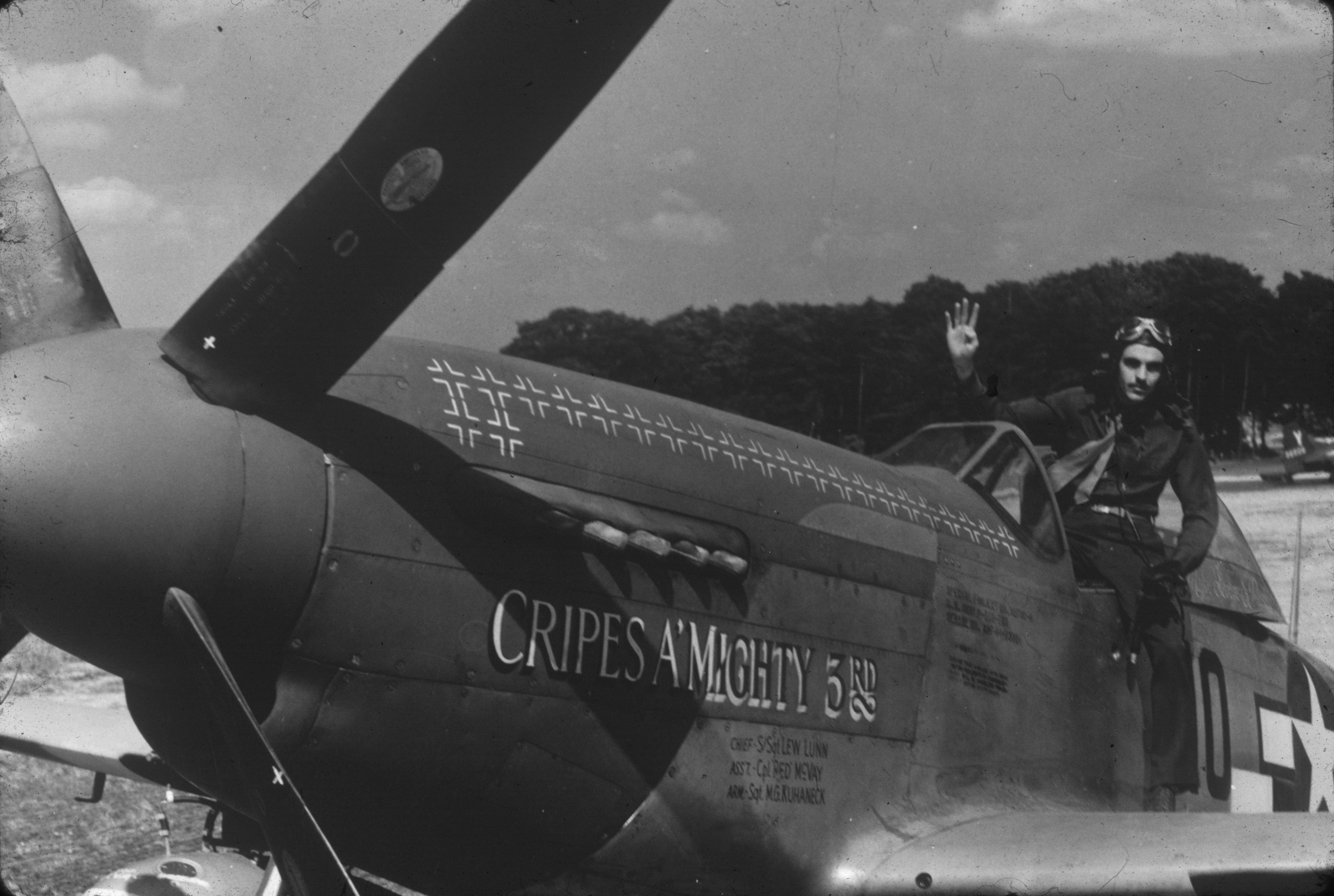
Major George E “Rasty” Preddy Jr in the cockpit of his P-51 Mustang (HO-P), #44-13321 nicknamed “Cripes A’ Mighty 3rd.” (@IWM FRE 006368)

His road to war would take time and effort. His introduction to flying was as a barnstormer which led him to attempting entry into the US Navy no less than three times, each time being rejected on account of his small stature and curved spine. With each rejection came more determination, his love of flying taking him back to Barnstorming, whilst he undertook bodybuilding and stretching exercises to straighten his back. Eventually, in the summer of 1940, he applied to the USAAF and to his delight he passed all the relevant examinations. However, as the US was not yet at war, Preddy’s entrance would take yet more time and so to gain experience and better prepare himself, he joined the Army National Guard, being posted to the 252nd Coast Artillery, which went on to protect the important oil refineries on the islands of Aruba and Curaçao, in the southern Caribbean Sea.

The following year in In April 1941,  Preddy received his orders to report for flying training, from which he graduated on December 12th that same year. December 1941 saw the Japanese attack on Pearl Harbour, an attack that led to the US joining the Second World War, and an attack that led to Preddy, commissioned as a Second Lieutenant, being posted to Australia to the 9th Pursuit Squadron (PS), 49th Pursuit Group (PG) in the defence of northern Australia.

Whilst here, Preddy would fly Curtiss P-40s, he named his first plane, ‘Tarheel‘,
as a tribute to his home state. During his time here, he damaged both a Japanese fighter and a bomber in combat operations. Sadly though, in the summer of 1942, he was involved with a collision with another P-40, an accident that would kill Preddy’s friend and colleague, and leave Preddy seriously ill in hospital for another six months or so.

In the October of 1942, Preddy returned to the US, it was here that he would cross paths once again with Lt. Jack Donalson, a pilot who was also a veteran of the early Pacific theatre, and who was with him on that tragic day in July 1942. The two met at Trumbull Field, Connecticut, on January 15th 1943, where the newly formed 352nd FG were training and forming up. The 352nd would be made up of three squadrons (328th, 486th and 487th), Preddy would initially be assigned to the 487th FS.

The 352nd would continue training, their new P-47 Thunderbolts arriving three days later. With the P-47 being new, there were many accidents and losses, primarily due to a carburettor hose clamp becoming loose. Luckily Preddy avoided all such incidents and by May 1943, he and the 352nd were ready for action.

On the 7th July the 352nd arrived at RAF Bodney (newly named Station 141) a small grassed airfield not far from RAF Watton in Norfolk. With small incursions into enemy territory the first few months were generally event free. Preddy would get his first kill later that year on December 1st 1943, while flying P-47D-5-RE Thunderbolt (HO-P) #42-8500 “Cripes A’Mighty“, a name he gave to all his aircraft, so-called because it was his favourite expression. Whilst escorting bombers back from a mission over occupied Europe, Preddy noticed a formation of German fighters who were focusing their attention on stragglers, easy pickings for the experienced and deadly Bf-109s. Preddy and his squadron dived down, bouncing the Germans, causing his first victim to explode in a flurry of cannon fire.

Preddy’s first year would end with two confirmed kills, a tally that would only grow as time went on. In his second kill, he would sadly lose his wing man, Lt. Richard Grow, but for his action he would receive the Silver Star, one of many achievements Preddy would gain.

On January 29th 1944, Preddy would come close to death for a second time, when after dispatching an FW-190, he was hit by Flak and had to ditch in the sea. After spending a short time in the water he was picked up by an RAF Air Sea Rescue Walrus and returned to Bodney.

Over March and April, the new P-51 Mustangs began to arrive at Bodney, an aircraft that would lead to Preddy achieving ‘Ace’ status. On May 13th, the 487th dived down on around thirty Bf-109s, Preddy accounted for two taking his tally over the magical ‘Five’ Kills and ‘Ace’ status.

During the summer of 1944 Preddy would achieve many more ‘kills’, by now he was well on his way to becoming the leading ace in the European skies. In March he was made Operations Manager of the 487th, and promoted to Captain.

By mid July Preddy has reached 14.5 kills, all a mix of single and twin-engined aircraft, and by the end of the month, this has risen to 21.83 kills, taking him to the top spot and leading ‘Ace’ of the 352nd.

Following an escort mission on the 5th, a further mission, in which Preddy was ordered to lead on the 6th, was scrubbed due to bad weather. With the day free to themselves, the officers mess became the focus of attention and the drinks ran freely

By the time Preddy had got to bed, he was well and truly drunk, and as with many operations of the war, the weather cleared and the operation was on once more, Preddy was woken after only an hours sleep and struggled to get to the briefing. Still reeling under the influence, he took off and lead the group into battle. Worse for wear, he emptied his stomach in the cockpit and headed toward the enemy.

As the bomber and their escorts approached Hamburg, Preddy led the attack on the Luftwaffe fighters.  In the airspace between 30,000 ft and 5,000 ft, Preddy managed to shoot down six Bf-109s, with numerous hits around canopies, wing roots and fuselages. On return he was greeted like a hero, the ground crews and squadron pilots crowding his aircraft. Preddy gave a simple reply to the eager crowd, vowing “Never again” would he fly with a hangover.  Following this mission Preddy was awarded the DSC and sent home to the US for a well-earned rest on a 30 day leave.
Preddy page

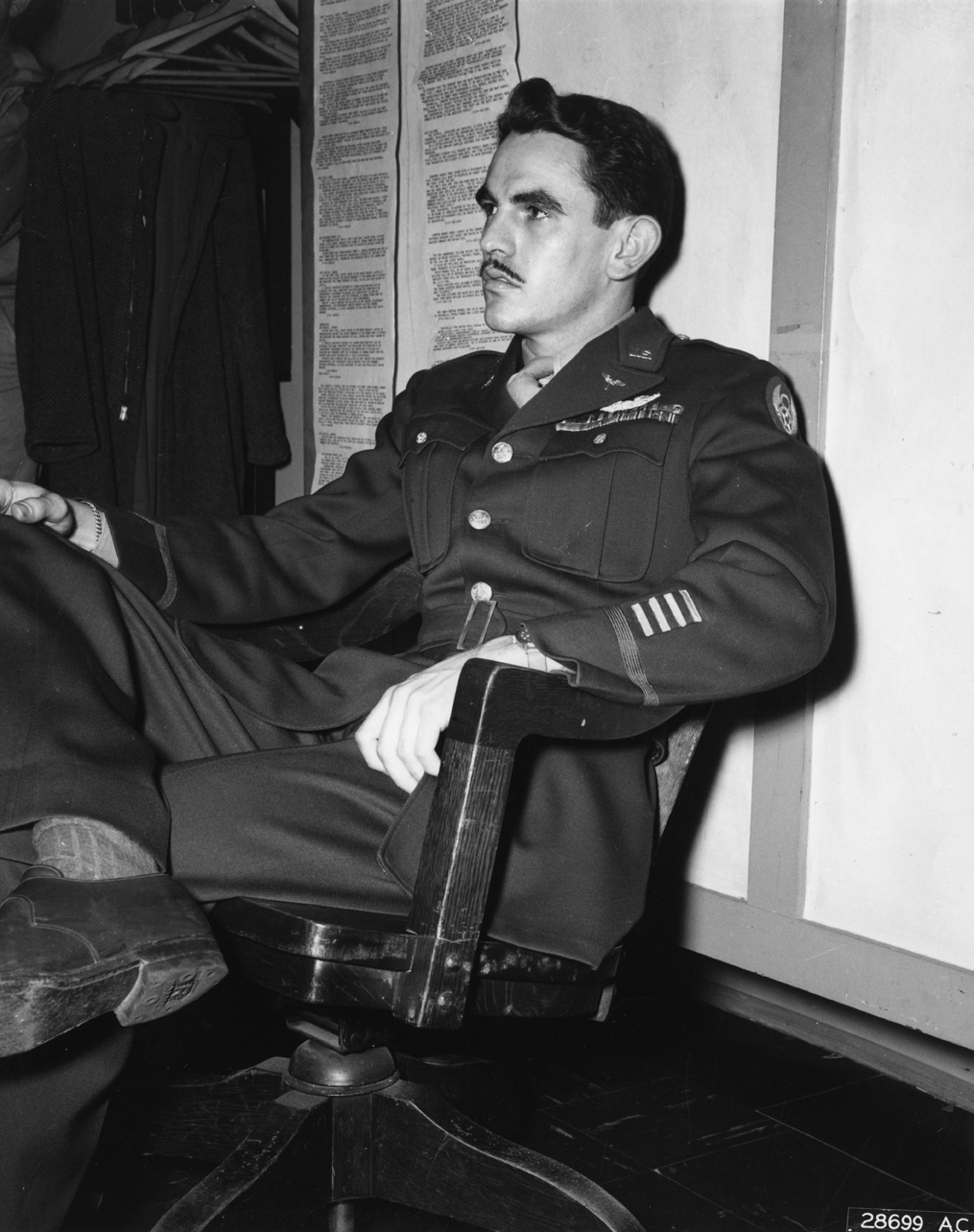
Major George Preddy, during his return to the United States between August & October 1944. Taken at a Press Conference in the Pentagon Building.’ (@IWM FRE 00346)

On his return in October, Preddy was again promoted, this time to Major, whereupon he commenced his second operational tour. His involvement with the 487th would not last long though, as with his promotion came new responsibilities and the command of the 328th FS, taking over from Lt. Col. John Edwards.

The hard winter of 1944-45 tore into the souls of the ground and air forces across Europe. Severe frosts, snow and cold made Bodney a difficult place to be. But the war continued and in the forests of the Ardennes, German forces were gathering. With few flights being carried out due to thick fog and freezing conditions, the German armoured brigades under the control of Field Marshal Gerd von Rundstedt, made a daring breakthrough (Operation Bodenplatte) in what became know as the ‘Battle of the Bulge’. Ground forces made continued calls for air support, but with increasingly bad weather, few flights were able to make it.

The order then came through and on the 22nd December 1944, the 352nd were to move to Belgium and Asch (Y-29) a small grassed airfield near to Genk in the province of Limburg. The 352nd crammed all the cold weather clothing they could into their aircraft and set off. By the end of the day the Group had settled in the cold of Belgium, it was a far cry from the relative warmth of Bodney.

Preddy’s time in Belgium would be short-lived however. As the weather cleared more missions were undertaken. On Christmas Day, the 328th would have one of its finest battles, shooting down eleven enemy aircraft, but it was a victory that would be eclipsed by the loss of perhaps its greatest leader and airman.

On that day there were two missions ordered, Preddy would lead the second of the two, an escort mission into Germany and Koblenz. On the return trip, Preddy was vectored to Liege, and warned of ‘heavy flak’.  Arriving south of the city, Preddy, along with his wingman Lt. Gordon Cartee, and another pilot Lt. James Bouchier of the 479 th FG, spotted an FW-190 and gave chase at tree-top level.

On entering the area, ground forces opened fire, the Anti-Aircraft battery were American, and all three allied aircraft were hit. Lt. Bouchier managed to climb high enough to bail out, landing safely in the British sector, Lt. Cartee, also having been hit, also managed to escape and get home, but not until after he saw Preddy’s P-51, turn and dive into the ground. Major George Preddy died in the crash.

Preddy’s death was devastating for both the group at both Asch and those back home at Bodney. Festivities were subdued to say the least. Preddy’s dashing good looks and character were well-known, his relationship with his own ground crews were one of the best, he always took time out for them and praised their efforts in keeping him flying. At 25 years of age, Major George Preddy was not a born killer, just a young man who loved to fly, and to fly well.

George Preddy had flown 143 combat missions, he had has been credited with shooting down 26.83 enemy aircraft, the highest in the 352nd FG, and destroying 5 enemy aircraft on the ground. His combined total of 31.83 aircraft was just 6 short of the Group’s highest, a total that most certainly isn’t conclusive.

His commanding officer Lt. Col. John C. Meyer, who held the Group’s record and  was the fourth ranking American Air Ace, described Preddy as “the complete fighter pilot”.  A man so brave and dedicated that he would be awarded, amongst others: the Distinguished Service Cross; Silver Star (1 Oak Leaf Cluster); Distinguished Flying Cross (6 Oak Leaf Clusters); Air Medal (6 Oak Leaf Clusters); Croix de Guerre, and the Purple Heart.

In 1968 the city of Greensboro dedicated Preddy Boulevard in honour for both George and his brother. The Preddy Memorial Foundation also created a petition to have Fayetteville’s Pope Air Force Base renamed Pope-Preddy Air Force Base.
George Preddy’s career may have been short, but his influence went far and wide especially amongst those who knew of him.

Major George Preddy is buried in the Lorraine American Cemetery, just outside Saint-Avold,  Moselle, France, alongside his brother, another fighter pilot, in Plot A, Row 21, Grave 43.

Sources and further reading.

RAF Bodney appears in Trail 8.

North Carolina Museum of History website Accessed 23/8/18

Freeman, R.A., “The Mighty Eighth“, Arms and Armour, 1986

The Preddy Memorial Foundation website Accesses 20/8/18
RAF Little Walden (Station 165)

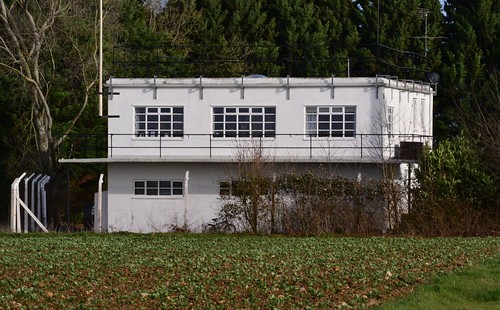
Sometimes, we come across quite unexpectedly, something of great interest. Whilst on my travels recently, passing through the southern regions of Cambridge into Essex, I came upon the former station RAF Little Walden. Being an unplanned visit, I was rather short in prior knowledge and preparation, no maps, aerial photographs, or other documents that I normally seek out before venturing off into the wilderness. So I was quite unprepared when I stumbled across the Watch Office from former station RAF Little Walden, otherwise known as Station 165 of the USAAF.

RAF Little Walden (Hadstock) – (Station 165)

Little Walden lies slightly closer to the village of Hadstock than it does Little Walden, and was originally called Hadstock. When construction began in 1942, it was allocated to the Eighth Air Force as a Class A bomber airfield. However, due to the bad winter of 1942/43 work ceased temporarily, being held up until well into the summer of 1943. At this point, Hadstock became known as Little Walden, a name change that coincided with the formation of the Ninth Air Force in Europe, an organisation whose primary role was the support of ground troops in the European theatre. With its headquarters at Sunninghill Park1 in Ascot, it would operate both transport and bomber units, taking many of these units (and their airfields) from the already established Eighth Air Force. Little Walden was one such airfield passing from the Eighth to the Ninth to fulfil this new role.

Although a Class A airfield, Little Walden’s main runway was slightly shorter than those of its counterparts, 1,900 yards as opposed to 2,000 yards, but the two auxiliary runways were both the standard 1,400 yards in length. A concrete and wood chip construction gave these runways good strength, it also had hardened perimeter tracks and fifty hardstands of the spectacle type. Grouped mainly in blocks of five, they were located around the perimeter track with a further block of eighteen to the north-west of the site. In the development process a public road the B1052, was closed as it passed directly though the centre of the proposed site.

Little Walden Watch Office

Little Walden’s Watch Office is now a private residential property.

A large bomb store lay to the west of the airfield, surprisingly close to the majority of the hardstands, any major accidental discharge being likely to cause substantial damage to parked aircraft. There were four areas within the bomb store, each holding 200 tons of bombs and tail units, further stores held pyrotechnics, incendiaries, ‘small’ bombs, grenades and small arms ammunition. Most of these were secured by earth banks with fusing points (both ultra-heavy and heavy-light) being held in temporary brick buildings.

To the eastern side of the airfield lay the technical area, with one of the type T2 hangars (the second being located to the north), a fire tender shelter, and a watch office designed to drawing 12779/41 – the standard airfield design of 1942/43. Behind this, lay the main technical area, with its usual range of dingy stores, MT (Motor Transport) sheds, parachute stores and a wide range of ancillary buildings.

Accommodation for staff was, as usual by now, dispersed over eleven sites, a sick quarters, communal site and WAAF site accounting for three of them. A further sewage works made the twelfth site. All-in-all accommodation was provided for just short of 3,000 men and women of mixed rank.

On March 6th, 1944 the airfield officially opened, the day before its first residents arrived. The 409th BG were a new Group, only constituted on June 1st, the previous year (1943). They trained using Douglas A-20 Havocs (known in British service as the Boston) a twin engines light bomber capable of carrying up to 4,000lb of bombs.

The 409th BG formed at Will Rogers Field (Oklahoma) and transitioned through Woodward and DeRidder bases before arriving in the UK. Between March and September they operated out of Little Walden, bombing V-weapons sites and airfields in France in a strategic role. Initially they performed in the low-level role, but soon moved to higher altitudes, performing their first mission on April 13th 1944.

In the short period of residency at Little Walden, the 409th would lose a number of aircraft, one of the first being that of #43-9899 of the 642nd BS, which was written off in a landing accident on April 22nd 1944. Three days later a second aircraft, #43-9691, would also crash-land at Little Walden being damaged in the process.

May would also prove to be a difficult month for the 409th, with one aircraft ‘lost’ on the 9th, a further crash landing on the 11th, another lost on the 22nd and two further aircraft lost (classified as MIA) on the 27th. It was on this mission that a further Havoc would collide with a low flying Mustang resulting in several tragic deaths.

Havoc #43-10130 of the 643rd BS, piloted by Captain Roger D. Dunbar took off from Little Walden heading south-east, when it collided with P-51B #42-106907 of the 503rd FS, 339th FG, piloted by 2nd Lt. Robert L. Dickens. The Mustang, on a training flight, disintegrated killing the pilot, whilst the Havoc crashed into the farmland below. In the ensuing fire, a local farmer’s widow and trained nurse, Betty Everitt ran to the scene and managed to pull one of the airmen out of the aircraft. When returning to retrieve another crewman, one of the bombs on board the aircraft exploded killing her, her small dog, a helping Staff Sgt. and those left inside the aircraft. As a thank you to Betty, the US airmen, from the base, raised almost £3,000 to provide an education for her four-year old orphaned son, Tony2. This was not a one-off either, a fund set up by Stars and Stripes and the British Red Cross, aimed to raise funds for children who had suffered the loss of one or both parents. The amounts raised went a long way to getting these children an education that they would not otherwise have had.

Early June would see another such tragedy, when three more Havocs would collide. Havocs A-20G #43-9703 and #43-9946, both of the 641st BS, would crash whilst the third aircraft managed to land at the airfield. #43-9703 was piloted by Joseph R. Armistead, whilst #43-9946 was piloted by Thomas A. Beckett. A young girl, Marjorie Pask, ran to help, pulling two airmen out of the wreckage then waiting with them until help arrived. Five airmen including the pilots and an air gunner, Staff Sergeant Albert H Holiday, were all killed. It was not until later that Marjorie realised that there were many bombs scattered around the site and how much danger she had been in 3.

Staff Sgt. Albert H Holiday, killed June 11th 1944 in a collision between two Havocs of the 409th BG. (IWM-UPL 21530)

With two further loses and a forced landing in June, it was be a difficult month for the 409th. The late summer months of July and August would be lighter but by no means a clean sheet. In September 1944, on the 18th, the 409th were moved out of Little Walden and posted to a forward Landing Ground A-48 at Bretigny, where they would continue to suffer from landing accidents, Flak and fighters.

Next at Little Walden came the Mustangs of the 361st FG, in a move that saw possession of Little Walden pass back into the hands of the Eighth Air Force. Station 165 was now back with its original owners.

The 361st FG were the last of the P-47 Groups to arrive in the UK. Initially based at Bottisham, they converted to the P-51 in the weeks leading up to D-day. Using the Thunderbolts they earned a reputation as a strong and determined ground attack unit, hitting rail yards and transportation links across France.

A short break whilst transferring from Bottisham to Little Walden gave a somewhat minor break for the 361st. But, following changes to the Eighth’s overall structure, it was soon back to normal and more attacks over occupied France. In October, Lt. Urban Drew shot down two Me 262s who were in the process of taking off from their airfield at Achmer. What was more remarkable about the attack was that Lt. Drew had only arrived in the U.K. a few days earlier, had been grounded for a Victory Roll and then went on to become an Ace shooting down six enemy aircraft and the first pair of 262s! He was awarded the Air Force Cross, being denied the Distinguished Flying Cross until after the war when records from both the Luftwaffe and US Air Force were able to confirm his dramatic claims.

The Christmas and winter of 1944-45 was notoriously bad, very cold temperatures, fog, frost and ice played havoc with operations. The Battle of the Bulge was raging and the allies were finding it all but impossible to provide assistance from the air. Many Bomb Groups suffered terrible tragedies as collisions and accident numbers increased in the poorer weather. The Ninth, who themselves had primary roles in ground support were finding it particularly difficult. To help, a selection of men and machines from the 361st (and 352nd from Bodney) were transported to France and the airfields at St. Dizier (Y-64) and Asch (Y-29) where they were seconded into the Ninth Air Force.  The main force back at Little Walden continued to support bomber missions whenever they could, a difficult job in often appalling conditions.

Duxford American Airshow May 2016

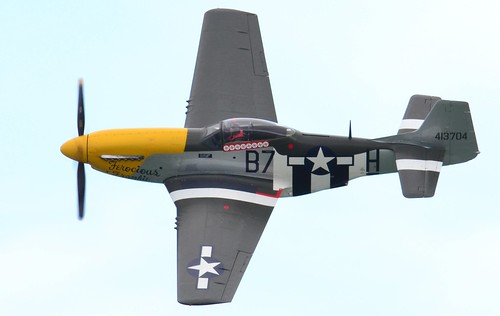
‘Ferocious Frankie’ #44-13704 (374th FS, 361st FG). The original crashed during a wheels up belly landing at RAF Little Walden, on November 9th, 1944. (This aircraft was flying at the Duxford American Airshow May 2016).

Aug 2015 317a

‘Ferocious Frankie’ (named after the wife of Lieutenant-Colonel Wallace E. Hopkins) seen at the Eastbourne Air Display August 2015.

By the end of January the seconding to the Ninth came to an end and the entire Group moved across to Belgium and Chievres, a former Belgian airfield captured and used by Luftwaffe bombers during the earlier years of the war. The 361st would remain there until April 1945 whereupon they returned back to Little Walden. During their absence Little Walden was made good use of. Being a ‘bomber airfield’ by design, its runways and hardstands were put to good use by Debach’s 493rd BG and their B-17 ‘Flying Fortresses’ whilst their own airfield was repaired and strengthened.

Spending only a month at Little Walden, the Air Echelons of the 493rd BG would depart in the April as the 361st FG returned. On the 20th, the 361st would fly their last operational mission, a flight that would close the record books culminating in a total of 441 missions. As the war ended and personnel were sent home, crews and aircraft of the 361st were dispersed to depots around the U.K., those that were left were sent home via the Queen Mary from Southampton arriving in New York in early November 1945. Within hours the group was disbanded and the men scattered to the four winds.

Between early September and early October 1945, the 56th FG ‘The Wolfpack’ were brought to Little Walden. The aircraft were also dispatched to depots around the country whilst personnel were brought to Little Walden for onward transportation to the United States. By mid October they too had gone.

Little Walden then began the wind down, transferring back to RAF ownership in early 1946. For the next twelve years or so, it was used to store surplus military equipment before they were sold off. After that, the site was returned to agriculture, the majority of the buildings pulled down and the runways dug up for road building hardcore.

The control tower stood for many years derelict and forlorn, until being purchased by an architect in 1982, eventually being turned into a private residence, the state it exists in today. The closed road has since been restored, utilising part of the NE-SW runway. Other parts that remain being a public footpath, but all a fraction of their former selves and no more than a tractor’s width wide.

What’s left of the technical area is a small industrial unit, remaining buildings being used for storage or small industrial companies. An access road from the B1052 passes the site an on to private residencies.

Little else survives of Little Walden. Memorial plaques are believed to be mounted on the side of the watch office, although I could not see these when I visited, and the village memorial mentions those who were stationed at the airfield.

The serenity of Little Walden does nothing to reflect the goings on here over 70 years ago. The aircraft are gone, the bird song replacing the sound of engines, and the busy runways now a small road. For those who were lost here, the watch office stands as  a memorial to their memory and the dedication shown by the many young men and women of the USAAF.

Sources and further reading.

1 Sunninghill Park was originally part of Windsor Forest and dates back to the 1600s and King Charles 1. Its ownership changed hands several times, and in the early 1800s during the Georgian period,  a large house was built upon it. The Ninth Air Force made it their headquarters between  November 1943 and September 1944, after which, in 1945, it was sold to the Crown Estate as a future home for Queen Elizabeth and Prince Philip, Duke of Edinburgh. However, before their marriage, the house burned down and the site remained unoccupied until the 1980s when a new property was designed and constructed for the Duke and Duchess of York. However, it was never occupied, the house fell into a very poor state of disrepair and was bought for £15m by an overseas investor. The site continued to decay and by 2014 was ordered for demolition.

2The Troy Record Newspaper Archives, Page 20, June 5th 1944 accessed 10/3/19.

3The full story can be read in ‘Balsham, A Village Story 1617-2017‘.

Little Walden is a new addition to Trail 46

Robert C Frascotti, USAAF, 352nd FG, 486th FS. RAF Bodney (Trail 8)

D-Day began many months if not years ahead of June 6th 1944. That day was to become famous as the biggest, most important day in the Second World War.

As the world’s largest amphibious assault force assembled along the South Coast of England, thousands of aircrew prepared for what was to be the most incredible night of their lives.

Across the Midland Counties, American ground crews prepared their fighters and paratrooper aircraft. Along southern England, the same scene was being played out. RAF crews too prepared Stirlings, Lancasters and Horsa gliders; fighter groups were briefed and paratroopers readied their gear. The invasion was on!

Flying an operation of this magnitude was going to require guts, daring and precision flying. There was little room for error.

In the lead up to June 6th, the RAF and USAAF had been bombing prime targets across Northern France to soften up the defending Germans. Supply lines were severed and gun emplacements destroyed. Beachhead bunkers had been heavily targeted, and supporting artillery further inland, hit hard.

In the air, fighters had been downing the Luftwaffe in an effort to gain vital air superiority over the drop zones.

At home, huge attempts were made to keep the plans and preparations as secret as possible. An intricate operation of deception was being played out; dummy airfields were built, camps and troop movements were hidden under cover and concealed in forests.

At an airfield in Norfolk, the day was to begin very badly for one particular young pilot. He was 1st Lt. Robert C. Frascotti of Milford, Massachusetts.

In the days leading up to D-Day at RAF Bodney (USAAF Station 141), the 352nd FG had been flying intruder missions over France, attacking ground targets and completing air superiority missions. P-51s were rapidly being prepared, and the growth of black and white stripes adorning aircraft, hinted of an imminent invasion.

In the late hours of June 5th, the P-51s were being fueled up and armed, ready for an early morning takeoff.  The weather was not at its best and a low mist shrouded the airfield reducing visibility. The mission ahead was to support the troops landing on the Normandy beaches.

At 02:30, the pilots climbed in, fastened their belts and awaited the signal to launch D-Day. First to leave were the 486th FS. To help with the takeoff, temporary lights were placed along the runway, guiding the aircraft safely out of harm’s way into the night sky. One of these aircraft, unfortunately struck the lights knocking them out and plunging the airfield into darkness once more. Lining up behind them were the second flight of the 486th, including Frascotti’s P-51.

When lining up, the flight were unaware that they were off centre. Frascotti and his wingman, Lt. Carlton “Bud” Fuhrman, accelerated away and raced down the runway. Fuhrman watched Frascotti to his left when suddenly there was a massive fireball. Thinking someone had dropped their external fuel tanks, Fuhrman pulled up sharply and pushed on through the flames hoping his engine would not falter resulting in him crashing into the raging fire below. Momentarily blinded by the now total darkness, Fuhrman, pushed the stick forward and fought against the impending stall. Eventually his sight returned and he was able to read his instruments once more. Looking back, he could see Frascotti’s fully fueled plane engulfed in fire with no hope of an escape. Frascotti died instantly. The accident report filed after Frascotti’s death stated that an inadequately lit tower along with poor weather and high levels of traffic had caused him to inadvertently strike the unfinished new control tower at Bodney resulting in the ignition of his fuel. Tragically, Frascotti died instantly, and the aircraft was a total loss.

Frascotti’s plane, a blue nosed P-51B-5 Mustang, 43-6685 was named ‘Umbriago‘. In Italian, ‘umbriago’ means ‘drunk’. Frascotti could have named his plane for that reason, but it could also be he was referring to the World War II-era song of 1944, “Umbriago”by Jimmy Durante about a fabled friend of the same name. The song lyrics end with, “So when you feel low, better send for my friend, Umbriago.”

At a mere 21 years of age, 1st Lt. Robert C. Frascotti had many tributes written about him. There was one benefit of his tragic accident: the following aircraft now had a ‘guiding light’ by which they could safely takeoff and leave for Normandy.

Frascotti was born on February 13, 1923 into a very close-knit and patriotic family in Milford, Massachusetts. (His father fought in World War I where he was gassed). Frascotti was awarded his pilot wings in Marianna, Florida on March 25, 1943, then completed advanced fighter training before deploying to England in March 1944. He joined the 486th FS of the 352nd FG, otherwise known as ‘The Blue Nosed Bastards of Bodney”.

1st Lt. Donald “Red” Whinnem of Hartford, Connecticut, was best friends with Frascotti since the early days of flight school. On D-Day at Bodney, “Red” took off without incident and flew for sixteen hours, returning to discover the tragedy that had occurred. “Red” says of his friend, “Bob was the nicest guy you would ever want to know, and a great athlete as well. He could stir up laughter anywhere he went, and he was great fun to be with. Bob would sing a song or tell a story and cheer everyone up. You couldn’t ask for a better friend, and he was closer than a brother to me.”

During his service, Frascotti was credited with the destruction of two enemy aircraft on the ground whilst strafing enemy airfields. On D-Day, he departed for his 89th mission. This was to be his last mission of the war as he was due to return to the States leaving conflict behind him. Sadly, he never made that journey home to Massachusetts until many years later.

Initially, Frascotti was buried in England. His remains were eventually taken back to Massachusetts in 1948 after his next of kin had his body exhumed, and he now lies in the Sacred Heart Cemetery, in Milford. Lt. Robert C. Frascotti VFW Post 1544 in his hometown, now bears his name, and on December 6, 2013, as part of the annual “Wreaths Across the Worcester and Norfolk District”, a group of local veterans, families and friends, laid a holiday wreath at Calzone Park in Milford to remember the fallen veterans of the area, including Frascotti. Since the war, every year until his death in 1998, 1st Lt. Donald “Red” Whinnem travelled to Frascotti’s grave in Milford to pay his respects and remember his wartime friend.

Fly-pasts and tributes continue to be paid for Frascotti, in both the United States and here at RAF Bodney, Norfolk. 1st Lt. Robert C. Frascotti will long be remembered for his brave sacrifice, and we that are here, are honored to continue to tell his story.

As for RAF Bodney, the airfield is now an Army training camp and part of the Stanford Training Area (STANTA) in Thetford Forest. Little remains of the airfield today but the history held within its decaying walls will long live on.

RAF Bodney can be visited in Trail 8 – Swaffham and her Neighbours (Part 1).

IMG_2210

Robert Frascotti next to his P-51B, 43-6685, named ‘Umbriago’ . At 21 years of age he was killed on his final mission before returning home. (Photo – Marc Hamel)

Colonel Thomas J.J. Christian Jnr. 361st FG RAF Bottisham.


Colonel Thomas J.J. Christian Jnr. (s/n: O-21782) (IWM UPL 18211)

Born Thomas Jonathan Jackson Christian, jr., on November 19th 1915 in San Francisco, Colonel Christian would become known as ‘Jack’ and would have a distinguished military career.

He was the great-grandson of “Stonewall” Jackson, an outstanding commander of the Confederate army in the American Civil War, and he was the son of a Brigadier-General – the military ethos ran thick through his veins.

Christian graduated from Chicago University High School in 1933 after which he went on to University where he studied for a further two years.

After graduating, he then went on to West Point, where in 1939, he chose to follow in his father’s footsteps into Field Artillery. Here he was appointed as a Second Lieutenant. Not long after though he changed his mind, being drawn to the idea of flying, and the Army Air Corps.

He studied initially at the Texas Air Corps Flying School in Love Field, Dallas, transferring to the the Air Training Corps Centre at Randolph Field, Texas. From here, he progressed to the Air Corps Advanced Flying School based at Kelly Field located in San Antonio. By 1940, he had passed and was assigned as an instructor back at Randolph Field.

His first overseas posting came in March 1941, when he was sent to the 19th BG at Clark Field in the Philippines. Here he flew the heavy bomber the B-17 Flying Fortress until the Outbreak of war, and the Bombing of Pearl Harbour and its surrounding airfields by the Japanese. He was then reassigned to Australia via a posting at Bataan. His job here was to ferry P-40 fighters.

It was during one these flights that he was shot down and declared missing. Protected and guided by the natives of the Timor Coast, he managed to find his way back to base.

In 1942, Christian was reassigned again, this time to fly fighters with the 67th Pursuit Squadron. operating out of Henderson Field, he achieved the Silver Star for his gallantry flying over 60 hours of combat flights in a Bell P-400.

In Early 1943, Christian returned to the United States, where he married Marjorie Lou Ashcroft, a woman he had met in Dallas. It was here that the now Major Christian, would join the 361st FG, becoming their first Commanding Officer. The 361st were constituted on January 28th, being activated just two weeks later. Assigned to the Eighth Air Force, it would be the last of twelve Fighter Groups to fly the P-47 Thunderbolt.

The unit trained and transited from Richmond AAB in Virginia, through Langley Field, Millville New Jersey, back to Richmond and then, via the Queen Elizabeth, on to Bottisham in England. At Bottisham, Christian flew with his men, leading them on their first operational mission on January 21st 1944, eleven months after they had been formed. It was during this very month, that Christian would become a father, his daughter being named Lou Ellen.

His first aircraft at Bottisham was P-47 ’42-75494′ coded E2-C, and he called it ‘Lou‘ after his baby girl. He had a picture of a crawling baby painted on its nose, a tribute to the baby he hadn’t yet seen.  Throughout his flying career with the 361st, Colonel Christian would fly three aircraft (successively named Lou, Lou III and Lou IV). The second aircraft 42-106787 and third 44-13410 were both P-51 Mustangs.

In March 1944, he was promoted to Colonel, he was still just 28 years of age. Whilst leading the 361st, Christian would fly over seventy combat missions his final and fatal one being on August 12th 1944.

On that day, Colonel Christian was flying his latest aircraft, P-51 ‘Lou IV’ 44-13410 in a ground attack role against the marshalling yards at Boisleux-au-Mont in France. Over the target area, accurate and heavy ground fire made flying difficult, and it was probably this that brought down his plane causing it to crash. Colonel Christian never survived and was killed in the crash, he was just twenty-eight years old.

During this military career Colonel Christian would be awarded the: American Defence Medal: Asiatic-Pacific Campaign Medal; Philippine Defence Ribbon; European-African-Middle Eastern Campaign Medal; Distinguished Flying Cross with 1 Oak Leaf Cluster; Air Medal with 3 Oak Leaf Clusters; World War II Victory Medal; Croix de Guerre; Silver Star and the Purple Heart.

Just weeks before the crash, Christian had taken part in a photo shoot with three other P-51s from Bottisham, which affectionately became  known as the ‘Bottisham Four’, the group appearing numerous times. The photo since became a tribute to Christian, and all that he had achieved.

At Bottisham, on what was one of the former accommodation sites, is a further tribute to Colonel Christian, a Lych Gate style memorial, it is sadly now missing its top, but was unveiled on 10th October 1955 by his daughter.

RAF Bottisham

A tribute at Bottisham to Colonel Thomas Christian.

Thomas Christian appears in the Tablets of the Missing in the Ardennes American Cemetery and on the Memorial at Neuville-en-Condroz Liège in Belgium. He also has several cenotaph memorials in the Texas State Cemetery, Austin Travis County, Texas and also in the Stonewall Jackson Memorial Cemetery, Lexington, Virginia. Christian’s body has never been recovered.

Marjorie Lou, Thomas’s wife died in 1984 aged 66, whilst his daughter Lou Ellen died in 2011 aged 67.

RAF Bottisham appears in Trail 55 – Around Newmarket.

Sources.

Find a grave website.

American Air Museum Website

RAF East Wretham (P2)- From Bomber Command to USAAF

After part one of RAF East Wretham, we see how the poor fortunes of the Czech squadron of Bomber Command were left behind, a new breed of aircraft had now arrived in the form of the US fighter Group’s P-47s and P-51s. After the departure of Bomber Command, the site was turned over to the USAAF and renamed Station 133.

RAF East Wretham (Station 133)

With this change came a number of modifications to the airfield. Temporary Pierced Steel Planking (PSP) was laid, more concrete pathways added and the site accommodation improved generally. The work continued for several weeks whilst the personnel of the newly formed 359th Fighter Group (FG) were gathered together in the United States, finally shipping out across the Atlantic in the October 1943.

Only being recently manned, the 359th were truly a new group (although some pilots were drawn from other established combat units) being formed of the 368th, 369th and 370th Fighter Squadrons (FS). Arriving from Westover Field Massachusetts in the October 1943, they were one of the last units to join the Eighth Air Force with P-47 Thunderbolts; a move that bolstered fighter numbers to some 550, trebling the Eighth’s total number of fighters in only a matter of weeks.

By December they were combat ready, and their first mission took place on December 13th 1943 – an escort mission protecting  heavy bombers as they attacked airfields in France. During the mission, thirty-six aircraft of the 359th carried out fighter sweeps in the  Pas-de-Calais area without loss and without a single ‘kill’, a rather calm opening to their European war. On the 20th, they undertook their second mission, another escort of heavy bombers to Breman. Joining them were the 4th FG, 56th FG, 78th FG, 352nd FG, 353rd FG, 356th FG, and for their first time the 358th FG all flying P-47s. For the fighters it was another ‘uneventful’ mission with only minimal losses, but for the heavy bombers it was their first encounter with Me-410s, and their time-fused, aircraft launched missiles.

During March 1944 a special squadron was formed commanded by Capt. Charles E. Ettlesen of the 359th. Known as “Bill’s Buzz Boys”, the purpose of the unit was to develop ground-attack tactics as so few of these had been truly successful up until now.

The group tried many new ways of attacking enemy airfields, and in the month they were together, they succeeded in destroying or damaging numerous aircraft, blowing up several hangars, locomotives, barges and other small boats in their attacks. During one of these attacks on the airfield at Chateudun, Capt. Ettlesen hit a high tension wire which cut half way through his wing. He manged to fly the P-47 back to England landing at RAF Martlesham Heath in Suffolk, trailing a good 30 feet of wire behind him! On April 7th, the unit’s four flights returned to their respective groups, and the new tactics learned were taken to RAF Millfield, the brainchild of General Quesada to train pilots in the art of ground attack.

, 8AF USAAF.

Capt Charles C. Ettlesen 369FS, 359FG, headed the specialised ground attack unit. After returning to East Wretham he was last seen going down to strafe a Locomotive north of Gotha, 9th Feb. 1945. Classed as MIA he was never heard from again. *2

The 359th at East Wretham continued on with bomber escort operations throughout the early stages of 1944, and then in the April, they began to convert to P-51 Mustangs, a change that involved major retraining of both pilots and ground crews. Used to the air-cooled Douglas Wasp engines of the P-47s, they now had to convert to liquid cooled Merlins. To prepare mechanics for the forthcoming Mustangs, ‘sample’ P-51Bs were sent out prior to the shipment to allow for a smooth transition from one aircraft to the other.

By May, the 359th were ready with their P-51s and their first foray into enemy territory took place on the 5th. Not unlike their first mission with P-47s, it was an escort mission to attack targets in the Pas-de-Calais and Siracourt areas in ‘Noball‘ operations. Like the first, it also was uneventful, cloud cover preventing both allied bombing or Luftwaffe intervention.

Ground attacks were incredibly dangerous, and the summer of 1944 would reinforce that fact. In May pilot, Major George “Pop” Doersch, whose daring would eventually take his ‘kill’ rate into double figures, flew too low to the ground in a strafing attack on an airfield near Rheims. In the attack his propeller struck the ground causing the blades to bend at the tips. Fortunately and using all his skill and strength, he managed to nurse the aircraft (P-51B) back to Manston where it landed without further incident.

George

Major George Doersh who took his P-51B too close to the ground bending the propeller tips. (IWM)* 3

As D-Day approached, the 359th focused on strafing ground targets in and around the Normandy area; railway locomotives and communication lines were all now very high priority. During the invasion itself, the 359th escorted the heavy bombers across the channel, and whilst over France, they took the opportunity to continue with these opportunist attacks.

With the new P-51s they were now able to fly deeper into the heart of Germany and as far east as Poland. It was during these later stages of the war that the 359th really began to make their mark, participating in some of the biggest bombing missions of Germany, including those of: Ludwigshafen, Stuttgart, Frankfurt, Berlin, Mersberg, and Brux.

On 11th September 1944, the green nosed Mustangs of the 359th were finally rewarded for their efforts when they received the Distinguished Unit Citation (DUC) for their action over Mersberg. After attacking over 150 Luftwaffe fighters they also went on to destroy seven  locomotives on their way home. The detailed Citation highlights the bravery and dedication shown by the pilots of the 359th summing up with:

The conspicuous intrepidity, aggressive tactics and esprit de corps displayed by the pilots of this unit on this occasion accounted for the destruction of thirty-five enemy aircraft and contributed to the safe escort of the attacking bombardment formations. The actions of this unit reflect the highest credit upon the 359th Fighter Group and the Armed Forces of the United States.

The determination shown by the 359th resulted in many outstanding pilots. One, Maj. Raymond “X-Ray Eyes” Wetmore became the 359th’s (370th FS) top ace scoring 21 victories (plus 3 on the ground)- his last being an Me 163. Flying latterly  in P-51 #44-14733, Wetmore, like Doersch had a very lucky escape when his aircraft was hit by friendly fire during the Battle of the Bulge. By putting the Mustang into a steep dive he was able to extinguish the fire and return home safely. Flying in three aircraft all called “Daddies Girl” after his daughter, he received numerous awards and by the end of the conflict had completed 142 missions covering 563 combat hours.

RAF East Wretham 4

The old part remains cordoned off.

This attitude to the war, gave the 359th a worthy credit of 263 aircraft shot down with over 100 more being destroyed on the ground. In the 346 missions they flew, they lost a total of 106 of their own aircraft.

Along with further support operations in France and Holland, the 359th went on performing ground attack missions as the allied forces entered Germany. At the war’s end flying wound down, and the USAAF remained at East Wretham until the November of 1945 when the 359th departed, returning to the States and inactivation. With this, no further flying took place at East Wretham and the skies would fall quiet once more.

The airfield then reverted to 12 Group (RAF) ownership, then in May the following year, it was handed back once more to Bomber Command. Within a month the site was handed over to the Technical Training Command and finally East Wretham became a Polish resettlement camp for those personnel who were unable to return home. When they had all finally been moved on, the majority of the site became what it is today, used by the British Army as part of the massive Stanford Practical Training Area (STANTA) for manoeuvres and live firing training.

Bomb Store

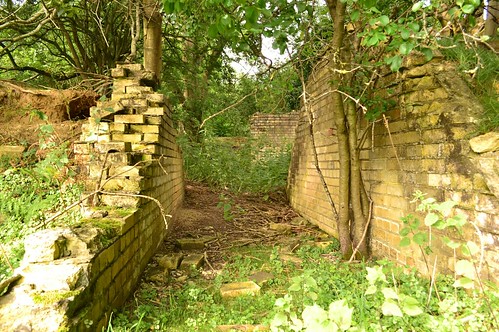
The bombs stores blast walls are still intact – just.

Today most traces of the airfield as it was are gone. A number of buildings notably a T2 hangar and several Nissen huts survive on what is now farmland or in the military camp. The unique Watch Tower was demolished after the war as were many of the other ‘temporary’ buildings. Now used by STANTA, a mix of old and new are intertwined with the majority standing on inaccessible military ground. Parts of the perimeter track and hardstands do exist, many overgrown or broken up by the weather and weed growth.

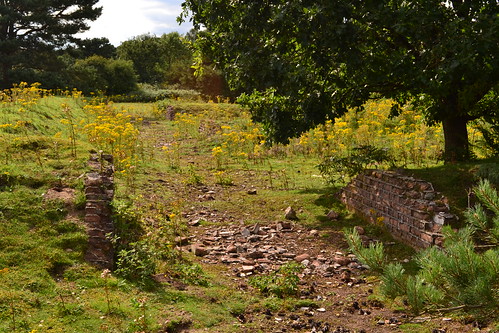
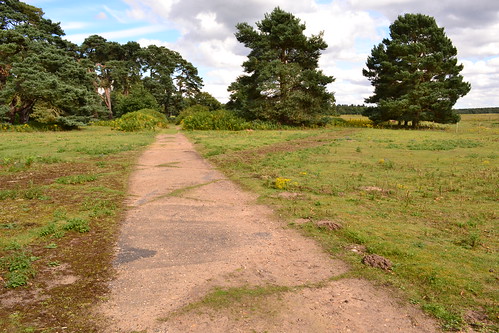
Perhaps the best and by far most accessible examples of East Wretham’s past, is the bomb site which forms part of the East Wretham Heath Nature Heritage Trail. Access is to the south of the site just off the main A1075, Thetford Road. A two-mile walk through Heath land, it takes you right through the original bomb store. An area of natural beauty, famed for its wetland and ancient flints, you can easily find the many blast walls and small fusing buildings still there. Also traceable are the tracks that once took bomb loaded trailers to the airfield across the heath. Many now buried under the acidic soil, their existence evident in exposed patches of bare concrete.

Bomb Store

The decay is evident throughout the bomb store.

All these stores are being gradually reclaimed by nature, trees and rabbit holes have both taken their toll, the layout is still discernible and whilst much of the brickwork is ‘intact’, the warning signs are there and the wartime structures are crumbling fast.

A small airfield, East Wretham was never considered the most ‘homely’ of sites. Often wet and boggy, it was one of the less well-known and less famous places to be used. But the courage and determination of those who served here both RAF and USAAF, went a long way to helping defeat the tyranny that stood facing us across the small section of water not so far away.

Sources and further reading: (East Wretham)

For more detailed information on the Free Czechoslovak Air Force see their superb website.

No.311 ORB – AIR 27/1687/7

*1 IWM –  FRE 6117

*2 IWM – UPL 31469

*3 IWM – UPL 22685

Norfolk Wildlife Trust website.

RAF East Wretham – Home to the Czechs of Bomber Command (P1)

Hidden in the depths of Thetford Forest not far from the two major US Air bases at Mildenhall and Lakenheath, is a former airfield that has received a new lease of life as an Army training facility. Once home to Bomber Command’s only Czechoslovakian Squadron, it was also home to Canadians and other Commonwealth nationals. After their final departure, it became the home of an American Fighter unit meaning its history is both diverse and multinational.

In Trail 13, we stop off at the former Station 133, more widely known as RAF East Wretham.

RAF East Wretham (Station 133)

Originally built in the early part of the Second World War and opened in March 1940, East Wretham was primarily designed as a satellite airfield for nearby RAF Honington.  Being a satellite the airfield’s facilities would be basic, accommodation rudimentary and technical facilities limited. It would however, be developed as the war progressed and as its use increased. The main runway for example, (running north-east to south-west) was initially grass but with the arrival of the USAAF it would be covered with Pierced Steel Planking (PSP), designed to strengthen the surfaces and thus prevent aircraft digging into the soil.

East Wretham would also have a range of hangars. In addition to the standard two ‘T2’ hangars, it would have a canvas Bessoneau hangar, (more generally linked to the First World and inter-war years),  and an additional four Blister hangars (9392/42) all believed to be double ‘extra over’ blister hangars each 69 ft wide in the singular design.

The watch office at East Wretham was another unusual design. Built to drawing 15498/40, it was originally a single storey room built on concrete pillars with a flat roof. It was then modified later on in the war to include an overhanging observation room, with the extension being mounted on metal pillars. This new extension had considerably more glazing than the original structure, and was more in keeping with the building style of other wartime airfields. These extra windows gave a much better view across the entire airfield, especially useful as the office was unusually located along the perimeter fence well behind the technical area of the airfield!

The Control Tower of the 359th Fighter Group at East Wretham. Caption on reverse: 'Caption on reverse: '359th FG Photos Source: T.P. Smith via Char Baldridge, Historian Description: #13 Control Tower at Station F-133, East Wretham, England.'

The unusual design of the Watch Office can clearly be seen in this photograph*1. (IWM)

Originally there were only 27 ‘frying pan’ style concrete hardstands, each one being located at various points around the perimeter track, all in groups of three or four. These were then added to later on, again using steel planking, to extend the number of dispersal points located on hard surfaces; a further indication to the problems with the boggy soil found in this part of East Anglia.

Accommodation for the initial 1,700 personnel, was dispersed over twelve sites around the north of the airfield, and across the road from the main airfield site. One of these sites (Site 2) was the nearby Wretham Hall, a grand building built in 1912, it was utilised by Officers of the USAAF for their own personal accommodation. Sadly, the grand three storey building was demolished in the early 1950s, possibly as a result of its wartime use.

A bomb storage site was also built on the airfield. Located on the south side of the site, it was well away from any accommodation or technical buildings. It was also well away from the three large fuel stores,  which boasted storage capacities of: 24,000, 40,000 and 90,000 gallons.

The initial use of East Wretham was as a dispersal for aircraft based at Honington, the first of which was a newly formed Czechoslovakian Squadron, No. 311 (Czech) Sqn, on 29th July 1940. So new were they that they didn’t receive their Wellington ICs until the August. This was to be a unique squadron in that it was the only Czech squadron to fly with Bomber Command, and whilst the main body of the squadron was located at Honington, the operational flight (A Flight) moved to East Wretham shortly after its  formation. In mid September a decision was made to move the entire squadron across to East Wretham posting a detachment to RAF Stradishall, where they stayed until April 1942.

On September 10th 1940, 311 Sqn, now with a small number of operational crews, took part in their first mission, a true baptism of fire flying directly into the German heartland and Berlin. For one of the crews and their Wellington, this would not go well, the aircraft believed forced down in the vicinity of a railway line near Leidschendam in Zuid-Holland, with all but one of the six airmen on-board being captured.

The only crew member not to be caught was Sgt. Karl Kunka, who managed to evade capture for a short period, only to shoot himself with the aircraft’s Very Pistol. It was thought that he carried out this action to not only avoid capture but any possible retaliation against his family back home in Czechoslovakia. Whilst Sgt. Kunka’s wounds were not initially fatal, they were so severe that he later died, failing to respond to treatment whilst in hospital.

The aircraft, Wellington MK.Ia, #L7788, ‘KX-E’, was also captured, repainted in Luftwaffe colours and flown for testing and evaluation to Rechlin, the Luftwaffe’s main aircraft test facility north of Berlin.

RAF East Wretham 3

East Wretham still uses the Nissen huts and smaller buildings today.

During December 1941, a further Czech unit, No.1429 Czech Operational Training Flight (COTF) was formed along side 311 Sqn, under the command of Sqn/Ldr. Josef Šejbl. This unit was designed specifically to train Czechoslovakian aircrews for Bomber Command, with instructors for the flight, being taken from 311 Sqn following completion of their tour of operations.

As aircrew completed their training, they were transferred to the operational flight, a steady but slow build up meant that numbers were quite low, the squadron being  considerably reduced by heavy casualties in the early stages of the war. As with other Bomber Command squadrons, 311 Sqn carried out night bombing missions, many penetrating Germany itself.

1941 would see more missions to Germany, starting with the first three nights January 1st – 3rd, when Bomber Command aircraft hit Bremen, with 311 Sqn taking part on the night of the 2nd. On this night, three aircraft from 311 Sqn would join the Hampdens and Whitleys of Bomber Command in attacking a major railway junction in the centre of the city, where fires and explosions were seen as far away as 20 miles. A relatively successful operation, it would not be long before the first casualties of 311 Sqn would occur.

On the night of January 16th – 17th Wellington IC #T2519 ‘EX-Y’ was lost on a mission to Wilhelmshaven, the aircraft going down after suffering ‘technical’ problems. Last heard from  at 22:21, the aircraft disappeared without trace along with the entire crew, none of whom were ever heard from again.

1941 would end as it started, with a return trip to Wilhelmshaven, in which good results were recorded. One aircraft was lost on this mission, Wellington #T2553 ‘EX-B’, the pilot, Sgt. Alois Siska ditching the aircraft after it had sustained serious flak damage over the target area. As the aircraft sunk, it took the life of the rear gunner Sgt. Rudolf Skalicky, the other’s climbing into the aircraft’s dingy, a small craft in which they remained for several days.

As the dingy drifted towered the Dutch coast, the icy conditions would take two more lives, that of Sgt. Josef Tomanek (Co/P) and F/O. Josef Mohr (Nav.), whilst the pilot, Sgt. Siska, suffered badly from frost bite and gangrene. The remaining crewmen, F/O. Josef Scerba (W/O), Sgt. Pavel Svoboda (air gunner) along with Sgt. Siska, were picked up by German forces and  interned as POWs, mainly staying in hospitals for treatment for cold related injuries. Sgt. Svoboda went on to escape captivity no less than three times, evading capture until after the war whereupon he returned to England.

By mid 1942, 311 Sqn were assigned a new posting and a new airfield, but before departing in their final month, April 1942, they  would be visited by two particularly significant dignitaries. On April 3rd, Air Vice Marshal J. Baldwin, Air Officer Commanding No. 3 Group, RAF Bomber Command, visited to award the DFC  to P/O. Karel Becvar for his services as a navigator with 311 Sqn. Then on the 18th April, the President of the Czechoslovak Republic, Dr. Edward Benes, arrived along with several other dignitaries to inspect the Squadron, and give a speech regarding the work carried out by the crews here at East Wretham.

Tarck to Bomb Store

A number of tracks remain on the site.

During their last month, 311 Sqn would fly twelve more operations before finally departing Norfolk for Northern Ireland and Aldergrove. Whilst here at East Wretham, they would fly 1,011 sorties which included both attacks on industrial targets and propaganda leaflet drops. On the 30th, the main air body along with the rear party departed the site, the bulk of the squadron moving two days earlier. After their departure, 311 Sqn would not return to East Wretham.

In November 1942, after a long quiet break, East Wretham would spring into life once more with the arrival of another bomber squadron, No. 115 Sqn (RAF) from Mildenhall now flying  Wellington MK.IIIs.

Over the winter of 1942-43, 115 Sqn would lose ten aircraft, most to missions over Germany but two whilst ‘Gardening’, the last occurring on the night of New Years Eve 1942.

During the early months of 1943 six more Wellingtons would be lost from 115 Sqn, KO-D, KO-X, KO-C, KO-N, KO-T and KO-Q, the new year had not brought new fortunes.

By now the limits of the Wellington had been realised and its days as a front line bomber were numbered. A poor performer in the bombing theatre, it would be gradually moved to other duties, being replaced by the superior four-engined heavies; 115 Sqn was no exception. The MK.II Lancaster, powered by four Bristol Hercules engines, was less common than the Merlin powered MK.I and MK.III, but none the less was far superior to the Wellington in both performance and bomb carrying capacity.

The first Lancaster arrived in the March of 1943, and as it did the Wellingtons began to depart. To help train crews on the new aircraft, a detachment from 1657 Heavy Conversion Unit (HCU) would be re-designated 1678 (Heavy Conversion) Flight (HCF) and was based here at East Wretham.

Flying the radial engined Lancaster MK.IIs under the code ‘SW’, they were one of only two HCFs to be established in Bomber Command, both in May of that year. Specifically set up to convert crews from the Wellington to the Lancaster, they were a short-lived unit, becoming a Heavy Conversion Unit once more on September 16th 1943, after moving to RAF Foulsham. During this time the flight would operate only eight aircraft in total, losing none whilst at East Wretham.

Even with the new aircraft though, flying over Germany was not without its problems for 115 Sqn. The first aircraft to be lost, and the first of its type in Bomber Command, Lancaster MK.II #DS625 ‘KO-W’ was lost without trace in a raid to Berlin on the night of March 29th/30th. The Pilot Sgt. H. Ross, (RCAF) and his crew all being commemorated on the Runnymede memorial. The aircraft being new, it had only flown 26 hours since its arrival at East Wretham earlier that year on March 9th.

rear-turret-of-Lanc-lost-595x478

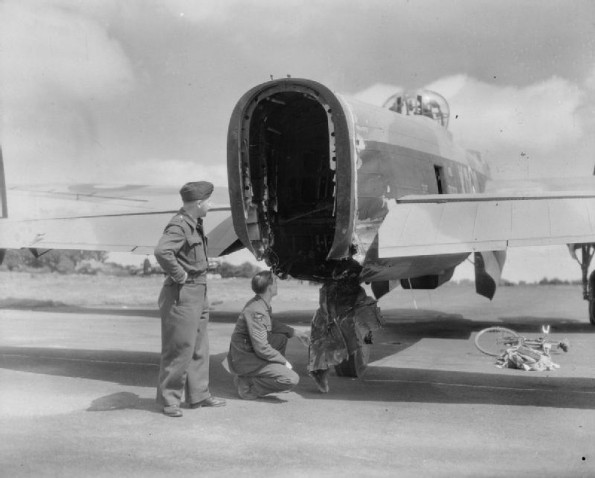
Avro Lancaster B Mk II, DS669 ‘KO-L’, of No. 115 Squadron, was hit by bombs from an aircraft flying above. during a raid on Cologne on the night of 28th/29th June 1943. The tail gun and gunner were both lost. (Author unknown)

With more missions into Germany, 115 Squadron’s Lancasters  would continue to serve well, perhaps one of the worst nights occurring just days before their eventual departure to RAF Little Snoring in early August 1943.

On the night of 2nd/3rd a mission was planned for Hamburg in which 740 aircraft were allocated. Of these, 329 were Lancasters, by far the largest contingency of the raid. Whilst over Germany, the formation entered a severe thunderstorm, and with many aircraft suffering from icing, they were forced to either turn back, or find other targets. The poor weather, including lightning, accounted for several of the losses that night including one of three lost from 115 Sqn.

Lancaster #DS673 was shot down by a night fighter, #DS685 was lost without trace and #DS715 was struck by lightning causing it to crash not far from the target. From the three that went down that night, there were no survivors from the twenty-one crewmen on board. 115’s time at East Wretham would close on a very sour note indeed.

With the departure of 115 Sqn in August, East Wretham would then pass from RAF ownership into the hands of the US Eighth Air Force, to become Station 133, the home of the three squadrons of the 359th Fighter Group – ‘The Unicorns’

Major George Preddy – 352nd FG – A tragic loss.

In Trail 8, we heard about a number of heroic tales and tragic losses. One of those, was that of one of the highest scoring P-51 pilots, Major George Preddy of the 487th Fighter Squadron (FS), 352nd Fighter Group (FG), based at RAF Bodney (Station 141)

George E. Preddy Jnr (0-430846), from Greensboro, North Carolina, was born on 5th February 1919, and graduated from Greensboro High School at the age of sixteen. Preddy became interested in flying whilst in college and made his first solo flight in 1938 at 19 years of age.

Major George E

Major George E “Rasty” Preddy Jr in the cockpit of his P-51 Mustang (HO-P), #44-13321 nicknamed “Cripes A’ Mighty 3rd.” (IWM FRE 6368)

His road to war would take time and effort. His introduction to flying was as a barnstormer which led him to attempting entry into the US Navy no less than three times, each time being rejected on account of his small stature and curved spine. With each rejection came more determination, his love of flying taking him back to Barnstorming, whilst he undertook bodybuilding and stretching exercises to straighten his back. Eventually, in the summer of 1940, he applied to the USAAF and to his delight he passed all the relevant examinations. However, as the US was not yet at war, Preddy’s entrance would take yet more time and so to gain experience and better prepare himself, he joined the Army National Guard, being posted to the 252nd Coast Artillery, which went on to protect the important oil refineries on the islands of Aruba and Curaçao, in the southern Caribbean Sea.

The following year in In April 1941,  Preddy received his orders to report for flying training, from which he graduated on December 12th that same year. December 1941 saw the Japanese attack on Pearl Harbour, an attack that led to the US joining the Second World War, and an attack that led to Preddy, commissioned as a Second Lieutenant, being posted to Australia to the 9th Pursuit Squadron (PS), 49th Pursuit Group (PG) in the defence of northern Australia.

Whilst here, Preddy would fly Curtiss P-40s, he named his first plane, ‘Tarheel‘,
as a tribute to his home state. During his time here, he damaged both a Japanese fighter and a bomber in combat operations. Sadly though, in the summer of 1942, he was involved with a collision with another P-40, an accident that would kill Preddy’s friend and colleague, and leave Preddy seriously ill in hospital for another six months or so.

In the October of 1942, Preddy returned to the US, it was here that he would cross paths once again with Lt. Jack Donalson, a pilot who was also a veteran of the early Pacific theatre, and who was with him on that tragic day in July 1942. The two met at Trumbull Field, Connecticut, on January 15th 1943, where the newly formed 352nd FG were training and forming up. The 352nd would be made up of three squadrons (328th, 486th and 487th), Preddy would initially be assigned to the 487th FS.

The 352nd would continue training, their new P-47 Thunderbolts arriving three days later. With the P-47 being new, there were many accidents and losses, primarily due to a carburetor hose clamp becoming loose. Luckily Preddy avoided all such incidents and by May 1943, he and the 352nd were ready for action.

On the 7th July the 352nd arrived at RAF Bodney (newly named Station 141) a small grassed airfield not far from RAF Watton in Norfolk. With small incursions into enemy territory the first few months were generally event free. Preddy would get his first kill later that year on December 1st 1943, while flying P-47D-5-RE Thunderbolt (HO-P) #42-8500 “Cripes A’Mighty“, a name he gave to all his aircraft, so-called because it was his favourite expression. Whilst escorting bombers back from a mission over occupied Europe, Preddy noticed a formation of German fighters who were focusing their attention on stragglers, easy pickings for the experienced and deadly Bf-109s. Preddy and his squadron dived down, bouncing the Germans, causing his first victim to explode in a flurry of cannon fire.

Preddy’s first year would end with two confirmed kills, a tally that would only grow as time went on. In his second kill, he would sadly lose his wing man, Lt. Richard Grow, but for his action he would receive the Silver Star, one of many achievements Preddy would gain.

On January 29th 1944, Preddy would come close to death for a second time, when after dispatching an FW-190, he was hit by Flak and had to ditch in the sea. After spending a short time in the water he was picked up by an RAF Air Sea Rescue Walrus and returned to Bodney.

Over March and April, the new P-51 Mustangs began to arrive at Bodney, an aircraft that would lead to Preddy achieving ‘Ace’ status. On May 13th, the 487th dived down on around thirty Bf-109s, Preddy accounted for two taking his tally over the magical ‘Five’ Kills and ‘Ace’ status.

During the summer of 1944 Preddy would achieve many more ‘kills’, by now he was well on his way to becoming the leading ace in the European skies. In March he was made Operations Manager of the 487th, and promoted to Captain.

By mid July Preddy has reached 14.5 kills, all a mix of single and twin-engined aircraft, and by the end of the month, this has risen to 21.83 kills, taking him to the top spot and leading ‘Ace’ of the 352nd.

Following an escort mission on the 5th, a further mission, in which Preddy was ordered to lead on the 6th, was scrubbed due to bad weather. With the day free to themselves, the officers mess became the focus of attention and the drinks ran freely

By the time Preddy had got to bed, he was well and truly drunk, and as with many operations of the war, the weather cleared and the operation was on once more, Preddy was woken after only an hours sleep and struggled to get to the briefing. Still reeling under the influence, he took off and lead the group into battle. Worse for wear, he emptied his stomach in the cockpit and headed toward the enemy.

As the bomber and their escorts approached Hamburg, Preddy led the attack on the Luftwaffe fighters.  In the airspace between 30,000 ft and 5,000 ft, Preddy managed to shoot down six Bf-109s, with numerous hits around canopies, wing roots and fuselages. On return he was greeted like a hero, the ground crews and squadron pilots crowding his aircraft. Preddy gave a simple reply to the eager crowd, vowing “Never again” would he fly with a hangover.  Following this mission Preddy was awarded the DSC and sent home to the US for a well-earned rest on a 30 day leave.

Major George Preddy, during his return to the United States between August & October 1944. Taken at a Press Conference in the Pentagon Building.’ (IWM FRE 346)

On his return in October, Preddy was again promoted, this time to Major, whereupon he commenced his second operational tour. His involvement with the 487th would not last long though, as with his promotion came new responsibilities and the command of the 328th FS, taking over from Lt. Col. John Edwards.

The hard winter of 1944-45 tore into the souls of the ground and air forces across Europe. Severe frosts, snow and cold made Bodney a difficult place to be. But the war continued and in the forests of the Ardennes, German forces were gathering. With few flights being carried out due to thick fog and freezing conditions, the German armoured brigades under the control of Field Marshal Gerd von Rundstedt, made a daring breakthrough (Operation Bodenplatte) in what became know as the ‘Battle of the Bulge’. Ground forces made continued calls for air support, but with increasingly bad weather, few flights were able to make it.

The order then came through and on the 22nd December 1944, the 352nd were to move to Belgium and Asch (Y-29) a small grassed airfield near to Genk in the province of Limburg. The 352nd crammed all the cold weather clothing they could into their aircraft and set off. By the end of the day the Group had settled in the cold of Belgium, it was a far cry from the relative warmth of Bodney.

Preddy’s time in Belgium would be short-lived however. As the weather cleared more missions were undertaken. On Christmas Day, the 328th would have one of its finest battles, shooting down eleven enemy aircraft, but it was a victory that would be eclipsed by the loss of perhaps its greatest leader and airman.

On that day there were two missions ordered, Preddy would lead the second of the two, an escort mission into Germany and Koblenz. On the return trip, Preddy was vectored to Liege, and warned of ‘heavy flak’.  Arriving south of the city, Preddy, along with his wingman Lt. Gordon Cartee, and another pilot Lt. James Bouchier of the 479 th FG, spotted an FW-190 and gave chase at tree-top level.

On entering the area, ground forces opened fire, the Anti-Aircraft battery were American, and all three allied aircraft were hit. Lt. Bouchier managed to climb high enough to bail out, landing safely in the British sector, Lt. Cartee, also having been hit, also managed to escape and get home, but not until after he saw Preddy’s P-51, turn and dive into the ground. Major George Preddy died in the crash.

Preddy’s death was devastating for both the group at both Asch and those back home at Bodney. Festivities were subdued to say the least. Preddy’s dashing good looks and character were well-known, his relationship with his own ground crews were one of the best, he always took time out for them and praised their efforts in keeping him flying. At 25 years of age, Major George Preddy was not a born killer, just a young man who loved to fly, and to fly well.

George Preddy had flown 143 combat missions, he had has been credited with shooting down 26.83 enemy aircraft, the highest in the 352nd FG, and destroying 5 enemy aircraft on the ground. His combined total of 31.83 aircraft was just 6 short of the Group’s highest, a total that most certainly isn’t conclusive.

His commanding officer Lt. Col. John C. Meyer, who held the Group’s record and  was the fourth ranking American Air Ace, described Preddy as “the complete fighter pilot”.  A man so brave and dedicated that he would be awarded, amongst others: the Distinguished Service Cross; Silver Star (1 Oak Leaf Cluster); Distinguished Flying Cross (6 Oak Leaf Clusters); Air Medal (6 Oak Leaf Clusters); Croix de Guerre, and the Purple Heart.

In 1968 the city of Greensboro dedicated Preddy Boulevard in honour for both George and his brother. The Preddy Memorial Foundation also created a petition to have Fayetteville’s Pope Air Force Base renamed Pope-Preddy Air Force Base.
George Preddy’s career may have been short, but his influence went far and wide especially amongst those who knew of him.

Major George Preddy is buried in the Lorraine American Cemetery, just outside Saint-Avold,  Moselle, France, alongside his brother, another fighter pilot, in Plot A, Row 21, Grave 43.

Sources and further reading.

RAF Bodney appears in Trail 8.

North Carolina Museum of History website Accessed 23/8/18

Freeman, R.A., “The Mighty Eighth“, Arms and Armour, 1986

The Preddy Memorial Foundation website Accesses 20/8/18
Amongst the Rabbit holes and bracken stand the bomb stores of yesteryear.

Trail 13 continued around the western edges of Norfolk, near to Thetford Forest and the heaths of Breckland. Here, not from Thetford, is an airfield left over from the latter parts of the war. Seeing both RAF and USAAF personnel, it was often boggy and wet, but that didn’t deter those brave young men who fought for freedom.

Now an Army training camp, what’s left is being attacked by another enemy. We return to Southern Norfolk to complete an earlier Trail.

RAF East Wretham (Station 133)

Originally built-in the early part of the Second World War and opened in March 1940, East Wretham was designed as a satellite to RAF Honington with an all grass runway running NE/SW, 2 x T2 hangars, various defence pillboxes, support buildings and a number of blister hangars. At Honington, a newly formed 311 (Czech) Sqn was formed (29th July 1940) flying Wellington ICs, and they utilised East Wretham as a dispersal until August that year, when they permanently moved in. 311 Sqn carried out night bombing duties for the duration of the time they were here, but then in 1942, Wretham’s status changed once more. 311 sqn moved out and East Wretham became a satellite for Mildenhall taking in 115 Sqn on the 8th November, with their Wellington IIIs. The following March (1943) these were replaced with the rarer Lancaster MkIIs and these remained here in the night bomber role, until a further change in August 1943 when 115 sqn moved to Little Snoring and the site passed to American hands to become Station 133.

rear-turret-of-Lanc-lost-595x478

Avro Lancaster B Mk II, DS669 ‘KO-L’, of No. 115 Squadron, was hit by bombs from an aircraft flying above. durinhttps://aviationtrails.wordpress.com/wp-admin/post.php?post=1422&action=editg a raid on Cologne on the night of 28/29 June 1943. The tail gun and gunner were both lost. (Author unknown)

Now home to the 359th Fighter Group,  it hosted the big heavy P-47 Thunderbolts of the 368th (code CV), 369th (IV) and 370th (CR latterly CS) Fighter Squadrons and so had to have steel matting runways laid to accommodate their heavy weight on the soft ground. Used primarily for bomber escort, the 359th FG would fly escort to targets in nearby France. However, in April 1944 the P-47s  were replaced with the more agile P-51s which allowed them to penetrate deep into the heart of both Germany and Poland. A task the ‘Mustang’ became famous for. During the Allied invasion of Normandy the 359th attacked bridges, locomotives and supported bombers hitting targets around the invasion area. As the invasion force got a foothold in France, the three squadrons of the 359th returned to long-range bomber escort duties, taking part in raids over Ludwigshafen, Frankfurt, Berlin and Merseburg. During August 1944, the group supported the operations in ‘Market Garden‘ and later that year the Battle of the Bulge in the Ardennes.

Wetmore

Maj. R. Wetmore, of the 370th FS, in front of P-51B (42-106894) ‘CS-P’. on the shoulders of his ground crew*1.

On 11th September 1944, the Green nosed Mustangs of the 359th really made their mark when they shot down 26 enemy fighters; for this, they received the Distinguished Unit Citation (DUC). The determination shown by the 359th resulted in many outstanding pilots. One, Maj. Raymond “X-Ray Eyes” Wetmore became the 359th (370th FS) top ace scoring 21 victories – his last being an Me 163. Flying in P-51 “Daddies Girl” named after his daughter, he received numerous awards and by the end of the conflict had completed 142 missions covering 563 combat hours.

Aug 2015 002

The old part remains cordoned off.

This attitude to the war, gave the 359th a worthy credit of 263 aircraft shot down with over 100 more being destroyed on the ground. In the 346 missions they flew, they lost a total of 106 of their own aircraft.

In November 1945 the USAAF left and no further flying took place at East Wretham . The airfield reverted to 12 Group (RAF) ownership, then in May the following year, it was handed back once more to Bomber Command . Within a month the site was handed over to the Technical Training Command and finally East Wretham became a Polish resettlement camp for those personnel who were unable to return home. When they had all finally be moved on, the majority of the site became what it is today, used by the British Army as part of the massive Stanford Practical Training Area (STANTA ) for manoeuvres and live firing training.

Aug 2015 015

The bombs stores blast walls are still intact – just.

Today most traces of the airfield as it was are gone. A number of buildings notably a T2 hangar and several Nissen huts survive on what is now farmland or in the military camp. The unique Watch Tower was demolished after the war as were many of the other ‘temporary’ buildings. Now used by STANTA, a mix of old and new are intertwined and the majority stands on inaccessible military ground.

Perhaps the best and by far most accessible examples of East Wretham’s past, is the bomb site which forms part of the East Wretham Heath Nature Heritage Trail. Access is to the south of the site just off the main A1075, Thetford Road. A two-mile walk though Heath land, it takes you right through the original bomb store. An area of natural beauty, famed for its wetland and ancient flints, you can easily find the many blast walls and small fusing buildings still there. Also traceable are the tracks that once took bomb loaded trailers to the airfield across the heath. Many now buried under the acidic soil, their existence evident in exposed patches of bare concrete.

Aug 2015 020

The decay is evident throughout the bomb store.

All these stores are being gradually reclaimed by nature, trees and rabbit holes have both played taken their toll, the layout is still discernible and whilst much of the brickwork is intact, the warning signs are there and they are crumbling fast.

A small airfield, East Wretham was never considered the most ‘homely’ of sites. Often wet and boggy, it was one of the less well-known and less famous places to be used. But the courage and determination of those who served here both RAF and USAAF, went a long way to helping defeat the tyranny that stood facing us across the small section of water not so far away.

To see the other sites on this Trail, Old Buckenham and Tibbenham, go to Trail 13.

Sources and further reading:

*1 Photo: 359th Fighter Group Association, accessed at http://www.littlefriends.co.uk/