Trail 32 RAF Nuthampstead – The end of an Era – Part 4

After Part 3 of our journey, we see the US bomber airfield at Nuthampstead finally come to a close. But as the war approaches its conclusion, operations continue to be flown and losses continue to mount.

The US forces would go to Dresden the morning after the RAF had been. 431  B-17s of the entire 1st Bombardment Division, would prepare for take off at 07:00 hrs to be over Dresden at mid-day. With two other Divisions also in the air that day, escort would be from 784 Mustangs, with the 20th FG protecting the leaders the 1st Bombardment Wing, the 398th BG, followed by the 91st and 381st Bomb Groups respectively. In all, in excess of 2,000 American aircraft would fly into the heart of Germany that day.

It was to go disastrously wrong for the Group though, for even as they flew over Holland, they were already off course and now the weather was moving in. With their Gee system being constantly interfered with and throwing up faults, the lead plane of the 389th decided to take the more southerly route to fly around the cloud, taking the formation near to Munster, a city heavily guarded by flak. Although objecting to the move, both the 381st and the 91st followed – a move they would come to regret. The 91st were hit hard; many aircraft were damaged and their crewmen badly injured. Then, another defensive turn took the Wing, some 137 aircraft, a total of fifty miles of course. They were now heading to Schweinfurt, the scene of such devastation in August 1943 where high loses resulted the US temporarily ceasing air operations as a result. Not wanting to relive the experience, the formation then turned south again, taking them, and their escorts, even further off course.

By now, the leader’s Gee system had completely failed, and as the formation approached the target, the deputy’s system also ceased working. Lost and confused, they were gifted with a break in the cloud through which they could see an ancient city with a river running through it. The order was given and bombs were dropped. With little to no flak and no enemy fighters to resist them, the formation unleashed its devastating load onto those below. Unfortunately, it was not Dresden at all, but the Czech capital Prague, they were some eighty miles off course.*5

The 398th flew their final operation on April 25th 1945, a flight that took them to the Skoda Armament Works at Pilsen. The 398th were joined that day by the 91st, 92nd, 303rd, 305th, 379th, 384th, and the 381st Bomb Groups. With simultaneous operations happening elsewhere at Munich and the Me 262 airfield in Prague, 198 aircraft were flew to Pilsen to bomb the Skoda works.

In contrast to their first mission, take off was controlled and in good order. The first aircraft was airborne at 05:20 and the last 35 minutes later. Forming up took place over Debden Buncher (RAF Debden) at 5,000 feet and the Buncher was left at 06:40, when the entire formation headed for the coast. at 07:37, they crossed the French shoreline.*10

The 398th BG were tasked with leading the 1st Combat Bombardment Wing, totalling three Bomb Groups made up of 120 B-17s. In charge was Captain Michael Robinson, Commanding Offcier of the 601st BS. The weather was predicted to be good, so a visual bomb run was planned, however, over the target, this proved not to be the case and 10/10 cloud completely obscured the target. Forced to go round again, the formation made a 360o turn bringing them back in at the rear of the formation. By now flak had become both intense and accurate.

Two aircraft from the 602nd in the high squadron were hit. The first B-17G #42-97266 (K8-G, “Godfathers Inc.“) piloted by 2nd Lt. Allan Ferguson, quickly left the formation spiralling out of control. Three of those on board managed to escape the aircraft as it fell earthward. Of the crew, six were killed whilst two were captured becoming prisoners of war for the last remaining days of action*6*7

The second aircraft that day was that of Lt. Paul Coville, B-17G #43-38652 (K8-V, “Stinker Jr“). After the second bomb run, the aircraft was hit behind the #3 engine, leaving a large hole and a damaged engine. After falling out of formation and feathering the engine, Lt. Coville brought the aircraft back, at which point the engine caught fire. A small explosion then ripped the right wing off outboard of the engine, sending the aircraft spiralling towards the ground. The crew inside, frantically tried to get out, assisting each other with parachutes. All crewmen except the ball turret gunner S. Sgt. Charles Walker, manged to escape the aircraft, managing to find allied troops on the ground and safety.

During their search for safety both Coville and the waist gunner S. Sgt. Harry Overbough, took two prisoners each, Overbough’s ending up being revealed as escaped Jewish prisoners who had donned German army uniforms to help them escape. *7*8

After bombs away, the formation made a right turn and headed as briefed toward home, crossing the English coast at 14:26. The first aircraft touched down at Nuthampstead at 15:02.*10

With the last mission flown, Nuthampstead’s days were now numbered. A handful of ‘Revival’ flights were made transferring POWs from Barth in Germany to airfield A-10 in France. In addition, flights carrying ground crews over Germany also took place. By May 1945 though, the war was over and the exodus of American forces back to the united States began. Over the period May / June,  1945, the 398th would depart Nuthampstead, the ground force returning to the US  from Greenock onboard the Queen Elizabeth, whilst the air personnel flew back between 21st and 27th May. After thirty days of rest and recuperation, the Group assembled at Drew Field, Florida where many officers and enlisted men were discharged from the service. The remaining handful were given duties elsewhere and transferred almost immediately.

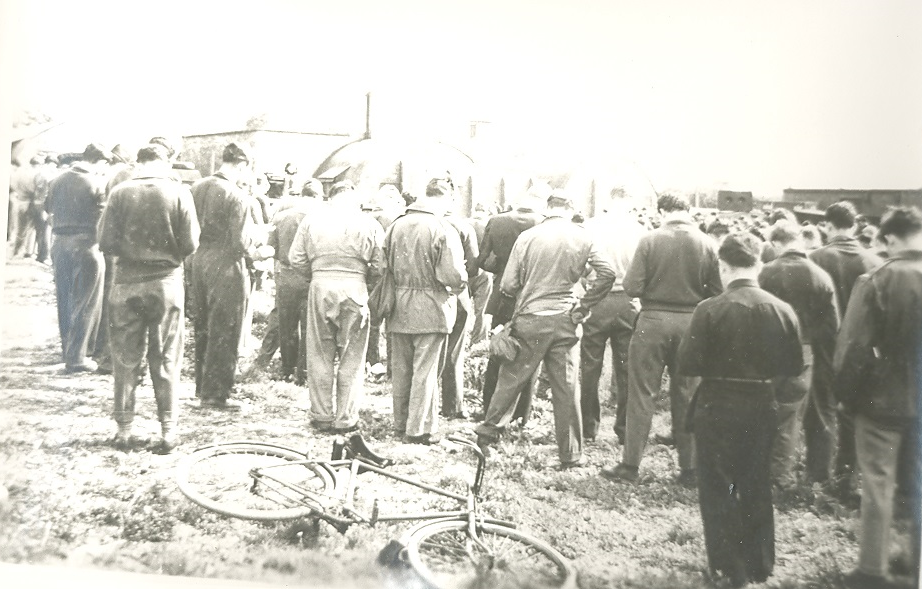
A VE day service held at Nuthampstead airbase. (@IWM UPL 35448)

On September 1st 1945, Major Gene Nelson and Major Dean Ashworth, quietly and without ceremony, inactivated the Group – the 398th would be no more.

By the time the war had come to a close, the 398th had completed 6,419 operational sorties (175 missions) dropping some 15,700 tons of bombs. They lost some seventy*10 aircraft in operations. For their determination and outstanding flying over Derben on April 8th, the Group received a Presidential Unit Citation, this came in addition to 2,124 Air Medals, 531 DFCs, 2 Silver Stars, 18 Bronze Stars and 4 Purple Hearts (with others being awarded elsewhere). Whilst their losses were perhaps hugely significant compared to other Groups, they nonetheless performed gallantly and with dedication deserving of any military group.

Returned to RAF ownership a month later the airfield became a store and maintenance station storing ordnance for disposal, and by 1954 the military had no further interest in it, and it closed some 5 years later.

During the 1960s Nuthampstead was in the limelight once more when it was considered as a site for London’s third airport after Heathrow and Gatwick. Being so close to the capital made it an ideal proposition, but the proposal faced huge opposition from those living and working in the area. The decision would eventually favour Stansted, a site not even shortlisted in the initial phase.

The Roskill Commission Inquiry (1968-70), identified seventy-eight initial sites, reducing it to four possibles: Nuthampstead, Thurleigh (Bedford), Cublington (Bucks) and Foulness on the Essex coast, ignoring Stansted on grounds of air traffic, noise and poor road access.

After great debate, Cublington was finally chosen, however, following in-house arguments and disagreements, this was later overturned in favour of Foulness (Maplin Sands),*9 Nuthampstead being rejected on various points including most noise, most agricultural loss and the requirement of a rail link.

With work intending to start in the early 1970s, the plans were eventually shelved due to the 1973 oil crisis and instead a smaller proposal was put forward to build a site at Stansted, itself a former war-time airfield. The build eventually went ahead and today Stansted sees in excess of 15 million passengers, all of which could have been located at Nuthampstead.

With that, Nuthampstead was destined to be become farmland once more. The Forestry Commission planted tress in the former bomb store, itself leading to large quantities of munitions being discovered after the site was abandoned. A small strip was retained for karting and a small crop spraying business utilised part of the airfield. Much of this has now also ceased and whilst parts of the original runway and peri track concrete surfaces still exits, farmland prevails once more over the site.

Built mid war, Nuthampstead had a rather unfortunate start, with many serious problems for the 55th FG and their P-38 Lightnings. The 398th, the Group synonymous with the airfield, were a rookie Group but one that went on to perform 195 operations many over Germany, losing a number of aircraft and crews in the process. They took part in some the the war’s most ferocious battles including Schweinfurt on October 9th, Berlin on several occasions and the US Air Force’s last operation of the war, Pilsen on April 25th 1945.
Transferred back to RAF ownership post war it was  a serious contender for London’s third airport, however, this was not to be and the airfield was largely removed, buildings were demolished and the runways were dug up for hardcore. Little remains of it today, a small private airstrip utilises some of the site, and a thriving museum continues to tell the story of those who served here. A stunning memorial stands outside the local pub frequented once by so many personnel who served here, at Nuthampstead, in those days of the 1940s.
The full history of RAF Nuthampstead can be read in Trail 32.

Sources and further information (Nuthampstead)

*1 Investigation of the US National Defense Program, Part 35. US Government Printing Office Available on Google books

*2 Fooy. F., “One of Thousands – A Navigator in the European Air War.” Lulu Publishing, 2015 Via Google Books

*3 Wilson. K. “Blood and Fears – How America’s Bomber Boys and Girls in England Won their War“. Weidenfeld & Nicholson, 2016 page 390

*4 American Air Museum Website accessed 11/2/24

*5 Taylor, F., “Dresden – Tuesday 13th February 1945“, Bloomsbury, 2004

*6 MACR 14224.

*7  “Hell from Heaven – Ch 35 – Mission 31 – Pilsen, Czechoslovakia,  Our Last Combat Mission – April 25, 1945” published by Leonard Streitfeld, Bombardier, 600th Squadron on the 398th BG Memorial Association Website.

*8 MACR 14220

*9 Banister, D., “Transport Planning In the UK, USA and Europe”  Taylor & Francis, 2003

*10 United States Army Air Forces, “The History of the 398th Bombardment Group (H)” (1945) World War Regimental Histories Book 124.

Missing Air Crew Reports 12214 and 12215

Ethell. J., & Price. A., “Target Berlin – Mission 250: March 6th 1944“. Janes, 1981

A good many photos, official records and personal stories are available on the 398th BG Memorial website. A great resource for those wanting to read more about the history of the 398th BG,

Trail 32 RAF Nuthampstead – The arrival of the 398th – Part 3

In Part 2 of this Trail, we saw how the 55th FG finally departed Nuthampstead having been dogged by mechanical problems. In this part, they are replaced by the 398th BG, a heavy bomber group who brought the B-17 ‘Flying Fortress’ with them. As ‘rookie’ crews though, their start may not have been the start they had wished for.

The new Group was a Heavy Bomber Group, equipped with B-17Gs, and would be the last Fortress Group to join the USAAF. Made up of four squadrons: 600th, 601st, 602nd and 603rd Bomb Squadrons (BS), the first personnel would arrive in Liverpool, on April 21st 1944, sailing on the USS Wakefield from Boston. Once at Nuthampstead, they would begin combat flights in a matter of days, their first mission taking place an May 6th that year.

Their journey to Nuthampstead had been a long one. Being activated on 1st March 1943 with a cadre from the 34th BG at Blythe, California. They trained hard, transferring to Orlando in Florida and then onto Spokane, Washington. In June 143, they transferred once more, this time to Rapid City, South Dakota, each time picking up new staff and crews as they went.

During training in the Autumn of 1943, the monotony of routine was broken when 2nd Lt. Thompson Highfill displayed courage and to assure the safety of his crew. After his B-17 suffered engine failure and complete wing disintegration, he ordered the crew to bale out, holding the aircraft as steady as he could whilst they made their escape. Too low to use his own chute, he made a wheels up landing, for which he was awarded the Distinguished Flying Cross, the first to the unit.

After further moves the unit was eventually war ready, and on March 24th 1944, the advance party began their journey to England. On April 22nd, the ground echelon arrived at Nuthampstead, the same day as the first section of the air echelon.

Having only been activated the year before, the 398th were a novice Group, but that would not prevent them operating against important strategic targets in Germany. These operations would include factories in Berlin, warehouses in Munich, marshalling yards in Saarbrucken, shipping facilities and docks in Kiel, along with oil refineries and aircraft production facilities in Munster. Thus even as a new unit, it would take part in some of the heaviest attacks on German industrial centres.

On May 6th, the 398th went into action for the first time, and like other newbies, it was a disaster. Although these missions were not seen as full missions (flying the full complement of aircraft and crews) they were nevertheless important in the development of the crews, honing their skills and allowing them to begin gelling as a close knit crew.

The morning started badly when breakfast was delayed. The take off as a result was also late with departures being badly timed. Forming up was ‘less than tidy’, with ten of the eighteen aircraft forming up on the wrong formation or in the wrong place. Once over the target, the ‘V’-weapons site at Sottevast, cloud prevented the bombers from seeing the target and so they returned without dropping a single bomb. Their inauguration had been far from successful but looking at it positively, there were no loses and all aircraft returned unharmed.

The rest of May saw the Group fly to Berlin no less than four times, in addition to targets at Kiel, Saarbrucken, Ludwigshafen, Ruhland and Dessau in Germany. They also flew to several targets in both France and Poland meaning there had been no let up for the novice flyers.

During the lead up to D-day, the 398th would attack coastal defences along the Cherbourg peninsula, softening up defences for the invasion forces who were about to land along the Normandy coast. These and other targets in France would dominate the early weeks of June, whilst July saw a return to the homeland and targets deep into Germany once more.

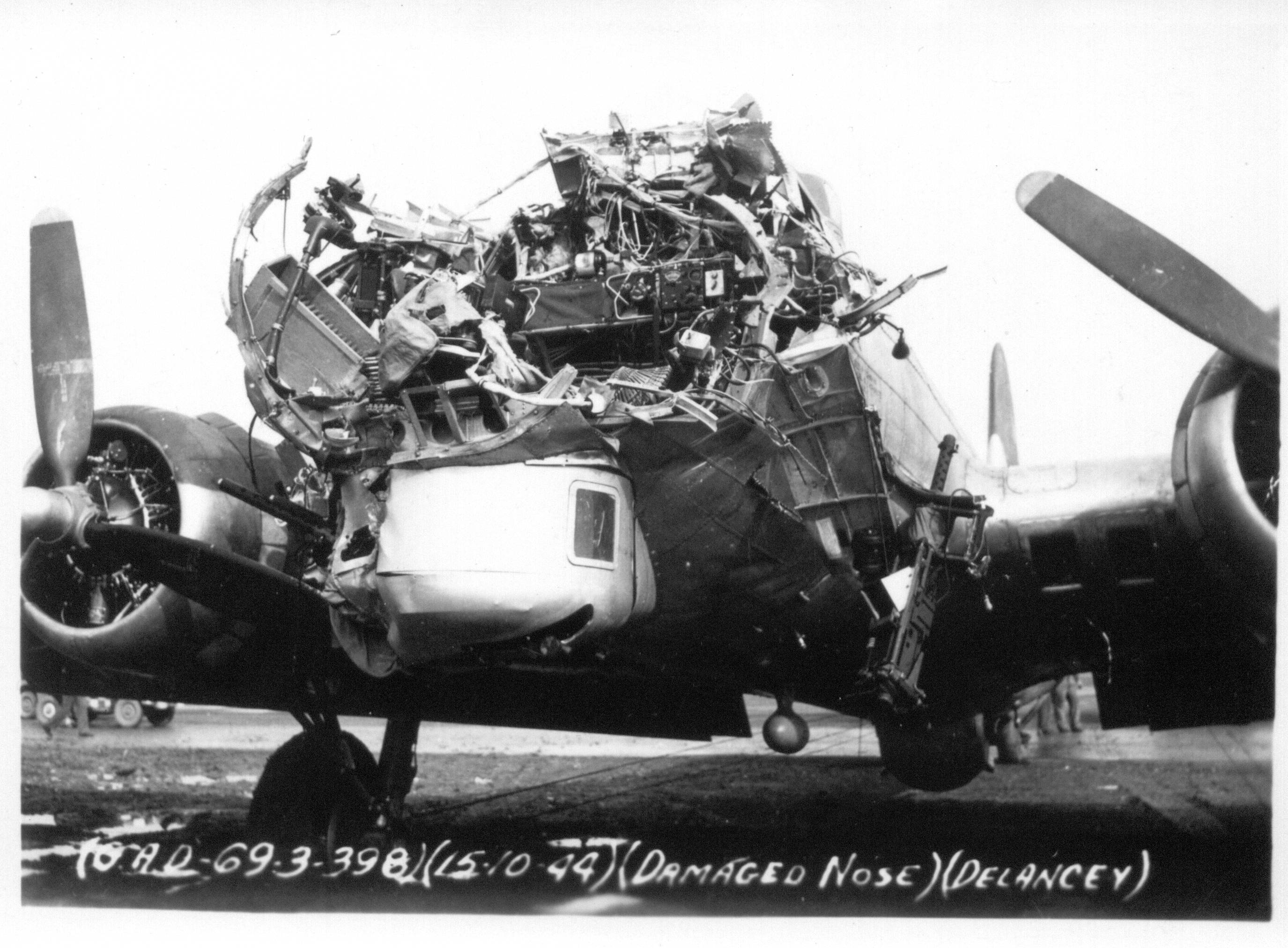
October 15th brought the true realities of war to the Group when a flak shell hit B-17G #43-38172 in the nose exploding inside the aircraft. The Toggler/bombardier,  Sgt George Abbott, was killed outright, and the instruments were all but obliterated. With no oxygen and the nose barely recognisable, the pilot 1st Lt. Lawrence DeLancey, managed to bring the B-17 home thus saving the lives of the other crewmen on board.

B-17G #43-38172 “2 Sad Lovely Julie” hit in the nose by flak, killing the bombardier outright. (@IWM UPL13907)

For his actions, Lawrence De Lancey was awarded the Silver Star, Lt. General Doolittle’s letter citing the “sheer determination and tenacity”  of De Lancey in bringing the aircraft and remaining crew home safely.

Christmas 1944 saw no easing up for the crews. On Christmas Eve, orders came through for every available bomber to be airborne. The winter of 1944-45 being one of the worst saw ground forces take a pounding in the Ardennes by a desperate last attempt at a breakthrough by the German land forces. Taking advantage of the fog and mist that had prevailed, air cover was limited for the allies but as soon as a break occurred, they would return in large numbers. That break occurred momentarily on the 24th.

Over 2,000 bombers of the Eighth Air Force, (which included 500 RAF and number of bombers from the Ninth AF) took to the skies that day, the largest Eighth Air Force operation to assemble over enemy territory in history.

The flyers did not experience mass opposition, in fact it was insufficient to make a difference, and so the operation fulfilled its objective of destroying supply links and disrupting airfield operations. On the way home, the bombers were faced with encroaching haze, many UK airfields becoming closed in and closed to landings. The 1st Air Division (formally 1st Bomb Division) were faced with a thick fog that forced them to land elsewhere, the 398th coming in at Ridgewell along with the 351st and Ridgwell’s normal residents the 381st. Christmas for the crews would be spent away from their England home that year.

On 3rd February 1945, the 1st AD were part of a force attacking Berlin again,  lead by the 91st BG with Lt. Col. Marvin Lord, the group Operations manager who was chalking one up, never having flown to Berlin before, he took over from the normal lead pilot who was on a short pass.

As the formation neared the initial point (IP) over Lehmke, near Gardelegen, the formation began to close up causing extensive turbulence from prop wash. Before the bombardiers took over, aircraft jostled for positions ensuring their safe place in the group. At this point, it took two pilots to control the buffeting aircraft, as they were thrown about the sky within the ever tightening formation. Ninth in line were the 398th BG led by 1st Lt. Perry Powell in B-17G #43-38697, of the 603rd BS.

Affected by this powerful prop-wash, Powell decided to drop back and in doing so he got too close to the low squadron. His automatic reaction was to lift the nose of his heavily laden B-17, a reaction that caused the air-frame to suffer extreme stress, stresses that caused the fuselage to split open around the ball turret, sending the powerful front end into the front of Lt. John McCormick’s B-17 #42-97387 of the 602nd BS. The collision cut away the nose of the second aircraft. With no parachutes or safety straps, the navigator 2nd Lt. Second Lieutenant Bruce Phelps fell to his death.

Now no longer flyable aircraft, both B-17s began to fall, spiralling toward the ground and their inevitable fate – of the two crews, only three were seen to escape that day.

Out of Perry Powell’s aircraft, #43-38697, eight were killed, only the tail gunner S.Sgt. Joe Bancroft survived becoming a prisoner of war. From John McCormick’s B-17, #42-97387, only he and the Bombardier, Bill Logan, survived, seven losing their lives in the tragic accident that marred the operation that day*3, *4.

Later that month, on the 13th, the 398th would take part in the hugely disputed attack on Dresden, a combined force of Allied aircraft that would drop in excess of 4,500 tons of bombs on a city whose conditions led to a firestorm that killed more than 25,000 inhabitants.

In the last part we see how Nuthampstead’s war comes to a close. The airfield no longer required eventually closes, but not before it enters a great debate about its future and possible expansion.

The full history of RAF Nuthampstead can be read in Trail 32.

Trail 32 RAF Nuthampstead – The end of the 55th – Part 2

In Part 1, we looked at the construction of Nuthampstead and were introduced to the 55th FG,  the first residents of the airfield. There had been a good start to their war, but things were about to take a turn for the worst.

Two days later, the 55th were again joined again by elements of the 20th FG, swelling their number into the fifties. A shortage of Lightnings had meant that the bulk of the deliveries had gone to Nuthampstead, leaving the Kings Cliff Group to fly along side the 55th until their own numbers had reached full capacity. However, very soon after take off that day, mechanical problems struck several of the Lightnings and they were forced to return. Forty-seven aircraft then continued on to their rendezvous point, but the Liberators of the 2nd BD were nowhere to be seen. Extremely low temperatures then caused further issues with the Allison engines and several more P-38s were forced to abort the mission and return home empty handed. By the time the bombers were located, the 38th FS were the only ones about, and the sixteen aircraft of the squadron began to protect their bigger friends from a swarm of attacking 109s and 190s.

Once back at Nuthampstead, claims were once again put in with a loss of none of their own. Apart from ongoing mechanical issues, the war was going well for the 55th.

On the 13th however, the gremlins struck again and this time they struck hard. The 55th were ordered to protect the 1st, 2nd and 3rd BD bombers to Bremen. Before they had even reached the bombers, three had to return due to mechanical problems with the engines and yet again, the extremely cold temperatures and humidity made flying difficult and the possibility of further problems more likely. Both engine issues and a determined fighter attack took its toll on the 55th, with seven aircraft failing to return that day, five being shot down and two lost from suspected engine problems that were by now dogging the Group.

These gremlins then reared their ugly heads again on the 29th, and once more it was over Bremen. Flying out over the Dutch coast the flight was attacked by a swarm of FW 190s, with full drop tanks and heavily laden, the Lightnings suffered badly once more with another seven P-38s failing to return to Nuthampstead.

Ongoing losses had meant that by the end of the month a third of the Group’s aircraft had been lost, either on operations or as a result of crashing on their return – the failings of the Lightning were now showing themselves in dramatic style. Poor performance at higher altitudes, where the bombers operated, seriously curtailed the ability of the engines to perform even satisfactorily. Oil turned to sludge and pipelines froze often leading to a catastrophic failure of the engines. Over the winter of 1943-44, over half the P-38 losses experienced were put down to the engine’s inability to cope with the moisture and freezing temperatures of the European skies. Compounding this, poor heating for the pilots led to immense discomfort, and even frost bite for some. Lengthy flights were taking their toll not only on the aircraft’s performance, but also the pilots ability to fight the better equipped enemy.

The new year of 1944 brought new challenges to the 55th. The mechanical problems of the Lightning continued, even with the introduction of the newer ‘J’ model, major engine problems prevented it from becoming the fighter it was designed to be, and as a result, losses continued to grow.

In February, the infamous ‘Big Week’ operation took place, the intended mass destruction of the German industrial region along the Rhine. The 55th offered a supporting role to the bombers but by no means was it a front row seat.

In March, after much speculation, the 8th Air Force turned its attentions to Berlin once more, a target that had been previously planned but scrubbed before take off, raised its head again. An initial flight in the first hours of March led to nothing more than failure after many bombers took too long to form up and subsequently returned low of fuel, those that did get away were forced to return due to cloud. On the 4th, another attempt was equally affected with many aircraft forced to attack targets elsewhere. But even after the recall was given, a small number of bombers did get through dropping the first, but totally ineffective, US bomb on the German capital.  With them, acting as escort, were the P-38s of the 55th FG, Led by Lieutenant-Colonel Jack S. Jenkins, commanding officer, who would become the first US fighter pilot to reach Berlin. Although the operation was a failure, it would nevertheless be a milestone in America’s part in the war.

Lt. Col. Jack S. Jenkins, of Levelland, Texas, in his P-38 “The Texas Ranger.” (#42-67074) Jenkins was the first US fighter pilot to fly over Berlin. (@IWM FRE 2425)

On the way in, Jenkins and his companions in the 38th FS, had received hits from flak, and as usual, were suffering from engine trouble, so much so that only half the 38th made it to the target area. Flying in his later P-38 “Texas Ranger IV” (#42-67825), Jenkins failed to locate the bombers and upon turning for home, had to outrun a number of enemy aircraft at low level. When the story of his achievement hit the headlines it was both big news and a welcome morale booster for not only the 55th, but for the US forces in general.

Sadly, Lt. Col. Jenkins, the ‘hero’ of Berlin, would only fly for a further month following his flight over the capital, being shot down on April 10th, in the same P-38 “Texas Ranger IV” he had flown so well. He survived the incident but was captured and taken prisoner by the Germans, whether they knew of his achievement or not is not known.

On the day following the Berlin operation, March 6th, the USAAF returned to ‘The Big ‘B”. The 55th were again to be a part of the operation, directed to protect the bombers on their return leg of the mission. Once at the rally point north of Berlin, the bombers began their flight home seeking the protection of the forty-seven P-38s that the 55th put up. Once over enemy territory though, the gremlins that had now played almost as big a part in the war as the Group, reared their heads once more and sixteen of the aircraft developed faults forcing them, and an escort for them, to return home. It had been a black time for the 55th.

In the following month, a new model of the P-38 would emerge, the ‘Droopsnoot’ P-38, a fighter bomber version of the Lightning. Both the 20th FG and the 55th FG flew the version on this day, thirty-four of them being from the 55th. But the ‘Droopsnoot’s’ arrival would  also mark the departure of the 55th from Nuthampstead, along with the simultaneous arrival of a new and very different Group.

Their time at Nuthampstead had been mixed. Scores of enemy aircraft had been claimed but many good airmen had been lost, and the aircraft they flew had proven to be less than perfect in the cold, damp European skies. But as the 55th left, the bombers of the 398th Bomb Group (BG) took over operations with the heavy bomber the B-17 Flying Fortress, this would be the aircraft and Group that Nuthampstead would become synonymous with.

Nuthampstead and the 55th FG in particular had suffered badly. Mechanical issues and caused untold damage and many losses in aircrew. Now it was time for them to move on and for a new group tp arrive at this Hertfordshire airfield. With departure of the 55th, came the Heavy Bomber Group the 398th.

In the next part, we travel along with the 398 BG as they take the war to Germany. But as new crews, things do not initially go their way, their first operations being ‘untidy’, a  trait that inevitably leads to losses.

The full history of RAF Nuthampstead can be read in Trail 32.

Trail 32 RAF Nuthampstead (Station 131) – Part 1

Nuthampstead airfield is located in Hertfordshire, 5.5 miles south east of Royston and a short distance from the village that gave it its name. As an American airfield, it was given the designation Station 131, to hide its true location from the enemy, and was controlled mainly by the 8th Air Force’s 398th Bomb Group (BG).

The airfield itself was opened in 1943 with a US investment of over $2 million*1 and was the American’s nearest airfield to London. Built late in the war by construction workers of the 814th and 830th Engineer Battalions of the US Army, it used rubble brought in from the bomb sites of both London and Coventry. Nuthampstead was a Class A airfield with three intersecting runways of standard lengths; one of 2,000 yards, and two of 1,400 yards, and each the standard 50 yards wide. The Pinnacle of the ‘A’ pointed easterly, with the main runway running north-east to south-west, with the second and third runways running roughly north to south and east to west; all three were of a tarmac-covered concrete construction. The surrounding perimeter track contained some 50 spectacle hardstands and linked the airfield to two T2 hangars.

The technical area, located on the western side of the airfield, housed a wide range of technical huts and buildings including the watch office of a 12779/41 brick and reinforced concrete design; AM bombing teacher; photographic block; fuel compound and a Dinghy block along with a collection of typical wartime airfield buildings. Whilst most of these were Nissen huts, there were also both Romney and Seco huts on site as well.

As with all Class A airfields the accommodation sites were dispersed away from the main airfield to protect those on the base from air attack. These covered twelve separate areas capable of holding just short of 3,000 personnel. These sites were also standard designs and included: two communal areas, two WAAF sites, an Officers site, sick quarters, and both an airmen’s and sergeants’ quarters. All accommodation blocks were Nissen design with both ‘Jane’ and Romney hutting also being evident. As was common with all temporary built dwellings they were cold and not very homely.

Perhaps the one saving grace for those stationed here was that the technical site was connected to the accommodation site by a road that passed the Woodman Inn, a 17th Century pub that became very popular with those stationed here. The pub currently contains a number of photos and memorabilia relating to the airfield and a separate excellent museum can be found at the back of the pub’s car park. In addition to the draw of the local pub, personnel stationed here were provided with a baseball field, basketball courts, volleyball courts, a football field and even a rodeo, all of which led to Nuthampstead having the 8th Air Force’s champion basketball team ‘Frank’s Yanks’.*2

The baseball team, captained  by Lt. Irwin Cohen, achieved a total of 34 consecutive wins against teams from the 1st, 2nd and 3rd Air Divisions as well as teams from various Fighter Groups of the 8th. They won the Eighth Air Force Championship on March 4th 1945.

By the time construction was started, gas attacks were seen as a much lower threat than they were at the beginning of the war, and as such, decontamination centres were now being built out of Nissen huts rather than the more sturdy thick walled brick designs used at the start of the war. Nuthampstead featured such an example, designed to drawing number 6517/42, it was an 18 bay Nissen hut combining all the facilities needed for decontamination should a gas attack occur. One of each of these was located at both Site 2 and Site 3.

Primarily a bomber station, Nuthampstead was initially operated by the 55th Fighter Group (FG) between September 1943 and April 1944, who flew the P-38 twin-boomed Lightning and later the P-51 ‘Mustang’.

The 55th were constituted on November 20th, 1940 being fully activated in January the following year. In May of 1942, they were converted from their initial fighters the P-43, to the P-38 whereupon they began training on the new type. A year later, over August and September 1943, they moved to England and were assigned to the US 8th Air Force and Nuthampstead.

The first personnel of three squadrons, the 38th Fighter Squadron (FS), 338th FS and 343rd FS travelled across the Atlantic from McChord Field in Washington, arriving at Nuthampstead in August. Preparations then began for the remainder of the Group and the airfield was re-designated Station 131 under the US naming system.

Their arrival in the Autumn of 1943 marked the arrival of the P-38, a 1939 design that soon gained devastating notoriety in several theatres of war.

The P-38 was a long range fighter that excelled more in the Far East than it did in the European theatre, but with this aircraft, the 55th FG claimed not only the honour of being the first fighter group to fly this long range aircraft, but also the first US fighter to fly over Berlin once long range tanks had been added.

The first of these aircraft, the improved P-38H, arrived in October with two groups, the 55th being one and the 20th FG at Kings Cliffe being the other. Whilst the ‘Lightning’ had previously been based in England in 1942, teething problems and modification work prevented them from actively taking part in any operational flights, being dispatched to North Africa before becoming fully operational in Europe.

Thus the 55th, were the first fully operational group, taking flight on October 15th when they undertook fighter sweeps along the Dutch coast, an uneventful flight it nevertheless marked the first operation of the type in Europe.

Previous problems with the type, notably around the aircraft’s mechanics, had not been fully resolved however, but that didn’t stop operations to the continent taking place. On November 3rd, the 55th performed their first deep penetration flight, escorting B-17s and B-24s of the 1st, 2nd and 3rd Bombardment Divisions in an attack on Wilhelmshaven. In the bomb run, the flight was attacked by Me 109s and FW190s, the 55th immediately joined in and claimed as many as six aircraft destroyed and several damaged. Their second mission had been a success, there had been no losses and several enemy aircraft were claimed as shot down – morale was riding high.

In part 2, we see how the 55th FG’s luck begins to run out, and how ongoing mechanical problems hamper operations. Losses would begin to mount up.

The full history of RAF Nuthampstead can be read in Trail 32.