November 7th 1945 – World Air Speed Record Herne Bay.

Trail 44 takes a look at the aviation highlights of the North Kent Coast in the small town of Herne Bay and its neighbour Reculver. It was here, on November 7th 1945, that the World Air Speed record was set in a ‘duel’ between two Gloster Meteors, as they raced across the Kent Sky.

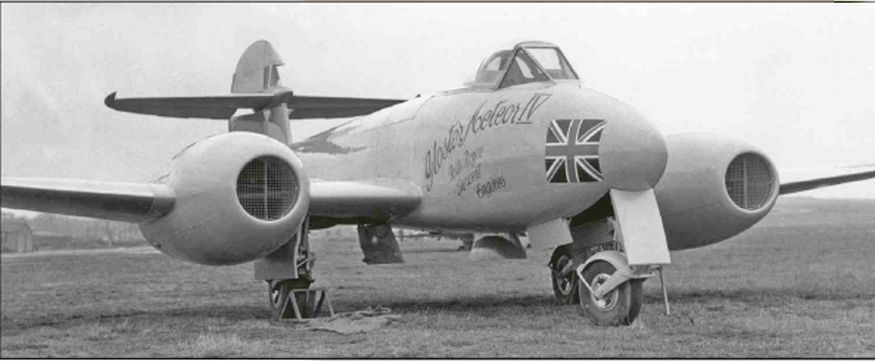
On that day, two Meteor aircraft were prepared in which two pilots, both flying for different groups, would attempt to set a new World Air Speed record over a set course along Herne Bay’s seafront. The first aircraft was piloted by Group Captain Hugh Joseph Wilson, CBE, AFC (the Commandant of the Empire Test Pilots’ School, Cranfield); and the second by Mr. Eric Stanley Greenwood O.B.E., Gloster’s own chief test pilot. In a few hours time both men would have the chance to have their names entered in the history books of aviation by breaking through the 600mph air speed barrier.

The event was run in line with the Fédération Aéronautique Internationale‘s rules, covering in total, an 8 mile course flown at, or below, 250 feet. For the attempt, there would be four runs in total by each pilot, two east-to-west and two west-to-east.

With good but not ideal weather, Wilson’s aircraft took off from the former RAF Manston, circling over Thanet before lining his aircraft up for the run in. Following red balloon markers along the shoreline, Wilson flew along the 8 mile course at 250 feet between Reculver Point and  Herne Bay Pier toward the Isle of Sheppey. Above Sheppey, (and below 1,300 ft) Wilson would turn his aircraft and line up for the next run, again at 250ft.

Initial results showed Greenwood achieving the higher speeds, and these were eagerly flashed around the world. However, after confirmation from more sophisticated timing equipment, it was later confirmed that the higher speed was in fact achieved by Wilson, whose recorded speeds were: 604mph, 608mph, 602mph and 611mph, giving an average speed of just over 606mph. Eric Greenwood’s flights were also confirmed, but slightly slower at:  599mph, 608mph, 598mph and 607mph, giving an overall average speed of 603mph. The actual confirmed and awarded speed over the four runs was 606.38mph by Wilson*1.

The event was big news around the world, a reporter for ‘The Argus*2‘ – a Melbourne newspaper – described how both pilots used only two-thirds of their permitted power, and how they both wanted permission to push the air speed even higher, but both were denied at the time.

In the following day’s report*3, Greenwood described what it was like flying at over 600 mph for the very first time.

As I shot across the course of three kilometres (one mile seven furlongs), my principal  worry was to keep my eye on the light on the pier, for it was the best guiding beacon there was. On my first run I hit a bump, got a wing down, and my nose slewed off a bit, but I got back on the course. Below the sea appeared to be rushing past like an out-of-focus picture.

I could not see the Isle of Sheppey, toward which I was heading, because visibility was not all that I wanted.

At 600mph it is a matter of seconds before you are there. It came up just where I  expected it. In the cockpit I was wearing a tropical helmet, grey flannel bags, a white silk shirt, and ordinary shoes. The ride was quite comfortable, and not as bumpy as some practice runs. I did not have time to pay much attention to the gauges and meters, but I could see that my air speed indicator was bobbing round the 600mph mark.

On the first run I only glanced at the altimeter on the turns, so that I should not go too high. My right hand was kept pretty busy on the stick (control column), and my left hand was. throbbing on the two throttle levers.

Greenwood went on to describe how it took four attempts to start the upgraded engines, delaying his attempt by an hour…

I had to get in and out of the cockpit four times before the engines finally started. A technical hitch delayed me for about an hour, and all the time I was getting colder and colder. At last I got away round about 11.30am. 

He described in some detail the first and second runs…

On the first run I had a fleeting glance at the blurred coast, and saw quite a crowd of onlookers on the cliffs. I remembered that my wife was watching me, and I found that there was time to wonder what she was thinking. I knew that she would be more worried than I was, and it struck me that the sooner I could get the thing over the sooner her fears would be put at rest.

On my first turn toward the Isle of Sheppey I was well lined up for passing over the Eastchurch airfield, where visibility was poor for this high-speed type of flying. The horizon had completely disappeared, and I turned by looking down at the ground and hoping that, on coming out of the bank, I would be pointing at two balloons on the pier 12 miles ahead. They were not visible at first.

All this time my air speed indicator had not dropped below 560 mph, in spite of my back-throttling slightly. Then the guiding light flashed from the pier, and in a moment I saw the balloons, so I knew that I was all right for that.

On the return run of my first circuit the cockpit began to get hot. It was for all the world like a tropical-summer day. Perspiration began to collect on my forehead. I did not want it to cloud my eyes, so for the fraction of a second I took my hands off the controls and wiped the sweat off with the back of my gloved hand. I had decided not to wear goggles, as the cockpit was completely sealed. I had taken the precaution, however, of leaving my oxygen turned on, because I thought that it was just that little extra care that might prevent my getting the feeling of “Don’t fence me in.”

Normally I don’t suffer from a feeling of being cooked up in an aircraft, but the Meteor’s cockpit was so completely sealed up that I was not certain how I should feel. As all had gone well, and I had got half-way through the course I checked up my fuel content gauges to be sure that I had plenty of paraffin to complete the job.

I passed over Manston airfield on the second run rather farther east than I had hoped, so my turn took me farther out to sea than I had budgeted for. But I managed to line up again quite satisfactorily, and I opened up just as I was approaching Margate pier at a height of 800 feet. My speed was then 560 mph.

Whilst the first run was smooth, the second he said, “Shook the base of his spine”.

This second run was not so smooth, for I hit a few bumps, which shook the base of my spine. Hitting air bumps at 600 mph is like falling down stone steps—a series of nasty jars. But the biffs were not bad enough to make me back-throttle, and I passed over the line without incident, except that I felt extremely hot and clammy.

After he had completed his four attempts, Greenwood described how he had difficulty in lowering his airspeed to enable him to land safely…

At the end of my effort I came to one of the most difficult jobs of the lot. It was to lose speed after having travelled at 600 mph. I started back-throttling immediately after I had finished my final run, but I had to circuit Manston airfield three times before I got my speed down to 200mph.

The two Meteor aircraft were especially modified for the event. Both originally built as MK.III aircraft – ‘EE454’ (Britannia ) and ‘EE455’ (Yellow Peril) – they had the original engines replaced with Derwent Mk.V turbojets (a scaled-down version of the RB.41 Nene) increasing the thrust to a maximum of 4,000 lbs at sea level – for the runs though, this would be limited to 3,600 lbs each. Other modifications included: reducing and strengthening the canopy; lightening the air frames by removal of all weaponry; smoothing of all flying surfaces; sealing of trim tabs, along with shortening and reshaping of the wings – all of which would go toward making the aircraft as streamlined as possible.

Related image

EE455 ‘Yellow Peril’ was painted in an all yellow scheme (with silver outer wings) to make itself more visible for recording cameras.*4

An official application for the record was submitted to the International Aeronautical Federation for world recognition. As it was announced, Air-Marshal Sir William Coryton (former commander of 5 Group) said that: “Britain had hoped to go farther, but minor defects had developed in ‘Britannia’. There was no sign of damage to the other machine“, he went on to say.

Wilson, born at Westminster, London, England, 28th May 1908, initially received a short service commission, after which he rose through the ranks of the Royal Air Force eventually being placed on the Reserves Officers list. With the outbreak of war, Flt. Lt. Wilson was recalled and assigned as Commanding Officer to the Aerodynamic Flight, R.A.E. Farnborough. A year after promotion to the rank of Squadron Leader in 1940, he was appointed chief test pilot at the Royal Aircraft Establishment (R.A.E.) who were then testing captured enemy aircraft. He was promoted to Wing Commander, 20th August 1945, retiring on 20th June 1948 as a Group Captain.

Eric Greenwood, Gloster’s Chief Test Pilot, was credited with the first pilot to exceed 600 miles per hour in level flight, and was awarded the O.B.E. on 13th June 1946.

His career started straight from school, learning to fly at No. 5 F.T.S. at Sealand in 1928. He was then posted to 3 Sqn. at Upavon flying Hawker Woodcocks and Bristol Bulldogs before taking an instructors course, a role he continued in until the end of his commission. After leaving the R.A.F., Greenwood joined up with Lord Malcolm Douglas Hamilton (later Group Captain), performing barnstorming flying and private charter flights in Scotland.

Greenwood then flew to the far East to help set up the Malayan Air Force under the guise of the Penang Flying Club. His time here was adventurous, flying some 2,000 hours in adapted Tiger Moths. His eventual return to England saw him flying for the Armstrong Whitworth, Hawker and Gloster companies, before being sent as chief test pilot to the Air Service Training (A.S.T.) at Hamble in 1941. Here he would test modified U.S. built aircraft such as the Airocobra, until the summer of 1944 when he moved back to Gloster’s – again as test pilot.

It was whilst here at Gloster’s that Greenwood would break two world air speed records, both within two weeks of each other. Pushing a Meteor passed both the 500mph and 600mph barriers meant that the R.A.F. had a fighter that could not only match many of its counterparts but one that had taken aviation to new record speeds.

During the trials for the Meteor, Greenwood and Wilson were joined by Captain Eric ‘Winkle’ Brown, who between them tested the slimmed-down and ‘lacquered until it shone’ machine, comparing  drag coefficients with standard machines. Every inch of power had to be squeezed from the engine as reheats were still in their infancy and much too dangerous to use in such trials.

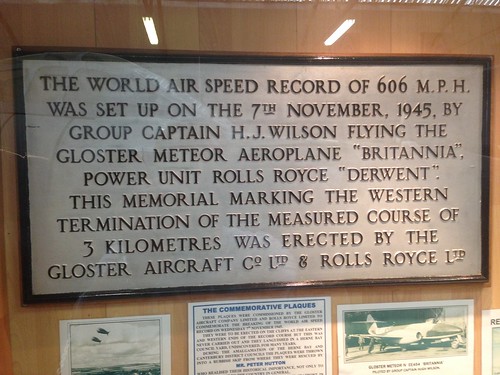
To mark this historic event, two plaques were made, but never, it would seem, displayed. Reputed to have been saved from a council skip, they were initially thought to have been placed in a local cafe, after the cliffs – where they were meant to be displayed – collapsed. The plaques were however left in the council’s possession, until saved by an eagle-eyed employee. Today, they are located in the RAF Manston History Museum where they remain on public display.

RAF Manston History Museum

One of the two plaques now on display at the RAF Manston History Museum.

To mark the place in Herne Bay where this historic event took place, an information board has been added, going some small way to paying tribute to the men and machines who set the world alight with a new World Air Speed record only a few hundred feet from where it stands.

Part of the Herne Bay Tribute to the World Air Speed Record set by Group Captain H.J. Wilson (note the incorrect speed given).

Sources and Further Reading.

*1 Guinness World Records website accessed 22/8/17.

*2 The Argus News report, Thursday November 8th 1945 (website) (Recorded readings quoted in this issue were incorrect, the correct records were given in the following day’s issue).

*3 The Argus News report, Thursday November 9th 1945 (website)

*4 Photo from Special Hobby website.

The RAF Manston History Museum website has details of opening times and location.

The Manston Spitfire and Hurricane Memorial museum website has details of opening times and location.

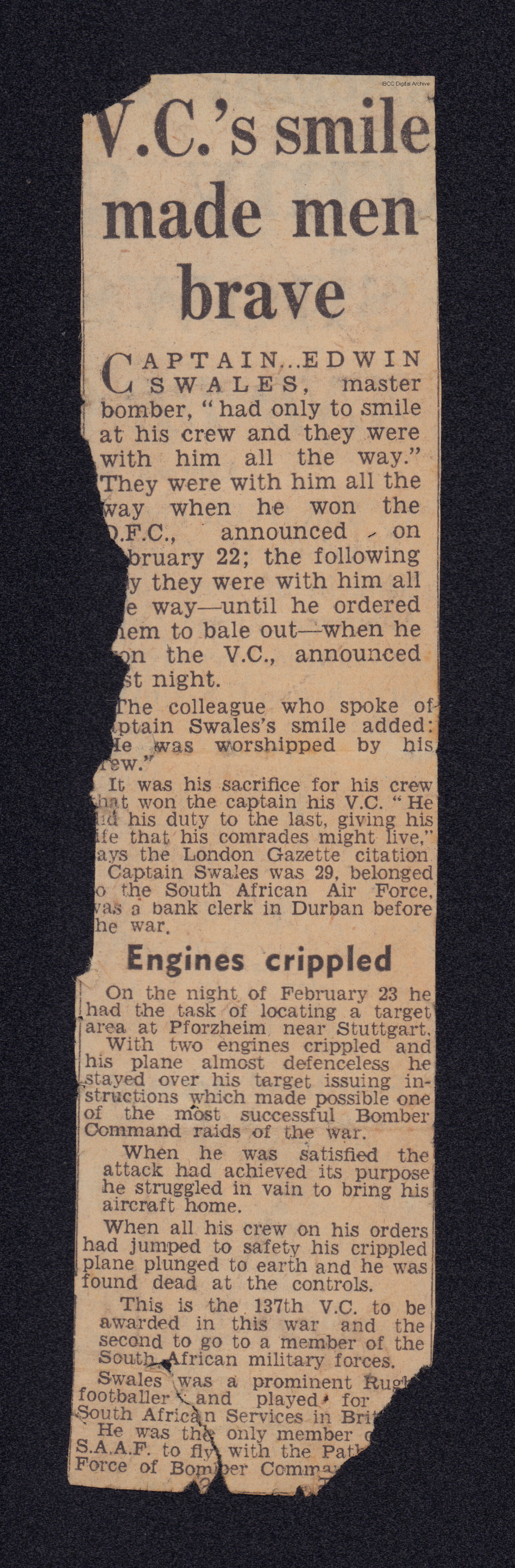
Captain Edwin Swales VC, DFC RAF Little Staughton.

The Royal Air Force was made up of many nationals including both those from the Commonwealth and those from across the globe.

In Bomber Command, and the Pathfinders in particular, one man stood out not just for his nationality, but for his bravery and dedication in the face of death.

That man was one Acting Major*1 Edwin Essery Swales VC, DFC based at RAF Little Staughton on the Bedfordshire / Cambridgeshire border.

Swales (fourth from right) and his crew with their Lancaster ‘M’ Mother *9

Swales was born on 3rd July 1915, the son of Harry Evelyn Swales and Olive Essery, in Inanda, Natal South Africa. He was one of four children whose father was a farmer. Whilst Edwin was young, his father, Harry, died from  the influenza epidemic that claimed some 50 million lives after the First World War. Without a father, the family were unable to maintain the farm, and so they moved away to Berea in Durban.

Once of high school age, the young Edwin Swales attended Durban High School, he also joined the Scouts learning valuable skills with like minded youngsters, that would help in him in later life. After leaving school Swales landed himself his first job, working at the international branch of Barclays Bank in Durban. But with with war looming, Swales like many young men at the time, was drawn to military service, and so he joined up, posted to the Natal Mounted Rifles where he achieved the rank of Sergeant Major.

Whilst with the Mounted Rifles, Swales served in several locations including: Kenya, Abyssinia and North Africa where he fought bravely alongside his compatriots and the Eighth Army under Montgomery. He would remain with the rifles until January 1942 at which point he transferred to the South African Air Force, obtaining his wings on 26th June a year later. Two months after this milestone, he, like many others from across the commonwealth, was seconded to the Royal Air Force ensuring his position overseas.

Swales (s/n: 6101V) like many new recruits to the Royal Air Force, would undergo a tense period of retraining, eventually being posted to fly heavy bombers within Donald Bennett’s 8 Group – ‘The Pathfinders’. His first and only posting, would be at Little Staughton with 582 Sqn.

During his short time at Little Staughton, Swales would fly a number of missions piloting Avro’s delight, the four engined heavy bomber the Lancaster.

Swales took part in many operations over occupied Europe, including the ill-fated attack on Cologne on December 23rd 1944, which saw the loss of five  aircraft from 582 Sqn. In total, eight aircraft from seventeen flying from both Little Staughton and Graveley were lost that day including the lead bomber flown by Sqn. Ldr. Robert Palmer who himself was awarded the Victoria Cross for his actions.

On that day, an Oboe mission that went terribly wrong, Swales heard the instruction to bomb visually releasing his bombs at 12:51hrs. Flak and fighter attacks were so ferocious, that Swales, like many others in the formation, had to take “violent evasive action” to shake off persistent and accurate attacks from fighter and ground based gunners. He was able to return his aircraft and crew safely to Little Staughton landing at 14:35*2

The action taken by Swales that day was indicative of his determination to succeed and protect both his aircraft and crew, and one that would be repeated time after time by the airman. As a result, it was seen fit to award Captain Swales the DFC for his action that night, his citation stating:

This Officer was pilot and Captain of an aircraft detailed to attack Cologne in December, 1944. When approaching the target, intense anti-aircraft fire was encountered. Despite this, a good bombing attack was executed. Soon afterwards the aircraft was attacked by five enemy aircraft. In the ensuing fights, Capt. Swales manoeuvred with great skill. As a result his gunners were able to bring effective fire to bear upon the attackers, one of which is believed to have been shot down. Throughout this spirited action Captain Swales displayed exceptional coolness and captaincy, setting a very fine example. This Officer has completed very many sorties during which he has attacked a variety of enemy targets*3

Within two months of the operation and at the time his award was being awarded, Swales would be in a similar position again.  This time as Master Bomber leading the formation and directing the bombers to the target.

On that night, only ten days after the historical attack on Dresden, 367 Lancasters and 13 Mosquitoes from 1, 6 and 8 Groups were detailed to attack the city of Pforzheim to the north-west of Stuttgart. This would be the only attack on the city during the war and it would prove almost as devastating as both Dresden and Hamburg.

Flying along side Swales that night in his Lancaster III PB538 ‘N’, were seven other crewmen, including two navigators as was commonplace for Oboe fitted aircraft.

On the run in to the target, the Lancaster was badly mauled by night fighters who successfully put one engine and the rear turret guns out of action. But undeterred, Swales remained on station guiding the following bombers onto the target with the greatest of precision.

When he was finally satisfied that the attack had been carried out successfully, he left his station and turned the aircraft for home. It had been difficult to keep the Lancaster flying, but Swales had persevered in order to complete the job. But he was now easy prey for enemy fighters and inevitably more attacks came.

Soon a second engine was put out of action and flying controls were damaged further with some now completely inoperable. With a reduced speed and difficult flying conditions he headed for the allied lines, where he hoped to get his crew out safely.

All those on board made the jump to safety, leaving just Swales at the controls of the failing Lancaster. As if someone had been watching over them, just as the last man left, the Lancaster finally gave up the struggle and dived into the earth –  Edwin Swales was still sat at the controls when it was found later on.

The attack on Pforzheim  was considered to be very accurate, with over 1,800 bombs having been dropped in as little as twenty minutes or so. Over 17,000 people were known to have died that night in the raging fire that followed the bombing, and a post-war photo, revealed that 83% of the built up area had been destroyed by the raid *4

Following the death of Captain Swales, Air Chief Marshall Sir Arthur Harris KCB, OBE, AFC, Chief of Bomber Command, personally write to Swales’ mother saying: “On every occasion your son proved to be a fighter and a resolute captain of his crew. His devotion to duty and complete disregard for his own safety will remain an example and inspiration for all of us.”*10

For his action, bravery and dedication to duty, 29 year old Edwin Swales, a prominent rugby player and South African “who only had to smile at his crew and they were with him all the way“*5  was awarded the Victoria Cross posthumously, the second such award to go to an airman of RAF Little Staughton, just one of three to the Pathfinders and one of only four South Africans to be awarded the Victoria Cross during the war. His citation appeared in the Fifth Supplement to The London Gazette, of Friday, the 20th of April, 1945:

Air Ministry, 24th April, 1945.

The KING has ‘been graciously pleased to confer the VICTORIA CROSS on the undermentioned officer in recognition of most conspicuous bravery:.—

Captain Edwin SWALES, D.F.C. (6101V), S.A.A.F., 582 Sqn. (deceased).

Captain Swales was ” master bomber ” of a force of aircraft which attacked Pforzheim on the night of February 23rd, 1945. As ” master bomber,” he had the task of locating the target area with precision and of giving aiming instructions to the main force of bombers following in his wake.

Soon after he had reached the target area he was engaged by an enemy fighter and one of his engines was put out of action. His rear guns failed. His crippled aircraft was an easy prey to further attacks. Unperturbed, he carried on with his allotted task; clearly and precisely he issued aiming instructions to the main force. Meanwhile the enemy fighter closed the range and fired again. A second engine of Captain Swales’ aircraft was put out of action. Almost defenceless, he stayed over the target area issuing his aiming instructions until he was satisfied that the attack had achieved its purpose.

It is now known that the attack was one of the most concentrated and successful of the war.

Captain Swales did not, however, regard his mission as completed. His aircraft was damaged. Its speed had been so much reduced that it could only with difficulty be kept in the air. The blind-flying instruments were no longer working. Determined at all costs to prevent his aircraft and crew from falling into enemy hands, he set course for home. After an hour he flew into thin-layered cloud. He kept his course by skilful flying between the layers, but later heavy cloud and turbulent air conditions were met. The aircraft, ‘by now over friendly territory, ‘became more and more difficult to control; it was losing height steadily. Realising that the situation was desperate Captain Swales ordered his crew to bale out. Time was very short and it required all his exertions to keep the aircraft steady while each of his crew moved in turn to the escape hatch and parachuted to safety. Hardly had the last crew-member jumped when the aircraft plunged to earth. Captain Swales was found dead at the controls.

Intrepid in the attack, courageous in the face of danger, he did his duty to the last, giving his life that his comrades might live.*6

His body was removed from the aircraft in which he gave his life and was interned at the War Cemetery at Leopoldsburg, in Belgium, Section VIII Grave C.5.

In honour of Captain Swales, two memorial stones were laid and revealed outside his Durban High School on Armistice day 2009. One in the Memorial Courtyard of the School and the second on the Memorial Wall of the Natal Mounted Rifles also in Durban. In attendance were both his niece, Professor Edwina Ward, and Lt. Gen. Carlo Gagiano, Chief of the South African Air Force.

In 2013, Swales was also awarded the “Bomber Command” clasp to be worn on the 1939 – 1945 Star already awarded.

Edwin Swales was indeed a very brave man, who through sheer determination managed to save his crew in spite of the dangers facing him. His award was in no doubt deservingly awarded.

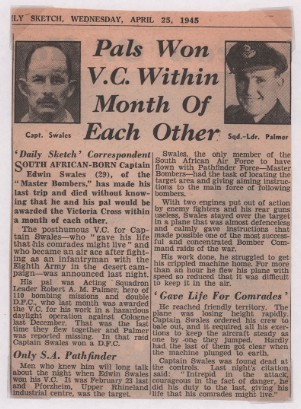
The story of pals Edwin Swales and Robert Palmer both of whom won VCs posthumously whilst at RAF Little Staughton.*7

NColeFIG170709-020001.jpg

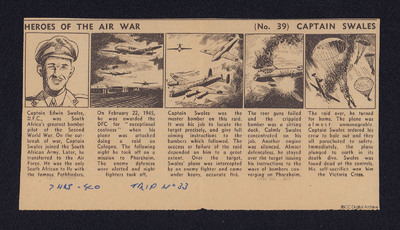
The story of Captain Swales appeared in a newspaper cartoon “Heroes of the Air War”.*8

RAF Little Staughton appears in Trail 29.

Sqn Ldr. Robert Palmer’s story appears in Heroic Tales.

Sources and further reading.

*1 the documents showing Captain Swales’ promotion to the rank of Major only reached the UK authorities after his death and as a result he was cited as being a Captain. (South African Aviation Foundation)

*2 National Archives 582 Operational Record Book AIR-27-2052-18

*3 Supplement 36954, to The London Gazette, 23rd February 1945, published 20th February 1945, page 1070

*4 Middlebrook, M., Everitt. C., “The Bomber Command War Diaries“, Midland Publishing Ltd, 1996

*5 International Bomber Command Centre National Archive website.

*6 Fifth Supplement to The London Gazette, of Friday 20th April 1945. Published on Tuesday 24th April 1945, Supplement 37049, Page 2173.

*7 “Newspaper cuttings concerning awards of Victoria Crosses,” IBCC Digital Archive, accessed November 11, 2023,

*8 “Heroes of the Air War (No. 39) Captain Swales,” IBCC Digital Archive, accessed November 11, 2023,

*9 Photo The South African Legion of Military Veterans website

*10 South African Aviation Foundation website

Trail 65 – RAF Thurleigh Part 2 – The USAAF Arrive.

In Part 1 we saw how RAF Thurleigh emerged from the Bedfordshire countryside and was shaped by early Luftwaffe raids on the construction site. We saw the arrival of new RAF training units flying Wellington bombers, and their subsequent departure to the far East. We saw how tragedy and fatal accidents claimed the lives of new Polish crews training at the station with 18 OTU, and how with Bomber Command moving on, Thurleigh’s role was set to change dramatically.

A New Ally Arrives: The American Transformation of Thurleigh

At the end of 1941, after the surprise attack on Pearl Harbour, America entered the conflict declaring war on both Japan and Germany and their allies. Over the next few months high ranking officials hurriedly put plans in place to send twenty-eight American bomb groups to the United Kingdom, and the European theatre of war. In a meeting between General Eaker and Air Chief Marshal Arthur Harris, discussions took place that would not only facilitate such a move, but also give the Americans suitable airfields on which to house their new heavy bombers.

Aware that most British airfields were too small to accommodate the American’s heavy bomber units, Eaker went on to press Harris for specific details including both their locations and the facilities available at each one. Anticipating this, Harris handed over the identity of eight potential sites, many of them RAF satellite stations, but all suitable for the American’s use. Amongst these were the airfields at Polebrook, Chelveston, Molesworth, Kimbolton, and of course Thurleigh.

Initially designated Station B-4, Thurleigh would then undergo a major modification programme, one that would bring it up to the new Class ‘A’ standard, a specification that would make it suitable for the American heavy bombers, both the B-24 ‘Liberator’ and the B-17 ‘Flying Fortresses’ that Eaker was sending over.

Thurleigh

One of the former arms buildings.

Construction crews quickly began work, both extending and reinforcing the short runways; they added additional hardstands, and expanded both the technical and domestic sites. Upon completion, the airfield would feature three concrete runways: one of 2,000 feet and two of 1,400 feet in length, each being the standard 50 yards wide. Aircraft dispersal was facilitated by a total of 51 loop and frying-pan style hardstands arranged around a full length perimeter track.

In addition, and unusually, four T2 hangars were erected, providing protective aircraft shelter and maintenance facilities. The bomb store was discreetly placed in Galsey Wood, a wooded area to the northwest and away from the main flying and accommodation areas – an essential safety precaution in wartime.

Fifteen accommodation sites, including two communal areas, two WAAF quarters, medical facilities, and barrack blocks, were all established along the road leading away from Thurleigh village to the south-west of the airfield. These sites employed a variety of wartime construction styles – brick, timber, concrete, steel, asbestos, and plasterboard – using standard designs from Laing, Nissen, Seco, Jane, Romney, and others. At full capacity, the base would accommodate over 440 officers and more than 2,500 enlisted personnel, including members of the Women’s Auxiliary Air Force.

After being allocated to the Americans on August 10th 1942, Thurleigh opened with its first residents. On 7th September that year, the first and only front line bomber Group to operate from the airfield, the 306th Bomb Group (BG), arrived with its four squadrons of B-17s: the 367th, 368th, 369th and 423rd Bomb Squadrons (BS). In command would be Col. Charles B. “Chip” Overcracker.

The 306th Bomb Group: Arrival of “The Reich Wreckers” (Autumn 1942)

Known as “The Reich Wreckers” the 306th would have many claims to fame, including being the oldest operational Bomb Group in the 8th Air Force and the only one to remain at the same station (Thurleigh) in England for the longest period of time. In addition, they were the first unit to have personnel achieve their first tour of operations, a major mile stone that gave the whole air force hope that going home was indeed possible.

Thurleigh

A graffiti panel rescued from a 423rd BS barrack now on display at the museum.

The Group, designated the 306th, were constituted on January 28th 1942, and activated in March that same year. Their journey to the UK began at Gowen Field in Idaho, transferring through Wendover Field to their embarkation point at New York onboard HMS Queen Elizabeth. The ground echelon set sale, travelling across the treacherous north Atlantic route to arrive at Greenock in Scotland, on September 5th, 1942.

The air echelon travelled separately, arriving a week later in small groups touching down at Thurleigh between the 8th and 13th September, having flown their own thirty-five aircraft across the northern route. This cold and bleak route took them via Greenland and Iceland, before passing over northern Ireland to arrive at Prestwick in Scotland on the north-west coast. During the journey over, one B-17F, with a crew of nine and one passenger, exploded for no apparent reason, 150 miles from Gander Lake,  Newfoundland. A second aircraft also ditched in the Irish Sea. The crew in this instance were picked up, but the aircraft was lost in the cold waters of the North Atlantic. This was the third B-17 the group had lost since their inauguration.

The 306th would go on to fight in some of the most bitter air battles of the war, including Schweinfurt, Stuttgart, Hannover, Berlin, Ludwigshafen and Leipzig. They would lead the first US bomber penetration of German skies; Big Week in February 1944, and go on to support both the Normandy landings and the St. Lo breakout. They would remain active throughout the war achieving numerous awards including two Medals of Honour, numerous Purple Hearts and two Distinguished Unit Citations (DUC) for action over occupied Europe.

Their arrival at Thurleigh was not however the great dream they may have wished for. On unloading, the 306th were greeted by unfinished buildings and mud – lots of it. Tents immediately formed the basis of personnel  accommodation and the officers’ mess was so small, staff had to operate in three shifts to enable them all to get fed.

Not only was a considerable amount of work needing to be done to get the station ready, but being new to the European theatre, a huge amount of ‘up-skilling’ was also going to be needed. To this end, intelligence staff, operations controllers and flight controllers were all sent to RAF stations to learn the ‘tricks of the trade’ enabling them to operate alongside their British counterparts in what was about to become a very busy airspace.

Baptism by Fire: First Operations and Early Losses

This poor start was then compounded when on October 2nd 1942, during a practice mission over the Wash, one of the waist gunners of B-17 #41-24492 ‘Lady Halitosis‘ of the 367th BS, suffered oxygen failure. In a bid to help the gunner, the pilot put the aircraft into a steep dive losing some 9,000 feet of altitude in a matter of minutes. The dive and subsequent recovery was so severe that the aircraft’s control cables snapped, and part of the starboard wing broke away taking an engine with it. The aircraft then caught fire and the bomb bay doors became detached. One of these doors, struck the rear section of the aircraft with such force that it severed the fuselage at the tail. The rear gunner, trapped inside his position, desperately tried to escape, hammering at the plexiglass and fuselage to break out. With only a 1,000 feet of air left, he just managed to break through the fuselage and free himself from his falling coffin. His parachute luckily opened, and he landed safely some distance away south-east of Spalding in Lincolnshire. His luck, already used exhaustively, somehow managed to continue on for a few moments more, when the remainder of the burning  B-17 came crashing down a mere one hundred yards or so from where he was sat.

Rescue crews from a nearby anti-aircraft gun ran to the scene but they were unable to get close enough to the wreckage due the the ferocity of the fire, and sadly, all six of those left inside, perished. During the whole episode only one other crewman managed to escape – Ball Turret Gunner Private Raymond McAskill – suffering slight injuries as he did so.

The event was so understandably harrowing for gunner S.Sgt. William Kellum, that he was eventually grounded, his mental state rendering him ‘unfit’ to continue on after having only carried out a few missions following his horrific flight debut in England.

With this disaster behind them, the 306th took to the air once more on their maiden operation on October 9th 1942, an operation to bomb the steel works at Lille, France. But again, it was not to be the glorious outcome they all would have wished for.

For the first time, over 100 American bombers, a mix of B-24s and B-17s, led by the soon to be legendary Col. Edward “Ted” Timberlake, flew across the English Channel to France. The huge formation, escorted by over 400 fighters, a mix of Spitfires – now part of the 4th Fighter Group –  and P-38 “Lightnings”, knew how important this mission was going to be.

Waiting for them were the battle hardened Luftwaffe pilots of JG 26 in their FW190s, they were not going to let the bombers through easily and the sky would be full.

With departure planned for 08:32, the lumbering giants gradually rose in to the air and set route for France.

As the bombers reached the target, the Luftwaffe struck, focussing initially on the B-24s of 93rd BG. Attacking from their favoured position, the rear, they struck at the formation ignoring the fighters flying high above. Releasing over the target, bombing was considered poor, some bomb aimers not even finding the target and so dropping their bombs on alternative sites. During the action, the formation had become disjointed, partly due to some turning back with technical problems and partly to some being knocked out by enemy fighters – the defensive wall had been breached.

As for the 306th, a second aircraft was lost, and this time there were no survivors. A third B-17, #41-24486 “Man O’ War” piloted by 2nd. Lt. James M. Stewart, lost three engines and its radio failed. It was about to ditch in the English Channel, when – as if out of a boy’s action story – a Spitfire, flown by Flt. Lt. Andrews of 91 Sqn, appeared alongside and guided the B-17 to RAF Manston in Kent where it made a successful crash landing. None of the crew were injured in the event, saved no doubt by the actions of Flt. Lt. Andrews.

Inexperience played a large part for many of the crews taking part that day. Being new to operational duties, not only had they suffered poor aiming but gunners had made hugely exaggerated claims about the numbers of enemy aircraft shot down – although probably unknowingly to them. In reply to the frenzied attack on the formation, air gunners sprayed bullets all over the sky hitting everything except the enemy. A mix of poor training and a determination to prove their worth, had been a recipe for disaster.

Thurleigh

One of several buildings on the bomb store.

Not only was the bomb aiming poor but so was the navigation. Many navigators, like the gunners, were simply not experienced enough, nor trained well enough for the European geography. With thick cloud being present almost all of the time, many new crews were unable to identify specific geographical features and were simply lost within 10 minutes of leaving their home base.*4

During this initial operation experienced enemy fighters were both fearsome and determined in their attacks. Whilst few bombers were actually shot down, all of those in the lagging 306th received hits from the FW-190s – some severely. The opening few weeks had been a real eye opener for the 306th, an experience resembling a baptism of fire not only for those newbies the “The Reich Wreckers“, but for the Eighth Air Force as a whole.

Weather, Warnings, and Misfires: October’s Frustrating Missions

The British winter weather then intervened. Several operations were cancelled as were training flights which were greatly needed. A cancelled flight to Lorient on October 21st, merely two weeks after their first operation, meant that the entire 306th returned without dropping a single bomb. The declining weather and poor visibility was to blame, but some ninety aircraft did continue on, and of those who did bomb, their bombs simply “bounced off” the submarine pens, having no impact whatsoever. *5

Aircrews were learning that operations over enemy territory were high risk, but even scrubbed missions could have their problems: aircraft still had tanks full of petrol and bomb-bays were still filled with tons of high explosives. For the 306th, troubles on this mission began even before they had left British airspace. When the abort signal came through, it instructed crews to drop their ordnance in the Wash – a large body of shallow coastal water off the north Norfolk coast.  Whilst it became a common practice for scrubbed missions, for one B-17 it was not going to be a simple or straight forward task.

Emergency Landing: A B-17 Touches Down at Sutton Bridge

B-17F, #41-24460 ‘RD-A’, “Little Audrey” of the 423 BS, began the process of releasing its bombs when suddenly the life raft latch broke loose causing the raft to escape and wrap itself around the elevator rendering the aircraft difficult to control.

Captain Mack McKay, 306th BG points to a “kill” marking painted on his B-17 Flying Fortress “Little Audrey” (IWM FRE 4418)

Now being unstable in flight, the B-17 had to find a safe place to land, and near to the Wash was the firing range at Holbeach and its associated airfield at RAF Sutton Bridge. A physically small grass airfield that was used for gunnery training of RAF fighters, it was not designed to take large four-engined heavy bombers. The likely hood of getting down safely was slim, but after using all his skill and judgement, the pilot managed to put the bomber down safely on the grass much to the joy of those inside the bomber. Once remedial work had been carried out on the aircraft, the crew began to prepare for the take off, an event just as risky as the landing and with odds just as bad.

Being an unusual aircraft to see at Sutton Bridge, huge crowds gathered to see the B-17 and to witness what could have been a terrible accident had the take off been misjudged on the small grass strip. Fortunately though, again using all his skill and judgement, the pilot got the aircraft up and the B-17 successfully rose in to the air making its way home to Thurleigh being waved off by the extensive crowd of locals gathered by. *6

Mounting Pressure: Heavy Losses and Royal Visits

The early days of November 1942, saw missions 3, 4 and 5 for the 306th. Visits to Brest, Lille and St. Nazaire, saw a further four aircraft lost with all crews listed as ‘missing in action’. These early loses were beginning to mount, and those in charge were beginning to voice their concerns.

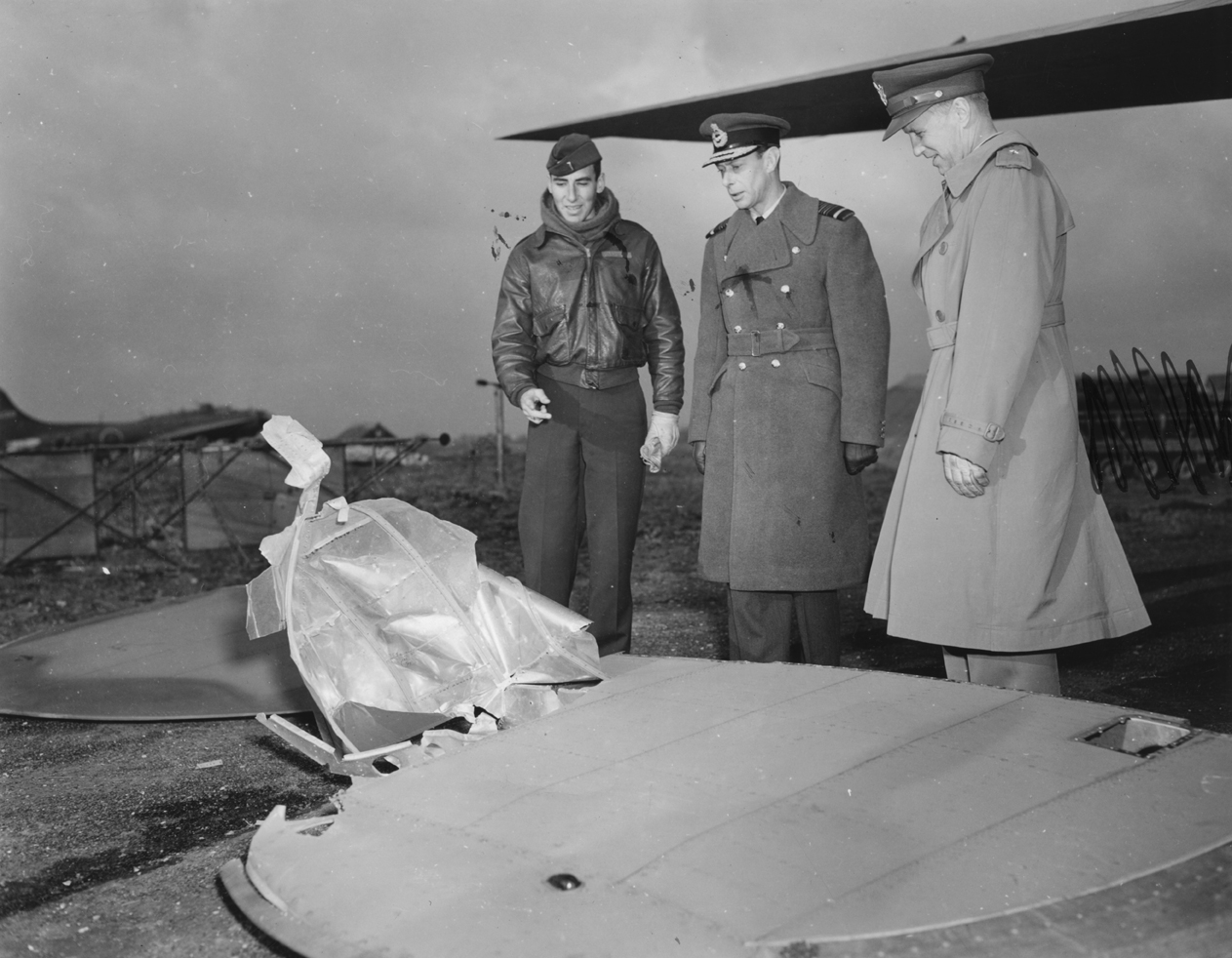
On November 13th, a Royal visit was made in which General Carl Spaatz and King George VI carried out a tour of the many airfields now in the region, including Thurleigh. Whilst the Royal party were here, they were shown around the airfield, seeing the various facilities available. They were also introduced to several crews and ground staff with whom they chatted happily.

Brigadier-General Newton Longfellow and Lieutenant Robert L Riordan of the 306th Bomb Group, show King George VI part of a damaged B-17 Flying Fortress during a royal visit. (IWM FRE 4390)

The B-17’s Fatal Flaw – and its Remedy

But the relief brought by important visitors didn’t prevent problems in the air. By now, the Luftwaffe had got the measure the of the B-17 and pilots, such as Oberstleutant Egon Mayer, quickly found its Achilles heel. Even though bristling with guns, the B-17s suffered from ‘blind spots’, areas where the gun’s arc didn’t cover. This made the bomber vulnerable, and the worst position was through a direct full frontal attack. New tactics were then used by the Luftwaffe, directing fire directly at the front of the aircraft, potentially its most vulnerable position. It became so successful, that some 30% of pilots and co-pilots in the 306th were killed in such attacks.*7  With little protection, early model B-17Es were quickly withdrawn from front line operations and investigations carried out into a possible remedy to the problem.*8

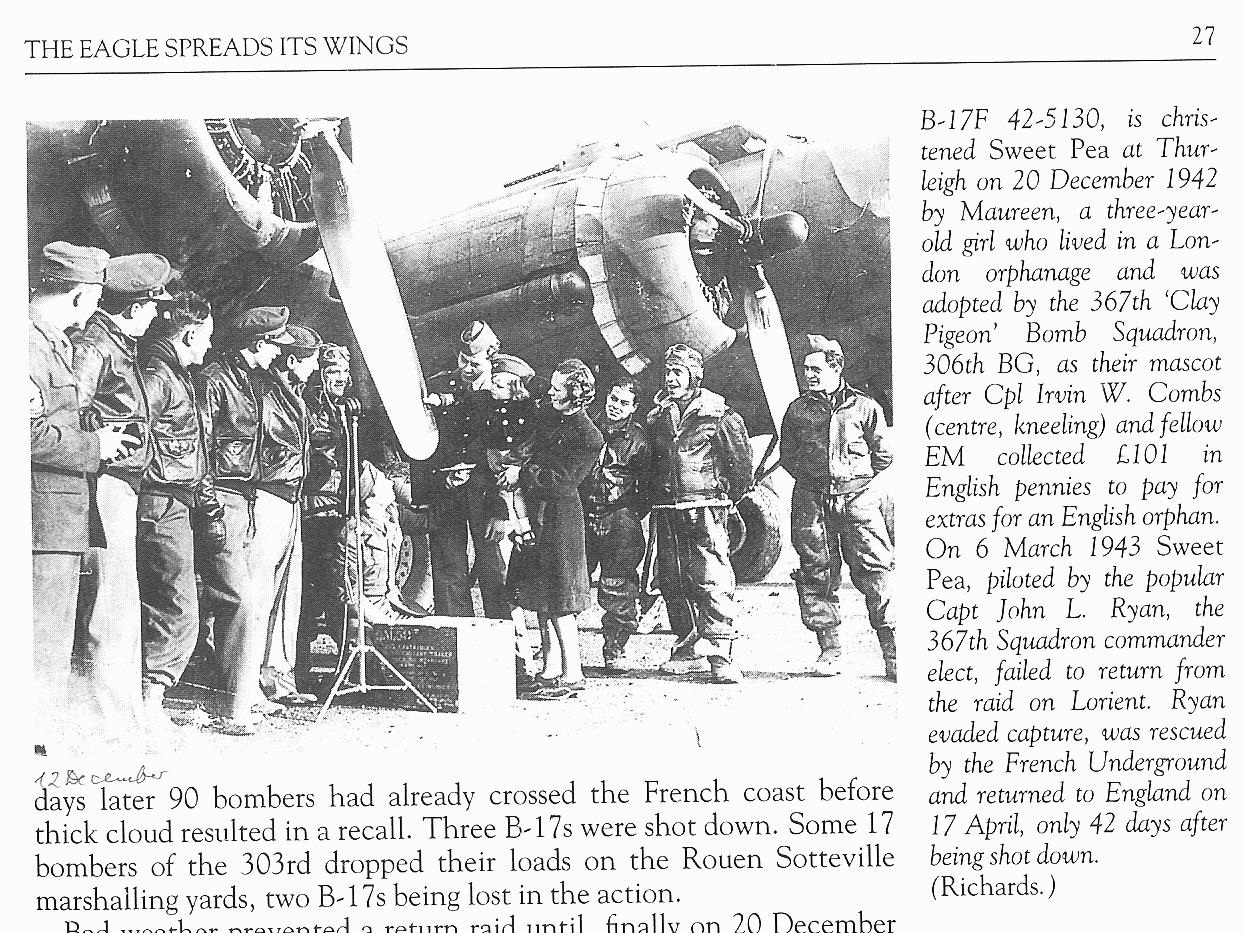
Naturally the B-17 crews realised this vulnerability too, and also set about finding their own remedy. Whilst official routes were being taken to solve the problem, these were taking too long, and a quicker solution was needed. Within the 367th BS an armourer  and a welder (S. Sgts. James C. Green and Ben F. Marcilonis) got together and took matters into their own hands. They designed and built a new bracket that could hold a heavy .50 machine gun fitted into the nose of the aircraft to protect this gap in the forward arc.  Once constructed and fitted, trials began, the ‘guinea pig’ being a B-17F #42-5130 named “Sweet Pea“.

The bracket fitted to Sweet Pea, proved to be so successful that it was adopted not only by the 306th but the 8th Air Service Command as a whole*9 becoming part of a modification feature to future B-17 models.

The aircraft  was unusual for other reasons though. It was ‘christened’ on December 20th 1942, by a small orphan girl called ‘Maureen’ whom the 367th BS had adopted from a London orphanage. They gave her the nickname ‘Sweet Pea‘ and to mark the occasion, she dipped her hand in paint and placed a print on the aircraft as a form of dedication.. Like many aircraft of the ‘Reich Wreckers’, Sweet Pea would fly on several operations, suffering a great deal of damage in the process; eventually failing to return from operations to Lorient on March 6th 1943, with one airman killed in action, one evading and eight being taken prisoners of war.

The news report on the dedication of ‘Sweet Pea‘ by Maureen – a three year-old orphan – at Thurleigh. (IWM UPL 15963)

Thurleigh had transformed from a training airfield into a heavy bomber base ready for its new American role. Upgraded to Class “A” standard it soon became home to the 306th Bomb Group – “The Reich Wreckers.” Their arrival in September 1942 was far from smooth though: unfinished buildings, muddy conditions, and a steep learning curve in the European theatre made for a difficult start. Early missions brought tragedy, from training accidents to heavy combat losses, while poor weather and inexperience compounded their struggles. Yet alongside setbacks came resilience, adaptation, and even innovation, as crews refined tactics and strengthened their aircraft. With these foundations laid, the stage was set for the 306th to face the increasingly bitter air battles of 1943.

The entire history can be read in Trail 65

Trail 65 – RAF Thurleigh Part 1 – Its Birth.

In Trail 65 we head west again this time to the borders of Bedfordshire and Northampton, where a former wartime airfield evolved from a base for USAAF bombers into a centre of aviation excellence. First built during the Second World War, it supported critical missions over occupied Europe. In the post-war years, it transitioned into a leading site for aeronautical research, contributing to major advances in jet technology, carrier operations, and automated landing systems. Although official flying ended in 1994, the site continued to reflect a remarkable legacy, marking its place in history as a cornerstone of Britain’s military and civil aviation development.

In this trail, we go back to Bedfordshire and the former RAF Thurleigh.

RAF Thurleigh (Station 111)

Situated some 6.5 miles north of Bedford, RAF Thurleigh was built on land approximately 250 feet above sea level. Although not a high elevation, its open plateau setting – typical of many wartime airfields – exposed it to the elements. Surrounded by multiple river sources, the location benefited from good natural drainage, aiding its suitability as an airfield site.

The nearby village of Thurleigh has a long recorded history, appearing in the Domesday Book as La Lega*1 – a name that over centuries, has evolved into its current form. In a similar fashion, the airfield that bears the same name, would come to be known under many titles of its own: RAF Thurleigh, USAAF Station 111, RAE Bedford, Bedford Aerodrome, and Thurleigh Airfield Business Park amongst others. Yet throughout its history, one theme remained constant – aviation.

The War Reaches Bedfordshire: Early Bombings and Construction (1941)

Thurleigh’s association with the Second World War began even before construction commenced. Isolated bombing incidents in the parish during 1941 – possibly the result of jettisoned bombs from German aircraft – marked its early wartime experience. Once the airfield’s construction began however, it quickly caught the attention of the Luftwaffe. On 17th April that year, eight enemy bombs were dropped directly onto the construction site, causing damage to the incomplete runway. A second attack on 12th August 1941 saw another eight bombs fall along the northern boundary, again damaging the airfield and rupturing a water main*2. Both raids highlighted how conspicuous such developments were to enemy reconnaissance and subsequent aerial attacks.

Once land had been sourced, the airfield’s construction was carried out by the company W.C. French Ltd. and officially opened during the summer of 1941. At this early stage, Thurleigh was a modest airfield in size, suited only for fighters or light to medium bombers. Its first operational residents were the personnel from No. 18 Operational Training Unit (OTU), part of the RAF’s Bomber Command. Having recently adopted the twin-engined Vickers Wellington, 18 OTU (formed from the Polish Training Unit in No. 6 Group, in June 1940 to train light bomber crews for Polish operational squadrons) was tasked with preparing new crews transitioning onto bombers ready for active duty.

Though OTUs were primarily training units, they often found themselves involved in operational sorties, especially during periods of ‘maximum effort’. As a result, many crews suffered casualties, even before they joined a front-line operational squadron.

Following them, in October 1941, 12 Operational Training Unit – first formed at RAF Benson in April 1940 – briefly stayed here. Their residency lasting a mere month, it remains unclear whether it was the entire unit, or just detachments  that were present here during that time. It was also at this time that the first recorded aircraft landing took place at Thurleigh: Wellington IC R1234*3 touching down on the new runway, marking a small but important milestone in the station’s dramatic history.

12 OTU Were not the only training unit to reside here. The Central Gunnery School (CGS), famed for “training the trainers” remained here from December 1941 until their departure to RAF Sutton Bridge on the Lincolnshire / Norfolk border in April 1942.

First established at RAF Warmwell on 6th November 1939, the CGS would train both gunners of bombers and fighters in the art of aerial warfare, those attending having proven themselves in combat already. Once trained, they would return to their original squadrons and pass on their valuable knowledge to others.

Tropical Kit and Tragedy: The Brief Story of 160 Squadron (1942)

Thurleigh’s relative quiet made it an ideal location to raise a new unit, and on January 16th 1942, the ground echelon of 160 Squadron RAF, formed here. Created as a Consolidated B-24 Liberator unit under War Establishment order WAR/ME/448 (dated 31st December 1941), the squadron’s formation began with the arrival of 108 airmen, who were followed by a further 126 the very next day. Over the following weeks, the numbers of ground crew and support staff swelled, as it did, each one was issued with tropical kit, a move that suggested a deployment to the Far East.

Throughout the weeks that followed, the air echelon underwent heavy bomber training some with 1653 Heavy Conversion Unit at RAF Polebrook, while  other crew members were sent to RAF Upwood for additional preparation. In mid-February, the posting finally came through and the ground party departed enroute to the Far East. Meanwhile, the air crews transferred to RAF Lyneham in Wiltshire, where they collected their new B-24s before they too left for the Far east.

Tragedy and Transition – May 1942

The now quieter Thurleigh would then experience a series of tragic accidents. On 18th May 1942, Wellington IC DV783, flown by a Polish crew led by Pilot Officer J. Kilmcsyk, crashed shortly after taking off. Just moments after departing the runway, the aircraft suddenly, and without warning, dived into the ground; the ensuing fireball killing all five crew members onboard. The Wellington, along with the crew’s bodies, was later recovered and the airmen interned in the Polish War Graves section of Newark cemetery in Nottinghamshire.

This was the second fatal crash suffered by the unit in as many days, a tragedy that was compounded by another such incident the following day – although mercifully this time, there would be no fatalities.

Not long after this short but devastating period, 18 OTU departed Thurleigh, a move that signified the end of its ties, as a training airfield, with Bomber Command. For the remainder of the war,  there would be no further front line, RAF units assigned here, and attention now turned to its new owner, the United States Army Air Forces.

In Part 2, we continue our journey through Thurleigh’s wartime history. We see the arrival of the USAAF, and share their experiences both good and bad. We learn of the failures of the B-17 and how through innovation they overcome these problems becoming one of the most successful bomb groups of the war.

The full story of RAF Thurleigh can be. read in Trail 65.

July 30th 1944 – Loss of Lancaster PB304 – 106 Squadron.

On Sunday July 30th 1944, Lancaster PB304 from 106 Squadron RAF Metheringham in Lincolnshire, crashed with the loss of all on board, along with two civilians, in Salford Greater Manchester.

Lancaster PB304, was a MK.III Lancaster based at RAF Metheringham in Lincolnshire, flying under the squadron code ZN-S. It was tasked to attack enemy strong points at Cahagnes in the Normandy battle zone following the Allied invasion in June.

The early briefing at 04:00 was not a welcome one, many men having been out the night before following a stand down order due to bad weather and heavy rain over the last two days. On board that day was: F/L. Peter Lines (Pilot); Sgt. Raymond Barnes (Flt. Eng.); F/O. Harry Reid RCAF (Nav.); F/O. John Harvey Steel (Air Bomber); Sgt. Arthur William Young (W.O/Gunner); Sgt. John Bruce Thornley Davenport (Mid-Upper Gunner) and Sgt. Mohand Singh (Rear Gunner)*1.

The operation, code-named Operation Bluecoat, would involve attacking six specific targets, each one identified to assist a forthcoming offensive by British land forces in the Normandy area.

After all the ground checks were completed and the signal given to depart, PB304 began the long taxi to the runway, take off was recorded as 05:55, but it is thought that this was ten minutes early with the first aircraft (ND682) departing at 06:05. Once in the air, the aircraft formed up alongside twenty other 106 Sqn aircraft,  meeting with a smaller formation from 83 Sqn at Coningsby before joining the main formation.

The weather remained poor with heavy cloud blanketing the sky between 5,000 and 10,000 feet, as the 183 Lancasters from No. 5 Group and one Mosquito headed south toward the Normandy coast.

With further poor weather ahead, signals were beginning to come through to abandon the mission and return to base, but communication between aircraft was garbled and difficult to understand, it may have been as a result of German interference broadcasting messages over that of the master bomber. The order to abort finally came through just after 08:00 even though some of the formation had released bombs on target indicators (TI) dropped by the Pathfinders. Smoke was by now mixing with the low cloud causing more confusion and difficulty in identifying the primary targets. Not all aircraft understood the message however, and many continued circling in the skies above Cahagnes. To make a difficult situation even worse, there was by now, an  approaching formation of over 450 American A-20s and B-26s along with just short of 260 P-51 and P-47 escorts on their way to France; the sky was full of aircraft in thick cloud and was an accident waiting to happen.

Difficult communication continued, some aircraft were seen disposing of their bomb loads over the Channel, whilst others retained them. Various courses were set for home, but with many airfields closed in by low cloud, alternatives were gong to be needed and alternative courses were issued to the returning bombers of each squadron.

106 Sqn were ordered to fly north along the western coast, passing over Pershore and on to Harwarden near Chester, before turning for home. The messages coming through continued to be misheard or misunderstood with several aircraft landing at either Pershore, Harwarden or Squires Gate at Blackpool. Gradually all aircraft managed to land, whether at home at Metheringham or at away airfields. Patiently the Metheringham staff waited, nothing had been heard from PB304 and they could not be contacted on the radio – something was wrong.

Precise details of the accident are sketchy, but an aircraft was seen flying low and in some difficulty. It passed low over Prestwich on the northern edges of Manchester, where it was later seen engulfed in flames. It twice passed over a playing field, where some suspect F/L. Lines was trying to make a crash landing, but this has not been confirmed. At some time around 10:10 -10:15 the aircraft came down resulting in a massive explosion, a full bomb load and fuel reserves igniting on impact. Many houses were damaged in the explosion with one being completely demolished.

As a result of the accident, all seven of the crew were killed along with two civilians, Lucy Bamford and George Morris, as well as, what is believed to be, over 100 others being injured all to varying degrees.

PB304 was the only aircraft lost that night, in a mission that perhaps with hindsight, should not have taken place. The poor weather and difficult communication playing their own part in the terrible accident in Salford on July 30th 1944.

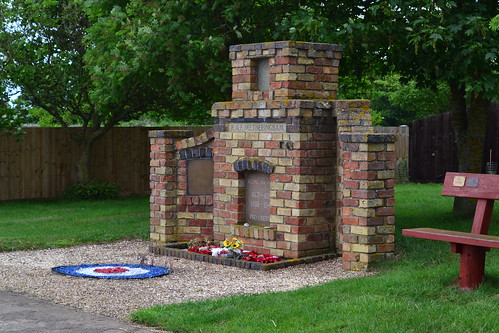
RAF Metheringham

The Memorial at Metheringham pays tribute to all those who flew with 106 Sqn.

Notes and Further Reading.

*1 Operational Record Book AIR 27/834/14 notes Sgt. Young as Sgt. A.L. Young.

A book written by Joseph Bamford the Grandson of Lucy who was killed that night, was published in 1996. “The Salford Lancaster” gives excellent details of the crew, the mission and the aftermath of the accident, published by Pen and Sword, it is certainly worth a read for those interested in knowing more about the incident.

Carter. K.C., & Mueller. R., “Combat Chronology 1941-1945“, Centre for Air Force History, Washington D.C.

Freeman. R., “Mighty Eighth War Diary“, Jane’s Publishing. 1980

RAF Narborough – ‘The Largest Aircraft Base of the First World War.’ Part 2

In Part 1, we saw how Narborough was established as a Night Landing Ground, and how the RNAS passed it onto the RFC to train pilots in aerial combat at great rick. In Part 2, that rick continues and so does the development of the aerodrome to the point it becomes the largest aircraft based airfield in Norfolk.

All Saints Church Narborough, Norfolk

2nd Lt. Allen Ingham Murphy, killed March 30th 1917 ‘in an aeroplane accident’.

These departures left only the reserve squadrons at Narborough, and it wouldn’t be long before they too suffered causalities. The first of these to lose a valuable pilot was 50 Reserve Squadron on March 30th 1917. A young Canadian, not yet out of his teens, 2nd Lt. Allen Ingham Murphy, was killed when his Armstrong Whitworth F.K.8 ‘A2720’ stalled whilst turning after take off. 2nd Lt. Murphy was the first of many casualties from the units that year – training young pilots was not getting any easier.

April saw the arrival of yet another of the Reserve Squadrons, with 64 Reserve Squadron (RS) being posted in from Dover (Swingate Down) in mid April. Another of the training units they would also bring RE8s, Avro 504s Nieuport 17s, BE2s and Shorthorns.

All Saints Church Narborough, Norfolk

Lt. Hubert J. Game, All Saints Church Narborough.

A second tragic accident on June 8th 1917, showed how fragile these aircraft could be. Lieutenant Hubert John Game  was attempting a loop when he got into difficulty and ended up in a steep dive. Trying to pull the aircraft – a BE2 (A2794) – out of the dive was too much for its fragile structure and it suffered a catastrophic wing failure, both wing extensions breaking away leaving the aircraft uncontrollable. Lt. Game was originally a Lieutenant in the Royal Field Artillery (RFA) and was attached to 53 (Training) Sqn RFC at Narborough, when he was tragically killed. He was also the younger brother of Air Vice-Marshal Sir Philip Woolcott Game, and was just 26 years old at the time of his death. He is another one of those whose grave lays a short distance away from the site of Narborough airfield.

Many of those who joined up to fight had jobs or were celebrities in their own field. Many famous actors went on in the second World War to have successful military careers, and many sports personalities also performed admirably. At Narborough, 2nd Lt. William Smeeth was a  22 year old who transferred into the RFC from the 9th Battalion Royal Irish Rifles. Before the war he attended the Loretto School (a prestigious boarding school whose building dates back to the 14th Century, and was founded in 1827 thus claiming to be Scotland’s oldest) from 1909 to 1913, and was a player in the Loretto XI. Considered a “fine, slow, left-handed bowler”, he was wounded in France and posted to Narborough as a flying instructor. On 17th July 1917 he was flying an Avro 504B (A9975) which was struck, whilst landing, by an A.W. FK8 which was taking off at the same time. In the accident Smeeth was killed, and he remains the only military grave in his home town of Bolton Abbey in the Yorkshire Dales.*6, 7

The inherent danger faced by trainees was made no more obvious once again on October 29th, when two more aircraft, both from 50 RS, were lost in separate accidents. The first an Armstrong Whitworth FK.8 (A2730) side slipped during a turn and nose dived into the ground killing both crewmen, 2Lt. Norman Victor Spear (aged 29) and Air. Mech. 1 Sidney Walter Burrell (age 22).  The second aircraft, also an Armstrong Whitworth F.K.8 (B219) spun off a low climbing turn also killing its pilot 2Lt. Laurence Edward Stuart Vaile (aged 23). It was indeed a black day for 50 RS and a stark reminder to the trainees.

All Saints Church Narborough, Norfolk

2Lt. Laurence Edward Stuart Vaile, killed ‘in an aeroplane accident’ August 29th 1917.

In October and December 1917 two more units bolstered the numbers of personnel at Narborough. Firstly, 1 Training Squadron was reformed here on October 1st, whilst 83 Sqn, born out of 18 (Reserve) Squadron (RS), arrived at Narborough two months later, both these bringing a range of aircraft that they quickly swapped for FE.2bs. 83 RS had previously been based at Wyton commanded by Major V. E. Albrecht and were one of the first units designated a Training Squadron Station rather than Training Depot Station.

83 Squadron had only been formed in January that year and within three months of their arrival here, would be on the front line at St. Omer  attacking enemy troop concentrations, attempting to stem the early German spring offensive.

The occurrences of all these tragic accidents was becoming so frequent, that one instructor, Capt. W.E. Johns, creator of ‘Biggles‘, later cited spies as the cause of many ‘accidents’ – claiming that they had tampered with the machines causing the deaths of the crews on board. Johns, himself having written off many machines, believed Americans with German sounding names were to blame for aircraft breaking up in mid-air or crashing at the bottom of loops. More likely however, the fault lay with over exuberant or simply poorly trained recruits.

Like most airfields, there were those locals who disliked the presence of the military and their new flying machines on their doorstep, and there were those who welcomed them into their villages and homes with open arms. Narborough was no different and there are many tales of interactions between military personnel and the local civilians.

The nearby Narborough Hall opened its doors to wounded brought in the from the fields of Flanders, whilst local people, in conjunction with airfield staff, held money raising events to help with food shortages. The local hostelries were frequented by personnel from the airfield, and friendly sports events were held between civilian and military teams. On some days, flying events were put on to display the aircraft and the skills of the pilots training with the RFC. Many came to watch in awe whilst others complained about low-level flying disturbing livestock, and pilots making a nuisance of themselves in the villages; others complained about the speeding lorries that brought in both supplies and men.

In early 1918 a year after the United States declared war, airmen of the 20th, 24th and 163rd U.S. Aero Squadrons were brought into Narborough and attached to 121 Sqn which had just formed in the opening days of the year. Whilst using a variety of aircraft, the backbone of the squadron was the DH 9, an aircraft they used until their departure to Filton in August and eventual disbandment.

As a unit set up to train the Americans, times were hard and often relationships were strained, the cold British winter weather being a substantial change from the hot climate of Texas from where many originated. These units, once here, were spread far and wide, amongst other squadrons across the UK; their Campaign Hat, a broad-brimmed, high-crowned hat, becoming synonymous with their presence.

There would be no let up in the movements in and out of Narborough. 1918 would see yet more arrivals in February with 26 Training Squadron (TS) and 69 Training Squadron (TS)  both units being posted in during that month. Flying a mix of Henry Farman models, the two units would leave Narborough in August to form 22 Training Depot Station in Gormanston, Ireland. Whilst here in Norfolk though, they would carry out training duties, honing their skills alongside the already present training units and the newly arrived Americans.

As time passed, the angst between the US and RFC staff began to mellow. The initial feeling of US personnel having a much more ‘laid back’ approach to rank and uniform being extremely distasteful to the more rigid RFC officials. By the time they were to leave though, relationships had matured and their sad departure ended what had become a generally happy association between them all.

The last months of the war saw no let up in training either; keen to join the RFC young men continued to join up and train to fly. In mid February 1918, two 18 year old boys were perhaps fulfilling a dream when it all went tragically wrong. Flying a DH.4 (B2121), 2Lt. John Fyffe Shaw and 2Lt. Charles Arkley Law of 26 Training Squadron, were both killed after their aircraft’s engine failed causing it to stall and then nose dive with dire consequences into the ground.

When crews arrived at the scene the throttle was found only half open, suggesting the aircraft had stalled during the low level right-hand turn they were performing. Insufficient fuel would have starved the engine leading to it cutting out and causing the resultant crash. Both airmen were from Scotland, Shaw from Dundee where he remains, and Law was from Edinburgh – he remains buried in Narborough.

All Saints Church Narborough, Norfolk

2Lt. Charles Arkley Law killed after his engine failed and the aircraft stalled.

In a major reforming of the military structure on April 1st 1918, the RFC and RNAS were finally amalgamated officially forming the Royal Air Force, a major turning point in the history of the force as it is today. To reflect this, RFC Narborough also took on the new name RAF Narborough, but a mere name change wouldn’t stop the intense work from going on as usual.

As the summer approached and the weather improved, so too did the relationship between the various nationalities. The American’s arrival at Narborough was now matched by the arrival of some thirty or more women of the Women’s Army Auxiliary Corps (WAAC)*2 – which along with the Women’s Naval branch (WRNS) and Women’s Legion, formed the Women’s Royal Air Force (WRAF) on April 1st. Many of these women performed roles in admin sections of the Air Force, telephonists, catering and personal duties whilst some entered the more technical roles, parachute packing, riggers, mechanics and carpenters. By the war’s end, Narborough would have in excess of 100 female personnel working at its site.

On September 12th 1918, 55 Training Depot Station – who originally formed at Manston when 203 Training Depot Station (TDS) was renumbered – arrived here also to carry out training duties. A large number of these training Depots existed at that time and continued on to the war’s end. Like other training units 55 TDS also flew a large range of aircraft types; B.E.2e, D.H.4, 6, and 9, Avro 504j and k and S.E.5a.

All Saints Church Narborough, Norfolk

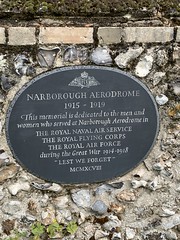
The Plaque at All Saint’s Church Narborough, honouring those who served at Narborough.

This latest squadron to join the many arrived during a time of major redevelopment not only of the site, but the training units as well. Narborough with such a huge influx of staff was now developing new accommodation buildings, hangars and work space. Electricity supplies were at last being installed, new roads created to get men and supplies around the site much quicker and a new hangar, The ‘Red hangar’ – due to its red brick construction – was added near to Battles  Farm. The site had become so big now that it was one of just a few considered for homing the new enormous Handley Page Bomber the V/1500 which was capable of bombing Berlin. But like both Sedgeford and Pulham that decision went elsewhere, to Bircham Newton, with its more suitable and stable soils and long term development potential.

Whilst no V/1500 was ever stationed at Narborough, Capt. J. Sinclair of 166 Sqn Bircham Newton, did land one on the site proving that it could be done and that Narborough airfield was more than able to cater for its needs. However, the aircraft never made the flight to Berlin,  the Armistice being called just before the operation was planned to go ahead.

In November 1918, the war finally ended. After 4 and half years of brutal warfare, millions had died, a small fraction of those killed had been either based at, or passed through, RAF Narborough in their training.

Then, after the news of the cessation of conflict, the big reduction in manpower and machines would begin. As units began to arrive home from France they were quickly disbanded. At Narborough, several of these arrived as cadres, No. 64 (14th February), No. 56 (15th February)and No. 60 (20th February) where upon they joined 55 Training Depot Station to see out their last few months of existence.

Despite this, training continued on, but with less urgency than before. The arrival of one (Sir) Alan Cobham went rather unnoticed, just another instructor to train those stationed here. His focus was on those who struggled to achieve the status of ‘pilot’ for whatever reason – whether it be lack of ability or just through lack of ambition. He remained at Narborough until February 1919 at which point, like so many others, he was demobbed and returned to civvy street.

With flying restrictions now lifted, Cobham teamed up with brothers Fred and Jack Holmes forming their own Aviation Tours company buying an ex RAF Avro 504K, a car and some petrol. He soon added to this a second 504K (G-EAKX and G-EASF) with which they created the famous ‘Cobham’s Flying Circus‘, performing daring barnstorming shows across the country.

In 1921, with the great depression, he began to work for an aerial photographic company and air taxi firm, this led him on to long distance travel, becoming known as “the King of the Taxi Pilots“.*8

Cobham went on to have an incredible aviation life, pioneering both long distance flight and aircraft technology. He made civil aviation more accessible and popular to the masses his influence on aviation going far beyond the training of RAF pilots.

With the war over it was now time for harsh decisions. The monetary and human cost of the war had been astronomical and the military were now no longer the favour of the Government. A new restructure and decommissioning of vast quantities of military equipment was on the horizon. In one small gesture in March 1919, 55 Training Depot Station were disbanded only to be renamed 55 Training Squadron, this simple move brought it inline with other training units of the same designation.

The four units who arrived at the end of 1918, would now one-by-one disband or move on elsewhere to disband; 56 departing to Bircham Newton on December 30th where it disbanded a month later; 60 followed in January only to disband before the month was out, and 64 ended its days on New Years Eve 1919 at Narborough. With that, its days now over, Narborough was deemed surplus to requirements and with the disbandment of the recently renamed 55 Training Squadron, on New Years Eve, the airfield was unceremoniously closed for good.

The post war years saw the closure of many other war time airfields like Narborough. But unlike its sister station RAF Marham a mile or so away, it would remain closed.  For over a year the site remained unoccupied and unused, and the usual vandalism began to take its toll. Machinery, tools and even scraped aircraft remained on site for enthusiastic youths to make their playground. Then in 1921, the buildings and contents were all sold off in a two day event over 2nd and 3rd February, in what was considered to be one of the biggest auctions in Norfolk: some of the items going to local farmers, other for small industrial units, some to schools and the like; Narborough was now scattered to the four corners of the county. The remainder of the site was sold to the farmer and it quickly returned to agriculture, a state it remains in today.

Some of the original buildings are reputed to have existed for many years, even to the present today, (a car show room in Cromer, a furniture warehouse in Terrington-St-Clement and a nearby hut at Setch) whether they still do, is difficult to ascertain, but most have long since succumbed to age, their inevitable deterioration and eventual demolition. In 1977 the last hangar on the airfield, a hangar known as the ‘Black Hangar’ was demolished after severe gales took the last sections of roof. With little option but to pull it down, it was removed leaving little trace.*2 The last full building on site, known as the ‘Racket House’ after personnel used it to play squash, burnt down in 1995, and with that the last trace of the airfield was wiped away.

Narborough itself having no hard runways or perimeter tracks has long since gone. A small memorial has been erected by the Airfield Research Group who are part of the Narborough Local history Society, aiming to promote and preserve the memory of RFC/RAF Narborough; a memorial plaque also marks the graves of those who never made it to France, and the small Narborough Museum & Heritage Centre holds exhibits of 59 Squadron in the local church.

During the First World War some nineteen Victoria Crosses were awarded to members of the RFC/RAF, of those three had passed through Narborough. Several famous individuals also cut their teeth at Narborough, and some went on to achieve great things in the aviation world. Many trainees lost their lives here, but many became successful pilots seeing the war out alive.

Significant not only in size, but in its history, Narborough has now been relegated to the history books. But with the dedication and determination of a few people the importance and historical significance of this site will hopefully continue to influence not only the aviators of tomorrow, but also the public of today.

Updated memorial August 2021

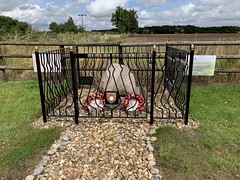
The Narborough memorial which sits at the entrance to Narborough airfield. It was refurbished after the original was struck by a vehicle.

After Narborough, we head east once more toward Swaffham. After turning off the main A47 we come across another American airfield. In the next part of this trip we visit the former RAF Attlebridge.

The full story of Narborough can be read in Trail 7 – North West Norfolk.

Sources and further reading (RAF Narborough)

National Archives: AIR 27/554/1; AIR 27/558;

*1 Fleet Air Arm Officers Association Website accessed 14/6/21

*2 Narborough Airfield Research Group “The Great Government Aerodrome” NARG, 2000

*3 RAF Museum Story Vault Website accessed 14/6/21

*4 Letter from 2/AM C. V. Williams from 59squadronraf.org.uk

*5 On May 31st 1917, all RFC ‘Reserve Squadrons’ were renamed ‘Training Squadrons’.

*6Loretto Roll of Honour 1914-1920” National Library of Scotland digitised copy. accessed 17/5/25 via Google books.

*7 Renshaw, A., “Wisden on the Great War – The Lives of Cricket’s Fallen 1914 – 1918“. Bloomsbury. 2014

*8 Gunn. P., “Flying Lives with a Norfolk Theme“. Gunn. 2010

The book “The Great Government Aerodrome” is an excellent publication about the history of Narborough and contains a great many photos and personal stories of those who knew Narborough. It is well worth a read.

RAF Narborough – ‘The Largest Aircraft Base of the First World War.’ Part 1

At the turn of the last century, flying was in its infancy, and airships formed the main threat from an enemy. Aeroplanes were fragile, slow and cumbersome and those that flew them, risk death at every turn with no means of escape.

As aircraft developed and those in high ranking positions finally saw their potential, production went into overdrive, but there was a greater need, the need for those to fly them.

In Norfolk, the threat from airships was very real, and so many new airfields sprung up to defend the British Isles from these roaming menaces. One such airfield, became the largest of them all, a huge site of 900 acres it dwarfed all other aircraft based airfields, and yet, it failed to last beyond the war.

In this part of Trail 7, we head to modern day RAF Marham, for on its fringes lie a field of forgotten heroes who gave their all during the First World War. We look at RAF Narborough.

RAF Narborough

Originally constructed as the largest aircraft base of the First World War, Narborough Airfield in Norfolk has been known by a variety of names over the years: Narborough Aerodrome, RNAS Narborough, RFC Narborough, and later RAF Narborough. However, the most unofficial — and arguably the most evocative — title, ‘The Great Government Aerodrome’, offers a sense not only of its vast scale (spanning over 900 acres), but also of the diversity of aircraft and personnel stationed there. Initially operated by the Royal Naval Air Service (RNAS), the site later came under the control of the Royal Flying Corps (RFC), and eventually the newly-formed Royal Air Force (RAF), with each change of name reflecting the evolving structure and ownership of Britain’s early air services.

Records show that the site at Narborough had military links as far back as 1912, in the year that the RFC was established when both the Naval Air Organisation and the Air Battalion of the Royal Engineers were combined. Unfortunately, little exists to explain what the site was used for at this time, but it is thought that it was used by the army for training with horses and gun carriages. In later years, it was used as a base from which to counteract the threat from both the German Zeppelin and Schütte-Lanz airships, and also to train future pilots of the RFC and RAF.

Narborough’s history in these early days is therefore sketchy, few specific records exist as to the many changes that were taking place at this time particularly in relation to the development of both the RNAS and the RFC.

However, Narborough’s activities, and its history too, were no doubt influenced on July 1st 1914, when the name RNAS Narborough was officially adopted, and all Naval flying units of the RFC were transferred over to the control of the Navy. A major development in the formation of both forces, there were at this point, a total of: 111 officers, 544 other ranks, seven airships,  fifty-five seaplanes (including ship-borne aircraft) and forty aeroplanes in RNAS service.*1 Some of these may well have seen service at Narborough at this point.

Narborough’s first interaction with flying occurred when a solo flyer – thought to have been Lt. F. Hodges in an Avro 504 *2 – touched down on farmland near to Battles’ Farm in the Autumn of 1915. Neither the pilot, the aircraft type nor the purpose of the landing can be substantiated, but it may well have been the precursor to the development of an airfield at this site.

The airfield itself was then developed, opening early that year (1915), on land that lay some 50 feet above sea level. It sat nestled between the towns of Kings Lynn (10 miles), Swaffham (5 miles); and Downham Market (9 miles), and a mile or so away from the small village of Narborough. A smaller aerodrome would, in 1916, open literally across the road from here, and at 80 acres, it would be tiny in comparison. However, over time, it would grow immensely to become what is today’s RAF Marham, an active airfield that has matured into one of the RAF’s top fighter airfields in the UK.

So by mid 1915, Narborough’s future had been decided, designated as a satellite station to RNAS Great Yarmouth, (itself commissioned in 1913) it was initially to be used as a night landing ground for those aircraft involved in attacks on enemy airships, the most likely reason for its location. No crews were permanently stationed here at the time however, ‘on-duty’ crews later being flown in to await the call to arms should an airship raid take place over East Anglia.

This first arrival of an aircraft in August 1915, led to the site being kept in use by the RNAS for the next ten months. During that time, aircraft of the Air Service would patrol the coastline around Norfolk, using aircraft mainly from Great Yarmouth along with a series of emergency landing grounds including Narborough. The threat from German airships at this time being very real. These landing grounds were strategically placed at intervals along the coastline with others more inland, these included: Aldeborough, Burgh Castle; Covehithe; Holt and Sedgeford all of which combined to make North Norfolk one of the densest regions for airfields at that time. But, and even with all these patrols, the roaming airships that made their way across the region had little to worry about as many of the fighter aircraft used could neither reach them at the higher altitudes nor locate them in poorer weather.

However, as a night landing ground, little activity would directly take place at Narborough (there are no recordings of airship sightings from Aircraft using the airfield) and so after a dormant ten months, the RNAS decided it was surplus to requirements and they pulled out leaving Pulham the only ‘in-land’ station larger than Narborough open in Norfolk at that time.

The future of Narborough could have so easily ended there, but even as closure plans were made, its future was still relatively secure, and it would not be long before a new user of the site would be found. Discussions were already in hand for the RFC to take over, provided the land owners’ permitted it! Luckily they did, and soon fifty acres of rough terrain and a small number of canvas flight sheds were theirs. As for staff accommodation, there was none, so when 35 Sqn arrived at the end of May 1916, Bell tents and make shift accommodation had to be erected by the personnel, in order to protect themselves from the harsh Norfolk elements.

With the First World War raging across the fields of Flanders, the demand for aircraft and trained crews grew rapidly. These new flying machines were evolving swiftly into lethal weapons and highly effective reconnaissance platforms, capable of identifying enemy positions and directing artillery fire with increasing accuracy. To meet the urgent need for trained airmen, hurried training programmes were established, and Narborough soon became a vital preparation ground for budding pilots.

Training, by any standard, was rudimentary. Recruits were required to pass a series of written examinations, followed by up to twenty hours of solo flying, a number of cross-country flights, and two successful landings. Added to this was a fifteen-minute flight at 8,000 feet, culminating in a dead-stick landing — that is, returning safely to earth with the engine cut. It was, in truth, barely enough experience for what lay ahead in the violence of aerial combat.

Like many newly established stations, Narborough was designated as an RFC training site — officially known as a Training Depot Station — joining a growing network of such facilities across Norfolk, Suffolk, and Lincolnshire. Their primary role was to prepare pilots for the rigours of air combat, with instruction in dog-fighting, aerobatics, cross-country navigation, and formation flying.

With the arrival of the RFC came immediate expansion. Additional acreage was acquired that same year, extending the airfield westward beyond the area already occupied by the RNAS, bringing it close to the present-day boundary of RAF Marham. As was often the case with wartime construction, adjustments to the local infrastructure were necessary. A road that once bisected the site was eventually closed to accommodate the growing airfield footprint.

RFC Narborough from the air 1917. @IWM (Q 111416)

So, it was during June 1916 that the first RFC squadron would make use of Narborough as an airfield, 35 Sqn transferring over here from Thetford with Vickers FB.5 and FE.2bs. disposing of their D.H.2s and Henry Farman F.20s in the process. Within two months of their arrival, the nucleus of the squadron would then be used to form a new unit, 59 Sqn, who were also to be stationed here at Narborough (under the initial temporary command of Lieutenant A.C. Horsburgh) with RE8s. On the 16th August, Horsburgh would take on a new role when the new permanent commander Major R. Egerton, was transferred in. It would be he who would take the unit to France the following year and command until his death in December 1917.

During their time here, these daring young trainees, many whom were considered dashing heroes by the awe-inspired locals, would display their skills for all who lined the local roads to see. As these eager young men quickly learned though, flying was not always ‘fun’, and the dangers of the craft were always present, many with dire consequences. Accident rates were high and survival from a crash was rare, even ‘minor’ accidents could prove fatal. All Saints church yard at Narborough, pays testament to their dangerous career with fourteen of the eighteen military graves present being RFC/RAF related.

The initial drive for both these squadrons was to train pilots in the art of cavalry support, using advanced pilot training  techniques. This included being able to send Morse code messages at a rate of six words per minute*2 whilst flying the aircraft over enemy territory – certainly no mean feat.

Deaths on and off the airfield were commonplace and not all aviation related either. During late June 1916, one of the Air Mechanics of 59 Sqn, Charles Gardner, suffered a heart attack and died, just one day prior to the official formation of his squadron. Whilst not considered to have been directly related to his role, his loss saw the beginning of a string of deaths in August that would set the scene for the coming months.

The first of these was another thought to be, unrelated aviation death, although whether or not Corporal Patrick Quinn was on duty at the time is unclear. He died on August 18th, whilst riding his motorcycle in the vicinity of the airfield, the narrow Norfolk roads catching him unaware. Then, just two days later on August 20th, the first of many fatal air accidents would occur.

In this instance, one of 59 Sqn’s pilots, Lt. Gordon William Hall, was killed when the DH.1 (4631) he was flying, side-slipped on approach to the airfield crashing into the ground as a result. A Court of Inquiry (87/8413) concluded that the aircraft had been “banked too steeply” and that the pilot had put the aircraft into a dive that made it uncontrollable. A verdict therefore of ‘accidental death‘ was subsequently recorded against Lt. Hall.*3

A mere eight days later, it was the turn of 35 Sqn to suffer its first fatality and in a not too dissimilar accident. On the 29th, an Armstrong Whitworth F.K.3 (6201), was written off after it too side-slipped and dived following a slow turn. The Pilot, Air Mechanic 1st Class  Moses Boyd, was tragically killed in the accident flying an aircraft that was based at Thetford but undertaking a training exercise here at Narborough. His Court of Inquiry (Ref. 87/4971) on 9th September 1916)*3 , summated that it was a “Flying accident. Turning having lost flying speed”. By now, the dangers of flying were becoming all too apparent and with another two deaths before Christmas, the glamour of flying was quickly becoming tarnished.

However, despite these accidents, young men continued to arrive at the airfield for training, but the large influx of personnel did not mean it was at all a glamorous place to be.

As a training ground, accommodation was basic to say the least, Narborough being described by one trainee as a “desolate, God-forsaken place“*4. Quickly realising the problem, the authorities, began to erect new buildings not only for personnel accommodation, but for training and maintenance roles as well. In response, a total of six permanent hangars, probably RFC General Service Flight Sheds, were erected by the design company and builders Boulton & Paul, three each side of the main road. The Boulton & Paul company based at Norwich, would go on to design and build many aviation related products including the famous ‘Defiant’, a turreted fighter of World War II.

With continued expansion over the next two years, up to 150 buildings would eventually be built on the site, a mix of technical, administrative and accommodation. This on going process of construction and development would, by the end of the war, see some 1,000 personnel based here at Narborough – a number comparable with many modest Second World War airfields.

Narborough wasn’t the only airfield being developed in the immediate area though. Next door, across the road, the new RFC Marham was opening, a much smaller site, that sat in the centre of what is now modern day RAF Marham. Why the two were put so close together is anyone’s guess, but Marham quickly became the home and headquarters to ‘C’ Flight 51 Squadron. The remaining two flights of the squadron being based at both RFC Mattishall and RFC Tydd St Mary.

Marham opened for business in September 1916 and one of those who would be stationed here was Major A.T. Harris, later ‘Bomber Harris’ of Bomber Command fame. He was in command of 191 Night Training Squadron, and took part in many flights from the airfield. Marham, like Narborough, would eventually close at the end of the war in the huge disarmament programme of the immediate post war years. But, unlike Narborough, it would be reborn in the expansion period of the 1930s and grow to what it is today.

There was a good relationship between the two stations, with plenty of rivalry and good humour. Flour bombs from Marham crews on Armistice day were met with a retaliation from Narborough crews with soot bombs, the culmination of several years of war finally coming to an emotional close.

RFC Narborough 1916. The six RFC hangars can be seen in line along the former Narborough – Beachamwell Road. (Marham Aviation Heritage Centre)

The RFC was now building in strength, not only in its front line units but in its reserves too. On November 2nd, 1916 a new reserve squadron was constituted and formed here at Narborough, 48 (Reserve) Squadron (RS). Models flown by the unit at this time included the Grahame White XV, the Maurice Farman Shorthorn and Sopwith’s Pup. As a newly formed unit they would have to get established, gain crews, admin staff and equipment. Once this was in place they could then move on, and after just a month, they departed Narborough heading for the Lincolnshire airfield at Waddington.

The vacancy at Narborough was quickly filled though, in mid December No. 50 Reserve Squadron (RS) arrived from the Kent village of Wye, just as the Sedgeford based 53 Reserve Squadron (RS) also arrived with 504s, BE2s, DH6s and RE8s.*5

Between their arrival and November the following year (1917), the date they departed for Spitalgate, 50 Reserve Squadron would lose twelve flyers in accidents, three Air Mechanics with the remainders being Lieutenants, both 1st and 2nd Class. Five of these remain in the local churchyard.

In early 1917, Nottingham born Captain Albert Ball, VC, DSO & Two Bars, MC arrived at Narborough; a veteran of the front line, he served here for only a short time as an instructor before the draw of the front line took him back once again. This time there was no coming home as he was killed after an intense aerial battle on May 7th that year with 44 victories under his belt. He was just 20 years of age.

Albert Ball via ‘Visit Nottingham’ website.

With increasing numbers of squadrons and men being required for front line units in France, both the original 35 and 59 Squadrons departed Narborough in early 1917. 35 Squadron were first to go, and those left behind saw them off from local train stations with all the pomp and ceremony they could muster.  A few days later a convoy of 3 ton Leyland lorries, trailers and an assortment of other vehicles loaded with men and equipment, set off for France where they met the air party who had already flown to St. Omer. 59 Squadron would follow to the same airfield on February 23rd, both squadrons remaining in France until 1919 and the war’s end.

In Part 2, the reserves are left to carry on training, but its not an easy job. The development and growth of Narborough continues and eventually the RAF is formed. There are major changes all round.

The full story of Narborough can be read in Trail 7 – North West Norfolk.

RAF Scone – A little airfield with a big History (4)

In Part 3, we saw how Scone grew in the post war era, taking on more civilian operations, training pilots from around the world. This continued on in the years that followed and so the airfield grew even more.

Airwork’s ideas were big though, and one of the major changes they would make would be the extension of the runways adding not one but two tarmac runways of 2,800 ft and 2,000 ft in 1968. Scone then became the only UK Air Training School to have such facilities. As an international training college it was going to need to be able to accommodate large numbers of personnel, students and aircraft.

By the 1970s Scone had reached a peak with in excess of 400 students being trained at any one time. Catering for all these nationalities was hard work and a separate school had to be set up to standardise the language.  A School of English taught both basic English and technical English, meaning that by this time not only were pilots and engineers being trained in aeronautical procedures, but English as well. The AST became so busy, that it boasted of being “the largest civil aviation training organisation in the world”.*3

The demand for Scone’s operations continued to grow, as did the airfield itself.  Development took another step forward in the late 1970s and early 1980s when Air Service Training Ltd. expanded yet again. With huge increases in overseas student numbers (over 100 nationalities) a new hall had to be built to provide accommodation for them all. This was Stormont Hall, a large building with all the facilities needed to accommodate and cater for all student needs.

However, like many aviation related histories, things took a turn in the 1990s. Political moves by the Civil Aviation Authority and the Government, combined with changing global economies, caused AST to cease training overseas pilots at the international college at Scone. By April 1996, following the closure of the college, the site owners, Caledonian Investments, broke the news to its users, that it was selling up and in August, Scone was put on the market with a £3m price tag; the end of an era had apparently come to an abrupt end.*4

However, the move did not initially prove to be too much of a set back for AST and Scone as a whole, as it was able to bolster its maintenance programme with the purchase of a Jetstream from Cranfield University. The facilities for the programme, primarily the hangar,  proved to be too small, so a larger one was obtained, on lease, from the Airport authorities, and was officially opened for business in November 2008 after an opening ceremony led by the then-Cabinet Secretary for Education and Lifelong Learning, Fiona Hyslop MSP.*3

A buyer for Scone was soon found however, and in 1997, the airport was purchased as a going concern by the Morris Leslie Group, who allowed the various companies to continue to operate as normal from the airfield. Scone, or now Perth airport, had a new lease of life and would quickly grow to some fifty companies employing around 400 people once more. It has also updated many of the former buildings, providing both residential properties and workshops. It has over recent years, welcomed high prestige figures including Queen Elizabeth, former President George Bush and Prince Andrew.

AST continue to operate from Scone under the new owner, and they are not alone. Other organisations include the Scottish Aero Club (formerly The Scottish Flying Club) and whose history, goes back to 1927, and who relocated to Scone in 1956, joining ranks with the Strathtay Aero Club to form the new  club.  The Aero Club remains Scotland’s largest flying club and continues to offer rotary and fixed wing training as well as both auto-gyro and micro-light flying. It also provides maintenance for those aircraft located on the site.

Other users of Perth include Scotland’s Charity Air Ambulance (SCAA) flying the EC135-T2 helicopter, a charitable organisation that relies solely on donations to keep it flying. It was formed in 2012 and launched a helicopter air ambulance in May 2013 to assist the Scottish Air Ambulance Service (SAAS) to deliver front-line care to time-critical emergencies across Scotland. SCAA provides a fully equipped medical helicopter that can be deployed to incidents across the length and breadth of Scotland.

Today many of the wartime buildings remain, in use, by small industrial units. The Battle Headquarters, can be seen from the road very much exposed, as all but the top slotted observation ‘turret’ would normally be underground. The accommodation and technical areas are located together and many now form part of a small hotel for those visiting the area.

There are three runways in use, two of concrete / tarmac and one of grass, these being 2,799 ft and 1,998 feet, the third grass runway is 2,040 feet, all joined at the ends to form a perimeter. Two large hangars hold around 85 aircraft with further space for 15 more parked on the apron.

The airfield lies a few miles north of Perth, the main A94 offers access to the airfield and views across some of the site. It sits on a hill and so much of it is hidden from view at ground level. Being an active airfield, access is limited and understandably restricted. However, views of the current residents are available and many of the wartime buildings are accessible operating as retail and industrial units.

RAF Scone (Perth Airport)

The Battle Headquarters is very much exposed, this would normally be below ground level with only the slits visible.

Scone for such a small airfield, has had a long and fruitful history. Its links to pilot training, especially throughout the war years, no doubt sent many airmen to front line squadrons, many of whom  would go onto serve in some of Britain’s fiercest air battles. A small and often rudimentary airfield, it played a huge part in Britain’s wartime and post-war aviation history, and long may it continue.

The full history of Scone can be read in Trail 56.

Sources and further reading (RAF Scone).

*1 University of Glasgow website. Accessed 10.2.25

*2 McCloskey. K., “Airwork – A History“. The History Press, 2012.

*3 The Herald Newspaper, 16th August 2020, via website

*4 The Herald Newspaper, 9th August 1996 via website

Perth Airport website

National Archives AIR 27/1679/1; AIR 27/1679/1

McCloskey, K. “Airwork – A history” The History Press, 2012

Lake, A., “Flying Units of the Royal Air Force“, Airlife, 1999.

McKay, S., “Secret Britain” Headline Publishing Group. 2021

Lake. A., “Flying Units of the RAF“. Air Life Publishing, 1999.

RAF Scone – A little airfield with a big History (3)

In Part 2, Scone supported the RAF throughout the war, training pilots and navigators in a range of aircraft. Post war, this demand reduced, but it was not the RAF’s end with Scone, nor the end of pilot training.

With Airwork now owning the site outright, they began to look to the future. In 1950, BEA began trials with flights to Renfrew and Glasgow, a scheme that was hoping to open doors to destinations wider afield, but it was not successful and so the idea never came to fruition. Keen to expand, Airwork then took on conversion flying for the Admiralty, converting naval pilots to from single to twin-engined aircraft. They also carried out engineering and navigational training and began work overhauling radio systems, the future was looking bright for the expanding airfield.

The December of 1950 saw the Glasgow University Air Squadron (UAS) move to Scone as a temporary measure whilst their runway at Abbotsinch was resurfaced. As a result, Airwork became responsible for the maintenance of the training aircraft they were using, primarily Tiger Moths and Miles Magisters. Airwork soon came up with the idea of a trophy to be contested for by the various Scottish University Air Squadrons, called the Scone Cup,  the first competition was held in October 1951 and won by Glasgow. After a further name change of the UAS to Universities of Glasgow and Strathclyde Air Squadron (UGSAS) in 1965, the squadron re-equipped with DH Chipmunks, bringing yet another type to the small Scottish airfield.

RAF Scone (Perth Airport)

Old buildings are utilised for modern purposes.

Meanwhile the Scone Cup continued, as did the relationship between Scone and the various Air Squadrons, until in 1969, when the RAF centralised all its maintenance work at RAF Turnhouse, and the link with Scone was broken. The GSAS were then reassigned back to Glasgow airport, the location of its origin way back in April 1941.

Like so many other contracts with the military post war, the Admiralty’s pilot training programme wouldn’t last long either, and a gradual reduction in the need for pilot training for the service, forced Airwork to look elsewhere for their trade. The dynamic years that followed saw a huge growth in civil aviation, with jets now spanning the globe in hours and not days, and private flying was becoming evermore affordable to the masses. It was this opportunity that Airwork seized, becoming the first civil school to gain an Instrument rating course certificate for pilot training.

This enabled the now renamed ‘Airwork School of Aviation’ to officially offer its services to civilian operators for the first time, an offer that was taken up by numerous airlines including the first, Sudan Airways, with the first trainees arriving in November 1955.

Although the Navy had ended its contract with Airwork and Scone, it was not the end of military training for good. Whilst 1957 brought the disbandment of some landmark units, on March 8th, another training unit, 1 Civilian Fighter Control Co-Operation unit, formed here at Scone operating the Avro Anson T22. Little seems to be published about the activities of this unit, but I would assume it was, like other training units at Scone, operated by civilians working as part of the Royal Air Force’s training programme. The unit remained active here at Scone, until 31st January 1961 where upon it was disbanded. A year after its cessation on May 10th, an Anson of the unit ‘VV977’ was sold as scrap at No.27 Maintenance Unit (MU) at Shawbury.

With that any RAF connections with Perth ceased. The airfield was passed to ACS Aviation, who claim to be the “leading Commercial Flight Training Organisation in Scotland”. Operating a range of services including commercial pilot training and maintenance provisions.

By the turn of the 1950s / 60s, Scone was heralded as a thriving pilot training facility, seen by many organisations as one of the best available. In acknowledgement of this, the recently formed British United Airways sent their pilots here and were quickly followed by other UK based airlines. The prestige that attracted these airlines  led to an award by the Ministry of Aviation confirming Scone’s high ranking status, something that had not been done before to any other UK based school.

Airwork’s organisation stretched the length and breadth of the UK, and as military reorganisations took place, so some of Airwork’s units were either closed or relocated to alternative locations. In the early 1960s, Scones Airwork School of Aviation began to expand further by taking over the School of Aeronautical Engineering from Hamble, which led to yet another name change to Airwork Services Training (AST) to match the new role now being served at Scone. As the school developed and established itself at Scone, so it too began to expand, delving into the roles of electrical, turbine and rotary fields, all of which required further development of the pre-war site.

RAF Scone (Perth Airport)

Modern day Scone is home to a large number of small aircraft.

As Airwork has expanded into the rotary field, the next natural step was to train helicopter pilots at the airfield. The first such operation took place on 30th September 1963, with students from the Ghana Air Force. The instructor on that course, one Cryil Sweetman, would go onto gain his own fifteen minutes of fame flying a Hiller UH-12C in James Bond’s ‘From Russia with Love.’

The growth of Scone continued on throughout the (1960s) decade. During these years no less than thirty Cessnas (130 and 150 models) were brought into the airfield to train pilots, a number that would make it the largest fleet in Europe, giving Scone the advantage over other European training centres. Combine that with the additional training facilities and private maintenance work, Scone was rapidly becoming one of the biggest players in the civil aviation industry.

In the final part, we see how Scone had grown from strength tot  strength, through different ownership it has continued to supply training for new and established pilots, establishing itself as one of the largest training centres around.

The full history of Scone can be read in Trail 56.

RAF Scone – A little airfield with a big History (2)

Part 1 of this trail, saw how Scone began its life, and how through private enterprise, it developed into a pilot training centre for RAF pilots. As the need for pilots and navigators increases so does the work at Scone.

On September 3rd 1939, with Britain’s declaration of war, the training units operating on behalf of the RAF were immediately reorganised and re-designated, 11 E&RFTS becoming known more simply as 11 Elementary Flying Training School (EFTS).

This reorganisation of training schools also led to new aircraft, the Tiger Moths currently under civilian registration, were given military designations (BB672 – BB692) and the Hart trainers were replaced by Miles Magisters. Whilst ground crews remained as civilians, the instructors were drafted into the RAF and the school became RAF controlled.

Also at this time, Airwork formed and operated a further training unit here at Scone, 7 Civil Air Navigation School (CANS) flying Avro Ansons. Like 11 E&RFTS, they were, in October, disbanded and re-designated 7 Air Observers Navigation School (AONS), this new designation beginning on 1st November 1939. To fulfil their role, they would then take on eight Dragon Rapides, specifically to train new crews in cross country navigation techniques. After further expansion of both aircraft numbers and type, on June 1st 1940, the AONS was disbanded, further streamlining of training units meaning these needs were met elsewhere.

It was in these early war years that Scone almost became the hub for vital research into radar, when in late 1939, the Telecommunications Research Establishment (TRE) relocated here from Bawdsey Manor in Suffolk; mainly to be away from prying eyes but also away from the possibility of attack by German bombers. The pioneer of radar Robert Watson-Watt, grew up in this region and later went to University here, so it was a natural place to move the research to. However, once at RAF Scone, it was realised that the facilities were far to rudimentary and completely insufficient to accommodate the amount of work  needed to carry out this vital research. So, in early 1940, the establishment moved again this time near to Swanage on the Dorset coast. Scone’s fifteen minutes of fame had sadly and quickly passed them by.

Then in early November 1940, 309 Squadron sent a detachment of Lysander IIIs to Scone. Only recently formed, they remained here for about six months, being primarily based at Renfrew where the Polish pilots found the number of woods and railway lines confusing. The sole purpose of 309 Sqn was as a Polish Co-operation unit to work in conjunction with the C-in-C of the Polish Army. It was unique in that it was ‘double’ ranked, having both British and Polish officers in charge, the idea being that once the Polish personnel were in place the British would be pulled out and the squadron would operate as an independent Polish unit. A series of training flights were carried out by the Polish pilots, but with lectures being carried out through a translator, it was often a difficult task to do.

In September 1941, ‘E’ Flight of 11 EFTS  was used to form a new training unit, 5 Flying Instructors School (Supplementary) then again simply to the Flying Instructors School, finally becoming the Flying Instructors School (Elementary) from April 1942. The small number of resident pilot instructors flew Miles Masters and Tiger Moths training hundreds of pilots between them before the unit was eventually disbanded in November 1942.

Scone airport looking south in 1947. (@Britain from above)

The remainder of 11 EFTS continued on to the war’s end however, gradually being reduced in size as demand for new pilots decreased. Post war, in 1947, it was renamed as 11 Reserve Flying School (RFS) still operated by Airwork and still flying the biplane the Tiger Moth along with Airspeed Oxfords, Ansons and Hawk trainers. By 1954, the unit had wound down finally being disbanded that same year on the 20th June.

The immediate post war years also saw a huge closure of now ‘unwanted’ airfields, all surplus to requirements. Many were put into care and maintenance or reserved for future use should east-west relations diminish. RAF Errol, located to the east of Scone between Perth and Dundee, was closed and proposals put forward to turn it into a municipal airport for Perth and Dundee. This proposal allowed Airwork to put forward their own offer to Perth Town Council for the site at Scone, the offer (£54,000) was quickly accepted and the deal was finalised and ownership handed over on 31st July 1946, just four months after the initial offer was made.

The war’s end allowed many of the former civilian clubs to reinstate their operations, some though, were unable to due to high costs or lack of suitable facilities. The Strathtay Aero Club, who were one of the lucky ones, were once again able to continue their operations with Airwork at Scone.

Throughout the 1940s, a resurgence of public events saw many air pageants and displays take place across the country. At Perth, the Strathtay Aero Club in conjunction with Airwork, organised its first post war air display attracting around 10,000 spectators, highlighting the renewed interest in aviation at that time.

Amongst those present at the display on 16th August 1947, were the Lord Provost Ure Primrose and Air Marshal Sir Richard Peirse. Aircraft taking part ranged from Bleriot’s 1909 monoplane to a squadron of clipped wing Spitfires. A short film of the event is available to view through the British Pathe News website.

Thus renewed interest in civilian flying, allowed Scone (Airwork) to become the saviour of yet another civilian aeroclub, and another that had been forcible suspended by the war. The Scottish Flying Club (SFC), who were initially based at Renfrew and whose buildings 309 Sqn moved into, were closed following the declaration of war and evicted from their premises. After being ejected from their airfield, they found themselves in the awkward position of having nowhere to operate from and unable to afford the high fees being charged by many civilian operators in the immediate post war years.

Airwork allowed the SFC to use Scone’s facilities in such a way that Airwork made no profit out of the agreement. This was clearly a saving grace for the club who eventually joined forces with the Strathtay Aero Club later in 1956, to form a new organisation, The Scottish Aero Club, who would continue to operate from here at Scone.

But the RAF had not finished with Scone yet. In 1949, 666 Squadron was reformed at Scone as an Royal Auxiliary Air Force unit (RAuxAF) comprising of the 1966 Air Observation Post Flight (AOP), the 1967 (AOP) Flight at Renfrew and the 1968 (AOP) Flight at Abbotsinch. The squadron flew Austers Vs and VIs, in a cooperation role with Army units, but by 1957 all three flights, and thus the squadron, had ceased to exist when a letter, signed by the Queen, was handed to more than eighty senior officers of the RAuxAF, officially ending its existence as a military unit. With that, thirty-two years of history had come to an end, a history that had seen the RAuxAF take part in virtually all of Britain’s major air battles since 1925.

With the war over, the RAF’s need for pilots reduces dramatically and so does the need for supporting civilian operations. However, at Scone, operations go from strength to strength.

The full history of Scone can be read in Trail 56.