RAF Narborough – ‘The Largest Aircraft Base of the First World War.’ Part 1

At the turn of the last century, flying was in its infancy, and airships formed the main threat from an enemy. Aeroplanes were fragile, slow and cumbersome and those that flew them, risk death at every turn with no means of escape.

As aircraft developed and those in high ranking positions finally saw their potential, production went into overdrive, but there was a greater need, the need for those to fly them.

In Norfolk, the threat from airships was very real, and so many new airfields sprung up to defend the British Isles from these roaming menaces. One such airfield, became the largest of them all, a huge site of 900 acres it dwarfed all other aircraft based airfields, and yet, it failed to last beyond the war.

In this part of Trail 7, we head to modern day RAF Marham, for on its fringes lie a field of forgotten heroes who gave their all during the First World War. We look at RAF Narborough.

RAF Narborough

Originally constructed as the largest aircraft base of the First World War, Narborough Airfield in Norfolk has been known by a variety of names over the years: Narborough Aerodrome, RNAS Narborough, RFC Narborough, and later RAF Narborough. However, the most unofficial — and arguably the most evocative — title, ‘The Great Government Aerodrome’, offers a sense not only of its vast scale (spanning over 900 acres), but also of the diversity of aircraft and personnel stationed there. Initially operated by the Royal Naval Air Service (RNAS), the site later came under the control of the Royal Flying Corps (RFC), and eventually the newly-formed Royal Air Force (RAF), with each change of name reflecting the evolving structure and ownership of Britain’s early air services.

Records show that the site at Narborough had military links as far back as 1912, in the year that the RFC was established when both the Naval Air Organisation and the Air Battalion of the Royal Engineers were combined. Unfortunately, little exists to explain what the site was used for at this time, but it is thought that it was used by the army for training with horses and gun carriages. In later years, it was used as a base from which to counteract the threat from both the German Zeppelin and Schütte-Lanz airships, and also to train future pilots of the RFC and RAF.

Narborough’s history in these early days is therefore sketchy, few specific records exist as to the many changes that were taking place at this time particularly in relation to the development of both the RNAS and the RFC.

However, Narborough’s activities, and its history too, were no doubt influenced on July 1st 1914, when the name RNAS Narborough was officially adopted, and all Naval flying units of the RFC were transferred over to the control of the Navy. A major development in the formation of both forces, there were at this point, a total of: 111 officers, 544 other ranks, seven airships,  fifty-five seaplanes (including ship-borne aircraft) and forty aeroplanes in RNAS service.*1 Some of these may well have seen service at Narborough at this point.

Narborough’s first interaction with flying occurred when a solo flyer – thought to have been Lt. F. Hodges in an Avro 504 *2 – touched down on farmland near to Battles’ Farm in the Autumn of 1915. Neither the pilot, the aircraft type nor the purpose of the landing can be substantiated, but it may well have been the precursor to the development of an airfield at this site.

The airfield itself was then developed, opening early that year (1915), on land that lay some 50 feet above sea level. It sat nestled between the towns of Kings Lynn (10 miles), Swaffham (5 miles); and Downham Market (9 miles), and a mile or so away from the small village of Narborough. A smaller aerodrome would, in 1916, open literally across the road from here, and at 80 acres, it would be tiny in comparison. However, over time, it would grow immensely to become what is today’s RAF Marham, an active airfield that has matured into one of the RAF’s top fighter airfields in the UK.

So by mid 1915, Narborough’s future had been decided, designated as a satellite station to RNAS Great Yarmouth, (itself commissioned in 1913) it was initially to be used as a night landing ground for those aircraft involved in attacks on enemy airships, the most likely reason for its location. No crews were permanently stationed here at the time however, ‘on-duty’ crews later being flown in to await the call to arms should an airship raid take place over East Anglia.

This first arrival of an aircraft in August 1915, led to the site being kept in use by the RNAS for the next ten months. During that time, aircraft of the Air Service would patrol the coastline around Norfolk, using aircraft mainly from Great Yarmouth along with a series of emergency landing grounds including Narborough. The threat from German airships at this time being very real. These landing grounds were strategically placed at intervals along the coastline with others more inland, these included: Aldeborough, Burgh Castle; Covehithe; Holt and Sedgeford all of which combined to make North Norfolk one of the densest regions for airfields at that time. But, and even with all these patrols, the roaming airships that made their way across the region had little to worry about as many of the fighter aircraft used could neither reach them at the higher altitudes nor locate them in poorer weather.

However, as a night landing ground, little activity would directly take place at Narborough (there are no recordings of airship sightings from Aircraft using the airfield) and so after a dormant ten months, the RNAS decided it was surplus to requirements and they pulled out leaving Pulham the only ‘in-land’ station larger than Narborough open in Norfolk at that time.

The future of Narborough could have so easily ended there, but even as closure plans were made, its future was still relatively secure, and it would not be long before a new user of the site would be found. Discussions were already in hand for the RFC to take over, provided the land owners’ permitted it! Luckily they did, and soon fifty acres of rough terrain and a small number of canvas flight sheds were theirs. As for staff accommodation, there was none, so when 35 Sqn arrived at the end of May 1916, Bell tents and make shift accommodation had to be erected by the personnel, in order to protect themselves from the harsh Norfolk elements.

With the First World War raging across the fields of Flanders, the demand for aircraft and trained crews grew rapidly. These new flying machines were evolving swiftly into lethal weapons and highly effective reconnaissance platforms, capable of identifying enemy positions and directing artillery fire with increasing accuracy. To meet the urgent need for trained airmen, hurried training programmes were established, and Narborough soon became a vital preparation ground for budding pilots.

Training, by any standard, was rudimentary. Recruits were required to pass a series of written examinations, followed by up to twenty hours of solo flying, a number of cross-country flights, and two successful landings. Added to this was a fifteen-minute flight at 8,000 feet, culminating in a dead-stick landing — that is, returning safely to earth with the engine cut. It was, in truth, barely enough experience for what lay ahead in the violence of aerial combat.

Like many newly established stations, Narborough was designated as an RFC training site — officially known as a Training Depot Station — joining a growing network of such facilities across Norfolk, Suffolk, and Lincolnshire. Their primary role was to prepare pilots for the rigours of air combat, with instruction in dog-fighting, aerobatics, cross-country navigation, and formation flying.

With the arrival of the RFC came immediate expansion. Additional acreage was acquired that same year, extending the airfield westward beyond the area already occupied by the RNAS, bringing it close to the present-day boundary of RAF Marham. As was often the case with wartime construction, adjustments to the local infrastructure were necessary. A road that once bisected the site was eventually closed to accommodate the growing airfield footprint.

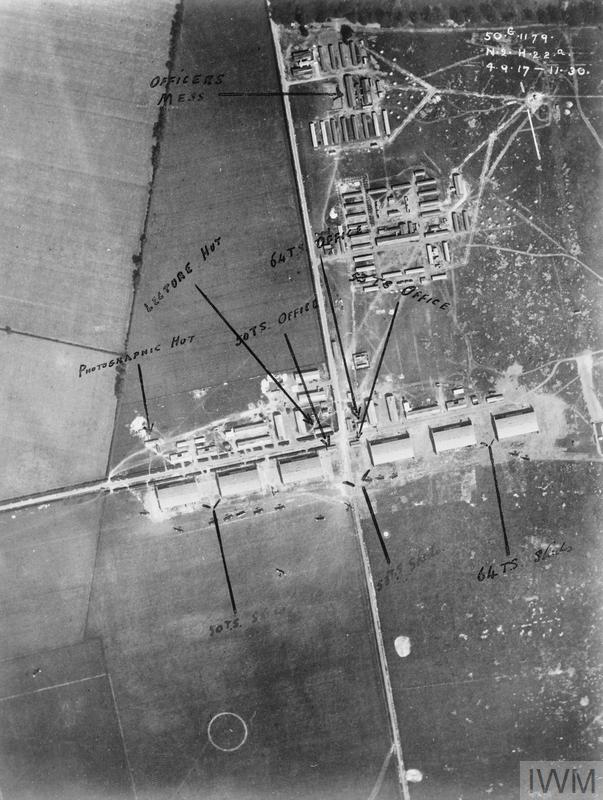
RFC Narborough from the air 1917. @IWM (Q 111416)

So, it was during June 1916 that the first RFC squadron would make use of Narborough as an airfield, 35 Sqn transferring over here from Thetford with Vickers FB.5 and FE.2bs. disposing of their D.H.2s and Henry Farman F.20s in the process. Within two months of their arrival, the nucleus of the squadron would then be used to form a new unit, 59 Sqn, who were also to be stationed here at Narborough (under the initial temporary command of Lieutenant A.C. Horsburgh) with RE8s. On the 16th August, Horsburgh would take on a new role when the new permanent commander Major R. Egerton, was transferred in. It would be he who would take the unit to France the following year and command until his death in December 1917.

During their time here, these daring young trainees, many whom were considered dashing heroes by the awe-inspired locals, would display their skills for all who lined the local roads to see. As these eager young men quickly learned though, flying was not always ‘fun’, and the dangers of the craft were always present, many with dire consequences. Accident rates were high and survival from a crash was rare, even ‘minor’ accidents could prove fatal. All Saints church yard at Narborough, pays testament to their dangerous career with fourteen of the eighteen military graves present being RFC/RAF related.

The initial drive for both these squadrons was to train pilots in the art of cavalry support, using advanced pilot training  techniques. This included being able to send Morse code messages at a rate of six words per minute*2 whilst flying the aircraft over enemy territory – certainly no mean feat.

Deaths on and off the airfield were commonplace and not all aviation related either. During late June 1916, one of the Air Mechanics of 59 Sqn, Charles Gardner, suffered a heart attack and died, just one day prior to the official formation of his squadron. Whilst not considered to have been directly related to his role, his loss saw the beginning of a string of deaths in August that would set the scene for the coming months.

The first of these was another thought to be, unrelated aviation death, although whether or not Corporal Patrick Quinn was on duty at the time is unclear. He died on August 18th, whilst riding his motorcycle in the vicinity of the airfield, the narrow Norfolk roads catching him unaware. Then, just two days later on August 20th, the first of many fatal air accidents would occur.

In this instance, one of 59 Sqn’s pilots, Lt. Gordon William Hall, was killed when the DH.1 (4631) he was flying, side-slipped on approach to the airfield crashing into the ground as a result. A Court of Inquiry (87/8413) concluded that the aircraft had been “banked too steeply” and that the pilot had put the aircraft into a dive that made it uncontrollable. A verdict therefore of ‘accidental death‘ was subsequently recorded against Lt. Hall.*3

A mere eight days later, it was the turn of 35 Sqn to suffer its first fatality and in a not too dissimilar accident. On the 29th, an Armstrong Whitworth F.K.3 (6201), was written off after it too side-slipped and dived following a slow turn. The Pilot, Air Mechanic 1st Class  Moses Boyd, was tragically killed in the accident flying an aircraft that was based at Thetford but undertaking a training exercise here at Narborough. His Court of Inquiry (Ref. 87/4971) on 9th September 1916)*3 , summated that it was a “Flying accident. Turning having lost flying speed”. By now, the dangers of flying were becoming all too apparent and with another two deaths before Christmas, the glamour of flying was quickly becoming tarnished.

However, despite these accidents, young men continued to arrive at the airfield for training, but the large influx of personnel did not mean it was at all a glamorous place to be.

As a training ground, accommodation was basic to say the least, Narborough being described by one trainee as a “desolate, God-forsaken place“*4. Quickly realising the problem, the authorities, began to erect new buildings not only for personnel accommodation, but for training and maintenance roles as well. In response, a total of six permanent hangars, probably RFC General Service Flight Sheds, were erected by the design company and builders Boulton & Paul, three each side of the main road. The Boulton & Paul company based at Norwich, would go on to design and build many aviation related products including the famous ‘Defiant’, a turreted fighter of World War II.

With continued expansion over the next two years, up to 150 buildings would eventually be built on the site, a mix of technical, administrative and accommodation. This on going process of construction and development would, by the end of the war, see some 1,000 personnel based here at Narborough – a number comparable with many modest Second World War airfields.

Narborough wasn’t the only airfield being developed in the immediate area though. Next door, across the road, the new RFC Marham was opening, a much smaller site, that sat in the centre of what is now modern day RAF Marham. Why the two were put so close together is anyone’s guess, but Marham quickly became the home and headquarters to ‘C’ Flight 51 Squadron. The remaining two flights of the squadron being based at both RFC Mattishall and RFC Tydd St Mary.

Marham opened for business in September 1916 and one of those who would be stationed here was Major A.T. Harris, later ‘Bomber Harris’ of Bomber Command fame. He was in command of 191 Night Training Squadron, and took part in many flights from the airfield. Marham, like Narborough, would eventually close at the end of the war in the huge disarmament programme of the immediate post war years. But, unlike Narborough, it would be reborn in the expansion period of the 1930s and grow to what it is today.

There was a good relationship between the two stations, with plenty of rivalry and good humour. Flour bombs from Marham crews on Armistice day were met with a retaliation from Narborough crews with soot bombs, the culmination of several years of war finally coming to an emotional close.

RFC Narborough 1916. The six RFC hangars can be seen in line along the former Narborough – Beachamwell Road. (Marham Aviation Heritage Centre)

The RFC was now building in strength, not only in its front line units but in its reserves too. On November 2nd, 1916 a new reserve squadron was constituted and formed here at Narborough, 48 (Reserve) Squadron (RS). Models flown by the unit at this time included the Grahame White XV, the Maurice Farman Shorthorn and Sopwith’s Pup. As a newly formed unit they would have to get established, gain crews, admin staff and equipment. Once this was in place they could then move on, and after just a month, they departed Narborough heading for the Lincolnshire airfield at Waddington.

The vacancy at Narborough was quickly filled though, in mid December No. 50 Reserve Squadron (RS) arrived from the Kent village of Wye, just as the Sedgeford based 53 Reserve Squadron (RS) also arrived with 504s, BE2s, DH6s and RE8s.*5

Between their arrival and November the following year (1917), the date they departed for Spitalgate, 50 Reserve Squadron would lose twelve flyers in accidents, three Air Mechanics with the remainders being Lieutenants, both 1st and 2nd Class. Five of these remain in the local churchyard.

In early 1917, Nottingham born Captain Albert Ball, VC, DSO & Two Bars, MC arrived at Narborough; a veteran of the front line, he served here for only a short time as an instructor before the draw of the front line took him back once again. This time there was no coming home as he was killed after an intense aerial battle on May 7th that year with 44 victories under his belt. He was just 20 years of age.

Albert Ball via ‘Visit Nottingham’ website.

With increasing numbers of squadrons and men being required for front line units in France, both the original 35 and 59 Squadrons departed Narborough in early 1917. 35 Squadron were first to go, and those left behind saw them off from local train stations with all the pomp and ceremony they could muster.  A few days later a convoy of 3 ton Leyland lorries, trailers and an assortment of other vehicles loaded with men and equipment, set off for France where they met the air party who had already flown to St. Omer. 59 Squadron would follow to the same airfield on February 23rd, both squadrons remaining in France until 1919 and the war’s end.

In Part 2, the reserves are left to carry on training, but its not an easy job. The development and growth of Narborough continues and eventually the RAF is formed. There are major changes all round.

The full story of Narborough can be read in Trail 7 – North West Norfolk.

Boeing B-29s in the UK.

During March 1944, an event took place in the UK that considering its historical importance, is little known about. It was actually quite a momentous event, especially in terms of aviation history, and in particular the Second World War.

As a follow on to RAF Glatton and Trail 6, we look into the short-lived presence of Boeing’s mighty aircraft the B-29 ‘Superfortress’, in what would appear to be its first and only wartime presence on British soil.

At the time of the bombing of Pearl Harbour in 1941, the United States was less than ready for a global war. The retaliation and defeat of not only Japan, but Nazi Germany as well, was going to be both costly and massive, requiring a huge increase in manufacturing of both arms and machinery.

This increase meant not only aircraft for the Air Force, but the infrastructure to support and train the aircrews too. A network of airfields and supporting organisations totalling some $100 million in 1940, would, by the war’s end be valued in the region of  $3,000 million. In terms of size, this infrastructure would cover an area of land equal to the combined areas of: New Hampshire, Vermont, Massachusetts, and Connecticut.*1

To complete the task, along with aiding her allies, the U.S. was going to need to design and manufacture many new models of aircraft, aircraft that would outshine anything previously made available to the U.S. forces. Long range bombers in particular, capable of travelling great distances were going to be required – and a lot of them. At the outbreak of the European war, the U.S. Army Air Corps was in comparison to the European forces, very small, commanding just 26,000 officers and enlisted men, and operating only 800 front-line aircraft. The Luftwaffe on the other hand, had expanded considerably over the previous years, now commanding some 3,600 aircraft. The British, who were still some way behind the Germans but growing rapidly, had available to them some 2,000 aircraft, whilst the French could muster slightly over 1,700. *1a

To meet this demand, U.S. aircraft manufacturers were going to have to start by modifying, and with some exceptions, redesigning the various aircraft types that were already available to the U.S.  forces. However, and likewise the British and German manufacturers, new models were going to have to be designed and put into production very quickly if victory was to be achieved in any of the world’s theatres.

Preempting war, the US Government put out tenders for long range bombers, in answer to which during the 1930s, the Boeing Model 299, first flew. Eventually being purchased by the US Government to fulfil the role, it was put into production as the iconic B-17 ‘Flying Fortress’, and was followed not long after by the B-24 ‘Liberator’; a more modern aircraft which took its maiden flight in 1939. But sitting on the drawing board at this time, was another aircraft that performed even better, the formidable B-29, a bomber designed to fly at altitudes up to 40,000ft, beyond the range of anti-aircraft guns and  faster than many fighters of the time. The aircraft was so advanced in design that depending upon its payload it was capable of flying distances of up to 5,000 miles, far beyond that of any other heavy bomber.

Whilst the U.S. aircraft manufacturers had already begun designing and testing these new models, it would be some time before the number and types of available aircraft would come anywhere close to being comparable to those of the Luftwaffe, R.A.F. or even later, the Imperial Japanese Air Force.

By August 1942 both the development and production of these two heavy bombers, the B-17 and B-24, were well underway, and so it was decided that they would go initially to the European theatre rather than the Far East. The competition for the attack on Japan now lay between the B-29 and Consolidated’s competitor the B-32 ‘Dominator’ – an enlarged and also pressurised version of their B-24. However, two years after the first design drawings were revealed, neither of these aircraft types had yet flown, and so the shorter ranged B-17 and B-24s were going to have to fill the gap until such times as their replacements could arrive.

The war in the Far East would provide its own set of problems. The distance that supplies would have to be taken would take time and before any invasion could take place, lost ground not only had to be recovered, but held. To achieve this, ground forces would need to be protected by an air umbrella, a defensive shield formed so tightly that air supremacy was guaranteed.

Getting supplies into China was difficult, by air it required long and dangerous flights over the ‘Hump’, the Himalayan mountain range, usually fulfilled by C-47s and DC-3s, their commercial equivalent. With the C-46 ‘Commando’ and C-87 coming on line later on, the frequency and quantity of these supplies could increase but it was still not enough for the Chinese, nor for the difficult task ahead.

By March 1943 the stage was set. The Fourteenth Air Force was created out of Maj. Gen. Claire Chennault’s China Air Task Force, which by the summer time, had begun attacks on coastal positions, ports and troop concentrations under Japanese control.  This air umbrella was in part achieved over Burma, and the desired attacks on Japan now looked more possible, but the B-17s and B-24s that had worked tirelessly lacked the range to hit the Japanese homeland;  the long range high performance B-29 was by now desperately needed.

During the Quebec Conference in August that year, U.S. officials put forward their proposal to stage American long range bombers on airfields in China, the area required for such bases being under Chinese control already and therefore not at the mercy of the Japanese forces. This offensive, designated the Matterhorn Project, would involve the still as yet untested  in battle, B-29s, their longer range and larger bomb capacity enabling them to ‘bomb Japan into submission’ in a similar way that Sir Arthur Harris had hoped for in Europe with the RAF’s bombing campaign against Germany’s industrial targets and cities.

To meet these aims a new force would be created, the Twentieth Air Force, which would be made up of two commands: the XX Bomber Command from China and the XXI Bomber Command who would be based in the Mariana Islands after they were retaken from Japanese control.

The aircraft destined to carry out this role, the B-29, was still very much an unknown quantity. Rushed into production with scant attention to testing, it was a monster of an aircraft, with a crew of eleven in pressurised compartments, electronic gun turrets and a massive 141 ft wingspan. The project was to be the biggest in U.S. aviation history, spares alone in the initial contract costing $19.5m, and one which General Arnold
referred to as the “$3 billion gamble”.*1b

The following film “Birth of the B-29 Superfortress” shows a B-29 production line and a test YB-29 in flight. It also contains some short graphic images at the start.

A batch of four XB-29 prototypes were built, and after initial test flights, a further fourteen ‘test’ aircraft, designated the YB-29, were also constructed. But problems with design drawings, missing parts and rushed testing meant that production was slowed to a minimum, part finished aircraft being stored whilst awaiting vital components. After test flights it became apparent that the B-29’s engines were prone to overheating and in several cases catching fire. This delayed further testing reducing flying time considerably until the problems could be solved. During flight tests, this problem with the engines was graphically seen, first on February 18th 1943, and then again a year later.

In February, XB-29 #41-003 (the second prototype XB) crashed into a meat packing factory killing all eight crew on board along with twenty civilians on the ground. The pilot, Eddie Allen, had already received the Air Medal for successfully landing the same XB-29 following another engine fire in the preceding December. A year later, January 29th 1944, engine problems caused yet another accident when  #41-36967, the last of the  fourteen*2 Wichita YB-29s  manufactured, crashed after losing all four engines whilst in the air. This problem with overheating engines becoming the proverbial  ‘thorn in the side’ of the Boeing production team.

By the summer of 1943, B-29 training squadrons were being set up, the first, the 58th Bombardment Operational Training Wing (Heavy) later the 58th BW (Very Heavy), was formed with the 40th, 444th, 462nd, 468th and 472nd Bombardment Groups, each with four or five squadrons of their own.

After a period of training four of these groups (the 472nd was disbanded April 1944) would transfer to India flying via Africa to join the Twelfth Air Force initially flying supplies over ‘the Hump’, before taking part in operations against Japan from the Chinese airfields.

Departure for these groups occurred over the March – April 1944 period, during which time one of these aircraft would divert to the U.K. causing a huge stir whilst ‘touring’ several U.K. airbases.

Whilst precise sources seem scarce, it is thought that flying B-29s across the southern route raised fears of a Luftwaffe attack whilst en-route, and so a plan of ‘disinformation’ was set in motion to fool the Germans into thinking that the B-29s were to be based in England, ready to be used against German targets. The first part of this ruse was in early March 1944, when YB-29 #41-36963 ‘Hobo Queen‘ took off from Salina Airbase in Kansas and flew to England. It initially took the southern route toward Africa, but then deviated north heading to Newfoundland. The YB-29, piloted by Colonel Frank Cook, then flew across to the UK initially landing at RAF St. Mawgan, in Cornwall.

During its short stay in the U.K. it was known to have visited RAF Horsham St. Faith near Norwich,  RAF Bassingbourn on the 8th March, RAF Knettishall and RAF Glatton on 11th March before its final departure from RAF St. Mawgan to India in April that year. The route took the YB-29 to Marrakech, Cairo (2nd April), Karachi (5th Apr) finally arriving at  Kharagpur, India, on 6th Apr 1944 . Once here, it was assigned to the 769th Bomb Squadron, 462nd Bomb Group who were then based at Piardoba in India, where it was modified as a tanker to ferry fuel over ‘the Hump’. The YB-29, the only test model to fly overseas,  gave a successful service, eventually being declared war weary and returned to the United States, its eventual fate being unknown, presumably, like many war weary models, the aircraft was scrapped.*3

Whilst in the U.K. the YB-29 was certainly a major draw, over 1,000 key personnel viewing the aircraft at RAF Glatton alone, its enormous size dwarfing anything that had been seen in U.K. skies before.

The ruse was considered a success. The many B-29s that followed across the southern route did so without any interference from German aircraft, although how much of that was actually down to the ruse itself, is hard to distinguish. It is even thought in some circles that photos of the ‘Hobo Queen‘ appeared in the newspaper of the National Socialist German Workers’ Party,  The Völkischer Beobachter, although an initial search of the paper through the Austrian National Library proved fruitless.

Crews and ground staff swarm around B-29 #41-36963 at Glatton airfield 11th March 1944*4.

Although B-29s were initially considered for the European theatre none operated from British soil until after the wars end, when a joint British and American operation, Project ‘Ruby‘*5, investigated deep penetration bombs against reinforced concrete structures. Three B-29s were prepared in the United States along with four B-17s and a select detachment of admin, maintenance, technical staff and air crew,  who arrived at RAF Marham, Norfolk, on March 15th 1946. Initial plans were to test a series of bombs on the submarine assembly plant at Farge, but due to the close proximity of housing and an electricity plant, the U-boat shelter at Heligoland was used instead. The bombing trials began on March 25th by which time an original three B-17s from RAF Mildenhall had also joined the group.

A number of both American and British bombs were tested in the trials:

  • The US 22,000lb. ‘Amazon’ bomb
  • The US rocket assisted 4,500lb. ‘Disney’ bomb (used by B-17s in the latter stages of the war)
  • The 4,500lb. ‘Disney’ bomb without rocket assistance
  • The American 22,000lb. fabricated ‘Grand Slam’ (designated T14)
  • The American 12,000lb. fabricated ‘Tall Boy’ (designated T10)
  • The British 12,000lb, ‘Tall Boy’
  • The British 2,000lb. Armour Piercing  bomb
  • The inert loaded 2,000lb. SAP (M103) bomb
  • The Picratol filled 2,000lb. SAP (M103) bomb
  • The 1,650lb. Model bomb

The results of the trials were quite conclusive, none of these bombs in their current form, were capable of penetrating the 23 ft thick concrete of the Farge roof, and therefore, all would need adapting, redeveloping or redesigning if such operations were to be carried out again.

Post war, B-29s were brought into the UK and operated as Boeing Washington B1s, operating with nine RAF Squadrons: No. 15, 35, 44, 57, 90, 115, 149, 192 and 207 at various airfields including RAF Marham, RAF Coningsby, RAF Watton and RAF Waddington, eventually being replaced by the high flying English Electric Canberra. The B-29 then disappeared from operational service in the UK.

Without doubt, the development of the B-29 had a major impact on the world as we know it today, and even though its first arrival in the UK in March 1944 caused a major stir in the aviation world, it incredibly remains a little known about clear fact. With little documentation available, there is clearly much more research to be done.

Since the original posting of this article, I have been contacted by Daniel Partridge whose grandfather (Leon Suthers) was at Randolph Field in the United States, after the war’s end. He has sent me some photos of ‘Hobo Queen’ after she returned to the US. According to information Daniel has supplied, she was used as a training airframe from January 1945 until 1954, after which she was scrapped. From the photos, you can see that much of the aircraft has been stripped away, presumably as part of this programme, yet the 45 camel ‘mission scores’ have been left. Further information from Daniel confirms that these Camels represent flights ‘over the hump’. My sincere thanks to Daniel for the information.

Hobo Queen

Hobo Queen Post War (Photo courtesy Daniel Partridge)

Hobo Queen

Hobo Queen Post War (Photo courtesy Daniel Partridge)

Sources and further reading.

*1 Nalty, B., et al. “With Courage The U.S. Army Air Forces in World War II” 1994. Air Force Historical Studies Office (p61)

*1a ibid (p38)

*1b ibid (p147)

*2 Only 14 YB-29BWs were built (#41-36954 – #41-36967) and all at Wichita. They were painted olive drab upper surfaces and light gull grey lower surfaces.

*3 MSN 3334.

*4 Image courtesy of 457th BG Association.

*5 Comparative Test of the Effectiveness of Large Bombs Against Large Reinforced Concrete Structures (PDF), Report of the Air Proving Ground Command, Elgin Field, Florida – Anglo-American Bomb Test Project “Ruby”. October 31st, 1946.

Simons. G.M., “B-29 Superfortress: Giant Bomber of World War Two and Korea“. Pen and Sword Aviation. (2012)

Mann. R.A., The B-29 Superfortress: A Comprehensive Registry of the Planes and Their Mission McFarland & Company Inc. (2004)

Harris, S.R., Jr. “B-29s Over Japan, 1944-1945: A Group Commander’s Diary” McFarland & Company Inc. (2011)

Mann. R.A.,.”The B-29 Superfortress Chronology, 1934-1960” McFarland & Company Inc. (2009)

4th June 1944 – Death of a Lancaster Crew

On June 3rd 1944, Lancaster ND841 ‘F2-D’ piloted by Flying Officer George. A. Young (s/n: 134149) RAFVR 635 Squadron, was detailed to mark and attack Calais as part of the preparations for D-Day. There would be eight other aircraft from RAF Downham Market also detailed for the mission and take off would be late that evening.

Initially, the aircraft and crew, were designated for training, but that night, nine aircraft and crews, were then detailed for operations to Calais, including F.O. Young’s crew in ‘D-Dog’. They were given orders to mark a coastal defence battery, as part of the preparations for the forthcoming D-Day invasion.

The mission as a whole would involve 127 Lancasters and 8 Mosquitoes of No.1, 3 and 8 Groups and the targets would be the gun batteries at both Calais and Wimerereux. It was a diversionary raid as part of Operation “Fortitude South“, to fool the Germans into believing the invasion would occur in the Pas-de-Calais region.

At 28 minutes past midnight, F.O. Young lined the Lancaster up, opened the throttles and began the long run down the runway. As the aircraft approached take off, it began to swing striking the roof of a B1 Hangar nearby. In an uncontrollable state the aircraft crashed just outside the airfield killing all those on board.

All other eight aircraft took off and returned safely after having dropped their bombs as instructed.

On board Lancaster ‘F2-D’ that night were:

Lancaster D - Dog crashed RAF Downham Market 4.6.44

Lancaster ND841 ‘D’ and its crew before the fatal crash on June 4th 1944.

Pilot: F.O. George Ambrose Young, aged 24 (s/n: 134149) RAFVR.
Flight Engineer: Sgt. Thomas Snowball, aged 32 (s/n: 1100769) RAFVR
Navigator: Flt. Sgt. Howard Pritchard, aged 22 (s/n: 1578502) RAFVR
Bomb Aimer: F.O. Walter Thomas Olyott, aged 21 (s/n: 151238). RAFVR
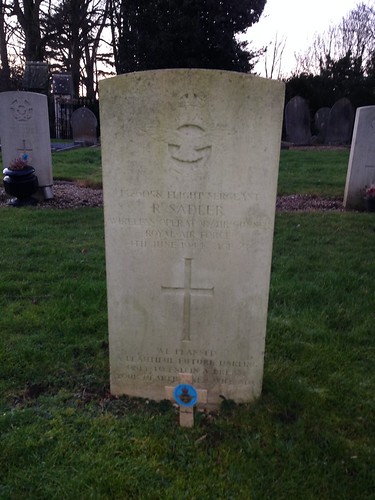
Wireless Operator / Gunner: F.Sgt. Robert Sadler, aged 23 (s/n: 1526058). RAFVR
Air Gunner: Flt Sgt. Stanley Wharton, aged 30 (s/n: 1578013) RAFVR
Air Gunner: Flt Sgt. Charles Patrick Nallen, aged 20 (s/n: 427537) RAAF

The Squadron’s Operation’s Record Book (AIR 27/2155/7) for that day simply  states:

3.6.44  ‘D’ F/O Young G.A. hit hangar after taking off and crashed on airfield when large bomb exploded and the crew all killed.  8 aircraft returned to base .

Three of the crew are buried in Kings Walk Cemetery, Downham Market, a short distance from the airfield.

Downham Market Cemetery

F.Sgt. Stanley Wharton (RAFVR)

Downham Market Cemetery

F.Sgt. Robert Sadler (RAFVR)

Downham Market Cemetery

F.O. Walter Thomas Olyott (RAFVR)

Sqn. Ldr. Leonard Trent VC – RAF Methwold

RAF Methwold was a small airfield that was never intended to be a major player in the Second World War, yet it would see some remarkable achievements performed by the people who were stationed there.

Once such notable person was Squadron Leader Leonard Trent V.C., who, on 3rd May 1943, took a squadron of Lockheed Venturas on a ‘Ramrod’ Mission to attack an electricity power station on the northern side of Amsterdam.

As part of a larger attack, it would not be a mission central to Bomber Command’s overall bombing strategy, but more a mission of support and encouragement to the resistance fighters bravely fighting in occupied Holland.

Trent (N.Z.248i) was born in Nelson, New Zealand on 14th April 1915 the son of dentist Leonard Noel Trent and his wife, Irene Violet Everett.

The family moved to Takaka when Trent was four years old where, a short while later, he would be introduced to flight, and a ride in a Gipsy Moth.

As an older child he attended Nelson College, a boarding school, where he took up golf, and rather that focus on his work, he focussed on his new found hobby which would eventually take him to victory in the Nelson Golf Club Senior Championship.

After finishing his studies, Trent worked in various jobs, saving steadily to reach his goal of earning a pilot’s licence. Once qualified, he returned to flying at Taieri near Dunedin, where a brief training course prepared him to join the RNZAF.

Following his Air Force training, he earned his wings in Christchurch in May 1938 – just one month before departing for England to begin service with the Royal Air Force.

At the outbreak of war he was sent with No. 15 Squadron flying the out-gunned and out-performed Fairy Battles, to France to carry out photo-reconnaissance sorties over occupied territory. As part of the Advanced Air Striking Force, he flew only one mission before the squadron would return to England (RAF Wyton) and change their Fairy Battles for Bristol Blenheim IVs.

After carrying out a number of low-level attacks, he was awarded a DFC for his part in the air war over Belgium, a career that preceded him becoming a flying instructor for RAF crews.

Wing Commander G J “Chopper” Grindell (centre), Commanding Officer of No. 487 Squadron RNZAF, with his two flight commanders in front of a Lockheed Ventura at Methwold, Norfolk. On his left is the ‘A’ Flight commander, Squadron Leader T Turnbull, and on his right is the commander of ‘B’ Flight, Squadron Leader L H Trent. (IWM)*1

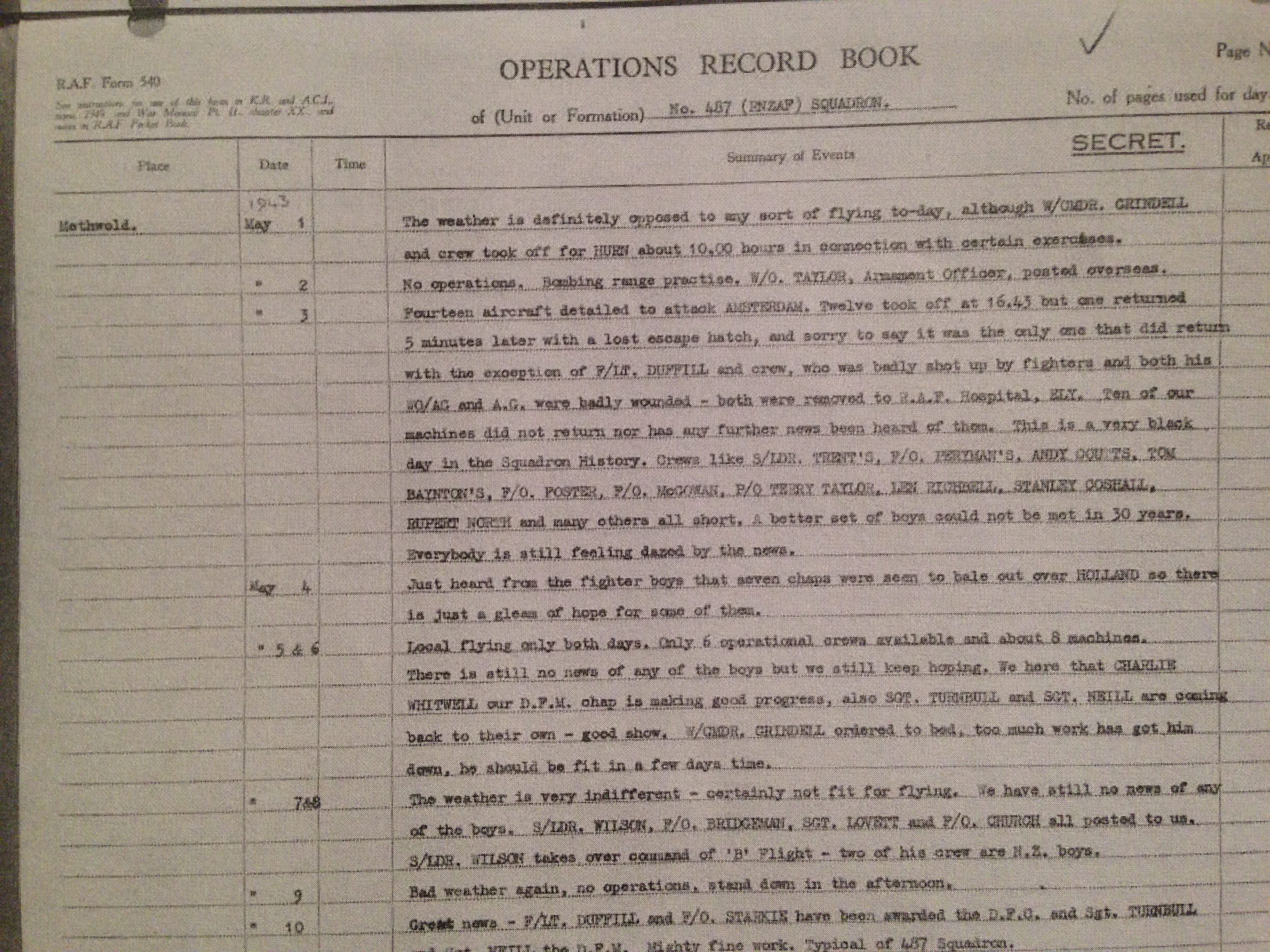
In 1942 he returned to operational duties as a newly promoted Squadron Leader taking command of B Flight, 487 (NZ) Squadron at RAF Feltwell. At the time 487 were part of No. 2 Group and were in the process of replacing their Blenheims with Venturas. The squadron moved from Feltwell to Methwold in early April 1943. Little did they know that only a month later, the Squadron’s Operations Record Book would read: “This is a very black day in the Squadron history…a better set of boys could not be met in 30 years. Everybody is still feeling dazed by the news.”

As an experienced pilot Trent would fly several low-level missions over the low countries, using an aircraft that was originally designed around a small passenger aircraft back in the United States. Whilst having powerful engines, Venturas suffered from poor manoeuvrability and a heavy air frame, these two failings combined with its rather ‘fat’ appearance, earned it the name “flying pig“.

Loses in Ventura operations would be high, and this was reflected nowhere else than on the very mission that Trent would fly on May 3rd 1943.

On that day fourteen Venturas of 487 Sqn were detailed to attack a target in Amsterdam, however only twelve aircraft actually took off, all at 16:43 from RAF Methwold. These aircraft were all part of a much wider operation, one that would involve an escort of nine RAF fighter squadrons. Timing was therefore crucial, as was low-level flying and maintaining the element of surprise. Within five minutes of their departure though, ‘EG-Q’ piloted by Sgt. A. Baker, would return after losing the crew escape hatch. This left eleven aircraft to carry on to the target.

A diversionary attack carried out by aircraft of 12 Group flying ahead of the main formation flew in too high, too soon, thus losing the surprise and alerting the defenders of the impending attack. Caught out by low fuel, many of the escorting fighters then had to leave, thus reducing the overall effectiveness of the defensive escorting force. The Luftwaffe, now ready and waiting, had scrambled numerous fighters, a deadly cocktail of FW-190s and Bf-109s. The squadron record book reports an estimated “80+ ” enemy aircraft in the locality of the attacking Venturas.

From this point on things went very badly for 487 Sqn.

As they crossed the Dutch coast Ventura ‘AJ478’ (EG-A) was attacked and shot down by Luftwaffe fighters. Ditching in the sea the crew took to a life raft where Sgt. T Warner, injured in the attack, died of his injuries. Committing his body to the sea the remaining three would be captured and become prisoners of war. Warner’s body would wash up two days later on a Dutch beach and be buried in the small town of Bergen op Zoom – all four were from New Zealand.

A second aircraft, ‘AE916’ (EG-C) was also very badly shot up by the pouncing fighters. However, it managed to return to England landing at their former base RAF Feltwell. The pilot and navigator were both unhurt, but the wireless operator and air gunner were both badly wounded, and were immediately taken directly the RAF hospital at Ely, Cambridgeshire. The aircraft was so badly damaged in the attack that it was written off. For their actions the pilot (F/Lt. Duffill) and navigator (F.O. Starkie) were both awarded the DFC, whilst the wireless operator (Sgt. Turnbull) and gunner (Sgt. Neill) the DFM.  Dufill later went on to become the managing director of Humbrol paints, a company renowned for its paint and modelling supplies.

Pressing on to the target, the casualties got worse and the loss rate increased.

Firstly, Ventura ‘AE684’ (EG-B) was shot down at 17:45 near Bennebroek with the loss of two; at the same time ‘AE731’ (EG-O) was shot down  just north of Vijfhuizen, three crewmen were captured but the fourth, Sgt. Tatam, died. Five minutes later at 17:50, ‘AE780’ (EG-S) was lost, with only one crew member surviving – the aircraft crashing into the suburbs of Amsterdam. Within three more minutes, a fourth aircraft of this group would go down; ‘AE713’ (EG-T) was hit, also causing it to crash in the northern suburbs of Amsterdam, this time killing all on board. By 18:00 there were only two of the eleven aircraft left, ‘AJ209’ (EG-V) flown by Squadron Leader Leonard Trent, and ‘AE716’ (EG-U) flown by F.O. T. Baynton.

Baynton’s aircraft, ‘EG-U’, would then be shot down by fighters causing it to crash in the outskirts of Amsterdam, also killing all four on board. Squadron Leader Trent, seeing all around him fall from the sky, pressed on. Flying toward the target he dropped his bombs and then turned away. Trent bravely and coolly defended his aircraft, shooting down a Bf-109 with his forward facing guns. Shortly after, he too was hit, the aircraft badly damaged, spiralled earthward uncontrollably, breaking up as it did so, throwing both Trent and his navigator F.L. V. Philips, out of the falling wreckage.

Both Trent and Philips were later captured and taken prisoner, the other two crew members; F.O. R. Thomas and Sgt. G. Trenery, both lost their lives in the crash.

One further aircraft, ‘AJ200’ (EG-G) piloted by New Zealander Sgt. J Sharp was thought to crash 3 km west of Schiphol, with only Sharp surviving; whilst the remaining two unaccounted aircraft, ‘AE956’ (EG-H) and ‘AE 798’ (EG-D), were lost over the sea on the way to the target. All eight crewmen were presumed killed, two of them being washed up several days later on the Dutch coast. The remainder were never heard from again.

In the space of only a few minutes, eleven aircraft had been attacked and ten shot down with the loss of 28 young RAF lives.

operations-record-page

The Operations Record Book for May 3rd 1943, shows the depth of feeling felt by the crews at Methwold following the disastrous mission. (Crown Copyright*2)

Trent spent the remainder of the war in Stalag Luft III where he participated in the ‘Great Escape‘, being the 79th man out of the famous tunnel, just as the sentry discovered the escape route. Trent was almost stood on by the guard. Being captured at this point possibly saved his life after Hitler gave orders to shoot many of the escapees. Only on his eventual return to England did the full and disastrous story of what had happened come out. He was awarded the Victoria Cross for his leadership in ensuring the bomb run was completed despite heavy enemy resistance and very high losses. The London Gazette published his citation on Friday 1st March 1946, in the Third Supplement which said:

“Before taking off, Squadron Leader Trent told the deputy leader that he was going over the target, whatever ‘happened…”

It later went on to say…

“On this, his 24th sortie, Squadron Leader Trent showed outstanding leadership. Such was the trust placed in this gallant officer that the other pilots followed him unwaveringly. His cool, unflinching courage and devotion to duty in the face of overwhelming odds, rank with the finest examples of these virtues.” *3

A determined attack, it was flawed from the moment the preceding force were spotted. The Venturas, woefully inadequate and unprotected, were literary cut down from the sky. Fighters escorting the Venturas confirmed seeing seven parachutes from the aircraft, but the scale of the loss was a blow so devastating, it left only six operational crews in the entire squadron.

For many days after, the Operational Record Books indicated “no news of the boys“, and as new crews and aircraft arrived, prayers for their return faded, but hopes for a return to operational status rose. Following a number of training flights, the next operational mission would finally take place on May 23rd, a mission that was a total success, and one that must have boosted the morale of the squadron immensely.

This mission was a disaster for the Royal Air Force and for Methwold in particular. The loss of life dealt a huge blow to the community both on, and around the base. In memory of these gallant young men, many of whom were never found, their names are inscribed on the Runnymede memorial, whilst those whose bodies were recovered, remain scattered in various graves across the Dutch countryside.

Trent himself, was transferred back to the UK in 1947 on a permanent commission, and from 1948 to 1959,  he was attached to Training HQ No. 3 Group based at Mildenhall. During this time, he would be posted to RAF Oakington and as Commander of 214 Sqn at RAF Marham, from where he flew Vickers Valiants during the Suez crises of 1956. On the night of 1st – 2nd September 1956, he flew a Valiant non-stop from Loring Air Base in Maine to RAF Marham, a time of 6 hours and 25 minutes – the first non-stop ‘V’ bomber flight across the Atlantic*4.

After that, and for the next three years, he would command RAF Wittering before being posted to the British Defence staff in Washington as an assistant air attaché, where he remained up until his retirement in 1965. During this time, he would also take up the role of Senior Air Staff Officer, Chief Intelligence Officer (RAF) and as an aide-de-camp to Her Majesty the Queen, Queen Elizabeth II.

After retirement, Trent would return to his homeland, where he would build a home for himself and his family.

In 1983, Leonard Trent managed an emotional return visit to his former station, RAF Methwold, from where he and so many of his friends took off from on that fateful day. Just three years later he would pass away at the age of Seventy-one.

As an accomplished golfer, painter and expert flyer, Leonard Trent was proud of his nationality and of his homeland. His distinguished service record and numerous honours position him among the nation’s foremost military pilots, securing his legacy as a revered figure.

RAF Methwold appears in Trail 8.

Sources and further reading.

*1 Photo source The Imperial War Museum (© IWM HU 81283)

*2 AIR\27\1935\13

*3  The London Gazette: (Supplement) no. 37486. p. 1179. 26 February 1946. Retrieved 29th January 2017

*4  RAF Museum Website accessed 3/11/25

Times Newspaper 20th May 1986.

AIR\27\1935\13 – Operational Records Book (summary), The National Archives

AIR\27\1935\14 – Operational Records Book (work carried out), The National Archives

Chorley, W.R., “Bomber Command Losses 1943, Midland Counties, 1996

11th April 1944 – Loss of B-17 ‘Tenny Belle’ RAF Kimbolton

On 11th April 1944, a mix of 917 B-17s and B-24s of the 1st,  2nd and 3rd Bomb Divisions (BD) of the USAAF, departed their airfields in England to strike at a range of targets across Germany – it was mission 298. The 1st BD, made up of 341 B-17s, attacked targets at Cottibus, Dobberphel, Stettin, Trechel and Sorau. the Focke Wulf aircraft assembly plant in Germany.

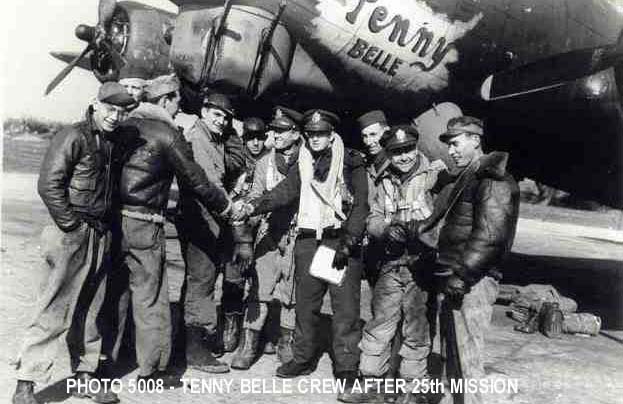
One of those aircraft taking part was #42-31083 “Tenny Belle” of the 525nd BS, 379th BG, based at RAF Kimbolton (Station 117) in Cambridgeshire. The aircraft had already flown thirty-seven operations before this one, but this would sadly be her last.

After taking off from Kimbolton at 07:41, the aircraft climbed to gain altitude and to form up. Its flight would take it easterly over Norfolk and the coast.

On board the aircraft, a B-17G-1-BO “Flying Fortress”, ‘FR*A’, was: 2nd Lt. John E. Daly Jr. (pilot); 2nd Lt. Robert W. Koerber (co-pilot); 2nd Lt. Williams F. Evans (navigator); S/Sgt. Carl B. Christensen (nose gunner/bombadier); T.Sgt. Omer L. Young (Flt. Engineer/top turret gunner); T.Sgt. Adriel Langendoerfer (radio operator); S.Sgt. Harvey W. Tuber (Ball turret gunner); S.Sgt. John N. MacCallum (right waist gunner); S.Sgt. Frank J. Hearne Jr. (left waist gunner) and S.Sgt. Howard L. Polizzo (tail gunner).

This was not Daly’s first crew though, they had formed at Pyote Air Base, Texas and transferred out to the UK together. On this operation, S/Sgt. Carl B. Christensen replaced the normal bombardier 1st Lt. Joseph Jennings who was at RAF Alconbury receiving Radar training.

#42-31083 ‘Tenny Belle‘ and probably Daly’s crew (centre facing camera) after the 25th mission.  (IWM UPL 31620)

Once airborne, the aircraft levelled out and began to find its place in the formation before heading off over the sea to Germany. At 09:03 and at 9,000 feet, in formation travelling at about 115 mph, the aircraft for unknown reasons, suddenly and violently lurched to the left as if the pilot had tried to steer away from another aircraft; it then lurched once again, this time to the right throwing the crew around inside the fuselage in an uncontrollable manner. The forces acting on the weary aircraft were too great though, and a fracture caused it to split into two sections.

The “Tenny Belle“, now unstable and with no aerodynamic stability whatsoever, simply fell from the sky hitting the ground with such force as to completely destroy it. In the impact, it also killed nine of the ten crewmen left onboard. The tenth, 2nd LT. Evans, managed to don his chute and escape the stricken aircraft whilst it hung in the air on the smallest amount of lift possible immediately following the accident.

According to the official crash report Form AF-14, the aircraft came down four miles west-south-west of Downham Market in the small hamlet of Barroway Drove. However, some sources say the aircraft fell at Fen Farm some six miles south-west of the town, neither can be confirmed at this stage, although due to the nature of the accident, it is possible parts were located in both areas.

There was no record of any explosions, and all engines were reported by 2nd Lt. Evans as “running very fast”.  In his statement following the crash he said:

The formation entered the clouds and we levelled off. We were in the clouds only a few minutes when the ship swerved violently to the left. I thought the pilot saw another wing-tip and was trying to avoid it. We then swerved more violently to the right. I then figured out it was out of control and thought that the plane had broken in two. I had my chute on before this. The last I saw of the Bombadier, he was trying to put his chute on. We were going straight down, and the engines were all running fast. There did not appear to be any fire in the wings. I tried to get to the escape hatch, but everything at his point is very confused and I do not know if I got out this way. I remember looking down to see of my chute was on, and  noting that it was backwards. It opened with some help from me and a moment later I hit the ground. I looked around to the plane coming down, the tail part landed way behind the ship and numbers of burning pieces were falling around. There was a farmer near and I tried to walk over to him, but I was feeling pretty shaky. He got a car and took me to a hospital. I didn’t feel any explosions and no alarm was given.”

The official board of enquiry concluded that:

The cause of the accident is undetermined and consequently, responsibility therfor[sic] cannot be established.”

Post crash, the bodies of the crew were removed and the B-17 guarded, none of the bombs aboard detonated. It was later salvaged on the 18th April 1944, but the strength of the impact had completely destroyed its fragile structure.

The normal bombadier, Joseph Jennings learnt about the loss of the crew that day, the news affected him badly, and he never talked about them or their loss afterwards.

Pilot, 2nd Lt. John Daly, (s/n: 0-805776) had flown 273 hours and 15 minutes on B-17s, gaining his pilots licence on June 30th 1943. He was only 19 years of age and thought to be one of the youngest pilots to serve in the USAAF at that time.

Sources and further reading.

Air Accident Form (A.A.F.) No. 14 USAAF.

American Air Museum Website accessed 14/1/25

Downham Market Heritage Centre

Rear Gunner Flight Sergeant Nicholas S. Alkemade, 115 Squadron RAF Witchford (Trail 11)

There have been many stories about bravery and acts of courage in all the Armed Forces involved in war. Jumping out of a burning aircraft at 18,000 ft without a parachute must come as one of those that will live on in history.

There have been a number of recorded incidents where this has occurred, and the crew member involved has lived to tell the tale. On the night of March 23rd/24th 1944, such a thing happened, and to the astonishment of both the Germans and the crew member, he survived to tell the tale.

Flt Sgt Nicholas  Stephen (Nico Stephan) Alkemade was born the 10 December 1922 (believed to be North Walsham, Norfolk, England), and was just 21 years old on that eventful night. He was stationed at RAF Witchford in Cambridgeshire, England and operated as a rear gunner in a Lancaster bomber.

On the night of the 23rd March 1944, the squadron was called to report to briefing to find that their mission for that night would be Berlin, the heart of Germany. They would form part of an 811 strong force made up of Lancasters, Halifaxes and Mosquitoes. This was to be the final run over Berlin.

Later that night, Alkemade climbed into the rear turret of 115 Squadron RAF, 3 Group, Lancaster DS664 named ‘Werewolf’ and prepared himself for the coming raid which was to be his 13th mission.

Once over Oberkochen, nr, Frankfurt, Germany, the aircraft was attacked by a Luftwaffe Ju 88 night-fighters, it caught fire and began to spiral out of control.

Now fearing for his life, the aircraft burning furiously, he looked round for his parachute. Turrets being notoriously small, he was not wearing it and would have to find it from inside the fuselage and put it on before exiting the aircraft.

He found himself surrounded by fire, the heat melting his mask and his skin burning. The fuselage was by now a massive fire. It was at this point, that he noticed his parachute no longer on the rack but burning on the floor of the aircraft. In his recount later in life, he describes how he felt:

“For a brief moment I stared while it dissolved before my eyes. It was not so much a feeling of fear, or dismay, or horror, as a sensation, a sort of twisting in the stomach”.

The fire reached his turret, his clothes scorched, now began to burn. With two options, die in an inferno or jump, he rotated the turret, elbowed open the hatch and fell back, he was 18,000 feet (5,500 m) up. As he fell, he could see the stricken Lancaster explode, then the stars beneath his feet. As he gained momentum, breathing became difficult, again his account reads:

‘Funny, I thought, but if this is dying, it’s not so bad . Then the rushing air, the stars, the ground, the sky, all merged and were forgotten as unconsciousness crept over me…’

Three hours later, Alkemade opened his eyes and looked at his watch, it read 3:25. He had jumped just after midnight. cautiously, he moved each part of his body to find everything was alright, if not a little  stiff.

It was at this moment he realised what he had done and that he was lying beneath pine tress in snow. It was these trees and snow that had saved his life. Cold and unable to move, he needed help.  Taking out his whistle, he blew hard, and continued with alternate blows and smokes of his remaining cigarettes, until found, unfortunately for him, by a German patrol.

The Gestapo interrogated Alkemade, at first in disbelief of his story, but after examining the wreckage of his aircraft, they found the remains of his parachute and were so amazed by his escape, they (reputedly) gave him a certificate in acknowledgement of his testimony.

He was taken to Stalag Luft 3, North Compound, in Poland, and was given Prisoner number: 4175. On the night he jumped, 76 men escaped from the very same prison, an event that became known as ‘The Great Escape’.

Alkemade’s stay was initially very unpleasant, spending days in solitary confinement for being a spy. He was eventually billeted amongst other airmen in the very same hut that one of the tunnels was dug from. He, like other prisoners, was given a diary which was his only and most prized possession. In it he wrote about the boredom and monotony of prison life. He became friends with the artist Ley Kenyon, who added illustrations to his diary.

Sporadic letters from home kept his spirits up, and eventually the Allies reached the camp and he was set free.

Alkemade found out later that the Lancaster had crashed, killing the pilot Jack Newman and three other members of the crew. Both the wireless operator and Navigator survived being thrown clear on impact. The deceased are all believed to be buried in the CWGC’s Hanover War Cemetery. Alkemade was repatriated in May 1945. Post war he returned to Leicestershire, where he married Pearl with whom he had been sending letters and was employed initially in a chemical works (where he survived 3 chemical accidents) and then as a furniture salesman until his death on June 29th 1987, in Cornwall.

Nicholas Alkemade’s story, along with his whistle, is recorded in the RAF Witchford Display along with artefacts and other personal memorabilia from the crews and staff of the airfield. His diary and letters remain with his son in their Leicestershire home. Pictures from his diary were published in the ‘Leicester Mercury’ Newspaper, November 2013.

For more information about RAF Witchford see Trial 11.

The location of Both RAF Witchford and the Witchford display can be found on the Interactive map, Airfields, Museums and Memorials page.

alkemade

Sgt. Nicholas Alkemade

B-17 Pilot 1st Lt.D. J. Gott and 2nd. Lt W. E. Metzger

War makes men do terrible things to their fellow mankind. But through all the horror and sometimes insurmountable odds, courage and bravery shine through. Two gallant young men both in the same B-17 were awarded the Medal of Honour for acts of extreme bravery in the face of certain death.

Born on 3 June  1923, Arnett. Oklahoma, Donald Joseph Gott, began his air force career at the local base in 1943. By the end of the first year he had achieved the rank of First Lieutenant in the US Army Air Corps. Posted with the 729th. Bomber Squadron, 452nd Bombardment Group to Deopham Green, Norfolk, England, he was to fly a B-17 (42-97904) ‘Lady Jeannette’ along with his crew and co-pilot  William E. Metzger.

Metzger was born February  9, 1922 – Lima, Ohio and by the time he was 22 he was a 2nd Lieutenant. He was to meet Gott at Deopham Green, Norfolk and together they would fly a number of missions over occupied Europe bombing strategic targets.

On the 9th November 1944, they took off with their crew on a mission that would take them into the German heartland to bomb the marshalling yards at Saarbrucken.

On this run, the aircraft, was badly hit by flak, three of the engines caught fire and were inoperable, the fires were so fierce that they were reaching the tail of the stricken aircraft.

Further fires within the fuselage started when flares were ignited, and this rapidly caught a hold. Hydraulic lines were severed and the liquid from within was jettisoned onto the burning fuselage.  With communication lines cut and unable to contact the crew, both Gott and Metzger had some difficult decisions to make. They had not yet reached the target, the aircraft still held its bomb load and they were deep into occupied territory.

The crew too had suffered badly at the hands of the anti-aircraft fire. The engineer was wounded in the leg and the radio operators  arm was severed below the elbow causing great pain and loss of blood. He would die very quickly if medical help was not found. Despite the quick thinking and application of  tourniquet by fellow crew members, he soon passed out and fell unconscious.

Gott and Metzger decided that jettisoning the injured radio operator  would not result in his receiving medical help and so they would drop the bombs and head for the nearest friendly territory where they could crash-land. Doing this, would risk not only the life of the operator, but that of the crew and themselves should the stricken aircraft explode.

Over the target, they released their bombs and flew alone toward allied territory. Flying low over the village of Hattonville, the aircraft was seen to swerve avoiding a church and homes. At this point, Metzger personally crawled through the aircraft and instructed the crew to bail out. Three chutes were seen by local people, two fell to earth and the third became entangled on the stabiliser and was trapped. A further three were seen moments later, all these escaped. Metzger decided to remain with Gott and try to land the aircraft with the radio operator on board. With only one working engine, Gott and Metzger brought the aircraft down through a series of tight turns and at only 100 feet from safety the aircraft banked and exploded. Crashing to earth it again suffered a second explosion and disintegrated killing all three crew members on board and the crew member still attached to the tail.

1st Lieutenant Gott and his co-pilot 2nd Lieutenant Metzger had shown great courage and determination to complete their mission, and to save their crew from certain death. They had shown the greatest of  valour in what was to be the final act of their short lives.

Both men were killed on that day, November 4th 1944 aged 21 and 22 respectively. They were both posthumously awarded the Medal of Honour on the 16th May 1945.

Gott’s remains were returned to the United States and he was buried at the Harmon Cemetery, in Harmon, Ellis County, Oklahoma, USA. Metzger, was returned to his home town and was buried at Woodlawn Cemetery, Lima, Ohio.

Along with Gott and Metzger, crew members who did not survive were:  T/Sgt Robert A, Dunlap and S/Sgt T.G. Herman B, Krimminger. The survivors were picked up by a a local field hospital and treated for their injuries: 2nd lt John A, Harland ; 2nd lt Joseph F, Harms ; S/Sgt B.T. James O, Fross ; S/Sgt R.W. William R, Robbins and T/Sg T.T. Russell W Gustafson.

A memorial now stands close to the site of the crash site.

metzger

2nd Lieutenant William Metzger (@IWM UPL 16264)

gott

1st Lieutenant Donald Gott (@IWM UPL 16265)


1st Lt. Raymond Harney and 2nd Lt. Warren French – 349th BS, 100th BG

Lt Raymond Harney (Photo courtesy of Tsymond Harney JR.)*1

A few years ago a story came to light that not only brought home the brutality of war but also the compassion found in war. It was of two American airmen whose World War II story finally come to a close 70 years after their death.

The two airmen, U.S. Army Air Corps 1st Lt. Raymond Harney (s/n O-523208) and U.S. Army Air Corps 2nd Lt. Warren French, (s/n O-2056584) of the 349th BS, 100th BG, were in a B17G (44-6306) over Germany on September 28th 1944, when they were hit by flak whilst on a mission to Merseberg. This would be their eighth and final mission.

Mission 652 involved a total of 342 B-17s which were sent to bomb the Merseburg/Leuna oil refinery and any additional targets of opportunity. During the operation, 10 B-17s were lost, 4 were damaged beyond repair and 251 damaged but repairable. Escort for the mission was provided by 212 P-51s of the USAAF.

B-17 ‘#44-6306’, was delivered to Kearney airbase on 28th June 1944,  then moved to Grenier airbase, New Hampshire on 9th July 1944, for onward transport to the United Kingdom.  It was assigned to the 349th Bomb Squadron, of the 100th Bomb Group, given the code ‘XR-G’, and based at RAF Thorpe Abbotts from the 12th July 1944.

The crew of #44-6306, assigned on the 28th August 1944, was: (Pilot) 1st Lt. Raymond E. Harney (Co-pilot); 2nd Lt. William R. Kimball (Navigator); 2nd Lt. Charles M. Hamrick (Bombardier); 2nd Lt. Warren. M. French (Top Turret/Engineer); Cpl. Thadeus L. Gotz (Radio Operator/Gunner); Cpl. Hubert J. Burleigh,Jr. (Ball Turret); Cpl. Melvin F. Cordray (Waist Gunner); Cpl. Robert C. Minear (Waist Gunner); Cpl James J. Sorenson, and (tail Gunner) Cpl. John H.  Bundner. However, for reasons unknown at this time, for this particular mission, Gotz was not aboard, and instead S/Sgt. Jack D. Francisco flew as tail gunner and Cpl. Robert C. Minear flew as the Flight Engineer.

At 12:10, whilst over the target, the B-17 was hit in the number 2 engine by anti-aircraft flak. As a result, the engine caught fire, the aircraft withdrew from the protection of the formation, joining another formation further back, but began to fall back again when the number 4 engine was also feathered. Harney continued to fly the crippled B-17 for two hours after being hit, before finally deciding enough was enough and he ordered the crew to bail out. Being determined to save his friend and the aircraft, he also decided that he and the injured French, would remain and try to land the aircraft.

Outside of the village of Schwickershausen, to the north of another major target, Schweinfurt, Germany, they attempted a belly landing bringing the aircraft down in a turnip field. The B-17 slid across the ground, ripping off the port wing, causing a tremendous fire. Neither Harney nor French sadly survived the subsequent fireball.

Although he managed to get the crew to leave the aircraft, their safety was not guaranteed and sadly, three were killed by local police in the following days. An event not uncommon in Nazi Germany. Only two of the gunners, Cpl. Melvin F. Cordray, and Cpl. Robert C. Minear, survived as POWs.

What makes this story more significant than usual, is what followed after the crash.

The local people made a wooden cross in remembrance of the crew and they kept it hidden away in the local church for over 70 years.

The cross kept secret for so many years.*2

The large wooden cross, had the words “Hier ruhen in Gott! 2 amer. Flieger,” or “Here rests in God 2 American flyers,” engraved on it, along with details of the aircraft crash. On the 70th anniversary of the crash, 28th September 2014, a memorial service was held in the village of Schwickershausen. Following this, on 5th October, the cross was flown over to England in an American KC-135 Stratotanker from RAF Mildenhall, with two Luftwaffe Tornadoes escorting them over Germany. The cross was donated to the ‘Bloody 100th’ museum at Thorpe Abbots for safe keeping. A certificate was also handed over along with the cross signifying not only the now peaceful and co-operative alliance between the two nations, but the final closing of a chapter of the history of two crew members of the “Bloody Hundredth.”

The cross being transported in the Boom pod of a KC-135 Stratotanker. October 2014.*4

This is a remarkable story, and one that certainly stands out amongst the horrors and heroism of the Second World War.

2Lt Warren M French

Warren French’s memorial stone in Belgium*3

Lt. Raymond E. Harney’s Gravestone is at Ft. Snelling Cemetery in Minnesota, his remains are in the graveyard at Gemeindefriedhof Schwickershausen. Warren French’s headstone is in the Ardennes, Neuville-en-Cond, in Belgium.

Thorpe Abbotts airfield and museum is featured in Trail 12

Sources:

*1 photo the Bloody 100th Foundation.

*2 Photo from RAF Mildenhall news

*3 Photo from ‘Find a Grave

*4 Photo from RAF Mildenhall News

This story first appeared in the RAF Mildenhall News report October 20th 2014.

RAF Fersfield – where history was changed forever.

After leaving the open expanses of Deopham Green and the roar of Snetterton, we head to a very remote and quiet airfield. Quiet and remote for a very special reason. From here, crews would experience top-secret flights, we would see a link to one of America’s greatest and most powerful families, and from here, the RAF would strike another blow at the heart of the Gestapo. We head to RAF Fersfield.

RAF Fersfield (Station 140/554)

https://upload.wikimedia.org/wikipedia/commons/1/15/RAF_Fersfield_-_29_Aug_1946_Airfield.jpg

29th August 1946. Photograph taken by No. 541 Squadron, sortie number RAF/106G/UK/1707. English Heritage (RAF Photography).*1

Originally built as a satellite for RAF Knettishall, RAF Fersfield was built-in late 1943. The third Class A airfield on this Trail, its main runway ran along a NE-SW direction, was 2,000 yds in length and was constructed of concrete. There was a second and third runway each of 1,400 yds running N-S and E-W, again of concrete. Fersfield had two T-2 Hangars, one to the north side and one to the south, and 50 loop dispersals for aircraft storage. The bomb dump was located to the north, the technical area to the south and the accommodation blocks to the south and south-west. Fersfield would eventually be able to accommodate up to 2,000 personnel of mixed rank and gender.

Initially, the airfield was called Winfarthing and designated station 140, it was then handed over  to the USAAF who would rename it Station 554.

Fersfield was specifically chosen for its remote location as, unknown to those who came here, it was going to play a major role in the battle over Europe.

The first residents were a detachment of the 388th Bomb Group (BG) who were then based at Knettishall, and consisted of four bomb squadrons: the 560th, 561st, 562nd and 563rd. A detachment specifically from the 562nd, were brought here to perform special operations and research into radio controlled bombs using war-weary B-17s and B-24s. These special flights taking place between July 12th 1944 and 1st January 1945.

The 388th were unique in many ways. Aside from their work in radio controlled flights, they were also the only unit in the USAAF to not have formal squadron  identification codes. However, after VE day and the end of hostilities, wireless transmitter codes were applied to aircraft under the left wing preceded with the aircraft’s individual letter as a prefix. This then, gave a unique four letter identification on each aircraft. Similarly, the various aircraft used as remote controlled aircraft had the top surfaces of each wing and tailplane painted white for recognition purposes. *4

T2 Hangar now a store

An original T2 Hangar now stores grain.

Operating as Operation ‘Aphrodite‘, the idea of these operations was to remove all operational equipment from the aircraft, fill it with around 20,000 lb of ‘Torpex’ and fly it by remote control, into a specified target such as ‘V’ weapon sites, submarine pens (Operations Crossbow and Noball) or similar high prestige targets that were otherwise difficult to destroy .

Both the USAAF and USN were carrying out these trials. The Navy, also using Fersfield, called their operations ‘Anvil‘ and used the PB4Y (the Navy version of the B-24 ‘Liberator’) as their drone.

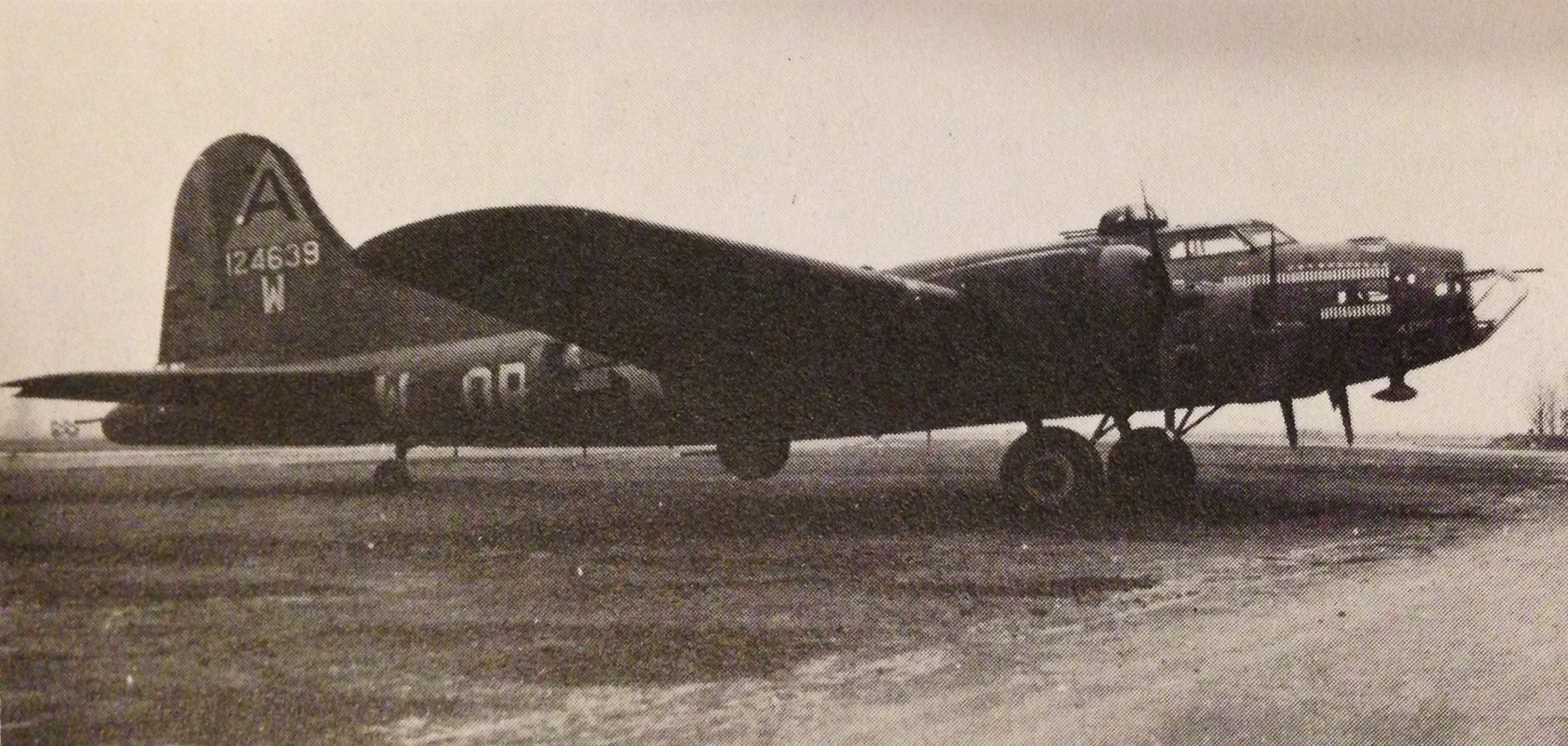
The first Aphrodite mission took place on August 4th 1944, and was to set the tone for all future operations. Mission 515, was flown using four B-17 ‘babies’ with four accompanying ‘mothers’ to target ‘V’  weapon sites at : Mimoyecques, Siracourt, Watten, and Wizernes. Escorting them were sixteen P-47s and sixteen P-51s. One of the babies, B-17 (#42-39835) ‘Wantta Spa(r)‘ (TU-N), had completed 16 missions between November 18th 1943 and July 6th 1944 with the 351st at Polebrook, and was declared to be “war-weary”. It took off but very quickly the crew – Lt J. Fisher and T/Sgt E. Most – realised there was a problem with the altimeter causing it to climb too quickly. Whilst T/Sgt Most bailed out, Lt. Fisher struggled on with the controls until it finally crashed in an almighty fireball in woodlands at Sudbourne, Suffolk, creating a crater 100ft wide. The three remaining ‘babies’ carried on but all failed to hit their designated targets. One Mother lost control and the baby hit a Gun Battery at Gravelines, the second overshot and the third B-17F formally (#41-24639) “The Careful Virgin”  (OR-W) of the 91st BG (323rd BS), hit short due to controller error.

The Careful Virgin 41-24639

B-17F “The Careful Virgin” before modification and whilst in the hands of the 91st BG. (USAF Photo)

Similar results were to follow in another mission only two days later, and then again in further operations throughout both the Aphrodite and Anvil projects.

The most famous tragedy of these missions was that of Lieutenant Joseph P. Kennedy Jnr, who was killed when his PB4Y unexpectedly blew up over Suffolk killing both him and his co-pilot on 12th August 1944.*2 In all, there were twenty-five drone missions completed, but none successfully hit their designated target with either control or accuracy. The missions were all considered failures and the operations were all cancelled soon after.

Operations Block

Former Operations Block south of the Technical site.

Another secret operation taking place from Fersfield, also involved radio controlled bombs. Designated Operation ‘Batty‘ it involved GB-4 television controlled bombs being  slung underneath B-17s and guided onto targets using TV. The 563rd BS provided much of the support whilst the other squadrons in the 388th BG, the crews. In the later part of 1944, a small number of these operations were flown again with little success and this too was abandoned before it could have any significant effect on the war.

All in all, the operations carried out here, were disastrous, killing as many crews and causing as much damage to the UK as it did the enemy. However, it did mean that the Allies had entered into the drone war and set the scene for future military operations. In all, there were 19 Aphrodite missions and 6 Batty operations carried out from RAF Fersfield.

The Americans left Fersfield toward the end of 1944, and it was then handed back to the RAF. A number of units used it for short periods, primarily for aircrew training, but none for major operational flights. However, it was not the end for the airfield, as Fersfield was to have one last remarkable mission and a further claim to fame.

Accomodation Site

Nissan Huts on the former accommodation site.

One of those squadrons who came here was 613 (City of Manchester) Squadron, who arrived at Fersfield on November 20th 1944. They were one of the twenty-one Royal Auxiliary Squadrons, and were considered the ‘baby’ of the Auxiliary Air Force by the other units. Formed on 1st February 1939 as part of No. 22 (Army Cooperation) Group, under Fighter Command, they were initially created with Hawker Hinds and a few Avro Tutors. It was then with another biplane, the Hawker Hector, and the monoplane the Lysander, that they moved with to France, early in the war to attack German gun positions and drop supplies to troops trapped in Calais by the advancing Wehrmacht.

613 performed a mix of roles, from Air Sea rescue operations from Martlesham Heath, to spraying lethal gas on troops in the event of an invasion, they moved from airfield to airfield gradually exchanging their older obsolete aircraft for more modern fighters as they went. They would take on both the North American Tomahawk followed by the incredible Mustang. It was with these aircraft that they were to escort the Venturas of 487 Sqn in their disastrous attack on the the Amsterdam power station in which Leonard Trent was awarded the VC. A mix up in rendezvous times meant the Venturas went on alone to the target, and thus paid the price for not having an escort with them.

In mid 1943, 613 Sqn operated from Snailwell near Newmarket, after which the ground personnel were sent to Sculthorpe and the aircrew to Lasham in Hampshire. This was to train all the personnel on the new Mosquito that the squadron was about to receive.

On joining the 2nd Tactical Air Force, they began attacks with their ‘Mossies’ on ‘Noball’ targets, and locomotives operating on the continent. It was at Lasham that 613 would become part of the newly formed 138 Wing, which would move soon after to Swanton Morley, but not before performing a very secret and daring mission.

Flying at very low level, they were to bomb the Kunstzaal Kleizkamp Art Gallery in the Hague, a former gallery turned Gestapo records office. Here documents relating to Dutch citizens for executions, deportation to concentration camps or labour camps were kept, and so it became a vital target for the wing. The operation was a total success, the building being all but demolished whilst nearby Dutch properties remained completely untouched.

The unit operated both on D-day, and supported the Americans in the Ardennes, flying through poor weather to strafe enemy ground troops who were trying to break through the American lines.

In November, the squadron moved to the continent in support of the allied forces whilst a small detachment of Mosquito VIs arrived here at Fersfield. They remained here until 7th August 1945, taking part in training flights, the last flight out taking place on August 5th 1945. At that point the squadron was disbanded the personnel transferring to 69 Squadron until their service ran out.

However, it was on March 21st 1945, that the crews of 613 Sqn would reunite with 487 Sqn, when the three Mosquito VI units of 21 Sqn (RAF), 464 Sqn (RAAF) and 487 Sqn (RNZAF) – now part of 140 Wing – were pulled back from the continent for a special mission to attack the Gestapo Headquarters at Copenhagen. Previously based at Hunsdon, the mission was Led by Gp. Capt. R. Bateson and Sqn. Ldr. E. Sismore, who took off in Mosquito RS570 ‘X’ at 08:35 and led a group of Mosquitoes in three waves of 6 aircraft in Operation Carthage.

The Shellhaus building raid gained notoriety for two reasons. Firstly, a large part of the building was bombed and destroyed and important documents were set alight, thus achieving the overall objective of the mission; another low-level, daring raid, it was operationally a great success.

However, Mosquitoes following the initial wave, attacked what they believed to be the target building, but it was in fact, a school masked by fire and smoke. This attack caused a significant number of unintentional civilian casualties including children at the school.

Six aircraft failed to return from the mission, four Mosquitoes (one of which crashed causing the smoke and fire that masked the school) and Two P-51s that were part of a twenty-eight strong fighter escort.

This operation was one of many daring low-level raids that the wing carried out, attacking various prestige targets including  the Amiens prison. Together with 138 Wing, the Mosquito under the charge of Basil Embry, more than proved itself as a successful low-level bomber aircraft capable of delivering high precision attacks on pin-point targets.

The aircraft eventually left Fersfield which signified the end of overseas operations for the site, and Fersfield would become a staging post for units prior to disbandment. Between November 1944 and September 1945 a number of units would be located here  which included: 98 and 107 (one week each); 140 (four days); 180 (one week), along with 226, and 605 Sqns. Operating a number of aircraft types including: Mosquitoes (T.III), Bostons (IIa), Hurricanes (IV), Martinets (TT.III), Mitchells (III) and Anson Is, Fersfield had now had its day, and in the last months of 1945, the site was closed and the land was sold off. Fersfield had closed its door for the last time and history had been written.

Post war, Fersfield had a brief spell of motor racing on its tracks and runways, but unlike Snetterton or Podington it would not last, and in 1951 Fersfield became agricultural once more, with many of the buildings being demolished and the remainder left to rot or, some thankfully, used for storage.

Nissen Huts

A few buildings remain on the technical Site.

Today a few buildings still do remain clinging onto life. The T-2 on the south side stores grain, and a number of Nissen huts  that housed the technical aspects of the airfield, are now storage for farm machinery and other associated equipment. All these can be located at the end of a small road from the village, and when visiting, I found the workers here only too willing to allow the visitor to wander freely among them. Footpaths cross the southern side of this site and to the north across the field dissecting the airfield. The path is very poorly marked and you are simply wandering across the crops. From here, you can find the last few remains of the accommodation site, further south a short distance away. Latrines and other communal buildings are shrouded in weeds, gradually disappearing beneath the undergrowth. Trees sprout from between the walls where so many walked before or after a mission. Nissen huts survive further out, now dilapidated and hastily patched, their memories mixed amongst the personal belongings of new owners.

Latrine Block

One of the many Latrines on the communal site.

It is hard to believe that an airfield with such an iconic history such as Fersfield never made it to the high status of so many others, as  surprisingly, it was here in this quiet and remote part of Norfolk that aviation history was made and American politics changed forever.

Squadrons that stayed at Fersfield in the last months of the war.

98 Sqn – Arrived here first, on April 18th 1945, remaining here until December 18th that same year with the Mitchell. They were disbanded at this point.

605 Sqn – Arrived 25th April 1945 staying until 31st August 1945 as a detachment of Mosquito VIs. They were then disbanded and renumbered as 4 Squadron.

226 Sqn – Joined 605 at Fersfield on 27th April 1945, also as a detachment but with Mitchell IIs. They too were disbanded on September 20th that same year.

180 Sqn – stayed here between 7th June and 14th June 1945, a weeks break from their airfield at Achmer to where they returned.

107 Sqn – Arrived at Fersfield a month later on 3rd July, also staying for one week with Mosquito VIs coming across from France to where they to returned.

140 Sqn – Stayed here between the 9th and 12th July 1945 with Mosquito XVIs, whilst en route from Eindhoven to Acklington.

Mosquito Mk.VIs involved in the Operation Carthage,*3.

No 487 Squadron

RS570 ‘X’ Gp Capt R N Bateson / Sqn Ldr E B Sismore (Raid Leader)
PZ402 ‘A’ Wg Cdr F M Denton / Fg Off A J Coe (damaged, belly landed at base)
PZ462 ‘J’ Flt Lt R J Dempsey / Flt Sgt E J Paige (hit by flak, 1 engine u/s, returned safely)
PZ339 ‘T’ Sqn Ldr W P Kemp / Flt Lt R Peel
SZ985 ‘M’ Fg Off G L Peet / Fg Off L A Graham
NT123 ‘Z’ Flt Lt D V Pattison / Flt Sgt F Pygram (missing)

No 464 Squadron

PZ353 Flt Lt W K Shrimpton RAAF (Pilot) / Fg Off P R Lake RAAF
PZ463 Flt Lt C B Thompson / Sgt H D Carter
PZ309 Flt Lt A J Smith RAAF / Flt Sgt H L Green RAAF (Flt. Lt. Green’s first given name was “Eric” known to all as “Les”, a common abbreviation in Australia. H.L. Green is used in the ORBs)*5
SZ999 Fg Off H G Dawson RAAF / Fg Off P T Murray (missing)
RS609 Fg Off J H Palmer RAAF / 2nd Lt H H Becker RNorAF (missing)
SZ968 Wg Cdr Iredale RAAF / Fg Off Johnson
All aircraft took off at 0840; last back landed 1405.

No 21 Squadron

SZ977 Wg Cdr P A Kleboe / Fg Off K Hall (missing)
PZ306 Sqn Ldr A F Carlisle / Flt Lt N J Ingram
LR388 Sqn Ldr A C Henderson / Flt Lt W A Moore
HR162 Flt Lt M Hetherington / Fg Off J K Bell
No 21 Squadron records list only these four aircraft and crews above as taking part in this operation.
All aircraft took off at 0835; the three which returned did so at 1355.

Sources and further reading.

*1 Photograph in Public Domain, taken from Wikipedia 20/8/15

*2 For a more detailed explanation of the operation that killed Joseph Kennedy Jnr. see  ‘The Last Flight of Joe Kennedy and Wilford Willy‘.

*3 Information from The National Archives, 21/8/15

*4 Freeman. R., “The Mighty Eighth” Arms and Armour, 1986

*5 My thanks go to Chris Berkley of the Canowindra Historical Society and Museum Inc. for the correction.

National Archives: AIR-27-1924-54, AIR-27-1924-53

1st. Lt. William G. Rueckert, 93BG, 409BS, RAF Hardwick

In early 2020, I posted an article about the crash and subsequent death of William G. Rueckert of the 93rd BG, 409 BS at RAF Hardwick in Norfolk. Since posting this article, I was contacted by his son, ‘Little Bill’, who has very kindly sent me a collection of photographs, letters, documents and a considerable amount of information around both his father’s life and his tragic accident. I wholeheartedly thank Bill for this – in some cases – very personal information, which has helped to build a bigger and more detailed image of the life of William Rueckert. This has been added to the page and is included here with Bill’s permission. I am republishing this in honour of the man who gave his all for freedom.

The journey of how ‘Little Bill’ found out the details of his father’s death was a long and somewhat difficult one, as many of the official records were destroyed in the St. Louis fire. It was made more difficult by the fact that at home, 1st. Lt. William Rueckert was never talked about by Bill’s mother and step father (2nd Lt. Leroy H. Sargent), and as Bill was only two and a half  years old at the time of his father’s death, he knew little of him. It’s only since Bill’s mother sadly passed away in 1994 that Bill has been able to make proper enquires, kick started by the discovery of a copy of the “Ladies Home Journal” in the attic of her house. All Bill knew before this, was that his father was a pilot and that he died in a crash in England.

Ladies Home Journal ( Jan. 1945)

Ladies Home Journal (Jan. 1945) The magazine that started Bill’s journey to find out about his father.

Since then, Bill has written an article for the “STAR”, a journal for “AWON” (American War Orphans Network) and he has been given an article published in the ‘Weekender’, a supplement published by the Eastern Daily Press*1 newspaper in Norwich, UK, written in December 2014; the title of which was “No Greater Love”, an article about Bill’s mother and father.

His journey also allowed him to make friends with David Neale, an officer of the “Friends of the 2nd “, an organisation he joined not long after. Since then, he has travelled to England on many occasions, including attending the 2nd Air Division  American Library Dedication in Norwich, in November 2001; visiting Madingley Cemetery and the former Hardwick airfield (owned and run by David Woodrow) where Bill’s father lost his life. He has also donated a replica of William’s Purple Heart to the local church at Topcroft, who honour both him and all those who served at Hardwick, every year.

This is 1st. Lt. William Rueckert’s story.

William Gamble Rueckert (S/N: 0-420521) was born June 9th 1920, in the Lutheran Hospital, Moline, Illinois. His father, Reuben Franklin Rueckert (26) was a chief electrician whilst his mother, Fay Wilforim Gamble (24) was a Housewife.

At school, William was a model student, developing a studious and conscientious approach to his studies. He worked hard at all he did, continuously achieving high grades; a work ethic he would carry and continue throughout his short life.
William, Dee and Little Bill

Dorothea ‘Dee’, Little Bill and William

At 18 years of age William joined the Cavalry Reserve Officers’ Training Corps (ROTC) at the University of Illinois, becoming a member of  the ‘Scabbard & Blade‘, an Honorary Military Society that promotes and develops the “Five Gold Stars”: Honour, Leadership, Professionalism, Officership, and Unity.  Here William studied law and used his passion for reading, particularly the classics like Shakespeare and Proust, to continue to achieve those high grades he was known for. His reputation for hard work and dedication was his bedfellow.

Whilst in the Cavalry, William got the nickname ‘Square John‘, he took to fencing and riding, whilst enjoying ‘Breaded Veal chop’ and listening to Ernie Pyle, an American journalist who would become one of the most famous war correspondents of World War II. One of the rules as a Cavalry Cadet  was that you had to carry a ‘handkerchief’, this was used to fulfil the joyful operation of cleaning your horse’s rear, a very unpleasant but ‘necessary’ duty.

On graduating, William would be presented with a sabre from his class, fulfilling both roles of president of the Cavalry Officers’ Club and as a Cadet Major. The sabre would remain in the family home for many years after.
William 'Square John' Horse jumping,

William ‘Square John‘ Horse jumping,

It was at University, on April 29th 1939, that William met on a blind date, his wife to be, Dorothea Griffiths, the woman he later referred to as ‘Dee’. Even before meeting up, the two were destined to face problems, a faulty car doing its utmost to prevent William from getting to his destination on time. But as a lover of dancing, William charmed Dee with his dance floor moves, and they turned out to be the perfect match, Dee forgiving William’s lateness and agreeing to see him a second time.

The two became inseparable, and within a year they were married, on June 10th, 1940, when William was just one day over 20 years old. The ceremony took place at Clinton, Iowa, but it would be here that the second of their problems would arise. Angry at the marriage, William’s mother objected, stating that he was too young to be legally married. Successfully, and much to the anger of William and Dee, she had the marriage annulled. However, the two were not to going to accept that, they simply ran away to repeat the wedding and reinstate their marriage vows in a new ceremony – love had conquered all.
Second Marriage Certificate

William and Dee’s second Marriage Certificate

After leaving the Cavalry and returning to his studies, he graduated from the University of Illinois with a Bachelor of Science in Commerce and Law on June 9th, 1941.  William and  Dee then moved to 64 Sommers Lane, Staten Island, on the southern edge of New York, Dee’s home town. William managed to secure himself a job with the Bethlehem Steel Co.  a company that would become a major supplier of armour plate and ordnance to the U.S. armed forces. Here William worked in the accounts department, whilst all the time continuing to work for his law license with the New York State Bar.
University Certificate

William’s University Certificate

With the war in Europe escalating, William, being a reserve at this time, was called up under President Roosevelt’s Defence plan, in August 1941, and he was sent to the Maintenance Officer Company, 35th Armoured Regiment, Fourth Armoured Division Pine Camp, Watertown, New York. He served as a 1st Lt. Artillery Officer in Company ‘A’, 1st Battalion. It was here that the dedication and hard work that he had shown throughout his education would shine through yet again, quickly standing out from other cadets. William also stood out on the ranges, soon winning himself a medal for artillery and rifle shooting.

A heavily pregnant Dee joined William at Watertown not long after his call up, remaining at home as a ‘Housekeeper’ whilst William went about his duty. The love between them never faltering once. In an interview after his death, Dee described William as “Sweet” saying that “Even after we were married, he would telephone for a date and arrive home with flowers and candy.”

It was this love for each other that produced at 5:45pm on December 1st, 1941, the same month as the Japanese attacked Pearl Harbour, their first child, William Griffiths Rueckert (Little Bill). Bill being born in a small Catholic Hospital just outside the base at Watertown. In those first few years of his life, Bill would grow very fond of his father, a father who would sadly be taken away from him far too soon. William and Bill developing a mutual love for each other.

Four years after his military career had begun with the cavalry, and one year after leaving the Armoured Division at Pine Camp, William would make a big change in his career,  resigning his commission and  volunteering for the United States Air Corps. In Bill’s words referring to why his father left the Army he said:  “After four years of wiping his horse’s ass, and looking up at the new way to travel, he had the flying bug“.

William Rueckert’s life then changed forever. In 1942 as a 1st Lt. Trainee Pilot, he left New York, Dee and his son, and moved to the West Coast Training Centre whose headquarters and administration centre was at Santa Ana Airbase in California.

Early Flight Training.

William would have progressed through several stages of training, from primary to basic, then on to advanced flying and eventually to the heavy bombers. This would take him through many courses at several sites. After primary flight training, he would have gone onto basic flying. Here a nine week course of some 70 hours or so would have taught William more basic flying skills, including: instrument flying, aerial navigation, night flying, long distance flying, radio operations and etiquette, and finally formation flying.

One of these first stations would be Lemoore AAF in California. Whilst here, William would learn firsthand the perils of flying, when on May 20th, 1943 he was involved in a mid air collision with another aircraft piloted by Air Cadet Donald. W. Christensen (S/N: 39677502). Sadly, Christensen would die in the crash whilst William would suffer a wound to the forehead.

I have, since the original post, been able to establish beyond doubt that this is the accident that Dee refers to, although she would later retell the event believing it was a B-24 at a Biggs Field, El Paso, in Texas.

The Army Air Corps used a range of aircraft to train pilots in basic flying, one of the more powerful and complex models was the single engined aircraft the Vultee BT-13 (replaced by the Vultee BT-15). On that day (May 20th, 1943) William was flying solo in BT-15 #42-1957 at Lemoore AAF, and was approaching to land.

The official records (crash number 43-5-20-6)*8 held at the Air Force Historical Research Agency, states that:

At 17:02, May 20, 1943, while upon final approach at Lemoore Field at the termination of a routine training flight, Student Officer, 1st. Lt. W.G. Rueckert collided with A/C  D.W. Christedsen [sic].

Both airplanes were approaching the field in the usual manner. The wind was slightly from the right at 10 mph. Position of the approaching ships gave the control ship stationed on the south-west corner of the mat no cause for alarm. A/C Christensen in ship 32 was in front below and to the right of Lt. Rueckert in ship 12. Several hundred yards from the south-west edge of the mat. Lt. Rueckert noticeably dropped the nose of his ship which struck the A/C Christensen’s airplane behind the canopy. Both airplanes remained in contact and fell to the edge of the mat from a height of about 50 feet. A/C Christensen plane landed on its back, exploded and burned killing A/C Christensen immediately. Lt. Rueckert’s landed nose first, broke clear of the other plane and the pilot jumped out and attempted to extinguish the blaze with his fire extinguisher. He sustained a cut on his forehead and shock. The fire truck and ambulance arrived immediately afterward, put out the blaze and conveyed Lt. Rueckert to the hospital.

Lt. Rueckert stated that he never saw A/C Christensen’s plane in the traffic pattern.

It is probable that one or both pilots were making improper correction for wind drift although witnesses were located at angles which made it impossible to verify this fact.”

The enquiry that followed concluded:

Failure of pilot in airplane to look around. Poor correction for drift on the part of one or both pilots. Lack of control tower in the vicinity of mat. Present control tower is approximately four thousand feet from the scene of the accident.

Dee would later retell the story to Bill, describing how she went to the hospital and how she had to remove little splinters of the shatter windshield from William’s forehead for weeks after the crash. It had been a hard lesson learnt for William.

On completion of the basic course, he then transferred to the multi engined Advanced Flying Course at Stockton Field*4, California, the Air Force’s first west-coast Advanced Flying Field. Here William was enrolled in Class 43-H.

On the Advanced Flying Course at Stockton Field, William would have undertaken a further seventy hours of multi-engined flying, formation flying, night flying and instrument flying using standard training aircraft such as the: Curtiss AT-9, Beech AT-10 or the Cessna AT-17 / UC-78. Upon completion of this course, William would receive his wings and a Commission.

Whilst William was here at Stockton Field, his son Bill, would reach his first birthday and William would send a heartfelt letter home telling Bill how much he missed him, and looked forward to spending time with him again. In his opening paragraph William said to Bill: “This eventful year you have quickly grown from an infant, into one grand, little boy, and I’m certainly proud of you, Billy.

WIlliam's letter to Little Bill on his first birthday.

William’s letter to Little Bill on his first birthday

The course lasted well into 1943, and on August 30th, Lt. William G. Rueckert graduated received his wings and his commission – his dreams were slowly becoming a reality.

For his next posting, William would be transferred to Kirtland Field, New Mexico (formerly known as Albuquerque Army Air Base, being renamed Kirtland Field in 1942 after Colonel Roy C. Kirtland), which specialised in navigation and bombardier training. The aircraft used here were the twin-engined Beechcraft AT-11 or the Douglas B-18 Bolo aircraft. Although split into three specialist schools, it also trained entire crews ready for the heavy Bombers the B-17 and B-24. It would be here that William would have his first encounter with the B-24 ‘Liberator’.

On October 28th 1943, William passed his instrument flying test, and by the time he was finished at Kirtland Field, he was a qualified pilot instructor on B-24s. With this under his belt, William was now ready, his flying training completed, he would transfer again, this time to Biggs Field, El Paso, Texas.

It would be here at Biggs Field that the family would be reunited once again, Dee and Bill joining William on the base’s accommodation. It would also be here that Dianne, Bill’s sister, would be born. Dianne sadly passing away in 2007.
Little Bill in El Paso

Little Bill in El Paso. The boots, he tells me, he still owns today!

Dee’s account of the accident that is now believed to have been the Lemoore AAF collision was retold later to Bill. Her account of the day’s events being sketchy. I am continuing to search for evidence of this but it is unlikely that William was involved in an accident whilst here at El Paso.

Finally, the draw of the war led William to requesting a post overseas. But before departing, he would pick his own crew members,  Harold Emerson Roehrs – his co-pilot, and Jimmy Gardner – his navigator, both of whom he had become good friends with at El Paso.

Later in life, Harold Roehrs would write his own biographical account, “Harold’s Story“, in which he mentions William in a dedication. William being the one who taught Harold to fly a B-24, something Harold had to prove to his Commanding Officer Major (later Lt. Colonel) Thermand D. Brown. In doing so, Harold flew Major Brown around the skies of Hardwick until he was convinced, and convinced he was! In his book, Harold pays homage to William saying of him: “My pilot and friend who shared his knowledge and taught me how to fly a B-24 Liberator“.  William being one of those many people who helped shaped Harold’s life.
L to R: William, Jimmy and Harold at El Paso

Left to Right: William, Jimmy and Harold at El Paso

The three friends would all be posted together to RAF Hardwick, Norfolk, England to join the 409th BS, 93rd BG, 20th Combat Wing, Eighth Air Force, in April 1944. All three serving in the same crew.

The three left Biggs Field travelling to Forbes Field, Topeka, Kansas at the end of March 1944, where they would collect their B-24 to fly to England. The aircraft was loaded up and they took off heading over the southern route.

Off to War.
"Harold's story"

“Harold’s Story” is dedicated to many including William Rueckert.

Harold detailed the journey in his book “Harold’s Story”*3, shining an immense light on the enormity of the trip, one that was made by many crews transporting themselves and aircraft across the vast southern hemisphere to a war very far away.

The journey would be broken into stages, each covering many miles, with hours of flying over water. Much of the journey taking in hot humid days broken by the cold nights, the time when they would fly the most.

The first part of the journey took them from Topeka to West Palm Beach on Florida’s southern point, then via Aguadilla, Porto Rico, to Georgetown in British Guiana. The crew would then fly onto Belem in Brazil before arriving at Fortaleza, their last stop before the next leg and the Atlantic.

The crossing of the Atlantic, then took the crew from Fortaleza, across the monotonous waters of the southern Atlantic Ocean. They were aiming for Dakar on the Cape Verde Peninsula, Africa’s most westerly point. The 1,928 miles would take them exactly twelve hours and thirty-five minutes, and cross four time zones point to point.

After a nights rest, the crew then flew from Dakar to Marrakesh in Morocco, where they waited for five days until the notoriously poor British weather cleared sufficiently for them to proceed. Finally, they were given the go-ahead, and the last leg would take them around neutral Spain and Portugal, wide of the Bay of Biscay, arriving finally at the US Staging post RAF Valley in Wales.  (RAF Valley, had been designated a major staging post for US arrivals along with St. Mawgan in Cornwall and Prestwick in Scotland).

As in many cases, the aircraft flown over by the crews was not the aircraft they would keep as part of their operational unit. The new aircraft being taken and flown by ferry crews to other operational squadrons. From Valley, crews would make their way to Liverpool where they would then be transferred to their assigned squadrons, William, Jimmy and Harold making their way to Hardwick by train. The journey not being a direct one, would lead to them arriving at Hardwick (Station 104) on April 24th 1944.

Formed only two years earlier on 22nd April 1942, the 409th was to be William’s only operational squadron. Having won three D.U.C.s already for operations over Europe including, the raid on the Romanian oil fields at Polesti, and the enormous raids of February 1944 ‘Big Week’, the 93rd were already a battle hardened group.
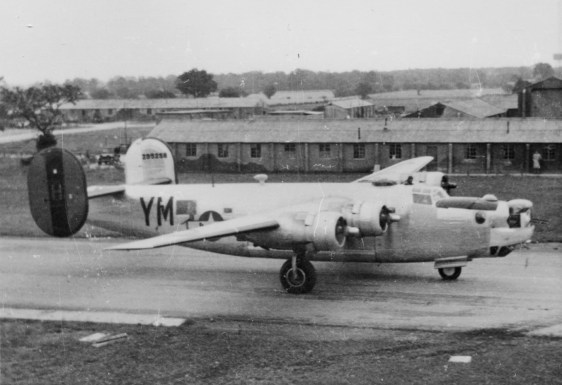
rueckert page

A B-24 Liberator (YM-H, serial number 42-95258) of the 409th Bomb Squadron, 93rd Bomb Group (IWM FRE 3762)

Ted’s Flying Circus” as they were to be known, were very much in the front line of operations, taking part in the preparations for D-Day, completing much of their bombing missions over the Normandy area. Here they focused on cutting German supply lines and vital communication routes across France.

First and last Mission.

William’s first and only mission, was on May 1st 1944, one week after his arrival at the base. It was to be an early morning flight, take off at 05:00. Mission 332 was for more than 500 heavy bombers of the 1st, 2nd and 3rd Bomb Divisions, to attack V- Weapons’ sites in northern France. These “Crossbow” operations were designed to destroy launching areas for the Nazi Terror weapons the V-1s that were targeting London and the South East. On that day William and Jimmy decided to volunteer to fill the vacant co-pilot and navigator spots in the crew of pilot Second Lieutenant Albert Schreiner (s/n: 0-805532) on B-24 ‘Joy Ride‘ #42-7621, leaving his other regular crewmen behind at Hardwick including Harold. William’s work ethics playing one last card as he wanted to get familiar with combat missions before taking his own crew out.

2nd Lt. Schreiner, a veteran pilot from Gloucester County, New Jersey had been along a similar path to  William’s, the ‘green’ newcomer. A Cavalry man he had enlisted in 1941, joining the National Guard before transferring across to the Air Corps.

On the night before the mission, William visited the local church at Topcroft, here he said his prayers in preparation for the following day’s flight. The church having strong links with the base, continues to honour the crews today.

The next morning, May Day 1944, two missions were planned, the first to the V Weapons site at Bonnieres, the second to a Brussels railway yard. About half the aircraft managed to get airborne for the first sortie, then it was the turn of ‘Joy Ride’.

The engines roared into life, 2nd Lt. Schreiner had signed the aircraft off fit for flight after a fuse for heating the suits had been replaced; the brakes were released and the aircraft began its roll along the perimeter track to the end of the runway where it sat waiting. After the signal to go was given, the engines were brought to full power, the brakes released and the aircraft shook and shuddered its way down runway 020 heading south. As it reached almost mid point it began to lift off, and when about 20 – 30 feet in the air, Schreiner gave the order to raise the undercarriage. S/Sgt. Monnie Bradshaw, the Top Turret Gunner / Flt. Engineer reported all instruments were well. He reached down to the undercarriage levers, when suddenly the aircraft hit the ground with an almighty sound.

A heavy landing tore off the left undercarriage leg and the nose wheel collapsed. Unable to gain any height, the aircraft crashed down and slid along the rest of runway 020 spinning round several times before ending up at the crossing with runway 032. Flames had by now engulfed the bomb bay and fuselage, Bradshaw pushed open the top hatch striking the Navigator 2nd Lt. James E. Gardner, on the head. Not seriously injured, both men escaped from the aircraft through the hatch, the top turret now resting on the nose of the stricken B-24, the fuselage engulfed in fire.

In the B-24 lined up behind William’s aircraft was Radio Operator Sgt. Cal Davidson who was stood between the pilot and co-pilot, a common practise on ‘night’ flights which allowed the pilot to focus on the instruments whilst the Radio operator watched the runway. Watching carefully between the rows of burning oil drums that lit the darkened runway, Davidson had a grandstand view of the incident that unfolded in horrifying detail in front of him. He described how he watched as William’s B-24 carrying a full load of fuel and bombs, took off from Hardwick’s north-south runway 020. In his diary that day, Sgt. Davidson wrote*5:

May 1 Blue Monday. No sleep last night as we were called for a mission, briefed at 2:00 and scheduled for a 4:00 take off flying the “War Goddess” to go on a practice mission before going to the actual target. As we sat on the runway next in line to take off, the plane ahead of us didn’t make it off crashing and exploding about 2/3rds of the way down the runway. Flames shot up and lit up the whole field. As I was standing between the Pilot and Co-pilot, the three of us watched stunned at what had just happened. Neast [The pilot: John K Neast] put his head down on the controls and said “O God why did this happen?”. He’d never taken off in the dark before and said he was all set until this happened.  The tower sent up red flares and told all remaining crews to get out of their planes. Once out of the plane with the engines quiet you could hear the 50 calibre bullets going off and the 500 lb bombs began exploding. Colonel Fiegel Base Commander and our Sq. C.O. Major Brown had tears in his eyes as he told us it was a 409th plane. Major Brown is one of the finest officers I have ever met.”

He then goes onto say:

One of those killed was a young French-Jewish boy from our barracks and had the bunk next to mine. We had nicknamed him ‘Frenchie’

‘Frenchie’ was Radio operator Sgt. Sheldon Sheinfine, who claimed to be probably the only French-Jew in the Eighth Air Force, he shared a barrack hut with Davidson, having adjacent bunks. Davidson himself, cleared out Sheinfine’s belongings almost immediately, and his loss, and the loss of the crew, had a great impact of Davidson.
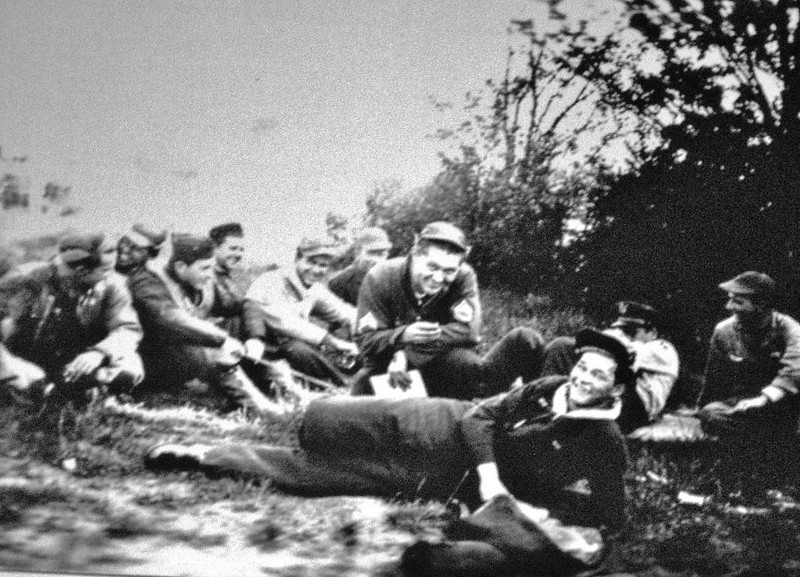
Sgt. Cal Davidson front

Sgt. Cal Davidson (laying down front)

Two nearby Groundcrew Sgt. Harry Kelleher*2 and Sgt. Johnny Findley also witnessed the crash. Sgt. Findley was closest and recalled how he heard “the squeaking sparks flying off, as the plane slid along the runway“. Then he watched as it “burst into flames as it continued down 020 north-south to 032  runway“. Findley ran over to one of the ejected crew members holding him until rescue crews arrived. Sgt. Kelleher leapt into a jeep and raced over to the crash site picking up a further two crewmen. “At that point” Kelleher said ,”the gas tanks exploded knocking over the jeep“. That was enough and they made a quick exit, in Kelleher’s words “they got the hell away.”

Standing on dispersal number 8, Engineering Officer Captain Thomas H. Jackson also saw the aircraft “crash and burn“, as it slid along the runway it “burst into flames“.

Another witness, ground crewman Corporal Johnny Fridell Jr*7, who was standing by runway 020 as the B-24 slid along on its belly, described sparks flying from the aircraft until it reached the crossing with 032, spinning around catching fire. Fridell then jumped into a shelter fearing what was about to happen. Over the next half an hour, seven of the 500 lb bombs on board the B-24 exploded, the full complement of fuel caught fire and the ten  ammunition boxes containing nine yards of .50 calibre bullets, began exploding too. It was a massive fireball from which it was unlikely anyone would survive.

Standing on the balcony of the control tower, the Commander Colonel Leland Gordon Fiegel, also watched as the lumbering B-24 came down onto the runway and caught fire. From where he stood, he didn’t think the damage was any more worse than “an ordinary belly landing“, but noted how “the fires increased rapidly in their intensity“.
B-24 "Joy Ride" Tail section

The tail section of B-24 “Joy Ride” after the crash.

Ground crewman Cpl. Johnny Fridell , along with rescue crews, then ran toward the fireball to try and help anyone they could. Miraculously, of the total number of crew, three were uninjured: Navigator 2nd Lt. James Gardner, Waist Gunners S/Sgt. Harold Loucks and T/Sgt. Kerry Belcher, mostly located within the rear of the aircraft between the bomb bay and the tail. Two further crewmen received injuries; Top Turret/ Flight Engineer S/Sgt. Monnie Bradshaw and  Tail Gunner Sgt. Anthony Constantine. The remaining five, including Rueckert, were killed: Pilot 2nd Lt. Albert Schreiner, Bombardier 2nd Lt. Paul Sabin, Radio Operator S/Sgt. Sheldon Sheinfine and Nose Gunner Sgt. John Dalto. All of these were located in the front portion of the aircraft. The fire and explosions were so intense only a single thumb was found by rescuers.
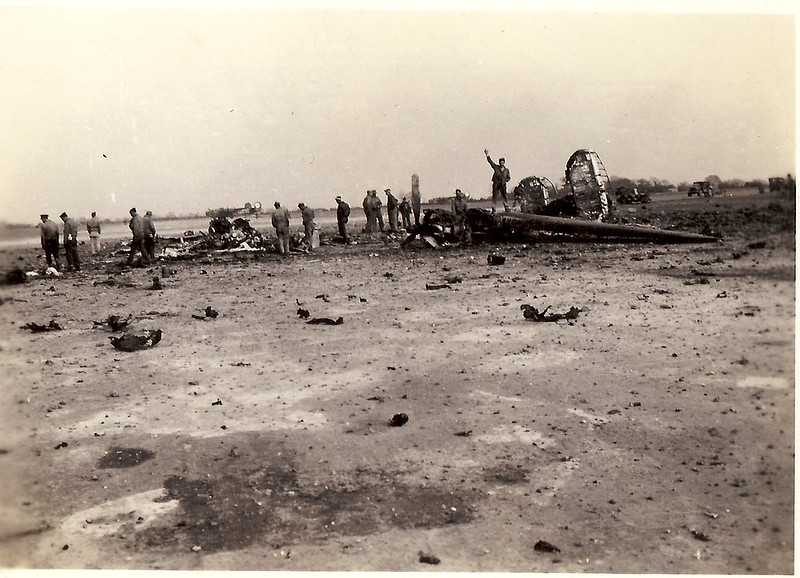
The B-24 after the fireball

The remains of Reuckert’s B-24.

By 16:00 RAF Bomb Disposal crews had managed to remove and deal with the remaining bombs, it was thought at this stage the aircraft may have suffered from prop wash, a devastatingly dangerous effect caused by preceding aircraft creating turbulent air.

The explosion caused such damage that it created a huge crater closing the two main runways for five days. The mission was scrubbed (22 aircraft had already gotten airborne and carried on), red flares being fired into the night sky instructing crews to abandon their aircraft and return. For the next week all aircraft had to take off using the short runway and climb up over nearby woods approaching Topcroft village. As a result of the difficulty in doing so, there were subsequent crashes at Hardwick, with aircraft falling into the woods beyond the airfield. The crater and burnt debris of William’s B-24 leaving a stark reminder of the dangers of flying a heavy bomber laden with combustible and explosive materials.

Dee finds out!

For seventeen days Dee knew nothing of her husband’s fate. At home, she had been working on the new family flat at St. George, on the north-eastern corner of Staten Island, whilst living a few miles away with her family at Castleton Corners. Dee had been writing letters every day, in many cases two or three times a day, but unbeknown to her they were not reaching her husband very quickly – if at all.

To Dee, the old furniture with scratches and rips from the dogs they had owned held fond memories of their early days together. The many moves they had made as William had been posted from one training airfield to another, were emphatically etched in their structure.

Dee was at her mum’s house on May 18th when the buff telegram arrived. With ‘Western Union’ emblazoned across the top and two tell-tale red stars*6 in the bottom left corner, Dee knew exactly what it meant, she didn’t need to open it. As the tar stained hand of her father held it out to her, her life fell apart. The man she had adored for the last five years was gone, the moment she, and all serving personnel wives’ feared, had happened. She became ill and slid towards depression. Seeing the changes in her, Dee’s mother took charge, she gave up her own job and took Dee and the two children in. Encouraging Dee to go out and get a job, as she cared for Bill and Dianne and nursed Dee back to full strength.

Gradually, Dee recovered and got her life back on track. Small reminders would never be far away though, each one bringing William back to her thoughts. Not long after his death, flowers he had ordered only days before the accident, finally arrived on Dee’s doorstep.
The Telegram that brought the terrible news to Dee

The dreaded Telegram that brought the news of William’s death to Dee

Shortly after the 20th, a confirmation letter arrived from the War Department in Washington D.C. In three short paragraphs it confirmed that William had been “killed in action on 1 May 1944 over England.” It said nothing about the incident, as these are “prepared under battle conditions and the means of transmission are limited“. Signed by Brigadier General Robert H. Dunlop, it told Dee that William’s service had been “heroic“.

Back in the UK, those that had escaped, particularly William’s good friend James ‘Jimmy’ Gardner the Navigator, went into shock. He was sent to London to recuperate, before being sent home. In later years Bill tried to talk to him about the crash, but the shutters came down and Jimmy understandably turned away from Bill.  In June 1944, Harold, Bill’s other good friend from  their days at El Paso, would convince Col. Brown of his flying abilities, being approved as a pilot and then assigned another crew, he would go on to complete 37 missions with the 93rd at Hardwick.

In the official enquiry that followed the crash the engineer stated that all engines were running OK, each at 2,600 rpm with 49” M.P. (Manifold Pressure) in each one; recognised as sufficient power to achieve a good take off with the load being carried by the bomber. Schreiner’s training record was scrutinised and found to be in order. The pre-flight mechanic’s report was checked and several eye witness accounts were taken. After deliberations the committee apportioned 100% blame to the pilot Lt. Schreiner’s night take off technique, saying that he had allowed the aircraft to land again without realising what he had done. As a result, the committee recommended modified training for all crews to include further training in night take off and landings.

First page of the Crash Report

The first page of the accident report which blamed the pilot for his ‘take off technique’. Note the misspelling of William’s name.

Rueckert’s remains was initially buried at the Cambridge American Cemetery and Memorial at Madingley, a few miles outside of Cambridge, along with the pilot 2nd Lt. Albert Schreiner. Later on, William’s mother asked Dee if his body could be returned to Illinois to be placed along side his father in the family plot in Moline. Dee, still angry at her attempts to stop the marriage, and knowing there was little more than bricks in the coffin, agreed to the move and the coffin was returned in 1952. Of the others, Bombardier 2nd Lt. Paul Sabin was buried in section 14 of the Mount Carmel Cemetery, Raytown, Jackson County, Missouri, and Radio Operator S/Sgt. Sheldon Sheinfine was buried at the Beth Israel Memorial Park, Woodbridge, Middlesex County, New Jersey. Sheinfine was only nineteen years of age. The last crewman to lose his life that day, was twenty-one year old Sgt. John Dalto, who was buried in the Long Island National Cemetery, East Farmingdale, Suffolk County, New York. The average age of the crew that day was only 20 years old.

At the end of the war, one of William’s original crewmen stopped off at Dee’s to explain that William had volunteered to fly in ‘Joyride‘ that fateful day, the purpose being to gain experience before taking his own crew into heavily defended enemy territory.

Since discovering a lot more about his father’s death, his son ‘Little Bill’, has repeatedly returned to Hardwick and has become very good friends with the site owner David Woodrow. William’s wings and wedding ring were never recovered from the crash site, and remain buried in Hardwick’s 032 runway, where the concrete patch stands today.

On the farm that now stands in the place of Hardwick airfield, is a small museum, maintained by a volunteer crew set up by both David Neale and David Woodrow. The farm also has a memorial to the 93rd BG and regularly honours those who served. During the time the airfield was open, a pond was located in this area, into this pond aircrew who had passed their statutory mission number were thrown, a right of passage that allowed them to go home. Many however didn’t, choosing to stay on and serve for longer.

Following the accident, 1st. Lt. Rueckert was awarded the Purple Heart, as was the pilot. His son Bill, has since donated a replica of the medal to the church at Topcroft, the church William visited the night before his death.

Purple Heart Certificate

William Rueckert’s certificate for his Purple Heart.

Inside the church, a plaque sits on the wall remembering the 668 men who never returned to Hardwick from missions. William’s name also appears in the St Paul’s Cathedral Roll of Honour, on page 365.

William G Rueckert was a brave young man who, like many others, went to fight a war a long way from home. Doing their duty came above all else, but like many others he longed to see his wife and family. Sadly, that day never came, and William lost his life serving the country and people he loved.

RAF Hardwick and the story of the 93rd BG whilst based here appears in Trail 12

William G Rueckert appears on the World War II Honours list of Dead and Missing, State of New York 1946 Page 136.

Sources, notes and further reading.

Much of the basic information used was supplied by William Rueckert (Little Bill) through emails, and all pictures (unless stated) were donated and used by kind permission from Bill to whom I am truly grateful.

*1 The Eastern Daily Press ‘Weekender’ was published on December 13th 2014.

*2 Sgt. Harry Kelleher went with the 39th BG when it took part in the Polesti raid. His rank was that of Non-flying Ordnance ground crew. However, it is believed he joined Captain Llewellyn L. Brown’s crew taking the position of Ball Turret Gunner on the B-24 #41-24298 ‘Queenie‘ which was hit by flak and diverted to Sicily. Harry had been denied the opportunity to fly in the bomber by his superiors, but went anyway. He is credited as Ball Turret Gunner on the ‘American Air Museum’ website having been awarded the Air Medal and the Distinguished Flying Cross. Harry had relayed the story to Little Bill before passing away, however, none of the crew have ever verified his claim and no other record seems to exist of it.

*3 Extracts from “Harold’s Story” written by Harold Emerson Roehrs, William’s best friend, were kindly given to me by Bill. The book I believe is now out of circulation.

*4 The History of Stockton Field can be found on the Military museum website, including images of Stockton Field taken during the war.

*5 Email from Cal Davidson to Bill Rueckert 25/8/04, courtesy of Bill Rueckert.

*6 One Red Star would signify Missing in Action or wounded, whereas two meant they were killed. Hence anyone seeing the telegram would know before even opening it what it meant. Dee’s father owned as company that repaired water tanks on top of the skyscrapers using tar, hence his hands were always covered with it.

*7 Corporal John L. Fridell Jr (s/n: 14077456) was one of the ground crew for ‘The Sleepy Time Girl‘ also referred to as “Sleepytime Gal‘ which completed 135 missions without returning once with mechanical problems.

*8 Accident number 43-5-20-6 Lemoore Army Air Field provided by the Air Force Historical Research Agency.

All quotes regarding the crash of the B-24 are from witness statements taken from the War Department Investigation, Report of Aircraft Accident Number 0000198.

USAAF Training Aircraft Fuselage Codes of WW II website

Abandoned and Little known Airfields website has a  very interesting collection of photographs and information on Lemoore AAF.

Kirtland Air Force Base Website

MyBaseGuide website

Aviation Archaeological Investigation & Research website.

El Paso Times Website.

2Lt. Thomas E. Cartmell Blog by Michael John Hughey, MD

My sincere thanks go to Bill for allowing me to publish his father’s story and to all those who have contributed comments, corrections and information about the accident. I am continuing to search for further information, if / when this arrives, I shall add it to the text.