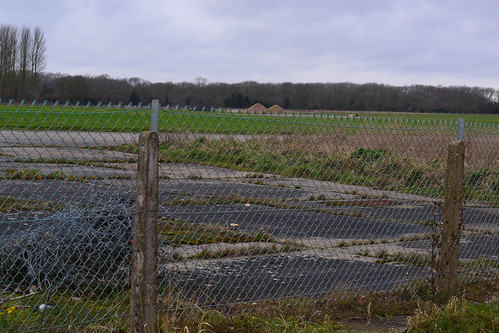
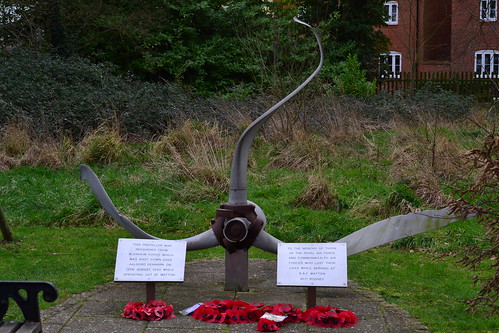
RAF Sculthorpe – The Beginnings of a New Airfield (1)

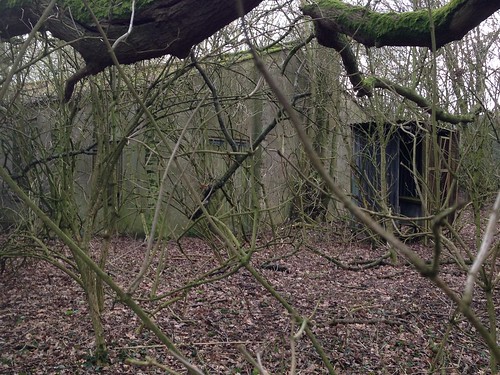
Not long before Christmas, I had the opportunity to return to RAF Sculthorpe to revisit the small collection they had in the Heritage Centre not only before it closed for the season, but before it moved to its new location in the former Chapel on the base. The Chapel itself, was hugely overgrown and in a very poor state after being left vacant for many years, but has been painstakingly refurbished, by the volunteers at the centre, with an aim to opening early this year (2024).

This gave me an opportunity to also revisit the airfield and see how it had fared.

RAF Sculthorpe

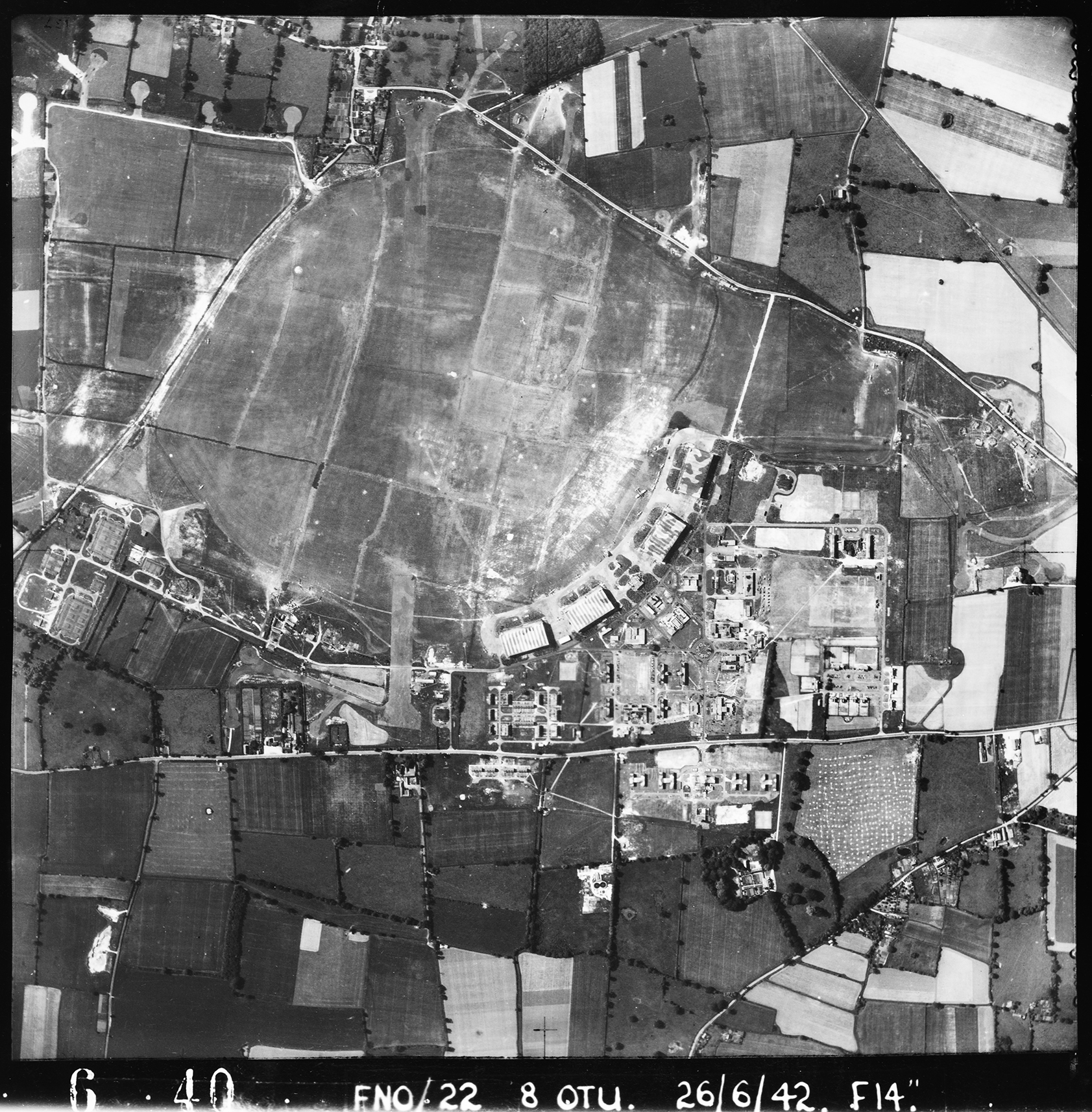
Sculthorpe airfield is located a few miles to the north-west of the town of Fakenham in Norfolk, in a parish that has links as far back as the Romans and even pre-historic eras. The airfield itself however, has its origins more recently in the latter part of the Second World War, but it has a much larger claim to fame , and one that it still retains to this day.
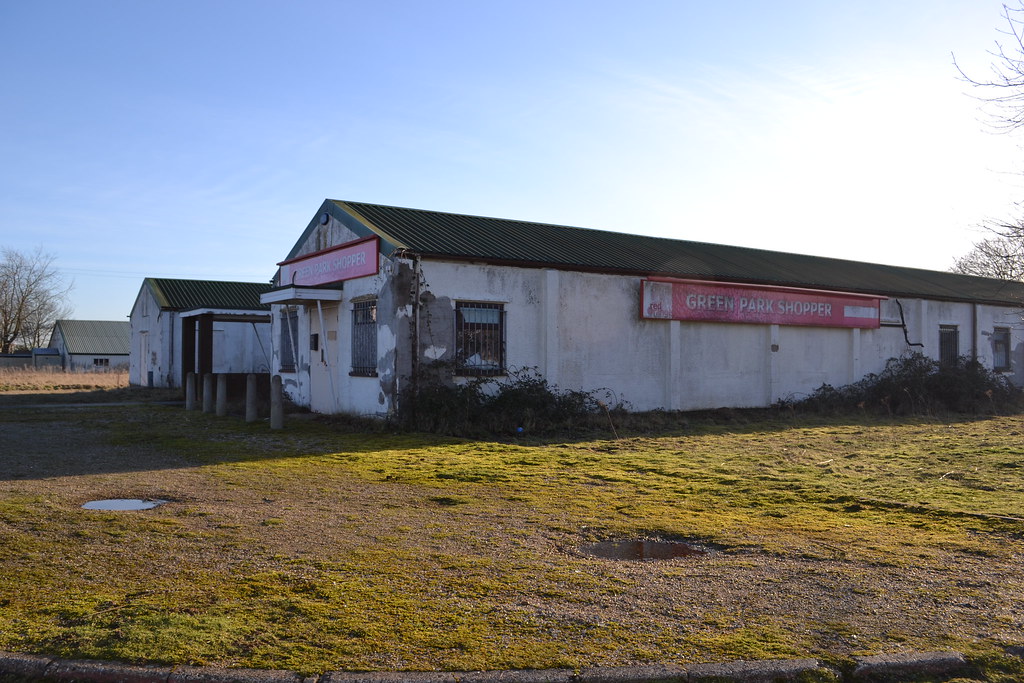
A once busy shop

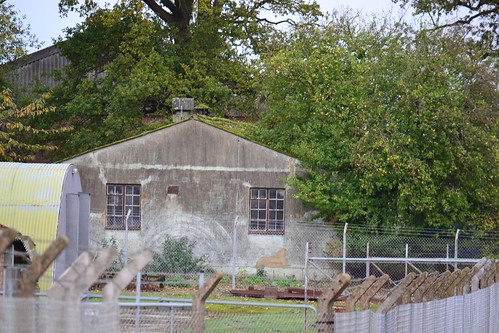
A former American school and more recently a shop now derelict and forgotten.

Designed initially as a heavy bomber site, and satellite to RAF West Raynham, Sculthorpe would initially be built with three runways, ten accommodation sites, a bomb store and a large technical area. Over time, these runways were extended to one of 12,000ft and two of 6,000ft, and all made of concrete. By the end of its life, its accommodation area would have grown enormously, as would its technical and administration sites, housing at its height, 10,000 personnel and their families. Such enormous facilities along with the fact that it was capable of holding around 100 aircraft, gave Sculthorpe the ability to boast being one of the biggest airfields in Western Europe, an honour it retains to this day.

Built by a collection of major companies including: Bovis Ltd, John Laing & Sons, and Constable Hart & Co. Ltd; it would boast as many as five major hangars – one B1 and four T2s, along with nine blister hangars all located around the site. Around the perimeter there would be 36 hardstands, many of which would be absorbed during extension work leaving 29 by 1958.

Although built in the Second World War, Sculthorpe had a limited War life, its heyday coming much later in the Cold War, during which time it became a major nuclear capable airfield housing American bombers on 90 day rotations.

Initially though, following a reshuffle of Bomber Command, it fell under the control of 2 Group Bomber Command but the first users of the airfield were not the bomber crews but the personnel of the 11 Heavy Glider Maintenance Section along with 2 Heavy Glider Maintenance Unit, who both moved in during early 1943, before the site was officially opened. As non-flying units they prepared, repaired and maintained thirty-two Horsa gliders, many of which would have been used the following year in the Normandy invasion. These units remained in situ at Sculthorpe for almost a year, departing mid March 1944.

2 Group were formed primarily of light bombers, and on May 15th 1943, the first of the main residents arrived in the form of Boston IIIAs belonging to 342 (Lorraine) Squadron.

342 Sqn had originally been set up as a Free French squadron in September 1941, operating in the Middle East with French crews. Their time there had not been good though, with many losses as a result of flying what were now considered ‘out of date’ aircraft – the Blenheim. It was then decided, after talks between the RAF and General Valin, the Commander of the Free French Air Force, to bring these men back and retrain them on more modern aircraft, and so in September 1942, orders from the UK directed many of these airmen back to the UK. Sadly however, during their return voyage, two of the four ships that were used to transport them, were sunk by German U-boats, and many of the  personnel were lost at sea.

Once in the UK, refresher courses were undertaken with 342 Sqn being officially re-formed on April 1st 1943, using these French personnel at nearby RAF West Raynham . Once formed, training continued, followed not long after by the first loss, when one of the aircraft attempted an emergency landing after running out of fuel. That aside, the Boston IIIa, or A20, they were now using, was considered a much improved model compared to the Blenheim, with both greater power and better armament, and was far more suited to the role it was about to perform.

Following further training, the squadron finally transferred over to Sculthorpe on May 15th 1943, where crews attended lectures on “evasive action and fighter control”. Two further crashes would cost the squadron several more airmen, some of whom were highly experienced and valued members of the unit.

As the saying goes, any port in a storm, and Sculthorpe provided that port. On May 19th, an American B-17 was forced to make an emergency landing at the airfield. On board the aircraft were three injured crewmen, the ball turret gunner, and the two waist gunners. The Ball Turret Gunner was given urgent medical assistance, but unfortunately he later died from those injuries, whilst the two waist gunners, both with frost bite to their hands and ears, thankfully survived. A second B-17 landed some time after the landing and collected the crewmen, transferring them back to their own base where they received further medical assistance.

There then came yet another change at Sculthorpe, as the Free French unit was combined with two other squadrons, 88 and 107 to form the new 137 Wing; a Wing made up of both French and British units.  On June 12th 1943, under the new Wing, 342 Sqn’s first operational flight took place, a ‘circus’ raid undertaken in conjunction with 107 Sqn. These types of operations would become the norm for the next month, and whilst there were some losses, they were thankfully light. In mid July, orders came through for the unit to depart Sculthorpe and move to nearby RAF Great Massingham, a move that was well organised and one that went smoothly. By the evening of July 19th all but two aircraft had departed Sculthorpe, and crews were settling in well to their new home.

There was no let up at Sculthorpe though, as over the next two days two more squadrons would move in to the now vacant premises. Orders for the transfer of both 464 (RAAF) and 487 (RNZAF) Squadrons were received with mixed emotions though. To make things worse, the transfer of both men and machinery did not go totally to plan and only happened following a change in operations and planning. Both Squadrons had been flying from  RAF Methwold, an airfield not far from Sculthorpe, as light bomber units with Lockheed’s Venturas. They regularly attacked targets in western Europe, often without fighter escort, which resulted in some heavy losses for the units.
RAF Sculthorpe

The Commissary and BX next door are still on site today

It was whilst at Methwold that Sqn. Ldr. Leonard Trent would perform so bravely receiving the Victoria Cross for his actions on May 3rd, 1943, with 487 (RNZAF) Sqn. The whole process began in mid June with an initial order requiring 464 (RAAF) Sqn, to move to Dunsfold, however, that move never materialised, the order being cancelled on July 4th. This meant that preparations would stop, and the squadron would remain at Methwold. They then entered a period of training, the weather having curtailed many operational flights for both this unit and others across the UK.

Then on July 10th, the weather broke just enough for an operational flight to be carried out by 464 Sqn, attacking targets at St. Omer. These were hit with great success; the 487 squadron commander commenting “a wizard piece of bombing”,  but still the squadron awaited, with anticipation, news of its next posting. Then two days later, whilst a contingent of the Australian press where visiting, news came through that the two units were to change its aircraft for Mosquitoes, and that the pilots would be fully trained within 6 weeks. The swap although not what was expected, was generally accepted well by the squadrons, but it brought disappointment for both the wireless operators and air gunners of each unit, who would have no place on board the two-seat ‘Mossie’,  and would have to be transferred out.

Following a period of further training, the long awaited news finally arrived. For 487 Sqn it arrived on July 16th, noted as ‘Panic day’, and on July 17th for 464 Sqn. Both squadrons would now transfer over to Sculthorpe. In preparation, 464 Sqn’s station adjutant visited the new airfield on the 19th to assess its condition, but he was not impressed! He reported that “there was very little of it to work in comfort and everything is drastically dispersed.”*1 His aggrieved feelings about the site were further exasperated by a lack of office space, the only silver lining to the whole move, being that more accommodation was apparently ‘in the pipeline’.

487 were the first to transfer. On the 19th, the advance party left Methwold followed in the early afternoon of the 20th by the main road party. The aircraft and crews then transferred over an hour or so after them.  On the 21st the aircraft of 464 Sqn also departed Methwold, the departure tinged with sadness as many were sorry to be leaving what had been a good home. The weather typical as it is, once again closed in, and several aircraft had to try two or three times before finally getting down safely at Sculthorpe. Fortunately there were no mishaps and all crews and aircraft arrived safely.

By the evening all personnel were unpacked and settling down for the night. The lack of buildings became quickly evident though, a fact made worse by the lack of bicycles, Sculthorpe being so widespread meant it was difficult to get around without transport. As a result, more bikes were needed and an order was placed with an urgent request. Coinciding with this, was a memo informing staff, of the impending move to form a new headquarters here, a move which would see both new recruits along with an increase in staffing levels. This was a further worry as there was still insufficient accommodation for those already here.

The month ended on a better note however, with good weather, night sorties and training on new equipment gave a hint of things to come. A new station Commander also arrived at this time, in the form of Group Captain P.C. Pickard DSO, DFC, once again hopes for the two squadrons were rising. Pickard’s arrival was by no means a coincidence – a new Wing was being formed and he had been chosen to lead it. Pickard’s record as a leader was outstanding, and he had been hand picked, for the role, by none other than Air Vice Marshall Basil Embry.

Pickard’s role here at Sculthorpe was to set up and command 140 Wing, a new unit consisting of three Mosquito squadrons, under the control of 2 Group of the Second Tactical Air Force headed by Embry himself. Even while the new Wing was being formed, training continued for those already here at Sculthorpe. On August 18th, whilst on one such flight, one of the Venturas (AE668) of 464 Sqn crashed into a Welsh hillside at Llandwrog, with the loss of all four crewmen. What was unusual, and concerning, was why the aircraft was so far off course at the time; the Welsh mountains not being where the aircraft should have been. It was not known why the aircraft crashed nor indeed whether the deviation of course was a factor in the accident, but it was a heart felt tragedy and the squadron’s first accident whilst at Sculthorpe.

Three days after this, on August 21st, the first of the new replacement aircraft arrived, two D.H. Mosquitoes, a milestone that coincided the following day with the setting up of a Mosquito Conversion Flight. The purpose of the Flight was to convert Ventura aircrew from both 464 and 487 Sqns over to the Mosquito.

Flying was slow to start with, as appalling weather prevented any chance of taking off even in the day-time, a situation that would prevail for some time. By now, the new postings for the surplus gunners of both units had begun to filter through, and gradually, one by one, they trickled out of Sculthorpe to their new respective squadrons elsewhere. It wasn’t  just the aircrew that were being posted out either, a number of tradesmen were also posted out, but oddly enough, they were not being replaced. The distinct lack of skilled technical personnel soon raised alarm bells amongst the units, for as a Mosquito squadron, 487 had no carpenters, and other skilled workers were becoming distinctly lacking.
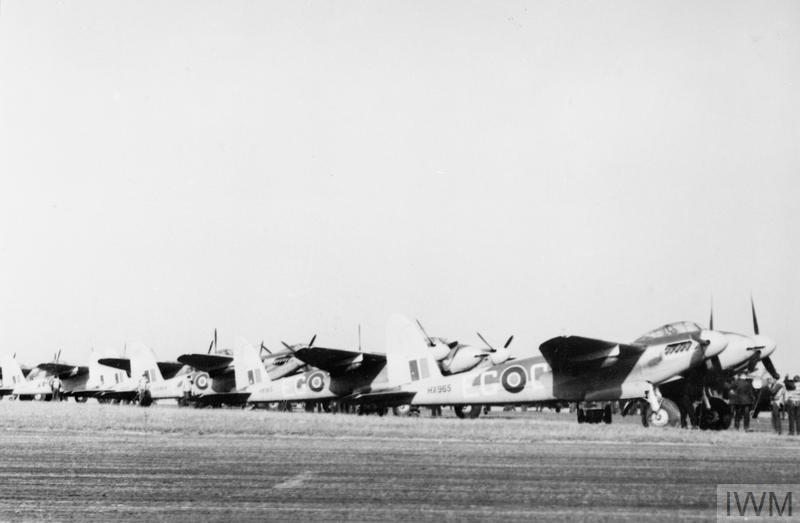
Mosquito FB Mk VIs (HX965 ‘EG-C’ leading) of No. 487 Squadron, lined up at Sculthorpe, prior to taking off on the first Mosquito raid mounted by No. 140 Wing. 24 aircraft from 464 and 487 Squadron RNZAF successfully attacked two power stations in France without loss. (©IWM HU 81325)

By early September Mosquito numbers had reached well into double figures, the lack of manpower was now the issue which was being made worse by the lack of spares, a situation that led to many aircraft being classed as unserviceable. A common problem seemed to be the undercarriage, repairs taking longer than usual keeping aircraft annoyingly grounded.

The 15th September 1943 saw another significant turn in the status of Sculthorpe, as it gained its own independence and became an operational airfield in its own right. With this, Sculthorpe had finally grown up. On the 28th, the numbers of aircraft on the books had reached over 70 when another squadron (21) arrived to join both 464 and 487 thus completing the formation of the Wing. The ORB for 464 Sqn stating that the airfield was not built for three squadrons (and a conversion flight) and that overcrowding was now a major issue for those based here at a cold and wet Sculthorpe.

21 Sqn was another Ventura unit, themselves having a history as far back as 1915, and very soon after their arrival, they too, would begin to receive the Mosquito. As with 464 and 487 Sqns, pilots were quickly placed on the conversion course flying with the Conversion Flight at Sculthorpe, the transition from Ventura to Mosquito being expedited with all speed.

By the 4th October, virtually all pilots had converted and completed cross country solo flights at low level. Only the incident on the 1st, when Flt. Lt. Henderson suffered engine trouble and subsequent fire, marred the otherwise rapid and clean transfer across. In the incident, Flt. Lt. Henderson managed to bring the aircraft down safely at RAF Attlebridge. Other good news for the unit was that those in the administration offices were now able to move from their cold and unsuitable temporary accommodation block to a new permanent building, this new block being the ‘best they had experienced since leaving RAF Oulton‘. Improvements were indeed coming but they were somewhat slow.
In Part 2 the two squadrons fly operationally, but it would not be the great start they had wished for. There would be further changes and more new arrivals at the airfield and larger four-engined bombers would also arrive.The full story can be read in Trail 21.

Trail 63 – The Twelve Airfields of The New Forest – Now There is Only One

This is an article submitted by Steve Williams on behalf of FONFA (Friends of the New Forest Airfields), a charity aiming to preserve the aviation heritage of the New Forest. For more information about their work and the airfields concerned see their website at https://fonfa.co.uk/ 

The Twelve airfields of the New Forest.

Driving through the New Forests’ lush and tranquil scenery today, it is hard to imagine that during the mid-1940s The Forest was progressively militarised, as Britain defended itself from threatened invasion, and prepared for Operation Overlord, the D Day landings. By May 1944 there were a staggering 2,876,000 troops from many nations, together with their vehicles and equipment in Southern England. Many of these were in the New Forest, which is located close to the major ports of Southampton and Poole and had flat terrain and trees to provide camouflage for the build-up of troops and supplies, as well as hiding aircraft.

At the start of The War there were only two active airfields in the New Forest. The sea plane base at Calshot, and the civilian airport at Christchurch. Both played key roles during and after The War.  The bombing of Britain during the early part of The War provided the stimulus to build many new airfields across the South of England. Five concrete runway airfields for heavy aircraft such as bombers, maritime patrol, troop transport and glider towing were built in the New Forest at Stoney Cross, Ibsley, Holmsley South, Beaulieu and Hurn.

As part of the preparation for D Day, a chain of Advanced Landing Grounds (ALG) were rapidly built on agricultural land, or existing airports. Five of these were in the New Forest at Winkton, Lymington, Needs Oar Point, Bisterne and on Christchurch airfield. These were temporary airfields and there were few permanent buildings. Much of the accommodation was tented. These five airfields played a major role during the build-up and execution of the D Day landings. They became operational during late March or early April 1944 and in the few weeks after D Day the RAF and USAAF squadrons moved from the New Forest Advanced Landing Grounds to new Advanced Landing Grounds built on liberated land in France, to continue providing support to the advancing troops.

This meant that four of the New Forest Advanced Landing Grounds were no longer required and were returned to agricultural use after just three months of intense operation. The larger concrete runway airfields remained in use longer. By the end of the 1940s only Calshot, Christchurch and Hurn existed. Calshot and Christchurch shut down in the 1960s leaving only Hurn, or what we now know as Bournemouth International Airport.

For me, the most interesting of the New Forest Airfields was Christchurch. It was operational for around 40 years, starting and finishing its life as a civilian airfield.  The Air Defence Research and Development Establishment was set up at Christchurch and this made many ground-breaking scientific developments in areas such as airborne radar, ground controlled interception, radio navigation and low visibility landing aids.  During the War, the Airspeed factory at Christchurch was an important Centre for the assembly of Horsa gliders and the manufacture and maintenance of aircraft including the Airspeed Oxford and the Mosquito.  After the War, De Haviland took over the Airspeed factory and produced Vampire, Venom and Sea Vixen military jets as well as the Ambassador twin engine airliner.

During 1944, the New Forest airfields were manned by over 25,000 military and 10,000 civilian staff and there were estimated to be around 1,500 RAF and USAAF aircraft. The airfields were involved in every aspect of air warfare from research and development, training, defensive and offensive missions, reconnaissance, and supporting the operations of secret agents and Resistance Organisations in occupied Europe. During the D-Day period, hundreds of sorties were flown daily. The ‘Advanced Landing Ground’ at Needs Oar Point was the busiest airfield in the country for around three weeks. Take offs or landings occurred as often as one every 45 seconds, for up to eighteen hours a day.

Building an Advanced Landing Ground

Building an Advanced Landing Ground

It is hard to imagine the scale of the social impact that this number of military personnel had on the unique culture, legal framework and way of life of the population of the New Forest. Each of the airfields has unique stories of bravery of those who flew from them and there are fascinating memories of life during these difficult years from those living on the RAF stations or in the New Forest during this period.

Today there is very little left of these airfields, especially the Advanced Landing Grounds. There are remnants of the larger concrete runway airfields and the runway pattern of some are still visible from the air.

RAF Beaulieu

RAF Beaulieu Airfield today from an aircraft approaching Southampton Airport

Airspeed Ambassador

Airspeed Ambassador taking off from Christchurch airfield (Photo by John Levesley)

RAF Ibsley

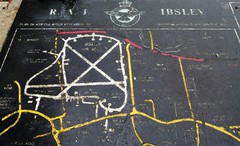
There are memorials and/or information boards at some of the airfields, this is at RAF Ibsley

A good overview of each of the airfields can be found in Alan Brown’s book, Twelve Airfields. For those who would like to find out more there is a wealth of detailed information, artefacts, archives, interactive displays, pictures, videos, models and dioramas, pilot’s stories and limited edition prints at The Friends of the New Forest Airfields, (FONFA) Heritage Centre, located near Bransgore on the former RAFCamp at Sopley.

RAF Sopley was not an airfield, but a very important early radar station, also known as “Starlight”. Much of the ground-breaking work done at Purbeck Radar in Swanage and at Christchurch was put into operation at Sopley. This evolved into what we now know as air traffic control.

A great deal of archives, pilot stories, memories of those who servedand useful information, together with the opening times for the Heritage Centre, can be found on the FONFA web site at https://fonfa.co.uk

P-38 in Support of D-Day

The USAAF P-38 Lightnings that operated from New Forest Airfields during 1944 in support of D Day

Article written by Steve Williams (FONFA) who provided all the photos. (My thanks go to Steve for the article and the work FONFA do in keeping this important part of our heritage alive. It is hoped to add more as information comes in from Steve and eventually to separate each of the twelve airfields out to give as much detail as possible to each).

November 7th 1945 – World Air Speed Record Herne Bay.

Trail 44 takes a look at the aviation highlights of the North Kent Coast in the small town of Herne Bay and its neighbour Reculver. It was here, on November 7th 1945, that the World Air Speed record was set in a ‘duel’ between two Gloster Meteors, as they raced across the Kent Sky.

On that day, two Meteor aircraft were prepared in which two pilots, both flying for different groups, would attempt to set a new World Air Speed record over a set course along Herne Bay’s seafront. The first aircraft was piloted by Group Captain Hugh Joseph Wilson, CBE, AFC (the Commandant of the Empire Test Pilots’ School, Cranfield); and the second by Mr. Eric Stanley Greenwood O.B.E., Gloster’s own chief test pilot. In a few hours time both men would have the chance to have their names entered in the history books of aviation by breaking through the 600mph air speed barrier.

The event was run in line with the Fédération Aéronautique Internationale‘s rules, covering in total, an 8 mile course flown at, or below, 250 feet. For the attempt, there would be four runs in total by each pilot, two east-to-west and two west-to-east.

With good but not ideal weather, Wilson’s aircraft took off from the former RAF Manston, circling over Thanet before lining his aircraft up for the run in. Following red balloon markers along the shoreline, Wilson flew along the 8 mile course at 250 feet between Reculver Point and  Herne Bay Pier toward the Isle of Sheppey. Above Sheppey, (and below 1,300 ft) Wilson would turn his aircraft and line up for the next run, again at 250ft.

Initial results showed Greenwood achieving the higher speeds, and these were eagerly flashed around the world. However, after confirmation from more sophisticated timing equipment, it was later confirmed that the higher speed was in fact achieved by Wilson, whose recorded speeds were: 604mph, 608mph, 602mph and 611mph, giving an average speed of just over 606mph. Eric Greenwood’s flights were also confirmed, but slightly slower at:  599mph, 608mph, 598mph and 607mph, giving an overall average speed of 603mph. The actual confirmed and awarded speed over the four runs was 606.38mph by Wilson*1.

The event was big news around the world, a reporter for ‘The Argus*2‘ – a Melbourne newspaper – described how both pilots used only two-thirds of their permitted power, and how they both wanted permission to push the air speed even higher, but both were denied at the time.

In the following day’s report*3, Greenwood described what it was like flying at over 600 mph for the very first time.

As I shot across the course of three kilometres (one mile seven furlongs), my principal  worry was to keep my eye on the light on the pier, for it was the best guiding beacon there was. On my first run I hit a bump, got a wing down, and my nose slewed off a bit, but I got back on the course. Below the sea appeared to be rushing past like an out-of-focus picture.

I could not see the Isle of Sheppey, toward which I was heading, because visibility was not all that I wanted.

At 600mph it is a matter of seconds before you are there. It came up just where I  expected it. In the cockpit I was wearing a tropical helmet, grey flannel bags, a white silk shirt, and ordinary shoes. The ride was quite comfortable, and not as bumpy as some practice runs. I did not have time to pay much attention to the gauges and meters, but I could see that my air speed indicator was bobbing round the 600mph mark.

On the first run I only glanced at the altimeter on the turns, so that I should not go too high. My right hand was kept pretty busy on the stick (control column), and my left hand was. throbbing on the two throttle levers.

Greenwood went on to describe how it took four attempts to start the upgraded engines, delaying his attempt by an hour…

I had to get in and out of the cockpit four times before the engines finally started. A technical hitch delayed me for about an hour, and all the time I was getting colder and colder. At last I got away round about 11.30am. 

He described in some detail the first and second runs…

On the first run I had a fleeting glance at the blurred coast, and saw quite a crowd of onlookers on the cliffs. I remembered that my wife was watching me, and I found that there was time to wonder what she was thinking. I knew that she would be more worried than I was, and it struck me that the sooner I could get the thing over the sooner her fears would be put at rest.

On my first turn toward the Isle of Sheppey I was well lined up for passing over the Eastchurch airfield, where visibility was poor for this high-speed type of flying. The horizon had completely disappeared, and I turned by looking down at the ground and hoping that, on coming out of the bank, I would be pointing at two balloons on the pier 12 miles ahead. They were not visible at first.

All this time my air speed indicator had not dropped below 560 mph, in spite of my back-throttling slightly. Then the guiding light flashed from the pier, and in a moment I saw the balloons, so I knew that I was all right for that.

On the return run of my first circuit the cockpit began to get hot. It was for all the world like a tropical-summer day. Perspiration began to collect on my forehead. I did not want it to cloud my eyes, so for the fraction of a second I took my hands off the controls and wiped the sweat off with the back of my gloved hand. I had decided not to wear goggles, as the cockpit was completely sealed. I had taken the precaution, however, of leaving my oxygen turned on, because I thought that it was just that little extra care that might prevent my getting the feeling of “Don’t fence me in.”

Normally I don’t suffer from a feeling of being cooked up in an aircraft, but the Meteor’s cockpit was so completely sealed up that I was not certain how I should feel. As all had gone well, and I had got half-way through the course I checked up my fuel content gauges to be sure that I had plenty of paraffin to complete the job.

I passed over Manston airfield on the second run rather farther east than I had hoped, so my turn took me farther out to sea than I had budgeted for. But I managed to line up again quite satisfactorily, and I opened up just as I was approaching Margate pier at a height of 800 feet. My speed was then 560 mph.

Whilst the first run was smooth, the second he said, “Shook the base of his spine”.

This second run was not so smooth, for I hit a few bumps, which shook the base of my spine. Hitting air bumps at 600 mph is like falling down stone steps—a series of nasty jars. But the biffs were not bad enough to make me back-throttle, and I passed over the line without incident, except that I felt extremely hot and clammy.

After he had completed his four attempts, Greenwood described how he had difficulty in lowering his airspeed to enable him to land safely…

At the end of my effort I came to one of the most difficult jobs of the lot. It was to lose speed after having travelled at 600 mph. I started back-throttling immediately after I had finished my final run, but I had to circuit Manston airfield three times before I got my speed down to 200mph.

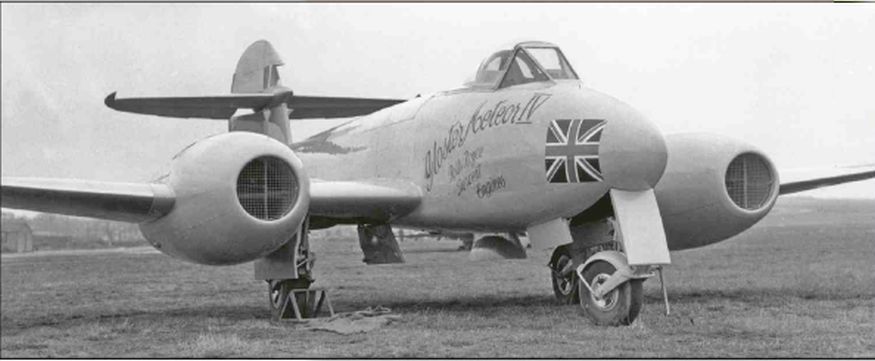
The two Meteor aircraft were especially modified for the event. Both originally built as MK.III aircraft – ‘EE454’ (Britannia ) and ‘EE455’ (Yellow Peril) – they had the original engines replaced with Derwent Mk.V turbojets (a scaled-down version of the RB.41 Nene) increasing the thrust to a maximum of 4,000 lbs at sea level – for the runs though, this would be limited to 3,600 lbs each. Other modifications included: reducing and strengthening the canopy; lightening the air frames by removal of all weaponry; smoothing of all flying surfaces; sealing of trim tabs, along with shortening and reshaping of the wings – all of which would go toward making the aircraft as streamlined as possible.

Related image

EE455 ‘Yellow Peril’ was painted in an all yellow scheme (with silver outer wings) to make itself more visible for recording cameras.*4

An official application for the record was submitted to the International Aeronautical Federation for world recognition. As it was announced, Air-Marshal Sir William Coryton (former commander of 5 Group) said that: “Britain had hoped to go farther, but minor defects had developed in ‘Britannia’. There was no sign of damage to the other machine“, he went on to say.

Wilson, born at Westminster, London, England, 28th May 1908, initially received a short service commission, after which he rose through the ranks of the Royal Air Force eventually being placed on the Reserves Officers list. With the outbreak of war, Flt. Lt. Wilson was recalled and assigned as Commanding Officer to the Aerodynamic Flight, R.A.E. Farnborough. A year after promotion to the rank of Squadron Leader in 1940, he was appointed chief test pilot at the Royal Aircraft Establishment (R.A.E.) who were then testing captured enemy aircraft. He was promoted to Wing Commander, 20th August 1945, retiring on 20th June 1948 as a Group Captain.

Eric Greenwood, Gloster’s Chief Test Pilot, was credited with the first pilot to exceed 600 miles per hour in level flight, and was awarded the O.B.E. on 13th June 1946.

His career started straight from school, learning to fly at No. 5 F.T.S. at Sealand in 1928. He was then posted to 3 Sqn. at Upavon flying Hawker Woodcocks and Bristol Bulldogs before taking an instructors course, a role he continued in until the end of his commission. After leaving the R.A.F., Greenwood joined up with Lord Malcolm Douglas Hamilton (later Group Captain), performing barnstorming flying and private charter flights in Scotland.

Greenwood then flew to the far East to help set up the Malayan Air Force under the guise of the Penang Flying Club. His time here was adventurous, flying some 2,000 hours in adapted Tiger Moths. His eventual return to England saw him flying for the Armstrong Whitworth, Hawker and Gloster companies, before being sent as chief test pilot to the Air Service Training (A.S.T.) at Hamble in 1941. Here he would test modified U.S. built aircraft such as the Airocobra, until the summer of 1944 when he moved back to Gloster’s – again as test pilot.

It was whilst here at Gloster’s that Greenwood would break two world air speed records, both within two weeks of each other. Pushing a Meteor passed both the 500mph and 600mph barriers meant that the R.A.F. had a fighter that could not only match many of its counterparts but one that had taken aviation to new record speeds.

During the trials for the Meteor, Greenwood and Wilson were joined by Captain Eric ‘Winkle’ Brown, who between them tested the slimmed-down and ‘lacquered until it shone’ machine, comparing  drag coefficients with standard machines. Every inch of power had to be squeezed from the engine as reheats were still in their infancy and much too dangerous to use in such trials.

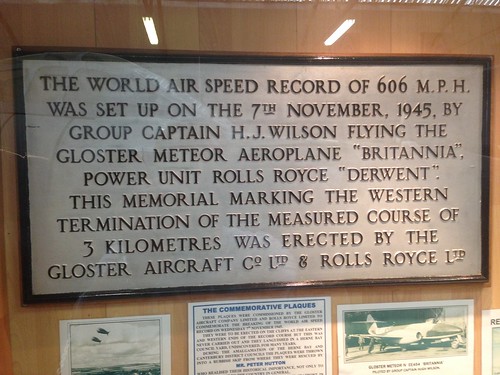
To mark this historic event, two plaques were made, but never, it would seem, displayed. Reputed to have been saved from a council skip, they were initially thought to have been placed in a local cafe, after the cliffs – where they were meant to be displayed – collapsed. The plaques were however left in the council’s possession, until saved by an eagle-eyed employee. Today, they are located in the RAF Manston History Museum where they remain on public display.

RAF Manston History Museum

One of the two plaques now on display at the RAF Manston History Museum.

To mark the place in Herne Bay where this historic event took place, an information board has been added, going some small way to paying tribute to the men and machines who set the world alight with a new World Air Speed record only a few hundred feet from where it stands.

Part of the Herne Bay Tribute to the World Air Speed Record set by Group Captain H.J. Wilson (note the incorrect speed given).

Sources and Further Reading.

*1 Guinness World Records website accessed 22/8/17.

*2 The Argus News report, Thursday November 8th 1945 (website) (Recorded readings quoted in this issue were incorrect, the correct records were given in the following day’s issue).

*3 The Argus News report, Thursday November 9th 1945 (website)

*4 Photo from Special Hobby website.

The RAF Manston History Museum website has details of opening times and location.

The Manston Spitfire and Hurricane Memorial museum website has details of opening times and location.

RAF Downham Market (Part 2 – D-Day to the War’s End)

In Part 1 Downham was born, serving the Stirlings of Bomber Command before becoming part of Bennett’s Pathfinder Force. A large airfield, it was often busy and as the war progressed toward D-Day, preparations began for operations over the invasion area.

On June 3rd 1944 Lancaster ND841 ‘F2-D‘ piloted by F/O. George. A. Young (s/n: 134149) RAFVR 635 Squadron, was detailed to attack Calais as part of the preparations for the forthcoming D-Day invasion. There would be eight other aircraft from RAF Downham Market also detailed for the mission, and take off would be late that evening.

The mission as a whole would involve 127 Lancasters and 8 Mosquitoes of 1, 3 and 8 Groups and the targets would be the gun batteries at both Calais and Wimerereux. It was a  diversionary raid as part of Operation “Fortitude South“, the elaborate plan to fool the Germans into believing the invasion would occur in the Pas-de-Calais region.

At 28 minutes past midnight, F/O. Young lined the Lancaster up on the runway, opened the throttles and began the long run. As the Lancaster approached take off, it began to swing striking the roof of the B1 Hangar. In an uncontrollable state the aircraft crashed just outside the airfield killing all those on board. What was left of the aircraft was salvaged, and three of the crew buried in the local cemetery in Downham Market.

Downham Market Cemetery

F.Sgt. Stanley Wharton (RAFVR) 635 Sqn. One of seven Killed 4th June 1944.

Two months later, another pilot of 635 Sqn, also flying a Lancaster III, ND811, ‘F2-T’, Squadron Leader Ian Bazalgette, would be awarded the second of Downham’s Victoria Crosses.

On August 4th 1944, flying Lancaster ‘T’ for Tommy, on a daylight raid to mark the V1 storage depot at Trossy St. Maximin, the aircraft was hit by flak knocking out both starboard engines and setting the aircraft on fire. Bazalgette pressed on, marked the target and then instructed the crew to bail out. Two of the crew were so badly injured they could not do so, and so Bazalgette attempted a crash landing. Unfortunately on impact with the ground the aircraft exploded, killing all three remaining crew members on board.

For his bravery and sacrifice, Ian Bazalgette was also awarded the V.C., the highest honour for military personnel. The London Gazette, of 14th August 1945, announced the award, citing: “His heroic sacrifice marked the climax of a long career of operations against the enemy. He always chose the more dangerous and exacting roles. His courage and devotion to duty were beyond praise“.

During that same month, August 1944, another squadron would appear here at Downham. Joining 635 Sqn were 608 Sqn, who had previously been operating abroad. They were reformed here on August 1st that year, also joining Bennett’s elite group. Another Mosquito squadron, they bolstered the number of aircraft and personnel present here at Downham. Flying the Mosquito XX, XXV and eventually XVI, they remained at Downham for a year whereupon they were once more disbanded. Whilst operating these aircraft, 608 Sqn would fly 1,726 operational sorties all as part of Bennett’s Pathfinder Force.

608 Sqn’s primary role was to carry out night strikes as part of the Pathfinder Operations focusing on the German heartland. Targets included: Berlin, Frankfurt, Hanover, Essen, Stuttgart, Nuremberg, Hamburg, Emden and Kiel. Their first operational sortie from Downham was on the night of 5th/6th August 1944, when a single Mosquito took off and bombed Wanne-Eickel.

Then, a month later, on the night of 6th November 1944, twelve aircraft from 608 Sqn took off in a diversionary attack on targets at Gelsenkirchen. The idea was to draw defences away from a much larger force attacking both Gravenhorst and Koblenz. The plan was for 608 to begin their attack five minutes ahead of the other forces, a plan that went like clockwork.

The full story of Mosquito KB364, piloted by P.O. James McLean (26) and Sgt. Mervyn Lambert Tansley (21), appears in Heroic Tales, but this was to be their final, fatal flight.

On return, the aircraft careered into All Saints’ Church, Bawdeswell, some 30 miles north-east of the airfield, setting it alight. The impact was such that parts of the aircraft struck two other homes, causing extensive damage to both properties. The resultant fire took four hours to extinguish and included crews from other nearby airfields. In honour of the two airmen, a plaque manufactured from part of the Mosquito has been mounted on the church wall inside the building.

The Christmas period of 1944 was a busy one for Downham and for the FIDO operators. With freezing fog, snow and general poor weather causing many problems for those on the continent and for those on British soil attempting to take off, FIDO crews were going to be busy. FIDO primarily designed as a landing aid, also permitted take offs during poor visibility. However, getting to the runway was a challenge in itself. Often with visibility down to just feet, ground staff would line the perimeter tracks with torches to guide each aircraft safely along. Anyone who made a mistake took the risk of running off the perimeter track, sinking into the ground along side or worse.

By the dawn of 1945 the war in Europe was all but over. Operations began to focus on troop concentrations, possible German escape routes and harbours. Both 635 and 608 Sqns continued operational flying until the war’s end. In August and early September these last two operational squadrons at Downham Market were disbanded, 608 Sqn on August 24th and 635 Sqn on September 1st. This left Downham devoid of all front line units.

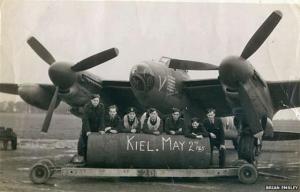
last raid - Kiel canal ground & air crew photo 2 May 1945 at Downham Market found by Brian Emsley, Welwyn G, father Edward Emsley far left httpwww.bbc.co.uknewseducation-32532153

A recently discovered photograph showing a D.H. Mosquito of Downham Market, taken on May 2nd 1945. It was taken just prior to the last mission undertaken by RAF aircraft on an attack on the Kiel Canal. It shows Ground & Aircrew next to their Mosquito and ‘Cookie’. It was found by Brian Emsley,  his father Edward Emsley is far left.*

With peace now settling across Europe, focus turned to returning personnel back to ‘Civvy street’. Within 8 Group, a new scheme was set up, and personnel were encouraged to make use of it. Across the range of Pathfinder stations, EVT (Educational and Vocational Training) was introduced. These classes were designed to give personnel the much needed skills in a range of civilian areas, to help them integrate back into civil life. Classes were broad and included a range of domestic activities such as: landscape gardening, cookery, music and carpentry. Some of these such as ‘domestic science’ were designed with the WAAFs in mind, whilst others were geared more (but not exclusively) toward the men.

"CIVVY STREET COURSE" IN R.A.F. PATHFINDER GROUP

1945 – Landscape and floral gardening are subjects given in the E.V.T. classes at Downham Market. Leading Aircraftman Arthur Pickersgill [centre] is now the station instructor. (IWM CH16028)

RAF Downham Market finally closed in 1946, but in 1948 the site was used for night Helicopter flight trials by BEA – the civil air company – transporting mail using Sikorsky S-51 Helicopters. This was a short lived venture but was by the end, considered a very successful companion to the day times routes recently started between Peterborough and a number of towns between Kings Lynn and Norwich. The venture included installing a flashing Sodium Beacon at Downham Market, its precise location on the airfield is not known and it may well have been a mobile unit*4.

Eventually in 1957, the land was sold off. The site was returned to agriculture but the airfield’s runways remained intact. In the 1970s, the Downham Market by-pass was built and the concrete runways were an ideal source of local hardcore. All three were subsequently removed along with large sections of the perimeter track leaving a mere road’s width for the larger part. Many of the buildings were at this time left, and small businesses soon took them over. One of these, a kitchen sales shop, now houses a small display relating to the history of the airfield.

At ground level, the discerning eye and a general appreciation of airfield structure and layout, suggest a presence of something more interesting. Huts, whilst in very poor condition, poke through overgrown trees and bushes, and provide shelter and storage facilities for local industry. The condition of windows and brickwork suggest that time is gradually running out for this once thriving airfield, unless other businesses move in.

The main runway ran east – west and for many years a small section of this remained for the farmers use. It was this runway that utilised FIDO, the storage area (at the far end) now taken over by the car dealership.

Downham Market Runway remains

The remnants of the main runway. Sadly this has now also been removed. It was this runway that utilised FIDO.

The remaining two runways were both removed for the hardcore. The western perimeter track remains in part width, from the threshold of the second runway virtually to the top to the threshold of the northern end of the third runway. However, the A10 road now dissects this and the uppermost part has been removed also. A new track (a public track) has been built for the farmer, this cuts across the northern end of the airfield and it is here that the (flooded) Battle Headquarters can be found. Now part of a ditch, its roof forms a bridge into one of the adjoining fields, it can only be found with careful searches of this ditch!

Battle Headquarters

A flooded Battle Headquarters. Several rooms exist below ground level, but these are all flooded, some said to be very deep.

Virtually the entire length of the northern part of the peri track can be walked round to the eastern end of the main runway. Part way along, another track leads off to the former bomb store, this is private the store now a wooded area. Also along here is the ultra heavy fusing point, a shed that is now used by the local farmer. At the far end of the peri track is where the accommodation area was constructed for the FIDO installers using Laing Hutting. Across the road can be seen the car dealership built on what was the FIDO installation. None of the original buildings remain here, but the peri track widens out to full width again at this point and heads east back toward the technical area.

Across the road from the technical area is the camp entrance and Bexwell, a small collection of houses and a church. Here a small memorial is placed telling the stories of the two heroic and brave crew members Aaron and Bazalgette. This road is the old road that led to all the accommodation areas. The WAAF site being the first and one of only two sites left with buildings still in place.

RAF Downham Market

Buildings on the WAAF site.

The other sites here include the Communal Site 1, Dormitory Site 1 (A), Sick Quarters, Dormitory Sites No. 2 (B), 3 (C), 4 (K) and 5 (J). Another track leads off to a sewage works. The road eventually joins the main A10. Across from here is the Communal Site 2, the second site with buildings still in use, and currently used by an engineering firm. A First World War memorial is also located here oddly hidden away amongst the bushes. Alongside these buildings are a pathway that leads to the second sewage treatment works.  This site can also be accessed by public footpath from the main road into Downham itself.

looking back to accomodation area

The sewage site. Through the trees you can see the remains of Communal Site 2.

Downham Market is an airfield that has a remarkable history, the dedication and bravery of the crews being second to none. What is left of this historic site is continually under threat, decay and dilapidation rapidly taking over.

The town is regularly overflown by F-35s from Marham, but when I was first here, two Tornadoes flew over whilst I was reading the dedications to both Bazalgette and Aaron. A fitting tribute not only to the two brave pilots, but all the crews that served here and to a station originally built to serve as a satellite for the very same airfield.

In 2015, a £170m regeneration plan was announced, perhaps signalling the end of Downham Market airfield for good (see here) – further details of these plans were to be released in the early part of 2016, but the funding for the scheme seemed to have been withdrawn in January 2020. No more seems to have been said about this venture, but more recently, development work for a fast-food outlet and shop was started alongside the western perimeter track, hopefully this won’t lead to further loss.

In April 2017 a project was launched to raise money for a seven slab memorial to be built close to the site of the former Dormitory Site 1, adjacent to the A10 road. The project hoped to raise in the region of £250,000 to cover the cost of the memorial and provide a lasting memory of those who flew and died whilst serving at RAF Downham Market. The full story and pictures can be accessed on the Eastern Daily Press website. There are more details and a link to the donations page on the RAF Downham Market website. I have been unable to confirm latest details and it may be another victim to the pandemic of 2020/21, only time will tell.

Trail 7 next leaves Downham Market heading east towards Norwich, stopping off at RAF Marham. On the way, we pass through the Norfolk countryside and a secret that shall no doubt, forever remain just that.

Sources and further reading (Downham Market).

* Photo published by the BBC 3/5/2015.

Technical information regarding the site was obtained from official drawings 50/W/117/42 and 50/W/116/42 courtesy of RAF Museum Hendon.

*1 National Archives AIR 27/1350

*2 National Archives AIR 27/1352/5

*3 National Archives AIR 27/2155/1, AIR 27/381/5

*4 Woodley, C. “The History Of British European Airways” Pen & Sword, 2006

The RAF’s pathfinder group, 635 squadron, flew daring missions in Lancasters, and a site dedicated to the crew and personnel of the squadron can be found on the RAF pathfinders archive website. A superb collection of photographs and personal accounts bring their memories alive.

The full Trail appears in Trail 7.

RAF Downham Market (Part 1 – The beginning)

In Trail 7, we visited the northern part of Norfolk, not far from the coast where it borders Cambridgeshire to the west and the North Sea to the north and east. In this part of the trail we visit a site that was once one of Norfolk’s most prestigious airfields, where not one, but two VCs were awarded to airmen of the RAF.

Not far from RAF Marham, we return to this once busy airfield to see what is left and take another look at the incredible history that was RAF Downham Market.

RAF Downham Market (Bexwell)

Located in the corner of the A10 and A1122, 10 miles south of Kings Lynn and and 15 miles north east of Ely, RAF Downham Market (known locally as Bexwell) was only open for four years. Yet considering its relatively short life, it created for itself a unique history that was, and remains, unprecedented in military history.

Built by W. & C. French Ltd., it was primarily a bomber station serving initially with 2 Group before transferring to 3 Group and then to 8 PFF (Pathfinder) Group, Bomber Command. Opened as a satellite station to RAF Marham, it eventually became an airfield in its own right, achieving this status on 3rd March 1944, when it became a parent station itself.

RAF Downham Market

One of the several buildings surviving at Downham Market.

Downham opened in 1942 as a bomber station, a role it performed for the duration of the Second World War. To achieve this, it would require substantial runways and a number of dispersed accommodation sites. As a classic Class ‘A’ airfield, it was spread over a large area incorporating two main sites, the main airfield to the north and the accommodation to the south. It was equipped to accommodate 1,719 male and 326 female personnel at its peak. A network of small roads would link all these dispersed sites together.

Downham would have three concrete runways the main being 1,900 yards long running east-west, whilst the second and third ran north-west to south-east and north-east to south-west, each 1,400 yds long. The classic ‘A’ formed by these runways, was linked by a perimeter track with 36 original pan style hardstands. At its peak, Downham boasted seven hangers, six ‘T2’ and one ‘B1’ which replaced two of the hardstands reducing the number to 34. None of these hangars survive here today. It had the usual bomb store (to the north east), technical area (south side) and eight accommodation areas spread well to the south and south west. As with all these Class ‘A’ stations, the two areas were separated by a public road, the ‘airfield’ to the north and accommodation to the south.

Today, little remains of the actual airfield site, the runways having been removed some considerable time ago. However, on the technical site there are a number of buildings still remaining, and in the accommodation areas further buildings also exist. All of these are either used by local industry or local farmers.

On opening, Downham received its first residents, the Stirling MK.Is of 218 (Gold Coast) Squadron. Arriving on the 8th July 1942, they would retain these aircraft until February 1943, when the new updated Stirling MK.III was brought into squadron service. 218 Sqn had a history that went back to the First World War; disbanded in 1919 they had been reborn in 1936, and were posted to France where their Fairey Battles were decimated by the superior fighters of the Luftwaffe. In November 1940, prior to arriving here at Downham, the squadron joined 3 Group, it remained operational with this Group for the remainder of the war.

On July 6th, they began preparing for their move to Downham, aircraft were stood down and no operational flying took place. On the morning of the 7th, thirteen Stirlings departed RAF Marham, completing the 10 mile straight line flight they arrived at Downham fifteen minutes later. By midnight, the entire squadron had transferred over, and crews were settling into their new quarters. Over the next few days air tests, fighter affiliations and cross country flying were the order of the day, the first operational flight not taking place until the 12th. In Stirling ‘HA-N’ was P.O. Farquharson and in ‘HA-R’ was Sgt. Hartley. A ‘gardening’ mission, only two crews were assigned and briefed but records show that “The vegetables were planted in the allotted positions. 18,000lb of seed were planted during this effort“*1. With that, Downham Market had now entered the war.

Over the next few weeks operations began to build, and targets moved into Germany itself. Lubeck, Vegesack, Duisberg, Hamburg and Saarbrucken were all on the initial list of operations. Apart from early returners due to ice or poor weather, all operations were considered successful and bombing was ‘accurate’.

On 29th July, a royal party visited RAF Downham Market to see how the crews were settling in at the new station. Led by Air Vice Marshall HRH The Duke of Kent, and accompanied by Sir Louis Grieg KBE CBO (ret),  the party were given an official tour of the airfield by Wing Commander P. D. Holder DFC – the Station Commander. After talking to a number of ground crews and watching Stirlings being bombed up, the Royal party then sampled the delights of the officers mess before departing the airfield.

In February 1943, 218 began replacing their Stirling MK.Is with the upgraded MK.IIIs, the last model of the Stirling bomber before they were relegated to other duties. By June, the last of the MK.Is were gone. Although fitted with better engines, the MK.III still remained limited by both its short wingspan and poorly designed bomb-bay.

In the following month a major decision was made to install the still experimental FIDO fog dispersal system here at Downham Market. With RAF Graveley only just having hers installed, the benefits of this system were by now bearing fruits, but despite this, only fifteen British airfields were to have the system installed. FIDO used oil burnt through a series of pipes set alongside the runway. These burners were supplied from large storage tanks, which in Downham’s case, were located to the south-east just off the airfield site. Each tank was filled by road from Kings Lynn, five tankers carrying out two runs each to complete the fill. Oil from these tanks, was then fed into the system – which was installed along the main east-west runway – by large pumps. Once lit, the burners could clear extensive fog or mist in a relatively quick time. The main storage tank site is today a car dealership, all signs of the network of pipes having since been removed.

Downham’s FIDO installation was slow at first, and only covered the initial touchdown area and the first 700 yards of the main east-west runway. A number of burner types were fitted at Downham over a period of time, starting with the MK.III or Haigill burner. These were in turn were replaced y the MK.IV and eventually, when labour became more available, the MK.V which was a sturdier, longer lasting burner capable of withstanding much heavier use.  It wouldn’t be until late 1943/44 that a longer section of the system was installed, now extending to 1,362 yds, almost the entire length of the main runway. The problem with FIDO was always where runways crossed, and here the pipes had to be placed below ground level. Along side the runway they were above ground, and with difficulty in seeing, some aircraft did manage to damage the piping on more than one occasion. With experimental lighting and landings used in the autumn of 1943, the first use of the system was on the night of December 16th/17th that year, when a large number of aircraft returning from Berlin were diverted to Downham due to their own bases being fog bound.

Over 35 aircraft landed at Downham that night, the toll on crews had FIDO not been in existence would certainly have been considerably higher than the terrible price that had already been paid on that disastrous night over Berlin. FIDO with all its counter arguments, had proved its worth in one fell swoop.

The Short Stirling, the first of the heavies for Bomber Command, was liked by many crews, but its short-comings were to become apparent all too soon. One of its problems was its enormous height, created through its huge and weak, undercarriage, which sometimes made landings difficult. Another recurring problem was a significant swing to port when taking off, combine the two features, and you have a difficult aeroplane to control at the best of times, let alone when badly damaged or in very poor weather.

One of the first casualties at Downham occurred on the morning of May 14th 1943, when Stirling ‘BF480’ HA-I piloted by Sgt. W. Carney, swung on touchdown careering off the runway into the Watch Office. No injuries were sustained by those onboard, but two other crewmen on the ground, who had previously landed, were killed in the accident. Coincidentally, another 218 Sqn Stirling, ‘EF367’, HA-G had a similar landing away at RAF Chedburgh at the same time on the same night. Onboard that aircraft there were an American and a New Zealander, all but two of the crewmen were killed, the others  escaping with injuries.

With plans for the invasion of occupied Europe well in hand by mid 1943, movements across Britain were starting to take place. At Downham a number of hangars were used to store Horsa gliders (hence the large number on site) ready for the invasion the following year. Between April 1943 and March 1944 the airfield was awash with stored examples. Accompanying the gliders were No. 14 Heavy Glider Maintenance Section, who maintained and prepared the gliders ready for when they were needed.

In the August 1943, an element of 218 Sqn was extracted to create a new squadron, 623 Sqn, using the MK.III Stirlings already on site. On the very day they were formed, 10th August 1943, four crews were briefed for operations, the target Nuremberg. Unfortunately, once over the target, crews had difficulty in distinguishing any relevant ground detail, and as a result, bombs were scattered over a wide area and the operation was largely unsuccessful. With little opposition all aircraft returned to Downham safely.

RAF Downham Market

One of the many huts that were left on the airfield.

However, two days after this on the night of August 12th /13th 1943, it was a different matter. It was whilst flying a 218 Sqn Stirling over Turin, that Flight Sergeant Arthur Louis Aaron, would suffer bullet strikes to his head that would break his jaw and tear away a large part of his face. Further bullets damaged his lung and right arm rendering it useless. Aaron still fought on though, despite his severe injuries, managing to assist the bomb-aimer in flying the stricken Stirling away from the enemy. Unable to speak, he communicated instructions to his bomb-aimer by writing with his left hand. Aaron attempted on four occasions to land the plane, but with failing strength, he was persuaded to vacate the cockpit; enabling the bomb-aimer to complete the belly landing on the fifth attempt. Aaron later died from exhaustion, the consequence of his determination and unparalleled allegiance to his crew, his aircraft and his duty. Aaron was the first of two pilots to receive the Victoria Cross whilst at Downham Market – both for extreme bravery in the face of the enemy.

The new squadron 623 Sqn, like many other squadrons however, was to be a short lived one. With high demand for Stirlings in the Conversion Units, it was decided to utilise the aircraft of 623 Sqn for this role, and on December 6th 1943 the unit was officially disbanded. Some crews returned to 218 Sqn but many others were posted out to new units. Flying of a total of 150 sorties in just four months, the squadron would lose ten aircraft, a loss rate of almost 7%.

The void left by 623 Sqn would be soon filled though. Just four days later another unit would transfer in, that of 214 (Federated Malay States) Sqn from RAF Chedburgh also a Stirling MK.III unit. For the majority of December, 214 Sqn would carry out ‘gardening’ missions, dropping mines designated ‘Nectarines‘ or ‘Cinnamon‘. Other operations would see bombs dropped on ‘Special Targets‘ although the Operational Records don’t specify the identity of these targets. 214 Sqn as with 623 Sqn, would be another of these short stay units, on January 17th 1944 they would transfer to RAF Sculthorpe and 100 Group, for RCM (electronic warfare) duties and a new aircraft, the B-17 Flying Fortress or Fortress I. As crews carried out circuits, lectures and training at Sculthorpe, the remainder of the squadron continued operations from Downham. By the 24th January though, all personnel had transferred over and Downham Market was far behind them.

In March 1944, Downham’s long standing unit 218 Sqn was finally ordered out, and on the 7th the entire squadron departed, the operations books simply stating: “218 Sqn moved from Downham Market to Woolfox Lodge by road and air today“. *2 Once at Woolfox Lodge, they would begin disposing of their Stirlings to take on the new heavy bomber – the Avro Lancaster.

The dust wasn’t allowed to settle at Downham however, and before long more personnel and a new Squadron would arrive, ready to fill the skies of Norfolk. This was no ordinary squadron though. With concerns about the poor quality of bombing and the lack of accuracy, it was decided to form a new Group that went much against the wishes of Arthur Harris. Seen as ‘elitist’, Harris vehemently disagreed with the new Group and fought his corner bravely. But with little choice in the matter and lacking his own high level support, he eventually succumbed to the Air Ministry’s demands, putting in command the Australian Group Captain Donald C.T Bennett, CB, CBE, DSO.

The new group would be called 8 Group (PFF) ‘The Pathfinders’, and was designed to use the cream of Bomber Command crews whose record for bombing had been excellent. Aircraft from the Group were to fly ahead of the main bomber force and ‘mark’ the target by various means – coloured flares being the primary and main method. In principle it worked well, but as records show, it was not without its own difficulties or setbacks.

Bennett, an aggressive pilot who didn’t suffer fools gladly, quickly won the admiration of his crews. He was also highly admired by Harris, who once described him as the the “most efficient airman” he had ever met; Harris considered Bennett perfect for the role. In appointing Bennett, Harris dismissed all other possible candidates including Air Chief Marshall Basil Embry, the Air Ministry’s most likely favourite.

The Pathfinders were officially formed on 15th August 1942, with 8 Group coming into official formation in January 1943. With the arrival of the new Squadron, 635 Sqn, Downham would now be playing its part in this role. This change would also mean a change in aircraft type at this Norfolk airfield, out went the now relegated Stirlings and in came Avro’s remarkable four engined heavy, the Lancaster MK.III.

RAF Downham Market

The remains of the Technical site looking toward the airfield.

635 Sqn was created under the command of Wing Commander Alan George Seymour Cousens on March 20th 1944. Using ‘C’ Flight from RAF Graveley’s 35 Sqn and ‘C’ Flight from RAF Bourn’s 97 Sqn. A total of eight aircraft and crews from each flight immediately began the move to Downham. At 09:15 the first of the road crews arrived from Bourn, with further sporadic arrivals until 11:00. The first aircraft to arrive touched down at 12:00, and within the next 20 minutes all aircraft were safely on the ground. Graveley crews began arriving soon after this, their first aircraft, along with a ground party, arriving at 15:05.

The new squadron consisted of 36 Officers, 120 NCOs and 200 ‘other ranks’. They were accommodated in Site ‘J’ whilst 20 NCOs and 40 armourers were accommodated in site ‘B’. A small number of officers were put up in the Rectory just outside the main gate of the airfield*3.

Shortly after the crews had landed, they were quickly briefed for an operation to attack Munich, but by the time the aircraft were prepared and bombs loaded, the operation was cancelled, the crews were then given the chance to settle in to their new homes.

635 Sqn would continue to use the Mk.III Lancaster for the next four months, replacing it with the Lancaster MK.VI  from March onward. This was an unusual model of the famous aircraft as it had neither a nose nor mid-upper turret, instead it was crammed with electronic radar jamming devices. Also replacing the normal three-bladed propellers were four bladed examples, aiming to improve the aircraft’s performance.

A growth in aircraft numbers and the development of Pathfinder methods soon led to a new branch of the Group, the Light Night Striking Force (LNSF) equipped with de Havilland’s ‘Wooden Wonder‘ the Mosquito.  In response to this, 571 Sqn, a new light bomber squadron equipped with the Mosquito XVI, was born here at Downham on April 5th 1944, barely two weeks after 635 Sqn themselves arrived. As a temporary measure it was decided that on April 10th, the squadron would be reduced to one Flight instead of two leaving eight aircraft plus a ‘spare’ at Downham whilst the remainder transferred to RAF Graveley. The idea behind the move was two-fold, firstly to bolster the expansion of 105 Sqn at Graveley, and secondly, to provide experience for the ground crews on the Mosquito.

The move went well, but on the 17th, a new order would come through that would change Downham yet again.

Movement order 21 required the entire 571 squadron to transfer to RAF Oakington, effective by 24th April. With that, preparations began and the advanced party moved from Downham on the 22nd followed by the rear party on the 24th. The entire squadron including the Graveley detachment were, by the end of the day, now at Oakington. Due to the move, there were no operations flown by the squadron from Downham Market during this short period of their history.

This departure left 635 Sqn as the only operational squadron at Downham Market. Whilst somewhat quieter, it is was not to be all plane sailing.

In Part 2, we see how Downham takes part in D-Day, the end of the war approaches but operations continue and Downham remains busy. After the war, the airfield is used for other purposes, and eventually closes. We then see what remains today and ask what does the future hold?

The full Trail appears in Trail 7.

RAF Narborough – The Great Government Aerodrome.

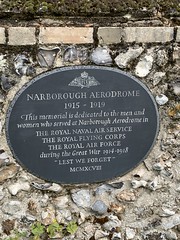
Resting not more than a mile or so from the boundary of Britain’s front line fighter base RAF Marham, is an airfield that never made it beyond the First World War. However, its importance cannot be denied nor should it be over looked. Key to aviation in Norfolk and to the Royal Air Force as a whole, it played a major part in both, and therefore is pivotal to today’s modern air force. Opened originally as a satellite by the Royal Naval Air Service, it became not only Norfolk’s first, but the biggest First World War, fixed wing aircraft airfield, only four airship stations were bigger.  Leading the way for the aviators of today’s Royal Air Force, we look back at the former RAF Narborough.

RAF Narborough

Built as the largest, aircraft based, World War One aerodrome, Narborough has been known under a range of different names. The most common, ‘The Great Government Aerodrome’ reflected not only its size (over 900 acres) but also its multinational stature; the range of aircraft and personnel based here, and its achievements in aviation history. Used by the Royal Naval Air Service (RNAS), the Royal Flying Corps (RFC) and the Royal Air Force (RAF), it would have names that reflected each of these fledgling services.

Records show that Narborough had military links as far back as 1912, in the year that the RFC was established when both the Naval Air Organisation and the Air Battalion of the Royal Engineers were combined. Unfortunately, little exists to explain what it was used for at this time, but in later years, it was used to counteract the threat from both the German Zeppelin and Schütte-Lanz airships, and also to train future pilots of the RFC and RAF.

Narborough’s history in these early days is sketchy, few specific records existing as to the many changes that were taking place at this time or to the development of the RFC and RNAS. Its activities – and history though – was no doubt influenced on July 1st 1914, when the name RNAS was officially adopted, and all Naval flying units of the RFC were transferred to the control of the Navy. A major development in the formation of both forces, there were at this point, a total of: 111 officers, 544 other ranks, seven airships,  fifty-five seaplanes (including shipborne aircraft) and forty aeroplanes in RNAS service.*1 Some of these may well have been used at Narborough at this point.

By 1915, Narborough’s future had been sealed, designated as a satellite station to RNAS Great Yarmouth, (itself commissioned in 1913) it was initially to be used as a night landing ground for those aircraft involved in attacks on enemy airships. No crews were permanently stationed here at this time however, but as time went on ‘on-duty’ crews would fly in, and await the call to arms should an airship raid take place over East Anglia.

The first recorded arrival was in August 1915, an event that would keep the site in use by the RNAS for the next ten months, before being designated as surplus to requirements and handed over to the RFC in June 1916.

It was in June 1916 that the first RFC squadron would make use of Narborough as an airfield, 35 Sqn transferring over here from Thetford with Vickers FB.5 and FE.2bs. disposing of their DH2s and Henry Farman F.20s in the process. Within two months of their arrival, the nucleus of the squadron would then be used to form a new unit, 59 Sqn, also here at Narborough, under the command of Lieutenant A.C. Horsburgh with the RE8s. Narborough was already beginning to grow.

It was in that same month, that the perils of war would be brought home to those based at Narborough, when one of 59 Sqn’s pilots, Lt. Gordon William Hall, was killed when the DH.1 (4631) he was flying,  side slipped on approach to the airfield crashing as a result. A court of enquiry confirmed that the aircraft had been “banked too steeply” and that the pilot had put the aircraft into a dive that made it uncontrollable. A verdict of ‘accidental death’ was recorded against Lt. Hall.*2

In August, it was the turn of 35 Sqn to suffer its first fatality in a non too dissimilar accident. On the 29th, an Armstrong Whitworth F.K.3 (6201), was written off after it too side slipped and dived following a slow turn. The Pilot – Air Mechanic 1st Class –  Moses Boyd was tragically killed in the accident flying an aircraft that was based at Thetford but undertaking a training exercise here at Narborough. Already, the dangers of flying were becoming all too apparent and the glamour of flying was becoming tarnished.

Within two months, another 35 Sqn aircraft would also crash, this time one of the two crewmen, pilot 2nd Lt. Robert Leslie Edward would escape with just injuries. The observer, 2nd Lt Ernest Hildreth, however, was not so lucky and was killed in the resultant crash.

As the First World War raged on the European continent, the demand for aircraft was growing. It was quickly developing into a lethal weapon and a very potent reconnaissance vehicle. To fill vacant spaces and meet high demand, training programmes were rushed into place, meaning Narborough would become a preparation ground for new recruits. With training considered very basic by any standards, recruits only had to pass a number of tests before being sent to the front. Written examinations followed up by twenty hours solo flying, cross-country flights and two successful landings, were followed by flying for fifteen minutes at 8,000 feet and landing with a cut engine. Barely enough experience to see anyone through a violent war.

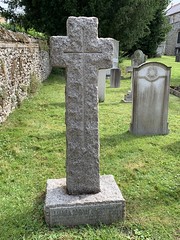
During these flights, these daring young men, many who were considered dashing heroes by the awe-inspired locals, would display their skills for all who lined the local roads to watch. As they were quickly learning though, life was not always ‘fun’, and the dangers of the craft were ever present. Accident rates were high and survival from a crash was rare, even ‘minor’ accidents could prove fatal. The local church yard at Narborough, paying testament to their dangerous career with fourteen of the eighteen graves present being RFC/RAF related.

The RFC was now building in strength, not only in its front line units but in its reserves too. On November 2nd, 1916 a new reserve squadron was constituted and formed here at Narborough, 48 (Reserve) Squadron (RS). Models flown by the unit at this time included the Grahame White XV, the Maurice Farman Shorthorn and Sopwith’s Pup. Over the next period of time, there followed a number of other reserve units: No 50, 53 and 64 (Reserve) Squadron (later designated Training Squadrons*3) all passing through Narborough at some point. However, and even with this large influx of personnel in these early days, Narborough was not to be the most exotic of locations.

As a training ground, accommodation was basic to say the least, being described by one ‘resident’ as a “desolate God-forsaken place“*4. It was soon realised by the authorities that new buildings needed to be erected for not only accommodation, but for training and maintenance roles as well. In response, a total of seven Boulton and Paul hangars, and up to 150 buildings would be built on the site over the next two years. A development that would by the end of the war, see some 1,000 personnel based here at Narborough – a number comparable with any modest Second World War airfield.

Meanwhile the threat from Zeppelins had not yet receded, and as a result 1916 would close with a small detachment of 51 Sqn BE.12s tasked with attacking these marauding menaces. Whilst primarily based at Hingham, 51 Sqn would have detachments spread across a number of East Anglia airfields, all preparing to meet the continued threat from Germany’s enormous airships.

With increasing numbers of squadrons and men being required for front line units in France, both 35 and 59 Squadrons departed Narborough in early 1917, and by the end of February both were gone.

All Saints Church Narborough, Norfolk

2nd Lt. Allen Ingham Murphy, killed March 30th 1917 ‘in an aeroplane accident’.

This left the reserves at Narborough, and it wouldn’t be long before they too suffered causalities. The first of these to lose a valuable pilot was 50 RS on March 30th 1917. A young Canadian, not yet out of his teens, 2nd Lt. Allen Ingham Murphy, was killed when his Armstrong Whitworth F.K.8 ‘A2720’ stalled whilst turning after take off. 2nd Lt. Murphy was the first of four casualties from the units that year – training young pilots was not getting any easier.

This danger was made no more obvious than on October 29th, when two aircraft, both from 50 RS were lost in separate accidents. The first an Armstrong Whitworth FK.8 (A2730) side slipped during a turn and nose dived into the ground killing both crewmen, 2Lt. Norman Victor Spear (aged 29) and Air. Mech. 1 Sidney Walter Burrell (age 22).  The second aircraft, also an Armstrong Whitworth F.K.8 (B219) spun off a low climbing turn also killing its pilot 2Lt. Laurence Edward Stuart Vaile (aged 23). It was indeed a black day for 50 RS and a stark reminder to the trainees.

All Saints Church Narborough, Norfolk

2Lt. Laurence Edward Stuart Vaile, killed in an aeroplane accident August 29th 1917.

In October and December two more units bolstered the numbers of trainees at Narborough. Firstly, 1 Training Squadron were formed here on October 1st, whilst 83 Sqn, born out of 18 (Reserve) Squadron (RS), arrived at Narborough during December that year bringing a range of aircraft that they quickly swapped for FE.2bs.

83 Squadron soon departed Narborough though, heading to France in March 1918 where they performed attacks on troop concentrations, attempting to stem the early spring offensive.

On June 8th, 1917 Lt. Hubert J. Game was killed when the B.E.2e (A2794) he was flying suffered a catastrophic wing failure when pulling out of a dive whilst looping the loop. Lt. Game was originally a Lieutenant in the Royal
Field Artillery (RFA) and was attached to 53 (Training) Sqn RFC at Narborough, when he was tragically killed. Hubert was the younger brother of Air Vice-Marshal Sir Philip Woolcott Game, and was just 26 years old at the time of his death. He is another one of those whose grave lays a short distance away from the site of Narborough airfield.

All Saints Church Narborough, Norfolk

Lt. Hubert J. Game, All Saints Church Narborough.

The occurrences of these tragic accidents were becoming so frequent, that one instructor, Capt. W.E. Johns, creator of ‘Biggles’ later cited spies as the cause of many ‘accidents’ – tampering with machines causing the deaths of the crews on board. Johns, himself having written of many machines, believed Americans with German sounding names were to blame for aircraft breaking up in mid-air or crashing at the bottom of loops. More likely, the fault lay with over exuberant or poorly trained recruits.

As the war drew to a close, one further squadron would be formed here at Narborough. On New Year’s day 1918, 121 Squadron were formed here, initially created to use DH.9s, they instead flew a variety of aircraft until they moved out to Filton in mid August. Shortly after their arrival here they were disbanded.

The last months of the war had no let up in training. Keen to join the RFC young men continued to train to fly. In mid February 1918 two 18 year old boys would perhaps be fulfilling a dream when it all went tragically wrong. Flying a DH.4, 2Lt. John Fyffe Shaw and 2Lt. Charles Arkley Law were both killed after the aircraft’s engine failed causing it to stall and then nose dive into the ground.

All Saints Church Narborough, Norfolk

2Lt. Charles Arkley Law killed after his engine failed and the aircraft stalled.

By August, war was over, and the the big wind down of squadrons would soon begin. At Narborough, two squadrons 69 (Training) Squadron and 26 (Reserve) Squadron would both merge to form a new 22 Training Depot Station. Many other similar units would soon follow suit and either disband or merge. This dramatic wind down continued on into, and beyond, 1919. In February, both 56 Sqn and 64 Sqn arrived as cadres; 64 Sqn was disbanded here later that year whilst 56 transferred to Bircham Newton where they too were disbanded later that same year. A third squadron, 60 Sqn also suffered the same fate, arriving as a cadre mid February before themselves being sent to Bircham Newton and disbandment.

With one last roll of the dice in mid March 1919, 55 Training Deport Station also disbanded here at Narborough, but out of the ashes was born a new unit 55 Training Squadron. With that though, Narborough was heading for closure, its days now over, it was soon to be surplus to requirements.

The post war years then saw the closure of many of Britain’s war time airfields including Narborough. But unlike its sister station RAF Marham a mile or so away, it would remain closed. The buildings were all sold off in what was considered to be one of the biggest auctions in Norfolk, with some of them going to local farmers, other for small industrial units, some to schools and the like, Narborough was now scattered to the four corners of the county. The remainder of the site was sold to the farmer and it quickly returned to agriculture, a state it remains in today. Some of these original buildings are reputed to still exist at various locations around the area today, whether that is true or not, is difficult to ascertain, but most have long since succumbed to age, the inevitable deterioration and eventual demolition.

Narborough itself having no hard runways or perimeter tracks has long since gone. A small memorial has been erected by a local group aiming to promote and preserve the memory of Narborough, a memorial plaque also marks the graves of those who never made it to France; and the small Narborough Museum & Heritage Centre holds exhibits of 59 Squadron in the local church.

All Saints Church Narborough, Norfolk

The Plaque at All Saint’s Church Narborough, honouring those who served at Narborough.

Significant not only in size, but in its history, Narborough has now been relegated to the history books. But with the dedication and determination of a few people the importance and historical significance of this site will hopefully continue to influence not only the aviators of tomorrow, but also the public of today.

Updated memorial August 2021

The Narborough memorial which sits at the entrance to Narborough airfield. It was refurbished after the original was struck by a vehicle.

Sources and further Reading (Narborough)

*1 Fleet Air Arm Officers Association Website accessed 14/6/21

*2 RAF Museum Story Vault Website accessed 14/6/21

*3 On May 31st 1917, all RFC ‘Reserve Squadrons’ were renamed ‘Training Squadrons’.

*4 Letter from 2/AM C. V. Williams from 59squadronraf.org.uk

Narborough appears in Trail 7.

Secrets Of The (Not So) Deep.

By Mitch Peeke.

This latest chapter in the story of B17 44-6133, which crashed in shallow water at Allhallows, Kent, in June of 1944, came about during a visit I made to The Kent Battle Of Britain Museum at Hawkinge; which ordinarily, is not perhaps the sort of of venue one might expect to find anything related to The Mighty Eighth.

I have been to this excellent museum a few times. They very graciously stocked the promotional leaflets for my own Battle Of Britain E-Book; 1940: The Battles To Stop Hitler when it came out in 2015. Four years later, in the Summer of 2019, I had organized the creation of a memorial at Allhallows, commemorating the lost crew of B17 44-6133 and later that same Summer, there I was, talking to Dave Brocklehurst MBE, Curator of the museum at Hawkinge, about my project, the memorial day we’d just held there and how there was going to be a new museum at nearby Slough Fort, which would include a display relating to the crash. The Fort has a small piece of wreckage from the B17 that had washed up on the beach front at Allhallows. It was then that Dave told me that he also had a genuine piece of that B17 in storage and he offered it to me, for inclusion in the Fort’s display. It is a fair-sized but broken piece of armour plate, thought to be a section of armour from either of the Pilots’ chairs, though Dave was by no means certain of that. We arranged for him to retrieve it from his storage section and for me to return to the museum to collect it. Then came the Covid pandemic of course!

Successive lockdowns meant I couldn’t collect it. Dave was kept extremely busy, not only with the general upkeep but also the museum’s newest acquisition; a Spanish-built Heinkel 111 that had been used in the 1969 film The Battle Of Britain, which of course had seen Hawkinge used as a filming location. Each time we made our arrangements, another lockdown put paid to our plans, then finally, we were able to make a definite date, in May of 2021, nearly two years after first discussing the idea, for me to collect the B17 artefact.

Dave Brocklehurst MBE, (right) Curator of The Kent Battle Of Britain Museum at Hawkinge, Presents Mitch Peeke with the salvaged armour plate. (Photo: Mitch Peeke.)

The first thing that struck me when Dave handed the plate to me, was the sheer weight of it. The plate measures a mere 17 by 19 inches. It is a quarter of an inch thick, but it weighs an incredible 22.6 pounds: 10 kg. No wonder Dave told me not to come to collect it on my Harley! I used my wife’s SUV instead.

Once I got it safely home, I photographed it from several angles and set about the task of trying to positively identify it. To that end, I emailed the Museum of aviation at Robins Air Force Base in America, as they are currently in the process of restoring a B17 to its former glory. Their Curator, a former US Air Force officer by the name of Arthur Sullivan, replied to my enquiry with 24 hours, expressing a great interest in the the plate and the story behind it. Despite casting their expert eyes over the photos I sent them, we are still not 100% certain; but it would seem likely, given its curved edges and obvious mounting bolts underneath, that it is seat base armour from either of the Pilot’s seats; the two angled slots most likely to have been for the lap straps to pass through.

Underside of the plate, showing the mounting bolts and possible Lap Strap slots. (Photo: Mitch Peeke.)

The plate was salvaged from the wreck site, a muddy, watery crater some 500 yards off the beach at Allhallows, in the late 1970’s. By then, some nefarious low tide salvage attempts had already been made, most notably by slightly drunk members of the Allhallows Yacht Club. One such foray had resulted in the Police being called to the club when the returning “Trophy Hunters” had brought a quantity of .50 caliber machine gun bullets back with them and decided to try “firing” them from a vice on a workbench, using a hammer and the pointed end of a six inch nail. Luckily for those concerned, the bullets had deteriorated to such an extent after laying on the muddy bottom of the Thames Estuary for 32 years, that they merely fizzled and smoked. The Police confiscated them. The Trophy Hunters had also retrieved one of the bombers Browning machine guns, probably one of the waist guns, but that had been hidden from the Police. That gun was apparently later taken apart and smuggled into Canada. To discourage any further foolhardy amateur salvage operations, the Royal Engineers were called in to demolish the wreck with explosives. Nobody seemed to consider the possibility of that wreck being a War Grave. The body of Staff Sergeant Cecil Tognazzini, the bomber’s Flight Engineer/Top Turret Gunner, has never been found. He is the only member of 44-6133’s crew who is still unaccounted for.

Today, the crater is still visible at low tide, as are the fragmented remains of the B17. The tidal mud holds a lot of the wreckage in suspension, so every now and again, more of it becomes visible, sticking up out of the muddy floor of the crater, when the tide goes out. Tempting though it still is for some to venture out there, the oozing mud makes such an expedition a dangerously foolish pursuit. Letting that sleeping B17 rest in peace is a far more noble and worthy aim.

In the meantime, we do now have two tangible pieces of 44-6133; one is the small piece of wreckage that washed ashore in 2017 and the other is the newly re-discovered armour plate. Both are now on display in the Slough Fort Museum. Thanks to Jeanne Cronis-Campbell, we also now have photographs of some of 44-6133’s young crew, taken by her late Father, Teddy; who was the plane’s Bombardier and the sole survivor of 6133’s crew, which I added to the memorial last year. And of course, we finally have that permanent memorial to those men, overlooking the place where they fell. We will, remember them.

My thanks to Mitch for the update.

The full story of 44-6133 can be found in ‘A Long way from Home‘,

July 2nd 1919, H.M.A. R.34 Sets A World Record Flight.

On July 2nd 1919 at 01:42, airship R.34 lifted off from the airfield at East Fortune, east of Edinburgh, to make an epic voyage – the first crossing of the Atlantic Ocean east to west by a powered aircraft.

R.34 possibly at East Fortune. (author unknown)

Conceived as early as 1916, R.34 was built at the works of William Beardmore and Co. Ltd. of Inchinnan near Glasgow. At 634 feet in length with a top speed of 62 mph, she would have five 270 hp Sunbeam ‘Maori’ engines, and would cost £350,000 to build. Her massive size gave her an impressive 1,950,000 cubic feet for gas storage, and she would be equivalent in size to a Dreadnought battleship. A major step forward in airship design, her aerodynamic shape reduced total air resistance to that of just 7% of an equivalently sized flat disc.

As she was designed under war specifications, R.34 would be built to carry twenty 100 lb and four 550 lb bombs, a range of Pom-Pom guns, Lewis machine guns and a small number of two-pounder quick-firing guns; but as she wasn’t finished until after the war, none of these were ever fitted, nor was she ever flown in anger.

Completed in early 1919, she just missed out on achieving the record of the first Atlantic crossing, being laid up by damage caused by poor handling, and thus beaten to the record now held by Alcock and Brown.

In May, she arrived at East Fortune airfield, a major airship station in East Lothian, from where she carried out a number of test flights including an endurance flight across the Scandinavian countries. In July she was set to make the first  Atlantic crossing, east to west.

In preparation for the flight, eight engineers were sent to the United States to train ground crews in the safe handling of the airship. The Admiralty provided two  warships, the Renown and Tiger, as surface supply vessels, and should R.34 have got into difficulty, she could have been taken in tow by one, or both of the two vessels.

On the evening of 1st July 1919 the ship was fueled to capacity (some 6,000 gallons), and in the early hours of the morning she was moved out of her shed and prepared for the flight. Her captain, Major G. H. Scott, gave the order to release early, and at 1.42 am (GMT) R.34 lifted slowly in to the Scottish sky.

After battling strong winds and Atlantic storms, R.34 finally arrived at Mineola. Huge crowds had turned out to greet her and her crew, a grandstand had been erected, parks and public spaces were packed with onlookers. Major J. Pritchard (The Special Duties Officer) put on a parachute and jumped from the airship to become the first man to arrive in America by air. He helped organise ground staff and prepared the way for R.34 to safely dock. As she settled on her moorings, she had not only become the fist aircraft to fly the Atlantic East to West, but broke the current endurance record previously held by the North Sea Airship NS 11, also based at East Fortune.

A record was made, R.34 had put British Airship designs and East Fortune firmly on the map. After 108 hours and 12 minutes flying time, R.34, her crew and two stowaways: William Ballantyne and a small tabby kitten called “Whoopsie”, had landed at Mineola, Long Island, New York.

After a 3 day stay in which the crew were treated like the heroes they were, R.34 was prepared for the homeward journey. On Wednesday July 10th 1919, at 23:54 she lifted off and set sail for home.

With prevailing winds carrying her eastward, she made an astonishing 90 mph, giving the opportunity to cut some of the engines and preserve fuel. This gave the crew a chance to divert over London, but due to a mechanical breakdown, this was cancelled and R.34 continued on her original route. Poor weather at East Fortune meant that she was ordered to divert to Pulham Air Station, Norfolk, but even after clarification that the weather had improved, her return to East Fortune was denied and she had to continue to Pulham – much to the disgust of the crew on board. At Pulham, the reception was quiet, RAF personnel greeted her and secured her moorings. She has covered almost 7,500 miles at an average speed of 43 mph.

Eventually after a major refit at East Fortune, R.34 left for the return to Pulham. After six weeks of static mooring, R.34 was sent to Yorkshire, to Howden Airship Station. Here she was used to train American crews, was modified for mast mooring and used for general training duties. During one such training mission, she was badly damaged in strong winds, and after sustaining further damage whilst trying to moor and secure her, she began to buckle. Falling to the ground, she broke up and was damaged beyond repair. R.34 was then stripped of all useful materials and the remainder of her enormous structure sold for scrap – a rather ungainly ending to an incredible and historical machine.

H.M.A. R.34 and her crew had become the first to cross the Atlantic east to west, they had achieved the  longest endurance flight, and become the first aircraft to complete a double-crossing of the Atlantic.

East Fortune

The memorial stone at East Fortune airfield commemorating the epic flight of R.34.

The Flight Crew for the Atlantic journey were:

Major G. H. Scott A.F.C – Captain
Captain G. S. Greenland – Second Officer
Second Lt. H. F. Luck- Third Officer
Second Lt. J. D. Shotter – Engineering Officer
Major G. G. H. Cooke DSC – Navigator
Major J. E. M. Pritchard O.B.E. – Special Duties
Lt. G. Harris – Meteorological Officer Second
Lt. R. F. Durrant – Wireless Officer
Lt. Commander Z. Lansdowne – Representative U S Navy
Brigadier General E. M. Maitland – Special Duties
Warrant Officer W. R. Mayes – First Coxswain
Flight Sergeant W. J. Robinson – Second Coxswain

Sergeant H. M. Watson – Rigger
Corporal R. J. Burgess – Rigger
Corporal F. Smith – Rigger
F. P. Browdie – Rigger
J. Forteath – Rigger Corporal

H. R. Powell – Wireless Telegraphy
W. J. Edwards – Wireless Telegraphy

W. R. Gent – Engineer
R. W. Ripley – Engineer
N. A. Scull – Engineer
G. Evenden – Engineer
J. Thirlwall – Engineer
E. P. Cross – Engineer
J. H. Gray – Engineer
G. Graham – Engineer
J. S. Mort – Engineer
J. Northeast – Engineer
R. Parker – Engineer

W. Ballantyne – Stowaway
“Whoopsie” – a small tabby kitten and stowaway

The crew of R.34 Crew – with the crew pets.

East Fortune airfield appears in Trail 42.

June 25th 1944, loss of a Rugby Star.

Sir Arthur Harris’s continuation of the bomber initiative of 14th February 1942, in which German cities became the focus for RAF raids, led to massed formations of light and heavy bombers striking at the very heart of Germany.

In order to achieve these aims, bomber forces of 1,000 aircraft would be required, meaning every available Bomber Command aircraft would be utilised along with those from Operational Training Units (OTU) and (Heavy) Converstion Units (CU).

On June 25th, 1942, whilst on operations to Bremen, the third of the ‘1,000’ bomber raids, one of the first operational aircraft casualties  for 1651 CU would occur when N7442 was shot down shortly before 01:00 by a Luftwaffe night-fighter over Holland. One factor that made this particular loss so great was that not only did all seven crewmen onboard lose their lives, but one of the crew, P/O. Lewis A. Booth (s/n: 118627), had gained international caps playing for England’s National  rugby team.

Born on September 26th 1909, Lewis Booth was the son of Alfred and Amie Booth. He was educated initially at Giggleswick School in Yorkshire, after which he transferred to the Malsis School becoming one of sixteen boys who was lost during the war and since commemorated on the Chapel’s Stained glass window.

Booth attended the Malsis school for two years, 1920-22, when the school first opened. A grand School, it was founded by Albert Henry Montagu, which grew and expanded over the years.

Ten years after he left the school, Booth made his international rugby debut in a game against Wales at Twickenham (January 21st, 1933), in front of a crowd of 64,000 fans; a game in which Wales beat England by 7 points to 3. Booth played his last international match against Scotland at Edinburgh’s Murrayfield stadium two years later on March 16th, 1935. Throughout his two year international rugby career he achieved seven caps for England scoring three tries, his first for England against Ireland at Twickenham, on 11th February 1933. After serving his national team, Booth went on to serve his country joining  the Royal Air Force where he achieved the rank of Pilot Officer within Bomber Command.

On the night of 25/26th June 1942, he was in a Short Stirling MK.I flying with 1651 Conversion Unit (CU) based at RAF Waterbeach in Cambridgeshire. 1651 CU was one of three Conversion Units set up in January 1942, by merging previously formed Conversion Flights. It served to convert crews of No. 3 Group to the Stirling, a rather ungainly aircraft that developed a poor reputation as a bomber. 1651 CU would join that night, sixty-eight other Stirlings in a force of over 1,000 aircraft; a mix of heavy and light bombers, ranging from the Hampden and Whitley to the Halifax and Lancaster.

Take off was at 23:58 from RAF Waterbeach, the weather that week had been good with little rain for many days. After forming up they headed for Germany a course that would take them across the North Sea and on to the western coast of Holland. Just 40 minutes into the flight, whilst over Waddenzee, the Stirling was attacked by a Luftwaffe night fighter and shot down with the loss of all seven crewmen on-board.

ROYAL AIR FORCE BOMBER COMMAND, 1942-1945.

A Stirling MK.I bomber of 1651 HCU at Waterbeach. @IWM (COL202)

P/O. Booth was publicly reported missing four days later on Tuesday 30th June in an article in the local paper “Yorkshire Post and Leeds Intelligencer”, which stated that he had been ‘lost in a Bomber Command raid’. The article highlighted Booth’s rugby career, saying that he had been a member of the Headingly Club playing over sixty games for his county team Yorkshire, before leaving to join up. 

P/O. Booth died just short of his 33rd birthday, he left behind a wife, Gladys, and a son Michael. His son would follow in his father’s footsteps also taking up rugby and also playing for his home country. P/O. Booth’s body was never recovered and remains missing to this day.

P/O Lewis Booth is joined by two other Pilot Officers, two Flying Officers, a Flight Lieutenant and two Sergeant Pilots amongst other ranks and service personnel all honoured by the Malsis School. Amongst the many awards they’ve achieved are three D.F.C.s and an A.F.M.

The game of rugby was hit hard by the Second World War, during which Germany would lose 16 of its international rugby players, Scotland 15, England 14, Wales 11, Australia 10, Ireland and France both 8, Wales 3 and New Zealand 2. All these losses were a severe blow to the international game, a game that brought many enemies face to face in a friendly tournament where there was little more at stake that honour and a cup.

With no official burial, P/O Booth’s service was commemorated on Panel 68 of the Runneymede Memorial, Surrey.

Lewis Alfred Booth @Tim Birdsall from the Malsis website.

Sources

ESPN Website.

The British Newspaper Archive.

Old Malsis Association website.

Rugby Football History website.

RAF Watton – The origins of ECM (Part 1)

Norfolk once boasted many major airfields, virtually all of which are now closed to military flying. Marham is the only major survivor spearheading the RAF’s front line fighter force, in conjunction with Lincolnshire’s RAF Coningsby and RAF Lossiemouth in Moray, Scotland.

However, during the Second World War the Norfolk landscape was very different; it was littered with front line airfields, composed mainly of light bomber and fighter squadrons, all of which could be found with relative ease.

One such airfield was that of Watton. Used by a range of light and heavy aircraft, its history was chequered, bearing witness to some of the more gruesome aspects of the air-war.

Today it is a housing estate, the single runway remains and is used for storage, the hangers and technical buildings have gone and the accommodation areas have all been sold off. That said, the perimeter track remains in part, the ‘feel’ of the airfield hangs over the area and a number of memorials pay silent tribute to those who served here.

Found on the edge of the town of Watton in Norfolk, we go back to this once busy RAF base and see what has changed, and relive the life of RAF Watton.

RAF Watton (Station 376)

RAF Watton, located some 11.5 miles north-east of Thetford, opened in 1939 as a medium bomber station with the RAF. Unusually it only had one runway, a grass example, which was later extended to 2,000 yards and crossed the airfield in an east-west direction.

The late 1930s saw a massive expansion of Britain’s military might, and in particular, its airfields. With little foresight into what lay ahead, these pre-war and early war airfields were not designed, nor built, as dispersed sites. Once the realisation of what the war would bring hit home however, later examples would be dispersed, giving a new dimension to airfield design. As a result, Watton (built by the John Laing company) was constructed with much of the accommodation block, technical area, hangars and so on, all being placed closely together on one single site.

Housing for the personnel was located in the north-western corner, with the technical area just east of this. The bomb dump, an ideal target, was further to the east of this area. Four ‘C’ type hangers were constructed each having a span of 150 feet, a length of 300 feet and a height of 35 feet. Whilst Watton was a medium bomber airfield, and thus aircraft were relatively small, it was envisaged at this time that larger, heavier bombers would soon come on line, and so foresight deemed larger than necessary hangar space be provided. A 1934/35 design, these hangars would be common place across expansion period airfields.

Another architectural design found at Watton was the redesigned Watch Office, an all concrete affair built to drawing 207/36, it was one that would very quickly become inadequate, requiring either heavily modifying or, as was in many other cases, replacing altogether.

RAF Watton

Part of Watton’s decaying perimeter track.

Partially opened in 1937, the airfield wasn’t fully completed and handed over to the RAF until 1939. Being a pre-war design, building materials were in good supply, and so the  accommodation blocks were constructed using brick, and they catered well for those who would find themselves posted here.

Another aspect considered at this time was that of camouflage; airfields were enormous open expanses and could be easily seen from great distances and heights. Numerous proposals for hiding them were put forward, a move that resulted in the formation of a special unit within the Directorate of Works led by Colonel Sir John Turner. Watton came under the eyes of Sir John and his department, and this led to an ingenious camouflage pattern of fields and hedges being painted across the entire airfield,  thus disguising it from prying eyes above. Whilst not completely effective, it certainly went some way to protecting it from attack.

RAF_FNO_22_RV_6040

Watton airfield taken in 1942 by No. 8 Operational Training Unit. The four hangars can be seen in the centre of the photo with the patchwork of ‘fields’ disguising the main airfield. English Heritage (RAF Photography).

The first postings to arrive were the men and machines of 21 and 34 Squadrons RAF. Their arrivals on March 2nd 1939 saw a reuniting of both squadrons under the Command of Group Captain P. J. Vincent DFC and 6 (B) Group . On the 7th, the airfield was inspected by the Group’s AOC after which 34 Sqn performed a flypast; one such event that would be the start of many visits from numerous dignitaries including the Marshall of the Royal Air Force himself, Sir Edward Ellington  GCB, CMG, CBE.

Little flying took place by either squadron at this time however, as the aerodrome was soon unserviceable due to the very poor British weather. Grass runways soon became bogs, and as was found across many grassed airfields at this time, unsafe for aircraft to either take off or land without mishap. From April  things picked up slightly, and intensive training began in the form of station tactics and defence exercises. The weather would however, continue to be the worst enemy, repeatedly preventing or restricting flying from taking place.

In August, 34 Sqn received orders to depart Watton and  proceed to Singapore, and so on the 12th, the air and ground parties began their long transit leaving Watton and England far behind. The quiet of their departure would not last ling however, as within a few days of them leaving, their empty beds would be filled once more, when the Blenheims and crews of 82 Sqn arrived.

At 11:05 on September 3rd 1939, notification came though to Watton of Britain’s declaration of war. Within days of the announcement aircraft were being moved out under the ‘Scatter’ scheme to another airfield, Sealand, for there was a fear of imminent air attacks following the war’s declaration. The Blenheims remained at Sealand until mid September, at which point they were recalled and prepared for attacks on vessels belonging to the German Navy. These vessels were not located however, and so the order to stand by was cancelled and the crews stood down. This would sadly become a regular and frustrating occurrence for the men of 21 Sqn.

Shortly after on the 9th, the first of the new MK.IV Blenheims were collected from Rootes Ltd at Speke, with further examples arriving over the next few days. Further movements saw aircraft detached to Netheravon and then onto Bassingbourne where Blenheim L8473 was damaged as it ‘nosed over’ whilst taxiing. A minor, but unfortunate accident, it would be the first of many more serious losses for the squadron.

RAF Watton

A fence separates the housing estate from the airfield remains.

On 26th September, another order came through for aircraft of 21 Sqn to stand by to attack  the German fleet, whilst a further two Blenheims (L8734 and L8743) would fly to the Rhur to carry out a photographic reconnaissance mission. However, bad weather, industrial smoke and a faulty camera prevented both aircraft from carrying out their duties: each one returning to Watton empty handed but unscathed – crews reporting heavy flak over the target area. The whole of October and November were pretty much a wash-out. Bad weather with prolonged heavy rain prevented any substantial flying beyond the local area. Air gunnery and co-operation flights were carried out whenever  possible, but the late months of 1939 had certainly been a ‘phoney war’ for 21 Sqn.

As 1940 dawned, things on the continent began to heat up and ground attacks increased for both Watton squadrons. Low-level sorties saw them attacking troop formations and enemy hardware as its galloped its was across the low-countries. Whilst bravely flying on and escorted by fighters, overall loses for the slower Blenheims of 2 Group were beginning to rise, a pattern that would only increase in the face of a far superior enemy in the coming months.

These losses were borne out by 82 Sqn in dramatic style on the 17th May, when twelve aircraft took off at 04:50 to attack Gembloux. They were met with heavy anti-aircraft fire and overwhelming fighter opposition – fifteen BF.109s, decimated the squadron. All but one aircraft was lost, the only survivor being P8858 crewed by Sgt. Morrison, Sgt. Carbutt and AC Cleary. Whilst not injured in the melee, the aircraft was badly damaged and as a result, was deemed irreparable and written off. An entire squadron had all but been wiped out in one fell swoop.

This disaster would be reflected right across 2 Group, who had now suffered its greatest overall loss to date, but for 82 Sqn it would not yet be the end of this traumatic and devastating period. The burning cauldron that was now facing the light bomber was taking its toll on crews, who were all at a distinct disadvantage to their Luftwaffe counterparts. On the 21st, three more aircraft were lost from Watton, with one being forced down in France, another lost without trace and a third limping home so badly damaged it also had to be written off.

A short visit by 18 Sqn between 21st and 26th May barely interrupted proceedings at Watton. After returning from France, they had spent no less than nine days in May at five different airfields including the nearby Great Massingham.

By early June 1940 Operation Dynamo had been completed and France was lost. The British Bulldog, whilst not a spent force, had shown her teeth, been bitten hard and was now licking her heavy wounds. Preparations would now begin to protect her own shores from the impending invasion.

Fuelled by revenge, combined attacks by both 21 and 82 Sqn continued on into the summer months. But revenge alone does not protect a crew from superior fighters and heavy flak. On June 11th, three more 21 Sqn aircraft were lost whilst attacking positions around La Mare, it is thought all three fell to Luftwaffe fighters. Two days later on the 13th, another five aircraft were lost, two from 21 Sqn and three from 82 Sqn; losses were mounting for the light bombers and Watton was amongst those bearing the brunt of these. On the 24th, 21 Sqn saw a reprieve, whether to rest crews, take on a new role or simply regroup, they began a move north to RAF Lossiemouth in Scotland. 82 Sqn however, would remain at Watton, where they would carry on with the punishing raids over the continent.

After the arrival and departure of another short stay unit, 105 Sqn between 10th July and 31st October, Watton was now left in the lone hands of 82 Sqn, a situation that would remain until the spring of 1942.

The dramatic loss of eleven crews back in May would come back to haunt 82 Sqn in August that year. On the 12th, another twelve aircraft took off on a high altitude bombing mission to Aalborg in Denmark. The airfield they were to target was well defended, and as if history were to repeat itself, once again eleven of the twelve aircraft were lost. The only one to return, that of R3915 crewed by Sgt. Baron, Sgt. Mason and Sgt, Marriott, turned back early due to low fuel.

In the space of three months, an entire squadron has been all but wiped out not once, but twice, unsustainable losses that would surely bring the squadron to its knees.

RAF Watton

Memorial to the crews lost at Aalborg, 13th August 1940. The propeller of Blenheim R3800, that crashed that day.

It was loses like this that helped convince the authorities to eventually withdraw Blenheims from front line service during 1942 – the Blenheim being long outdated and outclassed. At this time, Watton’s 82 Sqn, would begin their transfer to the Far East, a place they would remain at until the war’s end.

A lull in operations meant that Watton was then reduced to mainly training flights, through the Advanced Flying Unit. Small single and twin-engined aircraft providing the activity over the Norfolk countryside. Many of the crews being trained here would be shipped out to the satellite airfield at Bodney, before returning here for their evening meals.

A brief interlude in the May of 1942 saw the rebirth of the former 90 Squadron, a First World War unit that had gone through this very process on a number of occasions since its inception in 1917.

Flying the American B-17 ‘Flying Fortress’ or Fortress I as it was in RAF designations, 90 Sqn was set up to trial the use of the four-engined heavy for its suitability as an RAF bomber. During the first 15 days at Watton, the squadron gained personnel and received their first aircraft,  after which they moved to nearby RAF West Raynham. Here they would begin these trials which also required the use of a number of smaller airfields in the local area. These included both RAF Great Massingham and RAF Bodney, neither of which were particularly suited to the heavy bombers.

Watton then saw no further operational units, and in the mid 1943, it was handed over to the Americans who began to develop the airfield into something more suitable for their needs. It was now that Watton would take on a more sinister role.

In Part 2 we see how the Americans developed Watton, and how it became two sites rather than just one, and also, how its role in Electronic countermeasure took it into the post war years.

The full story of Watton can be found in Trail 9.