RAF Leuchars – one of Britain’s oldest airfields (Part 1)

Following on from Trail 53 we leave the former RNAS Crail and Dunino behind and head north-west to the mecca of the golfing world, and the historic town of St. Andrew’s, where just outside of the University town is an airfield whose history goes back as far as 1911; this makes it one of Britain’s oldest and most established airfields. Its development then takes it through the First World World War, to the relative peace of the 1920s, the expansion period of the 1930s and on into the Second World War. Faced with potential closure it then went on to be one of the most significant and important airfields in Britain’s Cold War defence network.

Sadly politics played its part as it often does, and in 2011, its fate was sealed when at 4:48pm on July 18th, Dr. Liam Fox the then Secretary of State for Defence announced when talking about bringing the Army back from Germany: “Two major units and a formation headquarters will be based at Leuchars, increasing the number of posts there from 1,200 to more than 1,300. Consequently, the Typhoon force due to be built up there will instead be built up at RAF Lossiemouth.”*10 With that the airfield was to close, being transferred over to the Army, a transfer that occurred four years later in March 2015. Since then the RAF has, on occasion, returned for flying duties,  but its front line RAF role had gone. A state which exists today.

On this next stop, we take an extensive look at the long and incredible life of RAF Leuchars.

RAF Leuchars.

Leuchars sits on the north-eastern coast of Fife, on the banks of the River Eden as it enters the sea at St. Andrew’s Bay. To the north across the River Tay, lies Dundee, and to the west, the city of Perth. South of Leuchars is the University town of St. Andrews – the home of world golfing. Being literally on the shore line, Leuchars provided an ideal location for a whole host of maritime operations, aerial reconnaissance and even later on, search and rescue.

Its life began just after the turn of the last century in 1911, when powered flight was but a mere few years old.  Even before the first aero-engine had been started here, the site was being put to use by the Royal Engineers with a Balloon Squadron, who used it for reconnaissance training in the Tentsmuir Forest on the edge of what is now the airfield.

With the formation of the RFC in 1912, the Balloon Squadron would become part of the first military flying arm to exist in the UK. It would continue in its role as spotting for artillery, even as powered flight gradually became established. On the nearby beaches, small aircraft were tried and tested, but balloon training would ultimately remain the focus of the squadron.

In 1916, the RNAS then acquired the land and began to develop the site as a place for powered flight. Taking over farmland, and eventually swallowing up the resident farm, the airfield slowly expanded, and by 1918 its future was established. By this time, the RAF had been formed, the flying responsibilities of the Navy were transferred to the RAF and the first unit was ready to move in. The Grand Fleet School of Aerial Fighting and Gunnery, run by the RAF to train Naval airmen, resided at the airfield from the end of 1918 on into 1920. This unit, a new unit in its own right, was formed out of the disbanded 208 (Temporary) Training Depot Station which, whilst formed at East Fortune in the Scottish borders, had only been in existence for as little as one month.

RAF Leuchars

The control tower at Leuchars. The airfield’s proximity to the shore line being evident.

In these early days of flying, risks were high, the thrill of manned flight was a draw for many young men eager to experience the joy of soaring above the clouds. As a result, there were numerous accidents and Leuchars was no different.

On May 19th, 1919, Lt. David Gardiner Cooper (22) lost his life when he misjudged a slow roll whilst flying in his Sopwith Camel (F8497), and on August 1st, Canadian, Lt. Philip Hall-Smith (30) was killed, after his Camel was seen to inexplicably nose dive into the ground.*1*2 Two unfortunate losses after a war that had already taken hundreds of thousands of lives.

During the 1920s, with the war now over, military might was seen as an almost unnecessary waste, units were cutback, airfields that had been established for war were closed, and fighting men were returned to civvy street. Political fighting amongst the three arms of the military, saw the RAF cut back to a fraction of its former self, its cause for survival spearheaded by Lord Trenchard. However, Leuchars managed to cling on, remaining not only active, but receiving further development as well. More land was purchased and in 1925 the base was officially renamed RAF Training Base Leuchars.

It would be a time of dramatic change and turbulence for the fledgling Air Force though, and this was wholly reflected by the number of units appearing at Leuchars during this period. Operating as one of the UK’s major Naval training bases (the RAF being responsible for Naval flying at this point), the first of these units to appear was 203 Sqn in March 1920 which had reformed here after having been disbanded just two months earlier at Scopwick.

On April 1st 1923, the RAF Carrier units were re-designated under the new 400 series of squadron codes – a major stepping stone in RAF / Naval structure. Then a year later in 1924, these units were combined to form the new Fleet Air Arm (FAA), the flying branch of the Royal Navy. These changes had a major impact on operational numbers here at Leuchars.

Formally a Royal Naval Air Service unit, 203 Sqn initially flew the Sopwith Camel, replacing these  in April 1922, with the Nieuport and the General (Gloster) Nightjar. In mid September, the squadron was posted to Turkey, departing Leuchars onboard HMS Argus; a posting that would last for three months. After that, the squadron returned to Leuchars once more, again onboard HMS Argus, remaining active at Leuchars until 1st April 1923. At this point the squadron was disbanded, being divided into two Naval Flights: 401 and 402. The squadron as was, would be reformed later, but it would be another twenty-three years before they would see the shores of Leuchars once more.

203 Sqn would be joined a month after their arrival by another former RNAS unit – 205 Sqn. Like 203, it too was disbanded at Scopwick only to reform here at Leuchars in April 1920. Bringing another new model of aircraft to the Scottish airfield, 205 Sqn flew the Parnall Panther, and would serve in its entirety as 205 until October 1921, when the Mobile Flight element  was reformed as 3 Squadron. The remainder of 205 Sqn continued serving alongside here at Leuchars.

3 Squadron would operate out of the Scottish base until 1st April 1923, at which point it was similarly divided into three flights: 420, 421 and 422 now serving at Gosport. The remainder of 205 were also divided up into separate Flights – 440, 441 and 442, but unlike its sister unit, 205 would not return in any form to these Fife shores.

As part of this formation of the FAA, Leuchars would see all these Flights joined by another seven: 403, 404, 405, 406, 443, 445, and 446, and all around this time. This would bring a whole range of aircraft to these shores: Nightjars, Panthers, Nimrods, Flycatchers and the like.  Some of these units would depart for foreign shores whilst some would remain in the UK at other bases. The skies above Leuchars was now buzzing with activity.

For the majority of the 1930s, Leuchars would remain as an FAA training base, being renamed No. 1 Flying Training School, on April 1st 1935. Aircraft seen here would have included a range of training types including the: Fairey IIIF, Fairey Gordon, Avro Tutor and Avro 504N. For three continuous years pilots trained at Leuchars for the Fleet Air Arm, a branch that continued to be the responsibility of the RAF.

The mid to late 1930s would see tensions slowly rise in Germany, but Britain’s general post war doctrine was to defend her shores rather than attack any potential enemy. The Royal Navy was still seen at these times as the main military force, a belief that would very soon change. Britain in these early years, had not seen Germany (partly due to the devastating conditions of the Treaty of Versailles) but France, as her biggest potential aggressor, and as such long range aircraft or heavy bombers were not seen as an important requirement.

Government ideas that Britain should only arm itself with a view to defence against its nearest potential threat, meant that early on, defences were developed at the cost of attacking units. But by the time it was clear that Germany was the threat, Britain was lacking far behind, as little national development had been undertaken. This doctrine saw a far reaching impact right across Britain’s peace time airfields, which at this time included Leuchars. With only one squadron, 36 Sqn (the former Coastal Defence Torpedo Flt.) transiting through on its way to the Far East, preparation for war and flying in particular, remained limited to training flights here at the Scottish base.

As Britain then entered the Expansion Period, new aircraft specifications were being pushed through and airfield development became increasingly important. A number of new airfields were built and a restructuring of the RAF was once again on the cards. Here at Leuchars, the number of hangars was extended, with 7 Belfast Truss hangars being added to the site.

With further changes in the late 1930s, Leuchars became a Temporary Armament Training Camp (later station) with a small collection of Wapitis who used the nearby range at Tentsmuir.

Then in 1938, this restructuring took place, Leuchars, driven by its coastal location, was passed over to Coastal Command in an exchange that saw the two squadrons based at Thornaby (224 Sqn and 233 Sqn) transfer across here, whilst 1 FTS would leave for Netheravon. The Temporary Armament Training Camp previously established here would also disband.

Both these units brought the Avro Anson with them, 224 replacing them the following year with the Lockheed Hudson, a military aircraft born out of a civil transport model. Over the next two years, 224 Sqn would upgrade each of these with both the MK.II and MK.III models before departing to Limvadi in April 1941.

233 Sqn however, would have a more turbulent time, moving initially to Montrose, and then back to Leuchars, where they also took on the Hudson, only to replace it a month or so later with the Blenheim IV. Then, within less than a year, they would depart Leuchars for good, heading for Aldergrove in Northern Ireland where they would continue their operations with Coastal Command.

As 1938 passed the situation in Europe looked even more grave, and home based units were put on alert. 224 Sqn began carrying out searches of the North Sea, looking for vessels making their way to the open waters of the Atlantic. A further flight began sweeps of the Firth of Forth looking for submarines operating in the waters off the Scottish coast. However, in September, Neville Chamberlain returned from Munich, and following his ‘Peace in our time’ speech, war had seemingly been averted for the time being, and these precautionary measures were then relaxed.

In mid December, with tensions eased, 224 Sqn was granted 3 weeks leave allowing personnel time to go home over the Christmas period. The relaxation of measures was however, short lived, and a year later the squadron was put on a war footing with mobilisation orders coming through on September 1st 1939.

In part 2 Leuchars enters the war, being a coastal airfield the sea would dominate its actions and the squadrons that would be based here. It would also be the first line of defence against Luftwaffe bombers, ships and U-boats.

The full story of Leuchars can be seen on Trail 62.
de Havilland Mosquitoes in BOAC Service.

Very few countries around the world managed to avoid the influence of the Second World War as it ravaged and rampaged its way across the globe. One such nation that did manage to keep its borders secure though was Sweden, a place that became known as a safe haven for downed airmen or those trying to escape the clutches of the Nazi tyranny that would engulf vast swathes of the European continent. Surrounded by conflict and declared neutral, Sweden was to all intents and purposes cut off from the rest of the world.

However, Sweden was a country reliant on imports and exports, a reliance that led to extensive negotiations between herself and both the axis and allied powers who effectively blockaded her supply routes. Through these negotiations she achieved an  agreement to the rights of passage for ‘safe-conduct traffic’, an agreement that allowed the passage through hostile waters of shipping, allowing the exports of paper and wood from Sweden, in exchange for imports of food and oil.

Sweden’s role in the Second World war was largely political. If she was to survive she was going to have to forge safe links beyond her closest Scandinavian neighbours. Fearing she would be sucked into war and absorbed into a Europe ruled by Germany, she turned to Britain with a view to forging a safe airway between Stockholm and Scotland.

Discussions around the opening of the Swedish air routes began prior to war breaking out, negotiations between the Chairman of Britain’s Civil Aviation Authority (CAA), Sweden’s airline company AB Aerotransport (ABA) and Germany’s Hermann Goring, eventually led to an agreed flight once per week from Stockholm – Oslo-Stavanger-Perth. However, ongoing Swedish concerns led to long delays in activation of the service, even though a successful test flight involving a Junkers 52 had taking place on November 27th 1939.

The Swedish ABA were to run the operation, initially using three DC-3s (named Gripen ‘Griffin’, Gladen ‘kite’ and Falken ‘falcon’) painted bright orange and clearly marked Sweden/Schweden in large black lettering to prevent attacks from either side on a neutral aircraft. Throughout the war though this link was tenuous at best, heightened German aggression and fearsome weather often being the determining factors for the safe passage of the aircraft between the two countries. German restrictions on both freight and passengers angered the Swedes, who defiantly disobeyed their rulings. This decision led to a number of Swedish operated aircraft being attacked and shot down.

By 1945 the Swedes decided it was now too dangerous to fly, particularly with trigger happy defences and over keen allied pilots. The airspace around Sweden’s near neighbour Norway, had become a cauldron of  fire, and so the service was eventually closed down.

However, this official Swedish run route was not the only airway that operated between the two countries. The Norwegians also ran a service albeit reduced, as did the Americans later on in the war with five stripped out B-24 Liberators. Another service however, a ‘British’ service, also operated, but this was much more of a clandestine role than that of their Swedish counterparts.

At the time Sweden was a producer of iron but more importantly ball-bearings, a  commodity essential for any moving parts in machinery; whether it be a simple tool or a more complex engine, without them machinery simply wouldn’t work.

Ball-bearings in Sweden were all manufactured by one company, Svenska Kullagerfabriken AB (SKF), who before the war, exported around 9% of her total output to Germany with another 9% going to the United Kingdom. During the war however, this balance dramatically fell heavily on the side of Germany with as much as 65% of her total output ending up in German hands by 1943.*1 This imbalance was primarily due to the exports that were received in the occupied territories, falling into German hands, and being diverted into Germany’s own industrial operations.

Britain however, also needed these ball-bearings, and was perhaps more keen on maintaining this link than many would have initially thought. Having her supply line to Swedish goods cut was going to hit Britain hard. Britain needed all the ball-bearings she could find, and so Sweden was vital to this supply. So desperate were the British  authorities to obtain these components that they mounted two naval operations,  ‘Rubble‘ and ‘Performance‘, both of which turned out to be disastrous in terms of both the loss of life and the loss of shipping.

There were many other reasons why Britain wanted to maintain this link though, one was the expansion of its resistance operations across Scandinavia, Sweden providing a safe passage for agents entering and leaving the region safely, a move that was just as important as it was for returning escaped or interned airmen of the RAF and later USAAF.

Furthermore, Britain needed to ensure that Sweden was receiving as much British propaganda as it was German. If this line were to be severed, there would be a chance that the imbalance in material may have detrimental effects on Sweden’s future as the war developed.

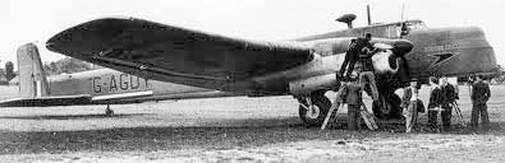
In late 1939 flights began in secrecy, operated by British Airways Ltd, who used three Junkers 52 transport aircraft and one Lockheed Model 14 Super Electra (the forerunner of the Hudson) named ‘Bashful Gertie‘ (G-AGBG). Like the Swedish operation, these flights took place between Perth and Stockholm via Norway and were flown by civilian crews in civilian marked aircraft. However, this route was subsequently closed when one of the aircraft was attacked by a Luftwaffe fighter, and another was captured in Oslo when the Germans invaded Norway.

Then in 1939/40 the two British aviation companies, British Airways Ltd and Imperial Airways, merged to form the British Overseas Airways Corporation (BOAC), a civilian operation that would go on to serve as Britain’s leading national airline for many years after the war’s end. The amalgamation of these companies was an important step forward leading to the reinstatement of the Swedish route, this time using the military base at RAF Leuchars in Fife.

Also piloted by Swedish or Norwegian aircrew, the idea behind the route was to pass POW mail and propaganda (magazines, newspapers etc) into Sweden where it could be forwarded to prison camps in occupied Europe. However, constantly aware of the need for ball-bearings and the fact that Sweden was a major supplier of them, plans were put in place for returning aircraft to be refuelled and filled with ball-bearings before returning to Leuchars. This run hence became known as the ‘ball-bearing run‘.

In these early years of the war, BOAC operated other similar aircraft types, these included C-47 Dakotas, converted Whitley IV bombers and Curtis Wright C46 aircraft, but their lack of speed and manoeuvrability left them vulnerable to Luftwaffe attacks. It soon became clear that a new and much faster type was needed and so BOAC began to put pressure on de Havilland for their new Mosquito.

Picture

A Whitley bomber in BOAC markings *7

A trial flight was undertaken using an unmarked Mosquito of 105 Sqn (DK292) on August 6th 1942 (there is some confusion over this exact date), flown by  Fl. Lt. Parry and P. Off. Robinson, the results of which showed the aircraft to be highly suitable for the purpose of the flights. The journey from Leuchars to Stockholm covered some 800 miles was, on average, completed in around 3 hours.

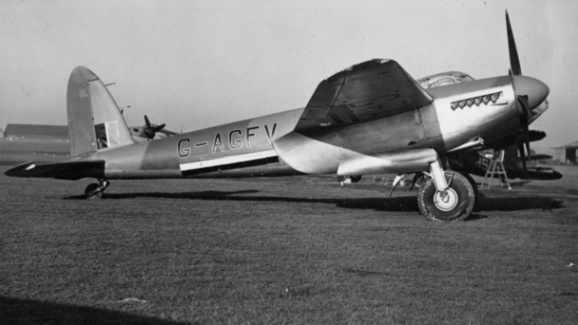
On 15th December 1942 the first civilian operated model of the aircraft arrived at Leuchars. A Mosquito PR.IV ‘DZ411’,  it was assigned the civilian registration G-AGFV, and began flights to Stockholm on 4th February 1943. After this, it was joined by six other Mosquito MK.VI aircraft between April and May (all being given the sequential registrations G-AGGC to AGGH) with a further three in April 1944.

The incredible carrying capacity of the Mosquito, which would be proven later in the war, would allow for up to 650Kg (10 -12 crates) of ball-bearings to be carried in the aircraft’s bomb bay.

The opening of such a link was kept very secret, the British not wanting the Germans to know about the new revolutionary Mosquito, nor their important cargo. However, keeping such an operation from German intelligence was difficult, if not impossible, and soon they discovered that the flights were again taking place between the two countries. Now embroiled in a political stand off, the Germans put pressure on neutral Sweden to put a stop to these flights, insisting that they were giving the British an advantage, and that as a neutral country, they should not be allowing British aircraft to land on Swedish soil. The Swedes maintained that the service was purely civilian and controlled solely by the Swedish authorities, to which the Germans threatened to inform Hitler thus rendering the aircraft legitimate military targets. Fearing that the British would in turn close the passage for the safe-conduct traffic, the Swedes ignored the German threats and so the service continued.

However, so as to not infringe or violate Sweden’s wartime neutrality, it was vital that the Mosquitoes remained unarmed for these operations. But that made any aircraft on this run a potential ‘sitting duck’, even though, like their Lockheed predecessors, they carried BOAC insignia and were flown by civilian aircrew.

So all of these aircraft had to be changed from military status to civilian, this required the removal of all traces of armament. Modified at Hatfield – the home of the Mosquito – the resultant weight loss altered the aircraft’s centre of gravity and so additional ballast had to be added to prevent changes in the aircraft’s flying characteristics.

The first example DZ411, was a Mosquito B.IV Series II, powered by two Merlin 21/23 engines built under the contract 555/C.23(a) and converted to a PR.IV at Hatfield prior to its delivery to BOAC at RAF Leuchars. It would go on to serve until early 1945 with BOAC before presumably returning to RAF ownership.

The first of the next batch, all FB.VIs, was ‘HJ680’ another example built at Hatfield under the same contract 555/C.23(a) but with Merlin 23/25 engines. This aircraft was initially passed to BOAC at Bramcote on April 16th 1943, receiving the registration G-AGGC before flying on to Leuchars immediately after. On the 18th, on the return leg of its maiden flight for BOAC, it was chased by enemy fighters, but its speed and agility allowed the Mosquito to escape unharmed. It was eventually removed from service on November 30th 1944, but remained at Leuchars in case a ‘spare’ aircraft was urgently needed. This particular model was the longest serving Mosquito in BOAC’s service, being taken off the civil register on January 4th 1946, whereupon it was passed to 22 Maintenance Unit. On June 15th 1950, the example was eventually sold as scrap to the John Dale Scrap merchants.

The next aircraft ‘HJ681’ arrived at the same time, and remained in service until January 1944, under the civil registration G-AGGD. This particular aircraft crash landed in Sweden and was reduced to spare parts.

‘HJ718’ arrived on April 24th and was given the registration G-AGGE, it served until June 1945, whilst ‘HJ720’ (G-AGGF) crashed into high ground at Invernairk, Glen Esk on 17th August 1943, killing both crewmen Captain L.A. Wilkins and Radio Operator N.H. Beaumont. A further FB.VI, ‘HJ721’ (G-AGGG) also crashed, this time on the return leg only a mile or so from Leuchars on October 25th 1943, when the port engine failed. Both crewmen, Captain Hamre and Radio Operator Haug, lost their lives along with their passenger Mr Carl Rogers.

The last FB.VI ‘HJ723’ also built under the same contract as the other models, arrived on the 2nd May 1943, and would operate until the end of June 1945 as G-AGGH . It was subsequently handed over to the RAF and eventually presumably disposed of.

By the end of May 1943, a total of nine Mosquitoes would have been modified and delivered to BOAC at Leuchars*5.

DH98 Mosquito G-AGFV (DZ411) MkIV BOAC on 8th January 1943 (© 2021 BAE Systems)

In June 1943, with the need for ball-bearings increasing, two Mosquitoes departed Leuchars with two very important dignitaries onboard. Firstly the British president of the Swedish SKF airline and secondly a ball-bearings expert from the British authorities, who were going to negotiate the delivery of further supplies to Britain.

In order to accommodate these additional passengers the bomb bay of the aircraft had to be converted, thus allowing them to lay on their backs on padded felt*6. An additional reading lamp was fitted, along with an oxygen supply, intercom and even coffee. The passenger would have a piece of string the other end of which was tied to the pilots leg, and should the conditions  in the bomb bay become too uncomfortable, they would pull the string.

These operations were very soon regularly carrying human cargo. On the outward leg mail, newspapers and other written material held within its bomb bay, would be deposited in Sweden, the aircraft would be refuelled and stocked up with either human cargo (allied aircrew, special agents or scientists), ball-bearings or a mix of the two. The faster and far more agile Mosquito would, in most cases, be able to out run any opposing Luftwaffe fighter that should, and indeed did, try to intercept the aircraft whilst on one of these flights.

One such notable passenger who was carried back from Sweden was the nuclear physicist Niels Bohr whose work on atomic structures and quantum theory had won him the Nobel Prize in Physics in 1922.*4 His journey almost cost him his life though after he failed to operate his oxygen mask correctly. Only when the failed to respond to the pilot’s attempts to contact him, was action taken and the aircraft reduced altitude allowing Bohr to breathe normally and regain consciousness. Bohr went on to work on the Manhattan project, an American project that led to the development of the atomic bomb that would end the war, and plunge the world into the nuclear age.

A large number of other significant people were also carried by these Mosquitoes, Sgt. Jack Byrne who went on to be a  founder member of the SAS, after being shot in the face, bayoneted in the groin and detained in several prisoner of war camps, was one such person repatriated to Leuchars. Three of those who escaped in the famous ‘Wooden Horse‘ escape were also returned via Mosquitoes from Sweden; as where Norwegians Peter Bergsland and Jens Muller two of the three to escape in ‘The Great Escape’.

In ‘Operation Gunnerside’, the SOE operation to blow up the German heavy Water plant in Norway (featured in the film ‘The Heroes of Telemark‘), six of the team were repatriated using this route. A key player in this operation was Leif Tronstad, a Norwegian Physicist who was also flown to Scotland to provide vital information about the German efforts to produce heavy water at the plant.

A considerable number of British personalities were also flown into Sweden using this method; T.S. Elliot, Sir Kenneth Clarke and even the Bishop of Chichester were flown into Sweden this way.

Sgt. Jack Byrne, was shot, bayoneted and imprisoned. He fought at Dunkirk, on D-Day, in North Africa and at the Battle of the Bulge and then went on to be a founder member of the SAS.*2

By the end of 1943, 157 such flights had been made, 129 of which were by these Mosquitoes. A total of some 110 tonnes of freight (a mix of human and mainly ball bearings) had been carried.

Even though these flights were highly successful, a few aircraft were lost. In Mid August 1944, G-AGKP ‘LR296’ a former 27 MU aircraft was lost when it crashed into the sea nine miles from Leuchars. All three on board, Captain G. Rae, Radio Operator D.T. Roberts and Captain B.W.B. Orton (himself a BOAC Mosquito pilot), were killed as it approached Leuchars on its return flight from Stockholm.  The crash was believed to have been caused by the aircraft’s structural failure, the aircraft having been repaired previously after an accident in January. The total number of aircraft being used by BOAC reached fourteen, with five of these crashing including one G-AGKR ‘HJ792’ being lost at sea in August 1944 with no trace of either the aircraft or crew ever being found.

On 17th May 1945 the service officially ceased. Between 1941 and the war’s end, 1,200 of these trips had been made, many by the Mosquitoes. The service between Sweden and Scotland had been a vital link between the two countries not only for the supply of ball-bearings but a life line for escapees and special agents. For these Mosquitoes it was a remarkable achievement for an aircraft that would prove itself to be one of the war’s most incredible designs.

de Havilland Mosquitoes used by BOAC*3:

DK292 – The first Mosquito to fly the Leuchars – Stockholm route
DZ411 – G-AGFV flew to 1945
HJ667 – G-AGKO flew to 1945
HJ680 – G-AGGC flew to 1946
HJ681 – G-AGGD crash landed Sweden 1941
HJ718 – G-AGGE flew to 1945
HJ720 – G-AGGF crashed Invernairk 1943
HJ721 – G-AGGG crashed near to Leuchars 1943
HJ723 – G-AGGH flew to 1945
LR296 – G-AGKP crashed near Leuchars 1944
HJ792 – G-AGKR lost at sea 1944
HJ898 – Crew trainer retained RAF serial flew to 1945
HJ985 – Crew trainer retained RAF serial returned to RAF 1944
LR524 – Crew trainer retained RAF serial returned to RAF 1944

RAF Leuchars appears in Trail 53.

Sources and further reading.

*1 Martin Fritz (1975) Swedish ball-bearings and The German war economy,
Scandinavian Economic History Review, 23:1, 15-35, DOI: 10.1080/03585522.1975.10407803

*2 Photo from “Think Scotland website”  accessed 12/3/21

*3*6 The Mosquito Page Website accessed 12/3/21

*4 For additional information and pilot stories about the ‘ball-bearing’ run see the Royal Institute of Navigation Blog.

*5 Thirsk, I. “de Havilland Mosquito – An illustrated History Vol.2“, Crecy 2006

*7 Photo from Aircraft Enthusiast Group Website.

BAE Systems Website

RAF Watton – The origins of ECM (Part 2)

In part 1 we saw how Watton had been built as a pre-war expansion period airfield and how the Blenheims that were stationed here were decimated in the face of a superior enemy. Eventually begin withdrawn, they were simply outclassed.

Eventually, the airfield like so many in this area, was handed over to the Americans. It was re-designated and would take on a different role. Watton would now grow and develop.

The USAAF renamed the airfield Station 376, they redeveloped the accommodation blocks, added more hardstands and laid a steel mat runway. The original hangars were added to so that there were now not only the original ‘C’ types, but also the more modern ‘B1’ and ‘T2’ types, along with three smaller blisters hangars. In 1944, the steel matting was removed and a concrete runway built in its place. The airfield’s history would now become a little more complex as it officially became two sites utilising the same single runway.

The main airfield itself would house aircraft of the 802nd Reconnaissance Group (Provisional), who were later renamed the 25th Bomb Group (Reconnaissance). Whilst on the southern edge of the site, a new complex was built for the repair and refurbishment depot the 3rd Strategic Air Depot (SAD). This complex grew so large that it became a site in its own right, gaining the designation Neaton (Station 505). The name has been somewhat confusing however, as the site was actually closer to the village of Griston that it was to Neaton.

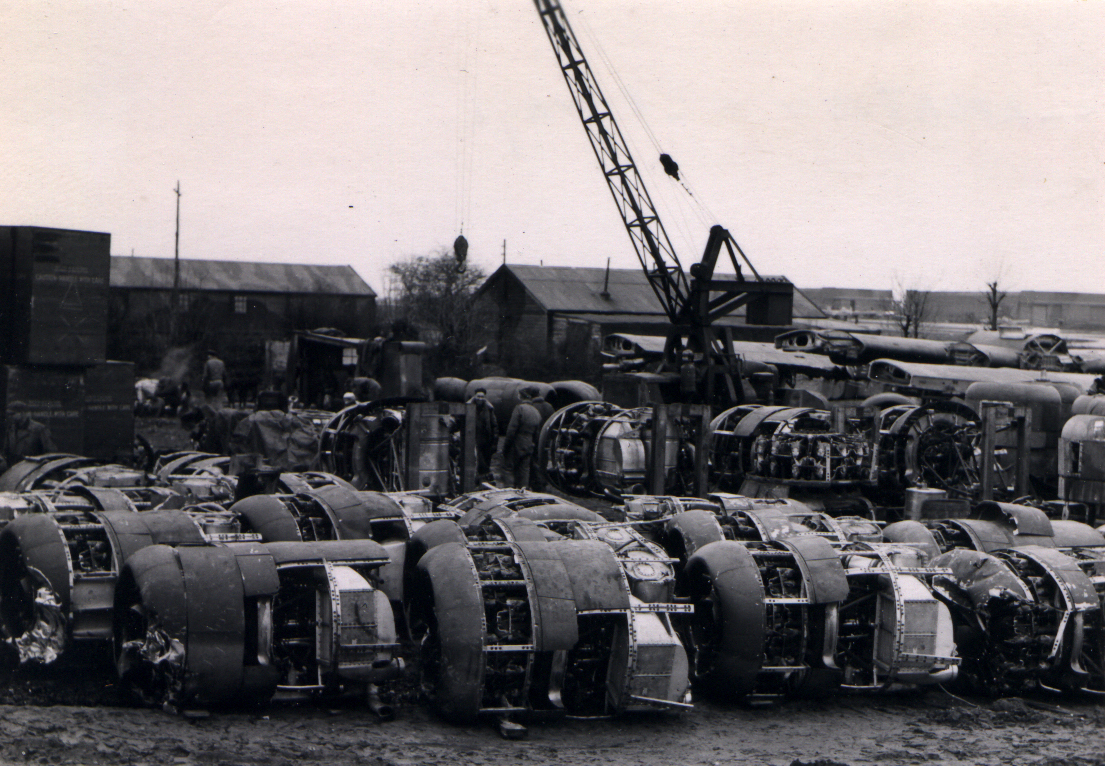
A collection of B-24 engines removed from their mounts. (IWM UPL 5385)

The role of the 3rd SAD was to maintain and repair the battle damaged B-24s of the 2nd Air Division, that had by now, flooded into the UK from the United States. This unenviable task required the recovery of the heavy bombers, washing them out and  perhaps removing the remains of airmen before returning them to flyable condition once more. Whilst not designed to be so, the acronym SAD certainly reflected the role perfectly.

Neaton consisted of a number of sites, 4 accommodation sites, a communal site, a sick quarters, two motor sites, a ‘miscellaneous’ site housing a Steam Jenny and then a 9AD site with tool sheds and other maintenance related buildings. The majority of these accommodation sites incorporated either the more common Laing or Nissen huts.

Watton itself would now become synonymous with reconnaissance, surveillance and electronic countermeasures (ECM). A new unit, 25th Bomb Group (Reconnaissance), it was constituted on 17th July 1944, and activated in England on 9th August that year. They would only serve from one UK airfield, that of Watton, where they would stay until VE day serving under the umbrella of the 8th Air Force. A visit by the famous ‘Carpetbaggers‘ (the special operations group designed to support French resistance operations) also saw the black Liberator’s fly regular missions from here during this time.

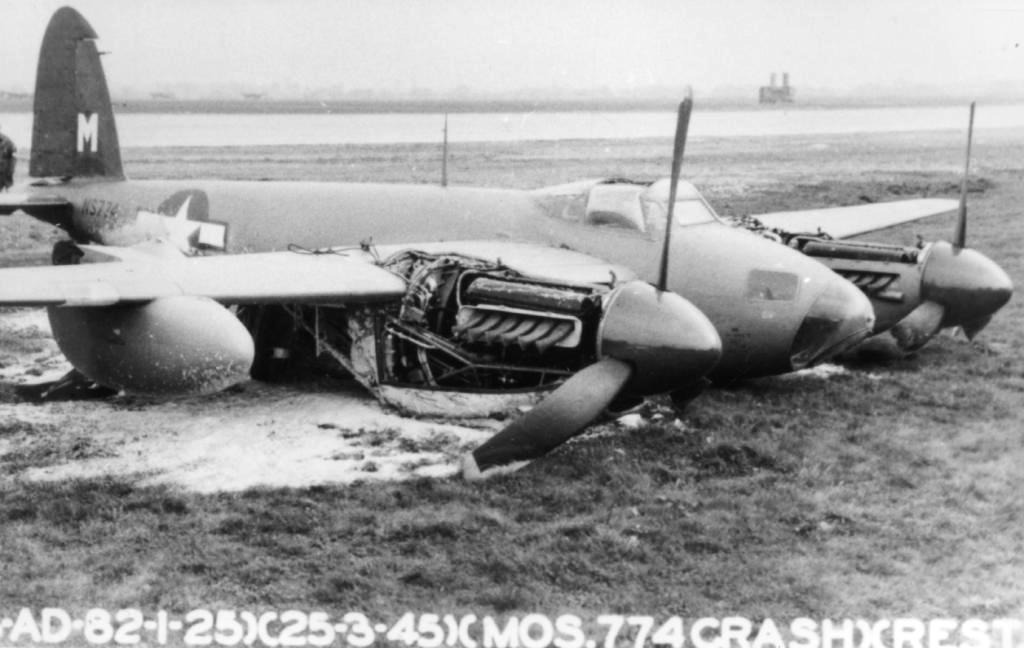
The end of Mosquito PR Mk XVI “M” NS774 of the 25th BG after crashing at RAF Watton (Station 376) 25th March 1943. (IWM UPL 6964)

The role of the Watton Group was to carryout reconnaissance missions over the seas around Britain and the Azores, gathering meteorological data. Combined with flights over the continent, the information they would gather, would help in the preparation of bombing missions. They would also carryout aerial mapping and photo reconnaissance missions, identifying German troop movements both at night and during the day.  Many of these operations involved major battles, including northern France, the Rhineland and the Ardennes. Additional tasks included electronic countermeasures using ‘chaff’, and flying ahead of large formations to ascertain last minute weather reports. A varied and dangerous collections of roles, they used a number of aircraft types including: B-17s, B-24s, B-25s, B-26s and P-38 Lightnings.

When VE day did finally arrive, the American unit departed returning to Drew Field in Florida. The August of that year must have been quite surreal, as the Americans left, flying was reduced and Watton was returned back to RAF ownership.

With the war now over, flying units began to return to the UK, many being disbanded not long after. One such unit was 527 Sqn who arrived here in the November, only to be disbanded in the April of 1946.

The next four years saw no other front line ‘operational’ flying units here at Watton, but the 1950s would bring a number of units back through its gates. With the introduction of the jet engine at the end of the war, piston engines fighters were soon being replaced by newer designs.

RAF Watton

One of Watton’s many accommodation blocks in modern use.

The ECM activity initiated at Watton by the 25th Bomb Group, would continue on in these early post-war years. For some twenty years or so in fact, through a variety of aircraft including: the Mosquito, Wellington, Domine, Lincoln, Anson, Proctor, Canberra, Meteor, Sea Fury, Firefly, Venom and many others. Each of these would not only play a vital part in the development and use of ECM, but radio research and training as well. Warfare had taken on a very new twist.

This move would see Watton becoming a hub for ECM activity. A number of RAF and Naval squadrons would operate from here undertaking such tasks. At the end of the war, Watton had become home to the Radio Warfare Establishment (RWE), renamed in 1946 to  the Central Signals Establishment (CSE). It was only one of five such units operating jointly between the military and National Air Traffic Services Organisation (NATS).  The Navy and RAF would jointly use Watton at this time, albeit for only a short period of time between March and September 1947, when the Naval Air Warfare Radio Unit moved in under the disguise of 751 NAS.

The role of the CSE was very complex, for too complex to discuss here, but with a number of squadrons operating under different roles whilst at Watton, it would culminate in 1948 in the forming of three un-numbered units: a Signals Research Squadron, a Monitoring Squadron and a Radio Countermeasures (RCM) Squadron. In essence, their role was to monitor and jam Soviet electronic communications and defence systems – it was an total airborne electronic warfare operation.*1

But the use of un-numbered squadrons was short lived, by the end of the decade the CSE had reverted to using numbered squadrons once more, their role to probe the air defences along the Soviet borders. British aircraft combined with ground stations, would monitor the reaction and activity of Soviet communications, seeing how they responded to intrusions into their airspace. By knowing this detail,  countermeasures could be put in place to jam or scramble these communications, ideally rendering them useless or at least temporarily incapacitated. The first of these numbered squadrons were 192 and 199, who were originally  the calibration and training units of the CSE.

Reformed here in July 1951 flying Mosquitoes, Lincoln B.2s and then the enormous Washington (B-29), 192 Sqn would not receive their first jet until January 1953 when the Canberra B.2 arrived. 192 Sqn would also fly the Varsity and the Comet C.2 before being disbanded and renumbered as 51 Sqn in August 1958.

199 Squadron (reformed on the same day) flew both the Lincoln B.2 and the Mosquito NF.36, in the same role as 192; their stay lasting until April 1952, at which point they moved to Hemswell in Lincolnshire where they picked up their first jet engined aircraft.

The August of 1952 saw a number of other units reform, disband or pass through Watton. 116 Sqn were reformed on the 1st, another ex Calibration flight of the CSE, it stayed until August 1958 when it was disbanded and reformed as 115 Sqn. A battle hardened squadron from Bomber Command, they had since themselves been disbanded. No longer flying operational bombers, the Varsitys 115 Sqn would operate would be the new form of transport, as they were reformed and moved on within days of their inception in that August.

On that same day in late August 1958, 245 Sqn would reform, also from the renumbering of another squadron – 527 Sqn. Flying Canberras they too were gone within days of their reformation.

As 1959 began to close and 1960 dawned, Watton would become the home of a new unit, 263 Sqn, who were operating Bloodhound missiles, the RAF’s ground to air missile used to defend Britain’s airfield against attacking aircraft. The operational use of these giant weapons lasted here until June 1963.

The 1960s saw the last of the flyers, lasting only between January 1962 and May 1963, 151 Sqn operated from here as the Signals Development Squadron, bringing back the props of the Hastings, Lincoln and Varsity before being renumbered again and subsequently disbanded.

Other units at Watton included 97 Sqn from 1963 – 1967; 98 Sqn (1/10/63 – 17/4/69), 360 Sqn (1/10/63 – 17/4/69) and 361 Sqn (2/1/67 – 14/7/67) two of which were both reformed and disbanded at Watton.

As can be expected, there were a large number of subsidiary and support units based at Watton, many of these attached to the Radio Warfare Establishment, along with SAM Training units, a range of flight units and other various regiments.

RAF Watton

Part of the disused Eastern Radar complex.

By the 1970s all flying had ceased leaving Eastern, and latterly Border Radar, the only ‘operational’ activity on the site. Eventually of course, even these were moved in the early 1990s, signalling the demise of the airfield as an active base. Watton was then handed over to the British Army.

A few years later the Army also reduced it use of Watton and the accommodation areas were sold off for private housing; a move that helped retain that airfield ‘feel’ that it still maintains today. More of the site was then sold later and new housing estates were built on the land where this previously stood; the entire feel of this has now since gone, replaced instead by a rabbit warren of roads with boxes for houses. The last remaining parts of the main airfield were sold off in 2012, the runway and peri-track being retained by the farmer and used for agricultural purposes.

Neaton too was sold off and has now been replaced by HMP Wayland, a prison holding category ‘C’ prisoners at her majesty’s pleasure.  One gruesome part of history being replaced by another.

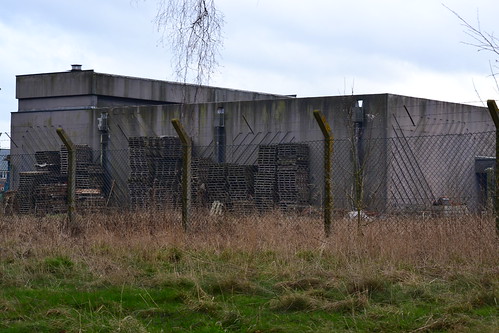
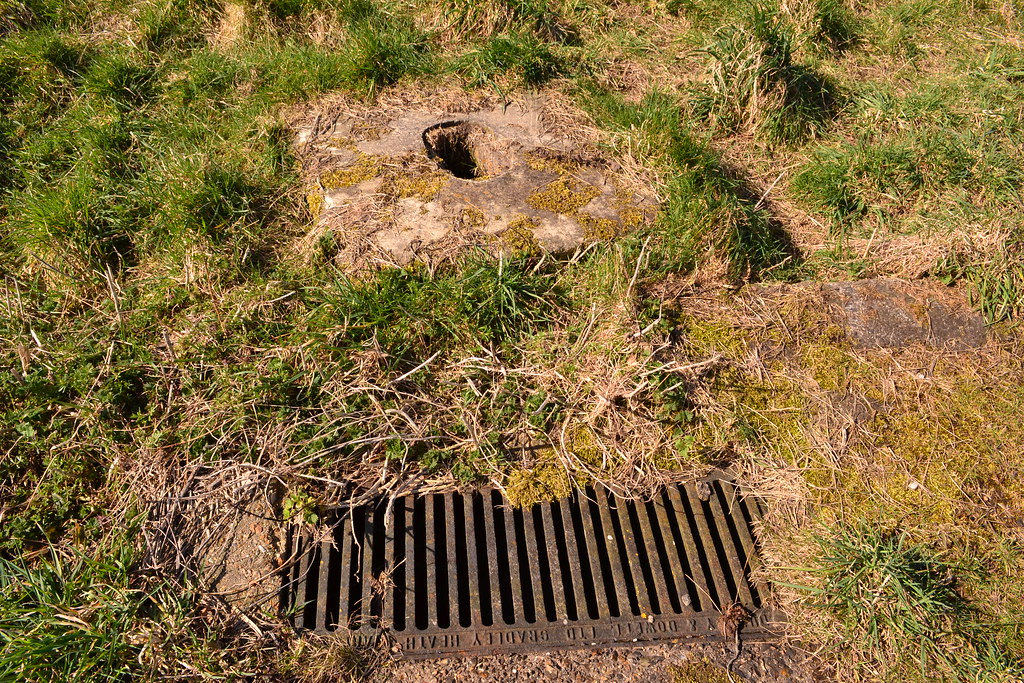
Today, the perimeter tracks, runways and hard standings support nothing more than housing. A proportion of the perimeter track remains with a small wire fence being the only defence to the continued onslaught of development. The original 4 “C” type hangars were all demolished as were the two control towers, one of which was built to support the new jet-era. Some minor buildings continue to remain surrounded by the original RAF housing, but these are few and far between, and even their future is uncertain.

Almost as lip service, many roads are named after an aircraft, Liberator, Marauder, etc., those aircraft synonymous with the operations of Watton and Neaton. Various concrete remains poke through the undergrowth and make this part of the site rather untidy. How long is it before they too disappear?

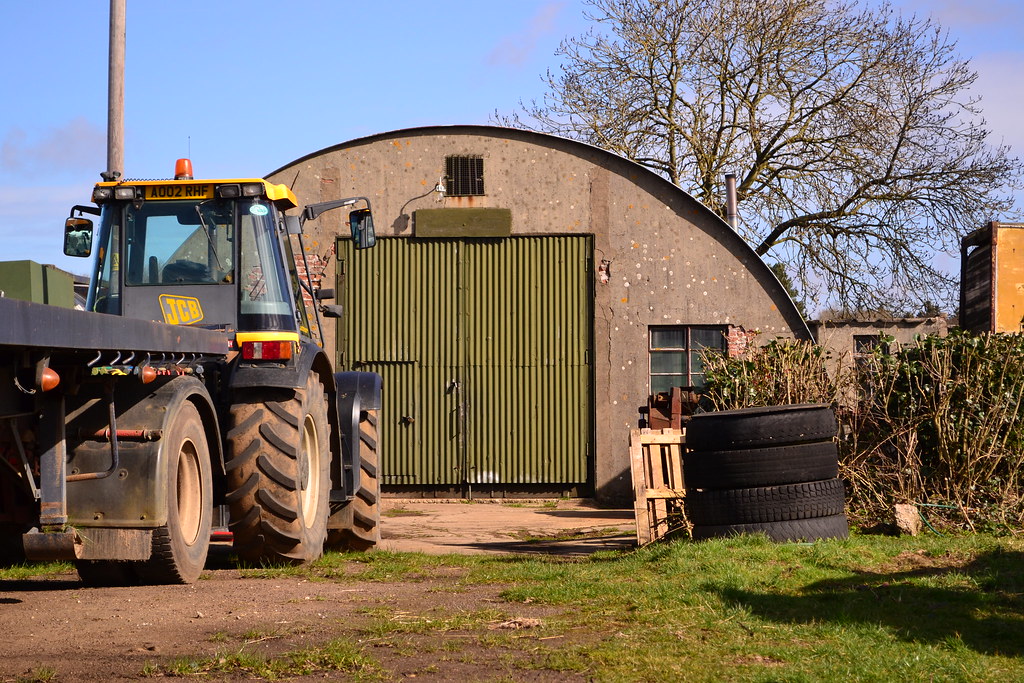
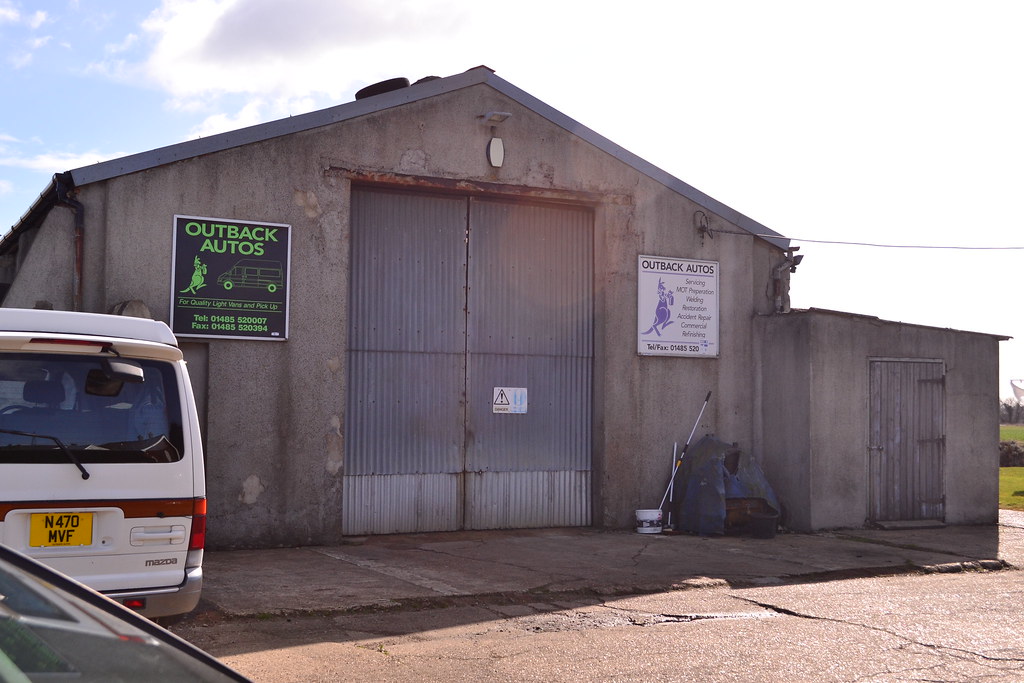
The site is split by the main road with some of the former administration buildings remaining on one side with the airfield and accommodation on the other. Some of these buildings are still in use with civilian operators and as such, have been well-preserved; others such as the technical site, have not been so fortunate and have become very rundown and in high states of disrepair.

RAF Watton

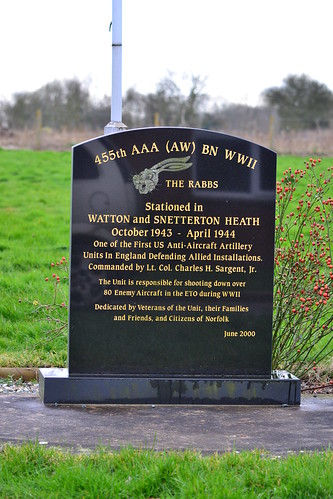
Memorial to the 455th AAA ‘The Rabbs’ located on the airfield site.

As for the airfield itself, two small memorials ‘guard’ the entrance to the new development. On the one side is the bent propeller recovered from a crashed Blenheim (R3800) shot down in the loss of eleven aircraft over Aalborg on 13th August 1940; on the other side a memorial that commemorates the 25th Bomb group USAAF. On the original housing site itself, a further memorial commemorates the 455th AAA ‘The Rabbs‘ who were given the task of defending Britain’s airfields against the Luftwaffe.  Owned by Stanford Training Area (STANTA) for a period of time and used for air mobile training, the odd Hercules or Army helicopter might have been seen here. However, this has now ceased and housing is creeping ever closer. I’m sure it won’t be long before many of these remaining remnants are lost to the developer’s digger.

Sources and Further Reading.

*1 Flintham, V., “High Stakes: Britain’s Air Arms in Action 1945-1990Pen and Sword, Oct 2008.

National Archives AIR 27/263/1: AIR 27/263/2

A website dedicated to RAF Watton has an extensive range of personal stories and information about life at Watton. It also has a video of the retrieval of Blenheim R3821 being recovered from Aalborg airport.

Further Pictures of the remains at these sites can be seen on Flckr.

NB: There is a museum commemorating the lives of the Watton personnel, open on limited days only, details can be found on their website.

Watton can be found on Trail 9.

RAF Great Massingham – Blenheims, Bostons and Mosquitoes.

In the heart of Norfolk, some 40 miles west of Norwich and 13 miles to the east of King’s Lynn, lies a small, quaint village typical of the English stereotype. Small ponds frequented by a range of ducks, are thought originally to be fish ponds for the 11th century Augustinian Abbey, and the history of the village is believed to go back as far as the 5th Century.  Massingham boasts an excellent village pub, and a small shop along with beautiful walks that take you through some of Norfolk’s most beautiful countryside; it has to be one of Norfolk’s greatest visual assets.

Sited above this delight is the former airfield RAF Great Massingham, which during the war years was home to number of light bombers and even for a short while, the four engined heavy, the B-17. In Trail 21, we return to RAF Great Massingham.

RAF Great Massingham

Great Massingham airfield lies in the heart of Norfolk, some 40 miles west of Norwich and 13 miles to the east of King’s Lynn, lies a small, quaint village typical of the English stereotype. Small ponds frequented by a range of ducks, are thought originally to be fish ponds for the 11th century Augustinian Abbey, and the history of the village is believed to go back as far as the 5th Century.  Massingham boasts an excellent village pub, and a small shop along with beautiful walks that take you through some of Norfolk’s most beautiful countryside; it has to be one of Norfolk’s greatest visual assets. Sited above this delight is the former airfield RAF Great Massingham, which during the war years was home to number of light bombers and even for a short while, the four engined heavy, the B-17.

Before entering Great Massingham I suggest you stop at Little Massingham and the church of St. Andrew’s. For inside this delightful but small church, is a roll of honour*1 that lists enormous amounts of information about the crews who served at the nearby base. It gives aircraft details, mission dates and crew names amongst others. It is a hugely detailed collection of information covering 1940-45, in which time 600 Massingham crews lost their lives. Seven of these crew members, are buried in the adjacent church yard: Sqn. Ldr. Hugh Lindsaye (18 Sqn), Sgt. John Wilson (RNZAF – 107 Sqn), Sgt. Thomas Poole (107 Sqn), P/O. Arthur Lockwood (107 Sqn), Flt. Sgt. Gordon Relph (107 Sqn), F/O. Charles Ronayne (RAF) and F/O. Joseph Watkins (239 Sqn), all being killed in different circumstances. This is a valuable and enlightening stop off to say the least.

RAF Great Massingham

The Roll of Honour in St. Andrew’s Church, Little Massingham.

On leaving the church turn right and you will almost straight away enter the village of Great Massingham. The airfield is to the east behind the village holding the high ground, which makes for a very windy and open site, whilst the village nestled on the lower ground, remains calm and quiet. Built originally as a satellite for the nearby West Raynham, Massingham opened in 1940 with grass runways initially under the command of 2 Group, Bomber Command and then latterly 100 Group, whose headquarters were at Bylaugh Hall. The distance between both RAF West Raynham and RAF Massingham was so small, that crews would cycle from one to the other each morning before operations.

RAF Great Massingham

The Officers Mess now a farm building.

There were a total of four T2 hangars and one B1 hangar built on this site. The airfield also had sixteen pan-type hardstands and twenty-one loop-type hardstands, giving a total of thirty-seven dispersal points around its perimeter.

The main accommodation and communal sites which totalled five and two respectively, were near to Little Massingham church, to the west, along with further areas to the south of the airfield . These included a communal area to the south-west of the village and sufficient accommodation for 1,197 men, consisting of Officers, Senior NCOs and ordinary ranks.  This was later upgraded to accommodate 1,778 men. In addition, accommodation was provided for the WAAFs of the airfield, 102 in total at the outset. This was also increased in the airfield’s upgrade, taking the total number of  WAAFs to 431.

The bomb dump and ammunition stores were well to the north away from the personnel as was standard. A number of anti-aircraft sites were scattered around the perimeter offering good protection from any attacking aircraft.

The first occupants of Massingham were the Blenheim IVs of 18 Sqn RAF who arrived in the September of 1940.

18 Sqn were previously based at West Raynham, making the transition invariably very smooth. In fact, operations barely ceased during the change over, the last West Raynham sortie occurring on 7th September 1940 with a six ship formation attack on the docks and shipping at Dunkirk, and the first Great Massingham sortie on the evening of the 9th to Ostend.

Whilst at Great Massingham, 18 Sqn flew the Blenheim Mk.IV initially on short range bombing sorties to the French coast. All was fairly quiet for the first few weeks, the squadron’s first loss not occurring until November 28th 1940, when Blenheim P6934 crashed after hitting high tension wires west of the airfield. All three of the crew were injured and admitted to hospital, but Sgt. William E. Lusty (S/N: 751633) died from his injuries the following day.

18 Squadron remained at Great Massingham until April the following year (1941), performing in the low-level bombing role. Like most other RAF airfields around this area of Norfolk, it would be dominated by twin-engined aircraft like the Blenheim and its subsequent replacements. As a reminder to those who may have got complacent about the dangers of flying in wartime, the departure of 18 Sqn was marred by the loss of Squadron Leader Hugh Lindsaye (S/N: 40235), who was killed whilst towing a drogue near to Kings Lynn a few miles away. An investigation into the crash revealed that a drogue he was pulling had become separated and fouled the port elevator. The pilot lost control as a result and all three crewmen (SgT. Stone and F/O. Holmes) were killed. Sqn. Ldr. Lindsaye is one of those seven buried in Little Massingham.

Shortly after the departure of 18 Sqn, Massingham took on another Blenheim squadron in the form of 107 Sqn, a move that was coincided with a detachment of B-17 Flying Fortresses of 90 Squadron.

The B-17 (Fortress I) squadron was formed at Watton earlier that month, they moved to West Raynham whereupon they began trials at a number of smaller airfields including Bodney and Massingham, to see if they were suitable for the B-17. These initial tests, which were undertaken by Wing Commander McDougall and Major Walshe, were a series of ‘circuits and bumps’ designed to see if the ground and available runways were suitable. It was decided that Massingham was indeed suitable, and so a decision was made on the 13th, to base the aircraft at Massingham but retain the crews at West Raynham, transport vehicles ferrying them to and from the aircraft on a daily basis. For the next few days further tests were conducted, and engineers from Boeing came over to instruct ground crews on the B-17’s engineering and armaments. Concerns were soon raised by crews about Massingham’s grass runways, and how well they would perform with the heavier four engined B-17’s constantly pounding them.

RAF Great Massingham

Remains around the perimeter track.

On the 23rd May, H.R.H The King conducted an inspection of Bomber Command aircraft at RAF Abingdon, in Oxfordshire. Amongst the types presented with the RAF bombers was a Fortress I from Massingham. The King, Queen and two Princess’s Elizabeth and Margaret, all attended and took a great interest in the Fortress. The Royal party taking considerable time to view and discuss the heavy bomber’s merits and features.

Back at Massingham, flight tests, training and examinations of the B-17 continued until in June 1941, when 90 Sqn were ordered out of both Massingham and West Raynham, moving to RAF Polebrook in Northamptonshire. But by the October, the Fortress’s had all gone from RAF bomber service, problems with freezing equipment convincing the RAF not to use the heavies in bombing operations.

By February 1942 the unit was disbanded and all its assets were absorbed into 1653 Heavy Conversion Unit (HCU). Within days of 90 Sqn’s arrival at Massingham, another more permanent squadron also arrived, again performing in the same low-level bombing role as their predecessors 18 Sqn. The spring of 1941 saw 2 group perform some of their largest operational sorties to date, with many Blenheims continuing their daylight raids on shipping and docks in north-west Germany.

It was during this hectic time, on May 11th, that 107 Sqn, would arrive at the Norfolk base at Massingham. Being taken off operations on the 10th, the air personnel made their way down from the Scottish base at Leuchars whilst the ground staff travelled by train the following day. A number of crews were posted on detachment to bases at Luqa, Ford and Manston.

After a short settling in period missions began again in earnest with their first twelve ship operation in Bomber Command taking them to Heliogoland on the 13th. Two of these Blenheims returned with engine problems, but the remainder managed to attack the target, in an operation that was considered a great success, with complete surprise being achieved. Flying at very low level was key to this operation, and whilst all aircraft returned home safely, one aircraft piloted by Sgt. Charney, flew so low he managed to strike the sea with his port engine; as a result, the airscrew was damaged and broke away leaving the aircraft flying on just one of its two powerplants!

The end of May was a difficult month for 107. On the 21st they returned to Heligoland, with nine aircraft taking off at 14:00, detailed for a daylight formation attack on the target. With  visibility of 12 – 15 miles, they pressed home their attack from as low as fifty feet, in spite of what was an ‘intense and accurate’ flak barrage. Four aircraft were hit by this flak, and in one of them, Sgt. John Wilson (S/N: 40746) was killed when shrapnel struck him in the head. Sgt. Wilson is also one of the seven in the church yard at Little Massingham.*2

On the return flight, a second aircraft also damaged by the flak, had an engine catch fire. The pilot and crew were all lost after ditching in the sea. Fl. Sgt. Douglas J. R. Craig (S/N: 903947) never having being found, whilst two other crewmen (Sgt. Ratcliffe and Sgt. Smith) were seen climbing into their life raft, later being picked up by the Germans and interned as prisoners of war.

On the 23rd the squadron was then detailed to search for shipping off France’s west coast. Due to bad weather, they were unable to make Massingham and had to land at Portsmouth instead. Continued bad weather forced them to stay there until the 27th when they were able at last to return to Massingham. No further operations were then carried out that month.

RAF Great Massingham

Gymnasium and attached Chancellery now a car repair shop.

The dawn of 1942 saw Bomber Command face its critics. High losses brought into question the viability of these small light aircraft as bombers over enemy territory, a situation that would see 2  Group, as it was, all but removed from operations by the year’s end.

But the end was not quite here, and January  of 1942 saw 107 take on the Boston III ( an American built aircraft designated the ‘Havoc’) as a replacement for the now ageing Blenheim. With the new aircraft 107 remained at Massingham, at least until the early August, where they made a short move to Annan before returning to Massingham a mere week later. It would take only a month before the first 107 Sqn Boston would be lost.

Whilst on a training flight, Boston W8319, struggled to join the formation, after turning back, it was seen to fall to the ground, the resultant fireball killing all three crewmen on board.

Despite this, losses over the coming months remained light. With the introduction of US airmen and the 15th Bomb Squadron, June / July saw a number of Massingham aircraft transfer across to the American’s hosts 226 Sqn at Swanton Morley. One of these aircraft, crewed by two US airmen; Captain S. Strachan and Lt. C. Mente, crashed near RAF Molesworth killing both on board.

By the end of 1942, 107 Sqn had lost a total of 23 aircraft on operations, and with each Boston carrying four crewmen it meant losses were increasing for the unit.

In February 1943, the Boston IIIs were replaced by the IIIa model. During May, the whole of 2 Group would begin to transfer across to the 2nd Tactical Air Force (TAF) in preparations for the invasion the following year. Losses had been high for the group, the light bombers being easily cut down by both Luftwaffe fighters and flak.

At the end of August 1943, it was 107 Sqn’s turn and they departed Great Massingham for Hartford Bridge and a new life within the 2nd TAF. It was during these summer months that a Free French unit, 342 Lorraine Squadron would arrive at Massingham. A unit formed with Bostons at West Raynham, it would stay at Massingham between July and into early September before moving off to rejoin 107 Sqn at Hartford Bridge, also beginning a new life within the 2nd Tactical Air Force.

It was these postings that would lead to the end of Massingham as a day bomber station, and no further vulnerable light bombers of this nature would be stationed here again.

In April 1944 Great Massingham  was redeveloped and upgraded, more accommodation blocks were provided and three concrete runways were laid; 03/21 and 13/31 both of 1,400 yards, and the third 09/27 at  2,000 yards, this would give the site the shape it retains today.

A year-long stay by 1694 Bomber (Defence) Training Flight with amongst them, Martinets, gave the airfield a much different feel. Target towing became the order the day and non ‘operational’ flying the new style. In the June of 1944, 169 Sqn would arrive at Massingham, operational flying was once again on the cards, with night intruder and bomber support missions being undertaken with the Wooden Wonder, the D.H. Mosquito. Between June and the cessation of conflict this would be a role the squadron would perform, and perform well, with numerous trains, ground targets and Luftwaffe night fighters falling victim to the Mosquito’s venomous attacks. Included in these are a damaged Ju 88 on the night of October 26th 1944 south of the Kiel Canal, and five trains on the night of October 29th.

RAF Great Massingham

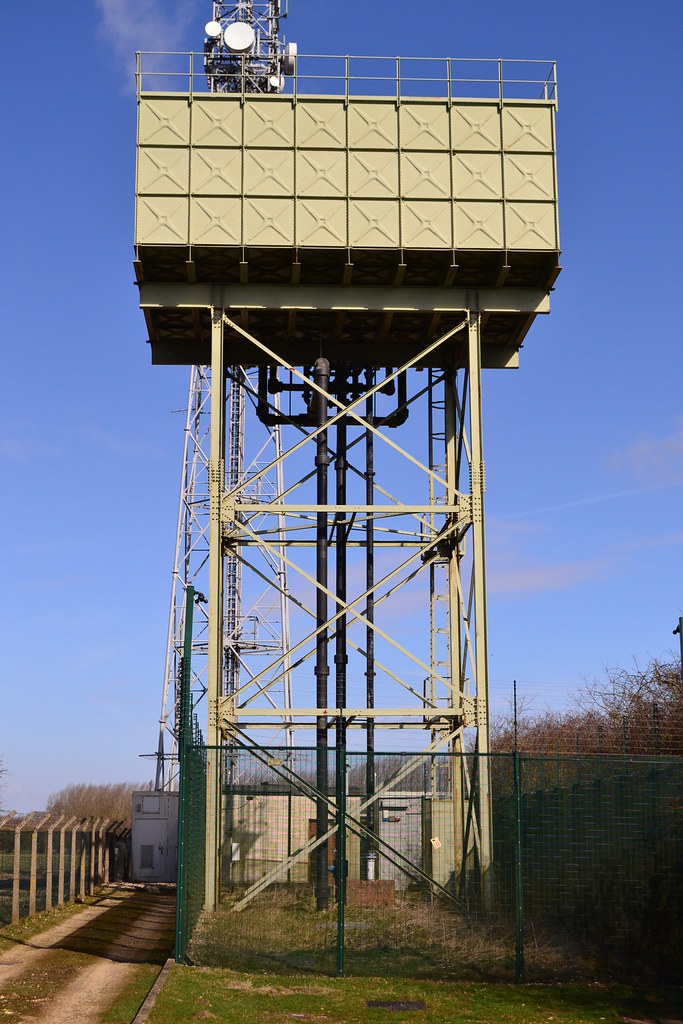
Original high-level Braithwaite water tank.

With them, came 1692 (Bomber Support Training) Flight, to train crews in the use of radar and night interception techniques.

Formed at RAF Drem in Scotland in 1942 as 1692 (Special Duties) Flight, they operated a range of aircraft including Defiants, Beaufighters and Mosquitoes. The two units stayed here at Massingham until both departed in August 1945, at which point 12 Group Fighter Command, took over responsibility of the site.

As radar and night interception roles developed, a new unit was created at Massingham under the control of the Central Fighter Establishment (CFE), who were to trial different techniques and strategies for air interception. They later moved to West Raynham where they continued to carry out this role.

Over the years a number of  post war celebrities were stationed at Massingham, they included F.O. Keith Miller AM, MBE – the Australian Test cricketer; P.O. (later Squadron Leader) Bill Edrich DFC – the England cricketer and the BBC commentator – Flt. Sgt. Kenneth Wolstenholme DFC and Bar.

After the aircraft left, the airfield fell quiet and was very quickly closed. 1946 saw the last personnel leave, and it remained dormant until being sold in 1958. Bought by a farmer, it is now primarily agriculture, although a small private airfield has opened utilising the former runways, and flying visitors are welcomed with prior permission. The airfield at great Massingham has a public footpath running part way through it. This is accessible at either end of the southern side of the airfield, and permits access along part of the original perimeter track. Accessing the eastern end of the path is easiest, a gated road from the village takes you up to the airfield site. Once at the top, you can see the large expanse that was the main airfield site. Trees have since been cultivated and small coppices cover parts of it. To your right at this point the peri track continues on in an easterly direction, but this section is now private and access is not permitted. This track would have taken you toward the Watch office, the Fire Tender building and storage sheds – all these being demolished long ago. A further area to the south of here has now been cultivated, and there was, what is believed to have been a blister hangar, located at this point – this too has long since gone.

The public path turns left here and takes you round in a northerly direction. To your left is a T2 hangar, it is believed that this is not the original, but one that had been moved here from elsewhere. This however, cannot be confirmed, but there was certainly a T2 stood here originally.

The track continues round, a farm building, very much like a hangar, houses the aircraft that now fly. Sections of runway drainage are visible and piles of rubble show the location of smaller buildings. The track then takes you left again and back to the village past another dispersal site, now an industrial unit complete with blister hangar.

Other foundations can been seen beneath the bushes and leaves on your right. This may have been the original entrance to the site, although Massingham was unique in that in was never fenced off, nor guarded by a main gate. Other examples of airfield architecture may be found to the north side of the airfield, indeed satellite pictures show what looks like a B1 hangar on the northern perimeter.

RAF Great Massingham

The perimeter track and T2 hanger re-sited post war.

After walking round, drive back toward Little Massingham, but turn left before leaving the village and head up toward the distant radio tower, itself a remnant from Massingham’s heyday. We pass on our left, the former accommodation site. Now a field, there is no sign of its previous existence. However, further up to the right, a small enclave utilises part of the Officers’ Mess, the squash court, and gymnasium with attached chancery. Hidden amongst the trees and bushes are remnants of the ablutions block, and other ancillary buildings. Continue along this road, then take the left turn, toward the tower. Here is the original high-level Braithwaite water tank and pump house, still used for its original purpose and in very good condition.

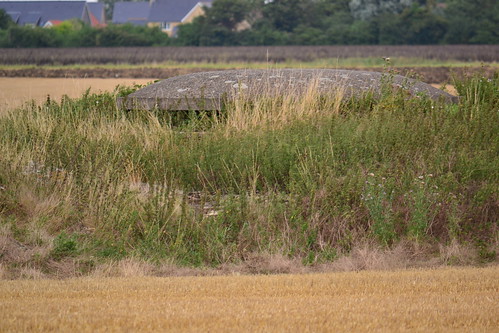
Finally, a lone pill-box defensive position can also be found to the west of the village, some distance from the airfield in the centre of a farmer’s field. All small reminders of the areas once busy life.

Great Massingham is a delightful little village, set in the heart of Norfolk’s countryside. Its idyllic centre, pubs and shops surround ponds and greens. A short walk away, is the windy and open expanse that once was a bustling airfield, resounding to the noise of piston engines. All is now much quieter, their memories but a book, some dilapidated buildings and a handful of graves. Standing at the end of the runway, looking down the expanse of concrete, you can easily imagine what it must have been like all those years ago. From Great Massingham we head east, to RAF Foulsham, before turning north and the North Norfolk coast, an area of outstanding natural beauty and some fine examples of airfield architecture.

Sources and links RAF Great Massingham

*1 A comprehensive history of RAF Massingham, including RAF material, is now under the care of the Massingham Historical Society. Contact Anthony Robinson antmassingham@gmail.com for details about the Museum or Roll of Honour, a hard copy of which can be purchased for a small fee.

*2 The ORB shows this as Sgt G, Wilson and not J.W. Wilson.

National Archives AIR 27/842/10

RAF Great Massingham is remembered on the Massingham village website which includes details of the Roll of Honour.

Massingham was first visited in 2015.

RAF Upwood (Trail 17) – The Graveyard of RAF Squadrons (Part 4)

In Part 3 Upwood became part of the Pathfinders operating Mosquitoes on major operations as Bennett’s Pathfinder Force. Eventually the war drew to a close and bombing operations wound down. Then we entered the jet age.

With the war in Europe now over, Upwood would become a ‘graveyard’ for RAF squadrons. The first of these 105 Squadron, arrived in the same month as 156 departed, with Mosquito XVIs. By the end of January 1946 they were gone, but like the Phoenix of Greek folklore, they would arise from the ashes at Benson in the early 1960s.

102 Squadron were another typical example of this, arriving in February 1946, only to be disbanded two weeks later, being renumbered as 53 Squadron. 53 Sqn made a conscious effort to buck the trend by  flying with the four engined heavies the Liberator VIs and VIIIs, but sadly they too did not last long, closing in the summer of that same year.

1946 was a busy year at Upwood, with what seemed a constant ebb and flow of ‘heavies’, this motion setting a scene that would prevail for the next eight years or so.

February 1946 finally saw the departure of 139 Sqn to Hemswell, after two years at Upwood, their time here had come – their historic role had come to an end. But for Upwood, it was still not the final curtain, for on July 29th, another unit would arrive, 7 Squadron. The unit was reduced to just ten aircraft prior to the move, and would not take on any new models until 1949 when the Lincoln B.2 arrived. An aircraft developed from the highly successful Lancaster, it would be used in operations over Malaya until the squadron was disbanded and then reformed elsewhere with Valiants in 1956.

Back in November 1946, two other squadrons would reform here at Upwood, both 148 and 214 Sqns, and both with Lancaster B.1 (F.E.). These ‘tropicalised’ versions of the B.1 had been destined to go to the Far East to fly operations against Japan as the ‘Tiger Force‘. These modifications included changes made to the radio, radar, navigational aids and included having a 400 gallon fuel tank installed in the bomb bay. Faced with the high temperatures of the Far East, they were painted white on top to reduce heat absorption, and black underneath. Fortunately though, the war with Japan had ended before they could be used, and in 1949, both these units would lose them in favour of the Lincoln also. This meant that Upwood now boasted three Lincoln squadrons, the war may have been over, but the power of the Merlin continued on well into the mid 1950s, these three squadrons disbanding between 1954 and 1956.

In the summer months of 1952, Dirk Bogarde starred in a film made at Upwood using Lancasters in an ‘Appointment in London‘.

A wartime story it was made by Mayflower Film Productions, and used four Lancasters crewed by Upwood airmen. Starring Dirk Bogarde, it is a story of intense rivalry between a Wing Commander aiming for his 90th mission, and an American officer, there is the usual love story attached as the two try to put aside their rivalry to achieve their own personal aims.

On February 23rd 1954, a forth Lincoln squadron arrived at Upwood, 49 Squadron took the number of four engined heavy bombers even further, staying here until August 1st the following year, at which point they were disbanded only to be reborn at Wittering in 1956.

By now, the RAF’s long range jet bomber, the Canberra, had been in service for a few years, and had proved itself as a more than capable aircraft. A first generation medium bomber, it was designed by W. E. W. ‘Teddy’ Petter, and would go on to set the world altitude record of 70,310 ft two years after entering service here at Upwood.

The success of the Canberra would be one to rival the Lancaster and Spitfire. Being built in twenty-seven different versions, it was exported to over fifteen countries world wide. In the RAF it served with no less than thirty-five squadrons, several of them ending up here at Upwood. Over 900 examples were built by British companies, with a further 403 being built under licence by the American Martin Company and designated the B-57. In RAF service, it reigned for fifty-seven years, the last examples being stood down in 2006.

Between 22nd May 1955 and 11th September 1961, eight RAF squadrons: 18, 61, 50, 40, 76, 542 and finally 21,  were all disbanded at Upwood, and all operating the aforementioned Canberra; primarily the B.2 or B.6 models, few of them operating the model for more than three years. There was also a return of 35 Sqn, the former Bomber Command unit who operated from Upwood in early 1940; they came over from Marham having operated as the Washington Conversion Unit before renumbering as 35 Sqn. They remained here until September 1961 whereupon they were disbanded for the penultimate time.
After the last Canberra Sqn had departed, Upwood remained under RAF control as part of the RAF’s Strike Command, until 1964 when they too pulled out leaving a small care and maintenance unit behind. Over the next few years Upwood would be used in the training of non-flying duties, until these units also left, the last in 1981. Upwood’s future now looked very insecure.
RAF Upwood

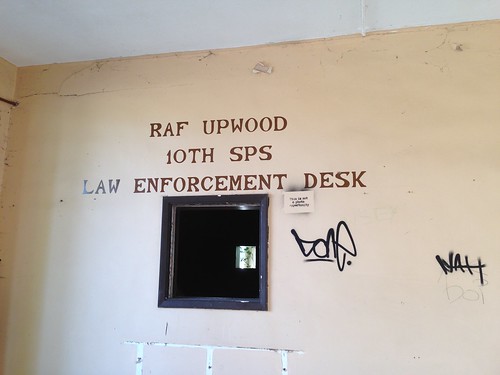
Inside the Gate house, the USAF presence. (Security Police Squadron).

Fortunately though, control of Upwood was then passed to the USAF for training and support services for nearby RAF Alconbury and RAF Lakenheath. It was earmarked for medical services, and should an attack occur during the Cold War, it would quickly be turned into a control area ready to deal with heavy nuclear attack casualties. Thankfully this was never put to the test though, and gradually the USAF phased out its use of Upwood, and as other airfields closed, personnel numbers became less and the homes they used emptied. Eventually, even the 423rd Medical Squadron pulled out, taking their community support, equipment and staff with them.

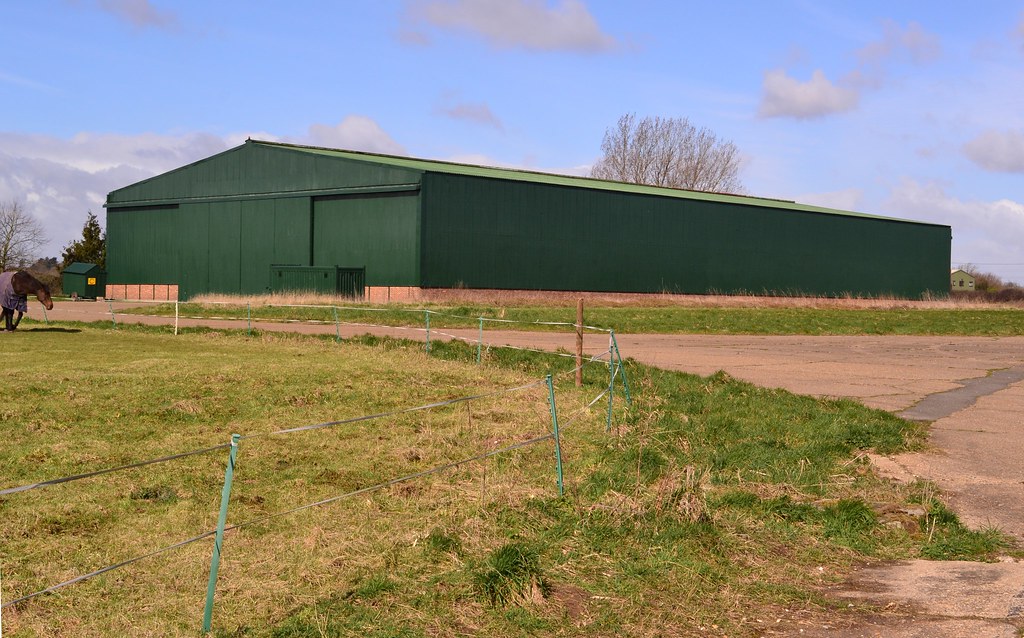
Upwood finally closed on 26th October 2012, and the remaining buildings including the NAFFI and NCO homes, were all sold off to developers and the site wound down. Since then, there have been numerous attempts to purchase the site and develop it with housing. These have all faltered along the way for one reason or another. On the positive side, the hangars remain actively used by an aero-engine company who refurbish jet engines. A glider club has been agreed a 10 year lease on the remaining parts of the runways (although these have been removed) and two Nissen huts have been fully refurbished to allow modern use. This part of the airfield looks and feels like a real and active military base, whilst the admin and medical side are ghostly reminders of its past. Standing on the site looking around, the imagination can only begin to think how this lonely and desolate place once bustled with crews and aircraft, crews going about their business and vehicles ferrying aircrew to their machines.

RAF Upwood

RAF Upwood’s hangars are still in use today. Aero engines outside await work.

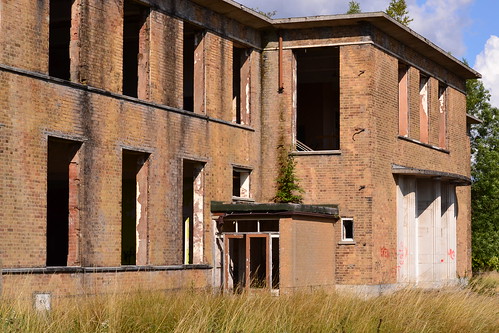
Today it is an enormous site covered with derelict buildings as if left following an atomic blast. The windows are all shattered, the buildings vandalised and graffiti daubed on all the walls. Two tanks have been brought in and a small urban assault company use it for mock battles. The guardroom, officers quarters and associated mess halls all remain, some in a worse state than others.

In 2017 the redundant site was acquired without conditions, and planning permission obtained for a comprehensive development of a small six acres of the site. This plan, put forward by Lochailort *5 included 60 houses. Huntingdon District Council have now incorporated Upwood into their long term Local Plan, and a proposal is under consideration for further development which would include the removal of large quantities of the buildings. It would also see hardstands being replaced by a mix of housing (450 homes) and business premises. The intention is to keep the architecturally significant buildings and layout, along with the hangars, thus retaining the military atmosphere, developing it “in a way which respects its setting and former use“.*4 I only hope that the sympathetic approach is indeed used, and that this incredible and historic site does not become another of Britain’s matchbox towns.

Post Script:

A website dedicated to RAF Upwood shows a range of older photographs, squadron details and information about Upwood’s history. Created by Sean Edwards, it is well worth a visit for more specific details.

A local gentleman has purchased a scrapped Canberra nose section that once flew  from Upwood, and has rebuilt it. It remains in his garage and is displayed at shows around the country.

Sources and further reading.

National Archives – AIR 27/379/4
National Archives – AIR-27-961-4

BAE Systems Website

*1 Photo from the UK Archives, (https://www.flickr.com/photos/nationalarchives) no known copyright restrictions.

*2 Josepf Jakobs story can be read on the: Josef Jakobs blog with further information on the Upwood Website.

*3 Middlebrook, M & Everitt, C. “The Bomber Command War Diaries 1939-1945“, Midland Publishing (1996)

*4 Huntingdonshire District Council Local Plan Proposal

*5 Lochailort Investments Ltd, Webiste.

Thirsk, I., “de Havilland Mosquito an illustrated History – Vol 2” Crecy publishing (2006)

For more information and details of the Pathfinders, see the excellent RAF Pathfinders Archive at: https://raf-pathfinders.com/

The full text can be read in Trail 17 – The Pathfinders

RAF Upwood (Trail 17) – The Graveyard of RAF Squadrons (Part 3)

In Part 2 Upwood progressed through the early war years as a training airfield operating a range of aircraft types. As the larger, heavier aircraft came n line, its wet and boggy ground became churned up necessitating the construction of hard runways.

By the end of the year these runways were completed, and in the early months of 1944, two more new squadrons would arrive at the airfield, 139 and 156 in February and March respectively.

By  now Bomber Command aircraft had been pounding German cities and industrial targets, the period January to March 1944 was to see Berlin hit particularly hard, and with Stirlings being withdrawn due to their high losses, the Lancaster crews would now be taking the brunt.

Now under the control of Bennett’s new Pathfinder Force (PFF), 139 (Jamaica) Sqn would bring with them the beautiful and much loved Mosquito MK.XX. Coming from nearby RAF Wyton, they had already begun replacing these with the MK.XVI, flying both models whilst performing operations from the Cambridgeshire airfield. The following month a Lancaster squadron, 156, who were based at another PFF airfield, RAF Warboys, joined 139. Within a month Upwood had become a major front line airfield, the roar of multiple Merlins now filling the Cambridgeshire skies.

RAF Upwood

139 (Jamaica) Squadron had a long history, which had begun on July 3rd 1918. This first period of their existence lasted only a year, the unit being disbanded in March 1919. With the onset of war they were called back into operation being reformed in 1936, when they went on to fly Blenheims, and later Hudsons, until being disbanded and renumbered as 62 Sqn in April 1942. Reformed again in the June of that year 139 Sqn would go on to serve well into the late 1950s.
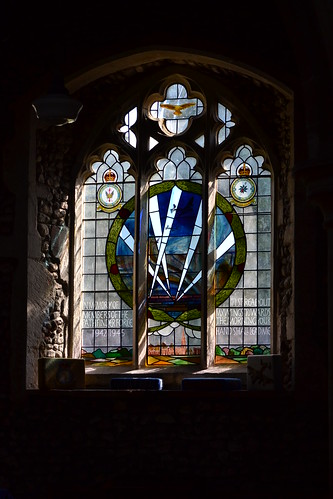
Named ‘Jamaica’ Squadron, 139 acquired their name as a result of the huge effort of the colony to provide enough money for twelve Blenheims, a remarkable effort considering the nature and size of the country. It was from Trinidad that Sqn. Ldr. Ulric Cross came, the most decorated West Indian of World War II, who earned himself the DSO and DFC whilst flying with the Pathfinders.

139’s drafting in to the Pathfinders occurred at the end of May 1943, leaving 2 Group for Don Bennett’s 8 Group, they formed the nucleus of the Light Night Striking Force (LNSF).  At this time they were still at RAF Marham, but moved across to Wyton and then onto Upwood arriving here on 1st February 1944, with a mix of Mosquito IV, IX, XX and XVIs.

There would be no settling in period for 139 Sqn, their first sortie, marking for a raid on Berlin, was due that very night. Take off for F.O. D Taylor and F.Lt. C. Bedell in Mosquito DZ 476, was at 17:50; they dropped their Target Indicator which was subsequently bombed on by Mosquitoes from another squadron. Whilst flak was recorded as ‘slight’, the aircraft was heavily engaged over Neinburg. The Mosquito landed back at Upwood, ending the squadrons first successful operation from here, at 22:40.

Photograph taken during an attack by De Havilland Mosquito B Mark IVs of No. 139 Squadron, on the locomotive sheds at Tours, France (date unknown) © IWM C 3409

156 Squadron were one of the four initial Pathfinder units having been taken on by the new Group in August 1942 whilst at RAF Warboys a few miles up the road. After two years of relatively high losses for the Squadron, the time for change had come, and they moved across here to RAF Upwood. Hopefully a new start for the depleted unit would see better results and higher morale. As 156 moved in, the few remaining aircraft of the NTU moved out, rejoining the main collection at Warboys, the unit having been split over the two sites for some time.

However, the first three months of 1944 were to prove to be the worst for 156 Sqn, over half its total yearly losses occurring during this period. This culminated, at the end of March, with the loss of four Upwood aircraft. Lancaster MK.IIIs: ND406 (S),  ND466 (Z), ND476 (V) and ND492 (L) all left as part of a seventeen strong force from Upwood joining with a further ninety-three other PFF aircraft to attack Nuremberg. Even though the weather was against the bombers, the operation went ahead, the 795 heavy bombers of Bomber Command making their way east. Strong winds caused havoc, with large parts of the force drifting off course, much farther north than they should have done. This resulted in them unknowingly bombing Schweinfurt and not Nuremberg. Outward bound, the German defences waited, many picking off the bombers before they even reached Germany. In total 95 bombers were lost, 82 of them on the outward journey. For 156 Squadron it was another devastating blow, and for Bomber Command a disaster, their biggest loss of the entire war*3.

RAF Upwood

A huge number of derelict buildings remain on the now abandoned site.

Of the thirty 156 Sqn airmen lost that night (two Lancasters were carrying eight crewmen), only six survived, each of these being incarcerated as POWs, the rest all being killed and buried in this region of Germany.

The months preceding June were taken up with missions to support the impending D-Day landings. With Bomber Command forces being pulled away from targets in Germany, many missions now focused on V weapons sites, rail and transport links, coastal batteries and airfields across western France. The number of Pathfinder Mosquitoes increased, as did the need for precision bombing, the wider ‘blanket’ bombing not being implemented on these small scale targets.

The transportation plan as it was known, required intense operations from 8 Group, and although the number of missions rocketed the number of casualties fell. Morale was on the increase and things were looking up for the crews of Upwood based aircraft.

With the Pathfinders being mainly experienced and skilled crews, any loss was considered damaging. In the period up to D-Day, losses for both squadrons were  in single figures, but of those who were lost, many were DFC or DFM holders, including on the 27th – 28th April, 156 Sqn Lancaster III ND409, which had five DFC bearing crewmen on board.

During this raid, which was only some four weeks after Nuremburg, 323 aircraft attacked Friedrichshafen’s engineering plants, where components were made for German tanks. Highlighted as an ‘outstanding’ raid, marking was near perfect which resulted in the entire destruction of the plant and almost three-quarters of the town.

Meanwhile, the Canadians were busily building Mosquitoes for the RAF, and on May 10th – 11th, the first Bomber Command MK. XX built in Canada, was written off when a flare ignited inside the aircraft. Returning from Ludwigshafen, the marker had failed to release only to cause disaster near Cambridge on the return flight. Inside the aircraft were Flying Officers G. Lewis and A. Woollard DFM, Woollard going on to survive a second serious crash on 12th June when his aircraft crashed in Sweden after it was hit by flak. Flying Officer Lewis in the first crash failed to survive.

In June 1944, a very special aircraft was unveiled at the de Havilland Canada Downsview factory during the ‘Million Dollar Day’ ceremonies. Mosquito KB273 was unveiled by  the cousin of Geoffrey de Havilland Junior, Joan Fontaine, the Hollywood film star, who gave her name to the aircraft. KB273 ‘Joan‘ would be passed to 139 Sqn here at Upwood before being handed over to 608 Sqn in August. In fact, KB273 was one of many Mosquitoes from this same stable that passed through 139 Sqn to the Downham Market unit. It was sadly lost on 29th February 1945, its pilot evading capture whilst the navigator was taken as a POW.

Losses remained relatively low on a month by month basis for the two squadrons, an excellent improvement compared to previous months and against other units. By the end of the year, 139 Sqn had sustained twenty operational losses whilst 156 Sqn suffered fifty-two. All in all 1944 had been a little more positive.

The dawn of 1945 saw the world entering the final stages of the war. The long and cold winter of 1944-45 prevented many operations from being carried out, and even though the Luftwaffe were finding it difficult to put up sufficient numbers of aircraft and skilled pilots, losses in Bomber Command were still high overall. Last ditch efforts saw attacks from fighter jets, mainly Me 262s, and 1945 would signify the end of operations from Upwood for one of the two Pathfinder squadrons based here.

For 156 Sqn the early months of 1945 would be their last, and although there was an all out effort, casualties were relatively light. With one Lancaster being lost in January (PB186) with all on board; three in February – two over the Prosper Benzol plant at Rottrop, (ME366, PB505) and another (PB701) over Dussledorf – January and February would close with few losses. March similarly would see another two in the closing hours of the month over Berlin, both crews of PB468 and PB517 being completely wiped out.

Germany continued to be pounded by large formations during April, a month that saw many of the last major operations for several squadrons. For 156, their final bombing mission came on the 25th, sixteen aircraft taking part in a raid to Wangerooge in which Bomber Command lost seven aircraft – six of which were collisions in near perfect weather. For 156 though, the raid was casualty free, and with that their bombing raids ceased. The final capitulation of Germany was taking place and mercy raids could now be flown to supply those who had lived in terror and hunger under the Nazi regime.

3010671412_0a0a4fd717

Aerial photo taken on 25th April 1945 over Wangerooge*1.

In that month alone, Squadron crews were awarded no less than: one DSO; nineteen DFCs; a CGM and three DFMs. Aircrews had flown over 850 operational hours in 141 sorties, a small fraction of the 4,839 they had flown in their three year existence. By June, operations for 156 Sqn had wound down at Upwood and they moved back to Wyton, finally being disbanded and removed from the  RAF register in September.

139 Sqn meanwhile, had continued their marking for night raids on German cities. During the period late February to the end of March, 139 Sqn carried out thirty-six consecutive night raids on Berlin, one of these being the largest ever attack by Mosquitoes on the German capital. On this operation, 142 twin-engined ‘Wooden Wonders’ from a number of different squadrons unleashed their loads in two waves over the German city. 139 Sqn leading the Light Night Striking force using up to date models of H2S.

After the Battle of Berlin had ended, along with a winter of heavy bombing, the analysis would now begin. Bomber Command’s effectiveness, and in particular its bombing strategy, would suddenly be under the spotlight, with its leader Sir Arthur Harris, the focal point. It would be a legacy that would last for generations to come, even to this day the debate continues, and there are many that fight the cause in support of Harris’s operational strategy.

The end of the bombing war for 139 Sqn came in May 1945, ironically their busiest month of the year, flying 256 sorties which culminated with an attack on Kiel.

Throughout their operational tour, 139 Sqn had lost a total 23 aircraft in 438 raids , the highest of all the Mosquito PFF squadrons.

Part 4 takes us into the Cold War, the development of the jet engine in which Upwood becomes a graveyard for disbanding RAF Squadrons.

The full text can be read in Trail 17 – The Pathfinders

RAF Upwood (Trail 17) – The Graveyard of RAF Squadrons (Part 2)

In Part 1 we saw how Upwood was formed and how the first squadrons arrived ready to show off their new Fairey Battles. As September 1939 dawned, war was declared and Upwood stepped up to the mark and prepared itself for the conflict.

The immediate issuing of order S.D.107 and S.D.107a, resulted in the whole of 63 Sqn, including their dispersed aircraft, being moved to Abingdon, whose crews and aircraft were in turn moved to France. The transfer of men and machinery being completed by 08:00 on the 8th September, at which point 63 Sqn joined No.6 Group, leaving Upwood far behind.

52 Sqn also brought back their aircraft from Alconbury filling the spaces left by 63 Sqn, before moving themselves to Kidlington, and then onto Abingdon where they would join once again with 63 Sqn.

The outbreak of war saw huge changes for the RAF. The immediate mobilisation began with the implementation of the ‘Scatter Scheme’, where aircraft were dispersed away from parent airfields to avoid the ‘imminent’ threat of attack. Over at West Raynham, 90 Sqn were doing just that. In mid September, aircraft that were dispersed to Weston-on-the-Green were now brought over to the all but vacant Upwood, in a move that preceded a more long lasting move by the squadron to the airfield.

RAF Upwood

Guard house to the former airfield.

Over the next few weeks a mix of Mk.I and MK.IV Blenheims were collected and brought into Upwood supporting the training role carried out by 90 Sqn. Training was a risky business, as many trainee crews would find out. On the 18th October, two Upwood Blenheims crashed, one in a field with its undercarriage retracted following an engine failure, and the second on the airfield itself. The worst of these was Blenheim L4876 which crashed on take off, and resulted in the loss of the life of the pilot P.O T. Peeler. His observer, Sgt. Dobbin was injured, whilst the wireless operator, AC2 Brown,  managed to escape without injury.

Over the winter months Upwood would rise in the league tables of airfields notorious for flooding and water logged  ground. The heavy rains making the airfield unserviceable on numerous occasions. This caused great concern for the air staff who made the difficult decision to cut short training programmes, thus enabling the supply of aircrew to be maintained. It did however, mean that there would be a supply to front line squadrons of crews with partial or less than perfect training.  This problem would persist at Upwood for some time to come, eventually being partly solved by the building of hard runways.

1940 brought with it another training squadron, 35 Sqn, who also found the ground at Upwood difficult, their move being hampered for several weeks before they could finally settle in and begin operations properly. The summary for February shows thirteen days were lost to bad weather and nine to waterlogged surfaces!

March 12th 1940, saw another fatal accident at Upwood, with the death of trainee pilot Sgt. Alphonse Hermels (s/n: 517823) whose aircraft collided with a Blenheim on detachment from  90 Sqn, the two aircraft taking off simultaneously but neither apparently being aware of the other’s presence.

In early April, both 35 and 90 Sqns were disbanded and amalgamated to form No. 17 Operational Training Unit (OTU). The name of 35 Sqn would be reborn as part of Bomber Command at Boscombe Down at the year’s end, but that would be their ties with this rather wet airfield cut, until in 1956, when it would return extending its stay to a more permanent five years. For the next three years the OTU would be the main user of Upwood, flying with a wide range of aircraft types, including: the Lysander, Anson, Hurricane, Spitfire, Wellington and Fairey Battle. The unit  eventually departed to Silverstone – famous for British Motor Racing – in December 1943.

As the BEF were being withdrawn from the beaches of Dunkirk, Britain began to brace itself for the impending invasion. Although the Battle of Britain would not officially start for some time yet, the period immediately after Dunkirk saw minor attacks on British airfields, particularly those in East Anglia. On several days during June, enemy bombers would penetrate British airspace and unload their small bomb loads on these sites. Some of the first enemy intruder missions were recorded at this time, and Upwood would receive its fair share of bombings although little damage was done.

This operational ‘dry spell’ was momentarily broken when 26 Squadron appeared on the scene at Upwood. For what must be one of the most mobile squadrons of the RAF, 26 Squadron were constantly transferring from airfield to airfield, staying here on an overnight stop in early October. In the space of less than a week the squadron had operated from no less than 6 different airfields including: Twinwood Farm (Glenn Miller’s last stop), Barton Bendish, and Snailwell.

RAF Upwood

Upwood’s collection of buildings are numerous.

Upwood was to experience some rather difficult times and localised action. Numerous accidents were interspersed with attacks by marauding Luftwaffe aircraft, they even had their own parachuting spy. The event caused a great deal of excitement around the base, and saw the spy,  42 yr old Josef Jakobs, being found guilty of treason and subsequently executed at the Tower of London.

Jakobs, who parachuted into England on January 31st 1941, broke his ankle when he landed at Dovehouse Farm, Ramsey Hollow, a few miles from the airfield. He was found by passing farm workers (Charles Baldock and Harry Coulson) after firing shots into the air. With him were maps with both RAF Upwood and RAF Warboys identified, transmitting equipment, codes, £497 in £1.00 notes and false papers. He was arrested, taken to Cannon Row Police Station in London where he was handed over to Lt. Col. Tommy ‘Tar’ Robertson of MI5.

Robertson took Jakobs to ‘Camp 020’ a special interrogation camp run by MI5, on Ham Common, where he was treated for his injuries and interrogated with a view to turning him into a ‘double agent’. However, his position had already been compromised because of local gossip about his capture, and so MI5 could not guarantee his position with the spy network.

Jakobs was finally tried under the Treachery Act under military law – a court martial consisting of four military figures. The court hearing began on 4th August and lasted two days. He was subsequently found guilty of treason and on the morning of the 15th he was shot by a firing squad formed from the Holding Battalion of the Scots Guards at the Tower of London, his body being buried in an unmarked grave in St. Mary’s Roman Catholic Cemetery in Kensal Green, North-West London.*2

Often, training airfield squadrons would operate in conjunction with various specialised units, in this case 11 Blind Approach Training Flight who were formed here at Upwood, in October 1941, with Air Speed Oxfords. This unit was quickly renamed 1511 (Beam Approach Training) Flight, and trained pilots in the use of navigation beams for poor weather or night landings. These twin engined Oxfords were found in numerous training flights and at numerous airfields across Britain and in Canada, and were generally popular with trainees.

As the war progressed new advances meant that the older aircraft were becoming tired and in need of replacement. With larger bombers coming on line, Wellingtons pulled from front line service were now being used in training operations. Added to this, the introduction of the Lancasters of the Navigation Training Unit (NTU) in June 1943, meant that Upwood’s runways could no longer withstand the churning up by heavy aircraft, and it was now that Upwood’s notoriously bad surface began to really show its true colours.

RAF Upwood

A scene typical of the buildings at Upwood

Being a heavier breed than the Blenheims and Oxfords, the ground began to break up, and it was for this reason that the OTU moved to Silverstone, and the Beam Training Flight moved out to Greenham Common. This left the airfield devoid of all operational aircraft apart from the NTU. It was now time to make amends at Upwood.

Whilst the site was all but vacant, one of the RAF’s Airfield Construction Flights moved in and construction began on the three concrete runways needed for Upwood to continue operations. The brain child of Wing Co. Alexander John ‘Daddy’ Dow, they were a huge organisation that supported the RAF’s front line squadrons by building, repairing and maintaining their runways.

In Part 3 Upwood see the arrival and use of the four engined heavies. The Pathfinders are born and Upwood becomes a front line bomber airfield.

The full text can be read in Trail 17 – The Pathfinders

RAF Upwood (Trail 17) – The Graveyard of RAF Squadrons (Part 1)

In the second part of Trail 17 we visit a station  with a history going back to World War One. This airfield saw a spy caught and hanged; the making of a film using Lancaster bombers, and more recently the site of a hospital for the treatment of victims of a nuclear war. Ever since its closure it has been the subject of numerous failed planning applications, and seems to have hung on by the skin of its teeth – perhaps until now.

This site must rank as one of Britain’s largest collection of ex military buildings (albeit subjected to the usual vandalism) for its collection is huge, and its a collection that includes wartime hangars. We of course go to RAF Upwood near Huntingdon.

RAF Upwood

RAF Upwood is a remarkable site to visit. Its buildings remain very empty stripped of their dignity and daubed with a wide range of graffiti, yet within its boundaries lay many years of history.

Located in the south-western corner of Cambridgeshire, not far from both RAF Alconbury and RAF Warboys, Upwood is possibly one of the countries most photographed aviation sites.

RAF Upwood has seen no less than twenty-two different RAF flying units grace its runways, the majority of these being post war operational units, many coming here prior to their disbandment – it is perhaps the graveyard of RAF squadrons.

However, whilst the latter part of the 20th Century saw it gain its recognition, its origins lay way back in the First World War.

Originally opened in September 1917, as Bury (Ramsey) after the adjacent village, it had no permanent buildings and was merely a grassed airfield with no fixed squadrons of its own. Towards the end of the war though, in 1918, five hangars and a small number of huts had been built, and it was at this time that it became officially known as ‘Upwood’.

RAF Upwood

Post war, Upwood served as a hospital and most of the buildings survive.

Then, when the war ended, the personnel departed and the site was cleared of all military related artefacts, the site being returned to the local community once more.

However, the impending conflict in the late 1930s, required a massive rethinking into Britain’s defences and the need for greater air power. A number of locations were earmarked for opening, and as a former airfield, Upwood was one of them. Designed as a medium bomber station, plans were put in place for as many as five large hangars, although only four were ever completed.

Opened in early 1937, during the expansion period of pre-war Britain, it was home to both 52 and 63 Squadrons Royal Air Force. In March the two newly formed squadrons arrived, 52 Sqn from Abingdon, No. 1. Bomber Group, and 63 Sqn from Andover, No. 2 Bomber Group. At the time of opening conditions were far from ideal, only half of the total number of hangars had been built, and more importantly, there was no provision for permanent accommodation; instead, crews were faced with a rushed collection of inadequate, temporary blocks. 52 Sqn were first, followed two days later by 63 Sqn, by which time conditions had changed marginally for the better, the officers mess being one such building to open as a permanent structure – clearly rank was to have its privileges.

For 52 Sqn it was a complete change, the move being managed over just two days, which also saw them transfer to No. 2 Bomber Group bringing them in line with 63 Sqn. Initially, 52 Sqn brought with them seven Hawker Hinds, then four more on the 8th and a further two on the 10th, bringing the total number of aircraft on role to thirteen. Six of these Hinds were immediately put into reserve saved for the formation of a ‘B’ Flight.

Meanwhile, 63 Sqn began to upgrade their aircraft taking on four replacement Audaxes, each being delivered straight from the A.V. Roe factory (Woodford Aerodrome)  in Manchester. With a further three and then two more being delivered from A.V. Roe’s on the 17th and 18th respectively, the number of aircraft at Upwood now amounted to twenty-two.

This was a busy time for Upwood, with personnel coming and going, new postings arriving and staff being posted out, there was considerable movement before things finally began to settle down and operations bed in.

On the 22nd and 24th, both squadrons took turns to carry out search operations over the local countryside looking for the remains of a DH Moth belonging to Mary Russell, the Duchess of Bedford, which disappeared on the evening of the 22nd during a snowstorm. Both searches proved unsuccessful, with no sightings been made. It later transpired that the Duchess had crashed into the North Sea, her body never being found.

With 52 Sqn’s ‘B’ Flight being formed on April 6th and 63’s on the 12th, the scene was almost set, and with visits by both Air Chief Marshall Sir John Steel KCB, KBE, CMG (Air Officer Commanding in Chief of Bomber Command), and then the Under Secretary State for Air a few days later; Upwood was finally on the map and making progress toward being both operational and fighting fit.

63 Squadron would then take a step forward, having the honour of being the first operational unit to receive the new Fairey Battle, K7559 landing at Upwood on May 20th 1937, some 6 months before 52 Sqn received theirs.

Throughout the summer of 1937, the number of delivered Battles gradually increased, each one coming directly from Ringway Aerodrome, one of Fairey’s main sites. For 63 Sqn, the following months would be a busy time ‘showing off’ their new aircraft to various dignitaries from around the globe. A massive PR stunt, it started with the Gaumont British Film Company, who filmed nine of the aircraft taking off, landing and flying in formation, scenes being recorded for the film “Under the Shadow of the Wing“.

During this period, Upwood would be inundated with visitors; his Highness the Duke of Aosta along with Italian representatives started the ball rolling, followed by: Major Woutieres of Belgium; Lt. Lim Weir K’nei of the Chinese Air Force; Air Chief Marshal Sir E. Ludlow-Hewitt KCB, CMG, DSO, MC; Air Commodore S. Goble CBE, DSO, DSC. and even a consortium from Germany – General der Flieger Milch, General Lieutenant Stumpff, General Major Udet along with their entourage. These three high ranking officials were, from the 1930s onward, key to the development, build up and use of Germany’s illegal Luftwaffe. Accompanying them, were a number of high ranking British Air Force personnel, who openly guided the party through a range of inspections of the Battles, a programme of events that included a flying display at RAF Mildenhall.

Generalfeldmarschall
Erhard Milch March 1942 (Source: Wikipedia)

By the end of 1937, 63 Sqn had flown 2,256 hours, many of these to show off their aircraft. With little else to do at this time, a range of pageants and shows kept the crews busy in between the obligatory gunnery and navigation training sessions.

1938 would be filled with similar such undertakings, but as the year drew on training  would take on a more serious and predominant role, mock bombing attacks being regularly practised by the squadron on various sites including Upwood itself.

After a short period away training at West Freugh, the squadron was placed in a ‘precautionary’ state, in readiness for immediate mobilisation – the threat of war in Europe now growing ever stronger. This period was short lived however, and the squadron temporarily returned to normal duties, with yet more visits from both high ranking officials and royal dignitaries from overseas.

November 25th 1938, would be a sad day for Upwood crews, training flights proving to be hazardous, and even fatal.

New Zealander P.O. K Vare, managed to land and walk away from Battle K7603 as it burned on a nearby railway line, whilst 63 Sqn Battle K7567 crashed in poor weather whilst undertaking a navigation exercise over Hampshire. The aircraft, piloted by P.O. J Ellis (killed), collided with trees severely injuring Cpl. A Thoroughgood and ejecting AC2 V. Rawlings. Being thrown from the aircraft was possibly Rawlings’s saviour, the likely hood of being killed himself higher had he not been.

Fairey Battle Mk.I (K7602) of 52 Squadron, at RAF Upwood.© IWM H(am) 179

On the 16th December, in a ceremony attended by the station staff, P.O. Ellis’s ashes were scattered over the airfield, the procedure being carried out from another Fairy Battle from the squadron.

After a short Christmas break, 63 Sqn returned to their duties once more, training flights, many of which were in conjunction with squadrons from other airfields, increasing in frequency as events across the Channel took on an even more sinister turn.

In mid March, a new policy was issued that would affect the operation of both the Upwood squadrons. This policy turned both 52 and 63 into ‘non mobilising’ units, meaning that the more senior officers would remain on site as instructors, whilst the ‘regular’ crews would be posted to operational units. The spaces left by these vacating staff being filled by Volunteer Reserves from the various Flying Schools. After a period of some months, these trained staff would revert to civilian status, but as reserves, they could be called upon if, or more likely when, war was declared – the war machine was again stepping up a gear. A further element of this change was the allocation of 10 new Avro Anson aircraft, each of these twin-engined training aircraft arriving over the next few weeks direct from Woodford.

This period would see world tensions rise even further, and as war looked even more likely, changes were again made to Upwood’s staff. Rehearsals in dispersing aircraft were carried out, passes were restricted to ensure sufficient numbers were always on hand in case of war being declared, and mock attacks on the airfield were carried out. During these mock attacks ‘Gas’ was sprayed by both ‘attacking’ aircraft and from a ground based “High Pressure Jenny”, a devise developed in America to spray water and steam over the outside of aircraft.

Upwood then experienced a second fatal accident, which occurred on the night of 25th July 1939, the crash involving Fairy Battle K9412 of 63 Sqn with the loss of all on board: Sgt. Albert Shepherd, Sgt. Aubrey Sherriff and AC2 William Murphy. The aircraft struck the ground and caught fire whilst taking part in one of these preparatory exercises.

The end of August saw a further ramping up of the gears with the implementation of the Bomber Command War Order (Readiness ‘D’). Aircraft of both squadrons were now restricted to essential tests and practises only, being dispersed across the airfield, bombed up but without fuses, ready for flight. Personnel were also put on high alert, anyone on leave was recalled and had to return back to the station.

As September dawned, the full readiness ‘D’ plan was brought into full force. 52 Sqn were ordered to disperse aircraft at nearby Alconbury, with twenty-four Battles and five Ansons being flown across, along with a small guard and a selection of maintenance personnel. The Royal Air Force as a body was mobilised by Royal Proclamation, and preparations were made for war, the entry in the Operations Record Book for 63 Sqn simply stating:

3rd Sept. 11:00 “A state of war is declared between Great Britain and the German Reich

In Part 2, Upwood goes to war, major changes come in terms of both aircraft and infrastructure. New squadrons arrive and an unwelcome visitor is caught.

The entire text can be read in Trail 17 – The Pathfinders.

RAF Warboys – Home to the Pathfinders (Part 2)

In the early years at Warboys, the Pathfinders had had a difficult start. High loses and poor results were compounded by poor weather. But in early 1943 the Lancaster began to arrive, and the old Wellingtons began to be phased out. The weather however,  takes no account of this and for the early part of January 1943, it continued to envelop the country preventing flights from Warboys going much further afield than Wyton, a stones throw away from their base. Even so, on the 13th, the Pathfinders took another major step forward, being formed into a new and unique Group of their own, No. 8 (PFF) Group, with Don Bennett (now an Air Commodore) remaining at the helm.

On the 26th, the squadron were able to use the new Lancasters for the first time on operations, a bombing raid to Lorient in which 4 Lancasters from Warboys took part; ‘ED474’, ‘ED485’, ‘W4851’ and ‘W4853’. On the 27th the same four aircraft, with different crews, went to Dussledorf, an operation that saw the use of Oboe Mosquitoes for the first time, and a mission that was followed on the 30th by Hamburg. All aircraft returned safely from each of these early operations – 1943 was beginning to look better already.

This run of ‘good luck’ ran well into April, with a relatively low loss rate per operation. This included on  April 16th, the death of Sgt. Patrick Brougham-Faddy (S/N: 577758) and the crew of both Lancasters ‘W4854’  and ‘W4930’. What perhaps makes this incident more notable, was the fact that Sgt. Brougham-Faddy was only 18 years of age, making him amongst the youngest to lose their life in Bomber Command operations. With him lost on that mission was also: his pilot P/O. Harald Andersen DFC; P/O. Kenneth Bordycott DFC, DFM and P/O. Frederick Smith DFM along with ten other experienced aircrew. These losses were a major blow to both the Warboy’s crews and the Pathfinders.

In June 1943, the Navigation Training Unit, a Lancaster based unit formed at RAF Gransden Lodge began its move, taking residency at both Upwood and here at Warboys. The split was not be in everyone’s favour, running a unit on two different sites initially caused some difficulty as the idea of the unit was to train crews in navigation techniques ready for postings to Pathfinder squadrons.

By the time 1943 drew to a close, fifty-seven aircraft had been lost from Warboys, a mix of both Lancaster MK.Is and MK.IIIs, the Wellington now having been replaced entirely within the squadron.

RAF Warboys

Buildings mark the edge of the bomb site.

The cold winter months of 1943 – 44 signified another major event in Bomber Command’s history – the air campaign against Berlin.

For almost 5 months, November to March, Bomber Command would attack Berlin relentlessly in pursuit of Harris’s doctrine of area bombing. The Short Stirling would be withdrawn as the losses mounting were unsustainable, a similar fate that began to land on the door of the Halifax. Some compared the Lancaster to the Halifax, similar to comparing a  “sports car and family saloon”*4. The handling of the Lancaster being far superior to that of the Halifax. As a result, the Lancaster squadrons would bear the brunt of the campaign, and Warboys crews would be in the thick of it. The Pathfinders using an updated version of H2S, would operate outside the range of Oboe, the land based navigation system introduced operationally a year before.

The cold of January 1944, did nothing to dampen the flights nor reduce the combat fatalities. Raids on Berlin, Brunswick, Munich and Frankfurt saw heavy losses (seventeen alone failed to return to Warboys in January, all experienced crews) and numerous aircraft returning early. For 156 Sqn this was disastrous, the squadron began to get a name for itself being referred to as the ‘chop’ squadron and consequently morale fell. With high losses the survival rate fell to an estimated 15%, *3 an unsustainable level of loss for any squadron. For the last fourteen days of January the squadron was effectively reduced to non-operational flights, and in a desperate attempt to bolster the men’s spirits and raise morale, a royal visit was arranged for the King and Queen. Both their majesty’s arrived on February 9th, where they talked to aircrew and took lunch in the Officer’s Mess. After a short stay they departed Warboys going on to visit other Pathfinder airfields in the area.

A widely used photo showing King George VI & Queen Elizabeth talking to ground crew of No 156 Squadron at Warboys(IWM CH 12153)

By the end of February 1944, 156 Sqn were prepared to leave Warboys, maybe a new start would give a new impetus. This move would be a direct swap with the remaining Lancasters of the Pathfinder’s Navigation Training Unit (NTU) based there. Perhaps ending the operating of the unit on two sites had been seen as an ideal opportunity to ‘kill two birds with one stone’, moving 156 and reuniting the NTU.  Whatever the reason the transfer began with a small advanced party taking the short drive to RAF Upwood.

By mid March the move was complete, and Warboys settled into its new role with a full complement of the NTU, hopefully now, the harrowing tales of loss were a thing of the past. With courses of generally three to five crews every few days, turnover was rapid.

With the Mosquito taking  a greater role in the Pathfinders, more crews were needing training in its operation. The 1655 (MTU) Mosquito Training Unit (formerly the 1655 Mosquito Conversion unit) originally formed at Horsham St. Faith in 1942, moved across from RAF Marham in Norfolk; Warboys was now awash with twin and four engined aircraft.

The Training unit would only stay at Warboys until December, at which point it moved to Upper Heyford where it would disband at the end of the year, being renumbered 16 Operational Training Unit (OTU). However, for that short time at Warboys, it grew extensively, gaining five flights including a mix of aircraft for training purposes. Whilst pilots were taught how to fly the Mosquito, the navigators were taught Pathfinder navigation & marking techniques, all prior to joining as a new crew for final training and ultimately postings to a Pathfinder squadron.

RAF Warboys

Further buildings survive near the bomb site.

Many of the aircraft delivered to Warboys were veteran aircraft themselves, having served with other numerous squadrons. Mosquito DZ606 which initially arrived in April 1944, had already flown at least nineteen operational sorties before arriving here. It was then passed on to another unit (139 Sqn) before returning with a further twenty-nine sorties under its belt. The dedication of ground crews, ease of repair and the reliability of the Mosquito enabled it to complete thirty-seven more operations with other units before the year was out.  It was eventually struck off charge in 1945 after being badly damaged.

One other notable example that appeared at Warboys with 1655 MTU, was W4053 which had been the Mosquito Turret Fighter Prototype in 1941. The (bizarre) idea of this was the fitting of a four gunned Bristol turret behind the cockpit, rather like a Boulton Paul Defiant. On tests though, the turret seized when turned to the front effectively trapping the occupant inside. After running further tests with the same results, the project was abandoned and no one was allowed to fly in it again – even though some did try! The aircraft had its turret removed and served with both 151 and 264 Squadrons before passing to 1655 MTU here at Warboys. In November 1944 it was damaged in a landing accident, repaired and then reused by the unit when it was renumbered as 16 OTU at Upper Heyford, where the Mosquito was destroyed in a crash.

With the Mosquito training unit moving away, the Navigation unit remained the sole user of Warboys, but years of use by heavy bombers had had a toll on the runway, their surfaces beginning to break up and cause problems. Warboys was going to need considerable repair work carried out. However, the Navigation unit remained here until the war’s end. On the 18th June 1945 a communique came through from Bomber Command and 8 (PFF) Group, announcing the disbandment  of the Navigation Training Unit., Staff began postings elsewhere, the last courses were completed and ‘Cooks’ tours (tours taking ground crews over Germany to see the devastation) were wound down.

Before the closure of Warboys though, two more squadrons would arrive, 128 Sqn and 571 Sqn, both Mosquito Pathfinder squadrons. 571 was disbanded here on September 20th, whilst 128 Sqn transferred out to B58/Melsbroek, then Wahn where it was disbanded in 1946.

After the training units were disbanded all flying ceased. The RAF did return briefly with Bloodhound missiles in 1960 staying for 4 years until the airfield was finally closed and sold off.

With that, Warboys was gone, and its remarkable history now a distant memory. But these memories were not to be forgotten forever. The local village commemorated the loss of one particular pilot who on the 10th April 1944, lost his life whilst flying a Lancaster over the Welsh countryside.

Flt. Lt. John L. Sloper DFC and Bar, was a veteran of 156 Sqn who had transferred out of operational duties to the Training Unit after completing his tour of duty on December 29th 1943. His last mission being a bombing raid to Berlin in Lancaster JB476. Flt. Lt. Sloper had achieved his quota in just seven months. He joined the Mosquito unit to pass on his skills to others, his personality, knowledge and determination making him very popular with the other crews.

RAF Warboys

A plaque dedicated to the memory of both Flt. Lt. Sloper and those who served with 156 Squadron.

Flt Lt. Sloper (S/N: 147214) was killed in Lancaster ‘JB 471’ during a cross country navigation flight near the village of LLanwrtyd Wells in Breconshire. The aircraft crashed after entering cloud, the ensuing fireball killing all those inside. Flt. Lt. Sloper’s remains were buried at Haycombe Cemetery and Crematorium, Bath.

The site today houses small industrial units, but it is primarily farmland. Only a small section of the main runway exist, and this has farm buildings upon it. This section, has been cut by the original A141 now a ‘B’ road, and evidence of the runway can still be seen either side of the road.

RAF Warboys

Pathfinder long distance walk.

The farm entrance has a large sign with a Lancaster modelled out of metal. Two memorials on the gate posts mark the runway (since my original visit the sign and one of the memorial plaques appears to have been removed, though I have yet to verify this). Across the road from here, you can see the extension to the runway and the remains of a small building, but probably not war-time due to its location.

There is luckily a footpath that circumnavigates the field called ‘The Pathfinder Long distance Walk’, and uses that iconic aircraft, the Mosquito, as its icon. This path allows views across the airfield and access to some of the remaining buildings.

Entry to the path is toward the village, a gated path that is actually part of the perimeter track. As you work your way round, to your right can be found one of the few Air Ministry designed pill boxes. The manufacturer of these mushroom defences being F. C. Construction, they were designed in such a way as to allow machine gun fire through a 360 degree turn. Often referred to as ‘Oakington’ pill boxes, there are only a few remaining today.

Also, deeply shrouded in hedges and undergrowth, another structure possibly a second pill box or the battle headquarters. With permission from the farmer, you may be able to access these, but they look in a rather dangerous condition.

Further along to your right is where one of the T2 hangars would have stood before its demolition. Tracks lead away from here, and there is what appears to be further examples of airfield architecture buried amongst the trees.

The perimeter track takes you around the rear of the airfield across the threshold of the main runway and round the perimeter track. A local model flying club now uses this part of the site between the runway and perimeter track. To your right would have been the bomb store, now open fields laden with crops rather than bombs. There are a few buildings here marking the boundary of the store, now used for chickens and extensively ‘modified’ by the farmer. They house farm machinery, a far cry from what would have been here many years ago.

The track then takes you away from the site and out across the Cambridgeshire countryside.

RAF Warboys

The remains of the Ground Control Interceptor (GCI) Radar Station.

Returning back to the road, we go in the opposite direction from the village and come to the entrance of the industrial site. These buildings stand on the perimeter track marking the western corner of the airfield.

Next to this part of the site, is a large telecommunications transmitter, apparently the origins of the site being 1941. Whilst its use and history is somewhat difficult to locate or verify, it is known that this was a Ground Control Interceptor (GCI) Radar Station used to lock fighters onto incoming enemy aircraft. Later, there was a high-powered transmitter here used by RAF Mildenhall and RAF Wyton. It was also used to communicate with the V bombers on long-range flights. The mast believed to be original, has been updated and refurbished for telecommunications purposes, but the block house remains behind high fencing with very strong padlocks!

The majority of the admin sites are located along the A141 toward Wyton, some evidence exists here but the majority have long gone. Return toward the village and find the church; located just on the outskirts of the village.

A superb memorial window and roll of honour can be found here, and it is well worth the effort. In Huntingdon town is the former Headquarters building of the Pathfinders, Castle Hill House, which now belongs to the local council. A blue plaque describes the historical significance of the building.

Pathfinders

Castle Hill House, Huntingdon. The Headquarters of the Pathfinders. (Photo courtesy Paul Cannon)

Designed initially as a satellite airfield, Warboys went on to be a pioneering airfield for a new and dedicated team of bombing experts. With 156 Squadron it took the war deep into the heart of Nazi Germany. As a result it suffered great losses, but without  doubt it performed one of the most vital roles in the latter parts of the war and it’s a role that should not be forgotten beneath waving crops and developing industry. The name of Warboys should be remembered as a Pathfinder icon.

After we leave Warboys, we head to her sister station to the west, and an airfield with a history going back to World War I. This airfield saw a spy caught and hanged; the making of a film using Lancasters, and more recently the site of a hospital for the treatment of victims of a nuclear war. We of course go to RAF Upwood.

Sources and further reading (RAF Warboys).

*1  A good blog  describes the life of Wing Co. T G ‘Jeff’ Jefferson, DSO AFC AE who served part of his life as a Pathfinder at RAF Upwood. It is well worth a read.

*3 Smith, G. “Cambridgeshire airfields in the Second World War“. Countryside Books (1997)

*4 Flying Officer J Catford DFC “View from a Birdcage“Tucaan Books (2005) Pg 51

National Archive: AIR 27/203/18
National Archive: AIR 27/1041/13
National Archive: AIR 27/1041/14
National Archive: AIR 27/1041/16
National Archive: AIR 27/1041/24

For more details of the Pathfinders see the excellent RAF Pathfinders Archive Website.

A website detailing crews, missions, aircraft and other information about 156 squadron is also well worth visiting for more specific and detailed information.

Warboys was originally visited in 2014 in Trail 17.

RAF Warboys – Home to the Pathfinders (Part 1)

In the south-western corner of Cambridgeshire, are a group of airfields that are synonymous with the Second World War’s target marking units, the Pathfinders. This is an area rich in aviation history, and an area that played a major part in not only the European Theatre of Operations of World War Two, but military operations long into the Cold war and beyond. Within a short distance of each other are the airfields at Wyton, Warboys, Upwood and Alconbury to name but a few, and it is two of these we visit in Trail 17.

Our first stop is the former RAF Warboys, once home to the Pathfinders.

RAF Warboys.

Warboys village is an ancient village with records of inhabitants going back to 7,000BC, it also has links to the Bronze age, the Romans, Vikings and the Doomsday book. Even further back, some 350 million years, there was an active volcano in the area, not far from where we start today.

RAF Warboys

The farm sign reminds us of the aviation link (it would appear that this sign may have recently been removed).

The airfield itself was initially constructed as a satellite for RAF Upwood, with a requirement for three 50 yards wide tarmac runways; one of 2,000 yards, another measuring 1,400 yards and the last 1,350 yards. There were initially twenty-four frying pan hardstands, two of which were then used as hangar bases, with a further eighteen loop style hardstands added after. This gave a total of forty dispersal points available for aircraft, and they would certainly be needed.

As with many airfields of this time there were two type ‘T2’ hangars, one each side of the airfield, supplemented with a ‘B1’ hangar. A well developed bomb store lay to the west of the airfield, and eleven domestic sites lay to the eastern side of the A141 to the south of the main airfield. These would accommodate up to 1,959 men and 291 women. Even before its completion, Warboys would undergo further development, an order coming through to extend two of the runways to 2,097 yards and 1,447 yards, its was a sign perhaps, of things to come. This extension work meant altering the perimeter track layout and diverting the main road around the airfield as it would be dissected by the new extension (the original road was reinstated post war, the end of the main runway being cut off as a result).

Construction began in 1940 with the airfield opening in September 1941, initially as a satellite bomber station. Whilst intended for Upwood, it was first of all used by Short Stirling’s from XV Squadron as an overflow from nearby RAF Wyton. As a satellite, Warboys was never far from the war when not long after the first Wyton aircraft landed, the Commanding officer of XV Squadron,  Wing Commander P. Ogilvie, crashed the Stirling he was piloting (W7439) here in bad weather. Luckily he and his crew escaped major injury but unfortunately the aircraft was written off completely. This crash would signify a run of accidents occurring at the airfield whilst XV squadron used Warboys.

However, XV Sqn’s stay was short-lived, and they soon departed the site their vacant place being taken by the Blenheims of ‘D’ Flight, 17 OTU (Operational Training Unit).*1

The Training unit was expanding, and their base at RAF Upwood was becoming crowded. Their move over to Warboys on 15th December 1941, was a part of this expansion, and led to four flights being created, each with a range of aircraft including: Lysanders, Ansons, Blenheims and even the odd Hurricane and Spitfire.

In August 1942, the OTU would receive orders moving the unit elsewhere, whilst over at RAF Alconbury, a few miles to the south-west, instructions came through to 156 Squadron to relocate here to RAF Warboys. The instruction specified that the move was to take place on the 5th and be completed by the 7th, it would involve the ferrying of large numbers of crews and their aircraft. On the 5th the first aircraft was brought across, and then on the 6th a further six aircraft were transferred. This was followed by another seven on the 7th.

Following the move the squadron was put straight onto operations, but many of these were cancelled because of the poor autumn weather. One of the first, occurring on August 11th, saw ten aircraft detailed for operations, and whilst all of them managed to take off,  three of them X37998 (Flt.Sgt. F. Harker); Z1595 (Sqn. Ldr. J. Beavis) and BJ603 (P/O. C. Taylor) would fail to return. All but three of the sixteen aircrew onboard would perish – the squadron’s first fatalities whilst at Warboys.

RAF Warboys

The remnants of the main runway are used for buildings.

On the night of 15th August 1942, eight more Wellingtons took off from Warboys for Dusseldorf, of these, three returned early with a forth being lost. The Operational Record Book simply stating “This aircraft failed to return” – a rather unembellished statement that became so common in operational records. Reports about the raid later highlighted the poor visibility and scattered bombing, with little or no industrial damage being done as a result.

Whilst August 1942 was not proving to be in anyway remarkable for 156 Sqn, it would prove to be a very historic month for Bomber Command. On the same day as the Dusseldorf raid, the Pathfinders – an elite force designed to locate and mark targets for the main bomber stream –  officially came into being. This idea had long been on the minds of the Air Ministry, causing a prolonged and difficult relationship between Sir Arthur Harris and Group Captain Sidney Bufton (Director of Bomber Operations at the Air Ministry). The fallout culminated in the intervention of the Chief of Air Staff, Sir Charles Portal, who came down on the side of Group Captain Bufton. He disagreed with Harris’s arguments, announcing that the Pathfinders were going to go ahead as planned.

This did not meet with Harris’s approval, he feared the Pathfinders would ‘skim off’ the cream of his bomber force, creating a corps d’elite, whilst Bufton was adamant it would vastly improve Bomber Commands accuracy, something that desperately needed to be done.

Harris gained the backing of his Group Commanders, explaining that removing individual crews from squadrons would be bad for morale within the groups and be divisive amongst the squadrons. He and his Commanders preferred a target marking unit within each Group, thus retaining these elite crews keeping the unity of the squadrons and the skills they possessed together. However, the long fight between Harris and Bufton came to a climax with the intervention of Sir Charles Portal, and an ultimatum was given to Harris, ‘accept the new Pathfinders or leave’.

The job of organising this new command fell to the then Group Captain Don Bennett D.S.O., an experienced pilot himself who advocated the use of target marking to improve bombing accuracy; something Bennett had indeed tried himself. However, it was not going to be an easy ride for the Group Captain, for the squadrons chosen all operated different aircraft types: Wellingtons, Stirlings, Halifaxes and Lancasters. The Wellingtons were becoming outdated and the Stirlings, whilst liked, had their own set of problems. Added to the mix the fact that German defences were improving and electronic counter measures (ECM) were on the increase, difficult times were definitely ahead.

RAF Warboys

Industry marks the south-western perimeter.

As a new force, only four squadrons were initially used, although more were considered and earmarked: 7 (No. 3 Group), 35 (No. 4 Group), 83 (No. 5 Group) and 156 (No. 1 Group), but it would take time for the new crews to settle and for improvements in bombing accuracy to shine through. All the while Pathfinder crews were operating, the remainder of the squadrons continued in their normal duties, this would allow the Pathfinder force to steadily grow.

For the large part, target marking in the latter part of 1942 would be by visual means only – a ‘Finder‘ and an ‘Illuminator‘ using flares and incendiaries respectively. This would prove to be an unsatisfactory method, the markers often being ‘lost’ amongst the fires that followed, or they were simply too difficult to see. However, photos taken after these early bombing raids showed that the number of bombs falling within 3 miles of the aiming point, post August, had in fact risen to 37% from 32%; those falling within 3 miles of the centre of concentration rising to 50% from 35%.*2 Whilst these figures were quite small, and bombing was still relatively inaccurate, it was at least a step in the right direction, and a boost to those who supported both Bufton and Bennett.

So, on the 15th August 1942, Bomber Command operations changed for good, the four squadrons moved to their respective airfields and the Pathfinders began preparations for a new battle. 156 Sqn at Warboys, would be a major part of this. Being one of the four pioneering airfields, Warboys would be joined by Graveley, Oakington and Wyton, as initial homes for the new force.

On the night of the 18th -19th August 1942, the Pathfinders would be put to the test for the first time, and two Wellingtons from 156 squadron were to be a part of it. The raid to Flensburg would not be successful though, one aircraft having great difficulty in locating the target through the haze, and the second having to ditch its flares five miles from the airfield after one ignited inside the aircraft. Of those that did get to mark, it proved to be inaccurate, and one Pathfinder aircraft, from 35 Sqn, was lost.

RAF Warboys

Airfield defence in the form of an ‘Oakington’ pill box.

The day after this, Group Captain Bennett visited Warboys to give a lecture on the Pathfinder Force and to promote its use; he must have made a good impression for after the lecture six Warboy’s crews volunteered for Pathfinder duties.

Further operations were carried out on the night of  27th – 28th August to Kassel. A good night for visual marking meant that bombing was accurate, and as a result all of the Henschel factories were damaged. However, the cost to the Pathfinders was very high. It was on this operation that the Pathfinders suffered one of their greatest losses. Thirty-one aircraft were missing of which fourteen were Wellingtons and three were from 156 Sqn. The next day, the mess hall was devoid of three crews, those from: ‘X3367’, ‘Z1613’ and ‘DF667’, and unbeknown to those sitting around the mess, there were no survivors. A fourth bomber (BJ883) returned to Warboys after the pilot, Sgt. E. Bowker, suffered severe head pains and was unable to carry on.

Not all operations were as bad. On the night of 19th – 20th September following action over Saarbrucken, a flare became lodged in the bomb bay of one of the 156 Sqn Wellingtons. Whilst sitting there it ignited causing a fire in the aircraft’s belly. The Pilot,  New Zealander Sqn. Ldr. A. Ashworth, instructed his crew to bail out, after which the fire extinguished itself allowing him to fly the aircraft back single-handedly, landing at the fighter station RAF West Malling in Kent. The operation itself, undertaken by 118 aircraft, was otherwise uneventful, although haze proved to be an obstacle for the markers.

The last 156 Sqn Wellington raid for 1942 occurred on December 21st and took the squadron to Munich as part of a force of 137 aircraft. The loss of ‘BK386’ crewed entirely by Canadians brought 1942 to a close, and a loss of 15 aircraft this year. To add insult to injury, whilst the majority of the bombers claimed to have hit the city starting large fires, photographs showed that in fact most bombs had fallen outside of the city in open countryside, possibly as a result of a successful decoy employed by the Germans. It had not been the most auspicious of starts for the Pathfinders, nor 156 Squadron at Warboys.

However, by early January, a new aircraft type was starting to arrive at Warboys – Avro’s mighty four engined heavy, the Lancaster MK.I. Created out of the under-performing Manchester, the Lancaster would go on to be one of the most iconic aircraft of the Second World War. Perhaps now the tide of misery would turn and Warboys crews would begin a new era in aviation history.

RAF Warboys

The beautiful Memorial window dedicated to the Pathfinders.

The full trail appears in Trail 17