Spitfires Galore! – RAF Ludham (Part 3)

In the previous parts of RAF Ludham, we have see how it got off to a slow start and how Spitfire squadrons used Ludham for off shore patrols. We saw how the airfield was handed over to the Americans and redeveloped with concrete runways and a new watch office. Now it was the turn of the Royal Navy to use Ludham, an experience they would rather have not had.

Being only four miles from the Norfolk coast, Ludham (or HMS Flycatcher, RNAS Ludham as it was now known) would have normally been ideal for the Royal Navy, however, this was not the case. The RN had recently set up the Mobile Naval Airfields Organisation, (MNAO) and was looking for a suitable location for its headquarters. The RN had considered locations as far away as the Far East, but in desperation had turned to the RAF for help with a suitable site. The RAF offered Ludham which the Royal Navy reluctantly accepted.

A small party arrived at Ludham and took charge, led by Commander (A) J.B. Wilson and Captain L.J.S. Edes. The airfield still being closed to flying, was commissioned for use by the RN on September 4th.

The purpose of the MNAO, which had by now changed names to Mobile Naval Air Base (MONAB), was as a facility providing airfield facilities working in conjunction with the Fleet as they progress across the Pacific toward Japan. They would take control of captured airfields or otherwise construct their own, thus providing air support and maintenance work for Royal Naval aircraft*1. The range of aircraft that Ludham would cater for included: the Avenger; Corsair; Expeditor; Firefly and Hellcat.

The creation and structure of MONAB is complex, each unit consisting upward (and sometimes in excess) of 1,000 personnel a number that would cause great problems for those at Ludham. With new personnel coming in, the numbers would exceed those that Ludham could realistically cater for and so many were put up in tents or other temporary accommodation. The winter of 1944 – 45 being one of the worst, eventually turned Ludham into a bog, cold, wet and very muddy! Ludham soon became a terrible place to work, let alone live! The RN decided to split the MONAB so that only the Receipt & Dispatch Unit was based at Ludham, which in itself led to more complications. As time went on, the RN began searching for a more suitable location, one with good road and rail connections as well as better accommodation facilities.

The whole saga ended up being so poor, that by January the RN were almost as desperate for a new location as they were before being offered Ludham. In February, the Air Ministry offered Middle Wallop, an airfield under the control of 7 Group RAF. On the 16th, the transfer occurred and RNAS Ludham ceased to be, Middle Wallop taking on the both the role and the name HMS Flycatcher.

After the Fleet Air Arm vacated Ludham, the airfield was handed back to RAF control, although many of the functions continued to be carried out by the remaining Naval personnel. In mid February, the former Station Commander of Matlask Sqn. Ldr. P. G. Ottewill (previously awarded the George Medal) arrived to formally take over control of Ludham. His arrival would signify the definitive end of the Navy’s links, and the last Naval personnel finally moved out on the 24th.

Ludham wouldn’t stay quiet for long though. Within days of the Navy’s departure two new squadrons would arrive bringing back the old favourite, the Spitfire, with the arrival of both 602 and 603 Sqns.

Armourers set the tail fuses on a clutch of 500lb bombs in front of a Spitfire XVI, 603 Squadron, Ludham, March 1945. The bombs were destined for V-2 sites in the Netherlands (© IWM CH 14808).

Both 602 (City of Glasgow) Squadron and 603 (City of Edinburgh) Squadron were Auxiliary Air Force (AAF) Squadrons, devised out of the remnants of the First World War, and led by Sir Hugh Trenchard. Post war apathy however, prevented the official formation of this force until 1924 when a Bill was passed in Government making them both legal and official. Initially designed to be ‘reservists’ they were to be located near to the city of their name and would be called upon to protect that region in the event of an attack. Manned by a cadre of regulars and non-regulars, the Auxiliary Air Force officially came into being on January 17th, 1939. Throughout the war the AAF, sometimes seen as ‘part-timers’, were responsible for a number of both high ranking officials and remarkable feats. Indeed, the AAF were a force to be reckoned with, the first Luftwaffe aircraft shot down over Britain*2 (the ‘Humbie Heinkel) going jointly to both 602 and 603 Sqns in an attack over Edinburgh.

602 (City of Glasgow) Sqn had the honour of being the first of these AAF units to emerge from this Bill, being formed on 12th September 1925 at Renfrew, Glasgow. 603 (City of Edinburgh) Sqn joining them not long after on 14th October 1925 at Turnhouse. Throughout the war years both units would move around covering the length and breadth of Britain (603 even having postings to Egypt) before reuniting here at Ludham in February 1945.

February 1945 had been a wintery month, the poor weather causing several missions to be postponed, with all commands of the Allied forces suffering. 602 Sqn returned from France to Coltishall, after which they moved between Matlask, Swannington and back to Coltishall before arriving here at Ludham on February 23rd 1945. The following day, their sister squadron 603 Sqn, arrived having been abroad operating with Beaufighters. Their arrival here at Ludham meant that 12 Group would have six operational squadrons in the vicinity, all dedicated to defeating the V2 rocket menace that was plaguing London and the south east. Upon moving in, neither squadron took long to settle, and the general consensus was that Ludham was a ‘good airfield’ to be based at, especially compared to Matlask and Swannington!

By this time 602 would have the Spitfire XVI which allowed for a 1,000lb bomb-load. This would be used not only against ‘Big Ben‘ (V2) sites, but bridges, railways and other communication lines across Holland and western Germany. 603 Sqn had the LF XVIE Spitfire, capable of carrying a more modest 500lb bomb load (either as 2 x 250lb or 1 x 500lb bomb) as a dive bomber, a role that the Spitfire was not designed for. As might be expected, a friendly rivalry had grown between the two squadrons resulting in a competition to see who could hit the most locomotives or other vehicles. This resulted in numerous ground attacks being carried out, some 1,008 hours being flown by 603 Sqn alone.

The daily routine continued with the bombing of sites in Holland as ‘Ramrod‘ missions. Crews from Matlask, Swannington and Coltishall all joining the Ludham crews. These sorties focusing on the V2 rocket sites, the Haagsche Bosch taking a particular pasting  in these last few cold days of February 1945.

Following information provided by the Dutch resistance, these Spitfires would patrol, with, pretty much, ‘free-reign’ over the Dutch countryside concentrating on areas around The Hague. Woodland became a source for many attacks, the Germans being particularly clever at hiding mobile V2 sites in such areas. Pilots, being acutely aware of Dutch civilians, would look for any traffic movement on roads around these areas and these were to be ‘fair game’, civilian traffic unlikely to be roaming so freely at this time.

Pilots of No. 602 Squadron study targets in Holland, with the aid of a large-scale map and target photographs in the Operations Room at RAF Ludham (possibly March 1945). This was part of a series of ‘posed’ photographs. Note the pilots names on the lockers and the seat-type parachute on the top of one. The pilots are (left to right): P.O. W. J. Robert, F.O. R. F. Baxter (the famous TV presenter, Raymond Baxter), Sgt. S. Gomm, W.Off. L. T. Menzies, W. Off. Crossland, Sgt. T. L. Love, W. Off. J. Toone and W. Off S. Sollitt. (© IWM CH 14810)

Attacks would normally come in from between 6,000 and 8,000 ft, diving down at about 70o, letting bombs go at around 3,000 ft. It was a difficult attack, keeping the target in the sights whilst avoiding flak and keeping the aircraft together. On one occasion, a Spitfire was seen to lose its wings pulling out of a dive too quickly, the bombs still attached to their mounts.

The whole of March saw similar patterns, attacks on railway yards, locomotives, transport facilities, trucks and V2 sites.

By April,  the war was all but over, with which came a final move for both 602 Sqn and 603 Sqns to Coltishall. Prior to this, on the 3rd, the two squadrons were given an ‘Easter gift’ in the form of a day out on the Norfolk Broads. For 603 breakfast finished at 10:30 at which point the bar opened for Guinness, providing a liquid recreation for those who wished it. Other 603 Sqn crews took boats up to the Broads where they joined with 602 crews spending the day relaxing on its quiet waterways.

On the 4th the order to vacate Ludham came through, the airfield was busied, sorting and packing equipment and tools, and on the 5th all aircraft, ground staff and equipment of both squadrons departed in shuttle flights for Coltishall – another link had been broken.

However, this was not to be the end of Ludham. Even as the Nazi war machine ground to a halt, Ludham would continue on, with two more squadrons arriving. Throughout the war the Spitfire in its various marks had been the main type to use Ludham, this was no different, 91 Sqn bringing the Spitfire XXI (8th April), and 1 Sqn the F.21.

There time here at Ludham was filled with mass formation flying, cross-country flights, dive bombing practise and regular parties. The crews even enjoying time fishing and boating on the Broads. Events were becoming so predictable that almost anything different was news, on August 1st Fl. Lt.R. (Tac) Brown became a father, a baby son being recorded in the ORB for that day!

Both units would stay until mid / late July 1945, at which point they departed, 1 Squadron heading to Hutton Cranswick, the Spitfire being the last piston-engined fighter aircraft to fly with this prestigious unit before taking on jets; and 91 Sqn to Fairwood Common, again the Spitfire seeing the end of piston engined aircraft before the dawn of the jet age. With their departure, the end had now come for Ludham as an active military airfield. The site was closed, put into care and maintenance and eventually sold off for agriculture.

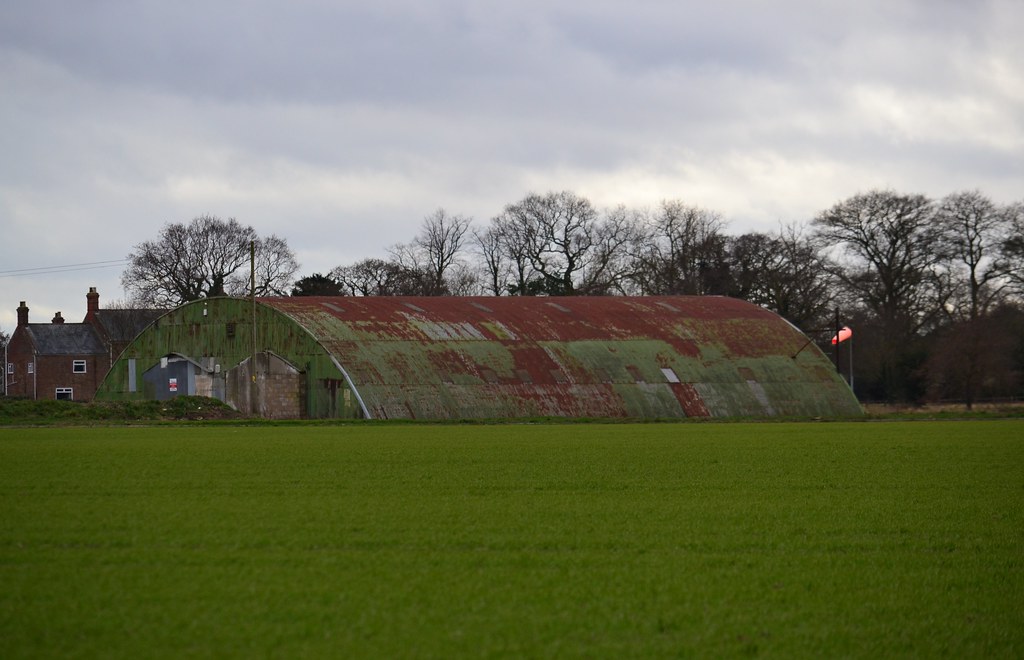
By the time it closed Ludham had developed from a basic satellite station to an airfield in its own right, with the addition of three hard runways, twelve pens, nine hardstands and the addition of (US type) single and double hardstands. It also had one type T2 hangar and four blister hangars – one of which survives today although not in its original location.

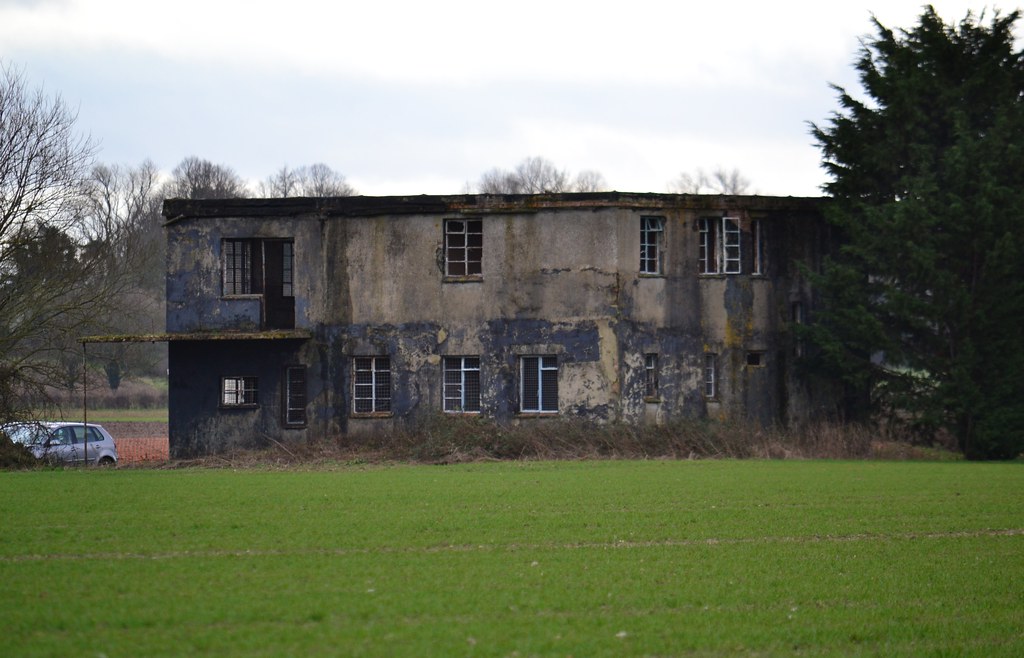
As with many of Britain’s wartime airfields, Ludham returned to agriculture, the runways were dug up and many of the buildings pulled down. Some remained used for agricultural purposes and part of one runway was left, used for crop sprayers and private light aircraft, one of the blister hangars was uprooted and placed on the end of the runway. Those buildings that were left decayed, including the two watch offices. In 2000 – 01, they were restored, and in 2005, Historic England (entry No: 1393540) designated both buildings as Grade II listed, as an “exceptionally well-preserved example of a Second World War control tower.” However, they were both left empty and the inevitable happened again, they began to decay and fall into disrepair once more a state they exist in today*3.

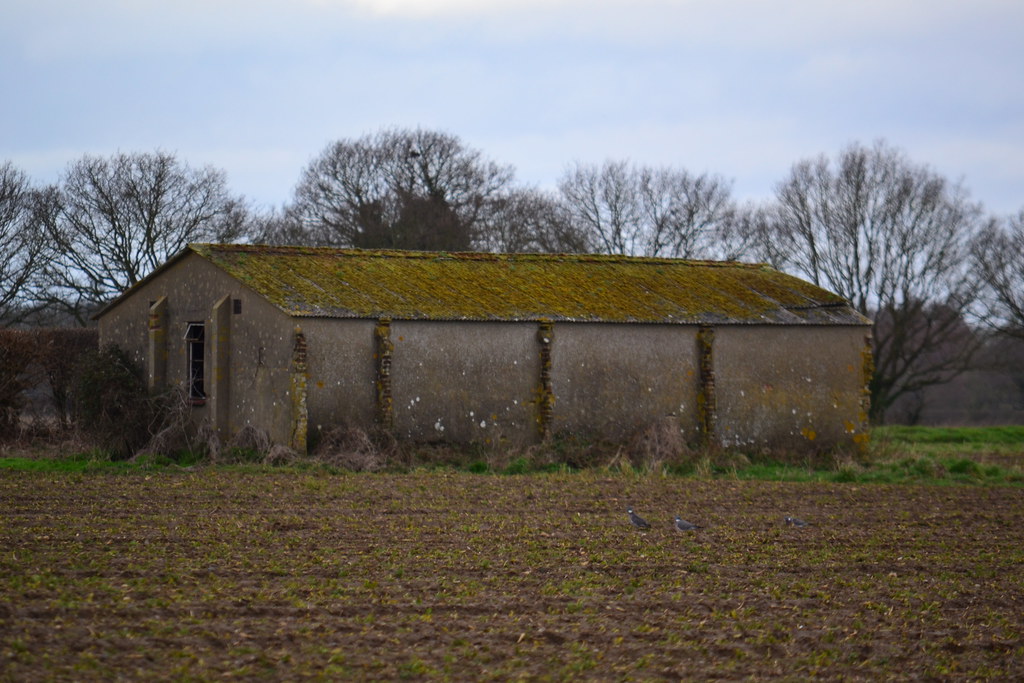
Dotted around the perimeter (a mere track) are a handful of buildings, defensive posts and firing butts, all remnants of Ludham’s once chaotic but meaningful past.

Ludham airfield rests between the villages of Ludham (to the south west) and Potter Higham (to the south east). The main A149 passes to the eastern side and the entire site is circumnavigated by a minor road. From this road, the majority of remnants can be seen, with good views across the entire site. A small private road leads up to the watch offices, and parts of the peri track and runways are still in evidence. Various buildings and structures can be found around this track too, some hidden in private gardens and utilised for storage.

Ludham started out as a satellite airfield, its future seemingly never intending to be major. But, circumstances dictated otherwise, eventually becoming a major player in the front line against enemy shipping, the V2 menace and as a safe haven for returning aircraft, limping home from battles over occupied Europe. If that isn’t sufficient for an entry in the history books, then what is?

The full story of RAF Ludham appears in Trail 58.

Sources and further reading.

National Archives: AIR 27/253/24 
National Archives:AIR 27/2107/15
National Archives: AIR 27/2107/19
National Archives: AIR 27/1164/17
National Archives: AIR 27/1164/14
National Archives: AIR 27/2078/31
National Archives: AIR 27/2080/29
National Archives: AIR 27/4/33

*1 For further information and a detailed explanation of MONAB, including photographs and history, see The MONAB Story – A history of the mobile airfields of the Royal Navy website.

*2 The shooting down of the ‘Humbie Heinkel‘ can be read in Trail 42 – East Lothian, Edinburgh’s Neighbours. 

*3 Historic England Website Listing 1393540

Simpson, B., “Spitfire Dive-Bombers versus the V2” Pen and Sword (2007) – for further information about Spitfires used against the V2 rockets.
Spitfires Galore! – RAF Ludham (Part 2)

In Part 1 we saw how Ludham began its life and how things got off to a slow but steady start, the period April to August 1942 being  pretty much along similar lines, routine patrols, shipping reconnaissances and scrambles. But the autumn signifies the beginning of many changes here at this Norfolk airfield. First however, the resident Spitfire squadron, 610 Sqn, would take part in one of the Second World War’s more famous failures.

Ludham airfield

One of several buildings located around the perimeter of the airfield.

On August 16th, a need arose for fighters to bolster 11 Group for ‘Operation Jubilee‘ –  the raid on Dieppe by allied forces, primarily Canadian. The raid was supposed to achieve a number of objectives, but only one was successful, the main force being held on the beach where vehicles became bogged down in the shingle. 610 Sqn formed part of the aerial umbrella, along with 411 Sqn and 485 Sqn who all jointly formed the 12 Group wing flying from a temporary base at RAF West Malling. On the previous night to the raid, the 19th, ground crews were busy at West Malling fitting long range drop tanks to the Spitfires which according to the ORB, “proved their worth on this occasion“. During the air battle, which raged between the Spitfires, Typhoons and around fifty Me 109s and FW 190s, 610 Sqn claimed two 109s along with one FW 190 as destroyed and two FW 190s as damaged.  Three of 610 Sqn’s aircraft went down, one of the pilots Flt. Sgt. Creagh, being picked up from the sea. Interestingly enough, during this skirmish, pilots noted seeing FW 190s in Italian markings! By 09:30 hrs the squadron had returned to West Malling.

The flight then returned to the skies over Dieppe three further times that day, taking off at 11:20 hrs and then again at 14:00 hrs, each time to cover the withdrawal of shipping. The last evening sortie took off at 17:35 hrs. On the 20th, 610 Sqn flew out to France once again, this time though it was to escort  US bombers returning from the continent, perhaps seeing the carnage left by the disastrous raid the day before.

By the 21st it was all over, and the sixteen aircraft returned to Ludham where they would receive a message of thanks from the AOC 11 Group – Leigh Mallory.

As the squadron were returning to Ludham, so too came a new delivery, the squadron’s first batch of Spitfire Mk.VCs, with three arriving on the 21st and one further aircraft arriving on the 22nd. These were gradually absorbed into flying duties as the squadron returned to normal patrols and escort duties from Ludham. 610’s tally for the month stood at 123 enemy aircraft destroyed and 41.5 probables.

Over September, flights were pretty much routine once more, then October arrived and Ludham became frantic again. On the 8th, a road party was sent as advanced party to Biggin Hill with a view to taking part in a “Hush-Hush” operation. Unfortunately the operation was cancelled just prior to the party’s arrival, and they had to return to Ludham somewhat disappointed; road and rail transport being provided for the next morning.

That day also saw 610 Sqn Spitfires provide withdrawal cover for “over 100 Fortresses”, which at the time was a “headline” mission, this being the largest daylight raid of the war so far. The incredible sight of this massed formation would be dwarfed in comparison by the wars end with formations consisting of 1,000 aircraft or more, in a stream that lasted for what must have seemed forever.  Whilst enemy aircraft were seen in this first momentous occasion, there were no claims of ‘kills’ or ‘probables’ made by pilots of Ludham’s 610 Sqn.

By now, rumours of another move were circulating widely, hopes for a move south nearer to the action were dashed, when signal O2OB, dated 11.10.42, came through instructing the squadron to move to Castletown, near Caithness in Scotland – the opposite end of the country to where they wanted to be.

The move was to take place on the 14th October, and would be a direct swap with 167 (Gold Coast) Sqn, yet another Spitfire VC squadron. The airlift of 167 Sqn was late in arriving, meaning that many men were left ‘Kicking their heels” at Ludham, so a number headed to Norwich and a little light entertainment at the cinema. The transfer then happened on the next day, the 15th, with many of the pilots suffering sickness on the way up, thought to be due to the poor weather. Now 610’s link to this small Norfolk airfield was broken, and a new link in Ludham’s chain of history would be forged – a new squadron had arrived.

167 Sqn stayed at Ludham for five months, after which they took part in exercise ‘Spartan‘, a twelve day posting first at Kidlington and then Fowlmere, before returning to Ludham on March 13th, 1943. Exercise Spartan was a prelude to D-day, a huge military exercise that took place in southern England as a practise for the allied offensive across Europe in June 1944. Like Operation Jubilee, it consisted heavily of Canadian units, and also like Operation Jubilee, there were many shortcomings, the result of which was the loss of Command for three Canadian Generals.

A further short two month stay at Ludham then saw 167 Sqn depart in May for good. This left the Norfolk airfield to the only Typhoon squadron to use the base – 195 Sqn.

Formed in November 1942, 195 Sqn had formed at Duxford, transferring to Hutton Cranswick where they were assigned their Typhoons. A further move to Woodvale then brought them to Ludham where they would stay until 31st July 1943.

Ludham airfield

The second Watch Office also in a very poor state of disrepair.

On arrival at Ludham the squadron was immediately confirmed as operational, and on the 15th May 1943, the very day the operational  notice came through, Sgt. R.A. Hough spotted an Me 109f bombing Southwold. He engaged the enemy shooting him down into the sea, the squadrons first confirmed kill of the war.

With four more Typhoons arriving on the 20th, the squadron was in good spirits and eager to get on. But like their predecessors before them, their month consisted of patrols, practice scrambles and training flights some of which included the squadron’s Hurricane (7778) and Tiger Moth (209). By the end of the month, the Ludham unit had made 362 flights, most as patrols or as training flights. June was similar, the lack of contact frustrating the pilots; a note in the ORB saying “Patrols carried out dawn to dusk, 12 operational sorties being flown, but the Hun wouldn’t play“. The highlight of the day was perhaps the darts match against the local Home Guard, the Home Guard winning that night! As the month progressed, the squadron began to venture further afield taking on trains and oil storage facilities on the continent, scoring many hits and receiving flak damage as a result. On the 8th July the squadron suffered its first Ludham fatality when Flt. Sgt. F. Vause hit the ground in a low flying exercise. A talk by Sqn. Ldr. Taylor reflected the sentiments of the unit when he said they had lost a “Damn good pilot”. He went on to stress the low flying rules.

The end of July came and notification to depart Ludham for Matalsk, and a share of the airfield with 609 Sqn. There was some regret withe the more ‘romantic’ types of the squadron and due honours were paid to Ludham on that last night of the 30th July.

The last Spitfire squadron before Ludham left RAF control was 611 Sqn, with their Spitfire LF VBs. This was a short stay lasting only until August 4th, when they were told to move to Coltishall as Ludham was being closed down in preparation for transference to the USAAF. After one sortie at Ludham the move went ahead on the 4th, but it was not overly welcomed as Coltishall was already busy and accommodation was cramped.

With that, Ludham was closed, and the airfield was taken over by the Air Ministry (Works) whereupon construction work began on three new concrete and tarmac runways, a project that would take a year to complete. During this time new hardstands were installed – a mix of (17) double and (18) single types using pierced steel, some of these were located outside of the perimeter, and a small maintenance unit took care of the running of the airfield. A new two storey watch office was built with the original being re-purposed.

Designated Station 177, Ludham was never actually occupied by the Americans though, even though all the upgrade work had been completed, it remained firmly deserted apart from a small maintenance unit who oversaw its use.

Instead, it was decided to use Ludham as a dummy airfield and emergency landing ground for returning aircraft. A decision that was partly made for them as heavy bombers returning from daylight missions over occupied Europe would often come in over this part of East Anglia, and Ludham was the first airfield they would come across. Because of this, Ludham would see some eight B-17s, a B-24, one P-47, and a P-38 aircraft have to either crash or make emergency landings at Ludham or in the immediate vicinity.

The first to make use of the airfield in this way occurred on October 8th, 1943 barely a month into the airfield’s upgrading. A B-17F #42-3393  “Just-A-Snappin” was badly damaged over Bremen. The aircraft, piloted by Capt. Everett Blakely, made it back to England crossing the Norfolk coast east of Ludham. The aircraft had sustained severe damage from flak, the Number 4 engine, the hydraulics and the brakes all being put out of action. The aircraft made an emergency landing at Ludham crashing into a large tree causing further damage to the air frame. It was salvaged a few days later. This particular aircraft had only been assigned to the 418th BS at Thorpe Abbots, part of the Bloody Hundredth, in the July. It also went under the name of  “Blakely’s Provisional Group” and ”Did You Say Ten Cents?“, the multitude of names causing confusion in a number of references.

Part of a door cover from P-38 Lightning named

Part of door cover retrieved from wreckage of P-38H5LO #42-67053 ‘CY-L’, flown by Lt. Goudelock on December 13th 1943. The aircraft crashed in Ludham after flying for 375 miles on one engine (IWM FRE 158)

A second aircraft would attempt to use Ludham as a safe haven not long after this. On the 13th December, 1943 P-38H #42-67503 of the 55th FG, 343rd FS, “Vivacious Vera” piloted by First Lt. Hugh J. Goudelock, sustained damage to one engine whilst escorting bombers also over Bremen. After nursing the aircraft back to Britain he attempted a landing at Ludham when, suddenly, the second engine gave out. This left the P-38 powerless, causing it to crash in Ludham, the pilot sustaining only minor injuries. The strength of the P-38 having brought the pilot back for 375 miles on a single engine,

A similar story was repeated on December 23rd when B-17F #42-3273 “Impatient Virgin” crashed at Potter Heigham, another village only a stones throw from the airfield, while attempting to land at Ludham following damage it received over Munster. A sudden loss of power meant the aircraft had to put down in a field rather than on the airfield, all ten crewmen luckily returned to duty and the aircraft was salvaged.

B-17F “Impatient Virgin” #42-3273 of the 95th Bomb after crashing at Potter Heigham near to Ludham airfield. (IWM FRE 3903)

December had certainly been a busy month for Ludham, even though officially it was closed to flying, it had more than proved its worth as an emergency landing ground.

The work continued at Ludham and eventually, in August 1944, it was complete. By then though the US forces had decided against using Ludham and it was handed over to the Royal Navy (RN).

In the concluding part we saw how the Royal Navy fared at Ludham and how eventually Spitfire squadrons return. The V2 becomes a menace to be dealt with and then the war comes to a close and Ludham’s future is decided.

The full story of RAF Ludham appears in Trail 58.

Spitfires Galore! – RAF Ludham (Part 1)

In this second part of Trail 58, we leave Rackheath behind and head east towards the coast of East Anglia, and an area known as the ‘Broads’. A few miles across this flat and wetland we come across a small airfield, currently used by crop sprayers and small light aircraft. This private field, almost indistinguishable from the farming land around it, just hints at its past, with two rundown towers, a blister hangar and a small collection of pathways, its history is fast disappearing.

In this the last part of Trail 58 we visit the former RAF Ludham.

RAF Ludham (Station 177, H.M.S. Flycatcher, RNAS Ludham).

Ludham is a small airfield that has been in existence since September 1941, when it opened as a satellite for RAF Coltishall located a few miles to the north-west. It would change hands on more than one occasion over the next few years, being assigned to the RAF, the USAAF and the Royal Navy before returning to RAF ownership once more.

Throughout this time, it would operate as a fighter airfield seeing  range of Spitfire Marks along with a Typhoon Squadron. A number of B-17s would crash here as would a P-38 lightning and several other USAAF aircraft; part of Ludham’s history being that of an emergency landing strip for returning aircraft.

At its inception, Ludham was a grassed airfield, with a hardened perimeter track linking a number of dispersals. Being a fighter airfield the perimeter was only 40 feet wide but of concrete construction, thus it was not designed for the larger, medium or heavy bombers of the allied air forces.

Furthermore, as a satellite, Ludham lacked the design features of a major airfield, and so the accommodation and technical facilities were not up to the same standard of those found on other sites. The accommodation huts were scattered around the north-western side of the airfield, and an initial single storey watch office was also built to the west. A standard wartime design for satellite airfields (design 3156/41), it was a single-roomed structure with a pyrotechnic cupboard and limited views. A switch room was then added to the building (design 1536/42) in early 1942, before the entire building was abandoned and a new twin storey watch office built. As with most airfields of this type, the twin storey building was constructed in conjunction with the addition of the concrete runways. This new office  (design 12779/41) with lower front windows (343/43) would have many benefits over the original not least better views across the airfield site.

Ludham airfield

The much dilapidated original Watch Office.

Another interesting, but not unique feature of Ludham, was a Modified Hunt Range, a structure designed to teach aircraft recognition. The structure, built inside a Laing Hut, saw the trainee sat in front of an enormous mirror. A moving model was then placed behind the student on an elaborate turntable that could not only move in the horizontal plane, but both turn and bank. A selection of lights and a cyclorama added to the realism, with the model reflected in the mirror in front of the student. The combination of all these features provided the students with life-like conditions, thus recreating the same difficulties they were likely to find in combat situations.

For much of its early life, Ludham was used as a satellite of Coltishall, although many of its squadrons were based here from the outset. The primary aircraft seen here was Supermarine’s magnificent Spitfire, the first of which was the MK.VB of 19 Squadron.

19 Sqn had only had this mark of Spitfire since October, previously operating the MK.IIA at RAF Matlask not far from here on the north Norfolk coast. The Mk V was the most produced Spitfire of all 24 marks (and their sub variants) and was armed with a combination of machine gun and canon depending upon which wing configuration was used. The link between the Spitfire, Matlask and Ludham would be a long one, with units moving from one to the other. forging a bond that would last the entire war.

Arriving in the opening days of December 1941, 19 Sqn immediately began carrying out patrols and bomber escort duties over the North Sea, a duty they had been undertaking whilst at Matlask. On several occasions they would fly out to meet incoming Beauforts and their escorts, after they had completed their anti-shipping missions along the Dutch coast. Daily flights would take: Red, Green, Yellow, White, Black or Blue section, each containing two aircraft, over Lowestoft and Great Yarmouth and around the coastal regions of the Norfolk / Suffolk coastline.

However, most of these encounters produced little in the way of contact – even when pilots were directed onto the enemy aircraft. On the 9th, P.O. Halford and Sgt. Turner were vectored onto an intruder, but neither aircraft saw, nor encountered the ‘bandit’, and they returned empty handed. Another two scrambles that same day by ‘Green’ and ‘Black’ sections also proved fruitless, although ‘Black’ section did manage to locate the aircraft which turned out to be a friendly.

Ludham airfield

An original Blister hangar now located on the former runway.

Other duties carried out by 19 Sqn included shipping reconnaissance flights, shadowing and monitoring shipping movements across the North Sea, particularly along the Dutch coast. Taking off at 11:20 on December 18th, F.O. Edwards and P.O. Brooker flew at zero feet across the Sea to Scheveningen where they spotted a convoy of 11 ships. One of these was identified as a flak ship protecting the convoy as it left for open waters. The pair then turned north and flew along the coast to Yumiden where they encountered three more ships. No enemy aircraft were encountered and the pair returned to Ludham to file their report.

Then on Christmas Eve, P.O.s Vernon and Hindley in ‘Blue‘ Section were tasked with a ‘Rhubarb‘ mission to attack the aerodrome at Katwyk. On route, they came across a convoy and two Me. 109Es, who were acting as escort / cover for the ships. The two Spitfires engaged the 109s, Blue 1 getting a two second canon and machine gun strike on one of them at 300 yards range. Black smoke was seen coming from the fighter which dived to the sea only to pull up at the last minute and head for home. Blue 2  engaged the other enemy aircraft, but no strikes were seen and the German pilot broke off also setting a course for home. The two Spitfires then engaged the convoy attacking a number of vessels, each pilot recording strikes on the ships, claiming some as ‘damaged’. After the attack they returned home, this leg of the flight being uneventful.

These events set a general pattern for the next four months, and one that would become synonymous with Ludham. Then, on April 4th 1942, 19 Sqn would move to RAF Hutton Cranswick, in the East Riding of Yorkshire, a direct swap with 610 Sqn who had been stationed there since the January.

Also during this time a supporting squadron had also been at Ludham, 1489 (Fighter) Gunnery Flight, (formerly 1489 (Target Towing) Flight) which had moved in to help prepare fighter pilots for air-to-air combat. Around the time that 19 Sqn departed Ludham, 1489 Flt also departed, also going to Hutton Cranswick with 19 Sqn where they were disbanded in 1943.

610 Sqn were another Spitfire squadron also operating the MK.VB at this time. They too got straight back into action carrying out the patrols undertaken by 19 squadron before them. No engagements were recorded until the 8th, when what were thought to be two ‘E’ boats were sighted but not engaged.

The remainder of April was much the same, several convoy escorts, reconnaissance missions along the Dutch coast and scrambles that led to very little. On the 27th two Spitfires did encounter and Ju 88 which they shot down, the crew from the Ju 88 were not seen after the aircraft hit the water. On the next day, ten Spitfires took off between midnight and 01:05 hrs to patrol the Norwich area. Here they saw green parachute flares, and flew to intercept. Sticks of bombs were then seen exploding in the streets of the city, and various pilots engaged with Do 217 bombers. Strikes were recorded on the enemy aircraft, but they were lost in smoke and they could not be confirmed as ‘kills’. Further attacks occurred again on the 29th and again strikes were seen by the RAF pilots on the enemy intruders.

The period April to August was pretty much along similar lines, routine patrols, shipping reconnaissances and scrambles.  Then in mid August, 610 Sqn would take part in one of the Second World War’s more famous failures.

Ludham had a mainly uneventful entry to the war, sporadic scrambles, intermittent contacts and many hours of training, its future looked secure. But, there were many changes ahead and many events that would put it firmly on the map of history.

In Part 2 we see how these changes affect Ludham and its future.

The full story of RAF Ludham appears in Trail 58.