Fleet Air Arm Memorial, London

The Fleet Air Arm memorial, on the banks of the Thames, is one of many that stand together at this spot. The Battle of Britain, the Korean War and Royal Air Force memorials all being in very close proximity, outside the Ministry of Defence building in Victoria Embankment Gardens.

Forming one of many Fleet Air Arm memorials across the country, it joins others such as those at that the National Memorial Arboretum and Lee on Solent.

A more modest memorial, this one was designed by the architect James Butler RA, who has created a number of other statues and monuments in and around London. 

Initially, the figure looks like an angel, but is thought to resemble Daedalus, the Greek inventor –  father to Icarus, who flew too close to the sun and fell to his death.

The statue, which was unveiled on the 1st of June 2000 by his Royal Highness The Prince of Wales, stands looking down, perhaps Daedalus watching his son fall from the skies. Crafted with a pilot’s body and flying suit, but with the bare arms of a ‘God’, it wears a fallen oxygen mask that reveals a face with a look of horror, as if witnessing some awful event beneath.

The winged guardian stands on a single stone column that protrudes from a boat-like base, around which are engraved the names of the many conflicts and battles that the Fleet Air Arm have been involved in. Ranging from 1914 right up to modern conflicts such as the Falklands and the Gulf War, it shows how important the Fleet Air Arm has been to both the safety of this nation and world peace in general.

There are further inscriptions around the other sides of the base. On the front, in gilded letters, are the words ‘Fleet Air Arm’, with the crested insignia, and to the side the words:

‘To the everlasting memory of all the men and women from the United Kingdom the British Commonwealth and the many Allied Nations who have given their lives whilst serving in the Royal Naval Air Service and the Fleet Air Arm’.

Also on the base is a quote from Psalm 18:10, “He rode upon a cherub and did fly yea he did fly upon the wings of the wind”.

One of many memorials standing at this location, the Fleet Air Arm winged  guardian, watches closely over the crowds below, standing as a tribute to those who gave their lives and whose bodies now rest in the deep waters of the worlds oceans.

London Feb 2015 026

The Fleet Air Arm Memorial on a wet and windy day in February.

Other ‘major’ memorials can be found here, with specific airfield memorials here.

Trail 20 – RAF Docking, a satellite that became an airfield in its own right.

RAF Docking

RAF Docking (also known as RAF Sunderland after the farm it took over) was originally built as a satellite for nearby RAF Bircham Newton. As one of many dummy airfields in this area, it saw an unusually high level of activity.

Looking across and along what would have been runway 3 at Docking.

Looking across and along what would have been runway 3 at Docking.

Docking had 3 grass runways one each of 1,730 yds, 1,400 yds and 1,100 yds (all extendable) it also had 8 blister hangars, 1 x A1 hangar and accommodation for 789 RAF personnel and 92 WAAFs.

Located to the East of Docking village, it was a ‘K’ site during the day and a ‘Q’ site at night. Dummy aircraft and false buildings would be used along with flarepath lighting to guide enemy bombers away from major nearby targets; it was quite successful in this role being bombed on a number of occasions.

Northern Peri Track

The northern side of the peri track. The bomb store is behind and slightly to the south.

Docking became a dispersal site for RAF Bircham Newton, and often took aircraft returning during the hours of darkness. They would remain here and then be transferred home the following day. As it grew, it took more and more aircraft, eventually becoming an airfield in its own right to the point that it had its own satellite which became RAF North Creake.

Many of the airfields in this area, participated in the anti-shipping role under the control of Coastal Command.  A small number of larger aircraft based with RAF squadrons, having with their longer range and larger bomb loads, were also based here and used to attack targets in Holland. A wide range of aircraft both visited and were stationed here at Docking, Avro Ansons, Lockheed Hudson and even Gloster’s Gladiators graced the grass field. In fact the range was so vast, (ranging from the iconic biplanes, Swordfish and Albacore to the larger Wellingtons, Whitley and Hampdens to the more modern Spitfire and Mosquito) that there are simply too many to mention with any real accuracy.

Movements in and out of Docking were frequent, but, many units were here at some point officially, these included: 53, 143, 221, 235, 241, 254, 268, 288, 304, 407, 415, 502, 521 and 524 RAF squadrons. With so many movements, it is hard to believe so little exists about its history or photographs of its activity.

Crew quarters

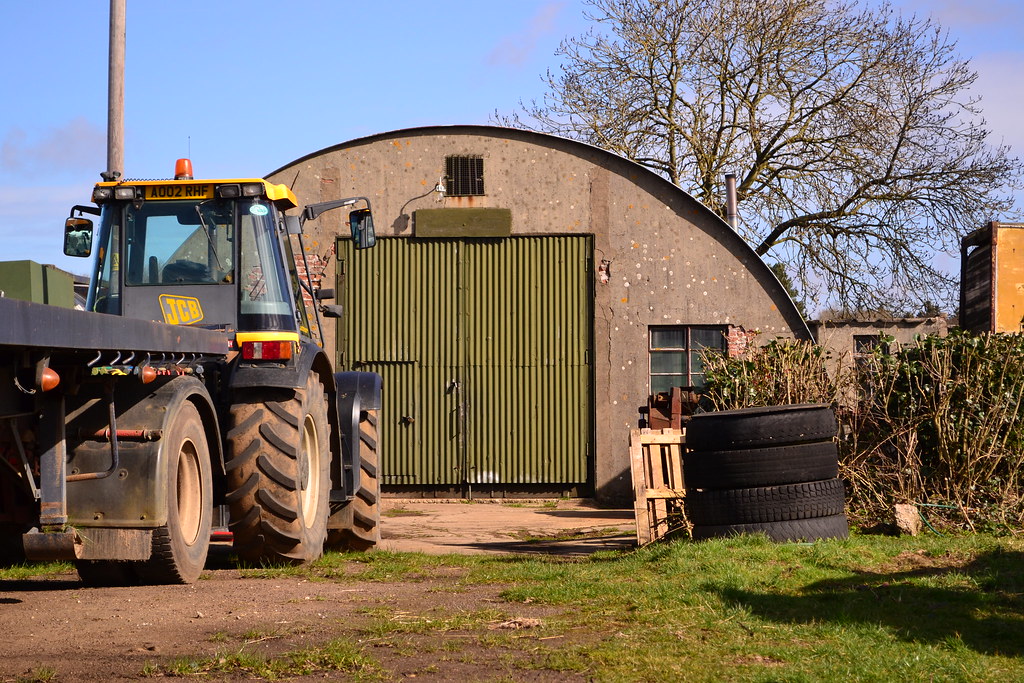
One of the crew huts now a storage unit, once housed pilots and latterly, local families.

Undoubtedly, the most significant contribution by Docking was that of meteorological reconnaissance, preparing weather reports for returning bombers and reports for forthcoming mission and the like. Many of these operations involved flying up to altitudes as high as 40,000 ft, taking measurements every 5,000 ft and reporting back. They would fly in set zones around the UK, Docking’s aircraft focussing on an area between Norfolk and Wick in Scotland. These sorties were codenamed ‘RHOMBUS‘, some from the west coast flying out deep into the Atlantic and some as far north as Iceland. Later on, these flights codenamed ‘PAMPA’ would involve flying deep into enemy territory to ascertain weather conditions over the target area in advance of a forthcoming bombing raid. Performed by Spitfires and latterly Mosquitos, these were often very dangerous with many crews failing to return.

Docking had its fair share of accidents. One such unfortunate incident on 10th october 1943, saw a Docking based Handley Page Hampden crash on take off, three of the crew members being killed in the ensuing fireball, whilst two others escaped – Sgt. J. Alloway and Flying Officer J. Maxwell. Alloway was severely burned and became one of ‘McIndoe’s’ army later known as the ‘Guinea Pig Club‘.

feathestone cropped

F.O. H Featherstone was killed when the HP Hampden he was in crashed.

A number of other crashes, many in extremely poor weather, paid a toll on the crews, these are all talked about in detail in David Jacklin’s book so I won’t dwell here. One that is worth a mention is that of Flying Officer H.E.M. Featherstone (41275), 206 Sqdn., Royal Air Force who died on 1st January 1941, Age 27 when the aircraft he was in crashed killing him and seven other crew members. Featherstone’s grave is found in the nearby war cemetery at Great Bircham.

Another ‘noteworthy’ mention is that of Pilot Officer A.L. Kippen (407 Sqn RCAF) who was killed on 16th May 1942. Kippen, (J/7208), an Air observer, was killed when the badly damaged Lockheed Hudson he was in, crashed on its approach to Docking hitting an anti-aircraft gun pit killing the occupants. He too is buried in the nearby church. What makes Kippen’s death so significant, is that just eight days earlier, his sister had sent him a poem, this poem now stands beside the headstone on a plaque.

PO Kippen killed at RAF Docking

P/O A Kippen, Whose Poem from his sister sits at the foot of his headstone.

Meteorological reconnaissance was not the only role played by Docking. Air Sea rescue were responsible for saving a number of downed crews, mine laying, anti-submarine missions and attacks by the Polish 304 Sqn RAF in the ‘1000 Bomber’ raid on Breman all form part of its rich tapestry. Even though it was a grass airfield, it became a refuge for many returning ‘heavies’, Lancasters, Halifaxes and even Stirlings found Docking a safe haven. On one day alone, 17th January 1944, a total of five Lancasters who had run out of fuel managed to land safely on its grass tracks. A number of B-17s also tried to land at Docking, but believing it to be a much longer runway, they ran off the end forcing their undercarriage to collapse in an adjacent ploughed field.

Toward the end of the war, Docking was used less and less operationally and eventually became a ‘demob’ centre for crews. Many faces were to pass through, including Richard Burton and Mick Misell (aka Warren Mitchell/Alf Garnet for those who watched British TV!). Robert Hardy (All Creatures Great and Small) another British TV actor was also here with Burton, as was Danny Blanchflower (Tottenham and Norther Ireland footballer). With little to do, these particular crew members were often in trouble, fights, vandalism and fraternization with the locals led to many a run in with the law.

Gas Decontimination building

A gas decontamination building.

After the war had ended, Docking was used as emergency housing for the locals, many stories are told by David in his book and indeed he was one of those souls who had to brave the cold and ‘misery’ of a Nissan hut in winter.

With such a ‘distinguished’ history, RAF Docking is one of those airfields that has managed to fade into the past. Little now remains of its existence. Being grass, there are no runway remains or even an indication of a runway. The perimeters being concrete now form the eastern road that pass along side the site, being single track it is considerably smaller today then it was in the 1940s. At the top of this road, where the track swings west, is the former bomb site. Now a ploughed field, its wartime existence totally masked.

The new Docking memorial.

The new Docking memorial.

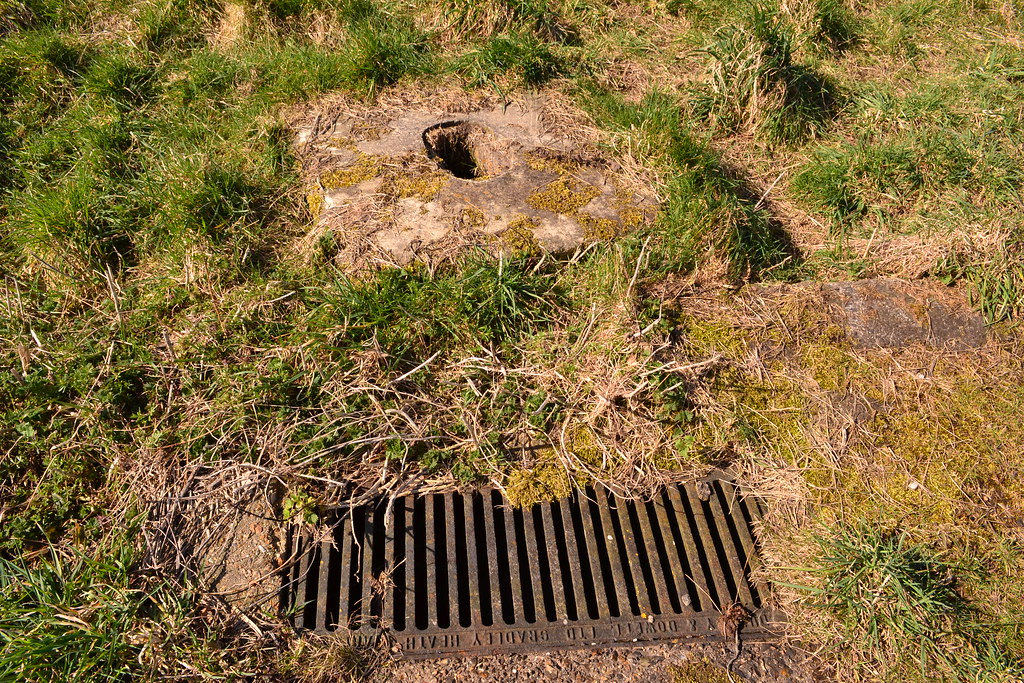
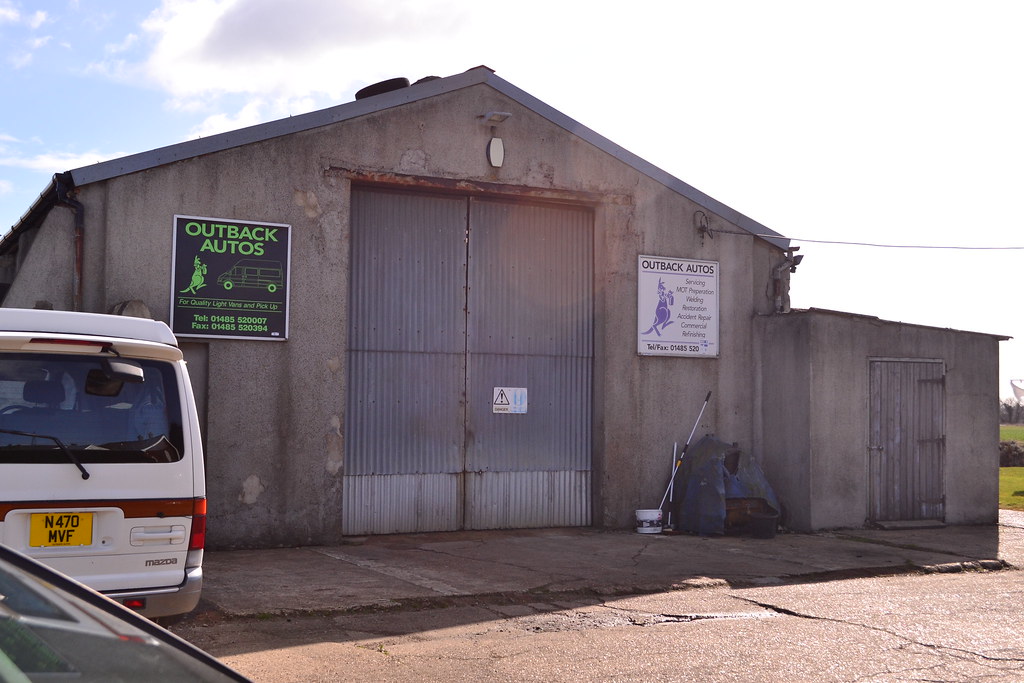
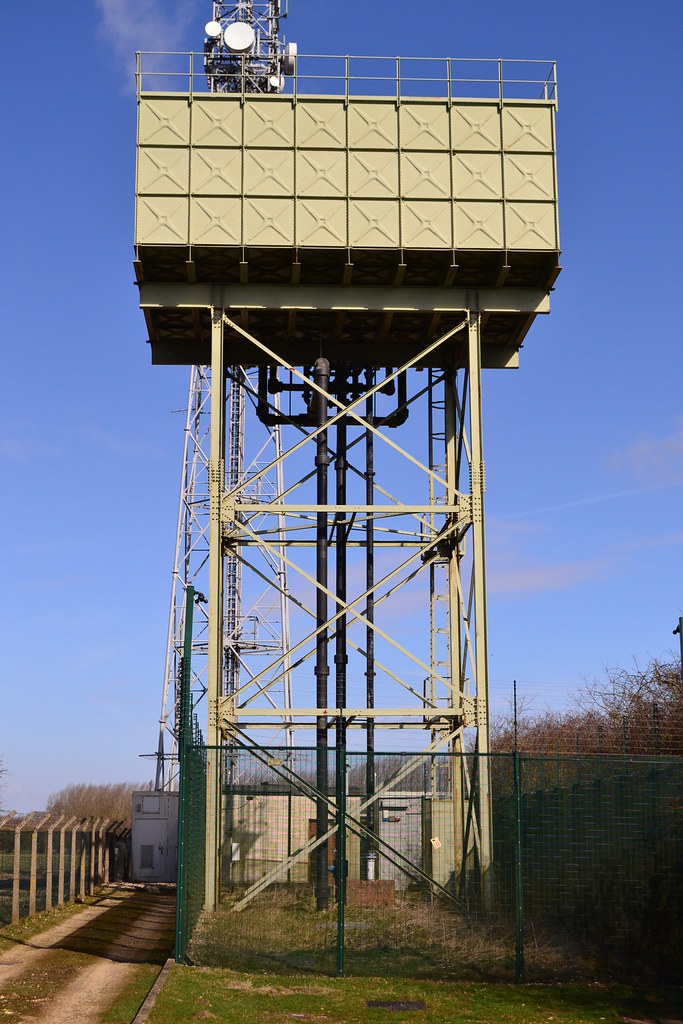
To the West of the site, the main road (B1154) passes through what was the admin and technical sites. A single crew hut stands in a field marking the location of the airmen barracks. Further along, the road forks, and to the left would be a further domestic site housing crews in more Nissan huts. The triangular coppice that stands in the middle of this fork, still retains, in a very dilapidated state, the gas decontamination centre and the emergency electrical supply, the stand-by set house. Both these are in a very poor state and now house disused agricultural machinery. Careful observations amongst the bracken and undergrowth reveals entrances to underground shelters, four entrances in total. These have been blocked and partially filled by the farmer to prevent access. Further along the right fork, would have been to the left, the WAAF site, to the right, the water tower along with further domestic units. All traces of these are now sadly gone.

Original watch tower

The original watch tower watches over crops rather than departing aircraft.

Newly created on this fork, is a memorial to those who flew from Docking, beautifully crafted in black, it over looks the airfield to the east. From here, a small pill-box can be seen amongst the hedgerow, and with permission, it may be accessible and could be one that was damaged when hit by an HP Hampden.

The entrance to the rebuilt Sunderland farm is also along here. This led to the A1 hangar, again now gone, and on through to the centre of the airfield to where the watch office still sits. Used for storage, again with permission it may be accessible. A number of smaller buildings are still evident here too and many can just be seen between the hedgerows, from the public highway.

pill box

A Pill Box remains hidden in the hedgerow.

When visiting Docking, it is strongly recommended that you visit the War Cemetery at St. Mary’s Church, Great Bircham, which includes 11 German war graves and a Cross of Sacrifice unveiled by King George VI on the 14th July 1946. These graves highlight the sacrifice of these men who flew in poor weather for the benefit of their more famous counterparts, the bomber crews. The high number of graves here and the stories that can be told, all reveal a rich tapestry of valour, bravery, sadness and loss that for a decoy station certainly earned its place in history.

War Graves Cemetery - St Mary's Great Bircham

War Graves Cemetery – St Mary’s Church, Great Bircham, includes 12 german graves.

Trail 20, takes a tour round North Norfolk, an area of natural beauty, where many of its airfields are remain intact, but are slowly succumbing to the bulldozer.

Please see Trail 20 for further reading and references.

A new parking area for the 384th BG memorial Grafton Underwood

Following many months of lobbying, letters and phone calls, a friend of mine, whom I met whilst trailing ‘American Ghosts‘, has finally secured and had built, a new parking area adjacent to the Memorial of the 384th BG at the former airfield, RAF Grafton Underwood (Station 106).

Kevin Fleckner, has maintained the site for some considerable time, which is located on the former airfield at the end of the 6000ft long, No.1 runway, part of which can still be seen in front of the memorial today.

Kevin’s next aim is to get both the ‘Stars ‘n’ Stripes’ and the union Flag raised once more, something that has not happened since the end of hostilities, 70 years ago.

The parking area is now tarmac, with top soil, seed and bollards placed to repair damage done by tractors and other road traffic.

It is accessible by wheelchairs and is a superb memorial, paying tribute the many men and women who served at Grafton Underwood during the Second World War.

My congratulations and thanks go to Kevin, for his dedication and for all the hard work he puts in maintaining the memorial on behalf of us all.

Well done buddy!

Grafton memorial

Grafton memorial

DSC_0127

The remains of the No.1 Runway

The memorial is bottom left by the road.

The memorial is bottom left by the road.


DSC_0115

The Church memorial window dedicated to the 384th BG


Royal Air Force Memorial, Embankment, London

London has many stunning memorials and monuments scattered about its streets and gardens. The Royal Air Force memorial is just one of many visited over recent months.

London Feb 2015 024

The Royal Air Force memorial stands on the Embankment overlooking the Thames.

The Royal Air Force memorial is located on the banks of London’s River Thames, between Embankment and Westminster tube stations.

Overlooking the river, it was designed by Sir Reginald Blomfield, sculpted by William Reid Dick, and  completed on 13th July 1923.

The memorial consists of a bronze globe on which stands a gilded eagle with its wings spread as if about to take off. The main tapering column is of Portland stone and this forms the official Royal Air Force memorial.

The initial idea for a memorial was raised by Maj.Gen.J.M.Salmond, in a letter to the Air Ministry on 27th November 1918. Following this a committee was set up and discussions continued around the raising of funds and more importantly, how it should be spent. The leads in this committee were Air Chief Marshal Sir Hugh Trenchard and Lord Hugh Cecil. Eventually, on 21st January 1920, an appeal was launched with an article in the Times newspaper and the money gradually gathered.

There then followed many discussions about a suitable location for the memorial and eventually, the current location was agreed and permission given for its erection. The Architect, Sir Reginald Blomfield, decided upon William Reid Dick as the sculptor, plans were drawn up and building work started.

London Feb 2015 003

A Bronze gilded Eagle stands as if about to fly.

It wasn’t until 16th July 1923, that the memorial would be both finished and unveiled. In the presence of Sir Hugh Trenchard, and many other dignitaries, the Prince of Wales gave a moving speech highlighting the sacrifice of those who gave their lives in this new form of warfare.

Following the Second World War, further inscriptions were added and the updated memorial unveiled by Lord Trenchard on Battle of Britain Sunday, 15th September 1946. The tradition of placing a pilot’s brevet shaped wreath at its base has continued ever since.

There are a number of inscriptions around the column and base, each one referring to the dedication and loss of the men and women from the entire British commonwealth who gave their lives in both World Wars.

Even on a wet winters day, this is a stunning memorial and a beautiful tribute to those brave people.

London Feb 2015 028

The Eagle looks across the Thames to the London Eye,

For more information about its history go to the RAF Benevolent Fund website here. A pdf is available.

Other major memorials appear in the blog here and for specific airfield memorials here.

As Heard on the BBC: RAF Kings Cliffe – Time is Running Out!

We recently published a post highlighting the proposed development of the former RAF Kings Cliffe airfield (Trail 6), and in particular the Glenn Miller Memorial located at Jack’s Green, which is part of Rockingham Forest in Northamptonshire, England (post 6/1/15).

IMG_2285

The memorial and hangar base where Maj. Glenn Miller played his last hangar concert on 3rd October 1944.

The proposal, by the land owner/developer, Philip Ashton-Jones, states that a ‘caravan site’ with access and associated buildings would be built on part of the former airfield. This outlined plan includes the location of the memorial on the hangar base where Maj. Glenn Miller performed his final hangar concert (3rd October 1944) before his mysterious disappearance over the English Channel in December that year.

Whilst promoting the issue, Marcella, contacted John Griff at BBC Northants, who in turn asked for an interview on the Stuart Linnell Breakfast Show. Living in the U.S., this would prove interesting as there is a time difference of 5 hours. However, a suitable time was agreed and arrangements made for a pre-recorded rather than live interview.

The proposal has, unsurprisingly, been met with resistance from the local community. Some of the issues include: impact on local property and the current roads around Kings Cliffe which pass a quarry and lead to the back of Kings Cliffe village. The roads are very narrow, and unsuitable for high levels of traffic. The area is relatively high up and gives great views of the surrounding countryside, a reason why it is used by walkers, horse riders, cyclists etc. Furthermore, there is a wide range of wildlife including a herd of  deer that roam freely through the forest – it is indeed an idyllic area of pristine and natural beauty.

Of course there is the NIMBY aspect, no one wants a holiday village in their back garden. There are fears of ‘development creep’ and damage to the local finely balanced ecosystem. To Aviation Trails, it is not only the environment, but it the future of the Glenn Miller Memorial that is at stake, as are the remains of the airfield where so many brave young men, who gave the ultimate sacrifice, flew from during the Second World War.

The BBC broadcast both sides of the debate, including an interview with the landowner/developer, Mr. Philip Ashton-Jones, who slipped into admitting it was not caravans but 55 ‘luxury lodges’ that are being proposed. This was one of several ‘suspicious’ actions, along with the time at which the planning application was made public (i.e. prior to the Christmas holiday when the planning offices were closed), that caused some concern. This action reduced the amount of time objectors had to raise their concerns.

We feel these issues and the memorial in particular, are an important part of our shared British and American history. RAF Kings Cliffe comes from an era that changed the world, and Maj. Glenn Miller was a man whose musical talents helped shape and develop popular music for years to come.

These ancient forests are now delicate ecosystems, the memorials, rapidly disappearing monuments to past generations and Anglo-American heritage. Both need protection from permanent and sustained damage.

The BBC site has the various interviews available through their website, (links are valid for 30 days from the 9th February 2015 – but may be available on archives). They are for entire shows, but we have noted the timings of the relevant parts.

The BBC news website article can be found here.

A facebook page here, anyone can access this.

The radio interview with Marcella can be found here at 1:39:20

The interview with Ian Sharpe and Mr Philip Ashton-Jones can be found here at 2:39:15

A further report from the site can be found here on the John Griff show at 1:15:30

A big thanks also goes to my good friend, Kevin Fleckner, who wrote in support of the memorial.

As an additional note, there is also talk of development on the nearby RAF Deenethorpe site, another Northampton historical site likely to disappear. See the BBC report here.

Andy Laing and Marcella Beaudreau

Sgt. Archibald Mathies, USAAF, RAF Polebrook (Medal Of Honour)

Staff Sgt. Archibald Mathies (U.S. Air Force file photo)*1

Born in the Scottish town of Stonehouse, South Lanarkshire, on the 3rd June 1918, Archibald (Archie) Mathies was to become a Second World War hero. He was awarded the Medal of Honour (MOH) for his actions whilst at RAF Polebrook (USAAF Station 110) in Northamptonshire, England.

It would be on the 20th February 1944, shortly after arriving at Polebrook, that he would earn this honour but his life would be dramatically cut short.

Not long after his birth in Scotland, Mathies moved with his family to the United States, to a small town in Western Pennsylvania called Finleyville, in Washington County.

After leaving school, he began work in a local coal mine. The work was hard, and the pay was low; Mathies was not inspired. Then, following the Japanese attack on Pearl Harbour, as many other brave young American men did, he joined the Army, enlisting in Pittsburgh on the 30th December 1940. Mathies would transition through a number of stations and training centres before finally completing a course in aerial gunnery on the 22nd March 1943. His last U.S. posting was to the 796th Bombardment Squadron at Alexandria, Louisiana for operational training duties flying B-17s. He would leave here on the 8th December 1943 bound for England and the European Theatre of Operations.

Mathies arrived in the U.K. eight days later. His initial assignment was with the Eighth Air Force Replacement Depot, before being attached to the 1st Replacement and Training Squadron. On the 19th January 1944, he received his first and only operational squadron posting; the 510th Bomb Squadron, 351st Bomb Group, based at RAF Polebrook, as an engineer/gunner. Promotion was swift, and on 17th February 1944, probably following his first mission, Mathies was awarded the rank of Staff Sergeant.

A few days later, on 20th February 1944, the allies began the enormous aerial campaign known as ‘Big Week’. During this short period a massive number of aircraft would attack targets deep in the heart of Nazi Germany. One of the first, (Mission 226) would see a total of 417 aircraft fly from airfields across England. From RAF Polebrook, 39 B-17s took off to attack Leipzig. In the lead planes were Maj. Leonard B. Roper (s/n O-734101 ) of the 510th BS forming the high group, and Maj. James T. Stewart (s/n O-659405) of the 508th BS, leading the low group.

Flying in the number three ship of the lower Squadron, in B-17 (42-31763) ‘Ten Horsepower‘ was: Pilot: Clarry Nelson, Co-Pilot: Roland Bartley, Navigator: Walter Truemper, Engineer / Top Turret Gunner: Archie Mathies, Bombardier: Joe Martin, Radio Operator: Joe Rex, Ball Turret Gunner: Carl Moore, Waist Gunner: Tom Sowell, Waist Gunner: Russ Robinson, and Tail Gunner: Magnus Hagbo.

A B-17 believed to be “Ten Horsepower” (TU-A, serial number 42-31763) taken prior to its crash”2.

On approaching the target, the formation was hit hard by fighters and flak, who would attack the formation for over an hour, hitting many aircraft in the subsequent melee. Ten Horsepower, was targeted repeatedly receiving many hits from 20mm cannon shells. In these attacks the co-pilot was killed and the pilot knocked unconscious from his wounds. Fearing the bomber was doomed, the bombardier jettisoned the bombs and then bailed out, later being captured by the Germans and becoming a prisoner of war. The remaining crew remained with the B-17 which soon began a deathly spiral toward the ground.

Mathies and the navigator (Walter Truemper) would eventually take over control of the aircraft and nurse it back to England. Once over their base at RAF Polebrook, the crew were instructed to bail out but both Mathies and Truemper refused to leave the injured pilot. After deliberation, they were given permission to try to land, the remaining two crew members prepared themselves for a heavy landing.

The first two attempts had to be aborted, but on the third attempt, as they approached the airfield, the aircraft struck the ground, killing all three crew members onboard.

The crash was a severe blow for the base, both air and ground crews were devastated. On returning from the mission, five other aircraft (42-38028, 42-38005, 42-39760, 42-39853 and 42-6151). were forced to land at nearby Glatton (Conington) only a short distance away.

This was only Mathies’ second mission and sadly, his last.

For his bravery, Mathies was awarded the Medal of Honour; his name now appears on page 280 of the St. Paul’s Cathedral Roll of Honour. Also, as a dedication to him, one of the temporary lodging units at the Joint Base Anacostia-Bolling is named after him, as is the Airman Leadership School at RAF Feltwell,  and the Noncommissioned Officer Academy at Keesler AFB, Mississippi. In addition, the bridge on Truemper Drive crossing Military Highway at Lackland Air Force Base, Texas; the USCIS Dallas District Office and the Mathies Coal Company in Pittsburgh, Pennsylvania, are all named in his honour.

Archibald Mathies  citation reads:

For conspicuous gallantry and intrepidity at risk of life above and beyond the call of duty in action against the enemy in connection with a bombing mission over enemy-occupied Europe on 20 February 1944. The aircraft on which Sgt. Mathies was serving as engineer and ball turret gunner was attacked by a squadron of enemy fighters with the result that the copilot was killed outright, the pilot wounded and rendered unconscious, the radio operator wounded and the plane severely damaged. Nevertheless, Sgt. Mathies and other members of the crew managed to right the plane and fly it back to their home station, where they contacted the control tower and reported the situation. Sgt. Mathies and the navigator volunteered to attempt to land the plane. Other members of the crew were ordered to jump, leaving Sgt. Mathies and the navigator aboard. After observing the distressed aircraft from another plane, Sgt. Mathies’ commanding officer decided the damaged plane could not be landed by the inexperienced crew and ordered them to abandon it and parachute to safety. Demonstrating unsurpassed courage and heroism, Sgt. Mathies and the navigator replied that the pilot was still alive but could not be moved and they would not desert him. They were then told to attempt a landing. After two unsuccessful efforts, the plane crashed into an open field in a third attempt to land. Sgt. Mathies, the navigator, and the wounded pilot were killed“.*3

Mathies was truly a brave and dedicated man, who in the face of adversity, refused to leave his wounded pilot and friend. Daring to land a badly damaged aircraft, he sadly lost his life showing both great courage and determination.

The crew of ‘Ten Horsepower‘ were:

Pilot: Clarry Nelson,
Co-Pilot: Roland Bartley,
Navigator: Walter Truemper
Engineer / Top Turret Gunner: Archie Mathies
Bombardier: Joe Martin (POW)
Radio Operator: Joe Rex,
Ball Turret Gunner: Carl Moore,
Waist Gunner: Tom Sowell,
Waist Gunner: Russ Robinson,
Tail Gunner: Magnus Hagbo

Notes:

*1 Photo from Malmstrom Air Force Base website.

*2 Photo IWM Freeman Collection FRE 4725

*3 Citation taken from: US Army Centre for Military History website.

RAF Polebrook (USAAF Station 110)

In April / May 1943, Station 110 once more resounded with American voices, the arrival of the 351st Bomb Group. Assigned to the 94th Combat Wing, (1st bombardment Division) they flew B-17s of the: 508th, 509th, 510th and 511th Bomb squadrons. These aircraft would be distinguished by a Triangular ‘J’ on the tail.

The 351st were only activated in the previous October, and were, as ‘rookies’, to take part in some of the most severe aerial battles of the Second World War.

Primary targets they would attack included: Schweinfurt, Mayen, Koblenz, Hannover, Berlin, Cologne, Mannheim and Hamburg. The 351st would later go on to attack submarine pens, harbours and ‘V’ weapons sites. Ground support was also provided for the Normandy invasion, the Battle of the Bulge and other major European ground battles.

foundations

Stone Foundations Poke Through the Undergrowth

In October 1943, the 351st received the first of its two Distinguished Unit Citations, with highly accurate bombing in very challenging conditions raising the standing of this new group. A second DUC was to follow in January 1944 for action deep in the heart of Germany. During an attack on Leipzig in the ‘big week’ campaign of 20th-25th February 1944, two crewmen of the 510th, 2nd Lt Walter Truemper (Navigator) and Sgt. Archibald Mathies (Flt. Engineer), both received Medals of Honour for taking over their stricken aircraft when both Pilot and Co-Pilot were injured / killed.  On attempting to land the aircraft, the B-17 crashed between Glatton (Trail 6) and Polebrook, exploding it killed all three remaining crew members.

It was during this time that (Cp.) Clark Gable was stationed at RAF Polebrook, initially to make recruitment films for air gunners. He only flew five combat missions in all, taking a film crew on each one. The first of these missions was on 4th May 1943 and his last on 23rd September that same year. He was initially awarded the Air Medal, and later the Distinguished Flying Cross, finally leaving Polebrook with over 50,000 feet of film on 5th November 1943. In 1944, the film ‘Combat America’, narrated by Gable himself, was shown in theaters around the United States.

A memorial looks over the remnants of the main runway.

A memorial looks over the remnants of the main runway.

The 351st remained at Polebrook until shortly after VE day, returning to the US and becoming deactivated on August 28th 1945. Polebrook became quiet once more being put under care and maintenance until its final closure in 1948.

During the three years the 351st were at Polebrook, they flew a total of 279 B-17s on 9,075 sorties with 7,945 of them dropping 20,778 tons of bombs. Air gunners on these aircraft were credited with 303 enemy aircraft destroyed. In all they flew 311 credited missions losing 124 B-17s in all.

The story of RAF Polebrook,  how it looks today and the story behind the men can be found here.


Australian Flt. Sgt. Rawdon H. Middleton VC (RAAF) 149 Sqn RAF

100641

Pilot Officer Rawdon Middleton (RAAF)*1

Middleton (s/n: 402745) was born on 22nd July 1916 in Waverley, New South Wales, Australia. Son of Francis and Faith Middleton, he was educated at Dubbo Hugh School. Nicknamed ‘Ron’ by his friends, he was a keen sportsman excelling at many sports particularly cricket and football. After leaving school, he worked as a ‘Jackaroo’ (cattle handler) until joining the Royal Australian Air Force on the 14th October 1940 under the Empire Air Training Scheme. He learnt to fly at Narromine, New South Wales and then was sent to Canada for further training in preparation for his posting to the UK. He finally arrived in Britain in September 1941, as a second pilot, and his first operational squadron was No. 149 Squadron RAF, who were flying Short Stirling bombers out of both Lakenheath and nearby Mildenhall in Suffolk.

P01019.003

Five student pilots from No. 7 Empire Air Training Scheme (EATS) course at No. 5 Elementary Flying Training School (5 EFTS) Narromine. They are left to right: Aircraftman (AC) Gordon Orchard; AC Douglas Scott; Leonard Reid; Pilot Officer (PO) Douglas Wilberforce Spooner (DFM); PO Rawdon Hume Middleton*2

Middleton’s first experience of operations, was in a Short Stirling over the Rhur, the industrial heartland of Nazi Germany. After spending a short time with 149 squadron he moved temporarily to No. 7 Squadron (RAF).

In July 1942, as first pilot, he was given his own aircraft and crew, it was also around this time that he returned to 149 squadron.

Their first mission together would be on July 31st, to bomb the strategic and heavily defended target, Düsseldorf. Middleton and his crew would continue to fly together and took part in other prestigious missions; namely Genoa on the 7th of November and his 28th mission, Turin on the 20th November. His 29th and final mission, would take place on the night of 28/29th November 1942.

In the early evening of the 28th he took off in Stirling BF372 coded ‘OJ-H’ as part of the raid on the Fiat works in Torino, Italy, along with 227 other aircraft which included – 117 Avro Lancasters, 46 Short Stirlings, 45 Handley Page Halifaxes, and 19 Vickers Wellingtons.

Middleton’s crew consisted of: Ft.Sgt. Leslie Anderson Hyder, Ft. Eng: Sgt. James Ernest Jeffrey, Bomb Aimer F.O. G. R. Royde, Wireless Operator: Sgt. John William Mackie; Gunners: P.O. N. E. Skinner, Sgt. D. Cameron and Sgt. H. W. Gough. Three of these had already completed their tour of 30 operations and could have left. However, their dedication to Middleton kept them together.

The mission would take the aircraft over the Alps and the Stirling, laden with bombs and fuel combined with having a notoriously poor ceiling, had to negotiate through the mountains rather than fly over them. A factor that often resulted in a high number of casualties.

Once over the target area, OJ-H was subjected to an extreme flak barrage. With poor visibility, Middleton had to make three passes over the target area to enable his crew to positively identify it. It was on the third pass that a shell burst hit the cockpit. The resulting damage was severe, and fragments had hit Middleton’s head badly injuring him. His right eye was lost and his skull exposed. There were further hits on the aircraft’s fuselage causing considerable damage to the control systems and airframe. Knocked unconscious by the blast, Middleton lost control and the aircraft plummeted through the skies to an altitude of around 800ft. The second pilot, Fl.Sgt. Hyder eventually managed to take the controls, release the bombs over the target and then pull the aircraft into a climb, safely reaching 1,500ft.

With his aircraft severely damaged, Middleton had a choice, get his crew to bail out over occupied France and certain capture, fly to Africa or head back to England; a journey that would last over 4 hours and put the aircraft at risk of attack and the crew in danger. Wanting to give them a fighting chance of getting home, he opted for the latter, and set a course for England.

SUK10501

Middleton was buried with full military honours at St. Johns Church, Beck Row. Suffolk.*3

The aircraft experienced a number of attacks as they crossed occupied France, but Middleton, fighting for survival, kept reassuring the crew that he would get them home. Eventually, and against all the odds, they made the English coast, and once over land Middleton ordered the crew to bail out. Five crewmen left the stricken aircraft whilst the other two remained to help him control it. Turning for the Channel, Middleton ordered the two remaining crew members to bail out, whilst he stayed at the controls, steadying the aircraft.

By now the Stirling was very low on fuel and it finally gave up the fight and crashed at 03:00 on the morning of November 29th 1942. Middleton, too injured and too weak to escape the wreckage, drowned within the aircraft fuselage. His two crew members, Sgt. James Ernest Jeffrey (576050) age 19 and Wireless Operator Sgt. John William Mackie (994362) age 30, despite escaping, also drowned. Both the bodies of Sgt Mackie and Sgt. Jeffrey were washed ashore later that day on the 29th.

Middleton’s body remained in the aircraft, but was eventually freed from the wreckage by the action of the sea, and was washed ashore on Shakespeare Beach, Dover, in February 1943. His remains were taken to RAF Lakenheath and he was buried in St John’s churchyard, Beck Row, within sight of his airfield in Suffolk, with full military honours. Middleton was only 26 and only one mission away from ending his tour and returning home.

For his action, dedication and bravery, Flt. Sgt. Middleton was posthumously awarded the Victoria Cross, the first to any serving member of the R.A.A.F in World War II. He was also posthumously awarded a commission as Pilot Officer, backdated to mid November before his sortie to Turin. Thirty years later, in 1978, Middleton’s V.C. was presented to the Australian War Memorial, in Canberra for safe keeping and preservation.

For their actions, the other crew members received three DFMs and two DFCs. Fl.Sgt. Leslie Hyder (DFM) was injured, P.Officer. N. Skinner (DFC) was also injured, along with Sgt. H. W. Gough (DFM). F.O. G. R. Royde (DFC) and Sgt. D. Cameron (DFM) escaped unhurt.

The London Gazette published a report on 12th January 1943. It said:

“Fl. Sgt. Middleton was captain and first pilot of a Stirling aircraft detailed to attack the Fiat Works in Turin one night in November, 1942. Very difficult flying conditions, necessitating three low altitude flights to identify the target, led to excessive petrol consumption, leaving barely sufficient fuel for the return journey. Before the bombs could be released the aircraft was damaged by anti-aircraft fire and a splinter from a shell which burst in the cockpit wounded both the pilots and the wireless officer. Fl. Sgt. Middleton’s right eye was destroyed and the bone above it exposed. He became unconscious and the aircraft dived to 800 ft. before control was regained by the second pilot, who took the aircraft up to 1,500 ft. releasing the bombs, the aircraft meanwhile being hit many times by light flack. On recovering consciousness Fl. Sgt. Middleton again took the controls and expressed his intention of trying to make the English coast, so that his crew could leave the aircraft by parachute. After four hours the badly damaged aircraft reached the French coast and there was once more engaged and hit by anti-aircraft fire. After crossing the Channel Fl. Sgt. Middleton ordered the crew to abandon the aircraft. Five left safely, but the front gunner and the flight engineer remained to assist the pilot, and perished with him when the aircraft crashed into the sea”.

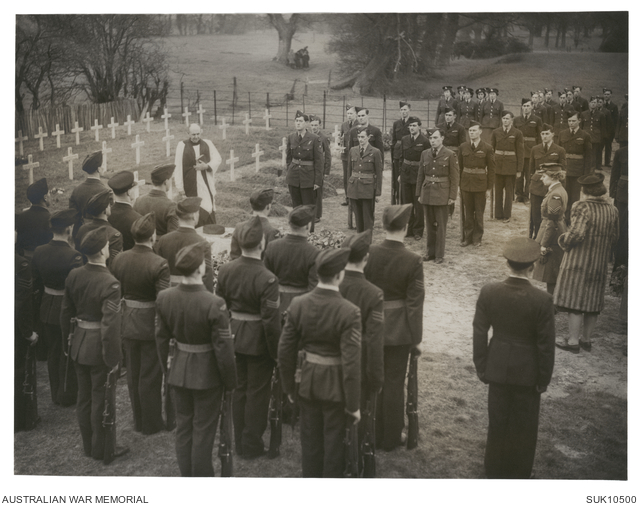
Funeral service for 402745 Flight Sergeant Rawdon Hume Middleton, the RAAF’s first VC winner. He was buried with full military honours in a country churchyard near his station. Air Vice Marshal H. N. Wrigley represented the High Commissioner for Australia (Mr S. M. Bruce) and the RAAF. The graveside service was conducted by Squadron Leader H. C. Thrush of Prospect, SA, RAAF Chaplain. (Australian War Memorial Public Domain)

Middleton’s citation read:

“Flight Sergeant Middleton was determined to attack the target regardless of the consequences and not to allow his crew to fall into enemy hands. While all the crew displayed heroism of a high order, the urge to do so came from Flight Sergeant Middleton, whose fortitude and strength of will made possible the completion of the mission. His devotion to duty in the face of overwhelming odds is unsurpassed in the annals of the Royal Air Force”.

In honour of Middleton’s bravery, Number 1 RAAF Recruit Training Unit at RAAF Base Wagga has renamed the club in his name, the “Middleton VC Club”, and he also appeared on one of the 1995 Australian 45c stamps. The dining hall located at the nearby (now American) base at RAF Mildenhall in Suffolk, has also been named in his honour.

St. John's Church Beck Row, Mildenhall Fl. Sgt. Rawdon Hume Middleton, VC (RAAF) 149 Sqn RAF, St. John’s Church, Beck Row, Suffolk.

Middleton was a brave and dedicated young man who gave his life to save those of his crew. Each and every one of them acted with the highest dedication, sadly for some, it cost them dearly.

Sources

*1 photo courtesy of Australian War Memorial, image 100641, Public domain.

*2 photo courtesy of Australian War Memorial, image P01019.003, Public domain.

*3 Photo courtesy of Australian War Memorial, Image SUK10501, Public domain

*4 Photo courtesy of Australian War Memorial, Image SUK10500, Public domain

‘In the Mood’ for aviation nostalgia?

Taking advantage of the winter sun and nearby location, I decided to take a short visit to one of the earlier trails and see how things had changed. Being a different time of year too, perhaps the buildings I saw would now be less obscured. I also thought that the initial trails were lacking and needed a little ‘historical substance’.

Whilst not wanting to lose sight of the idea behind the blog, I felt a little extra would not go amiss. Hearing about a memorial that I had missed earlier, I braved the late December air, donned coat, hat and scarf and set off to Kings Cliffe, in the top corner of Northamptonshire – land of Fighter squadrons and the last hangar concert performed by Major Glenn Miller.

RAF Kings Cliffe (Station 367)

(Revisited and updated December 2014)

DSC_0169

The Memorial at Kings Cliffe.

Unlike the other airfields in the tour, Kings Cliffe was a fighter airfield. Pass through the village from the south, out the other side, under the odd twin-arched bridge and then right. A few hundred yards along and the airfield is now on your right hand side. The memorial is here, flanked by the two flags. It is a more elaborate memorial than some, being made with the wing of a Spitfire on one side and the wing of a Mustang on the other. Various squadron badges are etched into the stone and as the weather takes it’s toll, these are gradually disappearing.

DSC_0197

Protected aircraft pen, with ‘dual skin’ defences on three sides. A number of these litter the site.

Over its life, Kings Cliffe would have a number of fighter units grace it skies. Built in 1943, it would receive its first squadron late that same year when P-39 Airacobras of Duxford’s 347th FS (350th FG) were temporarily based here. A short spell they would soon leave and be replaced with another short-term unit.

The following January, the 347th left and three squadrons: the 61st (code HV), 62nd (code LM) and the 63rd (code UN) of the 56th FG arrived from the U.S. This group fell under the command of the 67th Fighter Wing, Eighth Air Force. Redesignated the 56th FG in the previous May, they were initially given P-47s and continued to train at Kings Cliffe for fighter operations until moving on the 4th/6th April 1943 to Horsham St Faith, Norfolk. A few days later on 13th April 1943, they undertook their first operational sortie. Over the next two years the 56th FG would become famous for the highest number of destroyed aircraft of any fighter unit of the entire Eighth Airforce. A remarkable feat.

Littlefriends.co.uk

Pilots of the 77th FS, at Kings Cliffe 1944-45*1

After the 56th left Kings Cliffe, three more squadrons arrived. In August that year, the 20th FG arrived with their P-38 Lightnings. The 55th (code KI), 77th (code LC) and the 79th (code MC), would fall under the umbrella of the 67th Fighter Wing, Eighth Airforce.

After a spell of renaming, aircraft changes and training, their arrival at Kings Cliffe would see a period of stability for the 20th. Initial operations started in December that year, and their primary role would be to escort bombers over Europe, a role it maintained until the cessation of conflict. Targets of opportunity were often found whilst on these missions, but toward the end of the war, with fighter cover becoming less of an issue, dive bombing and ground attack missions became more common place. Their black and white chequered markings became feared by airfields, barracks and in particular trains as they became known as the “Loco Group” for their high number of locomotive attacks.

Oakington Pillbox Kings Cliffe Dec 2014

Oakington Pillbox, found in pairs, they offer a 360 degree field of fire.

On April 8th 1944, the 20th attacked an airfield in Germany, action for which they received a Distinguished Unit Citation (DUC). They would later take part in the Normandy invasion, Operation Market Garden, and air cover in the Battle of Bulge. In July 1944 they converted to P-51s and continued to escort bombers and search out targets of opportunity until the war closed. In the following October 1945, they returned to the U.S. and Kings Cliffe was returned to RAF ownership. The RAF would use it as a storage depot until selling it off in 1959. Its runways were dug up for hardcore, the buildings demolished and the site finally returned to agriculture.

Kings Cliffe December 2014 Draincover

Drainage covers and pipes adorn the remains of the runway.

Whilst standing at the memorial, it is difficult to imagine any of the activity that occurred here all those years ago. However, behind the memorial you can see a number of brick defence buildings enshrouded in trees and bushes. Move along the road to your right and there is the main gate. Stating that it is an airfield, it doesn’t encourage entrance. However, walk or drive a little further and there is a bridal way that allows access to the site. Walking along around the edge of the airfield, you can see hidden amongst the thorn bushes  an Oakington Pill box. Found in pairs and common in this area, they offer a 360 degree view of the site. The second of the pair is  short distance away in the middle of the field and more visible to the viewer. Also round here are three protected dispersal pens. Each pen has a double skin, in other words, an outside loop holed wall for firing through and an inner wall to protect air and ground crews in the event of an attack. There are a handful of other ancillary buildings here, all of which can be accessed with careful treading. A considerable number of these exist close to the road and path, so extensive travelling or trespass is not required for the more ‘informal’ investigation.

DSC_0188

Inside the Shelter.

Walking further along the path, you pass a large clump of trees heading of in an easterly direction. These mark the line of the east-west runway. Whilst the runway has gone, evidence of its existence can be found. A drainage channel, numerous pieces of drainage material and grates can be found amongst the remains of hardcore.

The path continues in a southerly direction away from the main part of the airfield, and a better option may be to return to the car and drive along to a different part of the site.

If you return through Kings Cliffe, bear left and through the small but gorgeous village of Apethorpe. Continue on and you’ll see a footpath that goes through the woods. Park here and walk through the woods. A couple of miles in and you come across a large open space, to your left is a distinguished memorial to Glenn Miller.

Glenn Miller Memorial RAF Kings Cliffe Dec 2014

Memorial to Glenn Miller’s final hangar concert, 3rd October 1944.

The memorial is located on the site of the original T2 hangar, quite a distance away from the main airfield. It was here that Miller performed his final hangar concert on October 3rd 1944. Standing here in the wintry air listening to ‘In the Mood’, is a surreal experience. To think that, on this spot 70 years ago, this very tune was performed by Miller himself; whilst young couples jitterbugged the evening away – a brief respite from the wartime tragedies that dominated their daily lives.

Leaving here, back to the track, you come across a footpath that takes you north, toward the main airfield before veering off and away to the west.

This path provides what is probably the nearest access point to the tower, as it crosses the track that joins the perimeter near to the towers location. The control tower still stands, but access from the path is over private land and should be undertaken with the land owner’s permission.

A final car trip back to the north side of the airfield reveals evidence of the accommodation blocks. The cinema, Gymnasium and chapel along with some other communal buildings still stand and in use by local timber companies. Well preserved, they are easily accessible and offer a good view to anyone aiming to find evidence of Kings Cliff’s history.

Kings Cliffe December 2014 Chapel with gym

Gymnasium and Chapel now used by a timber company.

Like many sites of it’s age, the majority of Kings Cliffe’s buildings are overgrown, indeed entering them you can see how the roofs have become detached in many cases, and mature trees now the only inhabitants where personnel once stood.

The main part of the airfield is agriculture, and it can be seen from further back, why this site was chosen as the views across the landscape toward Peterborough and the south are stunning. A remarkable place, it offers good evidence, nostalgia and beautiful walks into the bargain.

Overgrown buildings

Overgrown buildings

Kings Cliffe concludes this tour, however, if you return back along the road to the village of Kings Cliffe, turn right away from the village, you will eventually find yourself sitting opposite one of the crash exits of RAF Wittering, the main station to which Kings Cliffe was built as a satellite. Also along here, is a remnant of RAF Collyweston, an airfield absorbed into RAF Wittering at the end of the war when it expanded ready for the V – force bomber aircraft and later the Harriers. Now closed to flying due to government cutbacks, it houses an army detachment and a small RAF detachment for maintenance duties only.

Much of the evidence from the American participation in the Air War of the Second World War has now disappeared, being swallowed up by natures determination to regain what was originally hers. Agriculture and small businesses have clung on to the remainder, leaving little to see. In some ways, and I touched on this earlier, the fact that peace has now taken over what were bustling camps of 3000+ personnel, the roar of four engined bombers laden with high explosives or troop carriers taking scared young men to the killing fields of Europe, is a reflection on their bravery and dedication. These areas are simply peaceful now because of the men that served, lived and died here and whilst they are now gone, maybe their ghosts remain.

Kings Cliffe originally featured in Trail 6 ‘American Ghosts’.

*1 photo by Robert Derenbacker from ‘Little friends’ website http://www.littlefriends.co.uk

Eisenhower stopped off at Lashenden

It was during this time, on July 4th 1944, that General Eisenhower stopped off at Lashenden following one of his many flights over the German lines in Normandy. His pilot, Brig. Gen. Elwood R. Quesada, veteran of 90 sorties, was berated by his superiors for such a ‘foolish’ act. In response he said, “When a five-star general says ‘Go,’ you go!”

Lashenden, also known as Headcorn, was an advanced landing ground, built initially for the RAF, it was taken over by the US Ninth Airforce who used to to fly P-51s and P-47s out over France.

Today it is a thriving airfield, whose annual reenactments bring back the nostalgia of 1940s Britain. Find out more about Lashenden’s history and other airfields in Kent. Click on this link.

lady cropped 2 B&W

1940s Britain is reenacted on the Former Lashenden Advanced Landing Ground used by the Ninth Air Force.