A DUC, 2 Medals of Honour and Napalm.

In Trails 27 and 28 we head back to  southern Norfolk, to the eastern side of Thetford Forest. We visit three airfields, each one tells a remarkable story of heroism, bravery and loss.

Our first, just to the north of Attleborough, was home to the mighty B-17s of the 452nd Bomb Group, 45th Combat Wing, 3rd Air Division, Eighth Airforce. We start off at the windy and open expanse that is Deopham Green.

RAF Deopham Green (Station 142).

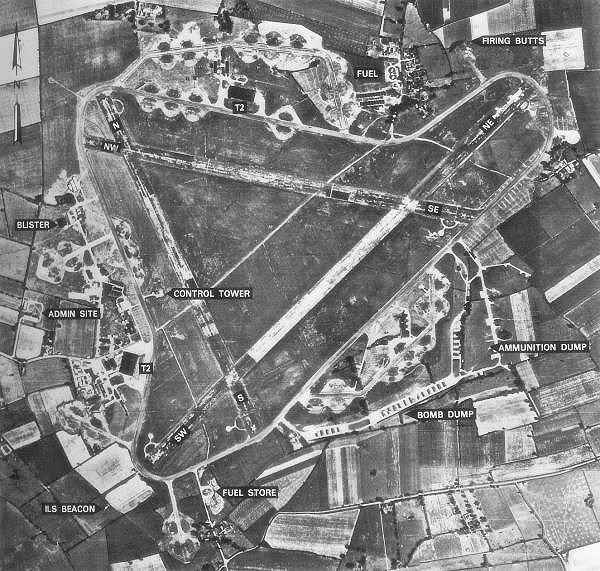
Deophamgreen-9jul46

Deopham Green taken 9th July 1946*1

Deopham Green (Station 142) was built-in 1943, to Class A standard and consisted of the usual three concrete runways; the main of 2,000 yds running NE-SW and two further runways NW-SE and  W-E both of 1,400 yds. All three were linked by a perimeter track with fifty-one dispersed hardstands (forty-nine loops and two pans), and two T2 hangars, one to the north and the second to the south-west of the airfield. The accommodation sites, 13 in all, lay to the west and south-west and could accommodate around 2,900 personnel. A mix of communal sites, sick quarters and accommodation blocks were spread widely to avoid injury through attack. The bomb site and fuel stores were situated to the south-east well away from the accommodation area.

Deopham Green’s first and only flying resident for the duration of the conflict was that of the 452nd Bomb Group.

The 452nd BG was made up of four bomb squadrons; 728th, 729th, 730th  and the 731st, flying B-17Gs. A black square with a white ‘L’ and parallel yellow bands denoted the group, whilst individual squadrons were issued with the codes 9Z (728th), M3, (729th), 6K (730th) and 7D (731st), although these were not displayed on individual aircraft during the conflict. Instead, squadron codes were a bar and ‘+’ sign or combinations of each allocated beneath the aircraft serial. The B-17s of the 452nd were originally olive and grey factory finish, but in March 1944, they began using the more common natural metal finish.

Aug 2015 025

The main runway looking south-west. The adjacent road uses part of the original track.

They were activated on June 1st 1943 moving to Deopham Green later that year between December and January 1944. Their first combat mission was to be on February 5th 1944. They would attack strategic targets such as: Frankfurt, Regensburg, Kassel, Schweinfurt and the oil installation at Bohlen. They initially operated over northern France attacking airfields, bridges and coastal defences in preparation for the Normandy invasion; supported ground troops in the advance against Brest, St Lo and the Battle of the Bulge. They also struck sites in preparation for the Allied crossing of the Rhine.

The 452nd was one of the first groups to use Petroleum Jelly bombs, later known as ‘Napalm’, a weapon that was to prove deadly to its victims.

It was on November 9th 1944 that Lieutenants Donald Gott and  William Metzger Jr performed courageously earning  the Medal of Honor posthumously after they were killed nursing their crippled B-17 ‘Lady Janet‘ home from Saarbrucken. Their story is described in ‘Heroic Tales‘.

For their courage, the 452nd BG received their first Distinguished Unit Citation (D.U.C) on April 7th 1945 for their action against strong fighter cover and flak over the jet fighter base at Kaltenkirchen.  Mission 931 would see one hundred and forty-three B-17s take on FW-190s and Me 262s – the 452nd would lose four B-17s. This was to be the final D.U.C. of the entire conflict for any bomb group.

The 452nd flew their final operational sortie  later that month on the 21st April 1945, returning to the U.S. in the following August where they were disbanded on the 28th.

Aug 2015 010

The southern end of the main runway.

In total, the 452nd flew 250 missions dropping 16,466 tons of bombs and losing 158 aircraft. They had the unenviable honour of having more Commanding Officers than any other Bomb Group during the Second World War. They achieved a D.U.C and two posthumous Medals of Honour, their awards reflecting their dedication, bravery and sacrifices.

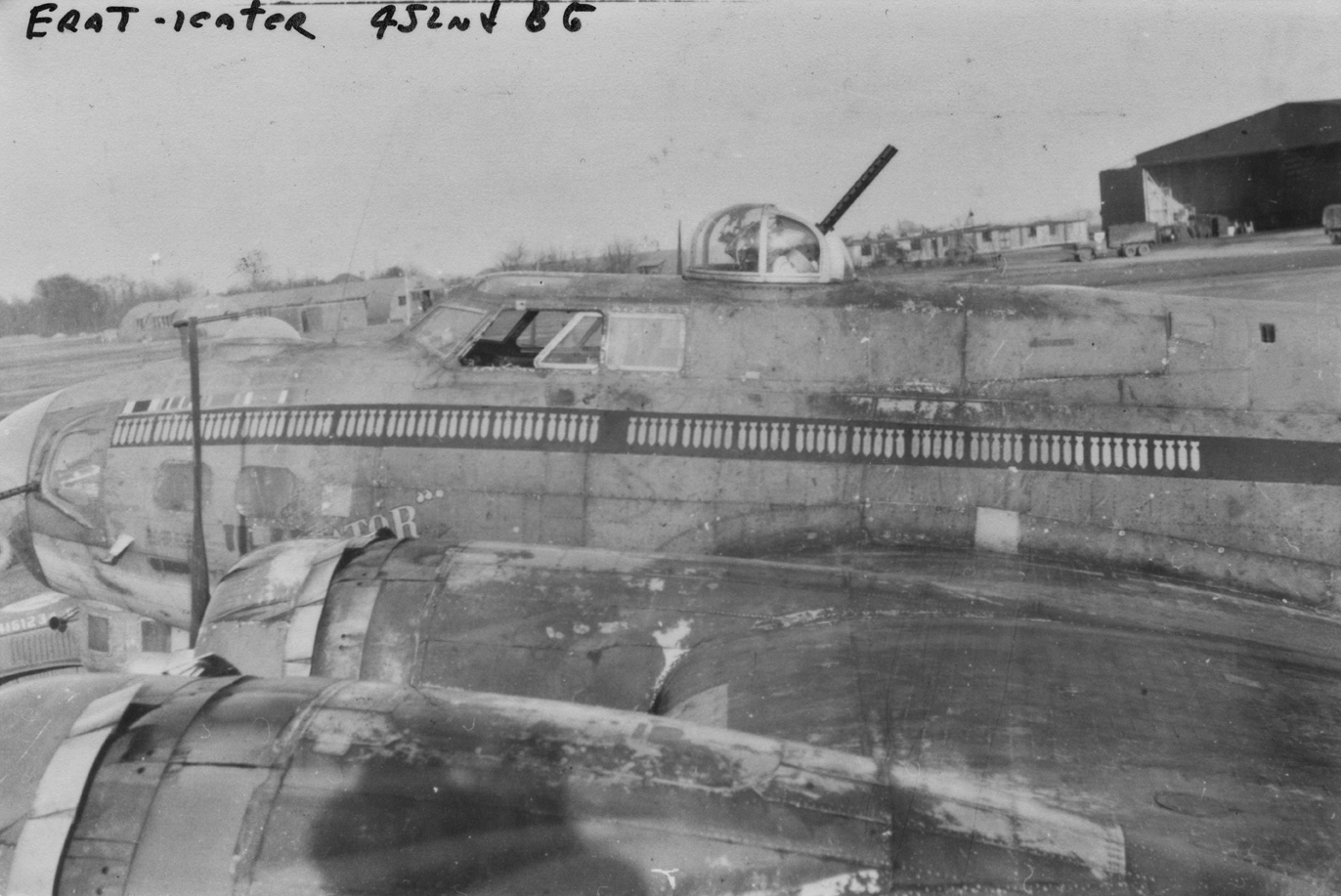
Sadly only one aircraft 42-39970, ‘E-Rat-Icator‘ of the 730th BS, was to survive every mission and return home to the United States. E-Rat-Icator completed an incredible 120 bombing missions, a major triumph for any operational aircraft only to be unceremoniously scrapped in December 1945.

B17

B-17, 42-39970, ‘E-Rat-Icator’ 730th BS, which was one of the first to use Petroleum Jelly bombs. This was to be the only aircraft of the 452nd to survive every mission and return home*2

At the end of hostilities the 452nd left the UK and Station 142 was handed over to the RAF 258 Maintenance Unit for care and maintenance. It was finally closed for good on New Years day 1948, the land was sold off in 1961 and returned to agriculture, a state in which it survives today.

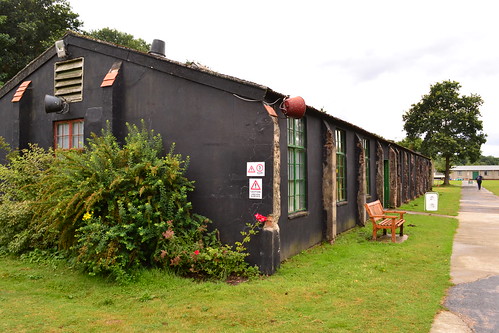
Deopham is a windy and wide open expanse. Development of the site has changed little of its atmospheric feeling. If starting at the southern end of the airfield, the first signs we see are two small structures; a small sentry post and ground crew hut used during maintenance work. Both stand amongst the hedges overgrown and almost hidden, the sentry post very run down and its life is surely near the end. The hut fights on, albeit in a very poor state, and is now the home of farm machinery and stores, and is more likely held together by the weed than any orignal fixings. To your left, at the end of this small track is a loop dispersal, where the B-17s would have been worked on by the crews in the hut.

Aug 2015 013

A hut once used by ground crews, barely stands in the undergrowth.

Leaving here, head north, taking the road from Bush Green follow it round. You pass on your right the entrance to the former fuel dump, then you veer right, this is now the original peri track. Turning left, you pass a gate on your right,  this junction is the entrance to the bomb store . There is no longer any sign of the mass of munitions that once sat here, merely a concrete road and farm supplies. Continue heading north, you are now on the lower section of the NW-SE runway. A short way up, it crosses the main runway, remains of the original can be seen on both sides of the road, its width giving an indication of the size of the aircraft that used it. From here, turn right and then drive along its length toward Deopham Stalland. This road utilises the main runway virtually in its entirety. The length of these concrete runways clearly visible, and in places, so too is the width, some 50 feet. Along here, the old sections that have not been covered in tarmac, run along side, and stopping off at any point allows you to stand and soak up the atmosphere of those lumbering bombers racing down the runway, labouring to get airborne with their mighty loads. At the end, you can see the last section stretch out before you, the weeds now taking over. Turning left will take you round the peri track toward the north-eastern side of the airfield and away from the site.

Aug 2015 034

One of the few remaining buildings fights the vegetation – Accommodation Site 7

Turn back on your self, drive down the ‘runway’ to the crossing point and then right and continue north. This is the secondary NW-SE runway once more. Most of this is now beneath the soil, but small sections can be see. Eventually you arrive at a small triangular grassed area. Three trees enclose a small memorial dedicated in May 1992 to the crews of the 452nd BG. A large concrete expanse to the right, the ‘car park’, are the remains of the original runway; from here it heads off to the north as a small track now frequented by dog walkers rather than heavy bombers. Carry on in a westerly direction toward the farm buildings. To your right a small track leads to where the control tower once stood. Sadly long gone, it was a standard wartime design to 12779/41, and was demolished after the land was sold in the 1960s. Behind here was the admin site, housing several dispersals and a blister hangar. All now gone and the land used for buildings owned by Stallard Farm.

To your left stood one of the two T2 hangars and other technical buildings, again mostly all gone today, those that are left are now part of the farm.

Aug 2015 040

Former Gymnasium and Chancery located on Site No. 5

Continue past this area and you come to a cross roads. Directly opposite to your right is the location of accommodation site 7. Heavily overgrown, it was the home to the 728th BS. The few remaining structures here are also nearing the end of their useful lives. Further on, are accommodation sites 8 and 9, only concrete and a few foundations remain, evidence of the huts that once housed crews here. Turning left at this junction, heading south, you pass Sites 4 (Communal) and 5 (Mess). Also here were sites 12 and the sick quarters 13. Here at site 5, there are a few buildings including  the former Nissen hut library, gymnasium and chapel, and former mess hall. These buildings are now owned by the Council and the Nissen hut still has today artwork paintings of ‘Robin Hood’ on the wall to the rear. A few other buildings survive around here in modern-day use. Others are mere shells and in great danger of falling down.

The former sick quarters (Site 13) still has buildings in use today.

Carrying on along this road and you leave Deopham Green through what was the main entrance. No visible sign of this remains today, the barrier and remaining accommodation sites to your right are all sadly long gone.

Deopham Green was a major airfield used by the Eighth Airforce for bombing missions over Europe. It supported ground operations, targeted transport and communication routes, and saw bravery beyond a scale imaginable today. It also led the way in new and devastating weapons that were to become commonplace in news reels in later years. It is amongst its wind-swept fields, sections of runway and small collection of buildings, that  remain the memories of those who never came back to tell the tale of the devastating war over occupied Europe.

On leaving Deopham Green, we head south again, to our next stop where the roar of radial engines has been replaced by the roar of motor racing. We visit the former American airbase at Snetterton Heath.

Sources and further reading.

*1 Photo in Public Domain, taken from wikimedia.

* Photo taken from Roger Freeman collection at http://www.americanairmuseum.com/media/10336

An airfield that holds a tremendous history, yet little exists.

In this revised trip, we go back to Woodhall Spa, and visit the former Bomber Command airfield, famed for its crews, missions and aircraft. Woodhall Spa is a remarkable airfield, yet it is hardly known, or recognisable today.

RAF Woodhall Spa was originally built as a satellite to RAF Coningsby a short distance away, and opened on 1st February 1942. It was built with three concrete runways; two of 1,400 yds (1,353 m) and a third and main runway of 2,000yds all 50yds (46 m) wide. The site like other Standard ‘A’ class airfields had two T2 hangars and one B1, thirty-six pan-style hardstands and numerous support buildings scattered around its perimeter. Accommodation was spread over 7 sites, along with a WAAF, sick quarters and 2 communal sites all located to the south-east. The technical and administrative sites were also to the south-east side of the airfield between the accommodation areas and the main airfield.

A bomb store was well to the north and the main entrance to the north-west. A range of accommodation and technical style huts were used, Laing / Nissen / Seco and a Watch Tower to drawing 15956/40.

aerial photo of RAF Woodhall Spa

An aerial photograph of Woodhall Spa taken post war. The B1 and T2 hangers can be seen to the north-west, a further T2 to the south. The accommodation block are below the frame. (Taken from a photo at the Thorpe Camp museum).

One remarkable features of Woodhall Spa was the installation of six arrester gear units on the runways. These were designed to prevent aircraft overshooting the runway and were installed during the building programme. Some 120 units were manufactured in all but only a handful of sites had them. On October 22nd 1942, the Woodhall Spa units were tested using an Avro Manchester from the Royal Aircraft Establishment and all went well. However, as the war progressed, reservations were registered about such a technique and the units were never used ‘operationally’ in any of the allocated sites.

At the same time that Woodhall Spa opened, the newly equipped Lancaster (Mk I & III) squadron, 97 Sqn, moved from RAF Coningsby into RAF Woodhall Spa and within a month were flying operations from their new home. However, their first operation, mine laying, was to be fatal for three aircraft, cashing on the journey home. This was not to be the general theme for 97 Sqn though. For the next year they would prove themselves more than capable, hitting many targets accurately with bravery and courage.

Lancaster Mk I ‘R5495’ OF-N of 97 Sqn Woodhall Spa, bombs up. This aircraft was shot down over Essen 8th/9th June 1942, the crew were all killed.*4

The following March (1943) the main bulk of 97 Sqn moved to Bourn to form part of the new Pathfinder force, with detachments at Graveley, Gransden Lodge, Oakington and a further section remaining at Woodhall.  On April 18th 1943, 619 Sqn was formed from the Woodhall Spa detachment retaining their Lancaster Is and IIIs. However, their stay was very short; they moved out to Coningsby in January 1944 and were replaced overnight by the famous 617 (Dambusters) Sqn*5.

During their year here, 619 Sqn would prove themselves further in raids over the Ruhr, Düsseldorf, Oberhausen and Krefeld. Casualties were light during these early missions, but in the following August (1943) the RAF a mounted a massive raid consisting of 596 aircraft on the V2 rocket site at Peenemunde. Three of the twelve aircraft sent by 619 Sqn would fail to return.

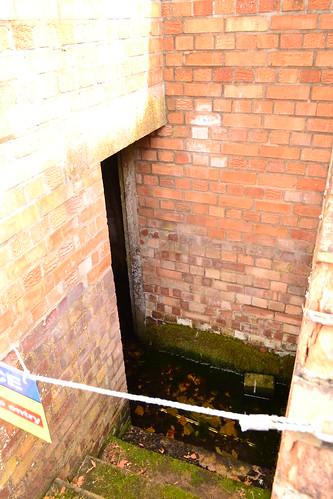
Bomb Shelter now flooded.

The bomb shelter now flooded and inaccessible.

When 619 Sqn moved out, 617 Sqn moved in. Lead by Group Captain Leonard Cheshire, 617 Sqn were the elite of 5 Group, Bomber Command and accordingly were to be assigned some of the most difficult and outright dangerous precision bombing missions.

Throughout 1944, 617 Sqn would have many near misses, and losses, ranging from low-level bird strikes to fighter attacks and flak. Targets varied considerably including those at: Limoge (aircraft engine factory), the Antheor Viaduct, Albert, St. Etienne and Metz (aircraft parts factories); many using the new ‘Tall Boy’ 12,000lb bomb.

On 15th April 1944, 617 Squadron were joined by 627 Sqn and obtained some D.H. Mosquito VIs, using these to good effect in the Pathfinder role while their Lancasters continued with the bombing. In June, they had a small respite from bombing missions and on the day of the Allied Invasion, they were tasked with dropping ‘Window’ over the Pas-de-Calais to fool the Germans into believing the invasion force would strike there.

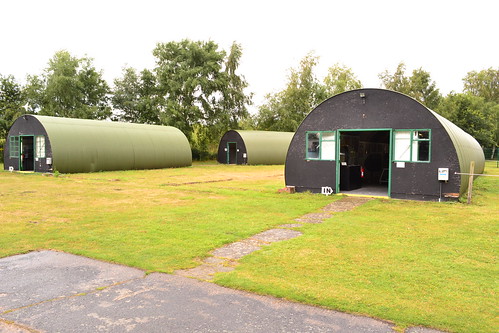
Nissen Huts

A handful of huts and buildings remain.

Throughout the remainder of 1944, 617 Sqn continued to use ‘conventional’ and Tall Boy  bombs on prestige targets like U-boat pens and the Samur Tunnel. Cheshire found himself handed a P-51, and after having it unpacked and engine tested, he used it to mark a V1 target to which 617 struck a devastating blow.

Further major targets were to befall the wrath of 617 Sqn. Flying 2,100 miles to a forward operating base at Yagodonik with Lancasters from 9 Sqn, they attacked the German main Battleship the ‘Tirpitz’. During the mission, for which they had long-range fuel tanks, of the 38 aircraft that set off, six were to crash on the outward journey, one turn back and one to crash on the return. The Tirpitz however was to remain ‘unsinkable’ for some time. It would take two more return trips by 617 Sqn from Lossiemouth to finally sink the ship, the last being on 12th November 1944, with the loss of 1000 German sailors.

Bombing and pathfinder operations for Woodhall spa crews continued right up to the end of the war. Early that year they would start to use the new ‘Grand Slam’ 22,000lb bomb, with their last operational fatality being on 16th April 1945. That was not the end for Woodhall Spa though. The famous Guy Gibson drove here and ‘borrowed’ a Mosquito of 627 Sqn against a backdrop of changed minds, mishaps and misjudgements, the resulting crash leaving him dead.

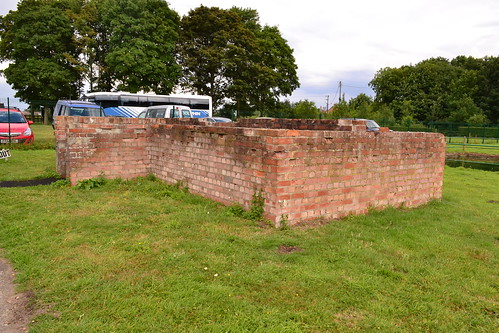
DSC_0181

Brick walls outline former structures.

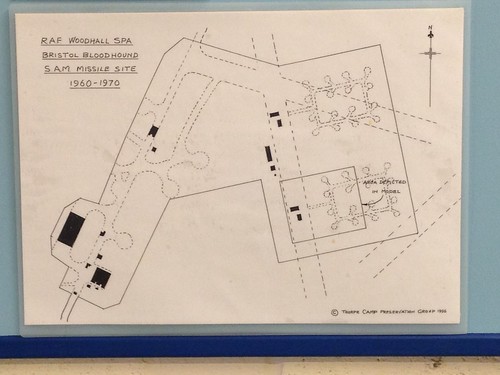
Woodhall closed soon after the war ended, but it was identified as a suitable location for Britain’s air defence missile the ‘Bloodhound’ and on May 1st 1960, Woodhall Spa became the base of 222 Sqn with Bloodhound MkI missiles. These were disbanded in June 1964 and replaced by Bloodhound Mk IIs of 112 Sqn on November 2nd 1964. These stayed until 1st October 1967 when they moved to Episkopi in Cyprus.

After the removal of the Bloodhound squadron, the RAF continued to use a small site near to the main entrance, utilising the 617 Sqn T2 hangar and other ancillary buildings as an engine maintenance and testing facility. This too has since closed and the main use is now as a quarry.

Thorpe Camp (RAF Woodhall Spa)

Map showing the location of the Bloodhound Missile Site (Photo of the display at the museum)

A long and distinguished life, Woodhall Spa’s operational losses totalled 91 aircraft, of which 74 were Lancasters and 17 Mosquitoes. Daring and brave crews, they gave their all for freedom and the love of flying.

Today little exists of this former airfield. Being a quarry and partly MOD, much of the  land it is not accessible to the general public. Most of the buildings have long since gone and the runways mostly dug up. A few minor concrete ‘side roads’ are in situ and with searching some evidence can be found. The tower was demolished just after the war as were many of the other buildings and huts. Steps have now been taken to turn whats left into a nature reserve (see post dated 4th July 2015) and a memorial has been placed at the intersection of the runway remains. The best remnants can be seen a little way to the south-east at the former No 1 communal site at Thorpe Camp (see below).

Former NAAFI

The former NAAFI for 469 airmen and 71 officers.

A small number of buildings remain here utilised now as a museum. These include a war-time NAAFI able to accommodate 469 airmen and 71 officers, the ablutions block, ration store and various Nissen huts. A bomb shelter is also here, now flooded and blocked off along with other part brick structures.

In the adjacent woods, the airmen’s quarters and other buildings can be found, now derelict and in a dangerous condition. Odd buildings are scattered about the various sites but these too are few and far between.

Considering the history of Woodhall Spa, the men who flew from here, the operations they undertook, the testing of revolutionary equipment, the new and deadly bombs, it has suffered possibly greater than most and much of this history, if it were not for the Thorpe Camp museum, would now be lost forever. Now it has become a nature reserve in part, then maybe, just maybe, the footsteps of those who were stationed here may once again be walked by others and their memories brought back to life.

Sources and further Reading.

*1 Author unknown, photo from http://www.aircrewremembered.com/hughes-mervyn.html, August 2015

*2 617 Squadron are most famous for the raid on the Ruhr dams in Operation Chastise ‘Operation Chastise’ carried out on 17 May 1943 under the command of Wing Commander Guy Gibson.

This is an updated trail part of Trail 1 Lower Lincolnshire.

A Gem of a Museum in the Heart of an Aviation Mecca

I recently updated the original Trail on this site after visiting the Thorpe Camp Museum. A really pleasant little museum, it provides a wealth of information for very little cost. Its history and that of the area, is incredible.

Thorpe camp museum sits on the original  communal site 1 on the former RAF Woodhall Spa and was acquired in 1988 by a group of volunteers (The Thorpe Camp Preservation Group) who have utilised the original buildings and pathways that would have been used by RAF personnel during their stay at Woodhall Spa. Entrance is a nominal fee and worth every penny.

DSC_0152

Original buildings of No. 1 communal site are now a museum.

A number of original huts and buildings display a range of letters, photos, memorabilia and other artefacts that take you through aspects of life both at Woodhall Spa and Lincolnshire life during the Second World War. Specific displays tell you about each of the four squadrons based here (97, 617, 619 (Dambusters) and 627) , the crew members, aircraft and personal stories. A memorial stands at the centre of the site reflecting their dedication.

Extensive work has been done to research the famous dams raid of 617 Squadron, how the bouncing bomb was developed, how it worked and what the aftermath of the operation was.

A small shop provides food and drink, and is a welcome break after a long journey.

DSC_0164

An Allan Williams Turret on the site.

A civilian section shows life ‘at home’. Weddings of the Second World War were scant affairs due to lack of money and rationing, but brides made the most of what they had; examples of these are nicely displayed. The home guard, ARPs, and domestic life are all represented in this atmospheric museum.

Many young men were sent from within the borders of Lincolnshire on major operations such as ‘Market Garden’, these too are represented through displays of uniforms, photos, letters and official documents.

Further buildings, also originals, house well stocked displays of the V1 and V2 development. The terror weapons used by Hitler to break the morale of the British people. Over 3000 of these V2s were used against targets in the UK predominately London and the South East. Models, photographs and documents again show the extent of this development.

Something I had never come across before was the idea of using arrester gear on heavy bombers where runways may have been shorter than ideal. The principle, based upon that used by the navy on their aircraft carriers, was to place one or more steel cables across the runway for a landing bomber to ‘catch’ as it landed. A small number of airfields in the UK has these, Woodhall Spa being one of them, and an original winch has been removed from the airfield and carefully refurbished. This now has pride of place in the museum. It is believed a further example remains on the airfield alongside the remains of the runway. A rather ingenious but ineffective idea, it was not widely used due to mis-landings and the increased weight that the arrested gear added to an already heavy aircraft.

DSC_0170

An Arrester Gear Hub that was used on RAF Woodhall.

Thorpe Camp provides a chance to see inside a Lancaster cockpit. A replica, painstakingly built includes all the detail of an original Lancaster bomber. Other parts, including turrets, dials and engines can also be found in this dedicated exhibition room.

Staff at Woodhall Spa are carrying out renovation projects and have their own workshop to do this. The process can be viewed and makes for an added interest to the visit.

As an aviation enthusiast the trip is topped off with another feature in the form of a BAC Lightning F1A (XM192) in 111 Squadron markings standing proud beside another cold war relic the Bristol Bloodhound missile.

DSC_0153

BAC Lightning of 111 Squadron RAF.

Using a range of original documents, photographs, letters and memorabilia, Thorpe Camp at Woodhall Spa is a delight to wander and a real insight not only into the life of this Second World War airfield but life during those hard times in general.

Thorpe Camp is part of Trail 1, and is located near to RAF Coningsby. It has its own dedicated webpage where you can find further information and details.

An airfield whose history remains secret.

This is the second airfield of Trail 25 which takes place in the Hertfordshire countryside. Even today, much of what went on here remains secret and little information about the people or its activities exists. However, its role in the both wars was significant.

RAF Sawbridgeworth

RAF Sawbridgeworth was originally constructed as an Advanced Landing Ground (ALG) during April 1916. It was designed to take aircraft from 39 sqn, who were currently based at nearby North Weald. Activated initially to combat the Zeppelins from Germany, 39 sqn are currently based at RAF Waddington flying the MQ-9 Reaper against a much different enemy.

May 2015 044

Part of the Airfield defences.

It wasn’t until the Second World War, that RAF Sawbridgeworth  really came into its own as an operational airfield.

Mathams Wood ALG, as it was known, saw expansion in the early 1940s, more through luck than careful planning. Each of the three runways, were constructed of Summerfield tracking, and measured 1,700 yds, 1,400 yds and 900 yds in length.  The usual Drem lighting was installed adjacent the track rather than embedded as would be the usual case.

A number of buildings were requisitioned as aircraft were dispersed here following France’s fall in 1940. The ALG was expanded through local workers and Mathams Wood ALG took on the unofficial name RAF Sawbridgeworth after the village that stands close by.

The expansion of Sawbridgeworth also included a number of buildings: 16x Dorman Long (4630/42) blister hangars, a T2 hangar, a number of ‘Blenheim’ style aircraft pens and 8 dispersed sites primarily to the East of the airfield. A watch tower, fire tender station, hospital, grocery store, Link trainer, gymnasium and the usual accommodation blocks all added to the much bigger site than had been previously been designed.

grocery store

The former Grocery Store.

The first unit to be based here was that of 2 (AC) sqn flying Westland Lysander II and IIIs in the observational role. Performing primarily in this activity, 2 sqn later on used the Curtis Tomahawk I & II, followed shortly after by the Mustang I and eventually the IA. Other squadrons to be based here included: 4, 63, 80, 126, 168, 170, 182 , 239, 268 and 652 sqns primarily undertaking a PR role whilst here.  A number of other non-flying units performing the evacuation and redeployment of personnel were also stationed here.

2 Sqn were also heavily involved in the secret work of the Special Operations Execute (SOE) involved in dropping agents into occupied France. Much of the training of the aircrews took place at Sawbridgeworth, with practice flights using the famous ‘Black’ Lysanders. Even today, some 75 years later, these operations and the role of the photographic reconnaissance units, remain well hidden operations cloaked in secrecy.

May 2015 041

The perimeter track still remains, in full at some points.

Sawbridgeworth was not devoid of its own enemy attention. On September 19th 1940 a Heinkel III was shot down and crashed in nearby Thorley Wash, one of several crashes close by.

As the war drew to a close, so did the activity at Sawbridgeworth. Following the invasion of Normandy, and the subsequent liberation of Europe, all operational flying ceased in November 1944 and the site went into care and maintenance. The runways were pulled up using P.O.Ws and the tower was demolished a year after the cessation of conflict in 1945. Other buildings were removed or demolished and the land turned back to agriculture.

Wandering the site today, there is luckily still quite a bit of evidence about. The perimeter track is complete, not in its full width throughout, but a large proportion of it. A number of pill boxes remain scattered around the perimeter of the site and the Battle Headquarters (design 11008/41) can be found with determined searching amongst the brambles and hedgerows.

May 2015 037

The former guard block, still largely intact.

To the west of the site is a small industrial complex utilising what was a ten-bed sick quarters, dental annexe, a twelve bed Barrack hut that doubled as a hospital ward, mortuary and an ambulance shed. An ablutions block is was also located here and the site is more or less complete. Not far from here, is a modern farm, which houses a number of smaller original buildings including a Parachute store (built to drawing 11137/41), fabric store, sub station, main stores and other technical buildings. These are all located on private land and in use by the farmer. There is also a signals block, located nearby to these sites and easily visible from the road.

Across to the east of the airfield, is whats left of the communal site. Here stood 33 buildings in total, incorporating a wide range of supporting units for recreation and general living. The only remaining buildings being the standby generator house and the grocery store. Both are used by local businesses.

Emergency generator

The Standby Generator House now a stores for machinery.

A memorial to those who served at Sawbridgeworth stands outside what was the guard block. A recent addition, it is a nice reminder of the dedication of the crews who were stationed here during two world wars.

Sawbridgeworth is a small well hidden airfield and takes some finding. Hidden by woodland and crops, it was created through luck rather than good planning. The crews and aircraft of Sawbridgeworth played a considerable part in the Second World War, and all in its short but yet significant life.

May 2015 005

A memorial stands dedicated to those who served at Sawbridgeworth.

Sawbridgeworth features with its sister station RAF Hunsdon in Trail 25.

The Korean War Memorial, London

On July 27th 1953, the Korean War, a very much ‘forgotten’ war, came to an end. For over 50 years, the 81,084 British Troops who were sent there feel they have had little official recognition from the authorities or public.

The Memorial stands overlooking the Thames.

However, on the 3rd December 2014,  320 veterans and 180 other guests, watched as HRH the Duke of Gloucester unveiled a new memorial on the Embankment next to the Royal Air Force, Fleet Air Arm and Battle of Britain memorials.

The memorial, which was a gift from the Republic of Korea in honour of the British Troops sent there, stands six metres high and was carved by Philip Jackson – famed for carvings of Sports personalities, artists and the Gurkha Memorial. It shows a Bronze statue of a soldier, head bowed, standing on a base of Welsh Slate in front of an obelisk of Portland Stone. Dressed in winter wear, the statue reflects the tiredness of constant rain, and the never-ending battle against both a determined enemy and the elements.

Behind the weary soldier are several carvings, including a mountainous landscape representing Korea’s environment, along with a number of inscriptions. On the base, to the front, reads (in both English and Korean)

“With gratitude for the sacrifice made by the British Armed Forces in defence of freedom and democracy in the Republic of Korea.”

To the North side of the memorial is a further inscription:

“The Korean War was the first UN action against aggression. The UN forces that fought the North Korean invasion were drawn from 21 countries. Although exhausted and impoverished after the Second World War, Britain responded immediately by providing strong naval, army and air forces and became the second largest contributor after the United States. A distant obligation honourably discharged.”

On the south side of the obelisk, below the Union Flag, it reads:

“In this fierce and brutal conflict those who fought included many Second World War veterans reinforced by reservists and young national servicemen. The land battle was fought against numerically superior communist forces, the terrain was mountainous and the weather extreme. 81,084 British servicemen served in the theatre of operations. 1,106 were killed in action, thousands were wounded and 1,060 suffered as prisoners of war.”

The Korean War was the first UN action and took troops from 21 different countries, many of whom had only just started to recover from the Second World War. For their action, two British Soldiers were awarded the highest military honour – the Victoria Cross – but yet despite this, it still remains very much a ‘forgotten war’.

HMS Triumph

HMS Triumph as she appeared in my father’s photo album on return from Korea.

Much of the fighting took place around the 38th Parallel, a point that once stabilised, became not only the border between North and South Korea, but the Russians and the West in what would be a long and at times trying Cold War.

The memorial stands facing the Thames, amongst a number of other memorials outside the Ministry of Defence building on the north embankment and forms a group of Korean memorials. These include a plaque in the crypt of St Paul’s, and two other memorials in the National Arboretum in Staffordshire and in Bathgate, Scotland.

This memorial stands as a reminder of a short war, but for those who took part, it is a timely reminder of the sacrifice that they and their colleagues made.

The unveiling of the memorial.


A website dedicated to the Korean War Veterans can be found here.

Other major memorials can be found here and RAF / USAAF memorials here.

RAF Witchford a revisit to a fascinating airfield.

I originally visited RAF Witchford some time ago but was lucky enough to have an invite to a gathering taking place earlier this month at the site. It was a very memorable day indeed. Trail 11, which this forms part, can be found here.

RAF Witchford

Witchford is found a few miles East of Mepal in the shadows of Ely Cathedral. Now an industrial estate, a large amount of the site is still in existence (and being used) and freely accessible to the general public. This makes it one of the rarer airfields around in terms of visiting.

RAF Witchford Perimeter Track Looking South

RAF Witchford Perimeter Track Looking South, the B1 Hangar is to your right.

A typical triangular Class A airfield, it had two runways of 1,408 and 1,415 yards and a further main runway of 2,010 yards, all concrete and 50 yards in width. The technical site was located on the western side of the airfield behind the long and straight perimeter track. A number of Nissen workshop huts were constructed along with the standard 343/43 Watch Office, Braithwaite water tower and 150 or so supporting buildings. As with all bomber airfields, the bomb store was well away from accommodation and was located to the southern side. Being a large airfield, it had three hangars, two T2 and one B1, and a total of 36 loop-type dispersed hardstandings.

The accommodation sites (14 in total), were spread out well behind the technical site predominately where the village now stands and beyond. The main entrance to the airfield, also to the west, is now a small track leading to housing known as Bedwell Hey Lane. In total Witchford was designed to accommodate 1,502 men and 230 female ranks and it officially became operational in July / August 1943.

Original Stores Hut

Original Nissen Hut now used for stores.

Witchford was served initially by Stirling IIIs of the newly formed 196 sqn RAF, whose first operational flight took place on August 28th that year. But as heavy operational losses built up, it soon became obvious that the large bomber was ‘unsuitable’ for long distance bombing missions and gradually, squadron by squadron, they were replaced by the more superior Lancaster to which the business park gets it’s modern name.  As these Stirlings became obsolete for front line use many were redeployed covering glider towing, mine laying and transport duties.

During September to November 1943 a number of changes were to happen at Witchford. A second squadron, 195 sqn RAF, was reformed at Witchford (October 1st 1943) using elements of 115 sqn, who were at that time, based at Little Snoring (Trail 22) in Norfolk.

IMG_3282

Inside the Nissen Hut.

A further unit, 513 Squadron, also formed at Witchford (15th September) again using the ill-fated Stirlings. However, 513 sqn never became operational, and were disbanded only two months later.

On the night of 26th November 1943, 12 aircraft of 115 Squadron left RAF Little Snoring in Norfolk, to attack the German capital, Berlin. On return, they were to land at their new station RAF Witchford where the ground staff had moved to that very day. Only one aircraft did not make it back that night and this meant that 115 sqn (who in August 1941 had taken part in trials of GEE) were now totally based at Witchford. 115 were still using the Armstrong Whitworth (Bagington) built Lancaster IIs with their Bristol Hercules engines. (My father, the inspiration to my love of aircraft, worked for Armstrong Whitworth at the Bagington site not long after being demobbed). It was with these aircraft that the Squadron dropped the first 8000 lb bomb on Berlin during Air Chief Marshal Harris’s bombing campaign against the German capital.

In March 1944, 115 sqn began replacing its Mk IIs with the Merlin engined Mk I and IIIs, aircraft it flew until hostilities ceased in 1945.

IMG_3287

Currently a stable, the original building will become a Gymnasium.

Enemy intruder missions over Allied Airfields were common place, and Witchford and her neighbour Mepal, were no exception. On the night of April 18th and 19th 1944 an ME 410 joined the circuit over nearby Mepal (see above) and shot down two Lancasters both from 115 sqn. A further intruder mission also occurred on the night of April 2oth / 21st but luckily there were no fatalities and little damaged was caused in this attack.

When 115 sqn’s war finally came to an end, it had one of the finest records in Bomber Command. A total of 678 operations in all, second only to 75(NZ) Sqn at Mepal. But the price was high, 208 aircraft being shot down or lost in action. Witchford as an airfield closed in March 1946 with the withdrawal of all operational units at the end of hostilities.

Today the site is a small business park, located on the western side of the airfield with a wide range of businesses working where the main Technical site of the field once stood. On entering the park, you drive down a long straight road, this is the original perimeter track. On your right is where the main hangars and maintenance area would have been located. The original B1 still stands today, but it is heavily transformed with new cladding and metal work. If you drive the length of this road you come to a security gate. Just to your right are a number of small huts. These are the original stores and in remarkable condition. Used by local businesses they house machinery and other equipment, but their features and layout clearly represent airfield architecture. Tucked away in here, in the foyer of one of the businesses, is a small but significant museum dedicated to the crews and personnel of RAF Witchford and nearby Mepal. It has a fantastic array of photographs, personal items and one of the Bristol Hercules engines from the downed 115 sqn Lancaster II. A free museum, it has a bizarre feeling to it as workers casually walk through between offices while you peruse the items neatly displayed on the walls. Do spend some time here; it is a fascinating insight into life on the base. (Further details are available later in the blog).

RAF Witchford Memorial Looking South

RAF Witchford Memorial Looking South

After leaving the museum, return back up the road taking the first right turn. On your right is the location of the control tower – now long gone. This brings you onto the remains of the main runway. If you drive to the top and turn back, you will see that it has been cut by a hedge that now separates the runway with the field. To the left of the hedge, you can still see the concrete remains of the original track. Continue to the top and turn the corner, then turn right.

RAF Witchford 'Diary'

RAF Witchford ‘Diary’

This is the threshold of the runway and joining perimeter and is marked by a superb memorial dedicated to the crews of the airfield. Also on here, is the remarkable ‘factual diary’ of the squadron and makes for very interesting reading. Look back south from here you have views across the airfield, along the perimeter track and down the runway; you just can sense the roar of lumbering bombers on their way to occupied Europe.

If you now leave the site, and turn left out of the park, follow the road down and turn left. Drive along as far as you can and stop at the gate. This is Bedwell Hey Lane and the original main entrance to the airfield. Vehicle access is only by permission, but a ‘kissing gate’ allows walkers free access and walks across the field. Go through. On your right are the entrances to various works stations, denoted by covered brickworks, further along to your left is the site of the original guard-house. keep going, and on your left you will see the Nissen huts mentioned previously. You finally arrive at the rear of the security gate you were at earlier. There are several occurences of a worker having stood in the wet concrete, these footprints can be found at numerous points around the site, especially here. Turn right and walk through another farm gate and you are on the remainder of the perimeter track. From here you can walk around a large portion of the perimeter track, having great views across the field. In a short distance you join where the threshold of the second runway would have been, it too is now all but gone.

RAF Witchford Holding point and Runway Threshold to the Right

RAF Witchford Holding point and Runway Threshold to the Right

Continue walking round the perimeter track, after a while, you see it narrows, the sides becoming overgrown with weeds, If you look in the adjacent fields, you will find a large quantity of former airfield drainage piping, scattered amongst pieces of building left after demolition. Eventually you arrive at a split in the track. Access straight on is not permitted, but you can take the right fork and in front you will see the low-lying remains of the armoury. Walking down this section will eventually bring you onto the main Ely to Cambridge road. If you look straight ahead and to the right from where you are standing, you will see the location of one of the two type T2 hangars.

RAF Witchford Perimeter Track Looking East - The Bomb Stores are to the Right

Witchford Perimeter Track Looking East – The Bomb Stores are to the Right, the T2 Hangar in Front

To your right and behind, is the bomb store, a significant size in its day, covered in huts and stores, bustling with activity; today there is sadly no remaining evidence of this busy section of the airfield.  However, this part of the perimeter track is well-preserved and shows use by the local farmer who now uses a  majority of the site. But looking across back toward the industrial area, you get a real sense of wartime activity, Lancasters and Stirlings rumbling where you now stand, bomb crews readying aircraft and vehicles hurrying from one aircraft to the next. Take in the atmosphere before walking back the way you came. Keep your eye open to the right. Part way along here, you can see along the length of what remains of the second runway along to the point where you stood earlier by the memorial. The original concrete still evident and witness to the many aircraft that flew from here. A poignant moment indeed. Continue back the way you came taking in views across the filed and the stores area.

RAF Witchford Runway Looking North

Remains of RAF Witchford Runway Looking North

After leaving the site, drive back along the main road away from Ely, you will pass a number of derelict buildings once used by the RAF at Witchford. Indeed one such building is now a small industrial unit, the others overgrown and in a poor state of disrepair. (Photos of both these buildings are available on flckr).

One of the happier stories to emerge from wartime Witchford is that of Sgt. Nicholas Alkemade, who given the choice of staying in his burning Lancaster, to die a terrible death, or jump minus his parachute, to a rather quicker death, opted for the latter. Amazingly for him, jumping from 18,000ft he landed in fir trees and soft snow, surviving with little injury. The Germans, after questioning him, confirmed his story after finding burnt sections of his parachute in the aircraft wreckage. He survived the war and returned to England later marrying his sweetheart. See his story here.

There are few wartime airfields today that exist in any form let alone accessible to the general public. Witchford has a few little gems tucked away in amongst the now busy business park, none more so than the museum and memorial. But walking round the perimeter track, you do so knowing that many years ago, Lancasters and Stirlings also rumbled here, and that many a young man left here never to return again.

On July 12th 2015, I was lucky enough to have been invited to join members of the 115 squadron Memorial project who have painstakingly researched the crash site and details of Lancaster ‘KO-Y’ DS 734, that took off from Witchford and crashed near Pasbrug, Mechelen, Belgium on the night of April 24th/25th, 1944.

Together with Sue Aldridge, one of the Museum founders, we met Dave Howell, son of Aubrey Howell DFC who flew Lancasters whilst at RAF Witchford. We were also given a short tour of the buildings by David Brand of Grovemere Holdings, the current land owners of both Witchford and Mepal sites. To them all I would like to say a huge thank you, It was a most memorable day and a great honour to have met you.

Sue and her husband Barry, have written a book ‘Memories of RAF Witchford’ which includes an enormous number of personal stories, photographs and detail about the life of RAF Witchford and the people who worked here. It is a must for anyone wanting to know more.

115 visit 010

The members of the Belgium memorial Project at Witchford July 2015.

Sources and Links.

‘Memories of RAF Witchford’ can be purchased from Sue, for details click here.

The 115 Squadron Memorial Project website can be found here.

Battle of Britain Memorial, London

In this the 75th anniversary year of the Battle of Britain, it is rather apt to include a mention of a further part of a Trail of major memorials. Another found in London outside the Ministry of Defence Building on the Northern Embankment, is that of the Battle of Britain.


Even on a cold and wet winters day it is an inspiring memorial placed near the busy junction at Westminster Bridge.

Sculpted by Paul Day, work on the site began in February 2005 with erection of a 82ft long granite base, in two parts, on which to stand the bronze sculpture. Created initially in wax, the sculptures were cast in bronze by Morrris Singer in sections, each section depicting a scene relating to the Battle. The memorial was finally opened by HRH the Prince of Wales on 18th September 2005.


The main and most significant section shows pilots as they ‘scramble’ to their waiting aircraft. Around this, are scenes referring to the women who helped not only in the factories and munitions works, but those who ferried the vital aircraft to their airfields. Other scenes depict: workers in a slit trench watching the battle rage overhead, the gunners defending the airfield, a dogfight, observers, mechanics and fitters all of whom worked tireless to keep the damaged aircraft flying. Further depictions show pilots at rest, drinking tea and relaxing telling tales of heroism and narrow escapes. A prominent picture that came out of the battle and the following blitz, was that of Saint Paul’s Cathedral standing proud of the smoke as all London burns around it. This too has been immortalised in bronze on another of the 14 scenes.

The detail of each panel is incredible. The emotion behind the eyes of those depicted grabs the passer-by and holds them, captured momentarily in time.


The entire battle is described through these characters, the romantic idea of the battle as seen by the farm workers, the joy of a victory from returning  crews, the tiredness after yet another sortie, and the fear as they run not knowing if this were to be a one way journey.

Around the scenes are the 2,937 names of the airmen who took part in Battle. As many records from the day were inaccurate, mislaid or destroyed it had to be decided upon what criteria  would be set in order to ‘qualify’ for a listing. This was that the pilot had to have flown between 10th July and 31st October 1940 and to have been awarded the Battle of Britain Clasp after flying at least one operational sortie in one of the recognised squadrons. A daunting task that took many hours of reading and research but was eventually completed and finalised as the 2,937 that appear today.  

There are 15 countries listed, covering 544 pilots who died during the battle and 795 who were to die by the end of the war. Interestingly, there is no Israeli mention, yet in the 1969 film made famous by its incredible cast, an Israeli pilot is mentioned. Perhaps this is due to the criteria used or inaccuracies in records used by the film.

Winston Churchill’s immortalised words ‘Never in the field of human conflict was so much owed by so many to so few’ are etched into the  base of the memorial bringing the entire structure to life.

The detail on this memorial is incredible, just glance and you’ll miss it. The way each scene is depicted in great detail even down to the ruffles in the clothing, the emotion behind the eyes and the position of the various people, it is an awe-inspiring memorial that proudly and aptly reflects those who gave so much for so many.

The memorial is found on the Victoria Embankment opposite the London Eye to the East of Westminster Bridge.

Other major memorials can be found here.

RAF Little Snoring – Honours and Awards

In the heart of the Norfolk countryside stands a quaint little church with a round turret. Standing proud on top of a hill just outside the nearby village, the church holds a rare and unique collection of war records.

RAF Little Snoring (Trail 22) was home to a number of squadrons including the rare Bristol Hercules engined Lancaster IIs of both 1678 HCU and 115 Sqn and latterly units of 100 Group flying amongst others, the DH Mosquito.

At the end of the war the airfield was closed down, used primarily as a storage site for surplus aircraft prior to scrapping.

Many of the buildings were pulled down and runways dug up returning the site to its primary use of agriculture. Whilst a small section survived along with two hangars and a now derelict control tower, the church has become the holder of a rare collection.

In the Officers Mess of Little Snoring were four boards painstakingly hand painted by L.a.c Douglas Higgins of 23 Squadron between 1944 and 1945, on which the ‘Kills’ of the squadrons were recorded for prosperity. Never intended to be more than a trophy board, they have now become a unique ‘diary’ of the events that took place in the latter part of the Second World War.

The boards of St. Andrew’s holds a unique record

The four boards stand on the back wall of the church and were rescued by a local villager (Mrs E. Whitehead  the church warden) on demolition of the officers mess. The two to the left, list the ‘victories’ and the two to the right the squadron honours.

The first victory is listed as “30.1.44, 169 Sqn, S/L Cooper. F/Lt Connolly. Brandenburg Area. Me 110 destroyed”. The final entry shows eight unidentified aircraft as ‘damaged’ by F/Lt Davis and F.O. Cronin of 515 Sqn over the Kaufbeurin Airfield on the 24th, April 1945.

The first of the four boards starts 30th January 1944

Perhaps one of the most interesting entries is that of 20th, March 1945 when the Station Browning Battery of RAF Little Snoring damaged an attacking Ju 88 on an intruder mission.

A range of aircraft appear on the boards including: Do 217, Me 109, Me 110s, Me 262s, Ju 88s, Ju 52s, Fw 190s and Heinkel’s 111 and larger 177 bombers. Many of the latter entries being for action over enemy airfields toward the closing months of the war.

The final entry is dated 24th April 1945

The honours boards go back slightly earlier. The first 13 entires go to 115 Sqn for a range of honours including the:DFM, DFC and  DSO,  which began on August 1943 when Sergeant Rosonbloom was awarded the DFM.

The final entry is a mention in despatches for L.a.c , G.E. Harper, in September 1944.

Next to the boards is a moving and thoughtful poem written by L.a.c. S. Ruffle on his return to Little Snoring post war. He tells the tale of the airfield through his eyes and about his wartime friend, creater of the board, Douglas Higgins, even referring to the boards in his poem.

These boards stand as a reminder of both the many brave actions of crews and the airfield defence staff,  they are a permanent record of action from a small airfield tucked away in the Norfolk countryside.

Ruffles’s poem recalls his time at Little Snoring.

Memorial Garden Opening 

Mixing my day job with my hobby is not usual but I felt this was more than worthy of a post.

For some time now I have been toying with the idea of a Memorial Garden at school tied in with the various topic work that we have been doing, which is linked to both the World War I and VE-day commemorations.

The idea really came to fruition in sort early last year when I approached the head of the school and put the idea to her. With enthusiasm the go ahead was given and the children were approached with the idea as an after school club. A small group volunteered to help and we began planning.

On June 18th 2015 the plan finally came together.

The Memorial at the Centre of the Garden.

As people arrived they were greeted with refreshments and displays of work, photos of family members along with artefacts gathered or brought in by friends and parents. My good friend Kevin Fleckner brought four original uniform and bits from a crashed B-17 for us to show.

At 17:15 two RAF Tornado jets from RAF Marham flew overhead. The first low and slow, the second 15 seconds behind, higher and much faster with her wings swept. Over the school, she banked and the crowd waved. The event had opened.

The head then read a short introduction and it was my turn. I have to tell you that public speaking is not my forte and whilst I had been a little nervous I stood at the podium and the nerves vanished. My speech went thus:

June 18th 2015 is a special day. Not just because we’re opening this beautiful space, but for several iconic reasons. 200 years ago today the British and French forces were locked in arms at the Battle of Waterloo. 75 years ago today Winston Churchill made his famous “this was their finest hour” speech. Two dates that will go down in history as both important and momentous.

But these ae not the only significant dates in history.

100 years ago last year in 1914 young men in their thousands signed up with excitement for what they thought would be the war to end all wars. However, the war they thought would be over by Christmas went on for four long years. In the killing fields of Flanders, young men, many barely older than 16 or 17 were slaughtered in their thousands, living in mud and rat infested trenches very few were to survive. If not killed by the constant shelling, sniper fire or the slow march through no man’s land, many would suffer shell shock, a brutal psychological illness that would eat away at the very heart and soul of the young men. Eventually, in 1918 the First World War ended, the guns fell silent and Europe could finally begin rebuilding once more.

Sadly man’s inhumanity to man was to raise its ugly head again. In 1939, Europe was plunged once more into war with the German invasion of Poland. As The mighty Nazi war machine blitzkrieged its way across Europe, the British Armed Forces once more fought bravely in the name of freedom and democracy.

From the beaches of Dunkirk to the defence of Britain in the skies over Kent, the landing grounds of Normandy, to the battles in the Ardennes, Arnhem, over the Rhine and eventually the battle for Berlin itself, the brutality of war would once more be seen again.

The civilian population of Europe was to suffer greatly too. The blitz of our cities and the bombing of European targets that killed thousands upon thousands as bombs rained down from the sky. The concentration camps, death camps and prisoners of war camps saw a brutality on a scale that was and still is, incomprehensible.

From the hot deserts of Africa through the warm seas of the Mediterranean to the freezing conditions of the Arctic convoys, young men would bravely fight without question many paying the ultimate and final sacrifice.

Eventually, on 8th May 1945, the war in Europe finally ended and Peace reigned once more. However, the killing went on in the Far East. On the Pacific Islands of Okinawa, Saipan, Iwo Jima and Guadalcanal, The fighting continued in some of the most brutal conditions known to man. Eventually on August 15th 1945. UK time, following the Americans dropping the world’s most devastating and horrific bombs on Hiroshima and Nagasaki, war was declared finally over. The world has now entered the atomic age and six years of war had left it scars across Europe, the Middle East, The Far East, in the waters of the Atlantic and Pacific Oceans and across both the northern and Southern Hemispheres. Across the world millions lay dead, injured, homeless or orphaned. In the words of our distinguished guests here today “There are no winners in war.”

If there is one thing that history can teach us, it is that man is unable to live at peace with his fellow-man. Whether it be disputes over territory, natural resources or religious ideologies, War has continued to be fought and young men and women have continued to die.

In post-World War 2, the world lived on a knife-edge; the Cuban missile crisis being the ultimate stand-off between the east and west. From Korea and Vietnam to the Falkland Islands, the Middle Eastern countries of Iraq and Afghanistan, Britain and her allies have continued to fight for peace and democracy something we here take very much for granted.

It is in the name of these young men and women that we have built this memorial garden, so that their memories and their sacrifice may live on in the hearts and minds of future generations. It is so that we can pay homage and remember the dedication, bravery and self-sacrifice that they have shown so that we may live today without fear and in freedom.

It is to these people that I say thank you. Thank you for willing to lay down your life so we may freely speak out against injustice. To those who never came home, who paid the ultimate sacrifice, may you forever rest in peace. Thank you

Next one of the children read what the garden meant to him. Un-nerved by the occasion, he told how his father passed on his grandfathers tales of the war, how it means he can enjoy the peace and tranquility and he made a remarkably moving speech from the heart.

We then had a young lady from the group read in full the Robert Lawrence Binyon poem ‘For the fallen’. Short gasps from some of the audience told me they didn’t realise where the Remembrance Day words came from as it appears in the middle of the poem. She too read fluently and without falter, quite an achievement. Both these children were only just 10/11 years old.

A blessing by the vicar led us into the last post and a two minutes silence for those who had paid the ultimate sacrifice. A number of visiting Vets saluted, the Air Training Cadets lowered the colours and all went silent. Not a sound bar the cool wind in the adjacent trees.

My Good Friends Baz and Helen, whom helped enormously, John and Tony the Veterans and Kevin, who brought a number of uniforms and bits for us to display.

After the reveille the colours were raised and the two veterans invited to open the memorial officially. One Tony, a Normandy D-day+1 vet and the other John, who fought from Africa against Rommel’s Tigers, through Italy up into the continent, stood either side. As they lifted the flag, John declared the garden open to applause from the gathered audience. The children then sang unaccompanied Vera Lynn’s “We’ll meet again”; many from the audience joined in. The event closed and photos were taken around the memorial.

I estimated around 150 people, which for a small school of 68 children is remarkable. We had veterans from Cambridge a good hour and half away,  visitors from Northampton another similar distance and a large number of folk from the village turn up.

The seating before people started to arrive. There were many more standing, being a small school. we simply didn’t have enough chairs!

The feedback from visitors was superb and everyone was buzzing.

A real team effort, the long evenings, the hard work and recent battle against moles had all been worth while.

We had texts and emails from those who were there praising the efforts. It all worked out far better than even I had envisaged.

We shall miss it. We had great fun, even the odd beer or two, but it has been a real bonding exercise, we have become a little ‘family’ and are really proud of our achievements.

I passed on the good wishes to the children whom I think are quite overwhelmed themselves. They did a fantastic job and were superb role models for others to follow.

The Garden as it is today. We shall seed the outside, and continue the fight with the moles. An area for relaxation and thought.

We shall continue to nurture and maintain the Garden and watch it grow. The children use it already and do enjoy it. The rose in the crown were the poppies. Made out of clay, they are all handmade by the children mounted on metal rods and bunched in groups of 3 or 4. They do look superb.

There were small stumbling blocks along the way, and these caused delays but none so great we couldn’t deal with them. All in all it went beautifully, far, far better than I ever imagined and the finished product, I hope you’ll agree, is stunning.

An article appeared in the paper on the following day, Saturday here’s a link.

A Total Success or a Human Tragedy – Operation Carthage

The Shell House attack.

Whilst researching a recent trip I came across this interesting film detailing the attack by 140 Wing (RAF) on the Gestapo Headquarters in Copenhagen, Denmark in 1945. Codenamed ‘Operation Carthage’. Technically it was 100% successful, the building was destroyed, the papers burned and resistance fighters escaped, but the attack resulted in the loss of 10 crew members 13 civilians and 86 children.

On March 21st 1945, 18 Mosquitos from 140 Wing (RAF) consisting of 3 waves of 6 from 487 Squadron, 464 Squadron and 21 Squadron  and two supporting photographic Mosquitos, took off from RAF Fersfield to attack and destroy the Gestapo Headquarters in Copenhagen, Denmark.

Leaving just before 9:00am, so they would arrive over the target when it was at its busiest, they headed out over the north sea on a direct line to Denmark.

Attacking at roof top height, they struck a blow at the heart of the Gestapo, killing 151 Gestapo officers and allowing for the escape of 30 Danish resistance fighters.

Sadly in the attack, a Mosquito s/n SZ977, flown by Wg. Cdr. Peter A Kleboe and Fg.Off. K Hall, struck a building causing it to crash and burst into flames. Following aircraft blinded by the smoke, believed this to be the target and bombed it, hitting a school killing 86 children inside.

Some argue the loss of those civilians was not sufficient to justify the attack whilst others claim the success of the mission outweighs the tragic loss of civilian life. The Debate goes on!

Aircraft involved in the attack

(Mosquito Mk.VI)

No 487 Squadron

RS570 ‘X’ Gp Capt R N Bateson / Sqn Ldr E B Sismore (Raid Leader)
PZ402 ‘A’ Wg Cdr F M Denton / Fg Off A J Coe (damaged, belly landed at base)
PZ462 ‘J’ Flt Lt R J Dempsey / Flt Sgt E J Paige (hit by flak, 1 engine u/s, returned safely)
PZ339 ‘T’ Sqn Ldr W P Kemp / Flt Lt R Peel
SZ985 ‘M’ Fg Off G L Peet / Fg Off L A Graham
NT123 ‘Z’ Flt Lt D V Pattison / Flt Sgt F Pygram (missing)

No 464 Squadron

PZ353 Flt Lt W K Shrimpton RAAF (Pilot) / Fg Off P R Lake RAAF
PZ463 Flt Lt C B Thompson / Sgt H D Carter
PZ309 Flt Lt A J Smith RAAF / Flt Sgt H L Green RAAF
SZ999 Fg Off H G Dawson RAAF / Fg Off P T Murray (missing)
RS609 Fg Off J H Palmer RAAF / 2nd Lt H H Becker RNorAF (missing)
SZ968 Wg Cdr Iredale RAAF / Fg Off Johnson
All aircraft took off at 0840; last back landed 1405.

No 21 Squadron

SZ977 Wg Cdr P A Kleboe / Fg Off K Hall (missing)
PZ306 Sqn Ldr A F Carlisle / Flt Lt N J Ingram
LR388 Sqn Ldr A C Henderson / Flt Lt W A Moore
HR162 Flt Lt M Hetherington / Fg Off J K Bell
No 21 Squadron records list only these four aircraft and crews above as taking part in this operation.
All aircraft took off at 0835; the three which returned did so at 1355.

Sources:National Archives, June 14th 2015.