1st. Lt. William G. Rueckert, 93BG, 409BS, RAF Hardwick

In early 2020, I posted an article about the crash and subsequent death of William G. Rueckert of the 93rd BG, 409 BS at RAF Hardwick in Norfolk. Since posting this article, I have been contacted by his son, ‘Little Bill’, who has very kindly sent me a collection of photographs, letters, documents and a considerable amount of information around both his father’s life and his tragic accident. I wholeheartedly thank Bill for this – in some cases – very personal information, which has helped to build a bigger and more detailed image of the life of William Rueckert. This has been added to the page and is included here with Bill’s permission.

The journey of how ‘Little Bill’ found out the details of his father’s death was a long and somewhat difficult one, as many of the official records were destroyed in the St. Louis fire. It was made more difficult by the fact that at home, 1st. Lt. William Rueckert was never talked about by Bill’s mother and step father (2nd Lt. Leroy H. Sargent), and as Bill was only two and a half  years old at the time of his father’s death, he knew little of him. It’s only since Bill’s mother sadly passed away in 1994 that Bill has been able to make proper enquires, kick started by the discovery of a copy of the “Ladies Home Journal” in the attic of her house. All Bill knew before this, was that his father was a pilot and that he died in a crash in England.

Ladies Home Journal ( Jan. 1945)

Ladies Home Journal (Jan. 1945) The magazine that started Bill’s journey to find out about his father.

Since then, Bill has written an article for the “STAR”, a journal for “AWON” (American War Orphans Network) and he has been given an article published in the ‘Weekender’, a supplement published by the Eastern Daily Press*1 newspaper in Norwich, UK, written in December 2014; the title of which was “No Greater Love”, an article about Bill’s mother and father.

His journey also allowed him to make friends with David Neale, an officer of the “Friends of the 2nd “, an organisation he joined not long after. Since then, he has travelled to England on many occasions, including attending the 2nd Air Division  American Library Dedication in Norwich, in November 2001; visiting Madingley Cemetery and the former Hardwick airfield (owned and run by David Woodrow) where Bill’s father lost his life. He has also donated a replica of William’s Purple Heart to the local church at Topcroft, who honour both him and all those who served at Hardwick, every year.

This is 1st. Lt. William Rueckert’s story.

William Gamble Rueckert (S/N: 0-420521) was born June 9th 1920, in the Lutheran Hospital, Moline, Illinois. His father, Reuben Franklin Rueckert (26) was a chief electrician whilst his mother, Fay Wilforim Gamble (24) was a Housewife.

At school, William was a model student, developing a studious and conscientious approach to his studies. He worked hard at all he did, continuously achieving high grades; a work ethic he would carry and continue throughout his short life.
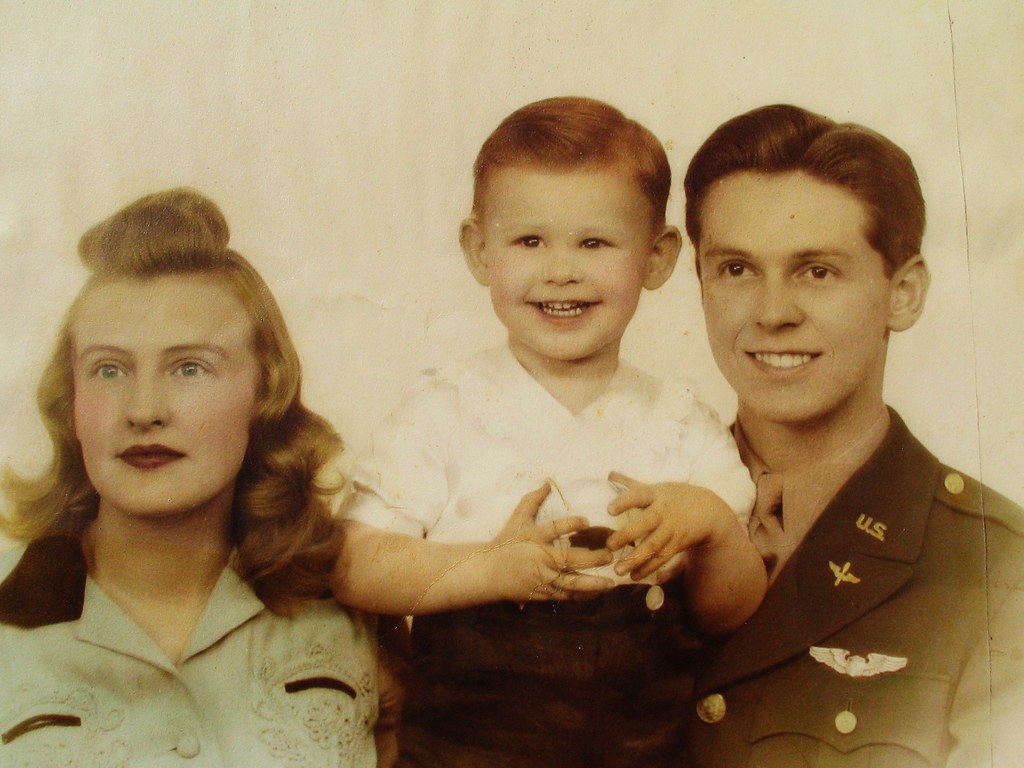
William, Dee and Little Bill

Dorothea ‘Dee’, Little Bill and William

At 18 years of age William joined the Cavalry Reserve Officers’ Training Corps (ROTC) at the University of Illinois, becoming a member of  the ‘Scabbard & Blade‘, an Honorary Military Society that promotes and develops the “Five Gold Stars”: Honour, Leadership, Professionalism, Officership, and Unity.  Here William studied law and used his passion for reading, particularly the classics like Shakespeare and Proust, to continue to achieve those high grades he was known for. His reputation for hard work and dedication was his bedfellow.

Whilst in the Cavalry, William got the nickname ‘Square John‘, he took to fencing and riding, whilst enjoying ‘Breaded Veal chop’ and listening to Ernie Pyle, an American journalist who would become one of the most famous war correspondents of World War II. One of the rules as a Cavalry Cadet  was that you had to carry a ‘handkerchief’, this was used to fulfil the joyful operation of cleaning your horse’s rear, a very unpleasant but ‘necessary’ duty.

On graduating, William would be presented with a sabre from his class, fulfilling both roles of president of the Cavalry Officers’ Club and as a Cadet Major. The sabre would remain in the family home for many years after.
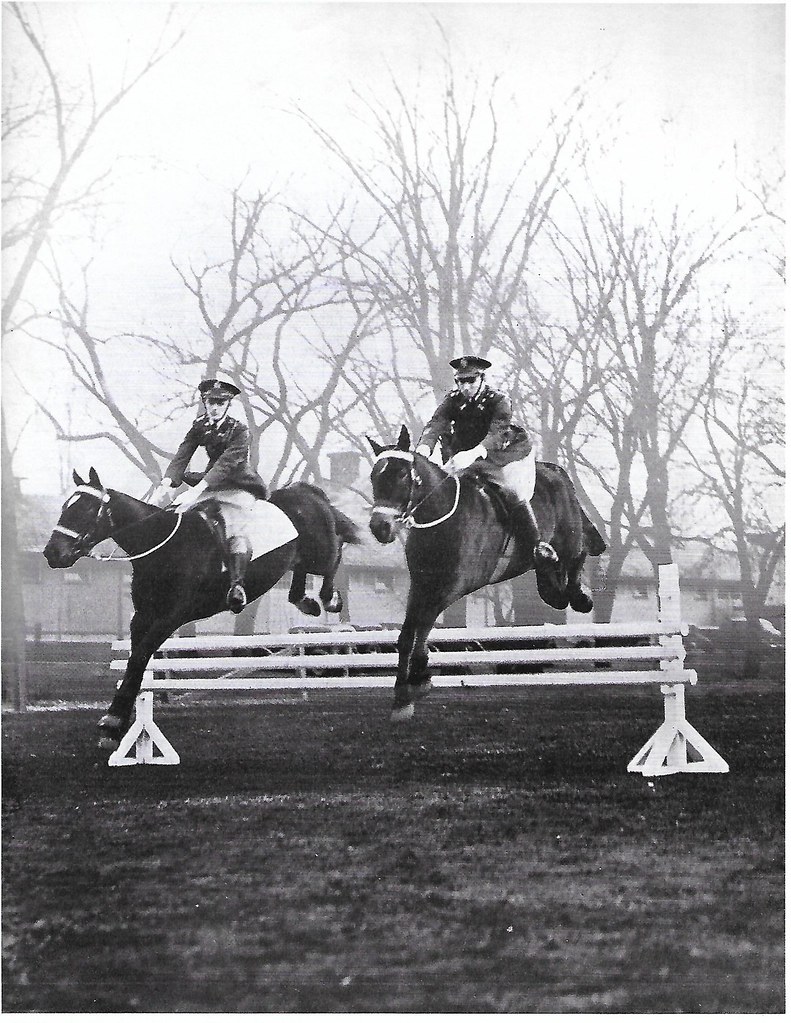
William 'Square John' Horse jumping,

William ‘Square John‘ Horse jumping,

It was at University, on April 29th 1939, that William met on a blind date, his wife to be, Dorothea Griffiths, the woman he later referred to as ‘Dee’. Even before meeting up, the two were destined to face problems, a faulty car doing its utmost to prevent William from getting to his destination on time. But as a lover of dancing, William charmed Dee with his dance floor moves, and they turned out to be the perfect match, Dee forgiving William’s lateness and agreeing to see him a second time.

The two became inseparable, and within a year they were married, on June 10th, 1940, when William was just one day over 20 years old. The ceremony took place at Clinton, Iowa, but it would be here that the second of their problems would arise. Angry at the marriage, William’s mother objected, stating that he was too young to be legally married. Successfully, and much to the anger of William and Dee, she had the marriage annulled. However, the two were not to going to accept that, they simply ran away to repeat the wedding and reinstate their marriage vows in a new ceremony – love had conquered all.
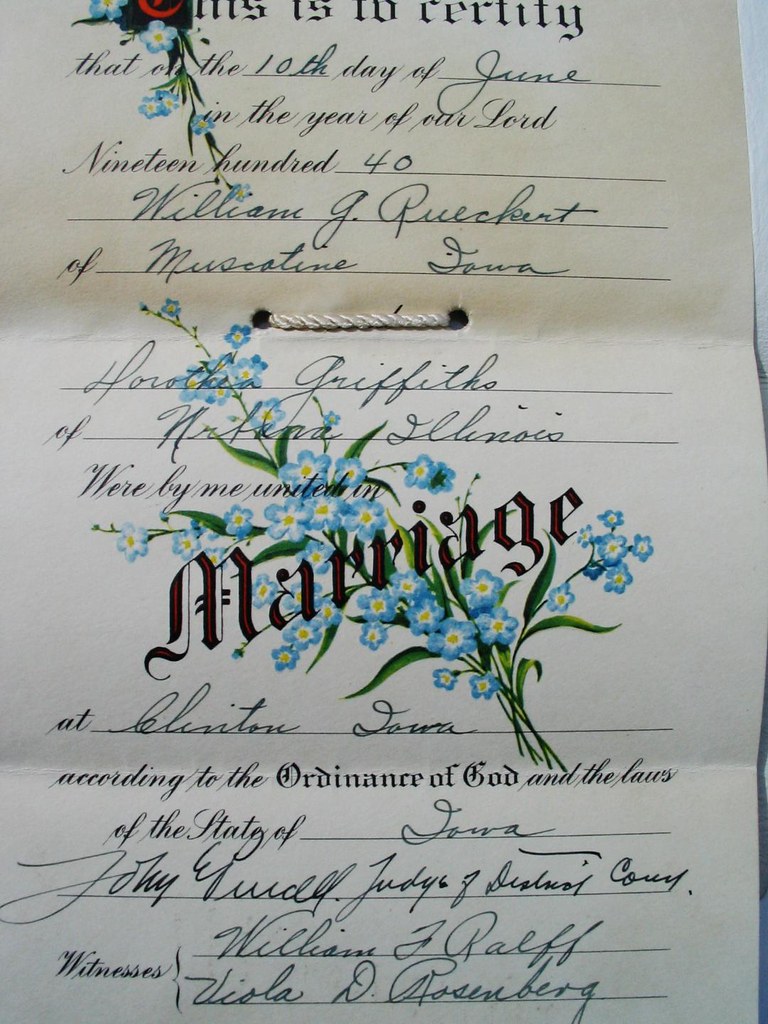
Second Marriage Certificate

William and Dee’s second Marriage Certificate

After leaving the Cavalry and returning to his studies, he graduated from the University of Illinois with a Bachelor of Science in Commerce and Law on June 9th, 1941.  William and  Dee then moved to 64 Sommers Lane, Staten Island, on the southern edge of New York, Dee’s home town. William managed to secure himself a job with the Bethlehem Steel Co.  a company that would become a major supplier of armour plate and ordnance to the U.S. armed forces. Here William worked in the accounts department, whilst all the time continuing to work for his law license with the New York State Bar.
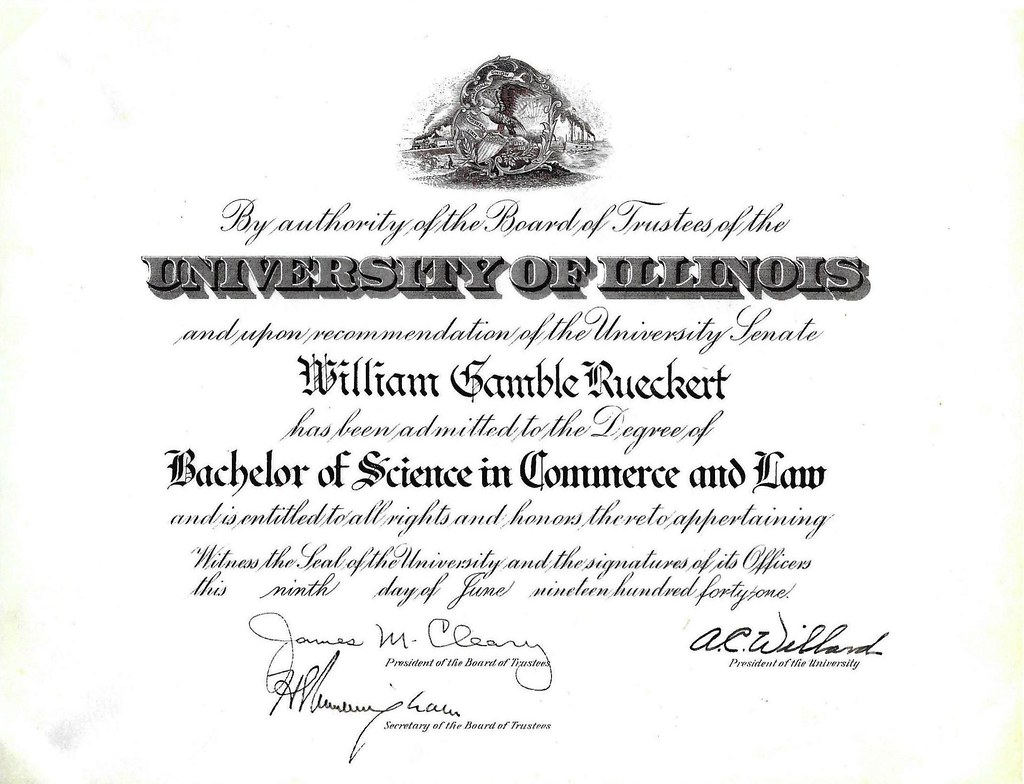
University Certificate

William’s University Certificate

With the war in Europe escalating, William, being a reserve at this time, was called up under President Roosevelt’s Defence plan, in August 1941, and he was sent to the Maintenance Officer Company, 35th Armoured Regiment, Fourth Armoured Division Pine Camp, Watertown, New York. He served as a 1st Lt. Artillery Officer in Company ‘A’, 1st Battalion. It was here that the dedication and hard work that he had shown throughout his education would shine through yet again, quickly standing out from other cadets. William also stood out on the ranges, soon winning himself a medal for artillery and rifle shooting.

A heavily pregnant Dee joined William at Watertown not long after his call up, remaining at home as a ‘Housekeeper’ whilst William went about his duty. The love between them never faltering once. In an interview after his death, Dee described William as “Sweet” saying that “Even after we were married, he would telephone for a date and arrive home with flowers and candy.”

It was this love for each other that produced at 5:45pm on December 1st, 1941, the same month as the Japanese attacked Pearl Harbour, their first child, William Griffiths Rueckert (Little Bill). Bill being born in a small Catholic Hospital just outside the base at Watertown. In those first few years of his life, Bill would grow very fond of his father, a father who would sadly be taken away from him far too soon. William and Bill developing a mutual love for each other.

Four years after his military career had begun with the cavalry, and one year after leaving the Armoured Division at Pine Camp, William would make a big change in his career,  resigning his commission and  volunteering for the United States Air Corps. In Bill’s words referring to why his father left the Army he said:  “After four years of wiping his horse’s ass, and looking up at the new way to travel, he had the flying bug“.

William Rueckert’s life then changed forever. In 1942 as a 1st Lt. Trainee Pilot, he left New York, Dee and his son, and moved to the West Coast Training Centre whose headquarters and administration centre was at Santa Ana Airbase in California.

Early Flight Training.

William would have progressed through several stages of training, from primary to basic, then on to advanced flying and eventually to the heavy bombers. This would take him through many courses at several sites. After primary flight training, he would have gone onto basic flying. Here a nine week course of some 70 hours or so would have taught William more basic flying skills, including: instrument flying, aerial navigation, night flying, long distance flying, radio operations and etiquette, and finally formation flying.

One of these first stations would be Lemoore AAF in California. Whilst here, William would learn firsthand the perils of flying, when on May 20th, 1943 he was involved in a mid air collision with another aircraft piloted by Air Cadet Donald. W. Christensen (S/N: 39677502). Sadly, Christensen would die in the crash whilst William would suffer a wound to the forehead.

I have, since the original post, been able to establish beyond doubt that this is the accident that Dee refers to, although she would later retell the event believing it was a B-24 at a Biggs Field, El Paso, in Texas.

The Army Air Corps used a range of aircraft to train pilots in basic flying, one of the more powerful and complex models was the single engined aircraft the Vultee BT-13 (replaced by the Vultee BT-15). On that day (May 20th, 1943) William was flying solo in BT-15 #42-1957 at Lemoore AAF, and was approaching to land.

The official records (crash number 43-5-20-6)*8 held at the Air Force Historical Research Agency, states that:

At 17:02, May 20, 1943, while upon final approach at Lemoore Field at the termination of a routine training flight, Student Officer, 1st. Lt. W.G. Rueckert collided with A/C  D.W. Christedsen [sic].

Both airplanes were approaching the field in the usual manner. The wind was slightly from the right at 10 mph. Position of the approaching ships gave the control ship stationed on the south-west corner of the mat no cause for alarm. A/C Christensen in ship 32 was in front below and to the right of Lt. Rueckert in ship 12. Several hundred yards from the south-west edge of the mat. Lt. Rueckert noticeably dropped the nose of his ship which struck the A/C Christensen’s airplane behind the canopy. Both airplanes remained in contact and fell to the edge of the mat from a height of about 50 feet. A/C Christensen plane landed on its back, exploded and burned killing A/C Christensen immediately. Lt. Rueckert’s landed nose first, broke clear of the other plane and the pilot jumped out and attempted to extinguish the blaze with his fire extinguisher. He sustained a cut on his forehead and shock. The fire truck and ambulance arrived immediately afterward, put out the blaze and conveyed Lt. Rueckert to the hospital.

Lt. Rueckert stated that he never saw A/C Christensen’s plane in the traffic pattern.

It is probable that one or both pilots were making improper correction for wind drift although witnesses were located at angles which made it impossible to verify this fact.”

The enquiry that followed concluded:

Failure of pilot in airplane to look around. Poor correction for drift on the part of one or both pilots. Lack of control tower in the vicinity of mat. Present control tower is approximately four thousand feet from the scene of the accident.

Dee would later retell the story to Bill, describing how she went to the hospital and how she had to remove little splinters of the shatter windshield from William’s forehead for weeks after the crash. It had been a hard lesson learnt for William.

On completion of the basic course, he then transferred to the multi engined Advanced Flying Course at Stockton Field*4, California, the Air Force’s first west-coast Advanced Flying Field. Here William was enrolled in Class 43-H.

On the Advanced Flying Course at Stockton Field, William would have undertaken a further seventy hours of multi-engined flying, formation flying, night flying and instrument flying using standard training aircraft such as the: Curtiss AT-9, Beech AT-10 or the Cessna AT-17 / UC-78. Upon completion of this course, William would receive his wings and a Commission.

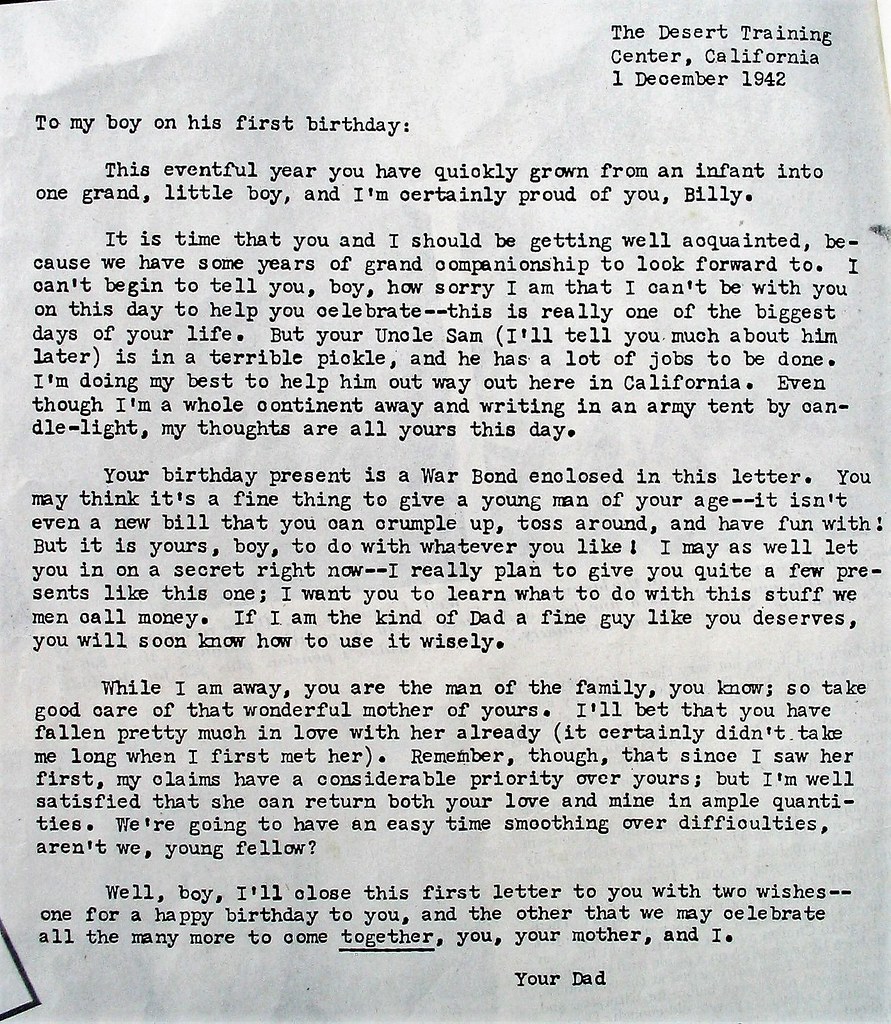
Whilst William was here at Stockton Field, his son Bill, would reach his first birthday and William would send a heartfelt letter home telling Bill how much he missed him, and looked forward to spending time with him again. In his opening paragraph William said to Bill: “This eventful year you have quickly grown from an infant, into one grand, little boy, and I’m certainly proud of you, Billy.

WIlliam's letter to Little Bill on his first birthday.

William’s letter to Little Bill on his first birthday

The course lasted well into 1943, and on August 30th, Lt. William G. Rueckert graduated received his wings and his commission – his dreams were slowly becoming a reality.

For his next posting, William would be transferred to Kirtland Field, New Mexico (formerly known as Albuquerque Army Air Base, being renamed Kirtland Field in 1942 after Colonel Roy C. Kirtland), which specialised in navigation and bombardier training. The aircraft used here were the twin-engined Beechcraft AT-11 or the Douglas B-18 Bolo aircraft. Although split into three specialist schools, it also trained entire crews ready for the heavy Bombers the B-17 and B-24. It would be here that William would have his first encounter with the B-24 ‘Liberator’.

On October 28th 1943, William passed his instrument flying test, and by the time he was finished at Kirtland Field, he was a qualified pilot instructor on B-24s. With this under his belt, William was now ready, his flying training completed, he would transfer again, this time to Biggs Field, El Paso, Texas.

It would be here at Biggs Field that the family would be reunited once again, Dee and Bill joining William on the base’s accommodation. It would also be here that Dianne, Bill’s sister, would be born. Dianne sadly passing away in 2007.
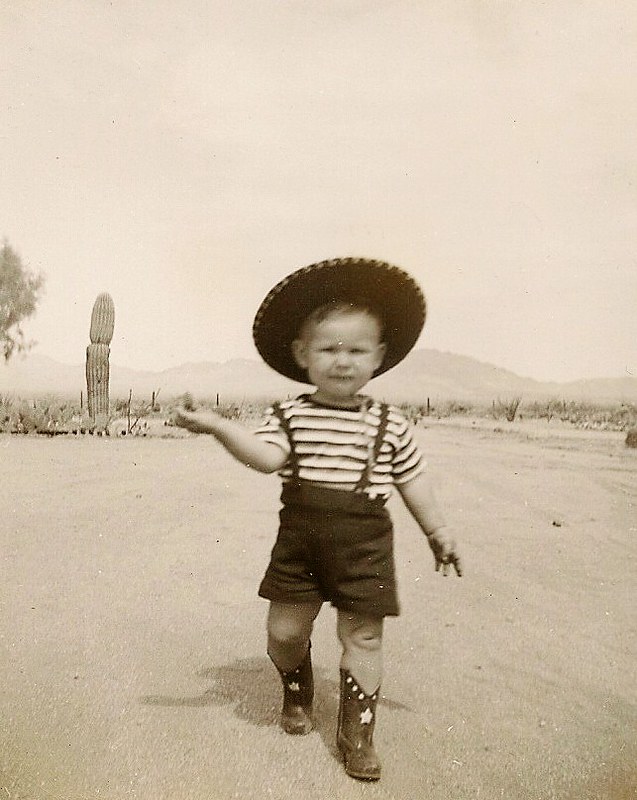
Little Bill in El Paso

Little Bill in El Paso. The boots, he tells me, he still owns today!

Dee’s account of the accident that is now believed to have been the Lemoore AAF collision was retold later to Bill. Her account of the day’s events being sketchy. I am continuing to search for evidence of this but it is unlikely that William was involved in an accident whilst here at El Paso.

Finally, the draw of the war led William to requesting a post overseas. But before departing, he would pick his own crew members,  Harold Emerson Roehrs – his co-pilot, and Jimmy Gardner – his navigator, both of whom he had become good friends with at El Paso.

Later in life, Harold Roehrs would write his own biographical account, “Harold’s Story“, in which he mentions William in a dedication. William being the one who taught Harold to fly a B-24, something Harold had to prove to his Commanding Officer Major (later Lt. Colonel) Thermand D. Brown. In doing so, Harold flew Major Brown around the skies of Hardwick until he was convinced, and convinced he was! In his book, Harold pays homage to William saying of him: “My pilot and friend who shared his knowledge and taught me how to fly a B-24 Liberator“.  William being one of those many people who helped shaped Harold’s life.
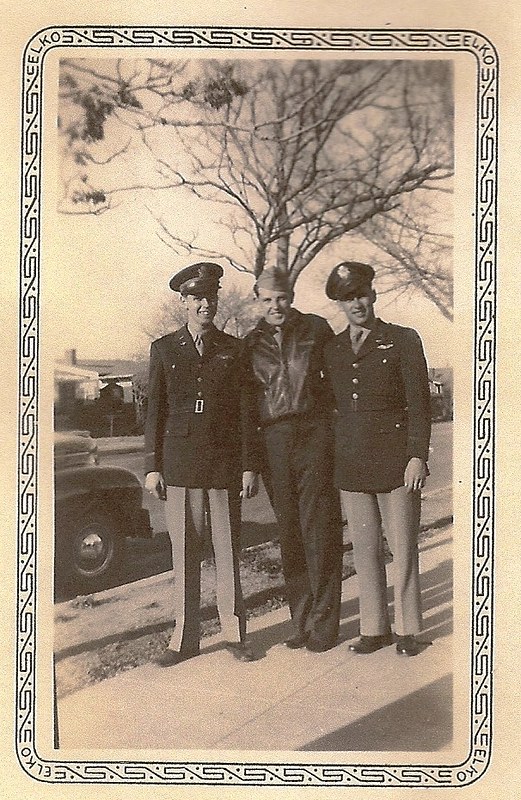
L to R: William, Jimmy and Harold at El Paso

Left to Right: William, Jimmy and Harold at El Paso

The three friends would all be posted together to RAF Hardwick, Norfolk, England to join the 409th BS, 93rd BG, 20th Combat Wing, Eighth Air Force, in April 1944. All three serving in the same crew.

The three left Biggs Field travelling to Forbes Field, Topeka, Kansas at the end of March 1944, where they would collect their B-24 to fly to England. The aircraft was loaded up and they took off heading over the southern route.

Off to War.
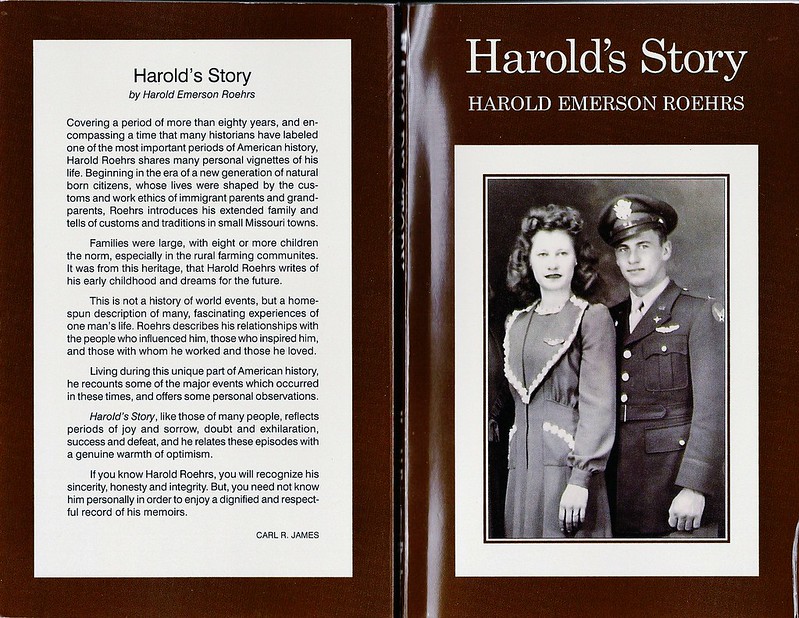
"Harold's story"

“Harold’s Story” is dedicated to many including William Rueckert.

Harold detailed the journey in his book “Harold’s Story”*3, shining an immense light on the enormity of the trip, one that was made by many crews transporting themselves and aircraft across the vast southern hemisphere to a war very far away.

The journey would be broken into stages, each covering many miles, with hours of flying over water. Much of the journey taking in hot humid days broken by the cold nights, the time when they would fly the most.

The first part of the journey took them from Topeka to West Palm Beach on Florida’s southern point, then via Aguadilla, Porto Rico, to Georgetown in British Guiana. The crew would then fly onto Belem in Brazil before arriving at Fortaleza, their last stop before the next leg and the Atlantic.

The crossing of the Atlantic, then took the crew from Fortaleza, across the monotonous waters of the southern Atlantic Ocean. They were aiming for Dakar on the Cape Verde Peninsula, Africa’s most westerly point. The 1,928 miles would take them exactly twelve hours and thirty-five minutes, and cross four time zones point to point.

After a nights rest, the crew then flew from Dakar to Marrakesh in Morocco, where they waited for five days until the notoriously poor British weather cleared sufficiently for them to proceed. Finally, they were given the go-ahead, and the last leg would take them around neutral Spain and Portugal, wide of the Bay of Biscay, arriving finally at the US Staging post RAF Valley in Wales.  (RAF Valley, had been designated a major staging post for US arrivals along with St. Mawgan in Cornwall and Prestwick in Scotland).

As in many cases, the aircraft flown over by the crews was not the aircraft they would keep as part of their operational unit. The new aircraft being taken and flown by ferry crews to other operational squadrons. From Valley, crews would make their way to Liverpool where they would then be transferred to their assigned squadrons, William, Jimmy and Harold making their way to Hardwick by train. The journey not being a direct one, would lead to them arriving at Hardwick (Station 104) on April 24th 1944.

Formed only two years earlier on 22nd April 1942, the 409th was to be William’s only operational squadron. Having won three D.U.C.s already for operations over Europe including, the raid on the Romanian oil fields at Polesti, and the enormous raids of February 1944 ‘Big Week’, the 93rd were already a battle hardened group.

https://i0.wp.com/media.iwm.org.uk/iwm/mediaLib/rfc/FRE_003762.jpg

A B-24 Liberator (YM-H, serial number 42-95258) of the 409th Bomb Squadron, 93rd Bomb Group (IWM FRE 3762)

Ted’s Flying Circus” as they were to be known, were very much in the front line of operations, taking part in the preparations for D-Day, completing much of their bombing missions over the Normandy area. Here they focused on cutting German supply lines and vital communication routes across France.

First and last Mission.

William’s first and only mission, was on May 1st 1944, one week after his arrival at the base. It was to be an early morning flight, take off at 05:00. Mission 332 was for more than 500 heavy bombers of the 1st, 2nd and 3rd Bomb Divisions, to attack V- Weapons’ sites in northern France. These “Crossbow” operations were designed to destroy launching areas for the Nazi Terror weapons the V-1s that were targeting London and the South East. On that day William and Jimmy decided to volunteer to fill the vacant co-pilot and navigator spots in the crew of pilot Second Lieutenant Albert Schreiner (s/n: 0-805532) on B-24 ‘Joy Ride‘ #42-7621, leaving his other regular crewmen behind at Hardwick including Harold. William’s work ethics playing one last card as he wanted to get familiar with combat missions before taking his own crew out.

2nd Lt. Schreiner, a veteran pilot from Gloucester County, New Jersey had been along a similar path to  William’s, the ‘green’ newcomer. A Cavalry man he had enlisted in 1941, joining the National Guard before transferring across to the Air Corps.

On the night before the mission, William visited the local church at Topcroft, here he said his prayers in preparation for the following day’s flight. The church having strong links with the base, continues to honour the crews today.

The next morning, May Day 1944, two missions were planned, the first to the V Weapons site at Bonnieres, the second to a Brussels railway yard. About half the aircraft managed to get airborne for the first sortie, then it was the turn of ‘Joy Ride’.

The engines roared into life, 2nd Lt. Schreiner had signed the aircraft off fit for flight after a fuse for heating the suits had been replaced; the brakes were released and the aircraft began its roll along the perimeter track to the end of the runway where it sat waiting. After the signal to go was given, the engines were brought to full power, the brakes released and the aircraft shook and shuddered its way down runway 020 heading south. As it reached almost mid point it began to lift off, and when about 20 – 30 feet in the air, Schreiner gave the order to raise the undercarriage. S/Sgt. Monnie Bradshaw, the Top Turret Gunner / Flt. Engineer reported all instruments were well. He reached down to the undercarriage levers, when suddenly the aircraft hit the ground with an almighty sound.

A heavy landing tore off the left undercarriage leg and the nose wheel collapsed. Unable to gain any height, the aircraft crashed down and slid along the rest of runway 020 spinning round several times before ending up at the crossing with runway 032. Flames had by now engulfed the bomb bay and fuselage, Bradshaw pushed open the top hatch striking the Navigator 2nd Lt. James E. Gardner, on the head. Not seriously injured, both men escaped from the aircraft through the hatch, the top turret now resting on the nose of the stricken B-24, the fuselage engulfed in fire.

In the B-24 lined up behind William’s aircraft was Radio Operator Sgt. Cal Davidson who was stood between the pilot and co-pilot, a common practise on ‘night’ flights which allowed the pilot to focus on the instruments whilst the Radio operator watched the runway. Watching carefully between the rows of burning oil drums that lit the darkened runway, Davidson had a grandstand view of the incident that unfolded in horrifying detail in front of him. He described how he watched as William’s B-24 carrying a full load of fuel and bombs, took off from Hardwick’s north-south runway 020. In his diary that day, Sgt. Davidson wrote*5:

May 1 Blue Monday. No sleep last night as we were called for a mission, briefed at 2:00 and scheduled for a 4:00 take off flying the “War Goddess” to go on a practice mission before going to the actual target. As we sat on the runway next in line to take off, the plane ahead of us didn’t make it off crashing and exploding about 2/3rds of the way down the runway. Flames shot up and lit up the whole field. As I was standing between the Pilot and Co-pilot, the three of us watched stunned at what had just happened. Neast [The pilot: John K Neast] put his head down on the controls and said “O God why did this happen?”. He’d never taken off in the dark before and said he was all set until this happened.  The tower sent up red flares and told all remaining crews to get out of their planes. Once out of the plane with the engines quiet you could hear the 50 calibre bullets going off and the 500 lb bombs began exploding. Colonel Fiegel Base Commander and our Sq. C.O. Major Brown had tears in his eyes as he told us it was a 409th plane. Major Brown is one of the finest officers I have ever met.”

He then goes onto say:

One of those killed was a young French-Jewish boy from our barracks and had the bunk next to mine. We had nicknamed him ‘Frenchie’

‘Frenchie’ was Radio operator Sgt. Sheldon Sheinfine, who claimed to be probably the only French-Jew in the Eighth Air Force, he shared a barrack hut with Davidson, having adjacent bunks. Davidson himself, cleared out Sheinfine’s belongings almost immediately, and his loss, and the loss of the crew, had a great impact of Davidson.
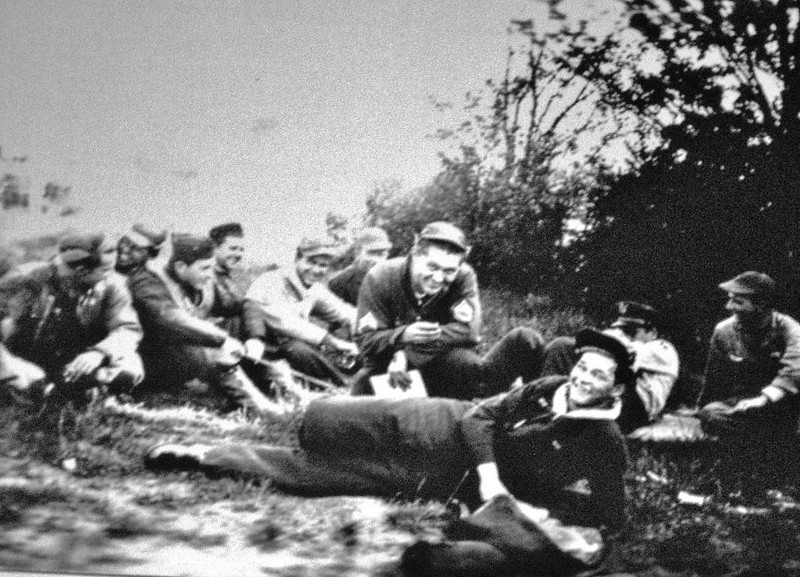
Sgt. Cal Davidson front

Sgt. Cal Davidson (laying down front)

Two nearby Groundcrew Sgt. Harry Kelleher*2 and Sgt. Johnny Findley also witnessed the crash. Sgt. Findley was closest and recalled how he heard “the squeaking sparks flying off, as the plane slid along the runway“. Then he watched as it “burst into flames as it continued down 020 north-south to 032  runway“. Findley ran over to one of the ejected crew members holding him until rescue crews arrived. Sgt. Kelleher leapt into a jeep and raced over to the crash site picking up a further two crewmen. “At that point” Kelleher said ,”the gas tanks exploded knocking over the jeep“. That was enough and they made a quick exit, in Kelleher’s words “they got the hell away.”

Standing on dispersal number 8, Engineering Officer Captain Thomas H. Jackson also saw the aircraft “crash and burn“, as it slid along the runway it “burst into flames“.

Another witness, ground crewman Corporal Johnny Fridell Jr*7, who was standing by runway 020 as the B-24 slid along on its belly, described sparks flying from the aircraft until it reached the crossing with 032, spinning around catching fire. Fridell then jumped into a shelter fearing what was about to happen. Over the next half an hour, seven of the 500 lb bombs on board the B-24 exploded, the full complement of fuel caught fire and the ten  ammunition boxes containing nine yards of .50 calibre bullets, began exploding too. It was a massive fireball from which it was unlikely anyone would survive.

Standing on the balcony of the control tower, the Commander Colonel Leland Gordon Fiegel, also watched as the lumbering B-24 came down onto the runway and caught fire. From where he stood, he didn’t think the damage was any more worse than “an ordinary belly landing“, but noted how “the fires increased rapidly in their intensity“.
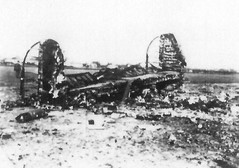
B-24 "Joy Ride" Tail section

The tail section of B-24 “Joy Ride” after the crash.

Ground crewman Cpl. Johnny Fridell , along with rescue crews, then ran toward the fireball to try and help anyone they could. Miraculously, of the total number of crew, three were uninjured: Navigator 2nd Lt. James Gardner, Waist Gunners S/Sgt. Harold Loucks and T/Sgt. Kerry Belcher, mostly located within the rear of the aircraft between the bomb bay and the tail. Two further crewmen received injuries; Top Turret/ Flight Engineer S/Sgt. Monnie Bradshaw and  Tail Gunner Sgt. Anthony Constantine. The remaining five, including Rueckert, were killed: Pilot 2nd Lt. Albert Schreiner, Bombardier 2nd Lt. Paul Sabin, Radio Operator S/Sgt. Sheldon Sheinfine and Nose Gunner Sgt. John Dalto. All of these were located in the front portion of the aircraft. The fire and explosions were so intense only a single thumb was found by rescuers.
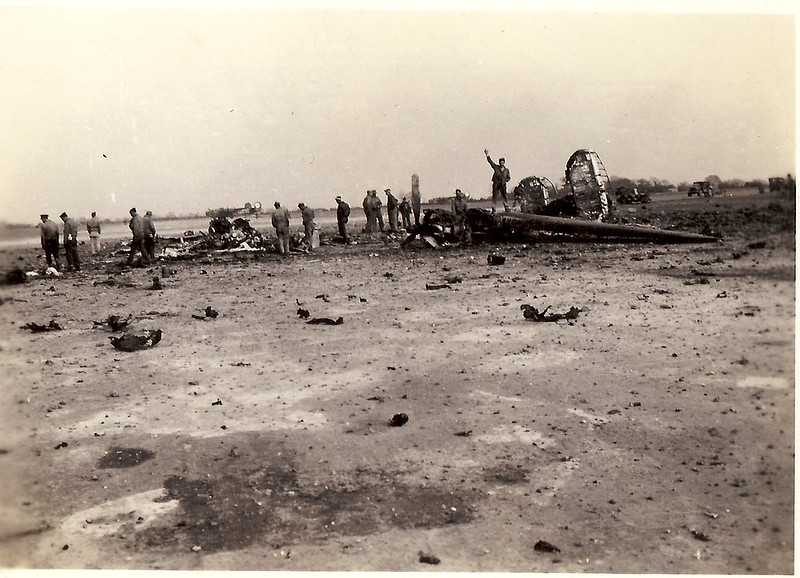
The B-24 after the fireball

The remains of Reuckert’s B-24.

By 16:00 RAF Bomb Disposal crews had managed to remove and deal with the remaining bombs, it was thought at this stage the aircraft may have suffered from prop wash, a devastatingly dangerous effect caused by preceding aircraft creating turbulent air.

The explosion caused such damage that it created a huge crater closing the two main runways for five days. The mission was scrubbed (22 aircraft had already gotten airborne and carried on), red flares being fired into the night sky instructing crews to abandon their aircraft and return. For the next week all aircraft had to take off using the short runway and climb up over nearby woods approaching Topcroft village. As a result of the difficulty in doing so, there were subsequent crashes at Hardwick, with aircraft falling into the woods beyond the airfield. The crater and burnt debris of William’s B-24 leaving a stark reminder of the dangers of flying a heavy bomber laden with combustible and explosive materials.

Dee finds out!

For seventeen days Dee knew nothing of her husband’s fate. At home, she had been working on the new family flat at St. George, on the north-eastern corner of Staten Island, whilst living a few miles away with her family at Castleton Corners. Dee had been writing letters every day, in many cases two or three times a day, but unbeknown to her they were not reaching her husband very quickly – if at all.

To Dee, the old furniture with scratches and rips from the dogs they had owned held fond memories of their early days together. The many moves they had made as William had been posted from one training airfield to another, were emphatically etched in their structure.

Dee was at her mum’s house on May 18th when the buff telegram arrived. With ‘Western Union’ emblazoned across the top and two tell-tale red stars*6 in the bottom left corner, Dee knew exactly what it meant, she didn’t need to open it. As the tar stained hand of her father held it out to her, her life fell apart. The man she had adored for the last five years was gone, the moment she, and all serving personnel wives’ feared, had happened. She became ill and slid towards depression. Seeing the changes in her, Dee’s mother took charge, she gave up her own job and took Dee and the two children in. Encouraging Dee to go out and get a job, as she cared for Bill and Dianne and nursed Dee back to full strength.

Gradually, Dee recovered and got her life back on track. Small reminders would never be far away though, each one bringing William back to her thoughts. Not long after his death, flowers he had ordered only days before the accident, finally arrived on Dee’s doorstep.
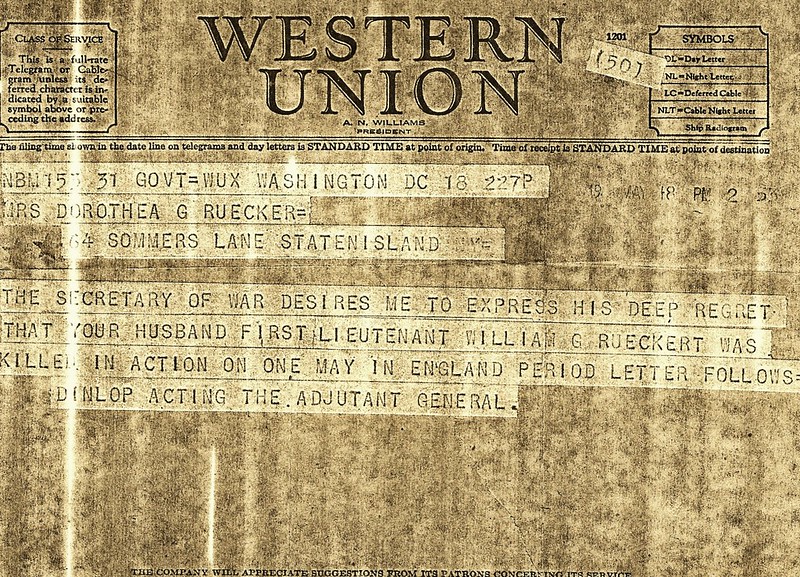
The Telegram that brought the terrible news to Dee

The dreaded Telegram that brought the news of William’s death to Dee

Shortly after the 20th, a confirmation letter arrived from the War Department in Washington D.C. In three short paragraphs it confirmed that William had been “killed in action on 1 May 1944 over England.” It said nothing about the incident, as these are “prepared under battle conditions and the means of transmission are limited“. Signed by Brigadier General Robert H. Dunlop, it told Dee that William’s service had been “heroic“.

Back in the UK, those that had escaped, particularly William’s good friend James ‘Jimmy’ Gardner the Navigator, went into shock. He was sent to London to recuperate, before being sent home. In later years Bill tried to talk to him about the crash, but the shutters came down and Jimmy understandably turned away from Bill.  In June 1944, Harold, Bill’s other good friend from  their days at El Paso, would convince Col. Brown of his flying abilities, being approved as a pilot and then assigned another crew, he would go on to complete 37 missions with the 93rd at Hardwick.

In the official enquiry that followed the crash the engineer stated that all engines were running OK, each at 2,600 rpm with 49” M.P. (Manifold Pressure) in each one; recognised as sufficient power to achieve a good take off with the load being carried by the bomber. Schreiner’s training record was scrutinised and found to be in order. The pre-flight mechanic’s report was checked and several eye witness accounts were taken. After deliberations the committee apportioned 100% blame to the pilot Lt. Schreiner’s night take off technique, saying that he had allowed the aircraft to land again without realising what he had done. As a result, the committee recommended modified training for all crews to include further training in night take off and landings.

First page of the Crash Report

The first page of the accident report which blamed the pilot for his ‘take off technique’. Note the misspelling of William’s name.

Rueckert’s remains was initially buried at the Cambridge American Cemetery and Memorial at Madingley, a few miles outside of Cambridge, along with the pilot 2nd Lt. Albert Schreiner. Later on, William’s mother asked Dee if his body could be returned to Illinois to be placed along side his father in the family plot in Moline. Dee, still angry at her attempts to stop the marriage, and knowing there was little more than bricks in the coffin, agreed to the move and the coffin was returned in 1952. Of the others, Bombardier 2nd Lt. Paul Sabin was buried in section 14 of the Mount Carmel Cemetery, Raytown, Jackson County, Missouri, and Radio Operator S/Sgt. Sheldon Sheinfine was buried at the Beth Israel Memorial Park, Woodbridge, Middlesex County, New Jersey. Sheinfine was only nineteen years of age. The last crewman to lose his life that day, was twenty-one year old Sgt. John Dalto, who was buried in the Long Island National Cemetery, East Farmingdale, Suffolk County, New York. The average age of the crew that day was only 20 years old.

At the end of the war, one of William’s original crewmen stopped off at Dee’s to explain that William had volunteered to fly in ‘Joyride‘ that fateful day, the purpose being to gain experience before taking his own crew into heavily defended enemy territory.

Since discovering a lot more about his father’s death, his son ‘Little Bill’, has repeatedly returned to Hardwick and has become very good friends with the site owner David Woodrow. William’s wings and wedding ring were never recovered from the crash site, and remain buried in Hardwick’s 032 runway, where the concrete patch stands today.

On the farm that now stands in the place of Hardwick airfield, is a small museum, maintained by a volunteer crew set up by both David Neale and David Woodrow. The farm also has a memorial to the 93rd BG and regularly honours those who served. During the time the airfield was open, a pond was located in this area, into this pond aircrew who had passed their statutory mission number were thrown, a right of passage that allowed them to go home. Many however didn’t, choosing to stay on and serve for longer.

Following the accident, 1st. Lt. Rueckert was awarded the Purple Heart, as was the pilot. His son Bill, has since donated a replica of the medal to the church at Topcroft, the church William visited the night before his death.

Purple Heart Certificate

William Rueckert’s certificate for his Purple Heart.

Inside the church, a plaque sits on the wall remembering the 668 men who never returned to Hardwick from missions. William’s name also appears in the St Paul’s Cathedral Roll of Honour, on page 365.

William G Rueckert was a brave young man who, like many others, went to fight a war a long way from home. Doing their duty came above all else, but like many others he longed to see his wife and family. Sadly, that day never came, and William lost his life serving the country and people he loved.

RAF Hardwick and the story of the 93rd BG whilst based here appears in Trail 12

William G Rueckert appears on the World War II Honours list of Dead and Missing, State of New York 1946 Page 136.

Sources, notes and further reading.

Much of the basic information used was supplied by William Rueckert (Little Bill) through emails, and all pictures (unless stated) were donated and used by kind permission from Bill to whom I am truly grateful.

*1 The Eastern Daily Press ‘Weekender’ was published on December 13th 2014.

*2 Sgt. Harry Kelleher went with the 39th BG when it took part in the Polesti raid. His rank was that of Non-flying Ordnance ground crew. However, it is believed he joined Captain Llewellyn L. Brown’s crew taking the position of Ball Turret Gunner on the B-24 #41-24298 ‘Queenie‘ which was hit by flak and diverted to Sicily. Harry had been denied the opportunity to fly in the bomber by his superiors, but went anyway. He is credited as Ball Turret Gunner on the ‘American Air Museum’ website having been awarded the Air Medal and the Distinguished Flying Cross. Harry had relayed the story to Little Bill before passing away, however, none of the crew have ever verified his claim and no other record seems to exist of it.

*3 Extracts from “Harold’s Story” written by Harold Emerson Roehrs, William’s best friend, were kindly given to me by Bill. The book I believe is now out of circulation.

*4 The History of Stockton Field can be found on the Military museum website, including images of Stockton Field taken during the war.

*5 Email from Cal Davidson to Bill Rueckert 25/8/04, courtesy of Bill Rueckert.

*6 One Red Star would signify Missing in Action or wounded, whereas two meant they were killed. Hence anyone seeing the telegram would know before even opening it what it meant. Dee’s father owned as company that repaired water tanks on top of the skyscrapers using tar, hence his hands were always covered with it.

*7 Corporal John L. Fridell Jr (s/n: 14077456) was one of the ground crew for ‘The Sleepy Time Girl‘ also referred to as “Sleepytime Gal‘ which completed 135 missions without returning once with mechanical problems.

*8 Accident number 43-5-20-6 Lemoore Army Air Field provided by the Air Force Historical Research Agency.

All quotes regarding the crash of the B-24 are from witness statements taken from the War Department Investigation, Report of Aircraft Accident Number 0000198.

USAAF Training Aircraft Fuselage Codes of WW II website

Abandoned and Little known Airfields website has a  very interesting collection of photographs and information on Lemoore AAF.

Kirtland Air Force Base Website

MyBaseGuide website

Aviation Archaeological Investigation & Research website.

El Paso Times Website.

2Lt. Thomas E. Cartmell Blog by Michael John Hughey, MD

My sincere thanks go to Bill for allowing me to publish his father’s story and to all those who have contributed comments, corrections and information about the accident. I am continuing to search for further information, if / when this arrives, I shall add it to the text.

July 30th 1944 – Loss of Lancaster PB304 – 106 Squadron.

On Sunday July 30th 1944, Lancaster PB304 from 106 Squadron RAF Metheringham in Lincolnshire, crashed with the loss of all on board, along with two civilians, in Salford Greater Manchester.

Lancaster PB304, was a MK.III Lancaster based at RAF Metheringham in Lincolnshire, flying under the squadron code ZN-S. It was tasked to attack enemy strong points at Cahagnes in the Normandy battle zone following the Allied invasion in June.

The early briefing at 04:00 was not a welcome one, many men having been out the night before following a stand down order due to bad weather and heavy rain over the last two days. On board that day was: F/L. Peter Lines (Pilot); Sgt. Raymond Barnes (Flt. Eng.); F/O. Harry Reid RCAF (Nav.); F/O. John Harvey Steel (Air Bomber); Sgt. Arthur William Young (W.O/Gunner); Sgt. John Bruce Thornley Davenport (Mid-Upper Gunner) and Sgt. Mohand Singh (Rear Gunner)*1.

The operation, code-named Operation Bluecoat, would involve attacking six specific targets, each one identified to assist a forthcoming offensive by British land forces in the Normandy area.

After all the ground checks were completed and the signal given to depart, PB304 began the long taxi to the runway, take off was recorded as 05:55, but it is thought that this was ten minutes early with the first aircraft (ND682) departing at 06:05. Once in the air, the aircraft formed up alongside twenty other 106 Sqn aircraft,  meeting with a smaller formation from 83 Sqn at Coningsby before joining the main formation.

The weather remained poor with heavy cloud blanketing the sky between 5,000 and 10,000 feet, as the 183 Lancasters from No. 5 Group and one Mosquito headed south toward the Normandy coast.

With further poor weather ahead, signals were beginning to come through to abandon the mission and return to base, but communication between aircraft was garbled and difficult to understand, it may have been as a result of German interference broadcasting messages over that of the master bomber. The order to abort finally came through just after 08:00 even though some of the formation had released bombs on target indicators (TI) dropped by the Pathfinders. Smoke was by now mixing with the low cloud causing more confusion and difficulty in identifying the primary targets. Not all aircraft understood the message however, and many continued circling in the skies above Cahagnes. To make a difficult situation even worse, there was by now, an  approaching formation of over 450 American A-20s and B-26s along with just short of 260 P-51 and P-47 escorts on their way to France; the sky was full of aircraft in thick cloud and was an accident waiting to happen.

Difficult communication continued, some aircraft were seen disposing of their bomb loads over the Channel, whilst others retained them. Various courses were set for home, but with many airfields closed in by low cloud, alternatives were gong to be needed and alternative courses were issued to the returning bombers of each squadron.

106 Sqn were ordered to fly north along the western coast, passing over Pershore and on to Harwarden near Chester, before turning for home. The messages coming through continued to be misheard or misunderstood with several aircraft landing at either Pershore, Harwarden or Squires Gate at Blackpool. Gradually all aircraft managed to land, whether at home at Metheringham or at away airfields. Patiently the Metheringham staff waited, nothing had been heard from PB304 and they could not be contacted on the radio, something was wrong.

Precise details of the accident are sketchy, but an aircraft was seen flying low and in some difficulty. It passed low over Prestwich on the northern edges of Manchester, where it was later seen engulfed in flames. It twice passed over a playing field, where some suspect F/L. Lines was trying to make a crash landing, but this has not been confirmed. At some time around 10:10 -10:15 the aircraft came down resulting in a massive explosion, a full bomb load and fuel reserves igniting on impact. Many houses were damaged in the explosion with one being completely demolished.

As a result of the accident, all seven of the crew were killed along with two civilians, Lucy Bamford and George Morris, as well as, what is believed to be, over 100 others being injured all to varying degrees.

PB304 was the only aircraft lost that night, in a mission that perhaps with hindsight, should not have taken place. The poor weather and difficult communication playing their own part in the terrible accident in Salford on July 30th 1944.

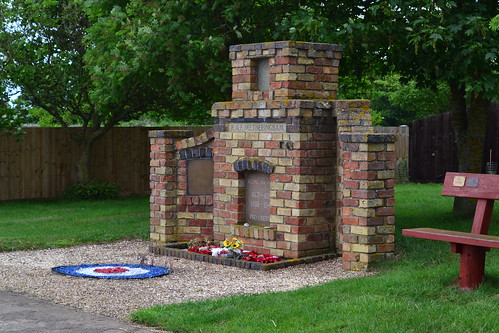
RAF Metheringham

The Memorial at Metheringham pays tribute to all those who flew with 106 Sqn.

Notes and Further Reading.

*1 Operational Record Book AIR 27/834/14 notes Sgt. Young as Sgt. A.L. Young.

A book written by Joseph Bamford the Grandson of Lucy who was killed that night, was published in 1996. “The Salford Lancaster” gives excellent details of the crew, the mission and the aftermath of the accident, published by Pen and Sword, it is certainly worth a read for those interested in knowing more about the incident.

Carter. K.C., & Mueller. R., “Combat Chronology 1941-1945“, Centre for Air Force History, Washington D.C.

Freeman. R., “Mighty Eighth War Diary“, Jane’s Publishing. 1980

RAF Warboys – Home to the Pathfinders (Part 2)

In the early years at Warboys, the Pathfinders had had a difficult start. High loses and poor results were compounded by poor weather. But in early 1943 the Lancaster began to arrive, and the old Wellingtons began to be phased out. The weather however,  takes no account of this and for the early part of January 1943, it continued to envelop the country preventing flights from Warboys going much further afield than Wyton, a stones throw away from their base. Even so, on the 13th, the Pathfinders took another major step forward, being formed into a new and unique Group of their own, No. 8 (PFF) Group, with Don Bennett (now an Air Commodore) remaining at the helm.

On the 26th, the squadron were able to use the new Lancasters for the first time on operations, a bombing raid to Lorient in which 4 Lancasters from Warboys took part; ‘ED474’, ‘ED485’, ‘W4851’ and ‘W4853’. On the 27th the same four aircraft, with different crews, went to Dussledorf, an operation that saw the use of Oboe Mosquitoes for the first time, and a mission that was followed on the 30th by Hamburg. All aircraft returned safely from each of these early operations – 1943 was beginning to look better already.

This run of ‘good luck’ ran well into April, with a relatively low loss rate per operation. This included on  April 16th, the death of Sgt. Patrick Brougham-Faddy (S/N: 577758) and the crew of both Lancasters ‘W4854’  and ‘W4930’. What perhaps makes this incident more notable, was the fact that Sgt. Brougham-Faddy was only 18 years of age, making him amongst the youngest to lose their life in Bomber Command operations. With him lost on that mission was also: his pilot P/O. Harald Andersen DFC; P/O. Kenneth Bordycott DFC, DFM and P/O. Frederick Smith DFM along with ten other experienced aircrew. These losses were a major blow to both the Warboy’s crews and the Pathfinders.

In June 1943, the Navigation Training Unit, a Lancaster based unit formed at RAF Gransden Lodge began its move, taking residency at both Upwood and here at Warboys. The split was not be in everyone’s favour, running a unit on two different sites initially caused some difficulty as the idea of the unit was to train crews in navigation techniques ready for postings to Pathfinder squadrons.

By the time 1943 drew to a close, fifty-seven aircraft had been lost from Warboys, a mix of both Lancaster MK.Is and MK.IIIs, the Wellington now having been replaced entirely within the squadron.

RAF Warboys

Buildings mark the edge of the bomb site.

The cold winter months of 1943 – 44 signified another major event in Bomber Command’s history – the air campaign against Berlin.

For almost 5 months, November to March, Bomber Command would attack Berlin relentlessly in pursuit of Harris’s doctrine of area bombing. The Short Stirling would be withdrawn as the losses mounting were unsustainable, a similar fate that began to land on the door of the Halifax. Some compared the Lancaster to the Halifax, similar to comparing a  “sports car and family saloon”*4. The handling of the Lancaster being far superior to that of the Halifax. As a result, the Lancaster squadrons would bear the brunt of the campaign, and Warboys crews would be in the thick of it. The Pathfinders using an updated version of H2S, would operate outside the range of Oboe, the land based navigation system introduced operationally a year before.

The cold of January 1944, did nothing to dampen the flights nor reduce the combat fatalities. Raids on Berlin, Brunswick, Munich and Frankfurt saw heavy losses (seventeen alone failed to return to Warboys in January, all experienced crews) and numerous aircraft returning early. For 156 Sqn this was disastrous, the squadron began to get a name for itself being referred to as the ‘chop’ squadron and consequently morale fell. With high losses the survival rate fell to an estimated 15%, *3 an unsustainable level of loss for any squadron. For the last fourteen days of January the squadron was effectively reduced to non-operational flights, and in a desperate attempt to bolster the men’s spirits and raise morale, a royal visit was arranged for the King and Queen. Both their majesty’s arrived on February 9th, where they talked to aircrew and took lunch in the Officer’s Mess. After a short stay they departed Warboys going on to visit other Pathfinder airfields in the area.

A widely used photo showing King George VI & Queen Elizabeth talking to ground crew of No 156 Squadron at Warboys(IWM CH 12153)

By the end of February 1944, 156 Sqn were prepared to leave Warboys, maybe a new start would give a new impetus. This move would be a direct swap with the remaining Lancasters of the Pathfinder’s Navigation Training Unit (NTU) based there. Perhaps ending the operating of the unit on two sites had been seen as an ideal opportunity to ‘kill two birds with one stone’, moving 156 and reuniting the NTU.  Whatever the reason the transfer began with a small advanced party taking the short drive to RAF Upwood.

By mid March the move was complete, and Warboys settled into its new role with a full complement of the NTU, hopefully now, the harrowing tales of loss were a thing of the past. With courses of generally three to five crews every few days, turnover was rapid.

With the Mosquito taking  a greater role in the Pathfinders, more crews were needing training in its operation. The 1655 (MTU) Mosquito Training Unit (formerly the 1655 Mosquito Conversion unit) originally formed at Horsham St. Faith in 1942, moved across from RAF Marham in Norfolk; Warboys was now awash with twin and four engined aircraft.

The Training unit would only stay at Warboys until December, at which point it moved to Upper Heyford where it would disband at the end of the year, being renumbered 16 Operational Training Unit (OTU). However, for that short time at Warboys, it grew extensively, gaining five flights including a mix of aircraft for training purposes. Whilst pilots were taught how to fly the Mosquito, the navigators were taught Pathfinder navigation & marking techniques, all prior to joining as a new crew for final training and ultimately postings to a Pathfinder squadron.

RAF Warboys

Further buildings survive near the bomb site.

Many of the aircraft delivered to Warboys were veteran aircraft themselves, having served with other numerous squadrons. Mosquito DZ606 which initially arrived in April 1944, had already flown at least nineteen operational sorties before arriving here. It was then passed on to another unit (139 Sqn) before returning with a further twenty-nine sorties under its belt. The dedication of ground crews, ease of repair and the reliability of the Mosquito enabled it to complete thirty-seven more operations with other units before the year was out.  It was eventually struck off charge in 1945 after being badly damaged.

One other notable example that appeared at Warboys with 1655 MTU, was W4053 which had been the Mosquito Turret Fighter Prototype in 1941. The (bizarre) idea of this was the fitting of a four gunned Bristol turret behind the cockpit, rather like a Boulton Paul Defiant. On tests though, the turret seized when turned to the front effectively trapping the occupant inside. After running further tests with the same results, the project was abandoned and no one was allowed to fly in it again – even though some did try! The aircraft had its turret removed and served with both 151 and 264 Squadrons before passing to 1655 MTU here at Warboys. In November 1944 it was damaged in a landing accident, repaired and then reused by the unit when it was renumbered as 16 OTU at Upper Heyford, where the Mosquito was destroyed in a crash.

With the Mosquito training unit moving away, the Navigation unit remained the sole user of Warboys, but years of use by heavy bombers had had a toll on the runway, their surfaces beginning to break up and cause problems. Warboys was going to need considerable repair work carried out. However, the Navigation unit remained here until the war’s end. On the 18th June 1945 a communique came through from Bomber Command and 8 (PFF) Group, announcing the disbandment  of the Navigation Training Unit., Staff began postings elsewhere, the last courses were completed and ‘Cooks’ tours (tours taking ground crews over Germany to see the devastation) were wound down.

Before the closure of Warboys though, two more squadrons would arrive, 128 Sqn and 571 Sqn, both Mosquito Pathfinder squadrons. 571 was disbanded here on September 20th, whilst 128 Sqn transferred out to B58/Melsbroek, then Wahn where it was disbanded in 1946.

After the training units were disbanded all flying ceased. The RAF did return briefly with Bloodhound missiles in 1960 staying for 4 years until the airfield was finally closed and sold off.

With that, Warboys was gone, and its remarkable history now a distant memory. But these memories were not to be forgotten forever. The local village commemorated the loss of one particular pilot who on the 10th April 1944, lost his life whilst flying a Lancaster over the Welsh countryside.

Flt. Lt. John L. Sloper DFC and Bar, was a veteran of 156 Sqn who had transferred out of operational duties to the Training Unit after completing his tour of duty on December 29th 1943. His last mission being a bombing raid to Berlin in Lancaster JB476. Flt. Lt. Sloper had achieved his quota in just seven months. He joined the Mosquito unit to pass on his skills to others, his personality, knowledge and determination making him very popular with the other crews.

RAF Warboys

A plaque dedicated to the memory of both Flt. Lt. Sloper and those who served with 156 Squadron.

Flt Lt. Sloper (S/N: 147214) was killed in Lancaster ‘JB 471’ during a cross country navigation flight near the village of LLanwrtyd Wells in Breconshire. The aircraft crashed after entering cloud, the ensuing fireball killing all those inside. Flt. Lt. Sloper’s remains were buried at Haycombe Cemetery and Crematorium, Bath.

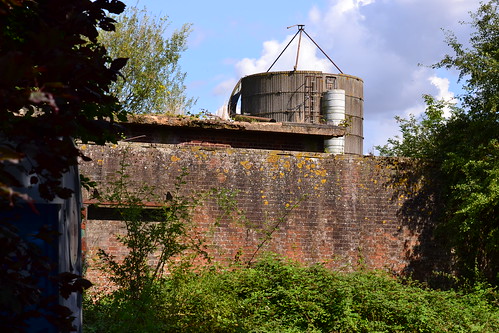
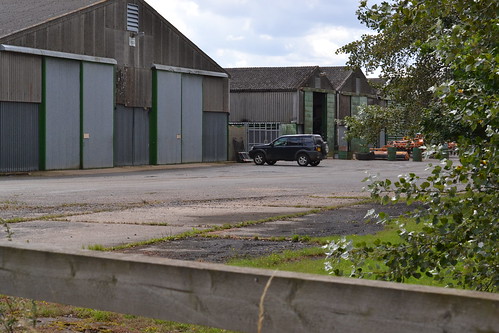
The site today houses small industrial units, but it is primarily farmland. Only a small section of the main runway exist, and this has farm buildings upon it. This section, has been cut by the original A141 now a ‘B’ road, and evidence of the runway can still be seen either side of the road.

RAF Warboys

Pathfinder long distance walk.

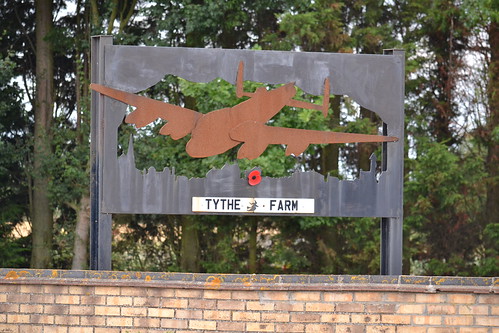
The farm entrance has a large sign with a Lancaster modelled out of metal. Two memorials on the gate posts mark the runway (since my original visit the sign and one of the memorial plaques appears to have been removed, though I have yet to verify this). Across the road from here, you can see the extension to the runway and the remains of a small building, but probably not war-time due to its location.

There is luckily a footpath that circumnavigates the field called ‘The Pathfinder Long distance Walk’, and uses that iconic aircraft, the Mosquito, as its icon. This path allows views across the airfield and access to some of the remaining buildings.

Entry to the path is toward the village, a gated path that is actually part of the perimeter track. As you work your way round, to your right can be found one of the few Air Ministry designed pill boxes. The manufacturer of these mushroom defences being F. C. Construction, they were designed in such a way as to allow machine gun fire through a 360 degree turn. Often referred to as ‘Oakington’ pill boxes, there are only a few remaining today.

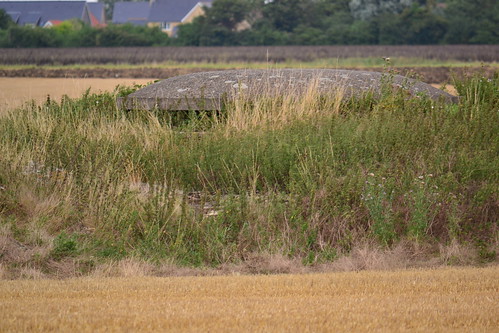
Also, deeply shrouded in hedges and undergrowth, another structure possibly a second pill box or the battle headquarters. With permission from the farmer, you may be able to access these, but they look in a rather dangerous condition.

Further along to your right is where one of the T2 hangars would have stood before its demolition. Tracks lead away from here, and there is what appears to be further examples of airfield architecture buried amongst the trees.

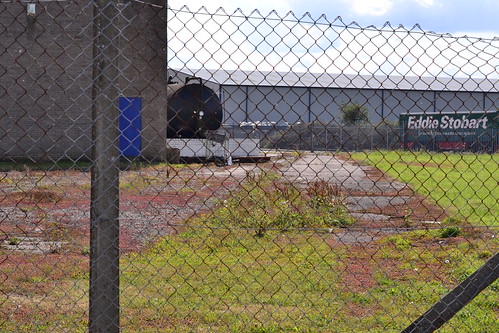
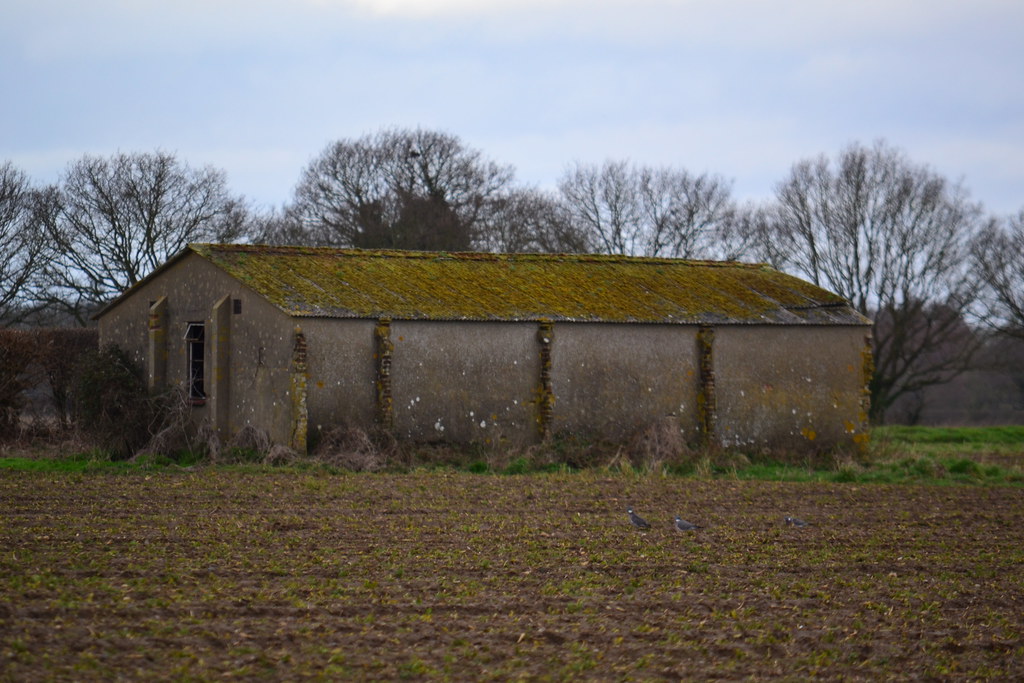
The perimeter track takes you around the rear of the airfield across the threshold of the main runway and round the perimeter track. A local model flying club now uses this part of the site between the runway and perimeter track. To your right would have been the bomb store, now open fields laden with crops rather than bombs. There are a few buildings here marking the boundary of the store, now used for chickens and extensively ‘modified’ by the farmer. They house farm machinery, a far cry from what would have been here many years ago.

The track then takes you away from the site and out across the Cambridgeshire countryside.

RAF Warboys

The remains of the Ground Control Interceptor (GCI) Radar Station.

Returning back to the road, we go in the opposite direction from the village and come to the entrance of the industrial site. These buildings stand on the perimeter track marking the western corner of the airfield.

Next to this part of the site, is a large telecommunications transmitter, apparently the origins of the site being 1941. Whilst its use and history is somewhat difficult to locate or verify, it is known that this was a Ground Control Interceptor (GCI) Radar Station used to lock fighters onto incoming enemy aircraft. Later, there was a high-powered transmitter here used by RAF Mildenhall and RAF Wyton. It was also used to communicate with the V bombers on long-range flights. The mast believed to be original, has been updated and refurbished for telecommunications purposes, but the block house remains behind high fencing with very strong padlocks!

The majority of the admin sites are located along the A141 toward Wyton, some evidence exists here but the majority have long gone. Return toward the village and find the church; located just on the outskirts of the village.

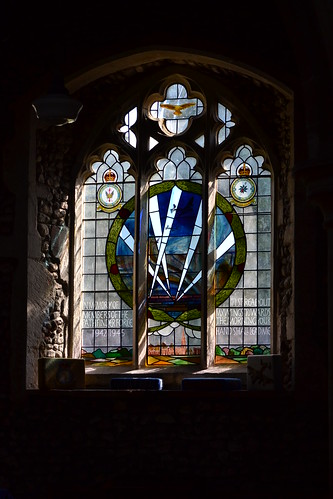
A superb memorial window and roll of honour can be found here, and it is well worth the effort. In Huntingdon town is the former Headquarters building of the Pathfinders, Castle Hill House, which now belongs to the local council. A blue plaque describes the historical significance of the building.

Pathfinders

Castle Hill House, Huntingdon. The Headquarters of the Pathfinders. (Photo courtesy Paul Cannon)

Designed initially as a satellite airfield, Warboys went on to be a pioneering airfield for a new and dedicated team of bombing experts. With 156 Squadron it took the war deep into the heart of Nazi Germany. As a result it suffered great losses, but without  doubt it performed one of the most vital roles in the latter parts of the war and it’s a role that should not be forgotten beneath waving crops and developing industry. The name of Warboys should be remembered as a Pathfinder icon.

After we leave Warboys, we head to her sister station to the west, and an airfield with a history going back to World War I. This airfield saw a spy caught and hanged; the making of a film using Lancasters, and more recently the site of a hospital for the treatment of victims of a nuclear war. We of course go to RAF Upwood.

Sources and further reading (RAF Warboys).

*1  A good blog  describes the life of Wing Co. T G ‘Jeff’ Jefferson, DSO AFC AE who served part of his life as a Pathfinder at RAF Upwood. It is well worth a read.

*3 Smith, G. “Cambridgeshire airfields in the Second World War“. Countryside Books (1997)

*4 Flying Officer J Catford DFC “View from a Birdcage“Tucaan Books (2005) Pg 51

National Archive: AIR 27/203/18
National Archive: AIR 27/1041/13
National Archive: AIR 27/1041/14
National Archive: AIR 27/1041/16
National Archive: AIR 27/1041/24

For more details of the Pathfinders see the excellent RAF Pathfinders Archive Website.

A website detailing crews, missions, aircraft and other information about 156 squadron is also well worth visiting for more specific and detailed information.

Warboys was originally visited in 2014 in Trail 17.

RAF Warboys – Home to the Pathfinders (Part 1)

In the south-western corner of Cambridgeshire, are a group of airfields that are synonymous with the Second World War’s target marking units, the Pathfinders. This is an area rich in aviation history, and an area that played a major part in not only the European Theatre of Operations of World War Two, but military operations long into the Cold war and beyond. Within a short distance of each other are the airfields at Wyton, Warboys, Upwood and Alconbury to name but a few, and it is two of these we visit in Trail 17.

Our first stop is the former RAF Warboys, once home to the Pathfinders.

RAF Warboys.

Warboys village is an ancient village with records of inhabitants going back to 7,000BC, it also has links to the Bronze age, the Romans, Vikings and the Doomsday book. Even further back, some 350 million years, there was an active volcano in the area, not far from where we start today.

RAF Warboys

The farm sign reminds us of the aviation link (it would appear that this sign may have recently been removed).

The airfield itself was initially constructed as a satellite for RAF Upwood, with a requirement for three 50 yards wide tarmac runways; one of 2,000 yards, another measuring 1,400 yards and the last 1,350 yards. There were initially twenty-four frying pan hardstands, two of which were then used as hangar bases, with a further eighteen loop style hardstands added after. This gave a total of forty dispersal points available for aircraft, and they would certainly be needed.

As with many airfields of this time there were two type ‘T2’ hangars, one each side of the airfield, supplemented with a ‘B1’ hangar. A well developed bomb store lay to the west of the airfield, and eleven domestic sites lay to the eastern side of the A141 to the south of the main airfield. These would accommodate up to 1,959 men and 291 women. Even before its completion, Warboys would undergo further development, an order coming through to extend two of the runways to 2,097 yards and 1,447 yards, its was a sign perhaps, of things to come. This extension work meant altering the perimeter track layout and diverting the main road around the airfield as it would be dissected by the new extension (the original road was reinstated post war, the end of the main runway being cut off as a result).

Construction began in 1940 with the airfield opening in September 1941, initially as a satellite bomber station. Whilst intended for Upwood, it was first of all used by Short Stirling’s from XV Squadron as an overflow from nearby RAF Wyton. As a satellite, Warboys was never far from the war when not long after the first Wyton aircraft landed, the Commanding officer of XV Squadron,  Wing Commander P. Ogilvie, crashed the Stirling he was piloting (W7439) here in bad weather. Luckily he and his crew escaped major injury but unfortunately the aircraft was written off completely. This crash would signify a run of accidents occurring at the airfield whilst XV squadron used Warboys.

However, XV Sqn’s stay was short-lived, and they soon departed the site their vacant place being taken by the Blenheims of ‘D’ Flight, 17 OTU (Operational Training Unit).*1

The Training unit was expanding, and their base at RAF Upwood was becoming crowded. Their move over to Warboys on 15th December 1941, was a part of this expansion, and led to four flights being created, each with a range of aircraft including: Lysanders, Ansons, Blenheims and even the odd Hurricane and Spitfire.

In August 1942, the OTU would receive orders moving the unit elsewhere, whilst over at RAF Alconbury, a few miles to the south-west, instructions came through to 156 Squadron to relocate here to RAF Warboys. The instruction specified that the move was to take place on the 5th and be completed by the 7th, it would involve the ferrying of large numbers of crews and their aircraft. On the 5th the first aircraft was brought across, and then on the 6th a further six aircraft were transferred. This was followed by another seven on the 7th.

Following the move the squadron was put straight onto operations, but many of these were cancelled because of the poor autumn weather. One of the first, occurring on August 11th, saw ten aircraft detailed for operations, and whilst all of them managed to take off,  three of them X37998 (Flt.Sgt. F. Harker); Z1595 (Sqn. Ldr. J. Beavis) and BJ603 (P/O. C. Taylor) would fail to return. All but three of the sixteen aircrew onboard would perish – the squadron’s first fatalities whilst at Warboys.

RAF Warboys

The remnants of the main runway are used for buildings.

On the night of 15th August 1942, eight more Wellingtons took off from Warboys for Dusseldorf, of these, three returned early with a forth being lost. The Operational Record Book simply stating “This aircraft failed to return” – a rather unembellished statement that became so common in operational records. Reports about the raid later highlighted the poor visibility and scattered bombing, with little or no industrial damage being done as a result.

Whilst August 1942 was not proving to be in anyway remarkable for 156 Sqn, it would prove to be a very historic month for Bomber Command. On the same day as the Dusseldorf raid, the Pathfinders – an elite force designed to locate and mark targets for the main bomber stream –  officially came into being. This idea had long been on the minds of the Air Ministry, causing a prolonged and difficult relationship between Sir Arthur Harris and Group Captain Sidney Bufton (Director of Bomber Operations at the Air Ministry). The fallout culminated in the intervention of the Chief of Air Staff, Sir Charles Portal, who came down on the side of Group Captain Bufton. He disagreed with Harris’s arguments, announcing that the Pathfinders were going to go ahead as planned.

This did not meet with Harris’s approval, he feared the Pathfinders would ‘skim off’ the cream of his bomber force, creating a corps d’elite, whilst Bufton was adamant it would vastly improve Bomber Commands accuracy, something that desperately needed to be done.

Harris gained the backing of his Group Commanders, explaining that removing individual crews from squadrons would be bad for morale within the groups and be divisive amongst the squadrons. He and his Commanders preferred a target marking unit within each Group, thus retaining these elite crews keeping the unity of the squadrons and the skills they possessed together. However, the long fight between Harris and Bufton came to a climax with the intervention of Sir Charles Portal, and an ultimatum was given to Harris, ‘accept the new Pathfinders or leave’.

The job of organising this new command fell to the then Group Captain Don Bennett D.S.O., an experienced pilot himself who advocated the use of target marking to improve bombing accuracy; something Bennett had indeed tried himself. However, it was not going to be an easy ride for the Group Captain, for the squadrons chosen all operated different aircraft types: Wellingtons, Stirlings, Halifaxes and Lancasters. The Wellingtons were becoming outdated and the Stirlings, whilst liked, had their own set of problems. Added to the mix the fact that German defences were improving and electronic counter measures (ECM) were on the increase, difficult times were definitely ahead.

RAF Warboys

Industry marks the south-western perimeter.

As a new force, only four squadrons were initially used, although more were considered and earmarked: 7 (No. 3 Group), 35 (No. 4 Group), 83 (No. 5 Group) and 156 (No. 1 Group), but it would take time for the new crews to settle and for improvements in bombing accuracy to shine through. All the while Pathfinder crews were operating, the remainder of the squadrons continued in their normal duties, this would allow the Pathfinder force to steadily grow.

For the large part, target marking in the latter part of 1942 would be by visual means only – a ‘Finder‘ and an ‘Illuminator‘ using flares and incendiaries respectively. This would prove to be an unsatisfactory method, the markers often being ‘lost’ amongst the fires that followed, or they were simply too difficult to see. However, photos taken after these early bombing raids showed that the number of bombs falling within 3 miles of the aiming point, post August, had in fact risen to 37% from 32%; those falling within 3 miles of the centre of concentration rising to 50% from 35%.*2 Whilst these figures were quite small, and bombing was still relatively inaccurate, it was at least a step in the right direction, and a boost to those who supported both Bufton and Bennett.

So, on the 15th August 1942, Bomber Command operations changed for good, the four squadrons moved to their respective airfields and the Pathfinders began preparations for a new battle. 156 Sqn at Warboys, would be a major part of this. Being one of the four pioneering airfields, Warboys would be joined by Graveley, Oakington and Wyton, as initial homes for the new force.

On the night of the 18th -19th August 1942, the Pathfinders would be put to the test for the first time, and two Wellingtons from 156 squadron were to be a part of it. The raid to Flensburg would not be successful though, one aircraft having great difficulty in locating the target through the haze, and the second having to ditch its flares five miles from the airfield after one ignited inside the aircraft. Of those that did get to mark, it proved to be inaccurate, and one Pathfinder aircraft, from 35 Sqn, was lost.

RAF Warboys

Airfield defence in the form of an ‘Oakington’ pill box.

The day after this, Group Captain Bennett visited Warboys to give a lecture on the Pathfinder Force and to promote its use; he must have made a good impression for after the lecture six Warboy’s crews volunteered for Pathfinder duties.

Further operations were carried out on the night of  27th – 28th August to Kassel. A good night for visual marking meant that bombing was accurate, and as a result all of the Henschel factories were damaged. However, the cost to the Pathfinders was very high. It was on this operation that the Pathfinders suffered one of their greatest losses. Thirty-one aircraft were missing of which fourteen were Wellingtons and three were from 156 Sqn. The next day, the mess hall was devoid of three crews, those from: ‘X3367’, ‘Z1613’ and ‘DF667’, and unbeknown to those sitting around the mess, there were no survivors. A fourth bomber (BJ883) returned to Warboys after the pilot, Sgt. E. Bowker, suffered severe head pains and was unable to carry on.

Not all operations were as bad. On the night of 19th – 20th September following action over Saarbrucken, a flare became lodged in the bomb bay of one of the 156 Sqn Wellingtons. Whilst sitting there it ignited causing a fire in the aircraft’s belly. The Pilot,  New Zealander Sqn. Ldr. A. Ashworth, instructed his crew to bail out, after which the fire extinguished itself allowing him to fly the aircraft back single-handedly, landing at the fighter station RAF West Malling in Kent. The operation itself, undertaken by 118 aircraft, was otherwise uneventful, although haze proved to be an obstacle for the markers.

The last 156 Sqn Wellington raid for 1942 occurred on December 21st and took the squadron to Munich as part of a force of 137 aircraft. The loss of ‘BK386’ crewed entirely by Canadians brought 1942 to a close, and a loss of 15 aircraft this year. To add insult to injury, whilst the majority of the bombers claimed to have hit the city starting large fires, photographs showed that in fact most bombs had fallen outside of the city in open countryside, possibly as a result of a successful decoy employed by the Germans. It had not been the most auspicious of starts for the Pathfinders, nor 156 Squadron at Warboys.

However, by early January, a new aircraft type was starting to arrive at Warboys – Avro’s mighty four engined heavy, the Lancaster MK.I. Created out of the under-performing Manchester, the Lancaster would go on to be one of the most iconic aircraft of the Second World War. Perhaps now the tide of misery would turn and Warboys crews would begin a new era in aviation history.

RAF Warboys

The beautiful Memorial window dedicated to the Pathfinders.

The full trail appears in Trail 17

Spitfires Galore! – RAF Ludham (Part 2)

In Part 1 we saw how Ludham began its life and how things got off to a slow but steady start, the period April to August 1942 being  pretty much along similar lines, routine patrols, shipping reconnaissances and scrambles. But the autumn signifies the beginning of many changes here at this Norfolk airfield. First however, the resident Spitfire squadron, 610 Sqn, would take part in one of the Second World War’s more famous failures.

Ludham airfield

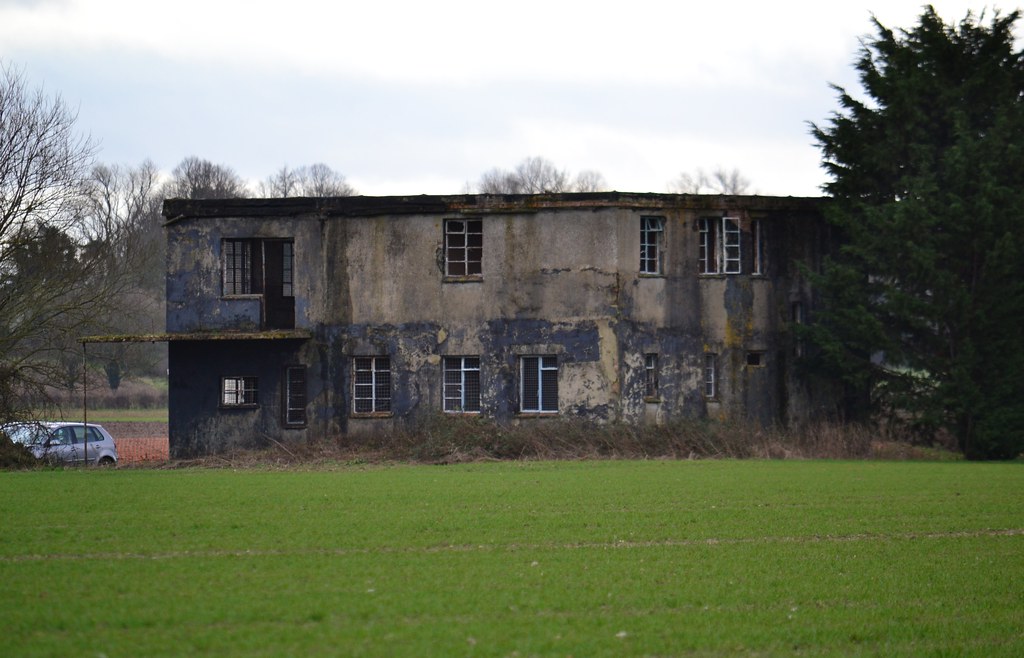
One of several buildings located around the perimeter of the airfield.

On August 16th, a need arose for fighters to bolster 11 Group for ‘Operation Jubilee‘ –  the raid on Dieppe by allied forces, primarily Canadian. The raid was supposed to achieve a number of objectives, but only one was successful, the main force being held on the beach where vehicles became bogged down in the shingle. 610 Sqn formed part of the aerial umbrella, along with 411 Sqn and 485 Sqn who all jointly formed the 12 Group wing flying from a temporary base at RAF West Malling. On the previous night to the raid, the 19th, ground crews were busy at West Malling fitting long range drop tanks to the Spitfires which according to the ORB, “proved their worth on this occasion“. During the air battle, which raged between the Spitfires, Typhoons and around fifty Me 109s and FW 190s, 610 Sqn claimed two 109s along with one FW 190 as destroyed and two FW 190s as damaged.  Three of 610 Sqn’s aircraft went down, one of the pilots Flt. Sgt. Creagh, being picked up from the sea. Interestingly enough, during this skirmish, pilots noted seeing FW 190s in Italian markings! By 09:30 hrs the squadron had returned to West Malling.

The flight then returned to the skies over Dieppe three further times that day, taking off at 11:20 hrs and then again at 14:00 hrs, each time to cover the withdrawal of shipping. The last evening sortie took off at 17:35 hrs. On the 20th, 610 Sqn flew out to France once again, this time though it was to escort  US bombers returning from the continent, perhaps seeing the carnage left by the disastrous raid the day before.

By the 21st it was all over, and the sixteen aircraft returned to Ludham where they would receive a message of thanks from the AOC 11 Group – Leigh Mallory.

As the squadron were returning to Ludham, so too came a new delivery, the squadron’s first batch of Spitfire Mk.VCs, with three arriving on the 21st and one further aircraft arriving on the 22nd. These were gradually absorbed into flying duties as the squadron returned to normal patrols and escort duties from Ludham. 610’s tally for the month stood at 123 enemy aircraft destroyed and 41.5 probables.

Over September, flights were pretty much routine once more, then October arrived and Ludham became frantic again. On the 8th, a road party was sent as advanced party to Biggin Hill with a view to taking part in a “Hush-Hush” operation. Unfortunately the operation was cancelled just prior to the party’s arrival, and they had to return to Ludham somewhat disappointed; road and rail transport being provided for the next morning.

That day also saw 610 Sqn Spitfires provide withdrawal cover for “over 100 Fortresses”, which at the time was a “headline” mission, this being the largest daylight raid of the war so far. The incredible sight of this massed formation would be dwarfed in comparison by the wars end with formations consisting of 1,000 aircraft or more, in a stream that lasted for what must have seemed forever.  Whilst enemy aircraft were seen in this first momentous occasion, there were no claims of ‘kills’ or ‘probables’ made by pilots of Ludham’s 610 Sqn.

By now, rumours of another move were circulating widely, hopes for a move south nearer to the action were dashed, when signal O2OB, dated 11.10.42, came through instructing the squadron to move to Castletown, near Caithness in Scotland – the opposite end of the country to where they wanted to be.

The move was to take place on the 14th October, and would be a direct swap with 167 (Gold Coast) Sqn, yet another Spitfire VC squadron. The airlift of 167 Sqn was late in arriving, meaning that many men were left ‘Kicking their heels” at Ludham, so a number headed to Norwich and a little light entertainment at the cinema. The transfer then happened on the next day, the 15th, with many of the pilots suffering sickness on the way up, thought to be due to the poor weather. Now 610’s link to this small Norfolk airfield was broken, and a new link in Ludham’s chain of history would be forged – a new squadron had arrived.

167 Sqn stayed at Ludham for five months, after which they took part in exercise ‘Spartan‘, a twelve day posting first at Kidlington and then Fowlmere, before returning to Ludham on March 13th, 1943. Exercise Spartan was a prelude to D-day, a huge military exercise that took place in southern England as a practise for the allied offensive across Europe in June 1944. Like Operation Jubilee, it consisted heavily of Canadian units, and also like Operation Jubilee, there were many shortcomings, the result of which was the loss of Command for three Canadian Generals.

A further short two month stay at Ludham then saw 167 Sqn depart in May for good. This left the Norfolk airfield to the only Typhoon squadron to use the base – 195 Sqn.

Formed in November 1942, 195 Sqn had formed at Duxford, transferring to Hutton Cranswick where they were assigned their Typhoons. A further move to Woodvale then brought them to Ludham where they would stay until 31st July 1943.

Ludham airfield

The second Watch Office also in a very poor state of disrepair.

On arrival at Ludham the squadron was immediately confirmed as operational, and on the 15th May 1943, the very day the operational  notice came through, Sgt. R.A. Hough spotted an Me 109f bombing Southwold. He engaged the enemy shooting him down into the sea, the squadrons first confirmed kill of the war.

With four more Typhoons arriving on the 20th, the squadron was in good spirits and eager to get on. But like their predecessors before them, their month consisted of patrols, practice scrambles and training flights some of which included the squadron’s Hurricane (7778) and Tiger Moth (209). By the end of the month, the Ludham unit had made 362 flights, most as patrols or as training flights. June was similar, the lack of contact frustrating the pilots; a note in the ORB saying “Patrols carried out dawn to dusk, 12 operational sorties being flown, but the Hun wouldn’t play“. The highlight of the day was perhaps the darts match against the local Home Guard, the Home Guard winning that night! As the month progressed, the squadron began to venture further afield taking on trains and oil storage facilities on the continent, scoring many hits and receiving flak damage as a result. On the 8th July the squadron suffered its first Ludham fatality when Flt. Sgt. F. Vause hit the ground in a low flying exercise. A talk by Sqn. Ldr. Taylor reflected the sentiments of the unit when he said they had lost a “Damn good pilot”. He went on to stress the low flying rules.

The end of July came and notification to depart Ludham for Matalsk, and a share of the airfield with 609 Sqn. There was some regret withe the more ‘romantic’ types of the squadron and due honours were paid to Ludham on that last night of the 30th July.

The last Spitfire squadron before Ludham left RAF control was 611 Sqn, with their Spitfire LF VBs. This was a short stay lasting only until August 4th, when they were told to move to Coltishall as Ludham was being closed down in preparation for transference to the USAAF. After one sortie at Ludham the move went ahead on the 4th, but it was not overly welcomed as Coltishall was already busy and accommodation was cramped.

With that, Ludham was closed, and the airfield was taken over by the Air Ministry (Works) whereupon construction work began on three new concrete and tarmac runways, a project that would take a year to complete. During this time new hardstands were installed – a mix of (17) double and (18) single types using pierced steel, some of these were located outside of the perimeter, and a small maintenance unit took care of the running of the airfield. A new two storey watch office was built with the original being re-purposed.

Designated Station 177, Ludham was never actually occupied by the Americans though, even though all the upgrade work had been completed, it remained firmly deserted apart from a small maintenance unit who oversaw its use.

Instead, it was decided to use Ludham as a dummy airfield and emergency landing ground for returning aircraft. A decision that was partly made for them as heavy bombers returning from daylight missions over occupied Europe would often come in over this part of East Anglia, and Ludham was the first airfield they would come across. Because of this, Ludham would see some eight B-17s, a B-24, one P-47, and a P-38 aircraft have to either crash or make emergency landings at Ludham or in the immediate vicinity.

The first to make use of the airfield in this way occurred on October 8th, 1943 barely a month into the airfield’s upgrading. A B-17F #42-3393  “Just-A-Snappin” was badly damaged over Bremen. The aircraft, piloted by Capt. Everett Blakely, made it back to England crossing the Norfolk coast east of Ludham. The aircraft had sustained severe damage from flak, the Number 4 engine, the hydraulics and the brakes all being put out of action. The aircraft made an emergency landing at Ludham crashing into a large tree causing further damage to the air frame. It was salvaged a few days later. This particular aircraft had only been assigned to the 418th BS at Thorpe Abbots, part of the Bloody Hundredth, in the July. It also went under the name of  “Blakely’s Provisional Group” and ”Did You Say Ten Cents?“, the multitude of names causing confusion in a number of references.

Part of a door cover from P-38 Lightning named

Part of door cover retrieved from wreckage of P-38H5LO #42-67053 ‘CY-L’, flown by Lt. Goudelock on December 13th 1943. The aircraft crashed in Ludham after flying for 375 miles on one engine (IWM FRE 158)

A second aircraft would attempt to use Ludham as a safe haven not long after this. On the 13th December, 1943 P-38H #42-67503 of the 55th FG, 343rd FS, “Vivacious Vera” piloted by First Lt. Hugh J. Goudelock, sustained damage to one engine whilst escorting bombers also over Bremen. After nursing the aircraft back to Britain he attempted a landing at Ludham when, suddenly, the second engine gave out. This left the P-38 powerless, causing it to crash in Ludham, the pilot sustaining only minor injuries. The strength of the P-38 having brought the pilot back for 375 miles on a single engine,

A similar story was repeated on December 23rd when B-17F #42-3273 “Impatient Virgin” crashed at Potter Heigham, another village only a stones throw from the airfield, while attempting to land at Ludham following damage it received over Munster. A sudden loss of power meant the aircraft had to put down in a field rather than on the airfield, all ten crewmen luckily returned to duty and the aircraft was salvaged.

B-17F “Impatient Virgin” #42-3273 of the 95th Bomb after crashing at Potter Heigham near to Ludham airfield. (IWM FRE 3903)

December had certainly been a busy month for Ludham, even though officially it was closed to flying, it had more than proved its worth as an emergency landing ground.

The work continued at Ludham and eventually, in August 1944, it was complete. By then though the US forces had decided against using Ludham and it was handed over to the Royal Navy (RN).

In the concluding part we saw how the Royal Navy fared at Ludham and how eventually Spitfire squadrons return. The V2 becomes a menace to be dealt with and then the war comes to a close and Ludham’s future is decided.

The full story of RAF Ludham appears in Trail 58.

Squadron Leader Emile Fayolle: A Free, French Pilot.

June 1940: Britain’s last remaining European ally, France; was now hors de combat, and the French people began to face the gruelling prospect of an indeterminate period of time in the shadow of the Swastika, under German occupation.

As news of the ignominious armistice and the new collaborationist Vichy government under Marshal Petain spread, there were many brave and defiant French servicemen who refused to acknowledge it. Some went underground, founding the Maquis; the French Resistance movement, whilst quite a number decided to get to England, by any available means, following their chosen leader: Brigadier-General Charles de Gaulle. Once in England, they formed themselves into La France Libre, the Free French Forces, with General de Gaulle as their commanding officer.

One such Frenchman was a nearly 24 year-old, qualified Pilote de Chasse, (fighter pilot) who was then serving overseas in the Armee de l’Air at Oran in French Algeria. He was Sergeant Emile “Francois” Fayolle.

Battle of Britain London Monument - ADJ EFM FAYOLLE

Sgt. Emile “Francois” Fayolle (Photo: © Friends of the Battle of Britain Monument)

Born on 8th September 1916, at Issoire, in Central France, Emile’s father was an Admiral in the French Navy and his Grandfather was none other than Marshal Marie Emile Fayolle, the legendary French Army commander of the First World War. With such ancestry, it was little wonder that Emile refused to acknowledge the humiliating armistice of Compiegne. After much discussion, and despite the warnings of dire consequences from their Station Commander, Emile, his good friend and squadron-mate Francois De Labouchere and two other like-minded pilots, stole two of the station’s aircraft and flew to the British base at Gibraltar. There all four took ship to England, arriving in Liverpool in mid July. Emile Fayolle and his close friend Francois De Labouchere strengthened their already inseparable partnership throughout their RAF training and even made sure they were posted to the same fighter squadron later.

On August 18th 1940, at the height of the Battle of Britain, Emile and Francois were posted to 5 OTU, (Operational Training Unit) at Aston Down. Both men were by now commissioned as Pilot Officers and at 5 OTU, they would be learning to fly and fight with the Hurricane. Pilot Officers Fayolle and De Labouchere would join 85 Squadron, commanded by Squadron Leader Peter Townsend at Church Fenton, on September 13th 1940, flying Hurricanes. They would both soon start making their presence felt with the Luftwaffe.

Emile stayed with 85 Squadron for nearly three months, being posted to 145 Squadron on December 3rd. He stayed with 145 Squadron till April 26th 1941, when he was then posted to Douglas Bader’s 242 Squadron. Although the Battle of Britain was over by then and the German night Blitz on Britain’s major towns and cities had largely petered out, every now and again the Luftwaffe could, and would, still mount a really big raid, such as the one they made on London during the night of May 10th 1941. Exactly one year to the day since they’d started the whole ball rolling by attacking the Low Countries and France, this raid would prove to be pretty much the Luftwaffe’s swansong; their final, despairing fling. Making use of the full moon in a cloudless night sky, the Luftwaffe, in that one night, seemed to drop a month’s worth of bombs and incendiaries on the British Capital. The damage they inflicted was widespread and severe.

It was on this night, during a late evening patrol, that Pilot Officer Emile Fayolle scored his first confirmed ‘kill’. Emile’s victory was one of three that night; all Heinkel 111 bombers and all scored by French pilots. Pilot Officer Demozay of 1 Squadron shot his down over East London, whilst Pilot Officer Scitivaux and Pilot Officer Emile Fayolle, both of whom were serving with 242 Squadron, had their encounters over the London Docks. All three ‘kills’ were confirmed.

On October 14th 1941, Emile was posted to 611 Squadron, flying the Hurri-bomber: a cannon-armed, bomb carrying, fighter-bomber version of the Mk IIc Hurricane. It wasn’t long before he personally took a heavy toll on enemy shipping. Despite being there for only three weeks, Emile seemed to take particularly well to 611 Squadron’s role, becoming something of a specialist in the rather risky art of fast and accurate low-level attacks. He was posted to a very special unit; 340 Squadron, at Turnhouse.

When the RAF formed 340 Squadron, it was the first, all-Free French, squadron. It was formed as part of the Ile de France fighter group and Emile, as well as his great friend Francois de Labouchere, naturally joined the unit. Promotion, as well as confirmed ‘kills’, swiftly followed. As well as the Heinkel 111 he’d shot down on 10th May 1941, he also had confirmed a FW 190 on 3rd May 1942 and a JU88 shot down into the sea on 11th May 1942. His tally of enemy shipping stood at an impressive 25 sunk by then. At the end of July 1942, Emile was further promoted; to the rank of Squadron Leader, and given command of 174 Squadron at Warmwell.

On the Dieppe operation of 19th August 1942, his first one as Commanding Officer, his Hurricane took a hit from defending German anti-aircraft fire after he’d led his squadron of Hurri-bombers fast and low into the attack. His battle-damaged aircraft lost height and crashed in the Channel on the way back to England, not far from Worthing.  Emile was still in the cockpit.

But that is not quite the end of this extraordinary Frenchman’s story. By the strange vagaries of the English Channel’s currents, Emile’s body was eventually washed ashore in his native France. The Germans recovered it and given that he was wearing what remained of the uniform of an RAF Squadron Leader, but with some French insignia, they presumed him to have been a Canadian. Emile’s body had been in the water for some time and was in no real state to be positively identified, so the Germans buried him in a grave marked “Unknown RAF Squadron Leader”.

It wasn’t till 1998, after much laborious research had been done, that Emile finally got a headstone of his own. He is buried at Hautot-sur-Mer (Dieppe Canadian) Cemetery and he is also commemorated on the London Battle of Britain memorial; with all the other gallant countrymen of his who had flown and fought with the RAF in the Battle of Britain. His fighting prowess had earned him a total of four medals, including the DFC and the Croix de Guerre. At the time of his death; the remarkable, Squadron Leader Emile Fayolle, had been just two weeks and six days short of his 26th birthday.

By Mitch Peeke

My thanks to Mitch for this story.

RAF Rackheath – The 467th BG, the highest bombing accuracy (pt2).

In Part 1 we saw how Rackheath had been developed, and how the 467th BG, the resident group had been subjected to a fierce introduction to the war.

Now, in part 2, we continue our visit to Rackheath and the bizarre event of December 1944.

On December 24th,  B-24 #42-50675 “Bold Venture III” piloted by 1st. Lt. P. Ehrlich, was one of sixty-two B-24s from the 467th taking part in a maximum effort attack on a range of targets in Germany. Hit by flak over the target, five of the  crew, including the pilot, bailed out fearing the aircraft was lost. All five were subsequently captured and incarcerated as prisoners of war. The fires in the engines then extinguished themselves allowing the remaining crew to engage the auto-pilot, taking the aircraft homeward and over allied territory. Once over France, they too bailed out as they were unable to land the heavy bomber, each of these men being safely picked up by allied forces. The plane then continued on, unmanned across the Channel, until it ran out of fuel.

RAF Rackheath

The former hangar has been completely refurbished.

At this point, the story becomes confused. Some say it landed / crashed  in a field near to  Lower House Farm, Vowchurch Common in Herefordshire. The wreck being salvaged the following day. However, there is little evidence of this event, and other sources (Freeman “The Mighty Eighth“) have it landing in a Welsh marsh a little further west. Whatever the truth is, its a remarkable, but not unique, story of  a crewless bomber flying ‘home’ coming to rest safely on British soil.

Also on that Christmas Eve, another Rackheath B-24, #42-95220, piloted by First Lieutenant William W. Truxes Jr , was hit over Pruen. The aircraft then exploded over Rettigny in Belgium, killing Sgt. Walter Walinski (TG); Sgt. Stanley P. Koly (LWG); Fl. Off. David J. Countey (Nav); Sgt. Roland L. Morehouse (BA); St. Sgt. Peter Hardick Jr (TTG); St. Sgt. John N. Ellefson (Radio Op) and Sgt. Alek Onischuk (RWG). Only the Nose Gunner St. Sgt. Robert J. Ball Jr. returned to duty the remainder being taken prisoners of war.

On the 29th the continuing appalling weather caused the loss of two more B-24s, both crashing attempting to take off from a foggy Rackheath (#42- 95115 and #42-51572). A third (#42-94881) was then abandoned over the sea, and a forth (#44- 10607) crashed at Attlebridge also after sustaining damage on its take off. The  visibility was so poor that day that the crews couldn’t even make out the edge of the runway. As a result of these crashes, the mission to Prum, was finally scrubbed, but by then fifteen airmen had already been lost.

The dawn of 1945 saw the Ardennes offensive continuing, and at Rackheath B-24 ‘Witchcraft‘ was approaching its 100th Mission an achievement it made on January 14th 1945. In just 140 days since arriving, it had reached its 70th mission an average of one mission every two days, but what made this particular achievement so remarkable was not this incredible average, but the fact that the aircraft had been mechanically sound throughout, not having to turn back from any sortie it had undertaken. A remarkable achievement, and a solid testament to the dedication of the ground crews who kept her in the air.

The Witch“, as she affectionately became known, would go on to complete a total of 130 missions without a single abort nor injury to any crewman. She became one of the most celebrated aircraft in the 8th Air force’s history. This total would surpass all other B-24s in the whole of the European theatre of operations. Like many though, ‘The Witch‘ eventually returned to the US where she was unceremoniously taken apart at Altus, Oklahoma. In memory of the aircraft, her achievements and the crews who were lost flying B-24s, she is now represented by the world’s last flying Liberator, currently owned and operated by the Collings Foundation, Massachusetts.

Ground crew of the 467th BG B-24 “Witchcraft“. Standing Crew Chief Joe Ramirez, Chamberlin. Front Row Walter Elliot, Geo Dong, Joe Vetter, Ray Betcher.’ (IWM FRE 1979)

As 1945 progressed the end of the war was near. Attempts by the Luftwaffe to curtail bomber intrusions into German airspace were becoming desperate. The introduction of the Me 262 was too little, too late, to make a major difference. But so determined to stop the bombers were the Luftwaffe pilots that many still got through and they were finding the bombers.

Other fighters more determined to bring down the enemy began ramming them. A specialist squadron the ‘Sonderkommando Elbe‘  was set up using volunteer pilots. They were instructed to strike the fuselage of the bomber between the wing and tail thus cutting the aircraft in two, a tactic that would  allow the German pilot to bail out of his aircraft whilst taking down the bomber.

On April 7th, the unit was put into action in its one and only recorded attack, as over 1,000 heavies flew towards German airfields, oil storage facilities and factories in north-west Germany. From the 2nd AD, 340 B-24s headed for Krummel, Duneburg and Neumunster. As the force approached they were targeted by a mix of over 100 Luftwaffe fighters including 109s, 190s and 262s. In this mix was the Sonderkommando Elbe. Whilst the tactic would prove to be more devastating to the rammer than the target, one of Rackheath’s B-24s #42-94931 ‘Sack Time‘ was hit in the tail severing the starboard stabiliser. The B-24’s pilot, Lt. Robert Winger, managed to keep the aircraft flying but with little control, he ordered the crew to abandon the aircraft once over allied territory. The B-24 then crewless, fell from the sky.

It is not known whether the attack was a deliberate act by the Sonderkommando Elbe, or as a result of the tail gunner Robert (Bob) Perkins’s action. Perkins in his attempt to defend the B-24, fired desperately at the attacker, Heinrich Henkel, striking the aircraft several times.

Then for three days in mid April, the heavies of the USAAF turned their attention to the gun batteries around Royan. These German strong holds were hindering the allied plans to use the port at Bordeaux, they had to be ousted.

During one of the missions, on April 15th, the 467th would make history again when three of the four squadrons released all their 2,000lb bombs within 1,000 ft of the mean point of impact, half of these being within 500 ft – a record that would not be beaten by any other USAAF unit. This was the ‘icing on the cake’ for the 467th who were building a strong reputation for consistent and accurate bombing.  So determined were the Americans to remove the defenders on the ground, that they used Napalm in 500 lb tanks, a rather horrific weapon used to great effect during the Vietnam war.

By the end of April the war was all but over, and at bases all around the UK, air and ground crews eagerly awaited the notice to cease operations. Some units were already being stood down, and very soon operations would begin to drop food rather than bombs. As the end of hostilities was announced, the figures began to be totted up. The 379th BG at Kimbolton were recorded as dropping the greatest number of bombs on a target, with the 467th BG at Rackheath achieving the greatest accuracy. This Rackheath record was due, in part, to the dedication, support and drive of its Commander, Colonel Albert Shower.

On April 25th 1945, the 467th completed its last mission, a total that amounted to 212 (5,538 sorties credited), dropping 13,333 tons of bombs. With 29 aircraft classed as ‘missing’, and a further 19 lost on operations, the war had not been cheap.

RAF Rackheath

The former runway looking north-east.

On May 13th, the 467th were to lead the Victory Flypast over High Wycombe, the headquarters of the Eighth Air Force operations, the choice of a B-24 as lead fuelling the ‘ill-feeling’ between B-24 and B-17 crews even further.

Over the next month, the aircraft and men of the 467th would return to the US, the majority of aircraft departing Rackheath on June 12th, whilst the ground echelons left via the Queen Mary from Greenock, the same port they had arrived at just over a year earlier. Eventually the 467th would be disbanded, renamed the 301st, but for Rackheath it was the end, and within a year much of the airfield was already being ripped up, the runways were disappearing and many of the accommodation buildings had been torn down. The entire site measuring just short of 4 km2  was already beginning to disappear.

Gradually agriculture has taken over, much of the main airfield site are now fields. The technical area has since been developed into an industrial estate with many of the original buildings being re clad, redeveloped, modernised or pulled down. The watch office has thankfully been refurbished and from the outside resembles a watch office typical of the time. Inside it is now offices. The one surviving T2 hangar, has had brickwork added to it, other buildings are almost indistinguishable from their modern counterparts. A memorial, dedicated to the men and Women of the 467th was unveiled on 29th July 1990, by the then 80 year old Colonel Albert J. Shower, returning for one last time to the place he had built up a reputation for hard graft whilst appreciating the need for recreation.

If approaching from the south, take the A1270 from Norwich heading north, leave at the roundabout with Salhouse Road turning right. The Holy Trinity Church is a few hundred yards along this road. Here you will find the village sign, memorial benches and numerous plaques in memory of the 467th. The two wrought iron gates at the entrance of the church were donated by the Coffey crew. Inside here (the church was closed on my visit) a collection of photographs and letters bring the Rackheath to life once more.

RAF Rackheath

The memorial gates donated by the Coffey crew.

When leaving the church, go back but turn right along Green Lane West. This takes you past the remaining hardstands and along to the industrial estate. Enter by Wendover Road, named after Wendover Field in Utah. Turning into Bidwell Road, (following the signs) you will find the main memorial on the the corner of Bidwell Road and Liberator Close.

Coming back again, turn left, follow Wendover Road to the corner with Witchcraft Way, a small road to your left. Here you will see the Watch Office. Also along here are Ramirez Road, Albert Shower Road, the T2 and other buildings of interest. A real rabbit warren, it is best explored to really discover the many buildings and plaques that remain.

The main accommodation areas were located back across the from the entrance of Wendover Road. Today a new road has been cut through this wooded area but within these woods, remains of huts still exist, some with etchings on the walls. All on private land, they are also gradually disappearing from view.

Rackheath was a short lived base, operating for just a short part of the war. But its contribution and the contribution of its crews, was nonetheless immense. With high accuracy and the determination to win, they took the war into the heart of Germany itself. The names of these young men now live on, in the road names and plaques that adorn many of the building and streets around this beautiful and now peaceful area of Norfolk.

After departing Rackheath we head a few miles east, toward the coast. Not far away, is another airfield, this time a former RAF site. Long gone it continues to use part of the original runway, two watch offices remain, and a smattering of wartime buildings lay dormant in the corner of now agricultural fields. In part 2 of Trail 58 we visit RAF Ludham.

Sources and further reading RAF Rackheath

For more detail on Mission 311 see: McLachlan, I., “Night of the Intruders” Pen and Sword (1994).

RAF Rackheath – The 467th BG, the highest bombing accuracy (Pt1).

In Trail 58 we head to the east of Norwich into an area known as the Norfolk Broads; an area created through turf extraction in medieval times. The large, shear sided pits were later flooded giving more navigable inland waterways than both Venice and Amsterdam.

Today, it attracts a wide range of wildlife, and offers a range of boating, bird watching and fishing holidays. The shear size and scope of the Broads attracting some 7 million visitors per year to enjoy the rich nature and peace of the Broads.

But in this area during the Second World War, life was very different. Overhead, the drone of aircraft engines was a constant reminder of a war being fought both across the sea and here in East Anglia.

Between Norwich and the East Anglian coast we visit two airfields, one USAAF and one RAF, both now long closed, they each played a vital part in the destruction of the Nazi tyranny across the sea in Europe.

Our first stop is a former bomber base. Now a huge industrial estate where many of the original wartime buildings have been demolished. But some still remain, refurbished, re-clad and in many cases almost indistinguishable from their original design. A memorial, located in the heart of the estate, denotes the technical area of the former base, and a local church displays a collection of wartime photographs.

Our first stop on this trail is the former US bomber base RAF Rackheath (Station 145).

Rackheath (Station 145)

Rackheath airfield lies approximately 5 miles north-east of Norwich, bordered to the east by the  East Norfolk Railway Line, and to the west by the (modern) A1270.

RAF Rackheath

Rackheath village sign denotes its history and links to the base.

Built over the period 1942-43, it was built as a Class A airfield incorporating three runways: one of  2,000 yds and two of 1,400 yds in length, each 50 yds wide and each covered with concrete.

A large number of hardstands lined the perimeter track, some 50 altogether, all being of the spectacle type; with  a bomb store to the north of the main airfield site, sitting surprisingly close to the majority of the hardstands and nearby Rackheath village.

A wide range of technical buildings, supported by two T2 hangars for aircraft maintenance, allowed for repairs and crew preparation: crew rooms, parachute stores, dingy stores, armouries, photographic blocks and so on. The watch office (design 12779/41) stood proud of the technical area located to the south-west of the site. All personnel areas – eleven accommodation and three ancillary sites – lay to the west of the airfield, dispersed around Rackheath Hall, an early 19 Century listed building with its notable architectural features and its own turbulent history. These sites, hidden amongst the woodland, were both extensive and well serviced by concrete roads that led to the main airfield site.

Rackheath was initially designed as a bomber airfield, but during the construction phase, it was re-designated as a fighter airfield. However, delays in the construction process, led to it never being operated as a fighter station, instead it was manned by the Eighth Air Force’s 467th Bombardment Group (BG) and B-24 Liberators.

The 467th BG consisted of the 788th, 789th, 790th and 791st Bomb Squadrons (BS), each flying Consolidated’s heavy bomber the B-24 Liberator. The group’s long journey to Rackheath started on 19th May 1943 at Wendover Field in Utah. After being activated on August 1st, they moved to Mountain Home Army Airfield in Idaho, then back to Utah and Kearns, from there onto Wendover Field again where they remained for fifteen weeks undertaking intensive training. On 12th February the ground echelons made their way, by train, to Camp Shanks, New York where they boarded the US ship Frederick Lykes. Their Atlantic journey brought them, like so many before them, to Greenock, a major port on the Clyde on Scotland’s west coast. From here, they boarded trains and made their way to Rackheath.

The air echelon in the meantime flew the southern route, tragically en route, they lost one of their B-24s (#42-52554 “Rangoon Rambler“) with all its crew, over the Atlas mountains in North Africa. The remainder of the group finally arrived here at Rackheath combining with the ground echelons in late March 1944, where they began to prepare for their first operation on April 10th.

Operating initially within the 2nd Bombardment Division (later the 2nd Air Division) 96th Combat Wing (CBW), they flew Liberator ‘H’, ‘J’, ‘L’ and ‘M’ models under the command of Colonel Albert J. Shower, the only US group commander to have brought and remained with the same group until the end of hostilities.

The 467th’s first mission was to bomb Bourges airfield, a relatively light target in which 730 bombers pounded aviation targets across the low countries. On the next day, they formed part of a even larger force of over 900 heavies attacking aircraft production factories in Germany, their honeymoon was well and truly over in one fell swoop.

But the first major event of the war for the 467th was to occur shortly after this on April 22nd 1944, on a day that has since become infamous in American aviation history. Mission 311, was an attack by 803 heavy bombers of the 1st, 2nd and 3rd Bombardment Divisions on targets at Hamm, Soest and Koblenz along with targets of opportunity. The Massed formation, escorted by 859 fighters, were led by the 445th BG, 2nd Air Division from Tibbenham. The 96th CBW portion was led  by the 458th BG from Horsham St Faith, with the 466th BG from Attlebridge on the low left, and the 467th ‘The Rackheath Aggies‘  on the high right.

As teleprinters rattled across the East Anglian area, B-24s were bombed up, fuelled and checked over by mechanics who meticulously prepared their machines for war. Maps were drawn up, meteorological reports were read out and orders were strict – ‘avoid the Ruhr!’

Once in the air, brightly coloured assembly ships gathered their flocks together in tight formations, and then it was time to set off for Germany. On route, technical problems dogged the lead plane, which led to inaccurate navigation, and ultimately brought the entire force into Ruhr Valley – exactly where they did not want to be.

Dividing up, the massed formations hit a range of targets, Hamm being the focus of the 467th. Surprisingly though, results were good, especially considering the many problems the formation had suffered flying over to Germany. Pleased with their results, the 467th set course for home, blissfully unaware of the dangers that were lurking not far away as they made the return leg of their journey.

The whole operation had been meticulously planned, but it meant that many of the bombers would be arriving home in the dark, an environment alien to many American crews. Experience had told them that Luftwaffe fighters lurked in the dark, unseen and dangerously accurate in their attacks.

When approaching from the east, Rackheath and Nearby Horsham St. Faith were the first two large airfields available, a distance of just some 4 miles separating them. With navigation lights and landing lights illuminating the aircraft, airfields were lit up like christmas trees, each one inviting their bombers home to safety. These lights were also a beacon for the as yet unknown, marauding Luftwaffe night fighters. As the first Rackheath Liberator approached, the air filled with requests for landing  permission, fuel now getting critically low and crews tired from the long flight. Gun places were vacated and crews began preparing to land, everyone was starting to relax – they were home.

It was this point that all hell was unleashed over Rackheath. Canon shells ripped in to the wings and fuselage of 1st Lt. Stalie Reid’s B-24 #42-52445, setting both starboard engines on fire.  The lead Luftwaffe pilot Staffelkapitaen Hauptmann Dieter Puttfarken of II/KG51, taking his companions, in their mix of night fighters, right into the heart of the flight path of the returning bombers. Here they waited, unseen, until the moment the bombers were at their most vulnerable.

RAF Rackheath

The former Watch Office has been refurbished and used as offices.

As the Liberator began to fall uncontrollably out of the sky, four of the crewmen manged to don their parachutes and escape, the remaining six failing to vacate the aircraft in time. All six were lost in the ensuing crash when the aircraft hit the Earth near to Barsham in Suffolk. For Sgt. Edward Hoke, one of those lucky enough to escape, his troubles were not yet over, for somehow, he was pulled from his parachute, and without a means to slow his descent, he too  fell to his death. It was only the third mission of the war for the crew.

Meanwhile, other aircraft began to line up desperate to land. Near misses were now becoming a risk, aircraft suddenly appearing out of the darkness within feet of each other. Then a second B-24 went down –  struck by the terror of the night. B-24 #42-52536 piloted by 2nd Lt. James A. Roden was hit by canon fire. So severe and so accurate were the strikes, that it severed the tail of the Liberator from the fuselage. Now split in two, the aircraft went into a spin and eventual fireball. The entire crew were lost that night.

Not content with picking aircraft off in the air, the Luftwaffe night fighters then began to attack, with bombs and guns, the main airfield site, strafing ground targets almost at will. By now crews were starting to panic, some withdrew from the landing pattern and headed off away from the airfield only to run the gauntlet of friendly Anti-Aircraft guns who were not expecting to see heavy American bombers at night.  By now it was becoming clear what had happened, and to protect the airfield all lights were extinguished. Aircraft were unable to see the runways, parts of which were now only illuminated by fires of wrecks and bombs. Waiting patiently, or diverting to other bases, B-24s light on fuel, circled frantically the field trying to find some sign that it lay below. The confusion that night, repeated across numerous US airbases, tore a hole in the hearts of the American flyers as numbers of those lost across East Anglia began to filter through.

April 22nd would go down in history as the worst loss in one night to intruders alone, made even worse by the fact that once over home territory, you consider yourself to be ‘safe’. Some American gunners were able to retaliate and there are records of intruders being shot down, but the statistics clearly fell heavily in favour of the intruders.

With that, the 467th had finally cut their teeth, their war was real, and it was having an effect.

On D-Day, the 467th were assigned to bombing shore installations and bridges near to Cherbourg, then as the allies progressed through France they supported them by attacking supply lines at Montreuil. A few days after the D-Day landings, a 467th BG Liberator became the first four engined bomber to land on a beach-head airstrip. The B-24 #42-95237, ‘Normandy Queen‘ piloted by 1st Lt. Charles Grace was hit by flak and badly damaged. Unable to make the crossing back home, he ordered the crew to bail out whilst he and his co-pilot brought the aircraft down onto an allied fighter airstrip, luckily without further mishap. All the crew that day survived to tell the tale.

B-24 Liberator (4Z-U, #42-95237) 791st BS, 467th BG parked on the grass in a field in Normandy – the first four engined heavy to do so. (IWM FRE 8431)

By now the allied onslaught of occupied Europe was well under way. Continual flying began to make its mark on both air and ground crews. The summer months seeing over 28,000 sorties being flown, meaning that many crews were reaching their quotas of missions in a very short space of time.

In early August a reshuffle of command within the Eighth saw several changes at the highest levels. Lower down, in the front line units, further reshuffles saw crews and squadrons move from one unit to another. The 788th BS, who had been taken to form the 801st Group to perform ‘Carpetbagger‘ operations in the lead up to D-Day, now rejoined their original Group back at Rackheath.

The long, cold winter of 1944-45 was known for its persistent fog, snow and ice that hampered air operations, and all just as the German army was about to make its one last push through the Ardennes forest. Christmas 1944 would be sombre time for the US forces, with the loss of both Brigadier General Frederick W. Castle and the fighter ace Major George Preddy who was inadvertently shot down by friendly fire and killed.

For the 467th BG it would also be a period of misery, a period that started with one of the most bizarre events in their history. We shall revisit Rackheath again in Part 2.

 An Unknown Airman; No longer

A Guest Post by Mitch Peeke.

At 10:30 on the morning of Tuesday 3rd September, over the Kent village of Chart Sutton, near Maidstone, the then usual sounds of cannon and machine gun fire, from yet another dogfight high in the heavens, were heard. Then came the other sound; a high-pitched screaming, as a blazing Hurricane plunged toward the earth out of the summer sky, with a long plume of black smoke marking its descent. Farm workers and others watched in horror; the stricken fighter looked set to crash onto the village school, where classes of local children were in attendance. But at almost the last moment, the doomed fighter was seen to veer sharply away to Port and to then crash in flames on the edge of the apple orchard at nearby Parkhouse Farm. The unfortunate pilot was obviously still at the controls.

The force of the crash was so great that identification of the pilot and aircraft seemed virtually impossible at the time, though in typically British fashion, a sharp-eyed local Police Officer watching the events unfold, had managed to note the aircraft’s serial number and the crash was reported to the Hollingbourne district ARP office. Despite this, it would be another forty-five years before the identity of this self-sacrificing pilot would even be guessed at, and a further five years before it was even remotely confirmed. Until then, he would simply be one of the increasing number of unsung heroes; young pilots who were simply posted as “Missing, presumed Killed In Action” as the Weald of Kent continued to be both a witness to, and a graveyard of, the great aerial struggle that was known as The Battle Of Britain.

Yet what this tiny piece of the huge Battle of Britain jigsaw vividly illustrates, is precisely the reason that this period of our island’s history is so dear to us.

As I said; the identity of the gallant pilot, who had stayed with his blazing aircraft and steered it away from the village school, remained a mystery for years. In 1989, I’d just moved to that area and was intrigued when one Sunday afternoon, I saw a Hurricane and a Spitfire, obviously from the RAF’s Battle of Britain Memorial Flight, performing a display over a nearby farm. My curiosity was of course aroused, as I knew the BBMF do not spare the engine hours of their aircraft lightly; so I asked around locally the following day and started to piece together the story, which ultimately turned into a full page article for the local newspaper, commemorating the 50th anniversary of the battle.

During the course of my research in 1989, I came across the following reports in the Kent County Archive at Maidstone:

Tuesday 3rd September 1940, Hollingbourne District A.R.P. Office: 

10:42.  A British Fighter has crashed in flames on Parkhouse Farm, Chart Sutton. Map reference 21/73.

11:12.  The aircraft is still burning fiercely and its ammunition is now exploding. There is no news of the pilot yet.

I also found out, thanks to the helpful locals, that even then, 49 years on from the crash, there is in fact a memorial to this unknown pilot, very close to where the aircraft crashed. It is a peaceful, beautifully kept garden, with a simple wooden cross bearing the inscription “RAF PILOT 3rd September 1940”. It was above this little memorial garden that the RAF had been performing their display.

The memorial lies hidden in a shady copse beside an apple orchard, on a south-facing slope that overlooks the one of the most beautiful parts of the county: the Weald of Kent. It is only open to the public once a year, and few people outside of the local Royal Air Force Association’s Headcorn branch and the people of Chart Sutton village, know its location. The whole thing, even now, is still a rather private affair between the local people, the RAF and the memory of the fallen pilot.

In 1970, the overgrown crash site was cleared and a formal garden constructed. There has been a memorial service every year at Chart Sutton Church ever since, which is usually followed by a display from either a lone fighter, or a pair of fighters, from the RAF’s Battle of Britain Memorial Flight. Tuesday, 3rd September 1940, is a date that Chart Sutton, and the RAF, have never forgotten.

Despite the fact that a local Police Officer had actually witnessed the crash and managed to log the involved aircraft’s number, confusion arose at the time because two more British fighters crashed in close proximity to the first very soon afterwards; one the next day in fact, at neighbouring Amberfield Farm and one ten days later on 14th September, almost unbelievably at Parkhouse Farm again.

The RAF sent a recovery squad to Chart Sutton on September 26th 1940, to clear the wreckage from all three crash sites. Although a local constabulary report to the RAF cited Hurricane P3782 as having been cleared from Parkhouse Farm, along with the fragmented remains of its pilot, plus the remains of the other pilot who’d crashed there on the 14th, that single piece of seemingly unimportant paper then got buried, lost in the general Police archives for years. It didn’t come to light again till the early to mid-nineteen eighties, probably during a clearout. It was then reproduced in that epic book, “The Battle of Britain Then & Now”.

Meanwhile, the removed remains of both pilots were interred at Sittingbourne & Milton Cemetery, in graves marked “unknown British airman”. The fighter that crashed at Amberfield Farm had left very little in its wake, having gone straight into the ground, so it is easy to see now, how the confusion over the identification of the three pilots subsequently arose, as aircraft crashes in Kent were of course quite commonplace during that long hot summer of 1940.

That was pretty much how things remained, till in 1980 a museum group excavated the site of the second Parkhouse Farm crash. Forty years to the very day since he’d crashed, Sergeant Pilot J.J. Brimble of 73 Squadron and his Hurricane, were exhumed from the Kent soil and positively identified. Also excavated at sometime soon afterwards, was the site of the Amberfield Farm crash, which was then positively identified as being that of Flying Officer Cutts of 222 Squadron, and his Spitfire. This left the last of the three “unknown airmen” and Hurricane P3782, the number from the now rediscovered police report.

Hurricane P3782 belonged to No. l Squadron, whose records show that on 3rd September 1940, it was allocated to Pilot Officer R.H. Shaw. The squadron log posts both Shaw and Hurricane P3782 as: “Missing, failed to return from a standing patrol” on the morning of Tuesday September 3rd 1940.

There can be little doubt now as to whom the Chart Sutton memorial belongs, but as the engine and cockpit of Shaw’s Hurricane are still deeply buried where they fell, there is nothing to base any official identification upon. Despite this, and the fact that the RAF removed what human remains they could find at the time, it has always been regarded locally as the last resting place of this gallant young airman.

Pilot Officer Robert Henry Shaw of 1 Squadron. By kind permission of Winston G. Ramsay, via Mitch Peeke.

Robert Henry Shaw was born on 28th July 1916, in Bolton to a family in the textile Business. He was commissioned as a Pilot Officer in the RAF on February 1st 1940 and posted to 11 Group, Fighter Command. On March 11th, he joined No.1 Squadron in France, as part of the force attempting to stem the German advance. The squadron was withdrawn to Tangmere, in Hampshire just before Dunkerque. It was at this time that Robert was inadvertently shot down by the pilot of another British fighter, who had evidently mistaken Robert’s Hurricane for a Messerschmitt 109. However, Robert managed to land his damaged Hurricane back at Tangmere and was himself unhurt.

I had the pleasure of meeting Robert’s brother when we were introduced to each other at the annual memorial service the year after the local newspaper ran my original story. Unbeknown to me, the paper had traced and contacted Robert’s family. His brother, who was completely unaware that Robert’s memory had been honoured annually in Chart Sutton for the previous nineteen years, travelled down for the 1991 service. At our meeting, he told me that Robert, in connection with the family’s textile business, had been a frequent visitor to Germany before the war and was at first mightily impressed by Hitler’s regime. However, during what turned out to be his final visit in 1937, Robert was witness to a public incident that dispelled any illusions he had formed of Hitler’s new Germany. Robert never did say exactly what it was that he’d witnessed, but though obviously tight of lip, he was decidedly firm of jaw. Robert came straight home and joined the RAF Volunteer Reserve, immediately.

The exact circumstances of Robert’s death have never been established, but it seems likely that he and his flight commander, Flight Lieutenant Hillcoat, probably encountered a pack of “Free hunting” Messerschmitt 109’s; ironically, one of the last such hunting pack operations before Goring unwisely tied his fighters to the bomber formations as a close escort. Robert was by then a seasoned and experienced fighter pilot, but the ensuing dogfight would have been anything but equal. Despite the odds being heavily against them, the pair did not shrink from the fight. Flight Lieutenant Hillcoat was also killed.

Pilot Officer Robert Henry Shaw of 1 Squadron Chart Sutton, Maidstone (photo Mitch Peeke)

The Chart Sutton memorial is the village’s way of honouring that last great courageous deed of Robert’s in steering his blazing and doomed Hurricane away from the village school. It was his final, desperate act of pure self-sacrifice that has justly made twenty-four year-old Pilot Officer Robert H. Shaw an immortal part of that Kent village.

Since I first penned this, some evidence has now emerged in the form of an engine plate that was apparently dug up at the site as long ago as 1987, which has now at last been brought out into the light of day. One is left to wonder just how many such artefacts, souvenired at some point in the past, still lie undiscovered in people’s houses!

My thanks go to Mitch for bringing this story to us.

An update to the Allhallows 379th BG Memorial.

A note kindly sent in by Mitch Peeke regarding an update of the Allhallows memorial – 379th BG after its winter ‘clean up’.

I had taken the plaque and the storyboard down for the winter, after I got out of hospital (that’s another story!). The storms we’d had plus the unprecedented amount of rain, had inflicted some damage to the base work. Paul Hare and his Grounds keeping team at the Holiday Park once again stepped in. They installed a third, lower stand for me and then carefully removed the decorative stones so they could concrete the entire base, putting the stones back on the setting concrete so that the whole thing is now set and solid. I came back and repainted the original stands.

I then re-installed the original plaque and storyboard, the backboards of which I had re-varnished. On the third, lower stand is a new plate I had made, bearing the only known photos of some of the crew members. The pictures had been taken by Teddy Chronopolis during a training flight in Texas. His daughter, Jeanne, very kindly let me have copies, which I took to the signmakers. Having done that, I went down onto the beach and gathered up loads of Oyster shells and some driftwood. I laid the driftwood at the base of the lower stand with some of the Oyster shells, then used the rest of the shells to lay a complete border around the inner perimeter of the memorial base. The driftwood and shells are to symbolize the aircraft’s final resting place.I then took a photo, which I sent to both Jeanne and Noel. They were both touched by this “Mk II” memorial!

The memorial has now been formally inducted into the Allhallows Village Heritage Trail. The first guided Heritage walk was held on the second weekend in March and was well attended. Unfortunately of course, the Coronavirus restrictions have curtailed such activities at the moment and the Holiday Park is closed to holidaymakers too. But people do still exercise their dogs and themselves along the seafront. Hopefully, things will return to some kind of normality before this summer is done!

Allhallows Memorial update

Photo by Mitch Peeke 14/3/20

My thanks to Mitch for the update and photo, the memorial is looking splendid!

The original story was told in ‘A Long Way From Home‘.

The unveiling took place on June 22nd 2019.