RAF Winfield and the Polish Connection (Part 2)

After Part 1, we return to RAF Winfield, where an ‘odd’ visitor arrives. We also see the post war demise of Winfield into the site it is today.

At the end of the war many Polish units and displaced persons were pulled back to the U.K. in preparation for their repatriation into civilian life and for some return to their native country. Winfield became the site of one such group; the 22 Artillery Support Company (Army Service Corps, 2nd Polish Corps) who whilst fighting in the Middle East and Italy adopted a rather odd mascot. He became known as Wojtek, a Syrian bear who was officially given the rank of Private in the Polish Army, and who ‘fought’ alongside them as one of their own.

THE POLISH ARMY IN BRITAIN, 1940-1947

Wojtek the Syrian bear adopted by the Polish relaxing at Winfield Airfield, the unit’s temporary home after the war.*1

After finding the bear as a young cub wrapped around the neck of a small Iranian boy, Lance Corporal Peter Prendys took him and adopted him. After the war, on October 28th 1946, the Polish Army along with the bear arrived at Winfield Displaced Persons Camp – little did they know what a stir Wojtek would cause.

As displaced persons the Polish men would venture into nearby Berwick, where the locals grew fond of them and drinks flowed in abundance. Wojtek would go with them, becoming a familiar, if not unorthodox, site amongst the streets and bars or Berwick. This cigarette smoking, beer loving character, often causing a stir wherever he went. He became renowned in the area, the local villagers would flock to see him. He joined in with the frolics and loved the life that he was being allowed to live.

As a bear he loved the rivers and the River Tweed flows only a short distance from Winfield, rich and fast flowing it is abundant in that other commodity – Salmon. However, Wojtek was under strict orders not to swim alone nor stray onto the airfield which although closed, could still provide a danger for him if seen.

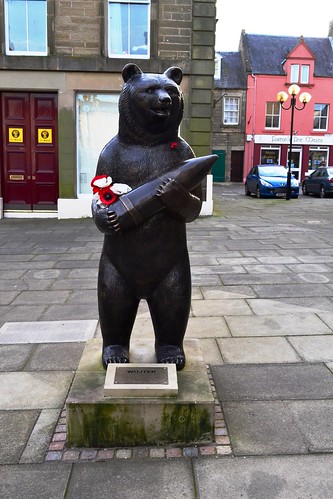
Wojtek became part of local history, eventually, a year after their arrival, the Polish unit were demobbed and they moved away. Wojtek was given to Edinburgh Zoo to look after, who did so until his death at the age of 21 in 1963. A statue stands in Princess Street Gardens beneath Edinburgh Castle as a reminder of both him and the Polish troops who were stationed at Winfield camp. A second statue of Wojtek stands in the centre of Duns, the village not far from Charterhall. The Wojtek Memorial Trust, set up in his honour, aims to promote both educational and friendship links between the young people of Scotland and Poland, an aim it tirelessly works towards today.
RAF Winfield

Statue of Wojtek in the centre of nearby Duns.

After the Polish troops left, Winfield was allocated to the USAF, and earmarked for development, but this never materialised and the site was left dormant. Winfield then reverted back to RAF control some five years later in October 1955, whereupon it was disposed of and sold off.

A small group of private flyers reopened the site, renovating the watch office and utilising a small hangar on the north of the airfield. This operation has now ceased and the watch office has sadly fallen into disrepair, it windows missing and open to the elements. The demise of Winfield and its subsequent decay has begun.

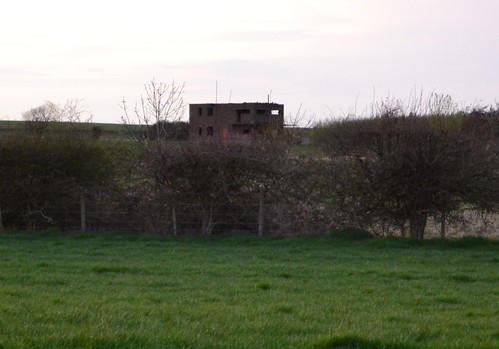
Winfield airfield lies between two roads, a further public road passes through the site although this was seen to be gated at the southern end. The most prominent feature is by far the Watch Office, a two-story design built to design 15684/41, having walls some 13.5 inches thick as was standard for all night-fighter stations (but different to the one at Charterhall).

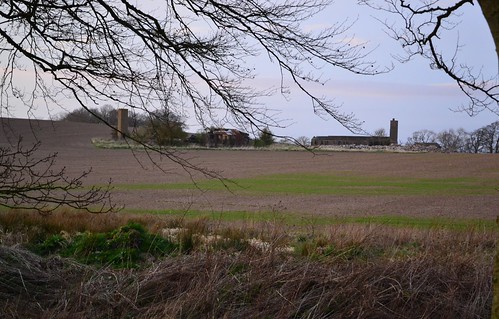
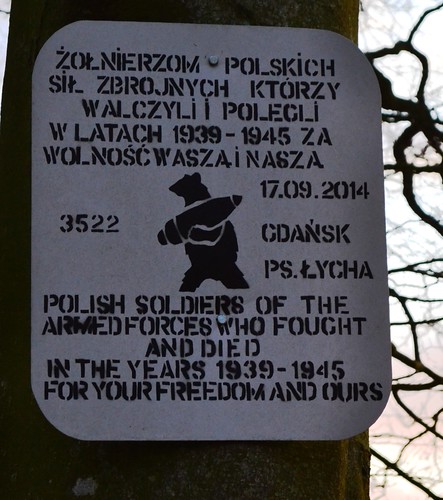
Other buildings also remain to the west on the main airfield site but these are only small and very few in number. The accommodation sites have all been removed, however, there are some buildings remaining in the former WAAF site to the north of the airfield. Located down a track just off the B4640, these buildings appear to be latrines and a possible WAAF decontamination block, with other partial remains nearby. Drawing numbers for these are unclear, (but appear to be 14420/41 and 14353/41) indicating WAAF (Officer and sergeant) quarters. Other buildings on this site look to have been a drying room, water storage tank and a picket post. Heading further south along this track leads to a small pond, here is a local design Fire Trailer shelter: a small brick-built building no more than about seven feet square. Presumably this pond was used to fill the fire trailer in cases of fire or attack and was located midway between the WAAF site and the main airfield. Also on this site, which is part of the Displaced Persons Camp, is a makeshift memorial to the Polish Armed Forces, dotted around the ground are a number of metal parts partially buried in the soil.
RAF Winfield

A plaque dedicated to the Polish Armed Forces placed next to the fire trailer hut.

The airfield runways and perimeter tracks are still in place, and years of both decay and locals using them to practice their driving skills on, have taken their toll. Like Charterhall, Winfield was also used as a motor racing circuit, although not to the same extent that Charterhall was. On one occasion though, as many as 50,000 spectators were known to have visited the site on one day alone!

Winfield like its parent site has now become history, the remnants of its past linger on as final reminders of the activities that went on here in the 1940s. The night fighter pilots who pushed the boundaries of aircraft location and interception are gradually fading away; the dilapidated buildings too are gradually crumbling and breaking apart. Inch by inch these sites are disappearing until one day soon, perhaps even they will have gone along with the brave young men who came here to train, to fight and in many cases to die.

As we leave the remnants of Winfield and Charterhall behind, we continue North to our next trail; nearing Edinburgh we take in more of Scotland’s natural beauty and even more tales of its wonderful but tragic aviation history.

My sincere thanks go to both Mr. and Mrs. Campbell for their hospitality and the help in touring these two sites. The history of both Charterhall and Winfield can be read in Trail 41.

Sources and Further Reading – RAF Winfield

*1 Photo IWM collections No.HU 16548.

The Polish Scottish Heritage website provides information about the scheme.
RAF Winfield and the Polish Connection (Part 1)

The second airfield on Trail 41 takes us a little further east to Charterhall’s satellite and a site that had strong links with the armed forces of Poland. Remembered here is an usual mascot, a bear known as ‘Wojtek’. We stop off a few miles away at the satellite that was RAF Winfield.

RAF Winfield.

RAF Winfield, located a few miles east of Charterhall, was pivotal to the success of the night-fighter training programme and in particular to Charterhall and 54 Operational Training Unit (O.T.U.).

Charterhall and Winfield cannot be talked about with great reference to each other, they were built together, manned together and operated as part of the same training programme. Winfield and Charterhall probably operated together more closely than any parent / satellite airfields of the Second World War.

RAF Winfield

Winfield Watch Office one of the few remaining buildings now derelict and forlorn.

Winfield (like Charterhall) was initially used as a First World War landing ground for 77 Sqn based at Edinburgh flying a range of Royal Aircraft Factory B.E. types in the Home Defence role. Whilst many of these airfields were designated ‘landing grounds’, many were not officially recorded to the point that their precise locations remain vague even today. Winfield (or Horndean as it was known), was designed as a site where crews could land in an emergency, perhaps if their aircraft developed problems or if weather prevented landing at their home station.

77 Sqn were part of a force who were to patrol the eastern regions of Britain, an area stretching from Dover in the south to Edinburgh in the north. This area, was the furthest point north and the defence of the Scottish border region fell to 77 Sqn. The conditions at Horndean were not luxury, and the ‘runways’ were far from smooth, but in an emergency any semi-decent ground was most likely welcome. Crews often practised emergency landings at both Horndean and Eccles Toft (Charterhall), where aircraft guards would restart the aircraft before flight could take place again. These ‘guards’ (or Ack Emas as they were known) were often mechanics recruited into the Royal Flying Corps because of their mechanical background and knowledge of engines. After a brief training period of some eight weeks, they were sent to various establishments to maintain and prepare aircraft before and after flight.

Horndean as an airfield was not to last though, and before the war’s end it would close returning to its former agricultural use.

With the outbreak of the Second World War, the training of pilots and other crewmen became a priority. Night fighters were also needed and Winfield would fulfil this role.

Winfield was built over the period 1941 – 42 opening later than expected, due to bad weather, in April 1942. A rather hastily affair, it was built between two roads and would only have two runways. Oddly, the initial construction of the runway was by hand, red shale from local quarries being brought in by endless lorries and laid down by local workers. It didn’t take long though before it was realised that this method was too slow, and so heavy machinery was brought in, and the stocks of shale bulldozed into the foundations. At the threshold, rubble stone was laid to a depth of some 12 feet, much deeper than the remainder,  to take the impact of landing aircraft. A covering of tarmac was laid over this layer in depths of between four and six inches thick. The runways at Winfield, like Charterhall, were 1,600 and 1,100 yards and both 50 yards wide. Aircraft dispersal was provided by thirty-seven hardstands whilst maintenance was carried out in four blister hangars.

The first personnel to arrive were an advanced party of thirty-four airmen led by Flying Officer Beal, who arrived on April 30th 1942. Unlike Charterhall, the airfield was complete and ready for the new recruits to move straight in. Being a satellite station, accommodation numbers catered for were less than those at Charterhall, 686 airmen and 56 WAAFs, all spread over five sites: three airmen, a WAAF, and a communal site. A small sewage plant was located not far from these, all to the north-eastern side of the airfield.

Trainees were to follow an initial three-tier programme. Starting in ‘A’ squadron – the conversion unit – they would then pass to ‘B’ and then finally onto ‘C’ here at Winfield. C Squadron, would finely tune skills and train aircrew in uses of Aircraft Interception (AI), ground attack and air-to-air gunnery techniques. Later on, a fourth tier would be added, focusing purely in flying the D.H. Mosquito in the night fighter role.

RAF Winfield

Remains of the former WAAF site.

These initial stages primarily used Beaufighters and Blenheims, aircraft that had been passed down from front line units to the training squadrons of the O.T.U.s. Many were therefore ‘war weary’ and as a result, mechanical problems were common place.

The first fatality at Winfield occurred in a rather bizarre accident on May 23rd 1942. A dispatch rider, Aircraftman 1st Class, John R. Livesey (s/n1478277), was struck by a Blenheim flown by Sgt. J. Grundy as the aircraft was taking off. The aircraft was damaged in the collision and the pilot unhurt, but Livesey was very sadly killed; he now rests at Marton (St. Paul) church in Blackpool.

In August 1942 a combined operation was planned involving Spitfire VBs from 222 Sqn (based at North Weald) and Boston IIIs from Attlebridge’s 88 Sqn. These manoeuvres saw eighteen Spitfires and twelve Bostons arrive, supported by three H.P. Harrows of 271 Sqn bringing ground crews, spares and supplies for the various aircraft. In all, around 360 new crews were accommodated at Winfield over the short two-week period.

Adept at low-level attacks, the two squadrons would arrive here between 1st and 4th August 1942, spend several days attacking ‘enemy’ transport and troop routes across southern Scotland, before departing. Considered a relative success, their stay was only for a short period vacating to RAF airfields at Drem, near Edinburgh, and Attlebridge, in Norfolk, respectively by mid August.

A further deployment of Mustang Is of 241 Sqn based at Ayr was cut short when bad weather prevented both flying and training operations from occurring. Later that month the small party left rather disappointed having hardly flown since arriving here at Winfield.

Being the more advanced tier of the training programme, serious accidents at Winfield occurred less frequently than at Charterhall. Burst tyres and mechanical problems being the main cause of many of the problems that were incurred.

RAF Winfield

Few buildings remain at Winfield, the WAAF site having the majority of the examples.

During July 1943, a Beaufighter from ‘C’ Squadron at Winfield misjudged the distance from himself to the target drogue being pulled by a Lysander, after firing and passing, his airscrew caught the drogue’s wire; luckily both aircraft were able to land safely and neither crew were injured. At the end of July a less fortunate incident occurred when, on a night flight, the port engine of Beaufighter T3370 (a former 456 Sqn RAAF aircraft coded RX-Z) caught fire. The crew bailed out, the pilot surviving but the Radio operator/navigator P/O. Frank Walmsley (s/n J/17124) of the RCAF was posted missing, presumed drowned, after the aircraft crashed into the sea. No trace was ever found of him.

October saw further deaths of crews from Winfield. On the 11th, Beaufighter VI, (ND184) crashed killing its Pilot Sgt. Angus Taylor, after it suffered engine failure; followed the next day by the crash of Beaufighter T3218 in a gunnery exercise over the North Sea. The aircraft crashed into the water after incurring a stall, both crewmen; F/O. John W. Roussel and F/O. Francis L. Kirkwood both of the RCAF, were missing presumed drowned. Both are commemorated on the Runnymede memorial.

During 1944 the tide began to turn and night fighter crews were on the offensive. The invasion of Normandy brought new hope and a new aircraft – the Mosquito. But as 1944 ended it would be the worst for fatalities in 54 OTU.

January brought many heavy bombers to the grounds of Winfield, returning from missions over Europe, they were either damaged or unable to land at their own respective bases due to poor weather. On February 17th 1945, fourteen Halifax IIIs from 420 Squadron RCAF landed at Winfield along with a further 408 Squadron aircraft. Whilst not able to comfortably accommodate such numbers and aircraft, it would have no doubt been a happy, and very much appreciated landing.

As the war drew to a close so did the number of flying hours. By May 31st the war was over and Winfield was no longer required, all the various ranks were pulled back to Charterhall leaving only a small maintenance party behind. For the next few years Winfield would have no operational units stay here, either temporary or permanently.

In the second part of this visit, we see how Winfield changed after the war, an odd visitor arrives, and Winfield’s decline begins.