RAF Barkston Heath – A little known airfield with a big history.

In the lower regions of Lincolnshire is a group of small airfields that are historically speaking, extremely important, but yet some are barely even known about. One of these is a small Relief Landing Ground (RLG), built with very few buildings and little infrastructure, it is one that is relatively unknown and in many cases even overlooked. Yet it was none the less, a thriving airfield during the hostile times of the Second World War. Whilst flying continues here today, still as a RLG, it has more than earned its place in the annuals of world history by being one of a small group of airfields that launched not one, but several of the biggest air operations the world has ever seen.

In this part of Trail 2, we take a new look at RAF Cranwell’s smaller but just as important satellite, RAF Barkston Heath.

RAF Barkston Heath (Station 483).

Barkston Heath sits on an area of Middle Jurassic Limestone, and is located about six miles south of RAF Cranwell, the parent airfield of the site siting on the edge of the Lincolnshire Cliff. It was identified as a possible location as early as 1936, and the year it opened, it used grass runways with very little infrastructure to support those using its grounds. As a satellite airfield it would have little based here, but would regularly see a number of biplanes use its grassed surfaces over a good number of years.

As a result of the focused development of Britain’s airfields during the pre-war expansion period and the early part of the war, it was then decided to upgrade Barkston Heath to the Class A standard; this earmarked it for three runways of concrete and wood chip of the standard lengths 2,000 yds and 1,400 yds by 50 yds wide. The idea behind this upgrade was to allow it to be used as  a bomber station, a satellite of RAF Swinderby. Ready to house the four engined heavy bombers of the RAF, it was a perfect location as it was found in the southern regions of Lincolnshire and within reach of Germany.

However, the development of Barkston Heath wasn’t completed for another two years, during which time it continued to be used as a satellite for RAF Cranwell. It was during this period that Cranwell was also developed, it being closed whilst runway improvement works were carried out. In order to keep the training programmes going, the aircraft from Cranwell were transferred over to Barkston Heath thus bringing a renewed flurry of activity to this airfield.

Then, during 1943, after Cranwell had re-opened, work then began which closed Barkston Heath. This work included the construction of its own hard runways along with 48 spectacle hardstands and 2 frying pan, most of which survive intact today. Aircraft repair hangars, of which there were originally four, soon totalled seven, of which six were the T2 variety and one a B1. These were located to the north-east of the site next to a public road with four of them across the road on a separate site. Unusually, the technical area was to the south of the airfield away from the hangars, the very buildings you would expect to see in the technical area of any airfield. The bombs store was located to the north-western side of the airfield and accommodation areas dispersed to the south.
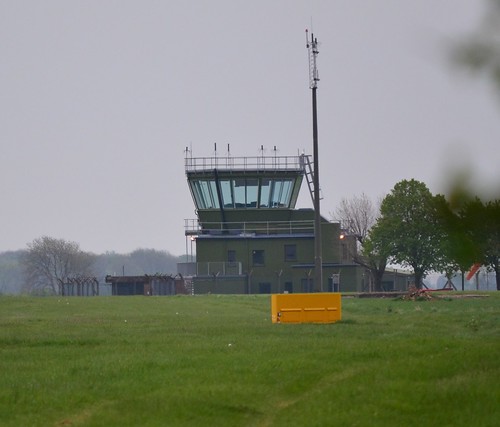
RAF Barkston Heath

Barkston Heath Watch Office.

Predominant in this area of the country were the RAF’s No. 5 Group, who were tasked with the training of bomber crews for the Royal Air Force. A number of airfields including Bardney, Bottesford and Swinderby were all found around here, and Barkston Heath would soon become another name added to that list. However, a decision in January 1944, when the airfield’s upgrading was complete, was made to transfer the airfield over to the USAAF in answer to their call to accumulate airfields in the region for Troop Carrying purposes. This meant that Barkston Heath was handed over to the US Ninth Air Force early that year, renamed Station 483 whereupon it became home to the 61st Troop Carrier Group (TCG) of the Ninth Air Force.

The TCGs were units set up to train and provide Troop Carriers for the forthcoming invasion of the continent on the Normandy beaches. An operation that would see one of the largest invasion plans of the war put into place. It would require the dropping of thousands of elite paratroops on and behind enemy lines to capture, eliminate and disrupt their positions before and during the invasion on the morning of June 6th 1944.

The 61st TCG, were one of five groups making up the “Northern Troop Carrier Bases” of the 52nd Troop Carrier Wing (TCW). This wing consisted at this time, of four Troop Carrier Squadrons (TCS) the 14th,  15th, 53rd and the 59th TCS who would arrive during February 1944. Their stay would last long after the famed Normandy invasion had taken place, in fact until March 1945, almost to the war’s end. Whilst they were stationed here, the 61st would take part in a large number of major operations across the European territories.

The 61st’s journey to Barkston Heath took them from Olmsted Field in Pennsylvania, through Augusta (Georgia), Pope Field (North Carolina) and on to North Africa. By the time they left North Africa they were a an experienced Troop Carrier Group having taken part in paratroop activities whilst here. These drops had earned the 61st a Distinguished Unit Citation (DUC) and by the time they arrived at Barkston Heath, they had already two major invasion strikes on their books, Sicily and Italy.

On arrival at Barkston Heath, they were transferred to the Ninth Air Force, and due to their experiences required little training for the work ahead. In the days during the build-up to the invasion, paratroops of the 101st Airborne began to arrive. Their presence only added to the excitement and curiosity of the ground crews who busied themselves painting invasion stripes across the wings and round the fuselages of the C-47s, that were parked along the runways of Barkston Heath. During the invasion on June 6th 1944, and on D+1 on June 7th 1944, they dropped paratroops and supplies near to Cherbourg on the Cotentin peninsula in Normandy. A major port, Cherbourg was also visited by the Titanic on its fateful voyage in April 1912, hopefully this would not be a prophecy as the area was an important place to both take and hold during the invasion.

Because of the nature of the drop and the dedication shown by the group, the 61st would receive their second DUC for this action. The awards for this brave and dedicated group of men were beginning to mount up.

Losses over Normandy were heavy however, and new recruits were brought in to replace those lost. A short period of training for the 44th TCS based at Cottesmore at the end of June, saw a six ship formation with gliders, mount a practice invasion at Barkston Heath. A smoke screen was laid down by an A-20 during which time four of the six aircraft landed safely.

After the breakout from the Normandy arena and the push north toward Holland and the Rhine, C-47s of 61st would then go on to drop British paratroops at Arnhem in Operation “Market Garden”; resupplying them by glider in the days that followed in September 1944. These troops consisted of the 1st Parachute Squadron Royal Engineers (550 men), 16th Parachute Field Ambulance (135 men), the Brigade Headquarters and the Paratroop section of the Defence Platoon consisting of 82 men. Amongst their parachutes they carried enormous quantities of kit, so much so that they had to be helped onto the aircraft by ground crew. Being ‘overweight’ parts of the kit had to be released before the paratroops hit the ground, as the extra weight forced them down faster than they should have been going. Many of these men suffered injuries from hitting the ground too hard, unable to release the harnesses in time to slow them selves down.

There were 157 paratroop filled aircraft in the sky that day, of which over 70 were from Barkston Heath – a considerable amount considering the relatively small size of the airfield. A further 358 aircraft followed all towing gliders, and so the sky that day was filled with silhouettes of aircraft as far as the eye could see. Even after this wave had passed, there were still two further waves to follow*1. In all, during operation ‘Market Garden‘, the 61st would carry out just short of 160 sorties dropping troops and supplies to the besieged ground forces around Nijmegen.

For the next few months the 61st would continue to supply the troops fighting in the lowlands of northern Europe, taking fuel, food and ammunition to the allied forces as they pushed forward toward Germany.

Then in mid March 1945, after many of the airfields in France had become secured, the 61st departed Barkston Heath, never to return. Whilst this curtailed their flying activities from this airfield, they would go on to cover other major operations including both the Rhine crossing that same month, and following the war’s end, the Berlin airlift in 1948/49. But before they departed, the Luftwaffe would have one small surprise for them. In a series of night attacks on the cluster of airfields in the area, including both RAF Cottesmore and RAF Barkston Heath, Night Fighters roamed the skies dropping anti-personnel bombs across the airfields. In the attack at Barkston Heath, the airfield was strafed and bombs were dropped, but thankfully little damage was done.

With the posting of the 61st to France, Barkston Heath would see a new group arrive, still under the ownership of the US Ninth Air Force. The new group, the 349th TCG,  operated C-46 aircraft to transport essential supplies into western Europe and then bringing  home both injured allied troops and German prisoners of war. The four squadrons based at Barkston, the 23rd, 312th, 313th and 314th, were only here for around 3 weeks before also moving off to France where they would continue their operations.

In April 1945, the withdrawal of the US forces from Barkston Heath meant that it was no longer required for their purposes, and so in June, the airfield was finally handed back to RAF control.

For a period after the war the airfield was used as a storage and disposal site before returning to the role of RLG for RAF Cranwell. Then, for the majority of the 1980s, Barkston Heath had an area within the former bomb dump developed for the siting of Bloodhound Missiles, Britain’s principle Surface-to-Air guided missile, and the first guided weapon to enter British operational service.

These missiles were manned by ‘D’ Flight from the RAF’s No. 25 Sqn on March  1st 1983, and remained here until October 1st 1989 when they were absorbed into No. 85 Sqn RAF. A year later they would be disbanded, the Bloodhound no longer being the mainstay of Britain’s last line of defence.

With the 1980s turning into the 1990s, Barkston Heath once more became a RLG for Cranwell. Since then it has continued to operate as a Training airfield for pilots of the three forces of the British Isles, recently replacing the Slingsby T67M260 Firefly with the Grob G 115 Tutor T.1.

As no large heavy aircraft had ever been assigned to Barkston Heath, it never needed developing beyond the Class A specification of its wartime role. The watch office has been updated though with the inclusion of the anti-glare glass house, but the wartime huts and technical buildings to the south of the airfield site have long gone. Fortunately the main concrete areas and hangars have survived much in thanks to their continued use by the Royal Air Force.
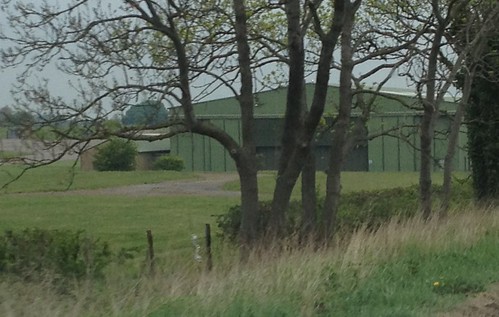
RAF Barkston Heath

One of Barkston’s many hangars still in use today. (Photo taken in 2013)

For a short period during 2003, the wartime aircraft of the RAF’s Battle of Britain Memorial Flight were stationed here whilst the runways at Coningsby were resurfaced ready for the arrival of the Eurofighter Typhoon. Barkston Heath was in fact the third choice after both  Waddington (which could not accommodate them) and Scampton (which was too large – the Spitfires possibly overheating whilst taxing and the hangars were in need of refurbishment) were discounted. After some minor modifications at Barkston Heath, the BBMF operated from here until October 5th when the majority of the aircraft returned home to Coningsby.*2

Since then Barkston Heath has remained as a satellite for Cranwell, operating as both a training facility and a Relief Landing Ground, a role that takes it back to it origins in 1936.

Today, little flying activity can be seen, but the airfield does have some reasonable viewing points. The hangers and (active) guard-house, are adjacent to the main road, and passing the airfield here parked aircraft can often be seen on the apron.

The remains of a Canberra B(1)8 ‘WT339’, an ex RAF Cranwell aircraft, rest in the dump, visible from a path leading off from the main road on the northern side of the airfield. Here also are the remains of the Bloodhound site, the launchers and missiles obviously all having been removed long ago. All the remaining hangars are visible behind the trees but those across the road are no longer used by the airfield operators. Other than this, little buildings wise, remains.

Whilst Barkston Heath has had a long life and one that looks to continue well into the future, its wartime life was relatively short. However, this doesn’t detract from the fact that it was, none the less, a highly important airfield playing a major part in the Allied invasion plans, and not just Normandy itself, but beyond to the ill-fated operations around the Dutch town of Arnhem.

RAF Barkston Heath is a name that should be more widely known, seared into every tale of the Normandy Invasion plan, a name that should live for many, many years to come.

Sources and Further Reading.

*1 Hicks, N., “Captured at Arnhem: From Railwayman to Paratrooper“, (2013) Pen and Sword.

*2 Cotter, J., “The Battle of Britain Memorial Flight: 50 Years of Flying“, (2007) Pen and Sword.
 

Spanhoe Airfield – into the Jaws of Death

RAF Spanhoe (Station 493)

With the BEF evacuation at Dunkirk, some thought that the war was over and that the mighty Nazi war machine was undefeatable. Poised on the edge France, a mere 20 or so miles from the English coast, the armies of the Wehrmacht were waiting ready to pounce and invade England. For Britain though, the defences came up and the determination to defeat this evil regime grew even stronger.

Defeat in the air during the Battle of Britain reversed the fortunes of Germany. Then the Japanese attack on Pearl Harbour in the Pacific, which led to the United States joining the war, set the scene for a new and vigorous joint front that would lead to the eventual invasion of occupied Europe, and ultimately the freedom for those held in the grip of the Nazi tyranny.

Plans for the invasion were never far from the thoughts of those in power – even in the darkest hours of both Dunkirk and the Battle for the British homeland. To complete this enormous task, an operation of unprecedented size and complexity would be needed. Vehicles, troops and supplies would all needed to be ferried across the English Channel, a massive air armada would have to fly thousands of young men to the continent. To succeed in this auspicious and daring operation, a number of both training and operational airfields would need to be built, and in 1943 Spanhoe was born.

Known originally as RAF Wakerley (and also referred to as Harringworth or Spanhoe Lodge) it was handed over to the U.S.A.A.F. and designated Station 493.

RAF Spanhoe Lodge

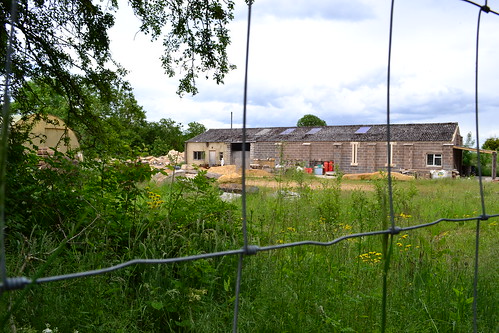
Remaining buildings on the Technical site at Spanhoe Lodge.

Located in the county of Northamptonshire, it would be a huge site with three concrete runways, the longest of which was 6000 ft. Two smaller intersecting runways were of 4,200 ft and all three were a huge 150 ft wide. A total of 50 spectacle hardstands were spread around the perimeter track whilst the tower, built to a 1941 design (12779/41), was located to the south of the airfield between the technical area and main airfield. Such was the design of the airfield, that the tower was located a good distance away from the main runway to the north. The technical area included a small number of Quonset huts, temporary brick-built buildings and two T2 hangars. Instructional and training buildings included a Synthetic Navigation Classroom (2075/43) designed with the most up-to-date projection and synthetic training instruments possible. These buildings were made more distinct by the two glazed astrodomes located at one end of the building which could be used on nights when stars were visible.

As Spanhoe was originally built as a bomber station, a bomb and pyrotechnic store was built on the eastern side of the airfield with three huge fuel stores, one to the north and two others to the west, all capable of holding 72,000 gallons of aviation fuel each.

Accommodation for the crews and ground staff was widely spread to the south amongst the local woods and fields, and consisted of numerous cold Quonset huts – but for the residents, Spanhoe was considered nothing special to write home about.

The first U.S. units to arrive were the Troop Carriers the of the 315th Troop Carrier Group (TCG), whose journey from the United States was not as straightforward as most.

Whilst on their way over the north Atlantic route, they were hit by bad weather and had to be diverted to Greenland. Here they stayed for over a month scouring the seas for downed aircraft and dropping supplies to the crews before they were rescued.

Eventually the 315th made England and began a series of training operations. A small detachment were sent to Algiers to assist in the dropping of supplies to troops in the Sicily and Italy campaigns before returning to the main squadron in the U.K. The 315th arrived at Spanhoe on 7th February 1944 now part of the Ninth Air Force,  IX Troop Carrier Command, 52nd Troop Carrier Wing. They operated two versions of the adapted Douglas DC-3; the C-47 Skytrain and the C-53 Skytrooper transport aircraft. Four Troop Carrier Squadrons (TCS) would use Spanhoe: the 34th, 43rd, 309th and 310th, and would all operate purely as paratroop carriers.

C-47 Skytrains of the 315th Troop Carrier Group in flight. Handwritten caption on reverse: 'C-47 Skytrain. 315 TCG over Lincolnshire. C-47 before 1944.'Image actually shows Harringworth Viaduct. RAF Spanhoe, the home field of the two Aircraft, is slightly out of shot to the left, making this right on the border of Rutland & Northamptonshire.

C-47 Skytrains of the 315th Troop Carrier Group in flight. over the Harringworth Viaduct. RAF Spanhoe, the home of the two Aircraft is just out of shot. (IWM – FRE 3396)

For the next few months they would train in preparation for the forthcoming D-day landings in which they would rehearse both formation flying at night and night paratroop drops with the 82nd Airborne; the unit the 315th would take to drop zones behind enemy lines in Normandy. These preparations were relentless, and not without casualties. The 315th were considered as one of the ‘weaker’ elements of the air invasion force, and would carry out drops nightly until the paratroops had completed their full quota of jumps and all were finally classed as ‘proficient’. The majority of these jumps were however, carried out in clear weather, a point that had not been factored into the final decision.

Flying at night would, unsurprisingly, claim  lives and this was brought home when on the night of May 11th-12th, two aircraft from the 315th’s sister group the 316th, collided during combined operations, killing fourteen airmen.

Even with all this training and a very high aircraft maintenance programme, there were many factors that could affect the outcome of operations. Some 40% of crews had only recently arrived before operations, and thus were not a party to a large part of the training missions.  Of the 924 crews that were designated for the operations, 20% had only had minimal training and 75% had never actually been under fire. The airborne crews were not well prepared.

On the third day of June the order came through to paint invasion stripes on the aircraft. These three white and two black stripes, each two feet wide, were designed to enable the recognition of allied aircraft who were sworn to radio silence over the invasion zones. D-Day was now imminent.

The 52nd’s mission would involve all the other groups of the Wing, taking aircraft from: Barkston Heath (61st TCG), Folkingham (313th TCG) Saltby (314th TCG) and Cottesmore (316th TCG) as well as eleven other paratroop and glider-towing units of the U.S. Ninth Air Force and fifteen RAF Squadrons – it was going to be an incredible sight.

315th C-47 landing at Spanhoe. On the ground can be seen the 315th’s C-109 (converted B-24) tanker . (Knight Collection)

Forty-eight aircraft took off from Spanhoe and formed up with the other Groups at checkpoint ‘ATLANTA’, they continued on toward Bristol turning south at checkpoint ‘CLEVELAND’ . They flew crossed the south coast at Portland and headed out toward Guernsey. The route would then take them north of the island where the 52nd would turn east and head over the Cherbourg Peninsula. They would drop their load of heavily laden paratroops south of Utah beach to capture the important town of St. Mere-Eglise. A ten-mile wide corridor would be filled with aircraft and gliders.

Over the drop zone the aircraft encountered cloud and heavy flak. Whilst a quarter received damage, all but one were able to return to England, the last being lost over the drop zone. For their efforts that night, the 315th TCG was awarded the Distinguished Unit Citation, the only one they would receive during the war.

After D-day, units of the 315th continued to drop supplies to the advancing troops, a default role they carried out for much of the war.

Tragedy was to rear its ugly head again and strike down Spanhoe crews. In July 1944, 369 Polish paratroopers arrived for training as part of Operation ‘Burden’. This involved thirty-three C-47s of the 309th TCS, fully loaded flying in formation at around 1,300 ft. The aim of the flight was to drop the Polish Paratroops at a drop zone (DZ) over R.A.F. Wittering.

RAF Spanhoe Lodge

One of the few overgrown buildings at the entrance to Spanhoe Lodge.

Shortly before arriving at the DZ near to the Village of Tinwell, two aircraft made deadly contact and both plummeted to the ground. Twenty-six paratroops and eight crewmen were killed that day, the only survivor was Corporal Thomas Chambers who jumped from an open door. Eyewitness accounts tell of “soil soaked in aviation fuel”, and bodies strapped to part open parachutes as many tried to jump as the aircraft fell. This tragic accident was a devastating blow to the Polish troops especially as they had not yet been able to prove themselves in combat and one that ultimately led to the disbandment of the section and reabsorption into other units.*1

The 315th’s next major combat mission would be ‘Market Garden‘ on September 17th, 1944, another event that led to many tragedies. On the initial day, ninety aircraft left Spanhoe with 354 Paratroops of the U.S. 82nd Airborne, the following day another fifty-four aircraft took British paratroops and then on the third day they were to take Polish troops. However, bad weather continually caused the cancellation of the Polish operations and even with attempts at take-offs, it wasn’t to be. Finally on September 23rd good skies returned and operations could once more be carried out. During all this time, the Polish troops were loaded and unloaded, stores under the wings of the C-47s were added and then removed, it became so frustrating that one Polish paratrooper, unable to cope with the stress and anticipation of operations, fatally shot himself.

Later that month, another plan was hatched to resupply the beleaguered troops in Holland. The idea was to land large numbers of C-47s on different airfields close to Nijmegen. Not sure if they had been secured, or even taken, the daring mission went ahead. Escorting fighters and ground attack aircraft neutralised anti-aircraft positions around the airfields allowing hundreds of C-47s to land, deposit their supplies and take off again, in a mission that took over six hours to complete. In total: jeeps, trailers, motorcycles, fuel, ammunition, rations and 882 new troops were all delivered safely without the loss of a single transport aircraft – a remarkable feat.

Further supplies were dropped to troops during both the Battle of the Bulge and Operation Varsity – the crossing of the Rhine – in March 1945. During this operation, the 315th would drop more British paratroopers near Wesel, Germany, a mission that would cost 19 aircraft with a further 36 badly damaged.

By now the Allies were in Germany and the Troop Carrier units were able to move to France leaving their U.K. bases behind. This departure signalled the operational end for Spanhoe and all military flying at the airfield would now cease.

Two months later the 253rd Maintenance Unit arrived and prepared Spanhoe for the receiving of thousands of military vehicles that would soon be arriving from the continent. Now surplus to requirements, they would either be scrapped or sold off, Spanhoe became a huge car park and at its height, would accommodate 17,500 vehicles. For the next two years trucks, trailers and jeeps of all shapes and sizes would pass through, until in 1947 the unit left and the site was closed for good and eventually sold off.

This was not the end for Spanhoe though. Aviation and controversy would return again for a fleeting moment on August 12th 1960, with the crash of Vickers Valiant BK1 ‘XD864’ of 7 Squadron RAF. The aircraft, piloted by Flt. Lt. Brian Wickham, took off from its base at nearby RAF Wittering, turned and crashed on Spanhoe airfield just three minutes after take off. The official board of enquiry concluded that the accident was caused by pilot error and that Flt. Lt. Wickham, was guilty of “blameworthy negligence”. The Boards findings were investigated by an independent body who successfully identified major flaws in both the analysis and the Boards subsequent findings.  Sadly no review of the accident or the Boards decision has ever taken place since.

Spanhoe Lodge

Spanhoe was the home of the 315th Troop Carrier Group, part of the 52nd Troop Carrier Wing, Ninth Air Force.

Spanhoe was then turned into a limestone quarry by new owners, the runways and the majority of the perimeter track was dug up and the substrate was removed. The majority of the buildings were demolished but a few were left and now survive as small industrial units involved in, amongst other things, aircraft maintenance and preservation work. A private flying club has also started up and small light aircraft now use what remains of the southern section of the perimeter track and technical area.

The main entrance to the airfield is no longer grand, and in no way reflects the events that once took place here. From this point you can see some of the original technical buildings and hidden behind the thicket, what was possibly a picket post. A footpath though the nearby woods allows access to the remains of eastern end of the main runway and perimeter track, other than this little is accessible without permission.

Outside the main entrance are two memorials consisting of a modern board detailing the group and squadron codes, and a stone obelisk listing the names of those crew members who failed to come home. Both are well cared for if not a little weathered.

DSC_0159

Spanhoe Lodge memorial

Spanhoe leaves a legacy, for both good reasons and bad. The crews that left here taking hundreds of young men into the jaws of death showed great bravery and skill. Determination to be the best and perform at the limits were driving factors behind their successes. Relentless training led to the deaths of many who had never even seen combat, and the scars of these events linger in what remains of the airfield today. Thankfully for the time being, the spirit of aviation lives on, and Spanhoe clings to the edge, each last gasp of breath a reminder of those brave men who flew defenceless in those daring and dangerous missions over occupied Europe.

On leaving Spanhoe, return to the main road, keeping the airfield to your left, join the A43, and then turn right and then immediately left. Follow signs to Oundle and Kings Cliffe and our next destination, the former airfield at Kings Cliffe, an airfield with its own modern controversies.

Spanhoe features as part of Trail 6, ‘American Ghosts’.

Sources and Further Reading

*1 A list of those killed in the Tinwell Crash can be found via this Dutch website for Polish War Graves.

The 315th TCG has a detailed website with regular newsletters and photographs.