With the increase in airfield construction and the demand for greater quantities of munitions, additional bomb storage became a problem during the Second World War. Bomb sites needed to be close enough to the airfields so that stores could be transferred quickly, but far enough away so as to not cause problems should an attack happen at either the airfield or at the store.
Apart from the major underground stores bought and secured in the 1930s, the War Office planned an additional nine above ground ‘Ammunition Parks’ at the outbreak of war*1. They were to add a further two more once the war had started and following the realisation that nine would not be sufficient to meet the demands of the air war over Europe.
Each of these parks were initially designed to hold a total of 1,000 tons of ordnance, but it was quickly realised that this too was not going to be anyway near sufficient and the capacity was soon raised to 10,000 tons.
Any store, needless to say, had to be safe, secure and well hidden from prying eyes, all of which presented the War Office with numerous problems. The initial pre-war sites relied upon the strength of the design to protect them but it was then thought better to use concealment as a way of protecting them and so the latter two sites did just this.
About one mile from RAF Attlebridge (Station 120) in Norfolk, stands one of these two sites. Located in Hockering Wood, now a site of Special Scientific Interest, it not only houses some of the rarest plants and animals in Norfolk but across the country as well.
Hockering Wood is one of the largest ancient, semi-natural woodlands in Norfolk, its ponds provide habitats for the protected Great Crested Newt, and a rare mix of soils support an ecological range that is remarkably unusual for Norfolk. It also contains a moated site believed to date as far back as the middle ages.
Yet with all this fauna and flora thriving, it is hard to believe that during the Second World War, this was an enormous bomb store capable of accommodating 8,400 tons of High Explosive (H.E.) bombs and 840 tons of incendiary bombs. A number of hardstandings, huts, component stores, staffing blocks and open sites, were spread out across the site, each linked by 9 foot (18 foot by adjoining H.E. groups) tar sprayed, metal roads that followed the natural contours of the wood. Whilst the general layout and design of each of these sites were similar, each construction team would have a certain amount of autonomy in the decision-making depending upon the conditions at each site. At Hockering, this would take into account the drainage, natural ditches, tree cover and natural barriers that existed there at the time. The requirement being that all natural features were to be retained as much as possible.
The H.E. bombs and ordinary small arms ammunition (S.A.A.) would be stored on hardstands, with the S.A.A. sited between the H.E. in the wooded area. The incendiaries, components stores and pyrotechnics would be stored in 36′ x 16′ Nissen huts, with some of the incendiaries on open land. The original plan was for the pyrotechnics to be grouped together in 6 huts per group, whilst the component stores would be in pairs. This provided a total of 17,000ft of storage for small arms, and over 20,000ft for pyrotechnics. Tail units, not fitted to the bombs until arming, were stored in an area covering 36,750ft. In addition to this at Hockering, there were two extra accommodation sites also planned in just beyond the perimeter fence should there be an overspill at nearby Attlebridge.
Access to the site was limited and controlled. Three public roads were closed off and entrance along these roads was by pass only – security was understandably high.
The site designed in the early 1940s, and designated as a ‘Forward Ammunition Depot’, was originally built to supply RAF units of 2 Group Bomber Command, and was under the control of No. 231 Maintenance Unit. It was built in the latter part of 1942, opening in early 1943 closing in 1945 at the end of the war. At its height it is thought to have served both USAAF and RAF units.
The tracks that led around the store are still there today, hidden beneath years of vegetation and soil build up. Foundations from many of the huts are still evident and even the odd building still stands as a reminder of the work that took place here all those years ago.
As with many of these historic sites though, mother nature has a way of claiming them back. Careful ecological management ensures the public get to enjoy the site whilst protecting the rare species that continue to thrive there.
A quiet and unassuming site today, it was once a hive of activity that supplied the bombs and bullets that brought death and destruction upon our enemy. It is somewhat reassuring to know that we can once again enjoy the peace and tranquillity that it now brings.
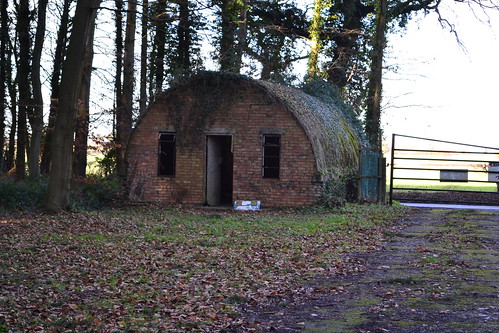
One of the more complete huts on the edge of Hockering Wood.
Sources and further reading
*1 Wikipedia has a full list of all the designated ammunition parks.
The technical information was obtained from the plan drawing MC/97/42 Sheet B.
 Aviation Trails