November 1938 -Tragedy at Stradishall

Whilst researching a forthcoming trail, I discovered the story of two airmen who were both killed in an accident, and are both buried in the local village cemetery.

Their gravestones are sadly much less ‘grand’ than many of the other airmen in the cemetery, but their departure was none the less, nothing short of a tragedy, and in no way less of a sacrifice than any other loss.

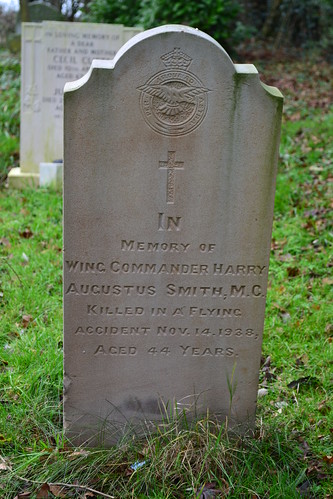
It was during a night training flight, on November 14th 1938, that Wing Commander Harry A. Smith MC, along with his navigator Pilot Officer Aubrey W. Jackson, both of No. 9  Squadron (RAF),  would be killed in a Handley Page Heyford III reg: K5194, when the aircraft undershot the airfield striking trees outside the airfield boundary. The crash was so forceful that the aircraft burst into flames killing both airmen.

Wing Commander Smith MC qualified as a pilot whilst in the Royal Flying Corps in 1916, and was the first of his rank to be killed since the inception of Bomber Command in July 1936. He had been awarded the Military Cross ‘for gallantry and distinguished service in the field‘ in 1918.

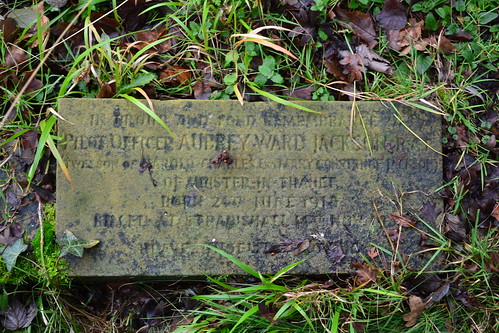
Pilot Officer Jackson was appointed for a Short Service Commission in January 1937, and later a Permanent Commission. He was only 20 years old at the time of his death.

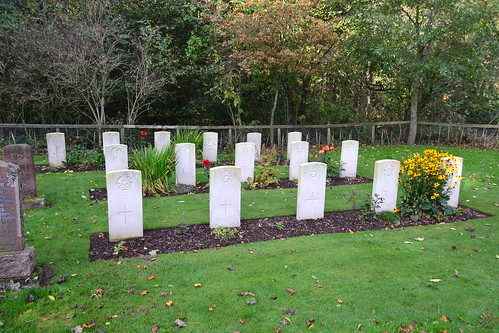
Both crewmen are buried in Stradishall’s local cemetery.

St. Margaret of Antioch, Stradishall

A very ordinary grave stone marks the plot of P.O. Aubrey W. Jackson, killed on November 14th 1938 on a night training flight.

St. Margaret of Antioch, Stradishall

Wing Commander Smith, killed alongside P.O. Jackson on a night training flight. He was the first of his rank to die since the formation of Bomber Command.

RAF Chedburgh – An appalling loss of life.

In this next trail, we start just a few miles to the south-west of Bury St. Edmunds in Suffolk, where we visit a number of airfields that were associated with the heavy bombers of the RAF’s Bomber Command.

Our first stop, although a satellite, more than earned its rightful place in the history books of aviation. It is an airfield where large numbers of the ill-fated Stirling flew many missions over occupied Europe, where the staggering statistics of lost men and machines speak for themselves.

Now little more than fields and a small industrial estate, the remnants of this wartime airfield stand as reminders of those dark days in the 1940s when night after night, young men flew enormous machines over enemy territory to drop their deadly payload on heavily defended industrial targets.

We begin our next trip at the former airfield RAF Chedburgh, home to the mighty four-engined bombers of No. 3 Group Bomber Command of the Royal Air Force.

RAF Chedburgh.

Built in 1942 (by John Laing and Son Ltd) as a satellite for RAF Stradishall, Chedburgh would be built to the Class A specification, a later addition to the RAF’s war effort. Being a bomber station Chedburgh would have three runways made of concrete, the initial construction being one of 2,000 yards and two of 1,400 yards, all the standard 50 yards wide, as was the standard specification brought in during 1941. Later on, these would be extended giving Chedburgh much longer runways than many of its counterparts, i.e. one at 3,000 yards and two at 2,000 yards. Having runways this long, meant that heavy bombers could use the site when in trouble, something that Chedburgh would get used to very quickly.

With the village of Chedburgh to the north of the site, directly opposite the main gate; the technical area along the north-eastern side of the main runway, and the bomb store to the east, Chedburgh would have two T2 hangars, a B1 and later on 3 glider hangars. Dotted around the perimeter track were a number of dispersals comprising 34 pan styles and 2 looped.
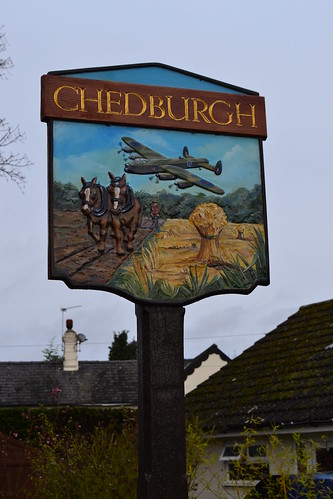
RAF Chedburgh

Chedburgh village sign reflects it aviation history.

Whilst housing only two major squadrons 214 Squadron and 620 Squadron, it would also be home to a small number of other operational units, 218, 301, 304 Sqns and 1653 Heavy Conversion Unit (HCU).

Opening under the control of No. 3 Group, on September 7th 1942, the first resident unit was 214 Squadron (RAF) flying the Stirling MK. I, a model they operated until as late as February 1944. The bulk of the unit arrived in the October, with operations beginning very soon after. Within four months they would begin replacing some of these models with the upgraded MK.III, also operating these until the beginning of 1944 and after transferring to RAF Downham Market in Norfolk.

As with many airfields at this time, the arrival of personnel preceded the completion of the works, development continuing well into the operational time of its residents, something that would cause a problem in the coming months.

It was in March of 1943 that the first casualties would occur, the night of March 1st/2nd being a baptism of fire for 214 Sqn. Stirling MK. I (R9143) BU-E piloted by F/S. J. Lyall (RCAF) would be hit by flak, she was badly damaged, and then abandoned by her crew. As he descended from the stricken aircraft, F/O. Hotson (RNZAF) would be hit by a splintering shell – the wounding he received as a result would be fatal. The remainder of the crew all escaped the aircraft safely but were later captured by the Germans and incarcerated. A multi-national crew, this loss was to be followed just two nights later with the loss of another Stirling, ‘BU-C’, but this time none of the seven crewmen were to survive.

Then on the next night, 5th/6th March, whilst on operations to Essen (the 100,000th sortie by RAF aircraft), Stirling BK662 ‘BU-K’ crashed into the North Sea about 30 km north-northwest of Ijmuiden. Only one of the crew, Air Gunner Sgt. William H. Trotter (s/n: 1128255) was ever found, the rest of the crew remaining ‘missing in action’. This was the first Stirling to be listed as such since the squadron’s operations began. This raid would prove devastating, taking the lives of 75 RAF airmen, but the War Office considered it a major success in terms of  industrial damage to the German war machine. The targeted Krupps factory, which sat in the centre of over 100 acres of industrialised area, was devastated by both accurate marking and then the subsequent bombing.

Throughout this month there were further loses to the squadron: Stirlings ‘BU-Q’ and  ‘BU-A’ (in which F/S. D Moore (RCAF) and Sgt. T. Wilson were both awarded the George medal for saving the life of their companion Sgt. J. Flack), along with ‘BU-M’ were all lost; ‘BU-M’ losing all but one crewman. Another aircraft, ‘BU-L’, lost all seven aircrew  on the night of March 27th/28th, and closing March off, was a collision between Stirlings BK663 and EF362, which left several more crewmen either injured or dead. Although many losses were as a direct result of flak or night fighters, the cracks were beginning to show, and the poor performance of the Stirling was becoming evermore apparent.

It was during this year on 17th June 1943, that Chedburgh’s second main operational unit would be formed, 620 Sqn (RAF), also carrying out bomber operations, again with the Stirling MK. I and later in the August, the MK. III. Also part of 3 Group Bomber Command, 620 Sqn were created through the streamlining of 214 Sqn and 149 Sqn at nearby Lakenheath. The move reduced each of the two former squadrons from three flights to two,  releasing ‘C’ Flight of 214 Sqn who were already stationed here at Chedburgh.
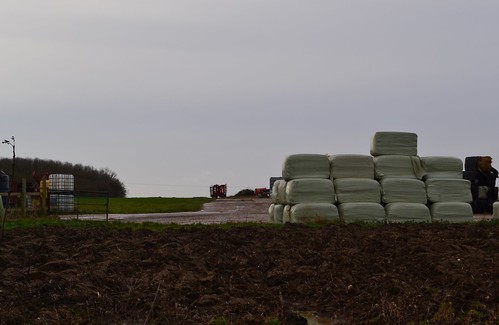
RAF Chedburgh

Parts of the perimeter track and runways remain as tracks used for storage.

As many of these crews were already well established and experienced, there would be no delay in commencing operations, the first sortie occurring on the night of the 19th June 1943 – two days after their formation. The first casualties occurred three days later on the night of 22nd/23rd June 1943, just a few days into their operational campaign. There then followed five months of heavy operational activity, a period in which the Stirling and its crews would be pushed to the very limit and beyond. The shortcomings of the aircraft being realised further more.

Being on a partially built airfield would be the cause of the demise of Stirling EF336 (QS-D) which swung on take off and ran into the partially constructed perimeter track. The uneven surface caused the undercarriage to collapse, and whilst there were no injuries to the crew, the aircraft was written off.

The poor service ceiling of the Stirling led to several aircraft being damaged through falling bombs from aircraft flying above. A number of Stirlings were recorded returning to bases, including Chedburgh, with damage to the air frames, damage caused by these falling ‘friendly’ bombs!  However, the extent of this damage did give great credit to the aircraft, showing both its robustness and strength in design; something that often gets forgotten when talking about the Stirling in operations.

The next few months for 620 Sqn would be filled with a mix of operational sorties, mining operations (Gardening) and training flights, including both ‘Bullseye‘ and ‘Eric‘; testing the home defence searchlight and AA batteries both at night and during the day. During a fighter affiliation exercise on July 2nd, two 620 Squadron aircraft collided, ‘EF394’ (QS-V) and BK724 (QS-Y)  killing fifteen and injuring two. One of those killed, Flight Mechanic AIC Arthur Haigh (s/n: 1768277) was only 18 years old, and one of five ground crew who were aboard the two aircraft that day.

Both 214 Sqn and 620 Sqn would go on for the next few months taking part in some of the war’s largest bomber missions including Hamburg, Essen and Remscheid. A number of aircraft would be lost and many aircrew along with them. The worst recorded night for 620 Sqn was the night operation on August 27th/28th, 1943 to Nuremberg, when three aircraft were shot down, all Stirling MK.IIIs: BF576 (QS-F) piloted by Sgt. Frank Eeles (s/n: 1531789); EE942 (QS-R) piloted by Flt. Sgt. John F. Nichols (s/n: 1318759) and EF451 (QS-D) piloted by Sgt. William H. Duroe (s/n: 658365). These three losses accounted for sixteen deaths and five taken as POWs, there were no other survivors.

The last 214 Sqn Stirling to be written off during bombing missions occurred on the night of November 22nd/23rd, 1943. Whilst on a mission to Berlin, Stirling EF445 (BU-J) was hit by flak, attacked by a FW-190 and then suffered icing. The resultant damage along with a lack of fuel, caused the pilot to ditch in the North Sea with the loss of two crewmen: pilot F/S. George A. Atkinson (s/n: 1485104) and Sgt. W. Sweeney (RCAF) (s/n: R/79844).

620’s stay at Chedburgh would be fairly short-lived, taking part in their final operation on the night of November 19th/20th, 1943 to Leverkusen. They then departed Chedburgh at the end of that month after suffering a heavy toll on their numbers and a devastating start to their war. By now the limitations of the Stirling were very well-known, and it was already being replaced by the much favoured Lancaster. In the short five months it had existed, the squadron had lost eighteen of its aircraft in operations, and a further six in accidents, statistics that are however, overshadowed by the loss of ninety-three lives. 620 Sqn left both Chedburgh and Bomber Command to join other units at RAF Leicester East and the Allied Expeditionary Air Force in November, where the unit was to perform Airborne operations along side 196 Sqn and 1665 Heavy Conversion Unit (HCU). A role that 620 performed for the remainder of the war.

With their departure came the arrival of another Stirling squadron, 1653 HCU, a Stirling training unit rather than a front line operational squadron. A month later 214 Sqn would also leave Chedburgh taking their Stirlings to Downham Market and then onto Sculthorpe where they replaced them with the B-17 Flying Fortress.

A P-51 Mustang (5Q-Q, serial number 42-106672) of the 504th Fighter Squadron, 339th Fighter Group, that has crash landed at Chedburgh, 18 May 1944. (IWM FRE 2784)

1653 HCU, as a training unit, would also have it share of accidents and losses, many due to technical problems, but some due to pilot error. A number of accidents were caused by tyres blowing, and some were caused by engine failures, the bravery of these pilots in dealing with these matters being no less than exemplary. One such incident being that of F/O. Hannah and his crew, who took off at 20:50 on the evening of November 3rd 1944, on a radar training flight. Immediately after take off both port engines cut out, something that was almost fatal in a Stirling. The aircraft, virtually uncontrollable, was heading towards a row of cottages but the crew managed to turn it  away missing the houses but colliding with a row of trees instead. All of the crew were injured to varying degrees – one fatally. Sgt. Eddie (RCAF) dying in the resultant crash.

After a year of being at Chedburgh, 1653 HCU would also depart (December 1944) by which time the Lancaster was well and truly the main bomber of the RAF. This late stage of the war would not be the end of Chedburgh though, Bomber Command retaining its use, sending the Lancasters I and III of 218 (Gold Coast)*1 Squadron here from RAF Methwold.

On December 2nd 1944 the first ground units began to arrive, with flying personnel arriving on the 5th, after much-needed runway repairs were completed. The airfield reopened with the arrival of eighteen Lancasters, formed into three new flights, of which thirteen would undertake operations on the 8th, to the railway yards at Duisburg – their first from Chedburgh. Both this mission and that of the 11th to the marshalling yards at Osterfeld, were heavily restricted by thick cloud, and so G-H navigation aids were used in conjunction with ‘Oboe‘.

For the majority of the remainder of the war Bomber Command continued its strategic missions against German cities, with marshalling yards and oil refineries being other major targets. It was of course this continued use of bomber aircraft against what was now a demoralised and weakened German population, that led to the outcry over Harris’s continued attacks on German cities. A controversial action that led to his move away from the lime light at the war’s end, and the lack of recognition for bomber commands efforts throughout the conflict.

218 Sqn would continue on though. The winter of 1944 / 45 proving to be one of the worst weather wise, many missions were either scrubbed or carried out in poor weather. On the night of January 1st/2nd 1945, one hundred and forty-six aircraft of No. 3 Group were tasked with the attack on Vohwinkel railway yards. During the attack in which 218 Sqn were a part, two aircraft were hit by heavy anti-aircraft fire from American guns below. One of these was 218 Sqn Lancaster MK. I PB768 (XH-B) piloted by 20 yr old Australian F/O. Robert G. Grivell. The accuracy of these guns was ironically excellent, hitting the aircraft not once but twice, causing it to spin uncontrollably toward the ground. All but one of the crew were killed in the ensuing crash.

It was during this period that the RAF began daylight bombing missions too, such was the poor state of the defending Luftwaffe. Numerous missions over the next weeks led to attacks on the coking plants at both Datteln and Hattingen, repeated again on March 17th in attacks at Huls (and Dortmund). Hattingen was again attacked by 218 Sqn aircraft on the 18th without loss.

ROYAL AIR FORCE BOMBER COMMAND, 1942-1945.

Mechanics at work on an engine of Lancaster B Mk. III, (LM577) ‘HA-Q’ “Edith”, of No. 218 Squadron. On March 19th 1945, this aircraft was hit by flak over Gelsenkirchen damaging the rear turret and injuring the gunner’s eye. LM577 went on to complete more flying hours than any other Lancaster on the station.(© IWM (CH 15460))

The remainder of the war would see 218 Sqn fly from Chedburgh, completing many missions until the war’s end. During Operation ‘Manna‘ in which the German Army lifted an embargo on food transport into Holland, ten Lancasters of 218 Squadron dropped food supplies to the starving Dutch below. Understandably April had seen fewer operations than in previous months, but with May seeing many more food trips to the Hague, 218 Squadron leapt to the top of the leader board for operational tours, overtaking both 77 Sqn and 115 Sqn their closest friendly ‘competitors’. With further flights under ‘Manna‘, and then repatriation flights under both ‘Dodge‘ and ‘Exodus‘ 218 Sqn continued to operate the long haul flights into European territory.

During August the big wind down began, and the Lancasters were gradually flown out of Chedburgh for disposal. Then on the 10th, 218 (Gold Coast) Squadron was finally disbanded, and the various crews sent home to their respective territories across the globe.

On August 27th 1945, the last two Lancasters departed Chedburgh, and all was very quiet for those left behind. Then in September, two Polish bomber squadrons arrived, both 301 and 304 Sqns remaining here until they were also disbanded a year later on December 18th, 1946; their Warwicks, Wellingtons and Halifaxes being no doubt scrapped. Whilst here, the Polish squadrons flew long-range transport flights, retaining at least some link to the heavy aircraft and long-range flights that had been common only a year or so before.

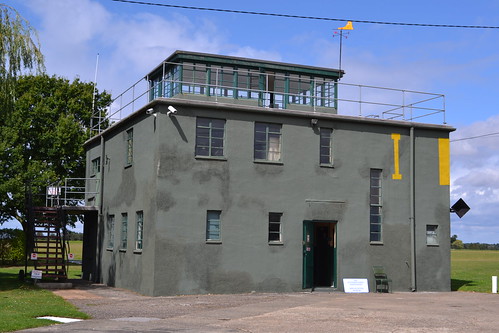
Over the remaining years the airfield, like many, has reduced to both agriculture and industrial use. The watch Office has been heavily modified and lies hidden within an industrial complex that has completely taken over the former technical site. A number of these original buildings still survive and visible from the main A143 Bury St. Edmunds to Haverhill road, the road that separates the airfield from the village opposite. The runways and perimeter tracks, visible only in small parts, are mere concrete platforms, now used to store farm produce and machinery, rather than the lumbering bombers of RAF Bomber Command.

The huts used to house the 1,600 RAF personnel and 240 WAAFs, have all been removed, as have the thirty-six hardstands – the airfield site now being completely agricultural.

RAF Chedburgh

Some technical buildings remain in use today.

Whilst Chedburgh was only built as a satellite airfield, by the end of the war it had been witness to many great sacrifices. Eighty-three aircraft had been lost on operations, all but 12 being Stirlings; eighteen from 620 Sqn and fifty from 214 Sqn. For a period of only fourteen months for 214 Sqn and five for 620 Sqn, this was an appalling loss of life, and one that was sadly mirrored by many bomber squadrons across the British Isles in the 1940s.

Sources and further reading

Much of the specific detail for these loses came from the Chorley, W.R., “Bomber Command Losses series”, published by Midland Counties Publications.

*1 A number of books are available on this squadron. One written by Ron Warburton, ‘Ron’s War‘ chronicles the life of a Flight Engineer of a Lancaster in 218 (Gold Coast) Sqn whilst at Chedburgh in 1945. It is published by RW Press, and available online. ISBN-13: 978-0983178804

A second book is also available, “From St Vith to Victory: 218 (Gold Coast) Squadron and the Campaign Against Nazi Germany“, written by Stephen Smith, and published by Pen and Sword Aviation in 2010 (ISBN10 1473855403). It details the life of 218 (Gold Coast Sqn) from its inception through to its disbandment in 1945.

A blog has also been set up dedicated to those who served in 218 (Gold Coast) Sqn and it gives a detailed history from 1936-1945. It has also been created by Stephen Smith who has also published other books relating to 218 Sqn including “A Short War” and “A Stirling Effort” which relates specifically to their time at RAF Downham Market.  https://218squadron.wordpress.com/
September 8th 1943 – Tragedy at RAF Mepal.

On the night of September 8/9th 1943,  a force of 257 aircraft comprising 119 Wellingtons, 112 Stirlings, 16 Mosquitoes and 10 Halifaxes took off from various bases around the U.K. to bomb the Nazi gun positions at Boulogne. Included in this force were aircraft from the RAF’s Operational Training Units, and for the first time of the war, five B-17s flown by US aircrews of the USAAF’s 422nd BS, 305th BG at Grafton Underwood. This was the first of eight such missions to test the feasibility of the USAAF carrying out night operations over Europe.  After the remaining seven missions, in which the squadron had dropped 68 tons of bombs, the idea was scrapped, the concept considered ‘uneconomical’ although the aircraft themselves proved to be more than capable of the operations.

The Gun battery targeted, was the emplacement that housed the Germans’ long-range guns, and the target wold be marked by Oboe Mosquitoes. With good weather and clear visibility, navigation was excellent, allowing the main force to successfully drop their bombs in the target area causing several huge explosions. However, not many fires were seen burning and the mission was not recorded as a success. Reports subsequently showed that the emplacement was undamaged due to both inaccurate marking by Pathfinders, and bombing by the main force. However, as both anti-aircraft fire and night fighter activity were light, no aircraft were lost during the flight making it a rather an uneventful night.

However, the mission was not all plain sailing, and whilst all crews returned, the night was marred by some very tragic events.

Three Stirlings were to take off from their various bases that night: at 21:00 hrs from Chedburgh, Stirling MK. III, EF136, piloted by F/S. R. Bunce of 620 Sqn; at 21:30, another Stirling MK.III, from 75 Sqn at RAF Mepal, BK809 ‘JN-T*1‘ piloted by F/O I.R.Menzies of the RNZAF; and lastly at 21:58 also from Chedburgh, Stirling MK. I, R9288 ‘BU-Q’ piloted by N.J. Tutt  of 214 Sqn.  Unfortunately all three aircraft were to suffer the same and uncanny fate, swinging violently on take off. The first EF136 crashed almost immediately, the second BK809 struck a fuel bowser, and the third R9288 ended up in the bomb dump. Miraculously in both the Chedburgh incidents there were no casualties at all, all fourteen crew men surviving what must have been one of their luckiest escapes of the war! The same cannot be said for the second though.

Stirling BK809 was part of a seventeen strong force of 75 Sqn aircraft. Each aircraft was carrying its full load made up of 1,000lb and 500lb bombs. As the Stirling was running along the runway, it swung violently, striking a fuel bowser which sent it careering into houses bordering the edge of the airfield.

One of the occupants of one of the houses, Mr. P. Smith, saw the aircraft approaching and ran into the street to warn others to get clear. As the aircraft struck the rear of the houses, it burst into flames causing some of the bombs to detonate. This brought considerable rubble down on the occupants of the second house, Mr and Mrs John Randall.

Mrs Randall managed to get out, her legs injured, whereupon she was met by a local fireman, Mr. A.E. Kirby of the National Fire Service. Mr. Kirby went on to help search in the wreckage of the house until his attempts were thwarted by another explosion. His body, along with that of Mr. Randall, was found the next day.

Two other people were also killed that night trying to provide assistance, those being F/Sgt Peter Gerald Dobson, RNZAF and Section Officer Joan Marjorie Easton WAAF. F/Sgt. Dobson was later mentioned in despatches. Three members of the crew lost their lives as a result of the accident, F/O. Menzies and F/O. N. Gale both died in the actual crash whilst Sgt. A. Mellor died later from injuries sustained in the accident.

A number of others were injured in the crash and one further member of the squadron, Cpl Terence Henry King B.E.M, was awarded the British Empire Medal “for his bravery that night in giving assistance“.

The mission on the night of September 8/9th 1943 will not go down as one of the most remarkable, even though  it was unique in many respects, but it will be remembered for the sad loss of crews, serving officers and civilians alike in what was a very tragic and sad event.

The crew of Stirling BK809 were:

F/O. Ian Robert Menzies RNZAF NZ415002. (Pilot).
P/O. Derek Albert Arthur Cordery RAFVR 136360. (Nav).
P/O. Norman Hathway Gale RAFVR 849986. (B/A).
Sgt. Ralph Herbert Barker RNZAF NZ417189. (W/O).
Sgt. Albert Leslie Mellor RAFVR 943914. (Flt. Eng).
Sgt. Bullivant G RAFVR 1395379. (Upp. G)
Sgt. Stewart Donald Muir RNZAF NZ416967. (R/G).

RAF Mepal was visited in Trail 11.

Sources and Further Reading.

*1 Chorley, 1996 “Bomber Command Losses 1943” notes this aircraft as AA-T.

Chorley, W.R., “Bomber Command Losses – 1943“, Midland Counties, (1996)

Middlebrook M., & Everitt C., “The Bomber Command War Diaries”  Midland Publishing, (1996)

Further details of this accident, the crews and those involved can be found on the 75 (NZ) Sqn blog. This includes the gravestones of those killed and a newspaper report of the event.

My thanks also go to Neil Bright (Twitter handle @Blitz_Detective) for the initial  information.

2017 – A Look Back Over The Last Three Years.

As 2017 draws to a close and another year passes, I’d like to look back at some of the highlights of the blog so far.

Since starting the site, way back in 2014, I have learned a lot about Britain’s airfields, their design and construction, and the men and machines that flew from them. What started as a record of memories has turned into a passion of history and hopefully, a dedication to all those who served, fought and died at these places. I have also seen how gradually, over time, many of these historic sites have sadly disappeared, beaten by the onslaught of time, the developers pen, and the ploughs of the industrial farmer evermore determined to draw out more crops from his expanding domain.

What were once massive military sites covering a vast acreage of land, homes to several thousand people who were all doing ‘their bit’ for the war effort; who came from all four corners of the world to fight, are now mere ruins or a collection of derelict and decaying buildings. In many cases they are merely small patches of concrete often covered with the waste of farm practices, or as in some cases, completely gone.

Since starting I have managed to visit over 100 different airfields, stretching from the southern most county of Kent to Edinburgh in Scotland; from Gloucestershire in the west to the East Anglian counties in the East. This has resulted in just short of 50 Trails around the country, but even this has barely scratched the surface of what is still out there waiting to be found. There are many, many more to go, so I thought at this point of the year, I’d share some of the posts that I’ve enjoyed, and also those examples that highlight the extent of this massive war-time development. With this, I hope to show a selection of the examples of features that have (so far) survived and the evidence of them that can be seen today. I hope you enjoy them and may I take this time to wish all followers, family and friends a very merry Christmas and a happy and safe New Year.

With the forming of the Royal Flying Corps, Britain needed and built a number of small airfields all with grass runways, wooden sheds for workshops and accommodation sites using tents. Examples of these places include the likes of Collyweston, (absorbed into modern-day RAF Wittering), Tydd St Mary (Attacked by Zeppelins) and Narborough (Norfolk’s very first airfield) to name but a few. Such little evidence of these sites now exists – many were absorbed into later airfields or they were returned to agriculture – that some, such as Hingham and Westley, we don’t even know the precise location of.

We saw  with the expansion of Britain’s airfields in the 1930s, how buildings changed dramatically from wooden construction – such as RAF Castle Camps – to more permanent (although classed as temporary) brick buildings, many examples of which survive in a preserved state at RAF Bircham Newton.

Technical buildings in use today. At the former RAF Snetterton Heath, technical buildings have survived as small industrial units.

We saw the development of the hangar, one of the most recognisable and distinguishing features of an airfield, from early wooden sheds through canvas doored Bessoneaux hangars, to metal hangars of over 150 feet in length. Many of these buildings still exist today, absorbed into farms or used for storage. Examples are thankfully still relatively common with some found at RAF East Fortune (now a museum), RAF Methwold (farmland), RAF Little Snoring (a light airfield) and RAF North Creake.

RAF Waterbeach 'J' Hangar RAF Waterbeach’s ‘J’ type hangar with a ‘T2’ behind. Waterbeach like so many, is an airfield embroiled in the planning process.

Runways to allow bigger and heavier aircraft to use them, grew from short grass strips to those of wood chip, tarmac and concrete of 2,000 yards in length and 50 yards wide. Some of these even exceeded a massive 3,000 yards in length. Many of these pathways continue to exist today in some form or other, RAF Eye (industrial), RAF Cottam (built and never used), RAF Debden (currently an army barracks), RAF Deopham Green (farmland) and RAF North Witham (an open and public space) are some of the better examples we can find today.

RAF Great Dunmow RAF Great Dunmow typifies the state of many of the better examples of these massive runways today.

The Watch Office, another distinguishing feature, lay central to the operations of a wartime airfield. Again its development was rapid and complex. Some thankfully have been restored as museums such as those at RAF Framlingham (Parham), RAF Debach, RAF East Kirkby, and RAF Martlesham Heath. Some are now derelict, decaying memorials to those who served. Examples found at RAF Winfield, and RAF North Pickenham, are particularly severe, whilst many are used for other purposes such as RAF Matching Green (radio); RAF Attlebridge (offices) and RAF Rattlesden (a glider club).

RAF Bury St Edmunds (Rougham) At Bury St. Edmunds (Rougham) the watch office is now restored and forms the main part of the museum.

There are numerous examples of other buildings on some of these sites, many are now part of small industrial complexes, workshops that were once used to repair aircraft parts now repair cars or other small items. Their original features often hidden by new cladding, overgrown weeds or a change in frontage. Slowly, but surely, they are gradually disappearing from our skyline.

The purpose of theses places was to wage war. In doing so many lives were lost, both military and civilian – on both sides. As a result, many heroic acts of bravery and self-sacrifice took place. The VC, the highest award given to members of the British armed forces for gallantry “in the face of the enemy”, was awarded to two pilots: Flt. Sgt. Arthur Louis Aaron, V.C., D.F.M. and Sqn. Ldr. Ian Willoughby Bazalgette (RAFVR) VC., both flying from RAF Downham Market. The American S.Sgt. Archibald Mathies, USAAF, 510th BS, 351st BG, was one of many Americans awarded the Medal Of Honour for his valour in combat whilst flying from RAF Polebrook, another was 2nd Lt. Robert E. Femoyer MOH, 711th BS of RAF Rattlesden, for his actions over Meresberg.

Losses were high both in combat and also during training. This year, I managed to visit several training stations of which two RAF Chaterhall and RAF Milfield had high losses of trainee pilots. Many are those are buried locally, and one delightful small church I visited at Fogo, had almost as many war dead as it did living inhabitants!

Fogo Church The church yard at Fogo has 16 war dead, most from the nearby training airfield RAF Chaterhall.

All in all its been a fascinating journey, I have entered the lives of many people who fought for what they believed in. I have read their stories, visited the very places they served at, and in many cases, the graves in which they now lie.  These decaying sites are the true monuments to their sacrifice. The buildings that once housed these young men stand as a lasting tribute to them, I hope that their memories never fade away in the way that many of these sites now have.

I’d like to thank you for taking the time to join me on this journey, I hope you have enjoyed reading about them as much as I have enjoyed visiting, researching and writing about them. I look forward to you joining me next year as we travel on many more trails around Britain’s disused airfields.

A Merry Christmas and a Happy New Year to all!

Andy.

RAF Brunton – A little known about airfield.

In this the second stop on our trip to Northumberland, we travel close to the North Sea coast not far from the eastern borders of England and Scotland. A small airfield, this was the satellite to RAF Milfield, and performed an important role in the Second World War. You cannot mention Milfield without reference to this airfield, and vice versa. Here we stop off at that little known about site RAF Brunton.

RAF Brunton.

Brunton is located some 3.5 miles to the south-east of Seahouses, a short distance from the Northumbrian coast. The village it takes its name from sits alongside the airfield, and is made up of a handful of buildings – primarily farmhouses. It is an open and flat area ideal for an airfield, and only a short flying distance away from its parent airfield RAF Milfield.

Brunton was designed as a satellite, and even though it was not a major airfield, it more than fulfilled the role of one. A constantly busy site, it somehow managed to ward off the high numbers of tragedies, losses and accidents that dogged Milfield and many other aircrew training facilities.

Brunton was conceived during the development of Milfield, when the need for another site was soon realised. The land on which Brunton stands was requisitioned in 1941, opening for business in early 1942. With its three runways forming an almost perfect equilateral triangle at its centre, it had a 50 yard perimeter track and twenty-five hardstands of the frying pan style. The longest of the three runways ran slightly off north-south, and was originally built to a length of 1,600 yards – it was later extended to 2,000 yards. The second and third runways, intersecting almost at their centre, were both 1,100 yards and were also extended but to 1,400 and 2,000 yards respectively.

RAF Brunton

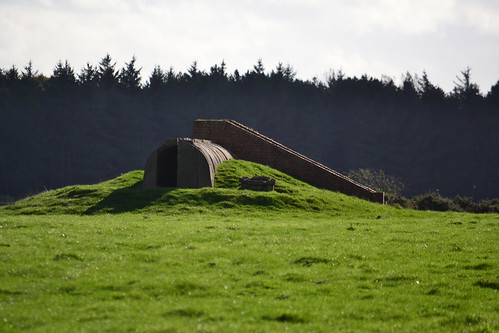
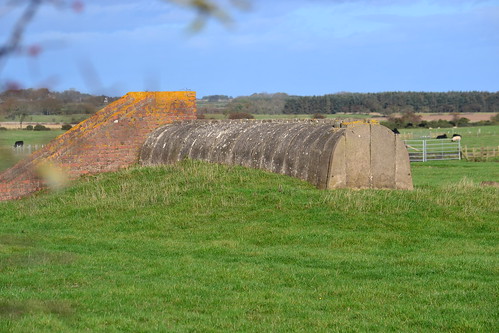
One of several exposed shelters at RAF Brunton.

Unusually, the accommodation areas were all closely tied together, a rare feature that placed them to the south of the airfield straddling the local railway (now the East Coast main line from which views can be seen as you pass by). Being a satellite, Brunton was only designed to accommodate small numbers of personnel, upward of some 750 men and women of mixed ranks.

As a satellite, there were no permanent hangars built, but four blister hangars were erected around the site, and used to maintain the aircraft. These Blister hangars (a name given to cover a wide range of arched aircraft shelters initially designed by architects and engineers, Norman & Dawbarn and William C. Inman of Miskins and Sons) were known as Dorman Long hangars, and were built to design 4630/42. At slightly under 72 feet in length they were 45 feet wide with a height of over 20 feet. Dorman Long hangars differed in design to other hangars by being constructed of four sections each held together by three RSJ type ribs, and ‘I’ shaped Purlins along the roof. These hangars were also bolted to foundations rather than staked to the ground like the more conventional blister hangars in use at that time. A similar hangar was used at RAF Sawbridgeworth in Hertfordshire – none of which survive today.

As a satellite, Brunton would work closely with its parent. It would be used in the second part of the 9-10 week pilot’s course to train pilots in formation flying, ground attack and strafing techniques. In the ground attack role, pilots would use a mix of rockets, bombs and cannon to destroy dummy convoys and strongholds. There were a number of ranges in the region providing targets for this particular role; Brunton aircraft predominately using the gunnery range at Goswick Dunes on which numerous ex-army vehicles, including Churchill Tanks, were placed.

Even before Brunton officially opened, it would witness a tragic accident in which it became the final resting place of one Whitley bomber, and three of its four crew. On November 6/7th 1941, whilst on a training flight, the MK. V Whitley (Z6932) of 10 Sqn, RAF Leeming, became lost in poor weather due to a failure of its navigation equipment. After landing on the partially built site, the Whitley took off again, heading south in an effort to locate its home base. As it lifted off, it struck a steam roller causing the aircraft to jolt and strike live high tension cables. The aircraft burst into flames and subsequently crashed. The Wireless Operator/Rear Gunner Sgt. Robert Whitlock, RAFVR (s/n: 163028) was pulled free by a crew from the local search light battery, but the remainder of the crew: Pilot F/Sgt. William Stuart RCAF, (s/n: R/60298) P/O. Richard. S. Austin, RNZAF, (s/n: 403785) and Observer Sgt. P. Bryant, RAFVR, (s/n: 976876), all perished. Bryant was a mere 23 years of age whilst Stuart and Austin were both just 21 years old.

Brunton’s opening in the summer of 1942, coincided with the start of operations at RAF Milfield, Brunton’s first residents would be 59 Operational Training Unit, a unit set up to train pilots for Fighter Command.

59 OTU operated the Hurricane, many of which were themselves veterans of the Battle of Britain. War-weary and battle-scarred, they were joined by a number of other aircraft types including Magisters and Fairy Battles. These flights would take the now adept pilots and train them to fly in formation and at low-level. A speciality would be to fly across the sea, at low-level, turn toward land and then strike at land based targets with bombs and canon or later rockets.

During the Spring of 1942 it was decided to allocate reserve squadron numbers to Operational Training Units, these numbers being in the range 551 – 566. The idea behind this plan – code name ‘Saracen‘ – was to create a series of squadrons that could be mobilised at a moments notice to counteract an imminent German invasion threat. The plans were later revised under the codename ‘Banquet‘ but would remain, in essence, in its original form well into 1944 before being seen as unnecessary, and so  withdrawn. At Brunton, 559 Sqn was allocated, (500 was generally added to the OTU number to create the reserve number) but the pilots of 31 Course, like many others, were never officially mobilised. However, Brunton was run as if it were a fully fledged operational squadron, the same rules and regulations, with two flights ‘E’ and ‘F’ both operating the Hurricane MK.I.

Flying with old and war-weary aircraft was difficult. Many would suffer engine fires, oil leaks or complete engine failures – some whilst in flight – and they rarely flew without the need for excessive trimming or constant adjustments to flying controls. These continuing problems would hound the pilots and ground crews for months, but undeterred they carried on, and morale remained particularly high.

RAF Brunton

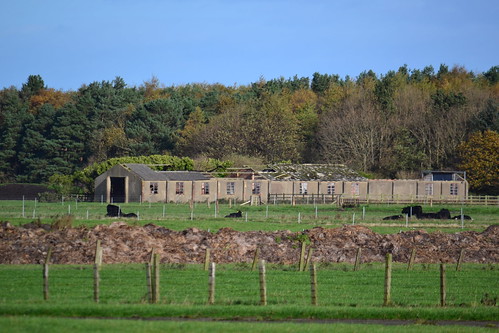
A very small number of buildings exist dotted about the former airfield. Thought to be the former flight offices, these examples are the largest.

On October 13th 1942, one of these Hurricanes would suffer from such a problem and its engine would fail causing the pilot to crash-land. A MK.I  Hurricane (P3524) it would be forced to land in a field not far from Alnwick, the county town a few miles to the south-west of the airfield. The aircraft was slightly damaged in the incident but fortunately the pilot, Sgt. C. Tidy (s/n 1042890), would walk away unhurt. In carrying out the controlled crash, Sgt. Tidy would steer his aircraft down missing a nearby school, but as he exited the aircraft, the documents he was carrying were scattered to the four winds. Wanting to do their bit, a local school master organised a search party with the boys in his care, and the documents were all gathered up and retrieved successfully. *1

Brunton, like Milfield, would have a high turnover of visiting aircraft. Many would come from Milfield, but some from much further afield to practice landings at night or as pilots transferred from one aerodrome to another. Some aircraft were also using Brunton as a safe haven, getting down after getting in trouble in the air. In March 1943 a Hurricane MK. I (W9121) of 59 OTU based at Milfield  crashed whilst on final approach at night to Brunton airfield. The pilot, Sgt. Cullener was very sadly killed in an event that was repeated in early 1944, when another Milfield 59 OTU Hurricane MK.I (P3104) also crashed on its approach to Brunton.

The dawn of 1944 saw 59 OTU along with the Specialised Low Attack Instructors School  (SLAIS) (also formed in 1942 at Milfield) disband, being replaced by a specialised unit the Fighter Leader School. The FLS was a unit designed solely to train pilots in the ground attack role and was set up primarily in preparation for the forthcoming Allied Invasion of Normandy. With this change so came a change of aircraft type, the Spitfire VB and MK IX now becoming the main aircraft operated in place of the Hurricane. The FLS would make great use of Brunton, training many pilots until it moved to Wittering at the end of 1944.

But not all staff would vacate Brunton in this move. A small detachment remained behind to give support to the build up of the newly reformed 56 Operational Training Unit who were brought together, both here and at Milfield, in place of the vacating FLS. This meant that the two sites would continue to operate very closely, but now using the heavier radial engined Tempests and Typhoons still in the ground attack role rather than the previous Spitfires and the now vulnerable Hurricanes of before.

The Typhoons came in with a number of teething troubles, one such attribute was the propensity to lose its tail plane during mid-flight, or the engine suffering a blow-back resulting in a fire in the engine or worse still in the cockpit. These issues were soon dealt with  though, and the Typhoon went on to become renowned as a ground attack aircraft, with its bombs or rockets proving devastating weapons in the role.

Av Typhoon IB JP853/SA-K of No 486 Squadron (Tangmere) (IWM CH 11578)

Brunton continued its close relationship with Milfield, supporting its 140 aircraft. Course No. 1 would begin in that January of 1945 and through it a large number of pilots would pass on their way to new roles in the European campaign.

Even as the war drew to a close accidents were still to happen and Brunton was no exception. In early January 1945, whilst being ferried from Milfield to Brunton Typhoon IB. (RB343) developed engine failure on take of at Milfield causing it to lose height and ultimately crash into the ground. The pilot, Canadian born P/O Nelson I. Gordon (J88818) was killed. Then just a month before the end of the war on April 9th, Tempest MK. V (EJ845) swung on take off at Brunton colliding with a wind sock. The accident took the life of another Canadian pilot, 32-years-old F/Lt. Ivan W. Smith (J22244) RCAF; he remains buried at Harrogate (Stonefall) Cemetery in Yorkshire along with over 1,000 other war dead.

Gradually though, the need for ground attack pilots diminished and Brunton, no longer required, was earmarked for closure. The war finally came to a close, and on February 14th 1946, 56 OTU were disbanded and the RAF pulled out of Brunton almost immediately. The airfield was now all but deserted.

After the war, for around 20 years, the Borders Parachute Centre occupied Brunton, until the land was sold, and the owner gave them notice to quit. Their lease ran out in 2004 and the club closed on the site. During this time a small contingent of RAF personnel were brought in when a radar facility was set up on the eastern side of the site. This too eventually closed though, and the personnel were pulled out. A small number of private pilots used the airfield to store and fly their aircraft from, it is believed they too have had to vacate the site, although this is not certain.

A large portion of the airfield still exists and in very good condition today. If travelling toward Brunton village you pass beneath the main East Coast main line railway, and on into the village. This road was the original entrance to the airfield, with the main technical area to your left. Now only farm buildings stand here, but the concrete pathway is still visible as it leads away to the main airfield site. Views across the airfield from this point offer little advantage, so turning back and driving along side the railway  down a single track, will lead you along the western side of the airfield and toward the back of the site. This is another original road and provides much better, but still limited, views of the site. The runways and perimeter track are present and many air raid shelters are also present along this western side. The remainder of the buildings from these various sites are now gone.

The small radar / monitoring dome is also still present but on the eastern side of the airfield, and although information about this is scarce, it was linked to nearby RAF Boulmer, and manned by RAF personnel. Boulmer which is currently the home of the Air Surveillance and Control System (ASACS) plays a key role in the home defence of the United Kingdom. Boulmer is linked to a number of monitoring stations around the British Isles and monitors, around the clock, an area of over one million square miles of airspace. This airspace stretches from the northern tip of Norway to as far out as Iceland and beyond, and encompasses the whole of the United Kingdom. With links direct to the QRA sites at RAF Coningsby, it monitors and tracks all aircraft activity around British Airspace, and in particular Soviet intrusions into this Airspace.

RAF Brunton

Another of the exposed shelters to along the western boundary. The taxiway of a short distance from here.

Brunton, whilst only a satellite, proved its worth during the Second World War. It trained numerous pilots in the art of ground attack techniques, and was pivotal in both the Normandy invasion and the drive on through occupied Europe. Visited by many commonwealth pilots, it was more ‘relaxed’ than other wartime airfields, but always maintained the highest of standards, operating as strictly and smoothly as any operational airfield of the Second World War.

Sources and further Reading.

*1 Article appeared in “The Northumbrian Times – No. 28” and was quoted in Walton, D. (1999), Northumberland Aviation Diary, Norav Publications.

RAF Waterbeach Museum.

Earlier this year I was able to visit the Waterbeach Military Heritage Museum located on the former RAF Waterbeach airfield; creating the museum has been quite an achievement and a very worthy cause. The museum contains many interesting photographs and artefacts relating to life at “the ‘Beach”, from its inception in 1940 right through to its final closure in 2013.

The current Museum was opened after the Army’s departure and the subsequent closure of the barracks. It is currently housed in Building 3 just inside the main entrance next to the former guard-house, and access is strictly controlled, and by prior arrangement only. It was created by the then curator, Oliver Merrington, along with a handful of local people who wanted to secure the future of the museum and keep the memories of Waterbeach alive for future generations. Mr. Merrington has since sadly passed away, but the volunteers continue the good work he put in place.

Whilst the museum is currently small, it holds a tremendous amount of information, all  of which is neatly displayed in cabinets and on the walls. Many original photographs are supplemented with official documents, personal stories, newspaper cuttings and artefacts, some of which relate to specific aircraft from Waterbeach’s history.

RAF Waterbeach Museum

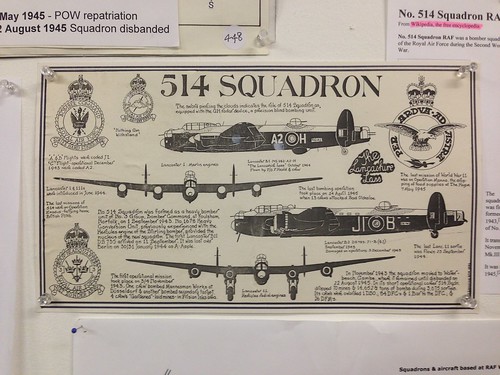
Part of one of the many displays in the museum.

Whilst most of the displays reflect life at Waterbeach during the Second World War, various aspects reflect its post war life, both with the RAF and with the Army’s Engineer Regiment – the founders of the original Waterbeach Museum in 1984.

The two rooms of the museum are dedicated to all these people, taking you on a journey through the life of Waterbeach, starting with the sad First World War story of three brothers: Sgt. Jack Day, (1st July 1916), Private Walter Day (1st July 1916) and Private Clifford Day (13th August 1918). Like so many families of the war, their lives were all taken prematurely, two of which occurred on the first day of the first Battle of the Somme. The three brothers, whose ages ranged from 19 to 22 years old, were all local boys to Waterbeach, and like so many, left a family devastated by their loss. Two of the boys remain buried abroad but Walter, like so many other young men, has no known grave and remains missing.

From here the display takes us to Waterbeach in the 1940s, the story of its construction and design are told using photographs taken at that time. Representations of the various bomber squadrons who used the airfield are supported with operational details, personal stories and artefacts relating to individual aircraft that flew from Waterbeach during these early war years.

In the post-war period Waterbeach was transferred to the Transport Command and again photographs and documents show the range of aircraft that flew from here: Liberators, Dakotas, Lancastrians and Avro Yorks.

Into the jet age and we see a flying suit, and a canopy from Gloster Javelin XH871, which ended its days at Bovingdon as a fire fighting air frame. It is particularity significant as it previously served here at RAF Waterbeach in the late 1950s.

RAF Waterbeach Museum

One of the many exhibits on display at the Museum.

After the Royal Air Force departed the base was handed over to the Army, and a small number of exhibits represent their presence here at Waterbeach. The Royal Engineers finally departed the barracks themselves in March 2013.

Other exhibits on display here include: the weather vane from the station church (now demolished), the operations boards, astro-compasses, radios and telephone equipment, all neatly arranged inside glass cabinets. A detailed history of one of the former gate guards, Spitfire LF MK.XIVe ‘TE392’ which now flies with the Lone Star Flight Museum, Galveston, Texas, is also on view.

This is a delightful little museum that has been put together to pay homage to those who served at Waterbeach, either under RAF command or with the Royal Engineers. It is run by volunteers and relies on charitable donations to keep it running. Like many museums, it has limited opening hours, but the range of material is fabulous and it deserves a great deal of public support.

On a final note, my personal thanks go out to Adrian Wright who gave up his own time to open up and show me around the museum.

For details of opening times and other information the curator can be contacted via email at:  waterbeachmilitarymuseum@waterbeach.org

or via Facebook at: https://en-gb.facebook.com/waterbeachmilitaryheritagemuseum/


RAF Debden (Part 3) – The USAAF Arrives.

After Part 1 and Part 2 of the trail, we find that Debden has a new owner, the USAAF. Its fortunes change and it becomes home to one of the most famous Fighter Groups of the Second World War.

121 Sqn, were reformed in 1941 at Kirton-in-Lindsey, initially with the Hurricane MK. I, and then IIBs moving on to the Spitfire IIA and eventually the VB; a model they brought with them to Debden. 71 Squadron had been formed at Church Fenton, and after moving through a series of stations that included Martlesham Heath, they arrived at Debden on 3rd May 1942 also with the Spitfire VB. On September 29th 1942 the two RAF units along a with a third, the 133 Sqn at Great Sampford,  were officially disbanded, but the men of the three units were not dispersed. Instead they absorbed into the USAAF as the 4th Fighter Group (FG). The men of these squadrons were all originally US volunteers who formed the three  American ‘Eagle Squadrons‘ operating within the Royal Air Force.

The 4th FG was specially created to take these three squadrons, they were brought together at Debden where they became the 334th (71 Sqn), 335th (121 Sqn) and 336th (133 Sqn) Fighter Squadrons (FS).  Debden would then be passed from the RAF to the USAAF, the transition of which, would be smooth and relatively uneventful, the units retaining the Spitfires they already had before replacing them with P-47s later in 1943.

A Spitfire Mk. V (QP-V) of the 334th Fighter Squadron, 4th Fighter Group. Handwritten caption on reverse: '1942. 334 FS. 4th FG.'

A Spitfire Mk. V (QP-V) of the 334th Fighter Squadron, 4th Fighter Group. (IWM)

The handover of ownership of Debden took place on the 12th September 1942, with an official ceremony on the 29th to coincide with the disbandment of the RAF units. During this ceremony both Major General Spatz and Brigadier General Hunter were joined by Air Chief Marshal Sir Sholto Douglas of the RAF’s Fighter Command, to see Debden and the aircrews officially joining the ranks of the USAAF. Initially little changed after the handover, the most prominent feature being the removal of the RAF roundels and the application of the US Star on the aircraft’s fuselage and wings. New ground crews were brought in and trained by RAF personnel to maintain the Spitfires, and so RAF crews remained on site until such times as the American were in position to become self-sufficient.

As these crews had been involved in front line operations for some time – the 71st having gathered a total of over half the 73.5 kills recorded by the three squadrons – they were immediately made operational and went on performing in the duties they had been so adept at completing thus far. So proud of their origins were they, that the 4th FG stood out from their fellow Americans both in the way they flew, and the way they behaved.

With their first mission under the ‘Stars and Stripes’ on October 2nd, they would not have to wait long before seeing action once again. The Eagle Squadrons would become famous throughout the war, achieving many records in aerial combat over the next three years. Taking part in the Normandy invasion, aerial battles over Northern France, the Ardennes, the Rhineland, and over Berlin itself; they would not be short of combat experience. Throughout their time the 4th FG would achieve many ‘firsts’. They were the oldest fighter group of the Eighth Air Force, and their combined totals of  enemy aircraft destroyed both in the air and on the ground was the highest of the entire USAAF. They were also the top scoring Allied Fighter Group of the war, destroying 1016 enemy aircraft for a loss of 241 of their own aircraft, many of which were due to flak. They would be the first unit to engage the enemy in air battles over both Paris and Berlin, and they would be the first US Eighth AF Group to penetrate German airspace – a record they established on 28th July 1943. The 4th would also be the first fighter group to be selected to escort the heavy bombers of the USAAF on their first shuttle run, landing in Russia before returning home.

Not only did they undertake many ‘firsts’, but the 4th FG gained an undeniable reputation, between the 5th March and 24th April 1944 they earned a Distinguished Unit Citation when they shot down 189 enemy aircraft whilst destroying 134 on the ground. You cannot mention the 4th without mentioning the name of Donald M. Blakeslee, credited with 16 kills, he was a brilliant fighter pilot who retired from the USAAF as a Colonel. Blakeslee was considered one of finest combat fighter leaders of the Second World War who shunned publicity even refusing to paint ‘kills’ on his aircraft, and he was known, on several occasions, to give kills to rookie airmen. Blakeslee initially flew in 401 Sqn (RCAF) before transferring to 133 Sqn and then the USAAF when they transferred across. He was a remarkable man, a great leader who was looked up to by all those who flew with him, he sadly died in September 2008 leaving a daughter. All-in-all, the 4th achieved quite a remarkable record considering they were initially volunteers of the American air war in Europe.

The 4th FG would remain at Debden thought the war, leaving it only when the RAF required the return of the airfield in July 1945, at which point the whole group packed up and departed for Steeple Morden in Cambridgeshire.

Airmen of the 4th Fighter Group ride in the back of a jeep at Debden air base. A P-47 Thunderbolt is in the background of the shot. Passed by the U.S. Army on 2 October 1943, THUNDERBOLT MISSION. Associated Press photo shows:- Pilots at a U.S. Eighth Air Force station in England are taken by truck from the Dispersal room to their waiting P-47's (Thunderbolts) at the start of a sortie over enemy territory. L-R: Lt. Burt Wyman, Englewood, N.J. ; Lt. Leighton Read, Hillsboro, W.V.; F/O Glen Fiedler, Frederickburg, Tex. AKP/LFS 261022 . 41043bi.' [ caption].' Passed for publication ....1943'. [stamp].

Taken almost a year to the day the US forces moved in, airmen of the 4th FG are taken ot heir P-47s before departing on a mission over enemy territory. The aircrew are: L-R: Lt. Burt Wyman, Englewood, N.J. ; Lt. Leighton Read, Hillsboro, W.V.; F/O Glen Fiedler, Frederickburg, Texas. (FRE 28 – IWM).

As 1943 dawned it would become much quieter in terms of movements at Debden. Now officially a US fighter airfield, the RAF had little to do here. For a short period of a week, 303 Squadron would stop over, the only visitors to make any great use of the airfield for the entire year. With Debden having long concrete runways, it was regularly visited by the lighter bombers, Marauders and Havocs taking refuge here from their own fog bound airfields during poor winter weather. It was during this time in 1943, that The Duchess of Kent, made a royal visit to Debden, taking time out to inspect the aircraft and crews of the 4th Fighter Group, accompanied by General D. Hunter and Colonel Edward Anderson.

With that 1943 faded into 1944, the jet age was dawning and the end of the war nearing sight.  In the July, 616 Squadron appeared with the Meteor, Britain’s first operational Jet aircraft. The squadron detachment stayed here until early 1945 when they moved on to Colerne and eventually the continent.

This move would signify the end of operational flying at Debden. The RAF retained the site reforming the Empire Flying Training School here on 7th March 1946 by merging both 12 and 14 Radio Schools into one. Flying a number of aircraft including Proctors, Tiger Moths, Ansons, Dominie and Lincoln IIs until October 20th 1949 when it was disbanded and Debden became the Royal Air Force Technical College, Signals Division. After a further name change the unit was finally disbanded on April 8th 1960, after it had operated a variety of aircraft including an: Anson, Air Speed Oxford, Spitfire XVI, Lincoln and Varsity.

Between 1963 and October 1973, Vampire F. MK.3 VF301 stood outside Debden’s front gate as guardian, one of several that have been here. It is now sits in the Midland Air Museum at Baginton in the markings of 605 (County of Warwick) Sqn as ‘RAL-G’.

DH Vampire F-1

A former Guardian of Debden now at the Midland Air Museum at Coventry’s Baginton airport.

Although remaining open, the airfield was used for a number of public displays and as a race track, including in 1966, the RAF Debden Motor Gala which featured Donald Campbell’s car, Bluebird CN7, in which Campbell set the land speed record in 1964.  Parts of the site are still used for racing today by the Borough 19 Motor Club*3

In 1975 the airfield officially closed although 614 Gliding School (later 614 Volunteer Gliding School) remained on site using it for flying, until they too departed moving to Wethersfield in 1982.

The army took over the site when the RAF Departed and they remain there to this day.

Debden, because if its post war usage, is a remarkably unique site, but whilst many of the original buildings remain intact, some even being listed as Grade II buildings*4, access is not permitted to the general public and therefore very little can be seen without prior permission. From public roads, high fences and thick hedges obscure most views although from the south, parts of the runway, and several dispersals can be seen quite easily.

RAF Debden

One of the pans now missing its Blister hangar.

By keeping the gate house to your right and passing along the road east to west, you pass the current accommodation area, Guard House and modern buildings used by the current Army owners. Continuing along this road soon brings you to the memorial. Whilst there is no official parking space here, there is a grass verge opposite the memorial where you can safely park your car off the busy main road. Behind the memorial is the north-south runway, still in full width, in which a small section of it can be seen as it rises and dips over the hill. Returning toward the main entrance brings you to a parking area on your right, where public access is permitted to Rowney Wood. Here there are a small number of original buildings still left along with former roads / and taxi ways. During its US occupation, there were five Blister Hangars located here, today only a couple survive, both in current use by local companies.

Like many former airfields and military sites, Debden has been identified as a possible housing location, with the potential for the construction of 55,000 homes. The announcement to close the barracks was made on November 7th 2016, as part of the ‘Better Defence Estate’ strategy, in which 91 MOD sites across the country will close by 2040. Government figures say that the move will save £140 million by closing these sites which also includes the US base at Mildenhall.*5

Considering the history of RAF Debden and the current status of its buildings, the restrictive nature of the site is also its guardian angel. However, with the axe looming heavily overhead, what will become of this site in the future? Its runways will no doubt be dug up, the older non-classified buildings could be demolished, its pathways and taxiways removed. Debden is in danger of disappearing for good leaving only small traces of this once famous airfield that not only took part in the Battle of Britain, but whose airmen defended London in what was very much our darkest hour.

Sources and further reading.

*2 AIR 27/703/17 National Archives

*3 ‘Borough 19 Motor Club’ website has details of their race activities.

*4 One such building is the Sector Operations Block, built in 1938, to the designs of J.H. Binge of the Air Ministry’s Directorate of Works and Buildings (drawing no. 5000/137).

*5 The story was highlighted in the Saffron Walden Reporter website accessed 11th October 2017.

Royal Air Force Police Flights who were at Debden have photos and information on their website.

RAF Debden (Part 2) – The Battle of Britain.

Following on from the first part of this Trail, we see how Debden was thrust into the Battle of Britain and the historic changes that followed.

On August 18th 1940,  at 17:30, the squadron consisting of thirteen aircraft were scrambled to patrol the Skies over Debden. Almost immediately they were diverted to Canterbury and ordered to patrol at 20,000 ft. Five minutes after reaching their designated point, they were ordered into battle attacking ‘raid 51’ who were crossing the coast in the vicinity of Folkestone. Within minutes, the two formations were entwined and the aircraft of 85 squadron set about the 150 – 250 machines of the Luftwaffe.

A mix of J.U. 87s, H.E.111s, J.U. 88s, M.E. 110s and M.E. 109s were staggered in layers between 10,000 feet and 18,000 feet, and as soon as the aircraft of 85 squadron were sighted, the enemy immediately employed tactical defensive manoeuvres with some of the bombers heading seaward whilst other climbed toward their fighter protection.

Hugely lacking in aircraft numbers, the RAF  had little choice but to ‘dive in’, as a result large numbers of individual ‘dog fights’ occurred, resulting in aircraft being strewn across the Essex sky around Foulness Point.  For a while there was complete chaos, aircraft were burning and crews knew little of each other’s whereabouts. In one incident P/O. J. Marshall (Yellow 2) followed his leader into attack. In the melee that followed Marshall flew into a cloud of vapour created by a damaged H.E.111 his wing colliding with the tail of the Heinkel severing it completely and cutting the wing tip-off of his own aircraft. Despite the damage Marshall nursed his crippled aircraft to Debden where he landed safely and unhurt.

During this attack six Me 110s, three Me 109s and one He 111 were confirmed as destroyed, a further He 111, Me 110, Ju 87 and Me 109 were confirmed as probables, whilst four Me 110s and two Do 17s were known to have been damaged.

85 Squadron casualties on the day consisted of one Hurricane destroyed and one damaged. It was during this attack that  Flight Lieutenant Richard H.A. Lee, D.S.O., D.F.C. (s/n 33208), flying as Blue 1, was last seen by Sqn. Ldr. Townsend and F/O. Gowers 10 miles east of Foulness Point chasing 5 Me 109s. He lost contact and failed to return to Debden.  Lee, a veteran with nine victories to his name, was Lord Trenchard’s Godson, and was reported missing that day. *2

On the next day, 19th August 1940, 85 Squadron departed Debden, swapping places with 111 squadron who had previously moved to Croydon. In a signal Air Chief Marshal Sir Cyril Newall, G.C.B., C.M.G., C.B.E., A.M., expressed his thanks to the crews of 85 Sqn, sending his gratitude for “all your hard fighting” in which he added “This is the right spirit for dealing with the enemy.” 85 Squadron went on to continue the fight at Croydon flying in the same determined manner they had shown whilst based at Debden.*2

RAF Debden

The memorial at Debden sits at the end of the north south runway (seen behind).

It was also during August 1940 that Debden became a focus for attacks by the Luftwaffe. On the 20th, a small reconnaissance mission took German aircraft over the airfield along with other airfields in the region. Six days later, on August 26th, the first attack on Debden would occur, a combined attack that would also involve strikes on Kenley, Biggin Hill, Hornchurch and North Weald airfields.

Whilst 11 Group – whose sector headquarters were at Debden – put up ten squadrons and one flight to intercept the incoming raiders,  a number of bombers did get through and over 100 bombs were dropped on the airfield damaging the landing area; the sergeants mess, NAAFI , a motor transport depot and equipment stores. In addition to this the water and electricity supplies were both cut, and five personnel were killed. The raid was made worse by the inefficient vectoring of protective aircraft from Duxford due to them being unable to obtain the correct radio frequency. This mishap did little to help the ongoing ‘dispute’ between Air Marshal Sir Keith Park and Air Vice-Marshall (later Air Marshal) Sir Trafford Leigh-Mallory, who were both locked in dispute over the defences of 11 Group’s airfields – it was arguably this feud that eventually cost Park his command of 11 Group, and a move as AOC to Malta.

At the end of August, Debden would once again become the focus of Luftwaffe attacks. Shortly after 8:00am on the morning of August 31st 1940, waves of Luftwaffe bombers flew over Kent turning northwards toward North Weald, Duxford and Debden. A formation of Dornier bombers managed to reach Debden again where they dropped over 100 incendiary and high explosive bombs on the airfield. This time the sick quarters and barrack blocks received direct hits whilst other buildings were damaged by blasts.

Further attacks on September 3rd and 15th failed to materialise and Debden was finally left alone to lick its wounds and repair the damage to its fragile infrastructure. It was also during this time (2nd September to the 5th September 1940) that all three resident squadrons: 257, 601 and 111  would depart, leaving Debden behind and heading further south to pastures new.

With the ending of the Battle of Britain, things would become a little quieter at Debden, although movements of man and machine would continue with a perpetual occurrence. The October and November would see more short stays: 25 squadron (8th October for around two and half months); 219 Sqn as a detachment for two months, and 264 Sqn at the end of November for just one month. These changes would lead Debden into the new year and 1941.

During 1941, 85 Squadron would return yet again, and after being bounced around with almost regular occurrence this, their final visit, would be in the night fighter role. Initially using their Hurricanes and then Defiants, they soon replaced these with the Havoc before vacating the site for good and the fields of Hunsdon in May that year.

There were yet more short stays during 1941: 54 Squadron in June (two days), 403 Squadron (25th August  – 3rd October); 258 Squadron (3rd October  – 1st November); 129 Squadron (1st November – 22nd December); 418 squadron (15th November – 15th April 1942); a detachment of 287 Squadron; 157 who were reformed here on 13th December moving to Castle Camps five days later where they would receive their Mosquito II aircraft, and finally 65 Squadron who arrived three days before Christmas and stayed until 14th April 1942.

One of these squadrons, 403 Squadron flying Spitfire VBs, was formed as a result of Article XV of the Riverdale Agreement, in which it was agreed between the British Government and the nations of the commonwealth: Canada, Australia and New Zealand; that their trained military personnel would fly and operate as part of the Royal Air Force. This would mean that both air and ground crews would perform their duties under RAF command. Some 70 squadrons were created as a result of this agreement, and of those seventy, 67 were numbered in the 400 series. Even though they were part of the RCAF, RNZAF and RAAF, they were treated as integral parts of the British Royal Air Force for the duration of the conflict.

Into 1942 and yet more of the same, 350, 41, 124, 232 and 531 Squadrons all following this similar pattern of short stays and placements, thus life at Debden was becoming a constant carousel of ground crews and flying personnel. Two squadrons from here did make a real name for themselves though, that of 71 and 121 Squadrons.

In Part 3, we see Debden take on a new owner, its fortune changes and it becomes home to one of the most famous Fighter Groups of the USAAF – the 4th Fighter Group.

RAF Debden (Part 1) – The Build up to the Battle of Britain.

Not far from Wethersfield, lies the parent airfield of Castle Camps. Now closed to aviation, it currently resides in the hands of the Army as the Carver Barracks. On this next part of this Trail we wind our way through the Essex countryside to the former fighter station that gained notoriety during the early 1940s, and in particular the Battle of Britain. In this, the first part of the visit, we look into the development of the airfield, and the build up that took it into the heart of the Battle. We visit the former RAF Debden.

RAF Debden (Station 356) – Essex

The internet and history books are awash with pictures and information about RAF Debden, and rightly so. It is an airfield with an incredible history, famous for its part in the Battle of Britain and the defence of London, it was home to no less than thirty RAF squadrons at some point; it was used by the U.S. volunteer squadrons the ‘Eagle Squadrons’, and then taken over by USAAF as a fighter airfield following their official entry into the war. It was then used again by the RAF post war up until 1975 when the British Army took over,  those whose hands it remains in today as the Carver Barracks.  Not only is it history long but the site is historically highly significant. According to Historic England, Debden airfield represents “one of the most complete fighter landscapes of the Battle of Britain period“, considered historically important due to its “largely intact defensive perimeter and flying-field with associated blast pens“.*1

Debden is therefore a remarkable site, but as an active military base, access and views are understandably very restricted. However, some buildings can still be seen from public areas, particularly the front as you pass by the main entrance.

RAF Debden

One of 11 Blister Hangars built at Debden.

Debden’s life began in the mid 1930s, it eventually opened in 1937, as part of the expansion programme of the pre-war era, and was classified as a fighter airfield under Scheme ‘C’ of the airfield construction programme. During this period, great consideration was given to the architectural features of airfield buildings, standard designs being finished and positioned aesthetically in line with both the local landscape, stone and environment. Design and construction of these airfields, in this the second part of the expansion phase, was carried out in conjunction with the Royal Fine Arts Commission, whose influence led to an overall improvement in airfield design. During this phase of expansion, over 100 permanent sites were built using these new designs, in fact, according to Historic England, it is these sites that have tended to survive in the best condition to date largely thanks due to their post war and Cold War usage. Even in this pre-war period, aesthetics were as important as operability!

Built by W. L. Fench Limited, Debden wasn’t completed until after it had been opened, thus the first units there were using the site in its unfinished state. The two initial landing surfaces were grass, but as a fighter airfield little more was needed. Even so, and not long after it opened, these were replaced by concrete and tarmac surfaces, giving the airfield much stronger and more adaptable landing surfaces. Being the standard 50 yards wide, these runways were also extended from the initial 1,600 and 1,300 yards to 2,600 and 2,100 yards respectively, allowing for larger and more powerful aircraft to utilise the site.

Debden had a large number of hangars built: three ‘C’ type, one Bellman and eleven blister hangars which were all spread around the perimeter and technical areas of the airfield. Some 80 hardstands were also provided, thus large quantities of aircraft were expected to use the site at one point or another.

Of these thirty operational flying squadrons to pass through Debden, the primary aircraft to see service would be the Spitfires and Hurricanes of Fighter Command. Biplanes such as the Demon and the Gloster Gladiator were also to feature here, as were the twin-engined aircraft the Beaufighter, Havoc/Bostons and the jet engined Meteor in the latter stages of the war. The period 1939 – 1942 though, was by far the busiest period for Debden, the majority of squadrons operating from here during this time.

Upon opening in 1937, Debden would operate the outdated and obsolete biplanes of the Royal Air Force, Hawker’s Fury II of 87 squadron being the first to arrive on 7th June 1937, being replaced shortly after by Gloster’s Gladiator, that famous Biplane that protected Malta as ‘Faith’, ‘Hope’ and ‘Charity’. In the summer of 1938, prior to the outbreak of war, Hurricanes were brought in and the entire squadron moved to airfields in France where they would stay until May 1940, when France was invaded by the German forces. Brought back to England, a short two-day stop over at Debden, would lead to a move north and Yorkshire before returning to the battle, and a night fighter role over Southern England.

Joining 87 Sqn in June 1937 were further Gladiators, those of 80  Squadron who, themselves formed a month earlier, would stay at Debden until departing for the Middle East and Ismailia a year later. A third squadron would arrive during this time, 73 Squadron, who shortly after reforming at nearby Mildenhall, would also replace their Hawker Furys with Gladiators coinciding with their move to Debden. Also moving to France, 73 Sqn would eventually move to the Middle East, where they would remain for the duration of the war, flying from numerous airfields including that of Habbaniyah, one of several places where my father was stationed post-war.

One other squadron would grace the skies over Debden that year, that of 29 Squadron, whose Hawker Demons were adapted to accept a Frazer-Nash turret for defence. A small aircraft, they would be no match for enemy fighters and so were replaced in December 1938 by the far superior aircraft the Blenheim IIF. Coinciding with this, was the movement of a detachment of 29 sqn aircraft to Martlesham Heath, which was followed by a months stay at RAF Drem in the border region before returning to Debden once more. By the end of June though, the entire squadron have been pulled out of Debden and moved to Digby in Lincolnshire and a new role as night fighters.

1938 also saw the reforming of 85 Squadron on the 1st June. 85 sqn, as a unit, had their roots in the First World War, being stationed in France before disbandment in the summer of 1919. But on this occasion, they were reformed out of ‘A’ Flight of 87 squadron prior to them taking on their Hurricanes and imminent move abroad. During the period 1939 – 1940, 85 Sqn would move around almost weekly, with one of their longest permanent stays being between November 1938 and September 1939 whilst here at Debden. Being the parent airfield of Castle Camps, Debden units would often be dispersed there, or in some cases stationed there, whilst also operating out of Debden – 85 Sqn being no exception.

Two other squadrons would fly from Debden during the winter/spring of 1939 – 40, both 17 and 504 operating the Hurricane MK. I. On an almost weekly basis, both units would yo-yo between Debden and Martlesham Heath, an almost continuous spiral of postings saw them using the ‘Heath’ as a forward operating airfield until around May 1940, when both units were moved to France in support of the B.E.F.

Hawker Hurricane Mark Is of No 17 Squadron taxiing at Debden, July 1940. In the foreground is YB-C, that of the CO, Squadron Leader Harold ‘Birdy’ Bird-Wilson, who was shot down on 24th September flying YB-W (P3878) (IWM – HU 54517)

As the fall of France turned into the Battle of Britain, fighter units to defend Britain became top priority. The dawn of 1940 would see the beginning of six more squadrons operate out of Debden, the majority of which would arrive during the height of the Battle. Debden, as the Sector Station responsible for the Thames Estuary and eastern approaches to London, would become a prestige Luftwaffe target during those early days of the Battle. As a result, it along with other Sector stations at Northolt, North Weald, Biggin Hill, Tangmere and Hornchurch, would endure some of the most sustained and prolonged attacks by German bomber formations.

To meet the demand for fighter units, 257 Squadron were reformed and posted to Debden initially flying the Spitfire MK. I. They quickly replaced these with the Hurricane I prior to them becoming operational on July 1st. Four days later they were joined at Debden by both 601 (the ‘Millionaires Squadron’ named so after the men who initially joined it) and 111 Squadron making this one of the largest collections of Hurricanes at that time.

85 Squadron were soon in the thick of the battle. As July 1940 turned to August, patrols would be sent up as regularly as the sun would rise, many of these patrols would result in enemy engagement; the Operational Record Books being testament to the continuing battle for the skies over Britain at that time. At the beginning of August on the 7th, Air Vice-Marshal K.R. Park M.C., D.F.C. visited  Debden, a visit that preceded the transfer of Debden from 12 Group into 11 Group. It was also at this time that the funeral of P/O. Britton of 17 Sqn took place, a young man who lost his life in a flying accident on the 6th whilst carrying out an air test in Hurricane N2456. In poor weather, visibility of only four miles, P/O Britton crashed into Debden Park destroying the aircraft in which he lost his life.

In mid August 1940, both ‘A’ and ‘B’ flights of 85 Sqn were brought back from Martlesham Heath and Castle Camps to Debden, a move that preceded the not only the first but one of the largest attacks by a Debden squadron on enemy aircraft.

In part 2, we see how Debden was affected by the German campaign, the relentless attacks that drew Debden crews into battle. We look at the changes at Debden and how the American made a name for themselves as determined and fearless fighter pilots.

*1 Historic England, Historic Military Aviation Sites – Conservation Guidance, 2016.

389th BG Exhibition at Hethel.

Whilst visiting RAF Hethel (Trail 38), we drop into the exhibition of the of the 389th BG who were stationed here during World War II.

The exhibition is small but it has a lot to offer. Located in the former Chapel/Gymnasium, it has been carefully restored and filled with information and artefacts pertaining to the former airfield and U.S Air Force during the Second World War.  There are also articles from the 466th Bomb Group who were based at nearby RAF Attlebridge, the RAF and stories from local people who befriended the Americans whilst they were here.

The exhibition is located on a working poultry farm and so access is limited, open every second Sunday of each month between April and October, from 10:00 am to 4:00 pm.

The buildings have been painstakingly restored by volunteers, some of whom have had connections with the airfield or Lotus cars, the current owner of the airfield itself. In 2001 the museum opened its doors to the public, after moving a collection of memorabilia from the Lotus site over to their new home here at the 389th exhibition.

It was during the restoration that two murals were discovered, these are perhaps one of the more stunning aspects of the exhibition. Painted in 1943 by Sgt. Bud Doyle, the then Chaplin’s driver, they are located on one of the walls of the Chapel. One is of Christ on a cross, whilst the other is a portrait of a pilot, both have been restored and remain on display where they were originally painted all those years ago..

389th BG Exhibition Hethel

The restored murals in the Chapel.

Located here, are a number of items many with stories attached. In the Chaplin’s quarters next door, are maps and other documents relating to the groups activities.

Two new Nissen huts have also been built, opened and dedicated in 2014 and 2017, they extend the exhibition further to include uniforms, service records, numerous photographs and more memorabilia.

RAF Hethel, 389th BG Museum

The dedication plaque.

There is also a refreshments bar offering the usual tea and snacks, along with a toilet facilities.

From the museum there are public footpaths into what was one of the accommodation areas of RAF Hethel, here are some of the remains of buildings, shelters primarily, hidden amongst the undergrowth. The footpaths are mainly concrete once you get onto the site.

RAF Hethel, 389th BG Museum

Part of the exhibition inside the former Chapel at RAF Hethel.

A nice little museum it has free entry and welcomes donations to help with the upkeep and maintenance of the site, if in the area, it is well worth a visit and your support .

The 389th website has further details and opening times and information of forthcoming events.