The skies of East Anglia were once busy and alive with the throbbing of radial and piston engines. The dangers of war were constant, and until aircraft were safely on the ground, danger and risk were always present. This is no more evident than in the large All Saints Church, Carleton Rode, Norfolk.
Although not strictly speaking in Carleton Rode, All Saints Church houses a plaque that is dedicated to the crews of four aircraft that collided in two separate collisions over the parish during the Second World War.
The Church itself is a historic building dating back to the 13th Century. It was modified in the 19th Century following a collapse of the tall tower. This restoration work gives the visitor the impression that this large church was a built with an unnatural small tower, but this was not so.
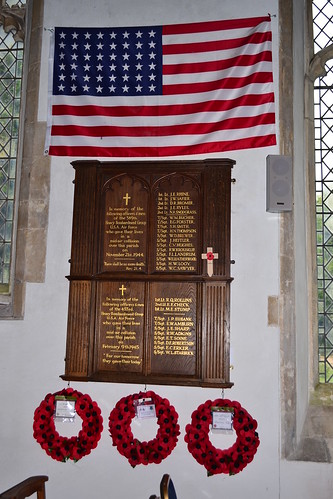
The memorial board at All Saints Church, Carleton Rode, gives the names of those who died in the two collisions. The top board contain the names of the 389th BG; the bottom, those of the 453rd BG.
The memorial itself hangs on the north wall inside All Saints, along with wreaths presented by local organisations including representations from the American base at RAF Alconbury.
The two collisions occurred on separate occasions and involved aircraft from both nearby RAF Hethel and RAF Old Buckenham.
Both incidents involved crews of the 2nd Air Division, Eighth Air Force. The first took place on November 21st 1944, followed a few months later, on February 9th 1945, by the second. The casualties of the first, were from the 566th BS, (389th BG) flying from RAF Hethel, and the second involved crews from the 734th BS, (453rd BG (H)) flying from RAF Old Buckenham. In all 28 airmen lost their lives in these two very tragic accidents.
The 566th BS were activated Christmas Eve 1942, and were assigned to the 389th BG, Second Air Division, Eighth Air Force. On arrival in England they were sent to RAF Hethel (Station 114) in Norfolk where they would participate in the air campaign over occupied Europe.
On November 21st 1944, the 389th were preparing for a mission to bomb the oil plants at Hamburg, Germany. Liberator B-24J, s/n 42-50452 ‘Earthquake McGoon’*1, piloted by Lt. Alfred Brooks took off to formate high above the Norfolk countryside. A second Liberator, B-24J, s/n 44-10513, piloted by 1st Lt. J. E. Rhine took off to join the same formation. The entire raid would involve a colossal 366 B-24 ‘Liberators’, along with 177 fighter-escorts involving both P-47 ‘Thunderbolts’ and P-51 ‘Mustangs’ – a formidable number of aircraft to have in the sky at any one time.
As the aircraft were joining the formation, the two B-24s collided, resulting in both aircraft crashing to the ground. Brooks was the only survivor from his aircraft, whilst there were only two survivors from ‘10513’. In total seventeen of the aircrew died that day in the resultant crash.
The crew who lost their lives that day were:
1st Lt James E. Rhine, s/n: 0-820824, *
1st Lt J.W. Safier.
2nd Lt D.R. Bromer.
2nd Lt J.E. Ryles.
2nd Lt. N.R. Snodgrass
Tech/Sgt. William M. Bucher, s/n: 36814876, *
Tech/Sgt. E.G. Forester
Tech/Sgt. Stanley H. Smith, s/n: 11082353, *
Tech/Sgt. Harold M. Thompson, s/n: 39092072, *
Staff/Sgt. Walter D. Brewer, s/n: 34872455, *
Staff/Sgt. Julius Heitler, s/n: 42041178, *
Staff/Sgt. Carl V. Hughes, s/n: 34021953,*
Staff/Sgt. R.W. Krouskup
Staff/Sgt. F.L. Landrum
Staff/Sgt. W.E. Leatherwood
Staff/Sgt. H.W. Looy
Staff/Sgt. W.C.Sawyer
*Seven of these men are buried in the Cambridge American Cemetery, five of whom were presented the Purple Heart.

A small window also remembers the 17 men killed in November 1944.
The second incident occurred on February 9th 1945, and involved two aircraft from RAF Old Buckenham.
The 734th BS flew as part of the 453 BG, 2nd Air Division, Eighth Air Force. They were activated on 1st June 1943, moving to England during the December of that year. Their trip took them from Wendover Field, Utah, to Idaho, California and onto Old Buckenham. Throughout the war they would operate as a strategic bomber group attacking many high prestige targets across Germany.
On February 9th 1945, two B-24s, 42-95102, ‘Spirit Of Notre Dame‘ and 42-50703 ‘Worry Bird‘ took off as part of a 313 strong force of B-24s to attack the Rothensee oil plant at Magdeburg, along with any targets of opportunity. Escorted by 151 P-51 ‘Mustangs’, they successfully bombed the target using H2X and returned home.
As the bombers were approaching Old Buckenham, the two aircraft collided and ‘Worry Bird‘ crashed in a fire-ball, within a mere hundred yards of the runway. ‘Spirit Of Notre Dame‘ on the other hand recovered from the collision making a safe landing at Old Buckenham. In the resultant crash, all 11 crews members of ‘Worry Bird‘ tragically lost their lives.
The crew of ‘Worry Bird‘ were:
1st Lt. RQ.Rollins
2nd Lt. Earl E. Check, s/n: 2005832, *
1st Lt. Max E. Stump, s/n: 0-718979, *
Tech/Sgt. J.P. Eubank
Tech/Sgt. E.W.Amburn
Staff/Sgt.J.E.Sharp
Staff/Sgt.R.W.Adkins
Staff/Sgt. E.T Soine
Staff/Sgt. D.E.Robertson
Staff/Sgt. E.C.Erker
Staff/Sgt. W.L. Starbuck
*Two of these men are buried in the Cambridge American Cemetery, one of whom was presented the Purple Heart.
This memorial reminds us of the dangers faced on a daily basis by young crews of the armed Air Forces during the Second World War. On these two days, 28 young men lost their lives in tragic accidents, that left a lasting scar on not only their bases, but their families and the local communities as well.
Notes:
All the crew members who lost their lives are remembered in the Saint Paul’s Cathedral Roll of Honour.
*1 in some references the aircraft name is given as ‘Earthquake Magoon‘.

 Aviation Trails