Part 3 took us through the 1920s and 1930s in the life of Sutton Bridge. As the war opened, the airfield swung between roles with remarkable speed. From a brief stint as a recruit training centre to hosting newly formed 264 and 266 Squadrons, the airfield grappled with scarce aircraft, harsh winter weather, and early operational mishaps. Defiants, Blenheims, and then Spitfires tested both pilots and crews, while accidents and maintenance challenges were constant. By early 1940, with the squadrons gone, Sutton Bridge pivoted once more, becoming a hub for new recruits and small training flights, laying the groundwork for its next vital role as 6 Operational Training Unit.
The Birth of 6 Operational Training Unit
6 OTU were created on March 10th, 1940 from the ashes of 11 Group Pilot Pool who were up until then based at RAF St. Athan. They had been established specifically to train front line fighter pilots who had already mastered the basics of flying and were to be ‘polished’ up before passing on to front line operational squadrons.
Following the initial administration and setting up of the unit, a small party of four non-commissioned officers and twelve airmen, arrived here at Sutton Bridge. They were followed a few days later by the main party including six officers and ten further airmen. Once established, the unit would be commanded by Sqn. Ldr. Philip C. Pinkham, who led the first course for trainees beginning March 11th 1940.
Pinkham was responsible to the Station Commander, the recently promoted Wing Commander Philip R. Barwell, who had even as a Station Commander, remained a keen flyer. To meet his insatiable demand for flying, Barwell would take any opportunity to fly that passed his way, often pulling rank, he would fly in as many aircraft as he could, frequently in the guise of that common excuse an ‘air test’. The new OTU would offer a great opportunity for Barwell, operating a mix of aircraft types but mainly Hurricanes, Masters, Fairy Battles, Battle trainers and a Gladiator.
The early days of the OTU here however, were not as grand as many would have hoped. Yet another lack of serviceable aircraft combined with the poor Fen weather of 1940, led to a reduction of available flying days, and so one day a week the airfield would close with a ‘day off’ being given to those stationed here – hardly reflective of a war mentality.
Training for War: Sutton Bridge under the Spotlight
The part-time attitude to the job didn’t reduce the seriousness of their efforts though, and a visit by dignitaries including, as suggested in some sources, Hugh Dowding, the AOC Fighter Command, made sure they were aware of that.
On May 3rd 1940, Air Chief Marshal Sir Edgar Ludlow-Hewitt, the Inspector-General of the Royal Air Force, also paid a formal visit to Sutton Bridge. Crossing the airfield’s runways and observing the pilots in action, he took careful note of the station’s flying operations and training routines. His inspection combined a keen eye for detail with practical recommendations, aimed at refining instruction and ensuring operational readiness. The visit, recorded in Report No. 11, highlighted both the strengths of the airfield and the areas that required attention, underscoring Sutton Bridge’s vital role in Britain’s initial wartime training programme.*11
Hewitt’s inspection highlighted significant challenges at the OTU. Gunnery practice for visiting units relied on firing at four 20-foot target drogues, towed from the beam by the OTU’s four Henley aircraft. The training, however, was severely limited by the condition of the Henleys; a shortage of spare parts often meant that only one or two aircraft could operate at any time. Accurate gunnery depended heavily on the steady towing of the targets. Additionally, Hewitt was sceptical of the OTU’s claim that the large, slowly moving targets “get shot to bits at once.” His observations highlighting how mechanical constraints could, and did, directly impact the effectiveness of instructor and trainee practice.
Despite all these challenges though, courses rapidly progressed, and soon foreign nationals who had joined the RAF, began to arrive. These included those not only those from the Commonwealth but the European countries invaded by the Nazis along with a handful from the United States: all eager to join up before the US officially joined the war.
There would of course be many casualties during these courses, some due to mechanical issues, many due to pilot error, learning to fly a combat aircraft under combat conditions being a very risky business indeed. Many of these casualties form the sixty – joined by a single Luftwaffe airman – graves less than a mile away in the St. Matthew’s Church yard in Sutton Bridge.
A change in fortune meant that the increase in trainees also meant an increase in aircraft. By the middle of the year 6 OTU were operating thirty-four Hurricanes in addition to the odd twenty or so other types present here although they were still classed as ‘unserviceable’. Combine these with visiting detachments and the sky over Sutton Bridge soon became an incredibly busy airspace.
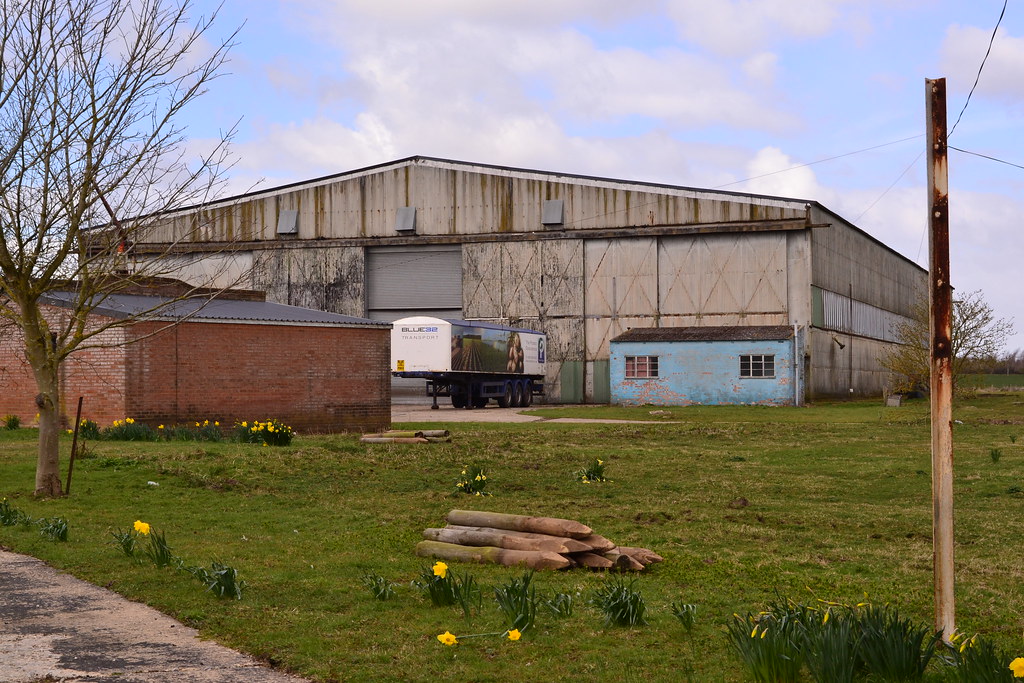
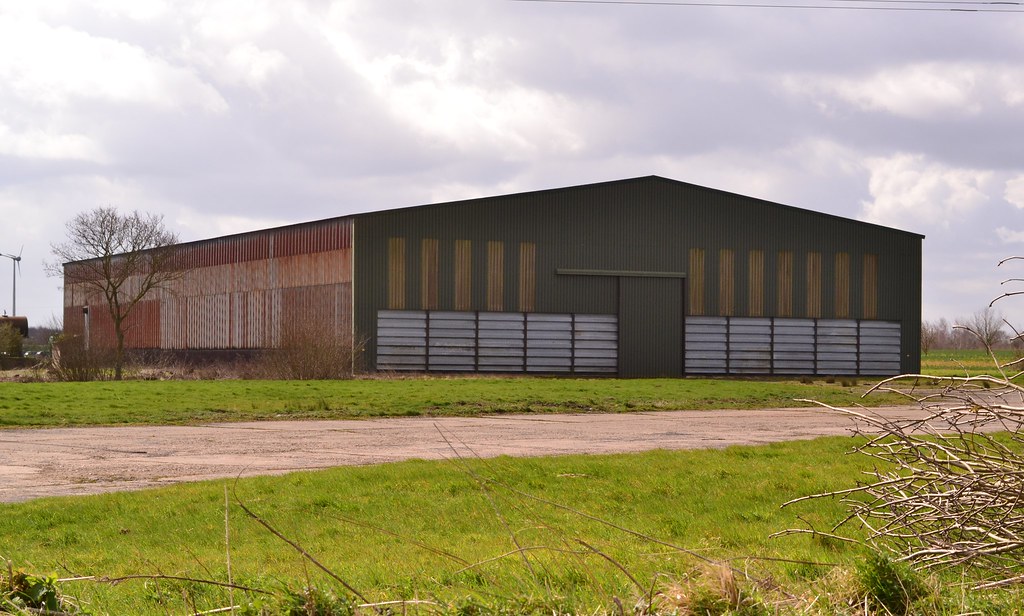
The ever increasing numbers of aircraft using the site inevitably led to a demand for more hangar space, and in May 1940, the first of two Bellman hangars were erected on the site, thus extending its ability to service damaged aircraft.
Following the fall of France, Britain stood alone, and many of the front line pilots at her disposal were either tired veterans or recently qualified and inexperienced, and so more crews were needed if they were to stand any chance of repelling the Germans, who so far, had rolled virtually unopposed across Europe. Many of these veterans of France, were now being posted into the training stations to train new pilots in the tactics and airman-ship that would hopefully save their lives. Sutton Bridge was no different, the record books for this period list endless postings in of these front line pilots as instructors, many holding DFCs or DFMs in reward for their action over France. One of those to arrive here was F. Off. Derek Dowding the son of Air Chief Marshal Hugh Dowding, the recruits were indeed in the company of the noble, Derek having the title ‘Honourable.’

F.O. Derek H.T. Dowding (right) with his father Hugh Dowding. (Battle of Britain Monument archive)
Training at a Cost: Accidents and Fatalities at 6 OTU
Life at Sutton Bridge was not without risk, even for the instructors. Sergeant Charles Cotton being the first from 6 OTU to suffer. On 25th June 1940, he sadly crashed after having only arrived about three weeks earlier at the airfield. Cotton was performing low level aerobatics near to the village of Upwell, not far from Sutton Bridge, when the Hurricane he was flying was seen to climb from low level, possibly stall and then dive nose first into the boggy Fen ground. The aircraft buried itself deep in the soil, leaving little trace on the surface of its demise.
The next day a recovery truck tried to remove the wreckage, but the boggy ground combined with limited access, made recovery difficult. With perseverance though, Sgt. Cotton’s remains were eventually removed from the aircraft whereupon he was taken to his home town in Essex and laid to rest.
To meet pilot demand, courses were cut from six weeks to two, increasing the already immense pressure on trainees to complete their flying training. This pressure often led to mistakes being made. Between June and November there were no less than eleven fatalities, six of which were involved in airborne collisions.
One such incident occurred on August 18th, when Sgt. Dudley McGee and Sqn. Ldr. Kazimierz Niedwiecki were involved in a collision in the skies to the east of Sutton Bridge. The pair were performing aerial combat techniques when the collision happened causing the death of both pilots. Niedwiecki, a Polish airman, had only just arrived at the airfield from 15 Elementary Flying Training School (EFTS) in Carlisle, a grading school for Polish pilots; whilst McGee had arrived two days after Niedwiecki from Ternhill’s 10 Flying Training School (FTS). Both airmen were experienced flyers, and so it is feasible that the pressure of getting through the course and onto active duty was a factor in their demise.
After colliding, Niedwiecki’s Hurricane came down on farmland near Terrington St. Clements whilst McGee’s fell near to Walpole Cross Keys a few miles away. Once recovered, both the pilots were buried in St. Matthews Church Yard in Sutton Bridge.
Instructors of Note: The Arrival of Bill Waterton
Dowding’s son was not the only notable person to instruct at Sutton Bridge. During the late autumn of 1940, one William ‘Bill’ Waterton was posted in to Sutton Bridge by his Squadron Commander Douglas Bader of 242 Squadron RAF Coltishall. Waterton had been in hospital for three months following a head injury suffered in a crash whilst providing cover over Dunkirk. He came to Sutton Bridge as an instructor and proved to be an exceptionally good one. It was a move that kick started a change in career for him that would change his life forever. However, at Sutton Bridge, providing instruction to other pilots was not enough for Waterton, and he yearned for a return to front line operations.
Waterton never got this move, instead he was sent to Canada, returning to the UK in 1943 on a posting to RAF Fighter Command and the Air Fighting Development Unit (AFDU) at RAF Wittering. Here he tested many captured German aircraft, pitting them against RAF fighters to see how they performed. Post war, he would fly a Gloster Meteor in an attempted world speed record achieving speeds in excess of 600mph. Speaking frankly and to the point, he would leave the RAF to fly for Gloster, the makers of the Meteor, and become a very successful test pilot pushing aircraft to their limits and nudging the much sought after sound barrier.
Being known for his ‘forthright’ attitude, Waterton achieved great things in aviation research, an achievement that was kick-started by his duties at RAF Sutton Bridge. *12 *13
Foreign Trainees and the Cost of Speed
As summer turned to Autumn and August to September, the RAF were losing pilots at an unsustainable rate, and Dowding needed many more and quickly. With many trainee pilots in the OTUs being foreign, and with poor English, he had little choice but to rush them through courses and get them into front-line units. The first Czech course consisted of some twenty airmen and lasted from 17th August to 11th September 1940. Virtually all of these went on to serve in the Battle of Britain, many being killed or posted as ‘Missing in Action’.
To expedite their movements, courses were refined further, and many trainees were sent up in pairs to practice combat manoeuvres on their own. One British pilot, Sgt. Frederick Howarth in L1658 and Czech pilot Sgt. Karel Stibor, collided in one such activity resulting in the death of both airmen. The two sites were cleared of immediate debris but the aircraft remained buried until the 1970s and mid 80s, when major parts were found and removed. These two men join the many others in St. Matthew’s. Such was the demand for new pilots that at Sutton Bridge alone, 525 pilots were posted in from, or out to, front line squadron between March and October 1940; only one-quarter of them not having fought in either the Battle of France or the Battle of Britain; most (345) having seen action in just the Battle of Britain. *14
The attack on Britain’s airfields was by now subsiding, but that didn’t stop the occasional bomb from dropping on Sutton Bridge, nor its ‘Q’ decoy site at nearby Terrington some 4 miles north-east. The first attack came in the night of August 30th-31st, in which bombs were dropped harmlessly on the dummy airfield. It was Terrington again at the end of September that would get another rogue bomber dropping its payload. By now the locals were getting worried and annoyed, and requested the site be moved. The RAF’s reply was not favourable nor was it what they wanted to hear. With yet another attack at the end of October, it was becoming clear why the RAF wasn’t going to play ball, a few dead horses and damage to walls was a small price to pay for keeping the training camp clear and operational.

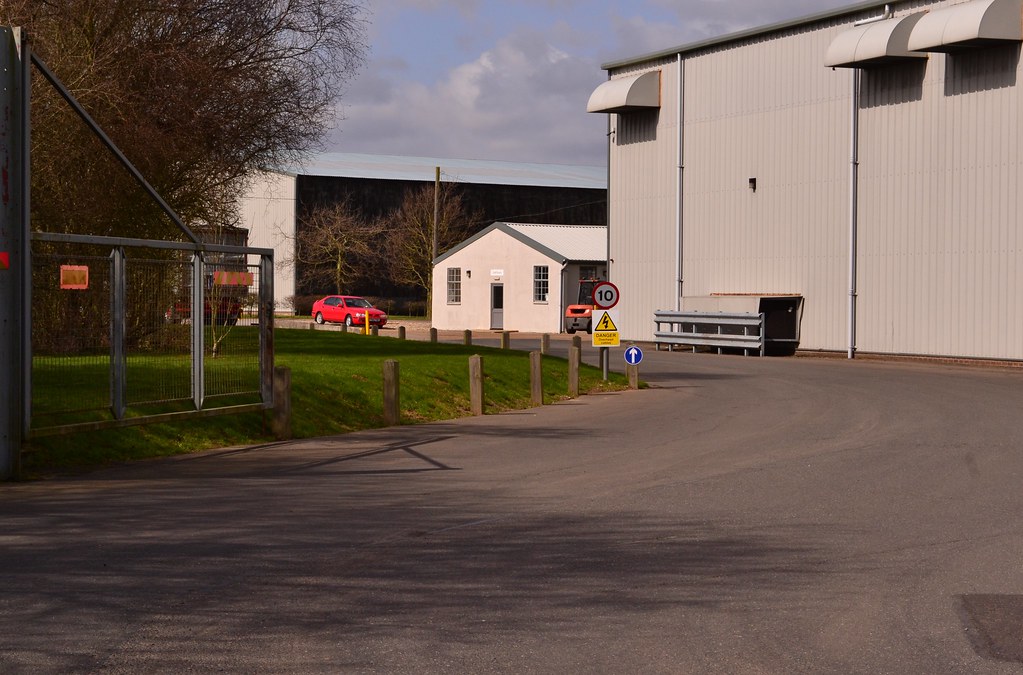
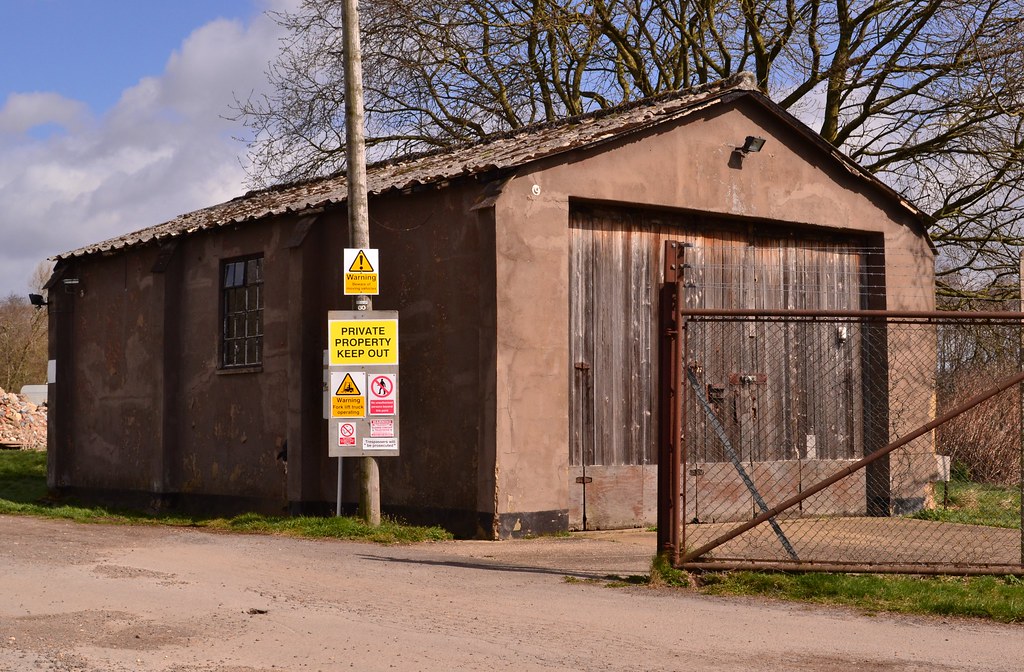
‘Handcraft hut’ now a private building.
During the whole of the war, the ‘Q’ site took no less than six German attacks, whilst the airfield at Sutton Bridge received only three, a comprehensive reason for the use of such areas at this crucial time.
From 6 OTU to 56 OTU: A New Chapter
By the end of the Battle of Britain, the various OTUs had shown their true capability, fuelling the front line squadrons that would protect the UK from German invasion and sweeping the enemy from the sky. But changes were now afoot, and in November 1940, 6 OTU was disbanded immediately being renumbered as 56 OTU; the change coming through as a result of the reshuffle of the training units – ’50’ being added as a prefix to all OTUs.
56 OTU continued to fly the Hurricane using the squadron code ‘FE’. In fact, little changed and everything carried on as usual with little immediate evidence of the new change. The new, recently appointed station commander, Group Captain Bruce Caswell, continued his reign over both the airfield and the daily goings on at the site.
The new unit would form the main squadron at Sutton Bridge for the next two years continuing to train pilots in the art of dog-fighting and air gunnery; the renumbered 56 OTU carrying on pretty much where 6 OTU had left off. New pilots arrived and were pushed through the various courses; the RAF still desperate to get new pilots into front line squadrons as soon as possible.
The challenge of getting pilots through the courses was still a great one, and with so many trainees coming and going, errors, accidents and fatalities remained a common occurrence.
A New Spirit: The RAF and Its American Volunteers
The end of 1940 and the success of the Battle of Britain gave renewed hope and boosted morale for both aircrew and civilians alike. Now, and even though the United States was still out of the war, the RAF found itself being bolstered by a small number of American airmen wanting to join the fight and stand by Britain’s side. Some of these joined as early as 1939 as volunteer reserves, going on to fly during the Battle of Britain. Whilst there are records of US airmen flying in the battle, most went on to join the famed ‘Eagle‘ Squadrons joining names like Don Gentile, Don Blakeslee and Johnny Godfrey, many of whom have become household names in Second World War terms, with historical stories to match.
As a way to retain US neutrality, the airmen made their way through training schools in Canada to the UK, arriving by ship as civilians. Many were sent to 3 Personnel Reception at Bournemouth and then onto 57 OTU or the new 56 OTU here at Sutton Bridge to complete their training before passing over to RAF units.
The First American Loss: Pilot Officer William Davis
One of these pilots arrived in March 1941, P.O. William Davis, a twenty-five year old trainee from St. Louis. He found himself sent to Sutton Bridge, preparing to take on the Hurricane. With twenty-five flying hours under his belt already, he made his first solo less than two weeks after his arrival, managing a successful flight but suffering a problematic landing. The next day, he departed the airfield again, this time to carryout a map reading exercise over the Lincolnshire Fens. Unfortunately, the weather closed in and with a featureless landscape to navigate by, he eventually ran out of fuel and opted for a landing in one of the many expanses of Fen fields.
Unfortunately, as he landed, the undercarriage dug into the soft mud, flipping the Hurricane (P5195) onto its back breaking Davis’s neck, killing him outright. Davis was the first American to die at Sutton Bridge, this tragic accident cutting his war very short. He remains a long way from home, buried not far from the airfield in the local church yard at Sutton Bridge. His full story can be read in Heroic Tales.

Pilot Officer W. Davis, killed March 1941.
The Eagles Gather
His was the first of a run of several accidents. Later in the summer of that year, Sgt Bidgood and Flt. Sgt. John Craig, who both veterans of the Battle of Britain, collided over the nearby village of Terrington St. John, killing both airmen. Being experienced airmen and valued pilots, their loss was a tragic one that cost the RAF dearly.
The Americans however, kept on coming. During 1941 alone they accounted for twenty-six accidents at Sutton Bridge. By the end of the year, 144 US airmen had passed through the airfield, 87 of whom went on to fly with the famed ‘Eagle Squadrons’ before they were officially transferred to the USAAF in 1942.
March 1940 saw the birth of 6 OTU at Sutton Bridge, a fast-paced training hub turning skilled pilots into front-line fighters. Operating Hurricanes, Battles, and Gladiators despite shortages and harsh Fen weather, the unit trained British and foreign recruits under tight schedules and high pressure. Success came at a cost, with accidents and fatalities a constant reminder of the dangers faced even before reaching combat, underscoring Sutton Bridge’s vital role in preparing airmen for the Second World War.
The full story can be read in Trail 3 – Gone but not Forgotten.









 Aviation Trails