RAF Leeming – The Great North Road (Pt 4).

In this, the last part of Trail 57 – The Great North Road (pt 2) we see how Leeming progressed from the late 1960s to the present day. From the modest little Jet Provost to the Tornado and on to the Hawk trainer. Leeming’s long history was far from over, but it is now very different to those dark days of World War 2 and the four-engined heavy bombers of the Canadian Air Force. At this point in time it was now home to No. 3 Flying Training School (F.T.S.)

The Flying Training School would remain at Leeming for twenty-three years, before being disbanded for a few years, in 1984. It  had a long history extending as far back as 1920, morphing into different guises but performing basically the same role each time.

Here at Leeming, 3 F.T.S. would use the Jet Provost T.3, a design that was based on the piston-engined P.56 Provost, using a new fuselage mated to the original wing structure, it would become a popular design, seeing many years of service both in the Royal Air Force and Air Forces abroad. Designed and built by Hunting Percival Aircraft Limited, who were based at Luton Airport, it would go through few design changes (most were technical e.g. ejection seats, upgraded engines etc) between its initial flight and final model the T.5. In 1967 it would become the Strikemaster, when the British Aircraft Corporation (B.A.C) took over, but the initial design would go on to serve well into the 1990s performing well in the training role it was designed to do.

The Provost was designed for a straight through or ‘Ab Initio‘ (‘from the beginning’) role, taking the trainee pilot from the piston engined stage through to obtaining his ‘wings’ before advanced flying training as a qualified pilot.

Bruntingthorpe May 2016 079 Hunting Jet Provost T.3A at Bruntingthorpe. This was previously flown by 1 FTS.

Initial arrivals were slow, but courses ran on time and very soon Leeming would be welcoming cadets and trainees from across the globe. Over the next 20 years or so, further upgrades would be made to the airfield site, repairs and modifications made to the perimeters and hardstands. Leeming was to operate on a 24 hours basis allowing for emergency landings of visitors  both civil and military. It would take part in NATO exercises, hosting as it does today, aircraft from around the country and the globe when the need arose.

The mid 60s saw the return of female personnel to Leeming. An absence of almost twenty years with little pomp or ceremony, but it was nevertheless a milestone in Leeming’s long and distinguished history.

Another major event in Leeming’s history was the arrival of the Central Flying School (C.F.S.) in 1976-77. This addition to Leeming’s pans had been slowly coming with aircraft being dispersed here since the previous year. The C.F.S. was another long standing and dynamic unit that had gone through many changes and many moves, here at Leeming though, its arrival was heralded with a display by the ‘Vintage Pair’ a Vampire T.11 (XH304) and Meteor T.7 (WF791) seen at many airfields around the country until the flight was disbanded in May 1986.

The C.F.S.’s history is far too detailed to be looked at here, but in essence the first arrivals were the Scottish Aviation Bulldogs, a small single engined aircraft with side-by-side seating. These were joined not long after by the Headquarters, Groundschool and Jet Provosts of the C.F.S. from RAF Cranwell in September 1977.

More upgrades to hangars and aprons in the late 70s and early 80s saw further changes with arrivals and departures of other units, and a rather important cadet arrived in the form of HRH Prince Andrew, amid much public interest. 1982 also saw the arrival of an American unit, the USAF’s 131st Tactical Fighter Wing (T.F.W.), with 12 Phantom F-4s, followed not long after by C130s and C141s.

In 1984, a four year reconstruction programme amounting to some £148m was implemented to prepare Leeming for the arrival of the latest version of the Multi Role Combat Aircraft the Tornado. In this case the F2 Air Defence Variant (A.D.V.). It was during this time (1984) that Leeming would join 11 Group Strike Command, the old Fighter and Bomber Commands having been amalgamated in 1968. To facilitate the upgrade, the remaining units, both the C.F.S. and 3 F.T.S. would cease operations here. The C.F.S. departing to Scampton and  3 F.T.S. being disbanded for another five years.

The move of the C.F.S. to Scampton, saw the Jet Provosts and Bulldogs depart Leeming in a grand final farewell. Flying in formation, nine bulldogs took off an hour before a second formation of Jet Provosts led in a Vampire by Air Commodore Kip Kemball. In addition to the Bulldogs were sixteen Jet Provosts, an equal mix of Mk.3s and MK.5s, two Meteors and the Vampire. After flying over several of Yorkshire’s airfields, they arrived simultaneously at Scampton and their new home.

In July 1988 the rebuilding programme had been completed and RAF Leeming reopened with the arrival of No XI(Fighter) Sqn – on July 1st 1988. Following not far behind was No 23(Fighter) Sqn on 1st November that same year. The third squadron to arrive, No XXV(Fighter) Sqn, landed on 1st October 1989; all being reformed here and all operating the F3 Variant Tornado. The F3 would perform its duties for 20 years at Leeming, ending with the final disbandment of XXV(F) Sqn in April 2008.

XI (F) Squadron, had been in operation since 1915 with an almost unbroken service record. XXV (F) Sqn had been operating as a Bloodhound SAM unit since the early 1960s. In 1989 they returned to manned aircraft, taking on the Tornado, operating in a range of military operations during Gulf War 1, the former Yugoslavia and the Baltic States.

In 1989 a tragic accident marred the almost unblemished record of modern Leeming, when on Friday 21st July a Tornado of 23 Sqn ZE833, crashed into the sea off Tynemouth whilst on a training flight. The Pilot, Fl. Lt. Stephen Moir,  was leading a pair of ‘target’ aircraft, when after an initial field intercept he pulled the aircraft up to 4,000ft, before initiating a 20o-25o nose down dive. At 3 – 400 ft the navigator gave a verbal warning just as the on board low warning indicator, set at 200 ft, activated. Within moments the aircraft hit the calm sea, a fireball engulfing the aircraft, at which point the crew ejected. The co-pilot passed through the fireball sustaining minor burns but the pilot suffered major head injuries rendering him unconscious. After 40 minutes the co-pilot was recovered by a Sea King helicopter from RAF Boulmer, but the pilot had been unable to initiate any recovery action and sadly drowned*10.

An inquiry could not establish any direct cause of the crash, other than suggesting the pilot had not taken into account the lack of lift with wings set back at 67o and the smooth sea not providing visual cues as to his height. By the time the navigator gave his warning it may well have been too late to recover.

A second, but less serious accident occurred for XI (F) Sqn five years later on June 7th 1994. On this occasion, whilst performing a high speed, low-level (1,300ft) pass over the sea 45 miles north-east of Scarborough, the labyrinth seal around the high pressure shaft failed causing a massive fire, major component failure and eventual failure of the right engine. The aircraft, now uncontrollable, became engulfed in flames. The two crew ejected safely and the aircraft crashed into the sea. As a result, a speed restriction was put on all Tornado aircraft until the RB199 engine seal had been investigated.

Further reviews of the armed forces led to the Tornado F3 squadrons being cut. This was to aid the phasing in of its replacement the Eurofighter Typhoon. The first of these to go was 23 Sqn, who had previously occupied Port Stanley airfield following the Falklands War. After being reduced to just four aircraft the unit was disbanded only to reform here at Leeming in 1988. As a result of this review, on February 26th 1994, 23 Sqn was disbanded not reemerging again until 1996 at Waddington with Sentry AEW 1s.

Another review of the military (2003 Defence White Paper, “Delivering Security in a Changing World”) saw further reductions of the Tornado squadrons, notably the demise of XI (F) Squadron in October 2005. This reduction left just one Tornado F3 unit XXV (F) at Leeming. They remained here until 4th April 2008 when they too were disbanded.

The next big step in Leeming’s history occurred in 1995, with the arrival of 100 Squadron. 100 Sqn had a history extending back to World War 1, they had an extensive World War 2 history, culminating in the humanitarian operations ‘Manna’ and ‘Exodus’.

The role of 100 Sqn at Leeming was a far cry from the activities of the previous years. Equipped with the BAe Hawk T MK.1 – a fully aerobatic, low-wing, transonic, two-seat training aircraft, it fulfils an  ‘aggressor’ role simulating enemy forces and providing essential training to the RAF front-line units. The Hawk T1 is equipped to ‘operational standards’, capable of being armed with AIM-9L Sidewinder air-to-air missiles and up to eight 3Kg practice bombs.

A final and tragic loss occurred at Leeming on 22nd October 1999 with the loss of Hawk T.1A ‘XX193’ just outside the village of Shap in Cumbria. The flight incorporated a three ship formation flying in the aggressor role, where one aircraft attempts to intercept the remaining two, who then take defensive action. After performing two such ‘attacks’ the aggressor, flown by Sqn Ldr Mike Andrews, flew north along the M6 corridor. During a slow turn, XX193, struck two trees and a brick outbuilding causing extensive damage to the property and destroying the aircraft. Neither of the two crew managed to eject resulting in both their deaths.

The assessment of the crash ruled that the aircraft was well maintained and serviceable, and that the Hawk pilot may have been distracted by other close aircraft taking his concentration off the low height. They also sited pilot fatigue as possible factor *11

RAF Leeming Hawk T1s of 100 Sqn line up for take off at RAF Leeming.

A number of other squadrons continue to use Leeming, in April 1996, 34 Squadron RAF Regiment arrived in North Yorkshire after serving for forty years in Cyprus. Now part of No. 2 RAF Force Protection Wing, their role is to provide air force protection capabilities. In 2007 – 90 Signals Unit arrived from RAF Brize Norton, they now form the largest contingency at Leeming,  half of the airfields population, providing communication services to operations both within the UK and by supporting operations world wide.

Whilst not flying units these nonetheless provide important services and support to the Royal Air Force operations, forming a large part of Leeming’s presence in this small Yorkshire village.

In 2014, history repeated itself with the return of 405 (R.C.A.F.) Sqn who flew into Leeming to take part in operation ‘Joint Warrior’. Now flying CP-140 Auroras, it was the first time the squadron had been at Leeming since it departed in World War 2. The full story appeared in ‘The Northern Echo’ newspaper.

Currently the RAF operate both the Hawk and the 120TP Prefect at Leeming. With its history extending far back to the origins of the Second World War, its links with the Canadian bomber group and a wide range of aircraft types and personnel, its history for the moment looks secure. In an ever changing world though who knows what the future holds, but for now, Leeming plays a major role in the training of Britain’s front line fighter pilots striving to keep the World’s air spaces free from terror.

Being an active base access to Leeming is restricted. A Tornado currently resides as the Gate Guard reminding us of the links with the former work horse of the RAF’s front line squadrons. The A1 main road by passes Leeming and access to the site has to be by exiting this road and turning on to the old Leeming road into the village. The road along side the airfield does offer excellent views, and a public viewing area has been provided by the base, for those who wish to watch the flying safely and virtually unrestricted.

Leeming has along and varied history, used by many nationals and operating a wide range of aircraft types, it is has been, and continues to be, a major player in Britain’s  air defence.
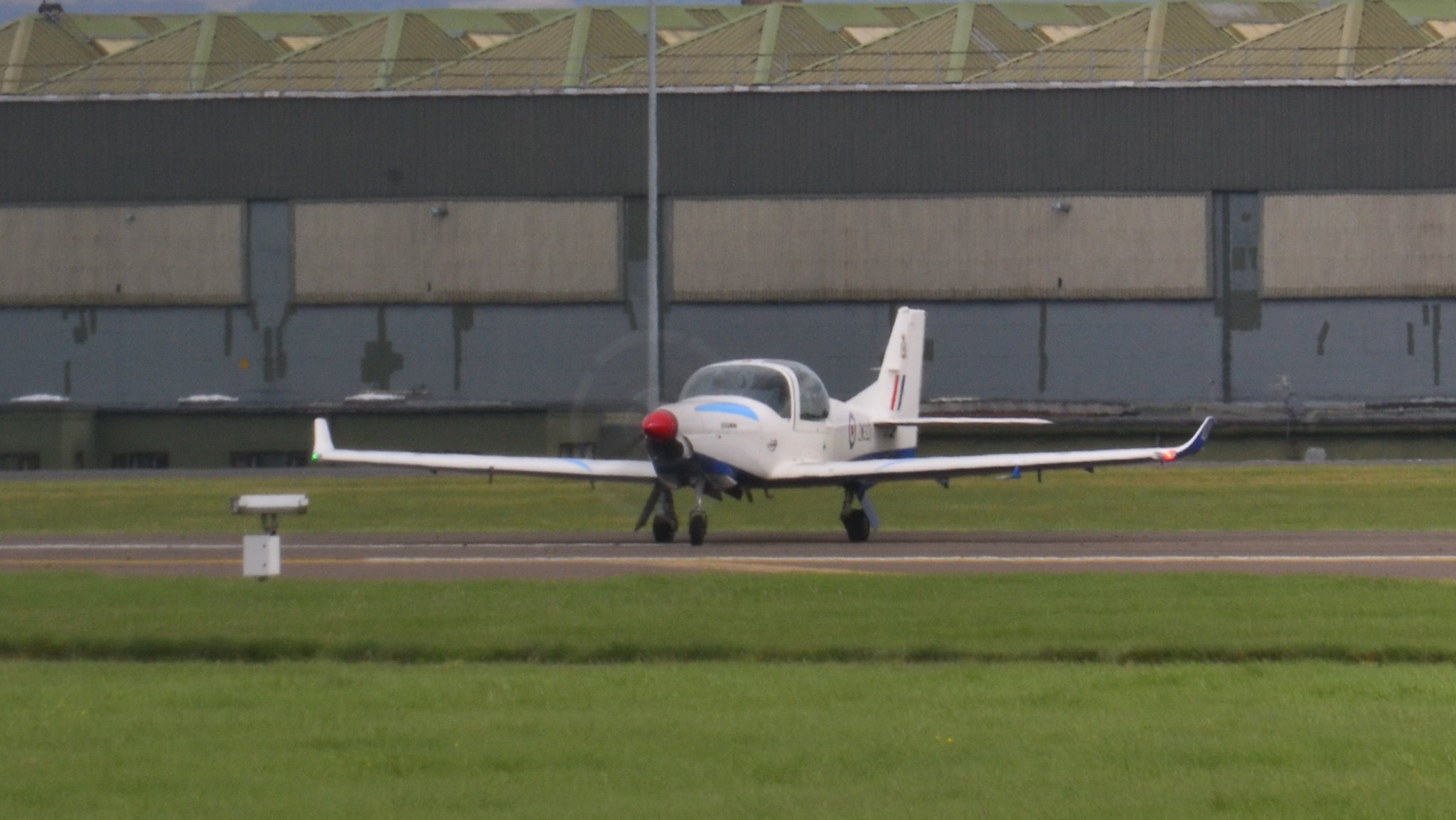
RAF Leeming 120TP PREFECT

Sources and further reading.

*1 National Archives Operational Record Book AIR 27/98/1

*2 National Archives Operational Record Book AIR 27/379/4

*3 National Archives Operational Record Book AIR 27/1796/28

*4 To avoid confusion with renumbering, Air Force Order 324/40, dated 7th June 1940, stated: “In order to avoid confusion in matters pertaining to similarly numbered units of the RAF and the RCAF, all units of the RCAF, after embarkation for overseas, are to be identified by use of the word “Canada” as a suffix immediately after the Squadron number, e.g., No. 110 Canadian (AC) Squadron.” However, this order was cancelled on 4th June 1943 by Air Force Routine Order 1077/43.

*5 AIR 27/1848

*6 Emmanuel College Roll of Honour website.

*7 Coupland, P. “Straight and True –  A History of RAF Leeming” Leo Cooper 1997.

*8  The London Gazette on 23rd October 1951 (Issue: 39366, Page: 5509)

*9 Buttler, T., “The 1957 Defence White Paper – The Cancelled Projects”. Journal of Aeronautical History, Paper No. 2018/03

*10 Ministry of Defence Military Aircraft Accident Summaries 7/90 6th June 1990

*11 Ministry of Defence Military Accident Summaries January 2001.

AIR 27/141/24

The Bomber Command Museum of Canada Website.

The Canadian Warplane Heritage Museum website

RAF Leeming – Royal Air Force Website.

Ward. C., “4 Group Bomber Command: An Operational Record“. 2012 Pen and Sword.

A detailed history of RAF Leeming can be found in: Peter Coupland’s book “Straight & True  – A History of RAF Leeming“, published in 1997 by Pen and Sword.
The full Trail can be seen in Trail 57.

RAF Leeming – The Great North Road (Pt 3).

In the next part of this trail, Leeming enters the jet age, its future still in the balance as many of Britain’s airfields are closed and sold off. But with new aircraft coming on line and a new threat looming from the east, Leeming survives and takes on a new role.

The end of World War 2 saw a Europe devastated by war. The Eastern countries liberated by the Russians had survived the tyranny of the Nazi regime, only to be embroiled in Communist hardship and doctrines. A new threat was emerging as mistrust grew between the Eastern Bloc and the Western Allies. A new Europe would emerge hanging delicately by a fine thread of peace: the Cold War was approaching.

Immediately though, there was little need for many of Britain’s extensive range of wartime airfields, and many were either put in to ‘Care and Maintenance’, sold off or simply closed and left to decay. But this new threat would see some of Britain’s wartime airfields remain open, some turning into missile bases, and some continuing in the air defence or strategic bombing role. For Leeming, this was perhaps, its saviour.

Within a month of the Canadian’s departure, a new unit would arrive at Leeming, not a front line fighter squadron nor a heavy bomber squadron, but a training unit, 54 Operational Training Unit (O.T.U.), which had been operational throughout the war. Flying a range of aircraft types, they were a far cry from the heavies that had preceded them over the last two years or so.

Their arrival in June was heralded by the ferrying in of a number of aircraft types, ranging from Tiger Moths to  Martinets and Wellingtons. Fighters such as the Tempest and Mosquito were also brought in during these early days of post war Leeming. The purpose of 54 O.T.U. was as a night fighter training unit, using ‘modern’ radar sets whose development had started during the war.

But years of neglect and a lack of funding, had meant that many of Britain’s airfields – to which Leeming was no exception – were in a poor state of repair, and much work was urgently needed to bring them up to a good standard. Over the next year or so, major repairs would be carried out. As a priority, the wartime accommodation buildings and now outdated water system were targeted first. Help in doing this was enlisted from German P.O.W.s who were yet to be repatriated, billeting them in the former accommodation blocks within the airfield grounds.

The immediate post war era saw a massive demobbing of forces personnel, this led to a  decline in service manpower, a move that resulted in the 1949 National Service Act. As a result of this act, adults between 17 and 21, were required, by law, to perform 18 months National Service.  This draft led to an influx of untrained personnel, who were brought in to fill gaps in important trades, but short service lengths meant the training was inadequate for many, and so a number of unskilled or poorly skilled personnel were placed in prime engineering positions. This lack of skilled personnel may well have contributed to a number of the many minor and major mishaps that occurred in the R.A.F. in the immediate years following the war.

Training new pilots was a risky business in these post war days, and on November 8th 1946, Pilot – Sqn. Ldr. Noel Dan Halifax R.A.F. (s/n: 33404), and his navigator F.O. Roy Edward Chater R.A.F.V.R. (s/n: 194286) were both killed whilst undertaking a training flight out of Leeming airfield. Chater was one of many young men who had come from the Emanuel College, Cambridge and was 21 years of age at the time of his death*6; his pilot was 27.

On that fateful day, the Mosquito, an NF30  serial number ‘NT266’, departed Leeming  in the late morning on a cross country training flight. Part of this flight took the Mosquito across the moors to the east of Leeming airfield. Whilst over the moors, the aircraft entered thick cloud which may have caused ice to form on the wings and / or control surfaces of the aircraft. The pilot, whilst a veteran of the Second World War and a Colditz inmate, had been in a P.O.W. camp for many years and was possibly inexperienced in both the aircraft type, and the weather conditions in which they were flying. After entering the cloud, the aircraft was then seen by a local farmer to dive in to the ground at Pockley Moor – killing both crewmen outright – the aircraft digging itself into the soft Moorland, where parts of it remain today. The Mosquito, a Leavesden aircraft built under contract 1/576 had only been at Leeming since the July, and was struck off charge as a result of the crash.

On May 1st the following year (1947), following the disbandment and subsequent merging of 54 O.T.U. with 13 O.T.U., a new unit, 228 Operational Conversion Unit (O.C.U.) was formed at Leeming. Flying a mix of piston engined and jet aircraft, it would eventually disband in 1961 before being reformed at Leuchars in Scotland in 1965.

One of the many types operated by the O.C.U. included the Meteor NF.36, a night fighter version of the Meteor that would be fitted with American built radar units. A delay  in supply of these models though meant that their presence would be limited, resulting in the reintroduction of the MK.XXX – a previous version of the aircraft. With a mix of aircraft types and a new influx of engineers, Leeming would soon see a return of the problems experienced by the Canadians only months before during the war.

Specialist tooling, experience in different aircraft and new parts were all once again in short supply, and in early 1948, this combination may well have led to the loss of a second Mosquito along with its pilot. In fact, as the 1940s drew to their close, pilot error and engine problems were commonly recorded as the causes of such accidents.

The O.C.U. would provide the opportunity for crews to convert from one aircraft type to another. The rise in tension in the Middle East (of which my father was to be a part of) saw the introduction firstly of the Brigand conversion course, and later the Mosquito light bomber course. These were then joined by both the Beaufighter and Meteor 7 courses. But these courses were dogged by delays, primarily due to the high number of unserviceable aircraft, created as a result of these aforementioned issues.

The early 1950s saw further changes to the R.A.F.’s training programmes, as squadrons were disbanded crews were posted elsewhere, and the aircraft they had been operating were moved about or scrapped. With much of this occurring at Leeming, the airfield would become a hive of activity. The silver lining on this rather dark cloud though, meant that the older outdated piston engines were disposed of, and more jets were brought in. The R.A.F.’s modernisation could at last perhaps begin.

RAF Leeming

A mix of old and new at Leeming.

On August 13th 1951, one of the most tragic of post war accidents was to happen to two Leeming aircraft – a Wellington and a Martinet both operated by 228 O.C.U. 

The two aircraft were carrying out air interception flights, the Wellington being used to train aircrew in the use of the interception radar, and the Martinet playing the part of the ‘target’. This was seen as an opportunity to give good experience to a group of Air Cadets who were visiting Leeming, both to see how these flights were carried out, and to give them experience in flying – it was meant to be a joyful day, but it sadly turned very sour with no warning.

With Cadets taking turns in each type, the two aircraft departed Leeming, and headed out over the Yorkshire countryside, the Martinet hiding amongst the cloud whilst the Wellington tried to track it.

The MK.XVIII Wellington (PG367) was flying over Husdwell in North Yorkshire with a crew of seven on  board that included one Air Cadet. The Martinet had a crew of two, again one was an Air Cadet gaining flying experience in the aircraft.

All of a sudden, the Martinet appeared of of the clouds colliding with the Wellington who had ironically failed to see him. The two aircraft struck each other, the collision causing the Martinet to immediately fall groundward killing instantly both the Cadet and the pilot. The Wellington meanwhile began to spin and break apart. The tail section, holding the parachutes, broke away leaving the crew stranded in the main fuselage. An experienced member of the crew, Ft. Lt John Alan Quinton (R.A.F.) G.C., D.F.C. managed to locate one parachute, strapped it onto the young cadet before he either fell, or was pushed  out, through the hole left by the now missing tail. 

With no further means of escape, the crew could do nothing but await their fate, one that came within moments and with the inevitable fatal consequences.

Of the nine people on board the two aircraft that day, only one, the cadet, sixteen year old Derek Coates A.T.C., survived, the remaining eight all being killed when the two aircraft hit the ground.

As a result of his actions, Flt. Lt. Quinton was awarded the George Cross posthumously, details being published in the London Gazette on 23rd October 1951:*8

CENTRAL CHANCERY OF THE ORDERS OF KNIGHTHOOD.
St. James’s Palace, S.W.I.
23rd October. 1951.

The KING has been graciously pleased to approve the posthumous award of the GEORGE CROSS to: —

Flight Lieutenant John Alan QUINTON, D.F.C. (115714), Royal Air Force, No. 228  Operational Conversion Unit.

On August the 13th, 1951, Flight Lieutenant Quinton was a Navigator under instruction in a Wellington aircraft which was involved in a midair collision. The sole survivor from the crash was an Air Training Corps Cadet who was a passenger in the aircraft, and he has established the fact that his life was saved by a supreme act of gallantry displayed by Flight Lieutenant Quinton, who in consequence sacrificed his own life. Both Flight Lieutenant Quinton and the cadet were in the rear compartment of the aircraft when the collision occurred. The force of the impact caused the aircraft to break up, and as it was plunging towards the earth out of control, Flight Lieutenant Quinton picked up the only parachute within reach, and clipped it on to the cadet’s harness. He pointed to the rip cord and a gaping hole in the aircraft, thereby indicating that the cadet should jump. At that moment a further portion of the aircraft was torn away and the cadet was flung through the side of the aircraft clutching his rip cord, which he subsequently pulled and landed safely. Flight Lieutenant Quinton acted with superhuman speed, displaying the most commendable courage and self-sacrifice as he well knew that in giving up the only parachute within reach, he was forfeiting any chance of saving his own life. Such an act of heroism and humanity ranks with the very highest traditions of the Royal Air Force, besides establishing him as a very gallant and courageous officer who, by his action, displayed the most conspicuous heroism.

Since then, a memorial has been dedicated to those who died, so their names may live on and so that the tragic accident may never be forgotten.

It was during this early part of the 1950s, that it was decided to upgrade Leeming to accept more jets, a new perimeter track and an extension to the runway was needed, better radio networks and accommodation blocks were required. Work began over the winter of 1951/52 which caused major disruption for those stationed at the base; so to allow flying to continue, it was decided to transfer the O.C.U. to RAF Coltishall. To add insult to injury, the snow and bad weather of 1951/52 further delayed the transfer of the O.C.U., the process not being completed until February at the earliest. By the summer though, work was almost completed and the O.C.U. returned now having in excess of 40 Meteors on its books. Leeming had now properly entered the jet age.

The increase in world tensions and improvements to the Air Force’s readiness, saw many reviews of the training programmes. Leeming’s wing was divided into three squadrons, each one focusing on a different aspect of flying training. Students would pass though each section before being allocated to an operational unit.

During the mid 50’s yet more work was carried at Leeming, including resurfacing of runways, a new airfield lighting system and further extensions to the accommodation areas. A new Vampire also emerged, the T.II, and new a Meteor, the NF.12.

1956 would see the jet age take a step further, with more new models arriving at Leeming destined for the O.C.U., that of Gloster’s Delta winged Javelin F.A.W.5.  To deal with the lack of trained crews required by the increase in numbers of squadrons waiting to transfer over to the Javelin, a ground training section was created within 228 O.C.U. – that of the Javelin Mobile Training Unit (J.M.T.U.) in early 1957.

Set up using simulators and radar equipment in caravans, a flying classroom was provided in one of two Vickers Valletas, a twin engined aircraft used to replace the Dakotas used in wartime. Gradually over time, a dedicated trainer version of the Javelin was brought in, the T.3, which meant that by 1959, the J.M.T.U. was no longer required, and it was disbanded.

The Javelin’s ingress into squadron life was slow,  until the September of 1957, when 33 Squadron (reformed following the disbandment of 264 Sqn) arrived at Leeming. Initially bringing more Meteors, they transitioned over to the Javelin F.A.W. 7 in the summer of the following year. Based on a design requirement F.44/46 for a twin-seat all weather / night fighter, the Javelin was developed into over ten different marks before its production was finally curtailed.

33 Sqn would not stay long though, apart from a short revisit it departed Leeming a year later, moving to Middleton St. George, now Durham Tees Valley Airport.

The transference to the Javelin was now happening in earnest, and with so many front line squadrons converting to the Javelin, it was imperative that training was increased. However, politics would play their part in the downfall of 228 O.C.U. and its eventual, but temporary, demise. With somewhere in the region of over eighty aircraft operated by the squadron, Duncan Sandy’s 1957 Defence White Paper would see RAF units cut back once more as numbers were reduced in light of perceived changes in the style and nature of any future nuclear war. The O.C.U. was therefore, disbanded in 1962 after it had moved to Middleton St George, its role ceasing after many years of active and all but unbroken duty since 1929.

The White Paper of 1957 is often considered as one of aviation’s greatest scythes cutting five major aircraft projects and two engine development programmes.  The first of these, the Avro 730 was followed by, the Saunders-Roe SR.177, the Short Seamew (a small lightweight anti-submarine aircraft), the Fairey Delta 3 Long Range Interceptor and the The Hawker P.1121. The Lightning was also hit hard but survived the cull to fill the gap between manned interceptors and ground to air missiles. Whilst cancelling these projects others did survive, the thin Wing Javelin (cancelled post White paper), the Hunter, and of course the Harrier, a remarkable leap in aviation*9.

A number of visiting units stopped by at Leeming during this turbulent time of the late 1950s / early 1960s. This brought a lot of aircraft and a lot of personnel, which Leeming, as an already cramped base, could not ideally hold. But the extensive range of aircraft must have made for excellent viewing for those interested in aviation.

Following the departure of 228 O.C.U., Leeming would immediately be occupied by another unit. The arrival of No. 3 Flying Training School (F.T.S.), under the control of 23 Group Flying Training Command.

In the last part of this trail, we see how Leeming became a front line operational station, giving up the training role to accommodate the R.A.F.’s modern front line fighter of the time the Tornado.

The full Trail can be seen in Trail 57.