A memorial for three aircraft that crashed close by.

Trail 22 takes us to an area of Norfolk that is filled with narrow lanes, and ‘chocolate box’ villages with duck filled streams and babbling brooks running through the middle. An ideal and welcome break from the horrors of what was witnessed in the skies of occupied Europe all those years ago.

Travelling away from Great Massingham and West Raynham, we carry on east, toward Norwich and then take a left turn and head north. Cutting through the delights of Norfolk, we take in the last few sites that offer good examples of airfield architecture. Before reaching our first site however, turn off the main road at Weasenham St. Peter, for here is a small reminder of the terrible tragedies of war.

Nestled in the village is a small but poignant reminder of the dangers faced by the young men who flew in our skies. Once over friendly territory, crews would often feel safe knowing that ‘home’ was but a few miles away. However, for many the danger was not over yet.

A pyramid memorial in this quiet and almost insignificant village, identifies the crews of not one but three aircraft that crashed close by killing all onboard. From this point you can see the hangars of West Raynham dominating the skyline, an indication of how close to home these young men were.

Blenheim L8800, of 114 sqn RAF, crashed on 5th June 1942. On board were: Sg. F. Cooke, Sgt. J Wallbridge (VR) and Sgt. E. Kitcher (VR) all of whom lost their lives. On 17th October that year, a B25 Mitchell,  FL206 of 98 sqn RAF, crashed killing the crew: Flt. Sgt. D. Tanner, Sgt. E. Boreham, Sgt. L. Horton and LAC F Barnett all of RAF(VR). Finally on May 22nd 1943, close to his spot a Douglas Boston III, AL285 of 342 ‘Lorraine’ Sqn.  crashed killing all her crew, who were part of the Free French Airforce: Lt. M. Le Bivic, Lt. R. Jacquinot, Sgt. L. Cohen and Cpl. J. Desertlaux. All three aircraft were based at nearby West Raynham when the tragedies struck.

various 003

The memorial at Weasenham St. Peter. Behind you, are the not so distant hangars of RAF West Raynham.

A sad and terrible loss of life. When leaving here, return to the main road and head east to our first stop at RAF Foulsham.

Death of a Ball Turret Gunner – Randall Jarrell.

ball

A Ball Turret, the home to many young men.1

There have been many poems written around the theme of death and dying in the line of duty. Some have become ‘classics’ known and used world-wide. Others have remained unknown but to those who wrote them.

Often written by young men, they reflect the horror of war , the conditions in which they served and lived , the sense of hopelessness and never-ending feeling of not knowing if today would be your last. Written in the latter stages of the Second World War and published in 1945, ‘The Death of the Ball Turret Gunner‘ is a short poem by Randall Jarrell. Jarrell, too old to serve as a Combat Pilot himself, served as an instructor and wrote many works around the theme of war. He reflects in this piece about the ‘matter-of-factness’ of war and death and how men (or boys) are slaughtered with little thought or remorse.

‘Death of a Ball Turret Gunner’ is about the death of a gunner in the underbelly of an American bomber.

“From my mother’s sleep I fell into the State,
And I hunched in its belly till my wet fur froze.
Six miles from earth, loosed from its dream of life,
I woke to black flak and the nightmare fighters.
When I died they washed me out of the turret with a hose.”

Jarrell, added his own explanation, describing how the ball turret resembled a mother’s womb and the “short small man”, the gunner within, a foetus.

As a ball gunner, you were exposed to exploding cannon shells. Spinning round and round contoured into all sorts of positions. Your only companion being the two .50 calibre machine guns that rattled their violent disgust. Many have analysed the work, it has been the inspiration for a play, published with illustrations and referred to in many literature works.

To me. It’s more simple. The work of a young man whose life was turned upside down, taken from the safety of his home, put into a killing machine and then discarded with little thought when life is extinguished.

The poem appears in many publications and websites, I found this copy on Wikipedia at:

http://en.m.wikipedia.org/wiki/The_Death_of_the_Ball_Turret_Gunner

A biographical account of Jarrell can be found here.

1 Photo courtesy of Marcella.

Other poems can be found here.

Fleet Air Arm Memorial, London

The Fleet Air Arm memorial, on the banks of the Thames, is one of many that stand together at this spot. The Battle of Britain, the Korean War and Royal Air Force memorials all being in very close proximity, outside the Ministry of Defence building in Victoria Embankment Gardens.

Forming one of many Fleet Air Arm memorials across the country, it joins others such as those at that the National Memorial Arboretum and Lee on Solent.

A more modest memorial, this one was designed by the architect James Butler RA, who has created a number of other statues and monuments in and around London. 

Initially, the figure looks like an angel, but is thought to resemble Daedalus, the Greek inventor –  father to Icarus, who flew too close to the sun and fell to his death.

The statue, which was unveiled on the 1st of June 2000 by his Royal Highness The Prince of Wales, stands looking down, perhaps Daedalus watching his son fall from the skies. Crafted with a pilot’s body and flying suit, but with the bare arms of a ‘God’, it wears a fallen oxygen mask that reveals a face with a look of horror, as if witnessing some awful event beneath.

The winged guardian stands on a single stone column that protrudes from a boat-like base, around which are engraved the names of the many conflicts and battles that the Fleet Air Arm have been involved in. Ranging from 1914 right up to modern conflicts such as the Falklands and the Gulf War, it shows how important the Fleet Air Arm has been to both the safety of this nation and world peace in general.

There are further inscriptions around the other sides of the base. On the front, in gilded letters, are the words ‘Fleet Air Arm’, with the crested insignia, and to the side the words:

‘To the everlasting memory of all the men and women from the United Kingdom the British Commonwealth and the many Allied Nations who have given their lives whilst serving in the Royal Naval Air Service and the Fleet Air Arm’.

Also on the base is a quote from Psalm 18:10, “He rode upon a cherub and did fly yea he did fly upon the wings of the wind”.

One of many memorials standing at this location, the Fleet Air Arm winged  guardian, watches closely over the crowds below, standing as a tribute to those who gave their lives and whose bodies now rest in the deep waters of the worlds oceans.

London Feb 2015 026

The Fleet Air Arm Memorial on a wet and windy day in February.

Other ‘major’ memorials can be found here, with specific airfield memorials here.

Trail 20 – RAF Docking, a satellite that became an airfield in its own right.

RAF Docking

RAF Docking (also known as RAF Sunderland after the farm it took over) was originally built as a satellite for nearby RAF Bircham Newton. As one of many dummy airfields in this area, it saw an unusually high level of activity.

Looking across and along what would have been runway 3 at Docking.

Looking across and along what would have been runway 3 at Docking.

Docking had 3 grass runways one each of 1,730 yds, 1,400 yds and 1,100 yds (all extendable) it also had 8 blister hangars, 1 x A1 hangar and accommodation for 789 RAF personnel and 92 WAAFs.

Located to the East of Docking village, it was a ‘K’ site during the day and a ‘Q’ site at night. Dummy aircraft and false buildings would be used along with flarepath lighting to guide enemy bombers away from major nearby targets; it was quite successful in this role being bombed on a number of occasions.

Northern Peri Track

The northern side of the peri track. The bomb store is behind and slightly to the south.

Docking became a dispersal site for RAF Bircham Newton, and often took aircraft returning during the hours of darkness. They would remain here and then be transferred home the following day. As it grew, it took more and more aircraft, eventually becoming an airfield in its own right to the point that it had its own satellite which became RAF North Creake.

Many of the airfields in this area, participated in the anti-shipping role under the control of Coastal Command.  A small number of larger aircraft based with RAF squadrons, having with their longer range and larger bomb loads, were also based here and used to attack targets in Holland. A wide range of aircraft both visited and were stationed here at Docking, Avro Ansons, Lockheed Hudson and even Gloster’s Gladiators graced the grass field. In fact the range was so vast, (ranging from the iconic biplanes, Swordfish and Albacore to the larger Wellingtons, Whitley and Hampdens to the more modern Spitfire and Mosquito) that there are simply too many to mention with any real accuracy.

Movements in and out of Docking were frequent, but, many units were here at some point officially, these included: 53, 143, 221, 235, 241, 254, 268, 288, 304, 407, 415, 502, 521 and 524 RAF squadrons. With so many movements, it is hard to believe so little exists about its history or photographs of its activity.

Crew quarters

One of the crew huts now a storage unit, once housed pilots and latterly, local families.

Undoubtedly, the most significant contribution by Docking was that of meteorological reconnaissance, preparing weather reports for returning bombers and reports for forthcoming mission and the like. Many of these operations involved flying up to altitudes as high as 40,000 ft, taking measurements every 5,000 ft and reporting back. They would fly in set zones around the UK, Docking’s aircraft focussing on an area between Norfolk and Wick in Scotland. These sorties were codenamed ‘RHOMBUS‘, some from the west coast flying out deep into the Atlantic and some as far north as Iceland. Later on, these flights codenamed ‘PAMPA’ would involve flying deep into enemy territory to ascertain weather conditions over the target area in advance of a forthcoming bombing raid. Performed by Spitfires and latterly Mosquitos, these were often very dangerous with many crews failing to return.

Docking had its fair share of accidents. One such unfortunate incident on 10th october 1943, saw a Docking based Handley Page Hampden crash on take off, three of the crew members being killed in the ensuing fireball, whilst two others escaped – Sgt. J. Alloway and Flying Officer J. Maxwell. Alloway was severely burned and became one of ‘McIndoe’s’ army later known as the ‘Guinea Pig Club‘.

feathestone cropped

F.O. H Featherstone was killed when the HP Hampden he was in crashed.

A number of other crashes, many in extremely poor weather, paid a toll on the crews, these are all talked about in detail in David Jacklin’s book so I won’t dwell here. One that is worth a mention is that of Flying Officer H.E.M. Featherstone (41275), 206 Sqdn., Royal Air Force who died on 1st January 1941, Age 27 when the aircraft he was in crashed killing him and seven other crew members. Featherstone’s grave is found in the nearby war cemetery at Great Bircham.

Another ‘noteworthy’ mention is that of Pilot Officer A.L. Kippen (407 Sqn RCAF) who was killed on 16th May 1942. Kippen, (J/7208), an Air observer, was killed when the badly damaged Lockheed Hudson he was in, crashed on its approach to Docking hitting an anti-aircraft gun pit killing the occupants. He too is buried in the nearby church. What makes Kippen’s death so significant, is that just eight days earlier, his sister had sent him a poem, this poem now stands beside the headstone on a plaque.

PO Kippen killed at RAF Docking

P/O A Kippen, Whose Poem from his sister sits at the foot of his headstone.

Meteorological reconnaissance was not the only role played by Docking. Air Sea rescue were responsible for saving a number of downed crews, mine laying, anti-submarine missions and attacks by the Polish 304 Sqn RAF in the ‘1000 Bomber’ raid on Breman all form part of its rich tapestry. Even though it was a grass airfield, it became a refuge for many returning ‘heavies’, Lancasters, Halifaxes and even Stirlings found Docking a safe haven. On one day alone, 17th January 1944, a total of five Lancasters who had run out of fuel managed to land safely on its grass tracks. A number of B-17s also tried to land at Docking, but believing it to be a much longer runway, they ran off the end forcing their undercarriage to collapse in an adjacent ploughed field.

Toward the end of the war, Docking was used less and less operationally and eventually became a ‘demob’ centre for crews. Many faces were to pass through, including Richard Burton and Mick Misell (aka Warren Mitchell/Alf Garnet for those who watched British TV!). Robert Hardy (All Creatures Great and Small) another British TV actor was also here with Burton, as was Danny Blanchflower (Tottenham and Norther Ireland footballer). With little to do, these particular crew members were often in trouble, fights, vandalism and fraternization with the locals led to many a run in with the law.

Gas Decontimination building

A gas decontamination building.

After the war had ended, Docking was used as emergency housing for the locals, many stories are told by David in his book and indeed he was one of those souls who had to brave the cold and ‘misery’ of a Nissan hut in winter.

With such a ‘distinguished’ history, RAF Docking is one of those airfields that has managed to fade into the past. Little now remains of its existence. Being grass, there are no runway remains or even an indication of a runway. The perimeters being concrete now form the eastern road that pass along side the site, being single track it is considerably smaller today then it was in the 1940s. At the top of this road, where the track swings west, is the former bomb site. Now a ploughed field, its wartime existence totally masked.

The new Docking memorial.

The new Docking memorial.

To the West of the site, the main road (B1154) passes through what was the admin and technical sites. A single crew hut stands in a field marking the location of the airmen barracks. Further along, the road forks, and to the left would be a further domestic site housing crews in more Nissan huts. The triangular coppice that stands in the middle of this fork, still retains, in a very dilapidated state, the gas decontamination centre and the emergency electrical supply, the stand-by set house. Both these are in a very poor state and now house disused agricultural machinery. Careful observations amongst the bracken and undergrowth reveals entrances to underground shelters, four entrances in total. These have been blocked and partially filled by the farmer to prevent access. Further along the right fork, would have been to the left, the WAAF site, to the right, the water tower along with further domestic units. All traces of these are now sadly gone.

Original watch tower

The original watch tower watches over crops rather than departing aircraft.

Newly created on this fork, is a memorial to those who flew from Docking, beautifully crafted in black, it over looks the airfield to the east. From here, a small pill-box can be seen amongst the hedgerow, and with permission, it may be accessible and could be one that was damaged when hit by an HP Hampden.

The entrance to the rebuilt Sunderland farm is also along here. This led to the A1 hangar, again now gone, and on through to the centre of the airfield to where the watch office still sits. Used for storage, again with permission it may be accessible. A number of smaller buildings are still evident here too and many can just be seen between the hedgerows, from the public highway.

pill box

A Pill Box remains hidden in the hedgerow.

When visiting Docking, it is strongly recommended that you visit the War Cemetery at St. Mary’s Church, Great Bircham, which includes 11 German war graves and a Cross of Sacrifice unveiled by King George VI on the 14th July 1946. These graves highlight the sacrifice of these men who flew in poor weather for the benefit of their more famous counterparts, the bomber crews. The high number of graves here and the stories that can be told, all reveal a rich tapestry of valour, bravery, sadness and loss that for a decoy station certainly earned its place in history.

War Graves Cemetery - St Mary's Great Bircham

War Graves Cemetery – St Mary’s Church, Great Bircham, includes 12 german graves.

Trail 20, takes a tour round North Norfolk, an area of natural beauty, where many of its airfields are remain intact, but are slowly succumbing to the bulldozer.

Please see Trail 20 for further reading and references.

A new parking area for the 384th BG memorial Grafton Underwood

Following many months of lobbying, letters and phone calls, a friend of mine, whom I met whilst trailing ‘American Ghosts‘, has finally secured and had built, a new parking area adjacent to the Memorial of the 384th BG at the former airfield, RAF Grafton Underwood (Station 106).

Kevin Fleckner, has maintained the site for some considerable time, which is located on the former airfield at the end of the 6000ft long, No.1 runway, part of which can still be seen in front of the memorial today.

Kevin’s next aim is to get both the ‘Stars ‘n’ Stripes’ and the union Flag raised once more, something that has not happened since the end of hostilities, 70 years ago.

The parking area is now tarmac, with top soil, seed and bollards placed to repair damage done by tractors and other road traffic.

It is accessible by wheelchairs and is a superb memorial, paying tribute the many men and women who served at Grafton Underwood during the Second World War.

My congratulations and thanks go to Kevin, for his dedication and for all the hard work he puts in maintaining the memorial on behalf of us all.

Well done buddy!

Grafton memorial

Grafton memorial

DSC_0127

The remains of the No.1 Runway

The memorial is bottom left by the road.

The memorial is bottom left by the road.


DSC_0115

The Church memorial window dedicated to the 384th BG


Royal Air Force Memorial, Embankment, London

London has many stunning memorials and monuments scattered about its streets and gardens. The Royal Air Force memorial is just one of many visited over recent months.

London Feb 2015 024

The Royal Air Force memorial stands on the Embankment overlooking the Thames.

The Royal Air Force memorial is located on the banks of London’s River Thames, between Embankment and Westminster tube stations.

Overlooking the river, it was designed by Sir Reginald Blomfield, sculpted by William Reid Dick, and  completed on 13th July 1923.

The memorial consists of a bronze globe on which stands a gilded eagle with its wings spread as if about to take off. The main tapering column is of Portland stone and this forms the official Royal Air Force memorial.

The initial idea for a memorial was raised by Maj.Gen.J.M.Salmond, in a letter to the Air Ministry on 27th November 1918. Following this a committee was set up and discussions continued around the raising of funds and more importantly, how it should be spent. The leads in this committee were Air Chief Marshal Sir Hugh Trenchard and Lord Hugh Cecil. Eventually, on 21st January 1920, an appeal was launched with an article in the Times newspaper and the money gradually gathered.

There then followed many discussions about a suitable location for the memorial and eventually, the current location was agreed and permission given for its erection. The Architect, Sir Reginald Blomfield, decided upon William Reid Dick as the sculptor, plans were drawn up and building work started.

London Feb 2015 003

A Bronze gilded Eagle stands as if about to fly.

It wasn’t until 16th July 1923, that the memorial would be both finished and unveiled. In the presence of Sir Hugh Trenchard, and many other dignitaries, the Prince of Wales gave a moving speech highlighting the sacrifice of those who gave their lives in this new form of warfare.

Following the Second World War, further inscriptions were added and the updated memorial unveiled by Lord Trenchard on Battle of Britain Sunday, 15th September 1946. The tradition of placing a pilot’s brevet shaped wreath at its base has continued ever since.

There are a number of inscriptions around the column and base, each one referring to the dedication and loss of the men and women from the entire British commonwealth who gave their lives in both World Wars.

Even on a wet winters day, this is a stunning memorial and a beautiful tribute to those brave people.

London Feb 2015 028

The Eagle looks across the Thames to the London Eye,

For more information about its history go to the RAF Benevolent Fund website here. A pdf is available.

Other major memorials appear in the blog here and for specific airfield memorials here.

Australian Flt. Sgt. Rawdon H. Middleton VC (RAAF) 149 Sqn RAF

100641

Pilot Officer Rawdon Middleton (RAAF)*1

Middleton (s/n: 402745) was born on 22nd July 1916 in Waverley, New South Wales, Australia. Son of Francis and Faith Middleton, he was educated at Dubbo Hugh School. Nicknamed ‘Ron’ by his friends, he was a keen sportsman excelling at many sports particularly cricket and football. After leaving school, he worked as a ‘Jackaroo’ (cattle handler) until joining the Royal Australian Air Force on the 14th October 1940 under the Empire Air Training Scheme. He learnt to fly at Narromine, New South Wales and then was sent to Canada for further training in preparation for his posting to the UK. He finally arrived in Britain in September 1941, as a second pilot, and his first operational squadron was No. 149 Squadron RAF, who were flying Short Stirling bombers out of both Lakenheath and nearby Mildenhall in Suffolk.

P01019.003

Five student pilots from No. 7 Empire Air Training Scheme (EATS) course at No. 5 Elementary Flying Training School (5 EFTS) Narromine. They are left to right: Aircraftman (AC) Gordon Orchard; AC Douglas Scott; Leonard Reid; Pilot Officer (PO) Douglas Wilberforce Spooner (DFM); PO Rawdon Hume Middleton*2

Middleton’s first experience of operations, was in a Short Stirling over the Rhur, the industrial heartland of Nazi Germany. After spending a short time with 149 squadron he moved temporarily to No. 7 Squadron (RAF).

In July 1942, as first pilot, he was given his own aircraft and crew, it was also around this time that he returned to 149 squadron.

Their first mission together would be on July 31st, to bomb the strategic and heavily defended target, Düsseldorf. Middleton and his crew would continue to fly together and took part in other prestigious missions; namely Genoa on the 7th of November and his 28th mission, Turin on the 20th November. His 29th and final mission, would take place on the night of 28/29th November 1942.

In the early evening of the 28th he took off in Stirling BF372 coded ‘OJ-H’ as part of the raid on the Fiat works in Torino, Italy, along with 227 other aircraft which included – 117 Avro Lancasters, 46 Short Stirlings, 45 Handley Page Halifaxes, and 19 Vickers Wellingtons.

Middleton’s crew consisted of: Ft.Sgt. Leslie Anderson Hyder, Ft. Eng: Sgt. James Ernest Jeffrey, Bomb Aimer F.O. G. R. Royde, Wireless Operator: Sgt. John William Mackie; Gunners: P.O. N. E. Skinner, Sgt. D. Cameron and Sgt. H. W. Gough. Three of these had already completed their tour of 30 operations and could have left. However, their dedication to Middleton kept them together.

The mission would take the aircraft over the Alps and the Stirling, laden with bombs and fuel combined with having a notoriously poor ceiling, had to negotiate through the mountains rather than fly over them. A factor that often resulted in a high number of casualties.

Once over the target area, OJ-H was subjected to an extreme flak barrage. With poor visibility, Middleton had to make three passes over the target area to enable his crew to positively identify it. It was on the third pass that a shell burst hit the cockpit. The resulting damage was severe, and fragments had hit Middleton’s head badly injuring him. His right eye was lost and his skull exposed. There were further hits on the aircraft’s fuselage causing considerable damage to the control systems and airframe. Knocked unconscious by the blast, Middleton lost control and the aircraft plummeted through the skies to an altitude of around 800ft. The second pilot, Fl.Sgt. Hyder eventually managed to take the controls, release the bombs over the target and then pull the aircraft into a climb, safely reaching 1,500ft.

With his aircraft severely damaged, Middleton had a choice, get his crew to bail out over occupied France and certain capture, fly to Africa or head back to England; a journey that would last over 4 hours and put the aircraft at risk of attack and the crew in danger. Wanting to give them a fighting chance of getting home, he opted for the latter, and set a course for England.

SUK10501

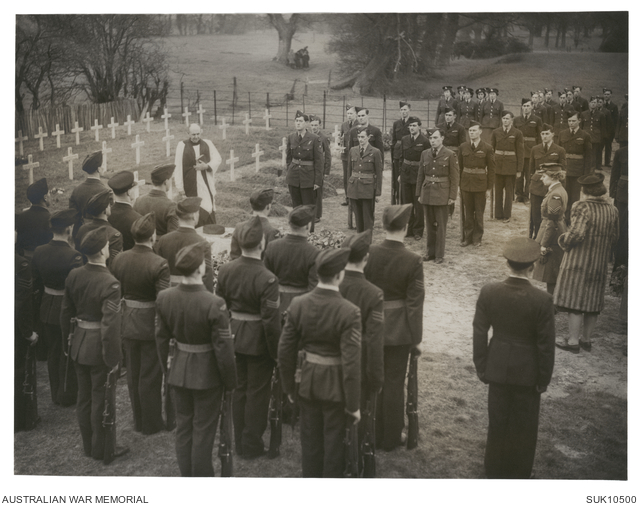
Middleton was buried with full military honours at St. Johns Church, Beck Row. Suffolk.*3

The aircraft experienced a number of attacks as they crossed occupied France, but Middleton, fighting for survival, kept reassuring the crew that he would get them home. Eventually, and against all the odds, they made the English coast, and once over land Middleton ordered the crew to bail out. Five crewmen left the stricken aircraft whilst the other two remained to help him control it. Turning for the Channel, Middleton ordered the two remaining crew members to bail out, whilst he stayed at the controls, steadying the aircraft.

By now the Stirling was very low on fuel and it finally gave up the fight and crashed at 03:00 on the morning of November 29th 1942. Middleton, too injured and too weak to escape the wreckage, drowned within the aircraft fuselage. His two crew members, Sgt. James Ernest Jeffrey (576050) age 19 and Wireless Operator Sgt. John William Mackie (994362) age 30, despite escaping, also drowned. Both the bodies of Sgt Mackie and Sgt. Jeffrey were washed ashore later that day on the 29th.

Middleton’s body remained in the aircraft, but was eventually freed from the wreckage by the action of the sea, and was washed ashore on Shakespeare Beach, Dover, in February 1943. His remains were taken to RAF Lakenheath and he was buried in St John’s churchyard, Beck Row, within sight of his airfield in Suffolk, with full military honours. Middleton was only 26 and only one mission away from ending his tour and returning home.

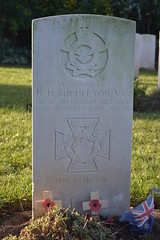
For his action, dedication and bravery, Flt. Sgt. Middleton was posthumously awarded the Victoria Cross, the first to any serving member of the R.A.A.F in World War II. He was also posthumously awarded a commission as Pilot Officer, backdated to mid November before his sortie to Turin. Thirty years later, in 1978, Middleton’s V.C. was presented to the Australian War Memorial, in Canberra for safe keeping and preservation.

For their actions, the other crew members received three DFMs and two DFCs. Fl.Sgt. Leslie Hyder (DFM) was injured, P.Officer. N. Skinner (DFC) was also injured, along with Sgt. H. W. Gough (DFM). F.O. G. R. Royde (DFC) and Sgt. D. Cameron (DFM) escaped unhurt.

The London Gazette published a report on 12th January 1943. It said:

“Fl. Sgt. Middleton was captain and first pilot of a Stirling aircraft detailed to attack the Fiat Works in Turin one night in November, 1942. Very difficult flying conditions, necessitating three low altitude flights to identify the target, led to excessive petrol consumption, leaving barely sufficient fuel for the return journey. Before the bombs could be released the aircraft was damaged by anti-aircraft fire and a splinter from a shell which burst in the cockpit wounded both the pilots and the wireless officer. Fl. Sgt. Middleton’s right eye was destroyed and the bone above it exposed. He became unconscious and the aircraft dived to 800 ft. before control was regained by the second pilot, who took the aircraft up to 1,500 ft. releasing the bombs, the aircraft meanwhile being hit many times by light flack. On recovering consciousness Fl. Sgt. Middleton again took the controls and expressed his intention of trying to make the English coast, so that his crew could leave the aircraft by parachute. After four hours the badly damaged aircraft reached the French coast and there was once more engaged and hit by anti-aircraft fire. After crossing the Channel Fl. Sgt. Middleton ordered the crew to abandon the aircraft. Five left safely, but the front gunner and the flight engineer remained to assist the pilot, and perished with him when the aircraft crashed into the sea”.

Funeral service for 402745 Flight Sergeant Rawdon Hume Middleton, the RAAF’s first VC winner. He was buried with full military honours in a country churchyard near his station. Air Vice Marshal H. N. Wrigley represented the High Commissioner for Australia (Mr S. M. Bruce) and the RAAF. The graveside service was conducted by Squadron Leader H. C. Thrush of Prospect, SA, RAAF Chaplain. (Australian War Memorial Public Domain)

Middleton’s citation read:

“Flight Sergeant Middleton was determined to attack the target regardless of the consequences and not to allow his crew to fall into enemy hands. While all the crew displayed heroism of a high order, the urge to do so came from Flight Sergeant Middleton, whose fortitude and strength of will made possible the completion of the mission. His devotion to duty in the face of overwhelming odds is unsurpassed in the annals of the Royal Air Force”.

In honour of Middleton’s bravery, Number 1 RAAF Recruit Training Unit at RAAF Base Wagga has renamed the club in his name, the “Middleton VC Club”, and he also appeared on one of the 1995 Australian 45c stamps. The dining hall located at the nearby (now American) base at RAF Mildenhall in Suffolk, has also been named in his honour.

St. John's Church Beck Row, Mildenhall Fl. Sgt. Rawdon Hume Middleton, VC (RAAF) 149 Sqn RAF, St. John’s Church, Beck Row, Suffolk.

Middleton was a brave and dedicated young man who gave his life to save those of his crew. Each and every one of them acted with the highest dedication, sadly for some, it cost them dearly.

Sources

*1 photo courtesy of Australian War Memorial, image 100641, Public domain.

*2 photo courtesy of Australian War Memorial, image P01019.003, Public domain.

*3 Photo courtesy of Australian War Memorial, Image SUK10501, Public domain

*4 Photo courtesy of Australian War Memorial, Image SUK10500, Public domain

Lt. Col. Leon Vance 489th BG – Medal of Honour

Leon vance.jpg

Leon Vance*

The story of Leon Vance is one of  the saddest stories to emerge from the Second World War. He was a young American, who through his bravery and dedication, saved the lives of his colleagues and prevented their heavily striken aircraft from crashing into populated areas of southern England. Following a mission over France, his was very severely injured, but miraculously fought on.

Leon Robert Vance, Jr. known as ‘Bob’ to his family and friends, was born in Enid, Oklahoma, on August 11th, 1916. He graduated from high school in 1933 after receiving many honours and being singled out as a high performing athlete. He went on, after University, to the prestigious Training College at West Point in 1935, staying until his graduation four years later in 1939. It was here, at West Point, he would meet and marry his wife Georgette Brown. He and Georgette would later have a daughter, after whom Vance would name his own aircraft ‘The Sharon D’.

Vance would become an aircrew instructor, and would have various postings around the United States. He became great friends with a Texan, Lieutenant Horace S. Carswell, with whom he would leave the Air Corps training program to fly combat missions in B-24 Liberators. They became great friends but would go on to fight in different theatres.

Prior to receiving his posting, Vance undertook training on Consolidated B-24s. Then, in October 1943, as a Lieutenant Colonel, he was posted to Europe with the newly formed 489th Bombardment Group (Heavy), as the Deputy Group Commander. One of the last groups to be assigned to the european theatre, they formed part of the 95th Combat Bombardment Wing (2nd Bomb Division),  Eighth Airforce, and were sent to RAF Halesworth (RAF Holton) designated Station 365 by the USAAF.

The group left their initial base at Wendover Field, Utah in April / May 1944 and their first mission would be that same month on May 30th, 1944, as part of a combined attack on communication sites, rail yards and airfields. A total of 364 B-24s were to attack the Luftwaffe bases at Oldenburg, Rotenburg and Zwischenahn, along with other targets of opportunity far to the north in the German homeland. With only 1 aircraft lost and 38 damaged, it was considered a success and a good start to the 489th’s campaign.

As the build up to Normandy developed, Vance and the 489th would be assigned to bombing targets in northern France in support of the Normandy invasion about to take place further to the south. An area the unit would concentrate on, prior to the Allied beach invasion on June 6th that year.

The day before D-day, the 489th would fly to Wimereaux, in the Pas-de-Calais region of northern France. This would be Leon Vance’s final mission.

B-24H Liberator of the 489thBG, RAF Halesworth*2

The group, (Mission 392),  consisted of 423 B-17s and 203 B-24s and were to hit German coastal defenses including: Le Havre, Caen, Boulogne and Cherbourg areas as precursors to the Normandy invasion. Some 127 P-47s and 245 P-51s would support the attacks. The 489th would assemble at 22,500 feet on the morning of June 5th, proceed to the south of Wimereaux and fly over dropping their payload then return to England. On the run in to the target, Vance was stationed behind the pilot and copilot.  The lead plane encountered a problem and bombs failed to jettison. Vance ordered a second run, and it was on this run that his plane, Missouri Sue, took several devastating hits.

Four of the crew members, including the pilot were killed and Vance himself was severely injured. His foot became lodged in the metal work behind the co-pilots seat. There were frantic calls over the intercom and the situation looked bad for those remaining on board. To further exacerbate the problems, one of the 500lb bombs had remained inside the bomb bay armed and in a deadly state, three of the four engines were disabled, and fuel spewed from ruptured lines inside the fuselage.

Losing height rapidly, the co-pilot put the aircraft into a dive to increase airspeed. The radio operator, placed a makeshift tourniquet around Vance’s leg, and the fourth engine was feathered.  They would then glide toward the English coast.

The aircraft was too damaged to control safely, so once over english soil, Vance ordered those who could, to bail out. He then turned the aircraft himself out to the English Channel to attempt a belly landing on the water. A dangerous operation in any aircraft, let alone one with an armed bomb and no power.

Still trapped by the remains of his foot, laying on the floor and using only aileron and elevators, he ensured the remaining crew left before the aircraft struck the sea. The impact caused the upper turret to collapse, effectively trapping Vance inside the cockpit. By sheer luck, an explosion occurred that threw Vance out of the sinking wreckage,  his foot now severed.  He remained in the sea searching for whom he believed to be the radio operator, until picked up by the RAF’s Air Sea Rescue units.

Vance was alive, but severely injured. He would spend a number of weeks, recuperating in hospital, writing home and gradually regaining his strength. Disappointed that his flying career was over, he looked forward to seeing his wife and young child once more. However, on a recuperation trip to London, Vance met a young boy, who innocently, and without thought, told him he wouldn’t miss his foot. The emotional, impact of this comment was devastating to Vance and he fell into depression. Then, news of his father’s death pushed him down even further.

Eventually, on July 26th, 1944 Vance was given the all clear to return home and he joined other wounded troops on-board a C-54, bound for the US. It was never to arrive there.

The aircraft disappeared somewhere between Iceland and Newfoundland. It has never been found nor has the body of Leon Vance or any of the others on board that day. Vance’s recommendations for the Medal of Honour came through in the following  January (4th), but at the request of his wife, was delayed until October 11th 1946, so his daughter could be presented the medal in her father’s name.

The citation for Leon Vance reads:

For conspicuous gallantry and intrepidity above and beyond the call of duty on 5 June 1944, when he led a Heavy Bombardment Group, in an attack against defended enemy coastal positions in the vicinity of Wimereaux, France. Approaching the target, his aircraft was hit repeatedly by antiaircraft fire which seriously crippled the ship, killed the pilot, and wounded several members of the crew, including Lt. Col. Vance, whose right foot was practically severed. In spite of his injury, and with 3 engines lost to the flak, he led his formation over the target, bombing it successfully. After applying a tourniquet to his leg with the aid of the radar operator, Lt. Col. Vance, realizing that the ship was approaching a stall altitude with the 1 remaining engine failing, struggled to a semi-upright position beside the copilot and took over control of the ship. Cutting the power and feathering the last engine he put the aircraft in glide sufficiently steep to maintain his airspeed. Gradually losing altitude, he at last reached the English coast, whereupon he ordered all members of the crew to bail out as he knew they would all safely make land. But he received a message over the interphone system which led him to believe 1 of the crew members was unable to jump due to injuries; so he made the decision to ditch the ship in the channel, thereby giving this man a chance for life. To add further to the danger of ditching the ship in his crippled condition, there was a 500-pound bomb hung up in the bomb bay. Unable to climb into the seat vacated by the copilot, since his foot, hanging on to his leg by a few tendons, had become lodged behind the copilot’s seat, he nevertheless made a successful ditching while lying on the floor using only aileron and elevators for control and the side window of the cockpit for visual reference. On coming to rest in the water the aircraft commenced to sink rapidly with Lt. Col. Vance pinned in the cockpit by the upper turret which had crashed in during the landing. As it was settling beneath the waves an explosion occurred which threw Lt. Col. Vance clear of the wreckage. After clinging to a piece of floating wreckage until he could muster enough strength to inflate his life vest he began searching for the crew member whom he believed to be aboard. Failing to find anyone he began swimming and was found approximately 50 minutes later by an Air-Sea Rescue craft. By his extraordinary flying skill and gallant leadership, despite his grave injury, Lt. Col. Vance led his formation to a successful bombing of the assigned target and returned the crew to a point where they could bail out with safety. His gallant and valorous decision to ditch the aircraft in order to give the crew member he believed to be aboard a chance for life exemplifies the highest traditions of the U.S. Armed Forces”*1

Leon Vance’s actions would be remembered. His local base in Oklahoma was renamed ‘Vance Air Force Base’ on July 9th, 1949. The gate at Tinker Air Force Base, Oklahoma was also later named after him on May 9th, 1997, and his name appears on the ‘Wall of the Missing’ at Madingley American War Cemetery in Cambridge, England.

IMG_2005

The Wall of the Missing, on Which Leon Vance’s Name Appears.

Leon Robert Vance, Jr. (August 11th, 1916 – July 26th, 1944)

For other personal tales, click here.

references

* Photo public domain ia Wikipedia

*1 “Medal of Honor recipients – World War II”.

*2 Photo Public Domain via Wikipedia.

They shall grow not old, as we that are left grow old: …

Originally posted on the anniversary of the publication of his poem, For the Fallen, 21st September 2014, Laurence Binyon’s poem has become synonymous with remembrance services across the country. This week is remembrance Weekend (and Veteran’s day in the United States) on which we remember the fallen: those who gave the greatest sacrifice, so we could live in peace.

I thought it appropriate to repost this during Thai special week so we know a little more about the poem and the history behind it.

‘Lest we forget’

“To all those who went before, (Robert) Laurence Binyon’s 1914 poem is widely used in remembrance services across the world. Laurence Binyon wrote his For the Fallen, with its Ode of Remembrance, while Binyon was visiting the cliffs of North Cornwall between Pentire Point and The Rumps.

Today, if you visit, there is a stone plaque at the spot to commemorate his poem, which reads: For the Fallen Composed on these cliffs 1914″. There is also a second plaque located on the beehive monument on the East Cliff above Portreath in central North Cornwall. There, you will find a plaque on a statue inscribed with the same words. Laurence Binyon’s poem, For the Fallen, was published in The Times newspaper, following heightened public sentiment due to the recent Battle of Marne (5-12 September 1914) on 21st September 1914, 100 years ago today. http://wp.me/P4xjD9-8u

For the Fallen

With proud thanksgiving, a mother for her children,
England mourns for her dead across the sea.
Flesh of her flesh they were, spirit of her spirit,
Fallen in the cause of the free.

Solemn the drums thrill: Death august and royal
Sings sorrow up into immortal spheres.
There is music in the midst of desolation
And a glory that shines upon our tears.

They went with songs to the battle, they were young,
Straight of limb, true of eye, steady and aglow.
They were staunch to the end against odds uncounted;
They fell with their faces to the foe.

They shall grow not old, as we that are left grow old:
Age shall not weary them, nor the years condemn.
At the going down of the sun and in the morning
We will remember them.

They mingle not with their laughing comrades again;
They sit no more at familiar tables of home;
They have no lot in our labour of the day-time;
They sleep beyond England’s foam.

But where our desires are and our hopes profound,
Felt as a well-spring that is hidden from sight,
To the innermost heart of their own land they are known
As the stars are known to the Night;

As the stars that shall be bright when we are dust,
Moving in marches upon the heavenly plain,
As the stars that are starry in the time of our darkness,
To the end, to the end, they remain.

(Published in The Times newspaper, 21st September 1914).

Thanks to Marcella who contributed to the writing of the original post.”

DSC_0097

 For the Fallen – Laurence Binyon (1869-1943)

In Honour of the 55,573 Young Men Who Never Returned

RAF Bomber Command – Green Park,

London

The Bomber Command memorial was erected in honour of the 55,573 crew members of the RAF Bomber Command who died during the Second World War. It stands as a reminder of the young men, whose average age was only 22, and who never returned to their beloved homes. It was unveiled by the Queen, on June 28th 2012, when a Lancaster bomber of the BBMF flew over dropping thousands of poppies.

RAF Bomber Command Memorial

RAF Bomber Command Memorial

The monument can be found in London adjacent to Green Park. It stands proudly watching over the grassed picnic area where picnickers, shoppers and tourists sit. The main part of the monument is a bronze sculpture consisting of seven members of a typical bomber command aircrew.

Perhaps not obviously noticed, some of the crew are looking to the sky, some with hands to shield from the morning sun, as if looking for missing friends. Others are looking downward, perhaps in despair or fear for those not yet home. The stance of the statues suggests a crew recently returned from a mission who have just disembarked from their damaged aircraft. Tired, bewildered and overwhelmed by what they have witnessed, they have been created in precise and superb detail.

The Pilot stands central and to the rear of the group; the navigator to the left, followed by the flight engineer, mid-upper gunner, bomb aimer, rear gunner and then the wireless operator to the right. Their faces reflecting the feelings and emotions that these young men felt. The base of the statues were ‘littered’ with photos of loved ones and messages from around the world. A moving tribute.

RAF Bomber Command Crest "Strike hard, Strike Sure"

RAF Bomber Command Crest “Strike Hard, Strike Sure”

Outside and on the walls of the memorial, are two crests; on the left, the RAF crest “Per Ardua ad Astra” meaning “Through adversity to the Stars“. The crest has its origins going back to August 1st 1918 and has been the symbol of the RAF ever since. On the right, is the crest of Bomber Command whose motto is “Strike Hard, Strike Sure“. Both beautifully carved into the undoubtedly beautiful Portland Stone.

A number of quotes, including one from Winston Churchill, “The Fighters are our salvation, but the bombers alone provide the means of victory” surround the memorial giving  it strength. A further quote, to the rear of the memorial reflects the losses of all nations, who on the ground, lost lives as a result of bombing campaigns on both sides – a reflection of reconciliation and peaceful times ahead.

The roof above the memorial is open. This allows you to see the figures against a backdrop of sky, whether at day or night, rather than the bustling city behind.  A view more representative of the times they lived and flew in.

The remainder of the roof is similar to the kriss cross design of the Vickers Wellington, one of the RAF’s bombers during World War II. The design is both eye-catching and unique, not only to the memorial but the Wellington from which it came.

The building of the memorial, which is truly a mix of emotion, international representation, and a build that reflects the lives of those affected by the war, is considered as closure for many; a symbol of what the young crews had to endure on long missions over occupied Europe. It also serves to act as a lesson to the those who were too young to know what the war meant to those who fought and died in it. It is A beautiful place to sit and give thanks to those 55,573 brave young men who never lived to experience peacetime again.

IMG_0426

RAF Bomber Command Memorial – Note the Roof Design.

The official Bomber Command Memorial website is here. An app is also available for a small fee that goes part way to supporting the maintenance of the memorial, it gives greater detail to the construction and design of the memorial, along with an audio script and stories from survivors of Bomber Command.

A history of the RAF Crest and its derivations can be found by clicking here.

By clicking here, you can see and hear some stories of those to whom the monument is honouring.

  “The Fighters are our salvation, but the bombers alone provide the means of victory

Winston Churchill, 1940

To see more memorials from airfields around the country please click here