In Trail 42 we continue our journey northward driving along the coastal route taken by the A1 road. The North Sea views here are simply breathtaking. Heading toward the seat of the Scottish Government and the beautiful and historic city of Edinburgh, we visit two more airfields with long and distinguished histories. One of these also has perhaps, one of the best collections of preserved buildings left on any wartime airfield outside of Duxford.
We start off just outside of Edinburgh heading eastward at an airfield that became synonymous with airfield lighting. The idea was simplistic, the effect wide-reaching. It was so successful, it became standard across many of Britain’s wartime airfields, it is of course RAF Drem.
RAF Drem
Drem is often used when talking about airfield lighting systems, the lights used to illuminate perimeter tracks, runways and landing patterns during the Second World War. But as an airfield, it played a much bigger part in the war, hosting some 47 RAF squadrons, a selection of Fleet Air Arm units and various Technical and Developmental Flights at some stage during its wartime life.
Many of these units were here on short detachments or rotations, whilst not conducive to long-term development of the site, it did bring a wide variety of aircraft to this small airfield in Scotland: Hurricanes, Spitfires, Whirlwinds, Mosquitoes, Defiants, Beaufighters, Typhoons and Tempests to name but a few. It also brought a multitude of nationalities with it: French Czechoslovakian, Polish, Canadian, Australian and New Zealand airmen all used the airfield at some point.
Located in East Lothian, Drem has a history that started in the early stages of World War I. Used by 77 Sqn, who were based at nearby Edinburgh, it was then called West Fenton, a name it retained until 1919 when it was renamed Gullane. 77 Sqn were responsible for the protection of the east coast of Scotland, and in particular the Firth of Forth in the Home Defence role. They used a number of landing grounds in this region including both Eccles Toft (Charterhall) and Horndean (Winfield); and had detachments spread widely around the Edinburgh region: Turnhouse, New Haggerston, Whiteburn and Penston.
77 Squadron flew a number of BE Types in this role, a role that continued up to 13th June 1919 when the squadron was disbanded. Also in 1919, (21st February) cadres from both 151 and 152 squadrons were also based here, staying until September and June respectively, when they too were disbanded following the end of the war.
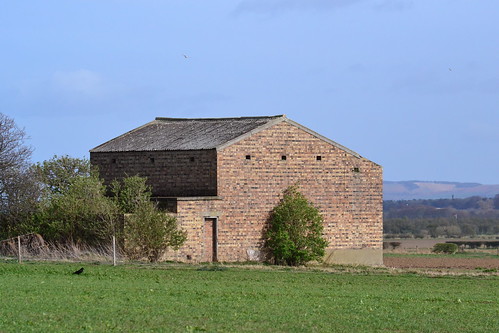
The Stand-by Set house, an auxiliary power station, still remains in good condition today.
A year before the end of the conflict, No. 2 Training Depot Station was formed here flying types such as the Bristol Scout, Sopwith’s Pup and Camel, the S.E.5a, Avro’s 504, and the Royal Aircraft Factory F.2B. A short role, they too were disbanded at the end of 1919, thus bringing the end of flying to Gullane.
In the interwar years Gullane, although only a temporary facility, was renamed Trenent, and it remained in this guise for a further six years becoming a full-time facility in 1939. In two years time, it would undergo fighter name changes finally taking on the name it has today, that of RAF Drem.
It was on 17th March 1939 that Drem returned to the flying training role with No. 13 Flying Training School (FTS) being formed here, operating a number of aircraft types including, Avro’s Anson, and Hawker’s Audax and Harts. After being renamed 13 Service Flying Training School (SFTS) in September that year, it would only last a month before being disbanded and absorbed into No. 8, 14 and 15 (SFTS). But it was at this point that Drem’s potential as a fighter airfield would be realised and its first operational unit would move in. Drem had finally reached maturity and its war would very soon begin.
Transferred to Fighter Command at the end of October 1939, a number of operational units would quickly arrive: 602 (13/10/39-14/4/40), 609 (17/10/39-3/6/42) and detachments from 607 Sqn (10/10/39) and 72 Sqn (17/10/39) would all precede 111 Sqn (7/12/39-27/2/40) in these early days.
It was during this time, in the early stages of the ‘phoney war,’ that Drem aircrews would have their first and perhaps their most significant aircraft intercept.
On 16th October 1939, Heinkel He 111 ‘1H+JA’, of Stabskette/KG26 piloted by Kurt Lehmkuhl was spotted en-route to the Firth of Forth. Immediately, aircraft from Drem’s 602 Sqn and Turnhouse’s 603 Sqn, were ordered to take off and intercept the aircraft. Whilst the Heinkel tried desperately to avoid the Spitfires, their deadly firepower proved too much, and the aircraft was eventually brought down at Kidlaw Hill. This Heinkel became known affectionately as the ‘Humbie Heinkel‘ due to its close proximity to the village of Humbie. The air-frame rapidly became a tourist attraction, locals would climb up into the hills to see the intact bomber as it lay helpless amongst the Scottish heather. The aircraft lay just a few miles short of where an Airspeed Oxford (N4592) had crashed just two days earlier killing both its young corporals: Basil F. Evans (23) and Charles M. Thorpe (22). The hills around Edinburgh were fast becoming a graveyard!
As a result of the Heinkel attack, the two gunners Cpl. Bruno Reimann and Sgt. Gottleb Kowalke were both killed (both are buried at the German Military Cemetery at Cannock Chase), the pilot was injured, but the navigator remained unharmed. Both the navigator and pilot surrendered to a local Policeman who was first at the scene of the crash*1. This shooting down was particularly notable as it was the first German aircraft to be brought down on British soil and the victory was claimed by Drem’s 602 Squadron pilot, Flt. Lt. Archie McKellar. McKellar’s jubilation would be short-lived though, being shot down and killed himself one year later and within days of the official ending of the Battle of Britain – his name would never appear in the Battle’s roll of Honour.

Perhaps one of the most iconic photos of the war, The ‘Humbie Heinkel’ lies on a Scottish hillside surrounded by onlookers, the first German aircraft to be shot down on British Soil.*2
Drem had now entered the war and whilst it was a ‘front line station’ its buildings would never be more than temporary. Crew numbers would reach 1,807 RAF air and ground crew along with a further 374 WAAFs. The runways (1 x 1850 yds extended to 2,300 yds and 2 of 1,400 yds) would remain grass and a number of hangers (15 in all) would include 3 Bellmans. Seven hardstands were built all suitable for single engined aircraft with the technical and main accommodation sites located to the north-east.
However, these early stages of the war were not all smooth running. In December 1939 tragedy struck when a combination of errors led to a number of 602 Squadron Spitfires inadvertently attacking a flight of Hampdens of 44 Squadron. During the confusion, in which it is thought the Hampdens failed to identify themselves correctly as ‘friendly’, two were shot down: Hampden I L4089 and Hampden I L4090. In the second aircraft Leading Aircraftman T. Gibbin was killed by the Spitfire’s bullets, as the two aircraft crashed into the cold waters of the North Sea. The remaining seven were all picked up by trawlers and taken safely to shore. In a moment of dark humour the next day, the remaining Hampdens departed Drem, dropping hundreds of toilet rolls over the squadron huts!
The winter of 1940 saw a short stay by 43 Sqn, arriving mid December and then departing at the end of February, possible one of the less appreciated stays knowing the inclement Scottish weather.

RAF crews of 43 Squadron sit around their dispersal hut stove at Drem. (IWM)
The early months of 1940 saw a royal visit to Drem, when on 28th February 1940, King George VI visited, escorted by none other than Air Marshall Dowding. Whilst here, the King awarded Sqn. Ldr. Douglas Farquhar with the DFC after he had brought down another HE 111 that was able to be repaired at Drem and subsequently flown to a base in England for evaluation.
The subsequent months would prove to be very hectic for Drem. Like other airfields in the north, Drem was to become a home and solace for battle weary crews moved from 11 Group in the southern regions of Britain. To keep up their skills, they would fly both coastal patrols and convoy escort missions, a far cry from the hectic and turbulent skies of Kent and the south coast.
This rotation of units through Drem would continue throughout the war, most squadrons remaining for short periods of only a month or two, and many ‘leap-frogging’ between here and other stations. One of these units included, in 1940, 29 Sqn (RAF) a night fighter unit that excelled and became perhaps one of the most successful night fighter Squadrons of the Second World War.
With these short stays, came a variety of nationalities, including two Polish units (307 and 309); a French (340); two Canadian (409 and 410); an Australian (453) and three New Zealand squadrons (485, 486 and 488), each bringing their own touch of life to Drem.
With them also came night fighter training, and it was with one of these units 410 Sqn (RCAF) – who had only been formed a month earlier on 30th June 1941 – that Pilot, Sergeant Denis W. Hall, (s/n 1168705) and Gunner, Flight Sergeant Denis G. Cresswell (s/n 751880) would lose their lives, when their Defiant N1731 crashed into a hillside near to the village of Gifford in East Lothian, whilst on a night training flight. Their military service at Drem had lasted a mere twenty-four days.
It was just prior to this, during 1940, that the Drem Lighting system was developed. Born out a necessity to solve issues around the Spitfire’s poor visibility when landing, the station Commander, Wing Commander “Batchy” Atcherly, personally addressed the issue. The problem was that Spitfires needed to keep their noses up in a relatively high angle of attack in order to maintain slow landing speeds, a configuration that meant the pilot could not see directly in front of him. Atcherly devised a plan using lights, whereby the pilots would be able to maintain this high angle and still be able to see where they were supposed to be going. He also had to overcome the added problem that lighting illuminated an airfield and thus attracted enemy aircraft over the site.
So he developed his idea, a bright lighting system that was mounted in such a way that only aircraft in the landing pattern and flight path could see the lights, yet they were dim enough and shrouded well enough, to be hidden from those not directly in the landing circuit. Essentially, the idea involved mounting covered lights on poles 10 feet high at designated points around the airfield indicating the landing pattern. If enemy aircraft were to approach, they would not be able to see the field and home based aircraft could land in relative safety. In an emergency, the entire system could be dimmed or even shut down, something that didn’t, as a rule, need doing.
The system was so successful that it was adopted by the RAF and used widely across other RAF airfields. Remnants of this system are scare today, but some can be found with careful scouring of the ground where runways were once laid.
During the latter half of 1940, Drem would be the place where the remains of the beleaguered 263 squadron would reform and recuperate. Formed in 1939, 263 would go on to serve in Norway with Gloster Gladiators, and after many problems, would bring their aircraft home during the Allied evacuation of Narvik. Unable to fly the great distance from Norway, the aircraft were loaded onto the carrier HMS Glorious for the trip home. It was during this trip that the Glorious met two of the German’s deadliest warships, the Scharnhorst and Gneisenau, who simply outgunned the carrier and on June 8th 1940, sank the Glorious with all the aircraft, many of its pilots and its commanding officer, on board.
The surviving fourteen pilots returned to Drem, where they were given Hurricanes. Gradually new pilots arrived and the squadron was returned to full strength. In July, after a short spell at Grangemouth, 263 Sqn returned to Drem with Whirlwinds replacing the Hurricanes.
Dogged by problems, the Whirlwinds were not to be the master of the air they had designed to be. 263 Sqn also brought a new idea they had successfully used in Norway, that of log-lined dispersals. Sadly they were too far away from the crew huts and apart from a photo opportunity, they were never used.
Slowly the war progressed, units came and went. Being near to the coast, Drem was regularly used for detachments of Air Sea Rescue Squadrons including 278 Squadron whose parent base was at Coltishall several hundred miles south in Norfolk!
In the mid 1940s Drem’s focus narrowed not only in to the night fighter role, but also airborne radar investigations. The Radar Development Flight were formed here in December 1942 operating Defiant IIs and Beaufighter VIs. For six months they would fly these aircraft evaluating new radar designs and new methods in aircraft interception. They carried on this role through several name changes including: 1692 (Radio Development) Flight and then 1692 (Bomber Support Training Flight) after it had left Drem for Norfolk.
As the war drew to a close, the Royal Navy strengthened its involvement with Drem, renaming it HMS Nighthawk on May 3rd, 1945. The Royal Navy had a keen interest in night fighter training and used the skills of the RAF to aid its own programmes of night flying training.
Whilst RAF involvement had all but wound down, one final important act was to occur at Drem. Just as Drem aircraft had taken part in the first downing of a Luftwaffe aircraft at the start of the war, it was another Drem unit, 603 squadron, who would take part in the ending of the war. 603 Sqn Spitfires were tasked on May 11th 1945, just four days after returning to Drem, with escorting three white Junkers JU 52s that were carrying a number of German High Command officers into Drem as part of the official surrender of the Norwegian delegation. As part of this agreement, the senior officers would provide not only detailed information on the locations of mines laid out in the Norwegian waters: but the locations of all military shipping; lists of all stocks of oil; petrol and coal; coastal batteries and their associated supplies and all matters concerning German naval activity – including the surrender of the entire U-boat fleet.

The German High Command in front of their white JU52. Left to right: (from doorway) Lieutenant Albens; Captain Loewisch; Captain Kruger; and on extreme left, Commander Mundy Cox, RN, C/O of the Royal Naval Air Station. (IWM)
Throughout the war, the Fleet Air Arm (FAA) had a number of units use Drem themselves: 732, 770, 784, 884, 892 and both 1791 and 1792 squadrons were all based here along with detachments from three other FAA units. This brought a new breed of aircraft including the Seafire, Hellcat and Firefly to Scotland’s skies.
After the war ended the Royal Navy’s Night Fighter Training School pulled out, the RAF returned but never really used it for more than glider training, and eventually Drem was closed in September 1947. Its closure had been swift and its decline even faster.
Much of Drem today is agriculture. The airfield is split into two parts, divided by the B1345 road. To the west is the former airfield, a grass site with a virtually intact perimeter track. Along this track (now a farm road) are the various dispersals used during Drem’s wartime life. To the south is a Type B Fighter Pen, distinguished from Type ‘E’s by their cranked walls, greater in size, they provided greater protection to aircraft than the ‘E’.
The technical site sits to the north-east of the airfield, now a small industrial site it still contains many of the original buildings used by Drem’s personnel. Some of these have been refurbished whilst others contain many original features. Back along the road, the Stand-by Set house still stands and what remains of the accommodation site sits across the other side of this dividing road.
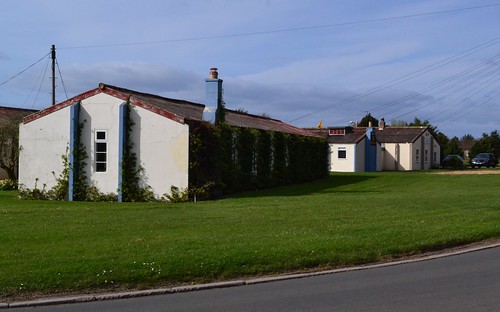
Part of the Accommodation site still stands in use by small industrial and retail units. A small display of information about Drem is also located on this site.
Inside one of these buildings, the Arts & Crafts Gallery, now Fenton Barns Retail Village which is the former WAAF dining hall, is a small display providing information about Drem and its wartime operations, with free entry it is an interesting stop off if you have time.
RAF Drem had a long and chequered history. For such a small airfield, it played a major part in the war: bringing down the first Luftwaffe bomber on British soil, being involved in the sad situation of friendly fire, and having a Royal visit. It provided solace for many weary crews, helped develop night fighter interception tactics and methods, and was used by the Royal Navy. It saw many nationalities pass through its doors, along with a wide range of aircraft types. Drem gave its name to a remarkable system of lighting that revolutionised airfield lighting both during the war and for aviation today. It certainly should have a place in today’s history books, it truly deserves it!
After we leave Drem, we travel a few miles south-east to a former satellite airfield of Drem. To an airfield that became a player in its own right, and has since been developed into perhaps Scotland’s biggest Aviation Museum it is certainly one of the best preserved airfields around. We go to the former airfield at RAF East Fortune.
Sources and further reading:
*1 A report of the crash appeared 75 years later in The Berwickshire News.
*2 © National Archives of Scotland. http://www.scotlandsimages.com


 Aviation Trails